Article

Sequential H2 Adsorption on the Aromatic Li6 Superatom: Field-Activated Physisorption and Thermodynamic Limits


by
Karen Ochoa Lara
1,
Jancarlo Gomez-Vega
2,
Rafael Pacheco-Contreras
3 and
Octavio Juárez-Sánchez
4,*
1
Departamento de Investigación en Polímeros y Materiales, Universidad de Sonora, Rosales y Encinas s/n, Col. Centro, Hermosillo CP 83000, Sonora, Mexico
2
Departamento de Ciencias Químico-Biológicas, Universidad de Sonora, Rosales y Encinas s/n, Col. Centro, Hermosillo CP 83000, Sonora, Mexico
3
Departamento de Física, Matemáticas e Ingeniería, Universidad de Sonora, Campus Navojoa, Lázaro Cárdenas del Río No. 100, Navojoa CP 85880, Sonora, Mexico
4
Departamento de Investigación en Física, Universidad de Sonora, Blvd. Luis Encinas y Rosales, Col. Centro, Hermosillo CP 83000, Sonora, Mexico
*
Author to whom correspondence should be addressed.
Computation 2026, 14(4), 94; https://doi.org/10.3390/computation14040094
Submission received: 1 March 2026 / Revised: 22 March 2026 / Accepted: 4 April 2026 / Published: 17 April 2026
(This article belongs to the Special Issue Feature Papers in Computational Chemistry)

Abstract

Understanding the intrinsic Li–H2 interaction, decoupled from substrate effects, is essential to rationalize the performance of lithium-decorated hydrogen storage materials. To address the current lack of a clean theoretical baseline, we characterized the sequential H2 adsorption on the gas-phase Li6 superatomic cluster using high-level density functional theory (DFT), complemented by Energy Decomposition Analysis (EDA), QTAIM, and NICS(0) calculations. Li6 acts as a structurally rigid platform (RMSD < 0.032 Å) where ligand-induced polarization progressively strengthens its σ-aromaticity (NICS(0) from −2.917 to −13.98 ppm) and increases the HOMO–LUMO gap up to 5.05 eV. EDA identifies the binding as field-activated physisorption, electrostatically dominated (65–67%) and mechanistically distinct from Kubas coordination, as confirmed by QTAIM closed-shell interaction parameters. Negative cooperativity governs an effective loading capacity of n = 2 molecules under cryogenic conditions (Teq = 143.76 and 114.64 K), while an entropic bottleneck renders higher loading non-spontaneous at all temperatures. These results establish Li6(H2)n as a foundational gas-phase reference, providing a systematic, contamination-free descriptor set for the intrinsic Li–H2 interaction. This framework is essential for isolating the electronic role of the lithium superatom and unambiguously identifying substrate-induced modulations in supported hydrogen storage materials.

Graphical Abstract

1. Introduction

Hydrogen storage in lithium-decorated nanostructured materials is a promising strategy for the sustainable energy economy [1,2,3]. The Li–H2 interaction governs the thermodynamic performance of these systems. Lithium has been widely used as a dopant in substrates such as graphene, borophene, B2S monolayers, and corannulene [4,5,6,7]. However, existing computational studies analyze lithium clusters on complex surfaces or decorated molecular frameworks [8,9,10], which introduce substrate effects (electronic charge transfer to/from the support), morphological changes (symmetry breaking and coordination geometry changes), and confinement-related effects that prevent unambiguous attribution of the Li–H2 interaction descriptors to the cluster itself. In supported systems, it is impossible to determine a priori whether the adsorption enthalpy or the charge distribution reflects intrinsic Li–H2 chemistry or artifacts of the substrate environment. A clean gas-phase theoretical reference on an isolated, electronically well-characterized cluster is therefore not merely convenient, but methodologically necessary [4,5,11], to decouple these contributions and establish transferable descriptors. Any deviation observed in supported systems can then be unambiguously attributed to substrate-specific modulation rather than to the intrinsic superatom chemistry. The Li6 cluster is the ideal candidate for this purpose. It possesses a closed electronic shell, octahedral symmetry, and aromatic superatom character. Furthermore, Li6 units have been shown to retain stabilizing aromatic motifs in assembled hydrogen storage materials [9,11,12,13,14,15].
While hydrogen adsorption on alkali-decorated systems has been extensively reported, existing studies often conflate the intrinsic chemistry of the lithium cluster with artifacts arising from the support, such as substrate-to-cluster charge transfer or confinement-induced distortions [16]. A systematic, gas-phase study at a high level of theory is therefore a methodological necessity to establish the clean limits of Li–H2 coordination. By decoupling these effects, this work provides the intrinsic descriptors required to rationalize the performance of complex decorated materials. This work addresses that gap using density functional theory (DFT) at the ωB97X-D4rev/def2-TZVPPD level with ωB97X-2 single-point refinement. We evaluated sequential adsorption in the gas-phase Li6(H2)n system (n = 1–4) through a multivariate characterization aimed at answering four fundamental questions: structural stability, electronic identity, interaction mechanism, and thermodynamic limits. This approach separates intrinsic electronic effects from thermodynamic constraints and establishes a clean theoretical reference for isolating Li–H2 chemistry from substrate effects in the design of lithium-decorated hydrogen storage materials.

2. Materials and Methods

2.1. Software

We performed all electronic structure calculations using the ORCA 6.1 package (Max Planck Institute for Chemical Energy Conversion, Mülheim an der Ruhr, Germany) [17,18,19,20,21] with tight convergence criteria (TightOpt and TightSCF) and a high-density integration grid (DefGrid3), including the NICS(0) indices and the Energy Decomposition Analysis (EDA) within the Ziegler–Rauk scheme. We carried out all wavefunction analyses with Multiwfn 3.8 (Beijing Tamaoqian Technology Co., Ltd., Beijing, China) [22], including the Molecular Electrostatic Potential (MESP) and the Quantum Theory of Atoms in Molecules (QTAIM) topological analysis with bond critical point (BCP) parameters. We developed in-house Python 3.12 (Python Software Foundation, Wilmington, DE, USA) [23] scripts for the systematic placement of H2 molecules on the Li6 cluster and for RMSD calculation using the Kabsch algorithm with atomic permutation [24]. We visualized molecular structures, isomers, MESP maps, and molecular orbitals with Jmol 14.32.83 (Jmol Development Team, Northfield, MN, USA) [25], and generated thermodynamic plots with Gnuplot 6.0 (Gnuplot Development Team, online resource) [26].

2.2. Level of Theory

We performed geometry optimizations and vibrational frequency analyses using the range-separated hybrid functional ωB97X-D4rev [27,28]. This functional belongs to the fourth rung of Jacob’s Ladder and incorporates long-range corrections and fourth-generation dispersion (D4), both critical for describing physisorption in lithium clusters. We combined it with the triple-zeta basis set def2–TZVPPD [29,30], whose diffuse functions (PD suffix) are required to capture the polarizability of H2 molecules under the superatom electric field and to describe the interstitial electron density at Non-Nuclear Attractors (NNAs). This level of theory overcomes the known limitations of pure GGA functionals such as PBE, which inadequately describe van der Waals forces and suffer from self-interaction errors. The single-reference character of the systems was verified via CCSD(T) calculations, yielding T1 diagnostic values below 0.011 for both the bare cluster and the representative Li6(H2)1 complex.
To achieve chemical accuracy, we refined electronic energies via single-point calculations using the double-hybrid functional ωB97X-2-D3BJ [31,32,33], which belongs to the fifth rung of Jacob’s Ladder and incorporates an MP2 correlation contribution. Its performance on the GMTKN55 benchmark database [34] yields a mean absolute error of ~0.5 kcal/mol for non-covalent interactions, surpassing canonical MP2 and approaching CCSD(T) quality at a fraction of the computational cost. This level of theory has been specifically validated for weakly bound complexes involving light metals and H2, where double-hybrid functionals with dispersion corrections consistently reproduce CCSD(T) interaction energies within ~0.3 kcal/mol [31,34]. This combination is therefore appropriate for the sequential adsorption energies in the −2 kcal/mol regime studied here, where basis set truncation errors are further controlled by the Counterpoise correction. We note that all reported vibrational frequencies are harmonic; the known overestimation of H–H stretching frequencies at this level (~6–7% relative to the experimental fundamental of 4161 cm−1) does not affect the relative trends in redshift across the series, which constitute the physically relevant quantity for mechanistic assignment. Raw energies and correction components are provided in Tables S3–S5.

2.3. Potential Energy Surface (PES) Sampling

We based the initial geometry of the Li6 cluster (neutral, singlet state) on literature-reported parameters [35]: D4h symmetry (compressed octahedral geometry, with four equatorial and two axial lithium atoms), with interatomic distances r(Li–Li)eq ≈ 2.98 Å and r(Li–Li)ax–eq ≈ 3.04 Å. To locate the low-lying isomers of the Li6(H2)n complexes (n = 1–4), we implemented an exhaustive search protocol using in-house Python scripts, generating over 200 initial structures through three complementary strategies: symmetry-adapted combinatorial sampling, stochastic sampling, and redundancy filtering.
Symmetry-adapted combinatorial sampling: We systematically placed H2 molecules at high-symmetry sites of the compressed octahedral (D4h) core: vertex (atop), edge-center (bridge), and face-center (hollow) positions. We generated all possible occupancy combinations for each coverage n.
Stochastic sampling: We randomly distributed H2 molecules at varying orientations and distances (2.0 to 5.0 Å) around the cluster to locate non-intuitive local minima.
Redundancy filtering: We screened all optimized structures through an RMSD analysis based on the Kabsch algorithm to discard redundant isomers.
We performed vibrational frequency calculations within the harmonic approximation to confirm the nature of the local minima and to derive thermodynamic corrections. Although we acknowledge that the harmonic approximation systematically overestimates H–H stretching frequencies by approximately 6–7% relative to experimental values, we found that the resulting redshifts (Δν) are consistent across the series and serve as a reliable descriptor for assigning the physisorption mechanism.

2.4. Energy Analysis

We construct the total adsorption energy (ΔEads,Total) additively from four contributions, each designed to isolate a distinct physical phenomenon. First, we obtain the zero-point energy correction as the difference between the ZPE of the complex and those of the isolated fragments:
ΔZPE = ZPEcomplex − ∑ZPEisolated,
while we correct the basis set superposition error (BSSE) using the Counterpoise method:
δCP = ∑(Efrag,dist − Efrag,ghost).
The interaction energy (Eint) quantifies the pure electronic attraction between fragments at the distorted geometry they adopt within the complex, excluding the cost of such distortion:
Eint = Ecomplex − (ELi6,dist + EnH2,dist).
We capture this geometric cost through the deformation energy (Edef), which represents the energetic penalty required to bring each fragment from its isolated equilibrium geometry to the geometry it adopts in the complex:
Edef = (ELi6,dist − ELi6,isolated) + (EnH2,dist − EnH2,isolated).
Finally, we integrate all four contributions into the total adsorption energy:
ΔEads,Total = Eint + Edef + δCP + ΔZPE.

2.5. Thermodynamic Analysis

We computed standard thermochemical properties within the Rigid Rotor-Harmonic Oscillator (RRHO) approximation at 298.15 K and 1 atm. We construct the internal energy of adsorption (ΔU) from four contributions:
ΔU = Eint + Edef + δCP + ΔZPE,
where Eint is the interaction energy between the cluster and the ligands, Edef is the geometric deformation energy of the fragments upon complexation, δCP is the Counterpoise BSSE correction, and ΔZPE is the zero-point energy difference. The internal energy of adsorption (ΔU) is numerically equivalent to ΔEads,Total defined in Equation (5), but is recast here within the thermodynamic state function formalism as the foundation for deriving ΔH, TΔS, and ΔG:
ΔH = ΔU + ΔnRT,
TΔS = T(Scomplex − ∑SisolatedFragments),
ΔG = ΔH − TΔS,
where Δn is the change in the number of gas-phase molecules (negative for adsorption), R is the universal gas constant, and T = 298.15 K. The TΔS term quantifies the loss of translational and rotational degrees of freedom of the H2 molecules upon binding, and ΔG determines the spontaneity of the process: positive values indicate non-spontaneous adsorption under the reference conditions.
To compare isomers and identify the global minimum (GM), we calculated the relative free energy and the corresponding Boltzmann population:
ΔΔG = ΔGisomer − ΔGGM,
Pi = (exp(−ΔGi/(RT))/∑j exp(−ΔGj/(RT)))100.
To decouple the contribution of each individual ligand and determine the saturation limits, we extended the analysis to sequential thermodynamic parameters (ΔXseq), where X represents any thermodynamic property. We calculated the sequential change upon adsorption of the n-th molecule as
ΔXseq(n) = ΔXcum(n) − ΔXcum(n − 1),
where ΔXcum denotes the cumulative value for the complex with n ligands. We modeled the temperature dependence of spontaneity using the Gibbs–Helmholtz equation, assuming ΔH and ΔS remain constant over the temperature range studied:
ΔG(T) = ΔHseq − TΔSseq.
From this relation, we defined the equilibrium (crossover) temperature Teq as the threshold at which the process transitions from endergonic to exergonic (ΔG = 0):
Teq = ΔHseq/ΔSseq.
This protocol allows us not only to identify the structural saturation ceiling of the system, but also to define the thermodynamic operational window (temperature and pressure) required for spontaneous loading of the superatom.

2.6. Topological, Magnetic, and Electronic Characterization

We quantified the geometric distortion of the Li6 cluster upon complexation through the RMSD of interatomic distances, computed using the Kabsch algorithm. We evaluated magnetic aromaticity via NICS(0) indices calculated at the geometric center of the cluster. In lithium superatoms, NICS(0) probes the magnetic response of the collective interstitial electron density generated by four Non-Nuclear Attractors (NNAs) located at the centers of four of the eight lateral triangular faces of the compressed octahedral D4h core (one NNA per unique symmetry-equivalent set of faces under D4h, positioned at the four faces sharing the equatorial plane). The geometric center of the cluster lies at the centroid of these four NNAs and constitutes a direct descriptor of the superatom shell stability, in contrast to planar organic systems where its interpretation differs substantially.
We performed all wavefunction analyses with Multiwfn using the electron density obtained at the ωB97X-D4rev/def2-TZVPPD level. We carried out three analyses. First, we performed QTAIM topological analysis, from which we extracted the bond critical points (BCPs) of the Li⋯H interactions, together with the electron density ρ(r) and its Laplacian ∇2ρ(r) at each BCP. Second, we performed Bader charge partitioning to obtain atomic charges and volumes. Third, we derived global reactivity descriptors (conceptual DFT, c–DFT) from the HOMO and LUMO orbital energies. We also computed Pearson correlation coefficients using an in-house Python script to quantify the linear relationships between energy components and structural descriptors of the system.

3. Results

3.1. Structural Stability and Superatom Identity

We identified the global minima (GM) through an exhaustive potential energy surface (PES) sampling of over 200 structures. As shown in Table S6, the Boltzmann populations for these GMs exceed 71% in all cases, reaching nearly 100% for the most stable complexes. Detailed energetic comparisons and geometries for all 20+ competitive isomers are available in Tables S1–S6 and Figure S1 of the Supplementary Material.
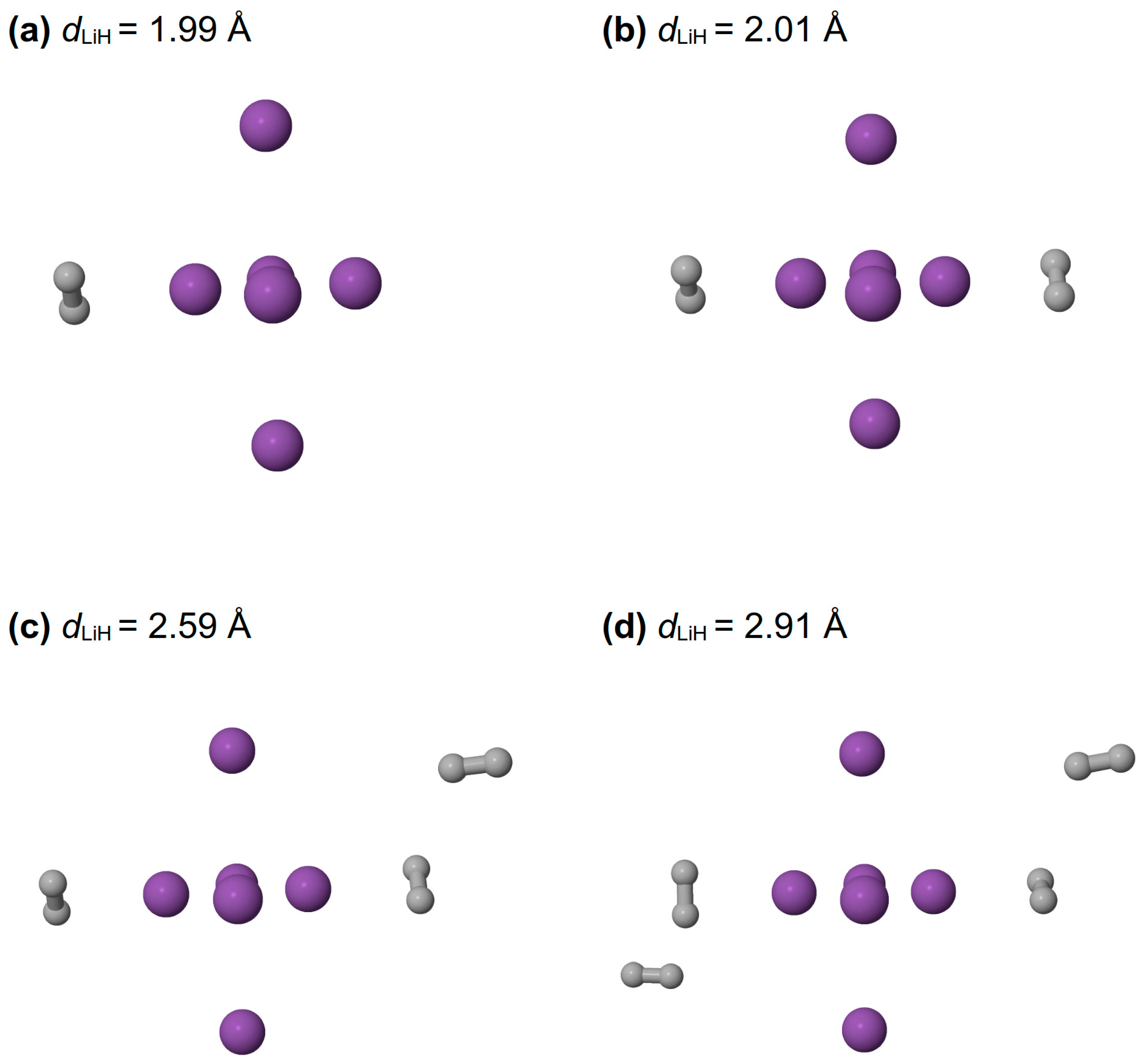
Across all complexes, the Li6 cluster (Figure 1) preserves D4h symmetry with minimal variations in Li–Li interatomic distances, reflected in RMSD values below 0.032 Å (Table 1 and Table S7). In contrast, higher-energy isomers exhibit more severe structural distortions (Table S7). We analyzed the redshift of the vibrational frequencies of the adsorbed H2 molecules (Table S9) and found that activated molecules reduce their stretching frequency to 4219 cm−1, compared to 4439.86 cm−1 for free H2 calculated at the same level of theory, corresponding to a shift of Δν ≈ −221 cm−1 for the most activated complex; the full series spans Δν = −183 to −221 cm−1 (Table 2).
The electronic identity of the superatom remains stable throughout the series, as confirmed by the minimal variation in the Non-Nuclear Attractor (NNA) properties and their correlation with the NICS indices (Table S15). The HOMO–LUMO gap increases from 4.60 eV in the bare cluster to 4.89–5.05 eV across the complexes (Table 1), indicating progressive electronic stabilization upon ligand loading. We confirmed the presence of four NNAs distributed across the lateral triangular faces of the compressed octahedral (D4h) core (Table S12), each carrying a negative charge of approximately −1.07 e and having volumes close to 212 Bohr3, an intrinsic feature of the superatom shell model. The NICS(0) indices range from −10.74 to −13.98 ppm across the global minima (Table 1 and Table S9), representing a substantial enhancement relative to the bare Li6 cluster (−2.917 ppm) and confirming that σ-aromaticity is progressively reinforced upon hydrogen coordination.
To quantify the structural determinants of adsorption stability across the series, we performed a Pearson correlation analysis to identify the physical variables governing the stability of the system (Table S14). We found a very strong positive correlation (r = 0.98) between the total adsorption energy (ΔEads,Total, defined in Section 2.4) and the mean Li–Li distance (rLi–Li), indicating that metallic core expansion is a necessary structural response to stabilize ligand loading. The electronic interaction energy (Eint) also shows a strong dependence on this core expansion (r = 0.95). We found a moderate inverse correlation (r = −0.69) between ΔEads,Total and the H–H bond distance (rH–H), indicating that greater H–H bond weakening corresponds to a stronger interaction with the superatom. The RMSD parameter shows a correlation of 0.48 with the total adsorption energy, confirming that structural distortions, although minimal, are coupled to the energetic stabilization of the system.

3.2. Thermodynamics and Saturation Limits

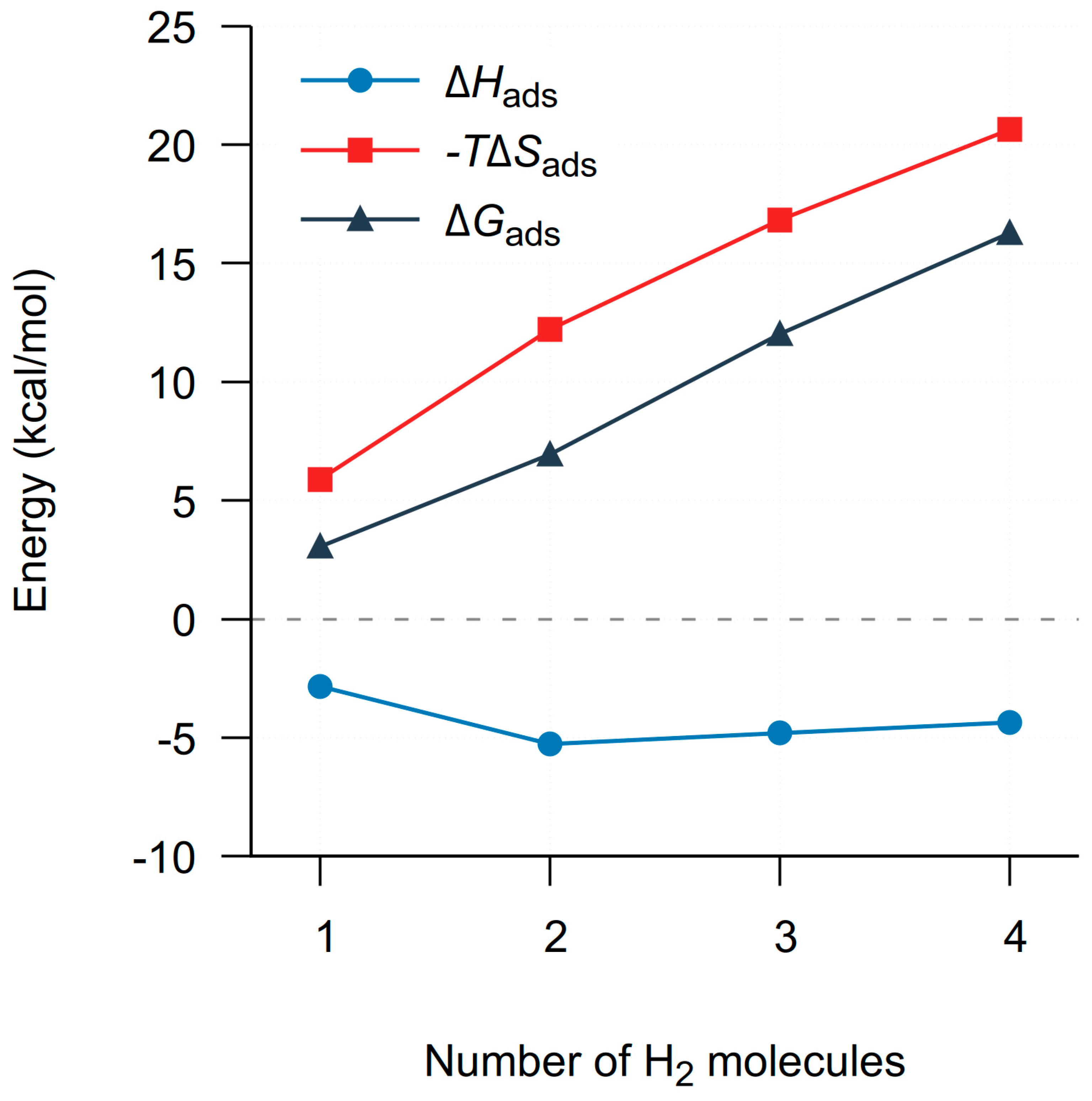
We report the cumulative enthalpy (ΔH), entropy (−TΔS), and Gibbs free energy (ΔG) contributions at 298.15 K for the Li6(H2)n series (n = 1–4) in Figure 2 and Table 2. In all cases, the entropic term outweighs the enthalpic stabilization, yielding positive ΔG values that increase monotonically along the series, ranging from 3.05 to 16.28 kcal/mol.
To decouple the contribution of each individual ligand, we analyzed the sequential thermodynamic parameters (ΔHseq, ΔSseq) and the equilibrium (crossover) temperature (Teq), detailed in Table 3. The first two adsorption steps are exothermic: ΔHseq = −2.84 kcal/mol (0 → 1) and −2.43 kcal/mol (1 → 2). From the third step onward (2 → 3), the process becomes endothermic (ΔHseq = +0.46 kcal/mol), marking the onset of saturation driven by electrostatic and steric repulsions.
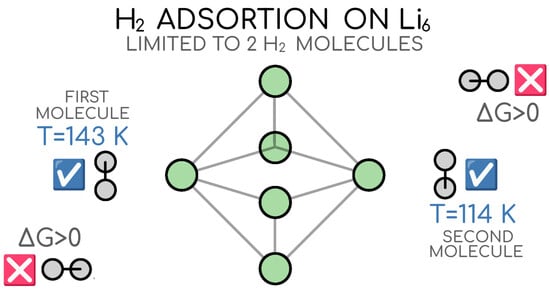
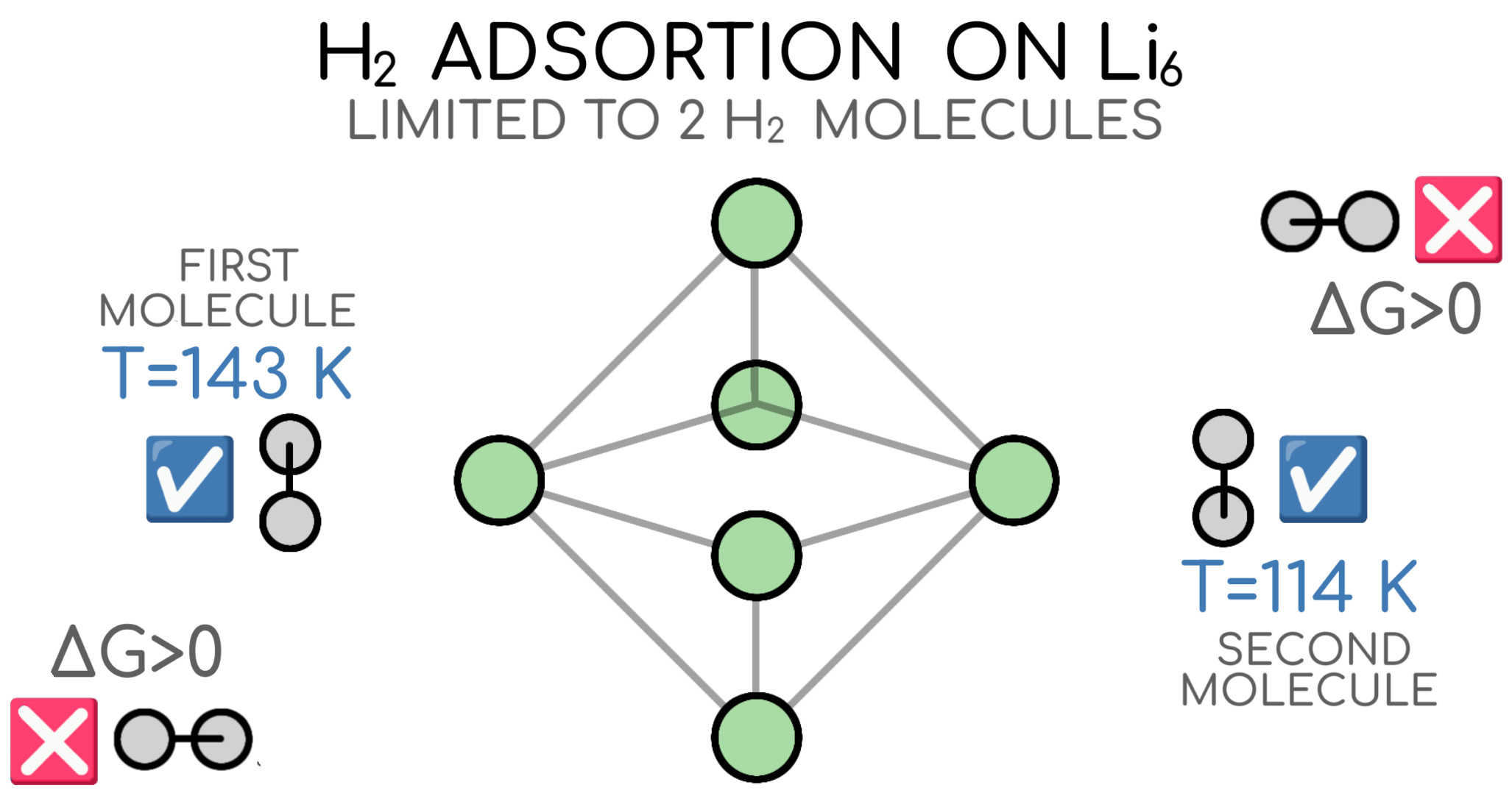
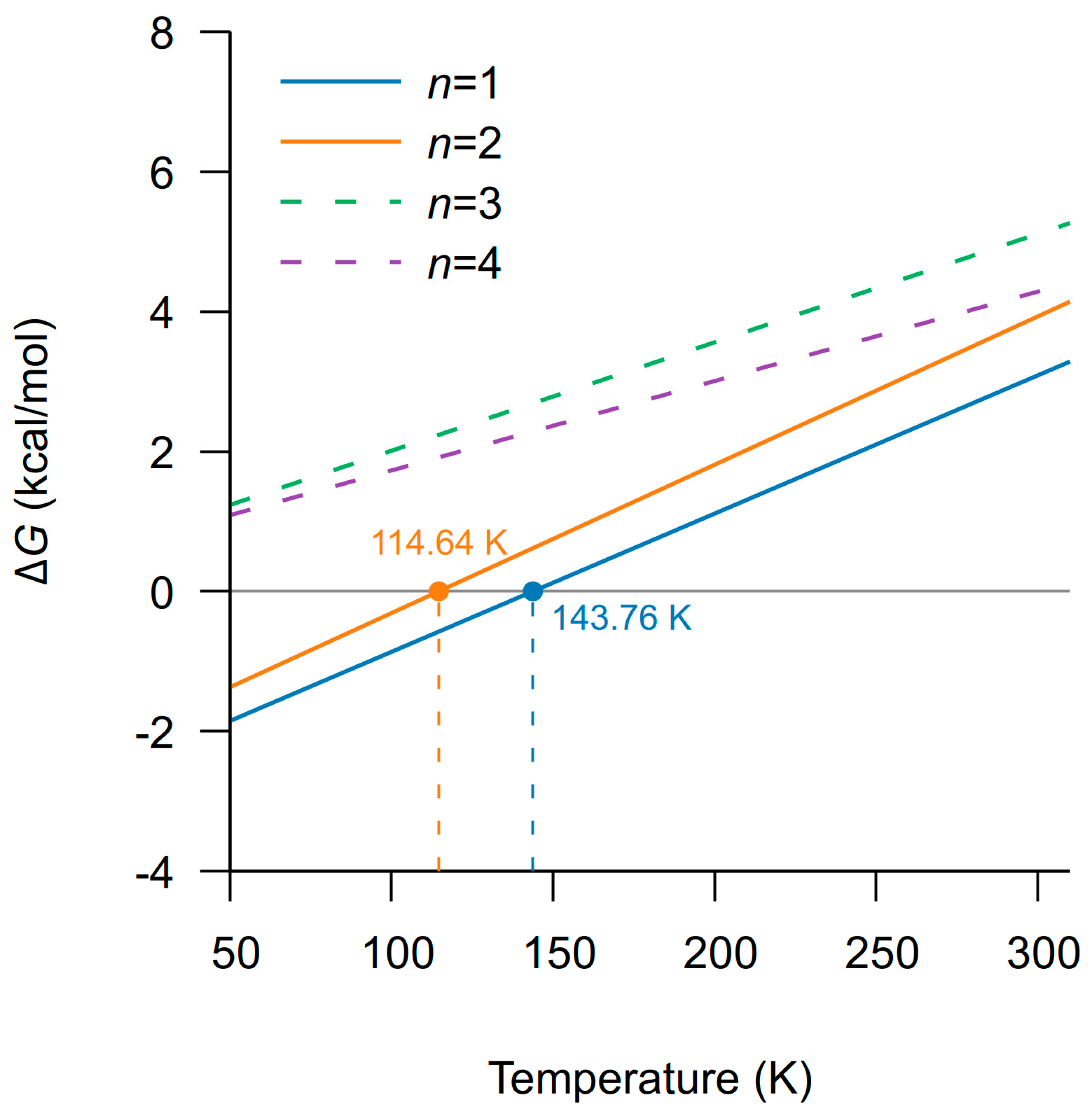
Figure 3 illustrates the temperature dependence of ΔG. Spontaneous adsorption (ΔG < 0) is only achievable under cryogenic conditions. We identified crossover temperatures of Teq = 143.76 K for the first step and Teq = 114.64 K for the second; below these thresholds, the system enters the spontaneous regime, as shown by the zero-crossings in Figure 3. Steps n = 3 and n = 4 exhibit no defined Teq and remain endergonic at all temperatures studied, due to the combination of an unfavorable adsorption enthalpy and a persistent entropic penalty. These results confirm that the effective thermodynamic loading capacity of Li6 is restricted to n = 2 molecules.

3.3. Nature of the Interaction: Field-Activated Physisorption

We analyzed the physical nature of the binding interaction using the Ziegler–Rauk EDA scheme (Table 4; complete data for all isomers in Table S10), in which the exchange–correlation term (EXC) is reported separately from the orbital term (Eorb), rather than being subsumed into it as in the classical formulation. For the n = 1 global minimum, the total interaction energy is Eint = −4.35 kcal/mol. The dominant attractive contribution is electrostatic (Eelstat = −9.34 kcal/mol), followed by the orbital term (Eorb = −4.03 kcal/mol), the exchange–correlation contribution (EXC = −3.91 kcal/mol), and dispersion (Edisp = −1.03 kcal/mol). Pauli repulsion contributes a destabilizing term of +13.96 kcal/mol. Across all complexes, the Eelstat/Eorb ratio exceeds 2.0, confirming the predominantly electrostatic character of the interaction. The preparation energy (Eprep) remains minimal throughout the series, ranging from 0.12 to 0.51 kcal/mol (Table 4), representing the minor energetic penalty required to deform the fragments and confirming the structural rigidity of the metallic platform. Note that ΔEads,Total (Equation (5)) incorporates thermal and basis set corrections that are not part of the standard Ebind reported in EDA schemes. This distinction is crucial to differentiate between purely electronic coordination and effective thermodynamic adsorption.
The QTAIM topological parameters at the bond critical points (BCPs) are presented in Table 5 (extended comparison in Table S11). The electron density ρ(r) at the Li⋯H interactions ranges from 0.0122 to 0.0131 a.u. The Laplacian ∇2ρ(r) is positive in all cases, with values between 0.0761 and 0.0827 a.u., characteristic of closed-shell interactions. For n = 3 and n = 4, we detected a slight increase in the electron density at the BCPs associated with H2 molecules in the first coordination sphere.

3.4. Electronic Characterization

We calculated Bader charges for all global minima (Table 6). The net charge transfer from the cluster to the H2 molecules is small but differentiated across all complexes. Activated molecules carry negative charges between −0.074 and −0.063 e, while spectator molecules show a significantly smaller charge transfer (−0.015 to −0.014 e).
We identified Non-Nuclear Attractors (NNAs) at the center of the octahedral void of Li6 (Tables S12 and S15). These NNAs concentrate a negative charge of approximately −1.07 e for n = 1, which decreases slightly to −1.04 e for n = 4. Their volumes range between 210 and 212 Bohr3 and remain virtually constant throughout the series. This simultaneous stability of the interstitial charge and the NNA volume confirms the closed-shell nature of the cluster and supports the superatom model.
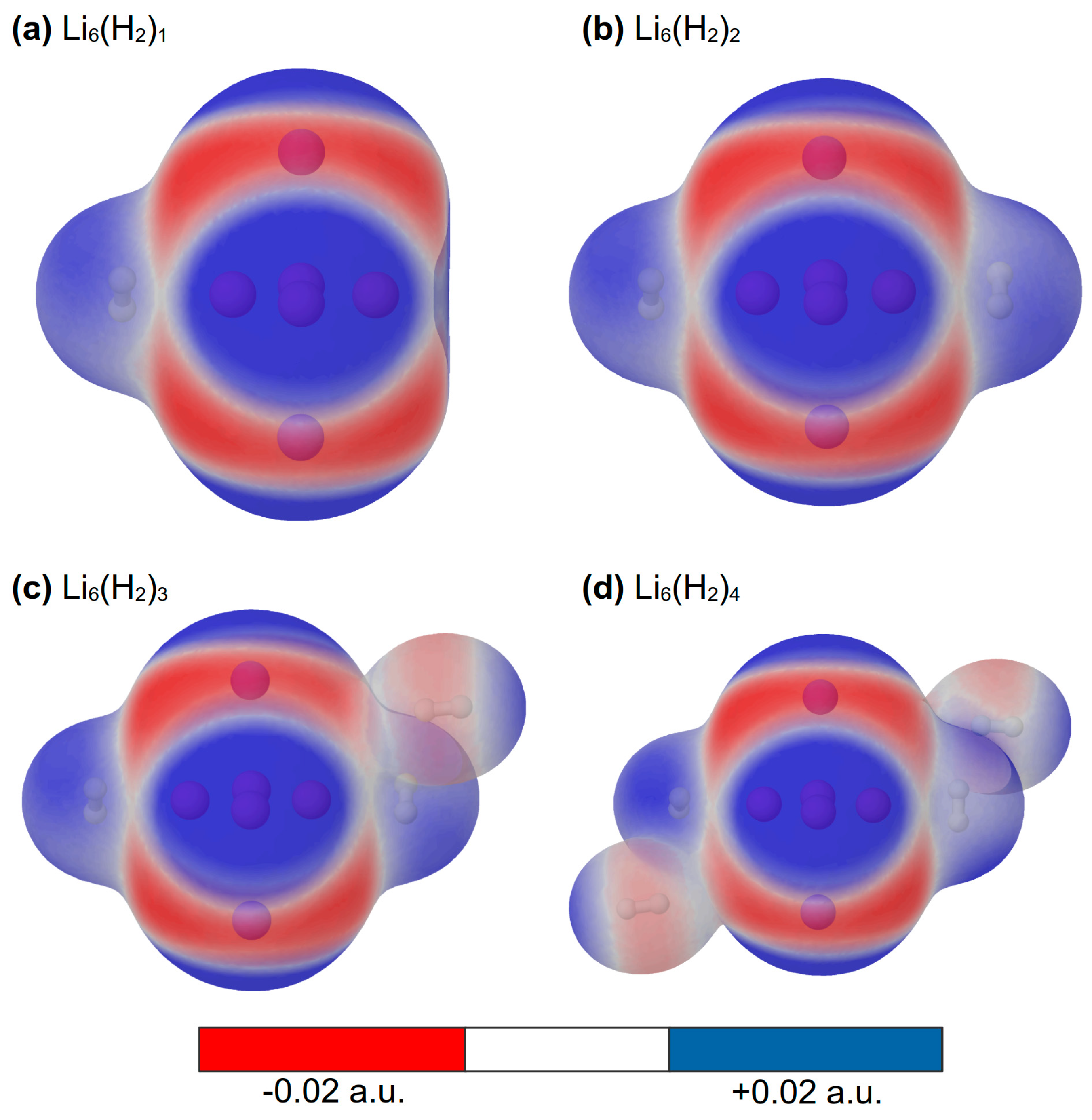
The Molecular Electrostatic Potential (MESP) maps corroborate this charge distribution (Figure 4). The lithium nuclei act as the predominant electrophilic regions of the system. We detected moderate inductive polarization of the H–H bond exclusively at the primary adsorption sites.
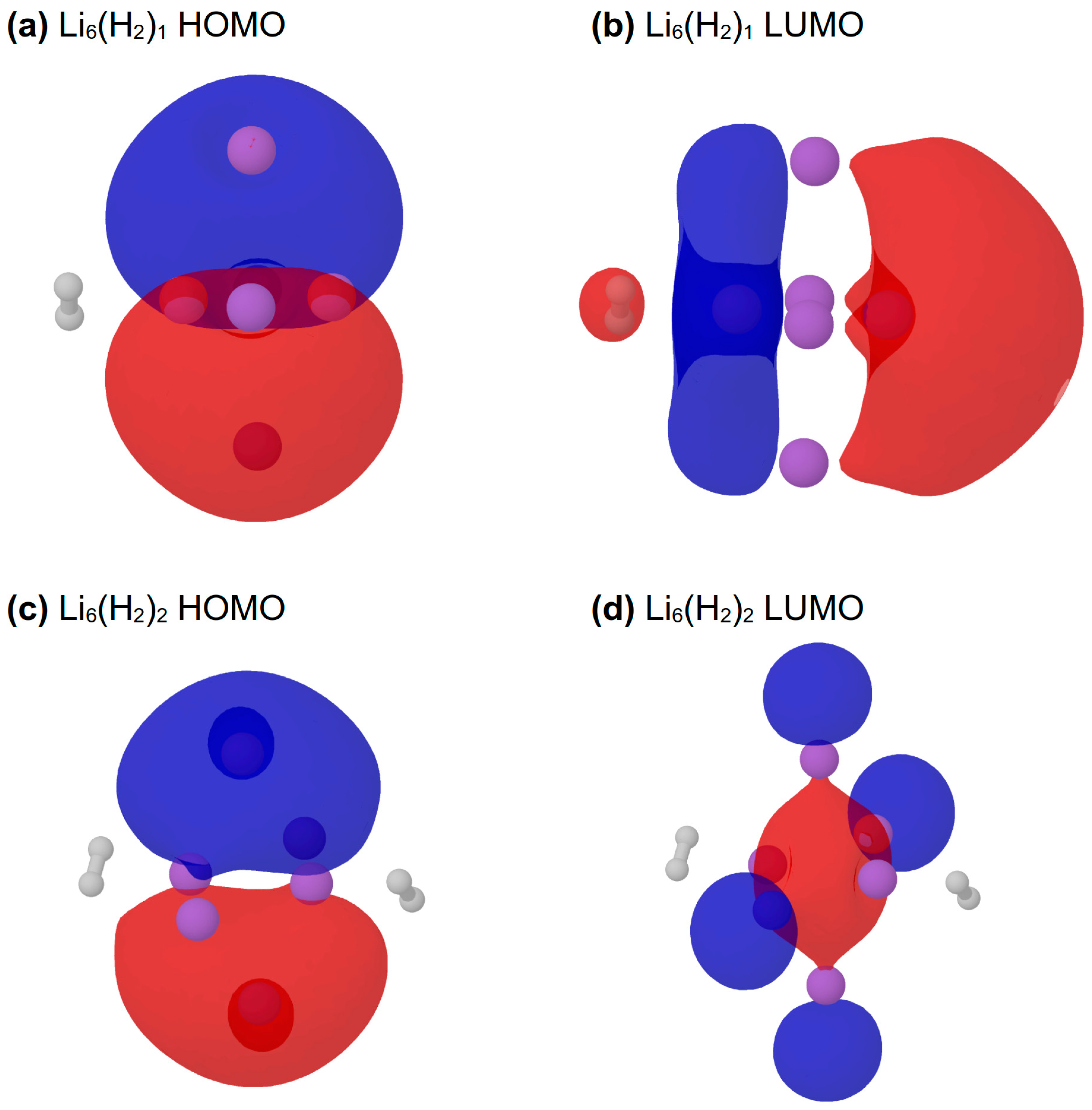
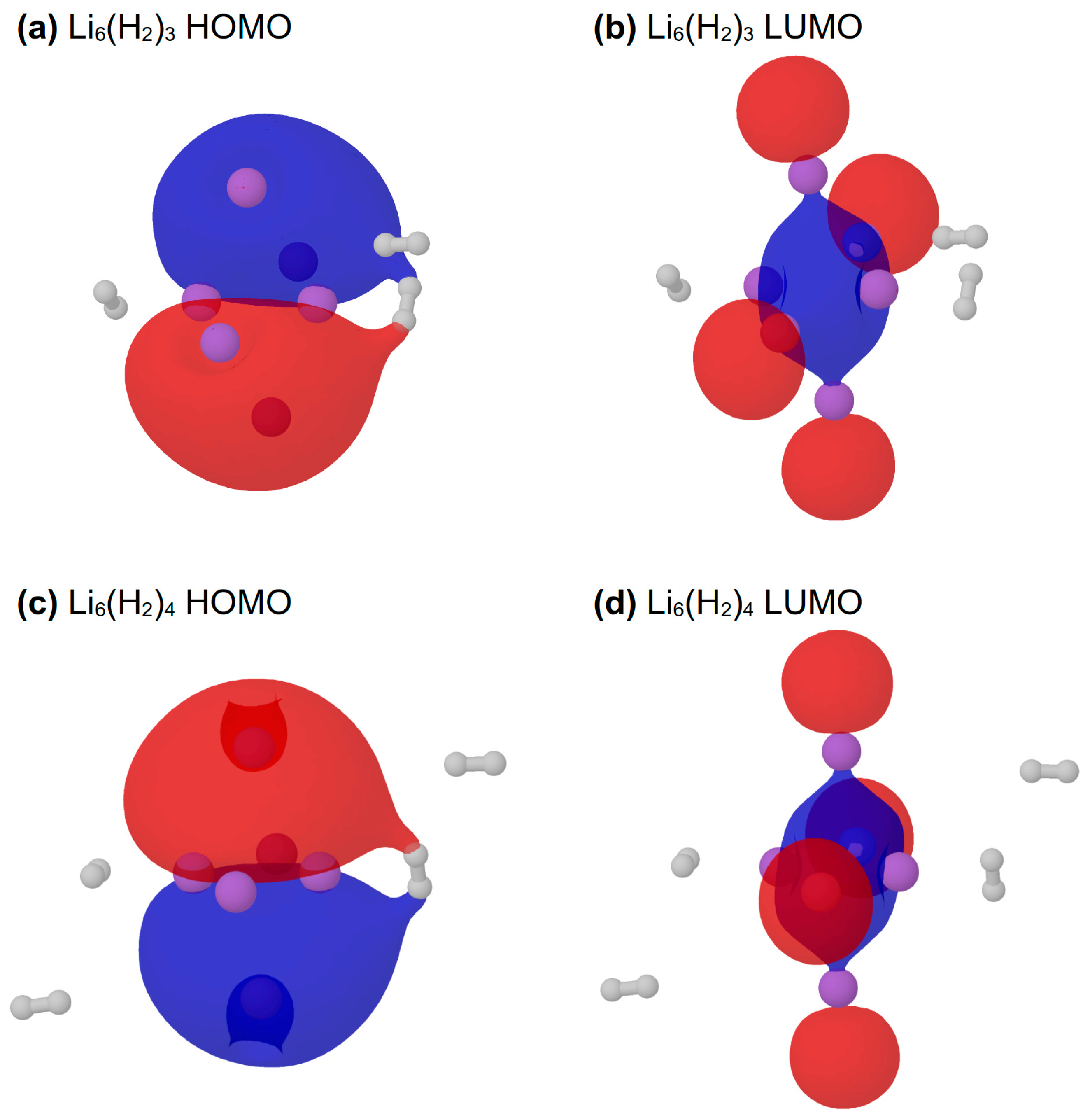
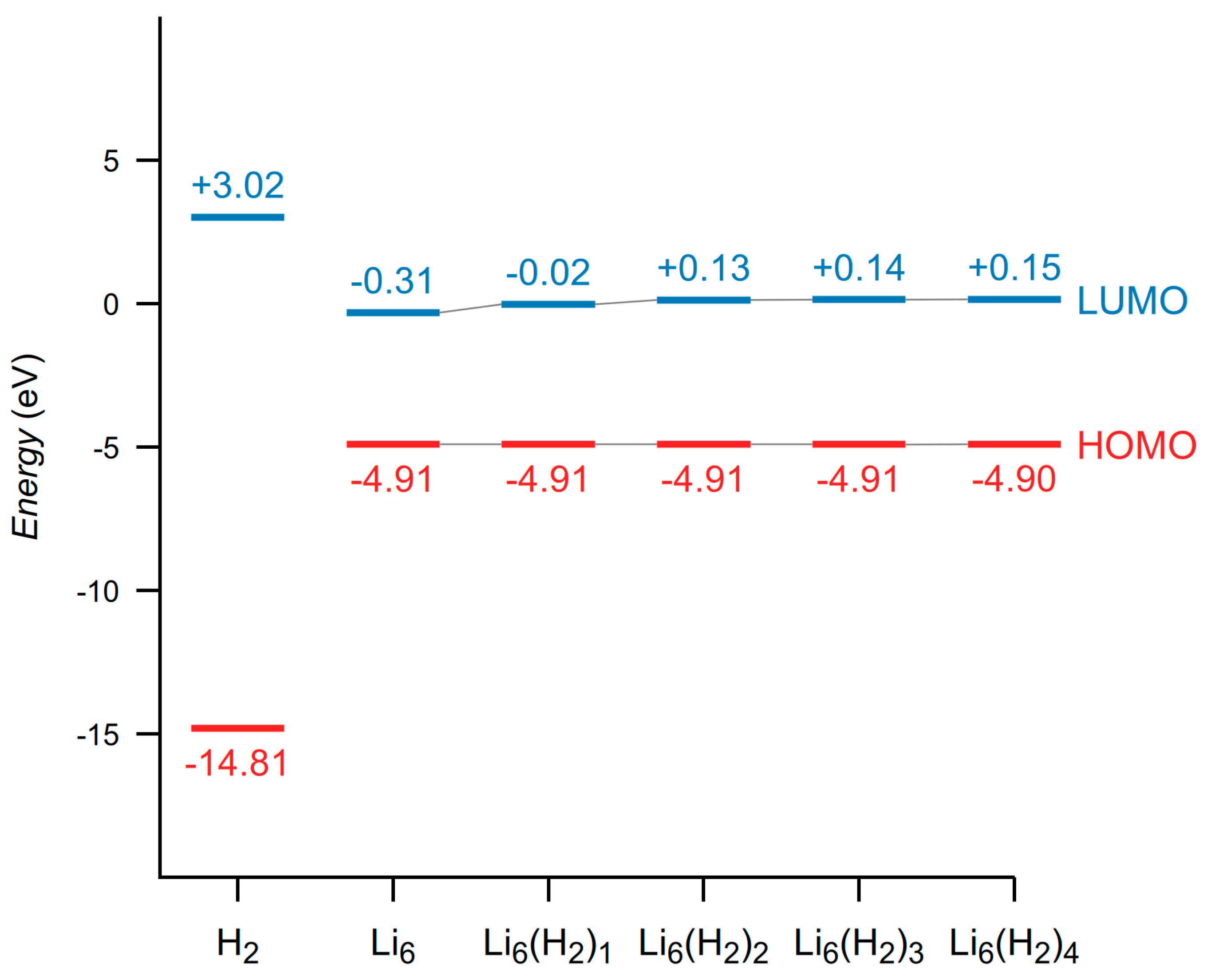
We analyzed the spatial distribution of the frontier molecular orbitals (FMOs) in Figure 5 and Figure 6, as well as their energetic evolution in the orbital energy level diagram in Figure 7. The HOMO is localized exclusively on the metallic core throughout the series. The LUMO incorporates contributions from the σ* antibonding orbitals of the coordinated H2 molecules. From these orbital energies, we derived the global reactivity descriptors (conceptual DFT, c–DFT) (Table 7 and Table S13) following the frontier molecular orbital framework for describing chemical reactivity [36]. Although absolute orbital eigenvalues are sensitive to the functional choice, the range-separated ωB97X-D4rev functional ensures a consistent description of the HOMO–LUMO gap and its relative trends across the series. The chemical hardness (η) and electronegativity (χ) show minimal variation relative to the isolated cluster. The chemical potential (μ) and electrophilicity index (ω) converge as ligand loading increases.

4. Discussion

4.1. Aromatic Superatom

Our results demonstrate that the Li6 cluster functions as a structurally rigid platform, whose stability under ligand loading is confirmed by the preservation of D4h symmetry and RMSD values below 0.032 Å (Table 1). We attribute this robustness to its intrinsic superatom character, whereby the four Non-Nuclear Attractors (NNAs) distributed across the lateral triangular faces of the compressed octahedral (D4h) core act collectively as an electronic anchor that cohesively holds the metallic core against external perturbations, minimizing geometric deformation. A key finding is the near-perfect correlation (r = 0.98) between the adsorption energy and the Li–Li distance; the metallic core undergoes minimal expansion to optimize the interaction without compromising its octahedral topology. This resistance to perturbation is further reflected in the progressive increase in the HOMO–LUMO gap from 4.60 eV in bare Li6 to ≈5.0 eV upon full loading (Table 1), Notably, starting from n = 2, the LUMO energy shifts into the positive regime (unbound), as shown in Table S13. This transition is physically consistent with the cluster’s high electronic hardness (η) and its character as a stable, closed-shell species that does not favor further electronic perturbation, confirming that hydrogen coordination reinforces rather than compromises the electronic stability of the cluster.
The integrity of the system is ensured by the ligand-induced strengthening of σ-aromaticity from −2.917 ppm in bare Li6 to ≈−13.8 ppm under hydrogen loading, which acts as an “electronic glue” that minimizes deformation under external repulsions. This stability is a direct consequence of the superatom shell model: each NNA carries a substantial negative charge (≈−1.07 e) that remains nearly constant up to n = 4, with associated volumes ranging from 210 to 212 Bohr3 without significant variation despite increasing ligand loading (Tables S12 and S15), reinforcing their collective role as a stabilizing charge anchor.
By residing at the centroid of these four NNAs, the NICS(0) magnetic index probes the collective interstitial electron density and remains free from the local contamination typical of σ covalent bonds. The persistence of strong σ-aromaticity is therefore not a computational artifact but is intrinsically tied to the stability of this collective interstitial density. The parallel evolution of these descriptors (Table S15) confirms that the Li6 core acts as an unaltered electronic anchor even under forced saturation regimes, thus supporting the concept of “NNA-supported aromaticity” that allows Li6 to retain its electronic identity up to n = 4.
The isomeric distribution (Table S6) reveals a coverage-dependent behavior. For n = 1, the global minimum dominates with a Boltzmann population of 97.78%, consistent with a structurally pure species. However, for n = 2, the global minimum population drops to 71.2%, with three isomers competing with significant populations. For n = 3 and n = 4, the distribution broadens further, with global minimum populations of 42.8% and 31.12%, respectively. This progressive isomeric dispersion is consistent with the saturation regime identified in Section 3.2 and provides independent reinforcement of the effective thermodynamic loading limit at n = 2. Despite this broadening distribution, the descriptors obtained (HOMO–LUMO gap, NNA charge, NICS indices, and EDA components) constitute a contamination-free reference set that can be directly employed to assess how a given substrate modulates the adsorption capacity of the Li6 motif in assembled materials. Deviations observed in supported systems can thus be unambiguously attributed to substrate-specific modulation rather than to the intrinsic superatom chemistry.

4.2. Nature of the Interaction

We interpret the binding in the Li6(H2)n complexes as field-activated physisorption (consistent with the ion-quadrupole polarization-enhanced mechanism described by Lochan and Head-Gordon [37]) and rule out the formation of Kubas-type complexes. Our multi-physics evidence supports this assignment through three independent criteria: vibrational, energetic, and topological criteria.
We observe a redshift of Δν ≈ −221 cm−1 and an H–H bond elongation of only 0.014 Å (Table 2). For context, classical Kubas complexes of transition metals such as W(CO)3(PR3)2(H2) exhibit νH–H frequencies in the range of 2600–3100 cm−1, corresponding to redshifts of 1000–1500 cm−1 relative to free H2 (~4161 cm−1) [38,39]. In contrast, Lochan and Head-Gordon report that Li+-doped light metal systems show typical shifts of only 130–160 cm−1 [37,40], a range with which our value of Δν ≈ −221 cm−1 is fully consistent. This behavior is characteristic of ion-quadrupole polarization-enhanced physisorption, lacking the d → σ back-donation required to form a Kubas-type σ-complex. The molecular integrity of H2 is preserved nearly intact, favoring desorption without significant kinetic barriers.
The Ziegler–Rauk EDA scheme confirms that the stabilization is predominantly electrostatic, contributing between 65% and 67% of the primary attractive interaction (Eelstat, Eorb, Edisp); percentages are computed over these three physically interpretable terms, with EXC reported separately as it represents the non-classical exchange–correlation correction of the hybrid functional rather than a classical interaction force [41], while the orbital component accounts for a secondary fraction of the stabilization (Table 4). The electric field generated by the superatom polarizes the H2 molecules, but charge transfer is insufficient to establish a strong and stable three-center Li⋯H⋯H coordinative bond.
We find a positive Laplacian (∇2ρ > 0) and low electron densities (ρ ≈ 0.013 a.u.) at the Li⋯H bond critical points (Table 5). These values are diagnostic of closed-shell interactions and exclude the formation of covalent or strongly coordinative bonds. Bader charge analysis (Table 6) further confirms the non-covalent nature of the interaction: charge transfer toward H2 is minimal, preventing the formation of stable hydrides and ensuring full process reversibility. The small dispersion contribution (Edisp = −1.03 kcal/mol, Table 4) indicates that storage does not rely on long-range van der Waals forces, but on a direct electrostatic response. The MESP maps (Figure 4) support this field-activated physisorption model.

4.3. The Entropic Bottleneck

The thermodynamics of the Li6(H2)n system is governed by the competition between electronic stabilization and the loss of translational and rotational degrees of freedom. At 298.15 K, the −TΔS term consistently outweighs the enthalpic stabilization, yielding positive ΔG values that increase along the series (3.05 to 16.28 kcal/mol). Spontaneous adsorption under standard conditions is therefore thermodynamically unfeasible. Nevertheless, the equilibrium (crossover) temperature analysis (Teq) allows us to precisely define the operational window of the system.
For the first two adsorption steps, the transition to the spontaneous regime (ΔG < 0) occurs under cryogenic conditions, with Teq = 143.76 K for n = 1 and Teq = 114.64 K for n = 2. While we recognize that the RRHO scheme tends to overestimate the entropic penalty in weakly bound systems by treating hindered translational and rotational modes as harmonic vibrations, we estimate that applying quasi-RRHO corrections would shift these Teq values upward by only 20–40 K. Since this adjustment does not alter our fundamental conclusion that spontaneous loading is restricted to the cryogenic regime (<200 K), we consider the RRHO results to be a robust upper bound that is physically representative of the system’s thermodynamic limits. For n ≥ 3, no defined Teq exists: the endothermic character of the sequential adsorption (ΔHseq > 0), combined with a persistent entropic penalty, keeps ΔG positive at all temperatures studied.
This effective loading limit at n = 2 has a structural origin: saturation of the first coordination sphere and the electrostatic repulsion generated by the high charge density at the central NNAs confine additional H2 molecules to peripheral, energetically unfavorable positions. As a result, the lower symmetry observed for n = 4 is a direct consequence of this “forced saturation state,” where inter-ligand repulsions prevent the adoption of higher-symmetry configurations. It is important to distinguish that the structural ceiling at n = 4 represents a forced saturation state only, not spontaneously accessible under either standard or moderately cryogenic conditions.
That said, the cryogenic window defined by Teq = 143.76 K and 114.64 K falls within a physically accessible temperature range, providing a quantitative thermodynamic reference rather than a practical storage prescription. In this context, Li6 should not be regarded as a failed adsorbent, but as a well-characterized reversible physisorption platform whose operational window serves as a gas-phase theoretical reference: future Li6-decorated materials in which the substrate favorably modulates the adsorption enthalpy could shift this window toward more practical temperatures.

5. Conclusions

Structural Stability: The Li6 cluster acts as a rigid, non-fluxional platform (RMSD < 0.032 Å) throughout the adsorption series. The superatom shell model maintains geometric integrity, consistent with reversible adsorption–desorption cycles without symmetry breaking for n ≤ 2.
Electronic Identity: Ligand loading strengthens the metallic σ-aromaticity, with NICS(0) values shifting from −2.917 ppm to a range of −10.74 to −13.98 ppm. This is accompanied by an increased HOMO–LUMO gap (up to 5.05 eV) and enhanced interstitial electron delocalization.
Interaction Mechanism: Energy Decomposition Analysis (EDA) identifies the binding as field-activated physisorption, dominated by electrostatic contributions (65–67%). Kubas-type coordination is excluded based on moderate vibrational redshifts (Δv ≈ −183 to −221 cm−1) and QTAIM parameters diagnostic of closed-shell interactions (∇2ρ > 0, ρ < 0.013 a.u.).
Thermodynamic Limits: The system exhibits negative cooperativity, establishing an effective loading capacity of n = 2 molecules under cryogenic conditions. An entropic bottleneck renders adsorption non-spontaneous at standard conditions, restricting the operational window to the cryogenic regime (Teq = 143.76 K and 114.64 K). These values are subject to the intrinsic uncertainty of the double-hybrid functional (~0.5 kcal/mol). While we acknowledge these RRHO values as upper-bound estimates, the estimated 20–40 K increase from quasi-RRHO corrections does not alter the robust conclusion that spontaneous loading requires cryogenic conditions.
Gas-phase Theoretical Reference Utility: The substrate-free characterization of Li6 yields a self-consistent set of contamination-free descriptors (Bader charges, NNA charge and volume, NICS(0) indices, EDA contributions, and crossover temperatures) that represent the intrinsic Li–H2 interaction. While these conclusions are derived from high-level theoretical modeling, the consistency between the electronic descriptors (EDA, QTAIM) and the thermodynamic limits provides a robust physical picture. Consequently, the reported Teq values should be interpreted as theoretical thresholds that define the operational window of the Li6 superatom. This constitutes a theoretical baseline against which the performance of Li6-decorated materials can be directly evaluated: deviations observed in supported systems can now be unambiguously attributed to substrate-specific modulation rather than to the superatom chemistry itself, enabling the rational, descriptor-guided design of lithium-decorated hydrogen storage materials.

Supplementary Materials

The following supporting information can be downloaded at https://www.mdpi.com/article/10.3390/computation14040094/s1. Figure S1 Optimized geometries for all studied Li6(H2)n (n = 1–4) isomers at the wB97X-D4rev/def2-TZVPPD level of theory. Structural labels correspond to the Cartesian coordinates provided in Table S1. Table S1 Cartesian coordinates (in Å) for the optimized structures of isolated species and Li6(H2)n complexes at the wB97X-D4rev/def2-TZVPPD level of theory; Table S2 Total electronic energies and counterpoise components (CP) at the wB97X-D4rev/def2-TZVPPD level of theory. All values are reported in atomic units (a.u.); Table S3. Total electronic energies and counterpoise components at the wB97X-2-D3BJ/def2-TZVPPD level of theory. All values are reported in atomic units (a.u.); Table S4. Zero-point energies (ZPE), thermal enthalpy corrections (Hcorr), and entropy terms (TS) at the wB97X-D4rev/def2-TZVPPD level. All values reported in atomic units (a.u.) at 298.15 K and 1 atm; Table S5. Energetic components and relative stabilities (kcal/mol) for Li6(H2)n complexes at the wB97X-D4rev/def2-TZVPPD level of theory. Values are derived from electronic energies and ZPE corrections. ΔEads,Total represents the final corrected adsorption energy; Table S6. Thermodynamic adsorption properties and Boltzmann population distribution for Li6(H2)n complexes. All energy values are reported in kcal/mol at 298.15 K and 1 atm. ΔΔG represents the relative stability compared to the Global Minimum (GM) of each group; Table S7. Geometric descriptors for isolated species and Li6(H2)n complexes at the wB97X-D4rev/def2-TZVPPD level of theory. Distances are reported in Angstroms (Å). Isomers are ordered according to their tThermodynamic stability (ΔΔG) at 298.15 K. RMSD is calculated for the Li6 core relative to the isolated cluster; Table S8. Magnetic aromaticity indices (NICS) for Li6(H2)n complexes at the wB97X-D4rev/def2-TZVPPD level of theory. Isotropic shielding (σiso) and NICS(0) values are reported in ppm. Isomers are ordered according to their thermodynamic stability (ΔΔG) at 298.15 K; Table S9. Harmonic stretching frequencies (ν) and classification of adsorbed H2 molecules. All frequencies are reported in cm−1. Isomers are ordered according to their thermodynamic stability (ΔΔG) at 298.15 K. Reference isolated H2 (gas) frequency: 4401 cm−1; Table S10. Energy Decomposition Analysis (EDA) components for Li6(H2)n complexes, according to the Ziegler–Rauk scheme. All values are reported in kcal/mol. Isomers are ordered according to their thermodynamic stability (ΔΔG) at 298.15 K; Table S11. Topological parameters of the electron density at the Bond Critical Points (BCP) for Li–H interactions in Global Minima. All values are reported in atomic units (a.u.) at the wB97X-D4rev/def2-TZVPPD level of theory. Only the most stable isomers according to Gibbs free energy (ΔG) are reported; Table S12. Atomic Charges and Volumes from Bader Population Analysis (QTAIM) at the wB97X-D4/def2-TZVPPD level of theory. Only the most stable isomers according to Gibbs free energy (ΔG) are reported; Table S13. Frontier molecular orbital indices (NO), energies, and HOMO-LUMO gaps for all Li6(H2)n isomers; Table S14. Pearson correlation coefficients (r) between energy components (Eint, Edef and ΔEadsTotal) and the structural/electronic descriptors for the Li6(H2)n global minima; Table S15. Correlation Table: Superatom Stability vs. Aromaticity.

Author Contributions

Conceptualization, O.J.-S. and R.P.-C.; methodology, R.P.-C. and O.J.-S.; software, O.J.-S.; validation, K.O.L., J.G.-V. and R.P.-C.; formal analysis, K.O.L., J.G.-V. and R.P.-C.; investigation, K.O.L., J.G.-V. and R.P.-C.; data curation, R.P.-C. and O.J.-S.; writing—original draft preparation, O.J.-S.; writing—review and editing, K.O.L., J.G.-V., R.P.-C. and O.J.-S.; visualization, O.J.-S.; supervision, O.J.-S.; project administration, O.J.-S. All authors have read and agreed to the published version of the manuscript.

Funding

This research received no external funding.

Data Availability Statement

The data supporting the findings of this study are available in the Supplementary Material of this article.

Acknowledgments

During the preparation of this manuscript, the authors used Gemini 3 Thinking (Google, 2026) for the purposes of translating the original draft from Spanish to English and refining linguistic clarity. The authors have reviewed and edited the output and take full responsibility for the content of this publication.

Conflicts of Interest

The authors declare no conflicts of interest.

Abbreviations

The following abbreviations are used in this manuscript:
BCPBond Critical Point
BSSEBasis Set Superposition Error
CCSDCoupled Cluster with Singles and Doubles
DFTDensity Functional Theory
EDAEnergy Decomposition Analysis
FMOsFrontier Molecular Orbitals
GAPHOMO–LUMO Energy Gap
GMGlobal Minimum
HOMOHighest Occupied Molecular Orbital
LUMOLowest Unoccupied Molecular Orbital
MESPMolecular Electrostatic Potential
NICSNucleus-Independent Chemical Shift
NNANon-Nuclear Attractor
PESPotential Energy Surface
QTAIMQuantum Theory of Atoms in Molecules
RMSDRoot-Mean-Square Deviation
RRHORigid Rotor-Harmonic Oscillator
ZPEZero-Point Energy

References

  1. Li, Q.; Zhang, Q.; Zhang, L.; Lang, J.; Yuan, W.; An, G.; Lei, T. A comprehensive review of advances and challenges of hydrogen production, purification, compression, transportation, storage and utilization technology. Renew. Sustain. Energy Rev. 2026, 226, 116196. [Google Scholar] [CrossRef]
  2. Züttel, A. Hydrogen storage methods. Naturwissenschaften 2004, 91, 157–172. [Google Scholar] [CrossRef]
  3. Jain, I.P.; Lal, C.; Jain, A. Hydrogen storage in Mg: A most promising material. Int. J. Hydrogen Energy 2010, 35, 5133–5144. [Google Scholar] [CrossRef]
  4. Yuan, L.; Gong, J.; Wang, D.; Su, J.; Zhang, M.; Yang, J. A first principles study of hydrogen storage capacity for Li-decorated porous BNC monolayer. Comput. Theor. Chem. 2022, 1208, 113578. [Google Scholar] [CrossRef]
  5. Liu, Z.; Zhao, W.; Chai, M. Li-decorated bilayer borophene as a potential hydrogen storage material: A DFT study. Int. J. Hydrogen Energy 2024, 51, 229–235. [Google Scholar] [CrossRef]
  6. Bi, L.; Yin, J.; Huang, X.; Wang, Y.; Yang, Z. A DFT study of H2 adsorption on lithium decorated 3D hybrid Boron-Nitride-Carbon frameworks. Int. J. Hydrogen Energy 2019, 44, 15183–15192. [Google Scholar] [CrossRef]
  7. Guardado, A.; Marisol, I.-R.; Mayén-Mondragón, R.; Sánchez, M. Hydrogen adsorption on lithium clusters coordinated to a gC3N4 cavity. J. Mol. Graph. Model. 2023, 122, 108491. [Google Scholar] [CrossRef]
  8. Srivastava, H.; Srivastava, A.K. Superalkalis for the Activation of Carbon Dioxide: A Review. Front. Phys. 2022, 10, 870205. [Google Scholar] [CrossRef]
  9. de Heer, W.A. The physics of simple metal clusters: Experimental aspects and simple models. Rev. Mod. Phys. 1993, 65, 611–676. [Google Scholar] [CrossRef]
  10. Kreibig, U.; Vollmer, M. Optical Properties of Metal Clusters; Springer: Berlin/Heidelberg, Germany, 1995. [Google Scholar] [CrossRef]
  11. García-Argote, W.; Medel, E.; Inostroza, D.; Vásquez-Espinal, A.; Solar-Encinas, J.; Leyva-Parra, L.; Ruiz, L.M.; Yañez, O.; Tiznado, W. From Aromatic Motifs to Cluster-Assembled Materials: Silicon–Lithium Nanoclusters for Hydrogen Storage Applications. Molecules 2025, 30, 2163. [Google Scholar] [CrossRef] [PubMed]
  12. Kaviani, S.; Piyanzina, I.; Nedopekin, O.V.; Tayurskii, D.A. A DFT-D3 investigation on Li, Na, and K decorated C6O6Li6 cluster as a new promising hydrogen storage system. Int. J. Hydrogen Energy 2023, 48, 30069–30084. [Google Scholar] [CrossRef]
  13. Liu, Z.; Liu, S.; Er, S. Hydrogen storage properties of Li-decorated B2S monolayers: A DFT study. Int. J. Hydrogen Energy 2019, 44, 16803–16810. [Google Scholar] [CrossRef]
  14. Zhang, Y.; Scanlon, L.G.; Rottmayer, M.A.; Balbuena, P.B. Computational Investigation of Adsorption of Molecular Hydrogen on Lithium-Doped Corannulene. J. Phys. Chem. B 2006, 110, 22532–22541. [Google Scholar] [CrossRef] [PubMed]
  15. Blanc, J.; Bonačić-Koutecký, V.; Broyer, M.; Chevaleyre, J.; Dugourd, P.; Koutecký, J.; Scheuch, C.; Wolf, J.P.; Wöste, L. Evolution of the electronic structure of lithium clusters between four and eight atoms. J. Chem. Phys. 1992, 96, 1793–1809. [Google Scholar] [CrossRef]
  16. Qi, H.; Wang, X.; Chen, H. Superalkali NLi4 decorated graphene: A promising hydrogen storage material with high reversible capacity at ambient temperature. Int. J. Hydrogen Energy 2021, 46, 23254–23262. [Google Scholar] [CrossRef]
  17. Neese, F. Software update: The ORCA program system, version 6.0. Wiley Interdiscip. Rev. Comput. Mol. Sci. 2025, 15, e70019. [Google Scholar] [CrossRef]
  18. Neese, F. The SHARK Integral Generation and Digestion System. J. Comput. Chem. 2023, 44, 381–396. [Google Scholar] [CrossRef]
  19. Neese, F. An improvement of the resolution of the identity approximation for the formation of the Coulomb matrix. J. Comput. Chem. 2003, 24, 1740–1747. [Google Scholar] [CrossRef]
  20. Neese, F.; Wennmohs, F.; Hansen, A.; Becker, U. Efficient, approximate and parallel Hartree-Fock and hybrid DFT calculations. Chem. Phys. 2009, 356, 98–109. [Google Scholar] [CrossRef]
  21. Helmich-Paris, B.; de Souza, B.; Neese, F.; Izsák, R. An improved chain of spheres for exchange algorithm. J. Chem. Phys. 2021, 155, 104109. [Google Scholar] [CrossRef]
  22. Lu, T.; Chen, F. Multiwfn: A multifunctional wavefunction analyzer. J. Comput. Chem. 2012, 33, 580–592. [Google Scholar] [CrossRef]
  23. Van Rossum, G.; Drake, F.L. Python 3 Reference Manual; CreateSpace: Scotts Valley, CA, USA, 2009. [Google Scholar]
  24. Kabsch, W. A solution for the best rotation to relate two sets of vectors. Acta Crystallogr. Sect. A 1976, 32, 922–923. [Google Scholar] [CrossRef]
  25. Jmol: An Open-Source Java Viewer for Chemical Structures in 3D. Available online: https://sourceforge.net/projects/jmol/ (accessed on 1 January 2026).
  26. Williams, T.; Kelley, C. Gnuplot 6.0: An Interactive Plotting Program. Available online: http://www.gnuplot.info/ (accessed on 1 January 2026).
  27. Mardirossian, N.; Head-Gordon, M. ωB97X-V: A 10-parameter, range-separated hybrid, generalized gradient approximation density functional with nonlocal correlation, designed by a survival-of-the-fittest strategy. Phys. Chem. Chem. Phys. 2014, 16, 9904–9924. [Google Scholar] [CrossRef]
  28. Najibi, A.; Goerigk, L. DFT-D4 counterparts of leading meta-generalized-gradient approximation and hybrid density functionals for energetics and geometries. J. Comput. Chem. 2020, 41, 2562–2572. [Google Scholar] [CrossRef] [PubMed]
  29. Weigend, F.; Ahlrichs, R. Balanced basis sets of split valence, triple zeta valence and quadruple zeta valence quality for H to Rn: Design and assessment of accuracy. Phys. Chem. Chem. Phys. 2005, 7, 3297–3305. [Google Scholar] [CrossRef]
  30. Rappoport, D.; Furche, F. Property-optimized Gaussian basis sets for molecular response calculations. J. Chem. Phys. 2010, 133, 134105. [Google Scholar] [CrossRef] [PubMed]
  31. Lin, Y.-S.; Li, G.-D.; Mao, S.-P.; Chai, J.-D. Long-Range Corrected Hybrid Density Functionals with Improved Dispersion Corrections. J. Chem. Theory Comput. 2013, 9, 263–272. [Google Scholar]
  32. Grimme, S.; Antony, J.; Ehrlich, S.; Krieg, H. A consistent and accurate ab initio parametrization of density functional dispersion correction (DFT-D). J. Chem. Phys. 2010, 132, 154104. [Google Scholar] [CrossRef] [PubMed]
  33. Grimme, S.; Ehrlich, S.; Goerigk, L. Effect of the damping function in dispersion corrected density functional theory. J. Comput. Chem. 2011, 32, 1456–1465. [Google Scholar] [CrossRef]
  34. Goerigk, L.; Hansen, A.; Bauer, C.; Ehrlich, S.; Najibi, A.; Grimme, S. A look at the density functional theory zoo with the advanced GMTKN55 database. Phys. Chem. Chem. Phys. 2017, 19, 32184–32215. [Google Scholar] [CrossRef]
  35. Temelso, B.; Sherrill, C.D. High accuracy ab initio studies of Li6+, Li6−, and three isomers of Li6. J. Chem. Phys. 2005, 122, 064315. [Google Scholar] [CrossRef] [PubMed]
  36. Yu, J.; Su, N.Q.; Yang, W. Describing chemical reactivity with frontier molecular orbitalets. JACS Au 2022, 2, 1383–1394. [Google Scholar] [CrossRef]
  37. Lochan, R.C.; Head-Gordon, M. Computational studies of molecular hydrogen binding affinities: The role of dispersion forces, electrostatics, and orbital interactions. Phys. Chem. Chem. Phys. 2006, 8, 1357–1370. [Google Scholar] [CrossRef] [PubMed]
  38. Grimme, S. Supramolecular Binding Thermodynamics by Dispersion-Corrected Density Functional Theory. Chem. Eur. J. 2012, 18, 9955–9964. [Google Scholar] [CrossRef]
  39. Kubas, G.J. Metal–dihydrogen and σ-bond coordination: The consummate extension of the Dewar–Chatt–Duncanson model for metal–olefin π bonding. J. Organomet. Chem. 2001, 635, 37–68. [Google Scholar] [CrossRef]
  40. Morris, R.H. Dihydrogen, dihydride and in between: NMR and structural properties of iron group complexes. Coord. Chem. Rev. 2008, 252, 2381–2394. [Google Scholar] [CrossRef]
  41. Zhao, L.; von Hopffgarten, M.; Andrada, D.M.; Frenking, G. Energy Decomposition Analysis. Wiley Interdiscip. Rev. Comput. Mol. Sci. 2018, 8, e1345. [Google Scholar] [CrossRef]
Figure 1. Optimized geometries of the Li6(H2)n global minima. (a) n = 1, (b) n = 2, (c) n = 3 and (d) n = 4. Coordination distances dLi–H are reported in Å. Purple and gray spheres represent lithium and hydrogen atoms, respectively. Detailed data for competitive isomers are provided in Tables S1–S6 and Figure S1 of the Supplementary Material.
Computation 14 00094 g001
Figure 2. Variation of the enthalpic (ΔHads), entropic (−TΔSads), and Gibbs free energy (ΔGads) contributions at 298.15 K and 1 atm as a function of hydrogen loading. The positive ΔGads values across the entire range highlight an entropic bottleneck, where the substantial loss of translational and rotational degrees of freedom outweighs the electronic stabilization, preventing spontaneous adsorption at standard temperature.
Computation 14 00094 g002
Figure 3. Temperature dependence of the sequential Gibbs free energy (ΔGseq) for H2 adsorption on the Li6 cluster. The intersection of each loading step (n = 1–4) with the dashed line (ΔG = 0) defines the equilibrium temperature (Teq), marking the transition to spontaneous adsorption. Spontaneity is achieved exclusively in the cryogenic regime for the first (T < 143.76 K) and second (T < 114.64 K) adsorption steps. For n ≥ 3, the process remains endergonic (ΔG > 0) across the entire temperature range studied, primarily due to positive enthalpic contributions and the persistent entropic penalty. These results highlight the thermodynamic window required for effective loading and confirm that the structural ceiling of n = 4 is not accessible through spontaneous physisorption under standard or moderate cryogenic conditions.
Computation 14 00094 g003
Figure 4. Molecular Electrostatic Potential (MESP) maps for the Li6(H2)n complexes. (a) n = 1, (b) n = 2, (c) n = 3 and (d) n = 4. The potential is mapped onto the total electron density isosurface (0.001 a.u.). The color scale ranges from −0.02 a.u. (red, nucleophilic) to +0.02 a.u. (blue, electrophilic). These maps identify the Li nuclei as the primary electrophilic sites and visualize the inductive polarization of the H2 molecules. Panels (c,d) highlight the attenuated interaction of spectator H2 units at larger coordination distances, consistent with the Bader charge transfer values reported in Table 6.
Computation 14 00094 g004
Figure 5. Spatial distribution of the frontier molecular orbitals (FMOs) for the Li6(H2)1 and Li6(H2)2 global minima: (a) Li6(H2)1 HOMO, (b) Li6(H2)1 LUMO, (c) Li6(H2)2 HOMO, and (d) Li6(H2)2 LUMO. Red and blue lobes represent the positive and negative phases of the wavefunction, respectively, generated at an isovalue of 0.02 e/bohr3. The HOMO remains predominantly localized on the Li6 metallic core, while the LUMO exhibits electronic participation from the H2 antibonding orbitals, facilitating inductive polarization.
Computation 14 00094 g005
Figure 6. Spatial distribution of the FMOs for the Li6(H2)3 and Li6(H2)4 global minima: (a) Li6(H2)3 HOMO, (b) Li6(H2)3 LUMO, (c) Li6(H2)4 HOMO, and (d) Li6(H2)4 LUMO. The persistent localization of the HOMO on the lithium core reflects its electronic stability as a superatom even at the saturation limit. The relative stabilization of the HOMO–LUMO gap and chemical hardness (η) reported in Table 1 and Table 6 correlates with the inability of the LUMO to effectively coordinate spectator H2 units at larger distances.
Computation 14 00094 g006
Figure 7. Frontier molecular orbital (FMO) energy level diagram for the isolated H2 and Li6 fragments and the Li6(H2)n (n = 1–4) global minima. Energy levels are reported in eV. Red and blue bars represent the Highest Occupied Molecular Orbital (HOMO) and the Lowest Unoccupied Molecular Orbital (LUMO), respectively.
Computation 14 00094 g007
Table 1. Electronic, structural, and magnetic descriptors of the Li6(H2)n global minima.
System (GM)1 NICS(0)
(ppm)
2 Gap
(eV)
3 RMSD
Li6−2.924.600.0000
Li6(H2)1−10.744.890.0315
Li6(H2)2−13.985.040.0178
Li6(H2)3−13.855.040.0179
Li6(H2)4−13.705.050.0232
1 Nucleus-Independent Chemical Shift. 2 HOMO–LUMO Energy Gap. 3 Root-Mean-Square Deviation.
Table 2. Adsorption descriptors for Li6(H2)n global minima.
System (GM)1 ΔGads
(kcal/mol)
2 ΔEseq
(kcal/mol)
3 dLi–H
(Å)
4 νH–H
(cm−1)
Status
Li6(H2)13.05−2.251.994219Favorable
Li6(H2)26.94−1.852.014244, 4246Favorable
Li6(H2)312.02+0.322.594247, 4250Saturated
Li6(H2)416.28+0.062.914252, 4257Saturated
1 Gibbs free energies of adsorption. 2 Sequential adsorption energies; this represents the sequential adsorption energy including ZPE, BSSE, and deformation corrections, excluding the thermal enthalpy correction ΔnRT. 3 Coordination distance. 4 Vibrational frequencies.
Table 3. Sequential thermodynamics of H2 adsorption on Li6.
Step1 ΔHseq
(kcal/mol)
2 ΔSseq
(cal/mol·K)
3 ΔG298K,seq
(kcal/mol)
4 Teq
(K)
0 → 1−2.84−19.763.05143.76
1 → 2−2.43−21.203.89114.64
2 → 30.46−15.505.08N/A
3 → 40.45−12.784.26N/A
1 Sequential enthalpy. 2 Sequential entropy. 3 Sequential Gibbs free energy. 4 Equilibrium temperature; this defines the thermodynamic threshold for spontaneity for each adsorption step.
Table 4. Energy Decomposition Analysis (EDA) and binding energy for the Li6(H2)n global minima. All values are reported in kcal/mol. Calculations were performed using the Ziegler–Rauk scheme.
System (GM)1 Eint2 Eprep3 Ebind4 Eelstat5 EPauli6 Eorb7 Edisp8 EXC
Li6(H2)1−4.350.12−4.23−9.3413.96−4.03−1.03−3.91
Li6(H2)2−7.950.31−7.65−17.0625.25−7.24−1.72−7.19
Li6(H2)3−8.340.44−7.90−18.8127.87−7.54−1.98−7.88
Li6(H2)4−8.620.51−8.10−20.0129.62−7.68−2.16−8.38
1 Total interaction energy (Eelstat + EPauli + Eorb + EXC + Edisp). 2 Preparation (deformation) energy. 3 Binding energy (Eint + Eprep). 4 Electrostatic energy. 5 Pauli repulsion. 6 Orbital energy. 7 Dispersion energy. 8 Exchange–correlation energy.
Table 5. Topological properties of the electron density (ρ(r)) and its Laplacian (∇2ρ(r)) at the Li⋯H bond critical points (BCPs) for the Li6(H2)n global minima. All parameters are reported in atomic units (a.u.).
System (GM)Interaction Typeρ(r)2ρ(r)Characterization
Li6(H2)1Li–H (Single)0.01300.0821Physisorption
Li6(H2)2Li–H (Symmetric)0.01220.0767Physisorption
Li6(H2)3Li–H (Relaxed)0.01270.0765Physisorption
Li–H (Compressed)0.01310.0827Steric Confinement
Li6(H2)4Li–H (Relaxed)0.01250.0761Physisorption
Li–H (Compressed)0.01300.0818Steric Confinement
Table 6. QTAIM charge analysis for Li6(H2)n global minima.
System (GM)1 Q(Li6) (e)2 Q(H2)act (e)3 Q(H2)spec (e)4 ΔQ (e)
Li6(H2)1+0.074−0.074+0.074
Li6(H2)2+0.134−0.067+0.134
Li6(H2)3+0.145−0.065−0.015+0.145
Li6(H2)4+0.154−0.063−0.014+0.154
1 Total charge of the lithium core (including NNAs). 2 Average charges of activated. 3 Spectator hydrogen molecules. 4 Net charge transferred from the Li6 core to the adsorbed H2 molecules.
Table 7. Global reactivity descriptors for the Li6(H2)n global minima. All parameters are reported in eV.
System (GM)1 μ2 η3 χ4 ω
Li6−2.612.302.611.48
Li6(H2)1−2.462.442.461.24
Li6(H2)2−2.392.522.391.13
Li6(H2)3−2.382.522.381.13
Li6(H2)4−2.382.532.381.12
1 Electronic chemical potential. 2 Chemical hardness. 3 Electronegativity. 4 Electrophilicity index.
Disclaimer/Publisher’s Note: The statements, opinions and data contained in all publications are solely those of the individual author(s) and contributor(s) and not of MDPI and/or the editor(s). MDPI and/or the editor(s) disclaim responsibility for any injury to people or property resulting from any ideas, methods, instructions or products referred to in the content.