


Abstract
The precise identification of musical emotion holds substantial academic and practical value, with critical applications in music recommendation, therapeutic interventions, and real-time human–computer interaction. Conventional paradigms for music emotion recognition, predominantly based on manual feature engineering and conventional machine learning, exhibit major impediments, including pronounced label subjectivity and insufficient generalizability, which have collectively hampered the further development of this domain. The development of convolutional neural networks (CNNs), recurrent neural networks (RNNs), and graph neural networks (GNNs) has expanded the range of automated approaches available for music emotion recognition. Every approach shows some intrinsic advantages and weakness; thus, they have had some success but are not yet fully qualified for application requirements. This paper will systematically summarize the application of deep learning in music emotion recognition in recent years, including theoretical frameworks, technical implementations, challenges, and future research trends. Typically, we will systematically discuss the current research status of deep learning and machine learning in music emotion recognition via a bibliometric analysis and then reveal the working mechanism of deep learning, which is underestimated in most previous studies. This work would shape the development of this research field, especially for the applications of deep learning in music emotion recognition.
1. Introduction
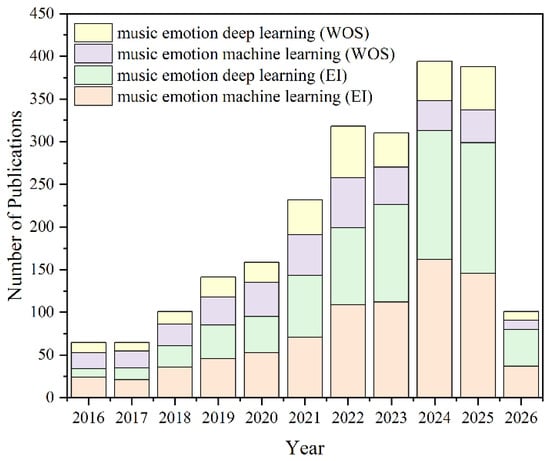
The research on music emotional expression serves as a core issue in the interdisciplinary study of psychology, musicology, and computational science. Music emotion recognition (MER) aims to analyze the emotional states contained or induced in music signals through computational models [1,2]. Its application scenarios are widely spread, covering personalized music recommendations, music emotion therapy, immersive entertainment interaction, and human–computer collaborative creation, etc. Bibliometric analysis is an effective tool to reveal the development of a typical research field and shed light on the emerging hotspots [3,4]. However, its application in music emotion recognition is relatively new. By searching the keywords “music emotion deep learning” in the Web of Science and Engineering Index to track the publications within the period of 2016–2026, we give the publication analysis in Figure 1. As can be seen, the research on music emotion recognition via deep learning has attracted increasing attention. Furthermore, we also search “music emotion machine learning” for a comparison. We can conclude that machine learning and deep learning both play an important role in this field, and the application of them in emotion recognition is determined mainly by the characteristics and sample size of music.
Figure 1.
Increasing publications by searching “music emotion deep learning” and “music emotion machine learning” in the Web of Science and Engineering Index (Date by 31 March 2026).
Music emotion recognition leverages feature extraction, model learning, and inference to bridge musical signals (audio, lyrics, and symbolic data) with corresponding human emotional states, enabling an automated prediction of affective responses [5,6,7]. The accuracy and efficiency of music emotion recognition hinge critically upon the choice of appropriate algorithms. Chronologically, the methodological landscape of this field can be divided into two paradigms: traditional machine learning approaches and the more recently developed deep learning techniques [8,9,10,11].
Traditional music emotion recognition methods primarily rely on handcrafted acoustic features and shallow machine learning models. Through manually designed features related to timbre, rhythm, harmony, spectral properties, and dynamics, they are then fed into shallow machine learning models such as Support Vector Machines (SVM), Random Forests (RFs), Gradient Boosted Decision Trees (GBDTs), and Gaussian Mixture Models (GMMs) to perform classification or regression tasks [12,13,14,15]. While these traditional methods can achieve basic emotion recognition on small-scale datasets, they suffer from some typical limitations. They rely on expert experience for feature engineering and thus are subjective and struggle to fully represent the intricate time–frequency structures and semantic information in music. However, pipelines based on fixed summary features or independently processed frames may have limited access to long-term temporal dependencies and higher-order feature interactions. The model generalizability is relatively poor and cannot meet the requirement in cross-genre, cross-instrument, and cross-cultural scenarios [16]. To alleviate this issue, a variety of music emotion classification and regression models were proposed [17,18]. For example, Hu et al. investigated the generalizability of emotion regression models for western and Chinese pop music from the view of valence and arousal [18]. Wang et al. compare the acoustic features of western and Chinese classical music emotion recognition by adopting different kinds of algorithms at each step of the training process [16] and conclude that pitch and loudness/rhythm features are more significant for western and Chinese classical music, respectively.
The development of deep learning technology has fundamentally transformed the technical roadmap for music emotion recognition. It employs end-to-end learning, enabling models to learn high-dimensional features from raw audio signals or spectral representations, thereby reducing, rather than eliminating, reliance on manual feature engineering [19]. Furthermore, convolutional neural networks (CNNs), recurrent neural networks (RNNs), graph neural networks (GNNs), and transformers facilitate local time–frequency feature learning, long-term temporal dependency modeling, and global semantic representation, which substantially boosts music emotion recognition accuracy [20,21]. In recent years, advances in large-scale audio pre-trained models, multimodal fusion strategies, and lightweight inference techniques have further driven music emotion recognition toward more efficient, robust, and generalizable systems, consolidating its status as one of the most active research directions in the field of music information retrieval (MIR).
Compared to the traditional machine learning counterpart, deep learning methods present some typical advantages. They are different in feature design, model capability, task performance, and application scenarios. At the feature level, traditional methods rely on manually extracted low-dimensional acoustic features, such as the Mel-Frequency Cepstral Coefficients (MFCCs), spectral centroid, beat density, chord sequences, etc. [22]. These features possess limited representational power. In contrast to traditional feature engineering, deep learning methods operate directly on raw or preprocessed audio—Mel-spectrograms, Constant-Q Transforms, or even raw waveforms—and automatically learn hierarchical, abstract representations that are more naturally aligned with the latent structure of musical emotion. At the modeling level, conventional shallow methods can represent nonlinear relationships through kernels, ensembles, or explicit dynamical models, but their performance often depends strongly on the selected features and temporal aggregation scheme. In contrast, deep learning models—through architectural strategies such as layer stacking, attention mechanisms, and cross-modal interaction—exhibit the capacity to effectively adapt to complex MER tasks, including song-level classification, temporal dynamic prediction, and fine-grained sentiment analysis. A representative case is the convolutional neural network, which excels at learning localized spectro-temporal features directly from spectrogram inputs (e.g., Mel-spectrograms), substantially reducing reliance on handcrafted acoustic feature engineering. For instance, Venkatesh et al. demonstrated that CNN models trained with relatively modest data can achieve superior accuracy in music genre classification, outperforming previous approaches based on manually designed features [23]. Guo etc. achieved automatic music genre recognition by constructing multi-layer CNNs and RNNs [24]. To better understand the relationships between different parts of the music piece and the overall structure, a transformer model with an intrinsic self-attention mechanism appeared [25]. However, we should clearly understand that the deep learning methods considerably rely on a large amount of high-quality labeled data, which is difficult to obtain in some cases. Thus, both of them have played important roles concurrently until now, as demonstrated well in Figure 1.
In this review, we would like to focus on the application and development of deep learning in music emotion recognition. We will firstly track the development history within last ten years via a bibliometric approach (citespace). Then, we discuss the fundamental theories of music emotion recognition: psychological models of emotion, task categorization, and public datasets. Applications of convolutional neural networks (CNNs), recurrent neural networks (RNNs), transformers, graph neural networks (GNNs), and multimodal fusion architectures in music emotion recognition were analyzed in detail. Typically, various algorithms will be explained to reveal how they work for music emotion recognition, which has been seldomly discussed in previous studies. Finally, we will analyze the current challenges and future directions in this field. This comprehensive review would help to shape the development of this emerging field.
2. Methods
2.1. Bibliometric Analysis Using Citespace
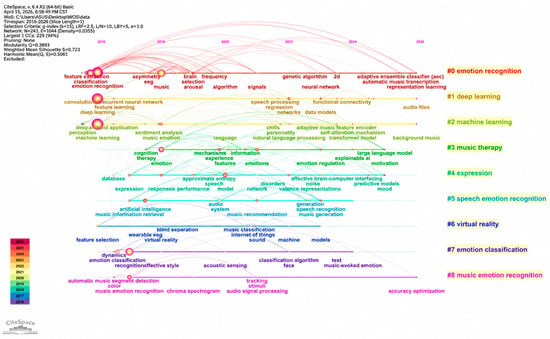
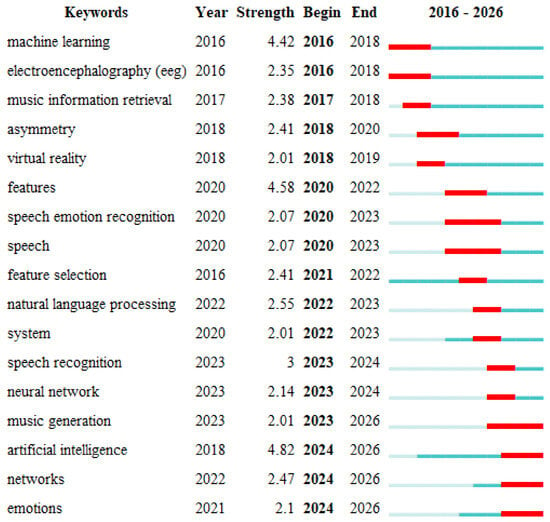
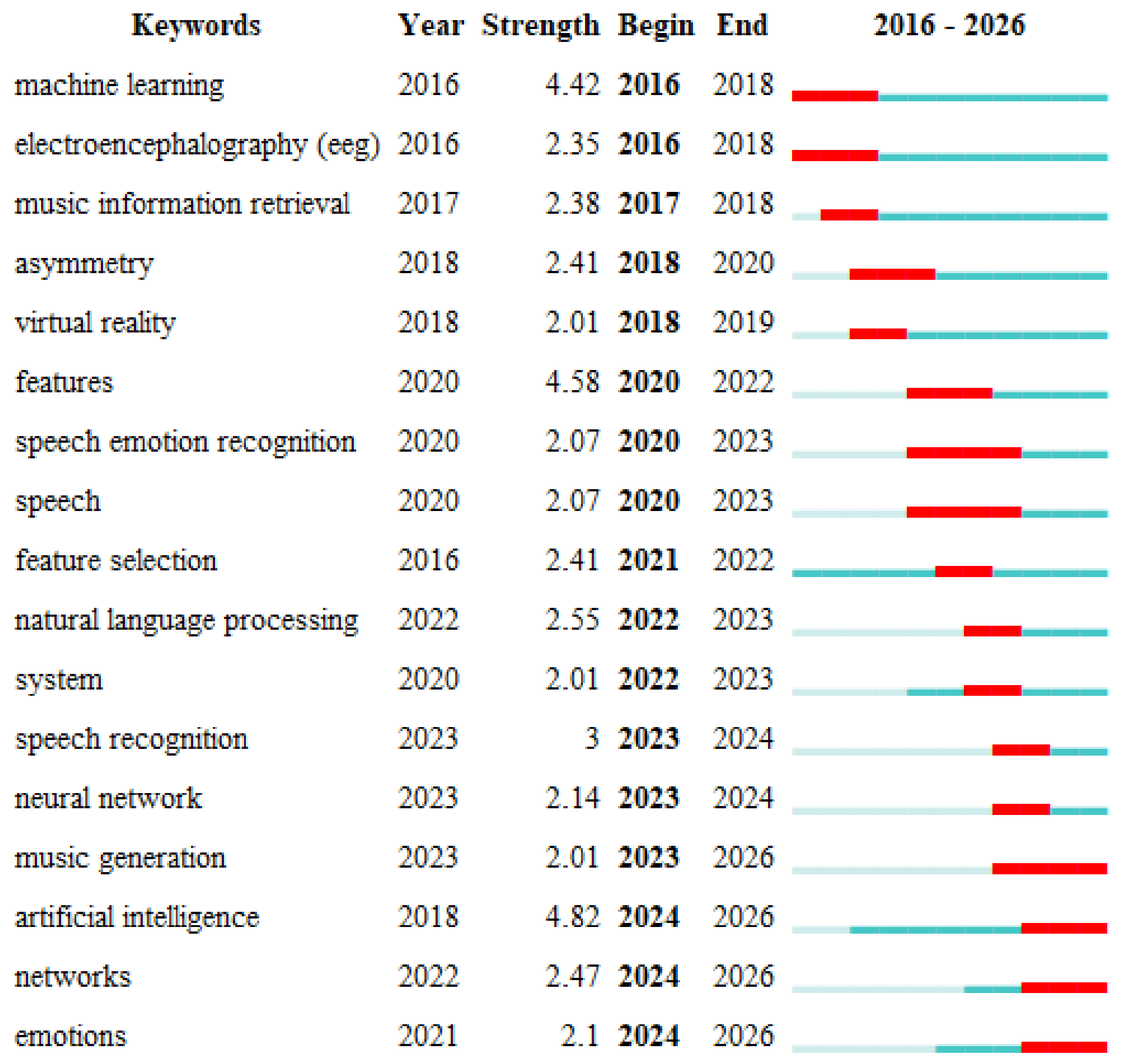
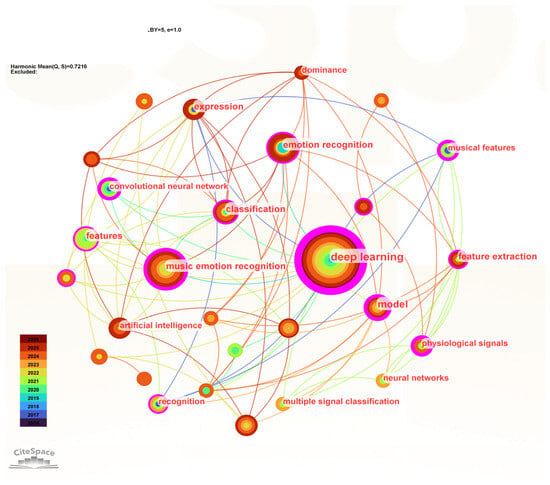
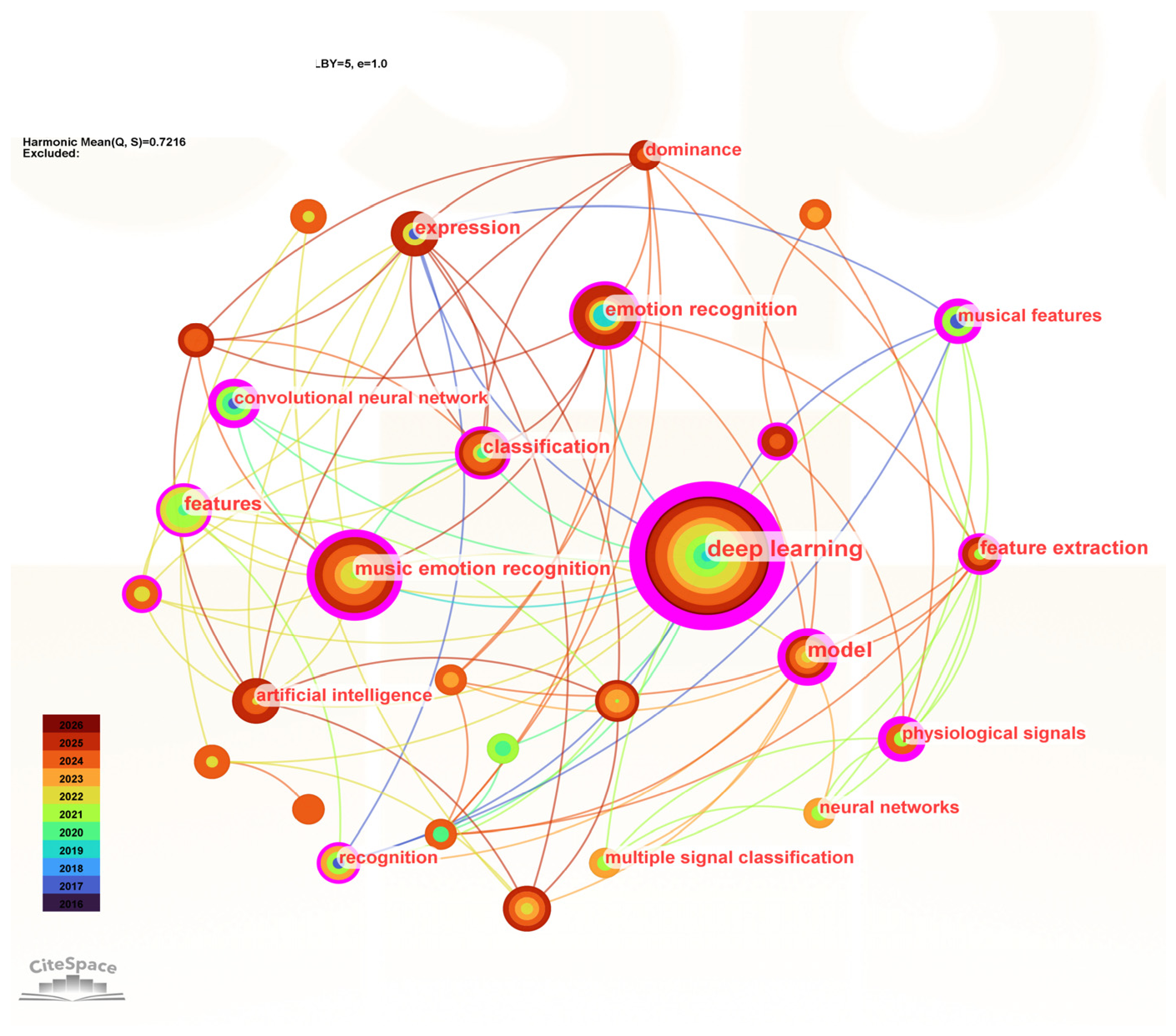
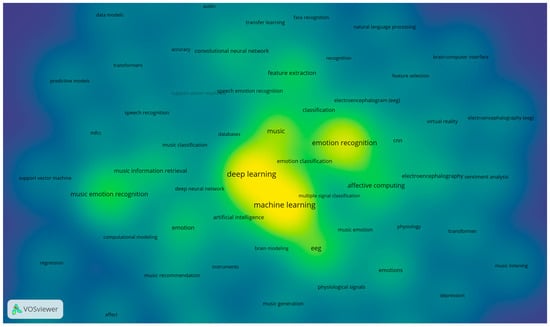
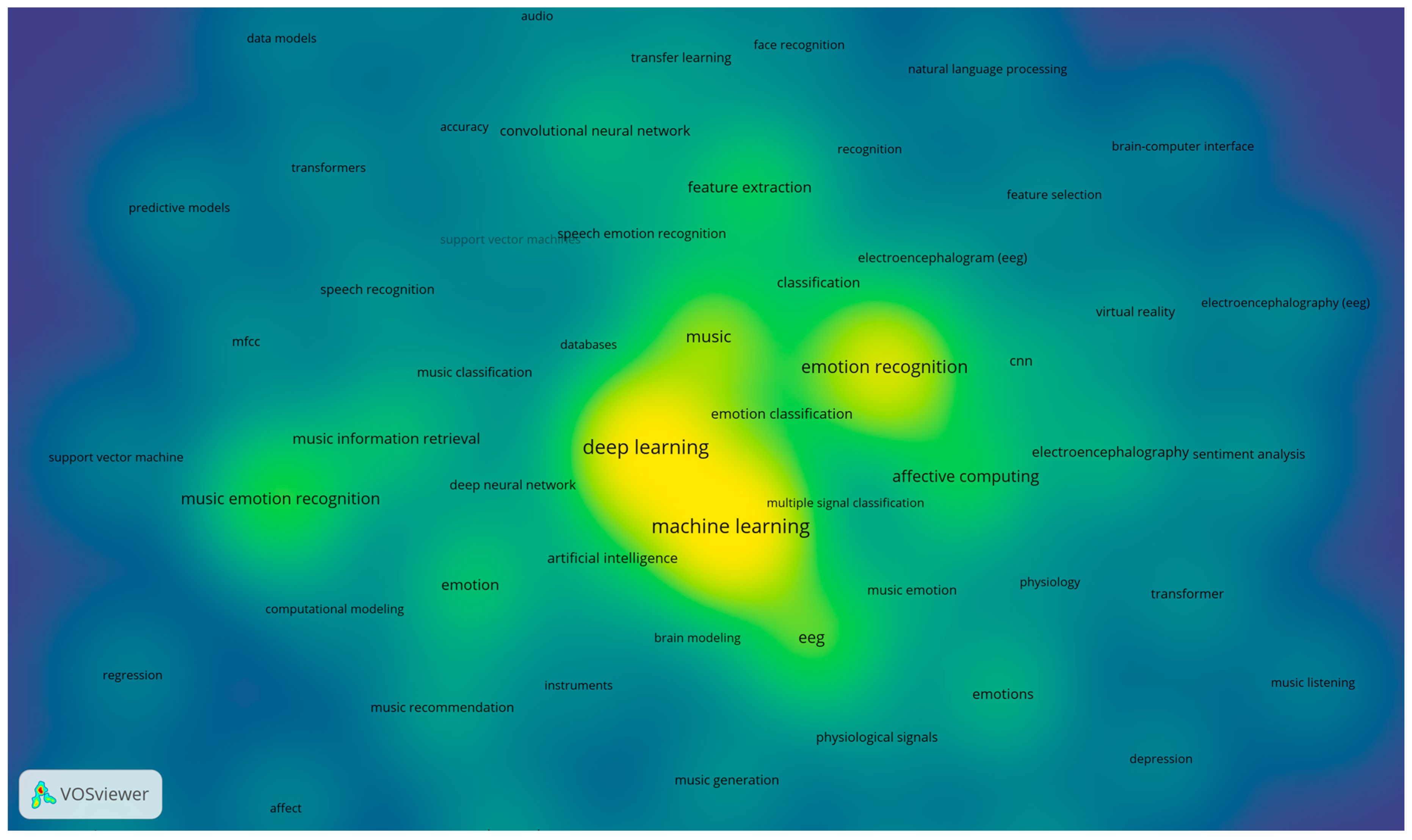
Until now, a comprehensive summary of music emotion recognition has not been available, especially for machine learning and deep learning. Citespace 6.4.R2 is a universal tool for tracking the evolution and development of a typical field by analyzing the time-related keywords and references that have appeared. As can be seen in Figure 2, we give nine main clusters within 2016–2026 and find that emotion recognition appeared in 2016 and lasted until this year, which is among the hottest topics in this field. Deep learning, machine learning, and music therapy ranked following this, serving as the core research point these years. As we know, music therapy is an important application of music emotion recognition. From 2017 until 2025, it attracted wide attention an ranked 3rd in the figure. Furthermore, we give the 17 keywords with the strongest citation bursts in Figure 3. Machine learning receives the highest citation since 2016 to 2018, lasting for over 3 years. Electroencephalography (EEG) ranked second; it records electrical brain activity from which affective correlates may be estimated, rather than extracting emotion directly. Artificial intelligence, networks, and emotions got more attention since 2024 and have dominated in this field until now. We also show the clusters to reveal the core research topic in the music emotion recognition field (Figure 4). Deep learning is the biggest cluster, which demonstrates its wide application in MER research. Furthermore, we can conclude the similar results from the heatmap (Figure 5), which shows that machine learning, deep learning, artificial intelligence, and electroencephalography are the hottest topics in this field.
Figure 2.
Keywords that appeared within 2016–2026 and their intrinsic correlation timescale.
Figure 3.
Top keywords that appeared within 2016–2026 in this field and their timescale.
Figure 4.
Cluster analysis of music emotion recognition.
Figure 5.
The heatmap of music emotion recognition.
2.2. Literature Overview
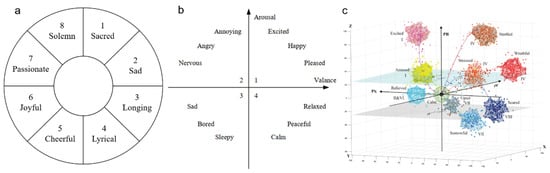
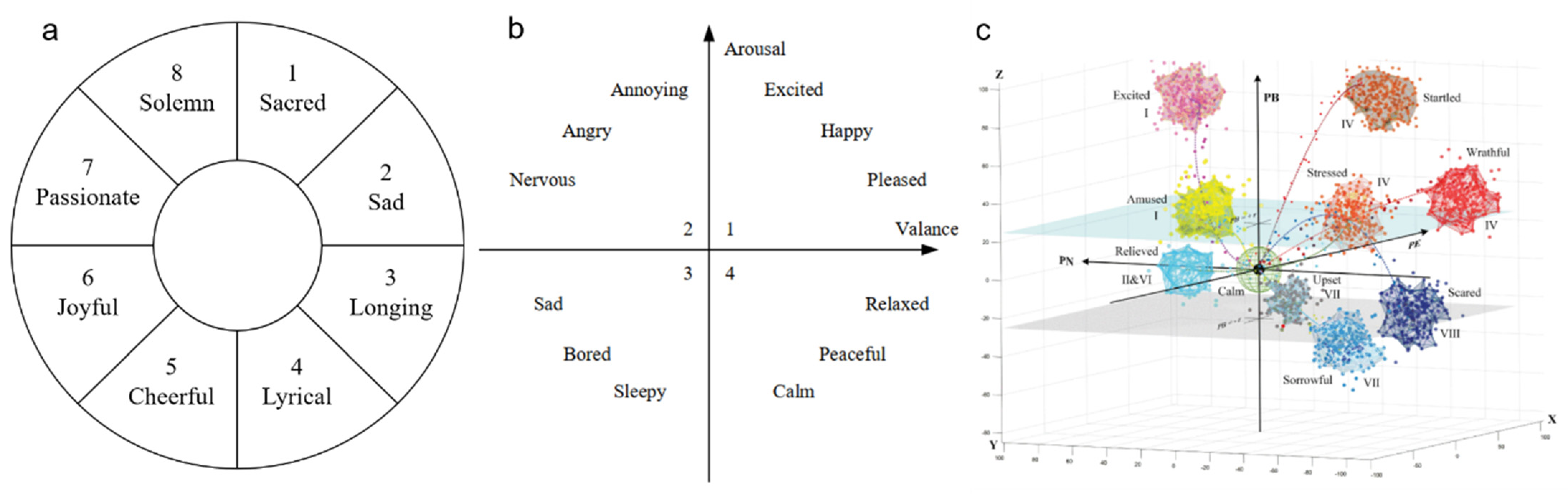
The computational modeling of musical emotion relies on psychological theories, and establishing a reasonable emotion model serves as the prerequisite for achieving precise recognition. Currently, the field of music emotion recognition primarily employs three categories of psychological models: categorial emotion models, dimensional emotion models, and hybrid emotion models. Categorial models summarize musical emotions into discrete types; the labels may be mutually exclusive in single-label tasks or co-occur in multi-label tasks. Classical categorical models could track up to 1936, namely as Hevner’s affective ring model, which comprises 8 groups (sacred, sad, longing, lyrical, cheerful, joyful, passionate, and solemn) with 67 emotional adjectives arranged in a circle [26,27]. Categorial emotion models are well-suited for applications like music recommendation and tag-based retrieval. However, they cannot express the emotional intensity, gradient transitions, or complex combinations of affective states, resulting in coarser granularity that struggles to capture the continuous dynamics and nuanced complexity of musical emotions. Dimensional emotion models represent affective states within a continuous numerical space, enabling the fine-grained characterization and quantitative description of emotions. This approach has become the predominant framework in deep-learning-based music emotion recognition. The most representative example is Russell’s circumplex model of affect, which employs two core dimensions: valence (pleasure–displeasure continuum) and arousal (calm–excitement continuum) [28]. Valence quantifies the positive–negative spectrum of emotions, while arousal measures the intensity range from calm to excited states. These two orthogonal dimensions can span the vast majority of musical affective states. Additionally, the dominance (submissive–dominant continuum) dimension can be incorporated to represent perceived control levels in emotional experiences, as shown in Figure 6c [29,30]. While dimensional models support regression tasks and temporal dynamic prediction—thus aligning more closely with human perception of musical emotions—they entail significantly higher annotation costs and implementation complexity and demand greater predictive accuracy from computational models. Hybrid emotion models integrate the advantages of both aforementioned approaches by first partitioning the affective space into discrete zones and then outputting continuous numerical values. This architecture enables simultaneous coarse-grained classification and fine-grained regression, naturally accommodating multi-task learning frameworks to thereby enhance model robustness and operational flexibility. Some other models for music-induced emotion have been proposed, which are based on distinct intention [31,32,33,34,35,36,37]. The representative models in music emotion recognition are given in Table 1.
Figure 6.
(a) Hevner emotional model; (b) Russel emotional model; (c) the three-dimensional emotion space model, reproduced with permission from Yinhua Liu, IEEE Access; published by IEEE, 2024 [27,30].
Table 1.
Emotion models in music emotion recognition.
Music emotion recognition can be categorized into three core classes of computational tasks, namely as the definition of emotion models, extraction of music features, and construction of music emotion recognition models. Song-level emotion prediction constitutes the most fundamental task, generating a single emotion label for an entire musical piece as the processing unit. This approach benefits from low annotation costs and straightforward implementation, leading to widespread adoption in music retrieval, classification, and recommendation systems. It represented the predominant paradigm in early-stage research. However, this method exhibits significant limitations: since musical emotions typically undergo dynamic fluctuations across sections, phrases, and melodic progression, a monolithic label fails to capture the authentic temporal evolution of affective states. Temporal affective dynamic prediction represents a more realistic advanced task that operates at frame, segment, or phrase-level temporal units [38]. It models the continuous emotion dynamics throughout musical playback, outputting time-series V-A values or emotion label sequences. This approach captures affective contour variations, transitional shifts, and dynamic structural patterns in music, therefore serving as the core requirement for applications like intelligent interaction systems, real-time scoring engines, and affect-regulated therapeutic interventions. Currently, it constitutes a primary research frontier in deep-learning-based affective computing. Multi-label and fine-grained emotion recognition addresses complex affective scenarios by enabling the prediction of co-occurring emotions, affectively ambiguous states, and intensity-graded classifications. For instance, a single musical piece may simultaneously exhibit compound states like “sadness + calmness” or “happiness + excitement”. Fine-grained tasks output either multi-label probability distributions or multi-level intensity vectors, thereby enhancing the model representational capacity and deployment flexibility across diverse application contexts.
Datasets serve as the foundation of deep-learning-based music emotion recognition, and high-quality annotated data directly determines model performance. Currently, there are some widely utilized public datasets for music emotional analysis, comprising full-length tracks with continuous valence and arousal annotations, supporting both regression and temporal tasks. The PMEmo dataset contains 794 pop songs with high-precision dynamic temporal annotations [39]. The DEAM dataset contains 1802 music excerpts (15 s or 45 s) sourced from western pop charts, with static V–A scores per segment and dynamic V–A labels at a 1 s resolution to capture emotion trends [40]. MER500 is a typical dataset, which contains five emotions [41]. TROMPA-MER, built upon 181 participants, 4721 annotations, and 1161 music excerpts, serves as an important platform for research on music emotion recognition [42]. Participants annotated each music excerpt with single free-text emotion words (in native language), distinct forced-choice emotion categories, preference, and familiarity. Additionally, participants stated the reasons for each annotation, including those distinctive of emotion perception and emotion induction. Furthermore, several small-scale datasets focused on specific genres or cultural contexts were proposed to support domain adaptation studies [43,44,45,46,47,48,49,50,51,52,53,54,55,56,57,58]. A comprehensive summary of music datasets can be found in Table 2.
Table 2.
A summary of music datasets.
Music emotion annotation methodologies primarily include human crowdsourcing, physiological signal-assisted annotation, and expert annotation [59]. While crowdsourcing is cost-effective and scalable, it is prone to subjective variance and noise. Expert annotation offers high precision and consistency but is limited by high costs and small scales. Physiological signals (e.g., EEG or ECG) provide indirect, person-dependent correlates of a listener’s response rather than objective emotion labels, and their acquisition requires specialized equipment. Currently, mainstream datasets rely on crowdsourcing, employing multi-annotator fusion and consistency validation to enhance data quality.
2.3. Data Preprocessing and Feature Representation for MER
2.3.1. Audio Preprocessing Pipeline
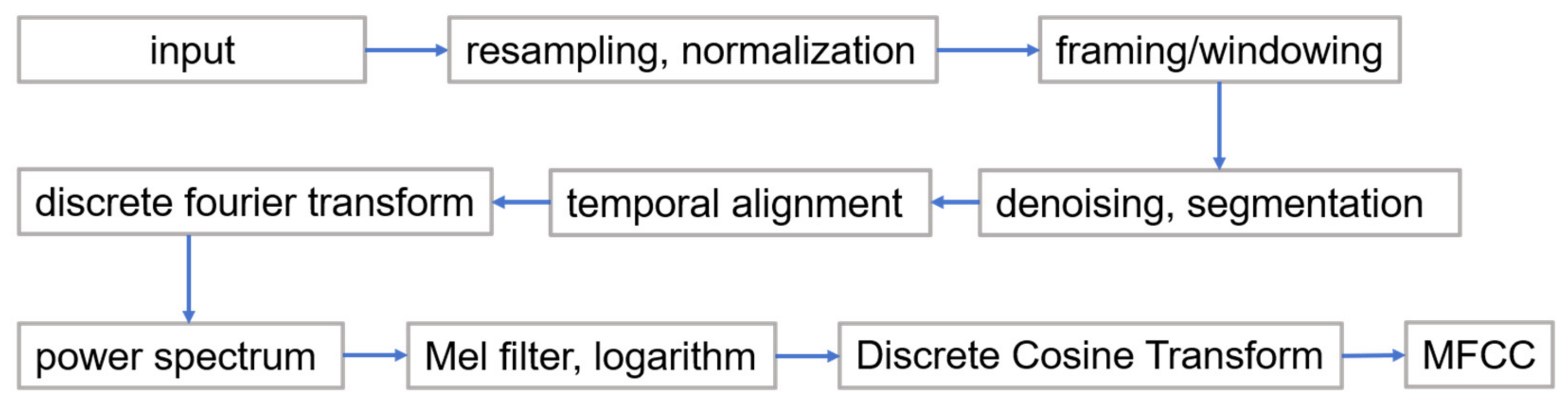
Audio preprocessing is a critical step to enhance model robustness and mitigate noise interference. The standard pipeline includes resampling, normalization, framing/windowing, denoising, segmentation, and temporal alignment, etc. [60]. Pre-emphasis is an optional signal-processing step used in some pipelines; it is not a universal requirement for music audio, and its use should be justified by the recording conditions and model input [61]. This is followed by amplitude normalization to eliminate volume discrepancies. Framing (20–50 ms) and Hamming windowing are applied to convert continuous waveforms into discrete frame sequences, preserving local time–frequency features. For long-form audio, tracks are segmented into fixed-length clips to fit model inputs. For temporal tasks, strict alignment between the audio signal and emotional annotations is enforced to ensure chronological consistency. Musical signals change continuously over time, but they are stationary over short periods, meaning musical signals have the characteristic of short-term stationarity [62]. For short-time Fourier analysis, the window and hop sizes determine the time–frequency trade-off; speech-oriented values of 10–30 ms are not a universal choice for music, which may require longer or multi-scale windows. Extracting features from each frame can produce a feature sequence that contains temporal information, making it convenient to perform time–frequency domain analysis. Digital signal processing analyzes music signals, and it can be done either in the time domain or frequency domain. Discrete Fourier transform (DFT) can convert audio signals from the time domain to the frequency domain, which helps to conduct a more systematic and comprehensive analysis of music signals.
2.3.2. Acoustic Feature Representation
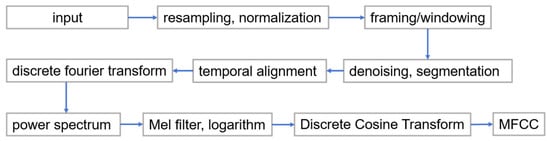
In MER systems, acoustic features constitute the primary input. The audio waveform already contains acoustic cues related to perceived emotion; feature extraction transforms these cues into representations that are easier for a model to learn from [63]. Currently, feature extraction in music emotion recognition is predominantly understood as acoustic feature extraction. While it is true that such features are not directly equivalent to emotional states, they do encapsulate affective information that can be effectively modeled [64]. Deep learning approaches for music emotion recognition primarily leverage time–frequency representations to circumvent the laborious process of manual feature engineering. Among these, the Mel-spectrogram stands as the most prevalent 2D input format, which transforms raw audio into a time–frequency–energy matrix that closely approximates human auditory perception, thereby rendering it ideally suited for CNN- and transformer-based architectures. MFCCs, while conventional handcrafted features, are often relegated to a supplementary role in deep learning pipelines (Figure 7). Another set of commonly employed features—spectral contrast, spectral flux, and RMS energy—jointly offer complementary representations of a piece’s dynamic, timbral, and rhythmic attributes. The Mel-spectrogram is a time–frequency representation derived from the standard spectrogram by converting frequency to the perceptually motivated Mel scale, thereby encapsulating temporal, spectral, and amplitude information. While the affective information conveyed by the Mel-spectrogram features is indeed limited in richness, it nonetheless provides an intuitive visualization of how three fundamental acoustic attributes—pitch (frequency), loudness (amplitude), and timbre (spectral and temporal structure)—evolve over time. Given their powerful deep feature extraction capabilities, deep learning models offer a compelling pathway to derive emotion-relevant representations. On the computational side, the generation of Mel-spectrograms from preprocessed music signals involves two fundamental operations—fast Fourier transform and Mel filter bank processing. Rhythm and harmony play a pivotal role in shaping musical emotion. Rhythmic attributes—including the onset strength, beat density, and tempo (BPM)—exert a primary influence on perceived arousal. Harmonic attributes—such as chord progressions, modality, and harmonic tension—in turn exert a significant influence on perceived valence. Within deep learning frameworks, these features can often be learned automatically from spectrograms without explicit extraction.
Figure 7.
Process from input to MFCC.
2.3.3. Multimodal Feature Representation
Musical emotion is collectively shaped by acoustic signals, lyrical semantics, and symbolic structures. To this end, lyrical features serve as a critical semantic complement—through tokenization and pre-trained language models, affective semantics can be extracted from lyrics to effectively offset the inherent limitations of acoustic-only analysis. Symbolic features—such as MIDI pitch, velocity, and structural metadata—afford the fine-grained structural analysis of musical compositions. Physiological signals, including EEG and ECG, can provide supplementary information about an individual listener’s induced response, but they do not make emotion labels objective. Multimodal fusion may improve performance when the modalities are complementary and well aligned, but it does not necessarily outperform a well-tuned unimodal system.
2.3.4. Data Augmentation Strategies
To mitigate overfitting arising from limited dataset sizes, data augmentation has become an essential component of MER pipelines. Time–domain augmentation techniques encompass time stretching, pitch shifting, random cropping, and amplitude perturbation; frequency–domain methods primarily involve time/frequency masking; and hybrid strategies include the mixing of different musical excerpts or the injection of controlled noise. These approaches can expand the training distribution and improve robustness; however, transformations that alter pitch, tempo, or temporal alignment may change the emotion label and should be validated or accompanied by corresponding label transformations.
3. Results
3.1. CNN-Based Music Emotion Recognition
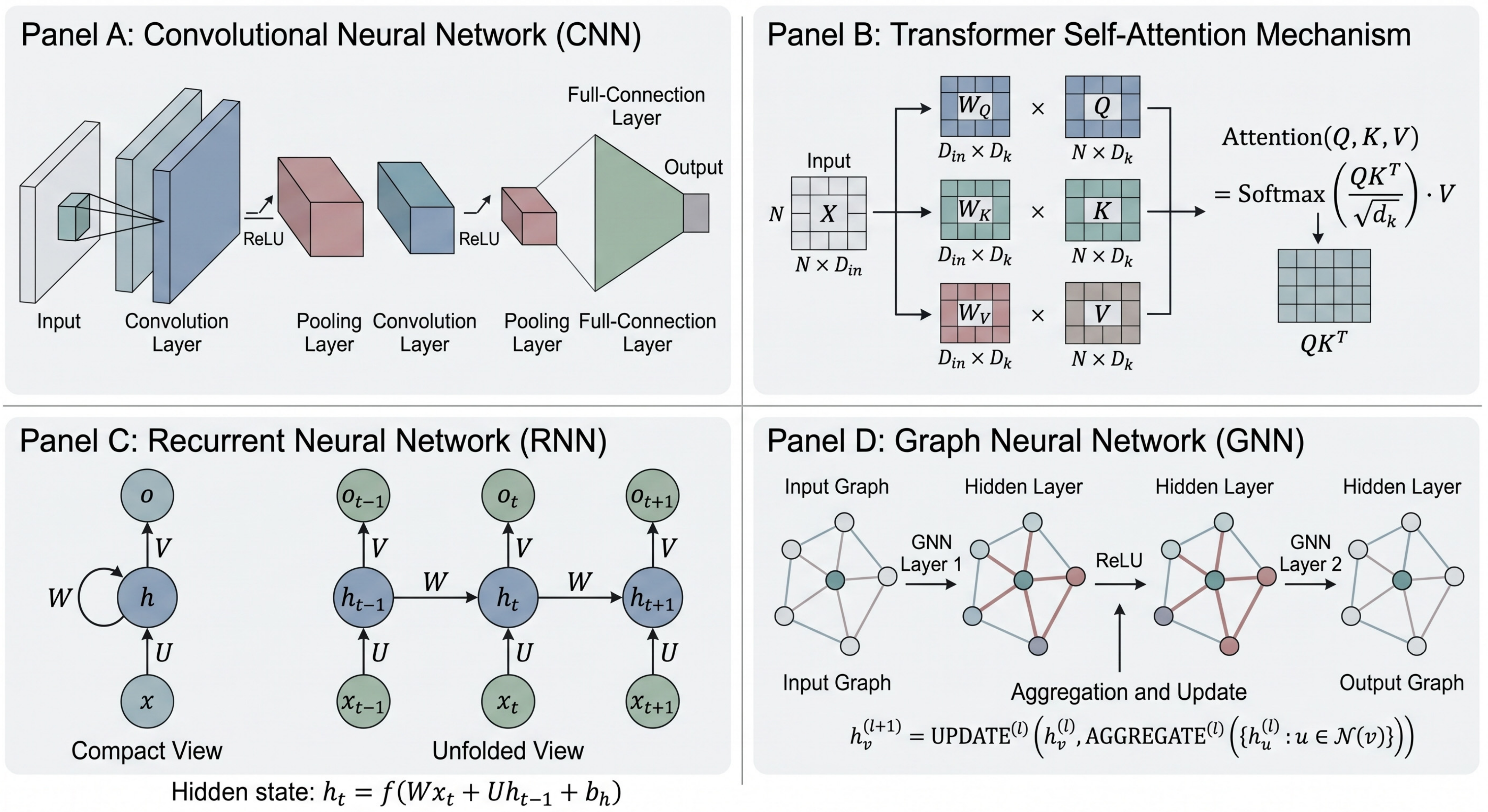
Convolutional neural networks (CNNs) stand as one of the earliest deep learning architectures to be adopted in music emotion recognition, excelling at extracting localized time–frequency representations from spectrogram inputs [65]. For context, Dutta et al. summarize representative traditional and shallow-learning baselines and CNN-based examples [25]. This study constructs the model-architecture mapping and the bibliometric analysis to more comprehensively give a summary of deep learning in MER. Furthermore, more datasets and models are included in Table 1 and Table 2 for reference. Some representative studies could be tracked, which discuss machine learning models for MER [66,67,68,69,70,71,72,73,74,75,76]. As a class of feedforward neural networks incorporating convolution operations, a typical CNN module comprises an input layer, convolutional layers, pooling layers, fully connected layers, inter-layer activation functions, and an output layer. This architecture offers two key strengths: first, it effectively extracts spatially localized features from two-dimensional spectrogram inputs; second, weight sharing reduces the parameter count and provides a useful inductive bias, although it does not by itself guarantee better generalization. Consequently, CNNs are highly suited for extracting local features from 2D representations such as Mel-spectrograms. Through successive convolutional and pooling operations, they automatically learn localized acoustic patterns—including timbral envelopes and harmonic structures—directly from spectrogram inputs. Beyond these foundational efforts, classic architectures such as VGG and ResNet have been successfully adapted for song-level emotion classification, while current research increasingly explores multi-scale CNNs, attention-augmented CNNs, and lightweight variants for real-time deployment. Plain CNNs with local kernels model long-range temporal dependencies only indirectly; deeper or dilated convolutions, temporal pooling, or recurrent/attention modules can expand the temporal receptive field.
3.2. RNN/LSTM/GRU for Temporal Modeling
Recurrent neural networks (RNNs), including gated variants such as LSTM and GRU, are designed for sequential data. LSTM and GRU mitigate, but do not eliminate, the difficulty of learning long-range dependencies. A comprehensive summary with representative recurrent, convolutional, hybrid, and selected non-deep approaches used in music emotion recognition was given in a previous study [25]. Representative deep-learning models and selected non-deep baselines used in MER could be found in previous studies [77,78,79,80,81,82,83,84]. Recurrent neural networks (RNNs) are widely regarded as one of the standard choices for modeling data with an inherent temporal structure. In contrast to a purely frame-by-frame feedforward model, an RNN preserves a hidden state that is recurrently updated at each time step. Convolutional networks, on the other hand, are also capable of modeling the temporal context, but they do so through temporal kernels, dilation, and pooling. This recurrent state is useful when sequential context is essential, although recurrence is not the only mechanism for temporal modeling; temporal CNNs and transformers are established alternatives. A defining characteristic of RNNs is that the recurrent connection is formed by the hidden state passed from one time step to the next; the output need not be fed back into the recurrent unit. Building on this capability, the CNN-LSTM/GRU hybrid architecture has become a common practice in MER: the CNN front-end extracts localized time–frequency features, which are then fed into the recurrent component for sequential modeling. Bidirectional variants (BiLSTM/BiGRU) incorporate both past and future context, but they require access to the full sequence and are therefore not causal for real-time streaming inference. Nevertheless, despite their effectiveness in temporal valence–arousal prediction, these models face persistent challenges in computational efficiency and scalability to ultra-long musical sequences.
3.3. Transformer and Self-Attention Models
The transformer employs self-attention to capture dependencies within its defined context window. However, the use of standard full attention does not necessarily mean that an entire unsegmented musical work is processed as a single input. This mechanism enables the model to dynamically attend to salient phrases or spectral regions that are most informative for emotional expression. Building on this foundation, the emergence of large-scale audio pre-trained models—including Wav2Vec2, HuBERT, AST, MERT, and Emotion2Vec—has further elevated the state of the art. These models differ in the pre-training domain and objective: wav2vec 2.0 and HuBERT were developed for speech, AST for audio classification, MERT for music representation, and emotion2vec for speech emotion; a universal valence–arousal correlation above 0.9 is not supported across MER datasets and protocols. Huang et al. introduced a memory-efficient relative-attention method for symbolic music generation [85]; this work should not be presented as an MER or music-style-classification result. Zeng et al. proposed a large-scale pre-training approach for a symbolic music understanding, achieving superior performance across four downstream tasks: melody completion, accompaniment suggestion, genre classification, and style classification [85]. Computational self-attention should not be equated with auditory masking, which is a distinct psychoacoustic phenomenon. In parallel, as data scales continue to expand and the demand for neural network expressiveness increases, network architectures have grown correspondingly more complex. In deep learning, attention is a learned weighting operation and should not be described as mechanistically equivalent to biological attention.
3.4. Graph Neural Networks (GNNs) and Structure-Aware MER
Given the inherently structured nature of music—characterized by verses, choruses, and harmonic progressions—graph neural networks (GNNs) offer a natural representational framework, modeling musical compositions as graphs in which notes or phrases serve as nodes and temporal or harmonic relations as edges. The usefulness of a GNN depends on how its nodes, edges, and pooling are defined; the graph structure does not automatically make predictions more coherent or interpretable. Wu et al. reported a 91.3% quadrant match rate for their specific multimodal GNN system [1]; this study-specific result should not be generalized to GNNs as a class.
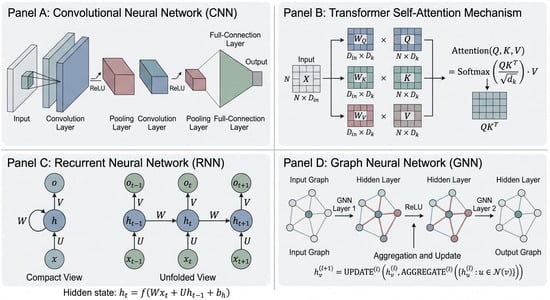
The comparative analysis above reveals that no single architecture universally dominates music emotion recognition tasks. CNNs remain the most practical baseline for standard classification problems where local spectral patterns are sufficiently discriminative, offering high computational efficiency and stable convergence. RNNs and their variants retain a distinct advantage for regression tasks that involve continuous emotion trajectories, as temporal ordering is fundamental to the prediction objective; however, their inherently sequential processing limits training parallelization and scalability. GNNs serve as a more specialized tool, best reserved for scenarios where the explicit musical structure is available and can be meaningfully encoded as a graph—their broader adoption is currently hindered by the lack of standardized graph-construction protocols. Transformers achieve state-of-the-art performance in data-rich environments by capturing global dependencies, yet their quadratic attention complexity and substantial data requirements render them less suitable for small-scale or resource-constrained applications. In practice, architecture selection should be guided by the specific task nature (classification vs. regression), data availability, and computational budget, rather than a one-size-fits-all heuristic. Schematic of CNN, RNN, GNN, and transformer was given in Figure 8.
Figure 8.
Schematic of CNN, RNN, GNN, and transformer.
3.5. Multimodal Fusion Models
Multimodal fusion integrates acoustic, lyrical, and symbolic cues to enhance emotion prediction. The fusion strategies are broadly categorized into three types: (1) early fusion—feature-level concatenation at the input stage, which is conceptually simple but risks dimension explosion; (2) late fusion—decision-level aggregation at the output stage, which offers robustness yet neglects inter-modal semantic interaction; and (3) mid-level fusion—which uses shared representations, cross-modal attention, or transformer mechanisms to model interactions between modalities. The relative merits of early, intermediate, and late fusion depend on the dataset and protocol. No consistent 5–10% improvement can be claimed without matched comparisons.
3.6. Model Training, Evaluation, and Benchmarks
3.6.1. Training Strategies
The training landscape for MER encompasses multiple paradigms: supervised learning—typically optimized with MSE or cross-entropy loss; transfer learning—via fine-tuning of pre-trained models; and weakly-supervised learning for scenarios with limited labels. Complementing these, self-supervised learning—through mask prediction or contrastive objectives—has emerged as a promising direction to mitigate data scarcity. Furthermore, domain adaptation strategies, including adversarial training and distribution alignment, are increasingly employed to enhance cross-genre and cross-cultural generalization.
3.6.2. Evaluation Metrics
The performance of deep learning models is typically quantified using metrics such as accuracy, precision, recall, and F1-score, while the confusion matrix is a diagnostic summary rather than a scalar metric. Among these, the confusion matrix serves as a visual analytical tool that records the distribution of predictions across different categories, offering an intuitive overview of model performance—particularly in multi-class classification tasks. Accuracy, defined as the ratio of correct predictions to the total number of predictions, remains the most commonly reported metric in classification settings. In classification tasks, precision quantifies the accuracy among positive predictions, recall reflects the coverage of actual positive instances, and specificity gauges the correct rejection rate among actual negative instances. The F1-score, defined as the harmonic mean of precision and recall, provides a balanced assessment of predictive performance, where a high value signifies robust category-level recognition. For regression tasks targeting valence and arousal, evaluation typically relies on the Pearson Correlation Coefficient, Root Mean Square Error (RMSE), and Mean Absolute Error (MAE). For temporal tasks, Dynamic Time Warping (DTW) and temporal correlation coefficients are employed to assess the similarity between predicted and ground-truth emotional trajectories over time.
3.6.3. Benchmark Performance
We intentionally refrain from compiling a consolidated performance comparison table in this section. Such cross-study aggregations can be highly misleading due to fundamental disparities in experimental setups. Specifically, reported performance metrics across the literature should not be interpreted as a single ascending trajectory. The cited studies rely on distinct datasets, emotion representations, data splitting protocols, and evaluation metrics. For example, classification accuracy for discrete emotion tags cannot be directly compared with Pearson’s Correlation Coefficient or RMSE for continuous dynamic regression. Consequently, quantitative superiority can be validly claimed only through direct head-to-head evaluations under a strictly unified protocol.
4. Discussion
4.1. Core Challenges in MER
Having surveyed both the psychological emotion models and the deep learning architectures, we now draw explicit connections between them. Categorical models, such as the discrete emotion categories proposed by Hevner, naturally align with multi-class classification tasks, where CNNs and transformers are commonly adopted as feature extractors followed by softmax layers. Dimensional models, particularly the valence–arousal scheme, correspond to regression or ordinal prediction problems, where RNN/LSTM-based architectures are frequently employed to capture temporal dynamics in continuous space. While deep learning has brought undeniable advantages to music emotion recognition, several critical challenges remain unresolved. First, the scarcity of high-quality annotated data—particularly for continuous temporal emotion annotations—limits the training of large-scale models. Second, the inherently subjective nature of emotional perception inevitably introduces label noise and annotation variability, further complicating model development. Third, emotional perception varies considerably across individuals and cultures, leading to annotation inconsistencies that can systematically mislead model training. Fourth, the resulting models exhibit weak cross-domain generalization, frequently failing when confronted with unseen musical genres or languages due to the distributional shift. Fifth, full-length sequence modeling can be computationally demanding, with the cost and training stability depending on the architecture, input resolution, and sequence length. Sixth, the black-box nature of deep learning models limits their interpretability, making it difficult to align predictions with established music–theoretical constructs. Seventh, cross-modal semantic alignment—capturing the synergy and divergence among acoustic, lyrical, and symbolic modalities—remains an open technical challenge.
4.2. Future Research Directions
In response to these challenges, the field is coalescing around three overarching directions: reducing dependence on labeled data, improving cross-domain universality, and enhancing real-world applicability. To this end, self-supervised and few-shot learning are being actively explored—leveraging pre-training strategies and prompt-based frameworks—to mitigate the annotation bottleneck and facilitate rapid adaptation to novel tasks. Concurrently, efforts focus on developing unified multimodal foundation models that seamlessly integrate and align diverse modalities such as audio signals, the lyrical content, and symbolic musical data. To investigate model behavior, studies use techniques such as attention visualization and SHAP analysis to identify associations with musical elements including rhythm and harmony; these associations should not automatically be interpreted as causal explanations. The field is also shifting from passive recognition toward affective generation and interaction, enabling emotion-controlled music synthesis and fostering more natural human–computer interfaces. For real-time deployment, lightweight solutions leveraging knowledge distillation and quantization methods are being optimized to facilitate edge computing applications. Additionally, cross-cultural alignment has emerged as a critical direction, with researchers striving to create universal models that account for cultural variations in emotional perception, thereby improving global adaptability. These interconnected advancements collectively shape MER’s evolving landscape, spanning from foundational data-efficient learning to culturally aware, interactive emotion-driven systems.
5. Conclusions
Music emotion recognition is a pivotal technology bridging acoustic signals and human perception. Deep learning has complemented and, in some settings, outperformed traditional methods through learned representations and multimodal modeling. While audio pre-trained models have set new performance benchmarks, challenges remain in data efficiency, generalization, and interpretability. Future advancements in self-supervised learning and large-scale foundation models will drive MER toward more robust, interpretable, and efficient applications in personalized services and mental health.
Author Contributions
Conceptualization, M.Z.; methodology, M.Z. and Q.J.; software, Q.J.; validation, M.Z.; formal analysis, M.Z. and Q.J.; investigation, M.Z. and Q.J.; resources, M.Z.; data curation, M.Z.; writing—original draft preparation, M.Z.; writing—review and editing, M.Z.; visualization, Q.J.; supervision, Q.J.; project administration, M.Z. All authors have read and agreed to the published version of the manuscript.
Funding
This work was supported by the Science and Technology Research Program of Hubei Provincial Department of Education, China (Grant No. B2025129), the Project of Wuhan Conservatory of Music (Grant No. 2025xjkt21), and the National Natural Science Foundation of China (Grant No. 62401416).
Institutional Review Board Statement
Not applicable.
Data Availability Statement
Data could be available from the corresponding author.
Acknowledgments
During the preparation of this manuscript/study, Tianhao Wang at Wuhan University of Technology gave a useful discussion about the algorithms of deep learning. The authors have reviewed and edited the output and take full responsibility for the content of this publication.
Conflicts of Interest
The authors declare no conflicts of interest.
References
- Wu, Y.; Hu, W. Salient structural modeling in multimodal music emotion recognition via graph neural networks. Multimed. Syst. 2026, 32, 209. [Google Scholar] [CrossRef] [Scilit]
- Louro, P.L.; Redinho, H.; Malheiro, R.; Paiva, R.P.; Panda, R. A comparison study of deep learning methodologies for music emotion recognition. Sensors 2024, 24, 2201. [Google Scholar] [CrossRef] [Scilit] [PubMed]
- Donthu, N.; Kumar, S.; Mukherjee, D.; Pandey, N.; Lim, W.M. How to conduct a bibliometric analysis: An overview and guidelines. J. Bus. Res. 2021, 133, 285–296. [Google Scholar] [CrossRef] [Scilit]
- Öztürk, O.; Kocaman, R.; Kanbach, D.K. How to design bibliometric research: An overview and a framework proposal. Rev. Manag. Sci. 2024, 18, 3333–3361. [Google Scholar] [CrossRef] [Scilit]
- Liyanarachchi, R.K.; Joshi, A.; Meijering, E.H. A Survey on Multimodal Music Emotion Recognition. arXiv 2025, arXiv:2504.18799. [Google Scholar]
- Zhang, J.; Chen, W. A Decade of Music Emotion Computing: A Bibliometric Analysis of Trends, Interdisciplinary Collaboration, and Applications. Educ. Inf. 2025, 41, 227–255. [Google Scholar] [CrossRef] [Scilit]
- Yang, X.; Dong, Y.; Li, J. Review of data features-based music emotion recognition methods. Multimed. Syst. 2018, 24, 365–389. [Google Scholar] [CrossRef] [Scilit]
- Wang, Y.; Zhao, X.; Deng, C.; Xiao, Y.; Ruan, H.; Jin, P.; Cai, X. A survey on music emotion recognition using learning models. Multimed. Syst. 2025, 31, 278. [Google Scholar] [CrossRef] [Scilit]
- Yan, P.; Chu, W.; Wu, H. A Multimodal Deep Learning Model for Optimizing Music Emotion Recognition Through Temporal and Semantic Feature Integration. J. Circuits Syst. Comput. 2026, 35, 2650058. [Google Scholar] [CrossRef] [Scilit]
- Huang, C.; Zhang, Q. Research on music emotion recognition model of deep learning based on musical stage effect. Sci. Program. 2021, 2021, 3807666. [Google Scholar] [CrossRef] [Scilit]
- Sun, Y. Feature centric based deep learning approach for music mood recognition with HuBERT transformer model. Sci. Rep. 2025, 15, 45460. [Google Scholar] [CrossRef] [Scilit] [PubMed]
- Han, D.; Kong, Y.; Han, J.; Wang, G. A survey of music emotion recognition. Front. Comput. Sci. 2022, 16, 166335. [Google Scholar] [CrossRef] [Scilit]
- Ning, Z.; Han, X.; Pan, J. Semi-supervised emotion-driven music generation model based on category-dispersed Gaussian Mixture Variational Autoencoders. PLoS ONE 2024, 19, e0311541. [Google Scholar] [CrossRef] [Scilit] [PubMed]
- Hao, X.; Li, H.; Wen, Y. Real-time music emotion recognition based on multimodal fusion. Alex. Eng. J. 2025, 116, 586–600. [Google Scholar] [CrossRef] [Scilit]
- Talaghat, M.A.; Parvinnia, E.; Mehrabi, M.; Boostani, R. A Multimodal Deep Network for Music Emotion Recognition using Audio Chorus and Lyrics. IEEE Access 2025, 13, 177509–177519. [Google Scholar] [CrossRef] [Scilit]
- Wang, X.; Wang, L.; Xie, L. Comparison and analysis of acoustic features of Western and Chinese classical music emotion recognition based on VA model. Appl. Sci. 2022, 12, 5787. [Google Scholar] [CrossRef] [Scilit]
- Eerola, T.; Anderson, C. A Meta-Analysis of Music Emotion Recognition Studies. ACM Comput. Surv. 2026, 58, 1–22. [Google Scholar] [CrossRef] [Scilit]
- Hu, X.; Yang, Y.H. Cross-dataset and cross-cultural music mood prediction: A case on western and chinese pop songs. IEEE Trans. Affect. Comput. 2017, 8, 228–240. [Google Scholar] [CrossRef] [Scilit]
- Sarkar, R.; Choudhury, S.; Dutta, S.; Roy, A.; Saha, S.K. Recognition of emotion in music based on deep convolutional neural network. Multimed. Tools Appl. 2020, 79, 765–783. [Google Scholar] [CrossRef] [Scilit]
- Zaman, K.; Sah, M.; Direkoglu, C.; Unoki, M. A survey of audio classification using deep learning. IEEE Access 2023, 11, 106620–106649. [Google Scholar] [CrossRef] [Scilit]
- Srivastava, N.; Ruhil, S.; Kaushal, G. Music genre classification using convolutional recurrent neural networks. In Proceedings of the 2022 IEEE 6th Conference on Information and Communication Technology (CICT); IEEE: Piscataway, NJ, USA, 2022; pp. 1–5. [Google Scholar] [CrossRef] [Scilit]
- Dabas, C.; Agarwal, A.; Gupta, N.; Jain, V.; Pathak, S. Machine learning evaluation for music genre classification of audio signals. Int. J. Grid High Perform. Comput. (IJGHPC) 2020, 12, 57–67. [Google Scholar] [CrossRef] [Scilit]
- Venkatesh, J.; Kannan, K.; Ayyadurai, M.; Sathish, M.G. Impact of machine learning in music genre classification using CNN. In Proceedings of the 2023 14th International Conference on Computing Communication and Networking Technologies (ICCCNT); IEEE: Piscataway, NJ, USA, 2023; pp. 1–6. [Google Scholar] [CrossRef] [Scilit]
- Guo, Y. Research on music genre recognition method based on deep learning. Mol. Cell. Biomech. 2024, 21, 373. [Google Scholar] [CrossRef] [Scilit]
- Dutta, J.; Chanda, D. Machine Learning and Deep Learning in Music Emotion Recognition: A Comprehensive Survey. Int. J. Math. Eng. Manag. Sci. 2025, 10, 977. [Google Scholar] [CrossRef] [Scilit]
- Hevner, K. Experimental studies of the elements of expression in music. Am. J. Psychol. 1936, 48, 246–268. [Google Scholar] [CrossRef] [Scilit] [PubMed]
- Yang, J. A novel music emotion recognition model using neural network technology. Front. Psychol. 2021, 12, 760060. [Google Scholar] [CrossRef] [Scilit] [PubMed]
- Russell, J.A. A Circumplex Model of Affect. J. Personal. Soc. Psychol. 1980, 39, 1161–1178. [Google Scholar] [CrossRef] [Scilit]
- Mehrabian, A. Pleasure-arousal-dominance: A general framework for describing and measuring individual differences in temperament. Curr. Psychol. 1996, 14, 261–292. [Google Scholar] [CrossRef] [Scilit]
- Wu, Z.; Shang, Y.; Liu, Y. Quantifying Emotions via Pupil Diameter and Grip Strength Measurements. IEEE Access 2024, 13, 187134–187154. [Google Scholar] [CrossRef] [Scilit]
- Hevner, K. The affective value of pitch and tempo in music. Am. J. Psychol. 1937, 49, 621–630. [Google Scholar] [CrossRef] [Scilit] [PubMed]
- Thayer, R.E. Toward a psychological theory of multidimensional activation (arousal). Motiv. Emot. 1978, 2, 1–34. [Google Scholar] [CrossRef] [Scilit]
- Chełkowska-Zacharewicz, M.; Janowski, M. Polish adaptation of the Geneva emotional music scale: Factor structure and reliability. Psychol. Music 2020, 49, 1117–1131. [Google Scholar] [CrossRef] [Scilit]
- Zentner, M.; Grandjean, D.; Scherer, K.R. Emotions evoked by the sound of music: Characterization, classification, and measurement. Emotion 2008, 8, 494–521. [Google Scholar] [CrossRef] [Scilit] [PubMed]
- Larsen, R.J.; Diener, E. Promises and problems with the circumplex model of emotion. In Review of Personality and Social Psychology, Emotion; Clark, M.S., Ed.; Sage Publications, Inc.: Thousand Oaks, CA, US, 1992; pp. 25–59. [Google Scholar]
- Watson, D.; Tellegen, A. Toward a consensual structure of mood. Psychol. Bull. 1985, 98, 219–235. [Google Scholar] [CrossRef] [Scilit] [PubMed]
- Tellegen, A.; Watson, D.; Clark, L.A. On the dimensional and hierarchical structure of affect. Psychol. Sci. 1999, 10, 297–303. [Google Scholar] [CrossRef] [Scilit]
- Qiao, Y.; Mu, J.; Xie, J.; Hu, B.; Liu, G. Music emotion recognition based on temporal convolutional attention network using EEG. Front. Hum. Neurosci. 2024, 18, 1324897. [Google Scholar] [CrossRef] [Scilit] [PubMed]
- Zhang, K.; Zhang, H.; Li, S.; Yang, C.; Sun, L. The PMEmo dataset for music emotion recognition. In Proceedings of the 2018 ACM on International Conference on Multimedia Retrieval; ACM: New York, NY, USA, 2018; pp. 135–142. [Google Scholar] [CrossRef] [Scilit]
- Aljanaki, A.; Yang, Y.H.; Soleymani, M. Developing a benchmark for emotional analysis of music. PLoS ONE 2017, 12, e0173392. [Google Scholar] [CrossRef] [Scilit] [PubMed]
- Panda, R.; Malheiro, R.; Paiva, R.P. Musical climate: Audio features for music emotion recognition. Psychol. Music 2018, 46, 643–666. [Google Scholar] [CrossRef] [Scilit]
- Gómez-Cañón, J.S.; Gutiérrez-Páez, N.; Porcaro, L.; Porter, A.; Cano, E.; Herrera-Boyer, P.; Gómez, E. TROMPA-MER: An open dataset for personalized music emotion recognition. J. Intell. Inf. Syst. 2023, 60, 549–570. [Google Scholar] [CrossRef] [Scilit]
- Bogdanov, D.; Won, M.; Tovstogan, P.; Porter, A.; Serra, X. The mtg-jamendo dataset for automatic music tagging. In Proceedings of the Machine Learning for Music Discovery Workshop, International Conference on Machine Learning (ICML 2019); PMLR: Long Beach, CA, USA, 2019; pp. 1–3. [Google Scholar]
- Livingstone, S.R.; Russo, F.A. The Ryerson audio-visual database of emotional speech and song (RAVDESS): A dynamic, multimodal set of facial and vocal expressions in North American English. PLoS ONE 2018, 13, e0196391. [Google Scholar] [CrossRef] [Scilit] [PubMed]
- Paolizzo, F.; Pichierri, N.; Giardino, D.; Matta, M.; Casali, D.; Costantini, G. A new multilabel system for automatic music emotion recognition. In Proceedings of the 2021 IEEE International Workshop on Metrology for Industry 4.0 & IoT, Rome, Italy; IEEE: Piscataway, NJ, USA, 2021; pp. 625–629. [Google Scholar] [CrossRef] [Scilit]
- Barthet, M.; Fazekas, G.; Sandler, M. Music emotion recognition: From content-to context-based models. In Proceedings of the from Sounds to Music and Emotions: 9th International Symposium, London, UK; Springer: Berlin/Heidelberg, Germany, 2013; pp. 228–252. [Google Scholar]
- Liu, X.; Chen, Q.; Wu, X.; Liu, Y.; Liu, Y. CNN based music emotion classification. arXiv 2017, arXiv:1704.05665. [Google Scholar] [CrossRef] [Scilit]
- Xiang, Z.; Dong, X.; Li, Y.; Yu, F.; Xu, X.; Wu, H. Bimodal emotion recognition model for Minnan songs. Information 2020, 11, 145. [Google Scholar] [CrossRef] [Scilit]
- Mia, M.; Das, P.; Habib, A. Verse-based emotion analysis of Bengali music from lyrics using machine learning and neural network classifiers. Int. J. Comput. Digit. Syst. 2024, 15, 359–370. [Google Scholar] [CrossRef] [Scilit] [PubMed]
- Chen, Y.A.; Yang, Y.H.; Wang, J.C.; Chen, H. The AMG1608 dataset for music emotion recognition. In Proceedings of the 2015 IEEE International Conference on Acoustics, Speech and Signal Processing, South Brisbane, QLD, Australia; IEEE: Piscataway, NJ, USA, 2015; pp. 693–697. [Google Scholar] [CrossRef] [Scilit]
- He, N.; Ferguson, S. Music emotion recognition based on segment-level two-stage learning. Int. J. Multimed. Inf. Retr. 2022, 11, 383–394. [Google Scholar] [CrossRef] [Scilit]
- Panda, R.; Malheiro, R.; Paiva, R.P. Novel audio features for music emotion recognition. IEEE Trans. Affect. Comput. 2020, 11, 614–626. [Google Scholar] [CrossRef] [Scilit]
- Hizlisoy, S.; Yildirim, S.; Tufekci, Z. Music emotion recognition using convolutional long short term memory deep neural networks. Eng. Sci. Technol. Int. J. 2021, 24, 760–767. [Google Scholar] [CrossRef] [Scilit]
- Koelstra, S.; Muhl, C.; Soleymani, M.; Lee, N.J.; Yazdani, A.; Ebrahimi, T.; Pun, T.; Nijholt, A.; Patras, I. DEAP: A database for emotion analysis using physiological signals. IEEE Trans. Affect. Comput. 2012, 3, 18–31. [Google Scholar] [CrossRef] [Scilit]
- Yang, Y.; Chen, H.H. Prediction of the distribution of perceived music emotions using discrete samples. IEEE Trans. Audio Speech Lang. Process. 2011, 19, 2184–2196. [Google Scholar] [CrossRef] [Scilit]
- Bogdanov, D.; Lizarraga-Seijas, X.; Alonso-Jiménez, P.; Serra, X. MusAV: A dataset of relative arousalvalence annotations for validation of audio models. In Proceedings of the 23rd International Society for Music Information Retrieval Conference, Bengaluru, India, 4–8 December 2022; pp. 5–15. [Google Scholar] [CrossRef]
- Mollahosseini, A.; Hasani, B.; Mahoor, M.H. AffectNet: A database for facial expression, valence, and arousal computing in the wild. IEEE Trans. Affect. Comput. 2019, 10, 18–31. [Google Scholar] [CrossRef] [Scilit]
- Han, X.; Chen, F.; Ban, J. Music emotion recognition based on a neural network with an inception-gruresidual structure. Electronics 2023, 12, 978. [Google Scholar] [CrossRef] [Scilit]
- Hsu, Y.L.; Wang, J.S.; Chiang, W.C.; Hung, C.H. Automatic ECG-based emotion recognition in music listening. IEEE Trans. Affect. Comput. 2017, 11, 85–99. [Google Scholar] [CrossRef] [Scilit]
- Juslin, P.N.; Laukka, P. Expression, perception, and induction of musical emotions: A review and a questionnaire study of everyday listening. J. New Music Res. 2004, 33, 217–238. [Google Scholar] [CrossRef] [Scilit]
- Zhao, X.; Wang, D. Analyzing noise robustness of MFCC and GFCC features in speaker identification. In Proceedings of the 2013 IEEE International Conference on Acoustics, Speech and Signal Processing; IEEE: Piscataway, NJ, USA, 2013; pp. 7204–7208. [Google Scholar] [CrossRef] [Scilit]
- Han, B.J.; Rho, S.; Jun, S.; Hwang, E. Music emotion classification and context-based music recommendation. Multimed. Tools Appl. 2010, 47, 433–460. [Google Scholar] [CrossRef] [Scilit]
- Panda, R.; Malheiro, R.; Paiva, R.P. Audio features for music emotion recognition: A survey. IEEE Trans. Affect. Comput. 2020, 14, 68–88. [Google Scholar] [CrossRef] [Scilit]
- Shi, Y. A CNN-Based approach for classical music recognition and style emotion classification. IEEE Access 2025, 13, 20647–20666. [Google Scholar] [CrossRef] [Scilit]
- Chou, Y.-C.; Chien, S.-K.; Chao, P.-C.; Lin, Y.-J.; Chen, C.-Y.; Yeh, K.-K.; Peng, Y.-C.; Tsao, C.-H.; Chen, S.-L.; Li, K.-C. SEM-Net: A Social–Emotional Music Classification Model for Emotion Regulation and Music Literacy in Individuals with Special Needs. Appl. Sci. 2025, 15, 4191. [Google Scholar] [CrossRef] [Scilit]
- Dutta, J.; Chanda, D. Music emotion recognition in assamese songs using MFCC features and MLP classifier. In Proceedings of the 2021 International Conference on Intelligent Technologies, Hubli, India, 25–27 June 2021; pp. 1–5. [Google Scholar] [CrossRef] [Scilit]
- Er, M.B.; Esin, E.M. Music emotion recognition with machine learning based on audio features. Comput. Sci. 2021, 6, 133–144. [Google Scholar] [CrossRef] [Scilit]
- Panda, R.; Rocha, B.; Paiva, R.P. Music emotion recognition with standard and melodic audio features. Appl. Artif. Intell. 2015, 29, 313–334. [Google Scholar] [CrossRef] [Scilit]
- Ciaramella, A.; Vettigli, G. Machine learning and soft computing methodologies for music emotion recognition. In Neural Nets and Surroundings: 22nd Italian Workshop on Neural Nets, Salerno, Italy; Springer: Berlin/Heidelberg, Germany, 2013; pp. 427–436. [Google Scholar] [CrossRef] [Scilit]
- Yang, Y.; Lin, Y.; Su, Y.; Chen, H.H. A regression approach to music emotion recognition. IEEE Trans. Audio Speech Lang. Process. 2008, 16, 448–457. [Google Scholar] [CrossRef] [Scilit]
- Jamdar, A.; Abraham, J.; Khanna, K.; Dubey, R. Emotion analysis of songs based on lyrical and audio features. Int. J. Artif. Intell. Appl. 2015, 6, 35–50. [Google Scholar] [CrossRef] [Scilit]
- Chen, Y.A.; Wang, J.C.; Yang, Y.H.; Chen, H.H. Component tying for mixture model adaptation in personalization of music emotion recognition. IEEE/ACM Trans. Audio Speech Lang. Process. 2017, 25, 1409–1420. [Google Scholar] [CrossRef] [Scilit]
- Koutras, A. Song emotion recognition using music genre information. In Speech and Computer: 19th International Conference, Hatfield, UK; Springer International Publishing: Berlin/Heidelberg, Germany, 2017; pp. 669–679. [Google Scholar] [CrossRef] [Scilit]
- Lu, N.L.; Liu, D.; Zhang, N.H. Automatic mood detection and tracking of music audio signals. IEEE Trans. Audio Speech Lang. Process. 2006, 14, 5–18. [Google Scholar] [CrossRef] [Scilit]
- Chang, C.Y.; Lo, C.Y.; Wang, C.J.; Chung, P.C. A music recommendation system with consideration of personal emotion. In Proceedings of the 2010 International Computer Symposium, Tainan, Taiwan; IEEE: Piscataway, NJ, USA, 2010; pp. 18–23. [Google Scholar]
- Schmidt, E.M.; Turnbull, D.; Kim, Y.E. Feature selection for content-based, time-varying musical emotion regression. In Proceedings of the International Conference on Multimedia Information Retrieval; ACM: New York, NY, USA, 2010; pp. 267–274. [Google Scholar] [CrossRef] [Scilit]
- Jiang, X.; Zhang, Y.; Lin, G.; Yu, L. Music Emotion Recognition Based on Deep Learning: A Review. IEEE Access 2024, 12, 157716–157745. [Google Scholar] [CrossRef] [Scilit]
- Agarwal, G.; Gupta, S.; Agarwal, S.; Rai, A.K. Emotion classification for musical data using deep learning techniques. Int. J. Reconfigurable Embed. Syst. 2023, 12, 240. [Google Scholar] [CrossRef] [Scilit]
- Pandeya, Y.R.; Bhattarai, B.; Lee, J. Deep-learning-based multimodal emotion classification for music videos. Sensors 2021, 21, 4927. [Google Scholar] [CrossRef] [Scilit] [PubMed]
- Grekow, J. Music emotion recognition using recurrent neural networks and pretrained models. J. Intell. Inf. Syst. 2021, 57, 531–546. [Google Scholar] [CrossRef] [Scilit]
- Xia, Y.; Xu, F. Study on music emotion recognition based on the machine learning model clustering algorithm. Math. Probl. Eng. 2022, 2022, 9256586. [Google Scholar] [CrossRef] [Scilit]
- Jandaghian, M.; Setayeshi, S.; Razzazi, F.; Sharifi, A. Music emotion recognition based on a modified brain emotional learning model. Multimed. Tools Appl. 2023, 82, 26037–26061. [Google Scholar] [CrossRef] [Scilit]
- Li, X.; Tian, J.; Xu, M.; Ning, Y.; Cai, L. DBLSTM-based multi-scale fusion for dynamic emotion prediction in music. In Proceedings of the 2016 IEEE International Conference on Multimedia and Expo, Seattle, WA, USA; IEEE: Piscataway, NJ, USA, 2016; pp. 1–6. [Google Scholar] [CrossRef] [Scilit]
- Huang, C.Z.A.; Vaswani, A.; Uszkoreit, J.; Shazeer, N.; Simon, I.; Hawthorne, C.; Eck, D. Music transformer. arXiv 2018, arXiv:1809.04281. [Google Scholar] [CrossRef] [Scilit]
- Zeng, M.; Tan, X.; Wang, R.; Ju, Z.; Qin, T.; Liu, T.Y. MusicBERT: Symbolic music understanding with large-scale pre-training. In Findings of the Association for Computational Linguistics: ACL-IJCNLP 2021; ACL: Kerrville, TX, USA, 2021; pp. 791–800. [Google Scholar] [CrossRef] [Scilit]

Disclaimer/Publisher’s Note: The statements, opinions and data contained in all publications are solely those of the individual author(s) and contributor(s) and not of MDPI and/or the editor(s). MDPI and/or the editor(s) disclaim responsibility for any injury to people or property resulting from any ideas, methods, instructions or products referred to in the content. |
© 2026 by the authors. Licensee MDPI, Basel, Switzerland. This article is an open access article distributed under the terms and conditions of the Creative Commons Attribution (CC BY) license.