


Abstract
Guiding user attention across multiple spatial regions is essential for safety-critical activities such as driving and cycling. While peripheral visual cues can redirect attention without disrupting central vision, their effectiveness may diminish under high visual workload or when targets fall outside the field of view. Haptic feedback offers an alternative channel that operates independently of visual demands. This study systematically compares three feedback conditions in a multi-region target search task using a head-mounted display: Ambient Display, Haptic Display, and Ambient-Haptic Display. Results show that haptic feedback significantly outperformed peripheral visual cues for rear visual area search. While the multimodal combination did not further improve objective performance over haptic feedback alone, it lowered perceived mental and physical demand relative to peripheral visual cues and was rated highly by participants. These findings demonstrate that haptic feedback provides superior attention guidance for targets outside the current field of view. Our work offers practical guidance for designing cross-modal assistive systems in safety-critical environments.
1. Introduction
Assistive technologies that guide user attention across multiple spatial regions have become increasingly important for safety-critical activities. These systems typically employ either visual or tactile feedback to alert users about events occurring outside their current field of view. Visual approaches leverage peripheral light cues to redirect attention while users maintain focus on their central visual field [1,2], while tactile approaches communicate directional information through vibrotactile devices worn on the body [3,4]. Both modalities have demonstrated effectiveness in guiding spatial attention, yet their relative advantages remain poorly understood, particularly for tasks requiring rapid attention shifts to rear visual regions.
Our prior studies addressed two related but distinct questions. One compared HMD-rendered directional arrows with haptic feedback during primary-to-secondary task switching [5], whereas the other compared peripheral ambient light cues with HMD arrows during multi-region search [6]. However, neither study directly compared peripheral ambient light cues with haptic cues or examined how these two channels might complement each other. In real-world scenarios such as driving and cycling, the visual environment is often more demanding, with users needing to simultaneously process traffic signs, monitor other vehicles, and adapt to changing lighting conditions [7,8]. When visual resources are heavily occupied by these primary tasks, peripheral visual cues must compete for the remaining attentional capacity, potentially reducing their effectiveness [9,10]. Furthermore, the guiding effect of peripheral cues may weaken over time [11]. Tactile feedback is less dependent on the visual scene and may therefore remain detectable as visual demands increase [12,13]. While auditory feedback offers another non-visual alternative, it can be difficult to perceive in noisy traffic environments [14]. This raises a practical question: can tactile feedback serve as an effective alternative or complement to peripheral visual cues, particularly when guiding attention to regions outside the current field of view? The present study therefore directly compares peripheral visual guidance with haptic guidance and evaluates their combination across frontal and rear search regions.
We address this question by systematically comparing three feedback conditions in a multi-region visual search task: Ambient Display utilizing peripheral visual cues, Haptic Display providing directional tactile feedback, and their combination (Ambient-Haptic Display). Through comprehensive user evaluations, our key findings include:
- Haptic feedback outperformed peripheral visual cues for guiding attention to rear visual regions, demonstrating the tactile channel’s advantage when targets fall outside the current field of view.
- Users preferred feedback conditions involving haptic cues over peripheral visual feedback alone when performing distributed spatial search tasks.
- The multimodal Ambient-Haptic Display was rated lower than the Ambient Display on Mental and Physical Demand.
These findings clarify the comparative and complementary roles of peripheral visual and haptic feedback in distributed attention tasks. The present study extends both our earlier comparison of HMD-rendered arrow guidance and haptic feedback in a dual-task setting [5] and our work on visual-channel integration [6] by directly comparing peripheral visual cues with haptic cues and evaluating their combination across frontal and rear search regions.
In summary, this paper investigates how peripheral visual feedback and haptic feedback support multi-region visual search tasks. Section 2 reviews related works on peripheral vision, haptic displays, and multimodal feedback systems. Section 3 details our experimental methodology and presents results across feedback modalities. Section 4 discusses the findings and their implications. Section 5 concludes the paper and outlines future research directions.
2. Related Works
Peripheral vision extends beyond 10 degrees from the central focus area [15], forming a functional complement to central vision: in visual search tasks, peripheral vision is responsible for initial target detection, while central vision performs target verification [16]. This collaborative mechanism supports daily activities and complex motor tasks [17,18]. In terms of perceptual characteristics, although peripheral vision exhibits lower detail resolution in processing color, form, and text [1,19], it demonstrates enhanced sensitivity to brightness changes [20,21] and possesses unique advantages in perceiving dynamic changes, discerning movement direction, and grasping relative spatial positions between objects [2]. Based on these characteristics, research indicates that peripheral visual cues presented through head-mounted displays can effectively redirect attention to areas outside the visual focus while users maintain concentration on their central visual field [1].
Visual search tasks typically require people to scan for targets across multiple spatial regions, often involving head movements to discover objects outside the field of view [22]. Peripheral vision plays a critical role in this process, allowing us to perceive and monitor targets at different spatial locations while fixating on the central visual field [23], accelerating target detection and cognitive processing speed through enhanced visual saliency [24,25]. Based on this characteristic, peripheral vision has been effectively utilized to enhance user interaction and situational awareness. In the driving domain, Matviienko et al. demonstrated that using LEDs in peripheral vision can improve drivers’ ability to maintain attention on the road, with lower distraction compared to Head-Up Display arrows [7,8]; Li et al. further found that ambient light displays can effectively guide drivers’ visual attention toward the rearview mirror area, enhancing situational awareness of surrounding traffic conditions, with this effect being more pronounced in high-urgency takeover scenarios [2]. In wearable devices, systems such as AmbiGlasses utilize peripheral illumination to provide environmental information without disrupting users’ focus on the central visual field [26]. Research on cycling scenarios indicates that users respond faster to visual signals such as ambient light than to vibration or voice prompts [27]. However, peripheral visual cues also have limitations: their guiding effect may weaken over time [11], and overly strong lighting conditions may conversely increase the risk of attention dispersion [14].
The above limitations suggest that although peripheral vision can effectively guide attention, relying solely on the visual channel for target detection and identification still presents inherent constraints [12]. Visual recognition is particularly susceptible to impediment when targets appear in peripheral vision, are obscured by other elements, or exist against complex visual backgrounds [9,10]. Haptic feedback systems, as an effective non-visual channel for information delivery, can enhance or replace visual and auditory signals without extending reaction times or increasing perceptual burden [3,13,28,29]. Among these, vibratory displays have emerged as a common implementation, enabling target localization when visual cues are limited or unavailable [4]. In navigation assistance, vibratory signals can provide direct directional guidance; for example, Kiss et al. conveyed navigational directions to motorcyclists through a belt-mounted vibration display [30], while Kaul et al. developed a head-mounted vibrotactile display to help users locate targets within three-dimensional virtual spaces [4]. This vibratory feedback acts like a “tap on the shoulder,” swiftly guiding attention toward the target direction [31]. Ariza N. et al. further demonstrated that adjusting vibratory feedback levels can significantly reduce target selection time while maintaining users’ ability to monitor different spatial regions [32].
Multimodal feedback systems, by integrating different sensory channels, have shown significant potential in assisting users to monitor and search across multiple spatial regions [33]. Research demonstrates that multimodal cues can significantly enhance performance in spatial search tasks: Hancock et al. found that when using multimodal feedback for distributed spatial attention tasks, detection speed increased by 43% and cognitive load was reduced by over 30% [34]; Benz et al. found that combining visual with haptic or auditory stimuli reduces performance variability in target localization [35]. However, the benefits of multimodal feedback are not universally applicable but rather depend on specific task contexts. For example, in driving scenarios, Arend et al. found that single visual search cues did not interfere with environmental monitoring, but adding haptic feedback adversely affected drivers’ performance in navigating curves [36]; conversely, Naujoks et al. found that visual-haptic warnings were more effective than visual-only warnings for redirecting spatial attention [37]. These seemingly contradictory results suggest that the effectiveness of combining visual and haptic feedback is modulated by multiple factors including task type, feedback design, and user state [28].
Although the aforementioned research has revealed the application value of multimodal feedback in spatial attention tasks, the combined use of peripheral vision and haptic feedback remains underexplored. Existing work has typically focused on single modalities or specific combinations such as visual-auditory or central visual-haptic feedback [33,34], while integrating peripheral visual cues with haptic signals offers a promising avenue for improving cross-regional attention distribution and search efficiency without overloading the central visual channel [38]. Building on the insights from the above research, our work aims to investigate the individual effects and synergistic interactions of peripheral vision assistance and haptic feedback in distributed spatial attention tasks. To this end, we designed a system supporting both unimodal and multimodal feedback to systematically compare the effects of different feedback conditions on target search efficiency, with the goal of providing empirical evidence for optimizing feedback modality design in cross-regional attention tasks.
3. Cross-Regional Search Guidance: System and User Study
This section describes the design and evaluation of visual and haptic feedback for multi-region target search tasks. We designed and implemented both peripheral visual feedback using Ambient Display and wearable haptic feedback for the user’s upper body, then conducted an experimental evaluation to investigate how different feedback modalities affect target search performance.
3.1. Peripheral Visual and Vibrotactile Cue Configuration
Ambient lighting has demonstrated effectiveness in guiding spatial attention across diverse application domains. Research shows that peripheral light cues facilitate target localization outside the direct field of view [39] and enhance search performance in virtual environments [40]. Such ambient visual feedback has been successfully applied in clinical alarm systems [41], vehicular situation awareness [11], and wayfinding applications [42]. Our previous work [6] validated the utility of Ambient Display for multi-region target search; the present study advances this line of inquiry by examining how ambient lighting integrates with haptic feedback. The Ambient Display retained the same spatial configuration as our earlier implementation, situated at roughly 60° eccentricity in the horizontal plane and 2 cm above the central fixation point, placing it within the far-peripheral visual field [43].
Haptic cues have been deployed across numerous interactive scenarios, including bicycle navigation [30,44,45], immersive 3D environments [4], emergency response coordination [36], and vehicle control transitions [46]. Evidence indicates that tactile feedback supports parallel cognitive processing and accelerates visual search responses [23,32], highlighting its capacity to preserve visual attention during concurrent task demands [47]. Based on findings that users integrate multiple vibrotactile stimuli into a coherent percept [48,49] and that dorsal placement yields superior vibrotactile sensitivity [50], haptic actuators were mounted on the left and right dorsal regions to convey directional information.
All feedback conditions employed a common 4 Hz temporal pattern to maintain temporal consistency across the visual and tactile cues. The Ambient Display retained the red, 4 Hz lighting parameters used in our previously evaluated implementation [6], allowing the present study to extend that system while maintaining a consistent visual configuration. Red was selected for its conventional association with alerting signals [41,51], while the 4 Hz rate was informed by previous research on flashing-light displays [52]. Under the multimodal condition, peripheral visual and tactile channels delivered synchronized directional cues. Target selection was accomplished through gaze-based dwell activation across all experimental conditions.
3.2. Experimental Evaluation
We conducted a within-subjects study comparing three guidance conditions in a target search task that spanned two spatial regions: a frontal visual area located within the participant’s field of view and a rear visual area located outside it. The three conditions were Ambient Display, Haptic Display, and Ambient-Haptic Display. The apparatus, task factors, experimental design, and protocol are detailed in the following subsections.
3.2.1. Apparatus and System Implementation
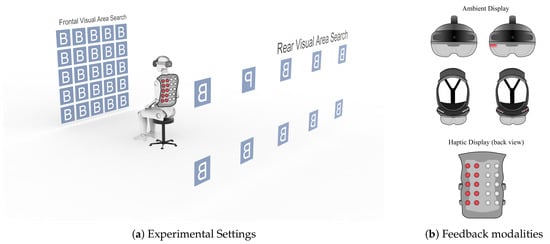
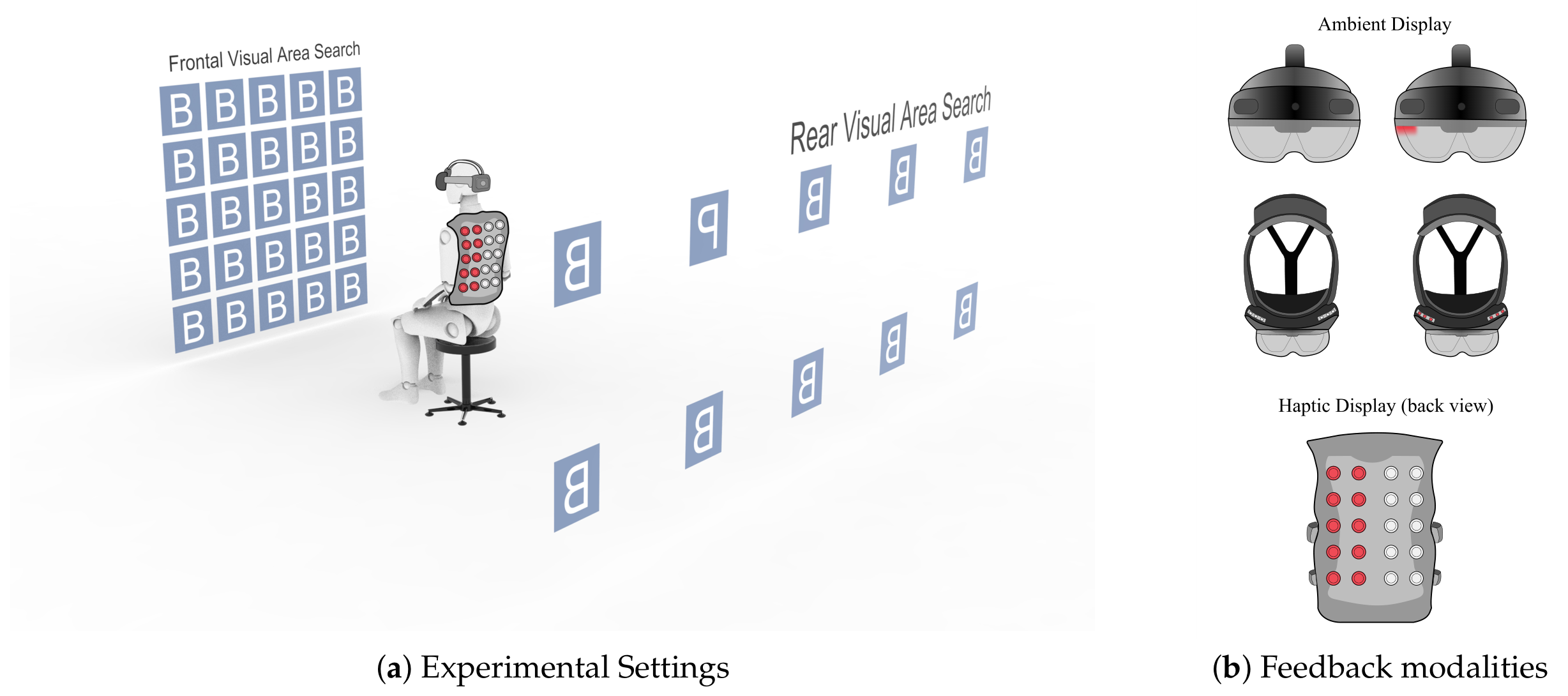
The study used Microsoft HoloLens 2 as the experimental platform, which features a transparent stereoscopic display and head-gaze tracking functions. We developed the experimental application using Unity 2019.4 and Mixed Reality Toolkit (MRTK) version 2.6. The development and deployment took place on Windows 10 systems using Microsoft Visual Studio 2019 (version 16.9.4). This configuration provided high-quality visual rendering and interactivity, which enhanced the experimental accuracy. For the Ambient Display, two sets of RGB LED strips were mounted on the Microsoft HoloLens 2 to provide peripheral visual feedback, as shown in Figure 1a. The LED strips were controlled via a Makeblock Halocode board. The red-colored LEDs pulsed at 4 Hz (four pulses per second), with each pulse lasting 100 ms.
Figure 1.
Experimental setup and feedback modalities.
For haptic direction guidance, tactile units were located on the left and right sides of the back of the bHaptics TactSuit X40. To focus the tactile feedback on the back, tactile units in the chest area were deactivated, as shown in Figure 1b. The tactile feedback was controlled by an application developed in Unity 2019.4, which integrated the bHaptics tactile plugin and was deployed on a desktop computer running the Windows 11 operating system. Consistent with the Ambient Display settings, the frequency of tactile feedback was set to four pulses per second, with each pulse lasting 100 ms. The directional information for the targets was published from the experimental application using the Message Queuing Telemetry Transport (MQTT) protocol to guide user actions. The MQTT server was hosted on Tencent Cloud and managed using EMQX V4.0.4 on a CentOS 7 server. Both the Ambient Display and haptic control applications subscribed to these directional guidance messages and triggered corresponding feedback upon receiving the data.
3.2.2. Task Factors and Target Layout
The experiment had two user tasks, each with different independent variables. The independent variables for the frontal visual area search were:
- Feedback Modality (3 levels): Ambient Display, Haptic Display and Ambient-Haptic Display
- Target Row (5 levels): 1, 2, 3, 4, 5
- Target Column (5 levels): 1, 2, 3, 4, 5
Similarly, the independent variables for the rear visual area search were:
- Feedback Modality (3 levels): Ambient Display, Haptic Display and Ambient-Haptic Display
- Target Row (2 levels): 1, 2
- Target Column (5 levels): 1, 2, 3, 4, 5
3.2.3. Experimental Design
A within-subjects repeated measures design was adopted for this study. Participants completed three experimental phases, each corresponding to a distinct feedback modality: Ambient Display, Haptic Display, and Ambient-Haptic Display. To control for order effects, the sequence of phases was counterbalanced across participants, with two-minute rest intervals separating consecutive phases. Within each phase, participants completed 25 frontal visual area search trials (one per grid position) and 10 rear visual area search trials (one per grid position), presented in randomized order, yielding 35 trials per phase and a total of 105 trials per participant.
3.2.4. Participants and Experimental Protocol
Twelve participants (7 males and 5 females) were recruited from a university campus for this study, with a mean age of 22.8 years . Among them, eight had prior experience with 3D gaming, two were familiar with VR technology, and one had encountered an AR-HUD system in an automotive setting. The sample size is comparable to those reported in recent HCI and haptics studies employing similar controlled experimental designs [53,54,55].
Throughout the experiment, participants wore a Microsoft HoloLens 2 and a bHaptics TactSuit X40. Prior to the formal trials, they received task instructions and completed a practice session to become acquainted with the equipment and procedures. The study consisted of three phases corresponding to different feedback conditions: Ambient Display, Haptic Display, and Ambient-Haptic Display. Phase order was counterbalanced across participants, with a two-minute break between consecutive phases. The complete session lasted approximately 50 min.
Participants were seated in swivel chairs and asked to locate and select a target letter P by orienting their head toward it. Following established protocols from previous studies [5,6,56], alphabetic characters served as selection targets. Frontal targets appeared within the participant’s immediate field of view, while rear targets were positioned outside the visual field and thus required directional guidance to locate. The target letter P appeared either in the frontal visual area or in the rear visual area behind the participant.
Each letter was presented on a dark blue square button rendered in white text. Selection was confirmed through a gaze-and-dwell mechanism: participants fixated on the target for one second to register their choice. When gaze entered a button region, the background shifted to a lighter blue tone and a circular indicator began expanding from the button center, providing visual confirmation of the selection progress. Once the circle completed its expansion after one second, the selection was registered.
In the frontal visual area search, participants identified the target letter P among 25 buttons positioned 1.35 m ahead. Each button measured 20 cm in width, separated by 2.5 cm gaps, forming a grid that occupied 1.1 m in both height and width. For the rear visual area search, ten buttons were arranged on a plane 1.35 m behind the participant. These buttons were also 20 cm wide, distributed at 42.5 cm intervals across a 2.7 m horizontal span and 82 cm vertical range. Following the random selection of 2 to 4 frontal targets, the letter P could subsequently appear in the rear visual area.
Under the Ambient Display condition, as illustrated in Figure 1b, two RGB LED strip arrays mounted on the Microsoft HoloLens 2 delivered peripheral visual cues. The red LEDs flashed at a rate of 4 Hz, with each flash sustained for 100 ms. When the angle between head orientation and the forward direction exceeded 30 degrees, the visual feedback was deactivated.
3.3. Results
In this study, we recorded performance metrics including reaction time and selection time, along with behavioral data encompassing head rotation and head movement, to evaluate participant performance across both frontal and rear visual area searches. Since frontal targets appeared within participants’ direct field of view whereas rear targets were positioned outside their immediate visual range, the two visual areas were analyzed separately to examine how different feedback modalities influenced performance in these distinct spatial regions. A repeated measures Analysis of Variance (ANOVA) was performed on the collected performance data across different feedback conditions. Effect sizes are reported as partial eta squared (), together with two-sided 90% confidence intervals calculated using the noncentral F-distribution method, following established recommendations for reporting ANOVA effect sizes [57,58]. As all participants successfully selected every target throughout the experiments, error rates were not included in the analysis.
3.3.1. Selection Time and User Behavior Data in Frontal Visual Area Search
Selection Time.
Selection time was measured based on the preceding trial type. For consecutive frontal visual area search trials, selection time was recorded from the moment the target (indicated by the letter “P”) appeared until successful selection. However, when the previous trial was a rear visual area search, the starting point for measuring selection time required adjustment due to the necessary head movement back to the frontal position. Given that the human central visual field spans approximately 60° in diameter [59], with all frontal targets positioned within this range, selection time measurement began once participants reoriented their head to within 30° of the frontal direction and continued until successful task completion.
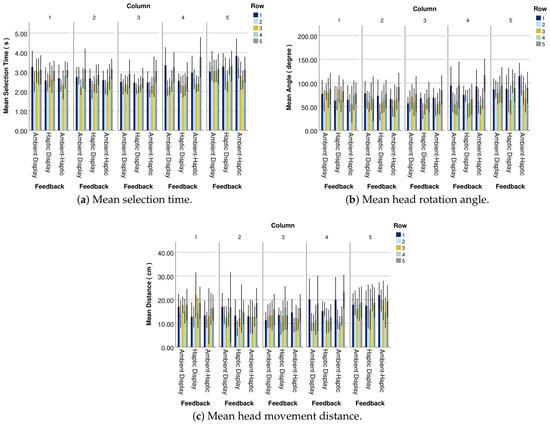
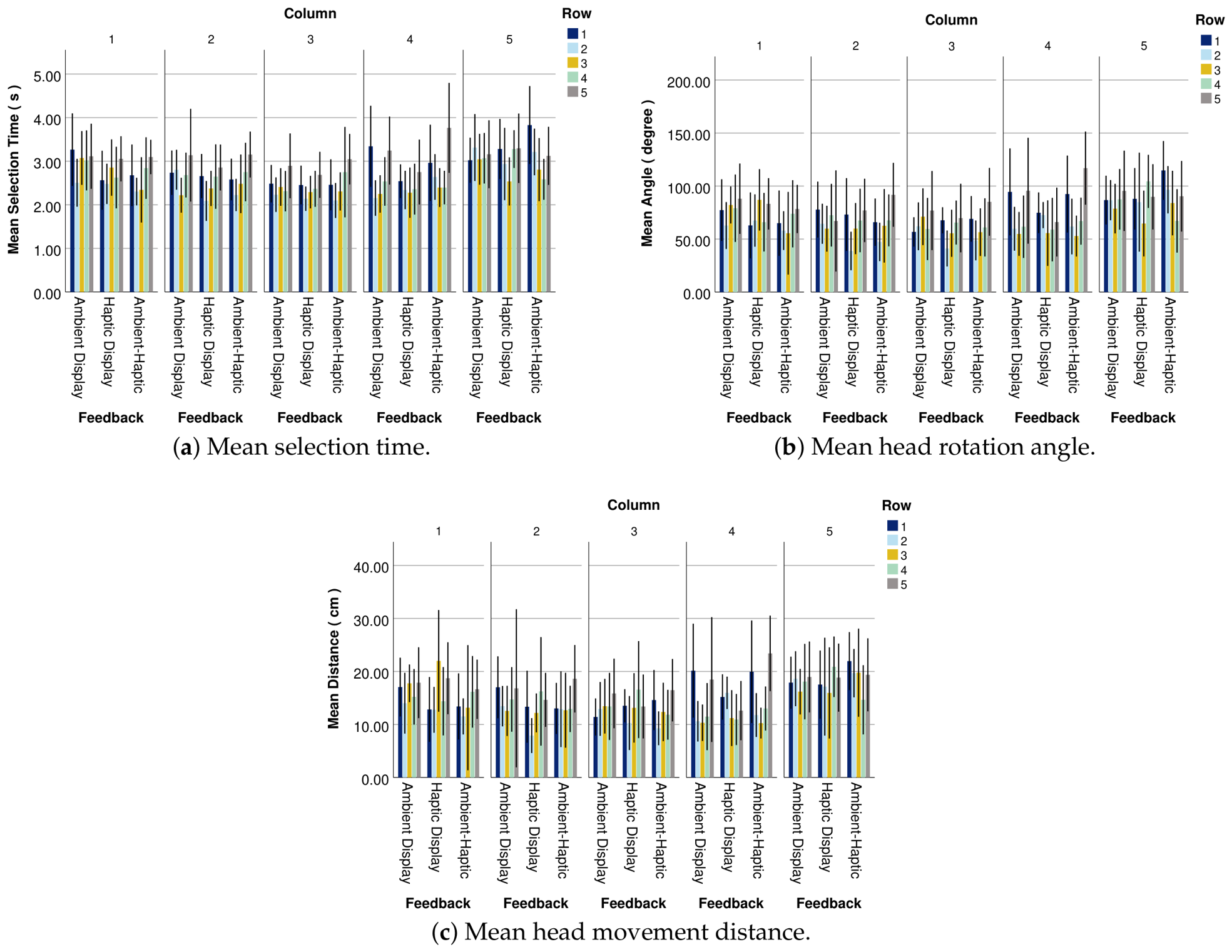
A repeated-measures ANOVA revealed significant main effects of Row, , , , 90% CI (Mauchly’s test indicated that the assumption of sphericity had been violated; therefore, the Greenhouse–Geisser correction was applied), and Column, , , , 90% CI . The Feedback Modality main effect and all interactions were nonsignificant. The mean selection time across Feedback Modality, Row, and Column is illustrated in Figure 2a. Post hoc pairwise comparisons with Bonferroni correction indicated that selection time of Row 1 (2.86 s) was significantly longer than Row 2 (2.50 s) , and that Row 5 (3.09 s) was significantly longer than Row 2 (2.50 s) , Row 3 (2.51 s) , and Row 4 (2.68 s) . Selection time of Column 2 (2.63 s) was significantly faster than Column 5 (3.10 s) , Column 3 (2.46 s) was significantly faster than Column 5 (3.10 s) , and Column 4 (2.66 s) was significantly faster than Column 5 (3.10 s) .
Figure 2.
Mean selection time, head rotation angle, and total head movement distance results for the frontal visual area search. Error bars represent 95% confidence intervals around the means.
Head Rotation Angle.
The total head rotation angle was recorded throughout the selection period. Significant main effects were observed for Row, , , , 90% CI , and Column, , , , 90% CI . The Feedback Modality main effect and all interactions were nonsignificant. The mean head rotation angle across Feedback Modality, Row, and Column is illustrated in Figure 2b. Post hoc pairwise comparisons with Bonferroni correction revealed that head rotation angle of Row 1 (77.81 degree) was significantly greater than Row 2 (63.54) , and that Row 5 (84.79 degree) was significantly greater than Row 2 (63.54 degree) and Row 3 (65.39 degree) . Head rotation angle of Column 5 (87.99 degree) was significantly greater than Column 2 (66.22 degree) and Column 3 (63.12 degree) .
Head Movement Distance.
The total head movement distance was recorded throughout the selection period. Significant main effects were observed for Row, , , , 90% CI , and Column, , , , 90% CI . The Feedback Modality main effect and all interactions were nonsignificant. The mean total head movement distance across Feedback Modality, Row, and Column is illustrated in Figure 2c. Post hoc pairwise comparisons with Bonferroni correction revealed that distance of Row 5 (17.38 cm) was significantly greater than Row 2 (13.26 cm) and Row 3 (14.20 cm) . Distance of Column 5 (18.37 cm) was significantly greater than Column 2 (13.94 cm) , Column 3 (13.24 cm) , and Column 4 (14.36 cm) .
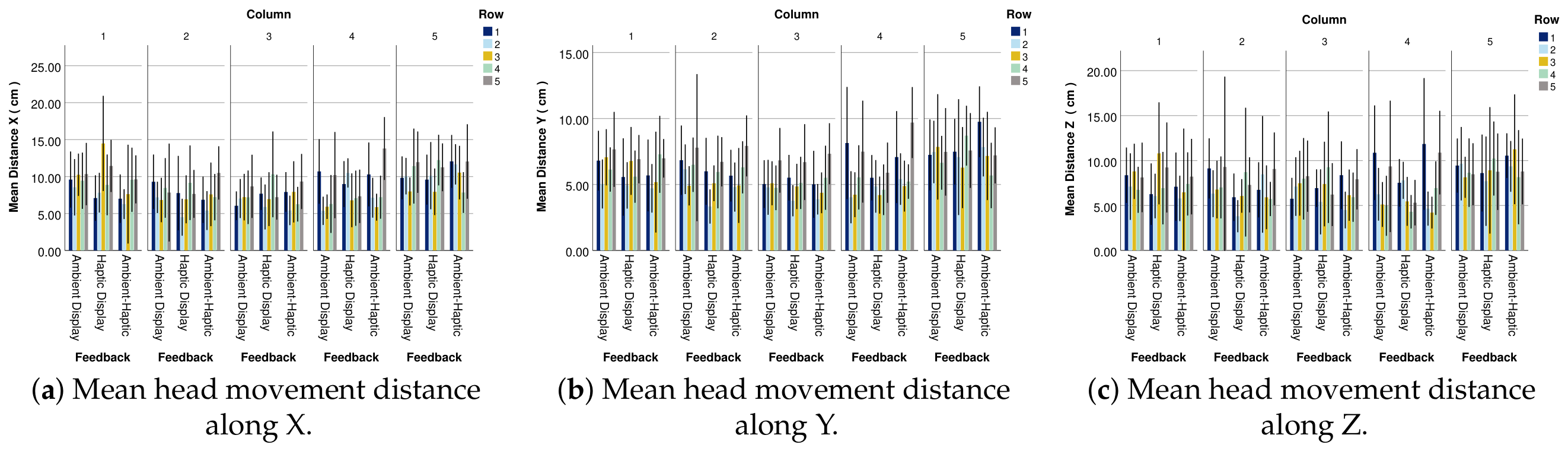
Head movement distance along the X, Y, and Z dimensions was also recorded. For the X dimension, significant main effects were observed for Row, , , , 90% CI , and Column, , , , 90% CI . Post hoc pairwise comparisons with Bonferroni correction revealed that distance of Row 5 (9.95 cm) was significantly greater than Row 3 (8.06 cm) . Distance of Column 5 (10.43 cm) was significantly greater than Column 2 (7.55 cm) , Column 3 (7.41 cm) , and Column 4 (8.23 cm) . For the Y dimension, significant main effects were observed for Row, , , , 90% CI , and Column, , , , 90% CI . Post hoc pairwise comparisons with Bonferroni correction revealed that distance of Row 1 (6.49 cm) was significantly greater than Row 2 (5.21 cm) , and that Row 5 (7.35 cm) was significantly greater than Row 2 (5.21 cm) and Row 3 (5.52 cm) . Distance of Column 5 (7.43 cm) was significantly greater than Column 3 (5.24 cm) . For the Z dimension, significant main effects were observed for Row, , , , 90% CI , and Column, , , , 90% CI . Post hoc pairwise comparisons with Bonferroni correction revealed that distance of Column 5 (9.11 cm) was significantly greater than Column 3 (6.98 cm) and Column 4 (7.03 cm) . For all three dimensions, the Feedback Modality main effect and all interactions were nonsignificant. The corresponding plots for the X, Y, and Z dimensions are provided in Appendix A Figure A1. Complete ANOVA results for the frontal visual area search, including all main effects and interactions, are presented in Appendix A Table A1.
3.3.2. Reaction Time, Selection Time and User Behavior Data in Rear Visual Area Search
Reaction Time.
Reaction time data was also collected for the rear visual area search. Given that the human central visual field spans approximately 60° in diameter, enabling detection of key contrasts, colors, and motions [59], and that all frontal visual area search targets were positioned within this range, reaction time was measured from the onset of the directional cue until the participant’s head rotation exceeded 30 degrees from the frontal direction. This metric captures the initial response initiation time, which is distinct from the complete selection process that requires sustained gaze confirmation.
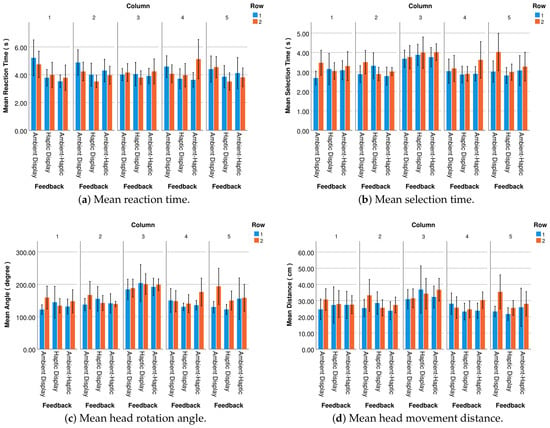
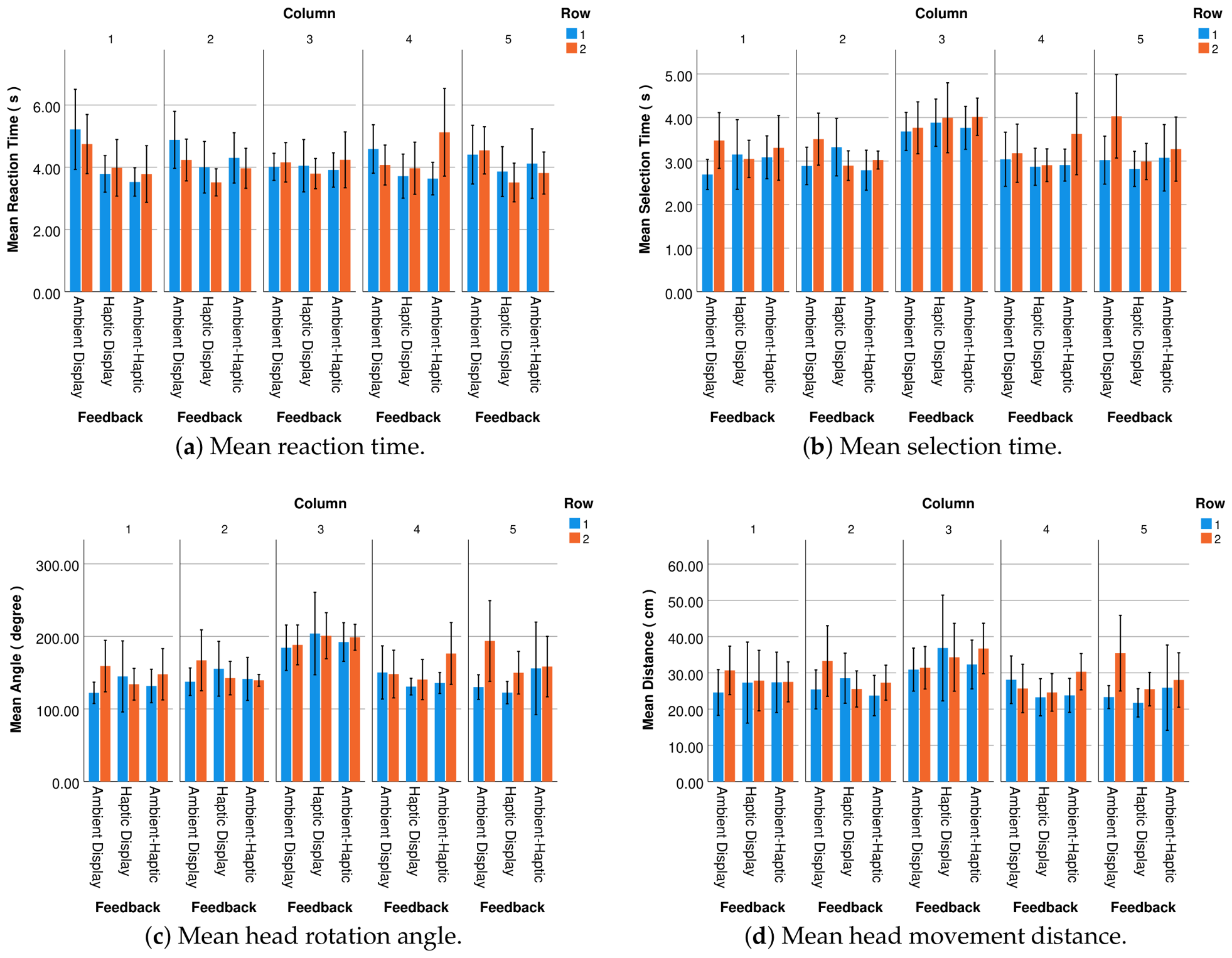
A significant main effect was observed for Feedback Modality, , , , 90% CI (Mauchly’s test indicated that the assumption of sphericity had been violated; therefore, the Greenhouse–Geisser correction was applied). The Row and Column main effects and all interactions were nonsignificant. The mean reaction time across Feedback Modality, Row, and Column is illustrated in Figure 3a. Post hoc pairwise comparisons with Bonferroni correction revealed that reaction time of Ambient Display (4.49 s) was significantly longer than Haptic Display (3.82 s) .
Figure 3.
Mean reaction time, selection time, head rotation angle, and head movement distance results for the rear visual area search. Error bars represent 95% confidence intervals around the means.
Selection Time.
For the rear visual area search, selection time measurement commenced once the participant’s head rotation exceeded 30 degrees from the frontal direction and continued until the target was successfully selected.
A significant main effect was observed for Column, , , , 90% CI . A Feedback Modality × Row interaction was also observed, , , , 90% CI . The Feedback Modality and Row main effects and the remaining interactions were nonsignificant. The mean selection time across Feedback Modality, Row, and Column is illustrated in Figure 3b. Post hoc pairwise comparisons with Bonferroni correction revealed that selection time of Column 3 (3.85 s) was significantly longer than Column 1 (3.13 s) , Column 2 (3.07 s) , and Column 4 (3.09 s) , and that Column 3 (3.85 s) was significantly longer than Column 5 (3.20 s) .
Head Rotation Angle.
The total head rotation angle was recorded throughout the selection period. A significant main effect was observed for Column, , , , 90% CI . The Feedback Modality and Row main effects and all interactions were nonsignificant. The mean head rotation angle across Feedback Modality, Row, and Column is illustrated in Figure 3c. Post hoc pairwise comparisons with Bonferroni correction revealed that head rotation angle of Column 3 (194.73 degree) was significantly greater than Column 1 (139.93 degree) , Column 2 (147.22 degree) , and Column 4 (146.97 degree) , and that Column 3 (194.73 degree) was significantly greater than Column 5 (151.75 degree) .
Head Movement Distance.
The total head movement distance was recorded throughout the selection period. A significant main effect was observed for Column, , , , 90% CI . A Feedback Modality × Row interaction was also observed, , , , 90% CI . The Feedback Modality and Row main effects and the remaining interactions were nonsignificant. The mean total head movement distance across Feedback Modality, Row, and Column is illustrated in Figure 3d. Post hoc pairwise comparisons with Bonferroni correction revealed that distance of Column 3 (33.75 cm) was significantly greater than Column 4 (25.96 cm) .
Head movement distance along the X, Y, and Z dimensions was also recorded. For the X dimension, a significant main effect was observed for Column, , , , 90% CI . Post hoc pairwise comparisons with Bonferroni correction revealed that distance of Column 3 (18.67 cm) was significantly greater than Column 4 (13.04 cm) . The Feedback Modality and Row main effects and all interactions for the X dimension were nonsignificant. For the Y dimension, significant main effects were observed for Row, , , , 90% CI , and Column, , , , 90% CI (Mauchly’s test indicated that the assumption of sphericity had been violated; therefore, the Greenhouse–Geisser correction was applied). Post hoc pairwise comparisons with Bonferroni correction revealed that distance of Row 2 (8.53 cm) was significantly greater than Row 1 (7.03 cm) . Distance of Column 3 (10.46 cm) was significantly greater than Column 1 (6.87 cm) , Column 2 (7.34 cm) , and Column 4 (7.32 cm) , and that Column 3 (10.46 cm) was significantly greater than Column 5 (6.93 cm) . The Feedback Modality × Column interaction was significant, , , , 90% CI . For the Z dimension, no main effect reached significance; however, a Feedback Modality × Row interaction was observed, , , , 90% CI . The remaining interactions were nonsignificant.
Complete ANOVA results for the rear visual area search, including all main effects and interactions, are presented in Appendix A Table A2.
3.3.3. User Preference
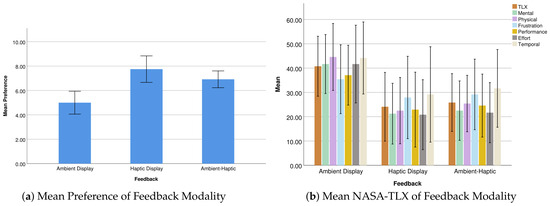
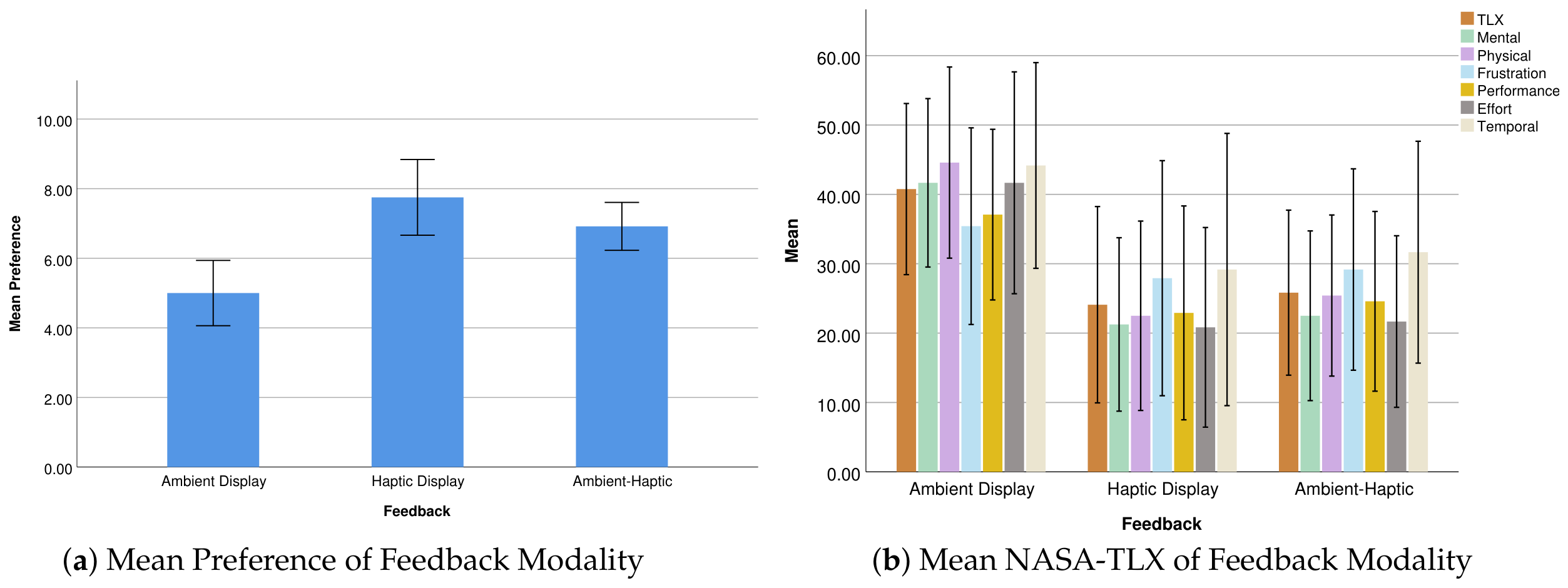
Following the experiment, participants rated their overall preference for each feedback condition on a 9-point Likert scale and completed a NASA Task Load Index (NASA-TLX) questionnaire. A one-way repeated-measures ANOVA across Feedback Modality revealed a significant effect on user preference, , , , 90% CI , as shown in Figure 4a. Post hoc pairwise comparisons using LSD correction indicated that preference of Ambient Display (5.00) was significantly lower than Haptic Display (7.75) and Ambient-Haptic (6.92) .
Figure 4.
Mean user preference and NASA-TLX scores across feedback modalities. Error bars represent 95% confidence intervals around the means.
A one-way repeated-measures ANOVA across Feedback Modality revealed significant effects on mental demand, , , , 90% CI (Mauchly’s test indicated that the assumption of sphericity had been violated; therefore, the Greenhouse–Geisser correction was applied), and physical demand, , , , 90% CI (Mauchly’s test indicated that the assumption of sphericity had been violated; therefore, the Greenhouse–Geisser correction was applied). Post hoc pairwise comparisons using LSD correction indicated that mental demand of Ambient Display (41.67) was significantly higher than Haptic Display (21.25) and Ambient-Haptic Feedback (22.50) . Physical demand of Ambient Display (44.58) was significantly higher than Ambient-Haptic (25.42) . No significant main effects of Feedback Modality were found for the overall NASA-TLX score or for the Effort, Frustration, Performance, and Temporal Demand subscales, as shown in Figure 4b. Complete ANOVA results for user preference and NASA–TLX measures are presented in Appendix A Table A3.
The following interview comments and quotations are presented as illustrative examples to contextualize the quantitative findings. During the experimental interviews, participants generally noted that the cues from the Haptic Display were more prominent compared to the Ambient Display. The strong tactile feedback from the Haptic Display effectively created a sense of urgency, which helped participants in locating the targets more efficiently. Additionally, the combined Ambient-Haptic Display was perceived as having the strongest warning effects. From a perceptual standpoint, participants found the Haptic Display more comfortable, as its vibrations heightened their awareness and improved the precision and speed of target detection.
Some participants indicated that during the experiment, they frequently noticed the tactile vibration feedback before becoming aware of the lighting effects. One participant remarked, “In the combined mode, the accompanying light effects during turning provided visual assistance and secondary confirmation for target localization, making the operation process smoother.” Additionally, a participant with experience using vehicle AR-HUD systems commented, “The lighting serves as an excellent directional supplement, helping me visually discern directions when I sometimes forget the directional cues provided by the vibrations.” Participants with experience in 3D gaming reported that the tactile feedback from both the Haptic Display and the Ambient-Haptic Display significantly heightened their sense of urgency in completing tasks. They described a sensation of continuous force that motivated them to localize targets more swiftly.
The majority of participants reported that vibrational feedback was most effective when delivered to the back. They preferred the concentration of tactile feedback in this area, appreciating that it heightened their sensitivity to vibrations and intensified their sense of urgency, leading them to see no need for alterations to the current setup. Additionally, some participants suggested modifications to target specific body parts, such as the arms or legs, indicating that such adjustments could potentially enhance the precision of directional vibration perception.
4. Discussion
This research investigates how peripheral visual and haptic feedback influence efficiency during search tasks across multiple spatial regions, particularly for target acquisition requiring attentional shifts. Through systematic evaluation of different feedback modalities, the study identifies strategies that enhance performance while maintaining manageable cognitive load. Results provide insights into how peripheral vision and haptic feedback guide user attention across various spatial regions. The findings reported below are based on a laboratory study with a modest sample of young adults, and should therefore be read as an initial characterisation of the relative strengths of the two channels rather than as definitive effect estimates.
4.1. Superiority of Haptic Feedback over Peripheral Visual Feedback
Our findings demonstrate that haptic feedback significantly outperforms peripheral visual feedback in facilitating attention shifts during rear visual area search tasks. As shown in Table 1, participants responded significantly faster with the Haptic Display compared to the Ambient Display, and reported lower mental demand and higher preference ratings. This performance advantage can be understood through the lens of multiple resource theory [60,61], which posits that human attention operates through separate processing channels for different sensory modalities. The haptic modality engages a dedicated somatosensory channel that does not compete with ongoing visual processing demands [62], thereby bypassing the resource competition that occurs when multiple visual cues vie for attention simultaneously. Feedback Modality showed no significant main effect on any frontal-area outcome, where the significant effects were limited to target Row and Column. Together with the significant modality effect on rear-area reaction time, this pattern indicates that, under the present experimental conditions, an advantage of haptic feedback over peripheral visual feedback was observed for attention shifts to targets outside the current field of view.
Table 1.
Performance comparison between Haptic Display and Ambient Display.
In our previous work comparing visual arrows and haptic feedback for dual-task target search [5], we found that haptic feedback was perceived as more salient than visual guidance, enabling faster responses when switching between tasks. The current study extends these findings by demonstrating that this advantage persists when comparing haptic feedback against peripheral visual cues specifically designed for attention capture. While peripheral lights can attract attention through sensitivity to motion and luminance changes [20], processing these cues still requires visual attention allocation. Tactile stimuli, by contrast, are difficult to ignore and create an immediate sense of urgency without drawing upon visual resources [29,61]. The subjective feedback from post-experiment interviews corroborated this interpretation, with participants expressing clear preferences for haptic guidance over ambient visual cues.
Notably, while feedback modality significantly influenced reaction time for rear visual area search, it did not significantly affect selection time once participants had oriented toward the target region. This pattern indicates that the primary advantage of haptic feedback lies in accelerating the initiation of attention shifts rather than improving the subsequent visual search and selection process within the target region. However, a limitation of the present study is that haptic feedback was evaluated only on the back; therefore, whether the observed advantage generalizes to other body locations remains unknown. Additionally, the generalizability of this haptic advantage may depend on participant characteristics: age and individual tactile sensitivity may influence the perceived salience of vibration, whereas prior experience with 3D gaming, VR, or AR-HUD systems may affect familiarity with spatial cues, potentially leading to different responses across user groups.
4.2. Benefits of Multimodal Integration
Although no significant reaction- or selection-time advantage of the Ambient-Haptic Display over the Haptic Display alone was detected, all targets were selected correctly, so accuracy could not provide an additional basis for distinguishing between the two conditions. The nonsignificant time-based comparisons may partly reflect limited statistical power; they therefore do not establish equivalence and cannot rule out a smaller undetected difference. The multimodal combination was nevertheless preferred over the Ambient Display alone, while its preference rating did not differ significantly from that of the Haptic Display. This pattern aligns with findings from our previous work [5], where visual-haptic combined feedback similarly yielded higher user preference ratings compared to unimodal visual conditions despite modest objective performance differences. Prior research has also shown that multimodal feedback may not improve reaction times but can reduce missed responses and false reactions [33]. The complementary relationship between ambient visual and haptic feedback can be interpreted through the redundancy gain principle in multisensory processing. When congruent information is presented through multiple sensory channels simultaneously, the redundant signals enhance perceptual confidence and reduce subjective uncertainty, even when one channel alone would be sufficient for task completion. In our study, participants reported that the Ambient Display provided visual confirmation of the directional information conveyed through haptic feedback. This interview-based observation suggests a subjectively perceived confirmatory role, although no corresponding additional benefit of the Ambient-Haptic Display over the Haptic Display alone was detected in reaction or selection time.
The NASA–TLX results showed a mixed rather than uniform pattern. Mental Demand was lower for both haptic-containing conditions than for Ambient Display. This finding is consistent with multiple resource theory, as tactile cues distribute directional information across a nonvisual sensory channel and may reduce reliance on the visual resources required for target search [60]. Related work has similarly shown that haptic patterns can convey information during simulated driving without increasing perceived mental workload [62]. Physical Demand was also lower for Ambient-Haptic Display than for Ambient Display. Significant modality differences were therefore limited to Mental and Physical Demand and did not extend to the overall NASA–TLX score or the Effort, Frustration, Performance, and Temporal Demand subscales. Because the overall score aggregates all six workload dimensions, differences in two dimensions may not produce a significant overall effect when the remaining dimensions are unchanged. Preference, by contrast, showed a clearer pattern, with both haptic-containing conditions rated significantly higher than Ambient Display. Thus, the preference advantage was not accompanied by a uniform reduction across the NASA–TLX measures. Although previous studies have raised concerns about potential cognitive overload when combining feedback modalities [36], no significant modality effect on the overall NASA–TLX score was observed in the present study. Nevertheless, these workload findings were based solely on self-reported ratings, and future studies should incorporate objective measures such as gaze behavior, physiological responses, or dual-task performance.
These findings underscore the importance of considering user experience alongside objective performance metrics in interface design. Participants’ reports suggest that peripheral visual cues may reinforce haptic guidance and contribute to a more coherent interaction experience. In practical applications, the modest additional cost of implementing peripheral visual feedback alongside haptic systems may be justified by improvements in user acceptance and subjective satisfaction, though such benefits may be context-dependent [28].
4.3. Practical Implications for Assistive System Design
The insights gained from our study have practical implications for the design of assistive systems aimed at enhancing efficiency when searching across multiple spatial areas. Such attention-management demands are also relevant to contexts such as driving, cycling, and navigation, where users must monitor information across different spatial regions.
Prioritize Haptic Feedback for Rapid Attention Guidance. Our findings indicate that haptic feedback provides the most effective means of prompting attention shifts, particularly when users need to redirect focus to regions outside their current field of view. The significant reduction in reaction time observed with the Haptic Display compared to the Ambient Display suggests that tactile cues can bypass visual processing bottlenecks and deliver directional information more directly. This advantage may be relevant to scenarios requiring immediate responses, such as collision warnings while driving, obstacle alerts during navigation, or hazard notifications in industrial environments. Designers of assistive systems may consider haptic feedback as a candidate modality for delivering directional guidance in such safety-critical applications.
Integrate Peripheral Visual Feedback as a Complementary Channel. While the Haptic Display produced faster rear-area reactions than the Ambient Display, the Ambient-Haptic Display was preferred over the Ambient Display. The peripheral visual feedback may provide confirmation of haptic cues and contribute to a more coherent interaction experience. Designers may consider integrating peripheral visual feedback alongside haptic systems to support user acceptance and subjective satisfaction, particularly in applications where user comfort and sustained engagement are important considerations.
In summary, our findings suggest that assistive systems benefit most from haptic feedback for rapid attention guidance, with peripheral visual feedback potentially serving a complementary role in supporting user experience and providing subjective confirmation. This multimodal approach balances performance optimization with user preference, offering a framework for designing assistive technologies that are both effective and well-received by users, although the specific parameters adopted here, including dorsal actuator placement, a 4 Hz pulse rate, and red peripheral lighting at 60° eccentricity, represent one point in a broader design space and warrant systematic exploration.
5. Conclusions and Future Work
This study compared peripheral visual and haptic feedback for multi-region target search tasks. Our findings demonstrate that haptic feedback outperforms peripheral visual cues for guiding attention to rear visual regions, with participants responding faster and reporting lower mental demand. While peripheral visual feedback alone was less effective, it may offer subjective confirmation when combined with haptic cues. These insights extend our previous work on visual channel integration [6] to cross-modal feedback design, offering practical guidance for assistive technologies in safety-critical environments.
Future work should extend these findings beyond the conditions examined here. The present evaluation involved a modest sample of twelve young adults in a controlled, seated laboratory setting without a demanding primary task; therefore, the extent to which the observed modality differences generalize to realistic driving and cycling conditions remains to be examined. Validation with larger and more diverse samples and under visual clutter, motion, concurrent task demands, and time pressure represents an important next step. Further research should independently vary Ambient Display color and pulse frequency under controlled luminance and contrast, examine alternative haptic placements and pulse patterns under dynamic lighting and motion conditions, and assess whether the observed preference for haptic guidance persists beyond initial exposure. Addressing these questions will further refine design guidelines for cross-modal assistive systems in safety-critical environments.
Author Contributions
Conceptualization, X.W., G.R., G.W. and J.L.; methodology, X.W. and G.R.; software, Z.H. and G.R.; validation, Z.Z. and J.L.; formal analysis, X.W. and Z.H.; investigation, X.W., Z.H. and Z.Z.; resources, G.W.; data curation, Z.H. and Z.Z.; writing—original draft preparation, X.W., Z.H. and G.R.; writing—review and editing, G.R., G.W. and J.L.; visualization, X.W. and Z.Z.; supervision, G.R. and G.W.; project administration, G.R. and G.W.; funding acquisition, G.W. and J.L. All authors have read and agreed to the published version of the manuscript.
Funding
This study was supported by (1) the Fujian Provincial Science and Technology Program (grant no. 2025R0103), (2) the Key Major Educational and Teaching Research Projects of Fujian Undergraduate Universities 2025 (grant no. FBJY20250163), (3) the Korea Institute of Police Technology (KIPoT; Police Lab 2.0 program) grant funded by MSIT (RS-2023-00281194; Development for a remotely-operated testimony system for the children based on AI and Cloud technology), and (4) a Research Grant (2024-0035) funded by HAII Corporation.
Institutional Review Board Statement
The study was conducted in accordance with the Declaration of Helsinki and approved by the Institutional Review Board of the School of Design Arts, Xiamen University of Technology (approval no. XMUT-SDA-IRB-2025-06/020, approved on 30 May 2025).
Informed Consent Statement
Informed consent was obtained from all subjects involved in the study.
Data Availability Statement
All data are contained within the manuscript. Raw data are available from the corresponding author upon request.
Acknowledgments
We appreciate all participants who took part in the study.
Conflicts of Interest
The authors declare that this study received funding from HAII Corporation. The funder was not involved in the study design, data collection, analysis, interpretation of data, the writing of this article, or the decision to submit it for publication.
Abbreviations
The following abbreviations are used in this manuscript:
| 3D | Three-Dimensional |
| ANOVA | Analysis of Variance |
| AR | Augmented Reality |
| HMD | Head-Mounted Display |
| HUD | Head-Up Display |
| LED | Light-Emitting Diode |
| MQTT | Message Queuing Telemetry Transport |
| MRTK | Mixed Reality Toolkit |
| NASA-TLX | NASA Task Load Index |
| VR | Virtual Reality |
Appendix A. Supplementary Results
Appendix A.1. Detailed Head Movement-Distance Plots
Figure A1.
Mean head movement distance along the X, Y, and Z dimensions for the frontal visual area search. Error bars represent 95% confidence intervals around the means.
Appendix A.2. Complete ANOVA Results
Table A1.
Complete repeated-measures ANOVA results for frontal visual area search, including main effects, two-way interactions, and three-way interactions. Light-green rows indicate . SA = sphericity assumed; GG = Greenhouse–Geisser correction. Confidence intervals are two-sided 90% intervals for partial eta squared.
Table A2.
Complete repeated-measures ANOVA results for rear visual area search, including main effects, two-way interactions, and three-way interactions. Light-green rows indicate . SA = sphericity assumed; GG = Greenhouse–Geisser correction. Confidence intervals are two-sided 90% intervals for partial eta squared.
Table A3.
Complete repeated-measures ANOVA results for user preference and NASA–TLX workload measures. Light-green rows indicate . SA = sphericity assumed; GG = Greenhouse–Geisser correction. Confidence intervals are two-sided 90% intervals for partial eta squared.
References
- Gruenefeld, U.; Stratmann, T.C.; Jung, J.; Lee, H.; Choi, J.; Nanda, A.; Heuten, W. Guiding Smombies: Augmenting Peripheral Vision with Low-Cost Glasses to Shift the Attention of Smartphone Users. In Proceedings of the 2018 IEEE International Symposium on Mixed and Augmented Reality Adjunct (ISMAR-Adjunct), Munich, Germany, 16–20 October 2018; IEEE: New Yord, NY, USA, 2018; pp. 127–131. [Google Scholar] [CrossRef] [Scilit]
- Li, J.; Huang, J.; Liu, L. Evaluation of Peripheral Vision Displays to Support Driver’s Situation Awareness in Automated Driving Takeover. Vis. Cogn. 2026, 33, 611–630. [Google Scholar] [CrossRef] [Scilit]
- Van Erp, J.B.; Van Veen, H.A. Vibrotactile in-vehicle navigation system. Transp. Res. Part F Traffic Psychol. Behav. 2004, 7, 247–256. [Google Scholar] [CrossRef] [Scilit]
- Kaul, O.B.; Rohs, M. HapticHead: A Spherical Vibrotactile Grid around the Head for 3D Guidance in Virtual and Augmented Reality. In Proceedings of the 2017 CHI Conference on Human Factors in Computing Systems, Denver CO, USA, 6–11 May 2017; ACM: New York, NY, USA, 2017; pp. 3729–3740. [Google Scholar] [CrossRef] [Scilit]
- Wang, G.; Wang, H.H.; Ren, G. Visual and Haptic Guidance for Enhancing Target Search Performance in Dual-Task Settings. Appl. Sci. 2024, 14, 4650. [Google Scholar] [CrossRef] [Scilit]
- Wang, G.; Wang, H.H.; Huang, Z. Enhancing Multi-Region Target Search Efficiency through Integrated Peripheral Vision and Head-Mounted Display Systems. Information 2025, 16, 800. [Google Scholar] [CrossRef] [Scilit]
- Matviienko, A.; Löcken, A.; El Ali, A.; Heuten, W.; Boll, S. NaviLight: Investigating ambient light displays for turn-by-turn navigation in cars. In Proceedings of the MobileHCI’16: 18th International Conference on Human-Computer Interaction with Mobile Devices and Services, Florence, Italy, 6–9 September 2016; ACM: New York, NY, USA, 2016; pp. 283–294. [Google Scholar] [CrossRef] [Scilit]
- Matviienko, A.; Ananthanarayan, S.; Brewster, S.; Heuten, W.; Boll, S. Comparing unimodal lane keeping cues for child cyclists. In Proceedings of the 18th International Conference on Mobile and Ubiquitous Multimedia, Pisa, Italy, 26–29 November 2019; ACM: New York, NY, USA, 2019; pp. 1–11. [Google Scholar] [CrossRef] [Scilit]
- Levi, D.M.; Carney, T. Crowding in Peripheral Vision: Why Bigger Is Better. Curr. Biol. 2009, 19, 1988–1993. [Google Scholar] [CrossRef] [Scilit] [PubMed]
- Andriamanalina, R.; Larabi, M.C.; Le Moan, S. Visual Crowding Reduces Blur Sensitivity in Peripheral Vision: A Study Using Natural Textures in Virtual Reality. J. Opt. Soc. Am. A 2025, 42, 1598. [Google Scholar] [CrossRef] [Scilit] [PubMed]
- Van Veen, T.; Karjanto, J.; Terken, J. Situation Awareness in Automated Vehicles through Proximal Peripheral Light Signals. In Proceedings of the AutomotiveUI’17: ACM 9th International Conference on Automotive User Interfaces and Interactive Vehicular Applications, Oldenburg, Germany, 24–27 September 2017; ACM: New York, NY, USA, 2017; pp. 287–292. [Google Scholar] [CrossRef] [Scilit]
- Günther, S.; Müller, F.; Funk, M.; Kirchner, J.; Dezfuli, N.; Mühlhäuser, M. TactileGlove: Assistive Spatial Guidance in 3D Space through Vibrotactile Navigation. In Proceedings of the PETRA’18: The 11th PErvasive Technologies Related to Assistive Environments Conference, Corfu, Greece, 26–29 June 2018; ACM: New York, NY, USA, 2018; pp. 273–280. [Google Scholar] [CrossRef] [Scilit]
- Petermeijera, M.; Cielerb, S.; Winterc, J.C.F.D. Comparing spatially static and dynamic vibrotactile take-over requests in the driver seat. Accid. Anal. Prev. 2017, 99, 218–227. [Google Scholar] [CrossRef] [Scilit] [PubMed]
- Matviienko, A.; Ananthanarayan, S.; El Ali, A.; Heuten, W.; Boll, S. NaviBike: Comparing Unimodal Navigation Cues for Child Cyclists. In Proceedings of the 2019 CHI Conference on Human Factors in Computing Systems, Glasgow, UK, 4–9 May 2019; ACM: New York, NY, USA, 2019; pp. 1–12. [Google Scholar] [CrossRef] [Scilit]
- Bürger, D.; Schley, M.K.; Loerwald, H.; Pastel, S.; Witte, K. Comparative analysis of visual field characteristics and perceptual processing in peripheral vision between virtual reality and real world. Hum. Behav. Emerg. Technol. 2024, 2024, 2845190. [Google Scholar] [CrossRef] [Scilit]
- David, E.J.; Beitner, J.; Võ, M.L.H. The importance of peripheral vision when searching 3D real-world scenes: A gaze-contingent study in virtual reality. J. Vis. 2021, 21, 3. [Google Scholar] [CrossRef] [Scilit] [PubMed]
- Vater, C.; Wolfe, B.; Rosenholtz, R. Peripheral vision in real-world tasks: A systematic review. Psychon. Bull. Rev. 2022, 29, 1531–1557. [Google Scholar] [CrossRef] [Scilit] [PubMed]
- Nuthmann, A.; Canas-Bajo, T. Visual search in naturalistic scenes from foveal to peripheral vision: A comparison between dynamic and static displays. J. Vis. 2022, 22, 10. [Google Scholar] [CrossRef] [Scilit] [PubMed]
- Rosenholtz, R. Capabilities and Limitations of Peripheral Vision. Annu. Rev. Vis. Sci. 2016, 2, 437–457. [Google Scholar] [CrossRef] [Scilit] [PubMed]
- Dziennus, M.; Kelsch, J.; Schieben, A. Ambient light based interaction concept for an integrative driver assistance system—A driving simulator study. In Proceedings of the Human Factors and Ergonomics Society Europe Chapter 2015 Annual Conference, Groningen, The Netherlands, 14–16 October 2015; pp. 171–182. Available online: https://elib.dlr.de/99076/ (accessed on 20 August 2026).
- Ren, Y.; Reddy, A.; Nebeling, M. PeriphAR: Fast and Accurate Real-World Object Selection with Peripheral Augmented Reality Displays. In Proceedings of the 2026 CHI Conference on Human Factors in Computing Systems, Barcelona, Spain, 13–17 April 2026; ACM: New York, NY, USA, 2026; pp. 1–16. [Google Scholar] [CrossRef] [Scilit]
- Stein, N.; Watson, T.; Lappe, M.; Westendorf, M.; Durant, S. Eye and head movements in visual search in the extended field of view. In Scientific Reports; Nature Publishing Group: Berlin, Germany, 2024; Volume 14, p. 8907. [Google Scholar] [CrossRef] [Scilit] [PubMed]
- Eckstein, M.P. Visual search: A retrospective. J. Vis. 2011, 11, 14. [Google Scholar] [CrossRef] [Scilit] [PubMed]
- Sutton, J.; Langlotz, T.; Plopski, A.; Zollmann, S.; Itoh, Y.; Regenbrecht, H. Look over there! Investigating saliency modulation for visual guidance with augmented reality glasses. In Proceedings of the UIST ’22: The 35th Annual ACM Symposium on User Interface Software and Technology, Bend, OR, USA, 29 October–2 November 2022; ACM: New York, NY, USA, 2022; pp. 1–15. [Google Scholar] [CrossRef] [Scilit]
- Healey, C.G.; Enns, J.T. Attention and Visual Memory in Visualization and Computer Graphics. IEEE Trans. Vis. Comput. Graph. 2012, 18, 1170–1188. [Google Scholar] [CrossRef] [Scilit] [PubMed]
- Poppinga, B.; Henze, N.; Fortmann, J.; Heuten, W.; Boll, S.C. AmbiGlasses—Information in the Periphery of the Visual Field; Oldenbourg: München, Germany, 2012. [Google Scholar] [CrossRef] [Scilit]
- Matviienko, A.; Mehmedovic, D.; Müller, F.; Mühlhäuser, M. “Baby, You can Ride my Bike”: Exploring Maneuver Indications of Self-Driving Bicycles using a Tandem Simulator. Proc. ACM Hum.-Comput. Interact. 2022, 6, 1–21. [Google Scholar] [CrossRef] [Scilit]
- Lan, R.; Sun, X.; Wang, Q.; Zhu, T.; Liu, B. Automated Vehicle’s Human-Machine Interfaces Design with Haptic Feedback: A Meta-Analysis. Appl. Ergon. 2026, 135, 104757. [Google Scholar] [CrossRef] [Scilit] [PubMed]
- Ren, G.; Huang, Z.; Lin, W.; Huang, T.; Wang, G.; Lee, J.H. Visual and Haptic Feedback in Multitasking Drone Operation: Effects of Task Complexity on Performance. Int. J. Human–Computer Interact. 2026, 42, 1–34. [Google Scholar] [CrossRef] [Scilit]
- Kiss, F.; Boldt, R.; Pfleging, B.; Schneegass, S. Navigation Systems for Motorcyclists: Exploring Wearable Tactile Feedback for Route Guidance in the Real World. In Proceedings of the CHI ’18: CHI Conference on Human Factors in Computing Systems, Montreal, QC, Canada, 21–26 April 2018; ACM: New York, NY, USA, 2018; pp. 1–7. [Google Scholar] [CrossRef] [Scilit]
- Van Erp, J.B.; Werkhoven, P.; Werkhoven, P. Validation of Principles for Tactile Navigation Displays. Proc. Hum. Factors Ergon. Soc. Annu. Meet. 2006, 50, 1687–1691. [Google Scholar] [CrossRef] [Scilit]
- Ariza N., O.J.; Lange, M.; Steinicke, F.; Bruder, G. Vibrotactile assistance for user guidance towards selection targets in VR and the cognitive resources involved. In Proceedings of the 2017 IEEE Symposium on 3D User Interfaces (3DUI), Los Angeles, CA, USA, 18–19 March 2017; IEEE: New York, NY, USA, 2017; pp. 95–98. [Google Scholar] [CrossRef] [Scilit]
- Geitner, C.; Biondi, F.; Skrypchuk, L.; Jennings, P.; Birrell, S. The comparison of auditory, tactile, and multimodal warnings for the effective communication of unexpected events during an automated driving scenario. Transp. Res. Part F Traffic Psychol. Behav. 2019, 65, 23–33. [Google Scholar] [CrossRef] [Scilit]
- Hancock, P.A.; Mercado, J.E.; Merlo, J.; Van Erp, J.B. Improving target detection in visual search through the augmenting multi-sensory cues. Ergonomics 2013, 56, 729–738. [Google Scholar] [CrossRef] [Scilit] [PubMed]
- Benz, T.; Nitsch, V. Understanding Ambiguous Effects of Multi-Modal Cueing on Task Performance Using Bayesian Sensory Integration. 2018. Available online: https://gfa2018.gesellschaft-fuer-arbeitswissenschaft.de/inhalt/D.1.2.pdf (accessed on 20 August 2026).
- Arend, M.G.; Benz, T.M.; Mertens, A.; Brandl, C.; Nitsch, V. Do multimodal search cues help or hinder teleoperated search and rescue missions? Ergonomics 2023, 66, 1255–1269. [Google Scholar] [CrossRef] [Scilit] [PubMed]
- Naujoks, F.; Mai, C.; Neukum, A. The effect of urgency of take-over requests during highly automated driving under distraction conditions. In Proceedings of the 5th International Conference on Applied Human Factors and Ergonomics, Kraków, Poland, 19–23 July 2014. [Google Scholar]
- Whitmore, N.W.; Chan, S.; Zhang, J.; Chwalek, P.; Chin, S.; Maes, P. Improving Attention Using Wearables via Haptic and Multimodal Rhythmic Stimuli. In Proceedings of the CHI Conference on Human Factors in Computing Systems, Honolulu, HI, USA, 11–16 May 2024; ACM: New York, NY, USA, 2024; pp. 1–14. [Google Scholar] [CrossRef] [Scilit]
- Schinke, T.; Henze, N.; Boll, S. Visualization of off-screen objects in mobile augmented reality. In Proceedings of the 12th International Conference on Human Computer Interaction with Mobile Devices and Services, Lisbon, Portugal, 7–10 September 2010; ACM: New York, NY, USA, 2010; pp. 313–316. [Google Scholar] [CrossRef] [Scilit]
- Kumaran, R.; Kim, Y.J.; Milner, A.E.; Bullock, T.; Giesbrecht, B.; Höllerer, T. The Impact of Navigation Aids on Search Performance and Object Recall in Wide-Area Augmented Reality. In Proceedings of the 2023 CHI Conference on Human Factors in Computing Systems, Hamburg, Germany, 23–28 April 2023; ACM: New York, NY, USA, 2023; pp. 1–17. [Google Scholar] [CrossRef] [Scilit]
- Cobus, V.; Meyer, H.; Ananthanarayan, S.; Boll, S.; Heuten, W. Towards reducing alarm fatigue: Peripheral light pattern design for critical care alarms. In Proceedings of the 10th Nordic Conference on Human-Computer Interaction, Oslo, Norway, 29 September–3 October 2018; ACM: New York, NY, USA, 2018; pp. 654–663. [Google Scholar] [CrossRef] [Scilit]
- Kiss, F.; Woźniak, P.W.; Scheerer, F.; Dominiak, J.; Romanowski, A.; Schmidt, A. Clairbuoyance: Improving Directional Perception for Swimmers. In Proceedings of the CHI’19: CHI Conference on Human Factors in Computing Systems, Glasgow, UK, 4–9 May 2019; ACM: New York, NY, USA, 2019; pp. 1–12. [Google Scholar] [CrossRef] [Scilit]
- Gutwin, C.; Cockburn, A.; Coveney, A. Peripheral Popout: The Influence of Visual Angle and Stimulus Intensity on Popout Effects. In Proceedings of the CHI’17: CHI Conference on Human Factors in Computing Systems, Denver, CO, USA, 6–11 May 2017; ACM: New York, NY, USA, 2017; pp. 208–219. [Google Scholar] [CrossRef] [Scilit]
- Poppinga, B.; Pielot, M.; Boll, S. Tacticycle: A tactile display for supporting tourists on a bicycle trip. In Proceedings of the 11th International Conference on Human-Computer Interaction with Mobile Devices and Services, Bonn, Germany, 15–18 September 2009; pp. 1–4. [Google Scholar] [CrossRef] [Scilit]
- Pielot, M.; Poppinga, B.; Heuten, W.; Boll, S. Tacticycle: Supporting exploratory bicycle trips. In Proceedings of the MobileHCI ’12: 14th International Conference on Human Computer Interaction with Mobile Devices and Services, San Francisco, CA, USA, 21–24 September 2012; ACM: New York, NY, USA, 2012; pp. 369–378. [Google Scholar] [CrossRef] [Scilit]
- Bial, D.; Appelmann, T.; Rukzio, E.; Schmidt, A. Improving Cyclists Training with Tactile Feedback on Feet. In Haptic and Audio Interaction Design; Lecture Notes in Computer Science; Springer: Berlin/Heidelberg, Germany, 2012; Volume 7468, pp. 41–50. [Google Scholar] [CrossRef] [Scilit]
- Tivadar, R.I.; Arnold, R.C.; Turoman, N.; Knebel, J.F.; Murray, M.M. Digital haptics improve speed of visual search performance in a dual-task setting. Sci. Rep. 2022, 12, 9728. [Google Scholar] [CrossRef] [Scilit] [PubMed]
- Israr, A.; Poupyrev, I. Tactile brush: Drawing on skin with a tactile grid display. In Proceedings of the SIGCHI Conference on Human Factors in Computing Systems, Vancouver, BC, Canada, 7–12 May 2011; ACM: New York, NY, USA, 2011; pp. 2019–2028. [Google Scholar] [CrossRef] [Scilit]
- Israr, A.; Poupyrev, I. Control space of apparent haptic motion. In Proceedings of the 2011 IEEE World Haptics Conference (WHC 2011), Istanbul, Turkey, 21–24 June 2011; IEEE: New York, NY, USA, 2011; pp. 457–462. [Google Scholar] [CrossRef] [Scilit]
- Huang, G.; Pitts, B.J. To Inform or to Instruct? An Evaluation of Meaningful Vibrotactile Patterns to Support Automated Vehicle Takeover Performance. IEEE Trans. Hum.-Mach. Syst. 2023, 53, 678–687. [Google Scholar] [CrossRef] [Scilit]
- Tseng, H.Y.; Liang, R.H.; Chan, L.; Chen, B.Y. LEaD: Utilizing Light Movement as Peripheral Visual Guidance for Scooter Navigation. In Proceedings of the MobileHCI ’15: 17th International Conference on Human-Computer Interaction with Mobile Devices and Services, Copenhagen, Denmark, 24–27 August 2015; ACM: New York, NY, USA, 2015; pp. 323–326. [Google Scholar] [CrossRef] [Scilit]
- Ronchi, E.; Nilsson, D.; Kojić, S.; Eriksson, J.; Lovreglio, R.; Modig, H.; Walter, A.L. A virtual reality experiment on flashing lights at emergency exit portals for road tunnel evacuation. Fire Technol. 2016, 52, 623–647. [Google Scholar] [CrossRef] [Scilit]
- Dai, S.; Li, Y.; Ens, B.; Besancon, L.; Dwyer, T. Precise Embodied Data Selection with Haptic Feedback while Retaining Room-Scale Visualisation Context. IEEE Trans. Vis. Comput. Graph. 2025, 31, 602–612. [Google Scholar] [CrossRef] [Scilit] [PubMed]
- Yu, X.; Chen, Y.; Culbertson, H. Propeller-based Handheld Force-feedback Device for Navigation. IEEE Trans. Haptics 2026, early access. [Google Scholar] [CrossRef] [Scilit] [PubMed]
- Kim, Y.; Lee, G. ConCon: A Wrist-Worn Clutch-Coupled Force-Feedback Device for VR Controller. In Proceedings of the CHI’26: 2026 CHI Conference on Human Factors in Computing Systems, Barcelona, Spain, 13–17 April 2026; ACM: New York, NY, USA, 2026. [Google Scholar] [CrossRef] [Scilit]
- Lehtinen, V.; Oulasvirta, A.; Salovaara, A.; Nurmi, P. Dynamic tactile guidance for visual search tasks. In Proceedings of the UIST’12: 25th Annual ACM Symposium on User Interface Software and Technology, Cambridge, MA, USA, 7–10 October; ACM: New York, NY, USA, 2012; pp. 445–452. [Google Scholar] [CrossRef] [Scilit]
- Steiger, J.H. Beyond the F Test: Effect Size Confidence Intervals and Tests of Close Fit in the Analysis of Variance and Contrast Analysis. Psychol. Methods 2004, 9, 164–182. [Google Scholar] [CrossRef] [Scilit] [PubMed]
- Lakens, D. Calculating and Reporting Effect Sizes to Facilitate Cumulative Science: A Practical Primer for t-Tests and ANOVAs. Front. Psychol. 2013, 4, 863. [Google Scholar] [CrossRef] [Scilit] [PubMed]
- Strasburger, H.; Rentschler, I.; Juttner, M. Peripheral vision and pattern recognition: A review. J. Vis. 2011, 11, 13. [Google Scholar] [CrossRef] [Scilit] [PubMed]
- Wickens, C.D. Multiple Resources and Performance Prediction. Theor. Issues Ergon. Sci. 2002, 3, 159–177. [Google Scholar] [CrossRef] [Scilit]
- de Paz, C.; Montes, A.; López de Frutos, P.; Travieso, D. Vibrotactile Alert Systems for Aircraft Handoffs Acceptance in Air Traffic Control. Future Transp. 2026, 6, 48. [Google Scholar] [CrossRef] [Scilit]
- Shakeri, G.; Ng, A.; Williamson, J.H.; Brewster, S.A. Evaluation of Haptic Patterns on a Steering Wheel. In Proceedings of the AutomotiveUI’16: 8th International Conference on Automotive User Interfaces and Interactive Vehicular Applications, Ann Arbor, MI, USA, 24–26 October 2016; ACM: New York, NY, USA, 2016; pp. 129–136. [Google Scholar] [CrossRef] [Scilit]

Disclaimer/Publisher’s Note: The statements, opinions and data contained in all publications are solely those of the individual author(s) and contributor(s) and not of MDPI and/or the editor(s). MDPI and/or the editor(s) disclaim responsibility for any injury to people or property resulting from any ideas, methods, instructions or products referred to in the content. |
© 2026 by the authors. Licensee MDPI, Basel, Switzerland. This article is an open access article distributed under the terms and conditions of the Creative Commons Attribution (CC BY) license.