


Abstract
The increasing use of Generative Artificial Intelligence in Higher Education has created new challenges for academic integrity, intellectual authorship, and the development of critical thinking. This study analyzes these challenges and evaluates a pedagogical intervention designed to promote the responsible use of Generative Artificial Intelligence in graduate education. The study was conducted between February 2025 and June 2026 and involved a total of 50 graduate students from three cohorts enrolled in two Master’s programs in Engineering and Business Administration. A qualitative educational action research approach was adopted, based on the analysis of academic assignments, similarity reports, and Artificial Intelligence-assisted writing detection using Turnitin, together with classroom observations and reflective discussions. The pedagogical intervention incorporated strategies based on the UNESCO (2023) guidance, structured prompt design, and the Socratic model. The findings revealed frequent use of Generative Artificial Intelligence-generated content without adequately paraphrasing the generated material, verifying information, or consulting the scientific literature. Following the intervention, students demonstrated greater attention to question formulation, information validation, and the use of reliable academic sources. The study contributes empirical evidence from educational action research showing that structured pedagogical interventions can promote the critical, ethical, and responsible use of Generative Artificial Intelligence in education.
1. Introduction
1.1. Educational Perspectives on Generative Artificial Intelligence
Higher Education is undergoing continuous change as technological advances reshape how knowledge is produced, shared, and used. Over recent decades, digital platforms, virtual libraries, and online resources have transformed teaching, learning, and academic research [1]. More recently, Generative Artificial Intelligence has expanded these transformations by enabling students and educators to generate text, summarize and translate information, answer questions, and support diverse learning and research activities [2]. Tools such as ChatGPT, Gemini, Claude, and Copilot, to name only a few, have consequently gained visibility across Higher Education disciplines. Students use them to understand concepts, organize ideas, prepare documents, and explore possible approaches to academic projects [3], while educators have begun to incorporate them into the design of learning activities and instructional materials. Generative Artificial Intelligence can be understood as a set of systems capable of producing original content from instructions provided by users [4]. These systems operate through models trained on large volumes of data that identify linguistic patterns and generate coherent responses according to the context of the user’s request [5]. Unlike traditional search engines, which retrieve existing information from multiple sources, Generative Artificial Intelligence generates original responses based on learned patterns and user instructions. The growing presence of these technologies has generated extensive discussion within Higher Education institutions [6]. Some perspectives emphasize their potential to support learning, stimulate creativity, and improve a variety of academic tasks. Others express concern about their possible effects on students’ intellectual development, particularly when AI-generated responses are used without analysis, validation, or critical reflection. These discussions have become increasingly relevant because Generative Artificial Intelligence is already part of everyday university life and will continue to influence educational practices in the coming years [7].
Against this background, the present study examines the challenges that Generative Artificial Intelligence poses to academic integrity in graduate education through a qualitative educational action research experience involving Master’s students in Engineering and Business Administration. It also explores pedagogical strategies designed to strengthen critical thinking, intellectual authorship, information validation, and the responsible use of Generative Artificial Intelligence.
1.2. Academic Integrity and Knowledge Construction
The emergence of Generative Artificial Intelligence has renewed discussions surrounding academic integrity [8]. Traditionally, this concept has been associated with principles such as honesty, responsibility, trust, fairness, and respect for intellectual property. Within Higher Education, these principles guide the preparation of academic work, the appropriate use of information sources, and the acknowledgment of contributions made by others [9].
For many years, concerns related to academic integrity focused primarily on practices such as plagiarism, unauthorized copying of academic work, and the inappropriate use of bibliographic references [10]. Generative Artificial Intelligence has introduced new challenges to academic integrity because a text may present low similarity levels while still raising questions about the student’s actual contribution to the development of ideas and intellectual authorship.
Beyond determining whether an Artificial Intelligence tool contributed to the preparation of a text, the central issue is to examine the student’s role in the learning process and in the construction of the knowledge presented as their own [11]. Preparing academic work involves searching for information, evaluating evidence, comparing perspectives, developing arguments, and drawing well-supported conclusions. When these activities are replaced by automatically generated responses, the student’s active participation in knowledge construction may be substantially reduced [12].
The discussion surrounding academic integrity extends beyond the detection of content produced with Generative Artificial Intelligence [13]. It also involves the capacity of Higher Education institutions to promote responsible practices that enable students and educators to use these technologies while preserving meaningful learning processes and academic integrity.
1.3. Critical Thinking and Information Verification
One of the main challenges associated with the use of Generative Artificial Intelligence in Higher Education is students’ ability to critically evaluate AI-generated outputs [14]. The speed with which these tools generate responses may create the impression that the information provided is accurate, comprehensive, and reliable. However, the quality of the generated content depends on both the information available during model training and the precision of the user’s prompts, which may result in inaccurate data, incomplete interpretations, or nonexistent references.
This issue is particularly relevant in graduate education, where students are expected to develop advanced skills in analysis, argumentation, and research. Academic training relies on the ability to formulate meaningful questions, examine different perspectives, identify robust evidence, and construct well-supported arguments [15]. In this context, Generative Artificial Intelligence can serve as a valuable resource for exploring initial ideas or identifying potential lines of inquiry, but it does not replace a thorough literature review or the critical evaluation of evidence.
Consulting specialized scientific sources remains an essential component of academic work. Databases such as Scopus, Web of Science, ERIC, and Google Scholar provide access to research that has undergone peer review and other validation processes, helping to ensure the quality of the information used [16]. Comparing content generated by Generative Artificial Intelligence with the scientific literature strengthens students’ analytical skills and reduces the risk of incorporating inaccurate or insufficiently supported claims.
In this context, prompt design has become increasingly important because the quality of AI-generated responses depends on the clarity and precision of the instructions provided by the user [17]. Formulating specific questions, providing relevant context, and requesting analytical responses encourage more meaningful interactions with Generative Artificial Intelligence. From an educational perspective, learning to design effective prompts represents a valuable competency that can contribute to the development of communication, problem-solving, and organizational thinking skills [18].
1.4. Teaching in the Age of Generative Artificial Intelligence
The incorporation of Generative Artificial Intelligence into Higher Education classrooms has also introduced new challenges for educators. In some cases, these technologies have been perceived as a threat to assessment practices or as a factor that may facilitate academically unethical behavior [19]. This perception has led some institutions and educators to adopt restrictive approaches to their use, despite the rapid diffusion of these tools and their growing presence in contemporary educational settings.
The challenge is to support students in developing the competencies required to use Generative Artificial Intelligence responsibly rather than prohibiting its use [20]. This includes guiding information retrieval, promoting information verification, strengthening students’ argumentative skills, and encouraging reflection on the ethical implications of academic work. From this perspective, educators continue to play a central role as facilitators of learning and guides in the construction of meaningful knowledge [21].
Preparing students for the responsible use of Generative Artificial Intelligence requires creating opportunities for dialogue in which they can reflect on their academic practices and recognize the limitations of these technologies [20]. It also requires reconsidering teaching and assessment strategies that emphasize analysis, interpretation, and the application of knowledge instead of the simple reproduction of information. This context provides an opportunity to rethink educational practices and strengthen competencies that will remain essential regardless of future technological advances.
This study seeks to contribute to current discussions on the ethical and educational implications of Generative Artificial Intelligence by providing evidence from an educational action research experience in graduate education. The following sections present the methodological approach and pedagogical intervention, the results observed throughout the educational experience, their interpretation in relation to the existing literature, and the main conclusions, implications, limitations, and directions for future research.
2. Materials and Methods
2.1. Educational Context
The educational experience that forms the basis of this study was conducted between February 2025 and June 2026 in two Master’s programs from different disciplinary fields: Engineering and Business Administration. The study involved 50 graduate students enrolled in courses addressing environmental and sustainability topics together with issues related to their respective professional fields. Within this context, activities focused on searching, analyzing, and communicating academic information were incorporated, providing the opportunity to develop and examine an educational experience centered on Generative Artificial Intelligence, academic integrity, and knowledge construction.
Throughout the study period, the students completed weekly academic assignments, including literature reviews, analyses of scientific articles, essays, research reports, critical reflections, and other written activities related to the course content. Across the three cohorts and six groups included in the study, these activities generated approximately 600 academic products, which constituted the primary source of evidence for the analysis. The continuous nature of these activities made it possible to monitor the evolution of students’ academic practices throughout the educational process.
2.2. Methodological Approach
This study was conducted using a qualitative approach with elements of educational action research. This methodological approach was selected because it allowed the educational experience to be examined while simultaneously implementing, observing, and refining pedagogical strategies related to the use of Generative Artificial Intelligence in graduate education.
Educational action research integrates iterative processes of observation, reflection, intervention, and continuous refinement within the same educational setting [22]. From this perspective, the educator–researcher actively participated in the implementation of the pedagogical strategy, analyzed the evidence generated throughout the educational process, and progressively refined the learning activities based on students’ academic performance, classroom interactions, and reflective discussions. In this study, the educational experience focused on the use of Generative Artificial Intelligence in academic activities while promoting reflection on academic integrity, intellectual authorship, critical thinking, and the responsible use of these technologies.
2.3. Participants
The educational experience involved 50 graduate students enrolled in two Master’s programs in the fields of Engineering and Business Administration. Participants were selected through convenience sampling, as they belonged to the groups assigned to the educator–researcher during the study period. Participation was voluntary, and all students agreed to take part in the educational experience developed within the courses.
The participants had diverse academic and professional backgrounds, as well as different levels of familiarity with Generative Artificial Intelligence tools. The study was conducted as part of the regular course activities, and the learning activities implemented formed part of the normal teaching and learning process.
The participants were enrolled in two Master’s programs from different disciplinary fields within the same higher education institution, allowing the educational experience to be implemented in distinct academic contexts under the same institutional framework. Because the study was conducted within the educator–researcher’s regular graduate courses, the pedagogical intervention formed part of the normal teaching and learning process rather than a separate research activity. This approach allowed the educational strategies to be implemented under authentic classroom conditions while students completed the academic assignments required by the course. Consequently, the findings should be interpreted within this specific instructional context, as they reflect the interaction between the pedagogical intervention and the learning environment in which it was implemented.
2.4. Data Collection Techniques and Instruments
Data were collected through the analysis of academic assignments completed by the students throughout the study period. These assignments included literature reviews, analyses of scientific articles, essays, research reports, critical reflections, and other written assignments prepared as part of the weekly course activities. Each submitted assignment was uploaded to Turnitin as part of the regular assessment process of the courses. Turnitin, an institutional platform widely used in Higher Education, supported the review of textual similarity and Artificial Intelligence-assisted writing, providing complementary information for the analysis conducted in this study.
The analysis of academic assignments was complemented by classroom observations conducted throughout the teaching and learning process. These observations emerged during the regular review of students’ assignments and the provision of individual and collective feedback. Rather than following a formal observation protocol, they focused on recurring patterns identified in students’ academic writing, particularly regarding the use of Generative Artificial Intelligence, information verification, consultation of scientific literature, academic writing practices, and intellectual authorship.
Data collection was further complemented through structured opportunities for dialogue and reflection incorporated into the class sessions. These activities included debates, guided discussions, and the exchange of experiences among students, providing additional information about their perceptions of the advantages and limitations of Generative Artificial Intelligence, the ethical implications of its use, and issues related to academic integrity, intellectual authorship, critical thinking, and knowledge construction.
2.5. Pedagogical Intervention Strategy
The pedagogical intervention was implemented throughout the academic semester in weekly three-hour sessions integrated into the regular course activities. Its purpose was to promote the critical and responsible use of Generative Artificial Intelligence through a pedagogical strategy organized into five sequential phases. The intervention combined short conceptual explanations with practical classroom activities, guided discussions, individual and collaborative exercises, and continuous feedback throughout the intervention.
The first instructional component focused on academic integrity and intellectual authorship. Learning activities addressed topics related to academic honesty, responsible use of information sources, knowledge construction, and the role of Generative Artificial Intelligence as a learning support tool.
The second instructional component was based on the recommendations proposed by UNESCO (2023) for the use of Generative Artificial Intelligence in education. These recommendations served as the pedagogical framework for discussing transparency, responsibility, critical thinking, and students’ active participation in learning processes. The UNESCO guidance also provided a reference for examining the role of Generative Artificial Intelligence within the university context and for promoting a balanced understanding of its opportunities and limitations.
The third instructional component focused on prompt design and use. Students participated in activities aimed at understanding how the instructions provided influence the quality of responses generated by Generative Artificial Intelligence. Different types of prompts were used to explain concepts, analyze situations, compare perspectives, and promote reflective thinking. Particular emphasis was placed on the Socratic model as a strategy to encourage questioning, argumentation, and critical analysis.
The fourth instructional component focused on strengthening students’ skills in searching, selecting, and validating scientific information. Students were encouraged to use specialized academic databases, and particular emphasis was placed on the importance of comparing information generated by Generative Artificial Intelligence with reliable scientific sources.
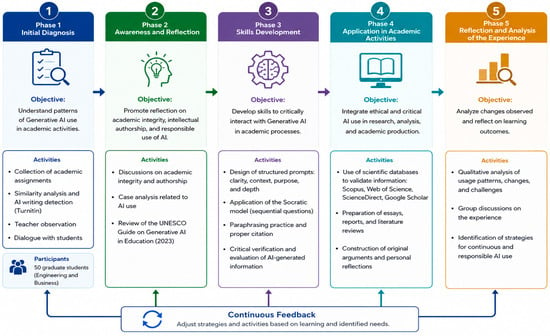
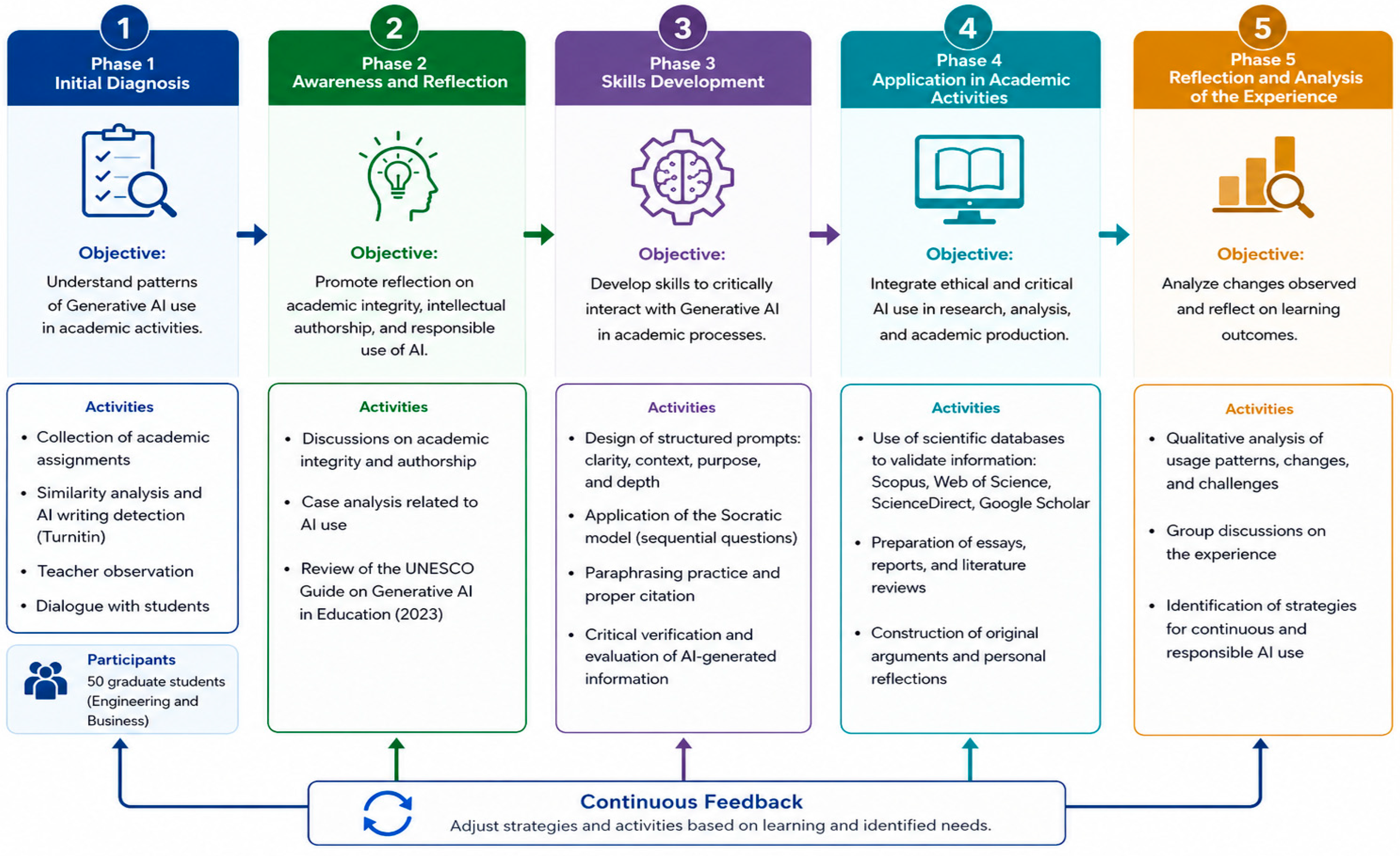
Paraphrasing was incorporated as a fundamental academic skill throughout the intervention. The proposed activities were designed to help students distinguish between reproducing information and reconstructing it through their own intellectual work, thereby fostering comprehension, analysis, and meaningful engagement with academic content. The five phases provided a structured framework that guided students from an initial diagnosis of their use of Generative Artificial Intelligence to the analysis and reflection of their learning experience while integrating the four instructional components throughout the educational process. Figure 1 summarizes the methodological design of the pedagogical intervention implemented in this study.
Figure 1.
Pedagogical Intervention Design.
2.6. Data Analysis
The analysis was conducted through the systematic review of the academic assignments submitted by the students, together with the records obtained from classroom observations and the reflections developed during the working sessions. Each assignment was individually examined as part of the regular assessment process, allowing the educator–researcher to analyze students’ use of Generative Artificial Intelligence in their academic work.
Following the review of each assignment, individual discussions were held with the respective students to provide feedback on their work and to reflect on issues related to academic integrity, intellectual authorship, critical thinking, the use of scientific sources, and the responsible use of Generative Artificial Intelligence. These discussions formed part of the pedagogical intervention and also contributed to the interpretation of students’ learning processes throughout the study.
The continuous review of academic assignments, classroom observations, Turnitin reports, and individual reflections made it possible to identify recurring patterns in students’ academic practices over time. The interpretation of these multiple sources of evidence supported the analysis of the educational experience developed during the intervention.
3. Results
3.1. The Presence of Generative Artificial Intelligence in Graduate Academic Activities
During the educational experience conducted with graduate students enrolled in two Master’s programs in Engineering and Business Administration, the use of Generative Artificial Intelligence was found to be part of the regular academic practices of a substantial proportion of the participants. These tools were used to complete assignments, search for information, organize ideas, draft texts, and prepare academic work.
The discussions and reflective activities conducted during the class sessions revealed that most students were already familiar with ChatGPT and other similar applications before the pedagogical intervention began. In many cases, these platforms were used regularly because of the speed with which they generated responses and their ability to produce content related to the topics covered in the courses. The prevailing perception among students was that Generative Artificial Intelligence represented a useful resource for optimizing the time devoted to academic work and facilitating an initial understanding of specific topics.
The analysis of the submitted assignments showed that the use of Generative Artificial Intelligence was not always accompanied by a critical evaluation of the information obtained. Many assignments reflected a strong reliance on AI-generated content, limiting students’ active participation in argument development, information analysis, and the production of their own reflections. The review of the assignments also revealed highly similar text structures, repetitive argumentative sequences, and homogeneous organization across different submissions.
Another pattern identified through the review of academic assignments and classroom discussions was the tendency of some students to regard information generated by Generative Artificial Intelligence as inherently reliable. This was particularly evident in activities involving conceptual reviews of specialized topics. In several assignments, information obtained from Generative Artificial Intelligence platforms was incorporated without being contrasted with scientific articles, specialized books, or institutional documents.
During the reflective discussions, several students explained that they used Generative Artificial Intelligence to produce initial drafts because complete texts could be generated within seconds. They also indicated that these tools reduced the time required to prepare essays, literature reviews, and other written assignments. These observations illustrated the prominent role that Generative Artificial Intelligence had assumed in students’ academic practices at the beginning of the educational experience.
The information collected during this initial stage demonstrated that Generative Artificial Intelligence had become an integral part of students’ academic activities before the implementation of the pedagogical intervention. These initial observations provided the basis for implementing the educational strategy described in the following sections, which sought to promote a more critical, responsible, and academically rigorous use of these technologies.
3.2. Initial Patterns of Use Identified Among Students
The analysis of the academic activities conducted during the study period made it possible to identify several patterns associated with the use of Generative Artificial Intelligence. Although most students acknowledged using these tools to support their academic work, the ways in which they were used revealed important differences in levels of intellectual engagement, critical analysis, and knowledge construction.
One of the most frequently observed patterns was the use of Generative Artificial Intelligence to produce complete assignments, essays, and research reports. In many cases, students requested comprehensive responses from generative platforms on the topics addressed in class and subsequently incorporated this content into their assignments with only minor modifications.
The review of the submitted assignments also revealed limited use of paraphrasing. Many students tended to reproduce responses generated by Generative Artificial Intelligence while preserving the original argumentative structure and replacing only a few words or expressions. During the reflective sessions, this practice provided opportunities to discuss the difference between making superficial textual changes and engaging in a genuine process of knowledge appropriation. Particular emphasis was placed on paraphrasing as an academic skill that requires understanding an idea, interpreting it critically, and expressing it through one’s own intellectual work while acknowledging the sources used.
Another recurring pattern was the limited consultation of specialized scientific literature. In a considerable proportion of the assignments, the information used originated primarily from responses generated by Generative Artificial Intelligence, whereas the incorporation of scientific articles, specialized books, or technical documents was limited.
An excessive reliance on responses generated by Generative Artificial Intelligence was also reflected in the similarity observed across some academic assignments. Several documents presented comparable structures, repetitive argumentative sequences, and conclusions with common characteristics, even though students were working on different topics.
During the reflective activities conducted in class, several students explained that they relied on Generative Artificial Intelligence because it could quickly produce texts that appeared complete and well structured. Some acknowledged that they initially assumed the responses generated by these tools were accurate by default and rarely verified the information before incorporating it into their assignments.
Cases were also observed in which Generative Artificial Intelligence produced non-existent references, incomplete information, or statements lacking verifiable documentary support. Although these situations were not identified in all assignments, they provided opportunities to discuss the importance of verifying information and comparing it with reliable academic sources.
The findings obtained during this stage identified recurring patterns in the academic use of Generative Artificial Intelligence, including the production of complete drafts, limited paraphrasing, reduced consultation of scientific literature, limited verification of information, and a high level of trust in AI-generated responses. These observations served as the basis for the pedagogical actions implemented during the following stages of the intervention.
3.3. Intellectual Authorship and the Limits of Automated Detection
One of the main challenges identified during the educational experience was determining intellectual authorship in academic work developed with the support of Generative Artificial Intelligence.
To examine this aspect, the academic assignments completed by the students were reviewed using Turnitin. The platform made it possible to analyze both textual similarity indices and the indicators associated with the potential use of Generative Artificial Intelligence in the preparation of academic documents.
The educational experience showed that the reports generated by Turnitin provide valuable information for educators, although they also present limitations that must be understood before interpreting the results. The platform itself states that its Generative Artificial Intelligence writing detection system was designed to support academic decision-making rather than to determine automatically whether academic misconduct has occurred. Turnitin also acknowledges that its models may produce false positives and false negatives. Consequently, it recommends that the results be interpreted together with human judgment, contextual analysis of each case, and the application of institutional academic integrity policies.
This clarification was relevant during the interpretation of the results obtained in this study. In recent years, some debates have focused on the technological capacity to detect content generated by Generative Artificial Intelligence [23]. During the review of the assignments, the interpretation of Turnitin reports was therefore complemented by the analysis of students’ academic work, classroom observations, and the individual discussions conducted throughout the pedagogical intervention.
The review of the assignments revealed situations in which a document presented low textual similarity while still reflecting limited intellectual participation by the student. Likewise, some cases required a more detailed examination because the Generative Artificial Intelligence indicators reported by Turnitin had to be interpreted in light of the limitations acknowledged by the platform itself. These observations reinforced the importance of avoiding interpretations based exclusively on percentages or automated indicators.
These observations are also consistent with recent evidence indicating that AI detection tools should be interpreted with caution. Although systems such as Turnitin provide valuable support for academic review, they remain subject to false positives, false negatives, and limited transparency, making their results insufficient as standalone evidence of AI use or academic misconduct [24]. Throughout the educational experience, Turnitin reports were therefore used primarily to identify assignments requiring closer examination rather than to reach immediate conclusions about intellectual authorship. Their interpretation was consistently complemented by the analysis of students’ written work, classroom observations, reflective discussions, and educators’ professional judgment, allowing each case to be examined within its educational context.
Another relevant aspect concerns the technical requirements for the operation of the detection system. According to Turnitin’s documentation, documents must satisfy specific requirements related to file length, format, and language before Generative Artificial Intelligence writing reports can be generated. These requirements include a minimum of 300 words written in prose and a maximum length of 30,000 words [25]. This represents an important limitation when analyzing lengthy academic documents, particularly theses and large research reports, which can easily exceed these thresholds.
Throughout the educational experience, Turnitin reports were not interpreted in isolation. Their interpretation was complemented by the review of students’ assignments, classroom observations, and the individual discussions conducted during the pedagogical intervention, allowing each case to be examined within its educational context.
3.4. Observed Changes Following the Pedagogical Intervention
The activities carried out during the intervention revealed changes in the way students interacted with Generative Artificial Intelligence tools. At the beginning of the educational experience, these technologies were used primarily to obtain rapid responses, essays, summaries, or explanations that were subsequently incorporated into academic assignments with only minor modifications.
The reflective activities on academic integrity, intellectual authorship, and the responsible use of Generative Artificial Intelligence provided opportunities for students to examine the implications of using these technologies in Higher Education. During the classroom discussions, students recognized that responsibility for the content presented in academic work remained with the author, regardless of the technological resources used during its preparation.
One of the most significant changes was related to Prompt Engineering. Unlike the initial interactions, which were characterized by brief instructions intended to obtain immediate answers, students gradually began to formulate more specific, contextualized, and analytical prompts. The use of the Socratic model supported this process by encouraging questioning, the exploration of different perspectives, and a deeper examination of the topics under study.
Evidence also emerged of greater attention being paid to the validation of information generated by Generative Artificial Intelligence. Students increasingly consulted specialized scientific literature and used academic databases such as Web of Science, Scopus, ScienceDirect, and Google Scholar to compare information, verify evidence, and support their arguments. Likewise, the activities focused on paraphrasing promoted more active participation in the preparation of academic texts and in the incorporation of students’ own reflections.
The educational experience also revealed a broader understanding of both the possibilities and the limitations of Generative Artificial Intelligence within academic processes. By the end of the intervention, students more frequently verified AI-generated information using scientific sources, formulated more analytical prompts, and demonstrated greater participation in the development of their academic work.
4. Discussion
4.1. From Detection to Responsible Use
The results of this study showed that the initial use of Generative Artificial Intelligence among graduate students was characterized by a strong reliance on AI-generated responses, limited consultation of scientific literature, superficial paraphrasing, and insufficient verification of information. These patterns indicate that the educational challenge extends beyond the use of the technology itself and is closely related to students’ intellectual engagement during the development of academic work. Rather than representing isolated practices, these findings reflect the need to strengthen educational strategies that promote responsible and reflective use of Generative Artificial Intelligence in Higher Education.
Within this context, the pedagogical intervention was not intended to restrict access to Generative Artificial Intelligence or to promote a negative view of these technologies. Instead, it sought to create opportunities for analysis that would enable students to understand both the possibilities and the limitations of these tools in Higher Education. The starting point was the recognition that Generative Artificial Intelligence has become part of contemporary academic practice and that its presence will continue to expand in the coming years. Consequently, one of the principal educational challenges is to prepare students to use these technologies critically, ethically, and responsibly.
As a framework for these discussions, the study adopted the UNESCO (2023) guidance on the use of Generative Artificial Intelligence in education. These recommendations emphasize the importance of preserving students’ intellectual autonomy, strengthening critical thinking, and ensuring that academic decisions continue to result from human reasoning [26]. The changes observed during the intervention were consistent with these recommendations, particularly regarding the progressive incorporation of information verification, scientific literature consultation, and greater student participation in the construction of academic work. Likewise, UNESCO’s recommendations shifted the focus from technological detection toward students’ intellectual development and knowledge construction [27].
One of the most significant discussions that emerged during the intervention concerned the distinction between producing academic text and constructing knowledge. Several students acknowledged that they had initially incorporated AI-generated responses into their assignments without fully understanding the concepts presented. This observation illustrates one of the principal educational risks associated with Generative Artificial Intelligence: producing coherent and well-structured text does not necessarily imply comprehension, critical analysis, or meaningful learning. The educational value of these technologies therefore depends on the extent to which students remain actively involved in interpreting, evaluating, and transforming the information they receive.
Another important aspect discussed throughout the intervention was the preservation of students’ individual voice in academic writing. Although Generative Artificial Intelligence frequently produced grammatically correct and well-organized texts, these responses often reflected standardized structures and homogeneous styles that reduced opportunities for students to express their own reasoning, interpretations, and academic identity. Classroom discussions therefore emphasized that the educational value of academic writing extends beyond producing coherent text; it also involves developing an individual voice capable of communicating original ideas, critical reflection, and personal engagement with scientific evidence. Encouraging students to revise, reinterpret, and rewrite AI-generated drafts using their own arguments became an important component of the pedagogical intervention.
The findings also support a broader understanding of academic integrity beyond plagiarism detection or the technological identification of AI-generated content. During the review of students’ assignments, documents with low similarity indices did not always demonstrate meaningful intellectual participation, while AI writing reports required careful interpretation because of the limitations acknowledged by Turnitin. These observations reinforce that automated detection systems should be understood as tools that support academic review, whereas responsibility for evaluating intellectual authorship and academic integrity continues to depend on educators’ professional judgment and the educational context in which the work is produced.
The intervention also demonstrated that students’ initial trust in AI-generated responses represented an important challenge for graduate education. During the reflective activities, participants analyzed examples of inaccurate information, nonexistent references, and unsupported statements generated by different AI platforms. These activities contributed to a greater awareness that the fluency and confidence with which AI-generated responses are presented do not necessarily reflect their accuracy. As a result, students increasingly recognized the importance of consulting scientific literature and verifying information before incorporating it into their academic work.
Another relevant finding concerns the role of scientific literature within learning processes supported by Generative Artificial Intelligence. At the beginning of the intervention, many assignments relied primarily on AI-generated information, with limited consultation of scientific articles or specialized publications. Following the pedagogical activities, students increasingly used academic databases such as Web of Science, Scopus, ScienceDirect, and Google Scholar to contrast information, evaluate evidence, and strengthen their arguments. This progression suggests that Generative Artificial Intelligence can support academic work more effectively when its outputs are complemented by systematic consultation of reliable scientific sources [28].
The changes observed in Prompt Engineering also deserve particular attention. Initially, students formulated brief prompts aimed at obtaining immediate answers. As the intervention progressed, prompts became more contextualized, analytical, and oriented toward exploration rather than simple content generation. The incorporation of the Socratic model encouraged students to formulate better questions, consider alternative perspectives, and engage more actively in the learning process. These findings suggest that Prompt Engineering can function not only as a technical skill but also as a pedagogical strategy for promoting reflection, inquiry, and critical thinking.
From this perspective, the contribution of the intervention extends beyond encouraging the responsible use of Generative Artificial Intelligence. The results suggest that the educational challenge is no longer whether students use these technologies, but how they integrate them into their learning while maintaining intellectual responsibility, critical evaluation of information, and academic integrity. In this regard, the UNESCO guidance contributed to positioning Generative Artificial Intelligence as a support tool whose educational value depends on students’ capacity to formulate meaningful questions, evaluate information critically, and construct knowledge through active intellectual participation [29].
4.2. Prompt Engineering and the Socratic Model for Knowledge Construction
The results of this study indicate that the educational value of Generative Artificial Intelligence is closely associated with the way students interact with these technologies. During the initial stages of the intervention, many participants formulated brief and general prompts intended to obtain immediate answers. This pattern frequently produced extensive responses with limited contextualization and little support for critical analysis. These observations indicate that several of the limitations identified during the intervention were associated with students’ interaction with Generative Artificial Intelligence.
As the intervention progressed, students gradually learned to formulate prompts that incorporated context, specific objectives, and analytical criteria. This change was accompanied by improvements in the quality of the responses generated by Generative Artificial Intelligence and by greater student participation in the development of academic assignments. The activities also showed greater attention to information verification, consultation of scientific literature, and the development of arguments supported by evidence.
The incorporation of the Socratic model contributed to this change by encouraging students to continue interacting with Generative Artificial Intelligence through successive questions. Instead of accepting the first response, participants examined assumptions, requested additional explanations, explored alternative perspectives, and evaluated the evidence supporting the information provided by the system [30]. This form of interaction promoted a more active learning process and encouraged continuous reflection throughout the academic activities.
The educational experience demonstrated that Prompt Engineering extends beyond the formulation of effective instructions for obtaining better responses from Generative Artificial Intelligence. Within the context of this intervention, it became an educational strategy that encouraged questioning, argumentation, information evaluation, and independent reasoning. As students improved the quality of their prompts, they also demonstrated greater intellectual participation in the preparation of their academic work.
Another important observation concerned the relationship between Prompt Engineering and academic research. At the beginning of the intervention, many students relied primarily on AI-generated responses to complete their assignments. As the intervention progressed, they increasingly consulted scientific articles and specialized publications to verify information, compare evidence, and strengthen their arguments. Academic databases such as Web of Science, Scopus, ScienceDirect, and Google Scholar became regular sources for validating information generated by Generative Artificial Intelligence.
These observations reinforce the distinction between generating text and constructing knowledge. Although Generative Artificial Intelligence can facilitate idea generation and support the early stages of academic work, meaningful learning continues to depend on students’ ability to formulate relevant questions, critically evaluate information, integrate scientific evidence, and develop their own arguments. Similar observations have been reported in previous studies that emphasize the importance of maintaining active student participation throughout the learning process [31].
From the perspective of academic integrity, the findings of this study indicate that educational efforts should prioritize the development of questioning, information evaluation, and critical reasoning when students interact with Generative Artificial Intelligence [32]. Preparing students to engage thoughtfully with these technologies contributes more effectively to higher education than approaches centered exclusively on restricting or detecting their use.
4.3. Information Validation and Scientific Sources
One of the principal findings of this study was the importance of strengthening students’ ability to validate information generated by Generative Artificial Intelligence. Although these platforms can produce extensive, coherent, and apparently well-supported responses, the quality of the writing does not necessarily guarantee the accuracy or reliability of the information presented [11]. Throughout the intervention, students encountered examples of incomplete information, nonexistent references, oversimplified interpretations, and statements that could not be confirmed through the scientific literature. These experiences reinforced the importance of systematic information verification as an essential component of academic work.
At the beginning of the intervention, many students tended to accept AI-generated responses without questioning their accuracy or consulting additional sources. This pattern was reflected in the limited use of scientific literature observed in many of the initial assignments, where AI-generated information frequently became the primary source used to prepare academic work. These findings indicate that the immediate availability of AI-generated content may encourage a false sense of reliability when students do not actively verify the information obtained.
The analysis of these situations provided opportunities to distinguish between access to information and knowledge construction. While Generative Artificial Intelligence can provide information within seconds, the development of academic knowledge requires interpretation, comparison of multiple sources, critical evaluation of evidence, and independent reasoning [33]. This distinction became particularly relevant in graduate education, where research competencies constitute a fundamental component of academic training.
For this reason, the pedagogical intervention emphasized the systematic consultation of scientific literature through academic databases such as Web of Science, Scopus, ScienceDirect, Google Scholar, and other specialized resources relevant to students’ disciplinary fields. These databases were incorporated into the learning activities as the primary sources for verifying information, contrasting evidence, and strengthening academic arguments. Their use was facilitated by the institutional access available to graduate students, allowing them to work with peer-reviewed scientific publications throughout the intervention.
Comparing AI-generated responses with scientific literature enabled students to identify methodological differences, recognize unsupported statements, and examine alternative interpretations that were frequently absent from automatically generated content. This comparison encouraged greater participation in the evaluation of evidence and promoted a more critical approach to the information incorporated into academic assignments.
Another topic discussed extensively during the intervention was the phenomenon commonly referred to as Artificial Intelligence hallucinations. Students analyzed examples in which generative systems produced apparently convincing information that lacked documentary support, including nonexistent references and inaccurate author attributions. These activities demonstrated that the fluency of AI-generated responses should not be interpreted as evidence of their accuracy and reinforced the importance of verifying information before incorporating it into academic work [34].
The findings also indicate that Generative Artificial Intelligence should complement the research practices expected in graduate education. Locating reliable sources, evaluating scientific evidence, identifying knowledge gaps, and developing well-supported arguments continued to depend on students’ active participation throughout the research process. As the intervention progressed, students increasingly integrated Generative Artificial Intelligence into information retrieval, analysis, and validation while maintaining consultation of scientific literature as the foundation of their academic work.
These observations reinforce the idea that the educational challenge extends beyond teaching students how to use Generative Artificial Intelligence. Higher Education institutions are also expected to prepare students to question information, verify evidence, interpret scientific findings, and make academically informed decisions [35]. Within this context, information validation becomes one of the essential competencies for the responsible integration of Generative Artificial Intelligence into graduate education.
5. Conclusions
The findings of this study contribute to the ongoing discussion on the educational implications of Generative Artificial Intelligence by supporting the view that academic integrity should be addressed primarily as a pedagogical challenge rather than exclusively as a technological one. The educational experience demonstrated that responsible use of Generative Artificial Intelligence depends less on the availability of detection systems and more on the development of students’ abilities to question information, evaluate evidence, construct arguments, and assume responsibility for their own academic work. Within this context, technologies such as Turnitin, Prompt Engineering, and structured pedagogical strategies should be understood as complementary resources that support learning while preserving the central role of educators in guiding academic development.
This study also contributes to current discussions by illustrating how pedagogical interventions grounded in ethical reflection, information validation, and guided interaction with Generative Artificial Intelligence can promote a more responsible use of these technologies in graduate education. Rather than positioning Artificial Intelligence as either a threat or a solution, the educational experience highlights the importance of integrating these tools into teaching practices that strengthen research competencies, critical analysis, and evidence-based decision-making. These findings may provide useful guidance for Higher Education institutions seeking to develop institutional strategies that combine technological innovation with the preservation of academic integrity.
Some limitations should be acknowledged. This study was conducted within two graduate programs at a single Higher Education institution using a qualitative educational action research approach. Consequently, the findings should be interpreted within this educational context and are not intended to provide statistical generalization to other institutions, academic disciplines, or educational levels. In addition, the study examined the effects of a specific pedagogical intervention and did not evaluate whether the observed changes persist over longer periods or transfer to other academic settings.
Future research could explore the implementation of similar pedagogical strategies in undergraduate education, different disciplinary fields, and institutions with diverse educational policies regarding Generative Artificial Intelligence. Longitudinal studies may also contribute to understanding the durability of changes in students’ research practices, academic writing, critical thinking, and responsible use of Generative Artificial Intelligence. Comparative studies involving different educational contexts would further strengthen the evidence regarding effective approaches for integrating these technologies into Higher Education.
Ultimately, the educational challenge presented by Generative Artificial Intelligence extends beyond determining whether students use these technologies. The more significant challenge is ensuring that their use continues to support the intellectual processes that define Higher Education: questioning evidence, constructing knowledge, exercising academic judgment, and assuming responsibility for one’s own learning. As Generative Artificial Intelligence becomes increasingly integrated into academic life, the future of academic integrity will depend less on identifying who generated a text than on ensuring that students remain responsible for understanding, evaluating, and defending the ideas they present.
Funding
This research was partially funded by the Instituto Politécnico Nacional (IPN), Mexico, through research project SIP 20260758.
Institutional Review Board Statement
The study involved the retrospective analysis of anonymized academic assignments submitted as part of regular graduate coursework. No intervention, experimentation, or collection of sensitive personal information was conducted, and all results are reported in aggregated form. An Ethics Committee was convened and constituted at the request of the Research Department of ESIME Ticomán, Instituto Politécnico Nacional, specifically to review the ethical aspects of this study. The Committee concluded that the research posed no risk to participants and did not involve biomedical or clinical procedures. The study was conducted in accordance with the ethical principles of the Declaration of Helsinki (2013 revision), including respect for privacy and confidentiality.
Informed Consent Statement
The students were aware that their academic work would be analyzed as part of the educational process and received continuous feedback throughout the course. The study consisted of the retrospective analysis of anonymized academic assignments submitted as part of regular graduate coursework. No intervention, experimentation, or collection of sensitive personal information was conducted, and all results are reported in aggregated form. Written informed consent was not obtained because no identifiable personal information was collected and the study involved the retrospective analysis of anonymized academic assignments.
Data Availability Statement
The data supporting the findings of this study are available from the corresponding author upon reasonable request. The data are not publicly available because they contain information derived from students’ academic activities and are subject to privacy and ethical considerations.
Acknowledgments
The author gratefully acknowledges the Instituto Politécnico Nacional (IPN) for its institutional support. During the preparation of this manuscript, the author used ChatGPT (OpenAI, GPT-5.5) for English translation and language editing. The author reviewed and approved all content and assumes full responsibility for the manuscript.
Conflicts of Interest
The author declares no conflicts of interest.
References
- Nguyen, L.T. Digital transformation in Vietnamese academic library services: Current trends and challenges. J. Acad. Libr. 2026, 52, 103269. [Google Scholar] [CrossRef] [Scilit]
- Baidoo-Anu, D.; Ansah, L.O. Education in the era of generative artificial intelligence (AI): Understanding the potential benefits of ChatGPT in promoting teaching and learning. J. AI 2023, 7, 52–62. [Google Scholar] [CrossRef] [Scilit]
- Namoun, A.; Ibrahim, I.A.; Mustafa, E.; Alrehaili, A.; Tufail, A.; Shuja, J.; Alanazi, M.H. Generative Artificial Intelligence in Education: An Umbrella Review of Applications and Challenges. 2024. Available online: https://assets-eu.researchsquare.com/files/rs-4892155/v1_covered_e5ce6c1c-6cfa-4e00-ab11-3b5f69dbe4c3.pdf (accessed on 30 June 2026).
- Banh, L.; Strobel, G. Generative artificial intelligence. Electron. Mark. 2023, 33, 63. [Google Scholar]
- Sengar, S.S.; Hasan, A.B.; Kumar, S.; Carroll, F. Generative artificial intelligence: A systematic review and applications. Multimed. Tools Appl. 2025, 84, 23661–23700. [Google Scholar] [CrossRef] [Scilit]
- García-Peñalvo, F.J.; Casañ-Guerrero, M.J.; Alier-Forment, M.; Pereira-Varela, J.A. La ética de la inteligencia artificial generativa en educación a debate: Perspectiva desde el desarrollo de un caso de estudio teórico-práctico. Rev. Esp. Pedagog. 2025, 83, 281–293. [Google Scholar] [CrossRef] [Scilit]
- Parada, E.J.V. Lectura crítica en la era de la Inteligencia Artificial Generativa: Potencialidades y riesgos en la escuela. Rev. Int. Pedagog. Innov. Educ. 2026, 6, 89–116. [Google Scholar] [CrossRef] [Scilit]
- Gallent Torres, C.; Zapata-González, A.; Ortego-Hernando, J.L. The impact of generative artificial intelligence in higher education: A focus on ethics and academic integrity. RELIEV 2023, 29, 1–19. [Google Scholar] [CrossRef] [Scilit]
- Cordero, J.; Torres-Zambrano, J.; Cordero-Castillo, A. Integration of generative artificial intelligence in higher education: Best practices. Educ. Sci. 2024, 15, 32. [Google Scholar] [CrossRef] [Scilit]
- Montes, M.D.M.; Vilchis, I.L. Entre la integridad académica y el plagio estudiantil: ¿Qué dicen las universidades públicas mexicanas en su normatividad? Educ. Policy Anal. Arch. 2021, 29, 166. [Google Scholar] [CrossRef] [Scilit]
- Schmidt, D.A.; AlBloushi, B.; Thomas, A.; Magalhaes, R. Integrating artificial intelligence in higher education: Perceptions, challenges, and strategies for academic innovation. Comput. Educ. Open. 2025, 9, 100274. [Google Scholar] [CrossRef] [Scilit]
- Lisbeth, S.M.T.; Leonel, Q.U.N.; Alex, F.S.A.; Arturo, L.P.L. Didáctica inteligente con IA generativa. Rev. Educ. Res. 2026, 77, 81–112. [Google Scholar]
- Currie, G.M. Academic integrity and artificial intelligence: Is ChatGPT hype, hero or heresy? Semin. Nucl. Med. 2023, 53, 719–730. [Google Scholar] [CrossRef] [Scilit] [PubMed]
- Michel-Villarreal, R.; Vilalta-Perdomo, E.; Salinas-Navarro, D.E.; Thierry-Aguilera, R.; Gerardou, F.S. Challenges and opportunities of generative AI for higher education as explained by ChatGPT. Educ. Sci. 2023, 13, 856. [Google Scholar] [CrossRef] [Scilit]
- Tasayco Jala, A.A.; Menacho Vargas, I.; Magallanes Yataco, E.M.; Ralli Magipo, L.G. El pensamiento crítico en la investigación de los estudiantes universitarios. Aula Virtual 2024, 5, 12. [Google Scholar]
- Chaparro-Martínez, E.I.; Álvarez-Muñoz, P.; Armas-Regnault, M.D. Gestión de la información: Uso de las bases de datos Scopus y Web of Science con fines académicos. Univ. Cienc. Tecnol. 2016, 20, 166–175. [Google Scholar]
- Ekin, S. Prompt engineering for ChatGPT: A quick guide to techniques, tips, and best practices. J. Eng. Technol. 2026, 43, 52–68. [Google Scholar] [CrossRef] [Scilit]
- Finkel, L.; Parra-Contreras, P.; Martínez-Solana, Y.; Matos-Mejías, C. ChatGPT como fuente de información en la educación superior: Valoración de los resultados que proporciona la IA generativa. Prof. Inf. 2024, 33, 1. [Google Scholar] [CrossRef] [Scilit]
- De Almeida Filho, C.L.; De Figueiredo, M.P.M.; Silveira, G.E.; Eidelwein, T. Desafios éticos para o uso de inteligência artificial na educação e na pesquisa. Campos Neutrai. 2024, 6, 220–243. [Google Scholar] [CrossRef] [Scilit]
- Aler Tubella, A.; Mora-Cantallops, M.; Nieves, J.C. How to teach responsible AI in higher education: Challenges and opportunities. Ethics Inf. Technol. 2024, 26, 1. [Google Scholar] [CrossRef] [Scilit]
- Numa-Sanjuán, N.; Diaz-Guecha, L.Y.; Peñaloza-Tarazona, M.E. Importancia de la inteligencia artificial en la educación del siglo XXI. AiBi Rev. Investig. Adm. Ing. 2024, 12, 49–62. [Google Scholar] [CrossRef] [Scilit]
- Vidal Ledo, M.; Rivera Michelena, N. Investigación-acción. Educ. Med. Super. 2007, 21, 1–15. [Google Scholar] [CrossRef] [Scilit]
- Arce, D.D. Herramientas para detectar el plagio a la inteligencia artificial: ¿Cuán útiles son? Tools to detect Plagiarism in Artificial Intelligence: How useful are they? Rev. Cognosi. 2024, 9, 144–150. [Google Scholar]
- Deep, P.D.; Edgington, W.D.; Ghosh, N.; Rahaman, M.S. Evaluating the Effectiveness and Ethical Implications of AI Detection Tools in Higher Education. Information 2025, 16, 905. [Google Scholar] [CrossRef] [Scilit]
- Turnitin. Requisitos de Archivo Para un Reporte de Escritura con IA. Available online: https://guides.turnitin.com/hc/es/articles/28234943089933-Requisitos-de-archivo-para-un-reporte-de-escritura-con-IA (accessed on 5 August 2026).
- Gonçalves, M.B.; de Almeida Pimenta, M.A. Inteligência Artificial Generativa na educação e pesquisa: Reflexões sobre o guia da UNESCO. S. Am. Dev. Soc. J. 2024, 10, 422. [Google Scholar]
- Pantò, E. IA (generativa) in classe: Le linee guida internazionali. Bricks 2023, 3, 81–91. [Google Scholar]
- Gupta, C.P.; Mishra, M. The Relation Between Intellectual Honesty and Research Integrity as the Fundamental Principles of Research. In Research and Publication Ethics; Ahuja, V.K., Baishya, K., Eds.; National Law University and Judicial Academy, Assam: Guwahati, India, 2024; pp. 151–173. ISBN 978-81-954276-9-7. Available online: https://nluassam.ac.in/docs/pub/Research%20and%20Publication%20Ethics.pdf#page=166 (accessed on 3 August 2026).
- Stratopoulos, T.C.; Wang, V.X. Artificial intelligence and accounting research: A framework and agenda. Int. J. Account. Inf. Syst. 2025, 56, 100760. [Google Scholar] [CrossRef] [Scilit]
- Fuentes, J.P.R.; de la Muela, A.M. Transformación educativa: Explorando el papel de la inteligencia artificial en la mejora de la calidad y la tutoría virtual. Edetani 2024, 65, 8. [Google Scholar]
- Bogantes, M.R.; Ávila, E.Q.; López, F.A. Condiciones del uso socrático de la Inteligencia Artificial Generativa y modelo híbrido docente en matemática universitaria. Cienc. Lat. Rev. Cient. Multidiscip. 2026, 10, 8485–8506. [Google Scholar] [CrossRef] [Scilit]
- Fuente-Ballesteros, A.; Zeidler, V.G.Z. Reflections on the impact of artificial intelligence on peer-review practices and its implications for greener scientific evaluation. Green Anal. Chem. 2026, 17, 100349. [Google Scholar] [CrossRef] [Scilit]
- Gómez, S.V.; Rebolledo, E.K.S.; Cano, J.M.M. Verificación de evidencias y fuentes de información de trabajos académicos elaborados con Inteligencia Artificial Generativa. Educ. Pesqui. 2025, 51, e294421es. [Google Scholar] [CrossRef] [Scilit]
- Sun, Y.; Sheng, D.; Zhou, Z.; Wu, Y. AI hallucination: Towards a comprehensive classification of distorted information in artificial intelligence-generated content. Humanit. Soc. Sci. Commun. 2024, 11, 1278. [Google Scholar] [CrossRef] [Scilit]
- Barbará, S. Inteligencia Artificial y Educación: Fundamentos, Usos y Desafíos para la Práctica Docente; Sebastián Barbará, 2026. Available online: https://books.google.com.mx/books?hl=es&lr=&id=EIzOEQAAQBAJ&oi=fnd&pg=PA4&dq=35.%09Barbar%C3%A1,+S.%E2%80%A6#v=onepage&q&f=false (accessed on 12 August 2026).
Disclaimer/Publisher’s Note: The statements, opinions and data contained in all publications are solely those of the individual author(s) and contributor(s) and not of MDPI and/or the editor(s). MDPI and/or the editor(s) disclaim responsibility for any injury to people or property resulting from any ideas, methods, instructions or products referred to in the content. |
© 2026 by the author. Licensee MDPI, Basel, Switzerland. This article is an open access article distributed under the terms and conditions of the Creative Commons Attribution (CC BY) license.