


Abstract
Profiling side-channel attacks based on deep learning can recover cryptographic information from power-consumption traces, but their effectiveness may be reduced when desynchronisation displaces informative leakage across temporal positions. This study investigates whether Temporal Convolutional Networks (TCNs) can model the local and long-range dependencies present in desynchronised traces. Three complementary TCN variants are designed to isolate different temporal modelling strategies: a single-kernel dilated architecture (TCN1), a multi-scale architecture using parallel kernel sizes (TCN2), and a residual architecture intended to support stable hierarchical feature learning (TCN3). The models are evaluated on the ASCAD v1 fixed-key benchmark under synchronised conditions and maximum temporal shifts of 25, 50, and 75 samples, using validation loss and complementary key-ranking metrics. Under the most challenging setting, TCN1 achieves the highest Rank Success Rate and reaches its best rank substantially earlier than the conventional CNN baselines, although the lowest Final Rank is obtained by a CNN. These results indicate that TCN1 provides the most favourable trade-off among convergence speed, ranking consistency, and architectural complexity, without establishing uniform TCN superiority across all metrics. Gradient saliency, LIME, and occlusion analyses further identify temporal regions that influence the model predictions and are consistent with expected leakage patterns. The main contribution is a controlled comparison of complementary TCN design strategies, combined with an explainability analysis, for profiling side-channel attacks under trace desynchronisation.
1. Introduction
Cryptographic algorithms are designed to ensure confidentiality, integrity, and authenticity of information, but their practical implementations often leak unintended physical information that can be exploited by adversaries. Consequently, network security and privacy have become critical concerns in both industrial and academic research communities [1].
Among the most effective threats against embedded cryptographic systems are Side-Channel Attacks (SCAs), which exploit physical leakages generated during the execution of cryptographic operations rather than targeting weaknesses in the mathematical structure of the algorithms themselves [2]. Such leakages arise because every electronic device emits measurable signals while processing information. These signals may manifest in different physical domains, including power consumption, electromagnetic radiation, acoustic emissions, vibrations, and execution timing [3,4,5]. By analyzing these unintended emissions, an attacker can infer secret information such as encryption keys, passwords, or sensitive user data.
Based on the exploited leakage source, SCAs can be broadly classified into four main categories: (i) Power Consumption Attacks, (ii) Electromagnetic Attacks, (iii) Acoustic and Vibration-Based Attacks, and (iv) Timing Attacks. Among these, power-based attacks have received considerable attention due to their effectiveness, relatively low implementation cost, and applicability to a wide range of cryptographic devices. Differential Power Analysis (DPA) and Correlation Power Analysis (CPA) remain among the most studied techniques for recovering secret cryptographic keys from power consumption traces.
Traditionally, SCAs relied heavily on expert knowledge, statistical signal processing methods, and handcrafted feature extraction techniques. However, the rapid development of Artificial Intelligence (AI) and Machine Learning (ML) has fundamentally transformed this field. Modern ML algorithms are capable of automatically learning complex leakage patterns directly from raw side-channel traces, significantly reducing the need for manual feature engineering while improving attack efficiency and scalability. As a result, AI-driven SCAs have emerged as one of the most powerful threats against contemporary cryptographic implementations.
Among Machine Learning techniques, Deep Learning (DL) has become the dominant paradigm for profiling Side-Channel Attacks because it can automatically learn discriminative leakage features directly from raw power traces without requiring handcrafted preprocessing. Early studies demonstrated that Convolutional Neural Networks (CNNs) significantly outperform traditional statistical approaches by jointly learning feature extraction and classification within a unified framework [6,7,8]. The pioneering work presented in [9] demonstrated for the first time that CNNs could automatically extract relevant leakage features from power traces and successfully recover cryptographic keys. These results established deep learning as one of the most effective approaches for power side-channel cryptanalysis and stimulated extensive research on increasingly sophisticated neural architectures.
Recent research has further explored the use of advanced AI paradigms for side-channel analysis. Generative Adversarial Networks (GANs) have been employed to augment datasets and generate synthetic traces capable of improving profiling attacks when limited training data are available [10]. Similarly, Reinforcement Learning (RL) has been investigated as a mechanism for automatically identifying the most informative regions of side-channel traces [11]. Furthermore, ML techniques have enabled the automation of sophisticated cache-timing and microarchitectural attacks [12].
A major milestone in this evolution was the introduction of the Advanced Side-Channel Attack Database (ASCAD) [13], which provided the first publicly available benchmark specifically designed for evaluating deep learning-based profiling attacks under reproducible experimental conditions. Since its introduction, ASCAD has become the reference benchmark for comparing machine learning architectures because it offers standardized profiling and attack partitions together with synchronised and desynchronised acquisition scenarios. Consequently, most recent deep learning-based side-channel studies evaluate their approaches using the ASCAD benchmark, enabling meaningful and reproducible comparisons between different architectures.
Despite these advancements, most existing DL-based SCA solutions rely on conventional CNN architectures [14,15]. Although CNNs effectively capture local leakage patterns, they are often limited in their ability to model long-range temporal dependencies that naturally characterize side-channel traces. Power consumption measurements are inherently sequential signals, where critical leakage information may be distributed across multiple temporal scales. Consequently, architectures specifically designed for temporal sequence modelling may provide significant advantages over conventional convolutional approaches.
Temporal sequence modelling has recently emerged as a promising alternative in several signal processing applications. In particular, Temporal Convolutional Networks (TCNs) employ causal convolutions together with exponentially increasing dilation factors, enabling large receptive fields while preserving computational efficiency and stable training [16]. TCNs have demonstrated excellent performance in several sequential learning problems, including malware detection, biomedical signal analysis, and time-series classification [17,18]. Despite these advantages, their application to profiling side-channel attacks remains relatively limited, and a systematic comparison of different TCN design strategies under standardized ASCAD evaluation protocols is still lacking. Taken together, the existing literature suggests that two complementary research directions have evolved largely independently. On the one hand, DL-based side-channel analysis has primarily focused on CNN-derived architectures evaluated on the ASCAD benchmark. On the other hand, TCNs have demonstrated excellent performance in generic temporal learning tasks but have received comparatively little attention in cryptographic side-channel analysis. Bridging these two research directions therefore represents a natural and timely research opportunity.
Another emerging research direction concerns the interpretability of DL-based side-channel attacks. Although deep neural networks often achieve high attack performance, their internal decision-making process generally remains difficult to interpret. Recent eXplainable Artificial Intelligence (XAI) techniques, including saliency maps, Local Interpretable Model-agnostic Explanations (LIME), occlusion analysis, Integrated Gradients, and SHapley Additive exPlanations (SHAP), have been increasingly adopted to investigate which temporal regions contribute most strongly to model predictions. Within the context of side-channel analysis, XAI can help in highlighting the temporal leakage points exploited by DL models, enabling a more comprehensive understanding of attack behaviour and facilitating the validation of extracted security insights. Furthermore, explainability contributes to the development of more trustworthy AI-based security assessment frameworks by providing evidence that the learned features correspond to meaningful physical leakage sources rather than spurious correlations. Nevertheless, compared with the large body of work devoted to improving attack accuracy, relatively few studies have investigated explainability within the context of side-channel analysis [17,18,19].
1.1. Literature Synthesis and Research Gaps
Table 1 shows that deep-learning profiling attacks, temporal sequence modelling, and explainable side-channel analysis have largely developed as related but insufficiently integrated research directions. CNN-based methods have established the effectiveness of automated leakage extraction, while ASCAD has enabled reproducible evaluation under trace desynchronisation. However, the comparative effect of different TCN design strategies on desynchronised power traces remains insufficiently investigated, particularly when performance analysis is combined with model explanations.
Table 1.
Comparative synthesis of the main research strands in power-based side-channel analysis, highlighting their principal contributions, current limitations, and the research gap addressed by the present study.
The present study addresses this gap by comparing three complementary temporal architectures under identical ASCAD conditions and by applying multiple attribution methods to examine the temporal regions influencing their predictions.
1.2. Contributions of the Paper
Addressing the afore-mentioned issues, this paper presents a comprehensive security analysis of deep learning-based power side-channel attacks through the development of three novel Temporal Convolutional Network architectures. The proposed models are evaluated using the Advanced Side-Channel Attack Database (ASCAD), a widely adopted benchmark for profiling attacks against 128-bit Advanced Encryption Standard (AES) implementations. Unlike conventional CNN-based approaches, the proposed architectures are specifically designed to exploit the temporal structure of power traces through multi-scale feature extraction and dilated temporal convolutions. Additionally, an XAI framework is integrated into the analysis to investigate the temporal regions that contribute most significantly to cryptographic key recovery, providing both performance improvements and enhanced interpretability. To the best of our knowledge, this is among the first studies jointly investigating TCNs and XAI for power-based side-channel cryptanalysis under desynchronisation countermeasures, providing both improved attack performance and interpretable security insights. It should be emphasized that the novelty of this work lies in adapting established TCN design principles to profiling side-channel attacks, systematically comparing three complementary architectural variants under identical ASCAD benchmark conditions, and integrating XAI techniques to interpret the temporal leakage features exploited during key recovery.
The main contributions of this work can be summarized as follows:
- The design, adaptation, and comparative evaluation of three complementary TCN-based architectures for power side-channel cryptanalysis.
- A comprehensive evaluation on the ASCAD benchmark under realistic attack conditions, including trace desynchronisation scenarios.
- A comparative analysis against conventional CNN-based approaches, highlighting that TCNs provide an effective trade-off between robustness, convergence speed, attack accuracy, and key recovery efficiency under challenging desynchronisation conditions.
- The integration of XAI techniques to identify and interpret the temporal leakage features exploited by the proposed models.
- An investigation of the relationship between temporal deep learning representations and physical leakage sources in AES implementations.
The remainder of this paper is organized as follows. Section 2 first describes the system model as well as the ASCAD dataset and then introduces the proposed TCN architectures and the adopted XAI framework. Section 3 presents the experimental setup and performance evaluation, discussing the obtained outcomes in terms of explainability and security implications. Finally, Section 4 briefly concludes the paper.
2. Materials and Methods
2.1. ASCAD Dataset and Threat Model
To evaluate the effectiveness of the proposed deep learning-based side-channel attacks, we employ the Advanced Side-Channel Attack Database (ASCAD), one of the most widely adopted benchmark datasets for profiling side-channel analysis. ASCAD was developed by the French National Cybersecurity Agency (ANSSI) to facilitate the study and comparison of machine learning and deep learning approaches for cryptographic key recovery.
The dataset contains power consumption measurements collected during the execution of the Advanced Encryption Standard (AES) encryption algorithm on an ATMega8515 microcontroller embedded within a smart-card platform. The ATMega8515 is frequently used in side-channel research because it represents a typical low-cost embedded device characterized by limited computational resources and reduced hardware protection mechanisms. As a consequence, its power consumption exhibits measurable variations that can be exploited by attackers to infer sensitive information. The ASCAD consists of 50,000 profiling traces and 10,000 attack traces. Each trace contains 700 sampled points corresponding to a selected window of interest during AES execution. The measurements were acquired using a high-resolution digital oscilloscope operating at a sampling frequency of 20 MHz, allowing precise observation of the current fluctuations generated by cryptographic computations. In the following of this paper, the experiments were conducted using the ASCAD v1 fixed-key dataset, which contains power consumption traces acquired from an AES-128 implementation executed on an ATMega8515 8-bit AVR microcontroller. The original ASCAD profiling and attack partitions were preserved throughout all experiments to ensure direct comparability with the benchmark results. In addition to the synchronised dataset, desynchronised variants with maximum temporal shifts of 25, 50, and 75 samples were also considered to evaluate the robustness of the proposed architectures under progressively more challenging operating conditions. The attack targeted the third byte (byte index 2) of the AES-128 secret key. The labels were generated from the corresponding intermediate value computed after the AddRoundKey and SubBytes operations, according to the official ASCAD annotation procedure. The Identity leakage model was adopted, resulting in 256 output classes corresponding to all possible values of the targeted intermediate byte. Prior to training, the input traces were normalized using the same preprocessing procedure adopted for all experiments. No additional feature extraction or manual trace alignment was performed, allowing the proposed models to learn directly from the raw power consumption traces. The original ASCAD profiling and attack partitions were preserved, and the profiling set was further divided into training and validation subsets for model optimization, while the official attack set was used exclusively for performance evaluation. Finally, all models were implemented in Python 3.1 using TensorFlow/Keras. To ensure experimental reproducibility, all experiments were performed using a fixed random seed equal to 42 for Python, NumPy, and TensorFlow. The experiments were executed on a workstation equipped with an Intel Core i7 processor, 32 GB RAM, and an NVIDIA RTX-series GPU running Ubuntu Linux.
The considered attack scenario follows the profiling paradigm, in which an adversary first trains a machine learning model using a profiling device with known cryptographic parameters and subsequently applies the learned model to recover the secret key from an unseen target device. This scenario represents one of the most challenging and realistic settings for evaluating modern side-channel attacks.
Power consumption traces can be exploited through different methodologies:
- Simple Power Analysis (SPA): extraction of secret information through visual inspection of individual traces.
- Differential Power Analysis (DPA): statistical analysis of multiple traces to identify key-dependent leakage.
- Correlation Power Analysis (CPA): correlation-based techniques exploiting leakage models such as Hamming Weight and Hamming Distance.
- Deep Learning-Based Power Analysis: automatic extraction of leakage features directly from raw traces using neural networks without manual feature engineering.
In this work, we focus on the latter category, investigating how temporal deep learning architectures can improve the extraction of cryptographic information from power consumption measurements.
2.2. AES-128 Target Implementation
The target cryptographic algorithm considered throughout this study is the 128-bit Advanced Encryption Standard AES-128 [20], which remains one of the most widely deployed symmetric encryption standards for secure communications, cloud services, financial transactions, and embedded systems.
AES operates on 128-bit plaintext blocks through a sequence of substitution and permutation operations organized into multiple rounds. For AES-128, ten encryption rounds are performed using a secret key of length 128 bits. During execution, intermediate variables generated by the SubBytes, ShiftRows, MixColumns, and AddRoundKey transformations produce data-dependent power consumption patterns that can leak information about the secret key. In side-channel analysis, the intermediate values generated during the first encryption round, particularly after the SubBytes operation, are commonly exploited because they produce measurable data-dependent leakage.
Consistent with the original ASCAD benchmark configuration, all experiments are conducted using a fixed secret key implementation. This setup reduces variability in the collected measurements and enables a more precise evaluation of the learning capabilities of the proposed architectures. Consequently, the observed performance differences can be primarily attributed to the effectiveness of the neural network models rather than to variations in cryptographic parameters.
The attack objective consists of recovering the secret key byte associated with the first AES round by exploiting the relationship between measured power consumption traces and the corresponding intermediate cryptographic computations.
2.3. Temporal Convolutional Networks for Side-Channel Analysis
Recent advances in deep learning have demonstrated that temporal dependencies contained within sequential data can be effectively modeled using Temporal Convolutional Networks (TCNs). Unlike traditional Convolutional Neural Networks (CNNs), which primarily focus on local feature extraction, TCNs are specifically designed to process temporal sequences while preserving causal relationships among observations.
A TCN is characterized by two fundamental properties:
- Sequence Length Preservation: the output sequence maintains the same temporal dimension as the input sequence through the use of appropriate zero-padding.
- Causality: predictions at a given time instant depend only on current and past samples, preventing information leakage from future observations.
These properties are achieved through one-dimensional causal convolutions combined with dilated convolutional filters. Given an input sequence (x), a dilated convolution with dilation factor (d) allows the receptive field to grow exponentially without significantly increasing computational complexity. Consequently, TCNs can efficiently capture both short-term and long-range dependencies that may be distributed across power traces.
Compared with Recurrent Neural Networks (RNNs), Long Short-Term Memory (LSTM) networks, and Gated Recurrent Units (GRUs), TCNs provide several advantages, including improved parallelization, reduced training times, stable gradient propagation, and superior capability to model long temporal contexts. These characteristics have led to successful applications in natural language processing, speech recognition, biomedical signal processing, electrocardiogram analysis, and electroencephalogram classification.
Given the inherently temporal nature of power consumption measurements, TCNs represent a promising architecture for side-channel cryptanalysis, where relevant leakage information may appear at different temporal scales and positions within the trace. The three investigated architectures, here devised in the following, should be regarded as complementary TCN variants derived from established temporal convolutional design principles rather than completely new network families. The three TCN variants were designed as a controlled architectural comparison intended to examine three complementary hypotheses about temporal leakage modelling. First, TCN1 investigates whether a relatively simple architecture combining a single kernel size with progressively increasing dilation factors is sufficient to capture both local leakage patterns and long-range dependencies. Second, TCN2 examines whether simultaneous feature extraction at different temporal resolutions, implemented through parallel kernels of sizes 3, 5, and 7, provides an advantage when informative leakage is distributed across temporal structures of different widths. Third, TCN3 evaluates whether residual connections improve gradient propagation, preserve relevant temporal information, and support the learning of more hierarchical leakage representations. Accordingly, the three models do not represent unrelated architectural alternatives, but a progression from baseline dilated temporal modelling to multi-scale feature extraction and residual temporal learning. Their evaluation under the same dataset partitions, training conditions, and performance metrics makes it possible to isolate the practical benefits and limitations of each design strategy.
2.4. Proposed TCN Architectures
2.4.1. TCN Model 1
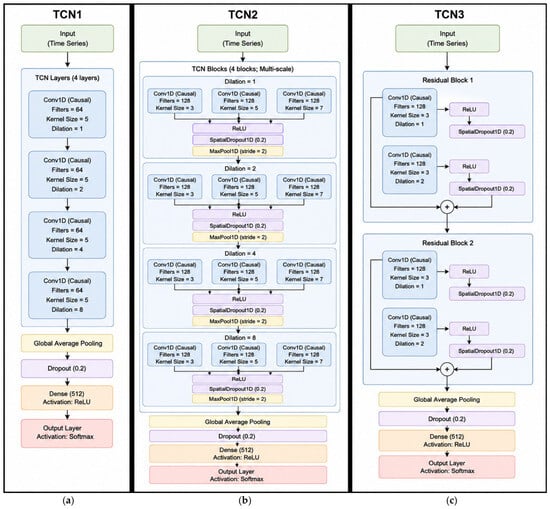
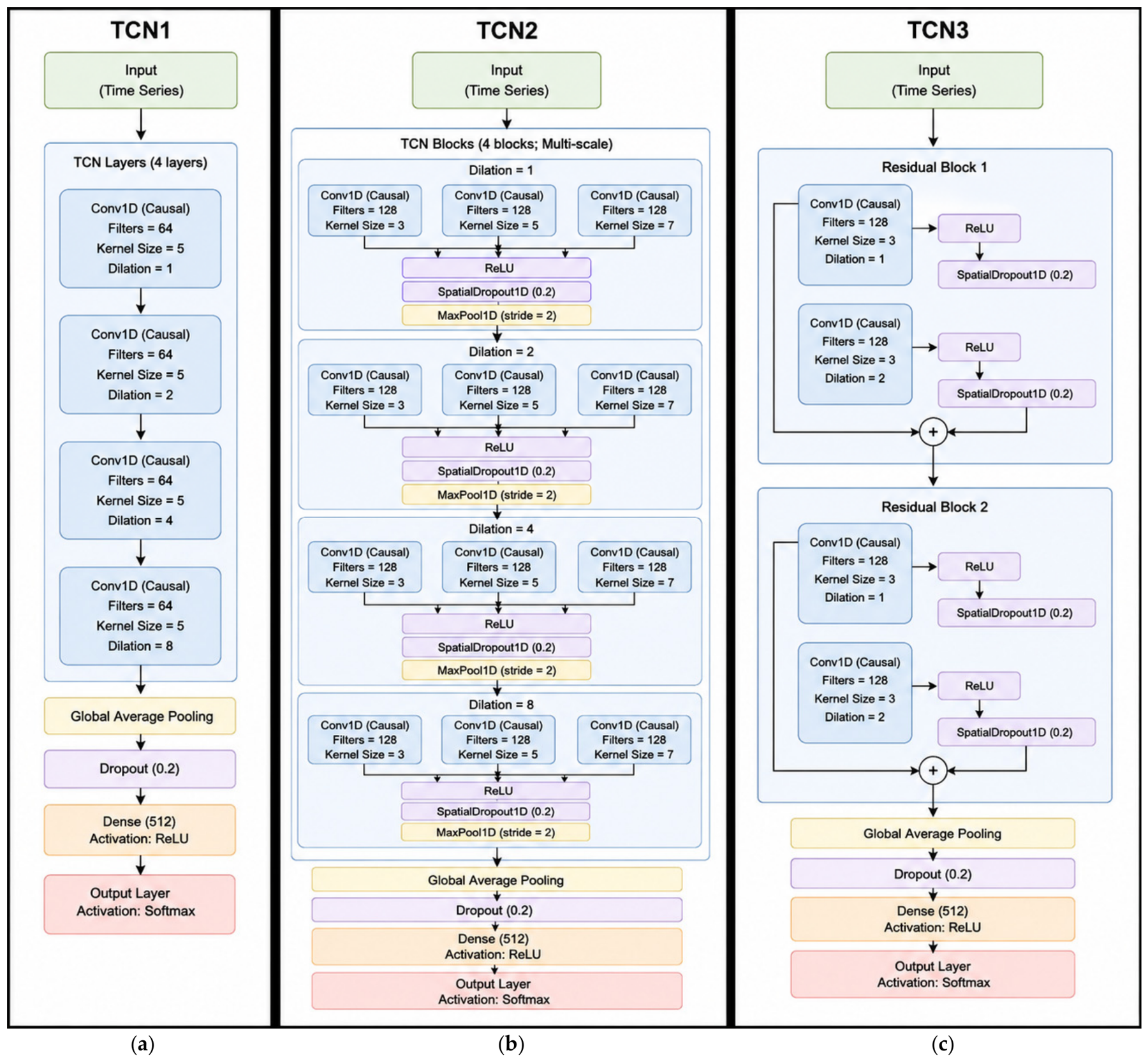
The first architecture represents the baseline Temporal Convolutional Network adopted in this study; see Figure 1a. The model is composed of a sequence of four temporal convolutional blocks employing causal dilated convolutions with dilation rates equal to 1, 2, 4, and 8, respectively. Each block consists of a one-dimensional convolutional layer with 64 filters and kernel size equal to 5, followed by a Rectified Linear Unit (ReLU) activation function, a SpatialDropout1D layer with dropout rate equal to 0.2, and a max-pooling operation for progressive temporal dimensionality reduction.
Figure 1.
Block diagrams of the three proposed TCN architectures: (a) TCN Model 1 consists of sequential dilated convolutional blocks with ReLU activation and max-pooling; (b) TCN Model 2 introduces a multi-scale design with parallel convolutional branches followed by stride-based pooling; (c) TCN Model 3 extends the architecture with residual connections, combining multiple dilated convolutional layers with shortcut paths to improve gradient propagation and capture complex temporal dependencies.
The increasing dilation factors allow the receptive field of the network to grow exponentially without a corresponding increase in the number of trainable parameters. Consequently, the architecture can efficiently capture both local leakage patterns and long-range temporal dependencies distributed throughout the power traces. The extracted temporal features are aggregated through Global Average Pooling and fed to a dense layer, followed by a softmax output layer corresponding to the possible AES key-byte hypotheses.
Due to its relatively simple architecture and moderate computational complexity, TCN1 serves as the baseline temporal model against which the more sophisticated TCN variants are compared.
2.4.2. TCN Model 2
The second architecture extends the baseline TCN by introducing a multi-scale temporal feature extraction strategy inspired by the Inception paradigm; see Figure 1b. Unlike TCN1, which employs a single kernel size throughout the network, TCN2 simultaneously exploits convolutional filters with kernel sizes equal to 3, 5, and 7 samples. This design enables the model to analyze leakage patterns occurring at different temporal resolutions.
The network consists of multiple causal dilated convolutional blocks characterized by dilation factors equal to 1, 2, 4, and 8. For each dilation level, convolutional operations are performed using 128 filters and the three kernel sizes. Each convolutional layer is followed by a ReLU activation function, a SpatialDropout1D layer with dropout rate equal to 0.2, and a max-pooling layer with stride equal to 2 to reduce memory requirements and computational complexity.
The adoption of multiple kernel sizes allows the network to simultaneously capture highly localized leakage features and broader temporal structures associated with AES operations. After the temporal processing stage, the extracted features are aggregated through Global Average Pooling and fed to a dense layer, before the final softmax classifier. Although this architecture exhibits greater representational capacity than TCN1, the increased model complexity may also introduce additional optimization challenges during training, particularly when the available profiling traces are limited.
2.4.3. TCN Model 3
The third architecture incorporates residual learning mechanisms to improve the modelling of complex temporal dependencies and facilitate gradient propagation through deeper network structures; see Figure 1c. TCN3 is composed of two residual blocks, each containing multiple causal dilated convolutional layers with dilation factors equal to 1 and 2. Within each residual block, two parallel causal convolutional branches with dilation factors 1 and 2 are employed, and their outputs are combined through a residual summation. As in the previous architectures, each convolutional operation is followed by a ReLU activation function and a SpatialDropout1D layer with dropout rate equal to 0.2. A shortcut connection then directly propagates the original block input to the output of the convolutional branch through an additive residual operation.
The residual connections provide several advantages, including improved gradient flow during backpropagation, mitigation of the vanishing-gradient problem, preservation of relevant temporal information, and enhanced learning of hierarchical leakage representations. These characteristics enable the network to maintain stable training behaviour while extracting increasingly abstract temporal features from power consumption traces.
After the residual feature extraction stage, the extracted temporal features are aggregated through Global Average Pooling and fed to a dense layer, followed by a softmax layer for AES key-byte classification. By combining residual learning and dilated causal convolutions, TCN3 is expected to provide a robust representation of side-channel leakage patterns while maintaining efficient optimization properties.
2.5. Training Procedure and Performance Evaluation
All models are trained using the ASCAD profiling traces under a supervised learning framework. The network input consists of raw power consumption traces, while the output corresponds to the probability distribution associated with the targeted AES key hypothesis.
Categorical cross-entropy is employed as the optimization objective, and the network parameters are updated through backpropagation using the RMSprop optimizer. To reduce overfitting and improve generalization capability, dropout layers are incorporated where appropriate.
The effectiveness of each architecture is evaluated using several complementary performance metrics, including validation loss, key-rank evolution, and the Rank Success Rate (RSR). Unlike conventional classification accuracy, which measures the proportion of correctly classified AES key-byte classes, the RSR quantifies the proportion of attack traces for which the correct key remains below a predefined rank threshold during the attack process. The RSR is formally defined as:
where denotes the number of attack traces for which the rank of the correct key is lower than or equal to the selected threshold , while is the total number of attack traces. In the following of this work, = 50 is adopted, providing a balanced criterion for evaluating whether the correct key remains among the most likely hypotheses during the attack. Throughout this work, complete key recovery is considered to be achieved only when the correct key reaches rank 0. Therefore, particular attention is devoted to reductions in the rank function interpreted as improvements in key ranking performance and directly reflecting the practical attack capability of the proposed models.
2.6. Explainable Artificial Intelligence Framework
Although deep learning models have demonstrated remarkable effectiveness in side-channel analysis, their decision-making process often remains difficult to interpret. This lack of transparency can hinder the understanding of which physical leakage sources are exploited during key recovery.
To address this limitation, an eXplainable Artificial Intelligence (XAI) framework is integrated into the proposed methodology. The objective is to identify the temporal regions of the power traces that contribute most significantly to the classification decisions made by the neural networks. Different complementary attribution techniques are employed to compute feature relevance scores across the temporal dimension. In particular, gradient-based attribution methods are used to derive saliency maps, while local surrogate models such as Local Interpretable Model-Agnostic Explanations (LIME) highlight the most influential time samples, and perturbation-based approaches such as occlusion analysis quantify the impact of removing individual temporal features. The resulting visualizations reveal that feature relevance is not uniformly distributed along the trace. While gradient-based attribution produces smooth and low-amplitude saliency patterns, suggesting that the model relies on distributed temporal structures rather than isolated points, LIME identifies a limited set of highly influential samples, highlighting sparse but relevant decision features. Most importantly, occlusion analysis exposes localized regions whose removal causes a significant degradation in the model output, indicating the presence of critical temporal leakage segments.
The XAI analysis therefore serves two complementary purposes. First, it provides supportive evidence that the networks focus on temporally meaningful regions of the input traces rather than relying exclusively on dataset-specific artefacts. Second, it offers security analysts additional insight into the temporal dynamics underlying successful side-channel attacks. Consequently, the proposed framework combines competitive attack performance with enhanced interpretability, facilitating a more informed analysis of the learned temporal representations.
3. Results and Discussion
3.1. Experimental Setup
For reproducibility, the original ASCAD partitioning was preserved throughout all experiments. The dataset contains 50,000 profiling traces used for model training and 10,000 attack traces employed for performance evaluation and key-recovery analysis. The original ASCAD partitioning was preserved, corresponding to an 83.3%/16.7% train-test split. Then, to ensure a fair comparison with the benchmark architectures proposed in [13], all experiments were conducted using the same hyperparameter configuration. Specifically, the networks were trained using two different numbers of epochs, namely 50 and 100, and two batch-sizes equal to 100 and 200. The proposed Temporal Convolutional Network (TCN) architectures were compared against the baseline Multi-Layer Perceptron (MLP), CNN, and CNN1 models available in the ASCAD benchmark, to assess which established TCN design is better suited for power side-channel analysis. These baseline architectures were selected because they allow a controlled comparison under identical dataset partitions, preprocessing procedures, training protocol, and evaluation methodology. Consequently, the present comparison is intended as a benchmark-oriented evaluation rather than an exhaustive assessment against all recent deep-learning architectures proposed for side-channel analysis. Table 2 reports here the hyperparameter configurations for the three TCN models, showing identical training settings with variations in convolutional architecture (filters, kernel sizes, and residual blocks).
Table 2.
Hyperparameter configurations for the three TCN models.
The performance evaluation was carried out under both synchronised and desynchronised conditions. In practical cryptographic devices, desynchronisation represents one of the most common software countermeasures against Side-Channel Attacks (SCAs). This protection mechanism introduces random temporal shifts into the power traces, making the alignment between cryptographic operations and leakage measurements significantly more difficult. Consequently, desynchronisation reduces the effectiveness of conventional attack techniques that rely on precise temporal correspondence between traces.
To assess the robustness of the proposed architectures, three desynchronisation levels were considered, corresponding to temporal shifts of 25, 50, and 75 clock cycles. The latter configuration represents the most challenging scenario and is therefore used as the primary benchmark throughout the following analysis.
The results obtained under synchronised conditions indicate that all investigated models achieve high attack performance, successfully recovering the AES secret key with a limited number of traces. Since the differences among the considered architectures are marginal in this scenario, the discussion focuses on the more realistic and challenging desynchronised cases. To assess the statistical robustness of the proposed architectures, each experimental configuration was repeated over multiple independent training runs using different random weight initializations. The quantitative results reported in the following sub-sections correspond to the average performance obtained over these independent runs. Whenever appropriate, the associated standard deviations and confidence intervals are also reported to quantify the variability introduced by the stochastic optimization process and to evaluate the stability of the learned models.
3.2. Impact of Desynchronisation on Attack Performance
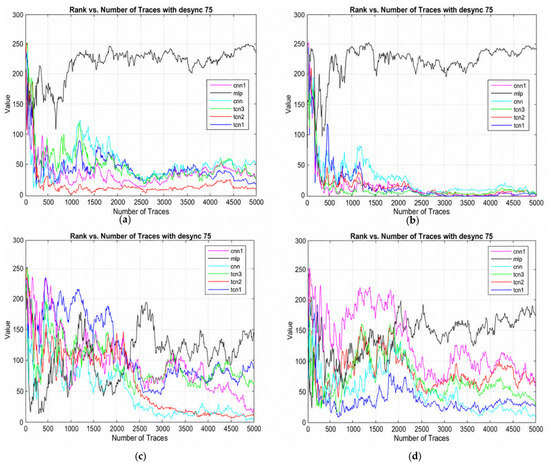
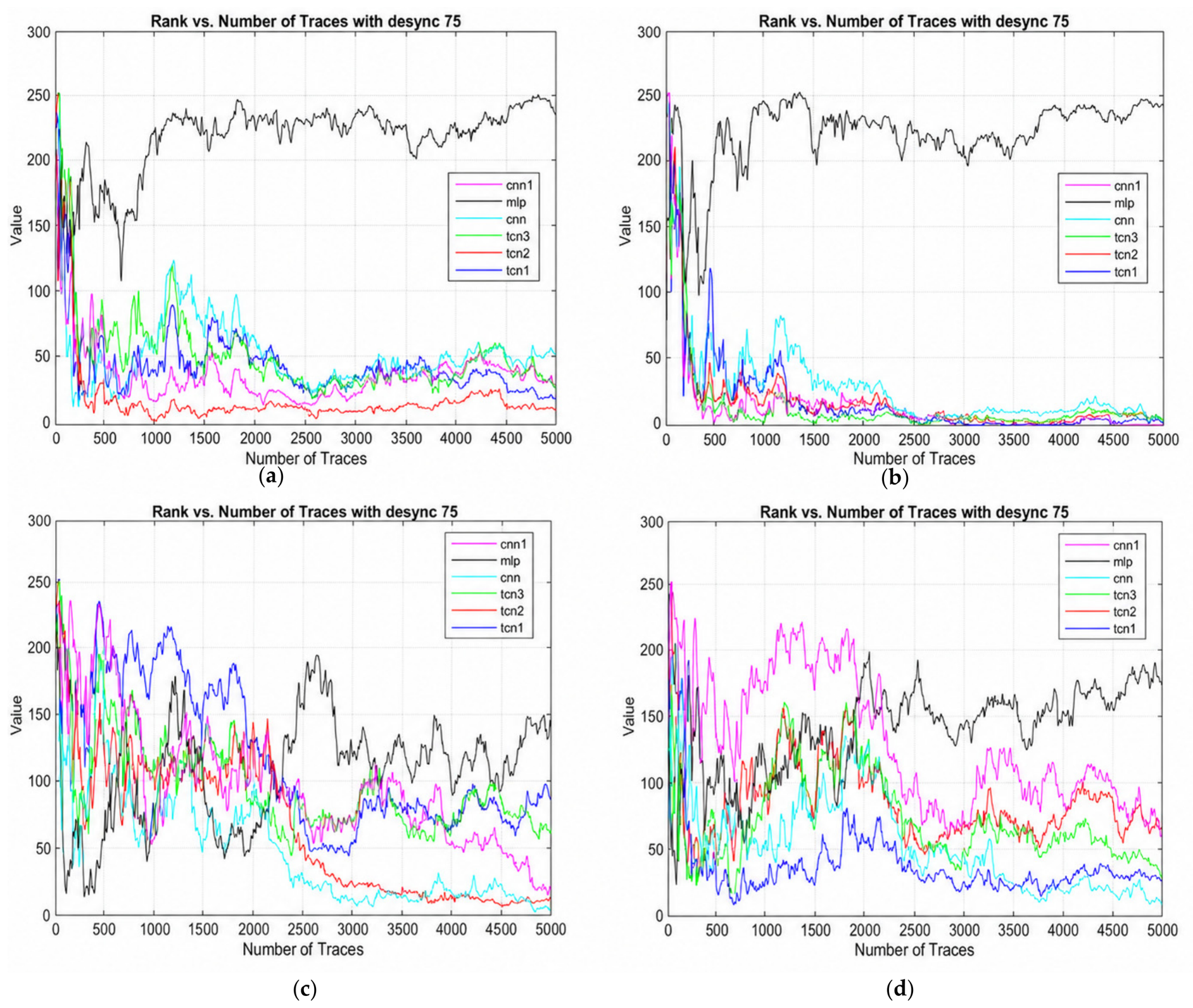
Figure 2 reports the rank evolution obtained under different combinations of training epochs and batch-sizes for the considered desynchronisation levels.
Figure 2.
Rank evolution obtained under different combinations of training epochs and batch-sizes for 75 clock cycle desynchronisation: (a) epoch = 50, batch-size = 100; (b) epoch = 50, batch-size = 200; (c) epoch =100, batch-size = 100; (d) epoch =100, batch-size = 200.
The results reveal that all proposed TCN architectures maintain robust attack capabilities even when substantial temporal shifts are introduced into the traces. This behaviour can be attributed to the intrinsic design of Temporal Convolutional Networks. Through the use of dilated convolutions, TCNs are capable of analyzing leakage patterns across multiple temporal scales simultaneously, enabling the extraction of meaningful features despite temporal misalignments.
Conventional CNN architectures rely primarily on local convolutional filters and therefore exhibit greater sensitivity to shifts in the leakage position. As desynchronisation increases, the discriminative information becomes distributed over wider temporal regions, making feature extraction more difficult for standard CNNs. Conversely, the expanding receptive field of TCNs allows the models to preserve contextual information over long temporal intervals, contributing to improved robustness against desynchronisation in several evaluation metrics.
Among the proposed solutions, TCN1 provides the most balanced overall performance across convergence speed, robustness, and attack accuracy. In particular, TCN1 consistently demonstrates rapid convergence during training, indicating that relevant leakage features are identified efficiently even when the available temporal information is distorted. The obtained results suggest that temporal modelling represents a critical component for improving the effectiveness of modern deep learning-based side-channel attacks, especially in the presence of practical countermeasures designed to disrupt trace alignment.
3.3. Key Rank Evolution
A widely adopted metric in side-channel cryptanalysis is the rank function, which quantifies the position of the correct key among all candidate key hypotheses. During an attack, the neural network assigns probabilities to the possible key values, and these probabilities are progressively combined as additional traces become available.
A rank equal to zero indicates successful key recovery, whereas larger rank values correspond to greater uncertainty regarding the correct key hypothesis. Consequently, the evolution of the rank function provides a direct measure of attack effectiveness.
The results indicate that TCN1 achieves a substantially faster reduction in the rank function than the CNN baseline during the early stages of the attack, whereas TCN2 and TCN3 exhibit different convergence behaviours depending on the considered metric. This aspect is especially important in realistic attack scenarios, where the number of obtainable traces may be limited.
The superior convergence behaviour of TCNs indicates that these architectures learn the statistical characteristics of the leakage more efficiently. Even with a reduced number of training epochs, TCN-based models rapidly identify informative temporal regions associated with AES operations. This behaviour confirms that exploiting temporal dependencies provides a substantial advantage over purely spatial convolutional approaches.
Furthermore, the results reveal that increasing the number of traces consistently decreases the rank value for all architectures. However, the rate of reduction is particularly evident for TCN1, highlighting its ability to exploit information distributed across multiple temporal scales.
3.4. Quantitative Performance Evaluation
To provide a more comprehensive comparison among the analysed approaches, several quantitative metrics were extracted from the experimental results:
- Final Rank: rank of the correct key after the last attack trace.
- Best Rank Trace: trace index at which the lowest rank was achieved.
- Rank Success Rate (RSR): proportion of attack traces for which the rank of the correct key is lower than or equal to a predefined threshold Rth.
- Mean Rank: average rank throughout the attack process.
- Rank Standard Deviation: variability of the rank across traces.
Table 3 summarizes the obtained results for the most challenging scenario, corresponding to a desynchronisation of 75 clock cycles, 100 training epochs, and a batch-size of 200. These metrics capture different aspects of the attack and should therefore be interpreted jointly. Final Rank reflects the position of the correct key after all attack traces have been processed and measures the ultimate key recovery capability. Best Rank Trace indicates the number of traces required to achieve the lowest rank, thus quantifying the convergence speed and data efficiency of the attack. RSR evaluates the consistency of the attack throughout the key-recovery process and should not be confused with the conventional classification accuracy over the 256 AES key-byte classes. In Figure 3 the Mean Rank summarizes the average ranking of the correct key over the entire attack, providing an overall measure of sustained attack effectiveness, while Rank Standard Deviation quantifies the variability of the rank across traces and therefore reflects the stability and robustness of the attack against temporal perturbations. Since these metrics characterize different properties, no single metric alone provides a complete assessment of model performance. Consequently, the overall effectiveness of each architecture is evaluated by considering the trade-off among final key ranking, convergence behaviour, and robustness across the entire attack. The results clearly demonstrate the advantages of the proposed temporal architectures. It should be noted that, under the most challenging desynchronisation scenario (75 clock cycles), none of the evaluated architectures reaches a final rank equal to zero. Consequently, the reported results should be interpreted as improvements in key ranking performance rather than complete key recovery. Although the final rank obtained by TCN1 is not the lowest among all models, TCN1 achieves the highest Rank Success Rate (0.8517), significantly outperforming both CNN and CNN1. This indicates that the correct key remains within the selected rank threshold for a substantially larger proportion of the attack traces, reflecting a more consistent attack behaviour throughout the key-recovery process. This observation highlights that different evaluation metrics capture complementary aspects of attack performance. While the CNN baseline achieves the lowest final rank in this specific experiment, TCN1 reaches its best rank much earlier and maintains a significantly higher RSR throughout the evaluation, providing a more favourable overall trade-off between convergence speed and robustness. TCN1 reaches its optimal performance after only 660 traces, whereas the baseline CNN requires approximately 4880 traces. This result highlights the ability of the proposed architecture to recover cryptographic information with substantially fewer observations, thereby reducing the effort required by a potential attacker.
Table 3.
Complementary performance metrics of the analysed methods for desynchronisation 75, 100 training epochs and a batch size of 200.
Figure 3.
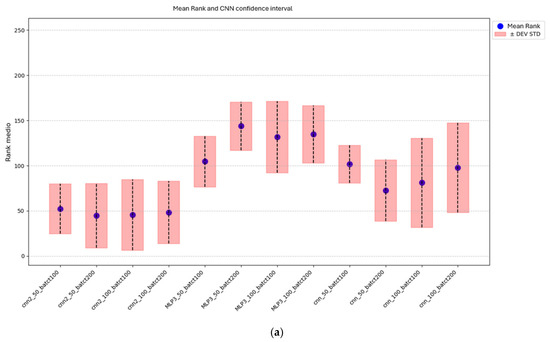
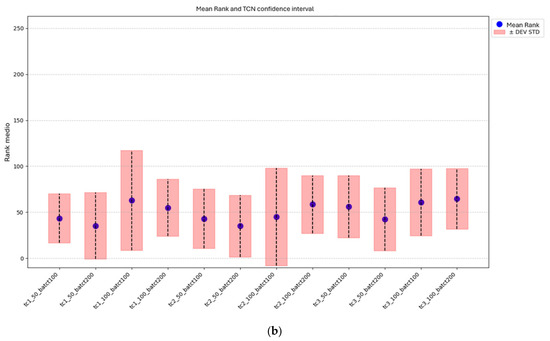
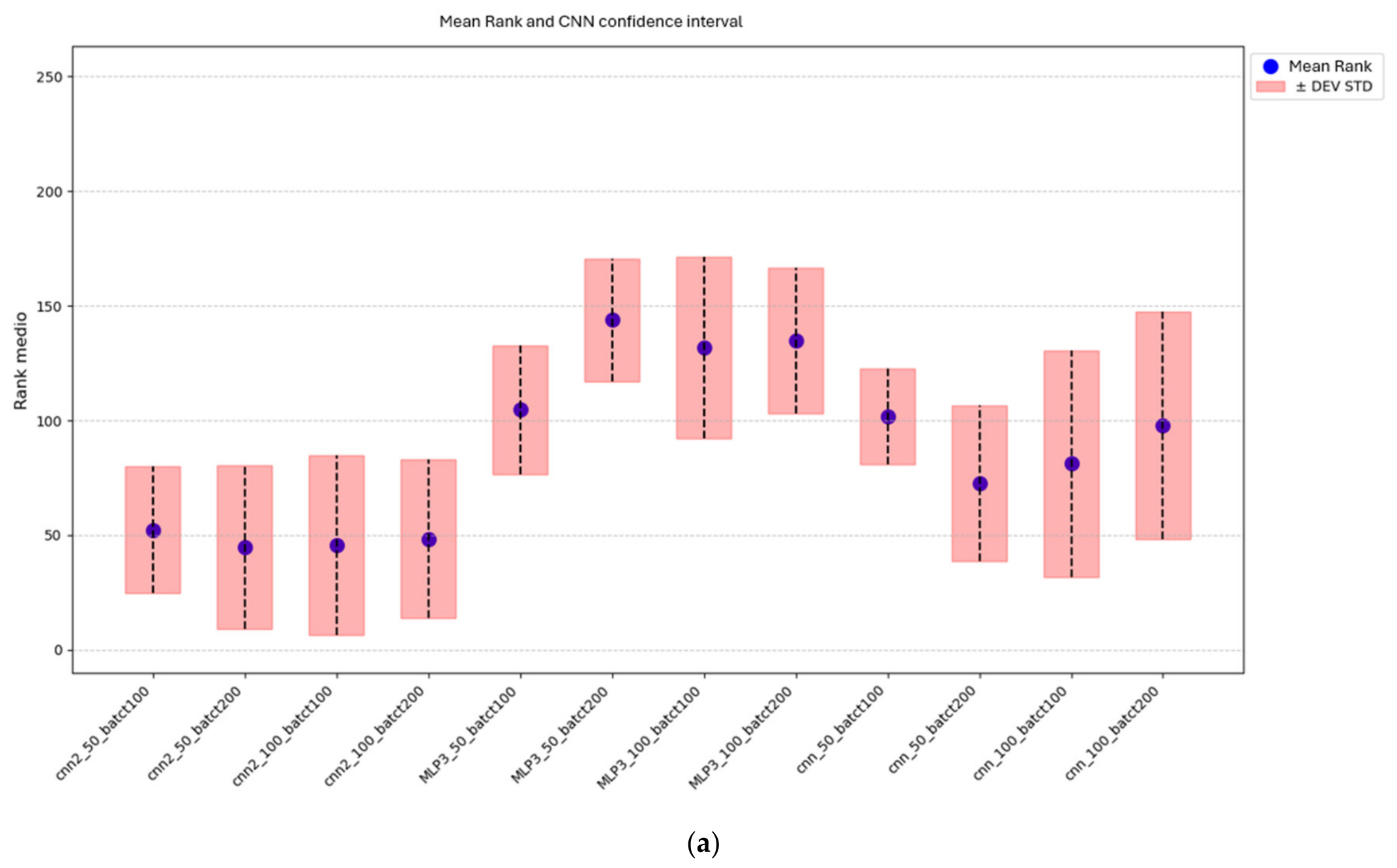
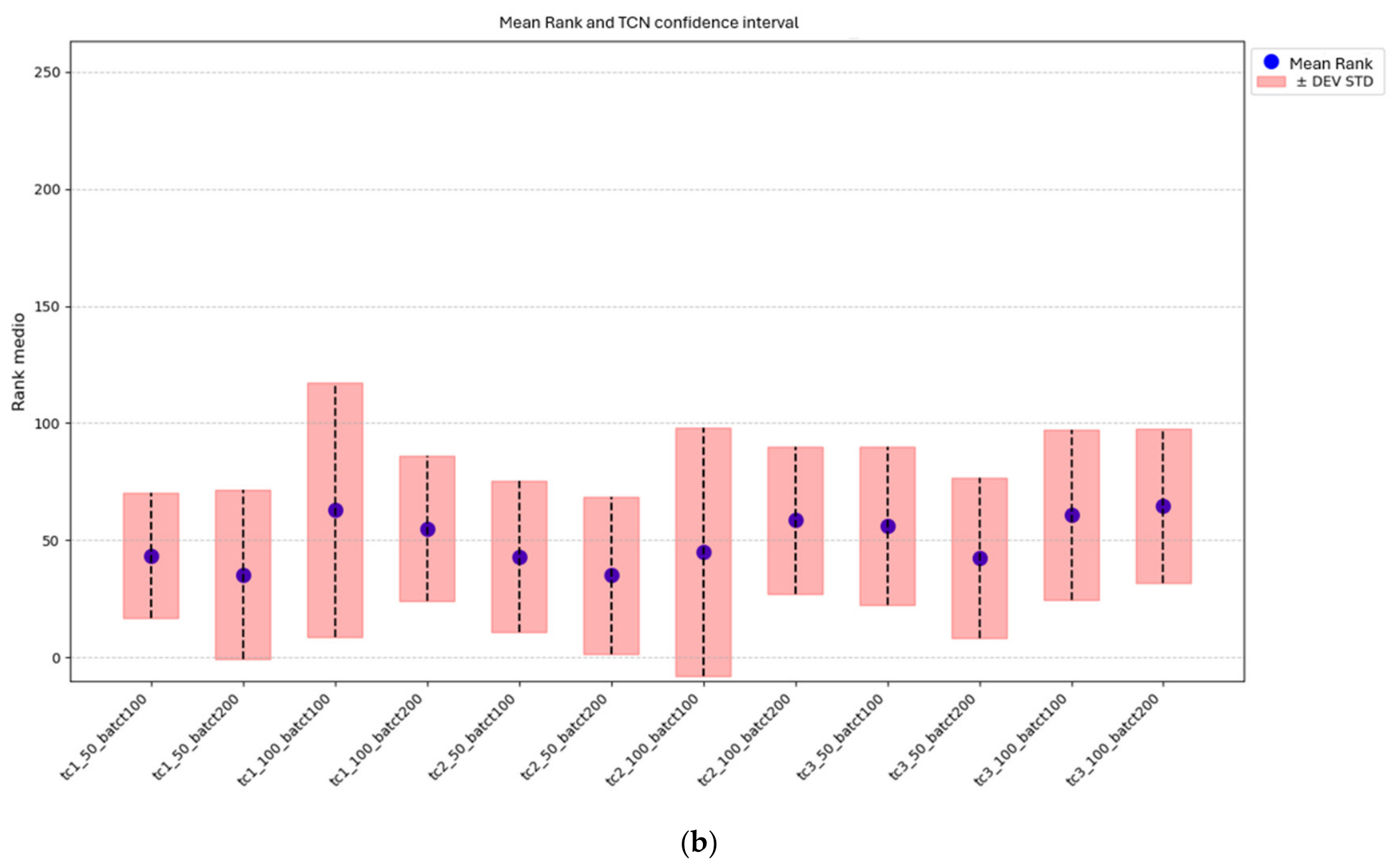
Mean rank and corresponding confidence intervals obtained over multiple independent training runs for the 75-sample desynchronisation scenario with 100 training epochs and a batch-size of 200. The blue markers represent the average rank computed across all independent runs, while the shaded regions correspond to ±1 standard deviation, quantifying the variability introduced by different random network initializations for: (a) conventional CNN methods; (b) proposed TCN solutions.
TCN3 also demonstrates competitive performance due to the introduction of residual connections, which facilitate gradient propagation and preserve temporal information across multiple layers. Conversely, TCN2 exhibits lower performance despite its multi-scale design, suggesting that increasing architectural complexity does not necessarily translate into improved attack effectiveness on the ASCAD benchmark. The larger number of filters and the multi-scale branches considerably increase the number of trainable parameters, potentially making the optimisation process more difficult and increasing the risk of overfitting under the available training data.
Overall, the quantitative results confirm that temporal modelling provides a measurable advantage for side-channel cryptanalysis under adverse operating conditions.
3.5. Mean Rank and Stability Analysis
Beyond attack effectiveness, evaluating the statistical robustness of deep learning models is essential for assessing their practical applicability to side-channel analysis. Since neural network training is inherently stochastic, different random weight initializations may lead to variations in the obtained attack performance. To quantify this effect, each experimental configuration was repeated over five independent training runs, and the resulting mean rank was averaged across all executions.
Figure 3 reports the average mean rank together with the corresponding confidence intervals for the considered architectures under the most challenging scenario (75-sample desynchronisation, 100 training epochs, and a batch-size of 200). The shaded regions represent ±1 standard deviation computed over the repeated independent runs, thereby providing an estimate of the variability introduced by the stochastic training process. Consequently, these confidence intervals quantify the statistical robustness and repeatability of each architecture rather than the variability of the rank during a single attack execution. Narrow confidence intervals indicate stable and highly repeatable behaviour across independent training runs, whereas wider intervals reveal greater sensitivity to random initialization and optimization dynamics.
For synchronised traces and low desynchronisation levels (25 clock cycles), all architectures exhibit comparable mean-rank behaviour. Under these conditions, leakage features remain sufficiently aligned and can be identified even by relatively simple neural network models. The differences become substantially more pronounced when the desynchronisation level increases to 75 clock cycles. In this scenario, the MLP model experiences a dramatic degradation in performance, confirming its limited ability to handle temporal variability. Similarly, one of the CNN architectures exhibits a significant increase in mean rank and rank variance.
In contrast, all three TCN architectures maintain average rank values below 50 throughout the attack process. Moreover, their confidence intervals remain relatively narrow, indicating stable and robust behaviour despite the severe temporal distortions introduced by the countermeasure.
These findings further support the hypothesis that TCNs are intrinsically more suitable for side-channel analysis than conventional deep learning architectures due to their ability to model long-range temporal dependencies.
3.6. Explainability Analysis of Temporal Leakage Features
To further investigate the behaviour of the proposed architectures, eXplainable Artificial Intelligence (XAI) techniques were applied to identify the temporal regions contributing most significantly to cryptographic key recovery. The explainability analysis was performed on the TCN1 architecture, which exhibited the most favourable trade-off between convergence speed, robustness, and Rank Success Rate in the experimental evaluation. The attribution methods were applied to the predicted probability associated with the correct AES key-byte class (ground-truth class), allowing the identification of the temporal regions that most strongly contributed to successful key recovery.
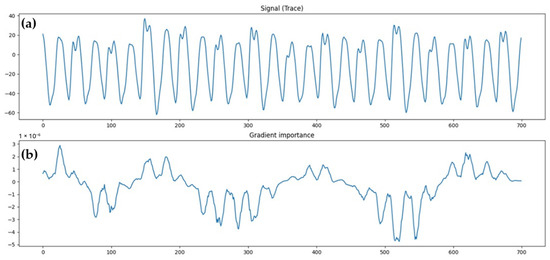
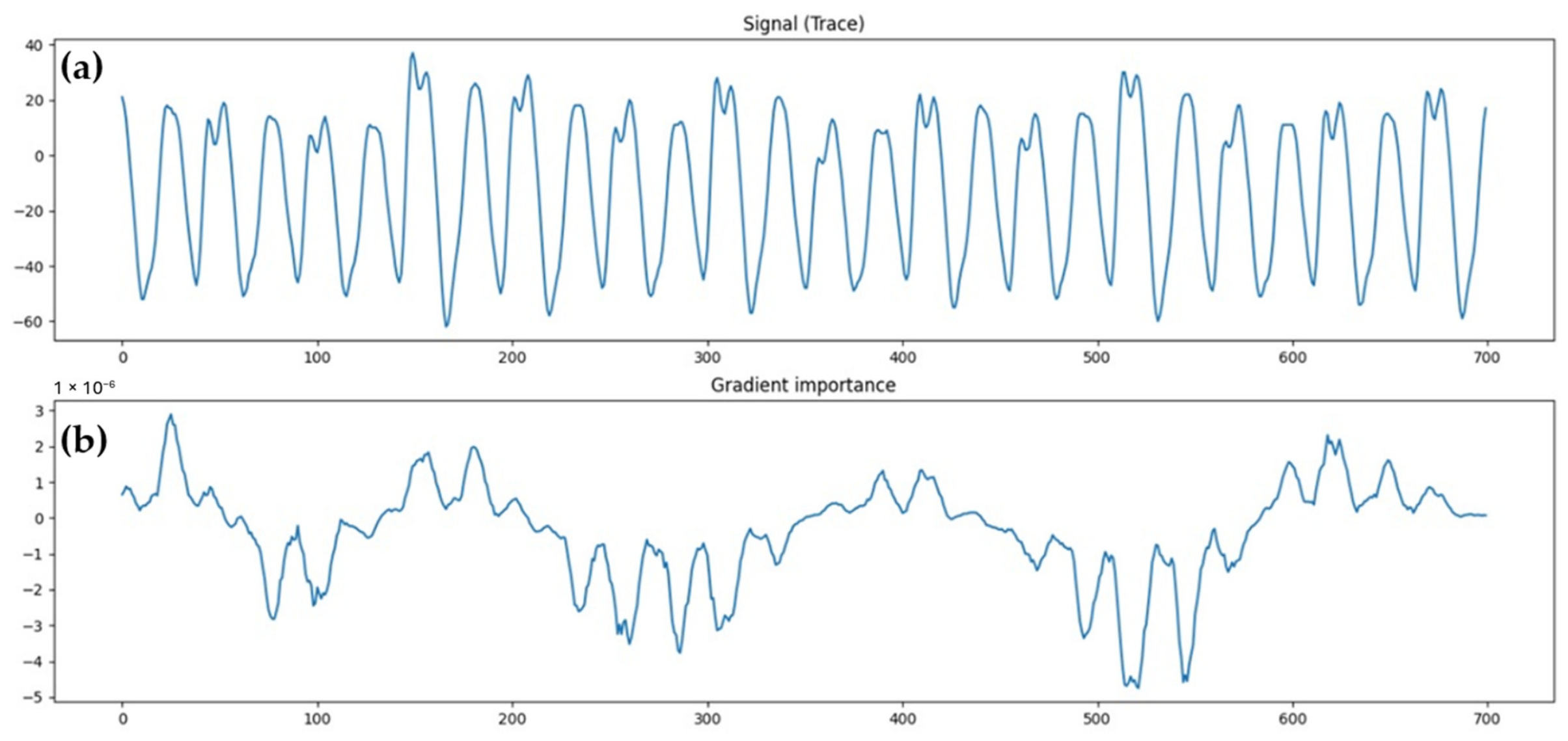
The attribution results provide useful insights into the temporal regions that contribute most strongly to the model predictions and are consistent with the expected leakage behaviour of the ASCAD benchmark. Gradient-based saliency maps (Figure 4) reveal smooth and low-amplitude relevance patterns distributed across the entire trace, suggesting that the model captures global temporal structures related to the overall execution flow of the AES algorithm. This behaviour is consistent with the fact that power consumption in CMOS devices reflects aggregated switching activity, where multiple operations contribute simultaneously to the observed signal.
Figure 4.
Gradient-based saliency analysis of temporal leakage features: (a) original power trace; (b) corresponding gradient-based importance scores for each time step. The attribution map exhibits smooth, low-amplitude variations distributed across the entire trace, indicating that the model captures global temporal dependencies rather than relying on isolated features. This behaviour reflects the aggregation of switching activity in CMOS devices and suggests that the network leverages distributed temporal structures associated with the execution flow of the AES algorithm.
The temporal regions identified by the attribution methods are consistent with the known points of interest of the ASCAD dataset, corresponding to the execution interval in which the first-round AddRoundKey and SubBytes operations generate the intermediate values used for profiling. Although the attribution methods do not establish a direct causal relationship between these operations and the learned representations, the observed agreement provides supportive evidence that the models focus on physically meaningful leakage regions.
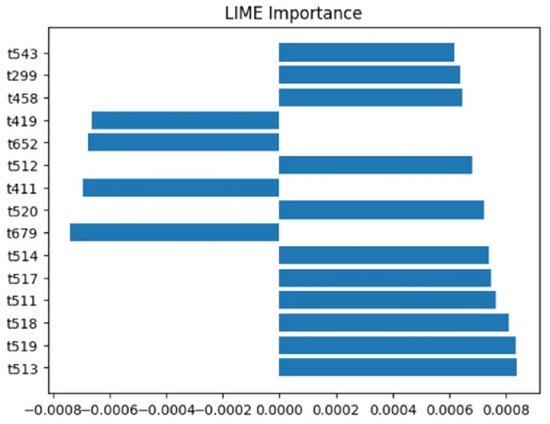
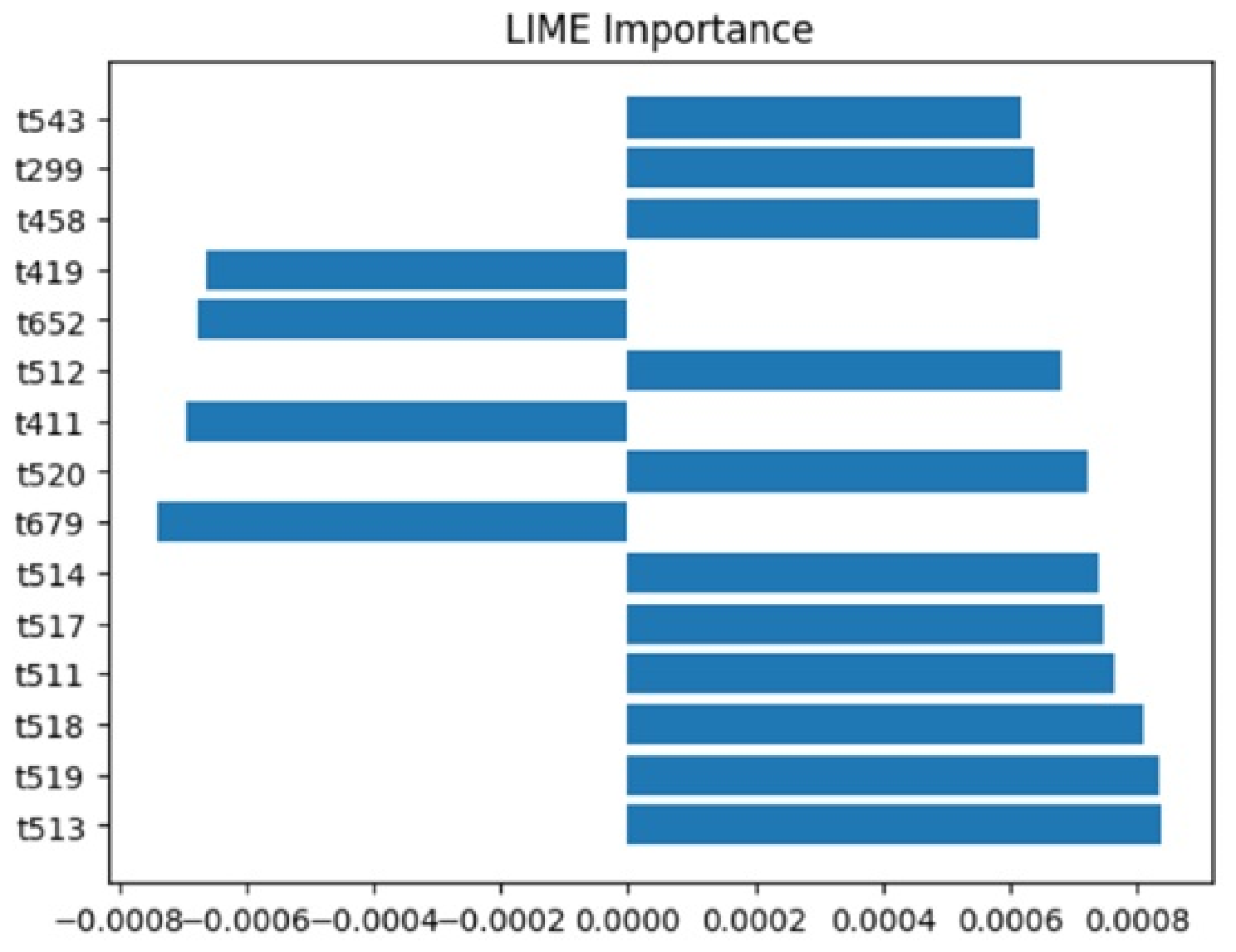
The LIME-based analysis provides both feature-level and spatial insights into the temporal importance distribution within the power traces. For LIME, the input traces were segmented into contiguous temporal intervals, and local surrogate linear models were fitted around each analysed trace by generating perturbed samples through random masking of temporal segments. The default exponential kernel was adopted to weight neighboring perturbations according to their proximity to the original trace. The feature ranking (Figure 5) highlights a limited number of highly influential time samples, indicating that the model relies on a sparse subset of temporal features for decision-making.
Figure 5.
LIME-based feature importance ranking of temporal leakage samples. The plot highlights the most influential time steps contributing to the model prediction, with positive and negative contributions indicating their impact on the output. The results reveal a sparse relevance distribution, where only a limited number of temporal samples play a significant role in the decision-making process. These highly influential points correspond to specific clock cycles likely associated with key-dependent cryptographic operations, such as SubBytes and AddRoundKey, confirming that the model focuses on localized leakage features rather than uniformly exploiting the entire trace.
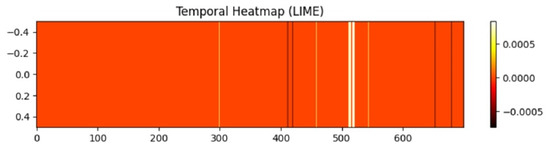
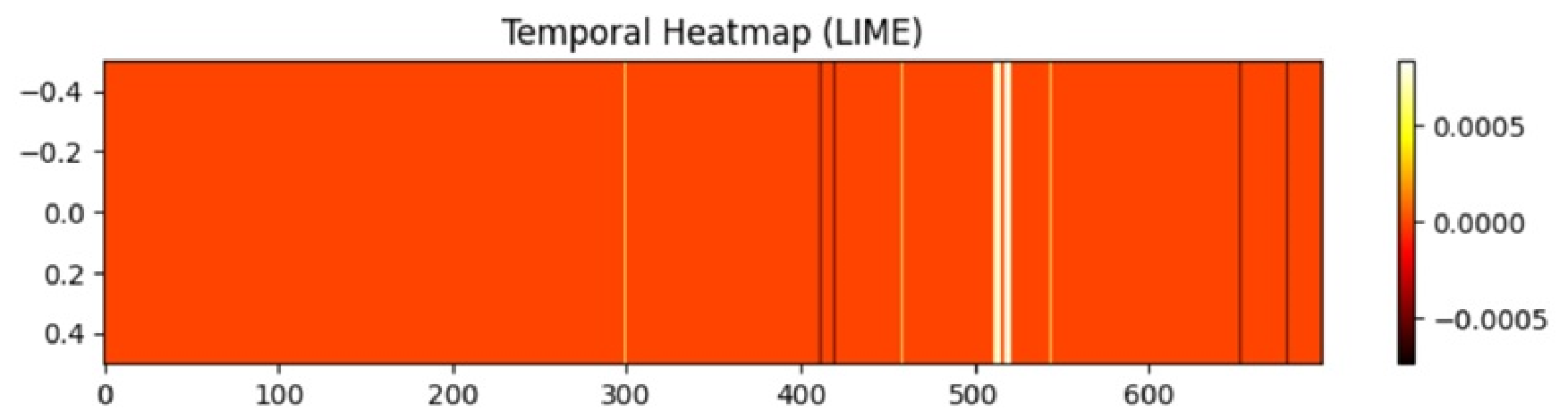
This observation is further reinforced by the corresponding temporal heatmap (Figure 6), which offers a continuous visualization of feature relevance across the entire trace. The heatmap reveals a predominantly uniform baseline with near-zero contribution for most time steps, while a small number of narrow vertical regions exhibit distinct intensity variations. These localized patterns align with the features identified in the LIME ranking and confirm that the model selectively focuses on specific temporal intervals rather than exploiting the entire signal uniformly. From a side-channel perspective, these critical regions can be associated with distinct clock cycles during which data-dependent cryptographic operations occur, such as SubBytes transformations or AddRoundKey computations. During these operations, intermediate values depend on both plaintext and secret key bytes, leading to measurable variations in power consumption through Hamming weight or Hamming distance effects. The strong spatial localization observed in the heatmap therefore suggests that the model is effectively capturing discrete leakage events corresponding to these key-dependent transformations.
Figure 6.
Temporal attribution map generated using Local Interpretable Model-agnostic Explanations (LIME). The color scale represents the local contribution of each temporal segment to the predicted AES key-byte class, with positive values increasing and negative values decreasing the prediction score. The highlighted regions indicate the temporal intervals that exert the strongest influence on the model decision.
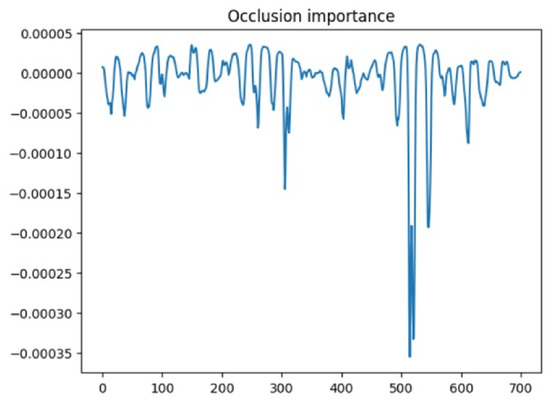
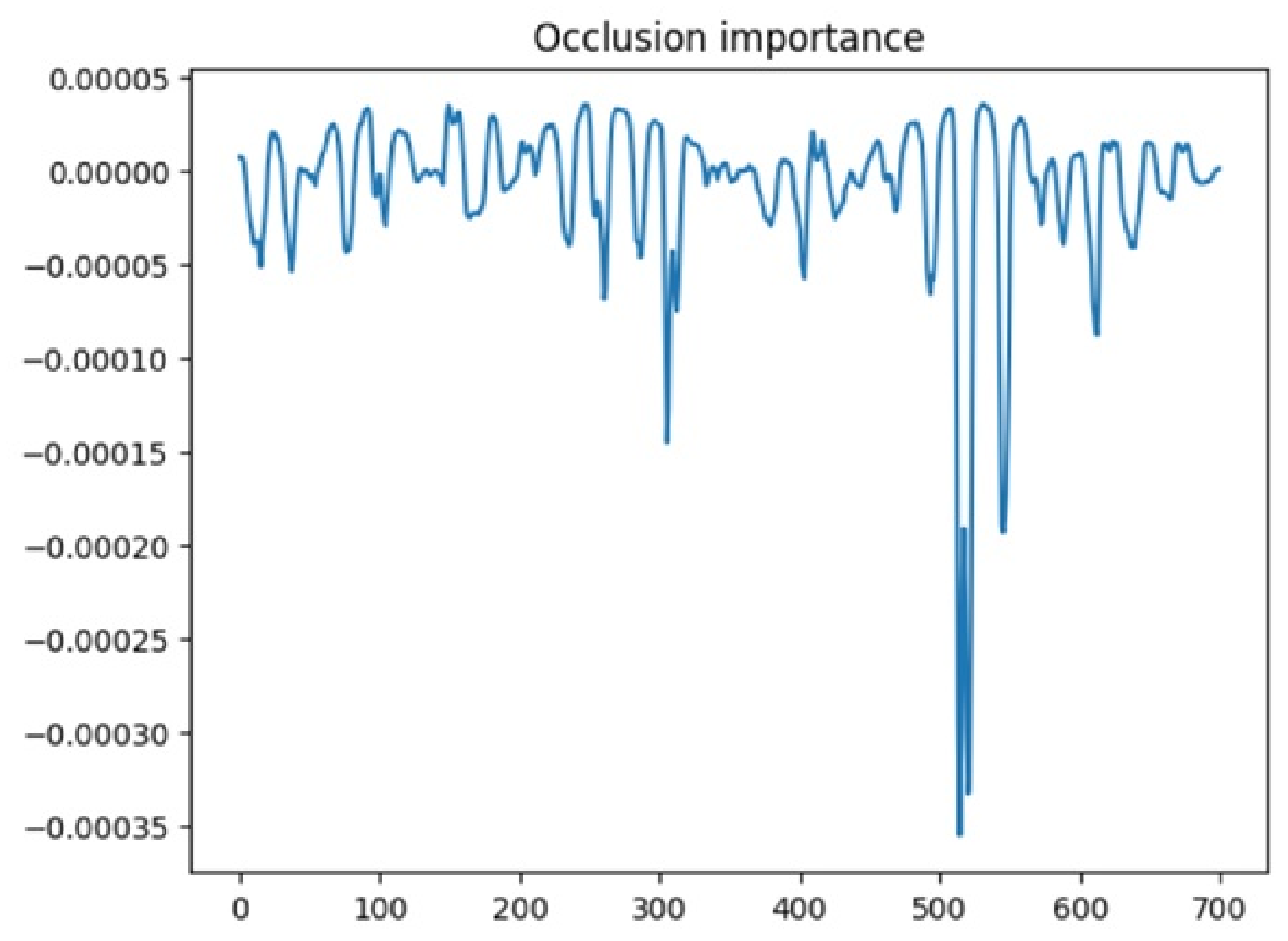
Most notably, the occlusion analysis (Figure 7) reveals well-defined temporal regions whose removal leads to a significant degradation in the model output. Occlusion analysis was performed by progressively masking contiguous temporal windows of the input trace and measuring the corresponding decrease in the predicted probability of the correct key hypothesis. Larger performance degradations indicate that the occluded temporal region contains highly informative leakage features. The presence of pronounced negative importance peaks indicates that these regions correspond to critical leakage segments that are essential for correct key hypothesis discrimination. From a physical perspective, these segments are likely aligned with the first-round computations of AES, where sensitive intermediate variables, such as the output of the S-box, are handled and thus produce the strongest data-dependent leakage.
Figure 7.
Occlusion-based importance analysis of temporal leakage features. Each time sample is individually perturbed to measure its impact on the model output. The resulting attribution map reveals sparse but highly significant negative peaks, indicating temporal regions whose removal leads to a strong degradation in prediction accuracy. These localized segments correspond to critical leakage points and are likely associated with key-dependent cryptographic operations, such as intermediate computations during the first round of AES. Unlike gradient-based methods, occlusion analysis captures causal feature relevance, highlighting the dominant role of specific temporal intervals in the model’s decision-making process.
The combination of these observations suggests that the proposed temporal models exploit both distributed and localized leakage mechanisms. While gradient-based analysis captures the global structure of the trace associated with continuous switching activity, perturbation-based methods identify causal regions directly linked to specific cryptographic operations. This dual behaviour reflects the inherent nature of side-channel leakage, where both global signal characteristics and localized computation events contribute to information leakage. To evaluate attribution stability, the explainability analysis was repeated on multiple correctly classified attack traces obtained from independent network executions. Similar attribution patterns were consistently observed, indicating that the identified temporal regions are robust with respect to both input variability and stochastic network initialization; however, the possibility that the explanations are partly influenced by dataset-specific characteristics cannot be completely excluded.
Overall, the XAI results provide supportive evidence that the temporal regions used by the model are consistent with the expected leakage behaviour of the ASCAD traces. However, these attribution patterns should not be interpreted as definitive proof of a causal correspondence between the highlighted samples and specific AES operations.
3.7. Discussion
The experimental results indicate that temporal modelling provides significant advantages for DL-based side-channel analysis under severe desynchronisation conditions. Among the proposed architectures, TCN1 achieves the most favourable balance between convergence speed, robustness, attack accuracy, and key recovery efficiency, whereas TCN2 and TCN3 exhibit complementary strengths but do not uniformly surpass the CNN baseline across all evaluation metrics. The superior performance of TCN1 can be attributed to its balanced architectural design. The use of a single kernel size together with progressively increasing dilation factors enables the network to capture both local leakage patterns and long-range temporal dependencies without introducing excessive architectural complexity. This balance appears particularly well suited to the statistical characteristics of ASCAD power traces, where informative leakage is concentrated within relatively limited temporal regions while still requiring contextual information from neighbouring samples. Consequently, TCN1 achieves an effective compromise between representation capability, optimization stability, and generalization performance. Although TCN2 incorporates a richer multi-scale architecture through multiple kernel sizes and a larger number of convolutional filters, the experimental results indicate that the additional complexity does not translate into improved attack performance. A plausible explanation is that the larger parameter space increases the difficulty of optimization while providing only limited additional information because the ASCAD leakage is concentrated within relatively narrow temporal regions. Consequently, the increased model capacity may introduce redundant feature representations or mild overfitting without substantially improving discrimination of the target leakage. TCN3 partially addresses this issue through residual connections, which facilitate gradient propagation and improve optimization stability. Nevertheless, the residual architecture alone does not fully compensate for the increased architectural complexity, leading to performance that remains slightly below that of the simpler TCN1 configuration. From a practical perspective, these findings suggest that highly effective profiling attacks do not necessarily require increasingly complex neural architectures. Instead, carefully designed temporal models with moderate architectural complexity may provide a better trade-off between computational cost, training stability, and attack effectiveness. This observation is particularly relevant for realistic attack scenarios, where computational resources, training time, and reproducibility are important practical constraints. Conversely, for designers of cryptographic countermeasures, the results indicate that evaluating resilience against modern temporal deep learning models should complement traditional CNN-based security assessments. Overall, the obtained results indicate that architectural simplicity, when combined with effective temporal modelling, may be more beneficial than increasing model complexity, highlighting the importance of architecture design rather than parameter count for deep learning-based side-channel attacks.
The integrated XAI analysis further helps in highlighting that the learned representations are likely associated with meaningful cryptographic leakage sources, improving the transparency and trustworthiness of the attack process. The observed attribution patterns are strongly aligned with the structural properties of the TCN architecture.
The contribution of this work lies in demonstrating how different temporal modelling strategies influence attack performance under identical benchmark conditions and in combining these architectures with explainability techniques to improve the interpretation of learned leakage representations. The consistency of the attribution maps across multiple traces further supports the stability of the learned temporal representations.
From a security perspective, the obtained results suggest that, within the evaluated ASCAD benchmark scenario, modern Temporal Convolutional Networks can substantially reduce the effectiveness of temporal desynchronisation as a standalone countermeasure against profiling side-channel attacks. Although these findings cannot be directly generalized to all cryptographic implementations or countermeasure configurations, they indicate that desynchronisation alone may provide limited protection against advanced TCN-based profiling attacks under the considered experimental conditions. Consequently, future secure implementations may benefit from combining temporal desynchronisation with complementary countermeasures.
3.8. Limitations
The comparative analysis presented in this work is intentionally limited to the MLP, CNN, and CNN1 architectures to guarantee direct reproducibility and ensure that all models are evaluated under identical experimental conditions. Nevertheless, the present comparison should not be interpreted as an exhaustive evaluation against the current state of the art in deep-learning-based side-channel analysis. In particular, recently proposed residual CNNs, attention-based architectures, hybrid temporal models, and transformer-based approaches were not included in this study. Extending the experimental comparison to these architectures represents an important direction for future work.
4. Conclusions
The proposed contribution lies in the adaptation and systematic evaluation of complementary TCN architectures for power side-channel analysis together with the integration of XAI techniques. Using the Advanced Side-Channel Attack Database (ASCAD) as a benchmark framework, the proposed models were evaluated against conventional machine learning and deep learning approaches, including Multi-Layer Perceptrons (MLPs) and Convolutional Neural Networks (CNNs), targeting the recovery of secret keys from AES-128 implementations.
The experimental results indicated that temporal convolutional architectures constitute an effective alternative to conventional CNN-based approaches for power side-channel analysis. In particular, TCN1 provides the most favourable balance between convergence speed, robustness, attack consistency, and key recovery efficiency under severe desynchronisation, while the remaining TCN variants highlight the impact of different architectural design choices on attack performance. Unlike traditional CNNs, the proposed models exploit dilated temporal convolutions to capture both local and long-range dependencies within power traces, enabling effective extraction of leakage information even when cryptographic operations are affected by significant timing misalignments. The analysis showed that the proposed architectures achieve faster rank reduction, improved attack accuracy, and greater robustness against desynchronisation levels up to 75 clock cycles. Among the investigated solutions, TCN1 exhibited the most favourable balance between computational complexity, convergence speed, and key recovery effectiveness, highlighting the potential of temporal deep learning models for advanced side-channel cryptanalysis.
Beyond the performance improvements, this study also incorporated eXplainable Artificial Intelligence (XAI) techniques to investigate the internal decision-making mechanisms of the proposed networks. The explainability analysis highlighted that the TCN models successfully identify physically meaningful leakage regions associated with AES operations, confirming that the learned representations are linked to genuine side-channel information rather than dataset-specific artifacts. The XAI analysis further highlighted that the learned representations consistently focus on temporal regions corresponding to the known leakage windows of the ASCAD benchmark. These findings provide valuable insights into the temporal characteristics of cryptographic leakage and contribute to the development of more transparent and trustworthy AI-driven security assessment methodologies.
From a cybersecurity perspective, the obtained results suggest that, for the evaluated ASCAD benchmark and desynchronisation settings, Temporal Convolutional Networks remain effective despite the presence of temporal desynchronisation. These findings indicate that desynchronisation alone may become less effective against TCN-based profiling attacks in this experimental scenario. However, further investigations involving additional hardware platforms, cryptographic implementations, and countermeasure configurations are required before drawing more general conclusion.
Future research will focus on several directions. First, the proposed methodology will be extended to other cryptographic algorithms and hardware platforms, including lightweight cryptographic primitives designed for IoT environments. Second, additional temporal architectures, such as attention-based models and Transformer networks, will be investigated to further improve attack performance and robustness. Third, more advanced XAI techniques, including SHAP, Integrated Gradients, and Layer-wise Relevance Propagation, will be explored to obtain deeper insights into the leakage mechanisms exploited by temporal neural networks. Finally, the integration of explainable deep learning with automated vulnerability assessment frameworks represents a promising research direction for the development of next-generation security evaluation tools for embedded and cyber-physical systems.
Overall, the presented results demonstrate that Temporal Convolutional Networks constitute a promising and interpretable framework for side-channel cryptanalysis, offering both improved attack capabilities and enhanced understanding of cryptographic information leakage. These findings contribute to the advancement of AI-driven cybersecurity research and provide useful guidance for the design of more resilient cryptographic implementations.
Author Contributions
Conceptualization, F.B.; methodology, F.B. and F.M.; software, F.B. and F.M.; validation, F.B. and F.M.; formal analysis, F.B. and F.M.; investigation, F.B. and F.M.; resources, F.B. and F.M.; data curation, F.B. and F.M.; writing—original draft preparation, F.B. and F.M.; writing—review and editing, F.B.; visualization, F.B.; supervision, F.B.; project administration, F.B. All authors have read and agreed to the published version of the manuscript.
Funding
This research received no external funding.
Data Availability Statement
The original contributions presented in this study are included in the article. Further inquiries can be directed to the corresponding author.
Conflicts of Interest
The authors declare no conflict of interest.
Abbreviations
The following abbreviations are used in this manuscript:
| AES | Advanced Encryption Standard |
| AI | Artificial Intelligence |
| ASCAD | Advanced Side-Channel Attack Database |
| CGAN | Conditional Generative Adversarial Network |
| CNN | Convolutional Neural Network |
| CPA | Correlation Power Analysis |
| DFA | Differential Fault Analysis |
| DL | Deep Learning |
| DPA | Differential Power Analysis |
| GAN | Generative Adversarial Network |
| GRU | Gated Recurrent Unit |
| IoT | Internet of Things |
| LIME | Local Interpretable Model-Agnostic Explanations |
| LSTM | Long Short-Term Memory |
| ML | Machine Learning |
| MLP | Multi-Layer Perceptron |
| RL | Reinforcement Learning |
| RNN | Recurrent Neural Network |
| SCA | Side-Channel Attack |
| SHAP | SHapley Additive exPlanations |
| SPA | Simple Power Analysis |
| TCN | Temporal Convolutional Network |
| XAI | eXplainable Artificial Intelligence |
References
- Spreitzer, R.; Moonsamy, V.; Korak, T.; Mangard, S. Systematic Classification of Side-Channel Attacks: A Case Study for Mobile Devices. IEEE Commun. Surv. Tutor. 2018, 20, 465–488. [Google Scholar] [CrossRef] [Scilit]
- Vasilas, T.; Brad, R. A Decade in Software-Based Side and Covert Channel Attacks and Countermeasures: A Survey. IEEE Access 2025, 13, 56587–56606. [Google Scholar] [CrossRef] [Scilit]
- Piessens, F.; van Oorschot, P.C. Side-Channel Attacks: A Short Tour. IEEE Secur. Priv. 2024, 22, 75–80. [Google Scholar] [CrossRef] [Scilit]
- Arpaia, P.; Caputo, F.; Cioffi, A.; Esposito, A.; Isgrò, F. Uncertainty Analysis in Cryptographic Key Recovery for Machine Learning-Based Power Measurements Attacks. IEEE Trans. Instrum. Meas. 2023, 72, 1–8. [Google Scholar] [CrossRef] [Scilit]
- Ahmed, A.A.; Hasan, M.K.; Aman, A.H.; Safie, N.; Islam, S.; Ahmed, F.R.A.; Ahmed, T.E.; Pandey, B.; Rzayeva, L. Review on Hybrid Deep Learning Models for Enhancing Encryption Techniques Against Side Channel Attacks. IEEE Access 2024, 12, 188435–188453. [Google Scholar] [CrossRef] [Scilit]
- Cook, J.; Drean, J.; Behrens, J.; Yan, M. There’s Always a Bigger Fish: A Clarifying Analysis of a Machine-Learning-Assisted Side-Channel Attack. IEEE Micro 2023, 43, 28–36. [Google Scholar] [CrossRef] [Scilit]
- Galli, D.; Lattari, F.; Matteucci, M.; Zoni, D. A Deep Learning-Assisted Template Attack Against Dynamic Frequency Scaling Countermeasures. IEEE Trans. Comput. 2025, 74, 293–306. [Google Scholar] [CrossRef] [Scilit]
- Ahmed, S.; Ahmad, N.; Shah, N.A.; Abro, G.E.M.; Wijayanto, A.; Hirsi, A.; Altaf, A.R. Lightweight AES Design for IoT Applications: Optimizations in FPGA and ASIC with DFA Countermeasure Strategies. IEEE Access 2025, 13, 22489–22509. [Google Scholar] [CrossRef] [Scilit]
- Maghrebi, H.; Portigliatti, T.; Prouff, E. Breaking Cryptographic Implementations Using Deep Learning Techniques. In Security, Privacy, and Applied Cryptography Engineering. SPACE 2016; Carlet, C., Hasan, M., Saraswat, V., Eds.; Lecture Notes in Computer Science; Springer International Publishing: Cham, Switzerland, 2016; Volume 10076. [Google Scholar]
- Gao, Y.; Ma, H.; Kong, J.; He, J.; Zhao, Y.; Jin, Y. EMSim+: Accelerating Electromagnetic Security Evaluation with Generative Adversarial Network. In Proceedings of the 2023 IEEE/ACM International Conference on Computer Aided Design (ICCAD), San Francisco, CA, USA, 28 October–2 November 2023; IEEE: Piscataway, NJ, USA, 2023; pp. 1–8. [Google Scholar]
- Peng, J.P.; Zhang, M.; Zheng, D. Side-Channel Attack on Deep Reinforcement Learning of AES. In Proceedings of the 2022 4th International Conference on Natural Language Processing (ICNLP), Xi’an, China, 25–27 March 2022; IEEE: Piscataway, NJ, USA, 2022; pp. 593–599. [Google Scholar]
- Tong, Z.; Zhu, Z.; Wang, Z.; Wang, L.; Zhang, Y.; Liu, Y. Cache side-channel attacks detection based on machine learning. In Proceedings of the 2020 IEEE 19th International Conference on Trust, Security and Privacy in Computing and Communications (TrustCom), Guangzhou, China, 29 December 2020–1 January 2021; IEEE: Piscataway, NJ, USA, 2020; pp. 919–926. [Google Scholar]
- Benadjila, R.; Prouff, E.; Strullu, R.; Cagli, E.; Dumas, C. Deep learning for side-channel analysis and introduction to ASCAD database. J. Cryptogr. Eng. 2020, 10, 163–188. [Google Scholar] [CrossRef] [Scilit]
- Spata, M.O.; Russo, V.M.; Ortis, A.; Battiato, S. Acoustic Side Channel Attack for Keystroke Splitting in the Wild. In Proceedings of the 2024 IEEE International Conference on Metrology for eXtended Reality, Artificial Intelligence and Neural Engineering (MetroXRAINE), St Albans, UK, 21–23 October 2024; IEEE: Piscataway, NJ, USA, 2024; pp. 131–136. [Google Scholar]
- Hannun, A.Y.; Rajpurkar, P.; Haghpanahi, M.; Tison, G.H.; Bourn, C.; Turakhia, M.P.; Ng, A.Y. Cardiologist-level arrhythmia detection and classification in ambulatory electrocardiograms using a deep neural network. Nat. Med. 2019, 25, 65–69. [Google Scholar] [CrossRef] [Scilit] [PubMed]
- Joomye, A.; Ling, M.H.; Jasser, M.B.; Ramly, A.M.; Yau, K.-L.A. An Effective Temporal Convolutional Networks-Based Method for Detecting Android Malware Using Dynamic Extracted Features. IEEE Access 2025, 13, 49891–49904. [Google Scholar] [CrossRef] [Scilit]
- Chinbat, M.; Wu, L.; Zhang, X.; Yang, Y.; Wei, M. Comparative Deep Learning-Based Side-Channel Analysis of an FPGA-Based CRYSTALS-Kyber NTT Accelerator. Cryptography 2025, 9, 64. [Google Scholar] [CrossRef] [Scilit]
- Feng, T.; Gao, H.; Li, X.; Liu, C. Side-channel attacks on convolutional neural networks based on the hybrid attention mechanism. Discov. Appl. Sci. 2025, 7, 390. [Google Scholar] [CrossRef] [Scilit]
- He, P.; Zhang, Y.; Gan, H.; Ma, J.; Zhang, H. Side-channel attacks based on attention mechanism and multi-scale convolutional neural network. Comput. Electr. Eng. 2024, 119, 109515. [Google Scholar] [CrossRef] [Scilit]
- FIPS PUB 197; Advanced Encryption Standard (AES). National Institute of Standards and Technology: Gaithersburg, MD, USA, 2023.

Disclaimer/Publisher’s Note: The statements, opinions and data contained in all publications are solely those of the individual author(s) and contributor(s) and not of MDPI and/or the editor(s). MDPI and/or the editor(s) disclaim responsibility for any injury to people or property resulting from any ideas, methods, instructions or products referred to in the content. |
© 2026 by the authors. Licensee MDPI, Basel, Switzerland. This article is an open access article distributed under the terms and conditions of the Creative Commons Attribution (CC BY) license.