
Artificial Intelligence in Education: From Instrumental Adoption to Human-Centered Pedagogical Ecologies

 ,
,  ,
,  and
and 
Abstract
1. Introduction
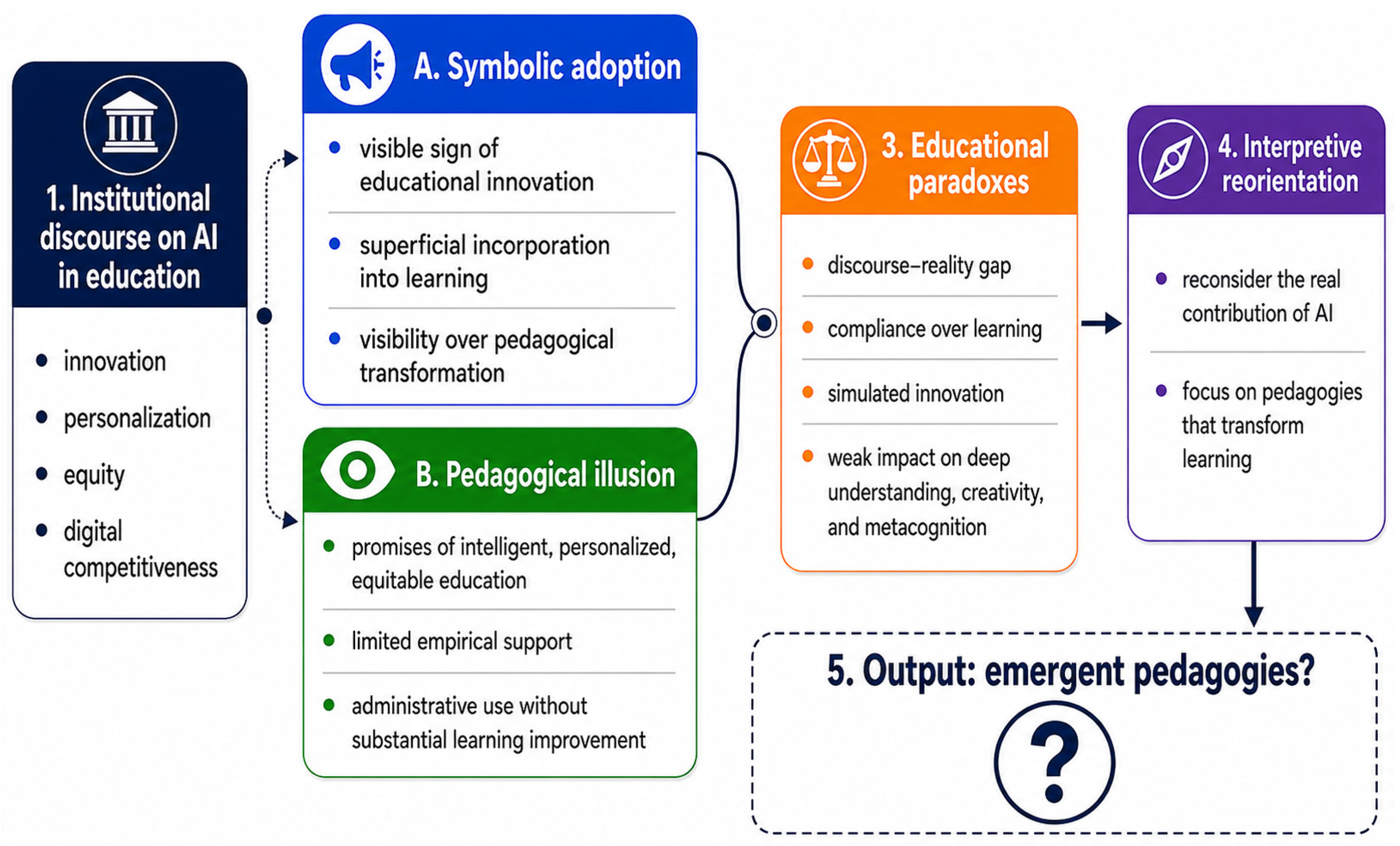
Tensions Regarding the Use of Artificial Intelligence in Education
2. Materials and Methods
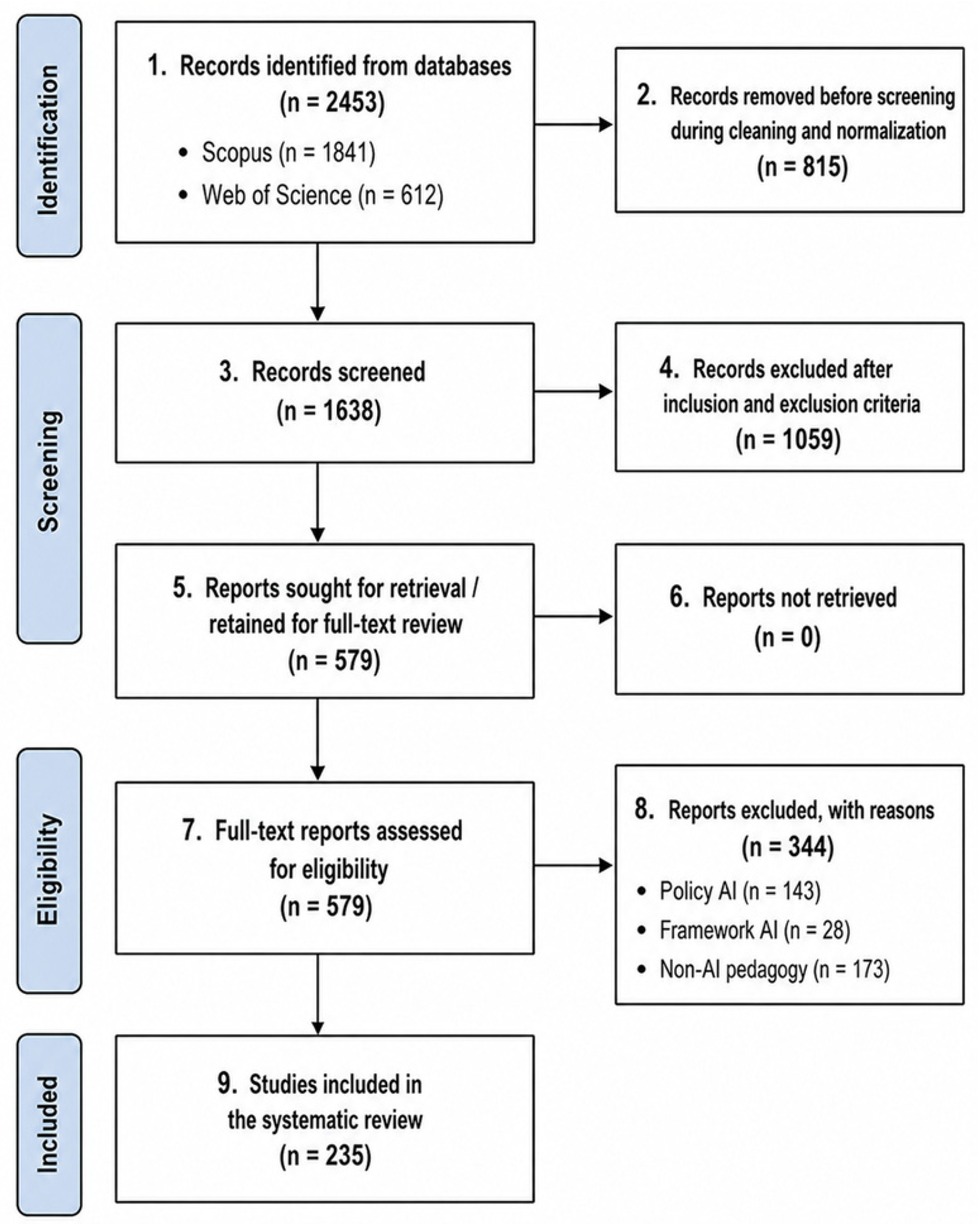
2.1. Identification and Search of Scientific Production
2.2. Databases and Analysis of Scientific Output
2.3. Organization of the Results
3. Results
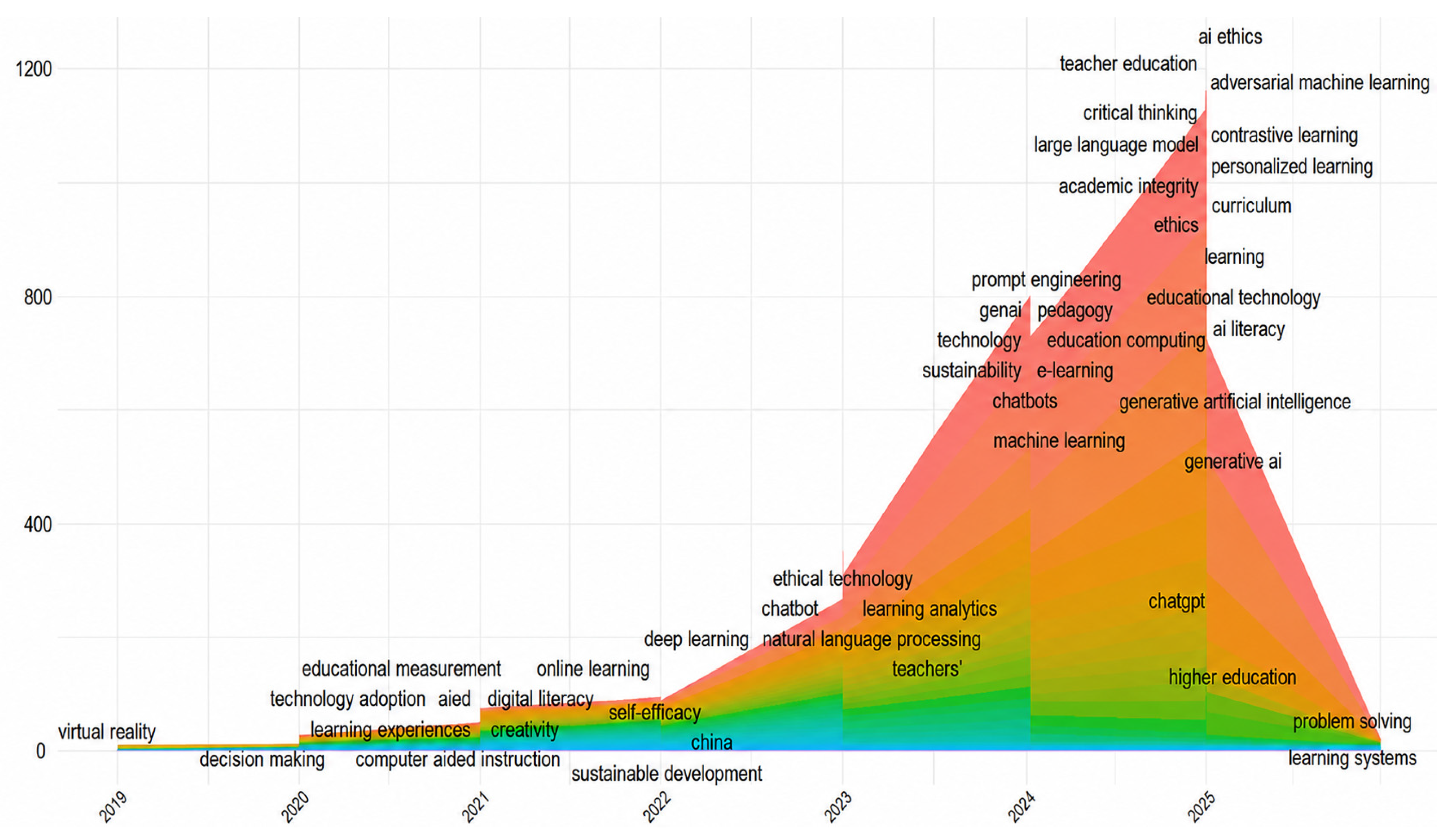
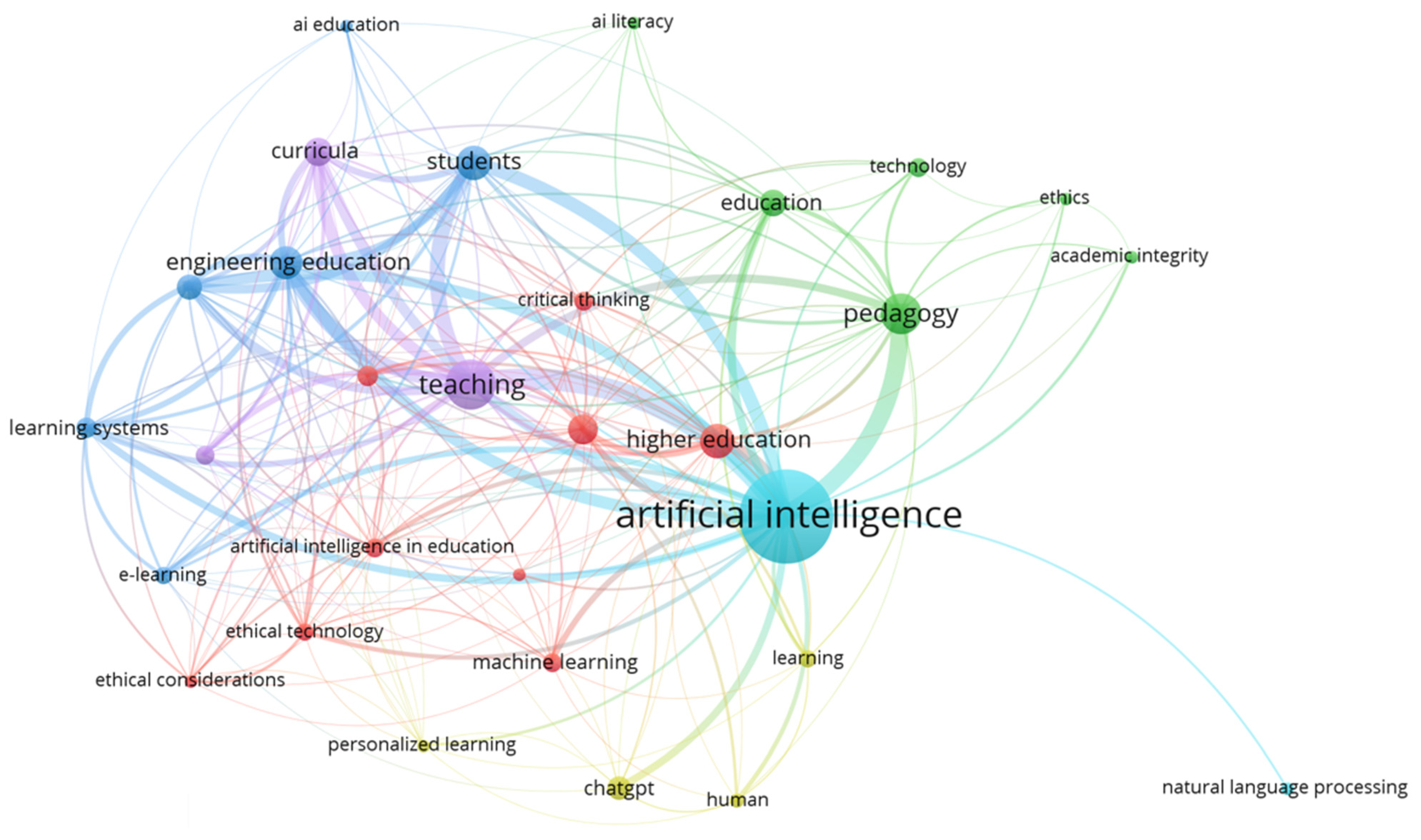
3.1. Q1. What Have Been the Main Thematic Trends Characterizing International Research on Artificial Intelligence in Education?
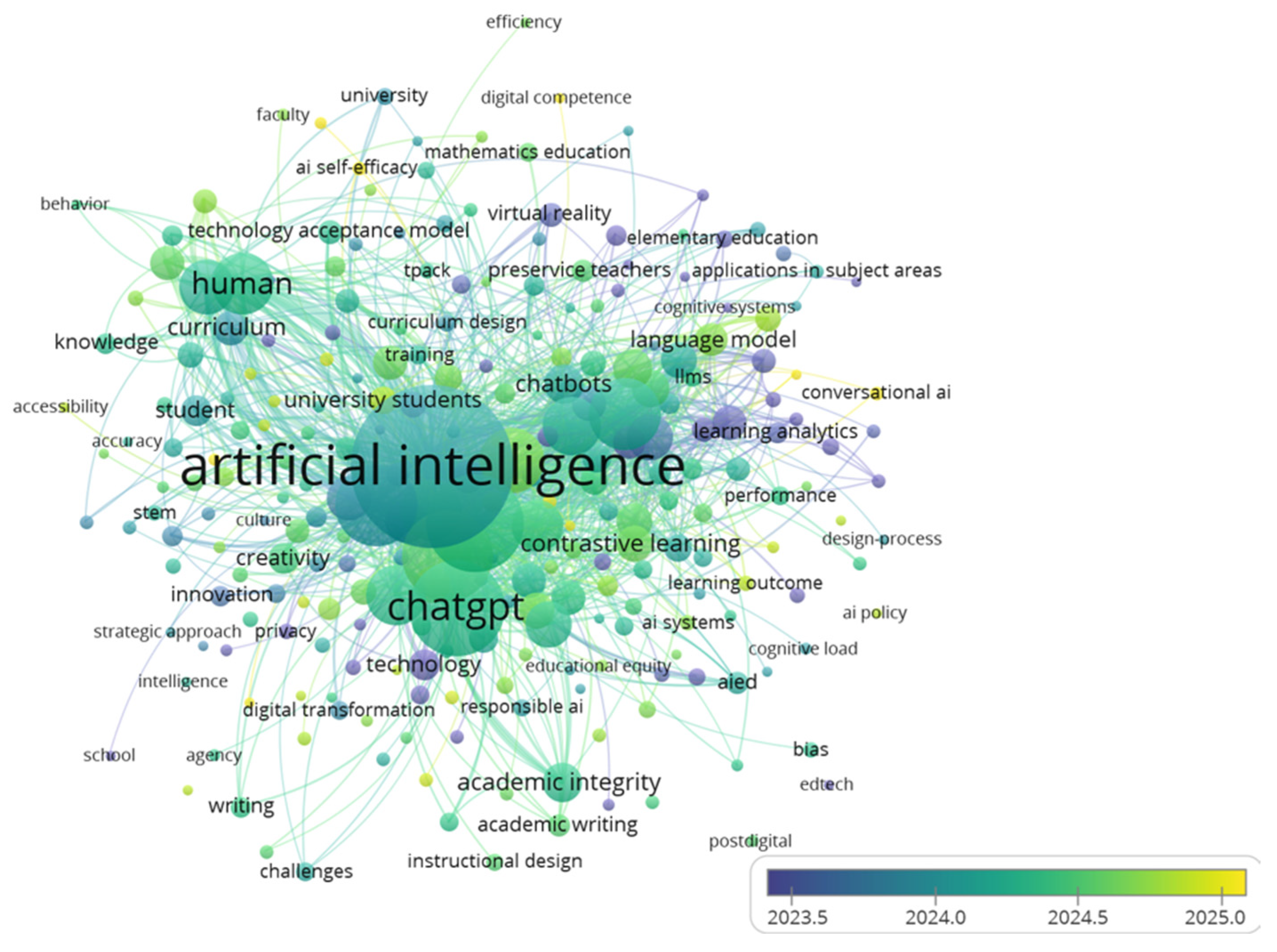
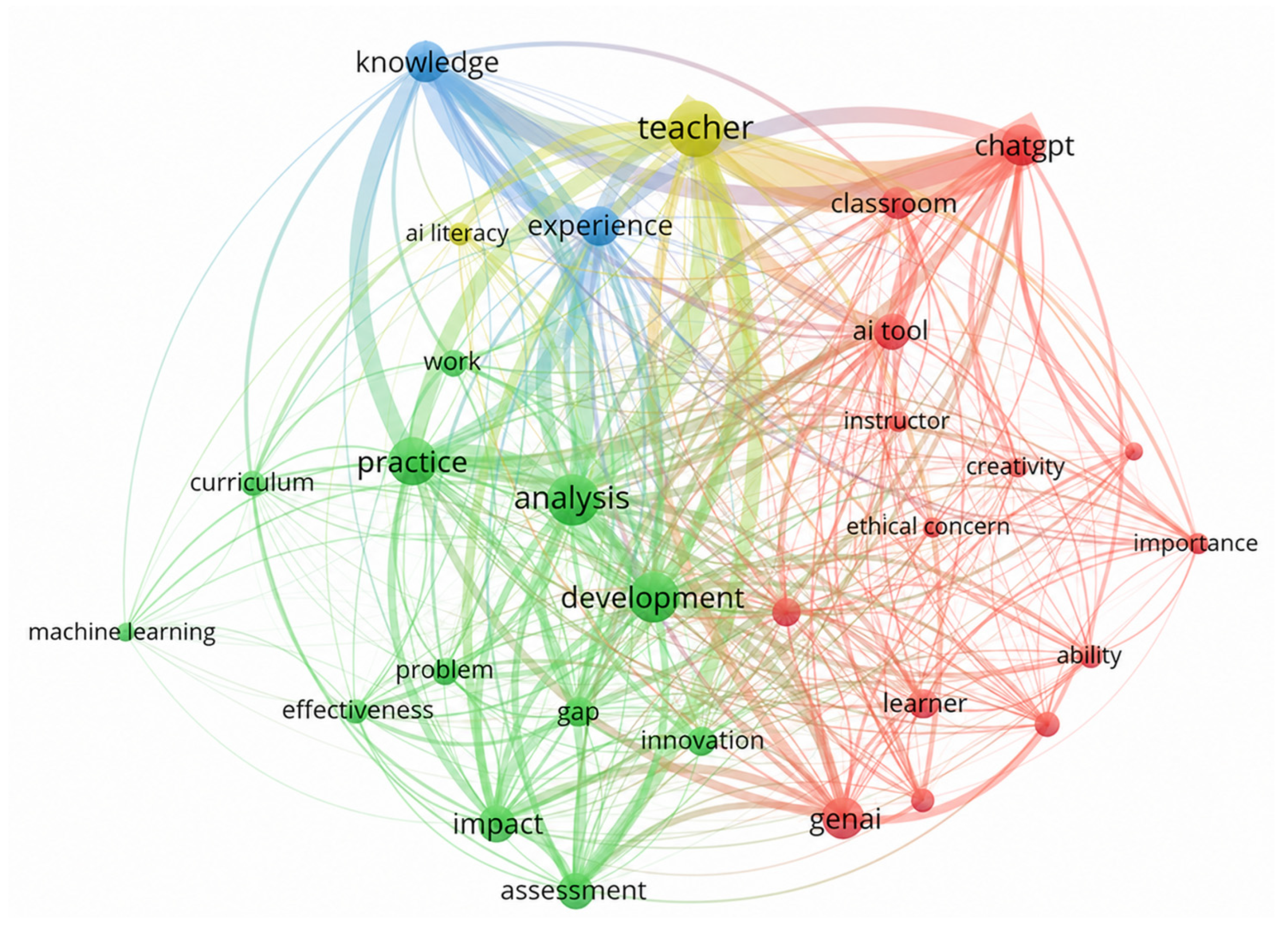
3.2. Q2. What Thematic Clusters Structure Scientific Production Specifically Focused on the Relationship Between Artificial Intelligence and Pedagogy?
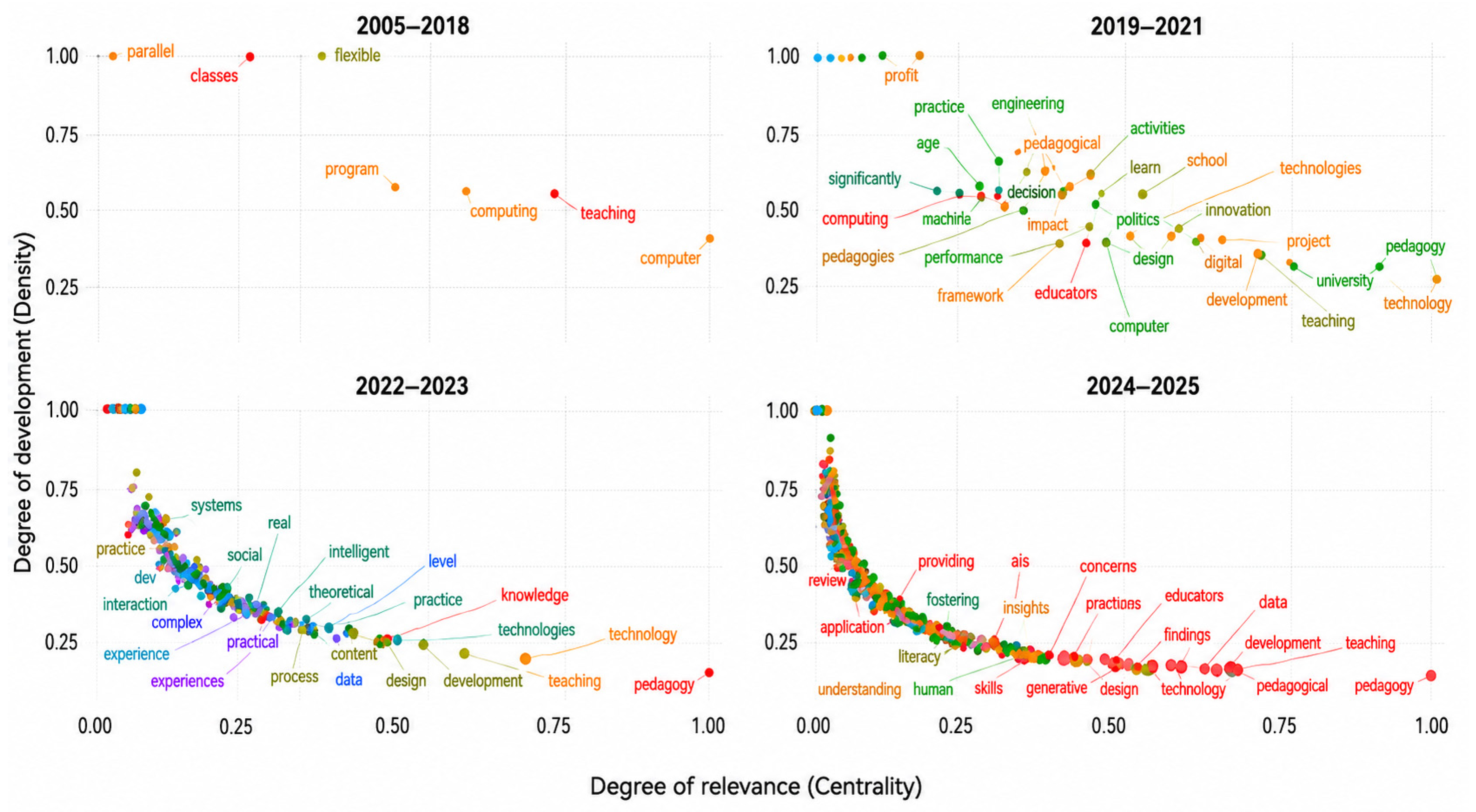
3.3. Q3. How Has Research on Artificial Intelligence and Pedagogy Evolved over Time in Terms of Thematic Centrality and Density?
3.4. Q4. What Are the Conceptual and Pedagogical Contributions of the Studies with the Greatest International Impact in the Field of Artificial Intelligence and Education?
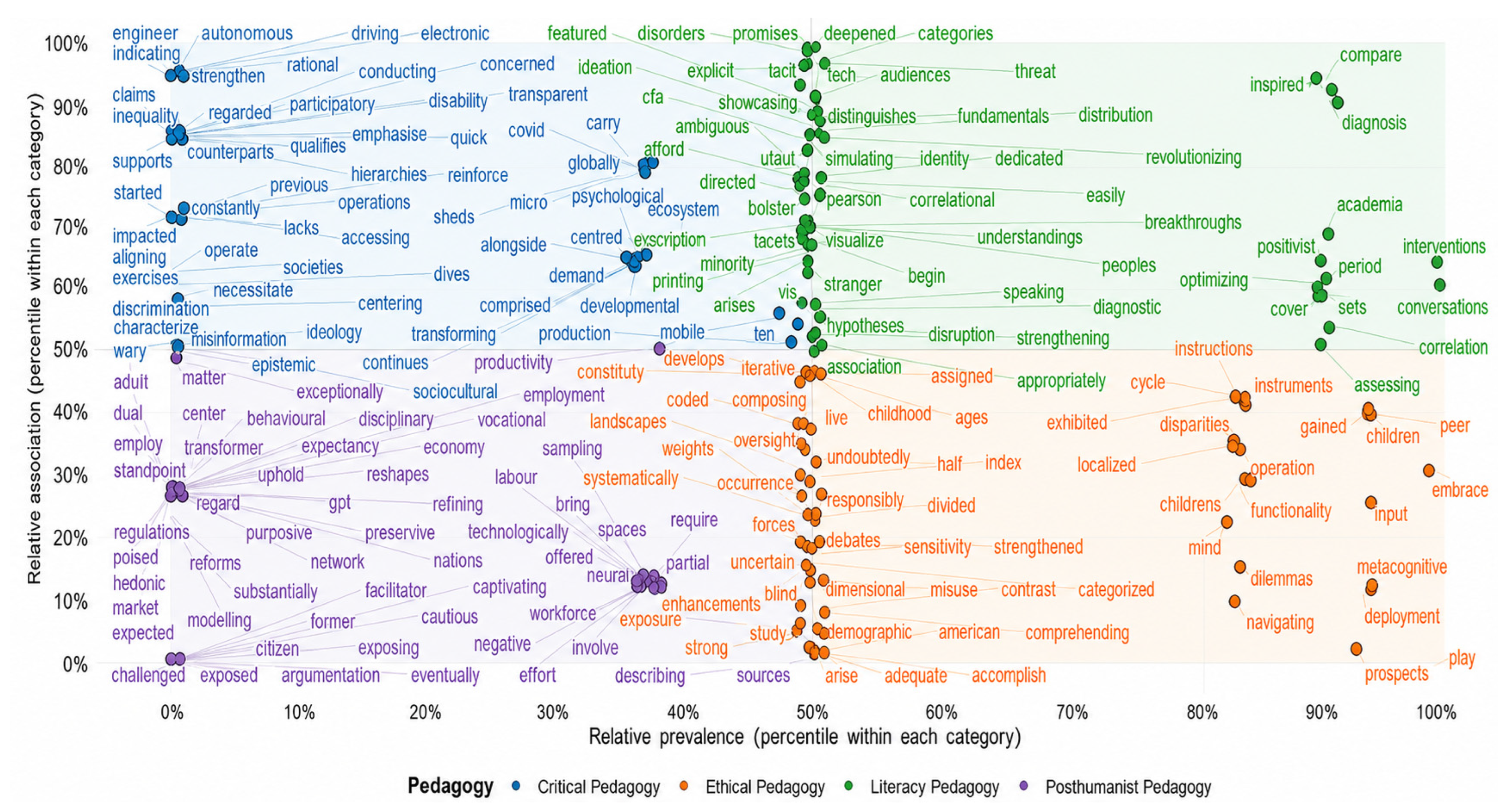
3.5. Q5. How Can the Emerging Pedagogical Dimensions Derived from the Literature on Artificial Intelligence in Education Be Systematically Classified?
- Critical dimension
- Ethical dimension
- Literacy-oriented dimension
- Humanistic dimension
4. Discussion
5. Conclusions
Supplementary Materials
Author Contributions
Funding
Institutional Review Board Statement
Informed Consent Statement
Data Availability Statement
Acknowledgments
Conflicts of Interest
References
- Aad, S.; Hardey, M. Generative AI: Hopes, controversies and the future of faculty roles in education. Qual. Assur. Educ. 2025, 33, 267–282. [Google Scholar] [CrossRef] [Scilit]
- Ali, A.; Khan, R.M.I.; Manzoor, D.; Mateen, M.A.; Khan, M.A. AI-Powered e-Learning: Innovations, Challenges, and the Future of Education. Int. J. Inf. Educ. Technol. 2025, 15, 882–890. [Google Scholar] [CrossRef] [Scilit]
- Davis, A.J. AI rising in higher education: Opportunities, risks and limitations. Asian Educ. Dev. Stud. 2024, 13, 307–319. [Google Scholar] [CrossRef] [Scilit]
- Díez Gutiérrez, E.-J.; Jarquín-Ramírez, M.-R. Higher Education in virtual environments: Educational risks of the use of private AI technology in the service of digital capitalism. Edutec 2025, 91, 55–69. [Google Scholar] [CrossRef] [Scilit]
- Denecke, K.; Glauser, R.; Reichenpfader, D. Assessing the Potential and Risks of AI-Based Tools in Higher Education: Results from an eSurvey and SWOT Analysis. Trends High. Educ. 2023, 2, 667–688. [Google Scholar] [CrossRef] [Scilit]
- Muringa, T.P. Exploring ethical dilemmas and institutional challenges in AI adoption: A study of South African universities. Front. Educ. 2025, 10, 1628019. [Google Scholar] [CrossRef] [Scilit]
- O’Dea, X. Generative AI: Is it a paradigm shift for higher education? Stud. High. Educ. 2024, 49, 811–816. [Google Scholar] [CrossRef] [Scilit]
- Ngoveni, M. Bridging the AI Knowledge Gap: The Urgent Need for AI Literacy and Institutional Support. Int. J. Technol. Learn. 2025, 32, 83–100. [Google Scholar] [CrossRef] [Scilit]
- Orfanidis, C. Moral Diversity in Institutional Policies Governing the Student Usage of Generative AI: An International Comparison. High. Educ. Q. 2025, 79, 70051. [Google Scholar] [CrossRef] [Scilit]
- Vanegas, W.J.; Santamaria, M.G.P.; Rodelo Molina, M.K.R.; Molina, J.E.S. Technological disruption of artificial intelligence-AI in education Contributions and risks in learning constructs. Encuentros 2025, 24, 475–486. [Google Scholar] [CrossRef]
- George-Reyes, C.E. Aproximación a los saberes digitales básicos en la formación de Sub-Especialistas en Anestesiología Pediátrica. Rev. Educ. Médica Super. 2019, 33, 37–50. [Google Scholar]
- Ariel, L.; Hayak, M. The Paradox of AI in ESL Instruction: Between Innovation and Oppression. Educ. Theory 2025, 75, 646–660. [Google Scholar] [CrossRef] [Scilit]
- Su, J.; Yang, W. Unlocking the Power of ChatGPT: A Framework for Applying Generative AI in Education. ECNU Rev. Educ. 2023, 6, 355–366. [Google Scholar] [CrossRef] [Scilit]
- Cinque, T. Exploring the paradox: Perceptions of AI in higher education—A study of hype and scandal. Explor. Media Ecol. 2024, 23, 199–215. [Google Scholar] [CrossRef] [Scilit]
- Sobaih Abu Elnasr, E.; Mahjoubi, M.N.; Brini, R.; Al-Qutaish, A.A.N. Transforming Education with AI: An Exploratory Study of Faculty Insights on ChatGPT’s Opportunities and Risks. An-Najah Univ. J. Res. B (Humanit.) 2025, 39, 289–296. [Google Scholar] [CrossRef] [Scilit]
- Stamboliev, E.; Christiaens, T. How empty is Trustworthy AI? A discourse analysis of the Ethics Guidelines of Trustworthy AI. Crit. Policy Stud. 2024, 19, 39–56. [Google Scholar] [CrossRef] [Scilit]
- Vuorikari, R.; Kluzer, S.; Punie, Y. DigComp 2.2: The Digital Competence Framework for Citizens. Publ. Off. Eur. Union 2022. [Google Scholar] [CrossRef] [Scilit] [PubMed]
- Hogenhout, L. A Framework for Ethical AI at the United Nations; United Nations Office for Information and Communications Technology: New York, NY, USA, 2021; p. 18. [Google Scholar]
- UNESCO. Guidance for Generative AI in Education and Research. UNESCO 2023. Available online: https://doi.org/10.54675/EWZM9535 (accessed on 3 March 2026).
- OECD. Empowering Learners for the Age of AI: An AI Literacy Framework for Primary and Secondary Education (Review draft). OECD 2025a. Available online: https://ailiteracyframework.org (accessed on 5 May 2026).
- Alshahrani, K.; Qureshi, R.J. Review the Prospects and Obstacles of AI-Enhanced Learning Environments: The Role of ChatGPT in Education. Int. J. Mod. Educ. Comput. Sci. 2024, 16, 71–86. [Google Scholar] [CrossRef] [Scilit]
- Chan, C.K.Y.; Lee, K.K.W. The AI generation gap: Are Gen Z students more interested in adopting generative AI such as ChatGPT in teaching and learning than their Gen X and millennial generation teachers? Smart Learn. Environ. 2023, 10, 60. [Google Scholar] [CrossRef] [Scilit]
- Unión Europea. Reglamento (UE) 2024/1689 del Parlamento Europeo y del Consejo, de 13 de Junio de 2024, por el Que se Establecen Normas Armonizadas en Materia de Inteligencia Artificial. Diario Oficial de la Unión Europea 2024. Available online: http://data.europa.eu/eli/reg/2024/1689/oj (accessed on 26 May 2026).
- Zhang, L.; Xu, J. The paradox of self-efficacy and technological dependence: Unraveling generative AI’s impact on university students’ task completion. Internet High. Educ. 2025, 65, 100978. [Google Scholar] [CrossRef] [Scilit]
- OECD. Results from TALIS 2024: The State of Teaching; OECD Publishing: Paris, France, 2025. [Google Scholar] [CrossRef] [Scilit]
- Comisión Europea. Directrices Éticas Sobre el uso de la Inteligencia Artificial (IA) y los Datos en la Educación y Formación para los Educadores; Oficina de Publicaciones de la Unión Europea: Luxembourg, 2022. [Google Scholar]
- Arribas, C.M.; Arcos, R.; Gertrudix, M. Rethinking education and training to counter AI-enhanced disinformation and information manipulations in Europe: A Delphi study. Cogent Soc. Sci. 2025, 11, 2501759. [Google Scholar] [CrossRef] [Scilit]
- Zhong, R.; Zhao, Y. Education Paradigm Shifts in the Age of AI: A Spatiotemporal Analysis of Learning. ECNU Rev. Educ. 2025, 8, 319–342. [Google Scholar] [CrossRef] [Scilit]
- Elyakim, N. Bridging expectations and reality: Addressing the price-value paradox in teachers’ AI integration. Educ. Inf. Technol. 2025, 30, 16929–16968. [Google Scholar] [CrossRef] [Scilit]
- Page, M.J.; McKenzie, J.E.; Bossuyt, P.M.; Boutron, I.; Hoffmann, T.C.; Mulrow, C.D.; Shamseer, L.; Tetzlaff, J.M.; Akl, E.A.; Brennan, S.E.; et al. The PRISMA 2020 statement: An updated guideline for reporting systematic reviews. BMJ 2021, 372, n71. [Google Scholar] [CrossRef] [Scilit]
- George-Reyes, C.E. Bibliographic database of Artificial intelligence in education: From instrumental adoption to human-centered pedagogical ecologies [Data set]. Zenodo 2026. [Google Scholar] [CrossRef] [Scilit]
- Braun, V.; Clarke, V. One size fits all? What counts as quality practice in (reflexive) thematic analysis? Qual. Res. Psychol. 2021, 18, 328–352. [Google Scholar] [CrossRef]
- Cooper, G. Examining Science Education in ChatGPT: An Exploratory Study of Generative Artificial Intelligence. J. Sci. Educ. Technol. 2023, 32, 444–452. [Google Scholar] [CrossRef] [Scilit]
- Tapalova, O.; Zhiyenbayeva, N. Artificial Intelligence in Education: AIEd for Personalised Learning Pathways. Electron. J. e-Learn. 2022, 20, 639–653. [Google Scholar] [CrossRef] [Scilit]
- Cope, B.; Kalantzis, M.; Searsmith, D. Artificial intelligence for education: Knowledge and its assessment in AI-enabled learning ecologies. Educ. Philos. Theory 2021, 53, 1229–1245. [Google Scholar] [CrossRef] [Scilit]
- Yang, W. Artificial Intelligence education for young children: Why, what, and how in curriculum design and implementation. Comput. Educ. Artif. Intell. 2022, 3, 100061. [Google Scholar] [CrossRef] [Scilit]
- Tam, W.; Huynh, T.; Tang, A.; Luong, S.; Khatri, Y.; Zhou, W. Nursing education in the age of artificial intelligence powered Chatbots (AI-Chatbots): Are we ready yet? Nurse Educ. Today 2023, 129, 105917. [Google Scholar] [CrossRef] [Scilit] [PubMed]
- Bearman, M.; Ajjawi, R. Learning to work with the black box: Pedagogy for a world with artificial intelligence. Br. J. Educ. Technol. 2023, 54, 1160–1173. [Google Scholar] [CrossRef] [Scilit]
- Crompton, H.; Jones, M.V.; Burke, D. Affordances and challenges of artificial intelligence in K-12 education: A systematic review. J. Res. Technol. Educ. 2024, 56, 248–268. [Google Scholar] [CrossRef] [Scilit]
- Salinas-Navarro, D.E.; Vilalta-Perdomo, E.; Michel-Villarreal, R.; Montesinos, L. Using Generative Artificial Intelligence Tools to Explain and Enhance Experiential Learning for Authentic Assessment. Educ. Sci. 2024, 14, 83. [Google Scholar] [CrossRef] [Scilit]
- Bower, M.; Torrington, J.; Lai, J.W.M.; Petocz, P.; Alfano, M. How should we change teaching and assessment in response to increasingly powerful generative Artificial Intelligence? Outcomes of the ChatGPT teacher survey. Educ. Inf. Technol. 2024, 29, 15403–15439. [Google Scholar] [CrossRef] [Scilit]
- Bulathwela, S.; Pérez-Ortiz, M.; Holloway, C.; Cukurova, M.; Shawe- Taylor, J. Artificial Intelligence Alone Will Not Democratise Education: On Educational Inequality, Techno-Solutionism and Inclusive Tools. Sustainability 2024, 16, 781. [Google Scholar] [CrossRef] [Scilit]
- Xu, J.J.; Babaian, T. Artificial intelligence in business curriculum: The pedagogy and learning outcomes. Int. J. Manag. Educ. 2021, 19, 100550. [Google Scholar] [CrossRef] [Scilit]
- Garg, S.; Sharma, S. Impact of artificial intelligence in special need education to promote inclusive pedagogy. Int. J. Inf. Educ. Technol. 2020, 10, 523–527. [Google Scholar] [CrossRef] [Scilit]
- Jiao, P.; Gutiérrez-Castillo, F.; Zhang, Q.; Alavi, A.H. Artificial intelligence-enabled prediction model of student academic performance in online engineering education. Artif. Intell. Rev. 2022, 55, 6321–6344. [Google Scholar] [CrossRef] [Scilit]
- Rudolph, J.; Ismail, M.F.B.M.; Popenici, S. Higher Education’s Generative Artificial Intelligence Paradox: The Meaning of Chatbot Mania. J. Univ. Teach. Learn. Pract. 2024, 21, 14–48. [Google Scholar] [CrossRef] [Scilit]
- Bell, R.; Bell, H. Entrepreneurship education in the era of generative artificial intelligence. Entrep. Educ. 2023, 6, 229–244. [Google Scholar] [CrossRef] [Scilit]
- Pantic, M.; Zwitserloot, R.; Grootjans, R.J. Teaching introductory artificial intelligence using a simple agent framework. IEEE Trans. Educ. 2005, 48, 382–390. [Google Scholar] [CrossRef]
- Fang, X.; Ng, D.T.K.; Leung, J.K.L.; Chu, S.K.W. A systematic review of artificial intelligence technologies used for story writing. Educ. Inf. Technol. 2023, 28, 14361–14397. [Google Scholar] [CrossRef] [Scilit]
- Kumar, R. Faculty members’ use of artificial intelligence to grade student papers: A case of implications. Int. J. Educ. Integr. 2023, 19, 9. [Google Scholar] [CrossRef] [Scilit]
- O’Dea, X.; O’Dea, M. Is Artificial Intelligence Really the Next Big Thing in Learning and Teaching in Higher Education? A Conceptual Paper. J. Univ. Teach. Learn. Pract. 2023, 20, 5. [Google Scholar] [CrossRef] [Scilit]
- Li, S.; Gu, X. A Risk Framework for Human-centered Artificial Intelligence in Education: Based on Literature Review and Delphi–AHP Method. Educ. Technol. Soc. 2023, 26, 187–202. [Google Scholar] [CrossRef]
- Saltman, K.J. Artificial intelligence and the technological turn of public education privatization: In defence of democratic education. Lond. Rev. Educ. 2020, 18, 196–208. [Google Scholar] [CrossRef] [Scilit]
- Lee, C.H.; Gobir, N.; Gurn, A.; Soep, E. In the Black Mirror: Youth Investigations into Artificial Intelligence. ACM Trans. Comput. Educ. 2022, 22, 3484495. [Google Scholar] [CrossRef] [Scilit]
- Hodgson, D.; Goldingay, S.; Boddy, J.; Nipperess, S.; Watts, L. Problematising Artificial Intelligence in Social Work Education: Challenges, Issues and Possibilities. Br. J. Soc. Work. 2022, 52, 1878–1895. [Google Scholar] [CrossRef] [Scilit]
- Yang, Y.; Qin, J.; Lei, J.; Liu, Y. Research Status and Challenges on the Sustainable Development of Artificial Intelligence Courses from a Global Perspective. Sustainability 2023, 15, 9335. [Google Scholar] [CrossRef] [Scilit]
- Yim, I.H.Y. Artificial intelligence literacy in primary education: An arts-based approach to overcoming age and gender barriers. Comput. Educ. Artif. Intell. 2024, 7, 100321. [Google Scholar] [CrossRef] [Scilit]
- Stuchlikova, L.; Weis, M. From Information to Insight: Reimagining Critical Thinking Pedagogy in the Age of Artificial Intelligence. In Proceedings of the 2024 International Conference on Emerging eLearning Technologies and Applications (ICETA), Stary Smokovec, Slovakia, 24–25 October 2024; pp. 591–598. [Google Scholar] [CrossRef] [Scilit]
- Toscano, R.; Guerra, M.A.; Durán-Ballén, S.; Valarezo, B.M. WIP—Development of Critical Thinking in AEC Students Aided by Artificial Intelligence. In Proceedings of the Frontiers in Education Conference, FIE, Washington, DC, USA, 13–16 October 2024. [Google Scholar] [CrossRef] [Scilit]
- Lubbe, A.; Marais, E.; Kruger, D. Cultivating independent thinkers: The triad of artificial intelligence, Bloom’s taxonomy and critical thinking in assessment pedagogy. Educ. Inf. Technol. 2025, 30, 17589–17622. [Google Scholar] [CrossRef] [Scilit]
- Bo, Z.; Pek, L.S.; Cong, W.; Tiannan, L.; Krishnasamy, H.N.; Ne’Matullah, K.F.; Arar, H. Transforming Translation Education: A Bibliometric Analysis of Artificial Intelligence’s Role in Fostering Sustainable Development. Int. J. Learn. Teach. Educ. Res. 2025, 24, 166–190. [Google Scholar] [CrossRef] [Scilit]
- Alqarni, A. Artificial Intelligence-Critical Pedagogic: Design and Psychologic Validation of a Teacher-Specific Scale for Enhancing Critical Thinking in Classrooms. J. Comput. Assist. Learn. 2025, 41, e70039. [Google Scholar] [CrossRef] [Scilit]
- Konstantinidis, A. A Metaphor for Rethinking Artificial Intelligence in/and Education. J. Interact. Media Educ. 2025, 2025, 17. [Google Scholar] [CrossRef] [Scilit]
- Asghar, M.Z.; Iqbal, J.; Özbilen, F.M.; Abedin, J.; Järvenoja, H.; Widanapathirana, U. The nexus of artificial intelligence literacy collaborative knowledge practices and inclusive leadership development among higher education students in Bangladesh China Finland and Turkey. Discov. Comput. 2025, 28, 172. [Google Scholar] [CrossRef] [Scilit]
- Adigun, O.T.; Ojomo, O.T. Application of Artificial Intelligence for Inclusive Education. In Enablers, Barriers, and Challenges for Inclusive Curriculum; Charamba, E., Ndhlovana, S., Eds.; IGI Global Scientific Publishing: Hershey, PA, USA, 2025; pp. 147–166. [Google Scholar] [CrossRef] [Scilit]
- Chakraborty, S.; Gálatro, D. Artificial Intelligence (AI) Equality in Engineering Education: Strategies to Unite the AI Gap between the Global North & South. In Proceedings of the IEEE Global Engineering Education Conference, EDUCON, London, UK, 22–25 April 2025. [Google Scholar] [CrossRef] [Scilit]
- Campbell, E. Critical Legal Research, Artificial Intelligence, and Systemic Racism: Teaching with Jim Crow Text-Mining. Leg. Ref. Serv. Q. 2023, 42, 208–219. [Google Scholar] [CrossRef] [Scilit]
- Wandera, D.B. Skewed Artificial Intelligence: Flagging Embedded Cultural Practices in Children’s Stories Featuring “Alice and Sparkle”. Read. Res. Q. 2024, 59, 651–664. [Google Scholar] [CrossRef] [Scilit]
- Mallette, J.C. Preparing Future Technical Editors for an Artificial Intelligence-Enabled Workplace. J. Bus. Tech. Commun. 2024, 38, 289–302. [Google Scholar] [CrossRef] [Scilit]
- Ahmad, W.; Shokeen, R.; Raj, R. Artificial Intelligence: Solutions in Special Education. In Transforming Special Education Through Artificial Intelligence; Walters, A., Ed.; IGI Global Scientific Publishing: Hershey, PA, USA, 2025; pp. 459–520. [Google Scholar] [CrossRef] [Scilit]
- Mahmoudi-Dehaki, M.; Nasr-Esfahani, N. Artificial Intelligence (AI) in Special Education: AI Therapeutic Pedagogy for Language Disorders. In Transforming Special Education Through Artificial Intelligence; Walters, A., Ed.; IGI Global Scientific Publishing: Hershey, PA, USA, 2025; pp. 193–222. [Google Scholar] [CrossRef] [Scilit]
- Sharma, S. The Potential of Artificial Intelligence to Enhance Special Education. In Transforming Special Education Through Artificial Intelligence; Walters, A., Ed.; IGI Global Scientific Publishing: Hershey, PA, USA, 2025; pp. 113–138. [Google Scholar] [CrossRef] [Scilit]
- D’ambrosio, F. Artificial intelligence and education: Between experimentation and evolutionary perspectives; Intelligenza artificiale e istruzione: Tra sperimentazione e prospettive evolutive. J. Educ. Cult. Psychol. Stud. 2024, 2024, 243–256. [Google Scholar] [CrossRef] [Scilit]
- Nguyen, H.; Nguyen, V.; Ludovise, S.; Santagata, R. Misrepresentation or inclusion: Promises of generative artificial intelligence in climate change education. Learn. Media Technol. 2025, 50, 393–409. [Google Scholar] [CrossRef] [Scilit]
- Sun, Y.; Lan, G. Enhancing critical language awareness in EAL writing education amid the rise of generative artificial intelligence. System 2025, 134, 103806. [Google Scholar] [CrossRef] [Scilit]
- Judson, H. “But I Didn’t Use ChatGPT!”: Democratic Course Design and Generative Artificial Intelligence in Higher Education Landscape. Teach. Sociol. 2025, 53, 246–256. [Google Scholar] [CrossRef] [Scilit]
- Palma González, E.E.; Elgueta, M.F. Artificial Intelligence and the New Social Order: Challenges for Legal Teaching and Learning; Inteligencia artificial y nuevo orden social: Desafíos para la enseñanza-aprendizaje del derecho. Novum Jus 2025, 19, 329–353. [Google Scholar] [CrossRef] [Scilit]
- Moya, B.A.; Eaton, S.E. Examining Recommendations for Generative Artificial Intelligence Use with Integrity from a Scholarship of Teaching and Learning Lens. RELIEVE Rev. Electron. Investig. Eval. Educ. 2023, 29, M1. [Google Scholar] [CrossRef] [Scilit]
- Rajkhanna, R.K.; Rabbiraj, C. Innovation in legal education: The role of artificial intelligence and its significance for the legal profession. Int. J. Intellect. Prop. Manag. 2023, 13, 268–282. [Google Scholar] [CrossRef] [Scilit]
- Kumar, R.; Eaton, S.E.; Mindzak, M.; Morrison, R. Academic Integrity and Artificial Intelligence: An Overview. Springer Int. Handb. Educ. 2024, F2304, 1583–1596. [Google Scholar] [CrossRef] [Scilit]
- Asad, M.M.; Shahzad, S.; Shah, S.H.A.; Sherwani, F.; Almusharraf, N.M. ChatGPT as artificial intelligence-based generative multimedia for English writing pedagogy: Challenges and opportunities from an educator’s perspective. Int. J. Inf. Learn. Technol. 2024, 41, 490–506. [Google Scholar] [CrossRef] [Scilit]
- Virvou, M.; Tsihrintzis, G.A. Artificial Intelligence Chatbots and Social Robots in Education: FEPER Framework for Efficiency, Pedagogical and Ethical Requirements. In Proceedings of the 2024 15th International Conference on Information, Intelligence, Systems & Applications (IISA), Chania Crete, Greece, 17–19 July 2024; pp. 1–8. [Google Scholar] [CrossRef] [Scilit]
- Ogalo, E.O.; Mtenzi, F. Leveraging Artificial Intelligence Tools for Learning: Academic Integrity and Ethics in Higher Education in Kenya. In Artificial Intelligence, Digital Learning, and Leadership: Redefining Higher Education; Areba, G., Gisore, B., Njurai, E., Eds.; IGI Global Scientific Publishing: Hershey, PA, USA, 2025; pp. 1–36. [Google Scholar] [CrossRef] [Scilit]
- Hassan, S.N. Integration of Micro-Credentials with Artificial Intelligence in Open Education: Developments and Challenges for Middle East Countries. In Integrating Micro-Credentials with AI in Open Education; Durak, G., Çankaya, S., Eds.; IGI Global: Hershey, PA, USA, 2024; pp. 251–279. [Google Scholar] [CrossRef] [Scilit]
- Alqahtani, N.; Wafula, Z. Artificial Intelligence Integration: Pedagogical Strategies and Policies at Leading Universities. Innov. High. Educ. 2025, 50, 665–684. [Google Scholar] [CrossRef] [Scilit]
- Ghimire, A.; Qiu, Y. Redefining pedagogy with artificial intelligence: How nursing students are shaping the future of learning. Nurse Educ. Pract. 2025, 84, 104330. [Google Scholar] [CrossRef] [Scilit] [PubMed]
- Han, P. Artificial Intelligence in Education: Supporting Diverse Learning Styles and Addressing Ethical Considerations. In Emerging Trends, Global Perspectives, and Systemic Transformation in AI; Wang, V., Ed.; IGI Global Scientific Publishing: Hershey, PA, USA, 2026; pp. 387–408. [Google Scholar] [CrossRef] [Scilit]
- Khurramov, A.J.; Axmedshaeva, M.A.; Mukhitdinova, F.A.; Xudayberdiyeva, G.A.; Almosova, S.S.; Makhamatov, M.M.; Khayitov, S.R. Artificial Intelligence in Education: Analysis and Assessment of Legal Knowledge Using AI Tools. Qubahan Acad. J. 2025, 5, 264–293. [Google Scholar] [CrossRef] [Scilit]
- Choiriyah, S.; Ramadhan, S.; Nugroho, A.; Heldy Ramadhan Putra, H.R.P.; Muharom, F. Artificial Intelligence-Driven Learning Assessment in Faculties of Education: An Exploratory Study. Munaddhomah 2025, 6, 482–495. [Google Scholar] [CrossRef] [Scilit]
- Sabbaghan, S. Introduction to Artificial Intelligence and Its Relevance to Academia. In Navigating Generative AI in Higher Education; Sabbaghan, S., Ed.; Edward Elgar Publishing: Cheltenham, UK, 2025; pp. 1–17. [Google Scholar] [CrossRef] [Scilit]
- Alli, A.A.; Magombe, Y.; Lwembawo, I.; Kasadha, J. A Policy Framework for the Use of Generative Artificial Intelligence in Higher Education Institutions. 2025 IST-Africa Conference (IST-Africa), Nairobi, Kenya, 28–30 May 2025 ; 2025; pp. 1–11. [Google Scholar] [CrossRef] [Scilit]
- Malavasi, P.; Righettini, C. Education and Artificial Intelligence: A New Perspective. In Digital Humanism; Bertolaso, M., Capone, L., Rodríguez-Lluesma, C., Eds.; Palgrave Macmillan: Cham, Switzerland, 2022; pp. 179–192. [Google Scholar] [CrossRef] [Scilit] [PubMed]
- Kolovskaia, A.; Ilin, A. Ontology of Artificial Intelligence as a Field of Engineering. Technol. Lang. 2023, 4, 46–57. [Google Scholar] [CrossRef]
- Morales-García, W.C.; Sairitupa-Sanchez, L.Z.; Morales-García, S.B.; Morales-García, M. Development and validation of a scale for dependence on artificial intelligence in university students. Front. Educ. 2024, 9, 1323898. [Google Scholar] [CrossRef] [Scilit]
- Bennani-Taylor, S. Infrastructuring AI: The stabilization of ‘artificial intelligence’ in and beyond national AI strategies. First Monday 2024, 29. [Google Scholar] [CrossRef] [Scilit]
- Pérez, R.A.; Sagrado, A.L.; González, E.O.; Fontán de Bedout, L. Implicaciones filosóficas, éticas y pedagógicas del uso de la Inteligencia Artificial en educación. Digit. Educ. Rev. 2024, 45, 29–36. [Google Scholar] [CrossRef] [Scilit]
- Adjekum, D.K.; Keller, J.C.; Waller, Z. An Evaluation of Artificial Intelligence Chatbots Ethical Use, Attitudes Towards Technology, Behavioral Factors and Student Learning Outcomes in Collegiate Aviation Programs. Coll. Aviat. Rev. 2024, 42, 84–118. [Google Scholar] [CrossRef] [Scilit]
- Yu, P.; Wang, S. An Examination and Analysis of the Integration of Artificial Intelligence and Gamification in the Pedagogy of Chinese Higher Education. Lect. Notes Educ. Technol. 2024, F2594, 29–46. [Google Scholar] [CrossRef] [Scilit]
- Onderi, H.N. Artificial Intelligence: Ethics and Academic Integrity in Higher Education. In Artificial Intelligence, Digital Learning, and Leadership: Redefining Higher Education; Areba, G., Gisore, B., Njurai, E., Eds.; IGI Global Scientific Publishing: Hershey, PA, USA, 2025; pp. 65–88. [Google Scholar] [CrossRef] [Scilit]
- Paz-Lourido, B.; Hervás-Torres, M.; Chaves, Á.R. Service-Learning in Higher Education in the Age of Digital Transformation and Artificial Intelligence. Lect. Notes Educ. Technol. 2024, F2959, 111–119. [Google Scholar] [CrossRef] [Scilit] [PubMed]
- Sánchez-Chero, M.; Bravo-Jaico, J.; Apac, N.C.A.; García, O.L.C. Artificial intelligence a phenomenological irruption in education. Opportunities and threats; Inteligencia artificial una irrupción fenomenológica en la educación, oportunidades y amenazas. Encuentros 2024, 22, 448–457. [Google Scholar] [CrossRef]
- Rief, J.J.; Schrader, B.J. Debating About, Against, and with ChatGPT: Redesigning Academic Debate Pedagogy for the World of Generative Artificial Intelligence. In The Role of Generative AI in the Communication Classroom; Elmoudden, S., Wrench, J., Eds.; IGI Global Scientific Publishing: Hershey, PA, USA, 2024; pp. 87–105. [Google Scholar] [CrossRef] [Scilit]
- Irish, A.L.; Gazica, M.W.; Becerra, V. A qualitative descriptive analysis on generative artificial intelligence: Bridging the gap in pedagogy to prepare students for the workplace. Discov. Educ. 2025, 4, 48. [Google Scholar] [CrossRef] [Scilit]
- Baghavathi Priya, S.B.; Anusha, J.S.; Chatiyode, V.; Madeswaran, T.S. Embracing Learner-Centric Pedagogy in the Age of Artificial Intelligence. In Adopting Artificial Intelligence Tools in Higher Education: Teaching and Learning; Murugan, T., Periasamy, K., Abirami, A.M., Eds.; CRC Press: Boca Raton, FL, USA, 2025; pp. 51–73. [Google Scholar] [CrossRef] [Scilit]
- Huang, Y.; Miao, L.; Zhang, X. Reflections on Education Reform of Giscience under the Wave of Generative Artificial Intelligence. In Proceedings of the 32nd International Conference on Geoinformatics, Jiaozuo, China, 16–18 June 2025. [Google Scholar] [CrossRef] [Scilit]
- Urmeneta, A.; Romero, M. Creative Application of Artificial Intelligence in Education. Palgrave Stud. Creat. Cult. 2024, F3866, 3–16. [Google Scholar] [CrossRef] [Scilit]
- Yan, Y.; Sun, W.; Zhao, X. Metaphorical conceptualizations of generative artificial intelligence use by Chinese university EFL learners. Front. Educ. 2024, 9, 1430494. [Google Scholar] [CrossRef] [Scilit]
- Vo, H. Teaching Design with Consumer-Ready Artificial Intelligence and Virtual Reality: A Case Study. In Proceedings of the ACM SIGGRAPH 2024 Educator’s Forum (SIGGRAPH ’24); Association for Computing Machinery: New York, NY, USA, 2024; p. 14. [Google Scholar] [CrossRef] [Scilit]
- Jin, F.; Peng, X.; Sun, L.; Song, Z.; Zhou, K.; Lin, C.-H. Knowledge (Co-)Construction Among Artificial Intelligence, Novice Teachers, and Experienced Teachers in an Online Professional Learning Community. J. Comput. Assist. Learn. 2025, 41, e70004. [Google Scholar] [CrossRef] [Scilit]
- Ruiz Viruel, S.; Sánchez-Rivas, E.; Ruiz Palmero, J. The Role of Artificial Intelligence in Project-Based Learning: Teacher Perceptions and Pedagogical Implications. Educ. Sci. 2025, 15, 150. [Google Scholar] [CrossRef] [Scilit]
- Pavlik, J.V. Considering the Pedagogical Benefits of Generative Artificial Intelligence in Higher Education: Applying Constructivist Learning Theory. In Generative AI in Higher Education; Edward Elgar Publishing: Cheltenham, UK, 2025; pp. 46–58. [Google Scholar] [CrossRef] [Scilit]
- Shi, W.; Shakibaei, G. Insights Into the Effectiveness of Artificial Intelligence-Integrated Speaking Instruction in Enhancing Speaking Skills and Social–Emotional Competence as Well as Reducing Demotivation and Shyness. Eur. J. Educ. 2025, 60, e70174. [Google Scholar] [CrossRef] [Scilit]
- van den Berg, G. Teachers’ experiences of using artificial intelligence from an open distance learning context: Successes, challenges, and strategies for success. Discov. Educ. 2025, 4, 192. [Google Scholar] [CrossRef] [Scilit]
- Núñez-Valdés, K.P.; Sepúlveda-Irribarra, C.A.; Villegas-Dianta, C.A.; Castillo-Paredes, A.J. Artificial intelligence and professor training: Analysis of student perceptions; Inteligencia artificial y formación docente: Análisis de las percepciones estudiantiles. Form. Univ. 2025, 18, 1–12. [Google Scholar] [CrossRef] [Scilit]
- Sánchez Vera, F. Critical Algorithmic Mediation: Rethinking Cultural Transmission and Education in the Age of Artificial Intelligence. Societies 2025, 15, 198. [Google Scholar] [CrossRef] [Scilit]
- Boutob, I.; Jmad, S.; Benmessaoud, S.; Kaddouri, M. Pedagogy of AI Strategies for Effective Teaching and Learning in the Age of Artificial Intelligence: Mohammed First University as a Case Study. In Effective Instructional Design Informed by AI; Gregory, S., Ed.; IGI Global Scientific Publishing: Hershey, PA, USA, 2025; pp. 55–86. [Google Scholar] [CrossRef] [Scilit]
- Kavitha, D.; Moorthy, D.; Jeyamala, C.; Julius Fusic, S.J. Instructional Design with Artificial Intelligence Tools to Support Student-Centered Learning. In Adopting Artificial Intelligence Tools in Higher Education: Teaching and Learning; Murugan, T., Periasamy, K., Abirami, A.M., Eds.; CRC Press: Boca Raton, FL, USA, 2025; pp. 74–99. [Google Scholar] [CrossRef] [Scilit]
- Lehfid, A.; Boualili, E.; El Bakkali, A. Between Transformation and Preservation: Moroccan High School Teachers’ Perceptions of Artificial Intelligence’s Impact on English Teaching Quality. Arab. World Engl. J. 2025, 2025, 96–111. [Google Scholar] [CrossRef] [Scilit]
- Mendonça, J.M.P.; Babo, L.; Pinto, C.M.A.; Cruz, M.; Queirós, R.; Mascarenhas, D. Work in Progress: Exploring Educators’ Perceptions on Generative Artificial Intelligence in Higher Education. In Proceedings of the 2025 IEEE Engineering Education World Conference (EDUNINE), Montevideo, Uruguay, 23–26 March 2025; pp. 1–4. [Google Scholar] [CrossRef] [Scilit]
- Praveena, T.; Anupama, K. Machine Learning Meets Language Learning: The Transformative Potential of Artificial Intelligence in English Language Instruction. Hum. Res. Rehabil. 2025, 15, 133–144. [Google Scholar] [CrossRef] [Scilit]
- Asakura, K.; Occhiuto, K.; Todd, S.; Leithead, C.; Clapperton, R. A Call to Action on Artificial Intelligence and Social Work Education: Lessons Learned from A Simulation Project Using Natural Language Processing. J. Teach. Soc. Work. 2020, 40, 501–518. [Google Scholar] [CrossRef] [Scilit]
- Loftus, M.; Madden, M.G. A pedagogy of data and Artificial Intelligence for student subjectification. Teach. High. Educ. 2020, 25, 456–475. [Google Scholar] [CrossRef] [Scilit]
- Cheong, P.H. Robots, Religion and Communication: Rethinking Piety, Practices and Pedagogy in the Era of Artificial Intelligence. In Religion in the Age of Digitalization: From New Media to Spiritual Machines; Isetti, G., Innerhofer, E., Pechlaner, H., de Rachewiltz, M., Eds.; Routledge: London, UK, 2020; pp. 86–96. [Google Scholar] [CrossRef] [Scilit]
- Tham, J.; Howard, T.; Verhulsdonck, G. Extending Design Thinking, Content Strategy, and Artificial Intelligence into Technical Communication and User Experience Design Programs: Further Pedagogical Implications. J. Tech. Writ. Commun. 2022, 52, 428–459. [Google Scholar] [CrossRef] [Scilit]
- Vidanaralage, A.J.; Dharmaratne, A.T.; Haque, S. Schema and emotion in memory retrieval following video-based learning: An artificial intelligence study. Australas. J. Educ. Technol. 2022, 38, 109–132. [Google Scholar] [CrossRef] [Scilit]
- Johnson-Eilola, J.; Selber, S.A.; York, E.J. Can Artificial Intelligence Robots Write Effective Instructions? J. Bus. Tech. Commun. 2024, 38, 199–212. [Google Scholar] [CrossRef] [Scilit]
- Oyekunle, D.O.; Nwaiku, M.; Matthew, U.O.; Ogechukwu, O.N.; Nwanakwaugwu, A.C.; Adebola, N.T.; Oladipupo, M.A.; Olawoyin, O.O. Transition to Sustainable Human-Centric Education in Emerging Artificial Intelligence Industry 5.0: Conversational AI with User-Centric ChatGPT-5. In Higher Education and Quality Assurance Practices; Saeed, S., Rana, O., Dhanaraj, R., Eds.; IGI Global Scientific Publishing: Hershey, PA, USA, 2025; pp. 37–76. [Google Scholar] [CrossRef] [Scilit]
- Alymani, A.A.A. Integrating Artificial Intelligence Rendering Tools in Design: Integrating AI as teaching methods in architectural education. Proc. Int. Conf. Educ. Res. Comput. Aided Archit. Des. Eur. 2024, 2, 629–638. [Google Scholar] [CrossRef] [Scilit]
- Siliquini-Cinelli, L. Scientia Iuris: Knowledge and Experience in Legal Education and Practice from the Late Roman Republic to Artificial Intelligence. Ius Gentium 2024, 112, 1–382. [Google Scholar] [CrossRef] [Scilit]
- Di Rosario, G.; Ciastellardi, M. The Integration of Artificial Intelligence in Communication Design Case Studies from the Polytechnic of Milan: From Digital Culture to Sociology of Media; l’integrazione dell’intelligenza artificiale nel design della comunicazione. Casi di studio del politecnico di milano: Dalla cultura digitale alla sociologia dei media. J. Educ. Cult. Psychol. Stud. 2024, 2024, 83–103. [Google Scholar] [CrossRef] [Scilit]
- Hermund, A.; Oxvig, H.; Bang, J.S. Embracing the Creative Nexus: Integrating artificial intelligence, philosophy, and artistic discourse in architectural education. Proc. Int. Conf. Educ. Res. Comput. Aided Archit. Des. Eur. 2024, 2, 665–674. [Google Scholar] [CrossRef] [Scilit]
- Billingsley, W. The Practical Epistemologies of Design and Artificial Intelligence. Sci. Educ. 2025, 34, 807–824. [Google Scholar] [CrossRef] [Scilit]
- Carradini, S. Some (Many) Ways to Think About Artificial Intelligence: Introduction to Special Issue on Effects of Artificial Intelligence Tools in Technical Communication Pedagogy, Practice, and Research, Part 2. J. Bus. Tech. Commun. 2025, 39, 1–10. [Google Scholar] [CrossRef] [Scilit]
- Benazouz, N.; Refrafi, S. Synergy between neurosciences and artificial intelligence: Towards a revolution in language teaching; synergie entre neurosciences et intelligence artificielle: Vers une revolution de l’enseignement des langues. Multilinguales 2025, 13, 210–239. [Google Scholar] [CrossRef] [Scilit]
- Andreeva, Y.; Fakhrutdinova, L.; Dautova, R.; Teleguzova, D. Phenomena of influence of household artificial intelligence on child-parent relations in the family space. Educ. Self Dev. 2025, 20, 97–109. [Google Scholar] [CrossRef] [Scilit]
- Bell, A.P. Pedagogy of the Prompt: Music Education, Artificial Intelligence, and Big Tech Magic. Action Crit. Theory Music. Educ. 2025, 24, 202–244. [Google Scholar] [CrossRef] [Scilit]
- Muñoz Bonilla, H.A.; Espinosa Rodríguez, M.A.; Chaves Campo, C.F. Symbolic Inculturation by Artificial Intelligence in Academic Organizational Culture; Inculturación Simbólica por Inteligencia Artificial en la Cultura Organizacional Académica. REICE. Rev. Iberoam. Sobre Calid. Efic. Cambio Educ. 2025, 23, 4. [Google Scholar] [CrossRef] [Scilit]
- Gnedykh, D.S.; Bordovskaya, N.V.; Koshkina, E.A.; Posokhova, S.T.; Khromova, M.A.; Iskhakova, M.P. Development of students’ subjectivity through interaction with generative artificial intelligence: A systematic review of scientific concepts. Educ. Sci. J. 2025, 27, 9–34. [Google Scholar] [CrossRef] [Scilit]
- Dall’Asta, J.C. Enhancing Design Thinking through the Systematic Integration of Artificial Intelligence (AI) in Architectural Education. In Proceedings of the 2025 5th International Conference on Artificial Intelligence and Education (ICAIE), Suzhou, China, 14–16 May 2025; pp. 377–381. [Google Scholar] [CrossRef] [Scilit]
- Kim, D.O. Reflection-AI: Artificial intelligence or algorithmic instruction problem? Empowering students through situated knowledges-based reflexivity. Front. Commun. 2025, 10, 1598082. [Google Scholar] [CrossRef] [Scilit]
- Monserrat, A.L.; Srnec, N.M. Reflection-AI: Artificial intelligence as a redefining force for expressive filmmaking in film schools. Front. Commun. 2025, 10, 1598376. [Google Scholar] [CrossRef] [Scilit]
- Suresh Babu, C.V.; Karuppuswamy, S.; Rijairaj, R.; Vignesh, A. Harnessing Artificial Intelligence in Music Creation: Exploring Genre Musical Features and Their Reflection in the Pedagogical Process. In Enhancing Music Education with Innovative Tools and Techniques; IGI Global Scientific Publishing: Hershey, PA, USA, 2025; pp. 51–86. [Google Scholar] [CrossRef] [Scilit]
- Jansen, B.J.; Jung, S.-G.; Farooq, A.; Salminen, J.; Aldous, K.; Msefula, P.S.; Alabed, A.; Khan, S.M.; O’Kennedy, R. Human-Centred Artificial Intelligence in Progressive Education: Unravelling the Benefits and Challenges in Qatar’s HEIs. Gulf Stud. 2025, 21, 105–126. [Google Scholar] [CrossRef] [Scilit]
- Alnasib, B.N.M. Factors Affecting Faculty Members’ Readiness to Integrate Artificial Intelligence into Their Teaching Practices: A Study from the Saudi Higher Education Context. Int. J. Learn. Teach. Educ. Res. 2023, 22, 465–491. [Google Scholar] [CrossRef] [Scilit]
- Bender, S.M. Awareness of Artificial Intelligence as an Essential Digital Literacy: ChatGPT and Gen-AI in the Classroom. Chang. Engl. 2024, 31, 161–174. [Google Scholar] [CrossRef] [Scilit]
- Dai, Y.; Lin, Z.; Liu, A.; Dai, D.; Wang, W. Effect of an Analogy-Based Approach of Artificial Intelligence Pedagogy in Upper Primary Schools. J. Educ. Comput. Res. 2024, 61, 159–186. [Google Scholar] [CrossRef] [Scilit]
- Acquah, B.Y.S.; Arthur, F.; Salifu, I.; Quayson, E.; Nortey, S.A. Preservice teachers’ behavioural intention to use artificial intelligence in lesson planning: A dual-staged PLS-SEM-ANN approach. Comput. Educ. Artif. Intell. 2024, 7, 100307. [Google Scholar] [CrossRef] [Scilit]
- Burriss, S.K.; Leander, K. Critical Posthumanist Literacy: Building Theory for Reading, Writing, and Living Ethically with Everyday Artificial Intelligence. Read. Res. Q. 2024, 59, 560–569. [Google Scholar] [CrossRef] [Scilit]
- Joubin, A.A. Enhancing the Trustworthiness of Generative Artificial Intelligence in Responsive Pedagogy in the Context of Humanities Higher Education. In General Aspects of Applying Generative AI in Higher Education; Lahby, M., Maleh, Y., Bucchiarone, A., Schaeffer, S.E., Eds.; Springer: Cham, Switzerland, 2024; pp. 207–220. [Google Scholar] [CrossRef] [Scilit] [PubMed]
- Angel, E.; Víctor, G.; Jorge, V.; Roger, M. Teacher training in the use of artificial intelligence Challenges for the educator in the 21st century; Formación docente en el uso de la Inteligencia Artificial Retos para el educador siglo XXI. In Proceedings of the LACCEI international Multi-conference for Engineering, Education and Technology, San Jose, Costa Rica, 17–19 July 2024. [Google Scholar] [CrossRef] [Scilit]
- Chiu, T.K.F.; Ahmad, Z.; Çoban, M. Development and validation of teacher artificial intelligence (AI) competence self-efficacy (TAICS) scale. Educ. Inf. Technol. 2025, 30, 6667–6685. [Google Scholar] [CrossRef] [Scilit]
- Ren, X.; Wu, M.L. Examining Teaching Competencies and Challenges While Integrating Artificial Intelligence in Higher Education. TechTrends 2025, 69, 519–538. [Google Scholar] [CrossRef] [Scilit]
- Chan, K.K.-W.; Tang, W.K.-W. Evaluating English Teachers’ Artificial Intelligence Readiness and Training Needs with a TPACK-Based Model. World J. Engl. Lang. 2025, 15, 129–145. [Google Scholar] [CrossRef] [Scilit]
- Zou, D.; Xie, H.; Kohnke, L. Navigating the Future: Establishing a Framework for Educators’ Pedagogic Artificial Intelligence Competence. Eur. J. Educ. 2025, 60, e70117. [Google Scholar] [CrossRef] [Scilit]
- Asal, M.G.R.; Alsenany, S.A.; Elzohairy, N.W.; El-Sayed, A.A.I. The impact of digital competence on pedagogical innovation among nurse educators: The moderating role of artificial intelligence readiness. Nurse Educ. Pract. 2025, 85, 104367. [Google Scholar] [CrossRef] [Scilit] [PubMed]
- Saharuddin, M.H.; Nasir, M.; Khalid, M.; Mahmud, M. Exploring Teachers’ Technological Pedagogical Content Knowledge in Utilising Artificial Intelligence (AI) for Teaching. Int. J. Learn. Teach. Educ. Res. 2025, 24, 136–151. [Google Scholar] [CrossRef] [Scilit]
- Galán-Íñigo, A.; Ruiz-Lázaro, J.; Jiménez-García, E. Comparative analysis of artificial intelligence competency frameworks in education; Análisis comparado de los marcos de competencias en inteligencia artificial en el ámbito educativo. Edutec 2025, 2025, 185–208. [Google Scholar] [CrossRef] [Scilit]
- Wolfer, J. Work in progress—A biomedical motif for teaching artificial intelligence in context. In Proceedings of the Frontiers in Education Conference, FIE, Arlington, VA, USA, 27–30 October 2010. [Google Scholar] [CrossRef] [Scilit]
- Wolfer, J. Topical tapestry: Weaving threads of parallel programming, computer graphics, and artificial intelligence into undergraduate CS courses. In Proceedings of the IEEE Global Engineering Education Conference, EDUCON, Istanbul, Turkey, 3–5 April 2014; pp. 979–982. [Google Scholar] [CrossRef] [Scilit]
- Gao, Z.; Wanyama, T.; Singh, I. Project and practice centered learning: A systematic methodology and strategy to cultivate future full stack artificial intelligence engineers. Int. J. Eng. Educ. 2020, 36, 1760–1772. [Google Scholar]
- He, S. The Application Path of Artificial Intelligence Technologies in Precision Teaching of College English. In Proceedings of the 2021 3rd International Conference on Internet Technology and Educational Informization (ITEI), Guangzhou, China, 10–12 December 2021; pp. 130–133. [Google Scholar] [CrossRef] [Scilit]
- Prainetr, S.; Pipattanasuk, T.; Prainetr, N. Artificial Intelligence Practical Pedagogy for the Youths in Special Economic Development Zone Mukdahan of Thailand. In Proceedings of the 2021 6th International STEM Education Conference (iSTEM-Ed), Pattaya, Thailand, 10–12 November 2021; pp. 1–4. [Google Scholar] [CrossRef] [Scilit]
- Shome, A. Can artificial intelligence enhanced robotic teaching assistant be a game changer in enhancing classroom engagement and learning among undergraduate students in our higher education institutes? J. High. Educ. Theory Pract. 2021, 21, 216–218. [Google Scholar] [CrossRef] [Scilit]
- Allen, B.; McGough, A.S.; Devlin, M. Toward a Framework for Teaching Artificial Intelligence to a Higher Education Audience. ACM Trans. Comput. Educ. 2022, 22, 3485062. [Google Scholar] [CrossRef] [Scilit]
- Okagbue, E.F.; Ezeachikulo, U.P.; Akintunde, T.Y.; Tsakuwa, M.B.; Ilokanulo, S.N.; Obiasoanya, K.M.; Ilodibe, C.E.; Ouattara, C.A.T. A comprehensive overview of artificial intelligence and machine learning in education pedagogy: 21 Years (2000–2021) of research indexed in the database. Soc. Sci. Humanit. Open 2023, 8, 100655. [Google Scholar] [CrossRef] [Scilit]
- Peng, Y.; Wang, Y.; Hu, J. Examining ICT attitudes, use and support in blended learning settings for students’ reading performance: Approaches of artificial intelligence and multilevel model. Comput. Educ. 2023, 203, 104846. [Google Scholar] [CrossRef] [Scilit]
- Hu, X.; He, W.; Chiu, T.K.F.; Zhao, L. Using a teacher scheme for educational dialogue analysis to investigate student–student interaction patterns for optimal group activities in an artificial intelligence course. Educ. Inf. Technol. 2023, 28, 8789–8813. [Google Scholar] [CrossRef] [Scilit]
- Asunda, P.; Faezipour, M.; Tolemy, J.; do Engel, M.T. Embracing Computational Thinking as an Impetus for Artificial Intelligence in Integrated STEM Disciplines through Engineering and Technology Education. J. Technol. Educ. 2023, 34, 43–63. [Google Scholar] [CrossRef] [Scilit]
- Connolly, C.; Hernon, O.; Carr, P.; Worlikar, H.; McCabe, I.; Doran, J.; Walsh, J.C.; Simpkin, A.J.; O’Keeffe, D.T. Artificial Intelligence in Interprofessional Healthcare Practice Education–Insights from the Home Health Project, an Exemplar for Change. Comput. Sch. 2023, 40, 412–429. [Google Scholar] [CrossRef] [Scilit]
- Moulieswaran, N.; Kumar, P.N.S. Amelioration of Google Assistant—A Review of Artificial Intelligence Stimulated Second Language Learning and Teaching. World J. Engl. Lang. 2023, 13, 86–91. [Google Scholar] [CrossRef] [Scilit]
- Zreik, M. Artificial Intelligence and the Future of Chinese Language Pedagogy: An In-Depth Analysis. In Fostering Foreign Language Teaching and Learning Environments with Contemporary Technologies; Köroğlu, Z.Ç., Çakır, A., Eds.; IGI Global Scientific Publishing: Hershey, PA, USA, 2023; pp. 1–20. [Google Scholar] [CrossRef] [Scilit]
- Alkhawaja, L. Artificial Intelligence in Education: Harnessing Its Power as a Valuable Tool, Not an Adversary. Int. J. Comput.-Assist. Lang. Learn. Teach. 2023, 13, e329607. [Google Scholar] [CrossRef] [Scilit]
- Chaturvedi, I.; Cambria, E.; Welsch, R.E. Teaching Simulations Supported by Artificial Intelligence in the Real World. Educ. Sci. 2023, 13, 187. [Google Scholar] [CrossRef] [Scilit]
- Strubberg, B.C.; Bennett, K.C.; Nardone, C.F. How to Navigate Shifting Tides: Mapping Technical Writing Students’ Use of Artificial Intelligence. In Proceedings of the IEEE International Professional Communication Conference 2023, 17–20 July 2023; pp. 111–116. [Google Scholar] [CrossRef] [Scilit]
- Shamkuwar, M.; Sharma, D. Education 4.0: Artificial Intelligence Dimensions. In Advancements in Artificial Intelligence, Blockchain Technology, and IoT in Higher Education: Mitigating the Impact of COVID-19; Pani, S.K., Muduli, K., Jana, S.K., Bathula, S., Khan, G.S., Eds.; Apple Academic Press: Palm Bay, FL, USA, 2023; pp. 53–81. [Google Scholar] [CrossRef] [Scilit]
- Stoiber, A.; Kim, Y.J.; Kim, G. Co-Designing Without Content Knowledge: How Teachers Navigate Co-Design of an Artificial Intelligence Curriculum. In Proceedings of the International Conference of the Learning Sciences, ICLS, Montreal, QC, Canada, 10–15 June 2023; pp. 2119–2120. [Google Scholar] [CrossRef] [Scilit]
- Amann, W.C.; Tripathi, S.K.; Stachowicz-Stanusch, A. Artificial Intelligence and Business Ethics: An Integrated Course-Design Framework. Proc. Int. Conf. Res. Educ. Sci. 2023, 9, 141–151. [Google Scholar]
- Tripathi, S.K.; Amann, W.C.; Stachowicz-Stanusch, A. Anti-Corruption Education in Management Programmes: Learning Style Versatility and Artificial Intelligence (AI) Applications in Course Development and Delivery. Proc. Int. Conf. Res. Educ. Sci. 2023, 9, 152–161. [Google Scholar]
- Rufrano, M.; Yeung, J.-E. Digital pedagogy for the present: An artificial intelligence methodology for curriculum development. Int. Conf. High. Educ. Adv. 2023, 757–764. [Google Scholar] [CrossRef] [Scilit]
- Cooper, G.; Tang, K.-S. Pixels and Pedagogy: Examining Science Education Imagery by Generative Artificial Intelligence. J. Sci. Educ. Technol. 2024, 33, 556–568. [Google Scholar] [CrossRef] [Scilit]
- Kong, S.C.; Yang, Y.; Hou, C. Examining teachers’ behavioural intention of using generative artificial intelligence tools for teaching and learning based on the extended technology acceptance model. Comput. Educ. Artif. Intell. 2024, 7, 100328. [Google Scholar] [CrossRef] [Scilit]
- Kong, S.C.; Lee, J.C.-K.; Tsang, O. A pedagogical design for self-regulated learning in academic writing using text-based generative artificial intelligence tools: 6-P pedagogy of plan, prompt, preview, produce, peer-review, portfolio-tracking. Res. Pract. Technol. Enhanc. Learn. 2024, 19, 30. [Google Scholar] [CrossRef] [Scilit]
- Chen, L.; Ifenthaler, D.; Yin-Kim Yau, J.Y.-K.; Sun, W. Artificial intelligence in entrepreneurship education: A scoping review. Educ. Train. 2024, 66, 589–608. [Google Scholar] [CrossRef] [Scilit]
- Cabero-Almenara, J.; Palacios-Rodríguez, A.; Loaiza Aguirre, M.I.; de Rivas Manzano, M.D.R.D. Acceptance of Educational Artificial Intelligence by Teachers and Its Relationship with Some Variables and Pedagogical Beliefs. Educ. Sci. 2024, 14, 740. [Google Scholar] [CrossRef] [Scilit]
- Xu, T.; Wang, H. The effectiveness of artificial intelligence on English language learning achievement. System 2024, 125, 103428. [Google Scholar] [CrossRef] [Scilit]
- Wang, Z. Artificial intelligence in dance education: Using immersive technologies for teaching dance skills. Technol. Soc. 2024, 77, 102579. [Google Scholar] [CrossRef] [Scilit]
- Alam, S.; Ahmad, F.; Biryukova, Y.N. Incorporating artificial intelligence and mall strategies in efl classrooms: Interactive pedagogical praxis. J. Educ. Cult. Soc. 2024, 15, 181–198. [Google Scholar] [CrossRef] [Scilit]
- Lebo, C.; Brown, N. Integrating Artificial Intelligence (AI) Simulations Into Undergraduate Nursing Education: An Evolving AI Patient. Nurs. Educ. Perspect. 2024, 45, 55–56. [Google Scholar] [CrossRef] [Scilit] [PubMed]
- Jiménez-García, E.; Martínez, N.O.; López-Fraile, L.A. Pedagogy Wheel for Artificial Intelligence: Adaptation of Carrington’s Wheel; Rueda de la Pedagogía para la Inteligencia Artificial: Adaptación de la Rueda de Carrington. RIED-Rev. Iberoam. De Educ. A Distancia 2024, 27, 87–113. [Google Scholar] [CrossRef] [Scilit]
- Jiang, J. When generative artificial intelligence meets multimodal composition: Rethinking the composition process through an AI-assisted design project. Comput. Compos. 2024, 74, 102883. [Google Scholar] [CrossRef] [Scilit]
- Smith, C.; Shiekh, K.; Cooreman, H.; Rahman, S.; Zhu, Y.; Siam, M.K.; Ivanitskiy, M.; Ahmed, A.M.; Hallinan, M.; Grisak, A.; et al. Early Adoption of Generative Artificial Intelligence in Computing Education: Emergent Student Use Cases and Perspectives in 2023. In Proceedings of the Annual Conference on Innovation and Technology in Computer Science Education, ITiCSE, Milan, Italy, 8–10 July 2024; Volume 1, pp. 3–9. [Google Scholar] [CrossRef] [Scilit]
- Su, J.; Yang, W.; Yim, I.H.Y.; Li, H.; Hu, X. Early artificial intelligence education: Effects of cooperative play and direct instruction on kindergarteners’ computational thinking, sequencing, self-regulation and theory of mind skills. J. Comput. Assist. Learn. 2024, 40, 2917–2925. [Google Scholar] [CrossRef] [Scilit]
- Abdelaal, N.M.; Al Sawi, I. Perceptions, Challenges, and Prospects: University Professors’ Use of Artificial Intelligence in Education. Aust. J. Appl. Linguist. 2024, 7, 24. [Google Scholar] [CrossRef] [Scilit]
- Theruvil Sayed, B.T.; Younes, Z.B.; Alkhayyat, A.; Adhamova, I.; Teferi, H. To be with artificial intelligence in oral test or not to be: A probe into the traces of success in speaking skill, psychological well-being, autonomy, and academic buoyancy. Lang. Test. Asia 2024, 14, 49. [Google Scholar] [CrossRef] [Scilit]
- Memarian, B.; Doleck, T. Teaching and learning artificial intelligence: Insights from the literature. Educ. Inf. Technol. 2024, 29, 21523–21546. [Google Scholar] [CrossRef] [Scilit]
- Fleischmann, K. Making the case for introducing generative artificial intelligence (AI) into design curricula. Art Des. Commun. High. Educ. 2024, 23, 187–207. [Google Scholar] [CrossRef] [Scilit]
- Bennett, L.; Abusalem, A. Artificial Intelligence (AI) and its Potential Impact on the Future of Higher Education. Athens J. Educ. 2024, 11, 195–212. [Google Scholar] [CrossRef] [Scilit]
- Hillen, A. Exploring Artificial Intelligence Tool Use in a Nonprofit Workplace. J. Bus. Tech. Commun. 2024, 38, 213–224. [Google Scholar] [CrossRef] [Scilit]
- Rajak, L.; Chauhan, S.; Bara, S. Transforming English Pedagogy with Artificial Intelligence: Enroute to Enhanced Language Learning. In Artificial Intelligence: A Multidisciplinary Approach Towards Teaching and Learning; Bentham Science Publishers: Sharjah, UAE, 2024; Volume 1, pp. 216–241. [Google Scholar] [CrossRef] [Scilit]
- Ulutaş, N.K.; Durmaz, M.E.; Elbuğa, N.; Sezgin, S.; Kaya, K.; İsmailoğulları, B. The Use of Augmented Reality (AR), Virtual Reality (VR), and Artificial Intelligence (AI) in Language Education: A Systematic Literature Review. In Reimagining Intelligent Computer-Assisted Language Education; Stevkovska, M., Klemenchich, M., Ulutaş, N.K., Eds.; IGI Global Scientific Publishing: Hershey, PA, USA, 2024; pp. 401–430. [Google Scholar] [CrossRef] [Scilit]
- Padua, D. Artificial intelligence and Quality Education: The Need for Digital Culture in Teaching. J. Educ. Cult. Psychol. Stud. 2024, 30, 181–193. [Google Scholar] [CrossRef] [Scilit]
- Billings, K.; Chang, H.-Y.; Lim-Breitbart, J.M.; Linn, M.C. Using Artificial Intelligence to Support Peer-to-Peer Discussions in Science Classrooms. Educ. Sci. 2024, 14, 1411. [Google Scholar] [CrossRef] [Scilit]
- Cogo, A.; Patsko, L.; Szoke, J. Generative artificial intelligence and ELT. ELT J. 2024, 78, 373–377. [Google Scholar] [CrossRef] [Scilit]
- Galván Fernández, C.G.; Calderón-Garrido, D. From educability to technology acceptability and artificial intelligence literacy: Validation of an instrument; de l’educabilitat a l’acceptació de la tecnologia i alfabetització en intel·ligència artificial: Validació d’un instrumeNT; De la educabilidad a la Aceptación de la tecnología y alfabetización en Inteligencia Artificial: Validación de un instrumento. Digit. Educ. Rev. 2024, 45, 8–14. [Google Scholar] [CrossRef] [Scilit]
- Molopa, S.T.; Mothopeng, O.; Zulu, M.; Kgasi, E.M.; Mila-Ndenge, N.; Ndlovu, N.; Barends, C.J.M.; Xesi, X.; Levi, Y. Information Literacy in the Artificial Intelligence Sphere. In Examining Information Literacy in Academic Libraries; Chizwina, S., Moyo, M., Eds.; IGI Global Scientific Publishing: Hershey, PA, USA, 2024; pp. 97–124. [Google Scholar] [CrossRef] [Scilit]
- Zulkarnain, N.Z.; Mansor, M. Introducing Artificial Intelligence Through Classroom Debates: A Student-Centric Approach. Lect. Notes Educ. Technol. 2024, 2024, 615–622. [Google Scholar] [CrossRef] [Scilit]
- Atenas, J.; Havemann, L.; Nerantzi, C. Critical and creative pedagogies for artificial intelligence and data literacy: An epistemic data justice approach for academic practice. Res. Learn. Technol. 2024, 32, 3296. [Google Scholar] [CrossRef] [Scilit]
- Mehrfar, A.; Zolfaghari, Z.; Bordbar, A.; Karimimoghadam, Z. The Evolution of E-Learning towards the Emergence of Artificial Intelligence (A Narrative Review). In Proceedings of the 2024 11th International and 17th National Conference on E-Learning and E-Teaching (ICeLeT), Isfahan, Iran, 27–29 February 2024; pp. 1–5. [Google Scholar] [CrossRef] [Scilit]
- Gierhart, A.R.; Shefferly, N.; Li, Y.; Speetzen, E. Generative Artificial Intelligence and Postsecondary Education: Rethinking Policy and Course Design. In Cases on Enhancing P-16 Student Engagement with Digital Technologies; Gierhart, A., Ed.; IGI Global Scientific Publishing: Hershey, PA, USA, 2025; pp. 31–54. [Google Scholar] [CrossRef] [Scilit]
- Castillo-Ortiz, I.; Villar-Patiño, C.; Guevara-Martinez, E. Computer vision solution for uniform adherence in gastronomy schools: An artificial intelligence case study. Int. J. Gastron. Food Sci. 2024, 37, 100997. [Google Scholar] [CrossRef] [Scilit]
- Perilla Granados, J.S.A.P. La inteligencia artificial en las facultades de Derecho a través de generadores de respuestas automáticas. Rev. Pedagog. Univ. Didact. Derecho 2024, 11, 55–70. [Google Scholar] [CrossRef] [Scilit]
- Komar, J.; Choo, C.Z.Y.; Ismail, I.; Chow, J.Y. Artificial intelligence as an enabler of innovative pedagogies in physical education. In Developing Future-ready Learners for a Global Age: Pedagogical Innovations in Singapore; Choo, S.S., Liu, W.C., Chua, B.L., Eds.; Routledge: London, UK, 2024; pp. 179–192. [Google Scholar] [CrossRef] [Scilit]
- Liu, L.; Fu, L. Research Trends of Artificial Intelligence in Language Education: A Bibliometric Review. In Proceedings of the 2024 International Symposium on Educational Technology (ISET), Macau, Macao, 29 July–1 August 2024; pp. 29–33. [Google Scholar] [CrossRef] [Scilit]
- Italo Juan de Dios Pituy, Y.; Nelson Malpartida Gutiérrez, J.; Sánchez, O.; Yunnete Baldeón Montalvo, M. The trajectory of artificial intelligence in postsecondary education: A systematic review of the literature 2019–2023. In Proceedings of the LACCEI international Multi-conference for Engineering, Education and Technology, San Jose, Costa Rica, 17–19 July 2024. [Google Scholar] [CrossRef] [Scilit]
- Chere, M.; Wayi-Mgwebi, N. Integration of Generative Artificial Intelligence in Higher Education: Pedagogy Factors and Best Practices. In Redefining Education and Development; Dube, K., Ed.; Springer: Cham, Switzerland, 2024. [Google Scholar] [CrossRef] [Scilit]
- Eduardo Palma, E.; Francisca Elgueta, M. Artificial intelligence and legal training: Sociocritical approach; Intel·ligència artificial i formació jurídica: Una aproximació sociocrítica; Inteligencia artificial y formación jurídica: Una aproximación sociocrítica. Rev. Educ. Derecho 2024, 2, 249–286. [Google Scholar] [CrossRef] [Scilit]
- Otto, S.; Ejsing-Duun, S.; Ruan Lyngdorf, N.E.; Bertel, L.B. Epistemic Lenses for Designing Instruction and Supervision in the Age of Generative Artificial Intelligence: An Adaptive Gameful Approach to AI in Higher Education Pedagogy. In Proceedings of the 52nd Annual Conference of SEFI, Lausanne, Switzerland, 2–5 September 2024. [Google Scholar] [CrossRef] [Scilit]
- Tillman, D.A.; Cochran, C.; Soto, T.J.; Robertson, W.H.; An, S.A.; Tinajero, J.V. Use of Artificial Intelligence to Improve Teacher Preparation. In Proceedings of the 2024 Artificial Intelligence x Humanities, Education, and Art (AIxHEART), Laguna Hills, CA, USA, 30 September–2 October 2024; pp. 41–45. [Google Scholar] [CrossRef] [Scilit]
- Cacciamani, S.; Khanlari, A. Knowledge building and artificial intelligence: A possible alliance. Sist. Intelligenti 2024, 36, 587–596. [Google Scholar] [CrossRef]
- Chhabra, G.; Mehdian, N.; Vasishta, P. Rethinking Higher Educational Practices in the Age of Artificial Intelligence. In Proceedings of the 2024 IEEE 5th India Council International Subsections Conference (INDISCON), Chandigarh, India, 22–24 August 2024; pp. 1–6. [Google Scholar] [CrossRef] [Scilit]
- Can, T.; Mangır, C. Empowering Language Educators: Integrating Artificial Intelligence in Classrooms and Beyond. In An Approach to Digitalization in Language Teaching from Different Perspectives: A Reflection of Empirical Work; Özkan, Y., Tuncer, H., Bada, E., Eds.; Nova Science Publishers, Inc.: New York, NY, USA, 2024; pp. 45–60. Available online: https://n9.cl/ughah (accessed on 15 May 2026).
- Dasgupta, I. An Analysis of Employability, Labour Skill Profile and Artificial Intelligence: The Case of New Education Policy 2020. In Role of Industry Academia Interface in Skill Development: Internalising Education Policies; Chatterjee, N., Biswas, S., Chattopadhyay, K., Eds.; Routledge India: New Delhi, India, 2024; pp. 256–264. [Google Scholar] [CrossRef] [Scilit]
- Nwosu, S.N. Artificial Intelligence in Educational Broadcasting: Tool for Dissemination of Effective Pedagogy Across Scholastic Levels in Nigeria. In Educational Broadcasting in Nigeria in the Age of Artificial Intelligence; Akpan, U.S., Ed.; Palgrave Macmillan: Cham, Switzerland, 2024; pp. 143–158. [Google Scholar] [CrossRef] [Scilit]
- Zhao, Y. Artificial Intelligence and Education: End the Grammar of Schooling. ECNU Rev. Educ. 2025, 8, 3–20. [Google Scholar] [CrossRef] [Scilit]
- Mehta, N.; Agrawal, A.; Benjamin, J.; Mehta, S.; MacNeill, H.; Masters, K. Pedagogy and generative artificial intelligence: Applying the PICRAT model to Google NotebookLM. Med. Teach. 2025, 47, 788–790. [Google Scholar] [CrossRef] [Scilit] [PubMed]
- Barger, V.A.; Chennamaneni, P.R.; Dahl, A.J.; Peltier, J.W. A How-To-Guide For Bringing Artificial Intelligence Into Life In Your Marketing Curriculum: A Blueprint For Student Learning And Success. Mark. Educ. Rev. 2025, 35, 99–108. [Google Scholar] [CrossRef] [Scilit]
- Kavitha, K.; Joshith, V.P. Artificial Intelligence Powered Pedagogy: Unveiling Higher Educators’ Acceptance with Extended TAM. J. Univ. Teach. Learn. Pract. 2025, 21, 1–38. [Google Scholar] [CrossRef] [Scilit]
- Ghimire, A. Utilizing ChatGPT to integrate world English and diverse knowledge: A transnational perspective in critical artificial intelligence (AI) literacy. Comput. Compos. 2025, 75, 102913. [Google Scholar] [CrossRef] [Scilit]
- Mazid, I.; Wallace, A.; Chen, J.; Choi, S. Exploring Key Drivers for Embracing Artificial Intelligence in Public Relations Pedagogy. Journal. Mass Commun. Educ. 2025, 80, 175–196. [Google Scholar] [CrossRef] [Scilit]
- Fox, J.D.; Pittaway, L.; Uzuegbunam, I. Artificial Intelligence as a Dynamic Copilot in Entrepreneurship Education. Entrep. Educ. Pedagog. 2025, 8, 329–344. [Google Scholar] [CrossRef] [Scilit]
- Ibragimov, G.I.; Kolomoets, E.N.; Filippova, A.A.; Khairullina, E.R.; Garnova, N.Y.; Torkunova, J.V. An analysis of science teachers’ use of artificial intelligence in education from a Technological Pedagogical Content Knowledge perspective. Online J. Commun. Media Technol. 2025, 15, e202523. [Google Scholar] [CrossRef] [Scilit]
- Omeh, C.B.; Olelewe, C.J.; Ohanu, I.B. Impact of Artificial Intelligence Technology on Students’ Computational and Reflective Thinking in a Computer Programming Course. Comput. Appl. Eng. Educ. 2025, 33, e70052. [Google Scholar] [CrossRef] [Scilit]
- Dubey, P.K.; Crevar, A.R. Integrating Artificial Intelligence in Higher Education: Enhancing Pedagogy, Instruction, and Administration. In AI Integration into Andragogical Education; Wang, V., Ed.; IGI Global Scientific Publishing: Hershey, PA, USA, 2025; pp. 181–208. [Google Scholar] [CrossRef] [Scilit]
- Duah, J.E.; Lu, X.; McGivern, P.; Jing, Y. Interdisciplinary Perspectives on Generative Artificial Intelligence Adoption in Higher Education: A Theoretical Framework Review. In Proceedings of the 2024 7th International Conference on Big Data and Education (ICBDE ’24), Oxford, UK, 24–26 September 2025; Association for Computing Machinery: New York, NY, USA, 2025; pp. 1–9. [Google Scholar] [CrossRef] [Scilit]
- Gronseth, S.; Itani, A.; Seastrand, K.; Beech, B.; Bruce, M.; Solorio, T.; Kakadiaris, I. Exploring a Digital Educational Escape Room Game to Support Artificial Intelligence Literacy and Team Building in an Online Environment. J. Interact. Learn. Res. 2025, 36, 29–44. [Google Scholar] [CrossRef] [Scilit]
- Zainadun, N.; Mohamad Salleh, M.N.M.; Jamil, A.I.; Rekan, A.A.; Jima’ain, M.T.A. Exploring the Potential of Artificial Intelligence in Enhancing Quranic Teachers’ Pedagogy: A Systematic Literature Review. Quranica 2025, 17, 501–541. [Google Scholar] [CrossRef] [Scilit]
- AlShamsi, A.S. Integration of Transformative Leadership, Artificial Intelligence, and the TPACK Framework for Efficient Pedagogy: A Documentary Analysis. Int. J. Learn. Teach. Educ. Res. 2025, 24, 995–1019. [Google Scholar] [CrossRef] [Scilit]
- Gulyamova, G.; Rasulmuhamedova, D. Integration of artificial intelligence into educational platforms for effective language learning. J. Ilm. Ilmu Terap. Univ. Jambi 2025, 9, 1009–1024. [Google Scholar] [CrossRef] [Scilit]
- Zhang, D.; Wen, L.; Wu, J.G. Structured or Semi-Structured? The Use of Reflection Journals in Postgraduates’ Generative Artificial Intelligence Literacy Development in an L2 Academic Writing Context. Eur. J. Educ. 2025, 60, e70189. [Google Scholar] [CrossRef] [Scilit]
- Albert, L.R.; Son, K. Culturally Sustaining Pedagogy and Artificial Intelligence: Reimagining Mathematical Curriculum Knowledge. In Culturally Sustaining Pedagogies in Mathematics and Technology Education: Research, Practices, and Critical Reflections; Terrell, K., Silva Pimentel, D., Eds.; IGI Global Scientific Publishing: Hershey, PA, USA, 2026; pp. 95–122. [Google Scholar] [CrossRef] [Scilit]
- Peddi, S.; Manoharan, G. Emerging Artificial Intelligence Trends in Education. In AI as Help and Hindrance in Education; Duarte, A., Andrade, J., Dias, P., Eds.; IGI Global Scientific Publishing: Hershey, PA, USA, 2026; pp. 329–360. [Google Scholar] [CrossRef] [Scilit]
- Dubey, P.K.; Crevar, A.R.; Rischard, M.K. Relevance of Artificial Intelligence in Assessment: A Balanced Approach. In Foundations and Frameworks for AI in Education; Wang, V., Ed.; IGI Global Scientific Publishing: Hershey, PA, USA, 2026; pp. 477–500. [Google Scholar] [CrossRef] [Scilit]
- Kalan, S.M.S.; Mazharpour, D. Artificial Intelligence Implementation in Teaching English as a Foreign Language: A Qualitative Research Synthesis. Appl. Res. Engl. Lang. 2025, 14, 77–122. [Google Scholar] [CrossRef]
- Dinata, R.P.; Suryati, N.; Jailani, K.; Keli, Y.P.; Rovikasari, M.; Hasymi, M. Exploring Rural EFL Lecturers’ Perspectives on the Integration of Artificial Intelligence (AI) in Foreign Language Pedagogy. Learn. J. Lang. Educ. Acquis. Res. Netw. 2025, 18, 633–654. [Google Scholar] [CrossRef] [Scilit]
- Boysen, G.A. Introduction to the Special Issue on Artificial Intelligence and the Teaching of Psychology. Teach. Psychol. 2025, 52, 251–253. [Google Scholar] [CrossRef] [Scilit]
- Akinlar, A. The Landscape of Artificial Intelligence in Education: A Bibliometric Analysis (1989–2025). In AI Use in Social Sciences; Demircioğlu, A., Ed.; IGI Global Scientific Publishing: Hershey, PA, USA, 2025; pp. 293–328. [Google Scholar] [CrossRef] [Scilit]
- Katmer, V.; Demircioğlu, A. Artificial Intelligence in Education: Shaping the Future of Curricula. In AI Use in Social Sciences; Demircioğlu, A., Ed.; IGI Global Scientific Publishing: Hershey, PA, USA, 2025; pp. 35–68. [Google Scholar] [CrossRef] [Scilit]
- Sysoyev, P.V.; Evstigneev, M.N.; Sorokin, D.O. Structural model of pre-service teacher training based on artificial intelligence technologies. Perspect. Sci. Educ. 2025, 9, 139–155. [Google Scholar] [CrossRef] [Scilit]
- Yang, J.; Zhang, L. Research on the Innovation of Teaching Strategies for College Students’ Labor Education Driven by Artificial Intelligence: Based on Learning Data Analysis and Feedback Mechanisms. In Proceedings of the 2024 3rd International Conference on Artificial Intelligence and Education (ICAIE ’24), Xiamen China, 22–24 November 2024; Association for Computing Machinery: New York, NY, USA, 2025; pp. 426–430. [Google Scholar] [CrossRef] [Scilit]
- Mendenhall, M.E.; Reiche, B.S.; Mendenhall, A. Generative Artificial Intelligence (AI) as a Copilot for Teaching Cases in Business Schools. In Advances in Global Leadership; Osland, J.S., Reiche, B.S., Maznevski, M.L., Mendenhall, M.E., Eds.; Emerald Publishing Limited: Leeds, UK, 2025; Volume 16. [Google Scholar] [CrossRef] [Scilit]
- Olabiyi, O.S.; Chinedu, C.C. The Convergence of Technology and Vocational Pedagogy and Artificial Intelligence for Driving Transformation and Creating a Sustainable Workforce. In Rethinking the Pedagogy of Sustainable Development in the AI Era; Chinedu, C., Mafarja, N., Hussein, M., Saleem, A., Eds.; IGI Global Scientific Publishing: Hershey, PA, USA, 2025; pp. 277–306. [Google Scholar] [CrossRef] [Scilit]
- El Samaty, M. Beyond AI-Enabled Classrooms: Fostering Critical Thinking in the Age of Generative Artificial Intelligence. In Prompt Engineering and Generative AI Applications for Teaching and Learning; ElSayary, A., Ed.; IGI Global Scientific Publishing: Hershey, PA, USA, 2025; pp. 527–546. [Google Scholar] [CrossRef] [Scilit]
- Dash, S.A.; Bharathi, S.V. Ai shishya: Enhancing vedic pedagogy with artificial intelligence in education 4.0. J. Educ. Online 2025, 22, 1. [Google Scholar] [CrossRef] [Scilit]
- Mazlan, C.A.N.; Koning, S.I.; Yusoff, M.Y.M.; Hassim, D.S.H.A.; Hidayatullah, R.; Jamnongsarn, S. Artificial Intelligence in Music Education: Trends, Challenges, and Future Directions. In Proceedings of the 2025 5th International Conference on Artificial Intelligence and Education (ICAIE), Suzhou, China, 14–16 May 2025; pp. 713–717. [Google Scholar] [CrossRef] [Scilit]
- Wan, Q.; Ma, J. Artificial Intelligence and Music Education: A Comparative Study of Primary Music Education in China and Korea. In Proceedings of the 2025 5th International Conference on Artificial Intelligence and Education (ICAIE), Suzhou, China, 14–16 May 2025; pp. 695–698. [Google Scholar] [CrossRef] [Scilit]
- Ghasem, N. The significance of artificial intelligence and machine learning in contemporary chemical engineering curriculum. Cogent Educ. 2025, 12, 2560057. [Google Scholar] [CrossRef] [Scilit]
- García Ramos, J. Development and introduction of a document disclosing AI-use: Exploring self-reported student rationales for artificial intelligence use in coursework: A brief research report. Front. Educ. 2025, 10, 1654805. [Google Scholar] [CrossRef] [Scilit]
- Hu, Z. Strengthening Chinese Medicine Health Management Education through Artificial Intelligence: A South African Case Study. Educ. Process Int. J. 2025, 17, e2025344. [Google Scholar] [CrossRef] [Scilit]
- Jaakkola, M. Operationalizing positive-constructive pedagogy to artificial intelligence: The 3E model for scaffolding AI technology adoption. Front. Commun. 2025, 10, 1610111. [Google Scholar] [CrossRef] [Scilit]
- Abduljawad, S. Examining the Impact of Artificial Intelligence (AI) Tools for Saudi Arabian English as a Second Language (ESL) Students. Int. J. Technol. Learn. 2025, 32, 117–139. [Google Scholar] [CrossRef] [Scilit]
- Drajati, N.A.; Cahyaningrum, D.; Handayani, E.I.P.; Handayani, A. Understanding the artificial intelligence literacy between novice and experienced english teachers in Indonesia. Teflin J. 2025, 36, 44–60. [Google Scholar] [CrossRef] [Scilit]
- Varghese, A.; Sowmya, T.; Sahana, S.; Dsouza, Z.F.; Mathiyarasan, M. Artificial Intelligence in Teaching: Revolutionizing Education Amidst Key Challenges. Stud. Syst. Decis. Control. 2025, 236, 421–432. [Google Scholar] [CrossRef] [Scilit]
- Sellnow, D.D. Reflection-AI: Exploring the challenges and opportunities of artificial intelligence in higher education. Front. Commun. 2025, 10, 1615040. [Google Scholar] [CrossRef] [Scilit]
- Sikarwar, T.S.; Mehta, S.; Rajput, S. Artificial Intelligence Enhancing Pedagogy: Investigating Teaching App Adoption Among School and Higher Education Instructor. In Proceedings of the 2025 IEEE International Conference on Interdisciplinary Approaches in Technology and Management for Social Innovation (IATMSI), Gwalior, India, 6–8 March 2025; pp. 1–6. [Google Scholar] [CrossRef] [Scilit]
- Basgier, C. “Never Let a Good [Literacy] Crisis Go to Waste”: Writing Across the Curriculum Administration Amid Artificial Intelligence Anxiety. In Rethinking Writing Education in the Age of Generative AI; Wang, C., Tian, Z., Eds.; Routledge: London, UK, 2025; pp. 97–109. [Google Scholar] [CrossRef] [Scilit]
- Sánchez Ramos, M.d.M. Integrating Machine Translation in Language Learning in the Age of Artificial Intelligence: A SWOT Analysis. In Translation, Translanguaging and Machine Translation in Foreign Language Education; Coulson, D., Denman, C., Eds.; Palgrave Macmillan: Cham, Switzerland, 2025; pp. 393–413. [Google Scholar] [CrossRef] [Scilit]
- Rodríguez Hernández, L.A. The pedagogical role of training research seedbeds in the era of artificial intelligence and emerging technologies; El papel Pedagógico de formar semilleros de investigación en la era de la inteligencia artificial y las tecnologías emergentes. Semin. Med. Writ. Educ. 2025, 4, 36. [Google Scholar] [CrossRef] [Scilit]



| N | Title | Authors | Cites |
|---|---|---|---|
| 1 | Examining Science Education in ChatGPT: An Exploratory Study of Generative Artificial Intelligence | Cooper [33] | 797 |
| 2 | Artificial Intelligence in Education: AIEd for Personalised Learning Pathways | Tapalova & Zhiyenbayeva [34] | 312 |
| 3 | Artificial intelligence for education: Knowledge and its assessment in AI-enabled learning ecologies | Cope et al. [35] | 307 |
| 4 | Artificial Intelligence education for young children: Why, what, and how in curriculum design and implementation | Yang [36] | 274 |
| 5 | Nursing education in the age of artificial intelligence powered Chatbots (AI-Chatbots): Are we ready yet? | Tam et al. [37] | 122 |
| 6 | Learning to work with the black box: Pedagogy for a world with artificial intelligence | Bearman & Ajjawi [38] | 114 |
| 7 | Affordances and challenges of artificial intelligence in K-12 education: a systematic review | Crompton et al. [39] | 110 |
| 8 | Using Generative Artificial Intelligence Tools to Explain and Enhance Experiential Learning for Authentic Assessment | Salinas-Navarro et al. [40] | 103 |
| 9 | How should we change teaching and assessment in response to increasingly powerful generative Artificial Intelligence? Outcomes of the ChatGPT teacher survey | Bower et al. [41] | 98 |
| 10 | Artificial Intelligence Alone Will Not Democratise Education: On Educational Inequality, Techno-Solutionism and Inclusive Tools | Bulathwela et al. [42] | 96 |
| 11 | Artificial intelligence in business curriculum: The pedagogy and learning outcomes | Xu & Babaian [43] | 92 |
| 12 | Impact of artificial intelligence in special need education to promote inclusive pedagogy | Garg & Sharma [44] | 91 |
| 13 | Artificial intelligence-enabled prediction model of student academic performance in online engineering education | Jiao et al. [45] | 88 |
| 14 | Higher Education’s Generative Artificial Intelligence Paradox: The Meaning of Chatbot Mania | Rudolph et al. [46] | 70 |
| 15 | Entrepreneurship education in the era of generative artificial intelligence | Bell & Bell [47] | 63 |
| 16 | Teaching introductory artificial intelligence using a simple agent framework | Pantic et al. [48] | 62 |
| 17 | A systematic review of artificial intelligence technologies used for story writing | Fang et al. [49] | 48 |
| 18 | Faculty members’ use of artificial intelligence to grade student papers: a case of implications | Kumar [50] | 46 |
| 19 | Is Artificial Intelligence Really the Next Big Thing in Learning and Teaching in Higher Education? A Conceptual Paper | O’Dea & O’Dea [51] | 46 |
| 20 | A Risk Framework for Human-centered Artificial Intelligence in Education: Based on Literature Review and Delphi–AHP Method | Li & Gu [52] | 44 |
| Dimension | Scientific Products |
|---|---|
| Critical dimension | [42,44,53,54,55,56,57,58,59,60,61,62,63,64,65,66,67,68,69,70,71,72,73,74,75,76,77] |
| Ethical dimension | [33,38,40,46,50,52,78,79,80,81,82,83,84,85,86,87,88,89,90,91,92,93,94,95,96,97,98,99,100,101,102,103,104,105] |
| Humanistic dimension | [106,107,108,109,110,111,112,113,114,115,116,117,118,119,120,121,122,123,124,125,126,127,128,129,130,131,132,133,134,135,136,137,138,139,140,141,142,143] |
| Literacy-oriented dimension | [34,35,36,37,39,41,43,45,47,48,49,51,144,145,146,147,148,149,150,151,152,153,154,155,156,157,158,159,160,161,162,163,164,165,166,167,168,169,170,171,172,173,174,175,176,177,178,179,180,181,182,183,184,185,186,187,188,189,190,191,192,193,194,195,196,197,198,199,200,201,202,203,204,205,206,207,208,209,210,211,212,213,214,215,216,217,218,219,220,221,222,223,224,225,226,227,228,229,230,231,232,233,234,235,236,237,238,239,240,241,242,243,244,245,246,247,248,249,250,251,252,253,254,255,256,257,258,259,260,261,262,263,264,265,266,267] |
Disclaimer/Publisher’s Note: The statements, opinions and data contained in all publications are solely those of the individual author(s) and contributor(s) and not of MDPI and/or the editor(s). MDPI and/or the editor(s) disclaim responsibility for any injury to people or property resulting from any ideas, methods, instructions or products referred to in the content. |
© 2026 by the authors. Licensee MDPI, Basel, Switzerland. This article is an open access article distributed under the terms and conditions of the Creative Commons Attribution (CC BY) license.
Share and Cite
George-Reyes, C.E.; Rumbaut-Rangel, D.; Buenestado-Fernández, M.; Oliva-Córdova, L.M. Artificial Intelligence in Education: From Instrumental Adoption to Human-Centered Pedagogical Ecologies. Information 2026, 17, 616. https://doi.org/10.3390/info17060616
George-Reyes CE, Rumbaut-Rangel D, Buenestado-Fernández M, Oliva-Córdova LM. Artificial Intelligence in Education: From Instrumental Adoption to Human-Centered Pedagogical Ecologies. Information. 2026; 17(6):616. https://doi.org/10.3390/info17060616
Chicago/Turabian StyleGeorge-Reyes, Carlos Enrique, Dayron Rumbaut-Rangel, Mariana Buenestado-Fernández, and Luis Magdiel Oliva-Córdova. 2026. "Artificial Intelligence in Education: From Instrumental Adoption to Human-Centered Pedagogical Ecologies" Information 17, no. 6: 616. https://doi.org/10.3390/info17060616
APA StyleGeorge-Reyes, C. E., Rumbaut-Rangel, D., Buenestado-Fernández, M., & Oliva-Córdova, L. M. (2026). Artificial Intelligence in Education: From Instrumental Adoption to Human-Centered Pedagogical Ecologies. Information, 17(6), 616. https://doi.org/10.3390/info17060616