


Abstract
Moroccan ICH is a rich domain that remains difficult to structure formally due to the heterogeneity of textual descriptions and the diversity of documented cultural practices. This article proposes a semi-automatic and adaptable methodological framework for constructing an ontology-driven knowledge graph from unstructured texts, applied to Moroccan ICH. The approach begins by classifying documents into the five predefined UNESCO categories using lexical, semantic, and hybrid methods, followed by intra-category semantic clustering to identify thematic substructures that inform ontological modeling. The results show that hybrid approaches achieve the best performance in document classification, while clustering requires an adaptive strategy for each category. Building on these stages, ICHOnto was generated as a CIDOC CRM-aligned ontology enriched with UNESCO categories, expert-validated subcategories, and entities and relations extracted from the texts. The resulting resource was evaluated through logical consistency, SHACL compliance, and functional assessment using Competency Questions. The evaluation confirms that ICHOnto provides a coherent, exploitable, and interoperable semantic resource for representing, organizing, and querying Moroccan ICH. Its modular structure also supports adaptation to other heritage corpora or domains based on unstructured textual data.
1. Introduction
ICH refers to the practices, representations, expressions, knowledge, and skills transmitted from generation to generation within communities. According to UNESCO’s Convention for the Safeguarding of the ICH [1], ICH includes oral traditions and expressions, performing arts, social practices, knowledge and practices concerning nature and the universe, and traditional craftsmanship. These elements play an essential role in the transmission of knowledge and contribute to the preservation of cultural identity.
Morocco has a particularly rich ICH, documented through a variety of sources, including institutional portals, specialized databases, and scientific reports [2,3,4,5]. However, this knowledge is predominantly available as unstructured textual descriptions, which limits its automatic processing, semantic interoperability, and integration into advanced digital environments. This heterogeneity represents a significant barrier to the development of intelligent systems for the management, analysis, and digital valorization of cultural heritage.
In this context, ontologies and knowledge graphs have become fundamental tools for structuring and formalizing knowledge. They enable the explicit modeling of domain concepts, relationships, and events, while supporting interoperability across heterogeneous information systems. In the cultural heritage domain, the CIDOC Conceptual Reference Model (CIDOC CRM) is widely recognized as a reference model for semantic integration and heritage data modeling [6]. Recent studies have also demonstrated the relevance of knowledge graphs for structuring, integrating, and managing digital cultural heritage data [7,8]. Nevertheless, ontology construction remains a complex and resource-intensive task, requiring both expertise in knowledge engineering and an in-depth understanding of the target domain. Traditional approaches rely mainly on manual modeling, which is difficult to scale.
To address these challenges, numerous studies have explored ontology learning from text by combining natural language processing, information extraction, and machine learning techniques [9,10,11,12,13]. In this context, document classification and clustering play a central role in identifying conceptual structures. Classification organizes documents according to predefined categories, whereas clustering enables the automatic discovery of semantic groupings within corpora [14,15]. These techniques have been widely used to support ontology construction [16,17]. Conversely, some approaches use ontologies to improve the performance of classification and clustering tasks, illustrating the complementarity between these two paradigms [18,19].
Recent advances in language models, particularly the emergence of Transformer architectures, have significantly improved semantic text representation. BERT [20] and its variants, such as Sentence-BERT (SBERT) [21], generate rich vector representations that are particularly suitable for semantic similarity, classification, and clustering tasks.
Previous studies have shown that lexical representations such as TF-IDF and BM25 remain relevant for specialized text classification, especially in archival, historical, and heritage-related domains. Brandsen and Koole demonstrated the relevance of text classification in heritage-related contexts through a multi-label classification framework applied to archaeological excavation reports [22]. Kragelj and Kljajić Borštnar further highlighted the value of automatic classification for digitized historical texts organized according to standardized documentary structures [23]. In the same line of research, Lindqvist et al. demonstrated the relevance of text classification approaches for examining historical documents [24]. In parallel, Transformer-based semantic representations, particularly Sentence-BERT, capture conceptual similarities between documents beyond simple lexical overlap [21]. In the cultural heritage domain, such approaches have been applied to document classification, automatic corpus organization, and thematic clustering [4,25,26,27,28,29]. Recent reviews of cluster analysis and benchmarks for text embedding clustering also emphasize the need to compare different families of algorithms based on corpus characteristics and the representations used [30,31].
In the field of cultural heritage, several studies have exploited these advances to construct knowledge graphs and structure heritage data. Dou et al. [25] and Fan and Wang [26] proposed ontology-based approaches that integrate natural language processing techniques for ICH. Gîrbacia [27] highlighted the growing importance of artificial intelligence in cultural heritage valorization. However, these studies remain largely focused on tangible heritage, leaving intangible heritage comparatively underexplored [28].
Moreover, the existing literature often focuses on specific stages of the ontology learning process, such as concept extraction, relation identification, or taxonomy construction, without proposing an integrated approach covering the full pipeline from corpus analysis to the generation of an ontology aligned with a conceptual standard.
Against this background, the present work proposes a semi-automatic methodology for constructing an ontology of Moroccan ICH from unstructured texts. The ontology is then enriched with entities and relations extracted from the source texts, thereby forming a knowledge graph. In this study, the term document classification refers to the assignment of documents to predefined UNESCO ICH categories using lexical, semantic, and hybrid methods, without implying supervised model training. The proposed approach follows a two-stage strategy. In the first stage, UNESCO category assignment is performed through a process combining an expert-validated Keywords-based approach, TF-IDF and BM25 scores, SBERT-based semantic similarity, and hybrid variants combining the lexicon with these representations. The resulting assignments are evaluated against the annotated corpus of 237 documents, which is used as the expert-validated gold standard for evaluation. In the second stage, intra-category semantic clustering is applied to identify homogeneous thematic substructures within each UNESCO category. Each document is represented by a dense vector obtained using a Sentence-BERT-based model. Two embedding models, paraphrase-multilingual-MiniLM-L12-v2 and dangvantuan/sentence-camembert-base, are compared, with or without dimensionality reduction using PCA, before applying three families of clustering algorithms: K-Means, Agglomerative Clustering, and Gaussian Mixture Models. This stage aims to produce groupings that are as consistent as possible with an expert-validated gold standard, thereby supporting the construction of ontology’s conceptual hierarchy. This study aims to address the following key questions:
- RQ1: How can unstructured textual descriptions of Moroccan ICH be classified according to the five UNESCO categories?
- RQ2: How can intra-category semantic clustering support the discovery of thematic substructures useful for ontology construction?
- RQ3: How can classification and clustering results be integrated into a CIDOC CRM-aligned ontology enriched as a knowledge graph?
- RQ4: To what extent does the resulting ontology constitute a coherent and queryable semantic resource?
Based on these questions, the main contributions of this work are as follows:
- A complete methodological pipeline for the semi-automatic construction of an ontology from unstructured heritage texts;
- An experimental comparison of several classification methods, including Keywords, TF-IDF, BM25, SBERT, and hybrid approaches;
- A comparative evaluation of K-Means, Agglomerative Clustering, and GMM on dense SBERT embeddings for identifying intra-category semantic substructures;
- The integration of an expert gold standard for evaluating both classification and clustering;
- The generation of ontology aligned with CIDOC CRM and enriched as a knowledge graph to ensure semantic interoperability;
- The validation of the ontology through logical consistency, SHACL constraints, and Competency Questions;
- The proposal of a reusable methodological framework for the semantic structuring of unstructured textual corpora, applied to the digital valorization of Moroccan ICH.
2. Related Works
2.1. Ontology Learning from Unstructured Text
Ontology learning from unstructured text is a major research area in knowledge engineering. Foundational studies have identified the main stages of this process, including concept extraction, semantic relation identification, hierarchical structuring, and ontological formalization [9]. More recent surveys highlight a shift toward hybrid approaches that combine symbolic methods, machine learning, and deep learning [10,11].
Several studies have proposed automatic or semi-automatic methods for ontology construction from textual corpora. Some approaches rely on automatic relation extraction [32,33], while others develop semi-automatic methodologies tailored to specific linguistic or industrial contexts [34,35,36,37,38,39,40]. Other works exploit text mining, clustering, or unsupervised induction to derive thematic or conceptual structures from texts [12,13,14,15,41]. Despite this methodological diversity, these studies often focus on specific stages of the ontology learning process and do not always provide an integrated framework combining corpus analysis, document structuring, ontology generation, and semantic validation.
2.2. Text Classification for Specialized and Heritage-Related Corpora
Specialized text classification is an essential step for automatically organizing complex corpora and supporting knowledge structuring. Previous studies have shown that lexical representations such as TF-IDF and BM25 remain particularly relevant for document classification in specialized contexts, especially when domain-specific vocabulary plays a discriminating role. In heritage-related domains, Brandsen and Koole proposed a multi-label classification framework applied to archaeological excavation reports [22]. Kragelj and Kljajić Borštnar also demonstrated the relevance of automatically classifying digitized historical texts according to a standardized documentary structure [23]. Similarly, Lindqvist et al. confirmed the usefulness of text classification approaches for examining historical documents [24].
These studies are particularly relevant to the present work because they show, first, that lexical approaches remain robust for specialized corpora, including cases where documents exhibit substantial writing variability, and second, that document classification can play a structuring role in heritage, historical, and archival contexts. However, for ICH, few studies have addressed the classification of textual descriptions into explicit heritage categories, particularly within frameworks aligned with UNESCO categories. For this reason, the present work explicitly compares several classification methods, namely a Keywords-based approach relying on an expert-validated lexicon, TF-IDF, BM25, SBERT, and hybrid approaches combining the lexicon with these representations.
2.3. Semantic Representations and Sentence Embeddings
Transformer-based language models have significantly reshaped semantic text representation. BERT introduced bidirectional contextual representations that have proved effective across a wide range of natural language processing tasks [20]. In this context, Sentence-BERT (SBERT) was proposed to generate sentence or document embeddings directly usable for semantic similarity, classification, and clustering [21].
In the cultural heritage domain, these representations have increasingly been used to explore, organize, and visualize complex textual corpora. Gagliardi and Artese demonstrated the relevance of Transformer models for structuring multilingual heritage data [29], while other studies have applied natural language processing and semantic structuring techniques to ICH [4,25,26,27,28]. These contributions confirm the growing interest in advanced semantic representations for heterogeneous heritage corpora.
2.4. Document Clustering and Conceptual Structuring
Document clustering is an important step in many knowledge structuring and ontology learning approaches. Some methods use existing ontologies to improve clustering quality [18,19], while others use clustering as a starting point for discovering concepts, subthemes, or semantic hierarchies [14,15,16,17]. From this perspective, clustering is not only an exploratory technique; it also supports the discovery of conceptual substructures that can be transformed into ontological classes or subclasses.
Recent methodological reviews show that partition-based, hierarchical, and probabilistic approaches remain the three major families in cluster analysis [30]. K-Means, Agglomerative Clustering, and GMM fall within this framework. K-Means is a simple and robust partition-based method suited to the initial structuring of a vector space. Agglomerative Clustering identifies hierarchical structures by progressively grouping semantically similar documents. GMM provides a more flexible probabilistic approach for modeling latent structures of variable shapes. Recent benchmarks for text embedding clustering further show that no single algorithm systematically dominates across all contexts, which justifies an experimental comparison based on corpus properties and the representations used [31].
In the present work, this comparative logic is directly integrated into the methodological pipeline. After the classification stage, each document is represented by a dense vector generated using a Sentence-BERT-based model and is then clustered within its UNESCO category using K-Means, Agglomerative Clustering, and GMM. The objective is not only to produce a document partition, but also to identify intra-category semantic substructures that are as compatible as possible with an expert gold standard, thereby supporting the construction of the ontology’s conceptual hierarchy.
2.5. Knowledge Graphs, Cultural Heritage, and Positioning of the Present Work
Knowledge graphs play an increasingly important role in structuring and ensuring interoperability among heritage data. Several studies have shown the value of combining ontologies, natural language processing, and deep learning to represent both tangible and ICH [7,8,25,26,27,28]. Dou et al. [25] and Fan and Wang [26] proposed ontology-based approaches that integrate natural language processing techniques to model ICH. More recently, Gîrbacia [27] highlighted the growing relevance of artificial intelligence for cultural heritage valorization, while Wang and Zhang [8] explored the construction of CIDOC CRM-aligned knowledge graphs for cultural heritage. Schimmenti et al. [42] proposed an LLM-based approach for generating knowledge graphs from unstructured cultural heritage texts.
Despite these advances, several limitations remain. First, existing studies often remain fragmented: some focus on information extraction, others on classification, clustering, or ontological modeling. Second, in the field of ICH, few studies explicitly combine document classification, intra-category semantic clustering, and CIDOC CRM-aligned ontology generation within a single pipeline. Third, the literature on Moroccan ICH from this perspective remains particularly limited. Moreover, although Schimmenti et al. [42] proposed an LLM-based approach for generating knowledge graphs from unstructured cultural heritage texts, their contribution remains mainly oriented toward knowledge extraction.
The present work is situated at the intersection of these approaches. It proposes an integrated methodology that articulates document classification, intra-category semantic clustering, the semi-automatic generation of a CIDOC CRM-aligned ontology, and evaluation through an expert gold standard, validation constraints, and Competency Questions (CQ). Its main contribution is to integrate these steps within a unified pipeline that produces a coherent, exploitable, and interoperable semantic resource for the representation and valorization of Moroccan ICH.
3. Materials and Methods
3.1. Overview of the Methodological Framework
This study proposes a semi-automatic methodological framework for constructing an ontology of Moroccan ICH from unstructured texts. The ontology is enriched with entities and relations extracted from the source texts, thereby forming a knowledge graph. The proposed approach integrates natural language processing (NLP), document classification, semantic clustering, and ontology engineering aligned with the CIDOC CRM model. Its objective is to transform heterogeneous textual descriptions into a structured, exploitable, and interoperable semantic representation.
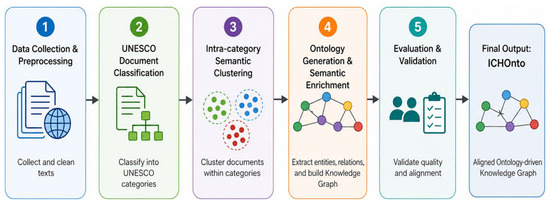
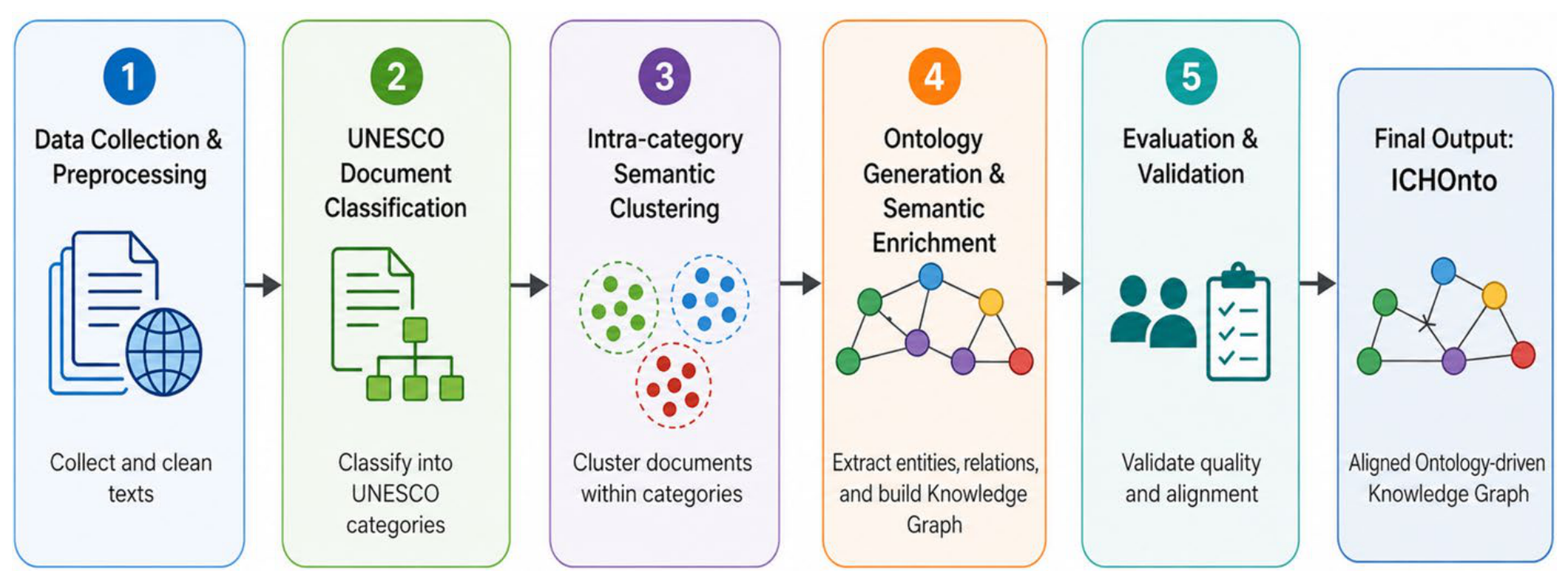
The methodological pipeline is organized into five main stages: (i) data collection and preprocessing, (ii) document classification according to the predefined UNESCO categories, (iii) intra-category clustering for the discovery of thematic substructures, (iv) ontology construction and semantic enrichment, and (v) evaluation using an expert gold standard, SHACL validation, and CQ.
Figure 1 summarizes the overall methodological pipeline used for constructing ICHOnto, an ontology-driven knowledge graph, from unstructured texts.
Figure 1.
Methodological pipeline for the semi-automatic construction of ICHOnto, an ontology-driven knowledge graph, from unstructured texts.
3.2. Corpus Construction and Gold Standard
The corpus used in this study consists of 237 textual documents, each corresponding to an element of Moroccan intangible cultural heritage (ICH). The documents were collected from institutional platforms and available data sources, including official portals, UNESCO data, and specialized cultural reports [2,3,4,5]. The final corpus size reflects the number of relevant and exploitable Moroccan ICH elements that could be collected during the corpus construction phase, rather than an arbitrary sampling decision.
The temporal coverage of the analyzed documents extends from 1974 to 2026. All documents were written in French. This linguistic characteristic motivated the choice of dangvantuan/sentence-camembert-base, a French-oriented sentence embedding model, for textual representation. In addition, paraphrase-multilingual-MiniLM-L12-v2 was included to compare the performance of a multilingual embedding space with a French-specific representation. These two models were selected because they provide sentence-level embeddings suitable for semantic similarity and clustering tasks, while offering a balanced comparison between a French-specific model and a compact multilingual alternative.
Each document is treated as an independent unit describing a cultural practice, a ritual, a form of know-how, or an oral expression.
To enable a rigorous evaluation, an initial annotated gold standard was constructed for the document classification stage, in which each document was associated with one UNESCO category. The categories are Performing Arts; Oral Traditions and Expressions; Social Practices, Rituals and Festive Events; Knowledge and Practices Concerning Nature and the Universe; and Traditional Craftsmanship.
This initial classification gold standard was developed in coordination with a domain expert and was used as the reference basis for evaluating the document classification methods.
3.3. Text Preprocessing and Normalization
The collected texts exhibit significant linguistic and typographic heterogeneity, requiring rigorous normalization to improve the quality of textual representations and ensure consistency across sources. The following preprocessing operations were applied:
- Lowercasing;
- Standardization of typographic apostrophes by replacing “’” with “‘”;
- Accent removal and Unicode normalization;
- Cleaning of special characters and punctuation;
- Preservation of apostrophes and hyphens to avoid degrading compound expressions and culturally meaningful terms;
- Replacement of non-informative characters with spaces, while preserving alphanumeric characters, spaces, apostrophes, and hyphens;
- Reduction of multiple spaces.
In addition, filename normalization was applied to ensure consistent matching between documents in the corpus and their corresponding gold-standard entries.
3.4. Document Classification
The classification of Moroccan ICH documents into predefined UNESCO categories relied on several complementary lexical and semantic approaches.
In the first step, a corpus-driven script was applied to the textual documents on Moroccan ICH to generate an initial keyword lexicon for each UNESCO category, based on the vocabulary observed in the corpus. This data-driven extraction aimed to identify representative and potentially discriminative terms for each domain, while providing a reproducible lexical basis.
In the second step, the initial lexicon underwent expert validation to assess its semantic relevance, remove noisy, overly general, or context-dependent terms, and enrich it with additional concepts, lexical variants, and specialized expressions not identified during automatic extraction. This two-step process integrates corpus-based evidence and domain expertise, yielding a more reliable, comprehensive, and classification-oriented lexical resource.
The evaluation covers a Keyword-Based Method (KW), TF-IDF, BM25, SBERT, and three hybrid variants integrating the expert lexicon with each representation: KW + TF-IDF, KW + BM25, and KW + SBERT. The experiments were conducted on the annotated corpus of 237 documents.
3.4.1. Keyword-Based Method
This method assigns each document to a category based on category-specific expert lexicons. For a given document , a score is computed for each category as follows:
Here, denotes a word occurring in the document, represents its frequency in the document , and denotes the weight assigned to the keyword in category . The predicted category is the one that obtains the highest score.
3.4.2. TF-IDF-Based Classification
TF-IDF, or Term Frequency–Inverse Document Frequency, is a statistical weighting method that represents documents in a vector space according to the relative importance of their terms:
where denotes the frequency of the term in document , is the number of documents containing , and is the total number of documents. Each document is then compared with category prototype vectors using cosine similarity.
3.4.3. BM25-Based Classification
BM25, or Best Matching 25, is a probabilistic retrieval model that extends TF-IDF by estimating the relevance between a document and a category :
where controls term-frequency saturation, and controls document-length normalization.
3.4.4. Semantic Classification with SBERT
The SBERT-based method represents both documents and category descriptions as dense vectors. Classification is then performed by comparing document vectors and category vectors using cosine similarity:
where and denote the vector representations of the document and category , respectively.
3.4.5. Hybrid Models
Hybrid models combine lexical, statistical, and semantic signals to improve classification performance. Three configurations are evaluated: KW + TF-IDF, KW + BM25, and KW + SBERT.
For each hybrid model, the scores are first normalized and then merged using a weighted linear combination:
where corresponds to the keyword-based score, and corresponds, depending on the configuration, to the TF-IDF, BM25, or SBERT score. The weighting parameters were selected through a sensitivity analysis in which several combinations of and were tested after min–max normalization.
The best-performing configurations were obtained when a slightly higher weight was assigned to the expert keyword-based score, particularly with and . This result confirms the importance of expert-validated lexical cues in a domain-specific corpus such as Moroccan ICH, while preserving the contribution of the complementary TF-IDF, BM25, or SBERT score.
The final category is selected as the one with the highest combined score. This strategy combines the precision of expert-defined keywords with the statistical or semantic information captured from the document representations.
3.5. Semantic Clustering
After classification, semantic clustering is applied within each category to identify coherent thematic subgroups. This step aims to reveal conceptual subcategories that can support ontology construction by producing partitions that are as close as possible to the expert gold standard.
3.5.1. Corpus and Gold Standard
The corpus consists of textual descriptions of Moroccan ICH, distributed across the five UNESCO categories. Each document represents a distinct semantic unit. For clustering evaluation, the reference data correspond to expert-validated GOLD files. These files contain the expert-corrected and validated document–cluster assignments established after reviewing the preliminary intra-category clustering results. They serve as ground truth for evaluating the automatic clustering configurations.
3.5.2. Document Representation
- Sentence Embeddings
Each document is represented by a dense vector generated using SentenceTransformers-based embedding models. Two models were evaluated within the grid-search protocol: paraphrase-multilingual-MiniLM-L12-v2, a multilingual Sentence-BERT model, and dangvantuan/sentence-camembert-base, a French-oriented CamemBERT-based sentence embedding model. This representation is denoted as:
The vectors are -normalized before clustering to enable effective semantic comparison using cosine similarity.
- 2.
- Dimensionality Reduction
Principal Component Analysis (PCA) is applied to the embeddings to assess the impact of dimensionality reduction on clustering performance:
3.5.3. Clustering Algorithms
Three families of clustering algorithms are evaluated.
- K-Means
K-Means partitions documents into clusters by minimizing within-cluster inertia:
where denotes the centroid of the cluster .
- Agglomerative Clustering
Agglomerative hierarchical clustering progressively merges the closest groups until clusters are obtained. In this study, three linkage criteria are tested: Ward, Average, and Complete.
- Gaussian Mixture Model
The GMM assumes that the data are generated from a mixture of Gaussian distributions. The probability of observing a vector is estimated as follows:
where is the weight of the component , is its mean, and is its covariance matrix. Each document is assigned to the component with the highest posterior probability.
3.5.4. Hyperparameter Optimization
A systematic search for the best configurations is conducted for each UNESCO category. This search explores several parameters, including the embedding model, PCA dimensionality, number of clusters , and algorithm-specific parameters.
3.5.5. Evaluation Metrics
The partitions generated are compared with the expert gold standard using several external evaluation metrics:
- Adjusted Rand Index (ARI): measures the agreement between the predicted partition and the reference partition while correcting for chance.
- Normalized Mutual Information (NMI): evaluates the amount of shared information between the two partitions.
- Macro-F1: computed after optimal matching between predicted clusters and reference clusters.
- Purity: measures the proportion of documents correctly grouped within the majority class of each predicted cluster.
3.5.6. Configuration Selection Strategy
The selection of the best clustering configuration for each category is based on a multi-criteria comparison of the performance obtained. Configurations are ranked according to the following priority order: ARI, NMI, Macro-F1, and Purity. For each category, this strategy selects the partition that best balances agreement with the gold standard and the quality of the generated clusters.
3.6. Construction of the GOLD Files
After intra-category semantic clustering, the generated thematic clusters were reviewed, corrected, and validated by the domain expert. The corrected document–cluster assignments were then stored as GOLD files for each UNESCO category. In this study, the term GOLD files refers to the expert-validated cluster annotation files obtained after clustering. These files associate each document with a validated thematic cluster and serve both as reference data for clustering evaluation and as structured input for ontology generation.
These files enable the transformation of thematic groupings into validated conceptual classes. They therefore ensure the transition from textual analysis to ontological modeling by considering clusters as future subclasses of the final ontology.
3.7. Generation of the ICHOnto Ontology
Based on the validated GOLD files, the ICHOnto ontology is semi-automatically generated by converting classification and clustering outputs into a formal representation of Moroccan ICH. The ICHOnto ontology was implemented using Protégé 5.5.0, an open-source OWL ontology editor developed by the Stanford Center for Biomedical Informatics Research.
This modeling combines two levels: a hierarchy of classes and subclasses, and a factual representation of heritage elements, their contexts, associated actors, and related objects.
3.7.1. Choice of the Ontological Model
The ontological model adopted for ICHOnto relies on CIDOC CRM as its conceptual reference framework. This choice serves two main objectives: ensuring interoperability with international heritage modeling standards and providing a robust semantic basis for representing heterogeneous entities such as practices, oral expressions, events, actors, places, and objects mentioned in heritage descriptions.
3.7.2. Class Hierarchy
The hierarchical structure of the ontology is based on a simple principle: each major UNESCO category of ICH is modeled as an owl:Class and aligned with a semantically appropriate CIDOC CRM class. The selected mappings are presented in Table 1.
Table 1.
Mapping between ICH domains and associated CIDOC CRM classes.
On this basis, the validated clusters derived from the GOLD files are transformed into OWL subclasses of their respective UNESCO domains. Each cluster, therefore, no longer corresponds merely to an empirical grouping of documents, but rather to an explicit conceptual entity within the ontology. The documents or heritage elements described in the corpus are represented as individuals of these classes or subclasses.
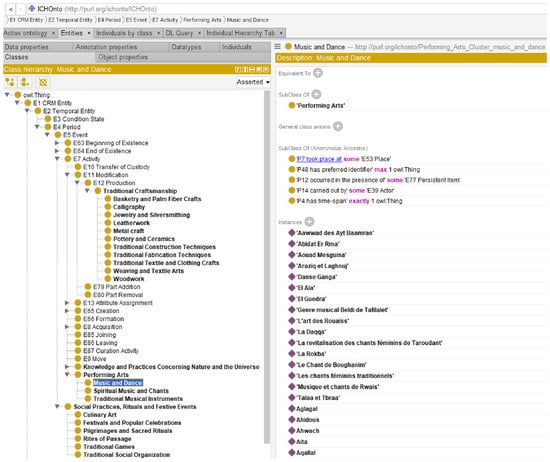
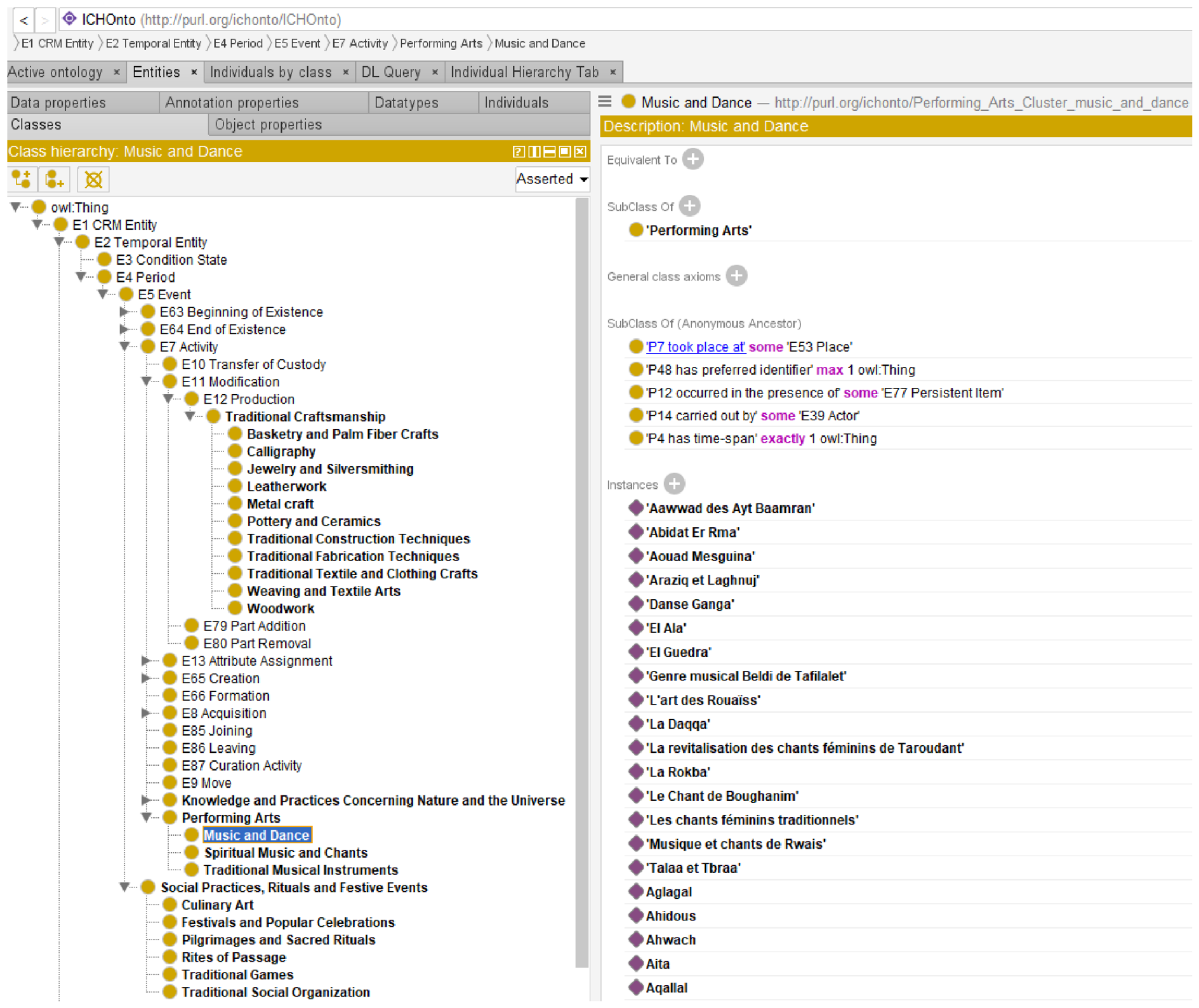
This hierarchical organization aligns the upper level of the taxonomy with the main UNESCO categories and introduces a more fine-grained second level derived from corpus-based semantic analysis. It thus constitutes the conceptual foundation of the ICHOnto ontology. Figure 2 presents an excerpt of ICHOnto in Protégé, showing how the classification and clustering outputs are organized into an ontology hierarchy aligned with CIDOC CRM.
Figure 2.
Excerpt of the ICHOnto ontology in Protégé, illustrating its CIDOC CRM-aligned hierarchy. Yellow circular icons represent ontology classes, while purple diamond icons represent individuals/instances associated with the selected class.
3.8. Semantic Enrichment
Beyond its hierarchical structure, the ontology is automatically enriched with contextual and institutional information. Contextual information includes places, actors, groups, objects, instruments, animal types, and source documents associated with heritage elements. Institutional information describes their official status, including UNESCO inscription, year of inscription, heritage status, and implemented or planned safeguarding activities.
This enrichment complements the taxonomic representation with a factual, contextual, and temporal knowledge layer aligned with CIDOC CRM. A specific constraint is also applied to elements of type E33_Linguistic_Object to avoid inappropriate event-related relations. These enrichment choices are summarized in Table 2.
Table 2.
Main contextual, institutional, and temporal classes and properties used in ICHOnto.
3.9. Ontology Evaluation
The evaluation of the ICHOnto ontology aims to assess its formal validity, the conformity of the instantiated data, and its functional usefulness for representing Moroccan ICH. This evaluation is structured around three complementary levels: OWL-based consistency checking, SHACL validation of instantiated data, and functional assessment using CQ.
3.9.1. Logical Consistency Checking
The logical consistency of ICHOnto is verified using the Pellet OWL reasoner to detect potential contradictions. This verification concerns the alignment between UNESCO categories, CIDOC CRM classes, subclasses derived from validated clusters, and heritage individuals.
3.9.2. SHACL Validation of Instances and Relations
SHACL validation complements logical consistency checking by assessing the conformity of RDF instances and relations. It verifies the typing of heritage elements, the validity of documentary and contextual links, and the expected datatypes for data properties.
3.9.3. Functional Evaluation Through Competency Questions
The functional evaluation of ICHOnto is based on Competency Questions, which are translated into SPARQL queries and executed over the ontology. The CQs were developed by the authors based on the functional objectives of ICHOnto and were reviewed by the domain expert to ensure their relevance to Moroccan ICH. This evaluation verifies whether the model supports effective querying of the institutional, factual, conceptual, and temporal dimensions of Moroccan ICH.
These questions are organized into nine functional categories (see Table 3), covering UNESCO inscriptions, contextual relations, conceptual structuring, data quality, interoperability, and institutional monitoring.
Table 3.
Categories of Competency Questions Selected for the Functional Evaluation of ICHOnto.
The selected Competency Questions are presented in Table 4.
Table 4.
List of Competency Questions.
This functional evaluation shows that ICHOnto can be queried at multiple levels and for different purposes, including descriptive, analytical, comparative, documentary, and institutional uses. It confirms ICHOnto’s ability to represent heritage elements, analyze their relations, assess data quality, ensure interoperability with CIDOC CRM, and model the institutional and temporal dynamics of safeguarding mechanisms.
4. Results and Discussion
The evaluation follows the main stages of the proposed pipeline: text document classification, intra-category clustering, and validation of the generated ontology. It combines logical consistency checking, SHACL validation, and CQ. The results highlight the relevance of hybrid approaches for classification and of a category-specific clustering strategy, thereby confirming the suitability of the proposed framework for constructing an ontology of Moroccan ICH.
4.1. Document Classification Results
4.1.1. Overall Performance of the Classification Methods
The first evaluation concerns the classification of text documents according to the five UNESCO categories of ICH. This evaluation was conducted using a gold standard of 237 documents validated by a domain expert. Seven methods were compared: an approach based on expert-defined keywords, three individual methods, namely SBERT, TF-IDF, and BM25, and three hybrid methods combining expert-defined keywords with TF-IDF, SBERT, and BM25. Performance was assessed using Accuracy, Macro-F1, Weighted-F1, and the number of evaluated documents.
Table 5 presents the overall performance of the different classification methods. In this table, the number of evaluated documents differs across methods because the classification pipeline includes a confidence-based uncertainty mechanism. A document was labeled as UNCERTAIN when the best category score was below a predefined minimum threshold or when the margin between the two highest category scores was too small to avoid forcing a category assignment in weak or ambiguous cases. These cases correspond to documents for which the method did not produce a sufficiently confident category assignment and were therefore excluded from the calculation of categorical performance metrics. Consequently, the “Evaluated Documents” column reports the effective coverage of each method, measured as the number of documents receiving a non-UNCERTAIN prediction out of the 237 documents in the gold standard. The results show that approaches incorporating expert-defined keywords achieve the most stable and practically useful performance for classifying documents related to Moroccan ICH.
Table 5.
Overall Performance of the document classification methods.
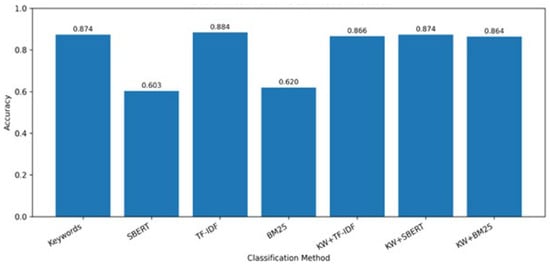
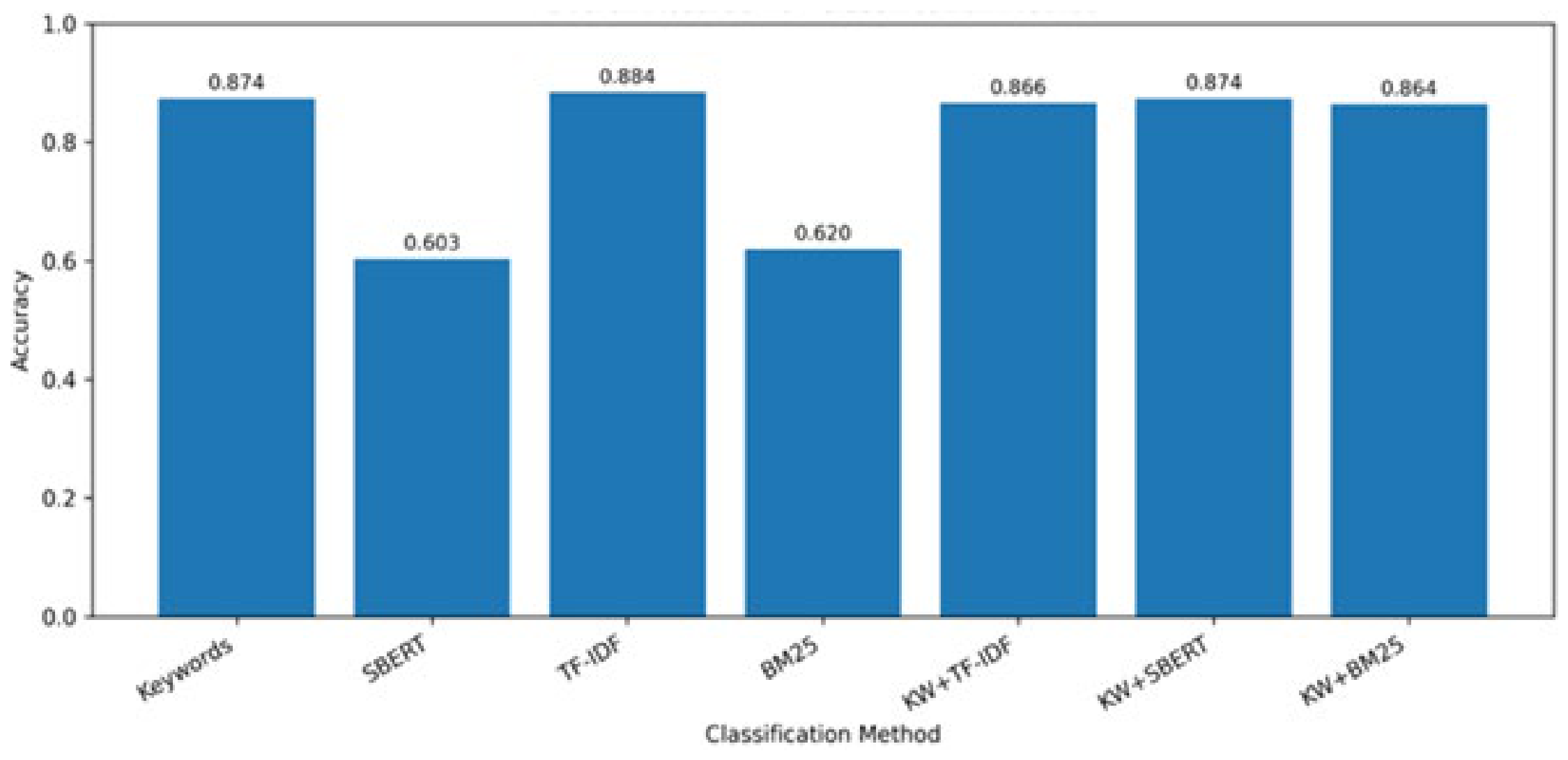
Figure 3 shows that the TF-IDF method achieves the highest apparent Accuracy, at 0.884. However, this result is not fully representative, as it is based on only 43 of the 237 documents, corresponding to an effective coverage of 18.1%, with 194 uncertain cases excluded. The high TF-IDF Accuracy therefore reflects performance on a small subset of documents for which the method produced confident predictions, rather than performance on the corpus as a whole. Consequently, its direct comparison with methods evaluated on more than 220 documents is limited. For this reason, TF-IDF is excluded from the main comparative analysis of the classification methods and is retained only for indicative purposes.
Figure 3.
Overall Accuracy by Classification Method.
Considering the six selected methods, the results show that approaches incorporating expert-defined keywords achieve the strongest performance. When used independently, SBERT and BM25 achieve the lowest scores, suggesting that generic models alone are inadequate for classifying a specialized cultural heritage corpus. The Keywords method provides a strong and interpretable baseline with an Accuracy of 0.874. Among the hybrid approaches, KW + SBERT offers the best operational trade-off: it maintains the same Accuracy as the Keywords method while evaluating more documents, namely 230 compared with 222. KW + TF-IDF achieves the highest Macro-F1 score of 0.836, reflecting a better balance across categories. KW + BM25 also remains competitive, with performance close to that of the other hybrid approaches. Overall, the comparison of the six selected methods confirms that effective classification of Moroccan ICH requires expert lexical knowledge, complemented by additional textual similarity methods.
4.1.2. Category-Level Performance Analysis
The category-level analysis reveals differences in performance across UNESCO domains. Categories associated with technical or specialized vocabulary are generally better recognized, whereas categories that are semantically closer to one another present greater classification challenges. Table 6 presents the F1-scores obtained by the six selected methods.
Table 6.
F1-score by Category and Method.
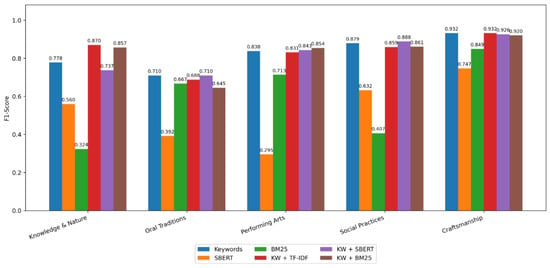
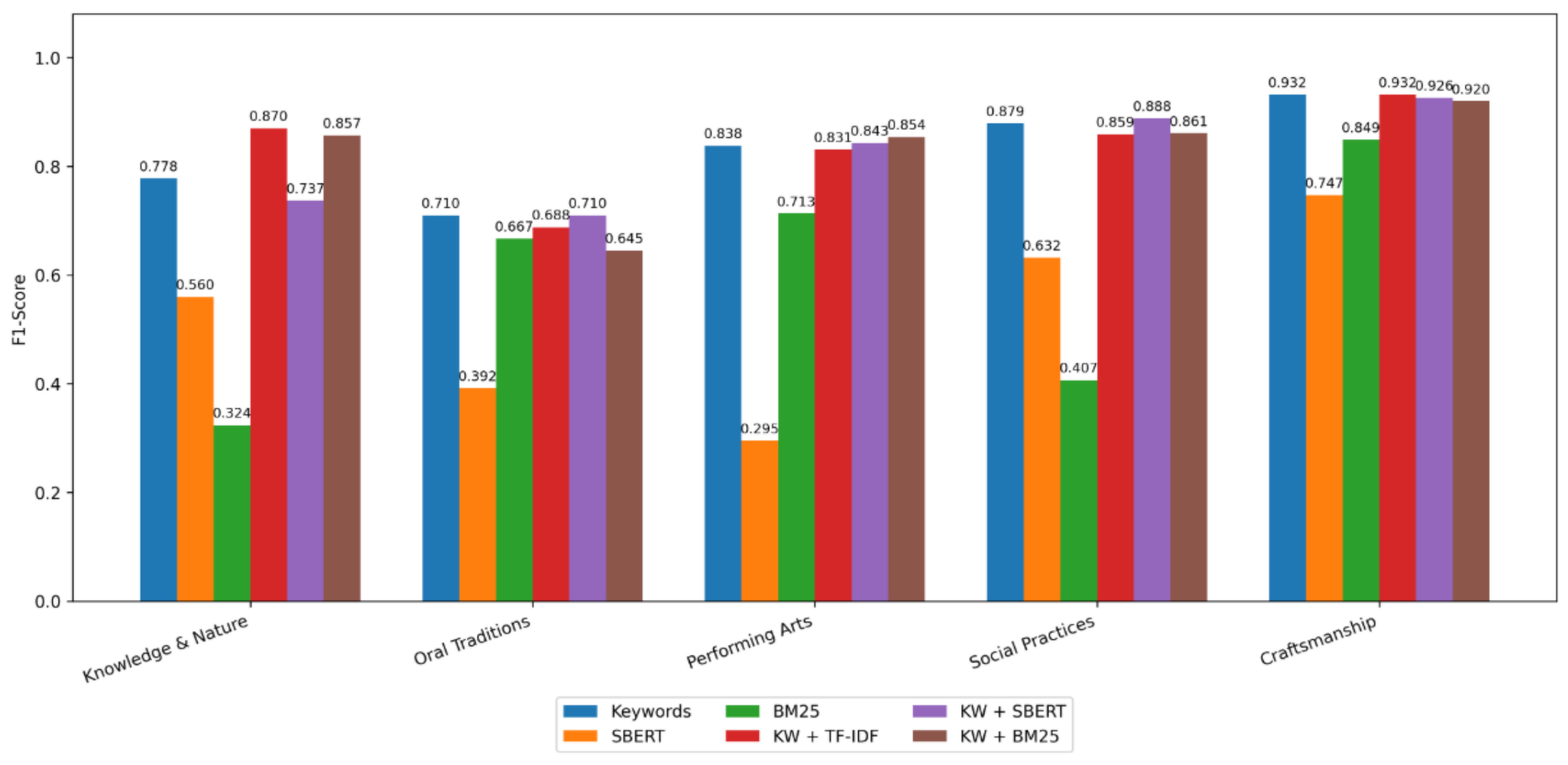
Figure 4 complements Table 6 by showing the differences in F1-scores across classification methods for each UNESCO category. The results confirm that methods incorporating expert-defined keywords provide the most stable performance, whereas SBERT, used alone, remains generally less effective, particularly for the Performing Arts category.
Figure 4.
F1-score by UNESCO Category and Classification Method.
The best-performing hybrid approach varies by category: KW + TF-IDF performs best for Knowledge and Practices Concerning Nature and the Universe, KW + BM25 for Performing Arts, and KW + SBERT for Social Practices, Rituals and Festive Events. Traditional Craftsmanship appears to be the most stable and best-recognized category, mainly because of its distinctive technical vocabulary. By contrast, Oral Traditions and Expressions remain the most difficult category to distinguish, probably because of lexical and thematic overlaps with other categories.
In summary, the classification phase provides a reliable basis for the subsequent stages of the pipeline. The assignment of documents to UNESCO categories enables the identification of internal thematic substructures within each domain through semantic clustering.
4.2. Overall Comparison of Clustering Configurations
The evaluation of intra-category clustering was conducted after document classification. Its objective is to identify coherent thematic subgroups within each category that can serve as a basis for ontological structuring. To ensure transparency and reproducibility, a grid-search procedure was applied by testing different embedding models, PCA dimensionality reduction settings, numbers of clusters, and clustering algorithms. The evaluated embedding models were paraphrase-multilingual-MiniLM-L12-v2 and dangvantuan/sentence-camembert-base. PCA was tested with 0, 50, and 100 dimensions, where PCA = 0 indicates that no dimensionality reduction was applied. The number of clusters was varied using offsets of −1, 0, and +1 around the expert-validated reference number of clusters. Three clustering algorithms were compared: K-Means, Agglomerative Clustering, and GMM.
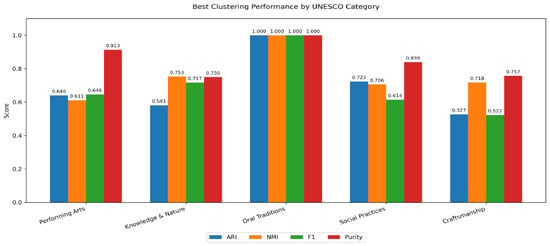
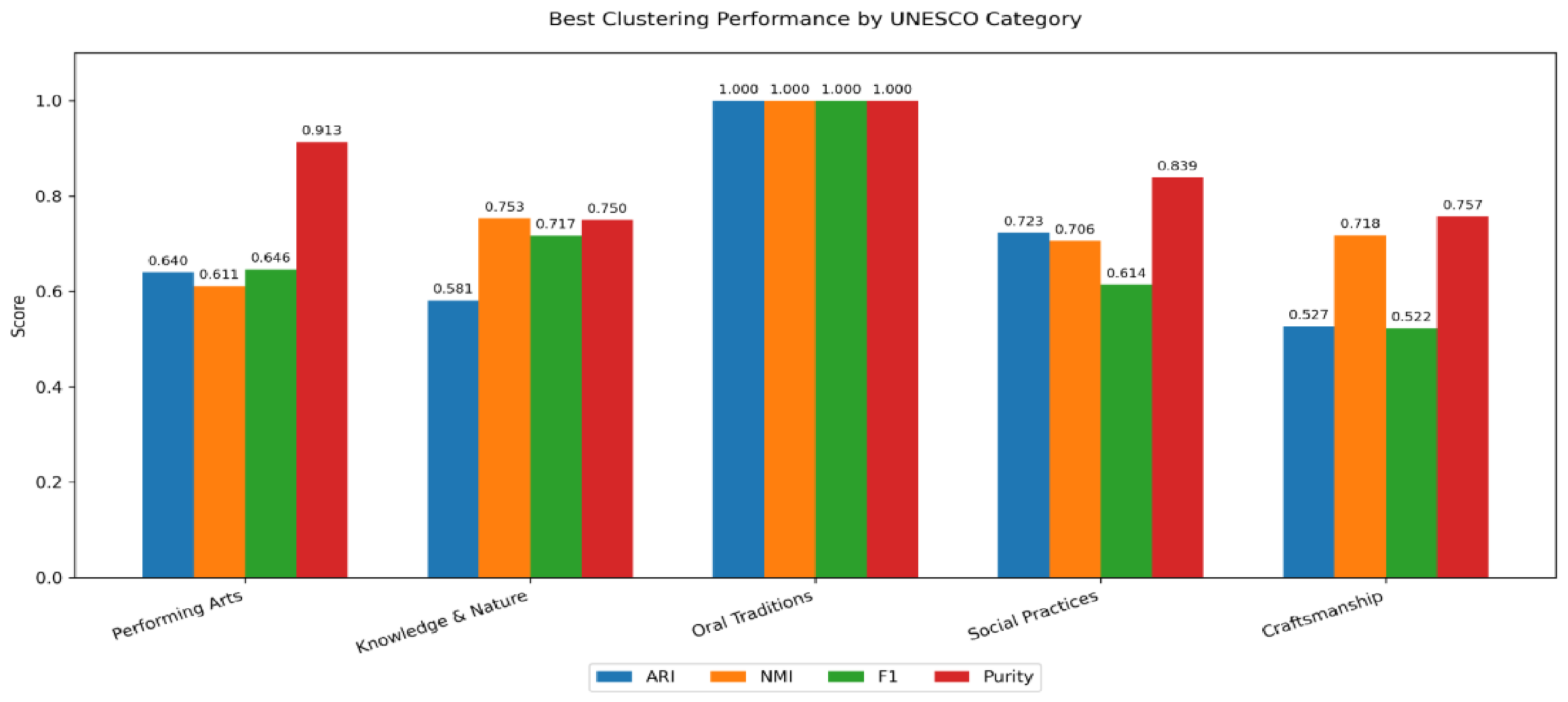
The best clustering configurations are presented in Table 7, and their performance across the main evaluation metrics is shown in Figure 5.
Table 7.
Best Clustering Configuration by UNESCO Category.
Figure 5.
Best Clustering Performance by UNESCO Category.
Three algorithms were evaluated for intra-category clustering: K-Means, Agglomerative Clustering, and GMM. However, only GMM and Agglomerative Clustering appear among the best configurations reported in Table 7. The absence of K-Means suggests that, among the tested configurations, this method is less effective at capturing the corpus’s semantic structure. This result supports the relevance of experimentally comparing several clustering algorithms. Table 7 confirms that no single method dominates across all categories. GMM achieves the best results for Knowledge and Practices Concerning Nature and the Universe, and Oral Traditions and Expressions. In contrast, Agglomerative Clustering performs better for Performing Arts, Social Practices, Rituals and Festive Events, and Traditional Craftsmanship. These variations show that a uniform configuration would be less appropriate than a strategy adapted to the characteristics of each category.
Figure 5 shows that clustering performance varies across UNESCO categories. Oral Traditions and Expressions achieves the best results, with perfect scores for ARI, NMI, F1, and Purity. This category contains 13 documents distributed across two expert-validated reference clusters: Oral Heritage, with 10 documents, and Languages and Dialects, with 3 documents. These perfect scores indicate an exact match between the generated clusters and the expert-validated reference partition for this specific category. This can be explained by the relatively clear thematic separation between oral heritage practices and language- or dialect-related elements. Nevertheless, the result should be interpreted cautiously because of the limited number of documents in this category.
By contrast, Traditional Craftsmanship shows more moderate performance, particularly for ARI and F1, suggesting a more complex thematic structure.
Overall, intra-category clustering provides an exploitable thematic structure for ontology construction. The resulting clusters can be used to identify subclasses, conceptual groups, or thematic axes within the ontology of Moroccan ICH.
4.3. Ontology Evaluation Results
The evaluation of ICHOnto is not limited to classification and clustering performance; it also addresses the intrinsic quality of the generated ontology. To this end, the analysis was conducted along three complementary dimensions: the logical consistency of the ontological structure, the validation of instances and relations using SHACL, and the functional evaluation based on CQ. Together, these three components provide a basis for assessing whether the resulting ontology is formally consistent, semantically valid, and operational for querying Moroccan ICH.
4.3.1. Logical Consistency of the Ontology
The first step involves checking the logical consistency of the generated ontology using the Pellet OWL reasoner, with particular attention to the alignment among UNESCO categories, CIDOC CRM classes, subclasses derived from validated clusters, and individuals representing heritage elements. This verification confirmed that the hierarchical structure produced by the pipeline is conceptually consistent and provides a reliable basis for semantic reasoning. This result validates the compatibility between the domain taxonomy and the selected ontological model.
4.3.2. SHACL Validation of Instances and Relations
In addition to the logical consistency assessment, SHACL validation was applied to instances and relations to verify the conformity of the instantiated data with the modeling choices. This validation covered heritage individuals, contextual relations, and automatically generated data properties, including P70_is_documented_in, P7_took_place_at, P11_had_participant, P16_used_specific_object, as well as ich:unescoListed, ich:unescoInscriptionYear, and ich:usesAnimalType.
The validation was performed using pySHACL with RDFS inference enabled. The SHACL shapes graph included 12 node shapes, 26 property constraints, and 6 SPARQL constraints, corresponding to a total of 32 constraint blocks. The validation report returned Conforms: true, with 0 validation results, 0 violations, 0 warnings, and 0 informational messages. These quantitative results indicate that the evaluated version of ICHOnto satisfies all defined SHACL constraints.
The results show that the essential model constraints are satisfied, particularly the correct association of items with their source documents, places, actors, and objects, as well as the conformity of the value types used for institutional properties. The validation also confirmed compliance with the specific constraint imposed on elements aligned with E33_Linguistic_Object, which must not be directly assigned certain inappropriate event-related relations.
4.3.3. Functional Evaluation Through Competency Questions
The functional evaluation of ICHOnto is based on a set of CQ implemented as SPARQL queries. Its objective is to verify that the ontology is not limited to formal consistency but also supports effective semantic querying.
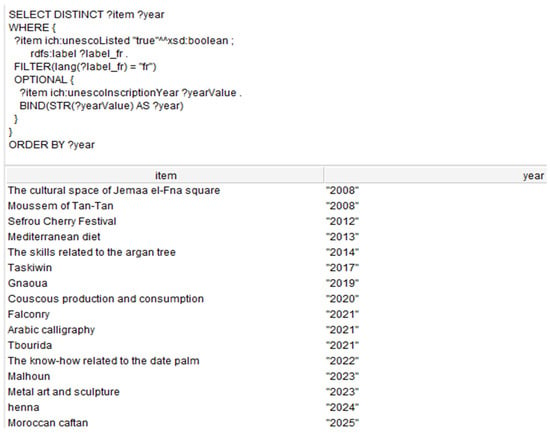
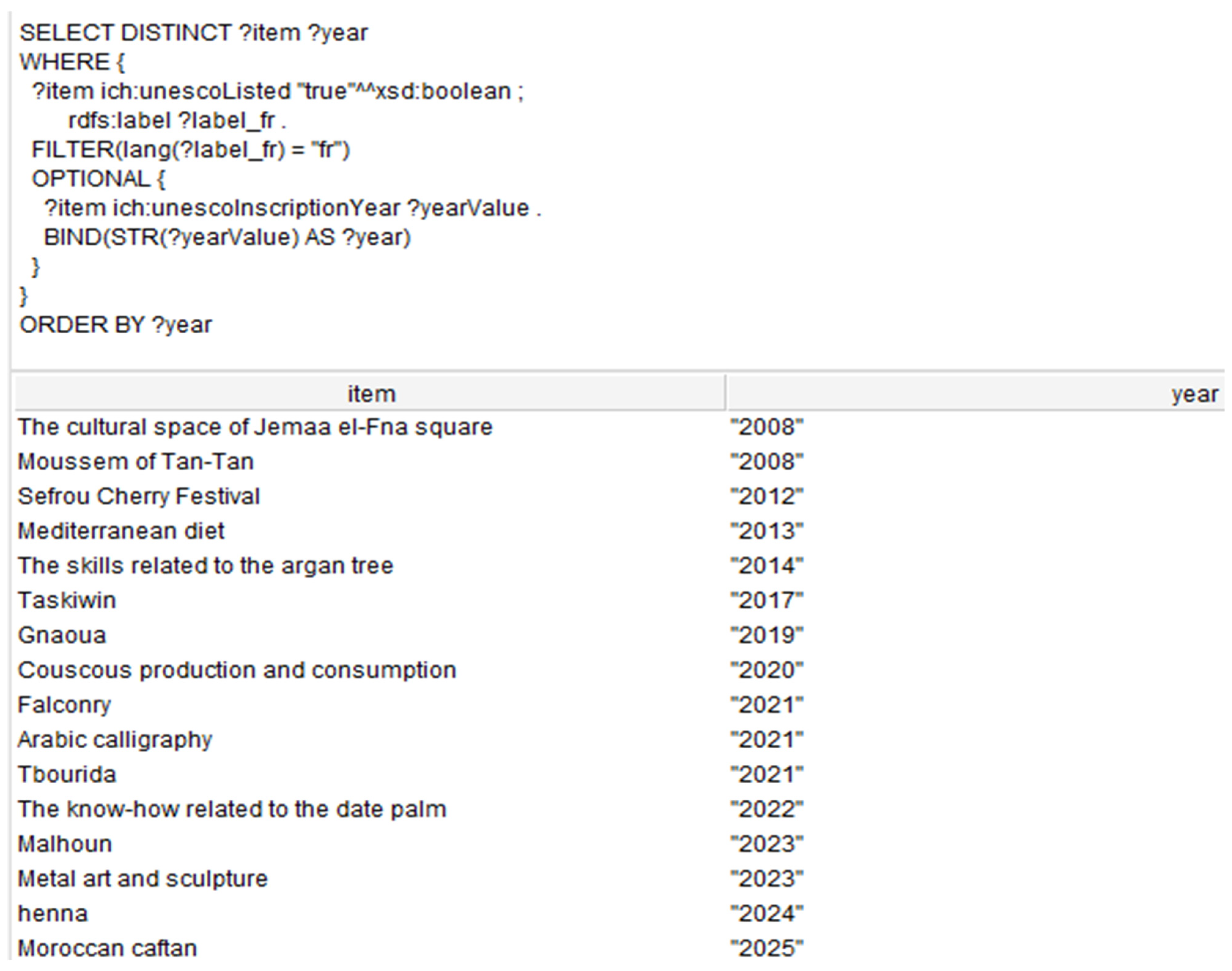
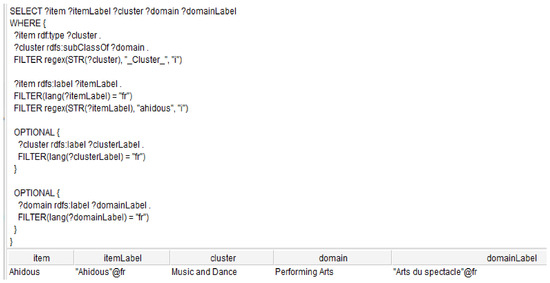
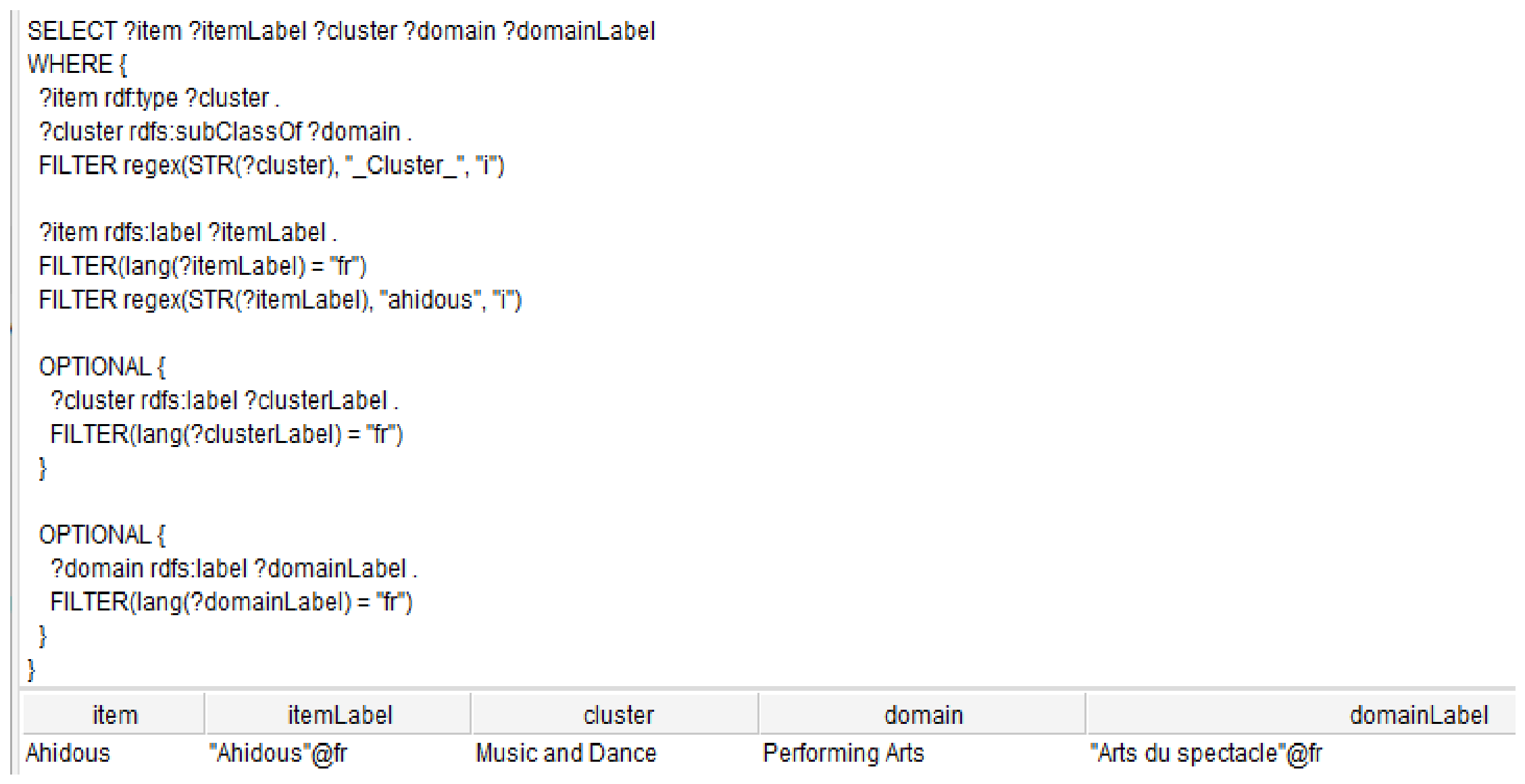
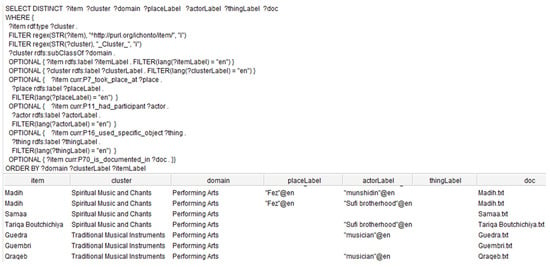
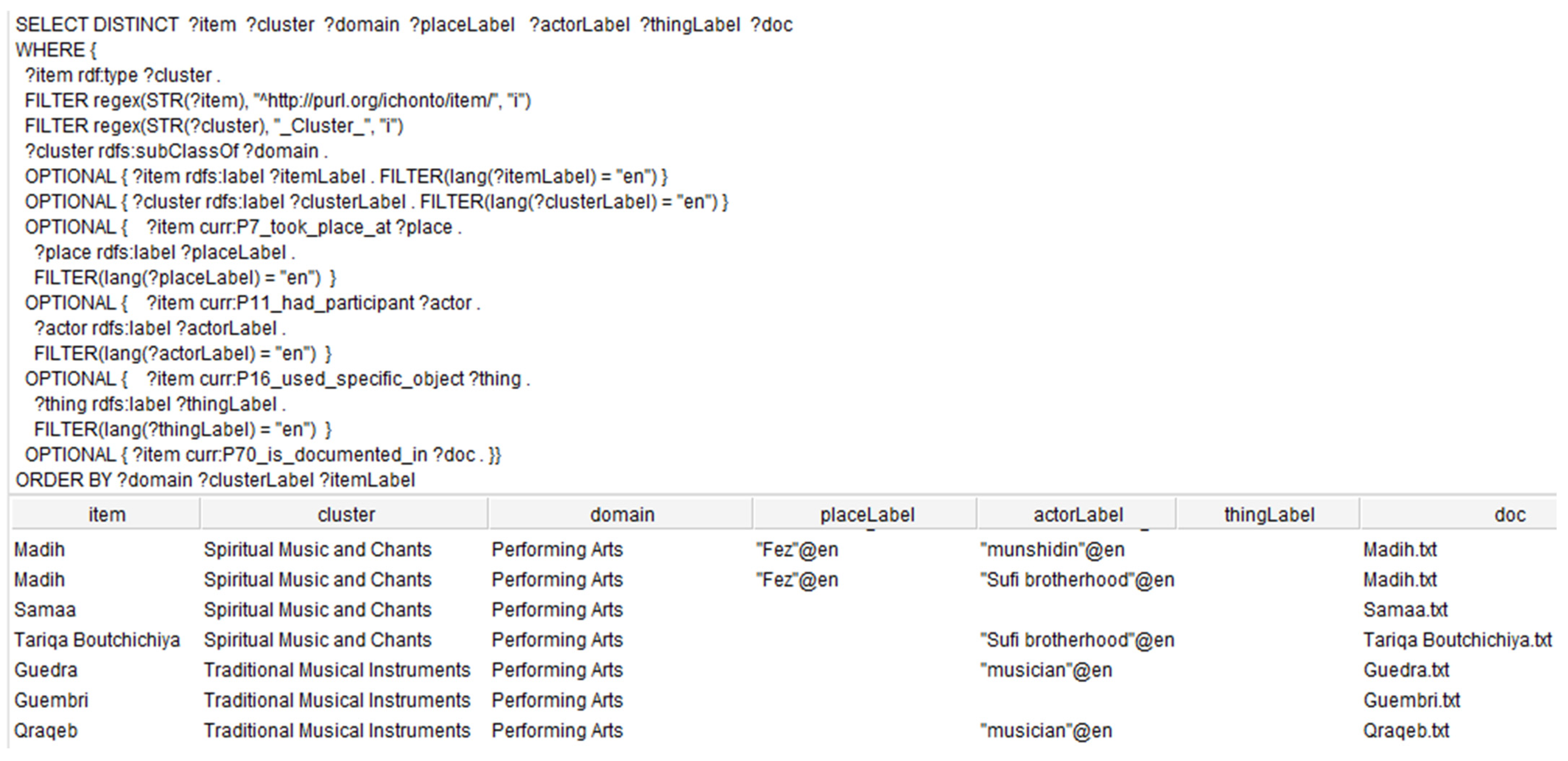
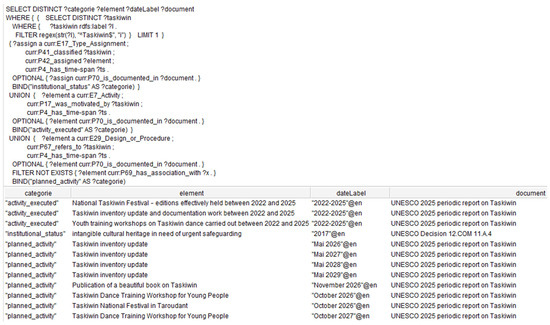
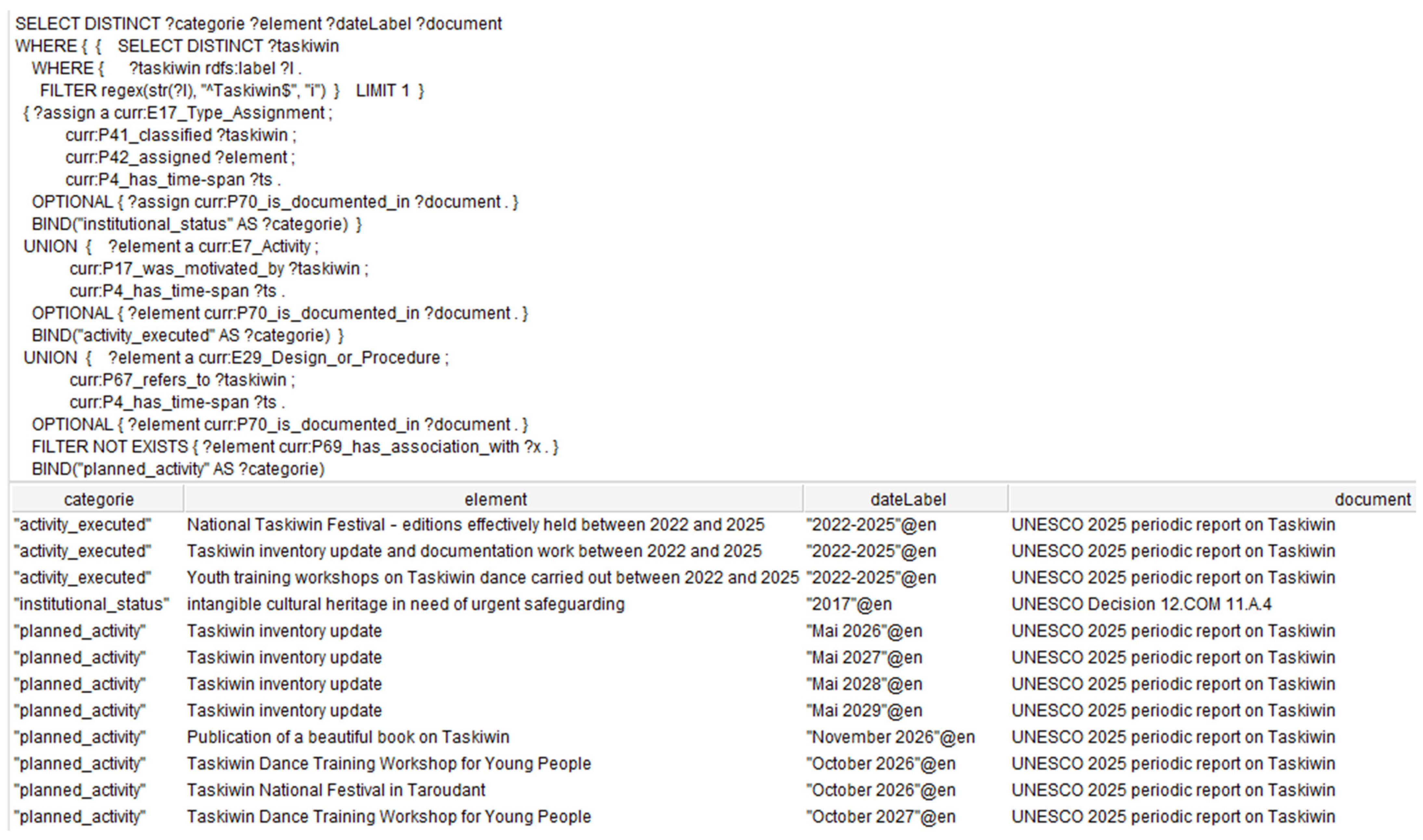
Figure 6, Figure 7, Figure 8 and Figure 9 illustrate this evaluation by presenting representative SPARQL query results associated with Competency Questions. These examples demonstrate that ICHOnto supports structured semantic querying, enabling the exploration of institutional metadata, factual relations between items, conceptual organization, documentary provenance, and institutional and temporal dimensions.
Figure 6.
Execution result of the SPARQL query associated with CQ1, retrieving the ICH elements inscribed on the UNESCO list with their year of inscription.
Figure 7.
Execution result of the SPARQL query associated with CQ12, retrieving the UNESCO category and validated semantic cluster assigned to a given heritage element.
Figure 8.
Execution result of the SPARQL query associated with CQ19, retrieving both conceptual ontology levels and factual item-level descriptions within a single query.
Figure 9.
Execution result of the SPARQL query associated with CQ25, retrieving Taskiwin’s institutional status, implemented and planned safeguarding activities, dates, and associated documents.
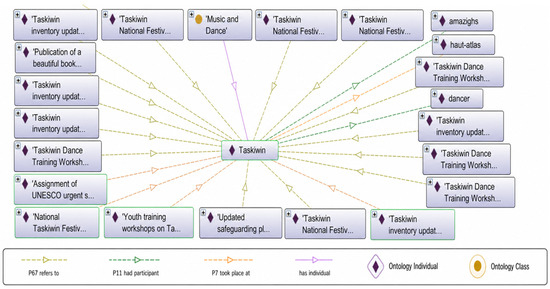
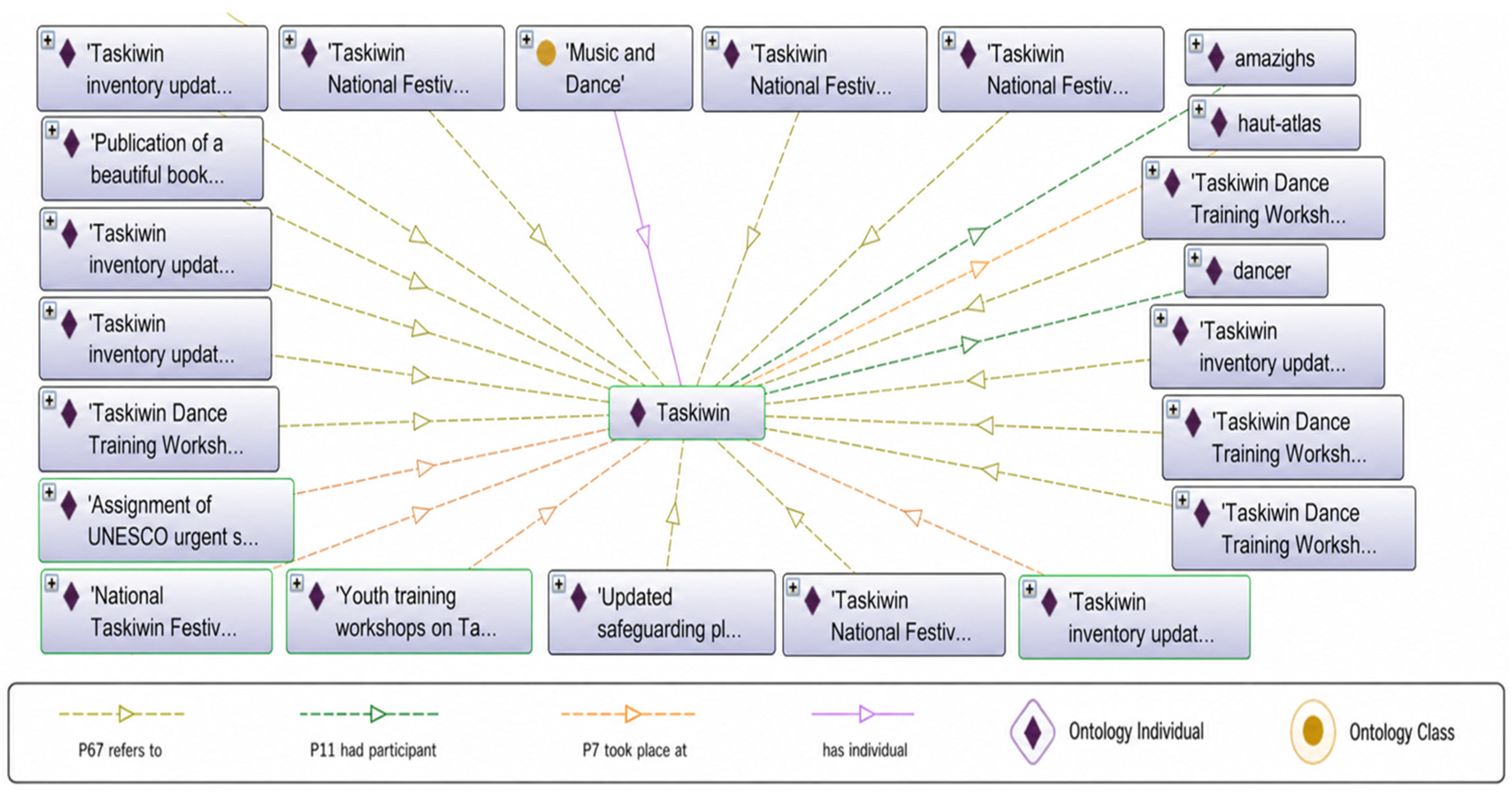
To provide a concrete view of the generated knowledge graph, Figure 10 presents an instance-level excerpt centered on the heritage element Taskiwin. The visualization was generated in Protégé using the OntoGraf plug-in and shows the links between Taskiwin, its semantic cluster, related places, participants, safeguarding activities, and inventory updates. The colored arrows indicate the relation types represented in the graph, namely P67_refers_to, P11_had_participant, P7_took_place_at, and has individual relation. This figure complements the ontology hierarchy presented earlier by illustrating the factual knowledge generated through semantic enrichment.
Figure 10.
Excerpt of the constructed ontology-based knowledge graph centered on Taskiwin, visualized in Protégé using OntoGraf. The figure shows the links between Taskiwin, its semantic cluster, related places, participants, safeguarding activities, and inventory updates.
Overall, this functional evaluation shows that ICHOnto can be queried at different levels of granularity and for various purposes, including descriptive, analytical, documentary, and institutional uses. It therefore confirms the ontology’s capacity to represent heritage knowledge, ensure its traceability and interoperability, and support the analysis of safeguarding mechanisms within a coherent semantic framework.
From a scalability and maintenance perspective, ICHOnto can also be progressively extended by adding new heritage elements, validated clusters, contextual entities, documents, and institutional metadata while preserving its CIDOC CRM-aligned structure. Its maintenance can be supported through repeated SHACL validation, OWL consistency checking, expert review of newly added elements, and versioning of ontology releases and source datasets.
5. Conclusions and Future Work
This work proposes a semi-automatic methodological framework for constructing an ontology of Moroccan ICH from unstructured texts and enriching it into an ontology-based knowledge graph. The approach is based on three complementary stages: document classification according to the five UNESCO categories, intra-category semantic clustering to identify thematic substructures, and the generation of an ontology aligned with CIDOC CRM. The overall pipeline was designed to transform a heterogeneous textual corpus into a structured, usable, and interoperable semantic resource.
The results highlight several findings. First, document classification proves more effective when supported by a hybrid approach that integrates expert lexical cues and semantic representations. Second, intra-category clustering identifies coherent thematic substructures, although its performance varies across UNESCO categories. Finally, no single method emerges as optimal for the entire pipeline; instead, the best results depend on the characteristics of the domain under study.
These findings confirm that the modeling of ICH from unstructured texts requires a multi-level approach that combines reliable document classification, intra-category thematic structuring, and ontological integration. The study, therefore, shows that combining robust hybrid classification with category-specific semantic clustering provides a solid methodological basis for the semi-automatic discovery of subcategories and their integration into a domain ontology.
The evaluation of ICHOnto further confirms its logical consistency, compliance with SHACL constraints, and ability to answer CQ. The contribution of this work, thus, extends beyond the application of text-processing techniques to ICH by demonstrating that a pipeline integrating classification, clustering, and ontology engineering can produce a coherent, validated, and functionally usable semantic resource.
This pipeline also has potential for reuse in other heritage contexts or in any domain based on the exploitation of unstructured textual corpora, provided that the classification categories, expert lexicon, reference corpus, and ontological model are adapted to the domain under study. This reusability strengthens the methodological scope of the work by showing that the proposed approach can serve as a generic framework for transforming heterogeneous textual documents into structured semantic resources.
However, several limitations should be acknowledged. The corpus remains relatively limited in size and mainly relies on institutional and available documentary sources, which may underrepresent local practices, regional variants, and less-documented forms of Moroccan ICH. In addition, although expert-generated lexicons improve domain relevance, they may introduce selection bias by reflecting the available sources and the experts’ interpretation of UNESCO categories. The generalization of the approach to other heritage corpora, countries, or languages would therefore require adapting the lexicons, validating the categories, and reassessing the models in the target context. Finally, the embedding models used are generic multilingual or French-oriented models and may not fully capture heritage-specific semantics, local terminology, Arabic transliterations, Amazigh or Darija expressions, and implicit cultural relations. These limitations highlight the need for broader corpora, domain-adapted lexical resources, and heritage-specific language models in future work.
A first direction for future work involves extending ICHOnto by integrating additional elements of Moroccan ICH, particularly those that are poorly represented or absent from institutional sources. Such an extension would broaden ICHOnto’s coverage and provide a more comprehensive representation of local practices, expressions, and know-how.
A second major direction concerns the interconnection of ICHOnto with other heritage resources, particularly MedinaOnto [43], the ontology of the tangible heritage of Fez, as well as with institutional databases and larger-scale cultural knowledge graphs. Such interoperability would enable connections between the intangible dimensions of heritage, such as practices, know-how, and cultural expressions, and the associated places, objects, and heritage spaces. It would also enhance the use of ICHOnto in semantic querying, heritage navigation, cultural mediation, and digital valorization. From this perspective, ICHOnto can be considered an initial building block for an interoperable heritage knowledge ecosystem dedicated to Moroccan cultural heritage.
A third direction would be to explore domain-adapted or heritage-specific language models for intangible cultural heritage more broadly. Since the embedding models used in this study are generic multilingual or French-oriented models, future work could investigate the fine-tuning of transformer-based models on larger and more diverse ICH corpora. In the Moroccan context, such corpora should include Moroccan ICH texts, Arabic transliterations, Amazigh or Darija expressions, and heritage-specific terminology. These models could improve the representation of culturally grounded concepts and implicit semantic relations, thereby strengthening both the classification and clustering stages of the proposed pipeline.
Author Contributions
Conceptualization, H.D.; Methodology, H.D.; Validation, H.D., I.C. and A.Z.; Formal analysis, H.D.; Investigation, H.D.; Data curation, H.D.; Writing—original draft preparation, H.D.; Writing—review and editing, H.D., I.C. and A.Z.; Supervision, I.C. and A.Z. All authors have read and agreed to the published version of the manuscript.
Funding
This research received no external funding.
Data Availability Statement
The data presented in this study are available on request from the corresponding author. The dataset is not publicly available due to restrictions related to the reuse and redistribution of some source texts and the inclusion of expert-validated annotations developed within the framework of this research.
Acknowledgments
The authors gratefully acknowledge Halima Naji, Head of the Inventory Service of Moroccan Cultural Heritage, for her expert support in validating the classification and clustering results, as well as in assessing the quality and functional relevance of the ICHOnto ontology from a domain-expert perspective. During the preparation of this manuscript, the authors used ChatGPT-5.5 for academic writing support, translation assistance, and the generation of graphical representations based on the authors’ experimental results. The authors reviewed and edited the output and take full responsibility for the content of this publication.
Conflicts of Interest
The authors declare no conflicts of interest.
Abbreviations
The following abbreviations are used in this manuscript:
| ICH | Intangible Cultural Heritage |
| KW | Keyword-Based Method |
| GMM | Gaussian Mixture Model |
| CQ | Competency Questions |
References
- UNESCO. Convention for the Safeguarding of the Intangible Cultural Heritage; UNESCO: Paris, France, 2003; Available online: https://ich.unesco.org/en/convention (accessed on 9 October 2025).
- Royaume du Maroc. Patrimoine Culturel Immatériel du Maroc. Available online: https://www.maroc.ma/fr/culture-du-maroc/patrimoine-immateriel (accessed on 9 October 2025).
- Ministère de la Jeunesse, de la Culture et de la Communication. Patrimoine Culturel Immatériel. Available online: https://mjcc.gov.ma/fr/departements/culture/patrimoine-culturel-immateriel/ (accessed on 9 October 2025).
- UNESCO. Intangible Cultural Heritage Lists. Available online: https://ich.unesco.org/fr/listes (accessed on 9 October 2025).
- Skounti, A. Le Patrimoine Culturel Immatériel au Maroc: Promotion et Valorisation des Trésors Humains Vivants. 2005. Available online: https://ahmedskounti.weebly.com/uploads/7/4/0/8/7408619/le_patrimoine_culturel_immatriel_au_maroc._proclamation_et_valorisation_des_trsors_humains_vivants_2005.pdf (accessed on 16 October 2025).
- Doerr, M. The CIDOC CRM—An Ontological Approach to Semantic Interoperability of Metadata. AI Mag. 2003, 24, 75–92. [Google Scholar] [CrossRef]
- Huang, Y.; Yu, S.; Chu, J.; Fan, H.; Du, B. Using Knowledge Graphs and Deep Learning Algorithms to Enhance Digital Cultural Heritage Management. Herit. Sci. 2023, 11, 186. [Google Scholar] [CrossRef] [Scilit]
- Wang, Y.; Zhang, M. CIDOC CRM-Based Knowledge Graph Construction for Cultural Heritage Using Large Language Models. Appl. Sci. 2025, 15, 12063. [Google Scholar] [CrossRef] [Scilit]
- Gómez-Pérez, A.; Fernández-López, M.; Corcho, O. An Overview of Ontology Learning from Unstructured Texts. In Knowledge Engineering and Knowledge Management; Springer: Berlin/Heidelberg, Germany, 2005. [Google Scholar]
- Al-Aswadi, F.; Chan, H.Y.; Gan, K.H. Automatic Ontology Construction from Text: A Review from Shallow to Deep Learning Trend. Artif. Intell. Rev. 2020, 53, 3901–3928. [Google Scholar] [CrossRef] [Scilit]
- Lourdusamy, R.; Abraham, S. A Survey on Methods of Ontology Learning from Text. In Intelligent Computing Paradigm and Cutting-edge Technologies (ICICCT 2019); Springer: Cham, Switzerland, 2019. [Google Scholar] [CrossRef] [Scilit]
- Poon, H.; Domingos, P. Unsupervised Ontology Induction from Text. In Proceedings of the 48th Annual Meeting of the Association for Computational Linguistics, Uppsala, Sweden, 11–16 July 2010. [Google Scholar]
- Zhong, N.; Yao, Y.Y.; Kakemoto, Y. Automatic Construction of Ontology from Text Databases. In WIT Transactions on Information and Communication Technologies; WIT Press: Southampton, UK, 2000; Volume 25, pp. 173–180. [Google Scholar]
- Krishnan, S.; Babu, L.D.D.; Venkatesan, V.P. Conceptual Clustering of Documents for Automatic Ontology Generation. In Advances in Brain Inspired Cognitive Systems; Springer: Berlin/Heidelberg, Germany, 2013. [Google Scholar] [CrossRef] [Scilit]
- Wei, X. An Ontology Learning Method Based on Document Clustering. Appl. Mech. Mater. 2011, 121–126, 1911–1915. [Google Scholar] [CrossRef] [Scilit]
- Song, Q.; Liu, J.; Wang, X.; Wang, J. A Novel Automatic Ontology Construction Method Based on Web Data. In Proceedings of the 2014 Tenth International Conference on Intelligent Information Hiding and Multimedia Signal Processing, Kitakyushu, Japan, 27–29 August 2014; IEEE: Piscataway, NJ, USA, 2014. [Google Scholar]
- Yu, Y.-T.; Hsu, C.-C. A Structured Ontology Construction by Using Data Clustering and Pattern Tree Mining. In Proceedings of the 2011 International Conference on Machine Learning and Cybernetics, Guilin, China, 10–13 July 2011; IEEE: Piscataway, NJ, USA, 2011. [Google Scholar] [CrossRef] [Scilit]
- Bloehdorn, S.; Cimiano, P.; Hotho, A.; Staab, S. Learning Ontologies to Improve Text Clustering and Classification. In From Data and Information Analysis to Knowledge Engineering; Springer: Berlin/Heidelberg, Germany, 2006. [Google Scholar] [CrossRef] [Scilit]
- Hotho, A.; Maedche, A.; Staab, S. Ontology-Based Text Clustering. In Proceedings of the 17th International Joint Conference on Artificial Intelligence, Seattle, WA, USA, 4–10 August 2001. [Google Scholar]
- Devlin, J.; Chang, M.W.; Lee, K.; Toutanova, K. BERT: Pre-Training of Deep Bidirectional Transformers for Language Understanding. In Proceedings of the 2019 Conference of the North American Chapter of the Association for Computational Linguistics: Human Language Technologies, Minneapolis, MN, USA, 2–7 June 2019. [Google Scholar] [CrossRef] [Scilit]
- Reimers, N.; Gurevych, I. Sentence-BERT: Sentence Embeddings Using Siamese BERT-Networks. arXiv 2019, arXiv:1908.10084. [Google Scholar] [CrossRef] [Scilit]
- Brandsen, A.; Koole, M. Labelling the Past: Data Set Creation and Multi-Label Classification of Dutch Archaeological Excavation Reports. Lang. Resour. Eval. 2022, 56, 543–572. [Google Scholar] [CrossRef] [Scilit]
- Kragelj, M.; Kljajić Borštnar, M. Automatic Classification of Older Electronic Texts into the Universal Decimal Classification–UDC. Electron. Libr. 2021, 77, 755–776. [Google Scholar] [CrossRef] [Scilit]
- Lindqvist, E.; Pettersson, E.; Nivre, J. To the Most Gracious Highness, from Your Humble Servant: Analysing Swedish 18th Century Petitions Using Text Classification. In Proceedings of the 6th Joint SIGHUM Workshop on Computational Linguistics for Cultural Heritage, Social Sciences, Humanities and Literature, Gyeongju, Republic of Korea, 12–17 October 2022; pp. 53–64. [Google Scholar]
- Dou, J.; Qin, J.; Jin, Z.; Li, Z. Knowledge Graph Based on Domain Ontology and Natural Language Processing Technology for Chinese Intangible Cultural Heritage. J. Vis. Lang. Comput. 2018, 48, 19–28. [Google Scholar] [CrossRef] [Scilit]
- Fan, T.; Wang, H. Research of Chinese Intangible Cultural Heritage Knowledge Graph Construction and Attribute Value Extraction with Graph Attention Network. Inf. Process. Manag. 2021, 58, 102753. [Google Scholar] [CrossRef] [Scilit]
- Gîrbacia, F. An Analysis of Research Trends for Using Artificial Intelligence in Cultural Heritage. Electronics 2024, 13, 3738. [Google Scholar] [CrossRef] [Scilit]
- Gao, W. Research on the Construction of Knowledge Ontology for Intangible Cultural Heritage. Int. Acad. J. Humanit. Soc. Sci. 2022, 3, 8. [Google Scholar] [CrossRef] [Scilit]
- Gagliardi, I.; Artese, M.T. Exploring and Visualizing Multilingual Cultural Heritage Data Using Multi-Layer Semantic Graphs and Transformers. Electronics 2024, 13, 3741. [Google Scholar] [CrossRef] [Scilit]
- Jaeger, A.; Banks, D. Cluster Analysis: A Modern Statistical Review. WIREs Comput. Stat. 2023, 15, e1597. [Google Scholar] [CrossRef] [Scilit]
- Wehrli, S.; Arnrich, B.; Irrgang, C. German Text Embedding Clustering Benchmark. In Proceedings of the 19th Conference on Natural Language Processing (KONVENS 2023), Ingolstadt, Germany, 19–21 September 2023; pp. 187–201. [Google Scholar]
- Thukral, A.; Jain, A.; Aggarwal, M.; Sharma, M. Semi-Automatic Ontology Builder Based on Relation Extraction from Textual Data. In Advanced Computational and Communication Paradigms; Advances in Intelligent Systems and Computing; Springer: Singapore, 2018. [Google Scholar] [CrossRef] [Scilit]
- Ta, C.D.C.; Thi, T.P. Identifying the Semantic Relations on Unstructured Data. Int. J. Inf. Sci. Tech. 2014, 4, 1–10. [Google Scholar] [CrossRef] [Scilit]
- Amdouni, E.; Belfadel, A.; Gagnant, M.; Renault, I.; Kierszbaum, S.; Carrion, J.; Dussartre, M.; Tmar, S. Semi-Automatic Building of Ontologies from Unstructured French Texts: Industrial Case Study. Data Sci. Eng. 2025, 10, 339–361. [Google Scholar] [CrossRef] [Scilit]
- Wątróbski, J. Ontology Learning Methods from Text: An Extensive Knowledge-Based Approach. Procedia Comput. Sci. 2020, 176, 3356–3368. [Google Scholar] [CrossRef] [Scilit]
- Xu, Y.; Rajpathak, D.; Gibbs, L.; Klabjan, D. Automatic Ontology Learning from Domain-Specific Short Unstructured Text Data. arXiv 2019, arXiv:1903.04360. [Google Scholar] [CrossRef] [Scilit]
- Taye, M.M.; Abulail, R.; Al-Oudat, M. An Ontology Learning Framework for Unstructured Arabic Text. In Proceedings of the 2023 7th International Symposium on Innovative Approaches in Smart Technologies (ISAS), Istanbul, Turkiye, 23–25 November 2023; IEEE: Piscataway, NJ, USA, 2023. [Google Scholar] [CrossRef] [Scilit]
- Wong, W.; Liu, W.; Bennamoun, M. Automatic Construction of Lightweight Domain Ontologies for Chemical Engineering Risk Management. arXiv 2008, arXiv:0812.3478. [Google Scholar] [CrossRef] [Scilit]
- Alkhatib, M. Semantically Enhanced and Minimally Supervised Models for Ontology Construction, Text Classification, and Document Recommendation. Ph.D. Thesis, Technische Universität Darmstadt, Darmstadt, Germany, 2020. [Google Scholar] [CrossRef]
- Minab, S.S.; Nazaruka, E. Method for Creating Domain-Specific Dataset Ontologies from Text in Uncontrolled English. Appl. Comput. Syst. 2025, 30, 1–11. [Google Scholar] [CrossRef] [Scilit]
- Fortuna, B.; Grobelnik, M.; Mladenić, D. Semi-Automatic Construction of Topic Ontologies. In Semantics, Web and Mining (EWMF 2005, KDO 2005); Lecture Notes in Computer Science; Springer: Berlin/Heidelberg, Germany, 2005. [Google Scholar] [CrossRef] [Scilit]
- Schimmenti, A.; Pasqual, V.; Vitali, F.; van Erp, M. Knowledge Graphs Generation from Cultural Heritage Texts: Combining LLMs and Ontological Engineering for Scholarly Debates. J. Doc. 2025, 82, 206–250. [Google Scholar] [CrossRef] [Scilit]
- Daoudi, H.; Chaker, I.; Zahi, A. Building an Ontology for the Tangible Cultural Heritage of the Medina of Fez. Heritage 2025, 8, 391. [Google Scholar] [CrossRef] [Scilit]

Disclaimer/Publisher’s Note: The statements, opinions and data contained in all publications are solely those of the individual author(s) and contributor(s) and not of MDPI and/or the editor(s). MDPI and/or the editor(s) disclaim responsibility for any injury to people or property resulting from any ideas, methods, instructions or products referred to in the content. |
© 2026 by the authors. Licensee MDPI, Basel, Switzerland. This article is an open access article distributed under the terms and conditions of the Creative Commons Attribution (CC BY) license.