


Abstract
Recent studies increasingly leverage pre-trained language models (PLMs) for patent relevance assessment. In practice, whether a query patent and the candidate patent share the technical domain is a critical factor in relevance assessment. Existing PLM-based rerankers usually ignore domain information, leading to domain-insensitive semantic modeling. In particular, distributional discrepancies between a query and the candidate with different domain labels introduce domain bias. To address these issues, we propose a Domain-Sensitive Semantic Decomposition Network (), including native semantic decomposition, multi-field fusion regression and pairwise ranking with hard negative mining, for patent relevance assessment. It takes a query and the candidate to generate the technical representation which is decomposed into domain-sensitive and domain-insensitive parts via the gating mechanism with three constraints. And a domain-balanced focal loss is designed to remove domain bias existing in the domain-sensitive part. In addition, multi-field fusion regression is introduced to model the overall technical semantics by incorporating both domain-sensitive and domain-insensitive parts, along with domain information. As for pairwise ranking with hard negative mining, it optimizes the re-ranking objective from a holistic ranking perspective through increasing the margin between positive and negative instances. Experiments on the public CLEF-IP 2011 demonstrate that consistently outperforms strong baselines, achieving gains of 2.5–17% in Recall, 2–7% in MAP, and 3–15% in PRES at different cut-off levels. These results indicate that explicitly modeling domain-sensitive and domain-insensitive semantics is an effective way to mitigate domain bias and enhance patent re-ranking performance.
1. Introduction
With the increasing awareness of intellectual property protection, more and more technologies are being disclosed in the form of patents. As patent databases expand, it becomes increasingly difficult to identify those patents that are truly relevant to a given invention. Patent retrieval aims to locate a set of relevant patents from a large patent collection based on a query patent. In practice, modern patent retrieval systems are typically organized as a two-stage pipeline [1]: an initial retrieval stage that efficiently selects a coarse set of candidate patents, followed by a re-ranking stage that refines these candidates based on a more sophisticated relevance assessment model. This work focuses on the second stage.
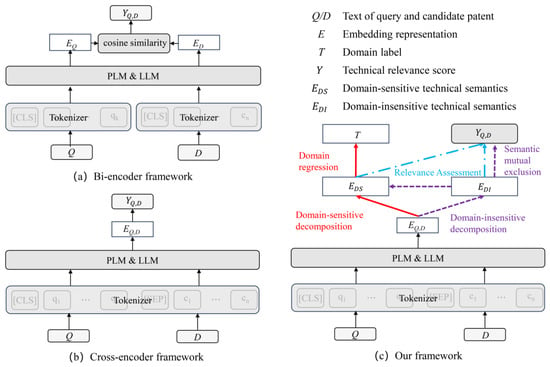
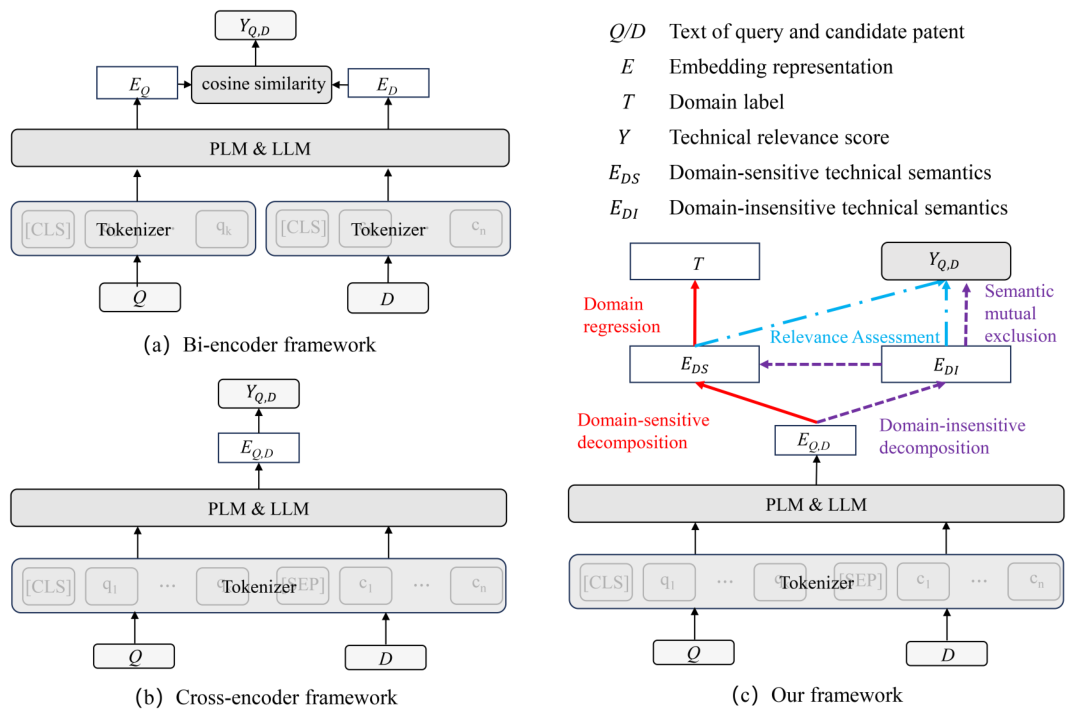
Recently, pre-trained language models (PLMs) [2,3] have been widely adopted for patent relevance assessment. The bi-encoder framework [4,5] (Figure 1a) and the cross-encoder framework [6,7] (Figure 1b) are two main architectures. In the bi-encoder framework, a query patent and the candidate patent are encoded independently, and their relevance is computed via a quantization function such as cosine similarity. In contrast, the cross-encoder framework concatenates a query and the candidate as a single input for joint encoding, which allows richer interactions between the two texts and typically leads to better relevance estimates. Although these PLM-based rerankers substantially outperform traditional term-based methods, they usually ignore domain information [8,9] that plays a critical role in patent examination.
Figure 1.
Bi-encoder framework, cross-encoder framework and our framework.
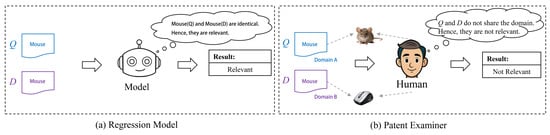
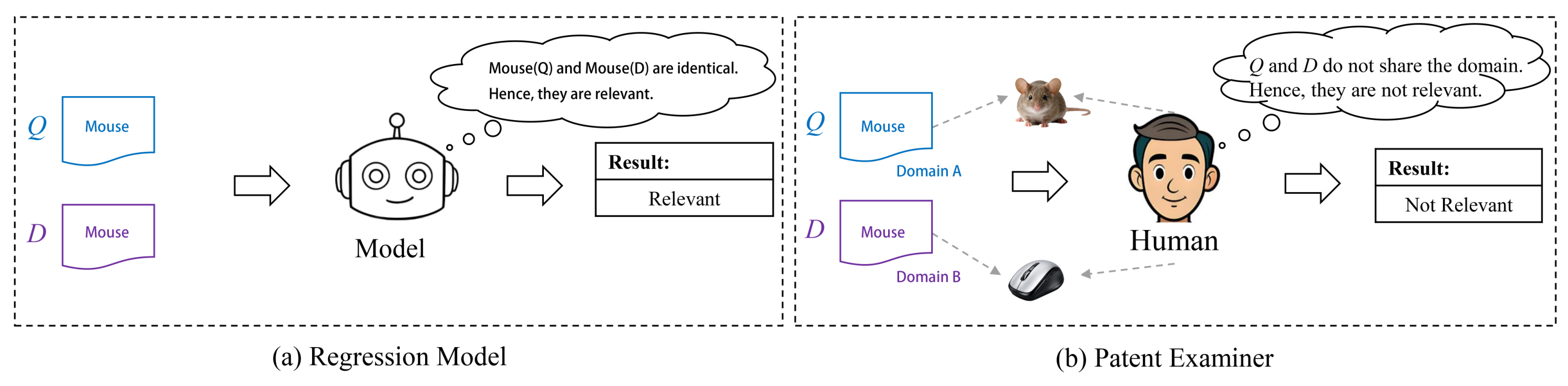
In the process of patent examination, relevance assessment is inherently domain-aware. Supposing a query and the candidate share a technical domain, this strongly directs patent examiners to focus on assessing the technical relevance within the specific technical domain. Hence, whether a query and the candidate share a technical domain potentially influences the examination decision (Figure 2). Nevertheless, most existing PLM-based approaches solely rely on plain text and do not explicitly model domain information, such as International Patent Classification (IPC). Moreover, the distribution of training pairs with different domain labels is unbalanced, which results in domain bias.
Figure 2.
Patent relevance assessment based on regression model and patent examiner.
To address these challenges, this paper proposes a Domain-Sensitive Semantic Decomposition Network () for patent relevance assessment. The characteristics of are as follows. First, it employs the gating mechanism with three constraints to decompose technical semantics into domain-sensitive and domain-insensitive parts. The three constraints guarantee the informativeness, orthogonality, and complementarity of both domain-sensitive and domain-insensitive parts. And a domain-balanced focal loss is designed to remove domain bias existing in domain-sensitive technical semantics. Second, it integrates both domain-sensitive and domain-insensitive technical semantics, together with domain information to estimate the technical relevance between a query and the candidate. Finally, it designs pairwise ranking with hard negative mining to widen the margin between positive and negative instances. Comprehensive experiments are conducted on the public CLEF-IP 2011 dataset [10]. The results show that effectively leverages patent classification information for technical semantic modeling and mitigates the adverse effects of distributional discrepancies between different technical domains, which makes it achieve better performance.
The main contributions of this paper are summarized as follows:
- It proposes a domain-sensitive semantic decomposition network, , to integrate domain information for patent relevance assessment.
- It introduces the gating mechanism with three constraints to decompose technical semantics into domain-sensitive and domain-insensitive parts, which boosts domain recognition ability in technical semantic modeling.
- It designs a domain-balanced focal loss to remove the domain bias, which enhances the robustness.
- It incorporates a pairwise ranking with hard negative mining to optimize ranking performance.
- It conducts comprehensive experimental evaluations to demonstrate the effectiveness of semantic decomposition and domain balance.
The remainder of this paper is organized as follows. Section 2 reviews related work. Section 3 defines the problem and summarizes the notation used in this paper. Section 4 details the proposed model, while Section 5 reports the experimental results and analysis. Section 6 concludes this work and discusses future directions. To encourage further research on patent relevance assessment, our dataset is publicly available at https://huggingface.co/datasets/yangguanghai89/DSSD_Net_data (accessed on 20 April 2026).
2. Related Work
Patent retrieval involves two stages: retrieval stage and re-ranking stage [11]. In the first stage, a set of technology-related keywords is generated based on the text of a query patent to retrieve candidate patents. In the second stage, those candidate patents are re-ranked based on technical relevance, which is quantified based on patent text and patent metadata.
Patent text contains the fields of title, abstract, description and claim, which is the carrier of patent technology and often used to quantify technical relevance. Early works adopt lexical matching to calculate technical similarity, such as term frequency and inverse document frequency [12]. With the development of deep learning, more and more studies use semantic matching based on neural networks to calculate text similarity [13]. Specifically, recent works utilize pre-trained language models (PLMs) to enhance semantic modeling, including a pre-training stage and a fine-tuning stage. In the pre-training stage, they are trained on a large corpus to learn general patterns and structures. During the fine-tuning stage, PLMs are refined for the specific downstream tasks. Semantic matching methods based on PLMs are divided into the bi-encoder framework and the cross-encoder framework. The former independently maps input sequences of a query and the candidate into the high-dimensional space and assesses the semantic relevance based on the space distance. The latter merges a query and the candidate into one sequence and learns the interactive effects to determine the degree of semantic relevance. For example, MADRM [5] encodes a query and the candidate independently, and cosine similarity is used to evaluate the semantic relevance while monoBERT [6] combines the texts of a query and the candidate into one sequence to calculate semantic similarity. Furthermore, An et al. [14] calculated technical similarity based on the word order information of entities and semantic direction of sequence structures. The structure of patent claims is used to construct textual representations which are decomposed into the similarity and specificity for semantic modeling [15]. P-BERT [16] enlarges the technical perspective via prefix sequence compression, which ensures the model embeds more technical features within the input limit for patent relevance assessment. Stamatis et al. [17] further emphasize the importance of designing domain-specific reranking mechanisms for long, structured patent documents, and a framework is proposed to combine the signals of lexicons and semantics with query-specific weighting. Ali et al. [18] investigate lightweight patent fields (e.g., abstracts) where key terms are extracted to construct labeled datasets for fine-tuning patent-specific BERT models, showing that abstract-centric modeling can achieve strong performance with lower computational costs.
In addition to text fields, a patent contains some metadata, such as the fields of classification, applicant and inventor. Those metadata fields are either used to fine-tune pre-trained language models [19,20], or taken to create a multi-view patent graph, the embeddings of which are used to predict patent classification [21]. As far as we know, few works take patent metadata to model technical semantics for patent relevance assessment.
Distinct from prior work, explicitly integrates the supervised signal of International Patent Classification (IPC) into a gated semantic decomposition framework. This enables the model to effectively disentangle technical semantics into domain-sensitive and domain-insensitive parts. A domain-balanced focal loss is designed to remove the domain bias. By combining native semantic decomposition, multi-field fusion regression, and pairwise ranking with hard negative mining in a unified architecture, we provide an effective solution for patent relevance assessment.
3. Problem Formulation and Notation
This section presents the problem formulation of patent relevance assessment in a re-ranking setting and introduces the notation used throughout the paper. Patent relevance assessment is formalized as training and inference stages, while Table 1 summarizes the key symbols.
Table 1.
Notations.
We view patent relevance assessment as a supervised re-ranking task. A training instance is denoted as , where is a pair consisting of a query patent Q and the candidate patent D, is a binary relevance label that indicates the relevance between a query and the candidate (non-relevant: 0; relevant: 1). The training set is denoted as .
At inference time, given a query patent Q and a candidate set , each pair is assigned a relevance score that is the predicted value of positive label via a function :
where denotes the model parameters. The final re-ranking output is an ordered list of candidates based on the descending of the predicted scores:
where denotes the ranked permutation of candidates for query Q.
4. Model
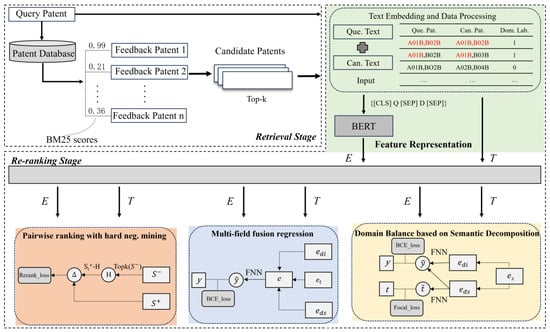
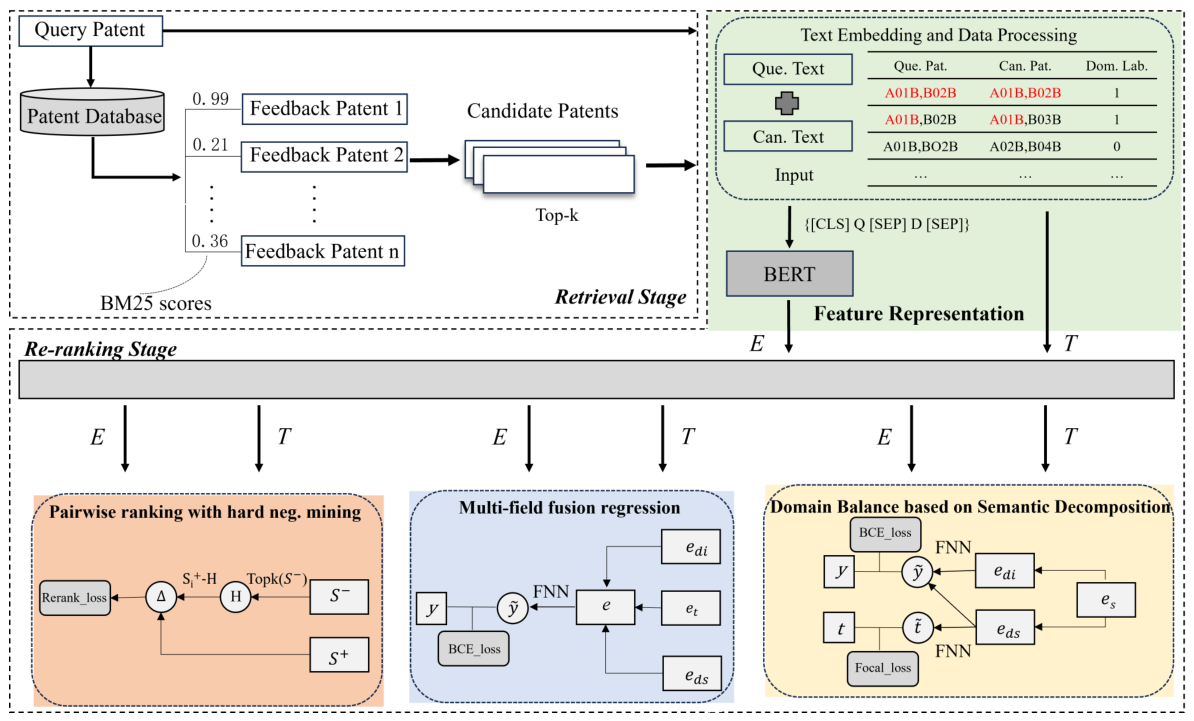
In this section, we present for patent relevance assessment. It first presents the technical representation based on patent text and metadata. Then, domain balance based on native semantic decomposition is introduced to separate technical semantics into domain-sensitive and domain-insensitive parts for domain balance. Next, multi-field fusion regression is designed to integrate the domain-sensitive and domain-insensitive semantics, along with domain information to evaluate the technical relevance. Finally, pairwise ranking with hard negative mining is proposed to directly optimize the evaluated performance from the holistic ranking perspective. The framework of is shown in Figure 3.
Figure 3.
Architecture of Patent Relevance Assessment Based on .
4.1. Technical Representation
A patent usually contains multiple text fields and metadata information. The former is unstructured data which explicitly explains technical details, including title field, abstract field, description field and claim field. The latter is structured data that contains plenty of potential technical connection, comprising the fields of International Patent Classification (IPC), applicant and inventor. Specifically, the title field and abstract field elaborate on the core technical characteristics while the IPC field denotes the technical domain. Hence, this paper takes the title field and abstract field to form text information as patent text. IPC is a hierarchical classification system that contains section, class, subclass and so on. Inspired by the practice that patent offices take the subclass part of an IPC code as the key value for IPC classification retrieval [22], the subclass is treated as a discriminative level of classification for determining the technical domain.
Given a training instance {}, technical representation is generated based on patent text. In this paper, the cross-encoder framework mentioned by Zhao et al. [23] is used to organize patent text, the contextual features of which are captured by the BERT model. Specifically, the texts of a query and the candidate are concatenated as an input, the representation of which is obtained through Formula (3).
where L is the sequence that merges the tokens of a query and the candidate, H is the output of the last hidden layer of the BERT model, and e is the representation of token [] in the output.
A patent is usually assigned one or more IPC codes. In accordance with common practice, a query and the candidate are considered to share the technical domain if their respective sets of IPC subclasses overlap. Specifically, a binary label is regarded as the domain label which is generated through Formula (4).
where and respectively refer to the subclass sets of a query and the candidate. is an indicator function; 1 indicates that a query and the candidate share one or more subclasses while 0 represents the opposite.
4.2. Domain Balance Based on Native Semantic Decomposition
Technical representation models comprehensive patent information that conflates domain-sensitive and domain-insensitive semantics. However, the distribution of training instances with different domain labels ( and ) is imbalanced, which results in domain bias. Hence, it introduces the gating mechanism to disentangle technical representation into domain-sensitive and domain-insensitive parts, and a domain-balanced focal loss is designed to balance the domain bias existing in domain-sensitive parts. Specifically, the native semantic decomposition incorporates three supervisory signals to guarantee the informativeness, orthogonality, and complementarity of both domain-sensitive and domain-insensitive parts.
First, it constructs the gating vector based on the technical representation, which is divided into domain-sensitive and domain-insensitive parts. And Formulas (5) and (6) are the formalized processes:
where denotes the activation function (sigmoid); , , and are learned parameters.
where ⊙ indicates elementwise multiplication; and are multi-layer perceptrons, each of which contains multiple linear layers. Intuitively, and are respectively encouraged to capture domain-sensitive and domain-insensitive technical semantics.
Then, it realizes native semantic decomposition via three task-driven supervisory signals, including informative, orthogonal, and complementarity constraints. The informative constraint ensures that both domain-sensitive and domain-insensitive parts remain informative for patent relevance assessment, which is formalized as Formula (7):
where and are regression modules, each of which corresponds to a binary classifier.
Obviously, the domain-insensitive part is orthogonal to the domain-sensitive part that results in domain bias. The orthogonal constraint minimizes the correlation between the two decoupled parts by penalizing their cross-covariance, which is formalized as Formula (8):
where denote the batch-wise centered representations of and , respectively, B is the batch size, d is the embedding dimension, and denotes the Frobenius norm. The term corresponds to the cross-covariance matrix between the two decoupled parts, and penalizes the mean squared cross-covariance to encourage the decorrelation between domain-sensitive and domain-insensitive technical semantics.
As for complementarity constraint, it ensures that the overall technical features are utilized for patent relevance assessment. To this end, a reconstruction constraint is introduced to encourage the fusion of the two decoupled parts to recover the original technical representation, which is formalized as Formula (9):
where denotes the reconstruction loss, B is the batch size, d is the embedding dimension, and denotes the norm.
This constraint ensures that semantic decomposition does not lead to information loss and retains the complete technical semantics for patent relevance assessment.
Finally, a domain-balanced focal loss is designed to remove the domain bias that stems from the imbalanced distribution of domain-sensitive technical representations with different domain labels. Unlike the cross-entropy loss, it introduces a domain-balanced factor and a focal factor. The former is generated based on the distribution of domain labels, while the latter directs the gradient to focus on hard instances. This is formalized as Formula (10):
where is the domain regression module implemented as a binary classifier, is the domain-balanced factor that is generated based on the distribution of domain labels, and is the focal factor that up-weights the hard examples.
Hence, the loss of domain balance based on native semantic decomposition is defined as Formula (11):
By combining informative, orthogonal, and complementarity constraints, the proposed gated semantic decomposition effectively separates domain-sensitive and domain-insensitive parts from the technical representation. And the domain bias existing in domain-sensitive parts is removed through the designed domain-balanced focal loss. All those form the foundation for subsequent technical relevance assessment.
4.3. Multi-Field Fusion Regression
Native semantic decomposition decouples technical representation into domain-sensitive and domain-insensitive parts. And domain bias existing in domain-sensitive parts is removed through the designed domain-balanced focal loss. In addition, whether a query and the candidate share a technical domain is an important explicit factor that influences the evaluated results. Hence, it fuses domain-sensitive technical semantics, domain-insensitive technical semantics and domain information to estimate the relevance score between a query and the candidate.
Given a training instance {}, it generates domain-sensitive technical semantic , domain-insensitive technical semantic and domain label t. And the representation of domain label is obtained through a representation module. It fuses the multiple fields of , and to evaluate patent relevance, which is formalized as Formula (12).
where , , , are trainable parameters; is a technical relevance regression network.
4.4. Pairwise Ranking with Hard Negative Mining
In this paper, the task of patent relevance assessment is modeled as a supervised re-ranking task with binary relevance labels, where the score of a positive label is used to rank the candidate patent. Hard instances are the negative instances with higher scores, which plays a critical role in influencing the re-ranking results. Pairwise ranking with hard negative mining is designed to reduce the scores of negative instances and improve the ranking of positive ones.
We suppose that is a batch of predicted scores, and is the predicted scores of positive instances while is the predicted scores of negative instances. For each batch, it determines hard negative instances by selecting the top k largest predicted scores of negative instances. And the margin distance between a positive instance and the hard negative instances is computed as Formula (13):
where k is a hyper-parameter referring to the number of hard negative instances.
The loss of pairwise ranking with hard negative mining is defined as Formula (14):
where is the margin hyper-parameter; denotes the number of valid instances, where each valid instance satisfies the condition that .
The full training objective integrates all previously defined loss terms, including domain balance based on native semantic decomposition, multi-field fusion regression, and pairwise ranking with hard negative mining. Specifically, the total loss is defined as Formula (15):
Native semantic decomposition removes domain bias and ensures that the decoupled domain-sensitive and domain-insensitive parts are informative, orthogonal and complementarity, while multi-field fusion regression takes technical text and metadata information to evaluate technical relevance. As for pairwise ranking with hard negative mining, it optimizes evaluation from a holistic ranking perspective by identifying hard negative instances to widen the margin between positive and negative instances.
5. Experiments
5.1. Dataset Creation
Our patent dataset is constructed based on CLEF-IP 2010 [24] and CLEF-IP 2011 [10] which are widely used in the evaluation of prior art candidate search. Those two datasets are originally designed for unsupervised ranking models. Specifically, CLEF-IP 2010 contains 196 training topics and 1348 testing topics while CLEF-IP 2011 includes 100 training topics and 1305 testing topics. Each topic is a query patent that corresponds to one or more gold patents. In addition, those two datasets share a patent library, consisting of 2.6 million distinct documents.
In retrieval state, the candidate pool is constructed via a standard BM25 retrieval model (16), following the indexing and searching setup described in [25]. For a query patent, a bag of query terms is generated based on its title and abstract fields, which is used to compute the retrieval scores between a query patent and another patent in the patent library. The Top-1000 patents with the highest retrieval scores are selected as the candidate patents corresponding to the query patent.
where is the frequency of term t in document D, is the inverse document frequency of term t across the entire patent corpus, and b are hyperparameters typically set to and , is the length of document D, and is the average length of documents in the corpus.
Based on the candidate pool, we construct the training, validation, and testing sets. For a query patent, if a gold patent appears in its Top-1000 candidate list, the gold patent and the query patent form a positive instance. As for negative sampling, a patent is randomly drawn from the patent library. If the selected patent does not belong to the set of gold patents relating to the query patent, the selected patent and the query patent form a negative instance. The training set and validation set are label-balanced, meaning that it constructs a negative instance corresponding to a positive one. For the testing set, a query patent and the TOP-1000 candidate patents form a re-ranking group. Specifically, training and testing topics of CLEF-IP 2010 and training topics of CLEF-IP 2011 are used to construct the training set and validation set, while testing topics of CLEF-IP 2011 are used to generate the testing set. The dataset is created as Table 2.
Table 2.
Statistics of the dataset constructed based on CLEF-IP.
5.2. Evaluation Metrics
In this paper, we take Recall, MAP, and PRES [26] as metrics to evaluate the performance in the re-ranking state. These three metrics are widely used in patent relevance assessment [9,25,27]. Recall and PRES are the recall-oriented metrics while MAP is an accuracy-oriented indicator. Specifically, PRES is a patent assessment score that combines MAP and Recall into a single score.
Recall:
where is the number of relevant patents in the Top k cutting window, is the total number of relevant patents, N denotes the number of query patents, and is a truncated value at the k-th position of a re-ranking list.
MAP:
where represents the ranking of relevant patents in a re-ranking list.
PRES:
where is the summation of ranks of relevant patents in a re-ranking list.
5.3. Baselines and Settings
5.3.1. Baselines
We compare the performance of our with several strong baselines, including PLMs without fine-tuning and PLMs with fine-tuning. PLMs, pre-trained on a large corpus, have learned general patterns and structures. And the performance is evaluated under both non-fine-tuned and fine-tuned settings.
Non-fine-tuned PLMs:
BERT [28], RoBERTa [29] and T5 [30] are representative PLMs that are evaluated in the bi-encoder framework.
Fine-tuned PLMs:
BERT, RoBERTa and T5 are fined-tuned in both the bi-encoder framework and the cross-encoder framework. We also focus on fine-tuning other retrievers and embedders for patent relevance assessment, such as RetroMAE [31] and BGE [32].
To ensure fair comparison and reproducibility, all compared methods are evaluated under the same input pipeline unless otherwise noted. Specifically, for each patent pair, the title and abstract fields are used as the textual input, while the candidate pool for reranking is constructed from the same first-stage retrieval results. The same train/validation/test split is applied to all methods. In preprocessing, model inputs are truncated to the same maximum sequence length when fixed-length encoding is required.
5.3.2. Settings
is implemented based on PyTorch 2.3.1. The bert-base-uncased model is regarded as the base model for content embedding, while Tanh is selected as the nonlinear activation function. The AdamW optimizer is used to minimize the objective function, and the learning rate is set to with a weight decay coefficient of . The dropout rate is set to 0.1, and the batch size is fixed to 64 for all PLM-based models. The dimensions of the hidden layer are arithmetic sequences. All the super-parameters are obtained through the search processes. The common default values are taken as the initial hyper-parameters for , which is refined by exploring the neighborhood values in the search ranges. The architecture-specific hyper-parameters and search ranges are presented in Table 3.
Table 3.
Hyper-parameters and search ranges.
For a patent, the title and abstract fields are concatenated as an input sequence that is truncated to a maximum length of 128 tokens. All models are trained and tested on a single NVIDIA GeForce RTX 5090d GPU (MSI, Taiwan, China). Additionally, an early stopping mechanism is implemented to terminate the training when the performance no longer improves. Specifically, the evaluated results are obtained based on the checkpoint with the minimum loss of the validation set.
5.4. Overall Performance
In this section, we present the evaluated results of and baselines, including PLMs without fine-tuning and PLMs with fine-tuning. Specifically, three cutting windows, including Top100, Top200 and Top400, are set to observe the trend of ranking performance. Table 4 presents the evaluation results.
Table 4.
Performance comparison against the baselines on CLEF-IP.
Overall, as the cutting window enlarges from Top100 to Top400, recall-oriented metrics steadily increase while the accuracy-oriented indicator decreases. More relevant patents are obtained within the larger cutting window. In non-fine-tuned PLMs, all PLMs adopt the bi-encoder framework to model technical semantics and function is used to calculate technical similarity. exhibits a clear advantage in recall-oriented metrics, while achieves superior ranking performance on the accuracy-oriented indicator.
Following fine-tuning on our constructed dataset, and present better ranking performance on both the recall-oriented and accuracy-oriented metrics compared to non-fine-tuned PLMs. The cross-encoder framework realizes the signal interaction between a query patent and the candidate patent, which contributes to the ranking performance. Hence, , and with the cross-encoder framework maintain significant advantages over those with the bi-encoder framework. For the bi-encoder framework, achieves the best ranking performance because it specializes a pre-training retrieval-oriented language model, comprising a full-scale BERT as the encoder and a one-layer transformer as the decoder. For the cross-encoder framework, , and achieve comparable performance, significantly outperforming the other models. Concretely, and obtain better ranking performance on the recall-oriented metrics, whereas exhibits the opposite trend.
Finally, obtains the best ranking performance in terms of Recall, MAP and PRES among the three cutting windows. Specifically, utilizes the cross-encoder framework to encode sequence semantics and shows a performance enhancement of 2∼17% in recall-oriented metrics and approximately 2∼7% in the accuracy-oriented indicator compared to the best ranking performance of different baselines. Experimental results strongly demonstrate that improves the ranking performance for patent relevance assessment.
5.5. Ablation Studies
To demonstrate the effectiveness of each component in , ablation experiments are conducted by progressively adding modules to the base model. Additionally, we design three different random seeds and report the performance with mean and standard deviation, which can be used to exhibit the robustness of our proposed model. The ablation studies are organized into four parts as follows.
(1) Plain text: It is denoted as , which serves as the base model of for expanding other components. (2) Domain balance based on native semantic decomposition: It is denoted as , which expands the component of domain balance based on native semantic decomposition. It adopts the gating mechanism with three constraints to disentangle technical representation into domain-sensitive and domain-insensitive parts, while a domain-balanced focal loss is designed to remove the domain bias existing in domain-sensitive technical semantics. (3) Multi-field fusion regression: It is denoted as , which expands the component of multi-field fusion regression. It fuses domain-sensitive technical semantics, domain-insensitive technical semantics and domain information to estimate the relevance score between a query and the candidate. (4) Pairwise ranking with hard negative mining: It is denoted as , which expands the component of pairwise ranking with hard negative mining to form the whole model. It optimizes evaluation from a holistic ranking perspective by identifying hard negative instances to widen the margin between positive and negative instances. Table 5 presents the detailed results corresponding to each ablation setting, demonstrating the unique contribution of each module to the overall performance improvement.
Table 5.
Ablation studies ().
Overall, as the cutting window enlarges, the performance of Recall and PRES improves while that of MAP decreases, which is consistent with the recall-oriented nature of patent prior art search. Experimental results show that using plain text for patent relevance assessment already achieves promising outcomes. Compared with base model , obtains superior ranking performance, indicating that semantic decomposition with three constraints alleviates representation entanglement, and the domain bias is effectively eliminated by the domain-balanced focal loss. Furthermore, achieves additional improvements over , demonstrating that multi-field fusion regression effectively integrates domain-sensitive technical semantics, domain-insensitive technical semantics and domain information, which ensures the improvement of ranking performance. Finally, by incorporating the pairwise ranking with hard negative mining, achieves the best overall performance, showing that ranking-oriented optimization further enlarges the margin between relevant patents and the most confusing non-relevant candidates, thereby improving robustness and contributing the final re-ranking quality. Notably, the standard deviation for all results is below 0.5%, which further demonstrates the stability of the proposed model.
6. Conclusions
This paper presents a domain-sensitive semantic decomposition network (), including domain balance based on native semantic composition, multi-field fusion regression and pairwise ranking with hard negative mining, for patent relevance assessment in the reranking stage. Native semantic composition introduces the gating mechanism with three constraints to disentangle technical representation into domain-sensitive and domain-insensitive parts, while a domain-balanced focal loss is designed to remove the domain bias existing in domain-sensitive technical semantics. Multi-field fusion regression is designed to fuse domain-sensitive technical semantics, domain-insensitive technical semantics and domain information to estimate the relevance score between a query and the candidate. As for pairwise ranking with hard negative mining, it optimizes the evaluated results from a holistic ranking perspective via identifying hard negative instances that are used to widen the margin between positive and negative instances. Experiments on the CLEF-IP 2011 benchmark demonstrate consistent improvements over strong baselines in terms of MAP, Recall, and PRES, indicating that domain-balanced semantic modeling is an effective way to enhance patent re-ranking performance.
This work has several limitations. The technical domain is designed based on a binary indicator of IPC subclass overlap, which is a coarse proxy and may not fully capture nuanced technical relationships between a query and the candidate. Compared with International Patent Classification (IPC), Cooperative Patent Classification (CPC) codes provide a more fine-grained view of technical areas. Integrating IPC and CPC to construct a more fine-grained technical domain, as well as incorporating richer metadata such as applicants, inventors, and citation relationships, is a promising direction. Moreover, is evaluated on the single CLEF-IP benchmark, and assessing its generality on other patent datasets and language regimes remains a topic for future research.
Author Contributions
Conceptualization, Y.Z. and F.W.; methodology, Y.Z.; software, J.C.; validation, Y.Z. and F.W.; formal analysis, T.Z.; investigation, Y.Z.; resources, F.W.; data curation, F.W.; writing—original draft preparation, Y.Z.; writing—review and editing, F.W.; visualization, J.C.; supervision, T.Z.; project administration, Y.Z.; funding acquisition, F.W. All authors have read and agreed to the published version of the manuscript.
Funding
This work was supported by the National Natural Science Foundation of China under Grant 62202210.
Institutional Review Board Statement
Not applicable.
Informed Consent Statement
Not applicable.
Data Availability Statement
To encourage further research on patent relevance assessment, our dataset is publicly available at https://huggingface.co/datasets/yangguanghai89/DSSD_Net_data (accessed on 20 April 2026).
Acknowledgments
We used ChatGPT (GPT-5.4, OpenAI, San Francisco, CA, USA) to polish the language.
Conflicts of Interest
The authors declare no conflicts of interest.
References
- Yates, A.; Nogueira, R.; Lin, J. Pretrained Transformers for Text Ranking: BERT and Beyond. In WSDM ’21: Proceedings of the 14th ACM International Conference on Web Search and Data Mining, Online, 8–12 March 2021; Association for Computing Machinery: New York, NY, USA, 2021; pp. 1154–1156. [Google Scholar] [CrossRef] [Scilit]
- Jing, L.; Zhou, C.; Feng, D.; Dou, Y.; Fan, X.; Jiang, S. A Patent Infringement Analysis Approach Based on Patent Knowledge Graph Driven Fusion of Graph and Image Similarity. IEEE Access 2025, 13, 29944–29968. [Google Scholar] [CrossRef] [Scilit]
- Shen, Y.; Lin, Z. PatentGrapher: A PLM-GNNs Hybrid Model for Comprehensive Patent Plagiarism Detection Across Full Claim Texts. IEEE Access 2024, 12, 182717–182725. [Google Scholar] [CrossRef] [Scilit]
- Reimers, N.; Gurevych, I. Sentence-BERT: Sentence Embeddings using Siamese BERT-Networks. In Proceedings of the 2019 Conference on Empirical Methods in Natural Language Processing and the 9th International Joint Conference on Natural Language Processing (EMNLP-IJCNLP), Hong Kong, China, 3–7 November 2019; Association for Computational Linguistics: Kerrville, TX, USA, 2019; pp. 3982–3992. [Google Scholar] [CrossRef] [Scilit]
- Kong, W.; Khadanga, S.; Li, C.; Gupta, S.K.; Zhang, M.; Xu, W.; Bendersky, M. Multi-Aspect Dense Retrieval. In KDD ’22: Proceedings of the 28th ACM SIGKDD Conference on Knowledge Discovery and Data Mining, Washington, DC, USA, 14–18 August 2022; ACM: New York, NY, USA, 2022; pp. 3178–3186. [Google Scholar] [CrossRef] [Scilit]
- Nogueira, R.; Yang, W.; Cho, K.; Lin, J. Multi-stage document ranking with BERT. arXiv 2019, arXiv:1910.14424. [Google Scholar] [CrossRef] [Scilit]
- Qiao, Y.; Xiong, C.; Liu, Z.; Liu, Z. Understanding the Behaviors of BERT in Ranking. arXiv 2019, arXiv:1904.07531. [Google Scholar] [CrossRef] [Scilit]
- Vowinckel, K.; Hähnke, V.D. SEARCHFORMER: Semantic patent embeddings by siamese transformers for prior art search. World Pat. Inf. 2023, 73, 102192. [Google Scholar] [CrossRef] [Scilit]
- Stamatis, V.; Salampasis, M.; Diamantaras, K.; Hanbury, A. A Combination of BERT and BM25 for Patent Search. In Proceedings of the 3rd Workshop on Patent Text Mining and Semantic Technologies (PatentSemTech 2022), Madrid, Spain, 11–15 July 2022; Institute of Information Systems Engineering, Technische Universität Wien: Vienna, Austria, 2022; pp. 12–13. [Google Scholar]
- Piroi, F.; Lupu, M.; Hanbury, A.; Zenz, V. CLEF-IP 2011: Retrieval in the Intellectual Property Domain. In Proceedings of the CLEF (Notebook Papers/Labs/Workshop), Amsterdam, The Netherlands, 19–22 September 2011. [Google Scholar]
- Ali, A.; Tufail, A.; De Silva, L.C.; Abas, P.E. Innovating Patent Retrieval: A Comprehensive Review of Techniques, Trends, and Challenges in Prior Art Searches. Appl. Syst. Innov. 2024, 7, 91. [Google Scholar] [CrossRef] [Scilit]
- Robertson, S. Understanding inverse document frequency: On theoretical arguments for IDF. J. Doc. 2004, 60, 503–520. [Google Scholar] [CrossRef] [Scilit]
- Vaswani, A.; Shazeer, N.; Parmar, N.; Uszkoreit, J.; Jones, L.; Gomez, A.N.; Kaiser, L.u.; Polosukhin, I. Attention is All you Need. In Proceedings of the Advances in Neural Information Processing Systems; Curran Associates, Inc.: Red Hook, NY, USA, 2017; Volume 30. [Google Scholar]
- An, X.; Li, J.; Xu, S.; Chen, L.; Sun, W. An improved patent similarity measurement based on entities and semantic relations. J. Inf. 2021, 15, 101135. [Google Scholar] [CrossRef] [Scilit]
- Shan, J.; Zhang, Q.; Shi, C.; Gui, M.; Wang, S.; Naseem, U. Structural Representation Learning and Disentanglement for Evidential Chinese Patent Approval Prediction. In CIKM ’24: Proceedings of the 33rd ACM International Conference on Information and Knowledge Management, Boise, ID, USA, 21–25 October 2024; Association for Computing Machinery: New York, NY, USA, 2024; pp. 2014–2023. [Google Scholar] [CrossRef] [Scilit]
- Wang, F.; Shi, X.; Wang, D.; Lou, Y. P-BERT: Toward Long Sequence Modeling by Enabling Language Representation with Prefix Sequence Compression, Soft Position Embedding, and Data Augmentation for Patent Relevance Assessment. IEEE Access 2025, 13, 41928–41942. [Google Scholar] [CrossRef] [Scilit]
- Stamatis, V.; Salampasis, M.; Diamantaras, K. A novel re-ranking architecture for patent search. World Pat. Inf. 2024, 78, 102282. [Google Scholar] [CrossRef] [Scilit]
- Ali, A.; Humayun, M.A.; Silva, L.C.D.; Abas, P.E. Optimizing Patent Prior Art Search: An Approach Using Patent Abstract and Key Terms. Information 2025, 16, 145. [Google Scholar] [CrossRef] [Scilit]
- Pujari, S.C.; Friedrich, A.; Strötgen, J. A Multi-task Approach to Neural Multi-label Hierarchical Patent Classification Using Transformers. In Proceedings of the Advances in Information Retrieval; Springer: Cham, Switzerland, 2021; pp. 513–528. [Google Scholar] [CrossRef] [Scilit]
- Lee, J.S.; Hsiang, J. Patentbert: Patent classification with fine-tuning a pre-trained bert model. arXiv 2019, arXiv:1906.02124. [Google Scholar] [CrossRef] [Scilit]
- Fang, L.; Zhang, L.; Wu, H.; Xu, T.; Zhou, D.; Chen, E. Patent2Vec: Multi-view representation learning on patent-graphs for patent classification. World Wide Web 2021, 24, 1791–1812. [Google Scholar] [CrossRef] [Scilit]
- Risch, J.; Alder, N.; Hewel, C.; Krestel, R. PatentMatch: A Dataset for Matching Patent Claims & Prior Art. In Proceedings of the Workshop on Patent Text Mining and Semantic Technologies (PatentSemTech@SIGIR); Institute of Information Systems Engineering, Technische Universität Wien: Vienna, Austria, 2021. [Google Scholar]
- Zhao, W.X.; Liu, J.; Ren, R.; Wen, J.R. Dense Text Retrieval Based on Pretrained Language Models: A Survey. ACM Trans. Inf. Syst. 2024, 42, 89. [Google Scholar] [CrossRef] [Scilit]
- Piroi, F. CLEF-IP 2010: Prior art candidates search evaluation summary. In Proceedings of the Workshop of the Cross-Language Evaluation Forum, LABs and Workshops, Notebook Papers, Padua, Italy, 22–23 September 2010. [Google Scholar]
- Wang, F.; Qian, T.; Liu, B.; Peng, Z. Patent expanded retrieval via word embedding under composite-domain perspectives. Front. Comput. Sci. 2019, 13, 1048–1061. [Google Scholar] [CrossRef] [Scilit]
- Magdy, W.; Jones, G.J. PRES: A score metric for evaluating recall-oriented information retrieval applications. In SIGIR ’10: Proceedings of the 33rd International ACM SIGIR Conference on Research and Development in Information Retrieval, Geneva, Switzerland, 19–23 July 2010; Association for Computing Machinery: New York, NY, USA, 2010; pp. 611–618. [Google Scholar] [CrossRef] [Scilit]
- Shalaby, W.; Zadrozny, W. Patent retrieval: A literature review. Knowl. Inf. Syst. 2019, 61, 631–660. [Google Scholar] [CrossRef] [Scilit]
- Devlin, J.; Chang, M.W.; Lee, K.; Toutanova, K. Bert: Pre-training of deep bidirectional transformers for language understanding. In Proceedings of the 2019 Conference of the North American Chapter of the Association for Computational Linguistics: Human Language Technologies, Volume 1 (Long and Short Papers), Minneapolis, MN, USA, 2–7 June 2019; Association for Computational Linguistics: Kerrville, TX, USA, 2019; pp. 4171–4186. [Google Scholar] [CrossRef] [Scilit]
- Liu, Y. Roberta: A robustly optimized bert pretraining approach. arXiv 2019, arXiv:1907.11692. [Google Scholar] [CrossRef] [Scilit]
- Raffel, C.; Shazeer, N.; Roberts, A.; Lee, K.; Narang, S.; Matena, M.; Zhou, Y.; Li, W.; Liu, P.J. Exploring the limits of transfer learning with a unified text-to-text transformer. J. Mach. Learn. Res. 2020, 21, 1–67. [Google Scholar]
- Xiao, S.; Liu, Z.; Shao, Y.; Cao, Z. RetroMAE: Pre-Training Retrieval-oriented Language Models via Masked Auto-Encoder. In Proceedings of the 2022 Conference on Empirical Methods in Natural Language Processing, Abu Dhabi, United Arab Emirates, 7–11 December 2022; Association for Computational Linguistics: Kerrville, TX, USA, 2022; pp. 538–548. [Google Scholar] [CrossRef] [Scilit]
- Xiao, S.; Liu, Z.; Zhang, P.; Muennighoff, N.; Lian, D.; Nie, J.Y. C-Pack: Packed Resources for General Chinese Embeddings. In SIGIR 2024: Proceedings of the 47th International ACM SIGIR Conference on Research and Development in Information Retrieval, Washington, DC, USA, 14–18 July 2024; ACM: New York, NY, USA, 2024; pp. 641–649. [Google Scholar] [CrossRef] [Scilit]

Disclaimer/Publisher’s Note: The statements, opinions and data contained in all publications are solely those of the individual author(s) and contributor(s) and not of MDPI and/or the editor(s). MDPI and/or the editor(s) disclaim responsibility for any injury to people or property resulting from any ideas, methods, instructions or products referred to in the content. |
© 2026 by the authors. Licensee MDPI, Basel, Switzerland. This article is an open access article distributed under the terms and conditions of the Creative Commons Attribution (CC BY) license.