


Abstract
Cost overrun is a major challenge in the construction industry. However, there is a notable lack of data from empirical studies that exhaustively identify and analyze risk factors contributing to overruns. This study aims to address this gap by systematically identifying and analyzing these risk factors. A hybrid methodology was employed. It combined a systematic literature review, a three-round Delphi process, and fuzzy set techniques. Insights from the literature review informed the first-round Delphi questionnaire. Subsequent rounds were refined based on earlier results. In the third round, experts’ opinions on the likelihood and impact of the cost risk factors were collected using a 5-point Likert scale. Finally, a fuzzy approach was employed to assess the severity of cost risk factors based on the combined effects of their likelihood and impact. The results revealed that the primary cost risk factors include escalation and fluctuation in material prices, inflation, material shortages, the country’s political instability, the country’s economic instability, delays in payment to the contractor, and delays in material procurement and delivery. Notably, the significant cost risk factors are largely beyond the contractor’s control and are closely tied to the broader political and economic conditions of the country.
1. Introduction
The construction industry (CI) plays a crucial role in the socio-economic development of any nation, where its contribution is even higher in the economies of developing countries [1,2]. The industry’s impact is contingent upon its performance, which is assessed based on the achievement of the project goals: time, cost, and quality [3], known as the iron triangle [4]. Nevertheless, cost overrun is one of the major challenges of the industry, where its severity is more pronounced in the cases of developing countries [5]. In Ethiopia, for example, Belay et al. [6] evaluated the cost performance of building and infrastructure projects and identified a cost overrun of up to 248% and 61%, respectively. Similarly, Belachew et al. [7] reported a cost overrun of up to 83.2% among eight road projects.
Conversely, cost overruns can be managed by the implementation of systematic cost risk management [8]. Risk management is the art of dealing with risks [9], which involves the systematic application of risk identification, analysis, response, and monitoring and control [10,11]. However, the Ethiopian Construction Industry (ECI) is known for its poor project risk management practice [12,13] that have resulted in a number of unsuccessful projects in the country [14].
Risk identification involves a systematic identification and documentation of risk factors [15]. It is a fundamental step in formal risk management. For a risk to be managed, it must be identified [16]. Several studies have been conducted to identify risk factors causing cost overruns in the global CI. However, it has been claimed that the majority of the studies conducted in the case of developing countries are not context-specific, such as project type or stakeholder perspective. Therefore, identifying cost overrun risks that are specific to the project type and from a specific stakeholder’s perspective has been suggested [17]. In the case of the ECI, for example, Mitikie et al. [18] ranked risk factors affecting the project objectives (time, cost, and quality) by combining the responses of contractors and consultants. However, this approach may overlook important distinctions, since risk factors can vary depending on the context and the stakeholder, as what matters to one may not matter to another [19,20]. Therefore, identifying cost risk factors from the perspective of each stakeholder is advised. A study by Zewdu and Aregaw [21] ranked the cost risk factors from clients’, contractors’, and consultants’ perspectives independently. However, the study ranked these factors in terms of their importance only, whereas risk factors are better ranked based on the combined effects of at least their probability of occurrence and impact [20]. Furthermore, these studies have used the findings of limited research literature in developing their questionnaire, which could have a higher chance of researcher bias in the literature selection and the non-inclusion of some risk factors. In addition, these studies have solely relied on the simple relative importance index [18] or mean [21] rankings that do not entertain the uncertainties in expert judgments. Therefore, a comprehensive and stakeholder, project-type, and objective-specific cost risk identification and analysis is lacking in the ECI.
To address these gaps, this study utilized a sequential and context-sensitive framework that considers uncertainties for identifying and evaluating cost overrun factors in construction projects with empirical importance to the Ethiopian building construction projects from the contractor’s perspective. The study integrates (1) a systematic literature review (SLR) that identifies a comprehensive list of cost overrun factors by using a systematic and evidence-based screening, (2) a three-round Delphi process that is used in refining the list with contractor experts’ consensus confirming their relevance to the Ethiopian building construction projects, and (3) the fuzzy logic that is used to evaluate the probability and impact of these risk factors independently, considering the uncertainty in contractor expert judgment.
This study provides a context-sensitive ranking of cost overrun risk factors, particularly for the ECI and other developing countries, where data shortage and institutional volatility are challenges. It evaluates the probability and impact of risks independently by applying fuzzy logic. Therefore, it provides uncertainty-conscious risk evaluation techniques by improving the traditional Delphi-based average ranking. In general, though several studies have identified risk factors, the aim of this study is not to discover a new risk factor. Rather, it advances the existing body of knowledge by showing how risk severity varies when expert uncertainty, economic volatility, and specific project objectives are considered.
In addressing the aim, the following research questions will be answered.
- •
- RQ1. What are the main risk factors that cause cost overruns to construction projects in developing countries?
- •
- RQ2. What are the main risk factors causing cost overruns in the Ethiopian building construction projects from the contractors’ perspective?
2. Materials and Methods
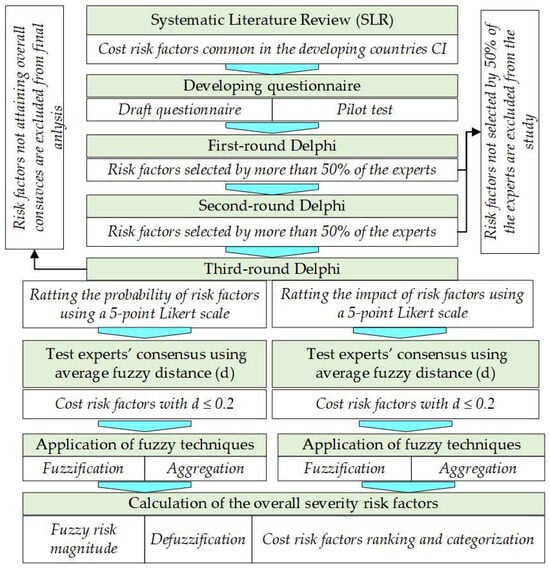
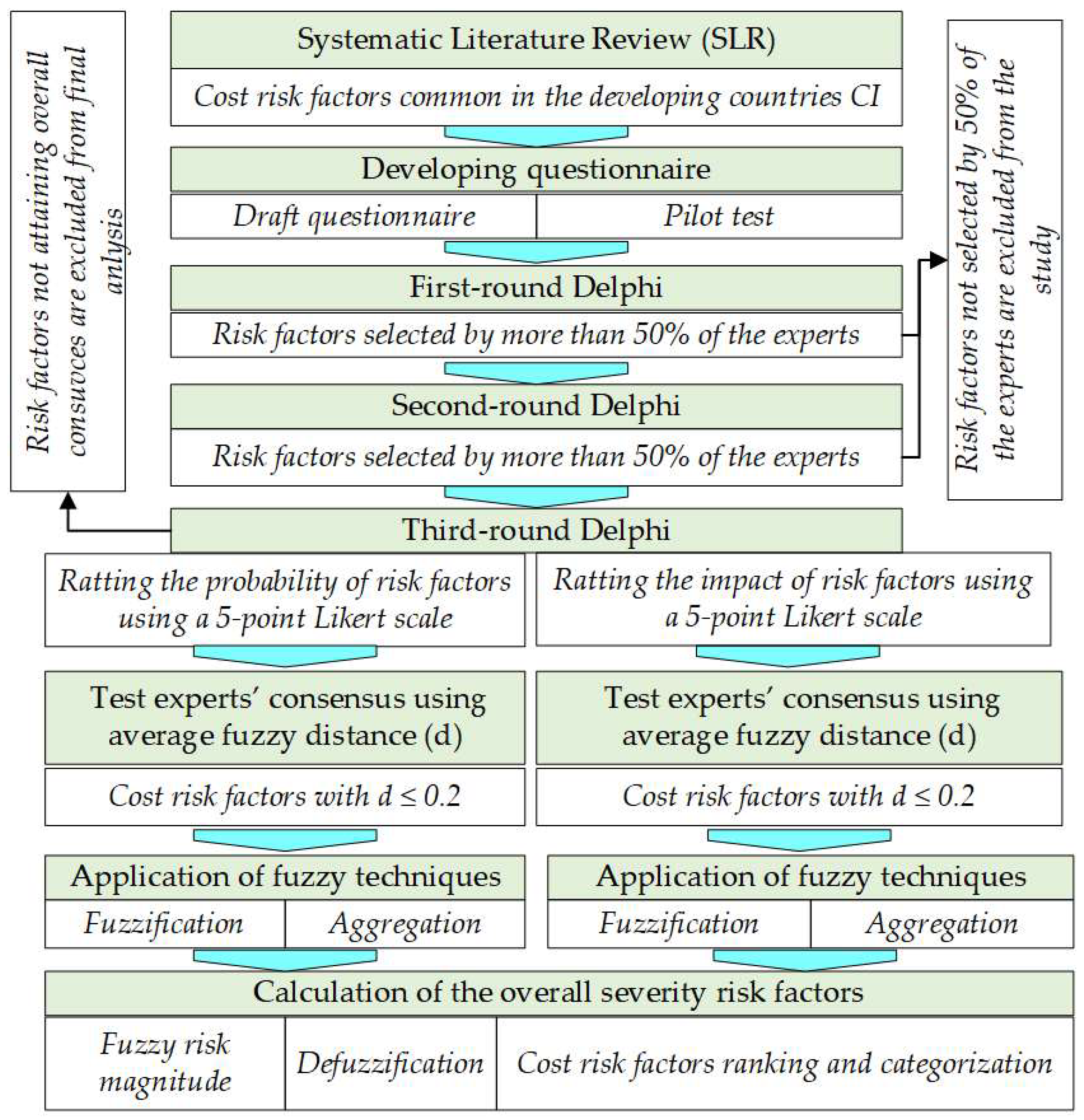
To address the research aim, the study utilized a multi-stage Systematic Literature Review (SLR), an iteration of three-round Delphi techniques, and fuzzy logic. The aim of this multi-stage filtering process is to distinguish between risks that are frequently cited in the literature and those that remain critical when evaluated by experts under uncertain and volatile conditions. Accordingly, the SLR captured the theoretical consensus in the literature, while the Delphi process is used to contextualize the knowledge within the ECI context. Fuzzy logic accounts for uncertainty in expert judgment. Therefore, the results reflect context-sensitive cost risks rather than a generic ranking. Figure 1 summarizes the process involving these methods.
Figure 1.
The research process.
2.1. The Systematic Literature Review Procedure
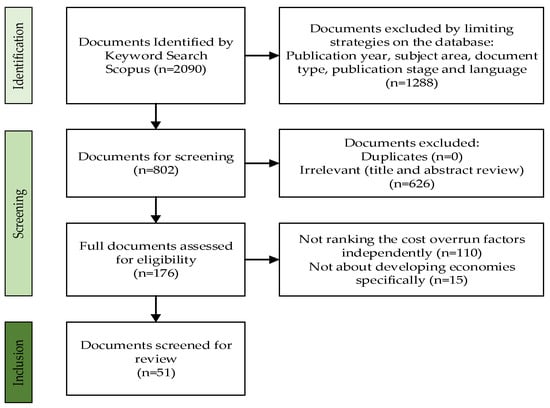
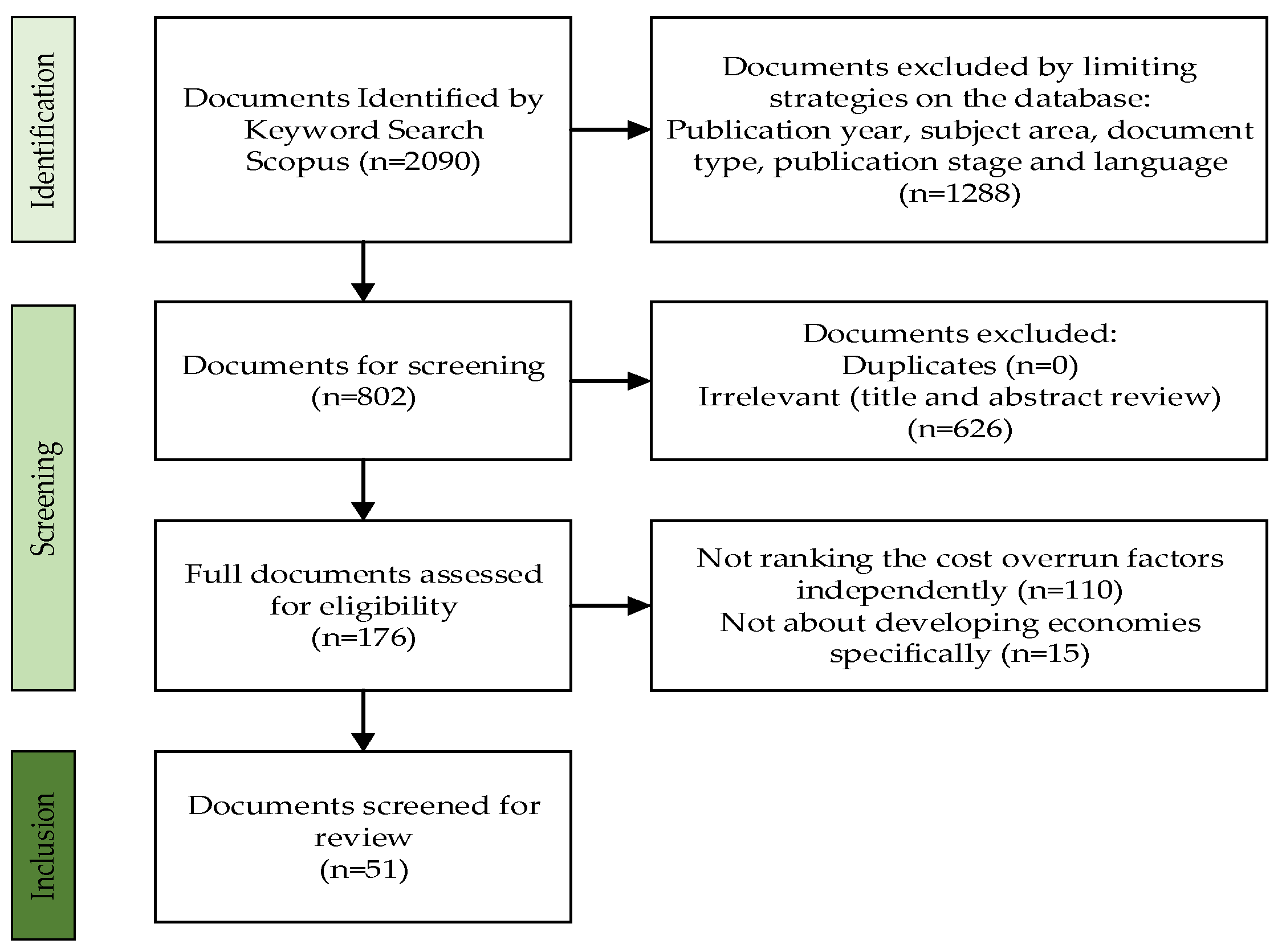
The SLR is a stand-alone research method that utilizes secondary data from relevant literature [22] to describe the knowledge and practices in a given subject [23]. The SLR is claimed to experience researcher bias. However, that can be addressed through the utilization of a systematic methodological process commonly known as the Preferred Reporting Items for Systematic Review and Meta-Analysis (PRISMA) [23,24]. Accordingly, this SLR followed the PRISMA protocol to ensure transparency and reproducibility. Figure 2 shows the process of the SLR in view of the PRISMA protocol specifically utilized in this study to address the risk of bias in the document search.
Figure 2.
Adopted PRISMA protocol.
Initially, a documents search was conducted on 31 December 2024 on the Scopus database to access documents published from 2010 to 2024. Scopus was selected as it has the most extensive coverage and is solely utilized in most studies [25,26]. The search protocol and database limiting criteria adopted were: TITLE-ABS-KEY ((“cost overrun” OR “cost risk” OR “budget overrun” OR “risk factors”) AND (“construction projects”)) AND PUBYEAR > 2009 AND PUBYEAR < 2025 AND (LIMIT-TO (SUBJAREA, “ENGI”)) AND (LIMIT-TO (DOCTYPE, “ar”) OR LIMIT-TO (DOCTYPE, “re”)) AND (LIMIT-TO (PUBSTAGE, “final”)) AND (LIMIT-TO (LANGUAGE, “English”)).
Then 1288 documents were exported to Excel and screened based on the predefined inclusion and exclusion criteria. Accordingly, articles (1) that are about construction projects in developing countries and (2) that have ranked the critical cost risk factors were included. Documents not meeting the above inclusion criteria simultaneously were excluded from the review. Countries were categorized based on the provisions of the World Economic Situation and Prospects report [27].
The document screening was done twice by the first writer independently, and the final result was presented to the panel of the other writers for the final decision. Accordingly, after detailed evaluation of the titles, abstracts, and full documents, fifty-one articles meeting the inclusion criteria were screened for final review (The list of the screened articles can be found from supplementary materials: Table S1). The contents of the articles were examined twice in detail by the first writer, and eighty-one cost risk factors were extracted and categorized into ten based on their nature.
Risk categorization is important in risk identification, as it facilitates the understanding of its nature for effective management [15]. Risks can be categorized based on their source [28], nature [29,30,31,32,33,34], project stage [35,36], and the originating party [34,37], where there is no consensus on which to adopt. However, classification based on nature is most commonly used. For instance, Siraj and Fayek [33] evaluated 130 construction studies and found that 50 articles (38.46%) adopted the nature-based risk categorization. A similar technique is also suggested by generic project risk management guidelines such as PMI [15].
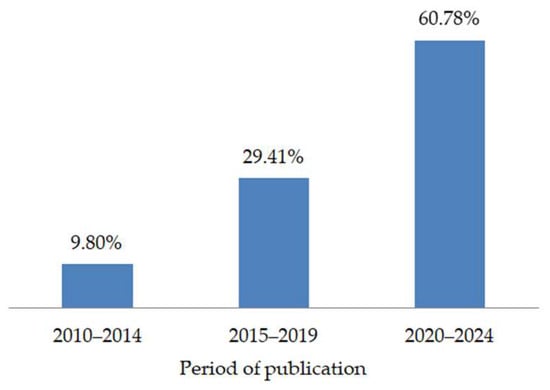
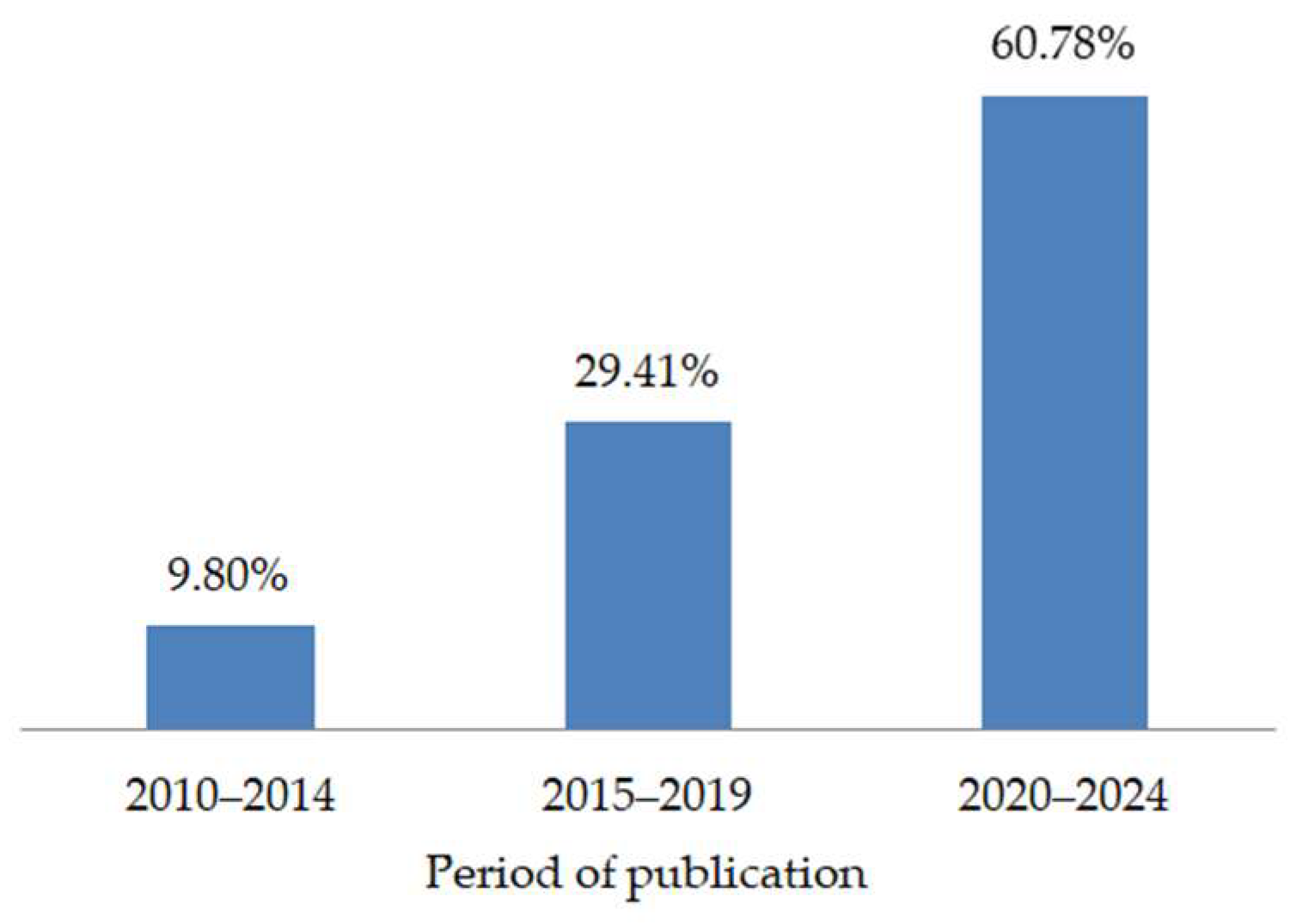
In addition to the SLR’s primary focus on the studies of developing countries’ construction industry (CI), the majority of the articles reviewed (46 out of 51) were published within the past ten years (Figure 3). Thus, the findings of the SLR are relevant if used as an input in assessing the cost risk factors in the recent ECI.
Figure 3.
Reviewed articles according to publication period.
2.2. The Delphi Technique
The Delphi technique is an alternative to focus group discussions [38]. It involves distributing a series of questions, each built upon the results of the previous rounds [39], to get experts’ consensus anonymously [40]. Delphi is becoming a robust tool commonly utilized in the research of construction engineering and management fields [41]. In order to ensure the reliability and credibility of the Delphi process, the procedures suggested by Junger et al. [42] were adopted.
Informed decision-making on the number of rounds and the quality and number of experts is the fundamental requirement of the Delphi technique. It depends upon the available resources and time, the nature of the research question, and the expert’s willingness to participate in each round [40]. Up to six-round Delphi studies are identified in the literature; however, conducting Delphi with more than three rounds is uncommon as they are costly, time-consuming, and can lead to expert fatigue and low response rates [41]. Conversely, finalizing results in one or two rounds can result in misleading conclusions [43]. A three-round Delphi is commonly utilized in most construction engineering and management studies [43,44,45]. In relation to the number of experts, it has been evidenced that a sample of 8–20 experts is common in construction engineering and management research [41].
Therefore, in this study, the consensus of 30 experts was assessed with an iteration of a three-round Delphi process. A three-round Delphi process was utilized to improve consensus and to reduce respondent fatigue while ensuring the reliability and validity of risk factors. The aim of the first round is to systematically screen risks from the literature by removing irrelevant factors. The second round is a screening process to validate the stability of the selected factors and to reduce random selection bias. The third round involved a detailed evaluation of the remaining risk factors, enabling fuzzy transformation and ranking. In general, the adopted three-round process increases robustness by progressively focusing expert attention while reducing the risk of early-stage bias.
The study adopted a predefined consensus criterion for each Delphi step. In the early exploratory components, the first two Delphi rounds adopted a majority agreement cut-off threshold (>50%). Though some literature suggested the use of a higher consensus level, such as ≥75% [42]. This study adopted a >50% cut-off threshold to avoid a premature exclusion of risk factors from the final analysis. It has been justified that there is no single and universal threshold level, and the adoption is dependent on factors such as the study aim [42,46]. Similar cut-off logic has been applied in other research [43,47,48].
In the third round, consensus was determined using the Average Fuzzy Distance (d) calculated for each risk parameter: the probability and impact independently. The overall consensus was assumed to be achieved when the calculated d ≤ 0.2 for both parameters simultaneously. Accordingly, factors meeting the consensus criteria for their probability and impact at a time will be retained, while those failing are considered to lack consensus and excluded from further analysis. Cost overrun factors with the lower values of d indicate strong consensus. The detailed step-by-step procedure and formula for calculating the value of d can be found in the literature [49]. Some fuzzy-based Delphi studies report both the average fuzzy distance and percent agreement as consensus criteria [49]. However, this study used the average fuzzy distances as the primary consensus criterion. The fuzzy distance provides an accurate and continuous measure of expert judgment proximity in fuzzy space. It is thus acceptable for capturing expert judgment differences that cannot be indicated by categorical percentage agreement. Thus, using only average fuzzy distance avoids biases in considering adjacent Likert ratings as disagreement, and it ensures a mathematically robust and theoretically consistent consensus measure.
As the study aims to identify cost overrun factors from the contractors’ perspective, the selection of experts started with the selection of the construction companies. It is assumed that experts working in companies with better project management backgrounds have a better understanding of the recent ECI. In this regard, the Ethiopian Conformity Assessment Enterprise (ECAE) was requested for the list of certified contractors, as it is responsible for certifying the management system of companies in Ethiopia. Until 2 December 2024, only seven certified contractors were found in the list, among which 4 privately owned companies were purposely selected based on their experiences and extent of their participation in different regions of the country. Though the role of public contractors in the ECI should not be undermined, private contractors are significantly participating in various regions of Ethiopian building construction projects. In addition, maintaining homogeneity among companies is advantageous in maintaining the equilibrium of respondents’ risk perception.
Initially, the heads of the companies were contacted, and a brief introduction about the aim of the research was given to them. Then, they were requested to suggest their technical people who meet the following expert criteria. For an expert to be selected, they (1) should have a minimum of a bachelor’s degree, (2) should have more than five years of experience in the ECI, and (3) should be currently participating in activities such as project risk management, cost risk management, cost estimation, or project management in general.
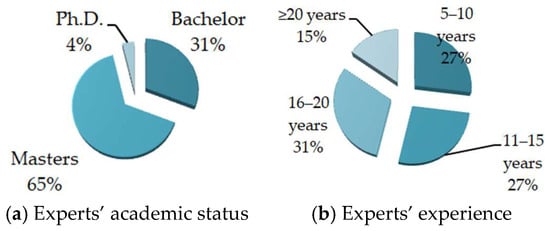
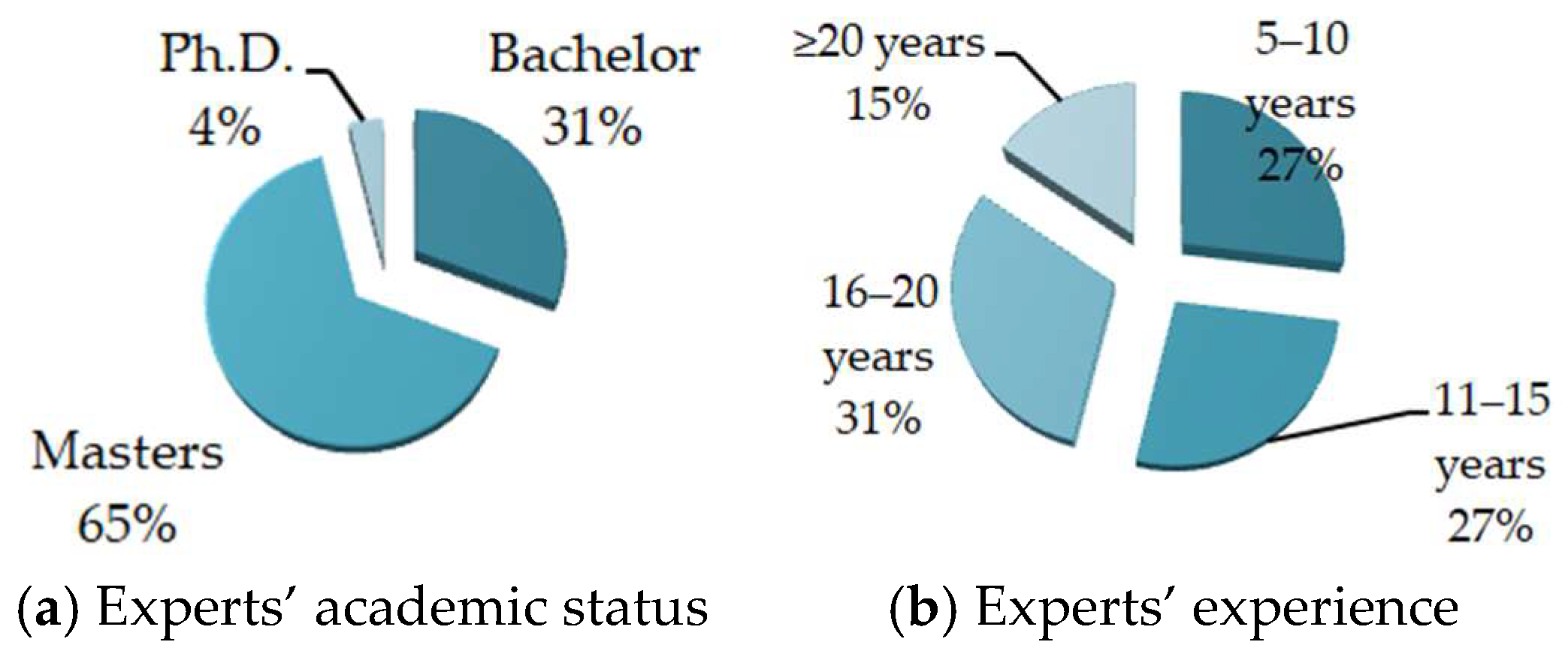
Accordingly, the Delphi was started with the participation of a panel of 30 experts in the first round and completed with the participation of 26 experts in the third round (86.67% response rate). Figure 4a,b show the experts’ demography, where the majority of experts have above a master’s degree (69%) and more than 10 years of experience (73%).
Figure 4.
Experts’ demography.
Though Delphi is criticized for its poor response rate in subsequent rounds [40], starting the process with a face-to-face method was suggested to increase the experts’ commitment [50,51]. Accordingly, a face-to-face data collection was used in the first round, during which a detailed explanation about the procedures and number of Delphi rounds was given to the experts. In addition, experts were requested to provide their e-mail addresses to confirm their willingness to participate in the subsequent rounds. All respondents expressed their willingness and provided their e-mail addresses. In the second and third rounds, experts were contacted via their e-mail.
Initially, the questionnaire was developed based on the findings of the SLR. A pilot test of the questionnaire was conducted with two experts: one Ph.D. holder and one M.Sc. holder with more than 18 years of academic and industry experience in the risk management of the ECI. The experts were requested to review the clarity of the questionnaire and suggest additional cost risk factors common to the ECI. Additional cost risk factors were not suggested. However, some wording adjustments were made, and the final questionnaire of the first-round Delphi was developed.
In the first round, experts were requested to select the cost overrun factors they commonly face from the lists identified by the SLR. Then, frequency analysis was conducted, and factors that were selected by the majority of the experts (>50%) were forwarded to the second round. Then, in the second round, experts were again requested to select from the factors forwarded from the first round, and factors that received more than 50% approval were then forwarded to the third round for final analysis. In the third round, experts were requested to independently rate the probability and impact of risk factors exported from the second round using a five-point Likert scale—from Very Low (1) to Very High (5)—adopted from PMI [15].
Although the Delphi technique facilitates experts’ consensus, it has limitations in accounting for the uncertainties inherent in human judgments. The third-round Delphi survey used linguistic scales to evaluate the probability and impact of the risks that cannot be adequately aggregated using crisp numerical averages. Therefore, utilizing fuzzy logic is advantageous by transforming such linguistic variables into fuzzy numbers, thereby preserving uncertainty and improving the robustness of risk prioritization.
2.3. Fuzzy Technique
Fuzzy logic—introduced by Zadeh [52]—is suited to mathematically interpret subjective reasoning where a definite conclusion is required from ambiguous information in the absence of precise data [53,54]. Fuzzy logic-based approaches can make the construction decision-making process more transparent and allow experts to express themselves in linguistic terms rather than in numerical terms [53,55]. Fuzzy technique is becoming a more researched topic in construction engineering and management fields in the form of either fuzzy set alone or hybrid fuzzy techniques (such as fuzzy neural networks, fuzzy Delphi, and fuzzy analytic hierarchy process). However, the use of fuzzy hybrid techniques is effective in addressing problems that cannot be addressed by fuzzy sets alone [56,57]. Thus, this study utilized a Fuzzy–Delphi hybrid approach to analyze the experts’ subjective judgment.
For a given fuzzy set A in the universe of discourse, the membership function of the universal set X, µA (x), is defined as µA (x): X→ [0, 1], determines the degree that element x belongs to the fuzzy set A [52,54]. The membership value 0 shows that the element x does not belong to the fuzzy set A, whereas the value 1 shows the element fully belongs to the set A. Any value between 0 and 1 show the element partially belongs to the set, A [52,58]. The basic step-by-step procedures of the fuzzy technique used in this study are (1) fuzzification, (2) aggregation, (3) calculation of fuzzy risk magnitude, (4) defuzzification, and (5) cost risk factor ranking and analysis. Similar techniques have been successfully utilized in other studies [59,60]. The steps are outlined in the subsequent sections.
2.3.1. Step 1: Fuzzification
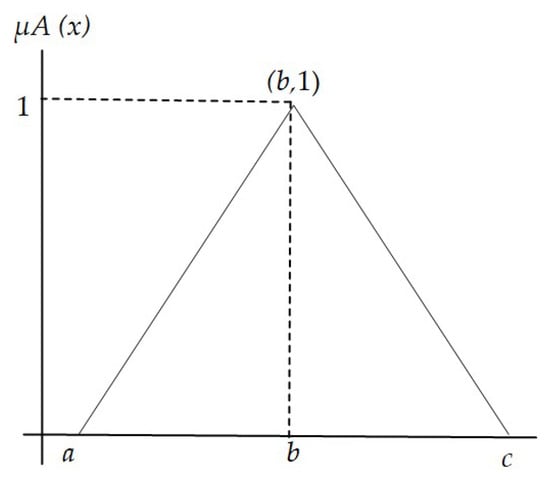
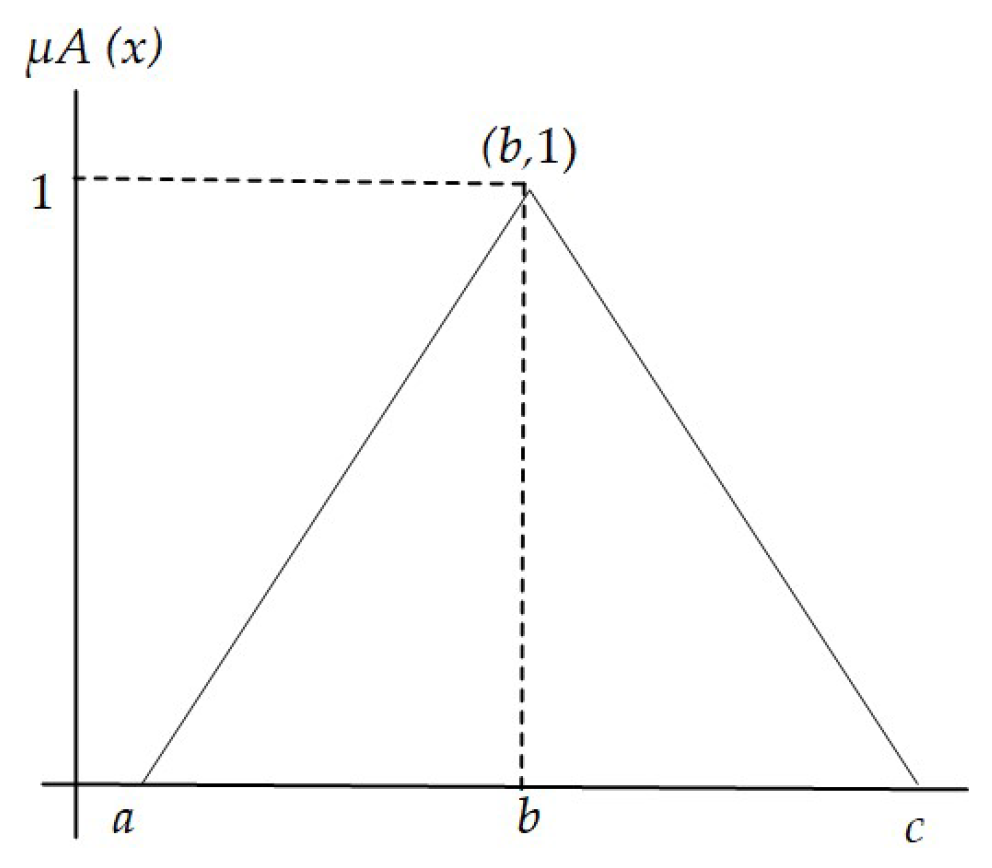
In the third round of the Delphi process, experts rated the linguistic variables, probability, and impact, using a linguistic scale from Very Low (1) to Very High (5). Linguistic variables are variables whose values are linguistic scales [61]. The linguistic scale represents a group of fuzzy numbers [60]. Thus, fuzzification is the technique of transforming the crisp values of linguistic variables into the corresponding fuzzy membership functions [62]. Several geometric mappings of membership functions, such as triangular, trapezoidal, and S-shaped, have been used [54,63]. However, this study adopted triangular membership functions as they are widely used because of their simplicity to compute and interpret [55]. A triangular membership function is basically represented by (a, b, c), where a < b < c. The parameters a and c represent the two extreme points of the base of a triangle, where b indicates the pick point of the triangle projected to its base. The triangular membership function can be symmetric or asymmetric [64]. Figure 5 and Equation (1) show the graphical and mathematical representation of the triangular membership functions, respectively [65,66]. For two triangular fuzzy membership functions A1 = (a1, b1, c1) and A2 = (a2, b2, c2) the basic fuzzy operational laws can be referred to the literature [54,67].
Figure 5.
Representation of triangular membership functions.
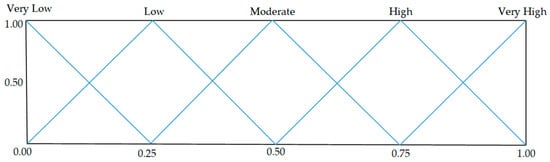
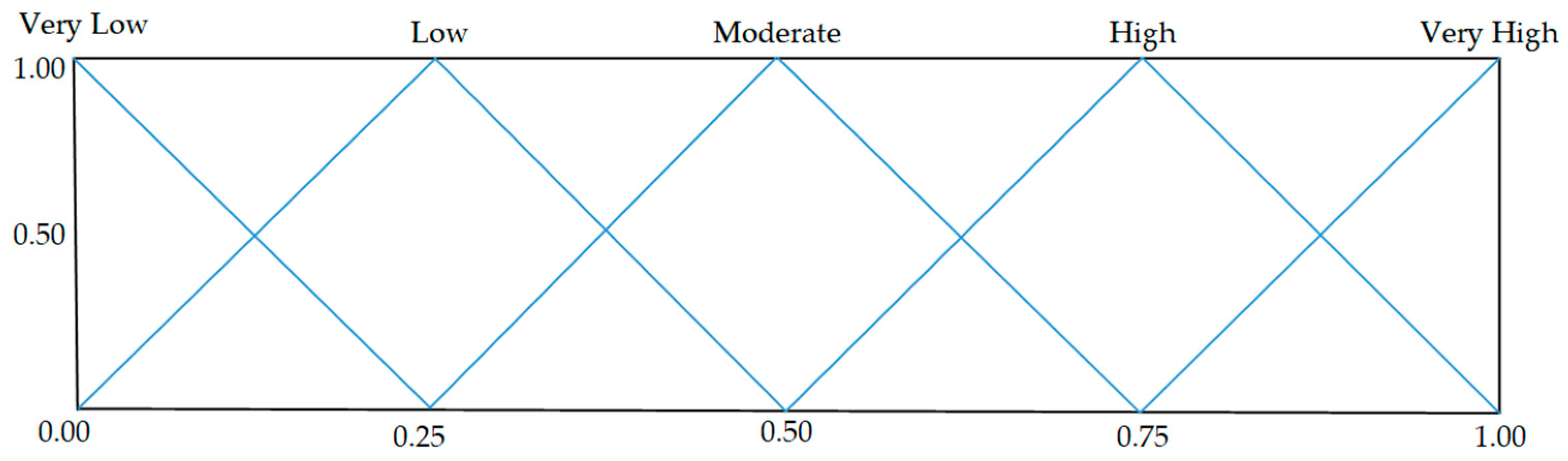
The fuzzy scale is selected based on the type of fuzzy numbers that are suitable to present the linguistic variable in a problem [60]. Table 1 and Figure 6 depict the triangular membership functions adopted in this study. Table 2 illustrates the fuzzification process of the experts’ judgments for the cost risk factor “escalation and fluctuation in material prices”.
Table 1.
Adopted linguistic scales and triangular membership functions.
Figure 6.
The fuzzification diagram.
Table 2.
Illustrations of the fuzzification process.
2.3.2. Step 2: Aggregation
Once the experts’ judgments are fuzzified, the next step is to conduct aggregation of their judgments for the probability and impact independently. Aggregation is a technique by which several fuzzy sets are combined to produce a single fuzzy set [54]. In fuzzy aggregation, the main concern was how expert judgments are summarized into a set of consistent group judgments. In response to this, several aggregation techniques, such as t-norms, t-conforms, and simple averaging operations, are suggested in the literature [68,69]. In this study, the averaging aggregation technique is used, as it is commonly utilized in most similar studies due to its practical simplicity.
Therefore, for n number of experts participating in a study, the aggregated expert’s judgment is computed by Equation (2) provided by Klir and Yuan [54].
where A1, A2, A3, and An are the fuzzy sets with fuzzy numbers (a1, b1, c1), (an, bn, cn). Thus, the aggregate fuzzy numbers for the probability (FP) and impact (FI) of the ith cost risk factor and jth expert could be computed by Equations (3) and (4).
For example, the aggregate value for probability and impact of the cost risk factor “escalation and fluctuation in material prices” is: FP = (0.577, 0.827, 0.942) and FI = (0.654, 0.904, 0.981).
2.3.3. Step 3: Determination of Fuzzy Risk Magnitude
Basically, the magnitude of a risk is computed as the product of its probability and impact [9]. Thus, the fuzzy risk magnitude (FRFi) of the ith cost risk factor is computed by multiplying the aggregated fuzzy values of probability (FPi) and impact (FIi) for each risk factor by using Equation (4).
FRFi = FPi × FIi,
For instance, the fuzzy risk magnitude for the cost risk factor “escalation and fluctuation in material prices” is (0.577, 0.827, 0.942) ⊗ (0.654, 0.904, 0.981) = (0.377, 0.747, 0.924).
2.3.4. Step 4: Defuzzification
For a risk factor to be practically evaluated, the fuzzy values should be converted to a single crisp value. Defuzzification is the technique of transforming the fuzzy values (which represent uncertainty) into a single crisp value for the subsequent decision-making [58]. The literature has provided a number of defuzzification techniques with their advantages and disadvantages [70,71]. Their selection depends on factors such as their suitability to the desired fuzzification output [70]. This used the centroid method (Equation (6)) as it is commonly utilized in symmetrical fuzzy shapes such as triangular [66,72].
where a, b, and c are the membership values for a given triangular fuzzy set A. For instance, the defuzzified value for the cost risk factor “escalation and fluctuation in material prices” is 0.683.
2.3.5. Step 5: Risk Factors Analysis
In this final step, cost risk factors are qualitatively analyzed based on the magnitude of their corresponding crisp value derived from defuzzification (step 4). Risks are basically analyzed by using qualitative and quantitative techniques. The qualitative technique is the critical step used to analyze the effects of individual factors, whereas the quantitative step is used to assess their joint effect on the project objective [15]. In both cases, risk probability and impact are the fundamental inputs [73].
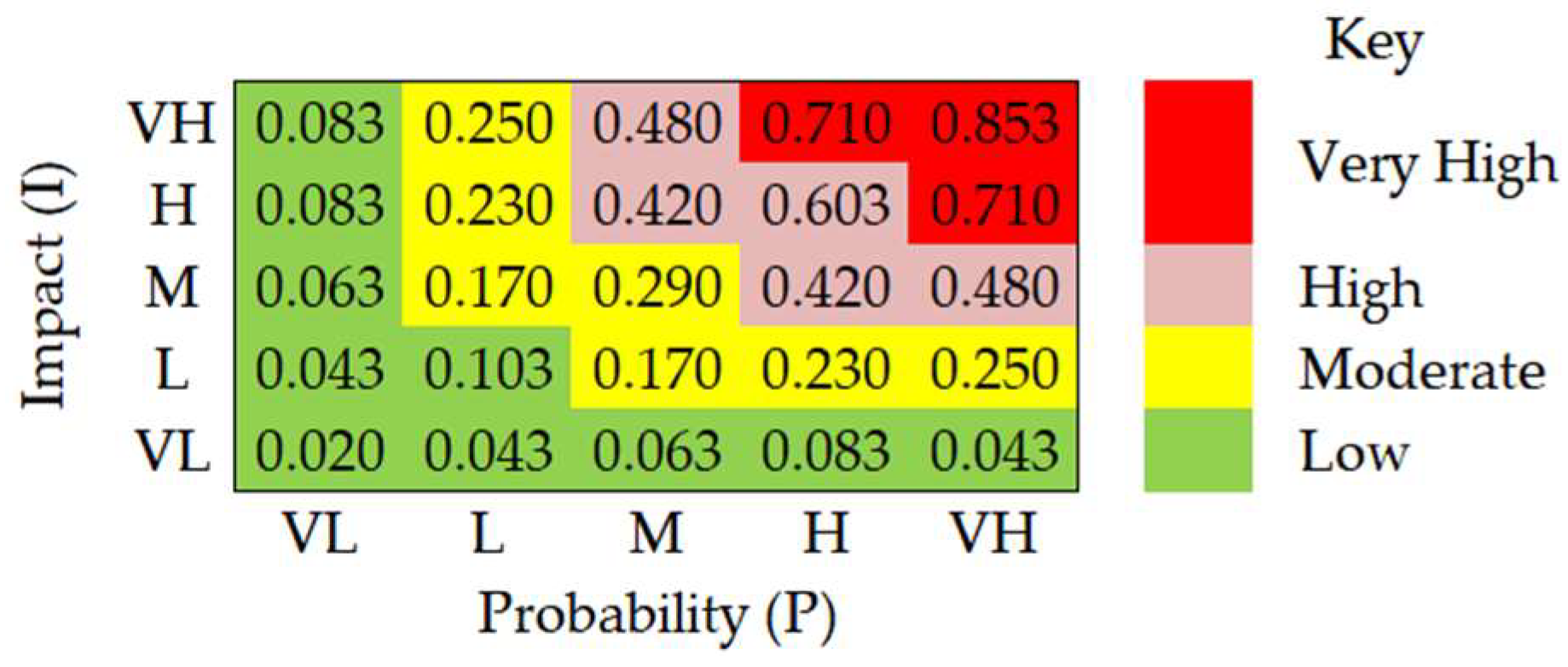
The probability-impact (P-I) matrix is a tool for qualitative risk analysis commonly utilized in different sectors, ranging from construction to healthcare [73] due to its simplicity in application and construction [74]. The matrix categorizes risk factors using linguistic terms such as low, moderate, high, and very high, built based on the ‘if-and-then’ rules like: if the probability is ‘High’ and the impact is ‘Low’, then the risk’s severity is ‘Moderate’, shown in yellow color in Figure 7 [15].
Figure 7.
Typical probability-impact matrix.
In spite of its popularity, the P-I matrix technique has limitations. For example, it does not support the decision-makers in prioritizing risk factors having the same severity category. Rather, it pushes the risk factors to the extreme corner of the linguistic terms. That means the risk severity should be low, medium, high, or very high [74]. This may mislead decision-makers during the assigning of mitigation strategies and may result in a waste of resources [73]. For instance, the matrix in Figure 7 collectively classified risk factors with different levels of severity—0.420, 0.480, and 0.603—as ‘High’. Though, they require different management attention.
In responding to this problem, researchers have proposed solutions. Acebes, Gonzalez-Varona, Lopez-Paredes and Pajares [73] suggested the use of a quantitative matrix by incorporating Monte Carlo simulation, while Levine [74] recommended the use of a logarithm-based matrix. However, these suggestions could reduce their practical utilization—simplicity—as they require structured data input and analytical skills. Therefore, incorporating a means that promotes the strengths and overcomes the weaknesses of the P-I matrix is suggested. Accordingly, this study used the advantage of fuzzy techniques described in the above steps to rank and qualitatively analyze risk factors classified under a given severity category.
Accordingly, a range of crisp values that is in agreement with the descriptions in a matrix is suggested. Thus, the risks are categorized as: low, moderate, high, or very high based on their proximity to the extreme bounds within the range [0.020–0.854]. The highest value (0.854) is where both the probability and impact of the risk are ‘Very High’, while the lowest crisp value (0.020) reflects situations where both dimensions are rated as ‘Very Low’. The crisp value ranges for each category are summarized in Table 3. Similar risk categorization techniques were used in other studies [11,59,60]. This technique is advantageous, as it can be used as a simplified risk probability and impact matrix.
Table 3.
Crisp value ranges and risk categorization.
Once the risks are linguistically classified, they are ranked based on their crisp magnitude to determine the relative importance for management. For instance, the crisp value for the cost risk factor “escalation and fluctuation in material prices” is 0.683, which is in the range of (0.604–0.853), and hence it is among the ‘Very High’ severity risk factors and ranked 1st (Table 3).
3. Results
The SLR resulted in eighty-one cost risk factors that are common in the developing countries’ CI. Table 4 shows that escalation and fluctuation in material prices, design change, poor quantity and cost estimation, variation or change order (addition/omission), and delay in payment to the contractor are the top five factors in the literature.
Table 4.
Results of the SLR.
The results of the first two Delphi rounds forwarded fifty-four cost risk factors that were finally reduced to forty-six, receiving an overall consensus fuzzy distance value of d ≤ 0.2. The results of the fuzzy analysis revealed that escalation and fluctuation in material prices, inflation, shortage of materials, country’s political instability, country’s economic instability, delay in payment to the contractor, and delay in procurement and delivery of materials are the critical cost risk factors, each exerting a ‘Very High’ impact on project costs.
The results show that the majority of cost risk factors excluded by Ethiopian experts (24 out of 35 during the Delphi rounds were those with the least frequency in the literature (less than 6%)). This agreement could be because the reviewed articles are based on countries with similar economic status and, hence, construction practice to Ethiopia. However, the majority of the factors classified as ‘Very High’ magnitude in the Ethiopian context have a frequency from low to high in the SLR. This could be because the scope in the Ethiopian context was building contractors, whereas the SLR was not stakeholder and project-specific. Furthermore, the cost risk factors finally assessed have ‘High’ or ‘Very high’ severity in the Ethiopian context. This confirms the advantage of Delphi techniques, as risk factors with the least severity were excluded during the first and third rounds. Table 5 summarizes the results of the study.
Table 5.
Results of the data analysis.
4. Discussion
4.1. Cost Risk Factors in the Developing Countries
The results of the SLR revealed that escalation and fluctuation in material prices (49%), design change (39), poor quantity and cost estimation (33%), variation or change order (addition/omission) (29%), and delay in payment to the contractor (27%) are the top five risk factors causing cost overrun in the developing countries’ CI.
4.2. Cost Risk Factors in the Ethiopian Context
4.2.1. Escalation and Fluctuation in Material Prices
Escalation and fluctuation in material prices are identified as the major cause for cost overrun, aligning with the findings of Ashtari, Ansari, Hassannayebi and Jeong [80], Xie, Deng, Yin, Lv and Deng [106], and the SLR. Construction materials account for 60% of the project cost [124,125], meaning that even a small price increase can significantly impact the overall project cost. Essentially, escalation is triggered by external factors such as supply chain disruption, geopolitical instability, inflation, variation in exchange rate, and a country’s economic instability [93,126]. Thus, escalation and fluctuation in material prices remain beyond the control of the contractor and their effect is difficult to forecast [127]. However, providing a price adjustment clause in the contract document is commonly suggested in managing such factors [36,106].
4.2.2. Inflation
Inflation is the second-ranked cost risk factor, aligning with the findings of Belay, Tilahun, Yehualaw, Matos, Sousa and Workneh [6]. Inflation drives up prices for materials, labor, equipment, and hire rates, making it one of the key causes of cost overrun [128]. Though forecasting inflation is not simple, estimators should conduct extensive information and data collection to properly incorporate the effect of inflation [129]. Musarat et al. [130] suggested the use of a time series construction rate forecasting model, which incorporates the possible inflation rates. Furthermore, Ebekozien et al. [131] suggested a downward review of the monetary policy rate, control of exchange rate volatility, and addressing insecurity as a strategy to mitigate the effect of inflation.
4.2.3. Shortage of Materials
Materials shortage is the other critical cause for cost overruns, supported by Berihu, Grum, Tariku and Abebe [94]. Materials affect up to 80% of the construction activity [125]. However, the CI is challenged by material shortages mainly due to poor quantification, delays in material procurement and delivery, supply of defective materials, poor inventory control, delays in the production of special materials, and frequent material quality and specification changes [132]. Thus, the materials shortage is primarily due to the contractor’s fault, but other parties’ faults should not be ignored. Management strategies such as materials planning, logistics, handling, and stock and waste control are the suggested mitigation strategies for materials shortage [133].
4.2.4. County’s Political Instability
Political instability is among the significant cost risk factors consistent with Mahmud, Ogunlana and Hong [122]. Political instability is one of the external risk factors affecting countries’ investment activity [134]. A politically unstable environment creates conditions that escalate project costs and even lead to full project interruptions [127]. According to Bekr [135], for instance, projects under politically unstable situations significantly encountered cost overruns and delays due to the higher cost of security, corruption, and unofficial holidays.
4.2.5. Country’s Economic Instability
The country’s economic instability is the other challenge, in agreement with Shaikh [103]. It is an external risk factor that influences managerial decision-making [136]. Project cost overruns and delays are the main challenges during economic instability that can be mitigated by implementing improved planning, effective cash flow management, cost reduction measures, supply chain optimization, risk management, and fostering organizational agility [136,137]. These suggestions reinforce the importance of resilient financial and operational strategies to manage economic instability, especially in developing countries.
4.2.6. Delay in Payment to the Contractor
Delay in payment to the contractor is the other factor with a ‘Very high’ severity, aligning with [94,123]. It is commonly the client’s fault [95]. It is suggested that clients should demonstrate the funding for the project in advance [98]. In addition, selecting a financially stable contractor is also advised, as contractors with weak financial standing are more likely to suspend work during payment delays, which may result in significant cost overruns [138].
4.2.7. Delay in Procurement and Delivery of Materials
The study identified delay in procurement and delivery of materials as the seventh ‘very high’ cost risk factor, in agreement with Berihu, Grum, Tariku and Abebe [94]. In many developing countries, construction materials are imported and must be purchased using foreign currency. This makes projects highly vulnerable to exchange rate fluctuations and inflation, and hence, delays in procurement [95]. Supplier defaults also exacerbate delivery challenges [123]. In its extreme cases, extended procurement delay could result in design and material changes during construction [93]. To address this risk, contractors should adopt robust procurement planning strategies [95].
In summary, it can be concluded that cost overrun in the ECI is mainly due to macroeconomic and political factors, which is in agreement with Bedada [139], who concluded that political and economic factors significantly impact the ECI. This could be because the ECI is dependent on imported resources, rendering it vulnerable to these factors, despite significant local resource use. Political instability and lower GDP reduced investment and raised inflation in Ethiopia [140]. To withstand those challenges, organizations should acquire strong stability and experience. However, the organizational capability of Ethiopian contractors remains weak. According to Donka and Mengistu [141], most of the contractors in the ECI exit the industry within a decade of their startup, and the industry is dominated by young companies with small capital and inadequate organizational capability.
Although the level of severity varies according to the specific context of the country, similar reports have been recorded in other developing countries. In Tanzania, for example, macroeconomic variables such as inflation rate, interest rate, labor, and technology are significant reasons for project failure [142]. According to Coleman et al. [143], political factors are among the critical reasons for unsuccessful projects in Ghana. According to a study by Draleti, Sengonzi and Kakitahi [118], the cost of materials, inflation, fraudulent practices, and kickbacks are among the critical causes of cost overrun in Uganda. Similarly, financial difficulty by the client, delays in payments of completed work, and material price fluctuations are among the critical causes of cost overruns in Ghana [95].
In contrast, construction project cost overruns in developed countries are mainly due to internal risk factors. For example, a study by Eliasson [144] evaluated the causes of cost overruns in Swedish transport infrastructure projects constructed from 2004 to 2022 and concluded that the decision-making process is the main cause of cost overruns. According to Steininger et al. [145], scope changes, geological conditions, high risk-taking propensity, and extended implementation are among the critical causes of cost and time overruns in Germany.
Thus, from the above comparisons, it can be concluded that though cost overrun is a global challenge, its extent and nature vary across nations depending on factors such as economic, political, organizational, and technical factors. A study by Ismail, Ramly and Hamid [17] conducted a systematic review of cost overruns in the CI of developed and developing countries and concluded that the effect of cost overruns in the cases of developing countries is more significant due to economic hurdles that often cause financial tightness in the construction projects. CI in developing countries is being challenged by issues such as political instability, a shortage of human resources, and the effect of inflation.
4.3. Implication and Limitation
The suggestion of the mitigation strategies provides practical guidance for tackling the effects of the risk factors with very high severity. The literature classified the possible mitigation strategies to be adopted as risk avoidance, risk reduction, risk sharing, risk transfer, and risk acceptance [15]. Contractors can use one or a combination of these strategies depending on their organizational capabilities and the nature of the risks to be mitigated. For instance, economic risk factors such as inflation and escalation can be mitigated through contractual procedures like the price escalation provision in the contract document (sharing the risks with the client) [36,146]. While material delivery issues can be addressed through proactive risk reduction strategies such as material hedging, early procurement, use of alternative suppliers, and stocking critical materials [147]. Furthermore, the mitigation of macroeconomic and political risks requires government intervention.
This study is significant to both the researchers and practitioners in the CI. The findings of the study highlight that cost overruns in the cases of the ECI are mainly due to factors that are beyond the control of the contractor. The study also suggests possible mitigation strategies in tackling those risks. For researchers, the study significantly contributes to the existing body of knowledge by identifying the critical causes of cost overrun in the ECI. Furthermore, its methodological approach, particularly the sequential SLR, Delphi, and fuzzy methods, offers a clear reference for other researchers conducting similar studies.
Though the study provides valuable insights into understanding the nature of cost overruns in the recent ECI, it is not without limitations. As the study is based on expert judgments, there could be a problem of subjectivity reflecting the experience of the selected experts. Although the Delphi sample is defensible, the Delphi panel may not fully represent contractors, and there could be a problem of generalizability. Furthermore, the study indicated critical risks in the ECI during data collection and does not imply that lower-ranked risks are not significant. Rather, the severity of a risk may vary depending on factors such as project type and economic situation, and hence, a risk that is critical in one situation may not be critical in another situation. Therefore, the findings of the study should not be interpreted as a universal ranking; it is rather a context-specific ranking. The other limitation is that, as the experts are from the ECI, the findings are context-specific and may not be directly generalizable to other countries. The other limitation of this study is it does not explicitly model the interaction among risks. However, these limitations present opportunities for future research, including cross-country comparative studies to enhance the external validity of the results, validation using longitudinal project cost data, and integration of probabilistic modeling techniques such as Monte Carlo simulation for cost overrun forecasting and modeling the interaction among the risks.
5. Conclusions and Recommendations
Cost overrun is among the critical challenges of the CI, where its impact is more significant in developing countries like Ethiopia. However, only limited attempts have been made to critically identify and analyze the risk factors contributing to cost overruns in the ECI. This study utilized a systematic literature review (SLR), a three-round Delphi, and a fuzzy set to fill the gap by assessing the developing countries and the Ethiopian context. The SLR resulted in eighty-one cost risk factors common to the developing countries. The Delphi resulted in fifty-four cost risk factors common to ECI, ranked by using fuzzy logic.
The findings of the SLR indicated that escalation and fluctuation in material prices, design change, poor quantity and cost estimation, variation or change order (addition/omission), and delay in payment to the contractor are the top five cost risk factors in the literature. From the context of the ECI, escalation and fluctuation in material prices, inflation, material shortages, the country’s political instability, the country’s economic instability, delay in payment to the contractor, and delay in procurement and delivery of materials are cost risk factors with a ‘Very High’ severity in the ECI, indicting cost overrun in the ECI is mainly due to the macroeconomic and political factors.
As these risks are predominantly external risks, stakeholders in the ECI should adopt proper mitigation strategies. Clients and contractors should incorporate contractual clauses that support price escalation and inflation-indexed contracts. Furthermore, those risks cannot be managed by the traditional contingency allocation, and hence, they should adopt advanced contingency estimating techniques, such as simulation, if risk acceptance is desired. As a policymaker, the government’s involvement is critical. Some of the activities to be performed by the government are facilitating the availability of foreign exchange for construction material suppliers and importers and promoting stable procurement policies.
Supplementary Materials
The following supporting information can be downloaded at: https://www.mdpi.com/article/10.3390/info17030226/s1, Table S1: List of reviewed articles; Table S2: Delphi questionnaire; Table S3: Survey results for the third-round Delphi.
Author Contributions
K.T.B.: Conceptualization, Data curation, Formal analysis, Investigation, Methodology, Project administration, Resources, Software, Validation, Visualization, Writing—original draft, Writing—review & editing. A.K.W.: Conceptualization, Methodology, Supervision, Validation, Writing—review & editing. A.T.S.: Conceptualization, Methodology, Supervision, Validation, Writing—review & editing. W.A.W.: Conceptualization, Methodology, Resources, Software, Supervision, Validation, Visualization, Writing—review & editing. M.D.Y.: Conceptualization, Resources, Supervision, Validation, Writing—review & editing. W.Z.T.: Conceptualization, Resources, Supervision, Validation, Writing—review & editing. All authors have read and agreed to the published version of the manuscript.
Funding
This research received no external funding.
Institutional Review Board Statement
According to the Bahir Dar University Senate legislation 2020, the study involved a non-interventional questionnaire, and informed consent and anonymity were strictly maintained. Thus, the study falls under the category of research that does not require formal ethics committee approval.
Informed Consent Statement
Informed consent was obtained from all participants involved in the study. Participants were voluntary and informed about the purpose of the research, their right to withdraw at any time, and the confidentiality of their responses. No personal identifiers were collected, and all responses were analyzed anonymously.
Data Availability Statement
The original contributions presented in this study are included in the article and Supplementary Material. Further inquiries can be directed to the corresponding author.
Conflicts of Interest
The authors declare no conflicts of interest.
Abbreviations
The following abbreviations are used in this manuscript:
| CI | Construction Industry |
| ECI | Ethiopian construction industry |
| SLR | Systematic literature review |
References
- Alaloul, W.S.; Musarat, M.A.; Rabbani, M.B.A.; Iqbal, Q.; Maqsoom, A.; Farooq, W. Construction Sector Contribution to Economic Stability: Malaysian GDP Distribution. Sustainability 2021, 13, 5012. [Google Scholar] [CrossRef] [Scilit]
- Giang, D.T.H.; Pheng, L.S. Role of Construction in Economic Development: Review of Key Concepts in the Past 40 Years. Habitat Int. 2011, 35, 118–125. [Google Scholar] [CrossRef] [Scilit]
- Abate, H.H.; Mengistu, D.G.; Abera, T.A. Failure Factors of Building Construction Projects in Ethiopia. Afr. J. Sci. Technol. Innov. Dev. 2024, 16, 860–880. [Google Scholar] [CrossRef] [Scilit]
- Pollack, J.; Helm, J.; Adler, D. What is the Iron Triangle, and How Has it Changed? Int. J. Manag. Proj. Bus. 2018, 11, 527–547. [Google Scholar] [CrossRef] [Scilit]
- Olatunji, O.A. A comparative analysis of tender sums and final costs of public construction and supply projects in Nigeria. J. Financ. Manag. Prop. Constr. 2008, 13, 60–79. [Google Scholar] [CrossRef] [Scilit]
- Belay, S.M.; Tilahun, S.; Yehualaw, M.; Matos, J.; Sousa, H.; Workneh, E.T. Analysis of Cost Overrun and Schedule Delays of Infrastructure Projects in Low Income Economies: Case Studies in Ethiopia. Adv. Civ. Eng. 2021, 2021, 4991204. [Google Scholar] [CrossRef] [Scilit]
- Belachew, A.S.; Mengesha, W.J.; Mohammed, M. Causes of Cost Overrun in Federal Road Projects of Ethiopia in Cases of Southern District. Am. J. Civ. Eng. 2017, 5, 27–40. [Google Scholar] [CrossRef] [Scilit]
- Welde, M.; Klakegg, O.J. Avoiding Cost Overrun Through Stochastic Cost Estimation and External Quality Assurance. IEEE Trans. Eng. Manag. 2024, 71, 1984–1997. [Google Scholar] [CrossRef] [Scilit]
- Kerzner, H. Project Management: A Systems Approach to Planning, Scheduling, and Controlling, 12th ed.; Wiley: Hoboken, NJ, USA, 2017; p. 814. [Google Scholar]
- Pinto, J.K. Project Management: Achieving Competitive Advantage, 5th ed.; Pearson: New York, NY, USA, 2019; p. 564. [Google Scholar]
- Sudarsana, D.K. Development of an Integrated Cost, Time, Quality and Safety Risk Analysis Tool in a Construction Project. Int. J. Cond. Monit. Diagn. Eng. Manag. 2023, 26, 3–8. [Google Scholar]
- Kivrak, S.; Udan, O.H. Risk Management Practices in Ethiopian Somali Regional State Construction Projects. Buildings 2023, 13, 3130. [Google Scholar] [CrossRef] [Scilit]
- Ayalew, T.; Dakhli, Z.; Lafhaj, Z. Assessment on Performance and Challenges of Ethiopian Construction Industry. Quest J. J. Archit. Civ. Eng. 2016, 2, 1–11. [Google Scholar]
- Yadeta, A.E. Critical Risks in Construction Projects in Ethiopia. J. Adv. Res. Civ. Eng. Archit. 2019, 1, 1–9. [Google Scholar]
- PMI. A Guide to the Project Management Body of Knowledge, 6th ed.; PMI: Newtown Square, PA, USA, 2017. [Google Scholar]
- Hillson, D.; Simon, P. Practical Project Risk Management: The ATOM Methodology, 3rd ed.; Berrett-Koehler Publishers, Inc.: San Francisco, CA, USA, 2020. [Google Scholar]
- Ismail, M.Z.; Ramly, Z.M.; Hamid, R.A. Systematic Review of Cost Overrun Research in the Developed and Developing Countries. Int. J. Sustain. Constr. Eng. Technol. 2021, 12, 196–211. [Google Scholar] [CrossRef] [Scilit]
- Mitikie, B.B.; Lee, J.; Lee, T.S. The Impact of Risk in Ethiopian Construction Project Performance. Open Access Libr. J. 2017, 4, e4233. [Google Scholar] [CrossRef]
- Park, Y.I.; Papadopoulou, T.C. Causes of Cost Overruns in Transport Infrastructure Projects in Asia: Their Significance and Relationship with Project Size. Built Environ. Proj. Asset Manag. 2012, 2, 195–216. [Google Scholar] [CrossRef] [Scilit]
- Hillson, D. Managing Risk in Projects, 2nd ed.; Routledge: London, UK, 2025. [Google Scholar]
- Zewdu, Z.T.; Aregaw, G.T. Causes of Contractor Cost Overrun in Construction Projects: The Case of Ethiopian Construction Sector. Int. J. Bus. Econ. Res. 2015, 4, 180–191. [Google Scholar] [CrossRef] [Scilit]
- Okoli, C.; Schabram, K. A Guide to Conducting a Systematic Literature Review of Information Systems Research. Sprouts Work. Pap. Inf. Syst. 2010, 10. [Google Scholar] [CrossRef] [Scilit]
- Fink, A. Conducting Research Literature Reviews, 4th ed.; SAGE Publications, Inc.: New York, NY, USA, 2014. [Google Scholar]
- Azarian, M.; Yu, H.; Shiferaw, A.T.; Stevik, T.K. Do We Perform Literature Review Right? A Scientific Mapping and Methodological Assessment. Logistics 2023, 7, 89. [Google Scholar] [CrossRef] [Scilit]
- Mongeon, P.; Paul-Hus, A. The Journal Coverage of Web of Science and Scopus: A Comparative Analysis. Scientometrics 2016, 106, 213–228. [Google Scholar] [CrossRef] [Scilit]
- Vieira, E.S.; Gomes, J.A.N.F. A Comparison of Scopus and Web of Science for a Typical University. Scientometrics 2009, 81, 587–600. [Google Scholar] [CrossRef] [Scilit]
- DESA. World Economic Situation and Prospects; United Nations Publication: New York, NY, USA, 2024. [Google Scholar]
- Othman, S.A.; Jaff, D.K.I.; Oztas, A. Development of a Risk Breakdown Structure in Mega Projects based on Different Case Studies. Eng. Technol. Appl. Sci. Res. 2024, 14, 15625–15630. [Google Scholar] [CrossRef] [Scilit]
- Ebrahimnejad, S.; Mousavi, S.M.; Seyrafianpour, H. Risk Identification and Assessment for Build-Operate-Transfer Projects: A Fuzzy Multi Attribute Decision Making Model. Expert Syst. Appl. 2010, 37, 575–586. [Google Scholar] [CrossRef] [Scilit]
- Al-Bahar, J.F.; Crandall, K.C. Systematic Risk Management Approach for Construction Projects. J. Constr. Eng. Manag. 1990, 116, 533–546. [Google Scholar] [CrossRef] [Scilit]
- Tessema, A.T.; Alene, G.A.; Wolelaw, N.M. Assessment of Risk Factors on Construction Projects in Gondar City, Ethiopia. Heliyon 2022, 8, e11726. [Google Scholar] [CrossRef] [Scilit] [PubMed]
- Choudhry, R.M.; Aslam, M.A.; Hinze, J.W.; Arain, F.M. Cost and Schedule Risk Analysis of Bridge Construction in Pakistan: Establishing Risk Guidelines. J. Constr. Eng. Manag. 2014, 140, 04014020. [Google Scholar] [CrossRef] [Scilit]
- Siraj, N.B.; Fayek, A.R. Risk Identification and Common Risks in Construction: Literature Review and Content Analysis. J. Constr. Eng. Manag. 2019, 145, 03119004. [Google Scholar] [CrossRef] [Scilit]
- Fernández-Valderrama, P.; Ureña-Estrella, C.; Moyano, J.; Bienvenido-Huertas, D. Cost and time risk factors in construction projects in the Dominican Republic. Front. Built Environ. 2024, 10, 1307572. [Google Scholar] [CrossRef] [Scilit]
- Mehdizadeh, R.; Breysse, D.; Taillandier, F.; Niandou, H. Dynamic and multi perspective risk management in construction with a special view to temporary structures. Civ. Eng. Environ. Syst. 2013, 30, 115–129. [Google Scholar] [CrossRef] [Scilit]
- Devi, A.C.; Ananthanarayanan, K. Factors Influencing Cost Over-Run in Indian Construction Projects. In MATEC Web of Conferences; EDP Sciences: Hulls, France, 2017; Volume 120. [Google Scholar] [CrossRef] [Scilit]
- Wang, J.-Y.; Yuan, H.-P. Major Cost-Overrun Risks in Construction Projects in China. Int. J. Proj. Organ. Manag. 2011, 3, 227–242. [Google Scholar] [CrossRef] [Scilit]
- Franc, J.M.; Hung, K.K.C.; Pirisi, A.; Weinstein, E.S. Analysis of Delphi Study 7-Point Linear Scale Data by Parametric Methods: Use of the Mean and Standard Deviation. Methodol. Innov. 2023, 16, 226–233. [Google Scholar] [CrossRef] [Scilit]
- Sumsion, T. The Delphi Technique: An Adaptive Research Tool. Br. J. Occup. Ther. 1998, 61, 153–156. [Google Scholar] [CrossRef] [Scilit]
- Keeney, S.; Hasson, F.; McKenna, H.P. The Delphi Technique in Nursing and Health Research; Wiley-Blackwell: Chichester, UK, 2011. [Google Scholar]
- Ameyaw, E.E.; Hu, Y.; Shan, M.; Chan, A.P.C.; Le, Y. Application of Delphi Method in Construction Engineering and Management Research: A Quantitative Perspective. J. Civ. Eng. Manag. 2016, 22, 991–1000. [Google Scholar] [CrossRef] [Scilit]
- Junger, S.; Payne, S.A.; Brine, J.; Radbruch, L.; Brearley, S.G. Guidance on Conducting and REporting DElphi Studies (CREDES) in palliative care: Recommendations based on a methodological systematic review. Palliat. Med. 2017, 31, 684–706. [Google Scholar] [CrossRef] [Scilit]
- Perera, B.A.K.S.; Rameezdeen, R.; Chileshe, N.; Hosseini, M.R. Enhancing the Effectiveness of Risk Management Practices in Sri Lanka Road Construction Projects: A Delphi Approach. Int. J. Constr. Manag. 2014, 14, 1–14. [Google Scholar] [CrossRef] [Scilit]
- Hallowell, M.R.; Gambatese, J.A. Qualitative Research: Application of the Delphi Method to CEM Research. J. Constr. Eng. Manag. 2010, 136, 99–107. [Google Scholar] [CrossRef] [Scilit]
- Perrenoud, A.; Short, E.; Cowan, D. Development and Validation of Elements for the Construction Risk Maturity Assessment (CRMA). Int. J. Constr. Educ. Res. 2023, 19, 42–60. [Google Scholar] [CrossRef] [Scilit]
- Gracht, H.A.v.d. Consensus measurement in Delphi studies. Technol. Forecast. Soc. Change 2012, 79, 1525–1536. [Google Scholar] [CrossRef] [Scilit]
- Perera, H.P.; Perera, B.A.K.S.; Palihakkara, D.A. Financial and Economic Risk Management in Coastal Land Reclamation Projects. Constr. Innov. 2023, 23, 878–897. [Google Scholar] [CrossRef] [Scilit]
- Xu, Y.; Yeung, J.F.Y.; Chan, A.P.C.; Chan, D.W.M.; Wang, S.Q.; Ke, Y. Developing a Risk Assessment Model for PPP Projects in China—A Fuzzy Synthetic Evaluation Approach. Autom. Constr. 2010, 19, 929–943. [Google Scholar] [CrossRef] [Scilit]
- Syaifullah; Ariffin, S.A.; Nordin, N.M. Fuzzy Delphi Method: A Step-by-Step Guide to Obtaining Expert Consensus on Mobile Tourism Acceptance Culture. Int. J. Adv. Comput. Sci. Appl. 2025, 16, 564–577. [Google Scholar]
- Hasson, F.; Keeney, S.; McKenna, H. Research Guidelines for the Delphi Survey Technique. J. Adv. Nurs. 2000, 32, 1008–1015. [Google Scholar] [CrossRef] [Scilit]
- McKenna, H.P. The Delphi Technique: A Worthwhile Research Approach for Nursing? J. Adv. Nurs. 1994, 19, 1221–1225. [Google Scholar] [CrossRef] [Scilit]
- Zadeh, L.A. Fuzzy Sets. Inf. Control. 1965, 8, 338–353. [Google Scholar] [CrossRef] [Scilit]
- Fayek, A.R. Fuzzy Logic and Fuzzy Hybrid Techniques for Construction Engineering and Management. J. Constr. Eng. Manag. 2020, 146, 04020064. [Google Scholar] [CrossRef] [Scilit]
- Klir, G.J.; Yuan, B. Fuzzy Sets and Fuzzy Logic: Theory and Applications; Prentice Hall PTR: Upper Saddle River, NJ, USA, 1995; p. 574. [Google Scholar]
- Sotoudeh-Anvari, A. The Applications of MCDM Methods In COVID-19 Pandemic: A State of the Art Review. Appl. Soft Comput. 2022, 126, 109238. [Google Scholar] [CrossRef] [Scilit]
- Sharma, S.; Goyal, P.K. Applying “Fuzzy Techniques” in Construction Project Management. Int. J. Emerg. Technol. 2019, 10, 384–391. [Google Scholar]
- Chain, A.P.C.; Chain, D.W.M.; ASCE, M.; Yeung, J.F.Y. Overview of the Application of “Fuzzy Techniques” in Construction Management Research. J. Constr. Eng. Manag. 2009, 135, 1241–1252. [Google Scholar] [CrossRef] [Scilit]
- Ameyaw, E.E.; Chain, A.P.C. Fuzzy Hybrid Computing in Construction Engineering and Management: Theory and Applications; Robinson Fayek, A., Ed.; Emerald Publishing Limited: Bingley, UK, 2018; p. 1. [Google Scholar]
- Andrić, J.M.; Lu, D.-G. Risk Assessment of Bridges Under Multiple Hazards in Operation Period. Saf. Sci. 2016, 83, 80–92. [Google Scholar] [CrossRef] [Scilit]
- Cheng, J.; Xu, M.-S.; Chen, Z.-R. A Fuzzy Logic-Based Method for Risk Assessment of Bridges During Construction. J. Haebin Inst. Technol. 2019, 26, 1–10. [Google Scholar] [CrossRef]
- Zadeh, L.A. The Concept of a Linguistic Variable and Its Application to Approximate Reasoning—I. Inf. Sci. 1975, 8, 199–249. [Google Scholar] [CrossRef] [Scilit]
- Chen, G.; Pham, T.T. Introduction to Fuzzy Sets, Fuzzy Logic, and Fuzzy Control Systems; CRC Press: Boca Raton, FL, USA, 2001; p. 316. [Google Scholar]
- Hedaoo, N.; Pawar, A. Risk Assessment Model Based on Fuzzy Logic for Residential Buildings. Slovak J. Civ. Eng. 2021, 29, 37–48. [Google Scholar] [CrossRef] [Scilit]
- Saatchi, R. Fuzzy Logic Concepts, Developments and Implementation. Information 2024, 15, 656. [Google Scholar] [CrossRef] [Scilit]
- Chang, D.-Y. Applications of the Extent Analysis Method on Fuzzy AHP. Eur. J. Oper. Res. 1996, 95, 649–655. [Google Scholar] [CrossRef] [Scilit]
- Rahmani, A.; Hosseinzadeh Lotfi, F.; Rostamy-Malkhalifeh, M.; Allahviranloo, T. A New Method for Defuzzification and Ranking of Fuzzy Numbers Based on the Statistical Beta Distribution. Adv. Fuzzy Syst. 2016, 2016, 6945184. [Google Scholar] [CrossRef] [Scilit]
- Shume, H.A.; Mitikie, B.B. An Integrated Delphi And Fuzzy AHP Model for Contractor Selection: A Case of Addis Ababa Design and Construction Works Bureau. Cogent Eng. 2024, 11, 2357724. [Google Scholar] [CrossRef] [Scilit]
- Syed, A.; Beg, I.; Khalid, A. Aggregation Methods for Fuzzy Judgments. Fuzzy Econ. Rev. 2016, 21, 3–21. [Google Scholar] [CrossRef] [Scilit]
- Fodor, J. Aggregation Functions in Fuzzy Systems. In Aspects of Soft Computing, Intelligent Robotics and Control; Fodor, J., Kacprzyk, J., Eds.; Springer: Berlin/Heidelberg, Germany, 2009; Volume 241, pp. 25–50. [Google Scholar]
- Rondeau, L.; Ruelas, R.; Levrat, L.; Lamotte, M. A Defuzzification Method Respecting the Fuzzification. Fuzzy Sets Syst. 1997, 86, 311–320. [Google Scholar] [CrossRef] [Scilit]
- Hellendoorn, H.; Thomas, C. Defuzzification in Fuzzy Controllers. J. Intell. Fuzzy Syst. 1993, 1, 109–123. [Google Scholar] [CrossRef] [Scilit]
- Maheswari, S.; Shalini, M.; Yookesh, T.L. Defuzzification Formula for Modelling and Scheduling A Furniture Fuzzy Project Network. Int. J. Eng. Adv. Technol. 2019, 9, 279–283. [Google Scholar] [CrossRef] [Scilit]
- Acebes, F.; Gonzalez-Varona, J.M.; Lopez-Paredes, A.; Pajares, J. Beyond Probability-Impact Matrices in Project Risk Management: A Qualitative Methodology for Risk Prioritisation. Humanit. Soc. Sci. Commun. 2024, 11, 1–13. [Google Scholar] [CrossRef] [Scilit]
- Levine, E.S. Improving Risk Matrices: The Advantages of Logarithmically Scaled Axes. J. Risk Res. 2012, 15, 209–222. [Google Scholar] [CrossRef] [Scilit]
- Ahmed Marey Alhammadi, A.S.; Memon, A.H. Ranking of the Factors Causing Cost Overrun in Infrastructural Projects of UAE. Int. J. Sustain. Constr. Eng. Technol. 2020, 11, 204–211. [Google Scholar] [CrossRef] [Scilit]
- Ahmed Marey Alhammadi, A.S.; Memon, A.H. Inhibiting Factors of Cost Performance in UAE Construction Projects. Int. J. Sustain. Constr. Eng. Technol. 2020, 11, 126–132. [Google Scholar] [CrossRef] [Scilit]
- Derakhshanalavijeh, R.; Teixeira, J.M.C. Cost Overrun in Construction Projects in Developing Countries, Gas-Oil Industry of Iran as a Case Study. J. Civ. Eng. Manag. 2016, 23, 125–136. [Google Scholar] [CrossRef] [Scilit]
- Raju, M.V.; Asadi, S.S.; Kumar, M.S.; Palivela, H. Evaluation of Cost and Time Impacts to Overruns in Construction Industry. Int. J. Civ. Eng. Technol. 2017, 8, 1416–1424. [Google Scholar]
- Sinesilassie, E.G.; Tabish, S.Z.S.; Jha, K.N. Critical factors affecting cost performance: A case of Ethiopian public construction projects. Int. J. Constr. Manag. 2018, 18, 108–119. [Google Scholar] [CrossRef] [Scilit]
- Ashtari, M.A.; Ansari, R.; Hassannayebi, E.; Jeong, J. Cost Overrun Risk Assessment and Prediction in Construction Projects: A Bayesian Network Classifier Approach. Buildings 2022, 12, 1660. [Google Scholar] [CrossRef] [Scilit]
- Asiedu, E.M.; Mkansi, M. Critical Factors Contributing to Budget Overruns in Ghana’s Telecommunication Industry Construction Projects. J. Constr. Dev. Ctries. 2023, 28, 265–293. [Google Scholar] [CrossRef] [Scilit]
- B, C.S.; Asadi, S.S. An Experimental Study for Evaluation of Time and Cost Driven Factors Analysis of a Commercial Complex. Int. J. Civ. Eng. Technol. 2017, 8, 139–146. [Google Scholar]
- Wang, Y.; Ghazali, F.E.M. Effective control measures to minimize cost overrun during construction phase of high-rise residential building projects in Chongqing, China. Arch. Civ. Eng. 2023, 69, 79–94. [Google Scholar] [CrossRef] [Scilit]
- Akram, M.; Ali, T.; Memon, N.A.; Khahro, S.H. Causal Attributes of Cost Overrun in Construction Projects of Pakistan. Int. J. Civ. Eng. Technol. 2017, 8, 477–483. [Google Scholar]
- Alghonamy, A. Cost Overrun in Construction Projects in Saudi Arabia: Contractors‘ Perspective. Int. J. Eng. Technol. 2015, 15, 35–42. [Google Scholar]
- Alhammadi, Y.; Al-Mohammad, M.S.; Rahman, R.A. Modeling the Causes and Mitigation Measures for Cost Overruns in Building Construction: The Case of Higher Education Projects. Buildings 2024, 14, 487. [Google Scholar] [CrossRef] [Scilit]
- Alshihri, S.; Al-Gahtani, K.; Almohsen, A. Risk Factors That Lead to Time and Cost Overruns of Building Projects in Saudi Arabia. Buildings 2022, 12, 902. [Google Scholar] [CrossRef] [Scilit]
- Amini, S.; Rezvani, A.; Tabassi, M.; Malek Sadati, S.S. Causes of cost overruns in building construction projects in Asian countries; Iran as a case study. Eng. Constr. Archit. Manag. 2023, 30, 2739–2766. [Google Scholar] [CrossRef] [Scilit]
- Johnson, R.M.; Babu, R.I.I. Time and cost overruns in the UAE construction industry: A critical analysis. Int. J. Constr. Manag. 2020, 20, 402–411. [Google Scholar] [CrossRef] [Scilit]
- Memon, A.Q.; Memon, A.H.; Soomro, M.A. Contractor’s Perception on Factors Causing Cost Overrun in Construction Works of Pakistan. Int. J. Sustain. Constr. Eng. Technol. 2020, 11, 84–92. [Google Scholar] [CrossRef] [Scilit]
- Renuka, S.M.; Umarani, C. Effect of Critical Risk Factors Causing Cost Deviation in Medium Sized Construction Projects. J. Constr. Dev. Ctries. 2018, 23, 63–85. [Google Scholar] [CrossRef] [Scilit]
- Sohu, S.; Abdullah, A.H.; Nagapan, S.; Rind, T.A.; Jhatial, A.A. Controlling Measures for Cost Overrun Causes in Highway Projects of Sindh Province. Eng. Technol. Appl. Sci. Res. 2019, 9, 4276–4280. [Google Scholar] [CrossRef] [Scilit]
- Alzebdeh, K.; Bashir, H.A.; Al Siyabi, S.K. Applying Interpretive Structural Modeling to Cost Overruns in Construction Projects in the Sultanate of Oman. J. Eng. Res. 2015, 12, 53. [Google Scholar] [CrossRef] [Scilit]
- Berihu, L.G.; Grum, B.; Tariku, Z.; Abebe, B.A. Causes, Effects, and Mitigation Measures of Time and Cost Overruns in Water Supply Projects: Case of Tigrai Region, Northern Ethiopia. Adv. Civ. Eng. 2023, 2023, 7113730. [Google Scholar] [CrossRef] [Scilit]
- Famiyeh, S.; Amoatey, C.T.; Adaku, E.; Agbenohevi, C.S. Major Causes of Construction Time and Cost Overruns: A Case of Selected Educational Sector Projects in Ghana. J. Eng. Des. Technol. 2017, 15, 181–198. [Google Scholar] [CrossRef] [Scilit]
- Obianyo, J.I.; Okey, O.E.; Alaneme, G.U. Assessment of cost overrun factors in construction projects in Nigeria using fuzzy logic. Innov. Infrastruct. Solut. 2022, 7, 304. [Google Scholar] [CrossRef] [Scilit]
- Sohu, S.; Abdullah, A.H.; Nagapan, S.; Memon, N.A.; Yunus, R.; Hasmori, M.F. Causative Factors of Cost Overrun in Building Projects of Pakistan. Int. J. Integr. Eng. 2018, 10, 122–126. [Google Scholar] [CrossRef] [Scilit]
- Sohu, S.; Ansari, A.A.; Jhatial, A.A. Most Common Factors Causing Cost Overrun with its Mitigation Measure for Pakistan Construction Industry. Int. J. Sustain. Constr. Eng. Technol. 2020, 11, 256–261. [Google Scholar] [CrossRef]
- Alinaitwe, H.; Apolot, R.; Tindiwensi, D. Investigation into the Causes of Delays and Cost Overruns in Uganda’s Public Sector Construction Projects. J. Constr. Dev. Ctries. 2013, 18, 33–47. [Google Scholar]
- Annamalaisami, C.D.; Kuppuswamy, A. Managing Cost Risks: Toward a Taxonomy of Cost Overrun Factors in Building Construction Projects. ASCE-ASME J. Risk Uncertain. Eng. Syst. Part A Civ. Eng. 2021, 7, 04021021. [Google Scholar] [CrossRef] [Scilit]
- Daoud, A.O.; El Hefnawy, M.; Wefki, H. Investigation of critical factors affecting cost overruns and delays in Egyptian mega construction projects. Alex. Eng. J. 2023, 83, 326–334. [Google Scholar] [CrossRef] [Scilit]
- Kamal, A.; Abas, M.; Khan, D.; Azfar, R.W. Risk factors influencing the building projects in Pakistan: From perspective of contractors, clients and consultants. Int. J. Constr. Manag. 2022, 22, 1141–1157. [Google Scholar] [CrossRef] [Scilit]
- Shaikh, F.A. Financial Mismanagement: A Leading Cause of Time and Cost Overrun in Mega Construction Projects in Pakistan. Eng. Technol. Appl. Sci. Res. 2020, 10, 5247–5250. [Google Scholar] [CrossRef] [Scilit]
- Kamaruddeen, A.M.; Sung, C.F.; Wahi, W. A Study on Factors Causing Cost Overrun of Construction Projects in Sarawak, Malaysia. Civ. Eng. Archit. 2020, 8, 191–199. [Google Scholar] [CrossRef] [Scilit]
- Kim, S.-Y.; Tuan, K.N.; Lee, J.D.; Pham, H.; Luu, V.T. Cost overrun factor analysis for hospital projects in Vietnam. KSCE J. Civ. Eng. 2018, 22, 1–11. [Google Scholar] [CrossRef] [Scilit]
- Xie, W.; Deng, B.; Yin, Y.; Lv, X.; Deng, Z. Critical Factors Influencing Cost Overrun in Construction Projects: A Fuzzy Synthetic Evaluation. Buildings 2022, 12, 2028. [Google Scholar] [CrossRef] [Scilit]
- Judson, L.; Paul, V.K. Critical Uncertainty Factors Impacting Building Construction Projects in India. Civ. Eng. Archit. 2022, 10, 1854–1863. [Google Scholar] [CrossRef] [Scilit]
- Mahamid, I. Contractors’ perception of risk factors affecting cost overrun in building projects in Palestine. IES J. Part A Civ. Struct. Eng. 2014, 7, 38–50. [Google Scholar] [CrossRef] [Scilit]
- Yang, J.-B.; Chen, C.-C. Causes of Budget Changes in Building Construction Projects: An Empirical Study in Taiwan. Eng. Econ. 2015, 60, 1–21. [Google Scholar] [CrossRef] [Scilit]
- Ammar, T.; Abdel-Monem, M.; El-Dash, K. Risk factors causing cost overruns in road networks. Ain Shams Eng. J. 2022, 13, 101720. [Google Scholar] [CrossRef] [Scilit]
- Rashed, E.F.; Shaqour, E.N. Factors Causing Cost Overrun in Administrative Construction Projects of Egypt. J. Eng. Appl. Sci. 2014, 61, 199–215. [Google Scholar]
- Bakri, A.S.; Razak, M.A.A.; Abd Shukor, A.S. Identification of Factors Influencing Time and Cost Risks in Highway Construction Projects. Int. J. Sustain. Constr. Eng. Technol. 2021, 12, 280–288. [Google Scholar] [CrossRef] [Scilit]
- França, A.; Haddad, A.N. Causes of construction projects cost overrun in Brazil. Int. J. Sustain. Constr. Eng. Technol. 2018, 9, 69–83. [Google Scholar] [CrossRef] [Scilit]
- Balali, A.; Moehler, R.C.; Valipour, A. Ranking cost overrun factors in the mega hospital construction projects using Delphi-SWARA method: An Iranian case study. Int. J. Constr. Manag. 2022, 22, 2577–2585. [Google Scholar] [CrossRef] [Scilit]
- Seddeeq, A.B.; Assaf, S.; Abdallah, A.; Hassanain, M.A. Time and Cost Overrun in the Saudi Arabian Oil and Gas Construction Industry. Buildings 2019, 9, 41. [Google Scholar] [CrossRef] [Scilit]
- Esmaeili, I.; Kashani, H. Managing Cost Risks in Oil and Gas Construction Projects: Root Causes of Cost Overruns. ASCE-ASME J. Risk Uncertain. Eng. Syst. Part A Civ. Eng. 2022, 8, 04021072. [Google Scholar] [CrossRef] [Scilit]
- Qalbin, R.A.; Rabayah, H.; Darwish, M.; Abendeh, R. Assessment of Construction Risks in Projects Funded by External Sources in Jordan during the COVID-19 Pandemic. Buildings 2023, 13, 1885. [Google Scholar] [CrossRef] [Scilit]
- Draleti, G.; Sengonzi, R.; Kakitahi, J. Improvement of Risk Management in Cost Estimation in the Building Construction Industry in Uganda. J. Constr. Dev. Ctries. 2024, 29, 111–138. [Google Scholar] [CrossRef] [Scilit]
- Taha, G.; Sherif, A.; Badawy, M. Overall Cost Overrun Estimate in Residential Projects: A Hybrid Dynamics Approach. Appl. Comput. Intell. Soft Comput. 2022, 2022, 2285971. [Google Scholar] [CrossRef] [Scilit]
- Akinradewo, O.; Aigbavboa, C.; Oke, A.; Coffie, H.; Ogunbayo, B. Unearthing Causative Factors of Cost Overrun on Ghanaian Road Projects. Balt. J. Road Bridge Eng. 2022, 17, 171–188. [Google Scholar] [CrossRef] [Scilit]
- Enshassi, A.; Kumaraswamy, M.; Al-Najjar, J. Significant Factors Causing Time and Cost Overruns in Construction Projects in the Gaza Strip: Contractors’ Perspective. Int. J. Constr. Manag. 2010, 10, 35–60. [Google Scholar] [CrossRef] [Scilit]
- Mahmud, A.T.; Ogunlana, S.O.; Hong, W.T. Key Driving Factors of Cost Overrun in Highway Infrastructure Projects in Nigeria: A Context-Based Perspective. J. Eng. Des. Technol. 2021, 19, 1530–1555. [Google Scholar] [CrossRef] [Scilit]
- Ikediashi, D.I.; Okolie, K.C. An Assessment of Risks Associated With Contractor’s Cash Flow Projections in South-South, Nigeria. Int. J. Constr. Manag. 2022, 22, 2051–2058. [Google Scholar] [CrossRef] [Scilit]
- Sha, K.; Jiang, Z. Improving Rural Labourers’ Status in China’s Construction Industry. Build. Res. Inf. 2003, 31, 464–473. [Google Scholar] [CrossRef] [Scilit]
- Caldas, C.H.; Menches, C.L.; Reyes, P.M.; Navarro, L.; Vargas, D.M. Materials Management Practices in the Construction Industry. Pract. Period. Struct. Des. Constr. 2015, 20, 04014039. [Google Scholar] [CrossRef] [Scilit]
- Anireddy, A.R. Material Cost Fluctuations: Analyzing the Effects of Market Volatility on Civil Project Budgets. Int. J. Sci. Res. 2024, 13, 1606–1610. [Google Scholar] [CrossRef] [Scilit]
- Herrera, R.F.; Sánchez, O.; Castañeda, K.; Porras, H. Cost Overrun Causative Factors in Road Infrastructure Projects: A Frequency and Importance Analysis. Appl. Sci. 2020, 10, 5506. [Google Scholar] [CrossRef] [Scilit]
- Musarat, M.A.; Alaloul, W.S.; Liew, M.S. Impact of Inflation Rate on Construction Projects Budget: A Review. Ain Shams Eng. J. 2021, 12, 407–414. [Google Scholar] [CrossRef] [Scilit]
- Guhhan, S.; Arditi, D. Factors Affecting International Construction. J. Constr. Eng. Manag. 2005, 131, 273–282. [Google Scholar] [CrossRef] [Scilit]
- Musarat, M.A.; Alaloul, W.S.; Liew, M.S. Incorporating Inflation Rate in Construction Projects Cost: Forecasting Model. Heliyon 2024, 10, e26037. [Google Scholar] [CrossRef] [Scilit]
- Ebekozien, A.; Aigbavboa, C.O.; Thwala, W.D.; Hafez, M.A.; Samsurijan, M.S. Sustainable Development Goals Under Threat: The Impact of Inflation on Construction Projects. Eng. Constr. Archit. Manag. 2024, 31, 323–341. [Google Scholar] [CrossRef] [Scilit]
- Abeyrathne, A.H.M.C.P.; Pavithra, G.; Gowsiga, M. The Mitigation Measures for Material Shortage Issues in Construction Industry. IQSSL Tech. Res. Proc. 2020. Available online: https://www.researchgate.net/publication/358565687_THE_MITIGATION_MEASURES_FOR_MATERIAL_SHORTAGE_ISSUES_IN_CONSTRUCTION_INDUSTRY (accessed on 31 July 2025).
- Yildiz, S.; Gunes, S.; Kivrak, S. Examining the Impact of Material Management Practices on Project Performance in the Construction Industry. Buildings 2024, 14, 2076. [Google Scholar] [CrossRef] [Scilit]
- Erfan, M.U. The Political Stability and Development Linkages in Bangladesh: A Study of Two Villages. J. Community Posit. Pract. 2024, 27, 60–88. [Google Scholar] [CrossRef] [Scilit]
- Bekr, G.A. Factors Affecting Performance of Construction Projects in Unstable Political and Economic Situations. ARPN J. Eng. Appl. Sci. 2017, 12, 5384–5395. [Google Scholar]
- Khan, W.A. The Impact of Economic Fluctuations on Project Management Practices in Large-Scale Construction Projects. iRASD J. Manag. 2024, 6, 152–163. [Google Scholar] [CrossRef] [Scilit]
- Weerakoon, T.G.; Wimalasena, S.; Fedotova, K. Economic Crisis Adaptation in Sri Lankan Construction Industry: Pathway to Prosperity. Balt. J. Real Estate Econ. Constr. Manag. 2023, 11, 240–256. [Google Scholar] [CrossRef] [Scilit]
- Sohu, S.; Halid, A.; Nagapan, S.; Fattah, A.; Latif, I.; Ullah, K. Causative Factors of Cost Overrun in Highway Projects of Sindh Province of Pakistan. IOP Conf. Ser. Mater. Sci. Eng. 2017, 271, 012036. [Google Scholar] [CrossRef] [Scilit]
- Bedada, A.T. An Analysis of How the Construction Business in Ethiopia is Affected by the Rising Cost of Building Materials. Am. J. Constr. Build. Mater. 2023, 7, 1–6. [Google Scholar] [CrossRef] [Scilit]
- Adisu Ayal, B.; Bamelak Bishaw, E.; Molla Aynalem, M.; Yirga Bekalu, K. Political Instability and Its Consequences for Economic Growth in Ethiopia: A Time Series Analysis. J. Econ. Adm. Sci. 2024, 30, 459–472. [Google Scholar] [CrossRef] [Scilit]
- Donka, D.T.; Mengistu, D.G. Business Failure and Organizational Capacity of Contractors in Ethiopia. Ethiop. J. Eng. Technol. 2023, 3, 129–148. [Google Scholar]
- Makoye, M.; Mlinga, R.S.; Ndanshau, M.O.A. Impact of macroeconomic factors on performance of construction industry in Tanzania. Int. J. Constr. Manag. 2022, 23, 2625–2636. [Google Scholar] [CrossRef] [Scilit]
- Coleman, C.E.; Muya, M.; Brobbey, D.A.; Mwanaumo, E.M. Impact of Political Factors on Construction Contract Termination: Empirical Evidence From Ghana. Afr. J. Appl. Res. 2025, 11, 129–153. [Google Scholar] [CrossRef] [Scilit]
- Eliasson, J. Cost overruns of infrastructure projects—Distributions, causes and remedies. Transp. Res. Part A Policy Pract. 2025, 198, 104532. [Google Scholar] [CrossRef] [Scilit]
- Steininger, B.I.; Groth, M.; Weber, B.L. Cost overruns and delays in infrastructure projects: The case of Stuttgart 21. J. Prop. Invest. Financ. 2020, 39, 256–282. [Google Scholar] [CrossRef] [Scilit]
- Chammout, B.; El-adaway, I.H.; Abdul Nabi, M.; Assaad, R.H. Price Escalation in Construction Projects: Examining National and International Contracts. J. Constr. Eng. Manag. 2024, 150, 04024109. [Google Scholar] [CrossRef] [Scilit]
- Moynihan, G.P.; Al-Zarrad, M.A. Application of Hedging Principles to Materials Price Risk Mitigation in Construction Projects. Int. J. Constr. Eng. Manag. 2015, 4, 180–190. [Google Scholar] [CrossRef]

Disclaimer/Publisher’s Note: The statements, opinions and data contained in all publications are solely those of the individual author(s) and contributor(s) and not of MDPI and/or the editor(s). MDPI and/or the editor(s) disclaim responsibility for any injury to people or property resulting from any ideas, methods, instructions or products referred to in the content. |
© 2026 by the authors. Licensee MDPI, Basel, Switzerland. This article is an open access article distributed under the terms and conditions of the Creative Commons Attribution (CC BY) license.