Viewpoint

Reimagining Higher Education Through the Creative Wellspring: Toward More Relational and Holistic Academic Cultures in an Era of Global Challenges

Child Study Center and Offices of Academic & Professional Development (OAPD) and Collaborative Excellence (OCE), Yale School of Medicine, New Haven, CT 06520, USA
Challenges 2026, 17(3), 28; https://doi.org/10.3390/challe17030028
Submission received: 23 March 2026 / Revised: 23 July 2026 / Accepted: 3 August 2026 / Published: 7 August 2026

Abstract

Our current moment is marked by profound institutional, ecological, and social upheaval. The unparalleled amassing of wealth by an infinitesimal percentage of the world’s population; populist movements on the left and right born of broken social contracts; escalating global conflicts and ecological collapse amidst breakneck technological advance—these are all emblematic of the uncharted ruptures that humans, our living kin, and our planetary system are currently weathering. The following viewpoint piece endeavors to shed light on the challenges, complexities, and opportunities of this polycrisis through the lens of academia. By highlighting the inherent contradiction that modern academia has unwittingly created through its narrow “apprenticeship” training structure, this paper first illustrates how one of the most highly skilled workforces in the world is nonetheless particularly ill-positioned to navigate the present moment holistically. The manuscript next argues that to address this gap, leaders of academia must expand their understanding of well-being, productivity, and expertise to include the fruits of their faculty members’ creative wellspring—a term that captures the humanistic, generative capabilities including vulnerability, reflection, courage, and connection that undergird value-based decision making, professional perseverance, and sustained collaboration with others. To move these ideas from theory to practice, the manuscript next emphasizes how the nurturance of a coaching ethos can support faculty in reenchanting their academic careers. The implications of an increasingly holistic, creative notion of expertise for promoting social and planetary flourishing are also considered.

1. Introduction

1.1. Background

The present moment seems rife with almost constant agitation, reaction, and allusion to the polycrisis—an intersecting set of relational, societal, ecological, and planetary challenges that threaten our current ways of co-existing and interacting with one another, our living kin, and the Earth itself.
On the (far) right we see a harkening back to a time of greater social stricture, with a longing for society’s restabilization through proto-modern pillars including the heteronormative family, nationalism based in white/Christian/nativist ideology, the flexing of political muscle, and suspicion toward mainstream science and climate change [1,2]. From this standpoint, highly educated and specialized professionals are considered with wariness; they are at best blamed for being out of touch and, at worst, for fostering self-serving, hermetic ideologies that exclude and discriminate against the nation’s best interests [3]. Such cultural backlash against science and academia has cast a pall of agita, uncertainty, and discomfort across the entire enterprise [4,5].
Within certain academic circles can be heard the antipode—a decrying of the endless destructive consequences unleashed by global capitalism’s unfettered march toward material progress [6,7,8,9,10]. Under critique here—both implicitly and explicitly—is the broader Enlightenment-infused paradigm contending that humans are anomic, discrete, and separate from one another and our larger natural ecosystems, with our manifest destiny demanding an endless race toward technological progress and material accumulation, regardless of the consequences to planetary, floral, faunal, or human well-being [6,10,11,12]. Also emerging are roadmaps regarding ways to engage more interdependently and co-creatively with one another, our institutions, and the larger planet.
To my way of thinking, the most constructive response to these clarion calls is not to pick a side, but instead to inquire about what such agita—regardless of its valence—could teach us about what is missing in the present moment. In other words, what may we be grieving, what have we already lost, in the discordant gap between the material productivity that Western capitalist societies value and the emerging limitations and consequences of such a system? What are the biases and blind spots that we have brought, perhaps unwittingly, to how we have prepared individuals to live, work, and flourish under our predominant economic and social structures? And what needs to shift so that we can unleash the vitality, power, and promise of people to actually address the problems of our present time?
To this very tall order I would like to offer a perspective gleaned from my own work fostering the leadership and career development of highly trained healthcare professionals, scientists, and educators employed within academic medicine. Based on my experience creating, deploying, and evaluating leadership development programs and coaching skills trainings within my own and other institutions, and delivering one-on-one coaching engagements to academic medical faculty across the US, I believe that a huge piece of the problem lies in the constricted way that we have defined, rewarded, and reified “expertise”. Specifically, due to the current ways in which academia is organized, as well as the legacy of our training structures, I contend that academics have not received sufficient support to develop the more vital, holistic, and creative aspects of themselves that could foster resilience and generativity amidst our present storms.

1.2. Academia Today

In the idyllic vision of academia, faculty spend their time indulging the life of the mind on long strolls with colleagues and in classrooms with their students. In academic medicine—the wing of academia devoted to teaching the next generation of doctors, studying disease processes, and translating findings to provide top-notch clinical care—these types of interactions are infused with life-saving, mission-driven resonance, as scientists study the most pressing diseases of the day and physicians connect compassionately with their patients and trainees.
Contrast this with studies revealing the soaring rates of depression, anxiety, and burnout amongst academics working within higher education globally. Frequently cited reasons for this malaise include institutions’ increasing competitiveness with one another; unceasing demands for faculty productivity; and advancement and promotion structures that leave academics fundamentally insecure and uncertain of the longevity of their careers [13,14,15].
For those working specifically in the sciences, the feelings of stress and helplessness may be heightened by unpredictable and inconsistent grant funding streams—now more insecure than ever in places like the US [16]. Similarly dire is the situation for physicians working within academic medicine, who are buckling under burnout from a low sense of control over the workplace environment [17] and a revenue-emphasizing system of clinical work delivery [18] that can interfere with the ethos of healing. A relative lack of compensation for those honoring the teaching mission of academic medicine completes the picture of a workforce rendered demoralized and cynical [19,20].
“Capitalist” or neoliberal academe—a system of organization that prioritizes output, labor extraction, and profit above the needs of its practitioners and the communities that higher education is beholden to serve—has been faulted for robbing the academy and its workforce of its enchantment, well-being, and soul [21,22,23,24,25]. Similarly decried is capitalist academe’s vicious feedback loop, whereby the pressures to conform to this system in turn isolate those working within it from creating broader communities of practice outside the ivory tower—the very partnerships that are increasingly necessary for solving the problems of our day [3,23,25]. Faculty collusion with a system that incites fear amongst its rank-and-file while playing to the vanity of its superstars is also seen as playing a role in academia’s current predicament [24].
Of course, it is easy to blame the problems completely on the system, just as it is seductive to instruct academics to buck up and face the stressors of working in highly reified settings or, alternatively, to push back against their exploitation. Less frequently explored is the relational potential between these two entities—the space in which academics could generatively come forward with both their technical competencies and more of themselves, and institutions of higher education could reciprocally applaud, support, and harness the resultant creativity, potential, and professional vigor of their workforce. In this vision of interdependent flourishing, academics and their larger institutions are not in battle with one another, but instead understand that they are reliant upon one another for mutual, holistic development, well-being, and the fulfillment of the academic mission to teach, train, and heal. To entertain such a possibility, we first need to understand how the training structures and ethos maintained for centuries by the academy and its practitioners have previously foreclosed on this possibility, in part by privileging one form of expertise above all others.

1.3. The Legacy of Apprenticeship

Professions that require a high level of expertise each have their own pedagogical approaches to imparting necessary skills, mindsets, and norms of conduct intergenerationally. Within the academy, the dominant mode of training for PhDs and MDs remains that of lengthy apprenticeship, in which skills of the craft are bestowed from reigning elders to more junior learners over many years of instruction [26,27]. In academic medicine, the specifics of this present as senior-level teachers, mentors, and instructors guiding the student/mentee on how, for example, to develop a grant, deliver a given medical intervention, or lay out a career strategy [28,29,30].
Not surprisingly, the metric of success is heavily competency-based, with MD and PhD-level practitioners undergoing a decade or more of intensive training that privileges acquisition of the technical skills required to conduct research and/or practice medicine [26,29]. While some emphasis is placed on such skills as resilience, collaboration, interpersonal and communication skills, and setting career vision [30,31,32], the core milestones of progress remain the mastery and demonstration of technical competencies and expertise, as evidenced by the number of papers written/published, grants submitted and funded, or money generated through clinical encounters. Little space is left for explicitly articulating, embracing, and instantiating the holistic values undergirding one’s activities, or for elaborating the concerted actions a newly minted physician or scientist may take to work more closely in line with values and callings (see also Dal Fiori [22]).
Unfortunately, the negative psychological sequelae of this circumscribed system of training and reward can pervade the entire lifecycle of an academic career. First, the reification of technical expertise over more holistic self-expression stands opposed to the development and integration of other core facets of adult psychosocial maturity, including ‘the courage to engage with work in an inspired, creative fashion, and the commitment to self and others’ actualization’ [29]. The capacity to collaborate interdependently with others, remain anchored in one’s deeper values amidst professional stressors, and think outside of the box are all essential facets for engaging in dynamic, inventive work. Individuals who have not been encouraged to assume these pivotal stances are not likely to easily embrace them, especially when the reward system does not valorize and may even penalize such behavior.
Further, a professional ethos that privileges mechanical performance before fuller self-engagement feeds a culture of metastasizing self-denial. Pressured to deliver ‘heroically,’ academic professionals may feel it imperative to present with impervious invincibility to stress, exhaustion, and vulnerability [33]. The negative consequences of such masking have been especially decried for medical professionals and their patients, with the latter feeling unheard or perhaps even harmed by a provider’s ‘tough it out’ hubris and the former burning out and unable to practice medicine optimally [33,34,35,36].
On the research side, the “publish or perish” ethos breeds many of the same pressures. Metrics for career advancement are focused almost exclusively on garnering grant money and producing findings judged to be impactful by one’s professional peers. However, data cannot be willed in a given direction, nor can granting agencies be forced to open the purse—making the career trajectories of academic scientists inherently unpredictable and uncontrollable. Given these terms, sobering reports of scientifically unethical behavior should not be all that surprising [37,38].
If the present social moment serves as a harbinger of what’s to come, knowledge- and creativity-centered professions will only become increasingly marked by complexity, uncertainty, and ambiguity (see, for instance, [39,40]). Destabilization by AI is already impacting fields as varied as tech, healthcare, science, and multimedia and graphic design [41,42]. The ecosystem of highly skilled work is transforming in ways not yet predictable or knowable. In our climate of dramatic social change, a workforce malnourished on an exclusively competency-based diet of technical expertise and reward may struggle to adapt, respond, and flourish.
Instead, it has become imperative for academia and its practitioners to acknowledge the strictures of our apprenticeship and achievement-only based paradigms and begin to seek out complementary fonts of energy, meaning, and generativity. I contend that centering, tapping, honoring, and nurturing the creative wellspring—a range of generative, holistic capabilities undergirding value-based decision making, perseverance, and fulfilling collaboration—will prove a necessary component for making this expansive shift.

2. The Creative Wellspring

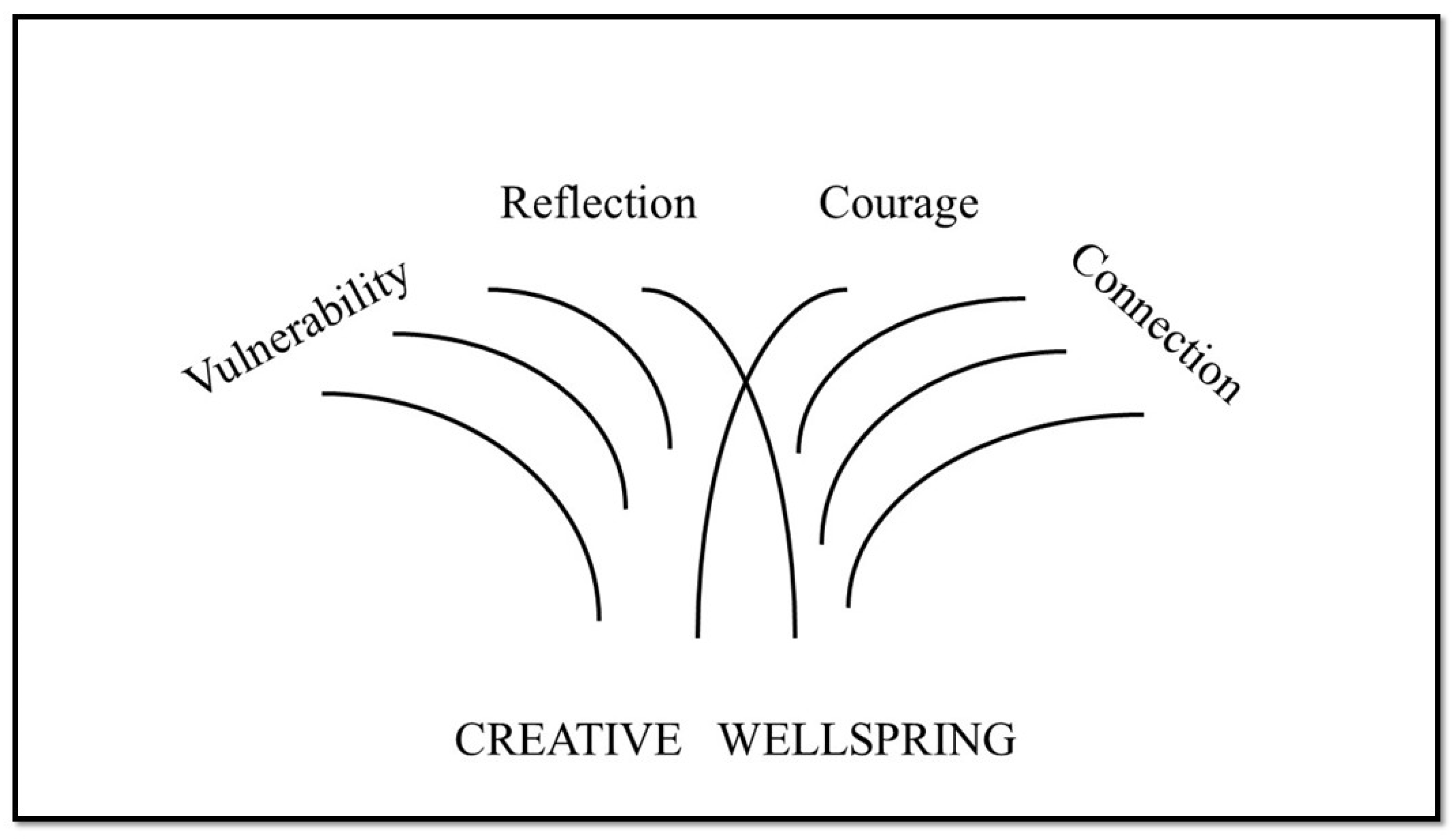
According to the Oxford English Dictionary, the term ‘wellspring’ comes from Old English and means ‘a source or origin providing a constant or abundant supply of something’ [43]. In this paper, the creative wellspring concept refers to a font of dynamic, inextinguishable inner resources that can assist academic professionals to act in accordance with their deeper aspirations and convictions, even in the face of career uncertainty, financial constraints, and institutional pressure and change. As detailed in Figure 1 below, the four key facets of the creative wellspring concept—vulnerability, reflection, courage, and connection—can individually and collectively help academics to meet the present moment with agency, generativity, and grace.

2.1. Vulnerability

Vulnerability calls on individuals to be open to and admit the impact of present challenges on themselves and other stakeholders within their professional system. While this may run contrary to a 20th-century leadership ethos of command and control, the current literature on leadership highlights numerous benefits of vulnerability in the workplace. By opening oneself to uncertainty, shame, and pain, individuals can tap a rich font of compassion, creativity, and capacity to lead [44,45,46]. Leaders not shying away from their own or others’ concerns can also enhance the lived connection that exists between themselves and their teams [46,47].
On a deeper level, vulnerability means embracing the reality that we have very little control over so many aspects of our personal and professional lives [46]. Rather than countering this with platitudes or empty promises of better days to come, holding that difficult truth can help us to shed bravado, over-analysis, and the rigid dismissals born of trying to control uncertainty. Such release enables individuals to move from the constrained mentality of self-proving apprentice and/or helpless victim to independent thinker and practitioner emboldened by intuition, potential, and creativity [44]. Finally, sharing vulnerably in groups around issues of collective suffering, injustices, and challenges may ultimately lay fertile ground for finding solutions based in fuller interdependent truths, complexities, and possibility [8,48].
In a series of autobiographical accounts, doctors working in academic medicine recount how embracing one’s mortality, own physical and mental health concerns, and inability to cure has opened them to bringing more empathy and greater depth of self to their work [49,50,51]. Relatedly, research has found that a more honest, vulnerable stance on the part of healthcare practitioners is linked to enhanced clinician well-being and improved relationships with patients [52,53,54]. By point of contrast, healthcare providers’ stance of impervious invincibility to stress has been linked to a range of negative consequences for patients and doctors, as noted earlier in this paper (see, for instance, [33,34,35,36]).

2.2. Reflection

Reflecting upon ourselves helps us identify and ground in deeper values and purposefulness [55,56], two anchors which put us back in the driver’s seat of guiding our own careers without violating what we believe to be most important and ethically sound. Reflection done at a natural pace also helps us to proceed more nimbly and with greater authority over our work [57]. In essence, reflection forces a pause, allowing us to move from panic to greater self-awareness, taking stock, and exhibiting agency even in situations that feel outside of our control.
In tandem with vulnerability, reflective practices may reveal previously unconsidered possibilities for action and change—gems that, in turn, may move academics from a knee-jerk, reactive stance of posturing perfection and competence, to a more generative, values-aligned, and fluid process. At the same time, reflection done alone and in tandem with others can open up systems thinking, or the capacity to see ourselves and our impacts on others more humbly, dynamically, and relationally, which in turn can reveal emergent opportunities for action and change [8,58]. Perhaps not surprisingly, reflection constitutes the ground level to many theories of dynamic change, be they personal, interpersonal, or systemic.
Within the academic medical context, developing reflection and self-awareness has been found to benefit physicians’ sense of well-being [35]. Such capacities are also linked to greater awareness of professional values and a deepening of learning, empathy, and engagement with difficult topics during graduate medical education [59,60]. More generally, the capacity to reflect upon and understand how our feelings may impact ourselves and others is a foundational component of emotional intelligence, which has in turn been linked to the successful practice of various physician competencies including the provision of quality clinical care [61,62,63,64].

2.3. Courage

Related to coeur, the French word for heart, courage allows one to simultaneously recognize fear and one’s passions and callings, and to then marry action to these most deeply held convictions, especially when the going gets tough or one is acting outside of conventional norms and reward structures. Courage, or ‘the quality of mind which shows itself in facing danger without fear or shrinking’ (Oxford English Dictionary, [65]), liberates us to act in line with what we think is right, even in the face of external pressures pushing us in another direction.
Within the academy, taking intentional, conscious action to work from reservoirs of deeper personal preference and meaning may sometimes feel and be received as renegade [66]. For individuals who hail from groups traditionally marginalized or silenced—in academic medicine this could include women, first generation, and faculty from URiM backgrounds—and/or for individuals working within a risk-averse culture or one marked by limited psychological safety, these fears of not conforming may feel particularly pronounced.
When such feelings emerge, we confront a choice. We can take the fear at face value, assuming that whatever we are afraid of must be dangerous or threatening. If there is an actual lion running toward us, salivating and roaring with its mouth ajar, the fight-or-flight reaction generated from this fear would of course be on point.
However, in situations that are fear-inducing but not life-threatening, we are afforded a different route. Slowing down to reflect on our emotions, we may be able to assess how realistic our hesitancy is and whether we should heed or work to surmount it. Taking a breath, we can consider whether our feeling is pachad (as described above, fear that is worthy of fight-or-flight) or yirah (a type of fear akin to awe and wonderment at possibility that we may not know how yet to navigate) [67]. If the fear is in fact of the second type—a by-product of sensing what we do most care about and the temptation to stretch ourselves to achieve it—then courage instead of distancing is in order [67,68].
Courage is harnessed whenever an academic decides to conduct their work in a more vulnerable, reflective, and interdependent way. In academic medicine, this may manifest when a physician steadfastly advocates for an iconoclastic intervention for a patient and/or reports unsafe behavior on the part of colleagues. Courage may be present during moments of broader systemic change, such as when researchers daringly abandon the apprenticeship worldview and create a more holistic science that honors the empirical while also valuing other ways of knowing—tactile, embodied, intuitive, relational. Such a decision to ‘leave good student habits behind’ and embrace one’s own intuitions and callings [67] may be especially scary at the present moment, even as it frees one to work from a place of deeper meaning, vitality, and flow. Interestingly, this type of cutting-edge, transdisciplinary approach to science is newly emerging and holds promise for a more expansive, humble, and satisfying pursuit of knowledge writ large [22,69,70,71,72].

2.4. Connection

Recent years have seen an explosion in calls to cultivate deeper, emergent interdependence to shepherd social and institutional change. Drawing on scientific discoveries ranging from the adaptive, extensive interconnections among plants and fungi in ecosystems [73,74,75], to quantum notions of ongoing entanglement amongst subatomic particles across vast cosmic separations [76,77], to a consideration of the emergent, generative, and unpredictable properties that complex systems may engender [78,79,80], leaders are being exhorted to stop micromanaging for outcomes and instead allow professionals to align around common purpose as they engage in collaborative, adaptive problem-solving tuned into the fuller possibilities of their milieus (see, for instance, Allen [81] and Senge, Hamilton, and Kania [82]).
Within the academy, fostering connection may necessitate expanding upon the hierarchical, linear way we traditionally envision training and productivity to include increasingly spontaneous, distributed dynamics that are embedded within the larger communities in which universities exist [22,23,25,81]. At the same time, however, we need to train a very strong compass onto the difference between proficient vs. creative work [83].
Within academic medicine, for instance, it will remain absolutely essential to teach surgeons to practice their craft in line with best practice, and for researchers to follow elaborate protocols precisely. In these domains, proficiency cannot be completely jettisoned for the sake of expansive process. At the same time, creative possibilities concerning how to embed and conduct work more dynamically and interdependently within our clinical, research, and teaching missions must also be considered. For instance, practices that explicitly realign from the individual to the collective [84] dare us to redefine the academic enterprise as inherently empirical and relational, an endeavor in which leadership and practitioners are committed to safeguarding psychological safety and security by privileging affiliation and connection alongside professional laurels and traditional signifiers of prestige.
Take, for instance, Amy Edmondson’s groundbreaking work revealing that healthcare teams marked by greater inclusiveness and psychological safety—in which one feels free to confess to errors and insecurities, share deeply held aspirations for work, and speak about the greater mission undergirding one’s endeavors—manifest a greater willingness by team members to engage in quality improvement efforts [85] and better healthcare outcomes for patients [86,87]. In parallel, interdisciplinary research teams marked by diverse membership and strong interpersonal relationships are found to produce high-quality scientific findings [88,89]. Further, engagement with robust professional networks—especially with peers at other institutions—enhances the career agency that associate and full professors experience [90]. These findings highlight the myriad benefits to be drawn from a connected, interdependent orientation toward work, even in a system that has historically recognized, elevated, and rewarded the solitary genius archetype.

3. Facilitating Expression of the Creative Wellspring

This paper has posited that by acting in accordance with the capacities of the creative wellspring, academics can position themselves to break free of a psychological legacy of apprenticeship and bring enhanced resilience, vitality, meaning, and zest to their work. Such an argument raises (at least) two follow-up questions: first, how can faculty tap the humanistic facets of the creative wellspring more fully, consistently, and robustly, especially at a moment when our academic institutions are undergoing transformational, existential change? Second, what does professionals’ unlocking of the creative wellspring have to do with social and planetary flourishing more generally?
The initial answer to both of these questions resides with professionals themselves. Regardless of the system they are working in, faculty members and other highly skilled workers will need to honor their own agency and decide how they would like to behave in the present moment. While never easy, even in moments of maximal stress, each of us still has the ability to choose how we will respond: with fear, or with courage; with reactivity, or through measured reflection upon our higher values; by hoarding resources for ourselves, or by sharing with others and growing the pie of possibility for everyone. Step one to tapping the creative wellspring involves this essential, and very personal, exercise of agency, while also acknowledging that fear will arise and needs to be managed.
On the interpersonal and institutional level, a creative wellspring ethos can be promoted by the actions of leadership. This can include role modeling such attributes as vulnerability and courage, and the encouragement of the same in others (see, for instance, Edmondson and Chamorro-Premuzic [45]). Based on my own work, I also contend that the reciprocal embrace of a positive psychology coaching ethos on the part of faculty and leadership can be of tremendous utility in helping individuals tap these deeper facets of themselves.
At its core, a coaching relationship grows from the premise that the client (‘coachee’) is a generative and whole person, with core values, strengths, insights, and deep potential for actualization and change [28]. Contrary to a dominant model of instructive or top-down mentorship, coaching is a lateral partnership, with the coach engaging in deep listening and asking thoughtful questions to help the coachee unleash their own creativity and innate capacity for evolution and problem solving [27]. Such a relationship opens the door to the coachee’s vulnerable and reflective consideration of what they may really want, as well as a space to name and plan courageous action in the service of reaching these goals.
Nurturing a coach ethos within spheres like academia does not require the involvement of professional certified coaches or, contrastingly, that every person within the organization become extensively trained. In several studies from within academic medicine, coaching provided by faculty who had received abbreviated, foundational training in coaching mindsets and skills was correlated with improvements in burnout, resilience, engagement, and emotional exhaustion for the physicians and trainees receiving the coaching [91,92,93]. Interestingly, decreases in emotional exhaustion and a deepened appreciation for developing self and others also accrued to faculty who provided the coaching [94,95]. The coach approach thus serves as a roadmap for generative, one-on-one conversation capable of fostering both parties’ resilience, engagement and sense of well-being.
The coach approach does not need to be limited to dyadic relationships; this ethos also provides systems-level scaffolding for holding increasingly vulnerable, engaged group dialogue around the burden of today’s competitive, monetized academic imperatives. According to Clutterbuck et al., a coaching culture is one in which ‘people [adopt] a coaching philosophy, principles, beliefs and mindsets and [apply] them to all professional activities and interactions’ [96] (p. 9). Such a culture rewards the surfacing of complexity, uncertainty, and shared responsibility, and is marked by blame-free learning from mistakes and healthy respect for each individual’s intrinsic motivations and desires [97].
When leaders embrace a coaching ethos by asking faculty what they require to work from a place of deeper meaning, the possibility of more authentic, dynamic problem-solving multiplies. Complementing the coach approach with generative group practices may also hold promise. These include the suspension of immediate reactivity to allow more holistic responsiveness to emerge from within the deeper relational system [79]. Tuning into “trans-subjective” or “fourth-person” knowing shared across one’s relational and organizational milieu can likewise untap previously unidentified possibilities for evolution and change [72,98]. Balancing this high-level, interdependent exploration with localized solution making may prove vital toward building an organizational culture in tune with its own needs [81].

4. Conclusions

‘The fate of our times is characterized by rationalization and intellectualization and, above all, by the ‘disenchantment of the world.’’
—Max Weber, 1946, p. 155 [99]
The above quote conjures an image of a compromised society—one in which an over-reliance on rationality has come at the expense of a more deeply spiritual way of being. Instead of using empirical methods merely as tools, Weber’s words seem to imply that the forces of modernity reify rational knowing as THE truth, leaving little room for honoring the generativity, inspiration, intuition, and enchantment that enrich the many ways in which we humans may be, know, and interact with one another.
Eighty years later, this quote also provides a portal through which to understand the current values imbalance within the academy, as well as its implications vis-à-vis our current global challenges. If incisive rational inquiry, sophisticated scientific proficiency, and the capacity to work under difficult circumstances were sufficient to solve our present social and planetary concerns, I suspect that professionals working within the academy and elsewhere would have already succeeded multifold. However, if what we need alongside our technical acumen is the fruits of intuition, knowing, and wisdom that flower when we cultivate variegated fonts of meaning and awareness [12], then academic professionals and others can best meet the moment by also unleashing the powerful creativity, vitality, and interpersonal connectiveness that lie dormant within.
To unlock these other channels of knowing, academics must recognize that scientific/rationalist competence is both powerful and insufficient. Without abandoning the rigor and technical skills they have spent decades honing, they must also make space to honor the facets of the creative wellspring—vulnerable and reflective inquiry, courageous action, and deep regard for connection—that improve personal well-being while allowing for enhanced interdependence and multimodal solution making to emerge. Reciprocally, institutions of higher education must recognize the value of these more humanistic capacities and support their workforce in unleashing them—through modeling by leadership and open-minded adoption of tools like the coach approach, creative suspension, and techniques for unlocking collective, “fourth-person” knowing.
We all must accept that we are learning as we go. The process and solutions for today’s grand challenges that may emerge—from within the academy and elsewhere—when we hold both rationalist and more expansive approaches to knowing are not yet clear. How to simultaneously respect, intertwine, and honor these perspectives is being considered in real time, making the uncertainty and lack of empirical guarantee both the limit and the opportunity of the present moment.
If the layers of social discord, competing dialogue, and existential agita are indicative of anything, it is that the old order no longer holds and something seismically new is struggling to come forth [8]. How we respond—by exclusively digging our heels into the sands of competency-based expertise or by engaging with the possibility of bringing our science into fuller dialogue with more holistic and creative ways of being—will ultimately be ours to decide.

Funding

The author has no funding to declare, other than her salary which supported her work during the creation of this manuscript.

Institutional Review Board Statement

Not applicable.

Informed Consent Statement

Not applicable.

Data Availability Statement

Data sharing does not apply as this paper is conceptual and there were no datasets generated in relation to its development.

Acknowledgments

The author would like to thank her many mentors as well as her school-aged son, who sat very patiently in her office on a Sunday afternoon as she completed yet another draft of this manuscript. The author used the Yale University Clarity GPT 5.2-Health AI platform to find the quote by Max Weber referenced in the Conclusion and to reformat the references below, from APA to MDPI-compliant formatting.

Conflicts of Interest

The author reports there are no competing interests to declare.

References

  1. Johnston, H. The MAGA movement’s big umbrella. Mobilization 2023, 28, 409–433. [Google Scholar]
  2. Reid, J. How the environmental movement lost its power- and how to get it back. The Atlantic, 14 May 2026. Available online: https://www.theatlantic.com/ideas/2026/05/climate-change-nature-ecosystems-environmental-movement/687162/ (accessed on 6 July 2026).
  3. Mounk, Y. (Host). Daniel Diermeier on Why Universities Are Their Own Worst Enemies. The Good Fight, 14 February 2026. Available online: https://writing.yaschamounk.com/ (accessed on 6 July 2026).
  4. The Economist. Trump’s attack on science is growing fiercer and more indiscriminate. The Economist, 21 May 2025. Available online: https://www.economist.com/science-and-technology/2025/05/21/trumps-attack-on-science-is-growing-fiercer-and-more-indiscriminate (accessed on 15 August 2025).
  5. Tollefson, J.; Kozlov, M.; Witze, A.; Garisto, D. Trump’s siege of science: How the first 30 days unfolded and what’s next. Nature 2025, 638, 865–867. [Google Scholar] [CrossRef] [Scilit] [PubMed]
  6. Bristow, J.; Bell, R.; Wamsler, C.; Björkman, T.; Tickell, P.; Kim, J.; Scharmer, O. The System Within: Addressing the Inner Dimensions of Sustainability and Systems Change; Report; The Club of Rome: Rome, Italy, 2024. [Google Scholar]
  7. Capra, F.; Luisi, P.L. The Systems View of Life: A Unifying Vision; Cambridge University Press: Cambridge, UK, 2014. [Google Scholar]
  8. Machado de Oliveira, V. Outgrowing Modernity: Navigating Complexity, Complicity, and Collapse with Accountability and Compassion; North Atlantic Books: Berkeley, CA, USA, 2025. [Google Scholar]
  9. Pirson, M. Dignity, humanistic management and the Sustainable Development Goals. J. Manag. Glob. Sustain. 2023, 11, 13–38. [Google Scholar] [CrossRef] [Scilit]
  10. Pirson, M. Humanistic Management: Protecting Dignity and Promoting Well-Being; Cambridge University Press: Cambridge, UK, 2017. [Google Scholar]
  11. Ellyatt, W. Towards a Unitive Approach; Worldviews Study Year 2-Summative White Paper; Galileo Commission: London, UK, 2025. [Google Scholar]
  12. Scharmer, O. We may be entering a second Axial Age. Noēma, 12 May 2026. Available online: https://www.noemamag.com/we-may-be-entering-a-second-axial-age/ (accessed on 4 June 2026).
  13. Akinlotan, O.; O’Connor, A.; Okunzuwa, O. University academics’ experiences and perceptions of mental health problems. J. Furth. High. Educ. 2026, 50, 49–73. [Google Scholar] [CrossRef] [Scilit]
  14. Hall, S. A mental-health crisis is gripping science- toxic research culture is to blame. Nature 2023, 617, 666–668. [Google Scholar] [CrossRef] [Scilit] [PubMed]
  15. Urbina-Garcia, A. What do we know about university academics’ mental health? A systematic literature review. Stress Health 2020, 36, 563–585. [Google Scholar] [CrossRef] [Scilit] [PubMed]
  16. Pololi, L.H.; Evans, A.T.; Civian, J.T.; Cooper, L.A.; Gibbs, B.K.; Ninteau, K.; Dagher, R.K.; Bloom-Feshbach, K.; Brennan, R.T. Are researchers in academic medicine flourishing? A survey of midcareer Ph.D. and physician investigators. J. Clin. Transl. Sci. 2023, 7, 525. [Google Scholar] [CrossRef] [Scilit] [PubMed]
  17. Linzer, M.; Jin, J.O.; Shah, P.; Stillman, M.; Brown, R.; Poplau, S.; Nankivil, N.; Cappelucci, K.; Sinsky, C.A. Trends in clinician burnout with associated mitigating and aggravating factors during the COVID-19 pandemic. JAMA Health Forum 2022, 3, e224163. [Google Scholar] [CrossRef] [Scilit] [PubMed]
  18. Rosner, M.H.; Falk, R.J. Understanding work: Moving beyond the RVU. Clin. J. Am. Soc. Nephrol. 2020, 15, 1053–1055. [Google Scholar] [CrossRef] [Scilit] [PubMed]
  19. Banerjee, G.; Mitchell, J.D.; Brzezinski, M.; DePorre, A.; Ballard, H.A. Burnout in academic physicians. Perm. J. 2023, 27, 142–149. [Google Scholar] [CrossRef] [Scilit] [PubMed]
  20. Shea, S.; Nickerson, K.G.; Tenenbaum, J.; Morris, T.Q.; Rabinowitz, D.; O’Donnell, K.; Perez, E.; Weisfeldt, M.L. Compensation to a department of medicine and its faculty members for the teaching of medical students and house staff. N. Engl. J. Med. 1996, 334, 162–167. [Google Scholar] [CrossRef] [Scilit] [PubMed]
  21. Altreiter, C.; Hager, T.; Puhringer, S. Political Economy of Knowledge Production in Capitalist Academia: Challenges and Opportunities for Socio-Ecological Transformation; Working Paper No. 164; Institute for Comprehensive Analysis of the Economy: Linz, Austria, 2025. [Google Scholar]
  22. Dal Fiore, F. Can we reinvent the modern university? A vision for a complementary academic system, with a life-affirming and spiritually conscious orientation. Challenges 2025, 16, 6. [Google Scholar] [CrossRef] [Scilit]
  23. Fitzpatrick, K. Generous Thinking: A Radical Approach to Saving the University; Johns Hopkins University Press: Baltimore, MD, USA, 2019. [Google Scholar]
  24. Fleming, P. Dark Academia: How Universities Die; Pluto Press: London, UK, 2021. [Google Scholar]
  25. Scharmer, O.; Pirson, M. Twelve Principles for Reimagining Universities in Times of Rupture and Regeneration. Club of Rome Blog Post, 25 February 2026. Available online: https://www.clubofrome.org/blog-post/scharmer-pirson-university/ (accessed on 13 April 2026).
  26. Nature Editorial. PhD training is no longer fit for purpose—It needs reform now. Nature 2023, 613, 414. [Google Scholar] [CrossRef] [Scilit] [PubMed]
  27. Wisdom, M.L. How to Mentor Anyone in Academia; Princeton University Press: Princeton, NJ, USA, 2025. [Google Scholar]
  28. David, D.H. A renaissance in academic medicine—Using a coach approach to develop early-career faculty. JAMA 2024, 331, 1087. [Google Scholar] [CrossRef] [Scilit] [PubMed]
  29. David, D.H. Unleashing the early career transition in academic medicine. J. Healthc. Leadersh. 2025, 17, 133–140. [Google Scholar] [CrossRef] [Scilit] [PubMed]
  30. Verderame, M.F.; Freedman, V.H.; Kozlowski, L.M.; McCormack, W.T. Competency-based assessment for the training of PhD students and early-career scientists. eLife 2018, 7, e34801. [Google Scholar] [CrossRef] [Scilit] [PubMed]
  31. Correa, R.; Curran, M.; Eno, C.; Graese, P.; Lim, J.; Nahmias, J.; Phung, A.; Robinson, S.; Stewart, N.H.; Sullivan, A.J.; et al. Milestones Guidebook for Residents and Fellows; Accreditation Council for Graduate Medical Education (ACGME): Chicago, IL, USA, 2020. [Google Scholar]
  32. Seivert, N.P.; Werntz, A.; Hsueh, L.; Sain, K.; Washburn, J.J.; Cavell, T.A. Career-enhancing research competencies: Student perceptions of research training in clinical psychology doctoral programs. Train. Educ. Prof. Psychol. 2022, 17, 259–268. [Google Scholar] [CrossRef] [Scilit]
  33. Sarkar, U.; Cassel, C. Humanism before heroism in medicine. JAMA 2021, 326, 127–128. [Google Scholar] [CrossRef] [Scilit] [PubMed]
  34. Do, V.; Lewis, M.; Li, H. Wellbeing vs competency? Debunking the false dichotomy in medical education. Acad. Med. 2026, 101, 370–374. [Google Scholar] [CrossRef] [Scilit] [PubMed]
  35. Shanafelt, T.D.; Sloan, J.A.; Habermann, T.M. The well-being of physicians. Am. J. Med. 2003, 114, 513–519. [Google Scholar] [CrossRef] [Scilit] [PubMed]
  36. Shelley, B.P. “Primum non nocere,” harmful medical mistakes, hubris syndrome, and human fallibility; Getting to the heart of the matter. Arch. Med. Health Sci. 2018, 6, 195. [Google Scholar] [CrossRef] [Scilit] [PubMed]
  37. Martinson, B.C.; Anderson, M.S.; De Vries, R. Scientists behaving badly. Nature 2005, 435, 737–738. [Google Scholar] [CrossRef] [Scilit] [PubMed]
  38. Kearney, M.; Downing, M.; Gignac, E.A. Research integrity and academic medicine: The pressure to publish and research misconduct. J. Osteopath. Med. 2024, 124, 187–194. [Google Scholar] [CrossRef] [Scilit] [PubMed]
  39. Cernega, A.; Nicolescu, D.N.; Imre, M.M.; Totan, A.R.; Arsene, A.L.; Șerban, R.S.; Perpelea, A.; Nedea, M.; Pițuru, S. Volatility, uncertainty, complexity, and ambiguity (VUCA) in healthcare. Healthcare 2024, 12, 773. [Google Scholar] [CrossRef] [Scilit] [PubMed]
  40. Maini, A.; Saravanan, Y.; Singh, T.A.; Fyfe, M. Coaching skills for medical education in a VUCA world. Med. Teach. 2020, 42, 1308–1309. [Google Scholar] [CrossRef] [Scilit] [PubMed]
  41. Goldman Sachs. How Will AI Affect the US Labor Market? 18 March 2026. Available online: https://www.goldmansachs.com/insights/articles/how-will-ai-affect-the-us-labor-market (accessed on 14 April 2026).
  42. Van Noorden, R.; Perkel, J.M. AI and science: What 1,600 researchers think. Nature 2023, 621, 672–675. [Google Scholar] [CrossRef] [Scilit] [PubMed]
  43. Oxford University Press. Wellspring. In Oxford English Dictionary; Oxford University Press: Oxford, UK, 2025; Available online: https://www.oed.com/dictionary/wellspring_n?tab=meaning_and_use#14600398 (accessed on 4 June 2025).
  44. Brown, B. Daring Greatly: How the Courage to Be Vulnerable Transforms the Way We Live, Love, Parent, and Lead; Avery: New York, NY, USA, 2012. [Google Scholar]
  45. Edmondson, A.C.; Chamorro-Premuzic, T. Today’s Leaders Need Vulnerability, Not Bravado. Harvard Business Review, 19 October 2020. Available online: https://hbr.org/2020/10/todays-leaders-need-vulnerability-not-bravado (accessed on 16 June 2025).
  46. Lesser, M. Seven Practices of a Mindful Leader; New World Library: Novato, CA, USA, 2019. [Google Scholar]
  47. Colonna, J. Reunion: Leadership and the Longing to Belong; HarperCollins Books: New York, NY, USA, 2023. [Google Scholar]
  48. Macy, J.; Brown, M. Coming Back to Life; New Society Publishers: Gabriola Island, BC, Canada, 2014. [Google Scholar]
  49. Emil, S. 54-year-old male—Chief of pediatric surgery. Int. J. Whole Person Care 2024, 11, 7–10. [Google Scholar] [CrossRef] [Scilit]
  50. Kutscher, E. Embracing vulnerability. Acad. Med. 2021, 96, 1345. [Google Scholar] [CrossRef] [Scilit] [PubMed]
  51. Persson, H.M. Physician, heal thyself. Int. J. Whole Person Care 2024, 11, 11–14. [Google Scholar] [CrossRef] [Scilit]
  52. Gerken, A.T.; Beckmann, D.L.; Stoklosa, J.B.; Vestal, H.S. Teaching to teach using vulnerability: A novel approach to clinician-educator programs for trainees. Acad. Psychiatry 2023, 47, 672–675. [Google Scholar] [CrossRef] [Scilit] [PubMed]
  53. Koppe, H. Not with a bang, but with love and gratitude. Int. J. Whole Person Care 2024, 11, 19–24. [Google Scholar] [CrossRef] [Scilit]
  54. Malterud, K.; Fredriksen, L.; Gjerde, M.H. When doctors experience their vulnerability as beneficial for the patients. Scand. J. Prim. Health Care 2009, 27, 85–90. [Google Scholar] [CrossRef] [Scilit] [PubMed]
  55. George, B.; Clayton, Z. True North: Emerging Leader Edition; Wiley: Hoboken, NJ, USA, 2022. [Google Scholar]
  56. Sinek, S. Start with Why: How Great Leaders Inspire Everyone to Take Action; Portfolio/Penguin: New York, NY, USA, 2009. [Google Scholar]
  57. Newport, C. Slow Productivity: The Lost Art of Accomplishment Without Burnout; Portfolio/Penguin: New York, NY, USA, 2024. [Google Scholar]
  58. Kania, J.; Ruparell, R.; Senge, P.; Hamilton, H. The Inner Work of System Leadership; Garrison Institute: Garrison, NY, USA, 2026; Available online: https://www.garrisoninstitute.org/get-inspired/read/the-inner-work-of-system-leadership-2/ (accessed on 16 April 2026).
  59. Wald, H.S.; Reis, S.P. Beyond the margins: Reflective writing and development of reflective capacity in medical education. J. Gen. Intern. Med. 2010, 25, 746–749. [Google Scholar] [CrossRef] [Scilit] [PubMed]
  60. Winkel, A.F.; Yingling, S.; Jones, A.; Nicholson, J. Reflection as a learning tool in graduate medical education: A systematic review. J. Grad. Med. Educ. 2017, 9, 430–439. [Google Scholar] [CrossRef] [Scilit] [PubMed]
  61. Arora, S.; Ashrafian, H.; Davis, R.; Athanasiou, T.; Darzi, A.; Sevdalis, N. Emotional intelligence in medicine: A systematic review through the context of the ACGME competencies. Med. Educ. 2010, 44, 749–764. [Google Scholar] [CrossRef] [Scilit] [PubMed]
  62. Dott, C.; Mamarelis, G.; Karam, E.; Bhan, K.; Akhtar, K. Emotional intelligence and good medical practice: Is there a relationship? Cureus 2022, 14, e23126. [Google Scholar] [CrossRef] [Scilit] [PubMed]
  63. Goleman, D. What makes a great leader? Harv. Bus. Rev. 2004, 1, 1–11. [Google Scholar]
  64. Grewal, D.; Davidson, H.A. Emotional intelligence and graduate medical education. JAMA 2008, 300, 1200. [Google Scholar] [CrossRef] [Scilit] [PubMed]
  65. Oxford University Press. Courage. In Oxford English Dictionary; Oxford University Press: Oxford, UK, 2025; Available online: https://www.oed.com/dictionary/courage_n?tab=meaning_and_use&tl=true#8120995 (accessed on 4 June 2025).
  66. Ortega, P.; Becker, M.L.; Chan, T.M.; Manning, K.D. Beyond traditional: Clearing the roadblocks to advancement in academic medicine. Perspect. Med. Educ. 2025, 14, 286–295. [Google Scholar] [CrossRef] [Scilit] [PubMed]
  67. Mohr, T. Playing Big: Practical Wisdom for Women Who Want to Speak Up, Create, and Lead; Avery: New York, NY, USA, 2014. [Google Scholar]
  68. Brach, T. Radical Acceptance: Embracing Your Life with the Heart of a Buddha; Bantam Books: New York, NY, USA, 2003. [Google Scholar]
  69. Kripal, J.J. The Flip: Epiphanies of Mind and the Future of Knowledge; Bellevue Literary Press: New York, NY, USA, 2019. [Google Scholar]
  70. Mayer, E.L. Extraordinary Knowing: Science, Skepticism, and the Inexplicable Powers of the Human Mind; Bantam Books: New York, NY, USA, 2007. [Google Scholar]
  71. Oznik, K.; Gagliano, M. Feeling around for the apparatus: A radicley empirical plant science. Catal. Fem. Theory Technosci. 2022, 8, 1–19. [Google Scholar] [CrossRef] [Scilit]
  72. Scharmer, O.; Pomeroy, E. Fourth person: The knowing of the field. J. Aware.-Based Syst. Change 2024, 4, 19–48. [Google Scholar] [CrossRef] [Scilit]
  73. Schlanger, Z. The Light Eaters: How the Unseen World of Plant Intelligence Offers a New Understanding of Life on Earth; HarperCollins: New York, NY, USA, 2024. [Google Scholar]
  74. Sheldrake, M. Entangled Life: How Fungi Make Our Worlds, Change Our Minds, and Shape Our Futures; Random House: New York, NY, USA, 2020. [Google Scholar]
  75. Simard, S. Finding the Mother Tree: Discovering the Wisdom of the Forest; Vintage Books: New York, NY, USA, 2021. [Google Scholar]
  76. Bohm, D. Wholeness and the Implicate Order: Routledge Classics; Routledge: London, UK, 2002. [Google Scholar]
  77. Bohm, D.; Peat, F.D. Science, Order, and Creativity, 2nd ed.; Routledge: London, UK, 2000. [Google Scholar]
  78. Meadows, D.H. Thinking in Systems: A Primer; Chelsea Green Publishing: White River Junction, VT, USA, 2008. [Google Scholar]
  79. Peat, F.D. Gentle Action: Bringing Creative Change to a Turbulent World; Pari Publishing: Pari, Italy, 2008. [Google Scholar]
  80. Thiese, N.D.; Twinn, C.; Redekop, G.N.; Yoannes, L. Harnessing principles of complex systems for understanding and modulating social structures. In Transforming: Applying Spirituality, Emergent Creativity, and Reconciliation; Redekop, V.N., Redekop, G.N., Eds.; Lexington Books/Fortress Academic: Lanham, MD, USA, 2021; pp. 377–393. [Google Scholar]
  81. Allen, K.E. Leading from the Roots: Nature Inspired Leadership Lessons for Today’s World; Morgan James Publishing: New York, NY, USA, 2019. [Google Scholar]
  82. Senge, P.; Hamilton, H.; Kania, J. The Dawn of System Leadership. Winter 2015. Stanford Social Innovation Review. Available online: https://ssir.org/articles/entry/the_dawn_of_system_leadership (accessed on 16 April 2026).
  83. Coyle, D. The Culture Code; Bantam Books: New York, NY, USA, 2018. [Google Scholar]
  84. Sadler, K.C. The shifting culture of the scientific workforce—A change for women and girls in science. Dis. Model. Mech. 2023, 16, dmm050111. [Google Scholar] [CrossRef] [Scilit] [PubMed]
  85. Nembhard, I.M.; Edmondson, A.C. Making it safe: The effects of leader inclusiveness and professional status on psychological safety and improvement efforts in health care teams. J. Organ. Behav. 2006, 27, 941–966. [Google Scholar] [CrossRef] [Scilit]
  86. Edmondson, A.C. The Fearless Organization; John Wiley & Sons: Hoboken, NJ, USA, 2019. [Google Scholar]
  87. Edmondson, A.C. Teaming: How Organizations Learn, Innovate, and Compete in the Knowledge Economy; Jossey-Bass: San Francisco, CA, USA, 2012. [Google Scholar]
  88. Campbell, L.G.; Mehtani, S.; Dozier, M.E.; Rinehart, J. Gender-heterogeneous working groups produce higher quality science. PLoS ONE 2013, 8, e79147. [Google Scholar] [CrossRef] [Scilit] [PubMed]
  89. Love, H.B.; Cross, J.E.; Fosdick, B.; Crooks, K.R.; VandeWoude, S.; Fisher, E.R. Interpersonal relationships drive successful team science: An exemplary case-based study. Humanit. Soc. Sci. Commun. 2021, 8, 106. [Google Scholar] [CrossRef] [Scilit]
  90. Niehaus, E.; O’Meara, K.A. Invisible but essential: The role of professional networks in promoting faculty agency in career advancement. Innov. High. Educ. 2015, 40, 159–171. [Google Scholar] [CrossRef] [Scilit]
  91. Palamara, K.; Kauffman, C.; Bazari, H.; Stone, V.; Donelan, K. Promoting success: A professional development coaching program for interns in medicine. J. Grad. Med. Educ. 2015, 7, 630–637. [Google Scholar] [CrossRef] [Scilit] [PubMed]
  92. Palamara, K.; Kauffman, C.; Chang, Y.; Barreto, E.A.; Yu, L.; Bazari, H.; Donelan, K. Professional development coaching for residents: Results of a 3-year positive psychology coaching intervention. J. Gen. Intern. Med. 2018, 33, 1842–1844. [Google Scholar] [CrossRef] [Scilit] [PubMed]
  93. Kiser, S.B.; Sterns, J.D.; Lai, P.Y.; Horick, N.K.; Palamara, K. Physician coaching by professionally trained peers for burnout and well-being: A randomized clinical trial. JAMA Netw. Open 2024, 7, e245645. [Google Scholar] [CrossRef] [Scilit] [PubMed]
  94. Mukherjee, B.; LaCross, L.; Khalsa, G. “A lifelong journey:” A phenomenological exploration of faculty perceptions about coach training at an academic medical center. BMC Med. Educ. 2024, 24, 1085. [Google Scholar] [CrossRef] [Scilit] [PubMed]
  95. Brooks, J.V.; Istas, K.; Barth, B.E. Becoming a coach: Experiences of faculty educators learning to coach medical students. BMC Med. Educ. 2020, 20, 208. [Google Scholar] [CrossRef] [Scilit] [PubMed]
  96. Clutterbuck, D.; Megginson, D.; Bajer, A. Building and Sustaining a Coaching Culture; Chartered Institute of Personnel and Development: London, UK, 2016. [Google Scholar]
  97. Wilson, C. Developing a coaching culture. Ind. Commer. Train. 2011, 43, 407–414. [Google Scholar] [CrossRef] [Scilit]
  98. Scharmer, O.; Kaufer, K. Leading from the Emerging Future: From Ego-System to Eco-System Economies; Berrett-Koehler Publishers, Inc.: Oakland, CA, USA, 2013. [Google Scholar]
  99. Weber, M. Science as a vocation. In From Max Weber: Essays in Sociology; Gerth, H.H., Mills, C.W., Eds.; Oxford University Press: New York, NY, USA, 1946. [Google Scholar]
Figure 1. Key facets of the creative wellspring.
Challenges 17 00028 g001
Disclaimer/Publisher’s Note: The statements, opinions and data contained in all publications are solely those of the individual author(s) and contributor(s) and not of MDPI and/or the editor(s). MDPI and/or the editor(s) disclaim responsibility for any injury to people or property resulting from any ideas, methods, instructions or products referred to in the content.