Perspective

The International Neuro Climate Working Group: A Global, Transdisciplinary Model for Advancing Planetary Health Through Brain Health


1
Department of Neurology with Experimental Neurology, Charité–Universitätsmedizin Berlin, Corporate Member of Freie Universität Berlin and Humboldt-Universität zu Berlin, 10117 Berlin, Germany
2
The International Neuro Climate Working Group, Global Consortium on Climate and Health Education, Mailman School of Public Health, Columbia University, New York, NY 10032, USA
3
Department of Psychiatry and Behavior, Stanford University, Stanford, CA 94305, USA
4
Banyan Commons, Sacramento, CA 95811, USA
5
EcoNeuro, Los Angeles, CA 90405, USA
*
Author to whom correspondence should be addressed.
Challenges 2026, 17(3), 27; https://doi.org/10.3390/challe17030027

Submission received: 28 May 2026 / Revised: 10 July 2026 / Accepted: 15 July 2026 / Published: 3 August 2026

Abstract

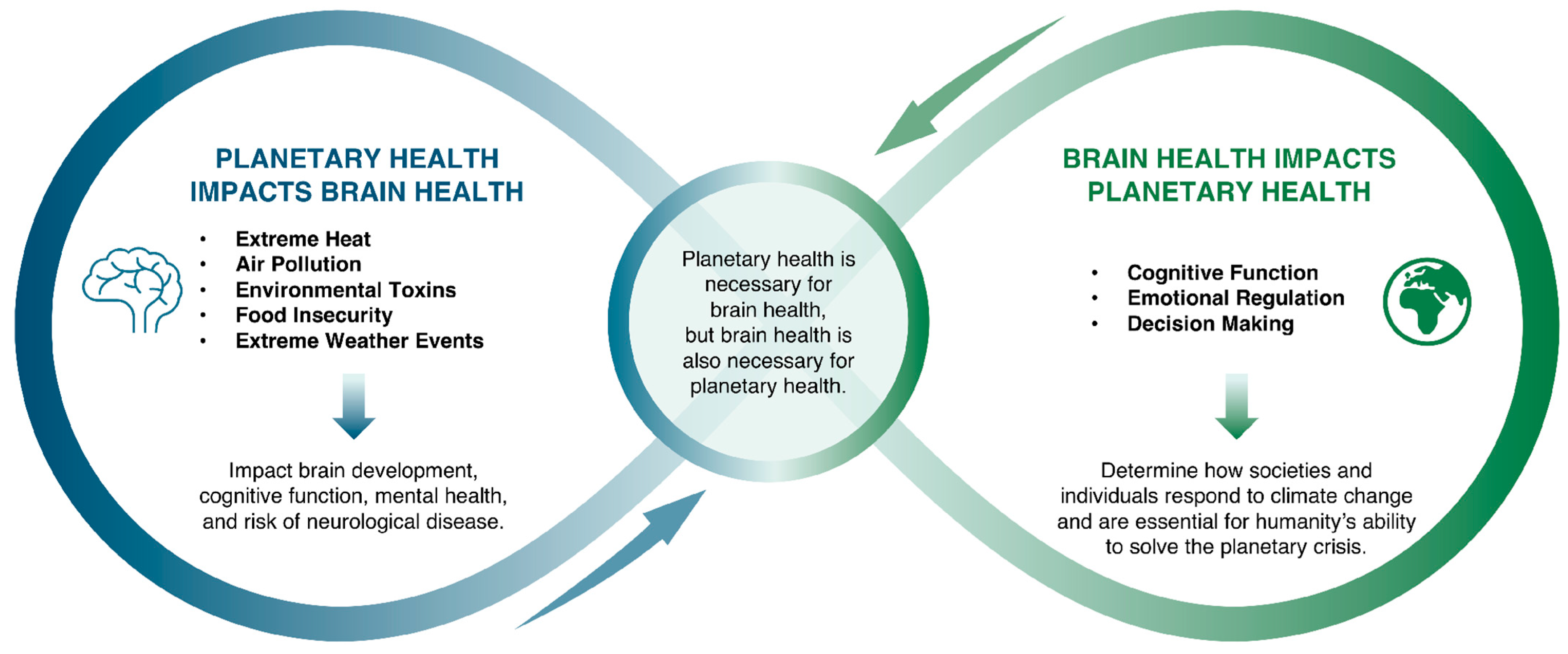
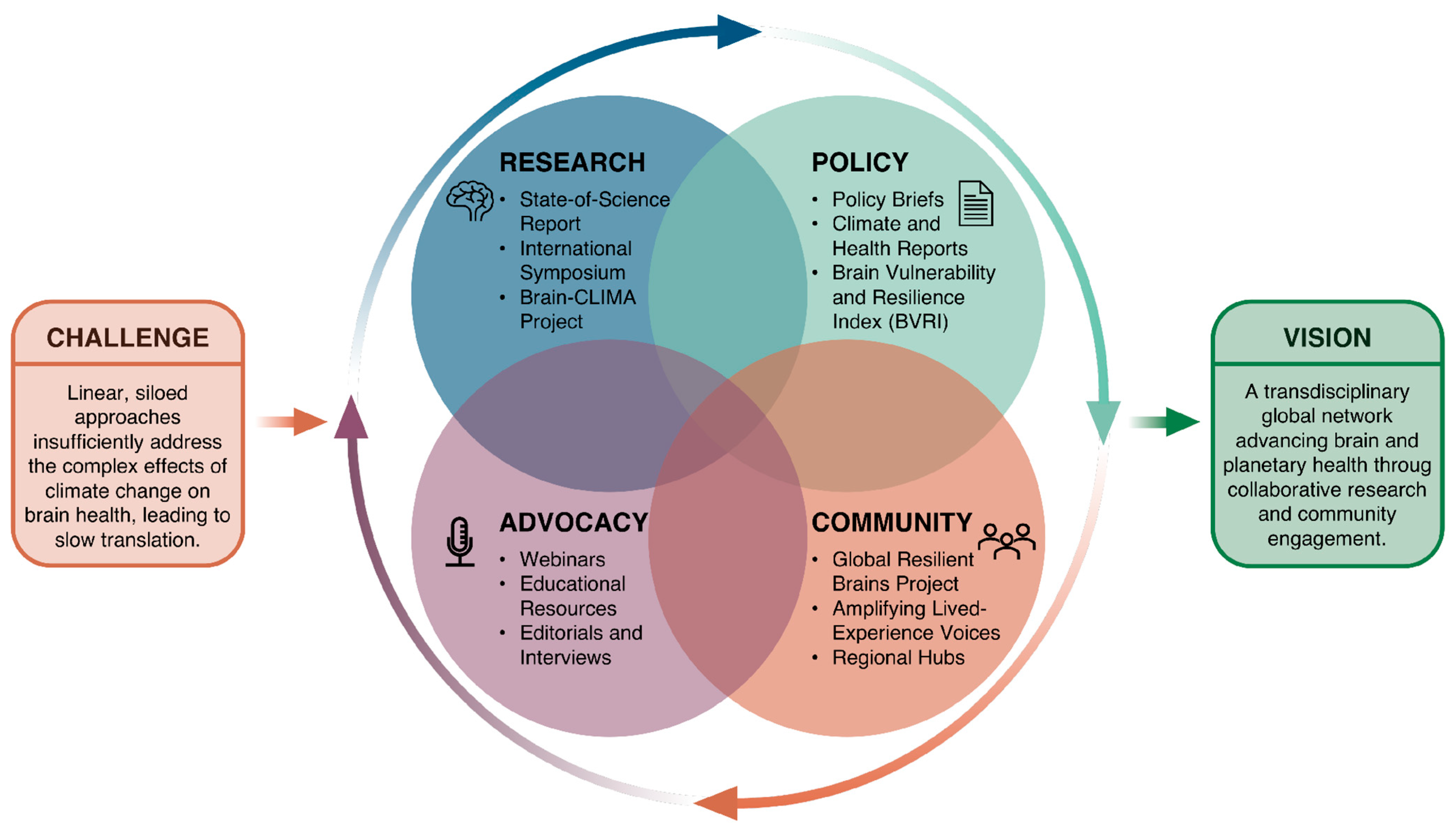
Climate change is increasingly recognized as a defining global health crisis, yet its impacts on brain health, encompassing neurological function, mental health, cognitive abilities, and psychosocial behavior, and the resulting implications for planetary health more broadly remain under-recognized, fragmented, and insufficiently translated into action. Emerging evidence links climate-related stressors, including extreme heat, air pollution, environmental toxins, food insecurity, and vector-borne diseases, to neurological and mental health outcomes across the lifespan. At the same time, brain health and planetary health are interconnected, as brain health plays a critical role in shaping how individuals and societies respond to planetary crises through cognition, behavior, and decision-making. Addressing these interconnected challenges requires new models of collaboration that move beyond disciplinary research silos toward integrated, solution-oriented, and community-engaged approaches. In this Perspective, we argue that advancing brain and planetary health demands global, transdisciplinary networks capable of bridging science, policy, and lived experience. We present the International Neuro Climate Working Group (NCWG) as a case study of such a model, an action-oriented, globally distributed network that integrates research, policy translation, advocacy, and community engagement, with a strong focus on low- and middle-income countries (LMICs). Through transdisciplinary research initiatives such as the Brain-CLIMA project in Latin America, emerging work in South Asia, and global resilience frameworks, NCWG provides an example of how multi-factor, mechanism-informed, and policy-integrated approaches may generate actionable insights and equitable solutions. We propose that scaling similar collaborative models may provide a promising approach to addressing the complex, multidimensional challenges at the intersection of climate change, planetary health, and brain health.
Keywords: climate change; planetary health; brain health; mental health; neurological disorders; environmental factors; climate mitigation and adaptation climate change; planetary health; brain health; mental health; neurological disorders; environmental factors; climate mitigation and adaptation