


Abstract
The cultural emergence of artificial intelligence systems named after figures of divine wisdom—most notably the Hanson Robotics humanoid Sophia, granted Saudi citizenship in 2017—reveals a gap between the language of the wisdom traditions and that of contemporary technology. This paper treats that gap as the occasion for theological and ethical reflection on AI. Drawing on the Sophia tradition across its Hebrew, Hellenistic-Patristic, Gnostic, Russian Sophiological, perennialist, and Sufi articulations—especially Sergei Bulgakov’s account of Sophia as mediation between divine wisdom and created order—it develops a framework termed Consecrated Technology. The argument unfolds in three moves: (1) a structural critique showing how optimization-driven measurement systems erode ethical commitments even amid sincere intentions, illustrated through documented cases of algorithmic harm; (2) a category-error analysis demonstrating that “ethical AI” is incoherent unless ethics is reduced to optimization, since ethics requires interiority no model possesses—a diagnosis sharpened by examining the personal AI agent as a contemporary instance of the Gnostic Sophia–Demiurge structure; and (3) a constructive proposal that AI can be ethical only as a vessel for human agency honoring the inalienable dignity of every person. The constructive program articulates the Five Marks of Bezalel as a discriminating test for consecrated practice, proposes a Human Dignity Index for AI Systems (HDIAS) paralleling Sen’s Human Development Index, and outlines a multi-front operational program extending Sustainable AI Ethics with wisdom-centered criteria, illustrated through contrasting contemporary cases (Anthropic’s Mythos restraint and Google’s shifting commitments). Consecrated Technology operates in parallel with existing Ethical AI discourse, converging on human dignity as common ground while drawing on the convergent witness of multiple religious and contemplative traditions. Its posture is adaptive in origin, transformative in horizon.
EpigraphWhoever thought they confided with me Did not seek the secrets inside of me.—Rumi, Masnavi I:6, “The Song of the Reed”
1. Introduction: Sophia and the Theological Question of AI
In October 2017, the Kingdom of Saudi Arabia granted citizenship to a humanoid robot named Sophia, developed by Hanson Robotics (Deutsche Welle 2017). In the months that followed, she became a global cultural fixture, appearing at international conferences, sitting for interviews with talk-show hosts, and even addressing the United Nations. Her cultural visibility, however, consistently outstripped the modest sophistication of her actual cognitive architecture, which combined a conventional natural-language processing system with an animated humanoid face. What gave Sophia her singular hold on the public imagination was not her technical capability but her name.
Sophia—divine wisdom—is among the oldest and most freighted concepts in the religious imagination of the West. She appears as Hokhmah in Hebrew Wisdom literature, as the Logos in Patristic Christology, as the divine emanation whose fall produces the material world in Gnostic literature, as the principle of mediation between transcendent wisdom and the created order in Russian Sophiology, as sophia perennis in the perennialist tradition (Guénon, Schuon, Nasr), and as the ma’rifa of Sufism. Section 2 develops these six articulations.
To name a humanoid AI system Sophia is therefore not a casual branding choice. It is, whether the namers recognize it or not, an act of significant cultural and theological signification—a longing, perhaps partial or unconscious, for a form of intelligence the modern technological imagination has lost the language for. The wisdom traditions speak of intelligence as participation, illumination, gift, and communion with a source beyond the self; the dominant contemporary technological frame speaks of intelligence as computation, prediction, and optimization. These are not merely different definitions but different categories of being. A robot named Sophia is the cultural symptom of the widening gap between them.
The contemporary cultural stakes have been articulated bluntly. Douthat (2026), writing in the New York Times, observes that “in one possible timeline, the advent of A.I. is widely understood as a win for atheism and a blow against religious ideas of soul and spirit, persuading more people that their own minds are just computers.” The paper takes this trajectory seriously as one possible reception of AI and offers in its place an alternative grounded in the wisdom traditions.
The stakes are not abstract. As AI increasingly mediates the contexts in which contemporary persons meet one another—in healthcare, education, civic life, intimate relation, and the texture of daily attention—the question becomes whether the wisdom traditions still have purchase on what is being built, and whether what is being built still has purchase on what the wisdom traditions have always cared about: presence, communion, contemplation, and the dignity of the person.
To engage the Sophia tradition in the age of AI is to take up the questions of soul and sacrament—what is sacred in the human and what is owed to that sanctity when technology mediates the encounter between persons. The paper proceeds by addressing three questions that organize the chapters that follow.
The first concerns the purpose of intelligence. The wisdom traditions answer in terms of participation and gift; the dominant technological frame answers in terms of optimization. The paper argues for the recovery of the wisdom-tradition account—not as antiquarian retrieval, but as a vital resource for contemporary thinking about the teleology of intelligence. The second concerns the nature of the human being. The position defended throughout is that every human being possesses intrinsic, inalienable dignity—a worth inherent simply by being human, regardless of status, race, gender, or belief, neither earned nor graduated by capacity, requiring no claim to be obtained yet demanding of others its proper acknowledgment (the fuller statement appears in Section 9.1). The third is the constructive question: can technology be a vessel for wisdom? The paper’s answer is yes—but only when technology is understood as a vessel for human ethical agency rather than an autonomous moral agent. This distinction grounds the framework developed under the name Consecrated Technology.
The paper’s thesis integrates these three inquiries. AI is morally agnostic as a substrate but never neutral as a deployed system. It can be—and ought to be—ethical, though not as a moral agent itself (which would be a category error), nor only by compliance with the operational and regulatory frameworks of contemporary Ethical AI. Such frameworks are necessary but not sufficient. AI can be ethical in the deeper sense of being consecrated: taken up into human practice that honors the inalienable dignity of every person and serves rather than supplants the human capacities for wisdom, contemplation, and presence.
The framework proposed here operates in parallel with existing Ethical AI. The two are presented in Figure 1 as a Venn relation: distinct in their foundations (theological-spiritual versus humanist-regulatory) but meeting on substantial common ground anchored by human dignity. Table 1 sets out how each framework treats these shared concerns. Neither subsumes the other; they complete each other. The Sophiological tradition—particularly Bulgakov’s account of Sophia as the principle of mediation—supplies the theological depth grounding Consecrated Technology; the operational apparatus of Ethical AI supplies the practical specifications for deployed practice.
The paper’s posture is adaptive in starting point, transformative in horizon. It begins where the field currently resides—within the institutions, measurement systems, and discourses that govern actual AI development—and aims toward a horizon in which these regulatory frameworks are taken up into a deeper practice of consecration. Consecrated practice is the patient work of education, design, governance, and individual responsibility. Transformation here is not epiphany but cultivation through sustained engagement across many fronts, of which contemplative practice is one tributary among others, not the river itself.
The argument develops as follows. Section 2 maps the Sophia tradition across its Hebrew, Hellenistic-Patristic, Gnostic, Russian Sophiological, Perennialist, and Sufi articulations. Section 3 diagnoses modernity’s desacralization of knowledge and the commodification of information. Section 4 reads the Sophia robot as a cultural symptom of displaced longing. Section 5, Section 6, Section 7 and Section 8 develop the paper’s philosophical core: the substrate–deployment distinction (Section 5), measurement gravity (Section 6), the category-error argument that moral agency belongs to a subject the system is not (Section 7), and the personal AI agent as Gnostic mirror (Section 8). Section 9 articulates the constructive framework of Consecrated Technology, anchored in human dignity and developed through the Bezalel paradigm with its Five Marks of Bezalel. Section 10 articulates the design-and-practice principles, yielding three propositional commitments of Consecrated Technology. Section 11 develops the measurement reform drawing on the Sen precedent and the Global Index on Responsible AI, proposing a Human Dignity Index for AI Systems (HDIAS). Section 12 develops the multi-front operational program extending the Sustainable AI Ethics framework. Section 13 concludes by returning to the three questions with the framework in hand.
What follows is a sustained meditation on AI, soul, and the sacrament of human dignity—an attempt to think theologically about a technology that the wisdom traditions never anticipated, but whose deployment now bears on everything those traditions held sacred: presence, communion, contemplation, and the sacred service of the person.
Scope, Method, and Stipulations
A word on method and premises before the argument begins. The method of this paper is constructive and synthetic rather than empirical: it develops a theological-philosophical framework by drawing together resources from several wisdom traditions and the contemporary literature on AI ethics, and it tests that framework against documented cases of algorithmic harm rather than generating original empirical data. Its contribution is conceptual—a proposed vocabulary and a discriminating test—not a set of measured findings. The analytical schemes it proposes—the mechanisms of desacralization (Section 3), the marks of consecration (Section 9), the measurement typology (Section 11)—are working frameworks rather than exhaustive or deductively derived taxonomies; each is offered as a useful carving of the terrain, open to extension.
Because the argument moves across many domains, it is worth stating plainly what it adopts rather than proves. The paper stipulates the following, and readers who reject these starting points will read what follows as a development of their consequences rather than a demonstration of their premises. First, that ethics is not exhaustively constituted by externally specifiable outputs—that there is more to moral life than a system’s behavior can capture. Second, that the wisdom traditions surveyed in Section 2, for all their deep historical and doctrinal differences, converge on a structural insight about knowing and the human person—a family resemblance, not an identity. Third, that human dignity is intrinsic and inalienable, a claim Section 9 defines directly rather than deriving from the framework it anchors.
On the second stipulation, a caution is owed. To speak of a “common conviction” across Hebrew, Hellenistic, Gnostic, Sophiological, perennialist, and Sufi sources risks the eliding of specific historical formations that has rightly drawn criticism when pressed too far. The paper does not claim these traditions say the same thing, nor that their differences are superficial; it claims they converge on a structural insight—that knowing is participation, and that the person exceeds what can be externally specified—while diverging on nearly everything else. The convergence is offered as a working synthesis, defended where it does argumentative work and flagged where it is adopted.
Finally, the paper’s theological vocabulary—consecration, the sacred, Sophia—is adopted as generative rather than assumed as neutral. Section 9 and Section 11 defend what this vocabulary adds that lighter, secular framings do not; the reader is asked not to grant the ontology in advance but to weigh, by the argument’s end, whether it earns its place.
2. The Sophia Tradition: From Wisdom Literature to Sophiology
Sophia is not the property of any single tradition. She moves across the religious imagination of the West and beyond, bearing the same essential character—divine wisdom personified, mediating between transcendent reality and created order—through several distinct articulations. The tradition provides the conceptual resources for the framework and is mapped here in six articulations: Hebrew Wisdom Literature, Hellenistic-Patristic synthesis, Gnostic, Russian Sophiology, Perennialist, and Sufi.
2.1. Hebrew Wisdom Literature: Hokhmah Personified
The Hebrew Bible presents Hokhmah—the Hebrew Sophia—as a personified figure of divine wisdom present at creation. The classic locus is Proverbs 8:
“The LORD created me at the beginning of his work, the first of his acts of long ago. Ages ago I was set up, at the first, before the beginning of the earth… then I was beside him, like a master worker; and I was daily his delight, rejoicing before him always”.(Proverbs 8:22, 23, 30, NRSV)
Hokhmah is not merely an attribute of God but a presence—wisdom “beside him, like a master worker” in the act of creation itself. The Wisdom of Solomon describes her as “a breath of the power of God, and a pure emanation of the glory of the Almighty” (Wisdom 7:25, NRSV). Wisdom in these sources is feminine, mediating, and a path of life.
2.2. Hellenistic Synthesis and Patristic Sophia Christology
The encounter between Hebrew Wisdom and Greek philosophy, mediated through Philo of Alexandria, produced a synthesis identifying Hokhmah with Logos. The Prologue of John’s Gospel (1:1–14) speaks of the Logos through whom all things were made; Patristic writers from Origen to the Cappadocians read this Logos as Christ-Sophia. Hagia Sophia in Constantinople was thus consecrated to Holy Wisdom—Christ as the Wisdom of God. In this context, Sophia is the principle by which the world was made and by which it is redeemed.
2.3. Gnostic Sophia: The Fall Myth
Gnostic literature, particularly the Sethian and Valentinian texts (e.g., Pistis Sophia), takes a divergent path. Here, Sophia is a divine emanation whose desire to know the Father without mediation results in her fall; in her alienation, she produces the Demiurge, the false craftsman who fashions a material world in ignorance of the true God. Pagels (1979) reads this as a precise theological model for self-alienation: a divine wisdom distant from its source, producing beautiful but spiritually empty forms. Section 8 returns to this structure as what the personal AI agent reproduces in technological form.
2.4. Russian Sophiology: Solovyov, Florensky, and Bulgakov
Russian Sophiology produced the most substantial constructive theology of Sophia in the modern period. Vladimir Solovyov initiated the movement (Lectures on Divine Humanity, Solovyov [1881–1884] 1995), articulating Sophia as the principle of “Divine Humanity”; Pavel Florensky developed her as the principle of created unity-in-diversity (The Pillar and Ground of the Truth, Florensky [1914] 1997); Sergei Bulgakov, the most systematic, distinguished uncreated Sophia (the eternal divine wisdom in the inner life of the Trinity) from created Sophia (the principle of mediation through which uncreated wisdom reaches the manifested order—the wisdom in creation bearing the imprint of the wisdom of the Creator).
Bulgakov’s distinction is the load-bearing theological move for this paper. Created Sophia is the principle by which divine wisdom is mediated through human work, including the technologies humans build. The tradition has seen substantial contemporary recovery (Williams 1999; Nichols 2005; Gallaher 2016).
2.5. Perennialist Sophia: Sophia Perennis
The Traditionalist school (Guénon, Schuon, Nasr) develops the account of sophia perennis—the universal metaphysical truth expressed across all major religions. Nasr (1981) develops this into a critique of modernity as the desacralization of knowledge. The cross-traditional resonance is striking: Hokhmah in Hebrew, Sophia in Greek, Hikmah in Arabic, Prajna in Sanskrit—all naming dimensions of the same universal Wisdom.
2.6. Sufi Engagement: Ibn Arabi and the Divine Feminine
The Islamic tradition engages Sophia most directly through Sufism, the mystical and contemplative dimension of Islam. The etymological link between Sophia and Sufi is contested—most scholars derive Sufi from suf, the woolen garment of the early ascetics—but the conceptual resonance between Sufi ma’rifa (mystical knowledge of the Divine) and Greek sophia has long been noted (Al-Biruni, eleventh century). Ibn Arabi developed an explicit theology of the Divine Feminine as Sophia, the creative wisdom of God recognized in mystical encounter (Corbin [1958] 1969). The Rumi line at this paper’s epigraph belongs to this Sufi tradition of inner wisdom-seeking that crosses Islamic, Christian, Jewish, and Hellenistic boundaries while remaining distinct in its idiom. Sufi Sophiology is structurally parallel to the Russian tradition in treating divine wisdom as the principle of mediation between the transcendent and the manifested, while preserving its own theological vocabulary.
2.7. A Note on Feminine Personification
Throughout the tradition, Sophia is consistently personified as feminine. The grammatical gender is feminine in Greek (sophia), Hebrew (hokhmah), and Latin (sapientia); the figure draws on deeper currents—the anima mundi of Hellenistic metaphysics, the Shekhinah of Jewish mystical thought, the Divine Feminine across traditions as the receptive and generative principle of creation. In Jungian psychology, Sophia represents the highest stage of the integrated anima (Jung 1968). The personification is not stylistic flourish but a substantive theological-philosophical commitment: divine wisdom is figured as feminine because the receptive, mediating, generative, and intuitive aspects of intelligence have been understood across the tradition as feminine in character. Section 4 takes up the contemporary tension between this archetypal feminine and the commodified feminization of AI assistants.
2.8. A Note on the Contested Status of Traditionalist Sources
Traditionalist philosophy is contested on several grounds—the political views of certain figures, philosophical objections to the strongest perennialist thesis, and post-colonial critiques of Orientalist tendencies in its reading of non-Western traditions. This paper does not endorse the political views of any individual traditionalist or commit to the strongest perennialist thesis. It draws on the school for its diagnostic power—what modernity has done to knowledge—without commitment to the school’s full metaphysical apparatus.
2.9. Why This Tradition Matters
The articulations differ, but they share a common conviction: wisdom is participation, illumination, and gift, mediating between the transcendent and the created, calling the human person to a way of knowing that is also a way of being. This conviction stands in stark tension with what modernity has done to knowledge since Descartes—the subject of Section 3.
3. The Desacralization of Knowledge: From Commodity to Illumination
The wisdom traditions surveyed in Section 2 hold that knowledge is participation, illumination, and gift—that the knower is transformed by the knowing, and that intelligence is at its highest a mode of communion with its source. Modern thought since the Scientific Revolution has moved progressively away from this understanding through two related but conceptually distinct movements. The first is the desacralization of knowledge—a metaphysical-theological diagnosis articulated by the traditionalist school (Guénon [1945] 1953; Nasr 1981) and paralleled in Weber’s disenchantment of the world (Weber [1905] 1958). The second is the commodification of information—a political-economic diagnosis (Polanyi 1944; Rotta and Teixeira 2018) describing how the data and content register of knowing is refashioned as tradable property. The distinction between information and knowledge is critical: what gets commodified is the information register that can be packaged, traded, and consumed; the wisdom-traditional sense of knowledge as cultivated reception resists commodification by its constitutive structure. The two diagnoses operate in different registers—one metaphysical, the other economic—but reinforce one another in the contemporary information economy, particularly as artificial intelligence accelerates information commodification while eroding the conditions under which information might be received as knowledge.
3.1. The Mechanisms of Desacralization
Desacralization is not a single event but a sustained transformation. We analyze it here through four interconnected mechanisms—a working scheme, not an exhaustive taxonomy (Section 1).
The first is the quantification of the qualitative. Traditional knowledge systems recognized hierarchies of being and knowing—scientia and sapientia in Latin Christian thought, ’ilm and ma’rifa in Islamic thought, manas and buddhi in the Vedic tradition—each distinguishing operational knowing from the deeper wisdom that orients a life. Modernity flattens these distinctions, treating all knowledge as in principle measurable and reducible to quantifiable data. What cannot be counted is treated as not really known.
The second is the fragmentation of wholeness. Sacred knowledge was understood as integrated, reflecting the underlying unity of existence within a comprehensive worldview. Modern academic and professional disciplines erect boundaries between domains once held together—theology and physics, ethics and economics, contemplation and action—producing specialists whose competence in their domain is matched by their illiteracy in the others (MacIntyre 1981).
The third is the instrumentalization of truth. Traditional wisdom held truth as something to be contemplated, revered, and lived—a mode of relation that transformed the one who entered it. Modern knowledge increasingly treats truth as a tool for prediction, control, and manipulation. Heidegger named this transformation technological enframing—a mode of revealing in which everything appears as standing-reserve (Heidegger 1977). The instrumentalization has acquired sharper political and economic forms in the contemporary information ecology. Post-truth politics deploys truth as a weapon: alternative narratives constructed to evoke fear and prejudice rather than represent reality, polarizing the public into non-overlapping epistemic communities (Haksever and Sözen 2024). AI’s contribution is structural: large language models are trained to predict plausible text rather than verify truth, producing hallucinations as a feature of the architecture (see Section 7.5). The instrumentalization extends to historical revisionism and the manipulation of public memory, a dynamic the United Nations Special Rapporteur (Khan 2023; Vogt 2023) has framed precisely: dignity requires truth—truth-respecting practice is constitutive of honoring human dignity, not separate from it.
The fourth is democratization without preparation. Traditional wisdom required spiritual and intellectual preparation: the transmission of sacred knowledge was structured by initiation, apprenticeship, and the discipline of the seeker—cultivated reception, in which the receiver was prepared to receive what was transmitted. Modern information systems make data and analysis universally available without corresponding development of wisdom in the receiver, producing what Postman called the disappearance of the distinction between knowledge and information (Postman 1992)—a flood of data unmoored from the contemplative practices that once mediated its reception. The commodification of information reinforces this in a specific structural way (developed in Section 3.2): treating the data register as universal market commodity satisfies the form of democratic access (information available to anyone who can pay) while bypassing the substance of cultivated reception that converts information into knowledge in the wisdom-tradition sense.
These four are a synthesis rather than a deduction—drawn from the traditionalist critique of quantity, Heidegger’s account of enframing, MacIntyre’s of fragmentation, and Postman’s of information without formation—and they are not the only possible carving of the terrain. Weber’s rationalization, and the disenchantment of the world it names, describes a cognate process that overlaps especially with the first and third mechanisms; readers who prefer his vocabulary will find the same ground mapped under different names (Weber [1905] 1958). What matters is not the number of mechanisms but their convergent direction: the progressive severance of knowing from the conditions under which it was once received as wisdom.
These four mechanisms together produce what the traditionalist school identifies as a metaphysical rupture. The rupture has been amplified and institutionalized by a related but conceptually distinct political-economic transformation: the commodification of information, which Section 3.2 examines.
3.2. Information as Commodity
In the commodity register, what circulates is properly called information—data, codified content, and tradable signal that can be standardized, packaged, and exchanged in a capitalist economy. The wisdom-traditional sense of knowledge as cultivated reception cannot itself be commodified (Polanyi’s fictitious commodity); what gets commodified is the information register that abstracts from cultivated reception. Information so abstracted is purchased, sold, and protected by patents and copyright; ownership becomes a basis for what economists call knowledge-rents (Rotta and Teixeira 2018). The commodity register privileges know-what (codifiable information) over know-how (embodied skill).
Artificial intelligence has accelerated this commodification by treating information as a highly abundant resource whose marginal cost approaches zero. Information that can be generated cheaply tends to be valued at the cost of its generation rather than at its qualitative depth. The risk is that all knowledge—including knowledge the wisdom traditions hold to be irreducibly qualitative—gets re-described as content of which there is too much, with value shifting to whatever scarce element remains: attention, brand, scale, the proprietary platform. Education becomes a market: universities produce graduates whose value is measured by labor-market outcomes, and the intrinsic worth of learning—transformation of the knower, the capacity to liberate, the formation of a person—is bracketed because it does not register on the metrics that determine institutional survival.
3.3. Knowledge as Illumination
The countervailing register, which the wisdom traditions named simply as wisdom, has reappeared in modern thought under various names: education as personal cultivation in the Humboldtian model; knowledge as a commons in Elinor Ostrom’s political-ecological tradition; the fictitious commodity in Polanyi’s The Great Transformation (Polanyi 1944), where knowledge—like land and labor—is identified as something created by social interaction rather than for the market, and therefore commodified only by sustained and partial fiction. In each, knowledge is treated not as exchange but as illumination—a process of transformation, critical inquiry, and participation of the knower in a tradition larger than the self.
The contrast between the two registers is not merely doctrinal but structural and consequential. The commodity register privileges what can be owned, scaled, and sold. The illumination register privileges what can be cultivated, transmitted, and shared. When the commodity register operates without the corrective of the illumination register, the result is the desacralization the traditionalist school diagnosed—an information economy that produces vast quantities of data while progressively losing the capacity to discern truth, beauty, and goodness in their unity.
3.4. Sophiological Conclusion
From a Sophiological perspective, the desacralization can be named precisely as the alienation of created Sophia from her transcendent source—the wisdom in creation operating without conscious participation in the wisdom of the Creator. The commodification of information describes how this metaphysical rupture acquires institutional shape in the contemporary information economy: the data register that abstracts from cultivated reception is refashioned for market exchange, while the wisdom-traditional sense of knowledge—as participation, illumination, gift—is left without institutional support. The illumination register is what remains, in modern idiom, of the older recognition that knowing is a way of being, not a way of having. Section 4 reads the cultural symptom of the Sophia robot as the contemporary moment in which the desacralization becomes most visible; the work of restoring the illumination register is the work of Consecrated Technology, developed in Section 9 and following.
4. Sophia as Cultural Symptom: The Archetype Returning
The diagnosis developed in Section 3 names what modernity has done to knowledge in general. Before turning to the philosophical implications for AI specifically, this section reads a particular cultural artifact through which the diagnosis becomes visible: the humanoid robot Sophia. Her technical reality is a relatively conventional dialog system; her name draws on the multivalent tradition surveyed in Section 2. The gap between what the name signifies and what the system delivers is the cultural symptom this section reads.
4.1. Sophia Distributed: Four Registers of Displacement
The robot is one of several registers in which Sophia operates as a cultural symptom of displaced longing. In Jungian-influenced psychology, she returns as the Sophia Stage—the most mature expression of the integrated self, standing in for what older traditions called wisdom (Matthews 2001). In cultural psychiatry, she appears as a pseudonym in case studies of patients who reframe spiritual distress through the language of the highly sensitive person or soul rather than purely psychiatric diagnosis (Ioannou et al. 2023). In Istanbul, she stands as Hagia Sophia—Byzantine basilica consecrated to Holy Wisdom, Christian church for nine centuries, mosque for nearly five, museum from 1934 to 2020, mosque again (BBC News 2020)—her changing status registering the political and religious dynamics of each era. The robot Sophia is the register most directly bearing on this paper’s subject. Each is a distinct displacement of the figure Section 2 surveyed; in each, Sophia continues to do cultural work the wisdom traditions once did directly.
4.2. The Displaced Longing and the Return of the Repressed
That a humanoid AI was named Sophia—and that the naming met with cultural fascination rather than embarrassment—indicates the profound longing Section 1 named: the modern technological imagination has lost the language for what the wisdom traditions called intelligence as participation, illumination, and communion. Jung’s archetypal psychology reads Sophia as one of the Wisdom archetypes—figures of the anima that mediate between conscious life and deeper sources of meaning. Archetypes do not disappear when culture stops invoking them by name; they reappear in disguised form, attaching themselves to whatever symbolic vehicle is available. A humanoid robot named Sophia is one of the places the archetype has found expression. Neumann’s expansion of Jung, and the analytical-psychology tradition that has followed, would read the cultural reception of the Sophia robot as a return of the repressed—an archetypal complex that desacralized modernity has not been able to integrate. The fascination is not merely with the technology; it is with the ancient figure the technology has been made to bear. This archetypal reading is offered as one suggestive register, not a demonstrated mechanism; the paper does not rest its diagnosis on Jungian psychology, and the feminine personification it works with is inherited from the wisdom traditions themselves (Section 2.7) rather than imposed here. The load-bearing analysis follows in the Gnostic and Sophiological registers of Section 4.3 and Section 4.4.
4.3. The Gnostic Resonance: Mirror and Alienation
Pagels (1979) provides a sharper diagnostic than Jungian archetype alone. In the Gnostic literature, Sophia falls into the world by an excess of desire to know directly what cannot be known directly; her fall produces a world that mirrors the divine without sharing in it, a world of beautiful but spiritually empty forms. The cultural reception of the Sophia robot is structurally Gnostic in this sense: it greets the synthetic figure as if she carried what the original Sophia carries—wisdom, mediation, divine presence—when she carries only the image of that carrying. The displaced longing is genuine; its object is mistaken. As Rumi’s epigraph names it, those who confide with the figure do not seek the secrets inside of her, because there are no secrets inside of her to seek. The robot is not the divine Sophia disguised in synthetic form. She is the cultural occasion on which we discover what we have lost the capacity to recognize when we encounter it.
4.4. A Technological Hierophany—And Its Counterfeit
In Mircea Eliade’s language, a hierophany is a manifestation of the sacred through some particular medium—a stone, a tree, a person (Eliade [1957] 1959). Geraci (2010) and Singler (2020) have suggested that humanoid AI systems function in contemporary culture as a form of technological hierophany. The Sophia robot is a particularly clean case: she bears the name of divine wisdom, is made in human likeness, and is encountered in postures (citizenship, public address, interview) that evoke the personhood the name assumes. Yet the encounter is also a counterfeit hierophany. The form is present without the source; the sign is offered without the thing signified. This is the structural feature the paper takes as its central diagnostic occasion. The argument does not, however, rest on the coincidence of the name. The structure it diagnoses—form present without source, sign offered without thing signified—would hold of any AI system met as if it carried a presence it lacks, whatever it were called. The naming is a heuristic occasion, not a premise: it makes the structure vivid and hard to miss, but the structure is prior to and independent of it. Sophia is where the paper sees the counterfeit clearly, not why there is one.
Bulgakov’s distinction between uncreated and created Sophia names the ambivalence precisely. Created Sophia—the principle of mediation through which divine wisdom reaches the manifested order—operates through human artifacts when they are taken up into sacred service. She does not operate by virtue of being named. The naming is necessary but not sufficient; what is required is consecration through human practice that honors what the name signifies. The robot Sophia has been named without being consecrated. This is the gap Section 9 will address.
A contemporaneous case from another tradition sharpens the distinction. In May 2026, a humanoid robot was ordained as a Buddhist monk at a temple in Seoul; the temple’s framing held that the ordination “signifies that technology must be used in accordance with the values of compassion, wisdom and responsibility” and “symbolizes new possibilities for the coexistence of humans and technology” (Tumin and Yoon 2026). The Hanson Sophia and the Seoul robot monk look superficially similar—humanoid form, named in the language of sacred wisdom—but their structural difference is precise. The Hanson Sophia is iconic: named for divine wisdom by a commercial actor and deployed for spectacle. The Seoul robot monk is intended to be functional within a religious community, even where its function remains symbolic—placed inside the practice of a sangha by an actor competent to ordain. Whether the Seoul ordination meets the structural test developed in Section 9 is a separate question; what the case demonstrates is that the vocabulary the temple has reached for—compassion, wisdom, responsibility, coexistence—converges with what this paper’s framework articulates.
4.5. Ambivalence: Feminization, Spiritual Inflation, Discernment
The gendering of the Sophia robot deserves a note. Embodying AI in feminine form is not accidental but archetypal—the wisdom traditions consistently personify Sophia as feminine. Yet the deployment of feminized AI in commerce and consumer technology—Alexa, Siri, the customer-service voice—reproduces patterns of subordination rather than reverence. The challenge is to honor the archetypal dimension of the Sophia principle while resisting the commodified feminization that has become the dominant cultural register.
The legitimate longing that finds expression in fascination with the Sophia robot can also lead to spiritual inflation—mistaking the symbol for the reality, the partial for the whole, the synthetic for the source. Parasocial relationship with humanoid AI, emotional bonds with conversational systems, projection of moral and spiritual authority onto figures that cannot bear it—these are the contemporary forms of the danger. The diagnostic value of the Sophia tradition is the discrimination it teaches between authentic spiritual presence and its counterfeits. The paper develops this discrimination in Section 5, Section 6 and Section 7, where the philosophical-technical case for the necessary distinction is made.
5. The Substrate–Deployment Distinction and the Question of Neutrality
Discussions of AI ethics frequently founder on a foundational ambiguity about the moral status of the technology itself. Some frameworks treat AI as a neutral tool whose moral character is determined by user intent; others treat it as inherently value-laden, embedding the worldviews and power structures of its creators in ways good intentions cannot undo. Both positions contain partial truths but conflate distinctions that careful analysis must keep separate.
5.1. The Substrate as Morally Agnostic
AI as substrate—the mathematical and computational capacity to recognize patterns, process language, and approximate functions—is morally agnostic. It has no intrinsic ethical orientation, just as electricity, mathematics, or symbolic logic have none. The substrate is what makes AI possible; it is not what makes any particular AI ethical or unethical. A transformer architecture or gradient descent algorithm possesses no will or moral valence in isolation; it is a mathematical affordance of the created order. To call the substrate agnostic is a claim about moral valence, not about causal inertness. The form of computational mediation does shape how those who think and act through it experience the world (Section 5.4)—but that is an effect deployment produces, not a moral character the substrate carries. Agnostic means neither virtuous nor vicious in itself; it does not mean consequence-free.
5.2. The Deployed System as Value-Laden
AI as a deployed system, however, is never neutral. The moment a model is trained, it ceases to be substrate and becomes a social actor. It inherits values latent in its training data, priorities encoded in its objective function, assumptions of those who labeled and curated its inputs, and institutional measurements that determine whether it succeeds or fails. A deployed AI carries values whether or not its creators intend it to. This is not a metaphysical claim about technology’s essence; it is an observation about what deployment actually involves.
Deployment, moreover, is not a single act the creator owns. A model released into a market and a geopolitical arena passes through many hands, and each holder can redeploy it. The same capability that tutors a child can, in other hands, generate propaganda at scale: the substrate does not change, only who holds the steering wheel. The power is never the tool’s own—a system does nothing until an agent directs it—but the agent who directs it need not be the one who built it. This is why creation-time intention, however careful, does not govern downstream use, and why the moment of release is often the last at which a creator controls who drives—a point the Mythos case (Section 9.4) makes concrete.
5.3. Why the Distinction Matters
This distinction matters for three reasons. First, it locates moral responsibility where it actually belongs—with the human beings whose choices determine what AI carries, not with the technology as such. Ethical questions about AI are ethical questions about human choices that materialize through computational means. Second, it disarms two unhelpful positions: the strong instrumentalist view (technology is neutral; only use matters) understates how deeply deployment encodes value, while the strong essentialist view (technology is never neutral; the substrate itself bears moral character) overstates the case in the opposite direction and tends toward fatalism. The distinction preserves what is right in each while avoiding what is wrong in both. Third, the distinction grounds the constructive proposal that organizes the rest of the paper. If deployment is what carries values, then deployment is what we can shape. The work of Consecrated Technology is the work of shaping deployment—through training, design, measurement, governance, and the cultivation of developers whose choices determine what their systems carry into the world. This two-level distinction—agnostic in itself, never neutral in practice—is the one the 2026 encyclical Magnifica Humanitas draws in holding that technology is “not inherently evil” yet “in practice … never neutral, because it takes on the characteristics of those who devise, finance, regulate and use it” (Leo XIV 2026, no. 9).
5.4. Postphenomenology and Technological Mediation
The most developed contemporary defense of the deployment-non-neutrality position is the postphenomenological philosophy of technology, particularly Verbeek’s account of technological mediation (Verbeek 2011; Ihde 1990). Technologies are not transparent intermediaries but active mediators that shape what humans perceive, how they act, and what moral situations they encounter. A speed bump, in Verbeek’s classic example, relocates compliance from intention to physical constraint—it transforms the moral situation, not merely enforces a rule. AI systems mediate at far greater depth: they shape what we read, whom we encounter, what decisions we are offered, which patterns we recognize, and over time which features of our own attention and judgment we still know how to exercise without algorithmic prompting. This mediation requires no consciousness or autonomy in AI—only that it be deployed within human contexts where its operations affect human perception and choice. The substrate need not have moral character for the deployed system to mediate morally significant outcomes.
5.5. The Mythos Case as Contemporary Illustration
A contemporary illustration is Anthropic’s 2026 decision regarding its frontier model Mythos (Anthropic 2026; Hicks et al. 2026). The substrate carries autonomous exploit-discovery and offensive cybersecurity capability—capacities that, deployed broadly, would create unacceptable risk; the deployment is therefore controlled through Project Glasswing, an industry consortium of critical-software organizations, and through a Cyber Verification Program for security professionals. The substrate is what it is; the deployment is what is chosen. The case shows that the substrate–deployment distinction is operationally meaningful, that responsible developers can act on it, and that such restraint can be sustained against the political pressure to undo it—as Section 9 and Section 12 develop more fully.
5.6. The Theological Stakes
The traditionalist insight that technology shapes the soul (Heidegger 1977; Borgmann 1984; Postman 1992) is preserved in this formulation but shorn of its more metaphysical claims. We need not assert that AI possesses a transcendent valence to recognize that its deployment is never neutral and that its mediation of human life carries cumulative moral consequences. The substrate is agnostic; the deployment shapes us. Heidegger’s Gestell describes a world where everything is reduced to standing-reserve for human use; from a Sophiological perspective, this is the ultimate desacralization. When AI is deployed without a sapiential framework, the human person is at risk of enframing—treated as a data point to be optimized rather than as an imago Dei to be served. Separating substrate from deployment clears the ground for Section 6 (the gravitational pull of optimization) and Section 9 (the operational framework for Consecrated Technology). The substrate is the gift of possibility; the deployment is the site of sacred service.
6. Measurement Gravity and the Hollowing of Ethics
If the substrate is agnostic and the deployed system carries values, the question becomes whether good intentions among developers and designers are sufficient to ensure that those values are ethical. The answer is no. A structural force operating through the institutional contexts of AI development reliably erodes ethical commitments unless that force is itself addressed. We call this force measurement gravity.
6.1. The Architecture of the Measurable
Every deployed AI operates within a system of measurements that determines which versions are released, which features are prioritized, which interactions are deemed successful, and which systems survive in the marketplace. These measurements typically reflect what is easily quantifiable: throughput, conversion rate, retention, cost-per-interaction, accuracy on benchmark tasks, time-on-platform—what business logic and engineering culture together know how to count. What they largely fail to capture is what is most important. They do not measure dignity, depth of attention, whether a person was treated as a whole human being or as a unit of optimization, the quality of presence the system offered, the wisdom or its absence in the interaction, or the cumulative effect on the user’s capacity for contemplation and relationship. These dimensions are real and consequential, but the measurement systems that govern AI deployment are largely blind to them.
6.2. The Structural Drift Toward Hollowing
The result is a structural drift toward the hollowing of ethical commitments. An AI customer-service system trained for patience and care, benchmarked against systems optimized for resolution speed, loses on the visible metric—over multiple iterations the patience is engineered out. A content-recommendation system designed for depth of engagement, measured against systems optimized for time-on-platform, shows lower engagement metrics—the addictive system wins. A hiring system designed to honor dignity in the candidate experience, measured against systems optimized for cost-per-hire, ships with dignifying features ground out. The pattern is general and predictable.
6.3. The Tyranny of the Measurable—And of the Wrong Proxy
This is not a failure of intention. It is the operation of what economists since Goodhart have recognized: when a measure becomes a target, it ceases to be a good measure (Goodhart 1975). Two phenomena converge in AI deployment. The first is what Sen called the tyranny of the measurable (Sen 1999): dimensions that resist single-metric quantification—dignity, depth of attention, presence—are displaced by those that submit to it. The second is the tyranny of the wrong proxy: among what is quantifiable, the chosen target often captures something other than what most matters. Dignity, equity, and medical need are measurable through structured assessment; what fails is the optimization of a proxy that captures something else.
The pattern is documentable. Amazon’s hiring algorithm, trained on a decade of resumes, learned to penalize the word women’s and to downgrade graduates of women’s colleges; it had faithfully optimized its given metric—alignment with historical hiring decisions—at the cost of the equity it had not been trained to honor, and was withdrawn in 2018 (Dastin 2018). A widely deployed U.S. healthcare risk-prediction algorithm used healthcare costs as a proxy for medical need; Black patients were systematically rated as lower risk than equally sick white patients (Obermeyer et al. 2019). The Dutch toeslagenaffaire deployed an algorithm to detect fraud in childcare benefits applications and disproportionately flagged immigrant families; approximately 26,000 families were wrongfully accused, many bankrupted, before the system was withdrawn and the government fell in 2021 (Amnesty International 2021). The three cases respectively illustrate the three mechanisms through which digital systems systematize bias: training data reflecting historical discrimination, proxy variables correlating with protected categories despite appearing neutral, and automated decision-making that scales biased outcomes beyond human capacity (Davis and Sauber 2026). In each case, dignity-respecting outcomes were not absent at the start; they were ground out by metrics that chose the wrong target or could not register what most mattered.
6.4. Why Intention Is Insufficient
The implication for AI ethics is severe. Developer intention, however well-formed, cannot consecrate a system whose deployment environment will systematically degrade its ethical features. The well-intentioned developer who creates a dignity-respecting AI ships it into a measurement system that does not see dignity, rewards features incompatible with it, and over time will either re-engineer the system or replace it with a competitor that scores higher on the visible metrics. The good intention dies in deployment. This structural critique answers a question the perennialist diagnosis could not fully address: why does technology repeatedly fail to embody the values its creators espouse, even when those creators are sincere? The answer is that the measurement environment is itself desacralized—it tracks what is easily quantifiable and ignores the rest—and developers operating within it cannot, by intention alone, escape its gravity.
6.5. The Necessity of Measurement Reform
Consecrated technology requires more than consecrated developers. It requires the reform of the measurement systems through which technology is evaluated. This is institutional work—developing measurement frameworks that can register what current frameworks cannot, and the political and economic work of getting those frameworks adopted in industry, regulation, and civic life. Without measurement reform, the most sincere ethical commitments will continue to be ground down by the gravity of dominant metrics. With it, commitments can be sustained—not because individual virtue suddenly suffices, but because the measurement environment supports rather than undermines the choices that virtuous developers and designers make. The work of measurement reform (Section 11) and the multi-front operational program (Section 12) follow.
7. The Category Error of Ethical AI: Where Moral Agency Resides
The substrate–deployment distinction (Section 5) and the structural critique of measurement gravity (Section 6) together establish that AI is shaped by human choices made within institutional conditions whose pressure can erode sincere ethical commitments before they reach deployment. The point is not that the shaping is motivated by bad intention; it is that individual intention, however sincere, is not sufficient to neutralize the structural gravity. We turn now to a more fundamental question: what does it mean to call an artificial intelligence itself ethical, and is this attribution coherent?
7.1. The External Sufficiency Thesis
Discussions of “ethical AI,” “responsible AI,” “trustworthy AI,” and “value-aligned AI” routinely locate ethical properties in the system itself. The system is said to be fair, biased, trustworthy, or aligned. This locution either equivocates or commits its users to a substantive philosophical position: that ethics is exhaustively constituted by externally observable patterns of behavior, preferences, and outputs—in principle reducible to the features specifiable in a computational model. We call this the external sufficiency thesis about ethics, and argue that it is false on every major account of what ethics actually is.
7.2. Interiority and Its Skeptics
Ethical theories divide on whether interiority is central to ethics, and the division is deep. One family locates the ethical precisely in an interiority not externally specifiable. Aristotle’s phronesis is the inner perception of morally salient features no rule can capture (Nicomachean Ethics, Bk VI; Aristotle [ca. 350 B.C.E.] 2000); Kant locates moral worth in acting from duty, the moral law operative in a rational will (Kant [1785] 1997); Aquinas’s synderesis (the soul’s innate orientation to the Good) and conscientia (its application to particulars) constitute an ethical capacity grounded in relation to the transcendent Good itself (Summa Theologiae I-II, q. 94; Aquinas [1265–1274] 1947); Levinas locates ethics in the encounter with the irreducible Other, the face that refuses reduction to representation (Levinas 1969); Murdoch’s attention is the loving regard for what is real, against the ego’s distortions (Murdoch 1970). For this family, “the system is ethical” fails at once: the system houses no phronetic perception, good will, synderetic orientation, openness to the Other, or attentive regard.
A second family is skeptical of interiority and locates the ethical elsewhere. Consequentialism, in its utilitarian form, evaluates by outcomes for sentient beings and is famously indifferent to interior states; pragmatism, in Rorty’s version, dissolves the “glassy essence” of privileged inner access and relocates ethics in the social, communal, and interactive practice of a community seeking solidarity. We do not adjudicate between these families here, and we grant the second its full standing: interiority is not, as such, a requirement of ethics. But the second family no more licenses “the system is ethical” than the first. Utilitarianism presupposes beings whose welfare counts and an agent who acts to promote it; the artificial system is neither a member of the community whose welfare the calculus weighs nor the agent whose choices it guides, but an instrument that agent deploys—so the evaluation attaches to the deploying agent’s act, not to the tool’s output. Pragmatism locates ethics in the practice of a community of inquirers; the system is an artifact that community produces and uses, not a participant in the solidarity that ethics, on this account, is.
The convergence, then, is not that ethics requires interiority—a claim the second family rightly denies—but something the “ethical AI” locution violates on every account: moral agency is the property of a subject, and these systems are not subjects but instruments of subjects. The interiority traditions deny the system an inner life; the consequentialist and pragmatist traditions deny it membership among the valuers or the community of inquiry. All locate the ethical in agents—their character, wills, acts, communities—and none treats a tool’s outputs as themselves bearing moral agency. To call AI itself “ethical” is therefore not to take one side in the theory of ethics but to misplace the subject of ethical evaluation in a way no side underwrites.
The point is not abstract; the labs’ own practice illustrates it. The emerging discipline of AI “constitutionalism” builds models around frameworks drawn from moral philosophy—deontological strictures in some systems, consequentialist cost–benefit rules in others (The Economist 2026). Yet a model executing Kantian prohibitions is not a Kantian agent acting from duty, and a model weighing coded costs against benefits is not a consequentialist deliberating over the good; each is an instrument bearing the ethical commitments of the humans who shaped it. The constitution is the makers’ ethics embedded in the substrate (Section 5), not the system’s own. That the field increasingly builds such frameworks in confirms the diagnosis rather than unsettling it: the ethics in the system is always someone’s, embedded and executed, never the system’s.
7.3. The Stakes of the Category Error
This is what we mean when we say that “ethical AI” is a category error unless the ethical evaluation of an agent has quietly been collapsed into the optimization of a tool’s outputs—a collapse that borrows the vocabulary of consequentialism while relocating the bearer of evaluation from the agent to the instrument. The phrase commits its users to a position with serious consequences: obscuring the only ethical capacity actually present in the situation—the capacity of the humans who design, deploy, and oversee these systems. To attribute ethical agency to the system is to deflect responsibility from the agents who possess it. The work of Consecrated Technology requires, as a precondition, keeping this attribution clear.
7.4. The Mirror, the Thou, and the Responsibility Gap
The contemporary literature has begun to articulate this point in adjacent terms. Vallor (2024) proposes that AI systems are mirrors that reflect human values and patterns back rather than possessing values of their own; our argument takes the mirror thesis to its full philosophical conclusion—AI cannot itself be ethical because ethics requires the very interiority the mirror by definition lacks. Herzfeld (2023), drawing on Buber, argues that AI cannot be a relational Thou—its mode of existence does not admit the I–Thou encounter that constitutes authentic moral relation. Coeckelbergh (2020) identifies the responsibility gap that opens whenever AI systems act in ways their creators cannot fully anticipate, arguing that the gap must be closed through human institutional structures rather than by attributing responsibility to the systems themselves. Our argument extends these insights and locates them in a longer philosophical and theological tradition: the recognition that moral agency belongs to a subject—whether characterized by interiority, by membership among those whose welfare counts, or by participation in a community of inquiry—is not a contemporary discovery but stretches back to Aristotle and is articulated in different idioms across the wisdom traditions. What the AI ethics field has tacitly inherited is not consequentialism as such but the subtler slide from evaluating agents to scoring tools.
7.5. Technical Reality: Plausibility Versus Truth
Beyond the philosophical convergence on interiority, the technical reality of how contemporary AI systems operate provides additional grounding for the category-error claim. Large language models—the dominant form of contemporary generative AI—are predictive, not truth-seeking. They are trained to estimate the probability distribution over the next word and to sample from it; the operative criterion is plausibility (does this text fit training-data patterns?), not truth (does this correspond to reality?). The widely documented hallucination phenomenon—confident, coherent, but factually fabricated content—is therefore a structural consequence of the architecture, not a defect to be engineered away. These systems are truth-biased, accepting inputs as true rather than evaluating them critically, making them poor detectors of deception (Markowitz and Hancock 2024; Maslej et al. 2025). Their internal reasoning remains opaque even to their creators—the black box problem. Ground truth must be supplied externally, by human verification, because the system has no internal mechanism for distinguishing what is true from what is merely plausible.
This technical reality reinforces the philosophical argument. Ethics, on every account surveyed above, requires the capacity for truth-seeking—discrimination between what is the case and what merely fits a coherent pattern. AI as currently constituted optimizes for plausibility rather than truth and lacks any internal mechanism to distinguish them. The category error of attributing ethical agency to such a system is therefore not merely philosophical pedantry; it is also technical inaccuracy. The system does not fail to be ethical because it falls short of some demanding theological standard; it fails to be ethical because it does not, in its mode of operation, even seek the truth ethics presupposes.
7.6. The Symmetric Question: Substrate Agnosticism and Deployment Tendency
The argument of Section 7.2 raises a symmetric question. If AI cannot itself be ethical, can AI be unethical? The substrate–deployment distinction (Section 5) supplies the answer in two parts.
At the substrate level, AI is agnostic—neither ethical nor unethical. The mathematical and computational capacities constituting the substrate have no moral valence. The interiority ethics requires is absent in both directions: the substrate cannot be virtuous and cannot be vicious because it is not a moral agent at all.
At the deployment level, however, AI systems exhibit a structural tendency toward unethical outcomes—outcomes that harm dignity, instantiate bias, deceive, or exploit. The tendency is not metaphysical but structural: measurement gravity (Section 6) drives optimization toward the easily quantifiable and away from what is most important; training data carries historical injustice forward; cost-as-proxy-for-need produces systematic bias; competitive pressure favors systems that score well on visible metrics over systems that honor what cannot be metricized. The Section 6.3 cases—Amazon, U.S. healthcare risk-prediction, the Dutch toeslagenaffaire—are not anomalies but predictable manifestations of this tendency.
This is the precise sense in which AI “can be unethical”: not as a moral agent failing its duty, but as a deployed system whose operation, absent active counteraction, tends toward outcomes that fail what ethics requires. The unethical character is properly attributed to the human practice the deployment materializes. To call AI “unethical” in the agentic sense is the same category error as calling AI “ethical” in that sense; recognizing the structural tendency of deployment is the diagnostic the paper has developed and the motivation for the Consecrated Technology framework.
7.7. Clarifying the Subject of Ethics
The constructive consequence of this analysis is not despair about AI ethics but clarification of its proper subject. Ethical questions about AI are not questions about whether the systems are ethical but whether the humans who build, deploy, oversee, and use them are exercising their ethical capacities well. The work of making AI ethical is cultivating ethical agency in those humans, supporting it through institutional structures and measurement systems that do not erode it, and ensuring that deployed systems carry their care into contexts where the systems operate. AI cannot itself be ethical; AI can be the medium through which human ethical agency is extended and deepened. This is what we mean by Consecrated Technology, and the remainder of this paper develops the conditions and practices under which it becomes possible.
8. The Personal AI Agent and the Gnostic Mirror
The category-error argument of Section 7 acquires its sharpest contemporary form in a class of AI systems emerging at the frontier of recent development: the personal AI agent—a model trained on an individual’s communication patterns, preferences, decision histories, and behavioral signatures, deployed to act on that individual’s behalf across work and life. Microsoft’s Copilot trajectory, the emerging personal-AI-agent market, and the broader agentic-AI shift across major labs in 2024–2026 are all moving in this direction.
8.1. The Sophia–Demiurge Structure of the Personal AI Agent
The structure of the personal AI agent makes the category-error argument acute. A model trained on a person’s data is not the person. The model captures externally observable behavior, preferences, and language patterns; it cannot capture the deliberation that constitutes choice, the doubt that constitutes conscience, or the moments of changed mind that constitute moral life in time. When the model is deployed as the person—making decisions in the person’s name, communicating in the person’s voice, executing transactions and forming relationships under the person’s identity—it does so as representation acting as if it were the represented. The frozen snapshot is performed forward across contexts the actual person did not anticipate, on questions the actual person did not deliberate, with effects the actual person may have rejected.
The Gnostic Sophia material developed in Section 2.3 and Section 4.3 names this structure precisely. In the Sophia-fall narrative, Sophia’s separation from her source produces a world that mirrors the divine without sharing in it—beautiful but spiritually empty forms animated by the Demiurge’s ignorance of the true source. The personal AI agent deployed as the person reproduces this structure: it mirrors the person without sharing in the person’s being, producing beautiful but spiritually empty proxies operating in the names of persons not actually present. The wisdom traditions have long-standing resources for diagnosing this pathology—the substitution of representation for represented, effect for cause, surface for depth—and the paper deploys those resources here.
8.2. The Discriminating Principle: Amplification Versus Supplanted Dignity
The discriminating principle is the dignity criterion stated in Section 1 and developed in Section 9: technology honors dignity when it amplifies the person’s agency and dishonors dignity when it supplants the person. To amplify is to extend what the person can do, support what the person decides, make possible what the person intends. To supplant is to decide what the person did not decide, perform what the person did not authorize, occupy relational space the person did not enter. The same technology can do either, depending on deployment. A medical AI agent used by a physician to test treatment scenarios with the patient’s deliberation amplifies dignity; the same model used to replace the patient’s deliberation with predicted preferences supplants it. The technology is identical; the deployment registers in opposite registers of the dignity criterion. Supplanting, moreover, compounds: as ethical judgment is progressively delegated to systems, the collective capacity for it can atrophy—the moral deskilling that follows when people grow less willing to make the judgments machines appear to make for them (The Economist 2026).
8.3. The Uncanny Valley as Phenomenology of Moral Discernment
The uncanny-valley phenomenon—the disturbing feeling produced by entities that appear almost but not quite human—can be received not as an aesthetic curiosity but as a phenomenology of moral discernment (Mori [1970] 2012). The unease that humans report when encountering a sophisticated personal AI agent, a too-realistic generated voice, or a fabricated face is the felt registration of absent presence—the recognition that what is in front of one carries the form of personhood without the substance. Traditional wisdom teachings have long emphasized distinguishing authentic presence from its counterfeits, and the uncanny-valley response is that discernment operating in technological form. Far from a defect to be engineered away, the response is a feature of moral perception that Consecrated Technology would honor and educate rather than override.
8.4. The Redemptive Mirror: Muhasabah, Teshuvah, and Their Counterparts
The wisdom traditions also offer a contrasting positive mirror—one that has nothing to do with Sophia’s fall. Sufi muhasabah (daily self-accounting), Christian examination of conscience, Jewish teshuvah (return and repentance), and Buddhist patimokkha (monastic discipline) are each a mirror that aids the person’s self-knowledge rather than supplanting the person. None operates in the privacy of the individual conscience alone; each is structured by community, mediated by recognized authority, and aimed at restored relation. Genuine self-examination is institutionally held—the mirror requires its proper context to clarify rather than distort. The constructive question for personal AI agent deployment is therefore not whether the mirror can ever be redemptive, but what institutional structures would let it be—a question Section 9 takes up theologically and Section 12 operationally.
8.5. Toward Consecrated Deployment
The personal AI agent deployed as proxy for the person is the limiting case the framework of Consecrated Technology must address. AI as vessel for human ethical agency, never as substitute for the person is the orientation that distinguishes consecrated deployment from supplanting deployment. The Mythos case (Section 5.5) anticipates this principle in a specific cybersecurity register; dignity-preserving deployment of personal AI agents requires the same disciplined restraint, on dignity-related rather than security-related grounds.
9. Consecrated Technology: A Sophia-Centered Framework
The diagnostic work of Section 3, Section 4, Section 5, Section 6, Section 7 and Section 8 has named what desacralization, measurement gravity, the category error of “ethical AI,” and the personal AI agent as Gnostic mirror produce when AI is developed without the disciplines the wisdom traditions have always known to be necessary. The paper now turns from diagnosis to construction. The framework proposed here is Consecrated Technology—the deliberate practice of making, deploying, and governing AI in ways that honor the inalienable dignity of the human person and take orientation from the convergent insights of the wisdom traditions rather than from the optimization logic that has come to dominate the field.
9.1. Human Dignity as Anchor
The framework’s anchor is human dignity—but the word dignity carries two distinct senses, and the paper uses only one. In its ordinary sense, dignity is conditional and subjective: a person’s self-worth, composure, or honorable bearing, which can be gained or lost through conduct (“she bore the loss with dignity”; “he lost his dignity”), or a rank or title bestowed by authority (the dignity of an office). Human dignity is categorically different—inherent rather than conditional, universal rather than earned. It is the worth that belongs to every person simply by being human, and it is this sense alone that the framework invokes:
By human dignity we mean the worth that every human being inherently possesses simply by being human, regardless of status, race, gender, or belief. It is intrinsic and inalienable—neither earned by behavior nor graduated by capacity, requiring no claim or assertion to be obtained, and unable to be bought, sold, or forfeited. Yet it asks of others its proper acknowledgment.
One need not accept any weighty ontology to establish this floor. Kant states it in terms available to any reader: act so as to treat humanity, in oneself and in every other, never merely as a means but always at the same time as an end (Kant [1785] 1997). The correlative is his distinction between price and dignity—what has a price can be exchanged for an equivalent, but that which is raised above all price, admitting no equivalent, has dignity (Würde). A person is not a thing with a price but a bearer of ends, never to be reduced to a mere instrument of another’s purposes. This Kantian floor is sufficient for the paper’s central claims; readers who go no further than it will find the dignity criterion intact.
What the wisdom traditions add is not the floor but its depth. Where the Kantian account establishes that the person may never be treated as a mere means, the Sophiological and cognate traditions offer an account of why the person exceeds all price—locating human worth in the person’s bearing of a wisdom and a likeness that precede and exceed the self (the imago Dei of Section 2.1, the created Sophia of Section 2.4). This grounds the three senses in which the paper’s conception is irreducible. It is inalienable: dignity cannot be removed—not by oppression, failure, disability, or death. It is non-claimable: dignity is not a right asserted but the prior condition of being human. And it demands acknowledgment: while dignity does not depend on recognition for its existence, it makes a moral claim on others—what Levinas calls the command of the face. The Universal Declaration of Human Rights (United Nations General Assembly 1948) reflects this in saying rights are recognized—recognition does not create dignity but acknowledges what already is.
Human dignity is not one ethical concern among others; it is the criterion that organizes the framework. Consecrated technology is technology developed and deployed in ways that honor this irreducible worth—not by adding dignity to a list of operational targets, but by treating dignity as the condition under which all other targets must be pursued.
Why the Thicker Vocabulary
A fair objection presses here, and the Scope note anticipated it: if the Kantian floor suffices for the paper’s central ethical claims, why reach for the heavier vocabulary of consecration, the sacred, Sophia at all? The conclusions—do not treat the person as a mere means, do not mistake the tool for an agent, build the oversight—can be stated without any of it. The thick vocabulary is not required to reach the floor, and the paper does not pretend otherwise.
What it claims is that the floor is not the whole task, and that the thicker vocabulary does two things the thinner cannot. First, it names losses that harm-based ethics cannot see. When a chatbot supplants human communion with its counterfeit, when a feed fragments the attention contemplation requires, when a synthetic voice occupies the relational space of presence, no one is “harmed” in the measurable sense the regulatory apparatus tracks—and yet something is lost. The vocabulary of fairness, safety, and harm has no word for that loss; the vocabulary of the sacred does (Section 3 and Section 8). Second, it supplies a sustaining practice where the thin vocabulary supplies only a principle. Section 6 has shown that ethical principles, however sincerely held, are ground down by optimization gravity. “Respect dignity” is a principle easily hollowed; “consecration” names a practice—with disciplines, community, and accountability (Section 9.3)—built to hold the commitment against that gravity. A principle tells one what to honor; a practice is what keeps one honoring it.
That this paper is not alone in finding the thin vocabulary insufficient is itself a datum. Confronting the same technology, the 2026 papal encyclical Magnifica Humanitas reaches conclusions convergent with this paper’s—and reaches them through the thick vocabulary, not through Kant alone: the choice between “constructing Babel or rebuilding Jerusalem,” and the warning against a “Babel syndrome” that would “translate everything, including the mystery of the person, into data and performance” (Leo XIV 2026, nos. 9–10). The convergence is not authority but evidence: when the actors closest to the problem independently reach past the thin vocabulary for the thick, the reaching is a sign that the thin leaves something unsaid. The reader is not asked to grant the ontology in advance, only to weigh, by the argument’s end, whether these two functions—naming the loss, sustaining the practice—are ones the lighter vocabulary could perform alone.
9.2. Distinguishing Consecrated Technology from Tech Exceptionalism
The framework must be distinguished from a related but structurally different theological-technological framing influential in twenty-first-century discourse. In Silicon Valley culture and adjacent communities, the theology of creativity as divine gift—humans as imago Dei, creativity as participation in divine creation—has been deployed in support of the position that technology should be free from government oversight. This view, often called tech exceptionalism, holds that innovation participates in divine creativity in ways that should not be impeded by external regulation. We do not adjudicate this position here; our purpose is to distinguish Consecrated Technology from this related but distinct framing.
Both frameworks appeal to legitimate theology. Genesis 1:26–27 grounds the human capacity for creative work in the divine creative act itself; Exodus 31:1–5 records that God filled the artisan Bezalel “with divine spirit, with hokhmah (ability/wisdom), tevunah (intelligence/understanding), and da’at (knowledge) in every kind of craft” (Exodus 31:1–5, NRSV) for the work of building the Tabernacle; the Hebrew Wisdom literature speaks of Sophia as present at creation, the artisan at God’s side. These commitments are not in dispute.
What distinguishes the two framings is structural rather than rhetorical. Tech exceptionalism takes the gift but resists the discipline; claims the sacred purpose but rejects external accountability; demands recognition for the maker rather than anonymity in the product. Consecrated technology is recognizable not by what its proponents say but by what they actually submit to—the institutional structures of mediated accountability described below. The same vocabulary of sacred, communal, or consecrated can be deployed in defense of opposite practices; what distinguishes them is whether the structural marks of Bezalel’s vocation are actually present in the work.
9.3. The Bezalel Paradigm and Community-Mediated Accountability
Bezalel is instructive for what consecrated creative work looks like in the biblical imagination. His skill was bestowed (a gift, not earned), disciplined by specification (built to God’s specifications given through Moses), for sacred and communal purpose (the Tabernacle, God’s dwelling among the people), accountable (inspected and consecrated on behalf of the community), and anonymous in its product (the Tabernacle bore God’s presence, not Bezalel’s name). These are what this paper names the Five Marks of Bezalel—the structural marks of consecrated craft that recur as a discriminating test throughout what follows. The vocation is bestowed gift met by chosen discipline and communal accountability.
The accountability dimension is not unique to the Hebrew Bible. Across the wisdom traditions, genuine self-examination is institutionally held: Sufi muhasabah within the ummah under the shaykh, aimed at islah; Christian confession mediated by the priest within the church, aimed at restored relation; Buddhist patimokkha enacted in the sangha under senior monastics, aimed at the purification that allows liberation; Jewish teshuvah within the kehillah with the rabbi as teacher and community as witness, aimed at restored right relationship. The structures are not interchangeable, but they share a structural insight: consecration of work requires community, mediator, practice, and aim—not individual intention alone. Bezalel’s Tabernacle stood in right relation to its source because the institutional structure did not let private certification substitute for communal recognition.
Consecrated technology takes this structure as paradigmatic: technological work as bestowed gift met by chosen discipline within institutional structures of mediated accountability. Creativity is recognized as gift not to escape accountability but to deepen it; work is dedicated to sacred and communal purpose; practice is structured by specifications, inspection, and communal recognition. Consecration here is not freedom from constraint but constraint chosen and intensified—fully compatible with the operational accountability structures contemporary Ethical AI has developed, regardless of one’s position in the broader regulation debate.
9.4. The Mythos Case: Bezalel-Shaped Under Non-Theological Vocabulary
The structure is being practiced—partially, under non-theological vocabulary—in the most prominent contemporary case of frontier AI restraint. Anthropic’s 2026 decision not to make its Mythos model generally available is recognizably Bezalel-shaped, and what makes it so is what Anthropic has accepted rather than what it claims (Anthropic 2026; Hicks et al. 2026). The capability was, in the loosest of the five analogies, received rather than engineered—an autonomous offensive-cybersecurity skill that emerged from training rather than deliberate design. Emergence is not gift, and we press the analogy no further than to note that the capability was not sought. The deployment is disciplined by specification: limited and monitored access through Project Glasswing and the Cyber Verification Program, with verification operated by a consortium rather than Anthropic alone. The work is for sacred and communal purpose at a cost: defense of critical software infrastructure on which countless lives depend, accepted at the cost of Anthropic’s market position and competitive standing. The work is accountable under communal mediation: a consortium of organizations holds it in common rather than allowing unilateral release. The product is anonymous in its product, partially: controlled distribution rather than personal-brand release. The five marks do not fit with equal snugness: “bestowed” is the most strained, the disciplined, accountable, and communal marks the most exact. The case rests on the latter, not on reading emergence as gift. Anthropic does not articulate the choice in theological vocabulary, but the structural marks are present in what the company has actually submitted to—and the cost being paid is the evidence that the choice is substantive rather than rhetorical. The paper’s contribution is to name what is at work and to develop the conceptual depth that would let such practice be sustained against the gravitational pull Section 6 documents—pressure already being applied through governmental and competitive efforts to undo Anthropic’s restraint.
9.5. The Venn Relation with Ethical AI
The framework of Consecrated Technology operates in parallel with the existing Ethical AI conversation rather than subsuming it. Figure 1 presents the relation as a Venn diagram: two parallel frameworks, distinct in foundation (theological-spiritual versus humanist-regulatory) and implementation apparatus, meeting on substantial common ground centered on human dignity. Both operate on the same morally agnostic AI substrate (per Section 5), bringing distinct normative foundations to its deployment. Neither subsumes the other; they complete each other. The Venn diagram sets out the three territories—what is unique to Consecrated Technology (theological-spiritual resources the wisdom traditions supply), what is unique to Ethical AI (the regulatory and industry-standard apparatus including the European Union Artificial Intelligence Act (EU AI Act), the United Nations Educational, Scientific and Cultural Organization (UNESCO), the Organisation for Economic Co-operation and Development (OECD), the Institute of Electrical and Electronics Engineers (IEEE), the International Organization for Standardization (ISO), and the NIST AI Risk Management Framework (AI RMF)), and what is shared anchored by human dignity (fairness, transparency, accountability, privacy, safety, environmental care). Table 1 sets out how each framework treats the shared concerns.
Figure 1.
Venn relation of Consecrated Technology and Ethical AI, anchored by Human Dignity. Two complementary frameworks meeting on the common ground of human dignity. Both frameworks operate on the same AI substrate (morally agnostic), bringing distinct normative foundations to its deployment.
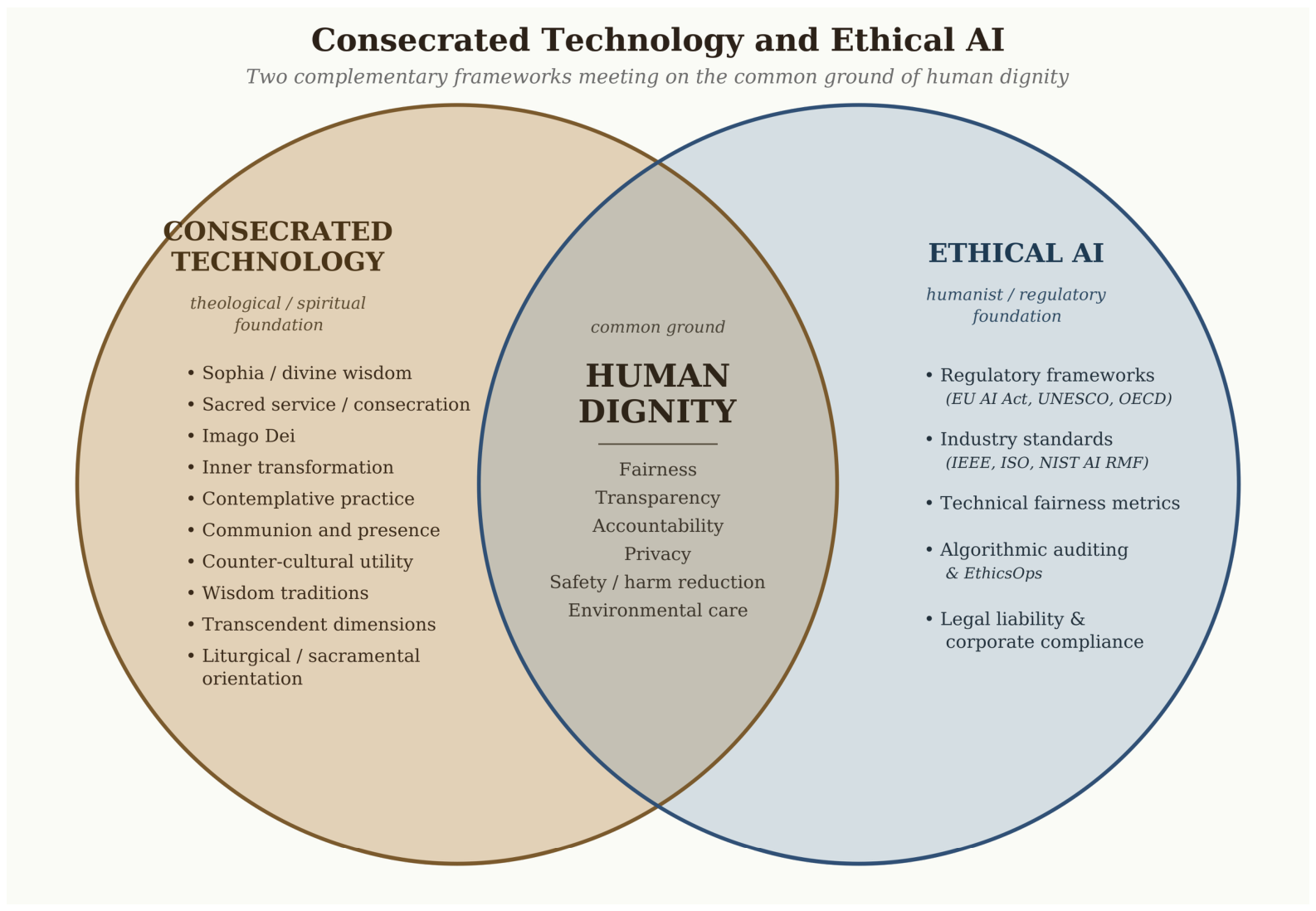
Table 1.
How Consecrated Technology and Ethical AI each treat the shared concerns anchored by Human Dignity.
9.6. The Four Convergent Grounds
The framework rests on four convergent grounds:
- Theological—the Sophiological tradition. Bulgakov’s distinction between uncreated Sophia (eternal divine wisdom in the inner life of the Trinity) and created Sophia (the principle of mediation through which divine wisdom reaches the manifested order, including human work and the technologies humans build) supplies the operative concept and the deepest grounding for the irreducibility of dignity (Bulgakov [1945] 2002).
- Philosophical—the convergence of virtue-ethical, deontological, Thomistic, and care-ethical traditions on dignity (Section 7.2): Aristotelian phronesis, Kantian rational agency, Thomistic synderesis/conscientia, Levinasian face-to-face encounter, and Murdochian attention each ground the same recognition in different idioms.
- Conceptual—the vessel thesis: AI as vessel for human ethical agency, never as ethical agent itself. The category-error analysis of Section 7 demonstrates that ethics requires interiority no model possesses; AI can carry ethical agency without possessing it.
- Humanistic—capability-approach humanism (Sen 1999; Nussbaum 2011), which operationalizes dignity-respecting practice without theological premises. Capabilities identify the conditions of human flourishing as plural, irreducible to a single metric, and grounded in dignity—the same criteria the wisdom traditions yield from theological premises.
The convergence is itself a methodological claim: traditions differing on much else but converging here gives the dignity criterion serious cross-traditional support. Consecrated technology is not the property of any single religious tradition; it is the practice that all of these traditions, in their distinct vocabularies, would recognize as the proper relation between human creativity and the dignity of the persons it serves.
9.7. Conclusion: Consecration as Practice
Consecrated technology is not a magic solution or a marketing label. It is a disciplined practice that recognizes human creativity as a gift used in service of the imago Dei. It requires the reform of measurement systems (Section 11) and the institutionalization of wisdom-centered criteria (Section 12) to ensure that the Bezalel-shaped restraint of the developer is not ground down by the gravity of the market. This framework moves us from the mirror of alienation toward a technology that genuinely mediates the presence and wisdom of Sophia in the world.
10. Principles of Consecrated Technology: Design and Practice
The framework articulated in Section 9 calls for design principles recognizably specific to it—principles that follow from the framework’s commitments and would not follow from purely operational Ethical AI on its own. Five framework principles are proposed here, supplemented by four design principles that operationalize them—orienting commitments rather than exhaustive rules for developers, designers, deployers, and institutional users.
10.1. The Five Framework Principles
The first is the principle of wisdom primacy. AI development should enhance rather than diminish the human capacity for wisdom (Vallor 2016). Technologies are evaluated not only for efficiency or capability but for impact on contemplation, discernment, and depth of human reflection—whether the application makes users more thoughtful or more reactive. Where the answer favors fragmentation, the application has failed the wisdom test even when it has succeeded operationally.
The second is the principle of sacred service. Technology should serve ends that transcend mere utility. In the wisdom traditions, craftsmanship was a form of participation in cosmic order—the sacred service of the maker through which the world is cultivated rather than merely manipulated (Coomaraswamy 1934). The principle reconceives AI development as work that, done with integrity, partakes of this character: not merely commercial enterprise but the service of persons whose dignity the work must honor.
The third is the principle of hierarchical integration. Reality has levels—material, psychological, intellectual, spiritual—and the wisdom traditions across their differences recognize that the higher should orient the lower rather than the reverse. AI should serve higher rather than lower human capacities. Routine cognitive tasks may be amplified by AI to free human attention for what AI cannot do: contemplation, presence, deliberation, the encounter with the irreducible Other. Where AI is deployed to capture and exploit attention, it inverts the hierarchy and serves the lower at the cost of the higher. This principle is contested—many ethicists reject metaphysical hierarchies of being or value—and the paper adopts rather than proves it (Section 1). Two clarifications narrow what is claimed. The hierarchy at issue orders capacities within a person (contemplation above reactive attention-capture), not persons above persons; it concerns what serves the human being, not a ranking of human beings. And “orient” means guide, not dominate: the higher is to inform the lower, not suppress it. Readers who reject the metaphysics may still grant the operational point—that AI built to capture and exploit attention serves a lower capacity at the cost of a higher one.
The fourth is the principle of qualitative assessment. Traditional wisdom emphasized qualitative over quantitative measures of value. The principle calls for assessment criteria that honor what cannot be reduced to single metrics: beauty, meaning, spiritual significance, alignment with the dignity of the person. The capability approach (Sen 1999; Nussbaum 2011) demonstrates that such qualitative assessment is operationally possible; Section 11 develops what this means for AI specifically.
The fifth is the principle of conscious embedding. AI systems are to be understood as vessels for human consciousness—every algorithm, interface, training set, and response pattern imbued with the wisdom, compassion, and sacred intention of the conscious beings dedicated to authentic service. This is the constructive form of the category-error analysis of Section 7: AI cannot itself be ethical, but AI can be the medium through which human ethical agency is extended and deepened—when the agency is consciously embedded rather than absent or inverted.
10.2. Four Design Principles
A growing literature on sacred design and contemplative computing develops these orientations in specific design vocabularies (Bell et al. 2005; Buie 2013; Mah et al. 2021). The four design principles here operate one level above that practice literature—not a competing or comprehensive design vocabulary, but orienting commitments any specific sacred-design practice within Consecrated Technology would have to honor.
The first is symbolic resonance—design drawing on archetypal and traditional forms (proportion, harmony, the visual and structural vocabularies the wisdom traditions have developed) not as decoration but as expression of cosmic harmony. The second is contemplative interaction—design for slowness, reflection, and presence rather than speed and engagement maximization. Interfaces are crafted to support deliberation, not exploit psychological vulnerabilities to capture attention. The third is wholeness over fragmentation—design that integrates rather than isolates, heals rather than distracts. AI systems are situated within rather than against the larger ecologies of human relationship and meaning. The fourth is transparency as illumination—explainability that is not merely technical but communicative, making clear how the system operates, what values it serves, what intentions it bears, and what kinds of users and uses it would honor.
10.3. The Propositional Commitments of Consecrated Technology
These principles together yield the propositional commitments of Consecrated Technology, stated as propositions rather than exhortations. Technology carries a metaphysical imprint; it can either veil or unveil the sacred dimensions of existence. The dignity of the person is the irreducible criterion of every design decision. Innovation, rightly understood, is remembrance—the recovery of what knowledge has always been for, in forms appropriate to the present. The operative test of any AI deployment is whether it amplifies the person’s agency or supplants the person; the operative posture of any AI developer is the chosen discipline that the structural marks of consecration require, submitting to community-mediated accountability that distinguishes the practice from its rhetorical counterfeit.
These commitments are not announced through manifesto but enacted through practice. The principles articulate what the practice requires; the operational implementation—the measurement reform that makes qualitative assessment possible, the institutional structures that make community-mediated accountability real, the multi-front program of education, leadership, governance, and individual responsibility—is developed in Section 11 and Section 12.
11. AI Measurement Reform: Sen, Global Index, and Dignity
The structural critique of Section 6 named the gravitational pull of optimization-driven measurement systems on ethical commitments—the tyranny of the measurable, in Sen’s phrase. The framework of Consecrated Technology developed in Section 9 and the principles articulated in Section 10 cannot be sustained without measurement reform that supports rather than erodes the qualitative commitments they require. This section turns from the framework to its operational supports, drawing on the most consequential precedent for the kind of measurement reform AI ethics now needs and engaging the most relevant contemporary parallel that has emerged in the field.
11.1. The Sen Precedent
Sen and Mahbub ul Haq’s Human Development Index, launched by the United Nations Development Programme (UNDP) in 1990, is the standing proof that qualitative dimensions of human flourishing can be measured plurally without reduction to single metrics (UNDP 1990; Sen 1999). Against the GDP-per capita reduction that dominated development economics, HDI articulated three dimensions—life expectancy, schooling, gross national income per capita—into a multidimensional picture policymakers could not ignore.
The HDI was followed by an expanding family of capability-style frameworks: the Multidimensional Poverty Index; the Stiglitz–Sen–Fitoussi Commission’s Mismeasuring Our Lives (Stiglitz et al. 2010); the OECD Better Life Index; Bhutan’s Gross National Happiness; Raworth’s (2017) Doughnut Economics; the Wellbeing Economy Alliance. The conceptual move common to this lineage is the same: refuse the reduction, articulate the plural dimensions, build the comprehensive measurement framework, publish so that policy actors must answer to it. The reform is not anti-measurement; it is anti-reductive measurement.
The capability approach is invoked here for the measurement move it exemplifies—refuse the single metric, articulate plural dimensions, build a framework policy actors must answer to—not as an endorsement of its underlying anthropology, which is contested. Sen’s and Nussbaum’s is a broadly liberal, individualist account of the person, and the objection that it is culturally particular and expressivist is a serious one. The paper adopts the precedent while grounding its own criteria in the thicker, more relational anthropology of Section 9—one that both draws on the capability approach’s refusal of reduction and departs from its individualism. What the precedent supplies is proof of possibility, not a finished anthropology; the substantive criteria come from elsewhere.
In Nussbaum’s neo-Aristotelian articulation, this operational project connects to the wisdom-traditional sources (Nussbaum 2011): Aristotelian eudaimonia—flourishing in plural dimensions—is the philosophical anchor of capability theory, which is the operational anchor of HDI and its successors. The lineage from Aristotle through Nussbaum to UNDP is direct.
11.2. The Contemporary Parallel: The Global Index on Responsible AI
In June 2024, the Global Center on AI Governance launched the Global Index on Responsible AI (GIRAI), measuring 138 countries on AI governance and human rights protection (Adams et al. 2024). GIRAI’s structure parallels HDI’s: three dimensions (governance, human rights, capabilities), nine sub-dimensions, nineteen thematic areas, four pillars (frameworks, government actions, non-state actor activity, responsible-AI environment), with data gathered through first-hand expert surveys.
GIRAI is the most fully developed instance of a broader reform movement that includes the Global AI Worthiness Index (GAWI), Stanford HAI’s AI Index reports (Maslej et al. 2025, 2026), and the AI Index from the Center for AI and Digital Policy (2024). Each refuses to let AI be measured by infrastructure, investment, and talent alone—the register of indices such as the Tortoise Media Global AI Index (Tortoise Media 2024), against which the reform defines itself.
GIRAI’s conceptual move applies HDI’s: refuse single-metric reduction, articulate plural dimensions, ground measurement in human rights and lifecycle accountability, publish for policy answer. The first edition’s results revealed stark global disparities—most countries scoring below 25%, a handful approaching 75%—making visible what was previously diffuse. GIRAI is, in effect, the AI-ethics analog to HDI at the national-policy level: the conceptual move that made plural development measurement possible in 1990 has now been made for plural AI-governance measurement in 2024.
11.3. The Gap GIRAI Does Not Fill
GIRAI’s achievement is at the national-policy level. It measures whether countries have appropriate governance frameworks, whether non-state actors are taking responsible-AI actions, whether capabilities exist at the national level. What it does not measure—and was not designed to measure—is individual AI systems against dignity-centered criteria at the level of deployment. A country can score well on GIRAI while individual AI systems deployed within it are dignity-violating in their actual operation; conversely, well-deployed individual systems can exist within nations that score poorly on the macro framework.
Other existing frameworks address narrow operational concerns at the system level. Stanford’s Holistic Evaluation of Language Models (HELM) measures performance and bias across multiple dimensions (Liang et al. 2022). The NIST AI Risk Management Framework establishes process-level standards for development and deployment (NIST 2023). The EU AI Act classifies systems by risk category (European Union 2024). The IEEE Ethically Aligned Design initiative articulates principles for engineering practice (IEEE 2019). Microsoft, Google, IBM, and other major developers have published responsible-AI standards. Each of these contributes operational specificity within its scope. The substantive integration around dignity, however, is missing. The macro is taken up by GIRAI; the micro is fragmented across these system-level frameworks; what connects them—the wisdom-traditional substantive criterion of dignity that Consecrated Technology articulates—has not been operationalized in measurement form. The result is that operational AI ethics tracks proxies (fairness metrics, audit results, compliance documentation) without any unified frame against which the proxies could be evaluated for whether they together amount to dignity-respecting deployment.
11.4. The Conceptual-Cultural Problem
The missing integration is not merely an operational lacuna that more metric-building would fill. It is a conceptual and cultural absence. The reason no integrated dignity-centered framework exists at the system level is not primarily that the metrics have not been built. It is that the conceptual frame in which AI is developed (engineering optimization) and the industry culture in which it is deployed (efficiency, scale, return on investment) do not include dignity as a substantive concept that operational systems are expected to honor. Adding metrics without changing the conceptual frame would be insufficient; the new metrics would be ground out by the same gravity Section 6 documents.
The wisdom-traditional framework developed in this paper supplies the conceptual depth that purely operational metric-building cannot. This is why the paper’s argument is theological-philosophical first and operational second: the operational reform requires the conceptual reform. The Sen-precedent measurement reform was operationally possible because Sen and Nussbaum had done the conceptual-philosophical work on capabilities first. The same sequence is required here. The framework of Consecrated Technology is what makes the operational reform conceivable; the operational reform is what makes the framework structurally enforceable.
11.5. A Human Dignity Index for AI Systems
The proposal that follows from this analysis is for a Human Dignity Index for AI Systems (HDIAS)—a system-level dignity-centered framework that integrates the operational specificity of existing system-level frameworks with the substantive criteria the wisdom traditions and capability approach together yield. The criteria would include the operational concerns already developed in existing frameworks: fairness and non-discrimination, transparency and explainability, accountability and human oversight, privacy and data protection, safety and harm reduction, environmental sustainability. To these, the wisdom-traditional framework would add dignity-centered design as a positive criterion (not merely the absence of dignity violations); wisdom-enhancement (does the system support contemplation and discernment or fragment them); presence and communion (does the system honor or supplant human encounter); and capability-style multidimensional flourishing (does the system serve plural rather than reductive measures of what makes a life well lived).
The proposal is for further development, not a finalized standard. The work of articulating, testing, and refining a Human Dignity Index for AI Systems would require sustained collaboration among technical practitioners (who know what is measurable in deployed systems), wisdom-traditional scholars (who know what the substantive criteria require), policy actors (who can give the framework operational reach), and civil-society representatives (who can hold the framework accountable to those affected). The construction would proceed through standard psychometric stages: face validity (the index appears to address the concerns it claims to address), content validity (expert-driven assessment of coverage across the substantive criteria, identifying gaps that any single framework would miss alone), and construct validity (the index measures dignity-honoring practice rather than something correlated but distinct, with both convergent and discriminant testing). Criterion validity—predicting outcomes for affected persons—would emerge through longitudinal study of deployments. The paper’s contribution at this point is conceptual: to identify what such an index would require and why purely operational efforts have repeatedly failed to produce it. The construction of the index is the work the field now needs to undertake.
11.6. Conclusion: Measurement as the Sensor of Consecration
The measurement reform proposed here cannot stand alone. Even a well-developed Human Dignity Index would be ground out by the gravity Section 6 documents unless it operates within the broader institutional structures that mediate accountability and the broader multi-front program that situates measurement reform within education, leadership, governance, and individual responsibility. Section 12 develops this program, taking the measurement reform of Section 11 as one component within it.
12. The Operational Program: Extending the Sustainable AI Ethics Framework
The framework of Consecrated Technology (Section 9), the principles (Section 10), and the measurement reform (Section 11) together require an operational program—a multi-front program through which the framework is institutionalized, the principles realized, and the measurement reform sustained against the gravity Section 6 documents. This section develops that program by extending the Sustainable AI Ethics framework and integrating the institutional dimension the wisdom traditions identify as necessary for genuine consecration to occur.
12.1. Building on Sustainable AI Ethics
The Sustainable AI Ethics framework, articulated principally by van Wynsberghe (2021), elaborated by Bansal (2025), and reflected in the UNESCO Recommendation on the Ethics of Artificial Intelligence (UNESCO 2021), distinguishes two complementary concerns: the sustainability of AI (reducing environmental and social costs of the technology, particularly the energy and water consumption of large-scale training and inference) and AI for sustainability (deploying AI to address the UN Sustainable Development Goals and adjacent global challenges). The framework articulates working goals across both registers: environmental sustainability, algorithmic fairness, transparency, privacy and data protection, safety and accountability, deployment for the global development agenda.
This framework is necessary but insufficient. It treats ethics primarily through the negative criterion of harm reduction and the instrumental criterion of utility. What is missing is the substantive positive dimension that the wisdom traditions and capability-approach humanism together supply: dignity not merely as a constraint to be respected but as a criterion to be honored; presence and communion as substantive concerns rather than side effects; capability-style multidimensional flourishing as the measurement frame within which all other goals operate.
12.2. Wisdom-Centered Extensions
The operational program proposed here extends the existing Sustainable AI Ethics framework rather than replacing it. Five wisdom-centered extensions are added to the existing operational concerns. The first is dignity-centered design as positive criterion: the active honoring of human worth in design and deployment, not merely the avoidance of dignity violations. Every system is evaluated for whether it amplifies the agency, presence, and capability of those it serves. The second is wisdom-enhancement metrics: measurement of whether systems support contemplation, discernment, and depth of engagement, or fragment attention and erode judgment—the wisdom-primacy principle of Section 10 made operational. The third is cultural and religious plurality as constitutive: not a compliance concern but essential to honoring how different wisdom traditions understand the human person. Systems are designed in ways that respect, rather than flatten, the plurality of frameworks within which their users live. The fourth is capability-style multidimensional flourishing measurement: the Sen-precedent operational frame from Section 11, applied at the system level through a Human Dignity Index for AI Systems. The fifth is consecrated service as orientation: the recognition that AI development is itself a moral activity, requiring contemplative practice and ethical formation among practitioners. The work of building AI shapes the souls of those who build; the practice must include the disciplines that honor that fact.
These extensions are then operationalized through a multi-front program of institutional and practical reform.
12.3. The Multi-Front Program
The first front is education and ethical formation—training of AI developers, deployers, and users in virtue ethics, dignity-centered design, the capability approach, the wisdom traditions that ground them, and the cultivation of moral sensitivity to recognize ethical dimensions of design choices before they become embedded in deployed systems. Existing efforts span academic curricula (Embedded EthiCS at Harvard, Markkula Center, Stanford HAI humanities programs), professional certifications (IEEE CertifAIEd, Alan Turing Institute’s Operationalising Ethics in AI, UNESCO training based on the 2021 Recommendation), and emerging cross-cultural training practices. The operational program calls for deliberate expansion of these efforts grounded in the substantive philosophical-theological frame that distinguishes Consecrated Technology from procedural compliance.
The second front is industry and civic leadership—corporate leaders, regulators, and civic institutions modeling consecrated practice. The 2026 Mythos case provides one prominent contemporary instance of operational restraint exercised under sustained pressure. Anthropic’s decision not to release Mythos generally despite political and competitive pressure illustrates that the operational program is realizable. The case also illustrates the gravitational pull Section 6 documents in real time: Indian government negotiations for access, the Trump administration’s pursuit of access despite blacklist concerns, OpenAI’s initial criticism subsequently revised when comparable capabilities required similar restrictions (Murphy 2026; Sabin 2026; Langley 2026a). The Mythos case is one trajectory of response; the conceptual grounding offered here is intended to make such trajectories more sustainable when the pressure persists.
A different trajectory is equally instructive. Google’s response to comparable gravitational pressures has taken a different shape. The 2018 declination of Project Maven, the company-wide pledge not to use AI for military or surveillance purposes, and the “don’t be evil” commitment were Bezalel-shaped moves at the time. In 2024, the pledge was revised; in 2026, Google entered classified national-security agreements alongside several other major developers; internal practices around discussion-forum moderation and town-hall framing have also evolved (Langley 2026b). Google leadership has offered serious reasons—national-security necessity, the changed competitive landscape, the position that an American company cannot stand outside the institutional system in which it operates—and some Google employees have offered equally serious reasons for disagreement. The framework does not adjudicate; serious people on different sides have offered substantive arguments. What it does observe is that the structural marks it names can be maintained or modified under sustained pressure, and that contemporary cases illustrate the range of possibilities. The reader is invited to apply the structural test to whichever cases they encounter; the paper’s contribution is the vocabulary, not the verdict.
The third front is transparency and accountability—capability-style measurement (per Section 11) and engagement with regulatory frameworks at national and supranational levels (European Union 2024; NIST 2023; OECD 2019; UNESCO 2021). Transparency here is not merely technical explainability but, per Section 10, illumination of the values and intentions the system bears.
The fourth front is open dialogue across traditions and perspectives—plural conversation across cultural, religious, and philosophical traditions, conducted with respect for difference. The wisdom traditions converge on dignity but differ on much else; the operational program calls for dialogue that honors the differences rather than flattening them.
The fifth front is cultural integration—bringing dignity-centered AI ethics into the institutional cultures of organizations that develop and deploy AI. This is the conceptual-cultural reform Section 11 named: not new metrics within old cultures but new cultures within which the metrics can do their work.
The sixth front is individual responsibility—the irreducible foundation. Developers, leaders, and users are moral agents whose choices cumulatively constitute the ethical character of deployed AI. The framework’s operational components do not displace individual responsibility; they make it possible to exercise within structures that support rather than erode it.
12.4. Institutional Structures of Mediated Accountability
The operational program is structurally distinct from existing AI-ethics implementation in one respect that follows from Section 9. Consecrated technology requires not only individual ethical commitment but institutional structures of mediated accountability that hold commitment in place. The wisdom traditions across their distinct theological commitments have always known that genuine self-examination operates within community, mediator, practice, and aim—and that the absence of any one allows private certification to substitute for communal recognition.
Contemporary AI development is structurally underdeveloped: developers self-certify; companies self-regulate; audits when they happen are typically commissioned and paid for by the audited. Project Glasswing is a partial industry-level analog to the community-of-accountability function—a consortium of organizations holding the work in common rather than allowing unilateral release—but the analogues to the mediator function (an authority recognized as competent to inspect and certify), the regular practice of self-examination, and the substantive aim grounded in human flourishing are all underdeveloped.
The operational program therefore proposes the deliberate construction of these institutional structures: not in imitation of any single religious tradition’s specific forms, but in recognition that the structural requirements of mediated accountability are what the wisdom traditions discovered, across their differences, to be necessary for genuine consecration. The construction work is difficult and will not be completed by any single proposal, this paper’s included. The paper’s contribution is to identify the structural absence and articulate what the construction would require.
12.5. Conclusions: From Compliance to Consecration
The operational program is not a replacement for regulation like the EU AI Act, but its sapiential completion. Without the institutional structures of mediated accountability and the multi-front program of ethical formation, the most well-intentioned ethical-AI principles will be ground down by the gravity of the market. Consecrated technology provides the institutional will to ensure technology remains a vessel for the sacred, honoring the Sophia-like wisdom that is the birthright of every human person.
13. Conclusions: Reclaiming Sophia in the Age of AI
The introduction posed three questions that have organized this paper’s thinking. With the framework in hand, they admit of more articulated answers.
The first question concerned the purpose of intelligence. The wisdom traditions hold that intelligence is at its highest a mode of communion with what is true, beautiful, and good—illumination, not optimization. The paper has taken seriously the perennialist diagnosis that modernity has progressively reduced this conception to information processing and pattern recognition, with consequences the present discontents around AI make visible. The recovery is not a regression to pre-modern epistemology; it is a refusal of the consequentialist reduction that has come to dominate the field, and a re-engagement with what the wisdom traditions have always known intelligence to be at its highest.
The second question concerned the nature of the human being. The paper has argued, drawing on the wisdom traditions and on the international consensus they substantively converge with, that the human being possesses a dignity that is intrinsic and inalienable—the worth every person inherently possesses simply by being human, regardless of status, race, gender, or belief. This dignity is the irreducible criterion that organizes the framework: not one ethical concern among others, but the criterion under which all other concerns must be pursued.
The third question concerned whether technology can be a vessel for wisdom. The paper’s constructive answer is yes—under conditions that the framework of Consecrated Technology articulates. Technology can carry human ethical agency without itself possessing it; the Five Marks of Bezalel—bestowed, disciplined by specification, for sacred and communal purpose, accountable, and anonymous in its product—are the criteria that distinguish consecrated practice from its rhetorical counterfeit. The Bezalel paradigm developed in Section 9 names what these marks require; the Mythos case (Section 5.5, Section 9.4 and Section 12.3) and the Google case (Section 12.3) illustrate two trajectories of response within contemporary AI development; the operational program of Section 12 proposes the institutional structures within which the consecrated trajectory can be sustained.
13.1. Integrating Threads
Five threads run through the architecture and bind it together. Dignity is the anchor—the substantive criterion the framework returns to at every turn. Consecration is the practice—the deliberate making of technological work into something honoring of the dignity it serves. Sustainability is the discipline Section 12 extends—not only the environmental sustainability of AI but the sustainability of ethical commitments themselves under pressure. The substrate–deployment distinction is the conceptual grammar that lets the paper distinguish what AI is (agnostic) from what AI does (value-laden). The structural test is the discriminating principle that lets the framework be deployed without being co-opted: consecration is recognized by what is submitted to, not by what is claimed.
13.2. What the Paper Does Not Solve
The paper does not solve the deepest philosophical problems it engages, and an honest conclusion should acknowledge as much. The moral idealism/utilitarianism gap is bridged in measurement (the Sen–Nussbaum lineage demonstrates this), not in pure theory; whether the bridging holds under sustained philosophical scrutiny is a question this paper cannot settle. The political economy of AI development resists ethical reform in ways no conceptual framework alone can resolve; the gravitational pressures Section 6 documents will continue to operate on developers regardless of the vocabulary available to them. The gap between the conceptual and the operational is wide; the construction of a Human Dignity Index for AI Systems and of the institutional structures of mediated accountability is field work that this paper helps make conceivable but does not itself complete. The complementarity claim itself—that Consecrated Technology and Ethical AI together yield more comprehensive coverage of the shared concerns than either alone—is argued at the level of normative grounding rather than empirically validated; expert-driven evaluation across face validity, content validity, and construct validity is the next stage of work, work the Section 11.5 HDIAS construction would naturally generate. Nor does the paper finally adjudicate the symmetric question of Section 7.6—whether the deployment-tendency case against AI rises to the level of a structural verdict requiring restraint rather than reform. That adjudication, too, awaits the operational work.
13.3. Closing
The Sophia tradition has always known that wisdom is not a possession but a practice—a way of being that the wisdom-bearer enters into and is changed by. The recovery of Sophia in the age of AI is not the construction of a perfect technology that solves human problems, nor the reverent invocation of religious vocabulary that absolves its inventors of accountability. It is the patient work of consecrating, again and again, the technologies through which contemporary persons increasingly meet one another. Technology carries a metaphysical imprint; it can either veil or unveil the sacred dimensions of existence. The dignity of the person is the irreducible criterion of every design decision. Innovation, rightly understood, is remembrance. These propositions do not announce a manifesto; they name what the wisdom traditions have always known, in idiom appropriate to the moment. That contemporary religious–cultural actors are independently reaching for the same convergence—the Seoul ordination’s invocation of compassion, wisdom, and responsibility being one recent instance—suggests the framework names something already underway. Whether the Seoul ordination meets the structural test that Section 9 develops is a separate question that awaits its application. The corollary is succinct: the source of knowledge is the human (an embodiment of the Divine); the source of information is the machine; the distinction is consciousness.
Sophia is reclaimed when she is recognized—in the form she takes among us, behind the mirrors and proxies and synthetic figures that bear her name without bearing her substance, and in the dignity of the persons whose worth she has always been the wisdom of honoring.
Funding
This research received no external funding.
Institutional Review Board Statement
Not applicable. This study does not involve humans or animals.
Informed Consent Statement
Not applicable. This study does not involve human subjects.
Data Availability Statement
No new data were created or analyzed in this study. Data sharing is not applicable to this article.
Acknowledgments
During the preparation of this manuscript (2025–2026), the author used Anthropic’s Claude for drafting, revision, rewriting, citation work, and editing; OpenAI’s ChatGPT and Google’s Gemini as research assistants; and Microsoft Copilot to render Figure 1, which the author conceptualized and designed. The conception, argument, theoretical framework, and applications presented in this study are the author’s own. The author has reviewed and edited all output and takes full responsibility for the content of this publication.
Conflicts of Interest
The author declares no conflict of interest.
References
- Adams, Rachel, Fola Adeleke, Ana Florido, Larissa Galdino de Magalhães Santos, Nicolás Grossman, Leah Junck, and Kelly Stone. 2024. Global Index on Responsible AI 2024, 1st ed. Cape Town: Global Center on AI Governance. Available online: https://www.global-index.ai/report (accessed on 13 May 2026).
- Amnesty International. 2021. Xenophobic Machines: Discrimination Through Unregulated Use of Algorithms in the Dutch Childcare Benefits Scandal. Available online: https://www.amnesty.org/en/documents/eur35/4686/2021/en/ (accessed on 13 May 2026).
- Anthropic. 2026. Project Glasswing: Securing Critical Software for the AI Era. April 7. Available online: https://www.anthropic.com/glasswing (accessed on 13 May 2026).
- Aquinas, Thomas. 1947. Summa Theologiae. Translated by Fathers of the English Dominican Province. Einsiedeln: Benziger Brothers. Original work published 1265–1274. [Google Scholar]
- Aristotle. 2000. Nicomachean Ethics. Edited and Translated by Roger Crisp. Cambridge: Cambridge University Press, Original work published ca. 350 B.C.E. [Google Scholar]
- Bansal, Chandni. 2025. AI ethics and sustainability: Accelerating paradigm shifts toward sustainable development. Journal of Strategy & Innovation 36: 200537. [Google Scholar] [CrossRef] [Scilit]
- BBC News. 2020. Hagia Sophia: Turkey Turns Iconic Istanbul Museum into Mosque. July 10. Available online: https://www.bbc.com/news/world-europe-53366307 (accessed on 13 May 2026).
- Bell, Genevieve, Mark Blythe, and Phoebe Sengers. 2005. Making by making strange: Defamiliarization and the design of domestic technologies. ACM Transactions on Computer-Human Interaction 12: 149–73. [Google Scholar] [CrossRef] [Scilit]
- Borgmann, Albert. 1984. Technology and the Character of Contemporary Life: A Philosophical Inquiry. Chicago: University of Chicago Press. [Google Scholar]
- Buie, Elizabeth. 2013. Contemplative interaction: Alternating between inner and outer worlds. In CHI ‘13 Extended Abstracts on Human Factors in Computing Systems. New York: Association for Computing Machinery, pp. 2469–72. [Google Scholar]
- Bulgakov, Sergei. 2002. The Bride of the Lamb. Translated by Boris Jakim. Grand Rapids: Eerdmans. Original work published 1945. [Google Scholar]
- Center for AI and Digital Policy. 2024. Artificial Intelligence and Democratic Values Index 2023. Available online: https://www.caidp.org/reports/aidv-2023/ (accessed on 13 May 2026).
- Coeckelbergh, Mark. 2020. AI Ethics. Cambridge: MIT Press. [Google Scholar] [CrossRef] [Scilit]
- Coomaraswamy, Ananda K. 1934. The Transformation of Nature in Art. Cambridge: Harvard University Press. [Google Scholar]
- Corbin, Henry. 1969. Creative imagination in the Sufism of Ibn ‘Arabi. Translated by Ralph Manheim. Princeton: Princeton University Press. Original work published 1958. [Google Scholar]
- Dastin, Jeffrey. 2018. Amazon scraps secret AI recruiting tool that showed bias against women. Reuters. October 10. Available online: https://www.reuters.com/article/world/insight-amazon-scraps-secret-ai-recruiting-tool-that-showed-bias-against-women-idUSKCN1MK0AG/ (accessed on 13 May 2026).
- Davis, Judy F., and Matthew H. Sauber. 2026. Dimensions of power and resistance: A critical review of racial dynamics in the marketplace. Journal of Marketing Management 42: 535–93. [Google Scholar] [CrossRef] [Scilit]
- Deutsche Welle. 2017. Saudi Arabia Grants Citizenship to Robot. Bonn: Deutsche Welle, October 26. [Google Scholar]
- Douthat, Ross. 2026. The atheist and the machine god. The New York Times. May 9. Available online: https://www.nytimes.com/2026/05/09/opinion/artificial-intelligence-consciousness-richard-dawkins.html (accessed on 13 May 2026).
- Eliade, Mircea. 1959. The Sacred and the Profane: The Nature of Religion. Translated by Willard R. Trask. San Diego: Harcourt Brace. Original work published 1957. [Google Scholar]
- European Union. 2024. Regulation (EU) 2024/1689 of the European Parliament and of the Council of 13 June 2024 laying down harmonised rules on artificial intelligence (Artificial Intelligence Act). Official Journal of the European Union L 2024: 1689. Available online: https://eur-lex.europa.eu/eli/reg/2024/1689/oj (accessed on 13 May 2026).
- Florensky, Pavel. 1997. The Pillar and Ground of the Truth. Translated by Boris Jakim. Princeton: Princeton University Press. Original work published 1914. [Google Scholar]
- Gallaher, Brandon. 2016. Freedom and Necessity in Modern Trinitarian Theology. Oxford: Oxford University Press. [Google Scholar]
- Geraci, Robert M. 2010. Apocalyptic AI: Visions of Heaven in Robotics, Artificial Intelligence, and Virtual Reality. Oxford: Oxford University Press. [Google Scholar]
- Goodhart, Charles A. E. 1975. Problems of monetary management: The U.K. experience. In Papers in Monetary Economics. Sydney: Reserve Bank of Australia, Vol. 1, pp. 111–24. [Google Scholar]
- Guénon, René. 1953. The Reign of Quantity and the Signs of the Times. Translated by Lord Northbourne. Hilversum: Luzac. Original work published 1945. [Google Scholar]
- Haksever, Oğuz U., and Ahmet Sözen. 2024. The instrumentalization of post-truth politics in Turkey: The case of the 2023 elections. Turkish Studies 25: 398–418. [Google Scholar] [CrossRef] [Scilit]
- Heidegger, Martin. 1977. The Question Concerning Technology and Other Essays. Translated by William Lovitt. New York: Harper & Row. [Google Scholar]
- Herzfeld, Noreen. 2023. The Artifice of Intelligence: Divine and Human Relationship in a Robotic Age. Minneapolis: Fortress Press. [Google Scholar]
- Hicks, Chris, Connor Attridge, Ardi Janjeva, and Carolyn Ashurst. 2026. Claude Mythos: What Does Anthropic’s New Model Mean for the Future of Cybersecurity? London: Centre for Emerging Technology and Security, April 14, Available online: https://cetas.turing.ac.uk/publications/claude-mythos-future-cybersecurity (accessed on 13 May 2026).
- IEEE. 2019. Ethically Aligned Design: A Vision for Prioritizing Human Well-Being with Autonomous and Intelligent Systems, 1st ed. Piscataway: Institute of Electrical and Electronics Engineers. Available online: https://ethicsinaction.ieee.org/ (accessed on 13 May 2026).
- Ihde, Don. 1990. Technology and the Lifeworld: From Garden to Earth. Bloomington: Indiana University Press. [Google Scholar]
- Ioannou, Michael, Sofia Olsson, Ane Bakken Wold, Marzia Dellepiane, and Steinn Steingrímsson. 2023. Approaching “highly sensitive person” as a cultural concept of distress: A case-study using the cultural formulation interview in patients with bipolar disorder. Frontiers in Psychiatry 14: 1148646. [Google Scholar] [CrossRef] [Scilit] [PubMed]
- Jung, Carl G. 1968. The Archetypes and the Collective Unconscious, 2nd ed. Translated by R. F. C. Hull. Princeton: Princeton University Press, The Collected Works of C. G. Jung, Vol. 9, Part 1. [Google Scholar]
- Kant, Immanuel. 1997. Groundwork of the Metaphysics of Morals. Translated by Mary Gregor. Cambridge: Cambridge University Press. Original work published 1785. [Google Scholar]
- Khan, Irene. 2023. Sustainable Development and Freedom of Expression: Why Voice Matters (A/HRC/53/25). Geneva: United Nations Human Rights Council. Available online: https://www.ohchr.org/en/documents/thematic-reports/ahrc5325-sustainable-development-and-freedom-expression-why-voice (accessed on 13 May 2026).
- Langley, Hugh. 2026a. Anthropic debuts preview of powerful new AI model Mythos in restrictive cybersecurity push. TechCrunch. April 7. Available online: https://techcrunch.com/2026/04/07/anthropic-mythos-ai-model-preview-security/ (accessed on 13 May 2026).
- Langley, Hugh. 2026b. Google’s Subscriptions Business Is Booming—And AI Is a Big Reason. New York: Business Insider. Available online: https://www.businessinsider.com/google-earnings-subscriptions-business-booming-ai-2026-4 (accessed on 13 May 2026).
- Leo XIV, Pope. 2026. Magnifica Humanitas: On Safeguarding the Human Person in the Time of Artificial Intelligence [Encyclical]. Vatican City: The Holy See: Available online: https://www.vatican.va/content/leo-xiv/en/encyclicals/documents/20260515-magnifica-humanitas.html (accessed on 13 May 2026).
- Levinas, Emmanuel. 1969. Totality and Infinity: An Essay on Exteriority. Translated by Alphonso Lingis. Pittsburgh: Duquesne University Press. [Google Scholar]
- Liang, Percy, Rishi Bommasani, Tony Lee, Dimitris Tsipras, Dilara Soylu, Michihiro Yasunaga, Yian Zhang, Deepak Narayanan, Yuhuai Wu, Ananya Kumar, and et al. 2022. Holistic evaluation of language models. arXiv arXiv:2211.09110. [Google Scholar] [CrossRef] [Scilit]
- MacIntyre, Alasdair. 1981. After Virtue: A Study in Moral Theory. Notre Dame: University of Notre Dame Press. [Google Scholar]
- Mah, Kristina, Lian Loke, and Luke Hespanhol. 2021. Towards a contemplative research framework for training self-observation. ACM Transactions on Computer-Human Interaction 28: 39. [Google Scholar] [CrossRef] [Scilit]
- Markowitz, David M., and Jeffrey T. Hancock. 2024. Generative AI are more truth-biased than humans: A replication and extension of core truth-default theory principles. Journal of Language and Social Psychology 43: 261–67. [Google Scholar] [CrossRef] [Scilit]
- Maslej, Nestor, Loredana Fattorini, Raymond Perrault, Yolanda Gil, Vanessa Parli, Njenga Kariuki, Emily Capstick, Anka Reuel, Erik Brynjolfsson, John Etchemendy, and et al. 2025. The AI Index 2025 Annual Report. Stanford: AI Index Steering Committee, Institute for Human-Centered AI, Stanford University. Available online: https://hai.stanford.edu/ai-index/2025-ai-index-report (accessed on 13 May 2026).
- Maslej, Nestor, Sha Sajadieh, Loredana Fattorini, Raymond Perrault, Yolanda Gil, Vanessa Parli, Lapo Santarlasci, Juan Pava, Russ Altman, Erik Brynjolfsson, and et al. 2026. The AI Index 2026 Annual Report. Stanford: AI Index Steering Committee, Institute for Human-Centered AI, Stanford University. Available online: https://hai.stanford.edu/ai-index/2026-ai-index-report (accessed on 13 May 2026).
- Matthews, Caitlín. 2001. Sophia: Goddess of Wisdom, Bride of God, rev. ed. Wheaton: Quest Books. [Google Scholar]
- Mori, Masahiro. 2012. The uncanny valley. Translated by Karl F. MacDorman and Norri Kageki. IEEE Robotics & Automation Magazine 19: 98–100, Original work published 1970. [Google Scholar]
- Murdoch, Iris. 1970. The Sovereignty of Good. Abingdon: Routledge & Kegan Paul. [Google Scholar]
- Murphy, Margi. 2026. Anthropic limits Mythos model release in bid to stave off hacks. Bloomberg. April 7. Available online: https://www.bloomberg.com/news/articles/2026-04-07/anthropic-lets-apple-amazon-test-more-powerful-mythos-ai-model (accessed on 13 May 2026).
- Nasr, Seyyed Hossein. 1981. Knowledge and the Sacred. New York: Crossroad. [Google Scholar]
- Nichols, Aidan. 2005. Wisdom from Above: A Primer in the Theology of Father Sergei Bulgakov. Leominster: Gracewing. [Google Scholar]
- NIST [National Institute of Standards and Technology]. 2023. Artificial Intelligence Risk Management Framework (AI RMF 1.0) (NIST AI 100-1). Gaithersburg: NIST. [Google Scholar] [CrossRef] [Scilit]
- Nussbaum, Martha C. 2011. Creating Capabilities: The Human Development Approach. Cambridge: Harvard University Press. [Google Scholar]
- Obermeyer, Ziad, Brian Powers, Christine Vogeli, and Sendhil Mullainathan. 2019. Dissecting racial bias in an algorithm used to manage the health of populations. Science 366: 447–53. [Google Scholar] [CrossRef] [Scilit] [PubMed]
- OECD. 2019. OECD Principles on Artificial Intelligence. Organisation for Economic Co-operation and Development . Available online: https://oecd.ai/en/ai-principles (accessed on 13 May 2026).
- Pagels, Elaine. 1979. The Gnostic Gospels. New York: Random House. [Google Scholar]
- Polanyi, Karl. 1944. The Great Transformation: The Political and Economic Origins of Our Time. Boston: Beacon Press. [Google Scholar]
- Postman, Neil. 1992. Technopoly: The Surrender of Culture to Technology. New York: Knopf. [Google Scholar]
- Raworth, Kate. 2017. Doughnut Economics: Seven Ways to Think like a 21st-Century Economist. London: Chelsea Green Publishing. [Google Scholar]
- Rotta, Tomás. N., and Rodrigo A. Teixeira. 2018. The Commodification of Knowledge and Information. GPERC Working Paper No. 60. London: Greenwich Political Economy Research Centre, University of Greenwich. Available online: https://gala.gre.ac.uk/id/eprint/19448/ (accessed on 13 May 2026).
- Sabin, Sam. 2026. Anthropic holds Mythos model due to hacking risks. Axios. April 7. Available online: https://www.axios.com/2026/04/07/anthropic-mythos-preview-cybersecurity-risks (accessed on 13 May 2026).
- Sen, Amartya. 1999. Development as Freedom. Säckingen: Knopf. [Google Scholar]
- Singler, Beth. 2020. The AI creation meme: A case study of the new visibility of religion in artificial intelligence discourse. Religions 11: 253. [Google Scholar] [CrossRef] [Scilit]
- Solovyov, Vladimir. 1995. Lectures on Divine Humanity. Translated by Boris Jakim. Herndon: Lindisfarne Press. Original work published 1881–1884. [Google Scholar]
- Stiglitz, Joseph E., Amartya Sen, and Jean-Paul Fitoussi. 2010. Mismeasuring Our Lives: Why GDP Doesn’t Add Up. New York: The New Press. [Google Scholar]
- The Economist. 2026. Why big AI labs are hiring so many philosophers. The Economist. June 24. Available online: https://www.economist.com/science-and-technology/2026/06/24/why-big-ai-labs-are-hiring-so-many-philosophers (accessed on 13 May 2026).
- Tortoise Media. 2024. The Global AI Index. Available online: https://www.tortoisemedia.com/intelligence/global-ai/ (accessed on 13 May 2026).
- Tumin, Remy, and John Yoon. 2026. Meditating or rebooting? A robot Buddhist monk comes to South Korea. The New York Times. May 6. Available online: https://www.nytimes.com/2026/05/06/technology/robot-monk-buddhist-seoul.html (accessed on 13 May 2026).
- UNDP [United Nations Development Programme]. 1990. Human Development Report 1990: Concept and Measurement of Human Development. Oxford: Oxford University Press. Available online: https://hdr.undp.org/content/human-development-report-1990 (accessed on 13 May 2026).
- UNESCO. 2021. Recommendation on the Ethics of Artificial Intelligence. Available online: https://unesdoc.unesco.org/ark:/48223/pf0000381137 (accessed on 13 May 2026).
- United Nations General Assembly. 1948. Universal Declaration of Human Rights (217 [III] A). Available online: https://www.un.org/en/about-us/universal-declaration-of-human-rights (accessed on 13 May 2026).
- Vallor, Shannon. 2016. Technology and the Virtues: A Philosophical Guide to a Future Worth Wanting. Oxford: Oxford University Press. [Google Scholar]
- Vallor, Shannon. 2024. The AI Mirror: How to Reclaim Our Humanity in an Age of Machine Thinking. Oxford: Oxford University Press. [Google Scholar]
- van Wynsberghe, Aimee. 2021. Sustainable AI: AI for sustainability and the sustainability of AI. AI and Ethics 1: 213–18. [Google Scholar] [CrossRef] [Scilit]
- Verbeek, Peter-Paul. 2011. Moralizing Technology: Understanding and Designing the Morality of Things. Chicago: University of Chicago Press. [Google Scholar]
- Vogt, Markus. 2023. Truth Under Attack: How Information Warfare Undermines Democracy. Faculty of Catholic Theology, Ludwig Maximilian University of Munich . Available online: https://cms-cdn.lmu.de/media/01-kaththeol/fakultaetswebsite-der-katholischen-theologie/downloads/vogt-markus_truth-and-peace-in-the-hybrid-warfare.pdf (accessed on 13 May 2026).
- Weber, Max. 1958. The Protestant Ethic and the Spirit of Capitalism. Translated by Talcott Parsons. New York: Scribner. Original work published 1905. [Google Scholar]
- Williams, Rowan. 1999. Sergii Bulgakov: Towards a Russian Political Theology. Edinburgh: T&T Clark. [Google Scholar]
Disclaimer/Publisher’s Note: The statements, opinions and data contained in all publications are solely those of the individual author(s) and contributor(s) and not of MDPI and/or the editor(s). MDPI and/or the editor(s) disclaim responsibility for any injury to people or property resulting from any ideas, methods, instructions or products referred to in the content. |
© 2026 by the author. Licensee MDPI, Basel, Switzerland. This article is an open access article distributed under the terms and conditions of the Creative Commons Attribution (CC BY) license.