


Abstract
Spiritual care is central to palliative care. It helps patients nearing the end of life to maintain a sense of meaning, hope, and dignity, while alleviating existential anxiety and emotional distress as they face death. This study analyzes spiritual care practice in palliative care in China. It explores how religion supports spiritual healing by adapting and reconfiguring localized rituals. These adaptations are particularly important where overt religious expression and formal rituals are hard to include in healthcare settings. Based on semi-structured interviews with 14 professional carers in Shanghai, this paper examines how religious resources are translated into spiritual care in the Chinese healthcare context and analyzes the mechanisms behind their therapeutic effects. Research finds, first, that spiritual care in Chinese palliative care is not usually labeled as “spirituality” but is more often called “psychological care.” Second, religion in practice has not disappeared; instead, it has moved from public ritual and belief to the private sphere. Its roles (providing meaning, reconciling relationships, and supporting the transition from life to death) are transformed into care practices such as life reviews, the “Si Dao Ren Sheng” (the “Four Themes of Life”: expressing gratitude, offering an apology, expressing love, and saying farewell), family support, body donation, and end-of-life planning. Third, these therapeutic practices are effective not because of religious dogma, sacred stories, or explanations of the afterlife, but because they reconnect the patient to the “past–present–future.” Looking to the past, life reviews help patients integrate their narratives and affirm self-worth. In the present, repairing family relationships and expressing emotions help patients feel seen, accompanied, and needed. Looking to the future, end-of-life planning and the assignment of responsibilities give patients some control and peace of mind. Based on the thematic analysis, this paper therefore inductively constructs a “past–present–future” model of meaning-making in Chinese spiritual healing. Drawing on the Chinese cases examined, it offers a theoretical contribution to the global study of spiritual care.
1. Introduction
In recent years, palliative care has become a central response to suffering at the end of life. Its aim is not simply to extend life, but to relieve pain, sustain dignity, and support patients and families as death approaches. Unlike medical treatment, which focuses primarily on curing illness and prolonging life, palliative care emphasizes holistic care for patients and their families. It addresses four key dimensions: physical, psychological, social, and spiritual. It aims to alleviate patients’ suffering and help them experience dignity, peace, and support during the final stages of life (World Health Organization 2020). Particularly in the terminal phase, when conventional medical treatments are no longer effective, spiritual care strongly shapes patients’ sense of meaning, hope, dignity, and overall well-being, and is an important inner resource for coping with anxiety about death and existential dilemmas (Sulmasy 2002; Balboni et al. 2013).
Early research tended to link the concept of spirituality with religious experience, the sacred, and a belief in the transcendent. James’ (1902) classic study of religious experience stressed the subjective feelings and sense of transcendence people meet in the face of the ‘sacred’. It set an important agenda for later work on spirituality. By the latter half of the 20th century, the academic community had begun to re-examine the traditional practice of equating spirituality with religious belief. Through empirical research, Zinnbauer et al. (1997) demonstrated that, although there is an overlap between religiosity and spirituality, people have begun to distinguish between the two in their subjective understanding. Zinnbauer et al. (1999) further noted that distinctions such as “institutionalized religion versus personalized spirituality” and “institutionalized faith versus functional meaning-seeking” have gradually emerged in contemporary research. Hill et al. (2000), however, emphasize at a conceptual level that while religion and spirituality share a common dimension of sacredness, they should not be reduced to one another; religion is more concerned with tradition, institutions, rituals, and community, whereas spirituality places greater emphasis on the individual’s search for the sacred, meaning, and ultimate concerns. Consequently, spirituality has gradually evolved from a concept ancillary to religion into an independent analytical category.
Building on this conceptual shift, research in medical humanities, nursing, and palliative care has further expanded the scope of spirituality. Tanyi (2002) defines spirituality as an individual’s personal quest for the meaning and purpose of life; this quest may be related to religion, or it may exist independently of it. In their consensus report on palliative care, Puchalski et al. (2009) proposed that spirituality involves an individual’s search for and expression of meaning and purpose, as well as the ways in which they experience a sense of connection with the present moment, the self, others, nature, and “the significant or the sacred”. Drawing on international consensus, Puchalski et al. (2014) further defined spirituality as a dynamic and intrinsic dimension of human life, emphasizing that its core elements include ultimate meaning, life purpose, transcendent experiences, and multiple relational connections with the self, family, others, society, nature, and the divine. The European Association for Palliative Care (EAPC) has adopted a similar approach, defining spirituality as a dynamic dimension of life through which people seek and express meaning, purpose, and transcendence, and form connections across multiple relationships (Nolan et al. 2011). In summary, the scope of spiritual care encompasses not only support for religious beliefs but also non-religious dimensions such as the meaning of life, dignity, the restoration of relationships, and existential peace.
In China, palliative care has functioned in its own cultural and spiritual context. Confucian ethics, Buddhist and Daoist beliefs, ancestor veneration, and local rituals not only shape people’s understandings of life, suffering, and death but also permeate family responsibilities, festive customs, responses to illness, and funerary practices (C. K. Yang 1961; Goossaert and Palmer 2011). They exert influence that does not depend entirely on explicit religious identities or institutionalized religious organizations (C. K. Yang 1961). In modern society, although secularization and religious governance have transformed the ways these traditions are expressed and their institutional roles (Goossaert and Palmer 2011), they continue to influence people’s everyday lives through cultural customs, familial ethics, and resources for meaning-making (F. Yang 2011). Against this historical and institutional background, palliative care in China provides an insightful field for examining how spiritual concerns are defined and addressed.
These cultural influences continue to be apparent in end-of-life care, where Confucian, Buddhist, and Daoist traditions shape contemporary practices through filial piety, familial responsibility, the pursuit of a good death, and efforts to achieve a sense of settlement and life completion at the end of life (Jing et al. 2020; Hai 2014). Jeon and Jing (2023) noted that filial piety and family control of medical information profoundly affect patient autonomy and end-of-life decision-making, necessitating the development of relational autonomy between patient agency and family responsibility. Fu et al. (2024) showed that the decision to accept inpatient hospice care is a dynamic and culturally shaped process, in which caregivers’ interpretations of death, responsibility, and care obligations directly influence acceptance of palliative care. In short, spiritual care in China cannot be understood apart from familial relationships, intergenerational duties, and sociocultural context.
Accordingly, palliative care in mainland China is more often framed in terms of psychological, spiritual, or humanistic care rather than within a formal religious–spiritual service framework. This reframing is closely related to the sources of suffering among Chinese terminal patients. Cheng et al. (2024) found that spiritual needs in mainland Chinese advanced cancer patients include being treated as normal and independent individuals, giving and receiving love, seeking inner peace, connecting to spiritual resources, searching for meaning and purpose, and preparing for death. These findings suggest that spiritual needs show up less as abstract religious belief than as concerns with dignity, love, relationships, meaning, preparing for death, and inner peace. On the institutional side, both the 2017 and 2025 editions of the Practice Guidelines for Hospice Care define hospice care as an integrated practice encompassing symptom control, comfort care, psychological support, spiritual support, and social support (National Health and Family Planning Commission of the People’s Republic of China 2017; National Health Commission of the People’s Republic of China 2025). These institutional categories suggest that patients’ spiritual concerns may be addressed through broader forms of psychological, spiritual, social, and humanistic support rather than through a separately institutionalized service identified as spiritual care. Spiritual care in Chinese palliative care may therefore not be absent; rather, how it is renamed, translated, and organized across institutional, professional, and cultural discourses becomes an important empirical question.
In addition, Chinese scholars have begun to discuss spirituality and spiritual care from social work and medical humanities perspectives. Liu (2015) attempted to construct a framework for indigenous Chinese spirituality and a related social work service system; Chen (2010) reviewed spiritual research in social work and the relationship between religion and spirituality; Zhang et al. (2023) further explored the theoretical foundations and practical approaches of spiritual perspectives in medical social work. Nevertheless, existing studies have three main limitations: First, although existing scholarship has recognized that spiritual care encompasses both religious and non-religious forms, it has not paid sufficient attention to how spiritual care is translated and implemented in practice within institutional contexts where explicit religious discourse and formal hospital pastoral care services are relatively inconspicuous; second, while domestic research has addressed psychosocial support, life review, and family care, empirical studies on how frontline social workers and volunteers respond to spiritual needs in daily practice remain insufficient; third, few studies have explained, at the level of therapeutic mechanism, why practices such as life review, family companionship, the “Si Dao Ren Sheng” (the “Four Themes of Life”: expressing gratitude, offering an apology, expressing love, and saying farewell), and preparing funerary and posthumous matters can be effective in the absence of explicit religious resources.
Accordingly, this article investigates the forms and therapeutic mechanisms of spiritual care in Chinese palliative care, based on semi-structured interviews with medical social workers and volunteers in Shanghai. It addresses three main questions: First, how is spiritual care redefined, renamed, and translated in the context of Chinese palliative care? Second, through what ritualized practices do social workers and volunteers respond to terminal patients’ spiritual needs? Third, how do these practices achieve therapeutic effects in the absence of explicit religious explanations and institutionalized chaplaincy? Based on the thematic analysis, this article inductively constructs, rather than applies, the “past–present–future” explanatory model of meaning connection. The past dimension comprises life review and narrative integration; the present dimension comprises emotional expression, the “Si Dao Ren Sheng,” family companionship, and relational repair; and the future dimension comprises advance care planning, the settlement of unfinished responsibilities, and arrangements concerning family and posthumous affairs. The model is used to explain how these practices reconnect patients with their life stories, significant others, and the approaching end of life.
2. Methods
This study uses a qualitative design to examine what spiritual care looks like, and how it works, in Chinese palliative care. Drawing on semi-structured interviews and thematic analysis, it builds its account from the experience of frontline practitioners.
2.1. Recruitment and Participants
The empirical data for this article are primarily derived from semi-structured interviews and a single focus group interview conducted by the researcher. The study included a total of 14 participants, comprising 8 medical social workers and 6 palliative care volunteers. Participants were recruited from major tertiary hospitals, community hospitals, and palliative care volunteer teams across Shanghai, with differing levels of experience, service populations, and roles, so as to widen the range of perspectives. Medical social workers primarily undertook tasks such as patient and family assessment, psychosocial support, family meetings, grief counseling, resource linkage, life review, and spiritual care. Volunteers mainly provided ward companionship, emotional support, life review, relational communication, and daily care services.
Facilities and volunteer teams were selected purposively to include tertiary hospitals, community hospitals, and palliative care volunteer teams and to capture variation in organizational settings and practitioner roles. Participants were eligible if they were medical social workers or palliative care volunteers with direct experience providing care or support to palliative care patients or their families in Shanghai and were willing to provide informed consent and be audio-recorded. Individuals who did not meet these role and experience criteria or who did not consent to participation or audio recording were not included. Patients, family members, and other professional groups were outside the sampling frame.
To protect participant privacy, all interviewees were anonymized in the article. Medical social workers are denoted as S1–S8, and volunteers as V1–V6. All identifying information pertaining to hospitals, community organizations, patients, and families was de-identified during the writing process.
The study was conducted in accordance with the Declaration of Helsinki and received approval from the authors’ Institutional Review Board.
2.2. Data Collection
Data collection primarily utilized semi-structured, in-depth interviews, supplemented by a focus group interview. The interviews were guided by open-ended questions, encouraging participants to narrate based on their professional experience. The interview content mainly covered the following dimensions.
First, participants’ professional background, years of practice, institutional affiliation, and basic involvement in palliative care work.
Second, participants’ understanding of “spiritual care,” “psychosocial care,” and their relationship to religion.
Third, identification, assessment, and intervention approaches for spiritual care in clinical practice.
Fourth, the visibility, limitations, and alternative expressions of religious beliefs, rituals, or religious resources in hospital care.
Fifth, the specific implementation of practices such as life review, the “Si Dao Ren Sheng,” family communication, wish fulfillment, advance directives, body donation counseling, and posthumous affairs arrangement.
Sixth, the impact of spiritual care on patients’ death anxiety, sense of life meaning, family relationships, and end-of-life tranquility.
Seventh, the division of labor and collaborative relationships among social workers, medical personnel, volunteers, and patients’ families.
Prior to formal interviews, the researcher briefed participants on the research purpose, the use of audio recordings, the principles of anonymization, and the exclusive academic use of data. Interviews commenced only after obtaining participants’ informed consent. During the focus group interview, the researcher reiterated that audio recordings would be used solely for scholarly purposes, not disseminated externally, and assured anonymization of personal and institutional information.
Interview formats included in-person individual interviews and one focus group discussion. Individual interviews were primarily aimed at probing the specific practical logic of spiritual care across different institutions, while the focus group facilitated comparison of medical social workers’ and volunteers’ differing understandings of palliative care, religious resources, and spiritual support, as well as observation of how various roles negotiate the relatively ambiguous concept of spirituality in care. Each interview lasted approximately 60–90 min and was recorded with participants’ informed consent. Data collection continued until new data no longer generated novel analytic themes.
2.3. Data Analysis
This study employed thematic analysis to organize and interpret interview data. The analytic process unfolded in three main stages. The first stage comprised open reading and preliminary coding, during which the researcher repeatedly reviewed interview transcripts, identifying concepts and experiential accounts closely tied to the research topics, such as “spiritual/psychosocial terminology substitution,” “the latent presence of religious activities,” “prayer in hospital wards,” “life review,” “Si Dao Ren Sheng,” “family guilt,” “body donation,” “posthumous affairs arrangement,” and “patients’ sense of meaning and tranquility.” The second stage involved thematic aggregation and category construction, whereby initial codes were further integrated into several core themes. Through iterative comparison, two principal analytic domains were ultimately formed: (1) the discursive translation of spiritual care and the latent presence of religious resources; (2) a meaning-connection therapeutic mechanism based on the “past–present–future” continuum. Within the second domain, three subthemes were further identified: (1) reconciliation and integration with the “past self”; (2) affirmation and strengthening of “present relationships”; (3) planning and acceptance of the “future endpoint.” The third stage entailed interpretive integration, during which interview data were placed in dialogue with theoretical discussions on “religion, ritual, and healing,” focusing specifically on how religious healing functions are re-coded within the Chinese medical context.
Throughout the analytic process, the researcher refrained from dichotomizing religious and non-religious practices; instead, attention was paid to their transformative relationships. For instance, religious practices such as prayer, scripture chanting, blessing, and farewell may be translated within specific clinical settings into more latent forms of spiritual care, including life review, relational repair, family companionship, and end-of-life settlement. This translation from explicit religious forms into clinically acceptable practices is the central thread of our analysis.
3. Findings
3.1. Discursive Transformation of Spiritual Care: From Explicit Religious Expression to the Reconstruction of Psychospiritual Practice
Within the Chinese medical context, spiritual care is neither simply equated with religious faith support nor does it signify the total withdrawal of religious resources. Rather, under the combined influence of institutional regulations and the discourse of medical professionalism, religious expressions are retranslated, and spiritual care is gradually constructed as a form of psychospiritual practice centered on life meaning, existential settlement, and relational repair.
First, at the level of discourse, the term “spiritual” is systematically replaced by “psychospiritual” or “psychological” in current practice. Medical social workers and volunteers note that the shift renames and professionalizes spiritual care rather than removing it from the Chinese medical system. Medical social workers commonly define “spirituality” as the exploration of life’s meaning, alleviation of death anxiety, life integration and farewell, relational repair, and fulfillment of final wishes. For example, Participant S1 noted that
“Spiritual care does not necessarily originate from religion; it is more about life’s meaning, letting go, and saying goodbye. Furthermore, the ‘spirit’ is regarded as a dimension higher than the mind: the mind refers to emotional states, while the spirit concerns life’s meaning and existential questions.” S2 and S5 similarly observed that “the concept of spirituality has been replaced by ‘psychospiritual’ or ‘psychological’ terminology in both policy and practice, resulting in the de-religionization of spiritual care discourse.”
This suggests that, within the medical setting, the substantive content persists, but the concept is renamed, and its religious dimension is rendered implicit.
Second, this process of translation is also evident in the manner in which religious practices are manifested. The interviews reveal that the hospitals represented in this study exercised caution toward overt religious rituals; participants reported that formal religious activities, such as donning religious vestments or conducting large-scale chanting ceremonies, were generally not permitted in these medical spaces. However, this does not entail the total absence of religion. Instead, religious needs are often transposed into more latent domains, taking the form of private, individualized, or everyday language-mediated practices. For instance, S2 remarked that while hospitals do not allow public religious activities, they do permit private observances:
“Patients or family members may pray behind closed doors, and we pretend not to notice.” V6 stated, “As a Buddhist, when serving patients with religious beliefs, I may use practices such as chanting scriptures; but when encountering non-believers, I translate religious concepts, such as the inner strength embodied by Kṣitigarbha Bodhisattva, into everyday language, like ‘Do you believe you have strength within yourself?’”
These accounts show that religion has not vanished from Chinese palliative care; rather, some of its resources are quietly translated within the medical system. Although participants reported that overt religious symbols, rituals, and faith-based language were constrained by institutional boundaries, their therapeutic functions persisted and were re-embedded within forms of practice that possessed greater institutional legitimacy and cultural appropriateness, such as “psychospiritual care,” “humanistic care,” and “life meaning support.” Spiritual care therefore takes a distinctive shape. Religion does not always appear as open faith-based support, yet some of its resources continue to operate through renamed language, private space, and reassigned function.
3.2. Therapeutic Mechanism: A Meaning-Connection Network Spanning “Past–Present–Future”
Spiritual care does not primarily manifest as explicit religious faith support, sacred narratives, or formal religious rituals; however, this does not indicate the disappearance of the therapeutic functions originally embedded in religious healing. On the contrary, interview data reveal that the functions once carried by religion and ritual—making meaning, voicing emotion, mending relationships, settling affairs, and carrying values forward—are recast as forms of psychospiritual care that fit the medical settings examined. Specifically, spiritual healing in these cases is realized through the construction of meaning connections across three temporal dimensions: past, present, and future. Care oriented toward the “past” assists patients in reviewing, integrating, and reinterpreting their life trajectories; care oriented toward the “present” helps patients affirm love, companionship, and value within their current relationships; and care oriented toward the “future” enables patients to arrange unfinished affairs, settle familial responsibilities, and accept the end of life within a manageable scope.
Thus, spiritual healing in the cases examined is, at its core, a process of reconstructing meaning connections: connecting patients with their “past selves” through life narratives, reconnecting them with “significant others in the present” through relational healing, and linking them to their “future destination” through end-of-life planning. Together, these dimensions form a network of meaning support at the end of life. Functions that may have been fulfilled by religious rituals (such as confession, forgiveness, blessing, farewell, and ultimate settlement) are thus translated into clinically acceptable practices of life narrative, relational healing, and end-of-life planning. Through this process, spiritual care responds to terminal patients’ profound concerns regarding life’s meaning, relational attachment, and death’s destination, even in the absence of explicit religious forms.
3.2.1. Reconciliation and Integration with the “Past Self”: Reconstructing the Life Narrative
Spiritual care oriented toward the “past” is primarily enacted through life review and narrative reconstruction. Among the practices described by participants, life review was the most frequently mentioned spiritual-care intervention. Its core purpose is not merely to evoke memories but to guide patients in re-examining their life trajectories from a holistic perspective, uncovering value, achievements, contributions, and uniqueness within their personal histories, thereby counteracting the nihilism and sense of meaninglessness induced by illness and impending death.
The interviews reveal that hospitals routinely facilitate life review for terminal patients through guided reminiscence, the creation of life storybooks, and the recognition of life contributions. For example, V6 shared childhood photo albums with a terminally ill grandmother, prompting her, previously silent, to begin speaking. V6 reflected, “I believe that seeing my childhood photos would also evoke her own memories and reflections on her life.” Such practices address the loneliness and the broken sense of time that illness brings, helping patients reconnect with their earlier selves and find meaning again through remembering.
Various tools are also utilized in life review. As S5 noted,
“I use tools such as ‘Who Commands My Life?’ or ‘The Four Seasons of Life’ cards, or depict life as a curve, to make abstract meanings tangible and actionable.”
These tools enable patients to transform unfocused anxiety, regret, and meaninglessness into narratable and reinterpretable life stories. In telling and reshaping their stories, patients draw their lives together and reach a sense of peace and completion.
Thus, the healing mechanism directed at the past operates chiefly through mnemonic reconstruction and the reproduction of meaning. In narrating and reflecting, patients reintegrate the fragments of their lives, affirming that “my life has value and a story,” and attain a sense of tranquility and completion through reconciliation with their past selves. The therapeutic value of life review lies not simply in recollecting the past but in reconstituting scattered life experiences into a coherent, comprehensible, and meaningful narrative. In this way, the functions of reviewing life, resolving regrets, and achieving self-closure, once fulfilled by religious ritual, become the integrative practice of life narrative in Chinese palliative care.
3.2.2. Affirmation and Strengthening of “Present Relationships”: Realizing Relational Healing
Spiritual care oriented toward the “present” is primarily achieved through the strengthening of real interpersonal bonds, effecting relational healing. While life review addresses “how I understand my life,” relational healing concerns how terminal patients reaffirm that they remain embedded in relationships of love, seen, accompanied, and needed by family, caregivers, and important others.
From the perspective of religious and ritual functions, the repair of relationships at the end of life mirrors the roles of forgiveness, reconciliation, and blessing in traditional religious practice. Many religious traditions employ confession, prayer, blessing, last rites, or family gatherings to help the dying process unresolved relationships. In Chinese hospitals, these functions take culturally acceptable forms such as the “Si Dao Ren Sheng” (expressing gratitude, apology, love, and farewell), family companionship, letter writing, apology, and leave-taking.
The study found that major hospitals predominantly utilize the “Si Dao Ren Sheng” to help terminal patients locate their position and value within relational networks, providing a legitimate ritual space for emotional expression and facilitating the flow and resolution of unfinished emotions between patients and families. This relational healing mechanism is particularly salient in China, where family ties are paramount. The interviews highlight that the spiritual suffering of Chinese terminal patients often centers not on fear of death itself, but on guilt, attachment, and unresolved relational knots with family members. Volunteers V3, V4, and V5 observed, “For Chinese people, among the Si Dao Ren Sheng, apology is the most important.” Such distress is bound up with familial responsibility, indebtedness, and words left unsaid between kin.
Social workers also recounted cases in which terminally ill patients, burdened by guilt toward their children, longed for a final meeting. S1 encouraged such a patient to write a letter to his children, expressing regret:
“I encourage patients to articulate their regrets and leave letters, even if they cannot be answered; this allows some resolution and enables farewell.” S5 further noted, “In the non-religious Chinese context, the companionship and care of family members are irreplaceable pillars of spiritual support. Even routine acts such as giving water or wiping the body affirm to the patient that they are cherished and cared for, alleviating feelings of isolation and guilt as a family burden.”
Family support is thus central to end-of-life healing: it rests on the experience of being needed, remembered, and loved.
In sum, spiritual healing in China often works by reordering relational structures as much as by changing inner belief. What patients find most difficult to relinquish at death is not the abstraction of death itself, but children, parents, spouses, familial responsibilities, and incomplete social roles. Social workers and volunteers, through listening, companionship, family communication, resource linkage, and wish support, help patients reaffirm their value within familial relationships and achieve a form of relational closure in a limited time. Thus, the functions of forgiveness, reconciliation, and farewell in religious rituals are translated into practices of relational repair within Chinese familial ethics.
3.2.3. Planning and Acceptance of the “Future Endpoint”: Achieving a Sense of Control and Tranquility
Care oriented toward the “future endpoint” works mainly through arranging posthumous affairs and settling unfinished responsibilities. This helps dying patients regain some control over their final days and accept death on bearable terms. Unlike integration with the past self and affirmation of present relationships, this mechanism addresses how patients confront imminent mortality and reestablish minimal control over their life trajectory amid physical decline, uncertainty, and the approach of death. While religious traditions often provide transcendent explanations for death via notions of the afterlife, rebirth, salvation, or the soul’s return, such ultimate concerns are not always directly articulated in religious language within the Chinese medical context. Instead, they become concrete arrangements and the placement of responsibilities.
For terminal patients, the anxiety surrounding death extends beyond the cessation of life to include concerns about the disposition of their bodies, the future welfare of their families, the arrangement of property and affairs, and the discharge of unfinished duties. Assisting patients with advance directives, body donation counseling, and estate planning constitutes a proactive approach to end-of-life planning that can significantly alleviate the anxiety of the unknown. When patients participate in arranging such matters, they transform uncontrollable death anxiety into specific, expressible, and manageable tasks, thereby regaining a measure of control. For instance, S1 recounted:
“A patient once said he did not want to become a source of regret for others. He believed that with his illness incurable, his body was worthless. Later, he shifted his perspective and chose to donate his body, finding a new sense of meaning and offering comfort to his daughter.”
For this patient, body donation was less about the afterlife than about remaking meaning: he reinterpreted a body he had seen as “worthless” and, in donating it, recovered a sense of value.
Planning for the future endpoint also involves arrangements for the family’s future and the placement of unfinished responsibilities. S3 noted that many young patients, once their condition became irreversible, began to worry about their children’s education or their parents’ eldercare:
“One patient was concerned about not being able to continue accompanying his daughter and hoped the social worker could help find university student resources to support her future studies.”
Ostensibly about educational resources, such requests fundamentally express a father’s unfulfilled responsibilities and end-of-life concerns. By helping patients discuss future family arrangements, connect resources, and affirm what has already been accomplished, social workers transform diffuse anxieties into tangible, manageable relational tasks.
In sum, planning and acceptance of the “future endpoint” constitute a crucial therapeutic mechanism of de-religionized spiritual care. Rather than relying on religious explanations of the afterlife, such care (through the management of posthumous affairs, body donation, advance directives, family arrangements, and resource linkage) helps patients regain partial control over their bodies, affairs, and relationships in their final days. When patients can arrange their own deaths, settle their responsibilities, and reaffirm their worth within limits they can manage, their fear of the unknown eases and gives way to a measure of calm and acceptance. In this way, religious concerns regarding ultimate destiny and life’s continuation are transformed, in the Chinese hospitals, into practices of end-of-life planning, responsibility placement, and value continuation.
3.2.4. Summary: From Overt Religious Transcendence to Translational Meaning-Connection
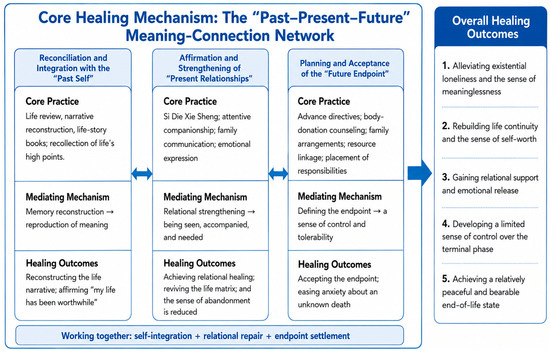
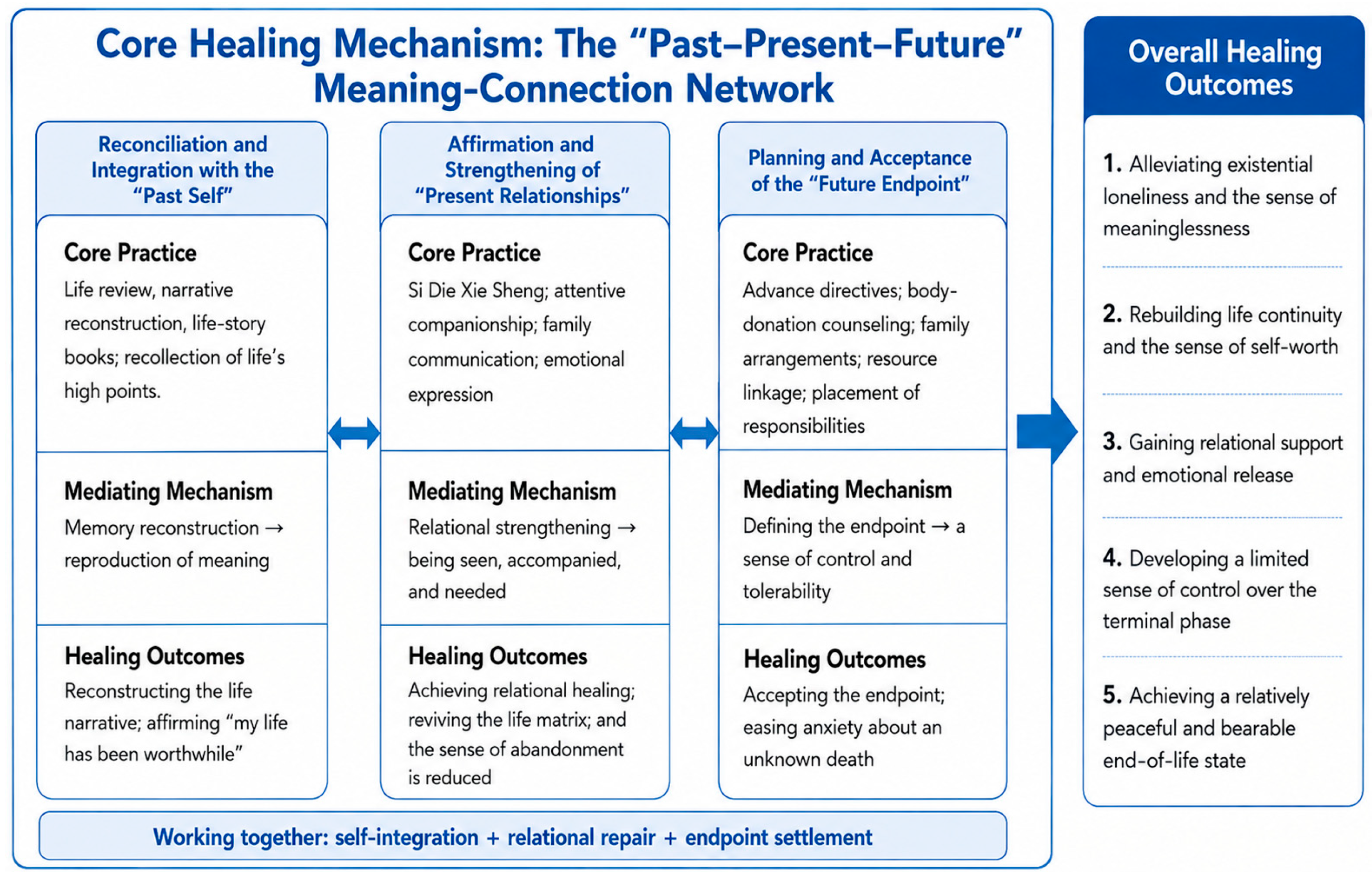
In short, the secular surface of Chinese palliative care does not mean that religious and ritual functions have disappeared; rather, some of their healing functions have instead been reworked for the clinic. Although participants described explicit religious faith support, sacred narratives, and religious rituals as constrained within hospital spaces, the therapeutic functions they embody have not disappeared; instead, they are reorganized through practices such as life narrative, relational repair, and end-of-life planning. Thus, the network of meaning-connection spanning “past–present–future” constitutes the core mechanism of spiritual healing identified in these cases. This network draws patients out of the temporal rupture, relational isolation, and meaninglessness imposed by illness, restoring them to a world of continuity, relationality, and manageable order. As shown in Figure 1, the model links each temporal domain to its core practices, mediating mechanism, and anticipated healing outcomes. Its importance lies in integrating otherwise separate practices into a single temporal–relational explanation of meaning reconstruction.
Figure 1.
Research Framework Diagram: Mechanisms of Spiritual Care in Palliative Care in China.
Notably, “past–present–future” are not three disjointed stages, but rather a progressively related and mutually constitutive temporal network of meaning-connection. Each dimension responds to one of the three core ruptures faced by terminal patients at the end of life: narrative disjunction with the past, relational disconnection in the present, and loss of control over the future endpoint. In this process, the “past” provides a foundation of meaning, the “present” supplies relational support, and the “future” enables the arrangement of the endpoint; together, these elements interact and transform, collectively achieving the reconstruction of meaning for terminal patients.
This mechanism may also be understood as the latent continuation of religious and ritual functions within the modern medical context. Life review inherits the functions of confession, reminiscence, and life summation found in religious traditions; the “Si Dao Ren Sheng” and family reconciliation carry forward the functions of forgiveness, blessing, and farewell; advance directives, body donation, and the arrangement of posthumous affairs assume the functions of death settlement, life extension, and ultimate concern. While these practices do not appear under the formal banner of religious ritual, they nonetheless provide perceptible therapeutic support to terminally ill patients through ritualized emotional expression, relational repair, and meaning reconstruction.
4. Discussion and Conclusions
This study analyzes the practices of spiritual care in Chinese palliative care, exploring how healing is achieved through the translation and reconstruction of indigenous ritual forms in contexts where overt religious expression and formal ritual were institutionally constrained in the cases examined. This study understands it as a particular configuration generated at the intersection of medical institutions, family ethics, and professional practice. Within this paradigm, religion in Chinese spiritual care undergoes a threefold transformation. First, at the discursive level, overt religious expressions are transformed into professional language such as “psychospiritual care” and “humanistic care.” Second, at the spatial level, religious practices shift from public institutional spaces to private wards, family interactions, or settings external to the hospital. Third, at the ritual level, religious practices such as prayer, scripture recitation, and rites for the dying are re-coded as life review, the “Si Dao Ren Sheng,” family companionship, body donation, and end-of-life planning.
First, this study shows the discursive translation and functional reconfiguration of spiritual care in Chinese palliative care. On the discursive level, spiritual care is recast as psychospiritual care, a term with greater institutional legitimacy and cultural acceptability. On the practical level, religious ritual is not directly replicated in its original form within Chinese palliative care, but its core functions are sustained through various ritualized practices such as life review, the “Si Dao Ren Sheng,” family companionship, relational healing, and the arrangement of unfinished wishes. These findings both resonate with and extend previous research. International studies have distinguished spirituality from formal religious service and defined it more broadly in relation to meaning, purpose, values, relationships, and transcendence (Puchalski et al. 2009; 2014). Studies conducted in mainland China further indicate that spiritual support may not be formally organized as an independent service but can nevertheless be embedded in the details of everyday palliative care (Cheng et al. 2024). These studies substantiate the culturally embedded and relational character of spiritual care, while the present study goes further by identifying the institutional mechanism through which spiritually significant concerns are rendered professionally recognizable under the more acceptable label of psychospiritual care.
Second, it proposes the “past–present–future” meaning-connection network as the core explanatory mechanism for spiritual healing in Chinese palliative care. This model draws on that literature and extends it. In the dimension of the past, life review and narrative reconstruction help patients integrate fragmented experiences and restore a sense of continuity in their life stories, consistent with evidence concerning the existential and spiritual value of therapeutic life review in palliative care (Keall et al. 2015). In the dimension of the present, “Si Dao Ren Sheng” and family companionship facilitate the expression of gratitude, apology, love, and farewell, thereby reaffirming patients’ relational bonds and present sense of existential worth. In the dimension of the future, advance care planning, body donation, and the settling of family affairs enable patients to prepare for the approaching endpoint, regain a degree of control, fulfill familial responsibilities, and establish a sense of symbolic continuity. These findings resonate with Cheng et al. (2024), who identified receiving and giving love, seeking inner peace, finding meaning and purpose, and preparing for death as central spiritual needs among Chinese patients with advanced cancer. Whereas these practices have often been discussed separately in terms of medical decision-making, practical preparation, or altruistic action, the present study reveals their interconnected spiritual significance. Taken together, the model integrates previously dispersed practices into a temporal and relational mechanism through which patients reconnect their life narratives, significant relationships, and approaching endpoint.
Third, it highlights the relational character of spiritual healing in Chinese palliative care. It should be noted that relational and nonreligious forms of spiritual care are not unique to China: contemporary Western chaplaincy also includes presence-based care, emotional support, and services for religiously diverse and unaffiliated care seekers (Lawton et al. 2023; Lawton and Cadge 2024). In the Chinese cases, however, spiritual distress and care were especially organized through family ethics, intergenerational responsibility, family-centered decision-making, and role obligations. Studies in Chinese cultural contexts have shown that filial piety, family responsibility, and family-centered decision-making shape end-of-life communication and choices (Ho et al. 2010; Jeon and Jing 2023; Fu et al. 2024). What patients found most difficult to relinquish was often not death in the abstract, but responsibilities and attachments concerning children, parents, spouses, and the family’s future. Therefore, in the Chinese cultural context, spiritual healing in palliative care is not primarily a matter of individual redemption through faith, but rather of existential settlement achieved through relational repair.
The theoretical contribution of this article is twofold. First, it illuminates ritualized therapeutic mechanisms beyond formal religious rituals, demonstrating how life review, the “Si Dao Ren Sheng,” and posthumous arrangements extend the emotional and symbolic functions of religious rites. Second, based on the thematic analysis, it inductively constructs a “past–present–future” explanatory model that integrates narrative reconstruction, relational healing, and planning for the approaching endpoint.
Admittedly, this study has certain limitations. First, the data are primarily drawn from Shanghai and do not fully represent spiritual care practices across diverse regions, religious backgrounds, or institutional settings in China. Second, the analysis is based chiefly on interviews with medical social workers and volunteers; further research is needed to understand how patients and families themselves experience and interpret these practices in terms of spirituality and healing. Future research may incorporate the perspectives of patients, family members, physicians, nurses, religious professionals, and policymakers to more systematically capture the translational process of religious resources in palliative care. Third, while this study focuses on mechanism construction, subsequent research could develop assessment tools to examine the effects of life review, relational repair, and end-of-life planning on death anxiety, sense of meaning, family communication, and grief adjustment.
In sum, this study demonstrates that spiritual care in the settings examined was not simply the absence of religious forms, but a culturally and institutionally specific mode of care shaped by local institutions, family ethics, and palliative practice. Through the inductively constructed “past–present–future” network of meaning-connection, practitioners helped terminal patients pursue self-integration, relational repair, and end-of-life settlement. The Chinese cases examined here therefore represent a configuration of spiritual care in which relational, narrative, and ritualized practices were especially prominent, while religious and transcendent resources remained possible but were not required.
Author Contributions
Conceptualization, X.L.; methodology, X.L.; software, X.L.; formal analysis, X.L.; investigation, D.S.; resources, Y.Y.; data curation, Y.Y.; writing—original draft preparation, X.L.; writing—review and editing, D.S.; visualization, D.S.; supervision, D.S.; project administration, Y.Y.; funding acquisition, X.L. All authors have read and agreed to the published version of the manuscript.
Funding
This research received no external funding.
Institutional Review Board Statement
The study was conducted in accordance with the Declaration of Helsinki and approved by the Institutional Review Board (or Ethics Committee) of Shanghai Normal University (protocol code Shanghai Normal University Ethics Committee Decision [2026] No.068 and 19 May 2026).
Informed Consent Statement
Informed consent was obtained from all subjects involved in the study.
Data Availability Statement
The data that support the findings of this study are not openly available due to reasons of sensitivity (e.g., patient and hospital information) and are available from the corresponding author upon reasonable request.
Conflicts of Interest
The authors declare no conflicts of interest.
References
- Balboni, Tracy A., Michael Balboni, Andrea C. Enzinger, Kathleen Gallivan, M. Elizabeth Paulk, Alexi Wright, Karen Steinhauser, Tyler J. VanderWeele, and Holly G. Prigerson. 2013. Provision of Spiritual Support to Patients with Advanced Cancer by Religious Communities and Associations with Medical Care at the End of Life. JAMA Internal Medicine 173: 1109–17. [Google Scholar] [CrossRef] [Scilit] [PubMed]
- Chen, Haiping 陈海萍. 2010. Shehui gongzuo zhong de lingxing yanjiu 社会工作中的灵性研究 [Spirituality Research in Social Work]. Social Work 社会工作 16: 15–17. (In Chinese) [Google Scholar]
- Cheng, Qinqin, Yongyi Chen, Yinglong Duan, Jianfei Xie, Qinghui Zhang, and Hongling Zheng. 2024. Exploring the Spiritual Needs of Patients with Advanced Cancer in China: A Qualitative Study. Scientific Reports 14: 4009. [Google Scholar] [CrossRef] [Scilit] [PubMed]
- Fu, Fang, Yong Hao Ng, Juan Wang, and Ernest Wing-Tak Chui. 2024. Journey to Inpatient Hospice Care: A Qualitative Study on the Decision-Making Process of Chinese Family Caregivers of Persons with Terminal Cancer. Patient Education and Counseling 119: 108072. [Google Scholar] [CrossRef] [Scilit] [PubMed]
- Goossaert, Vincent, and David A. Palmer. 2011. The Religious Question in Modern China. Chicago: University of Chicago Press. [Google Scholar]
- Hai, Bo 海波. 2014. Linzhong guanhuai yujing xia Fojiao shengsiguan de dangdai jiazhi zhuanhuan 临终关怀语境下佛教生死观的当代价值转换 [The Contemporary Value Transformation of Buddhist Views on Life and Death in the Context of Hospice Care]. Studies in World Religions 世界宗教研究 1: 44–51. (In Chinese) [Google Scholar]
- Hill, Peter C., Kenneth I. Pargament, Ralph W. Hood, Jr., Michael E. McCullough, James P. Swyers, David B. Larson, and Brian J. Zinnbauer. 2000. Conceptualizing Religion and Spirituality: Points of Commonality, Points of Departure. Journal for the Theory of Social Behaviour 30: 51–77. [Google Scholar] [CrossRef] [Scilit]
- Ho, Zheng Jie Marc, Lalit Kumar Radha Krishna, and Chung Pheng Alethea Yee. 2010. Chinese Familial Tradition and Western Influence: A Case Study in Singapore on Decision Making at the End of Life. Journal of Pain and Symptom Management 40: 932–37. [Google Scholar] [CrossRef] [Scilit] [PubMed]
- James, William. 1902. The Varieties of Religious Experience: A Study in Human Nature. New York: Longmans, Green, and Co. [Google Scholar]
- Jeon, Elaine Dabin, and Jun Jing. 2023. A Study of End-of-Life Care Communication and Decision-Making in China by Exploring Filial Piety and Medical Information Concealment. Asian Journal of Medical Humanities 2: 1–10. [Google Scholar] [CrossRef] [Scilit]
- Jing, Jun 景军, Jian Wang 王健, and Anli Leng 冷安丽. 2020. Shengming daijia zhi zhong yu youshi shanzhong zhi nan: Youguan yixiang wanqi aizheng huanzhe diaocha yanjiu de qishi 生命代价之重与优逝善终之难:有关一项晚期癌症患者调查研究的启示 [The Price of Survival and the Hardship of Good Death: A Study of Terminal Cancer Patients]. Sociological Review of China 社会学评论 8: 62–76. (In Chinese) [Google Scholar]
- Keall, Robyn M., Josephine M. Clayton, and Phyllis N. Butow. 2015. Therapeutic Life Review in Palliative Care: A Systematic Review of Quantitative Evaluations. Journal of Pain and Symptom Management 49: 747–61. [Google Scholar] [CrossRef] [Scilit] [PubMed]
- Lawton, Amy, Adah Anderson, and Wendy Cadge. 2023. Nonreligious Chaplains and Spiritual Care. Religions 14: 1166. [Google Scholar] [CrossRef] [Scilit]
- Lawton, Amy, and Wendy Cadge. 2024. “Ministry of Presence” as Emotional Labor: Perspectives from Recipients of Care. Religions 15: 1135. [Google Scholar] [CrossRef] [Scilit]
- Liu, Jitong 刘继同. 2015. Renlei lingxing gainian kuangjia fanwei neirong, jiegou cengci yu Zhongguo bentu lingxing shehui gongzuo fuwu tixi jiangou 人类灵性概念框架范围内容、结构层次与中国本土灵性社会工作服务体系建构 [The Conceptual Framework, Scope, Content, and Structural Levels of Human Spirituality and the Construction of China’s Indigenous Spiritual Social Work Service System]. The Journal of Humanities 人文杂志 2: 110–15. (In Chinese) [Google Scholar]
- National Health and Family Planning Commission of the People’s Republic of China 中华人民共和国国家卫生和计划生育委员会. 2017. Anning liaohu shijian zhinan (shixing) 安宁疗护实践指南(试行) [Practice Guidelines for Hospice Care (Trial)]. Available online: https://www.nhc.gov.cn/wjw/c100175/201702/0426c925075d47cc825138c2b7ddb115.shtml (accessed on 13 May 2026). (In Chinese)
- National Health Commission of the People’s Republic of China 中华人民共和国国家卫生健康委员会. 2025. Anning liaohu shijian zhinan (2025 nian ban) 安宁疗护实践指南(2025年版) [Practice Guidelines for Hospice Care (2025 Edition)]. Available online: https://www.nhc.gov.cn/yzygj/c100068/202508/77bbbf599f894e40bbeffff938e8a577.shtml (accessed on 13 May 2026). (In Chinese)
- Nolan, Steve, Philip Saltmarsh, and Carlo J. W. Leget. 2011. Spiritual Care in Palliative Care: Working towards an EAPC Task Force. European Journal of Palliative Care 18: 86–89. [Google Scholar]
- Puchalski, Christina, Betty Ferrell, Rose Virani, Shirley Otis-Green, Pamela Baird, Janet Bull, Harvey Chochinov, George Handzo, Holly Nelson-Becker, Maryjo Prince-Paul, and et al. 2009. Improving the Quality of Spiritual Care as a Dimension of Palliative Care: The Report of the Consensus Conference. Journal of Palliative Medicine 12: 885–904. [Google Scholar] [CrossRef] [Scilit] [PubMed]
- Puchalski, Christina M., Robert Vitillo, Sharon K. Hull, and Nancy Reller. 2014. Improving the Spiritual Dimension of Whole Person Care: Reaching National and International Consensus. Journal of Palliative Medicine 17: 642–56. [Google Scholar] [CrossRef] [Scilit] [PubMed]
- Sulmasy, Daniel P. 2002. A Biopsychosocial-Spiritual Model for the Care of Patients at the End of Life. The Gerontologist 42: 24–33. [Google Scholar] [CrossRef] [Scilit] [PubMed]
- Tanyi, Ruth A. 2002. Towards Clarification of the Meaning of Spirituality. Journal of Advanced Nursing 39: 500–9. [Google Scholar] [CrossRef] [Scilit] [PubMed]
- World Health Organization. 2020. Palliative Care. Available online: https://www.who.int/news-room/fact-sheets/detail/palliative-care (accessed on 13 May 2026).
- Yang, Ching Kun. 1961. Religion in Chinese Society: A Study of Contemporary Social Functions of Religion and Some of Their Historical Factors. Berkeley: University of California Press. [Google Scholar]
- Yang, Fenggang. 2011. Religion in China: Survival and Revival Under Communist Rule. New York: Oxford University Press. [Google Scholar]
- Zhang, Jianjun 张建俊, Jianhong Wang 王建红, Bingqian Xiao 肖昞乾, Yaxin Li 李亚欣, Xinbo Ouyang 欧阳鑫波, and Yuhua Peng 彭玉华. 2023. Yiwu shehui gongzuo jieru de lingxing shijiao: Lilun, shijian yu zhanwang 医务社会工作介入的灵性视角:理论、实践与展望 [A Spiritual Perspective on Medical Social Work Interventions: Theory, Practice, and Perspectives]. Medicine & Philosophy 医学与哲学 44: 34–39. (In Chinese) [Google Scholar] [CrossRef]
- Zinnbauer, Brian J., Kenneth I. Pargament, and Allie B. Scott. 1999. The Emerging Meanings of Religiousness and Spirituality: Problems and Prospects. Journal of Personality 67: 889–919. [Google Scholar] [CrossRef] [Scilit]
- Zinnbauer, Brian J., Kenneth I. Pargament, Brenda Cole, Mark S. Rye, Eric M. Butter, Timothy G. Belavich, Kathleen M. Hipp, Allie B. Scott, and Jill L. Kadar. 1997. Religion and Spirituality: Unfuzzying the Fuzzy. Journal for the Scientific Study of Religion 36: 549–64. [Google Scholar] [CrossRef] [Scilit]
Disclaimer/Publisher’s Note: The statements, opinions and data contained in all publications are solely those of the individual author(s) and contributor(s) and not of MDPI and/or the editor(s). MDPI and/or the editor(s) disclaim responsibility for any injury to people or property resulting from any ideas, methods, instructions or products referred to in the content. |
© 2026 by the authors. Licensee MDPI, Basel, Switzerland. This article is an open access article distributed under the terms and conditions of the Creative Commons Attribution (CC BY) license.