

Article

Reassessing Fromm’s Framework for Integrating Zen Buddhism and Psychoanalysis: Evidence from Contemporary Chinese Buddhist Practitioners

1
School of Philosophy, Nanjing University, Nanjing 210023, China
2
College of Marxism, Sichuan University, Chengdu 610207, China
*
Author to whom correspondence should be addressed.
Religions 2026, 17(8), 942; https://doi.org/10.3390/rel17080942
Submission received: 1 June 2026 / Revised: 30 July 2026 / Accepted: 4 August 2026 / Published: 10 August 2026

Abstract

Interdisciplinary dialogue between religion and psychoanalysis has long been regarded as an important approach to addressing modern psychological suffering. Erich Fromm sought to integrate Zen Buddhist practice with psychoanalytic reflections on integration of the unconscious, self-awareness, and personality, proposing a framework that links spiritual cultivation with psychological growth. However, this framework’s explanatory power and limitations in the contemporary Chinese context remain insufficiently explored through empirical research. Drawing on semi-structured interviews with 14 Chinese Zen practitioners in China, this study employs thematic analysis to examine their practices, psychological changes, and understandings of the relationship between Zen and mental health. Most participants regarded Zen practice as a long-term process involving cognitive reorientation, emotional regulation, and behavioral transformation, broadly resonant with Fromm’s integrative framework. However, the framework should not be treated as a directly applicable model of psychological intervention, as its practical relevance depends on sustained cultivation, community support, situated understanding, and clear professional and ethical boundaries. These qualitative findings underline potential risks when Zen cultural resources are introduced into contemporary mental health services, including decontextualization, instrumentalization, and an orientation toward immediate results. Therefore, within clearly defined ethical boundaries, a limited and responsible form of collaboration between Zen teachers and mental health professionals may be worth further exploration.

1. Introduction

Since Freud, the relationship between religion and psychology has shifted from confrontation to dialogue. In recent years, scholars have increasingly focused on the complex and multilayered interactions between religious faith, spiritual experience, and psychotherapy. These discussions have moved well beyond the earlier view that religion and psychology are mutually exclusive domains (Briant 2013). In the contemporary context, this shift is reflected in the growing emphasis on the roles of spiritual resources in emotional regulation, meaning-making, and self-integration (Friedman 2024). Furthermore, practices such as meditation, mindfulness, and inner cultivation have gradually been incorporated into discussions of mental health promotion and clinical intervention (Calderone et al. 2024). With the advent of digitalization and challenges including distraction, identity anxiety, and a lack of meaning, attempts to tackle these dilemmas have further advanced the theoretical dialogue between religion and psychoanalysis (Papaleontiou-Louca 2024).
Within this context, it is unsurprising that Erich Fromm’s Zen Buddhism and Psychoanalysis has attracted renewed scholarly attention. Fromm sought to connect Zen practices of awareness with psychoanalytic discussions of the unconscious, self-awareness, and personality integration in order to respond to the widespread alienation, self-estrangement, and crisis of meaning confronting modern individuals. Several studies regard this endeavor as a pioneering effort among mainstream psychoanalysts of his time to explore the complementary relationship between traditional religion and psychoanalysis (Aguirre-Camacho 2025). From a cross-cultural perspective, it has also drawn broad scholarly attention to the potential complementarity between Buddhist thought and psychoanalysis, and it provides an important theoretical approach for understanding spiritual practice and personality transformation (Šumiga 2019). Today, the intellectual and spiritual connotations of Zen Buddhism are increasingly regarded as a potentially valuable resource for alleviating psychological stress associated with the digital environment (Khan et al. 2025).
Nevertheless, Fromm’s approach is not without controversy. Existing research suggests that religious and spiritual resources cannot be readily transformed into universal psychological techniques once detached from their cultural traditions, communal structures, and disciplines of spiritual practice (Harrington and Dunne 2015). At the same time, scholarship on Fromm’s integrative framework has focused largely on theoretical interpretation, intellectual historical positioning, and cross-cultural comparison. Although empirical studies of Buddhist practitioners in mainland China have emerged in both the psychology of religion and Buddhist studies (Li 2020) and some recent work has begun to engage practitioners’ lived experiences (Guo 2022), few studies have examined Fromm’s framework in relation to lived experience in a sufficiently contextualized manner.
A review of the existing literature suggests a broad consensus that the awareness, reflection, ethical cultivation, and relational support found in religious practice may complement psychotherapy’s emphasis on self-understanding and emotional regulation. Such complementarity, however, does not imply that religious traditions can be directly converted into universally applicable psychological techniques. Proponents argue that dialogue between religion and psychoanalysis can help in identifying psychological distress and support meaning-making and personal transformation. Critics, however, caution that when spiritual resources are detached from their cultural traditions, communal structures, and disciplinary practices and reduced to instruments for stress reduction, emotional regulation, or individual adjustment, they risk becoming decontextualized and psychologized. Fromm, as an early and influential figure in the systematic integration of Zen Buddhism and psychoanalysis, exemplifies this tension. Drawing on humanistic psychoanalysis, he reinterpreted Zen in terms of awareness, alienation, and personal transformation, thereby demonstrating the theoretical potential for dialogue between the two. Subsequent studies of Buddhist modernity and the psychologization of religion, however, have argued that his interpretation involved selective appropriation of Zen: it foregrounded aspects compatible with modern subjectivity, psychological growth, and self-realization while comparatively downplaying Zen’s religious context, including precepts, teacher–disciple lineages, monastic communal life, and soteriological aims. Nevertheless, existing scholarship has largely assessed Fromm affirmatively at the theoretical and textual levels, paying comparatively little attention to how his framework is understood, negotiated, or revised within concrete Zen practices and religious communities.
This study examines contemporary Chinese Zen practitioners’ narrated experiences in relation to Fromm’s framework, situating his theory within their concrete practices, communal relationships, and processes of meaning-making. It critically reassesses the framework’s explanatory value at the experiential level, explores the ethical boundaries it may encounter when applied in practice, and considers how its limitations might be addressed through a more context-sensitive approach to the relationship between Zen practice and psychoanalytic thought.
More specifically, the paper proceeds in the following four steps:
(1) It outlines the main content and theoretical controversies of Fromm’s framework for integrating Zen Buddhism and psychoanalysis;
(2) It describes in-depth interviews conducted with Chinese Zen practitioners and provides an analysis of these interviews;
(3) It examines the explanatory power and theoretical limitations of the framework in real-life contexts on the basis of the interviews;
(4) It discusses possible directions for further development of the framework, in light of its limitations in addressing psychological problems in modern society.
Ultimately, this study finds that Chinese Zen practitioners’ experiences are broadly consistent with Fromm’s integrative conception in terms of cognitive restructuring, emotion regulation, and behavioral transformation. However, this correspondence does not mean the framework can be directly transformed into a universally applicable therapeutic model. It is inappropriate to universalize the framework into psychotherapeutic techniques by detaching it from its religious community, its cultural context, and the discipline of Zen practice. Issues of cultural translation, professional boundaries, and ethical responsibility must therefore be approached with great caution. The significance of this paper lies in its real-world examination of Chinese Zen practitioners’ experiences, offering empirical insight into how religious and spiritual resources may be discussed within mental health discourse and further clarifying the explanatory power, conditions of application, and practical boundaries of Fromm’s integrative framework in contemporary China.
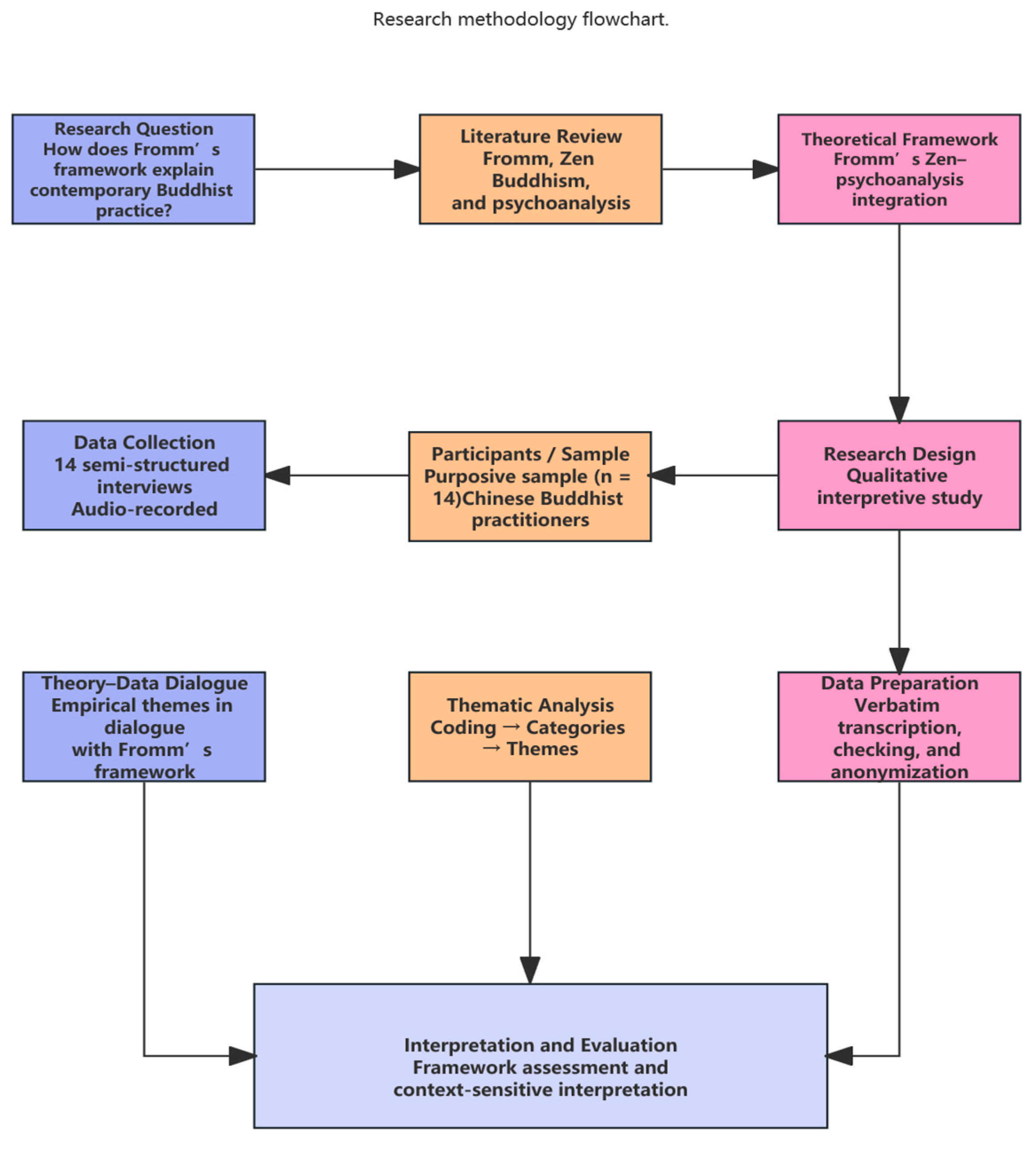
The logical design of the article is presented in the diagram below (Figure 1).

2. Fromm’s Theoretical Framework for Integrating Zen Buddhism and Psychoanalysis

In Zen Buddhism and Psychoanalysis, Erich Fromm, together with scholars such as D. T. Suzuki, promotes the integration of Eastern Zen thought and Western psychoanalysis. By examining the interactions between spiritual cultivation and psychological reflection, they sought to address individual psychological imbalance within the crisis of modernity. This section outlines the core content of Fromm’s framework, summarizes its theoretical features across three dimensions—cognition, emotion, and behavior—and provides a theoretical basis for the subsequent empirical examination.

2.1. Core Propositions of the Integrative Framework

From a psychoanalytic perspective, Fromm drew on Zen Buddhist resources to articulate a path of psychological transformation across cognition, emotion, and behavior. This framework highlights the cultural conditions of psychological maturity and links reason, love, and compassion to a movement toward greater wholeness and relief from mental distress. The following three dimensions specify how this transformative process unfolds.

2.1.1. Cognitive Dimension

Within Fromm’s integrative framework, the cognitive dimension concerns not cognitive change in general but the overcoming of an alienated mode of thought rooted in the “having” mode of existence. Zen awareness loosens the tendency to objectify experience and to control reality through fixed conceptual habits, opening the possibility of a more immediate and non-possessive way of relating to oneself and the world.
Fromm argued that, under the influence of modern habitual modes of thought, people tend to interpret the world through the quantitative methods of physics and anatomy. This tendency leads to the conceptualization of all things and an obsessive desire to exhaust all possible knowledge of every object (Suzuki et al. 1960, pp. 100–9). One of its side effects is a growing estrangement from one’s inner self, accompanied by anxiety in the face of the unknown. In this respect, Fromm’s critique concerns not only particular errors in thought but also a broader cognitive orientation that distances individuals from direct experience. To address this, Fromm turned to an approach that is distinct from the purely technical interventions of conventional psychoanalysis. Drawing on Zen practices of awareness, he sought to loosen conceptualized modes of cognition, enable a more direct apprehension of experience, and bring individuals into closer contact with themselves.
From an epistemological perspective, Zen approaches reality as it is experienced prior to habitual conceptual fixation. It adopts a cognitive logic of “penetrating into the interior of things and integrating with them” in order to grasp reality more directly (Li et al. 2015). In this view, ordinary conceptual thought leaves gaps in human understanding, and mindful awareness becomes a way of approaching what exceeds discursive knowledge. Take, for example, the following lines: “Flower in the crannied wall I pluck you out of the crannies Hold you here, root and all.in my hand Little flower but if I could understand What you are, root and all, and all in should know what God and man is” (Suzuki et al. 1960, p. 3). This perspective enables individuals to perceive their direct experience rather than remaining confined within one-sided definitions of things. In the process of accepting the authentic self, one may break free from affliction. Through mindful awareness, individuals gradually see through illusion and recognize, experience, and embrace suffering. In contemporary contexts, related approaches have also been applied to promote cognitive openness and wellbeing among older adults in Thailand (Glushich et al. 2025).
From a spiritual perspective, Fromm’s integrative attempt adopts the approach of “embracing things and becoming them.” In this article, “spiritual perspective” refers to the humanistic and normative dimension of Fromm’s thought concerning personal transformation, ethical responsibility, and relatedness, rather than Zen awakening or liberation in a doctrinal sense. This approach enables individuals, from a renewed cognitive perspective, to complete the transition from external pressure to inner motivation, thereby reaching an ideal state of deeper spiritual integration. This mode of fostering self-cultivation and enhancing spiritual adaptability also enables individuals to consciously perceive their selfish desires and negative impulses, emerging within an expanded state of awareness. Gradually dissolved in the illumination of inner light and warmth, these negative tendencies recede, bringing about a substantial enhancement of spiritual resilience.

2.1.2. Emotional Dimension

Fromm holds that the utilitarian orientation of modern society filters individual experience through language, logic, social taboos, and other mechanisms, demarcating the boundaries of emotional expression and repressing or excluding emotions that deviate from social norms. Under such circumstances, repressed emotions fail to enter consciousness, giving rise to psychological distress such as anxiety and somatic symptoms. When individuals abandon their inner feelings, treat nature with an exploitative and controlling attitude, and measure the value of life solely by the quantity of material possessions, they sever the connection between thought and emotion. This results in a state of inner disintegration accompanied by persistent anxiety, emotional instability, and despair. As stated in the book, “Western man is in a state of schizoid inability to experience affect. Hence he is anxious depressed, and desperate” (Suzuki et al. 1960, p. 79). The ultimate consequence is that individuals become trapped by greed, which undermines their concentration and continuity of thought and plunges them into inner emotional conflict.
To counteract these negative effects, Fromm draws on Zen’s non-discriminating mind and compassion to alleviate the emotional repression of modern life. He expresses Zen non-discrimination through a form of “purposeless connection” that serves as an alternative to utilitarian reasoning. By readjusting the hierarchy of habitual thought, individuals give greater priority to authentic emotional experience rather than logical analysis, enabling them to face their inner feelings directly. Furthermore, compassion directs individuals toward the spontaneous expression of full and integrated emotions, repairing the emotional bonds fractured by utilitarianism. Fromm advocates relating to others through love, connectedness, and active engagement, allowing emotion to return to its genuine form of expression. In respecting and accepting others, one may achieve profound resonance at the level of emotion and life itself (Fromm 1956). In this respect, the Buddhist ideal of boundless compassion may be understood as an ethical and emotional orientation toward alleviating suffering rather than reinforcing separation and self-interest.
From a spiritual perspective, Fromm’s work at the emotional level enables individuals to cultivate a more integrated personality and strengthen spiritual resilience through immersive engagement with life. It also helps individuals to overcome greed and transcend bondage to material interests, thereby enhancing their psychological resilience to disturbances from the external environment. Guided by love and compassion, this approach also helps individuals to build stable and sincere emotional connections, ultimately achieving greater freedom and liberation at the emotional level. To date, these ideas have been incorporated into forms of group therapy in clinical settings (Rosmarin et al. 2022).

2.1.3. Behavioral Dimension

The behavioral dimension represents the embodiment of Zen’s cognitive breakthroughs and emotional transformations in everyday life. Its aim is to alleviate psychological distress through changes in inner orientation, promote human wholeness, and restore mental health. Through the combined effects of cognitive, emotional, and behavioral transformation, Fromm suggests that individuals may gradually free themselves from external compulsions.
Fromm argues that the utilitarian orientation of modern society allows material possession and external success to weaken individual spontaneity, reducing human life to the mere performance of social roles (Fromm 2021). In the face of externally imposed patterns of behavior, one cannot rely on technical intervention alone; what is required instead is a deeper transformation of the person. Through work, interpersonal communication, and everyday activities, individuals may begin to release repressed energies and reduce defensive patterns of conduct. Through sustained and disciplined practice, inner creative impulses are gradually awakened, leading individuals away from spiritual impoverishment and toward a fuller sense of freedom. As Fromm writes, “this is what I mean by freedom. giving free play to all the creative and benevolent impulses inherently lying in our hearts” (Suzuki et al. 1960, p. 122). This model seeks to embody cultural integration in everyday life, enabling individuals to readjust their repressive and defensive mechanisms, ease the tension between consciousness and the unconscious, and gradually reorient their behavior away from possession, domination, and control and instead toward openness, creativity, and connection.
From a spiritual perspective, through the progressive development of the three dimensions of cognition, emotion, and behavior, Fromm constructs a model of psychological growth aimed at cultivating a sound personality (Table 1). Rather than constituting a merely procedural process, his approach not only addresses psychological problems but also advances an ethical vision of personality development and spiritual growth. Nevertheless, this framework carries distinct humanistic and normative presuppositions. Its lofty idealism may overlook questions of practical applicability in cross-cultural contexts, which has become an important subject of discussion and reflection among scholars.

2.1.4. Clarification of Concepts and Terminology

Through an analysis of the core arguments of Fromm’s integrative theory, it becomes apparent that his approach involves a degree of cross-traditional translation, mutual interpretation, and conceptual boundary blurring between psychoanalysis and Zen Buddhism. Although this approach helps to reveal possible affinities between the two traditions, it also risks presenting Zen and psychoanalysis as if they possess identical conceptual boundaries and practical aims. Therefore, before further analyzing and critically evaluating Fromm’s theory, it is necessary to clarify the core concept of the “self.”
Within their respective theoretical contexts, the psychoanalytic concept of the “ego” and the Buddhist teaching of “non-self” are not equivalent constructs. Nor is the psychoanalytic ego synonymous with selfishness, arrogance, or egocentrism in ordinary language. In The Ego and the Id, Freud conceptualized the ego as a psychic agency differentiated from the id, grounded in bodily sensations and the perceptual system. Governed by the reality principle, it mediates instinctual impulses, the moral demands of the superego, and external reality while participating in processes such as repression, defense, sublimation, and behavioral regulation (Freud 2011). In later psychoanalytic and psychodynamic traditions, the ego and related psychological functions are commonly thought to involve reality testing, defensive organization, affect regulation, adaptive capacity, identity integration, and the ability to maintain relatively stable interpersonal relationships. In other words, the psychoanalytic ego is not a synonym for egocentrism; rather, it refers to a set of functions through which individuals regulate internal conflicts, respond to external reality, and sustain psychological integration (Blanck and Blanck 1974).
By contrast, the “self” in Buddhism is a provisional designation used to describe the aggregation of mental and physical phenomena arising from karmic conditions. The notion of an inherent “self” is consistently refuted in Buddhist teachings. Instead, the concept refers to the eternal, independent, and sovereign inner soul described in the Upanishads of ancient Indian Brahmanism. This “true self” is believed to unchangingly transmigrate through cycles of rebirth, serving as the fixed, immutable core essence underlying the body and mind. The doctrine of non-self generally does not deny the continuity of personality, experience, or moral responsibility at the conventional level. It regards a “person” as a contingent, processual existence that arises in a manner dependent on ever-changing physical and mental conditions. In conventional terms, non-self means that from the perspective of ultimate reality, there exists no permanent, independent, or dominating substantial soul. The transmigration of lives is sustained by dependent origination and karmic causality, with no need to rely on an inherent self-entity. Eliminating the clinging to self constitutes the core path to liberation from suffering and the attainment of nirvana. The doctrine of non-self is rooted in empirical deconstruction and causal reasoning, incorporating neither the eternal soul theory nor the cognitive fallacy of radical substantialism (Rupert 1998; Peter 2013).
Accordingly, Buddhist non-self is concerned not simply with whether an ego exists in the psychoanalytic sense but, rather, the tendency to reify changing experience into a permanent self. Therefore, Psychoanalysis and Zen cannot be reduced to “strengthening the ego” and “dissolving the ego,” respectively. Psychoanalytic work may foster psychological integration, reflective capacity, affect regulation, and relational stability, while Zen practice seeks to loosen egocentric fixation and attachment to a fixed, independent self. Although both traditions may criticize narcissism, alienation, and rigid self-preoccupation, psychological fragility or impaired ego functioning is not equivalent to insight into non-self; likewise, non-attachment does not entail rejecting emotional needs, personal boundaries, or ordinary responsibilities.
Two further terms also require clarification: “transcendent experience” and “levels of consciousness.” In this study, “transcendent experience” is used provisionally to refer to experiences in which habitual self-referential patterns are temporarily loosened, enabling a less egocentric, less possessive, or more relational mode of awareness. This definition does not imply that all such experiences share the same origin, meaning, duration, or soteriological status. In particular, a temporary experience of self-transcendence should not be equated automatically with Zen awakening, psychoanalytic integration, or enduring ethical transformation. Likewise, “levels of consciousness” is used heuristically to describe relatively differentiated modes of awareness, self-relation, and engagement with others and reality rather than a fixed hierarchy of spiritual superiority or psychological development. Although shifts in reflective capacity, emotional regulation, relational openness, and existential orientation may be relevant to both Zen practice and humanistic psychoanalysis, they should not be treated as direct equivalents of Buddhist realization or ego development.
Fromm’s contribution lies in identifying a potentially productive affinity between Zen critiques of egocentric attachment and psychoanalytic concerns with alienation, narcissism, and rigid character structures. Influenced by D. T. Suzuki, however, he often translated Buddhist non-self and self-attachment into a modern humanistic–psychological critique of possessive, narcissistic, and egocentric modes of existence. While innovative, this translation risks assimilating Buddhist non-self, transcendent experience, and liberation with ideals of mature individuality, psychological health, or higher consciousness. Whether Fromm’s integration can preserve the distinct conceptual, practical, and soteriological orientations of Zen and psychoanalysis therefore requires further examination. The following sections test this question through contextualized analysis.

2.2. Reflections on Fromm’s Integrative Framework

Subsequent scholarship has reflected on Fromm’s integration of psychoanalysis and Zen along two lines: cross-cultural and clinical extensions; and critical dialogue across Buddhist psychology, contemplative studies, and mindfulness research. The first examines the framework’s applicability across cultural and therapeutic settings, whereas the second interrogates the normative assumptions, cultural selectivity, and ethical boundaries embedded in its humanistic and psychologizing orientation. Together, these studies raise a central question: under what conditions can Fromm’s framework adequately interpret religious practice, and when might it obscure Zen’s own traditions, aims, and disciplinary norms?
The first line of research extends the framework’s cross-cultural and clinical relevance. Makari interpreted Fromm’s work as a hermeneutic development within post-Freudian psychoanalysis, emphasizing cultural meaning and interpretive practice rather than a narrowly technical therapeutic model (Makari 1999). From a social–ethical perspective, Strawn has argued that religion can provide psychoanalysis with resources for making sense of meaning, faith, and transcendence, while psychoanalysis can illuminate the psychological dynamics of religious experience (Strawn 2007). Drawing on an Indian clinical case, Roland suggests that Fromm’s ideal of the “spiritually mature person” may have cross-cultural relevance, although its application must be situated within specific religious and cultural contexts (Roland 2017). Attrey further considers new applications of the framework in digital-age spiritual and therapeutic practices (Attrey et al. 2025). However, these extensions also raise a question: can Fromm’s categories account for religious experience without reducing it primarily to psychological growth?
The second line offers critiques from the perspectives of Buddhist and contemplative traditions. Epstein identified important affinities between Buddhism and psychoanalysis regarding suffering, self-understanding, and liberation while cautioning against superficial integrations that neglect the distinctive aims of Buddhist practice (Epstein 1995). Kornfield’s model of spiritual healing, centered on awareness, acceptance, and transformation, further emphasizes the role of Buddhist ethics and meditative discipline (Kornfield 2008). Purser criticized the secularization and instrumentalization of mindfulness, particularly the reduction in Zen-derived practices to techniques for productivity, stress reduction, or personal adjustment, as these uses may weaken their ethical and social–critical significance (Purser et al. 2018). Nguyen showed that Buddhist psychotherapy takes diverse forms across cultural, institutional, and religious contexts (Nguyen 2020). Christensen further warned that detaching mindfulness from religious traditions may generate broader ethical and political consequences (Christensen 2025).
A central limitation of Fromm’s framework lies in its tendency to interpret Zen through psychological growth, subjective integration, and self-realization. This orientation may downplay the religious conditions of Zen practice, including precepts, lineage, community, stages of cultivation, and soteriological aims. In practice, it may also encourage the decontextualization of Zen and its reduction to a resource for therapy or personal development. Since the existing literature remains largely theoretical and text-based, there is limited empirical research on how Fromm’s ideas are understood, negotiated, or challenged in actual Zen communities. Therefore, this study examines contemporary Chinese Zen practitioners’ narrated experiences in order to assess the explanatory potential and ethical boundaries of Fromm’s framework in relation to practice, community, and meaning-making.

2.3. Theoretical Characteristics and Conception of Therapeutic Effectiveness

Fromm’s integration of Zen Buddhism and psychoanalysis has a distinctively humanistic and normative orientation. He does not limit therapeutic effectiveness to symptom relief; rather, he understands it as a process through which individuals overcome alienation, deepen self-awareness, and develop a mature personality. To this end, he reinterprets Zen notions of awareness, non-attachment, and self-transcendence as resources for personal growth and spiritual transformation. However, this therapeutic ideal, centered on the development of a “mature personality,” also presupposes a universal model of subject formation and therefore faces challenges concerning cross-cultural applicability and the conditions of practice.
In terms of therapeutic aims, Fromm seeks to understand spiritual experience as a universal human need that transcends religious affiliation. He regards education, cultural understanding, and self-reflection as essential conditions for personality development. Individuals, in his view, need to reflect on their own experience in order to confront existential questions concerning the meaning of life, suffering, and value. Zen is thus incorporated into an educational framework oriented toward psychological growth and the realization of human potential. From the perspective of spiritual practice, spirituality also responds to the human need for connection beyond individual existence and the search for answers to questions concerning meaning, suffering, and self-worth (Hahn 2025).
To broaden the applicability of this framework, Fromm does not focus primarily on whether an individual is religious but, rather, whether one’s religion or value orientation contributes to human growth (Fromm 1967, pp. 10–24). In this respect, his approach is constructive. Makari and Strawn interpreted this orientation as a hermeneutic development within post-Freudian psychoanalysis, emphasizing the roles of cultural meaning, faith, and transcendence in psychological transformation (Makari 1999; Strawn 2007). Pinkas similarly noted that, by interpreting God as a symbol of human values and inner experience, Fromm sought to prevent spirituality from being confined to particular religious traditions (Pinkas 2024).
However, this universalizing strategy does not mean that the framework can operate independently of specific cultural and religious conditions. Zen practice generally requires a certain degree of cultural understanding, sustained self-reflection, and practical discipline. An individual’s level of psychological development may also affect their capacity to shift from external attachment to inward awareness (Utsch and Frick 2015). Fromm’s model of spiritual transformation therefore entails educational and cultural thresholds. Moreover, when religious experience is interpreted as a universal psychological phenomenon, particular religious traditions, ritual practices, institutional structures, and community relations may be marginalized, thereby obscuring the concrete conditions under which Zen practice is sustained (Hammoudeh 2021). Roland’s clinical research in India suggests that Fromm’s ideal of the “spiritually mature person” can acquire cross-cultural significance only when interpreted within local religious and cultural structures (Roland 2017). Whether Zen can function as a universal therapeutic resource thus depends not only on an individual’s psychological needs but also on their cultural background, practical competence, and community context. Thus, Fromm’s ideal of universal personality development may rest on somewhat idealized assumptions.
In terms of the means through which therapeutic goals are achieved, Fromm views both the Zen master and the psychoanalyst as guides who facilitate awareness and personality transformation. He imagines the analyst as a “physician of the soul,” emphasizing attentiveness, empathy, presence, and non-controlling guidance within the therapeutic relationship. Drawing on the Socratic metaphor of maieutic, he positions the analyst as a guide who enables self-discovery rather than an authority who imposes direction or control. This conception moves beyond a narrow understanding of therapy as merely technical intervention and corresponds with contemporary scholarship emphasizing empathy, sensitivity to religious belief, and relational accompaniment. Research suggests that empathic engagement with clients’ beliefs and emotional experiences can enhance self-understanding and trust (Hall 2007; Chatlos 2023). Likewise, careful attention to clients’ verbal expressions, nonverbal behavior, and affective responses may help therapists to understand their expectations of emotionally significant relationships within religious or transcendent experience (Buechler 2024).
Nevertheless, Zen masters and psychoanalysts differ fundamentally in their systems of training, sources of authority, ethical responsibilities, and institutional settings. Fromm’s integrative model rests on idealized assumptions about guides’ moral capacity and spiritual maturity, as well as the existence of stable communities of practice, without fully explaining how such conditions can be secured in practice. Equating the functions of Zen masters and psychoanalysts too readily may blur the boundary between professional therapeutic relationships and religious authority, raising interpretive and ethical risks. Therapeutic effectiveness in Fromm’s framework should therefore not be understood as an automatically attainable universal outcome but, rather, as a process that is dependent on cultural understanding, practical training, professional ethics, and community conditions.
Overall, the major contribution of Fromm’s framework lies in extending psychotherapy beyond symptom reduction toward questions of personality, ethics, and existential meaning. Its limitation, however, is that Zen may be translated into a psychological resource serving the growth of the modern subject while its religious tradition, disciplinary norms, and soteriological aims are relatively weakened. How these idealized theoretical assumptions are understood, negotiated, or challenged in concrete Zen practice requires further contextual examination.

3. Methods

This section outlines the research methods used to examine contemporary Chinese Zen practitioners’ narrated experiences and critically assess the explanatory value of Fromm’s integrative framework in relation to these experiences. The methodology is structured around five dimensions: procedural arrangement, introduction of research participants, data collection, data analysis, and bias reduction measures.

3.1. Research Design

This study adopts a qualitative research design using semi-structured in-depth interviews for data collection and thematic analysis for interpretation. Qualitative inquiry was chosen because the study seeks to examine how Chinese Buddhist practitioners narrate and interpret their Zen practice experiences, including changes associated with practice and their understandings of the relationships among Zen Buddhist thought, mental health, spiritual guidance, and psychoanalysis. This approach is suited to capturing the complexity and situatedness of lived experience.
Fromm’s integrative framework is treated as a heuristic interpretive reference, rather than a fixed model to be verified in advance. Although the main concepts of the framework are outlined in Section 2, they were not imposed on the interview materials as rigid coding categories. Instead, recurring themes were first identified in practitioners’ narratives and subsequently brought into dialogue with Fromm’s framework to assess its explanatory value, scope, and limitations in the contemporary Chinese context.

3.2. Research Participants and Recruitment

The study included 14 Chinese participants who were engaged, to varying degrees, in Buddhist, Chan-related, or meditation-oriented practices. Rather than seeking statistical representativeness, the sampling strategy aimed to capture diverse trajectories of Buddhist spiritual practice while ensuring that all the participants possessed substantial practical experience and were able to reflect on and articulate their psychological experiences in a meaningful way.
Recruitment was facilitated through Buddhist community contacts who circulated study information to eligible practitioners. Interested individuals received information about the study, confidentiality, and their right to withdraw, and all provided written informed consent before participation. The researchers had no prior relationship with the participants. Each participant received USD 5 as a token of appreciation. To protect confidentiality, the participants were anonymized and identified as P1–P14; their characteristics are presented in Table 2.
The inclusion criteria were as follows:
(1) Had long-term and continuous experience in spiritual practice;
(2) Were willing and able to narrate their experiences and any perceived personal changes associated with Buddhist practice;
(3) Possessed a certain capacity for self-reflection and spiritual guidance.
The participants were recruited from multiple sites, rather than a single temple, in order to reduce site-specific bias and capture diverse practice contexts. The sample comprised 14 participants (7 women and 7 men), including 5 married and 9 unmarried participants at the time of the interview. Their continuous practice experience ranged from 2 to 15 years.
The participants were not classified as “Zen practitioners” solely because they engaged in seated meditation or reported emotional benefits. Instead, they occupied different positions within a contemporary Chinese field of Zen- or Buddhist-related and meditative practice. Interview data indicated varying combinations of regular seated meditation; observations of breath, thoughts, and emotions; the use of Buddhist concepts—including attachment, letting go, compassion, karma, cultivation of the mind, and self-cultivation—to interpret experience; and connections with temples, monastic teachers, devotional activities, retreats, or Buddhist communities. These features were neither uniformly present nor exclusive to Zen Buddhism; rather, they indicate different degrees of embeddedness in Zen-related traditions, Buddhist culture, and religious practice.
The sample included three ordained monastics, three formally refuged lay Buddhists, and eight lay participants without formal refuge. For monastics, Zen practice was embedded in temple residence, Buddhist study, sutra recitation, rituals, monastic discipline, communal life, and sometimes teaching or helping others. Formally refuged lay Buddhists generally combined everyday seated meditation with temple contact, retreats, sutra recitation or copying, devotional activities, and volunteer work, often interpreting their experiences through Buddhist concepts. The remaining participants, while lacking formal Buddhist identity or stable temple affiliation, identified with or were influenced by Buddhist ideas such as compassion, letting go, liberation, and cultivation of the mind. They mainly encountered meditation through social media, online communities, or counsellor-led mindfulness courses and practiced home-based sitting, breath awareness, and emotion observation for stress, insomnia, anxiety, or self-regulation.
Attentive to the participants’ own understandings, this article adopts a cautious and broad conception of “Zen” informed by writers such as Erich Fromm and D. T. Suzuki. In contemporary China, monastic cultivation, lay Buddhist practice, temple activities, and individualized mindfulness-oriented meditation may intersect within this broader Chan-related field, but they should not be conflated. All identifying information was anonymized. The participants’ practice identities, settings, activities, and connections to Chan-related and Buddhist traditions are summarized in Table 2.

3.3. Data Collection

Data were collected through semi-structured, in-depth interviews. Semi-structured interviews were adopted because they allow participants to narrate their experiences around relatively consistent core themes, thereby enhancing comparability across interviews. At the same time, this method preserves the researcher’s flexibility to ask follow-up questions in response to participants’ answers, enabling a fuller understanding of their experiential contexts, modes of expression, and processes of meaning-making.
The researchers conducted interviews across multiple sites, including Pan long Temple, two monastic communities in Nanjing, and university premises for lay student participants. Six interviews were held in person, and eight interviews were administered virtually due to geographical constraints. The first author acted as the lead interviewer and facilitator, while the research assistant attended all the interviews, was responsible for audio recording, and performed other supporting tasks. All interviews were conducted via a combination of online remote and face-to-face offline formats, with each interview lasting 30–60 min. Prior to each interview, participants were informed of the research purpose and relevant precautions. Audio recording was initiated only after informed consent was obtained. Upon completion of each interview, the research assistant produced verbatim transcripts of the audio recordings. Identifiable personal information was removed for de-identification, and the transcripts were stored in encrypted form for subsequent thematic analysis. Upon completion of the transcription, the first author carefully cross-checked the transcripts against the original recordings, after which they were further reviewed and archived by the research team leader.
In addition to audio materials, the interviewers took concise situational field notes during and after each interview to supplement the record of interview interactions and research reflections. To ensure transcription quality, the first author also coordinated the team members to repeatedly compare the original recordings with the transcripts and revise ambiguous expressions and interpretive errors. Personally identifiable information was removed during the transcription process, and the participants’ names, affiliated temples, specific locations, and other sensitive information were fully anonymized.
Interviews primarily focused on the following core themes: Zen practice experience, changes in self-perception, emotional changes, transformations in lifestyle, understanding of the Buddha, and reasons for maintaining religious faith. During interviews, the researcher asked appropriate follow-up questions based on the interview outline to obtain richer and more in-depth empirical materials. The specific questions were as follows:
1. Would you like to share your spiritual practice experience?
(If the participant was willing to share, the following three supplementary questions were asked):
a. Approximately when did you begin your practice?
b. What are your main ways of practice?
c. What initial opportunity or motivation led you to start spiritual practice?
2. Have you noticed any changes in your cognition after practicing Zen?
(If the participant acknowledged changes, further questions were raised):
a. Are the changes brought by Zen more like “feeling more relaxed” or “becoming more restrained/self-disciplined”?
b. Has your way of understanding the world undergone essential changes? Does your practice make you more willing to explore the unknown?
c. Has your understanding of letting go and attachment changed after Zen practice?
3. How do you view the emotional changes brought about by spiritual practice?
a. Has Zen practice exerted positive guidance on your emotions? For instance, have tendencies such as depression, avoidance and mental suffering been alleviated?
b. Have you ever encountered psychological difficulties during your practice?
c. Do you treat people who seek help from you differently from your family members?
4. Could you share how Zen practice has influenced your lifestyle?
(If any influence is acknowledged:)
a. Does Zen make you tend to avoid unknown things?
b. Have changes in your life circumstances after Zen practice directly resolved most of your psychological problems?
c. What things do you consider meaningful at present?
5. What is your understanding of the Buddha?
6. In your opinion, what are the main reasons that sustain your Buddhist faith?
The interviewer did not rigidly follow the interview guide by asking questions item by item. Instead, appropriate follow-up questions were posed in response to the participant’s narration to obtain more specific, in-depth material. The interviewer fully respected the interviewee’s expressive logic and the core meanings conveyed in their statements. Of the 14 interviews included in this study, 5 were conducted in person in face-to-face settings and audio-recorded with the participants’ consent, after which they were transcribed verbatim. The interviews were documented through detailed notes taken during the interview and expanded into a consolidated interview record immediately afterwards by the researcher. During the analysis, this case was treated with particular caution, and interpretations were limited to content that was sufficiently clear in the documented record.

3.4. Data Analysis

Interview transcripts were analyzed through thematic analysis. Following the analytical framework proposed by Buechler and Clarke, core patterns of meaning embedded in the participants’ narratives were identified, categorized, and interpreted (Clarke 2022; Buechler 2024). The aim was to analyze data shaped by Buddhist practice, psychological experience, and cultural interpretation, in order to extract common structural patterns in the participants’ lived experiences while still attending to individual differences, ideological tensions, and contextual particularities.
In the process of data analysis, the researcher repeatedly read the interview transcripts to develop a holistic understanding of the dataset. Meaningful segments of the texts were identified, marked, and coded. On the basis of close engagement with the empirical material, preliminary themes were generated. These themes were then further refined in light of Fromm’s integrative framework, including where the data suggested possible revisions or extensions of the framework. These themes were then repeatedly reviewed and refined to ensure internal coherence and clear distinction between themes. This was followed by theme naming and definition to delineate each theme in relation to the research questions.
Throughout the analytical process, the researcher, while inductively summarizing the data, also interpreted the findings in relation to Fromm’s theoretical framework, thereby establishing an interactive connection between empirical materials and theoretical perspectives. Several core themes were ultimately refined, centered primarily on the three dimensions of cognition, emotion, and behavior. These themes were then used to examine the applicability and limitations of the theoretical framework in the context of the digital age.
Three-Stage Coding Procedure
Thematic analysis was carried out through the following three stages:
Stage One: Open Coding
The first author carried out primary coding, while emerging codes and thematic groupings were discussed with their supervisor/research team during the analytic process. Labels remained as close as possible to the participants’ original expressions. For example, the statement “learning to understand fear and attachment in different ways” was labelled “cognitive reconstruction of attachment concepts”; the expression “greater emotional resilience after Zen practice” was labelled “gradual formation of emotional regulation ability”; and the narrative “actively embracing precepts rather than passive obedience” was labelled “internalization of behavioral norms.” At this stage, more than 90 initial open codes were generated from the 12 interview transcripts.
Stage Two: Focused/Axial Coding
Open codes with similar meanings and related experiential connotations were merged into higher-order intermediate categories. For instance, the codes “cognitive reconstruction of attachment concepts,” “voluntary detachment from secular values,” and “breaking habitual thinking through mindfulness awareness” were grouped under the intermediate category “restructuring of the cognitive framework.” Codes such as “stabilization of emotional fluctuations,” “extension of compassion toward strangers,” and “inner satisfaction derived from helping others” were integrated into the category “integration and expansion of the emotional structure.” At this stage, more than 90 open codes were condensed into 12 intermediate categories.
Stage Three: Theoretical Thematic Synthesis
In the final stage, the 12 intermediate categories were further synthesized into 3 core themes and 9 sub-themes. At this stage, Fromm’s integrative framework—including the distinction between the “having” mode and the “being” mode, productive love, and self-awakening—was used as an interpretive point of reference for examining the extent to which the empirically derived themes resonated with, diverged from, or extended the theoretical framework.
Although independent double coding was not carried out, preliminary codes, category groupings, and emerging themes were discussed at several points with the first author’s supervisor/research team to examine interpretive coherence and refine thematic boundaries. Where uncertainties or overlaps arose, the first author returned to the original transcripts and revised the coding framework accordingly. Given the study’s use of thematic interpretive analysis, formal inter-coder reliability statistics were not calculated; instead, analytical credibility was enhanced through repeated engagement with the data, reflexive comparison across cases, and transparent documentation of coding decisions.
During the analytical process, Fromm’s integrative framework was not treated as a rigid a priori template; rather, the framework was approached as an interpretive perspective through which the researchers engaged in dialogue with the empirical data. Themes were generated inductively from the participants’ narratives and then interpreted in relation to Fromm’s framework to examine points of correspondence, divergence, and tension. This procedure was intended to make explicit how the empirical material both resonated with and departed from Fromm’s integration of Zen Buddhism and psychoanalysis.

3.5. Maintaining Rigor in Analysis and Interpretation

Given that interpretation in qualitative research is inevitably influenced by the researcher’s preunderstanding, academic training, and cultural standpoint, the following measures were taken to ensure rigor.
First, all the interviews were audio-recorded with the participants’ consent and subsequently transcribed verbatim. The recordings and transcripts were repeatedly cross-checked by the research team to minimize transcription errors and ensure accuracy. Second, during analysis, the stability and consistency of thematic induction were enhanced through repeated reading, constant comparison, and multiple rounds of thematic revision. Coding decisions and theme construction were further discussed by the research team to enhance interpretive consistency. Third, during writing, the participants’ original narratives were drawn on as much as possible to support analytical judgments, thereby strengthening traceability between the analytical conclusions and empirical materials. Finally, the research team deliberately distinguished the participants’ raw accounts from the researchers’ theoretical interpretations to avoid substituting a pre-established theoretical framework for empirical evidence.
Prior to formal data analysis, the research team also discussed the interview guide and tested the questions through simulated interviews to improve the consistency and validity of the interview protocol. During analysis, an open attitude toward diverse religious experiences was maintained to reduce interpretive bias. Furthermore, to avoid the limitations of a single cultural perspective, findings from psychological studies in different religious and cultural contexts were consulted, including Christianity (Peck et al. 2025), African traditional religion (Frost 2025). These references were used to enhance the openness of the analysis and the plurality of interpretations. A classic university textbook on the psychology of religion was also consulted (Hood et al. 1996, p. 546). During interviews, research assistants documented interview interactions, as well as reflections and revisions afterward, in light of their supervisors’ comments. Potential preconceptions were continuously examined through group discussions. Ultimately, the conclusions of this study are framed as contextualized and interpretive understandings rather than statistically universal generalizations.

4. Results

Based on in-depth interviews with 14 Chinese Buddhist practitioners, this study employed thematic analysis to explore their experiences of Zen practice and related psychological changes. The participants’ narratives converge around three major themes: first, cognitive reconstruction associated with spiritual practice; second, emotional regulation and emotional burdens arising in the course of practice; and third, the influence of practice on everyday behavioral patterns and understanding of the helping role. Collectively, the participants reported that long-term Zen practice deeply shapes cognition, emotion, and conduct. These changes are not instantaneous; rather, they demand persistent discipline, peer support, and continued practice in daily life.

4.1. Changes in the Cognitive Dimension

The participants’ cognitive changes associated with Zen practice were primarily reflected in three aspects: (1) the real-life predicaments that led them to embark on Zen practice; (2) changes in their understanding of the self, desire, and life goals before and after practice; and (3) the way spiritual practice reshaped their attitude toward conflict in daily life.

4.1.1. Reasons Why Participants Turned to Zen Practice

The participants turned to Buddhist practice not out of purely intellectual interest in abstract doctrines, but in response to concrete life difficulties, psychological pressures, experiences of loss and, in some cases, broader questions about meaning. They described their engagement with spiritual practice as arising from worldly anxieties, interpersonal tensions, work and family pressures, and persistent inner unrest. For these participants, engagement with Zen practice was often linked to the wish to regain a sense of stability, direction, or control in ordinary life.
Some participants recalled that their initial interest in Buddhism began by attending lectures on Buddhism as students. However, what truly led them to undertake sustained spiritual practice was their growing weariness with tedious and repetitive work after entering professional life, together with their observation that people around them had improved their lives through Buddhist teachings and practices.
“I first came into contact with spiritual practice during my postgraduate studies, mainly through a professor’s lecture, which sparked my strong interest. After starting work, I noticed people around me using Buddhist teachings to improve their mental wellbeing. I grew to detest my tedious, repetitive job, so I resigned and chose monastic life.”
(Interviewee 1)
Other participants described turning to practice in the context of psychological distress and everyday pressures. Most reported that they began Zen practice following recommendations from relatives or friends, while some first came into contact with meditation through social media and subsequently took up the practice.
“I used to be extremely quiet—I could go a whole day saying almost nothing. After junior high school, my grandmother took me to a temple to practice. My family were delighted to see my changes there, and I was also happy to gain their support.”
(Interviewee 2)
“I was deeply hurt by my former partner, which left me trapped in long-term repression and emotional instability for quite a while. As my mental state kept deteriorating, I developed moderate to severe anxiety and had to seek medical treatment at hospital. I tried countless ways to pull myself out of this predicament, until I chanced upon Chan meditation sessions held at a temple. I began practicing meditation with a tentative mindset, just hoping it might help.”
(Interviewee 11)
“I mainly work as a tutor, and the job comes with heavy pressure. The high-intensity workload caused severe insomnia, while performance targets intensified my mental exhaustion. I tried various relaxation methods with little success. By chance, I saw people recommending meditation on social media, so I took up this practice to regulate my emotions and ease my anxiety.”
(Interviewee 14)
These narratives suggest that the participants’ turn to Zen practice was closely linked to painful life experiences, psychological strain, a diminished sense of control, and dissatisfaction with their existing ways of coping. For them, the turn to Zen practice and the process of self-transformation gradually emerged from these lived experiences.

4.1.2. Changes in Participants’ Self-Cognition in the Course of Zen Practice

For most participants, entering sustained Zen practice was followed by noticeable changes in how they understood themselves, their desires, and their life priorities. Across the interviews, these changes were mainly reflected in three interrelated aspects: re-evaluation of external standards of self-worth, changing understanding of desire and attachment, and cultivation of awareness as a way of observing thoughts and emotions.
Several participants described becoming more aware that their earlier sense of self-worth had been closely tied to external recognition, social comparison, or feelings of superiority. What had once seemed natural or desirable was later re-examined as a source of inner tension.
“I was born into a well-off family and used to show off my sense of superiority to gain recognition from others. While this brought temporary satisfaction, I also lived in fear of losing that superiority, and this inner torment lingered for a long time. Over time, I grew weary of this cycle of vanity and loss. The supreme sense of belonging offered by Zen led me to take spiritual refuge and begin my practice.”
(Interviewee 3)
“When it comes to self-awareness, I used to measure my self-worth entirely by external factors: personal income, working conditions, and even my children’s academic performance. Criticism from others would often upset me, stirring up vengeful thoughts. Being consumed by anger kept me from truly understanding who I am. The mindful awareness cultivated through Chan meditation has allowed me to live free from reliance on outside validation, and I regard this as the most profound transformation I have undergone.”
(Interviewee 9)
The participants did not describe desire as something that should be completely eliminated. Rather, they understood it as something that needed to be differentiated according to its direction. In discussing “attachment” and “desire,” they did not regard desire as inherently negative. Instead, they distinguished between desires oriented toward greed and self-centeredness, which were seen as sources of suffering, and desires oriented toward altruism and spiritual cultivation, which could serve as a motivating force in the pursuit of liberation.
“In my view, when attachment and desire lead one toward negative conduct, they turn into greed. However, desire oriented toward altruism is the aspiration for virtuous Dharma, which acts like a boat carrying you toward the other shore. If one properly harnesses one’s desires, liberation can be attained upon Buddhahood. With virtuous thoughts, one also hopes that others will strive along the same path. Buddhism embodies a progressive outlook: it regards the world as imperfect and flawed, and advocates striving to fulfill and perfect it. Birth, aging, illness, death, suffering, and unfulfilled wishes are all manifestations of imperfection.” Buddhism embodies a progressive outlook: it regards the world as imperfect and flawed, and advocates striving to fulfill and perfect it. Birth, aging, illness, death, suffering, and unfulfilled wishes are all manifestations of imperfection.”
(Interviewee 4)
These accounts suggest that practice transformed not the quantity of desire but the principle and locus of evaluation. What had once appeared as personal preference was retrospectively recoded as socially shaped, while family expectations and peer comparison became objects of reflection rather than defining standards. The participants described this shift as the result of attentional redirection through awareness and active choice.1
The participants also linked these cognitive changes to the cultivation of awareness. Rather than simply suppressing unwanted thoughts, they described learning to notice them, staying with them, and gradually examining them more clearly. Interviewee 2, for example, described his experience of intrusive thoughts during meditation in a way that emphasized awareness and active engagement rather than avoidance. Asked whether stray thoughts occurred during sitting meditation, he replied: “Yes. In moments of extreme stillness, subconscious material suddenly surfaces. Through awareness, I become willing to take control of this state.” He further characterized his broader cognitive change as a “redirection of attention” undertaken through “active choice,” and described what had gradually receded as a form of “self-enclosure.”
At the same time, the participants did not describe these changes as amounting to a complete reconstruction of their values or full transcendence of worldly concerns. Rather, they portrayed self-cognitive transformation as gradual, partial, and still ongoing. As one participant reflected:
“All human beings possess emotions, desires, obsessions and wandering thoughts. More often than not, we get swayed by these feelings. Attachment, as it is known, means one’s words and deeds are readily shaped by greed, anger, ignorance, love and hatred. This inevitably exerts a subtle influence on one’s daily life, mental state, social interactions with others, and communication with family members. For all the shifts I have experienced, I have not yet managed to fully let go of worldly standards.”
(Interviewee 11)
This account suggests that the changes associated with Zen practice were often experienced not as complete detachment but as an ongoing effort to become more aware of, and less governed by, deeply rooted patterns of desire and evaluation.

4.1.3. Changes in Participants’ Perceptions of Daily Conflict

The changes described in the previous section were also reflected in how the participants talked about handling disagreements, demands, and interpersonal tensions in everyday life. The participants described changes not in the disappearance of conflict, but in how they responded to it.
“My working environment has changed, yet I feel the monastery is just as complex as any secular workplace. Take the elderly lay devotees who seem so pious today—let me tell you, things are far more complicated than they appear. Many of them lack depth of understanding and even form cliques. Though this does not affect my quality of life much, it is truly distressing when fellow practitioners or leaders—whom we call senior monks—adopt an overly high-pressure management style.”
(Interviewee 5)
“When I’m at work, I tend to dwell on criticism from colleagues or supervisors. Conflicts are inevitable on the job, and I would repeatedly question my self-worth in those moments. After practicing Zen meditation for some time, I’ve noticed that the psychological impact of external criticism has been mitigated.Most of the time, I am able to calmly accept unfavorable feedback from others.”
(Interviewee 12)
These accounts suggest that the participants did not experience Zen practice in uniformly harmonious environments. Even within the monastery, they continued to encounter interpersonal tensions, pressure, and frustration. In this sense, the changes they described in dealing with conflict cannot be explained simply by a more supportive external setting.
“Spiritual practice demands consistent and sustained effort. One should never expect that reciting mantras for a day or two can resolve all problems instantly; that is simply impossible. Personally, I am reluctant to over analyze things. Every morning when I still feel drowsy after waking up, I just hope to finish the daily rituals and be left in peace. Nevertheless, when devotees come to seek guidance, I have no choice but to respond patiently. Even if I wish to avoid certain questions, once they are brought to me, I must offer thoughtful and patient explanations.”
(Interviewee 1)
The participants did not claim that Zen practice had eliminated feelings of resistance, fatigue, frustration, or interpersonal difficulty. Rather, they described becoming more capable of noticing these states without being fully driven by them. Across the accounts, the effects of Zen practice on daily conflict did not lie in the disappearance of distress but in a growing ability to remain engaged, respond more steadily, and avoid reacting as impulsively as before. A similar pattern also appeared in family life. One participant, for example, described gradually moving from passively following others’ arrangements to taking greater responsibility for his own decisions. The emotional dimensions of these changes, including how the participants described what they felt in such situations, are discussed in the following section. To facilitate readers’ understanding, we have compiled the relevant content into (Table 3).

4.2. Changes in the Emotional Dimension

The participants described emotional change as gradual and incomplete. Zen practice was not said to remove emotional attachments, distress, or negative affect altogether. Rather, the participants became somewhat more capable of noticing and enduring difficult emotional states while also recognizing the limits of such change in everyday life. Their accounts in this dimension primarily concerned three issues: the ideal of the non-discriminating mind, the persistence of psychological distress during practice, and the perceived benefits and limits of Zen practice in dealing with emotional difficulties.

4.2.1. Participants’ Understanding of the Non-Discriminating Mind

When discussing the ideal of the “non-discriminating mind” and the practice of compassion, the participants generally did not portray it as a state that could be fully realized in everyday life. Rather, they suggested that this ideal remained constrained by ongoing family ties, interpersonal obligations, and the situated relationships of monastic practice. In this sense, non-discriminating compassion was understood less as an achieved emotional condition than an aspirational ideal continually negotiated in lived experience.
The participants illustrated this dilemma by drawing a contrast between Buddhist scriptures and real-life experience:
“We often admire figures like Master Hongyi, who made resolute choices to leave behind their spouses and children. The Buddha similarly resolved to renounce worldly ties, desiring no further contact and maintaining distance from relatives. Such are the accounts in classical texts. Yet, from my own experience, modern monastics can hardly cut off all connections with their families entirely. Nowadays, maintaining contact is far easier than in the past; a phone call takes little effort, and family members can visit frequently. Such bonds are nearly impossible to sever completely. Many young monastics still return home for major medical operations. After all, they are still sons first. If one cannot even show compassion and care for one’s own mother, how can one possibly care for others?”
(Interviewee 1)
The participants likewise reported that the ideal of the non-discriminating mind was difficult to carry through in professional life. Although they consciously attempted to cultivate this orientation, its practical effects were often limited.
“Regarding non-discriminating mind, I am now able to distinguish transient anxious and self-blaming thoughts from my true self, and I have gradually let go of perfectionism. Nevertheless, I still hold expectations for positive recognition from supervisors at work, though such desires have diminished significantly. I find it rather challenging to truly practice non-discriminating mind toward colleagues and strengthen my resistance to utilitarian temptations in professional settings. Instead of defining my worth solely based on external feedback, I would rather focus on fulfilling my duties steadfastly.”
(Interviewee 9)
“I admit I used to be highly self-centered and overly concerned with my outward image and others’ judgments. What Chan meditation has transformed in me is that I now consciously choose not to be governed by external conditions. I am better able to confront my inner anxiety and wandering thoughts head-on, yet I still cannot view outside evaluations with genuine non-discriminating mind.”
(Interviewee 13)
More broadly, the participants retained deep emotional attachments and did not describe themselves as relating to devotees, family members, fellow practitioners, and ordinary friends with absolute impartiality. Together, these narratives suggest that the participants’ understanding of compassion and the non-discriminating mind were shaped by interpersonal bonds, family obligations, and the practical conditions of Zen practice. In this sense, non-discriminating compassion appeared less as a fully achieved emotional state than a demanding ideal continually negotiated in everyday practice.

4.2.2. Psychological Distress and Emotional Burden in Zen Practice

The interviews suggested that meditative practice did not always produce a calm or relaxed experience. Most participants described continued experiences of psychological distress, mental fatigue, wandering thoughts, and negative emotions during the actual practice of Zen meditation. In addition, offering guidance or support to others often exposed practitioners to further emotional burdens such that helping others could itself become a source of strain rather than relief.
Some participants noted that long-term monastic life appeared to foster a deeply internalized sense of responsibility. However, when devotees and seekers repeatedly came to share their troubles, practitioners sometimes found themselves emotionally disturbed during meditation and weighed down by the suffering of others:
“After being a monastic for a long time, you naturally develop a kind of identity identification, just like the sense of responsibility of a teacher. At first, you are willing to listen to others, feeling you also gain something from it, and you want to share what you have learned with others. But I also get exhausted and do not want to keep acting as an emotional listener for everyone. Answering others’ questions embodies the spirit of benefiting oneself and benefiting others, yet it is actually very tiring. You have to absorb a great deal of negative energy. It is just like doctors being overwhelmed by endless patients. Many Zen masters are similar to physicians; all kinds of troubled devotees come to the temple for advice, and this really troubles me.”
(Interviewee 4)
Some participants suggested that beginners were not ready to prematurely guide others. If a practitioner has not yet established a relatively stable inner state, acting as an emotional confidant for others too early may disturb one’s own mental peace.
“I would feel frustrated when I have explained things thoroughly but the other person still refuses to understand, and this in turn disrupts my own state of mind. In fact, before you achieve a complete and stable inner state—a state of genuine spiritual maturity—you cannot truly resolve others’ inner doubts when you still have doubts within yourself.”
(Interviewee 5)
Overall, the interviews do not support the linear assumption that spiritual practice automatically eliminates psychological distress. On the contrary, the participants emphasized that practitioners must constantly confront mental fatigue, scattered thoughts, and emotional burdens throughout their spiritual journey.

4.2.3. Benefits and Limitations of Spiritual Practice for Psychological Wellbeing

When discussing the benefits of spiritual practice for psychological wellbeing, several participants noted that group-based Zen practice could foster a state that integrated both self-benefit and benefit for others. Having themselves received support through meditation, they also became more willing to listen to and help others. Some participants suggested that Zen practitioners and psychological workers shared certain functional similarities, such as listening to others, offering guidance, and assisting visitors in reinterpreting their inner troubles. Others emphasized that engagement in spiritual practice was often motivated more by self-improvement and self-benefit than an explicit orientation toward helping others. These divergent accounts highlight differences among interviewees in how they understood the psychological and relational significance of Zen practice. At the same time, the participants stressed that the roles of Zen practitioners and psychological workers cannot be simply equated.
“In the course of consultation and communication, we inevitably encounter misalignment in views. Their situations differ from general mental and psychological cases. Zen masters deal with a larger and more diverse group of people. Those who come for advice have complicated circumstances: some are immersed in metaphysical superstitions, some have low educational attainment, while others suffer from psychological repression and deep distress. Resolving such issues requires corresponding wisdom. Yet when helping others, I sometimes unconsciously absorb their negative emotions and even feel an urge to escape.”
(Interviewee 6)
“After practicing, my irritability has naturally lessened. Circumstances that used to induce depression and suffering no longer easily stir depressive moods in me. Such negative emotional states no longer linger, though I can still be affected by external emotions. These problems cannot be solved merely by changing one’s environment.”
(Interviewee 2)
“In resolving practical life issues such as interpersonal relationships, Zen practice mainly helps individuals shift their perspective, step out of their immediate emotional state, and rethink problems from a new angle. However, without guidance from a master, people tend to keep thinking within their original cognitive framework and fall into repetitive inner entanglements. When new troubles arise, they still get trapped again. Therefore, spiritual cultivation is much like building muscle: only through long-term, persistent practice and gradual self-improvement can one stabilize the inner state and spiritual temperament one aspires to.”
(Interviewee 1)
For many participants, their motivation to engage in Zen meditation was described as largely self-serving, as they primarily practiced to heal and improve themselves.
“Objectively speaking, I began practicing Zen meditation with mixed doubts. My core driving motive was self-benefit: I turned to this practice solely to relieve my own negative emotions such as mental friction and anxiety, rather than out of altruism or a wish to liberate all sentient beings.”
(Interviewee 10)
“I took up Zen meditation primarily to ease anxiety and insomnia triggered by trivial family matters, with no intention of helping others. I first learned about mindfulness through popular science short videos by chance. I also tried psychological counseling and many other coping methods, yet meditation has exerted the most profound and lasting influence on me.”
(Interviewee 8)
Others stated that their tendencies toward anger and depression had diminished after spiritual practice, although negative emotions still remained. They also emphasized that positive changes were often difficult to sustain without long-term, disciplined training. Taken together, the interviews suggest that the effects of Zen practice on psychological wellbeing were influenced not only by sustained practice itself but also by practitioners’ motivations for engaging in it. In some accounts, motivations integrating both self-benefit and benefit for others seemed to be associated with more positive and stable effects than an interest in self-improvement alone. Regardless of motivational differences, when the participants encountered difficulties that seemed difficult to resolve, they consistently pointed to continued practice as a primary means of responding to such problems. To facilitate readers’ understanding, we have compiled the relevant content into (Table 4).

4.3. Transformation in the Behavioral Dimension

The interview data suggest that behavioral transformation was reflected not only in the participants’ everyday conduct and disciplinary practice, but also in their practical judgments about when meditation should be undertaken and how spiritual guidance relates to psychological assistance. This section examines three aspects of the behavioral dimension: changes in daily behavioral choices, the participants’ views of the conditional applicability of meditation, and their understanding of the practical relationship between spiritual guidance and psychological assistance.

4.3.1. Changes in Daily Behavioral Choices

Several participants reported that Zen practice has reshaped their daily behavioral choices, especially in their understanding of precepts, personal duties, and altruistic conduct. As their practice deepened, some described a gradual shift in how they related to monastic precepts: what was initially experienced as externally imposed discipline could, over time, be reworked into a more internalized form of self-regulation.
The participants regarded Buddhist practice as a realistic and responsive approach rather than a mystical interpretation detached from real life. When facing those seeking help, they needed to respond in light of seekers’ actual psychological state, life circumstances, and cognitive capacity.
“Within the first five years of beginner practice in the monastery, life is never easy; the precepts feel more arduous and complicated. Observing precepts brings pain, yet this pain carries the possibility of ultimate spiritual awakening. Despite the hardship, I have no regrets. This is the path toward self-perfection. I take the initiative to seek instruction from senior monks, even when I am occasionally reprimanded. Through Zen practice, I have gradually evolved from being passively shaped by external rules to attaining inner autonomy. For the first time in my adulthood, I have become a being capable of making independent decisions.”
(Interviewee 4)
Although shifts in behavioral norms brought about by Zen meditation were encouraging, they could also be escapist.
“After practicing Chan meditation, I have become less reliant on others both at work and at home. Even so, I notice that I sometimes tend to escape from difficulties. For instance, when conflicts arise within my family, I shut myself in a room to meditate, yet the underlying problems remain unresolved.”
(Interviewee 7)
The effects of Chan meditation on behavioral choices may be ambivalent. While practice may strengthen independence and inner regulation, it can also, in some cases, be intertwined with avoidance of unresolved interpersonal difficulties.

4.3.2. Conditional Understanding of the Applicability of Meditation

On the question of whether meditation is suitable for everyone, the participants did not hold consistent views. Some believed that meditation can offer certain benefits to ordinary people, such as providing opportunities for physical and mental awareness and emotional adjustment. However, most participants emphasized that comprehension and assimilation of Zen teachings and practices require certain prerequisites, and that the same method is not suitable for all people.
“Meditation is influenced by many factors such as short-term Zen meditation retreats and personal motivation. It suits those who possess such spiritual affinity. Yet some people lack adequate cognitive ability, hoping merely to resolve their troubles through chanting, mantra recitation, and worship alone; such individuals are actually not necessarily suited to meditation practice.”
(Interviewee 6)
The participants emphasized that beginners and those with an unstable spiritual foundation should not take on responsibilities beyond what their level of practice can sustain. While acknowledging meditation’s potential merits for the general population, they repeatedly noted that its practical value depends on personal traits, cognitive competence, proper guidance, and sustained commitment, rather than functioning as an all-purpose solution.

4.3.3. The Relationship Between Spiritual Guidance and Psychological Assistance

When asked whether a person may need both spiritual guidance and psychological assistance, most participants argued that the two cannot be completely separated. For many seekers, their troubles often simultaneously involve psychological stress, relational conflicts, existential crises, and religious confusion. Hence, spiritual guidance and psychological assistance were often described as intertwined rather than clearly distinguishable.
“Understanding and choosing different Buddhist schools is a personal decision. Zen allows you to return to your original nature, rather than aiming directly at improving interpersonal relations through meditation. More often, it helps you view things from a different perspective. People may still be trapped in their problems. Despite persistent practice and effort, ideal outcomes are not always guaranteed. Even so, spirituality and reflective contemplation are still valuable. As practitioners, we scarcely draw a clear distinction between the two.”
(Interviewee 6)
“In my view, Chan meditation is fundamentally different from psychological counseling. Chan meditation leans more toward spiritual guidance, enabling one to become one’s own inner guide. By contrast, psychological support relies heavily on therapists, leaving individuals with relatively limited initiative.”
(Interviewee 13)
Nearly all the participants found it difficult to draw a precise boundary between spiritual guidance and psychological assistance in lived experience. At the same time, they did not regard the two as interchangeable. When asked for practical recommendations, all the participants, without exception, pointed toward selective and context-sensitive use of meditative approaches. To facilitate readers’ understanding, we have compiled the relevant content into (Table 5).
Summary: Taken together, the interview findings broadly align with Fromm’s integrative framework while also revealing important tensions. The participants understood the effects of Chan practice as a slow and uneven process of self-transformation shaped by factors such as motivation, identity, professional background, and length of practice. Therefore, Chan practice did not produce homogeneous or automatic change but, rather, gradually reshaped self-understanding, emotional regulation, and responses to everyday difficulties. The relationship between spiritual guidance and psychological assistance was also more complex than a simple binary. Although the participants often found it difficult to distinguish clearly between the two, they did not regard them as interchangeable. Chan-related healing should thus be understood not as a universal therapeutic solution, but as a selective and context-dependent form of care whose value and limits are defined in practice.

5. Discussion

This section moves from empirical analysis to theoretical discussion, situating the experiences of Chinese Zen practitioners in dialogue with Fromm’s integrative framework and the broader context of contemporary China.

5.1. From Empirical Findings to Theoretical Dialogue

The findings suggest that Fromm’s theoretical framework integrating Zen practice and psychoanalysis is not disconnected from the lived experiences of Chinese Zen practitioners; rather, the two display intertextuality on several key issues. Here, “intertextuality” does not mean that the empirical material simply confirms Fromm’s theory; rather, it refers to a relationship in which the two can be read in reference to one another in relation to their understanding of suffering, the alleviation of alienation, the transformation of the self, and the conditions under which healing becomes possible. For this reason, building on the experiential structures identified in the preceding section, this section offers a critical examination of the explanatory power, theoretical boundaries, and practical applicability of Fromm’s integrative framework in the context of contemporary China.
It should be clarified that the “healing” discussed in this study cannot be reduced to clinical recovery centered on symptom relief, nor equated with religious narratives of enlightenment, transcendence, or ultimate fulfillment. Healing should be understood as a dynamic process shaped by multiple conditions and produced through the interaction of various factors. It may take the form of emotional stabilization, shifts in cognitive patterns, the deepening of moral cultivation, and the reconfiguration of self-understanding while also often involving repetition, stagnation, and uneven development trajectories. The interviews do not reveal a universally effective and linearly reproducible model of transformation but, rather, an experiential reality situated between psychological adjustment and spiritual cultivation marked by processualism, conditionality, and contextuality. It is in this sense that the empirical material demonstrates the continued heuristic value of Fromm’s integrative framework in explaining such phenomena while also exposing the tensions and limitations it encounters when brought into the contemporary Chinese context.
On the basis of the foregoing analysis, this section proceeds in four steps. First, it examines the explanatory power of Fromm’s integrative framework in the context of contemporary China, exploring its relevance for understanding alienation, anxiety, and the search for spiritual practice in contemporary Chinese society. Second, drawing on both the existing literature and the interview data presented in this study, it considers the theoretical limitations that become visible when this framework is used to interpret the lived experiences of Chinese Zen practitioners. Third, it discusses the practical boundaries and potential risks of applying this framework, with particular attention to how its theoretical blind spots may lead to misinterpretation, the misplacement of responsibility, or adverse effects on vulnerable individuals. Finally, it explores possible directions for revision that are more attentive to context and more conscious of theoretical and practical limits, thereby addressing how Zen practice and psychoanalysis might enter into a form of limited integration and cautious collaboration in the Chinese context.

5.2. Contextual Relevance and Limited Interpretive Usefulness of Fromm’s Framework in Contemporary China

Fromm’s reflections on alienation emerged from the historical conditions of twentieth-century industrial capitalism, including instrumental rationality, consumer culture, and forms of social organization that contributed to loneliness, emptiness, and a loss of meaning. These reflections should not be transferred uncritically to contemporary China. Nevertheless, Fromm’s concerns provide one possible lens through which certain contemporary forms of distress may be considered. In digitally saturated environments, individuals may experience persistent online connectivity, accelerated social comparison, exposure to online conflict, and increasingly blurred boundaries between work, family, and private life. Existing studies have associated these conditions with difficulties in emotional regulation, loneliness, and relational tension (Meng et al. 2022; Basel et al. 2020).
The interviews also suggest that the cognitive, emotional, and behavioral transformations envisioned in Fromm’s framework do not map neatly onto the participants’ accounts, and the changes described by the participants cannot always be understood as stable or clearly observable behavioral transformations. Their accounts often point to gradual, uneven, and context-dependent processes shaped by continued practice, personal relationships, religious commitment, and everyday social circumstances. Fromm’s framework may therefore be useful for raising questions about certain aspects of self-awareness, emotional difficulty, and changing relations to suffering. These parallels do not establish the continuing validity or general applicability of Fromm’s social theory. They only indicate that his critical concerns may illuminate one dimension of the existential and relational pressures experienced in contemporary life.
In this respect, we argue that the contemporary interpretive usefulness of Fromm’s attempt to bring Zen Buddhism and psychoanalysis into dialogue lies primarily in its normative and practical orientation. It shifts attention away from a narrow preoccupation with the immediate gains and losses of particular difficulties and toward a form of self-cultivation that is inseparable from concern for others. Fromm’s reading of Zen practice may thus be understood not merely as a means of reducing distress, but as a practice through which individuals reconsider their relationships to suffering, desire, selfhood, and other people. The transformation concerns a change in habitual modes of thought and response from being governed primarily by acquisition, comparison, control, and external validation to greater awareness, responsibility, and relational concern (Chen 2011). This should be understood as a normative orientation within Fromm’s reading of Zen Buddhism, rather than an empirically established outcome of Zen practice or psychoanalytic engagement.
Beyond its possible relevance to certain contemporary experiences, the Chinese context provides a historically and culturally specific setting in which Fromm’s dialogue can be considered. In the Chinese context, psychoanalysis was introduced relatively late and developed through a historically uneven process. Psychoanalytic ideas began to circulate in the early twentieth century (Zhang 2007), whereas a more established professional community of psychoanalytic practitioners emerged mainly after the 1980s (Huang and Kirsner 2020). Buddhist and Daoist traditions, by contrast, have long provided resources for meaning-making, ethical orientation, and responses to existential and relational difficulties (Guo and Shi 2020). Studies of Buddhist practice and indigenous psychological counseling further suggest that spiritual guidance and psychological support may overlap in some contemporary Chinese settings (Li et al. 2015). The interviews reflect a similar practical tendency. Rather than sharply separating Zen Buddhist practice and psychoanalysis according to modern disciplinary boundaries, several participants compared them in relation to concrete concerns, including listening, moral guidance, emotional difficulty, and everyday decision-making. Some participants also perceived limited functional similarities between Zen teachers and psychological practitioners in specific helping contexts. Such comparisons should be understood as situated interpretations offered by the participants, rather than evidence that Zen Buddhism and psychoanalysis are conceptually identical, theoretically compatible, or institutionally interchangeable. Their normative authorities, institutional settings, relations of guidance, and ultimate aims remain distinct and may, in some respects, be difficult to reconcile.
Nevertheless, the coexistence of these traditions creates a socially situated and interpretively open space in which some individuals may compare, distinguish, or selectively combine different forms of spiritual and psychological help. The interviews create an occasion to place Fromm’s proposed dialogue between Zen Buddhism and psychoanalysis in conversation with contemporary Chinese experience. They do not establish general cultural receptivity to Fromm’s project, nor do they confirm his integrative framework. Rather, they suggest that his concerns with self-awareness, ethical orientation, and changing one’s relationship to suffering may illuminate selected aspects of the participants’ accounts while leaving other dimensions—such as religious commitment, teacher–student relationships, communal practice, ritual discipline, and doctrinal differences—insufficiently addressed.
This caution is particularly important in light of critiques of the contemporary mindfulness movement. In the United States, this movement has increasingly been presented as a broad remedy for everyday difficulties and incorporated into a commercialized wellbeing industry. Its expanding use in workplace-based wellbeing and stress management programs further demonstrates its movement beyond religious settings into organizational forms of intervention (Vonderlin et al. 2020). Scholars have warned that the translation of meditation into secular psychological and organizational contexts may obscure the cultural, religious, and ethical frameworks through which Buddhist practices have traditionally been understood (Kirmayer 2015). When meditative practices are detached from ethical commitments, doctrinal orientations, communal disciplines, and relations of guidance, they may be reduced to techniques for self-regulation, emotional management, or personal optimization. In this process, suffering may be individualized while its social, economic, and political conditions recede from view (Purser and Milillo 2015).
These critiques are relevant not because the Chinese context simply reproduces the Western mindfulness industry, but because they identify the risk of any attempt to translate Buddhist practice into psychological language. If Fromm’s integrative vision is interpreted only in terms of functional similarities, such as calming the mind, regulating emotions, or improving interpersonal adjustment, it may inadvertently encourage the decontextualization of Zen practice. Therefore, the central question is not simply whether Zen practice can produce psychological benefits, but what may be lost when its religious, ethical, relational, and institutional conditions are treated as secondary or dispensable.

5.3. Contextual Limits of Fromm’s Framework in Contemporary China

By bringing the interview data into dialogue with Fromm’s writings, this study finds that he sought to connect psychoanalysis with the direct experience and existential transformation emphasized in Zen Buddhism, thereby reconceiving psychotherapy as a process of personal growth. Although this integrative vision is theoretically illuminating, it also faces certain limitations in practical application. These limitations are reflected mainly in three respects: the overly idealized character of its theoretical design; inadequate consideration of the cultural and interpretive competencies required for engaging Zen teachings; and limited attention to the supportive role of communities in sustaining practice and transformation.

5.3.1. From Transformative Ideals to the Temporal and Contextual Realities of Practice

Fromm’s dialogue with Zen thought revolves around a powerful ideal of existential transformation. In Zen Buddhism and Psychoanalysis, Suzuki, Fromm, and De Martino argue that “This description of Zen’s aim could be applied without change as a description of what psychoanalysis aspires to achieve; insight into one’s own nature, the achievement of freedom, happiness and love, liberation of energy, salvation from being insane or crippled” (Suzuki et al. 1960, p. 22). Drawing on Zen Buddhist thought, Fromm sought to redefine psychoanalysis not merely as a method for symptom treatment or knowledge transmission, but as a path towards existential growth. This integration has a distinctly humanistic orientation. Fromm understood psychological development as a process of freeing oneself from social conditioning, illusory attachments, compulsive desires, inner fears, and alienated forms of selfhood. Through Zen’s emphasis on “direct experience,” he sought to challenge modern individuals’ dependence on concepts, logic, and external evaluation, allowing them to reconnect with a more vital and less alienated mode of self-experience. His dialogue with Zen expands the intellectual resources of psychoanalysis and foregrounds human agency and developmental potential.
At the same time, Fromm’s integration of Zen and psychoanalysis is normative and idealistic. While he offers a compelling account of liberation from alienation and the ideals of freedom, love, creativity, and personal integration, he pays less attention to how moments of insight or direct experience become stable transformations amid emotional recurrence, interpersonal conflict, practical setbacks, and ongoing social pressure. This limitation is related to his notion of the “social filter,” according to which consciousness is shaped by language, logic, and socially available frameworks of meaning; experiences that do not fit these frameworks may be ignored, repressed, or filtered out. Zen and psychoanalysis both seek to disrupt socially conditioned reactions, fixed concepts, and psychological defenses, thereby expanding the possibility of direct experience and self-awareness. However, Fromm discusses more fully the ideal of liberation than the practical, temporal processes through which such liberation is sustained, revised, or interrupted in everyday life.
Nevertheless, both existing research and this study suggest that direct realization or enlightenment (in the Zen sense) does not necessarily or automatically develop into enduring, stable psychological transformation. Studies of meditation and spiritual practice indicate that these experiences do not always accumulate in a unidirectional manner towards positive change. Even when individuals initially experience calmness, relief, or increased self-awareness, they may later encounter renewed anxiety, fear, confusion, or unresolved psychological conflicts. The emotional valence of such experiences, the degree of distress they involve, and their impacts on everyday functioning vary considerably. They are also shaped by factors such as individual background, intensity of practice, interpretive frameworks, and available forms of support (Lindahl et al. 2017).
There is therefore no simple or direct causal relationship between gaining insight and achieving a relatively stable transformation of the self. Even when individuals begin to understand their desires, fears, patterns of self-criticism, or interpersonal difficulties, their understanding must be continuously integrated and tested through work, family life, intimate relationships, everyday emotional responses, and practical pressures. New insights gained through a period of meditation practice or psychotherapy do not necessarily become stable resources that can be consistently mobilized in daily life. A less alienated mode of experience may be theoretically possible, but this does not mean that it can necessarily be maintained under changing conditions of lived reality.
This does not imply that Zen practice is inherently harmful. Rather, it suggests that its psychological meanings and practical effects should not be assumed to be uniform, stable, or universally applicable. The more important question concerns how a transformative experience can develop from a temporary cognitive or emotional shift into a psychological and ethical practice that continues to function in everyday life. Accordingly, criticism of Fromm should not be reduced to the claim that he regarded Zen practice as a linear process in which enlightenment could solve all psychological problems. Nor should Fromm be interpreted simply through a one-directional causal chain moving from “economic base” to “social character,” “ideology,” and “individual alienated behavior” (Pacquing 2018). A more accurate assessment is that Fromm’s theoretical emphasis lies in articulating the ideals of freedom, love, and de-alienation towards which transformation is directed while offering a relatively limited discussion of how individuals experience recurrence, frustration, and readjustment and how transformation can be sustained in ordinary life. Therefore, his framework needs to be further developed with attention to practical processes, individual differences, and concrete social contexts.
This study supports such a process-oriented interpretation. Several participants stressed that Zen practice requires long-term and repeated effort. Interviewee 1 in particular compared psychological transformation to “training the muscles of the mind,” emphasizing that inner change cannot depend on a single short-lived experience but requires continuous effort and repeated practice. Interviewee 3 similarly noted that the early stages of practice do not necessarily bring ease or liberation. On the contrary, the discipline of monastic life, self-restraint, and internal conflict may make the first few years of practice feel more painful and complicated for beginners. Likewise, the accounts of Participants 2, 7, 9, 13, and 14 suggest that meditation practice is better understood as a cyclical process. Individuals may first experience temporary relief, only to encounter the return of difficult emotions or concerns; they then readjust, continue practicing, and attempt once again to bring awareness back into everyday life. For many participants, the most significant change was not the permanent disappearance of anxiety, anger, intrusive thoughts, or self-criticism. Rather, it was the gradual development of a greater capacity to recognize, observe, and respond to these experiences without being immediately governed by them. For these participants, the significance of Zen practice lay not in eliminating suffering but, rather, in changing their relationship to suffering, anxiety, and negative emotions.
Moreover, different groups understand Zen practice in different ways and pursue different aims; consequently, the meanings and perceived effects of practice also vary. Based on the interviews, some non-monastic participants were more likely to approach Zen practice as a means of relieving stress and temporarily settling difficult emotions. Individual cases also suggest that, when practice lacks sustained guidance or is not integrated with the practical handling of real-life problems, meditation may sometimes be used to temporarily avoid interpersonal conflicts or negative emotions. By contrast, monastic participants more often situated their practice within frameworks of precepts, everyday discipline, and long-term ethical cultivation.
Given the limited sample size, this difference should be understood as a preliminary qualitative observation rather than a generalizable causal conclusion. For some participants, Zen practice was primarily a means of reducing stress, regulating emotions, and reshaping their relationship with themselves. Whether such practice can further develop into broader ethical relationships, altruistic orientations, or social responsibility depends on multiple practical and social conditions, including motivation for practice, religious commitment, duration of practice, doctrinal learning, access to teachers, participation in monastic or community settings, and the broader circumstances of everyday life.
In summary, the principal limitation of Fromm’s theoretical framework does not lie in its articulation of transformative ideals such as freedom, love, and de-alienation; rather, its limitation lies in the lack of sufficiently concrete, process-oriented discussion of how these ideals can be stably realized in actual practice.

5.3.2. The Threshold of Cultural Understanding in Spiritual Practice

In terms of cultural understanding, although the non-conceptual experience envisioned by Fromm ultimately transcends intellectual thought, its articulation and realization rely heavily on a relatively high level of philosophical abstraction. Consequently, it places considerable demands on practitioners’ cultural understanding, reflective capacity, and access to appropriate guidance. The interviews suggest that the psychological effects of spiritual practice are closely related to individuals’ ability to understand Buddhist doctrines, meditation methods, and their underlying frameworks. For those who lack relevant cultural resources or reflective competence, reliance on external rituals or fragmented concepts may make stable and profound inner transformation more difficult to achieve.
Fromm criticizes the pursuit of purely intellectual knowledge, arguing that remaining confined within conceptual knowledge prevents individuals from accessing a deeper form of experiential self-awareness. Drawing on the Zen notion of “direct experience,” he seeks to move from “observing the self” to “experiencing the self.” The significance of experiential knowledge, for Fromm, lies in its transcendence of the subject–object division characteristic of conventional cognition, in which the self is treated as an object to be examined by an observing intellectual subject (Suzuki et al. 1960, pp. 119–20). In this sense, direct experience challenges the rationalist framework of Western thought.
Fromm’s appropriation of such central Zen Buddhist ideas as “non-self” and the dissolution of attachment transforms them into theoretical resources for overcoming epistemological difficulties through “direct experience.” This does not mean that he fully accepts the Zen Buddhist dissolution of ego attachment or the transcendence of a fixed conception of the self. Rather, Fromm relocates “direct experience” within the framework of humanistic psychoanalysis and interprets it as a means of overcoming alienation, realizing subjectivity, and developing a mature personality.
More specifically, what Fromm criticizes is not conceptual thought as such but, rather, the tendency to confine knowledge to abstract and objectifying forms of intellectual cognition. The internal tension in his theory lies in the fact that, on the one hand, he draws on the Zen notion of “direct experience” to criticize the subject–object division and excessively conceptualized modes of cognition; on the other hand, his explanation of Zen experience and its relationship to psychoanalysis still necessarily relies on philosophical language, humanistic values, and psychoanalytic concepts. This transformation does not deny the significance of Zen direct realization; however, it tends to idealize Zen experience as an important resource for overcoming alienation, achieving personality integration, and attaining positive freedom, thereby altering its original spiritual aims and structure of meaning. In Fromm’s interpretation, the Zen Buddhist orientation toward direct realization and the transcendence of attachment is reinserted into a modern psychological discourse concerning personality maturity, realizing subjectivity, overcoming alienation, and positive freedom.
A potential risk of this transformation is that, when “direct experience” is excessively idealized as the central path to overcoming alienation and attaining personality maturity, practical difficulties, structural social constraints, and unresolved psychological conflicts may be reduced to problems of insufficient self-awareness or inadequate spiritual practice. Under such circumstances, spiritual practice may become a means of avoiding real-life conflicts and psychological difficulties, exhibiting a tendency toward “spiritual bypassing.”
This transformation is particularly evident in Fromm’s understanding of subjectivity. Fromm argues that human beings possess the potential for agency and free development, yet they are also always situated within social, cultural, and psychological conditions. Within alienated relations, they may be shaped into passive and objectified beings. Subjectivity is therefore not a naturally completed condition, but a capacity that must be gradually developed through sustained cultivation and practice. To become a subject again, individuals must cultivate awareness and command of their own emotions, desires, and actions while reducing passive conformity to social expectations, authoritarian demands, and alienated needs. At the same time, subjectivity entails recognizing that others are not objects to be used, controlled, or judged, but subjects who are likewise capable of knowing, expressing, and appropriating themselves. Therefore, subjectivity is not the spontaneous outcome of an immediate experience; rather, it is a practical capacity that must be understood, cultivated, tested, and continuously sustained within concrete social relations.
For this reason, Fromm’s notion of “direct experience” should not be regarded as a self-sufficient mechanism through which personality transformation automatically occurs once a particular experience has taken place. Its practical effects depend on whether practitioners are able to understand, recognize, sustain, and integrate the relevant experiences and whether they possess appropriate training conditions and access to guidance. This process does not escape conceptual or interpretive mediation; on the contrary, it heightens the need for particular cultural languages, interpretive frameworks, methods of practice, and competent teachers. In other words, it places substantial demands not only on instructors’ interpretive abilities but also practitioners’ cultural understanding, reflective capacity, and sustained commitment. Siebert noted that not everyone is able to endure or accomplish such profound existential transformation. When individuals fail to sustain this process, they may instead seek deliverance through supreme divine forgiveness, disrupting the normal functioning of psychological life (Siebert 1977). As Goldberg demonstrates, the effects of mindfulness-based interventions vary across intervention structure, implementation context, and participant characteristics, which suggests that transformation cannot be explained solely in terms of direct experience (Goldberg et al. 2022). These requirements, in practice, limit the range of individuals for whom such a method is accessible and effective.
Fromm’s account of “direct experience” is more persuasive as a philosophical critique of subject–object cognition than as a fully developed empirical account of how enduring inner transformation takes place. Directly equating the intuitive realization emphasized in Zen with psychoanalytic notions such as empathy, introspection, or proximity to immediate experience may obscure the fundamental differences between Zen and psychoanalysis in terms of self-structure, spiritual orientation, and practical logic.

5.3.3. Community Support and Practical Conditions for Spiritual Practice

In criticizing early psychoanalysis for its reliance on “the transmission of correct knowledge,” Fromm sought to move therapeutic work beyond intellectual understanding toward direct existential experience. Drawing on Zen, he also aimed to foster a more integrated experience of one’s relationship to the world and others. Although this line of reasoning is philosophically illuminating, in practice, it risks treating transformation as an internal and individual process. This, in turn, gives insufficient weight to the role of the environment, interpersonal relationships, and institutional conditions.
To attain the state he envisioned, Fromm reconceptualized the relationship between Zen master and disciple from the perspective of the path toward unity, redefining it in terms of the master’s grounded compassion toward the learner while downplaying the hierarchical dimension of this bond. He held that no human being can save another’s soul; one can only save oneself. In this view, the Zen master can do no more than serve as a midwife for inner awakening and a mountain guide on the spiritual journey. “The view expressed here implies only a possibility and thus has the character of a hypothesis which is to be tested” (Suzuki et al. 1960, p. 140). He further maintains that the insight attained in psychoanalysis is unforeseeable and cannot be forced, although it is nonetheless real. Although such insight may be consciously experienced, it cannot be fully captured or exhausted by conceptual language. He uses the notion of “sudden insight” to describe genuine psychological transformation, emphasizing that its meaning cannot be fully reduced to verbal explanation. When generalized into a practical model of transformation, however, it may obscure the concrete conditions upon which transformative experiences depend and understate the professional responsibilities and supportive functions of guides and mentors.
Drawing on the interviews, it can be seen that the organizational structure of monastic life, guidance from masters, and interaction and support among practitioners are important for sustaining meditation practice. Many participants tended to join relatively stable practice communities and regarded them as an important condition for maintaining long-term meditation practice. These communities can provide shared daily routines, institutional discipline, interpersonal feedback, and a concrete setting in which practice can be sustained over time. For example, Participants 1, 2, 3, 4, 8, 9, 11, and 13 all noted that they actively participated in group meditation activities organized by monasteries or meditation centers.
At the same time, the interviews indicate that practice communities are not idealized spaces free from friction or conflict. The participants’ accounts reveal persistent interpersonal tensions, hierarchical pressures, and factional dynamics. Entering a practice community does not enable practitioners to fully escape the pressures, comparison, competition, jealousy, or interpersonal conflict commonly found in secular life. Rather, they must continue to confront and negotiate such issues within the community itself. The significance of the community lies not in its elimination of conflict but in its provision of an institutional “container” within which participants can endure, understand, and work through these tensions through shared daily rhythms, institutional rules, guidance from masters and fellow practitioners, and interpersonal feedback without necessarily interrupting or abandoning their practice.
What Fromm’s account of transformation through “direct experience” risks overlooking is precisely this containing function of community. When the central question of transformation is understood primarily in terms of whether an individual can attain direct experience, the role of communal support, master–disciple relationships, institutional discipline, and practical settings in sustaining the transformative process may be underestimated. As such, we argue that the limitation of Fromm’s integrative framework lies in its failure to fully explain how inner transformation depends on specific relational, communal, and institutional conditions that sustain and consolidate it through long-term practice. While Fromm does not conceive of the individual as fundamentally separate from others, his Zen–psychoanalytic synthesis gives limited attention to how stable communities, institutional arrangements, and ongoing social relationships support the continuity and durability of spiritual practice.

5.4. Practical Boundaries and Ethical Responsibilities

The preceding discussion does not imply that Fromm’s dialogue between Zen Buddhism and psychoanalysis lacks practical value. On the contrary, it suggests that the contemporary application of this dialogue requires clearer boundaries than those articulated in Fromm’s original formulation. The value of his approach lies in its challenging of narrowly technical understandings of therapy and its emphasis on the experiential, ethical, and relational dimensions of human transformation. However, when Zen is prematurely integrated into psychological or therapeutic practice, the boundaries between spiritual cultivation, pastoral guidance, and professional mental health services may become blurred (here, “pastoral guidance” refers broadly to forms of spiritual care, moral instruction, and teacher–student guidance within Zen communities, rather than Christian pastoral ministry in a narrow sense). Therefore, the central issue addressed here is not whether Zen practice can facilitate self-understanding or emotional regulation but under what conditions it is interpreted, taught, and used to respond to psychological suffering and how these conditions shape the boundary between spiritual guidance and professional mental health care.
Fromm’s integration of Zen and psychoanalysis may blur certain principled boundaries between the resources of meditation practice and those of psychoanalytic treatment. As discussed above, Fromm’s central purpose in bringing Zen and psychoanalysis together was to construct a path toward human fulfillment through which individuals might overcome alienation. This integrative paradigm is highly normative and grounded in an elevated humanistic ideal. Its practical limitation lies in the possibility that it may obscure the different developmental requirements, aims, and conditions of application associated with Zen practice and psychoanalysis.
In this respect, Fromm provides relatively little guidance regarding the appropriate scope, sequencing, and limits of Zen and psychoanalytic approaches in concrete practice. Mark Epstein notes that although Buddhist practice and psychotherapy address suffering, self-attachment, and relational difficulties, they should not be equated. Buddhist teachings on non-self and emptiness should not be understood as affirmations of fragile self-structures or impaired psychological functioning; similarly, clinical work involving trauma, defenses, and emotional regulation cannot be replaced by concepts such as non-self or letting go (Epstein 1995). The relevant question is whether practitioners’ psychological conditions, the intensity of their practice, their support systems, and the professional resources available to them have been carefully assessed. For individuals experiencing significant trauma-related symptoms, dissociative experiences, severe emotional distress, or impaired daily functioning, entering intensive retreats, long-term seclusion, or deep contemplative practice without appropriate assessment may increase the difficulty of integration. Under such circumstances, appropriate clinical support should not be replaced by Zen practice. Some intensive or prolonged forms of meditation require practitioners to possess a certain degree of emotional regulation capacity, intact daily functioning, stable and supportive relationships, and adequate resources for understanding and integrating meditative experiences.
Fromm emphasizes the affinity between Zen and psychoanalysis in overcoming alienation, narcissism, and rigid self-structures. However, he pays comparatively little attention to several practical questions: how Zen guidance and clinical treatment should be differentiated when practitioners are simultaneously dealing with trauma, severe emotional distress, or impaired functioning; who is qualified to interpret their experiences; and when difficulties arising in spiritual practice should be referred for professional mental health assessment. The interviews in this study suggest that, in some circumstances, the participants’ interpretations of “letting go” or “non-self” may have functioned as temporary ways of distancing themselves from painful memories, emotional expression, or unresolved interpersonal conflict. For example, the accounts of Participants 1, 3, and 14 indicate that these concepts could at times be used to minimize attention to unresolved trauma or to interpret persistent suffering as the result of personal “attachment” or inadequate practice.
This phenomenon is provisionally described here as spiritual bypassing. Spiritual bypassing does not imply that Buddhist teachings are inherently escapist. Rather, it refers to the use of spiritual concepts, practices, or identities to avoid unresolved psychological conflicts, interpersonal responsibilities, grief, anger, trauma, or the structural conditions underlying suffering. Within the context of integrating Zen and psychoanalysis, concepts such as non-attachment, letting go, emptiness, acceptance, and impermanence may be interpreted in ways that discourage practitioners from acknowledging legitimate emotional needs or confronting harmful interpersonal and social circumstances. For instance, a practitioner may be explicitly or implicitly encouraged to “let go” of anger without examining whether that anger is connected to abuse, loss, injustice, or unmet needs. Similarly, an emphasis on transcending the self may lead some individuals to suppress emotional expression, weaken personal boundaries, or regard help-seeking as excessive attachment to the self.
Fromm’s emphasis on “direct experience” may also be simplified in contemporary practice into a generalized ideal of inward awareness or self-transcendence. Although Fromm explicitly criticized the reduction in transformation to intellectual knowledge, his psychological interpretation of Zen may nevertheless be detached from the doctrinal, ethical, communal, and disciplinary contexts in which Buddhist practice is embedded. When such detachment occurs, Buddhist language may become a readily appropriable vocabulary for self-management. Participant 9, for example, reported that when confronted with family conflict, she would sometimes remain alone in her room and meditate rather than immediately communicating with family members or seeking external support. Such behavior does not necessarily constitute spiritual bypassing in itself. However, when meditation is repeatedly used to postpone conflict resolution, avoid emotional expression, or reject necessary help-seeking, it may become spiritual bypassing. This example suggests that spiritual bypassing is not merely a theoretical possibility but a practical risk that may arise when Zen concepts are detached from their fuller context.
Fromm’s tendency to bring the roles of the psychoanalyst and the Zen teacher into closer proximity may have implications for ethical responsibility and professional authority in contemporary practice. Fromm’s humanistic vision may have positive implications for psychoanalysts’ and clients’ personal development. However, although he emphasizes the functions that Zen teachers and psychoanalysts may share in promoting maturity, freedom, and non-alienated existence, Fromm offers little discussion of their respective role boundaries, professional competencies, ethical responsibilities, and institutional constraints. An excessive emphasis on theoretical affinity may therefore be misinterpreted in practice as role interchangeability, creating uncertainty regarding confidentiality, informed consent, professional competence, responsibility, and referral mechanisms.
It may also become difficult for practitioners to distinguish between ordinary challenges that arise in spiritual training and symptoms requiring professional assessment or intervention. In practice settings that lack clear institutional guidelines, risk screening, and mechanisms for interdisciplinary collaboration, the boundaries of authority and responsibility between Zen guidance and psychological support may be overlooked or misunderstood. Participants may enter intensive retreats, prolonged seclusion, or deep contemplative practice without adequate psychological assessment. When intensive practice evokes traumatic memories, dissociative experiences, or severe emotional dysregulation, Zen instructors without clinical training may lack the expertise required for psychological assessment, crisis intervention, or trauma treatment. If the community also lacks clear referral channels, mechanisms for identifying risk, and access to external professional support, practitioners’ difficulties may not receive timely attention. Their distress may even be interpreted as a “spiritual obstacle,” thereby intensifying shame, self-blame, or delays in seeking help.
Barnett and Johnson (2011) argued that when religious or spiritual content is incorporated into psychotherapy, clinicians must carefully address ethical concerns involving professional competence, informed consent, power asymmetries, the imposition of values, role clarity, and referral responsibility. Clinical practitioners who employ Buddhist concepts or meditation techniques should not automatically regard themselves as qualified Zen instructors. Conversely, Zen teachers should not be assumed to possess the qualifications necessary for clinical assessment or crisis intervention simply because they can offer spiritual interpretations.
The interviews in this study further support this concern. Some participants described Zen practice as initially bringing calmness, clarity, or a sense of release. At the same time, they also reported that pre-existing anxiety, interpersonal conflict, unresolved emotional pain, or pressures of everyday life later re-emerged. In such situations, the reappearance of suffering was not always understood as an uneven but potentially normal aspect of practice. Instead, it was sometimes interpreted as evidence that one had not practiced correctly, remained overly attached, or lacked sufficient insight. These accounts do not demonstrate that Zen practice causes psychological harm. They do suggest, however, that temporary calmness or experiences of awakening should not be equated with stable psychological integration and that the recurrence of suffering should not automatically be interpreted as personal or spiritual failure.
It is therefore necessary to distinguish spiritual guidance from clinical responsibility. The ability of a Zen teacher to discuss attachment, suffering, non-self, or meditative practice does not necessarily entail the professional capacity to identify trauma-related symptoms, major depression, dissociation, suicide risk, psychotic vulnerability, or other forms of acute psychological distress. Conversely, psychotherapists who draw on Buddhist concepts or meditation techniques may not possess adequate training in Buddhist doctrine, ritual, ethical precepts, or the relational structures that sustain Zen practice. A responsible integration of Zen and psychoanalysis should therefore adopt a non-substitutional model: Zen practice may serve as a resource for reflection, ethical cultivation, and transforming one’s relationship to suffering, but it should not be presented as a substitute for psychotherapy, psychiatric treatment, crisis intervention, or other forms of professional care.
Finally, the practical challenges associated with meditation and community warrant further consideration. A growing body of research documents challenging or adverse experiences that may accompany contemplative or meditative practices, including fear, anxiety, sadness, perceptual changes, the re-emergence of traumatic memories, depersonalization, and impairments in social or occupational functioning (Lindahl et al. 2017). These studies should not be used to pathologize meditation, nor do they imply that all difficult experiences are harmful. They do, however, challenge the assumption that meditation is inherently harmless for everyone or that all individuals are equally suited to meditative practice—particularly when practice is highly intensive, insufficiently guided, detached from supportive relationships, or used as a substitute for necessary clinical care.
These issues are particularly important for individuals experiencing acute psychological distress, trauma-related symptoms, dissociative tendencies, severe emotional disorders, self-harm or suicide risk, or psychotic vulnerability. In such circumstances, spiritual guidance alone may be insufficient; clinical assessment or professional referral should take priority over approaches that interpret suffering solely in spiritual terms. The importance of community, as emphasized earlier, should also be understood as an ethical safeguard. Communities may provide continuity, interpretive support, and practical care when practitioners encounter difficulties. Although Fromm emphasized interpersonal relationships, love, and non-alienated modes of existence, his theory does not sufficiently elaborate the communal networks, teacher–student relationships, institutional norms, and everyday forms of mutual assistance that sustain Zen practice. Community should therefore be understood not merely as a background for practice, but as an important component of safety and ethical responsibility.
Some of the participants in this study further suggested that, within certain contemporary Chinese Zen practice settings, the boundaries between spiritual guidance, psychological support, and professional clinical services remain insufficiently articulated. In particular, further institutional clarification may be needed regarding Zen instructors’ qualifications, risk screening, the handling of difficult experiences, and procedures for professional referral.
At the same time, membership in a community does not automatically ensure safety. Hierarchical authority, idealization of teachers, pressure toward obedience, unclear institutional procedures, and the absence of referral mechanisms may themselves intensify practitioners’ vulnerability. Responsible Zen communities and practitioners should recognize the limits of their professional competence, avoid making therapeutic claims beyond the scope of their training, distinguish clearly between spiritual advice and clinical treatment, and establish appropriate referral pathways when serious psychological difficulties arise. Likewise, clinicians who incorporate Buddhist-related practices should clearly communicate the aims and limits of such practices and avoid treating Zen as a culturally neutral technique for emotional regulation.
The role of teachers and communities is not to interpret every difficult experience as a normal stage of practice. Rather, it is to provide appropriate listening, careful discernment of experience, non-shaming support, and professional referral where necessary. Research on meditation-related difficulties indicates that practitioners’ interpretations of and responses to challenging experiences are shaped by teacher guidance, contemplative traditions, peer support, and broader social contexts (Lindahl et al. 2017). When a community allows practitioners to express confusion, question authority, suspend practice, and seek external assistance, it may function as an important protective resource. Conversely, when a community attributes suffering to “incorrect attitudes,” “insufficient practice,” or “unresolved obstacles” and responds to those who experience difficulties with shame or isolation, the risks may be further intensified.
Nevertheless, Fromm’s dialogue between Zen and psychoanalysis should not be simply rejected. Its value lies in prompting renewed reflection on the experiential, ethical, and relational dimensions of psychological transformation. At the same time, its limitations remind us that theoretical affinities, when not accompanied by adequate institutional, ethical, and clinical qualifications, may be translated in practice into role confusion, conceptual misunderstanding, and insufficient support for vulnerable practitioners. Responsible integration does not mean turning Zen into a therapeutic technique, nor does it mean turning therapists into Zen teachers. Rather, it requires limited, cautious, and complementary dialogue grounded in clear roles, competence boundaries, ethical responsibility, and appropriate referral mechanisms.

5.5. Limited Application and Collaborative Path of Fromm’s Integrative Framework

While Fromm’s integrative framework remains theoretically valuable, it provides limited guidance regarding the practical conditions required for its application. Its limitations in relation to phased support, everyday interpretation, and role differentiation offer a starting point for considering how the framework may be further developed in the contemporary Chinese context.

5.5.1. From Linear Ideal to Phased Support

Given that Fromm’s integrative framework, as well as its later developments, rarely elaborates on the phased and repetitive nature of psychological transformation, in addition to affirming its theoretical value, greater attention should be paid to the actual dynamics of Zen practice and psychological change. Such transformation should not be understood as a one-time “sudden enlightenment” or as a process of steady and continuous improvement; rather, it should be regarded as a course that is susceptible to relapse, regression, and stagnation, which therefore requires ongoing adjustment.
For many practitioners in the Chinese context, Zen practice does not take place in an enclosed environment insulated from the pressures of everyday life. Rather, it is deeply embedded in family responsibilities, work routines, interpersonal relationships, and broader forms of social evaluation. Accordingly, the psychological changes brought about by practice must be understood as unfolding within conditions continually permeated by real-life conflicts. The process should therefore be analyzed in a way that incorporates inevitable fluctuations, such as relapse, regression, stagnation, and intertwined trajectories of change, as well as the recognition that, while progress may contain setbacks, these setbacks may in turn carry new developmental possibilities. All of these dimensions should be included within the scope of analysis. If one-off breakthroughs or steady, uninterrupted improvement are prioritized, the practical effects of practice may be misunderstood, as well as the reality that practitioners repeatedly encounter new dilemmas in the course of practice. This could intensify frustration and self-doubt.
Instead, a phased and process-oriented perspective might be adopted. For example, Li Jingjin and colleagues have proposed a therapeutic “toolkit” including mindfulness techniques, exercises, and activities to accommodate different preferences and situational needs. Such a toolkit may encourage individuals to explore a range of methods and to identify which forms of practice are most effective for them at a given moment (Li et al. 2024). Drawing on this line of thinking, support for Zen practice may be broadly divided into three interconnected stages. Recurring emotional fluctuations should be recognized as a normal part of psychological transformation and may be understood through three interconnected—though not strictly linear—phases. In the initial stage, the focus is placed on emotional stabilization, attentional regulation, and establishing a sense of safety. The intermediate stage gradually shifts toward cognitive restructuring and relational adjustment. The long-term stage emphasizes value consolidation and personality integration. It should be noted that this phased analytical framework aims to explain fluctuations and individual differences in spiritual practice, in order to build a more realistic analytical model. This can help to reduce bias in data collection and outcome evaluation while also offering a more targeted response to the cyclic predicament of “rapid stimulation—emotional volatility—renewed dependence” that is prevalent in the digital age.
From the perspective of risk prevention, it is necessary to avoid overinterpreting short-term emotional relief as fundamental transformation and to refrain from simplistically attributing relapse and fluctuation to an individual’s “insufficient practice” or “inadequate insight.” Fluctuation, stagnation, and setbacks should be incorporated into the normal scope of data collection and analysis. On the premise of acknowledging the procedural nature of transformation and individual differences, practical effects should not be promoted through commercialized hype.

5.5.2. From Philosophical Interpretation to Everyday Experiential Understanding

From the perspective of cross-cultural translation, Fromm’s framework relies heavily on abstract and speculative philosophical language while rarely explaining how these concepts are understood, accepted, and translated into concrete practice across different cultural contexts. When introduced into discussions of modern personality development and psychotherapy, this mode of philosophical interpretation risks unnecessarily raising the theoretical threshold and narrowing the range of applicable populations.
Monteiro and colleagues argue that the emerging groundswell of protest from traditional mindfulness practitioners over the ownership, legitimacy, and use of mindfulness practices has been strong and—perhaps in light of the rapid growth of minimally trained practitioners who lead courses—justified (Monteiro et al. 2015). In contrast, Kelly (2023) notes that contemporary mindfulness is often said to have transcended its Buddhist origins or that Buddhist traditions hold no exclusive claim over mindfulness. Addressing this question requires ongoing dialogue between traditional mindfulness traditions and their evolving modern adaptations to facilitate mutual critique, conceptual clarification, and normative refinement of related practices (Kelly 2023).
Judging from the interview data, the effective assimilation of Zen-related intellectual resources does not primarily depend on mastery of abstract doctrines. Rather, it is gradually understood and embodied amid work pressure, family relationships, emotional conflict, social comparison, and the responsibilities of everyday life. Therefore, for practitioners in the Chinese context, it is essential to adopt an experiential mode of interpretation rooted in ordinary daily life. For example, impermanence may be connected to understanding of career changes, shifts in intimate and social relationships, and the sense of life becoming uncontrollable; attachment may be linked to excessive social comparison, face-related anxiety, and perfectionist tendencies; awareness may be associated with the recognition of emotional triggers, relational inertia, and impulsive reactions; and letting go may be related to reducing self-criticism, loosening excessive mental entanglement, and restoring the capacity for intentional action. At the same time, balance should be maintained between life-oriented interpretation and grounded retention. With regard to life-oriented interpretation, core notions such as impermanence, attachment, awareness, and letting go should be grounded in concrete life experiences, including work stress, intimate relationships, intergenerational expectations, information anxiety, and self-evaluation. As for situational retention, in the course of practical adaptation it is necessary to attend to the ethical demands and communal norms underlying such conceptual transformations. This avoids reducing Zen ideas to consumable, replicable, and instantly effective techniques for emotional regulation.
Some scholars have argued that, on the premise of clearly distinguishing secular psychological application from religious practice, it is necessary to explore a limited and cautious connection between the two. By maintaining this distinction, one may then identify possible points of interface between secular psychological application and the meanings embedded in traditional religion (Oh 2022). The interview data further indicate that, once the dissemination and practice of Zen degenerate into fragmented, inspirational, and commodified forms, stable guidance, case discussion, and everyday practice are likely to become vulnerable to a range of adverse effects. From the perspective of risk prevention, we should avoid reducing Zen-related ideas to a mere collection of abstruse notions and prevent intellectual speculation from overshadowing genuine lived experience. Likewise, inappropriate theoretical interpretations should be eschewed at the individual level. For example, when confronted with real setbacks, some individuals may resort to verbal formulas such as “letting go” or “seeing through reality” in order to suppress genuine emotions, thereby giving rise to forms of spiritual bypassing.

5.5.3. From Role Integration to Collaborative Support

From the perspective of functional role integration, Fromm sought to advance both religious practice and psychotherapy by merging the functions of Zen masters and psychoanalysts. Although this proposition is theoretically illuminating, directly resorting to such “role integration” in practice tends to blur the professional boundaries between religious guidance and psychological intervention, resulting in ambiguous accountability and the displacement of risk and responsibility. This section therefore moves beyond the empirical material into normative recommendations informed not only by the interview data, but also by the limitations identified in Section 5.3 and the boundary risks discussed in Section 5.4.
Contemporary research indicates that collaboration between mental health professionals and faith communities can help improve access to care, alleviate the stigma surrounding mental illness and, to a certain extent, meet individuals’ needs for meaning and relational support. Nevertheless, this does not diminish the need to attend carefully to the ambiguity of boundaries in the Chinese context. Religious practice, ethical cultivation, and psychological support often overlap in Chinese historical traditions and lived experience. When confronted with stress, loss, or relational dilemmas, many individuals turn directly to temples, monastic teachers, or lay Buddhist communities in the hope of resolving problems. In particular, religious resources in China have entered the modern mental health field only relatively recently, while stable mechanisms for collaboration remain limited. Distinctions between the roles of religious practitioners, psychological counselors, and even academic scholars remain far from clear. Under such circumstances, prematurely emphasizing “integration” may instead lead religious guides to assume responsibility for psychological intervention beyond their professional training or cause mental health professionals to appropriate spiritual language without adequate religious literacy. Although this issue also exists in English-speaking cultural contexts, relevant studies have identified the need to avoid treating spiritual belief as a ready-made “therapeutic solution.” As one study on ACT-based spiritual care suggests, religious commitments should be accepted and worked with, rather than eliminated or avoided. It is therefore essential to clearly distinguish among such functions as cognitive emotional processes, psychological flexibility, doctrinal belief content, and existential meaning support. Clarifying the boundaries of professional practice can help to mitigate, rather than amplify, the risks involved in attempts at practical integration (Ford et al. 2024).
“Functional mutual reference” refers to a limited and ethically bounded form of collaboration in which mental health professionals and religious guides recognize each other’s distinctive strengths, make referrals when appropriate, and remain attentive to the limits of their own competence and authority. It does not imply the creation of hybrid roles that conflate therapeutic and contemplative authority; rather, it seeks to establish a supportive framework for limited cooperation on the basis of a clear division of labor and bounded responsibilities. Mental health professionals are primarily responsible for symptom identification, risk assessment, and necessary psychological intervention, whereas religious guides may contribute through existential meaning-making, ethical guidance, and opportunities for communal practice. Particularly in the Chinese social context, the collaboration envisioned within Fromm’s integrative framework is unlikely—at least initially—to take the form of full-scale integration between religious institutions and the medical system. On the contrary, it is more likely to develop through forms of referential and transitional structural support. Such a framework is better understood as a practical space for meaning provision, experiential sharing, preliminary observation, and necessary professional referral, rather than an attempt to impose abstract assumptions of role integration on the lived realities of Chinese Buddhist practitioners. These points should be understood as a preliminary ethical orientation rather than a fully developed protocol; more detailed procedures for referral timing, competency assessment, and interprofessional accountability lie beyond the scope of the present study and warrant dedicated future research.
Religious guidance should not replace clinical judgment, particularly where individuals show significant functional impairment, self-harm or suicidal ideation, severe trauma-related reactions, or other acute mental health concerns. In the Chinese context, spiritual practice is often embedded in family, work, and social relationships, while online spaces further blur the boundaries between religious advice and psychological support. Rather than pursuing abstract “integration,” practical development should therefore focus on collaborative arrangements with differentiated roles, referral mechanisms, and clear accountability between religious guides and mental health professionals.

6. Conclusions

This study reassessed Fromm’s framework for bringing Zen Buddhism and psychoanalysis into dialogue through a thematic analysis of semi-structured interviews with contemporary Chinese Zen practitioners. The findings provide partial and context-dependent support for Fromm’s framework rather than a wholesale validation of it. The participants described Zen practice as a long-term process involving cognitive reorientation, emotional regulation, and behavioral transformation. These accounts resonate with Fromm’s discussions of self-awareness, attachment to the ego, and the transformation of one’s mode of being, suggesting that his framework retains a degree of interpretive value. However, considered together with the secondary literature reviewed in this article (Kelly 2023; Hammoudeh 2021), this resonance should be understood as a theoretical interpretation of the participants’ self-reported experiences, not as evidence that Zen practice and psychoanalysis are equivalent or that Zen practice has been demonstrated to produce clinical effects.
At the same time, the interview findings qualify Fromm’s proposed integration in several respects. The participants’ experiences were shaped by their individual circumstances and by the cultural, religious, relational, and institutional contexts in which Zen was understood and practiced. Their accounts also suggest that the perceived changes associated with Zen practice depended on sustained cultivation, situated interpretation, and forms of communal or relational support. These dimensions are not fully captured by a framework that primarily emphasizes general affinities between Zen and psychoanalysis. Moreover, spiritual practice and psychological treatment do not necessarily pursue the same goals or operate through the same methods. Concepts and experiences associated with Zen should therefore not be translated directly into psychoanalytic categories, nor should psychoanalysis be treated as an exhaustive framework for interpreting Buddhist practice. Zen-informed practices may offer resources for reflecting on certain forms of psychological suffering, but they should not be treated as universally appropriate or as substitutes for professional psychological assessment and treatment.
Several limitations should be acknowledged. First, this study was based on qualitative interviews with 14 contemporary Chinese Zen practitioners. Its findings cannot be assumed to be transferable to other regions, Buddhist traditions, or religious and spiritual communities. The composition and size of the sample also limited the extent to which differences related to gender, marital status, family responsibilities, occupation, and other biographical or social factors could be examined. Second, the analysis relied on the participants’ retrospective self-reports. These accounts may have been influenced by memory, subsequent interpretation, and the participants’ efforts to make sense of their experiences. The thematic analysis also necessarily involved interpretive judgments by the researchers. Third, potentially significant differences across practice traditions, stages of cultivation, and individual psychological conditions were not fully explored. The findings should therefore be read as contextualized and interpretive rather than universally representative, and they do not establish causal relationships or clinical efficacy.
Future research could examine whether more differentiated relationships between spiritual practice and psychological transformation emerge across Buddhist traditions, practice paths, and stages of cultivation. Larger and more diverse samples could also support closer attention to participants’ gender, age, occupation, family relationships, and other relevant social and biographical conditions. Longitudinal studies may help clarify how Zen practice and psychological counseling or psychotherapy interact over time, particularly when they proceed in parallel and involve processes of repetition, fluctuation, and adjustment. Finally, studies involving practitioners, Zen teachers, and mental health professionals could examine role differentiation, possible forms of collaboration, and the professional and ethical boundaries that should be maintained when religious or spiritual resources enter mental health practice.

Author Contributions

Conceptualization, W.C. and L.S.; methodology, L.S.; Writing, W.C.; project administration, W.C.; Visualization, L.S. All authors have read and agreed to the published version of the manuscript.

Funding

This research received no external funding.

Institutional Review Board Statement

The study was conducted in accordance with the Declaration of Helsinki and approved by the Subcommittee of Social Sciences, Nanjing University Committee on Science and Technology Ethics on 8 May 2026 (Approval No. NJUSOC202605001).

Informed Consent Statement

Informed consent was obtained from all participants involved in the study. Informed consent covered the study’s purpose, interview content, audio recording arrangements, scope of data use, principles of anonymization, and confidentiality measures. Participants were also informed of their right to refuse to answer any questions or withdraw from the study at any time without consequence.

Data Availability Statement

The data used in the study are available from the corresponding author upon reasonable request.

Conflicts of Interest

The authors declare no conflicts of interest.

Note

1
The participant’s use of the term “subconscious” (潜意识), imported from psychoanalysis rather than traditional Buddhist vocabulary (where the closest analogues would be 随眠 anuśaya or 种子识 bīja-vijñāna), is itself indicative of the conceptual hybridization that Fromm’s integrative framework anticipates.

References

  1. Aguirre-Camacho, Aldo. 2025. Commentary: Mindfulness and CBT: A conceptual integration bridging ancient wisdom and modern cognitive theories of psychopathology. Frontiers in Psychology 16: 1565835. [Google Scholar] [CrossRef] [PubMed]
  2. Attrey, Shubhangi, Shilpa Joshi, and Vimal Bhatt. 2025. Mindful path to psychological wellbeing: A comprehensive review. Journal of Behavioral and Cognitive Therapy 35: 100537. [Google Scholar] [CrossRef]
  3. Barnett, Jeffrey E., and Susan M. Johnson. 2011. Integrating Spirituality and Religion into Psychotherapy: Persistent Dilemmas, Ethical Issues, and a Proposed Decision-Making Process. Ethics & Behavior 21: 147–64. [Google Scholar] [CrossRef]
  4. Basel, Almourad, John McAlaney, Tiffany Skinner, Megan Pleva, and Raian Ali. 2020. Defining Digital Ad-diction: Key Features from the Literature. Psihologija 53: 237–53. [Google Scholar] [CrossRef]
  5. Blanck, Gertrude, and Rubin Blanck. 1974. Ego Psychology: Theory and Practice. New York: Columbia University Press. [Google Scholar]
  6. Briant, Michael. 2013. Faith, Theology and Psychoanalysis. The Life and Thought of Harry S. Guntrip. Psychoanalysis and History 15: 105–10. [Google Scholar] [CrossRef]
  7. Buechler, Sandra. 2024. Erich Fromm: Clinical Mountain Guide. Psychoanalytic Inquiry 44: 103–15. [Google Scholar] [CrossRef]
  8. Calderone, Andrea, Desirée Latella, Federica Impellizzeri, Paolo de Pasquale, Fausto Famà, Angelo Quartarone, and Rocco Salvatore Calabrò. 2024. Neurobiological Changes Induced by Mindfulness and Meditation: A Systematic Review. Biomedicines 12: 2613. [Google Scholar] [CrossRef] [PubMed]
  9. Chatlos, John Calvin. 2023. Did Freud Miss the Discovery of Our Spiritual Core? Religions 14: 282. [Google Scholar] [CrossRef]
  10. Chen, Bing. 2011. Fojiao Xinlixue 佛教心理学 [Buddhist Psychology]. Guangzhou: Nanfang Daily Press. [Google Scholar]
  11. Christensen, Bo Allesøe. 2025. Situated psychology as triangulated. Understanding psychological processes as relations between subjectivity, intersubjectivity and objectivity. Integrative Psychological and Behavioral Science 59: 1–19. [Google Scholar] [CrossRef] [PubMed]
  12. Clarke, Victoria. 2022. Navigating the messy swamp of qualitative research: Are generic reporting standards the answer? Qualitative Research in Psychology 19: 1004–12. [Google Scholar] [CrossRef]
  13. Epstein, Mark. 1995. Thoughts Without a Thinker: Psychotherapy from a Buddhist Perspective. New York: Basic Books, p. 242. [Google Scholar]
  14. Ford, Kayla, Jessica Van Denend, Jason DeViva, James Cooke, and Anne Klee. 2024. Integrating Spiritual Care and Mental Health Care within a US Department of Veterans Affairs Inpatient Psychiatric Unit. Journal of Religion & Health 63: 4533–48. [Google Scholar] [CrossRef] [PubMed]
  15. Freud, Sigmund. 2011. Ziwo Yubenwo 自我与本我 [Ego and Id]. Shanghai: Shanghai Translation Publishing House. [Google Scholar]
  16. Friedman, Asia. 2024. Attention and Its Crisis in Digital Society. Contemporary Sociology—A Journal of Reviews 53: 233–35. [Google Scholar] [CrossRef]
  17. Fromm, Erich. 1956. The Art of Loving, 1st ed. New York: Harper, p. 133. [Google Scholar]
  18. Fromm, Erich. 1967. Psychoanalysis and Religion, 1st ed. New York: Open Road Integrated Media, Inc. [Google Scholar]
  19. Fromm, Erich. 2021. Zhanyou Haishicunzai, to Have or to Be. Shanghai: Shanghai Translation Publishing House. [Google Scholar]
  20. Frost, Marie-Luise. 2025. “We were healers, witches, we were oracles.” Women’s Transformative Power in African Traditional Religions and African Initiated Churches. Interdisciplinary Journal for Religion and Transformation in Contemporary Society 11: 530–50. [Google Scholar] [CrossRef]
  21. Glushich, Alla, Nahathai Wongpakaran, Tinakon Wongpakaran, Justin DeMaranville, and Danny Wedding. 2025. Positive death attitudes and psychological well-being: Examining the influence of the four immeasurables. Frontiers in Public Health 13: 1622813. [Google Scholar] [CrossRef] [PubMed]
  22. Goldberg, Simon B., Kevin M. Riordan, Shufang Sun, and Richard J. Davidson. 2022. The Empirical Status of Mindfulness-Based Interventions: A Systematic Review of 44 Meta-Analyses of Randomized Controlled Trials. Perspectives on Psychological Science 17: 108–30. [Google Scholar] [CrossRef] [PubMed]
  23. Guo, Shuozhi, and Daohong Shi. 2020. A Review of Researches on Indigenous Buddhist Psychology in China. Dharma Voice, 15–21. [Google Scholar] [CrossRef]
  24. Guo, Yongyu. 2022. The Enlightening Value of Fromm’s Humanistic Psychoanalysis. Acta Psychologica Sinica 54: 205–18. [Google Scholar] [CrossRef]
  25. Hahn, Jennifer Lois. 2025. Religion and Spirituality in Addiction Recovery. Religion Compass 19: e70017. [Google Scholar] [CrossRef]
  26. Hall, Todd W. 2007. Psychoanalysis, attachment, and spirituality part I: The emergence of two relational traditions. Journal of Psychology and Theology 35: 14–28. [Google Scholar] [CrossRef]
  27. Hammoudeh, Majd Jamal. 2021. Mindfulness: How mindfulness became the new capitalist spirituality. Corvinus Journal of Sociology and Social Policy 12: 201–5. [Google Scholar] [CrossRef]
  28. Harrington, Anne, and John D Dunne. 2015. When Mindfulness Is Therapy Ethical Qualms, Historical Perspectives. American Psychologist 70: 621–63. [Google Scholar] [CrossRef] [PubMed]
  29. Hood, Ralph W., Jr., Bernard Spilka, Bruce Hunsberger, and Richard Gorsuch. 1996. The Psychology of Religion: An Empirical Approach, 2nd ed. New York: Guilford Press, p. 546. [Google Scholar]
  30. Huang, Hsuan-Ying, and Douglas Kirsner. 2020. The History of Psychoanalysis in China. Psychoanalytic Inquiry 40: 3–15. [Google Scholar] [CrossRef]
  31. Kelly, Brian. 2023. Mindful, mindless, or misunderstood? A critical perspective of the mindfulness concept. Irish Journal of Psychological Medicine 40: 491–93. [Google Scholar] [CrossRef] [PubMed]
  32. Khan, Ali Nawaz, Naseer Abbas Khan, and Ali Ahmad. 2025. Editorial: Mindfulness and resilience in the digital age: Addressing cyberattacks and enhancing mental health and performance among adults. Frontiers in Public Health 13: 1671991. [Google Scholar] [CrossRef] [PubMed]
  33. Kirmayer, Laurence J. 2015. Mindfulness in cultural context. Transcultural Psychiatry 52: 447–69. [Google Scholar] [CrossRef] [PubMed]
  34. Kornfield, Jack. 2008. The Wise Heart: A Guide to the Universal Teachings of Buddhist Psychology. New York: Bantam Books, p. 429. [Google Scholar]
  35. Li, Huaizheng. 2020. Fromm’s Theory of Human Modes of Existence and Its Enlightening Significance. World Philosophy 1: 29–36. [Google Scholar]
  36. Li, Jianwei, Wang Lina, and Wang Ying. 2015. The Integration of Buddhism and Psychotherapy: The Application of Buddhist Meditation Methods in Psychotherapy. Medicine & Philosophy 36: 31–34. [Google Scholar]
  37. Li, Jingjin, Karen Anne Cochrane, and Gilly Leshed. 2024. Beyond Meditation: Understanding Everyday Mindfulness Practices and Technology Use Among Experienced Practitioners. Proceedings of the Acm on Human Computer Interaction 8: 1–29. [Google Scholar] [CrossRef]
  38. Lindahl, Jared R., Nathan E. Fisher, David J. Cooper, Rochelle K. Rosen, and Willoughby B. Britton. 2017. The varieties of contemplative experience: A mixed-methods study of meditation-related challenges in Western Buddhists. PLoS ONE 12: e0176239. [Google Scholar] [CrossRef] [PubMed]
  39. Makari, George J. 1999. Questions for Freud: The secret history of psychoanalysis. Journal of the History of the Behavioral Sciences 35: 191–92. [Google Scholar] [CrossRef]
  40. Meng, Shi-Qiu, Jia-Lu Cheng, Yang-Yang Li, Xiao-Qin Yang, Jun-Wei Zheng, Xiang-Wen Chang, Yu Shi, Yun Chen, Lin Lu, Yan Sun, and et al. 2022. Global prevalence of digital addiction in general population: A systematic review and meta-analysis. Clinical Psychology Review 92: 102128. [Google Scholar] [CrossRef] [PubMed]
  41. Monteiro, Lynette M., R. F. Musten, and Jane Compson. 2015. Traditional and Contemporary Mindfulness: Finding the Middle Path in the Tangle of Concerns. Mindfulness 6: 1–13. [Google Scholar] [CrossRef]
  42. Nguyen, Dat Manh. 2020. Prescribing the Dharma: Psychotherapists, Buddhist Traditions, and Defining Religion. Contemporary Buddhism 21: 448–52. [Google Scholar] [CrossRef]
  43. Oh, Whachul. 2022. Understanding of Self: Buddhism and Psychoanalysis. Journal of Religion & Health 61: 4696–707. [Google Scholar] [CrossRef] [PubMed]
  44. Pacquing, Ian Raymond. 2018. Our social discontents: Revisiting Fromm’s Redemptive psychoanalytic critique. Kritike 12: 277–92. [Google Scholar] [CrossRef]
  45. Papaleontiou-Louca, Eleonora. 2024. Religiosity: Is It Mainly Linked to Mental Health or to Psychopathology? Religions 15: 811. [Google Scholar] [CrossRef]
  46. Peck, Christopher E., Timothy B. Smith, and Jamila Mastny. 2025. Perceptions of Spirituality and of God: A Psychological Qualitative Study. Religions 16: 723. [Google Scholar] [CrossRef]
  47. Peter, Harvey. 2013. An Introduction to Buddhism: Teachings, History and Practices, 2nd ed. Cambridge: Cambridge University Press. [Google Scholar]
  48. Pinkas, Ronen. 2024. The Forgotten Language of Nontheistic Mysticism: Religious Factors in Erich Fromm’s Humanism. Religions 15: 531. [Google Scholar] [CrossRef]
  49. Purser, Ronald E., and Joseph Milillo. 2015. Mindfulness Revisited: A Buddhist-Based Conceptualization. Journal of Management Inquiry 24: 3–24. [Google Scholar] [CrossRef]
  50. Purser, Ronald E., Nirbhay N. Singh, and Steven Stanley. 2018. Mindfulness in Behavioral Health. In Handbook of Ethical Foundations of Mindfulness. Cham: Springer. [Google Scholar] [CrossRef]
  51. Roland, Alan. 2017. Erich Fromm’s Involvement with Zen Buddhism: Psychoanalysts and the Spiritual Quest in Subsequent Decades. The Psychoanalytic Review 104: 503–22. [Google Scholar] [CrossRef] [PubMed]
  52. Rosmarin, David H., Caroline C. Kaufman, Stephanie Friree Ford, Poorvi Keshava, Mia Drury, Sean Minns, Cheri Marmarosh, Avijit Chowdhury, and Matthew D. Sacchet. 2022. The neuroscience of spirituality, religion, and mental health: A systematic review and synthesis. Journal of Psychiatric Research 156: 100–13. [Google Scholar] [CrossRef] [PubMed]
  53. Rupert, Gethin. 1998. The Foundations of Buddhism. Oxford: Oxford University Press. [Google Scholar]
  54. Siebert, Rudolf J. 1977. Fromm’s Theory of Religion. Candor: Telos, p. 34. [Google Scholar]
  55. Strawn, Brad. 2007. Slouching toward integration: Psychoanalysis and religion in dialogue. Journal of Psychology and Theology 35: 3–13. [Google Scholar] [CrossRef]
  56. Suzuki, D. T., Richard De Martino, and Erich Fromm. 1960. Zen Buddhism and Psychoanalysis. London: Allen & Unwin. 180p. [Google Scholar]
  57. Šumiga, Dražen. 2019. Fromm’s understanding of the Buddhist philosophical theory and psychoanalysis: From the phenomenal ego to the authentic being. International Forum of Psychoanalysis 29: 50–61. [Google Scholar] [CrossRef]
  58. Utsch, Michael, and Eckhard Frick. 2015. Religiosity and spirituality in psychotherapy. Psychotherapeut 60: 451–66. [Google Scholar] [CrossRef]
  59. Vonderlin, Ruben, Miriam Biermann, Martin Bohus, and Lisa Lyssenko. 2020. Mindfulness-Based Programs in the Workplace: A Meta-Analysis of Randomized Controlled Trials. Mindfulness 11: 1579–98. [Google Scholar] [CrossRef]
  60. Zhang, Jingyuan. 2007. Zhongguo Jingshenfenxixueshiliao 中國精神分析學史料 [Historical Materials of Chinese Psychoanalysis]. Tangshan: Tangshan Publishing House. [Google Scholar]
Figure 1. This figure illustrates the overall logic of the article.
Religions 17 00942 g001
Table 1. Refinement of the Core Content of Fromm’s Integrative Framework.
Theoretical DimensionCore PursuitMode of OperationTarget Outcome
Cognitive DimensionCognitive restructuring and transforming thinkingAwareness, meditation, reflective cognitionAuthentic understanding of self and the world
Affective DimensionEmotional integration and healthy personalityNon-discriminating mind and compassionate practiceEliminate greed, dissolve destructive impulses
Behavioral DimensionTransformation of utilitarian orientationEmbedding cognition and emotion into daily lifeRelease repression, attain freedom
Table 2. The basic information of the interviewees after encryption is presented below.
IDReligious/Practice StatusYears of PracticeMain Practice SettingsMain Forms of Practice
P1Monastic15TempleSeated meditation, chanting, compassion meditation, body scan
P2Monastic7TempleSeated meditation, chanting, breath awareness
P3Monastic11TempleSeated meditation, chanting, Buddhist study
P4Lay Buddhist5Temple and homeSeated meditation, Buddhist study, chanting
P5Lay Buddhist5Temple and homeSeated meditation, Buddhist study
P6Lay Buddhist4Temple and homeBreath awareness, seated meditation
P7Non-refuged practitioner2HomeMindfulness meditation, breath awareness
P8Non-refuged practitioner3HomeMindfulness meditation, Buddhist study
P9Non-refuged practitioner2Multiple settingsMindfulness meditation
P10Non-refuged practitioner3HomeMindfulness meditation, breath awareness
P11Non-refuged practitioner2HomeBuddhist study, breath awareness
P12Non-refuged practitioner3HomeSeated meditation, breath awareness
P13Non-refuged practitioner3Multiple settingsMindfulness meditation
P14Non-refuged practitioner3Multiple settingsMindfulness meditation, breath awareness
Table 3. Correspondence between interview data and Fromm’s theoretical framework.
AspectInterview FindingsCore Concepts in Fromm’s Integrative FrameworkCorrespondence to Fromm’s Frame
Entry into practiceSecular distress, vanity, and loss of meaning led participants to Buddhist practice.Existential insecurity; emptiness of the “having” mode; inner powerlessness.Corresponds clearly
Self-cognitionDesire was resorted, and evaluation shifted inward.Recovery of subjective agency; self-awareness.Corresponds clearly
Daily conflictConflict remained, but responses became steadier.Integration rather than repression; awareness.Corresponds clearly
Self-directed agencySelf-change lies more in easing self-centered judgment than boosting agency.Self-awareness; recovery of subjective agency.Partially contradicts
Overall patternPractice reoriented life from worldly dislocation to inward grounding.Changing cognitive patterns enables self-perception and extricates people from thinking predicaments.Strong but not complete correspondence
Table 4. Correspondence between interview data and Fromm’s theoretical framework.
AspectInterview FindingsCore Concepts in Fromm’s
Integrative Framework
Correspondence to Fromm’s Frame
Emotional burden in practiceDistress, perplexity, and emotional burden remain during meditation and caregiving.Existential suffering; realistic self-awareness; integration rather than repressionCorresponds clearly
Inner stabilityWithout inner stability, altruism disturbs emotional balance.Maturity; inner integration; discipline; productive strengthPartially corresponds
Motivational orientationBoth self-interested and altruistic motivations are present, although movement between these two orientations is not easy.Productive orientation; transcendence of narcissism; love as care and responsibilityPartially conflicts
Benefits with limitsPractice relieves anger and depression, which return; effects require long-term cultivation.Productive orientation; self-awareness; discipline; gradual transformationPartially corresponds
Overall patternPractice improves emotional regulation and meaning-making but does not remove struggle.Mature relationship to suffering; affective integration from thinking predicamentsStrong but not complete correspondence
Table 5. Correspondence between interview data and Fromm’s theoretical framework.
AspectInterview FindingsCore Concepts in Fromm’s
Integrative Framework
Correspondence to Fromm’s Frame
Daily behavioral choicesPrecepts became self-discipline and altruistic action became more active.Discipline; productive orientation; responsibilityCorresponds clearly
Applicability of meditationMeditation was beneficial for some but not suitable for everyone.Individual development; maturity; integrity of the selfPartially corresponds
Spiritual and psychological helpSpiritual guidance and psychological assistance overlapped but were not identical.Relatedness; care; existential
orientation; practical response
to suffering
Partially corresponds
Overall patternPractice fostered self-discipline, responsibility, and active
engagement, but not universally.
Productive character; active self-formation; mature engagement with life; widespread application of humanismStrong but not complete correspondence
Disclaimer/Publisher’s Note: The statements, opinions and data contained in all publications are solely those of the individual author(s) and contributor(s) and not of MDPI and/or the editor(s). MDPI and/or the editor(s) disclaim responsibility for any injury to people or property resulting from any ideas, methods, instructions or products referred to in the content.