


Abstract
Yulin Cave 3 is dominated by exoteric Buddhist images as the unifying framework of the cave, with esoteric mandala images arranged on the ceiling and the four walls. Together they form a tantric maṇḍala space with the nature of a ritual arena, serving as a stone-cave site for daily practice. This paper focuses on the controversial Pure Land tableau on the south wall. Based on iconographic features, it argues that this mural should in fact be identified as the Maitreya Ascension Sutra tableau. Further examination shows that above the Eight Stūpas tableau on the east wall, the Nirvāṇa image is flanked by a composition of “Seven Buddhas + Maitreya.” Beneath the Mañjuśrī and attendants on the west wall, a scene of Sudhana worshiping the helmsman is depicted. The treasures held by the Dragon King and others should be understood as “ox-head sandalwood.” On this basis, the mural program is shown to embody the doctrine of the Avataṃsaka, encompassing the ten directions and three times, together with beliefs in rebirth in the Western Pure Land and Maitreya’s Pure Land. The presence of esoteric mandalas and the central Buddha altar defines this cave as a tantric maṇḍala with dual functions of “worship” and “practice”.
1. Introduction
The Yulin Caves, also known as Yulin Monastery and the Valley of Ten Thousand Buddhas, are located approximately 75 km southwest of present-day Anxi County (安西縣), in a valley formed by the erosion of the Tashi River (踏實河) (Dunhuang Research Academy 1997, p. 161). The caves were excavated into the cliff faces on both the eastern and western banks of the Tashi River. Yulin Cave 3 is located on the lower level of the eastern cliff. The cave has a domed ceiling, and an octagonal altar is installed at the center of the floor. The extant sculptures date to the Qing dynasty and include one Buddha, two disciples, and eight guardians. Originally, Qing-dynasty platforms were constructed in front of the east wall as well as the north and south walls. Nine Qing-dynasty sculptural figures remain on the platform in front of the east wall. The platforms in front of the north and south walls originally housed eighteen Qing-dynasty arhat sculptures, which have since been removed; the platforms themselves have also been dismantled, exposing the underlying wall surfaces (Jia 2014). In these areas, the lower registers of the murals are severely abraded, while the upper portions remain faintly discernible.
Murals preserved on the cave walls were executed from the Western Xia to the Yuan period. The ceiling is painted with a Vajradhātu Maṇḍala (Jingang jie mantuluo 金剛界曼荼羅). The east wall, which serves as the main wall, is painted from north to south with depictions of the Eleven-Headed Avalokiteśvara (Shiyi mian guanyin 十一面觀音), the Tableau of the Eight Stūpas (Bata bian 八塔變), and the Fifty-One-Headed Avalokiteśvara (Wushiyi mian guanyin 五十一面觀音). The central register of the north wall depicts a Pure Land Tableau (Jingtu bian淨土變), while the eastern and western sections depict the Maṇḍala of the Thirty-Seven Deities of the Vajradhātu (Jingang jie sanshiqi zun mantuluo 金剛界三十七尊曼荼羅) and the Maṇḍala of the Five Deities of Mārīcī (Molizhi tian wu zun mantuluo 摩利支天五尊曼荼羅), respectively. The central register of the south wall also depicts a Pure Land Tableau, while the eastern and western sections depict the Maṇḍala of Uṣṇīṣavijayā (Dingji zunsheng fomu mantuluo 頂髻尊勝佛母曼荼羅) and the Maṇḍala of the Nine Buddhas of the Purification of the Evil Destinies (Jiufoding e’qu qingjing mantuluo 九佛頂清淨惡趣曼荼羅), respectively. On both sides of the entrance on the west wall are depictions of Mañjuśrī Riding a Lion with His Retinue (Qishi wenshu yu juanshu 騎獅文殊與眷屬) and Samantabhadra Riding an Elephant with His Retinue (Qixiang puxian yu juanshu 騎象普賢與眷屬). The wall surface above the entrance has suffered severe damage; however, based on the surviving traces, it should have depicted a Tableau of the Vimalakīrtinirdeśa Sūtra (Weimojie jingbian 維摩詰經變), specifically the scene of Chapter of Manjushri Inquiring after the Illness (Wenshu wenji pin 文殊問疾品).
Apart from catalogues published by the Dunhuang Academy documenting the Yulin Caves and their murals and sculptures (B. Zhang 1995; Duan 1996), comprehensive research on Yulin Cave 3 is limited. To date, the only systematic study of the cave as a whole is Jia Weiwei’s doctoral dissertation, A Study of the Murals of Yulin Cave 3 (Yulin ku di 3 ku bihua yanjiu 榆林窟第3窟壁畫研究) (Jia 2014). This study identifies and names the esoteric Buddhist images in the cave and in combination with the overall iconographic arrangement of the cave, discusses how the belief systems of “Pure Land” and “repentance” that flourished during the Western Xia period are reflected in an integrated visual program combining exoteric and esoteric imagery. In addition, some scholars have published studies addressing issues such as the excavation date of Yulin Cave 3,1 the identification of specific wall themes,2 and the reasons for the appearance of secular figures (J. Guo 2019a).
Beneath this body of scholarship, however, lies an unresolved problem that bears directly on how the cave is to be understood as a whole. The mural in the central register of the south wall, the structural counterpart to the Western Pure Land scene on the north wall, has been read in at least two mutually incompatible ways: Sha Wutian identifies it as an Amitāyurdhyāna Sūtra Tableau on the strength of the narrative panels beneath it (Xing and Sha 2020), whereas Liu Yongzeng, attending to the earth-touching gesture of its principal Buddha, reads it as a Tableau of Akṣobhya’s Pure Land (Y. Liu 2014b). These two readings cannot both be correct, and each rests on a different and only partial body of evidence: the one on the severely abraded panels below, the other on a single iconographic feature. The disagreement is more than a matter of cataloging. Because the south wall anchors one half of the cave’s symmetrical program, its identity determines whether that half belongs to the devotional world of rebirth in a buddha’s pure land or to that of Maitreya, and therefore how the entire exoteric-esoteric assemblage is to be construed.
This instability raises three questions that the present study sets out to answer. First, what does the south-wall image actually depict when it is read on its own pictorial terms, rather than inferred from the damaged panels below or from a single hand gesture? Second, if its identification must be revised, how does that revision reshape the reading of the program as a whole, namely the relationships among the murals of the four walls and the doctrinal logic that binds them? Third, what do the imagery and its spatial arrangement together imply about the purpose for which the cave was constructed? These questions matter because Yulin Cave 3 is among the most fully realized surviving expressions of Western Xia Buddhist visual culture, one in which Central Plains Pure Land traditions, Avataṃsaka doctrine, and esoteric maṇḍala practice are drawn into a single, deliberately composed space. How its central images are identified therefore conditions any account of how these traditions were integrated and of the religious life the cave was built to serve.
Proceeding from these questions, this article first analyzes the “Pure Land Tableau” depicted in the central register of the south wall of Yulin Cave 3. Through comparisons with Buddhist scriptures and a review of relevant iconographic traditions, it proposes that the image depicted in the central section of the south wall should be identified as a Tableau of the Maitreya Ascending to Tuṣita Heaven Sūtra (Mile shangsheng jingbian 彌勒上生經變). Its style and form are consistent with those of the murals in the Wenshu Mountain Grottoes (Wenshu shan shiku 文殊山石窟) and wall paintings from the Shanxi(山西) region. Secondly, in terms of form, the distribution of exoteric and esoteric images in Yulin Cave 3 places exoteric Buddhist imagery at the center of each wall section, while a maṇḍala (ritual altar diagram Tancheng 壇城) is arranged on the ceiling and at each of the four cardinal directions of the cave. This results in an iconographic assemblage dominated by exoteric imagery yet possessing the characteristics of an esoteric maṇḍala. On the one hand, this mode of arrangement reflects the prominence of rebirth in the Pure Lands (both the Western Pure Land and Maitreya’s Pure Land) in Western Xia (Xixia 西夏) religious belief under the overarching influence of Avatamsaka tradition (Huayan tradition 華嚴傳統). On the other hand, when considered together with the maṇḍala imagery, it may be inferred that this cave acquired certain ritual functions after its excavation, functions that were closely related to the various repentance rites prevalent during the Western Xia period.
2. Reconsideration of the Iconographic Theme and Style of the Central Register on the South Wall
2.1. Two Stylistic Modes of the “Sequential Narrative Paintings” Beneath the South and North Walls
In Yulin Cave 3, the central registers of both the south and north walls are painted with a Pure Land Tableau. While the two murals are highly consistent in their overall compositional structure, they differ considerably in terms of figure postures, iconographic arrangements, and architectural details. Some scholars have identified the mural in the central register of the north wall as an Amitāyurdhyāna Sūtra Tableau (Guan wuliangshou jingbian 觀無量壽經變), based on the presence of scenes of “rebirth through lotus flowers” (Lianhua huasheng 蓮花化生) and the depiction of the “Sixteen Contemplations” (Shiliu guan 十六觀) beneath the mural (Xing and Sha 2020). The author agrees with this interpretation.
Regarding the imagery on the south wall, Sha Wutian identified the mural beneath the central register—specifically, the images painted within the square compartments below—as representations of the Sixteen Contemplations and the Unborn Enmity (Weisheng yuan 未生怨), and accordingly concluded that this mural should likewise be identified as an Amitāyurdhyāna Sūtra Tableau (Xing and Sha 2020). Liu Yongzeng, by contrast, identified the main deity as Akṣobhya Buddha (Achu fo 阿閦佛), based on the depiction of the principal figure seated in full lotus posture on a lotus pedestal and forming the earth-touching gesture (bhūmisparśa mudrā) with the right hand, and therefore interpreted the mural as a Tableau of Akṣobhya Buddha’s Pure Land (Achu fo jingtu bian 阿閦佛淨土變) (Y. Liu 2014b). Both interpretations are highly illuminating; however, a close examination of the pictorial details reveals a number of internal inconsistencies.
With regard to the images beneath the two central-register murals on the south and north walls, Sha Wutian identified them as representations of the Sixteen Contemplations and the Unborn Enmity, and by comparing each scene with the Sūtra on Contemplation of Amitāyus, assigned specific identifications to each image. He argued that the depiction of the Unborn Enmity narrative in Cave 3 largely follows a fixed narrative logic, while the Sixteen Contemplations developed new iconographic modes, such as the Contemplation of the Moon (Yuexiang guan 月想觀) (Figure 1 and Figure 2). However, on the south wall, the scene originally identified as part of the Unborn Enmity narrative—namely, “the minister’s admonition” (Dachen quanjie 大臣勸誡)—is interspersed among images identified as the Sixteen Contemplations, which runs counter to the expected logic of visual narration.
Figure 1.
Layout and Distribution of the Comic-Style Narrative Panels on the Lower Part of the North Wall of Cave 3 at Yulin Grottoes (Source: Xing and Sha 2020, translated by Ruyu Shi).
Figure 2.
Layout and Distribution of the Comic-Style Narrative Panels on the Lower Part of the South Wall of Cave 3 at Yulin Grottoes (Source: Xing and Sha 2020, translated by Ruyu Shi).
During the Qing-dynasty restoration of the murals in Yulin Cave 3, Buddhist platforms were constructed in front of both the south and north walls, directly covering the images beneath the central registers. As a result, after the removal of these platforms, the underlying murals are severely abraded in many areas, making identification difficult. Moreover, in the textual description of the Sixteen Contemplations in the Sūtra on Contemplation of Amitāyus, motifs such as jeweled trees and Buddha images appear repeatedly across different contemplative scenes. Consequently, relying solely on damaged murals and the narrative logic of the sūtra to identify the pictorial content may lead to a certain degree of misinterpretation.
First, a comparison of the sequential narrative paintings beneath the south and north walls reveals that these images do not appear to have been executed by the same painter. Rather, the sequential narratives beneath the two walls employ two distinct formal styles. For example, both the south and north walls include scenes depicting Buddha figures (Figure 3 and Figure 4). On the north wall, blue and green pigments are used in rendering the Buddha’s halo, and blue and green are likewise applied to architectural elements such as roof tiles, beams, and railings. By contrast, in the corresponding scenes on the south wall, only green pigment is used to embellish details, or black ink is employed for shading; blue pigment is not used.
Figure 3.
The Treasure Tree Contemplation in the Comic-Style Narrative Panels on the North Wall (Source: Digital Dunhuang https://www.e-dunhuang.com/cave/10.0001/0001.0002.0003 (accessed on 15 December 2025)).
Figure 4.
Comic-Style Narrative Panels on the South Wall (Source: Digital Dunhuang https://www.e-dunhuang.com/cave/10.0001/0001.0002.0003 (accessed on 15 December 2025)).
Differences in painterly style are also evident in the rendering of pictorial details. Taking the depiction of cloud motifs as an example (Figure 5 and Figure 6), the trailing ends of the clouds on the north wall are rendered in a manner close to the traditional Chinese depiction of auspicious clouds (Xiangyun 祥雲), with three cloud trails converging at a single point. On the south wall, however, the cloud trails are rendered with straighter, more rapidly brushed lines, without curved arcs or convergence. The differences discussed above are not limited to the two examples cited here but are visible throughout the full-width murals on the south and north walls, clearly demonstrating the presence of two distinct painting styles. At the same time, it is worth noting that no inherent, direct logical connection necessarily exists between the principal wall painting in the Dunhuang caves and the pictorial themes below it. The most common configuration is a principal wall painting paired with a procession of donors; yet in certain caves—such as Mogao Cave 61—the imagery painted beneath the Mount Wutai Panorama (Wutaishan tu 五臺山圖) is in fact a set of narrative scenes of the Buddha’s life that bears no direct relation to that theme. The practice of inferring the subject of the principal wall painting above from the theme of the narrative sequence (lianhuanhua) below therefore carries a certain risk.
Figure 5.
The Flower Throne Contemplation in the Comic-Style Narrative Panels on the North Wall (Source: Digital Dunhuang https://www.e-dunhuang.com/cave/10.0001/0001.0002.0003 (accessed on 15 December 2025)).
Figure 6.
The Sun Contemplation in the Comic-Style Narrative Panels on the South Wall (Source: Digital Dunhuang https://www.e-dunhuang.com/cave/10.0001/0001.0002.0003 (accessed on 15 December 2025)).
In light of the narrative discontinuities observed in the imagery on the south wall, as well as the stylistic differences between the two walls, identifying the theme of the Pure Land Tableau above solely on the basis of the images beneath—previously identified as the Unborn Enmity and the Sixteen Contemplations—appears insufficient. It is therefore necessary to return to the images themselves and to interpret the mural through a close reading of its visual details and content in order to determine its iconographic theme.
2.2. Western Pure Land Tableau or Maitreya’s Ascent to the Tuṣita Heaven Tableau
The iconographic tradition of Pure Land Tableau imagery in the Dunhuang cave temples underwent a developmental process from relative simplicity to increasing complexity. Prior to the Sui dynasty, Pure Land Tableaux in the Dunhuang caves typically took the form of “one Buddha flanked by two bodhisattvas” as the primary subject. Emphasis was placed on Amitābha Buddha (Amituo fo 阿彌陀佛) preaching the Dharma, together with the bodhisattvas and the assemblies of beings of the three levels of rebirth (Sanbei wangsheng zhong 三輩往生眾). From the Tang dynasty onward, large-scale preaching scenes emerged and became widespread, gradually forming a relatively fixed compositional pattern. Although details varied, such compositions generally included the following elements: Celestial Void Section (Xukong duan 虛空段), jeweled trees (Qibao shu 七寶樹), triad section (Sanzun duan 三尊段), jeweled ponds (Qibao chi 七寶池), jeweled pavilions (Bao louge 寶樓閣), and jeweled ground section (Baodi duan 寶地段) (Shi 2002)3.
From the perspectives of architectural form and the arrangement of figures, the Pure Land Tableau depicted in the central register of the south wall of Yulin Cave 3 can be divided into three sections (Figure 7). In the uppermost section, floating musical instruments are depicted in the sky, along with ten Buddhas arriving through the void while seated on auspicious clouds, each endowed with a halo around the head and a nimbus surrounding the body. In Pure Land Tableaux from the Dunhuang caves, such imagery is commonly used to represent the celestial section, depicting the spontaneous sounding of musical instruments and the assembly of Buddhas from the ten directions.
Figure 7.
Schematic Diagram of Zoning for the Pure Land Tableau in the Central Panel on the South Wall (Source: Digital Dunhuang https://www.e-dunhuang.com/cave/10.0001/0001.0002.0003 (accessed on 15 December 2025)).
The middle section constitutes the central focus of the composition. The Primary Buddha is seated in full lotus position (Jie jiafu zuo 結跏趺坐) on a lotus pedestal, with the right hand forming the earth-touching gesture (Chudi yin 觸地印) and the left hand forming the dhyāna mudrā (Chanding yin 禪定印) in front of the abdomen. The figure is endowed with both a head halo and a body nimbus. On either side of the primary Buddha, attendant bodhisattvas are seated on lotus pedestals, holding scriptures and silk cords, forming the established iconographic grouping of one Buddha with two attendant bodhisattvas. In the colonnaded corridors on either side of the architectural structure behind the central figures, six bodhisattvas stand in attendance on each side, totaling twelve figures. Within the projecting chambers (Baosha 抱廈) on both sides of the corridor, a Sumeru pedestal (Xumi zuo 須彌座) is placed, upon which a luminous cintā-maṇi (Moni baozhu 摩尼寶珠) is clearly depicted.
On the open ground in front of the courtyard, various assemblies of listeners are arranged from top to bottom in an “X-shaped” formation, including bodhisattvas, monks, male figures in secular attire wearing jeweled crowns and court robes and bearing head halos, as well as members of the Deva-nāga-aṣṭa-pariṣad (Tianlong babu 天龍八部), Mahārāja (Tianwang 天王), and Vajrapāṇi (Lishi 力士). Two projecting chambers are symmetrically depicted on either side. In the lowest section, several figures in secular attire are depicted standing within the corridors, while scenes of music and dance are painted within the central architectural structure.
Upon close observation, it can be seen that the secular figure standing on the steps at the very bottom of the composition, dressed in yellow court robes, together with the ten secular figures arranged on each side below him, all stand with Anjali Mudrā (Shuangshou heshi 雙手合十), facing downward toward the roof ridge of an architectural structure shrouded in clouds and mist (Figure 8). Through a systematic examination of these pictorial details, it becomes evident that the Pure Land Tableau in the central register of the south wall of Yulin Cave 3 differs in many respects from the Western Pure Land Tableau that gradually became standardized in the Dunhuang cave tradition (for specific comparisons, see Table 1).
Figure 8.
Details of Secularly Dressed Figures and Architecture at the Bottom of the Central Panel on the South Wall (Source: Digital Dunhuang https://www.e-dunhuang.com/cave/10.0001/0001.0002.0003 (accessed on 15 December 2025)).
Table 1.
Comparison of the Pure Land Tableau in the Central Panel on the South Wall of Cave 3 at Yulin Grottoes with the Common Style of the Western Pure Land Tableau in Dunhuang Grottoes.
For identifying an image as a Western Pure Land Tableau, particularly as an Infinite Life Sūtra Tableau or the Amitāyurdhyāna Sūtra Tableau, the most important criterion is whether scenes of rebirth through lotus flowers appear in the jeweled pond at the lower part of the composition, as such imagery represents the doctrinal emphasis on the “Three Classes and Nine Grades” (Sanbei jiupin 三輩九品) of rebirth in the Western Pure Land (H. Wang 2001). In the central-register image on the north wall of Yulin Cave 3, clear depictions of rebirth through lotus flowers can indeed be seen in the jeweled pond below (Figure 9). However, no traces of such rebirth imagery are visible in the corresponding area of the central-register image on the south wall. In view of the absence of this crucial iconographic evidence and the numerous discrepancies in pictorial details, the image in the central register of the south wall appears to diverge considerably from a Western Pure Land Tableau. In terms of both content and iconographic details, it is instead more closely aligned with a Maitreya’s Ascent to the Tuṣita Heaven Tableau.
Figure 9.
Lotus-born Beings in the Central Panel on the North Wall of Yulin Cave 3 (Source: Digital Dunhuang https://www.e-dunhuang.com/cave/10.0001/0001.0002.0003) (accessed on 15 December 2025).
The Maitreya Ascending to Tuṣita Heaven Tableau is primarily based on the Buddha Preaching the Sutra on Visualizing Maitreya Bodhisattva’s Ascent to Tuṣita Heaven (Foshuo Guan Mile Pusa Shangsheng Doushuai Tian Jing 佛说观弥勒菩萨上生兜率天经), which narrates the story of Maitreya’s parinirvāṇa (Rumie 入滅) and subsequent ascent to the Tuṣita Heaven, where he preaches the Dharma to the bodhisattvas. The text of the Maitreya Ascending Sūtra mainly describes the various features of the Tuṣita Heaven palace, and belief in Maitreya’s ascent possesses a meditative function, in that rebirth in the Tuṣita Heaven can be attained through meditative contemplation. In the Dunhuang region, depictions of the Maitreya Ascending Tableau first appeared during the Sui dynasty. A total of seven such murals survive, all of which are painted on cave ceilings. These typically depict Maitreya Bodhisattva preaching in the Tuṣita Heaven palace, with Maitreya most often shown seated in a relaxed or cross-legged posture, forming the preaching gesture with both hands or holding a kuṇḍikā (jingping 淨瓶) (H. Wang 2002, pp. 31–46).
By the Tang dynasty, with the development of Pure Land Tableau imagery, Maitreya sūtra tableaux also began to be painted as large-scale murals covering entire walls on the south and north sides of caves. These murals often depict both the Maitreya Ascending Tableau and the Maitreya Descending Tableau, gradually forming a relatively fixed compositional pattern, such as the Maitreya sūtra tableau on the south wall of the main chamber of Mogao Cave 61 (Figure 10). In terms of compositional form, these murals continue the “diagonal spatial composition” (Xiebian xing kongjian huafa 斜邊形空間畫法) (J. Zhang 2018, p. 300) characteristic of Pure Land Tableaux that became popular in the Dunhuang Mogao caves from the Tang dynasty onward, using spatial construction to highlight the preaching scene of the principal deity, with architectural structures and listening assemblies symmetrically arranged on both sides. In terms of content, the upper portion of the wall depicts Maitreya Bodhisattva preaching in the Tuṣita Heaven palace, occupying a relatively small area of the composition. The lower portion primarily depicts scenes from the Maitreya Descending Tableau, including, but not limited to, Mount Sumeru, the Three Dragon Flower Assemblies (Longhua sanhui 龍華三會), One Sowing, Seven Reapings (Yizhong qishou 一種七收), tonsure (Tidu 剃度), and episodes from Maitreya’s life, which together form a visual representation of Maitreya’s Pure Land (H. Wang 2002, pp. 31–102).
Figure 10.
Maitreya’s Ascension Sutra Tableau above the Maitreya Sutra Tableau in the Western Panel on the South Wall of the Main Chamber of Mogao Cave 61 (Source: Digital Dunhuang https://www.e-dunhuang.com/cave/10.0001/0001.0001.0061 (accessed on 15 December 2025)).
When comparing the image in the central register of the south wall of Yulin Cave 3 with canonical Maitreya Pure Land images from the Mogao caves, several differences become apparent. First, Yulin Cave 3 does not simultaneously depict scenes from both the Maitreya Ascending and Maitreya Descending tableaux. Instead, it depicts only Maitreya Buddha seated in full lotus posture on a lotus pedestal, implying a preaching scene. At the same time, a large number of figures in secular attire appear in the composition, wearing court robes and jeweled crowns and holding various precious objects—features that are rarely seen in Maitreya Pure Land Tableau imagery from the Mogao caves. Second, Yulin Cave 3 places particular emphasis on architectural depiction, with the participating assemblies arranged according to the architectural layout, which differs from the traditional Maitreya Pure Land imagery of Dunhuang. In terms of compositional form, the Pure Land Tableau in the central register of the south wall of Yulin Cave 3 breaks away from the conventional diagonal spatial composition and instead adopts an X-shaped arrangement for the listening assemblies, a feature regarded as an innovation unique to this cave (Zhu and Sha 2023). Consequently, the Maitreya Ascending Tableau depicted on the south wall of this cave does not fully adhere to the traditional Mogao cave models.
Outside the Dunhuang region, murals depicting the Maitreya Ascending Tableau are also found at Kaihua Temple (Kaihua si 開化寺) in Gaoping (高平), Shanxi (山西); the Ten Thousand Buddhas Cave at Mount Wenshu (Wenshu shan 文殊山) in Zhangye (張掖); and the West Great Temple (Xida si 西大寺) at Beiting (北庭, the Uyghur name is Beshbalik, 別失八里) in Xinjiang (新疆). In terms of both compositional form and content, these examples are closer to the image in the central panel of the south wall of Yulin Cave 3. Kaihua Temple is located on the southern slope of Sheli Mountain (Sheli shan 舍利山), northeast of Gaoping City, Shanxi Province. The main structure of its Mahāvīra Hall (Daxiong baodian 大雄寶殿) dates to the Northern Song dynasty, and Buddhist murals survive on the east, west, and north walls of the hall. The sūtra-tableau painting on the eastern section of the north wall has been identified by scholars as depicting the Maitreya Ascending Tableau (D. Gu 2015; Ruan 2021a). In this mural, the central panel depicts Maitreya preaching in the Tuṣita Heaven palace (Figure 11), while the vertical side panels depict two preaching scenes by Śākyamuni Buddha from the Maitreya Ascending Sūtra, through which the scenery of the Tuṣita Heaven palace is described (Y. Yang et al. 2022).
Figure 11.
Maitreya’s Ascension Sutra Tableau on the Eastern Side of the North Wall at Kaihua Monastery, Gaoping, Shanxi Province (Source: Y. Yang et al. 2022, p. 146, Figure 2a).
The Maitreya Ascending Tableau mural at Kaihua Temple is divided by architectural elements into three main sections. The uppermost section centers visually on Maitreya preaching in the Tuṣita Heaven palace and on the ground of the courtyard below on the Great Deity Laoduobati (牢度跋提) manifesting jeweled palaces, with offerings and listening assemblies symmetrically arranged on both sides (Ruan 2021a). The pavilions are depicted as two-story structures, each containing a radiant wish-fulfilling jewel placed on a lotus pedestal. The narrower middle section depicts the scene of five hundred billion heavenly princes manifesting jeweled palaces through jeweled crowns and maṇi jewels. The lowest section centers on a city gate tower as the principal architectural structure, surrounded by five hundred billion heavenly princes, dragon kings, and other beings.
On the left wall of the Ten Thousand Buddhas Cave (Cave 19) at Mount Wenshu, a Maitreya Ascending Tableau mural painted during the Western Xia period is preserved (Figure 12) (Dunhuang Cultural Relics Research Institute 1985, pp. 256–62). From top to bottom, it can be divided into four sections. Centered on the main architectural structure along the central axis, the composition is symmetrically arranged on both sides. The uppermost section depicts spontaneously sounding musical instruments and the assembly of Buddhas from the ten directions, while the central structure and the two-tiered projecting chambers on either side enshrine wish-fulfilling jewels. The second courtyard centers on Maitreya preaching, with listening celestial beings symmetrically arranged. The third section primarily depicts the Great Deity Laoduobati manifesting jeweled palaces, with wish-fulfilling jewels likewise placed within the cruciform projecting chambers on both sides. The fourth section depicts city towers, city walls, and architectural rooftops emerging amid clouds and mist, representing the scene of five hundred billion heavenly princes manifesting palaces.
Figure 12.
Maitreya’s Ascension Sutra Tableau on the Left Wall of the Ten Thousand Buddha Grotto at Wenshu Mountain (Source: T. Li 2019, p. 145).
A Maitreya Ascending Tableau is also painted in Niche E204 of the West Great Temple at Beiting (Beshbalik) in Xinjiang (Figure 13). Its compositional form and content are similar to those of the Ten Thousand Buddhas Cave at Mount Wenshu. It can likewise be divided into four sections (Chinese Academy of Social Sciences 1991, pp. 57–64). According to scholarly research, many Western Xia murals at the Ten Thousand Buddhas Cave at Mount Wenshu were strongly influenced by Uyghur art (T. Li 2019), and the iconographic sources for the Maitreya Ascending Tableau there may have derived from the West Great Temple at Beiting (J. Liu 2020).
Figure 13.
Partial View of Niche E204 at West Great Temple of Beiting Maitreya’s Ascension Sutra Tableau (Source: J. Liu 2019).
From the perspectives of compositional pattern, architectural arrangement and formal sources, and the activities of the figures, the Pure Land Tableau depicted in the central register of the south wall of Yulin Cave 3 is closer to a Maitreya Ascending Tableau than to a Western Pure Land Tableau.
2.3. Iconographic Analysis of the Maitreya Ascending to Tuṣita Heaven Tableau in Yulin Cave 3
In the Maitreya Ascending to Tuṣita Heaven Tableau depicted in the central register of the south wall of Yulin Cave 3, the uppermost section portrays spontaneously sounding musical instruments and the assembly of Buddhas from the ten directions. The middle courtyard constitutes the visual focus of the composition, centering on Maitreya and the listening assemblies arranged in an X-shaped formation, representing the scene of Maitreya preaching the Dharma in the Tuṣita Heaven. The architectural forms depicted in this mural belong to the hall-style architecture of the Western Xia period, a type that was directly influenced by architectural traditions of the Central Plains after the Song dynasty (Dunhuang Research Academy 1997, p. 244).
The basic characteristics of Western Xia hall-style architecture are as follows: “The primary structure consists of large-roofed hall-style buildings with wooden frameworks; secondary structures include pavilions, towers, corridors, and winding balustrades. Multiple individual buildings are enclosed by walls to form a closed courtyard. The main building, the ‘hall, ’ is arranged along the central axis, while other towers and pavilions are symmetrically distributed around it. This architectural style has been further confirmed through archaeological investigations of Western Xia architecture conducted over the past thirty years.” (Chen et al. 2016, pp. 21–22) The architectural layout depicted in Yulin Cave 3 corresponds closely to these characteristics (Figure 14). The hall in Yulin Cave 3—a timber frame with bracket sets, hip-and-gable and pyramidal roofs, and an enclosed courtyard of several freestanding structures—was not peculiar to the Western Xia but belonged to a system shared by the Song, Liao, Jin, and Xia as heirs to the Tang-derived Central Plains tradition; its close resemblance to the Moni Hall of Longxing Monastery, with its cruciform plan of porches on all four sides, attests to how thoroughly the Tangut had assimilated the Song timber-frame system. Within this tradition, Liao architecture is marked by its conservative retention of robust, Tang-style bracket sets, and Song architecture by the regularity and refinement codified in the Treatise on Architectural Methods (Yingzao fashi 營造法式). The distinctiveness of Western Xia lay not in its timber halls but in a synthesis—without parallel in Song or Liao—of the Central Plains tradition with Tibetan Buddhist and Central Asian forms, rooted in the Tangut command of the Hexi Corridor, its mixed Han, Tibetan, and Uighur population, and its Sino-Tibetan Buddhism, and most evident in its octagonal dense-eaved brick pagodas, lamaist stupas, pagoda-form funerary towers, and colossal glazed roof-ridge ornaments. With few Tangut timber halls extant, murals such as those in Yulin Cave 3 are valuable evidence for how the Western Xia transformed the Central Plains hall system.
Figure 14.
Architectural Structure of the Pure Land Tableau in the Central Panel on the South Wall (Source: Digital Dunhuang https://www.e-dunhuang.com/cave/10.0001/0001.0002.0003 (accessed on 15 December 2025)).
In addition, on both sides of the courtyard in the murals of Yulin Cave 3, a two-storey building with a double-eaved hip-and-gable roof (Chongyan xieshan ding 重簷歇山頂) is depicted, with annex (Guitou wu 龜頭屋) attached on all four sides. Flanking these structures on the left and right are square pavilions with double-eaved clustered pyramidal roofs (Chongyan cuanjian ding fangting 重簷攢尖頂方亭). This architectural configuration is similar to that of the Mani Hall (Moni dian 摩尼殿) of Longxing Temple, which was constructed during the Northern Song dynasty (see Figure 15 for comparison). The architectural forms depicted in the Maitreya Ascending Tableau at the Ten Thousand Buddhas Cave of Mount Wenshu during the Western Xia period are likewise close to those in Yulin Cave 3, both representing hall-style architecture of the Western Xia period as rendered in mural painting.
Figure 15.
Comparison of Architectural Details (Source: (a) after Digital Dunhuang https://www.e-dunhuang.com/cave/10.0001/0001.0002.0003 (accessed on 15 December 2025); (b) after T. Li 2019, p. 145; (c) Photographed by Shi Ruyu 石如玉).
Within the main hall of the upper architectural structure, Maitreya is depicted in Buddhist attire, seated in full lotus posture on a lotus pedestal, flanked on the left and right by two major attendant bodhisattvas. Standing within the corridors on either side of the main hall are twelve bodhisattvas in standing posture. In the towers located on both sides of the corridors, lion thrones (Shizi zuo 狮子座) are installed, upon which maṇi jewels are placed.
Under normal circumstances, Maitreya Ascending Tableaux primarily depict the scene of Maitreya Bodhisattva ascending to the Tuṣita Heaven palace to preach the Dharma. In such depictions, Maitreya is sometimes shown in bodhisattva attire, seated cross-legged or in a relaxed posture within a pavilion, surrounded by musicians, bodhisattvas, and other retinue figures both inside and outside the structure (H. Wang 2002, p. 35). Since the Tang dynasty, alongside imperial veneration of Maitreya belief (Z. Gu 2003), faith in Maitreya Buddha became widespread, as exemplified by the construction of the Great Southern Statue and the Great Northern Statue at the Mogao Caves. In mural paintings, images of Maitreya preaching in Buddhist attire within the Tuṣita Heaven palace also began to appear, such as in Mogao Cave 33 from the High Tang period. On the south wall of this cave, a Maitreya sūtra tableau is depicted, with the upper section portraying Maitreya Buddha preaching in the Hall of Good Dharma within the Tuṣita Heaven palace (Figure 16), and the lower section depicting scenes from the Maitreya Descending Tableau, including episodes from Maitreya’s biography and representations of Maitreya’s Pure Land.
Figure 16.
Maitreya Buddha in the Partial View of Maitreya’s Ascension Sutra Tableau at Mogao Cave 33 (Source: H. Wang 2002, p. 58).
Regarding this tableau, Wang Huimin has pointed out: “When Maitreya resides in the Tuṣita Heaven palace, he should hold the status of a bodhisattva; however, in the minds of some people in antiquity, he was regarded as a Buddha. For example, in the Dunhuang manuscript Liturgy for the Ascension (Shangsheng li 上生禮; three copies of the Shangsheng li have been identified among the Dunhuang manuscripts, namely S.5433, S.4451, and P.3840), he is addressed as ‘Namo Cishi Tathāgata of the Tuṣita Heaven Palace, the Responding and Perfectly Enlightened One.’ (南無兜率天宮慈氏如來應正等覺) This image reflects the sentiments of people at the time.” (H. Wang 2002, p. 58) Accordingly, with the top-down dissemination of belief in Maitreya Buddha, precedents may have already emerged in popular religious practice at Dunhuang for depicting Maitreya Bodhisattva in the Maitreya Ascending Tableau as Maitreya Buddha.
Moreover, the Sutra on Maitreya’s Ascent to the Tuṣita Heaven records in detail Maitreya’s birth, parinirvāṇa, and subsequent ascent to the Tuṣita Heaven palace:
“Then, upon the lion throne in the Mani Hall within the seven-jeweled terrace of the Tuṣita Heaven, he suddenly manifested, seated in full lotus posture upon a lotus flower, his body the color of Jambūnada gold, sixteen yojanas in height, fully endowed with the thirty-two marks and eighty minor characteristics, with a fleshy protuberance atop his head and hair the color of dark lapis lazuli, adorned with Śakra’s precious jewels and countless treasures.’”4
From this canonical passage, it is evident that Maitreya preaching in the Tuṣita Heaven already appears in Buddhist attire and is not solely a product of popular belief. This sūtra was translated by Juqu Jingsheng during the Northern Liang period and was not only widely circulated in the Central Plains but also extensively disseminated during the Western Xia period. Western Xia manuscripts unearthed at Khara-Khoto (Heishui cheng 黑水城) include this sūtra translated by Juqu Jingsheng (沮渠京聲). At the same time, a Western Xia-language version of the Sutra on Maitreya’s Ascent to the Tuṣita Heaven excavated at Khara-Khoto in 1909 (now housed in the Institute of Oriental Manuscripts, Russian Academy of Sciences) has been shown by scholars to be likewise based on Juqu Jingsheng’s translation, with descriptions of Maitreya’s ascent to the Tuṣita Heaven palace identical to those in the Chinese version (Sun 2013).
In images produced during the Western Xia period, both Buddhist-attired and bodhisattva-attired representations of Maitreya coexist. In the Maitreya Ascending Tableau at the Ten Thousand Buddhas Cave of Mount Wenshu, Maitreya appears in the form of a bodhisattva (Figure 17). Some scholars have identified this figure as Maitreya Buddha wearing red Tibetan-style monastic robes, interpreting it as a form influenced by esoteric Buddhism (T. Li 2019). However, in terms of bodily form and stylistic features, this depiction closely resembles the image of Maitreya Bodhisattva holding a fan on the east wall inside the Cishi Pagoda (Cishi pusa 慈氏菩薩) at Dunhuang (Figure 18). Guo Junye has examined this image and identified it as Maitreya Bodhisattva, a view with which the present author agrees (J. Guo 2021).
Figure 17.
Maitreya Bodhisattva at the Ten Thousand Buddha Grotto of Wenshu Mountain (Source: T. Li 2019, p. 145).
Figure 18.
Fan-Holding Maitreya Bodhisattva on the Eastern Wall inside the Cishi Pagoda, Dunhuang (J. Guo 2021).
Buddhist-attired representations of Maitreya primarily appear in Western Xia woodblock prints of the Maitreya Ascending Sūtra (Figure 19 and Figure 20). Both the Chinese and Western Xia versions of these printed illustrations depict Maitreya in Buddhist attire preaching within the Tuṣita Heaven palace, matching the depiction in Yulin Cave 3. This demonstrates that, during the Western Xia period, images depicting Maitreya Bodhisattva in Buddhist attire did indeed exist in Maitreya Ascending Tableaux. However, in Yulin Cave 3, Maitreya Buddha forms the earth-touching gesture with the right hand and the meditation gesture with the left hand in front of the abdomen, which differs from the preaching gesture commonly seen in other Maitreya Ascending Tableaux.
Figure 19.
Frontispiece Painting (Detail), Chinese-Language Manuscript Lower K-58, Russian Collection, Maitreya Buddha (Source: Cui and Wen 2020).
Figure 20.
Frontispiece Painting (Detail), No. 941 of the Tangut-language Album, Russian Collection (Source: Cui and Wen 2020).
Among the images collected by the present author, representations of Maitreya Buddha forming the earth-touching gesture do exist, but they all appear in imagery related to the Maitreya Descending Tableau, such as scenes depicting Maitreya’s subjugation of Māra and attainment of enlightenment. Examples include the Maitreya Subjugating Māra Tableau (Mile xiangmo bian 彌勒降魔變) above the doorway on the east wall of Mogao Cave 112 from the Middle Tang period, as well as scenes of Maitreya subjugating Māra and attaining enlightenment on the north wall of Mogao Cave 208 from the High Tang period. In the sculptural traditions of the Sichuan–Chongqing region (Chuanyu diqu 川渝地區), images of Maitreya Buddha forming the earth-touching gesture can likewise be found, such as the Maitreya Buddha in Niche 9 at Chonglong Mountain, Zizhong, excavated during the Five Dynasties period, and the Maitreya Buddha in the Maitreya Descending Tableau at Beishan Fowan, Dazu (大足北山佛灣), Chongqing, dated to the first year of the Jingkang era of the Northern Song dynasty (1126).
To date, no examples of Maitreya in Maitreya Ascending Tableaux forming the earth-touching gesture have been identified. In light of the developmental patterns of Maitreya sūtra tableaux and the Śākyamuni subjugating Māra and attaining enlightenment image painted at the center of the main wall of Yulin Cave 3—which visually unifies the entire mural program—the author tentatively suggests that the depiction of Maitreya Buddha forming the earth-touching gesture may have resulted from the painter’s deliberate reference to compositional models from Maitreya Descending Tableaux in order to correspond with the central Śākyamuni image. This interpretation remains hypothetical. A more definitive conclusion would require the discovery of additional examples of Maitreya Ascending Tableaux depicting Maitreya Buddha forming the earth-touching gesture, allowing for a more rigorous iconographic analysis based on a sufficiently large corpus of material.
On either side of the principal deity, in addition to the two attendant bodhisattvas, six bodhisattvas stand on each side within the corridors flanking the main hall, differing from the apsaras or attendant maidens commonly seen in other Maitreya Ascending Tableaux (Ruan 2021b). In the Sutra on Maitreya’s Ascent to the Tuṣita Heaven, only the opening passage briefly mentions the Buddhas, bodhisattvas, and heavenly beings attending the assembly: “There are also bodhisattva mahāsattvas named Bhadrāpāla, together with sixteen bodhisattvas of his retinue; and Mañjuśrī, Prince of the Dharma, together with five hundred bodhisattvas of his retinue.”5 The sūtra does not specifically describe the names or physical forms of the bodhisattvas.
In discussing Western Xia Pure Land Tableaux, Sha Wutian has addressed the frequent appearance of large numbers of bodhisattvas in Western Xia Pure Land imagery, noting that “in Western Xia caves, Pure Land Tableaux are often simplified to include only the principal deity and surrounding great bodhisattvas. While depicting the Western Pure Land, such imagery clearly emphasizes the bodhisattvas of the Pure Land. Given the importance of Avalokiteśvara (Guanshiyin pusa 觀世音菩薩) as a key figure among the Western Trinity (Xifang sansheng 西方三聖), it is worth considering whether the enlarged bodhisattva figures in these Pure Land Tableaux may be related to Western Xia beliefs concerning rebirth in Avalokiteśvara’s Pure Land.” (Sha 2020) In the a Amitāyurdhyāna Sūtra Tableau depicted in the central panel of the north wall—symmetrical to the Maitreya Ascending Tableau on the south wall—multiple bodhisattvas are likewise arranged around the principal Amitāyus Buddha (Wuliangshou fo 無量壽佛). Accordingly, the inclusion of bodhisattvas as the principal deity’s retinue in Western Xia Pure Land imagery should be understood in relation to Western Xia concepts of rebirth in the Pure Land.
It is also noteworthy that the images painted in the central registers of both the south and north walls of Yulin Cave 3 depict Thousand-Armed and Thousand-Eyed Avalokiteśvara. Their functions are comparable to those of the Water-Moon Avalokiteśvara (Shuiyue guanyin 水月觀音) images widely produced during the Western Xia period, both carrying connotations related to repentance rituals and aspirations for rebirth (Jia 2014). Considering the overall conceptual framework of the cave’s construction, the depiction of numerous bodhisattvas flanking the principal deities on both walls may likewise be closely associated with beliefs concerning rebirth in the Pure Land.
The image of the maṇi jewels appears repeatedly in Maitreya Ascending Tableaux. In Yulin Cave 3, maṇi jewels are depicted in two locations, placed within the subsidiary halls on either side of the main hall where Maitreya preaches (Figure 21). In the Maitreya Ascending Tableau at the Ten Thousand Buddhas Cave of Mount Wenshu, maṇi jewels are depicted eight times, appearing within the main hall and side halls of the first courtyard and within the side halls of the second courtyard (Figure 22). The Maitreya Ascending Tableau at Kaihua Temple in Gaoping, Shanxi, likewise depicts maṇi jewels within architectural structures, appearing in three locations (Figure 23).
Figure 21.
Maṇi Jewel in Architecture, Yulin Cave 3 (Source: Digital Dunhuang https://www.e-dunhuang.com/cave/10.0001/0001.0002.0003 (accessed on 15 December 2025)).
Figure 22.
Maṇi Jewel in Architecture, Wanfo Cave, Wenshu Mountain (Source: T. Li 2019, p. 145).
Figure 23.
Maṇi Jewel in Architecture, Kaihua Temple, Gaoping, Shanxi (Source: Y. Yang et al. 2022, p. 146, Figure 2a).
These jewels represent the five hundred billion rays of light of the Tuṣita Heaven palace. The Tuṣita Heaven palace is characterized by three main features: first, exquisitely magnificent architecture; second, the gathering of heavenly princes and heavenly maidens; and third, the pervasive presence of “light,” with light as its fundamental source (Ruan 2021b). In Maitreya Ascending Tableaux, the primary visual means of representing the light of the Tuṣita Heaven palace is the placement of maṇi jewels within architectural structures—a feature rarely seen in other types of Pure Land Tableaux.
The listening assemblies are arranged in an X-shaped configuration within the courtyard. This “entirely new” compositional mode has long been regarded as an innovation unique to Yulin Cave 3 (Zhu and Sha 2023). However, through comparison of the Maitreya Ascending Tableau compositional schemes at Yulin Cave 3, the Ten Thousand Buddhas Cave at Mount Wenshu, and Kaihua Temple in Gaoping, the present author argues that this X-shaped arrangement is not an entirely new compositional model. Rather, it derives from the Maitreya Ascending Tableau tradition and is visually emphasized through adjustments in wall surface scale, architectural proportions, and the depiction of figure activities. A more detailed analysis of this issue must be undertaken in conjunction with the section depicting the manifestation of jeweled palaces by the five hundred billion heavenly princes at the bottom of the Maitreya Ascending Tableau in Yulin Cave 3.
In the lowest section of the central register on the south wall, heavenly musicians performing music and dance are depicted within the central structure of the corridor. Within the corridors and on the platform below, dozens of figures in secular attire are shown wearing court robes and jeweled crowns, holding either ceremonial tablets or precious objects. At the very bottom of the mural, the ridgeline of an architectural structure is clearly visible amid swirling clouds (Figure 24). Regarding the activities of the figures in this section, previous scholars have mostly identified this scene as the reception of the five hundred billion heavenly princes in a Western Pure Land Tableau (Xing and Sha 2020). However, this conclusion was primarily reached within the interpretive framework that identified the mural as a Western Pure Land Tableau. A comparison with the “Three Sūtras and One Treatise” (Sanjing yilun 三經一論) closely associated with Western Pure Land belief reveals no textual emphasis on the presence of heavenly princes within the Western Pure Land. By contrast, the frequent appearance of heavenly princes in Yulin Cave 3 corresponds closely with the characteristics of the Maitreya Ascending Tableau.
Figure 24.
Five Hundred Billion Devas, Lower Middle Panel, South Wall, Yulin Cave 3 (Source: Digital Dunhuang https://www.e-dunhuang.com/cave/10.0001/0001.0002.0003 (accessed on 15 December 2025)).
In the Buddha Preaching the Sutra on Visualizing Maitreya Bodhisattva’s Ascent to Tuṣita Heaven, the scene of the five hundred billion heavenly princes transforming jeweled palaces from jeweled crowns and wish-fulfilling jewels is explicitly described (See the notes for the original sutra text).6 At Kaihua Temple in Gaoping, Shanxi, the scene of the five hundred billion heavenly princes transforming jeweled palaces is depicted in the middle section of the mural. The heavenly princes are shown holding jeweled crowns and wish-fulfilling jewels, from which large volumes of cloud vapor surge upward, connecting with the jeweled palaces in the process of manifestation. In the corresponding scene at the Ten Thousand Buddhas Cave of Mount Wenshu, the same episode is depicted outside the city tower at the very bottom of the mural. The jeweled crowns and jewels held by the five hundred billion heavenly princes likewise emit clouds, and beneath them—identical to the depiction in Yulin Cave 3—roof ridges emerge amid swirling clouds, representing architectural structures in the process of formation (see Table 2 for comparison).
Table 2.
Comparison of the Five Hundred Billion Devas and Mahādeva Raudrabhuti in the Maitreya’s Ascension Sutra Tableau.
A comparison of these three major Maitreya Ascending Tableaux reveals that the scene of the five hundred billion heavenly princes transforming jeweled palaces appears at the lowest register of the mural in both Yulin Cave 3 and the Ten Thousand Buddhas Cave of Mount Wenshu, whereas in Kaihua Temple it is placed in the middle register of the wall, resulting in differing compositional structures. Moreover, Yulin Cave 3 does not depict the scene in which the Great Deity Laodubati manifests forty-nine layers of subtly wondrous jeweled palaces from a jewel emanating from his forehead. Consequently, in terms of overall composition, Yulin Cave 3 lacks one compositional tier compared to the other two examples.
In both the Kaihua Temple and Mount Wenshu murals, in front of the courtyard where Maitreya preaches the Dharma, the listening assemblies are arranged in an X-shaped distribution centered on the Great Deity Laodubati.7 Given that the wall surface of Yulin Cave 3 is primarily organized along a vertical axis—rather than following the horizontal compositional mode of other Maitreya Ascending Tableaux—and that the volume of the flanking towers within the architecture has been deliberately enlarged, the X-shaped compositional arrangement appears more pronounced than in the other two murals. Nevertheless, this arrangement still belongs to the canonical compositional mode of Maitreya Ascending Tableaux and should not be regarded as an original invention unique to Yulin Cave 3 (Table 3).
Table 3.
Comparison of X-shaped Composition (From Left to Right: Yulin Cave 3, Kaihua Temple, Wanfo Cave of Wenshu Mountain).
In summary, through comparison with the Maitreya Ascending Tableaux at Kaihua Temple in Gaoping, the Ten Thousand Buddhas Cave of Mount Wenshu, and the Beiting West Great Monastery in Xinjiang, it becomes evident that the mural painted in the central register of the south wall of Yulin Cave 3 conforms in composition, architectural form, principal figures, and depicted activities to the Maitreya Ascending Tableau. In terms of composition and architectural forms, it is particularly close to the Mount Wenshu example, while in mural coloration it more closely resembles the painting conventions of Song-dynasty temples in Shanxi, such as Kaihua Temple in Gaoping and Yanshan Temple in Fanshi. Accordingly, the theme of this mural should be identified as a Maitreya Ascending Tableau, reflecting the prevalence of Maitreya ascension belief during the Western Xia period.
Among the Western Xia Tangut and Chinese languages scripts (Fanhan wen 番漢文) of the Maitreya Ascending Sūtra unearthed at Khara-Khoto is a vow text composed by Emperor Renzong (Xiarenzong Li Renxiao 夏仁宗 李仁孝, 1124–1193) of Western Xia. (See the notes for the original sutra text).8 This votive text is dated to the twentieth year of the Qianyou era (1189), in the latter part of Emperor Renzong’s reign, and thus reveals that during this period the Western Xia court promoted the Maitreya–Tuṣita cult through the resources of the state: Renzong commissioned a grand dharma-assembly for rebirth in the inner palace of Tuṣita before Maitreya (qiusheng Doushuai neigong Mile guangda fahui), and had the Sūtra on the Ascent of Maitreya Bodhisattva to the Tuṣita Heaven (Guan Mile pusa shangsheng Doushuai tian jing) carved and distributed, in both Tangut and Chinese, to the number of one hundred thousand copies. Notably, the assembly recited scriptures in three languages—Tibetan, Tangut, and Chinese—and also performed Buddha-recollection and dhāraṇī practices, thereby presenting a composite character that fused Sinitic, Tibetan, and dhāraṇī traditions, rather than one governed by Huayan thought alone. As for Tangut Buddhism as a whole, recent scholarship has shown that it was by no means monolithic: it underwent marked change over the dynasty’s two centuries and was deeply shaped by various regional Buddhist centers and external lines of transmission. Even so, the existence of this votive text demonstrates that, at the very least, the aspiration for rebirth in Maitreya’s pure land was indeed present in the Western Xia period. In the twentieth year of the jiyou era of Qianyou (Qianyou jiyou ershi nian 乾祐己酉二十年, 1189), Emperor Renzong of Western Xia invited the state preceptors to conduct seven days and nights of repentance rites at the imperial monastery of Great Dumin Temple (Da dumin si 大度民寺) and distributed one hundred thousand copies of the Tangut and Chinese Sutra on Visualizing Maitreya Bodhisattva’s Ascent to Tuṣita Heaven. This act not only demonstrates the Western Xia imperial court’s devotion to Maitreya’s Pure Land but also promoted the dissemination of Maitreya ascension belief throughout Western Xia territory through public ritual assemblies and the wide distribution of scriptures. The Maitreya Ascending Tableau painted in Yulin Cave 3 thus constitutes one piece of evidence for the transmission of Maitreya ascension belief during the Western Xia period.
Furthermore, at the very beginning of Emperor Renzong’s vow text, the phrase “the secret treasury of the lotus blossom gathers the myriad dharmas to dispel delusion; the golden mouth’s transmitted words reveal the Three Vehicles to transform sentient beings (蓮華祕藏, 總萬法以指迷; 金口遺言, 示三乘而化眾, 世傳大教, 誠益斯民)” explicitly reflects Huayan thought. This indicates that beliefs such as Maitreya’s ascension were subsumed within Huayan doctrinal frameworks. At the same time, the phrase “born within a jeweled lotus, welcomed by Maitreya (寶蓮中生, 彌勒來接)” reflects the intermingling of Western Pure Land belief and Maitreya Pure Land belief during the Western Xia period. This is because the Maitreya Ascending Sūtra itself does not describe lotus-birth scenes, yet lotus-birth imagery representing birth within jeweled lotuses is indeed depicted in the Maitreya Ascending Tableau at the Ten Thousand Buddhas Cave of Mount Wenshu (Figure 25).
Figure 25.
“Birth from the Precious Lotus”, Wanfo Cave of Wenshu Mountain (Source: T. Li 2019, p. 145).
3. Re-Examining the Other Iconographic Themes in Yulin Cave 3
Before discussing the corresponding relationships between the various wall surfaces of the grotto and the ideology behind its construction, it is necessary to clarify the important image details that remain to be confirmed on other wall surfaces of the grotto. Scholars have already conducted detailed discussions on the Esoteric Buddhist images in the grotto (Jia 2014). However, there is still a need for further discussion on the image designated as “Seven Buddhas + Four-Armed Guanyin (Qifo + Sibi guanyin 七佛+四臂觀音)” above the Eight Stupas Tableau on the east wall, as well as the images below the Manjusri Tableau beside the door on the west wall and the ox-headed offerings. These image details not only reflect the Dharma-ending Age thought inherited from the Liao Dynasty during the Tangut period but also embody distinct Avatamsaka thought.
3.1. Sudhana’s Fifty-Three Visits and Ox-Head Sandalwood
On the north and south sides of the door on the west wall of Yulin Cave 3, there are paintings of Manjusri, Samantabhadra, and their attendants. Around Manjusri riding a lion, there are depictions of Buddhapāla (Fotuoboli 佛陀波利), Old Man Manjusri (Wenshu laoren 文殊老人), the King of Khotan (Yutian wang 于闐王), and Sudhana (Shancai tongzi 善財童子). The figures on the water surface below, each holding a treasure, wearing official robes and precious crowns, should be the Nāga-Mātṛ (Mother of Dragons, Longmu 龍母) and the Pañca Nāgarājas (Five Dragon Kings Wu longwang 五龍王) recorded in the Expanded Record of Qingliang Mountain (Guang qingliang zhuan 廣清涼傳) (Jia 2014). With Manjusri riding a lion as the center, all the surrounding retinue face the door. However, Sudhana, the five Dragon Kings in official robes, and two foreigners presenting treasures below face a small boat in the painting. There are four people in the boat, among whom the tallest one has a halo and is in a preaching posture, with three lay figures listening to the Dharma in front of him (Figure 26). Although this group of figures is in the same scene as Manjusri riding a lion and his retinue above, there are obvious differences in their actions. Further discussion is needed to supplement the content depicted in this detail.
Figure 26.
Manjushri with Attendants (Mural Detail), Yulin Cave 3 (Source: Digital Dunhuang https://www.e-dunhuang.com/cave/10.0001/0001.0002.0003 (accessed on 15 December 2025) Note: The white circles indicate the Dragon King and his retinue; the green circles denote attendants holding treasures; and the blue circle marks the distinctive scene of a ship at sea. The distinctions among these figures and scenes are further interpreted below in the discussion of the figures’ identities. The two directions indicated by the arrows distinguish the orientations of the figures, showing that within the overall scene of Mañjuśrī and his attendants there also exists a smaller devotional cluster, one centered on the ship and the figures within it.).
The Avatamsaka Sutra (Huayan jing 華嚴經), Chapter on the Entry into the Dharma Realm (Ru fajie pin 入法界品), details the process of Sudhana visiting fifty-three spiritual mentors to practice the Bodhisattva path. Among them, the thirty-ninth section of the Chapter on the Entry into the Dharma Realm records Sudhana visiting Ship Captain Vaisravana (Poshiluo chuanshi 婆施羅船師) in the great city of pavilions:
“Gradually traveling, he reached that city and saw the ship captain dwelling on the coastline outside the city gate, surrounded by hundreds of thousands of merchants and countless other masses, preaching the Dharma of the great sea (Dahai fa 大海法) and expediently revealing the sea of the Buddha’s merits and virtues.”9 This is the origin of Sudhana’s visit to the ship captain. Subsequently, the ship captain told Sudhana that when he cultivated the Bodhisattva’s Practice of the Great Compassion Banner (Pusa dabeichuang xing 菩薩大悲幢行), he would always guide all sentient beings with fine boats on the ocean, and bestow treasures from the sea upon the beings of Jambudvīpa—thus enabling them to escape from all the seas of suffering (See the notes for the original sutra text).10
Based on the textual content, the character and environmental background of Sudhana’s visit to the ship captain can be summarized: Sudhana visits the ship captain in the sea, and there should be many treasures presented by the ship captain to the beings of Jambudvipa around them. The images below in Yulin Cave 3 exactly match this feature. A woodblock print depicting Sudhana’s visit to the ship captain is preserved in the Commentary and Illustrations on Chan Master Fuguo’s Guide to Manjusri (Foguo chanshi wenshu zhinan tuzan 佛國禪師文殊指南圖讚), written by Weibai (惟白, dates of birth and death unknown) in the Song Dynasty with a preface by Zhang Shangying (張商英, 1043–1121), Scholar of the Secretariat (Zhongshu sheren 中書舍人) (Figure 27).
Figure 27.
“Visiting the Boat Master”, Illustrated Commentary on Manjushri’s Guide (Source: Luo, p. 16).
The painting depicts Sudhana paying homage to the ship captain. Beside them stands a foreigner presenting a treasure, which is similar to the “foreigner presenting treasure (Huren xianbao 胡人獻寶)” pattern in Yulin Cave 3. A package is placed on the ground, which, together with the foreigner presenting the treasure, implies the emphasis on treasures in the scripture. A ship is anchored on the coastline in the background, surrounded by clouds and mist, which should represent the ship captain using a good ship to deliver sentient beings from the sea of suffering. Images of Sudhana’s Fifty-Three Visits continued to be painted after the Song Dynasty and spread to Japan (J. Li et al. 2012; Y. Wang 2020).
In addition, among the offerings held by the attendants painted below the images of Manjusri, Samantabhadra, and their retinue, there is a special ox-headed object (Figure 28). From the perspective of practical function, it should be an offering. Similarly, in the Chaoyuan tu (朝元圖) in the Sanqing Hall of Yongle Palace (Yongle gong 永樂宮) in Ruicheng County (芮城縣), Shanxi Province, a maid is seen holding an offering plate with an ox-headed object placed on it. When discussing murals in southeastern Shanxi, Meng Sihui named this ox-headed object a “rare ox-headed stone” and pointed out that this rare ox-headed stone was an innovation by Zhu Haogu (朱好古) and his disciples, characteristic of murals in southern Shanxi (Meng 2022). In terms of chronology, Yulin Cave 3 was constructed between the Western Xia and the Yuan Dynasty, while the Yongle Palace murals were painted in the third year of the Taiding reign (1325 CE). From a temporal perspective, it is unlikely that Yulin Cave 3 drew inspiration from the Yongle Palace murals. Since this rare ox-headed stone appears within the images of Manjusri, Samantabhadra, and their retinue, it may be possible to find the name of this offering through Buddhist scriptures, especially the Avatamsaka Sutra.
Figure 28.
Samantabhadra Tableau (Mural Detail), Yulin Cave 3 (Source: Digital Dunhuang https://www.e-dunhuang.com/cave/10.0001/0001.0002.0003 (accessed on 15 December 2025)).
The closest object to it in the Avatamsaka Sutra is “ox-headed sandalwood (Niutou zhantan 牛頭旃檀)”. The thirty-ninth section of the Avatamsaka Sutra, Chapter on Entry into the Dharma Realm records: “Good Man! From Mount Malaya comes sandalwood named Ox-Head; if one anoints one’s body with it and enters a pit of fire, the fire cannot burn them.”11 The ox-headed sandalwood mentioned here is an aromatic spice; anointing the body with it can prevent burning.
The seventy-roll Sūtra on the Right Mindfulness of the True Dharma (Zheng fa nian chu jing 正法念處經), translated into Chinese by Gautama Prajñaruci (Qutan bore liuzhi瞿曇般若流支) during the Northern Wei Dynasty in 542 and 543 CE, also records: “There is a mountain in this continent called Gao Shan. On the peaks of Gao Shan, there is abundant ox-headed sandalwood. When the gods and asuras wage war, those wounded by swords will be cured immediately by anointing the wounds with ox-headed sandalwood. Because the peak of this mountain is shaped like an ox’s head, and sandalwood trees grow on this peak, it is named ox-headed sandalwood.”12
This record of ox-headed sandalwood is more detailed: ox-headed sandalwood grows on a mountain called Gao Shan, which can cure sword wounds. Additionally, because the mountain is shaped like an ox’s head, the sandalwood trees growing there are also named ox-headed sandalwood.
Furthermore, the Prabhāsa-kumāra-nidāna-sūtra (Foshuo guangming tongzi yinyuan jing 佛說光明童子因緣經), translated by Dharmarakṣa (Shihu 施護) in the Song Dynasty, details the use of ox-headed sandalwood13, in the Buddhist context, apart from curing injuries, ox-headed sandalwood was also used to make precious alms bowls filled with treasures, and such alms bowls could only be offered to the Buddha to accumulate merits and eliminate sins.
Based on the images containing ox-headed sandalwood collected by the author so far, this type of offering only appears in Buddhist and Taoist murals as well as Water and Land paintings (Table 4). Without exception, in both Taoist and Buddhist images, this ox-headed object is either placed in a container held by attendants or in an offering vessel on the ground, consistent with the offering function of ox-headed sandalwood. Therefore, the treasure originally named “rare ox-headed stone” that frequently appears in religious images is actually ox-headed sandalwood. It first emerged in the Buddhist context and spread in religious paintings in the Hexi Corridor and southeastern Shanxi regions.
Table 4.
Ox-headed sandalwood in Murals and Water and Land Ritual Paintings.
3.2. Four-Armed Guanyin or Four-Armed Maitreya
The central panel of the main wall (east wall) in the main chamber of Yulin Cave 3 depicts the Eight Stūpas Tableau (Bata bian 八塔變), representing eight important scenes from Sakyamuni’s life—from his birth to the erection of stupas for offerings after his nirvana. Each of these eight pivotal life events is painted within a separate stupa, adorned with lotus flowers that are closely associated with the Avatamsaka Treasury Sea (Lianhua zanghai 蓮華藏海) (Xing and Sha 2020). The topmost scene portrays Sakyamuni’s Nirvana (Figure 29). Flanking the nirvana scene stand the Seven Buddhas and a four-armed Bodhisattva. Jia Weiwei identified the latter as Four-Armed Guanyin but did not conduct an in-depth discussion on the reason for Guanyin’s appearance here (Jia 2014).
Figure 29.
Nirvana Scene, Eastern Wall, Yulin Cave 3 (Source: Digital Dunhuang https://www.e-dunhuang.com/cave/10.0001/0001.0002.0003 (accessed on 15 December 2025)).
The Seven Buddhas usually refer to the Seven Past Buddhas, namely: 1. Vipaśyin (毗婆尸佛), 2. Śikhin (尸棄佛), 3. Viśvabhū (毗舍浮佛), 4. Krakucchanda (拘留孫佛), 5. Kanakamuni (拘那含牟尼佛), 6. Kāśyapa (迦葉佛), and 7. Śākyamuni (釋迦牟尼佛). Typically accompanying the Seven Past Buddhas is Maitreya in Bodhisattva attire, implying the unbroken succession of the Dharma. Since the Northern and Southern Dynasties, a large number of Buddhist statues related to this theme have appeared in the Central Plains and Dunhuang (Yin 1997).
Maitreya Bodhisattva first emerged in Gandhara sculptures. Early depictions of Maitreya commonly took two forms: Maitreya carved alongside the Seven Past Buddhas to adorn the base of stupas (Figure 30), or Maitreya in Bodhisattva attire holding a kuṇḍikā (Figure 31). With the spread of Maitreya belief, more forms of Maitreya Bodhisattva emerged. According to Miyaji Akira’s (宮治昭) research on Maitreya statues in Central Asia, there are four iconographic characteristics to identify Maitreya Bodhisattva: kuṇḍikā (jingping 淨瓶), stupa (Ta塔), dragon flower tree branches or blossoms (Longhua shuzhi huo longhua shuhua 龍華樹枝或龍華樹花), and Dharma wheel (Falun 法輪) (Miyaji 2009). Among these, the image of Maitreya Bodhisattva holding a kuṇḍikā was already widespread in Gandhara sculptures. However, in later developments, Guanyin Bodhisattva also appeared holding a kuṇḍikā, making it difficult to use this as a clear distinguishing mark between Maitreya and Guanyin. Dragon flower tree branches and Dharma wheels also frequently appear in Esoteric Buddhist Bodhisattva statues. As one of Maitreya’s iconographic features, the stupa is relatively unique and rarely found in Guanyin statues. Li Yumin pointed out: “The image of Maitreya wearing a precious crown adorned with a stupa at the front first appeared during the Gupta Dynasty. By the 8th–9th centuries, this stupa-adorned crown had become the most important symbol for identifying Maitreya.” (Y. Li 1987).
Figure 30.
Seven Buddhas and One Bodhisattva (Gandhara Relief) (Source: The Victoria and Albert Museum; https://collections.vam.ac.uk/item/O65291/seven-historical-buddhas-and-maitreya-relief-panel-unknown/) (accessed on 15 December 2025).
Figure 31.
Maitreya with a Kuṇḍikā (Gandhara Sculpture) (Source: The Metropolitan Museum of Art; https://www.metmuseum.org/zh/art/collection/search/38474) (accessed on 15 December 2025).
The relationship between Maitreya and stupas is recorded in Forest of Jewels in the Dharma Garden (Fayuan zhulin 法苑珠林), Volume Six: The Section on Violations and Damages. The Buddha stated that after his nirvana, he would entrust Manjusri: “Take the stupa containing my robes and alms bowl, place it everywhere throughout Jambudvipa, the entire world, and even the great thousand worlds to uphold my Dharma.”14 It also records: “When Maitreya descends, the stupa of Manjusri shall be handed over to Buddha Maitreya.”15 Thus, under the guidance of the thought of the Buddha’s nirvana in the Dharma-ending Age (Mofa shidai 末法時代), there is an obvious connection between stupas and Maitreya Bodhisattva, signifying the unbroken transmission of the Dharma. With the rise of Esoteric Buddhism, the image of Four-Armed Maitreya emerged (Figure 32), almost identical in appearance to Four-Armed Guanyin. Regarding standing four-armed Maitreya statues, based on the images collected by the author so far, there is only one such statue from 8th-century Thailand (Figure 33), which can be confirmed as Maitreya by the stupa image on its crown. Although no confirmed standing four-armed Maitreya statues have been found in the Central Plains, Hexi Corridor, Western Regions, or Central Asia, it is at least certain that standing four-armed Maitreya already existed in the 8th century CE. Therefore, there is a possibility that the four-armed Bodhisattva in the nirvana scene on the east wall of Yulin Cave 3 is also Maitreya Bodhisattva.
Figure 32.
Four-Armed Maitreya Bodhisattva (Source: Bhattacharyya and Wang 2024, p. 50).
Figure 33.
Maitreya Bodhisattva (Thailand, 8th CE) (Source: The Zen Gateway; https://www.thezengateway.com/culture/maitreya-buddha-thailand-c-8th-century-c-e) (accessed on 15 December 2025).
In addition, the combination pattern of Maitreya Bodhisattva and nirvana images has long existed, which is reasonable both in terms of doctrinal principles and iconographic traditions. In contrast, the corresponding relationship between Guanyin and nirvana images is not clear. Japanese scholar Miyaji Akira has conducted in-depth research on the relationship between Maitreya and nirvana images in Central Asia (Miyaji 2009). This combination of “nirvana + Maitreya” images found in Central Asia also exists in the Kizil Caves (Kezier shiku 克孜爾石窟) in Xinjiang, China: “The ‘Maitreya Bodhisattva in Tusita Heaven’ painted above the entrance to the main chamber of the grotto and the nirvana-related scenes in the corridor complement each other, expressing the believers’ desire to seek salvation from Maitreya Bodhisattva after Sakyamuni’s nirvana.” (Miyaji and Wang 2012) Furthermore, the simultaneous depiction of nirvana and Maitreya can be seen in Northern Wei Dynasty relief carvings such as the sculpted pagoda unearthed in Zhuanglang County and the stone stele with carvings in Maijishan Grottoes Cave 133, indicating that the combination of Maitreya and nirvana images was also prevalent in the Central Plains and Hexi Corridor.
Therefore, based on the possibility of the existence of four-armed Maitreya statues and Maitreya Bodhisattva’s close connections with the Seven Past Buddhas, stupas, and nirvana thought, the author believes that the Bodhisattva with an appearance similar to Four-Armed Guanyin here should be Four-Armed Maitreya. Its combination with the Seven Past Buddhas implies the thought of protecting the Dharma (Hufa 護法)—after the Buddha’s nirvana, Maitreya Buddha, as the future Buddha, inherits the Dharma. The stupas and nirvana scene in the Eight Stupas Tableau are also consistent with this concept, serving as a product of the Western Xia’s influence by the Liao Dynasty’s Dharma-ending Age thought. Regarding the influence of Buddhist thought between the Western Xia and Liao Dynasties, Solonin (Solonin 2013) argues that an important source of Western Xia Chinese Buddhism was Liao Buddhism, which was also influenced by Tang Buddhism. The Dharma-ending Age ideological (Mofa sichao 末法思潮) trend in Liao Buddhism (1052 CE) has been confirmed by abundant unearthed cultural relics such as the Chaoyang North Pagoda (Chaoyang beita 朝陽北塔) (Liaoning Provincial Institute of Cultural Relics and Archaeology and Chaoyang North Pagoda Museum 2007). According to scholarly research, the Dharma-ending Age ideological trend originating from the Liao Dynasty may have influenced the painting of murals in Western Xia grottoes (Z. Li 2022).
4. The Functions of Grotto Construction
Based on the previous analysis, the themes of each mural panel can now be confirmed. The central images on all four walls are Exoteric Buddhist images: the Eight Stupas Tableau on the main wall, the Sutra of Maitreya’s Ascent to Heaven Tableau and Amitabha Sutra Tableau on the north and south walls, the images of Manjusri, Samantabhadra, and their retinue on both sides of the door on the west wall, and the Vimalakirti Sutra Tableau above the door (now damaged). The five mandalas located on the ceiling and the four sides of the grotto, together with the central Buddha altar inside the grotto, form a “three-dimensional mandala,” thus transforming Yulin Cave 3 into a functional pure practice hall (Figure 34).
Figure 34.
Mural Composition Schematic, Yulin Cave 3 (Painted by Shi Ruyu).
Regarding the combination of Exoteric Buddhist images, first of all, Sakyamuni, the main deity of the Eight Stupas Tableau on the central panel of the east wall, together with Manjusri and Samantabhadra on the north and south sides of the door, forms the combination of “the Three Worthies of Huayan (Huayan sansheng 華嚴三聖).” Therefore, Sakyamuni on the main wall of the main chamber also possesses the dual identity of Vairocana Buddha (Pilu zhena 毗盧遮那), the patriarch of the Avatamsaka School (Huayan jiaozhu 華嚴教主). Through the function of the main wall in governing the ideology of the entire grotto, the thought of the whole grotto is further integrated into the Avatamsaka doctrine. Each stupa painted in the Eight Stupas Tableau is adorned with lotus flowers above, which is also a metaphor for the Avatamsaka Treasury Sea thought (Xing and Sha 2020). As Emperor Renzong of the Western Xia Dynasty stated at the beginning of his vow in the Sutra of Maitreya’s Ascent to Heaven: “The secret treasury of lotus flowers encompasses all Dharma to guide the confused, ” indicating that during the Tangut period, Avatamsaka thought had the function of integrating other Buddhist doctrines.
The Sutra of Maitreya’s Ascent to Heaven Tableau and a Amitāyurdhyāna Sūtra Tableau painted on the central panels of the north and south walls—this image configuration combining the beliefs in the Western Pure Land, Maitreya Pure Land, and Avatamsaka has been prevalent in the Hexi Corridor since the Sui and Tang Dynasties. Yang Mingfen pointed out in A Study of Tang Dynasty Western Pure Land Repentance Rituals (Tangdai Xifang jingtu lichan fa yanjiu 唐代西方淨土禮懺法研究) that Vairocana Buddha (Lushena fo 盧捨那佛) is the patriarch of the Lotus Treasury World in the Avatamsaka Sutra. Therefore, taking Vairocana Buddha as the main deity to include the statues of Amitabha and Maitreya should be one of the structures under the Avatamsaka thought system. At the same time, the grottoes dominated by Avatamsaka thought still retain the statue themes of the “Ten Directions and Three Times thought” (Shifang sanshi 十方三世). Due to the prevalence of Pure Land thought and Pure Land Chan meditation, the Avatamsaka structure of Ten Directions and Three Times was formed, with the Western Pure Land representing the “Ten Directions” and the Maitreya Pure Land representing the “Three Times.” (M. Yang 2007, pp. 245–46; Lai 2002) Therefore, the Exoteric Buddhist images in Yulin Cave 3 actually cover the Avatamsaka structure of Ten Directions and Three Times.
In addition, for the two panels on the north and south walls, being reborn in the Western Pure Land and Maitreya Pure Land is also an important purpose. Zhiyan (智儼, 602–668), the second patriarch of the Avatamsaka School who established a comprehensive doctrinal system, discussed the Western Pure Land and Maitreya Pure Land related to Avatamsaka rebirth in detail in his work Treatise on the Inner Chapters and Gates of the Avatamsaka Sutra (Huayan kongmu zhang 華嚴孔目章)16. Among them, being reborn in the Western Pure Land requires sentient beings to eliminate afflictions; those who cannot do so can be reborn in the Maitreya Pure Land, which is closest to the Saha World.
In the “Fourth Chapter: Methods to Verify Rebirth” of Treatise on the Inner Chapters and Gates of the Avatamsaka Sutra, Zhiyan also mentioned the practice methods for Pure Land cultivation:
“Briefly, there are ten gates, the first being the gate of establishing a practice hall. Set up a practice hall, place an image of Amitabha Buddha, hang streamers and lanterns, scatter flowers, perform ablutions, burn incense, worship the Buddha, practice circumambulation, and recite Amitabha Buddha’s name for one to seven days to verify rebirth.”17
A practice hall is required for cultivation, generally referring to setting up an altar in a pure room to create a pure practice space. As mentioned earlier, Yulin Cave 3 has been incorporated into the scope of an Esoteric Buddhist practice hall through the Vajra Realm Mandala on the ceiling and the vajra pestle heads around it. According to scholarly research, the four mandalas on the four walls of the grotto have specific functions of purifying negative karma, purifying the practice hall, protecting the practice hall, avoiding samsara, and achieving rebirth in the Pure Land (Jia 2014). Therefore, the Esoteric Buddhist images in the murals of Yulin Cave 3 actually define the grotto as a functional practice hall. As Xie Jisheng pointed out in his research on Tangut paintings: “The composition of the walls in Yulin Cave 3 is completely arranged according to the Tibetan Esoteric mandala. The Vairocana mandala on the ceiling corresponds to the circular altar inside the grotto, and the Tibetan-style mandalas placed at the four corners of the north and south walls together form a five-directional mandala.” (Xie 2012, p. 262)This way of combining Esoteric and Exoteric themes under the guidance of Avatamsaka thought appeared extensively in Liao Dynasty pagoda art, such as the Shakyamuni Pagoda of Fogong Temple (Fogong si shijia ta佛宮寺釋迦塔) in Shuozhou City (Shuozhou 朔州), Shanxi Province, built in the second year of the Qingning reign of the Liao Dynasty (1056). The first floor of the pagoda enshrines a statue of Sakyamuni Buddha about 11 m tall, sitting cross-legged on an octagonal lotus platform. The inner walls are painted with six Buddha seat images, forming the Seven Buddhas together with the main deity, reflecting the Liao Dynasty’s Dharma-ending Age ideological trend. The second floor houses the Three Worthies of Huayan, related to Avatamsaka thought. The third floor features the Four Buddhas of the Vajra Realm in Esoteric Buddhism, with the octagonal altar base implying the Eight Great Sacred Stupas. The fourth floor is sculpted with Sakyamuni Buddha, Ananda, Kasyapa, Manjusri, and Samantabhadra. The fifth floor is equipped with an Eight Great Bodhisattvas Mandala, with Vairocana Buddha making the wisdom fist mudra in the center, surrounded by eight great bodhisattvas to echo the Esoteric Four Buddhas on the third floor (Yu 2015). From the configuration of the statues inside the pagoda, the first, second, and fourth floors are Exoteric Buddha statues, while the third and fifth floors are Esoteric Buddha statues, forming a harmonious system of Exoteric and Esoteric Buddhism under the guidance of Avatamsaka thought, and also forming a three-dimensional Esoteric mandala. This combination of pagoda statues is almost identical to the mural configuration of Yulin Cave 3, which also indirectly confirms the profound influence of Liao Buddhism on Tangut Buddhism.
The “Buddha worship” and “circumambulation” links in Pure Land cultivation can be realized through the central Buddha altar installed in the grotto. Mogao Cave 305 is the earliest known central altar grotto, and Early Tang Cave 205 is also a central altar grotto, with the dual functions of Buddha worship (Lifo 禮佛) and circumambulation (Xingdao 行道). The octagonal three-level central Buddha altar in Yulin Cave 3 was repainted during the Qing Dynasty, and currently houses one Buddha, four bodhisattvas, and eight Dharma protectors (Y. Yang and Sha 2022). From the existing style of the Buddha altar, there is actually a platform in the front half of the altar that can be used to place offerings, and there is ample space between the altar and the grotto door, which is sufficient to support the believers’ Buddha worship needs. At the same time, there is a path between the central Buddha altar and the east wall of the main chamber that can accommodate 1–2 people, which also meets the requirements of the circumambulation ritual.
5. Conclusions
This study has offered a systematic re-examination of the mural program of Yulin Cave 3, with particular focus on the controversial “Pure Land Tableau” in the central register of the south wall. Through detailed iconographic analysis and comparison with analogous murals at Kaihua Temple in Gaoping (Shanxi), the Ten Thousand Buddhas Cave at Mount Wenshu (Zhangye), and the West Great Temple at Beiting (Xinjiang), the article argues that this mural should be identified as a Maitreya Ascending Sūtra Tableau rather than a Western Pure Land Tableau. Key evidence includes the absence of lotus-rebirth imagery in the jeweled pond, the distinctive X-shaped arrangement of listening assemblies, the depiction of maṇi jewels within architectural structures, the prominent role of secular figures wearing jeweled crowns, and the figural group representing the scene of five hundred billion heavenly princes manifesting jeweled palaces—all of which correspond closely to canonical features of the Maitreya Ascending Tableau tradition.
Beyond the south wall, the article further re-examines two additional iconographic details of the cave. First, the four-armed bodhisattva flanking the nirvana scene above the Eight Stūpas Tableau on the east wall is tentatively reidentified as Four-Armed Maitreya rather than Four-Armed Guanyin, on the basis of the established iconographic connection between Maitreya, stupas, and nirvana imagery in Central Asian and Chinese Buddhist art. Second, the scene beneath the Mañjuśrī Tableau on the west wall is identified as Sudhana’s visit to Ship Captain Vaiśravaṇa, as described in the Avataṃsaka Sūtra Chapter on Entry into the Dharma Realm, and the ox-headed offering held by attendant figures is identified as “ox-head sandalwood” (niutou zhantan), a Buddhist aromatic substance documented in multiple canonical sources.
Taken together, the mural program of Yulin Cave 3 reflects a sophisticated doctrinal synthesis characteristic of Western Xia Buddhism. The exoteric Buddhist images on the four walls—centering on the Avatamsaka “Three Worthies of Huayan” framework, combined with Pure Land aspirations for both the Western Pure Land and Maitreya’s Pure Land—are integrated within the overarching structure of the Avatamsaka doctrine of Ten Directions and Three Times. At the same time, the five esoteric mandalas distributed across the ceiling and four walls, together with the central octagonal altar, transform the cave into a functional tantric maṇḍala space serving ritual and repentance purposes. This study thus tries to contribute to the art history scholarship on Yulin Cave 3 by resolving a long-standing iconographic controversy, expanding our understanding of the Maitreya Ascending Tableau tradition outside the Mogao cave system, and illuminating the distinctive character of Western Xia Buddhist visual culture as a creative synthesis of exoteric and esoteric traditions under the doctrinal umbrella of Avatamsaka thought.
Funding
This research received no external funding.
Institutional Review Board Statement
Not applicable.
Informed Consent Statement
Not applicable.
Data Availability Statement
No new data were created or analyzed in this study. Data sharing is not applicable to this article.
Acknowledgments
I would like to express my sincere gratitude to my supervisor, Liu Chen of the School of Arts, Peking University, for the patient guidance and encouragement offered throughout the writing process, and for the many valuable comments provided on the first draft, which helped me refine the argument and structure of this article. I am also grateful to Zhang Jianyu of the School of Arts, Renmin University of China, who not only offered valuable guidance during the early stages of writing but also supplied many of the important images used in this article, making the paper more complete and substantial. I would also like to sincerely thank the anonymous reviewers for their valuable comments and suggestions, which greatly helped to improve this article. Finally, I would like to extend my gratitude to all the MDPI editors involved in the publication of this paper for their careful review of my initial manuscript.
Conflicts of Interest
The author declares no conflicts of interest.
Notes
| 1 | Regarding the dating of Cave 3 at Yulin Grottoes, the Yuan dynasty thesis is advocated by scholars (F. Yang and Liu 2022a, 2022b), by contrast, the Western Xia dynasty thesis is upheld by the Dunhuang Academy and scholars (Y. Liu 2014a) and (Sha and Li 2013). |
| 2 | Scholarly identifications of the Eight Stupa Tableau and the Thousand-Handed and Thousand-Eyed Guanyin Tableau on the east wall of the main chamber can be found in: Guo Jing (J. Guo 2019b) and Liu Yuquan (Y. Liu 1987) and Liu Yongzeng (Y. Liu 2014b); For the iconographic interpretation of the Pure Land tableau in the central panel on the north and south walls of the main chamber, see: Zhu Quanwen & Sha Wutian (Zhu and Sha 2023), Xing Yaolong & Sha Wutian (Xing and Sha 2020), Liu Yongzeng (Y. Liu 2017); Regarding the interpretation of the Mañjuśrī and Samantabhadra images flanking the door on the west wall of the main chamber, refer to Guo Amei (A. Guo 2022) and Zhang Shubin (S. Zhang 2019). |
| 3 | The “celestial section” primarily depicts musical instruments sounding spontaneously in the air and Buddhas from the ten directions assembling. The triad section centers on Amitābha Buddha (Amitāyus) preaching the Dharma, flanked by Avalokiteśvara and Samantabhadra as attendant bodhisattvas, representing the scene of the Buddha’s sermon. On either side of the triad, various assemblies of listeners are typically depicted, including bodhisattvas, celestial beings, and guardian deities. The jeweled tree section employs different types of trees to represent the Buddha preaching in different contexts. The jeweled pond section mainly features various multicolored birds and animals. In Western Pure Land Tableaux based on the Amitābha Sūtra, scenes of rebirth through lotus flowers are generally not depicted, whereas in those based on the Larger Sukhāvatīvyūha Sūtra and the Visualization Sūtra of Infinite Life, rebirth through lotus flowers is commonly used to represent the “three grades and nine levels of rebirth.” The jeweled ground section is usually depicted at the lowest register of the wall, where offering bodhisattvas and celestial beings holding musical instruments surround dancing musicians, thereby depicting scenes of music and dance in the Western Pure Land of Ultimate Bliss (Shi 2002, pp. 5–44). |
| 4 | The original sutra text is as follows: 「時兜率陀天七寶台內摩尼殿上師子床座忽然化生, 於蓮華上結跏趺坐, 身如閻浮檀金色長十六由旬, 三十二相、八十種好皆悉具足, 頂上肉髻, 髮紺琉璃色, 釋迦毗楞伽摩尼、百千萬億甄叔迦寶以嚴天冠。」 (Juqu, p. 1). |
| 5 | The original sutra text is as follows: 「復有菩薩摩訶薩。名跋陀婆羅。與其眷屬十六菩薩俱。文殊師利法王子。與其眷屬五百菩薩俱。」 (Juqu, p. 3). |
| 6 | The original sutra text is as follows: 佛告優波離:「諦聽!諦聽!善思念之。如來應正遍知, 今於此眾說彌勒菩薩摩訶薩阿耨多羅三藐三菩提記。此人從今十二年後命終, 必得往生兜率陀天上。爾時兜率陀天上, 有五百萬億天子, 一一天子皆修甚深檀波羅蜜, 為供養一生補處菩薩故, 以天福力造作宮殿, 各各脫身栴檀摩尼寶冠, 長跪合掌發是願言:『我今持此無價寶珠及以天冠, 為供養大心眾生故。此人來世不久當成阿耨多羅三藐三菩提, 我於彼佛莊嚴國界得受記者, 令我寶冠化成供具。』如是諸天子等各各長跪, 發弘誓願亦復如是。時諸天子作是願已, 是諸寶冠化作五百萬億寶宮, 一一寶宮有七重垣, 一一垣七寶所成, 一一寶出五百億光明, 一一光明中有五百億蓮華, 一一蓮華化作五百億七寶行樹, 一一樹葉有五百億寶色, 一一寶色有五百億閻浮檀金光, 一一閻浮檀金光中出五百億諸天寶女。一一寶女住立樹下, 執百億寶無數瓔珞, 出妙音樂, 時樂音中演說不退轉地法輪之行。」 (Juqu, pp. 4–6). |
| 7 | The account of Laodubati the Great God transfiguring a precious palace in the Maitreya Ascent Sutra:「爾時, 此宮有一大神, 名牢度跋提, 即從座起遍禮十方佛, 發弘誓願:『若我福德應為彌勒菩薩造善法堂, 令我額上自然出珠。』既發願已, 額上自然出五百億寶珠, 琉璃、玻瓈一切眾色無不具足, 如紫紺摩尼表裏映徹。此摩尼光迴旋空中, 化為四十九重微妙寶宮。」 (Juqu, p. 7). |
| 8 | The original sutra text is as follows:「朕聞:蓮華祕藏, 總萬法以指迷;金口遺言, 示三乘而化眾, 世傳大教, 誠益斯民。今《觀彌勒菩薩上生經》者, 義統玄機, 道存至理。光啟優波離之發問, 後彰阿選多之前因, 具用上生之善緣, 廣說兜率之勝境。十方天眾, 願生此中。若習十善而持八齋, 及守五戒而修六事, 命終如壯士伸臂, 隨願力往升彼天, 寶蓮中生, 彌勒來接, 末舉頭頃, 即聞法音。今發無上不退堅固之心, 得超九十億劫生死之罪。用名號則不墮黑暗邊地之聚。若歸依, 則心預成道授記之中。佛言未來修此眾生, 亦得彌勒攝受。感佛奧理, 鏤刻板斯經。迨於乾祐己酉二十年九月十五日, 恭請宗律國師、淨戒國師、大乘玄密國師、神法師、僧眾等就大度民寺作求生兜率內宮彌勒廣大法會, 燒結壇, 作廣大供養, 奉廣大施食並念佛通咒, 讀西番、番、漢藏經及大乘經典, 說法作大乘懺悔, 散施番、漢《觀彌勒菩薩上生兜率天經》一十萬卷, 漢《金剛經》《普賢行願品》《觀音經》等各五萬卷, 暨飯僧、救生、濟分、設四諸般法事凡七晝夜, 所成功德, 伏願一祖四宗證內宮之寶位, 崇考皇妣登兜率之蓮台, 歷數無疆, 宮用有慶, 不穀享黃髮之壽, 四海視昇平之年, 福同三輪之體空, 理契一真而言絕。謹願。奉天顯道耀武宣文神謀睿智制義去邪惇睦懿恭皇帝謹施。」 (Institute of Oriental Manuscripts, Russian Academy of Sciences 1996, pp. 47–48). |
| 9 | The original sutra text is as follows:「漸次遊行, 既至彼城, 見其船師在城門外海岸上住, 百千商人及餘無量大眾圍繞, 說大海法, 方便開示佛功德海。」 (Śikṣānanda, p. 4). |
| 10 | The original sutra text is as follows:「我在此城海岸路中, 淨修菩薩大悲幢行…… 我知海中一切寶洲、一切寶處、一切寶類、一切寶種。我知淨一切寶、鑽一切寶、出一切寶、作一切寶。我知一切寶器、一切寶用、一切寶境界、一切寶光明。我知一切龍宮處、一切夜叉宮處、一切部多宮處, 皆善迴避, 免其諸難…… 我以好船運諸商眾行安隱道, 復為說法令其歡喜, 引至寶洲與諸珍寶咸使充足, 然後將領還閻浮提。善男子!我將大船如是往來, 未始令其一有損壞。若有眾生得見我身、聞我法者, 令其永不怖生死海, 必得入於一切智海, 必能消竭諸愛欲海, 能以智光照三世海, 能盡一切眾生苦海, 能淨一切眾生心海, 速能嚴淨一切剎海, 普能往詣十方大海, 普知一切眾生根海, 普了一切眾生行海, 普順一切眾生心海。」 (Śikṣānanda, pp. 4–5). |
| 11 | The original sutra text is as follows:「善男子!摩羅耶山出栴檀香, 名曰:牛頭;若以塗身, 設入火坑, 火不能燒。」 (Śikṣānanda, p. 3). |
| 12 | The original sutra text is as follows:「此洲有山, 名曰高山, 高山之峰, 多有牛頭旃檀。若諸天與修羅戰時, 為刀所傷, 以牛頭旃檀塗之即愈。以此山峰, 狀如牛頭, 於此峰中生旃檀樹, 故名牛頭。」 (Gautama, p. 9). |
| 13 | The original sutra text is as follows:「以上妙牛頭旃檀之香, 造一大缽, 滿盛眾寶, 遠從外方, 遣人持來, 遺彼光明長者, 以為信記…… 復作是言:「如是寶缽, 若沙門、若婆羅門、若大威力諸神通者, 當受此缽, 如應得樂…… 光明長者亦以元因, 廣如前答。」諸苾芻言:「長者!今此寶缽, 非我等受, 當持奉佛, 即能增長善利, 滅諸罪垢。時諸苾芻如是言已, 隨處而散。」 (Dānapāla, p. 6). |
| 14 | The original sutra text is as follows:「汝持我衣缽之塔, 周遍閻浮及天下, 乃至大千世界, 處處安置, 鎮我佛法。」 (Daoshi, pp. 41–42). |
| 15 | The original sutra text is as follows:「至彌勒下時, 令文殊師利塔付彌勒佛。」 (Daoshi, p. 51). |
| 16 | The original sutra text is as follows:「佛引往生, 淨土緣強, 唯進無退, 故制往生。往生有二處:一是西方, 二生彌勒處。若欲斷煩惱者, 引生西方;不斷煩惱者, 引生彌勒佛前。何以故?西方是異界, 故須伏斷惑;彌勒處是同界, 故不假斷惑, 業成即往生。」 (Zhiyan, p. 576). |
| 17 | The original sutra text is as follows:「略作十門, 一作道場門。安置道場, 建彌陀佛像, 幡燈、散華、洗浴、燒香、禮佛、行道, 念阿彌陀佛, 一日乃至七日, 驗得往生。」 (Zhiyan, p. 577). |
References
Primary Sources
Daoshi 釋道世. Fayuan Zhulin Juan Di Sanshiwu 法苑珠林卷第三十五 [The Pearl Forest of the Dharma Garden, Vol. 35]. Qianlong Tripitaka 乾隆藏本.Gautama Prajñāruci 瞿曇般若流支. Zheng Fa Nian Chu Jing 正法念處經 [The Sūtra on the Right Dharma Contemplation], Vol. 69. Sixi Tripitaka Version 思溪藏本.Dānapāla 施護. Foshuo Guangming Tongzi Yinyuan Jing 佛說光明童子因緣經 [The Buddha Speaks of the Sūtra on the Karmic Affinities of the Bright Boy], Vol. 2. Goryeo Tripitaka Version 高麗藏本.Juqu, Jingsheng 沮渠京聲. Foshuo Guan Mile Pusa Shang Sheng Doushuaituo Tian Jing 佛說觀弥勒菩薩上生兜率陀天經 [The Buddha Speaks of the Sūtra on Maitreya Bodhisattva’s Ascent to Tusita Heaven]. Compiled in the same scroll with another sūtra, Qianlong Tripitaka Version 乾隆藏本.Śikṣānanda 實叉難陀. Da Fang Guang Fo Hua Yan Jing 大方廣佛華嚴經 [The Avataṃsaka Sūtra], Vol. 67, Ru Fa Jie Pin Di San Shi Jiu zhi Ba 入法界品第三十九之八 [The Chapter on Entering the Dharma Realm, Section 8 of Chapter 39]. Goryeo Tripitaka Version高麗藏本.Zhiyan 智俨 (Tang dynasty, comp.). Huayan jing neizhangmen deng za kongmu zhang juan 2 華嚴經內章門等雜孔目章卷 2 [The Chapter on the Inner Gates and Miscellaneous Categories of the Avatamsaka Sutra, Vol. 2]. Taishō Tripiṭaka 大正藏, Vol. 45.Secondary Sources
- Bhattacharyya, Benoytosh 貝諾托什・巴達恰亞, and Chuanbo Wang 王傳播, trans. 2024. Fan Xiang Zhi: Ji Yu Cheng Jiu Fa Man Deng Yi Gui Wen Xian De Fo Jiao Tu Xiang Zhi 梵像志:基於成就法鬘等儀軌文獻的佛教圖像志 [Sanskrit Iconography: A Buddhist Iconography Based on Ritual Texts Such as the Sādhanamālā]. Shanghai: Shanghai Chinese Classics Publishing House. [Google Scholar]
- Chen, Yuning 陳育寧, Xiaofang Tang 湯曉芳, and Runze Lei 雷潤澤. 2016. Xixia Jianzhu Yanjiu 西夏建築研究 [A Study of Western Xia Architecture]. Beijing: Social Sciences Academic Press 社會科學文獻出版社. [Google Scholar]
- Chinese Academy of Social Sciences 中國社會科學院考古研究所. 1991. Beitang Gaochang Huihu Fosi Yizhi 北庭高昌回鶻佛寺遺址 [The Site of the Uyghur Buddhist Temple in Beiting Gaochang]. Shenyang: Liaoning Fine Arts Publishing House 遼寧美術出版社, pp. 57–64. [Google Scholar]
- Cui, Hongfen 崔紅芬, and Zhiyong Wen 文志勇. 2020. Xixia yicun Mile Shang Sheng Jing Zhi Juanshou Hua Kaolüe 西夏遺存《彌勒上生經》之卷首畫考略 [A Study on the Frontispiece Paintings of the Survived Xixia Version of the Sūtra on Maitreya’s Ascent to Tusita Heaven]. Dazu Xuekan 大足學刊 00: 229–254. [Google Scholar]
- Duan, Wenjie 段文杰. 1996. Zhongguo Dunhuang Bihua Quanji 10: Dunhuang Xixia-Yuan 中國敦煌壁畫全集 10 敦煌西夏元 [Complete Collection of Chinese Dunhuang Murals, Vol. 10: Dunhuang during the Western Xia and Yuan Dynasties]. Tianjin: Tianjin People’s Fine Arts Publishing House 天津人民美術出版社, pp. 71–82. [Google Scholar]
- Dunhuang Cultural Relics Research Institute 敦煌文物研究所. 1985. 1983 Nian Quanguo Dunhuang Xueshu Taolunhui Wenji: Shiku Yishu Bian (Shang) 1983 年全國敦煌學術討論會文集 石窟・藝術編 上 [Proceedings of the 1983 National Dunhuang Academic Symposium: Grottoes and Art Volume (Part 1)]. Lanzhou: Gansu People’s Publishing House 甘肅人民出版社. [Google Scholar]
- Dunhuang Research Academy 敦煌研究院. 1997. Zhongguo Shiku: Anxi Yulin Ku 中國石窟 安西榆林窟 [Chinese Grottoes: Anxi Yulin Cave]. Beijing: Wenwu Press 文物出版社. [Google Scholar]
- Gu, Dongfang 谷東方. 2015. Gaiping Kaihua si Beisheng shangsheng jingbian he Huayan jingbian bihua neirong jiedu 高平開化寺北宋上生經變和華嚴經變壁畫內容解讀 [An Interpretation of the Content of the Maitreya Ascension Sutra Illustration and Avatamsaka Sutra Illustration Murals in the Northern Song Kaihua Temple in Gaiping]. Journal of Jiaozuo Teachers College 焦作師範高等專科學校學報 31: 13–34. [Google Scholar]
- Gu, Zhengmei 古正美. 2003. Cong Tianwang Chuantong Fo Wang Chuantong: Zhongguo Zhongshi Fojiao Zhiguo Yishixingtai Yanjiu 從天王傳統到佛王傳統 中國中世佛教治國意識形態研究 [From the Heavenly King Tradition to the Buddha King Tradition: A Study of Medieval Chinese Buddhist Statecraft Ideology]. Taipei: Shangzhou Publishing House 商周出版社. [Google Scholar]
- Guo, Amei 郭阿梅. 2022. Yulin Ku Di 3 Ku Wenshu, Puxian Bian Huizhi Niandai Yu Yongdao Gongyangren Shenfen Bianxi 榆林窟第 3 窟文殊、普賢變繪製年代與甬道供養人身份辨析 [A Study of the Dating of the Manjusri and Samantabhadra Tableaux and the Identity of the Donors in the Corridor of Yulin Cave 3]. Chinese Art Studies 中國美術研究 4: 44–50. [Google Scholar]
- Guo, Jing 郭靜. 2019a. Guazhou Yulin Ku Di 3 Ku Shisu Tuxiang Yanjiu 瓜州榆林窟第 3 窟世俗圖像研究 [A Study of the Secular Images in Yulin Cave 3, Guazhou]. Master’s thesis, Shaanxi Normal University 陝西師範大學, Xi’an, China. [Google Scholar]
- Guo, Jing 郭靜. 2019b. Yulin Ku Di 3 Ku Wushiyimian Qianshou Guanyin Jingbian De Tuxiang Xuanze 榆林窟第 3 窟五十一面千手觀音經變的圖像選擇 [The Iconographic Selection of the Fifty-One-Faced Thousand-Hand Guanyin Sutra Illustration in Yulin Cave 3]. Journal of the Silk Road Studies 絲綢之路研究集刊 1: 335–49, 424. [Google Scholar]
- Guo, Junye 郭俊叶. 2021. Dunhuang Zhishan Mile Pusatu Tuxiang Kao 敦煌執扇弥勒菩薩圖像考 [A Study of the Images of Maitreya Bodhisattva Holding a Fan in Dunhuang]. Dunhuang Research 敦煌研究 2: 72–84. [Google Scholar] [CrossRef]
- Institute of Oriental Manuscripts, Russian Academy of Sciences 俄羅斯聖彼得堡東方所. 1996. E Cang Heishui Cheng Wenxian (Di 2 Ce) 俄藏黑水城文獻 (第 2 冊) [Documents from Khara-Khoto Collected in Russia (Vol. 2)]. Shanghai: Shanghai上海古籍出版社 [Shanghai Chinese Classics Publishing House]. [Google Scholar]
- Jia, Weiwei 賈維維. 2014. Yulin Ku Di 3 Ku Bihua Yanjiu 榆林窟第 3 窟壁畫研究 [A Study of the Murals in Yulin Cave 3]. Master’s thesis, Capital Normal University 首都師範大學, Beijing, China. [Google Scholar]
- Lai, Pengju 賴鵬舉. 2002. Tangdai Mogao Ku De Duozhong “Huayan” Jiegou Yu “Zhongxin Tanchang” De Xingcheng 唐代莫高窟的多重 “華嚴” 結構與 “中心壇場” 的形成 [The Multiple “Avatamsaka” Structures and the Formation of “Central Altars” in Tang Dynasty Mogao Caves]. Yuan Kuang Journal of Buddhist Studies 圓光佛學學報 7: 97–111. [Google Scholar]
- Li, Jingjie 李靜杰, Dongfang Gu 谷東方, and Lina Fan 范麗娜. 2012. Mingdai Fosi Bihua Shancai Tongzi Wushisan Can Tuxiang Kaocha: Yi Chengdu Yu Zhangjiakou De Shili Wei Zhongxin 明代佛寺壁畫善財童子五十三參圖像考察—以成都與張家口的實例為中心 [An Investigation of the Images of Sudhana’s Fifty-Three Visits in Ming Dynasty Buddhist Temple Murals: Centered on Examples from Chengdu and Zhangjiakou]. Palace Museum Journal 故宮學刊 1: 238–92. [Google Scholar]
- Li, Tian 李甜. 2019. Wenshushan Shiku Yanjiu 文殊山石窟研究 [A Study of Wenshushan Grottoes]. Master’s thesis, Lanzhou University 蘭州大學, Lanzhou, China. [Google Scholar]
- Li, Yumin 李玉珉. 1987. Sui-Tang Zhi Mile Xinyang Yu Tuxiang 隋唐之彌勒信仰與圖像 [Maitreya Faith and Iconography in the Sui and Tang Dynasties]. Yishu Xue 藝術學 1: 91–117. [Google Scholar]
- Li, Zhijun 李志軍. 2022. Mofa Beijing Xia Liaodai Fota Dui Dunhuang Xixia Shiku Yingjian De Yingxiang: Mogao Ku Di 327 Ku Xixia Chongxiu Sixiang Zaoxiang Tanxi 末法背景下遼代佛塔對敦煌西夏石窟營建的影響—莫高窟第 327 窟西夏重修思想造像探析 [The Influence of Liao Dynasty Buddhist Pagodas on the Construction of Western Xia Dunhuang Grottoes in the Context of the Dharma Ending Age: An Analysis of the Ideology and Statues of the Western Xia Reconstruction of Mogao Cave 327]. Chinese Art Studies 中國美術研究 2: 57–67. [Google Scholar]
- Liaoning Provincial Institute of Cultural Relics and Archaeology 遼寧省文物考古研究所, and Chaoyang North Pagoda Museum 朝陽市北塔博物館. 2007. Chaoyang Bei Ta: Kaogu Fajue Yu Weixiu Gongcheng Baogao 朝陽北塔—考古發掘與維修工程報告 [Chaoyang North Pagoda: Report on Archaeological Excavation and Restoration]. Beijing: Wenwu Press 文物出版社. [Google Scholar]
- Liu, Jiang 劉江. 2019. Gaochang Huihu Mile Tuxiang Yanjiu 高昌回鶻彌勒圖像研究 [A Study of Maitreya Images of the Gaochang Uyghurs]. Master’s thesis, Xinjiang Arts University, Urumqi, China. [Google Scholar]
- Liu, Jiang 劉江. 2020. Wenshushan Wanfo dong yu Beitang Xida si 《Mile shangsheng jingbian》 de bijiao yanjiu 文殊山萬佛洞與北庭西大寺《彌勒上生經變》的比較研究 [A Comparative Study of the Maitreya Ascension Sutra Illustration in Wenshushan Wanfo Cave and Beiting Xida Temple]. Western Xia Studies 西夏學 1: 305–35. [Google Scholar]
- Liu, Yongzeng 劉永增. 2014a. Guazhou Yulin Ku Di 3 Ku De Niandai Wenti 瓜州榆林窟第 3 窟的年代問題 [The Dating of Yulin Cave 3 in Guazhou]. Art & Design Research 藝術設計研究 4: 16–23. [Google Scholar]
- Liu, Yongzeng 劉永增. 2014b. Guazhou Yulin Ku Di 3 Ku Shijie Baxiang Tu Tuxiang Jieshuo 瓜州榆林窟第 3 窟釋迦八相圖圖像解說 [An Iconographic Interpretation of the Sakyuni Eight Phases Painting in Yulin Cave 3, Guazhou]. Dunhuang Research 敦煌研究 4: 1–16. [Google Scholar]
- Liu, Yongzeng 劉永增. 2017. Yulin Ku Di 3 Ku De Achu Jingtubian Yu Guan Wuliangshou Jingbian: Ji Tan Chusheng Tang Shiqi Suowei De Chudi Yin Rulai Xiang 榆林窟第 3 窟的阿閦淨土變與觀無量壽經變—兼談初盛唐時期所謂的觸地印如來像 [The Akṣobhya Pure Land Tableau and Amitayurdhyana Sutra Illustration in Yulin Cave 3: Also on the So-Called Bhumisparsa Mudra Tathagata Images of the Early and High Tang Dynasties]. Journal of Tibetan Studies 藏學學刊 2: 1–19, 314. [Google Scholar] [CrossRef] [Scilit]
- Liu, Yuquan 劉玉權. 1987. Yulin Ku Di 3 Ku 《Qianshou Jingbian》 Yanjiu 榆林窟第 3 窟《千手經變》研究 [A Study of the “Thousand-Hand Sutra Illustration” in Yulin Cave 3]. Dunhuang Research 敦煌研究 4: 13–18, 77–109. [Google Scholar]
- Meng, Sihui 孟嗣徽. 2022. Yongle Gong Yu Yuandai “Jinnan Siguan Bihua Qun”: Yi Zhu Haogu Huaxing Wei Zhongxin 永樂宮與元代 “晉南寺觀壁畫群”—以朱好古畫行為中心 [Yongle Palace and the Yuan Dynasty “Southern Shanxi Temple and Monastery Mural Group”: Centered on the Workshop of Zhu Haogu]. Art Panorama 美術大觀 1: 58–68. [Google Scholar]
- Miyaji, Akira 宮治昭 (Japan). 2009. Niepan He Mile De Tuxiangxue: Cong Yindu Dao Zhongya 涅槃和彌勒的圖像學 從印度到中亞 [The Iconography of Nirvana and Maitreya: From India to Central Asia]. Beijing: Wenwu Press 文物出版社. [Google Scholar]
- Miyaji, Akira 宮治昭, and Yun Wang 王云. 2012. Yindu Fojiao Meishu Xilie Jiangzhuo Zhi San: Bamiyang Yu Kezier De Fojiao Meishu 印度佛教美術系列講座之三—巴米揚與克孜爾的佛教美術 [Lecture Series on Indian Buddhist Art, Part 3: Buddhist Art in Bamiyan and Kizil]. Art & Design Research 藝術設計研究 2: 94–104. [Google Scholar]
- Ruan, Jinyi 阮晉逸. 2021a. Beisheng Doushuai Jingtü De Tujing: Gaiping Kaihua si Mile Shangsheng Jingbian Kaoshi 北宋兜率淨土的圖景—高平開化寺彌勒上生經變考釋 [The Vision of the Northern Song Tusita Pure Land: An Examination of the Maitreya Ascension Sutra Illustration in Kaihua Temple, Gaiping]. Art Panorama 美術大觀 5: 44–48. [Google Scholar]
- Ruan, Jinyi 阮晉逸. 2021b. “Mingzhi Yi Liyue, Youzhi Yi Guishen”: Shanxi Gaiping Kaihua Si Beisheng Bihua Xin Jie “明治以禮樂 幽治以鬼神”—山西高平開化寺北宋壁畫新解 [“Governing with Ritual and Music, Secretly Ruling with Ghosts and Spirits”: A New Interpretation of the Northern Song Murals in Kaihua Temple, Gaiping, Shanxi]. Doctoral thesis, Peking University 北京大學, Beijing, China. [Google Scholar]
- Sha, Wutian 沙武田. 2020. Xixia Fojiao Yimianxiang: Xixia Shiqi Jingtü Sixiang Dui Dunhuang Shiku Gongde He Gongneng De Xin Quanshi 西夏佛教一面相—西夏時期淨土思想對敦煌石窟功德和功能的新詮釋 [One Aspect of Western Xia Buddhism: A New Interpretation of the Merit and Function of Dunhuang Grottoes Through Western Xia Pure Land Thought]. Western Xia Studies 西夏學 2: 246–75. [Google Scholar]
- Sha, Wutian 沙武田, and Guo Li 李國. 2013. Dunhuang Mogao Ku Di 3 Ku Wei Xixia Dongku Kao 敦煌莫高窟第 3 窟為西夏洞窟考 [A Study Confirming Mogao Cave 3 as a Western Xia Grotto]. Dunhuang Research 敦煌研究 4: 1–11, 125–27. [Google Scholar]
- Shi, Pingting 施萍婷, ed. 2002. Dunhuang Shiku Quanji 5: Amituo Jing Huajuan 敦煌石窟全集 5 阿彌陀經畫卷 [Complete Collection of Dunhuang Grottoes, Vol. 5: Amitabha Sutra Scrolls]. Hong Kong: The Commercial Press (Hong Kong) Limited 商務印書館 (香港) 有限公司. [Google Scholar]
- Solonin, Juha 索羅寧. 2013. Xixia Fojiao Zhi “Xitongxing” Chutan 西夏佛教之 “系統性” 初探 [A Preliminary Study of the “Systematicity” of Western Xia Buddhism]. Studies in World Religions 世界宗教研究 4: 22–38. [Google Scholar]
- Sun, Bojun 孫伯君. 2013. Xixiawen 《Guan Mile Pusa shangsheng Doushuai Tian jing》 Kaoshi 西夏文《觀彌勒菩薩上生兜率天經》考釋 [An Examination of the Western Xia Version of “The Sutra of Contemplating Maitreya Bodhisattva’s Ascension to Tusita Heaven”]. Journal of Western Xia Studies 西夏研究 4: 17–37. [Google Scholar]
- Wang, Huimin 王惠民. 2001. Dunhuang Xifang Jingtü Xinyang Ziliao Yu Jingtü Tuxiang Yanjiushi 敦煌西方淨土信仰資料與淨土圖像研究史 [Research History of Dunhuang Western Pure Land Faith Materials and Pure Land Images]. Dunhuang Research 敦煌研究 3: 12–19, 185. [Google Scholar]
- Wang, Huimin 王惠民, ed. 2002. Dunhuang Shiku Quanji 06: Mile Jing Huajuan 敦煌石窟全集 06 彌勒經畫卷 [Complete Collection of Dunhuang Grottoes, Vol. 6: Maitreya Sutra Scrolls]. Shanghai: Shanghai People’s Publishing House 上海人民出版社. [Google Scholar]
- Wang, Ying 王英. 2020. Shanxi Xiancun Shancai Tongzi Wushisan Can Bihua Diaocha Yu Yanjiu 山西現存善財童子五十三參壁畫調查與研究 [A Survey and Study of the Existing Sudhana’s Fifty-Three Visits Murals in Shanxi]. Master’s thesis, Shanxi Normal University 山西師範大學, Linfen, China. [Google Scholar]
- Xie, Jisheng 謝繼勝. 2012. Xixia Zangchuan Huihua: Heishui Cheng Chutu Xixia Tangka Yanjiu 西夏藏傳繪畫—黑水城出土西夏唐卡研究 [Western Tibetan-Style Painting: A Study of Western Xia Thangkas Excavated from Khara-Khoto]. Shijiazhuang: Hebei Education Press 河北教育出版社. [Google Scholar]
- Xing, Yaolong 邢耀龍, and Wutian Sha 沙武田. 2020. Dunhuang Xixia Dongku Guan Wuliangshou Jingbian De Xin Yangshi: Guazhou Yulin Ku Di 3 Ku Jingtubian De Shidu 敦煌西夏洞窟觀無量壽經變的新樣式—瓜州榆林窟第 3 窟淨土變的釋讀 [A New Style of the Amitayurdhyana Sutra Illustration in Western Xia Dunhuang Grottoes: An Interpretation of the Pure Land Tableau in Yulin Cave 3, Guazhou]. Journal of the Silk Road Studies 絲綢之路研究集刊 00: 335–53, 482–83. [Google Scholar]
- Yang, Fuxue 楊富學, and Jing Liu 劉璟. 2022a. Yulin Ku Di 3 Ku Wei Yuandai Xixia Yimin Ku Xin Zheng 榆林窟第 3 窟為元代西夏遺民窟新證 [New Evidence that Yulin Cave 3 was a Grotto of Western Xia Descendants in the Yuan Dynasty]. Dunhuang Research 敦煌研究 6: 1–12. [Google Scholar] [CrossRef] [Scilit]
- Yang, Fuxue 楊富學, and Jing Liu 劉璟. 2022b. Zai Lun Yulin Ku Di 3 Ku Wei Yuandai Huangjia Ku Er Fei Xixia Huangjia Ku 再論榆林窟第 3 窟為元代皇家窟而非西夏皇家窟 [Re-examining Yulin Cave 3 as a Yuan Dynasty Imperial Grotto Rather Than a Western Xia Imperial Grotto]. Image History 形象史學 2: 261–75. [Google Scholar]
- Yang, Mingfen (Shi Juemin) 楊明芬 (釋覺旻). 2007. Tangdai Xifang Jingtü Lichan Fa Yanjiu: Yi Dunhuang Mogao Ku Xifang Jingtü Xinyang Wei Zhongxin 唐代西方淨土禮懺法研究 以敦煌莫高窟西方淨土信仰為中心 [A Study of Tang Dynasty Western Pure Land Repentance Rituals: Centered on Western Pure Land Faith in Dunhuang Mogao Caves]. Beijing: Minzu Press 民族出版社. [Google Scholar]
- Yang, Yanli 楊豔麗, and Wutian Sha 沙武田. 2022. Guazhou Yulin Ku Di 4 Ku Wei Xixia Dongku Kao 瓜州榆林窟第 4 窟為西夏洞窟考 [A Study Confirming Yulin Cave 4 in Guazhou as a Western Xia Grotto]. Art Panorama 美術大觀 8: 34–40. [Google Scholar]
- Yang, Yifei 楊怡菲, Luke Li 李路珂, and Lingjie Zhao 趙令杰. 2022. Gaiping Kaihua Si Beisheng Bihua Doushuai Tiangong Jianzhu Tuxiang Jiedu 高平開化寺北宋壁畫兜率天宮建築圖像解讀 [An Interpretation of the Architectural Images of Tusita Heaven in the Northern Song Murals of Kaihua Temple, Gaiping]. Journal of Architectural History 建築史學刊 3: 144–59. [Google Scholar]
- Yin, Guangming 殷光明. 1997. Beiliang Shita Shang De Yijing Bagua Yu Qifo Yi Mile Zaoxiang 北凉石塔上的易經八卦與七佛一彌勒造像 [The Yijing Eight Trigrams and the Statue of Seven Buddhas and One Maitreya on Northern Liang Stone Pagodas]. Dunhuang Research 敦煌研究 1: 83–90, 188. [Google Scholar] [CrossRef]
- Yu, Bo 于博. 2015. Liaota Mijiao Tuxiang Yiyun Kao: Ji Ji Dui Tuxiang Peizhi De Tantao 遼塔密教圖像義蘊考—兼及對圖像配置的探討 [An Examination of the Esoteric Buddhist Iconic Connotations on Liao Dynasty Pagodas: Also on the Discussion of Icon Arrangement]. Journal of Nanjing Arts Institute (Fine Arts & Design) 南京藝術學院學報 (美術與設計) 5: 112–23. [Google Scholar]
- Zhang, Boyuan 張伯元. 1995. Anxi Yulin Ku 安西榆林窟 [Anxi Yulin Cave]. Chengdu: Sichuan Education Press 四川教育出版社. [Google Scholar]
- Zhang, Jianyu 張建宇. 2018. Hantang Meishu Kongjian Biaoxian Yanjiu: Yi Dunhuang Bihua Wei Zhongxin 漢唐美術空間表現研究 以敦煌壁畫為中心 [A Study of Spatial Representation in Han and Tang Art: Centered on Dunhuang Murals]. Beijing: Renmin University of China Press 中國人民大學出版社. [Google Scholar]
- Zhang, Shubin 張書彬. 2019. Zhonggu Fahua Xinyang Xin Tuxiang Leixing Zhi Kaoshi: Yi Yulin Ku Di 3 Ku 《Tanyi Gan Puxian Pusa Huaxian Nushen Tu》 (Niti) Wei Zhongxin 中古法華信仰新圖像類型之考釋 以榆林窟第 3 窟《曇翼感普賢菩薩化現女身圖》 (擬題)為中心 [An Examination of New Iconographic Types of Medieval Lotus Sutra Faith: Centered on the “Painting of Tan Yi Being Moved by Samantabhadra Bodhisattva Manifesting as a Woman” (Proposed Title) in Yulin Cave 3]. New Art 新美術 40: 22–30. [Google Scholar]
- Zhu, Quanwen 朱全穩, and Wutian Sha 沙武田. 2023. Yulin ku di 3 ku nanbei bi jingtubian neirong xin lun: Yichang Xixia huangjia jiti lichan yishi huodong de fuxian 榆林窟第 3 窟南北壁淨土變內容新論—一場西夏皇家集體禮懺儀式活動的復現 [A New Discussion on the Content of the Pure Land Tableaux on the North and South Walls of Yulin Cave 3: The Reconstruction of a Western Xia Imperial Collective Repentance Ritual]. Image History 形象史學 4: 227–46. [Google Scholar]
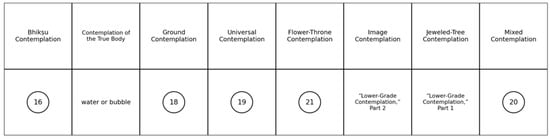
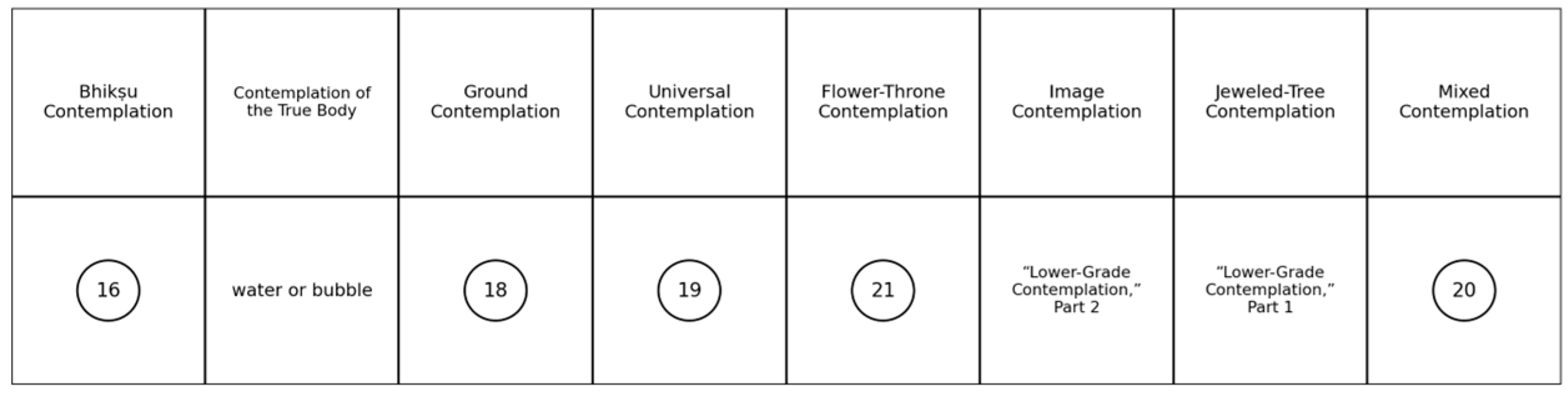
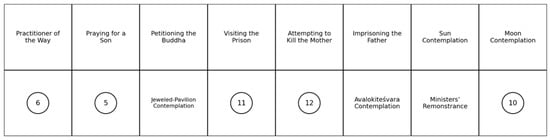
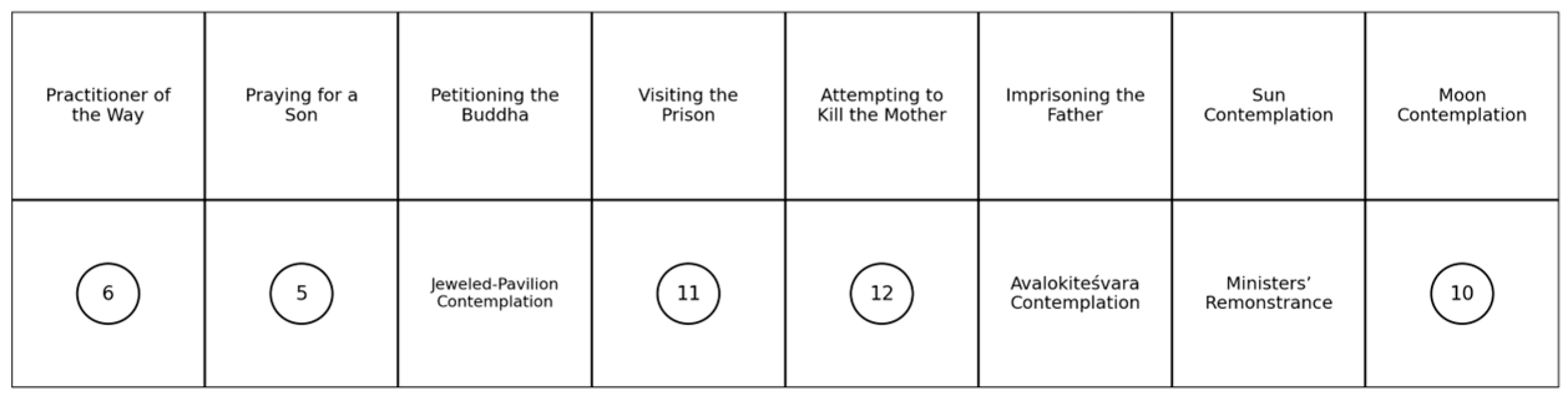
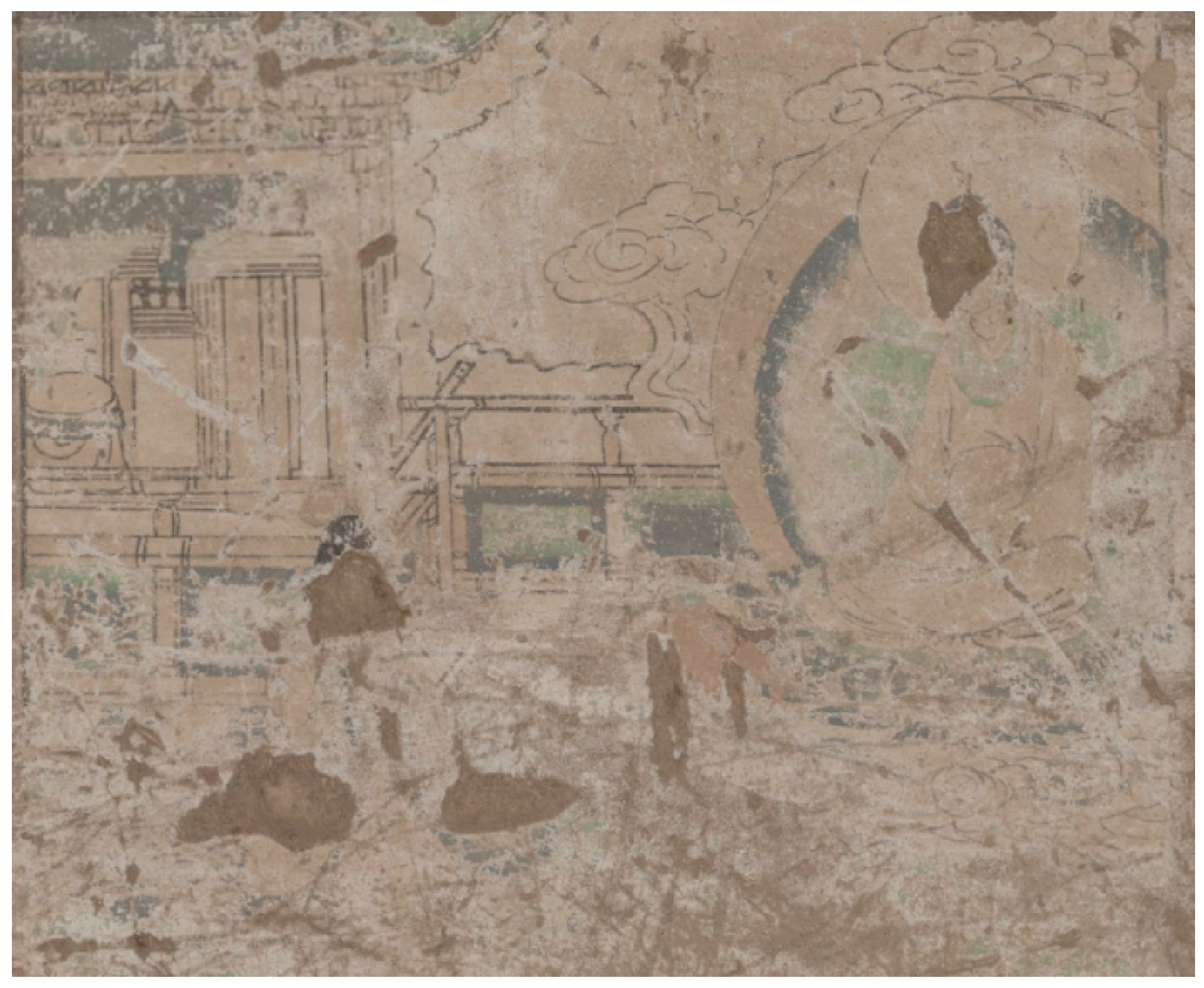
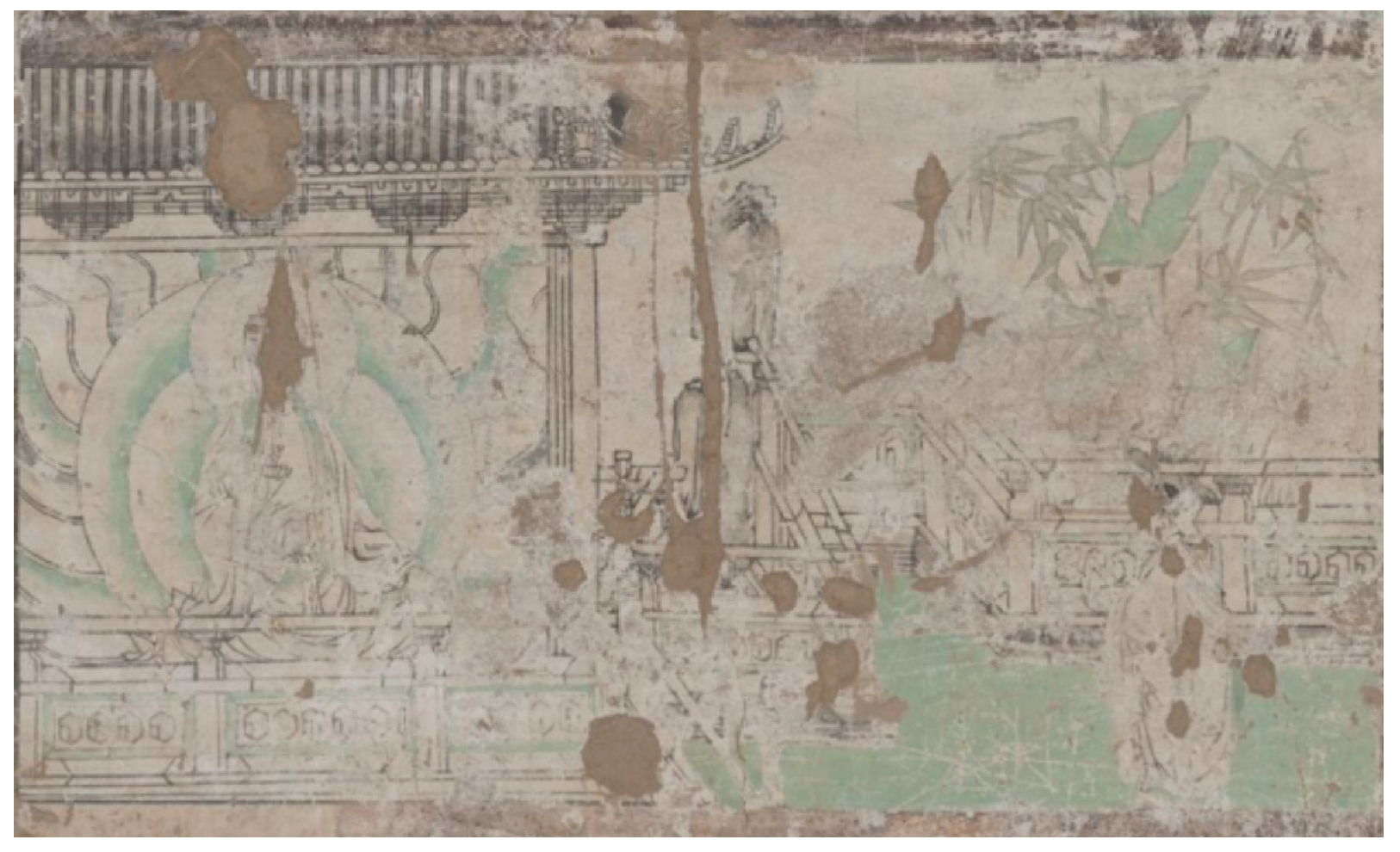
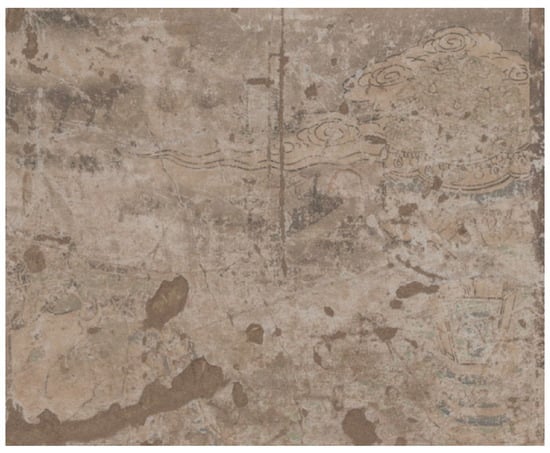
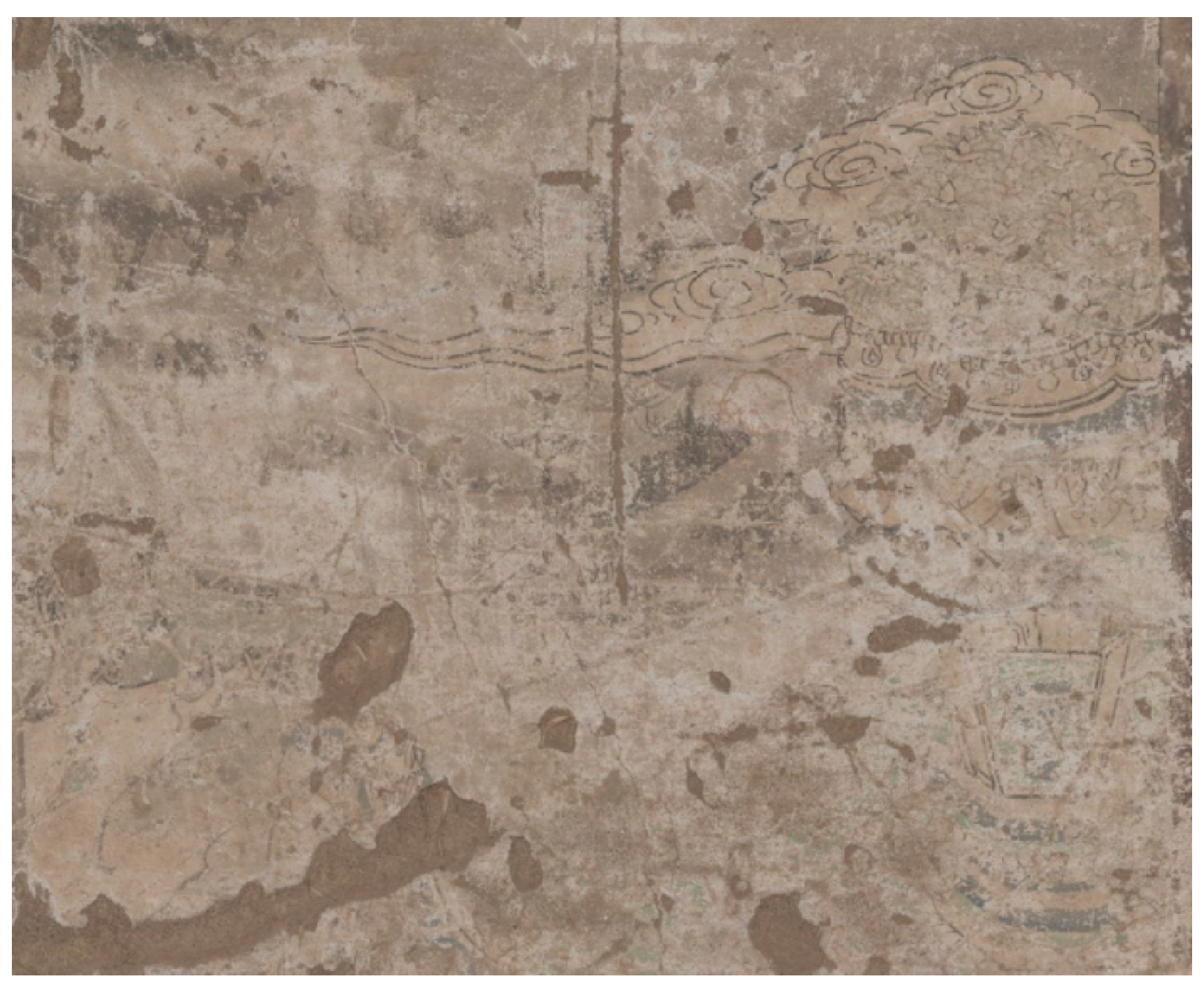
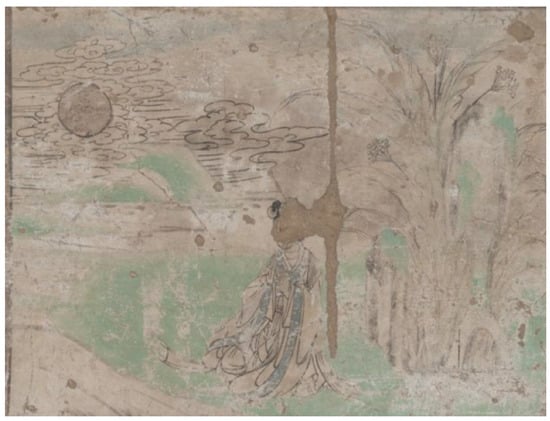
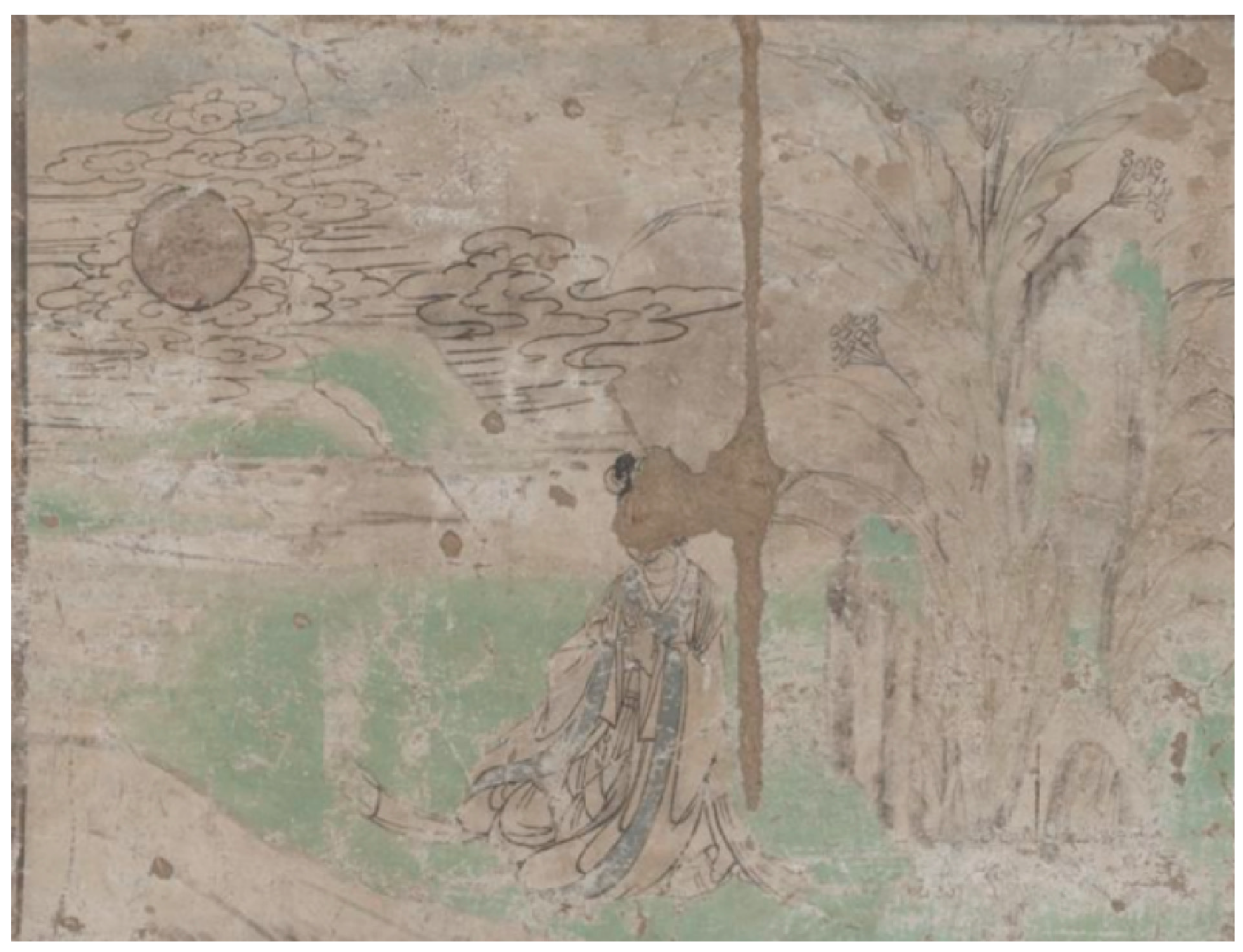
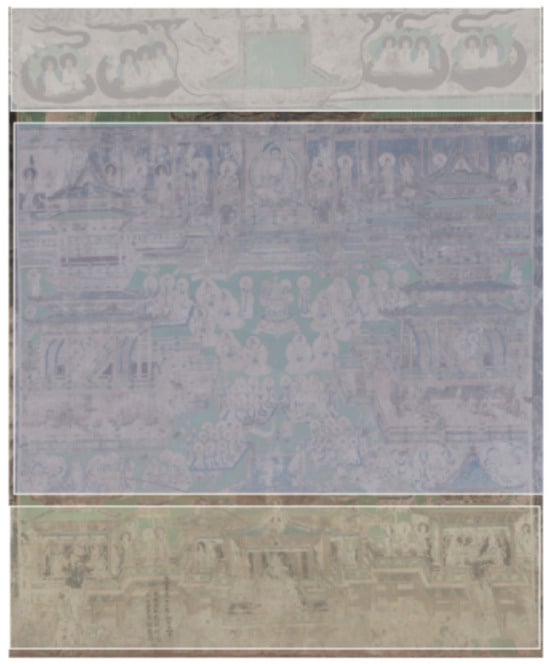
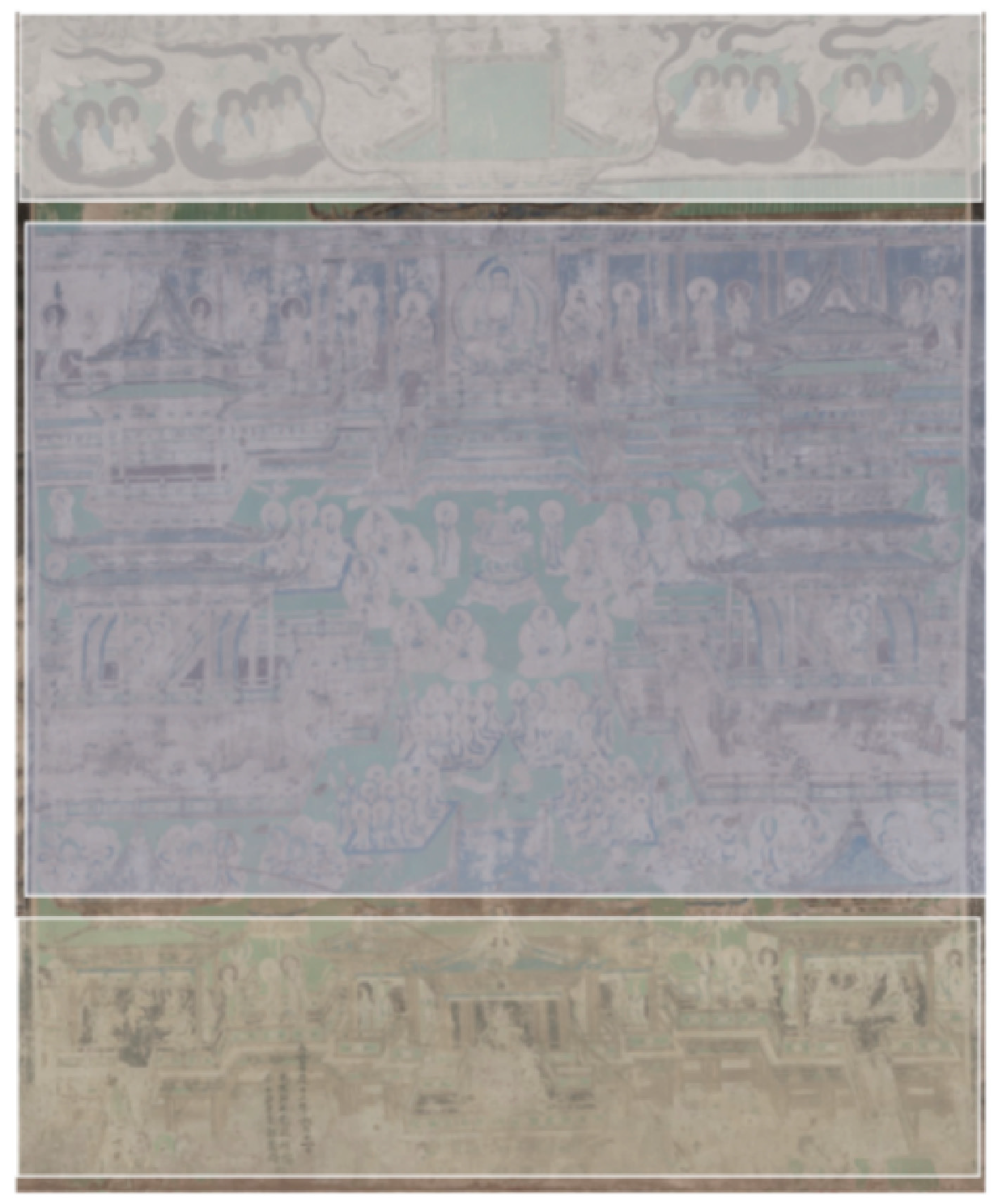
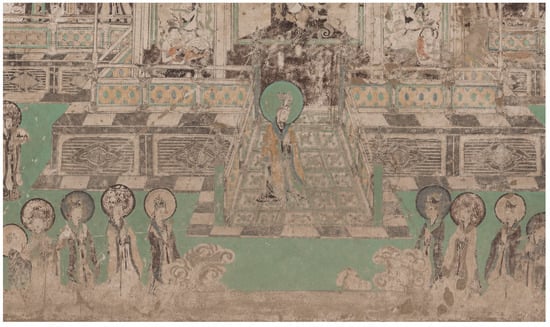
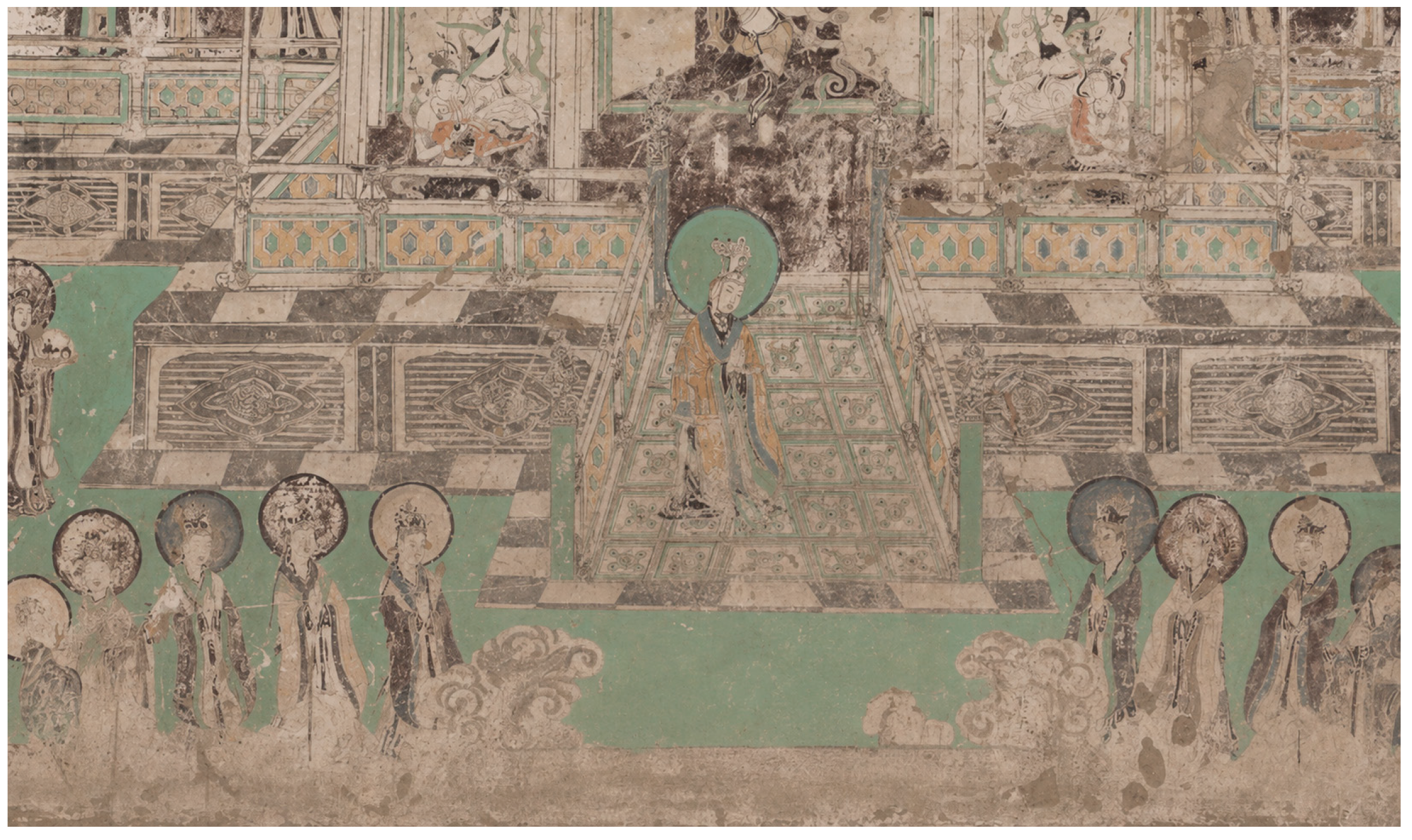
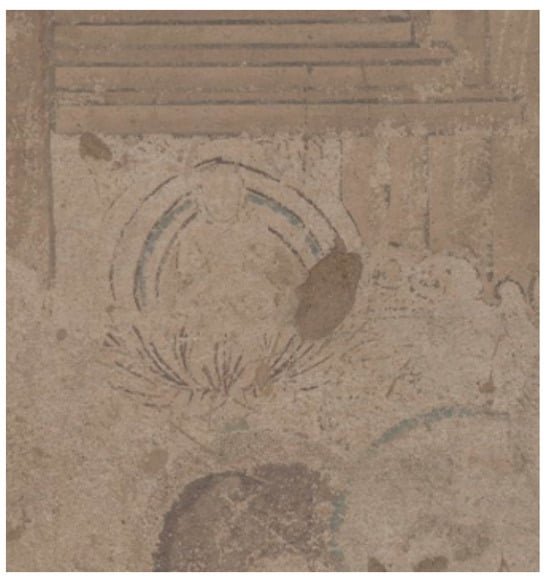
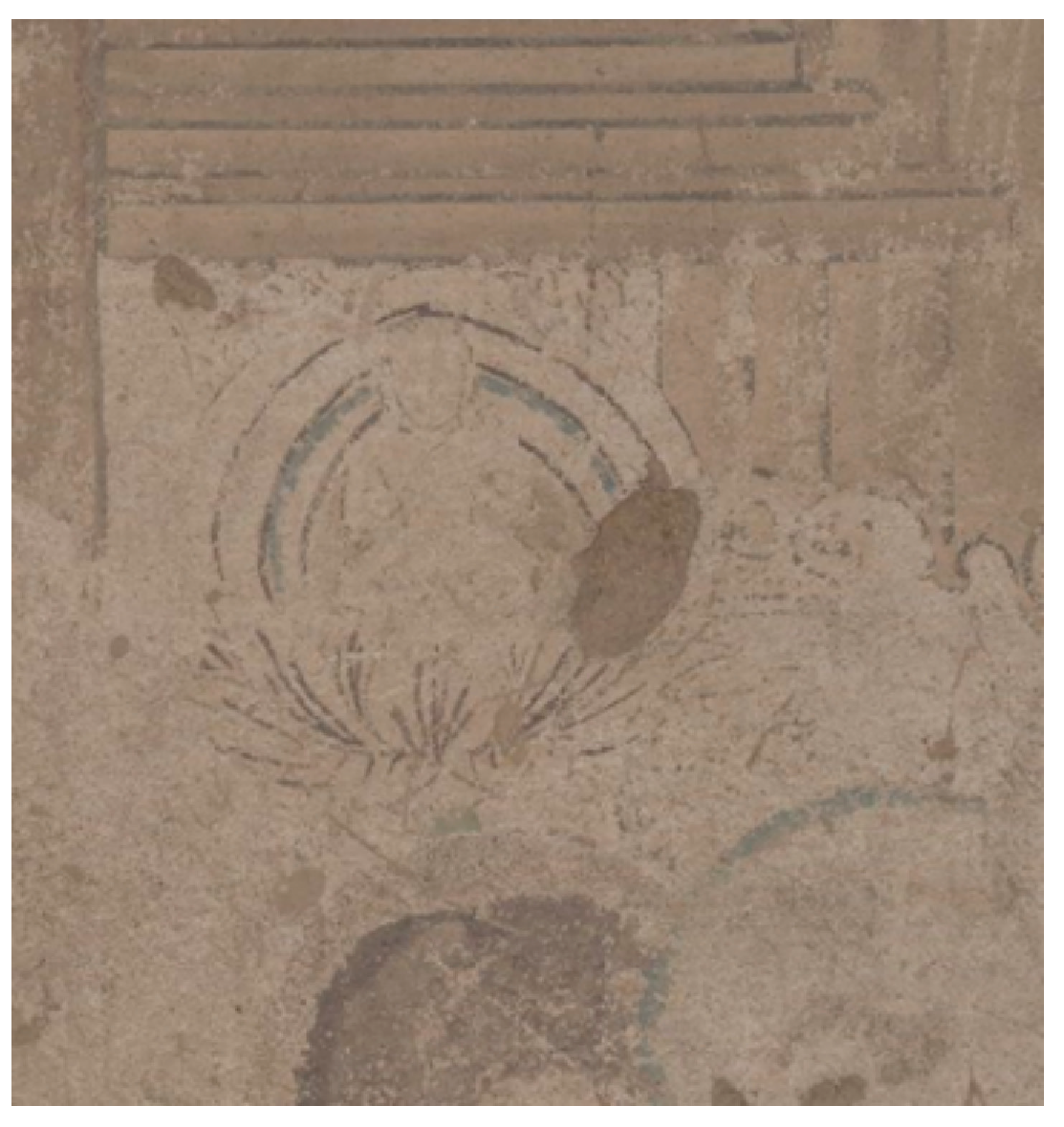
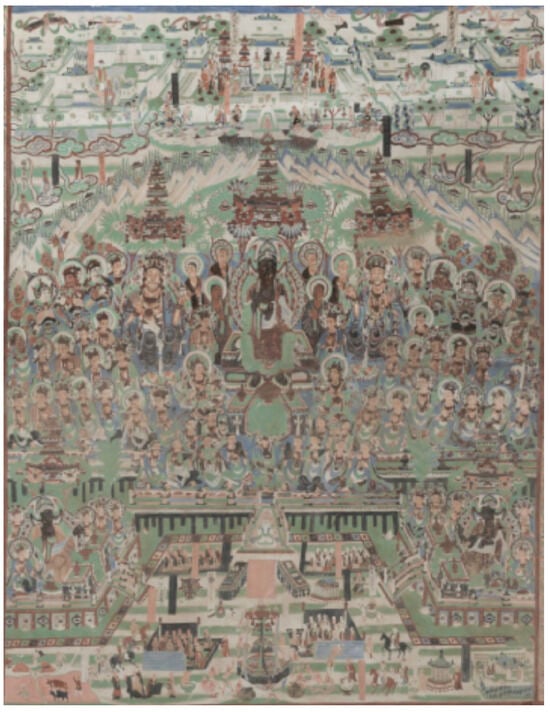
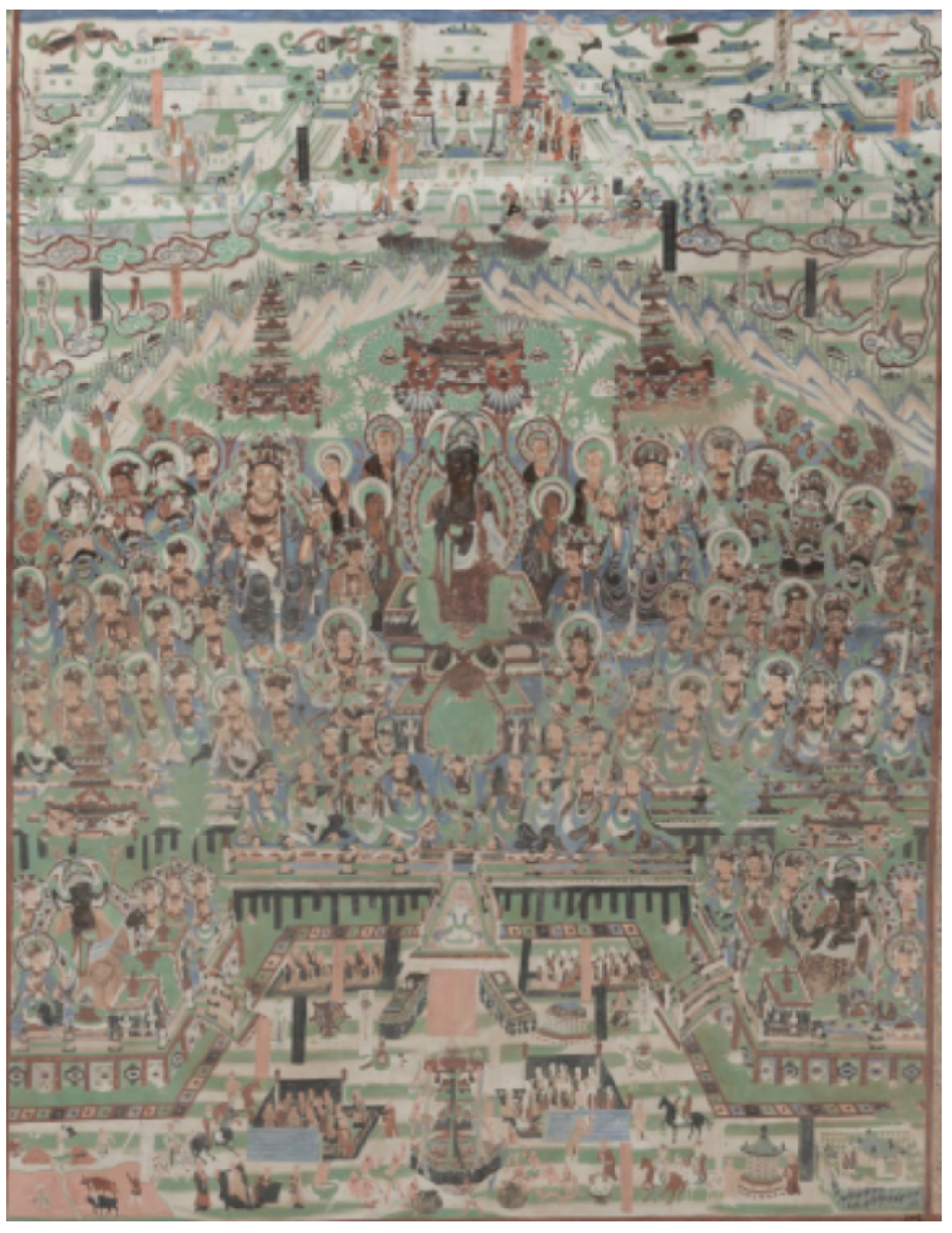
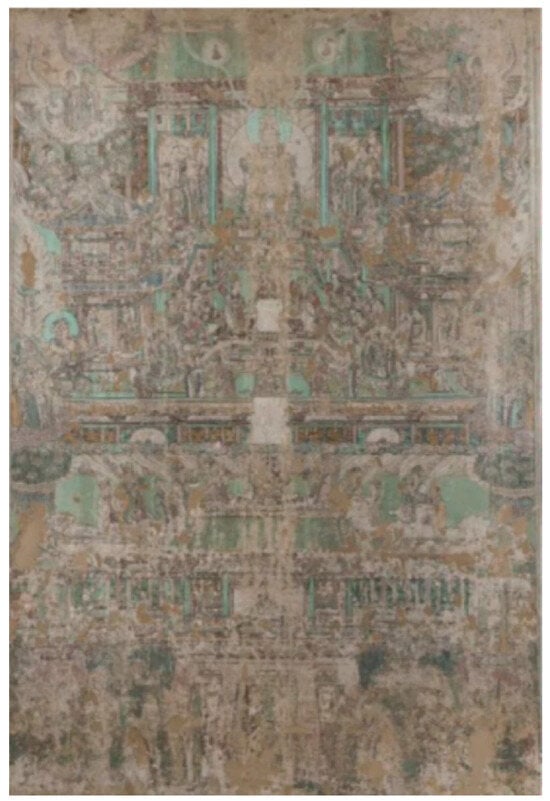
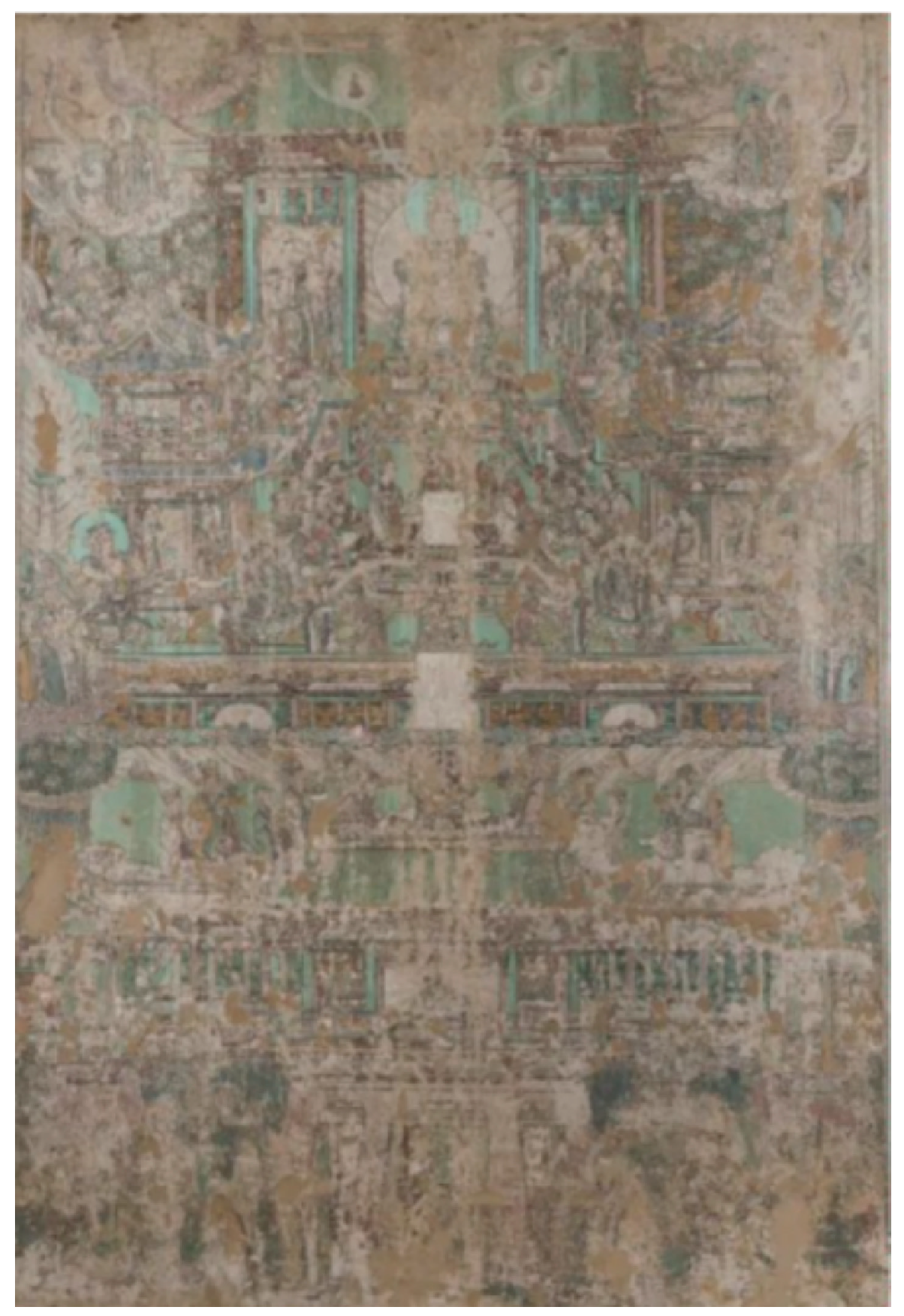
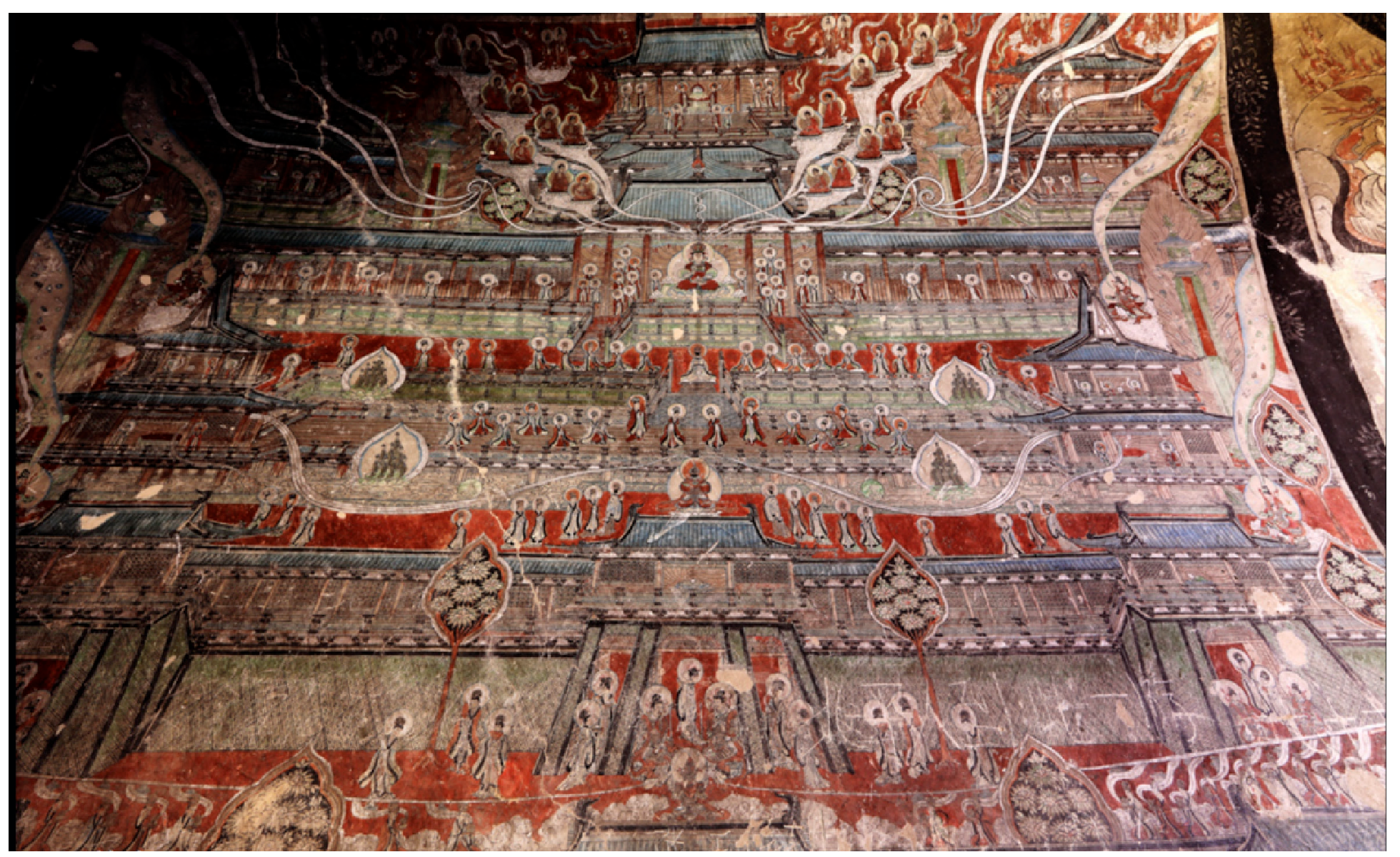
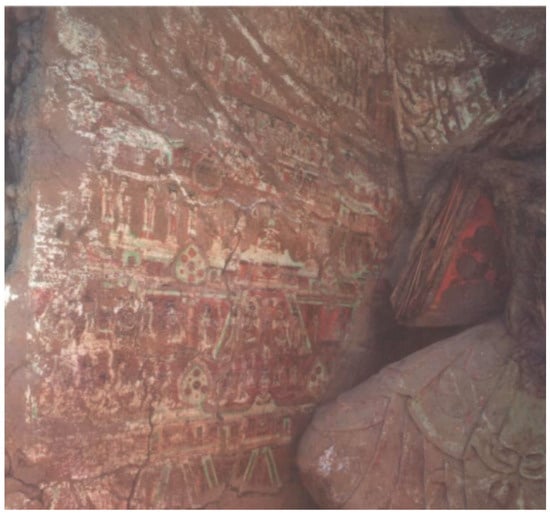
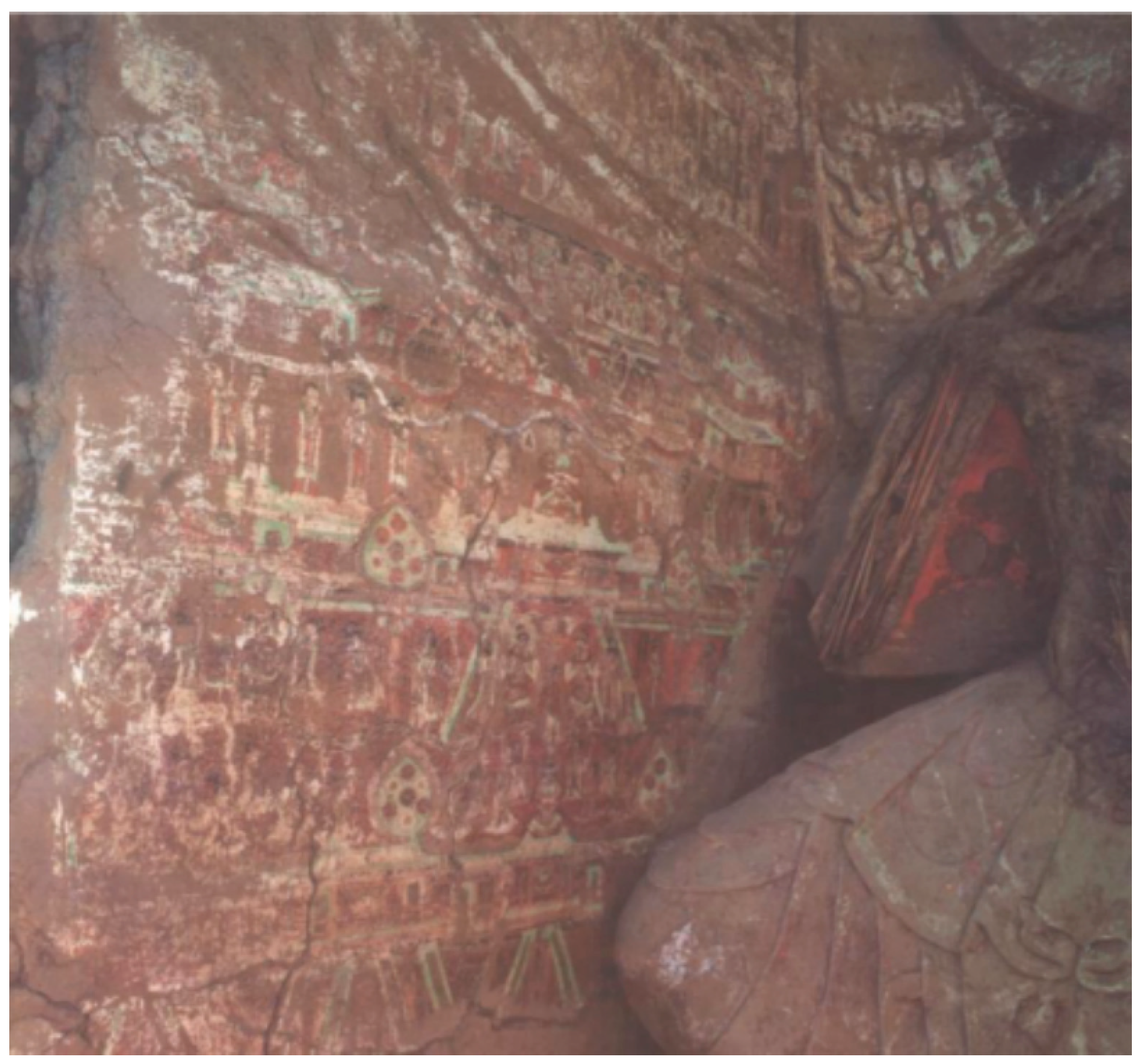
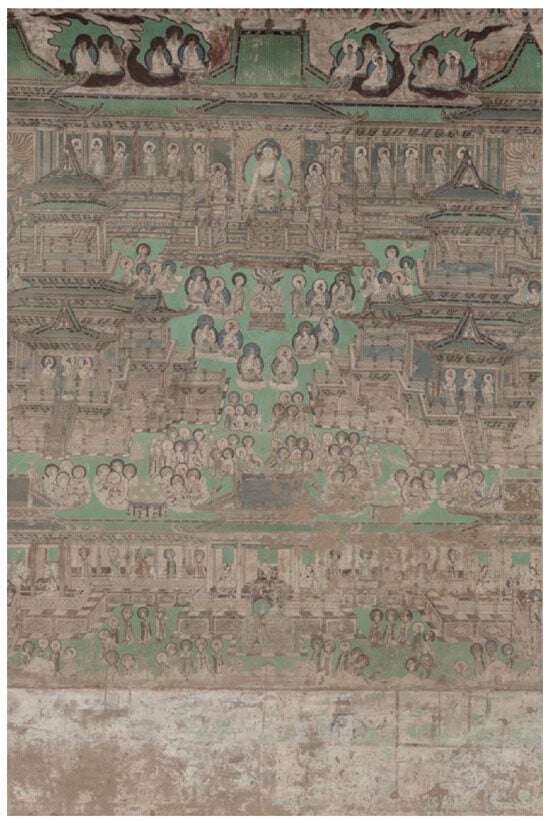
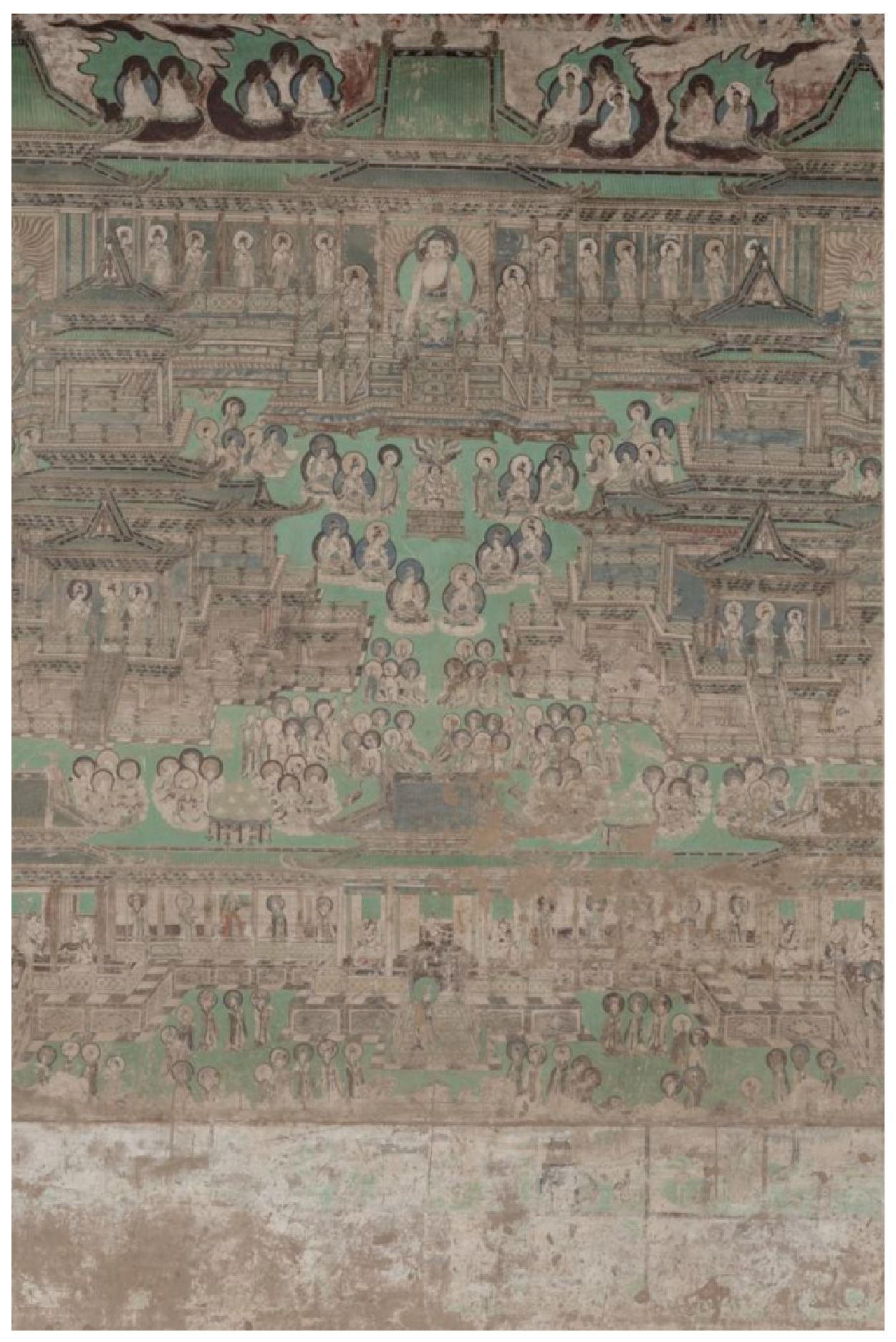
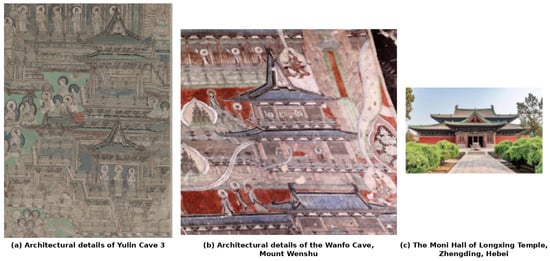
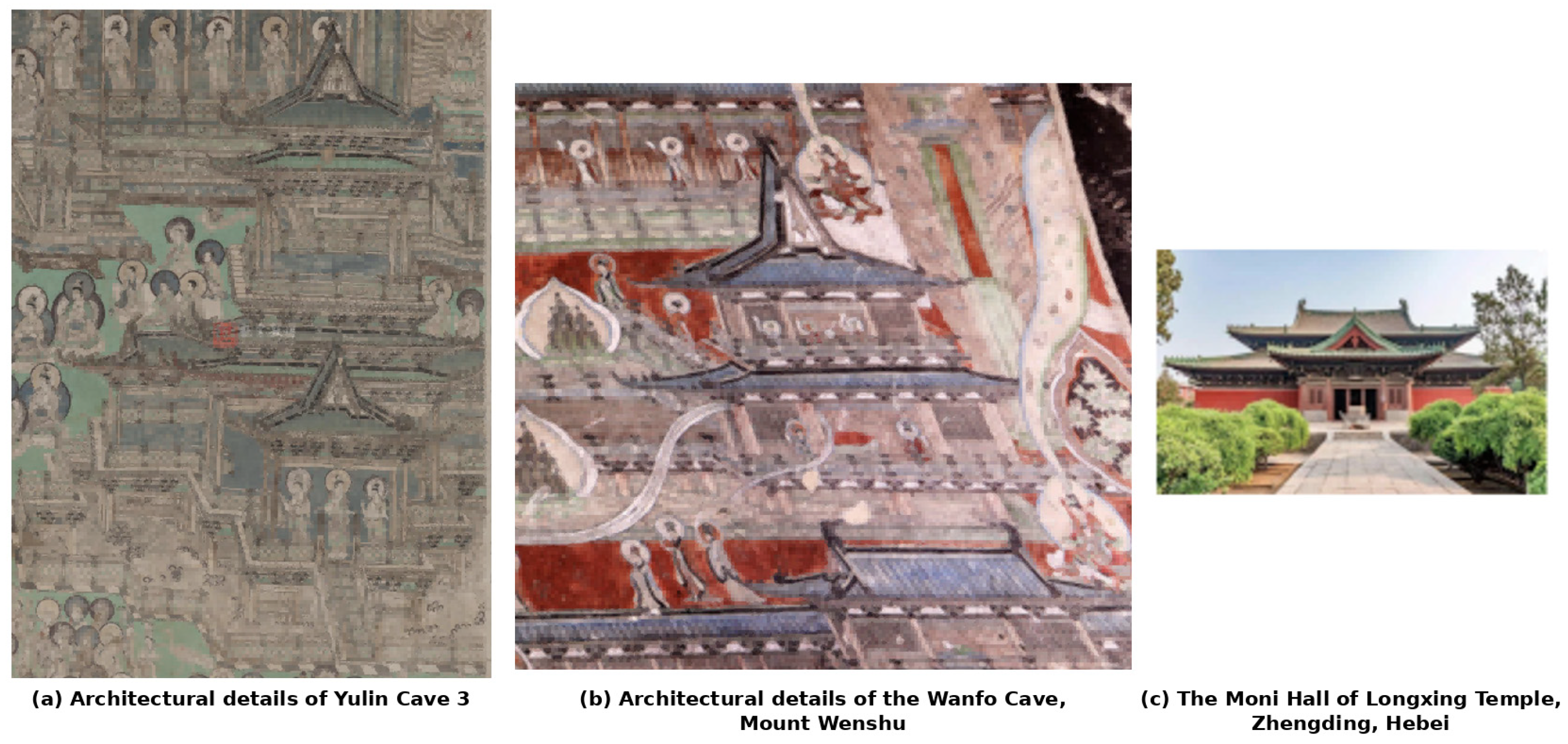
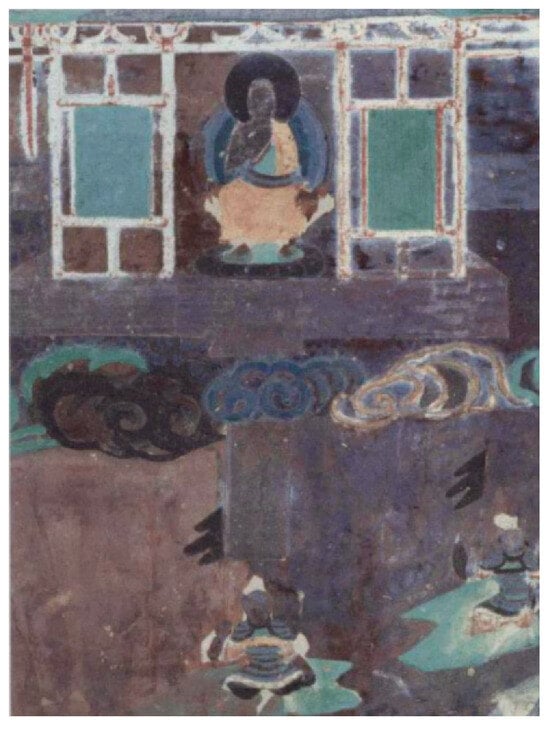
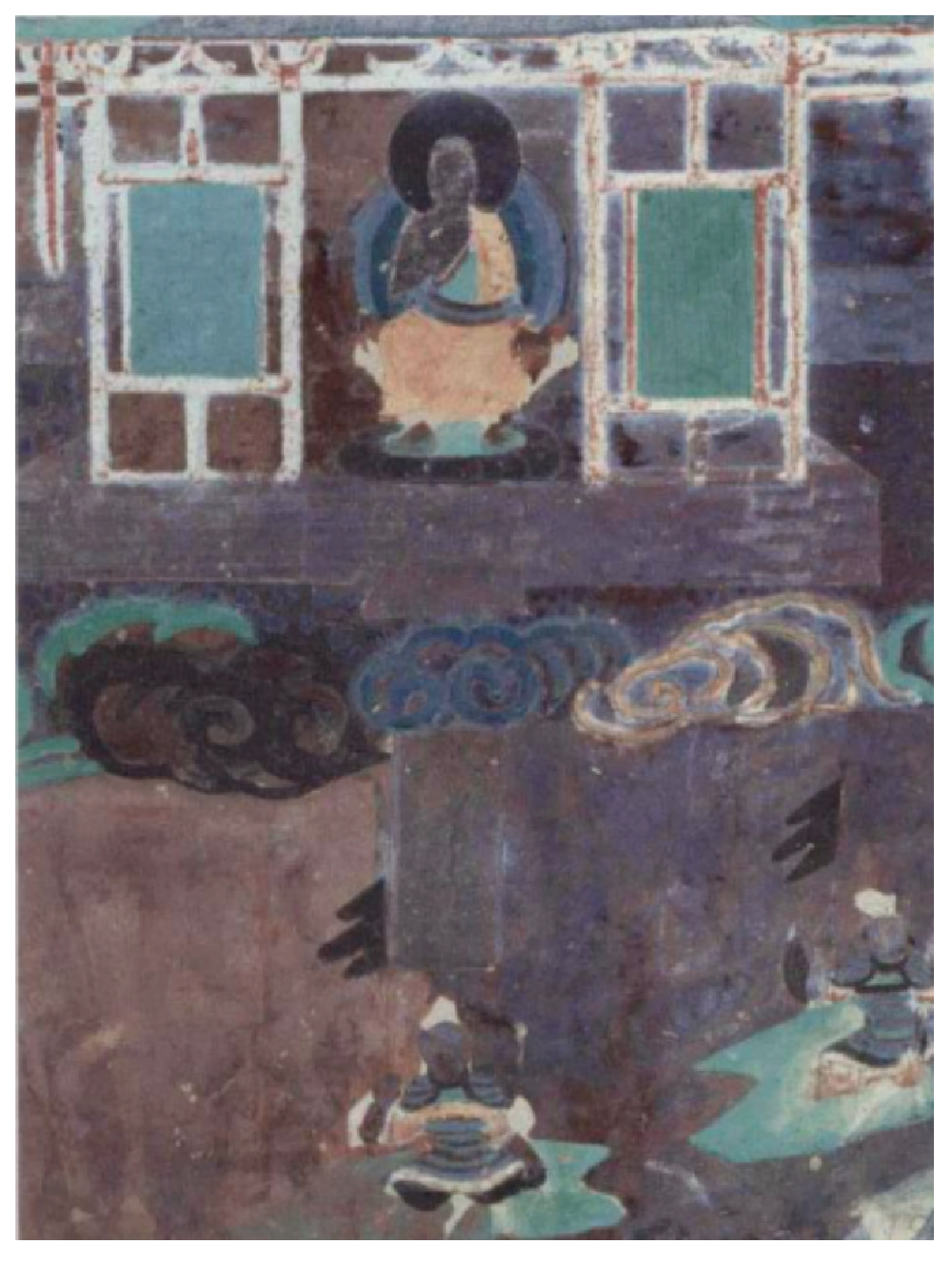
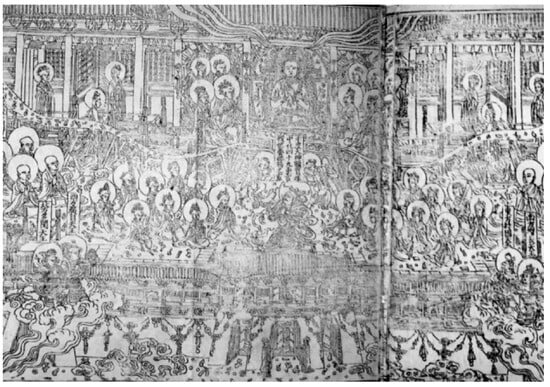
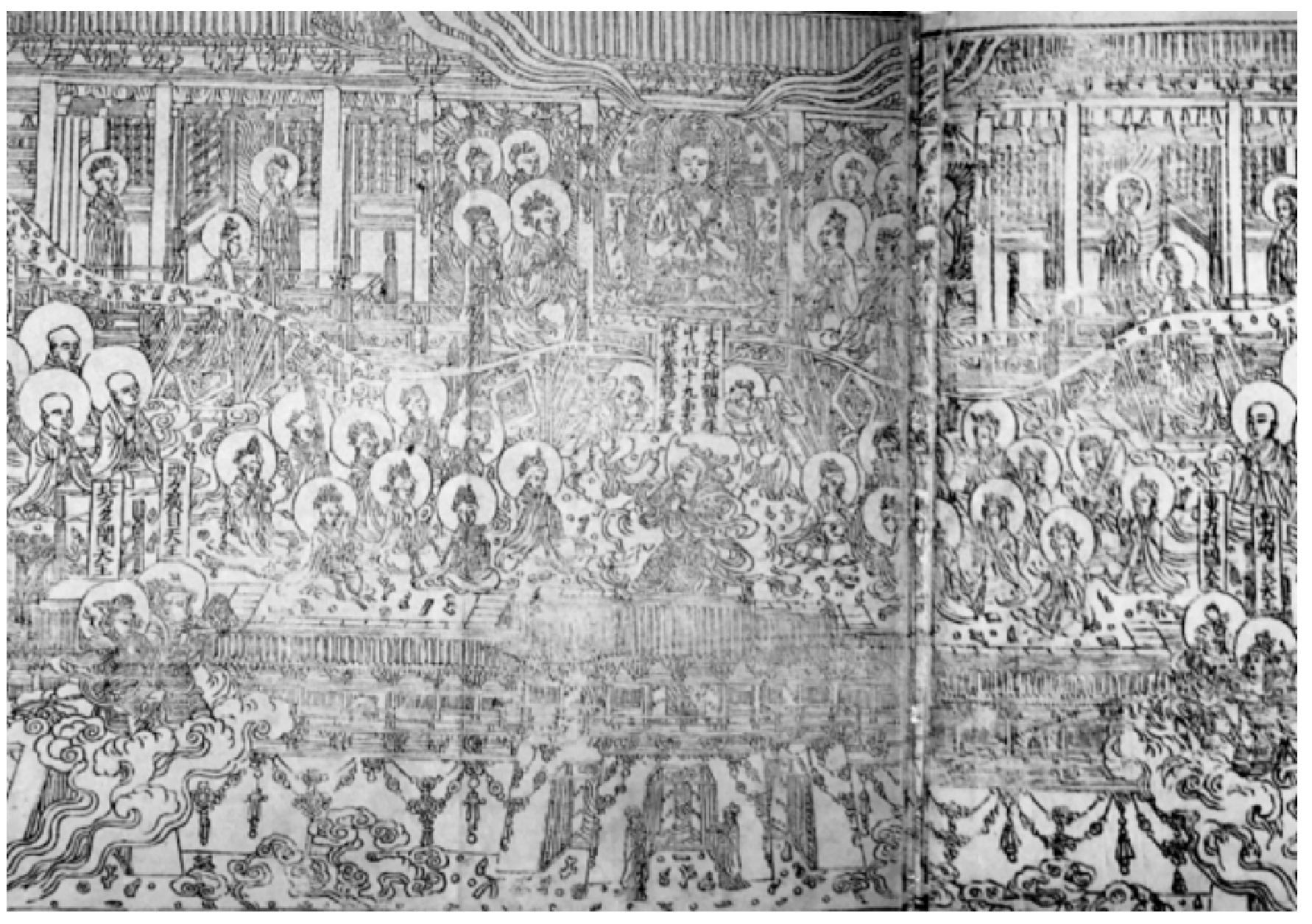
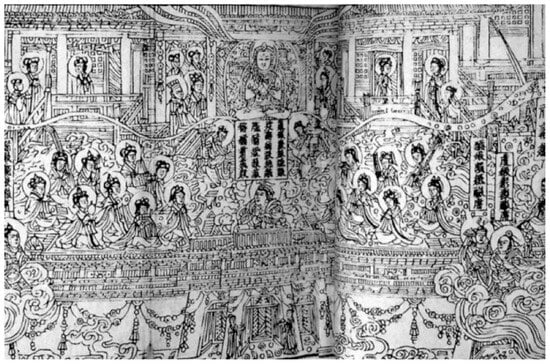
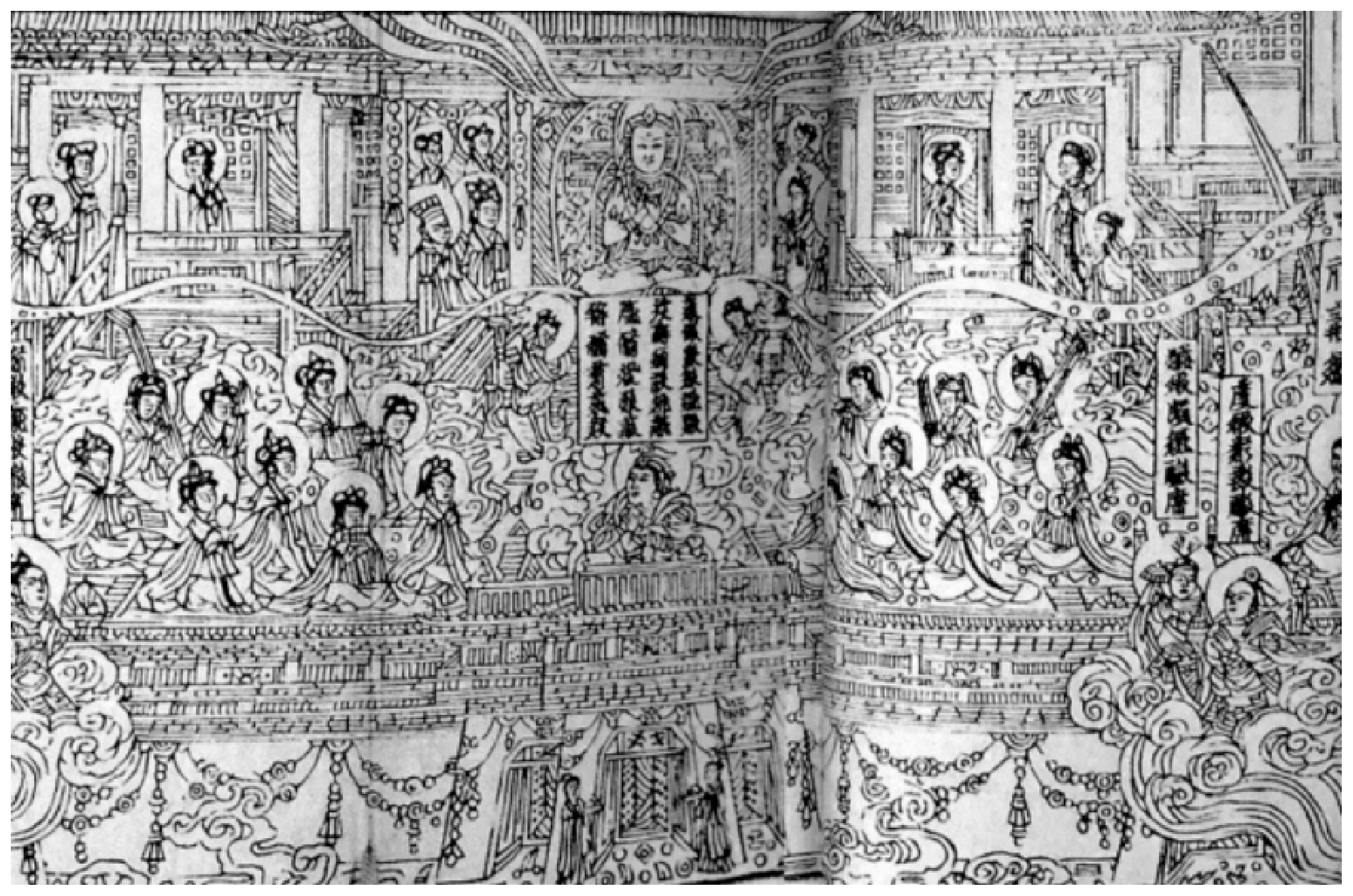
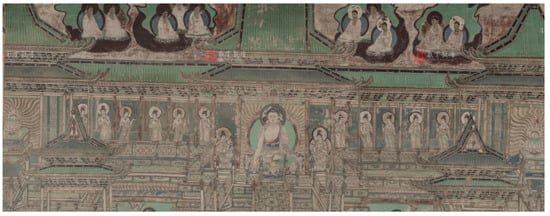
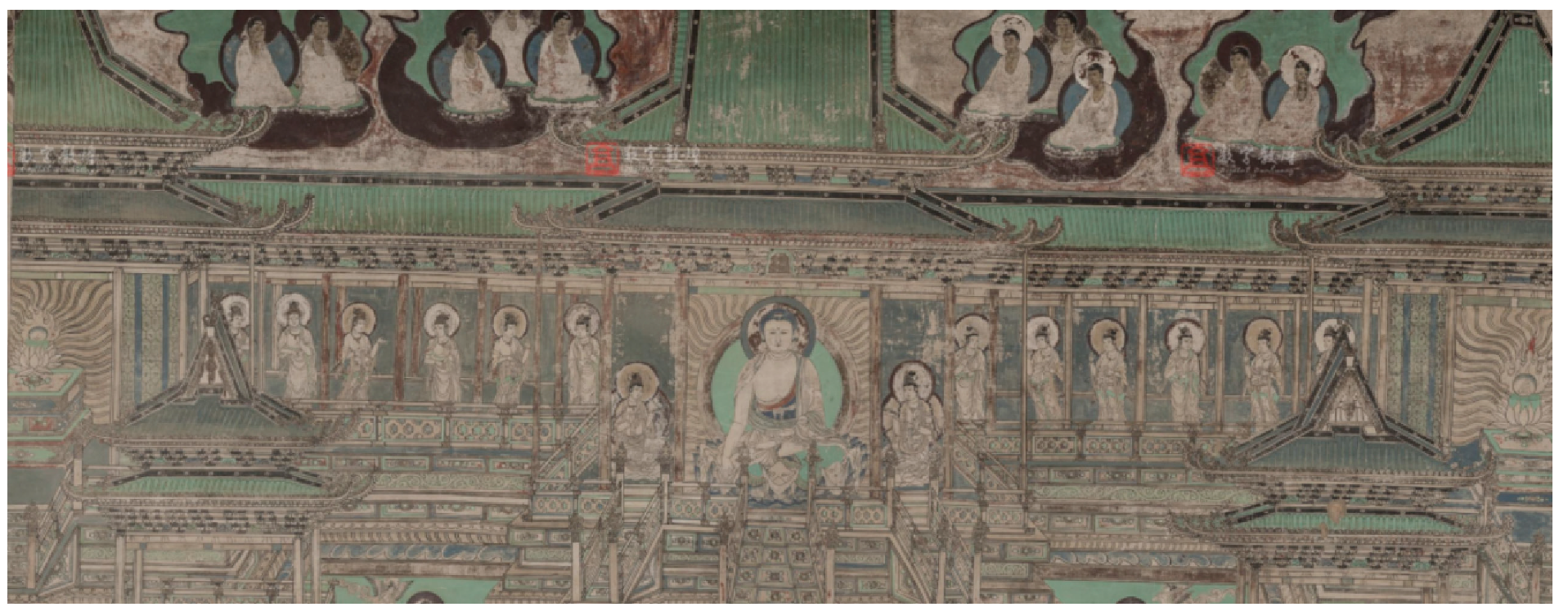
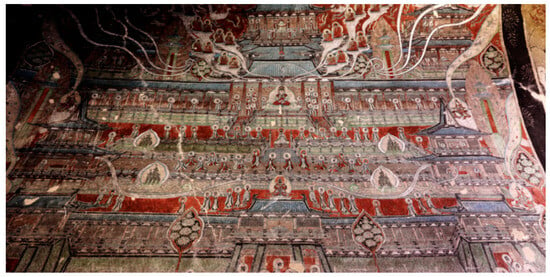
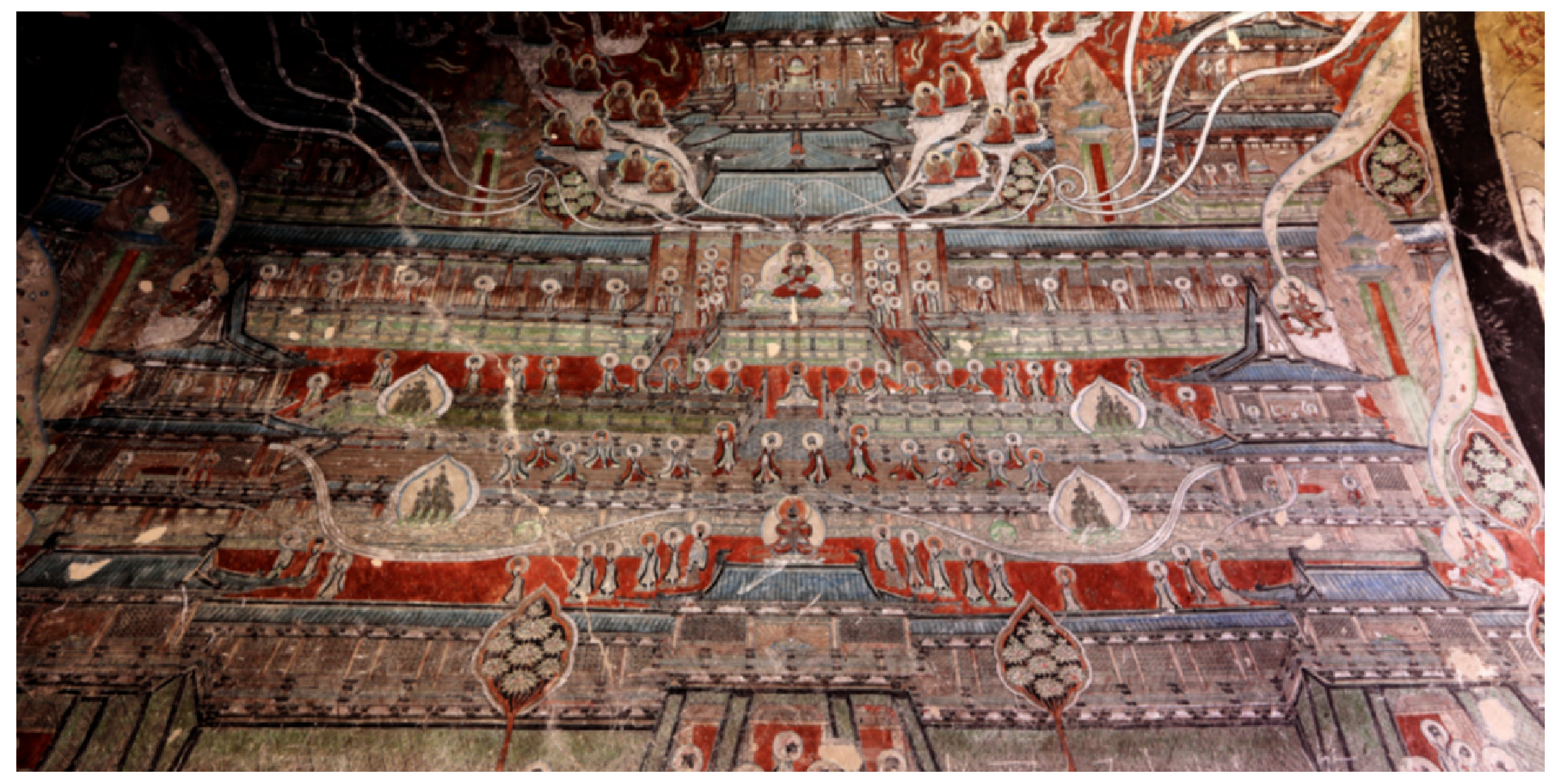
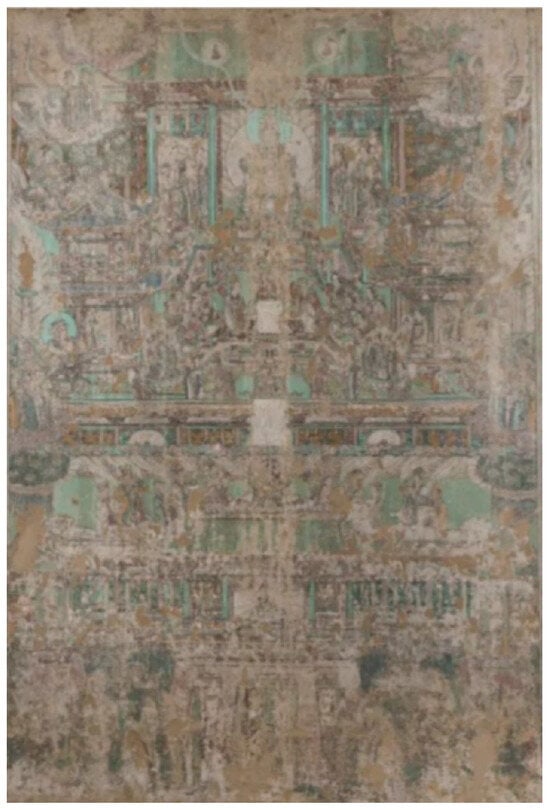
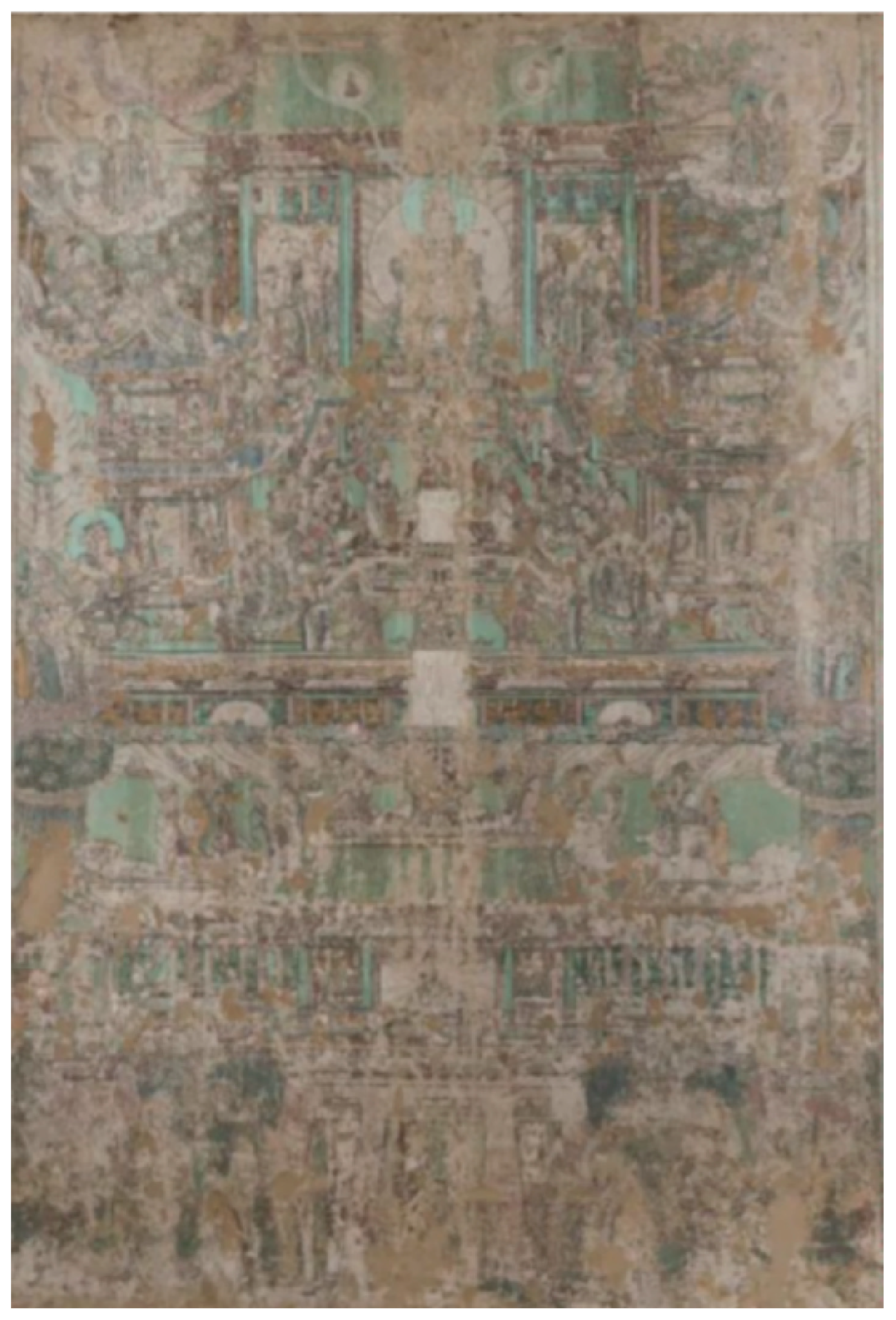
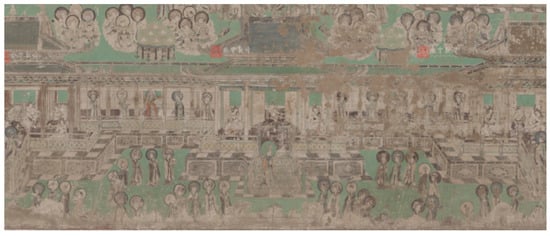
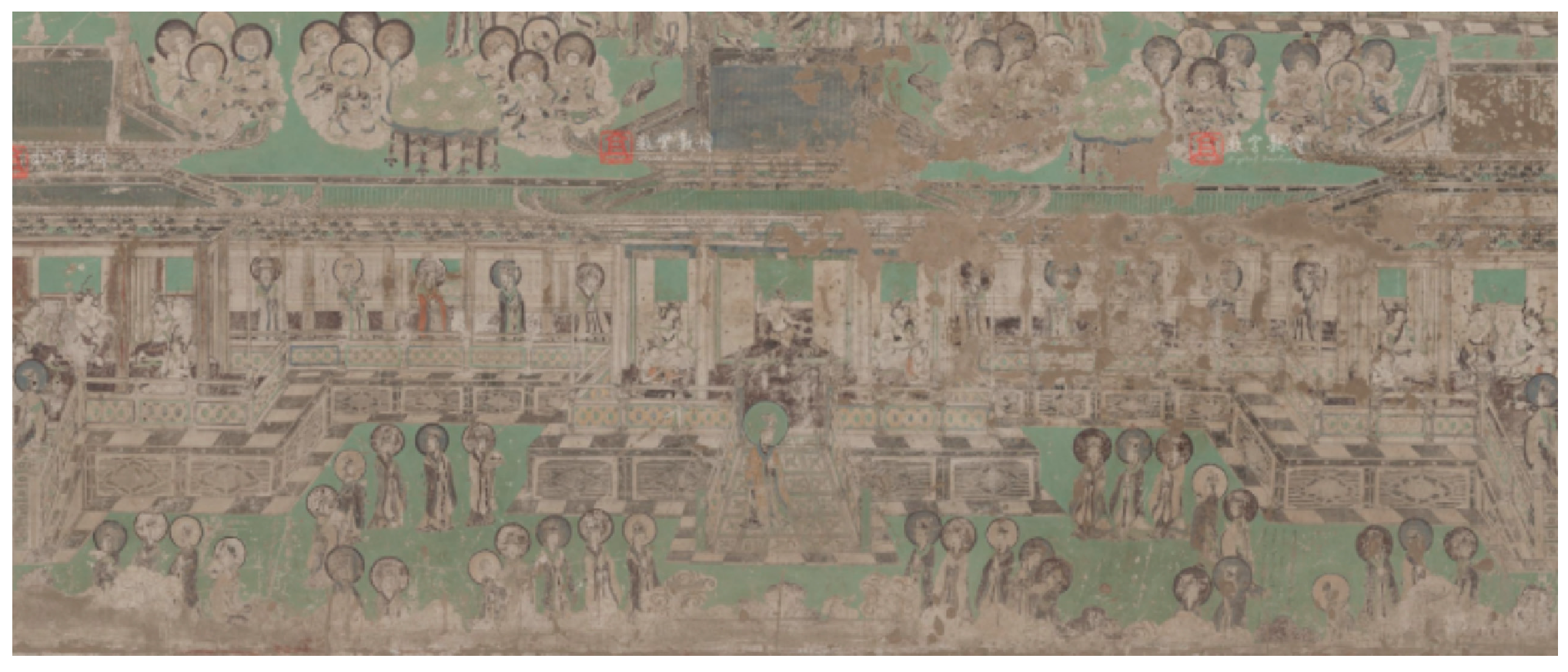
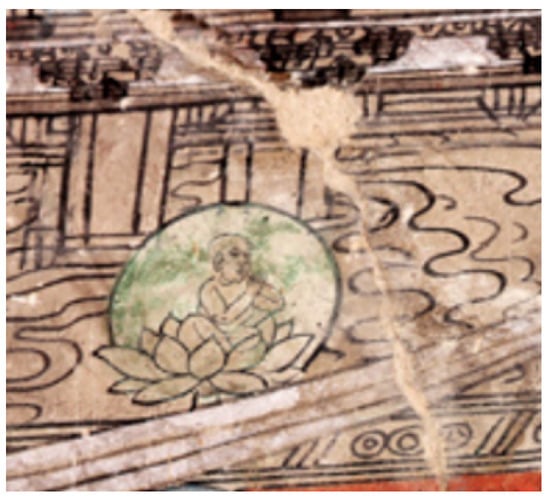
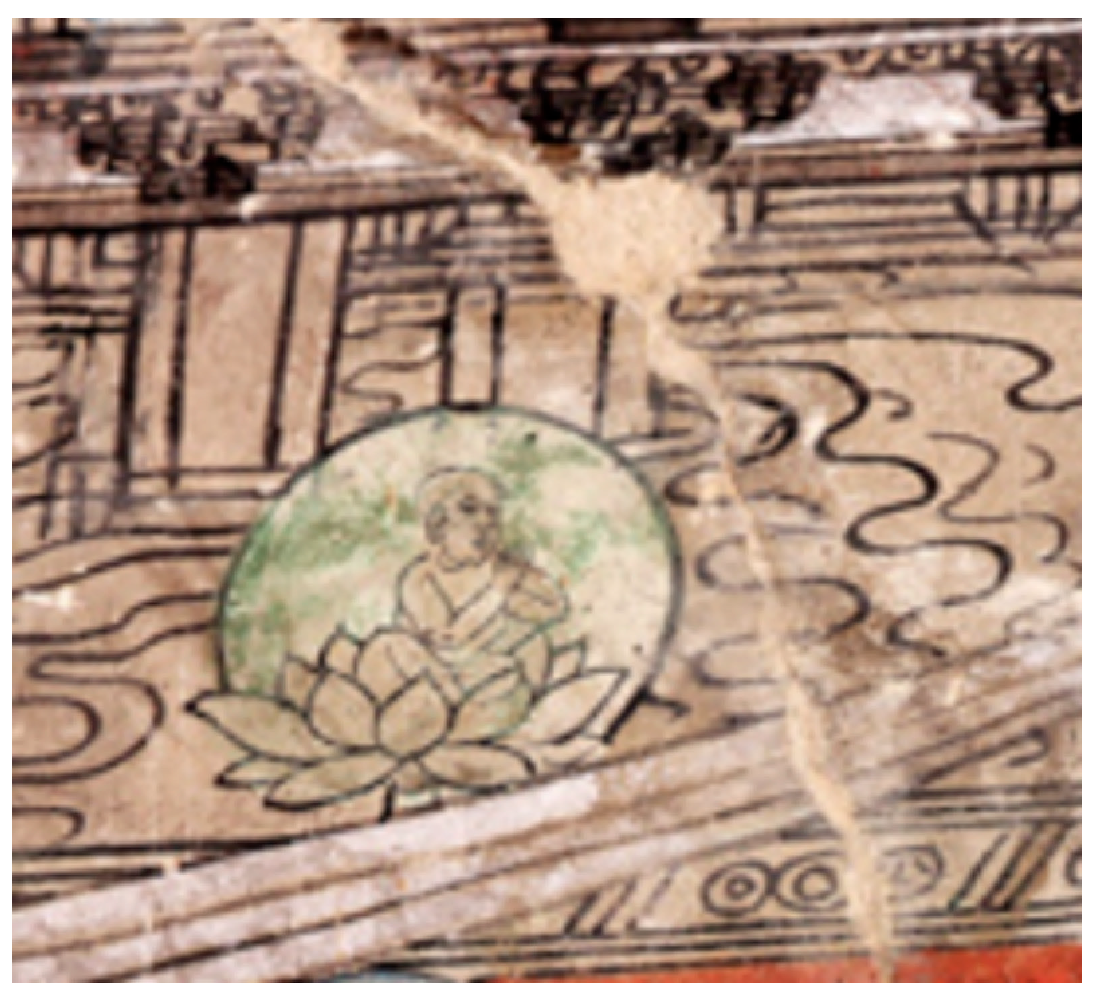
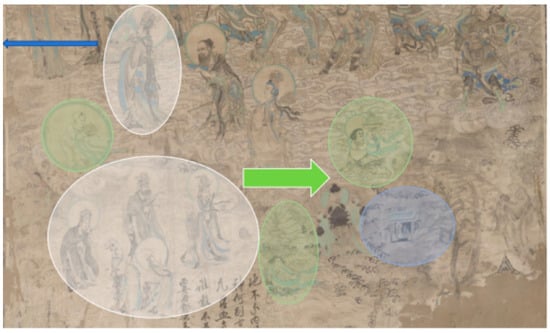
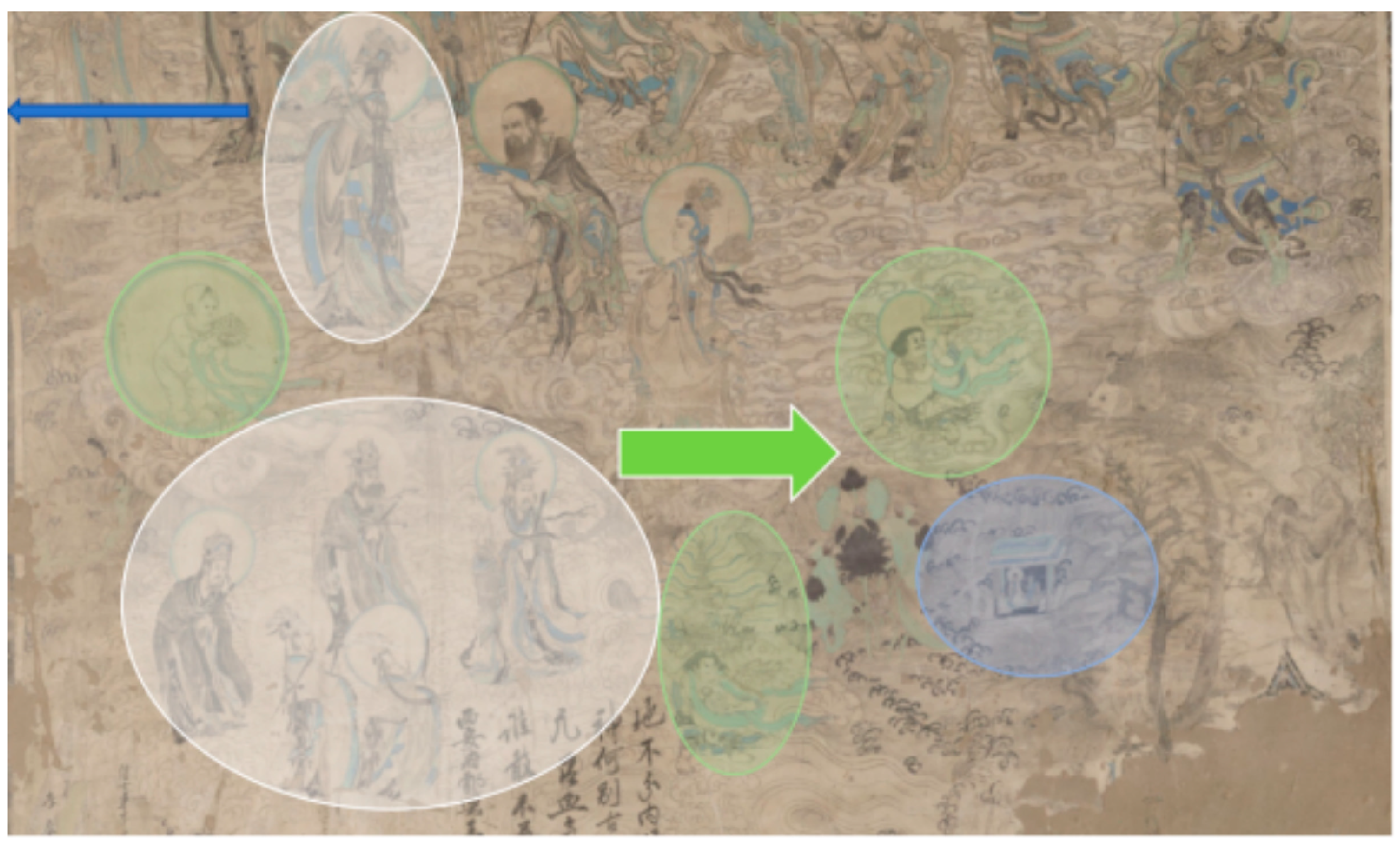
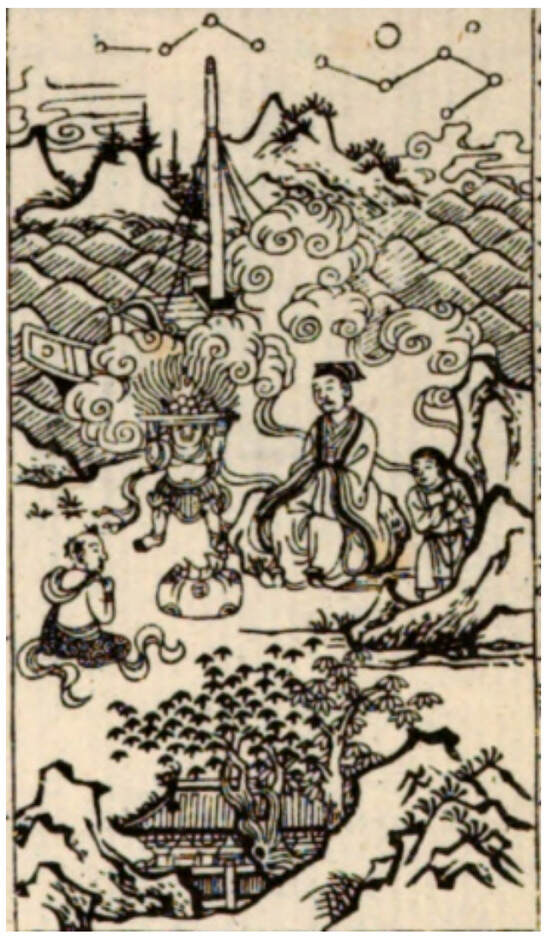
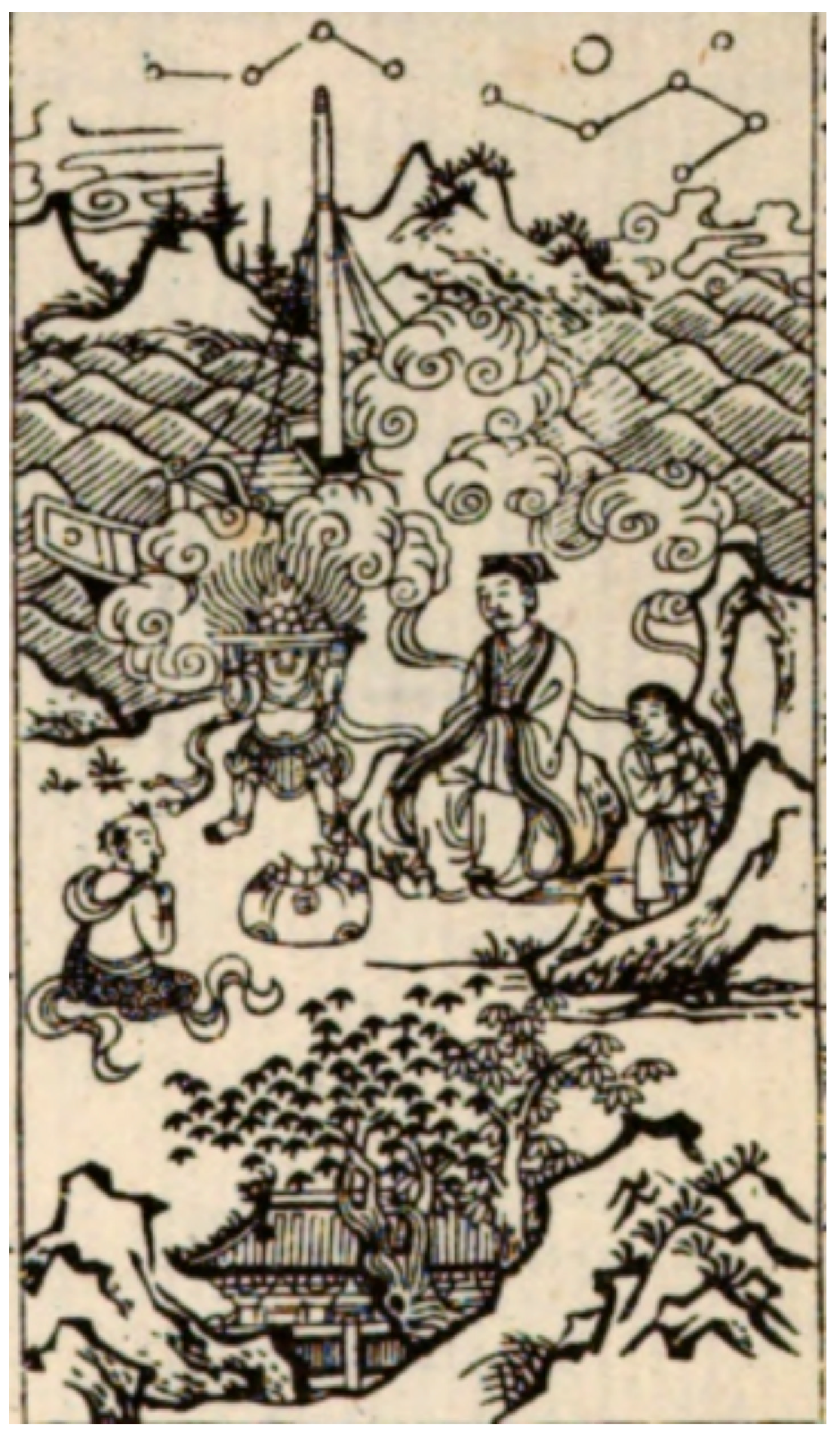
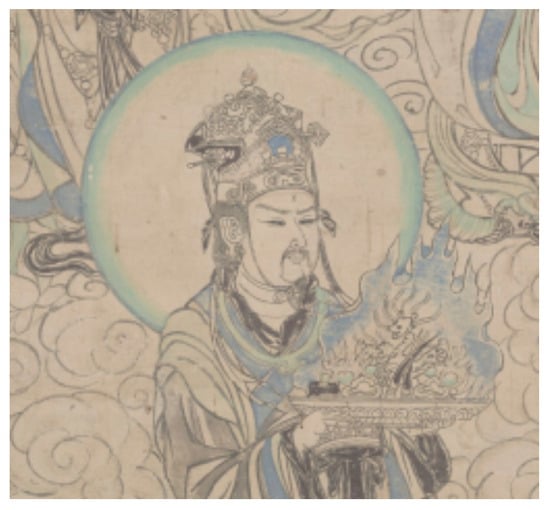
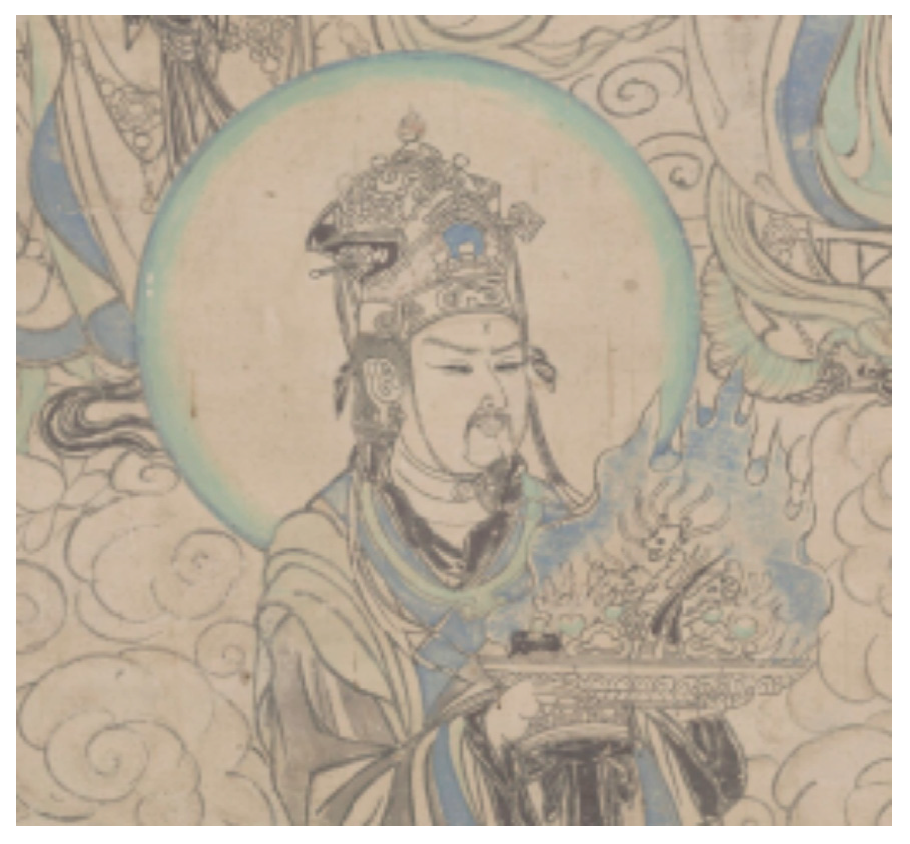


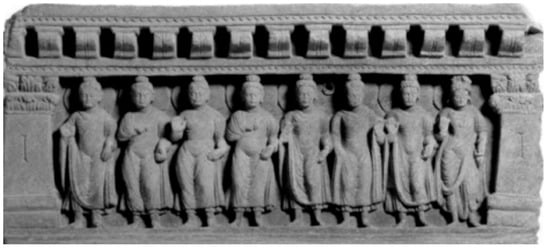
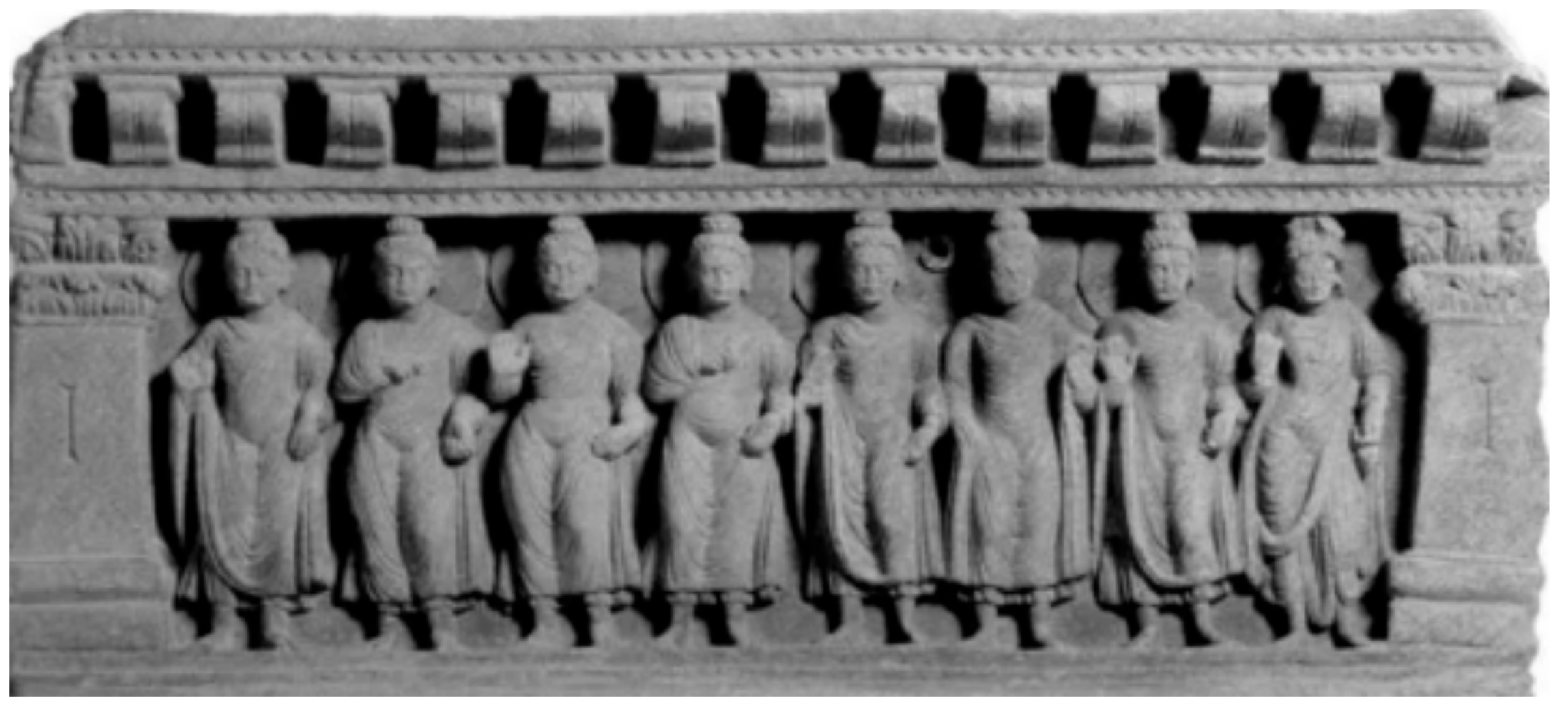
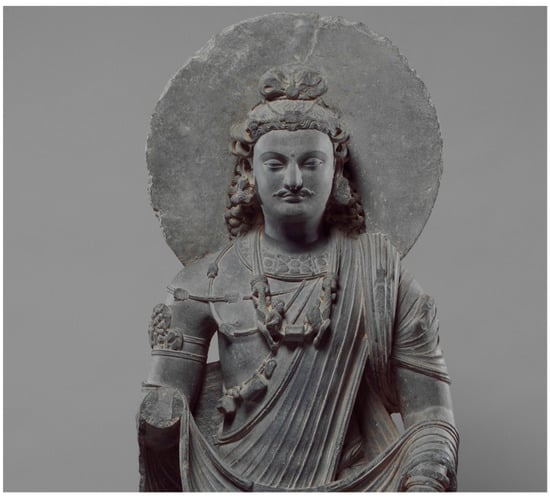
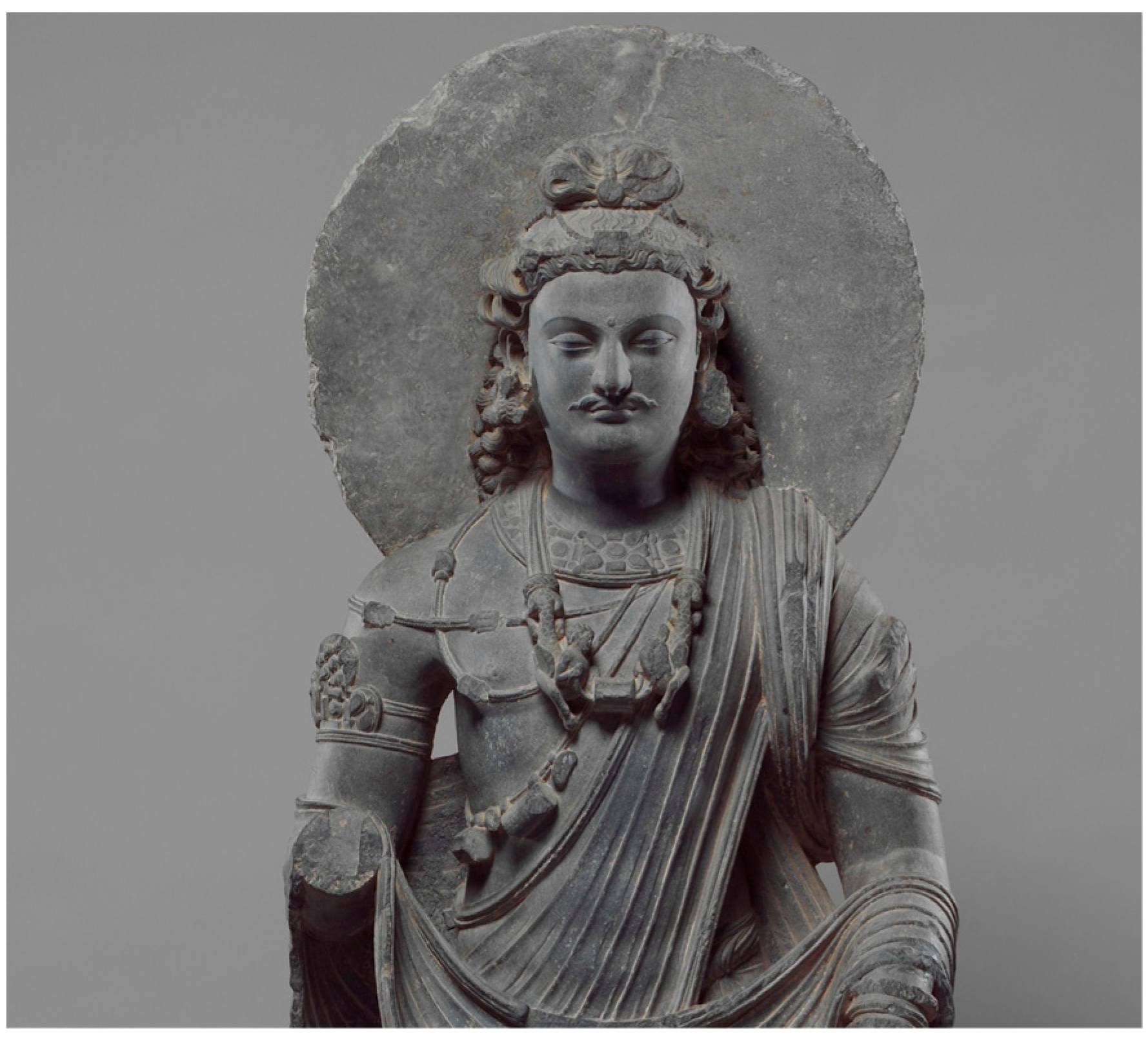
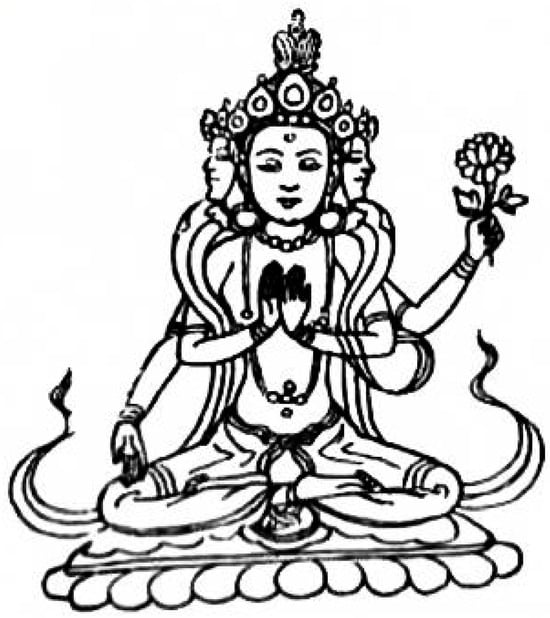
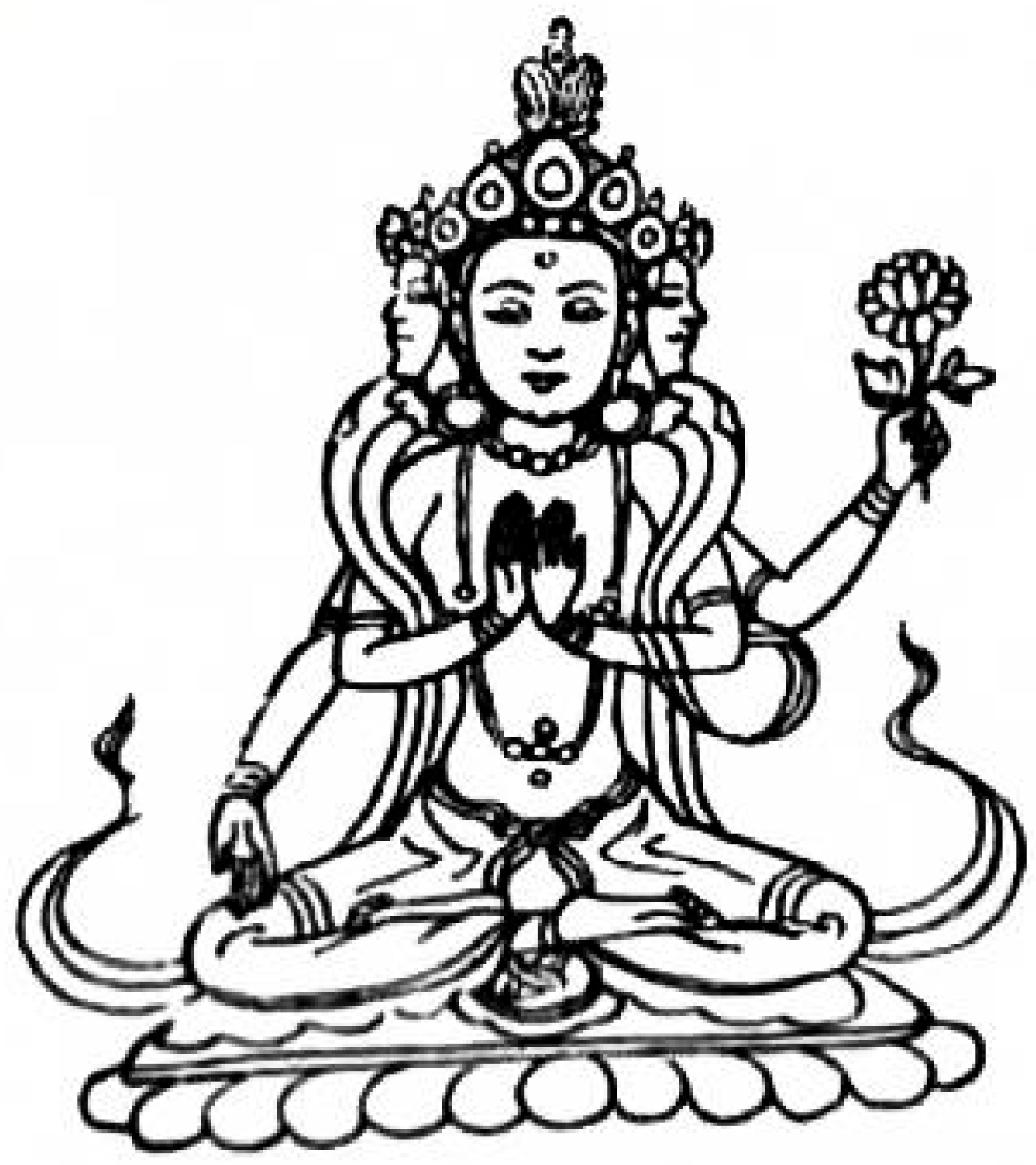
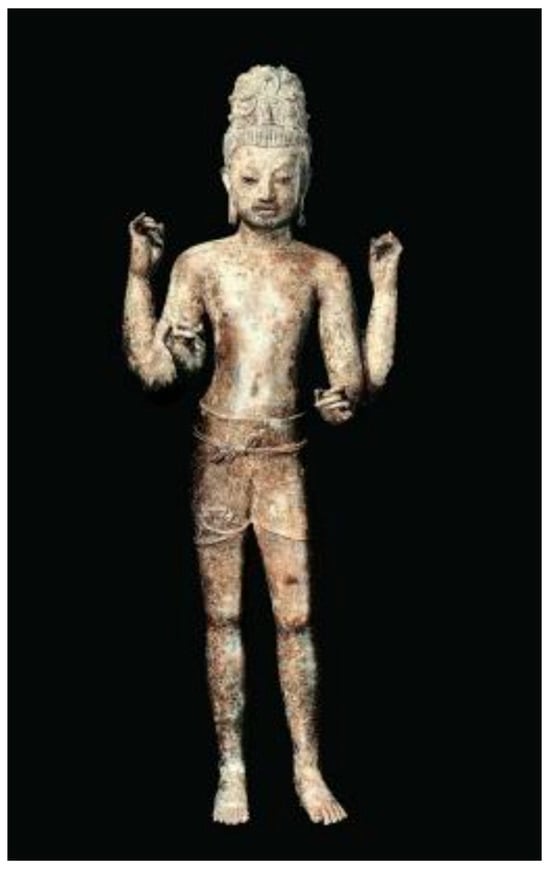
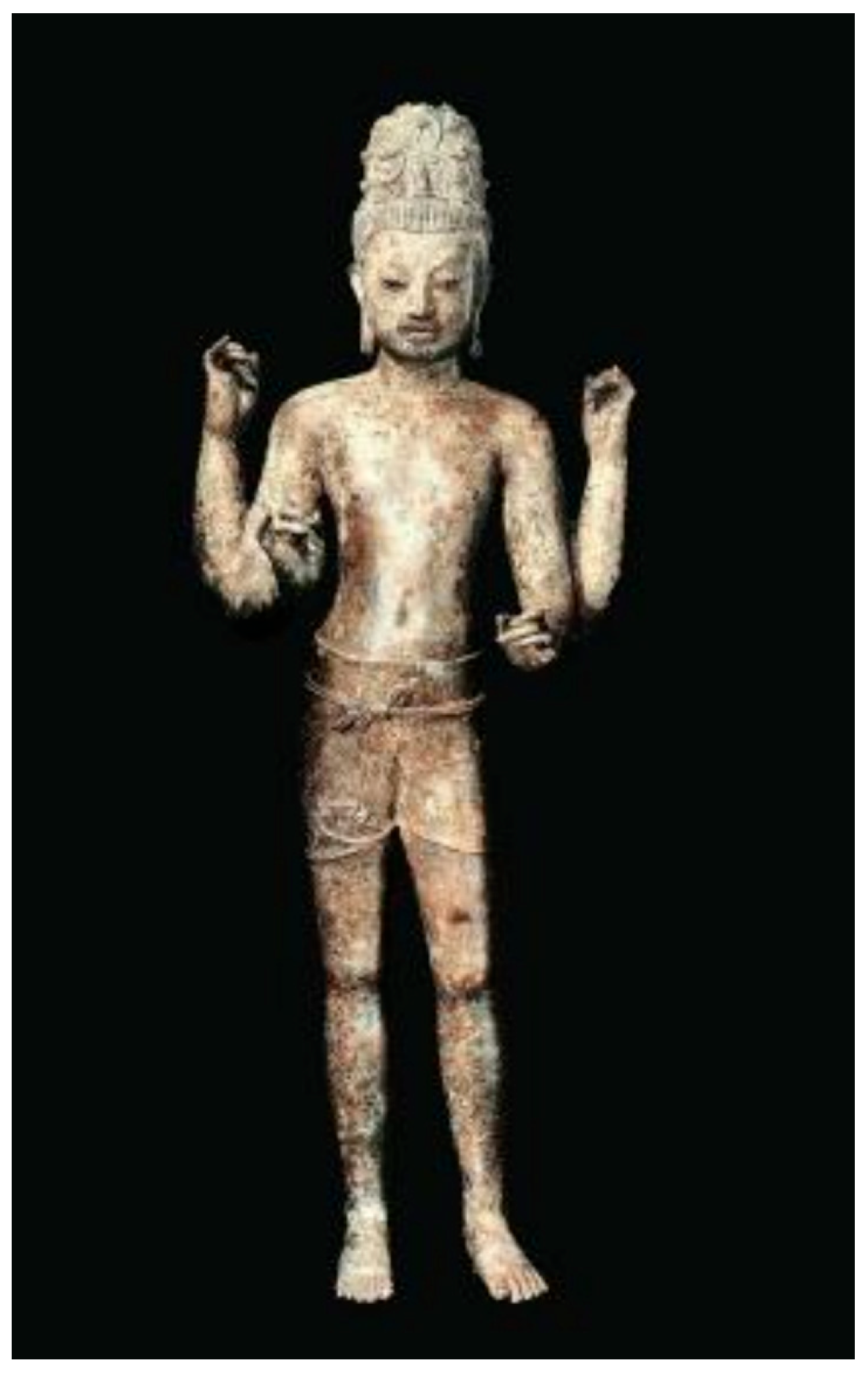
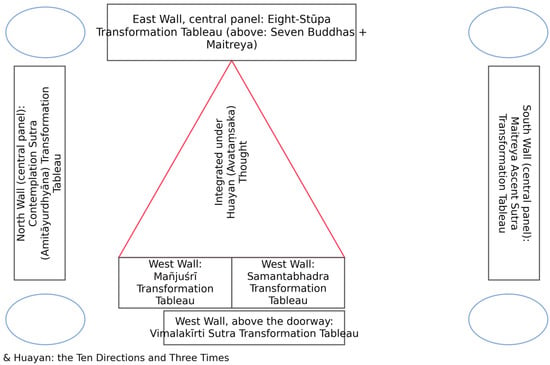
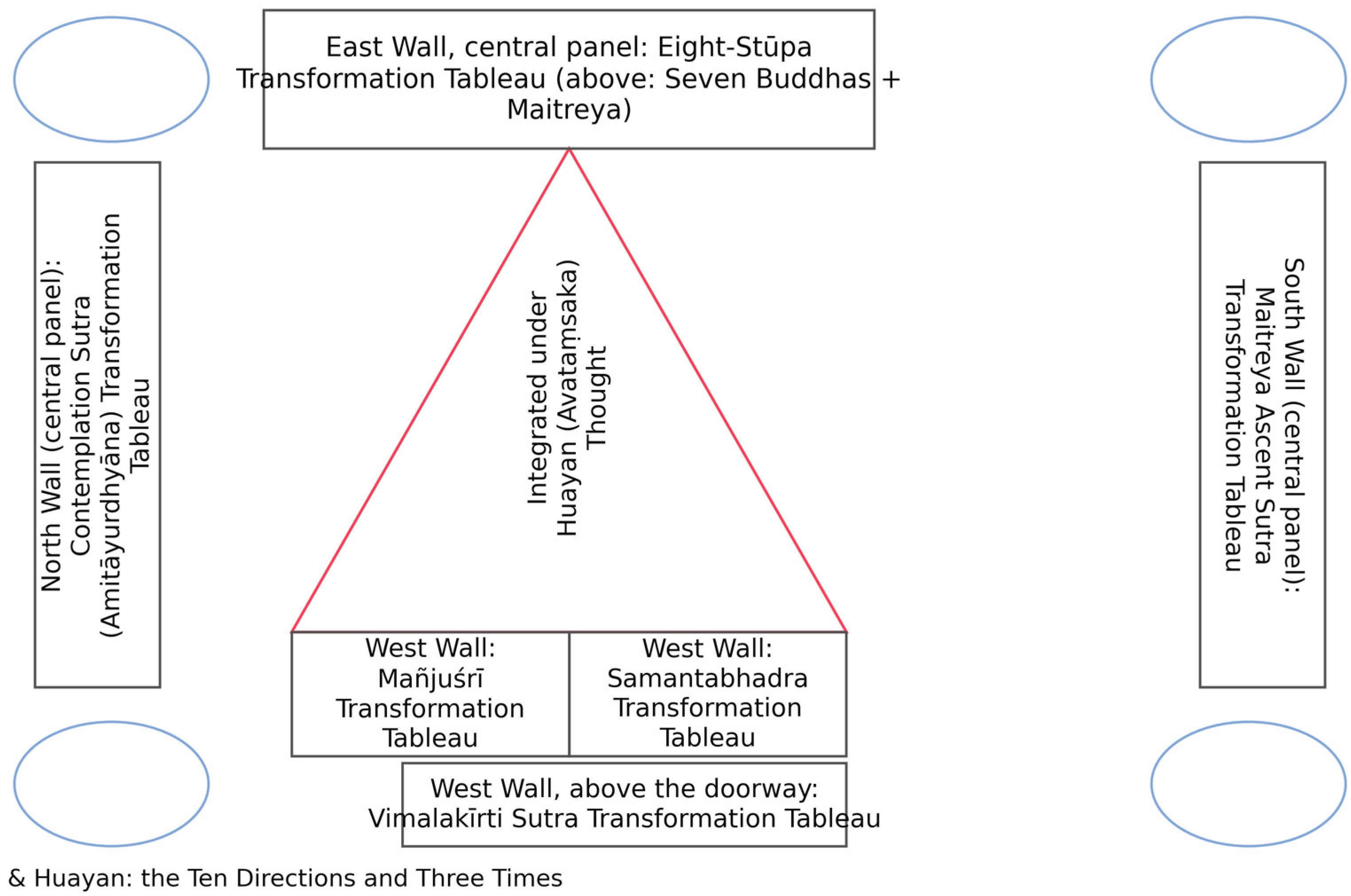

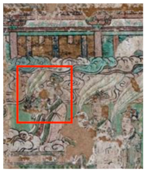
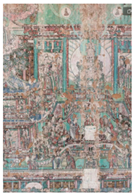
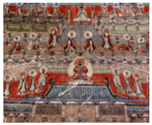
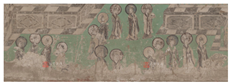
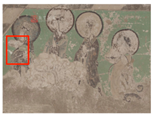
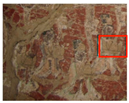
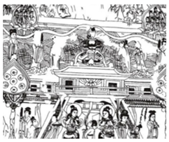
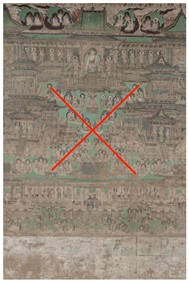
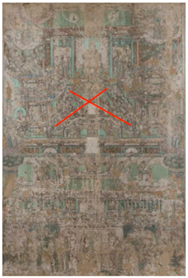
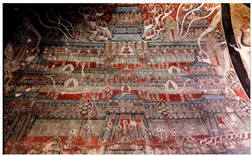
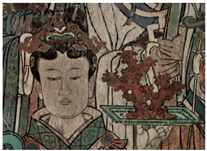
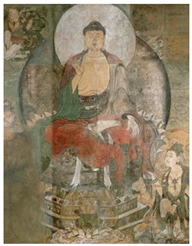
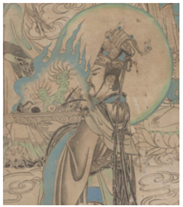
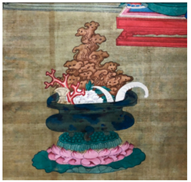
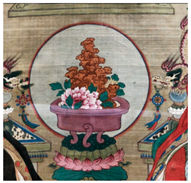
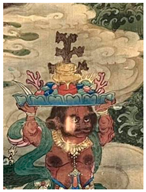
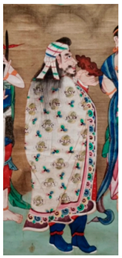
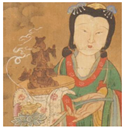
Disclaimer/Publisher’s Note: The statements, opinions and data contained in all publications are solely those of the individual author(s) and contributor(s) and not of MDPI and/or the editor(s). MDPI and/or the editor(s) disclaim responsibility for any injury to people or property resulting from any ideas, methods, instructions or products referred to in the content. |
© 2026 by the author. Licensee MDPI, Basel, Switzerland. This article is an open access article distributed under the terms and conditions of the Creative Commons Attribution (CC BY) license.