Article

Patching up Dunhuang Manuscripts of the Miaofa lianhua jing: Exploring the Buddhist Philological Significance of Textual Reconstruction

School of Humanities and Communication, Zhejiang University of Finance and Economics, Hangzhou 310018, China
Religions 2026, 17(6), 731; https://doi.org/10.3390/rel17060731
Submission received: 26 April 2026 / Revised: 4 June 2026 / Accepted: 8 June 2026 / Published: 18 June 2026

Abstract

The Miaofa lianhua jing 妙法蓮華經 is one of the most important scriptures of early Mahāyāna Buddhism, renowned as the “King of Sūtras”. It was extremely widely transmitted around the Tang Dynasty. More than 7000 scrolls of the Miaofa lianhua jing are preserved among the Dunhuang documents. However, many of these numerous manuscripts were split into two parts, or even divided into multiple fragments and scraps, which severely damaged their integrity. Therefore, it is necessary to join them together. After joining, the textual content of the scrolls can be restored, which facilitates in-depth research on Buddhist documents. This paper elaborates on the great significance of textual restoration of Dunhuang fragments of the Miaofa lianhua jing for Buddhist philology from four aspects: identifying the ten-scroll edition omitted in successive printed editions of the Chinese Buddhist Canon; promoting the collation and research of small unidentified Buddhist manuscript fragments; determining the authenticity of scroll fragments of unknown origin; and examining details concerning the circulation and restoration of Dunhuang Buddhist texts.

1. Introduction

After the Fahuajing 法華經 was introduced to China from India, several Chinese translations were produced through the work of eminent monks throughout history. Three complete translations survive today: The Zhengfahua jing 正法華經 translated by Dharmarakṣa 竺法護 in the Western Jin Dynasty, The Miaofa lianhua jing 妙法蓮華經 (Saddharmapuṇḍarīka-sūtra) translated by Kumārajīva 鳩摩羅什 in the Later Qin Dynasty, and The Tianpin miaofa lianhua jing 添品妙法蓮華經 (Saddharmapuṇḍarīka-sūtra with Additional Chapters) translated by Jñānagupta 闍那崛多 and Dharmagupta 達摩笈 in the Sui Dynasty. The Miaofa lianhua jing has attracted extensive academic inquiry, resulting in an impressive corpus of published research.1
Among the Dunhuang manuscripts, the versions of the Miaofa lianhua jing include both Kumārajīva’s original translation from the Northern and Southern Dynasties and revised editions supplemented by later generations. They possess extremely important textual value. The Dunhuang version of the Miaofa lianhua jing was transmitted over a long period, covering the Northern and Southern Dynasties, the Sui, Tang, and Five Dynasties, the Tibetan occupation period, and the Guiyi Army period. It serves as valuable material for the study of Miaofa lianhua jing devotion, medieval Buddhist history, and social history.
However, after the discovery of the Dunhuang Library Cave 敦煌藏經洞, the corrupt Qing government failed to protect and catalog its manuscripts in a timely manner. Foreign explorers including Aurel Stein, Paul Pelliot and Sergei Fedorovich Oldenburg flocked to Dunhuang and took away a large portion of the documents. Five fragmentary manuscripts, namely S.12318, S.9730, S.1641, S.9565 and S.1413 cited herein, were transported to Britain by Aurel Stein and are presently preserved at the British Library. Three fragments, Дx11996, Дx11994 and Дx2190, were taken to Russia by Sergei Fedorovich Oldenburg and are now held at the Institute of Oriental Manuscripts, Russian Academy of Sciences. The Qing government issued an imperial edict to transport Dunhuang manuscripts from Gansu 甘肅 to the Board of Education; these items were later transferred to the Metropolitan Library 京師圖書館, the predecessor of the National Library of China. Seven manuscripts including BD7552, BD6174, BD4849, BD6580, BD3322, BD1771 and BD8255 are preserved at the National Library of China. However, hundreds of fine manuscripts were appropriated by Li Shengduo 李盛鐸 and his associates by taking advantage of their official positions. Most of these pilfered scrolls were subsequently sold to Japan, with Yu534-2 presently housed at the Kyo-U Library in Japan. On their way to Beijing after being dispatched by the Qing government, Dunhuang manuscripts suffered repeated thefts, resulting in the dispersal of numerous scrolls. Among these, BeidaD47 is now held at Peking University Library and Jinyi145 at Tianjin Art Museum. Many manuscripts were fragmented, which has hindered the development of Dunhuang Studies. Professor Jiang Liangfu 姜亮夫 once elaborated on the necessity of joining Dunhuang fragmentary scrolls.2 The research team led by Professor Zhang Yongquan 張涌泉 has dedicated itself to the systematic reconstruction of fragmented Dunhuang manuscripts for over a decade and attained remarkable achievements.3 Regrettably, relatively few published results concern the codicological joins of the Miaofa lianhua jing. Hence, there is an urgent need to conduct a comprehensive joining of the Dunhuang manuscripts of the Miaofa lianhua jing.
The joining of scrolls not only restores the fragmented texts but also significantly advances research in Buddhist philology. Its value is mainly manifested in the following four aspects: (1) Restoring the original form of Miaofa lianhua jing manuscript fragments. Most Dunhuang manuscripts survive as fragmented scrolls or scraps. The philological concatenation of fragmented Miaofa lianhua jing scrolls from Dunhuang aims to reunite broken pieces originating from a single original manuscript, thereby restoring the codex’s intact physical form. (2) Determining the manuscript recension system. Although extant editions of the Miaofa lianhua jing vary in scroll divisions, their textual content is largely identical. Many fragmented scrolls cannot be attributed to a specific recension based merely on partial surviving text. However, collation via physical join with relatively complete manuscripts facilitates accurate classification of these fragments by textual lineage. (3) Remedying the deficiencies of printed editions of the Chinese Buddhist Canon. Compared with printed editions dating from the Song Dynasty onwards, early Chinese Buddhist manuscript copies better preserve the original textual features of Buddhist scriptures. Numerous fragmented scrolls of the Miaofa lianhua jing dating from the Southern and Northern Dynasties survive among Dunhuang manuscripts. Their philological concatenation helps supplement lacunae in woodblock-printed Buddhist canons compiled in subsequent dynasties. (4) Revealing the detailed restoration information of Dunhuang Buddhist scriptures. Many Dunhuang manuscripts of the Miaofa lianhua jing bear traces of historical repair. In antiquity, restorers occasionally pasted fragments from disparate scrolls together for conservation purposes. Such codicological reconstructions help illuminate the circulation, liturgical usage, repair history and secondary reuse of Dunhuang Buddhist sutra manuscripts.

2. Identifying the Ten-Volume Edition Omitted from Printed Buddhist Canons

The Miaofa lianhua jing exists in seven-scroll and eight-scroll editions in its transmitted versions. Among the Dunhuang manuscripts of the Miaofa lianhua jing, in addition to these two common textual formats, there are also a small number of ten-scroll versions. Kumārajīva’s original ten-scroll translation lacks the Devadatta Chapter 提婆達多品 and the repeated verses of the Universal Gate Chapter 觀世音菩薩普門品 of the Miaofa lianhua jing, thus containing only twenty-seven chapters. Moreover, beginning with the Persuasion to Maintain and Uphold the Dharma Chapter 勸持品, its chapter numbering is one fewer than that in the received editions.
Early studies on the ten-scroll version of the Miaofa lianhua jing among Dunhuang manuscripts were conducted by scholars including Kabutogi Shōkō 兜木正亨 and Fang Guangchang 方廣錩.4 The naming of the ten-volume edition is mainly determined by examining its head and tail titles, commentary titles, and textual ordering. However, among Dunhuang manuscripts, untitled fragmentary scrolls or fragments constitute the majority. Sometimes the above methods cannot be used for definite identification. By joining scrolls already identified as ten-volume versions with other fragments, more ten-volume versions can be verified.

2.1. Дx11996+Дx11994

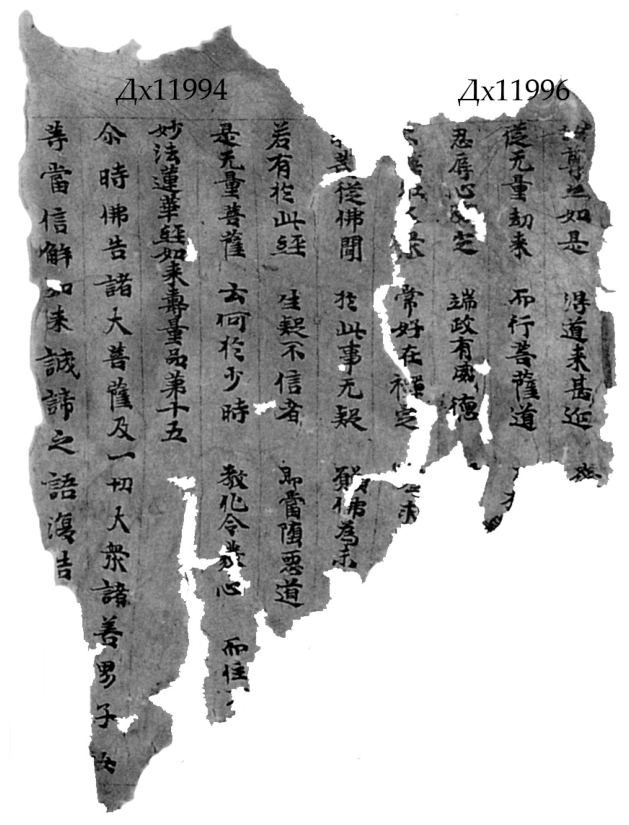
(1) Дx11996, see Russian Collections 俄藏 vol. 16, p. 16a.5 Fragmentary manuscript. As shown in the right part of Figure 1, four partial lines remain, with only the upper 10–13 characters preserved per line. Written in clerical-regular script (likai 隸楷), with black silk ruling lines. The original scroll is untitled; it is untitled in the Russian Collections. On the other hand, the Catalogue of Dunhuang Manuscripts in Russian Collections (Tai 2019) designates it as “Miaofa lianhua jing juan di wu congdi yongchu pin di shiwu” 妙法蓮華經卷第五從地踊出品第十五.
(2) Дx11994, see Russian Collections 俄藏 vol. 16, p. 16a. Fragmentary manuscript. As shown in the left part of Figure 1, seven partial lines remain, with approximately 18 characters per line. Written in clerical-regular script (likai 隸楷), with black silk ruling lines. The text contains the title “Miaofa lianhua jing rulai shouliang pin di shiwu” 妙法蓮華經如來壽量品第十五.
The two manuscripts mentioned above are consecutive in content and can be joined together. As shown in Figure 1, after joining, the two fragments are connected side by side in sequence. The three characters “zai 在” “chan 禪” and “wei 爲”, which originally belonged separately to Дx11996 and Дx11994 at their junction, can be roughly pieced together.
Furthermore, the two manuscripts share the same layout format (both feature colophonic lines, with roughly identical header heights; after supplementing the missing characters according to the complete text, each line contains approximately 18 characters, and the line spacing and character size are also similar). Their handwriting and calligraphic styles are alike (both are in semi-clerical script, with sharp starting strokes and connected stroke movements). This confirms that the two fragments were indeed torn from the same scroll. After the two fragments are joined, the preserved text begins with the phrase “Even so is the World-Honored One” 世尊亦如是 and ends with the remnant right portion of the second character in the phrase “Again proclaim to the multitude” 復告大衆. The corresponding text can be found in the Taishō Tripiṭaka at T no. 262, vol. 9, pp. 42a15–b2.
Figure 1. Schematic Diagram of the Joining of Дx11996 and Дx11994.
Religions 17 00731 g001
In addition, the text of Дx11994 bears the chapter title “Miaofa lianhua jing rulai shouliang pin di shiwu.” Compared with the Taishō Tripiṭaka edition, its chapter number is reduced by one, indicating that it is a fragment from Fascicle 7 of the ten-fascicle recension. Now that the two fragments mentioned above can be joined together, Дx11996 is also a fragment from Fascicle 7 of the ten-fascicle recension. The tentative title assigned in the Catalogue of Dunhuang Manuscripts in Russian Collections is therefore incorrect.

2.2. Дx2190+BeidaD47+BD7552+BD6174

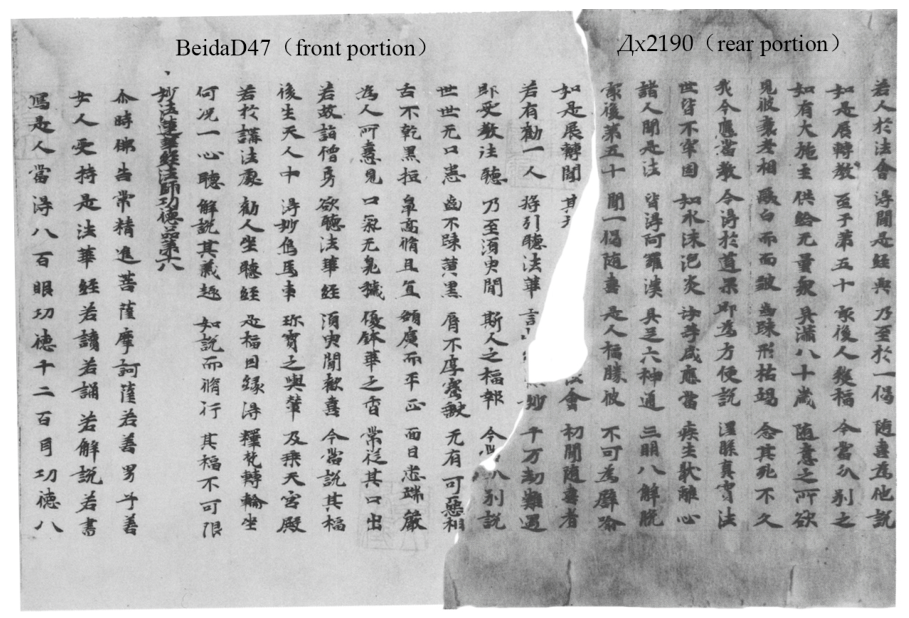
(1) Дx2190, as illustrated in Russian Collections vol. 9, pp. 78a–b, consists of two paper sheets. Its rear part, shown on the right side of Figure 2, preserves 28 lines (11 lines on the first sheet and 17 lines on the second; the upper parts of the first three lines are increasingly damaged, the last line retains only the residual right portions of two characters at the bottom, and the upper parts of the second to fourth lines from the end are all damaged). Each line contains 20 characters, with all extant text being verses. The script is clerical-regular script, with black silk lines. The original scroll bears no title; in Russian Collections, it is tentatively titled “Miaofa lianhua jing suixi gongde pin 18” 妙法蓮華經隨喜功德品第十八.
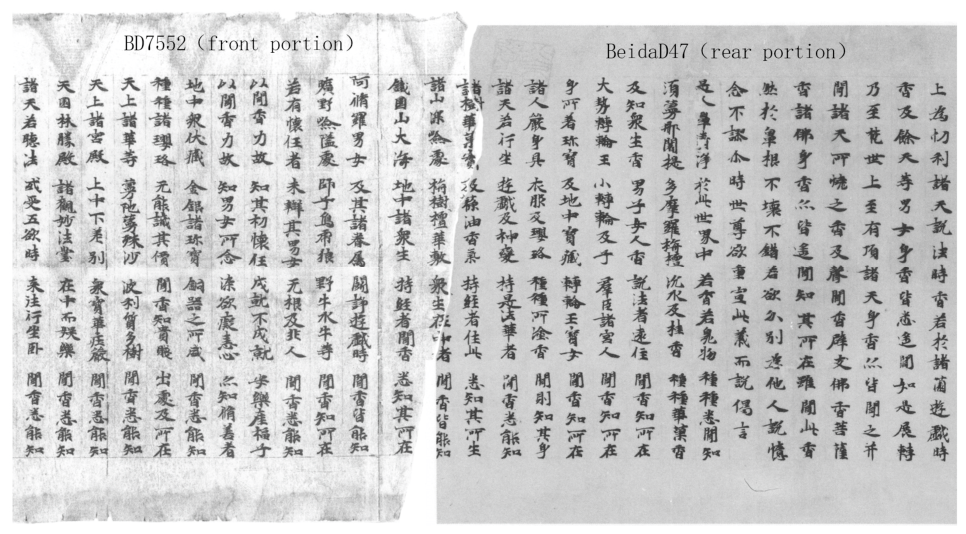
(2) BeidaD47, as illustrated in Beida 北大 vol. 1, pp. 194a–95b, and consists of three paper sheets.6 Its front part appears on the left side of Figure 2, and its rear part on the right side of Figure 3. A total of 94 lines are preserved (14 lines on the first sheet, 27 lines on each of the middle two sheets, and 26 lines on the last sheet). The first line preserves only seven characters at the top: five complete characters at the beginning of the line, plus two characters with only their left remnants. The lower parts of the following three lines show gradually diminishing damage. The last line retains only the right remnants of nine characters at the bottom, and the penultimate line has damage in its upper part. Each line contains 17 characters. The script is clerical-regular script, with black silk lines. The text bears the title “Miaofa lianhua jing fashi gongde pin 18” 妙法蓮華經法師功德品第十八.
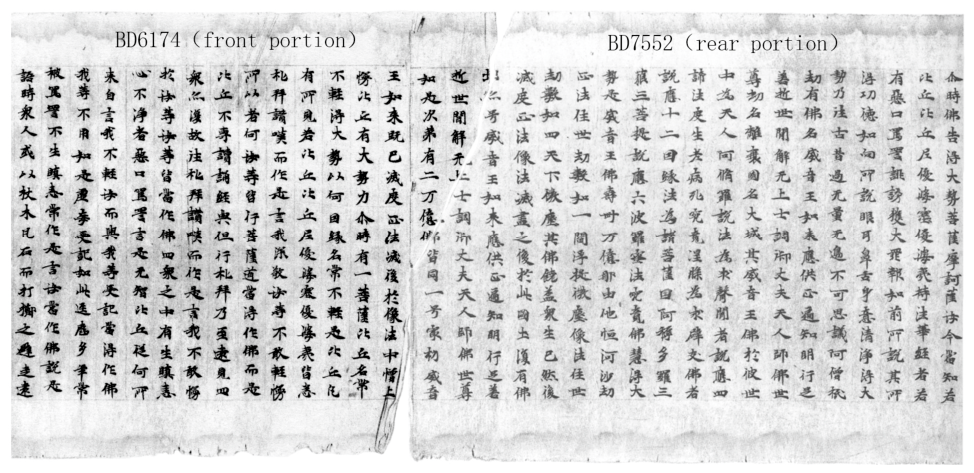
(3) BD7552 (Bei 北 5746; Ren 人 52) is illustrated in Guotu 國圖 vol. 97, pp. 310b–13a.7 It consists of five paper sheets. Its front part appears on the left side of Figure 3, and its rear part on the right side of Figure 4. Both ends are fragmented, with 111 lines preserved (3 lines on the first sheet, 27 lines on each of the following four sheets). Only four characters at the top remain in the first line, two complete characters at the beginning of the line, and two characters with only their left residual forms. The lower parts of the next two lines show gradually diminishing damage, while the upper parts of the last three lines exhibit increasingly severe damage. Each line contains 17 characters. The script is clerical-regular script, with black silk lines. Interlinear corrections and annotations are present. The text bears the title “Miaofa lianhua jing changbuqing pusa pin 19” 妙法蓮華經常不輕菩薩品第十九. According to the catalogue in Guotu, this scroll is a manuscript of the Southern and Northern Dynasties, dating to the 5th–6th centuries.
(4) BD6174 (Bei 北 5812; Jiang 薑 74), as shown in Guotu 國圖 vol. 82, pp. 312a–13b. Four paper sheets. The front part is illustrated in the left section of Figure 4. Sixty-three lines extant (The scroll consists of four sheets: the initial sheet bears three lines of text, the two middle sheets each contain twenty-seven lines, and the final sheet holds six lines. Only the left fragment of the first character survives on the opening line. Degradation affecting the lower margins of the subsequent two lines tapers off progressively, whereas deterioration along the bottom of the concluding four lines becomes increasingly severe.) Seventeen characters per line. Script in clerical-regular style with colophonic ruling lines. No original title on the scroll, Guotu catalogues it as the Miaofa lianhua jing juan liu 妙法蓮華經卷六. The annotated catalogue dates the scroll to the Northern and Southern Dynasties (5th–6th centuries).
Figure 2. Schematic Diagram of the Joining of Дx2190 (rear portion) and BeidaD47 (front portion).
Religions 17 00731 g002
Figure 3. Schematic Diagram of the Joining of BeidaD47 (rear portion) and BD7552 (front portion).
Religions 17 00731 g003
Figure 4. Schematic Diagram of the Joining of BD7552 (rear portion) and BD6174 (front portion).
Religions 17 00731 g004
The contents of the four manuscripts mentioned above are sequential and can be joined together. After joining, they are illustrated in Figure 2, Figure 3 and Figure 4 respectively. The four manuscripts are aligned side by side in sequence. At the junction between Дx2190 and BeidaD47, the character “miao” 妙, originally split between the two scrolls, is reunited as one, and the characters “shen” 深, “dangfen” 當分, and “xiang” 相 can also be largely reconstructed. At the junction between BeidaD47 and BD7552, the nine characters “zhushu” 諸樹, “shi” 實, “ji su” 及蘇, “zhong” 衆, and “zai zhong zhe” 在中者, originally divided between the two scrolls, are reunited as one. At the junction between BD7552 and BD6174, the six characters “chu yi” 出亦, “wushang” 无上, and “yi fo” 億佛, originally split between the two scrolls, are all reunited as one. Furthermore, the four manuscripts share approximately the same paper height and column format (all with bound lines, similar upper and lower margins, 17 characters per line, similar line spacing and character size). Their handwriting appears identical and their calligraphic styles are similar (all in clerical-regular script, with obvious raised horizontal-stroke starts and connected brushwork). This confirms that the four manuscripts were indeed split from the same original scroll.
In addition, the last sheet of Дx2190 contains 17 lines, and the first sheet of BeidaD47 contains 14 lines. When the two are joined, 27 lines are obtained after excluding the 4 overlapping lines. The last sheet of BeidaD47 contains 26 lines, and the first sheet of BeidaD47 contains 3 lines. When the two are joined, 27 lines are obtained after excluding the 2 overlapping lines. The last sheet of BD7552 contains 27 lines, and the first sheet of BD 6174 contains 3 lines. When the two are joined, 27 lines are obtained after excluding the 2 overlapping lines. This accords perfectly with the scroll’s standard format of 27 full lines per sheet, and thus serves as corroborating evidence. When the four fragments are joined together, the preserved text begins with the left remnants of the four characters following the phrase “the seat of a universal wheel-turning king” 若轉輪聖王所坐之處 and ends with the right remnant of the first character in the phrase “all beings attached to phenomena” 諸著法衆. The corresponding text can be found in the Taishō Tripiṭaka at T no. 262, vol. 9, pp. 47a8–51b21.
What is more, BeidaD47 bears the title “Miaofa lianhua jing fashi gongde pin 18”, and BD 7552 bears the title “Miaofa lianhua jing changbuqing pusa pin 19”. Both chapter numbers are one fewer than those in the Taishō Tripiṭaka edition. The two manuscripts are therefore identified as belonging to fascicle 8 of the ten-fascicle recension of the Miaofa lianhua jing. Thus, Dunhuang manuscript Дx2190 and BD 6174 must also be fragments of scroll 8 of the ten-volume version of the Miaofa lianhua jing. The tentative title “Miaofa lianhua jing suixi gongde pin 18” given in Russian Collections for Дx2190 is incorrect and should be revised to Miaofa lianhua jing suixi gongde pin 17.

3. Reconsidering the Value of Small Unidentified Buddhist Scripture Fragments

Among Dunhuang relics, there exists a considerable number of small unidentified Buddhist manuscript fragments. For instance, most of the Dunhuang fragments catalogued after S.8400 remain untitled, with only a very few bearing titles. These fragments preserve only limited textual content and are in poor physical condition,8 so they have rarely received sufficient attention from scholars. Some small unidentified fragments can be joined with other long scrolls, indicating that they were peeled off or broken off from other incomplete scrolls. Small fragments are an indispensable component of Dunhuang Buddhist scriptures and form the foundation for establishing the corpus of Dunhuang Buddhist manuscripts. They should not remain unorganized and unstudied for long. Manuscript fragment joining can revitalize these small fragments of Buddhist scriptures and better continue their “life”, as illustrated in the examples below.

3.1. BD4849+S.12318

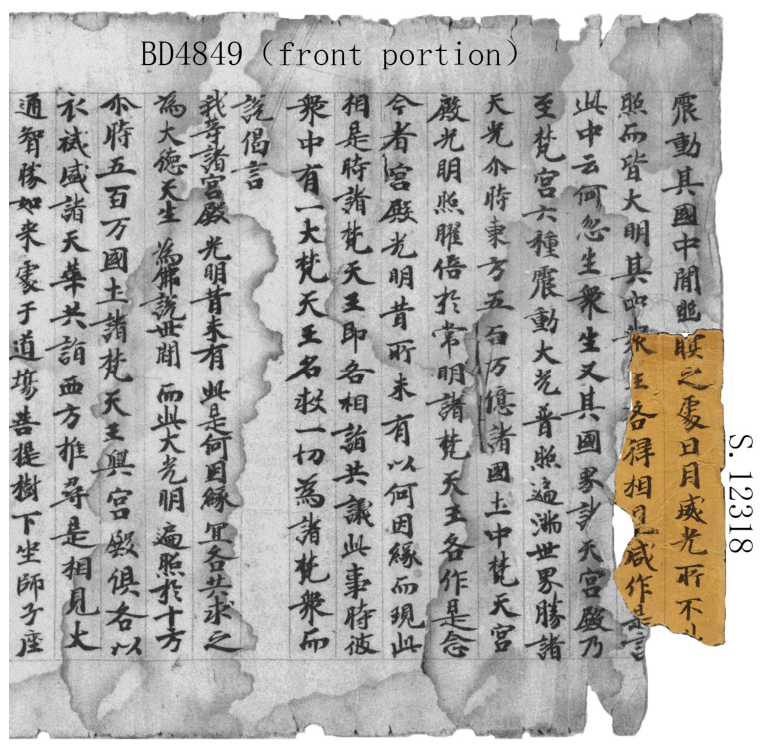
(1) BD4849 (Bei 北 5145; Ju 巨 49), is illustrated in Guotu vol. 64, pp. 405b–12a. It consists of eleven paper sheets. Its front part appears on the left and upper right of Figure 5. The manuscript is fragmentary at the beginning but complete at the end, with 278 lines preserved (28 lines on each of the first nine sheets, 26 lines on the tenth sheet, and the last sheet forming the tail of the scroll). Only eight characters at the top remain in the first line. The middle and lower parts of the second line are damaged, with only the left remnants of the last five characters extant. Each line contains 17 characters. The script is regular script (kaishu 楷書), with black silk lines. The colophon reads “Miaofa lianhua jing, Fascicle 3” 妙法蓮華經卷第三. According to the catalogue in Guotu, this scroll is written on yellow-sized paper, shows water stains on the surface, and dates to the 7th–8th centuries (Tang Dynasty).
(2) S.12318 is available on the IDP website.9 It is a fragment in scroll format. As shown in the lower right of Figure 5, 2 fragmented lines are preserved, with only 9–10 characters at the lower part extant in each line. The script is regular script (kaishu 楷書), with black silk lines. The original scroll bears no title; it remains untitled on the IDP website.
Figure 5. Schematic Diagram of the Joining of BD4849 (front portion) and S.12318.
Religions 17 00731 g005
The two fragments mentioned above are consecutive in content and can be joined together. As shown in Figure 5, after joining, the two fragments are connected vertically and horizontally in sequence. The five characters “ming” 暝, “zhong” 衆, “sheng” 生, “ge” 各, “shi” 是, originally belonging separately to the two fragments at their junction, are all reunited as one. Furthermore, the two fragments share the same layout format (both feature black silk lines; after supplementing the missing characters according to the complete text, each line contains 17 characters, and the line spacing and character size are also similar). Their handwriting and calligraphic styles are alike. (All are in regular script, with distinct outward-pointing tips at the start of horizontal strokes, outward flicking in the right-falling strokes, and connected brush flow throughout.) This confirms that the two fragments were indeed torn from the same scroll. After the two fragments are joined, the preserved text begins with the two characters following the phrase “six kinds of tremors” 六種震動 and ends with the colophon “Miaofa lianhua jing, Fascicle 3” 妙法蓮華經卷第三. The corresponding text can be found in the Taishō Tripiṭaka at T no. 262, vol. 9, pp. 23a13–27b9.

3.2. S.9730+S.1641

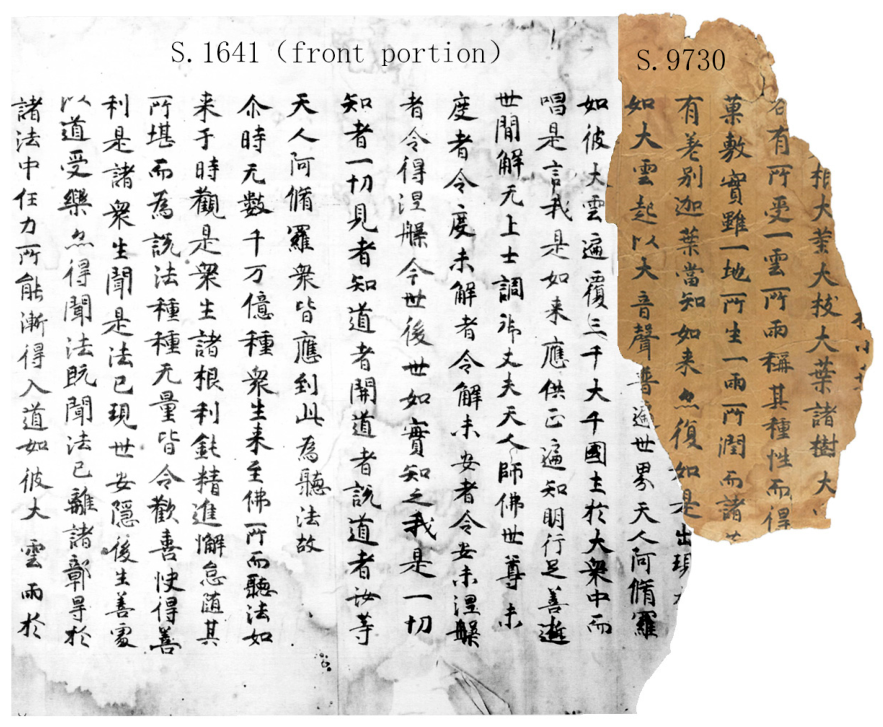
(1) S.9730 is available on the IDP website. It is a fragment. As shown on the right side of Figure 6, seven fragmentary lines are preserved, with only 1–15 characters in the upper part remaining in each line. The script is regular script with black silk lines. The surface of the scroll shows water stains and oil stains. The original scroll has no title; it remains untitled on the IDP website.
Figure 6. Schematic Diagram of the Joining of S.9730 and S.1641 (front portion).
Religions 17 00731 g006
(2) S.1641 is illustrated in Yingtu (Chinese Manuscripts from Dunhuang Collected in British Library 英圖) vol. 25, pp. 357a–70a. It consists of twenty-one paper sheets. Its front part appears on the left side of Figure 6. The manuscript is fragmentary at the beginning but complete at the end, with 541 lines preserved (8 lines on the first sheet, 28 lines on each of the middle nineteen sheets, and 1 line on the last sheet). Only the left remnants of five characters at the bottom remain in the first line. The second line preserves nine characters at the bottom, with only the left remnants of the first two characters extant. The upper part of the third line is slightly damaged, with only the left remnant of the third character remaining. Each line contains 17 characters. The script is regular script, with black silk lines. The text bears the titles “Miaofa lianhua jing shouji pin di liu” 妙法蓮華經授記品第六 “Miaofa lianhua jing huacheng yu pin di qi” 妙法蓮華經化城喻品第七. The colophon reads “Miaofa lianhua jing, Fascicle 3” 妙法蓮華經卷第三. According to the descriptive catalogue in Yingtu, this scroll is on yellow-sized paper, calendered and waxed, with water stains and oil stains, and is a Tang manuscript dating to the 7th–8th centuries.
The two manuscripts mentioned above are consecutive in content and can be joined. After joining, as illustrated in Figure 6, the two fragments are aligned side by side in sequence. At the junction, the five characters “rushi” 如是, “pubian” 普遍, and “da” 大, originally split between the two manuscripts, are fully restored. Furthermore, both manuscripts bear water stains and oil marks, and share an identical layout (both with ruled lines; when the missing characters are supplemented according to the complete text, each line contains 17 characters, with similar line spacing and character size). Their handwriting and calligraphic style are similar (both in regular script, with pronounced, forceful downward strokes and connected brushwork). This confirms that the two manuscripts were indeed torn from the same original scroll. When the two fragments are joined together, the preserved text begins with the left remnants of the three characters following the phrase “small branches and leaves” 小枝小葉 and ends with the colophon “Miaofa lianhua jing, Fascicle 3” 妙法蓮華經卷第三. The corresponding text can be found in the Taishō Tripiṭaka at T no. 262, vol. 9, pp. 19b2–27b9.

3.3. S.9565+S.1413

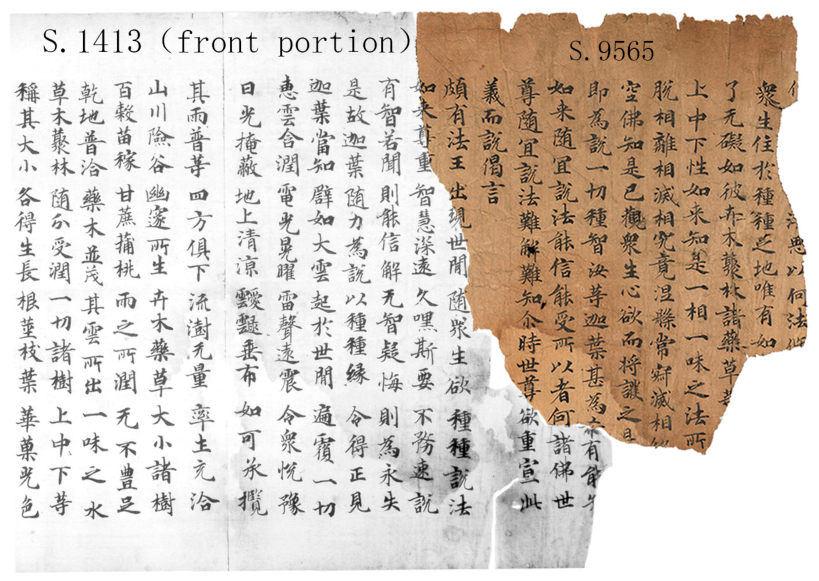
(1) S.9565 is available on the IDP website. It is a fragment. As shown in the upper right of Figure 7, twelve fragmentary lines are preserved, with only 4–15 characters in the upper part remaining in each line. The script is regular script with black silk lines. The surface of the scroll bears water stains. The original scroll has no title and remains untitled in IDP.
(2) S.1413, as illustrated in Yingtu vol. 22, pp. 59a–70b. It consists of nineteen paper sheets. Its front part appears on the left side of Figure 7. The manuscript is fragmentary at the beginning but complete at the end, with 510 inscribed lines preserved (10 lines on the first sheet, 28 lines on each of the middle seventeen sheets, and 24 lines on the last sheet). Only four characters at the lower part remain in the first line, with only the left remnants of the first character and the last two characters extant. The upper damage in the following four lines gradually diminishes. Each line contains 17 characters. The script is regular script with black silk lines. The text bears the titles “Miaofa lianhua jing shouji pin di liu” 妙法蓮華經授記品第六 “Miaofa lianhua jing huacheng yu pin di qi” 妙法蓮華經化城喻品第七. The colophon reads “Miaofa lianhua jing, Fascicle 3” 妙法蓮華經卷第三. According to the descriptive catalogue in Yingtu, this scroll is written on yellow-sized paper, shows water stains on the surface, and is a Tang manuscript dating to the 7th–8th centuries.
Figure 7. Schematic Diagram of the Joining of S.9565 and S.1413 (front portion).
Religions 17 00731 g007
The surviving text of the first fragment appears both in the Miaofa lianhua jing, juan san and the Supplemented Miaofa lianhua jing, juan san making its exact source difficult to determine. However, the contents of the two aforementioned fragments are sequentially continuous and can thus be joined together. After collation and joining, as shown in Figure 7, the two fragments are connected sequentially in vertical and horizontal directions. The characters originally separated in the two fragments at the joining area, “xihe” 希何, “zun” 尊, “chuxianshi” 出現世, “sui” 随, and “rulai zunzhong” 如來尊重, are all restored as unified clusters. Furthermore, both fragments show water stains on their surface and share the same layout format (both have black line columns; when the missing characters are supplemented according to the full text, each line contains 17 characters, with similar line spacing and character size). The handwriting is similar, and the calligraphic style and traces appear to be identical (both are in regular script, with varying ink density and distinct pointed starts on horizontal strokes). Based on the above evidence, these two fragments can be confirmed to have come from the same original scroll, torn apart. Since these two fragments can be fully joined, and the latter fragment bears the section title “Miaofa lianhua jing” and the colophon “Miaofa lianhua jing, Scroll 3”, it can be concluded that the former fragment must also be a remnant of Miaofa lianhua jing, Scroll 3. After joining, the preserved text begins with the left remnant stroke of the second character in the phrase “With what dharma shall one contemplate” 以何法念, and ends with the colophon “Miaofa lianhua jing, Scroll 3” 妙法蓮華經卷第三. The corresponding text can be found in Taishō Tripiṭaka at T no. 262, vol. 9, pp. 19b28–27b9.

4. Authentication of Controversial Fragmentary Scrolls

Since the discovery of the Library Cave at Dunhuang by Taoist priest Wang 王道士 in 1900, Dunhuang manuscripts have been scattered abroad and elsewhere, and forgeries were produced during this process. For example, most of the Dunhuang manuscripts preserved in the Tianjin Art Museum were donated by Zhou Shutao 周叔弢. Zhou Shutao’s old collection of Dunhuang scrolls mainly came from those formerly owned by Li Shengduo and Fang Erqian 方爾謙, which had circulated on the Tianjin market. Although this batch of scrolls is generally authentic, some forged manuscripts were mixed in among them. Similarly, forged scrolls also exist among public and private collections in Japan. If fragmentary scrolls of disputed authenticity can be joined together with other reliable fragments, their origin from the Dunhuang Library Cave will be verified.

4.1. Jinyi145+BD6580

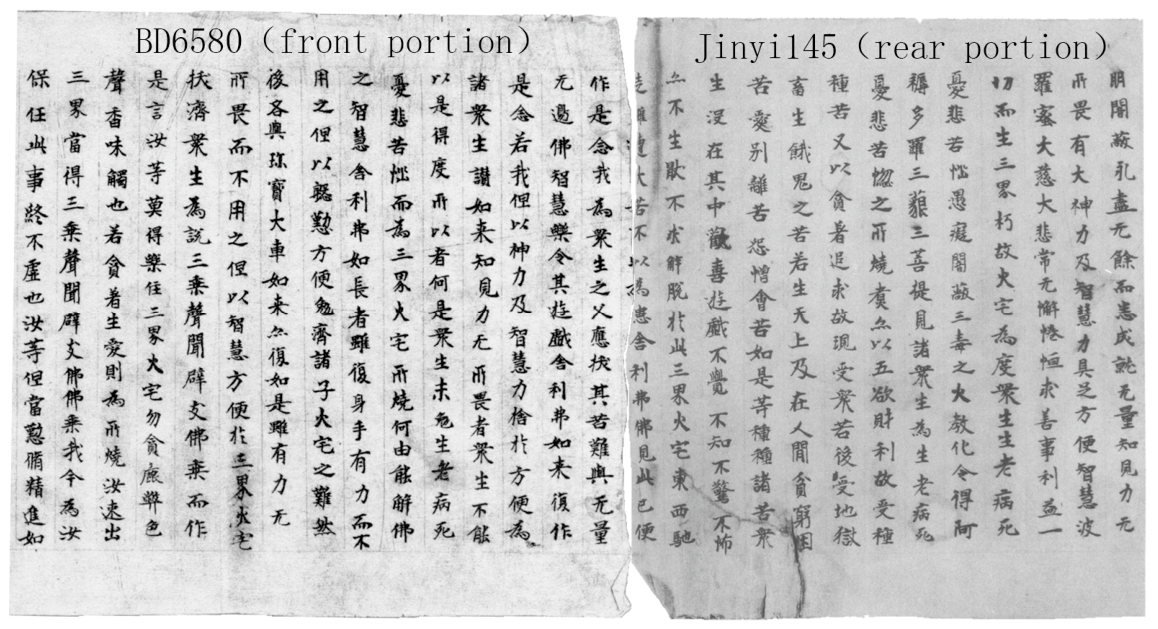
(1) Jinyi145, as shown in Jinyi vol. 3, pp. 129a–32b.10 Comprises seven sheets; paper height 25 cm. The rear portion is illustrated on the right in Figure 8. The scroll is damaged at the beginning and fragmented at the end, preserving 149 lines (1 line on the first sheet, 28 lines per sheet on the middle five sheets, 18 lines on the last sheet; in the uppermost eight characters of the final line, only the right fragments remain). Each line contains 17 characters. Written in regular script, with ruled columns. No original title appears on the scroll. Jinyi assigns the provisional title “Miaofa lianhua jing piyupin di san” 妙法蓮華經譬喻品第三. The catalogue entry notes extensive water stains on the surface, identifying it as a Tang-dynasty manuscript, formerly in the collection of Zhou Shutao.
(2) BD6580 (Bei 北 4766; Dan 淡 80), as shown in Guotu vol. 90, pp. 86b–96a. Consists of 16 sheets; paper height 25 cm. The front portion is illustrated on the left in Figure 8. The scroll is fragmentary at the beginning and complete at the end, preserving 421 lines (11 lines on the first sheet, 28 lines per sheet on sheets 2–6, 8–10, 12–15, 29 lines on sheet 7, 27 lines on sheet 11, 18 lines on the final sheet; in the first line, only the left fragments of six middle-upper characters remain). Each line contains 17 characters. Written in regular script, with black ruled columns. The text contains the heading “Miaofa lianhua jing xinjiepin di si” 妙法蓮華經信解品第四 and the colophon title “Miaofa lianhua jing, scroll two.” 妙法蓮華經卷第二 According to the catalogue in Guotu, the scroll is mounted with yellow backing paper, shows water stains on the surface, and is a Tang manuscript dating to the 7th–8th centuries.
Figure 8. Schematic Diagram of the Joining of Jinyi145(rear portion) and BD6580 (front portion).
Religions 17 00731 g008
The extant text fragments of Jinyi145 appear both in the Miaofa lianhua jing, juan er and the Supplemented Miaofa lianhua jing, juan er making its precise textual source difficult to determine. However, the contents of the two numbered scrolls mentioned above are sequential and contiguous, allowing them to be joined. As shown in Figure 8, the two pieces connect side by side in order after joining. At the junction between Jinyi145 and BD6580, the four characters “ku bu yi wei” 苦不以爲, which originally belonged to the two separate fragments, are restored to completeness, and the two characters “sui zao” 雖遭 can also be roughly pieced together. Furthermore, the two fragments share identical layout and format (both with black ruled columns; when the missing characters are supplemented according to the full text, each line contains 17 characters, with similar line spacing and character size). Their handwriting is alike, and their calligraphic style and traces appear consistent (both in regular script, with varying ink density and connected brushwork). On this basis, it can be confirmed that the two fragments were definitely torn from the same original manuscript scroll. Since the two fragments can be fully joined, and the latter bears the chapter title Miaofa lianhua jing and the colophon Miaofa lianhua jing, Scroll Two, the provisional title assigned to the former in Jinyi Miaofa lianhua jing piyu pin di san 妙法蓮華經譬喻品第三, is highly appropriate. When joined together, the preserved text begins with the phrase “Wo chang yu ri ye” 我常於日夜 [I constantly, day and night] and ends with the colophon “Miaofa lianhua jing, Scroll Two” 妙法蓮華經卷第二. The corresponding text can be found in Taishō Tripiṭaka at T no. 262, vol. 9, pp. 11a4–19a12.
Moreover, BD6580 was part of the early Dunhuang Library Cave materials acquired by the Metropolitan Library after the dispersal of the cave’s contents, and its authenticity is beyond doubt. Since Jinyi145 can be joined with BD6580, its authenticity is naturally confirmed as reliable.

4.2. Yu534-2+BD3322

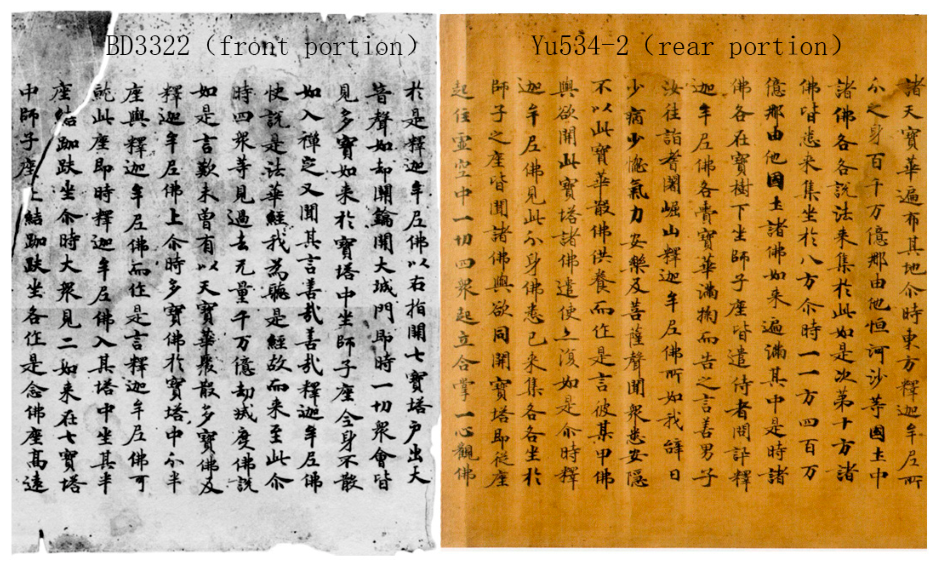
(1) Yu534-2, as shown in Miji vol. 7, pp. 55b–57a.11 Comprises 4 sheets; paper height 26.1 cm. The rear portion is illustrated on the right in Figure 9. The scroll is incomplete at both ends, preserving 112 lines (28 lines per sheet). Each line contains 17 characters. Written in regular script, with black ruled columns. The text bears the heading “Miaofa lianhua jing jianbaota pin di shiyi” 妙法蓮華經見寶塔品第十一.
(2) BD3322 (Bei 北 5363; Yu 雨 22), as shown in Guotu vol. 45, pp. 294a–99a. Consists of 9 sheets; paper height 26.1 cm. The front portion is illustrated on the left in Figure 9. The scroll is incomplete at both ends, preserving 239 lines (28 lines per sheet on the first eight sheets, 15 lines on the last sheet). Each line contains 17 characters. Written in regular script, with black ruled columns. The text bears the headings “Miaofa lianhua jing tipo daduo pin di shier” 妙法蓮華經提婆達多品第十二 and “Miaofa lianhua jing quanchi pin di shisan” 妙法蓮華經勸持品第十三. According to the descriptive catalogue in Guotu, the scroll is mounted with yellow backing paper, has a damaged hole in the first sheet, and is a Tang manuscript dating to the 7th–8th centuries.
Figure 9. Schematic Diagram of the Joining of Yu534-2 (rear portion) and BD3322 (front portion).
Religions 17 00731 g009
Both of the above-mentioned fragments belong to volume four of the Miaofa lianhua jing. Their texts are contextually continuous and can therefore be conjoined. After recombination, as shown in Figure 9, the two fragments are connected side by side in sequence. The phrase “Yi xin guan fo” 一心觀佛 [wholeheartedly contemplating the Buddha] at the end of the last line of Yu534-2 connects seamlessly with the opening phrase “Yu shi shi jia mou ni fo” 於是釋迦牟尼佛 [Then Śākyamuni Buddha]. Furthermore, the two fragments share the same paper height and layout format (both feature ruled lines; their top and bottom margins are of equal height, with 17 characters per line, similar line spacing and character size). Their handwriting is comparable (Please refer to the shared characters of the two fragments, including “ni” 尼, “ru” 如, “yan” 言, “zuo” 作, “fen” 分, “zhong” 中, “ci” 此, and “shi” 是. As shown in Table 1), and their calligraphic styles appear consistent (both in regular script, with obvious upward-turning starts to horizontal strokes, dense ink application, and connected brush movements). All this confirms that they were torn from the same manuscript scroll. After the joining of the two fragments, the preserved text begins with the phrase “Yu she zhu xie dai” 欲捨諸懈怠 [To abandon all laziness] and ends with “Fo zi zhi wo xin” 佛自知我心 [The Buddha knows my innermost mind]. The corresponding text can be consulted in Taishō Tripiṭaka, T no. 262, vol. 9, pp. 32a8–37a1.
BD3322 is an early item from the Dunhuang Library Cave that entered the collection of the Metropolitan Library after the dispersal of the cave manuscripts, and its authenticity is beyond doubt. Since Yu534-2 can be joined with BD3322, its genuineness is naturally reliable as well.

5. Reconstructing the Details of the Restoration of Buddhist Manuscripts

The nature of Dunhuang documents has long been a subject of diverse and conflicting opinions, with no consensus reached. The “restoration hypothesis” represents one prominent view, which holds that some Dunhuang manuscripts were used as material for repairing Buddhist scriptures, while others are Buddhist scriptures that had already been repaired. Shi Pingting 施萍婷 proposed that the Buddhist scriptures in the Library Cave at Dunhuang were directly related to a series of activities carried out by Daozhen in his time, such as “searching for ancient and damaged scriptures, bringing them into the temple, and repairing their beginning and end sections” (Shi 2015, pp. 319–47). Rong Xinjiang 榮新江 argues that “Daozhen’s work of repairing Buddhist scriptures continued uninterruptedly” (Rong 2001, p. 74). He also states that “the ancient and damaged scriptures collected by Daozhen from various temples were preserved in Sanjie Temple as materials awaiting repair, and eventually entered the Library Cave. The fragmentary scriptures, waste paper, wooden scroll ends, incomplete sutra wrappers, silk ribbons and other items observed by Stein in the Library Cave were preserved there as materials for repairing Buddhist scriptures, sutra wrappers and silk paintings” (Rong 2001, p. 75). Zheng Binglin 鄭炳林 holds that “repairing and piecing together collected fragmentary scriptures to form complete Buddhist scriptures with intact beginnings and ends” (Zheng 2002, p. 14) was one of the ways in which Daozhen and others preserved Buddhist scriptures from various Dunhuang temples. Lin Shitian 林世田 and others maintain that “the documents and cultural relics in the Library Cave are closely associated with Daozhen’s activities of collecting ancient and damaged scrolls and repairing Buddhist scriptures, and the repair of such fragmented scriptures should have been an important source of the scripture collection at Sanjie Temple.” (Lin et al. 2007, p. 25). Zhang Yongquan and others argue that “the Library Cave was precisely the ‘Gu Jing Chu’ (repository of old scriptures) where Daozhen gathered materials for restoration, which was entirely distinct from the scripture depository of Sanjie Temple. Daozhen collected damaged and obsolete scrolls from temples throughout Dunhuang for the purpose of ‘repairing their beginning and end sections’. Those scrolls restored and completed into sets were incorporated into the official scripture depository; the remaining fragments or duplicate copies were kept in the ‘Gu Jing Chu’ as reserve restoration materials, and ultimately constituted the genuine source of the documents found in the Library Cave.” (Zhang et al. 2021, p. 180).
Scholarly research on the ancient restoration of Dunhuang manuscripts has yielded abundant achievements by previous scholars. Nevertheless, certain traces of ancient restoration can only be revealed through textual fragment recombination. Next, taking BD 1771 and BD 8255 as an example, this paper discusses the significant role of fragment recombination in exploring the restoration of Dunhuang Buddhist manuscripts.

BD1771+BD8255

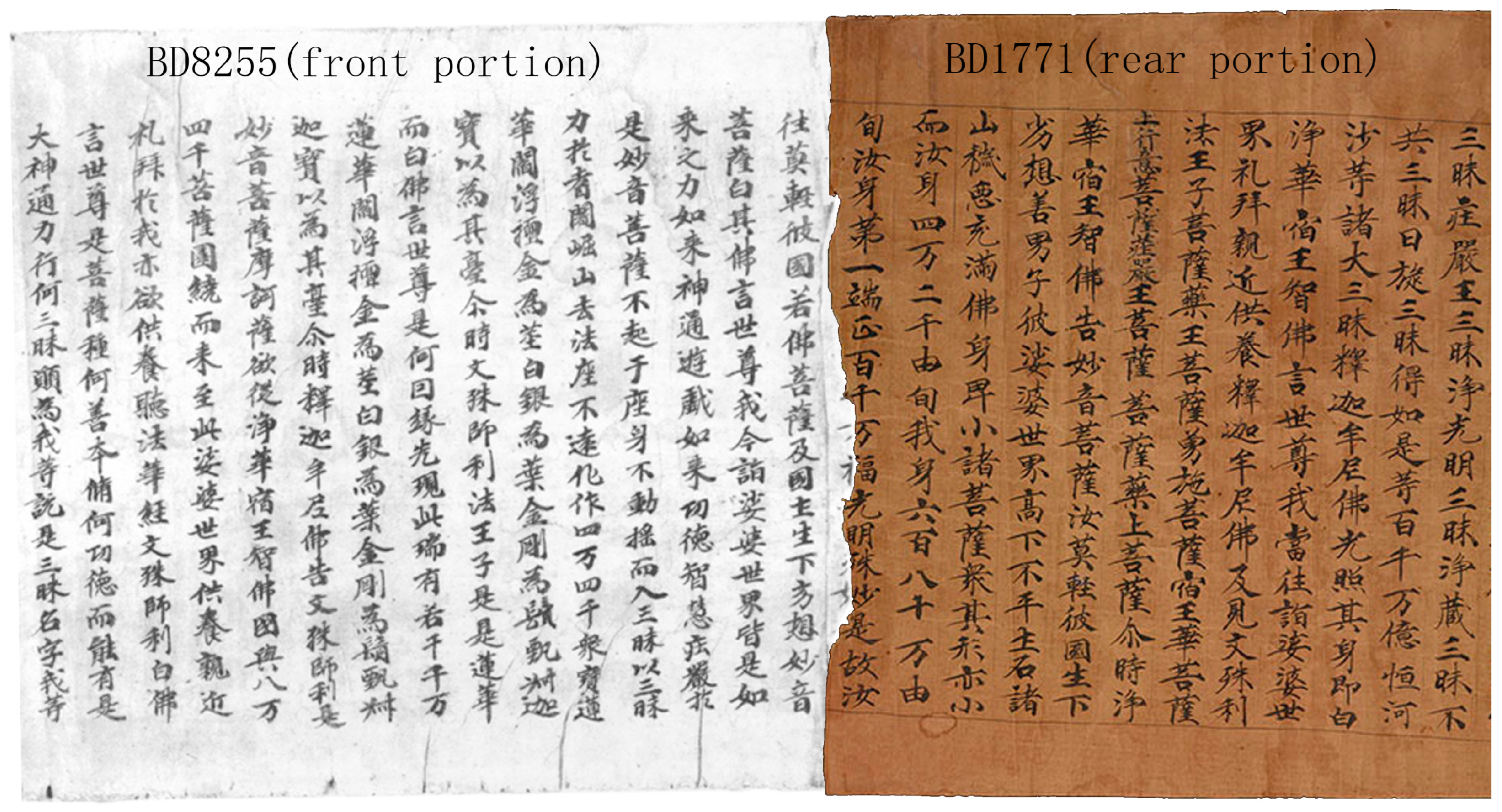
(1) BD1771 (Bei 北 5894; Wang 往 71) is available on the IDP website. The text consists of one sheet of paper, with a paper height of 25 cm. Its rear portion is shown on the right side of Figure 10. The scroll is complete at the front but fragmentary at the end, preserving 26 lines (The middle and lower parts of the final line are damaged and incomplete. Only the right residual strokes remain of the seven characters: “qian” 千 “wan” 萬 “fu” 福 “guang” 光 “zhu” 珠 “miao” 妙 “shi” 是). Each line contains approximately 17 characters. The script is regular script, with ruled lines present. The front inscription bears the title “Miaofa lianhua jing Miaoyin pusa pin di ershisi” 妙法蓮華經妙音菩薩品第二十四; beneath it appears the small character “seven” 七, indicating the serial number of the scroll. According to the descriptive catalogue of the Guotu, this scroll is an eighth-century Tang dynasty manuscript.
(2) BD8255 (Bei 北 5916; Fu 服 55), as seen in Guotu vol. 101, p. 347a–b. The manuscript consists of two sheets of paper, with a paper height of 25 cm. Its front portion is shown on the left side of Figure 10. The scroll is damaged at the beginning and missing at the end, preserving 28 lines (1 line on the first sheet and 27 lines on the second; only the left remnants of seven characters in the lower part of the first line remain). Each line contains approximately 18 characters. Written in regular script with boundary lines. The original scroll bears no title; Guotu assigns it the tentative title “Miaofa lianhua jing, juan qi” 妙法蓮華經卷七. According to the descriptive catalog, this manuscript was copied during the Guiyi Jun period, 9th–10th centuries.
Figure 10. Schematic Diagram of the Joining of BD1771+BD8255.
Religions 17 00731 g010
The surviving text of the latter fragment appears both in the Miaofa lianhua jing, juan 7, and in the Supplemented Miaofa lianhua jing, juan 7, making its precise source difficult to determine. Nevertheless, the contents of the two aforementioned fragments are sequentially continuous and can thus be joined together. As shown in Figure 10, after joining, the two fragments are connected side by side in sequence. The seven characters originally separated on the respective fragments, namely “qian” 千 “wan” 萬 “fu” 福 “guang” 光 “zhu” 珠 “miao” 妙 “shi” 是, are fully restored and integrated into complete textual units at the joint. However, the handwriting and calligraphic style of the second sheet of BD1771 differ from those of BD8255, and their layout formats are also distinct: the former has approximately 17 characters per line, while the latter has about 18 characters per line; the former also has larger character forms and wider inter-character spacing than the latter. It can therefore be confirmed that the second sheetsheets of BD1771 and BD8255 were not copied by the same scribe. According to the Catalogue of Guotu, BD1771 is dated to the Tang dynasty (8th century), and BD8255 to the Guiyi Army period (9th–10th centuries), which serves as corroborating evidence. Therefore, the assembly of BD 1771 + the first sheet of BD8255 and the second sheet of BD8255 should have been joined together by a restorer.

6. Conclusions

The collation of the Miaofa lianhua jing Dunhuang fragments not only restores the torn text but also offers new perspectives for the collation and further research of Buddhist documents.
First, it is necessary to determine the recensional affiliation of the Miaofa lianhua jing fragments. Although the sutra exists in different recensions divided into seven, eight, or ten scrolls, their contents are largely identical. For some fragments, their respective recensions cannot be determined based on partial text alone. However, joining them with relatively complete fragments facilitates the accurate identification of their textual systems.
Second, it remedies the deficiencies of printed Buddhist canons. Compared with the printed editions from the Song dynasty onward, early Chinese manuscript Buddhist scriptures better reflect the original form of the texts. Many fragments of the Miaofa lianhua jing from the Northern and Southern Dynasties are preserved among the Dunhuang manuscripts. Joining them together helps supplement the omissions and lacunae in later printed Buddhist canons.
Third, it advances the identification and authentication of Dunhuang Buddhist texts. Numerous small fragments of the Miaofa lianhua jing among Dunhuang manuscripts lack titles, and their precise identification is not possible based solely on their surviving contents or by comparison with other complete manuscripts or transmitted printed editions. Joining them with titled fragments helps resolve the problem of textual identification. During the dispersal of Dunhuang manuscripts, some scrolls have unclear provenance and their authenticity remains controversial. By joining them with other reliable fragments, we can verify their genuineness.
Lastly, many Dunhuang Miaofa lianhua jing manuscripts bear traces of repair: some were mended at the beginning and end, while others had missing middle sections supplemented. Joining these fragments therefore helps illuminate the circulation, use, restoration, and reuse of Dunhuang Buddhist manuscripts.

Funding

This research was funded by the Youth Project of the National Social Science Fund of China “Research on the Reconstruction of Fragmentary Dunhuang Manuscripts of the Fahuajing” 中國國家社會科學基金青年項目“敦煌本《法華經》殘卷綴合研究” (24CZJ012).

Institutional Review Board Statement

Not applicable.

Informed Consent Statement

Not applicable.

Data Availability Statement

No new data were created or analyzed in this study. Data sharing is not applicable to this article.

Conflicts of Interest

The author declares no conflict of interest.

Notes

1
For a deeper understanding of the textual content and parables of the Miaofa lianhua jing, see Hurvitz (1976). For a comprehensive exploration of the textual dissemination of the Miaofa lianhua jing alongside the historical development of Lotus-inspired religious devotion, one may refer to Lopez (2016). To gain thorough insight into the definition of individual terms in the Miaofa lianhua jing, readers may consult Seishi (2001).
2
Jiang (1987) stated: “There are tens of thousands of scrolls. Many were originally divided from a single original manuscript into several separate fragments. Separated, they suffer mutual loss; conjoined, they bring mutual benefit. Hence, their recombination is indispensable.”
3
For research findings concerning the reconstruction of fragmentary Dunhuang manuscripts, see Zhang and Zhang (2025), Zhang (2021), Zhang and Zhang (2012), et al.
4
Kabutogi (1978) identified a number of the ten-scroll manuscripts, while Fang (1997) also conducted an investigation into the ten-scroll version of the Miaofa lianhua jing.
5
“Дx” refers to the serial numbers of Dunhuang manuscripts in Dunhuang Manuscripts Collected in Russia (Menshikov and Qian 1992–2001; abbreviated as Russian Collection).
6
“BeidaD” refers to the serial numbers of Dunhuang manuscripts in Peking University Dunhuang Collection (Beijing Daxue Tushuguan and Shanghai Guji Chubanshe 1995, Shanghai Classics Publishing House; abbreviated as Beida).
7
“BD” refers to the serial numbers of Dunhuang manuscripts in Dunhuang Manuscripts Collected in the National Library of China (Ren 2005–2012; abbreviated as Guotu).
8
Frances Wood once described these small fragments: “They were never assigned catalogue numbers. Instead, they were placed in large blue cardboard boxes, separated line by line with white paper, and thereafter fell into complete neglect.” (Fang 2000, See Frances Wood’s Preface, p. 4).
9
“S.” refers to the Stein catalogue numbers of Dunhuang manuscripts, as seen in Chinese Manuscripts from Dunhuang Collected in British Library (Fang and Wood 2011–2017; abbreviated as Yingtu), The Dunhuang Treasures (Huang 1981–1986; abbreviated as Baozang), and the color images published on the IDP website.
10
“Jinyi” denotes the catalogue numbers of Dunhuang Manuscripts in the Collection of Tianjin Art Museum (Shanghai Guji Chubanshe and Tianjinshi Yishu Bowuguan 1996–1998; abbreviated as Jinyi).
11
“Yu” refers to the Haneda Toru numbers of Dunhuang documents in Dunhuang Miji, which reproduces the Dunhuang documents collected by the Japanese Kyo-U Library (Takeda Kagaku Shinkō Zaidan 2009–2013; abbreviated as Miji).

References

  1. Beijing Daxue Tushuguan 北京大學圖書館, and Shanghai Guji Chubanshe 上海古籍出版社, eds. 1995. Beijing Daxue Cang Dunhuang Wenxian 北京大學藏敦煌文獻. Dunhuang Manuscripts Collected in Peking University. Shanghai: Shanghai Guji Chubanshe. [Google Scholar]
  2. Fang, Guangchang 方廣錩. 1997. Dunhuang yishu zhong de Miaofa lianhua jing ji youguan wenxian 敦煌遺書中的《妙法蓮華經》及有關文獻 [The Lotus Sūtra and Related Documents in the Dunhuang Manuscripts]. Zhonghua Foxue Xuebao 中華佛學學報 [Chung-Hwa Buddhist Journal] 10: 208–30. [Google Scholar]
  3. Fang, Guangchang 方廣錩. 2000. Yingguo Tushuguan Cang Dunhuang Yishu Mulu (S.6981–S.8400) 英國圖書館藏敦煌遺書目録(斯6981號—斯8400號) [Catalogue of Dunhuang Manuscripts Preserved in the British Library (S.6981–S.8400)]. Beijing: Zongjiao Wenhua Chubanshe. [Google Scholar]
  4. Fang, Guangchang 方廣錩, and France Wood 吴芳思, eds. 2011–2017. Yingguo Guojia Tushuguan Cang Dunhuang Yishu 英國國家圖書館藏敦煌遺書 [Chinese Manuscripts from Dunhuang Collected in British Library]. 50 vols. Guilin: Guangxi Shifan Daxue Chubanshe. [Google Scholar]
  5. Huang, Yongwu 黄永武. 1981–1986. Dunhuang Baozang 敦煌寶藏 [Dunhuang Treasures]. 140 vols. Taibei: Xinwenfeng Chuban Gongsi. [Google Scholar]
  6. Hurvitz, Leon. 1976. Scripture of the Lotus Blossom of the Fine Dharma. Buddhist Studies and Translations. New York: Columbia University Press. [Google Scholar]
  7. Jiang, Liangfu 姜亮夫. 1987. Dunhuangxue Lunwenji 敦煌學論文集 [Collected Works on Dunhuang Studies]. Shanghai: Shanghai Guji Chubanshe. [Google Scholar]
  8. Kabutogi, Shōkō 兜木正亨. 1978. Sutain, Perio shūshū Tonkō Hokekyō mokuroku スタイン、ペリオ蒐集敦煌法華経目録 [Catalogue of the Lotus Sutra Manuscripts from Dunhuang Collected by Stein and Pelliot]. Tokyo: Reiyūkai. [Google Scholar]
  9. Lin, Shitian 林世田, Ping Zhang 張平, and Daying Zhao 趙大瑩. 2007. Guojia tushuguan suo cang Daozhen youguan xiejuan gudai xiufu qianxi 國家圖書館所藏與道真有關寫卷古代修復淺析 [A Preliminary Analysis of Ancient Repairs on Manuscripts Related to Daozhen in the Collection of the National Library of China]. Zhongguo Dianji Yu Wenhua 中國典籍與文化 [Chinese Classics and Culture] 3: 25–31. [Google Scholar]
  10. Lopez, Donald S., Jr. 2016. The Lotus Sūtra: A Biography. Lives of Great Religious Books. Princeton and Oxford: Princeton University Press. [Google Scholar]
  11. Menshikov, Lev Nikolaevich 孟列夫, and Bocheng Qian 錢伯城, eds. 1992–2001. E Cang Dunhuang Wenxian 俄藏敦煌文獻 [Dunhuang Manuscripts in Russian Collections]. 17 vols. Shanghai: Shanghai Guji Chubanshe. [Google Scholar]
  12. Ren, Jiyu 任繼愈, ed. 2005–2012. Guojia Tushuguan Cang Dunhuang Yishu 國家圖書館藏敦煌遺書 [Dunhuang Manuscripts in the National Library of China]. 146 vols. Beijing: Beijing Tushu Chubanshe. [Google Scholar]
  13. Rong, Xinjiang 榮新江. 2001. Dunhuangxue Shibajiang 敦煌學十八講 [Eighteen Introductory Lectures Focusing on the Core Issues of Dunhuang Studies]. Beijing: Beijing Daxue Chubanshe. [Google Scholar]
  14. Seishi, Karashima 辛嶋静志. 2001. A Glossary of Kumarajiva’s Translation of the Lotus Sūtra. Tokyo: The International Research Institute for Advanced Buddhology, Sōka University. [Google Scholar]
  15. Shanghai Guji Chubanshe 上海古籍出版社, and Tianjinshi Yishu Bowuguan 天津市藝術博物館, eds. 1996–1998. Tianjinshi Yishu Bowuguan Cang Dunhuang Wenxian 天津市藝術博物館藏敦煌文獻 [Dunhuang Manuscripts in the Collection of Tianjin Art Museum]. 7 vols. Shanghai: Shanghai Guji Chubanshe. [Google Scholar]
  16. Shi, Pingting 施萍婷. 2015. Sanjie Si · Dao Zhen · Dunhuang Cangjing 三界寺·道真·敦煌藏經 [Sanjie Temple, Daozhen, and the Dunhuang Canon]. In Dunhuang Shiku Yu Wenxian Yanjiu 敦煌石窟與文獻研究 [Studies on Dunhuang Caves and Documents]. Hangzhou: Zhejiang Daxue Chubanshe, pp. 319–47. [Google Scholar]
  17. Tai, Huili 邰惠莉, ed. 2019. E Cang Dunhuang Wenxian Xulu 俄藏敦煌文獻敘録 [Catalogue of Dunhuang Manuscripts in Russian Collections]. Lanzhou: Gansu Jiaoyu Chubanshe. [Google Scholar]
  18. Takeda Kagaku Shinkō Zaidan 武田科學振興財團, ed. 2009–2013. Dunhuang Miji 敦煌秘笈 [Dunhuang Secret Manuscripts]. 9 vols. Ōsaka: Takeda Kagaku Shinkō Zaidan. [Google Scholar]
  19. Zhang, Yongquan 張涌泉. 2021. Zhuihe yu Dunhuang canjuan de dingming: Dunhuang canjuan zhuihe de yiyi zhiyi 綴合與敦煌殘卷的定名——敦煌殘卷綴合的意義之一 [Reconstruction and Designation of Dunhuang Fragments: One Significance of Fragment Joining]. Wenxian 文獻 [The Documentation] 1: 103–15. [Google Scholar]
  20. Zhang, Yongquan 張涌泉, and Lei Zhang 張磊. 2025. Pinjie Silu Wenming: Dunhuang Canjuan Zhuihe Yanjiu 拼接絲路文明——敦煌殘卷綴合研究 [Piecing together the Silk Road: Manuscript Fragments from Dunhuang]. Beijing: Zhonghua Shuju. [Google Scholar]
  21. Zhang, Yongquan 張涌泉, and Xinpeng Zhang 張新朋. 2012. Dunhuang canjuan zhuihe yanjiu敦煌殘卷綴合研究 [A Study on the Joining of Dunhuang Fragments]. Wenshi 文史 [Literature and History] 3: 313–30. [Google Scholar]
  22. Zhang, Yongquan 張涌泉, Mujun Luo 羅慕君, and Ruoxi Zhu 朱若溪. 2021. Dunhuang cangjingdong zhimi fafu 敦煌藏經洞之謎發覆 [Unlocking the Dunhuang Library Cave Mystery]. Zhongguo Shehui Kexue 中國社會科學 [Social Sciences in China] 3: 180–203+208. [Google Scholar]
  23. Zheng, Binglin 鄭炳林. 2002. Wan Tang Wudai Dunhuang sanjiesi cang jing yanjiu 晚唐五代敦煌三界寺藏經研究 [A Study of the Scripture Collection at Sanjie Temple in Dunhuang During the Late Tang and Five Dynasties]. Xibei Di’er Minzu Xueyuan Xuebao 西北第二民族學院學報 [Journal of the Second Northwest University for Nationalities] 4: 11–17. [Google Scholar]

Table 1. Character Comparison of Yu534-2 and BD3322.
Collection Number
Yu534-2Religions 17 00731 i001Religions 17 00731 i002Religions 17 00731 i003Religions 17 00731 i004Religions 17 00731 i005Religions 17 00731 i006Religions 17 00731 i007Religions 17 00731 i008
BD3322Religions 17 00731 i009Religions 17 00731 i010Religions 17 00731 i011Religions 17 00731 i012Religions 17 00731 i013Religions 17 00731 i014Religions 17 00731 i015Religions 17 00731 i016
Disclaimer/Publisher’s Note: The statements, opinions and data contained in all publications are solely those of the individual author(s) and contributor(s) and not of MDPI and/or the editor(s). MDPI and/or the editor(s) disclaim responsibility for any injury to people or property resulting from any ideas, methods, instructions or products referred to in the content.