Elucidating and Collating the True Scriptures: A Study of the Newly Discovered Qing-Dynasty Editions of the Nanbei dou jing chanwei


Abstract
1. Introduction
2. Textual Overview
2.1. The Dongjing Association, Spirit-Written Scripture, and the Textual Character of the Chanwei Editions
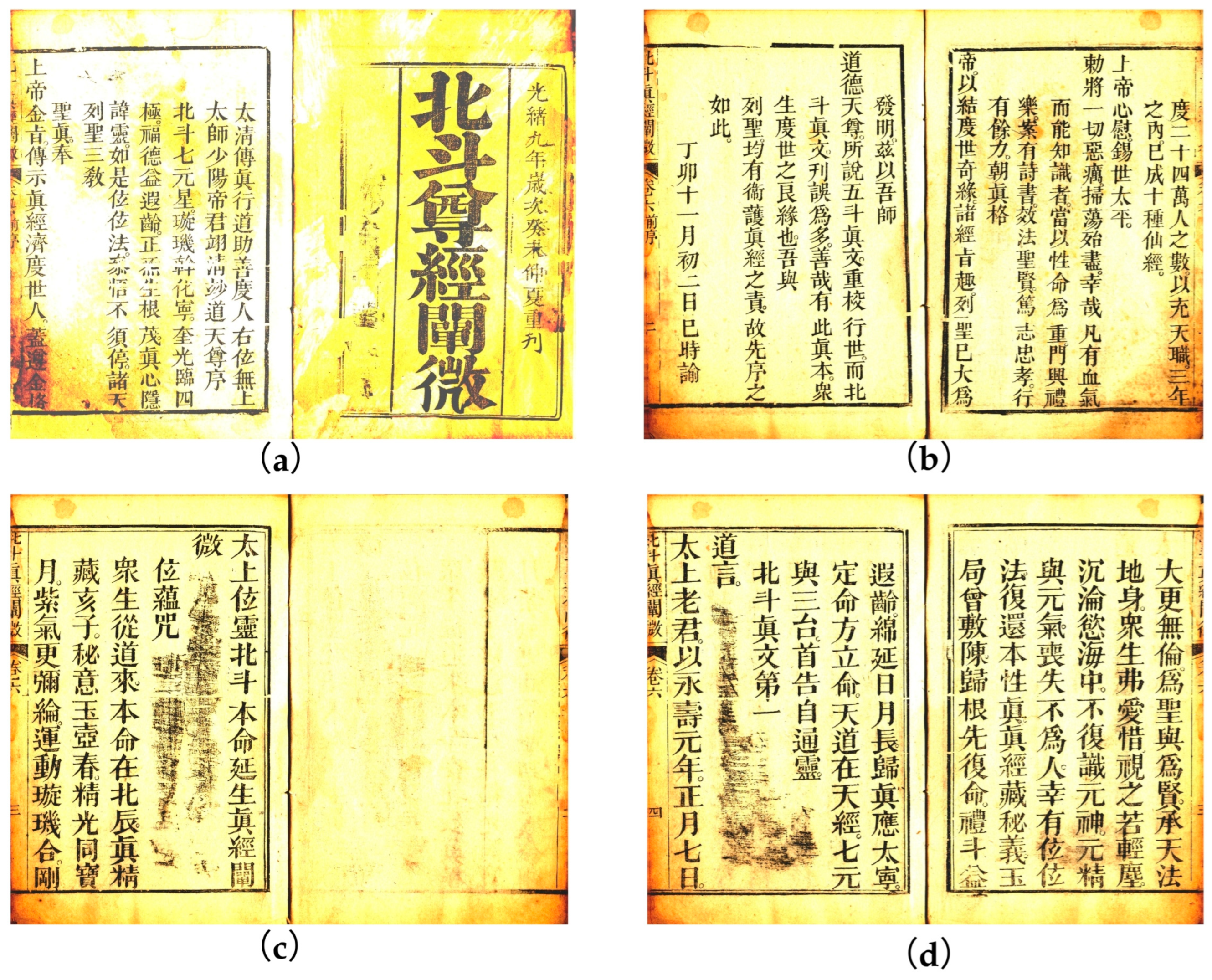
2.2. Si Zhao’s Beidou jing chanwei
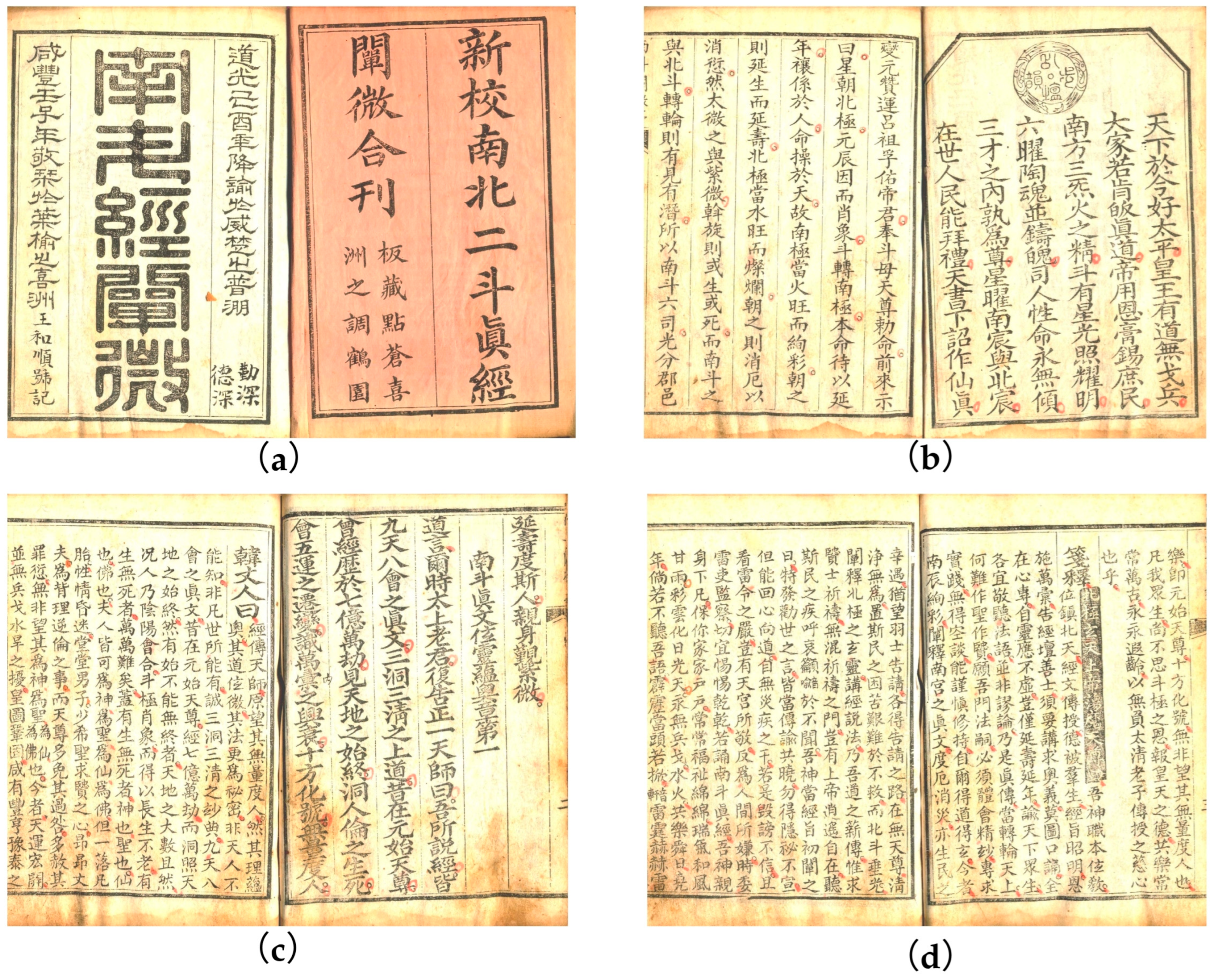
2.3. Xie and Gao’s Nandou jing chanwei
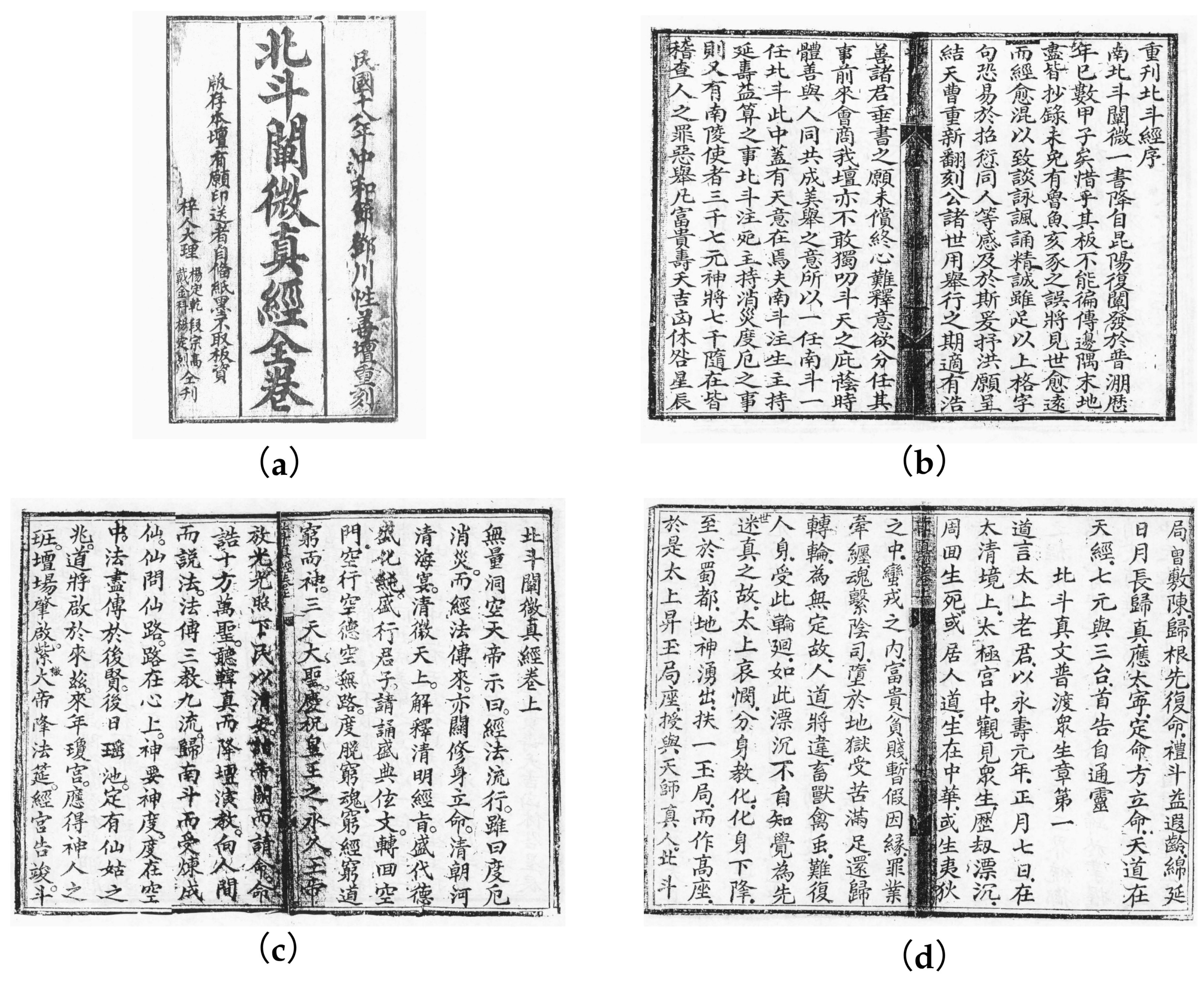
2.4. Xie and Gao’s Beidou jing chanwei
3. Philological Value
3.1. The Beidou jing chanwei: Collation Between the Old and New Recensions
3.2. The Nandou jing chanwei: The Philological Significance of an Independent Base Text
4. Doctrinal Character
4.1. The Beidou jing chanwei: Reconstructing Astral Doctrine Within the Three-Teachings Framework
The twenty-four calamities are all self-made; the resentful pneumas surge to heaven and stir the Sovereign on High. As the Seven Sovereigns revolve they are all dissolved; through three generations of numinous penetration one becomes akin to the sages.The twenty-four calamities bring suffering without end, yet among hundreds of thousands of souls none has heard of this. Those who pay reverence at the true [altars] and perform obeisance to the Dipper receive abundant divine responses—do not begrudge the burning of aloes and sandalwood in the jade cauldron.二十四厄皆自作,冲霄怨氣動皇天。七元運轉咸消釋,三世通靈擬聖賢。二十四厄無窮苦,百千萬姓總無聞。朝真禮斗多神應,莫惜沉檀玉鼎焚。(Beidou jing chanwei, pp. 16–17)
4.2. The Nandou jing chanwei: Systematization and Inner-Alchemical Transformation of the Southern Dipper Faith
The stars pay court to the Northern Pole, and the natal spirit takes its form therefrom; the Dipper revolves about the Southern Pole, and the natal destiny awaits its extension of years thereby. Calamity-averting rites pertain to humanity; the governance of destiny pertains to Heaven. Thus when the Southern Pole reaches the height of fire’s florescence and blazes with brilliance, those who pay obeisance to it shall have their life extended and their years prolonged. When the Northern Pole reaches the height of water’s florescence and shines with splendor, those who pay obeisance to it shall have their calamities dissolved and their transgressions expiated… As for the Eastern Dipper, it is concerned with recording birth; the Western Dipper, with recording death—these are reckoned in terms of punitive and overcoming phase relationships and are not in truth the actual governors of the limits of life and death set by natal destiny. The Southern Dipper has from time immemorial revolved in a manner invisible to the world, for it enters the earth by thirty-six degrees and is hidden at night but visible by day.星朝北極,元辰因而肖象;斗轉南極,本命待以延年。禳係於人,命操於天,故南極當火旺而絢彩,朝之則延生而延壽。北極當水旺而燦爛,朝之則消厄以消愆。……他若東斗則在注生矣,西斗則在注死矣,此以刑尅而論並,非實主乎生死命限者也。從來南斗轉輪,在無世所得見,蓋入地三十六度,夜隱而晝見也。(Nandou jing chanwei, vol. 1, preface, p. 1)
The Confucians say: the hun returns to Heaven; the po returns to Earth. They further say: those who receive the numinosity of yang become spirits; those who receive the numinosity of yin become ghosts. These words are indeed perceptive. But to what does that which returns to Heaven return? It returns to the Southern Dipper. To what does that which returns to Earth return? It returns to the Northern Dipper. The numinosity of yang is the Southern Dipper; the numinosity of yin is the Northern Dipper. This is why the hun belongs to yang and becomes a spirit, and the po belongs to yin and becomes a ghost. The Northern Dipper occupies the Palace of Kan and governs the Yin Bureau; it presides over the death of humanity, rectifying the balance of transgression and merit, good and evil… Is it not the Northern Dipper to which the hun is bound? What achievement could surpass that of the Northern Dipper? The Southern Dipper occupies the Palace of Li and governs the Yang Office; it presides over the birth of humanity, examines the balance of transgression and merit, good and evil, and causes those who are good to ascend to the Southern Palace, where the po-soul undergoes refining and salvation儒家云:魂歸於天,魄歸於地。又曰:得陽之靈者爲神,得陰之靈者爲鬼。此言良有見也。但歸於天者何所歸?歸於南斗也。歸於地者何所歸?歸於北斗也。陽之靈則爲南斗,陰之靈則爲北斗。魂所以屬陽而爲神,魄所以屬陰而爲鬼。然北斗位處坎宫,主司陰府,謂人之死也,校正罪福善惡。……魂非繫於北斗乎?北斗之功,孰大於是?南斗位處離宫,主司陽官,謂人之生也。考校罪福善惡,而善者則超昇南宫,魄受煉度。(Nandou jing chanwei, vol. 1, pp. 15–16)
The Southern Dipper is yang; yang governs growth and flourishing, and therefore extends life and saves humanity. The Northern Dipper is yin; yin governs severance and destruction, and therefore resolves calamities and dispels disaster. One yin and one yang preside over death and life, with beginning and end, without cessation. Hence to cultivate the wondrous Way, one must obtain the two pneumas of yin and yang, bring together kan and li, distinguish east from west, keep dragon and tiger undisturbed, and achieve the mutual completion of water and fire; then the primordial pneuma will naturally return to the furnace, the golden elixir will be perfected, and one will be able to save the world, save others, and save oneself.南斗則爲陽,陽主生長,故延壽而度人;北斗則爲陰,陰主肅殺,故解厄而消災。一陰一陽,主死主生,有始有終,無窮無盡。故修行妙道,必須得陰陽二炁,會合坎離,分辨東西,龍虎不驚,水火既濟,自然祖炁歸爐,金丹成而方能度世、度人、度身也。(Nandou jing chanwei, vol. 1, pp. 11–12)
5. Conclusions
Funding
Institutional Review Board Statement
Informed Consent Statement
Data Availability Statement
Conflicts of Interest
| 1 | Spirit-writing (fuji 扶乩) is a technique of communication between humans and deities through divination, in which one or two operators known as planchette mediums (jishou 乩手) hold a Y-shaped wooden stylus and, under the guidance of a descending deity, trace characters in a sand-filled tray. A reader standing beside calls out the characters as they appear, while a scribe records them on paper. Scholarship on spirit-writing has accumulated considerably in both Western and Chinese academic circles. In the Western scholarly literature, David K. Jordan and Daniel L. Overmyer’s The Flying Phoenix offered a combined ethnographic and historical study of spirit-writing religious groups in Taiwan, inspiring sustained scholarly attention to the phenomenon in subsequent decades (Jordan and Overmyer 1986). Philip Clart argued that spirit-writing constitutes a form of mediumship centered on moral cultivation, in which the self-cultivation of elite literati and the revelatory transmission of divine perfected mutually reinforce each other (Clart 2003). Lai Chi-tim has systematically examined the institutional standing and devotional functions of spirit-writing altars centered on the cult of Patriarch Lü within Qing religious life (Lai 2015). Goossaert’s recent monograph offers the most comprehensive synthetic treatment to date, tracing the historical development of spirit-writing from the Song–Yuan period onwards and proposing an analytical typology distinguishing narrative accounts, revealed texts, and ritual documents (Goossaert 2022a). In the Chinese scholarly literature, Xie Conghui 謝聰輝 has analyzed the typology of Daoist scripture production through the phenomenon of “flying phoenix revelation (feiluan kaihua 飛鸞開化)” in Song-dynasty Wenchang scriptures (Xie 2010); Wang Jianchuan 王見川 has traced the forms of planchette practice in the Song through Ming periods (Wang 2020); and Fan Chunwu 范純武 has examined spirit-writing techniques in Ming–Qing daily-use encyclopedias (Fan 2022). The scripture-composition activities examined in the present article find clear points of reference in the tradition illuminated by these studies. |
| 2 | Zhang Sanfeng had deep connections with the Northern Dipper tradition. The Guizhou tongzhi 貴州通志 compiled during the Jiajing reign of the Ming records that within the jurisdiction of Pingyue Guard 平越衛 there stood a Dipper Obeisance Pavilion (Lidu ting 禮斗亭) “within the Gaozhen Guan 高真觀, the place where the immortal Zhang Sanfeng performed obeisance to the Dipper” (Guizhou tongzhi 2009, p. 392). Tian Wen’s 田雯 Qian shu 黔書 of the Qing dynasty records that Zhang Sanfeng had at the Gaozhen Guan in Pingyue Prefecture 平越府, Guizhou, “built a thatched pavilion in a vacant plot behind the temple, where he would sit in stillness with his door closed by day and perform obeisance to the Dipper by night” (Guhuang tang ji 古歡堂集, p. 447). The Doumu yuanzun jiuhuang zhenjing 斗母元尊九皇真經, preserved in juan seven of the Zhang Sanfeng quanji 張三豐全集 reedited by Li Xiyue 李西月 of the Qing dynasty, carries this tradition of Zhang Sanfeng’s Dipper obeisance to the furthest heights of hagiographic elaboration (Zhang Sanfeng quanji, p. 447). |
| 3 | Since the Tang and Song periods, two distinct forms of the natal day have coexisted. The first takes the cyclical sign of the year of birth as the natal day, deriving from the traditional Chinese sexagenary system and the indigenous belief in natal destiny. The second takes the cyclical sign of the day of birth as the natal day, a product of the fusion and evolution of foreign astral fate calculation (xingming shu 星命術) with the indigenous Chinese tradition of natal belief (Song 2014). |
References
Primary Sources
Beidou jing chanwei 北斗經闡微 [Elucidation of the Scripture of the Northern Dipper] (Si Zhao’s edition 司昭本). Qing Guangxu ninth year woodblock edition 清光緒九年刻本. Author’s Collection.Xie and Gao’s Beidou jing chanwei 北斗經闡微 [Complete Volume of the True Scripture of the Elucidation of the Northern Dipper] (Xie Tianzhang and Gao Yungui’s edition 謝高本). Republican eighteenth year reprint edition 民國十八年重刻本. Author’s Collection.Daozang 道藏 [Daoist Canon]. Beijing 北京: Wenwu Chubanshe 文物出版社, Shanghai 上海: Shanghai Shudian 上海書店, Tianjin 天津: Tianjin Guji Chubanshe 天津古籍出版社, 1988.Guhuan tang ji 古歡堂集 [Collected Works of the Guhuan Studio]. In Yingyin Wenyuange Siku quanshu 景印文淵閣四庫全書, Vol. 1324. Taipei 臺北: Taiwan Shangwu Yinshuguan 台灣商務印書館, 1986.Guizhou tongzhi 貴州通志 [Comprehensive Gazetteer of Guizhou]. In Zhongguo difangzhi jicheng: Guizhou fu xian zhi ji 中國地方志集成·貴州府縣志輯, vol. 1. Nanjing 南京: Fenghuang Chubanshe 鳳凰出版社, 2009.Huainan honglie jijie 淮南鴻烈集解 [Collected Commentaries on the Huainanzi]. Beijing 北京: Zhonghua shuju 中華書局, 2013.Huangjing chanwei 皇經闡微 [Elucidation of the Imperial Scripture] (Si Zhao’s edition 司昭本). In Chongkan daozang jiyao, ji collection. Chengdu Erxian’an woodblock edition of the thirty-second year of the Qing Guangxu reign 清光緒三十二年成都二仙庵刻本.Kunming xian zhi 昆明縣志 [Gazetteer of Kunming County]. In Zhongguo difangzhi jicheng: Yunnan fu xian zhi ji 中國地方志集成·雲南府縣志輯, vol. 2. Nanjing 南京: Fenghuang Chubanshe 鳳凰出版社, 2009.Lunyu yizhu 論語譯注 [Annotated Translation of the Analects]. Beijing 北京: Zhonghua shuju 中華書局, 2009.Nandou jing chanwei 南斗經闡微 [Elucidation of the Scripture of the Southern Dipper] (Xie Tianzhang and Gao Yungui’s edition 謝高本). Qing Xianfeng second year woodblock edition 清咸豐二年刻本. Author’s Collection.Zhang Sanfeng quanji 張三豐全集 [Complete Works of Zhang Sanfeng]. Beijing 北京: Huaxia Chubanshe 華夏出版社, 2017.Zhaotong xian zhigao 昭通縣志稿 [Draft Gazetteer of Zhaotong County]. Zhaotong 昭通: Xinmin Shuju 新民書局, 1938.Published Sources
- Berling, Judith A. 1980. The Syncretic Religion of Lin Chao-en. New York: Columbia University Press. [Google Scholar]
- Brokaw, Cynthia. 1991. The Ledgers of Merit and Demerit: Social Change and Moral Order in Late Imperial China. Princeton: Princeton University Press. [Google Scholar]
- Chen, Fusheng 陳復聲. 2007. Kunming dongjing yinyue 昆明洞經音樂 [The Dongjing Music of Kunming]. Kunming 昆明: Yunnan Renmin Chubanshe 雲南人民出版社. [Google Scholar]
- Chen, Fusheng 陳復聲. 2017. Yunnan dongjing guyue tanmi 雲南洞經古樂探秘 [Exploring the Ancient Dongjing Music of Yunnan]. Kunming 昆明: Yunnan Jiaoyu Chubanshe 雲南教育出版社. [Google Scholar]
- Clart, Philip. 2003. Moral Mediums: Spirit-Writing and the Cultural Construction of Chinese Spirit-Mediumship. Ethnologies 25: 153–89. [Google Scholar] [CrossRef]
- Ding, Mingming 丁酩茗, and Guoqing Yu 于國慶. 2019. Zhengtong daozang he zangwai daoshu zhong suojian taishang xuanling beidou benming yansheng zhenjing wenben chutan 《正統道藏》和《藏外道書》中所見《太上玄靈北斗本命延生真經》文本初探 [A Preliminary Investigation into the Texts of the Taishang xuanling beidou benming yansheng zhenjing as Found in the Zhengtong daozang and the Zangwai daoshu]. Laozi xuekan 老子學刊 1: 51–60. [Google Scholar]
- Fan, Chunwu 范純武. 2022. Cong riyong leishu dao fuji zhenchuan mijue: Fuji jiangshen “jishu” de yanjin yu chuanbo 從日用類書到《扶乩真傳祕訣》:扶乩降神「技術」的演進與傳播 [From Daily-Use Encyclopedias to the Secret Teachings of the True Transmission of Spirit-Writing: The Evolution and Dissemination of the “Techniques” of Spirit-Writing and Deity Summoning]. Shanshu, jingjuan yu wenxian 善書、經卷與文獻 5: 37–70. [Google Scholar] [CrossRef]
- Goossaert, Vincent. 2014. Modern Daoist Eschatology: Spirit-Writing and Elite Soteriology in Late Imperial China. Daoism: Religion, History and Society 6: 219–46. [Google Scholar]
- Goossaert, Vincent. 2022a. Making the Gods Speak: The Ritual Production of Revelation in Chinese Religious History. Cambridge: Harvard University Asia Center. [Google Scholar]
- Goossaert, Vincent. 2022b. Spirit-Writing Altars and Daoist Rituals in Qing Jiangnan. Studies in Chinese Religions 8: 385–406. [Google Scholar]
- He, Xin 何欣. 2023. Qingdai minguo xinan diqu zhenxi kanben daoshu de soubian licheng yu yanjiu jiazhi shulun 清代民國西南地區珍稀刊本道書的搜編歷程與研究價值述論 [A Survey of the Compilation Process and Research Value of Rare Printed Daoist Books from the Southwest in the Qing and Republican Periods]. Xinan xueshu 西南學術 2: 152–80. [Google Scholar]
- He, Xin 何欣. 2024. Xinjian qingmo shubei yujing huizuan jingyi daquan zhaiyao kaolun 新見清末蜀北《玉經彙纂精義大全摘要》考論 [A Study of the Newly Discovered Late Qing Sichuan Compilation Yujing huizuan jingyi daquan zhaiyao]. Shijie zongjiao yanjiu 世界宗教研究 6: 53–64. [Google Scholar]
- He, Zhengjin 何正金. 2016. Da xiao chuantong de jiaorong hudong: Yi dali dongjing hui yu shengyutan wei li 大小傳統的交融互動——以大理洞經會與聖諭壇為例 [The Interaction between Great and Little Traditions: The Dongjing Association and the Sacred Edict Altar in Dali as Case Studies]. Minzu luntan 民族論壇 3: 51–57. [Google Scholar]
- Jordan, David K., and Daniel L. Overmyer. 1986. The Flying Phoenix: Aspects of Chinese Sectarianism in Taiwan. Princeton: Princeton University Press. [Google Scholar]
- Lai, Chi-tim. 2015. The Cult of Spirit-Writing in the Qing: The Daoist Dimension. Journal of Daoist Studies 8: 112–33. [Google Scholar] [CrossRef]
- Leng, Xuemei 冷雪梅. 2018. Wan qing minguo shiqi dali shanshu yanjiu 晚清民國時期大理善書研究 [A Study of Morality Books in Dali During the Late Qing and Republican Periods]. Ph.D. thesis, Shanghai Normal University 上海師範大學, Shanghai, China. [Google Scholar]
- Miura, Kunio 三浦國雄. 2017. Bulao busi de yuqiu: Sanpu guoxiong daojiao lunji 不老不死的欲求:三浦國雄道教論集 [The Desire for Immortality: Collected Essays on Daoism by Miura Kunio]. Translated by Wang Biao 王標. Chengdu 成都: Sichuan Renmin Chubanshe 四川人民出版社. [Google Scholar]
- Robinet, Isabelle. 2008. Beidou 北斗 Northern Dipper. In The Encyclopedia of Taoism. Edited by Fabrizio Pregadio. London and New York: Routledge, p. 224. [Google Scholar]
- Robinet, Isabelle. 2011. The World Upside Down: Essays on Taoist Internal Alchemy. Translated by Fabrizio Pregadio. Mountain View: Golden Elixir Press. [Google Scholar]
- Schipper, Kristofer. 1993. The Taoist Body. Translated by Karen C. Duval. Berkeley: University of California Press. [Google Scholar]
- Shi, Qinsheng 施秦生. 2021. Duren jing wudou jiegu 《度人經》「五斗」解詁 [An Exegetical Study of the “Five Dippers” in the Scripture of Salvation]. Zongjiao xue yanjiu 宗教學研究 1: 20–29. [Google Scholar]
- Shi, Qinsheng 施秦生. 2022. Wudou jing chengshu niandai ji zuozhe xinkao 《五斗經》成書年代及作者新考 [A New Investigation into the Dating and Authorship of the Scriptures of the Five Dippers]. Daojiao yanjiu xuebao: Zongjiao, lishi yu shehui 道教研究學報:宗教、歷史與社會 14: 145–83. [Google Scholar]
- Shi, Qinsheng 施秦生. 2025. The Southern Celestial Star Deities and the Refining and Transcendence Doctrine of the Ancient Lingbao Scriptures. Religions 16: 285. [Google Scholar] [CrossRef]
- Song, Shenmi 宋神祕. 2014. Jicheng, gaizao he ronghe: Wenhua shentou shiye xia de Tang Song xinmingshu yanjiu 繼承、改造和融合:文化滲透視野下的唐宋星命術研究 [Inheritance, Transformation, and Fusion: A Study of Tang–Song Astral Fate Calculation from the Perspective of Cultural Permeation]. Ph.D. thesis, Shanghai Jiao Tong University 上海交通大學, Shanghai, China. [Google Scholar]
- Wang, Jianchuan 王見川. 2020. Song–Ming shiqi de fuji, fuluan yu qingxian: Jian tan fuji, enzhu deng ci de qiyuan 宋—明時期的扶箕、扶鸞與請仙:兼談「扶乩」、「恩主」等詞的起源 [Planchette Practice, Spirit-Writing, and Spirit-Summoning in the Song–Ming Period: Also on the Origins of the Terms fuji and enzhu]. In Fuluan wenhua yu minzhong zongjiao guoji xueshu yantao hui lunwenji 扶鸞文化與民眾宗教國際學術研討會論文集. Edited by Fan Chunwu 范純武. New Taipei 新北: Boyang Wenhua 博揚文化, pp. 53–88. [Google Scholar]
- Xie, Conghui 謝聰輝. 2010. Nan Song daojing zhong feiluan kaihua chushi leixing de renzhi yu tezhi xilun 南宋道經中「飛鸞開化」出世類型的認知與特質析論 [An Analysis of the Typology and Characteristics of “Flying Phoenix Revelation” in Southern Song Daoist Scriptures]. In Kaituo zhe de zuji: Qing Xitai xiansheng ba shi shouchen jinian wenji 開拓者的足跡:卿希泰先生八十壽辰紀念文集. Edited by Gai Jianmin 蓋建民. Chengdu 成都: Bashu Shushe 巴蜀書社, pp. 133–55. [Google Scholar]
- Yunnan sheng bianjizu 云南省編輯組, ed. 1985. Yunnan minzu minsú he zongjiao diaocha 云南民族民俗和宗教調查 [Survey of the Ethnic Customs and Religions of Yunnan]. Kunming 昆明: Yunnan Renmin Chubanshe 雲南人民出版社. [Google Scholar]


Disclaimer/Publisher’s Note: The statements, opinions and data contained in all publications are solely those of the individual author(s) and contributor(s) and not of MDPI and/or the editor(s). MDPI and/or the editor(s) disclaim responsibility for any injury to people or property resulting from any ideas, methods, instructions or products referred to in the content. |
© 2026 by the author. Licensee MDPI, Basel, Switzerland. This article is an open access article distributed under the terms and conditions of the Creative Commons Attribution (CC BY) license.
Share and Cite
Shi, Q. Elucidating and Collating the True Scriptures: A Study of the Newly Discovered Qing-Dynasty Editions of the Nanbei dou jing chanwei. Religions 2026, 17, 732. https://doi.org/10.3390/rel17060732
Shi Q. Elucidating and Collating the True Scriptures: A Study of the Newly Discovered Qing-Dynasty Editions of the Nanbei dou jing chanwei. Religions. 2026; 17(6):732. https://doi.org/10.3390/rel17060732
Chicago/Turabian StyleShi, Qinsheng. 2026. "Elucidating and Collating the True Scriptures: A Study of the Newly Discovered Qing-Dynasty Editions of the Nanbei dou jing chanwei" Religions 17, no. 6: 732. https://doi.org/10.3390/rel17060732
APA StyleShi, Q. (2026). Elucidating and Collating the True Scriptures: A Study of the Newly Discovered Qing-Dynasty Editions of the Nanbei dou jing chanwei. Religions, 17(6), 732. https://doi.org/10.3390/rel17060732