


Abstract
In many parishes, lay communion from the chalice ceased during the COVID-19 pandemic, and has yet to return. This article summarizes the historical development of practice and theology regarding the chalice and proposes a symbolic and phenomenological account of communion with the blood of Christ. The practice of lay communion from the chalice in Western Christianity has gone through several distinct phases. From early Christianity into the medieval period, lay reception from the chalice was practiced regularly. In the twelfth century, the practice ceased due to increased focus on Christ’s real presence in the consecrated elements and increased fear of dropping or spilling Christ’s body and blood on the ground. The doctrine of concomitance arose to explain that in exceptional circumstances where communion was possible under only one species, communicants still received Christ whole and entire. Later, concomitance was used to support the practice of withholding the chalice from the laity, which lasted from the twelfth century until Vatican II. Without challenging the Council of Trent’s pronouncement that communion under both species is not required for salvation, this article argues that communion under both species maximizes the multivalent symbolism and the phenomenological experience of eucharistic communion for sacramental participants.
Keywords:
Eucharist; chalice; blood of Christ; phenomenology; symbol; liturgy; sacraments; communion; history of Christianity; concomitance 1. Introduction
The wood-carved altar in Founders Chapel on the campus of the University of San Diego is fashioned as a vine with strong roots, firm branches, and abundantly overflowing leaves and bunches of grapes. Another altar in St. Jerome Catholic Church in Hyattsville, MD has a mosaic depicting a mother pelican piercing her side to feed her children with her own blood.1 Both of these images bring to mind, in different ways, the theological significance of communion from the chalice. The altar in Founders Chapel conveys the sense that the Eucharist is a banquet, in which God’s abundant goodness is shared with those who come to the feast. It also brings to mind Jesus’s words in the Gospel of John: “I am the vine, you are the branches. Whoever remains in me and I in him will bear much fruit,” and suggests that eucharistic communion gladdens worshippers by connecting them to Jesus Christ, the true vine.2 The altar in St. Jerome Catholic Church associates Jesus Christ with the mother pelican who (as was apocryphally believed in antiquity) feeds her children with her own lifeblood. This image is perhaps also an allusion to the blood and water that flowed from Jesus’s side on the cross as he was pierced by a soldier’s lance, and to the common interpretation of this event in the Christian theological tradition as baptism and Eucharist flowing from the pierced side of Christ. Theological reflection by the fourth century Syriac poet Cyrillonas from the perspective of communicants combines these viticultural and sacrificial images, depicting Christ both as a fruitful vine and as a pierced, yet life-giving victim:
David Grumett comments on this passage, “Christ, in his sacrifice for death and sin, offers the wine that flows from his crushed and pierced body to give new life to the world.”4They see the cluster suspended from the height of the cross. Golgotha is its stem, from which sweetness is manifested. They receive his blood on their lips, and take into their hands his truth. Christ is the vine who is coming towards us, and who in his love extends to us the cluster. The cluster inclines its head with joy in the presence of its harvester, like our Lord inclined his head before the servant who struck it. The stem does not raise its voice when the harvester cuts it, and Christ gave no response when Caiaphas condemned him. The sickle cuts the stem, and streams of living water run forth; the lance pierced the side of Christ, and rivers of grace have run to us.3
While looking at these altars and reading the poetry of Cyrillonas provides an opportunity for rich reflection on biblical and theological themes, the act of physically receiving communion—especially communion from the chalice—further unlocks these symbolic connections and allows communicants to enter more deeply and experientially into the eucharistic mystery. It is communion from the chalice—the action of drinking, tasting, and swallowing the substantial blood of Christ under the accidental form of wine—that phenomenologically activates the symbolic connections for communicants with the images depicted on these altars. In a reverse manner, the withholding of the chalice from the laity can have the inverse effect, creating an internal and symbolic contradiction within the experience of communicants: If the Eucharist is an overflowing banquet, connection to Christ the true vine, communion with the blood of Christ poured out for us, the feeding of the children of God with God’s own lifeblood, then why is the chalice sometimes withheld from the laity? Since sacraments cause by signifying, the experience (or non-experience) of the signs and symbols of Christian worship are worthy of sustained reflection.
This essay, after briefly reviewing the history of communion from the chalice in Roman Catholicism, will explore symbolic and phenomenological meanings that communion from the chalice evokes in the experience of a participant. Kevin Irwin has called the Eucharist a “multifaceted jewel” that must be viewed from numerous angles in order to fully appreciate. By way of further analogy, I would suggest that the Eucharist is an elegant glass of wine whose various subtleties must be tasted and internalized in order to experience it most fully. In this analogy, reading works of liturgical theology is akin to taking a wine-tasting class in which one learns to appreciate the different subtleties of wine. Actually tasting these subtleties can only be accomplished by “taking a sip,” which occurs by participation in the liturgy. Good wine has a variety of “notes” that come together and that can be detected and appreciated by an experienced wine connoisseur.5 Continued liturgical experience (drinking) along with theological reflection allows one to more fully appreciate and enter into the mystery that is the Eucharist. While there is not space here to offer a comprehensive liturgical theology of communion from the chalice, it is my hope that offering a small taste of such a theology will at least whet the appetite for a richer and more full-bodied theology. Eucharist entails communion not only with the bread of life, but with the chalice of salvation.
2. Communion from the Chalice—A Historical Overview
In the Gospel of Luke, Jesus sits at table with his apostles and says, “I have eagerly desired to eat this Passover with you before I suffer, for, I tell you, I shall not eat it [again] until there is fulfillment of the kingdom of God.”6 He then shares a cup twice (this is unique to Luke) with his apostles, before and after he takes, blesses, breaks, and shares bread with them.7 As he takes, gives thanks for, and shares the cup the first time, he says, “Take this and share it among yourselves; for I tell you [that] from this time on I shall not drink of the fruit of the vine until the kingdom of God comes.”8 As he gives his apostles the bread, he says, “This is my body, which will be given for you; do this in memory of me.”9 The text continues, “And likewise the cup after they had eaten, saying, ‘This cup is the new covenant in my blood, which will be shed for you.’”10 Early liturgical sources such as the Didache indicate that both bread and wine were used in the Christian community’s eucharistic worship, and that both were consumed by those present.11 There was indisputably a close connection between worship and meal in early Christianity. Andrew McGowan defines “eucharistic meals” as “communal meals of early Christians, in which these processes of giving thanks tended to play a central part.”12 McGowan cautions, however, against thinking of early Christian eucharistic celebrations as always having bread and wine, and shows that a significant minority of early Christian communities celebrated the Eucharist with bread and water rather than bread and wine.13 Reasons for this may have been ascetic in nature, and included a criticism of the association of wine with pagan sacrificial mystery cults such as that of Dionysus.14 Some early sources also indicate that milk and honey were offered and consumed at eucharistic celebrations, and especially in the context of the baptismal Eucharist.15 However, in the majority of early Christians communities, it seems that wine was used, and that it was consumed by all who were present. Evidence of “substantial eucharistic meals” persists “well into the second and third centuries.”16 Eventually, use of both bread and wine became the norm for all Christian communities, and both would have been consumed by worshippers. As Edward Foley writes, “By the end of the period of the domestic church the orthodox presumption was that Eucharist was only properly celebrated with bread and wine.”17 Councils in Hippo (393) and Carthage (397) at the end of the fourth century required that bread and wine mixed with water be used in the eucharistic celebration, and that honey or milk, though they may also be offered at the altar, be distinguished from the body and blood of the Lord through the use of appropriate blessings.18 Nathan Chase suggests that,
It is possible that the institution narrative was added in the fourth century in order to further standardize the Eucharistic elements as bread and wine. This would also distinguish the Christian meal from other Greco-Roman meals (in particular those of collegia), which not only used bread and wine but also a number of other foodstuffs.19
Over time, the context of a substantial meal for eucharistic worship diminished and the liturgy became increasingly ritualized. As Juliette Day writes, “By late antiquity the eucharist had ceased to have any direct connection to a meal. By then it was framed by verbal, spatial, material and institutional aspects of ritualization; by theologies proposed through homilies and mystagogy; and by canonical regulation about eucharistic participation.”20 Even though the meal context for the Eucharist faded, lay communion from the chalice continued. Much of the evidence for this is material, especially in the form of chalices. Cyril of Jerusalem, one of few explicit textual sources in late antiquity on lay communion, gives direct instructions about how to receive from the chalice: “Be sanctified, receiving the blood of Christ. And while the moisture remains on your lips, touching it with your hands, sanctify your eyes, forehead, and your other senses.”21 Day points out that during communion, those present would have heard the Psalm verse, “Taste and see that the Lord is good” (Ps 34:8), and adds that “The sense proper to drinking wine is taste: however, the devotional reception of the consecrated wine is extended to the other sense organs, in a manner reminiscent of chrismation at baptism.”22 Day cites Cyril of Jerusalem as a rare written description of the “synaesthetic experience” that communion entails, but she rightfully points out that “every communion was [and, I would add, continues to be] synaesthetic,” involving not only taste, but touch, sight, smell, hearing, and internal sensory experience.23
The late 4th century Apostolic Constitutions suggests that the order of communion corresponded with hierarchical or vocational status within the church. People communed in the order of bishops, high clergy, minor clergy, male ascetics, female ascetics, children, and lastly, “all the people according to their rank.”24 Ordo Romanus I is similar to the Apostolic Constitutions in describing the movement from the pope to the laity in reception of communion, and particularly communion from the chalice.25 As in the Apostolic Constitutions, communion starts with the bishop and moves successively through the clergy, before the laity are finally communed. Day writes, “Lay status was, then, demonstrated ritually at the moment of communion.”26
Though the literary evidence for lay communion is not extensive, substantial material evidence exists, especially in the form of chalices from the late-antique period. While in the earlier period of the domestic church, chalices would have been made from a variety of materials, including glass, precious metals, wood, bone, and various stones, eventually precious metals became the dominant material, though, as Foley notes, “glass, stone, wood, and bone chalices continued to be used well into the Middle Ages.”27 Based on a thorough examination of material evidence, Day writes, “In the early medieval period we can confidently say that the laity dominated the principal liturgies of the parish and cathedral churches, and that they outnumbered the clergy in receiving communion.”28 Day describes different types and sizes of chalices that would have been used for different purposes and occasions. She notes that “even small parish churches would own many chalices, often of a different size, decoration and shape and that we could infer from this that, liturgically, these chalices were used for different groups within the congregation and on different occasions.”29 “Calices ministeriales” were “larger and designed for communion of the people.”30 Though some groups of lay people were excluded from communion altogether, such as penitents, the unbaptized, and women after childbirth, those who did commune consumed both consecrated bread and consecrated wine. As Foley writes, “everyone who stayed for the celebration of the Eucharist—catechumens and penitents would have been dismissed after the liturgy of the word—would ordinarily have drunk from the chalice.”31
Based on the material, visual and textual evidence, Day describes the process of reception from especially large chalices, some of which had two handles so as to be held by two ministers: “Because the laity drink whilst standing with head bowed, the chalice is designed to be held securely by the minister; the affordances, and the canons, indicate that it is not to be held by the communicant.”32 Day also describes, based on textual sources such as Ordo Romaus 1 and Ordo Romanus 21, the use of liturgical straws for the purpose of communion from the chalice. She writes,
Foley adds, “In general, the tube was used for the communion of the laity during Mass, though it also seems to have been used to give communion to the sick outside of Mass.”34 In Eastern Christianity, eucharistic spoons were, and continue to be, used to administer communion in the form of both species commingled in one large chalice. In addition to her thorough historical investigation of the material evidence, Day offers some phenomenological reflections on what these artifacts can tell us about the experience of receiving communion. Artifacts such as the straw or the spoon serve as both a bridge and a distancing agent from the blood of Christ, which makes the experience of reception different than how it was described by Cyril of Jerusalem. Day writes,Even if the material evidence is lacking, there are sufficient references in church inventories, but it does seem that this unnatural way of drinking caused anxiety in the official sources. This is suggested by the varied and unstable terminology… fistula and calamus were more normal, but also canna, sipho, dux, and pugillaris.33
She concludes, “The wine/water, the Blood of Christ, was experienced via an intermediary material artefact, in contrast to the bread placed directly into the hand from the paten, thus the affordances of chalices, straws and spoons open up ways of exploring lay eucharistic experience.”36Just as the straw establishes a direct connection between the mouth and the wine, it also acts to distance the communicant from the vessel which contains the wine and from normal drinking activities. The communicant’s lips no longer have a residue of wine/water, as the Jerusalem mystagogue presumed; rather, the wine/water is directed into the sensory organ which is proper to drinking and taste. The straw raises the significance of what is drunk, and of the vessel, while it simultaneously separates and restricts the communicant’s sensory engagement with them. Even the practical purpose of preventing spillage implies the heightened sacrality of that which is drunk.35
Communion from the chalice also played a significant role in Christian initiation, as it was the final initiatory sacrament received, and was thought to “complete,” “perfect,” or “confirm” the process of initiation. While by the ninth century, the word confirmare was used exclusively to describe episcopal handlaying and postbaptismal chrismation, its original usage was non-technical and referred to the sealing or completion of a larger action. Communion from the chalice was one such instance of an action that completed the action of communion, or in the case of Christian initiation, the whole action of being sacramentally immersed in the life of the Trinity and the Church. Jesse, bishop of Amiens (c. 800) describes rites which include baptism, presbyteral anointing, episcopal anointing with chrism, and communion under both species, saying, “Last of all the infant is confirmed with the body and blood of Christ, that he may be a member of him who suffered for him and rose again.”37 Ordo Romanus I similarly uses the verb communicare to describe communion with the host, while it uses confirmare to describe communion from the chalice.38 According to these early medieval sources, the actions of communion and Christian initiation were incomplete without communion from the chalice. The bread and wine that were offered by the worshipping community were in turn received back, completing the mutual gift-exchange between the Church and the triune God.
In the eighth through eleventh centuries, legislation developed that required that chalices be made of silver and gold. In this period, chalices gradually became smaller, reflecting decreasing frequency in communion by the laity. Foley writes, “Even when the people did receive communion, it was with progressive rarity that they actually drank from the chalice, often for fear that the previous Blood would be spilled.”39 This is but one example of fear of desecrating or dishonoring the sacrament leading to decreased sacramental participation by the faithful.
In the high medieval period, communion from the chalice gradually ceased due to several factors. Increased focus on the real presence of Christ in the elements led to increased scrupulosity about spilling the chalice. Growing clericalization of the liturgy and increased separation between laity and clergy contributed to a feeling of unworthiness lay Christians had towards receiving the sacrament. By the twelfth century in the West, the practice of lay communion from the chalice had essentially ceased.40 One liturgical side-effect of this cessation was the end of infant communion in the West. Whereas previously, infants too small to swallow bread had been communed from the chalice alone after their baptism, the end of lay communion from the chalice meant that infants did not receive communion at all.41
Another development during this period was the doctrine of concomitance. Concomitance first developed as a pastorally helpful doctrine that explained how, in practical situations in which communion could be received under only one species, the fullness of Christ (body, blood, soul, and divinity, as the Council of Trent would later say) was still fully received. One example is the case of infant communion: although infants could not swallow bread, it was understood that communion was necessary for salvation, and communion from the chalice alone was sufficient, since Christ was entirely present in either one of the two eucharistic species. The scholastic theologian William of Champeaux, for instance, referred to the doctrine of concomitance, writing,
For Christ is not received in parts or little by little, but as a whole, whether (he is received) in both species or in one of them… To little children just baptized only the chalice is given, because they cannot assimilate bread, and in the chalice they receive Christ entire. But the chalice must be given to them, because, as it is impossible for anybody to enter into life without baptism, so it is impossible without this life-giving viaticum.42
Despite the doctrine of concomitance’s origins as a pastorally useful doctrine to say that the fullness of Christ was still received in exceptional cases in which communion could only be received under one species, the logic later became reversed and concomitance was used to substantiate the withholding of the chalice from the laity, which lasted from the twelfth century until Vatican II in the West. Even today, the argument is sometimes made that the chalice should not be given to the laity because it might cause confusion about the doctrine of concomitance. In other words, the laity’s intellectual understanding of the doctrine of concomitance has become, in the minds of some, more important than the symbolic fullness afforded by following Christ’s example in the gospels of giving communion under both species. From a broad historical perspective, this reversal of priorities is quite shocking!
The end of lay communion from the chalice did not come without controversy. Grumett writes, “By the early fourteenth century, the denial of the chalice to laypeople was highly contentious, having become a symbol of their subjection to ecclesial and clerical power.”43 Though already widespread by the end of the twelfth century, the withdrawal of the chalice from the laity was not decreed universally until 15 June 1415 at the Council of Constance, along with a reaffirmation of the doctrine of concomitance:
By 1415, the practice of lay communion under the species of bread alone had been longstanding to the point that it transitioned from custom to law.Moreover, just as this custom (consuetudo) was sensibly introduced in order to avoid various dangers and scandals, so with similar or even greater reason was it possible to introduce and sensibly observe the custom that, although this sacrament was received by the faithful under both kinds in the early church, nevertheless later it was received under both kinds only by those confecting it, and by the laity only under the form of bread. For it should be very firmly believed, and in no way doubted, that the whole body and blood of Christ are truly contained under both the form of bread and the form of wine. Therefore, since this custom was introduced for good reasons by the church and holy fathers, and has been observed for a very long time (et diutissime observata sit), it should be held as a law which nobody may repudiate or alter at will without the church’s permission.44
Also at the Council of Constance in 1415 was the condemnation and burning at the stake of John Hus. Though Hus’s own views regarding communion under both kinds seem to have been moderate, his followers became known as “Hussites,” “Utraquists,” in recognition of their fervent advocacy for communion under both species (sub utraque specie), and “Calixintes,” from calix or chalice. As Enrico C.S. Molnar notes, “The chalice became the sacred symbol of the Bohemian Church and Reformation; the purple Cup was embroidered on Hussite vestments, carved on Church doors, hoisted on steeples, displayed on the banners of the Hussite Church Militant, and on the covers of Czech Bibles.”45 It was not Hus, but Jakoubek of Stribro, Hus’s successor, who “was the real architect of the utraquist reform.”46 Jakoubek’s treatise on sacramental communion under both species was discovered in 1949 by Bohumil Ryba in an inscription on the walls of the Bethlehem Chapel in Prague, along with another treatise by Jakoubek on infant communion, as well as a treatise by Hus. Jakoubek’s defense of utraquism cites patristic sources such as John Chrysostom, Dionysius, John of Damascus, Cyprian, Hilary of Poitiers, Ambrose, Ambrosiaster, Jerome, Augustine, Leo the Great, Gregory the Great, Haymo of Halberstadt, and Thomas Aquinas, among others. He discusses John 6:53 in the context of the necessity of communion from the chalice for salvation, and also sees communion under both species as a sign of participation in the “mystical and divine banquet.”47 He concludes that “from all these [authorities] and very many more, it must be believed that according to the gospel precept, the faithful community of the people should spiritually and sacramentally receive the body of Christ under the form of bread and His blood under the form of wine.”48 While the cessation of communion from the chalice had been the final straw in ending the practice of infant communion, the Utraquists sought to restore both of these practices. Their advocacy for both communion from the chalice and infant communion were ultimately taken up by the Council of Trent and addressed together.
In the Reformation era, Protestant reformers restored lay communion from the chalice and challenged the prevalent sacramental theology and practice of Roman Catholicism. Perhaps most significantly, Martin Luther, in his On the Babylonian Captivity of the Church, strongly criticized three abuses, which he called “captivities,” in Roman Catholic eucharistic theology and practice, including the reservation of the chalice from the laity.49 For Anabaptists, who faced great trial and persecution in the sixteenth century, communion from the chalice functioned as a sign of unity in identification with Christ’s suffering in the midst of persecution and potential martyrdom. As one Anabaptist leader, Hans Schlaffer, wrote,
Whoever drinks of this cup has first surrendered himself and testifies with it that he is prepared to pour out his blood for the sake of Christ and his church insofar as faith and the rest of love demands it. Whoever gives his body and pours out his blood as indicated, he does not give his own life nor spill his own blood, but rather the body and blood of Christ. For we are members of his body… For as many of us as partake of the one bread and the one cup are all one bread and one body.50
On 11 October 1551, Session XIII of the Council of Trent responded to Utraquist questions by addressing four articles on the Eucharist, including three questions pertaining to communion under both species and the question, “Should little children receive communion?”51 These questions were postponed, however, “to allow the Protestants to be heard on them.”52 The council scheduled the four articles to be addressed on 25 January 1552, with the hope that a significant number of Protestants would be present. Unfortunately, by 25 January, only six Protestant theologians had arrived at the council. They brought with them significant demands, which included (1) that they be given equal voting rights to the bishops, (2) that decisions previously made by the council be reopened, (3) that the council elect its own president, and (4) that the pope be subject to the council’s decrees. The Council rejected these demands, and at Session XVI on 28 April 1552, the council solemnly ratified a suspension for two years, which would ultimately last ten. After the second period of Trent (1551–1552) had failed to address these questions, Emperor Ferdinand I (emperor 1556–1564) sought to reconcile the Utraquists with the Catholic Church. While Ferdinand sought an acknowledgement from the Catholic Church “that communion under both kinds for the laity be considered valid, which was a fundamental liturgical and theological standpoint of the Utraquists,” he also asked the Utraquists, as a compromise, to “abandon certain of their other specific traits—this primarily was the Utraquist practice of small children receiving the Eucharist.”53 Eventually, Pope Pius IV entrusted these issues to the council, and they were finally dealt with officially in Session XXI.
On 14 July 1562, a list of four canons and chapters were proposed to the general congregation concerning communion under both species and the communion of children. Ultimately, the following three canons were approved, along with a fourth that denied the necessity of communion for the salvation of children who had not yet reached the age of discretion:
- If anyone says that all Christ’s faithful should receive both forms of the most holy sacrament of the eucharist by command of God or as necessary to salvation: let him be anathema.
- If anyone says the holy catholic church was not led by proper causes and reasons to communicate laity, and even clergy who are not consecrating, in the one form of bread alone, and has erred in the matter: let him be anathema.
- If anyone says that Christ, the source and author of all graces, is not received whole and entire under the one form of bread, on the grounds that he is not then received under both forms according to Christ’s institution, as some would falsely assert: let him be anathema.54
These canons uphold the doctrine of concomitance (Canon 3), deny that reception under both species is necessary for salvation (Canon 1), and defend the Church’s historical reasons for communing those other than the celebrating priest under the species of bread alone (Canon 2). Two further articles about particular situations in which communion from the chalice might be allowed were postponed:
Two other questions proposed, but not yet discussed, namely: “Whether the reasons which led the holy catholic church to communicate the laity and even non-celebrating priests in the form of bread alone are so compelling that the chalice is not to be allowed to these for any reason”; and, “Whether, if for reasons that are proper and according to christian charity it seems right to allow the chalice to an individual or nation or kingdom, this should be allowed on certain conditions, and what these are”: the same holy council reserves for examination and decision at another time, at the earliest opportunity.55
Practically speaking, communion from the chalice did not return in Roman Catholicism until Vatican II, which opened the door to permission for lay communion from the chalice in particular circumstances. The rationale discussed at and after the Council for communion under both kinds included following the Lord’s commandment more fully, the fullness of sign conveyed by both eating and drinking, the importance of blood in the establishment of the new covenant, and ecumenical considerations.56 As Sacrosanctum Concilium 55 states, “Without in any way retracting the dogmatic principles laid down by the council of Trent, communion under both kinds may be allowed at the discretion of bishops, both to clergy and religious, and to lay people, in cases to be determined by the apostolic see.”57 In subsequent years, these cases were defined and expanded.58 In the U.S., Roman Catholics have been allowed to receive communion from the chalice on weekdays since 1970, and this permission was extended to Sunday Masses in 1978.
The 2002 General Instruction on the Roman Missal restored numerous opportunities for communion from the chalice by the laity and, while reaffirming concomitance, also affirmed that “Holy Communion has a fuller form as a sign when it is distributed under both kinds.”59 The Norms for Distribution and Reception of Holy Communion Under Both Kinds in the Dioceses of America, also promulgated in 2002, laid out historical, theological, and practical guidelines with regard to reception under both species.60 A 2004 instruction from the Congregation of Divine Worship, Redemptionis Sacramentum, put forth a number of norms regarding communion from the chalice. It suggests that the chalice should not be given to the laity in cases where there is “such a large number of communicants that it is difficult to gauge the amount of wine,” “wherever access to the chalice would be difficult to arrange,” “where such a large amount of wine would be required that its certain provenance and quality could only be known with difficulty,” and “wherever there is not an adequate number of sacred ministers or extraordinary ministers of Holy Communion with proper formation, or where a notable part of the people continues to prefer not to approach the chalice for various reasons, so that the sign of unity would in some sense be negated.”61 It also acknowledges positively the sign value of having one chalice that all commune from, but allows the use of several chalices if the occasion necessitates.62 Redemptionis Sacramentum prohibits pouring of the Blood of Christ after consecration, and requires that all that remains of the Blood of Christ must be entirely and immediately consumed after the Mass.63 It requires precious materials for eucharistic vessels, and stipulates that wine must be “natural, from the fruit of the grape, pure and incorrupt, not mixed with other substances,” and not soured.64 In 2020, the COVID-19 pandemic caused most parishes and dioceses to limit reception of communion from the chalice to the celebrating minister only in order to prevent the spread of the virus. Though the pandemic has been declared over since May of 2023, many parishes have not returned to administering communion to the laity under both species.65
Ecumenically, both Orthodox and Protestant Christians typically receive communion under the forms of both bread and wine. A Roman Catholic movement towards more frequent communion from the chalice would constitute ecumenical progress towards both Orthodox and Protestant traditions. As Paul McPartlan has written,
From an ecumenical point of view, a restored general administration of the chalice to the Catholic faithful would remove a quite unnecessary difference in eucharistic practice between the Roman Catholic Church and other Churches which routinely offer the communion cup, a difference which itself is a cause of ecumenical tension, prompting the reasonable question of why Catholics do not fully follow the Lord’s own directions.66
The following sections will explore communion from the chalice from phenomenological and symbolic perspectives in an effort to draw out the various theological and experiential aspects of communion from the chalice. Such reflection on the multivalent meanings of communion from the chalice is akin to taking a wine-tasting course in which one learns to appreciate the various subtle notes of a good wine. Sensory experience, which is most fundamental, is a fitting place to start.
3. Communion from the Chalice—Sensory and Phenomenological Reflections
Louis-Marie Chauvet’s groundbreaking work, Symbol and Sacrament, challenged an “onto-theological” framework for the sacraments that emphasized form, matter, and causation to the neglect of human experience.67 Chauvet posited that humans are inherently symbolic beings, and that symbol and language form the deepest levels on which humans operate and interact with one another. As a result, for Chauvet, symbol and language ought to form the basis for sacramental theology, and for an understanding of all of reality. Kimberly Hope Belcher, while drawing from Chauvet, also nuanced his phenomenological framework by arguing that it is not symbol and language, but sensory engagement, that constitutes the most basic human mode of experience. In Belcher’s view, it is at the level of the senses that human worshippers can most fundamentally communicate with one another and with God.68 Before infants learn to talk, for instance, they can engage in eye contact, respond to physical touch, and learn to breastfeed. Pre-cognitive sensory engagement is primary, while symbolic and linguistic communication build on the senses. Along similar lines, Nathan Chase has recently highlighted the lack, and corresponding need, for liturgical scholars to renew their attention to the sensory experience of Christian liturgy.69 Chase writes,
The failure of liturgical practitioners and historians to also engage our senses of touch, smell, and taste, as well as the vestibular (the position of our body in space), proprioceptive (where each part of our body is in relation to the other parts), and interoceptive (what is going on inside our bodies) senses, is ultimately a failure to embrace our bodies as the site of sacramental encounter.70
Grumett, in his Material Eucharist, similarly notes that, “Although the theory of signification advanced by thinkers like Louis-Marie Chauvet has been fashionable, eucharistic theology must not lose sight of the material context in which the elements, their recipients, and Christ are all situated.”71 Specifically with regard to the Eucharist, Grumett pays significant attention to the physical and material elements of the Eucharist, arguing that “both theologians and churches should give the material elements of bread and wine more attention.”72 By focusing on the materiality of the Eucharist, Grumett seeks to reconnect the eucharist to “the material lives of Christians,” to “doctrinal truths about the material life and identity of Jesus Christ,” and to all of creation, from which eucharistic celebration draws the elements of “grain, salt, oil, water, leaven, and grapes.”73 In light of this primacy of the sensory suggested by Belcher, Chase, and Grumett, it is fitting to begin theological reflection on the chalice with the sensory experience of receiving communion from the chalice, before moving into symbolic resonances that communion from the chalice highlights.
While communion from the chalice certainly contains rich symbolism, the sensory experience of communing is primary, and it is sensory communion that activates these multivalent symbolic meanings. Grumett acknowledges correctly that “Eucharistic imagery is often focused on the bread and body, rather than on the wine and blood.”74 With regard to wine, Grumett suggests that wine’s quality as a mixture is important to theological reflection on its meaning. The ever-increasing mixing that occurs in the production of wine and in the eucharistic liturgy ultimately results in mixing communicants up with Christ, and subsequently with the Trinity. In his words, “The mixed wine and water, mingled with the Word, is partaken in by its recipient, who is a mixture of body and soul, who thereby participates in the incorruption of Christ in the power of the Spirit according to the will and purpose of the Father.”75 Augustine uses a similar analogy to highlight not only the union that the Eucharist brings about with Father, Son, and Spirit, but the communion with the ecclesial body of Christ that eucharistic communion constitutes. After preaching on the significance of the symbol of eucharistic bread, he adds, “And thus it is with the wine. Remember, friends, how wine is made. Individual grapes hang together in a bunch, but the juice from them all is mingled to become a single brew. This is the image chosen by Christ our Lord to show how, at his own table, the mystery of our unity and peace is solemnly consecrated.”76
In his reflection on the sense of taste, Chase highlights the sensory and symbolic resonance of wine. He suggests that the type of wine, and the sensory experience that a certain type of wine facilitates, ought to be considered theologically by those planning for liturgy. For instance, “Red wine with a substantial body is likely the most obvious choice for most parishes since red wine bears the closest similarity to blood. Its visual appearance and taste on the palate articulates the real presence of Christ in the Eucharist through its similarity to blood.”77 He continues,
In his activity, “Sensory Liturgy: Mystagogy on Wine and Choosing a Eucharistic Wine,” Chase invites deep reflection on the sensory taste of wine in connection with theological meaning. He identifies five characteristics of wine worth attending to: sweetness, acidity, alcohol, body, and tannin. Each of these characteristics contributes to the unique experience of drinking any given wine, and ideally ought to be reflected upon as wine is chosen for the eucharistic celebration.However, there may be reasons to deploy a white wine at strategic points during the liturgical year. Feasts like the Lord’s Resurrection, Ascension, Transfiguration, etc., are times of joyful celebration where white is the liturgical color used. A sweet, light-bodied white wine may best convey the joy of the feast in a way that a full-bodied red wine would not.78
Beyond the wine itself, because wine is a liquid, it is typically not encountered directly, but is usually mediated through a vehicle. As discussed previously, vehicles in the history of Christian worship have included cups and chalices, spoons, straws, and even fingers. In some cases, communicants hold this “vehicle” in their own hands, while in others it is given to them by another. In practice, what this means is that communicants do not simply encounter wine sensorially, but they also encounter the mediating vehicle. This might mean that they feel and possibly taste the cold, hard metal rim of a chalice on their lips or the round surface of a spoon as it slides over their tongue, or even the flesh of a minister’s finger, along with the taste of wine.
One phenomenological perspective worth reflecting on is that of an infant. While infants do not typically receive communion in Roman Catholicism today, they did through the twelfth century, and continue to do so in Orthodox, Eastern Catholic, and some Protestant contexts. For an infant especially, communion from the chalice is sensory more than it is symbolic. Medieval rubrics and descriptions of infant communion indicate that infants would have been communed either by the minister dipping a leaf into the chalice and then into the infant’s mouth, or by the minister dipping his finger (presumably pinky) into the chalice before placing it in the infant’s mouth.79 Therefore, in addition to wine, an infant may have tasted the soft, and possibly prickly texture of a leaf or the smooth, fleshy finger of the minister. Communion from a finger is particularly worthy of reflection, as infants are used to sucking the fingers of their parents, older siblings, or other family members as a source of comfort, or even relief from teething. The ability to suck is one that infants begin to develop in the womb, and continue to develop throughout their first days, weeks, and months of infancy as they cooperate with their mothers to perfect the art of breastfeeding. Sucking on a finger, as in breastfeeding, creates an intimate connection between the infant and the one whose finger he/she sucks. Sucking is an action that indicates dependence, though not a passive, but a cooperative dependence.
A related perspective worth considering here is that of someone who, for a health reason, can only receive the Eucharist under one species. Those with celiac disease or gluten intolerance may not be able to receive even a low-gluten host without serious health risk. In these cases, communion from the chalice is not only recommended, but is the right of these lay faithful, even in instances when the chalice is not offered broadly to the laity. As a newsletter from the United States Conference of Catholic Bishops’ Committee on Divine Worship says, “The lay faithful who are not able to receive Holy Communion at all under the species of bread, even of low-gluten hosts, may receive Holy Communion under the species of wine only, regardless of whether the Precious Blood is offered to the rest of the faithful present at a given celebration of Mass,” before reminding readers of the doctrine of concomitance.80 Even so, offering the communion chalice to all of the laity removes practical obstacles to communion for those with gluten intolerance that may come from a combination of lack of knowledge (by either laity or clergy), difficulties in communication (for example, needing to ask for exceptional communion from the chalice ahead of time), and other practical considerations (such as the awkwardness that may arise from offering the chalice to only one or a few lay participants). Two other distinct, but related experiences worth reflecting on come from those with alcohol intolerance and those who struggle with addiction to alcohol. In both cases, the use of mustum—“grape juice in which fermentation has begun, but has been suspended with the result that its alcohol content (usually less than 1.0%) does not reach the levels found in most table wines”—is authorized, but, since typically communion in the form of bread is offered to all present at Mass, simply not receiving from the chalice is also an option.81 The 2003 statement from the Congregation for the Doctrine of the Faith that allows all bishops to authorize the use of both low-gluten hosts and mustum “for an individual priest or layperson” in such situations shows that even alcohol intolerance should not prevent someone from receiving under both species.82 A unique case is that of priests who suffer from alcohol intolerance or alcohol addiction, since the primary celebrant is required to commune under both species—in these cases, mustum ought to be used.
A final experience worth reflecting on is that of someone on the verge of death. The Order of the Anointing of the Sick and of Their Pastoral Care gives priority to receiving communion under both kinds in the context of Mass:
Besides symbolic fullness, like an infant or someone with gluten intolerance, a person close to death may not able to swallow a host, and thus communion from the chalice might be the only possible way to receive viaticum. As Bruce Morrill points out, if someone has not been accustomed to receiving from the chalice during the rest of their Christian life, it may be difficult for them to experientially access the symbolic meaning of the chalice at the time of viaticum:If possible, Viaticum should be received within Mass, so that the sick person may receive Communion under both kinds. Communion received according to the form of Viaticum must be regarded as a special sign of participation in the mystery that is celebrated in the Sacrifice of the Mass, namely of the Death of the Lord and of his passing over to the Father.83
Not only does communion from the chalice communicate rich symbolic meaning to a person passing from the present life to the eternal banquet, but it, for some, may be the only possible means of receiving viaticum.85The post-Vatican II renewal of offering the cup to all who approach Holy Communion is no mere aesthetic nicety or lay power grab but rather a symbolic action that deepens not only the communal dimension of sharing in Christ’s sacramental presence in a given celebration but also a formation for healing practice at the hour of death. The rite’s preferred way to celebrate Viaticum is through offering both bread and cup to the dying person as a fuller symbolic realization of the person’s oneness with Christ and foretaste of the heavenly banquet. But how can the symbol give rise to such healing thoughts in the dying person or family and friends if they have no comfortable familiarity with receiving under both species? The need for such formation in liturgically practiced faith becomes all the more urgent when the dying person is not able to consume solid food and thus can receive only from the cup, a scenario the rite carefully anticipates and pastorally accommodates.84
The following section turns to an exploration of symbolic and theological models of communion from the chalice. Reflecting on the sensorial experience of communion from the chalice forms the basis for and leads into considering symbolic theological models. In the Christian tradition, communion from the chalice has had and continues to have a variety of theological resonances. These symbolic meanings build on and are activated by physical-sensorial drinking.
4. Communion from the Chalice—Symbolic and Theological Models
According to great medieval theologians such as Bonaventure and Thomas Aquinas, the sacraments, and the Eucharist in particular, operate on a threefold schema by which sacramental signs communicate and bring about ecclesial unity and encounter with the trinitarian God.86 In the case of the Eucharist, the first level of signification—the sacramentum tantum, or the sign alone—is the bread and wine. The second level of signification—the sacramentum et res, or the sign which is also a reality—is the body and blood of Christ. The body and blood (and soul and divinity, again as defined by Trent) of Christ are present substantially in the consecrated eucharistic elements, but themselves serve as a further sign of the res tantum, the unity of the Church in charity.87 To fully appreciate the theological tones brought to bear by communion from the chalice, therefore, it is necessary to consider both levels of signification. By attending to the sacramentum tantum—the wine—as well as the sacramentum et res—the blood (and body) of Christ, a multiplicity of theological descriptions of the Eucharist can be derived. More models exist than can be treated here.88 The following models of communion from the chalice have a similar purpose to the models offered by Kevin Irwin in his Models of the Eucharist—by reflecting upon these different theological emphases together, it is possible to come to a fuller understanding of the sacrament. Irwin calls the Eucharist “the jewel in the crown of Catholicism,”89 and also compares eucharistic theology to a mosaic:
Like a multifaceted jewel to be appreciated from all sides, a beautiful mosaic, or better, like a rich glass of wine to be tasted with appreciation, communion from the chalice is a multidimensional symbolic reality. When communion from the chalice occurs, the full symbolic resonance of the Eucharist is more fully realized.No one color or shape of one kind of glass make up a mosaic. It takes the juxtaposition of every piece to make a work of art. Different colors, shapes, and sizes of varied pieces are necessary for a mosaic to be a true and integral work of art. The same is true for sacramental theology derived from the liturgy. It is not monolithic. It is multivalent. It contains and reflects several mutually enriching meanings. This is especially true of eucharistic theology.90
4.1. Communal Meal and Supper of the Lord
A Roman Catholic invitation to communion states, “Blessed are those called to the supper of the Lamb.”91 Communion from the chalice symbolizes both the joy of a banquet and the anticipation of the eschatological feast. As discussed above, celebration of the Eucharist in the early Church was inextricable from a communal meal. Scholars have described the relationship between Eucharist and the communal meal in a variety of ways, some seeing the Eucharist proper and the communal meal as one inseparable event, and others seeing them as two separate events that took place back-to-back.92 Over time, the meal context faded, and the liturgy became increasingly ritualized. Even so, Nathan Chase observes that, “a substantial Eucharist and non-Eucharistic communal meals continued in some places into the fifth century.”93 One major consequence of the eventual cessation of lay communion from the chalice was the loss of the sense that the Eucharist was a celebratory meal. As Mark Searle points out, “wine has associations of joy and festivity” and serves as a “sacramental anticipation of our participation in the banquet in the kingdom of God.”94 In Roman Catholic liturgy, the verse from Psalm 104, “to bring forth food from the earth, wine to gladden their hearts,” is often prayed on feasts of martyrs and serves to connect the meal and sacrificial aspects of the eucharistic celebration.95 Historically, as emphasis moved from meal to sacrifice, the participation of the laity correspondingly declined. Regarding the connection between Eucharist and communal eating today, Chase writes,
One of the challenges facing the Eucharist today, and its connection to our common meal practices, is that there is a crisis in American domestic dining. Many families no longer eat together regularly. This also leads to a crisis in our Eucharistic celebrations and limits the connections between them.96
Kevin Irwin similarly suggests that participation in the Eucharist ought to “invite families to address how and when they can share meals with one another and, in effect, ‘dine’… This is the reality on which eucharistic sharing is based.”97 Chase adds that a problem exists “when the wine used in the liturgy in no ways mirrors wine we share in our domestic and secular contexts.”98 As the General Instruction of the Roman Missal states, drawing from the 2004 document Redemptionis Sacramentum, wine used for Eucharist should be natural, unmixed grape wine that has not soured.99 Participation at the Eucharist should recall the anthropological, historical, and theological roots of the Eucharist as a meal that unites those gathered and points forward to the eschatological wedding feast of the Lamb. The tasting of wine and the sharing of the chalice accentuate this particularly well.
4.2. Chalice of Unity
Closely related to the communal and meal symbolism of the Eucharist is the use of one common cup. Just as the one loaf of bread symbolizes the unity of the body of Christ, the whole assembly drinking from one cup expresses unity in Christ and the unity in mission that flows out of eucharistic celebration. As Irwin points out, “The words of institution clearly parallel bread and chalice/cup, not bread and wine.”100 He continues, “The liturgical ritual of sharing from one bread that is broken and from one cup that has been poured out for our salvation is a ritual way of underscoring how the Eucharist is essentially a communal experience.”101
The practice of dropping a piece of consecrated bread into the chalice at the fraction rite similarly signifies unity by recalling the practice of the fermentum in Rome, which entailed the dropping of a eucharistic fragment from the papal liturgy into wine at a liturgy celebrated by a different priest in the diocese to signify unity with the Bishop and diocese of Rome. Redemptionis Sacramentum prescribes that chalices be pre-filled before the eucharistic prayer.102 This prevents pouring the wine from one chalice to another after consecration. While this injunction was put in place to prevent possible spillage of the blood of Christ, it lessens the sign value of communion from one chalice. Chase observes, “Before Redemptionis Sacramentum, the Blood of Christ would often be consecrated in a single chalice and flagon(s). At the breaking of the bread, the consecrated wine from the flagon(s) would also be ‘broken’ or poured into other chalices,” thus allowing for symmetry between the one bread and one cup.103 He adds, “While the use of a main chalice can increase the ecclesial sign value of the one cup, despite the presence of other cups on the altar, often this main chalice is only used by the presider, thereby actually serving as a clerical and exclusionary ecclesial symbol.”104 Kevin Irwin makes the same point in his Liturgy and Sacraments in a COVID World:
After the pandemic we might reassess our practices for the members of the assembly receiving from the chalice. The unity of the church is manifested when the main chalice is shared with (at least some) members of the assembly. Where ministers of communion never share the fractioned host or the main chalice, this unity in sign is diminished.105
In summary of the history and symbolism of drinking from one chalice, Chase writes,
As discussed previously, for Anabaptists in the 16th century, for instance, the chalice was a symbol of unity amidst persecution. By drinking from the chalice, Anabaptists united themselves in drinking the cup that Christ drank as they dedicated their lives to witness in the face of persecution and potential martyrdom.From the 13th century until the allowances for communion under both species for the faithful during experiments before Vatican II and then commonly allowed after Vatican II, the ecclesiology of a single chalice was not an issue, since the faithful did not traditionally receive the Blood of Christ. The challenge today is how to recover the ecclesiology of the single cup within the rules allowed.106
4.3. Participation in the Paschal Mystery
Consideration of the Eucharist as a meal also prompts reflection on where the material elements that make up the bread and wine come from. Any meal is made from natural ingredients that are, often with great human effort, fashioned into their final form. Wine in particular comes from grapes grown in a vineyard that are picked and fermented over time. Though now grapes are often pressed by mechanical means, the method of “treading,” or stepping barefoot on the grapes, is the oldest and simplest method.107 Grumett points out that this is a process that is labor-intensive, unhygienic, and gentler in the way it leaves the pips of the grapes intact rather than crushed. Grumett writes correctly that, “An awareness of the different methods of growing grapes and extracting their juice is necessary to understand the theological symbolism that has been inferred from these activities” historically.108 On the relationship between the growth and manufacturing of food and theological symbol, Irwin writes, “Behind the theology of these prayers lies the paschal processes required for making bread and wine. That is, planting, harvesting, and baking/fermenting are processes of dying and rising, and these processes form the foundation for the celebration of the paschal mystery in the Eucharist.”109
Reflection on the process of growth and production also leads to consideration of the work, and the workers, that were necessary for the harvesting of grapes and the production of wine. This lengthy process is brought to completion in the eucharistic celebration, and especially in communion from the chalice. Chase reminds us that, “The process of cultivating, harvesting, and producing the wine has a rich symbolism in both the East and the West,”110 and that “Wine often tastes like the place where it was produced.”111 Our increasing distance from the experience of celebrating the Eucharist and the process of cultivating and producing wine means that we have to work harder to reestablish and re-member this connection. Chase suggests that using local wines can remind us, as the Roman Missal does, that the wine we offer is the work of human hands: “Blessed are you, Lord God of all creation, for through your goodness we have received the wine we offer you; fruit of the vine and work of human hands, it will become our spiritual drink.”112 Also of help in connecting wine with its origins is catechesis, scholarship, and mystagogical preaching that explicitly highlights this connection.
In an article reflecting on the relationship between Eucharist and justice, Daniel Groody recalls a Mass celebrated in El Paso at the border, with one half of the assembly in Mexico and the other half in the United States, separated by a sixteen-foot iron fence. In his proposal of a “eucharistic hermeneutic of migration” and a “migratory interpretation of the Eucharist,” Groody calls particular attention to the symbolism of the chalice.113 The wine in the chalice recalls the grapes, vineyards, and especially the workers who picked the grapes and whose blood, sweat, and tears were necessary for the production of wine. Commenting on the liturgical phrase, “fruit of the vine and work of human hands,” Groody says,
The blood of Christ symbolically highlights the suffering undergone by those attempting to cross the border, and connects “the pouring out of Christ’s blood for his people” and “the pouring out of their lives for their families.”115 It also connects us to the story of the Passover, when God passed over the homes of the Israelites whose doors were smeared with the blood of the Passover lamb. Communion from the chalice especially alludes to the Passover story, for, as Grumett points out, “The Lord does not pass over the manna in the wilderness. Rather, he passes over those houses marked by the blood of the Lamb, thereby sparing them from death.”116 Groody powerfully concludes, reflecting on seeing the eucharistic elements upon the altar:Given that the agricultural industry in the United States is sustained largely through immigrant labor, the bread and wine that come to the table is very often the result of immigrant labor. And in many parts of the country, this kind of labor is a modern-day slavery. And such slavery brings us face to face not only with the immigrant story but the Passover story all over again.114
Notably, Groody’s reflection moves from seeing on the altar to eating and drinking. This is a movement that takes place in the eucharistic celebration, and that also ought to take place in the lives of Christians. In the Eucharist, we not only see the sweat and sacrifice of immigrant laborers—of Christ—but we take their lives and experience into our own bodies by eating and drinking. We become one with those whose sacrifice made the eucharistic celebration possible, and, especially if this connection is drawn out effectively through preaching and catechesis, we are impelled to solidarity and just action as a result of this eating, drinking, and tasting.On the altar, then, we see not only the body and blood of Christ, but we see in the bread and the wine the hands, the feet, the labor, the sweat of those who worked in the fields. We see those who toiled the land so grain could be planted under the hot sun. We see those who fumigated the vines, even while their eyes turned red, their lungs filled with pesticides and their children were born with birth defects because of it. We see those who harvested the grapes, even for less than minimum wage, so they could send what they earned to their families in Mexico. We see those who woke up at four o’clock in the morning, baked bread or worked in the wineries, those who drove trucks and finally brought the bread and wine to our doors, to our altars. In the Eucharist, we see not only bread and wine but we see the footprints of the immigrant. In the Eucharist, we see in faith not only the body and blood of Christ; we see also the body and blood of the migrant, the bodies of the crucified, who also poured out their families so that they might eat and we might eat, so that they might drink and we might drink, even if it cost them their lives 117.
4.4. Already and Not Yet—Suffering, Eschatology, and Justice
Another article by Groody inspires reflection not only on the eucharistic bread and wine, but on the material and the origin of the eucharistic chalice. Typically, Roman Catholic eucharistic vessels are made of precious metals. The chalice, however, like other material liturgical objects, has the capacity for its material to be adapted with the result of the object taking on added symbolic meaning. Pope Francis, for instance, when celebrating Mass on the island of Lampedusa in the midst of the ongoing global refugee crisis, chose to use a chalice hewn from driftwood from a refugee shipwreck. As Groody writes, “The pope’s personal decision to use a wooden chalice made from the driftwood of a refugee boat is also revelatory. Among other things, it sends a message to those who would diminish the liturgical celebration by excessive preoccupation over rubrical particulars.”118 Groody continues,
Groody connects Francis’s words to those of John Chrysostom, who warns his congregants that it is better to have chalices of wood and hearts of gold than chalices of gold and hearts of wood.When one loses a sense of the integral relationship between the body of Christ in the Eucharist and the bodies of those who suffer in the world, the Christian life suffers, degenerating into concern over form without substance, law without spirit, and rules without heart. We see this at work when a person becomes more preoccupied with the ‘noble’ materials used in making a chalice than the making of a noble and godly life.119
Besides challenging those overcome by excessive rubricism, this particular chalice highlights the saving function and eschatological nature of the Eucharist. On 8 May 2011, villagers on Lampedusa saved 528 refugees who had been aboard a ship that sank near the shores of Lampedusa. Franco Tuccio, the artist who carved the chalice, kept some of the driftwood from the ship. For him, this wood had become “a symbol of salvation.”120 Highlighting the primacy of embodied engagement, Groody recounts, “Unable to verbalize what he experienced, he eventually would carve with his hand what he could not speak with his mouth.”121 In addition to the chalice, Tuccio carved crosses, an altar, and a pulpit with the sheep’s wheel in the middle of it. Groody writes, “Of all that he crafted… the chalice held a unique significance. If Lampedusa has become the symbolic center of the global refugee crisis, the chalice would become the symbolic center of the pope’s message at Lampedusa.”122 In the words of Tuccio, “From the time I made it, there was something powerful about this chalice,” and further, “It was the most important thing I did for the pope’s visit.”123 Drawing from Paul Ricoeur’s Interpretation Theory, Groody writes, “The rich and complex symbolism of this chalice is first of all something to encounter, not just analyze; it holds a surplus of meaning beyond what the mind can understand, ideas can convey or this article can articulate.”124 A significant part of that meaning has to do with the relationship between suffering and redemption, death and resurrection, earthly life and eternity. While every Eucharist does so, this particular chalice connects communicants in a unique way to refugees who lost their lives in shipwreck and to the death and resurrection of Jesus Christ. On the eschatological nature of this chalice, Groody writes,
Communion is always eschatological, but this chalice highlighted this in a particular way. While the chalice itself symbolizes in the way described by Groody, the act of actually drinking from this chalice brings these symbols directly into the physical, embodied, and sensory experience of communicants. It is one thing to see and make mental symbolic connections. Consuming and bringing the symbol into one’s own body, person, and being constitutes symbolization on a deeper level. Groody concludes by connecting the chalice not only with eschatology but with action:As it is centered on the eschatological horizon in the liturgy, the cup/ chalice unites and holds in dialectical tension the refugee and Christ, suffering and salvation, this present world and the world to come. In the process, it invites all into a space of transformative encounter, into the divine-human borderlands of the eucharistic celebration, where God embraces all who suffer on this earthly sojourn, takes all people into his heart, and invites all people to share in his eschatological banquet.125
Communion from the chalice connects worshippers with the eschatological banquet while also challenging them to take up the cup of Christ by compassionately attending to the needs of the world.127The cup is a constant reminder that if the globalization of indifference is to be transformed into a globalization of solidarity, then one must not let this cup pass in a way that anesthetizes oneself from its pain; the cup of suffering tenderizes the heart, while the chalice of salvation redeems it so that it can feel again in accord with God’s heart (Ezek 36:26–27) by feeling with and tending to the pain of another.126
The models discussed so far are interrelated. In highlighting the symbolism of the meal-nature of the Eucharist, communion from the chalice connects us to the past, present, and future. Considering the sacramentum tantum of the Eucharist, and especially the wine, provides ground for reflection on the unitive, paschal, eschatological, and ethical dimensions of the eucharistic celebration. The Jewish Passover meal serves as the setting for the Last Supper in the synoptic Gospels, and a very close relationship existed between Eucharist and communal meal in the early Church. As Pope Francis highlights in Desiderio Desideravi, Jesus continues to earnestly desire to eat with people today. There is also eschatological resonance to meal, and specifically wine, imagery. In the words of Jesus, “I shall not drink any more wine until the day I drink the new wine in the kingdom of God.”128
4.5. Renewal of Baptism
While the previous models began their reflection from the “sacramentum tantum” of the Eucharist—in our case from the wine—this next model begins from the “sacramentum et res”—the blood of Christ. This model for communion from the chalice considers the relationship between the chalice and baptism. Since baptism is itself a polyvalent sacrament with numerous theological meanings, consideration of this model will also be multidimensional. One prominent connection that the chalice evokes with baptism has to do with the forgiveness of sins. As Paul McPartlan observes, “Many dimensions of the Eucharist are more clearly opened up by drinking the cup of the Lord. Forgiveness is prominent among them.”129 He continues, “The chalice powerfully symbolises fidelity to the Lord, forgiveness repeatedly received from his mercy, determination to die with him and hope that we shall rise with him for the eternal banquet.”130 At baptism, a ritual washing with water occurs and functions as an efficacious symbol of the cleansing of original and personal sin. The biblical language of “washing in the blood of the Lamb” connects the chalice—the blood of Christ—with the baptismal washing, and thus highlights the way Eucharist functions as a forgiveness of sins.131 Being washed in the blood of the Lamb connotes a renewal of baptismal washing. A eucharistic preface for the Easter Vigil from the Gelasian Sacramentary, dating to the sixth through eighth century, connects baptism and Eucharist by relating the flowing natures of water and wine:
In the context of the Easter Vigil, of course, baptism and Eucharist would both have been received by new initiates, and were seen as co-contributors, along with presbyteral and episcopal chrismations, to the making of a new Christian. This prayer highlights the fact that in baptism, neophytes are regenerated in a new spiritual birth, while in the eucharist, newly baptized Christians are nourished with the “living food” of Christ himself. The water that flowed from the side of Christ is related to the saving waters of baptism, and the description of the life-giving food from the altar calls to mind the blood that flowed from Christ’s side. By the flowing waters of baptism, the burdens of sin are carried away, and by Christ’s blood, poured out and made present in the Eucharist, eternal life is conveyed to those who gather at the altar.O the great and eternal blessings of holy mother Church! He (Christ) does not wish to have something to destroy, but longs to find something to redeem. Just as Mary has rejoiced in the birth of her most holy son, the Church rejoices at the sight of the generation of her sons and daughters. Thus that blessed font that poured out from the side of the Lord carried away the heavy burdens of our sins so at these sacred altars the eternal life of those re-born might convey life-giving food.132
As the culminating sacrament of initiation, Eucharist is the only initiatory sacrament that is repeated again and again. As such, each time it is repeated, it recalls the entire process of initiation. The chalice in particular highlights the connection to baptism by its symbolic connection to the forgiveness of sins. As Paul McPartlan writes, “The communion cup, then, particularly reminds us that the Eucharist is what keeps our baptismal commitment alive until we finally consummate it by dying in Christ so as to rise in him.”133 McPartlan continues,
This connection between Eucharist, specifically communion from the chalice, and renewal of baptism, is also present in current Roman Catholic liturgical texts. For instance, McPartlan highlights the first preface of the Most Holy Eucharist in the Roman Missal: “As we eat his flesh that was sacrificed for us, we are made strong, and, as we drink his Blood that was poured out for us, we are washed clean.”135 Though baptism and Eucharist (and confirmation) separated in the West in the medieval period, the relationship between the chalice and baptism keeps the theological connection between baptism and Eucharist present in experience. As McPartlan writes,It is the whiteness of their baptismal garment that the saints have restored by washing in the blood of the Lamb. The initial washing in water has been refreshed and renewed in the Eucharist, which secures in the path of life those who, in baptism, have turned their backs on death but who continue to contend against its allies, darkness, and sin.134
This connection also of course recalls the historical practice of celebrating all three initiatory sacraments together, with communion from the chalice serving as the culminating sacramental experience. As mentioned previously, the word “confirm” was historically used to refer to communion from the chalice, as it concluded and completed sacramental initiation.The eucharistic cup helps Christian hearts and minds to keep these foundational sacraments [baptism and Eucharist] intimately united, recognizing the Eucharist as the living of the mystery of baptism with a regularity which constitutes the heartbeat of the body that we join when we are washed with baptismal water and sealed with holy chrism.136
In addition to being connected to baptism by forgiveness of sin, communion from the chalice in particular recalls the baptismal covenant. The Roman Catholic eucharistic prayers quote Jesus’s words at the Last Supper: “Take this, all of you, and drink from it, for this is the chalice of my Blood, the Blood of the new and eternal covenant, which will be poured out for you and for many for the forgiveness of sins. Do this in memory of me.”137 The words associated with the chalice in particular emphasize the renewal of covenant that takes place at the Eucharist. A covenant is always a pact between two parties, and thus renewal of baptism goes in two directions: (1) God is covenantally committed to the baptized, and expresses this by washing and forgiveness of sin and by incorporation into the divine life, and (2) the baptized are committed to God, the Church, and the Christian way of life, a commitment that is expressed in the baptismal promises, the regular recitation of the Creed, and the living out of a Christian vision of reality in everyday life. Covenants are both sealed and renewed. The new covenant of Jesus Christ is not just with the celebrating priest, but with the gathered assembly and all of God’s people. Communion from the chalice thus highlights the fact that God’s covenant is with the whole Church, the People of God. Communion from the chalice in particular brings to the immediate experience of the communicant the participation in the new covenant of Jesus Christ. Irwin connects this covenant renewal with baptismal forgiveness of sin:
The forgiveness of sins that was first accomplished for each of us in water baptism is now recalled and renewed through the Eucharist, which is the sacramental celebration of the sin-forgiving sacrifice of Christ himself. The dynamism of the Eucharist as a sacrament of covenant renewal means that it is a sacrament of the forgiveness of sins.138
One Old Testament passage that communion from the chalice alludes to is Exodus 12, in which blood is sprinkled on the doors of the Israelite people signifying their status as members of God’s covenanted people so that they will be spared by the blood of the Lamb. Later in Exodus 24, the blood of bullocks is poured over the altar and the Israelite people as a reminder of God’s covenant. In the Gospel of John, Jesus dies at the moment when lambs are being butchered for the Passover meal.139 In a similar way, communion from the chalice serves as a reminder of this covenant. In the Institution narrative, and thus in the eucharistic prayers, it is the chalice, rather than the bread, that Jesus explicitly associates with his new covenant. McPartlan comments, with reference to Exodus 24, “At the Last Supper, this whole procedure is dramatically intensified… to ratify the new covenant written on hearts, not on tablets of stone, the blood of the covenant is not poured externally but drunk deep within.”140 Connecting this model to the image of the vine, communion from the chalice reminds us that the lifeblood of Christ, given to us in baptism, flows in our veins because we are branches of the true vine and members of the body of Christ.
4.6. Sacrificial Banquet
Though the Eucharist is certainly a meal, it has also been historically described as a sacrifice. Sacrosanctum Concilium says that “Our Saviour instituted the eucharistic sacrifice of his body and blood…in order to perpetuate the sacrifice of the Cross throughout the centuries until He should come again.”141 John Paul II wrote in Ecclesia de Eucharistia that, “though the idea of a ‘banquet’ naturally suggests familiarity, the Church has never yielded to the temptation to trivialize this ‘intimacy’ with her Spouse by forgetting that he is also her Lord and that the ‘banquet’ always remains a sacrificial banquet marked by the blood shed on Golgotha.”142 Consideration of both the “sacramentum tantum”—the wine—and the “sacramentum et res” of the chalice—the blood of Christ—leads to reflection on the ways that the chalice symbolizes (and brings about) reception of and participation in Christ’s sacrifice. Vatican II speaks of the priestly offering of lives that Christians are called to by their baptism, and suggests that the Eucharist is a privileged place for this offering to take place.143 One Roman Catholic memorial acclamation connects drinking the chalice to participation in the paschal mystery when it says, “When we eat this Bread and drink this Cup, we proclaim your Death, O Lord, until you come again.”144 The exsultet, sung at the Easter Vigil Mass, similarly connects the eucharistic celebration to Christ’s sacrificial self-offering and to the Jewish celebration of Passover: “These then are the feasts of Passover, in which is slain the Lamb, the one true Lamb, whose Blood anoints the doorposts of believers.”145 Just as it was through his sacrificial death on the cross that new life was won for all Christians, it is through participation in this Passover of Jesus Christ that Christians today can find new life. As McPartlan says, “Jesus is clearly looking to the Cross and offering a life through death to those who will participate.”146 Connecting the sacrificial nature of the Eucharist with Christ’s words at the Last Supper, John Paul II highlights “the words spoken by Christ over the bread and wine, which he made into concrete expressions of the handing over of his body and the shedding of his blood.”147
The language of sacrifice to describe the Eucharist has caused much debate, and even division within the Church. As discussed previously, some early Christians used water rather than wine at their eucharistic celebrations as a critique against pagan sacrificial mystery cults. In the Reformation era, as part of his larger criticism of focus on human works rather than God’s grace, Martin Luther objected to the use of sacrificial language to describe the Mass as one of three “captivities.”148 Over the past century, however, Roman Catholics and Lutherans, as well as other Christians, have made substantial progress in applying sacrificial language to the eucharistic celebration in a way that is mutually agreeable.149 Reflection on the “sacramentum tantum” and the “sacramentum et res” of the chalice—the wine and the blood of Christ—continues to be helpful in ecumenical dialogue.
5. Conclusions
There is a danger in this conversation of blaming clergy unilaterally for the withholding of the chalice from the laity and thus increasing the divide between lay and clerics in the Church. In some cases, it may in fact be true that pastors are preventing lay communion from the chalice in their parishes. However, in many cases practical obstacles stand in the way of lay communion from the chalice. For one, communion from the chalice necessitates more communion ministers, and therefore greater planning for the liturgical celebration. In addition, in some cases the laity themselves may not be interested in communing from the chalice and may decline if given the opportunity. This may be because they are used to receiving only under one form, because they feel squeamish about “drinking blood,” because their eucharistic piety is focused on the reserved sacrament which is only in the form of bread, or because they themselves have the opinion that nothing is to be gained from communion from the chalice because, per concomitance, Jesus Christ is fully present under the form of bread. Here, the concept of co-responsibility is important.150 Clergy should not be expected to do everything and solve every problem on their own, and more can be expected from the laity in terms of sharing knowledge and responsibility for symbolically full liturgical celebrations. Especially in cases where “sacramental minimalism” is prevalent, good historical, theological, and liturgical catechesis is necessary to accompany the more frequent offering of the chalice to the congregation. Pastors must invite their congregants into participation in ministry, and lay worshippers must exercise the responsibility they are called to by their baptism.
This article, after providing an overview of the history of the practice of communion from the chalice in Roman Catholicism, has offered theological reflection on the practice of communion from the chalice from sensory and symbolic frameworks. Many of the “models” discussed in this article overlap, and those discussed here are certainly not exhaustive. The General Instruction on the Roman Missal ties together the meal, covenant, and eschatological resonances of communion from the chalice when it says,
The Roman Catholic Church recognized this fullness of sign in another way when, in 1969, it changed the name of the solemnity of “Corpus Christi” to the solemnity of “Dies Sanctissimi Corporis et Sanguinis Domini Iesu Christi” (Solemnity of the Most Holy Body and Blood of Christ). Bread and wine together constitute the fullness of the sacramental sign, and receiving the Eucharist under both species most fully communicates the rich symbolism of the Eucharist to communicants. In the words of McPartlan,Holy Communion has a fuller form as a sign when it takes place under both kinds. For in this form the sign of the Eucharistic banquet is more clearly evident and clearer expression is given to the divine will by which the new and eternal Covenant is ratified in the Blood of the Lord, as also the connection between the Eucharistic banquet and the eschatological banquet in the Father’s kingdom.151
On the multivalent symbolic meaning (joy, festivity, anticipation of participation in the heavenly banquet, destiny, suffering, etc.) that communion from the chalice contributes to the experience of communicants, Mark Searle adds, “All these associations come crowding back as we lift to our lips the cup of his blood, impressing upon us the fact that we are called to share in the likeness of his death if we are to have any share in the likeness of his resurrection.”153 Continuing to drink from and reflect upon the chalice will allow Christians to deepen their appreciation for the many textures of meaning that can be tasted in the choice wine of the Eucharist, which Jesus Christ has kept until (the eternal) now.154It is imperative to receive and consume the blood of Christ and, while this is certainly done under the form of the eucharistic bread alone, for the Council of Trent teaches that ‘the whole and entire Christ and the true sacrament are received under either species’… it is done with much more awareness when we drink from the communion cup.152
Funding
This research received no external funding.
Institutional Review Board Statement
Not applicable.
Informed Consent Statement
Not applicable.
Data Availability Statement
The original contributions presented in this study are included in the article/Appendix A. Further inquiries can be directed to the corresponding author.
Conflicts of Interest
The author declares no conflict of interest.
Appendix A
Figure A1.
Altar in Founders Chapel at the University of San Diego. Photograph by Christopher M. O’Brien.
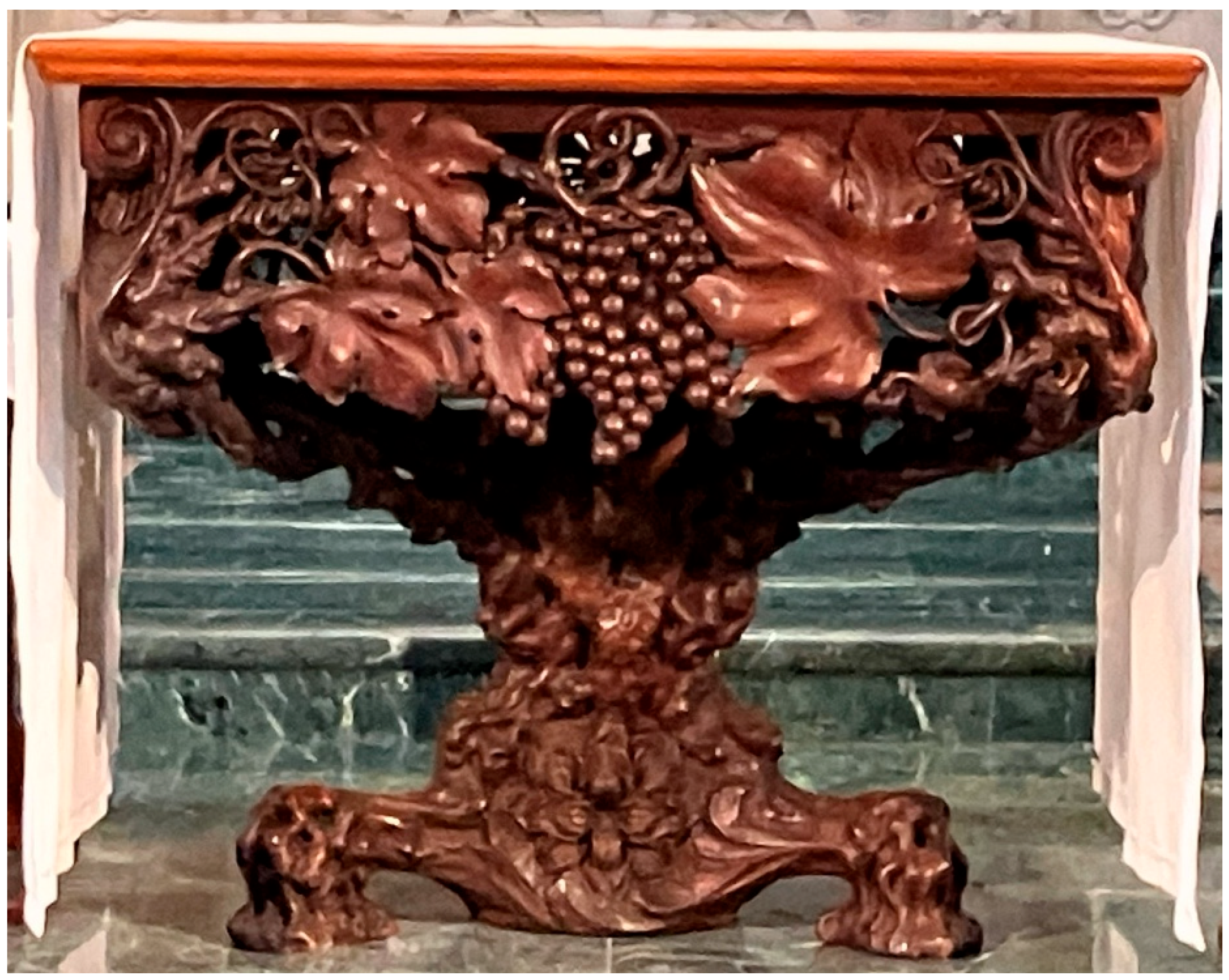
Figure A2.
Mosaic on altar at St. Jerome Catholic Church in Hyattsville, MD. Photograph by Sarah O’Brien.
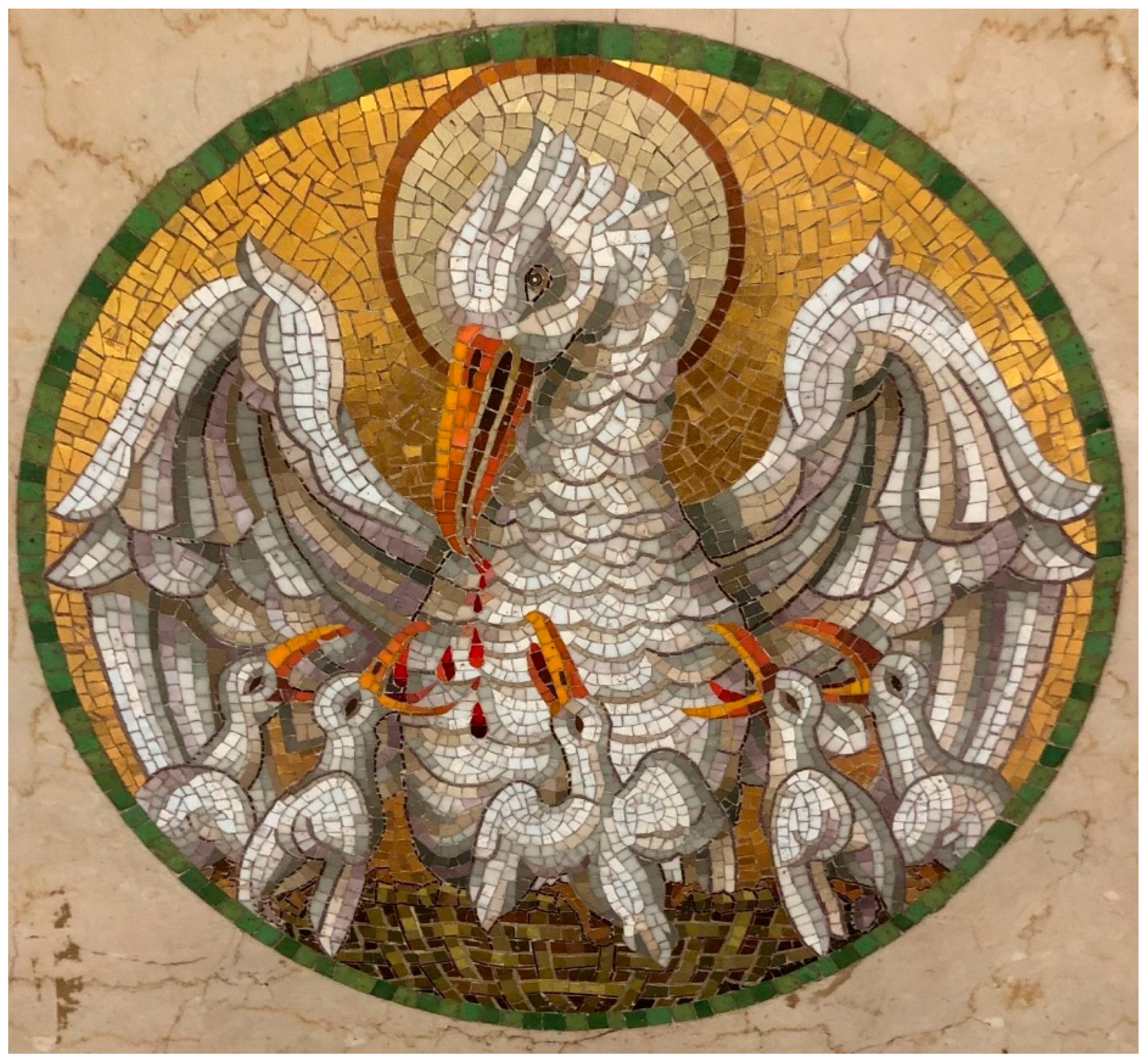
Notes
| 1 | Images of both altars can be found in Appendix A. |
| 2 | John 15:5, NABRE. Future biblical citations from NABRE unless otherwise indicated. |
| 3 | Cyrillonas, The Easter of the Lord, translation cited from Grumett (2016, p. 59). Original in Cyrillonas, La Paque du Seigneur, pp. 17–18, 68–69. |
| 4 | Grumett (2016, p. 61). |
| 5 | For example, St. Francis Winery & Vineyard in Santa Rosa, CA describes its 2021 Cabernet Sauvignon, “Kitten,” thus: “This wine shows off its depth with generous aromas and flavors of crushed wild blackberries, dark red fruits, cassis, and milk chocolate that meet up with savory notes of black olive and sage along with a hint of allspice. These vibrant flavors are balanced with smooth tannins and a long, rich finish.” It also connects the unique taste of the wine with the process of growth and harvest undergone by the grapevines: “Our 2021 harvest began just a little early with the first fruit picked on August 18. Limited rainfall during the growing season produced slightly lighter crops but brought intense, concentrated flavor and color. Free from lingering heat waves, the consistent weather during the summer months helped maintain fruit acidity for brightness and balance. Harvest continued through the middle of October when the last of the reds were picked.” St. Francis Winery & Vineyards (2025). For an in-depth look at the relationship between wine and spirituality in the Christian tradition, see Kreglinger (2016). |
| 6 | Luke 22:15–16. As Pope Francis points out in Desiderio Desideravi (“I have earnestly desired”—in Greek, “ἐπιθυμίᾳ ἐπεθύμησα”), eucharistic theology appropriately begins with the desire of Jesus Christ to eat, drink, and commune with all people. See Francis (2022). Michael Wolter suggests that Jesus’s words here do not express an “unfulfilled wish,” but rather that “this Passover meal is so important to [Jesus] because it is… his last one until the parousia.” Wolter (2017, p. 456). While some scholars have argued that Jesus did not join his apostles in drinking, Wolter writes, “It is more likely… that Luke imagined Jesus as drinking with them” (p. 457). For an insightful and comprehensive commentary of Luke 22:14–20, see Wolter (2017, pp. 451–65). |
| 7 | Wolter suggests that these two instances create a parallel structure: “(a) Saying over the Passover (vv. 15–16), (b) Saying over the cup (vv. 17–18), (a’) Saying over the bread (v. 19), (b’) Saying over the cup (v. 20).” Wolter (2017, p. 454). |
| 8 | Luke 22:17–18. |
| 9 | Luke 22:19. |
| 10 | Luke 22:20. Some ancient manuscripts leave out the second mention of the cup in 22:19c-20. Wolter suggests that these verses might have been dropped from later manuscripts because no parallel existed in their synoptic counterparts and because the second mention of the cup was seen as redundant. The wording in Luke has parallels in Mark 14:22–26 and 1 Corinthians 11:22–25, so Luke may be preserving these traditions. See Wolter (2017, p. 453). See also Matthew 26:26–29. |
| 11 | See Didache 9:2, 5, in Niederwimmer (1998, p. 144): “First, with regard to the cup: ‘We Thank you, our Father, for the holy vine of David your servant…’ Let no one eat or drink of your thanksgiving [meal] save those who have been baptized in the name of the Lord.” |
| 12 | McGowan (1999, p. 12). |
| 13 | McGowan considers numerous sources in his study, and questions commonly held perceptions about well-known sources. Ignatius of Antioch, for instance, never mentions the contents of the cup, and Justin Martyr’s account of the Eucharist “is ambiguous and may originally have referred to a eucharist employing water.” McGowan (1999, p. 93). |
| 14 | McGowan highlights a number of instances in which “the bread and water characteristic of the Christian meal are contrasted with the meat and wine of sacrifice to idols.” McGowan (1999, p. 201). |
| 15 | See, for instance, Apostolic Tradition 21.27–30, in Bradshaw (2023, p. 79). |
| 16 | McGowan (1999, p. 94). |
| 17 | Foley (2009, p. 69). |
| 18 | See McGowan (1999, p. 89). |
| 19 | Chase (2024, p. 25). |
| 20 | Day (2024, p. 57). |
| 21 | Cyril of Jerusalem, Mystagogical Catecheses, 5.22, in Cyril of Jerusalem (2017, p. 135). |
| 22 | Day (2024, pp. 57–58). |
| 23 | Day (2024, p. 65). |
| 24 | Quoted in Day (2024, p. 58). |
| 25 | See Ordo Romanus I, 20, in Andrieu (1948). |
| 26 | Day (2024, p. 58). |
| 27 | Foley (2009, p. 66). |
| 28 | Day (2024, p. 58). See Day’s chapter for extensive details, statistics, and images of chalices from this time period. |
| 29 | Day (2024, p. 61). For example pictures of chalices from this time period, see Day’s chapter as well as Foley (2009, p. 118). For an image of a large eighth century chalice with two handles, see Foley (2009, p. 169). |
| 30 | Day (2024, p. 60). |
| 31 | Foley (2009, p. 119). |
| 32 | Day (2024, p. 74). By affordances, Day refers to the function and relationship to the user that can be ascertained from an examination of the material properties of an artifact. |
| 33 | Day (2024, p. 78). |
| 34 | Foley (2009, p. 171). |
| 35 | Day (2024, p. 79). |
| 36 | Day (2024, p. 58). |
| 37 | Jesse Episcopi Ambianensis, Epistola de Baptismo (Migne 1844–1855, 105, 791). “Novissime autem corpore et sanguine Christi confirmatur infans, ut ejus possit esse membrum, qui pro eo passus est et resurrexit.” English in see Fisher (1965, p. 71). For further references of infant communion from the chalice in this period, see Christopher M. O’Brien, Infant Communion in Roman Catholicism: A Historical Liturgical Theology (2026b, forthcoming from Liturgical Press Academic). For a shorter treatment of the history and theology of infant communion in the West, see Christopher M. O’Brien, “Children and the Eucharist in Roman Catholicism,” Ex Fonte: Journal of Ecumenical Studies in Liturgy (O’Brien 2026a). |
| 38 | See OR I, 20. Ordo Romaus XV, Ordo Romanus XXIV, Ordo Romanus XXXI, and Alcuin similarly use the word confirmare to describe communion from the chalice. For an extensive discussion of the use of the word confirmare in this time period, see Fisher (1965, pp. 159–67). On the use of the word to describe communion from the chalice, he writes, “The meaning here is that the communicant in receiving the chalice completes his communion” (163), and again, “In this context it signifies the completion of the baptism and unction, the bringing of initiation to its climax and fulfillment” (164). |
| 39 | Foley (2009, p. 169). |
| 40 | Some exceptions did exist. As Grumett writes, “Increasingly, the only laypeople likely to have received the chalice were sovereigns at their coronation.” Grumett (2016, p. 244). A few centuries later, after the Council of Trent, an exceptional possibility of lay communion from the chalice existed in some German dioceses. |
| 41 | Fisher (1965, pp. 114–22). See also O’Brien, Infant Communion in Roman Catholicism (2026b) and O’Brien (2026a), “Children and the Eucharist in Roman Catholicism.” |
| 42 | De Sacramento Altaris, in P.L., 163, 1039. “Non enim accipitur Christus membratim vel paulatim, sed totus vel in utraque specie, vel in altera…Unde et infantulis mox baptizatis solus calix datur, quia pane uti non possunt, et in calice totum Christum accipiunt. Dandus autem est calix eis, quia, sicut non potest ad vitam quis ingredi sine baptismo, ita nec sine hoc vitali viatico.” Translation adapted from Fisher (1965, p. 115). See O’Brien (2026b), Infant Communion in Roman Catholicism for further examples. |
| 43 | Grumett (2016, p. 245). |
| 44 | Council of Constance, Session 13, in Tanner (1990, 1:419). |
| 45 | Molnar (1954, p. 110). |
| 46 | Patapios (2002, p. 504). See the full article on the extent to which Hus did discuss communion under both kinds and the authorities he cites in that discussion. According to Patapios, it was not until his condemnation on 15 June 1415 that Hus finally became convinced of the desirability and necessity of utraquism. |
| 47 | Patapios (2002, p. 520). |
| 48 | Jakoubek of Stribro, as cited in Patapios (2002, p. 521). |
| 49 | See Luther (1884, pp. 497–573). Reformation era condemnations, in the Lutheran confessional writings, for instance, do not apply to current Roman Catholic practice and understanding. Even so, a more frequent Roman Catholic practice of lay communion from the chalice effectively promotes ecumenical convergence and works toward clarifying misunderstanding stemming from the Reformation era. |
| 50 | Schlaffer (1527, pp. 109, 196). |
| 51 | On Trent’s treatment of the question of infant communion, see O’Brien (2022). |
| 52 | O’Malley (2013, p. 147). |
| 53 | Cernusak (2016, pp. 148, 152). |
| 54 | Council of Trent, Session 21, Canons on Communion Under Both Kind and of Children, canons 1–3 (Tanner, 2:727). |
| 55 | Council of Trent, Session 21, Canons on Communion Under Both Kind and of Children, canons 1–3 (Tanner, 2:728). |
| 56 | Bugnini (1990, p. 627). |
| 57 | Vatican II, Sacrosanctum Concilium 55 (Tanner, 2:831). |
| 58 | See Bugnini (1990, pp. 626–34) for a discussion of the extension of lay communion from the chalice in the years immediately following Vatican II. |
| 59 | General Instruction of the Roman Missal (2002, 281). |
| 60 | United States Conference of Catholic Bishops (2002). |
| 61 | Congregation of Divine Worship and the Discipline of the Sacrament (2004, 102). |
| 62 | Redemptionis Sacramentum, 105. |
| 63 | Redemptionis Sacramentum, 106–107. |
| 64 | Redemptionis Sacramentum, 117, 50. |
| 65 | See, for instance, Roewe (2022); Orendain (2024). |
| 66 | McPartlan (1995, p. 111). |
| 67 | Chauvet (1994). See also Chauvet (2001). |
| 68 | See Belcher (2011). |
| 69 | Chase (2025). |
| 70 | Chase (2025, p. 176). |
| 71 | Grumett (2016, p. 297). |
| 72 | Grumett (2016, p. 3). |
| 73 | Grumett (2016, pp. 3, 8). |
| 74 | Grumett (2016, p. 58). |
| 75 | Grumett (2016, p. 63). |
| 76 | Augustine (n.d.). |
| 77 | Chase (2025, pp. 186–87). |
| 78 | Chase (2025, p. 187). |
| 79 | Today in Orthodox and Eastern Catholic churches, infants (and all communicants) typically receive communion from a spoon. |
| 80 | United States Conference of Catholic Bishops (2012). |
| 81 | United States Conference of Catholic Bishops, Committee on Divine Worship Newsletter. |
| 82 | Congregation for the Doctrine of the Faith (2003). |
| 83 | The Order of the Anointing of the Sick and of Their Pastoral Care (2026). |
| 84 | Morrill (2009, p. 201). |
| 85 | On the rich symbolism of wine with respect to viaticum, consider the “Last Supper” scene in the film Of Gods and Men, in which the community of monks celebrate an emotional meal together before being captured, and ultimately, martyred. Drinking wine, and the feelings that come with its symbolism, play a prominent role in the scene. |
| 86 | On Bonaventure, see Hellman and Piolata (2024). On Thomas, see De Lubac (1944, 1956); and O’Brien (2026b), Infant Communion in Roman Catholicism. |
| 87 | See, for instance, 1 Corinthians 12. |
| 88 | In fact, it might be said that an infinity of models could be conceived of. See, for instance, Marion (1991, pp. 156–58). Marion refers to the “infinite reserve of meaning” found in the Eucharist, demanding an “infinity of interpretations,” each of which lead back to the infinite Word. |
| 89 | Irwin (2020, p. viii). |
| 90 | Irwin (2020, pp. 18–19). |
| 91 | The Order of Mass, 132, in The Roman Missal (2011, p. 669). See also Revelation 19:9. |
| 92 | Andrew McGowan, for instance, sees discussion of an “agape” meal as problematic because it separates meal from liturgy, when in actuality the meal and liturgy were part of the same reality. See McGowan (1999, pp. 11–12). Here McGowan criticizes scholars such as Gregory Dix, who “consigned the meal of the Didache to the obscure category of the agape, understood to be another form of ritual meal whose very vagueness has often made it a convenient dumping ground for the unwanted meal evidence of the first few centuries.” McGowan (1999, p. 22). |
| 93 | Chase (n.d., p. 2.) Sensory Liturgy is a project consisting of a database of resources preserved in Google Drive, and can be accessed at https://drive.google.com/drive/folders/1Ph9xW6nS8LVS4bXSh-CdFXQi5RoDcWB5?usp=drive_link (accessed on 25 March 2026). |
| 94 | Searle (1981, p. 70). See also Searle (1978). |
| 95 | Psalm 104:14–15. |
| 96 | Chase (n.d., p. 4). |
| 97 | Irwin (2020, p. 34). |
| 98 | Chase (n.d., p. 4). |
| 99 | General Instruction of the Roman Missal (2002, 321–23). |
| 100 | Irwin (2020, p. 57). |
| 101 | Irwin (2020, p. 59). |
| 102 | Redemptionis Sacramentum, 105. |
| 103 | Chase (n.d., p. 6). Foley writes similarly, “This decree in effect diluted the fraction rite in the Roman Catholic Mass, which now only consisted of the breaking of the bread, and created a second fraction rite at the preparation of the gifts, where wine was now to be poured into communion cups.” Foley (2009, p. 343). |
| 104 | Chase (n.d., p. 6). |
| 105 | Irwin (2021, p. 129). |
| 106 | Chase (n.d., p. 7). |
| 107 | See Grumett (2016, pp. 58–59). |
| 108 | Grumett (2016, p. 59). |
| 109 | Irwin (2020, p. 36). |
| 110 | Chase (n.d., p. 3). |
| 111 | Chase (n.d., p. 8). |
| 112 | The Order of Mass, 25, in The Roman Missal (2011, p. 529). |
| 113 | Groody (2006, pp. 386–402, 388). |
| 114 | Groody (2006, p. 399). |
| 115 | Groody (2006, p. 388). |
| 116 | Grumett (2016, p. 223). |
| 117 | It is page 400 of the article by Daniel Groody called “Fruit of the Vine and Work of Human Hands: Immigration and the Eucharist.” |
| 118 | Groody (2017, p. 976). |
| 119 | Groody (2017, p. 976). |
| 120 | Groody (2017, p. 980). |
| 121 | Groody (2017, p. 980). |
| 122 | Groody (2017, p. 980). |
| 123 | Groody (2017, pp. 980–81). |
| 124 | Groody (2017, p. 981). See also Ricoeur (1976, pp. 45–70). |
| 125 | Groody (2017, p. 982). |
| 126 | Groody (2017, p. 984). |
| 127 | Jean Corbon makes a similar point when he connects the cosmic liturgy with the liturgy celebrated and finally with compassion, the “liturgy of the poor.” See Corbon (2005, especially pp. 241–48). |
| 128 | Mark 14:25. See also McPartlan (1995, p. 103). |
| 129 | McPartlan (1995, p. 107). |
| 130 | McPartlan (1995, p. 112). |
| 131 | See Revelation 7:14. |
| 132 | Mohlberg (1960, p. 457). English adapted from Whitaker (2003, pp. 236–37). “O sanctae matris aecclesiae pia sempiterna beneficia! Non uult habere quod perimat, sed cupit inuenire quod redimat. Exultauit Maria in sacratissimum puerperi, exultat ecclesia in filiorum suorum generationis speciem. Sic fons ille beatus qui dominico latere circumfulxit, molis excepit uiciorum, ut his sacris altaribus uitales escas perpetua uita conferat renatorum.” |
| 133 | McPartlan (1995, p. 100). |
| 134 | McPartlan (1995, p. 101). |
| 135 | The Order of Mass, 60, in The Roman Missal (2011, p. 588). |
| 136 | McPartlan (1995, p. 111). |
| 137 | The Order of Mass, 90, 103, 111, and 120 in The Roman Missal (2011, pp. 639, 647, 651, 659). |
| 138 | Irwin (2020, pp. 146–47). |
| 139 | See John 19:28–37. In his study of the historical Jesus, A Marginal Jew, John P. Meier argues that John’s account is more likely to be historically accurate on the timing of Jesus’s death. See Meier (1991, pp. 395–401). |
| 140 | McPartlan (1995, p. 103). |
| 141 | Vatican II, Sacrosanctum Concilium, 47. |
| 142 | John Paul II, Ecclesia de Eucharistia, 48. |
| 143 | See Vatican II, Lumen Gentium, 9, 34 (Tanner, 2:855–56, 877). See also 1 Peter 2:9–10. |
| 144 | The Order of Mass, 91, 104, 112, and 121 in The Roman Missal (2011, pp. 640, 648, 652, 660). |
| 145 | Easter Sunday of the Resurrection of the Lord, 19, in The Roman Missal (2011, pp. 349–50). |
| 146 | McPartlan (1995, p. 103). |
| 147 | John Paul II, Ecclesia de Eucharistia, 47. |
| 148 | Luther, On the Babylonian Captivity of the Church. |
| 149 | See, for instance, United States Conference of Catholic Bishops Committee on Ecumenical and Religious Affairs and the Evangelical Lutheran Church in America (2015); Evangelical Lutheran Church of Finland and the Catholic Church in Finland (2017); Lutheran World Federation and the Pontifical Council for Promoting Christian Unity (2013). |
| 150 | See, for instance, Noem (2024). |
| 151 | General Instruction on the Roman Missal, 281. |
| 152 | McPartlan (1995, p. 105). |
| 153 | Searle (1981, p. 70). |
| 154 | See John 2:10. |
References
- Andrieu, Michel. 1948. Les “Ordines Romani” du Haut Moyen Age. Louvain: Spicilegium Sacrum Lovaniense, vol. 2, Repr. 1971. [Google Scholar]
- Augustine. n.d. Sermon 272. Available online: https://www.earlychurchtexts.com/public/augustine_sermon_272_eucharist.htm (accessed on 25 March 2026).
- Belcher, Kimberly Hope. 2011. Efficacious Engagement: Sacramental Participation in the Trinitarian Mystery. Collegeville: Liturgical Press. [Google Scholar]
- Bradshaw, Paul F. 2023. Apostolic Tradition: A New Commentary. Collegeville: Liturgical Press Academic. [Google Scholar]
- Bugnini, Annibale. 1990. The Reform of the Liturgy: 1948–1975. Collegeville: Liturgical Press. [Google Scholar]
- Cernusak, Tomas. 2016. Relations of the Apostolic See to the Czech Lands during the Reformation and Confessionalisation (1526–1620). In The Papacy and the Czech Lands: A History of Mutual Relations. Edited by Tomas Cernusak, Jaroslav Pánek, Josef Žemlička, Zdeňka Hledíková, Antonín Kalous, Tomáš Parma, Jitka Jonová and Jaroslav Šebek. Prague: Institute of History, Rome: Instituto Storico Ceco Di Roma, pp. 147–84. [Google Scholar]
- Chase, Nathan P. 2024. Eucharistic Praying in Ritual Context: From the New Testament to the Classical Anaphoras. Alcuin/GROW Joint Liturgical Studies. Norwich: Hymns Ancient and Modern. [Google Scholar]
- Chase, Nathan P. 2025. Worshipping with Our Senses: A Methodological State of the Question and an Invitation. Worship 99: 176–87. [Google Scholar]
- Chase, Nathan P. n.d. Sensory Liturgy: Mystagogy on Wine and Choosing a Eucharistic Wine. Available online: https://drive.google.com/drive/folders/1Ph9xW6nS8LVS4bXSh-CdFXQi5RoDcWB5?usp=drive_link (accessed on 25 March 2026).
- Chauvet, Louis-Marie. 1994. Symbol and Sacrament: Sacramental Reinterpretation of Christian Existence. Translated by Madeleine Beaumont, and Patrick Madigan SJ. Collegeville: Liturgical Press. [Google Scholar]
- Chauvet, Louis-Marie. 2001. The Sacraments: The Word of God at the Mercy of the Body. Translated by Madeleine Beaumont. Collegeville: Liturgical Press. [Google Scholar]
- Congregation for the Doctrine of the Faith. 2003. Circular Letter to all Presidents of the Episcopal Conferences Concerning the Use of Low-Gluten Altar Breads and Mustum as Matter for the Celebration of the Eucharist. Available online: https://www.vatican.va/roman_curia/congregations/cfaith/documents/rc_con_cfaith_doc_20030724_pane-senza-glutine_en.html (accessed on 25 March 2026).
- Congregation of Divine Worship and the Discipline of the Sacrament. 2004. Instruction Redemptionis Sacramentum on Certain Matters to Be Observed or to Be Avoided Regarding the Most Holy Eucharist. Available online: https://www.vatican.va/roman_curia/congregations/ccdds/documents/rc_con_ccdds_doc_20040423_redemptionis-sacramentum_en.html (accessed on 25 March 2026).
- Corbon, Jean. 2005. The Wellspring of Worship, 2nd ed. Translated by Matthew J. O’Connell. San Francisco: Ignatius Press. [Google Scholar]
- Cyril of Jerusalem, Saint. 2017. Lectures on the Christian Sacraments. Edited by Maxwell E. Johnson. Yonkers: St. Vladimir’s Seminary Press. [Google Scholar]
- Day, Juliette J. 2024. Eucharistic Materiality and Lay Liturgical Experience in the Early Middle Ages. In An Embodied Religion: Materialities and Devotion in Medieval Europe. Edited by João Luís Fontes, Diana Martins, Catarina Fernandes Barreira and Mário Farelo. Berlin: Peter Lang, pp. 57–80. [Google Scholar]
- De Lubac, Henri. 1944. Corpus Mysticum: The Eucharist and the Church in the Middle Ages. Notre Dame: University of Notre Dame Press, Repr. 2007. [Google Scholar]
- De Lubac, Henri. 1956. The Splendour of the Church. New York: Sheed and Ward. [Google Scholar]
- Evangelical Lutheran Church of Finland and the Catholic Church in Finland. 2017. Communion in Growth: Declaration on the Church, Eucharist, and Ministry. Helsinki: Grano. [Google Scholar]
- Fisher, J. D. C. 1965. Christian Initiation: Baptism in the Medieval West. Chicago: Hillenbrand Books, Repr. 2004. [Google Scholar]
- Foley, Edward. 2009. From Age to Age: How Christians Have Celebrated the Eucharist. Revised and Expanded Edition. Collegeville: Liturgical Press. [Google Scholar]
- Francis. 2022. Apostolic Letter Desiderio Desideravi on the Liturgical Formation of the People of God. Available online: https://www.vatican.va/content/francesco/en/apost_letters/documents/20220629-lettera-ap-desiderio-desideravi.html (accessed on 25 March 2026).
- General Instruction of the Roman Missal. 2002. Available online: https://www.vatican.va/roman_curia/congregations/ccdds/documents/rc_con_ccdds_doc_20030317_ordinamento-messale_en.html (accessed on 25 March 2026).
- Groody, Daniel. 2006. Fruit of the Vine, Work of Human Hands: Immigration and the Eucharist. Worship 80: 386–402. [Google Scholar]
- Groody, Daniel. 2017. Cup of Suffering, Chalice of Salvation: Refugees, Lampedusa, and the Eucharist. Theological Studies 78: 960–87. [Google Scholar] [CrossRef] [Scilit]
- Grumett, David. 2016. Material Eucharist. Oxford: Oxford University Press. [Google Scholar]
- Hellman, Wayne O.F.M.Conv., and Thomas A. Piolata O.F.M.Cap. 2024. The Goal of the Eucharist is Spiritual Communion. America: The Jesuit Review. Available online: https://www.americamagazine.org/faith/2024/04/16/bonaventure-eucharistic-revival-247661/ (accessed on 25 March 2026).
- Irwin, Kevin. 2020. Models of the Eucharist, 2nd ed. New York: Paulist Press. [Google Scholar]
- Irwin, Kevin. 2021. Liturgy and Sacraments in a COVID World: Renewal, Not Restoration. Mahwah: Paulist Press. [Google Scholar]
- Kreglinger, Gisela H. 2016. The Spirituality of Wine. Grand Rapids: Wm. B. Eerdmans Publishing Co. [Google Scholar]
- Luther, Martin. 1884. Babylonian Captivity of the Church. Edited by Hermann Böhlau. Repr. 1966. D. Martin Luthers Werke: Kritische Gesamtausgabe. Weimar, vol. 6, pp. 497–573. English in Robinson, Paul W., ed. 2016. Church and Sacraments. Vol. 3 of the Annotated Luther. Minneapolis: Fortress Press, pp. 13–129. [Google Scholar]
- Lutheran World Federation and the Pontifical Council for Promoting Christian Unity. 2013. From Conflict to Communion: Lutheran-Catholic Common Commemoration of the Reformation in 2017. Leipzig: Evangelische Verlagsanstalt. [Google Scholar]
- Marion, Jean-Luc. 1991. God Without Being: Hors-Texte. Translated by Thomas A. Carlson. Chicago: University of Chicago Press. [Google Scholar]
- McGowan, Andrew. 1999. Ascetic Eucharists: Food and Drink in Early Christian Ritual Meals. Oxford: Clarendon Press. [Google Scholar]
- McPartlan, Paul. 1995. Sacrament of Salvation: An Introduction to Eucharistic Ecclesiology. Edinburgh: T&T Clark. [Google Scholar]
- Meier, John P. 1991. A Marginal Jew: Rethinking the Historical Jesus. New York: Doubleday, vol. 1. [Google Scholar]
- Migne, Jacques-Paul. 1844–1855. Patrologia Latina. Available online: https://patristica.net/latina/ (accessed on 25 March 2026).
- Mohlberg, Leo Cunibert, ed. 1960. Liber sacramentorum Romanae Ecclesiae ordinis anni circuli, (Cod. Vat. Reg. lat. 316/Paris Bibl. Nat. 7193, 41/56) (Sacramentarium Gelasianum). Rerum Ecclesiasticum Documenta. Series Maior, Fontes IV; Rome: Casa Editrice Herder. [Google Scholar]
- Molnar, Enrico C. S. 1954. The Restoration of Holy Communion in Both Kinds. Anglican Theological Review 36: 104–11. [Google Scholar]
- Morrill, Bruce. 2009. Divine Worship and Human Healing: Liturgical Theology at the Margins of Life and Death. Collegeville: Liturgical Press. [Google Scholar]
- Niederwimmer, Kurt. 1998. The Didache: A Commentary. Edited by Harold W. Attridge. Translated by Linda M. Maloney. Minneapolis: Fortress Press. [Google Scholar]
- Noem, Stacey. 2024. We Stand or Fall Together: A Century on Co-Responsibility. McGrath Church Life Journal. Available online: https://churchlifejournal.nd.edu/articles/a-century-on-co-responsibility/ (accessed on 25 March 2026).
- O’Brien, Christopher M. 2022. Children and the Eucharist at the Council of Trent. Theological Studies 83: 379–99. [Google Scholar] [CrossRef] [Scilit]
- O’Brien, Christopher M. 2026a. Children and the Eucharist in Roman Catholicism. Ex Fonte: Journal of Ecumenical Studies in Liturgy. Forthcoming. [Google Scholar]
- O’Brien, Christopher M. 2026b. Infant Communion in Roman Catholicism: A Historical Liturgical Theology. Collegeville: Liturgical Press Academic, Forthcoming. [Google Scholar]
- O’Malley, John W. 2013. Trent: What Happened at the Council. Cambridge: Harvard University Press. [Google Scholar]
- Orendain, Simone. 2024. The Pandemic is Officially Over, but Will Communion Chalices Make a Comeback at Mass? Detroit Catholic. Available online: https://www.detroitcatholic.com/news/the-pandemic-is-officially-over-but-will-communion-chalices-make-a-comeback-at-mass#:~:text=%22The%20full%20act%20of%20eating,hearing%20from%20health%20officials%20locally.%22 (accessed on 25 March 2026).
- Patapios, Hieromonk. 2002. Sub Utraque Specie: The Arguments of John Hus and Jacoubek of Stribro in Defence of Giving Communion to the Laity Under Both Kinds. Journal of Theological Studies 53: 503–22. [Google Scholar] [CrossRef] [Scilit]
- Ricoeur, Paul. 1976. Interpretation Theory: Discourse and the Surplus of Meaning. Forth Worth: Texas Christian University. [Google Scholar]
- Roewe, Brian. 2022. As Pandemic Eases, Will the Communion Cup Ever Make a Comeback? National Catholic Reporter. Available online: https://www.ncronline.org/news/coronavirus/pandemic-eases-will-communion-cup-ever-make-comeback (accessed on 25 March 2026).
- Schlaffer, Hans. 1527. A Pleasant Letter of Comfort. Edited by Lydia Müller. 1938. Glaubenszeugnisse oberdeutscher Taufgesinnter I. Leipzig: M. Heinsius Nachfolger, 109. English in Klaassen, Walter, ed. 1981. Anabaptism in Outline: Selected Primary Sources. Scottsdale: Herald Press, p. 196. [Google Scholar]
- Searle, Mark. 1978. The Cup of His Blood. Assembly 5: 33. [Google Scholar]
- Searle, Mark. 1981. Liturgy Made Simple. Collegeville: Liturgical Press. [Google Scholar]
- St. Francis Winery & Vineyards. 2025. Cabernet Sauvignon—Kitten. Available online: https://www.stfranciswinery.com/ (accessed on 23 December 2025).
- Tanner, Norman P., ed. 1990. Decrees of the Ecumenical Councils. 2 vols. Washington, DC: Sheed & Ward and Georgetown University Press. [Google Scholar]
- The Order of the Anointing of the Sick and of Their Pastoral Care. 2026. English Translation According to the Typical Edition. For Use in the Dioceses of the United States of America. Approved by the United States Conference of Catholic Bishops and Confirmed by the Apostolic See. Collegeville: Liturgical Press.
- The Roman Missal. 2011. Renewed by Decree of the Most Holy Second Ecumenical Council of the Vatican. Promulgated by Authority of Pope Paul VI and Revised at the Direction of Pope John Paul II. English Translation According to the Third Typical Edition. For use in the Dioceses of the United States of America. Approved by the United States Conference of Catholic Bishops and Confirmed by the Apostolic See. Study edition. Collegeville: Liturgical Press.
- United States Conference of Catholic Bishops. 2002. Norms for the Distribution and Reception of Holy Communion Under Both Kinds in the Dioceses of the United States of America. Available online: https://www.usccb.org/prayer-and-worship/the-mass/norms-for-holy-communion-under-both-kinds (accessed on 25 March 2026).
- United States Conference of Catholic Bishops. 2012. Committee on Divine Worship Newsletter, October 2012 (updated 20 April 2016). Celiac Disease, Alcohol Intolerance, and the Church’s Pastoral Response. Available online: https://www.usccb.org/prayer-and-worship/the-mass/order-of-mass/liturgy-of-the-eucharist/celiac-disease-and-alcohol-intolerance (accessed on 25 March 2026).
- United States Conference of Catholic Bishops Committee on Ecumenical and Religious Affairs and the Evangelical Lutheran Church in America. 2015. Declaration on the Way: Church, Ministry, and Eucharist. Minneapolis: Augsburg Fortress Press. [Google Scholar]
- Whitaker, Edward C. 2003. Documents of the Baptismal Liturgy. Revised and Expanded by Maxwell E. Johnson. Collegeville: Liturgical Press. [Google Scholar]
- Wolter, Michael. 2017. The Gospel According to Luke. Translated by Wayne Coppins, and Christoph Heilig. Waco: Baylor University Press, Tübingen: Mohr Siebeck, vol. 2. [Google Scholar]
Disclaimer/Publisher’s Note: The statements, opinions and data contained in all publications are solely those of the individual author(s) and contributor(s) and not of MDPI and/or the editor(s). MDPI and/or the editor(s) disclaim responsibility for any injury to people or property resulting from any ideas, methods, instructions or products referred to in the content. |
© 2026 by the author. Licensee MDPI, Basel, Switzerland. This article is an open access article distributed under the terms and conditions of the Creative Commons Attribution (CC BY) license.