


Abstract
One of the apostolic fields in which the Society of Jesus was involved since its foundation in 1540 was the missiones ad gentes [missions among non-Christians], which produced a constant flow of European missionaries to other continents. Specifically, the Jesuit provinces of Spain sent many missionaries beyond their borders, creating administrative units that were initially dependent on the metropolis and later became autonomous Jesuit territories. There are many partial studies of many of the realities related to the Jesuit missions; We now intend to take a brief historical overview to illustrate this centrifugal trend in Spain within the Jesuit sphere, both in the old Society (before its suppression by Pope Clement XIV in 1773) and in the contemporary one (since its restoration by Pope Pius VII in 1814). To this end, we will briefly review demographic and geographical data, which provide overall figures and territorial configurations throughout the history of the Society of Jesus.
1. Introduction
Half a century before the Society of Jesus was founded, Europe had entered the age of geographical discovery, pioneered first by Portugal and then by Spain. This is what has been called the first great globalization, which involved initial contact with very different cultures. The Church, following the theology of the time, which asserted that there was no salvation outside the Church (Extra ecclesiam nulla salus) (Sullivan 1999; Falgueras Salinas 2008), understood the need to offer that salvation to so many people who appeared in remote lands, intensifying the mission ad gentes [among non-Christians]. Until then, this had been carried out by the secular clergy and traditional religious orders, but on a very limited scale due to the more restricted geographical horizon.
Since its foundation in 1540, the Society of Jesus enthusiastically took on this undertaking, which turned out to be one of the fields in which they achieved some of their most appreciated successes, such as the reductions of the former Jesuit province of Paraguay, or the attempts to enculturate Christianity in China and India.
The Jesuit missions were an undertaking of the entire Society of Jesus, which interested all European Jesuits, but especially those in the territories that were then global powers with a wide network of territories throughout the world. You can consult the extensive bibliography on the missions at the bibliography on the history of the Society of Jesus, which includes publications since 19001, or specific data bases online, like that of the Institute for Advanced Jesuit Studies at Boston College2, or that of the Katholieke Universiteit Leuven3.
In this work, we present Spain’s contribution to this field, in a telephoto lens view, describing the centrality and, at the same time, the productivity or centrifugal tendency of the Spanish Jesuit provinces, which sent so many missionaries and from which so many entities were born that, at a given moment, became independent4. To this end, we will present demographic and legal/geographical data on both the former Society of Jesus (1540–1773) and the contemporary one (since 1814).
2. The Jesuit Provinces of Spain in the Old Society of Jesus
Founded in 1540, the Society of Jesus experienced great progress and development, prompting its first superior general, Ignatius of Loyola (1491–1556), to begin permanently delegating his authority and powers to provincial superiors, whom he entrusted with the respective territories of the provinces or administrative units. Thus, in 1546, the first province was created, that of Portugal. The following year, in 1547, the province of Spain was created, whose first provincial was Ignatius of Loyola’s relative, Fr. Antonio de Araoz (1515–1573), who had already introduced the Society to Spain in October 1539. In 1549, the province of India was created; in 1553, that of Brazil, and so on.
When the Jesuit province of Spain was established, there were seven houses with 41 Jesuits, but the initial growth was so rapid that Ignatius of Loyola decided in 1552 to divide it into two provinces, Aragon and Castile I5, covering the territories of the Crowns of Aragon and Castile, respectively. However, it was only a formal division, as both remained under the same provincial, that of Castile, Fr. Antonio Araoz, since the newly appointed provincial of Aragon, one of the co-founders of the Society, Fr. Simão Rodrigues de Azevedo (1510–1579), requested to return to Portugal (Astrain 1902–1925, I, 90, 91, 207, 230, 278; II, 160–161; DHCJ Spain).
There is a constant in the development process of the Spanish-speaking Jesuit provinces, and that is the centrality of the province of Castile, which has been, both in the old and new Society of Jesus, a mother province, or even a grandmother, a matrix from which the others have broken away in the first or successive generations. The province of Aragon remained in its original configuration until the suppression of the Society in 1773, but it also made a great contribution to the missions, since, as a political territory, it had a rich culture of exploration that it developed in the Mediterranean since the Middle Ages.
During a visit to the Iberian Peninsula, Jerónimo Nadal (1507–1580), acting on behalf of Ignatius of Loyola, according to his instructions in a letter dated 7 January 1554, established the provinces of Aragon, Castile II, and Andalusia:
“Una será del reino de Aragón, Valencia y Cataluña; otra de Castilla [la] Vieja y el reino de Toledo; otra de la Andalucía, a la cual se ayuntará, si os pareciere, Salamanca, y lo que se hiciere en Extremadura y Granada [One will be from the kingdom of Aragon, Valencia, and Catalonia; another from Old Castile and the kingdom of Toledo; another from Andalusia, to which Salamanca will be added, if you see fit, and whatever is done in Extremadura and Granada.]”.(EppIgn VI, 122–123, 151–153)
At that time, there were 11 Jesuit communities/colleges in Spain: 7 in the territory of the Crown of Castile I (Valladolid, Alcalá de Henares, Oñate, Burgos, Medina del Campo, Salamanca, and Córdoba) and 4 in that of Aragon (Valencia, founded in 1544, the oldest in Spain; Barcelona, Gandía, and Zaragoza).
This decision by Ignatius of Loyola was implemented at a meeting in early April 1554 in Medina del Campo (Valladolid), where it was decided not to separate Salamanca from Castile II. Commissioner Francisco de Borja (1510–1572) felt that the college in Plasencia (Cáceres, Extremadura), whose foundation was being arranged that same year, was far from the province of Andalusia, which would make it difficult to communicate by letter or visit it, and so it seemed better that it should belong to the province of Castile II. Thus, the new province of Baetica was limited to the former kingdoms of Jaén, Córdoba, Granada and Seville, and only had the college of Córdoba, recently founded in 1553, and 18 subjects. The rest of the territory of the Crown of Castile was entrusted to the provincial of Castile II. The Canary Islands, as a suffragan diocese of Seville, remained in the province of Andalusia or Baetica as a mission area until the establishment of permanent communities began at the end of the 17th century.
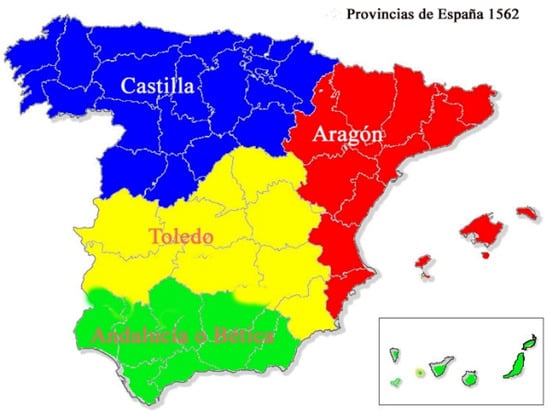
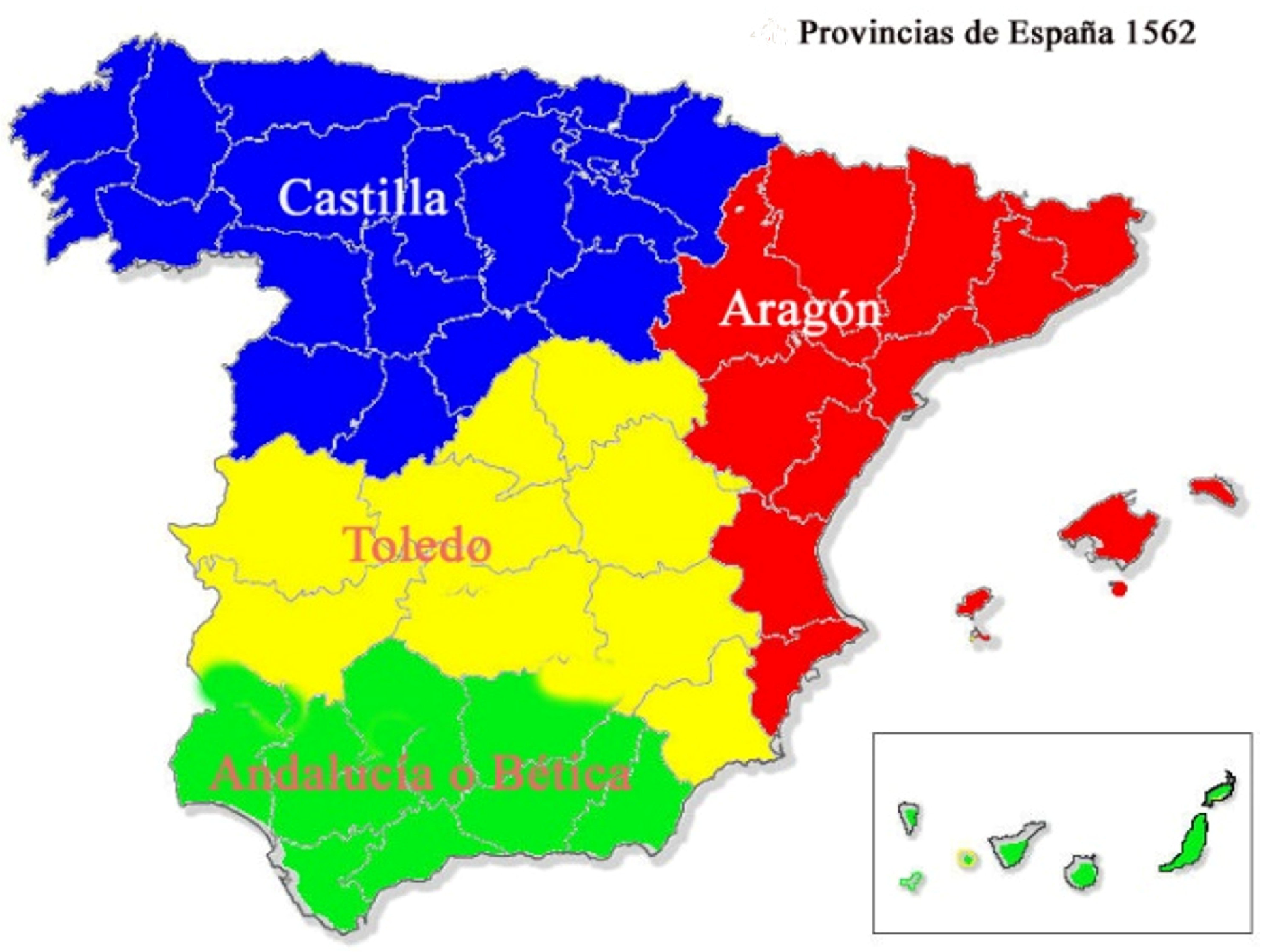
A final modification to this scheme was made by Nadal, on another trip to Spain, before leaving for France in early March 1562, when he divided the province of Castile II into two again: Castile III (covering the territories of Galicia, Asturias, Santander, the Basque Country, Navarre, León, Old Castile) and Toledo (Madrid, Extremadura, La Mancha or New Castile, Murcia) (Soto Artuñedo 2013a). This territorial configuration remained unchanged until the suppression of the Society in 1773. [Figure 1: Jesuit provinces of Spain (1540–1773)].
Figure 1.
Jesuit provinces of Spain (1562–1773).
3. American Geography of the Old Society of Jesus
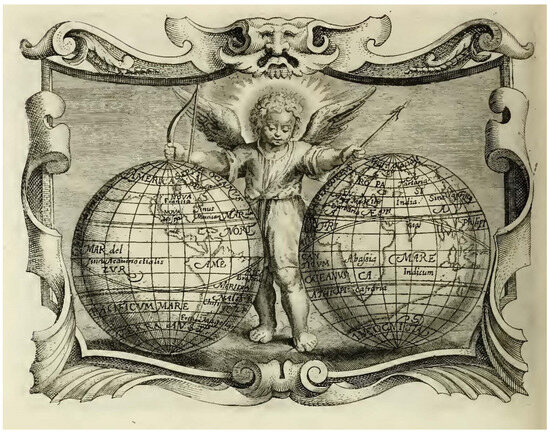
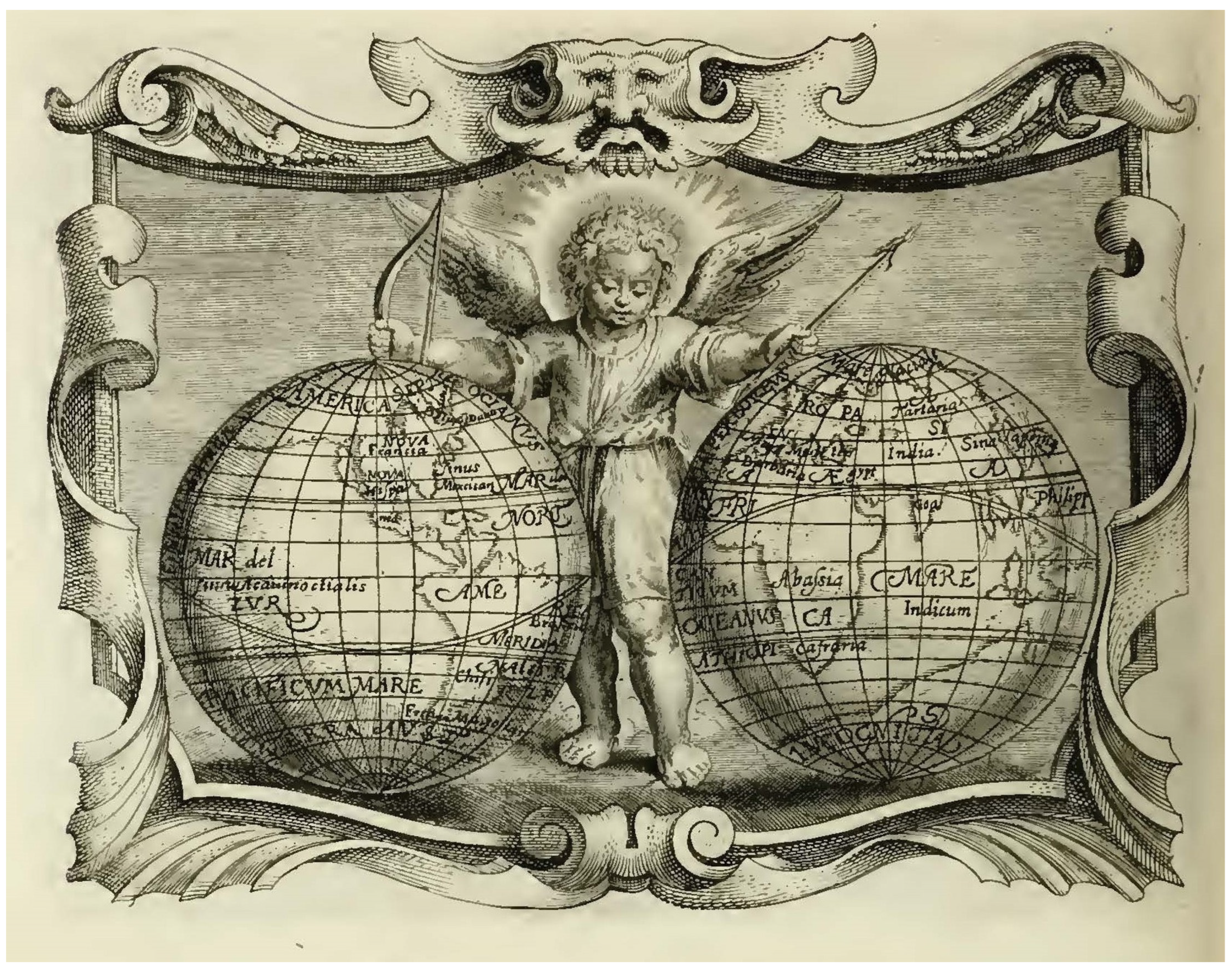
“Unus non sufficit orbis” [One world is not enough] is the legend accompanying a figure in the book Imago Primi Saeculi Societatis Iesu [Image of the First Century Society of Jesus] (1640, p. 326), printed to gloriously commemorate the first centenary of the Society of Jesus in 1640. This maxim reflects the Jesuits’ need to go beyond their own national boundaries and spread throughout the world, as countless members of the Society have done since its inception. [Figure 2: Unus non sufficit orbis].
Figure 2.
Unus non sufficit orbis.
The Society was late to join the evangelization of America, as it was founded in 1540 and therefore could not reach Brazil (which was under the Portuguese crown) until 1547, seven years after its founding. In Spanish America, the task of evangelization was initially reserved for the secular clergy and the traditional orders (Dominicans, Franciscans, Augustinians, and Mercedarians). The incorporation of the Jesuits had a long prehistory (Mateos 1944a, pp. 109–66), but it did not become a reality until the missionary field of the Spanish West Indies was offered to the Superior General of the Society, Francisco de Borja.
At the same time that the first provinces were being established, Ignatius assigned each of his four assistants the care of a region, which was enshrined in the First General Congregation (1558). These four assistances were: Italy, Portugal, Spain, and Germany. To the assistance of Portugal was assigned the province of Portugal (1546) and the two established in the so-called “Indies of the King of Portugal”: India (1549) and Brazil (1553), that, in turn, founded the vice-province of Marañón in 1615, which became independent in 1727. These were the territories of “Su majestad fidelísima” [His most loyal majesty], to which the Padroado extended, as a set of privileges and special powers granted by the popes to Catholic sovereigns, particularly in Spain and Portugal, to administer the Church in their territories, especially in America and the colonies. It allowed monarchs to appoint bishops, administer ecclesiastical revenues, and finance missions in exchange for evangelization. The Spanish assistant was responsible for the territory of the “Rey Católico” [Catholic King]: Spain, Spanish America, and the Philippines, where the “patronato regio” [royal patronage], similar to Padroado, prevailed.
Jesuits had been present in Florida since 1566, at the request of Pedro Menéndez de Avilés (1519–1574) to the king and the then vicar general of the Society, Francisco de Borja. Their territory covered what are now the US states of Georgia (Guale mission), Carolina (Santa Elena), and Virginia (Ajacán). Two years later, the second expedition to America and the first to Peru arrived, by order of the king, with Jerónimo Ruiz del Portillo (1532–1590) as the first provincial of the Spanish Indies. It was difficult to govern Florida from Peru due to the enormous distance, so in 1568, Borja separated it from the authority of the provincial of the West Indies or Peru (the first province established) and placed it directly under the Father General.
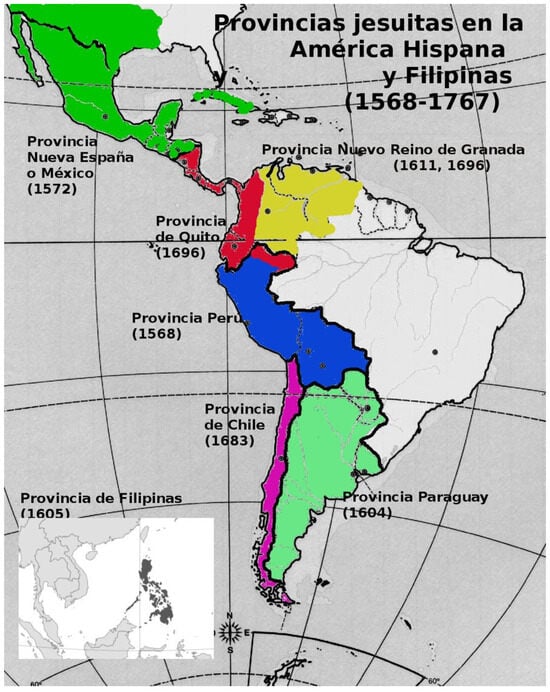
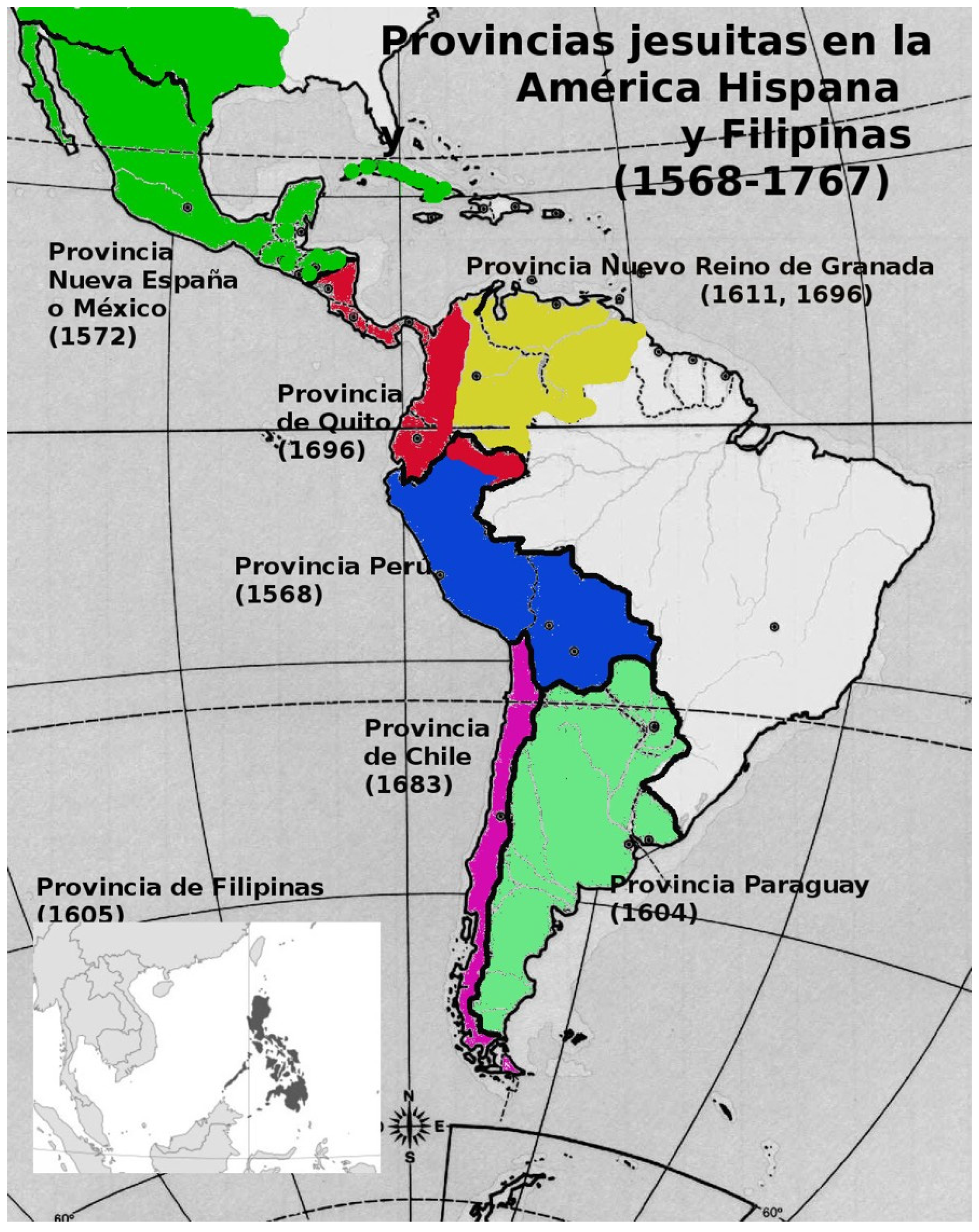
With the subsequent development of the religious order, up to six provinces were established in the Spanish assistance in Spanish America and one in the Philippines. Provinces were created almost empty as a bet on the future to establish themselves and grow in these new territories, but in America, there is no Castilian genesis in its provinces, as occurred in Spain, but rather Peru is the original province, the mother province of Spanish America. Shortly after the region of La Florida was abandoned in 1572, Francisco de Borja segregated the province of New Spain or Mexico. The first two provinces of Spanish America (Peru and Mexico) coincided in their boundaries with those of the two viceroyalties of Peru and New Spain. In 1581, the province of Mexico founded the college of Manila (Philippines) and, in 1594, the Philippines acquired the status of a vice-province dependent on Mexico, and that of an independent province in 1605. In 1669, the Philippine province founded the mission of the Mariana Islands, which soon became a dependent vice-province.
In 1604–1607, the province of Paraguay broke away from the vast province of Peru, integrating the current territories of Argentina, Paraguay, Uruguay, and Chiquitos (Bolivia). In 1607, Chile was added, becoming a vice-province dependent on Paraguay in 1611 and later on Peru in 1625, before becoming an independent province in 1683. The vice-province of the New Kingdom of Granada and Quito was also established in 1607, which, due to its remoteness and difficulty of governance, became an independent province in 1617. In 1696, the decree establishing the province of Quito (24 March 1695) was executed, assigning to it the colleges and houses of the bishoprics of Quito, Panama, and Popayán (except for the districts of Antioquia and Medellín) and the missions of Maynas and Chocó, separating them from the province of the New Kingdom of Granada (Medina 1994, 1999; Soto Artuñedo 2021b; Fejér and De Cock 1997). [Figure 3: Jesuit provinces in Spanish America (1540–1773)].
Figure 3.
Jesuit provinces in Spanish America and the Philippines (1568–1773).
4. Transfer of Spanish Jesuits to the Missions, Before the Suppression
The creation and growth of these Jesuit provinces overseas required the generosity of the European provinces, in the form of a constant influx of personnel, mostly from Spain, throughout the early stages of the Society. Thus, for example, in the first ten years of missions in America (1563–1573), the transfer of personnel from the provinces of Spain to the Indies, first to those of the King of Portugal and later to those of the Catholic King of Spain, was numerous and continuous.
4.1. Portuguese Indies: Asia and Brazil
From the beginning, Spanish Jesuits were able to go to the territories of the Portuguese crown. The first was Francis Xavier (1506–1552) in 1541, who inaugurated the ministry of missions ad gentes in the Society of Jesus, paving the way for many who followed him, motivated by his letters.
Between 1563 and 1573, 24 expeditions were sent to the East Indies and another seven to Brazil, to which the Spanish provinces contributed 26 individuals, 11 of whom went to India and 15 to Brazil. In 1573, the visitor Alessandro Valignano (1539–1606) managed to lead an expedition of 24 Spaniards to the East Indies, specifically Japan (DHCJ Japan), and obtain royal provisions for another 44 missionaries. This was despite opposition from the Portuguese Jesuit rigorists led by Luis Gonçalves da Câmara (1519–1575), who were entrenched against the Castilians, whom they identified with the new Christians, converts descended from Islam and Judaism. They even obtained a letter from King Sebastian to Superior General Everardo Mercuriano (1514–1580), who maintained a timid position on the matter, requesting the withdrawal of the Spanish Jesuits from the Far East, something impossible to execute, although it was ordered. The poor relationship worsened with the support of the Castilian Jesuits for the dynastic rights of Philip II of Spain over the kingdom of Portugal.
However, Castilian Jesuits continued to go to the East Indies; for example, between 1552 and 1775, there were 44 Spanish Jesuits in China out of a total of 1010 Jesuits, compared to 152 Portuguese and 110 French (Cerezo and Villasante 2015, pp. 29–30). The number was smaller than those sent to the West Indies, but not of lesser quality (Medina 2024, pp. 128–46). Without attempting to be exhaustive, we mention some of these missionaries:
- India with Antoni Monserrat (1536–1600) (DHCJ Monserrat; Alay 2006), the martyr Alfonso Pacheco (DHCJ Pacheco; Agustí 1893, pp. 133–57) (1549–1583) and Jerónimo Javier Ezpeleta y Goñi (1549–1617) (DHCJ Javier Ezpeleta; Didier 2011), and Juan de Bustamante (1536–1588), who brought the first printing press to India in 1556 (Ojeda Marín 2019).
- Japan with the Cordovan Jesuit brother Juan Fernández (+1567) (DHCJ Japan), companion of Francisco Javier (Schurhammer 1973), Cosme de Torres (1510–1570) (Pacheco 1969), Pedro Morejón (1562–1639) (DHCJ Morejón), the martyr Baltasar de Torres (1563–1626) (DHCJ Torres Baltasar 2), Pedro Gómez (1534–1600), (DHCJ Gómez Pedro).
- The first Spanish Jesuit in China after Francisco Javier was Diego de Pantoja (1571–1618) (Soto Artuñedo 2018b, 2021a).
- The first Jesuit to arrive in Korea was Gregorio de Céspedes (1551–1611) (Park 1987).
- Alexandre de Rhodes (1591–1660), a Frenchman from a Spanish Jewish convert family (Rhodes 1966; Phan 1998), arrived in Vietnam.
- Ethiopia with Andrés de Oviedo (1518–1577) (Alonso Romo 2006) and Pedro Páez (1564–1622) (Reverte 2001; Soto Artuñedo 2020).
There were also Spanish Jesuits in the Portuguese West Indies (Brazil), such as José de Anchieta (1534–1597), who was born in Tenerife and educated in Coimbra, and was canonized by Pope Francis on 2 April 2014 (Vieira 1945; Caxa and Rodríguez 1988). Ignacio de Azevedo (1527–1570) and his 39 fellow martyrs are also related to the Spanish provinces, as several of them were recruited in Spain, such as Alonso de Baena (1530–1570) (López Pereira 2010), Gregorio Escrivano (+1570), Juan de Mayorga (1533–1570), Fernando Sánchez (+1570), Juan de Zafra (+1570), Esteban de Zudaire (1551–1570), Juan de San Martín (1550–1570), a Francisco Pérez Godoy (1540–1570), nephew of Saint Teresa of Jesus, (DHCJ Pérez Godoy) and even Manuel Pacheco from Ceuta (Ceuta belonged to Portugal at the time). They were captured and killed by the Huguenots (French Calvinists) on 15 July 1570, on the high seas near Tazacorte (Island of La Palma, Canary Islands), while sailing to the mission in Brazil. Pius IX beatified them as martyrs in 1862 (Domingues 1971).
4.2. Spanish Indies: America and the Philippines
As for the Spanish West Indies, the dispatch began during the generalate of Francisco de Borja, with seven expeditions, which were continued by his successor, Everardo Mercuriano, who, almost annually, sent another nine groups (six to Mexico and three to Peru) with a total of 96 Jesuits. In 1574, 1577, and 1580, two expeditions departed each year, one to Mexico and one to Peru, while there were none in 1575. The expedition to Peru in October 1577, with 17 subjects, most of them students, was led by Fr. José Tiruel (1532–1605) and arrived in Lima on April 4 of the following year, 1578. A group of 16 individuals (7 priests and 9 scholastics or Jesuits in formation) left on 29 May 1579, for Mexico (MonMex I, 466–468). It had been organized by the procurator of Mexico, Pedro Díaz (1545–1618), who participated in the congregation of procurators in Rome in 1579, but on his return, he did not arrive in time for the embarkation in Sanlúcar de Barrameda (Cádiz), taking with him the missionaries who were being sent from Italy. Therefore, a second expedition was organized with seven Jesuits (three priests and four brothers) who set sail with the procurator on 9 May of the following year, 1580 (MonMex II, 9). Another shipment left on 20 September 1580, bound for Peru, with 16 individuals (three priests, four deacons, seven scholastics, and two brothers), led by Father Baltasar Piñas (1528–1611). They arrived in Lima on 20 April 1581, at the beginning of the generalate of Claudio Aquaviva (1543–1615), although it had been organized during the time of his predecessor, Everardo Mercuriano. Although it set sail from Seville a month and a half after Mercuriano’s death, it had been organized during his term (MonPer II, 608; MonPer II, 855–856; Mateos 1944b, I, 21). [Table 1: Expeditions to Spanish America during the generalates of Borja and Mercuriano].
Table 1.
Expeditions to Spanish America during the generalships of Borja and Mercuriano.
The expeditions continued until the expulsion of the Jesuits in 1767. Among the largest were those of 1694, led by Father Pedro Calderón (1637–1708), with forty-five Jesuits, including some Italians and Germans; that of 1705 with forty-three; that of 1735 with fifty-six; and that of 1760 with thirty-four.
The letters requesting to be sent on missions to the Indies (Eastern or Western) are known as “indipetae” (Indiam petens [requesting the Indies]) and are a magnificent source for studying the spirituality of missionaries (Maldavsky 2012; Imbruglia et al. 2022; Colombo 2023). When they made this request, they knew they were putting their lives at risk, not only on the missions but also during the voyage, due to illness or shipwreck. In 1717, twenty-three missionaries died in the shipwreck of the Sangronis (DHCJ, Colombia). Another shipwreck was that of the French ship Duc de Chartres on 11 January 1744, during the voyage from Cadiz to Buenos Aires, off the coast of Rio Grande do Sul, with 15 Jesuit priests (13 dead), 9 brothers (7 dead), and 8 scholastics (6 dead) (Borba 2023). Although it was not a missionary ship, the shipwreck off the coast of Esmeraldas was epic for a group of passengers, among whom was a Sevillian who later became a Jesuit in Peru, Pedro Gobeo de Vitoria (1579–1650) (Soto Artuñedo 2023; Sánchez-Cid 2024).
Taking stock of the situation in the Spanish West Indies and the Philippines, Agustín Galán García (1995, pp. 199–206, 355; Ortega Moreno and Galán García 2012) confirms that, throughout the Modern Age, a total of 4011 Jesuits took part in 200 expeditions; of these, some 3162 were from the Spanish Jesuit provinces and some 849 were from other European nations. Pacheco Albalate (2011), researching personal communication, gave a total of 4035 missionaries, of whom 3229 embarked for America (719 were not Spanish), and 806 for the Philippines (183 were not Spanish), with a total of 902 non-Spaniards embarking for the Spanish territories. According to Pacheco, there were some 3133 Jesuits from the provinces of Spain, some 30 fewer, according to Galán. [Table 2: Count of missionaries to Spanish overseas territories, according to M. Pacheco].
Table 2.
Number of missionaries to Spanish overseas territories, according to M. Pacheco.
In addition to being a statistically significant number, they were Jesuits of the highest caliber. Francisco de Borja, in one of his first dispatches, emphasized the ideal profile of missionaries to Provincial Diego de Avellaneda on 9 December 1568:
“pero le aviso que los […] que han de ir […], han de ser de los mejores que tenga en la provincia, de probada virtud, medianía de letras, y salud suficiente para tal empresa, y que vayan con su consolación y gusto” [But I warn you that those […] who are to go […] must be the best you have in the province, of proven virtue, moderate learning, and sufficient health for such an undertaking, and that they go with their consolation and pleasure.].(Borgia IV, 679–680)
About ten years later, Mercuriano described the Jesuits sent to America in this way, to reassure the viceroy Pedro Moya de Contreras, on 29 January 1579: “many good people, who will give Your Excellency contentment and satisfaction. [many good people, who will give Your Excellency contentment and satisfaction]” (MonMex I, 392).
The list of these great Spanish missionaries is immense, so we will mention only a few: Jerónimo del Portillo (1532–1590) (Torres Saldamando 1906; Zubillaga 1943); Alonso de Barzana (1530–1597), the Javier of the West Indies (Soto Artuñedo 2018a); Juan de la Plaza (1527–1602) (Bartolomé-Martínez 1986); the strategist of the Spanish South American missions José de Acosta (1540–1600) (DHCJ Acosta, Leuridan Huys 1997); Diego Torres Bollo (1550–1638), organizer of the Paraguayan reductions (Díaz Risco 2015); Paraguayan martyr saints Juan del Castillo (1595–1628) and Alfonso Rodríguez (1598–1628) (Blanco 1929; Storni 1976); the apostles of African slaves Alonso Sandoval (1576–1652) (Restrepo 2005) and Saint Peter Claver (1580–1654) (Valtierra 1980); the visitor Rodrigo de Figueroa (1574–1641) (DHCJ Figueroa); the procurator of the Indies Juan Martínez de Ripalda (1641–1707) (Martínez Argote); the great missionary, linguist, and explorer José Gumilla (1686–1750) (Rey Fajardo 1958), etc. A large army of missionaries who, together with the native Jesuits, evangelized the Spanish part of the New World.
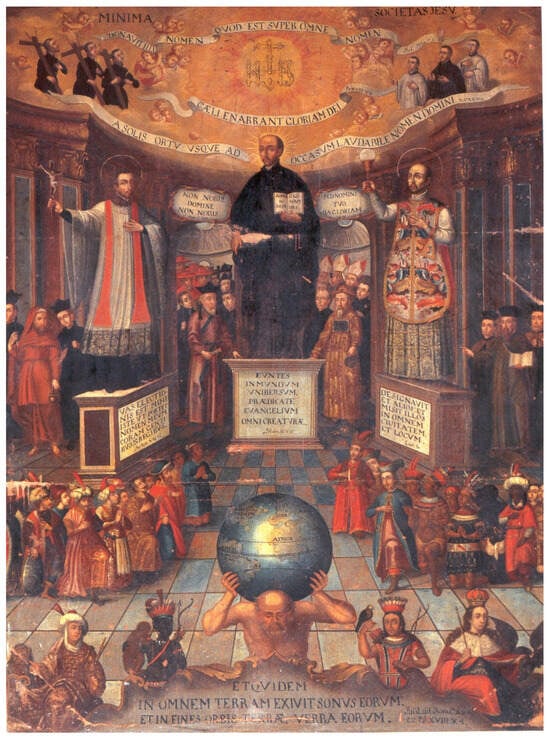
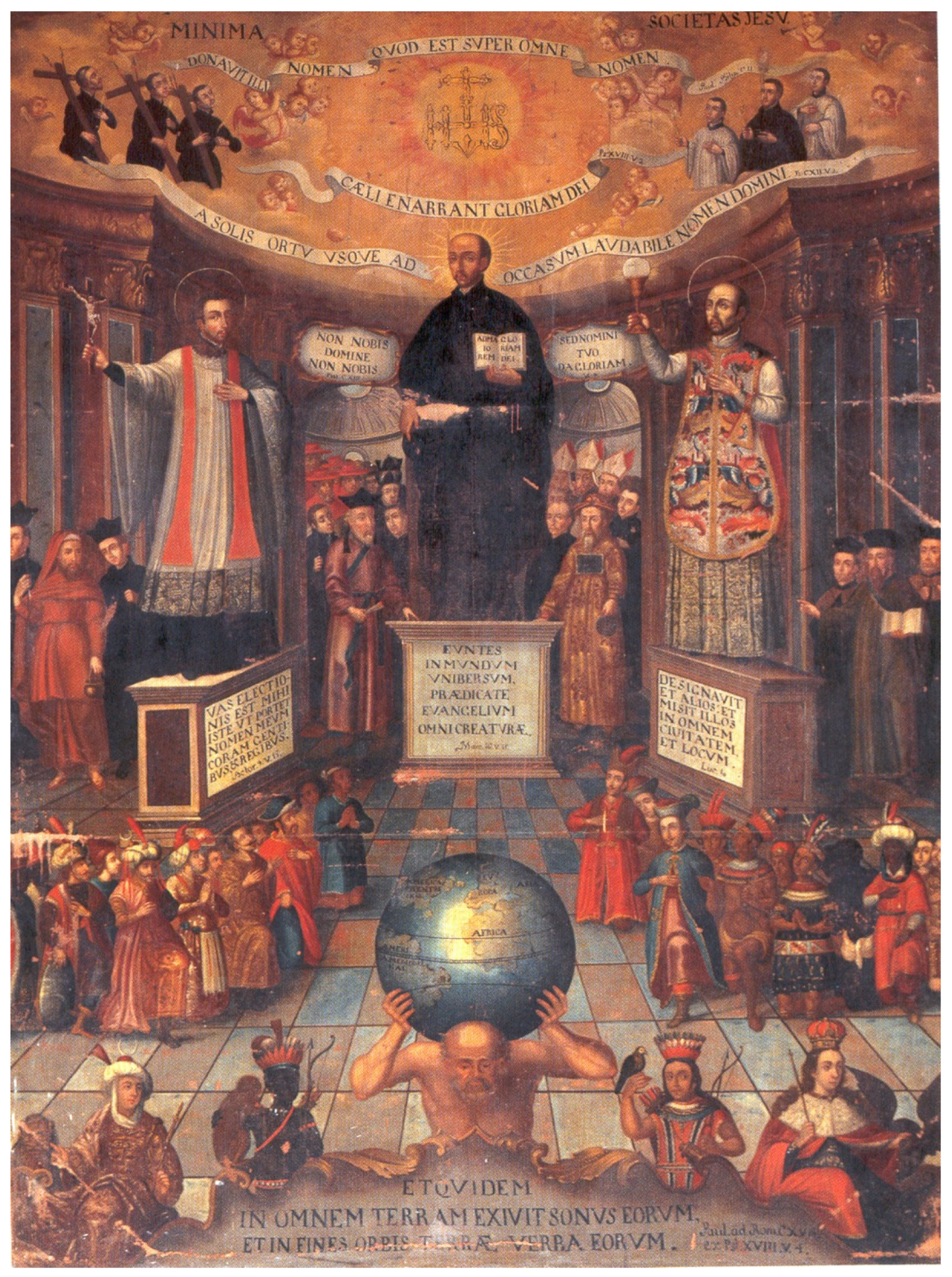
Thus, with this great diversity of origins, the human fabric of the Jesuit missions was constructed, an eloquent diversity gloriously represented, among other images, in the Alegoría del triunfo de los jesuitas en las cuatro partes del mundo [Allegory of the Triumph of the Jesuits in the Four Parts of the World], by an anonymous 18th-century author, which is preserved in the Church of San Pedro, Lima, Peru. [Figure 4: Allegory of the Triumph of the Jesuits in the Four Parts of the World, anonymous 18th-century artist, San Pedro Church, Lima, Peru]. It responds only to the mobility enunciated by Nadal, which pays little respect to political boundaries: “todo el mundo habemos de tener por casa [the whole world must be our home]” (Pradells Nadal 2002, p. 89).
Figure 4.
Allegory of the Triumph of the Jesuits in the Four Parts of the World, anonymous 18th-century artist, San Pedro Church, Lima, Peru.
5. The Province of Spain and Its Missions in the Turbulent 19th Century
In the modern era, history is, in some respects, very different, as we see unstoppable growth in the number of Jesuits, along with greater dynamism in the geographical structure, partly due to political instability, especially throughout the 19th century.
The Society of Jesus, restored in 1814 after suffering the trauma of papal suppression, was reborn as it had been before, but it was still subject to the anti-Jesuit sentiment inherited from the 18th century. As a result, it withdrew into itself and faced modernity. In fact, it suffered repeated persecutions in various countries throughout the 19th century—not always expulsions—usually decreed by liberal governments. Without attempting to be exhaustive and without counting those in Spain, we take those indicated by Banger: in 1818 they were expelled or dissolved from the United Kingdom of the Netherlands; in 1820 from Russia; in 1828 from France; in 1834 from Portugal (in the context of the liberal wars); in 1847 from Switzerland; in 1848 from Austria (in the context of the 1848 revolution) and expulsion from Argentina; temporary expulsion from Colombia in 1850 and 1871; in 1852 from Ecuador; in 1871 from Guatemala; in 1872 from the newly formed German Empire (in the context of the Kulturkampf); in 1873 from the Kingdom of Italy (after the completion of Italian unification with the occupation of Rome); in 1874 from the Austro-Hungarian Empire; in 1880 from the Third French Republic; in 1881 from Nicaragua; and in 1889 crisis in Brazil, with the separation of Church and State and the end of the Padroado regime (Bangert 1981).
Judging by the facts, combating the Jesuits became an essential element of adherence to the liberal creed, in flagrant contradiction to the proclamation of freedoms characteristic of liberal regime theory. This explains the strange decree issued by General José Tadeo Monagas (1784–1868) of Venezuela, prohibiting the admission of Jesuits, even though there were none in the country and there were no plans for their return. The decree also revealed a profound ignorance of the object of his phobia, as it referred to members of the Society of Jesus of both sexes. The expulsion decree appears in the Gaceta de Venezuela dated 31 August 1848, and states that:
“Se declaran perjudiciales a los intereses de la República y como tales no serán admitidos en ella a los extranjeros de ambos sexos pertenecientes a la Compañía de Jesús, cualquiera sea la denominación que hayan tomado [Foreigners of both sexes belonging to the Society of Jesus, whatever name they may have taken, are declared harmful to the interests of the Republic and as such will not be admitted to it.]”.(Pino Iturrieta 2018)
Regarding this abstraction of the Jesuit threat, which seems so far removed from reality, the decree of expulsion of 18 May 1850, from the Republic of New Granada (1832–1858), stated: “que todavía nuestra naciente civilización e industria y nuestras nacientes instituciones no tienen la fuerza bastante para luchar con ventaja en la regeneración social con la influencia letal y corruptora del jesuitismo” [that our nascent civilization and industry and our nascent institutions do not yet have the strength to fight with advantage in social regeneration against the lethal and corrupting influence of Jesuitism]” (Restrepo Daniel, 192–193). Or the decree of 26 July 1861, by General Mosquera, expelling the Jesuits from the Granadine Confederation (1858–1863), alleging that they had “votos solemnes de obediencia pasiva” y, por tanto, “no son personas libres para obrar” [solemn vows of passive obedience and, therefore, are not free to act]” (DHCJ Colombia).
The echoes of this wave of anti-Jesuit sentiment reached the United States: on 24 March 1898, L’Italia, a newspaper published in San Francisco and widely circulated on the west coast of the United States, ran an article entitled “Il cinquantenario patriottico. La cacciata dei gesuiti [The Patriotic Fiftieth Anniversary: The Expulsion of the Jesuits”], which recalled the riots of 1715 in Sicily. It was a violent accusation against the Society of Jesus, defined as the sect that for centuries had manipulated the consciences of the most important sovereigns and ministers and which, expelled from Europe in the second half of the 18th century, but restored by the Congress of Vienna, had continued its shady business, eventually being expelled from Russia, France, Spain, Portugal, and finally Piedmont, against which it was conspiring (Scalisi 2025, p. 137).
Living with this anti-Jesuit political culture, Mexico was the first American nation to restore the Society on 19 May 1816, under the protection of Ferdinand VII of Spain. The Jesuits returned to Brazil in 1842, creating a province in 1927, two years after it had been established as an independent vice-province.
In Spain, restoration after 1815 was a real challenge (even a miracle of Jesuit resilience), with the return from exile in Italy of just over a hundred elderly people and, above all, due to the political upheavals in Spanish history in the 19th century (Frías 1914, 1923–1944, I refer to the first volume of the cited work; Revuelta González 2004, 2006). The Society returned to Spain under the absolutist Ferdinand VII, a stigma that conditioned its entire history in the 19th century, due to the political alternation between absolutism and liberalism. From 1815 onwards, of the more than 5000 former Jesuits expelled by Charles III, only 122, aged between 65 and 93, were able to return, but in just five years, 467 novices joined, including some who had left the Society before the papal suppression. Once again, this religious order would be a recurring victim of political upheaval, with four persecutions in the form of dissolution or dispersion (1820–1823; 1834–1852; 1868–1874; 1932–1936/39). To these must be added the expulsion ordered by Charles IV in 1801 in retaliation for the papal recognition of the surviving Society of Jesus in Russia, for the former Jesuits authorized to return in 1798 (Pradells). Throughout the 19th century, the Society had full legal status in Spain only between 1814–1820 and 1823–1835 (Soto Artuñedo 2021c). Until 1863, all Spanish Jesuits formed a single province, which covered peninsular Spain, America, the Philippines, and Spanish possessions in the Gulf of Guinea.
In those turbulent circumstances, the province of Spain began to expand beyond its borders. Fundamental to this was the launch of the missions with the letter from Father General Jan Roothan (1885–1853) dated 3 December 1833, “De Missionum exterarum desiderio excitando et fovendo” [On arousing and fostering the desire for foreign missions], supporting the desire of Gregory XVI, who had been prefect of Propaganda Fide. He emphasized that the missionary vocation is proper to the Society of Jesus, and therefore missionary activity should be activated. He invited the Jesuits to offer themselves and the provincials to send them without waiting for the numerical increase of their own province, which will be the effect of the sacrifice made. Roothan insisted on the need for a solid spiritual life, warning against missionary romanticism, and wanted missionaries to evangelize without imposing European culture and to do everything possible to train a native clergy.
As a result of this letter, 1260 Jesuits, more than half of the total, volunteered for the missions, and many were sent to all parts of the world. Some of these missions began under the jurisdiction of the province of Spain. In the year of the dissolution in 1835, there were 238 Jesuits in Spain (115 priests and 168 brothers), many of whom went abroad, while others reinforced missions such as the one in Argentina. Roothan sent a first expedition to Colombia in 1844, at the request of the government, and when they were expelled from that country in 1850, they moved to Guatemala and Ecuador, where others expelled from Guatemala in 1862 also arrived. Jesuits also arrived in Jamaica (1837), Uruguay (1841), Paraguay (1843), Chile (1843), and Guatemala (1852).
A new era began for Spain with the signing of the concordat with the Holy See on 16 March 1851, as Article 29 obliged the government to establish houses of religious orders such as the Paulines, Oratorians of Saint Philip Neri, and other orders approved by the Holy See, in all dioceses where it seemed necessary, after consulting with the diocesan prelates. The bishops interpreted that this third order did not have to be the same in all dioceses but could be different from among those approved by the Holy See, which opened the door to the Society of Jesus. Thus, rather than a reestablishment, this Elizabethan restoration consisted of a series of authorizations to open specific houses for specific purposes, primarily missionary, as permitted by Article 29 of the concordat.
On 19 October 1852, the government reestablished the Society of Jesus in the Philippines, designating the sanctuary of Loyola (Guipúzcoa) as its headquarters and missionary college, which signified the official reappearance of the Jesuits. Another royal decree dated November 26 of the same year ordered the return of the Jesuits to Havana, Cuba, to take charge of secondary education, and a first expedition left for there in 1853. The possibility of assisting the prelates, indicated in the concordat, would also facilitate the work of the Jesuits in some diocesan seminaries (a ministry very characteristic of this period), such as that of Las Palmas de Gran Canaria, Canary Islands (Quintana Miranda 2006; Castro 2014), whose direction was entrusted to the Jesuits in 1852. It also made possible the creation of some residences and other missionary seminaries such as the one in El Puerto de Santa María. On 17 June 1856, the mission of the Gulf of Guinea was created and entrusted to the Jesuits, as was Puerto Rico two years later.
As a result of these government provisions, the first Jesuit expeditions set out, and during the generalate of Fr. Peter Jan Beckx (1795–1887), they settled in Spanish possessions with the support of the government: Cuba (1853), Fernando Poo (1859–1871), and the Philippines (1859) with a leprosarium on the island of Culion. In addition, the Pio Latino-Americano College (1858) was founded in Rome to train Latin American clergy, entrusted to the Jesuits, and the magazine Die Katholischen Missionen (1873) was launched in Germany (DHCJ Spain, DHCJ General Beckx).
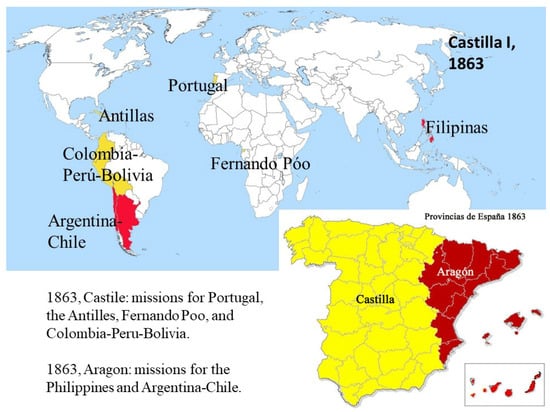
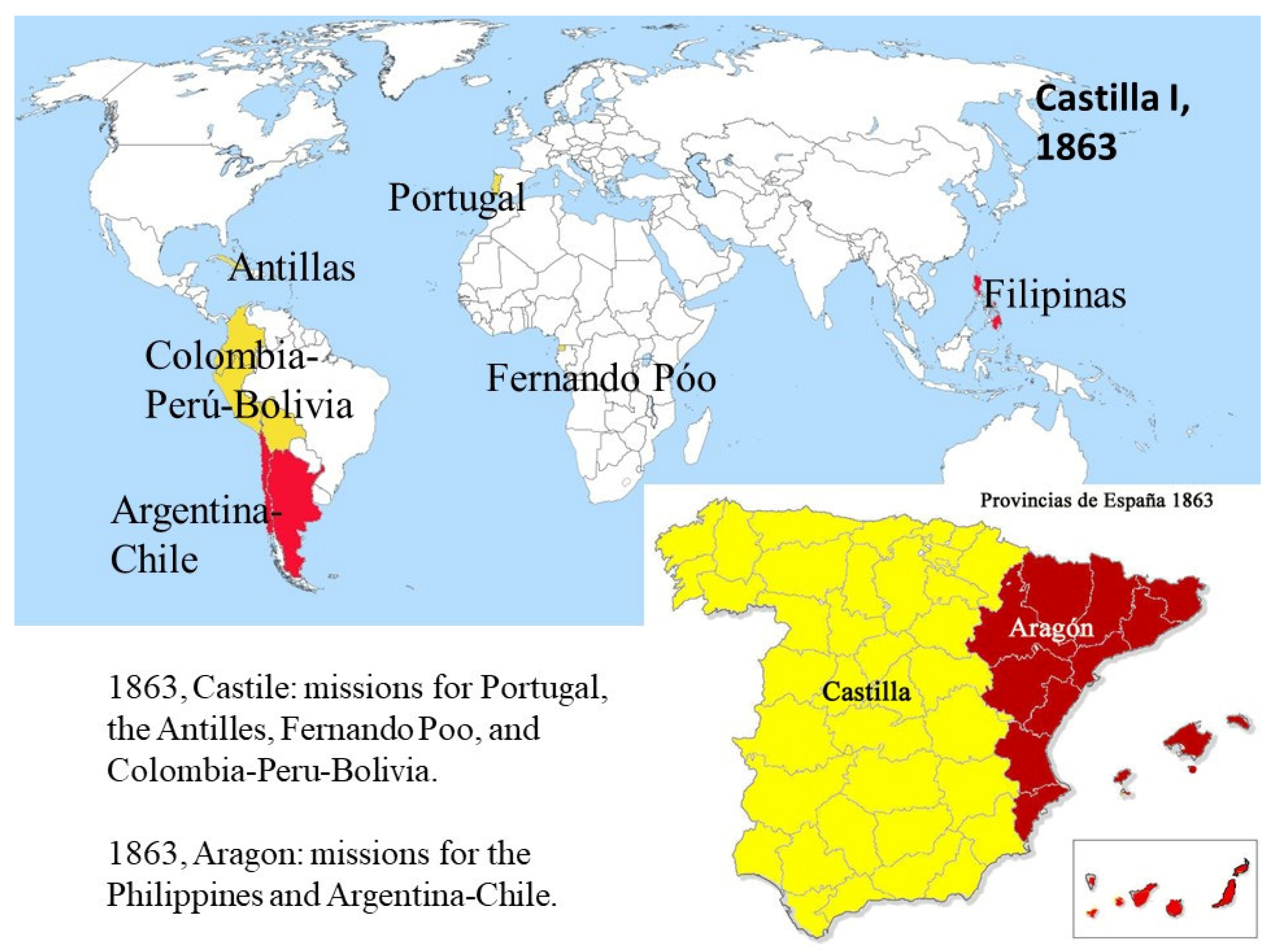
Despite political instability, the Society developed significantly during the final years of Isabel II’s reign. In 1857, the number of subjects in the province of Spain reached 1000, although there were 133 from other provinces, especially Italy; almost 870 from Spain; 22 houses, three colleges in the Antilles, and five missions in Fernando Poo, the Philippines, Chile, Paraguay, and Colombia. It seemed the right time to divide the province, which was studied in October 1857, but although it was deemed advisable, it was not yet believed to be feasible due to political circumstances. A year later it seemed more feasible, without any change in circumstances. In any case, the division was not discussed again until the provincial congregation convened in Loyola on 11 August 1862, with the main issue being to send Fr. General a request for the division of the province. After the necessary consultations, Father General Beckx signed the decree establishing the provinces of Aragon I and Castile I6 on 31 July 1863, published on 7 August, the anniversary of the restoration of the Society of Jesus by Pius VII (Frías 1923–1944, II, 369–381).
The territories of the two new provinces were those of the former Crowns of Aragon and Castile, respectively, each of which assumed certain foreign missions. The Canary Islands were assigned to Aragon I, along with the missions of the Philippines, Chilo-Paraquarensis (later called Chilo-Argentinensis and Argentino Chilena: Argentina, Chile, Uruguay) and Brazil (only for a few years), while Portugal remained a mission of Castile I, in addition to Fernando Poo, the Antilles and the American republics of Peru and Bolivia until to the Mexican border. [Figure 5: Provinces and missions of Spain in 1863].
Figure 5.
Provinces and missions of Spain in 1863.
The outlook for the two provinces on the eve of the 1868 revolution could not have been more promising, with an abundance of vocations and apostolic and missionary activity. In 1868, there were 758 Jesuits in the province of Castile I, of whom 243 were missionaries, and 526 in the province of Aragon, of whom 172 were missionaries, as this justified the legal existence of the Society (Frías 1915, p. 6). In the Colombia-Ecuador mission, there were 76 in Ecuador and 78 in Guatemala (Revuelta González 1984, p. 19).
But the revolution of September 1868 undid what had been built, although, once the confusion of the first few months had passed, the Jesuits who had remained in hiding managed to resume their work. The decree of suppression did not affect the houses located overseas, but it did affect the missionary schools on the Peninsula, which were the ones that supplied them with subjects. Between the two provinces, there were a total of 1300 Jesuits and 423 missionaries in 1869.
After the short-lived monarchy of Amadeo of Savoy, the First Republic was proclaimed (1873), but the difficulties of those years only managed to slow down the pace, not the activity, of the Jesuits (Revuelta González 1984, p. 367). In this hostile environment, a decree of 29 September 1874, allowed the incorporation of free schools (many of them created by Jesuits) into official institutes, making it possible to hold exams with a mixed panel.
In January 1875, Alfonso XII arrived in Spain and was proclaimed king before the Spanish Cortes. This marked the beginning of the Bourbon Restoration, a historical period spanning from General Arsenio Martínez Campos’s pronouncement on 29 December 1874, in Sagunto, which brought an end to the First Spanish Republic, to the proclamation of the Second Republic on 14 April 1931. With the restoration of the monarchy and the Constitution of 1876, religious tolerance and the confessional nature of the state returned, in which the political activity of Cánovas del Castillo (Sánchez Blanco 2006) was decisive.
6. Geographic Evolution of the Provinces of Spain and Their Missions
When Alfonso XII restored the monarchy in 1875, there were 1409 subjects in the Spanish provinces (compared to 1284 in 1868). The missions had benefited from the suppression, as they received new reinforcements. From 1875 onwards, there was tolerance, although the 1868 decree of suppression remained in force, which made possible the great founding moment of most of the apostolic works that have survived to this day (Revuelta González 1986).
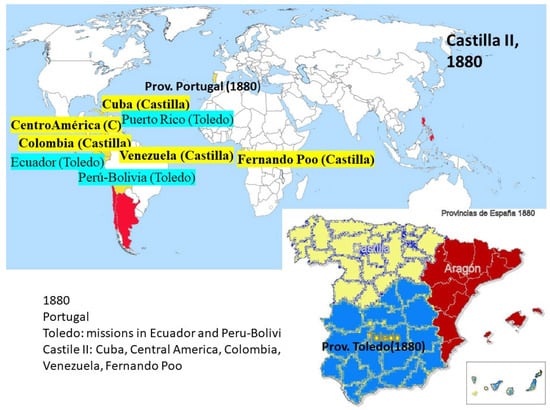
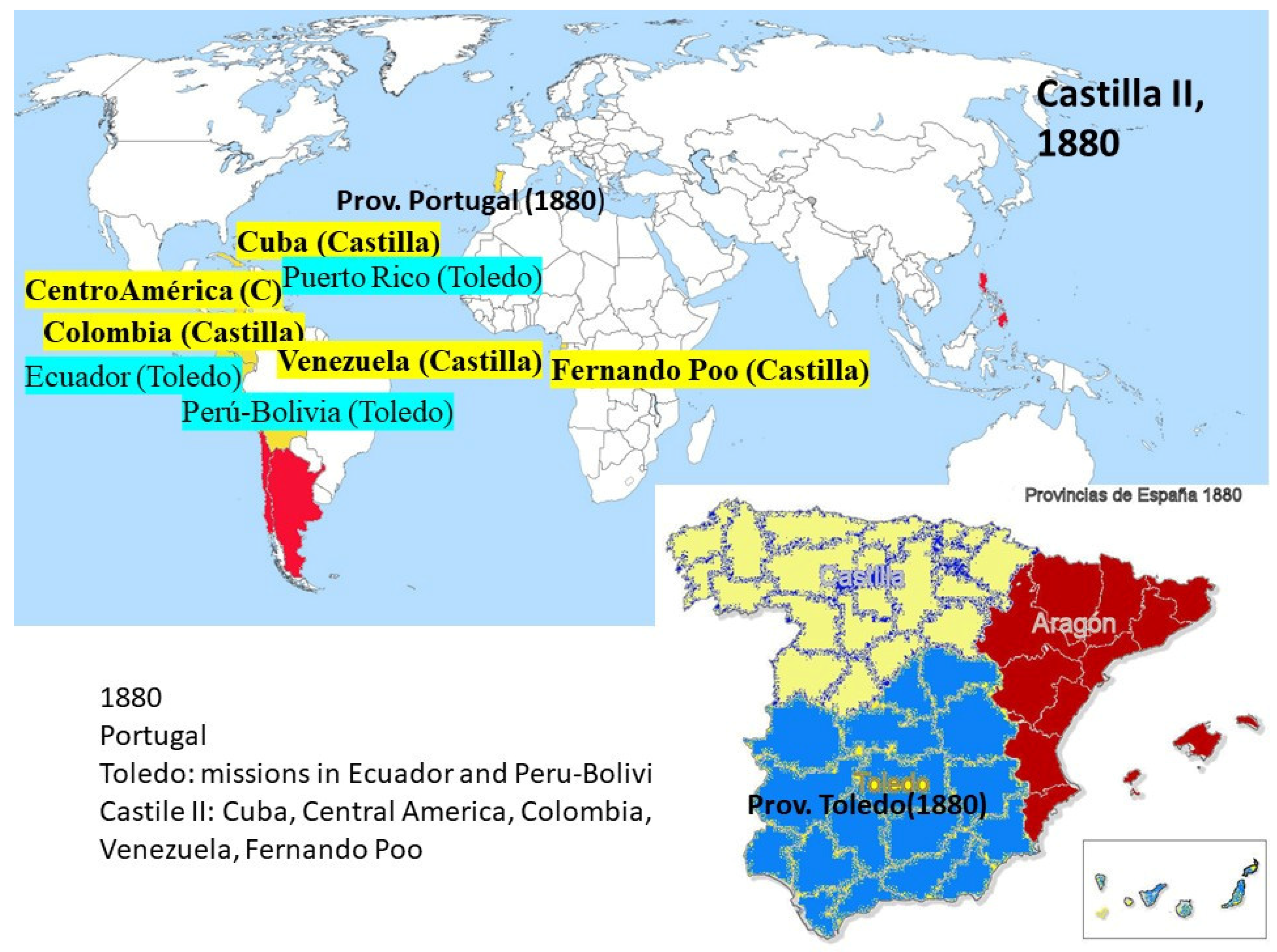
This development led to the mother province of Castile giving birth to its first two offspring in June 1880: Portugal (25 July) and Toledo (7 July), which was left with the missions of Ecuador, Peru, Bolivia, and Puerto Rico, in addition to the Canary Islands. This division had already been decided in 1868, but it had not been possible to implement it due to the revolution and the suppression of the Society (Frías 1915, p. 6; Revuelta González 1991, pp. 631–38). [Figure 6: Spanish provinces and missions in 1880].
Figure 6.
Spanish provinces and missions in 1880.
Castile II was left with just over six hundred Jesuits and its new territory was Navarre, the Basque Country, Old Castile, León, Asturias, and Galicia in Spain; and Cuba, Central America, Venezuela, and Colombia in the Americas. However, it experienced an average annual increase in numbers equal to, and even greater than, before the territorial reduction, so that by August 1914, the number had risen to 1356 (Frías 1923–1944, II, 357).
Continued legislative changes gave greater stability to the Society and its works. A royal order dated 11 July 1897, recognized the Society as a religious corporation authorized to teach and granted its teachers the right to sit on tribunals without the need for an academic degree, the latter being repealed on 12 April 1901. Another order from the Minister of the Interior, Segismundo Moret, dated 9 April 1902, legally recognized the congregations included in the previously ad hoc registry, as was the case with the Society of Jesus. This decree was resumed by the President of the Council of Ministers, Antonio Maura, and accepted by the Holy See on 19 June 1904, when an agreement was signed recognizing the legal personality of the religious congregations registered in 1902, excluding them from the common law of Associations (Revuelta González 1991). The legal existence of the Society was maintained until the Second Republic imposed the suppression of the order by Article 26 of the Constitution of 1931.
During this period, the Spanish Society enjoyed a period of peace, with a great deal of development work and an increase in vocations, which led to new foundations in the mother province of Castile. In 1915, Aragón took on the Ahmedabad-Gujarat mission (India).
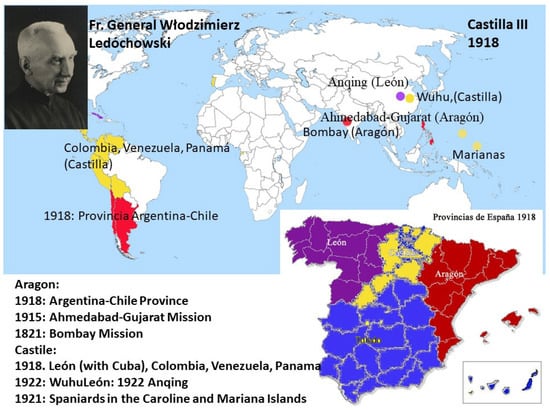
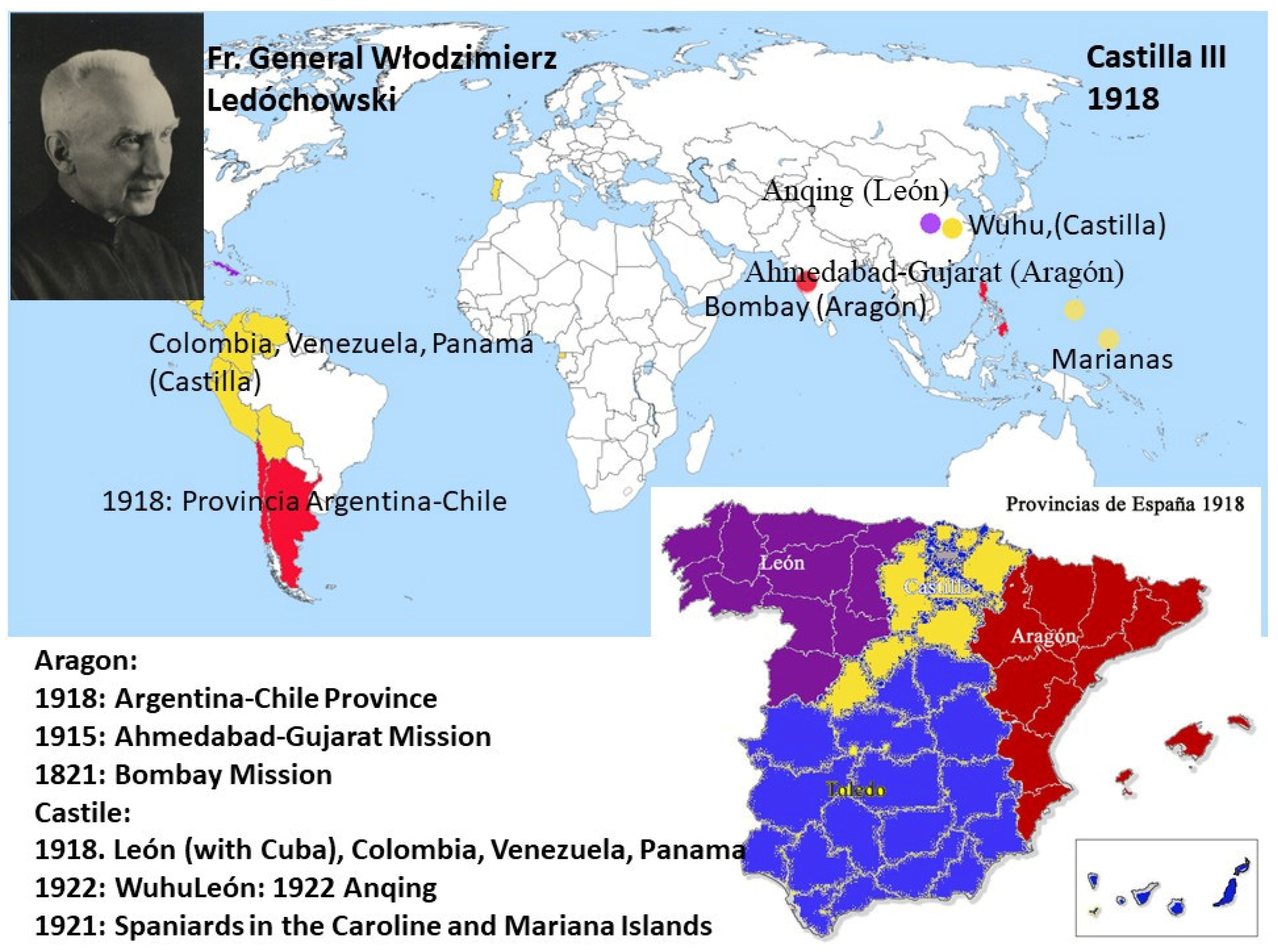
The three Spanish provinces remained unchanged until 1918, when Father General Wlodimir (o Włodzimierz) Ledóchowski (1866–1942) separated the Argentine-Chilean province from Aragon I (11 February) and divided Castile II, creating the provinces of Castile III and León (2 February). Leon comprised the territories of Galicia, Asturias, and the civil provinces of León, Zamora, Salamanca, Valladolid, Palencia, and Santander, to which the island of Cuba was linked. The rest of the territory remained part of the province of Castile III, to which the Canary Islands were incorporated on 11 June 1920. In 1921, the province of Aragon I received the mission of Bombay, while a gradual replacement of Spanish missionaries by Americans began in the mission of the Philippines, which was separated from its former mother house in 1929. [Figure 7: Spanish provinces and missions in 1918].
Figure 7.
Spanish provinces and missions in 1918.
In China, the Castilian Jesuits collaborated with the French from 1913, and in 1922, the province of Castile III was put in charge of the mission in Wuhu, and that of León, in Anqing. Spanish missionaries from various provinces served the Caroline and Mariana Islands from 1921.
7. Progressive Emancipation of the Spanish Missions
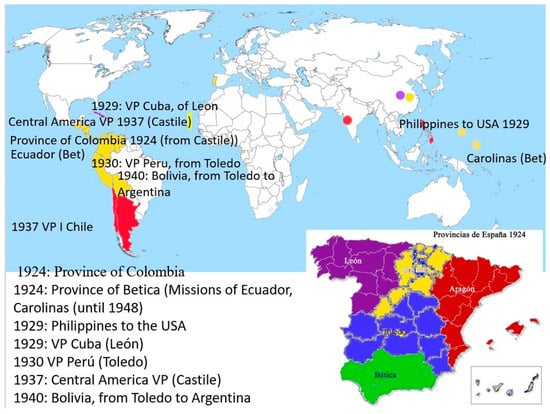
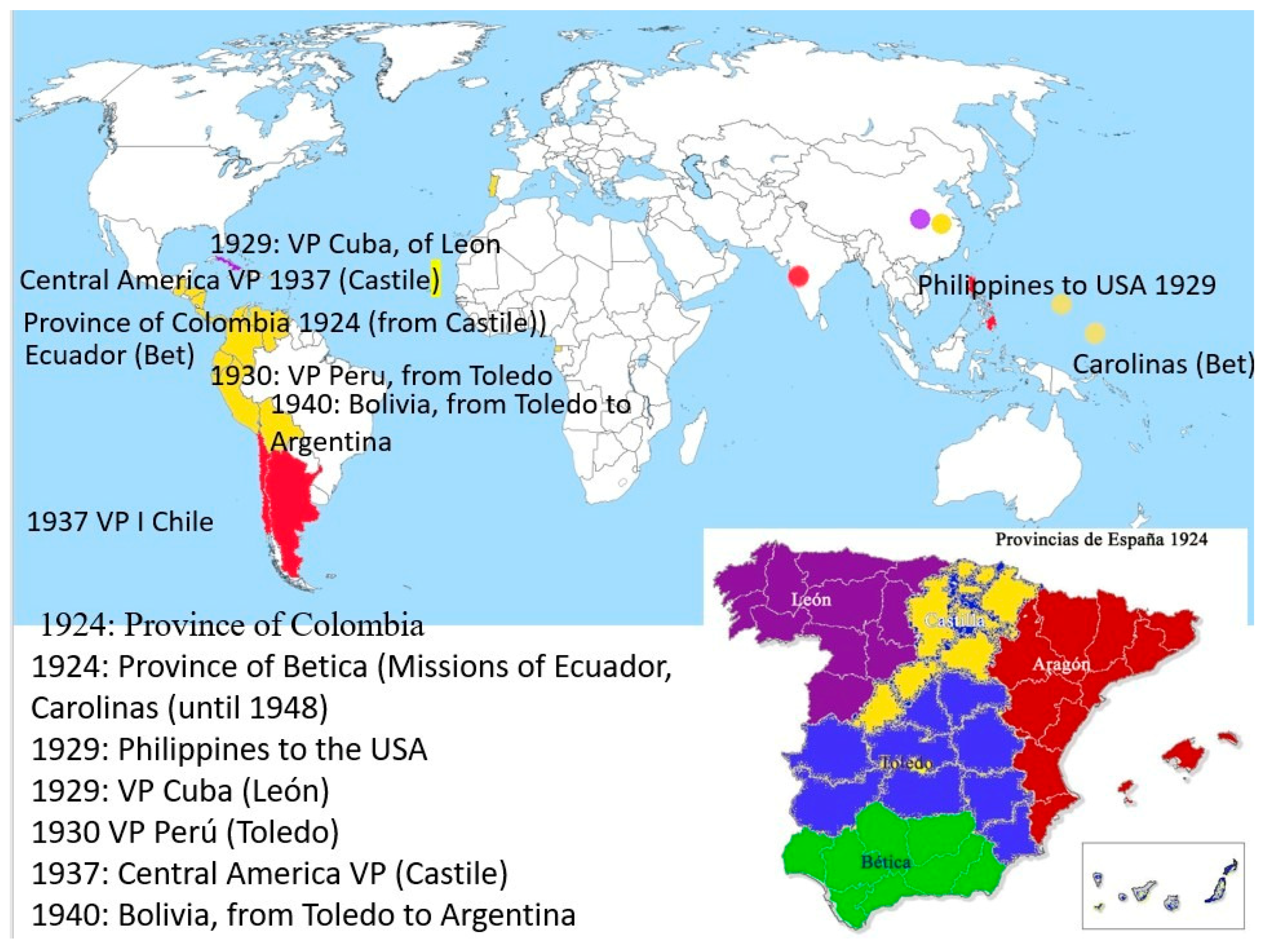
The mission territories gradually acquired a strong personal identity that would eventually lead to their emancipation. In 1924, the province of Colombia gained independence from Castile (AR 1924, 119–121/136–138; Fejér), which remained the authority on Venezuela and Panama; and on 15 August, the province of Betica or Andalusia, a granddaughter of the province of Castile, split from Toledo and was entrusted with the missions of Ecuador and the Carolinas. In 1926, the first Jesuits arrived in Paraguay from the Argentine-Chilean province.
The Central American vice-province was established (1 January 1937) and entrusted to the province of Castile III; Bolivia ceased to depend on the province of Toledo (28 November 1940) and became part of Argentina, passing to the Latin American assistance; Father General Ledóchowski asked the Spanish provinces for volunteers (30 September 1941) for the Vice-Province of Peru, and five Jesuits were immediately sent, one from each province. These events led to a more or less intense decline in the Spanish Society. [Figure 8: Spanish provinces and missions after 1924].
Figure 8.
Spanish provinces and missions after 1924.
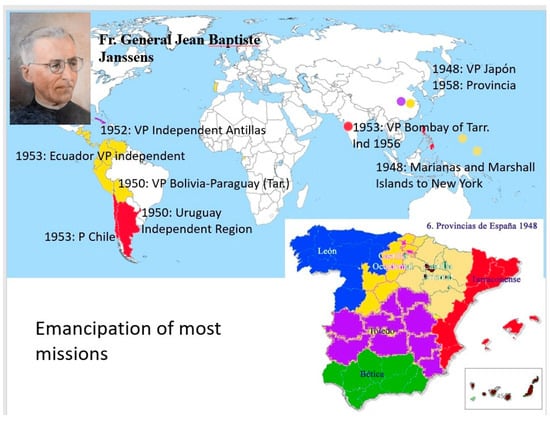
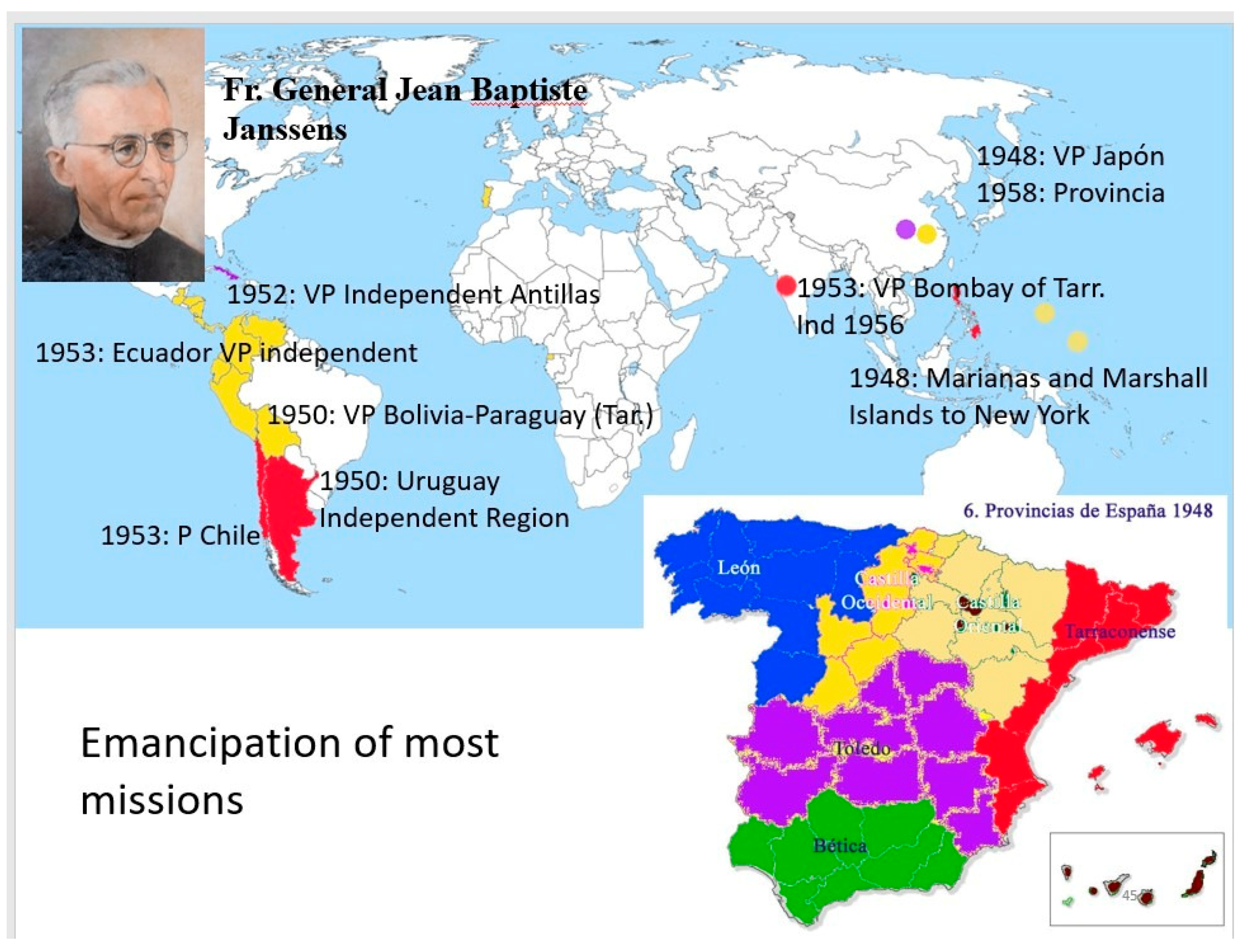
In post-Civil War Spain, the entire northern part of the peninsula was restructured in a very striking way, according to a decision by Father General Juan B. Janssens (1869–1964). In addition to rationalizing the number of members for better governance by facilitating greater communication, he had another political motivation: to divide and dilute the more nationalist regions. On 21 June 1948, the provinces of Aragon I, Castile III, and Leon, all with more than a thousand members, were divided into four: Tarraconense I, which comprised the Catalan civil provinces, and those of the former kingdom of Valencia, and the Balearic Islands; Castile Oriental, which included Guipúzcoa, Navarre, the Aragonese civil provinces, and two Castilian provinces (Soria and Logroño); Castile Occidental, which would extend over the other two Basque civil provinces (Álava and Vizcaya) and four Castilian provinces (Ávila, Burgos, Segovia, and Valladolid); León, which retained its name, only losing Valladolid. However, despite the restructuring, these were well-populated provinces in 1949: Tarraconense had 1019 members and León 1006; Western Castile had 653; Eastern Castile had 993; Toledo had 632; and Betica had 739. This decree decided to assign the Canary Islands to Betica, but this did not take place until 1952, remaining in the province of Eastern Castile in the meantime. That same year, the Goiano-Mineira vice-province (1952–1972) was separated from Central Brazil and placed under the jurisdiction of León. It included the states of Minas Gerais, Espírito Santo, and Goiás.
During Janssens’s term as Superior General, the Society’s tremendous growth led to its enrichment with new provinces and vice-provinces. Father General decided to transfer the Caroline and Marshall Islands, a mission of the Betica Province, to the New York Province, although the Spanish missionaries remained assigned to the Mission (AR 2 February 1948). The mission in Japan was established (6 November 1948) as an independent vice-province, supported by the universal Society, but in a special way by the provinces of Betica and Toledo. It became an independent province on 11 September 1958. Bolivia and Paraguay separated from the province of Argentina, under the name of the Bolivian-Paraguayan vice-province, and became dependent on the province of Tarraconense in 1950 (AR 17 November 1950). That same year, 1950, Uruguay became an independent region. Cuba had been a mission since 1918 and a vice-province since 1929, dependent on León, and became an independent vice-province of the Antilles (7 September 1952).
The vice-province of Ecuador became an independent vice-province in 1953, ceasing to belong to the provinces of Betica (AR 30 April 1952). The vice-province of Bombay was established as dependent on Tarraconense in 1953, and became independent in 1956, integrated into the assistance of Spain (AR 23 April 1953). These changes affected the Spanish provinces and involved a large flow of personnel: the Tarraconense, for example, in order to enable the sending of the first two groups of some 70 Jesuits to the Bolivian-Paraguay Vice-Province, closed the residences in Gerona and Tarragona and the Commercial Institute in Barcelona. [Figure 9: Provinces of Spain and their missions after 1948].
Figure 9.
Provinces of Spain and their missions after 1948.
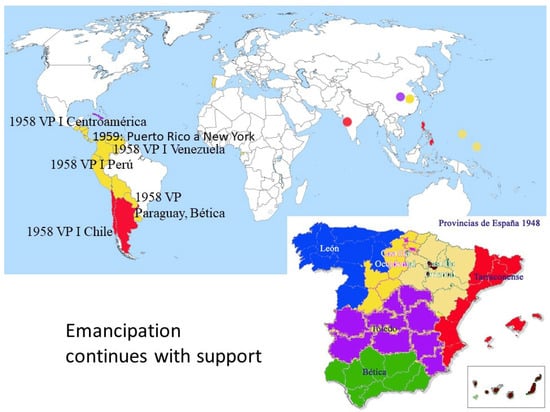
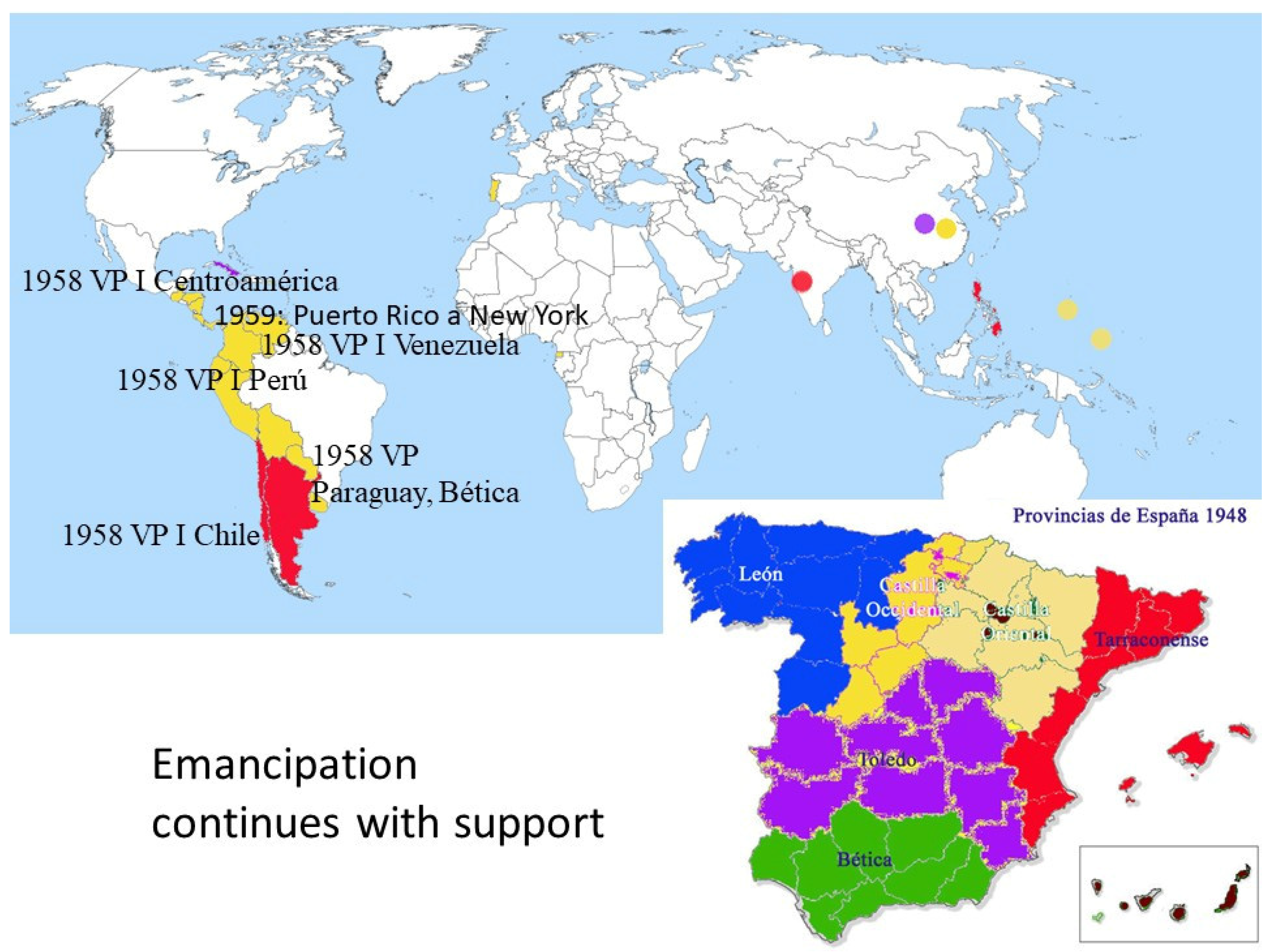
The transfer of Spanish Jesuits to Latin America, India, Japan, and the Far East continued. In 1958, the vice-province of Chile, the Peruvian vice-province (which depended on Toledo), the Venezuelan vice-province (of Eastern Castile, 11 February), and the Central American vice-province (of Western Castile, 12 March) declared their independence, and the vice-province of Paraguay was established as dependent on Betica (2 July). The process culminated with the creation of the Assistance of Northern Latin America (25 December) and the transfer of Puerto Rico to the province of New York (17 May 1959) (Carrez 1900). [Figure 10: Spanish provinces and missions in 1958].
Figure 10.
Spanish provinces and missions in 1958.
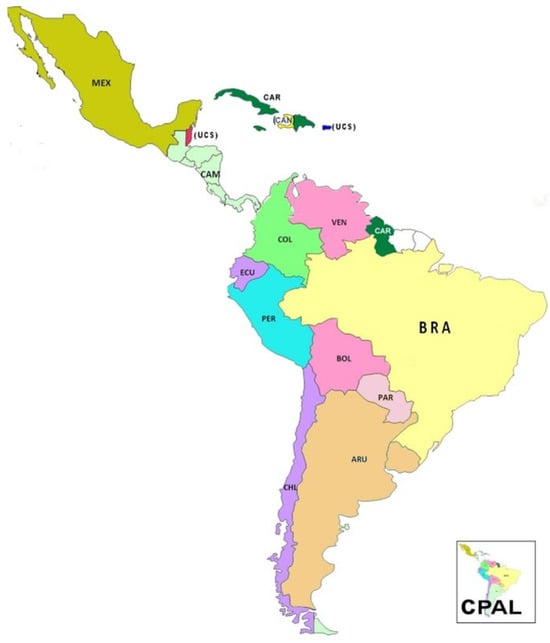
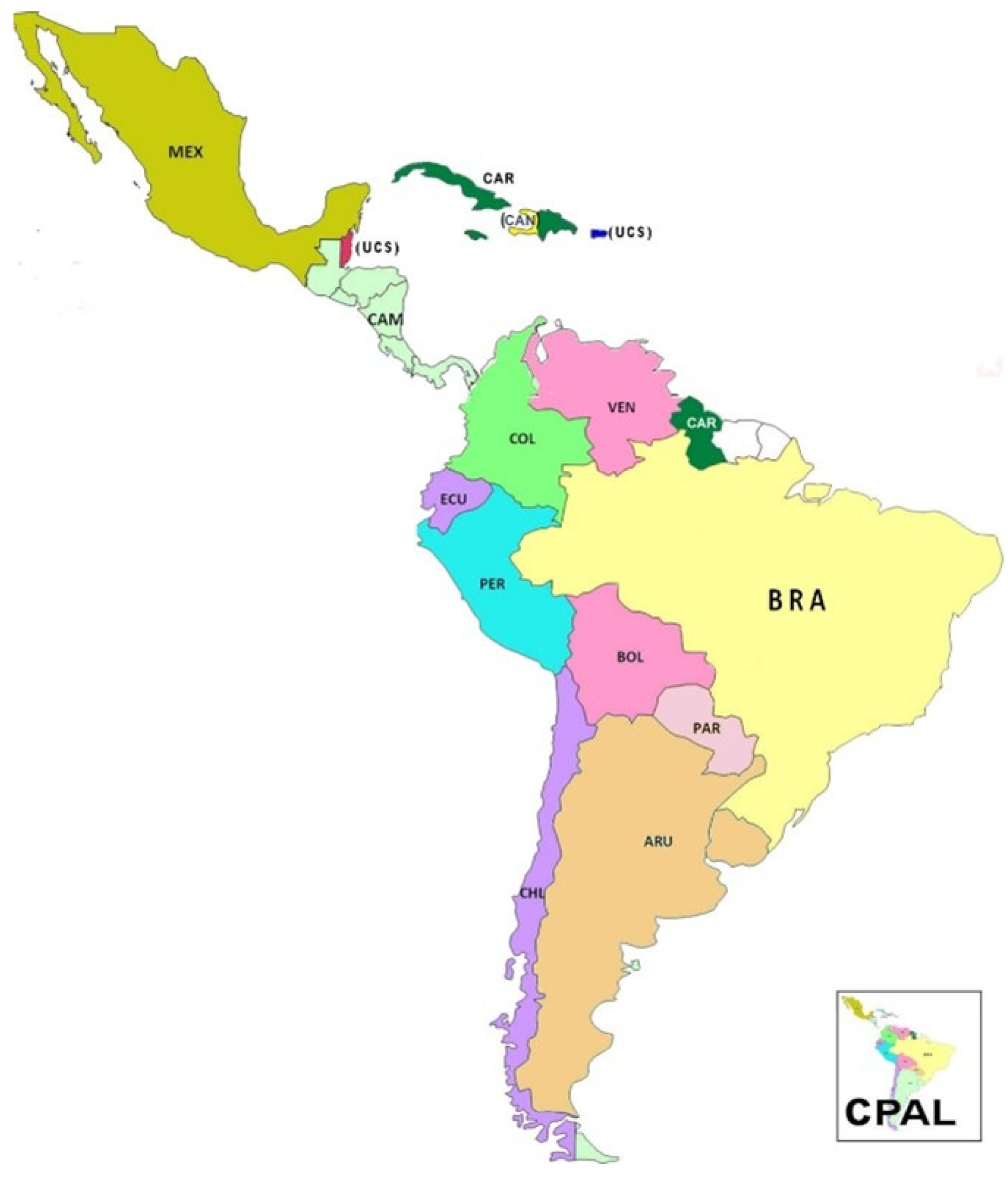
The growth of provinces in Spanish America was made possible by the generous transfer of many missionaries from Spain. Thus, for example, this missionary redistribution of the Society explains why the 5424 Jesuits assigned to the Spanish provinces at the beginning of 1954 fell to 4791 at the end of 1961, even though the average number of novices entering every province exceeded 34 every year. The 1961 catalogs provide the key. The Spanish provinces had transferred 1680 Jesuits (834 priests, 487 scholastics, 359 brothers) to the territories of Japan, Ahmedabad, Central America, the Far East, Bombay, Venezuela, Gujarat, the Antilles, Paraguay, and Peru. Although a significant number of these were natives of the vice-provinces, a very considerable number were Spanish (DHCJ, Spain). [Figure 11: Jesuit provinces of Latin America (2024)].
Figure 11.
Jesuit provinces of Latin America (2024).
In Spain, on 2 July 1962, another geographical design was agreed upon, correcting the one established 14 years earlier (AR 2 July 1962). The classic name of Aragon II was restored for a province (476 members) that encompassed historic Aragon, the ancient kingdom of Valencia, and the Balearic Islands; Castile IV (588) brought together the civil provinces of Old Castile; Leon (736) encompassed the civil provinces of the kingdom of Leon with Asturias and Galicia; Loyola brought together Navarre and the three Basque provincial councils for the first time in history; and Tarraconense II (754) included only the four Catalan provinces for the first time in history. [Figure 12: Spanish provinces and missions after 1962].
Figure 12.
Spanish provinces and missions after 1962.
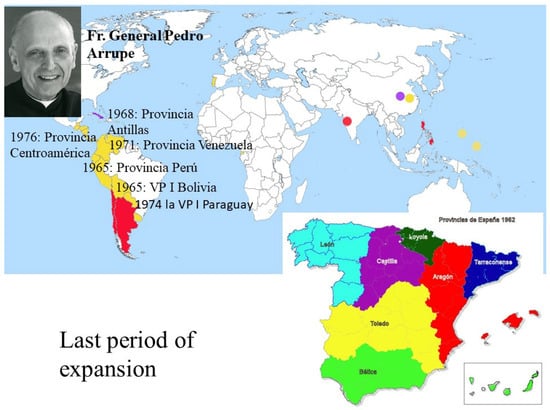
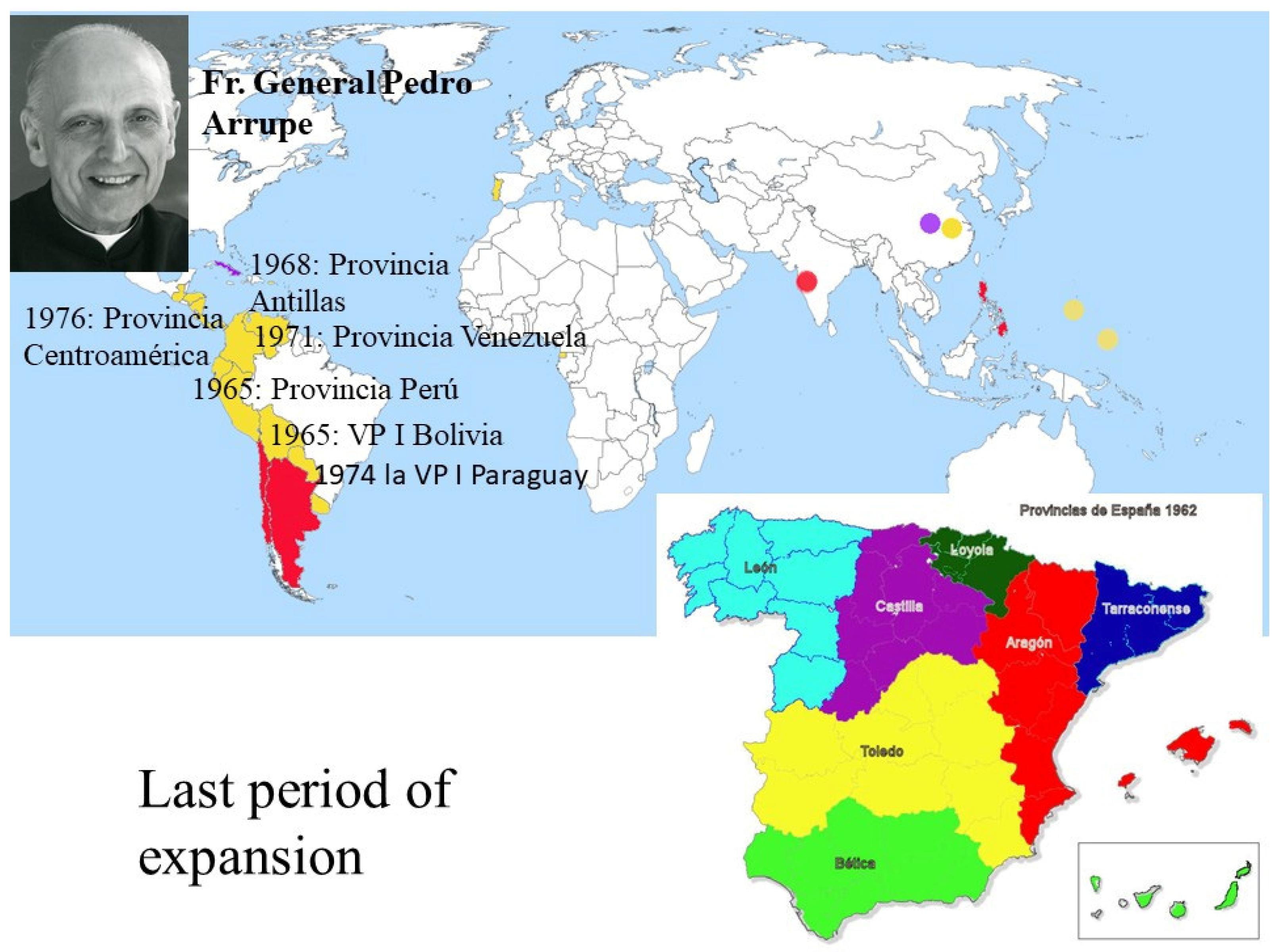
Following the election of Fr. Arrupe (1965), the final period of expansion began. In 1967, the independent province of Peru was created, and Bolivia acquired the status of an independent vice-province. Given the development of the Antilles, the province of the Antilles was officially established (31 July 1968), which included Cuba, the Dominican Republic, and the so-called “Miami section” (DHCJ Antillas Españolas), but in fact, Cuba continued as an independent region until its full integration into the Antilles in 2014. In 1971, the independent province of Venezuela was created; in 1974, the independent vice-province of Paraguay; and in 1976, the province of Central America.
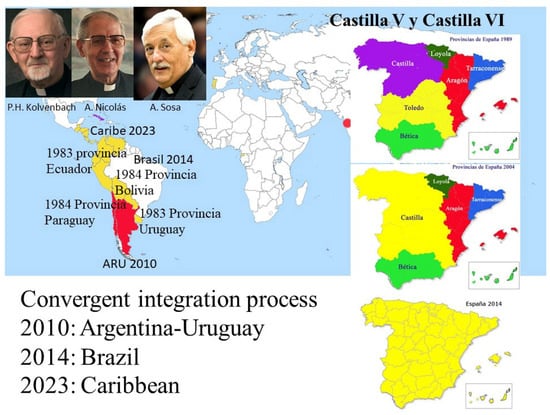
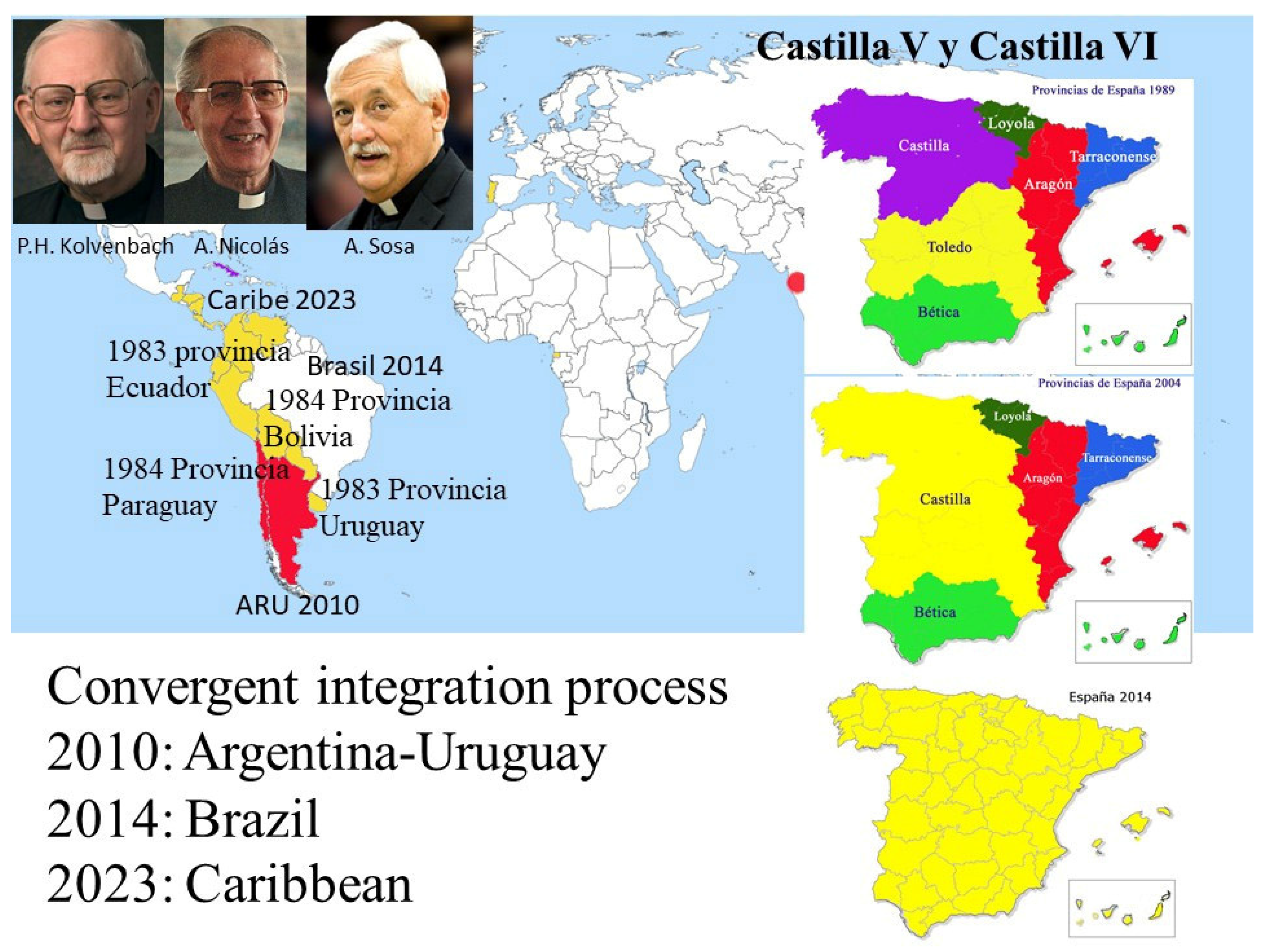
Under Fr. Kolvenbach (elected in 1983), the last provinces were established. In 1983, the provinces of Ecuador and Uruguay were created, and in 1984, those of Bolivia and Paraguay.
Spain had also reached a turning point, because although we had witnessed a divergent, expansive process, from 1989 onwards a slow path of convergence and integration began (parallel to the vocational crisis that began after the Vatican II Council), in which the name of a changing province of Castile stood out, which, like a grandmother, was gathering up her children. The provinces of Castile and León were united on 22 April 1989, in a vast province of Castile V, which brought together the entire northwest of Spain: 16 civil provinces in five autonomous regions, with 642 members (433 priests, 50 scholastics, and 159 brothers), the fourth largest in the entire Society. Both provinces had shared the novitiate since 1974. In 2004, a new province of Castile VI was created with the territories of the former Castile V and Toledo, and in 2014 all the provinces of Spain (Aragon, Betica, Castile, Loyola, and Tarraconense) were integrated into one province of Spain, whose structure already existed, although without territorial jurisdiction, since 1970, when it was created, with Urbano Valero as provincial, with a statute that defined its powers, preserving the territorial organization of the seven provinces (AR 1970, 650–656).
In America, the effects of the crisis in vocations are beginning to manifest themselves with a gradual decline that continues until now. Some kind of decline occurred with the merger of Argentina and Uruguay (2010) and the restructuring of the Antilles into the new province of the Caribbean (2023). [Figure 13: Jesuit provinces and missions since 1983].
Figure 13.
Jesuit provinces and missions since 1983.
8. Demographic Trends in the Provinces of Aragon and Castile
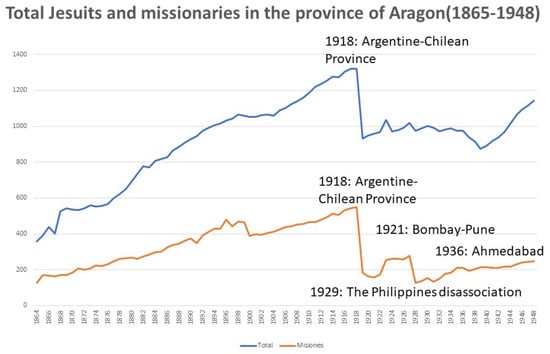
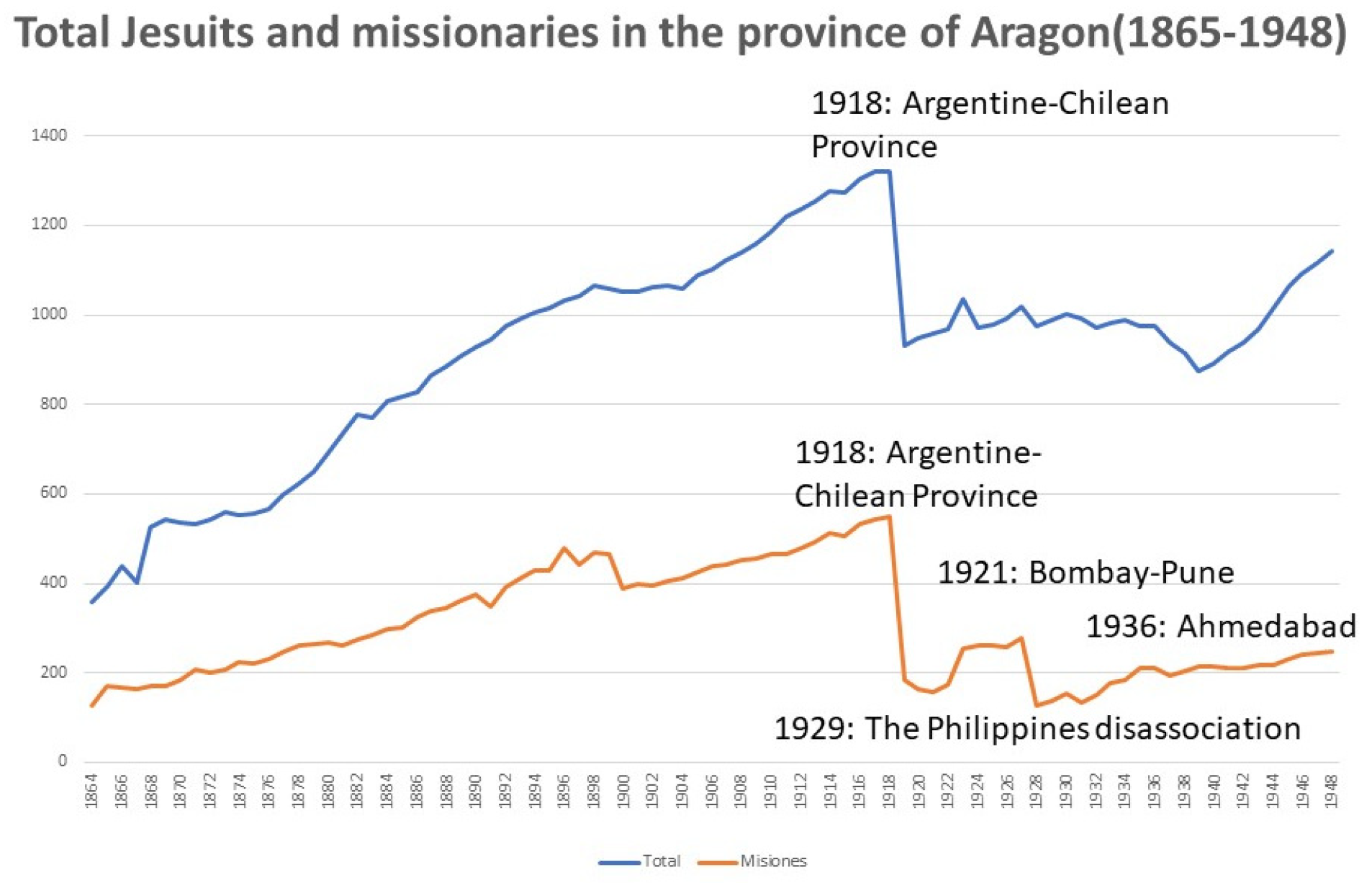
We have only compiled statistical data for the provinces of Aragón I and Castilla I as examples; the former remained unchanged from 1863 to 1948, while Castilla was divided into Castilla II and León, but retained the same territory as a whole until 1948. This time frame covers most of the missionary history of both provinces, and from 1948 onwards, the territories separated, meaning it is not easy to continue the statistical study. To this end, we have used data from the annual Jesuit catalogs7, sometimes adjusting the numbers to accommodate changes in the design and terminology of the catalogs, which may indicate statistically insignificant variations. [Figure 14, Figure 15, Figure 16 and Figure 17].
Figure 14.
Total Jesuits and missionaries in the province of Aragon (1865–1948).
Figure 15.
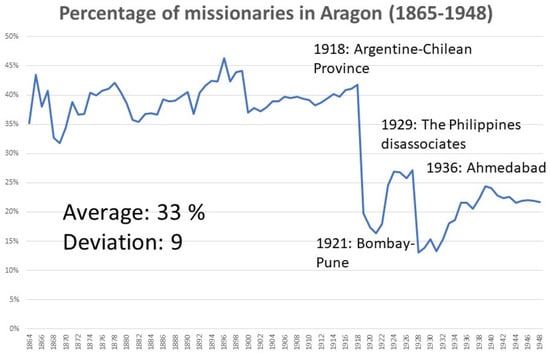
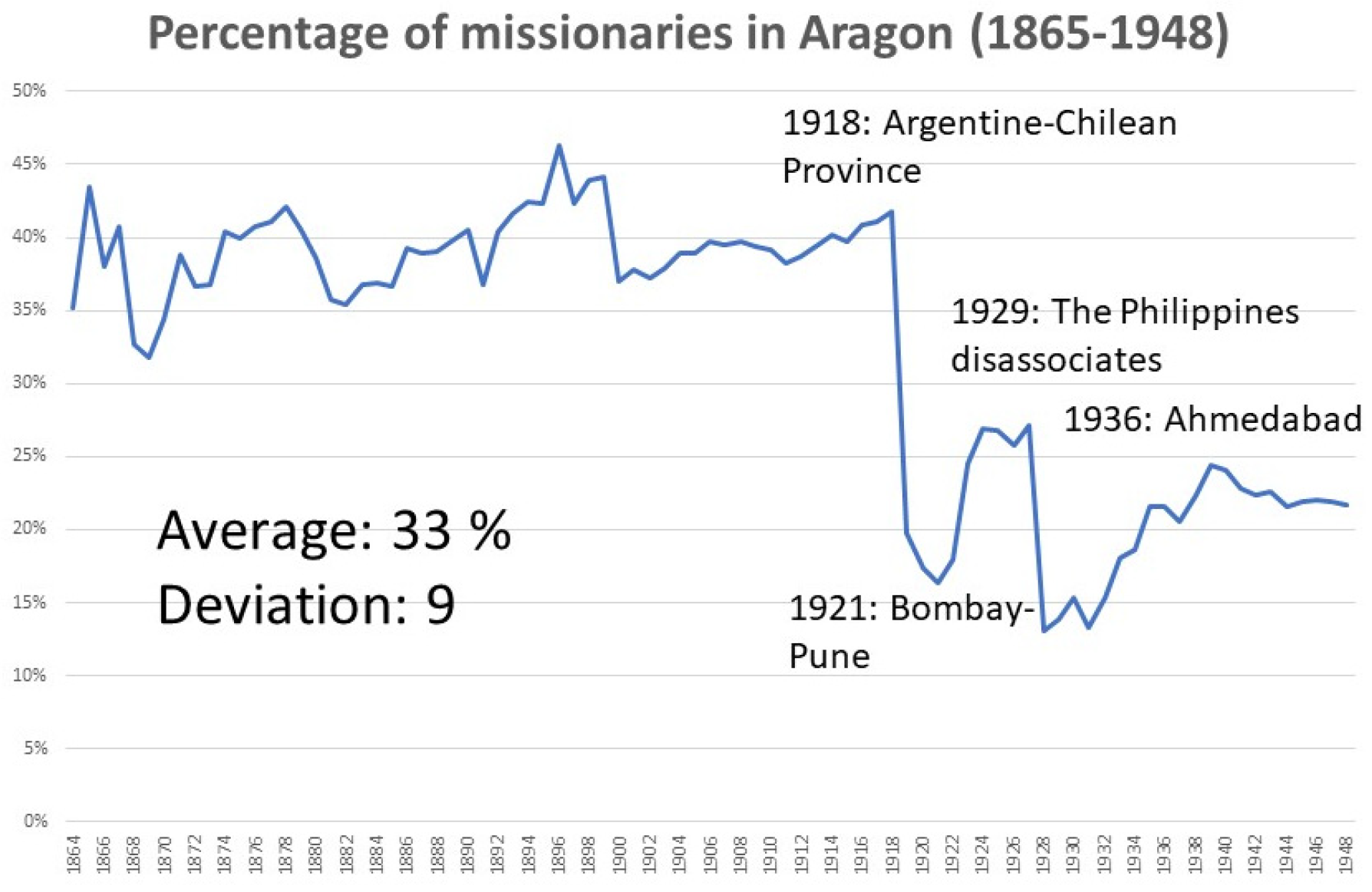
Percentage of missionaries in Aragon (1865–1948).
Figure 16.
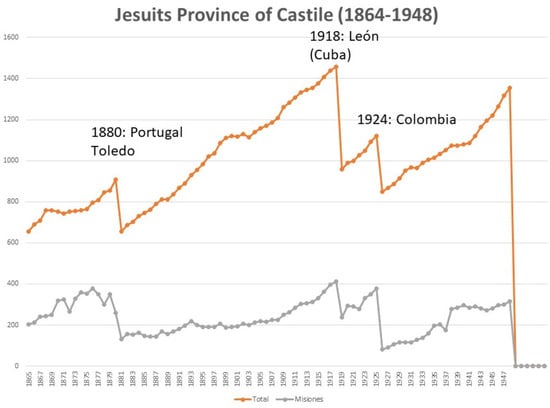
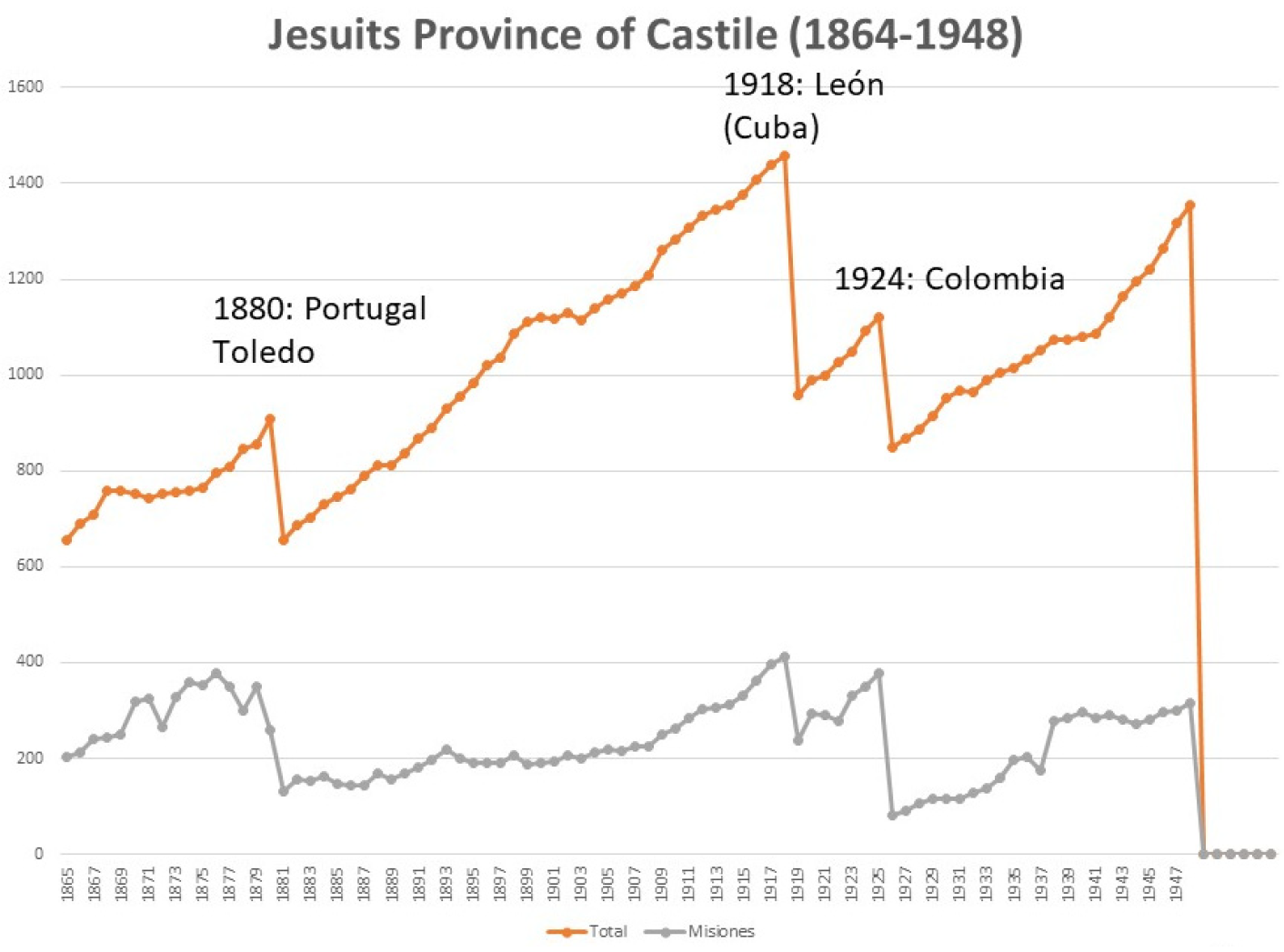
Total Jesuits and missionaries in the province of Castile (1865–1948).
Figure 17.
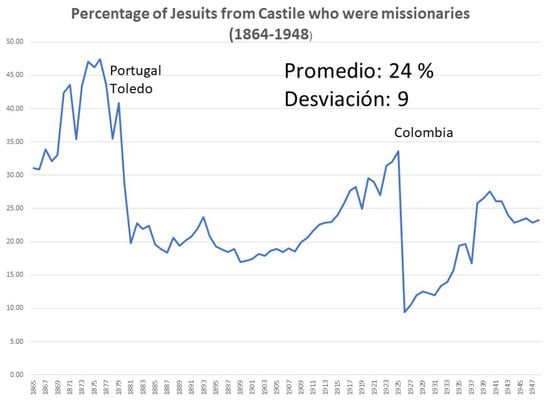
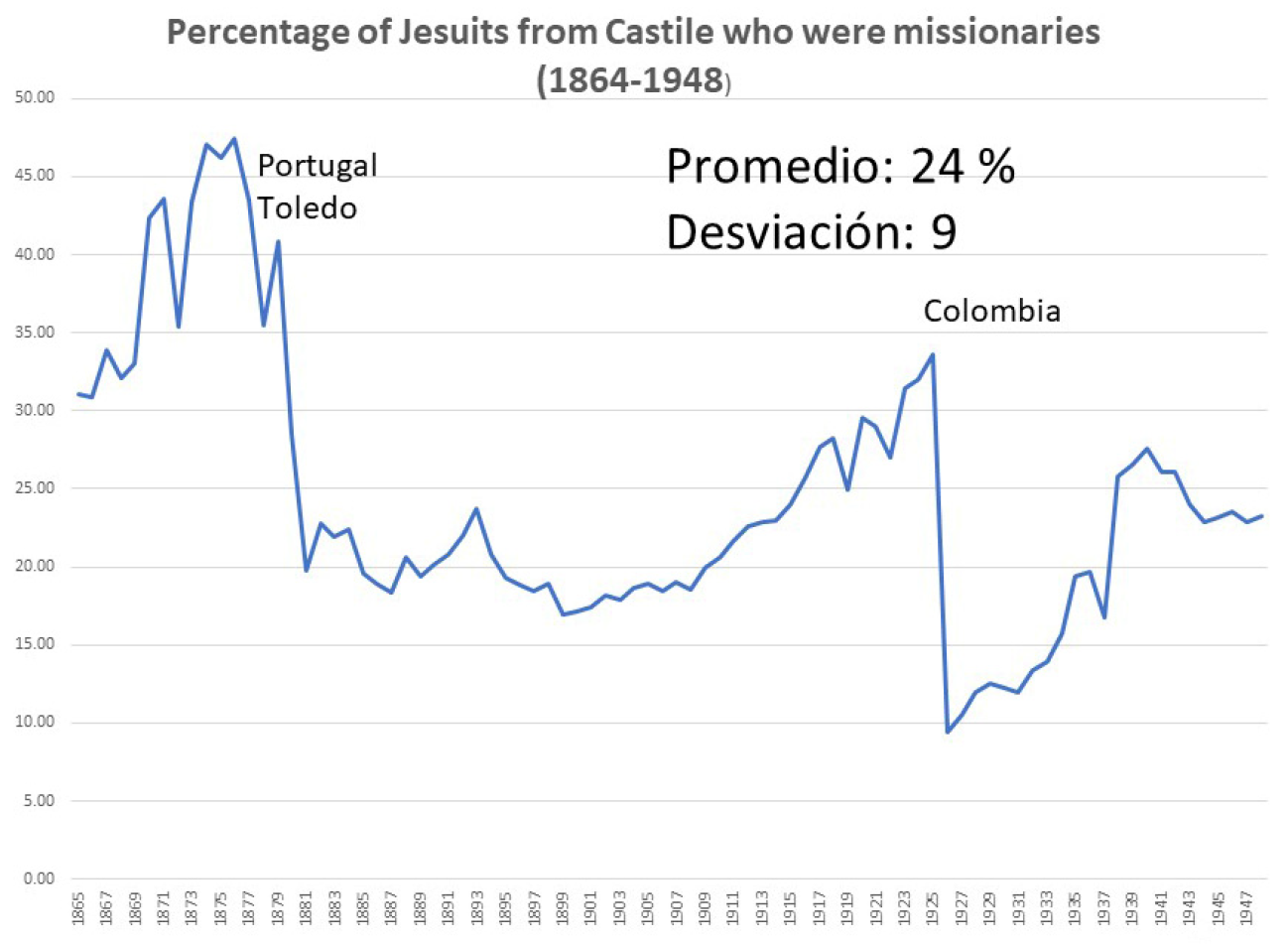
Percentage of missionaries in Castile (1864–1948).
The first observation is the continuous upward trend in the number of subjects in both provinces, both in terms of the total number of Jesuits in the province and those in mission lands. When a territory became independent, all the Jesuits in it came under the jurisdiction of the new entity, and although many were natives, others were from the original province; the same applies to the incorporation of a new mission. Here we do see differences between the two provinces. While Aragon has a more regular upward trend, Castile experiences more variations. In terms of averages, Aragon is a more missionary province, with a third of its members working in missions (33%), while Castile only has a quarter (24%). The variation in the two provinces is small, with a standard deviation of 9. It is curious that although the total number in Castile is greater than in Aragon, it is not proportional to its territory, which is larger in Castile.
In Aragon, there was only one decrease in the number of members, missionaries of the province and the percentage of missionaries, coinciding with the emancipation of the Argentine-Chilean province in 1918. The other decrease is not apparent in the total number of members of the province, but it is apparent in the number and percentage of missionaries: the separation of the Philippines in 1829. There are two increases in missionaries: the incorporation of the Bombay-Pune mission (1921) and Ahmedabad (1936).
In the statistics for Castile, we see greater dynamism. Thus, in 1880, the provinces of Portugal and Toledo became independent; in 1918, León became independent, taking with it the mission in Cuba, and the Argentine-Chilean province was created; and in 1924, Colombia became independent. These losses are clearly reflected in the number of members of the province, the number of missionaries, and the percentage of missionaries.
As for the percentage of Jesuits in the province of Castile working in missions, we obtain an average of 24%, with little variation (standard deviation 9). In other words, almost a quarter of the Jesuits in this province were in mission territories. There is a gradual increase in this percentage, which falls at times when a particular area gains independence. In 1868, with the Glorious Revolution that suppressed the Society in Spain, many of its Jesuits went abroad, and quite a few of them to mission territories, which is why the highest percentages occur around 1870 to 1877, with a peak of 47% (almost half) in 1874. In 1880, the percentage declined with the independence of Portugal and Toledo. However, the percentage was not greatly affected by the independence of León and Cuba, as the same percentage of missionaries served the remaining territories. When Colombia gained independence, the percentage of missionaries fell from 33.63% to 9.42%, which seems to reflect the reduction in Castile’s missionary space, which was left with only Venezuela, Panama, and Wuhu (China), although this percentage began to grow in 1927, with an acceleration of growth during the Second Spanish Republic and Civil War (1932–1939), and a temporary decline in the immediate post-war period.
9. Some Conclusions
Spanish Jesuit missionaries contributed to the establishment and development of the Catholic faith in many countries in Spanish America and the Philippines, as well as other regions, both in the old Society and in the new Society.
As far as the old Society (1540–1773) is concerned, the Spanish Jesuit provinces provided human resources (with many first-rate Jesuits) and economic resources to those territories. The generation of provinces began with that of Peru, which was created from scratch, without any previous dependence on any province in Spain, either as a mission or a vice-province. This evangelization was carried out by virtue of the royal patronage, which sent missionaries from the metropolis to its overseas territories.
The same thing happened in the second stage of the Society (from 1814 onwards), with the difference that this stage was marked by political tensions that affected the Society in the form of dissolution or expulsion. Despite this, the order’s significant demographic growth allowed it to generously send many Jesuits to mission fields in Spanish-speaking areas, as well as to other areas such as Japan, China, and India.
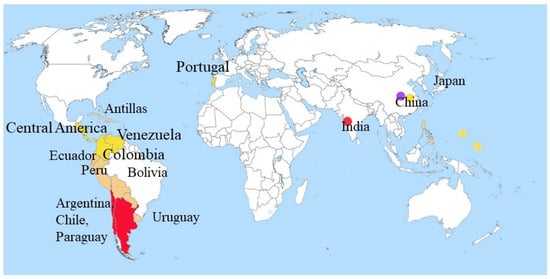
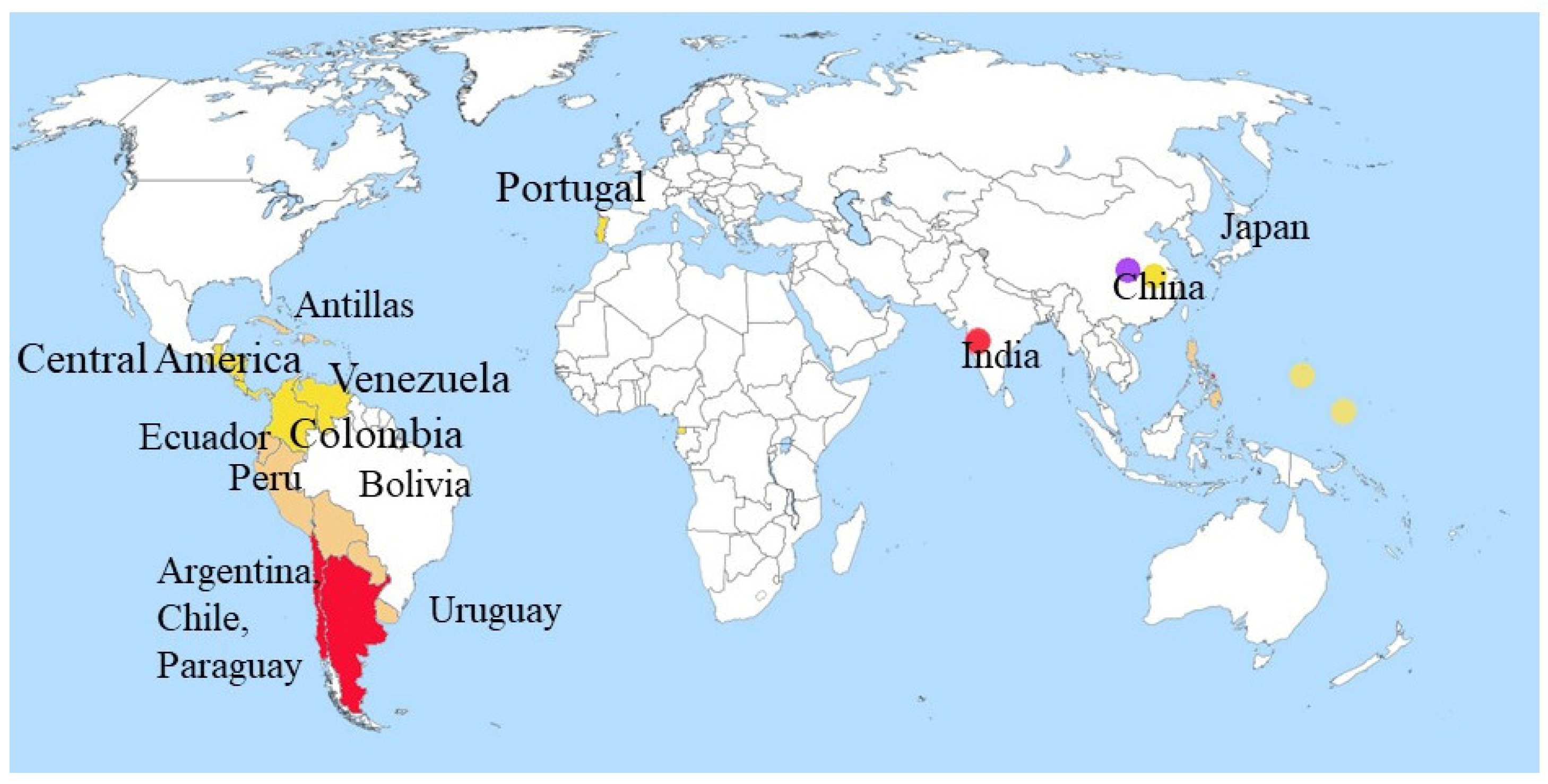
In summary, in the Contemporary Age, the following Jesuit provinces were established after having been missions of the province of Aragon: Argentina (1918); Chile (1953); Bolivia (1984); and, partially, Paraguay and Uruguay. And these others were territories dependent on Castile and/or the successive Spanish provinces to which it gave rise: Colombia (1924), Peru (1965), Antilles (1968), Venezuela (1971), Central America (1976), Ecuador (1983), Uruguay (1983), and Paraguay (1984). The Spanish provinces also had missions in the former Spanish territories of Fernando Poo, the Philippines, the Caroline Islands, and the Mariana Islands, as well as in other places outside Spanish culture, such as Japan, Brazil, China, and India. In addition, it has supported other places outside Spain with personal missions. This study is completed by showing the contribution of human resources, for example, in the provinces of Aragon and Castile. [Figure 18: Jesuit provinces and missions born from the provinces of Spain].
Figure 18.
Jesuit provinces and missions born from the provinces of Spain.
It would be interesting to supplement this study with other aspects, such as logistical and financial support. In the old Society, this role was assumed in particular by the Office of the Indies in Seville, studied by Galán García. In the contemporary era, mission offices were created in several provinces, some of them specific, such as the office for Japan, the Far East, Paraguay, etc., up to the current Secretariat of Missions and NGOs such as Entreculturas. They sought resources to help the missions and supported the missionaries.
We cannot assess the quality of this evangelization here or describe it. We can assume that it was a European-style evangelization, transmitting the theology developed in Europe (there was no other), but, given the way of missioning of the Society, with attempts at cultural adaptation, taking on the values and concerns of the peoples being evangelized. This is clearer in the old Society (especially in China and India) but also in the contemporary one, in which many Jesuits have identified with the peoples they were missionaries to. Also commendable are the attempts to develop local theologies, joining forces with other ecclesial institutions (for example, in Liberation Theology). It remains to be studied how the Jesuit missions have impacted the identity of these peoples, which is most evident in Paraguay with his Guaraní language, or promoted their development, as well as whether there are differences between the missionary practices of the Jesuits and those of other religious congregations.
Funding
This research received no external funding.
Institutional Review Board Statement
Not applicable.
Informed Consent Statement
Not applicable.
Data Availability Statement
The original contributions of this study are included in the article. Further inquiries can be directed to the corresponding author.
Acknowledgments
Figure 2 published in a book (Imago Primi saeculi Societatis Iesu, Anvertpiae: Ex oficina plantiniana Balthasaris Moreti, 1640): https://archive.org/details/imagoprimisaecul00boll (accessed on 15 February 2026). Figure 4 is public domain https://commons.wikimedia.org/w/index.php?search=Allegory+of+the+triumph+of+the+Jesuits+in+the+four+parts+&title=Special%3AMediaSearch&type=image (accessed on 15 February 2026). The other figures were created by the author.
Conflicts of Interest
The author declares no conflicts of interest.
Abbreviations
The following abbreviations are used in this manuscript:
| AR | Acta Romana Societatis Iesu |
| ARSI | Archivum romanum Societatis Iesu |
| Borgia | Sanctus Franciscus Borgia Quartus Gandiae Dux et Societatis Praepositus Generalis Tertius. 1894–1911. 5 vol. Madrid. |
| DHCJ | O’Neill, Charles E. y Domínguez, Joaquín Mª (Dirs.). 2001. Diccionario Histórico de la Compañía de Jesús, Bibliográfico-Temático, 4 tomos. Roma/Madrid: Institutum Historicum Societatis Iesu/Universidad Pontificia Comillas. |
| EppIgn | Sancti Ignacii Loyola Societatis Iesu fundatoris epistolae et instructiones. 1903–1911. 12 vol. Madrid, reimpresión 1964–1968. |
| MonMex | Monument Mexicana. 1965–1991. Edited by Félix Zubilaga, 8 vol., Roma: Institutum Histgoricum Societatis Iesu. |
| MonPer | Monumenta Peruana. 1954–1981. Edited by Antonio Egaña, 8 volúmenes, Roma: Institutum Historicum Societis Iesu. |
| Nadal | Pláticas espirituales del P. Jerónimo Nadal, S. I., en el Colegio de Coimbra [1561], 1945. Edited by Miguel Nicolau. Facultad de Teología, Granada, Sexta exhortatio, n. 16. |
Notes
| 1 | https://arsi.jesuits.global/repertori/repertori-bibliografici/#polgar (accessed on 1 March 2026). |
| 2 | https://jesuitonlinebibliography.bc.edu/ (accessed on 1 March 2026). |
| 3 | Jesuitica Project KU Leuven—Facilitating academic research on our Jesuitica book collections: https://jesuitica.be/ (accessed on 1 March 2026). |
| 4 | The final decision to convert a dependent province or region into an independent province is a legal and apostolic process governed by the Constitutions and norms of the General Congregations. It depends on the superior general, who takes into account several criteria: 1. The self-sufficiency and maturity of the administrative unit; that is, its capacity for self-management in human resources, its capacity to manage the stages of formation, and its financial stability. 2. Apostolic and governance criteria: a consolidated apostolic project and its own governance structure. 3. Geographical, political, and historical context. |
| 5 | We added a Roman numeral to indicate the different configurations of the province of Castile, as it is the one that has undergone the most different geographical configurations while retaining the same name. |
| 6 | The province of Castile is the one that has undergone the greatest variety in its geographical configuration in contemporary history: Castile I (1863–1880); Castile II (1880–1918); Castile III (1918–1948); Castile IV (1962–1989); Castile V (1989–2004); Castile VI (2004–2014). In addition, the following provinces also existed within its territory: Western Castile (1948–1962); Eastern Castile (1948–1962); León I (1918–1948); León II (1948–1989); Toledo I (1880–1924); Toledo II (1924–2004) (Soto Artuñedo 2013b). |
| 7 | https://arsi.jesuits.global/repertori/cataloghi-nuova-compagnia/ (accessed on 1 March 2026). |
References
Archival Sources
Acta Romana Socidetatis Iesu. 1948, 1950, 1952, 1953, 1962, 1970.Imago Primi Saeculi societatis Iesu a provincia Flandro-belgicae repraesentata. 1640. Antverpiae, Ex officina plantiniana Balthasar Moreti.Monument Mexicana. 1965–1991. Edited by Félix Zubilaga, 8 vol., Roma: Institutum Histgoricum Societatis Iesu.Monumenta Peruana. 1954–1981. Edited by Antonio Egaña, 8 vol., Roma: Institutum Historicum Societis Iesu.Pláticas espirituales del P. Jerónimo Nadal, S. I., en el Colegio de Coimbra [1561]. 1945. Edited by Miguel Nicolau. Granada: Facultad de Teología. Sexta exhortatio, n. 16.Sancti Ignacii Loyola Societatis Iesu fundatoris epistolae et instructiones. 1903–1911. 12 vol. Madrid, reimpresión 1964–1968.Sanctus Franciscus Borgia Quartus Gandiae Dux et Societatis Praepositus Generalis Tertius. 1894–1911. 5 vol. Madrid.Published Sources
- Agustí, Vicente. 1893. Mártires de Salsete. Bilbao: Imprenta del Sagrado Corazón de Jesús. [Google Scholar]
- Alay, Josep Lluis. 2006. Embajador en la Corte del Gran Mogol: Viajes de un Jesuita Catalán del Siglo XVI por la India, Pakistán, Afganistán y el Himalaya. Lérida: Milenio. [Google Scholar]
- Alonso Romo, Eduardo Javier. 2006. Andrés de Oviedo, patriarca de Etiopía. Península. Revista de Estudios Ibéricos 3: 215–31. [Google Scholar]
- Astrain, Antonio. 1902–1925. Historia de la Compañía de Jesús en la Asistencia de España. Madrid: Razón y Fe, vol. 7. [Google Scholar]
- Bangert, William V. 1981. Historia de la Compañía de Jesús. Santander: Sal Terrae, p. 466, [1986. A History of the Society of Jesus. Brighton: Institute of Jesuit Sources]. [Google Scholar]
- Bartolomé-Martínez, Bernabé. 1986. Otro soriano para la Historia: El padre jesuita Juan de la Plaza, Provincial y Visitador Religioso en las Indias”. Celtiberia 72: 315–39. [Google Scholar]
- Blanco, José María. 1929. Historia Documentada de la Vida y Gloriosa Muerte de los Padres Roque González de Santa Cruz, Alonso Rodríguez y Juan del Castillo, de la Compañía de Jesús, Mártires del Caaró y Yhují. Buenos Aires: S. de Amorrortu. [Google Scholar]
- Borba, José Vanderlei. 2023. Naufrágios na Costa Sul-Riograndense (1737–1889): Com Registros de Bases Digitais do Reino Unido. Lisboa and Rio Grande: Coleção Riograndense. [Google Scholar]
- Carrez, Ludovicus. 1900. Atlas Geographicus Societatis Iesu. Paris: Georgium Colombier Typographum. [Google Scholar]
- Castro, Merello. 2014. Agustín. In El Seminario Diocesano de Canarias y los Jesuitas (1852–1868). Bilbao: Mensajero. [Google Scholar]
- Caxa, Quiricio, and Pero Rodríguez. 1988. Primeiras Biografias de José de Anchieta. São Paulo: Loyola. [Google Scholar]
- Cerezo, Elías, and Roberto Villasante, eds. 2015. Jesuitas Españoles en China (1552–2014). Taipei: Inforchina. [Google Scholar]
- Colombo, Emanuele. 2023. Quando Dio Chiama. I Gesuiti e le Missioni nelle Indie (1560–1960). Bologna: Il Mulino. [Google Scholar]
- Didier, Hugues. 2011. Jerónimo Javier, un navarro en la India. In Actas del I Congreso Ibero-Asiático de Hispanistas Siglo de Oro e Hispanismo General. Edited by Vibha Maurya and Mariela Insúa. Pamplona: Universidad de Navarra, pp. 147–58. [Google Scholar]
- Díaz Risco, Juan. 2015. Diego de Torres Bollo. Fundador de las Reducciones de Paraguay. Madrid: Asociación de Escritores de Madrid. [Google Scholar]
- Domingues, Ernesto. 1971. Raízes Terrestres de 40 Mártires. Braga: Apostolado da Oração. [Google Scholar]
- Falgueras Salinas, Ignacio. 2008. Dos cartas sobre el dogma “extra ecclesiam nulla salus”. Thémata. Revista de Filosofía 40: 365–98. [Google Scholar]
- Fejér, Jozsef, and Joseph De Cock. 1997. Data Chronologica Originis et Evolutionis Regionum Provinciarum 1774–1958. Roma: Archivum Romanum Societatis Iesu. [Google Scholar]
- Frías, Lesmes. 1914. La Provincia de España de la Compañía de Jesús (1815–1863). Reseña Histórica Ilustrada. Madrid: Sucesores de Ribadeneyra. [Google Scholar]
- Frías, Lesmes. 1915. La Provincia de Castilla de la Compañía de Jesús desde 1863 hasta 1914. Bilbao-Deusto: Administración de El Mensajero del Corazón de Jesús. [Google Scholar]
- Frías, Lesmes. 1923–1944. Historia de la Compañía de Jesús en su Asistencia Moderna de España. Madrid: Editorial Razón y Fe, vol. 2. [Google Scholar]
- Galán García, Agustín. 1995. El Oficio de Indias de los Jesuitas en Sevilla 1566–1767. Sevilla: Fundación Focus. [Google Scholar]
- Imbruglia, Girolamo, Pierre-Antoine Fabre, and Guido Mongini, eds. 2022. Cinque Secoli di Litterae Indipetae. Il Desiderio delle Missioni nella Compagnia di Gesù. Roma: Institutum Historicum Societatis Iesu. [Google Scholar]
- Leuridan Huys, Johan. 1997. José de Acosta y el Origen de la Idea de Misión. Perú, siglo XVI. Cuzco: Centro Bartolomé de Las Casas. [Google Scholar]
- López Pereira, Juan Antonio. 2010. De muy Madura Virtud. Vida del Beato Alfonso de Baena, Mártir Jesuita Nacido en Villatobas (1539–1570). Villatobas: Ayuntamiento. [Google Scholar]
- Maldavsky, Aliocha. 2012. Pedir las Indias. Las cartas indipetae de los jesuitas europeos, siglos XVI-XVIII, ensayo historiográfico. Relaciones 33: 147–81. [Google Scholar] [CrossRef] [Scilit]
- Mateos, Francisco. 1944a. Antecedentes de la entrada de los jesuitas españoles en las misiones de América (1538–1565). Missionalia Hispanica 1: 109–66. [Google Scholar]
- Mateos, Francisco, ed. 1944b. Historia General de la Compañía de Jesús en la Provincia del Perú. Madrid: CSIC-Instituto Gonzalo Fernández de Oviedo, vol. 2. [Google Scholar]
- Medina, Francisco de Borja. 1994. La Compañía de Jesús y la evangelización de America y Filipinas en los archivos de la orden. In Memoria Ecclesiae, Actas del VIII Congreso de la Asociación de Archiveros de la Iglesia en España, Córdoba 12 al 15 Septiembre 1992. Directed by Agustin Hevia Ballina. Logroño: Fundación Dialnet, vol. 5, pp. 31–61. [Google Scholar]
- Medina, Francisco de Borja. 1999. Métodos misionales de la Compañía de Jesús en América Hispana y Filipinas. Mar Oceana: Revista del Humanismo Español e Iberoamericano 4: 159–92. [Google Scholar]
- Medina, Francisco de Borja. 2024. El Prepósito General Everardo Mercurián (1514–1580) y su Gobierno de los Jesuitas de España. Madrid: Editorial Sindéresis. Granada: Universidad Loyola Andalucía, Facultad de Teología Granada. Roma: Institutum Historicum Societatis Iesu. [Google Scholar]
- Ojeda Marín, Alfonso. 2019. Juan de Bustamante y la primera imprenta europea en la India. Indi@logs 6: 133–55. [Google Scholar] [CrossRef] [Scilit]
- Ortega Moreno, Mónica, and Agustín Galán García. 2012. Quiénes son y de dónde vienen: Una aproximación al perfil prosopográfico de los jesuitas enviados a Indias (1566–1767)”. In Los Jesuitas. Religión, Política Y Educación (Siglos XVI-XVIII). Edited by José Martínez Millán. Madrid: Universidad de Comillas, pp. 1419–48. [Google Scholar]
- Pacheco, Diego. 1969. El Hombre que Forjó a Nagasaki” Vida del P. Cosme de Torres. Madrid: Apostolado de la Prensa. [Google Scholar]
- Pacheco Albalate, Manuel. 2011. Jesuitas Expulsos de Ultramar Arribados a El Puerto de Santa María (1767–1774). Cádiz: Universidad de Cádiz. [Google Scholar]
- Park, Chul. 1987. Gregorio de Céspedes, Jesuita Español y Primer Visitante Europeo a Corea en el Siglo XVI. Seoul: Universidad Sogang. Available online: https://www.cervantesvirtual.com/research/gregorio-de-cespedes-primer-visitante-europeo-de-corea/0dc55eaf-7f34-4a1b-9e35-d87a75beee88.pdf (accessed on 1 March 2026).
- Phan, Peter. 1998. Mission and Catechesis: Alexandre de Rhodes and Inculturation in Seventeen Century, Vietnam. New York: Orbis Books. [Google Scholar]
- Pino Iturrieta, Elías. 2018. La Segunda Expulsión de los Jesuitas. Available online: https://prodavinci.com/la-segunda-expulsion-de-los-jesuitas/ (accessed on 1 March 2026).
- Pradells Nadal, Jesús. 2002. La cuestión de los jesuitas en la época de Godoy: Regreso y segunda expulsión de los jesuitas españoles (1796–1803). In Y en el Tercero Perecerán: Gloria, Caída y Exilio de los Jesuitas Españoles en el s. XVIII: Estudios en Homenaje al P. Miquel Batllori i Munné. Edited by Enrique Giménez López. Alicante: Universidad, pp. 533–62. [Google Scholar]
- Quintana Miranda, Pedro Marcelino. 2006. Historia del Seminario Conciliar de Canarias, Biografía y comentarios de Simón Pérez Reyes. Las Palmas de Gran Canaria: Anroart Ediciones. [Google Scholar]
- Restrepo, Eduardo. 2005. De instauranda Æthiopum salute: Sobre las ediciones y características de la obra de Alonso de Sandoval. Tabula Rasa. Revista de Humanidades 3: 13–26. [Google Scholar] [CrossRef] [Scilit]
- Reverte, Javier. 2001. Dios, el Diablo y la Aventura. La Historia de Pedro Páez, el Español que Descubrió el Nilo Azul. Barcelona: Litografía Rosés, Plaza & Janés Editores. [Google Scholar]
- Revuelta González, Manuel. 1984. La Compañía de Jesús en la España Contemporánea. Tomo I: Supresión y Reinstalación (1868–1883). Madrid: Sal Terrae, Mensajero, Universidad Pontificia de Comillas. [Google Scholar]
- Revuelta González, Manuel. 1986. Fundación de colegios de jesuitas en la España contemporánea. Miscelánea Comillas 44: 175–99. [Google Scholar]
- Revuelta González, Manuel. 1991. La Compañía de Jesús en la España Contemporánea. Tomo II: Expansión en Tiempos Recios (1884–1906). Madrid: Sal Terrae, Mensajero, Universidad Pontificia de Comillas. [Google Scholar]
- Revuelta González, Manuel. 2004. Sesenta años de reapariciones inestables (1815–1874). In Los Jesuitas en España y en el Mundo Hispánico. Coordinated by Teófanes Egido. Madrid: Marcial Pons, pp. 291–312. [Google Scholar]
- Revuelta González, Manuel, ed. 2006. Las cuatro supresiones legales de la Compañía de Jesús en la España contemporánea. In Once Calas en la Historia de la Compañía de Jesús. “Servir a todos en el Señor”. Madrid: Universidad Pontificia de Comillas, pp. 211–31. [Google Scholar]
- Rey Fajardo, José del. 1958. El P. José Gumilla: Un sociólogo audaz y un americanista olvidado. Revista Javeriana 50: 5–22. [Google Scholar]
- Rhodes, Alexandre. 1966. Rhodes of Vietnam: The Travels and Missions of Father Alexander de Rhodes in China and Other Kingdoms of the Orient. Westminster: The Newman Press. [Google Scholar]
- Sánchez Blanco, Ángel. 2006. Antonio Cánovas Del Castillo, 1828–1897. In Malagueños en la Historia. Coordinated by Francisco Cabrera Pablos and Manuel Olmedo Checa. Málaga: Benedito Editores, pp. 56–67. [Google Scholar]
- Sánchez-Cid, Francisco Javier. 2024. El oscuro negocio del jesuita Pedro de Vitoria y el rescate económico de don Juan de Arguijo. Etiópicas 20: 33–52. [Google Scholar] [CrossRef] [Scilit]
- Scalisi, Lina. 2025. Et nondimeno finis. I gesuiti alle soglie del settecento tra conflitti, disobbedienze, esilio. Magallánica, Revista de Historia Moderna 12: 134–61. [Google Scholar]
- Schurhammer, George. 1973. Francis Xavier—His Life His Times. Rome: Jesuit Historical Institute. [Google Scholar]
- Soto Artuñedo, Wenceslao. 2013a. Las provincias jesuitas en España (1). Jesuitas 116: 6–7. [Google Scholar]
- Soto Artuñedo, Wenceslao. 2013b. Las provincias jesuitas en España (2). Jesuitas 117: 12–13. [Google Scholar]
- Soto Artuñedo, Wenceslao. 2018a. Alonso de Barzana, SJ (1530–1597), el Javier de las Indias Occidentales. Vida y obra. Bilbao: Grupo Comunicación Loyola. [Google Scholar]
- Soto Artuñedo, Wencesao, coord. 2018b, Diego de Pantoja, sj (1571–1618). Un Puente con la China de los Ming. Aranjuez: Editorial Xerión.
- Soto Artuñedo, Wencesao, coord. 2020, El Jesuita Pedro Páez. Cartas desde el Nilo Azul. Aranjuez: Editorial Xerión, Aranjuez.
- Soto Artuñedo, Wenceslao. 2021a. El jesuita Diego de Pantoja (1571–1618) en la Ciudad Prohibida de Beijing. Aranjuez: Editorial Xerión. [Google Scholar]
- Soto Artuñedo, Wenceslao. 2021b. Fuentes documentales en los archivos de las Órdenes Religiosas para el estudio de América: Los jesuitas. Memoria Ecclesiae 43: 77–136. [Google Scholar]
- Soto Artuñedo, Wenceslao. 2021c. La inestabilidad de los jesuitas: Disoluciones y restauraciones en el siglo XIX en España. In De Reinos a Naciones. Espacios, territorios y Mentalidades. Coordinated by Juan Jiménez Castillo and Manuel Rivero Rodríguez. Madrid: Polifemo, pp. 355–80. [Google Scholar]
- Soto Artuñedo, Wenceslao. 2023. El jesuita Pedro de Vitoria (1579–1650) y la reedición de su libro Naufragio y Peregrinación. IHS—Antiguos Jesuitas en Iberoamérica 11: 1–15. [Google Scholar]
- Storni, Hugo. 1976. Documentación y bibliografía sobre los beatos mártires rioplatenses. Archivum Historicum Societatis Iesu 45: 318–47. [Google Scholar]
- Sullivan, Francis A. 1999. ¿Hay salvación fuera de la Iglesia? Bilbao: Desclée. [Google Scholar]
- Torres Saldamando, Enrique. 1906. Padre Jerónimo Ruiz de Portillo, primer Provincial en el Perú. Revista Histórica 1: 445–55. [Google Scholar]
- Valtierra, Angel. 1980. Cuarto Centenario del Nacimiento de San Pedro Claver, 24 de Junio de 1580–1524 de Junio de 1980. Pedro Claver, S.J., el Esclavo de los Esclavos. El Forjador de una Raza. El Hombre y la Época (1580–1980). Bogotá: Banco de la República. [Google Scholar]
- Vieira, Celso. 1945. El Padre Anchieta, la vida de un Apóstol en el Brasil Primitivo. Buenos Aires: Editorial Claridad. [Google Scholar]
- Zubillaga, Félix. 1943. Métodos misionales de la primera Instrucción de San Francisco de Borja para la América española. Archivum Historicum Societatis Iesu 12: 58–88. [Google Scholar]

Disclaimer/Publisher’s Note: The statements, opinions and data contained in all publications are solely those of the individual author(s) and contributor(s) and not of MDPI and/or the editor(s). MDPI and/or the editor(s) disclaim responsibility for any injury to people or property resulting from any ideas, methods, instructions or products referred to in the content. |
© 2026 by the author. Licensee MDPI, Basel, Switzerland. This article is an open access article distributed under the terms and conditions of the Creative Commons Attribution (CC BY) license.