


Abstract
The legend of Khotan’s origins highlights the cult of Vaiśravana. It was in Central Asia that this deity, one of the four guardians of the world (Sanskrit lokapāla), established himself as the protector of the state. Iconographically, his cult gave rise in Japan to a particular image known as Tobatsu Bishamon 兜跋毘沙門, a name that probably refers to Khotan. This image, which is also found in Sichuan, depicts the god standing on the palms of the Earth Goddess, who is half-emerging from the ground, flanked by two demons. The figure of Tobatsu Bishamon has had a strange fate, based on a play on words whereby the term Tobatsu came to be read as “eight swords” (Tōhachi 刀八). This semantic change gave rise to a cult of “Vaiśravana with eight swords” (Tohachi Bishamonten), in which the god is depicted riding a lion. This iconographic transformation also led to changes in the god’s functions and his identification with the fox goddess Dakiniten. The article traces this evolution, suggesting a persistent influence of Khotan Buddhism on medieval Japan.
1. Introduction
Vaiśravaṇa, one of the main figures of Buddhist mythology and iconography, has long been associated with the kingdom of Khotan in Central Asia.1 Most studies devoted to him emphasize his martial aspect as one of the four guardians of the world (lokapāla) and more specifically as a protector of the state. However, there are other aspects that have received less attention, yet are no less important: namely his chthonic aspect and his transformation through contact with local cults. These aspects are most clearly expressed in a singular form of Vaiśravaṇa known by his Japanese name, Tobatsu Bishamon 兜跋毘沙門. This popular image of the god may have spread from Central Asia eastward toward Japan, through a northern route that bypassed the central Chinese centers of power.
Before addressing these questions, allow me to say a few words about the common depiction of Vaiśravaṇa. As a warrior deity and protector of Buddhism, the state, and its ruler, he is the primus inter pares among the four deva-kings (sitianwang 四天王) (Shim 2013; Satō 2022; Kita 1999; Minamoto 1930; Miyaji 1992; Hashimoto 2008; Tanabe 1992, 1999, 2006). He has risen to the pinnacle of the Buddhist pantheon as a cardinal deity (and more specifically as the guardian of the North), Dharma protector (dharmapāla), god of battles, and god of fortune. I will not dwell on these functions, as I wish to demonstrate that they are not sufficient to understand his rise to prominence. To begin to understand his ascension, we need to explore the latent associations between him and other Buddhist deities, beginning with the Earth Goddess (Pṛthvī).
Vaiśravaṇa is sometimes depicted accompanied by a large retinue, consisting of minor deities and a motley crew of demons. He is, above all, a subduer of demons, some of whom are said to be his “brothers.” He is not only a deva-king, but also a demon-king, occasionally described as a yakṣa himself. He is said to be the leader of the legions of yakṣas and rākṣasas, and as such he is invoked to ward off epidemics, disasters, and military threats.2 Vaiśravaṇa’s popularity is undoubtedly due in large part to his cosmological symbolism, particularly his association with the northern quadrant (Faure 2015b). Although each cardinal direction has its own demons, in Chinese cosmology, the north remains the quintessential demonic region.3
Vaiśravaṇa was regarded as a protector of the state from very early on. His worship highlights the political dimensions of Buddhism. His military function is linked to his apotropaic role, which consists of warding off the demons that threaten the Dharma and its earthly incarnation, the Buddhist king. In the Golden Light Sūtra (Suvarṇaprabhāsa Sūtra), Vaiśravaṇa vows to protect all those—beginning with the sovereign—who uphold this sūtra (Emmerick 1970; Iyanaga 2002). He ensures the king’s longevity, the prosperity of his kingdom, and the might of his armies. His role as subduer of demons extends to his image as god of battles, a function he shares with the other three deva-kings. The depictions of Vaiśravaṇa in the Mogao Caves (Dunhuang), however, attest to the rise and popularity of his cult (Anderl 2018). One of the main legends attesting to this popularity as a war god in China is the rescue of the city of Anxi when it was besieged in 742, during the reign of Emperor Xuanzong 玄宗 (r. 712–756), by a coalition of what the Chinese considered to be “barbarians” (Arabs, Sogdians, and Tibetans). This legend is anachronistic, as it claims that Xuanzong invoked Vaiśravaṇa on the advice of the esoteric Buddhist master Yixing (684–727).4 In any case, it was the identification of Vaiśravaṇa with the North that earned him this role, as it was believed that invasions (whether human or epidemic) came from that direction (Faure 2015a).
Vaiśravaṇa already possessed the characteristics of a god of fortune in India and Central Asia. He was identified very early on with Kubera, an Indian god of wealth who ruled over precious metals and pearls.5 The merging of these two deities likely stemmed from their functional similarities as regents of the northern direction. Kubera was also identified with Pañcika, who, together with the goddess Hārītī, formed a couple mirroring that of Vaiśravaṇa and Śrī (J. Kichijōten 吉祥天) (R. A. Stein 1991).
Vaiśravaṇa is easily distinguishable from the typical warrior figures found in esoteric Buddhism thanks to the reliquary-stūpa—or pagoda—that he holds in the palm of one hand. Very early on, he was closely associated with the Buddha’s relics, before eventually being identified with them. Due to the identification of the relics with the wish-fulfilling jewel (cintāmaṇi) in medieval Japan, he is also identified with the jewel in Japanese texts. Because Vaiśravaṇa’s seed-letter (bīja), vai (J. bi 毘) is considered to give rise to all things, it is also the seed-letter of the cintāmaṇi. This symbolic association took on great significance in premodern Japan.6
2. Tobatsu Bishamon Worship
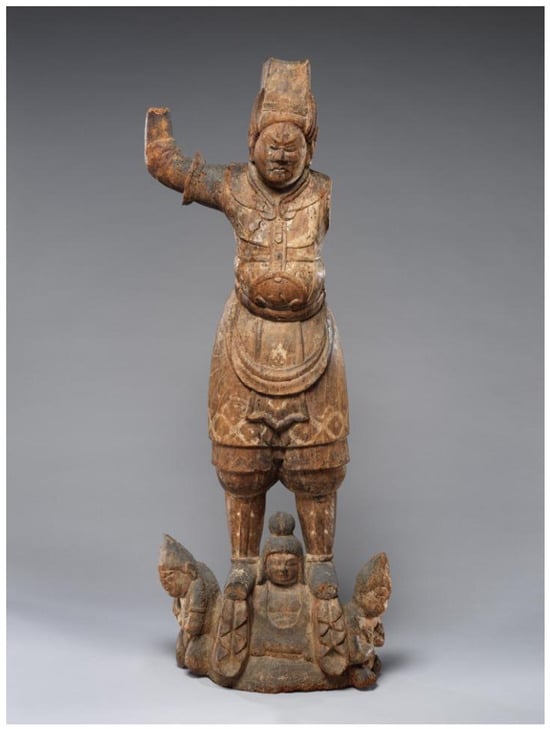
Among the various forms of Vaiśravaṇa, Tobatsu Bishamon (for lack of a better name) seems quite unique, as he is depicted standing on the palms of the Earth Goddess, who is half-emerging from the ground (B. Matsumoto 1939; Granoff 1970; Tanabe 1999, 2006). This figure has been well known to Japanese art historians, and, to a lesser extent, to Western art historians since the work of Phyllis Granoff.7
This is a form of Vaiśravaṇa that shows a strong Central Asian influence and is considered to be the origin of the Kingdom of Khotan and its royal lineage. I will, however, begin with Japanese representations, then move westward to Central Asia before returning to Japan. The reason for this is that the name Tobatsu Bishamon exists only in Japan, whereas depictions of this deity are found not only in Japan but also in Central Asia and China (Sichuan and Yunnan).8 According to Rolf Stein, the name “Tobatsu” is derived from Tubbat (a name referring to Turkestan, and more specifically Khotan).9 This image was also found on the murals of the Mogao caves in Dunhuang.10 This martial symbolism, while it explains the popularity of Vaiśravana in Tang China, may be less significant than the royal and chthonic symbolism in understanding the development of the cult in Khotan and in Japan.11
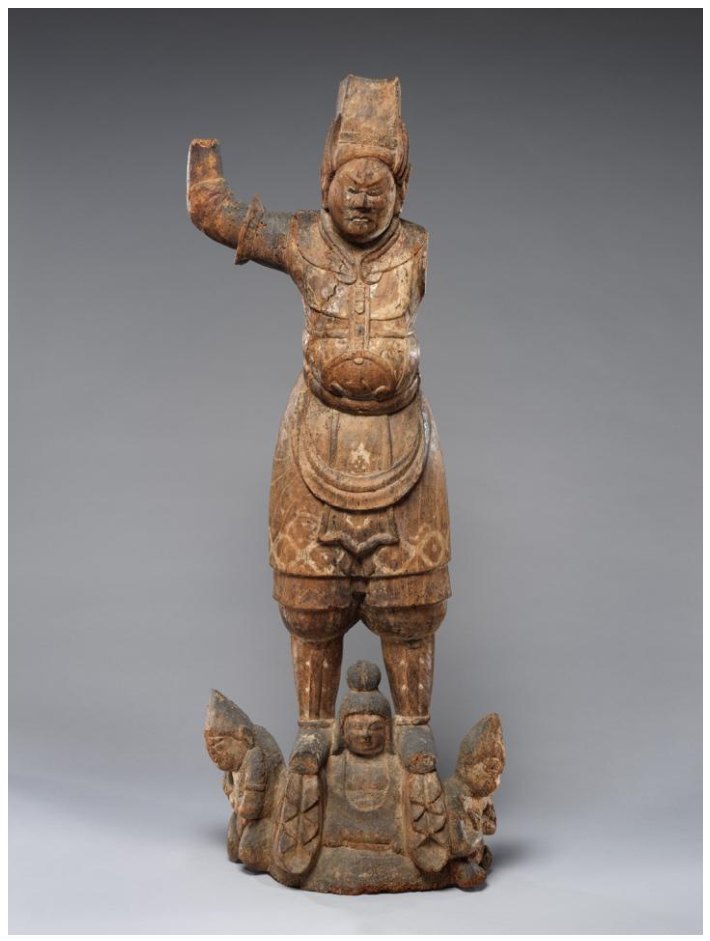
In Japan, according to most Japanese art historians, the finest representations of Tobatsu Bishamon can be found at Tōji 東寺, Seiryōji 清涼寺, Kanzeon-ji 観世音寺, and the Nara National Museum (Irie 2012). Other examples (paintings or sculptures) can be found in Western museums, such as the Metropolitan of Art (see Figure 1), the Seattle Art Museum, the Denver Art Museum, the British Museum, and the Guimet Museum. This form of Vaiśravaṇa is generally clad in a long-skirted armor and wears a sort of diadem. His main characteristic, however, is that he stands on the palms of the Earth Goddess (Pṛthivī), who is sometimes flanked by two demons.12
Figure 1.
Tobatsu Bishamon (Metropolitan Museum of Art).
3. From Kyoto to Khotan
From the 5th to the 10th century—and likely even earlier—the oasis of Khotan was a thriving Buddhist center. The first report about Khotan as a center of Mahāyāna Buddhism was written by the famous pilgrim Faxian 法顯 (337?–422?) at the turn of the 5th century (Legge 1965; King 2022). Chinese monks frequently traveled to Khotan to obtain original Sanskrit texts for translation. As is well known, Khotanese monks such as Devaprajñā and Śikṣānanda played an important role in the Chinese translation of Mahāyāna scriptures. Khotan also became a center of esoteric Buddhism in the 7th century.
A legend that emerged in the early 5th century traces the origins of Khotan to a visit by the Buddha, who is said to have traveled through the air from the Indian city of Śrāvastī (Anderl 2018, p. 268). Another founding legend, depicted in the Mogao caves, tells how Vaiśravaṇa, with the help of the Arhat Śāriputra, drained the waters that threatened to flood the Khotan oasis.13
Khotan was a major site for the worship of Vaiśravaṇa, and more specifically for the worship of Tobatsu Bishamon. The statue from the Rawak Stūpa, dating from the 3rd or 4th century CE, has been identified as depicting Vaiśravana standing on the hands of the Earth Goddess (Granoff 1970, pp. 155, 160). The kings of Khotan claimed to be descendants of Vaiśravaṇa. This connection, combined with Tobatsu Bishamonten’s Central Asian armor and the name “Tobatsu,” suggests that Khotan may be the place of origin of the fully developed iconographic form known as Tobatsu Bishamon.14
In a version of the founding myth recorded in Xuanzang 玄奘’s Datang xiyu ji 大唐西域記, the king of Khotan prayed to Vaiśravaṇa to grant him an heir, whereupon a baby emerged from the forehead of the god’s statue (Li 1995, 1996). However, the child refused to drink the queen’s milk. In response to the king’s prayers, the ground below the statue rose up, taking the shape of a nipple, and the child was then able to suckle the “milk of the earth” (chinyū 地乳, sk. go-stana), which is said to be the origin of the name of the country Khotan (Kustana).15
In a Tibetan version of the myth, when king Aśoka traveled to Khotan, his concubine, while taking a bath, had a vision of Vaiśravaṇa and became pregnant. Fearing that the newborn, once grown up, would dethrone him, Aśoka abandoned the child in the desert. It was then that a nipple sprang from the ground to nourish the child (Thomas 1935; Emmerick 1967; Yamazaki 1990). This detail suggests that the worship of Vaiśravaṇa in Khotan was more than just a cult dedicated to a warrior deity. Vaiśravaṇa was perceived as the ancestral deity of the royal lineage of Khotan, and not merely as one of the four guardians of the world (lokapāla). In any case, this account highlights the close relationship between the Earth Goddess and Vaiśravaṇa—or even their shared identity. I will return to this relationship below.
4. Tobatsu Bishamon at Dunhuang
Khotan and Dunhuang are closely linked, both iconographically and in the realm of narrative literature (jātakas, bianwen 變文, etc.) (Anderl 2018, pp. 277–81). Depictions of Khotanese Buddhist legends and the protective deities of Khotan were also popular iconographic themes in Dunhuang, reflecting a direct or indirect connection with Khotanese patronage. These depictions appear as early as the late 8th century and continue to be present through the 10th century. However, the legends depicted in Dunhuang differ from those found in Khotan. Vaiśravaṇa, for example, appears in a group of Khotan’s “Eight protectors.”16 Another recurring theme is the scene in which Vaiśravaṇa and the Arhat Śāriputra drain the lake that covered Khotan (Anderl 2018, pp. 282–86).
Dunhuang murals sometimes depict Vaiśravaṇa riding a lion (as in Tibetan paintings) (Béguin and Colinart 1994). This detail is significant, as it reappears in Japan with the figure of Tohachi Bishamon. Murals dating from the 9th or 10th century show Tobatsu Bishamon standing on the hands of the Earth Goddess, flanked by Śrī-Lakṣmī (J. Kichijōten) and/or Sarasvatī (J. Benzaiten 弁才天 or 弁財天) and a yakṣa.17 Art historians have taken an interest in the yakṣa, who is depicted lifting a child with a single hand. This has led them to compare him to Hārītī (Ch. Guizimu, J. Kishimojin 鬼子母神), a child-eating demoness who, after being converted by the Buddha, became the protector of children (Chandra 2003).
5. The Elements of the Cult
The warlike and protective aspects of Tobatsu Bishamon have been the subject of in-depth study (Granoff 1970). The chthonic aspect, more closely linked to local cults, has been less studied. Granoff is the main exception, but she herself attempts to interpret this aspect from the perspective of the royal cult. She emphasizes royal symbolism in Khotanese mythology, and in particular the concept of deified kingship, in which the king is depicted as the husband of the Earth. She notes that in the Golden Light Sūtra the king is called bhūpati (husband of the Earth). The Earth Goddess declares that she will protect those who honor this scripture and that she will “uphold their feet.” The motif of hierogamy between the king (symbolizing Heaven) and the queen (symbolizing the Earth) appears to have been widespread in Indo-European kinship ideology (Granoff 1970, p. 164). Granoff’s interpretation is remarkable, but it does not explain why it is Vaiśravaṇa, and not the king of Khotan, who is lifted up by the Earth Goddess.
The regal aspect is only one of the facets of Tobatsu Bishamon, and it is worth taking a closer look at his connection to the Earth Goddess Pṛthvī (alt. Dṛḍhā, Vasudhārā; J. Chijin 地神 or Jiten 地天) and the two demons who accompany her (Inokawa 1963). As early as the Golden Light Sutra, Vaiśravaṇa is closely related to this goddess, as well as with the goddesses Śrī (J. Kichijōten) and Sarasvatī (J. Benzaiten) (Emmerick 1970, pp. 43–50). It is worth noting that Śrī, in particular, became his consort. As Madeleine Biardeau has pointed out, she is a manifestation of the Earth in its beneficent aspect (Biardeau 1991; Emmerick 1970, pp. 51–55). Sarasvatī inherits several characteristics from Śrī, but she also represents the dark powers of the Earth. The Asabashō 阿娑縛抄 by Shōchō 承最 (1205–1282) explains that one should invoke Kichijōten when praying for fertility, and Benzaiten when one has “violated” the Earth.18 The Golden Light Sutra states that Vaiśravana, Śrī, and Sarasvatī constitute a single power, which manifests as Śrī for those with superior abilities, as Sarasvatī for those with average abilities, and as Vaiśravana for those with inferior abilities. In the section devoted to Bishamonten in the Byakuhō kushō 白寶口抄 (13th century), it is stated that Kichijōten is identical to the Earth Goddess Jiten 地天, and is therefore the mother of all buddhas and bodhisattvas.19
We know the important role played by the Earth Goddess in the Buddha’s victory over Māra. In esoteric Buddhism, the Earth deity (or deities) has a dual aspect: light and darkness, positive and negative. The former is represented by goddesses such as Śrī and Sarasvatī, the latter by deities such as Yama, the ruler of the underworld. In Japan, the Earth Goddess is sometimes a symbol of fertility and fecundity, sometimes a symbol of power embodied by a male warrior deity named Kenrō Jishin 堅牢地神 (Firm-earth Deity), who strikingly resembles Bishamon.20
It is important to distinguish the Earth Goddess—who here serves as a pedestal (and thus a sort of protector)—from the demons that Vaiśravaṇa and other similar figures usually trample underfoot. In some cases, however, the distinction between her and the two demons flanking her becomes blurred. After all, the latter are merely another aspect of the chthonic powers represented by the former. Based on the common belief that Vaiśravaṇa tramples on demons, the Earth Goddess is identified in some texts with these two demons. In the Ungadaya giki 吽迦陀野儀軌 (alt. Unkyadaya giki), a Japanese apocryphal text attributed to the esoteric Buddhist master Vajrabodhi (Jingangzhi 金剛智, 671–741), it is said that Vaiśravaṇa tramples on three yakṣas, the one in the center being called Jiten 地天 (“Earth Deva,” also known as Kangiten 歓喜天, “Joyful Deva”), while those on either side are female attendants, the celestial maiden Niranba 尼藍婆女天 on the left, and the “divine king” Biranba 毘藍婆神王 on the right.21 It is therefore not easy to distinguish the status of the Earth Goddess from that of the two demons. In the Besson zakki 別尊雑記 別尊雑記 by Shinkaku 心覚 (1117–1180), for example, it is said that she is subdued, like the two demons, by Tobatsu Bishamon.22 However, the texts in question may be missing the point: Tobatsu Bishamon does not trample on the goddess, he stands on her palms. In other words, she is his support, and he springs from or emanates from her, so to speak.
A text from the Tendai school, the Sange yōryakki 山家要略記, following a passage stating that Kenrō Chijin “is both the father and mother of the 84,000 demons (kijin 鬼神),” clarifies that this passage establishes the identity between the Earth Goddess and Tobatsu Bishamon (Shintō Taikei Hensankai 1993). The same applies to various other deities depicted in the same manner, such as Mahākāla and Cintāmaṇicakra Avalokiteśvara (Ch. Ruyilun Guanyin, J. Nyoirin Kannon 如意輪観音, Avalokiteśvara with the wish-fulfilling wheel).23 Because of these iconographic similarities, these deities were associated with Tobatsu Bishamon. In Huilin 慧琳’s phonetic dictionary of Buddhist terms, the Yiqiejing yinyi 一切經音義 (ca. 807), for example, there is a gloss that associates Mahākāla (the “Great Black One,” i.e., Śiva) with the Earth Goddess and thus indirectly links him to Tobatsu Bishamon.24 In Japan, Mahākāla was clearly perceived as another chthonic deity, closely linked to the Earth Goddess and Sarasvatī (Benzaiten).
It is said that the two demons Lambā (J. Ranba 藍婆) and Vilambā (J. Biranba 毘藍婆) symbolize the hordes of yakṣas and rākṣasas under Vaiśravaṇa. Depending on the sources, they are trampled by Vaiśravaṇa or, conversely, they support him, much like the Earth Goddess. In the first case, they are fiends, in the second, they are acolytes. Their names are also those of two members of a group known as the Ten Rākṣasīs (J. Jūrasetsunyo 十羅刹女). Like Hārītī (also known as the “Mother of Demons,” Ch. Guizimu 鬼子母, J. Kishimojin 鬼子母神), another deity associated with Central Asia and Khotan, these demons, once converted, became the protectors of the Lotus Sūtra. Eventually, they joined Hārītī’s retinue. They are also sometimes part of the retinue of the bodhisattva Samantabhadra (J. Fugen Bosatsu 普賢菩薩) (Fabricand-Person 2002, pp. 346–47).
6. From Tobatsu Bishamon to Tohachi Bishamon
Let us now briefly examine an intriguing development concerning Vaiśravaṇa in medieval Japan. There, the name Tobatsu inspired another figure—one who, despite the near synonymy, is quite different—namely, Tohachi Bishamon 刀八毘沙門, a four faced, twelve-armed deity generally attributed to the Tendai priest Son’i 尊意 (859–940).25 The swords he holds in eight of his hands derive from the transcription of Tobatsu (or Tohatsu) as Tohachi 刀八 (“Eight Swords”). He wears a lion-headed headgear and rides a lion reminiscent of the ferocious mount of the bodhisattva Mañjuśrī, held on a leash by an old man identified as Udayana, the king of Khotan.26 This image became widespread during the Muromachi period (1336–1573) and remained popular throughout the Edo period (1600–1868).
7. Tohachi Bishamon and Foxes
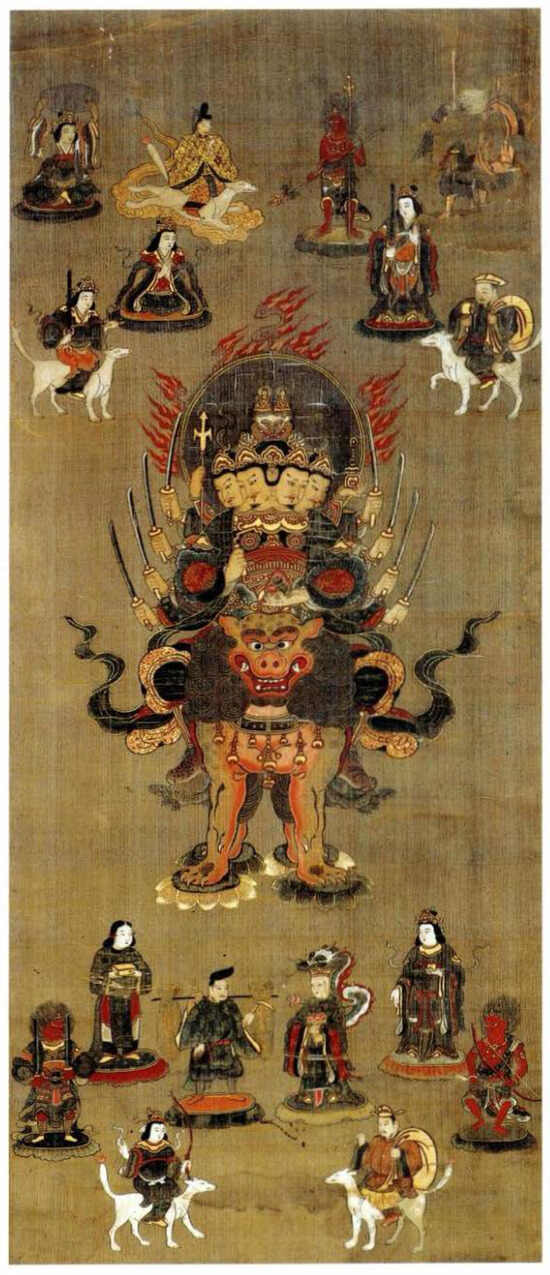
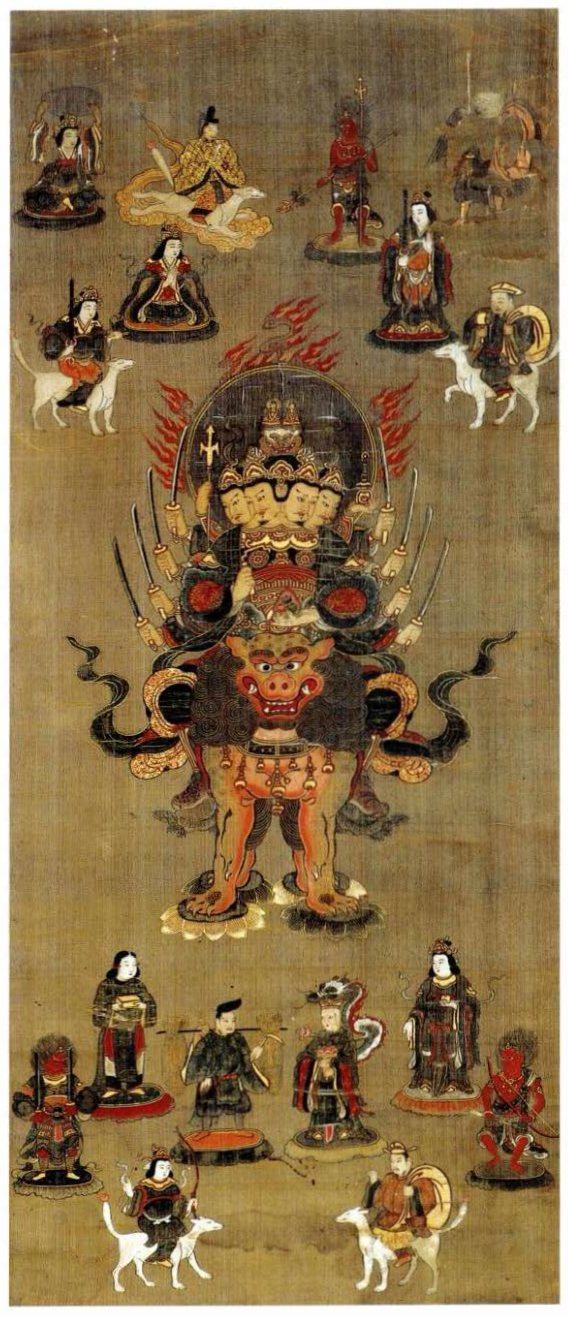
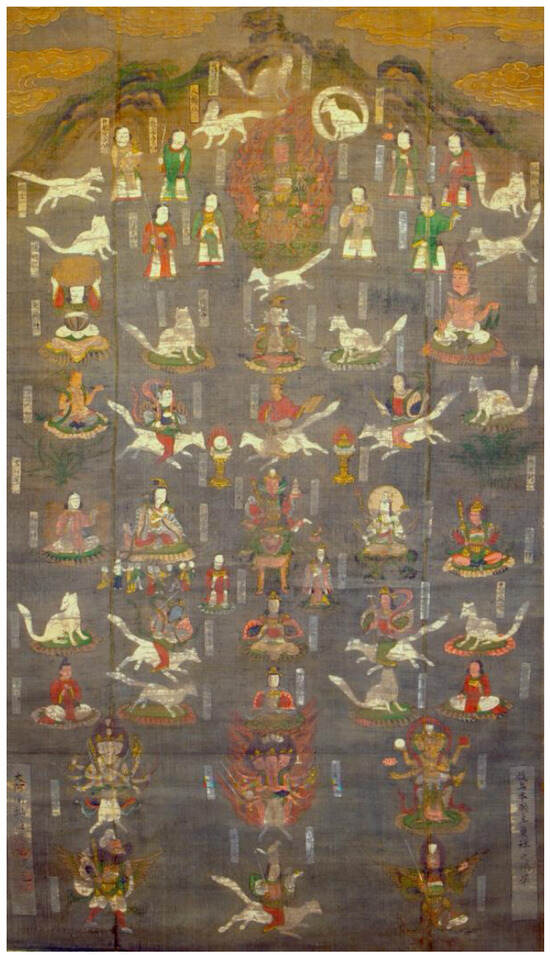
In what is known as the Inari mandala 稲荷曼荼羅—an image dating from the Muromachi period and preserved at the Fushimi Inari 伏見稲荷 Shrine in Kyoto (Figure 2)—Tohachi Bishamon is surrounded by sixteen deities, several of whom are riding foxes.27 Among them are Kichijōten 吉祥天 (Śrī), Daikokuten 大黒天 (Mahākāla), and the Inari deity depicted as an old man carrying young rice seedlings. The fox is, of course, Inari’s traditional and the mount of Dakiniten 荼枳尼天 (also written 吒枳尼天 or 荼吉尼天).28 Tohachi Bishamon is thus identified with this goddess, who originated from the deification of the Indian demoness ḍākinī.29 The latter was associated with the fox in China, and her image subsequently developed into that of the “celestial fox” (tenko 天狐) in Japan. The slopes of Mount Inari are covered with hundreds of tombs dedicated to fox spirits, as the image of the fox has become intertwined with that of the ancestors. The image of Dakiniten in Japan was thus grafted onto a flourishing popular cult—that of the Inari deity—through her association with the fox.30 Dakiniten was part of a network that included Mahākala, the Seven Mothers (Shichimo 七母、Sk. Saptamātṛkās,), Benzaiten 弁才天 (Sarasvatī), Jiten 地天 (or Jishin 地神, Pṛthvī, the Earth Goddess), Kishimojin 鬼子母神 (Hārītī), etc. Most of these deities were already present (and likely interconnected) in Khotan and Dunhuang.31
Figure 2.
Inari mandala, Muromachi period, 14th century. Fushimi Inari Shrine, Kyoto.
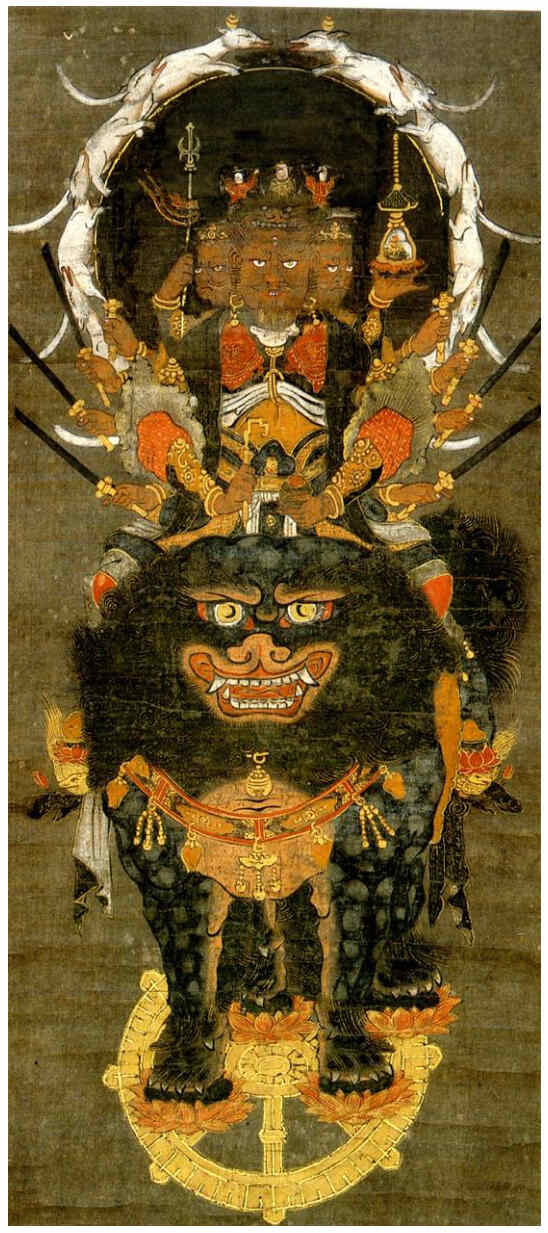
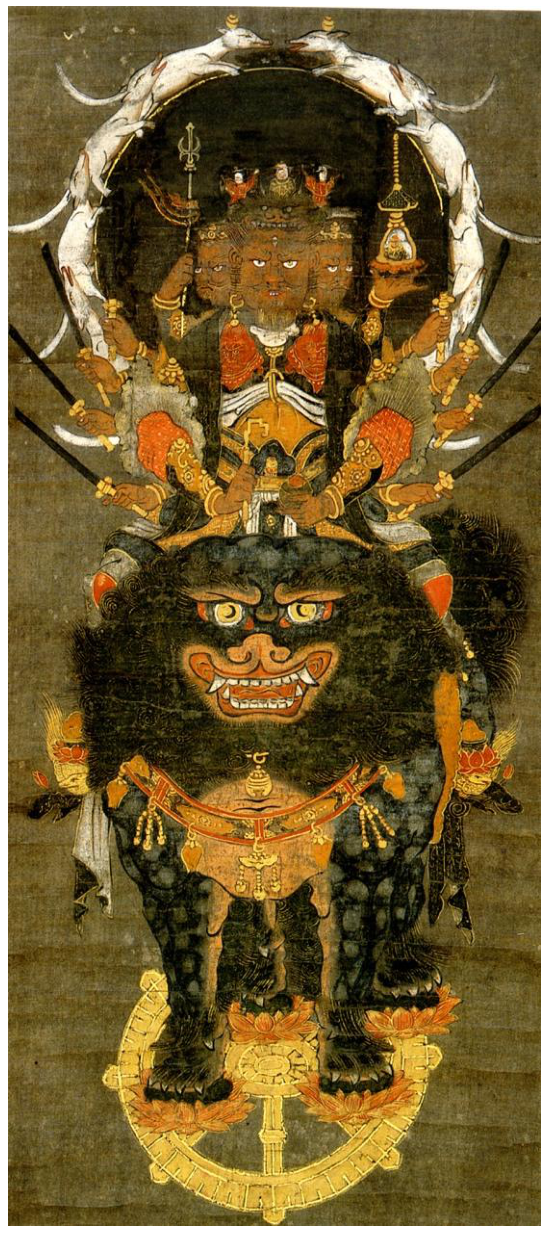
On a painted scroll from the Imakumano Kannonji Temple 今熊野観音寺 in Kyoto (Figure 3), Tohachi Bishamon rides a lion whose paws rest on four lotuses atop a dharma-wheel. Three small attendants are visible above him, two of whom are resemble Dakiniten’s attendants riding foxes. His feet rest on two small turtles, a detail that evokes Myōken Bosatsu, the deity of the North Star.32 His mandorla is bordered by a motif of eight white foxes, another clear connection to Dakiniten.
Figure 3.
Tohachi Bishamon, Muromachi period, 16th century. Imakumano Kannonji, Kyoto.
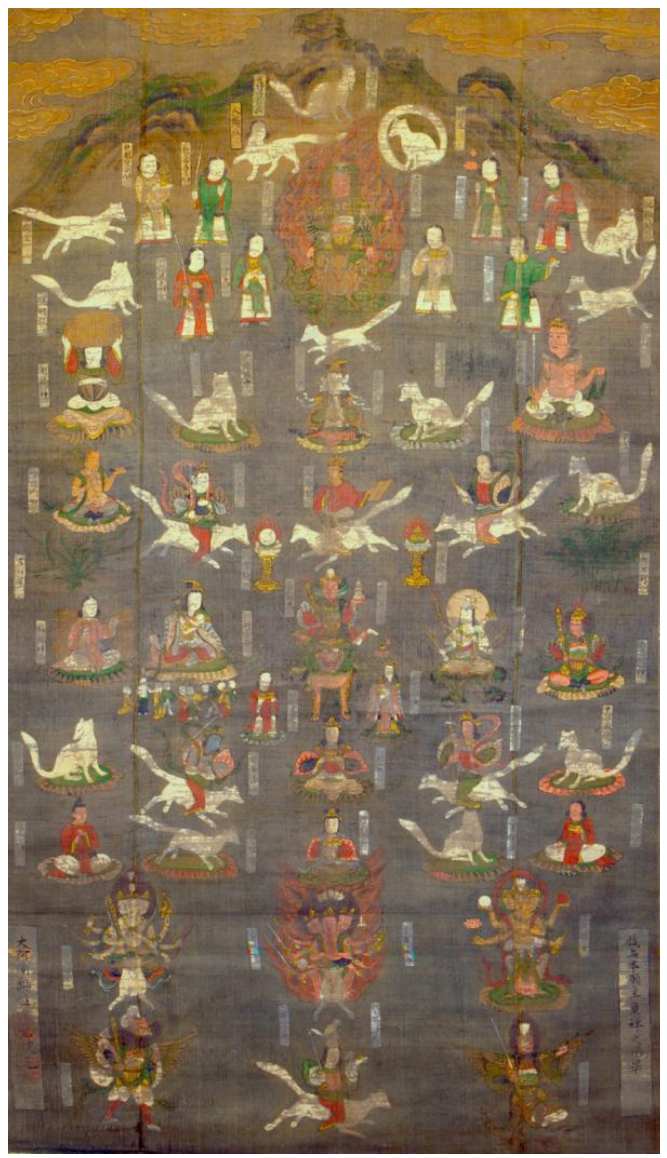
We should also mention the Izuna mandala 飯綱曼荼羅 from Rinnōji Temple 輪王寺 in Nikkō 日光 (dating from the Nanbokuchō period, 14th century) (Figure 4).33 Although its name refers to Izuna Gongen 飯綱権現, another deity riding a fox and worshiped on Mount Izuna in Nagano Prefecture, this mandala is a Dakiniten mandala. It strikes the viewer with the profusion of foxes surrounding various deities and their attendants (who themselves ride foxes). Tohachi Bishamon appears as the central deity under the name Dakiniten. Curiously, he is surrounded by the usual Dakiniten (referred to here as Shinkoō Bosatsu 辰狐王菩薩, Bodhisattva King of Divine Foxes) and her attendants. The ḍākinīs were also associated with Mahākāla and Yama (J. Enmaten 焔摩天) (Iyanaga 1999, pp. 51–52, 57–58; 2019; Kuo 2003). In Yixing’s commentary on the Mahāvairocana sūtra, it is Mahākāla who subdues them (Iyanaga 1999, pp. 51–53).
Figure 4.
Izuna mandala. Nanbokuchō period, 14th century. Rinnōji, Nikkō (Tochigi Prefecture).
8. Bishamonten and Gozu Tennō
Marcelle Lalou has highlighted the bovine origins of Vaiśravaṇa-Kubera, born from the union between the god Brahmā and a cow.34 It may be as a distant consequence of this that Bishamonten came to be associated with the pestilence deity Gozu Tennō 牛頭天王, the Ox-headed Deva King.35 In the Hoki naiden 簠簋内伝, among Gozu Tennō’s eight children, known as the Eight Princes (Hachiōji 八王子), seven bear the same names as the great Yakṣa Generals, all of whom are sons or emanations of Vaiśravaṇa (Misaki 1986). The fact that the retinues of these two deities are identical suggests that they share deep affinities.
The Asabashō also mentions a legend according to which, when an epidemic broke out in the land of Tohatsura (Tokhara or Khotan?), the Eleven-faced Avalokiteśvara (Jūichimen Kannon 十一面観音) manifested himself in the form of Vaiśravaṇa with eleven ox-heads.36 In his Keiran shūyōshū 渓嵐拾葉集, the Tendai monk Kōshū 光宗 (1276–1350) asserts that the Ox King, the Buddha’s relics, and the cintāmaṇi jewel are one and the same, on the grounds that they all symbolize non-duality.37 This also explains why, in Tendai, Bishamonten is associated with the Ox constellation, one of the twenty-eight lunar mansions (nijūhasshuku 二十八宿): both rule over the northeast direction (also known as the Demon-gate, kimon 鬼門).38
9. Conclusions
Despite his central role as the protector of Buddhism and the Buddhist state, Vaiśravaṇa remained a Janus-faced deity. After all, he was a demon who had turned against his own kind, the yakṣas. He had retained from his former life a ferocity that, although it had been transformed into a martial quality, could be perceived as threatening. As one source puts it, “When Vaiśravaṇa is joyful, the yakṣas do no harm to humans; when he is angry, they wreak havoc.”39 Judging by his wrathful appearance, however, joy does not seem to be one of his predominant moods. He remained, at least potentially, a dangerous god of obstacles who had to be propitiated. Nowhere is this ambivalence more evident than in the contrast between Tobatsu Bishamon’s connection to the Earth’s life-giving power and the wrathful Tohachi Bishamon, a deity in whom ferocity and dark chthonic powers clearly predominate. This ambivalence explains his affinities with other deities of demonic and chthonic origins, symbolized by one of them whose very name, Kōjin 荒神, means “wild god.”40
To explain the transformation of Tobatsu Bishamon into Tohachi Bishamon, a simple play on words inducing a semantic and iconographic shift would not have been sufficient had it not been supported by a whole set of symbolic relationships, which remain latent on the Khotanese side—partly due to a lack of documentation—but become more visible on the Japanese side. Some of these deities already appear around Vaiśravaṇa as protectors of the state in the Golden Light Sūtra, while others did not come to the forefront until medieval Japan: namely Śrī (Kichijōten), Mahākāla (Daikokuten), Skanda (Idaten 韋駄天), Maheśvara (Daijizaiten 大自在天), Dakinī (Dakiniten), Sarasvatī (Benzaiten), Vināyaka (Shōten 聖天), Avalokiteśvara with the with-granting Wheel (Nyoirin Kannon), and Hārītī (Kishimojin). Most of these were chthonic deities originally associated with the worship of the Hindu god Śiva (known in Japan as Maheśvara and Mahākāla). In addition to Mahākāla’s role in the Dali state (937–1253) and in Xi Xia, the Tibetan-speaking Tangut state (1038–1227), murals and texts from Dunhuang show that he was one of the eight protective deities of Khotan.41 All of these deities are also linked to the cults of relics and the cintāmaṇi jewel, which enjoyed immense popularity in Japan during the 11th and 12th centuries. In almost all cases, these are predators who have become protectors, which may provide clues to the demonic origins of Vaiśravaṇa and his relationship with local powers and chthonic cults.
From a formal perspective, beyond the connections between the lion of Mañjuśrī, the king of Khotan, and the lion of Tohachi Bishamon, we may perhaps glimpse the resurgence of older images, such as that of the ancient Chinese god of war Chiyou 蚩尤, a four eyed, six armed deity wielding fearsome bladed weapons in each hand.42 However, in the absence of documentation, this must remain a heuristic hypothesis.
The case of Tobatsu Bishamon also raises the question of the routes through which Buddhism was transmitted. It was long believed that the influence of esoteric Buddhism on medieval Japan passed through the Chinese capital before reaching the Japanese capital, particularly through the work of the esoteric Buddhist masters Śubhakarasimha (Ch. Shanwuwei 善無畏, Vajrabodhi (Jingangzhi 金剛智), Amoghavajra (Bukong 不空), Yixing 一行 in China, Kūkai 空海, Ennin 圓仁, Enchin 圓珍, Annen 安然 and their successors in Japan. However, not all routes lead to Chang’an, and there may have been other—more direct but less well-documented—routes connecting Khotan to Kyoto via Gansu and Inner Mongolia, Dunhuang, the Tanguts and the Liao kingdoms.43 The influence of Liao Buddhism on Japanese Buddhism during the late Heian and early Kamakura periods has recently been highlighted by several researchers, and this is a line of inquiry worth exploring (Kamikawa 2008; Kim 2013). Buddhism also spread from Khotan and Dunhuang southwestward toward Sichuan and Yunnan, and eastward toward the Korean peninsula and Kyushu. This explains why similar images of Tobatsu Bishamon—as well as Cintāmaṇicakra Avalokiteśvara (Ruyilun Guanyin, J. Nyoirin Kannon) and Hārītī—are found in Sichuan (for instance in Bazhong), while Tibetan influence there is less significant than expected.
Although documentation concerning the origins of Vaiśravaṇa’s cult and its development in Khotan and Central Asia is relatively scarce, studying its evolution in the context of medieval Japan has allowed us to gain insight in the complex dynamics at work between names, appearances, myths, and rituals, as well as between foreign and local cults. Vaiśravana was part of a network of deities linked by functional affinities and sometimes identified with one another. It is likely that, like the Japanese Tobatsu Bishamon, the khotanese Vaiśravaṇa also developed in relation to deities such as Hārītī, Mahākāla, Skanda, Pṛthvī, Śrī and Sarasvatī. The case of Tobatsu Bishamon also illustrates the importance of names in these dynamics, and the way in which religious imagination can be expressed through semantic combinations of Chinese characters or phonetic wordplay.
Funding
This research received no external funding.
Institutional Review Board Statement
Not applicable.
Informed Consent Statement
Not applicable.
Data Availability Statement
All research data are included in the bibliography.
Conflicts of Interest
The author declares no conflict of interest.
Notes
| 1 | On this kingdom, see (A. Stein 1907). |
| 2 | Cf. for example Dīrghāgama (Ch. Chang ahanjing 長阿含経) T. 1, 1: 80a: “The Heavenly King of the Northern Region is called Píshāmén (Vaiśravaṇa). He is leading the yakṣa demons and has great powers.” |
| 3 | The symbolic association between Vaiśravaṇa and the northern quarter explains why he is at times identified with the Northern Dipper (Hokuto 北斗, our Ursa Major) or with the Pole Star. The symbolism of the North also connects him with the cyclical sign (or deity) of the Rat (zi 子), the first of the twelve animals of the duodecimal cycle in Chinese astrology. |
| 4 | See Pishamen yigui 毘沙門儀軌, T. 21, 1249: 228b. See also Dasong sengshi lüe 大宋僧史略, T. 54, 2126: 253c–254b and (Goble 2013). |
| 5 | On the link between Vaiśravaṇa and Kubera, see (Granoff 1970, pp. 162–64; Iyanaga 1994; 2002, pp. 391–442). |
| 6 | See Keiran shūyōshū, in (Takakusu and Watanabe 1924–1932, vol. 76, 2410: 629b, 630c, and 778b). On the cintāmani dhāranī expounded by Vaiśravaṇa, see Suvarṇaprabhāsa Sūtra, T 16, 665: 430c. |
| 7 | See (Granoff 1970); Granoff’s work remains the best source in English today on that deity. In Japanese, see also (Iwasa 1976). |
| 8 | For instance Bazhong 巴中Caves, Nankan 南龛, in (He 2003). On the spread of the cult of Vaiśravaṇa in Sichuan, see (Granoff 1970: pp. 135–36). On Sìchuan as an early center of the Vaiśravaṇa worship, see Granoff, ibid., 155. |
| 9 | See (R. A. Stein 1959; Iyanaga 2002, pp. 391–442). Although the identification of Tobatsu with Khotan is not definitive, it seems the most plausible hypothesis given the importance of Vaiśravaṇa lore in Khotan. |
| 10 | Rolf Stein, ibid. According to Tanabe Katsumi, the name originated in Japan during the Heian or Kamakura period. See (Tanabe 1999). |
| 11 | On this point, see (Granoff 1970, pp. 162–67). |
| 12 | See (Inokawa 1963). This image is reminiscent of certain depictions of an episode in the legend of the Buddha known as “Touching the Earth” (bhūmisparṣa), in which the Earth Goddess emerges halfway from the ground and seems to serve as a pedestal for the Buddha during his confrontation with Māra. On this episode, see (Guthrie 2004; Granoff 1970, pp. 159–60; Iyanaga 2002, p. 358; Takahashi 2021). In an ink drawing of Bishamonten mandala, Tobatsu Bishamon is surrounded by Kichichōten and the Five Princes, two young boys (dōji 童子, one of whom takes the form of a dragon), eight yakṣas, and twenty-eight attendants (including various deities of the underworld and of the Northern Dipper). See (Kyoto shiritsu Geijutsu Daigaku Geijutsu Shiryōkan 2004, no. 1072). |
| 13 | See Mogao Caves 231, 237, and 454. See also (Yim 2010). |
| 14 | See (Yamazaki 1990; Zhang 2005; Brough 1948; William 1973); Erika Forte, “On a Wall Painting from Toplukdong Site no. 1 in Domoko: New Evidence of Vaiśravaṇa in Khotan?” In (Klimburg-Salter and Lojda 2014). |
| 15 | Cf. Xuanzang, Datang xiyuji, T 51, 2087: 943, 945. See also (Yamazaki 1990, p. 55; Forte 2014, p. 215; Palmeri 2021). |
| 16 | One of them is Samjñāya (Ch. 散脂), another martial god who is part of Vaiśravaṇa’s retinue and who also appears in Japanese iconography. See (Emmerick 1970, pp. 55–57). Forte (2014) has recently argued that the figure discovered at Toplukdong and identified with Vaiśravaṇa is rather Samjñāya. The Eight Protectors of Khotan are depicted in fourteen of the Mogao Caves, and in Yulin 榆林Cave 33 (Guazhou County, Gansu Province). Tobatsu Bishamon appears in Yulin caves 25 and 154. One these figures, see (Rong and Zhu 2013, 2019; Sun 1999; Zhang 2005). |
| 17 | See (E. Matsumoto 1937). See also the woodblock print, dated 947, in the collection of the British Museum; ref. number 1919,0101,0.245. |
| 18 | See Asabashō, in (Takakusu and Ono 1932–1934, vol. 9, p. 517a). |
| 19 | See TZ 7: 137c. |
| 20 | In the Jianlao ditian yigui 堅牢地天儀軌 (T 21, 1286: 354b), the Earth deity is depicted as male. |
| 21 | See T 21, 1251: 235a. The term “female attendants” seems to be a mistake, as Biranba is clearly male. On the cover of Ishizaki Tatsuji’s book, Tōfukuji Bishamon Tennō 東福寺毘沙門天王 (Ishizaki 1936), the three figures being trampled by Bishamonten all appear to be identical. See also Asabashō, TZ 9, 3190: 427b–c. Ranba (Skt. Lambā) and Niranba (Nilambā) are also the names of the first two female demons in the group of Ten raksaṣīs (J. Jūrasetsunyo 十羅刹女) who protect the Lotus Sūtra and form the retinue of the bodhisattva Samantabhadra (J. Fugen). On this group, see (Fabricand-Person 2002). |
| 22 | TZ 3: 583c. |
| 23 | On the cult of the cintāmaṇi, see (Ruppert 2000). On Nyoirin Kannon, see (Faure 2015b, pp. 285–314). |
| 24 | T 54, 2128: 366b. |
| 25 | The rarer form with one face and ten arms seems to be a simplification. In his twelve hands, in addition to eight swords, Tohachi Bishamon holds a stūpa and a trident (Vaiśravaṇa’s usual attributes), as well as a jewel and a key (the usual attributes of Uga Benzaiten 宇賀弁才天). |
| 26 | On “Mañjuśrī crossing the sea” (J. Tokai Monju 渡海文殊), a representation of Mañjuśrī on his way to Wutaishan that was widespread in Tang and Song China and medieval Japan, see (Wu 2002). See also (Hamar 2019). |
| 27 | See Figure 2. |
| 28 | Irie Tami believes that the four faces resemble those of another warrior deity, Saishō Taishi 最勝太子 (Samjñāya), who is described in various sources as the first or third of Vaiśravaṇa’s five sons. She is hesitant, however, to conclude that Saishō Taishi is the prototype for Tohachi Bishamon. She examines other characteristics of this figure—the jewel and key he holds, the lion he rides, the foxes in his mandorla, the image of the Buddha Dainichi 大日 (Mahāvairocana) above his head, and the turtles that serve as his stirrups—and argues that they suggest other influences (Benzaiten, Monju, Myōken, Dakiniten). See (Irie 2012). |
| 29 | See above, Figure 2. The ḍākinī is said to be a “trace” (suijaku 垂迹) of Mañjuśrī (J. Monju). On the ḍākinī and Dakiniten, see (Iyanaga 1999). |
| 30 | In the Shintōshū, the Inari deity is said to have Monju as its “fundamental ground” (honji 本地) and Dalini Myōō, alias Shinkoō Bosatsu or Nyoi Hōju Bosatsu 如意宝珠菩薩, as its “trace” (suijaku 垂迹). See (Shintō Taikei Hensankai 1988; Irie 2012, p. 368). |
| 31 | Regarding the Mothers, see (Lo Muzio 2017). |
| 32 | On the symbolic affinities between Tohachi Bishamon and Myōken, see (Irie 2012, pp. 363–64). |
| 33 | See Figure 4. On this mandala, see (Irie 2008). The Rinnōji possesses another scroll depicting Tohachi Bishamon, flanked by two white foxes. In the upper part of the scroll, a young immortal sits on a lotus, with a sword slung over his shoulder and a Dharma-wheel in his left hand. Above him, two dragons guard the wish-fulfilling jewel, flanked by disks representing the sun and moon. See (Faure 2015a, Figure 1.24). |
| 34 | See (Lalou 1946). On the metamorphoses of Kubera, see (Iyanaga 2002, pp. 443–502). |
| 35 | See (Shintō Taikei Hensankai 1987). On Gozu Tennō, see (Faure 2021). |
| 36 | See TZ 9, 3190: 419a. |
| 37 | T 76, 2410: 778c. |
| 38 | Again, the main deity of a mandala called Shōnyū mandara 證入曼荼羅 is identified as Tobatsu-shū Tamon Tennō (i.e., Tobatsu Bishamon). He is described as having an ox-head, and an extremely frightful appearance. The Gyōrinshō 行林抄 also describes a ten-headed Tobatsu Zōō (or Zaō) 兜跋蔵王, whose heads include those of the deva-kings Avalokiteśvara, Brahmā, Indra, Maheśvara, and Vaiśravaṇa. See Gyōrinshō 行林抄. T. 76, 2410: 434b. |
| 39 | See Gong’yang shier daweidetian baoen pin 供養十二大威徳天報恩品, translated by Amoghavajra, T. 21, 1297: 384. |
| 40 | On Kōjin, see (Faure 2021, pp. 225–77). |
| 41 | On Mahākāla in Dali, see (Bryson 2013). On Mahākāla in Xi Xia, see (Hou 2022). |
| 42 | See (Granet 1926). Chiyou was known in medieval Tendai, as can be seen from the Yōtenki 耀天記, in Shintō Taikei Hensankai 神道大系編纂会, ed., Shintō Taikei, Jinja-Hen 神社篇 29, Hiyoshi 日吉, 89. |
| 43 | On Buddhism under the Liao, see (Nogami 1953; Yokouchi 2008; Sørensen 2011; Keyworth 2022). |
References
- Anderl, Christoph. 2018. Linking Khotan and Dūnhuáng: Buddhist Narratives in Text and Image. Entangled Religions 5: 250–311. [Google Scholar] [CrossRef] [Scilit]
- Béguin, Gilles, and Sylvie Colinart. 1994. Vaiśravaṇa, dieu des richesses, dieu des armées A propos d’un thang-ka du Musée Guimet. Artibus Asiae 54: 137–55. [Google Scholar] [CrossRef] [Scilit]
- Biardeau, Madeleine. 1991. Symbols of the Earth in Indian Religion. In Asian Mythologies. Edited by Yves Bonnefoy. Translated by Wendy Doniger. Chicago: University of Chicago Press, pp. 99–101. [Google Scholar]
- Brough, John. 1948. Legends of Khotan and Nepal. Bulletin of the School of Oriental and African Studies 12: 333–39. [Google Scholar] [CrossRef] [Scilit]
- Bryson, Megan. 2013. Mahākāla worship in the Dali kingdom (937–1253): A study and translation of the Dahei tianshen daochang yi. Journal of the International Association of Buddhist Studies 35: 3–69. [Google Scholar]
- Chandra, Lokesh. 2003. The Khotanese Mural of Hārītī in Shrine DII at Dandan-Uilig. Archiv Orientalní 71: 293–302. [Google Scholar]
- Emmerick, Ronald Eric. 1967. Tibetan Texts Concerning Khotan. London: Oxford University Press. [Google Scholar]
- Emmerick, Ronald Eric. 1970. The Sutra of Golden Light: Being a Translation of the Suvarnabhasottamasutra. London: Luzac & Company, pp. 23–43. [Google Scholar]
- Fabricand-Person, Nicole. 2002. Demonic Female Guardians of the Faith. In Engendering Faith: Women and Buddhism in Premodern Japan. Edited by Barbara Ruch. Ann Arbor: Center for Japanese Studies, University of Michigan, pp. 346–47. [Google Scholar]
- Faure, Bernard. 2015a. Protectors and Predators: Gods of Medieval Japan II. Honolulu: University of Hawai’i Press, pp. 28–29. [Google Scholar]
- Faure, Bernard. 2015b. The Fluid Pantheon: Gods of Medieval Japan I. Honolulu: University of Hawai’i Press, pp. 28–29. [Google Scholar]
- Faure, Bernard. 2021. Rage and Ravage: Gods of Medieval Japan III. Honolulu: University of Hawai’i Press, pp. 107–49. [Google Scholar]
- Forte, Erika. 2014. On a Wall Painting from Topolukdong Site no. 1 in Domoko: New Evidence of Vaiśravaṇa in Khotan? In Changing Forms and Cultural Identity: Religious and Secular Iconographies. Edited by Deborah Klimburg-Salter and Linda Lojda. Turnhout: Brepols, vol. 1, pp. 215–24. [Google Scholar]
- Goble, Andrew. 2013. The Legendary Siege of Anxi: Myth, History, and Truth in Chinese Buddhism. Pacific World 15: 1–32. [Google Scholar]
- Granet, Marcel. 1926. Danses et Légendes de la Chine Ancienne. Paris: Félix Alcan, vol. 1, p. 271. [Google Scholar]
- Granoff, Phyllis. 1970. Tobatsu Bishamon: Three Japanese Statues in the United States and an Outline of the Rise of this Cult in East Asia. East and West 20: 144–68. [Google Scholar]
- Guthrie, Elizabeth. 2004. A Study of the History and Cult of the Buddhist Earth Deity in Mainland Southeast Asia. Ph.D. dissertation, University of Canterbury, Christchurch, New Zealand; pp. 59–99. [Google Scholar]
- Hamar, Imre. 2019. The Mañjuśrī cult in Khotan. Studies in Chinese Religions 5: 343–52. [Google Scholar] [CrossRef] [Scilit]
- Hashimoto, Akihiko 橋本章彦. 2008. Bishamonten: Nihon-Teki Tenkai no Shosō 毘沙門天: 日本的展開の諸相. Tokyo: Iwata Shoin. [Google Scholar]
- He, Hui 何汇 (何匯). 2003. Bazhong Shiku 巴中石窟. Shanghai: Shanghai Jiaotong Chubanshe 上海交通大学出版社, pp. 44–45, 65–66. [Google Scholar]
- Hou, Haoran. 2022. Mahākāla Literature Unearthed from Karakhoto. In Buddhism in Central Asia II: Practices and Rituals, Visual and Material Transfer. Edited by Yukiyo Kasai and Henrik H. Sørensen. Leiden and Boston: Brill, pp. 400–29. [Google Scholar]
- Inokawa, Kazuko 猪川和子. 1963. Jiten ni sasaerareru Bishamonten chōzō: Tōbatsu Bishamonten-zō ni tsuite no Ikkōsatsu 地天に支えられる毘沙門天 彫像: 兜跋毘沙門天像についての 一考察. Bijutsu Kenkyū 美術硏究 229: 53–73. [Google Scholar]
- Irie, Tami 入江多美. 2008. Dakiniten (Shinkoō Bosatsu) ni kansuru ichi shiron: Nikkōsan Rinnōji-zō ‘Izuna mandara-zu’ o chūshin to shite ダキニ天(辰狐王菩薩)に関する一試論ー 日光山輪王寺蔵「伊頭那(飯縄)曼荼羅図」を中心として. Bijutsushi Ronshū 美術史論集 8: 94–110. [Google Scholar]
- Irie, Tami 入江多美. 2012. Tohachi Bishamonten no zōyō ni kansuru kōsatsu 刀八毘沙門天の像容に関する考察. In Zuzōgaku 1–Imēji no Seiritsu to Denshō 図像学 1 ーイメージの成立と伝承. Edited by Tsuda Tetsuei. Tokyo: Chikurinsha, pp. 350–68. [Google Scholar]
- Ishizaki, Tatsuji. 1936. Tōfukuji Bishamon Tennō 東福寺毘沙門天王. Kyoto: Tōfukuji Bishamondō Shōrin-an 東福寺毘沙門堂勝林庵. [Google Scholar]
- Iwasa, Kanzō 岩佐貫三. 1976. Shiten no jaki to hōsōki: Oni no shisō kenkyū, sono san 四天の邪鬼と方相鬼ー鬼の思想研究·その三. Indogaku Bukkyōgaku Kenkyū 印度学仏教学研究 25: 387–90. [Google Scholar]
- Iyanaga, Nobumi. 1994. Daikokuten. In Hōbōgirin: Dictionnaire encyclopédique du bouddhisme d’après les sources chinoises et japonaises. Tokyo: Maison Franco-Japonaise, vol. 1, pp. 867, 894–95. [Google Scholar]
- Iyanaga, Nobumi 彌永信美. 1999. Dākinī et l’Empereur: Mystique bouddhique de la royauté dans le Japon médiéval. Versus: Quaderni di Studi Semiotici 83–84: 41–111. [Google Scholar]
- Iyanaga, Nobumi 彌永信美. 2002. Daikokuten Hensō: Bukkyō Shinwagaku I 大黒天変相 ー仏教神話学 I. Kyoto: Hōzōkan, pp. 400–6, 412. [Google Scholar]
- Iyanaga, Nobumi. 2019. Ḍākinī. In Brill’s Encyclopedia of Buddhism. Edited by Jonathan Silk. vol. 2, pp. 132–40. [Google Scholar]
- Kamikawa, Michio 上川通夫. 2008. Nihon Chūsei Bukkyō Shiryōron 日本中世仏教史料論. Tokyo: Yoshikawa Kōbunkan. [Google Scholar]
- Keyworth, George. 2022. Did the Silk Road(s) Extend from Dunhuang, Mount Wutai, and Chang’an to Kyoto, Japan? A Reassessment Based on Material Culture from the Temple Gate Tendai Tradition of Miidera. Edited by Yukiyo Kasai and Henrik H. Sørensen. Leiden: Brill, pp. 17–67. [Google Scholar]
- Kim, Youn-mi. 2013. The Hidden Link: Tracing Liao Buddhism in Shingon Ritual. Journal of Song-Yuan Studies 43: 117–70. [Google Scholar] [CrossRef] [Scilit]
- King, Matthew W. 2022. In the Forest of the Blind: The Eurasian Journey of Faxian’s Record of Buddhist Kingdoms. New York: Columbia University Press. [Google Scholar]
- Kita, Shin’ichi 北 進一. 1999. Bishamonten-zō no hensen 毘沙門天像の變遷. In Sekai Bijutsu Daizenshū: Chūō Ajia Tōyō-Hen 世界美術大全集 中央アジア 東洋編. Tokyo 東京: Shogakukan 小學館, vol. 15, pp. 311–17. [Google Scholar]
- Klimburg-Salter, Deborah, and Linda Lojda, eds. 2014. Changing Forms and Cultural Identity: Religious and Secular Iconographies. Papers from the 20th Conference of the European Association for South Asian Archaeology and Art. Turnhout: Brepols, vol. 1, pp. 215–24. [Google Scholar]
- Kuo, Liying 郭麗英. 2003. Dakini (荼吉尼). In Hōbōgirin. Vol. 7: 839–920 (pour Iyanaga) and Vol. 8: 1095–1106 (pour Kuo Liying). Paris: Adrien-Maisonneuve, pp. 1095–106. [Google Scholar]
- Kyoto Shiritsu Geijutsu Daigaku Geijutsu Shiryōkan 京都市立大学芸術資料館, ed. 2004. Rokkakudō Nōman’in Butsuga Funpon. Bukkyō Zuzō Shūsei 六角堂能満院 仏教図像聚成. 2 vols. Kyoto: Hōzōkan. [Google Scholar]
- Lalou, Marcelle. 1946. Mythologie indienne et peintures de Haute Asie, 1: Le dieu bouddhique de la fortune. Artibus Asiae 9: 97–110. [Google Scholar] [CrossRef] [Scilit]
- Legge, James, trans. 1965. A Record of Buddhistic Kingdoms: Being an Account by the Chinese Monk Fa-Hien of His Travels in India and Ceylon (A.D. 399–414) in Search of the Buddhist Books of Discipline. New York: Dover Publications, pp. 16–20. [Google Scholar]
- Li, Rongxi, trans. 1995. A Biography of the Tripitaka Master of the Great Ci’en Monastery of the Great Tang Dynasty. Berkeley: Numata Center for Buddhist Translation and Research, p. 164. [Google Scholar]
- Li, Rongxi, trans. 1996. The Great Tang Dynasty Record of the Western Regions. Berkeley: Numata Center for Buddhist Translation and Research, p. 377. [Google Scholar]
- Lo Muzio, Ciro. 2017. Skanda and the Mothers in Khotanese Buddhist Painting. In Interaction in the Himalayas and Central Asia: Processes of Transfer, Translation and Transformation in Art, Archaeology, Religion and Polity. Edited by Eva Allinger, Frantz Grenet, Christian Jahoda, Maria-Katharina Lang and Anne Vergati. Vienna: Austrian Academy of Sciences, pp. 71–89. [Google Scholar]
- Matsumoto, Bunzaburō 松本文三郎. 1939. Tōbatsu Bishamon kō 兜跋毘沙門攷. Tōhō Gakuhō 東方学報 10: 12–21. [Google Scholar]
- Matsumoto, Eiichi 松本榮一. 1937. Tonkō-Ga no Kenkyū 敦煌画の研究. Tokyo: Dohōsha, vol. 1, pp. 420–21, 454–56. [Google Scholar]
- Minamoto, Toyomune 源豊宗. 1930. Bishamonten-zō no Kigen 毘沙門天像の起源. Bukkyō Bijutsu 佛敎美術 15: 40–55. [Google Scholar]
- Misaki, Ryōshū 三崎良周. 1986. Yakushi shinkō to Gozu Tennō 薬師信仰と午頭天王. Tendai Gakuhō 天台学報 29: 17–28. [Google Scholar]
- Miyaji, Akira 宮治昭. 1992. Tōbatsu Bishamonten no seiritsu o megutte: Tairitsu to kōryū ni yoru zuzō no seiritsu 兜跋毘沙門天の成立をめぐって─對立と交流による圖像の成立. In Tōyō Bijutsushi ni Okeru Nishi to Higashi: Tairitsu to Kōryū: Dai 10-kai Kokusai Shinpojiumu 東洋美術史における西と東: 対立と交流: 第 10回国際シンポジアム. Kyoto: Kokusai Kōryū Bijutsushi Kenkyūkai, pp. 59–66. [Google Scholar]
- Nogami, Shunjō 野上俊靜. 1953. Ryō Kin no Bukkyō 遼金の佛教. Kyoto: Heirakuji Shoten. [Google Scholar]
- Palmeri, Ginevra. 2021. Divine disguises on the crossroads of Khotan: The iconographies from Dandan Oilik. Journal of Asian Civilizations 44: 71. [Google Scholar]
- Rong, Xinjiang, and Lishuang Zhu. 2013. Dunhuang yu Yutian 敦煌与于阒. Lanzhou: Gansu Education Press. [Google Scholar]
- Rong, Xinjiang, and Lishuang Zhu. 2019. The Eight Great Protectors of Khotan Reconsidered: From Khotan to Dunhuang. In Ancient Central Asian Networks. Rethinking the Interplay of Religions, Art and Politics across the Tarim Basin (5th–10th C.). BuddhistRoad Paper 6.1. Edited by Erika Forte. Bochum: Ruhr-Universität Bochum, pp. 44–84. [Google Scholar]
- Ruppert, Brian D. 2000. Jewel in the Ashes: Buddha Relics and Power in Early Medieval Japan. Cambridge: Harvard University Asia Center, pp. 142–92. [Google Scholar]
- Satō, Yukiko 佐藤有希子. 2022. Bishamonten-zō no Seiritsu to Tenkai 毘沙門天像の成立と展開. Tokyo: Chūōkōron Bijutsu Shuppan. [Google Scholar]
- Shim, Yeoung Shin. 2013. Four Heavenly Kings: Iconography and symbolism seen through literary evidence and imagery. Ph.D. dissertation, University of Pennsylvania, Philadelphia, PA, USA. [Google Scholar]
- Shintō Taikei Hensankai 神道大系編纂会, ed. 1987. Shintō Taikei 神道大系, Ronsetsu-Hen 論説編 16, Onmyōdō. Tokyo: Shintō Taikei Hensankai, pp. 27–86. [Google Scholar]
- Shintō Taikei Hensankai 神道大系編纂会, ed. 1988. Shintō Taikei, Bungaku-Hen 文学編. Tokyo: Shintō Taikei Hensankai, p. 76. [Google Scholar]
- Shintō Taikei Hensankai 神道大系編纂会, ed. 1993. Shintō Taikei, Ronsetsu-hen: Tendai Shintō 天台神道. Tokyo: Shintō Taikei Hensankai, vol. 2, pp. 94, 245. [Google Scholar]
- Sørensen, Henrik. 2011. Esoteric Buddhism under the Liao. In Esoteric Buddhism and the Tantras in East Asia. Edited by Charles Orzech, Henrik Sørensen and Richard Payne. Leiden and Boston: Brill, pp. 456–64. [Google Scholar]
- Stein, Aurel. 1907. Ancient Khotan. Oxford: Clarendon Press. [Google Scholar]
- Stein, Rolf A. 1959. Recherches sur l’épopée et le barde au Tibet. Paris: Presses Universitaires de France, p. 283. [Google Scholar]
- Stein, Rolf A. 1991. The Guardian of the Gate: An Example of Buddhist Mythology, from India to Japan. In Asian Mythologies. Edited by Yves Bonnefoy. Translated by Wendy Doniger. Chicago: University of Chicago Press, pp. 122–36. [Google Scholar]
- Sun, Xiushen 孫修身, ed. 1999. Dunhuang Shiku Quanji 12: Fojiao Dongchuan Gushihua 敦煌石窟全集12: 佛教東傳故事畫. Hong Kong: The Commercial Press. [Google Scholar]
- Takahashi, Sakiko 高橋早紀子. 2021. Jiten no hen’yō: Bishamonten no ashimoto de 地天の変容—毘沙門天の脚下で. In Shinbutsu Shūgō no Higashi Ajia-Shi 神仏融合の東アジア史. Edited by Yoshida Kazuhiko 吉田一彦. Nagoya: Nagoya Daigaku Shuppankai, pp. 329–52. [Google Scholar]
- Takakusu, Junjirō 高楠順次郎, and Ono Genmyō 小野玄妙, eds. 1932–1934. Taishō Shinshū Daizōkyō Zuzō 大正新脩大藏經圖像. Tokyo: Daizō shuppan. [Google Scholar]
- Takakusu, Junjirō 高楠順次郎, and Watanabe Kaigyoku 渡邊海旭, eds. 1924–1932. Taishō Shinshū Daizōkyō 大正新修大藏經. Tokyo: Taishō Issaikyō Kankōkai. [Google Scholar]
- Tanabe, Katsumi 田辺勝美. 1992. Bishamonten-zō no kigen 毘沙門天像の起源. Kodai Oriento Hakubutsukan Kenkyū Kiyō 古代オリエント博物館硏究紀要 13: 95–145. [Google Scholar]
- Tanabe, Katsumi 田辺勝美. 1999. Bishamonten-zō no Tanjō: Shirukorōdo no Tōzai Bunka Kōryū 毘沙門天像の誕生: シルクロードの東西文化交流. Tokyo: Yoshikawa Kōbunkan, p. 11. [Google Scholar]
- Tanabe, Katsumi 田辺勝美. 2006. Bishamonten zō no Kigen 毘沙門天像の起源. Tokyo: Sankibō Busshorin. [Google Scholar]
- Thomas, Frederick William. 1935. Tibetan Literary Texts and Documents Concerning Chinese Turkestan, Part 1: Literary Texts. London: Oriental Asiatic Society. [Google Scholar]
- William, Joanna. 1973. The Iconography of Khotanese Paintings. East and West 23: 109–54. [Google Scholar]
- Wu, Pei-jung. 2002. The Mañjuśrī Statues and Buddhist Practice of Saidaiji: Iconography, Interior Features of Statues, and Rituals Associated with Buddhist Icons. Ph.D. dissertation, University of California, Los Angeles, CA, USA. [Google Scholar]
- Yamazaki, Gen’ichi. 1990. The Legend of the Foundation of Khotan. Memoirs of the Research Department of the Toyo Bunko 47: 55–80. [Google Scholar]
- Yim, Young Ae. 2010. Bukbang Damuncheon-ui Botap Dosang Haeseok: Dosang Hyeongseong Wonin-gwa Won-Goryeo Ijeon-ui Yangsang 북방 다문천의 보탑 도상 해석: 도상 형성 원인과 원·고려 이전의 양상. Misulsa-wa Sigak Munhwa 미술사와시각문화 9: 86–115. [Google Scholar]
- Yokouchi, Hiroto 橫内裕人. 2008. Ryō, Kōrai to Nihon bukkyō: Kenkyūshi o megutte 遼·高麗と日本仏教–––研究史をめぐって. Higashi Ajia no Kodai Bunka 東アジアの古代文化 136: 23–37. [Google Scholar]
- Zhang, Xiaogang 张小刚. 2005. Dunhuang ruixiangtu-zhong de Yutian huguo shenwang 敦煌瑞像图中的于阗护国神王. Dunhuang Yanjiu 敦煌研究 1: 50–56. [Google Scholar]
Disclaimer/Publisher’s Note: The statements, opinions and data contained in all publications are solely those of the individual author(s) and contributor(s) and not of MDPI and/or the editor(s). MDPI and/or the editor(s) disclaim responsibility for any injury to people or property resulting from any ideas, methods, instructions or products referred to in the content. |
© 2026 by the author. Licensee MDPI, Basel, Switzerland. This article is an open access article distributed under the terms and conditions of the Creative Commons Attribution (CC BY) license.