


Abstract
Churches continue to play a central role in UK local communities. Churches’ social capital can make them ideally placed to respond to poverty. However, individuals within church congregations do not always express a clear understanding of poverty, especially if they have little experience of hardship themselves. This can limit the effectiveness and appropriateness of their responses. This paper questions how local churches can be better resourced to respond to poverty, particularly in areas of inequality. It explores this through reflections on the Hidden Hardship Devotional Study Guide, developed following rural participatory research. The paper argues for the importance of local congregations first addressing language and their understanding of poverty before they act; to then move beyond the “rescuer” phenomenon to break down binaries of “us” and “them” and embrace hospitality; and in doing so to address the violence of poverty. These make the paper a matter of grassroots politics: by responding to poverty, local churches enter longstanding debates on the relationship between the state and religion, and questions around faith provision versus the welfare state. The paper concludes that sharing the voices of people experiencing poverty through participatory research presents an important yet novel opportunity to better resource local churches to respond to poverty by encouraging greater reflection and comprehension rather than an action, solution focussed mindset.
1. Introduction
Society needs faith groups to be able to make effective responses to poverty. This is needed on multiple levels. First, for countries—like the United Kingdom (UK)—with a welfare state that is no longer sufficient for keeping people out of poverty (Alston 2019), faith groups have drawn on their strong social capital to play an important role in providing responses to poverty including care and poverty relief (Shannahan and Denning 2023). Secondly, religious faith is a significant motivator for people to undertake social action in response to poverty (Cloke et al. 2012; Denning 2021b). However, I argue that it is not enough to simply act because the form that action takes and how it is undertaken is also important. It cannot be assumed that individuals within church congregations hold accurate understandings and assumptions about poverty, particularly if they have not experienced poverty themselves. This is a problem because it means that local churches are, at best, not always making the most effective use of their social capital for responding to poverty despite people’s best intentions, and at worst, are either not responding or are making ill-informed responses to poverty that could result in further stigma for those experiencing poverty. This paper explores how this can be a barrier to effectively responding to poverty. Thirdly, this need sits within the wider context of the faith and voluntary sector playing a vital role in building more resilient societies which can help to establish more resilient nations in the context of crises from international wars causing rising fuel prices that affect citizens’ cost of living, through to the COVID-19 global pandemic (HM Government 2025). Resilience is therefore discussed throughout the paper in three ways: first, the personal resilience of individuals experiencing hardship; secondly, the resilience of local communities, or in other words societal resilience at the community level; and thirdly, the resilience of nations. As will be shown, these three variations of resilience affect each other in different ways at different times. Faith groups and the associated voluntary sector have a crucial role to play within the context of resilience at different scales, but their actions need to be effective, not simply existing. Drawing these three contextual needs together, churches are therefore not always as effective in their responses to poverty as they could be. In response to this challenge, this paper explores the question of how local churches can conceptually be better resourced to respond to poverty, particularly in areas of inequality.
This question is addressed by a creatively original approach that reflects on the Hidden Hardship research and its outputs. This has two components. First, the original Hidden Hardship research examined how people experience, navigate and respond to rural hidden hardship in the North Cotswolds, Gloucestershire, UK. Secondly, following the initial research, the Hidden Hardship Devotional Study Guide was developed to resource Christians responding to hardship within communities where the wider majority are living in affluence. Inspired by these two stages of the Hidden Hardship research, I draw out three analytical themes: first, the importance of first addressing language and comprehension of poverty and hardship before local congregations take action; secondly, to move beyond the “rescuer” phenomenon to break down binaries of “us” and “them” and embrace hospitality; and thirdly, in doing so to address the violence of poverty that threatens societal resilience and secure livelihoods. Through these themes, the paper contributes to discussions of grassroots politics: by responding to poverty, local churches enter into longstanding debates about the relationship between the state and religion, and questions around faith provision versus the welfare state. Ultimately, poverty is a political issue. Whilst the paper draws upon research in one area of the UK, the Conclusion draws out the implications of this argument beyond the UK to show the significance of the argument in comparable contexts across the global North.
The paper concludes that sharing the voices of people experiencing poverty through participatory research presents an important opportunity to better resource local churches to respond to poverty by encouraging greater reflection and comprehension rather than an action, solution focussed mindset. Consequently, this paper does not set out to provide a “how to guide” for how local churches can respond to poverty more effectively. Rather, it presents an argument for the conceptual approach that could make local church responses to poverty more effective.
2. Approach and Methodology
This paper reflects on two aspects of the Hidden Hardship research: first, the original participatory research which worked with people experiencing and/or responding to rural hidden hardship in the North Cotswolds, Gloucestershire, UK; and secondly, the subsequent development of the Hidden Hardship Devotional Study Guide1.
The methodology of the original Hidden Hardship research is discussed in detail at (Denning 2026) and summarised here. Whilst it was not participatory in the sense of action research that originated from within a community (Brydon-Miller 2004), the research was participatory in its values, approach to knowledge production, and methods. The research was undertaken during 2022–2023 in one rural town and one rural village in the North Cotswolds. These are kept anonymous in order to protect research participants’ identities. First, community profiles of the rural town and village were undertaken. Secondly, the researcher spent time at local groups and gatherings in the town and village to meet people experiencing and/or responding to hardship; recognising that someone could fall into both of these categories. Some gatherings were purposeful responses to hardship, such as a local foodbank outlet, whereas others were more general community activities, such as a toddler group. It was important to include a range of activities in order to understand the different ways in which people navigate hardship beyond the formal “poverty projects”.
This was an overt process, and the researcher kept a field diary to record happenings and reflections. After a period of familiarisation, 22 semi-structured interviews were undertaken with people at the gatherings who were experiencing and/or responding to hardship. Following this, closer participatory work was completed with three households experiencing hardship. The adults in these households—who happened to all be single women—completed solicited diaries for a month detailing their experience of hardship, and then 3 go-along interviews were undertaken to enable greater understanding of how they experienced and navigated hardship in their day-to-day lives. For example, a conversation was had with one participant sitting in a church as she regularly worshipped there and felt that this played an important part in her experience of the local community, and another go-along interview featured a trip to the local supermarket. All semi-structured and go-along interviews were audio recorded and then professionally transcribed for analysis. All participants and local organisations taking part in the research were fully briefed on the research and signed informed consent forms. Participants and local organisations were all offered anonymity, and so real names or pseudonyms are used with permission. Analysis was thematic using NVivo to code the research data. It was coded around 13 themes including the causes of hardship; defining hardship; experiences of hardship; help in tough times; negotiating hardship; work and volunteer responses; and factors stopping hardship from improving.
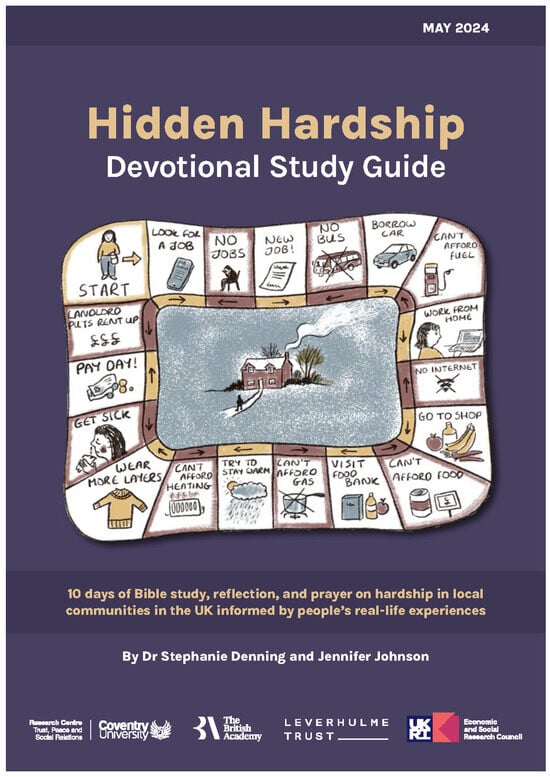
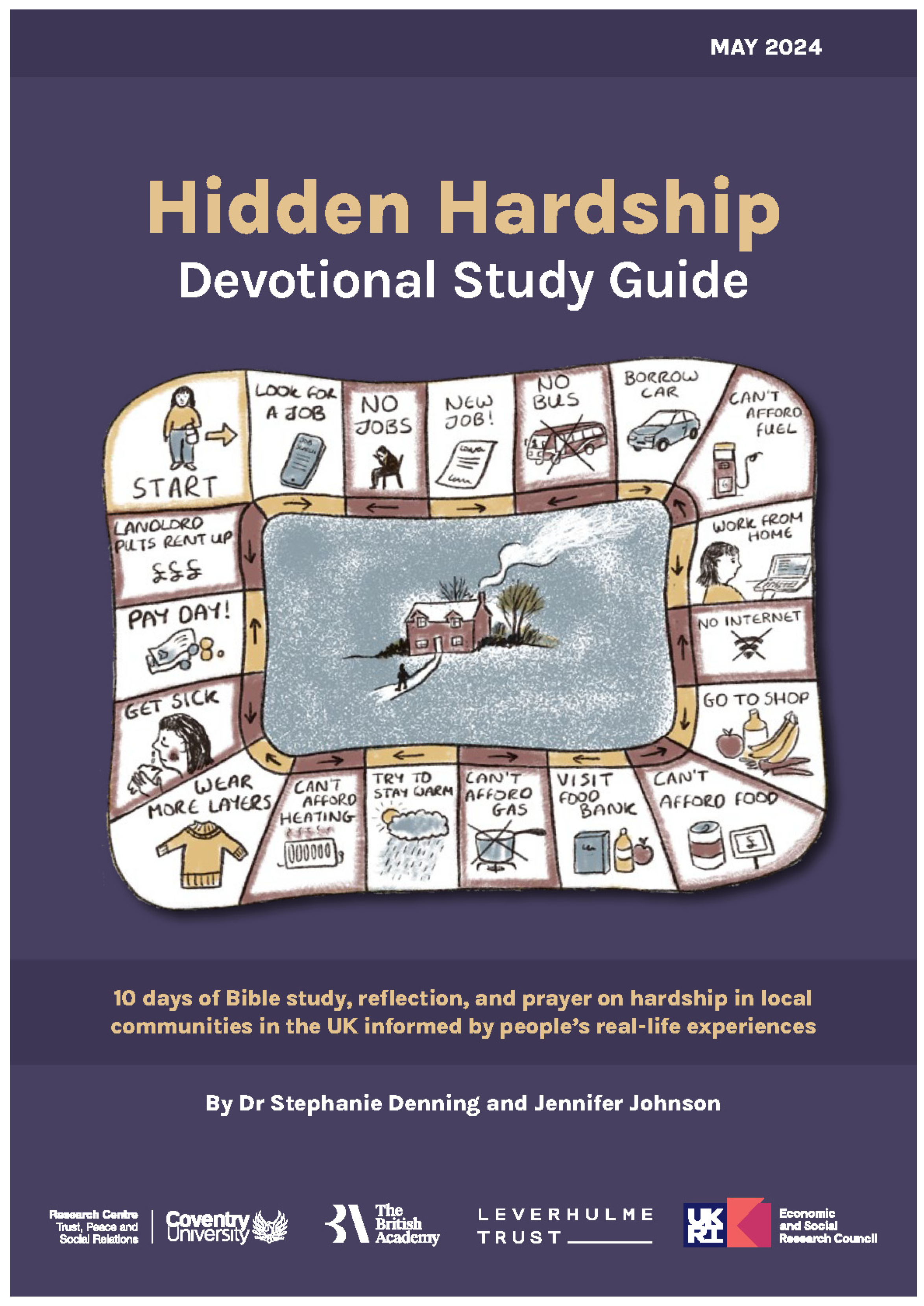
The Hidden Hardship Devotional Study Guide (Figure 1) was subsequently developed in 2024 to resource Christians responding to hardship within communities where the wider majority are living in affluence. This was in direct response to a need identified in the original Hidden Hardship research, formalised as a recommendation in the Hidden Hardship Report for Policymakers and Community Leaders2 that:
Figure 1.
The front cover of the Hidden Hardship Devotional Study Guide featuring artwork by Beth Waters.
The study guide was developed for individual use rather than a group setting because discussing hardship amongst affluence could be very difficult in a group setting such as a Bible study group if member(s) of that group are experiencing hardship, and particularly if they are keeping it hidden from others. Rather, the concluding sections of the study guide move towards taking group action.‘Rural hardship in the North Cotswolds is often hidden for the wealthier majority. This is played out in the contradiction of the strength and support of rural communities but with people in hardship experiencing or fearing stigma and shame.’, followed by: ‘Within the above, faith groups and faith leaders (notably the Church in rural areas) can play a crucial role in raising awareness and challenging false stereotypes of hardship’.(Hidden Hardship Report for Policymakers and Community Leaders, 2023)
To develop the study guide, initially a workshop was hosted by myself (the lead researcher) and Jennifer Johnson (Research Assistant) with 6 church leaders/workers (3 local/regional Church of England leaders, 2 national Officers of the Methodist Church, and 1 CEO of a national organisation that resources rural UK churches). The workshop content covered: a reminder of the Hidden Hardship research findings; discussion of “Where are your congregations/people that you work with at in their understanding of (rural) hardship?”; mind mapping and discussion of Bible passages and theological reflection on hardship; and discussion of the study guide’s section on next steps and take-away actions. Drawing on these discussions—and particularly upon the workshop participants suggestions of Bible passages that move beyond the “go-to” responding to poverty passages—I then co-wrote the devotional study guide with the Research Assistant. One workshop participant wrote the prayers within the guide, and all workshop participants were sent a full draft for their feedback and for further edits before it was published. The study guide was formed of 10 themed days: what is hardship? (day 1), inequality and awareness of hardship (day 2), people’s experiences of hardship (day 3), causes of hardship (day 4), coping strategies: help in tough times (day 5), coping strategies: family and friends (day 6), coping strategies: local groups for support (day 7), barriers to wellbeing (day 8), taking action 1 (day 9), taking action 2 (day 10). These drew on the rigorous thematic analysis of the original Hidden Hardship research data, with the 10 themed days following the analysis themes. Each day’s content ended with several questions for people to reflect and act upon. Within the content of each day, the study guide combined evidence from the original participatory research which was grounded within human geography, professional illustrations by the artist Beth Waters from participants’ interviews and solicited diaries of their experiences of hardship, and theological reflection. The illustrations were of quotes from participants’ interviews and solicited diaries and produced with permission of the participants. The author chose the extracts, rather than the participants in order that there was an illustration for each analysis theme. On reflection, for future studies participants could choose quotes for illustration to make this process more participatory. Following professional design, this resulted in a 52-page A5 booklet. This was then published as an online resource on the Hidden Hardship website and distributed online and hard copies were available to be requested through the project website, resulting in 2750 hard copies distributed across the UK.
Whilst the Hidden Hardship research focussed on one rural area (the North Cotswolds in Gloucestershire, UK), both the findings from the original research in the Hidden Hardship Report for Policymakers and Community Leaders and the subsequent Devotional Study Guide have implications that extend beyond this context. The context for this is explored here, and the detail of the implications discussed in the Conclusion of the paper. First, they resonate with rural areas across the UK because whilst there is diversity in the form of rural areas (for example coastal rural areas compared to mountainous farming), people living in rural hardship experience similar issues and similar barriers to wellbeing (for example see the work of Ovenden-Hope et al. 2025 which was carried out after the original Hidden Hardship research took place. Their work examined rural Cornwall in the UK and identified similar issues for rural poverty to the Hidden Hardship research). Secondly, the Hidden Hardship Devotional Study Guide not only discusses rural hardship but also experiences of hardship within areas of greater affluence more broadly—whether rural or urban—and therefore associated issues of inequality. As discussed further in the Conclusion section to this paper, the implications of the discussion therefore extend beyond the specific (rural) context of the North Cotswolds to be relevant to issues of faith, inequality, and the grassroots politics of these in similar contexts across the Global North.
The four themes of the Discussion section arise from the author’s reflections on the original Hidden Hardship research and the subsequent Hidden Hardship Devotional Study Guide. As such, the discussion section does not include an in-depth discussion of the empirical findings of the Hidden Hardship research which have previously been published elsewhere (Denning 2026). The argument is also not centred around the real-world impact of the Devotional Study Guide, nor does it make claims about the effectiveness of that impact. Rather, reflections are drawn from the author’s experience of developing it to then discuss in a wider context how the Church can be better resourced to respond to poverty and hardship.
3. Discussion
This discussion takes four areas in turn. First, it briefly discusses the contextual landscape of (rural) poverty in the UK and Church responses to this. This sets the scene for the remainder of the discussion on how local churches can be better supported to respond to poverty more effectively. Secondly, I turn to the question of where to start in responding to poverty, arguing that this needs to be people addressing their understanding, assumptions and the language of poverty before taking action, and getting to know the local community. Thirdly, this paper advocates for moving beyond “do-gooder” and “rescuer” notions yet addressing hospitality, particularly in areas of predominant affluence. Fourthly, the discussion draws on the notion of the violence of poverty which is juxtaposed to affluence and the rural idyll but must be challenged for effective local church responses to poverty.
3.1. The Landscape of UK (Rural) Poverty and Church Responses
Churches have a long history of responding to poverty. Much attention has been given to reviewing this topic, and I do not look to replicate that (for example see attention in the geographies of religion by Williams 2025; Brunn 2015; Hopkins et al. 2013). Combining a theological and human geography approach, Shannahan and Denning (2023) have argued that there are currently four main forms of Church responses to poverty in the UK: caring, campaigning and advocacy, enterprise, and community building. The caring response is welfare-based illustrated by the food bank and an ethic of loving your neighbour; campaigning and advocacy moves beyond welfare responses, for example to campaign on Government policies on the causes of poverty; an enterprise response prioritises self-help, for example through church-supported social and business enterprises; whilst community building is a bottom-up approach with examples including asset-based community development (ABCD) (Shannahan and Denning 2023). The combination of these different approaches to Church responses to poverty mean that responses can be made without negating the role of the (welfare) state itself in responding to poverty. To reiterate, this paper does not assume that Church responses to poverty should replace the role of the (welfare) state, nor assume that stronger Church provision is necessarily desirable. Rather, it starts from the understanding that in the UK the welfare state is not sufficient in keeping people out of poverty (Alston 2019) and so in that context how can Church responses be made more effective?
Human geography and the geographies of religion—which grounded the Hidden Hardship research—bring useful understandings of poverty to this discussion. In particular, they emphasise that poverty is relative, can vary by local, regional and national contexts, and that the processes around poverty including economic reform are important (Milbourne 2010). This discussion focusses upon the context of poverty in the UK because that is where the Hidden Hardship research took place, but the Conclusion draws out the implications of this argument beyond the UK to show the significance of the argument in comparable contexts across the Global North. The existence of poverty (within wealthy societies) is certainly not unique to the UK, making this a topic with global significance.
Churches’ extensive social capital makes local (and national) churches well-placed to respond to poverty. Social capital is defined by Putman (1993 cited in Fyfe and Milligan 2003, p. 407) as ‘features of social organisation, such as trust, norms and networks, that can improve the efficiency of society by facilitating coordinated action.’ Local churches are examples of such an organisation which often has these elements of trust, norms and networks (albeit not guaranteed). In turn, Baker and Skinner (2014) emphasise the relationships between people in social capital, and how these relationships form networks within society to result in people working together to help each other within their network as well as in wider society. This provides an opportunity for local churches to be effective responders to poverty in their communities. However, bringing this opportunity into fruition is also not guaranteed. For example, whilst bonding social capital can be productive in reinforcing relationships between people with similar identifies, and bridging capital can extend relationships with others who are less similar to oneself (Baker and Skinner 2014), these are not always played out positively and could conversely result in inequalities, exclusion and stigma being reinforced. Indeed, social capital is affected by the degree to which individual or community networks link to other networks (which they were not already a part of) to access other resources (Baker and Skinner 2014). This paper explores how the reflections drawn from participatory research into hardship can help turn this opportunity for an effective local church response to poverty into reality. More specifically, the discussion focusses upon responding to poverty within areas of wider affluence. In such areas the social capital of churches can be particularly complex because depending upon the composition of the church community, there can be a tension between the potential of their bridging capital versus the risk of exclusion from their bonding social capital. More broadly, this follows government attention to faith groups’ social capital for how they can engage in wider society (Shannahan 2010). For example, the ecumenical Faithful Cities report makes use of the idea of social capital to introduce the notion of faithful capital to show how faith groups have particular social relationships and networks that can be used for faith groups to play an important role in society that goes beyond religious practice in the most literal sense of religious worship (Commission on Urban Life and Faith 2006).
Rural poverty in the UK has received less academic attention than elsewhere in Europe and North America (Black et al. 2019; May et al. 2020; Milbourne 2004). Rural poverty within the UK presents particular challenges in terms of poverty, not least because rural areas are more typically associated with a rural idyll that does not sit well with the notion of poverty (May et al. 2020; McAreavey 2023). It is beyond the scope of this paper to extensively review rural poverty, which I have undertaken elsewhere (Denning 2026). In brief, rural areas in the UK are diverse in their form (McAreavey 2023), but are typified in terms of rural poverty by a lack of local, secure employment opportunities, less affordable housing, and poorer access to services and amenities than their urban counterparts (Black et al. 2019; May et al. 2020; Denning 2026).
The North Cotswolds, Gloucestershire, UK, where the Hidden Hardship research took place are typified by inequality: there are super-rich celebrities, but also people living in hardship (Denning 2026). Traditional measures of poverty in the UK—namely the Index of Multiple Deprivation (IMD)—have been found to be less accurate for rural areas compared to urban areas, and to underestimate rural poverty because for rural areas this measure considers such large areas and gives little emphasis to transport access which is a particular issue in rural areas (Ovenden-Hope et al. 2025). This can make it harder to access statutory and voluntary sector funding and resources in rural areas, especially in areas of predominant affluence and therefore greater inequality for the minority who are experiencing hardship, because it is harder to justify the need for resources on purely quantitative grounds. This is despite rural areas often having a higher cost of living than urban areas in the UK (Smith et al. 2010). Milbourne (2004) has argued that the middle-classes have negatively affected social capital in rural areas because whilst some have set up welfare assistance initiatives, middle-class incomers have further marginalised the poorer minority. This reinforces the above discussion on the tensions between the possibilities and potential exclusions of social capital in areas of predominant affluence. Cumulatively then, rural poverty is often less visible to onlookers and in the attention that it is given in policy and practice than urban poverty (Milbourne 2014, 2016). And yet rural areas have been just as affected by multiple crises in recent years including the political crises of Brexit, austerity, the COVID-19 pandemic, and specifically rural crises such as animal epidemics (Woods 2023). These have all negatively affected the economic security and resilience of rural communities, emphasising the need for effective local church responses to (rural) poverty.
3.2. The Step Before Action
As a researcher of faith and poverty, I am often asked by local church leaders and members of church congregations “What should we do? Where do we start?” in terms of their local church responses to poverty. Here, I argue that local church responses to poverty need to start with comprehension, addressing language, and challenging attitudes and assumptions before action is taken. This is often not what is expected: the above questions generally refer to people asking what action should be taken.
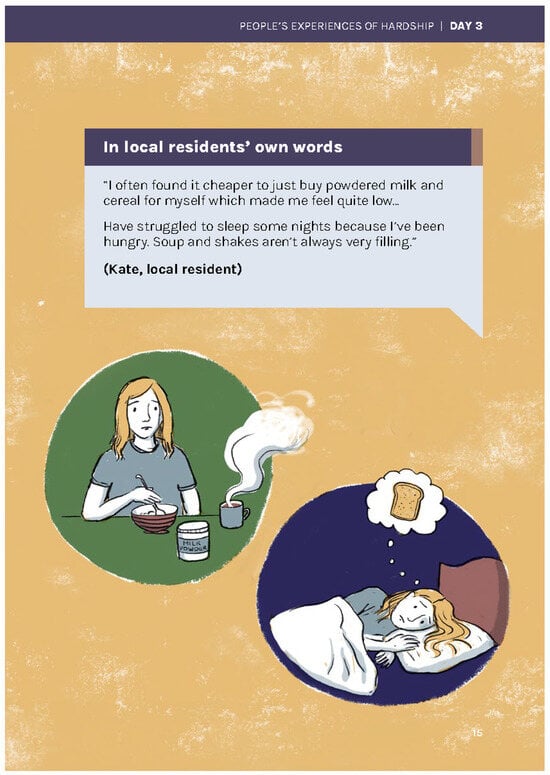
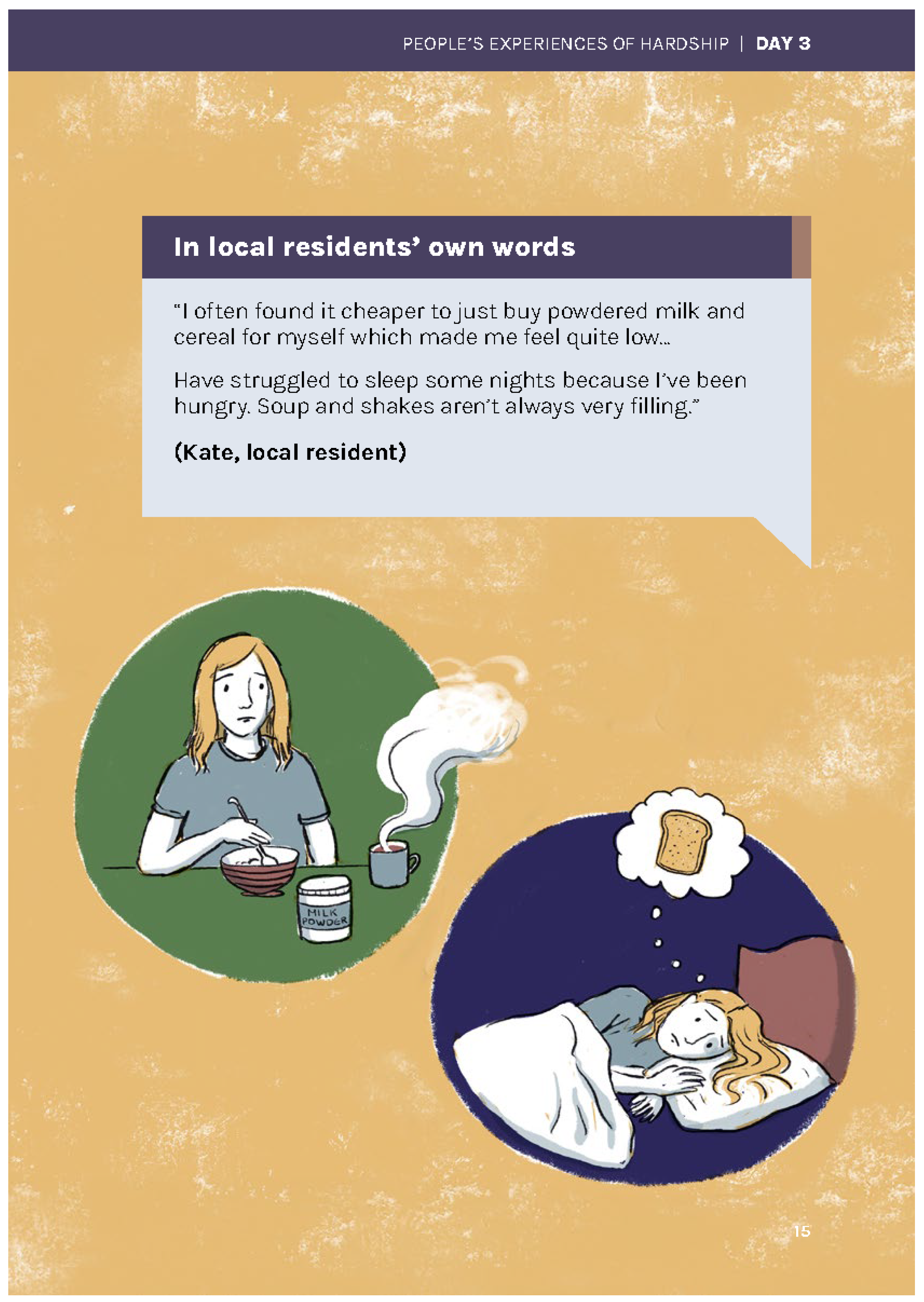
Day 1 of 10 of the Hidden Hardship Devotional Study Guide starts with the question “What is hardship?”. It puts forward the notion that everyone—whatever their experiences—should challenge themselves in their understanding of hardship. The study guide includes within each daily entry a quote and illustration of a research participants’ experience of hardship (see Figure 2 and Figure 3 for examples) and an explanation based on the research participants’ experiences for each daily theme. Day 2 of the Hidden Hardship Devotional Study Guide turns to the theme of inequality and awareness of hardship. It encourages readers to recognise the specifics of people experiencing hardship within affluence and inequality, and to think about how people feel, for example some research participants shared that they experienced embarrassment of being in hardship, particularly in an area of affluence:
Figure 2.
Extract from day 3 of the Hidden Hardship Devotional Study Guide showing the quote from Kate and professional illustration of this quote by Beth Waters.
Figure 3.
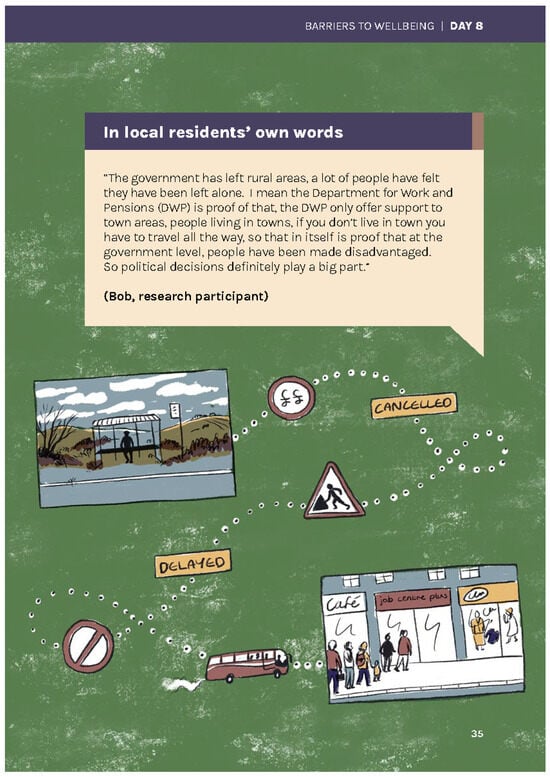
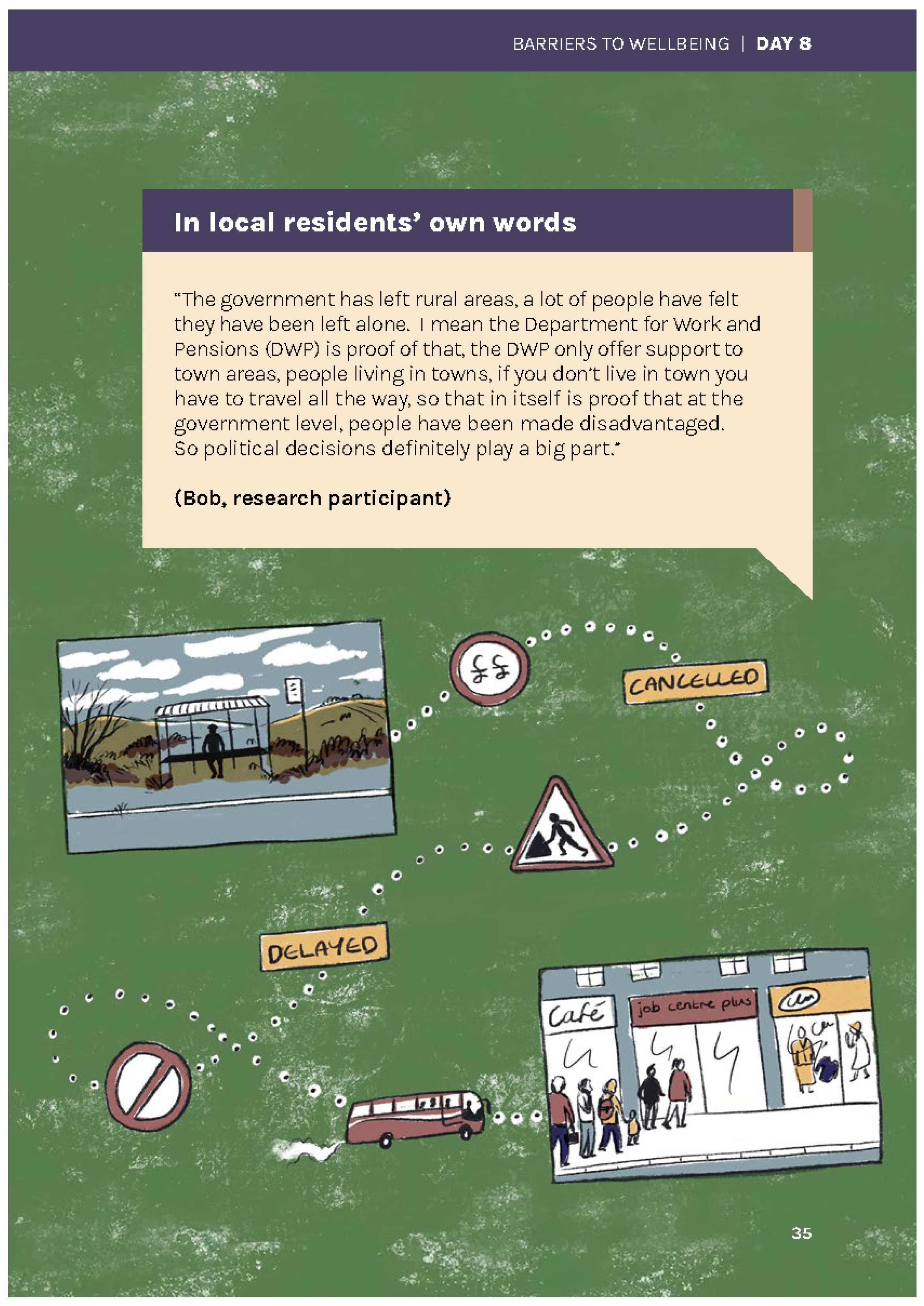
Extract from day 8 of the Hidden Hardship Devotional Study Guide showing a quote from a research participant and professional illustration of this quote by Beth Waters.
Julie’s interview quote makes several points. First, she shares that she feels embarrassed to tell others who are generally more affluent than her (this is her reference to “in the area that we live” to the North Cotswolds being a predominantly wealthy area) that she is “struggling”. Secondly, she comments that she feels judged by others and that they could make assumptions that she is “a certain type of person” with negative connotations because of experiencing hardship. Finally, she questions whether she is being judged and blames herself over others for this feeling: “That might be my insecurities”.It’s embarrassing… in the area that we live in, I think to put your hands up and say, I’m really struggling here, you’re, you are, you feel judged, whether you are or not, I don’t know, you feel judged that you are a certain type of person or I don’t know. That might be my insecurities but…(Julie, interview, local resident, Hidden Hardship research, 2023)
These three points relate to the literature on stigma. Stigma is a discourse intended to elicit shame (see Shannahan 2026 for a longer discussion on this). Stigma is important for churches and their congregations to consider in their responses to poverty because it relates to people’s daily experiences of hardship and can be (unintentionally) exacerbated by responses to poverty which then further decreases people’s personal and societal/community resilience, and wellbeing. For example, human geographers—amongst others—have given attention to how people can experience stigma attending a food bank: whilst this is often not the intention of the food bank leaders or volunteers, research in both urban and rural settings has shown this can be the experience of food bank clients (Garthwaite 2016; May et al. 2019, 2020). Turning to another example, in rural settings people have hidden their situations of homelessness because of the stigma of being homeless and that being exacerbated in small rural communities (Cloke et al. 2007). In part this stigma is experienced because of the wider societal stigma in the UK around receiving benefits, and the associated false assumption that people in receipt of benefits are lazy or do not want to work (Slater 2016). These myths have been used in the political arena for political gain—for example the myth that people frequently want to exploit the benefit system has been used to justify harsh sanctions (Joint Public Issues Team 2013)—emphasising how poverty is a matter of politics. This emphasises the relationship between personal and societal resilience: when one is decreased then the other is also affected rather than them operating in silos. In this way, it can be argued that in our daily interactions we are each responsible for our own and others’ resilience through how we interact with each other, and this feeds into and is affected by bigger discourses of societal resilience of which we also all play a part and can influence to varying degrees.
The study guide—and the preceding Hidden Hardship research uses the language of hardship over poverty. I have argued elsewhere (Denning 2026) that hardship can be a more accessible and less stigmatising term than poverty: people experiencing poverty rarely describe their own situation as such—in part because of the stigma of the term poverty. In the participatory Hidden Hardship research, hardship was a term that people seemed to be more comfortable to use to describe their own situation, but one that still recognised the multidimensional nature of the jigsaw of poverty (Shannahan and Denning 2023). Cumulatively then, through this discussion, I broaden stigma from the food bank or specific instances to consider experiences of stigma and hardship in affluent communities more generally; not just to attending the food bank but also at the school gate, in the supermarket, and amongst neighbours. These are all affected by the wider discourses of stigma in society and within national and grassroot political agendas. An effective church response to poverty necessitates not only an understanding of this, but also an appreciation of what it means to experience day-to-day life in this way. Day 4 of the Hidden Hardship Devotional Study Guide on the theme the causes of rural hardship therefore emphasised to readers that even within the same community we do not all start with the same resources in any given situation.
This raises the question of how local churches and their congregations can better understand the experiences of others both within their congregations and wider communities, as the first step to then challenging one’s own comprehension and assumptions of hardship and poverty. The study guide and subsequently this discussion draw on asset-based community development (ABCD) to do this. ABCD is an approach to community development that emphasises the gifts, associations, and hospitality in communities:
ABCD therefore advocates bottom-up rather than top-down change and transforms a community by focussing on the assets that are present rather than the deficits (Russell 2020). Whilst this is not without critique (see Denning 2023) for a discussion on the limitations of ABCD), ABCD provides an opportunity to influence the conceptual way of thinking for responding to poverty. For Methodist Minister Mather in the United States of America, implementing ABCD in his Christian ministry meant “My parish was the streets” (Mather 2018). He found that ABCD and taking time to get to know the local community meant that his own and his church’s response to poverty transformed how he understood the Biblical passage in Matthew 25 which discusses feeding the hungry; he began working to change the causes of why people were hungry, and worked together with neighbours to do this. However, ABCD is not without critique. As discussed by Denning (2023), ABCD has been challenged over whether it reduces the role and importance of the welfare state (MacLeod and Emejulu 2014). However, in response to this critique, key proponent of ABCD Russell has argued that ABCD should hold governments accountable (Russell 2011, 2016)—for example in relation to structural causes of poverty such as austerity as discussion in Section 3.4 on the violence of poverty. This tension is important to grapple with in church responses to poverty.In the system world of philanthropy, generosity is sometimes called “charity”, which is really an unstable and false generosity because it is oriented around the needs and deficiencies of just one party in the transaction. Charity is demeaning in this way. As if you need me, and have nothing but gratitude to offer in return. Charity says, “You have not earned this; I am giving it to you because you have so few gifts”.(McKnight and Block 2012)
Returning to the question of “What should we do?”, ABCD therefore encourages people to take time to get to know their local community more—even if they consider themselves already well connected—and to understand different people’s experiences, challenges, and gifts. For example, Day 1 of the Hidden Hardship Devotional Study Guide therefore asks people to question themselves “How aware are you of who is experiencing struggle or tough times in your community?”. Within the study guide, the quotes from the Hidden Hardship research participants’ experiences of hardship combined with the illustrations raise the emotion and reality of hardship, for example that of Kate (Figure 2):
I often found it cheaper to just buy powdered milk and cereal for myself which made me feel quite low… Have struggled to sleep some nights because I’ve been hungry. Soup and shakes aren’t always very filling.(Kate, diary, local resident, Hidden Hardship research, 2023)
Cumulatively, more effective local church responses to poverty begin with a step before action: with each person challenging their understanding, assumptions, and attitudes towards poverty, hardship, and the people that experience these—whether similar or different to themselves. This is a vital stage before effective action.
3.3. Moving Beyond the “Do-Gooder” and Embracing Hospitality
The next dimension of supporting an effective response to poverty based on reflections on the Hidden Hardship Devotional Study Guide is to move beyond the notions “do-gooder” and “rescuer”—particularly in places of predominant affluence—and to embrace hospitality.
The terms “do-gooder” and “rescuer” present a binary of “us” and “them” or giver and receiver and place more power and agency with the “rescuer” than the receiver. They refer to a person being the answer to another person’s problems in an overly virtuous sense that emphasises McKnight and Block’s (2012) aforementioned perspective on charity as being demeaning. This is contrary to ABCD and to Christian theology of all humans being equal in the image of God because it presents some people as having more worth or value than others. I have previously written about this in terms of volunteering experiences (Denning 2021b) where I argued that this binary should be downplayed in volunteering experiences because of the unequal power imbalance in those ideas, and also in order to recognise that in volunteering experiences the volunteer often also benefits or is changed in some way. This discussion extends this beyond volunteering to argue that this binary should be broken down in daily life and in interactions between people who are different to each other including in terms of economic or hardship status. These themes run throughout the devotional study guide and build the foundation for challenging understanding, attitudes and assumptions before taking action.
Building upon this, day 5 of the Hidden Hardship Devotional Study Guide discusses the theme of hospitality. There are different conceptualisations of hospitality (for example see Derrida 2000; Dikeç et al. 2009). I follow Friese (2009) on hospitality: ‘Host and guest are tied by a reciprocal relation: it is the host who receives as much as the guest gives himself to the host, if hospitality is to come into being and endure.’. Such an understanding of hospitality builds upon the previous discussion of breaking down the binary of giver and receiver and avoiding the “do-gooder” or “rescuer”; it is no longer about a guest and a host, but rather about mutual exchange of time and gifts in the ABCD sense of all having something to bring and share together. Hospitality is therefore not the same as charity—a point which is often neglected in the conceptualisation and practice of local churches (Allen 2016). In his theological reframing of food poverty and Christianity, Allen (2016) argues that food banks are problematic because they reflect privilege, and focus on giving rather than hospitality. Similarly, I have previously discussed hospitality through the lens of the geographies of religion in relation to volunteering experiences (Denning 2021a); different volunteers at a holiday hunger project for children had different ideas of hospitality in terms of how the “receiver” (the children) should behave and who should be eligible for a free lunch which had consequences for whether people persisted in volunteering or not. Here I take that argument further beyond formal “poverty projects” to argue that people’s attitudes and interactions day-to-day should be one of hospitality. In this way, an effective local church response to poverty and hardship is not about hospitality and a response in a particular time, space, or project. Rather, it is a mode of being through which every interaction within the congregation and the wider community is one of hospitality and awareness of hardship. This models the example of Jesus in Christian teaching and care for one’s neighbour which is often taken for granted as a way of living, but actually moves away from the dominant focus on “poverty projects” within church settings to really challenge people to put this ethic into practice.
3.4. The Violence of Poverty
The final discussion section examines the violence of poverty and how this relates to building both personal and societal resilience within local church responses to poverty and hardship. The Hidden Hardship Devotional Study Guide discusses the causes of hardship (day 4), coping strategies (days 5–7), and barriers to wellbeing (day 8). When these are combined, they show that many of the causes of poverty are outside of individuals’ control and are political and structural causes. Despite this, many local church responses to poverty often address the symptoms of poverty rather than the cause, for example people not having food is often responded to through a caring approach of giving food at a project such as a food bank (Shannahan and Denning 2023). The study guide explains that the barriers to wellbeing from rural hardship in the North Cotswolds—which are in common with the causes of hardship in many rural areas across the UK—are centred around the “lacks of” in rural areas. These included the lack of secure local employment, the lack of government support (including low benefit rates), the lack of affordable housing, lack of local amenities, and the withdrawal of local services including transport. This is illustrated by the research participant quoted on day 9 of the Hidden Hardship Devotional Study Guide (Figure 3):
The impact of austerity has been seen differently in rural and urban areas of the UK, with rural areas often seeing an increased withdrawal of services (May et al. 2020). This is an example of how national policies have affected resilience at the scale of the community and in turn for individuals. In addition, experiencing these issues in areas of predominant affluence and inequality meant that the majority of other people in the area who were not experiencing hardship had greater resources to address these barriers to wellbeing. For example, if a family with young children owns two cars they can drive to employment and to amenities and supermarkets to buy cheaper food in bulk rather than relying on limited local shopping or limited public transport. The study guide—and this discussion—argues that more needs to be done to address the structural causes of poverty (although it is beyond the remit of this paper to argue how the structural causes of poverty can be better addressed).The government has left rural areas, a lot of people have left they have been left alone. I mean the Department for Work and Pensions (DWP) is proof of that, the DWP only offer support to town areas, people living in towns, if you don’t live in town you have to travel all the way, so that in itself is proof that at the government level, people have been made disadvantaged. So political decisions definitely play a big part.(Bob, interview, Hidden Hardship research participant, Hidden Hardship research, 2023)
This is the violence of poverty which emphasises both the grassroots politics of poverty and how this relates to national political policies and governance. In this way, grassroots politics and local church responses to poverty are increasingly intertwined in today’s society, and each audience should recognise this more. I follow the work of Shannahan in examining poverty as a form of violence: Shannahan (2019) argues that ‘poverty is a form of structural and cultural violence, which demands a systemic and spiritual revolution if it is to be defeated.’ Shannahan’s use of the terms structural and cultural violence come from Galtung’s (1969 cited in Shannahan 2019) triad of violence; structural violence refers to unequal power structures in society that result in inequality such as low pay, whilst cultural violence legitimises direct and structural violence (for example blaming people who are poor for their own situation). I follow Shannahan in arguing that the violence of poverty needs to be addressed both in society generally, and by Churches and their congregations including by challenging the structural injustices in society and therefore the structural causes of poverty.
The violence of poverty is complicated in rural areas by the fact that the violence of poverty is juxtaposed to the rural idyll. The rural idyll is a romanticised idea of rural life in the UK (May et al. 2020), typified by areas such as the Cotswolds with attractive, apparently wealthy villages (Cloke et al. 2001). Poverty and the rural idyll do not sit well together. May et al. (2020) argue that this plus an emphasis on self-sufficient rural households and mutual community support can feed into rural residents perceiving that struggle is simply part of rural life rather than a problem that needs to be addressed. The argument can be taken further to suggest that this is actually part of the violence of poverty and a form of cultural violence; the internalising of one’s own situation rather than recognising the structural and cultural violence that is play and the role of national politics within this. Cooper and Whyte (2017) discuss this in terms of the violence of austerity, which in the context of this discussion is a form of structural violence. They argue that austerity is dependent upon violence and has harmed vulnerable people (Cooper and Whyte 2017). In combination with the work of Shannahan (2019) this takes the notion of violence away from direct conflict to show that economic and political policies can also be violent. Here caution is warranted over how this paper has advocated for hardship as being more accessible and less stigmatising language than poverty: in relation to the structural causes of poverty and government responsibility for this, the recognisable language of poverty and its associated political campaigning remain important. The paper is therefore not calling for the total abandonment of the language of poverty in favour of hardship, but rather a recognition of the effect of language in different pastoral and political circumstances.
Drawing this section together, I therefore argue that local (and national) church responses need to challenge the violence of poverty: both the structural violence that relates to the causes of poverty, and the cultural violence that sustains and accepts that poverty is found within communities. This matters on multiple levels: First, it is a matter of ethical justice and injustice not only that people are experiencing poverty, but that they are subject to the violence of poverty and its structural causes. Secondly, challenging the violence of poverty and its associated grassroot and national politics will build societal resilience in local communities, which in turn will make for a more resilient society nationally. Recognising the violence of poverty is therefore an important step in building more effective local church responses to poverty in order that these address the causes of poverty rather than only the symptoms of poverty: whilst in the Hidden Hardship research individuals experiencing hardship displayed significant personal resilience in their daily lives (Denning 2026), it should not be exclusively down to the individual to build their own resilience; together we need to build a more resilient society where people do not have to face poverty and hardship, and local churches and their congregations have an important role to play in doing this.
4. Conclusions
This paper has questioned how local churches can conceptually be better resourced to respond to poverty, particularly in areas of inequality. This question is important because churches are in many ways well placed to respond to poverty with strong social capital, religious faith motivating many to undertake social action, and the potential of faith groups to build a more resilient society. However, it is a problem that local churches and individuals within church congregations do not always make the best use of these opportunities because they do not necessarily have sufficient understanding of poverty to respond effectively, particularly if they have little shared experience of poverty themselves, for example, in areas of predominant affluence. For an original response to this question—both within the social sciences and religious studies—I have reflected on the participatory Hidden Hardship research in the rural North Cotswolds, Gloucestershire, UK and the subsequent development of the Hidden Hardship Devotional Study Guide to explore how local churches and their congregations can be better resourced to respond to poverty.
In conclusion, rather than presenting a “how to guide” for how local churches can respond more effectively to poverty overall, I have argued that a different conceptual framing is needed. I have advocated that sharing the voices of people experiencing poverty through participatory research presents an important opportunity to better resource local churches to respond to poverty by encouraging greater reflection and comprehension rather than starting with an action, solution-focused mindset. This has been facilitated by three themes. Each of these has moved beyond the specific context of the Hidden Hardship Devotional Study Guide within the North Cotswolds to have explored responding to poverty in areas of wider affluence and inequality; this being a problem in communities across the Global North.
First, I have argued that churches and their congregations wanting to respond to poverty need to take a step before action to start with comprehension of the complexity of poverty and the politics of poverty, to address language—encouraging the use of the concept of hardship over poverty to be less stigmatising and more accessible—and challenge pre-held attitudes and assumptions around poverty and the people that experience it. This is important whether one has experience of poverty oneself or not, but particularly so if they live within affluence themselves. In doing so, this theme has addressed the grassroots politics around the stigma of experiencing poverty and how an ABCD approach attempts to counter that stigma. Stigma and attitudes towards charity, gifts and deficits all affect how a response to poverty is then undertaken in terms of the approach rather than just the literal action. In doing so, this paper has broadened discussions of poverty and stigma beyond specific “poverty project” settings to consider people’s experiences of stigma and hardship in affluent communities more generally and day-to-day. An effective church response to poverty necessitates and understanding of this and an appreciation of experiencing stigma within daily life.
Secondly, I have argued that churches need to break down the binary of “giver” and “receiver” in their responses to poverty, and embrace hospitality in terms of reciprocity over charity. This encourages a different way of thinking rather than planning “poverty projects” instead to live out this ethos in daily interactions, which builds upon the first point on the importance of language and stigma. Extending this more broadly, this argument has political implications for how poverty is approached in grassroots politics through to national policy; it encourages more emphasis upon policies that look to improve people’s daily lives and reduce levels of poverty by addressing the causes of poverty rather than simply funding responses to poverty and a project mentality. In doing so, this presents an opportunity for a grassroots re-envisioning of the politics of responding to poverty: with less emphasis on “poverty projects” and more attention on the conceptual thinking and relationships behind a response. This is contrary to much top-down government policy on poverty, and local churches’ strong social capital makes them well placed to lead such a way of thinking of responding for others, including policymakers, to follow. Such an approach would build a more cohesive and resilient society, such as that which the UK Government looks to build (HM Government 2025).
Finally, I have argued that for an effective local church response to poverty, the violence of poverty needs to be addressed. This is important in order to address the political, structural causes of poverty rather than focussing on the symptoms of poverty. The paper has shown how the violence of poverty in rural areas is complicated by the rural idyll, and how this becomes tied up within the politics of poverty and the need to attempt address the structural causes of poverty for local church response to truly be effective. In turn this will address the grassroots politics of poverty, and how this then relates to national political policies and governance: the wider implication of this argument is that local churches with their congregations—and often also with strong wider community relations—can play an important role here in raising voices from the grassroots for public debate and to influence the political policies around poverty. This will help to challenge the aforementioned political and everyday stigma of poverty, as well as naming the effects of austerity and its associated policies and look to hold governments accountable for raising the standard of living across the local communities of their countries, not just for those who are already affluent. This is important in both rural and urban areas, but from a governance point of view this paper has also highlighted the need for more political attention to poverty within rural areas—even if these statistically appear affluent (Ovenden-Hope et al. 2025)—which to-date has been lacking. There is therefore an opportunity for local churches to raise this issue for local and national governance, and to raise largely hidden voices of those experiencing rural hardship that is hidden by the wider affluence and focus on tourism (Denning 2026).
Stepping outside of the local, rural North Cotswolds and UK context in which this discussion has been empirically based, this argument is significant with challenges and future directions raised on a number of levels in other contexts. First, it speaks to the aforementioned ongoing debates over how churches should—or should not—be responding to poverty in relation to government provision such as the UK’s welfare state, and therefore more widely relates to longstanding debates over the relationship between the state and religion. The relationship between faith and poverty is therefore a political issue at both a local, grassroots scale and nationally. Hence, this debate is as important in local communities and national Churches in a range of comparable contexts in the Global North as it is in local church communities in the UK. Secondly, it speaks to conversations over how faith groups and the voluntary sector (of which faith-based organisations are a significant part) can contribute to building more resilient local communities that can combat poverty and inequality, thereby enhancing societal and national resilience. This argument has also shown the varying relationship between personal, local/societal, and national resilience, and how these can each affect each other to varying degrees. Discussion of this relationship has emphasised that responsibility for resilience is not found exclusively at any one level. Thirdly, this serves as a reminder and advocate for how research can be turned into action. Finally, this paper raises future research directions: there is a need for more participatory research in the vein of this discussion but in different place contexts. This includes in different rural contexts, of different faiths besides Christianity, and in countries besides the UK; inequality within nations is a global problem, and addressing the conceptual approach to international responses to poverty then becomes the natural step after that.
Funding
This research was funded by the British Academy, grant number SRG2021/210245 (for the original Hidden Hardship research project) and Economic and Social Research Council Impact Acceleration Award, grant number PDA108 (for the development of the Hidden Hardship Devotional Study Guide).
Institutional Review Board Statement
The study was conducted in accordance with the Declaration of Helsinki and approved by the Ethics Committee of Centre for Peace and Security, Coventry University (protocol code P143203 and 7 December 2023).
Informed Consent Statement
Informed consent was obtained from all subjects involved in the study. Written informed consent has been obtained from the participants to publish this paper.
Data Availability Statement
The data presented in this study are openly available in [UK Data Service ReShare] [https://reshare.ukdataservice.ac.uk/858654/, accessed on 5 October 2026].
Conflicts of Interest
The author declares no conflicts of interest.
Abbreviations
The following abbreviations are used in this manuscript:
| ABCD | Asset-based Community Development |
| DWP | Department for Work and Pensions |
| IMD | Index of Multiple Deprivation |
| UK | The United Kingdom |
Notes
| 1 | The Hidden Hardship Devotional Study Guide is available at https://hiddenhardship.coventry.ac.uk/next-steps/hidden-hardship-devotional-study-guide/ (accessed on 5 October 2026). |
| 2 | The Hidden Hardship Report for Policymakers and Community Leaders is available at https://hiddenhardship.coventry.ac.uk/report-for-policymakers-and-community-leaders/ (accessed on 5 October 2026). |
References
- Allen, Chris. 2016. Food Poverty and Christianity in Britain: A Theological Re-assessment. Political Theology 17: 361–77. [Google Scholar] [CrossRef] [Scilit]
- Alston, Philip. 2019. Visit to the United Kingdom of Great Britain and Northern Ireland. In Report of the Special Rapporteur on Extreme Poverty and Human Rights. Geneva: Human Rights Council, United Nations. [Google Scholar]
- Baker, Chris, and Helen Skinner. 2014. Faith in Action. The Dynamic Connection Between Spiritual and Religious Capital. London: William Temple Foundation. [Google Scholar]
- Black, Niki, Karen Scott, and Mark Shucksmith. 2019. Social inequalities in rural England: Impacts on young people post-2008. Journal of Rural Studies 68: 264–75. [Google Scholar] [CrossRef] [Scilit]
- Brunn, Stanley, ed. 2015. The Changing World Religion Map. Sacred Places, Identities, Practices and Politics. London: Springer. [Google Scholar]
- Brydon-Miller, Mary. 2004. The Terrifying Truth: Interrogating Systems of Power and Privilege and Choosing to Act. In Travelling Companions: Feminism, Teaching and Action Research. Edited by Patricia Maguire, Mary Brydon-Miller and Alice McIntyre. Westport: Praeger Publishers, pp. 3–19. [Google Scholar]
- Cloke, Paul, Paul Milbourne, and Ruth Widdowfield. 2001. Homelessness and Rurality: Exploring Connections in Local Spaces of Rural England. Sociologia Ruralis 41: 438–53. [Google Scholar] [CrossRef] [Scilit]
- Cloke, Paul, Sam Thomas, and Andrew Williams. 2012. Radical faith praxis? Exploring the changing theological landscape of Christian faith motivation. In Faith-Based Organisations and Exclusion in European Cities. Edited by Justin Beaumont and Paul Cloke. Bristol: Polity Press, pp. 105–26. [Google Scholar]
- Cloke, Paul, Sarah Johnsen, and Jon May. 2007. The periphery of care: Emergency services for homeless people in rural areas. Journal of Rural Studies 23: 387–401. [Google Scholar] [CrossRef] [Scilit]
- Commission on Urban Life and Faith. 2006. Faithful Cities. A Call for Celebration, Vision and Justice. Church of England and the Methodist Church. London: Church House Publishing. [Google Scholar]
- Cooper, Vickie, and David Whyte. 2017. Introduction: The Violence of Austerity. In The Violence of Austerity. Edited by Vickie Cooper and David Whyte. London: Pluto Press, pp. 1–31. [Google Scholar]
- Denning, Stephanie. 2021a. Persistence in volunteering: An affect theory approach to faith-based volunteering. Social and Cultural Geography 22: 807–27. [Google Scholar] [CrossRef] [Scilit]
- Denning, Stephanie. 2021b. Religious faith, effort and enthusiasm: Motivations to volunteer in response to holiday hunger. Cultural Geographies 28: 57–71. [Google Scholar] [CrossRef] [Scilit]
- Denning, Stephanie. 2023. ‘I believe in building people up’: A call for attention to asset-based community development in geographical framings of poverty in the global North. Area 55: 426–34. [Google Scholar] [CrossRef] [Scilit]
- Denning, Stephanie. 2026. Hidden hardship: Everyday experiences, coping strategies, and barriers to wellbeing in rural Britain. Journal of Rural Studies 123: 1–9. [Google Scholar] [CrossRef] [Scilit]
- Derrida, Jacques. 2000. Of Hospitality. Anne Dufourmantelle Invites Jacques Derrida to Respond. Stanford: Stanford University Press. [Google Scholar]
- Dikeç, Mustafa, Nick Clark, and Clive Barnett. 2009. Extending Hospitality: Giving Space, Taking Time. Paragraph 32: 1–14. [Google Scholar] [CrossRef] [Scilit]
- Friese, Heidrun. 2009. The Limits of Hospitality. Paragraph 32: 51–68. [Google Scholar] [CrossRef] [Scilit]
- Fyfe, Nicholas, and Christine Milligan. 2003. Out of the shadows: Exploring contemporary geographies of voluntarism. Progress in Human Geography 27: 397–413. [Google Scholar] [CrossRef] [Scilit]
- Garthwaite, Kayleigh. 2016. Hunger Pains. Life Inside Foodbank Britain. Bristol: Policy Press. [Google Scholar]
- HM Government. 2025. The UK Government Resilience Action Plan. The UK’s Strategic Approach to Resilience; London: HM Government.
- Hopkins, Peter, Lily Kong, and Elizabeth Olson, eds. 2013. Religion and Place: Landscape, Politics and Piety. London: Springer. [Google Scholar]
- Joint Public Issues Team. 2013. The Lies We Tell Ourselves: Ending Comfortable Myths About Poverty. London: Baptist, Methodist and United Reformed Churches Working Together on Behalf of the Baptist Union of Great Britain, the Methodist Church, the Church of Scotland and the United Reformed Church. [Google Scholar]
- MacLeod, Mary Anne, and Akwugo Emejulu. 2014. Neoliberalism With a Community Face? A Critical Analysis of Asset-Based Community Development in Scotland. Journal of Community Practice 22: 430–50. [Google Scholar] [CrossRef] [Scilit]
- Mather, Michael. 2018. Having Nothing, Possessing Everything. Finding Abundant Communities in Unexpected Places. Grand Rapids: WM. B. Eerdmans Publishing Co. [Google Scholar]
- May, Jon, Andrew Williams, Paul Cloke, and Luke Cherry. 2019. Welfare Convergence, Bureaucracy, and Moral Distancing at the Food Bank. Antipode 51: 1251–75. [Google Scholar] [CrossRef] [Scilit]
- May, Jon, Andrew Williams, Paul Cloke, and Luke Cherry. 2020. Still bleeding: The variegated geographies of austerity and food banking in rural England and Wales. Journal of Rural Studies 79: 409–24. [Google Scholar] [CrossRef] [Scilit]
- McAreavey, Ruth. 2023. What is the rural? In Rural Governance in the UK. Towards a Sustainable and Equitable Society. Edited by Adrienne Attorp, Sean Heron and Ruth McAreavey. London: Routledge, pp. 12–33. [Google Scholar]
- McKnight, John, and Peter Block. 2012. The Abundant Community. Awakening the Power of Families and Neighbourhoods. San Francisco: Berrett-Koehler Publishers. [Google Scholar]
- Milbourne, Paul. 2004. Rural Poverty: Marginalisation and Exclusion in Britain and the United States. London: Taylor and Francis Group. [Google Scholar]
- Milbourne, Paul. 2010. The Geographies of Poverty and Welfare. Geography Compass 4: 158–71. [Google Scholar] [CrossRef] [Scilit]
- Milbourne, Paul. 2014. Poverty, Place, and Rurality: Material and Sociocultural Disconnections. Environment and Planning A: Economy and Space 46: 566–80. [Google Scholar] [CrossRef] [Scilit]
- Milbourne, Paul. 2016. Poverty and welfare in rural places. In Routledge International Handbook of Rural Studies. Edited by Mark Shucksmith and David Brown. London: Routledge, pp. 450–61. [Google Scholar]
- Ovenden-Hope, Tanya, Victoria Brown, and Elpida Achtaridou. 2025. Pretty Poverty: The Cornwall Rurality Matters Report. Devon: Plymouth Marjon University and the Diocese of Truro. [Google Scholar]
- Russell, Cormac. 2011. People Powered Change. Twelve Domains That People Are Uniquely Able to Change Through Handmade and Homemade Solutions. Dublin: Nurture Development. [Google Scholar]
- Russell, Cormac. 2016. Neoliberalism with a Community Face? A Critical Analysis of Asset-Based Community Development in Scotland? Available online: https://www.nurturedevelopment.org/blog/neoliberalism-community-face-critical-analysis-asset-based-community-development-scotland/ (accessed on 21 September 2020).
- Russell, Cormac. 2020. Rekindling Democracy. Eugene: Cascade Books. [Google Scholar]
- Shannahan, Chris. 2010. Voices From the Borderland. Re-Imagining Cross-Cultural Urban Theology in the Twenty-First Century. London: Equinox Publishing Ltd. [Google Scholar]
- Shannahan, Chris. 2019. The Violence of Poverty: Theology and Activism in an “Age of Austerity”. Political Theology 20: 243–61. [Google Scholar] [CrossRef] [Scilit]
- Shannahan, Chris. 2026. Subverting Poverty Stigma—Dub Theology and the Politics of Shame. Religions 17: 889. [Google Scholar] [CrossRef] [Scilit]
- Shannahan, Chris, and Stephanie Denning. 2023. Politics, Poverty and the Church in an ‘Age of Austerity’. Religions 14: 59. [Google Scholar] [CrossRef] [Scilit]
- Slater, Tom. 2016. Revanchism, stigma, and the production of ignorance: Housing struggles in austerity Britain. Research in Political Economy 31: 23–48. [Google Scholar] [CrossRef] [Scilit]
- Smith, Noel, Abigail Davis, and Donald Hirsch. 2010. A Minimum Income Standard for Rural Households. London: Joseph Rowntree Foundation. [Google Scholar]
- Williams, Andrew. 2025. Religion and Social Welfare: New Critical Perspectives. In Handbook of the Geographies of Religion. Edited by Lily Kong, Orlando Woods and Justin Tse. Cham: Springer, pp. 757–78. [Google Scholar]
- Woods, Michael. 2023. Rural recovery or rural spatial justice? Responding to multiple crises for the British countryside. The Geographical Journal 191: 1–10. [Google Scholar] [CrossRef] [Scilit]
Disclaimer/Publisher’s Note: The statements, opinions and data contained in all publications are solely those of the individual author(s) and contributor(s) and not of MDPI and/or the editor(s). MDPI and/or the editor(s) disclaim responsibility for any injury to people or property resulting from any ideas, methods, instructions or products referred to in the content. |
© 2026 by the author. Licensee MDPI, Basel, Switzerland. This article is an open access article distributed under the terms and conditions of the Creative Commons Attribution (CC BY) license.