


Abstract
This study examines ideological variation among Mexico’s Catholic bishops using computational analysis of 2330 documents (1976–2026): topic modeling, Wordfish scaling, and consecration network analysis. Topic modeling recovers nine topics organized around a spiritual emphasis pole (homiletics, pastoral life) and a social engagement pole (social pastoral, Chiapas/indigenous rights). Wordfish’s primary dimension contrasts prophetic/individual voice with institutional/consensus. Liberation theology bishops deviate most from the episcopal conference’s administrative register. Network analysis identifies the apostolic nunciature, through which the Holy See shapes episcopal appointments, as the dominant consecration hub. Regional and temporal variation are substantial but partly reflect source composition effects. A multilevel test that merges Protestant/Evangelical population share with bishops’ actual diocesan assignments, accounting for clustering by bishop and by state, finds that greater Protestant presence predicts more doctrinal and less indigenous rights discourse, closer to the supply side reading of religious economy theory than to its mobilization reading. Ideological differentiation within this hierarchical religious institution appears driven by differences in issue emphasis, and in the balance between charismatic and bureaucratic forms of episcopal authority.
1. Introduction
Do ideological differences persist among Mexico’s Catholic bishops, and how are they manifested in their public communications and pastoral priorities? This question addresses a core tension in hierarchical religious institutions: centralized doctrinal authority coexists with considerable local pastoral autonomy, since individual bishops retain discretion over which issues to emphasize in their public statements.
Mexico’s Catholic Church is an ideal setting in which to examine this question: a historically influential institution whose episcopate has long combined a spiritual orientation centered on evangelization and spiritual renewal with a social engagement orientation emphasizing poverty alleviation, indigenous rights, and liberation theology. These currents reflect broader post-Vatican II debates about the Church’s role in society.
This study builds on earlier, preliminary work (Díaz-Domínguez 2014) by applying modern computational text analysis to a far larger and more temporally extensive corpus: 2330 documents from 1976 to 2026, including pastoral letters, diocesan bulletins, Mexican Episcopal Conference (CEM) communiqués, and press coverage. Three methods are employed. Latent Dirichlet Allocation (LDA) topic modeling identifies the latent thematic structure of episcopal discourse; Wordfish text scaling estimates each actor’s position on a latent dimension from word choice; and consecration network analysis reconstructs the genealogical ties binding the episcopate and situates textual position within institutional lineage.
Together, these methods assess whether ideological variation exists in bishops’ pastoral priorities, how many dimensions characterize that variation, how liberation and indigenous theology discourse differs lexically from the episcopal conference’s institutional register, and how textual position relates to episcopal lineage and to institutional versus individual voice. Throughout, ideology denotes patterned differences in issue emphasis, theological vocabulary, and form of ecclesiastical authority: three analytically separable dimensions, not measures of one left–right scale. The findings contribute to research on religious institutions and politics in Latin America (Grzymala-Busse 2012), organizational heterogeneity within hierarchical institutions, and the computational analysis of religious discourse.
2. Literature Review
2.1. The Catholic Church in Latin America and Mexico After Vatican II
The Second Vatican Council (1962–1965) was a watershed for the Catholic Church globally and in Latin America specifically, emphasizing the laity, vernacular liturgies, and dialogue with the modern world, and opening space for ideological pluralism within a formally unified structure. Mexico’s Church has been shaped by tensions between liberationist and neo-fundamentalist tendencies, with progressive bishops historically concentrated in Northern and Southern dioceses and more conservative prelates in the Bajío (Camp 1997; Loaeza 1985; Acuña 1989; Blancarte 1992).
Mexican episcopal discourse also unfolded within the continental sequence of general conferences of the Latin American Episcopal Council (CELAM). Medellín (CELAM 1968) translated the Council into the language of liberation, structural injustice, and base communities in the same year as the Tlatelolco massacre of October 1968, which, together with the Corpus Christi massacre of June 1971, tested how far the Mexican hierarchy would speak publicly against state repression. Puebla (CELAM 1979), opened by John Paul II during his first papal journey abroad, reaffirmed the preferential option for the poor while seeking to contain the more radical readings of Medellín, and it marked the beginning of a long period in which Rome rebalanced Latin American episcopates through its appointments (Levine 1992; Hagopian 2009). Aparecida (CELAM 2007), whose concluding document was drafted by a commission chaired by Jorge Mario Bergoglio, joined a strongly spiritual program of missionary discipleship, carried forward as a Continental Mission, to sustained attention to poverty, violence, and exclusion, without adopting the vocabulary of liberation theology. This double emphasis has guided much of the Latin American Church over the past two decades, and it blurs the conventional line between a progressive pole defined by social concern and a conservative pole defined by spiritual concern. Whether Mexican bishops after 2007 combine both registers, rather than choose between them, is therefore an empirical question that the corpus can address.
These competing responses can be organized more precisely using a distinction common in the Mexican literature: bishops’ positions ad extra ecclesia (the Church’s mission toward society) versus ad intra ecclesia (the Church’s internal life and discipline) (Legorreta and Sota 2000). Four ideal-typical post-conciliar models are commonly distinguished (Libanio 1986; Loaeza 1985; Sota and Luengo 1994): a postmodern Church, in which a stable Catholic identity gives way to a plurality of small, loosely coordinated groups; a traditionalist Church, seeking to restore an identity rooted in the Council of Trent; a neo-fundamentalist Church, in which Vatican II is read chiefly as a mandate to reinforce discipline under Rome; and a liberationist Church, in which Vatican II is the point of departure for a plural, socially rooted, and committed ecclesial community (CELAM 1968, 1979). Mexico’s episcopate has combined elements of the neo-fundamentalist and liberationist models, so the paper’s central tension, spiritual versus social engagement discourse, corresponds closely to this ad intra/ad extra and liberationist/neo-fundamentalist axis.
At the level of individual bishops rather than Church wide models, Mexican scholarship has further identified as many as five overlapping groupings within the modern episcopate (Acuña 1989; Sota and Luengo 1994; Camp 1997): a numerically dominant “silent majority” who rarely issue public statements; a “freedom of religion” group focused on securing legal access to broadcast media for evangelization; a “spiritual mission” group that frames evangelization as the Church’s central task and avoids confrontation with the state; an “effective suffrage” group centered on demands for electoral transparency and democratization; and a “land and liberty” group, concentrated historically in the Southern Pacific dioceses, that has supported popular and indigenous movements. This typology anticipates the spiritual/social engagement divide recovered computationally below and supplies vocabulary for the bishops who anchor the progressive pole.
2.2. Ideological Variation Among Clergy
Despite institutional doctrine, substantial ideological variation exists among Catholic clergy in political engagement, social justice emphasis, and openness to ecumenism (Jelen 2003; G. A. Smith 2008; Hale 2015). Hagopian (2009) finds bishops’ social justice positions vary with religious competition, theological commitment, and organizational interests. Institutional positions and individual behavior are not isomorphic: bishops retain autonomy in pastoral strategy and issue prioritization despite institutional constraints (Camp 1997).
The religious economy perspective (Gill 1998; Chesnut 2003; Trejo 2009) predicts that churches modify their messages in response to competition. Facing Evangelical and Protestant growth, Catholic bishops might adopt more progressive social messaging to reach the poor, emphasize moral traditionalism to build interdenominational alliances, or stress institutional distinctiveness. Evidence is mixed: Wilde et al. (2010) found bishops from countries without official Catholicism voted more progressively at Vatican II, but the competition–ideology relationship remains contested. In addition, liberation theology in specific dioceses could enhance Protestant/Evangelical growth rather the other way around (Mackin 2003).
The application of religious economy theory to Latin America has, however, been extensively criticized, and the criticism bears directly on how its predictions should be read here. Bruce (1999) argues that the rational choice model rests on assumptions about free-floating religious consumers that fail where religious identity is bound up with ethnicity, nation, and community, and Chaves and Gorski (2001), reviewing the evidence on which the theory most depends, find no general positive association between religious pluralism and religious participation. Students of Latin American religion have pressed related objections. Smilde (2007) shows that evangelical conversion in Venezuela is better understood as an exercise of cultural agency in response to concrete personal and social problems than as a choice among competing religious products, and Vásquez (2011) calls for a materialist, practice-centered account of religion that attends to bodies, places, and networks rather than to markets and preferences. For Mexico, De la Torre and Gutiérrez Zúñiga (2007) document a religious diversity that is strongly regionalized and tied to migration, indigenous community dynamics, and local histories, which suggests that Protestant and Evangelical growth is not simply a response to the quality of the Catholic supply. In this article, the religious economy thesis is therefore used as a falsifiable benchmark rather than as an endorsed account of religious change: it is one of the few frameworks that generates a directional prediction about episcopal messaging, and its critics give reason to expect that the prediction may fail.
Religious institutions produce voluminous textual material, including pastoral letters, homilies, press statements, and official documents, that reveals which issues bishops view as salient and which theological vocabularies they employ. Topic modeling and text scaling analyze this material systematically, reducing reliance on researcher imposed categories and surfacing latent structures that may not be obvious from close reading (Blei et al. 2003; Laver et al. 2003; Slapin and Proksch 2008). Prior applications to religious and legislative discourse (Mimno et al. 2011; Roberts et al. 2013; Lauderdale and Herzog 2016) support the utility of these methods for tracking discursive evolution over time.
3. Theoretical Framework and Hypotheses
A third theoretical lens, orthogonal to the two theses below, concerns the form rather than the content of episcopal authority. Weber ([1922] 1978) distinguishes charismatic authority, grounded in an individual leader’s personal, prophetic qualities, from rational-legal or bureaucratic authority, grounded in impersonal office and procedure, and describes how charismatic movements are typically absorbed over time into a routinized administrative apparatus, the “routinization of charisma”. National episcopal conferences such as Mexico’s CEM are paradigmatic bureaucratic institutions, their communiqués collectively drafted and procedurally vetted to represent institutional consensus rather than an individual voice. Liberation theology bishops, by contrast, frequently derived their authority from personal, charismatic engagement with a specific population, such as Samuel Ruiz’s decades long mediation of the Chiapas conflicts, rather than from their formal position in the hierarchy (Walzer 1987; C. Smith 1991; Levine 1992). Episcopal discourse should therefore vary not only in theological or social content but in whether it resembles bureaucratic consensus or personal, prophetic address, a dimension analytically distinct from the content based divide addressed below, and the one the text scaling results most clearly recover.
The spiritual mission approach emphasizes bishops’ theological commitments. Bishops oriented toward spiritual renewal prioritize evangelization, catechesis, and moral traditionalism, whereas those emphasizing social justice prioritize poverty alleviation, structural change, and prophetic witness. These contrasting priorities reflect different interpretations of Vatican II and of the Medellín (CELAM 1968) and Puebla (CELAM 1979) conferences, a divide also documented within national episcopates elsewhere in Latin America (Mainwaring 1986; Hagopian 2009). The approach assumes that bishops’ choices reflect relatively stable theological convictions that should be visible in their communication patterns.
The clearest instantiation of the social justice pole is Latin American liberation theology, which supplies specific theological content rather than a generic disposition toward the poor. Building on the Medellín (CELAM 1968) and Puebla (CELAM 1979) conferences, and on Gutiérrez’s ([1971] 1988) foundational formulation, liberation theology introduced the preferential option for the poor, structural sin (the view that unjust structures, and not only individual acts, warrant moral condemnation), and comunidades eclesiales de base, grassroots lay led organization. These concepts, largely absent from pre-conciliar language, offer a textual marker of alignment with the social justice pole.
The religious economy approach emphasizes institutional adaptation to competitive religious markets: bishops facing high Evangelical competition adopt more progressive social messaging to reach marginalized populations, and bishops where Catholicism dominates emphasize institutional distinctiveness (Gill 1998; Trejo 2009). Arguably, a third characteristic is that when moral issues mobilize interfaith consensus, bishops downplay differences with other Christian traditions (Hagopian 2009). Bishops’ choices are assumed to reflect rational adaptation to market conditions, so issue emphasis should track local competitive pressures.
This thesis derives from the broader rational choice, or supply side, theory of religion, modeling religious adherence and organizational behavior as outcomes of competition for religious goods (Stark and Bainbridge 1987; Iannaccone 1991; Finke and Stark 1992). Where pluralism is high and state regulation weak, competing religious firms are expected to differentiate their message to retain market share, whereas a dominant, historically established firm, such as the Catholic Church across much of twentieth century Mexico, has weaker incentives to adapt locally. Applied here, variation in local religious pluralism, not region as such, should be the operative predictor of message differentiation (Mackin 2003). This variable’s operationalization and limitations are discussed later.
Hypotheses
From these frameworks it is plausible to derive five testable hypotheses:
H1 (Heterogeneity).
There is meaningful ideological variation among Mexico’s bishops, reflected both in topic emphasis and in the vocabulary they use; not all bishops emphasize the same themes.
H2 (Two poles).
Episcopal discourse is organized along a spiritual emphasis pole (core faith, homiletics, sacramental and parish life) versus a social engagement pole (human development, peace, justice, and indigenous rights).
H3 (Liberationist distinctiveness).
Bishops associated with indigenous and liberation theology deviate most sharply from the institutional/consensus register of the episcopal conference, because liberation theology introduced a genuinely novel ecclesiastical vocabulary.
H4 (Religious competition/region).
Bishops in dioceses facing stronger evangelical competition, concentrated in the South, exhibit greater emphasis on social justice themes.
H5 (Institutional moderation).
Institutional communications (CEM, diocesan press offices) differ systematically from the communications of individual, named bishops.
It is noteworthy to remark that H1–H3 concern construct validation, which is expected from the historical literature almost by construction; whereas H4 and H5 advance propositions with observable implications that could fail outright. The critique of religious economy theory reviewed above gives a substantive reason to expect that H4, in particular, may fail.
4. Data and Sources
The analysis includes 2330 official and journalistic documents on Mexico’s Catholic bishops spanning 1976–2026 (2701 were collected, 376 were removed during cleaning, and five 2018 messages were added). The corpus integrates nine source types, combining primary Church documents with press coverage. Table 1 summarizes the sources.
Table 1.
Corpus composition by source (N = 2330).
The corpus spans five decades, from the post-Vatican II period to the present, but coverage is uneven: modest coverage of the 1970s–1990s from historical press archives, a large 2009–2011 cluster, and a dense 2020–2026 layer from systematic news scraping. This imbalance should be kept in mind when interpreting temporal patterns.
The starting year is set by source availability rather than by research design. 1976 is the earliest year for which full-text material on the episcopate could be recovered in a form suitable for computational analysis: the archive of the weekly Proceso, whose first issue appeared in November 1976, supplies the first continuous run of full texts reporting bishops’ public statements, and the earliest document in the corpus dates from that month. Pastoral letters and declarations from the preceding decade, including those that followed Medellín (CELAM 1968), the Tlatelolco massacre of 1968, and the Corpus Christi massacre of 1971, survive mainly in print archives that have not been digitized, and adding a small, hand-selected set of them would have introduced a selection problem of its own. The fifty-year window therefore reflects what is available in full text and carries no substantive claim that 1976 marks a turning point. Substantively, the corpus opens in what is usually regarded as the second phase of Latin American liberation theology, on the eve of the Puebla conference (CELAM 1979).
The median document contains roughly 207 preprocessed tokens (mean 355), reflecting variation from brief news reports to extended pastoral letters. Documents include formal pastoral communications, press releases, diocesan newsletters, episcopal homilies, official statements on political and social issues, and administrative communications. After preprocessing and deduplication, all retained documents contain sufficient token length for inclusion (minimum ten content tokens after stopword removal).
Documents were collected through four pipelines: PDF extraction from archived diocesan online publications, structured web scraping of news, manual search for national newspapers on compact discs and digital archives, and digitization of the El Mensajero archive. Processing included text extraction and UTF-8 normalization, removal of 225 off topic documents, deduplication in two stages (14 exact duplicates and 135 near-duplicate copies identified by tf-idf cosine similarity above 0.99), removal of two documents below the ten-token floor, the addition of five 2018 messages, and metadata coding of source, bishop, territory, date, and year. The 268 documents coded “unknown” are primarily CEM institutional statements, reassigned to the CEM in the text scaling stage. In regression models, the corpus is merged with external state level covariates, INEGI census religion data, indigenous population share, Human Development Index, and geographical regions, to test the religious competition mechanisms more directly.
The mode of collection is tied to the period, which matters because the corpus spans the transition from print to digital communication. Every document dated between 1976 and 1994 comes from the print edition of Proceso, retrieved from the magazine’s archive and converted to machine-readable text. La Jornada documents begin in 1996, when its digital archive becomes available. CEM communiqués, diocesan bulletins, the Voces collection, and El Mensajero are Church publications concentrated in 2008–2011, and documents from 2013 onward are almost entirely press items retrieved by web scraping. In practice, then, the print/digital divide is a divide in source type: the early decades are observed through investigative press coverage, the middle years mainly through the Church’s own publications, and the most recent years through digital news. No reweighting is applied, because the population of episcopal statements in each decade is unknown and there is therefore no defensible target distribution to weight toward. The imbalance is handled instead by reporting document counts by decade (Section 9.2), by re-estimating the main results separately for Church and press sources, by including a year term and bishop random intercepts in the multilevel models, and by reading temporal contrasts as descriptive. Optical character recognition errors in scanned material are limited by the preprocessing rules described next, and because the dictionary filter drops terms that appear in fewer than five documents, idiosyncratic misspellings tend to be removed from the vocabulary rather than distort topic or scale estimates.
5. Materials and Methods
5.1. Latent Dirichlet Allocation
The first method is LDA (Blei et al. 2003), which is a generative probabilistic model that represents each document as a mixture of latent topics and each topic as a distribution over vocabulary terms. This approach is well suited to ecclesiastical discourse, which characteristically blends spiritual, social, and institutional concerns within a single document.
Preprocessing proceeded in four steps: multi-word bishop names were consolidated into canonical tokens (e.g., Méndez Arceo to mendez_arceo) so a name would appear as one coherent signal; regular expressions removed boilerplate (URLs, dates, citation markers, and OCR artifacts from the El Mensajero archive); only alphabetic tokens of three or more characters were retained (raw vocabulary: 59,617 types); and 670 stopwords were removed, combining the spaCy Spanish list (Honnibal and Montani 2017) with domain specific additions (ecclesiastical boilerplate, honorifics, generic news vocabulary, and numeric fragments).
Estimated models range K = 5 through 20, fit with gensim (Řehůřek and Sojka 2010) and evaluated by c_v coherence (Röder et al. 2015). As Table S1 and Figure S5 (online Supplementary Materials) show, K = 9 achieved the highest coherence (c_v = 0.546), with K = 15 a secondary peak (c_v = 0.528). K = 9 is selected because the gap to neighboring values is clear, all nine topics are substantively interpretable, and the solution aligns with theoretical poles. The model was estimated before near-duplicate documents were removed and then applied to the 2330 documents retained after deduplication. Re-estimating the coherence sweep on the deduplicated corpus favors a coarser solution (K = 6), which indicates that near-duplicates inflated coherence at K = 9; the nine-topic solution is retained because it preserves the substantively distinct Chiapas/indigenous rights and social pastoral topics on which the ideology score depends, and the K = 6 solution is provided in the replication package. After dictionary filtering (terms in fewer than five documents or over 60 percent were removed), the vocabulary contains 16,703 terms, each document receives a probability distribution over the nine topics, and for descriptive analysis is assigned to its highest probability (“primary”) topic.
5.2. Wordfish Text Scaling
To estimate bishops’ textual positions, the analysis employs the Wordfish algorithm (Slapin and Proksch 2008; Lauderdale and Herzog 2016; Egerod and Klemmensen 2020), which models the frequency of word w in document d as a Poisson process. Texts are aggregated by actor under four inclusion rules: documents lacking a named bishop attribution are assigned to the CEM; CEM documents dominated by theology or homiletics are excluded because they contain little individual signal; the analysis is restricted to actors with a named diocese or territory; and actors with fewer than ten documents are dropped. This leaves 39 actors (with the CEM) covering 1435 documents, tokenized with a Spanish only pattern (minimum five characters), a 568-word stopword list built on spaCy’s Spanish list (Honnibal and Montani 2017), and a vocabulary capped at 3000 terms appearing in at least six of the 39 corpora, vectorized with scikit-learn (Pedregosa et al. 2011). The restriction to 39 relatively vocal actors is consistent with Acuña’s (1989) and Camp’s (1997) characterization of a substantial “silent majority” within the Mexican episcopate: at any given time, many bishops rarely or never issue public statements. It is therefore important to emphasize that the Wordfish sample is not a random sample of the episcopate, but rather the subset of bishops who speak publicly with sufficient frequency to permit text scaling. That selection process may itself be correlated with ideological position.
Because Wordfish’s scale is sign indeterminate, orientation was calculated using the correlation between estimated positions and each actor’s mean posterior probability on Topic 9 (Chiapas/indigenous rights), most strongly associated with indigenous and liberation theology. Positions below are reported after orientation: negative values denote the progressive/liberation theology (prophetic) pole, positive values the institutional/conservative pole, with the CEM anchoring the institutional extreme. Precision is reported as within-actor document projection standard deviations. As a complementary check, each actor is projected into a two dimensional Principal Component Analysis of the mean topic probability vector. Because orientation only fixes the sign of the dimension, using Topic 9 to orient the scale does not mechanically generate the observed ordering, which is estimated from word frequencies alone.
5.3. Consecration Network Analysis
Finally, the episcopal consecration network was reconstructed from consecration relationships, producing a directed genealogy that links the episcopate across generations. Using Catholic-Hierarchy records (Cheney 2026), the resulting network contains 381 prelates linked by 628 ties, 238 from principal consecrators and 390 from co-consecrators. Out-degree, betweenness centrality, PageRank, and HITS hub and authority scores (computed with NetworkX; Hagberg et al. 2008) identify structural hubs, and Wordfish scores are then overlaid to examine whether textual position travels along consecration lineages.
6. Results I: The Thematic Structure of Episcopal Discourse
6.1. Nine Topics
The nine topic solution organizes Mexican episcopal discourse along three broad dimensions: theological and spiritual content (Topics 5 and 8); social and political engagement (Topics 1, 3, 4, and 9); and institutional Church life (Topics 2 and 6). Topic 7 occupies an intermediate position: news coverage of the Church in the public sphere. Table 2 summarizes the topics; Figure S4 (online Supplementary Materials) shows their distribution.
Table 2.
Summary of the nine LDA topics (N = 2330).
6.2. Topic by Topic Interpretation
Topic 8 (Theology and homiletics, 21.3 percent), the largest topic, captures the core theological register, scripture, catechesis, pastoral reflection. Its high mean probability (0.746) indicates thematically concentrated documents with little political admixture; it dominates the Bishops’ Voices collection (139 of 142 documents) and constitutes the spiritual emphasis pole. Topic 5 (Diocesan pastoral life, 15.1 percent) covers dioceses’ internal working life, ordinations, parish communications, pastoral letters; the El Mensajero archive loads onto it. Topic 6 (Institutional appointments and formation, 12.4 percent) captures the administrative vocabulary of episcopal governance, with the second highest mean probability (0.694).
Topic 1 (Social pastoral and human development, 10.0 percent) deploys the language of Catholic Social Teaching, human dignity, integral development, structural responsibility, the moderate progressive pole grounded in official doctrine. Topic 3 (Episcopal peace calls, 4.5 percent) is a shorter, formulaic genre: collective CEM statements calling for peace amid acute security crises. Topic 9 (Chiapas, EZLN, and indigenous rights, 6.2 percent) is the most historically distinctive topic. It is organized around the Chiapas conflict and Bishop Ruiz, who mediated between the Zapatista Army and the federal government after the 1994 uprising. Substantively, it captures the historical high water mark of liberation and indigenous theology in the corpus; its dominant episcopal figures are Raúl Vera and Felipe Arizmendi, and its principal sources are La Jornada, Proceso, and El Universal.
Topic 4 (Politics and Church–State relations, 9.6 percent) captures engagement with party politics in the democratic transition era (PRI, PAN, PRD, President Vicente Fox, education policy). Topic 2 (Hierarchy and papal relations, 9.3 percent) covers cardinal appointments, papal visits, and Vatican relations, with Cardinal Aguiar the dominant contemporary figure. Topic 7 (Church in the public sphere, 11.7 percent) captures how secular outlets frame the Church; the attribution verb destacó (“highlighted”) marks these as reported speech rather than primary documents.
6.3. Temporal Patterns
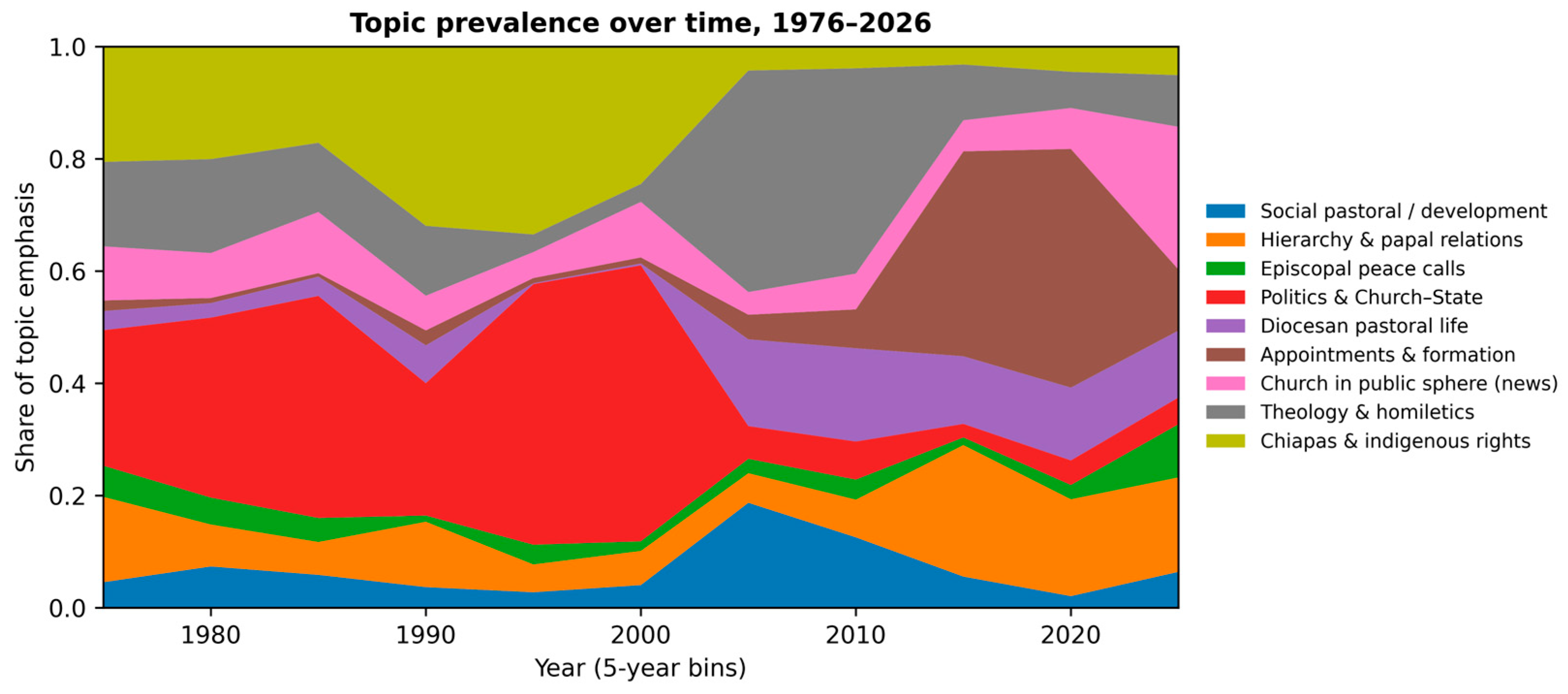
Table S2 (online supplement) shows topic distribution by decade, Figure 1 plots prevalence over time. Three shifts stand out: in the 1980s–1990s, Topics 4 (politics/Church–State) and 9 (Chiapas/EZLN) dominate, reflecting the PRI’s declining hegemony and the Zapatista mediation; in the 2000s–2010s, Topics 8 (theology) and 5 (diocesan pastoral life) account for roughly 60 percent of documents, reflecting expanded coverage of primary Church documents; in the 2020s, Topics 6 (appointments/formation) and 7 (public sphere frame) surge, partly real post-2018 institutional activity under Cardinal Aguiar and Pope Francis, partly a corpus artifact of heavy news scraping.
Figure 1.
Topic prevalence over time, 1976–2026. Source: 02_topic_model_document_topics.csv (replication_package_FINAL_v2).
6.4. Source Variation as Convergent Validity
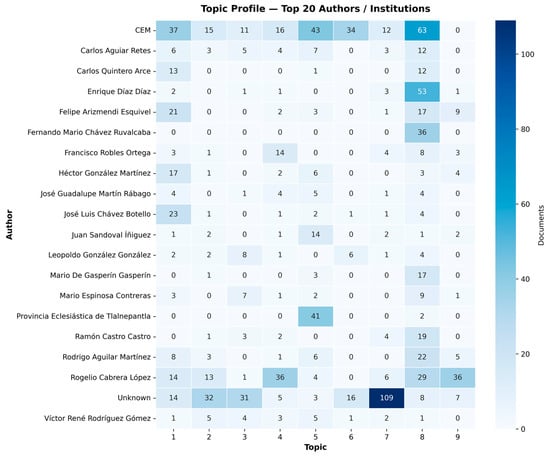
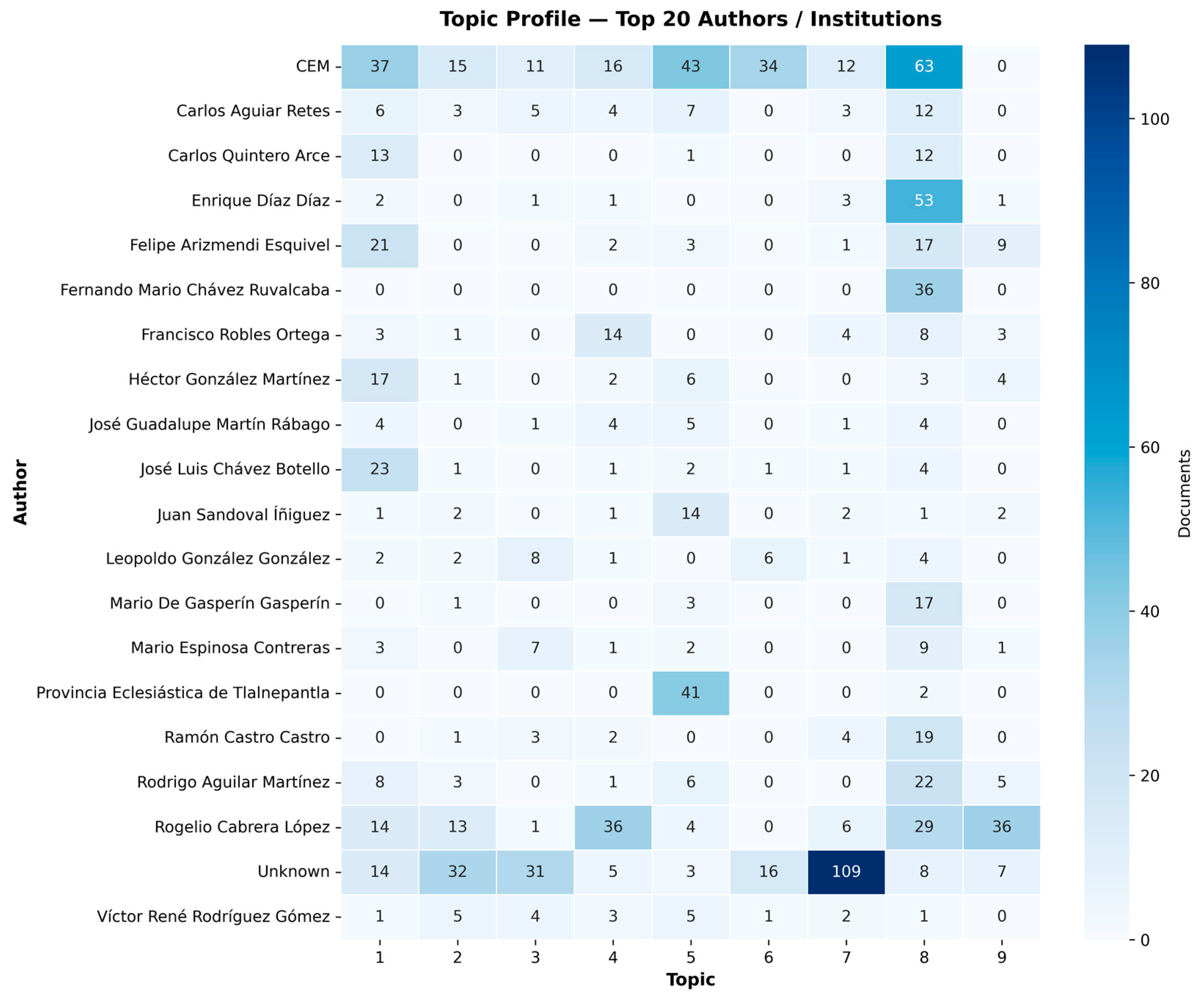
Topic–source correspondence provides convergent validity: CEM and diocesan sources concentrate in theology (Topic 8) and pastoral life (Topic 5); Voices loads almost entirely onto theology; El Mensajero entirely onto pastoral life; Proceso and La Jornada concentrate in politics (Topic 4) and Chiapas/indigenous rights (Topic 9), consistent with their investigative, progressive focus; news sources dominate institutional appointments (Topic 6) and the public sphere frame (Topic 7). Figure 2 displays topic emphasis by individual bishop for the most prolific authors (including the “unknown” in a separate row, which belongs to CEM writers).
Figure 2.
Topic emphasis by bishop (top authors by document count). Source: 02_topic_model_document_topics.csv (replication_package_FINAL_v2).
These structural relationships seem to support H1 and H2: episcopal discourse is heterogeneous and organized around a social engagement cluster (Topics 1, 3, and 9) and a theological cluster (Topics 5 and 8), with a cross-cutting institutional hierarchy dimension (Topics 2, 6, and 7). Topic 4 (party politics) is analytically distinct: conservative bishops were no less politically engaged than progressive bishops, but they emphasized different issues, such as moral legislation rather than social justice.
7. Results II: Ideological Ideal Points from Text
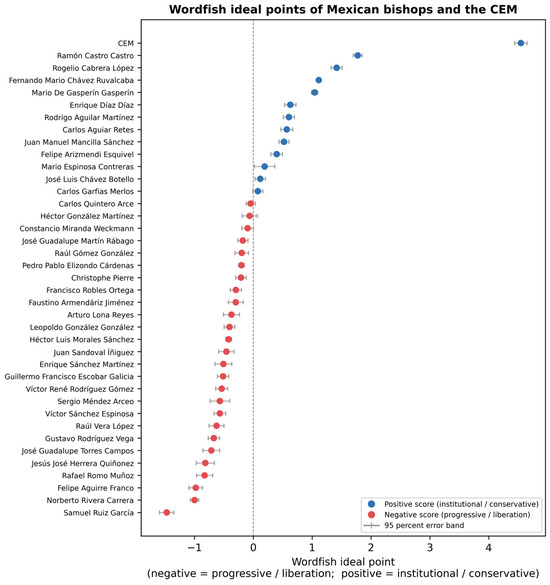
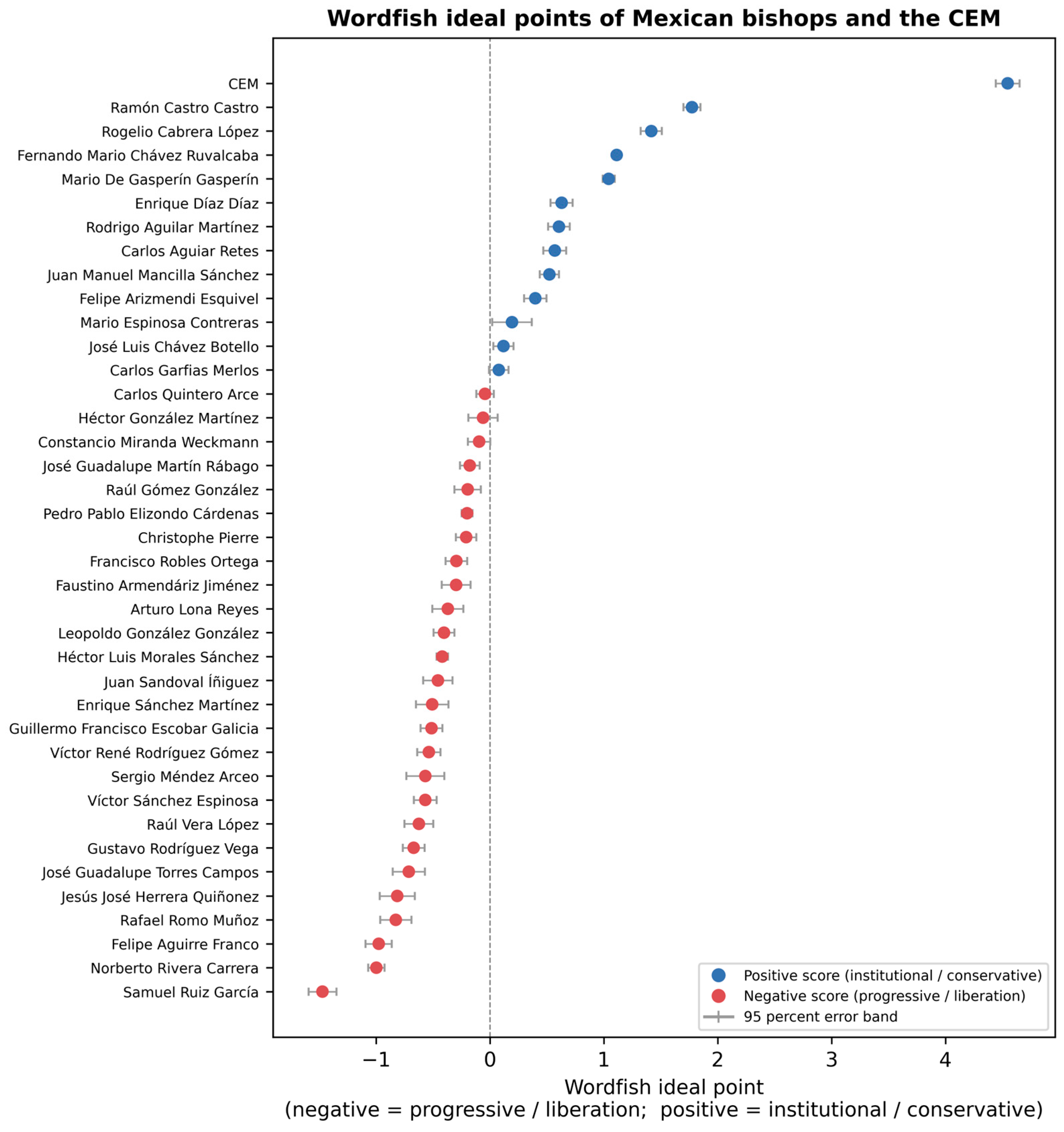
Table S3 (online Supplementary Materials) reports Wordfish ideal point estimates after orientation (negative = progressive/liberation theology pole; positive = institutional/conservative pole). Figure 3 renders the scale with 95 percent error bands.
Figure 3.
Wordfish ideal point estimates for 39 actors, with 95 percent error bands. Source: 03_wordfish_ideal_points_N39.csv (replication_package_FINAL_v2).
7.1. What the Scale Recovers
The CEM occupies the institutional extreme (θ = +4.55), reflecting the distinctive administrative vocabulary of its bulletins. At the opposite pole, bishops most associated with liberation theology and social conflict occupy the most progressive positions: Ruiz (−1.47), the dominant Chiapas conflict figure; Vera (−0.62), the most prominent human rights bishop of the post-2000 era; and Méndez Arceo (−0.57), a canonical reference in Mexican liberation theology (Mackin 2003). Together with Lona, these bishops correspond closely to the historical “land and liberty” grouping (Acuña 1989; Sota and Luengo 1994; Camp 1997), providing independent qualitative corroboration of the progressive pole recovered computationally. Recent prominent CEM figures, such as Cabrera (+1.42), Castro (+1.77), and Cardinal Aguiar (+0.57), cluster near the institutional pole, consistent with their administrative roles and with H3.
The primary dimension recovered is best described as prophetic/individual voice versus institutional/consensus voice, not a simple left–right axis: the most salient axis of variation is the degree to which a bishop’s output deviates from the standardized language of the national ecclesiastical bureaucracy. Progressive liberation theology bishops deviate coherently, introducing vocabulary from social conflict, indigenous rights, and prophetic tradition; conservative bishops do not form a symmetric cluster, since their traditionalist discourse largely retains the institutional register. This asymmetry matches a well documented feature of Latin American Catholicism (Levine 1992; Mainwaring and Wilde 1989): liberation theology produced a genuinely novel vocabulary, base communities, preferential option for the poor, structural sin, while conservative Catholicism retained the pre-conciliar institutional idiom. Wordfish, rewarding distinctive vocabulary, captures the progressive deviation because it is lexically novel; the most discriminating words along the estimated scale are reported in Figure S1 (online Supplementary Materials).
7.2. A Caveat: Media Salience Versus Ideological Direction
Some placements are instructive precisely because they are counterintuitive. Juan Sandoval Íñiguez of Guadalajara (−0.46), unambiguously among the most conservative voices in the episcopate, vocally opposed to same sex marriage, abortion, and the political left, is placed nearer the progressive pole than, say, Arturo Lona (−0.37), a founder of indigenous and liberation theology practice in the Isthmus of Tehuantepec. Another example is Mexico City’s Cardinal Norberto Rivera, a prominent center right figure. This reveals a limitation intrinsic to unsupervised text scaling on a mixed source corpus: the model measures vocabulary distinctiveness relative to the institutional baseline, not necessarily ideological direction. Sandoval and Rivera’s documents skew toward newspaper sources (La Jornada, Reforma, Proceso) that covered them precisely because their statements were controversial. The resulting text is saturated with political vocabulary, political parties, moral legislation, church abuses, public scandals, diverging sharply from the CEM’s administrative register and, statistically, resembling the politically charged language of liberation theology bishops in the same outlets, but in the opposite direction. Wordfish here partly captures media salience: these outliers were prominent in the press for opposite reasons, and the model cannot distinguish the direction of deviation (Lowe 2008; Egerod and Klemmensen 2020), underscoring the value of the topic space cross-check.
A direct check confirms this reading: re-estimating Wordfish on Church only versus press only documents (online Supplementary Materials, Section S2.1) moves Sandoval and Romo to the institutional side once restricted to their own Church generated text, while Vera and Aguiar hold stable positions throughout. Ruiz, Lona, and Méndez Arceo have too few Church sourced documents to re-estimate at all, so their progressive placement cannot be cross-validated against primary Church sources.
7.3. Cross-Validation: Topic Space PCA
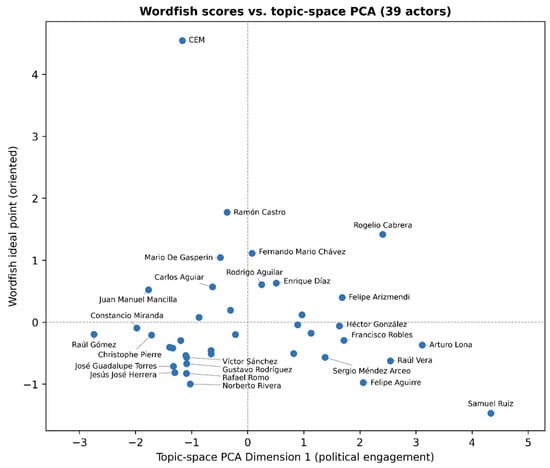
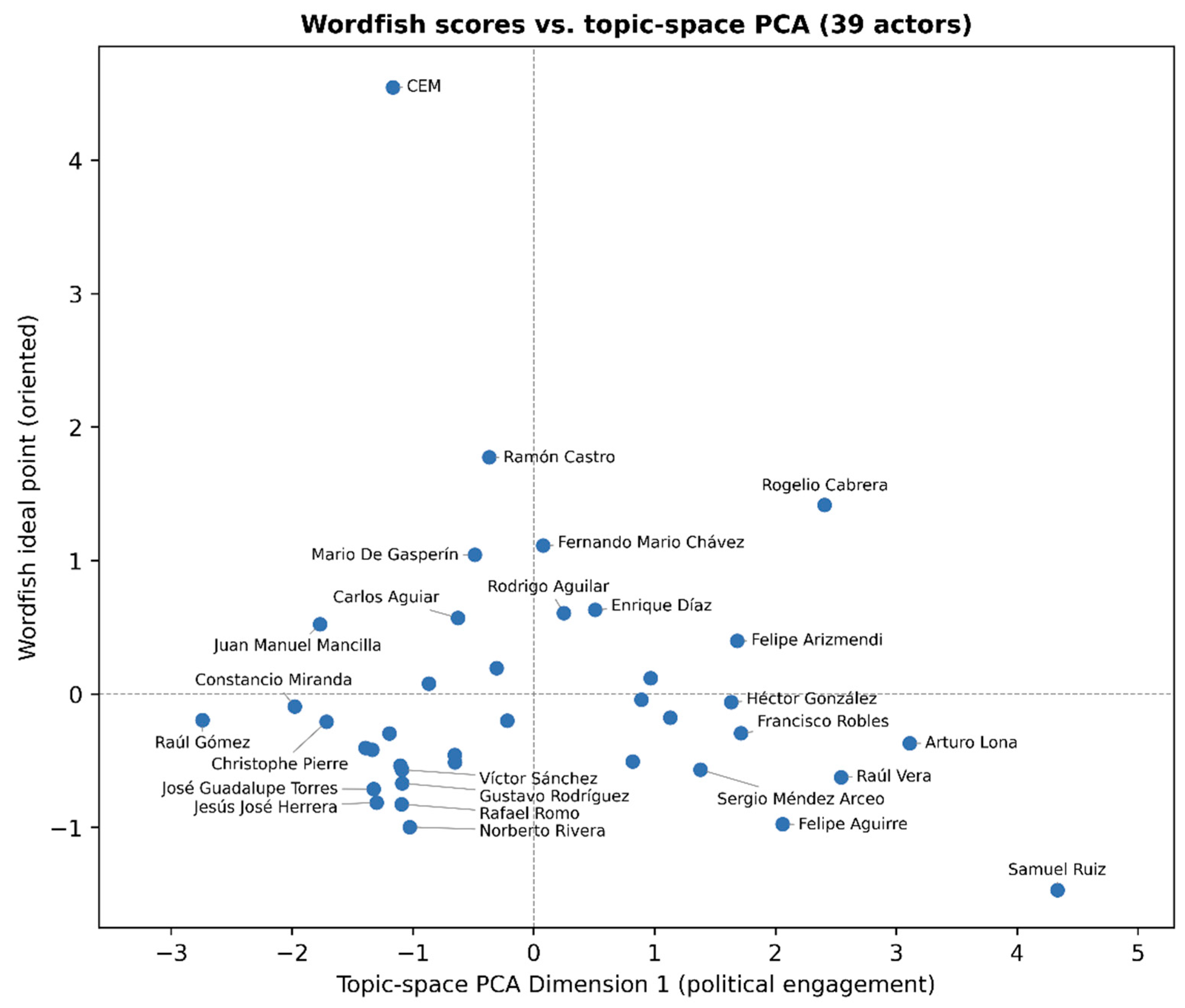
As a complementary measure, each actor is projected into a Principal Component Analysis (PCA) of the mean topic probability vector. The first component (27 percent of variance) loads positively on Topics 1 (social pastoral), 4 (politics), and 9 (Chiapas/indigenous rights), and negatively on Topics 2 (hierarchy), 5 (pastoral life), and 6 (organization), the same contrast identified by Wordfish. The aggregate correlation with Wordfish scores is modest (r = 0.12), but directional agreement on benchmark cases is strong: liberation theology outliers (Ruiz, Vera, Lona) score high on both measures, recent CEM presidents (Aguiar 2006–2011, Cabrera 2018–2024, and Castro 2024–present) low on both (Figure 4). The weak aggregate correlation reflects that PCA summarizes which topics an actor emphasizes, while Wordfish captures which words distinguish the actor from the institutional register. Thus, convergence is expected at the extremes.
Figure 4.
Wordfish scores versus topic space PCA Dimension 1 for the 39 actors. Source: 03_wordfish_ideal_points_N39.csv + 02_topic_model_document_topics.csv (replication_package_FINAL_v2).
8. Results III: The Episcopal Consecration Network
Ideology does not form in isolation; bishops are embedded in a genealogy of consecration, which lets the analysis ask a question the topic and scaling results cannot: does discursive heterogeneity persist inside a centralized personnel structure, or does centralized consecration flatten it? Table 3 lists the principal consecrators by number of bishops consecrated.
Table 3.
Principal consecrators in the modern Mexican episcopate (381 nodes, 628 ties).
The dominance of Girolamo Prigione is striking, but it is best read as a measure of the Holy See’s influence rather than of one prelate’s personal network. As apostolic delegate and later nuncio (1978–1997), a period that culminated in the establishment of formal diplomatic relations between Mexico and the Holy See in 1992, Prigione served as principal consecrator for 53 bishops, far more than any Mexican cardinal. Bishops are appointed by the pope; under canon law, the pontifical legate gathers information on candidates and proposes a list of three names (terna) to the Apostolic See (Code of Canon Law 1983, cann. 364 and 377 §3), and presiding over the consecration of a new bishop is a routine part of the office. A nuncio’s centrality in the consecration genealogy is therefore, to a large extent, a structural trace of Rome’s control over episcopal appointments, exercised through the nunciature (Camp 1997). What distinguishes the Prigione years is that they coincide with the first two decades of John Paul II’s pontificate, when Roman appointment policy in Latin America favored doctrinally reliable candidates and sought to rebalance episcopates shaped by Medellín (Levine 1992; Hagopian 2009). His two generation cluster encompasses 92 of the 381 nodes, making the nunciature he headed the unmistakable structural center of the genealogy, with the highest betweenness centrality and hub score (full centrality network and measures for all consecrators are reported in Figures S2 and S3, online Supplementary Materials). The conservative post-Prigione succession runs through Norberto Rivera Carrera, Juan Sandoval Íñiguez, and Francisco Robles Ortega, archbishops frequently associated with conservatism in the press. Overlaying Wordfish scores, however, shows that textual position does not travel cleanly along consecration lineages. Prigione consecrated bishops spanning a wide range of the scale, although some influential post-1990 consecrators are concentrated on its institutional side, consistent with the diplomatic and disciplinary priorities of the Holy See in those years. The result is best read as evidence about institutional structure, not ideological transmission: a centralized consecration network coexists with substantial discursive heterogeneity rather than constraining it. Because the consecrator’s role is largely procedural, consecration ties were never likely to transmit a discursive style, and the absence of such transmission is consistent with reading the network as a map of Vatican appointment power rather than of mentorship.
9. Covariates of Episcopal Ideology
To test H4 and H5, a document level ideology score was calculated for all 2330 documents in the full corpus (1976–2026). The score sums probability mass on social engagement topics (Topic 1, social pastoral; Topic 3, peace calls; Topic 9, Chiapas/indigenous rights) and subtracts probability mass on spiritual topics (Topic 5, diocesan pastoral life; Topic 8, theology/homiletics), so higher values denote more social engagement discourse. Because the measure is constructed from topic proportions rather than deviation from the CEM, it is independent of the Wordfish anchoring and provides a non-circular basis for comparison. Table 4 summarizes the tests. Across the full corpus the difference is significant but is modest in size, and it is marginal among Church sources and absent in press coverage (online Supplementary Materials, Sections S1 and S2.3).
Table 4.
Tests on the full corpus (document level topic based ideology score, 1976–2026).
9.1. Regional Variation as Proxy for Religious Competition
In the full corpus, regional variation emerges clearly (ANOVA F = 13.3, p < 0.0001). As Table 5 shows, Southern and Northern dioceses score highest on social engagement, whereas Central, Bajío–Occidente, and Gulf–Southeast dioceses score lowest and therefore lean more strongly toward spiritual discourse. The two high scoring regions reach this position differently: the South is driven by indigenous rights, liberation theology, and Chiapas (Topic 9), whereas the North is driven by the violence and peace register of border dioceses (Topics 1 and 3, concentrated in Nuevo Casas Grandes and Mexicali). The score therefore captures social engagement broadly rather than liberation theology specifically. Diocese size again does not predict ideology (r = 0.07, p = 0.655). This regional pattern is a geographic proxy for religious competition rather than a direct test, which is reported below.
Table 5.
Mean document ideology by region (higher = more social engagement).
9.2. A Non-Monotonic Temporal Pattern
Extending the analysis across all years reveals a temporal pattern invisible in any single sub-period: the corpus’s mean document ideology rises through the 1980s to its highest observed level in the 1990s (+0.31), the decade of the Zapatista uprising, Chiapas mediation, and intense Church–State politics, falls sharply in the 2000s (−0.21) and 2010s (−0.31), as the corpus fills with diocesan pastoral material, then returns toward the center in the 2020s (−0.03). A linear trend is flat (slope ≈ 0, p = 0.84) precisely because the pattern is non-monotonic, so the decade breakdown in Table 6, not the slope, is informative. This must be read alongside the corpus composition caveat: the 1990s are heavily press covered (Proceso, La Jornada), loading on social engagement topics, while the 2000s–2010s are dominated by primary Church documents loading on spiritual topics. The temporal curve thus reflects a genuine discursive shift and a shift in the observational window simultaneously; disentangling the two would require source balanced sampling.
Table 6.
Mean document ideology by decade, 1976–2026.
9.3. Convergent Validity
Finally, aggregating the document level topic ideology score to the actor level and correlating it with the oriented Wordfish scores yields r = −0.34 (p = 0.042, N = 37 actors with at least ten documents in the topic corpus), the expected sign because higher topic based ideology scores (more social engagement) should correspond to more negative Wordfish positions (the progressive pole). The two independently constructed measures (one based on topic proportions and the other on word level deviation) thus converge modestly, strengthening confidence that they capture a related underlying dimension even though each measures a somewhat different facet of the texts.
9.4. Test of Religious Competition: Protestant/Evangelical Population Share
The regional pattern substitutes geography for the variable religious economy theory specifies: diocese level religious market competition (Gill 1998; Chesnut 2003; Trejo 2009). To test the mechanism, each document’s diocese is assigned to a state, and each state year its Protestant/Evangelical population share from INEGI census data (1970, 1980, 1990, 2000, 2010 and 2020), interpolated between census waves. Diocese to state assignment uses a single state simplification per diocese; where a bishop moved between dioceses, assignment is time aware, drawn from consecration and appointment records (Cheney 2026), matching each document to the diocese the bishop actually held in that year. This recovers a usable state assignment for 1682 of 2330 documents (Table 7), spanning 170 bishops or institutional sources, 30 states, and 1976–2026, substantially larger and more temporally complete than the region only test.
Table 7.
Descriptive statistics for the direct religious competition test.
Table 8 reports five specifications regressing document level ideology, in which higher values denote more social engagement discourse, on Protestant/Evangelical population share while controlling for indigenous population share, a secular year trend, state Human Development Index, and macro region. Because the covariates are fixed within state year cells and documents are nested within both bishops and states, the primary specification is a multilevel (mixed effects) model (Gelman and Hill 2007; Bates et al. 2015) with crossed random intercepts for bishop and for state; this fits the data substantially better than the bishop clustered linear model, reported for comparison in the online Supplementary Materials (Section S3), which agrees with it on every conclusion below. The Human Development Index enters as a within year z score rather than in levels: the index is strongly trended, its raw correlation with year is 0.74 in this panel, and in levels it is collinear with the year term, so the within year score isolates a state’s relative position among its peers in the same year. Section S4 reports the level specification for comparison. The Protestant/Evangelical coefficient is negative in all five specifications and significant in every one, strengthening rather than attenuating as controls are added, from −0.011 in Model 1 to −0.054 in Model 5. Indigenous population share is positively signed throughout and reaches significance in Model 4, consistent with Trejo’s (2009) emphasis on indigenous mobilization.
Table 8.
Covariates of document ideology: test of religious competition.
The direct measure of religious competition therefore does not behave as religious economy theory predicts, but the composite coefficient is easy to over read, because the outcome sums five topics with opposite signs. Table 9 decomposes it. The negative composite is produced mainly by a rise in theology and homiletics, the single largest component effect, together with a fall in Chiapas and indigenous rights discourse; social pastoral and human development moves in the opposite direction and episcopal peace calls do not move at all. Both leading components survive excluding Chiapas, the state that combines the highest evangelical share with the most indigenous rights discourse, although they attenuate. What larger Protestant presence predicts, then, is not a general retreat from social concern but a shift in register toward doctrinal and devotional language and away from the indigenous rights vocabulary in particular. That pattern is closer to the supply side reading of religious economy theory, in which competition leads religious suppliers to emphasize core religious goods, than to the political mobilization reading the hypothesis was built on, and it is compatible with the Weberian contrast the Wordfish scale recovers: the primary axis of variation in this corpus is better described by charismatic or prophetic against bureaucratic authority, a distinction that also echoes Walzer’s (1987) contrast between the prophetic social critic, represented by Amos, and the institutional priest Amaziah at Bethel. The results thus support the regional component of H4 while disconfirming the competition mechanism in the precise direction H4 specified.
Table 9.
Which pole moves with the Protestant/Evangelical share? Decomposition of the composite ideology score.
A second reading of the decomposition is generational. Topic 9 is anchored by a cohort of bishops formed by Vatican II and Medellín whose ministries ended around the turn of the century: Sergio Méndez Arceo led Cuernavaca from 1952 to 1982 and died in 1992, Arturo Lona Reyes led Tehuantepec from 1971 to 2000 and died in 2020, and Samuel Ruiz García, appointed bishop of Chiapas (later San Cristóbal de Las Casas) in 1959, retired in March 2000 and died in 2011 (Cheney 2026). The fall of this vocabulary may therefore partly track the retirement and replacement of these prelates, a succession that the Holy See shaped directly through its control of episcopal appointments. In Weberian terms, this is what the routinization of charisma leads one to expect: authority grounded in a person seldom survives that person’s departure intact, and the vocabulary attached to a prophetic leader tends to fade even when successors share much of his pastoral orientation. Because Chiapas combines the strongest Protestant growth with the most visible episcopal succession, part of the competition coefficient may reflect this generational turnover. The year term and the bishop random intercepts absorb part of it, and the Topic 8 and Topic 9 coefficients survive the exclusion of Chiapas, but a cohort effect cannot be ruled out with a corpus that observes the earliest decades only through the press.
A third reading is continental. The combination in Table 9 of more doctrinal and homiletic language, more Catholic Social Teaching vocabulary (Topic 1), and less liberationist and indigenous vocabulary (Topic 9) closely resembles the double program of Aparecida (CELAM 2007), which joined a missionary and spiritual emphasis to sustained social concern while leaving aside the language of liberation theology. Where Protestant presence is greatest, Mexican bishops appear to respond less by choosing between the spiritual and social poles than by speaking in both registers at once, in the idiom that Aparecida made standard across the region. What changes with local Protestant presence is mainly the idiom in which social concern is expressed, which is difficult to reconcile with a model of religious firms adjusting their product to retain market share.
10. Discussion
Overall, three findings emerge. First, the Mexican episcopate is heterogeneous (H1), with substantial dispersion in both what bishops emphasize and how they express it. Second, this heterogeneity is organized around a recognizable pair of substantive poles (H2, H3): a spiritual/theological register anchored by homiletics and pastoral life, and a social engagement register anchored by Catholic Social Teaching and Chiapas liberation theology. Third, the most salient axis in the textual record is institutional versus prophetic voice, with the CEM defining the institutional pole and liberation theology bishops forming its lexically distinctive opposite. These poles are best read as emphases rather than camps: in the years after Aparecida, the same bishop can, and often does, speak in both registers.
The convergence of independent methods on the same benchmark actors (Ruiz, Vera, Lona, and Méndez Arceo at one pole, and the CEM and several recent conference presidents at the other) lends confidence even where aggregate correlations are modest. The placements of Sandoval and Rivera, however, remind us that unsupervised scaling recovers distinctiveness rather than ideological direction alone. In a mixed corpus that includes adversarial press coverage, media salience and ideological position can be conflated; results therefore require validation against substantive knowledge and the topic space projection.
The network analysis situates these currents within the institutional structure: Prigione’s centrality shows how the Holy See, acting through its nunciature, can shape an entire national episcopate, while the conservative post-Prigione consecration lineage illustrates institutional concentration and elite reproduction rather than ideological transmission, since textual position does not travel cleanly along these lineages. The full corpus covariate tests, however, tell a more cautious story. Regional variation is substantial, and social engagement discourse reaches its highest observed level in the 1990s before a subsequent pastoral turn. By contrast, the institutional versus individual difference is small and is not robust to restricting the analysis to Church sources. Most importantly, the direct measure of Protestant/Evangelical competition does not behave as the religious economy hypothesis predicts: its coefficients are consistently signed opposite to the theoretical expectation. This result is consistent with the long-standing critique of religious market models as an account of religious change in Latin America (Bruce 1999; Chaves and Gorski 2001; De la Torre and Gutiérrez Zúñiga 2007; Smilde 2007; Vásquez 2011). Decomposing that composite shows the shift is toward doctrinal and devotional language rather than away from social concern in general. Indigenous population share is consistent with parts of the observed regional divide, but it does not constitute evidence for the competition mechanism itself. Human development is not robust: its coefficient depends on whether the index enters in levels or as a within year score, so no development association is claimed here. These dynamics likely generalize beyond Mexico, to other hierarchical organizations pairing centralized personnel control with devolved public voice.
11. Limitations
Several limitations must be noted. Document volume is heterogeneous across actors: the CEM (497 documents) and Cabrera (138) have far larger corpora than most bishops (10–40), so cross-actor comparisons are asymmetric in precision. Newspaper sources also attribute language to bishops that journalists may have paraphrased or selected for salience, potentially biasing the profiles of high-profile prelates. Wordfish recovers a single dimension; a second, weaker dimension (liturgical versus social emphasis) exists but is not modeled. In addition, the full corpus tests use a topic-based score whose social engagement component (Topics 1, 3, and 9) plausibly combines liberation theology discourse with the violence and peace register characteristic of Northern border dioceses.
Temporal coverage is also uneven: the corpus is dense around 2009–2011 and 2020–2026 but sparse in the 1970s–1980s, so Wordfish scores are time averaged and cannot fully capture within-bishop change. Regional and temporal patterns are also entangled with changes in source composition and should therefore be read as descriptive rather than causal. A source composition robustness check (online Supplementary Materials, Section S2.2) recomputes regional ideology within Church generated and press documents separately: the overall level shifts by source (Church documents lean spiritual/institutional everywhere, press documents lean social engagement everywhere), but the ranking is preserved: North and South remain the two most socially engaged regions, Central the least, in both. The regional divide is a difference in degree across source types, not an artifact of one. Moreover, in the diocese attributable subsample, every decade outside the 2000s and 2010s is entirely press sourced, so the 1990s peak cannot be corroborated against primary Church documents and may partly reflect press coverage.
The religious competition test rests on additional simplifying assumptions. Each diocese is assigned to a single state even though diocesan and state boundaries are not always coterminous; additional covariates may be needed to represent the theory more completely; and Protestant/Evangelical shares are interpolated between census waves, smoothing short term fluctuations in religious competition. Other covariates may also capture historical and political characteristics specific to each region rather than religious market competition itself (Mackin 2003). These limitations make the direct competition test more credible than a regional proxy, but they also counsel against treating the reported associations as causal estimates.
Two further limitations concern time. Because the corpus begins in 1976, the period of Medellín, the Tlatelolco and Corpus Christi massacres, and the first phase of liberation theology is not observed directly, and the early prophetic statements of bishops such as Méndez Arceo and Ruiz are only partly captured; a longer window might sharpen the contrast between the 1960s and later decades, although it is unlikely to reverse the direction of the findings. In addition, both LDA and Wordfish treat each word as carrying a fixed meaning across fifty years. That is a simplification. The vocabulary of liberation theology itself changed, as Gutiérrez’s (1984) turn toward spirituality in We Drink from Our Own Wells illustrates, so that spiritual and liberationist language need not mean the same thing in 1976 and in 2026. The topics reported here are therefore best read as stable clusters of co-occurring words rather than as concepts with an immutable content.
12. Conclusions
This study has examined ideological variation among Mexico’s Catholic bishops using 2330 documents spanning 1976–2026 and three complementary computational methods. Despite doctrinal uniformity and hierarchical discipline, the Mexican episcopate is best understood as a coalition of distinct actors whose ideological currents persist across five decades. Topic modeling recovers a clear division between spiritual and social engagement discourse; Wordfish scaling locates bishops on a latent dimension contrasting prophetic/individual with institutional/consensus voice, placing liberation theology bishops farthest from the episcopal conference baseline; and the consecration network reveals the genealogical scaffolding, dominated by the nunciature through which the Holy See controlled episcopal appointments, that underpins the institutional pole. Full corpus tests add substantial regional variation and a non-monotonic temporal pattern whose highest observed level falls in the 1990s. Finally, a test merging Protestant/Evangelical population data with bishops’ actual diocesan assignments shows that this regional pattern cannot be attributed straightforwardly to religious market competition.
The analysis also delineates the limits of unsupervised text scaling on heterogeneous corpora, where media salience can masquerade as ideological position, and thus shows why triangulation across topics, words, networks, and metadata is essential. Several extensions follow naturally: municipality level religious market covariates matched to precise diocesan boundaries could sharpen the competition test; time varying positions could identify within-bishop change; and a second textual dimension could distinguish liturgical from social emphasis. Digitizing the print archives of 1966–1976 would bring Medellín and the first phase of liberation theology into the corpus, and dynamic topic models (Blei and Lafferty 2006) or diachronic word embeddings (Hamilton et al. 2016) could trace how the meaning of key terms such as liberación or espiritualidad has shifted over time. Ultimately, the persistence of the spiritual/social engagement divide from the post-Vatican II decades to the present suggests that these are enduring structural currents within the Mexican Church rather than transient divisions.
Supplementary Materials
The following supporting information can be downloaded at https://www.mdpi.com/article/10.3390/rel17101204/s1. Table S1: LDA coherence scores by number of topics; Table S2: topic distribution by decade; Table S3: Wordfish ideal points, Mexican bishops and the CEM; Table S4: Wordfish ideal points re-estimated within source type; Table S5: regional document ideology by source type; Table S6: H5 (institutional vs. individual) by source type; Table S7: Table 8 compared with bishop-clustered linear models; Table S8: Human Development Index coefficient under two scalings; Figure S1: most discriminating words along the estimated scale; Figure S2: centrality measures for the principal consecrators; Figure S3: the episcopal consecration network; Figure S4: distribution of documents across the nine topics; Figure S5: LDA coherence (c_v) by number of topics; Figure S6: Wordfish ideal points, full corpus vs. Church only vs. press only; Figure S7: OLS clustered vs. multilevel estimates for Protestant/Evangelical share; Figure S8: mean document ideology by decade; Section S1: H5 does not replicate on the full corpus; Section S2: Church only vs. press only robustness checks; Section S3: bishop-clustered linear robustness check for Table 8; Section S4: sensitivity of the Human Development Index coefficient to scaling.
Funding
This research received no external funding.
Institutional Review Board Statement
Not applicable. The study analyses publicly available institutional and press documents and aggregate census statistics, and does not involve human subjects or animals.
Informed Consent Statement
Not applicable.
Data Availability Statement
The corpus metadata, the derived topic, scaling, and network measures, and the replication code that support the findings of this study are available from the repository (https://github.com/alejdiazd/ideology-mexican-bishops-replication, accessed on 5 October 2026). The underlying documents are drawn from publicly accessible diocesan, episcopal conference, and press archives; state level covariates come from public INEGI census data; and the consecration genealogy is derived from the publicly available Catholic-Hierarchy database (Cheney 2026). The document level ideology score merged with state year Protestant/Evangelical population share, indigenous population share, and Human Development Index, used for the direct religious competition test is available from the repository. The state level covariates are themselves drawn from public INEGI census data.
Acknowledgments
Generative AI (Sonnet 4.5 by Claude Code) was used to check the final code, revisions, and full replication. The author is the only responsible for all the content and the analyses.
Conflicts of Interest
The author declares no conflicts of interest.
Abbreviations
The following abbreviations are used in this manuscript:
| CEM | Conferencia del Episcopado Mexicano (Mexican Episcopal Conference) |
| CELAM | Consejo Episcopal Latinoamericano (Latin American Episcopal Council) |
| EZLN | Ejército Zapatista de Liberación Nacional (Zapatista Army of National Liberation) |
| HDI | Human Development Index |
| INEGI | Instituto Nacional de Estadística y Geografía (National Institute of Statistics and Geography) |
| LDA | Latent Dirichlet Allocation |
| PCA | Principal Component Analysis |
| REML | Restricted Maximum Likelihood |
References
- Acuña, Héctor. 1989. Desde Conservadores Hasta Progresistas en el Obispado. El Financiero, January 6.
- Bates, Douglas, Martin Mächler, Ben Bolker, and Steve Walker. 2015. Fitting Linear Mixed Effects Models Using lme4. Journal of Statistical Software 67: 1–48. [Google Scholar] [CrossRef] [Scilit]
- Blancarte, Roberto. 1992. Historia de la Iglesia Católica en México, 1929–1982. Mexico City: Fondo de Cultura Económica. [Google Scholar]
- Blei, David M., and John D. Lafferty. 2006. Dynamic Topic Models. In Proceedings of the 23rd International Conference on Machine Learning. New York: Association for Computing Machinery, pp. 113–20. [Google Scholar]
- Blei, David M., Andrew Y. Ng, and Michael I. Jordan. 2003. Latent Dirichlet Allocation. Journal of Machine Learning Research 3: 993–1022. [Google Scholar]
- Bruce, Steve. 1999. Choice and Religion: A Critique of Rational Choice Theory. Oxford: Oxford University Press. [Google Scholar]
- Camp, Roderic Ai. 1997. Crossing Swords: Politics and Religion in Mexico. New York: Oxford University Press. [Google Scholar]
- CELAM. 1968. Medellín: Conclusions of the Second General Conference of Latin American Bishops. Bogotá: CELAM. [Google Scholar]
- CELAM. 1979. Puebla: Evangelization at Present and in the Future of Latin America. Bogotá: CELAM. [Google Scholar]
- CELAM. 2007. Aparecida: Concluding Document of the Fifth General Conference of the Bishops of Latin America and the Caribbean. Bogotá: CELAM. [Google Scholar]
- Chaves, Mark, and Philip S. Gorski. 2001. Religious Pluralism and Religious Participation. Annual Review of Sociology 27: 261–81. [Google Scholar] [CrossRef] [Scilit]
- Cheney, David M. 2026. The Hierarchy of the Catholic Church: Current and Historical Information about Its Bishops and Dioceses. Available online: https://www.catholic-hierarchy.org/ (accessed on 5 July 2026).
- Chesnut, R. Andrew. 2003. A Preferential Option for the Spirit: The Catholic Charismatic Renewal in Latin America’s New Religious Economy. Latin American Politics and Society 45: 55–85. [Google Scholar] [CrossRef] [Scilit]
- Code of Canon Law. 1983. Codex Iuris Canonici. Vatican City: Libreria Editrice Vaticana. [Google Scholar]
- De la Torre, Renée, and Cristina Gutiérrez Zúñiga, eds. 2007. Atlas de la Diversidad Religiosa en México. Mexico City: CIESAS, El Colegio de Jalisco, El Colegio de Michoacán, El Colegio de la Frontera Norte, Universidad de Quintana Roo, and Secretaría de Gobernación. [Google Scholar]
- Díaz-Domínguez, Alejandro. 2014. Mixed Messages: The Catholic Church and Mexico’s Uneven Local Contexts. Ph.D. dissertation, Vanderbilt University, Nashville, TN, USA. [Google Scholar]
- Egerod, Benjamin C. K., and Robert Klemmensen. 2020. Scaling Political Positions from Text: Assumptions, Methods and Pitfalls. In The SAGE Handbook of Research Methods in Political Science and International Relations. Edited by Luigi Curini and Robert Franzese. London: SAGE Publications, pp. 498–521. [Google Scholar] [CrossRef] [Scilit]
- Finke, Roger, and Rodney Stark. 1992. The Churching of America, 1776–1990: Winners and Losers in Our Religious Economy. New Brunswick: Rutgers University Press. [Google Scholar]
- Gelman, Andrew, and Jennifer Hill. 2007. Data Analysis Using Regression and Multilevel/Hierarchical Models. Cambridge: Cambridge University Press. [Google Scholar]
- Gill, Anthony. 1998. Rendering unto Caesar: The Catholic Church and the State in Latin America. Chicago: University of Chicago Press. [Google Scholar]
- Grzymala-Busse, Anna. 2012. Why Comparative Politics Should Take Religion (More) Seriously. Annual Review of Political Science 15: 421–42. [Google Scholar] [CrossRef] [Scilit]
- Gutiérrez, Gustavo. 1984. We Drink from Our Own Wells: The Spiritual Journey of a People. Maryknoll: Orbis Books. [Google Scholar]
- Gutiérrez, Gustavo. 1988. A Theology of Liberation: History, Politics, and Salvation, rev. ed. Maryknoll: Orbis Books. First published 1971. [Google Scholar]
- Hagberg, Aric A., Daniel A. Schult, and Pieter J. Swart. 2008. Exploring Network Structure, Dynamics, and Function Using NetworkX. Paper presented at the Proceedings of the 7th Python in Science Conference (SciPy2008), Pasadena, CA, USA, August 19–24; pp. 11–15. [Google Scholar]
- Hagopian, Frances, ed. 2009. Religious Pluralism, Democracy, and the Catholic Church in Latin America. Notre Dame: University of Notre Dame Press. [Google Scholar]
- Hale, Christopher W. 2015. Religious Institutions and Civic Engagement: A Test of Religion’s Impact on Political Activism in Mexico. Comparative Politics 47: 211–30. [Google Scholar] [CrossRef] [Scilit]
- Hamilton, William L., Jure Leskovec, and Dan Jurafsky. 2016. Diachronic Word Embeddings Reveal Statistical Laws of Semantic Change. In Proceedings of the 54th Annual Meeting of the Association for Computational Linguistics. Berlin: Association for Computational Linguistics, pp. 1489–501. [Google Scholar]
- Honnibal, Matthew, and Ines Montani. 2017. spaCy 2: Natural Language Processing with Neural Network Models. Unpublished manuscript. [Google Scholar]
- Iannaccone, Laurence R. 1991. The Consequences of Religious Market Structure: Adam Smith and the Economics of Religion. Rationality and Society 3: 156–77. [Google Scholar]
- Jelen, Ted D. 2003. Catholic Priests and the Political Order: The Political Behavior of Catholic Pastors. Journal for the Scientific Study of Religion 42: 591–604. [Google Scholar] [CrossRef] [Scilit]
- Lauderdale, Benjamin E., and Alexander Herzog. 2016. Measuring Political Positions from Legislative Speech. Political Analysis 24: 374–94. [Google Scholar] [CrossRef] [Scilit]
- Laver, Michael, Kenneth Benoit, and John Garry. 2003. Extracting Policy Positions from Political Texts Using Words as Data. American Political Science Review 97: 311–31. [Google Scholar] [CrossRef] [Scilit]
- Legorreta, José de Jesús, and Eduardo Sota. 2000. Estructuras y tendencias actuales de la iglesia católica. In La Iglesia Católica y la Política en el México de Hoy. Edited by José de Jesús Legorreta. Mexico City: Universidad Iberoamericana. [Google Scholar]
- Levine, Daniel H. 1992. Popular Voices in Latin American Catholicism. Princeton: Princeton University Press. [Google Scholar]
- Libanio, João Batista. 1986. La Vuelta a la Gran Disciplina. Buenos Aires: Paulinas. [Google Scholar]
- Loaeza, Soledad. 1985. Notas para el estudio de la Iglesia en México. In Religión y Política en México. Edited by Martín De la Rosa and Charles Reilly. Mexico City: Siglo XXI. [Google Scholar]
- Lowe, Will. 2008. Understanding Wordscores. Political Analysis 16: 356–71. [Google Scholar] [CrossRef] [Scilit]
- Mackin, Robert S. 2003. Becoming the Red Bishop of Cuernavaca: Rethinking Gill’s Religious Competition Model. Sociology of Religion 64: 499–514. [Google Scholar] [CrossRef] [Scilit]
- Mainwaring, Scott. 1986. The Catholic Church and Politics in Brazil, 1916–1985. Stanford: Stanford University Press. [Google Scholar]
- Mainwaring, Scott, and Alexander Wilde, eds. 1989. The Progressive Church in Latin America. Notre Dame: University of Notre Dame Press. [Google Scholar]
- Mimno, David, Hanna Wallach, Edmund Talley, Miriam Leenders, and Andrew McCallum. 2011. Optimizing Semantic Coherence in Topic Models. In Proceedings of the 2011 Conference on Empirical Methods in Natural Language Processing. Edinburgh: Association for Computational Linguistics, pp. 262–72. [Google Scholar]
- Pedregosa, Fabian, Gaël Varoquaux, Alexandre Gramfort, Vincent Michel, Bertrand Thirion, Olivier Grisel, Mathieu Blondel, Peter Prettenhofer, Ron Weiss, Vincent Dubourg, and et al. 2011. Scikit-Learn: Machine Learning in Python. Journal of Machine Learning Research 12: 2825–30. [Google Scholar]
- Roberts, Margaret E., Brandon M. Stewart, Dustin Tingley, and Justin Grimmer. 2013. The Structural Topic Model and Applications to News Analysis. arXiv arXiv:1309.0718. [Google Scholar]
- Röder, Michael, Andreas Both, and Alexander Hinneburg. 2015. Exploring the Space of Topic Coherence Measures. In Proceedings of the Eighth ACM International Conference on Web Search and Data Mining (WSDM). New York: ACM, pp. 399–408. [Google Scholar]
- Řehůřek, Radim, and Petr Sojka. 2010. Software Framework for Topic Modelling with Large Corpora. In Proceedings of the LREC 2010 Workshop on New Challenges for NLP Frameworks. Valletta: ELRA, pp. 45–50. [Google Scholar]
- Slapin, Jonathan B., and Sven-Oliver Proksch. 2008. A Scaling Model for Estimating Time Series Party Positions from Texts. American Journal of Political Science 52: 705–22. [Google Scholar] [CrossRef] [Scilit]
- Smilde, David. 2007. Reason to Believe: Cultural Agency in Latin American Evangelicalism. Berkeley: University of California Press. [Google Scholar]
- Smith, Christian. 1991. The Emergence of Liberation Theology: Radical Religion and Social Movement Theory. Chicago: University of Chicago Press. [Google Scholar]
- Smith, Gregory A. 2008. Politics in the Parish: The Political Influence of Catholic Priests. Washington, DC: Georgetown University Press. [Google Scholar]
- Sota, Eduardo, and Enrique Luengo. 1994. Entre la Conciencia y la Obediencia: La Opinión del Clero Sobre la Política en México. Mexico City: Universidad Iberoamericana. [Google Scholar]
- Stark, Rodney, and William Sims Bainbridge. 1987. A Theory of Religion. New York: Peter Lang. [Google Scholar]
- Trejo, Guillermo. 2009. Religious Competition and Ethnic Mobilization in Latin America: Why the Catholic Church Promotes Indigenous Movements in Mexico. American Political Science Review 103: 323–42. [Google Scholar] [CrossRef] [Scilit]
- Vásquez, Manuel A. 2011. More than Belief: A Materialist Theory of Religion. New York: Oxford University Press. [Google Scholar]
- Walzer, Michael. 1987. The Prophet as Social Critic. In Interpretation and Social Criticism. Cambridge: Harvard University Press, pp. 67–94. [Google Scholar]
- Weber, Max. 1978. Economy and Society: An Outline of Interpretive Sociology. Edited by Guenther Roth and Claus Wittich. Berkeley: University of California Press. First published 1922. [Google Scholar]
- Wilde, Melissa J., Kristin Geraty, Shelley Nelson, and Emily Bowman. 2010. Religious Economy or Organizational Field? Predicting Bishops’ Votes at the Second Vatican Council. American Sociological Review 75: 586–606. [Google Scholar]

Disclaimer/Publisher’s Note: The statements, opinions and data contained in all publications are solely those of the individual author(s) and contributor(s) and not of MDPI and/or the editor(s). MDPI and/or the editor(s) disclaim responsibility for any injury to people or property resulting from any ideas, methods, instructions or products referred to in the content. |
© 2026 by the author. Licensee MDPI, Basel, Switzerland. This article is an open access article distributed under the terms and conditions of the Creative Commons Attribution (CC BY) license.