


Abstract
The blackfin flounder (Glyptocephalus stelleri) is an important demersal fish species widely distributed in the Northwest Pacific and represents a valuable fisheries resource in Korea and Japan. Understanding the genetic diversity and population connectivity of exploited marine species is essential for effective fisheries management and conservation. In this study, mitochondrial DNA control region sequences (401 bp) were analyzed from 62 individuals collected from Jumunjin, Korea, and Maizuru, Japan, to assess genetic diversity, demographic history, and population structure. Sequence analysis identified 48 haplotypes, revealing exceptionally high haplotype diversity (h = 0.982 ± 0.010) and relatively low nucleotide diversity (π = 0.011 ± 0.006). Neutrality tests and mismatch distribution analyses indicated a historical demographic expansion during the Pleistocene. No significant genetic differentiation was detected between the two sampling locations (FST = −0.004, p > 0.05), suggesting strong genetic connectivity between Korean and Japanese samples based on mitochondrial DNA data. These findings provide important baseline genetic information for understanding population connectivity and may contribute to the coordinated management of blackfin flounder fisheries in the Northwest Pacific.
1. Introduction
Blackfin flounder (Glyptocephalus stelleri, family Pleuronectidae) is a commercially important benthic flatfish widely distributed throughout the northwestern Pacific, including the South and East Seas of Korea, waters surrounding Japan, and extending north to Sakhalin, the Tatar Strait, the Kuril Islands, and the Bering Sea [1,2]. This deep-water demersal species typically inhabits depths ranging from 50–700 m and undergoes seasonal migrations to shallower waters for spawning. Spawning periods exhibit marked geographic variation: April to June in the East Sea of Korea [3,4], March to May in Tottori, Japan [5], and June to July in Hokkaido, Japan [6]. The species produces pelagic eggs and larvae with an extended planktonic phase exceeding one month [7], which theoretically facilitates widespread larval dispersal and gene flow among geographically separated populations via ocean currents. Blackfin flounder represents a critical fishery resource in both Korea and Japan, but intensifying exploitation has raised serious sustainability concerns. In the East Sea of Korea, this species now comprises approximately 59.4% of total flounder catches [2], and intensive fishing pressure has led to documented declines in multiple stock indices. The mean age of captured individuals has decreased substantially [8,9], suggesting recruitment overfishing. Furthermore, catch per unit effort (CPUE) in Korean waters declined by approximately 75% between 2002 and 2015, while total biomass decreased by 24% from 1997 to 2012. These trends highlight the need for comprehensive, science-based management strategies to ensure the long-term sustainability of blackfin flounder stocks across their distribution range.
Understanding population genetic structure is fundamental for developing effective management units and conservation strategies for marine fishes [10,11]. Genetic analyses can reveal whether geographically separated groups represent demographically independent populations or form part of a single interbreeding stock, information that is crucial for implementing appropriate management policies adapted to local population dynamics. Despite the commercial importance of blackfin flounder, genetic research on this species remains remarkably limited. To date, only one study [12] has investigated the population genetics of G. stelleri, analyzing mtDNA control region variation across five sampling locations along the Japanese coast and finding no evidence of population structure within Japanese waters. However, that study did not include samples from Korean populations, leaving the critical question of potential genetic differentiation between Korean and Japanese stocks unresolved. Several oceanographic and ecological factors suggest the possibility of genetic structuring between Korean and Japanese blackfin flounder populations. The East Sea/Sea of Japan is a semi-enclosed marginal sea characterized by complex hydrographic regimes with contrasting water masses. The northern East Sea is strongly influenced by the North Korean Cold Current, which brings cold, low-salinity waters southward [13], whereas the southern region is dominated by the northward-flowing Tsushima Warm Current—a branch of the Kuroshio Current—carrying warm, high-salinity waters along the coasts of Korea and Japan [14]. These distinct current systems create pronounced environmental gradients that have been demonstrated to influence population genetic structure in various marine fish species inhabiting this region [15,16]. Additionally, the documented differences in spawning timing between Korean and Japanese waters [4] could potentially contribute to temporal reproductive isolation. Given these biogeographic and life-history considerations, I hypothesized that blackfin flounder populations in Korea and Japan might exhibit genetic differentiation despite the species’ extended pelagic larval duration and presumed high dispersal potential. Specifically, I predicted that the northernmost East Sea population of Korea (Jumunjin), which experiences the coldest and least saline conditions, might be genetically distinct from populations along the Sea of Japan coast of Honshu (Maizuru), which lie within the influence of the Tsushima Warm Current.
Mitochondrial DNA (mtDNA) markers, particularly the hypervariable control region (D-loop), have become standard tools in fish population genetics and phylogeography due to several advantageous characteristics: maternal inheritance (eliminating recombination), elevated substitution rates relative to nuclear DNA, and effectively haploid inheritance [17]. The control region typically exhibits substantial intraspecific genetic variability, making it especially suitable for detecting population structure and demographic signals over relatively recent evolutionary timescales spanning tens of thousands of years. Numerous studies have successfully employed mtDNA control region sequences to assess genetic diversity, population structure, and phylogeographic patterns in marine fishes, providing valuable insights for fisheries management [15,18]. In this study, I analyzed mtDNA control region sequences from blackfin flounder collected from Korean and Japanese waters to: (1) characterize the genetic diversity and demographic history of populations in each region; (2) test for genetic differentiation between Korean and Japanese populations; and (3) evaluate whether the species forms a single panmictic population or whether genetic evidence supports the recognition of separate management units. Our findings will provide essential baseline genetic information to guide fishery management recommendations, particularly regarding the necessity for transboundary cooperative management between Korea and Japan for the sustainable conservation of this overexploited species.
2. Materials and Methods
2.1. Sample Collection
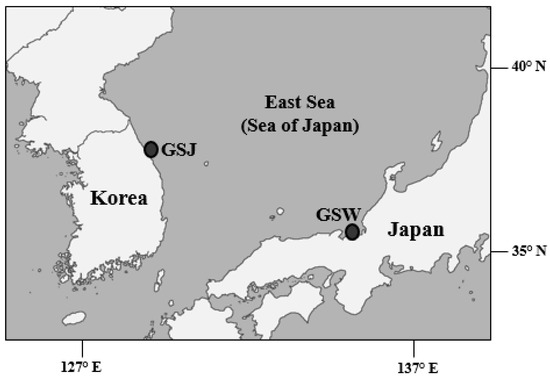
A total of 62 blackfin flounder specimens were collected from two geographically distinct locations: Jumunjin on the East Sea coast of Korea (37.9° N, 128.8° E; n = 30) and Maizuru on the Sea of Japan coast of Honshu, Japan (35.5° N, 135.3° E; n = 32) between 2012 and 2016 (Figure 1). Samples were obtained from commercial fishery landings using bottom trawl nets at depths ranging from 80 to 180 m. The total length (TL) of the collected individuals ranged from 22.3 to 26.5 cm. Muscle tissue samples were excised from fresh specimens, immediately preserved in 95% ethanol, and stored at −20 °C until DNA extraction. All procedures were conducted in accordance with institutional guidelines for the use of fish in research.
Figure 1.
Map showing the sampling locations of Glyptocephalus stelleri. GSJ: Jumunjin; GSW: Maizuru.
2.2. DNA Extraction, PCR Amplification, and Sequencing
Total genomic DNA was extracted from approximately 20 mg of muscle tissue using a standard phenol-chloroform extraction protocol. A 401 bp fragment of the mtDNA control region (HVR1) was amplified via polymerase chain reaction (PCR) using the universal fish primers L-Pro (5′-ACTCTCACCCCTAGCTCCCAAAG-3′) and H-DL (5′-CCTGAAGTAGGAACCAGATG-3′) [12]. PCR amplifications were performed in 25 μL reaction volumes containing 50 ng of template DNA, 2.5 μL 10× PCR buffer, 2.0 mM MgCl2, 0.2 mM of each dNTP, 0.4 μM of each primer, and 1.25 U Taq DNA polymerase (TaKaRa Bio, Kusatsu, Japan). Thermal cycling conditions consisted of an initial denaturation at 94 °C for 3 min, followed by 35 cycles of 94 °C for 30 s, 54 °C for 45 s, and 72 °C for 1 min, with a final extension at 72 °C for 10 min. PCR products were verified by electrophoresis on 1.5% agarose gels stained with ethidium bromide. Amplified PCR products were purified using a PCR purification kit (Qiagen, Hilden, Germany) and sequenced in both directions using an ABI 3730xl DNA Analyzer (Applied Biosystems, Foster City, CA, USA) with the same primers used for amplification. Raw sequences were edited and assembled using the SeqMan 12.3 (DNASTAR, Madison, WI, USA). Multiple sequence alignments were performed using ClustalW implemented in the BioEdit software v7.2.5 [19], and alignments were manually inspected and refined.
2.3. Genetic Diversity Analysis
Standard genetic diversity indices were calculated using ARLEQUIN v3.5.2.2 [20]. The number of polymorphic (segregating) sites (S), number of haplotypes (Nh), haplotype diversity (h), and nucleotide diversity (π) were computed for each population and for the total sample. Haplotype diversity represents the probability that two randomly chosen individuals possess different haplotypes, while nucleotide diversity measures the average number of nucleotide differences per site between two sequences.
2.4. Population Structure Analysis
Population genetic differentiation was assessed using pairwise fixation indices (FST) calculated in ARLEQUIN v3.5.2.2 [20]. Statistical significance was evaluated using 10,000 permutations. Additionally, an exact test of population differentiation was performed using a Markov chain method (10,000 steps). Analysis of molecular variance (AMOVA) was conducted to partition genetic variation within and among populations. A neighbor-joining (NJ) phylogenetic tree was constructed based on Kimura 2-parameter distances using MEGA X 10.2.6 [21], with bootstrap support assessed using 1000 replicates. A minimum spanning network of haplotypes was constructed using PopART v1.7 [22] to visualize genealogical relationships among haplotypes.
2.5. Demographic History Analysis
Demographic history was inferred using neutrality tests and mismatch distribution analysis [23]. Tajima’s D [24] and Fu’s Fs [25] statistics were calculated in ARLEQUIN v3.5.2.2 [20] to detect departures from neutrality and population equilibrium. Significantly negative values suggest recent population expansion or purifying selection, while positive values indicate population bottlenecks or balancing selection. Mismatch distribution analysis was performed to test the sudden expansion model by comparing observed and expected distributions of pairwise nucleotide differences. The fit to the expansion model was evaluated using the sum of squared deviations (SSD) and raggedness index (r), with significance assessed via 10,000 bootstrap replicates. The expansion time in generations t was estimated using the relationship t = τ/2μk, where τ is the expansion parameter, μ is the mutation rate per site per generation, and k is the sequence length (401 bp). For this estimation, a mutation rate range of 3–12% per million years for the mitochondrial control region was adopted, based on previous studies of marine teleosts in the Northwest Pacific [26]. Since specific data on the lifespan of G. stelleri are limited, a generation time of 3–4 years was assumed based on its maturation age and the total length of the analyzed samples (22.3–26.5 cm TL), which is consistent with other Pleuronectid species in the region [4,8,9]. These parameters were then used to calculate the expansion timeframe in years before present (T = t × g, where g is the generation time). The mutation rate range applied here is consistent with estimates commonly used for the mitochondrial control region in marine fishes and has been widely adopted in previous phylogeographic studies of teleost species.
3. Results
3.1. Sequence Characteristics and Haplotype Composition
A 401 bp fragment of the mtDNA control region was successfully sequenced from all 62 individuals. The nucleotide composition was A = 34.3%, T = 28.7%, C = 22.5%, and G = 14.5%, showing a typical AT bias (63.0%) characteristic of fish mitochondrial DNA. Among the 401 nucleotide positions, 32 were polymorphic (segregating sites), defining 48 distinct haplotypes. Of these polymorphic sites, 25 were transitions and 7 were transversions, resulting in a transition/transversion ratio of 3.57. The majority of haplotypes (42 out of 48, 87.5%) were singletons found in only one individual (17 unique haplotypes in Jumunjin and 25 in Maizuru), while the remaining 6 haplotypes were shared by two or more individuals. Approximately 77% of all sampled individuals possessed unique haplotypes, indicating exceptionally high haplotype diversity.
3.2. Genetic Diversity
Genetic diversity indices are summarized in Table 1, including sample size (N), number of haplotypes (Nh), haplotype diversity (h), and nucleotide diversity (π). Haplotype diversity represents the probability that two randomly selected individuals have different haplotypes, whereas nucleotide diversity indicates the average number of nucleotide differences per site between sequences. For the combined sample, haplotype diversity (h) was exceptionally high at 0.982 ± 0.010, whereas nucleotide diversity (π) was relatively low at 0.011 ± 0.006. The Korean population (Jumunjin) exhibited h = 0.974 ± 0.017 and π = 0.012 ± 0.007, while the Japanese population (Maizuru) showed h = 0.991 ± 0.011 and π = 0.012 ± 0.007. Although Maizuru displayed slightly higher haplotype diversity than Jumunjin, this difference was not statistically significant (p > 0.05). Both populations showed remarkably similar nucleotide diversity values. The pattern of extremely high haplotype diversity coupled with relatively low nucleotide diversity is a genetic signature characteristic of recent population expansion following a bottleneck event.
Table 1.
Molecular diversity indices and neutrality test results for the mtDNA control region sequences of G. stelleri.
3.3. Population Genetic Structure
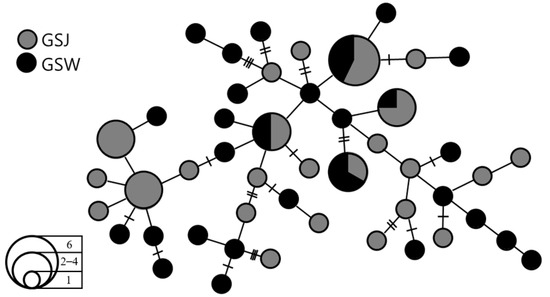
The pairwise fixation index (FST) between Jumunjin and Maizuru populations was −0.004, which is effectively zero and not significantly different from zero (p = 0.541 based on 10,000 permutations) (Table 2). The low and non-significant FST value (−0.004) indicates high gene flow (Nm) between the two regions, suggesting that the blackfin flounder in these waters functions as a single panmictic population. The exact test of population differentiation also revealed no significant difference between the two populations (p = 0.583 ± 0.012). Analysis of molecular variance (AMOVA) indicated that 99.6% of genetic variation occurred within populations, with only 0.4% among populations (ΦST = −0.004, p > 0.05), further confirming the absence of population genetic structure. The pairwise FST value between the Korean and Japanese populations was −0.004 (p = 0.540), indicating no significant genetic differentiation. Based on this FST value, the estimated number of migrants per generation (Nm) was infinitely high, suggesting extensive gene flow between the two regions. Furthermore, the average evolutionary divergence (genetic distance) over sequence pairs between groups was 0.011, confirming that the two groups function as a single panmictic population. Haplotypes from Korea and Japan were randomly distributed throughout the tree, with bootstrap support values generally low (<50%) for most nodes, which is consistent with recent common ancestry and limited phylogenetic resolution. The minimum spanning haplotype network displayed a characteristic star-like topology (Figure 2), with a dominant central haplotype shared between both populations and surrounded by numerous singleton haplotypes differing by 1–3 mutational steps. Of the 48 total haplotypes identified, 4 haplotypes were shared between the two populations. The central haplotype H1 (n = 7) represents the most common haplotype in the dataset and is shared by four Korean individuals and three Japanese individuals. This haplotype occupies the center of the minimum spanning network (Figure 2), with Korean and Japanese sequences intermixed, strongly supporting genetic connectivity and panmixia between the two populations. Korean-specific, Japanese-specific, and shared haplotypes were thoroughly intermingled throughout the network, with no evidence of geographic segregation.
Table 2.
Pairwise FST (below diagonal) and associated p values (above diagonal) among populations of G. stelleri.
Figure 2.
Minimum spanning haplotype network based on mtDNA control region sequences. The frequency of each haplotype is represented by circle size. Each short perpendicular line connecting haplotypes represents one mutational step. Circles are labeled with abbreviated symbols representing populations.
3.4. Demographic History
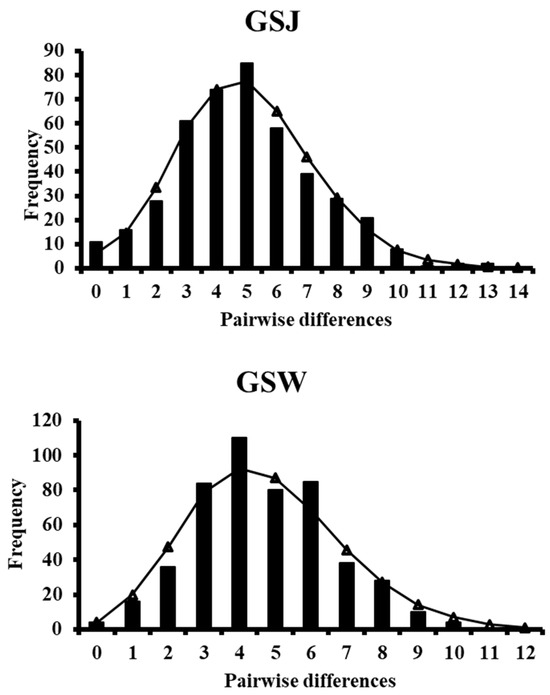
Neutrality test results provided strong evidence for historical demographic expansion (Table 1). Tajima’s D values were negative for all populations (Jumunjin: D = −0.513, p = 0.086; Maizuru: D = −0.866, p = 0.231; Total: D = −0.956, p = 0.068) but did not reach statistical significance (p > 0.05). In contrast, Fu’s Fs test yielded highly significant negative values for all populations (Jumunjin: Fs = −13.400, p = 0.001; Maizuru: Fs = −20.510, p < 0.001; Total: Fs = −25.611, p < 0.001), indicating a significant excess of rare haplotypes characteristic of recent population growth. The contrasting pattern of negative but non-significant Tajima’s D values alongside highly significant Fu’s Fs values is characteristic of recent demographic expansion. Fu’s Fs test is considerably more sensitive than Tajima’s D for detecting population growth [24,25] because it is particularly responsive to the excess of rare haplotypes (singletons) that accumulate during rapid population expansion. The 42 singleton haplotypes observed in this dataset (87.5% of all haplotypes) provide a strong signal of recent growth, detected by Fu’s Fs, while Tajima’s D, which has lower statistical power for this purpose, fails to reach significance despite negative values consistent with expansion. The mismatch distribution analysis for all populations exhibited a clear unimodal pattern, and the observed distributions fitted the expected spatial expansion model well (Figure 3; Table 1). This was further supported by the non-significant values of the sum of squared deviations (SSD = 0.002–0.0045, p > 0.40) and low Harpending’s raggedness indices (r < 0.05, p > 0.10) across all groups. Specifically, the expansion parameter τ was estimated at 5.07 for Jumunjin, 4.73 for Maizuru, and 4.84 for the total sample. The estimated population size parameters, θ0 (initial) and θ1 (final), were 0.004 and 50,064, respectively. The remarkably high θ1/θ0 ratio suggests that G. stelleri underwent a massive and sudden population expansion in the Northwest Pacific. Using the assumed mutation rate range of 3–12% per million years and a generation time of 3–4 years, the demographic expansion was estimated to have occurred approximately 100,800 to 403,000 years before present, corresponding to the middle-to-late Pleistocene epoch. This timeframe closely matches the estimate of 124,000–413,000 years reported in a previous study [12] for Japanese blackfin flounder populations, suggesting a shared demographic history across the species’ range.
Figure 3.
Mismatch distribution from pairwise nucleotide difference among the mtDNA control region sequences for two populations of G. stelleri. Bars indicate the observed distribution, and solid lines indicate the expected distribution under the sudden expansion model based on the mtDNA control region sequence.
4. Discussion
4.1. Genetic Diversity and Demographic History
The exceptionally high haplotype diversity coupled with relatively low nucleotide diversity observed in blackfin flounder is consistent with previous genetic studies on this species [12] and appears to be a common feature among Northwest Pacific flatfishes [27,28]. This pattern—many haplotypes with shallow sequence divergence—typically reflects two complementary processes: (1) large historical effective population size that retains numerous maternal lineages over evolutionary time, and (2) recent demographic expansion that allows newly arising mutations to become established before drift or selection eliminates them. Historical catch data support the interpretation of a large population size. Blackfin flounder landings in the East Sea peaked at approximately 4050 metric tons in 1999, indicating substantial historical abundance that would favor retention of many distinct haplotypes across generations. The rapid evolutionary rate of the mitochondrial control region means that during periods of population expansion, many newly arising haplotypes differing by only one or a few mutations can simultaneously become established before genetic drift can eliminate them. Multiple independent genetic signals converge on the hypothesis of late Pleistocene demographic expansion. The star-like network topology, significant excess of rare haplotypes detected by Fu’s Fs, and unimodal mismatch distribution all point to rapid population growth from a relatively small ancestral population. The estimated expansion timeframe (100,800–403,000 years BP) coincides with dramatic paleoceanographic changes in the Northwest Pacific during Pleistocene glacial-interglacial cycles [29,30]. During glacial maxima, global sea levels dropped by up to 120 m below present levels. For the semi-enclosed East Sea (Sea of Japan), such extreme lowstands would have drastically reduced basin volume and effectively isolated it from surrounding waters through closure of shallow connecting straits. These events would have severely altered physicochemical conditions and reduced available deepwater habitat, likely precipitating population bottlenecks. Subsequently, as sea levels rose during interglacial periods and oceanographic connections were re-established, environmental conditions became favorable again, allowing rapid population expansion and recolonization. This scenario of glacially induced bottleneck followed by postglacial expansion appears to be a common demographic pattern for marine species in this region, with similar genetic signatures documented in willowy flounder [31], pointhead flounder [28], and horse mackerel [32]. Quantitatively, the genetic diversity indices of G. stelleri in this study (h = 0.982, π = 0.011) are comparable to or higher than those of other sympatric Pleuronectiformes in the Northwest Pacific. For instance, the diversity levels are similar to those of the point-head flounder, Cleisthenes herzensteini (h = 0.938–0.985, π = 0.009–0.013) [28], which also exhibits a lack of significant population structure across its range. Furthermore, the values are notably higher than those reported for the willowy flounder, Tanakius kitaharai (h = 0.822–0.925, π = 0.004–0.006) [31], suggesting that G. stelleri has maintained a relatively larger and more stable effective population size despite historical climatic fluctuations.
4.2. Population Genetic Structure and Gene Flow
The absence of genetic differentiation between Korean and Japanese populations, despite their geographic separation and exposure to different oceanographic regimes, can be attributed to a combination of life-history characteristics and oceanographic conditions that facilitate extensive gene flow. Marine fish species with high dispersal potential, particularly those with extended pelagic larval phases, frequently exhibit weak or absent genetic structure across broad geographic ranges when physical barriers are lacking and populations are connected by ocean currents. Blackfin flounder exemplifies this pattern through several key characteristics. The species spawns buoyant pelagic eggs at approximately 100 m depth, and larvae undergo a planktonic phase exceeding one month [7] before settlement. During this extended pelagic period, eggs and larvae can be transported over considerable distances by prevailing ocean currents, effectively connecting distant spawning areas and preventing reproductive isolation. The relatively deep spawning depth likely increases access to major current systems, allowing eggs and larvae extended exposure to advective transport. The oceanographic setting of the East Sea/Sea of Japan strongly facilitates such connectivity. This semi-enclosed basin features continuous deepwater habitat along the Korean and Japanese coasts with no obvious geographic barriers to dispersal. The dominant Tsushima Warm Current flows northeastward through the Korea Strait and along both the eastern Korean coast and western Japanese coast, creating a major pathway for larval transport that would promote mixing. Additionally, the North Korean Cold Current descending from the north creates a dynamic, multi-directional current system with substantial water mass exchange, further enhancing dispersal opportunities. This observed genetic homogeneity is consistent with patterns documented in numerous other marine fishes with similar life histories in the Northwest Pacific. Other flatfish species show comparable results: pointhead flounder exhibits no significant structure across the Sea of Japan [28], and brown sole displays high gene flow among Korean sampling locations [27]. Beyond flatfishes, panmixia over large geographic scales has been reported in Japanese sea bass [33], Japanese halfbeak [34], and Pacific herring [35], reinforcing the principle that prolonged pelagic larval duration combined with advective transport can maintain genetic connectivity across broad spatial scales. Notably, observable ecological differences between regions do not necessarily translate into genetic differentiation when gene flow remains high. The documented spawning time differences between Korean and Japanese waters likely represent phenotypic plasticity or local adaptation to environmental cues rather than reflecting underlying genetic isolation. Similar patterns have been observed in Pacific herring, which exhibits temporally and spatially variable spawning but maintains uniform mitochondrial DNA structure across Northeast Asia [35]. Historical demographic processes likely contribute to the observed genetic homogeneity. The recent population expansion (within the past 100,000–400,000 years) may mean that insufficient time has elapsed for genetic drift to produce detectable regional differentiation, particularly if gene flow has remained high throughout the post-expansion period. This scenario of recent range expansion preventing regional genetic structure has been proposed for several other East Asian marine fishes, including white croaker [36], yellow drum [37], and mullet [38], all of which experienced postglacial demographic expansions and currently exhibit little mtDNA differentiation across large geographic areas.
4.3. Implications for Fisheries Management and Future Research
Accurate delineation of population genetic structure is critical for defining appropriate management units and implementing sustainable fisheries policies. Our results demonstrate that blackfin flounder in the East Sea of Korea and the Sea of Japan coast of Honshu constitute a single genetic stock, functioning as a panmictic population maintained by high contemporary gene flow and sharing a common postglacial demographic history. This finding has important implications for fisheries management: the genetic evidence indicates that blackfin flounder should not be managed as separate national stocks, but rather as a single transboundary resource shared between Korea and Japan. Unilateral management actions by one country would be insufficient and potentially ineffective, as fishing pressure in one region affects the same genetic population exploited in the other region. Instead, coordinated transboundary management and conservation strategies are essential to ensure the long-term sustainability of this overexploited species. Such collaborative management should include harmonized regulations across jurisdictions, such as compatible catch limits, minimum size restrictions, seasonal closures during critical spawning periods, and coordinated stock assessment programs that treat the population as a single unit. The lack of significant genetic differentiation implies that a decline in the Maizuru (Japan) stock could directly affect the recruitment and population stability in Jumunjin (Korea). Furthermore, considering the species’ preference for deep, cold water (15–24 m), warming sea temperatures due to climate change may shift its spawning migration timing and alter its spatial distribution. Such environmental pressures, combined with fisheries exploitation, could impact the genetic diversity of the species in the long term. Given the documented declines in catch per unit effort (75% decrease from 2002–2015) and biomass (24% decline from 1997–2012) in Korean waters, along with decreasing mean age of captured fish [8,9], suggesting recruitment overfishing, immediate international cooperation is warranted to prevent further stock depletion. While this study provides valuable baseline genetic information, I acknowledge important methodological limitations that should be addressed in future research. First, this study relies exclusively on a single mitochondrial marker with strictly maternal inheritance, meaning I am observing only the matrilineal component of the species’ evolutionary history. The current genetic landscape of G. stelleri is likely a synergistic result of a large effective population size, the lack of significant physical barriers in the East Sea/Sea of Japan, and rapid demographic expansion following the Last Glacial Maximum (LGM). The high haplotype diversity (h = 0.982) coupled with low nucleotide diversity (π = 0.011) is a hallmark of a population that underwent a bottleneck followed by rapid growth, which prevented the accumulation of deep lineages while maintaining a vast array of closely related variants. The absence of population structure detected with mtDNA could potentially result from male-mediated gene flow that this marker cannot detect, or theoretically from balancing selection acting on the mitochondrial genome itself, though the latter seems unlikely given the non-coding nature of the control region. Critically, mtDNA cannot reveal sex-biased dispersal patterns, which have been documented in some marine fishes and can profoundly influence population dynamics and management strategies. An additional limitation of this study is the relatively modest sample size (n = 30 from Korea, n = 32 from Japan), which, while comparable to similar studies on Northwest Pacific flatfishes [27,28], may reduce statistical power to detect subtle population structure such as weak isolation by distance. Therefore, my results should be interpreted as providing strong evidence supporting panmixia between Korean and Japanese populations rather than conclusive proof of absolute genetic homogeneity. Larger-scale sampling efforts spanning multiple years and additional geographic localities (including northern Japanese waters, Sakhalin, and the Bering Sea) would enhance statistical power and provide a more comprehensive understanding of population connectivity across the species’ entire distribution range. Therefore, future studies should incorporate biparentally inherited nuclear markers such as microsatellites or single-nucleotide polymorphisms (SNPs), which offer higher resolution for detecting contemporary gene flow, can identify cryptic population structure undetectable with mtDNA alone, and may reveal adaptive genetic variation underlying local differences in life-history traits such as spawning timing. Genome-wide approaches such as restriction site-associated DNA sequencing (RAD-seq) would be particularly valuable for identifying loci under selection and assessing the potential for local adaptation despite apparent genetic homogeneity at neutral markers. Such multi-marker approaches are essential to corroborate my mtDNA-based findings and obtain a comprehensive, robust understanding of population connectivity in blackfin flounder.
5. Conclusions
This study represents the first comprehensive population genetic assessment of blackfin flounder across Korean and Japanese waters. My mitochondrial DNA results provide strong evidence that supports the hypothesis of a single genetically homogeneous population of blackfin flounder in the Northwest Pacific, with no detectable genetic differentiation between Korean and Japanese waters (FST = −0.004, p > 0.05). Multiple independent lines of genetic evidence—including exceptionally high haplotype diversity (h = 0.982), shared haplotypes between populations, star-like network topology, and significant signals of late Pleistocene demographic expansion—converge on the conclusion that this species functions as a single panmictic population maintained by high contemporary gene flow via larval dispersal. These findings have critical implications for fisheries management and conservation. I strongly recommend that fisheries authorities in Korea and Japan develop a joint and harmonized management plan for Glyptocephalus stelleri throughout the Northwest Pacific. Unilateral management actions by individual nations will be insufficient and potentially ineffective, as fishing pressure in one region directly impacts the same genetic stock exploited in adjacent waters. Coordinated transboundary management should include: (1) harmonized regulations across jurisdictions, including compatible catch limits, minimum size restrictions, and seasonal closures during critical spawning periods; (2) urgent stock assessments conducted at the whole-basin level rather than treating Korean and Japanese populations as separate units; (3) establishment of a bilateral scientific committee for data sharing and coordinated monitoring; and (4) implementation of precautionary management measures given the documented severe declines in catch per unit effort (75% decrease, 2002–2015) and biomass (24% decline, 1997–2012) in Korean waters. However, the current panmictic structure should not lead to complacency. Continued monitoring is essential to detect potential future changes in population connectivity resulting from overexploitation, habitat degradation, or climate-driven oceanographic shifts. Furthermore, complementary studies using biparentally inherited nuclear markers (microsatellites or SNPs) and larger sample sizes spanning the species’ entire distribution range are urgently needed to corroborate my mtDNA-based findings, assess the potential for sex-biased dispersal or local adaptation, and provide the comprehensive genetic data required to design effective, science-based conservation strategies that ensure the long-term sustainability of this ecologically and commercially important fishery resource.
Funding
This research was supported by a Korea Institute of Marine Science and Technology Promotion (KIMST) grant funded by the Ministry of Oceans and Fisheries (KIMST RS-2021-KS211500, Korea–Arctic Ocean Warming and Response of Ecosystem, KOPRI, and RS-2023-00256330, Development of risk managing technology tackling ocean and fisheries crisis around Korean Peninsula by Kuroshio Current).
Data Availability Statement
The data presented in this study are available on request from the corresponding author due to reasons of privacy.
Acknowledgments
We acknowledge Kouji Nakayama for his great support in collecting samples from Japan and for revising the manuscript with valuable suggestions.
Conflicts of Interest
The author declares no conflicts of interest.
References
- Matarese, A.C.; Kendall, A.W., Jr.; Blood, D.M.; Vinter, B.M. Laboratory Guide to Early Life History Stages of Northeast Pacific Fishes; NOAA Technical Report NMFS 80; U.S. Department of Commerce: Washington, DC, USA, 1989.
- Kim, Y.S.; Han, K.H.; Kang, C.B.; Kim, J.B. Commercial Fishes of the Coastal and Offshore Waters in Korea, 2nd ed.; National Fisheries Research and Development Institute: Busan, Republic of Korea, 2004.
- Cha, H.K.; Kwon, H.C.; Lee, S.I.; Yang, J.H.; Chang, D.S.; Chun, Y.Y. Maturity and spawning of Korean flounder Glyptocephalus stelleri (Schmidt) in the East Sea of Korea. Korean J. Ichthyol. 2008, 20, 263–271. [Google Scholar]
- Lee, H.W.; Lee, S.J.; Yang, J.H.; Lee, J.B.; Cha, H.K.; Kim, J.K. Occurrence of eggs and larvae of blackfin flounder Glyptocephalus stelleri (Pleuronectidae, Pisces) off Wangdol-cho, East Sea. Korean J. Fish. Aquat. Sci. 2014, 47, 654–658. [Google Scholar] [CrossRef] [Scilit]
- Tottori Prefecture Web Site. Glyptocephalus stelleri. Available online: http://www.pref.tottori.lg.jp/dd.aspx?menuid=73961 (accessed on 14 January 2026).
- Hashimoto, R. Studies on the age of Glyptocephalus stelleri (Schmidt). Bull. Tohoku Reg. Fish. Res. Lab. 1953, 2, 49–55. [Google Scholar]
- Okiyama, M. Larvae and young of the witch flounder, Glyptocephalus stelleri (Schmidt) at metamorphosis stages. Bull. Jpn. Sea Fish. Res. Lab. 1963, 11, 101–108. [Google Scholar]
- Zhang, C.I. Fisheries Resource Ecology; Woosung Publishing Co.: Seoul, Republic of Korea, 1991; pp. 1–399. [Google Scholar]
- Yang, J.H.; Yoon, S.C.; Lee, S.I.; Cha, H.K.; Kim, J.B.; Choi, Y.M.; Park, J.H. Age and growth of blackfin flounder Glyptocephalus stelleri in the East Sea, Korea. Fish. Aquat. Sci. 2012, 15, 169–176. [Google Scholar] [CrossRef] [Scilit]
- Carvalho, G.R.; Hauser, L. Molecular genetics and the stock concept in fisheries. Rev. Fish Biol. Fish. 1994, 4, 326–350. [Google Scholar] [CrossRef] [Scilit]
- Crandall, K.A.; Posada, D.; Vasco, D. Effective population size: Missing measures and missing concepts. Anim. Conserv. 1999, 2, 317–319. [Google Scholar] [CrossRef]
- Xiao, Y.; Gao, T.; Zhang, Y.; Yanagimoto, T. Demographic history and population structure of blackfin flounder (Glyptocephalus stelleri) in Japan revealed by mitochondrial control region sequences. Biochem. Genet. 2010, 48, 402–417. [Google Scholar] [CrossRef] [Scilit]
- Yun, J.Y.; Magaard, L.; Kim, K.; Shin, C.W.; Kim, C.; Byun, S.K. Spatial and temporal variability of the North Korean cold water leading to the near-bottom cold water intrusion in Korea Strait. Prog. Oceanogr. 2004, 60, 99–131. [Google Scholar] [CrossRef] [Scilit]
- Chen, C.T.A. Chemical and physical fronts in the Bohai, Yellow, and East China seas. J. Mar. Syst. 2009, 78, 394–410. [Google Scholar] [CrossRef] [Scilit]
- Gwak, W.S.; Lee, Y.D.; Nakayama, K. Population structure and sequence divergence in the mitochondrial DNA control region of gizzard shad Konosirus punctatus in Korea and Japan. Ichthyol. Res. 2014, 62, 379–385. [Google Scholar] [CrossRef] [Scilit]
- Cheng, J.; Han, Z.; Song, N.; Gao, T.; Yanagimoto, T.; Strussmann, C.A. Effects of Pleistocene glaciation on the phylogeographic and demographic histories of chub mackerel Scomber japonicus in the north-western Pacific. Mar. Freshw. Res. 2018, 69, 514–524. [Google Scholar] [CrossRef] [Scilit]
- Avise, J.C. Phylogeography: The History and Formation of Species; Harvard University Press: Cambridge, MA, USA, 2000. [Google Scholar]
- Garber, A.F.; Tringali, M.D.; Stuck, K.C. Population structure and variation in red snapper (Lutjanus campechanus) from the Gulf of Mexico and Atlantic coast of Florida as determined from mitochondrial DNA control region sequence. Mar. Biotechnol. 2004, 6, 175–185. [Google Scholar] [CrossRef] [Scilit]
- Hall, T.A. BioEdit: A user-friendly biological sequence alignment editor and analysis program for Windows 95/98/NT. Nucleic Acids Symp. Ser. 1999, 41, 95–98. [Google Scholar]
- Excoffier, L.; Lischer, H.E.L. Arlequin suite ver 3.5: A new series of programs to perform population genetics analyses under Linux and Windows. Mol. Ecol. Resour. 2010, 10, 564–567. [Google Scholar] [CrossRef] [Scilit]
- Kumar, S.; Stecher, G.; Li, M.; Knyaz, C.; Tamura, K. MEGA X: Molecular Evolutionary Genetics Analysis across computing platforms. Mol. Biol. Evol. 2018, 35, 1547–1549. [Google Scholar] [CrossRef] [Scilit]
- Leigh, J.W.; Bryant, D. PopART: Full-feature software for haplotype network construction. Methods Ecol. Evol. 2015, 6, 1110–1116. [Google Scholar] [CrossRef] [Scilit]
- Rogers, A.R.; Harpending, H. Population growth makes waves in the distribution of pairwise genetic differences. Mol. Biol. Evol. 1992, 9, 552–569. [Google Scholar] [CrossRef] [Scilit]
- Tajima, F. Statistical method for testing the neutral mutation hypothesis by DNA polymorphism. Genetics 1989, 123, 585–595. [Google Scholar] [CrossRef] [Scilit]
- Fu, Y.X. Statistical tests of neutrality of mutations against population growth, hitchhiking and background selection. Genetics 1997, 147, 915–925. [Google Scholar] [CrossRef] [Scilit]
- Grant, S.W.; Bowen, B.W. Shallow population histories in deep evolutionary lineages of marine fishes: Insights from sardines and anchovies and lessons for conservation. J. Hered. 1998, 89, 415–426. [Google Scholar] [CrossRef] [Scilit]
- Kim, S.G.; Morishima, K.; Arai, K. Genetic structure of wild brown sole inferred from mitochondrial DNA analysis. Anim. Cells Syst. 2010, 14, 197–206. [Google Scholar] [CrossRef] [Scilit]
- Xiao, Y.; Zhang, Y.; Yanagimoto, T.; Li, J.; Xiao, Z.; Gao, T.; Xu, S.; Ma, D. Population genetic structure of the point-head flounder, Cleisthenes herzensteini, in the Northwestern Pacific. Genetica 2011, 139, 187–198. [Google Scholar] [CrossRef] [Scilit]
- Wang, P.X. Response of Western Pacific marginal seas to glacial cycles: Paleoceanographic and sedimentological features. Mar. Geol. 1999, 156, 5–39. [Google Scholar] [CrossRef] [Scilit]
- Domitsu, H.; Oda, M. Linkages between surface and deep circulations in the southern Japan Sea during the last 27,000 years: Evidence from planktic foraminiferal assemblages and stable isotope records. Mar. Micropaleontol. 2006, 61, 155–170. [Google Scholar] [CrossRef] [Scilit]
- Xiao, Y.; Takahashi, M.; Yanagimoto, T.; Zhang, Y.; Gao, T.; Yabe, M.; Sakurai, Y. Genetic variation and population structure of willowy flounder Tanakius kitaharai collected from Aomori, Ibaraki and Niigata in Northern Japan. Afr. J. Biotechnol. 2008, 7, 3836–3844. [Google Scholar]
- Song, N.; Jia, N.; Yanagimoto, T.; Lin, L.; Gao, T. Genetic differentiation of Trachurus japonicus from the Northwestern Pacific based on the mitochondrial DNA control region. Mitochondrial DNA 2013, 24, 705–712. [Google Scholar] [CrossRef] [Scilit]
- Liu, J.X.; Gao, T.X.; Yokogawa, K.J.; Zhang, Y.P. Differential population structuring and demographic history of two closely related fish species, Japanese sea bass (Lateolabrax japonicus) and spotted sea bass (Lateolabrax maculatus) in Northwestern Pacific. Mol. Phylogenetics Evol. 2006, 39, 799–811. [Google Scholar] [CrossRef] [Scilit] [PubMed]
- Yu, H.J.; Kai, Y.; Kim, J.K. Genetic diversity and population structure of Hyporhamphus sajori (Beloniformes: Hemiramphidae) inferred from mtDNA control region and msDNA markers. J. Fish Biol. 2016, 89, 2607–2624. [Google Scholar] [CrossRef] [Scilit] [PubMed]
- Gwak, W.S.; Roy, A. Genetic diversity and population structure of Pacific herring Clupea pallasii in the Northeast Asia inferred from mtDNA marker. Ecol. Genet. Genom. 2021, 18, 100076. [Google Scholar] [CrossRef] [Scilit]
- Han, Z.Q.; Gao, T.X.; Yanagimoto, T.; Sakurai, Y. Deep phylogeographic break among white croaker Pennahia argentata (Sciaenidae, Perciformes) populations in North-western Pacific. Fish. Sci. 2008, 74, 770–780. [Google Scholar] [CrossRef] [Scilit]
- Han, Z.Q.; Gao, T.X.; Yanagimoto, T.; Sakurai, Y. Genetic population structure of Nibea albiflora in Yellow Sea and East China Sea. Fish. Sci. 2008, 74, 544–552. [Google Scholar] [CrossRef] [Scilit]
- Liu, J.X.; Gao, T.X.; Wu, S.F.; Zhang, Y.P. Pleistocene isolation in the Northwestern Pacific marginal seas and limited dispersal in a marine fish, Chelon haematocheilus (Temminck and Schlegel, 1845). Mol. Ecol. 2007, 16, 275–288. [Google Scholar] [CrossRef] [Scilit] [PubMed]

Disclaimer/Publisher’s Note: The statements, opinions and data contained in all publications are solely those of the individual author(s) and contributor(s) and not of MDPI and/or the editor(s). MDPI and/or the editor(s) disclaim responsibility for any injury to people or property resulting from any ideas, methods, instructions or products referred to in the content. |
© 2026 by the author. Licensee MDPI, Basel, Switzerland. This article is an open access article distributed under the terms and conditions of the Creative Commons Attribution (CC BY) license.