Article

Reservoir Quality Evolution in the Permian Wargal Carbonate Ramp, Western Salt Range, Pakistan

1
College of Earth Sciences, Jilin University, Changchun 130061, China
2
Key Laboratory of Mineral Resources Evaluation in Northeast Asia, Ministry of Natural Resources, Changchun 130061, China
3
School of Environmental Science and Engineering, Shandong University, Qingdao 266237, China
*
Authors to whom correspondence should be addressed.
J. Mar. Sci. Eng. 2026, 14(7), 652; https://doi.org/10.3390/jmse14070652
Submission received: 9 March 2026 / Revised: 28 March 2026 / Accepted: 29 March 2026 / Published: 31 March 2026

Abstract

The Permian Wargal Formation of the western Salt Range preserves a shallow marine carbonate-ramp succession, in which heterogeneity reflects coupled depositional architecture, facies-selective diagenesis, and deformation-related structural compartmentalisation of the Wargal interval. This study integrates balanced restoration with stratigraphic logging, microfacies analysis, paragenetic reconstruction, and quantitative pore-network topology to evaluate how stratigraphic packaging and diagenetic overprint govern connected pathway development within a structurally partitioned fold–thrust setting. Balanced restoration of a representative transect yields 1.1336 km of minimum tectonic shortening (18.7%) and indicates shortening shared between thrust slip and distributed folding, providing an admissible geometric framework for assessing compartmentalisation. The Wargal succession is ~130 m thick and organised into three carbonate packages bounded by laterally persistent argillaceous marker intervals (~21–23 m and ~98–105 m), with grain-supported shoal to shoal-margin facies dominating intervening units. Diagenesis is strongly facies-selective; grain-supported microfacies record progressive calcite cementation that occludes pore throats, whereas mud-supported facies retain microporosity but are preferentially modified by neomorphism, compaction, and pressure-solution fabrics. Image-based analysis of 20 thin-section fields of view shows that pore connectivity varies systematically among microfacies and that a connectivity-weighted index ( I conn ) covaries more closely with skeleton-derived connectivity than with segmented areal porosity ( ϕ 2 D = 0.124 –9.750%). The combined results quantify the decoupling between pore volume and connectivity and provide a basis for predicting reservoir-quality evolution from facies architecture, diagenetic sequence, and structural segmentation, with direct relevance to subsurface characterisation of marine carbonate successions in hydrocarbon systems.

1. Introduction

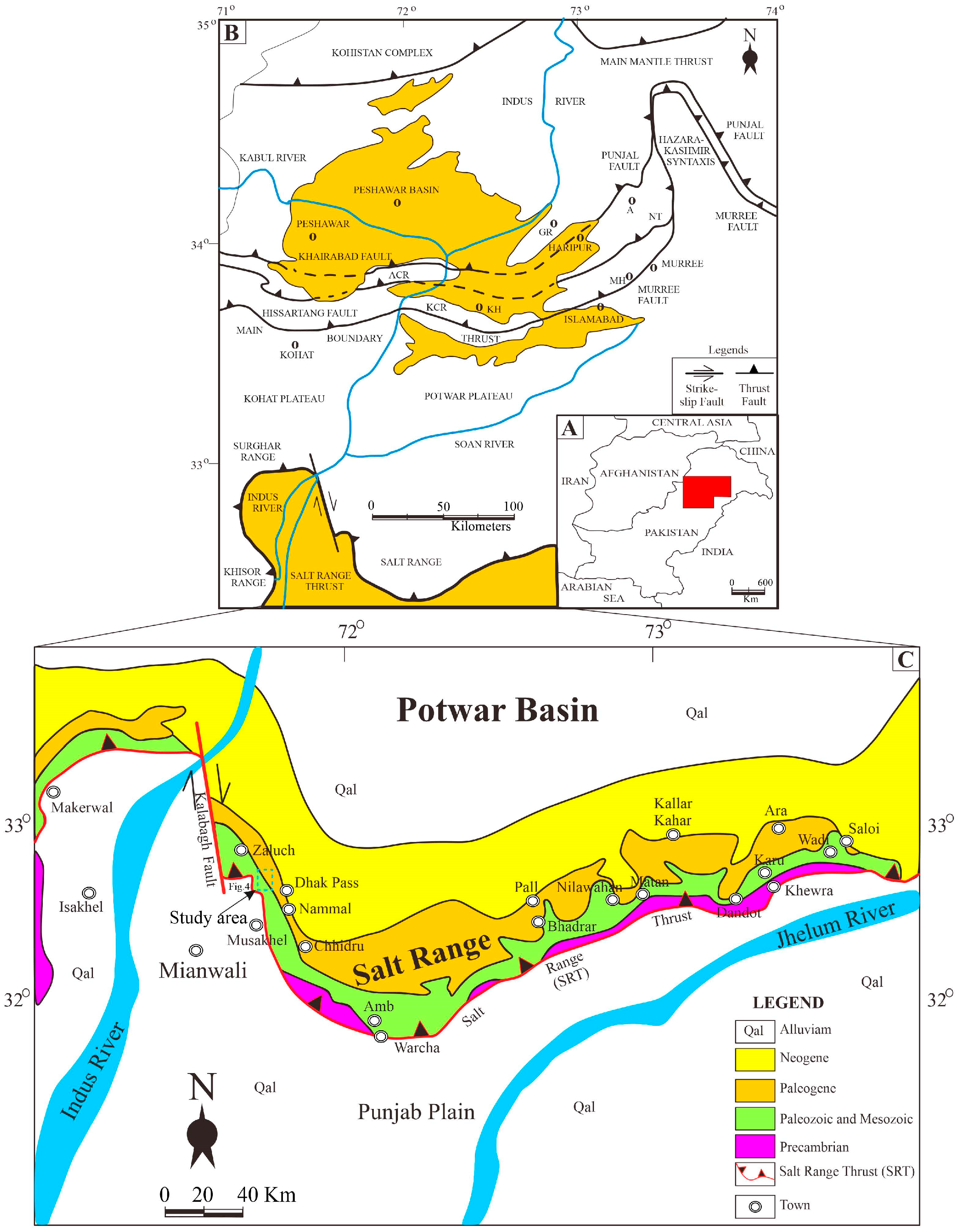
Fold and thrust belts remain among the most prolific structural provinces for hydrocarbon entrapment because contraction generates predictable closure geometries while simultaneously introducing segmentation through thrust splays, tear faults, and internally complex fold trains [1,2,3,4,5]. In the Salt Range–Potwar Plateau of northern Pakistan, thin-skinned deformation above a regionally weak evaporitic décollement has long been recognised as a first-order control on fold style, thrust hierarchy, and along strike compartmentalisation [3,5,6,7] (Figure 1). Recent geodetic and Interferometric Synthetic Aperture Radar (InSAR) studies further emphasise that the basal detachment and the western boundary fault system are mechanically heterogeneous, with spatially variable coupling and measurable aseismic slip, providing a modern kinematic context for the long-term structural architecture expressed at the surface [8,9]. Within such belts, reservoir performance is rarely governed by structure alone.
Carbonate ramps, which constitute a major fraction of Phanerozoic shallow marine archives and petroleum reservoirs, characteristically display laterally extensive bedding yet strong internal heterogeneity driven by shifting hydrodynamic energy, carbonate productivity, and accommodation [10,11,12,13]. The persistent challenge is that facies-based predictions of reservoir quality often fail where diagenesis and pore network organisation decouple pore volume from transmissive behaviour [14,15,16]. Consequently, robust interpretation requires frameworks that explicitly connect stratigraphic architecture and facies selectivity to the geometry and continuity of pore networks, rather than relying on porosity magnitude as a surrogate for flow potential [15,16].
Methodological advances now allow pore space to be quantified reproducibly from thin sections using supervised machine-learning segmentation and pore network topology to be characterised using skeleton-based descriptors that capture pathway development at a thin-section scale [17,18]. These approaches are increasingly used to enhance repeatability in petrographic workflows and to formalise microstructural comparison across facies, yet they are commonly applied without explicit anchoring to stratigraphic hierarchy or without integration into thrust belt compartmentalisation frameworks [17,18]. The opportunity, therefore, is to treat structural segmentation, stratigraphic packaging, diagenetic paragenesis, and pore network organisation as coupled elements of a single multi-scale heterogeneity problem.
The middle Permian Wargal Formation of the western Salt Range provides a particularly suitable natural laboratory for such integration. It represents a laterally extensive shallow marine carbonate system deposited along the northwestern margin of the Indian plate, and it has been analysed in prior work primarily in terms of facies architecture and sequence scale organisation, with increasing attention to reservoir implications at the outcrop analogue level [19,20,21,22]. At the same time, the western Salt Range is structurally segmented by a thin-skinned fold and thrust system that includes tear faulting and frontal thrusting near the Kalabagh corridor, creating an explicit need to reconcile formation-scale reservoir architecture with map-scale compartmentalisation [4,5,8].
This study presents an integrated structural and sedimentological analysis of the Zaluch Nala–Chatuwala Nala transect to develop a quantitative framework for multiscale heterogeneity. This helps in establishing the map-scale fold-fault architecture and structural domains using diagnostic criteria for fold geometry, fault hierarchy, and stratigraphic juxtaposition. The subsurface geometry with serial cross-sections and quantifying minimum shortening by balanced restoration will also be achieved. Furthermore, this study characterises the Wargal stratigraphic packaging and microfacies organisation within an open-ramp framework and reconstructs facies-selective diagenetic evolution from cross-cutting petrographic relations. The application of machine-learning-based pore segmentation and skeleton-derived topology metrics is useful in the quantification of thin section. These results were related to structural segmentation and seal risk. The resulting dataset links structurally admissible shortening constraints to facies-dependent pore connectivity within the transect corridor, providing testable constraints on formation-scale heterogeneity in a segmented fold–thrust setting.
Figure 1. Regional and geological setting of the study area. (A) Location map of Pakistan. (B) Tectonic map of northern Pakistan, showing major structural boundaries, including the Salt Range Thrust. Abbreviations: A, Abbottabad; NT, Nathiagali Thrust; MH, Margalla Hills; GR, Gandgar Range; KH, Kherimar Hills; Campbellpore Basin; ACR, Attock Cherat Range; KCR, Kala Chitta Range (compiled from [23,24]. (C) Geological map of the Salt Range, showing the study area (modified after [25]).
Jmse 14 00652 g001

2. Tectonic and Stratigraphic Framework

2.1. Regional Tectonic Setting

The Salt Range–Potwar Plateau constitutes the southern frontal part of the western Himalayan foreland fold and thrust belt, developed in response to India–Eurasia convergence and expressed as thin-skinned shortening above a regionally weak evaporitic décollement [1,2,3,26] (Figure 1). Seismic and balanced section studies have shown that the frontal thrust system is coupled to detachment folding and ramp-related fault bend structures, with deformation style strongly modulated by the presence and mechanical behaviour of Eocambrian evaporites within the Salt Range Formation [3,6,27]. Along strike, structural style varies systematically, and the western termination zone is influenced by strike slip and tear fault components associated with the Kalabagh fault system, which acts as a segmentation element for thrust propagation and fold continuity [4,5]. Recent InSAR and modelling studies corroborate this segmentation by documenting spatial variability in coupling and aseismic slip behaviour along the detachment and the Kalabagh boundary system [8,9].
The study area lies in the western Salt Range in the vicinity of Zaluch Nala, where contractional structures are expressed by NW trending fold trains and an imbricate to locally segmented thrust architecture. In this corridor, folds are commonly asymmetric and foreland vergent, and thrusts are variably linked by tear faults that disrupt along strike continuity and produce domain-scale differences in fault density, fold wavelength, and stratigraphic repetition [28]. Such behaviour is consistent with the regional Salt Range–Potwar model in which displacement is transferred between ramps and folded panels above the evaporitic décollement, while tear faulting modulates lateral connectivity of structures toward the western boundary zone [3,4,5].

2.2. Stratigraphic Framework

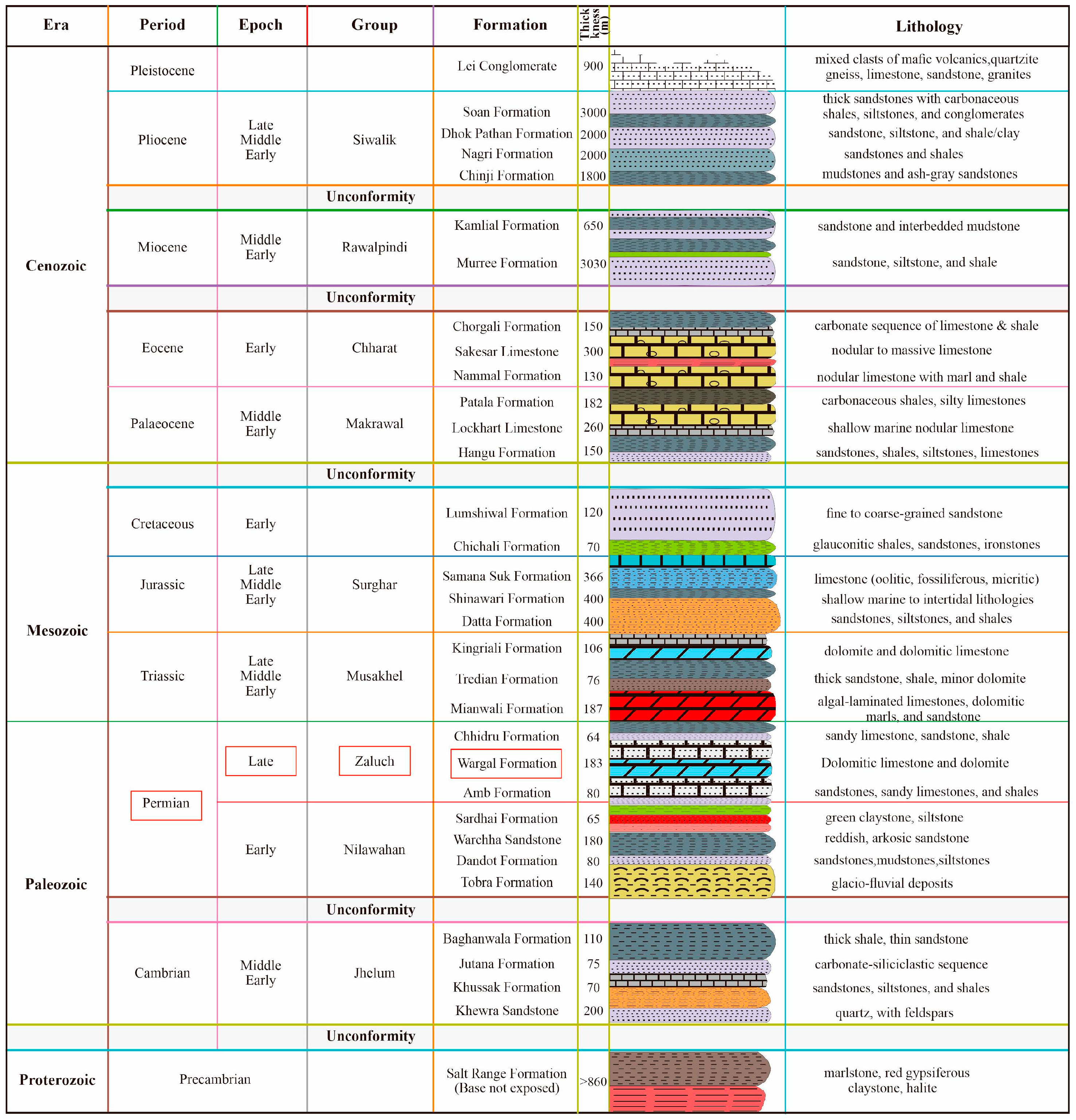
Exposed stratigraphy in the western Salt Range comprises an Eocambrian to Eocene platform succession, with the Salt Range Formation forming the basal evaporitic unit that also governs thin-skinned structural style [7,29] (Figure 2). The Permian stratigraphy is classically subdivided into the Nilawahan Group, dominated by siliciclastic successions, and the overlying Zaluch Group, which records a transition into fully marine carbonate ramp deposition [7,29,30] (Figure 2). Within the Zaluch Group, the Wargal Formation occupies an intermediate position, conformably overlying the Amb Formation and passing upward into the Chhidru Formation, reflecting sustained shallow marine carbonate production and subsequent stratigraphic evolution toward the latest Permian interval [19,30] (Figure 2). Regional synthesis and biostratigraphic constraints place Wargal deposition broadly within the Middle to Late Permian, with published work emphasising ramp-scale facies organisation, sequence-scale packaging, and lateral variability across Salt Range and Trans Indus exposures [19,20,21,31]. This tectonic and stratigraphic context provides the necessary basis for evaluating how structural compartmentalisation interacts with ramp-derived facies architecture, facies selective diagenesis, and pore network organisation at the formation scale.

3. Data and Methods

3.1. Structural Analysis

Map-scale fold-fault architecture and structural domains were established by synthesising existing geological constraints and remotely observable structural traces with bedding-attitude control. Subsurface geometry was then constrained through three serial cross-sections constructed approximately perpendicular to the regional structural grain and drafted to honour stratigraphic thicknesses and surface-constrained cutoffs and repetitions. Balanced restoration was applied to cross-section A–A′ to test geometric admissibility and quantify shortening following standard balanced-section principles. Restoration was performed in MOVE (v2013.1) using a plane-strain approximation and a sequential workflow appropriate for coupled faulting and folding in thin-skinned systems. Thrust displacement was removed first using a move-on-fault operation consistent with thrust kinematics and fault-parallel flow, applied to the relevant hanging-wall panels. Residual fold curvature was then restored using flexural-slip unfolding, selected because the folds are dominated by layer-parallel bending and because this operator best preserves bed length while allowing interlayer slip. A fixed pin and datum were defined within a comparatively stable reference panel so that restoration proceeded within a common reference frame without introducing rigid-body drift or arbitrary section translation. Restoration quality control was applied iteratively and included: (i) cutoff consistency at key marker horizons, especially laterally persistent units providing the strongest control on thrust displacement and fold tightening; (ii) preservation of stratigraphic order; (iii) screening for topological violations, including line crossing, self-intersection, polygon inversion, and overlap introduced during panel translation or unfolding; and (iv) qualitative assessment of thickness plausibility to avoid unrealistic local thickening or thinning beyond drafting tolerance or interpretational uncertainty. Shortening was calculated from the difference between restored and deformed section lengths measured between fixed reference posts as:
Shortening ( % ) = L restored L deformed L restored × 100
Final figures were compiled and refined for publication in Corel Draw 2021.

3.2. Stratigraphic Logging and Sampling Strategy

A continuous stratigraphic section of the Wargal Formation was measured and logged at Chatuwala Nala, western Salt Range. The logged interval is approximately 130 m thick and captures the full exposed thickness at this locality. Bed thickness, lithology, sedimentary structures, fossil content, and macroscopic textural attributes were recorded at decimetre to metre scale to document vertical organisation and to identify laterally traceable marker intervals. Seventy-eight hand samples were collected at stratigraphically controlled positions. Sampling density was increased across facies transitions, argillaceous intervals, and changes in bedding style. Sampling targeted fresh, unweathered material to maximise petrographic reliability.

3.3. Petrography, Microfacies Classification, and Diagenetic Description

Standard petrographic thin sections were prepared from the collected samples and examined under plane-polarised and cross-polarised light using a polarising microscope fitted with a digital camera. Carbonate textures were described using depositional-texture terminology based on Dunham-type schemes, with attention to grain support, mud fraction, sorting, and evidence for syndepositional binding. Microfacies were defined using allochem composition (skeletal and non-skeletal grains), matrix characteristics, and fabric attributes, then integrated with outcrop observations to maintain stratigraphic context and support ramp-scale facies interpretation. Diagenetic features were recorded systematically from thin sections and outcrop, with emphasis on textures and cross-cutting relations. Relative timing was constrained using overprinting criteria, including pore-occlusion sequences, truncation by stylolites and pressure-solution seams, and cross-cutting fracture fills.

3.4. Digital Pore-Network Analysis: Image Acquisition, Segmentation, and Metrics

A facies-stratified subset of thin sections was selected for quantitative pore-network analysis to enable comparative assessment among microfacies. Twenty fields of view were analysed, comprising four fields of view for each microfacies (WMF-1 to WMF-5). Photomicrographs were acquired at constant magnification under fixed illumination and optical settings, and each image was spatially calibrated using the microscope scale.
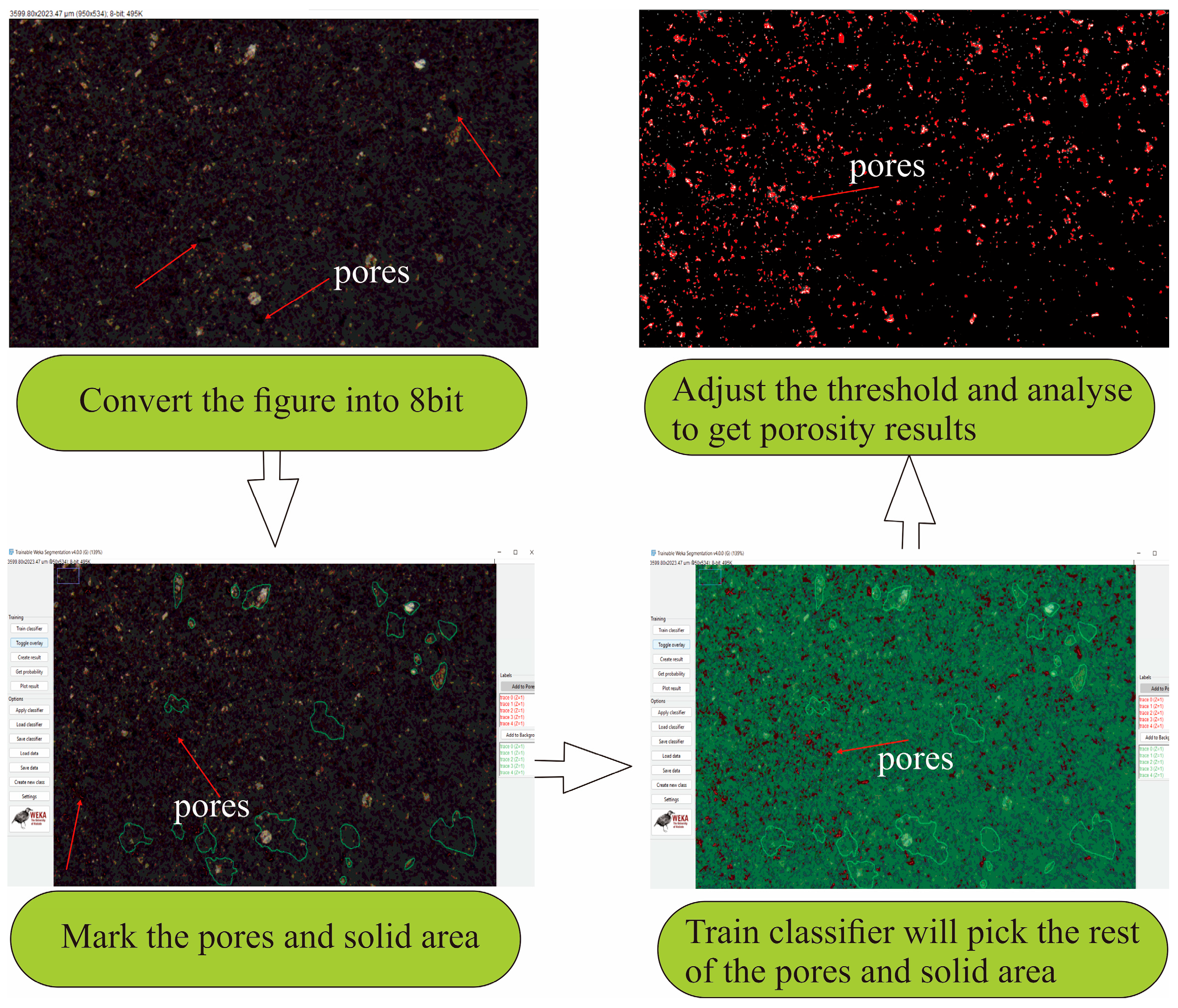
Image processing and quantification were performed in Fiji (ImageJ Version 1.54r). Pore space was segmented using the Trainable Weka Segmentation plugin(Wayne Rasband and Contributors, National Institutes of Health, USA http://imagej.org), which applies supervised machine-learning pixel classification. A two-class classifier was trained to separate pore pixels from a composite non-pore class (carbonate matrix, grains, and cement), appropriate for non-impregnated thin sections (Figure 3). Classifier probability outputs were converted to binary pore masks using an image-specific threshold selected by minimising pixel misclassification relative to a manually annotated reference region that captured representative pore and matrix textures. Thresholds across the dataset fall within 0.700–0.999, reflecting natural variation in contrast and textural complexity. Segmentation results were verified by visual comparison of pore-mask overlays against the original images to ensure faithful delineation of pore boundaries and connected pathways (Figure 3).
Binary pore masks were skeletonised and analysed using the Analyze Skeleton plugin to extract two-dimensional topological descriptors. Areal porosity was calculated as:
ϕ 2 D = A pore A total
Total skeleton length was computed as the sum of all branch lengths:
L skel = i = 1 n L i
Skeleton length density was defined as:
L d = L skel A total
A connectivity-weighted porosity index was used as a scalar comparative metric that combines pore area and pathway development:
I conn = ϕ 2 D L d
where ϕ 2 D is expressed as a fraction (0–1). All metrics are two-dimensional thin-section-scale proxies intended for relative comparison of pore-network topology among microfacies.

4. Results

4.1. Structural Framework and Map-Scale Architecture

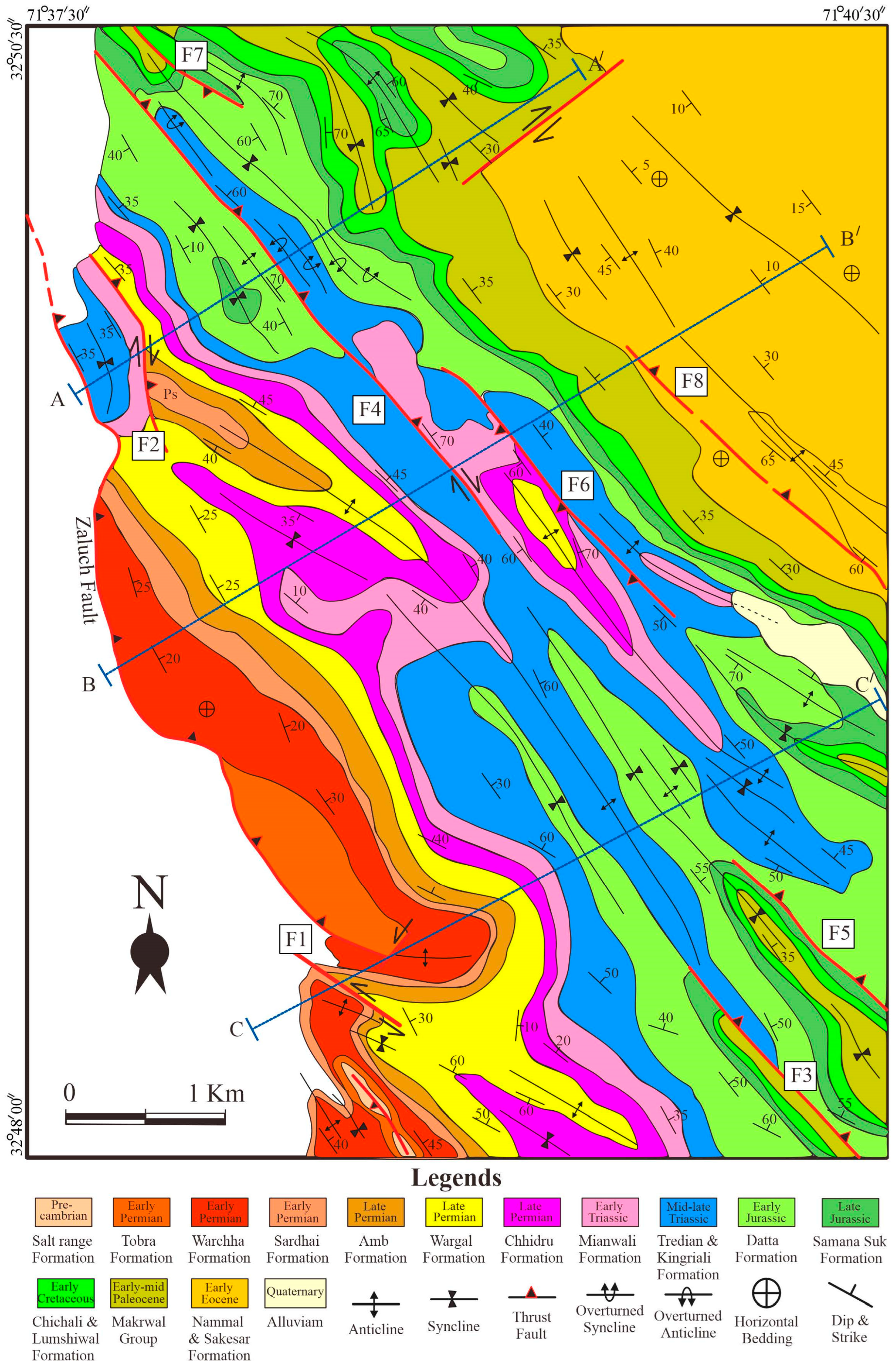
The structural framework of the study area is organised by a coherent NW-trending grain expressed by kilometre-scale anticlines and synclines arranged in parallel to locally en echelon fold trains (Figure 4). Folds are systematically asymmetric and dominantly southwest-vergent. Forelimbs are commonly steep, with dips typically 50° to 70°, whereas back limbs are gentler; locally, forelimb dips decrease to approximately 20°, indicating along-strike variability in fold tightening and limb rotation. Fold traces are regionally persistent, but axial continuity is commonly disrupted at map scale, where limbs are truncated or displaced, yielding short fold segments and discontinuous closures where faulting partitions otherwise coherent fold geometries (Figure 4).
Thrusting defines the principal map-scale discontinuities and exerts first-order control on structural relief and stratigraphic juxtaposition. A prominent frontal fault system occupies the western margin of the mapped area, where older successions are tectonically emplaced over younger surficial deposits. Within the belt interior, thrust traces form a dense network that repeatedly juxtaposes Triassic packages against Jurassic and younger strata and, locally, Permian against Triassic units. This thrust architecture is complemented by back-thrusting and tear faulting. Tear faults, expressed as oblique to locally north–south discontinuities, interrupt fold continuity, generate abrupt changes in fold wavelength and axial trend, and mediate displacement transfer between adjacent thrust segments (Figure 4). Back-thrusts locally enhance short-wavelength structural complexity, consistent with compartmentalised contractional kinematics rather than uniform fold amplification.
Systematic changes in fold tightness, fault style, and the stratigraphic level of deformation justify subdivision of the area into four structural domains. This partitioning reflects genuine strain localisation and strain transfer, capturing a progression from comparatively open folding in the northeast to increasingly fault-assisted contraction and stratigraphic exhumation toward the southwest. The deformation front is defined by the Zaluch Fault (ZF), which bounds the structurally most mature sector of the belt and anchors the observed gradient in deformation intensity.
The northeastern domain is dominated by macroscopic folds developed largely within Triassic to Eocene successions. Fold traces maintain the regional NW trend, while attitudes indicate a consistent tightening toward the southwest. A NE-oriented tear fault subdivides the domain into a northern sector characterised by tighter, upright folds trending north to north–northwest, developed mainly within Triassic to Jurassic strata, and a southern sector in which folds remain open to gentle across much of the domain and tighten only toward the southeastern corner (Figure 4). A NW-oriented thrust (F8) traverses the Eocene strata with limited apparent separation, consistent with modest throw and/or displacement preferentially absorbed by folding (Figure 4).
The northwestern domain exhibits the highest structural density and the clearest evidence for fault-assisted fold growth. Tight folds are developed principally in Permian to Paleocene strata, with limb dips commonly between 40° and 70°. A dominant thrust (F4) emplaces Triassic units (Tredian and Kingriali) over the Jurassic Datta Formation and is associated with strongly deformed, locally overturned fold geometries. Structural complexity is enhanced by a north–south tear fault (F2) and a northwest-trending back-thrust (F7) that places the Datta Formation over the Samana Suk Formation. The western margin of this domain is bounded by the Zaluch Fault, which marks the structural front of the mapped area.
The southeastern domain is characterised by comparatively open folding within Permian to Cretaceous rocks, with typical limb dips of approximately 40° to 45°, and by two major thrusts (F3 and F5) that produce stratigraphic repetition and local segmentation (Figure 4). F3 places Triassic rocks over the Makarwal Group and Jurassic strata and shows evidence for lateral displacement, consistent with oblique slip and tear-related linkage between thrust segments. F5 similarly emplaces the Tredian and Datta formations over the Samana Suk Formation, indicating that thrust accommodation is distributed across multiple strands rather than concentrated on a single emergent structure (Figure 4).
The southwestern domain contains the most mature expression of contraction, expressed by tight asymmetric folds and exposure of older successions from Permian into Precambrian strata. In this domain, F4 enters as a NW-trending, steeply southwest-dipping thrust, detached at the level of the Datta Formation, and emplaces Datta Formation over Cretaceous rocks, transferring displacement into a train of tight folds (Figure 4). This structural style is expressed prominently by the Chitta Wahan anticline, cored by Permian Sardhai Formation, and the Zaluch anticline, cored by Precambrian Salt Range Formation. The Zaluch Fault defines the frontal structure of the domain; its trace is undulatory and gently northeast-dipping, and it places Permian to Precambrian rocks over Quaternary alluvial fan deposits, demonstrating substantial tectonic emplacement at the deformation front (Figure 4). A local splay (F1) at the southeastern termination of the Zaluch Fault thrusts the Tobra Formation over the Warchha Sandstone, recording subsidiary shallow-level faulting that locally reorganises stratigraphic architecture (Figure 4).

4.2. Cross-Section Constraints on Thrust-Fold Geometry

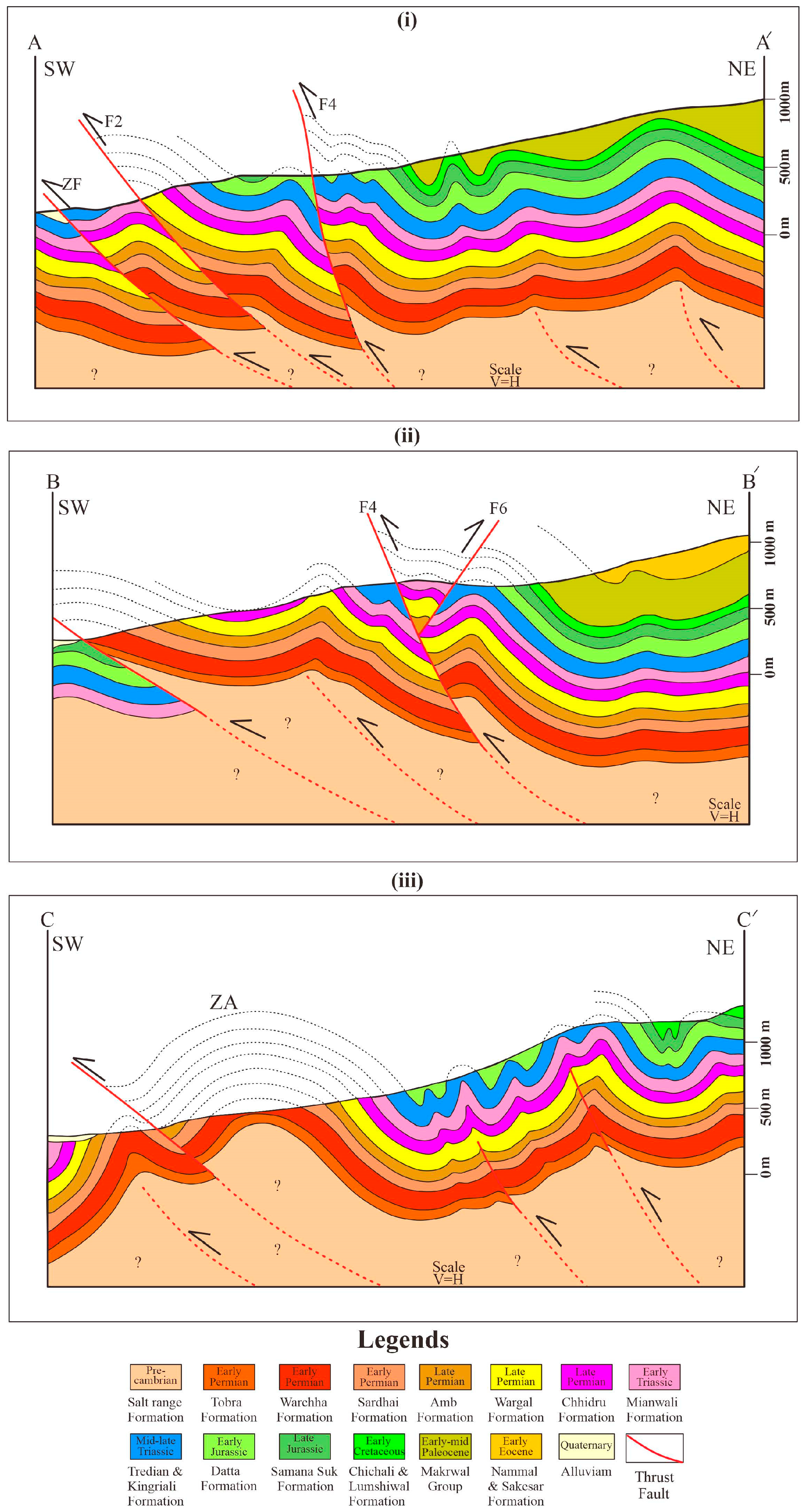
Three serial cross-sections (A–A′, B–B′, C–C′) constrain the subsurface geometry required by the mapped stratigraphic juxtapositions and fold patterns and collectively support a thin-skinned fold and thrust architecture developed above a regional basal décollement (Figure 5).
Section A–A′ captures a progressive transition from upright folds in the northeast into tighter, locally southeast-overturned geometries toward a major structural break at F4. In section view, F4 is steep to near-vertical and emplaces Triassic strata over Jurassic strata, introducing a ramp-like discontinuity superimposed on the folded cover. South of F4, cover strata remain tightly to openly folded until F2 reaches the surface. F2 dips gently to the northeast and places Permian strata above Triassic strata, after which the frontal architecture is expressed by emergent thrusting along the ZF at the deformation front. Together, these relations require distributed folding punctuated by discrete thrust offsets that impose sharp stratigraphic cutoffs and reorganise dip panels across fault ramps.
Sections B–B′ and C–C′ depict a comparable structural style of open to tight, asymmetric southwest-facing folds but with clear along-strike variability in fault configuration and the relative expression of folding versus thrust repetition. Both transects require blind thrusting beneath prominent forelimb panels and at least one emergent fault, demonstrating that shortening is partitioned between distributed limb rotation and discrete slip-on thrust surfaces. Where additional strands are present, including locally mapped thrusts such as F6, fold wavelengths shorten, amplitudes increase over shorter distances, and stratigraphic repetition becomes more pronounced, indicating tighter structural packing relative to segments dominated by folding. Conversely, in sectors with lower fault density, fold wavelengths increase and shortening is expressed more by progressive changes in limb dip than by repeated fault offsets.
Near-surface structures further refine the geometry of the system. F1 occupies the forelimb of the Zaluch anticline and is best interpreted as an out-of-sequence, shallow-level fault that does not require linkage to deeper thrusts in order to reproduce the observed stratigraphic relations. In addition, both B–B′ and C–C′ require a local pop-up geometry, consistent with limited back-thrusting or duplex-style uplift within the broader contractional field. The culmination expressed on C–C′ is characterised by tighter, more closely spaced folds and by secondary structures that steepen limb panels and compartmentalise fold crests. Marker horizons traced through this culmination show systematic panel rotation expressed as progressive dip changes that are not readily represented by a single simple ramp geometry and instead indicate shortening distributed across multiple structures within a structurally elevated panel assemblage.

4.3. Balanced Restoration and Shortening of Cross-Section A–A′

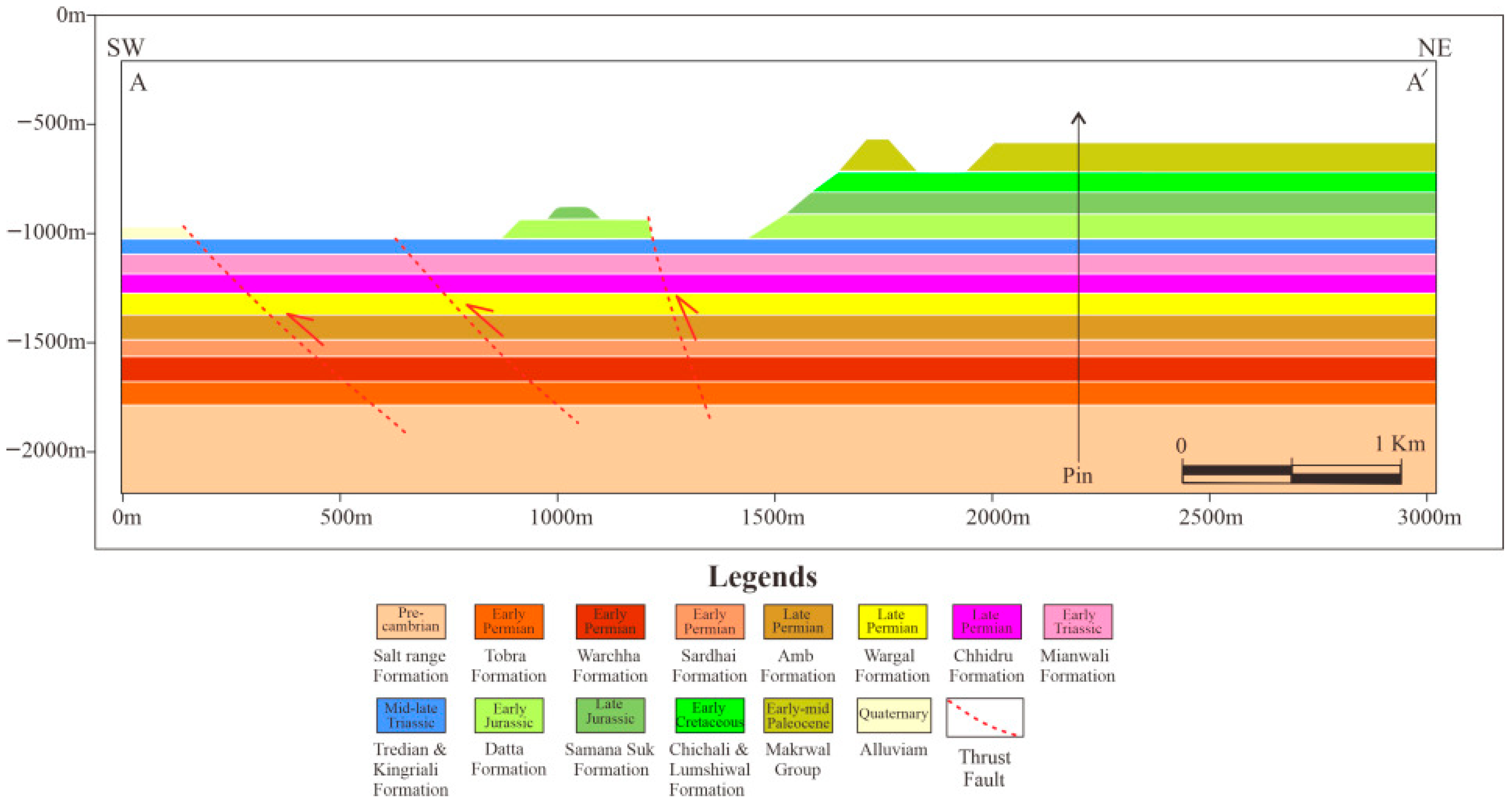
A balanced restoration of cross-section A–A′ was performed to evaluate the geometric admissibility of the interpreted fold–thrust architecture and to quantify shortening in a manner consistent with the mapped structural style (Figure 6). Restoration was conducted under a plane-strain assumption appropriate for a kilometre-scale transect through a contractional belt, treating bedding as mechanically layered and enforcing bed-length conservation on laterally persistent marker horizons while maintaining plausible stratigraphic thicknesses after unfolding. Where horizons are truncated by thrusting or where subsurface ties are non-unique, constraints were applied by preserving stratigraphic order and avoiding overlaps or topological inconsistencies, rather than by forcing continuity across structurally segmented panels.
The final restored geometry approaches a near-horizontal pre-deformation configuration without artefactual breaks, consistent with thin-skinned shortening above a weak basal horizon (Figure 6).
The restoration yields a quantitative shortening estimate based on the difference between restored and deformed section lengths measured between fixed reference posts. The deformed length ( L deformed ) is 4.9214 km, whereas the restored length ( L restored ) is 6.0550 km, giving a net recovered shortening of Δ L = 1.1336 k m and a shortening of 18.7 % for cross-section A–A′. This value represents a minimum shortening required to reconcile the interpreted architecture with an admissible pre-deformation configuration under the adopted assumptions. The restoration further indicates that shortening is partitioned between discrete thrust slip and distributed folding. Although a unique slip budget cannot be derived without independent subsurface calibration, the restored geometry requires appreciable fold tightening within panels, particularly where thrusts diminish upward and deformation is transferred into bending rather than expressed as continuous emergent offsets. In this sense, the kinematic outcome is best characterised as fault-assisted folding, with major thrusts providing primary discontinuities and fold panels accommodating the remaining shortening through flexural-slip bending and interlayer slip. The structural architecture provides the context for interpreting the stratigraphic organisation and petrographic variability of the Wargal Formation at Chatuwala Nala.

4.4. Stratigraphic Framework and Stacking Architecture

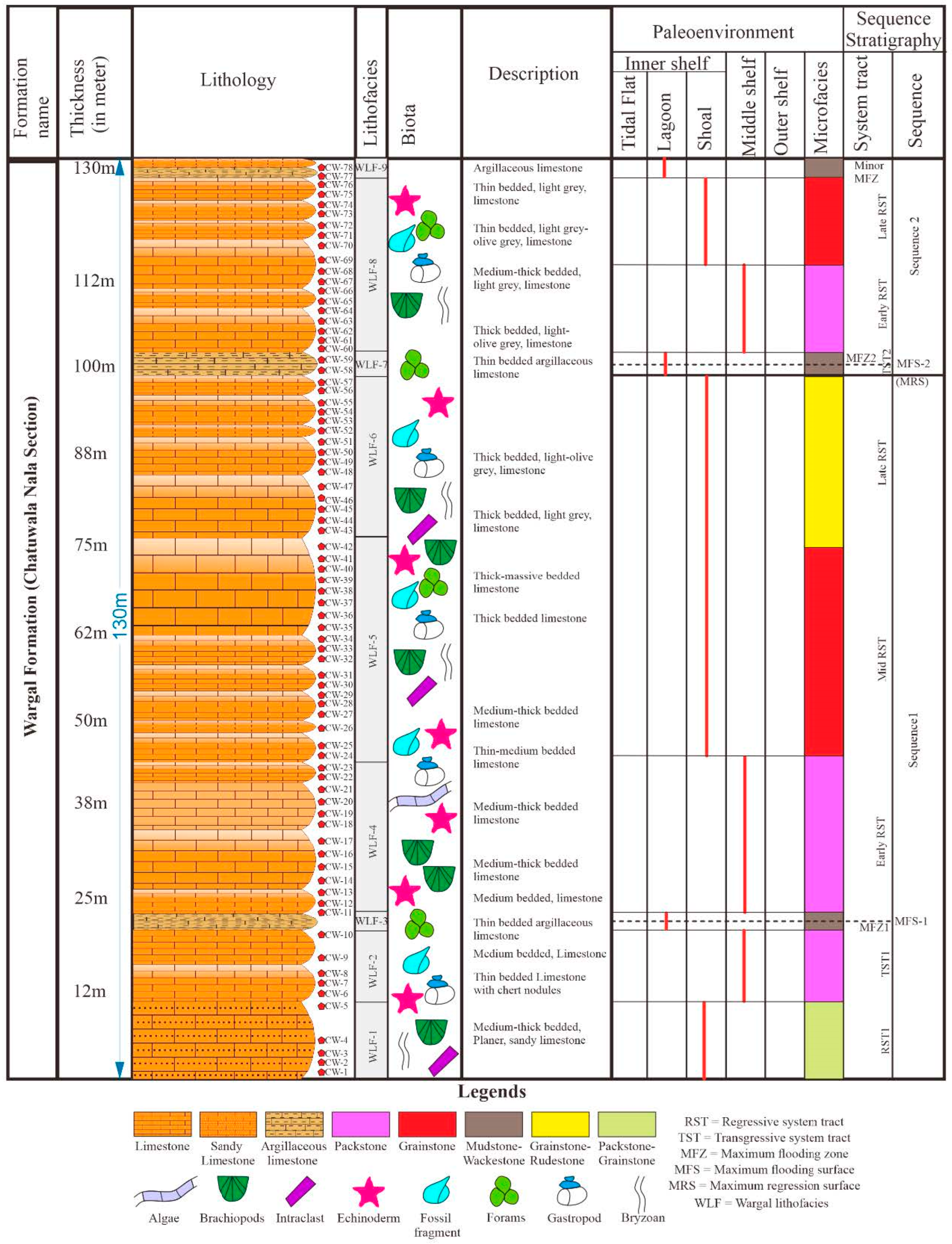
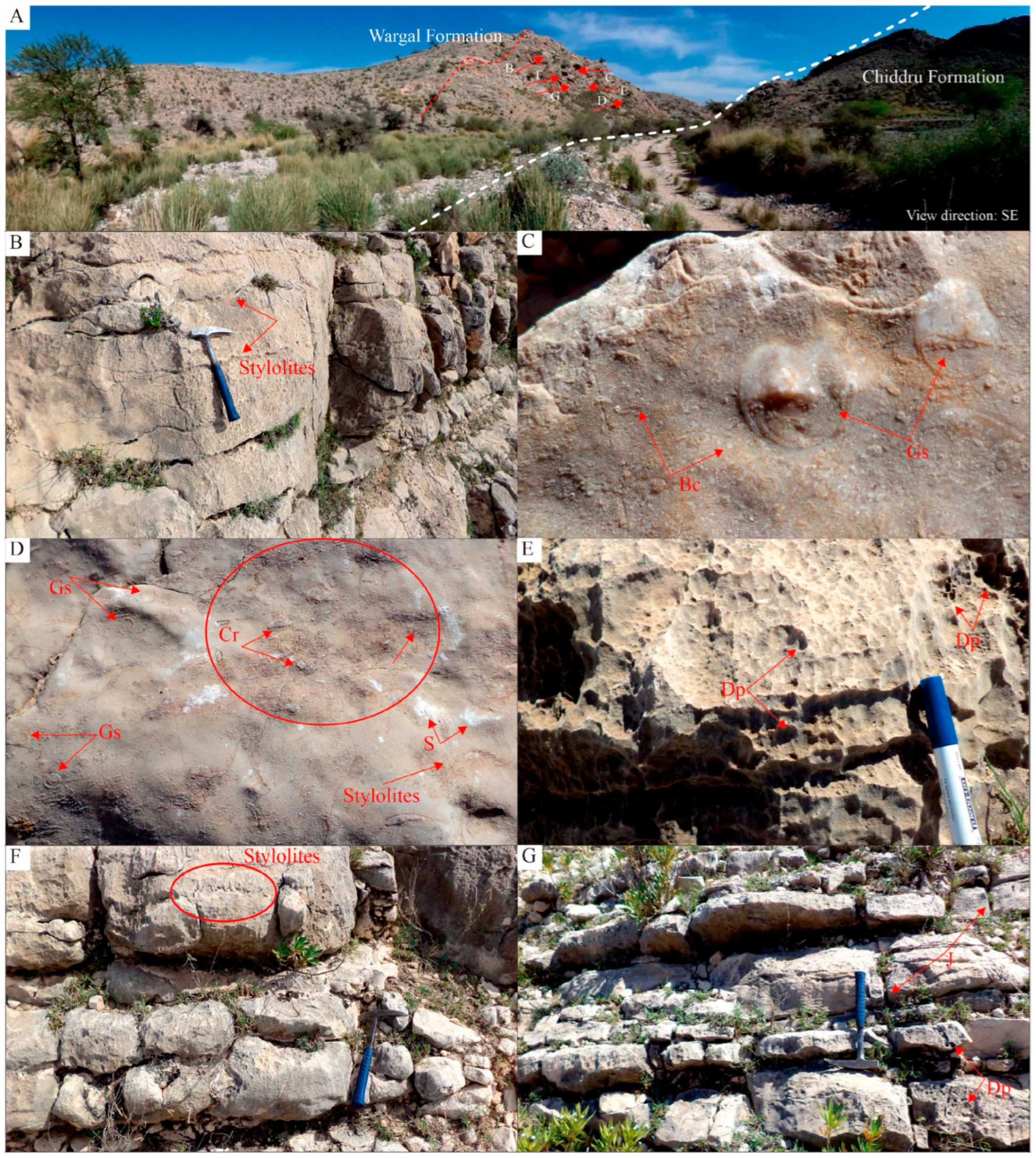
The Wargal Formation at Chatuwala Nala comprises a laterally continuous carbonate succession ~130 m thick with tabular, sheet-like bedding and traceable lithological units (Figure 7). Limestone spanning mud-supported to grain-supported fabrics dominates the measured section and is interrupted by argillaceous limestone intervals that are darker, recessive-weathering, and less competent than adjacent cleaner beds, making them reliable marker horizons at the outcrop scale (Figure 7 and Figure 8).
Two markers are particularly persistent: a lower argillaceous package at ~21–23 m above the base and a thicker interval at ~98–105 m that separates two thick limestone successions and coincides with a shift in bedding style and the relative proportion of argillaceous to cleaner limestone (Figure 7 and Figure 8). A minor argillaceous bedset occurs near the top of the section at ~128–129 m (Figure 7).
These markers subdivide the succession into three carbonate packages: (i) a lower package (0–21 m) of thin- to medium-bedded limestone dominated by micrite-retaining fabrics with subordinate grain-supported beds; (ii) a middle package (23–98 m), the thickest interval, characterised by thicker-bedded limestone and an overall increase in grain-supported facies that forms the principal cliff-forming succession; and (iii) an upper package (105–130 m) with a return to thinner bedding and mixed micrite-retaining and grain-supported fabrics, including the minor argillaceous bedset near the top (Figure 7).
Microfacies (WMF) stacking mirrors this partitioning as follows: WMF-1 predominates in the lower package with WMF-3 concentrated within and adjacent to the lower marker interval; the middle package is dominated by WMF-2 with discrete WMF-4 beds; and the upper package shows renewed prevalence of WMF-1 and WMF-5 with minor recurrence of WMF-3 near the top (Figure 7).

4.5. Microfacies Characteristics

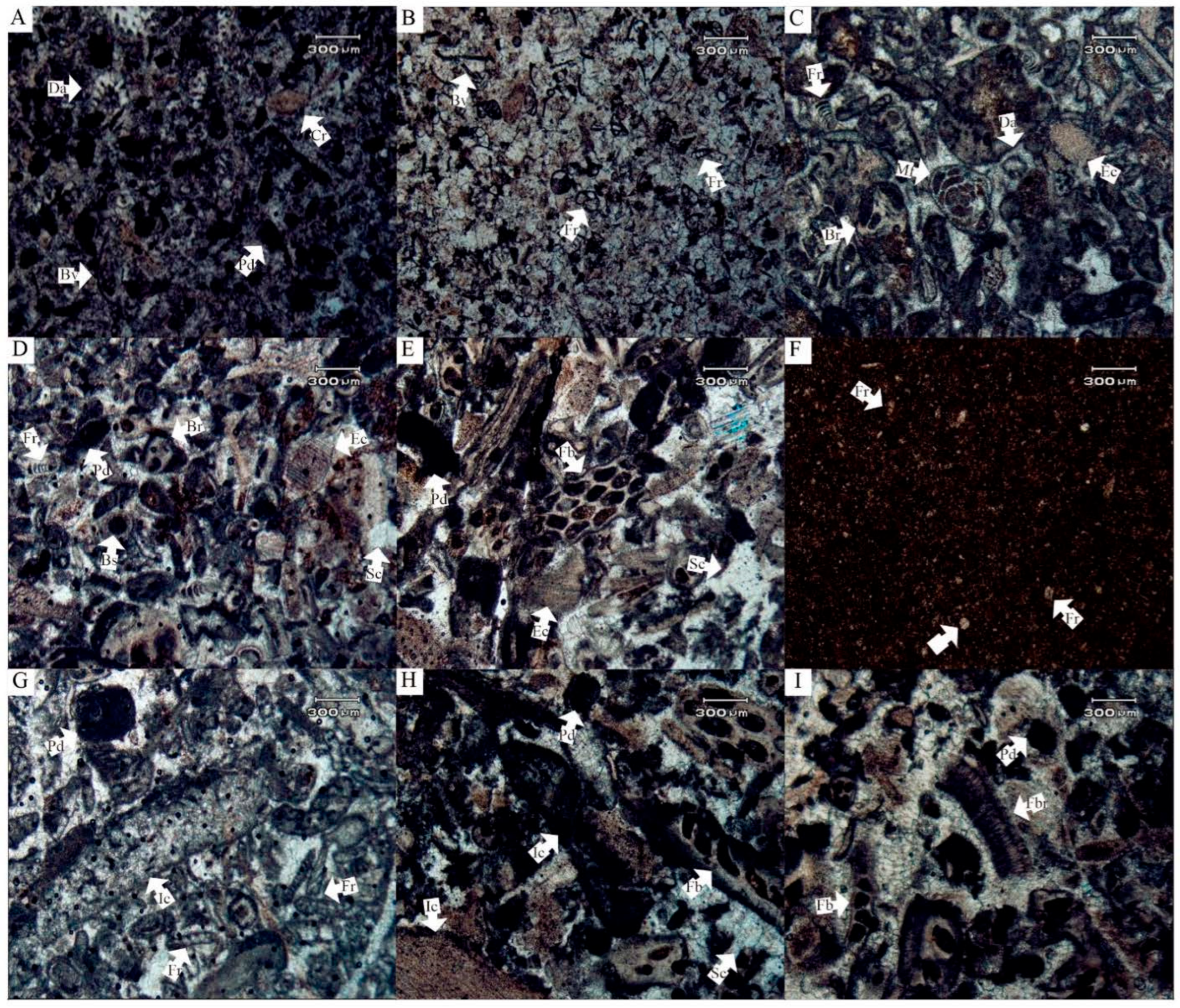
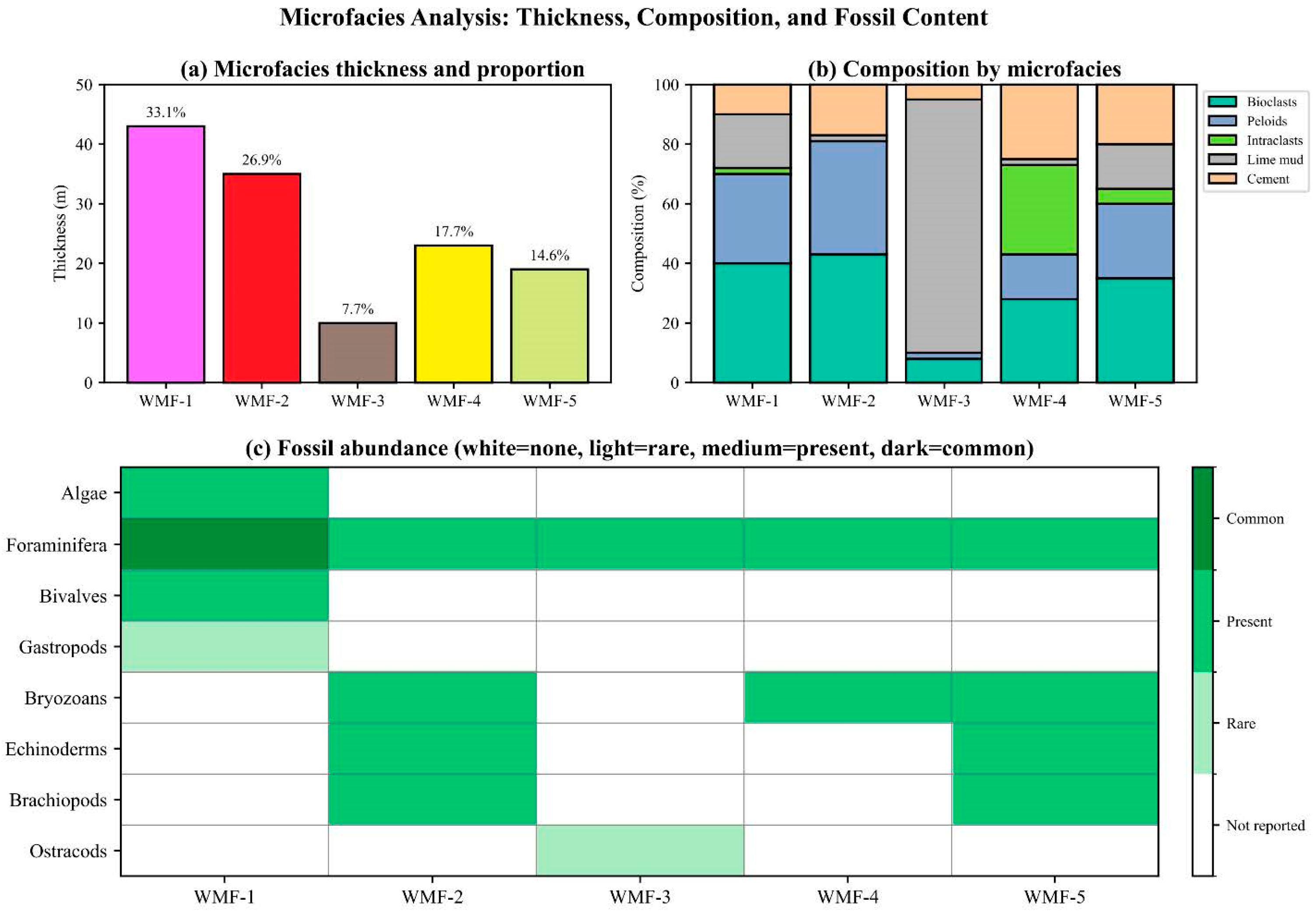
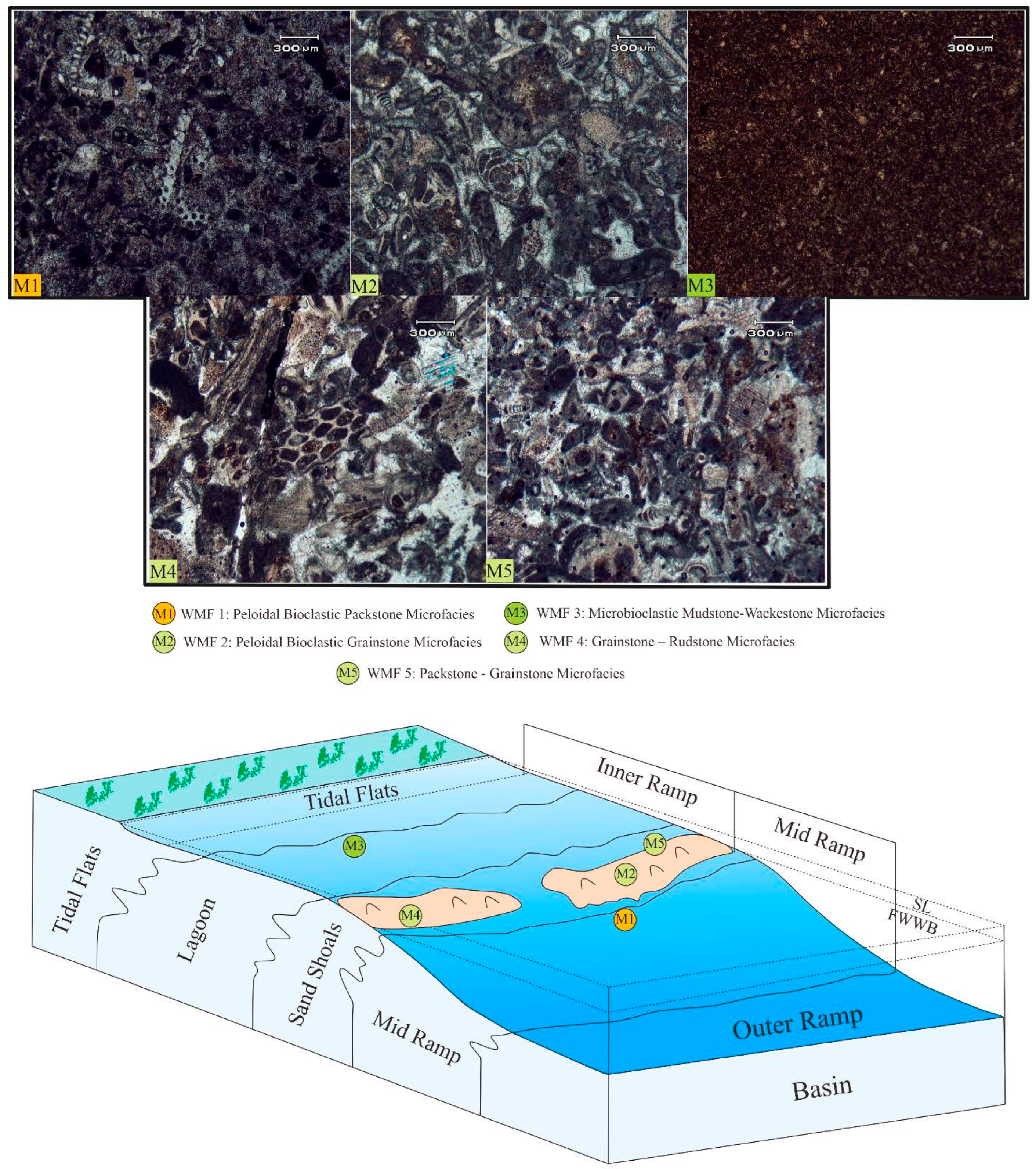
Petrographic analysis of the Wargal Formation at Chatuwala Nala distinguishes five recurring carbonate microfacies (WMF-1 to WMF-5) that vary in depositional texture, allochem assemblage, micrite content, and degree of diagenetic modification (Figure 9). Where appropriate, microfacies are related to Standard Microfacies (SMF) categories as heuristic equivalents to facilitate comparison with published ramp successions [34,35]. The relative stratigraphic contributions of each WMF, together with normalised constituent proportions and fossil-group distributions, are synthesised in Figure 10.

4.5.1. WMF-1 (Peloidal Bioclastic Packstone)

WMF-1 is a peloid-rich packstone containing dasycladacean algae and a subordinate skeletal assemblage dominated by small benthic foraminifera and bivalve fragments, with rare gastropod debris (Figure 9A,B). Micrite is appreciable, and sparry calcite cement is variably developed; interparticle pore space is locally preserved but commonly reduced by cement occlusion. WMF-1 occurs preferentially in the lower and upper carbonate packages and commonly recurs immediately above argillaceous limestone marker intervals (Figure 7). The micrite-retaining fabric and shallow-water biota are consistent with low to moderate agitation in inner-ramp settings. WMF-1 most closely corresponds to SMF 16-type peloidal packstone to grainstone associations [34,35].

4.5.2. WMF-2 (Peloidal Bioclastic Grainstone)

WMF-2 is grain-supported and dominated by abundant peloids with a diverse skeletal assemblage including fenestrate bryozoans, crinoid debris, brachiopod fragments, echinoderm grains, and subordinate foraminifera (Figure 9C–E). Micrite is sparse to absent, and intergranular pore space is widely occluded by sparry calcite cement, consistent with extensive cementation of an originally grain-supported framework. WMF-2 is concentrated in the middle carbonate package, where it forms thick, laterally persistent beds that dominate the cliff-forming interval (Figure 7). Grain support and micrite depletion indicate elevated agitation in shallow subtidal shoal to shoal-margin settings. WMF-2 is most comparable to SMF 11-type high-energy grain-supported facies [34,35].

4.5.3. WMF-3 (Microbioclastic Mudstone to Wackestone)

WMF-3 is mud-supported and dominated by micrite with sparse fine skeletal grains, including small benthic foraminifera and locally rare ostracods dispersed within a largely homogeneous matrix (Figure 9F). Primary interparticle porosity is effectively absent; pore space is dominated by micrite-hosted microporosity that is locally modified by compaction, as indicated by fabric reorganisation and incipient pressure-solution features. WMF-3 is concentrated within argillaceous limestone marker intervals and adjacent thin interbeds, defining the most mud-rich component of the succession (Figure 7). The mud-dominated texture and fine assemblage indicate low-agitation accumulation in protected shallow marine settings. WMF-3 most closely corresponds to SMF 19-type micrite-dominated facies [34,35].

4.5.4. WMF-4 (Grainstone to Rudstone)

WMF-4 comprises coarse, locally poorly sorted grain-supported fabrics grading to rudstone, characterised by intraclasts with subordinate peloids and foraminifera and locally fenestrate bryozoan fragments (Figure 9G,H). Broken allochems and geopetal fabrics are common. Pore space is variably reduced by coarse sparry cement, and local secondary porosity occurs where dissolution and micro-fracturing are present. WMF-4 occurs as discrete beds within the middle carbonate package and locally within the upper package (Figure 7). The coarse texture, reworked components, and disrupted fabrics indicate high-agitation shallow subtidal conditions, commonly associated with shoal-margin reworking. WMF-4 is most comparable to SMF 12-type grainstone to rudstone and shell-concentration facies [34,35].

4.5.5. WMF-5 (Packstone to Grainstone)

WMF-5 comprises mixed packstone to grainstone fabrics within beds or bedsets, with variable micrite retention and heterogeneous cement distribution. Peloids are abundant and occur with brachiopod shell fragments, bryozoans including fenestrate forms, crinoid debris, subordinate benthic foraminifera, and local intraclasts (Figure 9I). Interparticle pores are variably occluded by blocky calcite cement. WMF-5 occurs intermittently throughout the succession and is most common in transitional intervals characterised by bed-scale alternations between micrite-retaining packstone domains and grain-supported domains with reduced micrite (Figure 7). The mixed fabric indicates fluctuating agitation in shallow marine settings and is consistent with a transitional association between SMF 16-type and SMF 11-type facies [34,35].

4.6. Diagenesis and Pore Modification

Diagenetic features were documented from outcrop observations and transmitted-light petrography and are described in terms of texture and demonstrable overprinting relationships. Relative timing is constrained by pore-occlusion patterns, truncation by pressure-solution seams and stylolites, and cross-cutting fracture fills (Figure 11).

4.6.1. Porosity-Reducing Processes

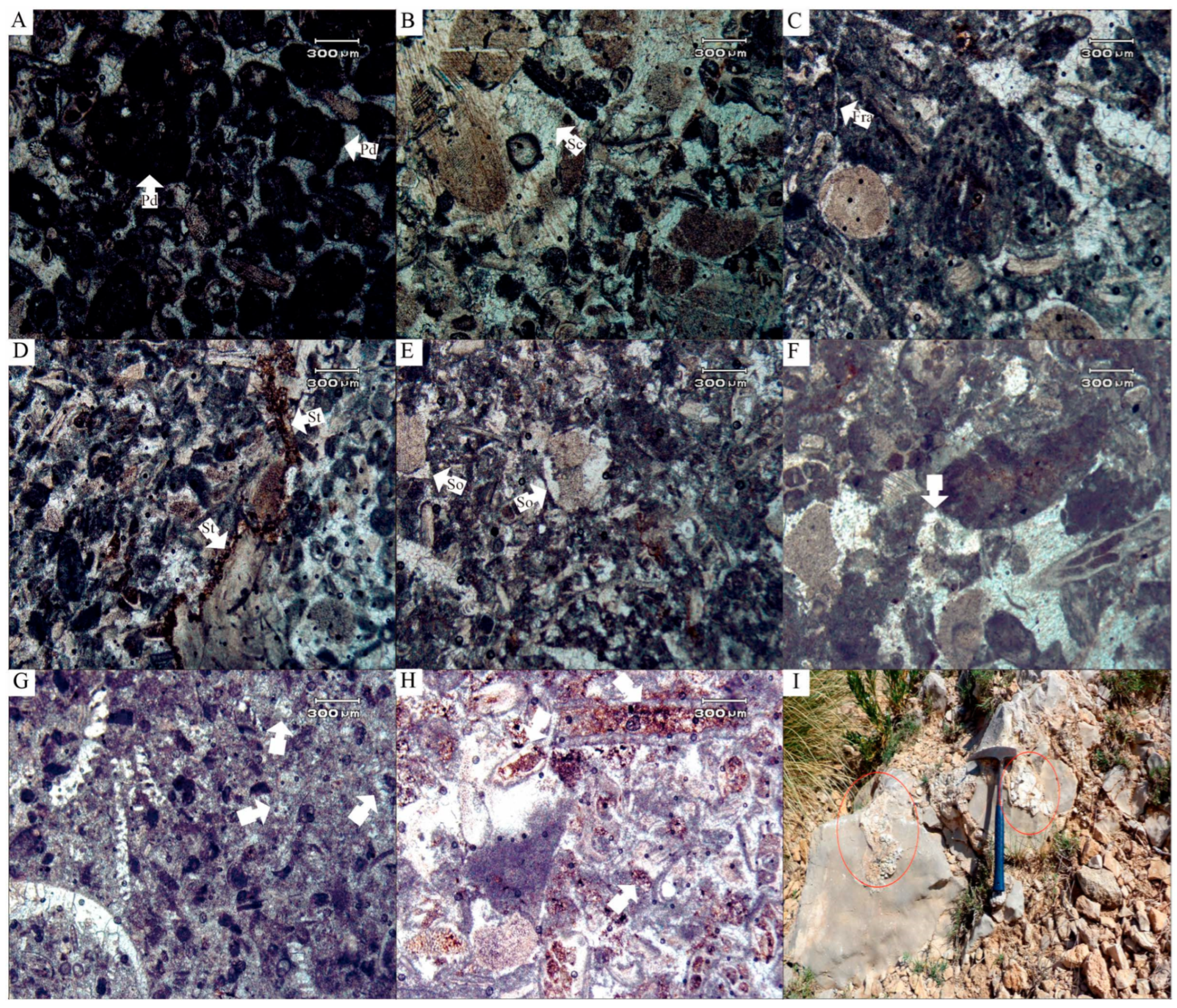
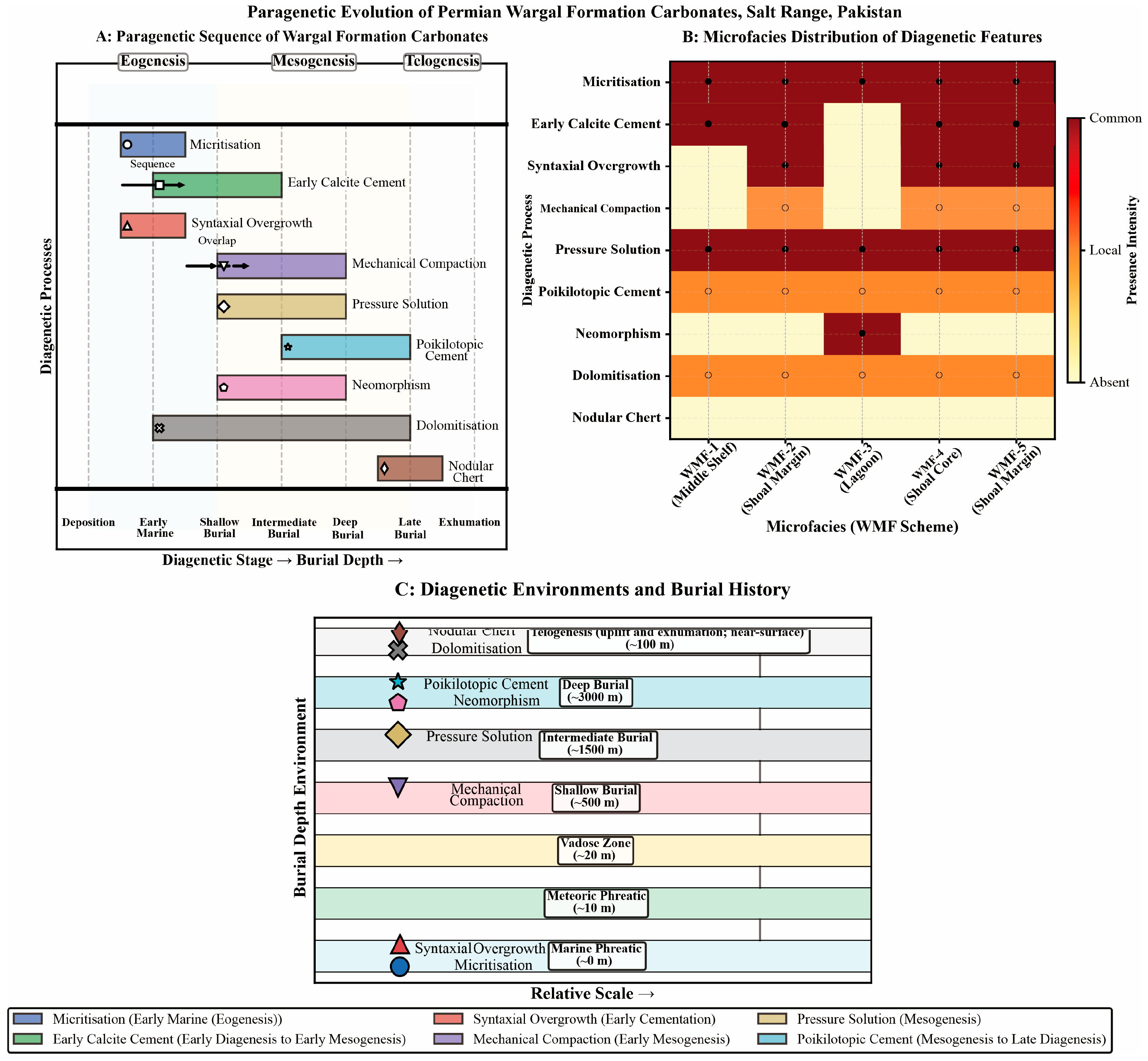
Micritisation is pervasive and occurs as micritic envelopes and partial to complete alteration of allochems, locally obscuring grain boundaries and imparting a peloid-like appearance to altered grains (Figure 11A). It is most consistently expressed in micrite-retaining packstone fabrics (WMF-1) and in mixed packstone to grainstone textures (WMF-5), where grains preserve micritic rims prior to later cement infill. Micritised fabrics are overprinted by sparry calcite cement and truncated by pressure-solution seams, indicating that micritisation predates at least one cement generation and subsequent chemical compaction (Figure 11A,D). Calcite cementation is the principal porosity-reducing overprint in grain-supported microfacies, particularly WMF-2 and WMF-4, where interparticle pore space is commonly occluded. Syntaxial overgrowths occur locally on echinoderm fragments, followed by pore-filling spar that progressively reduces pore-throat continuity; poikilotopic calcite, where present, encloses multiple grains and former pore space and indicates advanced pore filling (Figure 11B,E,F). Mechanical compaction is expressed by tight grain packing and incipient grain breakage in grain-rich intervals (WMF-2 and WMF-4) and is accompanied locally by hairline fractures that are commonly sealed by calcite (Figure 11C). Bedding-parallel pressure-solution seams and stylolites are widespread and truncate grains and earlier cement fabrics, indicating that chemical compaction post-dates at least one cement phase and accompanies continued burial modification (Figure 11D). Neomorphic recrystallisation is facies-selective and most clearly developed in mud-rich microfacies (WMF-3), where fine micrite is replaced by a coarser calcite mosaic (Figure 11G).

4.6.2. Porosity-Enhancing Processes

Porosity enhancement is expressed primarily by dissolution and local development of secondary pore space. Dissolution manifests as irregular enlargement of pore domains and small vugs that affect skeletal grains and, locally, previously cemented fabrics; it is most commonly observed in grain-supported and mixed microfacies (WMF-2, WMF-4, and WMF-5), where it locally re-opens cement-restricted pore networks and, where it cuts cement, directly indicates a post-cement dissolution event. Fracturing may locally increase connectivity where fractures remain incompletely sealed, most plausibly in coarse grain-supported fabrics (WMF-4) where microfractures intersect pre-existing pore domains, although the frequent occurrence of calcite-filled microfractures indicates spatially restricted fracture effectiveness (Figure 11C). Dolomitisation and silicification are minor and occur as rare replacive dolomite patches and outcrop-scale chert replacement within limestone, respectively (Figure 11H,I); in the absence of definitive petrographic timing constraints, both are treated as late-stage overprints with local, facies-dependent effects. Cross-cutting relationships define a paragenetic sequence from early micritisation through progressive calcite cementation, followed by compaction and bedding-parallel pressure solution, and finally local dissolution and fracture-related modification with variable cement sealing (Figure 11; Table 1).

4.7. Pore-System Characteristics and Quantitative Pore-Network Attributes

Pore attributes were assessed using complementary petrographic observation and image-based pore-network analysis. Petrographic pore types were identified from thin sections spanning the textural range of each microfacies, and quantitative connectivity descriptors were derived from segmented pore masks and skeletonised pore networks following the workflow in Section 3. Pore-type terminology follows the carbonate pore classification of [14]. Twenty thin-section fields of view were analysed, comprising four fields of view from each microfacies (WMF-1 to WMF-5).

4.7.1. Petrographic Pore Types

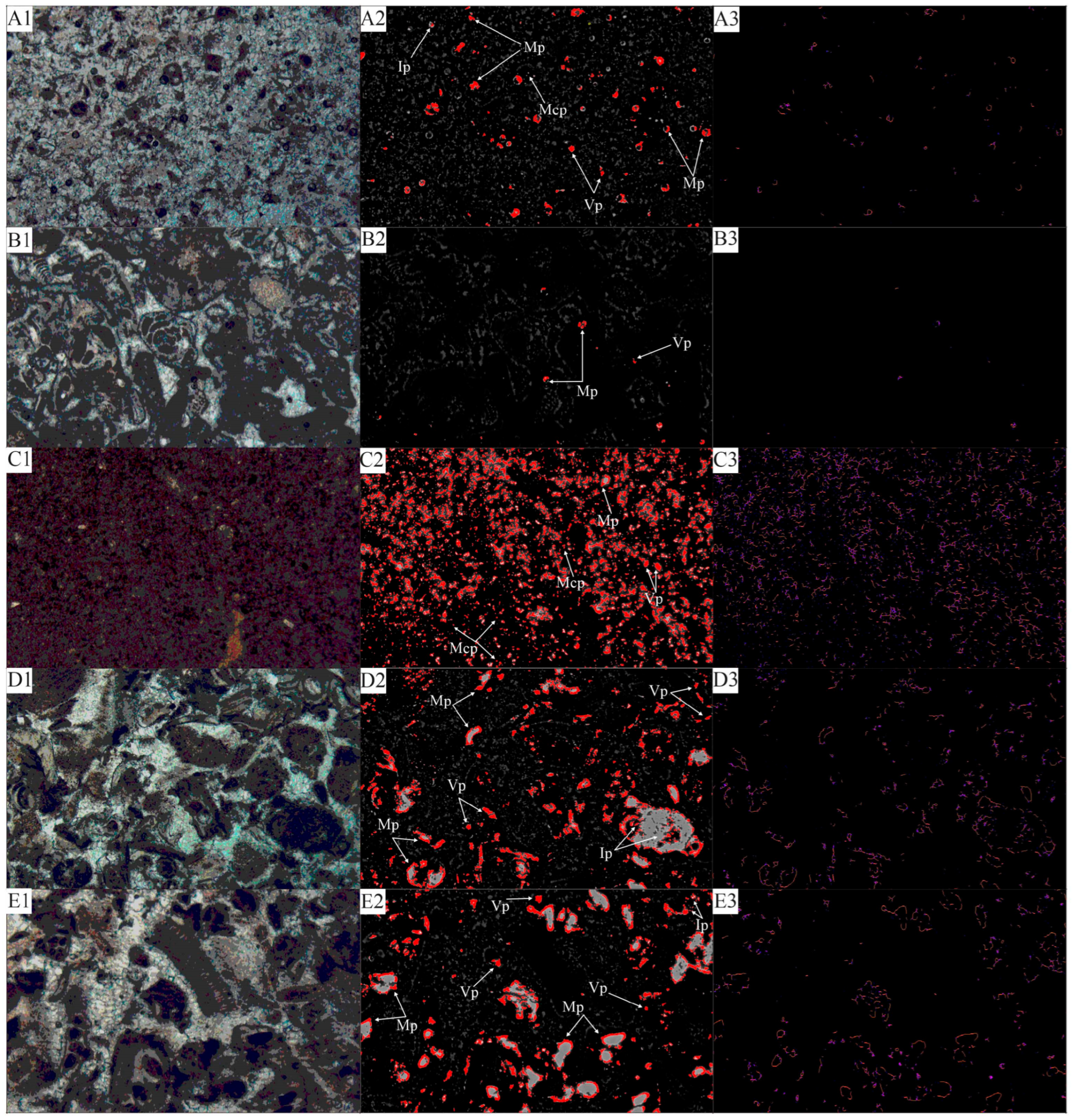
Pore space occurs as a spectrum of petrographic pore types whose relative importance differs among microfacies (Table 2). Identified pore types include micritic microporosity, interparticle pores, intraparticle and mouldic pores associated with skeletal grains, dissolution-enlarged pores, and local microfractures (Figure 12). Interparticle porosity is variably preserved in packstone to grainstone fabrics but is commonly reduced where sparry calcite cement occludes pore throats, consistent with the cement sequence documented in Section 4.6 (Figure 11B,E,F). Mud-supported WMF-3 is dominated by matrix-hosted micritic microporosity, with subordinate dissolution-related pores and rare microfractures (Figure 12C; Table 2). In contrast, grain-supported and mixed fabrics (WMF-1, WMF-2, WMF-4, and WMF-5) display a broader pore spectrum that includes skeletal intraparticle and mouldic pores, interparticle pores between grains, and locally developed dissolution-enlarged voids (Figure 12A,B,D,E; Table 2). Microfracture-related porosity is sporadic and is most evident in coarse, grain-supported WMF-4, where fractures locally intersect existing pore domains (Figure 12D; Table 2). Pressure-solution seams and stylolites are common fabrics (Section 4.6) but do not constitute open porosity at thin-section scale.

4.7.2. Image-Derived Pore-Network Metrics

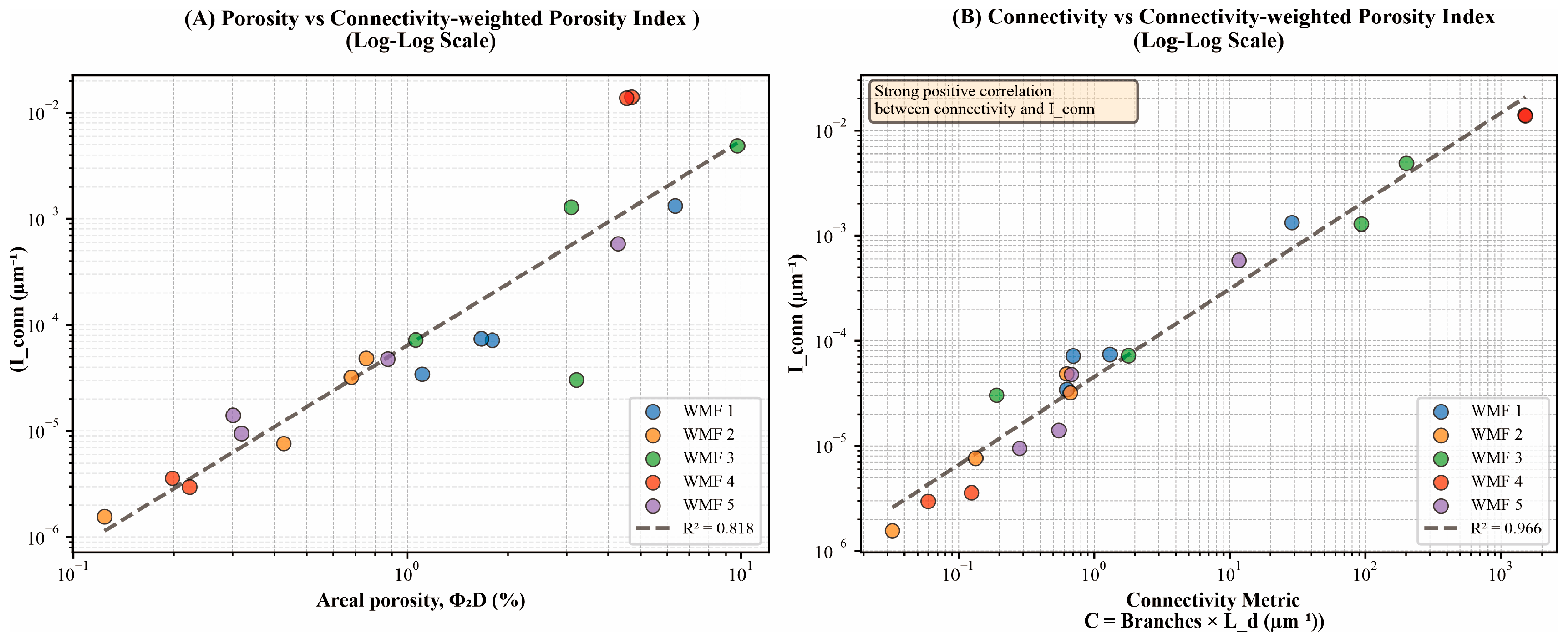
Image-derived measurements quantify microfacies-scale differences in pore connectivity and pathway continuity at thin-section scale (Figure 12; Table 3). Areal porosity ( ϕ 2 D ) spans 0.124–9.750% across analysed fields of view, with microfacies medians ranging from 0.553% (WMF-2) to 3.157% (WMF-3) (Table 3). Table 3 reports median (interquartile range) and full ranges for areal porosity ϕ 2 D , skeleton length density L d , branch number, and the connectivity-weighted porosity index I conn = ϕ 2 D L d (metric definitions in Section 3). Grain-supported WMF-2 consistently exhibits the weakest connectivity, expressed by the lowest L d and branch numbers (Figure 12(B3); Table 3), consistent with pervasive pore occlusion by sparry calcite cement (Figure 11B,E,F). In contrast, WMF-4 shows the strongest development of connected pathways, with the highest L d and branch numbers and dense, highly branched network geometries (Figure 12(D3); Table 3). WMF-5 is intermediate, with more continuous networks than WMF-2 but lower pathway density and branching than WMF-4 (Figure 12(E3); Table 3). Mud-supported WMF-3 commonly yields comparatively higher segmented ϕ 2 D , yet networks remain discontinuous (Figure 12(C3); Table 3), indicating microporosity partitioned into numerous short, weakly connected domains rather than laterally continuous pathways. Collectively, these results demonstrate that porosity magnitude alone does not predict connected pathway development, because connectivity is reduced by cement occlusion in grain-supported fabrics and by domain isolation in microporous, mud-rich fabrics (Figure 13; Table 3).

5. Discussion

5.1. Structural Framework and Shortening Constraints

This research explores the Salt Range–Potwar Plateau system, where deformation is widely regarded as thin-skinned and mechanically decoupled by a weak basal décollement associated with Precambrian evaporites [3] (Figure 1). Recent Global Navigation Satellite System (GNSS) and Interferometric Synthetic Aperture Radar (InSAR) studies provide a present-day kinematic context in which a subhorizontal salt-controlled detachment and measurable creep on the Kalabagh Fault have been inferred; in contrast, the cross-sections and balanced restoration presented here constrain admissible geometry and minimum shortening at section scale over geological timescales [8,9].
Within this regional framework, the map pattern is most consistent with foreland-vergent contraction expressed by northwest-trending fold trains, systematic forelimb steepening, and a hierarchical thrust system segmented by tear faults and supplemented locally by back-thrusting (Figure 4 and Figure 5). The partitioning into structural domains is interpreted as genuine strain localisation and displacement transfer, expressed by systematic changes in fold wavelength, fault density, limb dip, and stratigraphic repetition. This style of segmentation is compatible with documented structural and morphotectonic complexity at the western Salt Range termination and along the Kalabagh Fault Zone, where restraining geometry and segmentation are known to generate local uplift and compartmentalised deformation [8,28,41].
The serial cross-sections refine the kinematic interpretation by requiring coupled folding and thrusting above a basal detachment, rather than purely fault-driven translation of rigid panels (Figure 5). The steep internal break represented by F4, the gentler geometry of F2, the requirement for blind thrusting beneath prominent forelimb panels, and the occurrence of pop-up geometries together support a ramp-flat architecture in which ramps impose sharp dip-panel changes and promote forelimb strain localisation while adjacent panels continue to shorten by progressive folding. Where shallow forelimb faults are interpreted as out of sequence, they are treated here as a mechanically plausible outcome of evolving wedge behaviour and internal stress reorganisation, consistent with experimental Coulomb wedge results and Himalayan syntheses of out-of-sequence deformation [42,43].
Balanced restoration of cross-section A–A′ provides the quantitative anchor for this model (Figure 6). Restoration yields a minimum shortening of 1.1336 km, equivalent to approximately 18.7% shortening for the restored transect length. This estimate is robust as a minimum for the adopted geometry under bed-length conservation and admissible panel restoration. However, the detailed allocation of shortening among individual thrust strands and fold panels, as well as the depth, continuity, and linkage geometry of the basal detachment, remains non-unique without independent subsurface calibration, consistent with recent quantitative treatments of uncertainty in section balancing and restoration workflows [44]. Strain partitioning inferred from the restoration and serial sections indicates that shortening is shared between discrete thrust slip and distributed folding, with preferential localisation along forelimb corridors, tear-fault transfer zones, and local pop-up or back-thrust domains that define the principal segmentation elements used in subsequent formation-scale integration.

5.2. Wargal Ramp Stacking and Facies Organisation

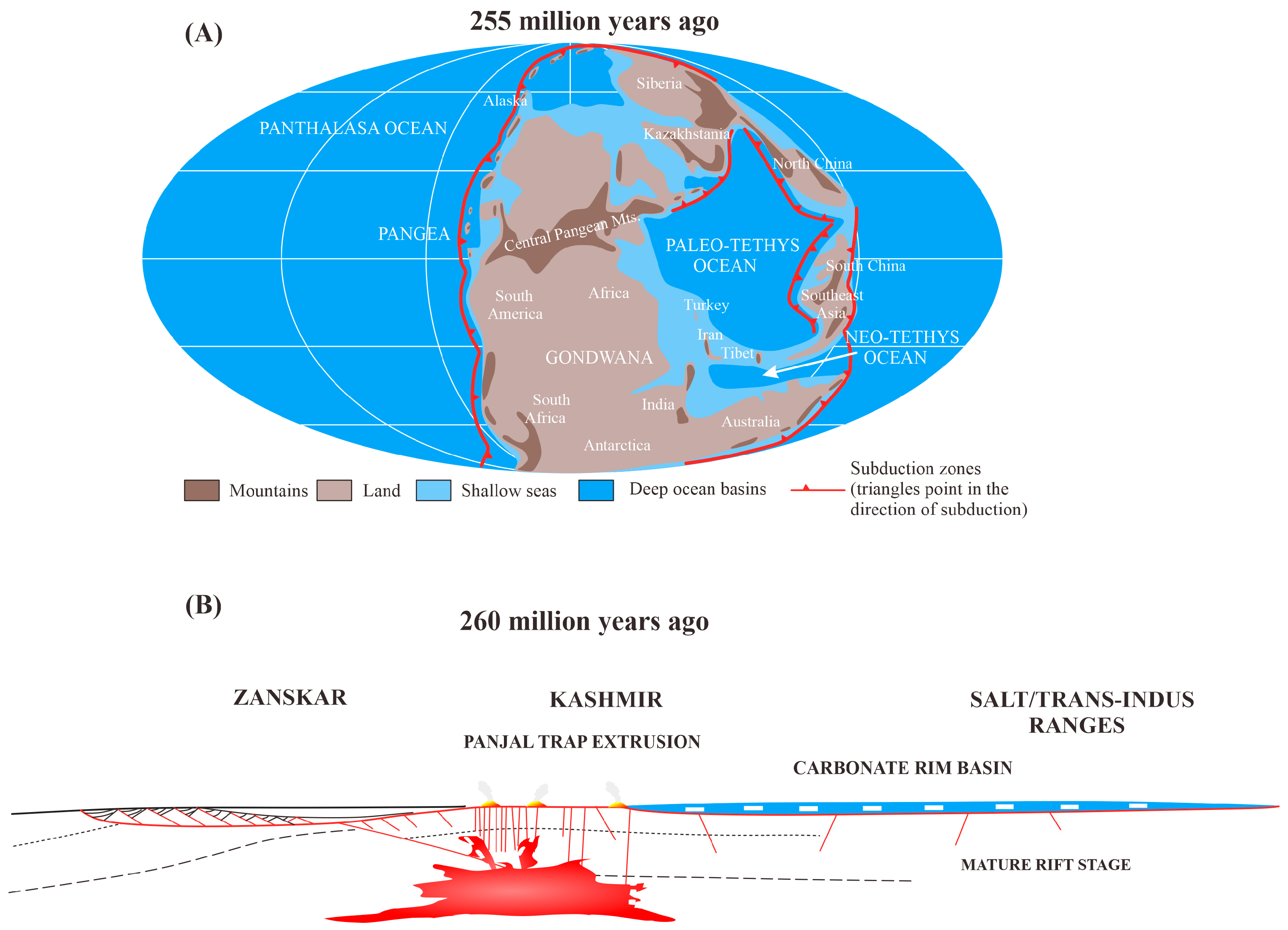
During Late Permian time, the western Salt Range occupied the northwestern Indian margin within the Paleo-Tethys realm, providing the palaeogeographic context for development of the Wargal carbonate ramp [19,45,46] (Figure 14A). The accompanying schematic rift-stage framework summarises how inherited accommodation and differential subsidence along a low-gradient shelf can promote along-strike variability in thickness and stratigraphic completeness, thereby establishing the regional boundary conditions for ramp growth prior to later Himalayan deformation [10,12] (Figure 14B).
The Wargal Formation at Chatuwala Nala records deposition on a low-gradient carbonate ramp, expressed by laterally continuous, sheet-like bedding and marker-bounded packages traceable at the outcrop scale (Figure 7 and Figure 15). In carbonate ramps, facies belts migrate across low relief in response to the coupled effects of carbonate production, hydrodynamic reworking, and accommodation, rather than being anchored to a rigid margin or reef-rimmed platform edge [10,11,12,47]. The measured section preserves a threefold packaging defined by two prominent argillaceous limestone intervals at ~21–23 m and ~98–105 m, with a minor argillaceous bedset near the top, partitioning the succession into three carbonate packages (Figure 7).
This organisation indicates alternating phases of enhanced fines retention and phases dominated by carbonate sand production and redistribution, consistent with open-ramp interiors where modest shifts in effective energy and accommodation reorganise facies-belt widths without requiring platform drowning or margin collapse [12,47,48].
The argillaceous marker intervals represent episodes of increased fines retention across the ramp interior, expressed by concentration of mud-supported WMF-3 and reduced development of thick, laterally extensive grain-supported beds (Figure 7 and Figure 9).
A parsimonious control is diminished net winnowing and export of micrite from the inner ramp, promoting preservation of mud-rich fabrics without invoking major changes in platform morphology [11,35]. In contrast, the intervening carbonate packages reflect intervals in which carbonate sand generation and reworking outpaced fines preservation, yielding expanded grain-supported facies dominated by peloidal and bioclastic grainstones (WMF-2) and locally coarse grain-supported beds with intraclasts (WMF-4), consistent with shoal to shoal-margin reworking (Figure 7 and Figure 9) [12,35]. Within this framework, WMF-3 captures protected, low-energy micrite accumulation; WMF-1 and WMF-5 represent inner-ramp domains with alternating micrite retention and episodic winnowing; WMF-2 records sustained high-energy shoal production; and WMF-4 records episodic high-energy reworking and coarse sediment concentration [10,12] (Figure 15). Published work on the Wargal Limestone in the western Salt Range similarly supports an open-ramp template and emphasises repeated reorganisation of facies associations at package scale [19,20,21]. This architecture implies dual predictability.
The argillaceous markers and package boundaries provide laterally persistent stratigraphic elements, whereas within-package alternation among WMF-1, WMF-5, WMF-2 and local WMF-4 reflects bed- to bedset-scale heterogeneity driven by shifting hydrodynamic gradients and sediment redistribution across a low-gradient profile [12,47,48] (Figure 7). Accordingly, stratigraphic packaging furnishes a robust mapping framework, while internal textures remain sensitive to local energy partitioning and reworking intensity, producing laterally variable bedset-scale mosaics characteristic of ramp interiors.
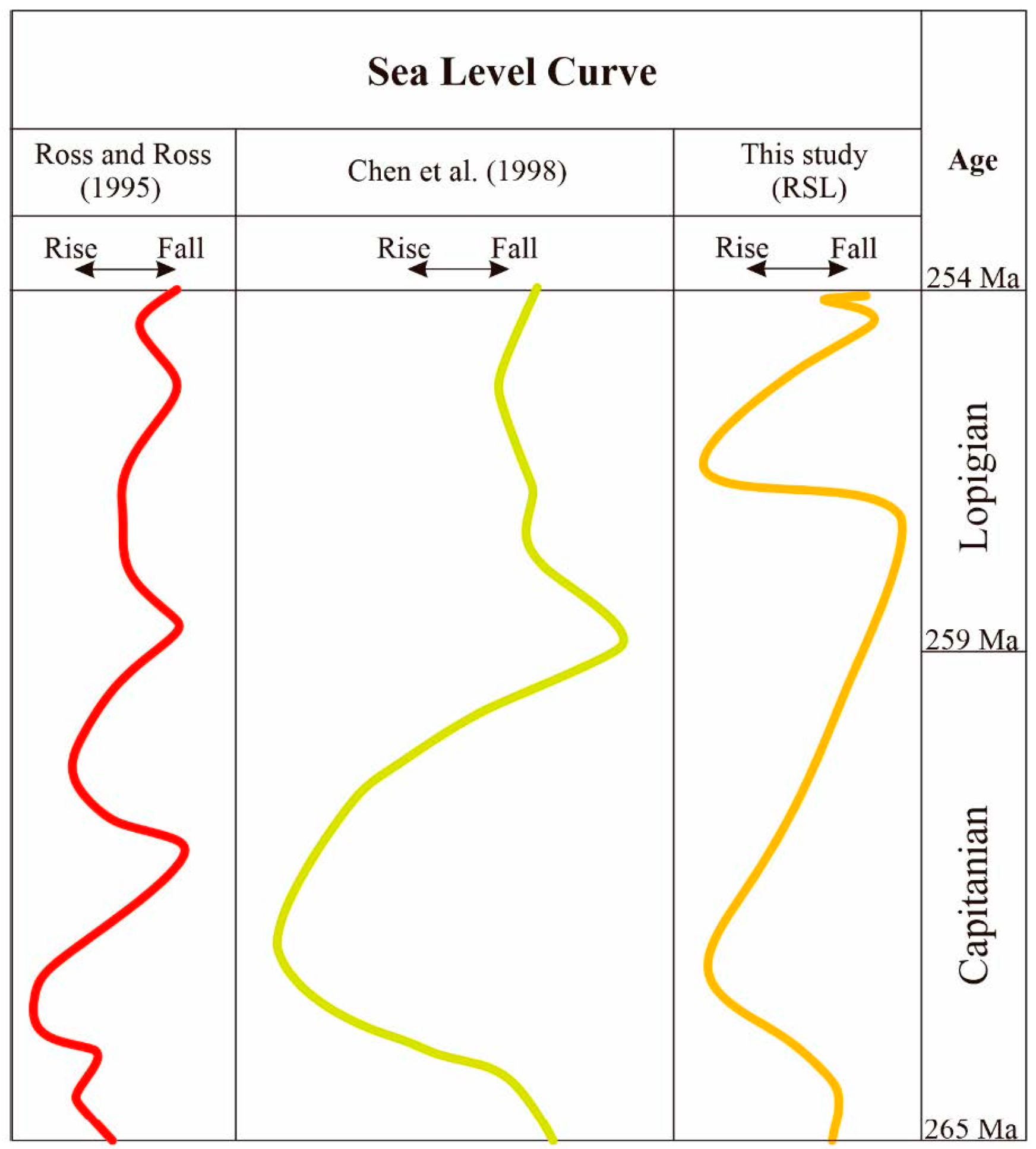
In a transgressive-regressive (T-R) framework, the same packaging can be expressed as a locally derived relative sea-level tendency curve constrained by stacking patterns and recurrence of the argillaceous intervals [49,50,51] (Figure 7 and Figure 16). The argillaceous marker intervals are treated operationally as maximum flooding zones at outcrop scale because they coincide with enhanced fines retention and reduced development of grain-rich shoal facies (Figure 7). The intervening carbonate packages dominated by WMF-1, WMF-2, WMF-4 and WMF-5 are consistent with relative shallowing tendencies expressed by more effective carbonate sand production and reworking. Maximum regressive surfaces are placed at stacking turnarounds where grain-rich facies give way to sustained upward increase in fines-rich deposits leading into the next marker interval (Figure 16). This interpretation is intentionally local and stacking-based; comparison with long-wavelength Permian eustatic syntheses is used only as context given limitations in age control, subsidence history, and curve resolution [19,52].

5.3. Diagenesis and Pore-System Controls

Diagenetic modification in the Wargal Formation is strongly facies-selective, reflecting the interaction of primary depositional texture, early pore architecture, and burial compaction [16,35]. Cross-cutting relations indicate a paragenetic sequence from early micritisation through progressive calcite cementation to mechanical compaction and bedding-parallel pressure solution, followed by spatially restricted dissolution and fracture-related modification [11,35,55] (Figure 17; Table 1).
Micritisation is most evident in micrite-retaining and mixed fabrics (WMF-1 and WMF-5), whereas grain-supported facies (WMF-2 and WMF-4) are dominated by early to burial calcite cementation that systematically occludes intergranular pores and reduces pathway continuity [15,16,35] (Figure 11B,E,F). Mud-supported WMF-3 is modified primarily by recrystallisation of the micritic matrix, acting on initially micro-porous domains rather than on an interparticle framework (Figure 11G).
Bedding-parallel stylolites truncate grains and earlier cement fabrics, demonstrating that chemical compaction post-dates at least one cement generation [35,56,57] (Figure 11D). Stylolitisation is pervasive at outcrop scale (Figure 8) but does not generate open porosity at thin-section scale (Table 2). Late porosity enhancement is limited and local: dissolution and microfracturing occur sporadically, most plausibly in coarse grain-supported fabrics (WMF-4), yet frequent calcite sealing constrains their contribution to persistent connectivity (Figure 11C).
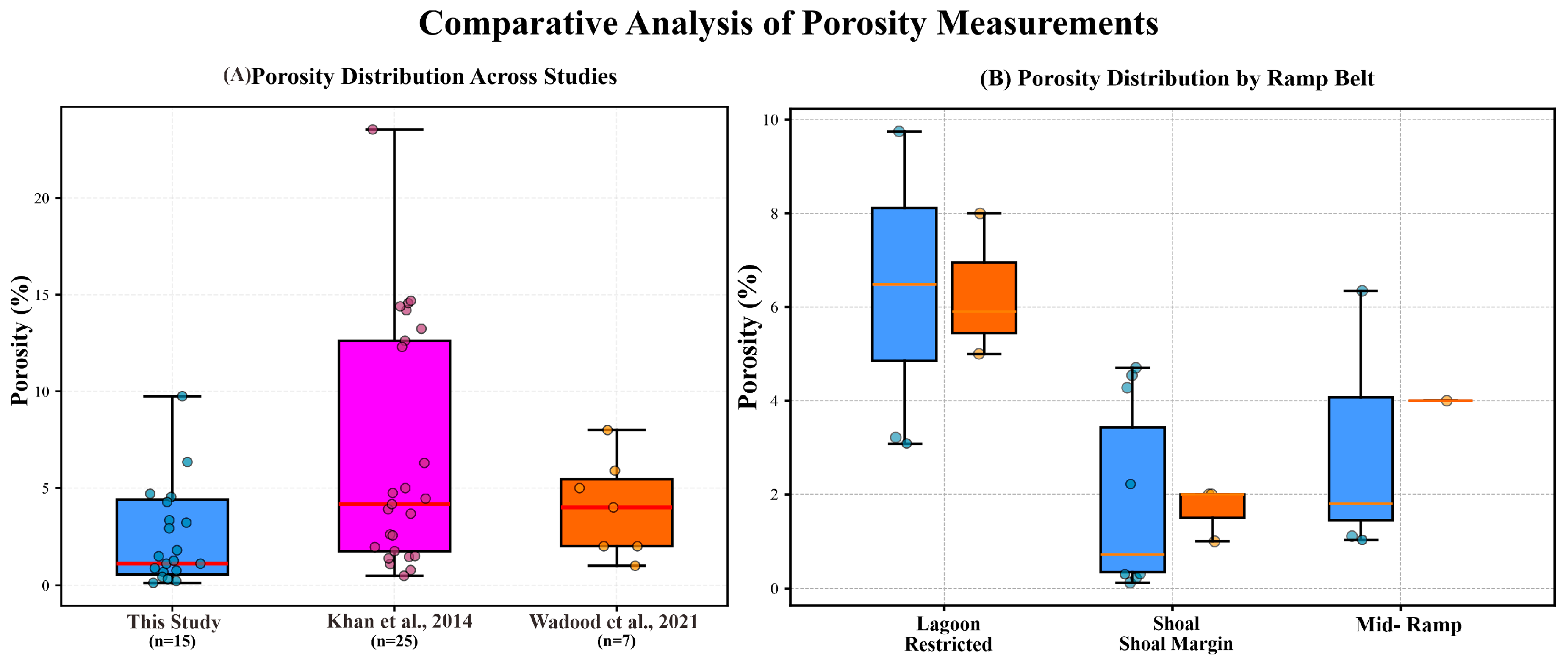
The resulting pore system exhibits a systematic decoupling between pore volume and connected pathway development, quantified by image-derived network metrics [15,18] (Figure 12 and Figure 13; Table 3). WMF-2 shows the weakest connectivity despite grain support, consistent with cement occlusion of originally intergranular pores, whereas WMF-4 exhibits the strongest pathway development, reflecting coarser primary textures and local pore-linking overprints. WMF-3 yields comparatively high segmented porosity but discontinuous networks, indicating storage-dominated microporosity with limited interconnection [16,58]. Together, these relations indicate that pore connectivity in the Wargal Formation is governed primarily by diagenetic occlusion and pore-domain organisation, providing a mechanistic basis for the inter-study porosity variability and facies-belt overlap documented in published datasets [20,22] (Figure 18).
Published porosity datasets for the Wargal Formation show substantial dispersion among studies and broad overlap among depositional belts, underscoring the scale dependence and non-uniqueness of porosity-only inference in ramp carbonates [16,20] (Figure 18A). At belt scale, reported porosity tendencies vary across lagoon-restricted, shoal to shoal-margin, and mid-ramp settings, but the observed scatter is consistent with the premise that connected pathway development is governed by pore-network organisation and facies-selective diagenesis rather than by pore volume alone [14,16] (Figure 18B). In this context, the present thin-section-scale results provide a mechanistic explanation for dispersion in porosity-based prediction, because cement occlusion in grain-supported fabrics and domain isolation in microporous mud-rich facies can suppress connectivity even where measurable porosity is retained (Figure 11, Figure 12 and Figure 13; Table 3).

5.4. Structural Segmentation and Connectivity

At the scale of the Zaluch–Chatuwala Nala transect, the structural framework defines the boundary conditions for Wargal-level traps by controlling the development of closure on the Wargal horizon, the degree of along-strike segmentation, and the juxtaposition relationships across faults [3,4,5,6,59] (Figure 4 and Figure 5). In thin-skinned fold–thrust belts, closures commonly arise from ramp-related folding and from shortening transferred into folding where thrust displacement diminishes upward [3,5,6]. However, continuity of closures is frequently disrupted by tear faults, forelimb-localised thrust splays, and local pop-up geometries [4,5,59]. In the studied section, these elements imply that closures, where present, are appropriately treated as potentially compartmentalised kinematic panels rather than laterally continuous anticlines, particularly where serial sections and map patterns indicate forelimb thrusting and strike-parallel segmentation (Figure 4 and Figure 5).
Formation-scale behaviour within the Wargal interval depends on how this segmentation interacts with stratigraphic and petrographic controls on connected pathways [14,16]. The results show systematic differences in connected-pathway development among microfacies: WMF-4 exhibits the strongest pathway development, WMF-5 is intermediate, WMF-2 is commonly connectivity-limited by cement occlusion, and WMF-3 is dominated by microporosity partitioned into short, weakly connected domains (Figure 9, Figure 12 and Figure 13; Table 3). Structural position can plausibly amplify or fail to amplify these intrinsic contrasts because brittle strain in thrust-related folds is commonly concentrated in hinge zones, steep forelimbs, and fault-adjacent damage zones where curvature and slip gradients are highest [6,27]. Under this geometry, fracture-enhanced connectivity is most plausible in hinge and ramp-adjacent panels where discontinuity density is expected to be greatest, whereas low-curvature limb panels are more likely to preserve matrix-dominated behaviour [16] (Figure 5). The principal implication is that connected pathways are most likely where favourable microfacies architecture, particularly WMF-4 and parts of WMF-5, coincides with structurally localised brittle deformation, while mud-rich WMF-3 intervals are more likely to contribute storage-dominated microporosity with limited transmissive connectivity at thin-section scale [14,16] (Figure 12 and Figure 13).
Seal integrity at the Wargal level is jointly governed by the immediate overburden and by fault-zone transmissibility [60,61]. Stratigraphically, Wargal is bounded by the Amb Formation below and the Chhidru Formation above, and both units exhibit lithologic heterogeneity in the western Salt Range [29,30,60] (Figure 2). In this context, top-seal capacity is most defensibly attributed to shale-prone intervals within the overburden where thickness, lateral continuity, and fracture state are favourable, whereas carbonate- and sandstone-rich intervals are less predictably sealing [60]. Faults introduce an additional uncertainty because thrusts and associated damage zones may either enhance containment through favourable juxtaposition against sealing lithologies or promote leakage where connected fracture networks and transmissive fault rocks develop [61]. Seal behaviour is therefore best treated as an evaluable property controlled by juxtaposition and fault-rock character, rather than assumed a priori from fault presence alone [61] (Figure 4 and Figure 5).
Integrating the structural and petrophysical constraints identified in this research provides a testable framework for evaluating Wargal reservoir prospectivity. Prospectivity is maximised where closure on the Wargal horizon can be demonstrated and remains intact across the spillpoint, where segmentation elements identified in the map and sections are treated explicitly as compartment boundaries and where shale-prone intervals in the overburden provide effective top seal across the crest [5,61] (Figure 4 and Figure 5). Within such closures, the most credible connected-pathway domains are those combining favourable microfacies architecture with structurally enhanced fracture potential in hinge and fault-adjacent panels, whereas cement-occluded grainstones and microporous mud-rich intervals are expected to be connectivity-limited despite locally elevated pore volume [14,16] (Figure 12 and Figure 13). Finally, charge timing and migration relative to deformation remain external constraints that require independent evaluation; the framework developed here therefore defines the geometric and petrophysical boundary conditions against which petroleum system elements can be tested [60,61] (Figure 6).

6. Conclusions

The structural transect defines a thin-skinned, detachment-controlled fold–thrust system in which NW-trending, SW-vergent folds are segmented by thrust and tear faults; balanced restoration yields 1.1336 km of minimum shortening (18.7%) and indicates shortening shared between thrust slip and distributed folding. The Wargal Formation at Chatuwala Nala is a ~130 m carbonate-ramp succession partitioned into three packages by laterally persistent argillaceous marker intervals (~21–23 m and ~98–105 m) and characterised by systematic microfacies stacking. Diagenesis is strongly facies-selective, with cement occlusion dominating grain-supported facies and matrix modification prevalent in mud-supported intervals, so that pore volume and connected pathway development diverge. Image-derived pore-network metrics confirm this decoupling; segmented areal porosity spans 0.124–9.750%, yet connectivity is highest in coarse grain-supported WMF-4, intermediate in WMF-5, commonly reduced in cemented WMF-2, and weak in microporous WMF-3. These coupled structural and petrographic constraints imply that Wargal-level prospects, where present, are conditioned by fault-related segmentation and by facies-dependent connectivity rather than by porosity magnitude alone.

Author Contributions

Conceptualisation, B.A. and H.T.; methodology, B.A., H.T. and S.B.; software, B.A.; validation, H.T., S.B. and M.Y.J.B.; formal analysis, B.A. and S.B.; investigation, B.A., S.B. and M.Y.J.B.; resources, H.T.; data curation, B.A. and M.Y.J.B.; writing—original draft preparation, B.A.; writing—review and editing, H.T., S.B. and M.Y.J.B.; visualisation, B.A. and S.B.; supervision, H.T.; project administration, H.T.; funding acquisition, H.T. All authors have read and agreed to the published version of the manuscript.

Funding

This study was supported by the National Key R&D Program of China (grant No. 2019YFC0605402) and by the Key Research and Development Program of Jilin Province (20230203107SF).

Data Availability Statement

The original contributions presented in this study are included in the article. Further inquiries can be directed to the corresponding author.

Acknowledgments

We are grateful to Muhammad Haneef for his valuable guidance and sustained support throughout this research. We also thank the reviewers and Academic Editor for constructive comments that improved the clarity and presentation of the manuscript.

Conflicts of Interest

The authors declare no conflicts of interest.

Abbreviations

The following abbreviations are used in this manuscript:
2Dtwo-dimensional
AAbbottabad (map label)
ACRAttock Cherat Range
Brbryozoan debris
Bsbrachiopod spine
Bvbivalves
CBCampbellpore Basin
Crcrinoid ossicles
Dadasycladacean algae
Ecechinoderm fragments
Fbfenestrate bryozoans
Fbrfibrous brachiopod shell fragments
Frforaminifera (allochem label)
Frafracture (diagenetic-fabric label)
GNSSGlobal Navigation Satellite System
GRGandgar Range
Iconnconnectivity-weighted porosity index
Icintraclasts
ImageJimage-analysis software (used via Fiji)
InSAR Interferometric Synthetic Aperture Radar
IQRinterquartile range
KCRKala Chitta Range
KHKherimar Hills
Ldskeleton length density (total skeleton length normalised by field-of-view area)
MFZmaximum flooding zone(s)
Mfmiliolid foraminifera
MHMargalla Hills
MLmachine learning (Trainable Weka Segmentation)
MRSmaximum regressive surface(s)
NTNathiagali Thrust
Pdpeloids
RSLrelative sea level
Scspar (sparry calcite) cement
SMFStandard Microfacies
Sosyntaxial overgrowth
Ststylolites
T–Rtransgressive to regressive (framework)
WMF-1peloidal bioclastic packstone
WMF-2peloidal bioclastic grainstone
WMF-3microbioclastic mudstone to wackestone
WMF-4grainstone to rudstone
WMF-5packstone to grainstone
ϕ2Dareal porosity measured on segmented binary pore masks (reported as %)

References

  1. Yeats, R.; Lawrence, R. Tectonics of the Himalayan thrust belt in northern Pakistan. In Proceedings of the US-Pakistan Workshop on Marine Sciences in Pakistan, Karachi, Pakistan, 11–16 November 1982. [Google Scholar]
  2. Lillie, R.J.; Johnson, G.D.; Yousuf, M.; Zamin, A.S.H.; Yeats, R.S. Structural Development Within the Himalayan Foreland Fold-and-Thrust Belt of Pakistan. 1987. Available online: https://archives.datapages.com/data/cspg_sp/data/012/012001/379_cspgsp0120379.htm (accessed on 25 January 2026).
  3. Jaumé, S.C.; Lillie, R.J. Mechanics of the Salt Range-Potwar Plateau, Pakistan: A fold-and-thrust belt underlain by evaporites. Tectonics 1988, 7, 57–71. [Google Scholar] [CrossRef]
  4. McDougall, J.W.; Khan, S.H. Strike-slip faulting in a foreland fold-thrust belt: The Kalabagh Fault and Western Salt Range, Pakistan. Tectonics 1990, 9, 1061–1075. [Google Scholar] [CrossRef]
  5. Grelaud, S.; Sassi, W.; de Lamotte, D.F.; Jaswal, T.; Roure, F. Kinematics of eastern Salt Range and South Potwar basin (Pakistan): A new scenario. Mar. Pet. Geol. 2002, 19, 1127–1139. [Google Scholar] [CrossRef]
  6. Baker, D.M.; Lillie, R.J.; Yeats, R.S.; Johnson, G.D.; Yousuf, M.; Zamin, A.S.H. Development of the Himalayan frontal thrust zone: Salt Range, Pakistan. Geology 1988, 16, 3–7. [Google Scholar] [CrossRef]
  7. Gee, E. Overview of the Geology and Structure of the Salt Range, with Observations on Related Areas of Northern Pakistan; The Geological Society of America: Boulder, CO, USA, 1989. [Google Scholar]
  8. Zafar, W.A.; Javed, F.; Ahmed, R.; Ehsan, M.; Abdelrahman, K.; Fnais, M.S.; Qureshi, M.A. Mechanics of the Kalabagh Fault, northwest Himalayan fold and thrust belt (convergence zone of India and Eurasia), using SAR interferometry and CFS. Front. Earth Sci. 2023, 11, 1231408. [Google Scholar] [CrossRef]
  9. Meyer, P.; Jouanne, F.; Doin, M.-P.; Ahmed, A.; Awan, A.A.; Mugnier, J.-L. Present-day quantification of seismic coupling along the décollement level beneath the Potwar Plateau region in Pakistan western Himalaya. Earth Planet. Sci. Lett. 2024, 637, 118723. [Google Scholar] [CrossRef]
  10. Read, J.F. Carbonate platform facies models. AAPG Bull. 1985, 69, 1–21. [Google Scholar] [CrossRef]
  11. Tucker, M.E.; Wright, V.P. Carbonate Sedimentology; John Wiley & Sons: Hoboken, NJ, USA, 1990. [Google Scholar]
  12. Burchette, T.P.; Wright, V.P. Carbonate ramp depositional systems. Sediment. Geol. 1992, 79, 3–57. [Google Scholar] [CrossRef]
  13. Pomar, L. Types of carbonate platforms: A genetic approach. Basin Res. 2001, 13, 313–334. [Google Scholar] [CrossRef]
  14. Choquette, P.W.; Pray, L.C. Geologic nomenclature and classification of porosity in sedimentary carbonates. AAPG Bull. 1970, 54, 207–250. [Google Scholar] [CrossRef]
  15. Ehrenberg, S.; Eberli, G.; Keramati, M.; Moallemi, S. Porosity-permeability relationships in interlayered limestone-dolostone reservoirs. AAPG Bull. 2006, 90, 91–114. [Google Scholar] [CrossRef]
  16. Lucia, F.J. Carbonate Reservoir Characterization: An Integrated Approach; Springer Science & Business Media: Berlin/Heidelberg, Germany, 2007. [Google Scholar]
  17. Arganda-Carreras, I.; Kaynig, V.; Rueden, C.; Eliceiri, K.W.; Schindelin, J.; Cardona, A.; Sebastian Seung, H. Trainable Weka Segmentation: A machine learning tool for microscopy pixel classification. Bioinformatics 2017, 33, 2424–2426. [Google Scholar] [CrossRef]
  18. Koeshidayatullah, A.; Morsilli, M.; Lehrmann, D.J.; Al-Ramadan, K.; Payne, J.L. Fully automated carbonate petrography using deep convolutional neural networks. Mar. Pet. Geol. 2020, 122, 104687. [Google Scholar] [CrossRef]
  19. Mertmann, D. Evolution of the marine Permian carbonate platform in the Salt Range (Pakistan). Palaeogeogr. Palaeoclimatol. Palaeoecol. 2003, 191, 373–384. [Google Scholar] [CrossRef]
  20. Wadood, B.; Khan, S.; Li, H.; Ali, N. The Late Permian clastic–dominated carbonate shelf, Northwestern Pakistan: Implications for palaeoenvironments, palaeoclimate, and reservoir modelling. Geol. J. 2021, 56, 4947–4975. [Google Scholar] [CrossRef]
  21. Riaz, M.; Ghazi, S.; Waqas, M. Sedimentology and Sequence Stratigraphy of the Late Permian Wargal Limestone: Implication for Reservoir Potential in the Salt Range, Pakistan. J. Geol. Soc. India 2024, 100, 887–900. [Google Scholar] [CrossRef]
  22. Khan, S.; Ahmad, S.; Hanif, M.; Jan, I.U.; Swati, M.A.F.; Khan, S.; Saboor, A. Lithofacies, paleoenvironments and sequence stratigraphic modelling of the Wargal Limestone: Implication for reservoir characterization in the Salt Range, northwest, Pakistan. J. Himal. Earth Sci. 2014, 47, 41–60. [Google Scholar]
  23. Hylland, M.D.; Riaz, M.; Ahmad, S. Stratigraphy and structure of the southern Gandghar range, Pakistan. J. Himal. Earth Sci. 1988, 21, 1–14. [Google Scholar]
  24. Iqbal, M.; Baig, T.; Khan, M.R. Petroleum potential of Kalachitta-Margala hills range and adjoining Peshawar-Hazara basin, Pakistan. In Proceedings of the SPE-PAPG Annual Technical Conference, Islamabad, Pakistan, 27–28 March 2007; pp. 121–128. [Google Scholar]
  25. Jan, I.U.; Stephenson, M.H. Palynology and correlation of the Upper Pennsylvanian Tobra Formation from Zaluch Nala, Salt Range, Pakistan. Palynology 2011, 35, 212–225. [Google Scholar] [CrossRef]
  26. Gansser, A. The geodynamic history of the Himalaya. Zagros Hindu Kush Himalaya Geodyn. Evol. 1981, 3, 111–121. [Google Scholar]
  27. Butler, R.W.; Coward, M.P.; Harwood, G.M.; Knipe, R.J. Salt control on thrust geometry, structural style and gravitational collapse along the Himalayan mountain front in the Salt Range of northern Pakistan. Dyn. Geol. Salt Relat. Struct. 1987, 399, 339–418. [Google Scholar]
  28. Sajjad, A.; Irshad, A.; Irfan, K. Structure and stratigraphy of the Paleozoic and Mesozoic sequence in the vicinity of Zaluch Nala, Western Salt Range, Punjab Pakistan. Pak. J. Hydrocarb. Res. 2005, 15, 1–8. [Google Scholar]
  29. Shah, S. Stratigraphy of Pakistan, Memoir 22; Geological Survey of Pakistan: Quetta, Pakistan, 2009. [Google Scholar]
  30. Fatmi, A.N. Lithostratigraphic Units of the Kohat-Potwar Province, Indus Basin, Pakistan. Mem. Geol. Surv. Pak. 1974, 10, 1–80. [Google Scholar]
  31. Wardlaw, B.; Mei, S.; Yin, H.; Tong, J. Refined conodont biostratigraphy of the Permian and lowest Triassic of the Salt and Khisor Ranges, Pakistan. In Proceedings of the Proceedings International Conference Pangea and Paleozoic–Mesozoic Transition, Wuhan, China, 9–11 March 1999; pp. 154–156. [Google Scholar]
  32. Ghazi, S.; Ali, S.H.; Sahraeyan, M.; Hanif, T. An overview of tectonosedimentary framework of the Salt Range, northwestern Himalayan fold and thrust belt, Pakistan. Arab. J. Geosci. 2015, 8, 1635–1651. [Google Scholar] [CrossRef]
  33. Shah, S.; Ahmed, R.; Cheema, M.; Fatmi, A.; Iqbal, M.; Raza, H.; Raza, S. Stratigraphy of Pakistan: Geological survey of Pakistan. Memoir 1977, 12, 56–98. [Google Scholar]
  34. Wilson, J.L. Carbonate Facies in Geologic History; Springer Science & Business Media: Berlin/Heidelberg, Germany, 1975. [Google Scholar]
  35. Flügel, E. Microfacies data: Fabrics. In Microfacies of Carbonate Rocks: Analysis, Interpretation and Application; Springer: Berlin/Heidelberg, Germany, 2004; pp. 177–242. [Google Scholar]
  36. Folk, R.L. The Natural History of Crystalline Calcium Carbonate: Effect of Magnesium Content and Salinity1; American Association of Petroleum Geologists: Tulsa, OK, USA, 1979. [Google Scholar]
  37. Heckel, P.H. Diagenetic model for carbonate rocks in Midcontinent Pennsylvanian eustatic cyclothems. J. Sediment. Res. 1983, 53, 733–759. [Google Scholar] [CrossRef]
  38. Badiozamani, K. The dorag dolomitization model, application to the middle Ordovician of Wisconsin. J. Sediment. Res. 1973, 43, 965–984. [Google Scholar] [CrossRef]
  39. Land, L.S. The origin of massive dolomite. J. Geol. Educ. 1985, 33, 112–125. [Google Scholar] [CrossRef]
  40. Hardie, L.A. Dolomitization; a critical view of some current views. J. Sediment. Res. 1987, 57, 166–183. [Google Scholar] [CrossRef]
  41. Abbas, W.; Ali, S.; Reicherter, K. Seismicity and landform development of the dextral Kalabagh Fault Zone, Pakistan: Implications from morphotectonics and paleoseismology. Tectonophysics 2022, 822, 229182. [Google Scholar] [CrossRef]
  42. Mukherjee, S. A Review on Out-of-Sequence Deformation in the Himalaya; Geological Society of London: London, UK, 2015. [Google Scholar]
  43. Callot, J.P.; Guichong, W.; Moretti, I.; Yongxing, G.; Letouzey, J.; Wu, S. Structural Style of a Compressive Wedge with Salt and Coal Shale Decollement Levels: Analogue and Seismic Modelling of the Kuqa Thrust Belt (North Tarim, China). In Proceedings of the European Geosciences Union General Assembly Conference, Vienna, Austria, 7–12 April 2013; Volume 15. Available online: https://www.academia.edu/23730876/Structural_style_of_a_compressive_wedge_with_salt_and_coal_shale_decollement_levels_Analogue_and_seismic_modelling_of_the_Kuqa_Thrust_Belt_North_Tarim_China_ (accessed on 25 January 2026).
  44. Witte, J.; Oncken, O. Uncertainty quantification in section-balancing using Pseudo-3D forward modeling–Example of the Malargüe Anticline, Argentina. J. Struct. Geol. 2020, 141, 104189. [Google Scholar] [CrossRef]
  45. Scotese, C.R.; Langford, R. Pangea and the paleogeography of the Permian. In The Permian of Northern Pangea: Volume 1: Paleogeography, Paleoclimates, Stratigraphy; Springer: Berlin/Heidelberg, Germany, 1995; pp. 3–19. [Google Scholar]
  46. Stampfli, G.; Marcoux, J.; Baud, A. Tethyan margins in space and time. Palaeogeogr. Palaeoclimatol. Palaeoecol. 1991, 87, 373–409. [Google Scholar] [CrossRef]
  47. Neal, T.C.; Appendini, C.M.; Rankey, E.C. Hydrodynamic influences on sedimentology and geomorphology of nearshore parts of carbonate ramps: Holocene, NE Yucatán Shelf, Mexico. J. Sediment. Res. 2021, 91, 1040–1066. [Google Scholar] [CrossRef]
  48. Sequero, C.; Aurell, M.; Badenas, B. Sedimentary evolution of a shallow carbonate ramp (Kimmeridgian, NE Spain): Unravelling controlling factors for facies heterogeneities at reservoir scale. Mar. Pet. Geol. 2019, 109, 145–174. [Google Scholar] [CrossRef]
  49. Catuneanu, O.; Abreu, V.; Bhattacharya, J.; Blum, M.; Dalrymple, R.; Eriksson, P.; Fielding, C.R.; Fisher, W.; Galloway, W.; Gibling, M. Towards the standardization of sequence stratigraphy. Earth-Sci. Rev. 2009, 92, 1–33. [Google Scholar] [CrossRef]
  50. Catuneanu, O. Model-independent sequence stratigraphy. Earth-Sci. Rev. 2019, 188, 312–388. [Google Scholar] [CrossRef]
  51. Embry, A.F.; Johannessen, E.P. Two approaches to sequence stratigraphy. In Stratigraphy & Timescales; Elsevier: Amsterdam, The Netherlands, 2017; Volume 2, pp. 85–118. [Google Scholar]
  52. Ross, C.A.; Ross, J.R. Foraminiferal zonation of late Paleozoic depositional sequences. Mar. Micropaleontol. 1995, 26, 469–478. [Google Scholar] [CrossRef]
  53. Chen, Z.; Jin, Y.; Shi, G. Permian transgression-regression sequences and sea-level changes of South China. Proc. R. Soc. Vic. 1998, 110, 345–367. [Google Scholar]
  54. Gradstein, F.M.; Ogg, J.G.; Smith, A.G.; Bleeker, W.; Lourens, L.J. A new geologic time scale, with special reference to Precambrian and Neogene. Epis. J. Int. Geosci. 2004, 27, 83–100. [Google Scholar] [CrossRef]
  55. Moore, C.H.; Wade, W.J. Carbonate diagenesis: Introduction and tools. In Developments in Sedimentology; Elsevier: Amsterdam, The Netherlands, 2013; Volume 67, pp. 67–89. [Google Scholar]
  56. Gomez-Rivas, E.; Martín-Martín, J.D.; Bons, P.D.; Koehn, D.; Griera, A.; Travé, A.; Llorens, M.-G.; Humphrey, E.; Neilson, J. Stylolites and stylolite networks as primary controls on the geometry and distribution of carbonate diagenetic alterations. Mar. Pet. Geol. 2022, 136, 105444. [Google Scholar] [CrossRef]
  57. Todaro, S.; Manniello, C.; Pietragalla, A.; Preto, N.; Agosta, F. Depositional Setting, Diagenetic Processes, and Pressure Solution-Assisted Compaction of Mesozoic Platform Carbonates, Southern Apennines, Italy. Geosciences 2024, 14, 89. [Google Scholar] [CrossRef]
  58. Sulieman, H.; Jouini, M.S.; Alsuwaidi, M.; Al-Shalabi, E.W.; Al Jallad, O.A. Multiscale investigation of pore structure heterogeneity in carbonate rocks using digital imaging and SCAL measurements: A case study from Upper Jurassic limestones, Abu Dhabi, UAE. PLoS ONE 2024, 19, e0295192. [Google Scholar] [CrossRef] [PubMed]
  59. Jaswal, T.M.; Lillie, R.J.; Lawrence, R.D. Structure and evolution of the northern Potwar deformed zone, Pakistan. AAPG Bull. 1997, 81, 308–328. [Google Scholar] [CrossRef]
  60. Kadri, I.B. Petroleum Geology of Pakistan; Pakistan Petroleum Limited: Karachi, Pakistan, 1995. [Google Scholar]
  61. Ogilvie, S.R.; Dee, S.J.; Wilson, R.W.; Bailey, W.R. Integrated Fault Seal Analysis: An Introduction; The Geological Society of London: London, UK, 2020. [Google Scholar]
Figure 2. Generalised stratigraphic framework of the Salt Range, adapted from [32]. Reported thicknesses represent maximum values compiled from [33]. The stratigraphic column is schematic and not to scale.
Jmse 14 00652 g002
Figure 3. Image analysis workflow for pore quantification in Fiji using Trainable Weka Segmentation (ML), the red arrows are showing pores as written on the figures.
Jmse 14 00652 g003
Figure 4. Geological map of the Zaluch Nala–Chatuwala Nala area, western Salt Range, Pakistan, showing the distribution of stratigraphic units and major structures modified after [7,28].
Jmse 14 00652 g004
Figure 5. Geological cross-sections along lines (i) A–A’, (ii) B–B’, and (iii) C–C’ (see Figure 4 for locations). Sections show structural geometry and stratigraphic relationships across the study area.
Jmse 14 00652 g005
Figure 6. Balanced restored cross-section A–A′, western Salt Range, Pakistan, showing the restored stratigraphic configuration after sequential removal of thrust displacement and flexural-slip unfolding under a plane-strain approximation. Dashed fault traces are shown for kinematic reference.
Jmse 14 00652 g006
Figure 7. Stratigraphic log of the Wargal Formation at Chatuwala Nala showing lithology and bed thickness, key sedimentary features and fossil content, microfacies distribution, inferred depositional settings, and tract-scale stacking patterns.
Jmse 14 00652 g007
Figure 8. Field expression, bedding architecture, and fossil fabrics of the Wargal Formation at Chatuwala Nala, western Salt Range, Pakistan. (A) Regional outcrop view looking southeast; red line marks the measured stratigraphic section, and approximate positions of panels (BG) are indicated. (B) Section, viewed toward the northeast, showing tabular thin- to medium-bedded limestone (10–30 cm) with bedding-parallel stylolites and honeycombed weathering; hammer for scale. (C) Bioclastic grainstone, viewed toward the northeast, containing Gs with geopetal infill, recording early cavity filling and post-depositional cementation. (D) Weathered bedding-plane surface, viewed toward the northeast, showing spar-replaced Gs, Cr, stylolites, and S-cemented framework. (E) Pitted limestone surface, viewed toward the northeast, produced by chemical weathering; Dp indicated. (F) Wargal Limestone showing bedding-parallel, high-amplitude stylolites. (G) Thin- to medium-bedded limestone, viewed toward the northeast, showing subhorizontal tabular beds, recessive bedding-plane partings, Dp, and pervasive J. Abbreviations: Bc, bioclasts; Cr, crinoid plates and ossicles; Dp, dissolution pit; Gs, gastropods; J, joint; S, spar calcite.
Jmse 14 00652 g008
Figure 9. Representative thin-section photomicrographs from the Wargal Formation showing allochem assemblages and textures diagnostic of WMF-1 to WMF-5. (A,B) WMF-1 with abundant Pd and common Da, Bv and Cr. (CE) WMF-2 dominated by Pd with Mf, Fr, Da, Ec and Br (including Fb); intergranular pores are commonly occluded by Sc, and Bs occurs locally. (F) WMF-3 with micritic matrix and dispersed Fr. (G,H) WMF-4 characterised by Ic with subordinate Pd and Fr, locally with Fb. (I) WMF-5 with Pd accompanied by Fbr and Fb. Abbreviations: Br, bryozoan debris; Bs, brachiopod spine; Bv, bivalves; Cr, crinoid ossicles; Da, dasycladacean algae; Ec, echinoderm fragments; Fb, fenestrate bryozoans; Fbr, fibrous brachiopod shell fragments; Fr, foraminifera; Ic, intraclasts; Mf, miliolid foraminifera; Pd, peloids; Sc, sparry calcite cement.
Jmse 14 00652 g009
Figure 10. Integrated synthesis of Wargal microfacies at Chatuwala Nala. (a) Bar chart showing the stratigraphic thickness and relative proportion of each microfacies (WMF-1 to WMF-5) within the measured section. (b) Stacked bar chart showing the normalised modal solid-phase composition of each microfacies, including bioclasts, peloids, intraclasts, lime mud, and cement, with pore space excluded. (c) Heat map showing the qualitative abundance of principal fossil groups across microfacies, where white = none/not reported, light = rare, medium = present, and dark = common. WMF-2 (peloidal bioclastic grainstone).
Jmse 14 00652 g010
Figure 11. Diagenetic fabrics and cement stratigraphy of the Wargal Formation, integrating thin-section petrography with outcrop-scale replacement features. (A) Micritised grains forming abundant Pd, recording early micritisation and pervasive grain alteration. (B) Coarse Sc occluding interparticle pores. (C) Hairline Fra related to compactional deformation and later cement sealing. (D) Bedding-parallel St indicating pressure solution during burial compaction. (E) So on echinoderm fragments, reflecting optically continuous calcite precipitation. (F) Poikilotopic calcite cement forming large crystals that enclose multiple grains, consistent with advanced burial cementation. (G) Neomorphic recrystallisation expressed by replacement of fine micrite by a coarser calcite mosaic (white arrows). (H) Replacive dolomite with iron-oxide staining. (I) Outcrop view of chert replacement within limestone. Abbreviations: Fra, fracture; Pd, peloids; Sc, sparry calcite cement; So, syntaxial overgrowth; St, stylolites.
Jmse 14 00652 g011
Figure 12. Pore-network characterisation across five Wargal carbonate microfacies. For each representative thin-section field, the image-analysis workflow comprises grayscale conversion of the petrographic image (A1E1), supervised segmentation of pore space highlighted in red (A2E2), and skeletonisation of the connected pore network for quantitative network analysis (A3E3). Panels A–E correspond to WMF-1, WMF-2, WMF-3, WMF-4, and WMF-5, respectively. The segmented pore system comprises interparticle pores, intraparticle pores (Ip), matrix-hosted microporosity (Mcp), dissolution-generated mouldic pores (Mp), and locally developed vuggy pores (Vp). Differences in pore-network continuity among microfacies are expressed by variations in the density, branching, and connectivity of the extracted skeletons.
Jmse 14 00652 g012
Figure 13. Cross-plots showing how pore volume and network geometry structure two-dimensional pathway development across Wargal microfacies. (A) ϕ2D versus Iconn. (B) Skeleton-derived connectivity (branches × Ld) versus Iconn. Iconn = ϕ2D × Ld (ϕ2D as fraction, 0–1; Ld in µm−1); Iconn (µm−1) is a comparative pathway descriptor, not an estimate of absolute permeability.
Jmse 14 00652 g013
Figure 14. Permian palaeogeographic and rift framework for the Wargal platform. (A), Palaeogeographic reconstruction at ~255 Ma showing the northwestern Indian margin in the Paleo-Tethys to Neo-Tethys realm (modified after [45]). (B), Schematic rift-stage cross-section at ~260 Ma illustrating rift-related subsidence and carbonate rim-basin development in the Salt-Trans-Indus region, providing the geodynamic context for Wargal platform growth and thickness variability (modified after [46]). Red is showing magma and lines are showing fault structures.
Jmse 14 00652 g014
Figure 15. Conceptual carbonate ramp facies-belt model for the Wargal Formation, illustrating inferred depositional environments and associated microfacies (WMF-1 to WMF-5) across the ramp interior.
Jmse 14 00652 g015
Figure 16. Relative sea-level (RSL) reconstruction for the Wargal platform, derived from facies stacking and depositional interpretations in the studied section and compared with global eustatic curves of [52,53]. Sequence-stratigraphic interpretation follows a T-R framework, with chronostratigraphic calibration from [54] as applied to the Salt Range by [19].
Jmse 14 00652 g016
Figure 17. Paragenetic evolution and diagenetic architecture of the Wargal Formation carbonates. (A) Schematic paragenetic sequence from deposition through eogenesis, mesogenesis and telogenesis, referenced to progressive burial stages. (B) Relative distribution and intensity of diagenetic features across WMF-1 to WMF-5, highlighting facies selectivity and burial overprint. (C) Conceptual burial-diagenetic framework relating diagenetic environments to relative burial-depth domains; depths are schematic and not basin-calibrated.
Jmse 14 00652 g017
Figure 18. Porosity variability within the Wargal Formation across datasets and ramp belts. (A) Dataset-level porosity distributions illustrating inter-study dispersion and skewness [20,22]. (B) Belt-scale porosity patterns across lagoon-restricted, shoal to shoal-margin, and mid-ramp settings.
Jmse 14 00652 g018
Table 1. Diagenetic inventory and inferred timing of Wargal Formation, Chatuwala Nala, western Salt Range, Pakistan.
Diagenetic FeaturePetrographic/Field EvidenceDistribution (Microfacies Where Noted)Inferred Timing (Basis)
MicritisationMicritic envelopes; micritic alteration of allochemsWidespreadEarly diagenesis, commonly marine, inferred from grain-coating envelopes that are overprinted by later cements and compaction features [11]
Calcite cement, early pore-lining to pore-filling sparIsopachous to pore-filling spar; partial occlusion of interparticle poresCommon in grain-supported intervalsEarly to shallow-burial cementation, inferred from early pore occlusion and relationships with subsequent compaction and pressure-solution fabrics
Syntaxial overgrowthOptically continuous calcite overgrowths on echinoderm fragmentsWMF-2, WMF-4, WMF-5Early cementation, based on crystal continuity on echinoderm substrates and overprinting by later cements [36]
Mechanical compactionGrain packing; local grain breakage; incipient microfracturingGrain-rich intervalsPost-depositional compaction following initial stabilisation, preceding or overlapping with pressure-solution development
Fracturing and fracture-fill cementHairline to microfractures; fractures partially to completely sealed by sparry calciteLocalLate relative to primary fabrics; timing constrained where fracture fills cross-cut earlier pore textures and/or compaction fabrics
Pressure solutionStylolites and dissolution seams, commonly bedding-parallelWidespread; seams prominent in cleaner limestone bedsBurial-related chemical compaction, inferred from stylolitic truncation of grains and earlier cement fabrics
Poikilotopic calcite cementLarge calcite crystals enclosing multiple grains and former pore spaceLocalLate pore-filling cement generation, inferred from engulfment textures and advanced pore occlusion [37]
NeomorphismMicrite to microspar transformation; calcite mosaic replacementFacies-selective, most evident in WMF-3Post-depositional recrystallisation, facies selective in mud-rich matrices [37]
Dissolution and secondary porosityIrregular pore enlargement; local vugs; partial dissolution of grains and/or cementsLocal, variableTiming variable; post-dates at least one cement generation where dissolution cuts cemented fabrics
DolomitisationPatchy replacive dolomite; rhombs or irregular replacement texturesLocalTiming uncertain; replacive textures indicate post-depositional modification, potentially spanning late early diagenesis to burial diagenesis [38,39,40]
Silicification (nodular chert)Bedding-parallel nodules and irregular replacive silica bodies; outcrop-scale chert replacementField-visible within limestoneTiming uncertain; replacive field expression is compatible with a late diagenetic overprint in the absence of petrographic timing constraints
Table 2. Distribution of petrographic pore types across the five Wargal Formation microfacies (WMF-1 to WMF-5) at Chatuwala Nala. Pore types are classified following [14].
Pore TypeWMF-1WMF-2WMF-3WMF-4WMF-5
Micritic microporosityCommonTraceDominantMinorMinor
Interparticle porosityMinorTrace-MinorAbsentMinorCommon
Intraparticle porosityMinorCommonMinorCommonCommon
Mouldic porosityCommonCommonTraceCommonCommon
Vuggy dissolution porosityCommonMinorMinorCommonCommon
Fracture porosity (microfractures)TraceMinorTraceCommonCommon
Stylolitic porosity (open)AbsentAbsentAbsentAbsentAbsent
Table 3. Microfacies-level summary statistics for pore-network metrics. Values are reported as median (IQR) [min–max]. ϕ2D (%), Ld (µm−1) and Iconn (µm−1) are reported; Iconn = ϕ2D × Ld (ϕ2D used as a fraction, 0–1) for comparative assessment of two-dimensional pathway development among microfacies.
Microfaciesϕ2D Porosity (%) Median (IQR) [Min–Max]Branches (n) Median (IQR) [Min–Max]Ld (µm−1) Median (IQR) [Min–Max]Iconn (µm−1) Median (IQR) [Min–Max]
WMF 11.732 (1.528–2.935) [1.109–6.346]250 (197–568) [176–1387]1.515 × 10⁻³ (1.353 × 10⁻³–3.068 × 10⁻³) [1.111 × 10⁻³–7.481 × 10⁻³]2.620 × 10⁻⁵ (2.241 × 10⁻⁵–1.388 × 10⁻⁴) [1.233 × 10⁻⁵–4.752 × 10⁻⁴]
WMF 20.553 (0.351–0.699) [0.124–0.754]86 (63–109) [26–142]1.169 × 10⁻³ (5.948 × 10⁻⁴–1.848 × 10⁻³) [4.515 × 10⁻⁴–2.307 × 10⁻³]7.134 × 10⁻⁶ (2.198 × 10⁻⁶–1.299 × 10⁻⁵) [5.598 × 10⁻⁷–1.739 × 10⁻⁵]
WMF 33.157 (2.590–4.849) [1.061–9.750]1264 (249–2705) [203–4031]8.665 × 10⁻³ (1.919 × 10⁻³–1.565 × 10⁻²) [3.390 × 10⁻⁴–1.794 × 10⁻²]2.437 × 10⁻⁴ (2.219 × 10⁻⁵–7.836 × 10⁻⁴) [1.091 × 10⁻⁵–1.750 × 10⁻³]
WMF 42.382 (0.217–4.582) [0.198–4.703]2540 (63–5015) [45–5029]5.391 × 10⁻² (6.081 × 10⁻⁴–1.076 × 10⁻¹) [4.785 × 10⁻⁴–1.088 × 10⁻¹]2.470 × 10⁻³ (1.234 × 10⁻⁶–4.965 × 10⁻³) [1.067 × 10⁻⁶–5.040 × 10⁻³]
WMF 50.597 (0.315–1.726) [0.301–4.278]122 (112–310) [95–864]1.818 × 10⁻³ (1.526 × 10⁻³–2.689 × 10⁻³) [1.070 × 10⁻³–4.882 × 10⁻³]1.109 × 10⁻⁵ (4.641 × 10⁻⁶–6.505 × 10⁻⁵) [3.412 × 10⁻⁶–2.088 × 10⁻⁴]
Disclaimer/Publisher’s Note: The statements, opinions and data contained in all publications are solely those of the individual author(s) and contributor(s) and not of MDPI and/or the editor(s). MDPI and/or the editor(s) disclaim responsibility for any injury to people or property resulting from any ideas, methods, instructions or products referred to in the content.