


Abstract
High-quality maritime infrared images are crucial for accurate object detection, classification, and segmentation in maritime environments. However, maritime infrared images are often degraded by various types of noise, including non-uniform noise and detector non-uniformity-induced fixed-pattern noise (e.g., vertical stripe noise), which pose significant challenges for the aforementioned high-level vision tasks. A novel network, termed SWDNet (Spatial–Wavelet Joint Denoising Network), is proposed to jointly model spatial- and wavelet-domain features, enabling the effective enhancement of maritime infrared image quality while preserving fine image details. Two parallel sub-networks with distinct architectures are employed to extract complementary information for maritime infrared image denoising. In the upper branch, hierarchical spatial attention aggregation (HSAA) modules are employed at multiple scales to extract spatial features and adaptively assign importance weights to different spatial locations. The lower branch employs a Haar-based DWT for sub-band decomposition, a pixel-grouped self-attention module for boundary refinement, and parallel multi-scale horizontal convolutions to suppress vertical stripe noise in the HL sub-band. Finally, the directional edge enhancement (DEE) module employs learnable Sobel operators in conjunction with multi-layer convolutions to effectively extract and enhance directional edge features. Experimental results demonstrate that, compared with state-of-the-art methods, the proposed SWDNet achieves superior denoising performance on both synthetic and real maritime infrared datasets.
1. Introduction
Maritime infrared (MIR) imaging has become an important sensing modality for maritime surveillance, ship detection, and sea air monitoring due to its all-weather and day–night capabilities. However, the quality of MIR images is severely degraded by complex imaging mechanisms and sensor-induced noise, significantly limiting the performance of subsequent high-level vision tasks. The radiation received by a maritime infrared imaging system consists mainly of the following components:
where denotes the background radiation from the sea surface, which is closely related to the temperature of the sea surface and the state of the sea. represents the infrared radiation emitted by the ship or target. represents the atmospheric transmittance, which is significantly affected by humidity, aerosols, and visibility. and denote atmospheric self-emission and path radiance, respectively. The maritime background is characterized by large-scale, slowly varying low-frequency structures, whereas targets such as ships typically manifest as localized, high-contrast components in the mid- to high-frequency bands. The degradation model of infrared images can be expressed as
where I denotes the observed infrared image. S represents the underlying clean (noise-free) scene signal. is the structured noise, varying along the scanning direction, typically caused by non-uniform detector responses, readout circuits, or scanning mechanisms; it often exhibits stripe-like or banded patterns with strong directional correlation. denotes random noise, which is commonly modeled as approximately zero-mean Gaussian noise, arising from thermal fluctuations and electronic readout noise. Generally, a denoising model aims to get S from I by eliminating and .
Conventional methods primarily employ spatial-domain filtering or transform-domain techniques to deal with image noise [1,2,3,4]. Spatial-domain methods suppress image noise by directly processing local pixel neighborhoods. Park et al. [5] introduce a median-based bilateral filtering approach, which effectively suppresses noise while preserving contour information by sorting pixel intensities and extracting Gaussian median coefficients. Zhang et al. [6] develop an adaptive non-local filtering method that integrates an adaptive detector with a non-local means filter to identify and remove noisy pixels in infrared images. Although these spatial-domain methods are computationally efficient, they often introduce color smearing or blurring artifacts. Transform-domain approaches perform denoising on the transformed representation of the image and subsequently reconstruct a clean image via inverse transformation. Malfait et al. [7] propose an image denoising method that is based on the signal processing techniques of wavelet theory and prior knowledge to improve image quality. To improve the wavelet-based denoising performance, a modified recursive cycle spinning algorithm is proposed, which improves the computational efficiency while preserving fine signal details by employing a scaled-down threshold during wavelet shrinkage [4]. Li et al. [8] introduce a multi-scale wavelet transform-based method combined with polynomial sparse representation to suppress stripe noise in infrared images by modeling the vertical noise component. Although the above traditional denoising methods achieve good performance, they exhibit an over-reliance on manually set parameters, are time-consuming, and are not suitable for real scenes with complex backgrounds.
In recent years, with the rapid advancement of computer hardware technologies, deep learning-based denoising networks have demonstrated remarkable performance, owing to their powerful capabilities to learn complex noise distributions and texture representations. Image denoising networks can be broadly categorized into two types depending on whether they require clean reference images: self-supervised and supervised denoising networks. Self-supervised denoising methods do not require clean reference images and are trained solely on noisy images. By constructing surrogate supervision signals, such as masking or blind-spot mechanisms, these methods learn denoising mappings, which makes them highly flexible and practical in real-world scenarios; this is particularly advantageous for tasks where annotated data are scarce. However, due to the absence of direct supervision, their performance is generally slightly lower than that of supervised methods, and they rely on assumptions such as noise independence, which may result in insufficient detail recovery or excessive smoothing under complex noise conditions. Krull et al. [9] propose a self-supervised approach known as the Blind-Spot Network, where each target pixel is inferred solely from its neighboring pixels while excluding itself, thereby preventing the network from simply replicating the noisy input. Chen et al. [10] highlight that performing training and inference at the original input resolution, combined with asymmetric operations, effectively balances noise suppression and structural preservation by accounting for the spatial correlation of image noise. Neighbour2Neighbour [11] extends the Noise2Noise approach by generating noisy image pairs through the random sub-sampling of individual noisy images under the assumptions of zero-mean noise and pixel independence. Yang et al. propose SC-BSN [12], which introduces multi-branch directional shifted blind-spot operations and the complementary random-replacing refinement (CR3) to effectively suppress spatially correlated noise while preserving local structures. Jiao et al. [13] propose a lightweight zero-shot image denoising approach, which combines the Regional Feature-Enhanced Denoising Network (RFED-Net) with vertex-to-edge pyramid mapping and slope-to-vertex consistency strategies to reduce the network complexity while improving the denoising accuracy and processing speed.
Supervised denoising methods rely on paired noisy and clean images for training, allowing the network to directly learn the mapping from noisy to clean images. As a result, they typically achieve higher performance and stronger detail restoration, with stable training and faster convergence. However, these methods heavily depend on high-quality paired data, are sensitive to the distribution of the training set, and may exhibit limited generalization when confronted with real-world complex noise. The dual-branch network architecture is used to expand the width of the denoising network instead of the depth, which can reduce the parameters and computational costs. Wu et al. [14] propose a DCBDNet, which uses a dual convolutional neural network with skip connections for image blind denoising. Tian et al. [15] propose DuDeNet (Dual Denoising Network), which consists of a feature extraction block, an enhancement block, a compression block, and a reconstruction block, to recover clean images. Pang et al. [16] propose a two-stream deep fully convolutional neural network for low-quality image enhancement, which utilizes an infrared detail enhancement sub-network and a global content-invariant sub-network to achieve better performance for infrared image enhancement. Wu et al. [17] propose DCANet, which uses a noise estimate network and a dual convolutional neural network with attention for image blind denoising. Most early image denoising studies primarily focus on visible-light images, whereas research on maritime infrared image denoising remains relatively limited.
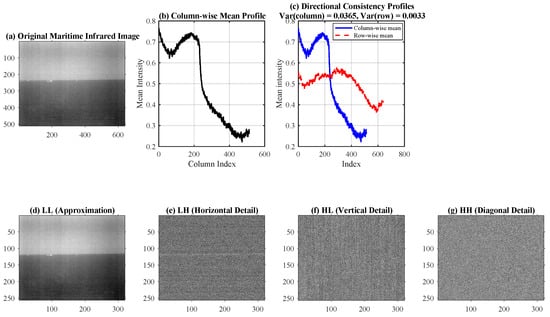
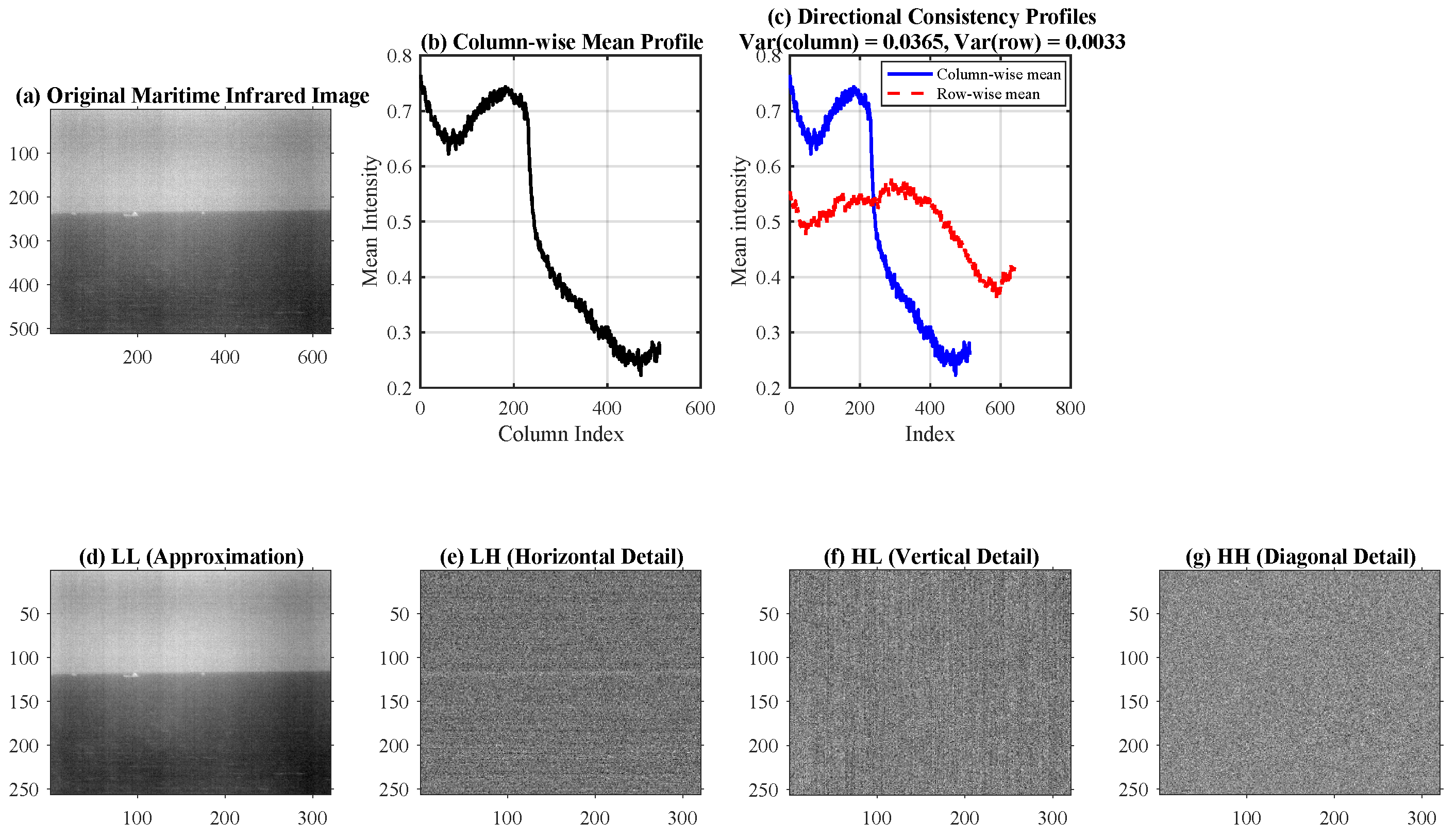
Figure 1 shows the noise model analysis of a real maritime infrared image from both the spatial domain and the wavelet domain. (a) is the original maritime infrared image. (b) illustrates the average pixel intensity computed along each image column. (c) compares the column-wise and row-wise mean intensity profiles to quantify the directional noise consistency. (d)–(g) show the decomposition results for a real maritime infrared image based on the Haar wavelet, corresponding to the LL, LH, HL, and HH sub-bands, respectively. Maritime infrared images are commonly degraded by complex noise arising from sensor non-uniformity and thermal fluctuations. Spatial-domain directional consistency analysis reveals that the variance in the column-wise mean intensities is significantly larger than that in the row-wise means, indicating the presence of vertically oriented structured noise. Wavelet-domain decomposition further shows that such directional noise is mainly concentrated in the HL sub-band, while the HH sub-band primarily contains approximately isotropic random noise. These observations suggest that maritime infrared image degradation can be modeled as a combination of directional structured noise and random noise, motivating noise-aware denoising strategies that exploit both directional and multi-scale characteristics.
Figure 1.
The noise model analysis of a real maritime infrared image.
To address the aforementioned issues, this article proposes a real maritime infrared image denoising network based on joint spatial and wavelet domains, termed SWDNet. The main contributions are summarized as follows.
- (1)
- To extract richer complementary information, this paper proposes a set of parallel sub-networks that jointly fuse features from the spatial and wavelet domains, thereby significantly enhancing the denoising performance for real maritime infrared images.
- (2)
- Multi-scale HSAA modules are employed in the upper branch to capture spatial features and adaptively assign weights to different spatial locations. In parallel, the WAT module alleviates discontinuous boundary transitions between the targets and background and suppresses vertical stripe noise through parallel horizontal convolutions.
- (3)
- A directional edge enhancement (DEE) module is employed to extract and enhance edge information using learnable Sobel operators and multi-layer convolutional structures.
The subsequent sections of this paper are arranged as follows: Section 2 introduces the methodology of the proposed network; Section 3 introduces the dataset and experimental settings; Section 4 describes the experimental results and evaluation of our network; Section 5 concludes the paper and discusses the limitations of the proposed method.
2. Methodology
2.1. Network Architecture
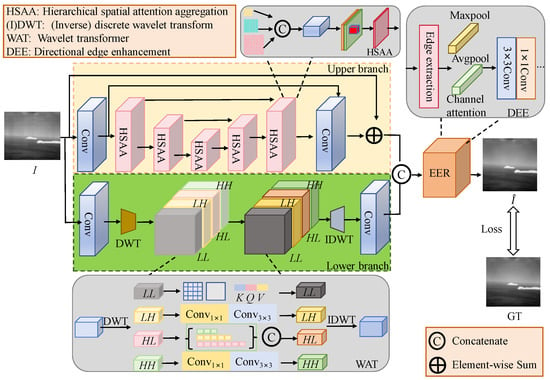
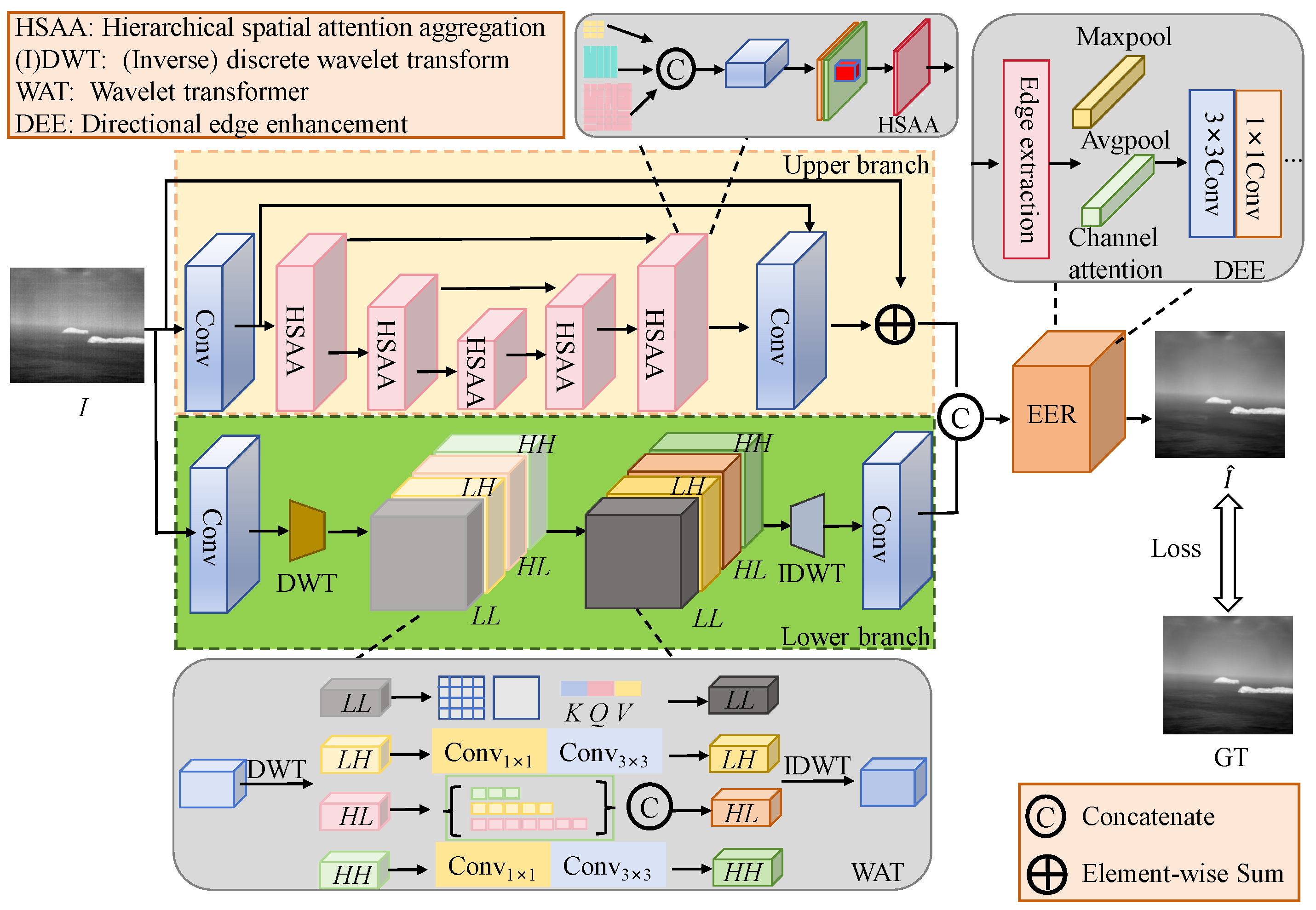
Figure 2 shows the main architecture of the proposed SWDNet, which consists of a dual-branch network and a directional edge enhancement module. This study analyzes the noise characteristics of maritime infrared images and designs targeted modules and network architectures to remove vertical stripe noise and random noise while preserving fine image details during effective denoising.
Figure 2.
Main architecture of the proposed SWDNet.
2.2. Hierarchical Spatial Attention Aggregation (HSAA) Module
The attention mechanism plays a significant role in instructing the network regarding ‘where’ and ‘what’ to focus on. Li et al. [18] propose an infrared thermal imaging denoising method that uses a second-order attention mechanism and non-local modules at the regional level to improve the extraction of image features and fit the noise residual. Tian et al. [19] propose an attention-guided denoising convolutional neural network (ADNet) that uses an attention block to finely extract the noise information hidden in the complex background. By leveraging channel attention weight sharing across the network, CAWSNet dynamically captures both global non-noise features and fine-grained high- and low-frequency details [20]. Bai et al. [21] utilize channel attention blocks (CABs) to preserve local image information in MSPNet.
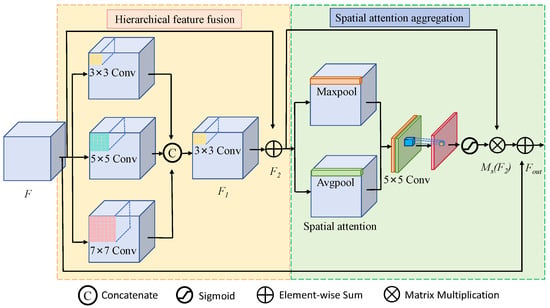
Inspired by the above, in order to further extract the detail and semantic information of the image, we employ convolution operations and hierarchical spatial attention aggregation (HSAA) modules at different scales to extract and fuse the spatial features of the image. As shown in Figure 3, in the HSAA module, we use convolutions at three scales (, and ) to obtain the structural information and contextual information of maritime images, which can cover scene information with different proportions (such as ships, islands, waves, etc.) in the lowest-resolution feature layer. The formula is as follows:
Figure 3.
The structure of the proposed hierarchical spatial attention aggregation (HSAA) module.
After obtaining the scene information of the maritime infared image, this work introduces a spatial attention mechanism to focus on the different feature information between positions, which can enhance the expressive power and generalization of SWDNet. The spatial attention mechanism can guide the network to focus on more important spatial locations in the image (such as target regions, edges, or texture information), thereby enhancing useful features and suppressing redundant background information. The functions are shown as follows:
By dynamically reweighting spatial positions, the spatial attention mechanism effectively enriches feature representations and improves the model’s ability to capture underlying spatial structures. In the upper branch structure, spatial attention incorporates image features at different scales, enabling the model to better understand both the local and global structural information of the image.
2.3. Wavelet Transformer Module (WAT)
Wavelet decomposition facilitates image denoising by decomposing an image into multi-scale frequency sub-bands, enabling the effective separation of noise and structural information across different resolutions. By selectively suppressing noise-dominated high-frequency components while preserving or enhancing structure-related coefficients, wavelet-based denoising algorithms achieve a favorable trade-off between noise reduction and detail preservation. Li et al. [22] propose a wavelet transform network for single-image denoising. Jiang et al. [23] propose a wavelet dual-branch diffusion (WD-Diff) network for infrared image denoising. By integrating a cascaded wavelet transform and enhancement blocks into a multi-stage CNN framework, the proposed MWDCNN effectively exploits multi-scale frequency representations to suppress noise while preserving fine image details [24]. Rhee et al. [25] integrate wavelet-domain constraints into a diffusion-based framework, enabling the attenuation of high-frequency noise while preserving fine details and salient image structures. The proposed WCNN reorganizes convolutional layers into parallel sub-networks guided by wavelet decomposition, enabling each sub-network to capture features at specific directions and scales, thereby increasing the effective depth for feature extraction while avoiding gradient issues and efficiently handling different noise levels with a single set of trained parameters [26].
The Haar wavelet transform is a lossless, global representation signal decomposition method that can transform the input features from the spatial domain to the wavelet domain. In this work, we use a two-dimensional discrete wavelet transform (DWT) based on the Haar wavelet to obtain four sub-band components. The function can be defined as
where the sub-band preserves low-frequency structural information, while , , capture horizontal, vertical, and diagonal high-frequency details, respectively.
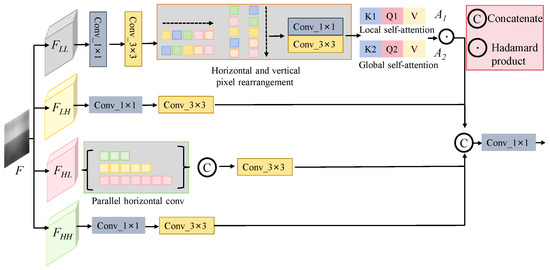
From a wavelet-domain perspective, vertical stripe artifacts exhibit intensity variations along the horizontal direction, which are mainly manifested as high-frequency components in . We design parallel horizontal convolutions at three scales (, , ) to reduce the vertical stripe noise in the feature maps, as shown in Figure 4. The formula is as follows:
Figure 4.
Detailed structure of the proposed wavelet transform (WAT) module.
For the sub-band, which contains the main structures and contours of the image, we design a pixel-grouping self-attention module to capture both global and local attention information. This module assigns adaptive weights to target information with similar pixel values. The local self-attention branch divides the feature maps into local patches, which are arranged sequentially. It computes the similarity only within each local region to capture fine-grained details, thereby enhancing local feature representation. The global self-attention branch computes the similarity across all local regions of the feature maps to capture information at the full scale. The attention mechanism measures the similarity between features from different local regions, enabling the network to model long-range dependencies and establish global relationships among multiple objects. The formulas are as follows:
where and , respectively, denote the weighted summation of the value vectors using the computed local and global attention weight matrices. and , as well as and , serve as the inputs for the attention computation in two separate branches. The outputs of these two branches represent local and global attention information, respectively. The value vector V is shared by both attention branches and is used for weighted summation to generate the final feature output. is the dimensionality of the key vector. The local and global attention branches enable the network to focus on fine-grained local details as well as global structural information, thereby enhancing the representation of the target features.
Finally, the attention outputs from both branches are fused to enhance local details and global information, resulting in a weighted fusion output guided by the self-attention mechanism. The formula is as follows:
2.4. Directional Edge Enhancement (DEE) Module
Edge enhancement plays a crucial role in image denoising by preserving structural boundaries and preventing over-smoothing, which is essential in maintaining perceptual quality and high-level semantic information. By selectively amplifying edge-related features while suppressing noise-dominated components, edge enhancement enables denoising models to better discriminate between true image structures and noise, leading to improved detail preservation and visual fidelity. Wu et al. [27] propose a detail enhancement block (DEB) that employs multi-level local feature attention and residual learning to effectively enhance fine details while suppressing noise, thereby alleviating detail loss in infrared image denoising. Zhang et al. [28] propose a feature enhancement block in MEFNet that uses multi-scale channel attention and residual connections to strengthen infrared feature representations.
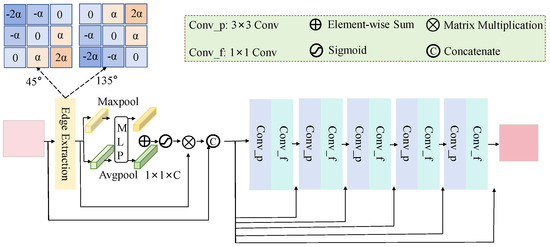
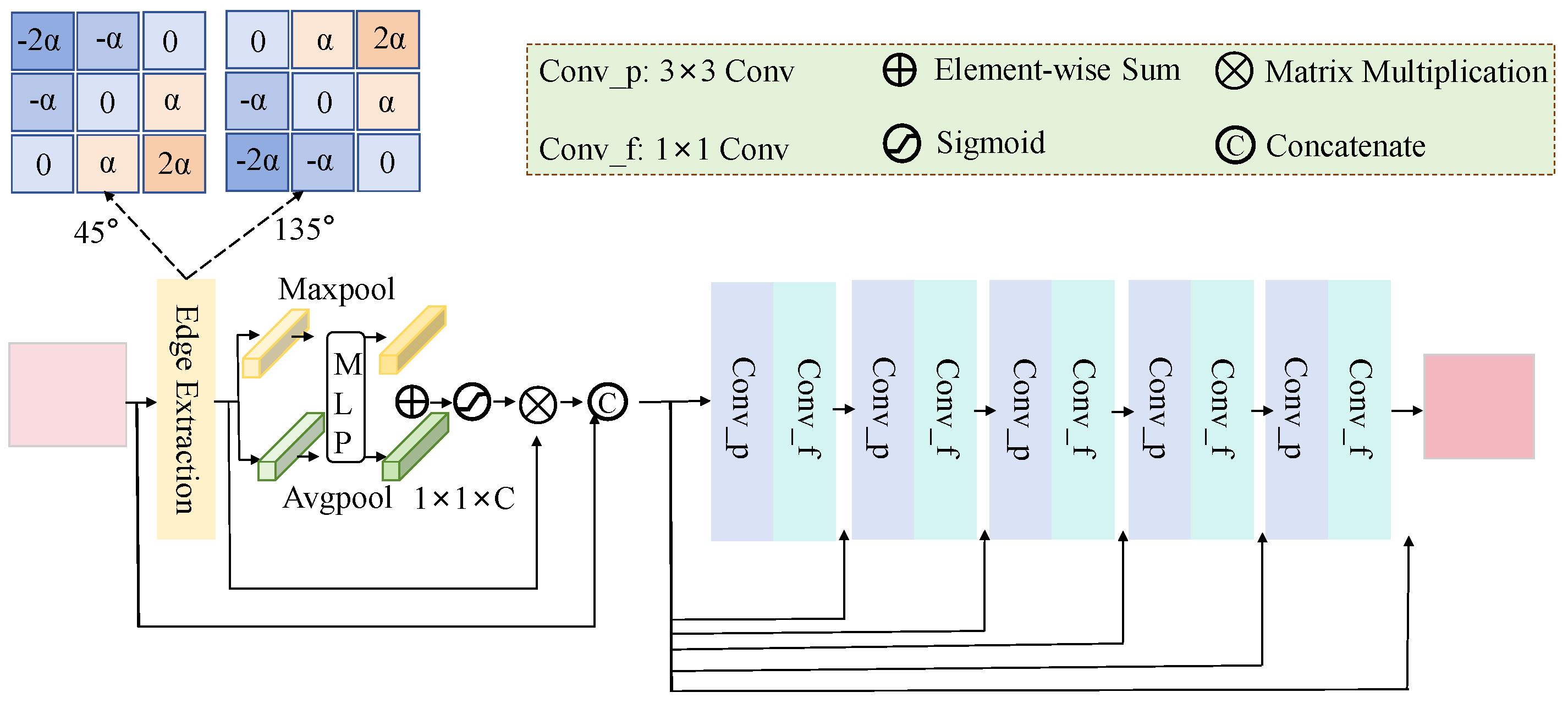
When reconstructing an image, a convolutional layer is typically used to fuse all feature maps into a single reconstructed image. However, for infrared images with relatively few texture details, the edges of the reconstructed image tend to be more blurred. To preserve more edge information of the target, a learnable Sobel operator is used to extract edge features. These features are then fused through dense connections, and an edge-enhanced reconstruction module is designed to strengthen the edge information. In the analysis of noise characteristics in maritime infrared images, it can be observed that the 0-degree and 90-degree Sobel operators mainly extract horizontal and vertical stripe noise information, while the 45-degree and 135-degree directions are more effective in extracting target-related information. To suppress stripe noise, only the 45-degree and 135-degree Sobel operators are employed in this study to extract diagonal target features, thereby avoiding the enhancement of stripe-related patterns. Figure 5 shows the Sobel operators in the 45-degree and 135-degree directions. In each convolutional block, pointwise convolution is applied to fuse the outputs of the previous layer and the edge enhancement layer, followed by convolutional kernels with a size of to further extract image features. Dense connections link the outputs of the Sobel-based edge feature extraction layers to the inputs of subsequent layers, ensuring that the network can better reuse previously extracted features. This enhances the network’s ability to represent features and significantly improves the flow of information.
Figure 5.
The architecture of the directional edge enhancement (DEE) module.
2.5. Loss Function
We use the Charbonnier loss as the reconstruction loss function, and the edge loss is used to prevent high-frequency information loss between the denoised image and the ground-truth image. The overall loss function is designed as follows:
where we empirically set to 0.1. is the Charbonnier loss, represented as
where the constant C is set to 0.001, and is the edge loss, which is denoted as
where denotes the Laplacian operator. The selection of the value will be described in detail in Section 4.3.
3. Dataset and Experimental Settings
3.1. Dataset
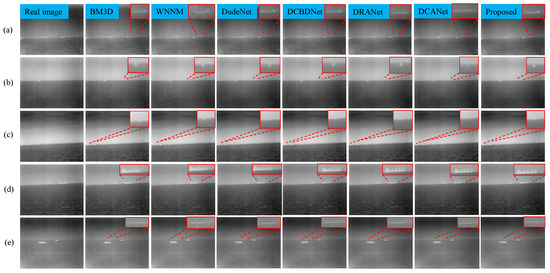
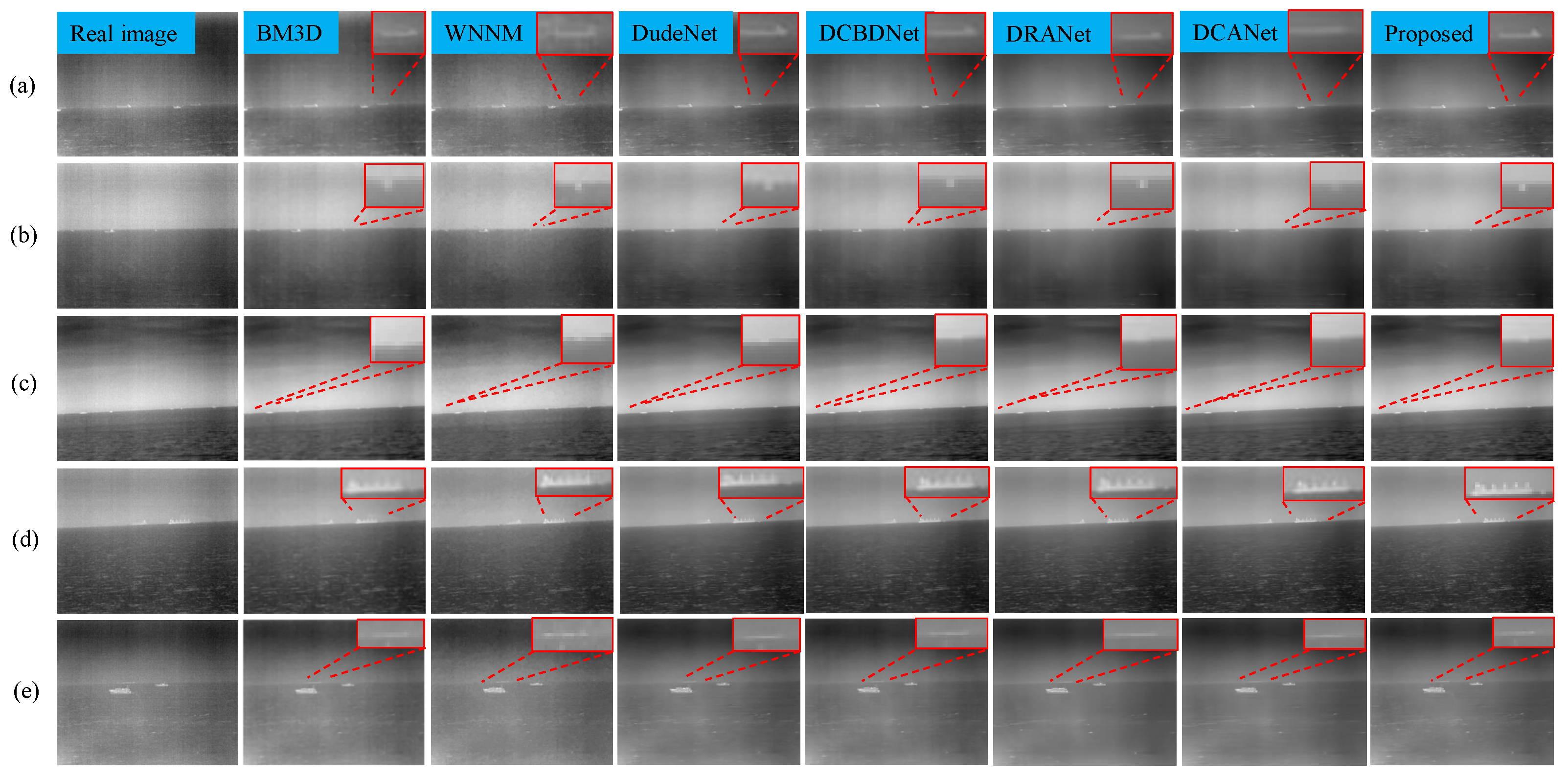
Due to hardware performance limitations and the lack of a cooling system, real infrared images are often accompanied by significant noise contamination, as shown in the first column of Figure 6.
Figure 6.
Visual results for real maritime infrared images compared with state-of-the-art methods. (a–e) represent five different real maritime infrared scenes with varying background complexity and target characteristics.
3.2. Training Setup
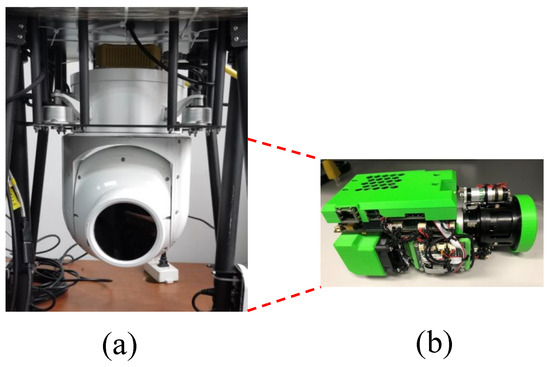
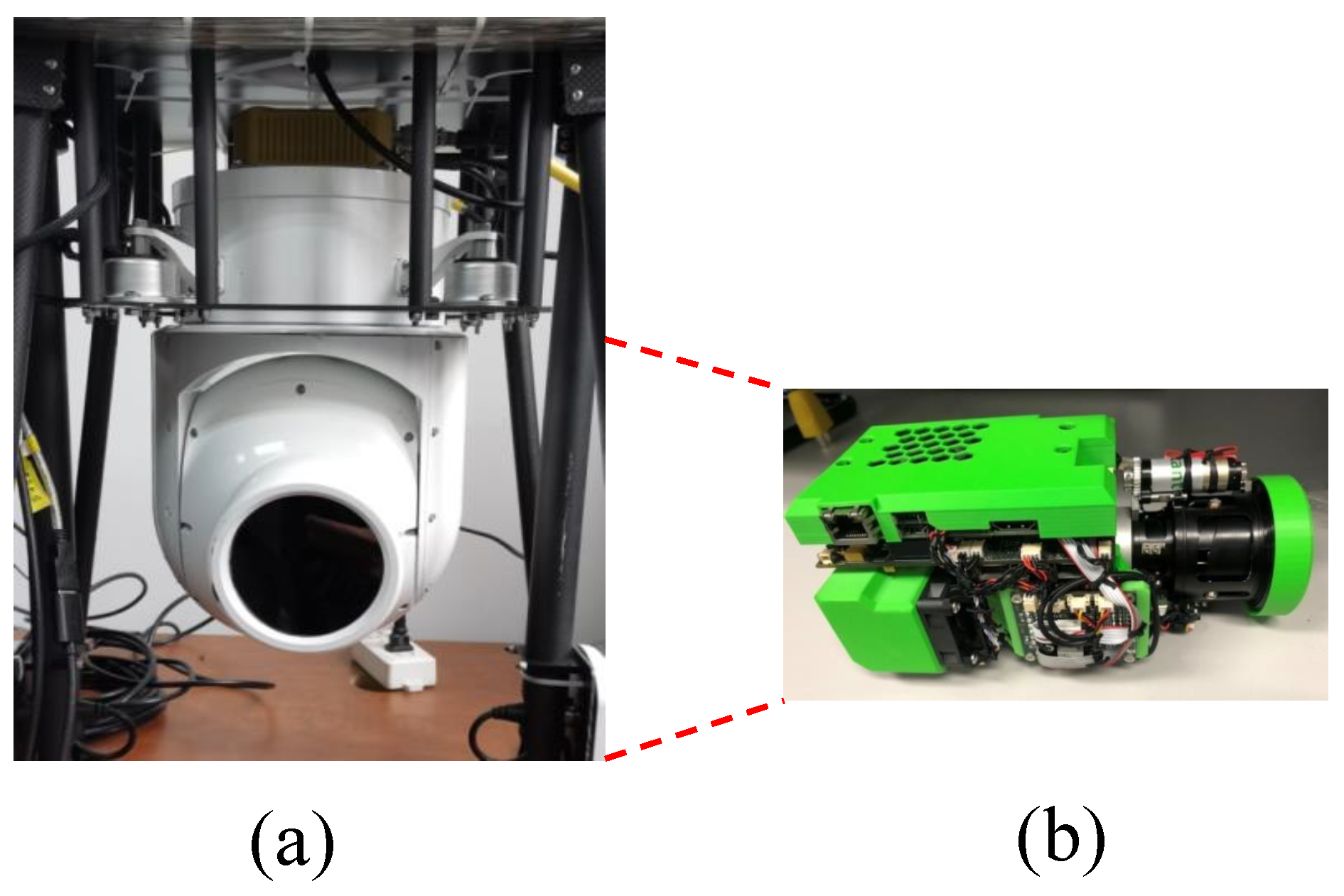
Following the rapid development of hardware technology, a high-imaging-quality infrared thermal camera with a cooling system was purchased by our research team, namely a medium-wave infrared thermal imager from the French company NOXANT, with a spectral range of 3.7 microns to 4.8 microns. It can capture high-quality infrared images, as shown in Figure 7.
Figure 7.
The infrared imaging system. (a) Photograph of the actual system. (b) Real object image of the mid-wave infrared camera.
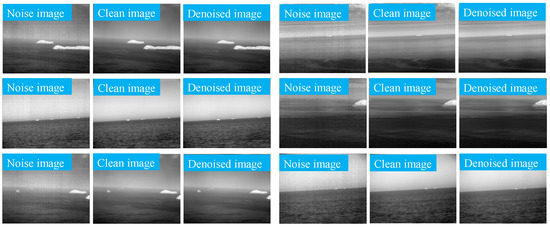
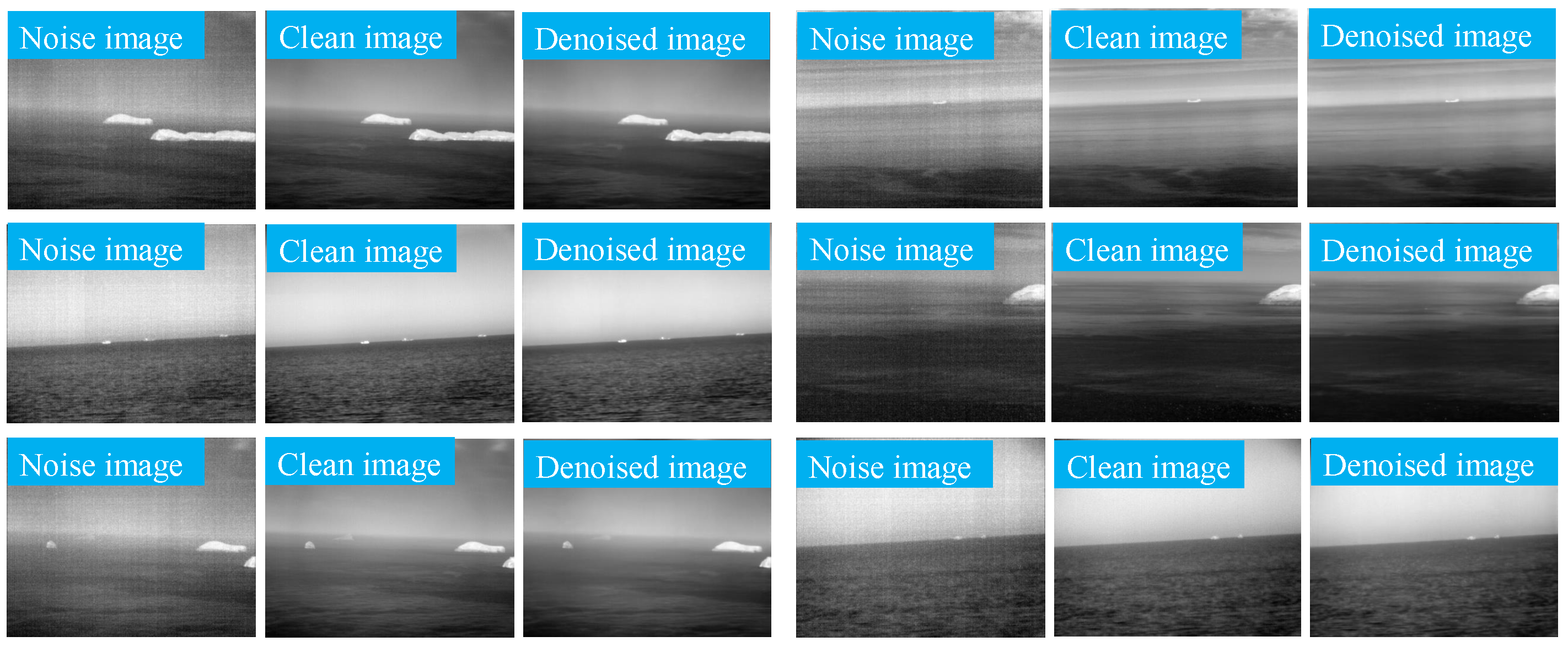
Our goal is to denoise the real maritime infrared images that are severely contaminated by noise, as shown in the first column of Figure 6. Clear denoised images with good detail retention are crucial for subsequent tasks such as object detection, classification, and segmentation. Therefore, we use clean infrared images and noisy images with manually added stripe noise and Gaussian noise, where the noise is introduced based on the noise model analysis of real maritime infrared images, as paired samples. These paired images are then fed into a supervised deep learning network to learn their characteristics. The artificially generated noisy images are shown in the first column of Figure 8. Ultimately, we use the trained model to process real maritime noise-contaminated infrared images. We utilize 1000 multi-scene maritime infrared images with clean and noisy images as image pairs, and we randomly select 800 pairs as the training data, 100 pairs as the validation data, and 100 pairs as the test data. In addition, the training data and validation data are randomly cropped to image patches, which are fed into the model.
Figure 8.
Noisy image and clean image in dataset and test set denoising result.
The maritime infrared images collected in our laboratory are 8-bit grayscale images with a resolution of . During training, image patches of size are extracted, and a batch size of 16 is used for input to the network for learning. We apply 120 epochs to train the proposed model, during which the initial learning rate is steadily reduced using the cosine annealing strategy. The initial learning rate (lr) is set to , and the learning rate is gradually reduced to during training, while the other hyperparameters of the Adam optimizer are kept at their default values. We use PyTorch 1.13.1 and Python 3.8.5 to implement the code of SWDNet. All experiments are implemented on a computer with an NVIDIA GeForce RTX 4090Ti GPU.
3.3. Evaluation Metrics
The structural similarity index metric (SSIM), peak signal-to-noise ratio (PSNR), and natural image quality evaluator (NIQE) are the three most important metrics for the evaluation of denoising performance. The formula for the PSNR is as follows:
where n is 8, indicating the number of bits for each pixel. MSE is mean square error, and the formula for the MSE is defined as follows:
The larger the PSNR value, the less distortion is present. Structural similarity (SSIM) is an index used to measure the similarity of two images, and the formula is as follows:
where is the average gray value of the clean image, is the average gray value of the reconstructed image, and are standard deviations, . When the SSIM value is closer to 1, the two images are considered to be more similar and the output image is more consistent with the clean image.
NIQE represents the distance between the test image and the natural image model. A smaller value indicates that the image is closer to the statistical characteristics of high-quality images and thus has a higher quality level.
The edge preservation index (EPI) measures the similarity in gradient distributions between the denoised image and the ground truth, providing an effective assessment of how well structural details, particularly edges, are preserved during the denoising process. The formulation of the EPI is given as follows:
where denotes the gradient of the original image, representing edge information. denotes the gradient of the denoised image.
Parameters refer to the total number of learnable weights in a denoising model, reflecting its complexity and capacity to represent image features.
FPS indicates the number of images that the model can process per second, reflecting the computational efficiency and inference speed of the denoising algorithm.
4. Result Analysis
4.1. Comparison with State-of-the-Art Methods
To verify the effectiveness of the proposed model, we qualitatively and quantitatively compare six state-of-the-art methods under the paired synthetic infrared maritime images and real maritime infrared images. The results are shown in Table 1, Figure 6 and Figure 8. In Figure 8, the images denoised by SWDNet demonstrate its excellent denoising performance, and image detail information is well preserved. In Table 1, regarding the average PSNR values, the performance of the proposed network exceeds that of the other six models by 5.62 dB, 8.53 dB, 1.05 dB, 1.09 dB, 0.54 dB, and 0.31 dB. In terms of quantitative evaluation, the proposed method achieves a higher SSIM and lower NIQE compared with existing methods. The improvement in the SSIM indicates that our method is more effective in preserving structural information, such as edges and fine textures, during the denoising process. Meanwhile, the lower NIQE scores suggest that the restored images are more consistent with natural image statistics, leading to better perceptual quality. This advantage is particularly important for stripe noise removal, where maintaining structural continuity while suppressing structured noise is challenging. Among all compared methods, SWDNet achieves the highest EPI, indicating that it not only attains superior denoising performance but also effectively preserves edge information. While SWDNet may not excel in terms of total parameters or FPS, it effectively balances model complexity with denoising performance. Under a relatively controlled computational cost, the proposed method is still able to achieve competitive denoising performance, demonstrating a favorable balance between efficiency and effectiveness. In summary, SWDNet demonstrates superior performance in terms of both distortion and perceptual metrics.
Table 1.
Evaluation metrics compared with state-of-the-art methods. The best results are bolded.
Regarding the real maritime infrared dataset, the qualitative results are shown in Figure 6. Firstly, BM3D and WNNM are two classical traditional algorithms, and their denoising effects on maritime infrared scene images are generally far from satisfactory. BM3D retains more detail information of the image, but a significant amount of noise remains unremoved. WNNM is an image denoising method based on low-rank matrix recovery. Subjective results indicate that WNNM blurs image details and is also time-consuming. DuDeNet, DCBDNet, DRANet, and DCANet are four classical deep learning methods for image denoising whose performance is superior to that of the two aforementioned traditional algorithms. For DuDeNet and DCBDNet, the image details are well preserved, but the generated denoised image is blurry and the removal of stripe noise is not sufficient. For DRANet and DCANet, the generated denoised image is relatively clear, but there is significant loss of detailed information such as waves and small targets on the sea–sky line, and there is also significant residual stripe noise. Our proposed network performs the best in terms of image clarity, detail information preservation, and stripe noise removal. In summary, the proposed method is capable of effectively removing Gaussian noise and non-uniform noise from images, while simultaneously preserving fine image details.
4.2. Ablation Experiments
Ablation experiments are conducted on the paired infrared maritime images to verify the effectiveness of the proposed network. We train seven different networks in the ablation experiments, namely HSAA, WAT, DEE, HSAA+WAT, WAT+DEE, HSAA+DEE, and all, with the results presented in Table 2. We can see that the whole SWDNet displays the best denoising performance compared to the other six models. Compared to the others, the WAT+DEE model exhibits slightly inferior performance in terms of both distortion metrics and perceptual metrics. This suggests that the wavelet transform and edge enhancement enable effective denoising while maintaining more image details. In summary, the results of our ablation experiments show that each proposed module in SWDNet is efficient and effective. Thus, the proposed three modules can remarkably enhance the network’s performance indicators.
Table 2.
Quantitative results in ablation experiments for SWDNet. The best results are bolded.
4.3. Discussion of Key Parameter
To verify the effect of the key parameter in the loss function, we vary its value from 0.05 to 0.20 in increments of 0.05 based on the proposed SWDNet. As shown in Table 3, the best PSNR and SSIM are achieved when the threshold is set to 0.10.
Table 3.
The analysis of the threshold. The best results are bolded.
5. Conclusions and Discussion
In this paper, we present a novel network based on joint spatial and wavelet domains for real maritime infrared image denoising. Ablation experiments have been conducted to validate the effectiveness of the proposed modules, HSAA, WAT, and DEE. To demonstrate the effectiveness and progressiveness of the proposed method for maritime infrared image denoising, we conducted experiments on both synthetic and real datasets, including ablation studies and comparisons with state-of-the-art approaches. The experiments reveal that the proposed SWDNet exhibits excellent denoising performance on both synthetic and real maritime infrared datasets, while retaining more detailed information about the image.
Nevertheless, SWDNet also has certain limitations. First, the preservation of edge information for maritime infrared targets still needs improvement, particularly for small and weak targets on the sea surface. Second, due to the high complexity of real-world maritime infrared scenes, it is challenging to achieve a balance between denoising performance and practical engineering applicability, making lightweight deployment difficult.
Author Contributions
Conceptualization, H.X. and M.W.; methodology, H.X.; software, H.X.; validation, Y.J., F.T. and M.W.; formal analysis, F.T.; investigation, H.X.; resources, L.D.; data curation, H.X.; writing—original draft preparation, H.X.; writing—review and editing, L.D.; visualization, M.W.; supervision, L.D.; project administration, L.D.; funding acquisition, L.D. All authors have read and agreed to the published version of the manuscript.
Funding
This research was funded by the Fundamental Research Funds for the Central Universities of China under Grants 3132024632, in part by the High-Tech Ship research project from the Ministry of Industry and Information Technology of the People’s Republic of China under Grant MC-201902-C01, and in part by the Joint Program of Liaoning Provincial Science and Technology Program (Key Research and Development Program Project) under Grant 2025JH2/101800108.
Data Availability Statement
The datasets presented in this study are not publicly available because they are part of an ongoing research project. Requests to access these datasets can be directed to the corresponding author.
Conflicts of Interest
The authors declare no conflicts of interest.
References
- Wang, X.; Tian, J.; Yu, Y.; Wang, Q.; Feng, Y.; Agbenu, I.K.N.; Su, Y.; Zhang, Z. NLIFD: Improved non-local mean filtering algorithm for infrared face image denoising. Phys. Scr. 2025, 100, 075011. [Google Scholar] [CrossRef] [Scilit]
- Kang, K.; Liu, T.; Xu, X.; Zhu, G.; Zhou, J. Study of infrared image denoising algorithm based on steering kernel regression image guided filter. In Proceedings of the 2019 18th International Conference on Optical Communications and Networks (ICOCN), Huangshan, China, 5–8 August 2019. [Google Scholar]
- Xie, J.; Song, L.; Huang, H. Thermal radiation bias correction for infrared images using Huber function-based loss. IEEE Trans. Geosci. Remote Sens. 2024, 62, 1–15. [Google Scholar] [CrossRef] [Scilit]
- Chawhan, M.; Neole, B.; Sah, P.; Lad, B.V.; Algburi, S.; Abdulhadi, A.M.; Majdi, A.; Khan, W.A. Denoising of digital images using modified recursive cycle-spinning and wavelet shrinkage. EURASIP J. Adv. Signal Process. 2025, 2026, 1. [Google Scholar] [CrossRef] [Scilit]
- Park, C.-G.; Choi, B.-I. The effective noise reduction method in infrared image using bilateral filter based on median value. J. Korea Soc. Comput. Inf. 2016, 21, 27–33. [Google Scholar] [CrossRef] [Scilit]
- Zhang, F.; Hu, H.; Wang, Y. Infrared image enhancement based on adaptive non-local filter and local contrast. Optik 2023, 292, 171407. [Google Scholar] [CrossRef] [Scilit]
- Malfait, M.; Roose, D. Wavelet-based image denoising using a markov random field a priori model. IEEE Trans. Image Process. 1997, 6, 549–565. [Google Scholar] [CrossRef] [Scilit]
- Li, M.; Nong, S.; Nie, T.; Han, C.; Huang, L. An infrared stripe noise removal method based on multi-scale wavelet transform and multinomial sparse representation. Comput. Intell. Neurosci. 2022, 2022, 4044071. [Google Scholar] [CrossRef] [Scilit]
- Krull, A.; Buchholz, T.O.; Jug, F. Noise2void-learning denoising from single noisy images. In Proceedings of the IEEE/CVF Conference on Computer Vision and Pattern Recognition; IEEE: Piscataway, NJ, USA, 2019. [Google Scholar]
- Chen, S.; Zhang, J.; Yu, Z.; Huang, T. Exploring efficient asymmetric blind-spots for self-supervised denoising in real-world scenarios. In Proceedings of the IEEE/CVF Conference on Computer Vision and Pattern Recognition; IEEE: Piscataway, NJ, USA, 2024. [Google Scholar]
- Huang, T.; Li, S.; Jia, X.; Lu, H.; Liu, J. Neighbor2neighbor: Self-supervised denoising from single noisy images. In Proceedings of the IEEE/CVF Conference on Computer Vision and Pattern Recognition; IEEE: Piscataway, NJ, USA, 2021. [Google Scholar]
- Yang, G.; Song, C.; Xue, M.; Yu, J. SC-BSN: Shifted Convolutions Based Blind-Spot Network for self-supervised image denoising. Neurocomputing 2025, 648, 130714. [Google Scholar] [CrossRef] [Scilit]
- Jiao, M.; Liu, Y.; Wang, J.; Peng, Y. Pixel2Noise: A lightweight self-supervised denoising for single image zero-shot recognition. Pattern Recogn. 2025, 171, 112148. [Google Scholar] [CrossRef] [Scilit]
- Wu, W.; Liao, S.; Lv, G.; Liang, P.; Zhang, Y. Image Blind Denoising Using Dual Convolutional Neural Network with Skip Connection. arXiv 2023, arXiv:2304.01620. [Google Scholar] [CrossRef] [Scilit]
- Tian, C.; Xu, Y.; Zuo, W.; Du, B.; Lin, C.; Zhang, D. Designing and training of a dual CNN for image denoising. Knowl.-Based Syst. 2021, 226, 106949. [Google Scholar] [CrossRef] [Scilit]
- Pang, Z.; Liu, G.; Li, G.; Gong, J.; Chen, C.; Yao, C. An infrared image enhancement method via content and detail Two-Stream deep convolutional neural network. Infrared Phys. Technol. 2023, 132, 104761. [Google Scholar] [CrossRef]
- Wu, W.; Lv, G.; Duan, Y.; Liang, P.; Zhang, Y.; Xia, Y. Dual convolutional neural network with attention for image blind denoising. Multimed. Syst. 2024, 30, 263. [Google Scholar] [CrossRef] [Scilit]
- Li, Z.; Luo, S.; Chen, M.; Wu, H.; Wang, T.; Cheng, L. Infrared thermal imaging denoising method based on second-order channel attention mechanism. Infrared Phys. Technol. 2021, 116, 103789. [Google Scholar] [CrossRef] [Scilit]
- Tian, C.; Xu, Y.; Li, Z.; Zuo, W.; Fei, L.; Liu, H. Attention-guided CNN for image denoising. Neural Netw. 2020, 124, 117–129. [Google Scholar] [CrossRef] [Scilit]
- Chen, Y.; Shi, M.; Li, H.; Yao, Q. CAWSNet: Channel Attention Weight Sharing Network for Single Image Denoising. Knowl.-Based Syst. 2025, 332, 114870. [Google Scholar] [CrossRef] [Scilit]
- Bai, Y.; Liu, M.; Yao, C.; Lin, C.; Zhao, Y. MSPNet: Multi-stage progressive network for image denoising. Neurocomputing 2023, 517, 71–80. [Google Scholar] [CrossRef] [Scilit]
- Li, J.; Cheng, B.; Chen, Y.; Gao, G.; Shi, J.; Zeng, T. EWT: Efficient wavelet-transformer for single image denoising. Neural Netw. 2024, 177, 106378. [Google Scholar] [CrossRef] [Scilit]
- Jiang, N.; Zhang, Y.; Li, Q.; Yan, F. An infrared image denoising method based on wavelet dual-branch diffusion model. IEEE Trans. Geosci. Remote Sens. 2025, 63, 5629013. [Google Scholar]
- Tian, C.; Zheng, M.; Zuo, W.; Zhang, B.; Zhang, Y.; Zhang, D. Multi-stage image denoising with the wavelet transform. Pattern Recognit. 2023, 134, 109050. [Google Scholar] [CrossRef] [Scilit]
- Rhee, T.; Lee, D.; Kim, A. TIR-Diffusion: Diffusion-based Thermal Infrared Image Denoising via Latent and Wavelet Domain Optimization. arXiv 2025, arXiv:2508.03727. [Google Scholar]
- Liu, G.; Dang, M.; Liu, J.; Xiang, R.; Tian, Y.; Luo, N. True wide convolutional neural network for image denoising. Inf. Sci. 2022, 610, 171–184. [Google Scholar] [CrossRef] [Scilit]
- Wu, H.; Chen, B.; Guo, Z.; He, C.; Luo, S. Mini-infrared thermal imaging system image denoising with multi-head feature fusion and detail enhancement network. Opt. Laser Technol. 2024, 179, 111311. [Google Scholar] [CrossRef] [Scilit]
- Zhang, X.; Chen, G.; Chen, Z.; Wu, H.; Wang, Z.; Cheng, L.; Yang, A. Multi-scale feature enhancement and fusion network for real-world infrared image denoising. Infrared Phys. Technol. 2025, 148, 105833. [Google Scholar] [CrossRef] [Scilit]

Disclaimer/Publisher’s Note: The statements, opinions and data contained in all publications are solely those of the individual author(s) and contributor(s) and not of MDPI and/or the editor(s). MDPI and/or the editor(s) disclaim responsibility for any injury to people or property resulting from any ideas, methods, instructions or products referred to in the content. |
© 2026 by the authors. Licensee MDPI, Basel, Switzerland. This article is an open access article distributed under the terms and conditions of the Creative Commons Attribution (CC BY) license.