


Abstract
Due to challenges such as inadequate lighting, water scattering, high density of small objects, and complex object morphology in underwater environments, traditional YOLO11 models face difficulties including interference from complex backgrounds, weak perception of small objects, and insufficient feature extraction when applied underwater. This paper proposes an improved MIP-YOLO11 model for underwater object detection based on the YOLO11 framework. First, a MCEA module is designed in the backbone network to replace the basic CBS convolution module. Through a lightweight multi-branch convolutional structure, the perception ability for small objects, object edges, contours, and morphological features in underwater scenes are enhanced without significantly increasing computational overhead. Second, an IMCA module based on the coordinate attention mechanism is introduced at the end of the backbone network to replace the C2PSA module, reducing the number of model parameters while maintaining detection accuracy. Finally, the Bottleneck module in C3k2 is improved by incorporating a PConv and a dual residual connection mechanism, thereby expanding the receptive field and enhancing the efficiency of complex feature extraction. Experimental results demonstrate that MIP-YOLO11 significantly outperforms the traditional YOLO11 in underwater environments. P and R are improved by 2.5% and 4.1%, respectively. Moreover, the mAP0.5 and mAP0.5:0.95 metrics are increased by 4.2% and 7.5%, respectively. The improved model achieves a good balance between high accuracy and light weight, and can provide a more reliable underwater object detection scheme for AUV underwater detection and other application scenarios.
1. Introduction
The exploitation of marine resources is gradually becoming the main development direction for all countries in the world. Underwater object detection, as a key technology, has been embodied in many application scenarios. However, the complex ocean environment poses significant challenges to underwater target recognition: underwater images often have low contrast, color cast and blur problems; suspended particles and various aquatic organisms in the water further hinder the accurate detection of objects. In addition, traditional detection algorithms generally have the problems of high computational complexity and large storage requirements, and it is difficult to meet the real-time processing requirements on underwater platforms such as AUV [1].
The current object detection algorithms are mainly divided into two technical routes, namely, the two-stage detection method based on region proposal represented by R-CNN series (such as Fast R-CNN, Faster R-CNN) [2,3,4] and the end-to-end single-stage detection method represented by SSD and YOLO [5]. YOLO series, with its end-to-end architecture design, has shown significant advantages in the field of real-time inspection and has become the mainstream solution in the industry.
Improvements based on the YOLO series of models have become a research hotspot in this field. Existing research has centered around two main directions: lightweight deployment adaptation and high-precision detection in complex environments. The specific research progress and limitations are as follows:
Li et al. proposed an improved YOLO-SC model based on the YOLO-V3 model for submarine cable detection, addressing the difficulty of extracting location and feature information due to underwater image blur and the blue-green hue. The model achieves precise cable positioning by introducing lightweight network reconstruction, multi-scale feature fusion, and use skip connections during the feature extraction phase. The model was validated on a self-made submarine cable dataset, achieving an AP of 99.41% and an F1 score of 97.49% [6]. Xin et al. proposed a lightweight underwater object detection model, YOLOv7-SDBB, addressing the issues of misdetection and missed detection caused by the limited memory and computational capacity of underwater devices and the complexity of underwater environments. The model reduces parameter size and computation by introducing the ShuffleNetv2 lightweight network and enhances detection speed by designing the D-ELAN and D-MPConv modules. Experimental results show that the improved model increased the P on the URPC2020 dataset by 2.7% compared to the baseline YOLOv7, with a 20.3% reduction in params and a 41.7% reduction in FLOPs, while the detection speed increased to 100.9 FPS [7]. Zhao et al. proposed the BGLE-YOLO model, based on the YOLOv8 framework. The model has a parameter size of only 1.6 MB and a computational complexity of just 6.2 G FLOPs, easily meeting the deployment requirements of edge devices. However, the detection performance of the model on some datasets is slightly lower than that of the baseline model; its generalization ability and robustness still need further validation on more diverse datasets. Furthermore, the model’s detection performance still has room for improvement in complex underwater scenes such as turbidity and fog interference [8]. Zhang et al. optimized the C2F structure and introduced a PSA module at the end of the backbone network, while incorporating the Neck component of the Gold-YOLO model to improve the Neck structure of the YOLOv8 model. Experimental results show that the improved model increased P and R by 2.76% and 2.06%, respectively, while mAP0.5 and mAP0.5:0.95 were increased by 1.05% and 3.55%, respectively [9]. Zou et al. proposed an EMR-YOLO model based on the BOD method to solve the core problem of visual feature degradation in a complex underwater environment. By designing an efficient detection head, lightweight downsampling convolution module and an RTRA mechanism, the feature extraction and fusion ability of the model is effectively improved, and the attention to the target area is strengthened. Experimental results demonstrate that the EMR-YOLO model achieves improvements of 2.33%, 1.50%, and 4.12% in the three key detection performance metrics—AP, AP50, and AP75, respectively—while maintaining high efficiency [10]. Zhu et al. proposed the AWAF-YOLO algorithm, an improvement of the YOLOv8 model, to address common problems in underwater object detection, such as false positives, low accuracy, and weak generalization ability. Experimental verification shows that compared to the baseline model, the proposed method improved mAP0.5:0.95 on the TrashCan1.0 and Aquarium datasets by 2.6% and 1.6%, respectively [11]. Du et al. proposed the SF-Bi-YOLOv8 model, integrating self-attention mechanisms and a simplified weighted bidirectional feature pyramid structure under the YOLOv8 framework. The model achieved a 2.74% and 5.59% improvement in mAP0.5 and mAP0.5:0.95, respectively, compared to the baseline model on underwater detection object datasets [12]. Qian et al. designed a deformable attention DASPPF module and SF-PAFPN feature fusion structure within the YOLOv8 framework, combined with wavelet convolution, to enhance the model’s ability to detect small objects and reduce false positives and missed detections. Experimental results show that this method achieved 85.6% mAP0.5 on the URPC dataset, 2.1% higher than the YOLOv8 baseline model [13]. Wang et al. proposed an underwater object detection model, FEFM-YOLO11, based on YOLO11. The model replaced the original C3K2 module with a FEM module to enhance feature extraction, and adopted a multi-branch expansion convolution structure and context-aware module to improve object detection ability. Experimental results show that compared to the baseline, the improved algorithm increased mAP0.5 and mAP0.5:0.95 by 2.0% and 1.9%, respectively, verifying the feasibility and effectiveness of the method [14].
In summary, existing research has made progress in lightweight deployment and feature enhancement for complex underwater environments. For YOLOv8 and YOLOv11, many articles have already demonstrated their satisfactory performance in relatively structured or simple scenarios. While the methods described above, such as BGLE-YOLO and FEFM-YOLO11, have demonstrated the value of multi-scale feature extraction and attention mechanisms for underwater object detection, they share one limitation: their convolution modules and attention mechanisms are designed as general purpose vision modules or mechanisms without incorporating domain-specific knowledge of underwater optical degradation or marine biomorphology.
Therefore, this paper proposes an improved MIP-YOLO11 model for underwater object detection with high robustness and accuracy, aiming at the core defects of YOLO11 underwater application. The model is designed to alleviate the problem of small object and edge ambiguity in underwater object recognition, and optimize the recognition and location ability of the traditional convolution module when dealing with complex underwater object morphology. The design inspiration comes from the deep understanding of the ambiguity and noise interference problems unique to underwater object detection and the diversity of underwater biological forms.
Inspired by multi-branch structures and edge detection, we designed the first MCEA improvement module, which combines multi-scale convolutions, Sobel operators, and a lightweight attention mechanism to enhance edge detection capabilities for underwater objects of varying scales. Drawing inspiration from the CA mechanism, we introduced a combination of max-pooling and direction-sensitive convolution branches to design the IMCA module, which specifically optimizes the recognition of directional features of underwater objects in complex backgrounds. The third module, Pinwheel-Bottleneck, incorporates windmill-style convolutions and a dual-residual connection mechanism to expand the receptive field and preserve fine details. The key technical contributions are outlined as follows:
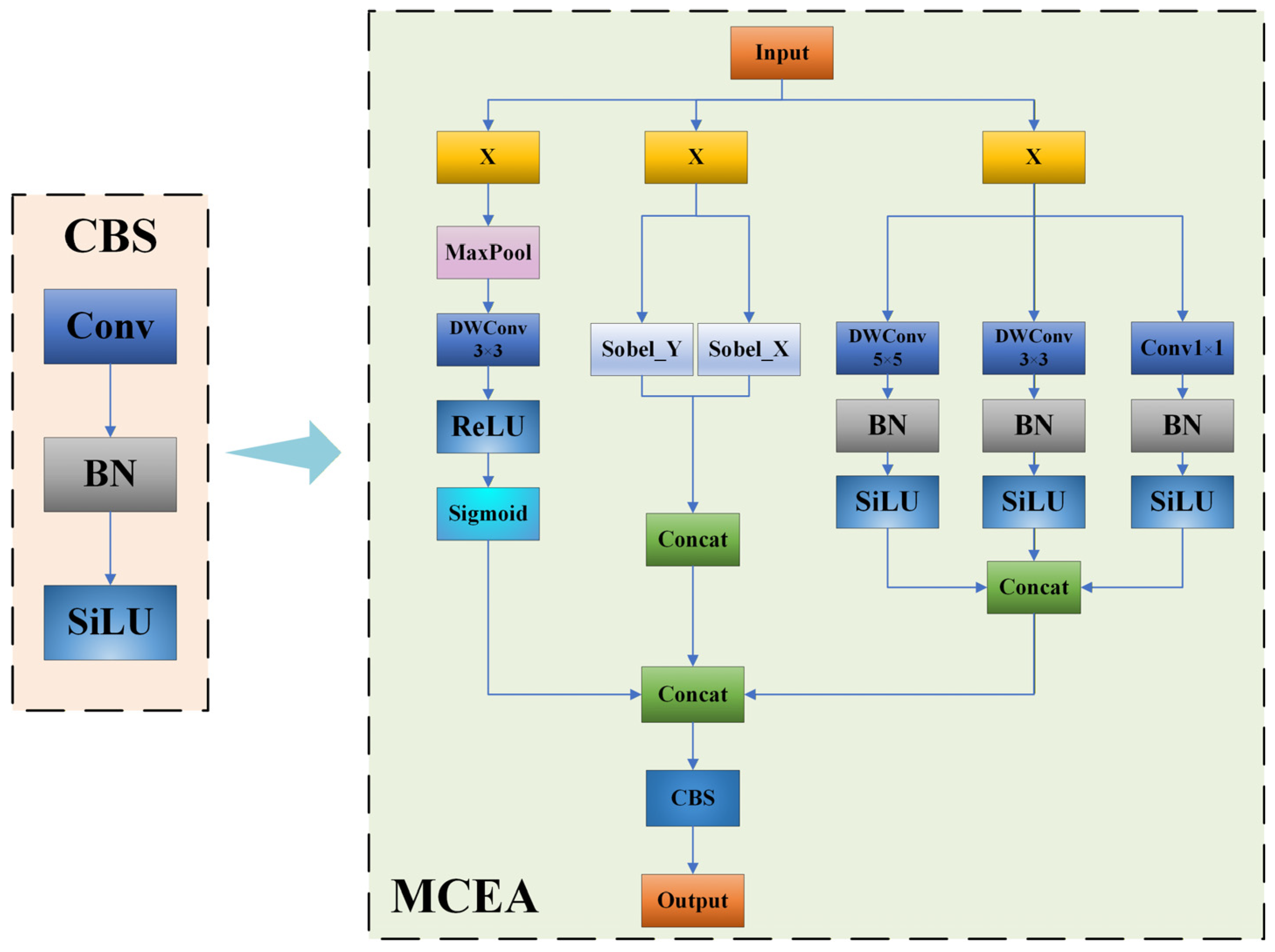
- Aiming at the difficulty of underwater object feature extraction, an improved MCEA module is proposed. A three-branch structure is added to the forward channel of the CBS module. In the first branch, a combination of 1 × 1 point convolution and 3 × 3 and 5 × 5 depth convolution is designed to realize multi-scale spatial feature extraction; in the second branch, the Sobel operator is introduced to better extract horizontal and vertical edge information, so as to better locate the object position; and in the third branch, a lightweight channel attention mechanism combining global maximum pooling and depth convolution is adopted to guide the model to focus on the key features of underwater objects.
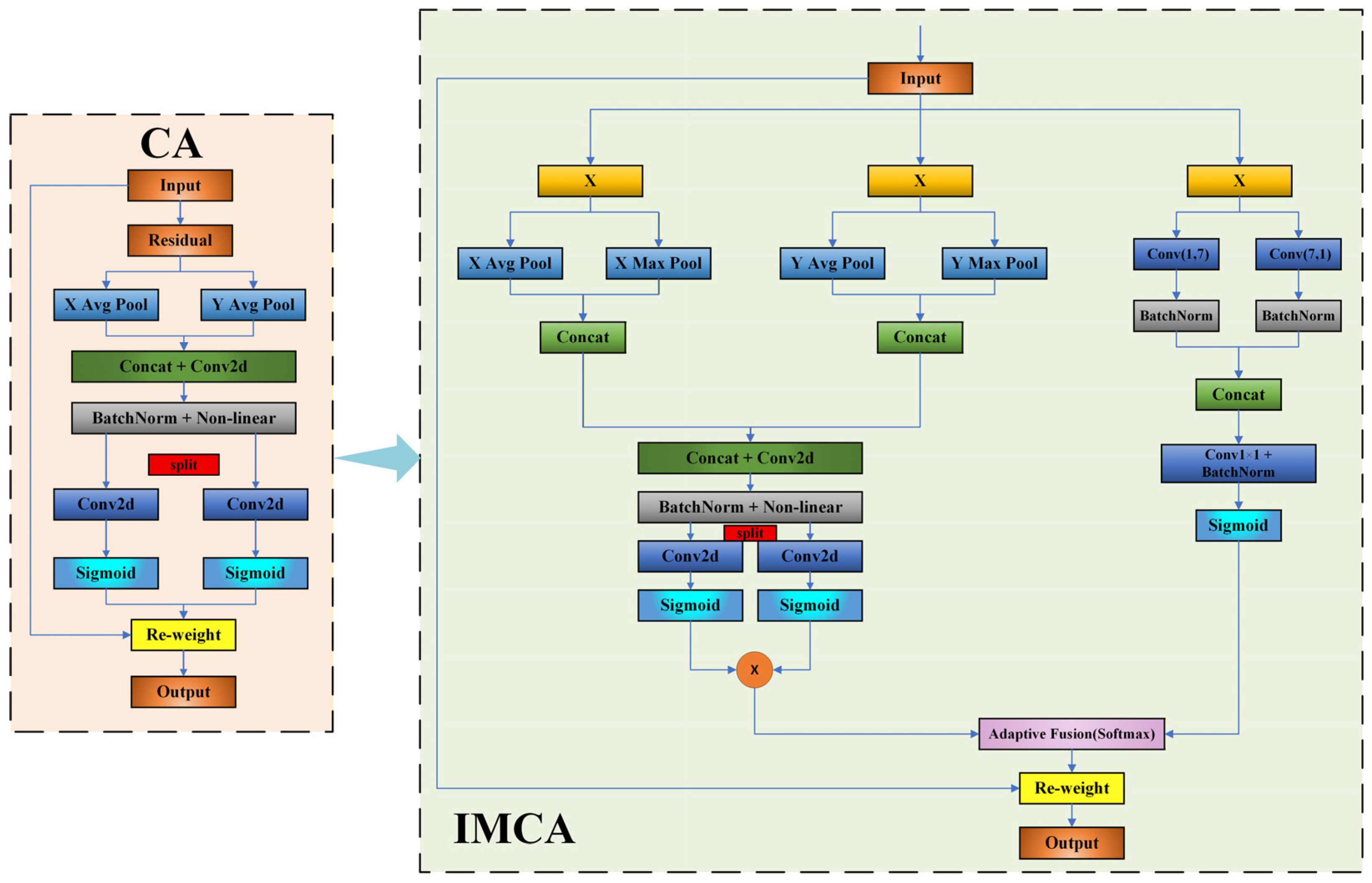
- The IMCA module is designed to solve the problem that the existing CA module can easily weaken the underwater small target features in the process of global average pooling, and there are still deficiencies in complex background and directional structure modeling. The IMCA has been improved in two aspects on the basis of the original CA: first, the parallel mechanism of maximum pooling and average pooling is introduced to improve the perception ability of underwater complex scenes; second, the direction-sensitive convolution branch is constructed, and the asymmetric strip convolution kernel is used to detect the horizontal and vertical objects in the underwater targets respectively, thus enhancing the detection ability of all kinds of underwater creatures with directional characteristics. Finally, the attention features of each branch are dynamically integrated by adaptive fusion weights, which can be learned, so as to enhance and locate the underwater object.
- Considering that the receptive field of the C3k2 module is relatively small and the shallow feature information cannot be fully retained in the task scene of underwater small object recognition, the Bottleneck module of C3k2 is improved, and the PConv and double residual connection mechanism are introduced to form a four-stage structure of CBS-PConv-PConv-CBS. The receptive field of the network can be enlarged by cascading two PConv layers, while the detailed information of the shallow layer can be fully preserved by using the double residual mechanism.
The design of the improved module is described in detail in Section 2 of this article. Section 3 gives the experimental results, explains the results of the ablation experiment, contrasts the experiment and the generalization experiment in detail, and makes a visual analysis. Section 4 summarizes the research work. Finally, Section 5 gives the final conclusion.
2. Methods
2.1. Basic YOLO11 Framework
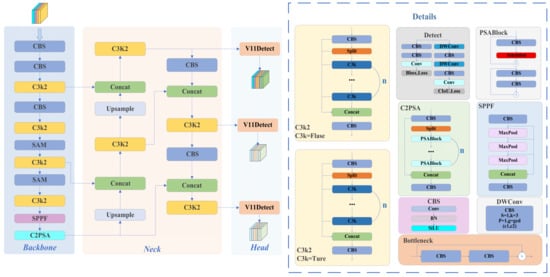
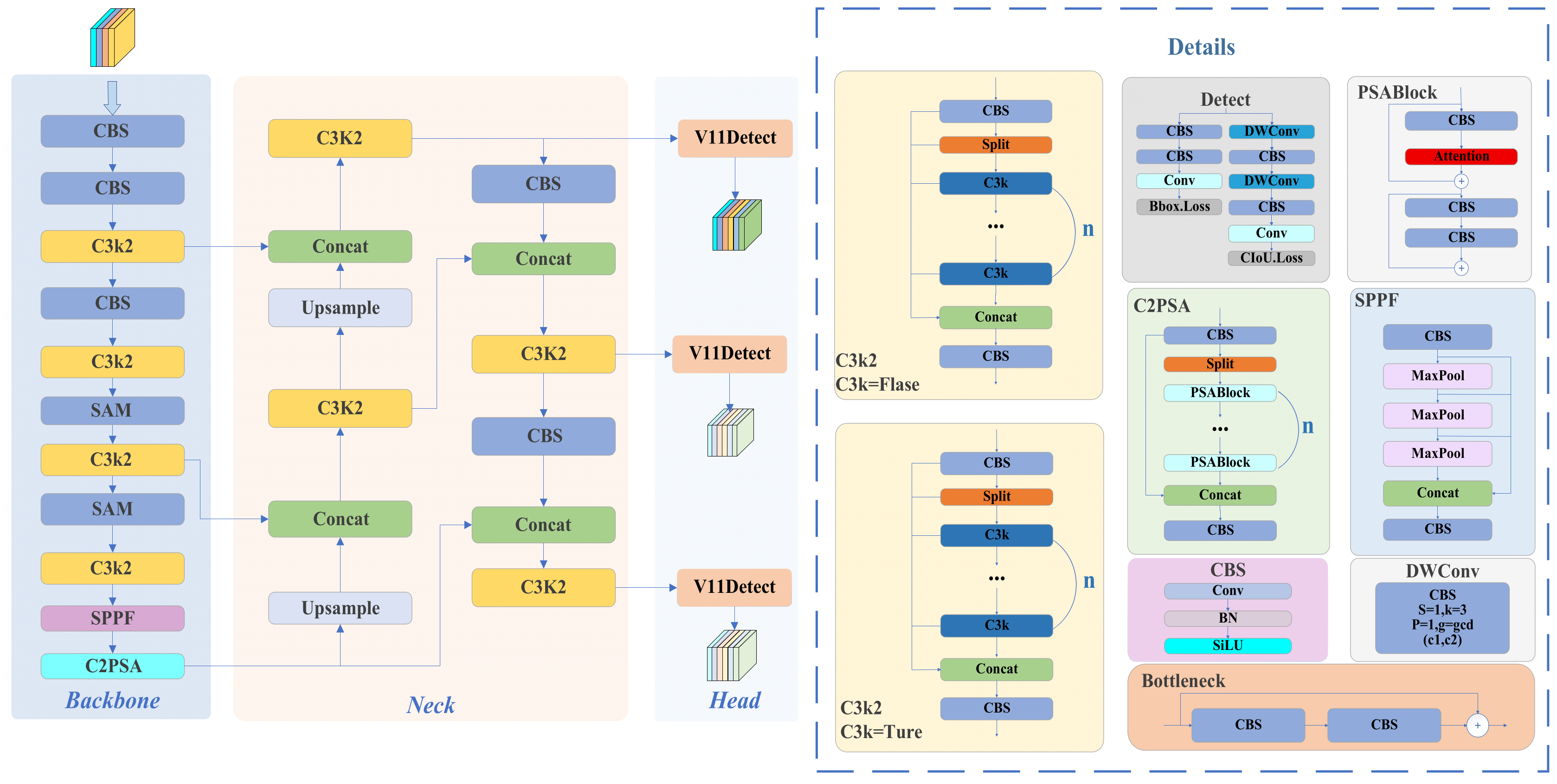
YOLO11 is the latest version released by Ultralytics in 2024. Through its newly designed C2PSA and C3k2 modules and structural optimization, YOLO11 achieves higher detection accuracy and detection efficiency. The structure of YOLO11 is shown in Figure 1. Figure 1 shows the general framework of the baseline model on the left and details of its specific modules on the right [15].
Figure 1.
The schematic diagram of the YOLO11 network framework. Different colors represent different functional modules.
2.2. MIP-YOLO11 Framework
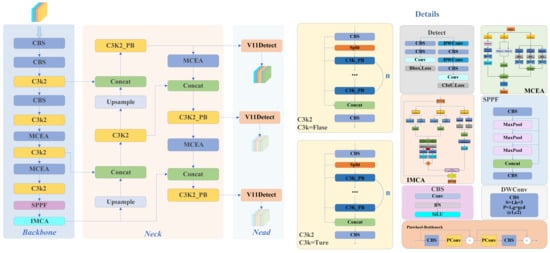
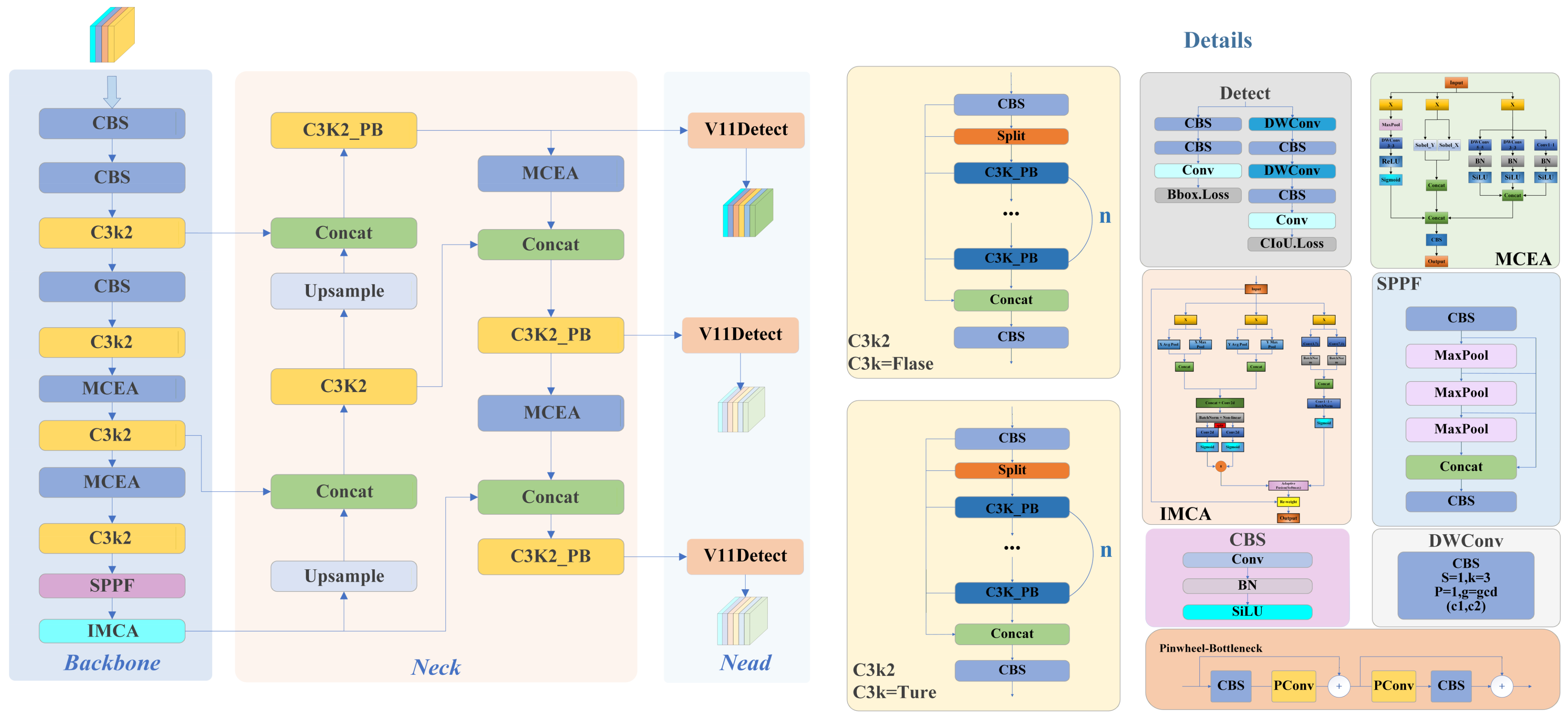
YOLO11 is used as a baseline model. Although its C2PSA and C3k2 modules enhance feature representation, YOLO11 is still deficient for the specific task of underwater object detection. Therefore, we designed an improved MIP-YOLO11 model, the specific framework is shown in Figure 2. Figure 2 shows the overall framework of the MIP-YOLO11 model on the left and the details of its specific modules on the right. In this framework, the original CBS module is replaced with an MCEA module; the C2PSA module is replaced with an IMCA module; and the original Bottleneck module is substituted with a Pinwheel-Bottleneck module.
Figure 2.
The schematic diagram of the MIP-YOLO11 network framework. Different colors represent different functional modules.
2.2.1. MCEA Module
Underwater object detection faces the challenge of highly uneven object scale distribution. Due to the diverse morphology of underwater organisms, small objects may occupy only a few dozen pixels in an image, while large objects may cover a significant portion of the scene. Therefore, using a single convolution kernel is insufficient to simultaneously capture fine local textures and large-scale contextual semantic information. The original CBS module has a simple structure, and its feature extraction ability is relatively weak in underwater target detection scenes. Therefore, for the above problems, we improve the CBS module as follows: add a three-branch parallel structure to the forward channel of the CBS module to increase its feature extraction ability.
The first branch employs a combination of 1 × 1 pointwise convolutions with 3 × 3 and 5 × 5 depth convolutions to achieve multi-scale spatial feature extraction. This approach adapts to the detection requirements of underwater objects of varying sizes, enabling the capture of both local features and broader contextual information. Meanwhile, the introduction of multi-scale feature extraction capability is achieved while keeping the number of parameters and computational complexity within a range comparable to that of a single standard convolution. Complementary to the attention branch, they overcome the inherent limitations of a single attention mechanism in detail retention.
Underwater optical degradation leads to severe distortion of color and texture information, while the shape and contour of objects remain relatively stable during the degradation process, making them the most reliable discriminative feature in underwater scenes. The Sobel operator provides stable prior responses to horizontal and vertical gradients. Its embedded weak smoothing property helps mitigate the interference of high-frequency noise on edge detection. Additionally, the bidirectional gradient estimation ensures response to object contours in any direction, with low computational complexity. The second branch employs Sobel operators to explicitly extract horizontal and vertical edge information. Since underwater objects typically exhibit distinctive body contours and morphological edge features, and boundary information is susceptible to illumination attenuation and water turbidity in complex underwater backgrounds, this branch effectively enhances object boundary features to improve localization accuracy. The Sobel operators for both directions are defined in Equation (1).
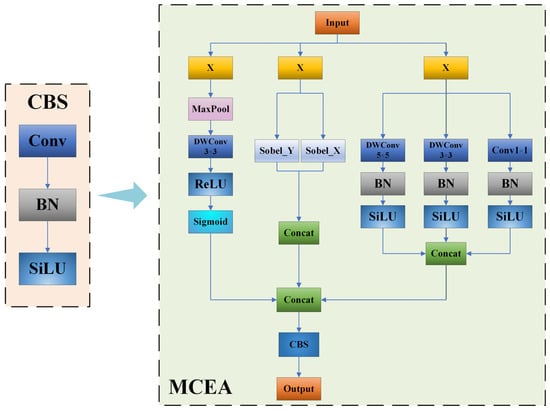
The third branch employs a lightweight channel attention mechanism combining global max pooling with deep convolutions. This mechanism adaptively learns the importance weights of features across channels, guiding the model to focus on key identification features of underwater objects while suppressing interference from water noise and uneven illumination. The outputs from all three branches undergo feature fusion via channel concatenation, followed by a 1 × 1 convolution to uniformly adjust channel dimensions. The MCEA module enhances the model’s perception capabilities for small underwater objects, as well as object edge contours and morphological features. The MCEA architecture is illustrated in Figure 3.
Figure 3.
Comparison between the CBS module and the proposed MCEA module. Different colors represent different functional modules.
2.2.2. IMCA Module
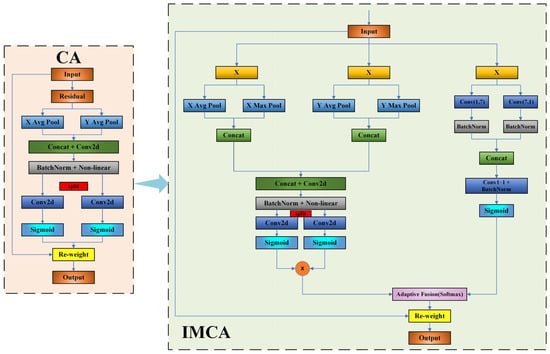
Compared with other attention mechanisms, CA introduces spatial position information and realizes simultaneous consideration of channel relationships and directional characteristics. CA compresses the feature map horizontally and vertically through two one-dimensional adaptive averaging pooling operations to generate feature representations with directional perception capability, and generates corresponding attention weights by using shared 1 × 1 convolution [16]. See the left side of Figure 4 for specific structure. CA can effectively capture the long-range dependence between spatial positions while maintaining low computational overhead. Compared with a traditional channel attention mechanism, CA can locate the object area more accurately.
Figure 4.
Comparison between the baseline CA module and the proposed IMCA module. Different colors represent different functional modules.
However, the average pooling strategy adopted in a CA module will dilute the response intensity of small underwater objects, because the characteristics of objects will be masked by complex underwater background information during the average pooling process. In addition, the underwater environment is characterized by uneven illumination, suspended particle interference, color attenuation and so on, so a CA module cannot distinguish foreground object from underwater chaotic background effectively. Furthermore, underwater objects exhibit a wide range of morphological variations. Underwater organisms, such as certain fish species and aquatic plants, typically have elongated shapes, with long-range dependencies in horizontal or vertical directions. Some objects present strip-like structures or are distributed along specific orientations. The CA module has difficulty fully capturing these directional geometric features.
In order to solve the above problems, we have made the following improvements on the basis of the original CA:
The first is to introduce a parallel mechanism of maximum pooling and average pooling into the pooling strategy, so as to reduce the impact of average pooling strategy on the response intensity of small underwater objects. Maximum pooling can preserve the peak response of small underwater objects, avoid smoothing the features of small objects in the global averaging process, and capture the overall distribution information by average pooling. Together, they can improve the perception ability of small objects in complex underwater scenes.
Secondly, direction-sensitive convolution branches are constructed, and asymmetric stripe convolution kernels (1 × 7 and 7 × 1) are used to capture horizontal and vertical structural features respectively, which effectively enhance the detection ability of objects with different shapes and directional distribution features.
Finally, IMCA dynamically integrates the attention features of each branch through learnable adaptive fusion weights, which can automatically adjust the weights of the two branches according to different underwater scenes; thus achieving more accurate feature enhancement and localization of underwater objects.
2.2.3. Pinwheel-Bottleneck Module
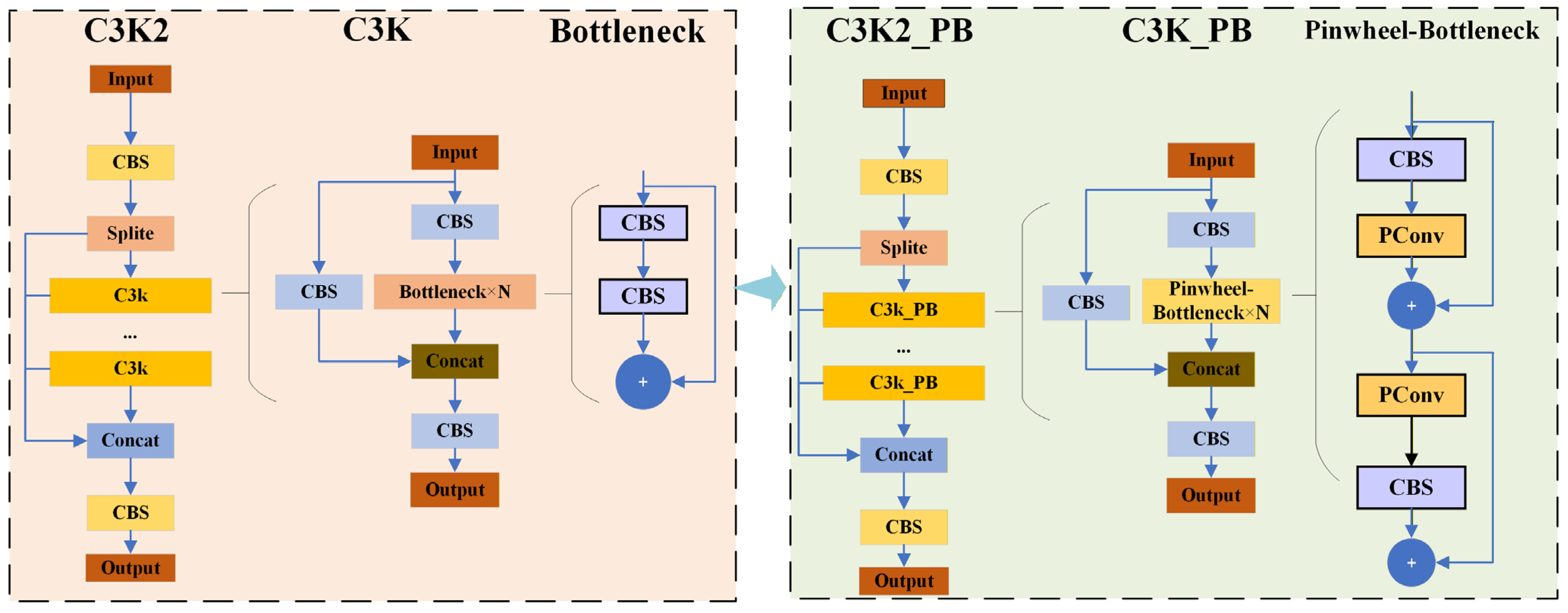
C3k2 serves as the primary feature processing module in YOLO11, but it struggles with handling features of small underwater objects. Therefore, the Pinwheel-Bottleneck module was designed and integrated into YOLO11’s C3k2 architecture. The Pinwheel-Bottleneck adopts a four-stage structure: CBS-PConv-PConv-CBS. Its key features include the use of PConv [17] and a dual residual connection mechanism. First, PConv employs an asymmetric padding strategy, processing input features through four-directional strip-shaped convolution kernels to form a pinwheel-shaped receptive field distribution. This simultaneously captures structural information in horizontal, vertical, and diagonal directions, making it suitable for detecting irregularly shaped objects in underwater scenes. Second, underwater small objects often have blurred boundaries and small sizes, making it difficult for standard convolutions to fully extract their features. In contrast, the multi-directional convolutions of PConv integrate both local and global information, enhancing the perception of fine-grained structures. The structure of PConv is briefly introduced below, with the first layer of convolution as follows:
denotes the convolution operation symbol. represents a 1 × 3 convolution kernel with channel output , where the parameters denote the number of padding pixels on the left, right, top, and bottom, respectively.
The relationship between the height , width , and number of channels of the output feature map after the first layer of convolution and the input feature map is as follows:
Here, denotes the number of channels in the output after PConv convolution, and represents the stride of the convolution. The results from the four-directional convolutions are concatenated and output as follows:
Finally, apply normalization using a 2 × 2 convolution kernel. The final output is calculated as follows:
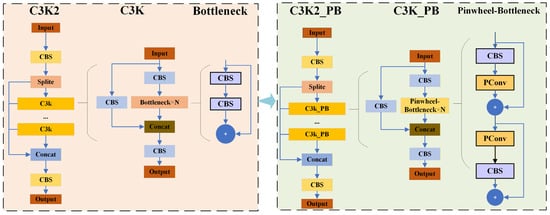
Simultaneously, Pinwheel-Bottleneck establishes residual connections between the input and the first PConv output, as well as between the first residual result and the final convolutional output. This dual residual structure not only effectively mitigates the vanishing gradient problem in deep networks but also fully preserves detailed feature information from shallow layers, ensuring subtle features are effectively retained during network propagation. Furthermore, the cascading of two PConv layers progressively expands the network’s receptive field, enabling the model to simultaneously perceive local details and global contextual information, effectively adapting to underwater object detection requirements. The specific structure of Pinwheel-Bottleneck is illustrated in Figure 5:
Figure 5.
Comparison of the original Bottleneck module structure and the improved Pinwheel-Bottleneck module structure. Different colors represent different functional modules.
2.3. Evaluation Indicators
The core metrics commonly used by researchers to evaluate the performance of YOLO models include P, R, mAP0.5, and mAP0.5:0.95. This paper uses seven core metrics to evaluate the detection performance, lightweight features and real-time performance of the model systematically and comprehensively. The performance of model detection was expressed by P, R, mAP0.5 and mAP0.5:0.95. Lightweight features are evaluated by two metrics, FLOPs and params [18]. Real-time performance is represented by FPS.
P measures the proportion of correctly predicted underwater object samples among all samples predicted as underwater objects by the model. Higher precision indicates fewer false positives in the model’s detection of underwater objects. The calculation formula is:
refers to instances where the model correctly detects underwater objects as underwater objects, while refers to instances where the model incorrectly detects non-underwater objects as underwater objects.
R measures the proportion of actual underwater object samples that are correctly detected. A higher recall rate indicates fewer underwater objects missed by the model. The calculation formula is:
refers to instances where the model incorrectly detects underwater objects as non-underwater objects.
AP is a comprehensive performance metric for evaluating underwater object detection models, balancing precision and recall. mAP represents the average AP value across all underwater object categories. In underwater object detection tasks, mAP0.5 and mAP0.5:0.95 are typically key indicators. The formulas for AP and mAP are:
Here, denotes the number of categories, and represents the value for category .
FLOP is used to measure the computational complexity of the model in a single inference process, usually in FLOPs, reflecting the real-time data processing capability of the equipment. Params are used to measure the size and complexity of the model. The lower the number of parameters, the more relaxed the configuration requirements for hardware devices are generally [19].
FPS is an important indicator used to measure the inference speed of a target detection model, indicating the number of image frames per second that the model can process. The higher the FPS, the better the real-time performance of the model, and the faster the target detection task can be completed in the actual application scenario. The formula for FPS is:
represents the total number of images processed, and represents the total time taken to complete the inference.
3. Results
3.1. Experimental Environment
The experimental system used Windows 11, with an NVIDIA GeForce RTX 3080 Laptop GPU (16 GB) and an AMD Ryzen 9 5900HX processor with Radeon Graphics (3.30 GHz), equipped with 32 GB of RAM. Development environment: Microsoft VS Code Language: Python 3.13.7. Framework: PyTorch 2.9.0. Operating platform: CUDA 12.6. See Table 1.
Table 1.
Experimental environment configuration.
The initial learning rate is set to 0.01, with eight workers, a batch size of 16, and 200 training epochs. Both training and testing images are set to 640 × 640 pixels. Training and validation are conducted under identical hyperparameters, as shown in Table 2.
Table 2.
Hyperparameter settings.
3.2. Dataset Construction
The datasets studied in this paper are the DUO and RUOD datasets. The DUO dataset comprises a total of 7782 images, including 6671 images in the training set and 1111 images in the validation set. The DUO dataset contains four categories: sea cucumbers, sea urchins, scallops, and starfish [20]. The RUOD dataset comprises 14,000 images, divided into a training set and a validation set. The training set contains 9800 images, while the validation set contains 4200 images. The RUOD dataset includes 10 categories: fish, divers, starfish, coral, sea turtles, sea urchins, sea cucumbers, scallops, squid, and jellyfish [21].
3.3. Ablation Experiment
To analyze the contribution of each module to the overall model performance and further validate the effectiveness of the proposed improvements, we conducted an ablation study using the DUO dataset. With YOLO11 as the baseline model, a series of experiments were designed based on mathematical combinations of single and multiple modules to comprehensively evaluate the impact of each modification.
A: Replacing the Conv module with MCEA to strengthen initial feature extraction for underwater objects;
B: Replacing the C2PSA module with an enhanced IMCA attention mechanism module to improve object perception and detection capabilities in complex underwater environments;
C: Substituting the Bottleneck module with an improved Pinwheel-Bottleneck module to preserve fine-grained features while expanding the receptive field.
Table 3 demonstrates that incorporating Module A into the baseline YOLO11 model increases P from 83.5% to 85.2%, and R from 74.4% to 76.3%. mAP0.5 increased from 82.2% to 84.4%, and the core metric mAP0.5:0.95 improved from 61.7% to 65.3%, representing the largest mAP0.5:0.95 gain among single modules. Simultaneously, the number of params increased from 2.58 × 10⁶ to 3.37 × 10⁶, and FLOPs rose from 6.3 G to 9.6 G, with the complexity increment remaining within an acceptable range.
Table 3.
Results of ablation experiments. “√” indicates that the corresponding module is included in the model.
After introducing the baseline model YOLO11 into Module B, the model’s P decreased from 83.5% to 82.9%, while R increased from 74.4% to 76.1%. mAP0.5 improved from 82.2% to 83.2%, while mAP0.5:0.95 improved from 61.7% to 63.5%. Concurrently, the number of params decreased, and FLOPs remained comparable to the baseline model. This demonstrates that Module B achieves overall performance gains without significant P trade-offs.
After introducing the baseline model YOLO11 into Module C, with model params increasing only from 2.58 × 10⁶ to 2.92 × 10⁶ and FLOPs rising from 6.3 G to 7.5 G, mAP0.5 improved from 82.2% to 82.8%, while mAP0.5:0.95 increased from 61.7% to 63.9%. P and R remained largely stable, indicating that this module positively contributes to refining object localization by enhancing bounding box regression accuracy and detection quality at high IoU thresholds. This achieves the expected goal of a modest leap in detection precision.
In multi-module ablation experiments, after A + B module combination, the accuracy rate P was 85.8%, R was 77.4%, mAP0.5 was 86.0%, mAP0.5: 0.95 was 67.7%, and the detection performance index was improved comprehensively. After the combination of A + C modules, P is up to 86.0%, achieving the maximum improvement of P, and other detection performance indicators are also slightly improved, which is suitable for scenes with extremely high requirements for target classification accuracy. The B + C combination maintained an extremely low increase in complexity with a slight performance boost, making it suitable for resource-constrained lightweight deployment scenarios. After the A + B + C combination, the detection performance was maximized. Compared with the baseline model, P increased by 2.5% to 86.0%, R increased by 4.1% to 78.5%, mAP0.5 increased by 4.2% to 86.4%, and mAP0.5:0.95 increased by 7.5% to 69.2%. Although the complexity of this combination is slightly increased, the benefit of the performance increase is much higher than the trouble caused by the complexity increment, which is an acceptable cost. Experimental results on multi-module combinations demonstrate a significant positive synergistic effect among Modules A, B, and C. Their combined use achieves additive performance gains.
To analyze the contribution of each component within the modules and further validate the effectiveness of the improved modules, ablation experiments were conducted on the MCEA and IMCA modules using the DUO dataset, with YOLO11n as the baseline model. Ablation studies were designed based on mathematical combinations of single and multi-component configurations to comprehensively evaluate the effect of each component’s improvement within the modules. The specific definitions are as follows:
A1: Retain only the multi-scale convolution branch;
A2: Retain only the Sobel operator edge detection branch;
A3: Retain only the lightweight attention mechanism branch;
B1: Retain only the pooling branch;
B2: Retain only the direction-sensitive convolution branch.
As shown in Table 4, branch A1 demonstrates comprehensive improvements across all detection metrics, achieving mAP0.5 and mAP0.5:0.95 of 83.5% and 64.1%, representing gains of 1.3% and 2.4% over the baseline, respectively. Branch A2 yields moderate improvements in recall and mAP metrics, with mAP0.5 and mAP0.5:0.95 reaching 82.5% and 62.7%, corresponding to increases of 0.3% and 1.0% over the baseline, albeit with relatively limited magnitude. In contrast, branch A3 alone fails to improve performance and instead leads to substantial degradation, with mAP0.5 and mAP0.5:0.95 declining sharply to 71.1% and 49.4%, representing decreases of 11.1% and 12.3% relative to the baseline. This performance deterioration can be attributed to the max-pooling operation, which excessively focuses on salient features at the expense of fine-grained spatial details, necessitating the complementary detail-preserving capabilities of branches A1 and A2 to compensate for such information loss. In the dual-branch combination experiments, A1A2, A1A3, and A2A3 achieve mAP0.5:0.95 of 64.2%, 64.5%, and 63.0%, respectively, all surpassing their individual single-branch counterparts and demonstrating effective complementary synergy among the three branches. Ultimately, the full three-branch configuration attains the best overall performance, with mAP0.5 and mAP0.5:0.95 reaching 84.4% and 65.3%, yielding improvements of 2.2% and 3.6% over the baseline, thereby validating the effectiveness of the proposed module design.
Table 4.
Results of ablation experiments on the internal components of the MCEA module. “√” indicates that the corresponding component is included in the module.
As shown in Table 5, both branches B1 and B2 effectively enhance detection performance while simultaneously reducing model parameters. Specifically, branch B1 achieves the highest precision of 84.0%, representing a gain of 0.5% over the baseline, whereas branch B2 outperforms B1 in terms of recall and mAP0.5:0.95, reaching 75.4% and 62.8%, respectively, demonstrating the complementary nature of the two branches. Upon combining both branches, all metrics reach their optimal values, with mAP0.5 and mAP0.5:0.95 attaining 83.2% and 63.5%, corresponding to improvements of 1.0% and 1.8% over the baseline, while the parameter count is concurrently reduced to 2.48M. These results collectively validate the effectiveness of the proposed module B in achieving superior detection performance under a lightweight design constraint.
Table 5.
Results of ablation experiments on the internal components of the IMCA module. “√” indicates that the corresponding component is included in the module.
3.4. Comparison Experiments
In order to further verify the superiority of MIP-YOLO11, we selected RT-DETR-L, YOLOv5n, YOLOv8n, YOLOv9t, YOLOv10n and YOLO11n as the comparison experiments. The comparison experiments used DUO dataset. The evaluation indexes were consistent with ablation experiments. All comparison algorithms use the same parameters and use the same training platform as described in Section 3.1. Results are presented in Table 6.
Table 6.
Comparison results with other models.
As can be seen from Table 6, RT-DETR-L is a two-stage detection model, and it can be seen that its computational overhead is much higher than that of a single-stage detector, with params up to 32 × 10, FLOPs up to 103.8 G, an FPS value of 44.4, and its detection performance is not as good as that of a single-stage detector. YOLOv5n has the lowest computational overhead with 2.19 × 10⁶ params and 5.9 G FLOPs among single-stage detectors, and its FPS value reaches 61.7, but its detection performance index is generally low due to its lightweight structure. mAP0.5:0.95 is only 59.8%, which is difficult to meet the detection requirements in complex scenes. YOLOv9s achieves the best detection performance in a baseline model, mAP0.5 and mAP0.5:0.95 reach 83.6% and 65.6% respectively, and its FPS value reaches 65.4, but 6.21 × 10⁶ parameters and 22.3 G FLOPs bring huge computational burdens, params and FLOPs are 2.8 times and 3.8 times that of YOLOv5n respectively, which seriously limits its deployment application in a mobile underwater platform. YOLOv8n, YOLOv10n and YOLO11n are gradient optimized between detection performance and light weight, and the FPS value is also improved to some extent, among which YOLO11n is the highest, reaching 85.5, but they do not break through the trade-off bottleneck, and the highest R is only 75.3%.
Compared to other models, the proposed model achieves higher accuracy at the cost of some lightweight design. Although the FPS value decreased slightly to 65.4, it still met the requirements of real-time detection. In terms of detection performance, the proposed model outperforms others in all metrics, validating the effectiveness of the proposed improvements.
3.5. Generalization Experiment
To further validate the performance of the proposed model on different datasets, we evaluated it based on the published RUOD underwater target dataset. This dataset covers richer target categories and more challenging underwater scenarios, and serves as a useful complementary validation platform to the main experiment to more fully test the generalization of the model. All experimental settings were consistent with the previous subsection to ensure comparability of results. The experiments demonstrated that the proposed model achieves good performance across different underwater datasets. Specific results are shown in Table 7.
Table 7.
Comparison of model performance on RUOD dataset.
It can be seen from Table 7 that the proposed model still performs well in the RUOD dataset, with accuracy rate of 85.4%, a recall rate of 79.2%, mAP0.5 of 85.6%, mAP0.5:0.95 of 62.3%, and all four performance indicators are the highest. The FPS value is 69.3, which still meets the real-time requirements.
3.6. Experiments’ Results Visualization Analysis
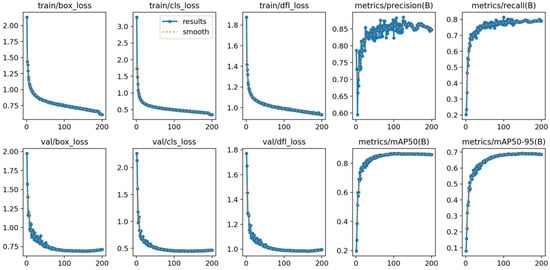
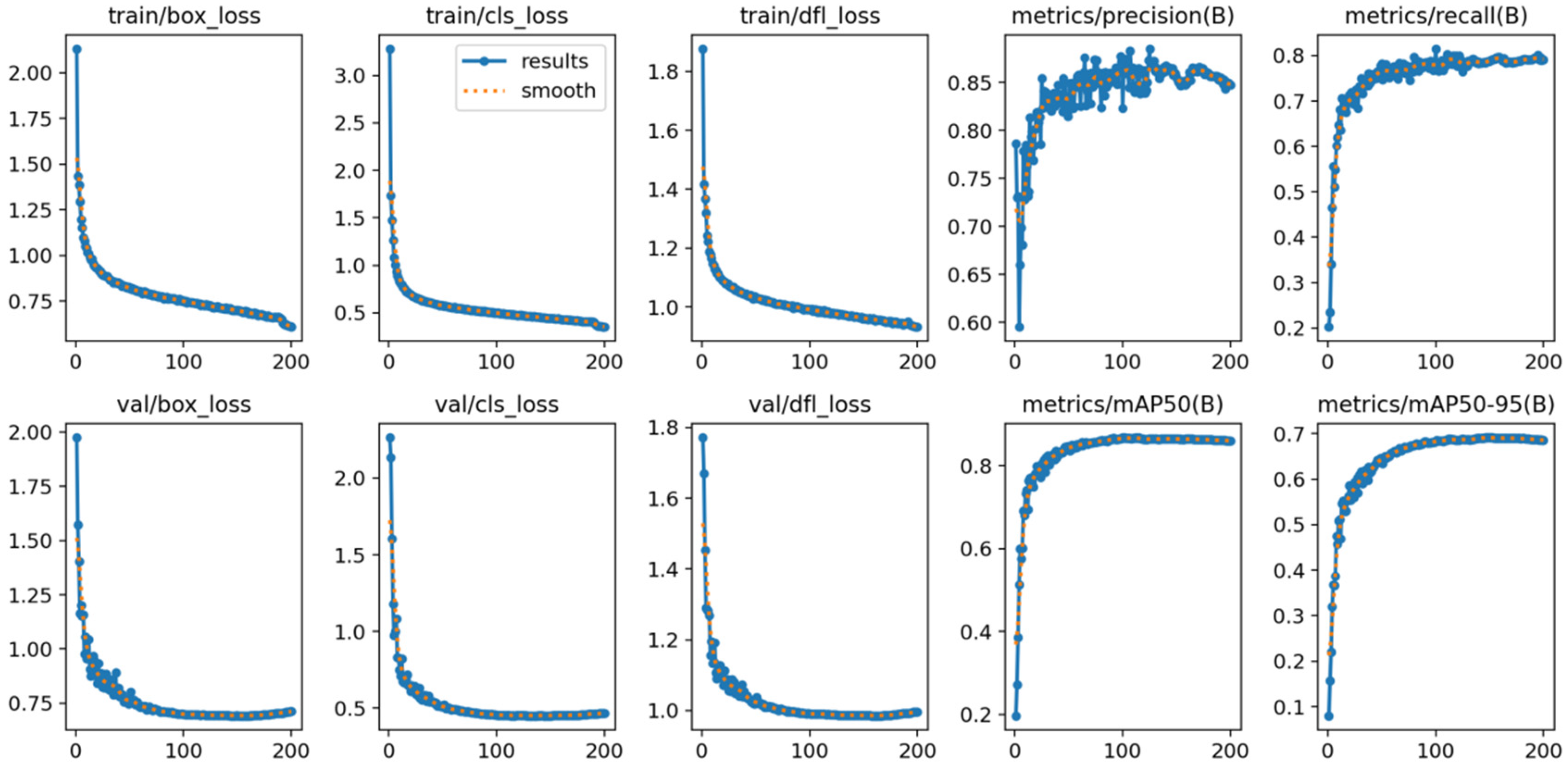
To better observe the effectiveness of the improved model, Figure 6 shows the training curves of the MIP-YOLO11 model, including P, R, mAP 0.5, and mAP 0.5:0.95.
Figure 6.
Experimental accuracy data results of MIP-YOLO11.
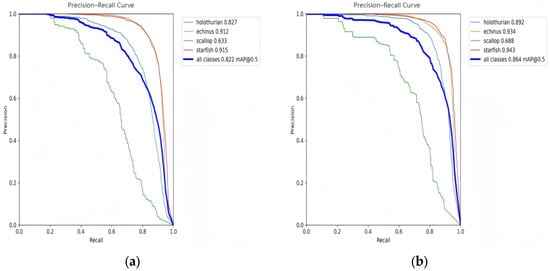
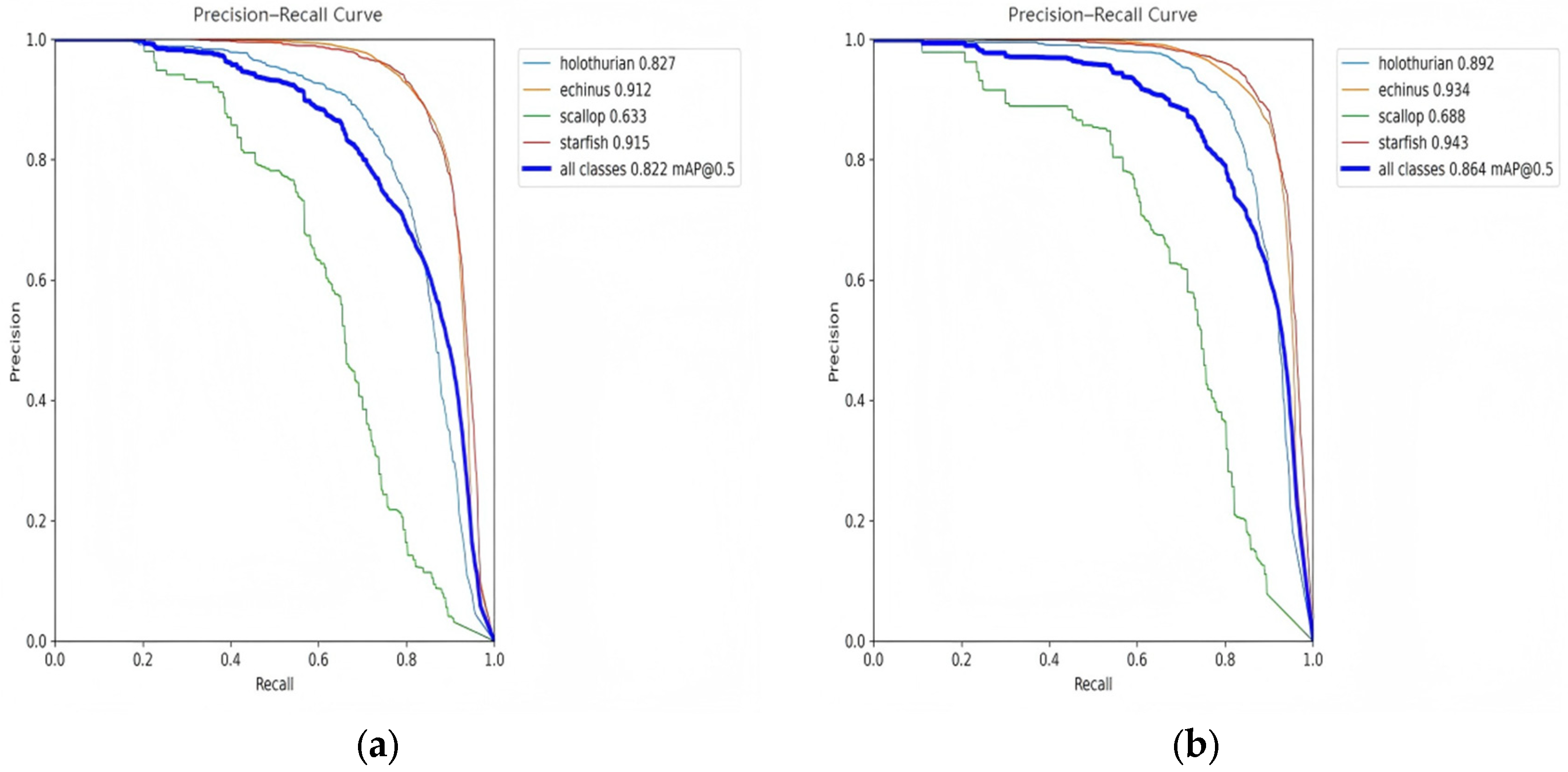
Figure 7 presents the PR curves for the of the baseline model YOLO11 and the proposed MIP-YOLO11 on the DUO dataset. The PR curves demonstrate that the proposed model achieves higher detection efficiency across all four object categories.
Figure 7.
Comparison of models’ PR curve. (a) YOLO11; (b) MIP-YOLO11.
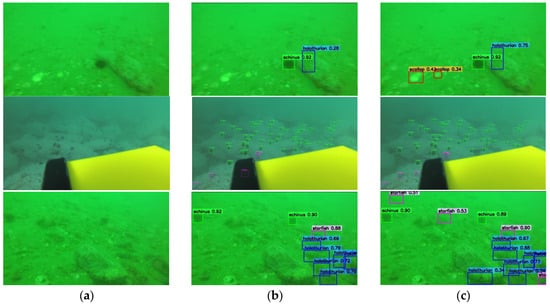
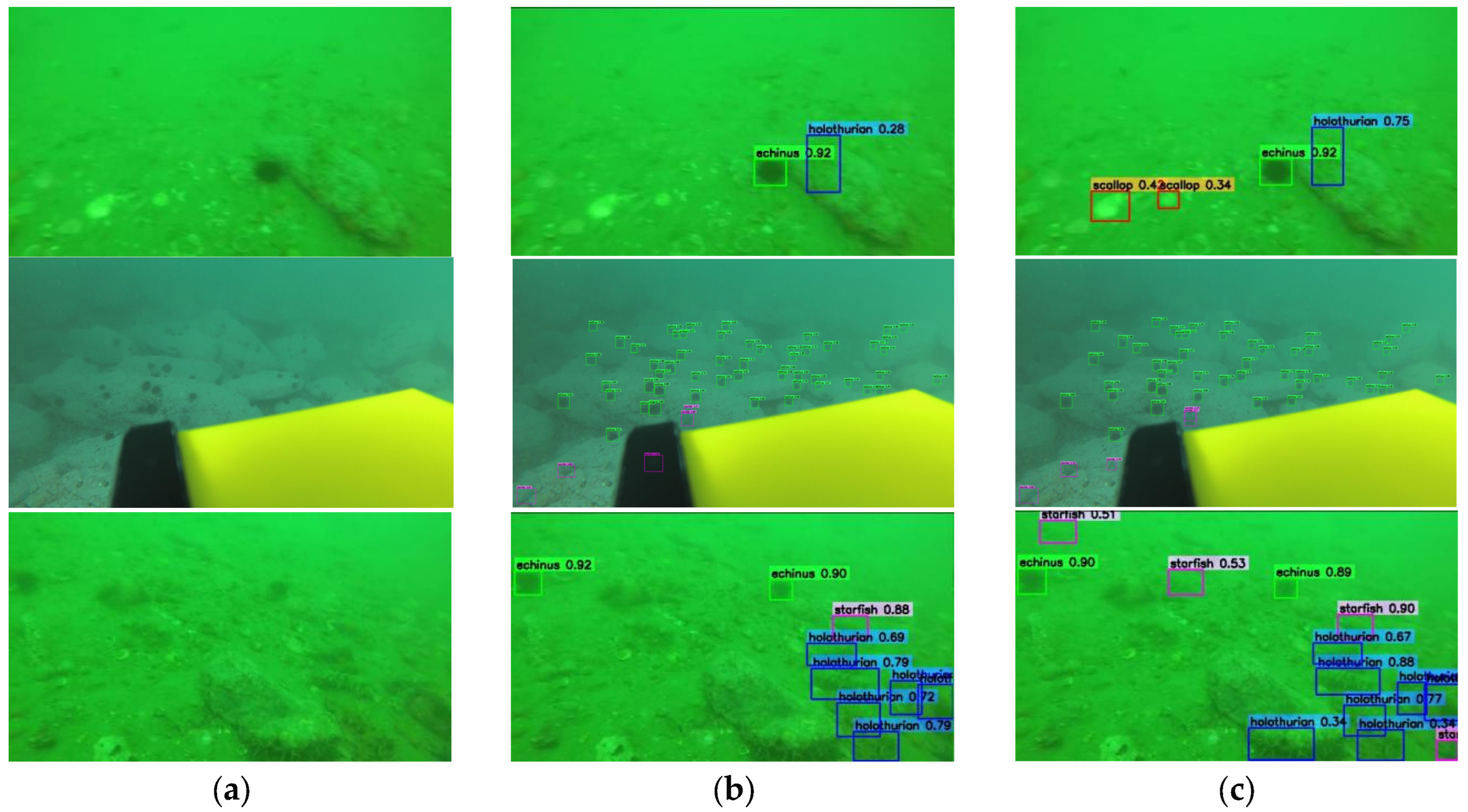
To visually demonstrate the performance gains of the improved model, we conducted qualitative validation using representative test images. These encompassed scenarios with small objects, objects obscured by dense biological clusters, and images exhibiting severe color shifts and blurring. Validation results are shown in Figure 8, where Figure 8a represents the original image, Figure 8b shows the baseline model, and Figure 8c displays the improved MIP-YOLO11 model.
Figure 8.
Comparison of test results on the DUO dataset. (a) Original image; (b) Detection results of the baseline model YOLO11; (c) Detection results of the proposed MIP-YOLO11. Different colored bounding boxes indicate different object categories (e.g., echinus, holothurian, scallop, and starfish).
It can be observed that the improved MIP-YOLO11 model significantly enhances detection performance, particularly in complex scenarios. In the comparison presented in Figure 8b,c, the baseline model incorrectly identified a portion of the ROV as a starfish, resulting in false detection. Additionally, the baseline model exhibits cases of missed detections, where certain objects were not recognized. In contrast, the MIP-YOLO11 model demonstrates substantial improvements in both reducing false positives and minimizing missed detections.
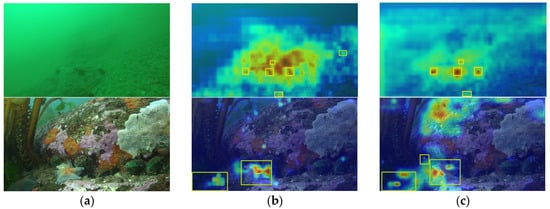
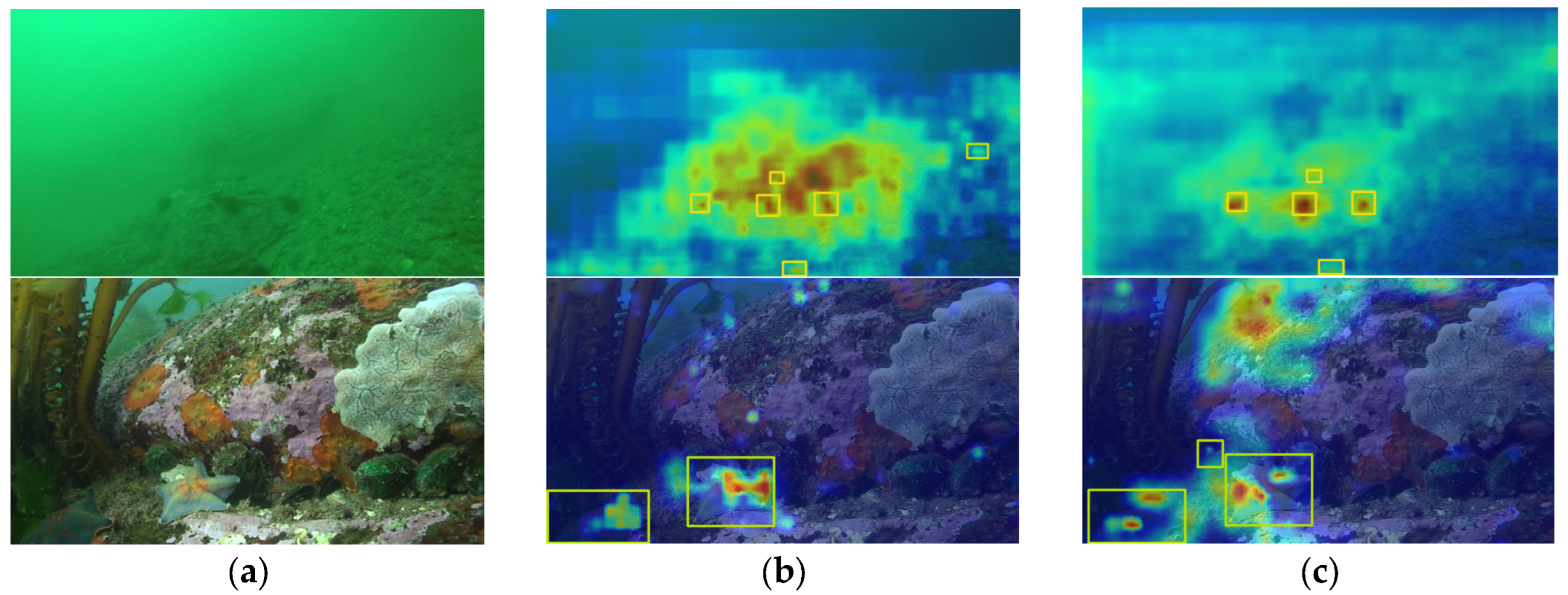
GradCAM heatmaps reveal the critical response regions during network predictions, thereby indicating whether the model focuses attention on the object itself rather than background areas, further enhancing the transparency and interpretability of the inference process [23]. In order to verify whether MIP-YOLO11 can effectively suppress the interference caused by target background noise and reduce the false detection rate, GradCAM is used to visualize the reasoning process of the model.
The validation results on the DUO dataset are shown in Figure 9, where Figure 9a represents the original image, Figure 9b represents the baseline model, and Figure 9c represents the improved MIP-YOLO11 model.
Figure 9.
Comparison of heat maps on the DUO dataset. (a) Original image; (b) YOLO11; (c) MIP-YOLO11. Warmer colors indicate higher activation. The rectangles highlight representative target regions for comparison.
From the first set of comparisons, it can be observed that the attention map of the baseline model is not well-focused during prediction, with the attention spread out at the boundary between the object and the background. This indicates that background noise strongly interferes with the model, leading to frequent misidentifications and missed detections. In contrast, the attention map of MIP-YOLO11 clearly concentrates on the object, with background interference effectively suppressed, demonstrating a stronger ability to focus on the object and successfully reducing false positives.
In the second set of comparisons, it can be seen that during the prediction process, the attention map of MIP-YOLO11 exhibits a more precise attention distribution, enabling the model to effectively identify objects that are fused with the background and difficult to recognize. This demonstrates that MIP-YOLO11 possesses superior object recognition capabilities, successfully reducing false negatives.
3.7. Sub-Experiments
Random seed selection can affect weight initialization, data shuffling, and other random processes during training, which may influence the model’s performance. In previous experiments, the default seed value of 0 was used. Therefore, we conducted supplementary experiments using multiple random seeds and calculated the variance of the results to ensure the stability of the model. This experiment used the DUO dataset, and all parameters, except for the seed, were set as described in Section 3.1.
As shown in Table 8, the choice of different random seeds has a certain impact on the model’s performance. The variances of R and mAP0.5 are relatively small, with values of 0.06 and 0.09, respectively. The variance of mAP0.5:0.95 is 0.14, and the variance of P is 0.16. This indicates that the fluctuations of these four metrics across different random seeds are relatively small, and the model’s performance is stable. This experiment demonstrates that the proposed model is robust to different seed values. For the sake of comparison with other models under the same conditions, we still select the default seed value of 0.
Table 8.
Variance analysis of model performance across different random seeds using the DUO dataset.
4. Discussion
To address the key challenges in underwater object detection in marine environments, including complex background interference, weak perception of small objects, and insufficient feature extraction, we designed the MIP-YOLO11 model to effectively tackle the problem of underwater object detection.
In terms of detection performance, the proposed model shows better performance than the baseline model. In the experiment of the DUO dataset, its P reaches 86.0%, R reaches 78.5%, mAP0.5 reaches 86.4%, and mAP0.5:0.95 reaches 69.2%, which is mainly due to the synergy of the three improved modules. Furthermore, the proposed MIP-YOLO11 model also achieves good performance on the RUOD dataset, its P reaches 85.4%, R reaches 79.2%, mAP0.5 reaches 85.6%, and mAP0.5:0.95 reaches 62.3%, which confirms the generalization ability of the model. Regarding practical deployment, MIP-YOLO11 achieves a significant performance boost while maintaining a controlled increase in both parameter count and computational cost: the model has 3.61 × 10⁶ params and requires 10.7 G FLOPs, which is slightly higher than the baseline YOLO11n model. Although there was a slight increase compared to baseline YOLO11n model, it is within an acceptable range.
Despite some improvements in the MIP-YOLO11 model, there are still three issues to consider. First, it was observed in the results of the generalization test that the performance of the MIP-YOLO11 model dropped slightly on the RUOD dataset. This indicates that the complexity of category and background increases, which may affect the detection performance. Future research can consider the processing method of image data enhancement to improve the model’s performance. Second, the increase in params and FLOPs is still significant, so it is necessary to further find the balance between precision and light weight. Future work may explore reducing computational overhead through techniques such as channel pruning or knowledge distillation while maintaining accuracy. Finally, it should be noted that all experiments in this study were performed on a single computer, so there may be differences between the hardware configuration in the experiment and the configuration of the actual underwater robot computer. These differences may affect the performance of the algorithm in practical applications, especially in terms of computational power and resource constraints. Due to the limitation of experimental conditions, this paper did not carry out such experiments. Therefore, future research should be conducted on actual robot hardware to evaluate the applicability of these parameters on different computing platforms.
5. Conclusions
In this paper, an improved underwater target detection model MIP-YOLO11 based on YOLO11 is proposed. Aiming at the core problems of weak underwater environment characteristics, complex morphology and background interference, the performance breakthrough is achieved by innovative design of three modules. The first is to design the MCEA module to replace the ordinary CBS module of the backbone network, and strengthen the edge and detail perception of underwater small objects without significantly increasing the computational burden. Secondly, the IMCA module is designed to replace the C2PSA module, which improves the focusing ability and morphological adaptability of targets in complex scenes, especially for underwater targets with directional distribution characteristics. Thirdly, the Pinwheel-Bottleneck module is innovated, the CBS-PConv-PConv-CBS four-level series structure and double residual connection mechanism are adopted, which effectively expands the receptive field of the network and fully retains the detailed feature information of the shallow layer.
Experimental results demonstrate that the proposed model contains only 3.61 × 10⁶ params and a computational complexity of 10.7 G FLOPs. Without significantly increasing computational complexity, it achieves a P of 86.0%, R of 78.5%, mAP0.5 of 86.4%, and mAP0.5:0.95 of 69.2% in underwater object detection tasks. Compared with the baseline model YOLO11n, the core metrics achieve absolute improvements of 2.5%, 4.1%, 4.2%, and 7.5%, respectively. This model improves detection performance at the expense of some lightweight features.
In summary, MIP-YOLO11 provides a solution with both innovation and practical value for underwater object detection, which can provide technical support for underwater robot operations, marine resource exploration and other practical application scenarios. Future research will focus on maximizing model lightweighting while ensuring detection accuracy to enhance its practical deployment capability. Additionally, given the rapid evolution of the object detection field, subsequent work will explore more advanced algorithm designs to further improve the overall performance of the model.
Author Contributions
Conceptualization, X.Q. and Y.S.; methodology, X.Q. and Y.S.; software, X.Q. and M.C.; validation, X.Q. and M.C.; formal analysis, X.Q. and Y.S.; investigation, X.Q. and M.C.; resources, Y.S. and Z.W.; data curation, X.Q. and Y.S.; writing—original draft preparation, X.Q.; writing—review and editing, X.Q., Y.S. and Z.W.; visualization, X.Q.; supervision, Y.S. and Z.W.; project administration, Y.S. and Z.W.; funding acquisition, Y.S. and Z.W. All authors have read and agreed to the published version of the manuscript.
Funding
This research received no external funding.
Data Availability Statement
The data featured in this study can be obtained upon request from the corresponding author.
Acknowledgments
We would like to thank the editor and the anonymous reviewers for their valuable comments and suggestions that have greatly improved the quality of this paper.
Conflicts of Interest
The authors declare no conflicts of interest.
Abbreviations
The following abbreviations are used in this manuscript:
| YOLO | You Only Look Once |
| MCEA | Multi-branch Convolutional Edge-detection Attention |
| CBS | Convolution-BatchNorm-Silu |
| IMCA | Improved Multi-branch Coordinate Attention |
| CA | Coordinate Attention |
| R-CNN | Region-based Convolutional Neural Networks |
| SSD | Single Shot MultiBox Detector |
| BOD | Benthic Organism Detection |
| RTRA | Regional Two-Level Routing Attention |
| FEM | Feature Enhancement Module |
| PConv | Pinwheel-shaped Convolution |
| C2PSA | Cross Stage Partial with Spatial Attention |
| PSA | Partial Self-Attention |
| C2F | CSPDarknet53 to 2-Stage FPN |
| URPC2020 | Underwater Robot Professional Contest 2020 |
| DASPPF | Deformable Attention-based Spatial Pyramid Pooling Fast |
| P | Precision |
| R | Recall |
| mAP | Mean Average Precision |
| FLOPs | Floating Point Operations Per Second |
| FPS | Frames Per Second |
References
- Liu, H.; Li, Y.; Qian, T.; Tang, Y. Recent Progress in Ocean Intelligent Perception and Image Processing and the Impacts of Nonlinear Noise. Mathematics 2025, 13, 1043. [Google Scholar] [CrossRef] [Scilit]
- Girshick, R.; Donahue, J.; Darrell, T.; Malik, J. Rich Feature Hierarchies for Accurate Object Detection and Semantic Segmentation. In Proceedings of the IEEE Conference on Computer Vision and Pattern Recognition (CVPR), Columbus, OH, USA, 23–28 June 2014; IEEE: New York, NY, USA, 2014; pp. 580–587. [Google Scholar] [CrossRef] [Scilit]
- Girshick, R. Fast R-CNN. In Proceedings of the IEEE International Conference on Computer Vision (ICCV), Santiago, Chile, 7–13 December 2015; IEEE: New York, NY, USA, 2015; pp. 1440–1448. [Google Scholar] [CrossRef] [Scilit]
- Ren, S.; He, K.; Girshick, R.; Sun, J. Faster R-CNN: Towards real-time object detection with region proposal networks. In IEEE Transactions on Pattern Analysis and Machine Intelligence; IEEE: New York, NY, USA, 2017; Volume 39, pp. 1137–1149. [Google Scholar] [CrossRef] [Scilit]
- Mi, Z.; Lian, Z. Review of YOLO Methods for Universal object Detection. J. Comput. Eng. Appl. 2024, 60, 38–54. [Google Scholar]
- Li, Y.; Zhang, X.; Shen, Z. YOLO-Submarine Cable: An Improved YOLO-V3 Network for Object Detection on Submarine Cable Images. J. Mar. Sci. Eng. 2022, 10, 1143. [Google Scholar] [CrossRef] [Scilit]
- Xin, S.; Ge, H.; Yuan, H.; Yang, Y.; Yao, D. Improved lightweight underwater object detection algorithm of YOLOv7. Comput. Eng. Appl. 2024, 60, 88–99. [Google Scholar]
- Zhao, H.; Xu, C.; Chen, J.; Zhang, Z.; Wang, X. BGLE-YOLO: A Lightweight Model for Underwater Bio-Detection. Sensors 2025, 25, 1595. [Google Scholar] [CrossRef] [Scilit] [PubMed]
- Zhang, F.; Cao, W.; Gao, J.; Liu, S.; Li, C.; Song, K.; Wang, H. Underwater Object Detection Algorithm Based on an Improved YOLOv8. J. Mar. Sci. Eng. 2024, 12, 1991. [Google Scholar] [CrossRef] [Scilit]
- Zou, D.; Zhao, S.; Zhou, J.; Liu, G.; Jiang, Z.; Xu, M.; Fu, X.; Liu, S. EMR-YOLO: A Multi-Scale Benthic Organism Detection Algorithm for Degraded Underwater Visual Features and Computationally Constrained Environments. J. Mar. Sci. Eng. 2025, 13, 1617. [Google Scholar] [CrossRef] [Scilit]
- Zhu, Z.; Su, Z.; Wang, W. Underwater Image Object Detection Based on AWAF-YOLO Algorithm. Laser Optoelectron. Prog. 2025, 62, 1601001. [Google Scholar]
- Du, R.; Wang, Z.; Meng, L.; Jing, Y. Underwater small objects detection based on self-attention and improved pyramid network. J. Shenzhen Univ. Sci. Eng. 2025, 42, 428–436. [Google Scholar] [CrossRef] [Scilit]
- Qian, J.; Chen, M. WDS-YOLO: A Marine Benthos Detection Model Fusing Wavelet Convolution and Deformable Attention. Appl. Sci. 2025, 15, 3537. [Google Scholar] [CrossRef] [Scilit]
- Wang, Q.; Liu, Z. FEFM-YOLO11: Underwater Object Detection Algorithm Based on Improved YOLO11. Neural Process. Lett. 2025, 57, 82. [Google Scholar] [CrossRef] [Scilit]
- Ultralytics. YOLO11. 2024. Available online: https://docs.ultralytics.com/models/yolo11/ (accessed on 1 November 2025).
- Hou, Q.; Zhou, D.; Feng, J. Coordinate Attention for Efficient Mobile Network Design. In Proceedings of the IEEE/CVF Conference on Computer Vision and Pattern Recognition; IEEE: New York, NY, USA, 2021. [Google Scholar] [CrossRef] [Scilit]
- Yang, J.; Liu, S.; Wu, J.; Su, X.; Hai, N.; Huang, X. Pinwheel-shaped Convolution and Scale-based Dynamic Loss for Infrared Small object Detection. In Proceedings of the AAAI Conference on Artificial Intelligence; Computer Vision Foundation: New York, NY, USA, 2025; Volume 39, pp. 9202–9210. [Google Scholar] [CrossRef] [Scilit]
- Zhang, M.; Ye, S.; Zhao, S.; Wang, W.; Xie, C. Pear Object Detection in Complex Orchard Environment Based on Improved YOLO11. Symmetry 2025, 17, 255. [Google Scholar] [CrossRef] [Scilit]
- Wang, X.; Wang, A.; Yi, J.; Song, Y.; Chehri, A. Small Object Detection Based on Deep Learning for Remote Sensing: A Comprehensive Review. Remote Sens. 2023, 15, 3265. [Google Scholar] [CrossRef] [Scilit]
- Liu, C.; Li, H.; Wang, S.; Zhu, M.; Wang, D.; Fan, X.; Wang, Z. A Dataset and Benchmark of Underwater Object Detection for Robot Picking. In Proceedings of the 2021 IEEE International Conference on Multimedia & Expo Workshops (ICMEW); IEEE: New York, NY, USA, 2021; pp. 1–6. [Google Scholar] [CrossRef] [Scilit]
- Fu, C.; Liu, R.; Fan, X.; Chen, P.; Fu, H.; Yuan, W.; Zhu, M.; Luo, Z. Rethinking General Underwater Object Detection: Datasets, Challenges, and Solutions. Neurocomputing 2023, 517, 243–256. [Google Scholar] [CrossRef] [Scilit]
- Zhao, Y.; Lv, W.; Xu, S.; Wei, J.; Wang, G.; Dang, Q.; Liu, Y.; Chen, J. DETRs Beat YOLOs on Real-time Object Detection. In Proceedings of the 2024 IEEE/CVF Conference on Computer Vision and Pattern Recognition (CVPR); IEEE: New York, NY, USA, 2024; pp. 16965–16974. [Google Scholar] [CrossRef] [Scilit]
- Selvaraju, R.R.; Cogswell, M.; Das, A.; Vedantam, R.; Parikh, D.; Batra, D. Grad-CAM: Visual Explanations from Deep Networks via Gradient-Based Localization. Int. J. Comput. Vis. 2020, 128, 2438–2454. [Google Scholar] [CrossRef] [Scilit]

Disclaimer/Publisher’s Note: The statements, opinions and data contained in all publications are solely those of the individual author(s) and contributor(s) and not of MDPI and/or the editor(s). MDPI and/or the editor(s) disclaim responsibility for any injury to people or property resulting from any ideas, methods, instructions or products referred to in the content. |
© 2026 by the authors. Licensee MDPI, Basel, Switzerland. This article is an open access article distributed under the terms and conditions of the Creative Commons Attribution (CC BY) license.