


Abstract
Side-scan sonar is essential to underwater target detection, yet its effectiveness is hindered by scarce annotated data and complex acoustic artifacts. This study systematically evaluates four YOLO variants, YOLOv8n, YOLOv10n, YOLOv11n, and the newly released YOLOv13n, on two public side-scan sonar datasets with limited samples and severe class imbalance. We assess detection accuracy, computational efficiency, inference speed, and transfer learning using COCO pre-trained weights, as well as the impact of optimizer choice between SGD and AdamW. The results reveal distinct strengths: YOLOv8n achieves the fastest inference at 60.98 FPS, with a competitive mAP50 of 0.906, ideal for real-time applications. YOLOv11n offers the best accuracy–efficiency balance, attaining the highest recall of 0.859 and mAP50 of 0.917. YOLOv13n demonstrates exceptional precision of 0.993 and high-IoU localization, with an mAP75 of 0.760. Transfer learning consistently boosts performance, with average mAP50:95 gains exceeding 54% on the more challenging dataset, highlighting its critical role in overcoming data scarcity. SGD generally outperforms AdamW, confirming its suitability as the default optimizer. These findings provide practical guidelines: YOLOv8 for real-time needs, YOLOv11 for balanced performance, and YOLOv13 for precision-critical tasks with ample resources. This work also establishes a benchmark for future underwater autonomous system research.
1. Introduction
Underwater object detection plays a critical role in a wide range of marine applications, including mine and unexploded ordnance identification [1,2], aquatic life monitoring and conservation [2,3], subsea resource exploration [4,5], salvage and rescue operations [6,7], and submarine pipeline inspection [8,9,10,11]. Sonar systems, owing to their superior performance under poor visibility conditions and their capability to operate over extended ranges and coverage areas, have become the predominant sensing modality for underwater imaging. Commonly used imaging sonars include forward-looking sonar (FLS) [12], side-scan sonar (SSS) [13], and synthetic aperture sonar (SAS) [14]. These sensors are typically deployed on autonomous or remotely operated underwater vehicles, which continuously emit acoustic pulses and record backscattered echoes to form imagery. During long-duration seafloor surveys lasting several days, vast quantities of sonar imagery are acquired, yet critical targets such as naval mines appear only rarely. Manual interpretation of such data is not only laborious and time-consuming but also prone to fatigue-related oversight. Consequently, the development of rapid, accurate, and automated underwater target detection methods is imperative to reduce operator burden and enhance post-mission analytical efficiency.
Considerable research efforts have been devoted to automatic target recognition in SSS imagery [15,16]. These approaches generally fall into two categories: traditional machine learning and deep learning. Conventional machine learning methods typically rely on handcrafted features, such as texture, corners, and edges, for unsupervised detection [17,18,19,20]. Side-scan sonar imagery is characterized by less prominent features and sparse target distribution. However, the underwater environment is highly dynamic and complex, rendering traditional handcrafted features insufficiently robust for real-world deployment. Three typical physical artifacts further exacerbate detection difficulties: First, acoustic shadows form on the side of a target facing away from the sound wave, appearing as continuous dark regions due to wave occlusion. Although they can be used to infer target height, they also result in the loss of target contours. Second, speckle noise arises from the interference of coherent sound waves scattered by rough interfaces, manifesting as randomly distributed granular patterns that obscure target edges and structural details. Third, multipath reflections occur when sound waves reach the receiver via multiple reflections off the sea surface, seabed, or other interfaces, producing false targets (ghost images), trailing artifacts, or repetitive patterns that lead to false alarms and positioning errors. Collectively, these artifacts significantly increase the difficulty and uncertainty of underwater target detection. Consequently, despite the emergence of various deep learning methods, underwater target detection remains a highly challenging research problem.
In recent years, deep learning approaches using block-based or modular strategies have emerged as a dominant paradigm [21,22,23] and specifically in image object detection [24] and further analysis of multisource heterogeneous data while enabling uncertainty quantification [25].
Among various architectures, the You Only Look Once (YOLO) family of one-stage detectors has gained particular traction as a real-time solution and is frequently adopted as a baseline in comparative studies. For instance, Tang et al. [26] integrated transfer learning with YOLOv3 for shipwreck detection. Yu et al. [27] incorporated attention mechanisms into YOLOv5 to enhance underwater detection performance. Zhang et al. [28] modified YOLOv5 for FLS imagery, while Qin et al. [29] introduced improvements to YOLOv7. From this point of view, researchers have developed methods like CSC-YOLO, a YOLOv8-based variant specifically designed for shipwreck detection [30]; ScEMA-YOLOv8 [31]; CSTC-YOLOv8 for underwater sonar target detection tasks [32]; and lightweight models for side-scan sonar target detection (SS-YOLO and CKAN-YOLOv8) [33,34]. Meanwhile, ABFP-YOLO (an enhanced version of YOLOv11) [35] and SOCA-YOLO [36] have also been presented for small object detection in SSS imagery. Despite the rapid evolution of the YOLO series, now extending to YOLOv13, a systematic assessment of these successive versions specifically for side-scan sonar object detection remains conspicuously absent from the literature.
A further obstacle to the direct application of deep learning in sonar imagery lies in the scarcity of annotated data, particularly for typical underwater targets. Deep neural networks are notoriously data-hungry, and the limited availability of labeled sonar samples poses a significant challenge [37]. To mitigate this issue, numerous studies have adopted transfer learning strategies, wherein models pre-trained on data-rich domains, such as optical or synthetic aperture radar (SAR) imagery, are fine-tuned on sonar data. Zhang et al. [38] transferred models pre-trained on SAR datasets to sonar target detection. Cheng et al. [39] proposed a cross-modal transfer learning method that fuses SAR and optical information for underwater target classification. The same group further developed a multi-domain collaborative transfer learning framework incorporating multi-scale repeated attention mechanisms for SSS image classification. Huo et al. [40] combined transfer learning with synthetic sample generation to improve classification performance. These studies collectively underscore the potential of transfer learning in bridging domain gaps and alleviating data limitations.
Against this backdrop, the present study undertakes a systematic and comparative evaluation of four representative YOLO variants, YOLOv8, YOLOv10, YOLOv11, and the recently released YOLOv13, on two SSS datasets. The threefold: (1) to benchmark detection accuracy, computational efficiency, and inference speed across models, (2) to quantify the impact of transfer learning using COCO pre-trained weights, and (3) to examine the influence of optimizer choice on training outcomes.
This study aims to provide both methodological insights and actionable guidance for researchers and practitioners engaged in sonar-based automatic target recognition.
2. Materials and Methods
2.1. YOLOv8
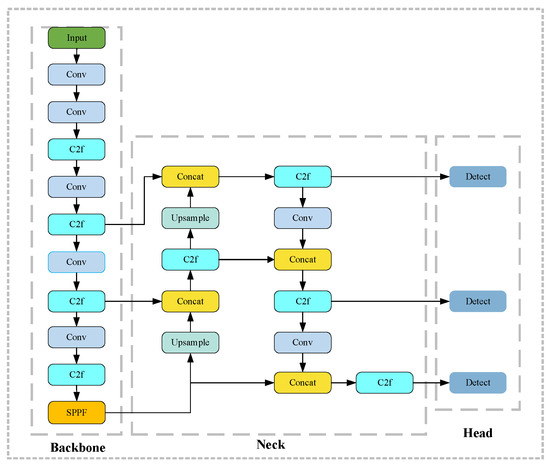
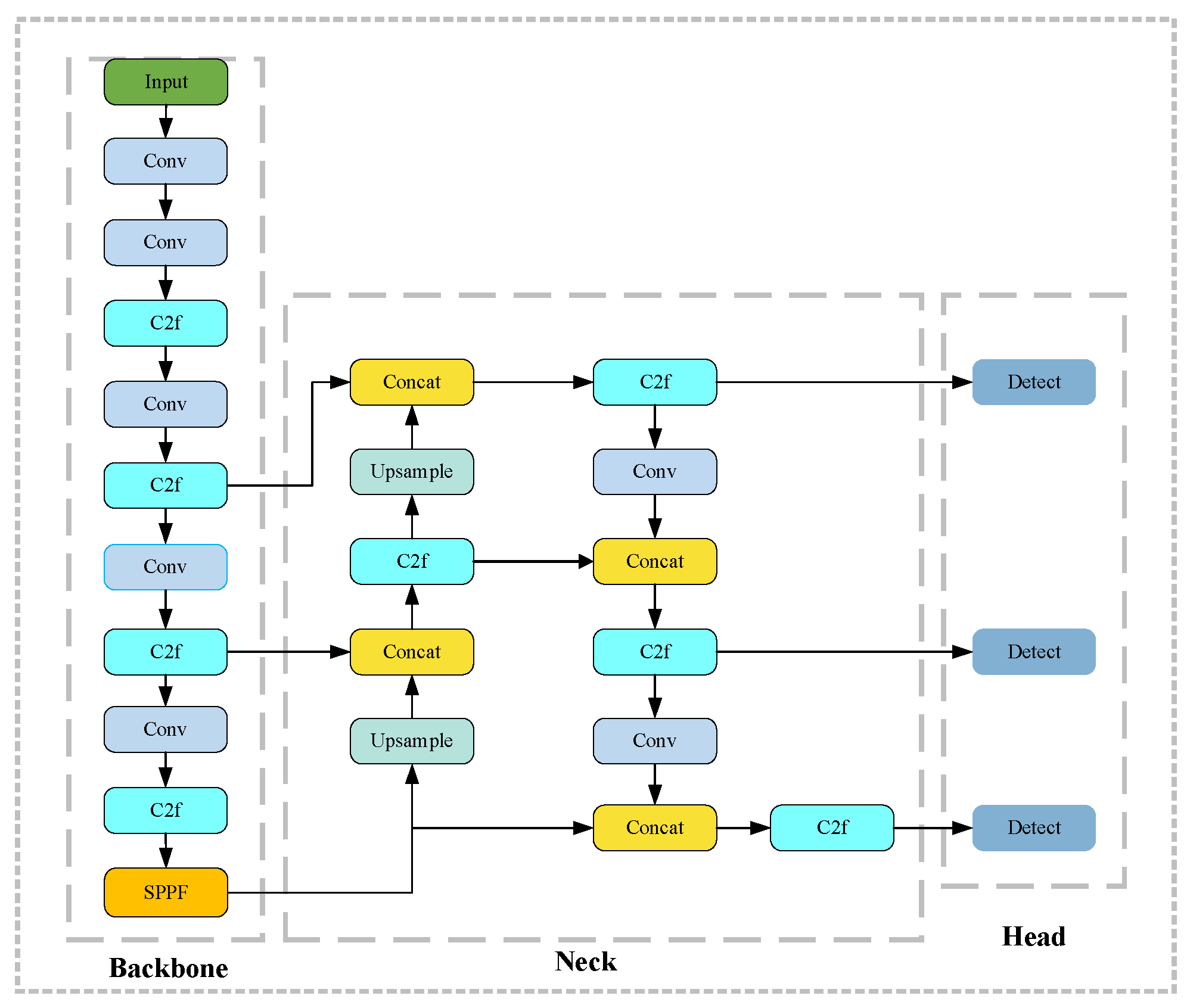
YOLOv8, released by Ultralytics in 2023, is a one-stage object detector that builds upon the architectural strengths of YOLOv5 and YOLOv7 while introducing several key innovations to achieve a more favorable trade-off between detection accuracy and inference efficiency [41]. The overall architecture comprises four core components: input layer, backbone network, feature fusion neck, and decoupled detection head. An illustration of the model structure is provided in Figure 1.
Figure 1.
Architecture of the YOLOv8 model.
(1) Input
The input module preprocesses raw SSS images by uniformly resizing them to 640 × 640 pixels and converting them into three-channel RGB format. During training, a variety of data augmentation techniques—including mosaic augmentation, random affine transformations, and color jittering—are employed to enhance model generalization and robustness across diverse imaging conditions and acoustic environments.
(2) Backbone
The backbone adopts a hierarchical architecture composed of stacked convolution–batch normalization–SiLU (CBS) modules, Cross-Stage Partial with 2 convolutions (C2f) modules, and a Spatial Pyramid Pooling—Fast (SPPF) module, which progressively extract multi-scale deep features. The CBS module integrates convolution, batch normalization, and the Sigmoid Linear Unit (SiLU) activation function to facilitate low-level feature extraction and stable gradient propagation. The C2f module, inspired by the Efficient Layer Aggregation Networks (ELAN) multi-branch design, aggregates gradient information from different network depths, thereby improving representational capacity while maintaining a lightweight structure. The SPPF module applies multi-scale max-pooling operations to aggregate contextual information, effectively enlarging the receptive field and enhancing feature representation efficiency.
(3) Neck
The neck network adopts the Path Aggregation Network with Feature Pyramid Network (PAN-FPN) architecture, enabling bidirectional feature fusion of high-level semantic information and low-level spatial details through top-down and bottom-up pathways. Compared with YOLOv5, YOLOv8 replaces the C3 modules in the neck with more expressive C2f modules and streamlines the upsampling paths. These modifications reduce computational complexity while preserving effective multi-scale feature integration.
(4) Head
The detection head adopts a decoupled design that separates the classification and regression branches, which independently predict object categories and bounding-box offsets. YOLOv8 abandons traditional anchor-based mechanisms in favor of a fully anchor-free paradigm, performing dense predictions directly on feature maps. For loss computation, the classification branch employs binary cross-entropy loss, while the regression branch combines distribution focal loss and complete Intersection over Union loss to jointly optimize localization accuracy and classification confidence.
2.2. YOLOv10
YOLOv10, proposed by Tsinghua University in 2024, is the first model in the YOLO series to achieve truly end-to-end, real-time object detection without requiring non-maximum suppression post-processing [42]. It delivers high detection accuracy while substantially reducing inference latency and computational overhead. The overall architecture retains the conventional tripartite design of backbone, neck, and detection head and introduces several core innovations centered on non-maximum suppression (NMS)-free training, efficient structural design, and accuracy enhancement.
(1) Backbone Network
The backbone adopts an enhanced Cross-Stage Partial Network (CSPNet) structure that integrates large kernel convolutions and compact inverted blocks. Large kernel convolutions expand the effective receptive field, while compact inverted blocks strengthen gradient and feature reuse under low Giga Floating Point Operations (GFLOPs) constraints. These components collectively enable stronger feature representation within a lightweight backbone.
(2) Feature Fusion Neck
Built upon a Path Aggregation Network (PAN), the neck constructs a multi-scale feature pyramid and incorporates partial self-attention modules in deeper stages. This design enhances global contextual modeling while maintaining computational efficiency, which aids in distinguishing targets from background clutter in sonar imagery.
(3) Detection Head
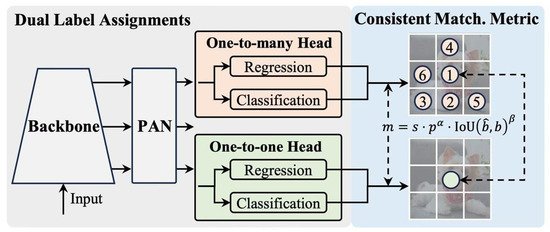
YOLOv10 introduces a consistent dual assignment strategy for training and inference decoupling. During training, a one-to-many head provides rich positive sample supervision. During inference, the model seamlessly switches to a one-to-one head that directly outputs final predictions, completely eliminating the need for NMS. This mechanism not only removes post-processing latency but also avoids performance fluctuations caused by NMS threshold selection.
(4) Efficiency Optimization
The model integrates multiple lightweight designs, including a lightweight classification head, spatially and channel-wise decoupled downsampling, and feature rank-based adaptive architecture replacement. These techniques jointly reduce computational redundancy under strict parameter budgets.
(5) Accuracy Enhancement
In addition to large kernel convolutions and partial self-attention, YOLOv10 employs structural reparameterization techniques to introduce extra branches during training, increasing model capacity without incurring additional inference cost. This achieves a favorable balance between precision and speed.
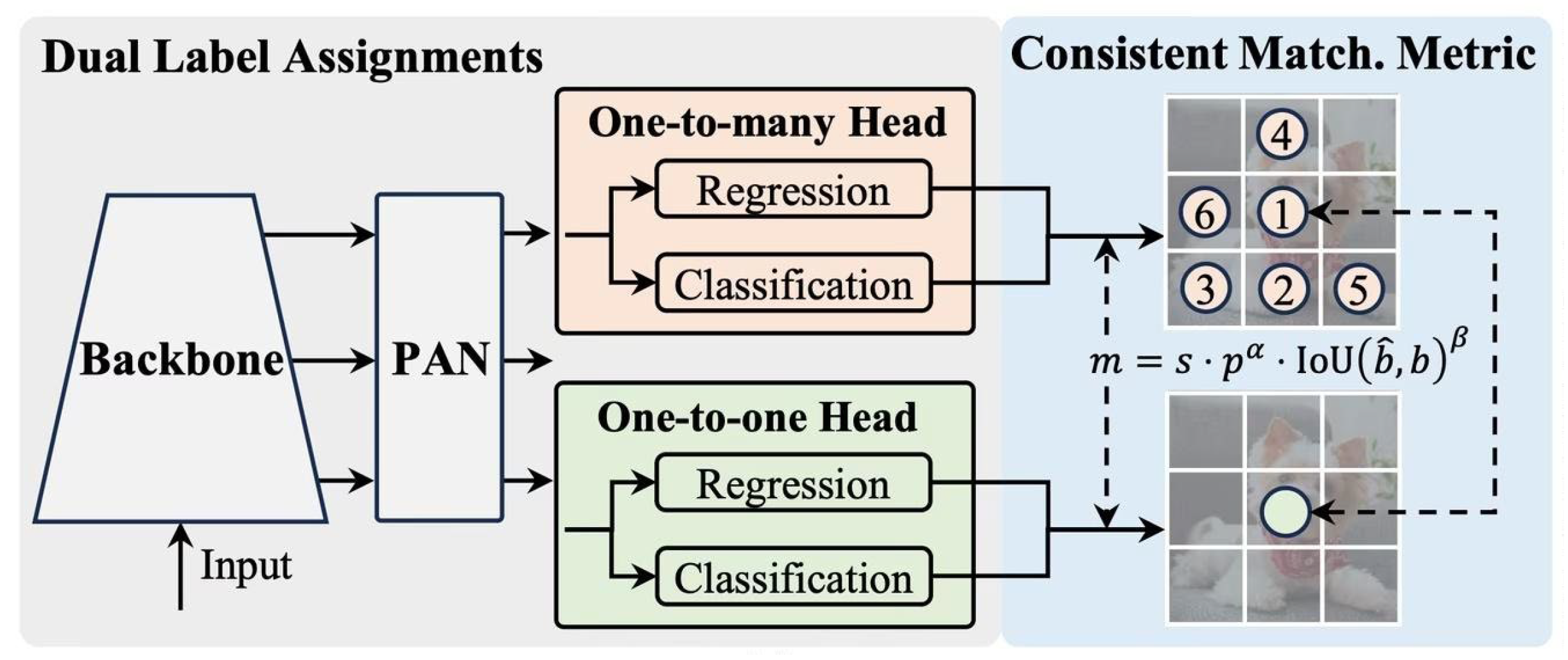
Figure 2 illustrates the consistent dual assignment mechanism that underpins NMS-free training in YOLOv10. The one-to-many and one-to-one heads share the same backbone and are jointly optimized via a consistent matching strategy.
Figure 2.
Consistent dual assignments for NMS-free training [42].
2.3. YOLOv11
YOLOv11, released by Ultralytics in 2024, represents the next generation of object detectors within the YOLO series. Building upon the foundation of YOLOv8, it introduces systematic architectural refinements and strategic upgrades aimed at achieving a superior trade-off between detection accuracy and inference efficiency [43]. Key innovations are concentrated in three core components: the backbone network, the feature fusion neck, and the detection head.
(1) Backbone Network
The backbone incorporates the Cross-Stage Partial with kernel size 2 (C3k2) module as a replacement for the previous C2f module. C3k2 features flexible kernel size configurations that adapt to varying network depths and computational budgets, enabling finer granularity in balancing representational capacity and computational cost. Additionally, a channel-wise partial self-attention module is embedded in the deeper stages of the backbone. This module selectively applies self-attention mechanisms to a subset of feature channels, effectively expanding the receptive field and strengthening global contextual modeling. A hybrid serial parallel multi-scale pooling structure further enhances the aggregation efficiency of contextual information.
(2) Feature Fusion Neck
The neck network retains the bidirectional fusion architecture of the PAN, while uniformly upgrading the original C2f modules to C3k2 modules. This enhancement improves the neck capacity for integrating multi-scale semantic information, ensuring that low-level spatial details and high-level semantic features are preserved with higher fidelity during propagation. As a result, detection robustness across objects of varying sizes is substantially improved.
(3) Detection Head
The detection head continues to adopt a decoupled structure, with separate branches for classification and regression. A fully anchor-free paradigm is employed, coupled with a dynamic label assignment strategy that optimizes positive and negative sample allocation. This configuration stabilizes the training process and improves sample efficiency. To further reduce computational overhead, depth-wise separable convolutions are introduced in the classification branch in place of standard convolutions, significantly decreasing parameter count and GFLOPs while maintaining classification accuracy.
In summary, YOLOv11 achieves steady improvements in detection precision through a combination of module level substitutions, attention mechanism integration, and lightweight design optimizations, all while sustaining high inference speed. These attributes render it particularly suitable for complex underwater detection scenarios that demand both real-time responsiveness and accurate localization.
2.4. YOLOv13
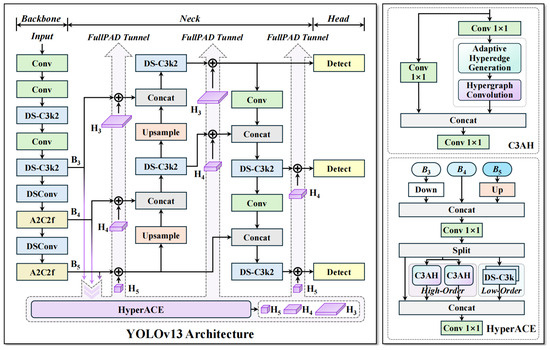
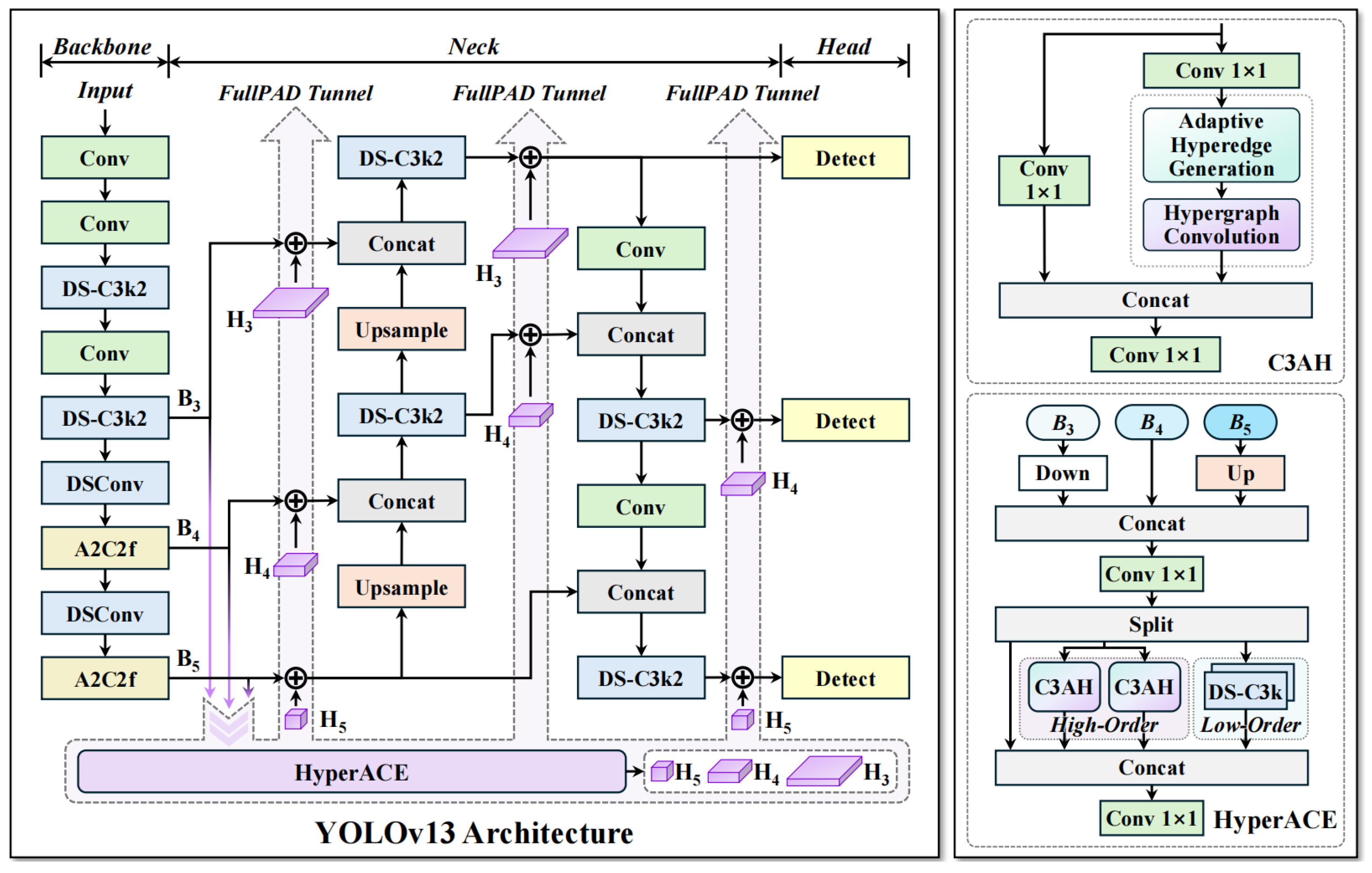
YOLOv13, the latest addition to the YOLO series released in 2025, was jointly developed by Tsinghua University and iMoonLab [44]. It achieves state-of-the-art detection accuracy on the COCO benchmark while maintaining low computational complexity and competitive inference speed. The core innovations center on three aspects: high-order feature modeling, global information synergy, and lightweight architecture design. Figure 3 illustrates the overall architecture of YOLOv13.
Figure 3.
Architecture of YOLOv13 [44].
(1) Hypergraph Adaptive Correlation Enhancement (HyperACE) Module
YOLOv13 introduces, for the first time in the YOLO series, a hypergraph learning module termed HyperACE. This module treats each spatial location in multi-scale feature maps as a vertex of a hypergraph and employs learnable hyperedges to adaptively model high-order correlations among vertices. Through a lightweight message-passing mechanism, HyperACE achieves comprehensive contextual aggregation with minimal additional computational cost, substantially enhancing the model discriminative capacity between targets and interference in complex scenes.
(2) Full Process Aggregation (FullPAD) and Distribution Strategy
To maximize the utility of high-order features, YOLOv13 further proposes the FullPAD strategy. Leveraging the high-order semantic associations extracted by HyperACE, FullPAD propagates enhanced features through multiple parallel pathways to various network stages, facilitating information synergy and gradient flow across the entire pipeline from backbone to neck. This global optimization mechanism effectively mitigates information degradation in deep networks and improves the alignment between localization accuracy and classification confidence.
(3) Lightweight Backbone Design
YOLOv13 replaces traditional large kernel convolutions with depth-wise separable convolution (DSConv). These modules maintain an equivalent receptive field while significantly reducing parameter count and GFLOPs, enabling the model to sustain high inference efficiency despite increased network depth. Residual connections and channel shuffling strategies are further incorporated to optimize feature reuse and information flow.
Although YOLOv13 exhibits strong performance on public benchmarks, the more established variants—such as YOLOv8 and YOLOv11—remain the preferred choices in current industrial deployment, owing to their stable codebase, seamless integration with the Ultralytics framework, and mature ecosystem support.
2.5. Transfer Learning
Transfer learning is a machine learning approach that leverages knowledge from a source domain to improve learning performance on a target domain. It is particularly suited to scenarios where annotated samples in the target domain are scarce [45]. The core idea is to transfer general feature representations or model parameters learned from data-rich source tasks to data-constrained target tasks through specific adaptation strategies, thereby avoiding training from scratch and significantly enhancing model generalization and convergence efficiency on the target domain.
2.5.1. Overview of Transfer Learning Principles
In deep learning-based object detection, transfer learning is typically implemented through a pre-training and fine-tuning paradigm. Although the source domain (e.g., large-scale optical image datasets such as COCO) and the target domain (e.g., SSS imagery) differ in imaging mechanisms and data distributions, low-level visual features such as edges, textures, and shapes exhibit a certain degree of universality. Pre-training on large-scale source data enables the model to learn hierarchical and transferable visual representations. Subsequent fine-tuning on limited target domain data allows the model to rapidly adapt to the specific semantic categories and noise characteristics of the target domain.
From an optimization perspective, transfer learning can be viewed as searching for a local optimum on the target domain in the vicinity of the source domain optimum. Initializing the target model with pre-trained weights places the model in a more favorable region of the parameter space compared with random initialization. As a result, the model converges in fewer iterations and exhibits reduced overfitting. Depending on the volume of target domain data, fine-tuning strategies can be flexibly adjusted: full fine-tuning is preferred when sufficient data are available, whereas freezing shallow backbone layers and updating only the detection head or high-level parameters may be adopted in extremely data-scarce scenarios.
2.5.2. Transfer Learning Strategy in This Study
This study adopts the aforementioned pre-training and fine-tuning paradigm. The implementation procedure is as follows:
(1) Source Domain Pre-training: Each of the four YOLO variants—YOLOv8, YOLOv10, YOLOv11, and YOLOv13—is fully trained on the COCO object detection dataset. After the models have sufficiently converged, the trained weight parameters are saved to serve as source domain knowledge for subsequent transfer.
(2) Parameter Transfer: The pre-trained weight parameters obtained from COCO are assigned to the target domain models with corresponding architectures as initial weights.
(3) Target Domain Fine-Tuning: Using the transferred pre-trained weights as initialization, the four models are fine-tuned on the SSS training sets with identical hyperparameter configurations.
By systematically comparing experimental groups with and without transfer learning, we quantitatively evaluate the performance gains achieved by this strategy across different YOLO variants and across sonar datasets with varying sizes and degrees of class imbalance.
3. Experiments and Results
3.1. Dataset
Two publicly available side-scan sonar image datasets are employed in this study: the Seabed Objects-KLSG dataset [40] and the Sonar Common Target Detection dataset (SCTD) version 1.0 [38].
The Seabed Objects-KLSG dataset is a public resource originally constructed for side-scan sonar image classification. Acquired over a decade, the imagery originates from multiple sonar equipment suppliers, including Lcocean, Hydro-tech Marine, Klein Marine, Tritech, and Edge Tech. Only 447 images of this dataset are publicly available, covering two object categories: ship and aircraft. It contains 395 ship instances and 62 aircraft instances. As the original dataset provides only classification-level annotations without bounding-box labels required for object detection, we manually annotated all images with bounding boxes in TXT format, preserving the original category labels.
The SCTD dataset was collaboratively developed by Tsinghua University, Fudan University, Shanghai University, Hohai University, Jiangxi University of Science and Technology, among others. A total of 357 images from this dataset are released to the public, covering three object categories: ship, human, and aircraft. The dataset contains 266 ship instances, 34 human instances, and 57 aircraft instances. Image sizes vary across samples and are not uniformly resized in the original release.
Both datasets exhibit pronounced characteristics of limited sample size and class imbalance. In Seabed Objects-KLSG, ship instances account for 86.4% of all targets, while aircraft account for only 13.6%. In SCTD, ship instances constitute 74.5%, aircraft 16.0%, and human targets merely 9.5%. Under such conditions, simple random sampling for training–test splitting may result in under-representation of minority classes in the training set, thereby exacerbating overfitting and compromising generalization performance on minority categories [46].
To minimize partitioning bias induced by class imbalance, we adopt stratified sampling for dataset splitting. Stratified sampling divides the population into distinct strata based on class labels and performs independent random sampling within each stratum, thereby ensuring that the class proportions in the training and test sets remain consistent with the original dataset. Following this principle, both datasets are split into training and test sets in an 80:20 ratio. After partitioning, the Seabed Objects-KLSG training set contains 357 images and the test set contains 90 images. The SCTD training set contains 285 images and the test set contains 72 images.
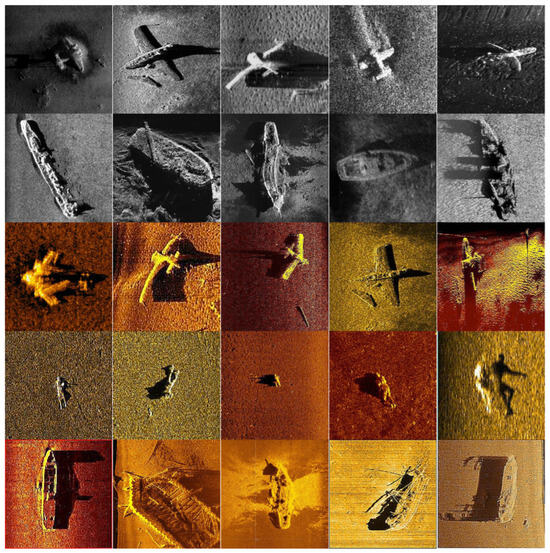
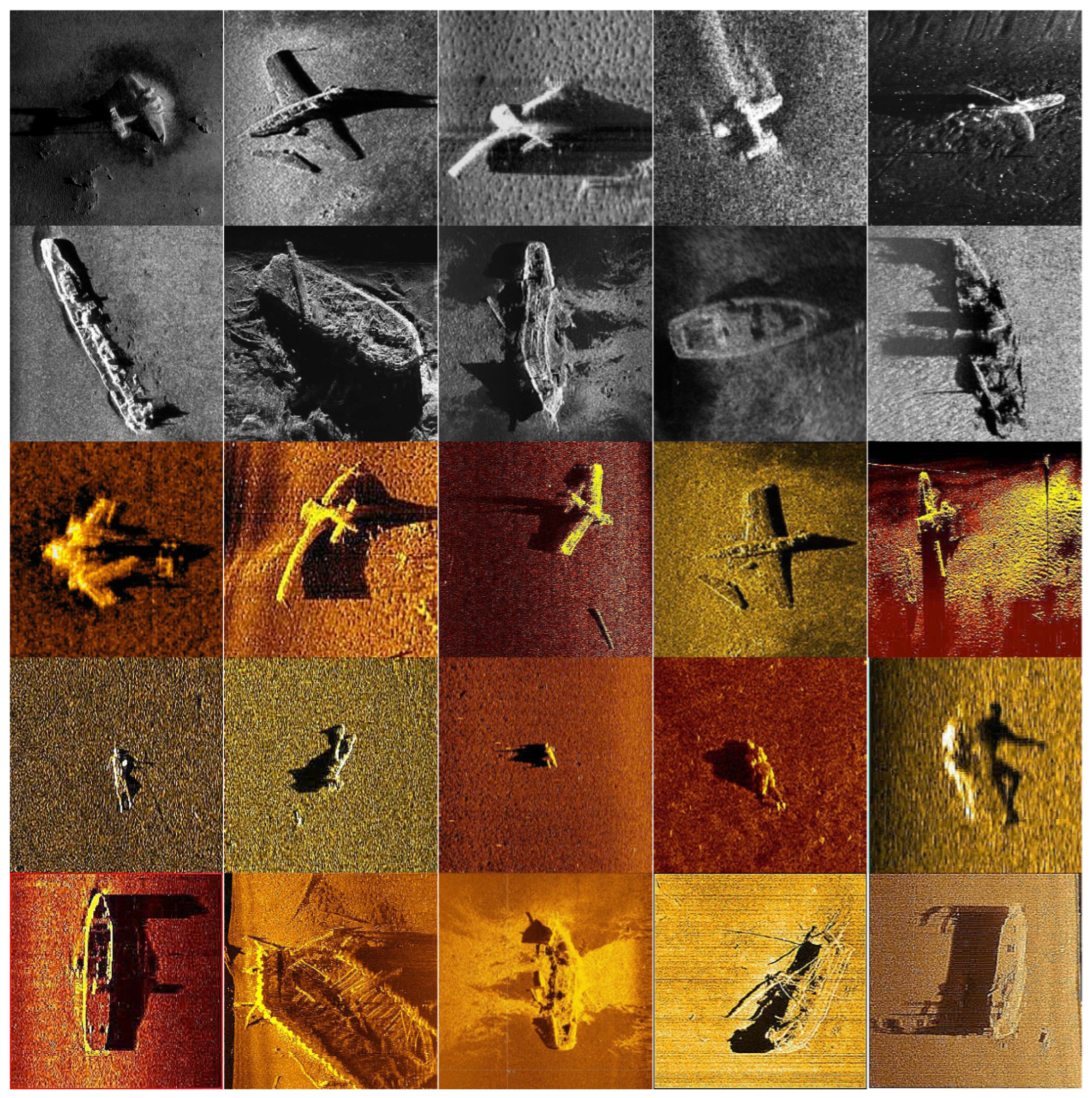
Figure 4 presents representative image samples from both datasets. It is evident that side-scan sonar imagery exhibits substantial intra-class diversity: even within the same category, targets vary considerably in brightness, scale, sharpness, morphology, orientation, and degree of wreckage. Such intra-class variability imposes high demands on feature extraction and model generalization. Subsequent experiments will systematically evaluate the detection performance of different YOLO variants by extracting and recognizing intrinsic information features from these images.
Figure 4.
Partial dataset samples. The first two rows represent the Seabed Objects-KLSG dataset, and the last three rows represent the SCTD dataset.
3.2. Evaluation Metrics
To evaluate the detection performance, classical accuracy metrics, such as precision, recall, and mean average precision (mAP), were used to assess the picked results. Referring to the confusion matrix, TP, TN, FP, and FN denote the numbers of true positives, true negatives, false positives, and false negatives, respectively.
Precision is defined as (1):
For class A, precision is defined as the ratio of the number of sampling points who are correctly predicted as A to the number of sampling points who are predicted as A.
Recall is defined as the ratio of the number of sampling points who are predicted as A to the total number of sampling points that belong to A. The calculation of recall is (2):
mAP50 represents the mean of the average precision across all categories calculated at an Intersection over Union (IoU) threshold of 0.5. The calculation formula is shown in Equation (3).
where N represents the total number of categories and APi denotes the average precision of the i-th category. As one of the most commonly used evaluation metrics in the field of object detection, mAP@50 comprehensively considers both precision and recall while measuring localization accuracy with an IoU threshold of 0.5. A higher value indicates superior model performance in the detection task.
mAP50:95 refers to the mean of the average precision values computed for each category at multiple Intersection over Union (IoU) thresholds ranging from 0.5 to 0.95, which are then averaged across all categories. The calculation formula is given in Equation (4).
where M denotes the number of Intersection over Union thresholds (typically 10, ranging from 0.5 to 0.95) and APij refers to the average precision of the i-th category at the j-th threshold. As a more stringent evaluation criterion, the mAP50: 95 metric requires the model to maintain high detection performance across various IoU thresholds. A higher value indicates stronger robustness and accuracy in both target localization and classification tasks.
mAP75 (mean Average Precision at IoU = 0.75) refers to the mean average precision calculated at an Intersection over Union threshold of 0.75. This metric demands a higher degree of overlap between predicted and ground-truth bounding boxes (IoU ≥ 0.75), thereby imposing stricter requirements on localization accuracy and more effectively evaluating the model’s performance in precise bounding-box regression. Its calculation method is similar to that of mAP50, but by setting a higher IoU threshold, it focuses on reflecting the model’s capability in fine-grained localization tasks. In practical applications, mAP75 is often used as a supplementary metric to mAP50:95 for further analysis of the model’s stability under different localization accuracy requirements.
3.3. Detection Performance Evaluation
To comprehensively evaluate the performance of different YOLO models in side-scan sonar underwater target detection, experiments were conducted on two datasets: SeabedObjects-KLSG and SCTD. The models under comparison included the widely adopted YOLOv8, YOLOv10, YOLOv11, and the newly released YOLOv13. To ensure experimental consistency, all models were trained and tested with a unified input size of 640 × 640 pixels.
The hardware configuration consisted of an Intel® Core™ i9-13900H CPU and an NVIDIA GeForce RTX 4060 GPU with 8 GB of memory, running on the Windows 11 operating system. The software environment was built on Python 3.11.14, with PyTorch 2.8.0 as the deep learning framework and CUDA 12.8 for parallel computing.
3.3.1. Comparison of Detection Accuracy
To systematically evaluate the detection accuracy of different YOLO models in SSS underwater target detection, comparative experiments were conducted on the Seabed Objects-KLSG and SCTD datasets using five metrics: precision, recall, mAP50, mAP75, and mAP50:95. To ensure a fair comparison, all models were trained using the Stochastic Gradient Descent (SGD) optimizer with identical hyperparameter settings. The following configurations were consistently applied: an input image size of 640 × 640, a batch size of 16, and an initial learning rate of 0.01. The maximum number of training epochs was set to 1000, with an early stopping mechanism applied to halt training when no further performance improvement in 100 epochs was observed. All other parameters were kept at their default values.
The YOLO framework inherently includes preprocessing techniques such as image normalization and rotation. Therefore, no additional image enhancement or fusion methods were applied in this study, ensuring a fair and consistent evaluation of different YOLO algorithms.
Table 1 presents the detection results on the Seabed Objects-KLSG dataset. Overall, different YOLO variants exhibit distinct performance profiles, reflecting varying trade-offs in architectural design among detection confidence, positive sample coverage, and localization accuracy.
Table 1.
Evaluation of experimental results on Seabed Objects-KLSG dataset with SGD optimizer.
In terms of precision, YOLOv13n achieves the highest value of 0.941, substantially outperforming other models. This indicates its exceptional capability in positive sample identification and false-positive suppression. YOLOv11n ranks second with a precision of 0.930, followed by YOLOv13n (0.896) and YOLOv8n (0.801), both of which remain at competitive levels.
Regarding recall, YOLOv8n leads with 0.885, demonstrating superior positive sample coverage. YOLOv10n follows closely at 0.839. YOLOv13n and YOLOv10n exhibit recall rates of 0.835 and 0.825, respectively.
For comprehensive detection performance, YOLOv10n achieves the highest or tied-highest scores across mAP50, mAP75, and mAP50:95 (0.915, 0.832, and 0.697, respectively), showcasing balanced and leading detection capabilities. YOLOv11n and YOLOv13n perform comparably, with mAP50 of 0.906 and 0.904 and mAP50:95 of 0.698 and 0.634, respectively. Notably, YOLOv10n attains the highest mAP75 of 0.832, reflecting its advantage under strict localization requirements.
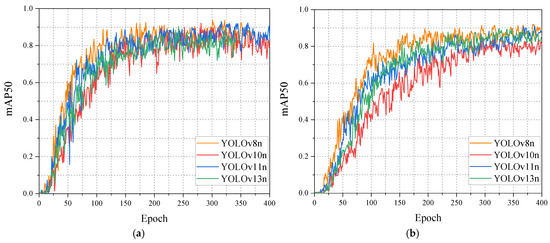
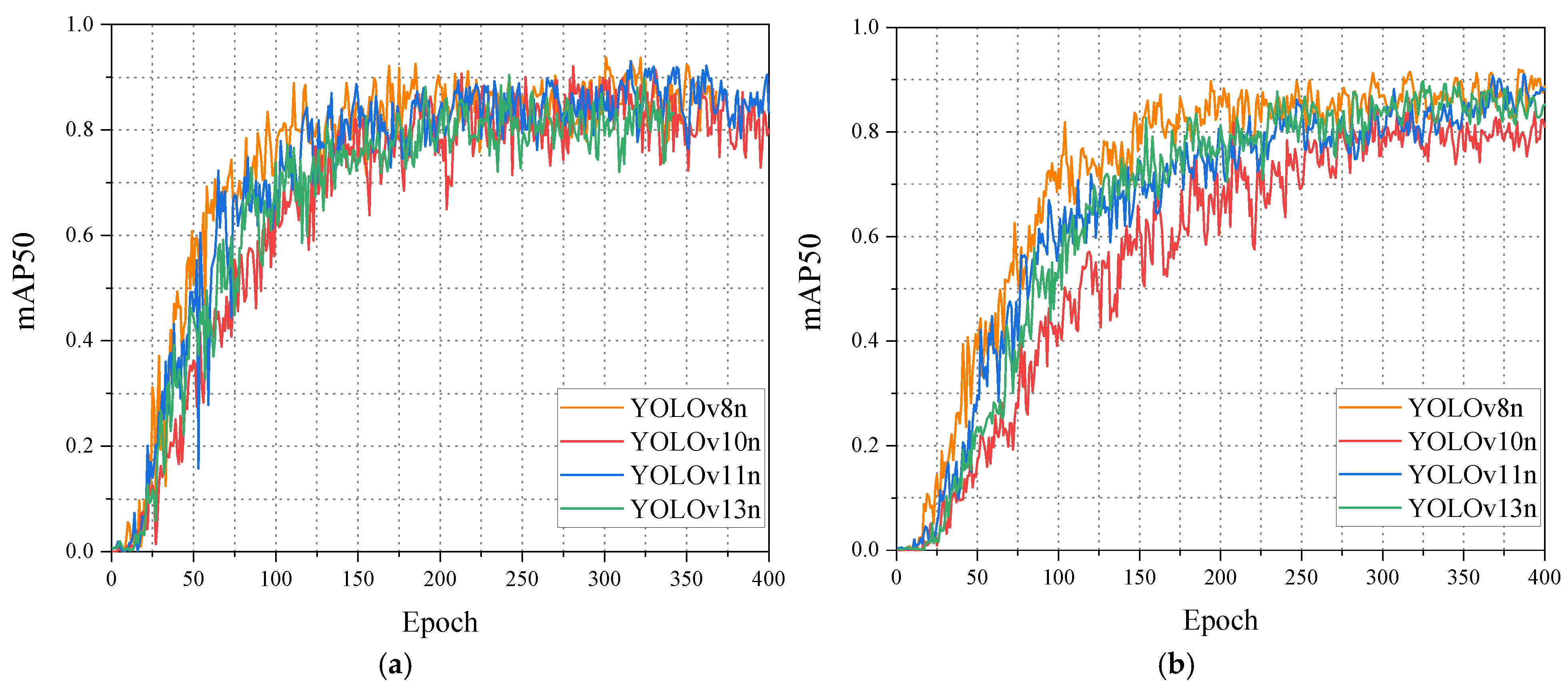
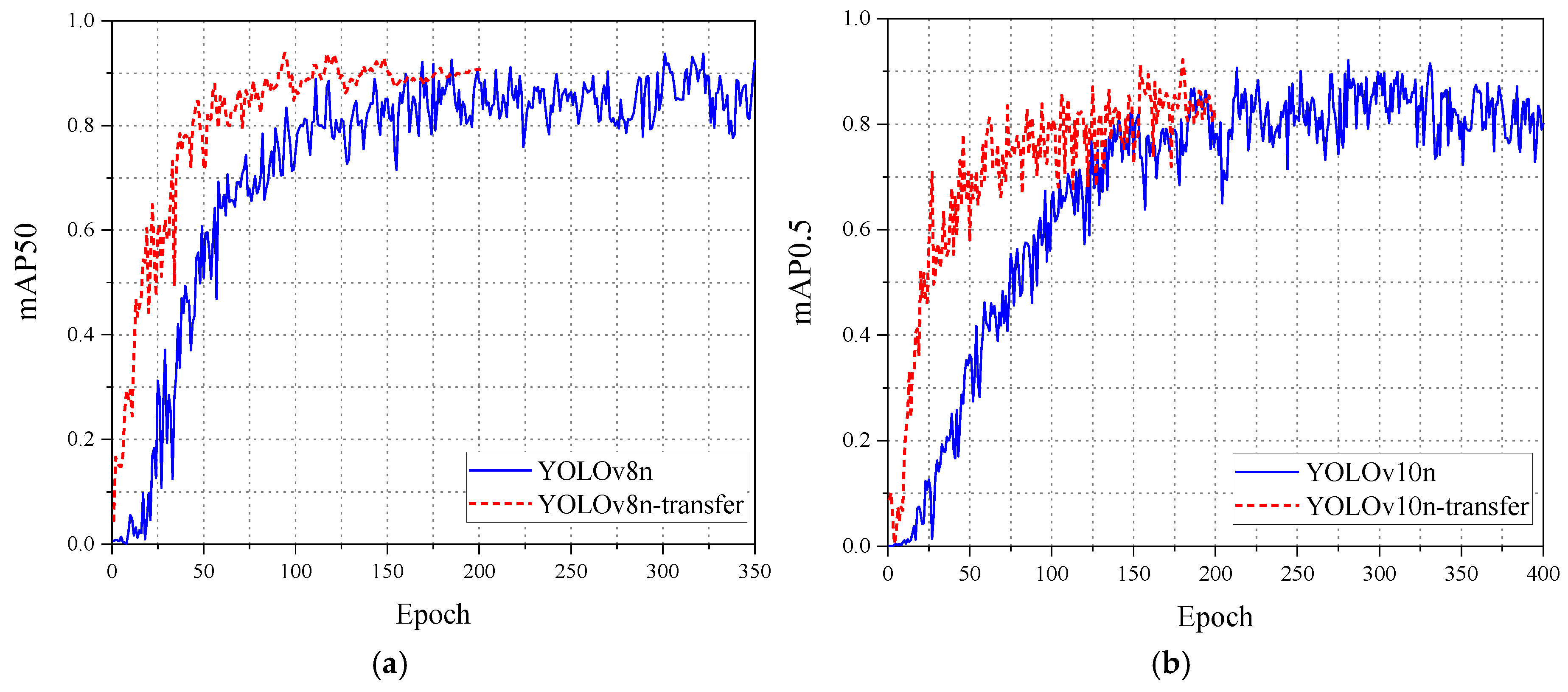
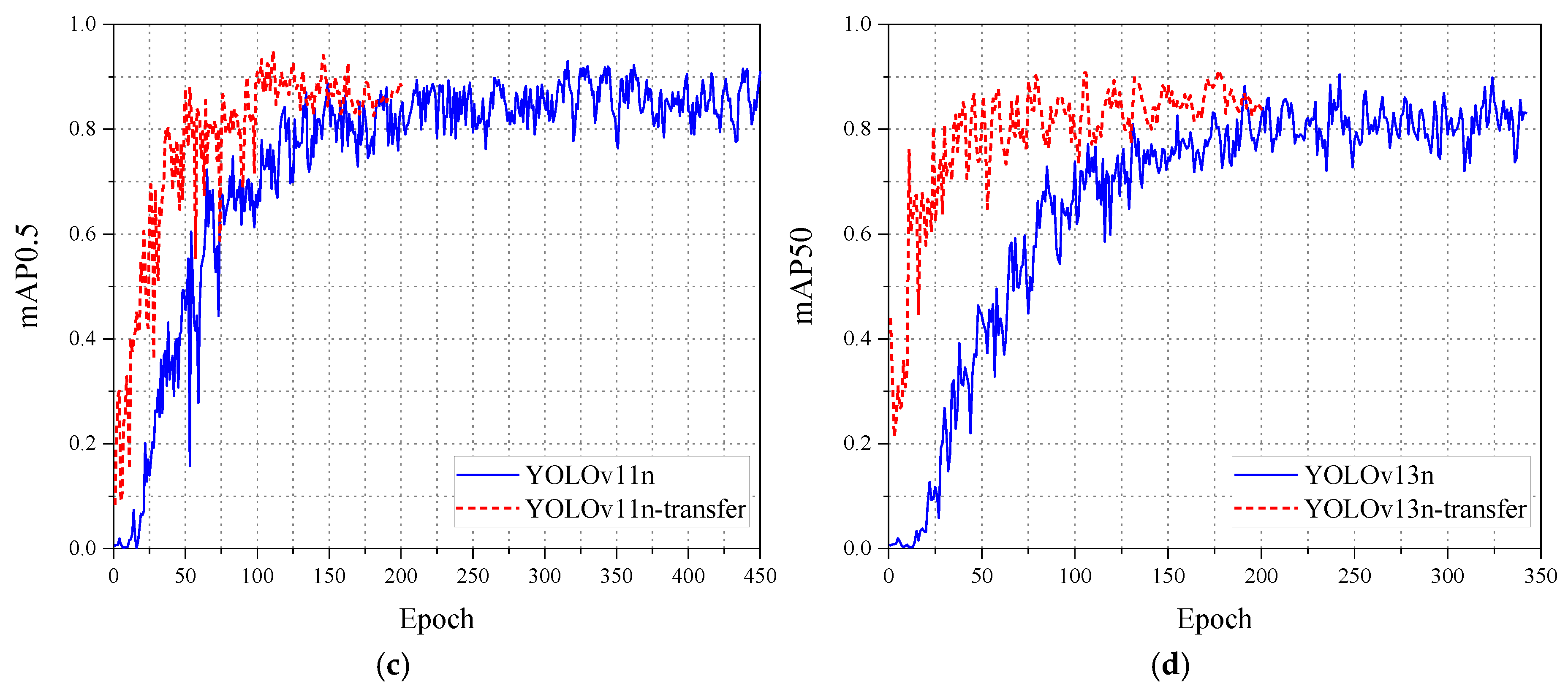
Figure 5 illustrates the progression of mAP50 and mAP50:95 over training epochs. YOLOv8n exhibits the fastest convergence in mean average precision, followed by YOLOv11n, with both models stabilizing at high final precision. YOLOv10n converges the slowest and displays considerable fluctuation during training. These trends are consistently observed across both mAP50 and mAP50:95 curves, further corroborating the advantages of YOLOv8n and YOLOv11n in rapid learning capability and robustness.
Figure 5.
Comparison of mAP50 (a) and mAP50-95 (b) on Seabed Objects-KLSG dataset.
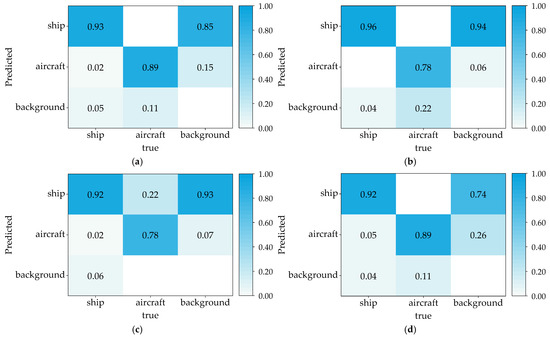
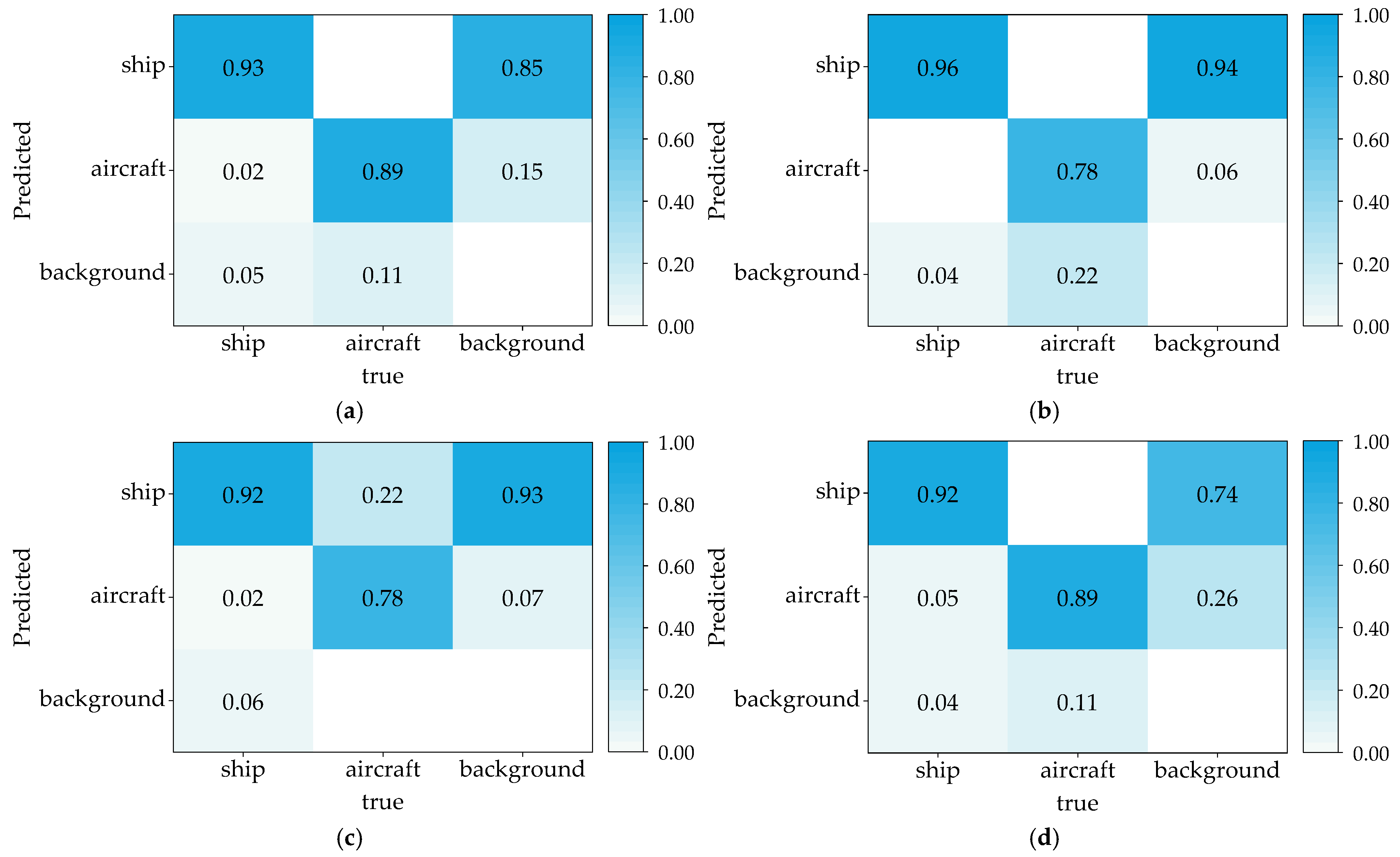
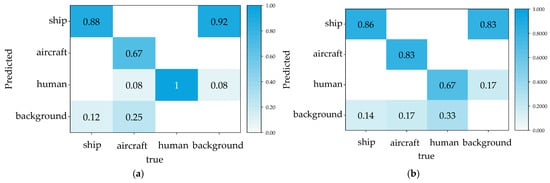
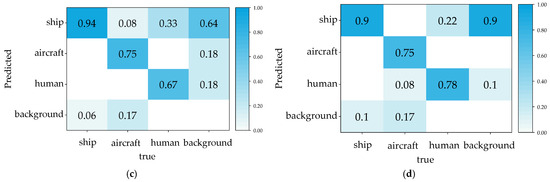
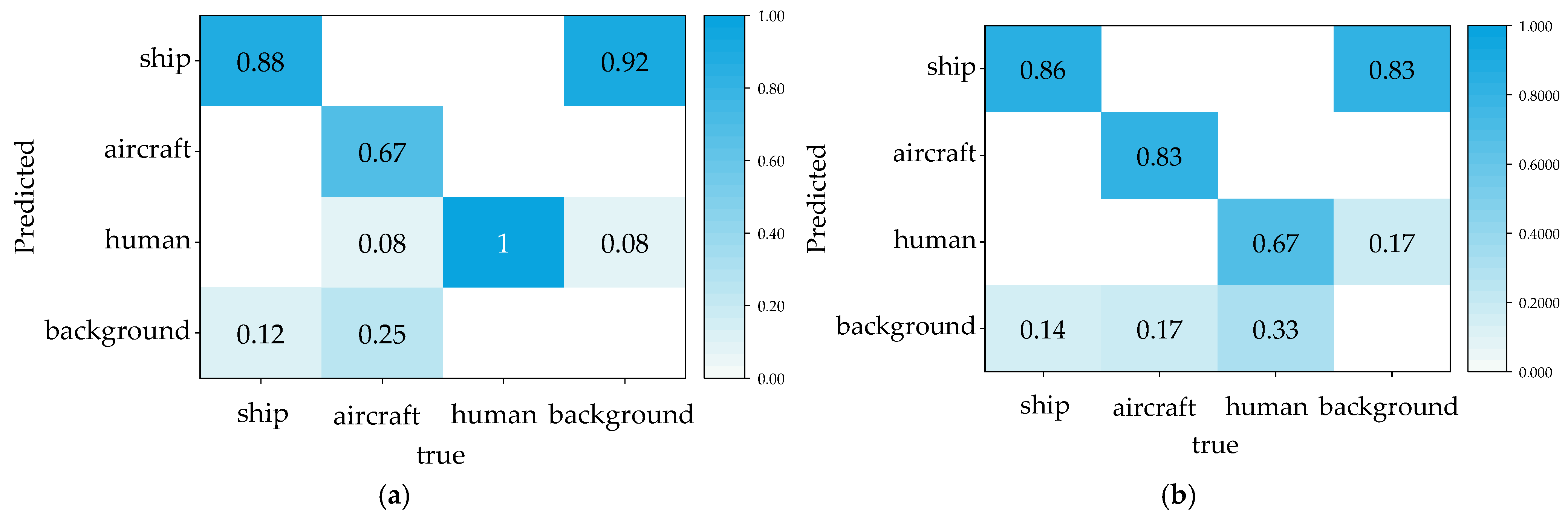
Figure 6 presents the confusion matrices of YOLOv8, YOLOv10, YOLOv11, and YOLOv13 on the Seabed Objects-KLSG dataset. Overall, the detection accuracy of the ship class is generally higher than that of the aircraft class. This observation can be attributed, at least in part, to the relatively larger number of ship samples in the dataset, which allows the model to learn more representative features during training. Additionally, the misclassification of some background regions as ships may have contributed to an increase in ship predictions, thereby influencing the recall rate to some extent. These findings suggest that class imbalance may affect the detection performance across categories, offering valuable insights for improving the recognition of under-represented classes in future work.
Figure 6.
Confusion matrices of YOLOv8n (a), YOLOv10n (b), YOLOv11n (c), and YOLOv13n (d) on Seabed Objects-KLSG dataset.
To assess model performance under extreme few-shot and severely imbalanced conditions, we further conducted comparative experiments on the SCTD dataset. This dataset contains only 357 images, with the ship category accounting for 74.5% of instances, while aircraft and human categories represent merely 16.0% and 9.5%, respectively, an imbalance far more pronounced than that of Seabed Objects-KLSG. The experimental results are summarized in Table 2.
Table 2.
Evaluation of experimental results on SCTD dataset with SGD optimizer.
Table 2 compares the detection performance of the four YOLO algorithms on the SCTD dataset. Overall, YOLOv13n achieves the highest recall (0.886) and the best comprehensive mAP50:95 metric (0.666), while also attaining the highest scores in mAP50 (0.905) and mAP75 (0.809), indicating its strong capability in target recognition. YOLOv8n and YOLOv11n exhibit balanced performance across various metrics. Notably, YOLOv8n achieves a precision of 0.932 and an mAP50 of 0.899, with relatively fewer training epochs (415), demonstrating good training efficiency. YOLOv11n attains a slightly higher mAP50 of 0.902 but requires more epochs (472). In summary, YOLOv13n excels in recall and multi-threshold average precision, while YOLOv10n leads in precision. The choice among algorithms can be tailored based on the tolerance for missed detections and false alarms in practical applications.
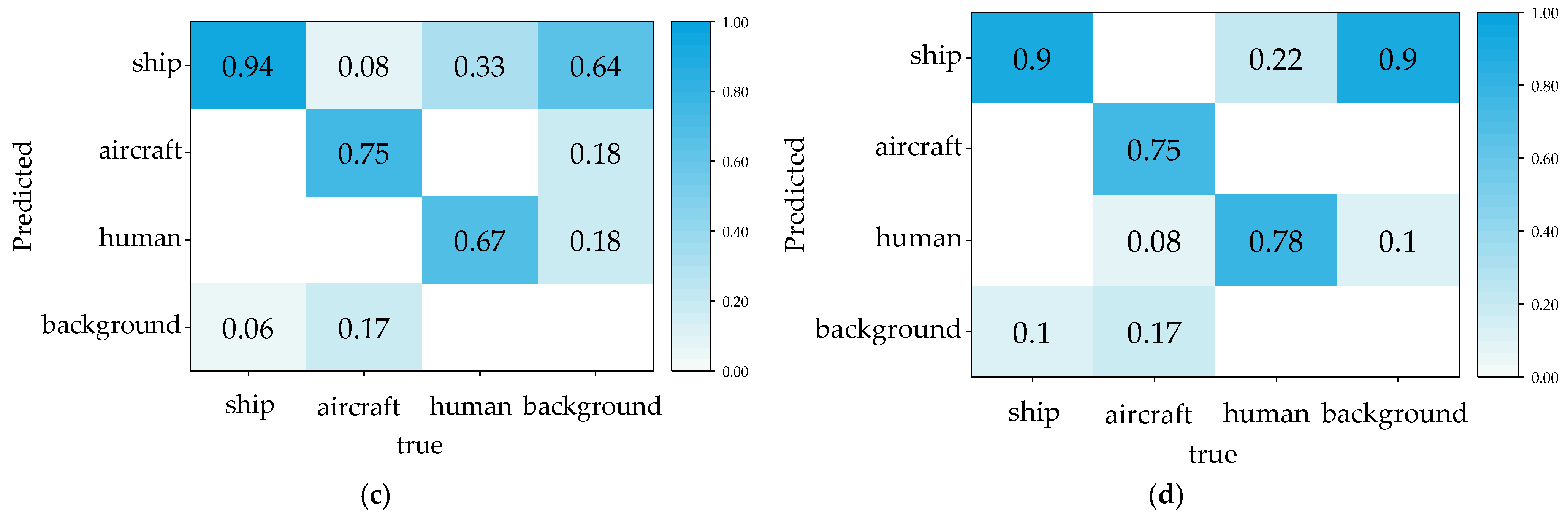
Figure 7 presents the confusion matrices of each model on the SCTD dataset. It can be observed that with the exception of YOLOv8, the three remaining models achieve the highest classification accuracy on the ship class, followed by aircraft, while the human class exhibits the lowest accuracy—a trend that generally aligns with the sample size distribution across categories. In addition, certain background regions are prone to being misclassified as shipwrecks, reflecting the interference caused by complex seafloor environments in model recognition.
Figure 7.
Confusion matrices of YOLOv8n (a), YOLOv10n (b), YOLOv11n (c), and YOLOv13n (d) on SCTD dataset.
3.3.2. Impact of Optimizer Selection
The choice of optimizer constitutes a critical hyperparameter in deep neural network training, exerting substantial influence on convergence behavior and final generalization performance. To investigate the suitability of different optimizers for SSS target detection, we re-trained all YOLO models by using the AdamW optimizer with a learning rate of 0.001 while maintaining identical hyperparameter settings, including input size, epoch setting, and batch size, and systematically compared the results with those obtained using the SGD optimizer (Table 1 and Table 2). The experimental outcomes with AdamW on the two datasets are summarized in Table 3 (Seabed Objects-KLSG) and Table 4 (SCTD).
Table 3.
Evaluation of experimental results on Seabed Objects-KLSG dataset with AdamW optimizer.
Table 4.
Evaluation of experimental results on SCTD dataset with AdamW optimizer.
On the KLSG dataset, YOLOv8n shows a substantial improvement in precision (from 0.801 to 0.965) and mAP50 with AdamW, demonstrating good adaptability to this optimizer. YOLOv11n achieves higher recall (0.863) with AdamW while maintaining competitive multi-threshold average precision. In contrast, YOLOv10n and YOLOv13n perform better with SGD, with YOLOv10n attaining a precision of 0.941 and an mAP50 of 0.915 and YOLOv13n delivering balanced metrics.
On the SCTD dataset, YOLOv11n exhibits remarkable gains with AdamW, achieving the highest precision, recall, mAP50, and mAP50:95 among all models, highlighting its strong performance potential. YOLOv10n also benefits from AdamW, with its mAP50:95 increasing from 0.661 to 0.708, further enhancing its high-precision detection capability. YOLOv8n and YOLOv13n maintain stable performance across both optimizers, with YOLOv13n showing notable recall (0.886) and mAP50 (0.905) with SGD.
Overall, the choice of optimizer significantly influences algorithm performance, and practical applications can leverage these insights to select appropriate optimizers based on task requirements (e.g., prioritizing precision or recall) and model characteristics.
3.3.3. Visual Analysis of Detection Results
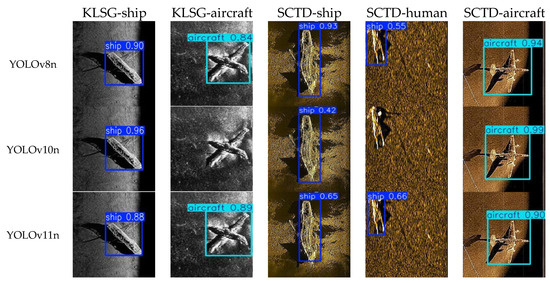
To provide an intuitive illustration of the detection performance of different YOLO models on side-scan sonar imagery, representative samples from both datasets were selected for visual comparison. Figure 8 presents the prediction results of YOLOv8, YOLOv10, YOLOv11, and YOLOv13 on ship, aircraft, and human targets, including bounding-box localization, class confidence scores, and detection outcomes.
Figure 8.
Visual results on KLSG and SCTD datasets.
As shown in Figure 8, overall, under stable marine conditions (e.g., columns 1 and 5 in Figure 6), the models exhibit relatively high detection confidence. In contrast, under complex marine environments (e.g., column 2), missed detections or multiple bounding boxes may occur. The detection behaviors of the four models vary to some extent, and these visual observations are generally consistent with the quantitative metrics reported in Section 3.3.1. Both YOLOv8n and YOLOv11n effectively detect all target categories, with accurate bounding-box placement and relatively high confidence scores, demonstrating strong generalization capability. YOLOv10n achieves relatively high confidence scores overall but exhibits missed detections in some images (e.g., the human target in the SCTD dataset is not detected), which aligns with its moderate recall performance.
On the SeabedObjects-KLSG dataset, YOLOv13n accurately localizes ship and aircraft targets with high confidence, though multiple overlapping detection boxes are observed in some test images. This indicates that YOLOv13n possesses strong feature extraction capabilities and effectively captures rich contextual information.
In summary, the visual analysis intuitively illustrates the differences among the models in terms of precision, recall, and localization accuracy and also reflects the characteristics underlying YOLOv13n’s high precision. The consistency between qualitative observations and quantitative evaluations provides robust support for the conclusions drawn in this study.
3.3.4. Computational Time and Cost
To holistically assess the overall performance of different YOLO models in side-scan sonar target detection, this subsection conducts a joint analysis from the dual perspectives of detection accuracy and computational efficiency.
Key efficiency indicators, including network depth, the number of model parameters, GFLOPs, training time, and Frames Per Second (FPS), are used to evaluate the computational efficiency and overhead of the models. The experimental results are shown in Table 5. To further assess inference speed under resource-constrained conditions, we conducted additional experiments on an NVIDIA T1200 Laptop GPU (configured at 45W TDP), a low-power mobile workstation GPU. The results are reported as FPS2 in Table 5, while FPS1 denotes the inference speed measured on the NVIDIA RTX 4060 GPU. Although the T1200 is not equivalent to embedded platforms such as the Jetson series, it provides a useful approximation of model performance under limited computational resources. All measurements were obtained under identical experimental conditions (Seabed Objects-KLSG dataset, SGD optimizer, and unified hyperparameters).
Table 5.
Comparison of the calculation efficiency.
Table 5 presents a comparison of computational efficiency among the four YOLO models. In terms of network architecture, YOLOv13n has the deepest structure (535 layers) but the smallest parameter count (2.448M) and relatively low computational complexity (6.2 GFLOPs), indicating the use of efficient module design. YOLOv8n has the fewest layers (168) but the largest parameter count (3.006M) and a computational complexity of 8.1 GFLOPs. Regarding training efficiency, YOLOv8n converges the fastest (415 epochs), while YOLOv10n requires the most epochs (730). In terms of inference speed, YOLOv8n achieves the highest frame rates under both test conditions (60.98 FPS and 55.56 FPS), whereas YOLOv13n exhibits relatively slower inference (34.01 FPS and 31.06 FPS), which can be attributed to its deeper network structure. YOLOv11n and YOLOv10n demonstrate moderate inference speeds. Overall, YOLOv8n offers clear advantages in computational efficiency and training speed, while YOLOv13n, despite its low parameter count, is limited in inference speed, necessitating a trade-off based on specific application requirements in practical deployment.
3.3.5. Effect of Transfer Learning
To quantify the performance gains brought by transfer learning in side-scan sonar target detection, we initialized all YOLO models with COCO pre-trained weights and performed full fine-tuning on the two sonar datasets. All experiments were conducted using the SGD optimizer with an initial learning rate of 0.01. Due to the accelerated convergence enabled by the use of pre-trained weights, the number of training epochs was set to 200 to mitigate the risk of overfitting. The remaining hyperparameters were kept consistent with those described in Section 3.3.1. Based on this setup, the performance of models after transfer learning was systematically compared with the results obtained without transfer learning, as reported in Section 3.3.1.
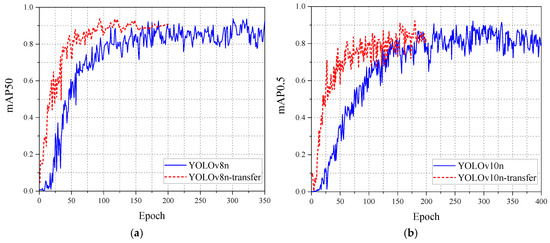
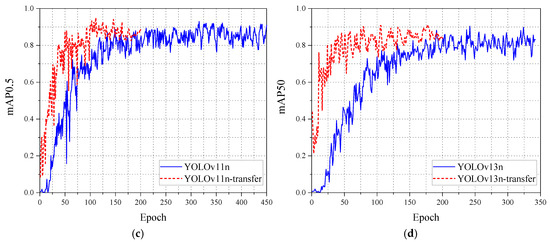
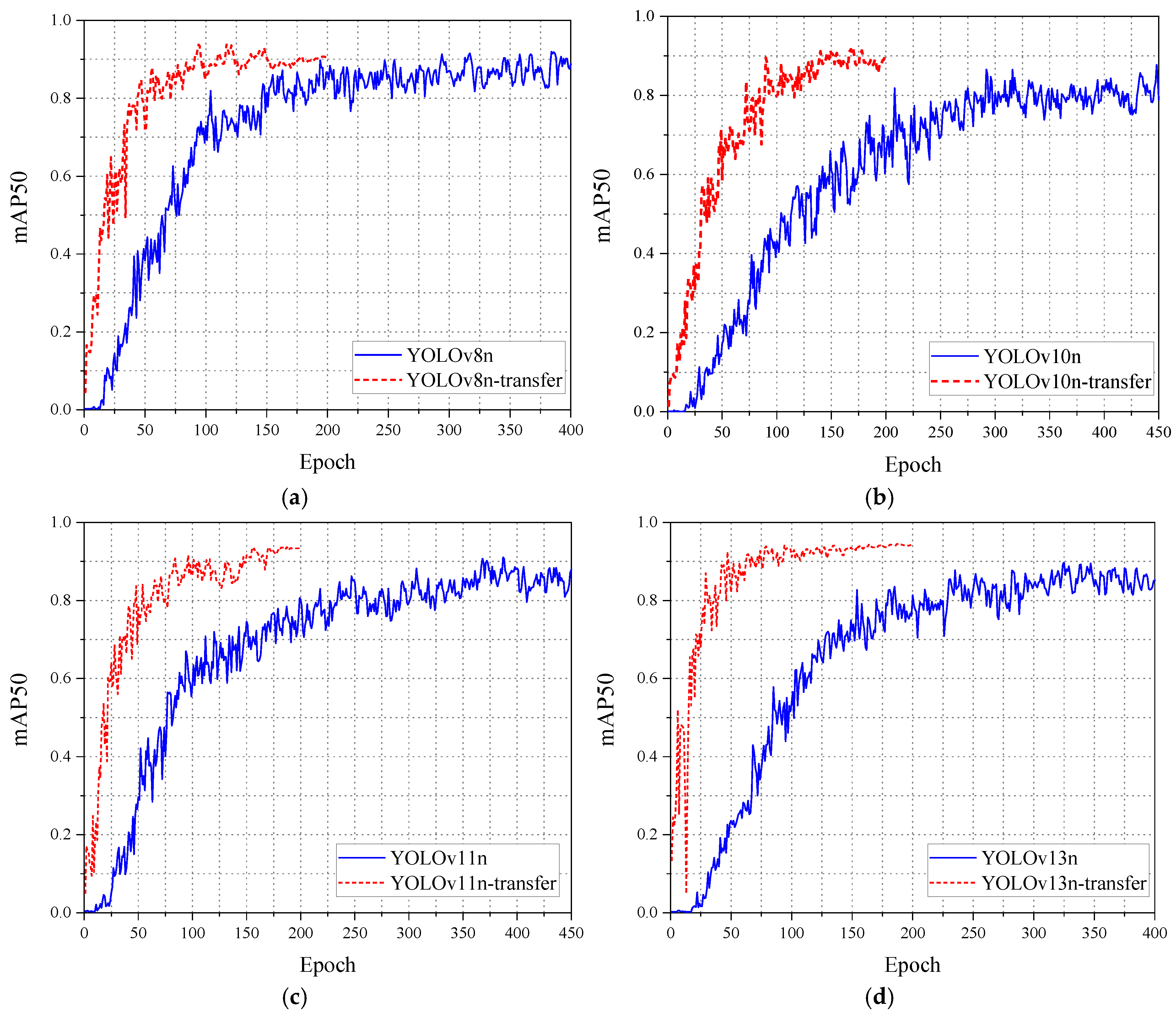
Complete experimental results before and after transfer learning are summarized in Table 6. Figure 9 and Figure 10 illustrate the evolution of mAP50 over training epochs on the Seabed Objects-KLSG and SCTD datasets, respectively.
Table 6.
Evaluation of experimental results before and after transfer learning.
Figure 9.
Comparison of mAP50 curves before and after transfer learning on the SeabedObjects-KLSG dataset over training epochs: (a) YOLOv8n; (b) YOLOv10n; (c) YOLOv11n; (d) YOLOv13n.
Figure 10.
Comparison of mAP50 curves before and after transfer learning on the SCTD dataset over training epochs: (a) YOLOv8n; (b) YOLOv10n; (c) YOLOv11n; (d) YOLOv13n.
In terms of convergence dynamics, transfer learning substantially accelerates the training process for all models. As shown in Figure 7 and Figure 8, models initialized with pre-trained weights (dashed curves) achieve high accuracy within the first 20 epochs, whereas scratch-trained models (solid curves) require considerably more iterations to reach comparable performance. Moreover, transfer learning smooths the convergence trajectories and reduces fluctuations, indicating that pre-trained knowledge provides a more favorable initialization region in the parameter space.
Table 6 presents a comparison of detection performance before and after transfer learning for each YOLO model on both datasets. Overall, transfer learning yields positive effects for most models, though the extent varies depending on the model and dataset.
On the Seabed Objects-KLSG dataset, YOLOv13n benefits the most, with its mAP50:95 increasing from 0.634 to 0.761, a relative gain of 20.0%, along with simultaneous improvements in precision and recall, demonstrating strong transferability. YOLOv8n also exhibits notable gains, with precision surging from 0.801 to 0.980 and mAP50:95 improving by 9.8%, indicating that transfer learning effectively enhances its recognition accuracy. YOLOv11n shows improvements in recall and high-threshold metrics, though precision slightly decreases, maintaining overall stable performance. YOLOv10n experiences some fluctuations after transfer learning, with certain metrics declining, possibly due to its already strong baseline performance with the SGD optimizer.
On the SCTD dataset, the benefits of transfer learning are more widespread. Both YOLOv11n and YOLOv13n achieve comprehensive improvements, with YOLOv13n’s mAP50:95 rising from 0.632 to 0.722 (a 14.2% gain) and YOLOv11n’s mAP50:95 increasing from 0.674 to 0.731. Although YOLOv8n and YOLOv10n exhibit slight drops in precision, their recall and comprehensive metrics are significantly enhanced, reflecting the positive role of transfer learning in balancing precision and recall.
In summary, transfer learning effectively boosts the performance of underwater sonar target detection models, with YOLOv13n and YOLOv11n benefiting the most. The varying responses across models highlight the importance of selecting appropriate models and transfer strategies based on specific task requirements.
4. Discussion
4.1. Evaluation on Another Dataset
Mine images were sourced from a publicly available dataset comprising 1170 real side-scan sonar images [2]. These data were collected in situ between 2010 and 2021 using a 900–1800 kHz Marine Sonic dual-frequency side-scan sonar (Marine Sonic Technology, Ltd., White Marsh, USA) mounted on a Teledyne Marine Gavia Autonomous Underwater Vehicle (AUV). In addition to mine targets, the dataset contains numerous small rocks and complex terrain features. As most images lack target instances, only those containing mines were retained, resulting in a final set of 304 samples. Complete experimental results before and after transfer learning are summarized in Table 7.
Table 7.
Evaluation of experimental results of mine dataset before and after transfer learning.
The table presents the detection performance of four YOLO models on the mine dataset before and after transfer learning. The mine dataset is characterized by a small sample size (304 images) and includes complex terrain features and rock interference, posing greater challenges to model generalization.
Overall, transfer learning yields positive effects for most models. YOLOv13n benefits the most significantly, with recall increasing from 0.658 to 0.752, mAP50 rising from 0.742 to 0.822, and mAP50:95 improving from 0.542 to 0.625, indicating that pre-trained knowledge effectively enhances its ability to detect mine targets. YOLOv11n achieves the highest precision among all models (0.957) after transfer, with mAP50:95 increasing to 0.648, demonstrating strong detection accuracy. YOLOv10n shows substantial gains, with mAP50:95 rising from 0.572 to 0.639 and mAP75 reaching 0.726, indicating robust high-threshold localization capability. YOLOv8n also exhibits improvements in recall and comprehensive metrics, though the gains are relatively moderate.
It is worth noting that while transfer learning improves recall and overall accuracy for most models, precision fluctuations are observed in some cases. For instance, YOLOv11n experiences a slight drop in recall, and YOLOv8n shows a decrease in mAP75, which may be attributed to domain discrepancies between the pre-training source and underwater sonar imagery. Additionally, the overall performance of all models on the mine dataset is generally lower than that achieved on the KLSG and SCTD datasets, reflecting the challenges posed by small sample sizes and complex backgrounds.
In summary, transfer learning demonstrates positive effects on the mine dataset, with YOLOv13n and YOLOv10n benefiting the most. Future work could explore data augmentation or domain adaptation techniques to further enhance model robustness in small-sample, complex scenarios.
4.2. Limitations
Despite the contributions of this study, several limitations should be acknowledged.
The experiments relied on two public side-scan sonar datasets, SeabedObjects-KLSG and SCTD, which suffer from small sample sizes, class imbalance, and limited environmental diversity, potentially affecting model generalizability. Sonar data scarcity is a well-known challenge in the field, often addressed through transfer learning [37,38,39,40] and sample generation [47,48,49]. Future work will focus on sample generation techniques to enrich the dataset.
Second, this work evaluates models on static datasets, ignoring temporal dependencies in real sonar streams. In practice, dynamic environments require adaptive updating, which is omitted here, limiting online applicability. Future work will incorporate temporal information to enhance detection accuracy, as explored by several researchers [50,51].
This study did not explore key acoustic phenomena in side-scan sonar imaging, such as shadows, speckle noise, and multipath reflections, which are critical in underwater target detection [52,53]. Visual interpretation methods (e.g., saliency maps) were also not addressed. These aspects will be investigated in future work to improve model interpretability and robustness.
5. Future Work
To address the above limitations, subsequent research will focus on three aspects:
1. To address dataset limitations, future work will focus on three areas: (i) collaborating with marine institutions to expand dataset scale and diversity; (ii) employing physics-based sonar image simulation to generate synthetic training samples; (iii) investigating few-shot and self-supervised learning to improve model generalization under extreme data scarcity.
2. We will tackle temporal dependencies in sonar streams by developing dynamic updating and adaptive filtering mechanisms. Key directions include: (a) applying temporal filters (e.g., Kalman filters and RNNs) to capture inter-frame dependencies; (b) designing automated normalization algorithms to handle distribution shifts caused by varying acquisition conditions; (c) integrating domain adaptation to enhance generalization across different data collection sessions. The goal is to build a unified framework for robust and deployable underwater target detection
3. We will conduct in-depth investigations into key acoustic phenomena inherent in side-scan sonar imaging, including shadows, speckle noise, and multipath reflections, to understand their specific impacts on model behavior and detection performance. Additionally, we will explore visualization techniques such as saliency maps to establish clearer connections between model decisions and sonar-specific features. These efforts aim to enhance both the interpretability and physical consistency of deep learning-based underwater target detection systems.
4. Future work will emphasize deploying optimized models on embedded platforms or UUVs for nearshore field trials, addressing real-time processing and environmental robustness.
In summary, this comparative study clarifies the performance differences and application scenarios of various YOLO versions for SSS object detection and confirms the effectiveness of transfer learning on small-scale sonar datasets. These findings provide empirical foundations for subsequent domain adaptation and practical deployment.
6. Conclusions
This study systematically evaluated four YOLO variants, YOLOv8n, YOLOv10n, YOLOv11n, and the newly released YOLOv13n, for underwater object detection using side-scan sonar imagery under conditions of limited data and class imbalance. Experimental results on two public datasets demonstrate that each model exhibits distinct advantages. YOLOv8n achieves the fastest inference speed, making it suitable for real-time applications. YOLOv11n provides the best trade-off between detection accuracy and computational efficiency. YOLOv13n excels in precision and high-IoU localization performance, benefiting significantly from its advanced architectural design. Transfer learning using COCO pre-trained weights consistently improves detection performance, particularly on the more challenging dataset, with average mAP50:95 gains considerable percent confirming its critical role in overcoming data scarcity. The SGD optimizer generally outperforms AdamW across most configurations, establishing it as the preferred default choice for sonar object detection tasks. These findings offer practical guidance for selecting appropriate YOLO models based on specific deployment requirements and underscore the importance of transfer learning in underwater autonomous systems. Future work will focus on expanding dataset diversity, incorporating temporal modeling for sequential data and deploying optimized models on embedded platforms for real-world validation.
Author Contributions
Conceptualization, L.L. and H.L.; methodology and software, L.L.; validation, L.L. and J.Z.; writing and editing, L.L. and H.L.; supervision, Y.P. and G.Z. All authors have read and agreed to the published version of the manuscript.
Funding
This research study was funded by the National Natural Science Foundation of China under grant No. 42374050.
Data Availability Statement
The original contributions presented in this study are included in the article material. Further inquiries can be directed to the corresponding author.
Conflicts of Interest
The authors declare no conflicts of interest.
References
- Hożyń, S. A review of underwater mine detection and classification in sonar imagery. Electronics 2021, 10, 2943. [Google Scholar] [CrossRef] [Scilit]
- Pessanha Santos, N.; Moura, R.; Torgal, G.S.; Lobo, V.; Neto, M.C. Side-scan sonar imaging data of underwater vehicles for mine detection. Data Brief 2024, 53, 110132. [Google Scholar] [CrossRef] [Scilit] [PubMed]
- Ridgway, J.L.; Madsen, J.A.; Fischer, J.R.; Calfee, R.D.; Acre, M.R.; Kazyak, D.C. Side-scan sonar as a tool for measuring fish populations: Current state of the science and future directions. Fisheries 2024, 49, 454–462. [Google Scholar] [CrossRef] [Scilit]
- Chen, L.; Liu, Z.; Tong, L.; Jiang, Z.; Wang, S.; Dong, J.; Zhou, H. Underwater object detection using invert multi-class AdaBoost with deep learning. In Proceedings of the 2020 International Joint Conference on Neural Networks (IJCNN), Glasgow, UK, 19–24 July 2020; pp. 1–8. [Google Scholar] [CrossRef] [Scilit]
- Fan, B.; Chen, W.; Cong, Y. Dual refinement underwater object detection network. In Proceedings of the 16th European Conference, Glasgow, UK, 23–28 August 2020; pp. 275–291. [Google Scholar] [CrossRef] [Scilit]
- Jian, Z.; Liang, Z.; Li-Nan, Z.; Nan, L. The design and research of intelligent search and rescue device based on sonar detection and marinebattery. In Proceedings of the 2017 International Conference on Computer Network, Electronic and Automation (ICCNEA), Xi’an, China, 23–25 September 2017; pp. 383–387. [Google Scholar]
- Nguyen, H.T.; Lee, E.H.; Lee, S. Study on the classification performance of underwater sonar image classification based on convolutional neural networks for detecting a submerged human body. Sensors 2019, 20, 94. [Google Scholar] [CrossRef] [Scilit]
- Zheng, G.; Zhao, J.; Li, S.; Feng, J. Zero-shot pipeline detection for sub-bottom profiler data based on imaging principles. Remote Sens. 2021, 13, 4401. [Google Scholar] [CrossRef] [Scilit]
- Shi, B.; Cao, T.; Ge, Q.; Lin, Y.; Wang, Z. Sonar image intelligent processing in seabed pipeline detection: Review and application. Meas. Sci. Technol. 2024, 35, 045405. [Google Scholar] [CrossRef] [Scilit]
- Feng, H.; Huang, Y.; Qiao, J.; Wang, Z.; Hu, F.; Yu, J. Prediction-based submarine cable-tracking strategy for autonomous underwater vehicles with side-scan sonar. J. Mar. Sci. Eng. 2024, 12, 1725. [Google Scholar] [CrossRef] [Scilit]
- Kaevitser, V.I.; Smirnov, V.M.; Smolyaninov, I.V. Use of sonar systems to detect areas of gas discharge of the seabed. Oceanology 2024, 64, 623–628. [Google Scholar] [CrossRef] [Scilit]
- Haniotis, S.; Cervenka, P.; Negreira, C.; Marchal, J. Seafloor segmentation using angular backscatter responses obtained at sea with a forward-looking sonar system. Appl. Acoust. 2015, 89, 306–319. [Google Scholar] [CrossRef] [Scilit]
- Barngrover, C.; Althoff, A.; DeGuzman, P.; Kastner, R. A brain–computer interface (BCI) for the detection of mine-like objects in sidescan sonar imagery. IEEE J. Ocean. Eng. 2016, 41, 123–138. [Google Scholar] [CrossRef] [Scilit]
- Williams, D.P. Fast target detection in synthetic aperture sonar imagery: A new algorithm and large-scale performance analysis. IEEE J. Ocean. Eng. 2015, 40, 71–92. [Google Scholar] [CrossRef] [Scilit]
- Johnson, S.; Deaett, M. The application of automated recognition techniques to side-scan sonar imagery. IEEE J. Ocean. Eng. 1994, 19, 138–144. [Google Scholar] [CrossRef] [Scilit]
- Yu, F.; Liu, X.; Liu, W.; Liu, J. Global-local coupled learning method for autonomous underwater vehicle side-scan sonar image recognition. Eng. Appl. Artif. Intell. 2025, 153, 110853. [Google Scholar] [CrossRef] [Scilit]
- Nayak, N.; Nara, M.; Gambin, T.; Wood, Z.; Clark, C.M. Machine learning techniques for AUV side-scan sonar data feature extraction as applied to intelligent search for underwater archaeological sites. Field Serv. Robot. 2021, 16, 219–233. [Google Scholar] [CrossRef] [Scilit]
- Yang, F.; Du, Z.; Wu, Z.; Li, J.; Chu, F. Object Recognizing on Sonar Image Based on Histogramand Geometric Feature. Mar. Sci. Bull. 2006, 5, 64–69. [Google Scholar]
- Langner, F.; Knauer, C.; Jans, W.; Ebert, A. Side scan sonar image resolution and automatic object detection, classification and identification. In Proceedings of the OCEANS 2009-EUROPE, Bremen, Germany, 11–14 May 2009. [Google Scholar] [CrossRef] [Scilit]
- Isaacs, J.C. Sonar automatic target recognition for underwater UXO remediation. In Proceedings of the IEEE Conference on Computer Vision and Pattern Recognition (CVPR) Workshops, Boston, MA, USA, 7–12 June 2015; pp. 134–140. [Google Scholar] [CrossRef] [Scilit]
- Hosseini, S.A.; Shahri, A.A.; Asheghi, R. Prediction of bedload transport rate using a block combined network structure. Hydrol. Sci. J. 2022, 67, 117–128. [Google Scholar] [CrossRef] [Scilit]
- Abbaszadeh, S.A.; Maghsoudi, M.F. Landslide susceptibility mapping using hybridized block modular intelligence model. Bull. Eng. Geol. Environ. 2021, 80, 267–284. [Google Scholar] [CrossRef] [Scilit]
- Heo, S.Y.; An, B.; Kim, D.; Park, M.; Lee, H.; Lee, Y. Feasibility study of block-matching and 3D filtering denoising algorithm in multi-material decomposition technique for dual-energy computed tomography. J. Korean Phys. Soc. 2023, 82, 305–314. [Google Scholar] [CrossRef] [Scilit]
- Tasci, B.; Acharya, M.R.; Baygin, M.; Dogan, S.; Tuncer, T.; Belhaouari, S.B. InCR: Inception and concatenation residual block-based deep learning network for damaged building detection using remote sensing images. Int. J. Appl. Earth Obs. Geoinf. 2023, 123, 103483. [Google Scholar] [CrossRef] [Scilit]
- Abbaszadeh Shahri, A.; Chunling, S.; Larsson, S. A hybrid ensemble-based automated deep learning approach to generate 3D geo-models and uncertainty analysis. Eng. Comput. 2024, 40, 1501–1516. [Google Scholar] [CrossRef] [Scilit]
- Tang, Y.; Jin, S.; Bian, G.; Zhang, Y. Shipwreck Target Recognition in Side-Scan Sonar Images by Improved YOLOv3 Model Based on Transfer Learning. IEEE Access 2020, 8, 173450–173460. [Google Scholar] [CrossRef] [Scilit]
- Yu, Y.; Zhao, J.; Gong, Q.; Huang, C.; Zheng, G.; Ma, J. Real-Time Underwater Maritime Object Detection in Side-Scan Sonar Images Based on Transformer-YOLOv5. Remote Sens. 2021, 13, 3555. [Google Scholar] [CrossRef] [Scilit]
- Zhang, H.; Tian, M.; Shao, G.; Cheng, J.; Liu, J. Target detection of forward-looking sonar image based on improved YOLOv5. IEEE Access 2022, 10, 3150339. [Google Scholar] [CrossRef] [Scilit]
- Qin, K.S.; Liu, D.; Wang, F.; Zhou, J.C.; Yang, J.X.; Zhang, W.S. Improved YOLOv7 model for underwater sonar image object detection. J. Vis. Commun. Image Represent. 2024, 100, 104124. [Google Scholar] [CrossRef] [Scilit]
- Jiao, S.; Xu, F.; Guo, H. Side-scan sonar image detection of shipwrecks based on CSC-YOLO algorithm. Comput. Mater. Contin. 2024, 82, 3019–3044. [Google Scholar] [CrossRef] [Scilit]
- Zheng, L.; Hu, T.; Zhu, J. Underwater sonar target detection based on improved ScEMA-YOLOv8. IEEE Geosci. Remote Sens. Lett. 2024, 21, 1503505. [Google Scholar] [CrossRef] [Scilit]
- Luo, Y.; Huo, G.; Cheng, Z.; Zhang, W. CSTC-YOLOv8: Underwater object detection model based on improved YOLOv8 for side scan sonar images. J. Electron. Imag. 2025, 34, 023019. [Google Scholar] [CrossRef] [Scilit]
- Yang, N.; Li, G.; Wang, S.; Wei, Z.; Ren, H.; Zhang, X.; Pei, Y. SS-YOLO: A lightweight deep learning model focused on side-scan sonar target detection. J. Mar. Sci. Eng. 2025, 13, 66. [Google Scholar] [CrossRef] [Scilit]
- Xiao, Y.; Yang, H.; Dai, D.; Wang, H.; Shan, Z.; Wu, H. CKAN-YOLOv8: A lightweight multi-task network for underwater target detection and segmentation in side-scan sonar. J. Mar. Sci. Eng. 2025, 13, 936. [Google Scholar] [CrossRef] [Scilit]
- Zhu, J.; Li, H.; Liu, M.; Zhai, G.; Bian, S.; Peng, Y.; Liu, L. Underwater side-scan sonar target detection: An enhanced YOLOv11 framework integrating attention mechanisms and a bi-directional feature pyramid network. J. Mar. Sci. Eng. 2025, 13, 926. [Google Scholar] [CrossRef] [Scilit]
- Cui, X.; Zhang, J.; Zhang, L.; Zhang, Q.; Han, J. Small object detection in side-scan sonar images based on SOCA-YOLO and image restoration. Front. Mar. Sci. 2025, 12, 1542832. [Google Scholar] [CrossRef] [Scilit]
- Chungath, T.; Nambiar, A.M.; Mittal, A. Transfer learning and few-shot learning based deep neural network models for underwater sonar image classification with a few samples. IEEE J. Ocean. Eng. 2024, 49, 294–310. [Google Scholar] [CrossRef] [Scilit]
- Zhang, P.; Tang, J.; Zhong, H.; Ning, M.; Liu, D.; Wu, K. Self-trained target detection of radar and sonar images using automatic deep learning. IEEE Trans. Geosci. Remote Sens. 2022, 60, 4701914. [Google Scholar] [CrossRef] [Scilit]
- Cheng, Z.; Huo, G.; Li, H. A multi-domain collaborative transfer learning method with multi-scale repeated attention mechanism for underwater side-scan sonar image classification. Remote Sens. 2022, 14, 355. [Google Scholar] [CrossRef] [Scilit]
- Huo, G.; Wu, Z.; Li, J. Underwater object classification in sidescan sonar images using deep transfer learning and semisynthetic training data. IEEE Access 2020, 8, 47407–47418. [Google Scholar] [CrossRef] [Scilit]
- Varghese, R.; M., S. YOLOv8: A novel object detection algorithm with enhanced performance and robustness. In Proceedings of the 2024 International Conference on Advances in Data Engineering and Intelligent Computing Systems (ADICS), Chennai, India, 18–19 April 2024; pp. 1–6. [Google Scholar] [CrossRef] [Scilit]
- Wang, A.; Chen, H.; Liu, L.; Chen, K. YOLOv10: Real-time end-to-end object detection. In Proceedings of the Advances in Neural Information Processing Systems 37, Vancouver, BC, Canada, 10–15 December 2024. [Google Scholar] [CrossRef] [Scilit]
- Khanam, R.; Hussain, M. YOLOv11: An overview of the key architectural enhancements. arXiv 2024, arXiv:2410.17725. [Google Scholar] [CrossRef] [Scilit]
- Lei, M.; Li, S.; Wu, Y.; Hu, H.; Zhou, Y.; Zheng, X.; Ding, G. YOLOv13: Real-time object detection with hypergraph-enhanced adaptive visual perception. arXiv 2025, arXiv:2506.17733. [Google Scholar] [CrossRef] [Scilit]
- Oquab, M.; Bottou, L.; Laptev, I.; Sivic, J. Learning and transferring mid-level image representations using convolutional neural networks. In Proceedings of the IEEE Conference on Computer Vision and Pattern Recognition (CVPR), Columbus, OH, USA, 23–28 June 2014; pp. 1717–1724. [Google Scholar] [CrossRef] [Scilit]
- Reitermanova, Z. Data splitting. In Proceedings of the Week of Doctoral Students 2010—19th Annual Student Conference, Prague, Czech Republic, 1–4 June 2010; pp. 31–36. [Google Scholar]
- Huang, C.; Zhao, J.; Yu, Y.; Zhang, H. Comprehensive sample augmentation by fully considering SSS imaging mechanism and environment for shipwreck detection under zero real samples. IEEE Trans. Geosci. Remote Sens. 2022, 60, 5906814. [Google Scholar] [CrossRef] [Scilit]
- Zhao, X.; Zhao, J.; Zhu, W. Side-Scan Sonar Image Simulation Considering Imaging Mechanism and Marine Environment for Zero-Shot Shipwreck Detection. IEEE Trans. Geosci. Remote Sens. 2023, 61, 4209713. [Google Scholar]
- Yang, Z.; Zhao, J.; Yu, Y.; Huang, C. A Sample Augmentation Method for Side-Scan Sonar Full-Class Images That Can Be Used for Detection and Segmentation. IEEE Trans. Geosci. Remote Sens. 2024, 62, 5908111. [Google Scholar] [CrossRef] [Scilit]
- Shi, P.; Sun, H.; Fan, X.; He, Q.; Zhou, X.; Lu, L. An effective automatic object detection algorithm for continuous sonar image sequences. Multimedia Tools Appl. 2024, 83, 10233–10246. [Google Scholar] [CrossRef] [Scilit]
- Zhao, B.; Zhou, Q.; Huang, L.; Zhang, Q. DNTFE-Net: Distant neighboring-temporal feature enhancement network for side scan sonar small object detection. Expert. Syst. Appl. 2024, 258, 125107. [Google Scholar] [CrossRef] [Scilit]
- Ye, T.; Deng, X.; Cong, X.; Zhou, H.; Yan, X. Parallelization strategy of non-local means filtering algorithm for real-time denoising of forward-looking multi-beam sonar images. IEEE Trans. Circuits Syst. Video Technol. 2024, 34, 13226–13243. [Google Scholar] [CrossRef] [Scilit]
- Li, S.; Li, T.; Wu, Y. Side-scan sonar mine-like target detection considering acoustic illumination and shadow characteristics. Ocean. Eng. 2025, 336, 121711. [Google Scholar] [CrossRef] [Scilit]



Disclaimer/Publisher’s Note: The statements, opinions and data contained in all publications are solely those of the individual author(s) and contributor(s) and not of MDPI and/or the editor(s). MDPI and/or the editor(s) disclaim responsibility for any injury to people or property resulting from any ideas, methods, instructions or products referred to in the content. |
© 2026 by the authors. Licensee MDPI, Basel, Switzerland. This article is an open access article distributed under the terms and conditions of the Creative Commons Attribution (CC BY) license.