Review

A Review on Machine Learning and Bioinformatics to Study Biofouling in Marine Renewable Energy Devices: Modeling, Performance Prediction, and Maintenance Planning

1
School of Computer Science and Engineering, University of Electronic Science and Technology of China (UESTC), Chengdu 611731, China
2
School of Mechanical and Electrical Engineering, University of Electronic Science and Technology of China (UESTC), Chengdu 611731, China
3
Department of Civil Engineering, International Hellenic University, 57001 Thessaloniki, Greece
4
State Key Laboratory of Coastal and Offshore Engineering, Dalian University of Technology, Dalian 116024, China
5
Ningbo Institute, Dalian University of Technology, Ningbo 315000, China
6
School of Environmental Science and Engineering, Nankai University, Tianjin 300071, China
*
Author to whom correspondence should be addressed.
These authors contributed equally to this work.
J. Mar. Sci. Eng. 2026, 14(6), 549; https://doi.org/10.3390/jmse14060549
Submission received: 20 January 2026 / Revised: 8 March 2026 / Accepted: 11 March 2026 / Published: 15 March 2026
(This article belongs to the Special Issue Design, Modeling, and Development of Marine Renewable Energy Devices)

Abstract

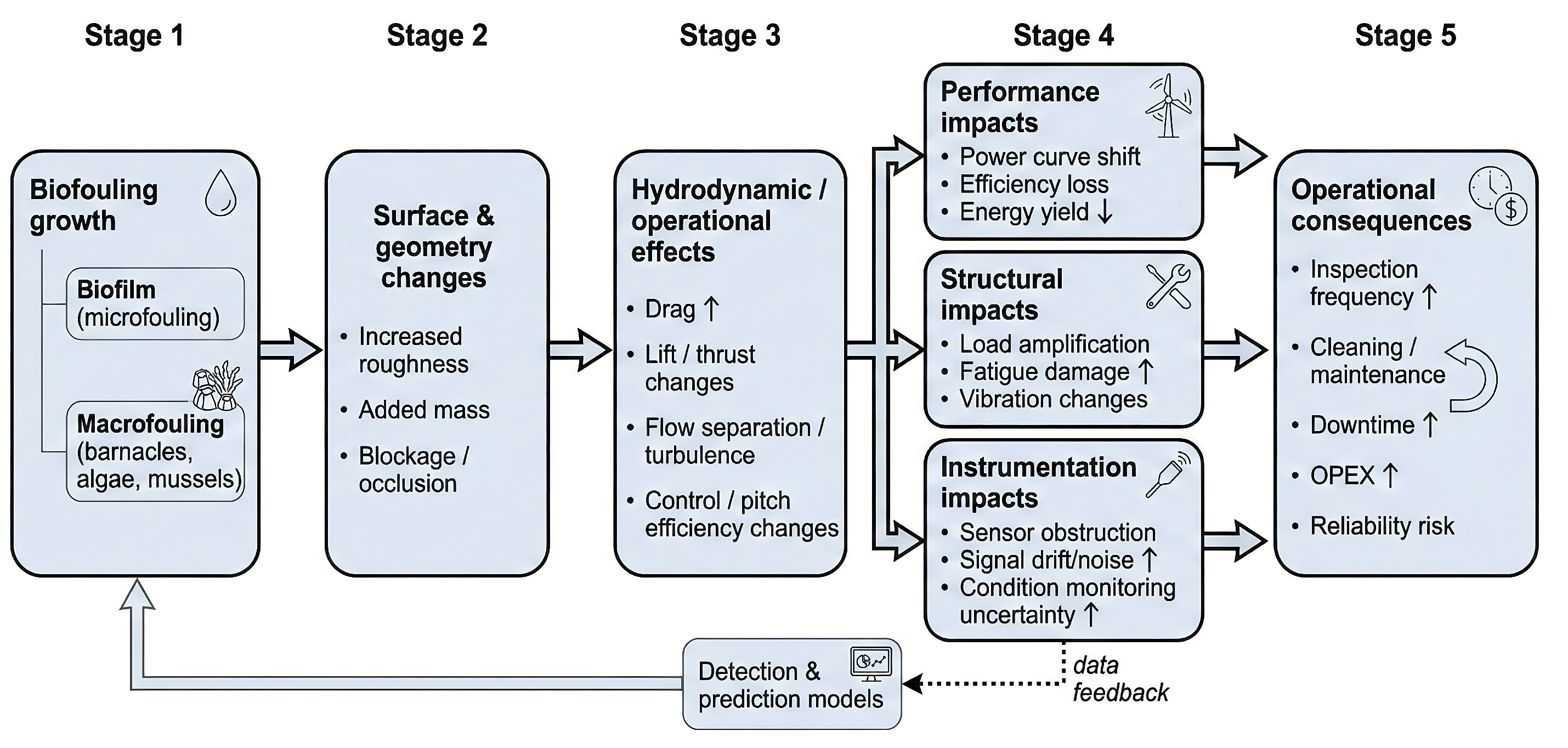
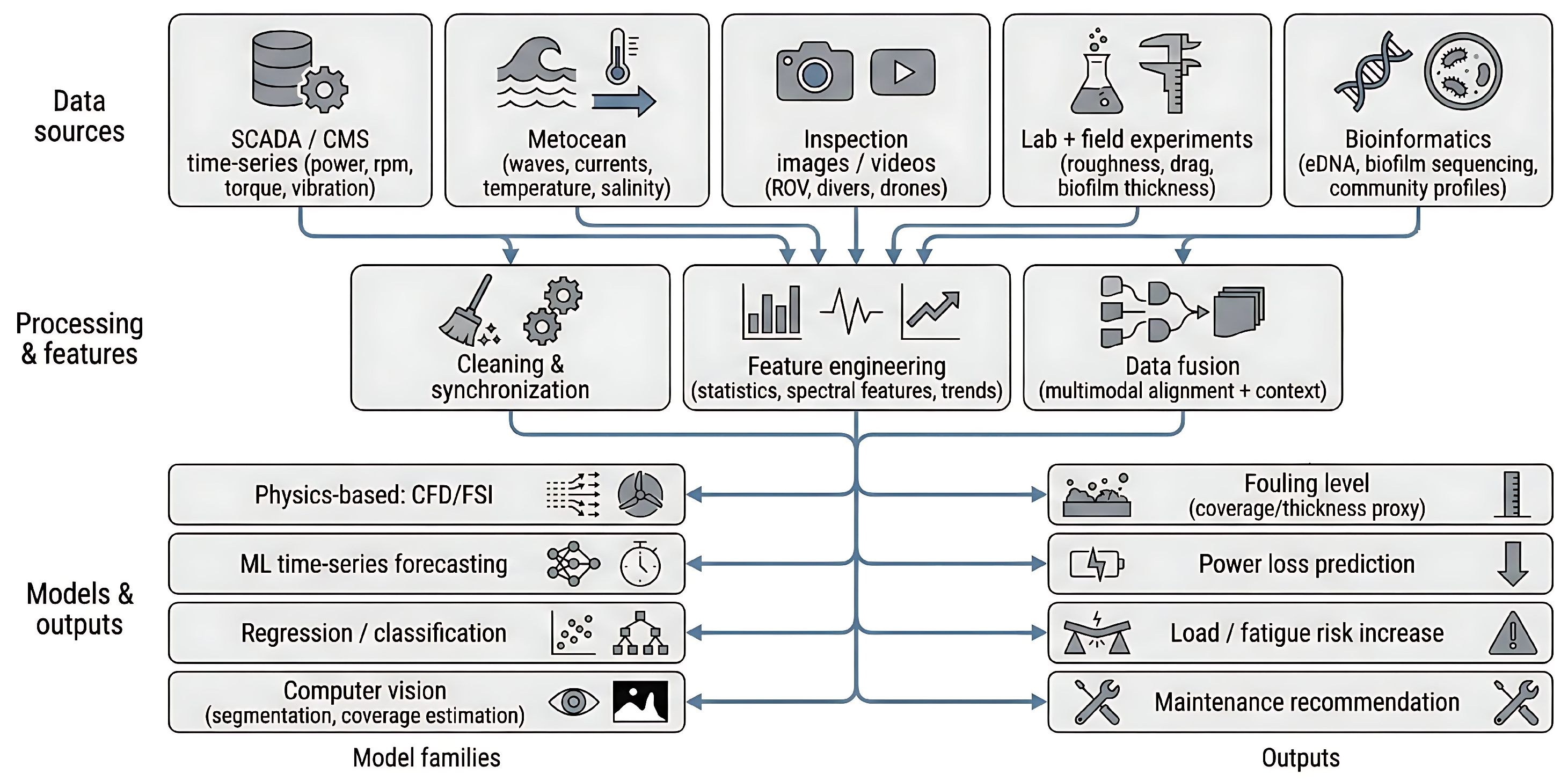
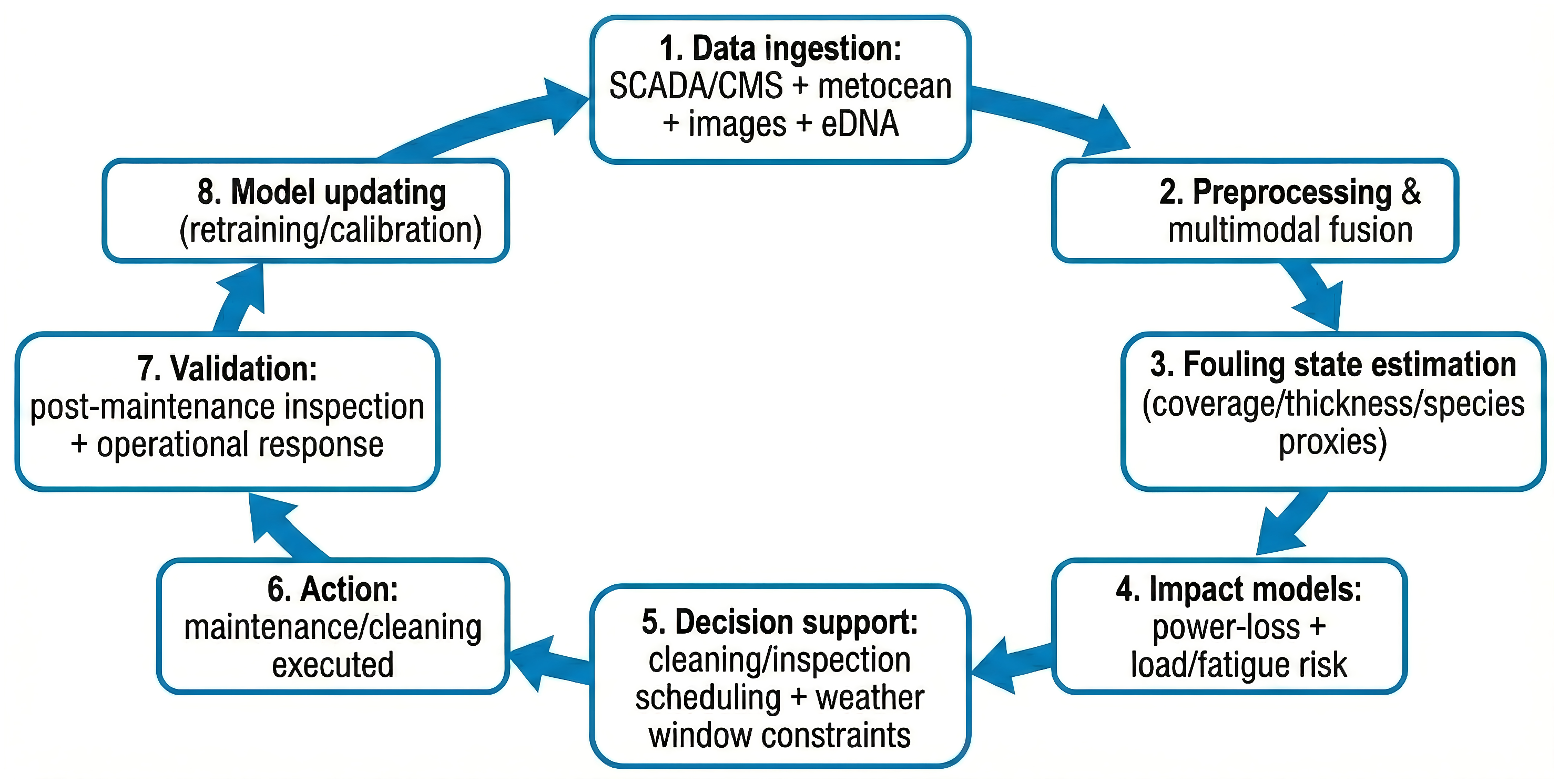
Marine renewable energy (MRE) systems operate in harsh marine environments where long-term exposure to seawater leads to biofouling, resulting in increased surface roughness, hydrodynamic drag, added mass, structural loading, sensor degradation, and reduced energy production. Despite its significant operational and economic impact, biofouling management in MRE devices has traditionally relied on manual inspections and empirical growth models, which offer limited predictive capability. This review provides a structured, data-centric synthesis of recent advances in machine learning (ML) and bioinformatics approaches for biofouling modeling, performance prediction, and maintenance planning in offshore wind turbines, tidal turbines, and wave energy converters. The study systematically examines key fouling locations and associated engineering impacts, and analyzes the major data streams used for predictive modeling, including SCADA and condition-monitoring time series, metocean variables, inspection imagery, laboratory and field experiments, and environmental DNA (eDNA) sequencing outputs. We compare modeling strategies ranging from physics-based simulations to classical ML, deep learning, computer vision, and hybrid physics-informed frameworks, and discuss how biological indicators such as microbial community profiles and eDNA-derived taxa abundances can be integrated as predictive features. The review further outlines emerging digital twin architectures for fouling-aware performance forecasting and maintenance decision support. Finally, we identify key challenges including data scarcity, cross-site generalization, validation practices, and uncertainty quantification, and propose future research directions toward integrated, proactive biofouling management systems in marine renewable energy infrastructure.
Keywords: biofouling; marine renewable energy; SCADA; machine learning; bioinformatics; predictive maintenance; environmental DNA; digital twin; tidal turbine; offshore wind biofouling; marine renewable energy; SCADA; machine learning; bioinformatics; predictive maintenance; environmental DNA; digital twin; tidal turbine; offshore wind