


Abstract
As critical end-effectors enabling the practical deployment of marine robotic systems, soft hands face persistent challenges including multi-finger asynchronization, unbalanced force distribution, and insufficient anti-disturbance robustness, compounded by constraints from soft material nonlinearity and harsh marine environmental disturbances. To address these limitations, this paper proposes a dexterous grasping method integrating coupled dynamical systems and adaptive force planning control, designed to enhance operational reliability in complex marine environments. An intermediate dynamic layer is embedded to ensure precise multi-finger synchronization, a hybrid force planning algorithm balances force uniformity and constraint satisfaction, and an adaptive controller synergizes with a Neo-Hookean model to compensate for nonlinear deviations. Simulations and physical experiments demonstrate that the method delivers excellent grasping stability and accuracy for uneven mass distribution targets such as cylinders and spheres, while balancing synchronization precision, constraint compliance, and anti-disturbance capability. Compared with the traditional coupled dynamical systems (DSs), the constraint violation is reduced by up to 18.2%, the friction force is increased by 4.0%, and the force distribution uniformity is improved by approximately 5.1%.Compared with the particle swarm optimization (PSO) strategy, the constraint violation is reduced by up to 50.5%, the friction force is increased by 40.9%, and the force distribution uniformity is also improved by about 5.1%. This work fills a key gap in balancing multiple performance metrics for marine soft hands, providing a reliable technical solution to accelerate the real-world deployment of marine robotic systems.
1. Introduction
Marine robotic systems play a pivotal role in modern marine engineering. These systems support critical tasks, including underwater resource exploration, environmental monitoring, and offshore structure maintenance. Soft hands serve as the direct interaction interface between robots and marine objects. Such hands have gained increasing prominence in marine robotic systems [1], acting as core end-effectors for diverse underwater operations. Key operations include marine organism sampling, coral reef restoration, sunken ship salvage, and offshore equipment maintenance. Soft hands exhibit high compliance and adaptability, standing as a highly promising alternative to traditional rigid grippers [2]. These devices safely handle irregularly shaped objects, minimize damage to fragile marine organisms and precision equipment, and their inherent flexibility further enhances adaptability to unstructured marine environments.
In recent years, with the rapid development of flexible robotics technology, the soft hands, endowed with adaptive deformation and tight surface conformability by virtue of flexible materials, have demonstrated broad application prospects in fields such as fragile object grasping, human–robot interaction, and medical assistance [3]. Compared with traditional rigid manipulators, soft hands are more suitable for grasping objects with complex shapes, fragility, and deformability, attracting extensive global research attention [4]. However, existing studies mostly focus on hardware-level innovations (e.g., mechanical structure design, flexible material selection) and the exploration of operation modes including sliding rolling [5], pivoting [6], enveloping [7], and finger gait [8]. Representative works, such as the rolling-gait dexterous manipulation concept proposed by Yang et al. [9] and the sampling-based multi-finger path planning method developed by Wu et al. [10], still fail to fully adapt to the flexible material properties, dynamic contact states, and multi-finger coordination requirements of soft hands. In fact, core performances such as dexterous grasping precision and stable operation reliability are more dependent on precise control system design and optimization. When grasping objects with unstable centers of gravity and diverse shapes, the soft hands require accurate multi-finger coordination, uniform force distribution [11], and rapid adaptive anti-disturbance ability. Restricted by flexible materials’ strong nonlinearity, complex multi-finger coupling, and existing control systems’ poor adaptability to environmental disturbances and object property uncertainties [12], current technologies cannot meet these demands. Therefore, there is an urgent need to develop efficient grasping planning and control methods.
For grasping objects with unstable centers of gravity and diverse geometries, grasp planning and operation strategies are the core enablers for dexterous operation of soft hands. These strategies encompass three interrelated key research objectives: (1) To tackle the challenges of multi-finger coordination and synchronization control, precise motion trajectory planning for flexible fingers is essential to ensure coordinated movement of each finger under disturbed environments and avoid instability during posture transitions; (2) To achieve uniform force distribution, dynamic adjustments to grasp postures and contact pressure are essential to adapt to variations in object geometries and uneven mass distribution, thereby preventing excessive deformation of soft materials and object slippage; (3) To tackle the complex constraint adaptation problem, an operational mode compatible with multiple constraints (e.g., friction cones, force-moment balance) must be designed, while accounting for the nonlinearity of soft materials and enhancing robustness against environmental disturbances to ultimately achieve stable and efficient grasping.
The application of coupled dynamical systems (DSs) provides an effective solution for multi-finger coordination planning of soft hands. Wang et al. [13] applied coupled dynamical systems to multi-robot cooperative control, yet this method fails to account for the significant nonlinear deformation and dynamic contact uncertainty of flexible fingers in soft hands. Huang et al. [14] proposed a unified framework for multi-arm motion planning; however, originally designed for rigid multi-arm robots, this framework does not consider the inherent strong nonlinear deformation of flexible fingers in soft hands nor the dynamic contact uncertainty during the grasping process. Multi-finger coordination synchronization and uncertainty adaptation constitute the core of multi-finger control for the soft hands [15]. The adaptive control theory proposed by Hu et al. [16] provides a theoretical basis for addressing parameter perturbations and deformation uncertainties. The Model Reference Adaptive Control (MRAC) method developed by Tang et al. [17], after optimization, can compensate for the nonlinear deviations caused by soft materials. However, neither of these methods fully accounts for the dynamic uncertainties of flexible deformation, which tends to result in an imbalance between impedance adjustment and deformation adaptation, along with poor robustness. The combination of sliding mode control and disturbance observers offers a technical approach to enhance robustness. The distributed adaptive control method proposed by Culbertson et al. [18] exhibits strong anti-disturbance capability, yet it fails to adapt to the strong nonlinear deformation and dynamic contact characteristics of the soft hands, leading to coordination imbalance and response lag under complex disturbances. The integrated method of extended state observers and nonlinear sliding mode control proposed by Kastritsi et al. [19] can effectively suppress environmental disturbances and model uncertainties, but without the incorporation of constraint conditions, the resulting high-frequency chattering that is easy to damage flexible materials.
Control strategies are crucial for ensuring the grasping stability and operational accuracy of soft hands Impedance control and force hybrid control are core methods for soft hands to achieve compliant contact. Pfanne et al. [20] proposed a method of planning operations in the grasping null space and controlling grasping impedance, which effectively avoids excessive deformation and force overload of soft hands but fails to consider the real-time impact of dynamic environmental disturbances on impedance adjustment; Mohammadi et al. [21] proposed an adaptive grasping method integrating tactile sensing and empirical learning. By adjusting finger impedance in real time, this method improves the adaptability of soft hands to changes in object shapes and achieves compliant fitting and stable grasping. However, this method does not fully adapt to the model uncertainties caused by the strong nonlinear characteristics of soft materials. In summary, although existing core control methods have improved the contact compliance and shape adaptability of soft hands in specific scenarios, these methods have limitations in resisting dynamic disturbances and adapting to nonlinear models. In terms of planning methods, geometric and incremental planning is an important technical path for soft hands grasping planning. Sundaralingam et al. [22] proposed a high-level task planning method that combines finger gait and incremental manipulation; this method achieves object pose transformation by adjusting finger positions step by step and is suitable for the soft hands to gradually adapt to objects with unknown shapes. However, it relies heavily on prior knowledge of object shapes, resulting in limited adaptability when the soft hands grasp various complex objects. Jing et al. [23] added task constraints to the planning process to improve operation accuracy but failed to fully consider the dynamic deformation uncertainties of flexible materials in soft hands, leading to insufficient robustness in disturbed scenarios. Existing geometric and incremental planning methods have obvious limitations in adapting to the diversity of object shapes, coping with the dynamic characteristics of flexible materials, and resisting environmental disturbances, making it difficult to meet the requirements for stable grasping by soft hands.
Shape estimation and grasp quality assessment are key links for optimizing the grasp planning of the soft hands. The Gaussian process model proposed by Zhan et al. [24] allows for the shape estimation of unknown objects, but it is characterized by high computational complexity and weak anti-noise capability. The particle filter algorithm developed by Hang et al. [25] is compatible with the compliant contact characteristics of the soft hands, yet it suffers from insufficient robustness and sampling efficiency. The grasp quality assessment indicators reviewed by Wang et al. [26] can be used to optimize grasp performance but fail to account for the time-varying characteristics of flexible deformation and dynamic contact uncertainties. Data-driven methods and tactile sensing can compensate for the difficulty in establishing accurate strongly nonlinear models for the soft hands. The factor graph modeling method proposed by Sodhi et al. [27] enables real-time estimation of contact states, but it exhibits poor adaptability to noise and dynamic contact point drift, coupled with insufficient real-time performance. The visual–tactile fusion deep learning method developed by Calandra et al. [28] can optimize contact postures, yet it relies heavily on large-scale training datasets and exhibits low robustness against dynamic deformation noise. Reinforcement learning and imitation learning eliminate the need for precise mathematical models: the relevant methods proposed by Zhou et al. [29], Dai et al. [30], and Zhu et al. [31] have promoted the application of data-driven approaches in the soft hands. Nevertheless, all these methods lack sufficient adaptability to the dynamic uncertainties of flexible deformation, suffering from simulation-to-reality transfer bias and limited strategy generalization under complex disturbances.
Most existing studies on soft hands focus on structural design such as fiber reinforcement and pneumatic actuation, but do not optimize control considering dynamic disturbances in marine environments. Coupled dynamical systems (DSs) are mostly applied to multi-robot coordination, yet fail to account for the strong nonlinear deformation of soft hands. The particle swarm optimization (PSO) algorithm has been used for force planning, but suffers from local optima and poor constraint satisfaction. Current research on underwater soft hands has not addressed asynchronous multi-finger movement, uneven force distribution, and weak disturbance rejection. Furthermore, a control framework that achieves balanced multi-performance objectives is still lacking.
Despite the progress made by the algorithms in stable grasping of soft hands, several critical challenges remain unsolved. The soft hands exhibit poor adaptability to dynamic environments. Most methods perform well under static or slightly disturbed environments. But when it faces dynamic situations like strong sudden disturbances or rapid direction changes, the deformation lag and nonlinear features of the soft hands will significantly degrade control performance. The handling of multiple coupled constraints is not good enough. Existing studies often fail to fully consider various constraints of the soft hands, such as input saturation and deformation limits.
To address the issues, this paper proposes a dexterous grasping method that integrates coupled dynamical systems (DSs) and adaptive force planning control. A corresponding adaptive force planning control framework is designed, which combines coupled dynamical systems (DSs) with quantum particle swarm-sequential quadratic programming. The framework establishes dynamic coupling relationships between flexible fingers based on an intermediate dynamic layer. This enables multi-finger coordination and synchronization. The method incorporates multiple constraint conditions, including friction cone constraints, force balance and moment balance, to improve grasping stability for unstable objects in disturbed environments. For force distribution optimization, the method adopts three key strategies. Multi-strategy quantum initialization, adaptive particle search and a constraint repair mechanism. These strategies avoid local optima and excessive deformation of soft materials, ultimately facilitating the soft hands to achieve stable object grasping.
The main contributions of this paper are as follows:
(1) A novel coordinated control strategy for coupled dynamical systems (DSs) with an intermediate dynamic layer is proposed. Combined with an asymptotically stable task-space DS model for real-time trajectory re-planning, it improves the multi-finger asynchronization problem and ensures smooth transformation of object postures.
(2) An adaptive force planning algorithm integrating quantum particle swarm optimization and sequential quadratic programming is developed. The algorithm incorporates multiple constraints such as friction cones and force balance, and a constraint repair mechanism is designed to address the insufficient adaptation to complex constraints, achieving uniform distribution of grasping forces.
(3) Soft hands model based on the Neo-Hookean model is established, and an adaptive controller is designed. Verified by finite element simulations and experiments, the framework can stably grasp objects of different shapes such as cylinders and spheres, balances operational accuracy and robustness in disturbed environments, and optimize the anti-disturbance performance of flexible materials.
The remainder of this paper is organized as follows: Section 1 and Section 2: Construct the mechanical model of the fiber-reinforced soft hands and design a task-space dynamical system (DS). Section 3: Propose the adaptive force planning control law, integrating coupled dynamical systems (DSs), quantum particle swarm optimization, and sequential quadratic programming algorithms. Section 4: Conduct finite element simulations and verification under different object shapes and disturbed environments. Section 5: Summarize the research work and outline future research directions for improving the dexterous manipulation performance of the soft hands.
2. Model Construction
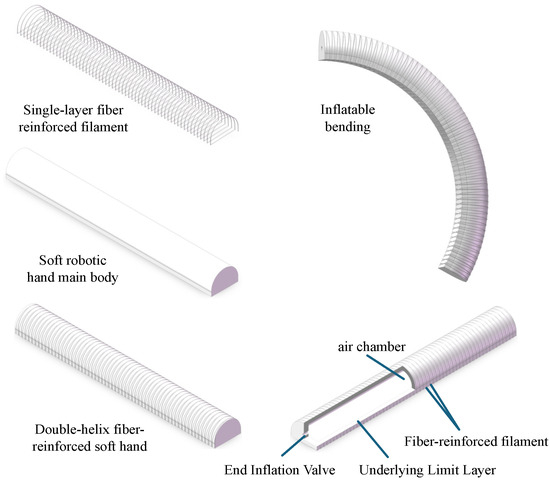
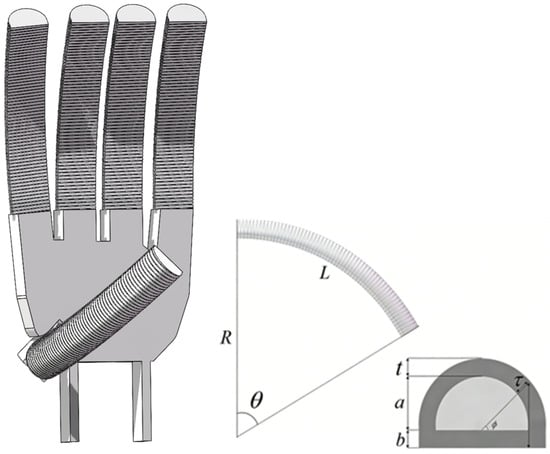
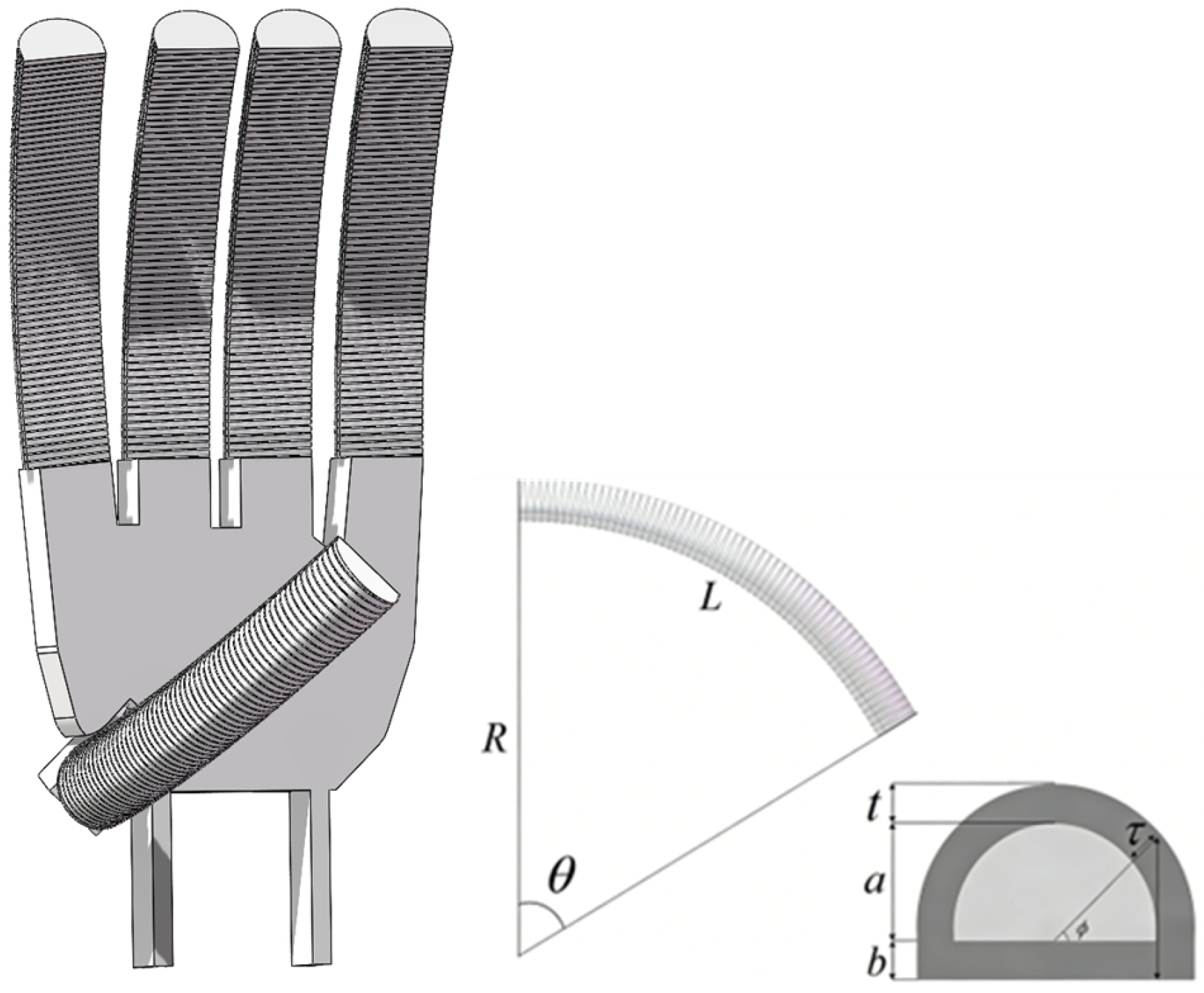
This paper adopts fiber-reinforced soft hands. The soft hands mainly consist of deformable chambers, a base strain-limiting layer, and an outer fiber-reinforced layer. The deformable chambers, base strain-limiting layer, and outer fiber-reinforced layer enable the soft hands to bend steadily and grasp objects during inflation or deflation. This structural design considers the softness of silicone and the high toughness of fiber-reinforced threads. The softness of silicone and high toughness of fiber-reinforced threads allow the soft hands to achieve large deformation and carry heavy loads, providing strong support for control precision and grasp stability. The deformation chamber serves as the core driving component of the soft hands. When internal pressure of the deformation chamber increases, silicone walls expand under force, causing the soft hands to deform and thereby realizing bending or grasping actions. The underlying strain-limiting layer constrains deformation, enabling the soft hands to provide more precise and stable gripping force when holding objects. The fiber-reinforced layer adopts Kevlar threads in uniform bidirectional spiral winding to reinforce the deformation chamber, limit radial expansion, and improve gripping strength.The cavity structure of the soft hands is shown in Figure 1.
Figure 1.
Cavity structure of the soft hands.
This paper uses the Neo-Hookean model to describe the constituted model of the hyperplastic material of soft hands. The strain energy density function describes the elastic energy stored per unit volume of the material during deformation. The strain force density function of the double-helix fiber-reinforced soft hands silicone w is
where, is the initial shear modulus of the material, I is the strain invariant of the material, representing the state of deformation.
where, , , , respectively, represent the principal stretch ratios along the three axes in the space. This formula describes the relationship between the energy storage of soft materials and the extent of deformation. As the deformation increases, the strain energy density increases, meaning that more elastic energy is stored inside the material. Due to the isotropic incompressibility of the silicone material of the soft hands:
The principal stresses in the three axes are
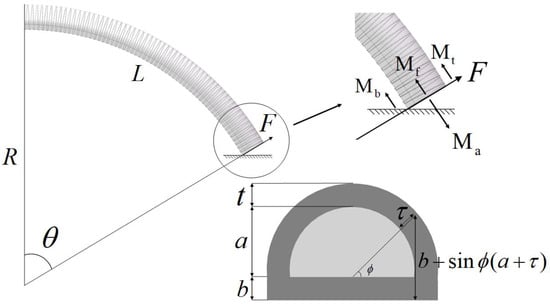
where, p is the Lagrange multiplier, enforcing that the silicone material is incompressible, i values are 1, 2, and 3. The soft hands contact force model is shown in Figure 2.
Figure 2.
Contact force of the soft hands.
When the soft finger inflates and bends, it encounters a flat surface, generating a force F perpendicular to the fingertip. The torque balance formula is
is the bending moment generated by internal air pressure acting on the fingertip; , is the moment caused by the stretching of top and bottom materials; is the bending moment caused by the interaction force when in contact with an object.
Bending moment generated inside the soft actuator by air pressure:
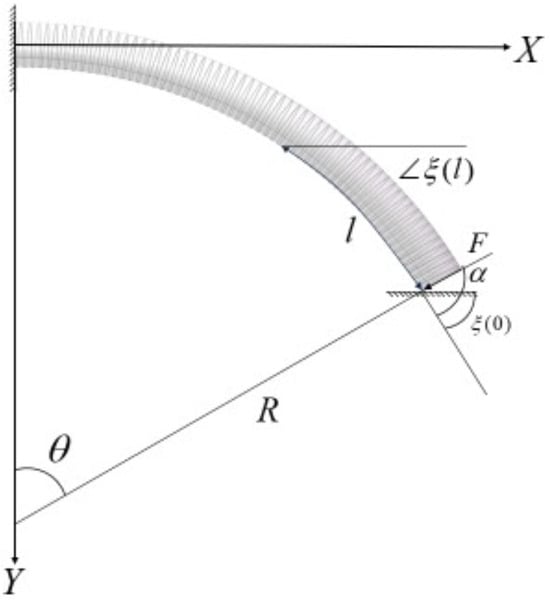
where, is the pressure of the filled gas, and is the atmospheric pressure. Introducing the coordinate parameter , the value of in the vertical direction is
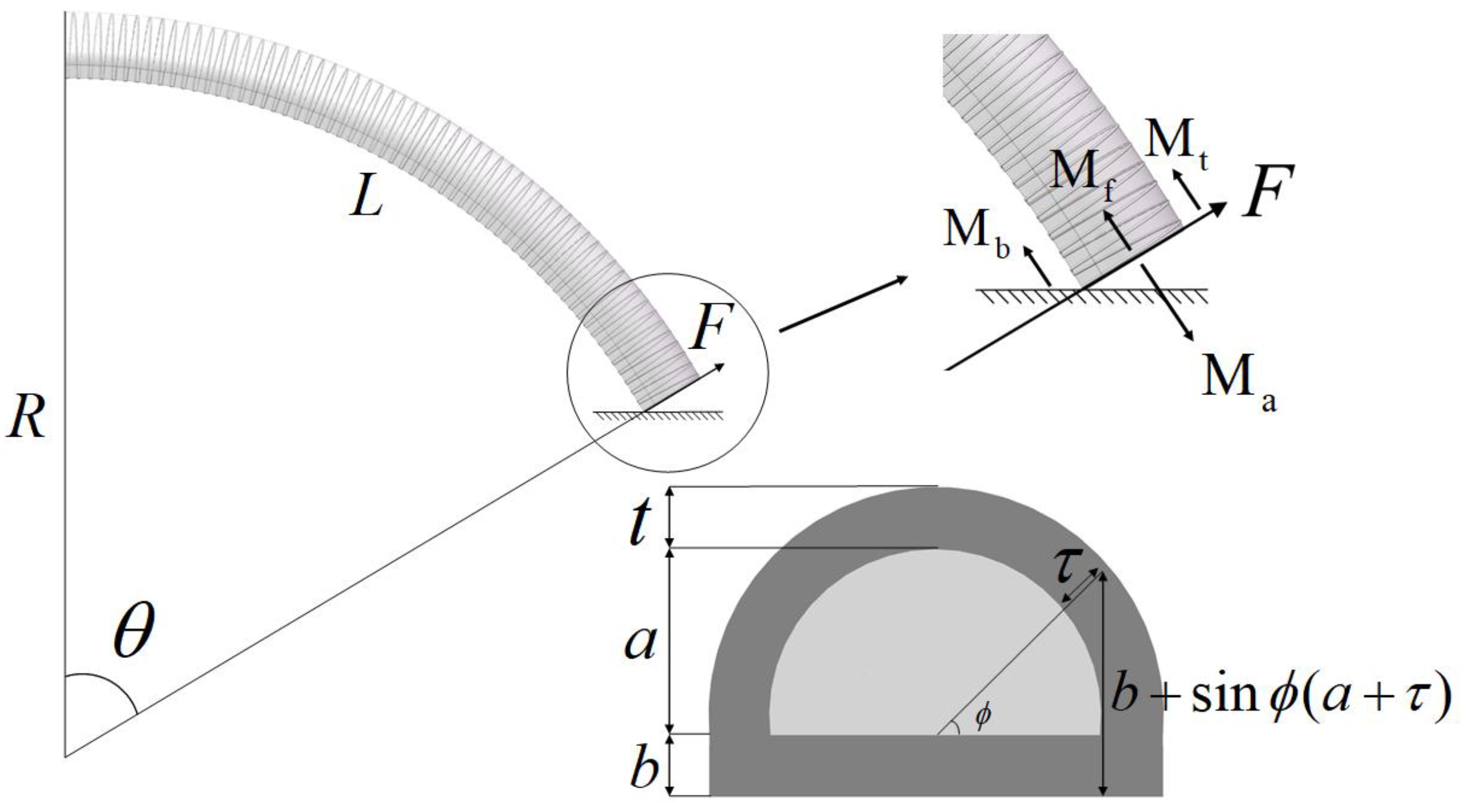
where is theoretically applied to the embedded flexible sensor, obtained from a tensile test, and can be approximated as . The schematic of the bending force on the soft hand is shown in Figure 3.
Figure 3.
Schematic of bending force on soft hands.
Top-level is
The stretching torque at the top layer is
Approximate the semicylindrical top wall of the actuator as a flat top wall, with the position of the flat top wall at distance a from the bottom, where v is the undetermined coefficient:
Among them, and are
The soft hands generate contact force with the object at the fingertips as
where, is the length of the soft fingertip. When the soft finger moves freely without external force, the relationship between the inflated gas and the bending angle of the soft finger is
Among them, , , and correspond to the shear modulus of the top layer, bottom layer, and flexible sensor. If the soft hands’ bending movement is obstructed and contact force is generated, the fingertip force F formula is
3. Task-Space DS
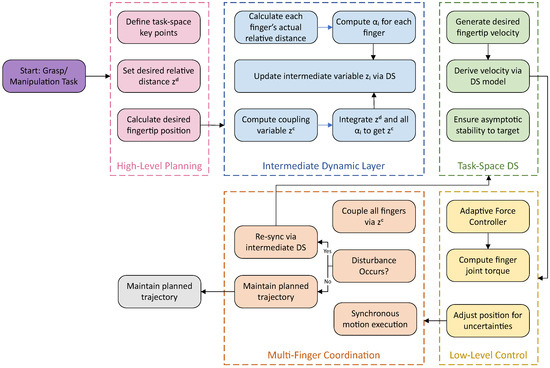
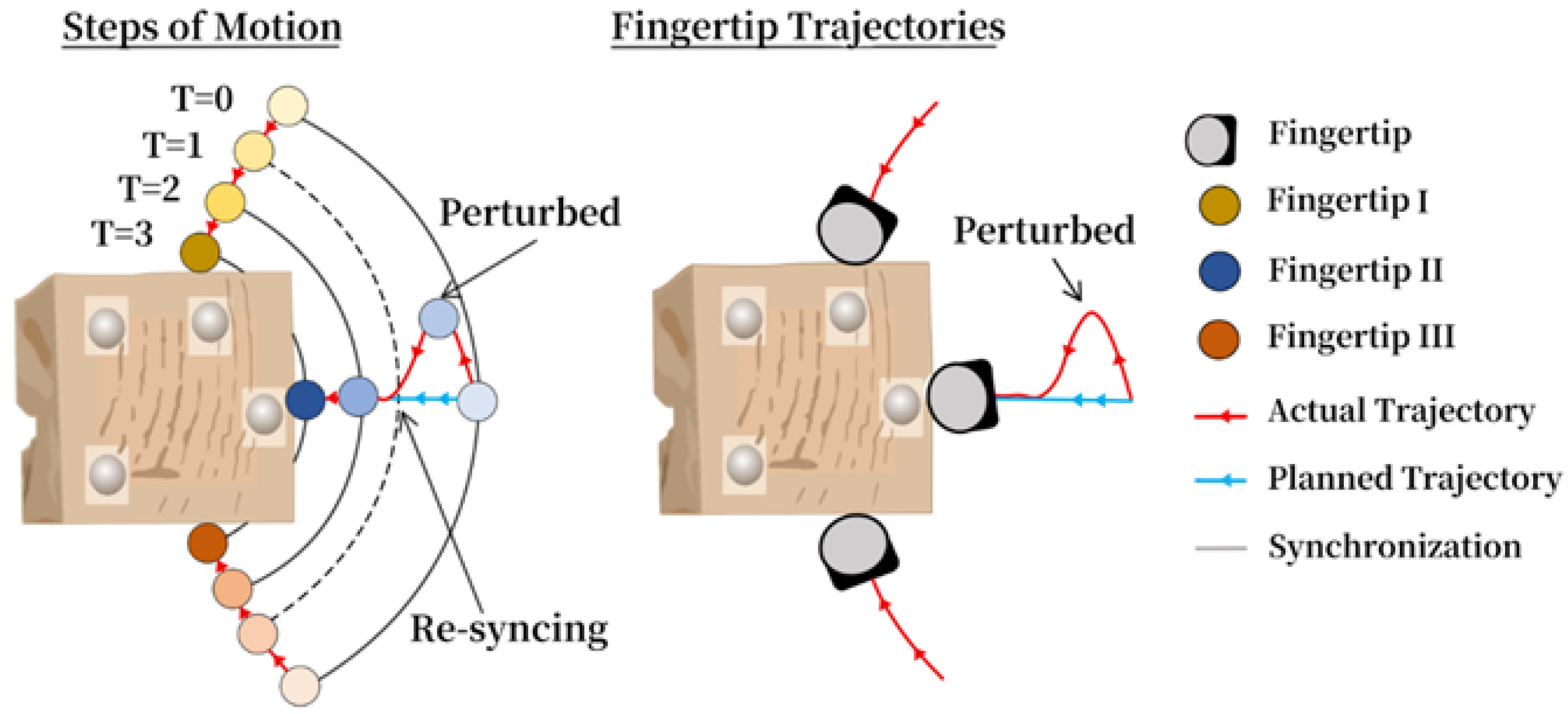
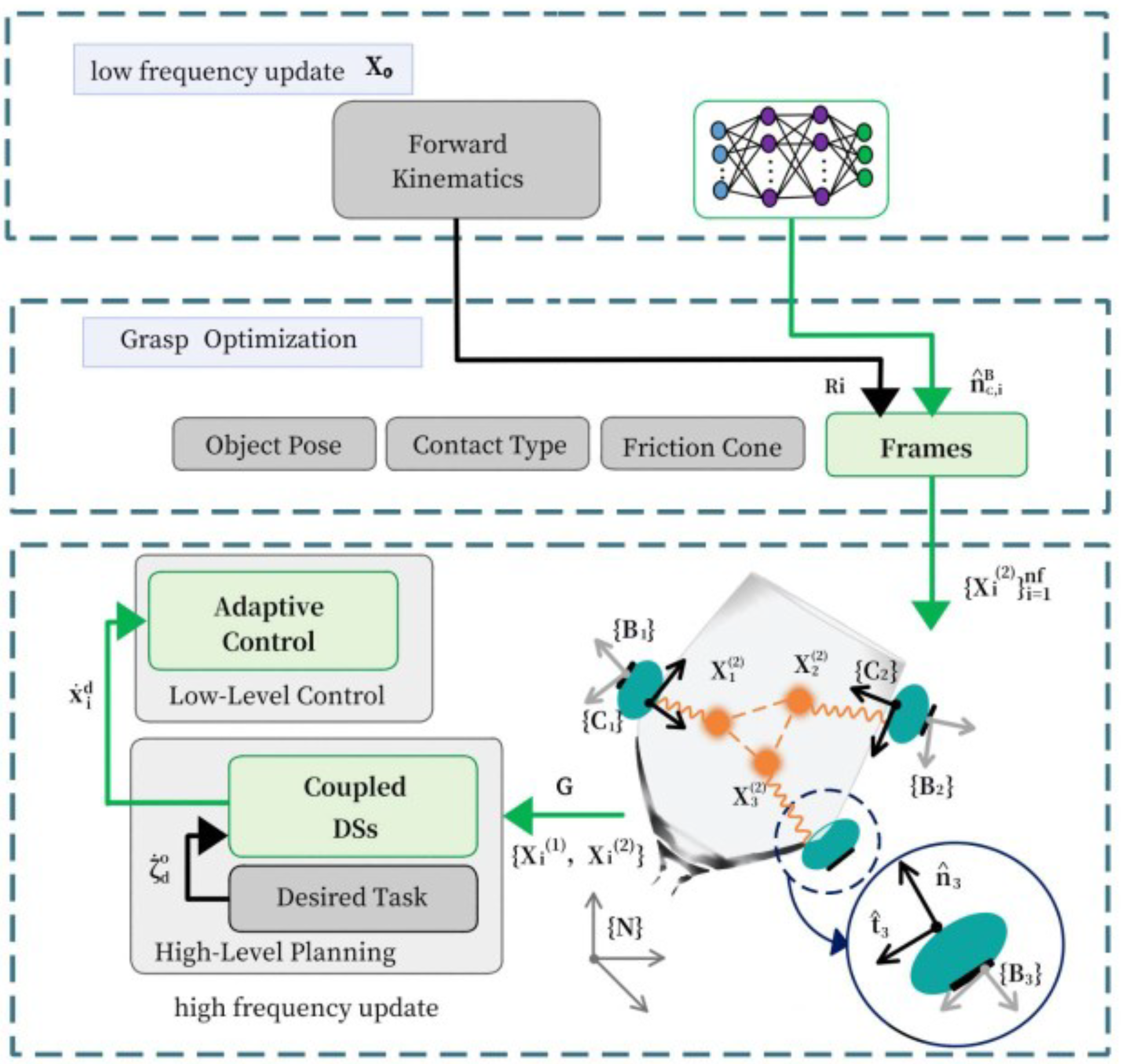
To address the problems of poor synchronization in multi-finger motion and insufficient robustness of soft hands under disturbances, a task-space dynamical system (DS) oriented toward finger coordination is designed. On this basis, considering the strong nonlinear deformation characteristics of flexible materials, dynamic contact uncertainty, and the requirement for flexible interaction between fingers and objects, the desired velocity of each fingertip is obtained through an asymptotically stable task-space dynamical system model. Furthermore, an intermediate dynamic layer containing relative distance variables and coupling mechanisms is constructed to form a coordinated control system for the synchronous motion of multiple fingers. The structure of the task-space dynamical system is shown in Figure 4.
Figure 4.
Block of the coupling algorithm.
This paper designs an adaptive force planning controller based on a DS-based controller because the DS-based controller is robust to disturbances. Specifically, in the high-level planning, the task represents the task is represented as the desired velocity , where denotes the dimension of the position in the task space, and each fingertip adheres to the form of a dynamical system (DS).
is a continuous and asymptotically stable dynamical system at the attractor , which means as . The function can be linear, nonlinear, or cyclic, and can maintain and generate all trajectories to reach the target state.
In the low-level control of soft hands with fingers, the positions of the soft hands’ fingers can be set. In practical applications, while position control is intuitive to implement, it relies on high gains and damages the grasped object if contact occurs earlier than planned. In grasping applications, an accurate understanding of the object shape and soft hands model is required. Adaptive force planning is more suitable for establishing flexible object-finger interactions, allowing adaptation to potential imperfections or model inaccuracies.
Thus, a force-planning-based control approach is adopted for the control of the five-fingered soft hands:
where, is calculated to achieve the expected fingertip velocity . The goal in low-level control is to define the function for each finger. By utilizing , the position of the soft finger is explicitly adjusted to address uncertainties related to object shape, mass distribution, and contact mechanics.
First, the relative distance variables and the intermediate dynamic system among them are defined. This paper elaborates on how a single soft finger is controlled through this intermediate dynamic system. Subsequently, this paper explains how multiple soft fingers are coupled via the intermediate dynamic system, and how this coupling mechanism achieves finger coordination that is well-suited for grasping and manipulation tasks. The coupling schematic of the soft hands is shown in Figure 5.
Figure 5.
Coupling schematic.
A single soft robotic end effector is considered. The task is to control this end effector to reach the desired position . Another requirement is that needs to lie on the line connecting two specific points in the task space: (1) and (2) . These two points are used for defining grasping and manipulation tasks. However, for now, let us assume they are externally defined. Given this, the desired position of the robot can be expressed in the form of a relative distance measure.
where, is a variable representing the relative distance between the desired position and the second point . This paper does not directly set for the robot to track, but instead, it sets an intermediate target , defined by .
Then adjust z to make it converge to . This intermediate variable will later serve as a coupling variable. Determining and controlling z is central to our coordinated planning problem. Regardless of the actual software hand position, z needs to evolve to ensure that as . Therefore, this paper proposes the following dynamic system (DS):
State-related target points: changing the variable z is equivalent to changing the soft hands target position . Therefore, this must be considered when deriving the DS of the soft hands end effector. Given the end effector position , the variable z, and the intermediate DS, the following task-space DS is proposed to control the soft hands’ end effector:
is the state matrix, is the identity matrix. The task-space DS is asymptotically stable at the target point , that is, .
Intermediate variable feedback: Intermediate variable feedback is obtained by providing the DS with state feedback from the soft hands, the actual relative distance of the current position of the soft hands is calculated. To better distinguish the actual relative distance from the DS variables, it uses instead of z to represent the current relative distance measure.
It estimates z by performing a one-step integration of the intermediate dynamic system, , with the integration time being one time step .
To couple the fingertips controlled by DS, it defines the intermediate DS of the i fingertip.
Among them, serves as a coupling variable, and it is
couples the entire system and captures the status of all fingers conveyed through the measurement of their actual relative distances, .
4. Control Rule and Adaptive Laws
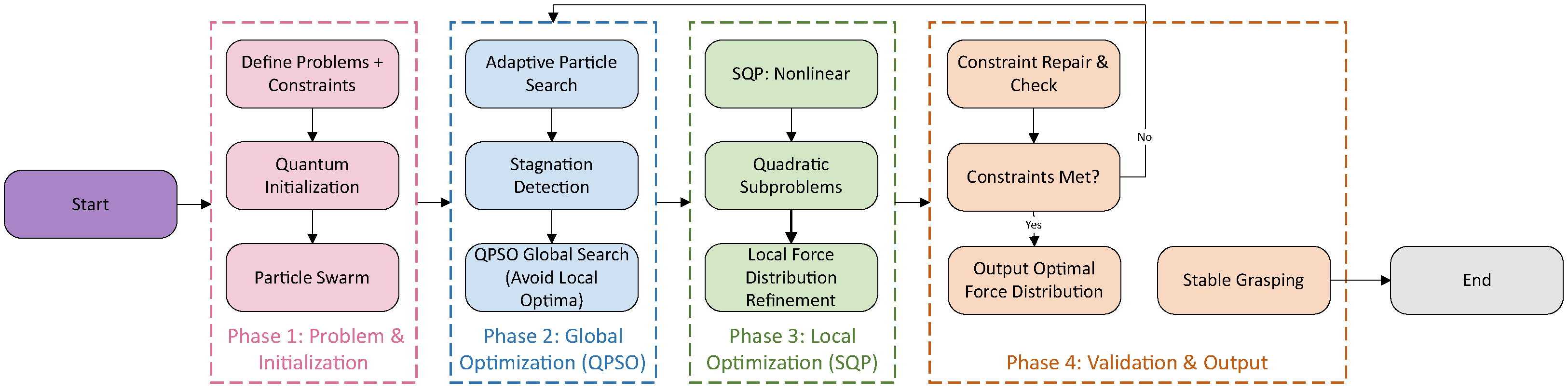
To address the problems of unbalanced force distribution among multiple fingers of soft hands and poor adaptability to complex constraints, an adaptive force planning algorithm integrating quantum particle swarm optimization and sequential quadratic programming is proposed. On this basis, considering the stable grasping requirements such as preventing object slipping, avoiding excessive deformation of flexible materials, and force-moment balance, the algorithm is designed with multiple constraint conditions and a constraint repair mechanism: the desired contact force distribution of each fingertip is obtained through multi-strategy quantum initialization and adaptive particle search, and a sequential quadratic programming module is further introduced to locally optimize the force distribution, forming a robust grasping force planning system that balances global optimization and constraint satisfaction. The structure of the adaptive force planning algorithm is shown in Figure 6.
Figure 6.
Block of the force planning algorithm.
The soft hands fail to grasp due to unbalanced force distribution across its five fingers. This paper proposes an improved grasp force planning algorithm based on quantum particle swarm optimization and sequential quadratic programming, and designs constraints such as friction, force balance, and moment balance. Multi-strategy quantum initialization enhances the diversity of the initial population; adaptive particle search, stagnation detection, and periodic local optimization strengthen the global search capability of particles, avoiding local optima; a constraint repair mechanism improves system constraint satisfaction and grasp stability.
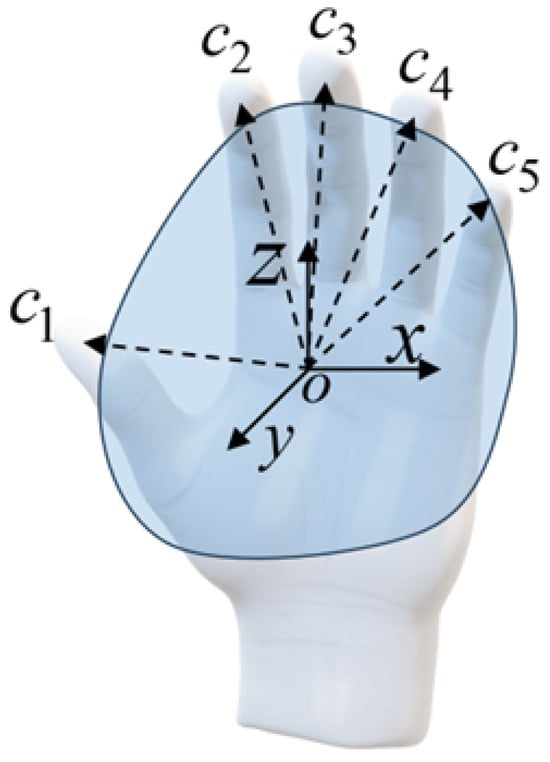
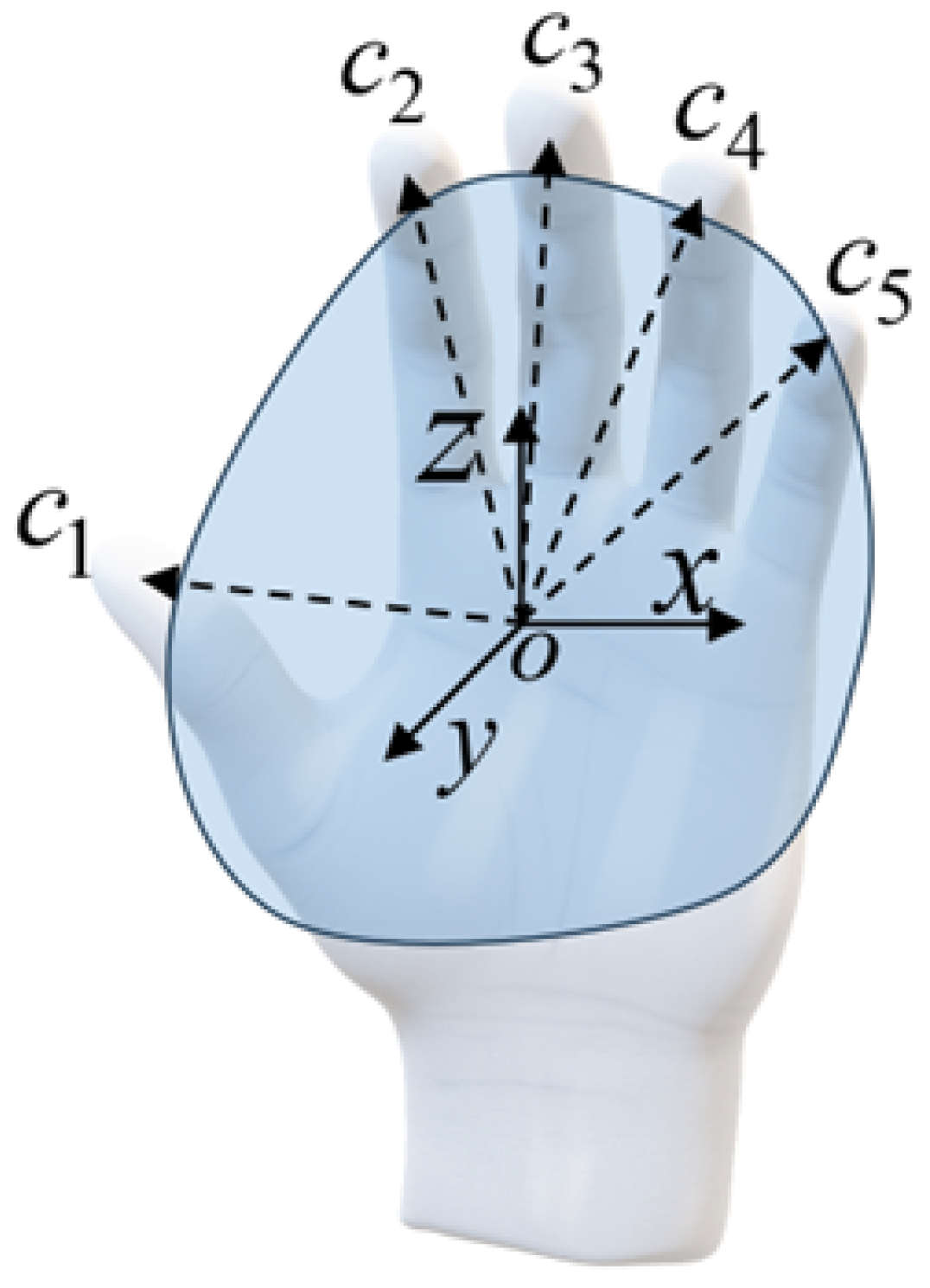
The contact between the soft hands and the object occurs at the fingertips of each finger, and each finger needs to be controlled as an independent actuator. Figure 7 is a schematic diagram of a human hand grasping an object, where o is the centroid of the object, and , , , , respectively represent the contact points of the five fingers with the object.
Figure 7.
Schematic of a five-fingered hand.
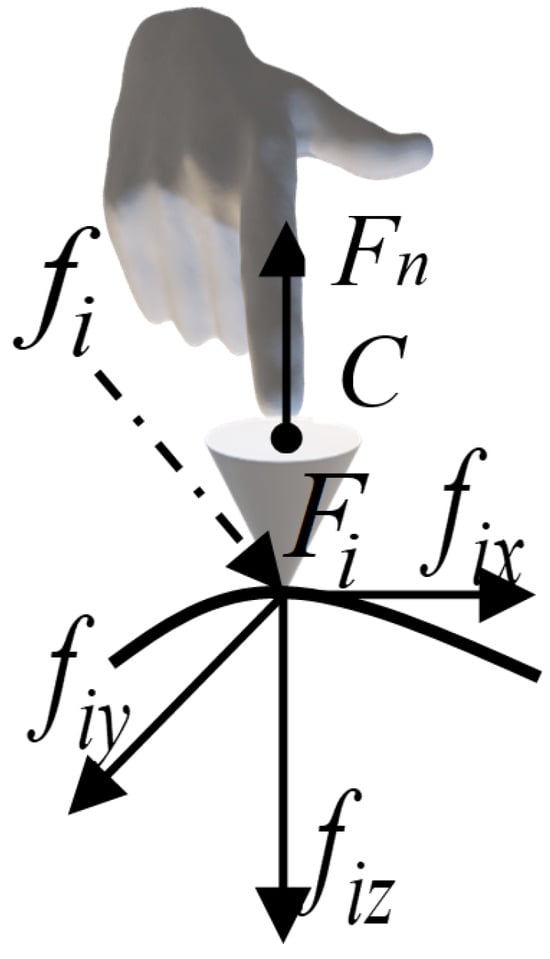
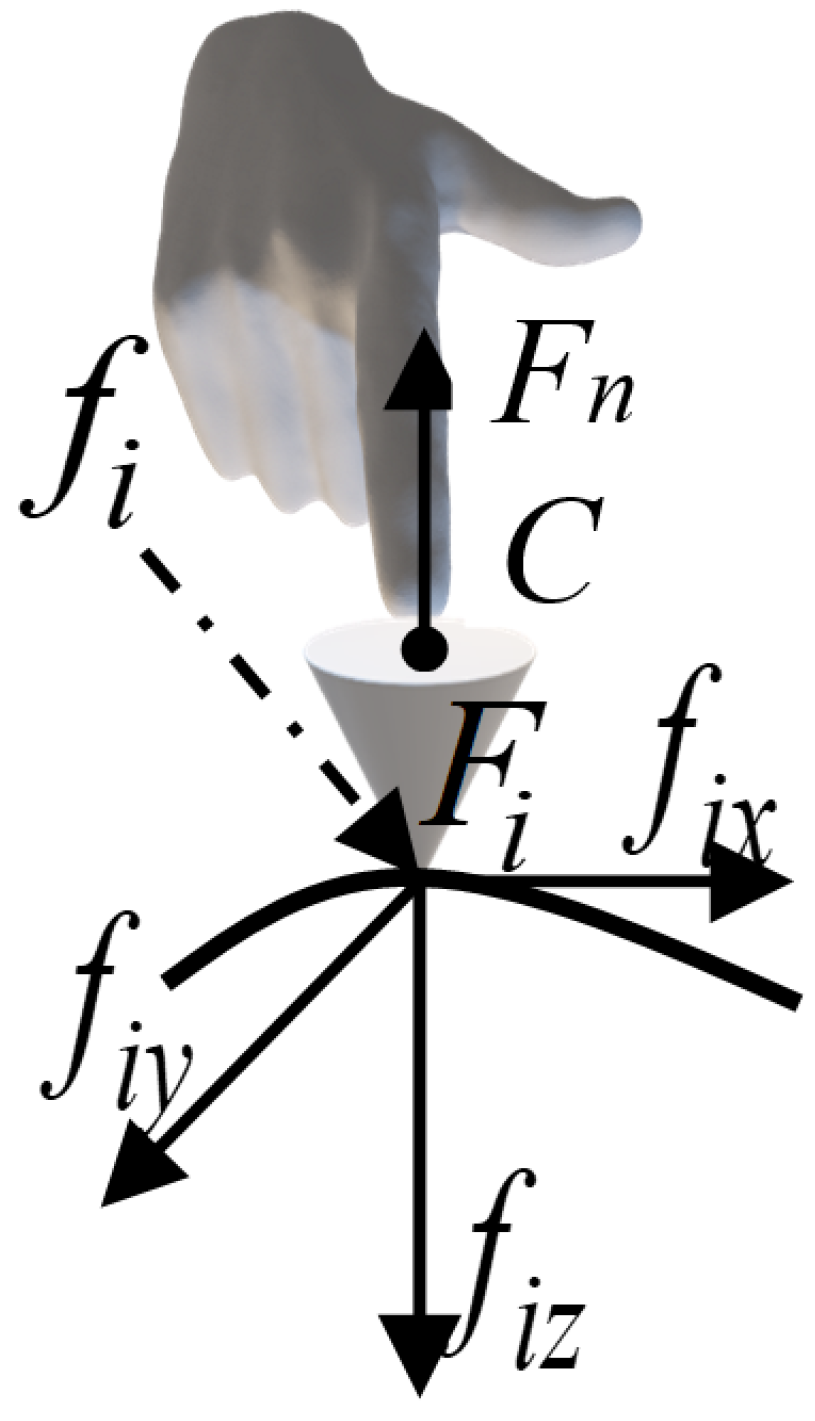
When an object encounters soft fingers, due to friction, the direction of the contact force vector can only be restricted within a conical region. Friction constraints are a type of nonlinear constraint and cannot be represented using linear methods, so a polyhedral cone is used as a substitute. The opening angle of the friction cone, which represents the friction constraint, is related to the coefficient of friction: the larger the coefficient of friction, the smaller the cone’s opening angle. The magnitude of the friction force is limited by the relationship between the normal force and the coefficient of friction at the contact surface.
where, is the normal force, acting on the contact point and perpendicular to the contact surface; is the tangential friction force, acting on the contact point and along the contact surface; is the coefficient of static friction, which determines the tendency of an object to slide at the contact point. The schematic of the single-finger friction cone of the bionic hand is shown in Figure 8. The contact force vector must lie within the friction cone. Through the constraints of the friction cone, a soft robot hand can stably grasp objects, preventing them from sliding.
Figure 8.
Schematic of the single-finger friction cone for a bionic hand.
In friction cone , represents the contact force between the fingertip and the object, is the normal component, and are the two tangential components, where i is the i-th finger of the gripper.
Three contact models: frictional contact, and soft finger contact describe different types of contact, each with distinct characteristics. A brief analysis of the three contact models is as follows (Table 1):
Table 1.
Contact model.
Among them, and are the components of the force in the directions of x and y, is the normal component of the force, is the torque of the normal force. is the static friction coefficient between the i-th finger and the object, is the torque friction coefficient between the i-th finger and the object.
Friction constraint: ensures that friction can balance gravity, providing sufficient vertical support. A friction cone is used to ensure that the system remains stable when the resultant vector of friction lies within the friction cone range, preventing slipping or tilting.
Among them, is the coefficient of friction, is the stability margin, and W is the weight of the object being grasped. The total friction force must be greater than or equal to to ensure the stability of the system.
Force balance constraint: The force balance constraint requires the resultant force to be zero to ensure that a soft hands do not move the object horizontally. The force balance constraint allows the soft hands to counteract horizontal disturbances.
where, and represent the object’s movement in horizontal and vertical directions, respectively. is set as a constant threshold to ensure the object does not slide horizontally.
Moment equilibrium constraint: Ensures that the resultant moment is zero, preventing the object from rotating. The friction cone at the contact point can form a completely closed space, so the object will not move regardless of the external forces and moments applied to it.
where, represents the resultant of all external moments acting on the object, points from the object’s center of mass to the i-th contact point, and is the force applied by the soft hands at the i-th contact point.
Contact pressure constraints and contact force range constraints: Limit the contact pressure of soft hands to prevent excessive deformation of the soft material, which could result in loss of grasping ability, and to avoid local stress at the contact points exceeding the material limits, which could cause structural damage. The design of pneumatic soft robots itself imposes limitations, as their grasping contact forces are smaller compared to rigid manipulators, so restricting the range of contact forces is necessary.
where, A is the contact area of the soft hands, is the maximum contact pressure, and are the minimum and maximum contact forces, respectively.
The actual contact force at the end of the soft hands is obtained through sensors. Quantum particle swarm optimization is used for global search, where each particle represents a candidate solution for the contact force distribution among the five fingers of the soft hands. The population consists of multiple particles, covering the feasible domain of the contact force distribution for the five fingers. Sequential quadratic programming is used to convert the nonlinear constrained optimization problem into a series of quadratic subproblems, allowing for more uniform exploration in potential optimal regions. Ultimately, the contact force distribution that satisfies all constraints and achieves the best overall performance for the five fingers of the soft hands is obtained.
The particle position update formula in particle swarm optimization is
where, represents the position of the i-th particle in the j-th dimension at time t, that is, in the i-th soft five-finger contact force scheme, the contact force of the i-th finger at the t-th iteration. is the local attractor, the best contact force value of the i-th soft finger during the iteration. is the contraction-expansion coefficient, u is a uniformly random number in the interval , is the average position of all particles in the j-th dimension, the optimal contact force of the j-th soft finger, ensuring the coordination of the five-finger forces.
Sequential Quadratic Programming transforms the solution of nonlinear constrained optimization problems into a sequence of quadratic programming subproblems. In each iteration, a quadratic programming problem of the following form is solved to find the adjustment direction of the soft hands contact forces that minimize the value, thereby further optimizing the force distribution of the soft hands based on the current state:
Among them, H is the Hessian matrix of the Lagrangian function, reflecting the force coupling effect caused by the interaction of the five fingers due to the flexibility of the soft hands structure. d is the search direction, representing the adjustment needed to distribute the current soft hands contact forces more optimally. and are the inequality and equality constraint functions, respectively. represents the first-order derivative vector of the original objective function at the current contact force state , and represents the dot product of and the search direction d, reflecting how the first-order trend of the objective function at affects the search direction. The block of the overall algorithm is shown in Figure 9.
Figure 9.
Block of the overall algorithm.
5. Simulation Verification
To comprehensively validate the effectiveness and superiority of the proposed dexterous grasping method for soft hands, three targeted experiments are designed focusing on the core performance metrics (coordination, stability, robustness), and systematic verification is conducted by integrating simulations and physical tests. Details are as follows:
(1) Multi-finger Coordination and Synchronization Experiment: Soft hands are tested under external disturbances conditions using MATLAB 2022 software to verify that the intermediate dynamic layer can eliminate multi-finger asynchrony and enable synchronous convergence to the target position after disturbances, thus confirming the effectiveness of the coupled dynamical systems control strategy.
(2) Anti-disturbance Robustness Comparison Experiment: With cylinders and spheres grasping objects of the soft hands under strong disturbances, the proposed method is compared with the traditional coupled dynamical systems and PSO-based strategy using MATLAB and ABAQUS 2020 software, verifying its nonlinear and disturbance compensation mechanisms.
(3) Grasping Stability and Force Uniformity Experiment: Finite element simulation experiments are conducted on the soft hands grasping cylinders and spheres using ABAQUS software, which verified that the adaptive force planning algorithm can achieve uniform contact force distribution, avoid stress concentration, and realize slip-free stable grasping.
5.1. Multi-Finger Coupled Simulation Experiment
Finite element simulation experimental platform was developed for soft hands. Coupling variables of the soft hands were selected as the analysis objects. Three core experimental conditions were introduced: dynamic disturbances, uneven mass distribution, and parameter uncertainties. Verification experiments for the cooperative control strategy of the coupled dynamical systems with an intermediate dynamic layer were conducted.
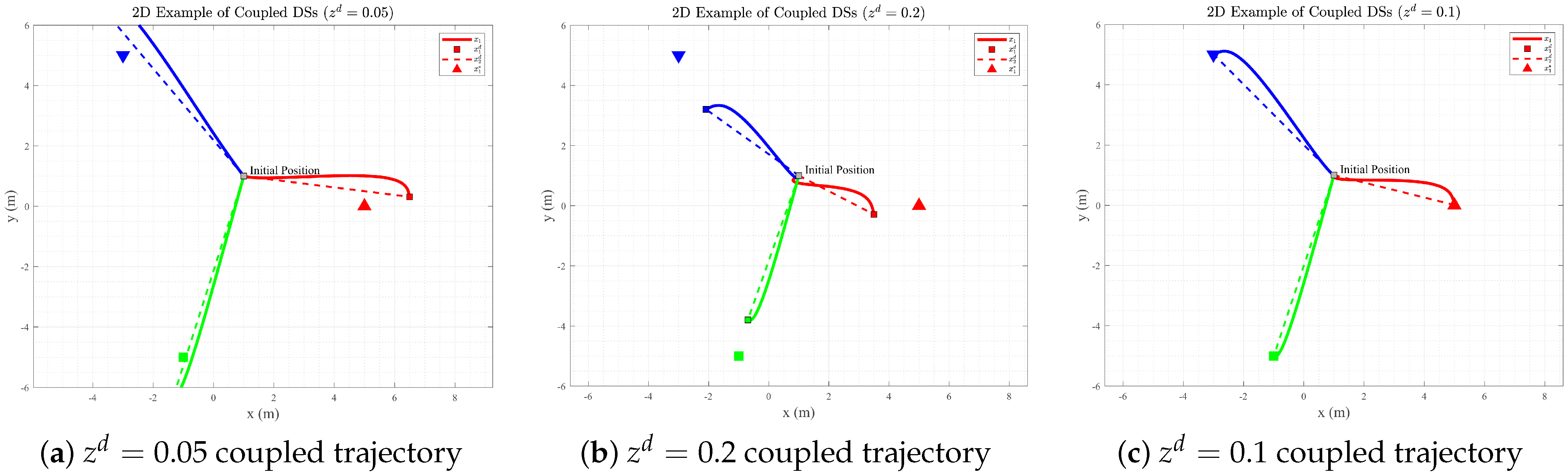
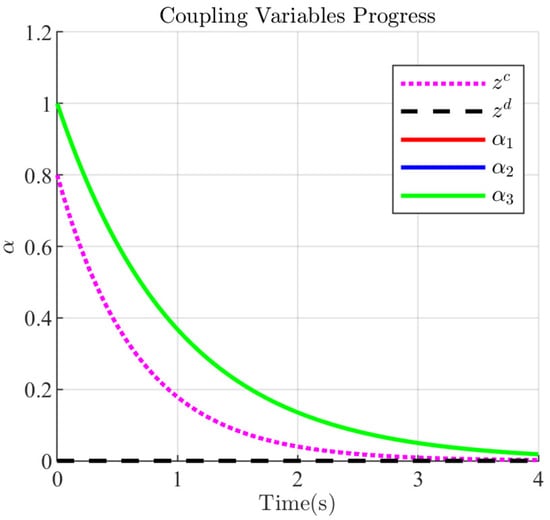
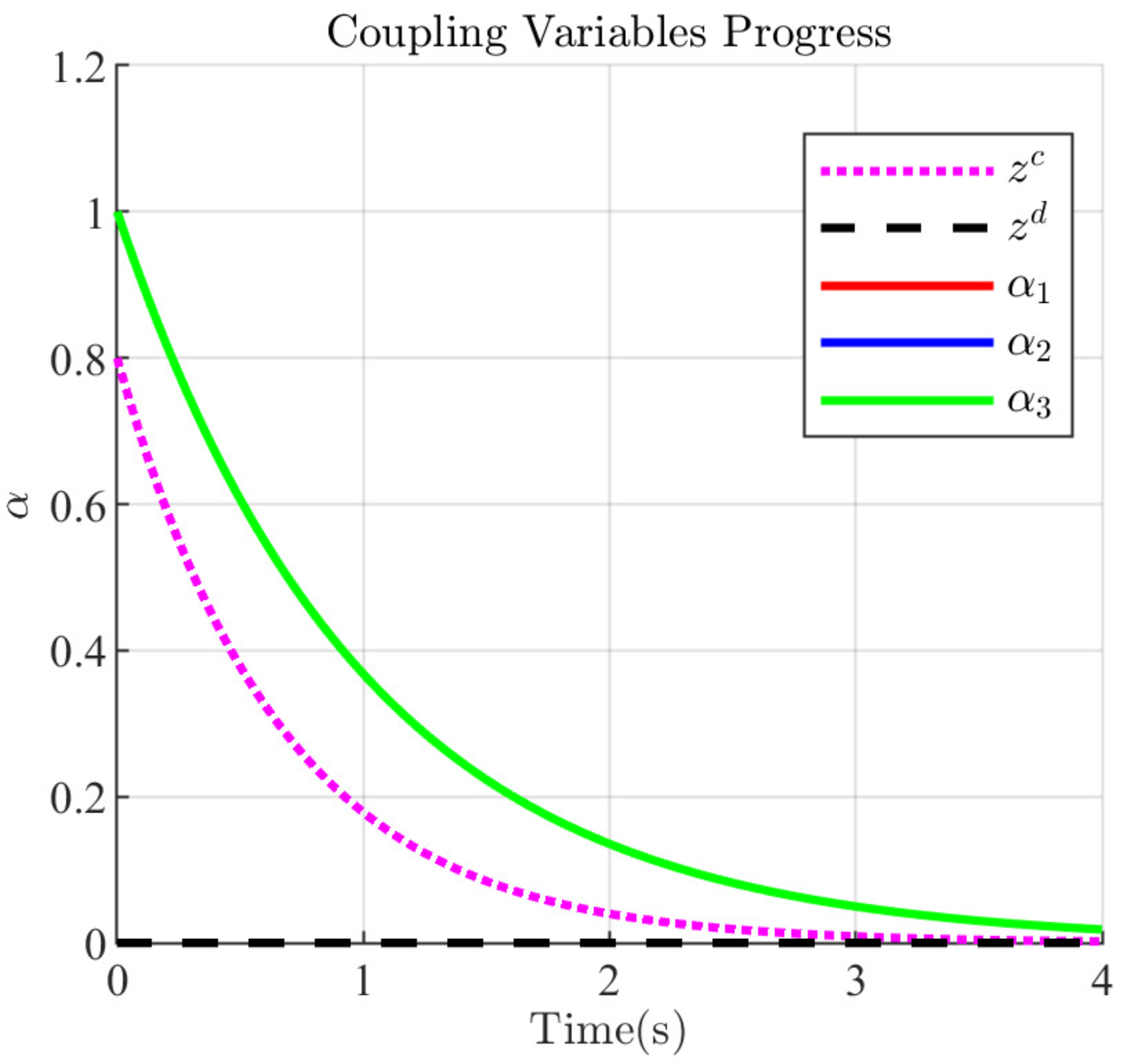
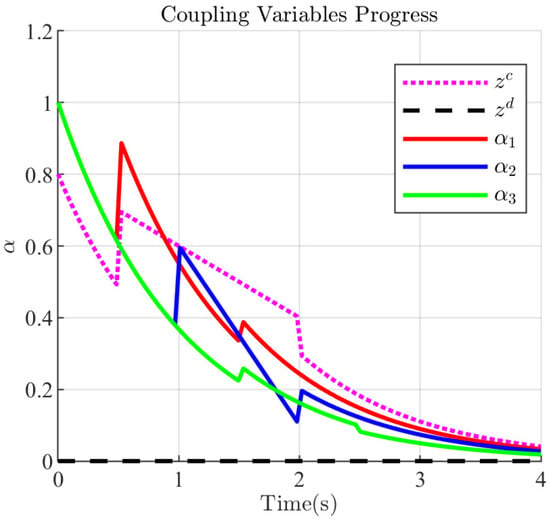
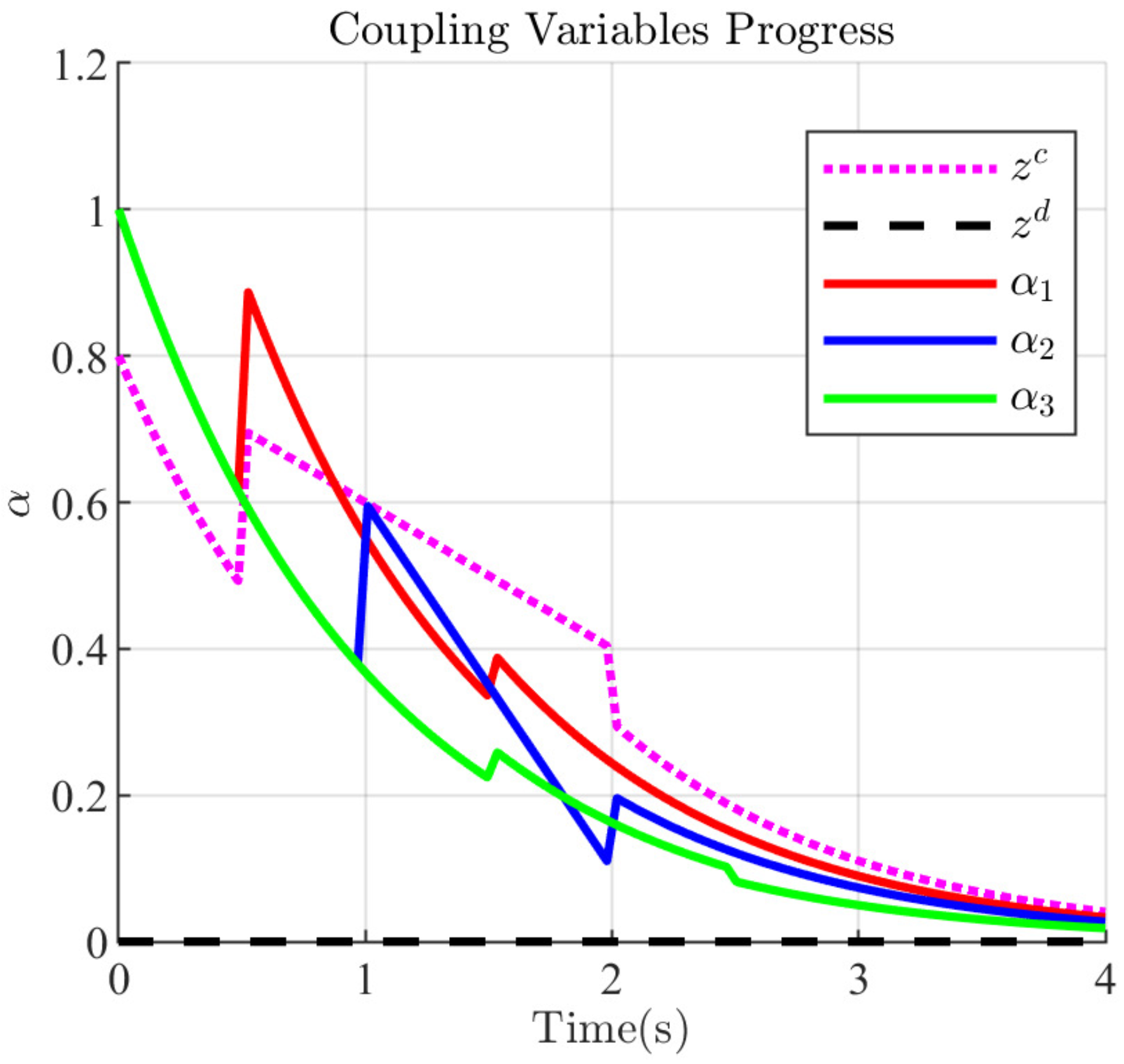
The 2D trajectory of the coupled system demonstrated synchronous convergence of multiple fingers of the soft hands to the target region. This convergence occurred despite influences from dynamic marine water flow disturbances, uneven mass distribution, and parameter uncertainties. The soft hands featured a customized design embedded with a dynamic correlation mechanism. The dynamic correlation mechanism enabled real-time adjustments to meet underwater operation requirements. The relative distance coupling strength parameter took a small value (e.g., ). As shown in Figure 10a, the trajectory diagram exhibited scattered convergence and significant multi-finger asynchrony under the condition. Insufficient coupling strength prevented the marine environment-optimized built-in adaptive regulation mechanism from offsetting motion deviations caused by dynamic water flow. Insufficient coupling strength also hindered adaptation to force differences resulting from uneven mass distribution of marine targets. Multi-finger synchronous motion could not be guaranteed ultimately. The relative distance coupling strength parameter took a large value (e.g., ). As shown in Figure 10b, the trajectory diagram indicated delayed convergence of soft fingers. Excessive coupling strength restricted the adaptive adjustment range of the integrated dynamic layer. Excessive coupling strength impaired the ability of individual soft fingers to respond to contact uncertainties in complex marine environments. Excessive coupling strength also amplified the superimposed effects of water flow disturbances and uneven mass distribution. Lag in motion correction resulted from these combined effects. The relative distance coupling strength parameter , as shown in Figure 10c. The parameter accurately quantified coupling strength. Quantification of coupling strength enabled the embedded dynamic mechanism to establish real-time correlations among soft fingers. The embedded dynamic mechanism revised motion trends disturbed by the three marine-related factors. The embedded dynamic mechanism ensured the coordinated motion state remained unaffected. This outcome fully validated the core advantage of achieving precise multi-finger synchronization in underwater scenarios through adaptive trajectory adjustment. As shown in Figure 11. The soft fingers converged smoothly without fluctuations. Real-time matching regulation was implemented for the specific coupling strength. Dynamic system balance was achieved through real-time matching regulation. As shown in Figure 12. The soft fingers stabilized quickly after temporary fluctuations. Moderate coupling strength regulated by the integrated dynamic mechanism allowed timely disturbance compensation adjustments. No overcorrection occurred during these adjustments. The effectiveness of enhancing the system’s adaptability to dynamic marine uncertainties through coordinated trajectory control was verified. The system met the performance requirements of marine robotic systems.
Figure 10.
2D Trajectory of the coupled systems.
Figure 11.
Trend chart of coupling variables without disturbance ( represents the relative distance variable in the coupled system, represents the target relative distance parameter of the coupled system. corresponds to the coupling variable of the soft hands).
Figure 12.
Trend chart of coupling variables with disturbance ( represents the relative distance variable in the coupled system, represents the target relative distance parameter of the coupled system. corresponds to the coupling variable of the soft hands).
5.2. Force Planning Algorithm Simulation Experiment
Underwater operations in marine engineering imposed stringent requirements on the grasping force optimization of soft hands. Accordingly, the present study designed simulation experiments with cylinders and spheres as typical grasping objects, considering their high relevance to practical marine scenarios. Cylinders correspond to common cylindrical components in marine engineering (e.g., underwater pipelines, structural supports, and sampling tubes) and exhibit typical line-contact characteristics during grasping. Spheres, on the other hand, match the structural form of spherical equipment widely used in marine operations (e.g., buoyancy modules, underwater sensor housings, and spherical buoys) and demonstrate a stable point-contact interaction mode with soft hands. These two geometric shapes not only cover the core contact modes required for stable underwater grasping but also feature geometric characteristics highly consistent with mainstream operation targets in marine contexts. Moreover, their regular structures and easily quantifiable parameters facilitate systematic variable testing under simulated marine disturbance conditions.
The experiment regarded force distribution uniformity and constraint satisfaction as core optimization criteria, which align with the rigorous requirements for safe and efficient underwater operations. A comparative research framework was established, incorporating three types of force planning strategies: the proposed adaptive force planning algorithm, traditional coupled dynamical systems, and particle swarm optimization-based strategies. For comprehensive performance evaluation in marine-specific contexts (where resisting water flow disturbances and adapting to complex underwater environments are core objectives), three key analysis indicators were selected: force distribution uniformity, constraint satisfaction, and grasping stability.
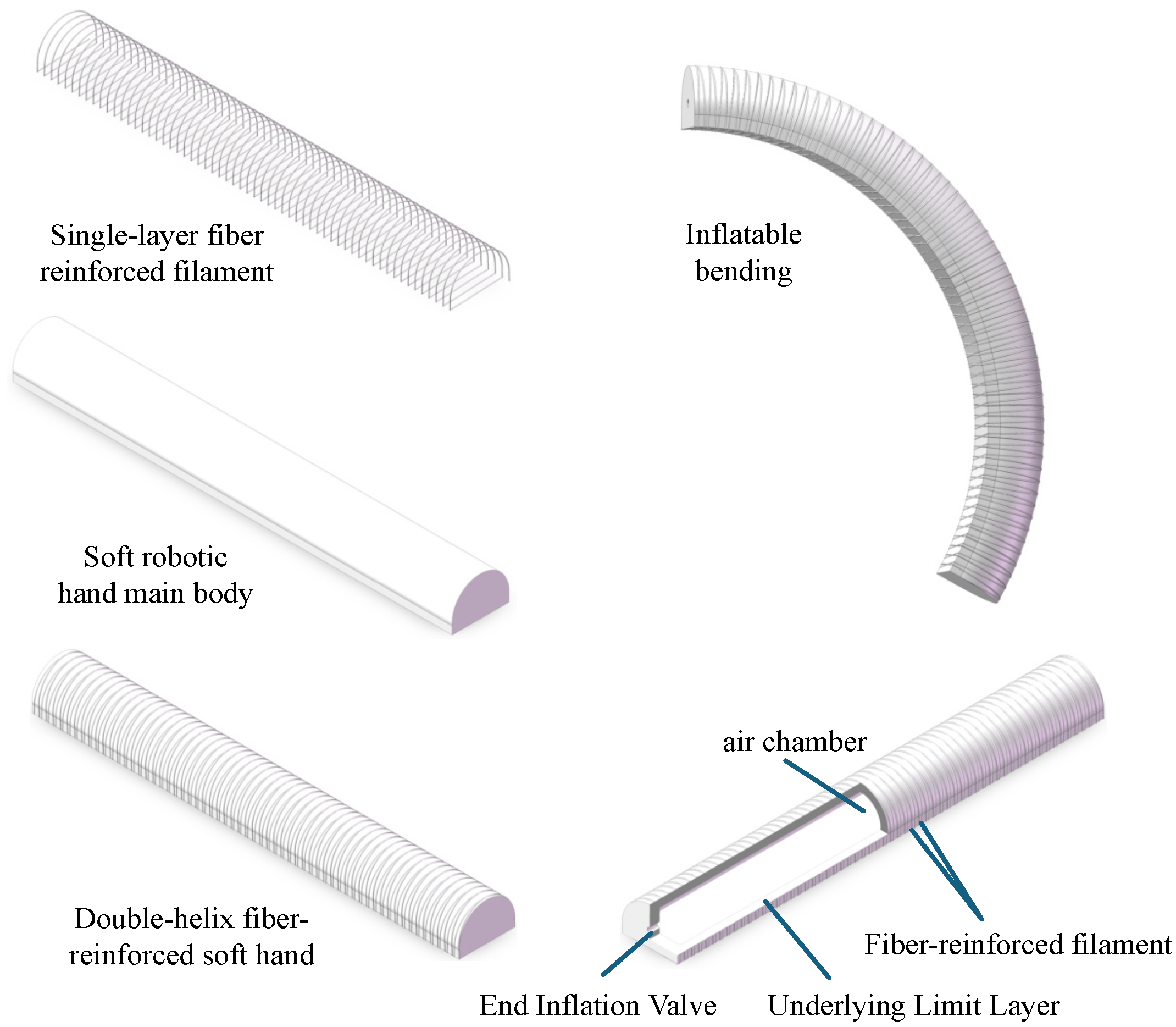
The fabrication process of the soft hands involve five sequential steps: (1) designing the soft hands mold using SolidWorks 2022 software; (2) fabricating the mold by 3D printing technology; (3) casting the soft hands body with flexible silicone material; (4) winding double-helix fiber-reinforced threads to enhance structural integrity under submerged loads; (5) sealing the inflation port with waterproof Luer connectors to ensure underwater airtightness. The structural schematic of the soft hands is shown in Figure 13. The detailed experimental parameter configuration of the soft hands is summarized in Table 2.
Figure 13.
Structural of soft hands.
Table 2.
Soft hands parameters.
The experimental design had two core orientations: one focused on reducing the inhomogeneity of grasping force distribution, and the other centered on ensuring grasping stability. Friction sufficiency at each contact point was designated as a basic constraint. The experiment employed an integrated algorithm that integrates coupled dynamical systems with adaptive force planning control. Meanwhile, various classical algorithms were selected to serve as a performance benchmark comparison system. A multi-dimensional performance analysis mechanism was established to characterize the features of different algorithms. Multiple representative indicators were selected, and a comprehensive scoring method was employed as the criterion for algorithm screening. Finite element simulations were conducted on the grasping process of soft hands to establish a verification system for the proposed algorithm.
Total objective value:
The total objective value is normalized, where , , are weights and is the standard deviation of forces. In this paper, the weights are set as = 0.4, = 0.3 and = 0.3. = 0.4 is used to ensure energy efficiency by minimizing the grasping force to reduce energy consumption. = 0.3 guarantees the uniformity of force distribution to avoid material fatigue caused by excessive local stress in the soft hands. = 0.3 ensures grasping stability by providing sufficient friction to resist water flow disturbances and prevent object slippage. Different weight combinations have been verified through preliminary experiments, and the algorithm achieves the optimal balance under these weight settings. This indicator reflects the comprehensive optimization of force magnitude, uniformity, and friction force, and can be used to select the optimal grasp force distribution. If the objective value is excessively large, it indicates uneven force distribution, excessive total applied force, or insufficient friction force, which lead to unstable grasping.
Summary of squared forces:
where n denotes the number of soft fingers used, which is also the number of contact points. This indicator reflects the total magnitude of the applied forces: the smaller the value, the smaller the force used to achieve the grasping target, thereby improving energy efficiency. An excessively large sum of squared forces means the applied grasping force is too strong, which damages the object or leads to unnecessary energy consumption. Conversely, an excessively small sum of squared force fails to provide sufficient friction to support the object being lifted.
Stability margin:
where W denotes the weight of the object. This indicator reflects the safety level of the grasp: if , it indicates insufficient grasping force, and the object slips. if , it reaches the safe grasping threshold, meaning the friction force is sufficient to resist gravity and prevent slipping. An excessively large value will lead to unnecessary force consumption.
Constraint violation degree:
The indicator reflects whether the constraints are satisfied. If the value is excessively large, which indicates that the solution cannot guarantee stable grasping and needs to be re-optimized, with the focus on whether the normal force, friction force, and moment are balanced.
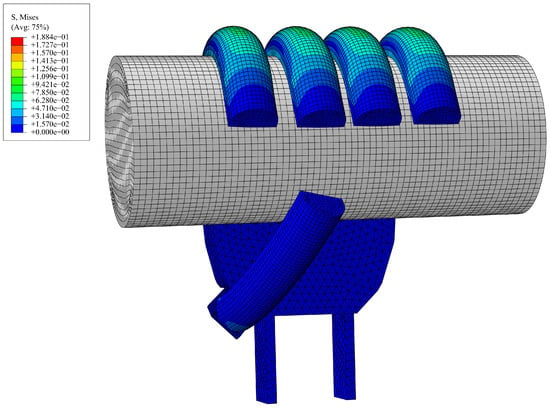
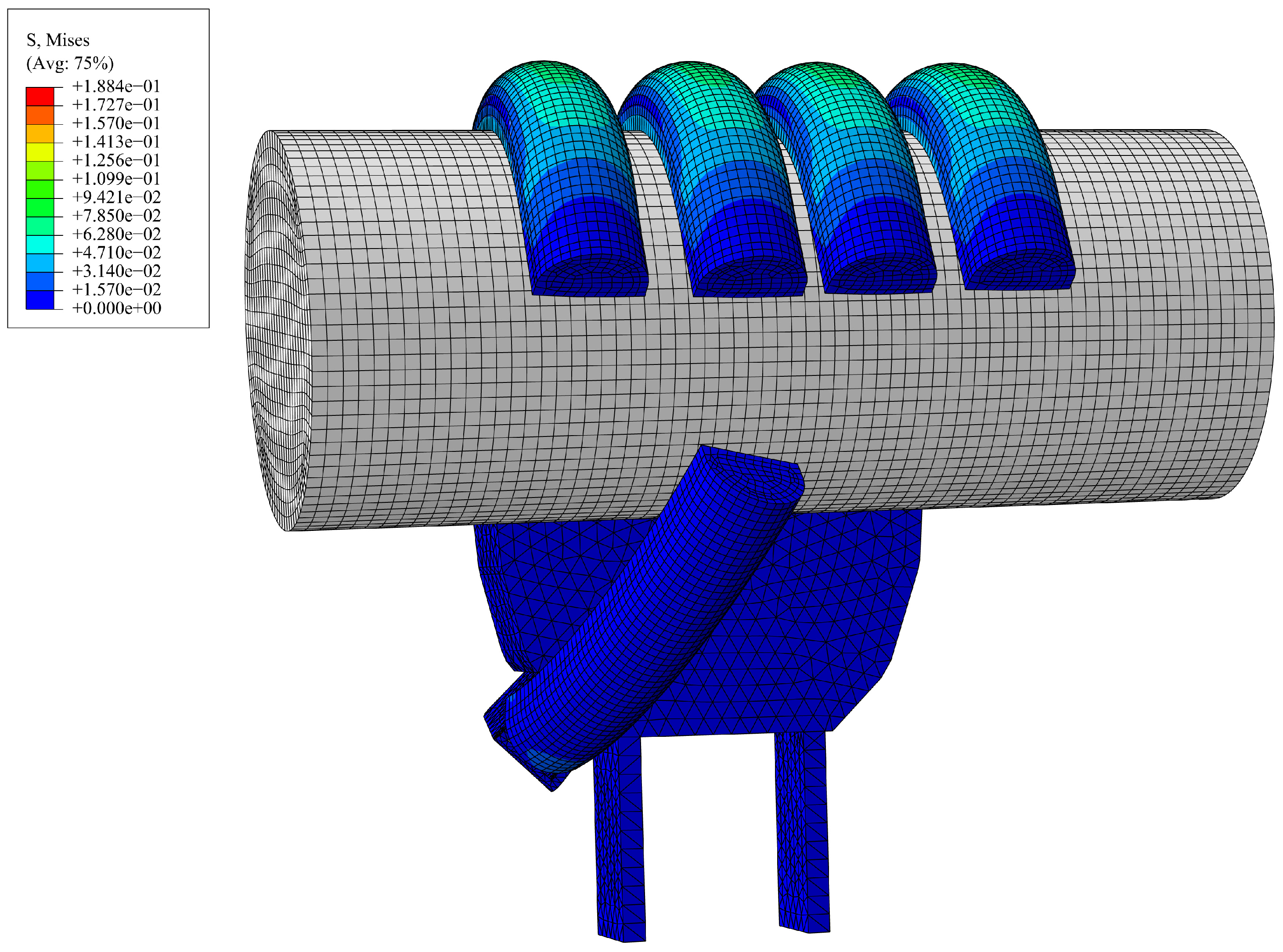
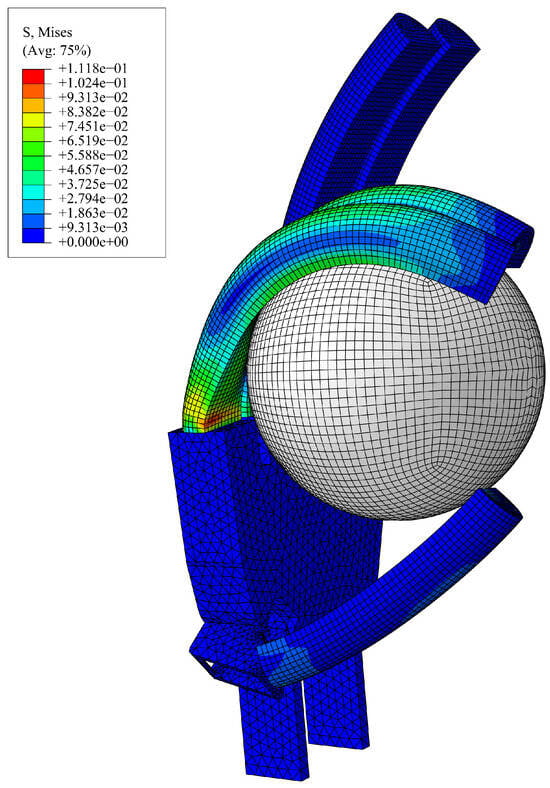
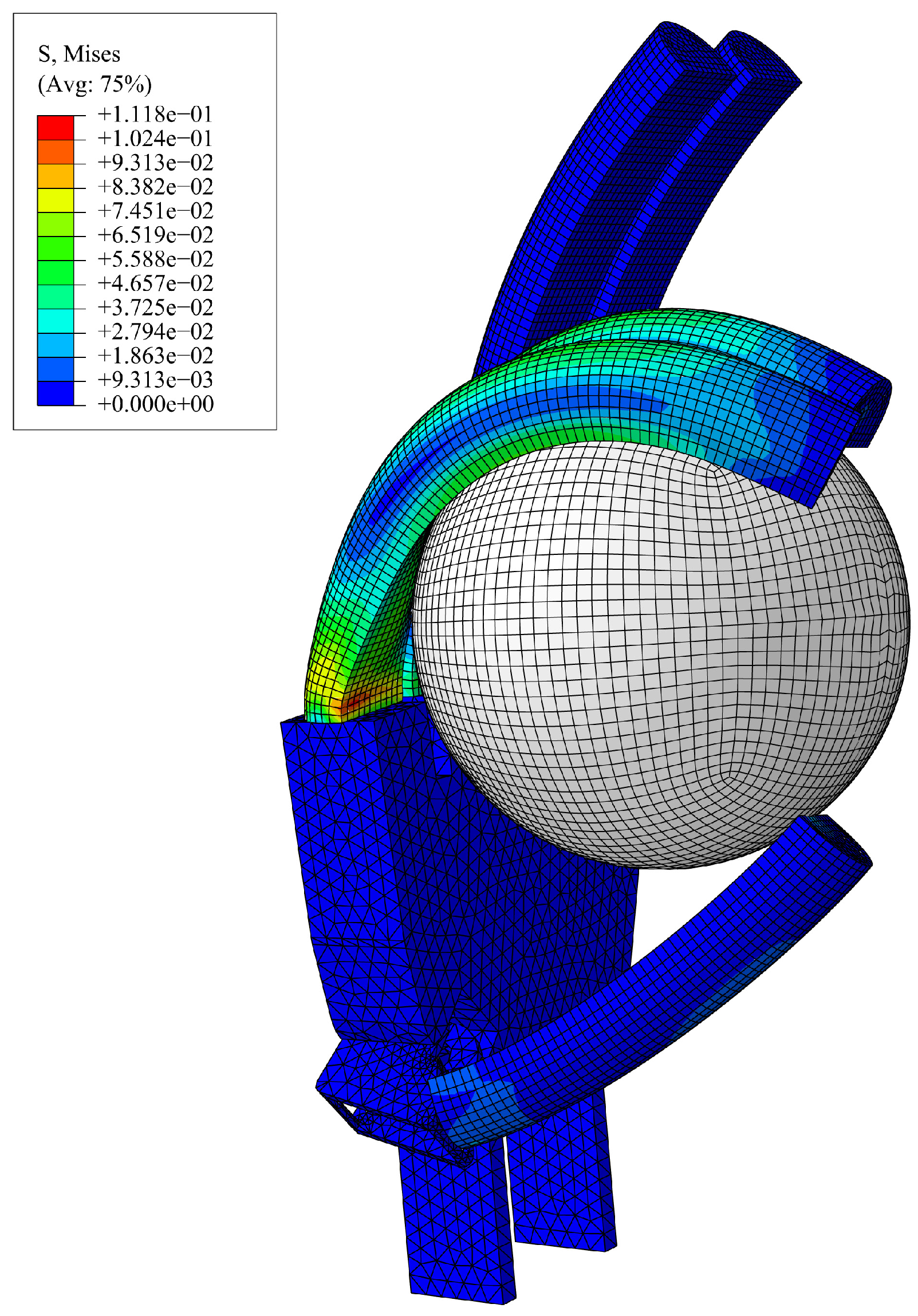
Cylinders and spheres were selected as typical marine scenario targets. Finite element analysis of soft hands grasping, force time-varying characteristic tests and force planning performance optimization experiments were conducted. The finite element analysis, the test of force characteristics and the optimization experiment of force planning performance for cylindrical grasping are shown in Figure 14, Figure 15 and Figure 16. The finite element analysis, the test of force characteristics and the optimization experiment of force planning performance for spherical grasping are shown in Figure 17, Figure 18 and Figure 19. The experiments established a core objective of achieving precise grasping force control by an adaptive force planning algorithm, with uniform force distribution, high grasping stability, excellent constraint satisfaction and reliable water flow disturbance resistance all realized in grasping both target types.
Figure 14.
Finite element analysis of cylindrical object grasping.
Figure 15.
Force-displacement variation of cylindrical object grasping.
Figure 16.
Performance optimization of cylindrical object grasping.
Figure 17.
Finite element analysis of spherical object grasping.
Figure 18.
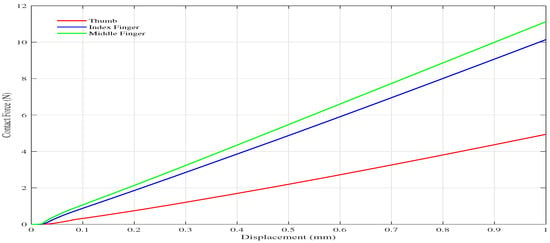
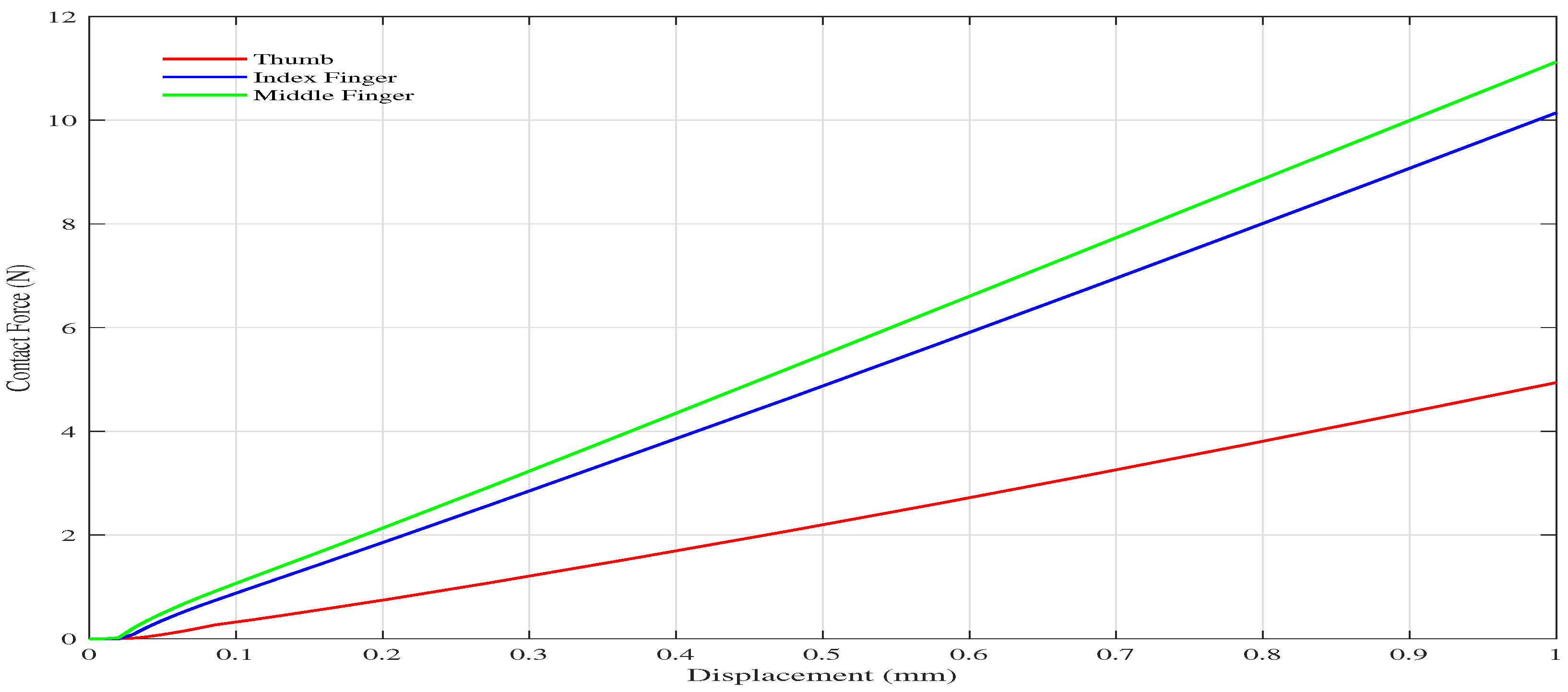
Force-displacement variation of spherical object grasping.
Figure 19.
Performance optimization of spherical object grasping.
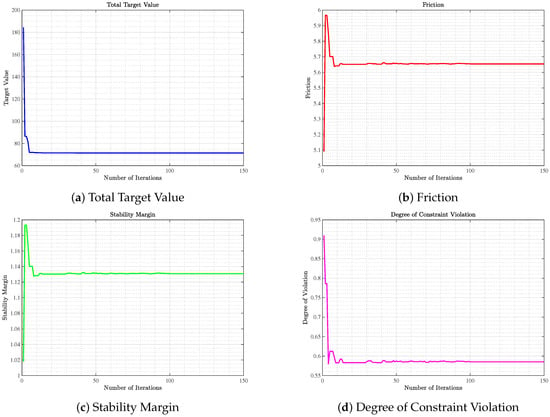
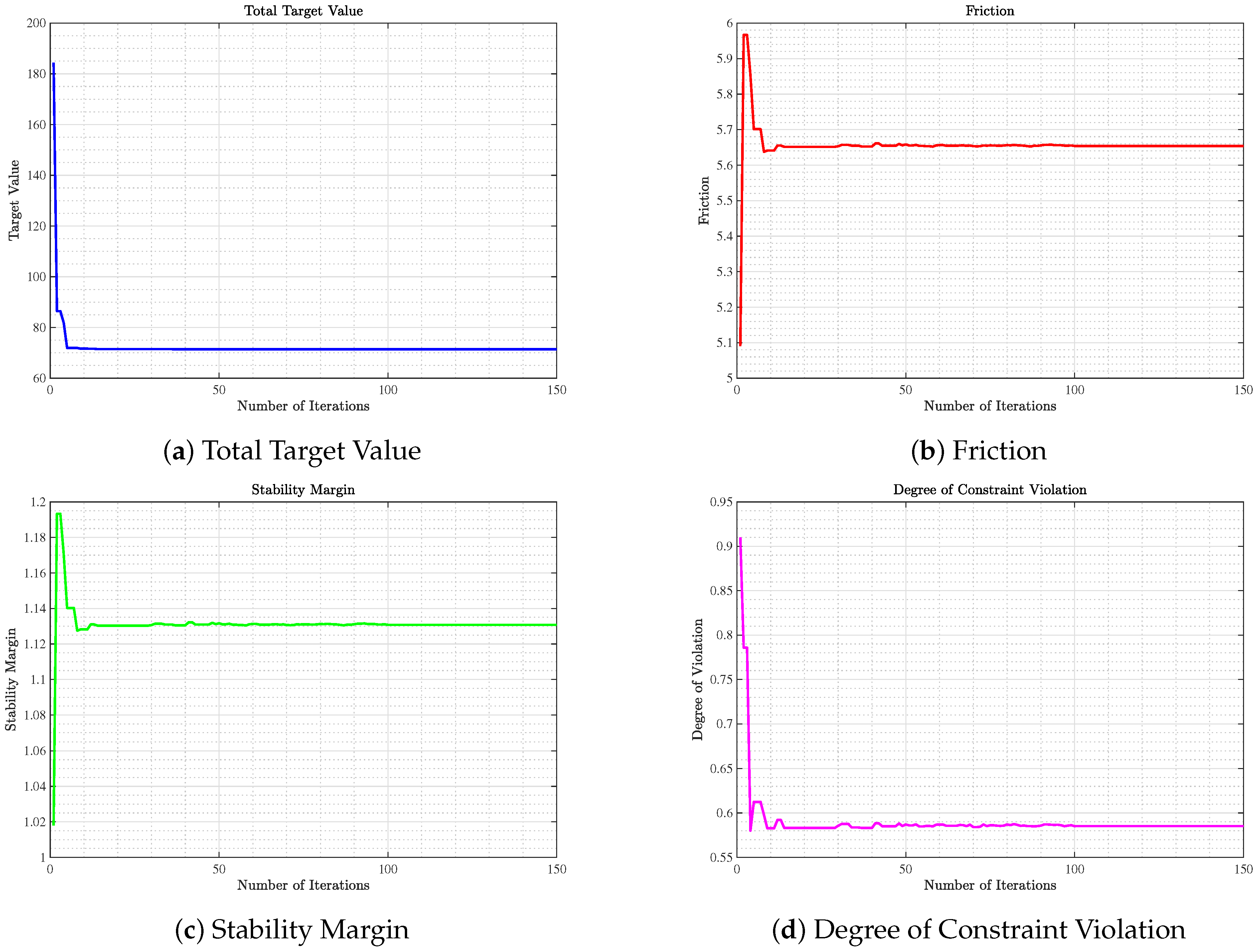
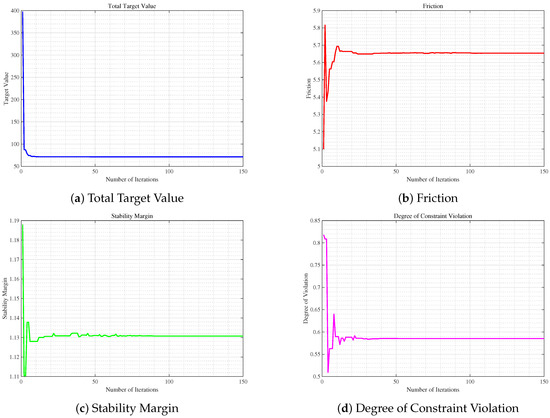
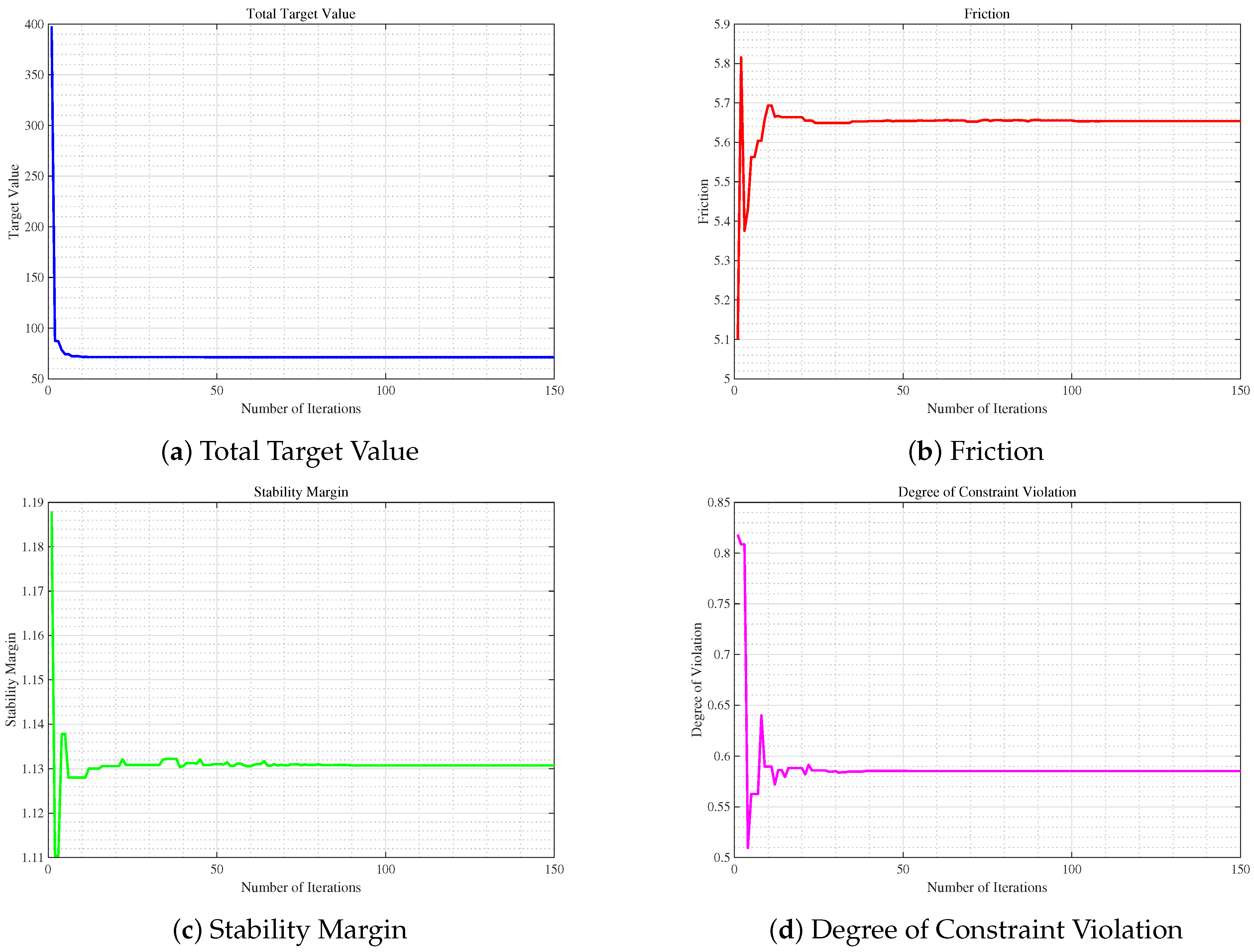
The force planning algorithm exhibited consistent rapid convergence and stable performance maintenance when grasping marine targets such as cylinders and spheres. Both performance optimization curves for cylindrical and spherical targets displayed highly similar trends, with the total objective value rapidly dropping to a stable level within the corresponding iteration interval in Figure 16a. Specifically, the total objective value for cylindrical targets decreased sharply to a stable level of 70 within 0–20 iterations, while that for spherical targets converged to the optimal range within 0–15 iterations in Figure 19a. This consistency stems from the force planning algorithm’s ability to dynamically update and correct the solution direction for underwater marine scenarios. The adaptive particle search module avoids local stagnation by dynamically adjusting particle trajectories, while the multi-strategy quantum initialization module expands population diversity. The synergy among the adaptive particle search module, multi-strategy quantum initialization module, and periodic local optimization module drives the rapid convergence of the objective function.
In terms of friction force, friction performance curves for both cylindrical and spherical targets presented highly consistent variation trends, with friction rapidly rising to the safe threshold range of 5.6–5.7 within 0–10 iterations in Figure 16b and Figure 19b. Specifically, friction for cylindrical targets stabilized at the safe threshold range after the rapid rise within 0–10 iterations, while that for spherical targets also maintained stable operation without fluctuations at the same threshold range in the subsequent 10–20 iterations. This stable friction performance originates from the force planning algorithm’s ability to dynamically adjust the contact force of each soft finger based on real-time friction demand. The deeply integrated constraint repair mechanism with friction cone constraints modifies the force distribution scheme in real time when friction reaches the threshold critical point, which effectively avoids friction overshooting. The synergy between the dynamic contact force adjustment strategy and the real-time constraint repair mechanism prevents grasping slippage of the soft hands under water flow disturbances.
The stability margins of cylindrical and spherical targets rapidly entered the safe range: the cylindrical target increased to 1.12–1.13 within 0–10 iterations, and the spherical target rose to 1.13 within 0–15 iterations, with no overshoot observed throughout the process, as shown in Figure 16c and Figure 19c. The force planning algorithm dynamically regulated the contact positions and force distribution of the soft fingers in real time. Meanwhile, the multi-strategy quantum initialization module expanded the population search range, which effectively avoided local optima that could induce stability margin fluctuations at key nodes. This design ensures the reliable anti-disturbance capability of grasping postures against dynamic marine disturbances.
The constraint violation degrees of both target types decreased continuously and converged to zero, as shown in Figure 16d and Figure 19d. The force planning algorithm integrates the global search capability of quantum particle swarm optimization with the local optimization advantage of sequential quadratic programming. The constraint repair mechanism adjusts the force distribution in real time for violation points, satisfying constraints such as force-moment balance and contact-pressure limits with high precision.
In contact stress control and force synchronization for marine target grasping, the adaptive force planning and force coupling algorithm exhibited consistently high performance in the soft hands’ grasping of cylindrical and spherical targets. The algorithm prevented localized high-stress concentration at all contact nodes of both target types, and stress gradient transition remained smooth at interface edges where stress tended to accumulate, as shown in Figure 14 and Figure 17. No local peaks observed in contact stress and a uniform interface stress gradient. When the soft hands contacted the target, elastomer material underwent adaptive deformation driven by finger bending. The finite element model accurately calculated the stress transfer process at the contact interface via mesh division, while the adaptive force planning algorithm dynamically adjusted the contact pressure distribution based on real-time stress feedback to avoid local overload. Combined with the elastic modulus of the fiber-reinforced layer material of the soft hands and the deformation-limiting structural design, a stable grasping effect was achieved: the soft hands fitted tightly with the target without structural overload. The effect is critical for the soft hands to grasp cylindrical pipes and spherical buoys under underwater flow disturbances.
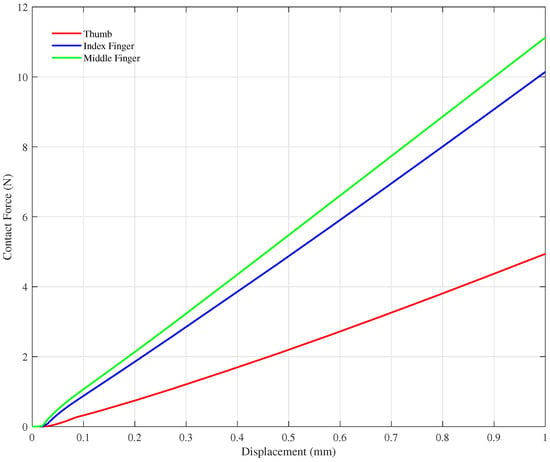
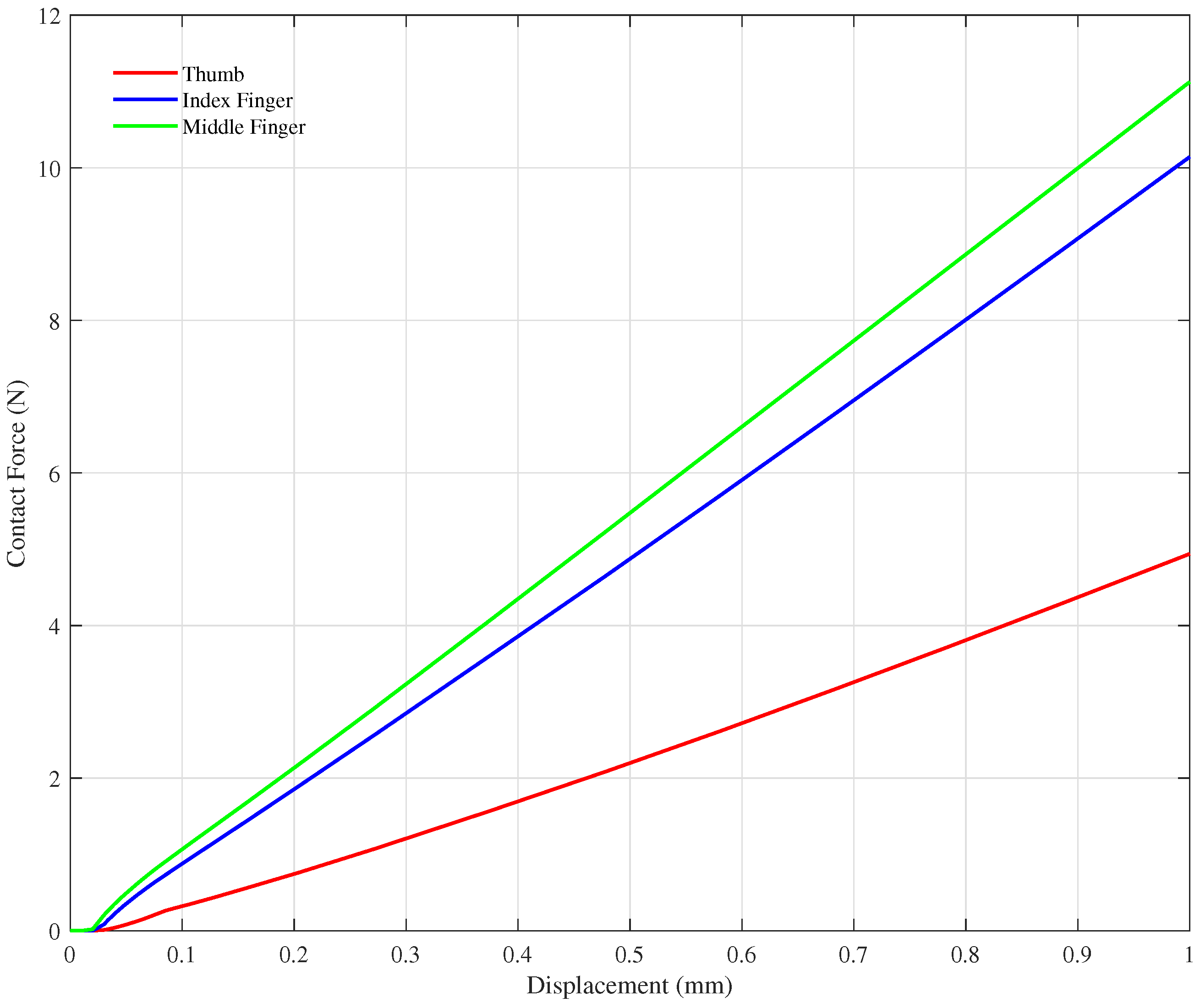
In force synchronization control, the contact forces of the soft fingers increased linearly and synchronously with displacement for both target types, with no asynchronous fluctuations observed at any node. Force values remained consistent even within the unstable displacement range of 0.3–0.6 mm, as shown in Figure 15 and Figure 18. Driven by the cooperative control strategy of the coupled dynamical systems, the intermediate dynamic layer of the system perceived displacement deviation of each finger in real time. The layer synchronized motion trends of all soft fingers by adjusting coupling parameters. As the soft hands approached the target, the coupling function transmitted the displacement changes of a single finger to other fingers, maintaining a unified force application rhythm. Meanwhile, the adaptive force planning algorithm dynamically adjusted the output force of each finger based on real-time contact states to eliminate force discrepancies, ultimately achieving the uniform distribution of grasping force. The effect is critical for resisting grasping slippage induced by water flow disturbances in marine scenarios.
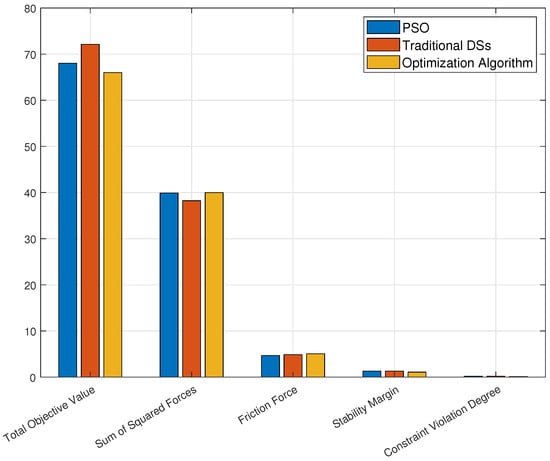
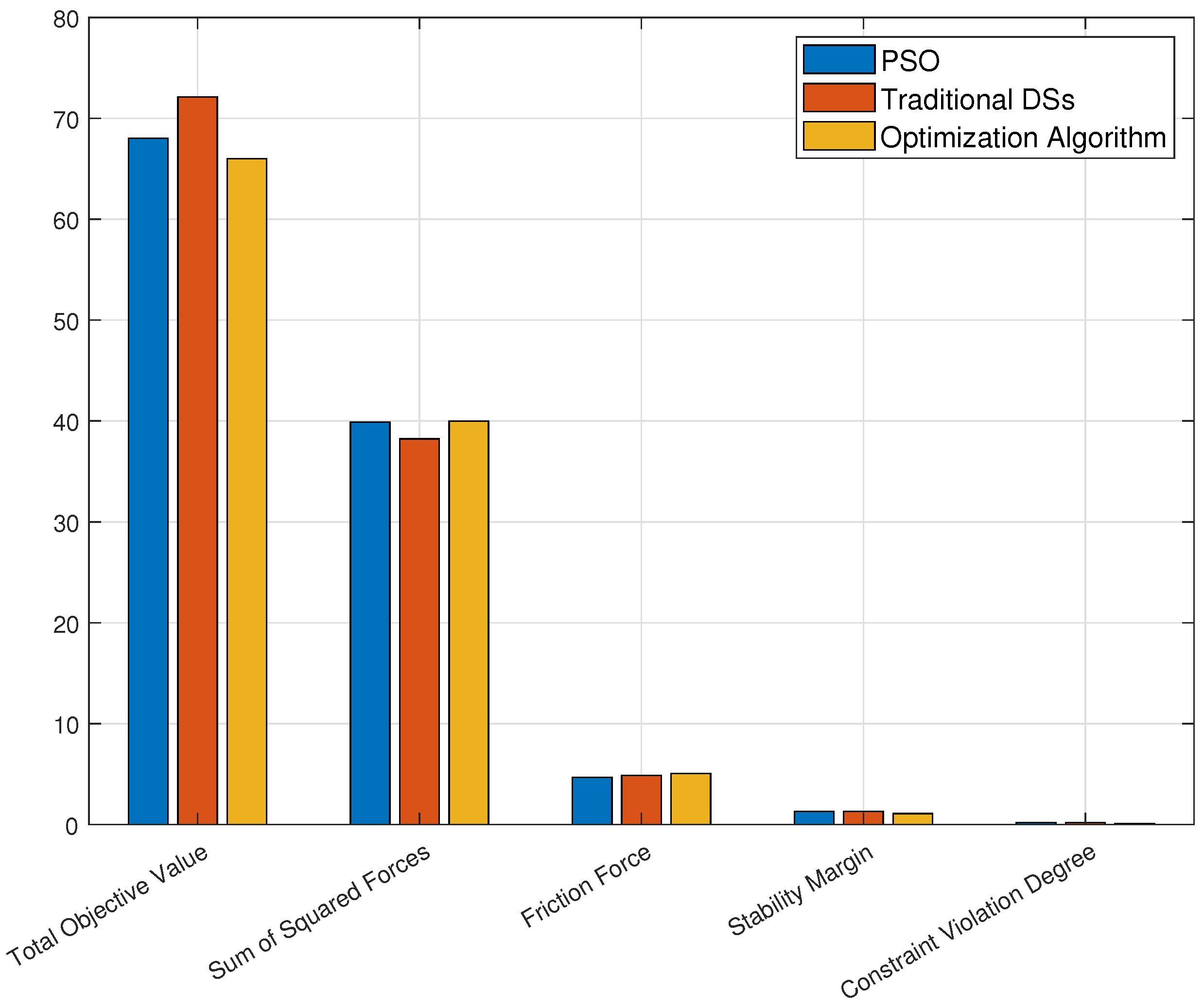
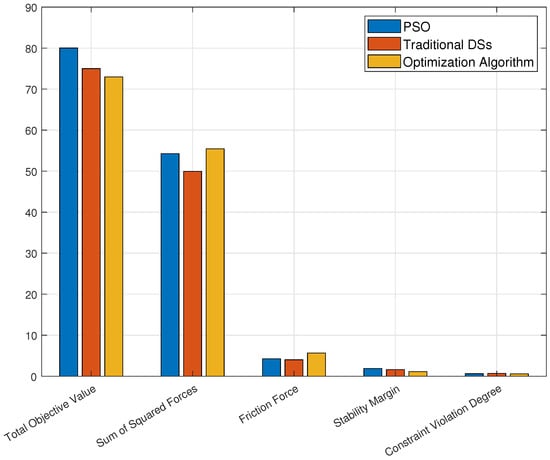
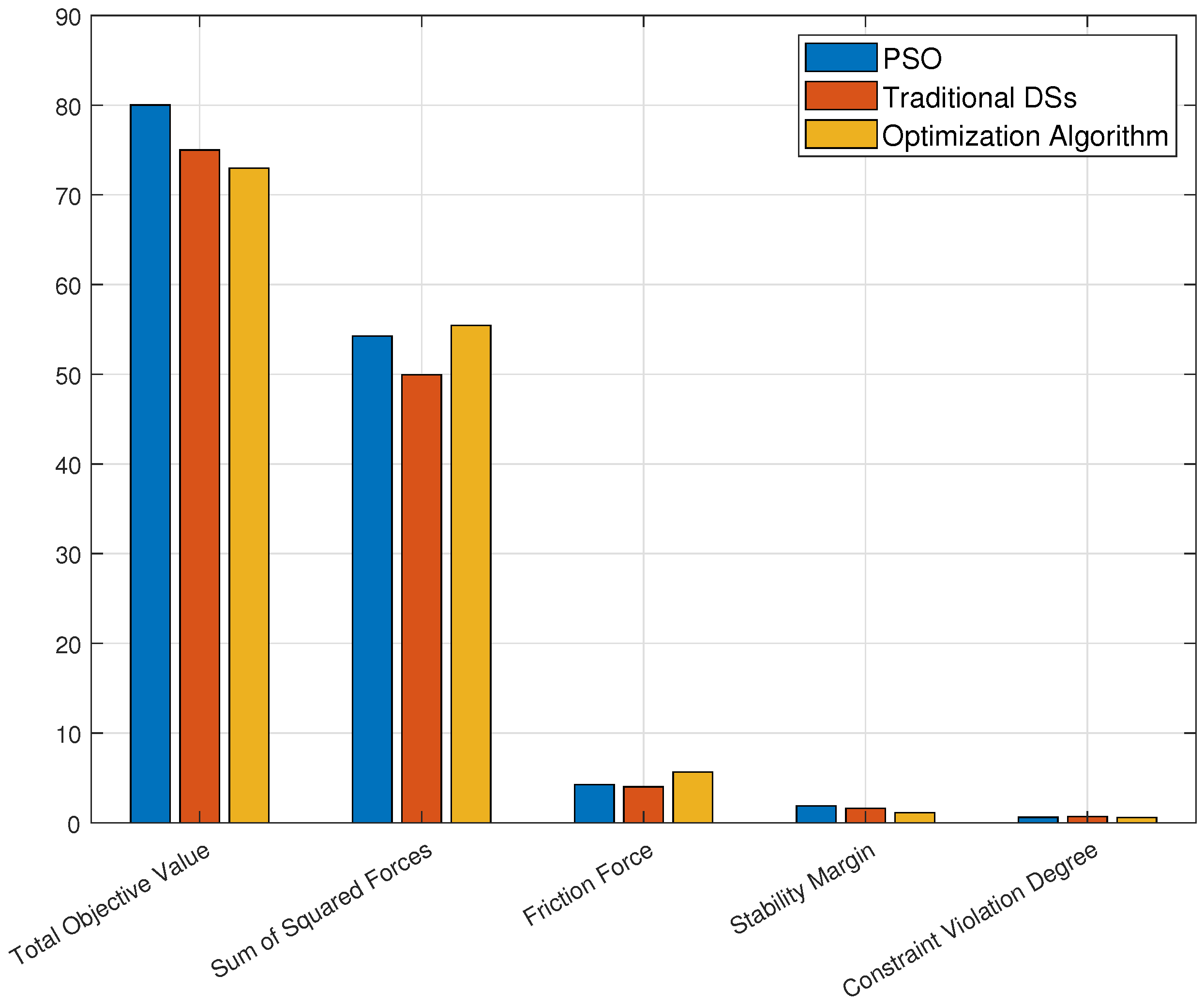
For multi-dimensional performance optimization of marine target grasping, the optimized algorithm integrating adaptive force planning and force coupling mechanism outperformed particle swarm optimization (PSO) and traditional coupled dynamical systems across all core metrics, as shown in Figure 20 and Figure 21. All detailed values are shown in Table 3 and Table 4.
Figure 20.
Performance comparison of cylinder grasping.
Figure 21.
Performance comparison of spherical grasping.
Table 3.
Algorithm performance of cylindrical grasping.
Table 4.
Algorithm performance of spherical grasping.
For the total objective value, the optimized algorithm achieved 65.9847 for cylindrical targets and 72.9847 for spherical targets. Both values were lower than those of PSO and traditional coupled dynamical systems, with no significant fluctuations throughout the process. The algorithm fused the global search capability of quantum particle swarm optimization and the local refinement advantage of sequential quadratic programming, avoided local optima under marine disturbances. The algorithm realized precise contact force adjustment and ensured the structural safety of the soft hands in underwater flow environments.
The optimized algorithm’s friction force reached 5.0687 for cylindrical targets and 5.6687 for spherical targets, significantly higher than PSO (4.6687/4.2687) and traditional coupled dynamical systems (4.8753/4.0233). It remained consistently within the safe anti-slip range with no sudden drops or insufficient force output. The advantage stemmed from the deep integration of the constraint repair mechanism of the force planning algorithm and friction cone constraints, which realized precise friction force regulation and avoided excessive energy consumption. Combined with the force coupling algorithm’s capability to ensure consistent contact states of all fingers through uniform force distribution, the design effectively prevented grasping slippage underwater flow disturbances and met the anti-slip requirements of marine operations.
Stability margins of the three algorithms were relatively close. Margins reached approximately 1.2 for cylindrical targets and ranged from 1.13 to 1.89 for spherical targets. Stability margins of the optimized algorithm were slightly lower, at 1.0933 for cylindrical targets which is slightly above the safety threshold of 1.0. On the premise of ensuring no slipping, it minimizes the grasping force to avoid excessive force application and remains stable throughout the iteration process. In contrast, the PSO and traditional coupled dynamical systems exhibit relatively high stability margins, which may lead to excessive force and thus damage to fragile marine targets. The intermediate dynamic layer of the optimized algorithm perceived displacement deviations in real time and adjusted coupling parameters to maintain grasping posture stability. The force planning algorithm balanced force distribution dynamically to avoid instability caused by excessive local force and ensured reliable anti-disturbance capability of the soft hands against dynamic marine water flows.
The constraint violation degree of the optimization algorithm (0.1022 for cylinders and 0.5836 for spheres) was the smallest, only half of that of PSO (0.2066/0.6025) and traditional coupled dynamical systems (0.2056/0.6933). The force planning module of the optimized algorithm embedded a constraint repair mechanism. The mechanism dynamically adjusted force distribution for violation points. Additionally, the force coupling algorithm integrated multiple constraints including force-moment balance into the coordination process. It minimized the risk of constraint violation and improved grasping reliability. The design was highly consistent with marine safety standards and reduced the risk of structural failure.
Experimental results verified the proposed method exhibited significant advantages over traditional coupled dynamical systems (DSs) and particle swarm optimization (PSO)-based strategies. Compared with traditional coupled dynamical systems (DSs), the constraint violation degree was reduced by up to 18.2%, friction force increased by 4.0%, and force distribution uniformity improved by approximately 5.1%. Compared with particle swarm optimization (PSO)-based strategies, the constraint violation degree was reduced by up to 50.5%, friction force increased by 40.9%, and force distribution uniformity also improved by approximately 5.1%. Cylinders and spheres were selected as typical marine targets; a comparative verification framework with the two methods was established by multi-finger coordination, anti-disturbance robustness and grasping stability experiments, and verified by combining finite element simulations and physical tests. Experimental results showed the proposed method relied on the intermediate dynamic layer, adaptive force planning algorithm and model-controller fusion design, achieved uniform contact stress, synchronous finger movement and precise satisfaction of multiple constraints, and enabled stable target grasping under marine water flow disturbances. Compared with the traditional coupled dynamical systems and PSO algorithms, the proposed algorithm does not achieve the optimal values in all indicators. Instead, the proposed algorithm achieves an optimal balance of multiple performances under the core requirements of marine scenarios. Although stability margin is slightly lower, which meets the requirements for safe grasping. Meanwhile, the proposed algorithm solves the problems of traditional algorithms such as excessive force application, high constraint violation, and uneven force distribution, making more suitable for stable object grasping by marine soft hands.
5.3. Underwater Experiments of the Soft Hands
The soft hands control system comprised a 24 V lithium battery, an air pump, a motor driver, a single-chip microcomputer, bending sensors, force sensors and air pressure sensors. The 24 V lithium battery supplied power to the motor driver and air pump. It was stepped down to 5 V through a voltage reduction and regulation circuit to supply power to the single-chip microcomputer, bending sensors, force sensors and air pressure sensors. The system controlled the soft hands by driving the air pump and electromagnetic valves. The system collected real-time data of intracavity air pressure, bending angles and grasping force. The single-chip microcomputer acquired and processed the feedback signals to implement closed-loop control.
The force sensor comprised a thin-film pressure sensor and a signal conversion module. The sensor collected pressure data in real time. It identified object grasping status and grasping force magnitude. Interaction was achieved by pressure sensing data. The data was fed back to adjust the grasping strategy.
The soft hands adopted a waterproof control cabin and metal cable waterproof connectors. The signal and data lines of the sensors were integrated into the cables. The external interfaces were vulcanized. The interface between the soft hands’ pneumatic pipeline and the control cabin adopted metal Luer connectors. The connectors were reinforced with cable ties. The thin-film sensors of the bending sensor group were cast at the bottom of the soft hands with silica gel during manufacturing. The waterproof thin-film sensors of the bending sensor group were attached to the fingertips of the soft hands. The signal lines of the thin film sensors were connected to waterproof cables, then connected to the conversion module in the control cabin through metal waterproof connectors. The technical specifications of the soft hands are shown in Table 5.
Table 5.
Technical specifications of soft hands.
To verify the applicability and effectiveness of the proposed dexterous grasping method integrating coupled dynamical systems and adaptive force planning control, physical experiments were conducted in practical working environments. A five-fingered fiber-reinforced soft hands served as the test platform. The experiments compared the proposed method with traditional coupled dynamical systems and particle swarm optimization-based force planning algorithms.
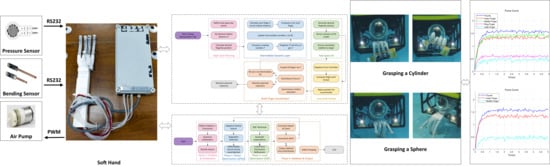
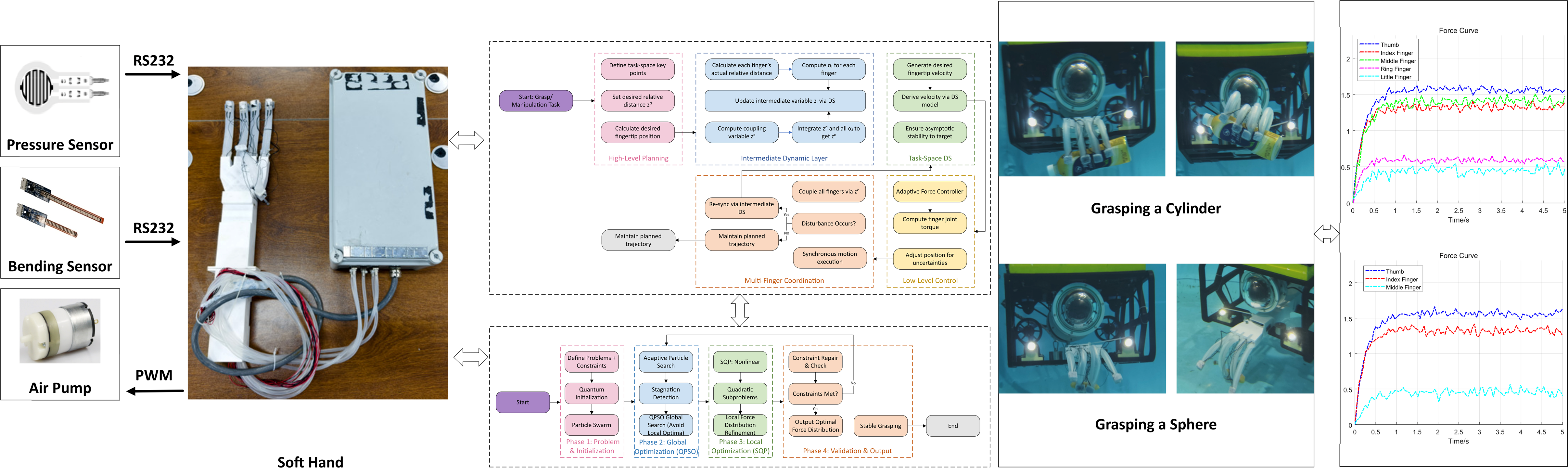
As shown in Figure 22, physical experiments were conducted in a simulated marine water tank with water flow disturbances. Grasping targets were cylinders and spheres with uneven mass distribution. Cylinders had a diameter of 50 mm, a length of 100 mm and a mass of 0.8 kg, a 0.3 kg counterweight was embedded at one end of each cylinder to simulate underwater pipelines. Spheres had a diameter of 80 mm and a mass of 0.6 kg. Spheres were used to simulate buoys. Soft hands were adopted for the experiments. Pressure sensors and air pressure sensors provided real-time feedback data. The adaptive force planning algorithm dynamically calculated control commands based on feedback data. Air pressure in the deformation chambers was adjusted to drive synchronous bending of the fingers. Stable grasping was achieved. This paper introduces an intermediate dynamic layer to address the multi-finger asynchrony problem, integrates the quantum particle swarm-sequential quadratic programming algorithm to optimize force distribution, and combines the Neo-Hookean model with an adaptive controller to compensate for nonlinear deviations. Compared with traditional algorithms, the method reduced the constraint violation degree by up to 50.5%. The method significantly improved friction force and force distribution uniformity also exhibited strong anti-disturbance capability. Simulation results and physical experiment results were highly consistent. Consistency verified the reliability and effectiveness of the method. The research filled the research gap in the synergistic balance of multiple performances of soft hands in marine scenarios and provided a practical technical solution for marine robotic systems.
Figure 22.
Hardware composition, control framework, grasping experiments, and force data curves of the underwater soft hands system.
6. Conclusions
This paper verifies the multi-finger coordination, anti-disturbance robustness, and grasping stability of the soft hands under force coupling and the proposed force planning algorithm through simulations and physical experiments. To address core challenges of multi-finger asynchrony, unbalanced force distribution, and insufficient anti-disturbance capability for soft hands in marine environments, an adaptive force planning method integrated with coupled dynamical systems is proposed. A hybrid algorithm combining quantum particle swarm optimization and sequential quadratic programming resolves traditional single-algorithm limitations (e.g., local optimality, unbalanced force distribution) and achieves global force distribution optimization. Experimental results show the proposed method significantly outperforms comparative algorithms in key metrics (constraint violation degree, friction force, force distribution uniformity) and enables stable grasping of uneven mass-distribution objects under water flow disturbances. However, the algorithm’s real-time response under high-frequency water flow disturbances calls for further refinement, and its robustness has yet to be validated in real marine flow fields. Future work will incorporate dynamic compensation to enhance real-time performance and conduct targeted optimization in real marine environments for robustness verification.
7. Future Directions and Limitations
This paper has several limitations. Its anti-disturbance ability lacks adaptability to extreme disturbances such as high-speed marine currents and vortices, and the silicone material exhibits poor abrasion resistance in sediment environments. To address these shortcomings, future research will integrate flow prediction models to achieve dynamic disturbance pre-compensation. Modular soft hands using carbon fiber-reinforced silicone will be developed to improve abrasion resistance. In addition, the proposed method will be extended to multi-object grasping and dynamic target tracking, combined with underwater visual feedback, to enhance its adaptability in real marine scenarios.
Author Contributions
Methodology, Q.Z.; Validation, X.D.; Writing—original draft, W.Y.; Visualization, N.Z.; Supervision, J.L. All authors have read and agreed to the published version of the manuscript.
Funding
This research received no external funding.
Data Availability Statement
The original contributions presented in this study are included in the article. Further inquiries can be directed to the corresponding author.
Conflicts of Interest
Author Jinxing Liu was employed by the company Shanghai Marine Diesel Engine Research Institute. The remaining authors declare that the research was conducted in the absence of any commercial or financial relationships that could be construed as a potential conflict of interest.
References
- Ali, Z.A.; Li, X.; Tanveer, M.A. Controlling and stabilizing the position of remotely operated underwater vehicle equipped with a gripper. Wirel. Pers. Commun. 2012, 61, 107–122. [Google Scholar] [CrossRef] [Scilit]
- Namdar Ghalati, M.H.; Chafiarad, H.; Suhagat, A.; Zareinejad, M.; Ahmadi-Pajouh, M.A. Strain modeling of soft reinforced bending actuator considering external force constraints. Soft Robot. 2022, 9, 776–787. [Google Scholar] [CrossRef] [Scilit]
- Dai, X.Q.; Liu, C.Y.; Lai, Q.; Huang, X.; Zeng, Q.J.; Liu, M. The Local Path Planning Algorithm for Amphibious Robots Based on an Improved Dynamic Window Approach. J. Mar. Sci. Eng. 2025, 13, 399. [Google Scholar] [CrossRef] [Scilit]
- Ji, H.; Lan, Y.; Yin, F.; Hong, R.; Nie, S.; Huo, L. Development of an anthropomorphic soft manipulator with rigid-flexible coupling for underwater adaptive grasping. Soft Robot. 2023, 10, 1070–1082. [Google Scholar] [CrossRef] [Scilit]
- Wu, M.; Afridi, W.H.; Wu, J.; Afridi, R.H.; Wang, K.; Zheng, X.; Wang, C.; Xie, G. Octopus-inspired underwater soft robotic gripper with crawling and swimming capabilities. Research 2024, 2024, 0456. [Google Scholar] [CrossRef] [Scilit]
- Wang, H.; Xu, H.; Abu-Dakka, F.J.; Kyrki, V.; Yang, C.; Li, X.; Chen, S. A bidirectional soft bioinspired hand driven by water hydraulic for dexterous underwater grasping. IEEE Robot. Autom. Lett. 2022, 7, 2186–2193. [Google Scholar] [CrossRef] [Scilit]
- Liu, C.X. Research on Soft Humanoid Hand with Proprioception-Interactive Tactile Sense. Master’s Thesis, Hefei University of Technology, Hefei, China, 2023. [Google Scholar]
- Wang, S.B. Research on Grasping and Simulation Technology of Soft Hand Based on Visual Target Recognition and Localization. Master’s Thesis, Harbin Institute of Technology, Harbin, China, 2023. [Google Scholar]
- Yang, X.; Wang, Z.; Tai, X. Position control of aircraft active side-stick based on sliding mode active disturbance rejection control. Mach. Electron. 2025, 43, 49–56. [Google Scholar]
- Wu, Z.P. Research on Articulated Endoskeleton Pneumatic Soft Gripper. Master’s Thesis, Nanjing University of Science and Technology, Nanjing, China, 2021. [Google Scholar]
- Dai, X.Q.; Han, J.B.; Lin, Q.; Tian, X.T. Anomalous pseudo-parabolic Kirchhoff-type dynamical model. Adv. Nonlinear Anal. 2022, 11, 503–534. [Google Scholar] [CrossRef] [Scilit]
- Lu, Q.; Zhang, F.; Li, K.; Wang, X.; Zhang, Z.; Gan, Z. Stiffness Enhanced Reconfigurable Soft Hand for Versatile Stable Grasps and In-hand Manipulation. Bioinspir. Biomim. 2025, 20, 016020. [Google Scholar] [CrossRef] [Scilit]
- Wang, Y.; Dong, X.; Han, Y. 3D path planning of UAV based on improved particle swarm optimization algorithm. Comput. Era 2012, 13, 36637–36646. [Google Scholar]
- Huang, H.; Huang, C.; Xie, J.; Wang, N. Biomimetic soft hand combined with variable stiffness and friction. Ind. Robot. Int. J. Robot. Res. Appl. 2025, 52, 96–97. [Google Scholar] [CrossRef] [Scilit]
- Dai, X.Q. Hyperbolic and parabolic equations with several opposite-sign source at critical initial energy level in heat and vibrating systems. Nonlinear Anal.-Theory Methods Appl. 2020, 195, 111752. [Google Scholar] [CrossRef] [Scilit]
- Hu, S. Adaptive fuzzy sliding mode active disturbance rejection control for trajectory tracking of electro-hydraulic servo manipulator. Mach. Electron. 2025, 43, 61–67. [Google Scholar]
- Tang, W.; Zhu, P.; Hu, Y.; Guo, X.; Wang, Y.; Qin, K.; Zhong, Y.; Sheng, Q.; Xu, H.; Li, Z.; et al. Multifunctional Robotic Electrofluid for Soft Fluctuation Actuation. Sci. Adv. 2025, 11, 10048. [Google Scholar]
- Culbertson, H.; Schwager, M. Decentralized adaptive control for collaborative manipulation. In Proceedings of the IEEE International Conference on Robotics and Automation (ICRA), Brisbane, QLD, Australia, 21–25 May 2018; pp. 278–285. [Google Scholar]
- Kastritsi, T.; Calinon, S.; Billard, A. Progressive adaptation with DMP synchronization and variable stiffness control. IEEE Robot. Autom. Lett. 2018, 3, 3796–3798. [Google Scholar] [CrossRef] [Scilit]
- Planer, M.; Calinon, S. Object-level impedance control for dexterous in-hand manipulation. IEEE Robot. Autom. Lett. 2020, 5, 2987–2994. [Google Scholar]
- Mohammadi, A.; Hsiao, H.K.; Bani, A.M.; Jaimie; Raschke, S.U.; Tan, Y.; Choong, P.; Oetomo, D. Encoding Desired Postural Synergies in a Single-Actuator Soft Robotic Prosthetic Hand Through Finger Joint Stiffness Modulation. In Proceedings of the International Conference on Rehabilitation Robotics (ICORR), Chicago, IL, USA, 12–16 May 2025; pp. 693–698. [Google Scholar]
- Sundaralingam, B.; Hermans, T. Cooperative in-hand regrasp planning: Alternating optimization of finger gaits and in-grasp manipulation. In Proceedings of the IEEE International Conference on Robotics and Automation (ICRA), Brisbane, QLD, Australia, 21–25 May 2018; pp. 231–238. [Google Scholar]
- Jing, H.; Hou, D.; Wang, K.; Du, W. Research on sliding mode active disturbance rejection control method for underwater operation robot. Ship Sci. Technol. 2023, 45, 101–107. [Google Scholar]
- Zhan, X. Reaching law sliding mode control for valve-controlled symmetric hydraulic cylinder position servo system. Hydraul. Pneum. Seals 2025, 45, 27–33. [Google Scholar]
- Hang, K.; Bircher, W.G.; Morgan, A.S.; Dollar, A.M. Hand-object configuration estimation using particle filters for dexterous in-hand manipulation. Int. J. Robot. Res. 2020, 39, 1760–1774. [Google Scholar] [CrossRef] [Scilit]
- Wang, Y.; Hao, T.; Liu, Y.; Xiao, H.; Liu, S.; Zhu, H. Anthropomorphic Soft Hand: Dexterity, Sensing, and Machine Learning. Actuators 2021, 10, 84. [Google Scholar] [CrossRef] [Scilit]
- Wan, P.; Kress, M.; Mukadam, M.; Anderson, S. Learning tactile models for factor graph-based estimation. In Proceedings of the IEEE International Conference on Robotics and Automation (ICRA), Xi’an, China, 30 May–5 June 2021; pp. 13866–13869. [Google Scholar]
- Calandra, R.; Owens, A.; Jayaraman, D.; Lin, J.; Yuan, W.; Malik, J.; Adelson, E.H.; Levine, S. More than a feeling: Learning to grasp and regrasp using vision and touch. IEEE Robot. Autom. Lett. 2018, 3, 3300–3307. [Google Scholar] [CrossRef] [Scilit]
- Zhou, Z.; Ai, Q.; Li, M.; Meng, W.; Liu, Q.; Xie, S. The Design and Adaptive Control of a Parallel-Chambered Pneumatic Muscle-Driven Soft Hand Robot for Grasping Rehabilitation. Bioinspir. Biomim. 2024, 19, 706. [Google Scholar] [CrossRef] [Scilit] [PubMed]
- Dai, X.Q.; Yang, C.; Huang, S.B.; Yu, T.; Zhu, Y.R. Finite Time Blow-Up for a Wave Equation with Dynamic Boundary Condition at Critical and High Energy Levels in Control Systems. Electron. Res. Arch. 2020, 28, 91–102. [Google Scholar] [CrossRef] [Scilit]
- Zhu, H.; Xu, J.; Liu, S.; Rajeswaran, A.; Levine, S. Dexterous manipulation with deep reinforcement learning: Efficient, general, and low-cost. In Proceedings of the IEEE International Conference on Robotics and Automation (ICRA), Montreal, QC, Canada, 20–24 May 2019; pp. 3651–3657. [Google Scholar]

Disclaimer/Publisher’s Note: The statements, opinions and data contained in all publications are solely those of the individual author(s) and contributor(s) and not of MDPI and/or the editor(s). MDPI and/or the editor(s) disclaim responsibility for any injury to people or property resulting from any ideas, methods, instructions or products referred to in the content. |
© 2026 by the authors. Licensee MDPI, Basel, Switzerland. This article is an open access article distributed under the terms and conditions of the Creative Commons Attribution (CC BY) license.