


Abstract
Marine target classification is a key technology for unmanned surface vehicles (USVs) to perform ocean surveillance. Traditional maritime target classification methods require improvements in both accuracy and processing speed when handling classification tasks. In this paper, a distributed maritime target classification (DMTC) method based on broad learning and MobilityFirst is proposed. Firstly, a multi-model collaborative classification and fusion framework is proposed to achieve feature consistency fusion. Secondly, to enhance the security and privacy of communication in autonomous surface vehicles, the MobilityFirst approach is employed to improve information complementarity among multiple models within the distributed framework. Finally, the broad learning system, as the model’s classification layer, reduces the training complexity. Extensive experimental results demonstrate that this proposed approach surpasses single-model and distributed methods in accuracy, F1 score, and the area under the precision–recall curve (AUPR). This approach offers a clear advantage in multi-ship classification tasks while simultaneously enhancing the model’s generalization capability.
1. Introduction
Marine target classification technology is one of the key technologies in the fields of military security, navigation safety, and maritime surveillance. Real-time and accurate maritime target classification requires detection and analysis based on a large amount of sensing data [1]. Although satisfactory classification results can be achieved by traditional single-model target classification methods under specific operating conditions [2,3,4], the performance of this method is frequently restricted when deployed in complex and ever-changing maritime scenarios. This is reflected in the limitations of handling diverse data and the lack of adaptability in dynamic environments. This makes it a significant challenge in practical applications.
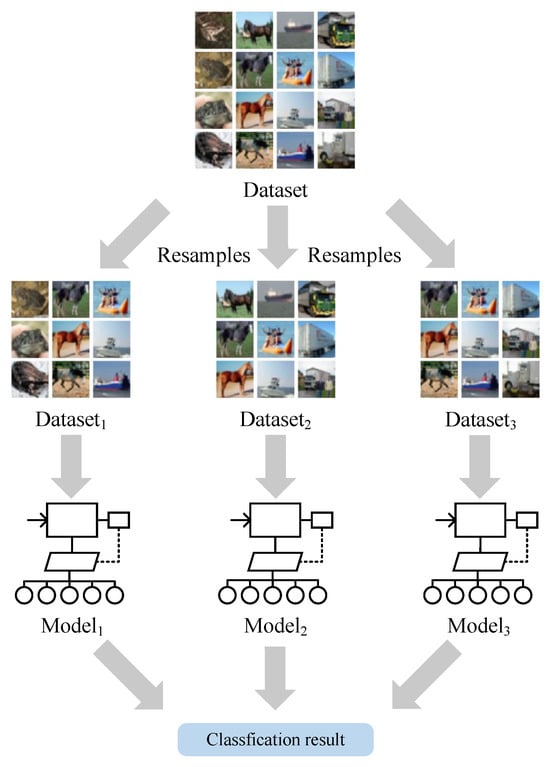
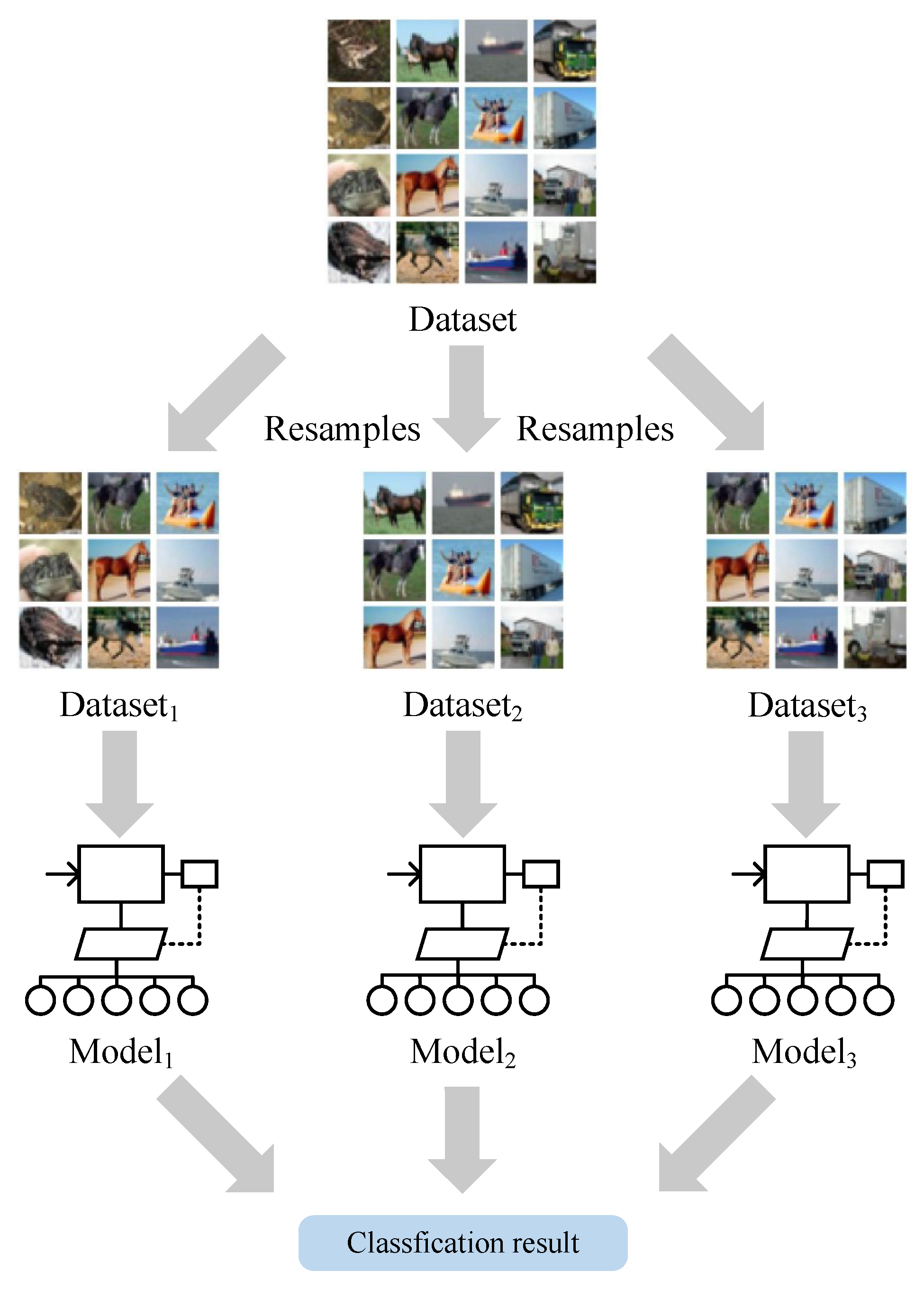
To address the aforementioned challenge, collaborative target classification technology has received extensive attention in recent years. Collaborative target classification technology has found extensive practical applications across multiple disciplines, including military applications [5], unmanned vehicles [6], robot vision [7], medical image analysis [8], agriculture [9], ocean exploration [10], and multi-agent systems [11,12] etc. By effectively integrating multiple models, the final prediction results can be obtained. This method can effectively improve the overall classification accuracy of the algorithm in open environments. The flowchart of general ensemble learning is shown in Figure 1. Most collaborative target classification techniques still rely on deep learning models at this stage. A stackable ensemble learning method has been proposed by both Yang and Zhang to enhance the classification performance of sample sets. Yang’s approach involves incorporating Transfer Learning (TL) and Data Augmentation (DA) techniques [13]. TL methods have been introduced into image classification tasks, where the application of weight adjustment techniques enables an effective transfer of knowledge from large-scale advanced pre-trained models and adaptation to target tasks. The stacked ensemble strategy further promotes the deep fusion of multiple heterogeneous pre-trained convolutional neural network (P-DCNN) models. On the other hand, Zhang’s method employs a stacked integrated deep learning model based on temporal priors [14]. The feature extraction capability is enhanced through the temporal attribute classifier (TAC) and integrated models. The approach employed by Xi differs from the former, as it places a greater emphasis on the semi-supervised classification of online integration [15]. To achieve real-time and reliable target maneuver classification, a dynamic micro-clustering algorithm is employed to adaptively process streaming data. Deep learning, with its robust feature extraction capability and autonomous learning ability, has achieved remarkable advancements in the fields of image classification and other domains. However, deep learning models also possess inherent limitations that cannot be disregarded. Firstly, the training and inference processes of deep learning models are computationally intensive and necessitate high-end hardware infrastructure, which hinders their deployment in environments where computing resources are constrained. Secondly, the opaque nature of deep learning models impairs transparency in their decision-making process, thereby compromising interpretability and model reliability.
Figure 1.
The flowchart of general ensemble learning.
In recent years, broad learning, as a new form of fast machine learning network, has provided innovative solutions for maritime target classification. A new BLS-based object classification system is proposed by Liu, whose overall performance and detection efficiency are effectively improved through the integration of incremental learning algorithms and optimized network structures [16]. This system adopts a shared convolutional layer to conduct feature extraction, and incorporates a region proposal network (RPN) along with region of interest (ROI) pooling mechanisms to localize and identify the target region. Furthermore, an incremental learning algorithm is introduced into the system to solve the redundancy problem in network iterative updates. An approach integrating broad learning and convolutional neural networks (CNNs) is proposed by Zeng. The information in the source domain is used to deal with classification problems in the target domain [17]. A broad learning model based on elastic network regularization for visual classification tasks is introduced by Li [18]. By introducing the label enhancement technology, the boundaries between different classes are strengthened, and the diversity of the label space is improved. The broad learning system can quickly process and learn from massive data, significantly reducing the time and resource consumption of model training. Compared with deep learning, broad learning is more efficient when dealing with complex data. In addition, broad learning can effectively process non-stationary data and adapt to dynamically changing environments, which makes it have great potential in maritime target classification.
In summary, a distributed multi-agent target classification method based on broad learning and MobilityFirst is proposed in this paper. Firstly, the data features of the target dataset are extracted. This method introduces MobilityFirst as a communication protocol to realize communication between unmanned surface vehicles. Compared to 5G/6G and IoT protocols, the MobilityFirst protocol is not reliant on extensive and centralized base station infrastructure. USVs can leverage the MobilityFirst protocol to establish a decentralized and heterogeneous wireless link, making it more suitable for maritime environments. Secondly, through multi-agent feature consistency, it can be achieved among models with diverse capabilities and structures. Finally, the classification layer of the model is implemented by the broad learning system (BLS), which completes the classification of decision consensus and yields the final prediction outcome.
The work of this paper is summarized as follows:
- 1.
- A collaborative fusion framework for multi-model classification is proposed in this paper, enabling classification models with varying capabilities to cooperate and achieve feature consistency fusion.
- 2.
- The framework is integrated with distributed computing to enable efficient USV communication via the MobilityFirst network protocol. Comprehensive security and privacy protection are ensured throughout the entire communication process.
- 3.
- This method integrates deep learning derived fused features with a broad learning based classification system. This approach effectively reduces the training workload of the model while improving its classification performance.
The remainder of this paper is organized as follows: Section 2 introduces the related work of the method proposed in this paper. A distributed maritime target classification (DMTC) method based on broad learning and MobilityFirst is proposed in Section 3. In Section 4, a large number of comparative experiments are carried out to verify the effectiveness of the proposed method. Section 5 discusses the limitations of the proposed method. Finally, Section 6 concludes the research.
2. Related Work
2.1. Distributed Computing
In real-world data analysis, data often exhibit multi-dimensional and nonlinear characteristics. A single model is difficult to obtain all potential information and patterns of the target. To address the limitations of a single model in processing complex data, multi-model fusion is proposed. The stage of fusion can be divided into data layer fusion [19,20], feature layer fusion [21,22], and decision-making layer fusion [23,24]. Compared to the other two methods, feature-level fusion captures more feature information while maintaining moderate data transfer volumes. This method enables the extraction of more comprehensive and representative features, thereby enhancing classification performance. Typical decision fusion methods are divided into weighted fusion and ensemble learning [25,26,27]. The weighted fusion method typically assigns different weights based on the model’s performance or trustworthiness. Then, the decision results of each model are weighted and averaged according to these weights, using methods such as weighted fusion and voting. Ensemble learning is the construction of multiple independent models and the combination of their prediction results to achieve better prediction results than a single model. Currently, mainstream ensemble learning methods are recognized, including bagging, boosting, and stacking, all of which have found extensive practical applications across diverse research domains [28,29]. The formation of strong classifiers through the combination of multiple weak classifiers is highlighted, with such weak classifiers typically exhibiting homogeneity.
However, some shortcomings of the existing decision-making fusion methods must be addressed. Firstly, these methods typically employ a fixed weight allocation mechanism when fusing heterogeneous models. Though straightforward, this mechanism overlooks the key point that model performance varies significantly across different tasks or datasets. Secondly, the traditional decision fusion method is not well adapted to the distributed computing environment. In distributed systems, there is usually no central node for unified coordination and control. In this case, there is a lack of effective interaction and collaboration between the models, resulting in the inability to integrate the decision-making of the models effectively.
A novel solution to the aforementioned challenges is presented by distributed computing approaches, and relevant investigations have been conducted in previous research [30,31,32,33]. The distributed computing approach emphasizes the interaction and collaboration between models to reach a consensus on decision-making in the absence of a central node. In a distributed computing approach, each model is treated as an independent agent. These agents can dynamically adjust their behaviors and policies based on the communication topology and real-time data, making the entire system more flexible and adaptable. Through the cooperation between agents, the system is resistant to single points of failure and noise interference. This improves the accuracy and reliability of the classification results.
2.2. MobilityFirst
MobilityFirst initially originated from the Future Internet Architecture program of the National Science Foundation [34]. The goal of this project is to address some of the problems in the existing Internet architecture, particularly in terms of mobility and security. With the rapid advancement of mobile terminals and wireless technologies, conventional internet protocols relying on fixed networks have become less capable of satisfying the requirements of modern communications. As a result, MobilityFirst is proposed as a new network architecture specifically optimized for mobility and quality of service.
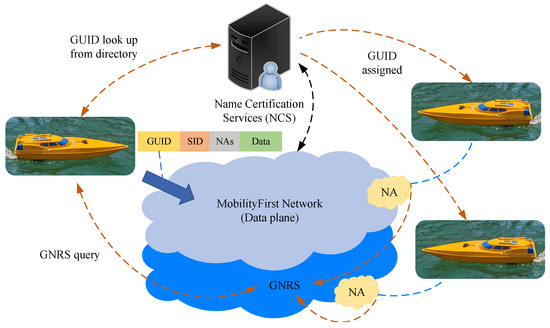
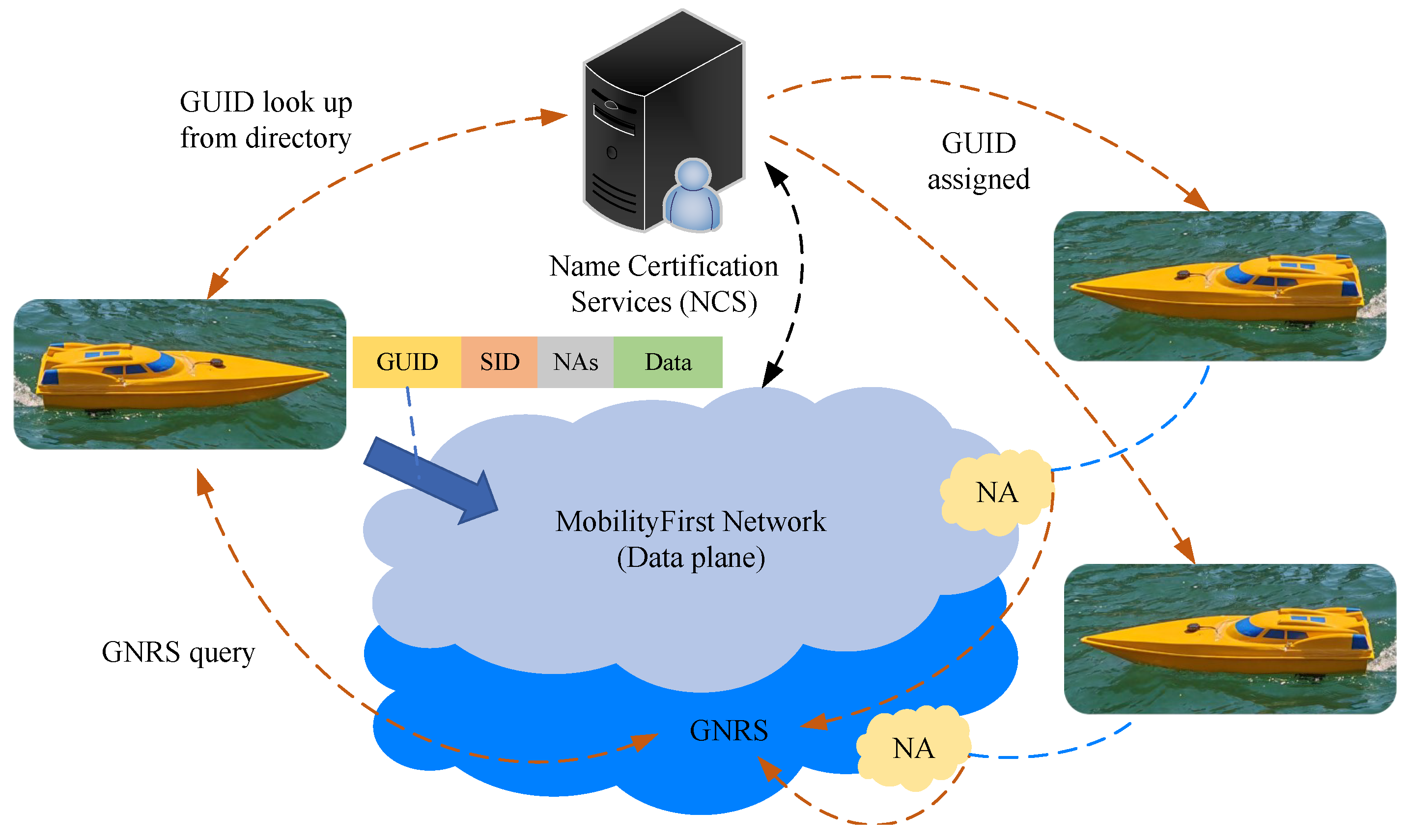
The core principle of MobilityFirst is to transform the host-centric network model into a network-centric one, identifying entities in the network through a globally unique identifier (GUID) rather than relying on traditional IP addresses. This design allows the network to handle mobility more efficiently without a fixed IP address. A novel routing protocol, which dynamically adapts to network topology changes, is employed in MobilityFirst to achieve more reliable and efficient data transmission. Compared to traditional TCP/IP protocols, MobilityFirst has more robust mobility support and higher security. Meanwhile, MobilityFirst’s routing protocol adjusts the path according to real-time network conditions, ensuring efficient and reliable data transmission. The MobilityFirst network architecture is shown in Figure 2. Name Certification Services (NCSs) support anycast, multicast, and other options through send and get functions to achieve accurate data transmission and retrieval. The allocation of GUIDs and the lookup mechanism in the directory service ensure the accuracy of data transmission. The GUID-to-SID mapping is accomplished through the collaboration between the Network Address (NA) node and the GUID Naming Resolution Service (GNRS), with entity localization and data routing optimized accordingly. These designs make the MobilityFirst network efficient and scalable in distributed and mobile environments. In this paper, MobilityFirst is used as a communication protocol to enable communication between USVs. With MobilityFirst, USVs enable efficient and secure data exchange.
Figure 2.
MobilityFirst network architecture.
2.3. Broad Learning
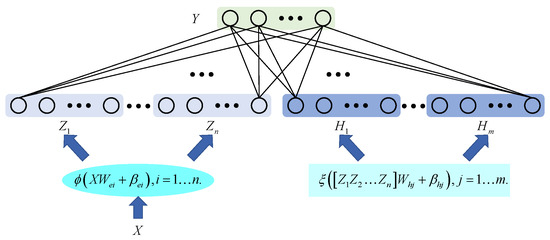
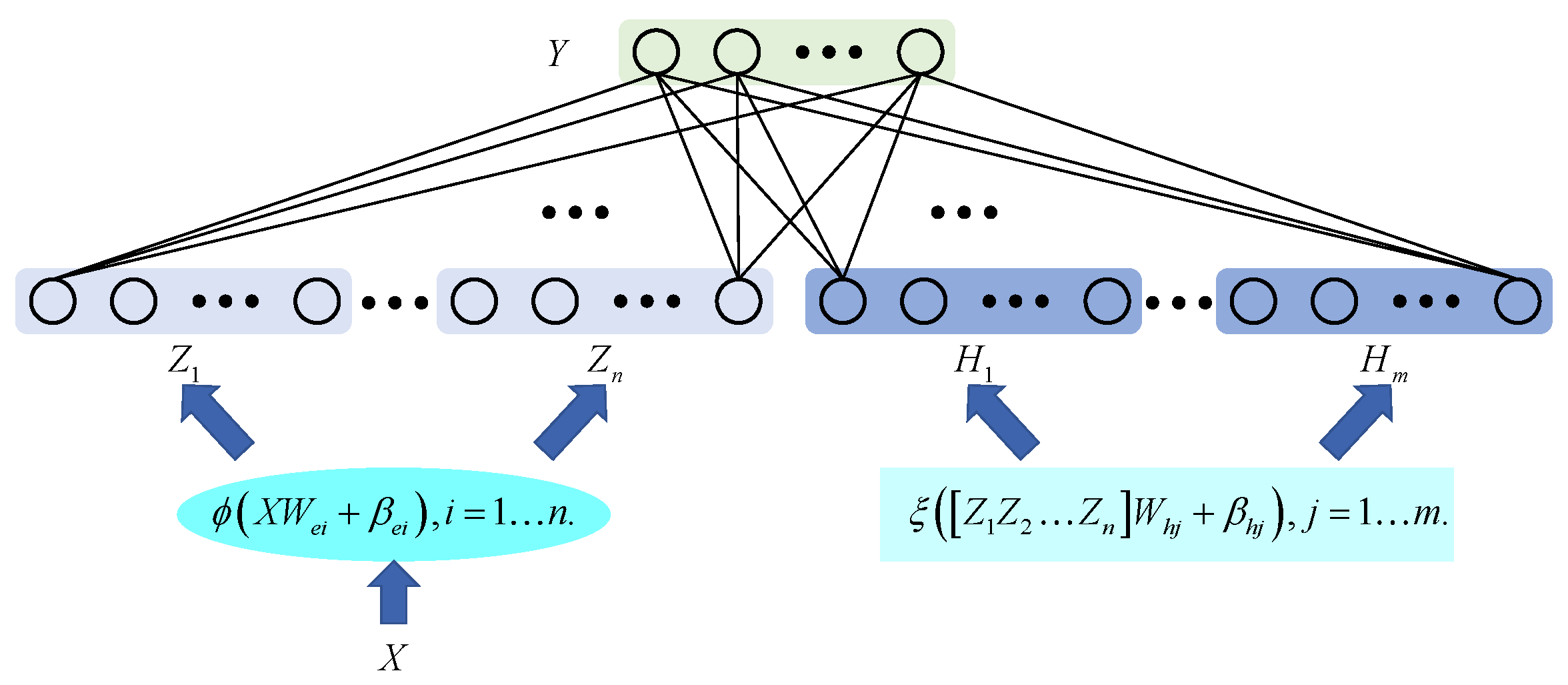
Broad learning, as a further evolution of the random vector functionally linked neural network, achieves performance improvement by expanding network width instead of depth [35,36]. A broad learning network is composed of feature nodes Z and enhancement nodes H. Feature nodes are directly mapped from input data, while enhancement nodes are nonlinear transformations of the feature nodes. These two parts of the network make up the width of the network. The model structure diagram of broad learning is shown in Figure 3.
Figure 3.
The model structure diagram of broad learning.
A new merged matrix A is acquired through the fusion of the initial input matrix X and the processed outcome matrix H. It is passed as an input to the output layer. For a given feature Z, the enhancement layer H can be obtained directly by computation. When the training label Y is known, the weight of the random network is equal to the product of the inverse of the merging matrix and the label matrix by computing the merging matrix A above. Instead of performing the inverse operation, ridge regression can be utilized to solve the merged matrix and obtain the weight matrix W. The formula is provided as follows:
where , is the regression coefficient. Then, the weight W can be obtained as
Specifically, it can be written by
Broad learning is a simple and efficient learning process. Due to the simplicity of the network structure, broad learning can be trained quickly, especially when working with small-scale datasets. Additionally, the incremental learning capability of breadth learning avoids the entire network from being retrained. To further enhance the flexibility and efficiency of broad learning, it can be adapted to various complex data and task requirements through different structural combinations and enhancement strategies. Currently, the primary variants of broad learning are feature cascade [37], feature convolution cascade [38], and deep cascade [39]. In this paper, features are extracted from deep learning, and the broad learning is used as a classification layer. After the decision formula of each model is reached, the feature vectors are input into the broad learning.
3. Methodology
In this paper, a distributed maritime target classification (DMTC) method based on broad learning and MobilityFirst is proposed. A multi-model collaborative classification and fusion framework is designed. The information complementarity and feature consistency fusion between models is realized through distributed computing based on MobilityFirst. Ultimately, the broad learning system achieves accurate classification based on fused features.
3.1. DMTC Framework
The role of USVs has become increasingly important in current ocean exploration and monitoring tasks [40]. USVs can perform various tasks in harsh maritime environments, which play an indispensable role in scientific research for national defense security. However, these tasks often require the USV to have a high degree of autonomy and precise target classification capabilities. Assume that there is a target D to be identified. There are the N classification models to accomplish the target classification task. The N classification models can be uniformly represented as . It supposes that it is represented as for the training set corresponding to the model . It can be expressed as for the probability density function corresponding to the data . Considering the distributed condition, the target X may be inconsistent due to differences in the location, angle, platform, etc., which is detected by each model. Therefore, the input data of model is represented as . The top corner label i represents the i-th model.
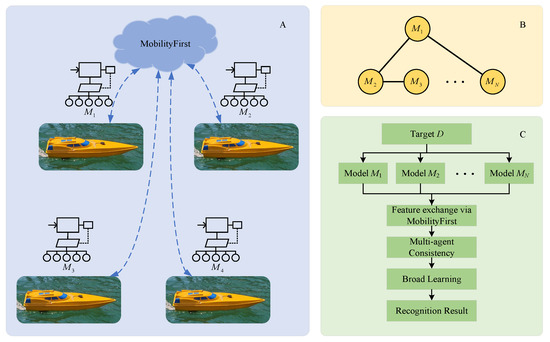
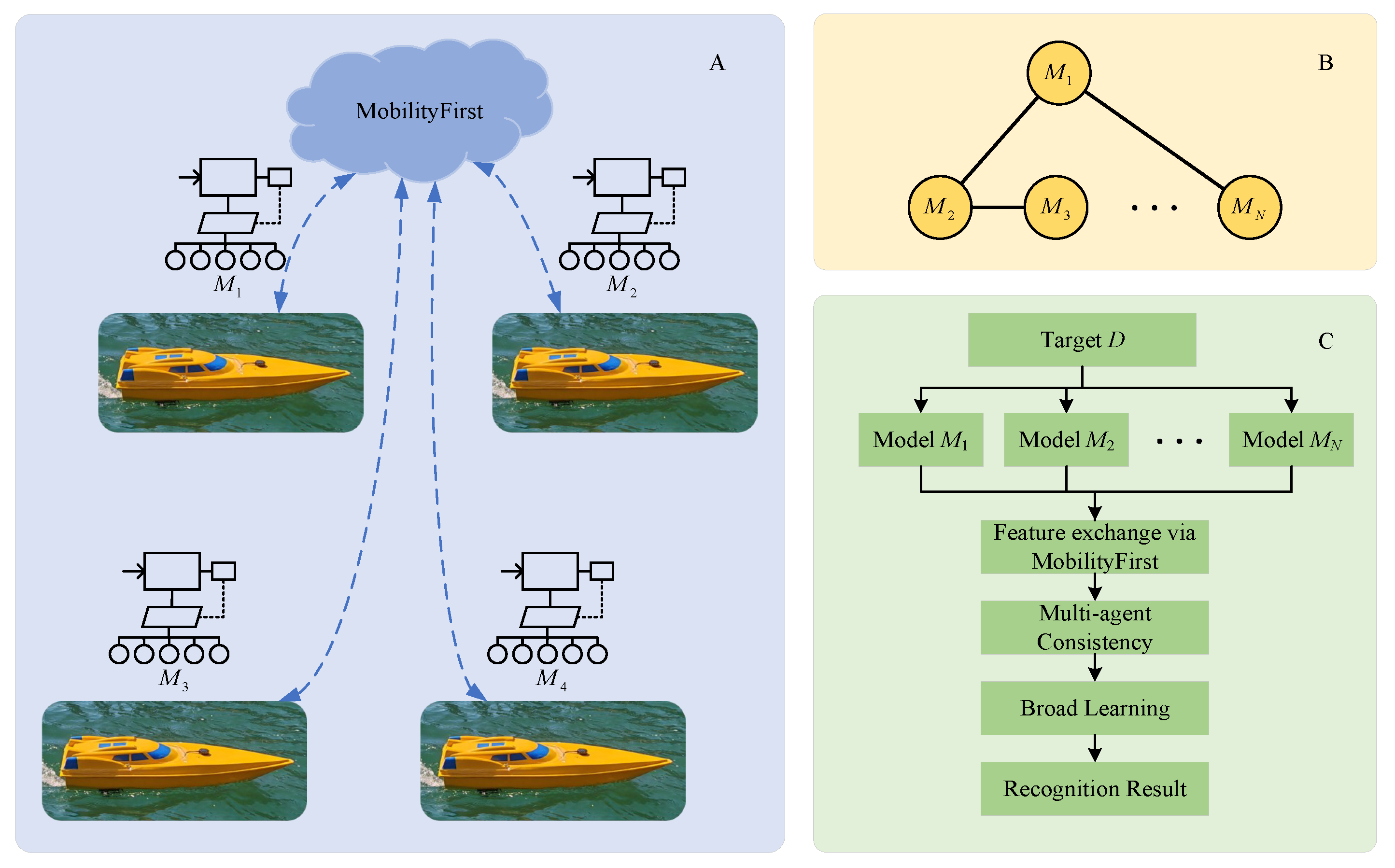
The DMTC method framework is shown in Figure 4, which includes the algorithm scenario, communication topology graph, and algorithm flow. Figure 4A constitutes the application platform of DMTC, developed based on practical requirements. Each USV employs a model for preliminary target recognition and outputs target feature descriptors. MobilityFirst has adopted a mechanism of name and address separation by rethinking endpoint naming and connection-oriented protocols. At a high level, MobilityFirst allows applications to interact securely with abstract mobile entities in a connectionless manner. Compared to traditional TCP/IP network protocols, the advantage of MobilityFirst lies in its intrinsic consideration of mobility. By introducing a globally unique identifier (GUID), it solves the problem of confusion in logical concepts. Therefore, MobilityFirst is utilized for subsequent feature information exchange to achieve feature consistency and enhance the security of multi-agent communication. Finally, broad learning leverages invariant features to enable high-accuracy and rapid target classification. The framework introduces the multi-agent consensus that allows the USV to exchange information through a well-defined communication topology graph in Figure 4B. The topology structure not only depicts the communication paths between the USVs but also optimizes the data transmission process. The flowchart of the DMTC method is described in Figure 4C, and the DMTC pseudocode is given in Algorithm 1.
| Algorithm 1: DMTC method. |
Input: : Model; : Communication time; : Communication interval; Output: Prediction labels for target classification
|
Figure 4.
Comprehensive details of the DMTC framework. (A) Application Scenarios. (B) Communication topology graph. (C) Algorithmic Flowchart.
3.2. Feature Extraction and Exchange
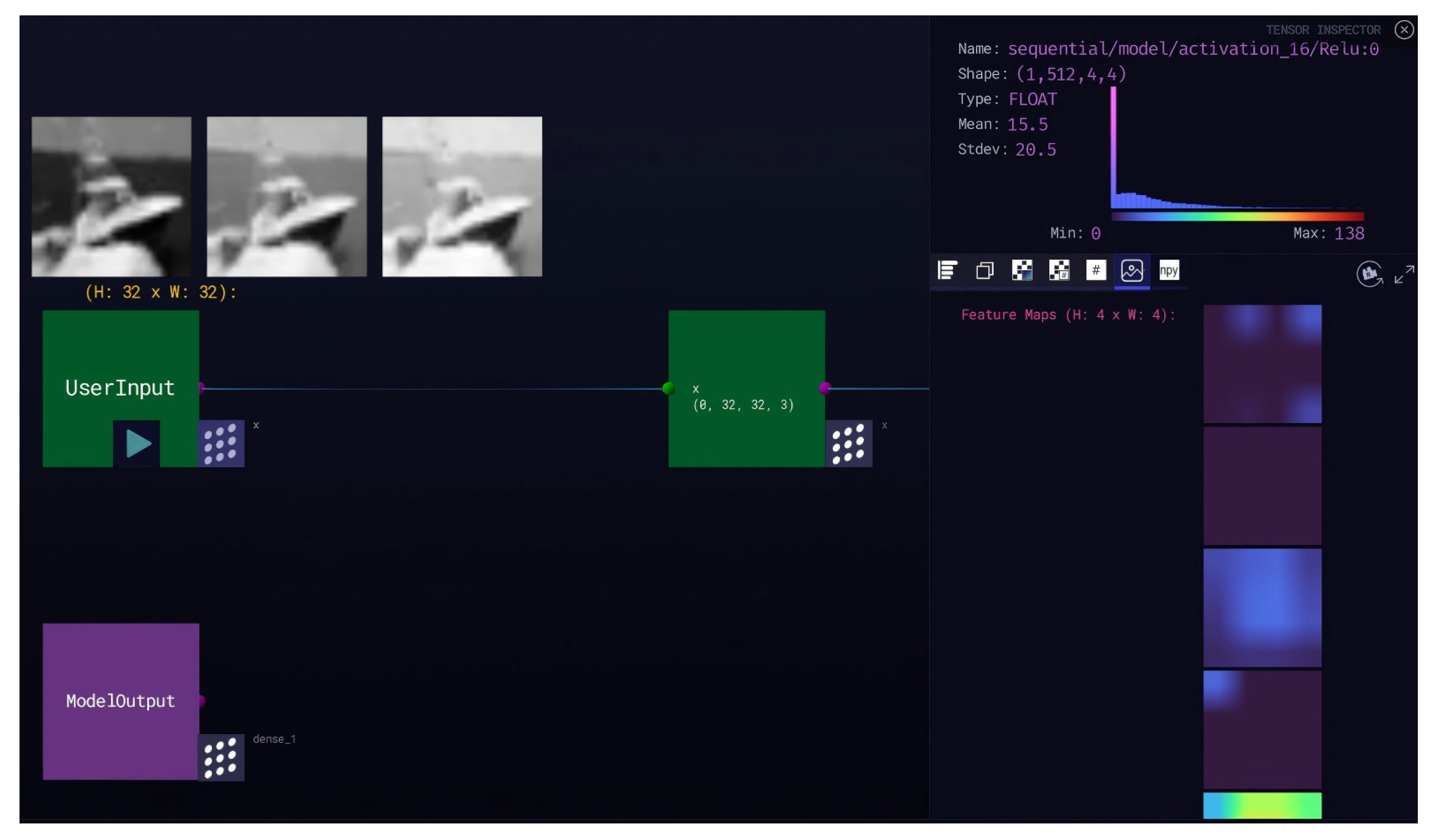
In this paper, the dataset is first input into the deep learning model , and the initial training is carried out. The feature maps of the ResNet18 network model are visualized within Zetane software (version 1.4.0), as illustrated in Figure 5. Specifically, feature maps refer to the output results produced by the convolutional layers of a neural network following convolution operations on input images. In contrast, feature vectors are specific representations extracted from these feature maps across different agents, all of which analyze the same image. These vectors integrate both shallow and deep features of the image, providing a comprehensive representation of the key information contained within. Subsequently, the feature vector is extracted from the feature maps of deep learning networks and used as the information exchanged between the models. This is the basis for the consistent decisions made by each model to achieve target classification tasks. Subsequently, the feature vector is integrated through consistency fusion and subsequently processed using generalized learning algorithms for final classification.
Figure 5.
Feature maps of ResNet18.
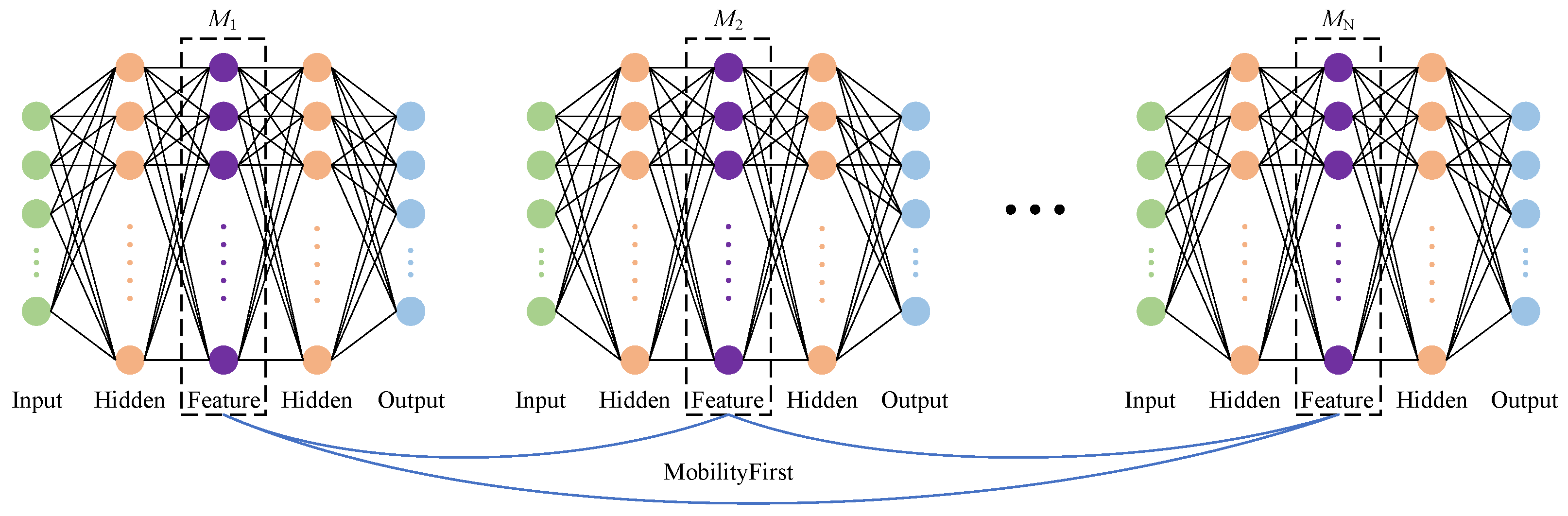
To achieve overall decision-making consensus at the cluster level, it is necessary to communicate between multiple agents to reach consensus results. The feature obtained by a single model is extracted, and data exchange is carried out to achieve multi-model fusion. The extraction and exchange of image features are shown in Figure 6.
Figure 6.
MobilityFirst-based feature extraction and exchange framework schematic.
The consistent feature results obtained by multi-agent systems need to be guaranteed. It is necessary to set the starting point and the number of exchanges to control the time of information exchange between the multi-agents. An array D is initialized to store the state solutions of each multi-agent at each time point. Then, the feature result extracted by each model is set as the initial state of each agent. Subsequently, each agent communicates information with the neighbor node according to the topological diagram. This communication process entails transmitting one’s initial state to neighboring agents while receiving their initial states, utilizing consensus algorithms to compute the communication outcomes at each iteration in a multi-agent system. The above process is shown in lines 4 to 9 of Algorithm 1. When the number of exchanges is reached, the final fused feature will be obtained.
3.3. Consistency Formulation
It supposes that the models are distributed into the directed graph G, where is a non-empty finite set of nodes. E is the set of edges. The Laplacian matrix is defined as . When the communication topology map contains a directed spanning tree, the topology map is connected. At this point, the Laplace matrix has a single eigenroot of 0. For a multi-agent consensus algorithm,
where represent the feature information exchanged between the multi-agents. It is stored in the array X and used to obtain the final fusion result. represents the element of the corresponding Laplacian matrix L in the i-th row and j-th column. According to the article, it is known that , when the communication topology graph contains a directed spanning tree [41]. The represents the non-negative left eigenvectors of the Laplacian matrix L corresponding to the eigenvalue. Graph theory is not only the mathematical basis of multi-agent collaboration, but also a key tool for effective object classification and information exchange between models. Through multi-agent consensus feature fusion, each model derives consistent features, which are ultimately integrated through broad learning to obtain the final classification results.
Training the deep learning model is the most computationally intensive component of this algorithm. Each iteration involves both forward and backward propagation, which requires extensive matrix computations. The computational complexity for each epoch is proportional to the number of parameters; thus, the total training complexity is , where E is the number of epochs, N is the number of samples, and P is the number of model parameters. Additionally, this algorithm incorporates a multi-agent consensus control mechanism that iteratively processes each sample to facilitate agreement among agents. The computational complexity for this consensus process is , with I denoting the number of samples and J the number of iterations. For broad learning, the hidden layer output is computed using randomly generated functional links. When processing N samples, the overall complexity is , where is the number of input nodes, is the number of hidden nodes, and H is the number of output nodes. Because the complexities of feature extraction and broad learning are significantly lower than those of deep learning, they are omitted from our final analysis. In summary, the primary computational burden of the algorithm is .
4. Experiments
4.1. Experimental Setup
4.1.1. Dataset Introduction
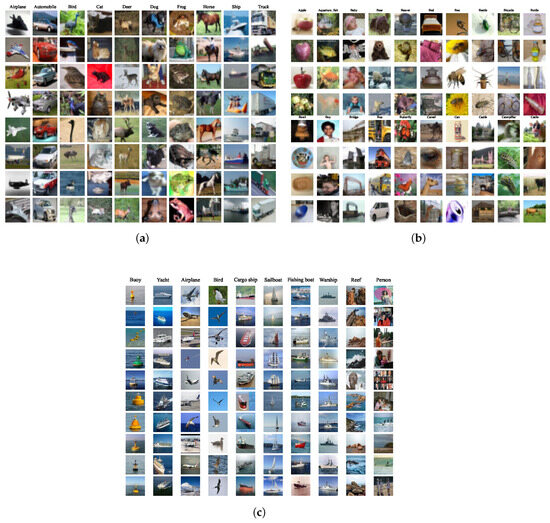
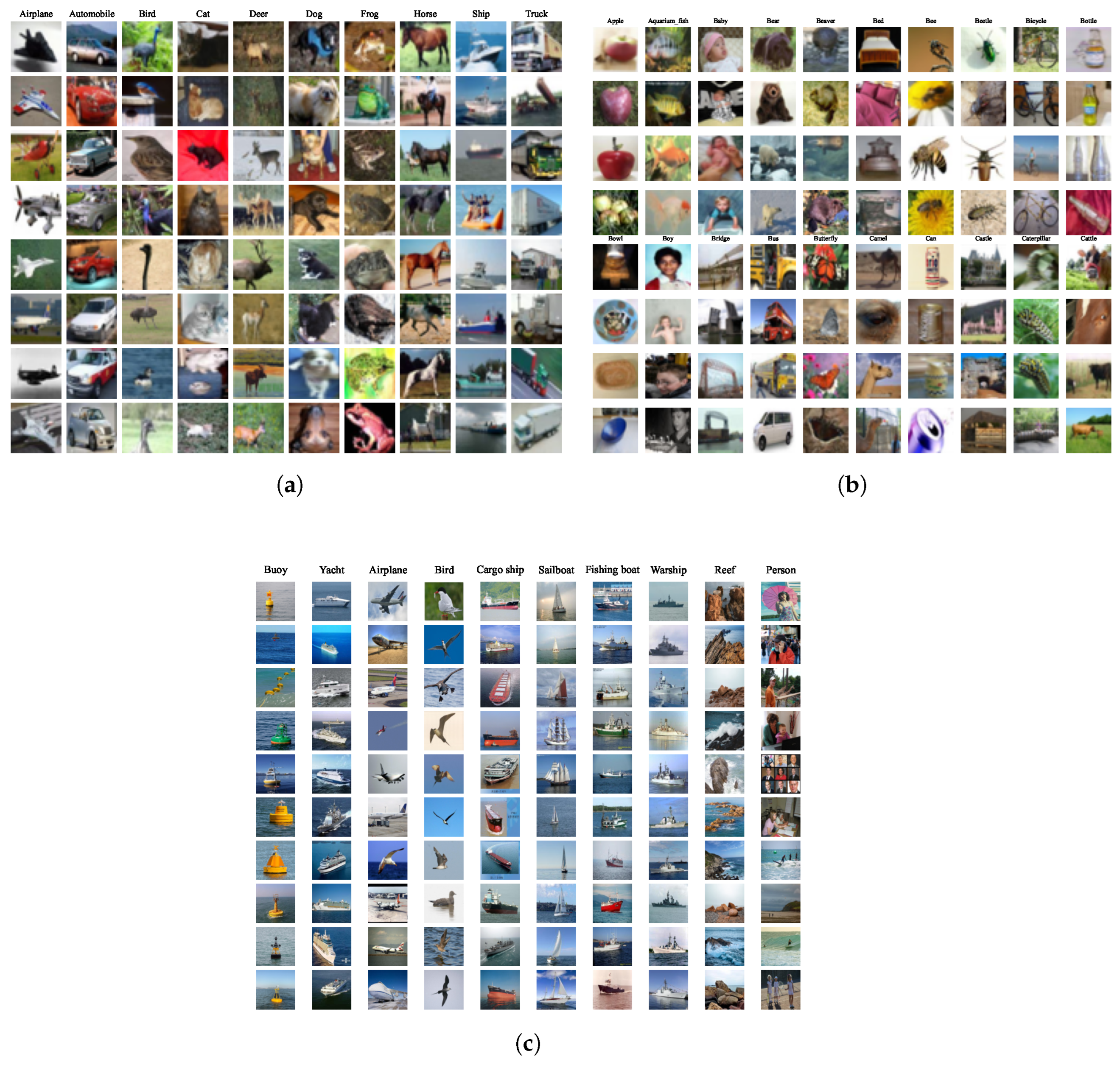
The CIFAR-10, CIFAR-100, and maritime surface target detection (MSTD) datasets are used to evaluate the performance of this method in maritime target classification. CIFAR-10 is a widely recognized and applied image classification dataset in the fields of machine learning and computer vision. The dataset comprises 60,000 32 × 32 pixel color images, with 50,000 used for training and 10,000 for testing. These images span 10 categories, including airplanes, automobiles, ships, and trucks, with each category containing 6000 images. To further validate the generality and robustness of the proposed method, this experiment also utilizes the CIFAR-100 dataset, which encompasses more classes. CIFAR-100 consists of 100 categories, each with 600 images, totaling 60,000 32 × 32 pixel color images. These categories are grouped into 20 superclasses, each comprising five subordinate categories. The MSTD dataset comprises 20,000 maritime-related target images, with 4000 designated for testing. These images are categorized into ten classes, with unequal distribution across categories. Ships account for of the total categories. Due to their large original dimensions, the images are resized to 32 × 32 pixels for analysis. Selected images and their corresponding classifications from the CIFAR-10, CIFAR-100, and MSTD datasets are displayed in Figure 7a, Figure 7b, and Figure 7c, respectively.
Figure 7.
Experimental datasets (a) CIFAR-10 datasets. (b) CIFAR-100 datasets. (c) Maritime surface target detection datasets.
4.1.2. Comparative Methods
To demonstrate the superiority of the proposed method in the collaborative classification of maritime targets, a multitude of comparative approaches are employed in this study. In this section, three deep learning convolutional neural network models are employed, namely VGG16, ResNet18, and ResNet50. VGG16 is a Visual Geometry Group network proposed by Simonyan and Zisserman. It strikes a balance between network depth and width via multiple convolution kernels, thereby enhancing the network’s representational and generalization capabilities [42]. ResNet18 and ResNet50 are typical residual networks that address the degradation problem of deep neural networks and boost both the performance and efficiency of the network via skip connections [43]. Meanwhile, the effectiveness of the DMTC method is validated by comparison with single-model methods based on BLS, namely VGG16_BLS, ResNet18_BLS, and ResNet50_BLS. As a classic ensemble learning algorithm, the averaging method enhances overall performance by fusing the predictions of multiple base models while mitigating model variance and alleviating the risk of overfitting. Federated learning is essentially a distributed machine learning framework. Its primary objective is to enhance model performance and generalization capability. This goal is achieved through multi-party collaborative modeling, while ensuring data privacy, security, and compliance with relevant laws and regulations. In this experiment, accuracy, value, and are used as evaluation indicators for model performance.
4.1.3. Parameter Settings
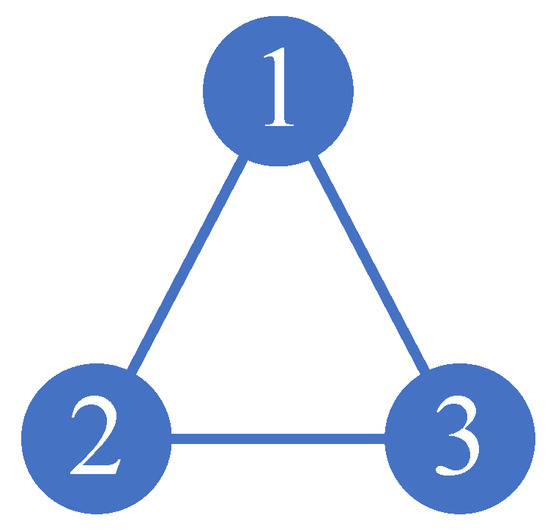
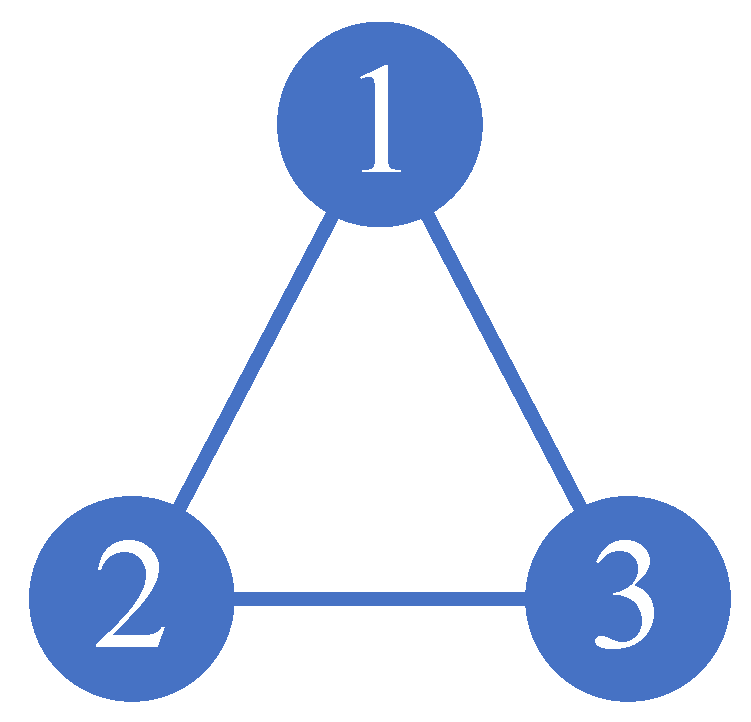
In this experiment, each model is implemented using the TensorFlow-GPU 2.10.0 and Keras 2.10.0 frameworks and is trained and tested on the CIFAR-10 and CIFAR-100 datasets. This experiment is solely intended to validate the effectiveness of the algorithm. Setting each model training epoch to 10 with a batch size of 256 significantly reduces the overall training time. To ensure a consistent running environment, the Python version is 3.8, the graphics card is an NVIDIA GeForce RTX 4070, and CUDA 11.2 accelerates the training and testing processes. The DMTC method proposed in this paper, along with the multi-agent comparison approach employed, is validated through comparative experiments using three USVs. The communication topology structure of the three USVs is shown in Figure 8. The different numerals represent distinct unmanned surface vehicle entities.
Figure 8.
Diagram of the communication topology used in the experiment.
4.2. Effect of Communication Time
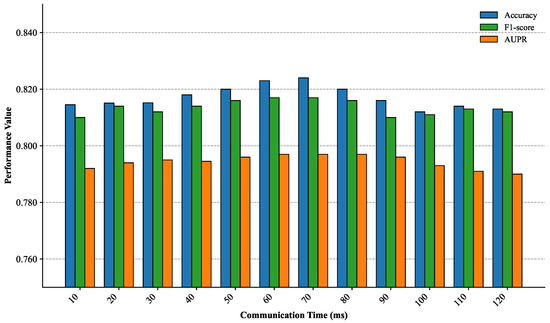
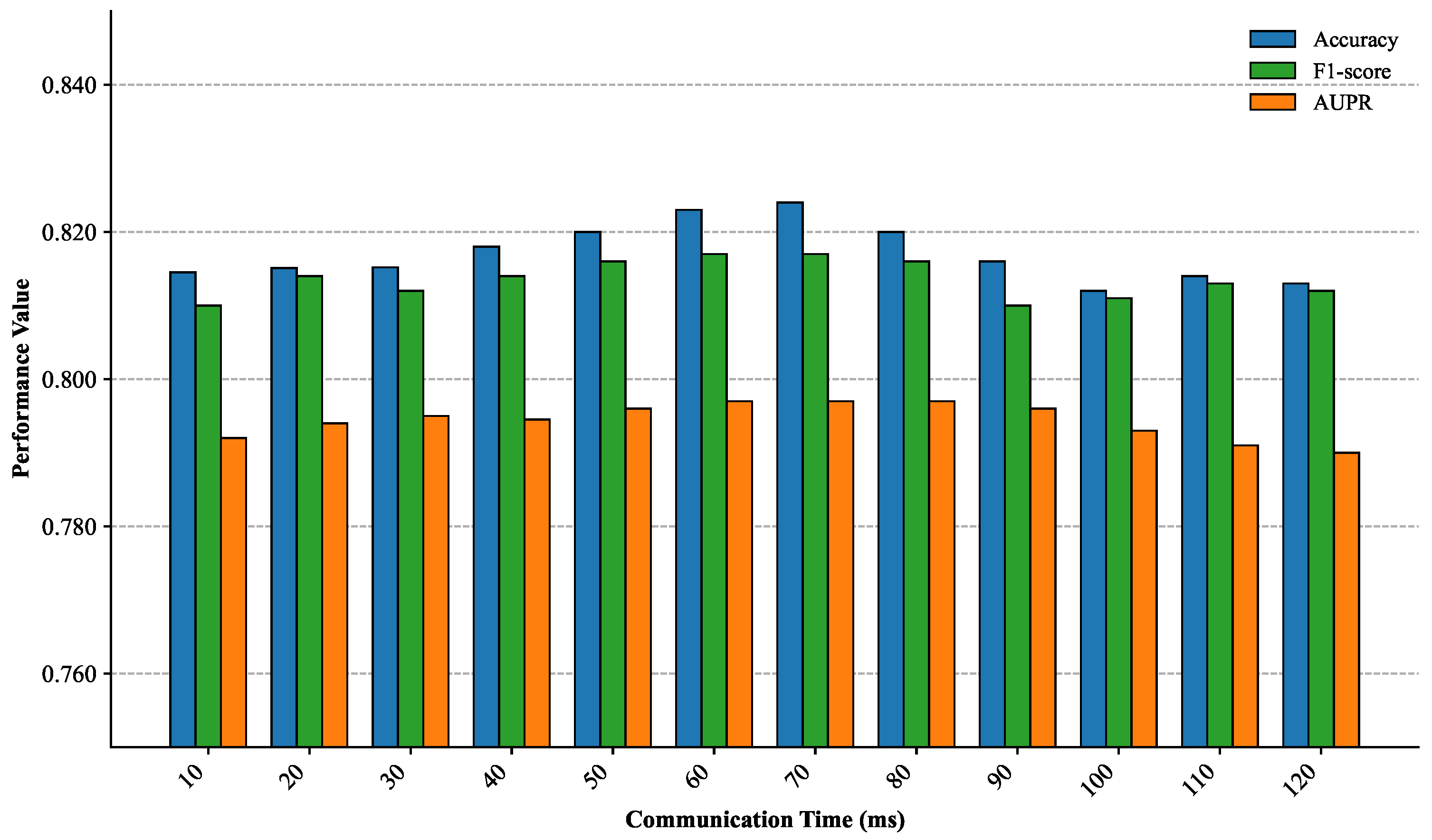
In order to further explore the influence of communication time on the DMTC method, the experiment is carried out on the model with different communication times. The communication interval based on MobilityFirst in the simulation design of this paper is set to 1 ms. The primary performance metrics of the DTMC method under varying communication durations are depicted as shown in Figure 9.
Figure 9.
The performance curve of the DMTC method under different communication time.
As can be seen from Figure 9, the overall trend of accuracy, F1 and AUPR permissions is increasing first and decreasing. When the communication latency ranges between 60 and 80 ms, the AUPR metric remains relatively stable, with F1 score and accuracy reaching their peak values at 70 ms. The experiment shows that the communication time affects the performance of the DMTC method. If the communication time is too short, the communication between the models is shallow, resulting in the improvement effect not being obvious. Longer communication time makes decisions between models more fixed, which also affects performance. Accordingly, within this simulation environment, the optimal communication duration is selected as 70 ms, with the optimal number of communication rounds set at 70.
4.3. Experimental Result
This section will present comparative experiments conducted across multiple models on various datasets, with all USV experiments utilizing the same single model as in the comparative studies. The number of USVs is fixed at 3. The comparative experiment primarily utilizes the CIFAR-10 and CIFAR-100 datasets. Training time refers to the duration required for the model to be trained on the training subsets of these datasets, while inference time denotes the period taken by the model to perform testing on the respective test subsets.
4.3.1. Comparative Experiment Based on CIFAR-10
The initial experiment, detailed in Table 1, employs the VGG16 architecture as the baseline and is evaluated on the CIFAR-10 dataset.
Table 1.
Comparative experiment based on VGG16 in the CIFAR-10 dataset.
The second experiment uses the ResNet18 model as a comparative experiment on the CIFAR-10 dataset. The detailed results are documented in Table 2.
Table 2.
Comparative experiment based on ResNet18 in the CIFAR-10 dataset.
Table 3 establishes the third experiment, which employs the ResNet50 architecture as a comparative benchmark on the CIFAR-10 dataset. Despite ResNet50’s more intricate design compared to ResNet18, it effectively reduces the number of model parameters, thereby enhancing training efficiency and increasing recognition accuracy.
Table 3.
Comparative experiment based on ResNet50 in the CIFAR-10 dataset.
The experimental results based on the CIFAR-10 dataset demonstrate that the DMTC method consistently achieves the best performance across VGG16, ResNet18, and ResNet50. Specifically, it outperforms the original models, BLS-enhanced variants, and the average voting method in all three core metrics: accuracy, F1 score, and AUPR. Although DMTC requires longer training times compared to BLS-based models, it maintains the highest accuracy among all methods, even approaching the inference time of BLS-enhanced models. This trade-off indicates that DMTC effectively balances performance and inference efficiency, making it a highly competitive approach for model optimization on the CIFAR-10 dataset.
4.3.2. Comparative Experiment Based on CIFAR-100 and MSTD Datasets
In order to verify the versatility of the proposed method, the classical CIFAR-100 and MSTD datasets are also used in this experiment. Meanwhile, comparative experiments with federated learning methods are conducted to further validate the efficacy of the proposed DMTC algorithm.
In Table 4 and Table 5, the ResNet18_BLS demonstrates notable time efficiency; however, its performance improvement remains limited. The inference times for federated learning and average voting methods are comparatively longer, with overall performance falling short of the DMTC approach. The DMTC method achieves a more optimal balance between classification accuracy and inference efficiency, validating its effectiveness in complex image recognition tasks.
Table 4.
Comparative experiment in the CIFAR-100 dataset.
Table 5.
Comparative experiment in the MSTD dataset.
In summary, the DMTC approach consistently outperforms baseline models, BLS-augmented models, average voting method, and federated learning across the key metrics of accuracy, F1 score, and AUPR on the CIFAR-10, CIFAR-100, and MSTD datasets. While the training time of the DMTC method is generally longer than that of BLS enhancement and average voting method, this increased communication cost is justified by the resultant performance gains. Multiple experimental results demonstrate that the DMTC method’s performance improvements are independent of the underlying model architecture or dataset complexity, indicating robust generalization capabilities.
5. Limitations
Here are several issues that need to be improved in the future: (1) By introducing broad learning, the computational effort of the model is reduced. However, the structure of the model is also complex and requires longer training times. Further research is therefore needed to develop a more generalized approach to model simplification. (2) In addition, the topological graph currently used is set based on experimental experience. Future research will focus on automating the construction of inter-model communication topologies to achieve further performance gains. (3) All experimental methods involving communication in this paper are conducted under optimal communication conditions. Future work will address more realistic scenarios characterized by constrained communication channels and packet loss.
6. Conclusions
The distributed maritime target classification (DMTC) method based on broad learning and MobilityFirst proposed in this paper has significantly improved the performance in the field of machine learning target classification. This method utilizes multiple USVs to collect target features and leverages the MobilityFirst architecture to ensure the privacy-preserving communication of feature information. Through distributed computing, consensus-based fused features are obtained, effectively integrating multi-model feature data while expanding the feature dimensions of the target to be classified. Finally, a broad learning system is applied to perform classification inference on the fused features, delivering accurate classification results and significantly enhancing the efficiency of target categorization. In the experimental environment utilized in this paper, extensive experimental results demonstrate that the DMTC method outperforms comparable algorithms by to in accuracy while significantly reducing inference time. Moreover, it maintains robust and adaptable performance across datasets of varying complexity. This provides strong technical support for maritime safety monitoring and early warning defense systems, and also opens up a new research direction and application prospect for future maritime multi-ship collaborative classification.
Author Contributions
Methodology, F.T., L.-E.Y. and R.W.; software, S.L.; validation, S.L.; formal analysis, Z.W.; investigation, S.L.; resources, L.-E.Y.; data curation, Z.W.; writing—original draft, Z.W. and R.W.; writing—review & editing, F.T. and L.-E.Y.; visualization, R.W.; funding acquisition, F.T. All authors have read and agreed to the published version of the manuscript.
Funding
This work was supported by the National Natural Science Foundation of China under Grants 52201407, and 52371360.
Data Availability Statement
The original contributions presented in this study are included in the article. Further inquiries can be directed to the corresponding author.
Acknowledgments
Our thanks to the hard-working editors, and for the valuable comments from the reviewers.
Conflicts of Interest
The authors declare no conflicts of interest.
References
- Song, Z.; Sui, H.; Li, Y. A Survey on Ship Detection Technology in High-Resolution Optical Remote Sensing Images. Wuhan Daxue Xuebao 2021, 46, 1703–1715. [Google Scholar] [CrossRef]
- Li, Y.; Wang, J.; Huang, J.; Li, Y. Research on Deep Learning Automatic Vehicle Recognition Algorithm Based on RES-YOLO Model. Sensors 2022, 22, 3783. [Google Scholar] [CrossRef] [Scilit] [PubMed]
- Deng, L.; Yang, S.; Jia, L.; Geng, D. An Ensemble Classification Method Based on a Stacking Strategy for Ship Type Classification with AIS Data. J. Mar. Sci. Eng. 2025, 13, 886. [Google Scholar] [CrossRef] [Scilit]
- Dai, Z.; Liang, H.; Duan, T. Small-Sample Sonar Image Classification Based on Deep Learning. J. Mar. Sci. Eng. 2022, 10, 1820. [Google Scholar] [CrossRef] [Scilit]
- Zhang, H.; Zheng, J.; Song, C. Multiple-Target Matching Algorithm for SAR and Visible Light Image Data Captured by Multiple Unmanned Aerial Vehicles. Drones 2024, 8, 83. [Google Scholar] [CrossRef] [Scilit]
- Ren, F.; Xu, L.B.; Fei, J.J.; Doma, B.T.; Li, H. Enhancing Vehicle-Machine Interface Icon Detection in Automated Testing Through a Three-Stage Machine Vision Verification Algorithm. IEEE Access 2024, 12, 43191–43200. [Google Scholar] [CrossRef] [Scilit]
- Sun, R.; Wu, C.; Zhao, X.; Zhao, B.; Jiang, Y. Object Recognition and Grasping for Collaborative Robots Based on Vision. Sensors 2024, 24, 195. [Google Scholar] [CrossRef] [Scilit]
- Liu, L.; Wang, Y.; Zhang, P.; Qiao, H.; Sun, T.; Zhang, H.; Xu, X.; Shang, H. Collaborative Transfer Network for Multi-Classification of Breast Cancer Histopathological Images. IEEE J. Biomed. Health Inform. 2024, 28, 110–121. [Google Scholar] [CrossRef] [Scilit]
- Zhi, H.; Yang, B.; Zhu, Y. Collaborative Wheat Lodging Segmentation Semi-Supervised Learning Model Based on RSE-BiSeNet Using UAV Imagery. Agronomy 2023, 13, 2772. [Google Scholar] [CrossRef] [Scilit]
- Namgung, H.; Kim, J.-S. Collision Risk Inference System for Maritime Autonomous Surface Ships Using COLREGs Rules Compliant Collision Avoidance. IEEE Access 2021, 9, 7823–7835. [Google Scholar] [CrossRef] [Scilit]
- Li, Y.; Qu, F.; Tong, S. Observer-Based Fuzzy Adaptive Finite-Time Containment Control of Nonlinear Multiagent Systems with Input Delay. IEEE Trans. Cybern. 2021, 51, 126–137. [Google Scholar] [CrossRef] [Scilit] [PubMed]
- Tong, S.; Sun, K.; Sui, S. Observer-Based Adaptive Fuzzy Decentralized Optimal Control Design for Strict-Feedback Nonlinear Large-Scale Systems. IEEE Trans. Fuzzy Syst. 2018, 26, 569–584. [Google Scholar] [CrossRef] [Scilit]
- Yang, H.; Zhang, Y.; Ding, W. Multiple Heterogeneous P-DCNNs Ensemble with Stacking Algorithm: A Novel classification Method of Space Target ISAR Images under the Condition of Small Sample Set. IEEE Access 2020, 8, 75543–75570. [Google Scholar] [CrossRef] [Scilit]
- Zhang, H.; Liu, C.; Ma, J.; Sun, H. Time-Prior-Based Stacking Ensemble Deep Learning Model for Ship Infrared Automatic Target Recognition in Complex Maritime Scenarios. Infrared Phys. Technol. 2024, 137, 105168. [Google Scholar] [CrossRef] [Scilit]
- Xi, Z.; Lyu, Y.; Kou, Y.; Li, Z.; Li, Y. An Online Ensemble Semi-Supervised Classification Framework for Air Combat Target Maneuver Recognition. Chin. J. Aeronaut. 2023, 36, 340–360. [Google Scholar] [CrossRef] [Scilit]
- Liu, X.; Wu, Y. Research on Vision of Intelligent Car Based on Broad Learning System. IEEE Trans. Cybern. 2022, 53, 4805–4814. [Google Scholar] [CrossRef] [Scilit]
- Zeng, R.; Liu, H.; Peng, S.; Cao, L.; Yang, A.; Zong, C.; Zhou, G. CNN-Based Broad Learning for Cross-Domain Emotion Classification. Tsinghua Sci. Technol. 2022, 28, 360–369. [Google Scholar] [CrossRef] [Scilit]
- Li, Y.; Jin, J.; Geng, Y.; Xiao, Y.; Liang, J.; Chen, C.P. Discriminative Elastic-Net Broad Learning Systems for Visual Classification. Appl. Soft Comput. 2024, 155, 111445. [Google Scholar] [CrossRef] [Scilit]
- Liu, J.; Liu, Z.; Wu, G.; Ma, L.; Liu, R.; Zhong, W.; Luo, Z.; Fan, X. Multi-interactive Feature Learning and a Full-time Multi-modality Benchmark for Image Fusion and Segmentation. In Proceedings of the 2023 IEEE/CVF International Conference on Computer Vision, Paris, France, 1–6 October 2023; IEEE: Piscataway, NJ, USA, 2024. [Google Scholar] [CrossRef] [Scilit]
- Lu, C.; Qin, H.; Deng, Z.; Zhu, Z. Fusion2Fusion: An Infrared–Visible Image Fusion Algorithm for Surface Water Environments. J. Mar. Sci. Eng. 2023, 11, 902. [Google Scholar] [CrossRef] [Scilit]
- Wang, Y.; Sun, F.; Lu, M.; Yao, A. Learning Deep Multimodal Feature Representation with Asymmetric Multi-layer Fusion. In Proceedings of the 28th ACM International Conference on Multimedia, Seattle, WA, USA, 2020; Association for Computing Machinery: New York, NY, USA, 2020; pp. 3902–3910. [Google Scholar] [CrossRef] [Scilit]
- Shen, J.; Chen, Y.; Liu, Y.; Zuo, X.; Fan, H.; Yang, W. ICAFusion: Iterative Cross-attention Guided Feature Fusion for Multispectral Object Detection. Pattern Recognit. 2024, 145, 109913. [Google Scholar] [CrossRef] [Scilit]
- Liu, A.A.; Lu, Z.; Xu, N.; Nie, W.; Li, W. Multi-type decision fusion network for visual Q&A. Image Vis. Comput. 2021, 115, 104281. [Google Scholar] [CrossRef] [Scilit]
- Yuan, T.; Liu, W.; Yan, F.; Liu, B. Decision Fusion for Few-shot Image Classification. Int. J. Multimed. Inf. Retr. 2023, 12, 31. [Google Scholar] [CrossRef] [Scilit]
- Breiman, L. Bagging Predictors. Mach. Learn. 1996, 24, 123–140. [Google Scholar] [CrossRef] [Scilit]
- Freund, Y.; Schapire, R.E. A Decision-Theoretic Generalization of On-Line Learning and an Application to Boosting. J. Comput. Syst. Sci. 1997, 55, 119–139. [Google Scholar] [CrossRef] [Scilit]
- Wolpert, D.H. Stacked Generalization. Neural Netw. 1992, 5, 241–259. [Google Scholar] [CrossRef] [Scilit]
- Lara, A.; Mukherjee, S.; Ramamurthy, B.; Raychaudhuri, D.; Ramakrishnan, K.K. Automated Inter-Domain Cut-Through Switching for the Future Internet. IEEE Trans. Netw. Serv. Manag. 2018, 15, 1393–1406. [Google Scholar] [CrossRef]
- Mwangi, X.; Sollins, K. MNDN: Scalable Mobility Support in Name Data Networking. In Proceedings of the 5th ACM Conference on Information-Centric Networking, New York, NY, USA, 21–23 September 2018; Association for Computing Machinery: New York, NY, USA, 2018; pp. 117–124. [Google Scholar] [CrossRef] [Scilit]
- Teng, F.; Ban, Z.; Li, T.; Sun, Q.; Li, Y. A Privacy-Preserving Distributed Economic Dispatch Method for Integrated Port Microgrid and Computing Power Network. IEEE Trans. Ind. Inform. 2024, 20, 10103–10112. [Google Scholar] [CrossRef] [Scilit]
- Li, X.; Long, L. Distributed Event-triggered Fuzzy Control of Heterogeneous Switched Multi-agent Systems under Switching Topologies. IEEE Trans. Fuzzy Syst. 2023, 32, 574–585. [Google Scholar] [CrossRef] [Scilit]
- Zheng, Y.; Liu, Q.; Wang, J. A Specified-Time Convergent Multiagent System for Distributed Optimization with A Time-Varying Objective Function. IEEE Trans. Autom. Control 2023, 69, 1257–1264. [Google Scholar] [CrossRef] [Scilit]
- Ma, W.; Xu, Z.; Zhao, J.; Zhang, S.; Shao, Z. Cooperative Distributed Extremum Seeking Control for Coupled Multiagent Systems Based on Distributed Classification-gradient Tracking. Int. J. Adapt. Control Signal Process. 2023, 37, 2627–2654. [Google Scholar] [CrossRef] [Scilit]
- Raychaudhuri, D.; Nagaraja, K.; Venkataramani, A. Mobilityfirst: A Robust and Trustworthy Mobility-Centric Architecture for the Future Internet. ACM Sigmobile Mob. Comput. Commun. Rev. 2012, 16, 2–13. [Google Scholar] [CrossRef] [Scilit]
- Gong, X.; Zhang, T.; Chen, C.L.P.; Liu, Z. Research Review for Broad Learning System: Algorithms, Theory, and Applications. IEEE Trans. Cybern. 2021, 52, 8922–8950. [Google Scholar] [CrossRef] [Scilit] [PubMed]
- Pao, Y.; Park, G.; Sobajic, D. Learning and Generalization Characteristics of the Random Vector Functional-Link Net. Neurocomputing 1994, 6, 163–180. [Google Scholar] [CrossRef] [Scilit]
- Yan, X.; Liu, Y.; Jia, M. Multiscale Cascading Deep Belief Network for Fault Classification of Rotating Machinery under Various Working Conditions. Knowl.-Based Syst. 2020, 193, 105484. [Google Scholar] [CrossRef] [Scilit]
- Feng, Q.; Liu, Z.; Chen, C.L.P. Broad and Deep Neural Network for High-Dimensional Data Representation Learning. Inf. Sci. 2022, 599, 127–146. [Google Scholar] [CrossRef] [Scilit]
- Wei, Z.; Deng, W.; Zhao, H.; Xue, J. A New Prediction Approach Using FCM and Deep Cascade Elastic Broad Learning for Photovoltaic Power Generation in Short Term. In Proceedings of the 2022 IEEE 2nd International Conference on Computer Communication and Artificial Intelligence (CCAI), Beijing, China, 6–8 May 2022; IEEE: New York, NY, USA, 2022; pp. 1–7. [Google Scholar] [CrossRef] [Scilit]
- Hong, S.M.; Ha, K.N.; Kim, J.Y. Dynamics Modeling and Motion Simulation of USV/UUV with Linked Underwater Cable. J. Mar. Sci. Eng. 2020, 8, 318. [Google Scholar] [CrossRef] [Scilit]
- Ren, W.; Beard, R.W.; McLain, T.W. Coordination Variables and Consensus Building in Multiple Vehicle Systems. In Cooperative Control: A Post-Workshop Volume, 2003 Block Island Workshop on Cooperative Control; Springer: Berlin/Heidelberg, Germany, 2005; pp. 171–188. [Google Scholar] [CrossRef] [Scilit]
- Simonyan, K.; Zisserman, A. Very Deep Convolutional Networks for Large-Scale Image Recognition. arXiv 2015, arXiv:1409.1556. [Google Scholar] [CrossRef] [Scilit]
- He, K.; Zhang, X.; Ren, S.; Sun, J. Deep Residual Learning for Image Classification. In Proceedings of the IEEE Conference on Computer Vision and Pattern Classification, Las Vegas, NV, USA, 27–30 June 2016; IEEE: Piscataway, NJ, USA, 2016; pp. 770–778. [Google Scholar] [CrossRef] [Scilit]

Disclaimer/Publisher’s Note: The statements, opinions and data contained in all publications are solely those of the individual author(s) and contributor(s) and not of MDPI and/or the editor(s). MDPI and/or the editor(s) disclaim responsibility for any injury to people or property resulting from any ideas, methods, instructions or products referred to in the content. |
© 2026 by the authors. Licensee MDPI, Basel, Switzerland. This article is an open access article distributed under the terms and conditions of the Creative Commons Attribution (CC BY) license.