


Abstract
This study investigated the combined effects of climate change-related salinity extremes and nanoparticle pollution on the seagrass Posidonia oceanica and the macroalga Caulerpa prolifera. Both species were exposed, individually and in co-occurrence, to different salinity regimes (34; 38 and 42 g kg−1) and to the emerging contaminant nano-TiO2 (0.7 mg L−1, environmentally relevant concentration, and 5.0 mg L−1, high-stress exposure). Biochemical and physiological responses were assessed at baseline (T0) and after 3, 6, and 12 days of exposure, followed by a 12-day recovery phase to evaluate post-stress resilience. This multifactorial design enabled the evaluation of interactive and cumulative effects of salinity shifts associated with climate change and nanoparticle contamination. Results showed that P. oceanica was particularly sensitive to nano-TiO2 at a concentration of42 g kg−1. Reduced photosynthetic performance was associated with enhanced oxidative stress and limited recovery capacity, suggesting potential long-term impacts on meadow persistence and ecosystem functioning. In contrast, C. prolifera exhibited higher tolerance and recovery efficiency, potentially gaining a competitive advantage under climate-induced environmental variability and increasing the risk of seagrass decline and community shifts in coastal ecosystems. These biochemical markers of early stress do not necessarily reflect direct population effects, particularly in long-lived foundation species such as Posidonia oceanica.
1. Introduction
Seagrass meadows and macroalgal communities are essential components of coastal marine ecosystems, providing key ecological services such as habitat provision, shoreline stabilization, nutrient cycling, and carbon sequestration [1,2]. In the Mediterranean Sea, Posidonia oceanica represents a climax seagrass species, forming complex and long-lived meadows that support high levels of biodiversity.
Coastal ecosystems are increasingly threatened by multiple, co-occurring anthropogenic stressors associated with global change. Among these, salinity fluctuations driven by altered freshwater inputs, climate change, and desalination activities can significantly influence the physiological functioning of marine macrophytes [3]. P. oceanica is particularly susceptible to salinity increases in acute exposure conditions, with negative effects observed above 39 g kg−1, including strong reduction in growth, tissue necrosis, and increased mortality. Plant mortality increased significantly over 42 g kg−1 and reached 100% at 50 g kg−1 [4].
During mesocosm studies, P. oceanica showed that plants surviving intermediate salinities (≤46 g kg−1) can recover growth rate when returned to normal salinity, but only after short exposure periods [4]. Nevertheless, a recent study conducted in a lagoon ecosystem (Stagnone di Marsala) showed that lagoon populations of P. oceanica exhibit much greater physiological plasticity than previously assumed. They tolerated water salinities up to 51.0–51.5 g kg−1 by activating adaptive mechanisms, including osmotic regulation (reduction of osmotic potential), accumulation of osmoprotectants (proline), maintenance of cellular turgor, and photosynthetic plasticity (PSII efficiency maintained under high salinity) [5]. In mesocosm experiments, Mancuso and colleagues [5] showed that at 46 g kg−1, after 30 days of exposure, no marked increase in necrosis or significant reduction in leaf number or shoot size was observed, and no severe decline in photosynthetic performance occurred. Ecotypes responded differently, with populations historically exposed to confinement and stress showing higher tolerance. Results from the literature suggest that responses may vary significantly depending on the duration of stress exposure and that local ecotypes can respond differently, indicating that local acclimation and adaptation are possible. Surveys conducted in the Dardanelles Strait and in the Marmara Sea showed that P. oceanica populations occur at salinities ranging from 21.5 to 28.0 g kg−1. Genetic analysis revealed signs of isolation and low genetic diversity, suggesting that the isolated Marmara population has persisted over time [6]. Early exposure phases and recovery trajectories may therefore represent ecologically meaningful predictors of longer-term responses to salinity stress. For these reasons, the effects of hypersaline discharges cannot be generalized, as they strongly depend on ecological context, population-specific traits, ecotype identity, and stress-exposure history.
At the same time, in such environmentally stressed ecosystems, the release of emerging contaminants such as engineered nanomaterials represents a growing environmental concern [7]. Titanium dioxide nanoparticles (n-TiO2), widely used in consumer products and industrial applications, are characterized by high photoactivity and the potential to generate reactive oxygen species (ROS), leading to oxidative stress in aquatic organisms [8,9,10].
Despite increasing attention to the ecological effects of nanomaterials, the interactive impacts of salinity stress and n-TiO2 exposure on marine primary producers remain poorly understood. Moreover, comparative evaluations between native and invasive species subjected to these combined stressors are still scarce, particularly with respect to resilience and post-exposure recovery capacity. Nanoparticles have been shown to affect terrestrial plants at high concentration levels; nevertheless, low exposure levels can result in biostimulation effects. Trela-Makowej et al. [11] showed that although at higher concentrations TiO2 NPs can cause oxidative stress, membrane damage, genotoxic effects, and growth inhibition, at low concentrations TiO2 NPs can enhance photosynthetic efficiency, stimulate plant growth and biomass accumulation, activate antioxidant defence systems, and modulate gene expression linked to stress responses. Farahi et al. [12] demonstrated a dose-dependent response, consistent with hormesis, whereby TiO2 nanoparticles act as a biostimulant at low doses and lose their beneficial effect as concentration increases. However, data on marine plants and macroalgae are still largely lacking. The occurrence of synergistic effects arising from the combined action of ecological and ecotoxicological stressors has been widely explored in the literature for marine species, particularly in relation to ocean acidification and heatwaves [13,14,15,16]. Nevertheless, the combined effects of salinity stress and chemical exposure to n-TiO2 on marine plants are yet to be fully understood. Furthermore, an aspect that is almost completely lacking concerns the impact of these interactions on potential and indirect competition between species.
Caulerpa prolifera is a fast-growing, thermophilic green macroalga that can rapidly colonize new habitats through dispersal mechanisms involving both fragment colonization and stolon elongation [17]. It is a native Mediterranean species commonly associated with soft sediments, coastal lagoons, and semi-enclosed environments, where it often occurs at the margins of seagrass meadows or within degraded areas of P. oceanica beds [18]. Under conditions of environmental degradation, C. prolifera can locally expand and dominate several Mediterranean habitats, particularly where disturbance facilitates its spread due to its better adaptation to unstable substrates and elevated nutrient availability [19]. The relationship between Caulerpa prolifera and Posidonia oceanica has been described in the literature primarily in terms of co-occurrence, habitat substitution, and responses to environmental disturbance, rather than direct competitive exclusion. Several authors describe C. prolifera as a secondary colonizer, occupying gaps, dead matte, or areas where P. oceanica vitality has already been compromised by external stressors [18,20]. Accordingly, the presence of C. prolifera within or adjacent to P. oceanica meadows can be interpreted as an indicator of altered environmental conditions and phase-shift processes, rather than as a primary driver of seagrass decline or may not be casually related to either process [21].
Building on these considerations, we aimed to investigate the relationship between Posidonia oceanica and Caulerpa prolifera by comparing their biochemical and physiological responses to specific stress conditions. In this study, a controlled laboratory experiment was conducted to assess the physiological and biochemical responses of P. oceanica and C. prolifera under combined salinity and nanoparticle stress. The experimental design included three salinity levels (34 g kg−1, hyposaline; 38 g kg−1, control; and 42 g kg−1, hypersaline) and two concentrations of TiO2 nanoparticles (0.7 mg/L, environmentally relevant; [9], and 5.0 mg/L, high-stress condition). Both species were exposed for 12 days, with sampling at T0, 3, 6, and 12 days, followed by a 12-day recovery phase under control conditions to evaluate resilience and recovery capacity. This experimental framework simulates short-term exposure scenarios and early recovery trajectories rather than long-term chronic contamination.
Biochemical markers (including oxidative stress indicators and antioxidant enzyme activities) and physiological parameters (such as photosynthetic efficiency and pigment content) were measured to characterize stress responses. This multifactorial approach enables the assessment of short-term stress responses and recovery dynamics following combined stress exposure. Although direct species interactions were not tested, differences in stress tolerance and recovery capacity were used to infer potential species-specific resilience and competitive shifts between native seagrass and opportunistic macroalgal species under scenarios of environmental perturbation and emerging chemical pollution.
2. Materials and Methods
2.1. The Study Area
The Gulf of Talamone, located along the southern Tuscan coast (Italy) within the northern Tyrrhenian Sea and adjacent to the Maremma Regional Park, represents a semi-enclosed marine system of high ecological value. The area hosts a diverse array of benthic habitats—including sandy and detrital bottoms, rocky reefs, and extensive Posidonia oceanica meadows—supporting elevated levels of biodiversity and providing key ecosystem services such as sediment stabilization, carbon sequestration, and nursery habitats for juvenile fauna [18,22].
Bathymetrically, the gulf features a gently sloping seabed reaching ~30–35 m in its central basin. Hydrodynamic conditions are moderate and influenced by dominant winds such as the Mistral (north-westerly wind) and Sirocco (south-easterly wind) and episodic freshwater inflows from minor fluvial systems, leading to seasonal variability in salinity and turbidity. These physical drivers, together with nutrient loading from coastal runoff, contribute to a moderate risk of eutrophication, particularly in sheltered and poorly flushed zones.
Recent monitoring by ARPAT [23] has provided valuable insights into the ecological status of P. oceanica in the Gulf of Talamone. The meadows in deeper waters appear relatively stable (lower limit 21.4 m); however, shallow zones (<10 m) show signs of deterioration, including: a 20–30% reduction in shoot density and canopy height compared to earlier assessments; dead matte coverage up to 30%, indicating fragmentation and lower meadow resilience; and signs of regression of the lower meadow limit in impacted sites [23].
Despite these pressures, the meadows maintain moderate to high species diversity, hosting epiphytic algae, sessile invertebrates, and juvenile fish. Nonetheless, a decline in epiphyte richness and juvenile fish densities has been recorded in fragmented patches, suggesting early stages of habitat simplification [24,25]. In addition, sporadic occurrences of Caulerpa prolifera and C. cylindracea have been documented by ARPAT, particularly along degraded meadow margins and detrital substrates at depths between 15 and 25 m. Although current coverage is limited and spatially patchy, these opportunistic macroalgae are considered early indicators of ecological instability, as they tend to colonize disturbed habitats and can contribute to the replacement of seagrasses under continued stress [19,26]. This trend, already observed in other Mediterranean coastal areas, is ecologically relevant given the competitive potential of Caulerpa spp. in seagrass-dominated systems. In summary, the study area exemplifies a delicate ecological equilibrium.
2.2. Plant Collection
Posidonia oceanica undergoes leaf renewal in autumn, during which senescent leaves detach and are transported by currents and waves toward the shore, where they accumulate to form natural structures known as “banquettes”, which play a crucial role in coastal protection [27,28].
Posidonia oceanica plants were collected along the shoreline following a strong storm event that caused their natural uprooting. The plants, accumulated within the beach banquette, were examined for rhizome and leaf integrity as well as overall vitality. Only intact and viable specimens were selected and placed in containers filled with seawater for transport to the laboratory, where they were subsequently maintained in a continuous-flow seawater system. Caulerpa prolifera thalli were manually collected alive underwater while scuba diving from the study area for experimental purposes. Sampling was conducted outside protected areas, involved limited biomass, and was performed in a way that minimized habitat disturbance and avoided any interaction with Posidonia oceanica meadows. The collection technique was optimized to prevent propagule release, thereby minimizing indirect impacts. The collection of P. oceanica was restricted exclusively to naturally uprooted and beach-cast material gathered immediately following storm events in an area located outside the boundaries of the Parco Regionale della Maremma (locality Puntata). No living plants were removed from the meadow. In accordance with Italian environmental legislation (Legislative Decree No. 152/2006, art. 185), no specific collection permit was required for P. oceanica beach wrack or for the collection of C. prolifera.
2.3. Experimental Design
The experiment was performed in mesocosms following a nested hierarchized design to evaluate significant of segregation according to a priori defined factors of variability. In particular, the effects due to: species (two levels, fixed, P. oceanica vs. C. prolifera), salinity (three levels, fixed, S1 = 34 g kg−1, S2 = 38 g kg−1, S3 = 42 g kg−1), n-TiO2 levels (three levels, fixed, 0 mg/L, 0.7 mg/L vs. 5.0 mg/L), exposure (three levels, fixed, no, yes, recovery), exposure time (7 times, fixed, T0, T3, T6, T9, T12 days, T6r, T12r) were tested in three random replicates (n = 3) (Table 1). The mesocosms were established separately under controlled and constant environmental conditions. Seawater temperature was maintained at 18 °C, with pH kept within optimal values (mean 8.10, range 7.95–8.15). Illumination was provided by white light at an intensity of 10,000 lux, following an 18/6 h light/dark photoperiod. All tanks were maintained under well-oxygenated conditions, with dissolved oxygen levels > 90% saturation. Each mesocosm contained 16 Posidonia oceanica shoots (each consisting of a rhizome segment with one or more leaf bundles) or, for Caulerpa prolifera, 16 propagules. At each sampling time, P. oceanica shoots and C. prolifera leaves were sampled from both treated and control tanks for the determination of the investigated parameters. Throughout the experiment, pH, dissolved oxygen, temperature, and salinity were monitored daily in all mesocosms. Leaves of both species were quickly excised and analyzed or frozen until the analyses under −80 °C were opportune.
Table 1.
Experimental design of the mesocosm experiment on Posidonia oceanica and Caulerpa prolifera.
A comprehensive suite of morphological, physiological, biochemical, and ecological parameters was measured to assess the effects of environmental stressors on the tested macrophytes. Chlorophyll-a (Chl-a, µg/g), and chlorophyll-b (Chl-b, µg/g), were quantified in both Posidonia oceanica leaves and Caulerpa prolifera thalli in order to assess potential differences in photosynthetic pigment responses to combined salinity and nanoparticle stress, given that both species share the presence of chlorophyll b and comparable light-harvesting strategies. Furthermore, on collected samples the following parameters were determined to evaluate the stress induced by single and combined exposure: total proteins (TP, µg/mL), superoxide dismutase (SOD, U/mL), Glutathione peroxidase (GPx, nmol/(mg·min)), Glutathione S-transferase (GST, µmol/(µg·min)), Lipid peroxidation (LPO, U/mg). On P. oceanica, the length of rhizome (cm), the leaf number per shoot, the length of the longer leaf per shoot (cm), the length of the shorter leaf per shoot (cm) were determined. On Caulerpa prolifera, the length and width (cm) of the leaf, the length of stolon and the presence of rhizoids were determined as control factors for the experiment. This parameter serves as a direct indicator of the plant’s primary productivity and overall health [29].
2.4. Methods for Analysis
To assess photosynthetic activity, the chlorophyll-a, b (Chl-a,b) content was quantified spectrophotometrically in leaves of both species. Samples were homogenized in acetone to extract pigments, following standard protocols for pigment analysis in seagrasses and macroalgae [30]. Determinations were performed as reported by the literature [31,32,33]. Biomarkers of biochemical stress were measured to evaluate the oxidative stress (i.e., LPO) and the activity of antioxidant enzymes (i.e., SOD, GPx, GST).
Chlorophyll-a and chlorophyll-b contents were determined as indicators of photosynthetic performance and pigment modulation under stress conditions. Fresh plant material was homogenized, and pigments were extracted in an organic solvent under dark and cold conditions to prevent degradation. After centrifugation, the absorbance of the clarified extracts was measured at 663 and 645 nm using a UV–Vis spectrophotometer (Peak Instruments, Houston, TX, USA, C7100-S). Chlorophyll concentrations were calculated according to established equations based on specific absorption coefficients and expressed as µg g−1 fresh weight:
- chlorophyll a = (12.7 × A663 − 2.69 × A645) × V/W
- chlorophyll b = (22.9 × A645 − 4.68 × A663) × V/W
where A is the absorbance at the corresponding wavelength, V is the final extract volume (mL), and W is the fresh weight of the sample (g). To ensure full methodological reproducibility and analytical transparency, the chlorophyll calculations were validated using calibration curves generated with pure chlorophyll standards (R = 0.995; APAT-IRSA/CNR Manuali e Linee Guida 29/2003). The inclusion of such validation is essential because spectrophotometric determinations are sensitive to solvent composition, instrument configuration, and potential pigment degradation.
Biomarkers were determined on the S9 protein fraction following Provenza et al. [33]. Tissues were homogenized in 50 mM phosphate buffer containing 2 mM EDTA, using appropriate tissue-to-buffer ratios, and processed with an Ultra-Turrax under cold conditions. Homogenates were centrifuged at 12,000× g for 12 min at 4 °C, and the resulting supernatants were collected and stored at −80 °C until analysis. Total protein content was quantified spectrophotometrically at 750 nm according to the Lowry method and used to normalize enzymatic activities [33].
Superoxide dismutase (SOD) activity was determined following Gao et al. [34] by measuring the inhibition of pyrogallol autoxidation in Tris–EDTA buffer (pH 8.2), with absorbance recorded at 420 nm after 3 min; results were expressed as U/mg protein.
Glutathione peroxidase (GPx) activity was measured according to Badary et al. [35] using a reaction mixture containing reduced glutathione, glutathione reductase, and NADPH, following incubation at 37 °C in the presence of hydrogen peroxide. The decrease in absorbance at 340 nm was monitored for 2 min and GPx activity was expressed as nmol/mg min−1.
Glutathione S-transferase (GST) activity was determined according to Habig et al. [36] using reduced glutathione and CDNB as substrates, with absorbance measured at 340 nm for 5 min and results were expressed as µmol/µg min−1.
2.5. Data Analysis and Statistics
Results were statistically analyzed using PRIMER version n. 7.0, following established procedures described in the literature [37,38,39], to assess significant differences among the factors of interest. Raw data were used to generate box plots to describe variability according to the tested factors. Data were square-root and log(x + 1) transformed and subsequently normalized to reduce the influence of different measurement scales among variables.
A Euclidean distance matrix was then calculated. Differences between species were tested using a one-way ANOSIM with 9999 permutations [40]. Subsequently, data were analyzed separately. Principal component analysis (PCA), non-metric multidimensional scaling (n-MDS), and one-way and three-way nested ANOSIM were performed to further evaluate patterns in the results [37,38]. The adoption of non-parametric multivariate techniques was motivated by the violation of key assumptions required for parametric analyses, including multivariate normality and homogeneity of variances, as well as by the presence of zero-inflated and highly skewed distributions commonly observed in ecological datasets. Moreover, the complex, nested structure of the experimental design and the simultaneous analysis of multiple response variables justified the use of permutation-based procedures such as ANOSIM and ordination methods, which provide a more robust and assumption-free framework for detecting ecological patterns than traditional parametric alternatives.
3. Results
3.1. General Levels and Species-Specific Responses
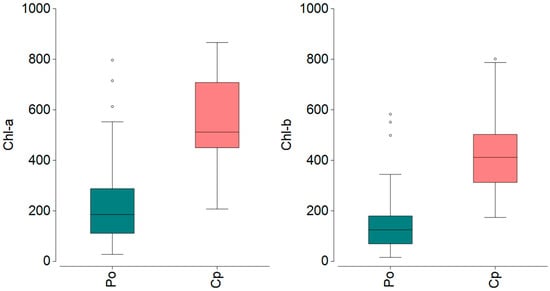
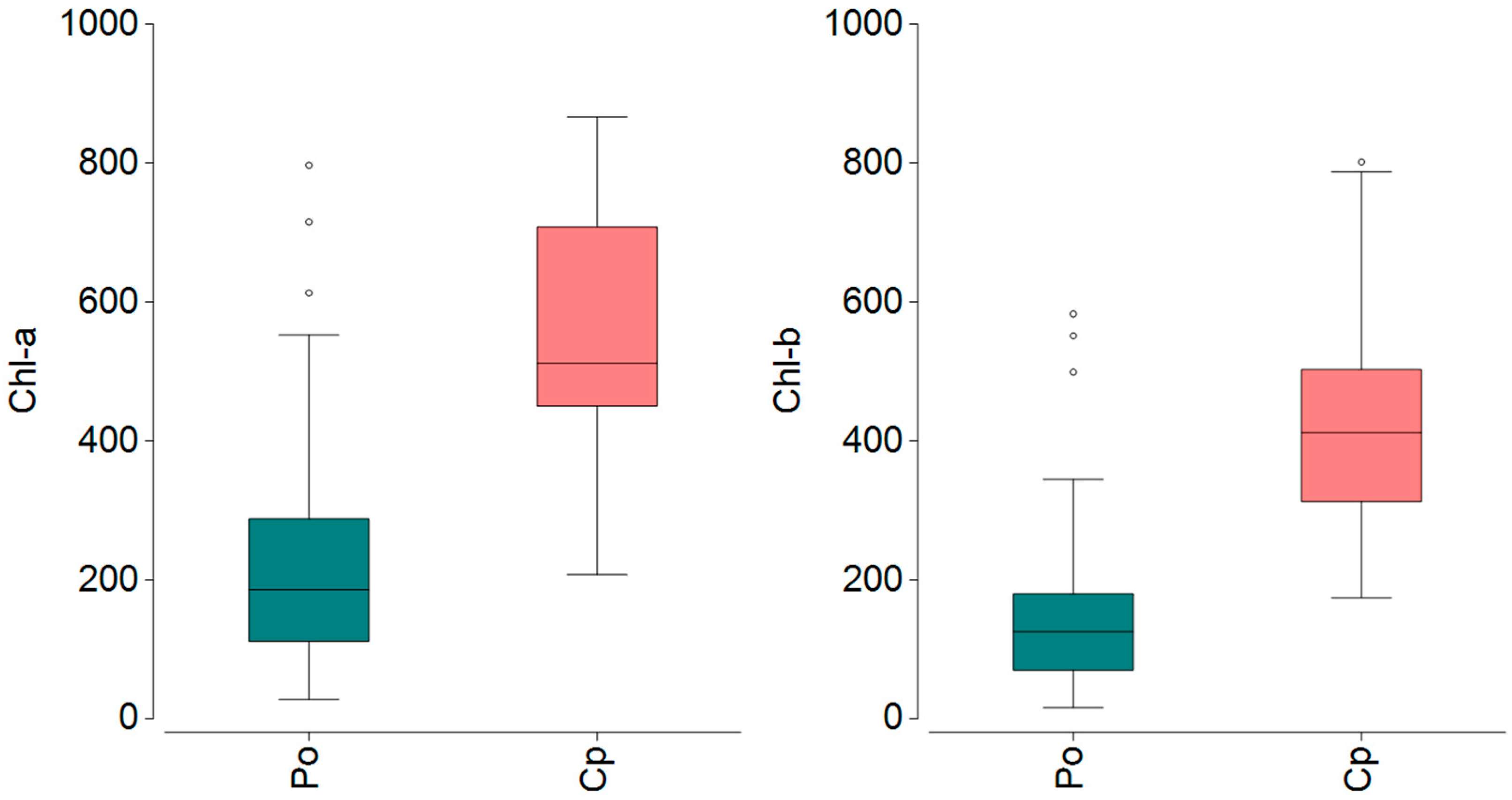
Descriptive statistics of chlorophyll content, total proteins and antioxidant biomarkers in P. oceanica (Table 2) and C. prolifera (Table 3) are reported. In P. oceanica, chlorophyll-a and chlorophyll-b showed high variability, as indicated by the wide range of values and elevated standard deviations. Total protein concentrations were relatively high, with moderate dispersion among samples. Antioxidant enzyme activities (SOD, GPx and GST) and lipid peroxidation levels (LPO) exhibited lower variability, suggesting a more homogeneous biochemical response across samples. In Caulerpa prolifera, chlorophyll-a and chlorophyll-b concentrations showed relatively high mean values, with moderate variability, as indicated by the standard deviations. Total protein content was high across samples, with a moderate dispersion suggesting, also in this species, overall homogeneous protein levels. Caulerpa prolifera showed substantially higher mean concentrations of chlorophyll-a and chlorophyll-b compared to P. oceanica, with values more than two-fold higher for both pigments, indicating a greater photosynthetic pigment investment (Figure 1). Variability in chlorophyll content was high in both species, but slightly more pronounced in P. oceanica, as suggested by higher relative dispersion. Total protein concentrations were comparable between the two species, with slightly higher mean values observed in P. oceanica, suggesting similar overall metabolic investment. Antioxidant enzyme activities (SOD, GPx and GST) exhibited very similar mean values and low variability in both species, indicating comparable antioxidant capacity and suggesting the absence of strong species-specific oxidative stress responses. Lipid peroxidation levels were slightly higher in C. prolifera than in P. oceanica, although values remained within a comparable range, suggesting mild differences in oxidative status rather than clear stress-related effects.
Table 2.
Descriptive statistics of chlorophyll content, total proteins and antioxidant biomarkers in Posidonia oceanica.
Table 3.
Descriptive statistics of chlorophyll content, total proteins and antioxidant biomarkers in Caulerpa prolifera.
Figure 1.
Boxplots of chlorophyll-a (Chl-a) and chlorophyll-b (Chl-b) concentrations (µg g−1) measured in Posidonia oceanica (Po) and Caulerpa prolifera (Cp). Boxes represent the interquartile range (25th–75th percentile), the horizontal line indicates the median, whiskers show the minimum and maximum values excluding outliers, and dots represent outliers.
These findings are consistent with multivariate statistical analyses. The one-way ANOSIM revealed a clear and significant effect of species, with a global R statistic of 0.326 and a significance level of 0.01%, indicating a marked separation between species that is principally due to the difference among levels of Chl-a,b photosynthetic pigments consistent with the marked differences observed in Chl-a,b.
3.2. Significance of Tested Factors in Posidonia oceanica
Chlorophyll-a and chlorophyll-b levels showed a strong positive correlation (Draftsman Plot, r = 0.983), whereas a weak negative relationship was observed between total proteins and GPx activity (Draftsman Plot, r = −0.565).
Box plots obtained by grouping data according to the tested factors (i.e., concentration, exposure time and salinity) highlighted clear patterns in pigment content and biochemical responses in Posidonia oceanica. Chlorophyll-a and chlorophyll-b showed a reduction in median values at C1 (environmentally relevant concentration of TiO2), with median Chl-a and Chl-b values of approximately 160 µg g−1 and 110 µg g−1, respectively. In contrast, higher concentrations (C2) induced a stimulatory effect, with median values increasing to about 200 µg g−1 for Chl-a and 140 µg g−1 for Chl-b.
During the exposure period, Chl-a and Chl-b levels progressively increased up to T6, reaching median values of approximately 320 µg g−1 for Chl-a and 190 µg g−1 for Chl-b. A marked decrease was observed from T9 onwards, with median values dropping to around 170 µg g−1 (Chl-a) and 110 µg g−1 (Chl-b). Even after 6 and 12 days of recovery, pigment concentrations did not return to baseline (T0) values, which showed median levels of approximately 200 µg g−1 for Chl-a and 120 µg g−1 for Chl-b.
GPx activity showed a decreasing trend over time, reaching the lowest median values at the end of the exposure period (T6–T12), with medians around 6–7 nmol mg−1 min−1. A recovery of GPx activity was observed after 6 days of recovery, with median values increasing to approximately 8 nmol mg−1 min−1 and reaching levels close to T0 (about 10 nmol mg−1 min−1) after 12 days of recovery (T12r). Lipid peroxidation (LPO) exhibited an early increase at T3, with median values around 1.2 U mg−1, but returned to T0 levels (approximately 0.9 U mg−1) by T6 and remained stable until the end of the exposure.
Salinity strongly influenced the analyzed parameters. Low salinity conditions (36 g kg−1) resulted in reduced median values of Chl-a and Chl-b (approximately 140 µg g−1 and 90 µg g−1, respectively) compared to standard (40 g kg−1; medians around 200 and 120 µg g−1) and high salinity levels (45 g kg−1; medians around 190 and 120 µg g−1), together with a wider range of variability.
Total protein content decreased under low salinity, with median values of approximately 6200 µg mL−1, while median TP values under optimal salinity remained higher (around 7500 µg mL−1). Under high salinity conditions, TP showed the widest range of variation, with median values around 7800 µg mL−1.
Under low salinity conditions, GST exhibited the highest median activity (approximately 0.36 µmol µg−1 min−1), while LPO levels were also higher (median around 1.1 U mg−1), although the widest variability in LPO was observed at high salinity levels.
Multivariate analyses (Table 4) highlighted different contributions of the tested factors to the overall biochemical variability in Posidonia oceanica. The factor exposure time did not produce a significant separation among groups (global ANOSIM R = −0.356, p = 0.097), indicating a high degree of overlap among temporal levels when exposure was used as the sampling structure. This lack of temporal discrimination is consistent with the patterns observed in the box plots, where several parameters showed an initial variation during exposure followed by a progressive return toward baseline values during the recovery phase, resulting in an overall attenuation of time-related multivariate differences. Pairwise comparisons between time levels further confirmed the absence of clear temporal separation, with mostly low or negative R values and non-significant results.
Table 4.
Summary of ANOSIM (three-way nested) results for Posidonia oceanica. R values close to zero or negative indicate little or no separation among groups, whereas higher positive values indicate increasing multivariate dissimilarity. Significance levels are based on permutation tests.
In contrast, the factor exposure emerged as the main driver of multivariate differences. The global ANOSIM test revealed a significant effect of exposure condition (average R = 0.519, p = 0.012%), indicating a moderate but clear separation among unexposed, exposed, and recovery groups across all time points. This result suggests that exposure status induced coherent multivariate shifts in the biochemical profile of P. oceanica, overriding temporal variability.
Salinity also showed a significance, although weaker, influence on the multivariate structure of the data (average R = 0.16, p = 0.027%). The low R value indicates partial overlap among salinity groups, suggesting that salinity acted as a secondary factor modulating biological responses rather than as a dominant source of variability.
Overall, multivariate results indicate that biochemical responses in P. oceanica were primarily structured by exposure conditions, with salinity exerting a subordinate effect, while temporal variability was mitigated by recovery processes leading to a convergence toward baseline conditions.
3.3. Significant of Tested Factors in Caulerpa prolifera
In this species, chlorophyll-a and chlorophyll-b levels showed a strong positive correlation (Draftsman Plot, r = 0.884), whereas a weak negative relationship was observed between total proteins and GST activity (r = −0.572). In addition, a weak positive association was detected between total proteins and SOD activity (r = 0.484).
Box plots obtained by grouping data according to the tested factors (i.e., concentration, exposure time and salinity) highlighted clear patterns in pigment content and biochemical responses in Caulerpa prolifera. Chlorophyll-a and chlorophyll-b showed a progressive increase in median values at C1 (environmentally relevant concentration of TiO2), with median values of approximately 550 µg g−1 for Chl-a and 420 µg g−1 for Chl-b, and a further increase at C2 (high TiO2 levels), reaching median values of about 620 µg g−1 and 460 µg g−1, respectively. This pattern indicates a clear stimulatory effect, accompanied by an increase in data variability.
Furthermore, total protein (TP) median levels increased at C2 (approximately 8200 µg mL−1), associated with higher SOD median activity (around 3.4 U mL−1). In contrast, GPx showed higher median values at C1 (approximately 11 nmol mg−1 min−1), while median values at C2 were comparable to those observed in controls (around 10 nmol mg−1 min−1).
During the exposure period, Chl-a and Chl-b levels increased up to T3, reaching median values of approximately 650 µg g−1 and 500 µg g−1, respectively, and then progressively decreased, returning close to control levels by the end of the exposure (T12; medians around 500 µg g−1 for Chl-a and 360 µg g−1 for Chl-b). During the first sampling time of the recovery phase (T6r), both photosynthetic pigments showed their lowest median values (approximately 450 µg g−1 for Chl-a and 300 µg g−1 for Chl-b). However, at T12r, median values reached the highest levels observed throughout the experiment, exceeding those recorded during the exposure phase (approximately 700 µg g−1 for Chl-a and 500 µg g−1 for Chl-b).
Regarding TP, the highest median values were recorded at T3 (approximately 8500 µg mL−1), while at all subsequent times TP medians remained higher than those observed at T0 (around 6800 µg mL−1), although relatively constant. SOD median values remained stable during the exposure phase (T3–T12; approximately 3.1 U mL−1), showed the lowest median levels during early recovery (T6r; around 2.7 U mL−1), and reached the highest median values at T12r (approximately 3.6 U mL−1).
An opposite pattern was observed for GST during the recovery phase, with median values decreasing at T12r (approximately 0.29 µmol µg−1 min−1), while GPx median levels fluctuated throughout the experiment and remained consistently lower than control values (T0 ≈ 13 nmol mg−1 min−1) at all exposure and recovery times. Lipid peroxidation (LPO) showed a progressive increase in median values compared to controls starting from T3 (≈1.2 U mg−1), reaching the highest and relatively constant median values during the T6–T12 interval (≈1.4–1.5 U mg−1). During recovery, a marked reduction in LPO median values was observed (≈1.0 U mg−1).
Salinity did not markedly affect median values of Chl-a, Chl-b, TP, GPx or GST. In contrast, significant effects were observed for SOD and LPO. In both cases, the lowest and highest salinity levels reduced SOD median values compared to control salinity (38 g kg−1 ≈ 3.1 U mL−1), with the strongest reduction observed at low salinity (34 g kg−1; ≈2.8 U mL−1). LPO showed an opposite trend, with the highest median values recorded under low salinity conditions (≈1.6 U mg−1).
Multivariate analyses (Table 5) highlighted different contributions of the tested factors to the overall biochemical variability in C. prolifera. Overall, multivariate results indicate that biochemical responses in C. prolifera displayed a more diffuse and non-significant multivariate structure, suggesting higher physiological plasticity and a less integrated response to the tested stressors.
Table 5.
Summary of ANOSIM (three-way nested) results for Caulerpa prolifera. R values close to zero or negative indicate little or no separation among groups, whereas higher positive values indicate increasing multivariate dissimilarity. Significance levels are based on permutation tests.
4. Discussion
4.1. Functional and Ecological Divergence
Chlorophyll content is commonly used as a functional proxy of photosynthetic status and is known to respond to a wide range of environmental constraints. Variations in chlorophyll levels are therefore frequently interpreted as early signals of physiological stress in marine macrophytes [41]. At the same time, oxidative stress biomarkers, including antioxidant enzymes and lipid peroxidation, provide complementary information on cellular defence mechanisms and potential damage pathways activated under adverse conditions, such as salinity fluctuations or contaminant exposure [42].
Based on the experimental design adopted here and on the multivariate structure of the dataset, clear differences emerged between Posidonia oceanica and Caulerpa prolifera in the way physiological responses were organized. In Posidonia oceanica, the strong positive correlation between chlorophyll-a and chlorophyll-b reflects their tightly coordinated role within the photosynthetic apparatus. In contrast, the weak negative relationship observed between total protein content and GPx activity should not be interpreted as a direct functional trade-off, but rather as a loose association, potentially mediated by broader metabolic adjustments.
A similar positive coupling between chlorophyll-a and chlorophyll-b was observed in C. prolifera. However, in this species, the relationships between total proteins and antioxidant enzymes (GST and SOD) were weak and inconsistent, suggesting that changes in protein content were not systematically associated with oxidative stress responses. This points to a more decoupled regulation of individual biochemical pathways.
The combined action of chemical exposure and salinity variability appeared to represent a more critical condition for P. oceanica than for C. prolifera. In Posidonia oceanica, the three-way nested ANOSIM clearly identified exposure as the main driver of multivariate biochemical differentiation, while salinity exerted a significant, albeit secondary, effect. Time, by contrast, did not significantly structure the multivariate space. This pattern suggests that exposure conditions induced coherent physiological shifts, whereas salinity acted as a modulating factor influencing the magnitude and direction of those shifts. Such a role of salinity is consistent with previous evidence showing that osmotic fluctuations can affect photosynthetic performance and metabolic regulation in seagrasses, potentially altering their sensitivity to additional stressors [3,43].
Univariate patterns observed in the box plots agree with this interpretation. Under salinity values departing from the control condition, P. oceanica exhibited reduced chlorophyll levels together with increased variability in oxidative stress-related markers. This combination suggests a reduced physiological buffering capacity when osmotic and chemical stressors co-occur. Importantly, the absence of a significant temporal effect in the multivariate analysis is also coherent with the recovery trends observed at the univariate level. Several parameters showed an initial response during exposure followed by a gradual return toward baseline values, resulting in an overall convergence of biochemical profiles over time. Such convergence can effectively dampen temporal separation in multivariate space, even in the presence of short-term physiological disturbances.
A markedly different picture emerged for C. prolifera. Although box plots revealed clear changes in pigments and selected oxidative stress markers across concentrations, exposure times and salinity levels, these variations did not translate into a significant multivariate structuring of the dataset. Neither exposure nor salinity emerged as dominant factors in the three-way nested ANOSIM. This diffuse multivariate response suggests that C. prolifera may rely on flexible, pathway-specific adjustments rather than on a coordinated reorganization of its overall physiological state. Such behaviour is consistent with the ecological profile of opportunistic macroalgae, which are often characterized by rapid acclimation and tolerance to environmental variability [19].
Taken together, these results indicate an asymmetric response to combined stressors. In Posidonia oceanica, chemical exposure produced an integrated multivariate response that was further modulated by salinity conditions, whereas in C. prolifera responses remained more compartmentalized and less structured at the multivariate level. From an ecological perspective, this suggests that combined chemical and osmotic stress may impose higher physiological costs on the seagrass than on the macroalga, even when partial recovery is possible.
4.2. Posidonia oceanica &Caulerpa spp. As Contrasting Ecological Strategies
Posidonia oceanica and Caulerpa species represent two functionally and ecologically divergent groups of Mediterranean macrophytes. Posidonia oceanica is an endemic seagrass and a foundation species of Mediterranean coastal ecosystems, forming extensive and persistent meadows that enhance biodiversity, promote sediment stabilization and provide coastal protection [22,44]. Despite its ecological importance, P. oceanica is generally characterized by limited physiological plasticity, which contributes to its vulnerability under changing environmental conditions and cumulative anthropogenic pressures [45,46,47].
In contrast, Caulerpa species are green macroalgae with high colonization capacity, rapid growth rates and broad tolerance ranges. Species such as C. prolifera are often favoured in disturbed or fluctuating environments, where they can persist or expand even under suboptimal conditions for seagrasses. This ecological flexibility may allow Caulerpa to gain a competitive advantage in systems undergoing environmental degradation or increased variability [19].
Furthermore, recent studies have shown that Caulerpa species harbour highly diverse and species-specific endosymbiotic bacterial communities. In a comparative analysis of four Caulerpa species, most bacterial taxa were unique to each host, while only a minor fraction formed a shared “core” microbiome [48]. These host-specific bacterial assemblages suggest potential coevolutionary relationships and may contribute to the physiological performance, ecological adaptability, and resilience of Caulerpa genus. Incorporating the microbiome perspective reinforces the view of Caulerpa as a highly flexible genus capable of thriving under variable and disturbed environmental conditions.
Posidonia oceanica meadows remain structurally functional in deeper areas, shallow portions are under increasing threat from cumulative stressors, including mechanical damage from anchoring, turbidity, nutrient enrichment, and emerging contaminants. The concurrent presence of Caulerpa spp. in impacted zones further underscores the risk of an early-stage functional shift toward macroalgal-dominated assemblages. Targeted conservation strategies—such as anchoring regulation, nutrient input control, and early detection of opportunistic and invasive macroalgal species—are urgently needed to preserve the ecological integrity of this coastal system.
As Mediterranean coastal systems are increasingly exposed to salinity variability driven by climatic and hydrological changes, osmotic stress is likely to interact with other pressures. Even moderate departures from optimal salinity values have been shown to affect photosynthetic performance and physiological status in P. oceanica [3]. Under such conditions, additional stressors may further constrain the capacity of the seagrass to maintain functional stability.
At the same time, engineered nanomaterials such as TiO2 nanoparticles are increasingly recognized as emerging contaminants in coastal waters, due to multiple release pathways associated with urban activities and consumer products [9]. These particles can interact with biological systems and contribute to oxidative stress in photosynthetic organisms [42]. The interaction between osmotic variability and chemical exposure therefore represents a realistic and ecologically relevant stress scenario.
4.3. Ecological Implications
Within this framework, the present results suggest that P. oceanica may be particularly sensitive to multi-stressor conditions, where chemical exposure induces an integrated physiological response that is further influenced by salinity. Although recovery processes appear to mitigate temporal effects at the biochemical level, repeated or chronic exposure events could still impose cumulative costs over longer timescales. In contrast, the weaker multivariate structuring observed in C. prolifera suggests a higher capacity to accommodate multiple stressors without a pronounced system-level reorganization.
Such divergence in response organization may (or not) have important ecological consequences, either positive or negative, for the study plants. Under scenarios of increasing environmental variability and contaminant inputs, opportunistic macroalgae may be favoured over habitat-forming seagrasses, potentially leading to shifts in community structure and ecosystem functioning. These patterns are consistent with broader concerns regarding the vulnerability of seagrass ecosystems under cumulative pressures [18,44].
4.4. Limits and Relevance of This Study
This study was conducted under controlled laboratory conditions and over a relatively limited time span, focusing on biochemical and functional endpoints such as pigment content, antioxidant activity and lipid peroxidation. These markers are widely recognized as sensitive indicators of early physiological stress, but they do not necessarily translate directly into population- or meadow-level consequences, especially for long-lived foundation species such as Posidonia oceanica [18,21]. For this reason, the results should be interpreted as evidence of physiological disturbance and response capacity, rather than as direct predictors of long-term ecosystem change.
Another important limitation is that, despite the inclusion of multiple experimental factors, laboratory experiments cannot fully reproduce the complexity of coastal systems under global change. In natural environments, macrophytes are simultaneously exposed to a suite of interacting pressures, including temperature increase, marine heatwaves, changes in hydrodynamics, eutrophication and light reduction, which may act together with chemical contamination [44,46,49]. The simplified setting adopted here therefore represents a necessary compromise, allowing mechanistic interpretation while inevitably reducing environmental realism.
Within these limits, the present study remains ecologically relevant for several reasons. First, it explicitly adopts a multi-stressor perspective and compares two macrophytes with contrasting ecological strategies: a slow-growing, habitat-forming seagrass (P. oceanica) and a fast-growing, opportunistic macroalga (Caulerpa prolifera). Such comparisons are particularly informative in the Mediterranean context, where cumulative pressures are increasingly recognized as key drivers of ecosystem change [1,22,44]. Second, the inclusion of a recovery phase provides insight into the potential reversibility of physiological responses, an aspect that is often neglected in short-term ecotoxicological studies but is highly relevant for coastal systems characterized by episodic disturbances and pulsed contaminant inputs [18].
Finally, these results contribute to the growing discussion on emerging contaminants in coastal environments. Engineered nanomaterials such as titanium dioxide nanoparticles are increasingly released into marine waters through diffuse urban sources and wastewater pathways, and their biological effects are known to depend strongly on environmental context [9,42]. The species-specific patterns observed here suggest that chemical stress may interact with physical drivers such as salinity in ways that amplify vulnerability in some taxa while being more readily accommodated by others.
4.5. Future Perspectives
Future research should aim to move beyond short-term physiological responses and better connect sublethal biochemical changes to ecologically meaningful outcomes. In particular, longer experiments and repeated exposure–recovery cycles would help clarify whether the partial recovery observed in this study persists under chronic or recurring stress, which is increasingly likely under ongoing global change [44,46].
There is also a clear need to increase ecological realism. Mesocosm and field-based studies, where natural variability in light, temperature, hydrodynamics and sediment processes is preserved, would allow a more robust assessment of how macrophytes respond to multiple stressors acting simultaneously [49]. Such approaches are especially important when considering nanomaterials, whose aggregation, reactivity and bioavailability can be strongly modified by environmental conditions [42].
From a mechanistic point of view, integrating classical biochemical biomarkers with omics-based tools (e.g., transcriptomics and metabolomics) represents a promising direction. These approaches could help identify the molecular pathways underlying stress integration, tolerance and recovery, and clarify why species such as P. oceanica show more integrated multivariate responses, whereas opportunistic macroalgae appear more flexible [50].
Finally, linking experimental results with cumulative-impact and scenario-based models would improve their relevance for management and conservation. In Mediterranean coastal hotspots, where salinity variability, warming and chemical contamination are expected to intensify and co-occur, such integrative approaches will be essential to anticipate shifts in community structure and to support strategies aimed at preserving seagrass meadows and the ecosystem services they provide [18,20,44].
5. Conclusions
This study highlights the importance of adopting multifactorial experimental approaches to investigate the responses of marine macrophytes to combined stressors. The results indicate that exposure to nano-TiO2 can alter biochemical and functional endpoints, and that salinity conditions contribute to shaping these responses, particularly in Posidonia oceanica. While recovery processes suggest a degree of physiological reversibility, the integrated nature of the response in the seagrass points to a higher sensitivity under combined stress conditions.
In contrast, Caulerpa prolifera displayed a more diffuse multivariate response, despite evident changes at the univariate level. This pattern suggests a greater capacity for flexible physiological adjustment, which may confer an advantage in disturbed environments. Over time, under chronic nanoparticle contamination and ecological salinity stress, such differences may facilitate its expansion of Caulerpa in anthropogenically impacted areas and could contribute to shifts in benthic community composition, with potential losses of ecosystem services associated with seagrass meadows.
Such structured research based on multifactorial design—combining chemical exposure, ecological stress, and recovery analysis across competing species—should be developed in the future to goes beyond traditional single-stressor studies allowing a better comprehension of ecological dynamics in a global-changing scenario.
Author Contributions
Conceptualization, M.R. and S.A.; methodology, I.B. and F.P.; software, S.A.; validation, E.G.; formal analysis, F.P., I.B. and E.G.; investigation, I.B., E.G. and F.P.; resources, M.R.; data curation, S.A.; writing—original draft preparation, M.R. I.B. and S.A.; writing—review and editing, visualization, supervision, project administration, funding acquisition, M.R. All authors have read and agreed to the published version of the manuscript.
Funding
This research was supported by the Bioscience Research Center under internal grant No. RG_55_2025 (Principal Investigator: M. Renzi).
Data Availability Statement
The raw data supporting the conclusions of this article will be made available by the authors on request.
Acknowledgments
During the preparation of this manuscript/study, the authors used ChatGPT v.5.2 for the English correction. The authors have reviewed and edited the output and take full responsibility for the content of this publication.
Conflicts of Interest
The authors declare no conflicts of interest.
References
- Orth, R.J.; Carruthers, T.J.; Dennison, W.C.; Duarte, C.M.; Fourqurean, J.W.; Heck, K.L.; Hughes, A.R.; Kendrick, G.A.; Kenworthy, W.J.; Olayarnik, S.; et al. A global crisis for seagrass ecosystems. BioScience 2006, 56, 987–996. [Google Scholar] [CrossRef] [Scilit]
- Duarte, C.M.; Marbà, N.; Gacia, E.; Fourqurean, J.W.; Beggins, J.; Barrón, C.; Apostolaki, E.T. Seagrass community metabolism: Assessing the carbon sink capacity of seagrass meadows. Glob. Biogeochem. Cycles 2010, 24, GB4032. [Google Scholar] [CrossRef] [Scilit]
- Touchette, B.W. Seagrass–salinity interactions. J. Exp. Mar. Biol. Ecol. 2007, 350, 194–215. [Google Scholar] [CrossRef] [Scilit]
- Fernández-Torquemada, Y.; Sánchez-Lizaso, J.L. Effects of salinity on leaf growth and survival of the Mediterranean seagrass Posidonia oceanica. J. Exp. Mar. Biol. Ecol. 2005, 320, 57–63. [Google Scholar] [CrossRef] [Scilit]
- Mancuso, F.P.; Bernardeau-Esteller, J.; Spinelli, M.; Sarà, G.; Ruiz, J.M.; Calvo, S.; Tomasello, A. Life on the edge: Adaptations of Posidonia oceanica to hypersaline conditions. Environ. Exp. Bot. 2023, 210, 105320. [Google Scholar] [CrossRef] [Scilit]
- Meinesz, A.; Cirik, Ş.; Akcali, B.; Javel, F.; Migliaccio, M.; Thibaut, T.; Yüksek, A.; Procaccini, G. Posidonia oceanica in the Marmara Sea. Aquat. Bot. 2009, 90, 18–22. [Google Scholar] [CrossRef] [Scilit]
- Ma, H.; Williams, P.L.; Diamond, S.A. Ecotoxicity of manufactured ZnO nanoparticles: A review. Environ. Pollut. 2010, 172, 137–149. [Google Scholar] [CrossRef] [Scilit] [PubMed]
- Hund-Rinke, K.; Simon, M. Ecotoxic effect of photocatalytic active nanoparticles (TiO2) on algae and daphnids. Environ. Sci. Pollut. Res. 2006, 13, 225–232. [Google Scholar] [CrossRef] [Scilit] [PubMed]
- Keller, A.A.; McFerran, S.; Lazareva, A.; Suh, S. Global life cycle releases of engineered nanomaterials. J. Nanopart. Res. 2013, 15, 1692. [Google Scholar] [CrossRef] [Scilit]
- Rastogi, A.; Zivcak, M.; Sytar, O.; Kalaji, H.M.; He, X.; Mbarki, S.; Brestic, M. Impact of metal and metal oxide nanoparticles on plants: A critical review. Front. Chem. 2017, 5, 78. [Google Scholar] [CrossRef] [Scilit] [PubMed]
- Trela-Makowej, A.; Orzechowska, A.; Szymańska, R. Less is more: The hormetic effect of titanium dioxide nanoparticles on plants. Sci. Total Environ. 2024, 910, 168669. [Google Scholar] [CrossRef] [Scilit] [PubMed]
- Moshirian Farahi, S.M.; Taghavizadeh Yazdi, M.E.; Einafshar, E.; Akhondi, M.; Ebadi, M.; Azimipour, S.; Mahmoodzadeh, H.; Iranbakhsh, A. The effects of titanium dioxide (TiO2) nanoparticles on physiological, biochemical, and antioxidant properties of Vitex plant (Vitex agnus-castus L.). Heliyon 2023, 9, e22144. [Google Scholar] [CrossRef] [Scilit]
- Anselmi, S.; Cavallo, A.; Del Rio, L.; Renzi, M. Impact of global change on environmental hazards of different clays: A case study on Aliivibrio fischeri. J. Hazard. Mater. 2023, 457, 131806. [Google Scholar] [CrossRef] [Scilit] [PubMed]
- Vellani, V.; Cuccaro, A.; Oliva, M.; Pretti, C.; Renzi, M. Assessing combined effects of long-term exposure to copper and marine heatwaves on the reef-forming serpulid Ficopomatus enigmaticus through a biomarker approach. Mar. Pollut. Bull. 2024, 201, 116269. [Google Scholar] [CrossRef] [Scilit]
- Vellani, V.; Oliva, M.; Pretti, C.; Renzi, M. Stress-related molecular biomarkers to monitor the effects of global changes on calcifying reef-forming organisms: A review in the Mediterranean. J. Mar. Sci. Eng. 2025, 13, 4. [Google Scholar] [CrossRef] [Scilit]
- Scarcelli, F.; Spadaro, C.; Ienco, A.; Osso, V.; Giovannelli, P.; Greco, S.; Mazzuca, S.; Piro, A. Evaluation of the ecological status of Posidonia oceanica meadows along the Calabrian coasts. Ecol. Indic. 2025, 173, 113408. [Google Scholar] [CrossRef] [Scilit]
- Parreira, F.; Martínez-Crego, B.; Afonso, C.M.L.; Machado, M.; Oliveira, F.; dos Santos Gonçalves, J.M.; Santos, R. Biodiversity consequences of Caulerpa prolifera takeover of a coastal lagoon. Estuar. Coast. Shelf Sci. 2021, 255, 107344. [Google Scholar] [CrossRef] [Scilit]
- Pergent, G.; Bazairi, H.; Bianchi, C.N.; Boudouresque, C.F.; Buia, M.C.; Calvo, S.; Clabaut, P.; Harmelin-Vivien, M.; Mateo, M.A.; Montefalcone, M.; et al. Climate change and Mediterranean seagrass meadows: A synopsis for environmental managers. Mediterr. Mar. Sci. 2014, 15, 462–473. [Google Scholar] [CrossRef] [Scilit]
- Piazzi, L.; Ceccherelli, G. Persistence of biological invasion effects: Recovery of native macroalgal assemblages after removal of Caulerpa racemosa var. cylindracea. Estuar. Coast. Shelf Sci. 2006, 68, 455–461. [Google Scholar] [CrossRef] [Scilit]
- Boudouresque, C.F.; Bernard, G.; Bonhomme, P.; Charbonnel, E.; Diviacco, G.; Meinesz, A.; Pergent, G.; Pergent-Martini, C.; Ruitton, S.; Tunesi, L. Protection and Conservation of Posidonia oceanica Meadows; RAMOGE & RAC/SPA: Monaco, Monaco, 2012. [Google Scholar]
- Duarte, C.M. The future of seagrass meadows. Environ. Conserv. 2002, 29, 192–206. [Google Scholar] [CrossRef] [Scilit]
- Boudouresque, C.F.; Mayot, N.; Pergent, G. The outstanding traits of the functioning of the Posidonia oceanica seagrass ecosystem. Biol. Mar. Medit. 2006, 13, 109–113. [Google Scholar]
- ARPAT. Monitoraggio DELLE acque Marino-Costiere in Toscana—Relazione Tecnica 2019; Regione Toscana: Florence, Italy, 2019. [Google Scholar]
- Montefalcone, M.; Parravicini, V.; Vacchi, M.; Albertelli, G.; Morri, C.; Bianchi, C.N. Human influence on seagrass habitat fragmentation. Estuar. Coast. Shelf Sci. 2010, 86, 292–298. [Google Scholar] [CrossRef] [Scilit]
- Borowitzka, M.A.; Lavery, P.S.; van Keulen, M. Epiphytes of seagrasses. In Seagrasses: Biology, Ecology and Conservation; Larkum, A.W.D., Orth, R.J., Duarte, C.M., Eds.; Springer: Berlin/Heidelberg, Germany, 2006; pp. 441–461. [Google Scholar]
- Ruitton, S.; Verlaque, M.; Boudouresque, C.F. Seasonal changes of Caulerpa racemosa var. cylindracea. Aquat. Bot. 2005, 82, 55–70. [Google Scholar] [CrossRef] [Scilit]
- Astudillo-Gutierrez, C.; Pavo-Fernandez, E.; Gracia, V.; Sierra, J.P.; Llull, T.; Mosso, C.; Sanchez-Artus, X.; Sanchez-Arcilla, A. Posidonia oceanica banquette accumulations in southern Catalonia: Management approaches and key parameters for coastal protection. Front. Mar. Sci. 2025, 12, 1681826. [Google Scholar] [CrossRef] [Scilit]
- Terracciano, S.; Montes, J.; Brunetta, R.; Cabrita, P.; Ciavola, P.; Armaroli, C. Influence of Posidonia oceanica accumulation on beach morphodynamics: A remote sensing study. Coast. Eng. 2025, 205, 104933. [Google Scholar] [CrossRef] [Scilit]
- Marbà, N.; Duarte, C.M. Rhizome elongation and seagrass clonal growth. Mar. Ecol. Prog. Ser. 1998, 174, 269–280. [Google Scholar] [CrossRef] [Scilit]
- Wellburn, A.R. The spectral determination of chlorophylls a and b. J. Plant Physiol. 1994, 144, 307–313. [Google Scholar] [CrossRef] [Scilit]
- Pignattelli, S.; Broccoli, A.; Renzi, M. Physiological responses of garden cress (Lepidium sativum) to different types of microplastics. Sci. Total Environ. 2020, 727, 138609. [Google Scholar] [CrossRef] [Scilit] [PubMed]
- Pastorino, P.; Broccoli, A.; Anselmi, S.; Bagolin, E.; Prearo, M.; Barceló, D.; Renzi, M. The microalgae Chaetoceros tenuissimus exposed to contaminants of emerging concern: A potential alternative to standardized species for marine quality assessment. Ecol. Indic. 2022, 141, 109075. [Google Scholar] [CrossRef] [Scilit]
- Provenza, F.; Pastorino, P.; Anselmi, S.; Leporatti Persiano, M.; Scirocco, T.; De Rinaldis, G.; Fossi, M.C.; Panti, C.; Renzi, M.; Specchiulli, A. Chemical pollution and ecotoxicological effects of high-density polyethylene microplastics in Mytilus galloprovincialis from two Italian lagoon ecosystems. Environ. Toxicol. Pharmacol. 2023, 98, 104075. [Google Scholar] [CrossRef] [Scilit] [PubMed]
- Gao, R.; Yuan, Z.; Zhao, Z.; Gao, X. Mechanism of pyrogallol autoxidation and determination of superoxide dismutase enzyme activity. Bioelectrochem. Bioenerg. 1998, 45, 41–45. [Google Scholar] [CrossRef] [Scilit]
- Badary, O.A.; Abdel-Maksoud, S.; Ahmed, W.A.; Owieda, G.H. Naringenin attenuates cisplatin nephrotoxicity in rats. Life Sci. 2005, 76, 2125–2135. [Google Scholar] [CrossRef] [Scilit] [PubMed]
- Habig, W.H.; Pabst, M.J.; Jakoby, W.B. Glutathione S-transferases: The first enzymatic step in mercapturic acid formation. J. Biol. Chem. 1974, 249, 7130–7139. [Google Scholar] [CrossRef] [Scilit]
- Clarke, K.R.; Warwick, R.M. Change in Marine Communities: An Approach to Statistical Analysis and Interpretation, 2nd ed.; PRIMER-E: Plymouth, UK, 2001. [Google Scholar]
- Anderson, M.J.; Gorley, R.N.; Clarke, K.R. PERMANOVA+ for PRIMER: Guide to Software and Statistical Methods; PRIMER-E: Plymouth, UK, 2008. [Google Scholar]
- Clarke, K.R.; Gorley, R.N. PRIMER v7: User Manual/Tutorial; PRIMER-E: Plymouth, UK, 2015. [Google Scholar]
- Clarke, K.R. Non-parametric multivariate analyses of changes in community structure. Aust. J. Ecol. 1993, 18, 117–143. [Google Scholar] [CrossRef] [Scilit]
- Ralph, P.J.; Durako, M.J.; Enriquez, S.; Collier, C.J.; Doblin, M.A. Impact of light limitation on seagrasses. J. Exp. Mar. Biol. Ecol. 2007, 350, 176–193. [Google Scholar] [CrossRef] [Scilit]
- Gonzalez-Fernandez, C.; Rodea-Palomares, I.; Leganés, F. Nanoparticles in marine systems: Ecotoxicological interactions with photosynthetic organisms. Sci. Total Environ. 2018, 631–632, 1391–1403. [Google Scholar]
- Ralph, P.J.; Tomasko, D.; Moore, K.; Seddon, S.; Macinnis-Ng, C.M.O. Human impacts on seagrasses: Eutrophication, sedimentation, and contamination. Environ. Pollut. 2006, 140, 63–75. [Google Scholar]
- Waycott, M.; Duarte, C.M.; Carruthers, T.J.B.; Orth, R.J.; Dennison, W.C.; Olyarnik, S.; Calladine, A.; Fourqurean, J.W.; Heck, K.L.; Hughes, A.R.; et al. Accelerating loss of seagrasses across the globe threatens coastal ecosystems. Proc. Natl. Acad. Sci. USA 2009, 106, 12377–12381. [Google Scholar] [CrossRef] [Scilit] [PubMed]
- Boudouresque, C.F.; Bernard, G.; Pergent, G.; Shili, A.; Verlaque, M. Regression of Mediterranean seagrasses caused by natural processes and anthropogenic disturbances and stress: A critical review. Bot. Mar. 2009, 52, 395–418. [Google Scholar] [CrossRef] [Scilit]
- Marbà, N.; Duarte, C.M. Mediterranean warming triggers Posidonia oceanica shoot mortality. Glob. Chang. Biol. 2010, 16, 2366–2375. [Google Scholar] [CrossRef] [Scilit]
- Sandoval-Gil, J.M.; Ruiz, J.M.; Marín-Guirao, L.; Bernardeau-Esteller, J.; Sánchez-Lizaso, J.L. Ecophysiological plasticity of shallow and deep populations of Mediterranean seagrasses. Posidonia oceanica and Cymodocea nodosa in response to hypersaline stress. Mar. Environ. Res. 2014, 95, 39–61. [Google Scholar] [CrossRef] [Scilit] [PubMed]
- Delbridge, L.; Coulburn, J.; Fagerberg, W.; Tisa, L.S. Community profiles of bacterial endosymbionts in four species of Caulerpa. Symbiosis 2004, 37, 335–344. [Google Scholar]
- Holon, F.; Marre, G.; Parravicini, V.; Mouquet, N.; Bockel, T.; Descamp, P.; Tribot, A.-S.; Boissery, P.; Deter, J. A predictive model based on multiple coastal anthropogenic pressures explains the degradation status of a marine ecosystem: Implications for management and conservation. Biol. Conserv. 2018, 222, 125–135. [Google Scholar] [CrossRef] [Scilit]
- Marín-Guirao, L.; Ruiz, J.M.; Dattolo, E.; Garcia-Muñoz, R.; Procaccini, G. Physiological and molecular evidence of differential short-term heath tolerance in Mediterranean seagrasses. Sci. Rep. 2016, 6, 28615. [Google Scholar] [CrossRef] [Scilit] [PubMed]

Disclaimer/Publisher’s Note: The statements, opinions and data contained in all publications are solely those of the individual author(s) and contributor(s) and not of MDPI and/or the editor(s). MDPI and/or the editor(s) disclaim responsibility for any injury to people or property resulting from any ideas, methods, instructions or products referred to in the content. |
© 2026 by the authors. Licensee MDPI, Basel, Switzerland. This article is an open access article distributed under the terms and conditions of the Creative Commons Attribution (CC BY) license.