


Abstract
Three female specimens of the caridean shrimp genus Tozeuma, collected off Jeju Island in 2003, 2004, and 2019, are documented as the first Korean records of T. armatum Paulson, 1875 and T. lanceolatum Stimpson, 1860. One specimen is identified as T. armatum based on a rostrum 1.67 times the carapace length and a single recurved median tooth at the posterior end of the third abdominal carina. Two specimens are identified as T. lanceolatum based on the combination of long preserved rostra, each exceeding 2.1 times the carapace length, and a tridentate posterior margin of the third abdominal carina. Both specimens of T. lanceolatum have damaged rostral tips; their preserved rostral proportions therefore represent minimum values. Morphological descriptions, illustrations, and a key to the three species of Tozeuma recorded from Korea are provided. The applicability and limitations of established diagnostic characters are discussed. These historical specimens document previously unreported occurrences in Korean waters, without establishing recent range expansion or resolving the species boundaries between the two nominal species.
1. Introduction
The caridean shrimp genus Tozeuma Stimpson, 1860 currently contains 11 species [1]. Members of Tozeuma are characterized by an extremely slender body, a mandible with only a molar process, the absence of an exopod on the third maxilliped, and a three-articled carpus on the second pereopod [2]. Species of Tozeuma occur in shallow to moderately deep marine habitats, with some species associated with seagrass beds or gorgonians [3,4]. Species identification within the genus is sometimes difficult because several diagnostic characters show morphological variation [5,6].
Prior to this study, the genus Tozeuma was represented in Korean waters by a single species, T. tomentosum (Baker, 1904), characterized by a hirsute integument and a short rostrum [7]. Examination of historical collections revealed three female specimens collected off Jeju Island in 2003, 2004, and 2019, identified as T. armatum Paulson, 1875 and T. lanceolatum Stimpson, 1860. Here, we document these specimens as the first Korean records of the two species, provide morphological descriptions and illustrations, and present a key to the three Korean species of Tozeuma. We also evaluate the applicability and limitations of established diagnostic characters in identifying the Korean material.
2. Materials and Methods
The specimens examined in this study were deposited in the National Institute of Fisheries Science (NIFS), Busan, Korea. Individuals were collected using a bottom otter trawl (mesh size at the cod end = 0.98 × 0.98 mm), operated during daytime for 30–60 min at approximately 3.4 knots. All samples were frozen on board shortly after capture and maintained at −80 °C until their morphological identification in the laboratory. Specimens were photographed after removal from frozen storage and before morphological identification, and were subsequently preserved in 90% ethyl alcohol. The coloration descriptions refer to previously frozen specimens rather than living individuals.
Carapace length (CL) was measured from the posterior margin of the orbit to the posterior mid-dorsal margin of the carapace, and used to indicate specimen size. Rostral length (RL) was measured from the posterior margin of the orbit to the distal tip of the rostrum or, in damaged specimens, to the preserved distal end. Measurements of incomplete rostra are reported as preserved lengths, and the corresponding RL/CL ratios represent minimum values for the original intact structures. Preserved ventral rostral teeth were counted separately for each specimen. Morphological terminology follows Bruce [8] and Chace [5]. Species are arranged in alphabetical order.
3. Results
Systematics
Family Hippolytidae Spence Bate, 1888
Genus Tozeuma Stimpson, 1860
Figure 1.
Tozeuma armatum Paulson, 1875 and Tozeuma lanceolatum Stimpson, 1860 from Korea. (A) T. armatum, female (CL 9.0 mm), NIFS-Cr-20260812-1; (B) T. lanceolatum, female (CL 8.5 mm), NIFS-Cr-20260812-2. Photographs show previously frozen specimens. Scale bars = 5.0 mm.
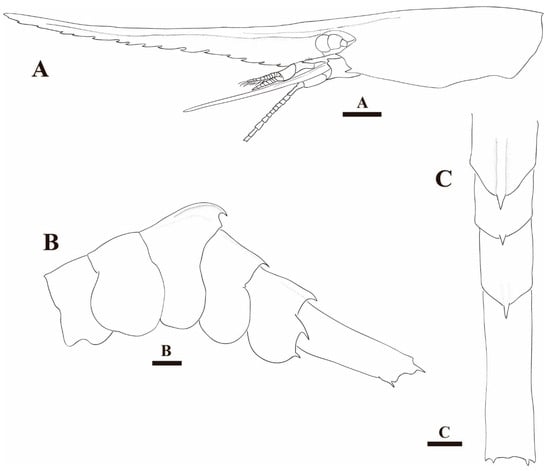
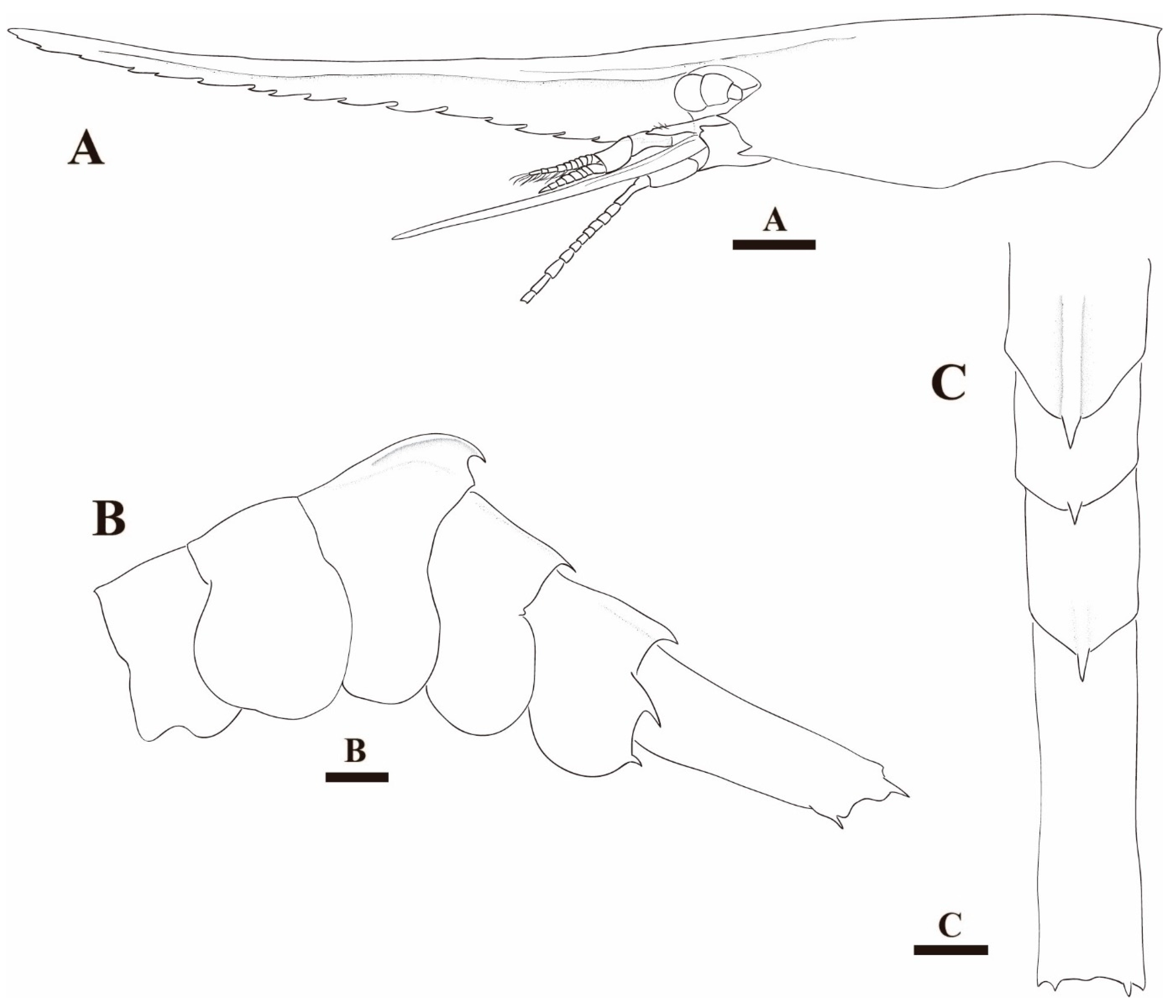
Figure 2.
Tozeuma armatum Paulson, 1875, female (CL 9.0 mm), NIFS-Cr-20260812-1. (A) anterior part of body, setae omitted, lateral view; (B) abdomen, setae omitted, lateral view; (C) third to sixth abdominal somites, dorsal view. Scale bars: (A) = 1.5 mm; (B,C)= 1.0 mm.
Korean name: Top-nal-kko-ma-se-u (톱날꼬마새우)
Tozeuma armatum Paulson [9]: 99, pl. 15, Figure 2a–o (type locality: Red Sea); Kemp [10]: 106; [11]: 399, Figure 4; Borradaile [12]: 402; Ledoyer [3]: 23; Hayashi [13]: 355, Figure 263a,b,g,h; [14]: 93, Figure 4d–g; Chace [5]: 95; De Grave et al. [4]: 100, Figure 3B,C.
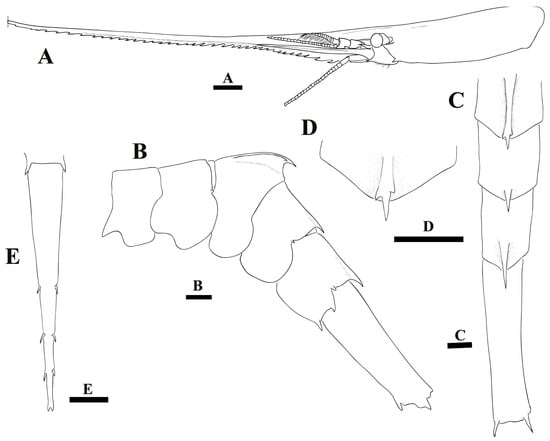
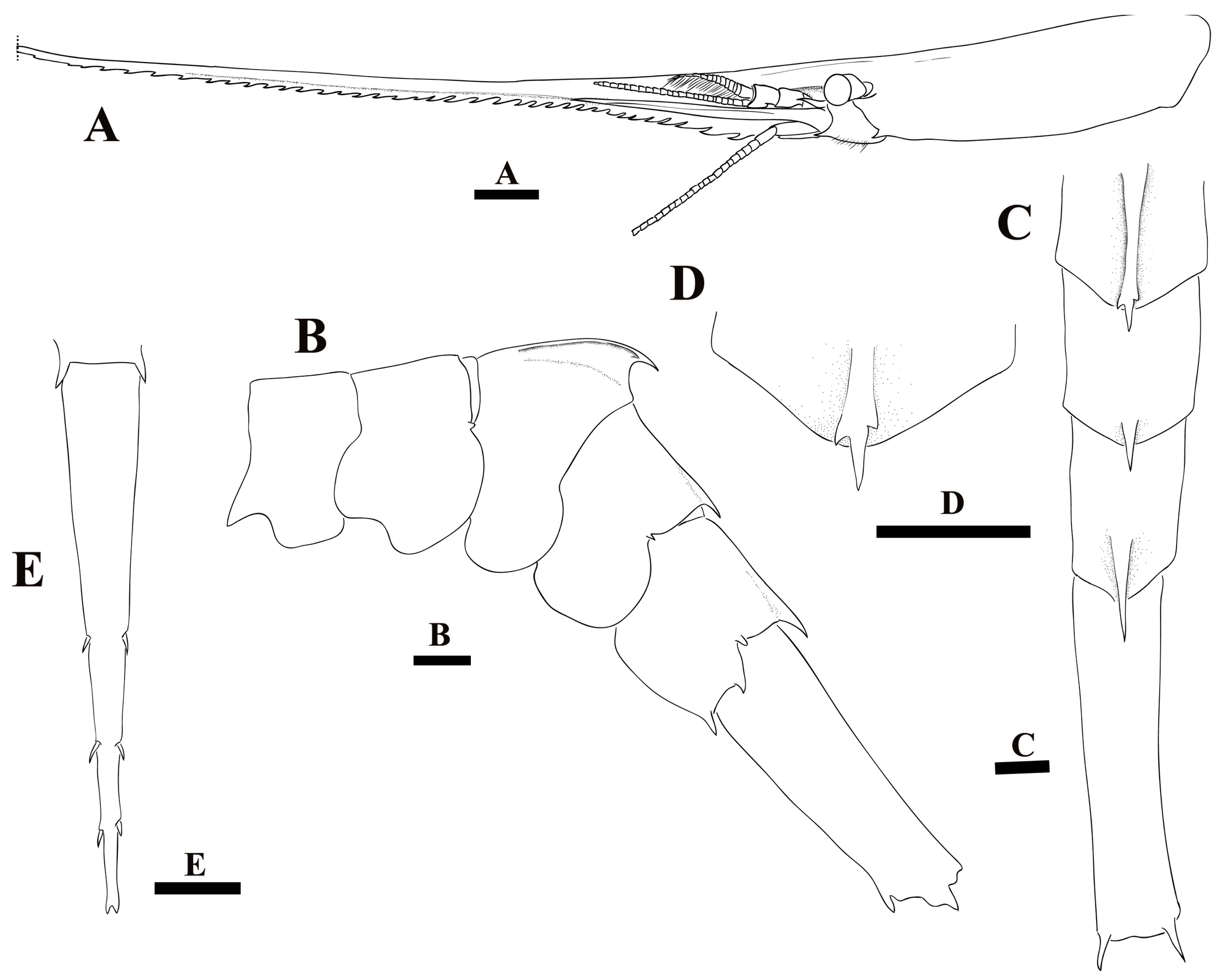
Figure 3.
Tozeuma lanceolatum Stimpson, 1860. (A–D) female (CL 8.5 mm), NIFS-Cr-20260812-2; (E) female (CL 9.0 mm), NIFS-Cr-20260812-3. (A) anterior part of body, setae omitted, lateral view (distal part of rostrum broken off); (B) abdomen, setae omitted, lateral view; (C) third to sixth abdominal somites, dorsal view; (D) enlarged posterior portion of third abdominal carina, dorsal view; (E) telson, dorsal view. Scale bars: (A) = 1.5 mm; (B–E) = 1.0 mm.
Angasia stimpsonii Henderson [15]: 437, pl. 40, Figures 18–20.
Angasia armata-Nobili [16]: 42; Holthuis [17]: 61, Figures 10 and 11.
Material examined. Offshore waters southeast of Jeju Island, Korea, 32°59′20″ N, 127°18′22″ E, 126 m, collected by bottom otter trawl operated by Tamgu 3, 16 October 2003, 1 female (CL 9.0 mm), NIFS-Cr-20260812-1.
Description. Body (Figure 1A) extremely slender and strongly compressed laterally; integument smooth, without dense covering of setae. Rostrum (Figure 2A) straight to slightly elevated distally, 1.67 times as long as carapace; dorsal margin unarmed; ventral margin bearing closely arranged 17 teeth. Carapace (Figure 2A) elongate, smooth; dorsal surface without supraorbital spine; antennal spine developed; pterygostomian spine moderate; posteroventral margin rounded (slight apparent protrusion due to specimen fixation artifact). Abdomen (Figure 2B,C) compressed laterally; third abdominal somite conspicuously elevated dorsally, dorsal carina flattened with lateral margins weakly raised, its posterior end produced into a single large recurved median tooth; fourth abdominal somite with posterodorsal projection, anteroventral angle rounded; fifth somite armed posteriorly, pleuron bearing distinct posterolateral spine and small posteroventral spine; sixth abdominal somite elongate, posterolateral spine moderate, posteroventral spine weak. Telson slender and elongate, posterior margin damaged distally. Second pereopod with carpus consisting of three articles. Third to fifth pereopods similar, propodi armed ventrally with 5–6 serial spines, dactyli armed with 4–5 accessory spines.
Coloration. Specimen predominantly pale pink to translucent whitish pink; rostrum reddish; posterior abdominal and uropodal regions with reddish pigmentation (Figure 1A).
Distribution. Indo-West Pacific: Red Sea, Gulf of Martaban, Andaman region, waters off Sri Lanka, Maldives, Seychelles, Cargados Carajos, New Caledonia, Ryukyu Islands (Kumejima), Western Australia (Dampier Archipelago), and Korea (new record in depth of 126 m); shallow water to upper continental shelf, 6.5–126 m.
Remarks. The Korean specimen agrees with the morphological diagnosis of T. armatum presented by Chace [5] in the combination of a relatively short rostrum (1.67 × CL; 167% of CL) and a single recurved median tooth at the posterior end of the third abdominal carina. Hayashi [14] reported a similar rostral proportion, approximately 1.7 × CL, in an Australian specimen. The Korean specimen also has a flattened dorsal carina, a condition reported in Australian and Japanese specimens assigned to T. armatum [14]. Flattening of the carina is therefore not treated here as a difference between the Korean material and those specimens, or as a character sufficient on its own to distinguish T. armatum from T. lanceolatum. Ledoyer [3] noted ontogenetic variation in rostral proportions in juveniles from New Caledonia. De Grave et al. [4] suggested that T. armatum may represent a species complex, noting differences in habitat association and colour among material assigned to the species.
Korean name: Gin-ppul-kko-ma-se-u (긴뿔꼬마새우)
Tozeuma lanceolatum Stimpson [18]: 27 (type locality: Hong Kong); Bruce [8]: 594, Figures 18–22; Chace [5]: 95, Figure 29; Xu & Li [2]: 124, Figure 9; Anker & De Grave [6]: 420, Figures 63 and 64.
Material examined. Offshore waters southwest of Jeju Island, Korea, 32°22′48″ N, 125°19′26″ E, 68 m, collected by bottom otter trawl operated by Tamgu 1, 29 October 2004, 1 female (CL 8.5 mm), NIFS-Cr-20260812-2; offshore waters southwest of Jeju Island, Korea, 32°07′42″ N, 125°08′51″ E, 50 m, collected by bottom otter trawl operated by Tamgu 20, 20 October 2019, 1 female (CL 9.0 mm), NIFS-Cr-20260812-3.
Description. Body (Figure 1B) strongly compressed laterally and extremely slender; integument smooth and glabrous. Rostrum (Figure 3A) very long and slender, nearly straight, distal tip broken and missing in both females; preserved RL/CL ratio 2.3 in NIFS-Cr-20260812-2 and 2.1 in NIFS-Cr-20260812-3, both exceeding 2.1; these ratios represent minimum values for intact rostra. Dorsal margin unarmed; preserved ventral margin bearing 38 teeth in NIFS-Cr-20260812-2 and 34 teeth in NIFS-Cr-20260812-3. Carapace (Figure 3A) elongate and smooth; orbit feebly developed; antennal spine small and marginal; supraorbital and hepatic spines absent; pterygostomian spine moderate; posteroventral margin rounded (slight apparent protrusion due to specimen fixation artifact). Abdomen (Figure 3B,C) smooth, glabrous, elongate and strongly compressed; third abdominal somite with strongly thickened middorsal carina ending posteriorly in large median tooth flanked by two smaller teeth; fourth and fifth somites without dorsal carina but with strong acute posterior teeth, anteroventral angle of fourth somite rounded (slight apparent protrusion due to specimen fixation artifact); pleuron of fifth somite with distinct posterolateral and posteroventral spines; sixth somite very elongate, tapering slightly posteriorly and bearing acute posterolateral and posteroventral teeth. Telson (Figure 3D) narrow, slender and tapering, with three pairs of small dorsolateral spines, posterior margin bifurcate. Second pereopods slender, approximately equal in length, with carpus consisting of three articles. Third to fifth pereopods moderately robust, propodi armed ventrally with 5–6 serial spines, dactyli strongly curved with 4 accessory spines.
Coloration. Specimen translucent whitish to pale pink, anterior body and rostrum with reddish to orange pigmentation (Figure 1B).
Distribution. South China Sea (Hong Kong, Singapore, the Philippines, Beibu Gulf, Guangdong, Hainan) and East China Sea (southwestern part of Jeju Island, Korea); at approximately 14–140 m.
Remarks. The Korean specimens agree with the material from Hong Kong described by Bruce [8] and the Chinese material reported by Xu and Li [2] in the combination of long rostra with numerous ventral teeth and a tridentate posterior margin of the third abdominal carina. Although the distal rostral tips are missing in both Korean specimens, the preserved portions each exceed 2.1 × CL.
The armature of the third abdominal carina is not always preserved intact. Chace [5] noted that the lateral teeth may be lost through damage, and variation in the relative development of the median and lateral teeth has also been reported in T. lanceolatum [6]. The Korean specimens are identified as T. lanceolatum primarily on the combination of long preserved rostra and a tridentate posterior margin of the third abdominal carina. Additional documented abdominal features include acute posterodorsal projections on the fourth and fifth somites, posterolateral and posteroventral spines on the fifth pleuron, and posterolateral and posteroventral teeth on the sixth somite. These additional features are described for comparison but are not treated as independently diagnostic between the two species. The differences illustrated in the projections of the fifth and sixth abdominal somites cannot presently be established as consistent interspecific differences or intraspecific variation from this limited material.
Key to the Species of Tozeuma Known from Korea
- Integument conspicuously hirsute, body covered with numerous fine setae; rostrum approximately as long as carapace and with 5 ventral teeth; dactyli of third to fifth pereopods biunguiculate .............................................................................. T. tomentosum
- -
- Integument smooth and glabrous; rostrum distinctly longer than carapace and ventral margin with numerous teeth ............................................................................................... 2
- 2.
- Rostrum less than twice carapace length; posterior end of third abdominal carina with single recurved median tooth ................................................................... T. armatum
- -
- Rostrum at least twice carapace length; posterior end of third abdominal carina tridentate, with median tooth flanked by two smaller lateral teeth ............... T. lanceolatum
The rostral proportions in couplet 2 should be interpreted together with the posterior armature of the third abdominal carina, rather than as invariant species boundaries. The key is most reliable when both structures are adequately preserved. Specimens with damaged structures or conflicting character combinations require examination of additional morphology and comparison with published descriptions or reference material. Identification may remain uncertain when both the rostrum and the posterior carinal armature are damaged.
4. Discussion
The present records increase the number of Tozeuma species documented from Korean waters to three. The specimens were collected in 2003, 2004, and 2019 and therefore represent newly documented historical occurrences. These records do not, by themselves, demonstrate recent colonization or contemporary range expansion.
Tozeuma tomentosum is readily distinguished by its hirsute integument. The Korean specimens assigned to T. armatum and T. lanceolatum are distinguished by a combination of rostral proportions and the posterior armature of the third abdominal carina. The single specimen of T. armatum has a rostrum 1.67 × CL and a single recurved median tooth. The two specimens of T. lanceolatum have preserved rostra exceeding 2.1 × CL and a tridentate posterior carinal margin. Their rostral tips are missing, so the preserved proportions represent minimum values for the intact structures (Table 1).
Table 1.
Specimen-level measurements and morphological observations of the Korean Tozeuma material.
The interpretation of these characters requires consideration of both variation and preservation. Bruce [8] and Chace [5] provide comparative morphological accounts relevant to the identification of the Korean material. Hayashi [14] reported flattening of the third abdominal carina in material assigned to T. armatum, indicating that flattening alone does not distinguish the two nominal species. Damage to the lateral carinal teeth and variation in their relative development further limit the use of posterior carinal armature in isolation [5,6]. Rostral proportions may also vary during growth [3]. The additional abdominal armature documented here is useful for comparison, but its independent diagnostic value between the two species has not been established.
This study documents geographical records and evaluates the application of published morphological diagnoses to three Korean females. It does not establish the stability of diagnostic characters across populations or resolve the species boundaries between T. armatum and T. lanceolatum. We retain the two currently recognized nominal species and identify the Korean material using combinations of the available morphological characters. Broader comparative sampling, including topotypic material and molecular evidence, would be needed to reassess their taxonomic relationship.
Author Contributions
Conceptualization, J.N.K. and J.H.C.; investigation, J.N.K. and J.H.C.; original draft preparation, J.N.K. and M.H.K.; review and editing, M.H.K. and J.H.C.; funding acquisition, J.H.C. All authors have read and agreed to the published version of the manuscript.
Funding
This work was supported by a grant from the National Institute of Fisheries Science, Republic of Korea (R2026004).
Data Availability Statement
Morphological observations, collection information, and specimen measurements supporting this study are provided in the article. The examined voucher specimens are deposited at the National Institute of Fisheries Science (NIFS), Republic of Korea, under catalogue numbers NIFS-Cr-20260812-1, NIFS-Cr-20260812-2, and NIFS-Cr-20260812-3.
Acknowledgments
We are grateful to the captains and crews of the R/V Tamgu 1, R/V Tamgu 3, and R/V Tamgu 20 of the National Institute of Fisheries Science (NIFS), Republic of Korea, for their assistance with sampling and specimen collection.
Conflicts of Interest
The authors declare no conflicts of interest.
References
- DecaNet Editor. DecaNet: Tozeuma Stimpson, 1860 and Constituent Species. Available online: https://www.marinespecies.org/aphia.php?p=taxdetails&id=158375 (accessed on 2 August 2026).
- Xu, P.; Li, X.-Z. Report on the Hippolytidae Bate (sensu lato) from China seas. Zool. Syst. 2015, 40, 107–165. [Google Scholar] [CrossRef]
- Ledoyer, M. Les Caridea (Crustacea: Decapoda) des herbiers de Phanérogames marines de Nouvelle-Calédonie (Région de Nouméa). Zool. Verh. 1984, 211, 1–58. [Google Scholar] [CrossRef] [Scilit]
- De Grave, S.; Chan, T.-Y.; Fujita, Y.; Okuno, J. Hippolytidae and Barbouriidae (Decapoda: Caridea) collected during the Ryukyu “KUMEJIMA 2009” expedition. Zootaxa 2012, 3367, 95–102. [Google Scholar] [CrossRef] [Scilit]
- Chace, F.A., Jr. The caridean shrimps (Crustacea: Decapoda) of the Albatross Philippine Expedition, 1907–1910, Part 7. Smithson. Contrib. Zool. 1997, 587, 1–106. [Google Scholar]
- Anker, A.; De Grave, S. An updated and annotated checklist of marine and brackish caridean shrimps of Singapore (Crustacea, Decapoda). Raffles Bull. Zool. Suppl. 2016, 34, 343–454. [Google Scholar]
- Cha, H.K.; Lee, J.U.; Park, C.S.; Baik, C.I.; Hong, S.Y.; Park, J.H.; Lee, D.W.; Choi, Y.M.; Hwang, K.; Kim, Z.G.; et al. Shrimps of the Korean Waters; National Fisheries Research and Development Institute: Busan, Republic of Korea, 2001; pp. 1–188. (In Korean)
- Bruce, A.J. Redescriptions of five Hong Kong carideans first described by William Stimpson, 1860. In The Marine Flora and Fauna of Hong Kong and Southern China II; Morton, B., Ed.; Hong Kong University Press: Hong Kong, China, 1990; pp. 569–610. [Google Scholar]
- Paulson, O. Studies on Crustacea of the Red Sea with Notes Regarding Other Seas. In Part I. Podophthalmata and Edriophthalmata (Cumacea); Tipografiia S. V. Kulzhenko: Kiev, Ukraine, 1875; pp. 1–144. (In Russian) [Google Scholar]
- Kemp, S. Notes on Crustacea Decapoda in the Indian Museum. V. Hippolytidae. Rec. Indian Mus. 1914, 10, 81–129. [Google Scholar] [CrossRef] [Scilit]
- Kemp, S. Notes on Crustacea Decapoda in the Indian Museum. VII. Further notes on Hippolytidae. Rec. Indian Mus. 1916, 12, 385–405. [Google Scholar]
- Borradaile, L.A. On Carides from the Western Indian Ocean. Trans. Linn. Soc. Lond. Zool. 1917, 17, 397–412. [Google Scholar] [CrossRef] [Scilit]
- Hayashi, K.-I. Prawns, shrimps, and lobsters from Japan (79). Family Hippolytidae. Genus Tozeuma and key to genera of Hippolytidae. Aquabiology 1994, 94, 355–358. (In Japanese) [Google Scholar]
- Hayashi, K.-I. Lysmata dispar sp. nov., a new shrimp from the Dampier Archipelago, Western Australia, with notes on other species of Hippolytidae. Rec. West. Aust. Mus. Suppl. 2007, 73, 85–95. [Google Scholar] [CrossRef] [Scilit]
- Henderson, J.R. A contribution to Indian carcinology. Trans. Linn. Soc. Lond. Zool. 1893, 5, 325–458. [Google Scholar] [CrossRef] [Scilit]
- Nobili, G. Faune carcinologique de la Mer Rouge. Décapodes Stomatopodes Ann. Sci. Nat. Zool. 1906, 4, 1–347. [Google Scholar]
- Holthuis, L.B. The Hippolytidae and Rhynchocinetidae collected by the Siboga and Snellius Expeditions with remarks on other species. Siboga-Exped. Monogr. 1947, 39a8, 1–100. [Google Scholar]
- Stimpson, W. Prodromus descriptionis animalium evertebratorum quae in expeditione oceanum Pacificum Septentrionalem a Republica Federata missa, C. Ringgold et J. Rodgers ducibus, observavit et descripsit. Proc. Acad. Nat. Sci. Phila. 1860, 12, 22–47. [Google Scholar]



Disclaimer/Publisher’s Note: The statements, opinions and data contained in all publications are solely those of the individual author(s) and contributor(s) and not of MDPI and/or the editor(s). MDPI and/or the editor(s) disclaim responsibility for any injury to people or property resulting from any ideas, methods, instructions or products referred to in the content. |
© 2026 by the authors. Licensee MDPI, Basel, Switzerland. This article is an open access article distributed under the terms and conditions of the Creative Commons Attribution (CC BY) license.