


Abstract
This paper investigates the problem of fixed-time event-triggered consensus control for distributed unmanned underwater vehicle systems subject to communication and energy constraints. The systematic integration control framework is developed, where each unmanned underwater vehicles updates their control inputs only at event-triggered instants instead of continuously, thereby reducing unnecessary communication and actuation efforts. By designing a fixed-time consensus protocol, it is guaranteed that the group of unmanned underwater vehicles achieves time-synchronized consensus within the convergence time, independent of the initial conditions. The stability and convergence of the proposed scheme are rigorously proved using Lyapunov theory and fixed-time stability analysis. Furthermore, a zeno-free triggering condition is established to ensure the feasibility of practical implementation. Numerical simulations are carried out on a team of unmanned underwater vehicles to demonstrate the effectiveness of the proposed method in achieving precise coordination, reducing communication burden, and enhancing energy efficiency in distributed marine operations.
1. Introduction
With the rapid development of marine technology, distributed unmanned underwater vehicles (UUV) have emerged as a powerful tool for ocean exploration, environmental monitoring, and offshore resource exploitation. Compared with single-robot systems, cooperative multi-robot systems offer advantages in terms of scalability, fault tolerance, and efficiency. However, the deployment of UUVs in real-world ocean environments faces several challenges [1,2]. First, the limited bandwidth and intermittent nature of underwater acoustic communication significantly restrict continuous information exchange. Second, energy consumption is critical due to the difficulty of recharging or replacing batteries in deep-sea environments [3]. Third, the uncertain and dynamic marine conditions make it difficult to guarantee reliable coordination within strict time constraints [4]. These issues highlight the need for control strategies that are both energy-efficient and time-guaranteed.
Consensus control has become a fundamental research topic in distributed multi-agent systems, aiming to design protocols that enable all agents to reach an agreement on certain states or outputs through only local interactions [5,6]. In the context of UUVs, consensus is particularly important for achieving cooperative tasks such as formation keeping, synchronized exploration, and collaborative payload transportation [6,7]. Unlike terrestrial or aerial networks, UUV systems suffer from limited and unreliable acoustic communication, long transmission delays, and strict energy constraints, which make continuous information exchange impractical [8,9]. Conventional consensus algorithms typically guarantee asymptotic or finite-time convergence, but they either lack strict convergence time guarantees or require frequent communication updates, which leads to excessive resource consumption. These challenges motivate the development of consensus strategies that can ensure time-synchronized coordination within a fixed convergence time, while also reducing unnecessary communication through event-triggered mechanisms.
While consensus control provides the fundamental framework for achieving coordination among multiple UUVs, its practical implementation is often hindered by the limitations of continuous communication and control updates. On the other hand, event-triggered control alleviates these issues by reducing unnecessary transmissions, yet most existing designs only guarantee asymptotic or finite-time convergence. Event-triggered control has recently emerged as an effective solution to reduce the communication and actuation burden in distributed systems. Instead of continuously transmitting information and updating control inputs, each agent only triggers updates when a well-designed condition is satisfied. This approach is particularly appealing for UUVs, where acoustic communication is costly and energy resources are extremely limited. By reducing unnecessary updates, event-triggered mechanisms can significantly extend the operational lifetime of multi-robot networks and mitigate bandwidth limitations [10,11,12]. However, most existing event-triggered consensus algorithms focus on asymptotic or finite-time convergence, which may not be sufficient for time-critical underwater missions. To meet these requirements, it is essential to integrate event-triggered control with fixed-time consensus strategies, thereby ensuring strict convergence within a preassigned time while preserving communication efficiency.
In underwater scenarios, where strict mission deadlines and synchronization are critical, neither asymptotic convergence nor uncertain finite-time guarantees are sufficient [13]. Some finite-time design can be obtained through fractional-order nonlinear dynamical systems and Ulam-Hyers-type stability further are particularly relevant in characterizing the robustness of solutions with respect to perturbations and approximation errors [14,15,16]. Fixed-time control has recently gained significant attention due to its ability to guarantee system convergence within a predefined time bound, which is independent of initial conditions [17,18]. This gap highlights the necessity of combining consensus and event-triggered mechanisms with fixed-time convergence properties, leading to a control framework that ensures strict synchronization within a prescribed time bound while simultaneously conserving communication and energy resources. Compared with finite-time control, where the convergence time may vary depending on the system state, fixed-time strategies provide stronger performance guarantees that are particularly desirable in safety-critical and time-sensitive applications [19]. For UUVs operating in uncertain and dynamic ocean environments, such properties are crucial to ensure that coordinated tasks, such as formation keeping, target tracking, or cooperative manipulation, are completed within strict mission deadlines. Nevertheless, the majority of existing approaches for UUVs either rely on asymptotic convergence or finite-time convergence without explicit fixed-time guarantees [20]. This limitation motivates the integration of fixed-time stability theory with event-triggered consensus protocols, thereby enabling distributed UUVs to achieve strict time-synchronized coordination while reducing energy consumption and communication load.
Consensus control has been extensively studied in the field of multi-agent systems. Traditional consensus algorithms often rely on continuous communication and control updates, which may cause excessive energy consumption and overload limited communication channels. Event-triggered control has recently been introduced as an efficient alternative, where control updates are executed only when certain conditions are satisfied. This mechanism effectively reduces unnecessary communication and prolongs the operational lifetime of multi-robot systems [21,22]. On the other hand, finite-time and fixed-time control strategies have attracted significant attention due to their ability to guarantee convergence within a bounded time, independent of initial conditions in the fixed-time case [23,24]. Nevertheless, few studies have combined fixed-time stability with event-triggered mechanisms in the context of UUV systems, where both energy efficiency and strict convergence time are crucial.
Motivated by these observations, this paper develops a fixed-time event-triggered consensus control framework for distributed UUVs. The event-triggering rule is designed for UUV platoon consensus tracking that depends on both local tracking errors and their dynamics. And this triggering mechanism is integrated with a fixed-time control law, such that fixed-time convergence is preserved under event-triggered updates. This integration distinguishes the proposed approach from existing event-triggered or fixed-time control methods considered separately. Compared with most existing event-triggered schemes only guarantee asymptotic convergence and lack explicit convergence-time guarantees [4,25], the new scheme simultaneously addresses time-guaranteed convergence. Different from existing fixed-time control approaches for UUVs [19,20], the proposed approach integrates an event-triggered mechanism achieves communication efficiency and energy conservation, making it highly suitable for practical underwater missions. The main contributions of this work can be summarized as follows:
- (i)
- Fixed-time consensus control framework is developed for distributed UUVs, which guarantees that all UUVs reach time-synchronized consensus within fixed time, independent of their initial conditions.
- (ii)
- An event-triggered communication and control mechanism is designed to significantly reduce unnecessary communication and actuation updates, thereby improving the energy efficiency of UUV networks operating under stringent resource constraints.
- (iii)
- A rigorous Lyapunov-based stability analysis is provided to prove the fixed-time convergence property and to establish a Zeno-free triggering condition, which ensures the feasibility of real-time implementation.
The remainder of this paper is organized as follows. Section 2 introduces the problem formulation, mathematical model of UUVs, and necessary preliminaries. In Section 3, the fixed-time event-triggered consensus control scheme is developed, and the triggering condition is designed. Further the theoretical analysis is provided, where Lyapunov-based proofs are presented to establish fixed-time convergence and Zeno-free triggering. In Section 4, numerical simulations are conducted on a group of UUVs to verify the effectiveness and advantages of the proposed method. Finally, Section 5 concludes the paper and outlines directions for future research.
2. Preliminaries and Problem Description
2.1. Preliminaries
Lemma 1
([26]). Consider double-integrator system
where and are the measurable state variables and is the control input. If control law is developed as
with parameters given below as
Then, the origin of system is fixed-time stable if the parameters and are selected.
Lemma 2
([27,28]). There exists a continuous radially bounded Lyapunov function such that
- 1.
- 2.
- if the following inequality holdswhere are all positive constants with and . Then the origin of the system is fixed-time stable and the settling time is bounded by
where .
Lemma 3
([29]). There exist positive constants satisfying
2.2. Problem Description
The kinematics and dynamics of the i-th UUV can be modeled as follows [30]:
where denotes the position and orientation of the i-th UUV in the earth-fixed frame, with representing the position coordinates and denoting the roll, pitch, and yaw angles, respectively. The vector represents the linear and angular velocities of the UUV in the body-fixed frame, where are the surge, sway, and heave velocities, and are the roll, pitch, and yaw angular velocities. is external disturbances induced by wind, wave, and ocean currents, etc. denotes the control inputs of the i-th UUV. is nonsingular transformation matrix. is a symmetric positive definite inertia matrix. is hydrodynamic damping matrix. is the matrix of Coriolis and centripetal terms.
Assumption 1.
There exists a known term such that the disturbance satisfies .
Assumption 2.
The deviation between the actual UUV state and the desired reference trajectory is assumed to be available for feedback.
The objective of this study is to develop a distributed fixed-time output-feedback control framework for a group of UUVs such that consensus tracking can be achieved under nonlinear dynamics and external disturbances while reducing communication and control update burdens.
From the perspective of UUV systems, such a time-synchronized consensus is of great importance in practical applications: (i) it enables synchronous sensing and sampling, ensuring that all robots collect environmental data at the same instant to avoid temporal inconsistencies; (ii) it guarantees precise formation keeping, which is crucial for robust multi-robot navigation in dynamic ocean environments; and (iii) it facilitates coordinated task execution, such as cooperative transportation, networked sensor deployment, and simultaneous manipulation, where strict synchronization at time T is required to prevent collisions or task failure.
3. Main Results
3.1. Fixed-Time-Observer Design
For the convenience of observer design, rewrite kinematic model (6) and kinetic model (7) into the following Euler-Lagrange system as
where , and with
and
To compensate for the external disturbances, and system uncertainties, the auxiliary system is constructed:
Denote the estimate error as
where the estimate value and . The disturbance observer is proposed as
where
with positive constants and , , . Further, one can obtain
According to Lemma 1, we can know that can converge to zero in a fixed time, i.e., .
Theorem 1.
Considering the UUV formation system that detailed in (13), the fixed-time observer delineated in (20) enables estimation of by within the fixed time .
Proof.
According to Equations (19) and (20), the estimated value of disturbances is expressed as
Next, the observation error is calculated as
Therefore, can converge to zero in a fixed time. According to (8), the estimation value of is
Then, one can obtain the estimation error as follows:
Hence, can converge to zero in a fixed time, i.e., when . This concludes the proof. □
3.2. Design of Fixed-Time Controller for Consensus Under Static Event Triggering Mechanism
The use of event-triggered control mechanisms in dynamic systems, both in static and dynamic formulations, presents a paradigm shift from traditional time-triggered control strategies. This approach, characterized by its efficiency and adaptability, leverages conditions within the system itself to determine the timing of control actions, rather than relying on a predetermined schedule. Herein lies the relative advantages of dynamic and static event-triggered control strategies, each suited to different scenarios and requirements. In this part, we first concern about the static triggering mechanism strategy.
Step 1: For the ith underwater robot, the tracking error is defined as
Then calculating the time derivative yields
where and . The kinetic tracking controller is designed as
where are positive, and are positive odd numbers satisfying .
To avoid direct differentiation of measured signals and to suppress high-frequency noise that may lead to unnecessary triggering events, a first-order dynamic filter is introduced. The filter is designed to generate a smooth estimate of the corresponding signal while preserving its essential dynamics for control implementation. The nonlinear filter is proposed as
where , is the output of the tracking differentiator.
Define the error as
Substituting the Equations (29), (31) and (33) into Equation (30), it is obtained
The Lyapunov function is
According to Equation (31), it yields
The controller is designed as
where and is the estimator of .
Remark 1.
The hydrodynamic effects and deviations from the desired trajectory are not only reflected in the final control inputs applied to the engines, but are explicitly incorporated throughout the backstepping-based control design process. In particular, the system dynamics, including hydrodynamic terms and trajectory tracking errors, are systematically handled in the derivation of the virtual control laws and their recursive inversion steps, which form the core of the proposed control framework. Therefore, the essential hydrodynamic characteristics and tracking deviations are rigorously accounted for within the analytical control design and stability analysis.
The event-triggering mechanism is
The error is constructed as
The Lyapunov function is chosen as
The derivative of takes the form
If , then . It follows
Theorem 2.
Considering the kinematic model (6) and kinetic model (7) with Assumptions 1 and 2, integrate distributed event-trigger into consensus control strategy (51). The trigger condition is designed as
- If , the event is triggered and the controller is updated simultaneously to measure the error.
- If , the entire system can achieve actual fixed-time stability.
Proof.
To verify the stability of the whole system, choose the Lyapunov function as
Deriving with respect to time yields
Under Lemma 3, it brings
where , , , , is a positive constant and . Based on Lemma 2, the closed-loop system is fixed-time stability bounded by
□
The essence of the event-triggered mechanism is to prevent Zeno behavior. If Zeno behavior exists, the controller will be triggered infinitely. By proving that there is a positive lower bound between any two triggers , the possibility of Zeno behavior occurring during event triggering can be eliminated. By and Lemma 3, we can get the following inequality:
where the time derivative of is represented by . Because all state signals in the system are bounded, there must be positive constants that satisfies . According to the initial conditions , we can get that where are positive constants. The next event trigger will not trigger before . According to the event trigger conditions, it is obtained
and . Based on Equation (49), it obtains that
Remark 2.
The threshold is selected based on a trade-off between control performance and communication frequency. A smaller leads to more frequent triggering and performance closer to continuous-time control, whereas a larger reduces triggering frequency at the cost of slightly degraded transient performance.
According to inequation (53), We can get the positive lower bound of the event triggering interval
In Equation (51) ensures that the static event triggering interval has an absolute positive lower bound such that no Zeno behavior occurs in the entire system.
This section presents an integrated fixed-time event-triggered consensus control scheme tailored for distributed UUV systems. The proposed approach not only guarantees strict convergence within a fixed time but also reduces the overall resource consumption, thereby making it particularly suitable for long-duration and large-scale cooperative marine operations.
4. Simulation
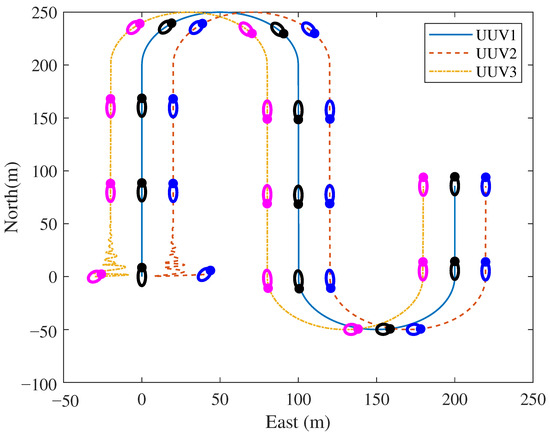
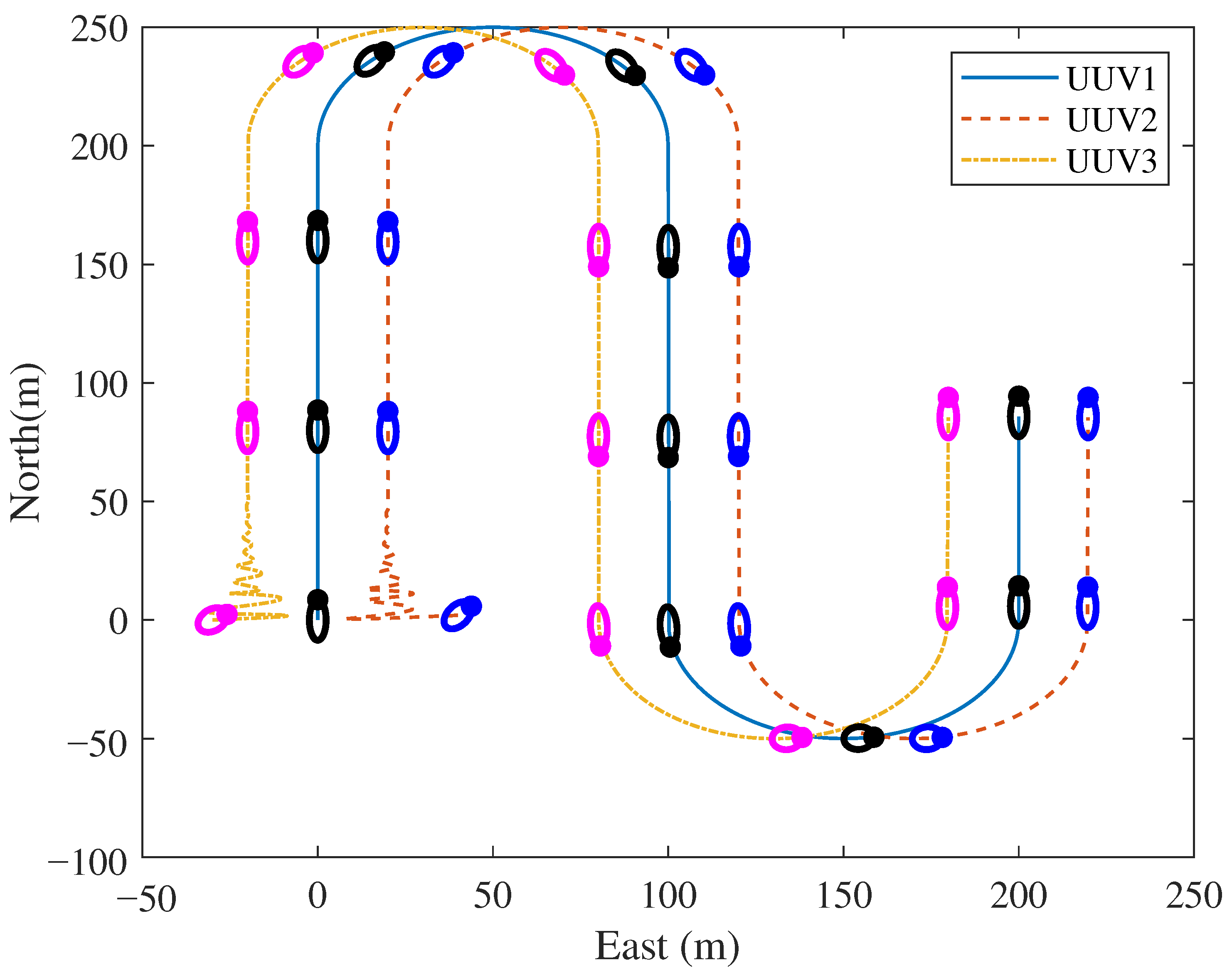
This 3-DOF UUV model captures the essential nonlinear coupling [30] and is widely adopted for motion control and cooperative control studies. It provides a physically consistent platform for validating the proposed platoon consensus and event-triggered control strategy. Three UUVs with identical dynamic parameters but different initial positions are considered. The desired cooperative trajectory is generated by a piecewise geometric path composed of straight-line segments and circular arcs. Specifically, the UUVs first move along a straight-line path, then perform a circular turning maneuver, followed by another straight-line motion and a symmetric turning segment, forming an S-shaped return trajectory. This composite path allows us to evaluate the tracking performance of the proposed control scheme under both straight-line cruising and sharp turning maneuvers. The controller parameters are configured as follows: , , , , , , , , , , , , , , , , . To evaluate the robustness of the proposed algorithm, an external disturbance is introduced into each degree of freedom (DOF) of the system.
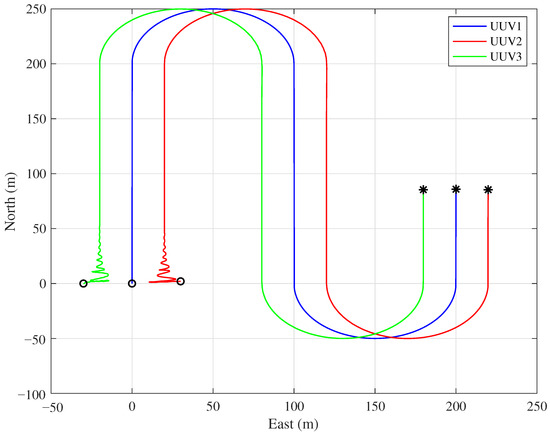
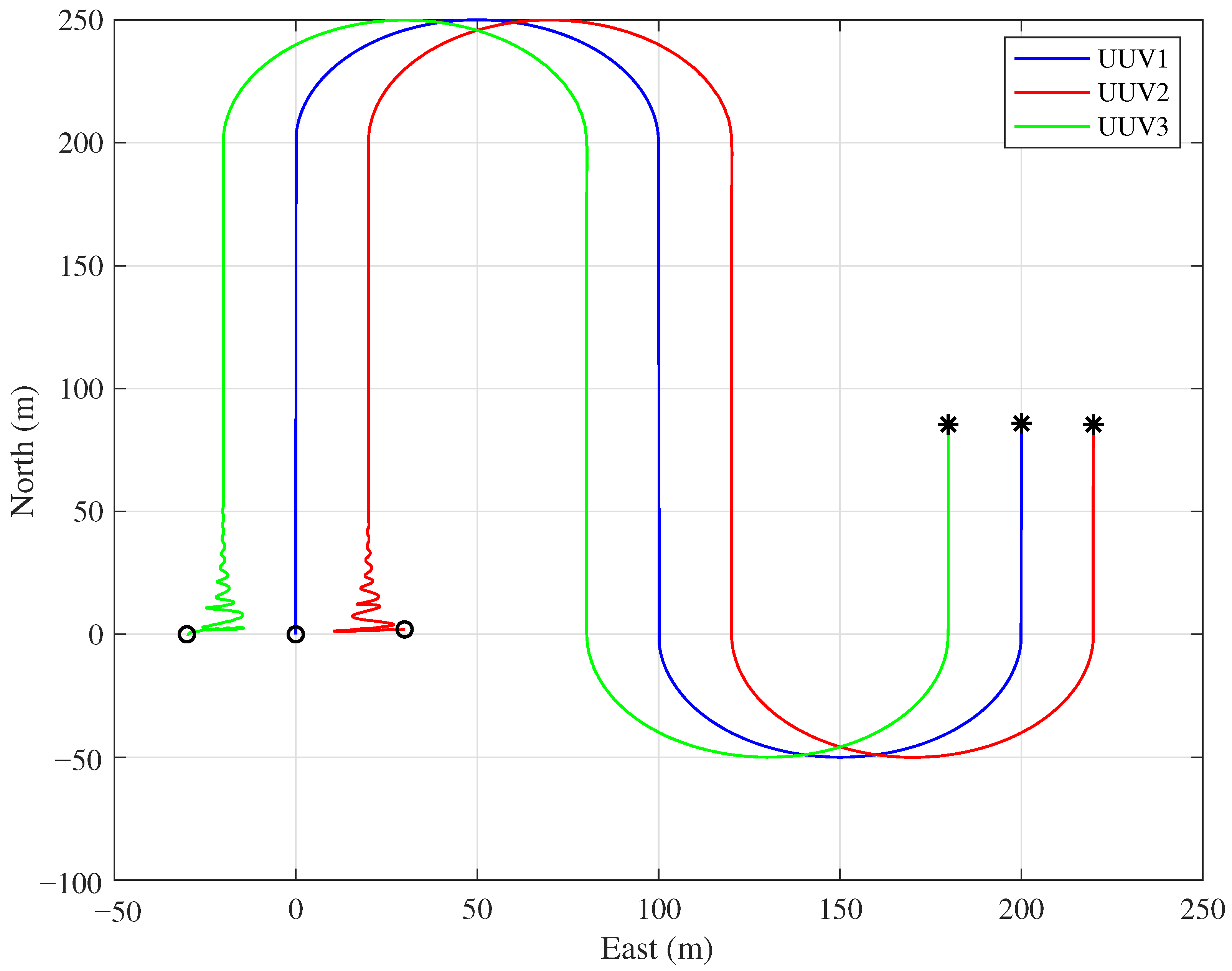
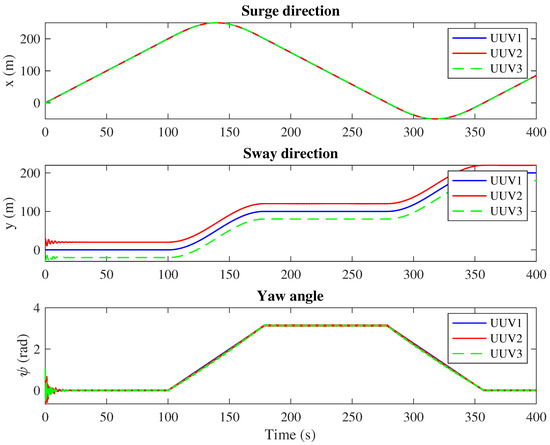
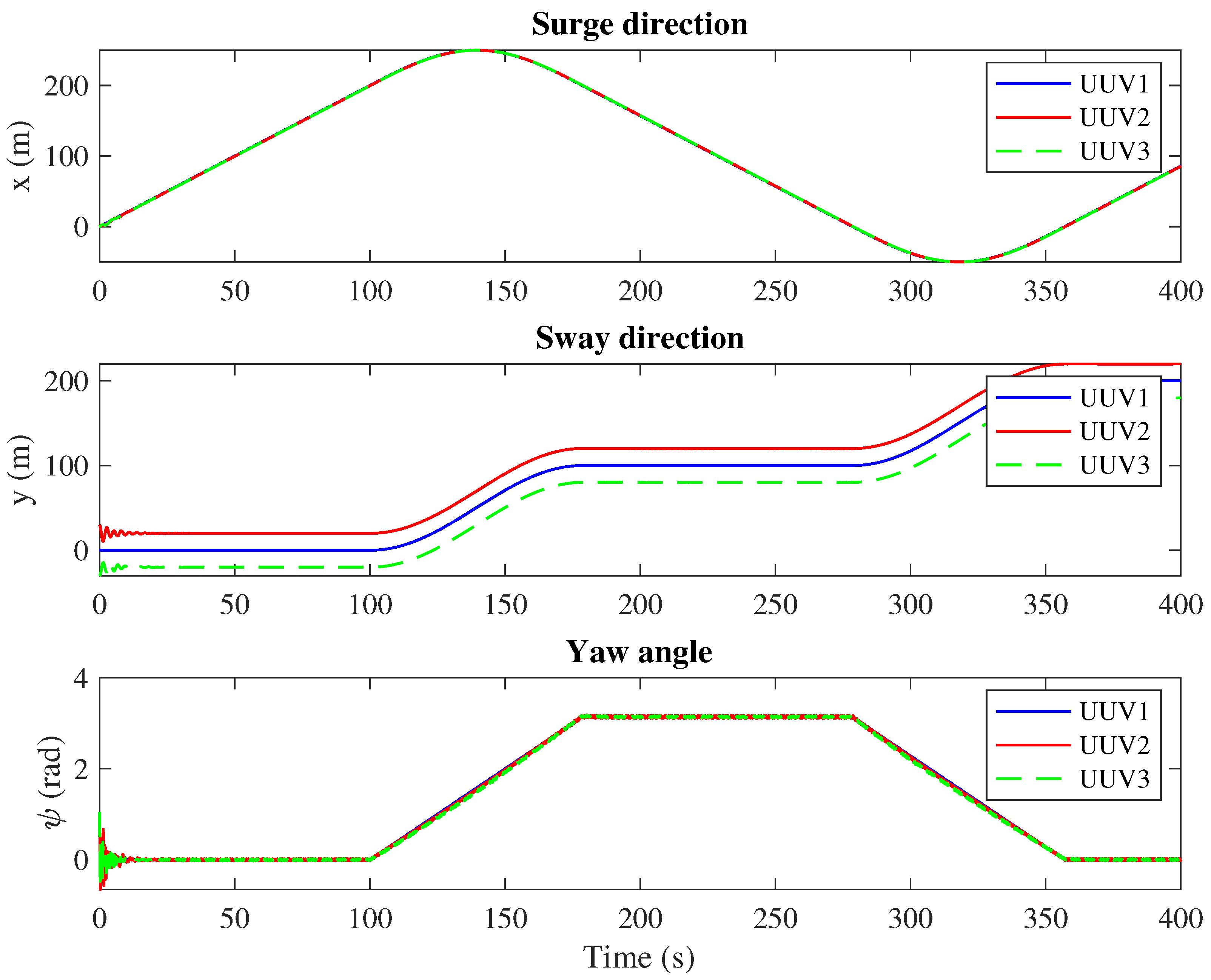
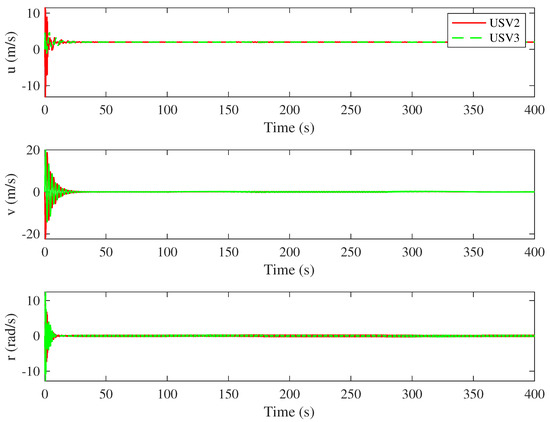
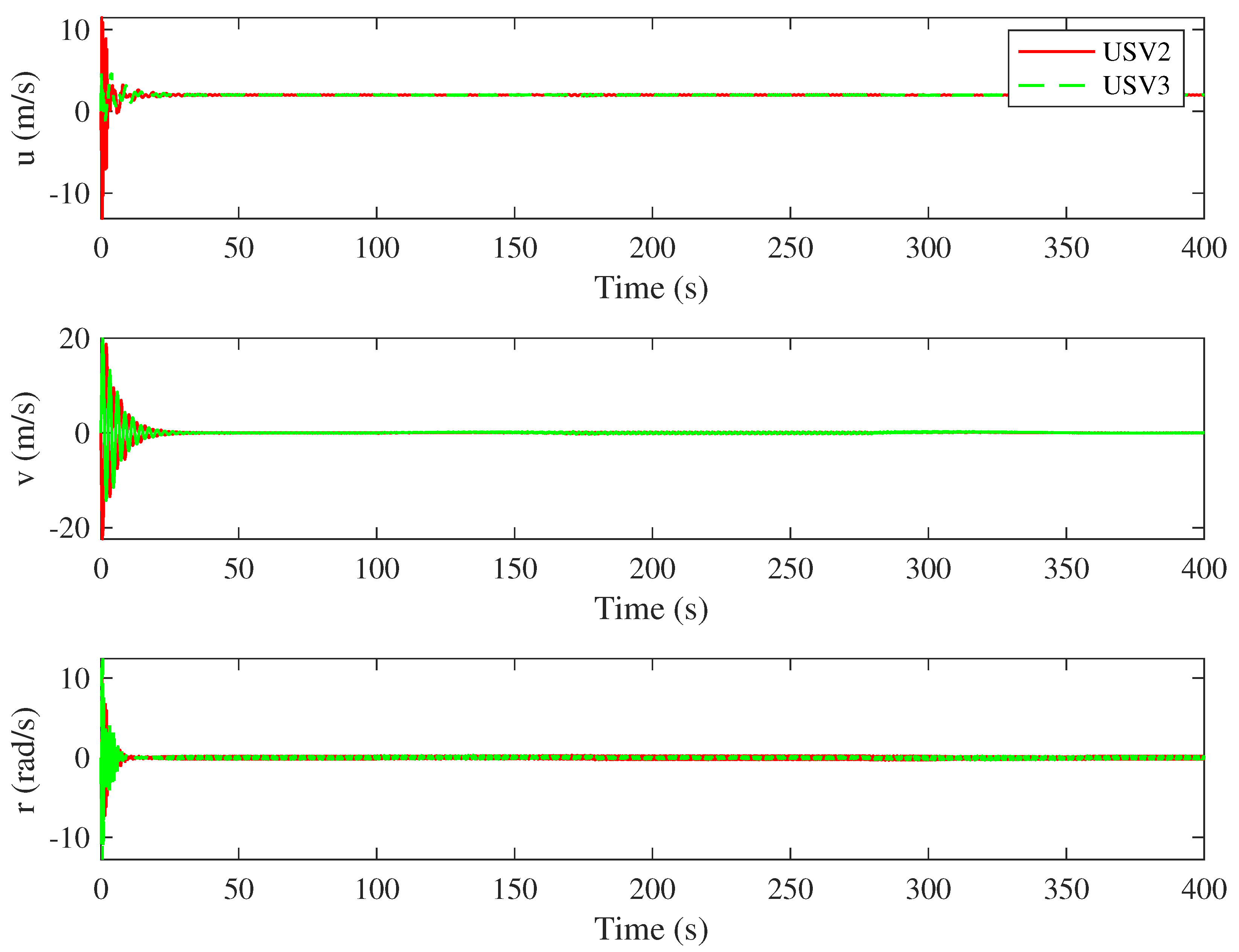
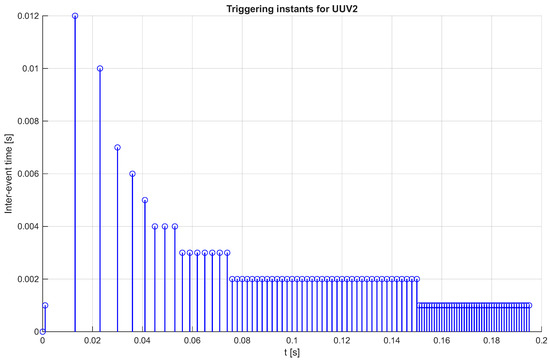
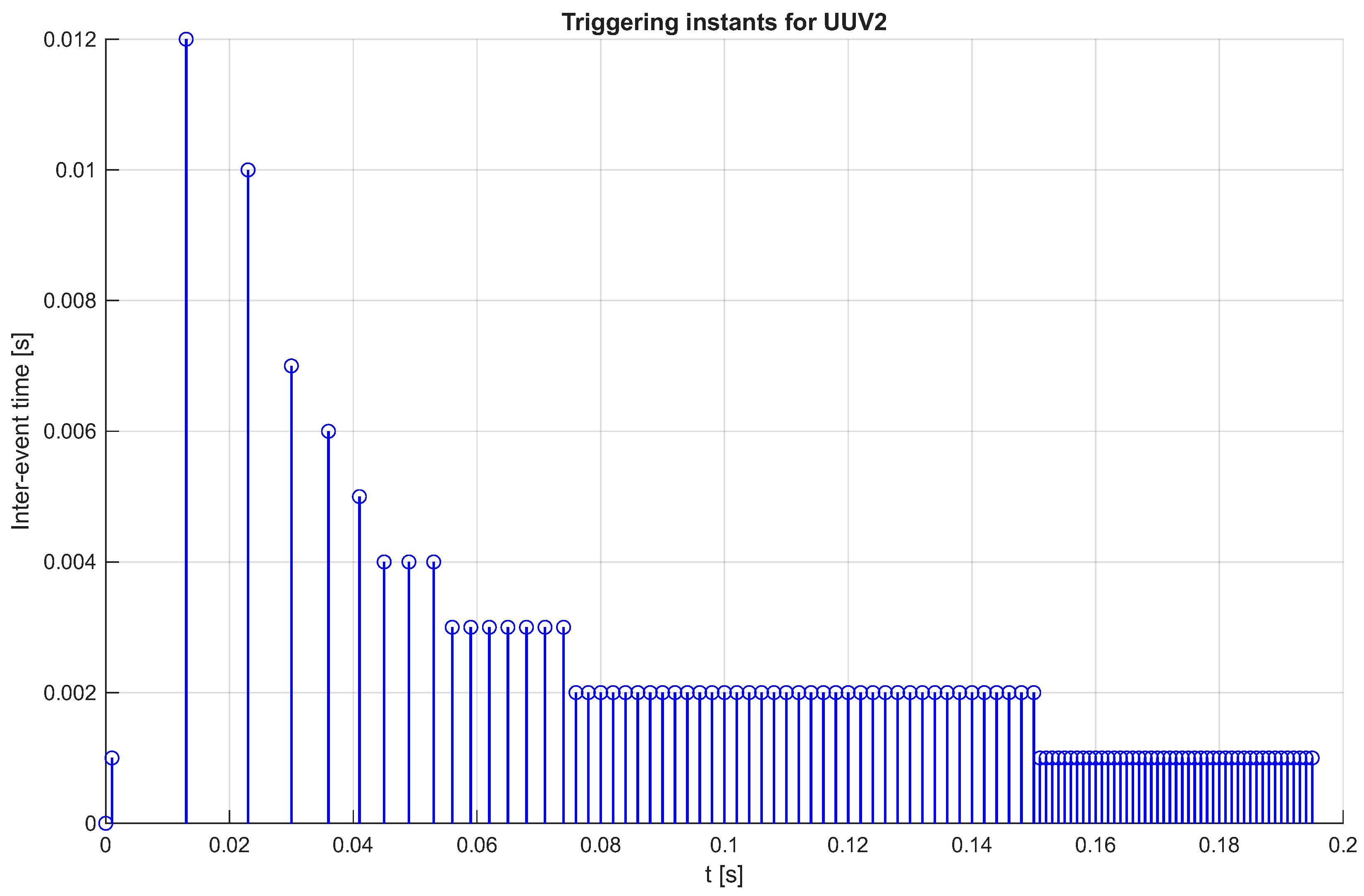
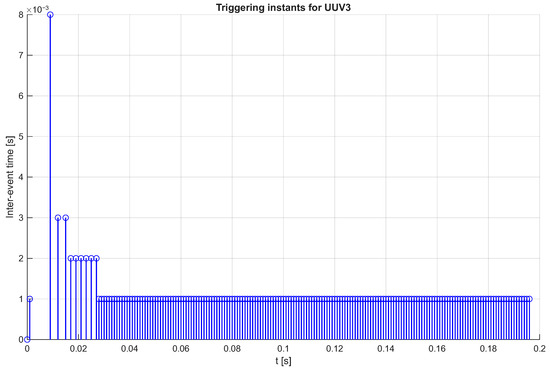
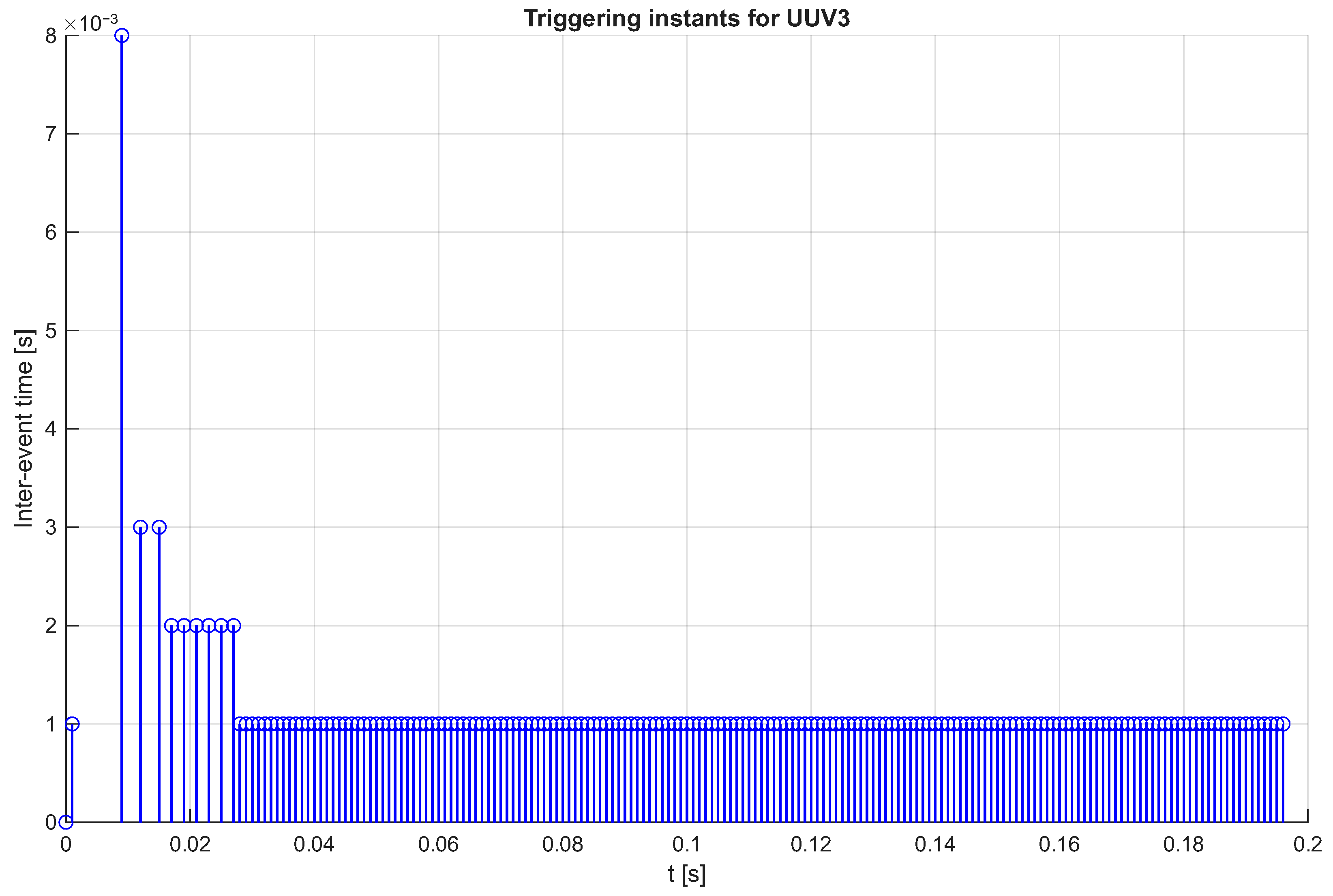
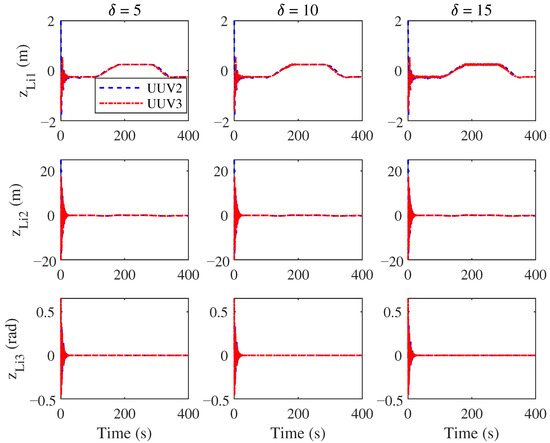
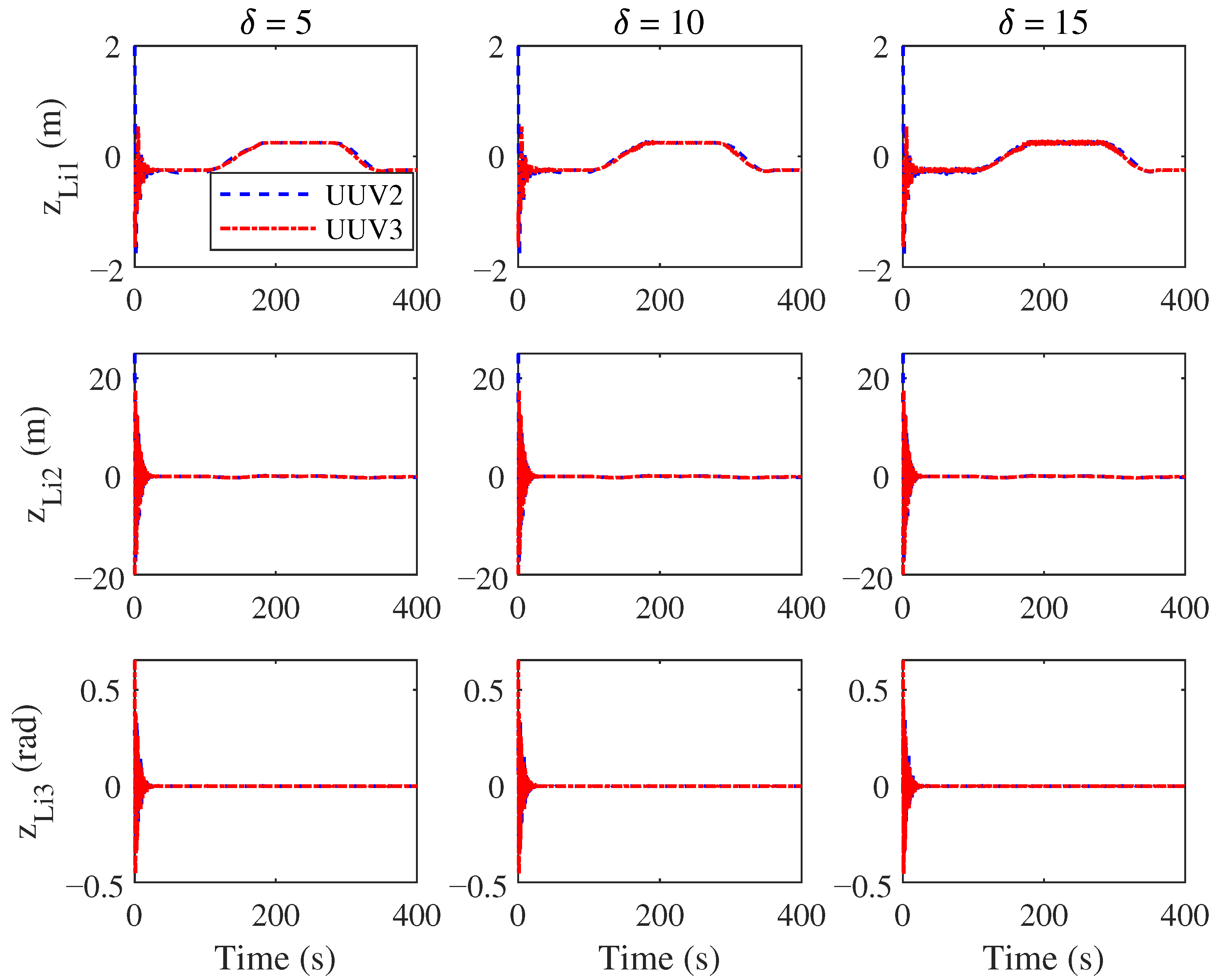
Figure 1 shows the planar trajectory tracking performance of three UUVs in the East–North frame under the proposed platoon control strategy. Starting from different initial positions, all UUVs smoothly converge to the desired reference trajectory while maintaining the prescribed inter-vehicle spacing. Although the reference path contains sharp turns and curvature variations, the motions remain continuous and stable, with only transient oscillations. Moreover, no physical collision occurs even though the projected trajectories intersect geometrically. Overall, this figure demonstrates accurate trajectory tracking, stable formation maintenance, and safe coordinated motion. Figure 2 presents the position and yaw angle responses of the UUVs. In the surge direction, all UUVs exhibit identical longitudinal motion profiles, indicating successful longitudinal consensus. In the sway direction, lateral offsets appear due to the formation geometry, but the motion trends remain highly synchronized. The yaw angles also evolve in a coordinated manner during acceleration and turning phases. These results confirm that the proposed controller achieves synchronized motion and stable formation tracking. Figure 3 illustrates the surge velocity, sway velocity, and yaw rate responses of the UUVs. Relatively large oscillations appear during the initial transient phase due to mismatched initial conditions and nonlinear coupling effects. However, these oscillations decay rapidly, and all velocities converge smoothly to their steady-state values. The yaw rates asymptotically approach zero, indicating stable heading regulation. This figure verifies that velocity consensus and stable dynamic behavior are achieved for all UUVs. Figure 4 and Figure 5 depict the triggering instants and inter-event time sequences of UUV2 and UUV3. During the initial transient stage, triggering events occur more frequently to compensate for large tracking errors. As the system converges, the triggering intervals gradually increase and remain strictly positive. No accumulation of triggering instants is observed, confirming that Zeno behavior is avoided. These figures demonstrate that the proposed event-triggered mechanism effectively balances control performance and communication efficiency. The UUVs position errors are shown in Figure 6 exposed to various noises. The disturbance is defined as , where the coefficient is set to 5, 10, and 15 to represent three distinct operational conditions. As observed, even under substantial noise levels , the position errors remain bounded and small, which is within the acceptable tolerance for formation-keeping tasks. This demonstrates that the proposed controller possesses strong disturbance rejection capabilities. Furthermore, the system demonstrates good robustness to variations in the mass matrix of the UUVs in Figure 7. As validated in the simulations, even with significant changes in the mass matrix parameters by , and +, the formation consistently maintains excellent consensus tracking performance. This demonstrates low sensitivity of the controller to modeling uncertainties. In addition, the UUVs do not collide at trajectory intersection points, as separation can be ensured in three-dimensional space by assigning different depths. Overall, the proposed strategy exhibits strong robustness and practical applicability.
Figure 1.
Multiple UUVs formation consensus, ∘ and * stands for the start and terminal point.
Figure 2.
Surge, Sway, and Yaw Performance.
Figure 3.
Velocity Consensus Performance of UUVs.
Figure 4.
Event-Triggered Updating Performance for UUV2.
Figure 5.
Event-Triggered Updating Performance for UUV3.
Figure 6.
The Position Errors under Various Noises.
Figure 7.
UUVs Trajectories subject to Parametric Variations.
In summary, the simulation results presented in Figure 1, Figure 2, Figure 3, Figure 4, Figure 5, Figure 6 and Figure 7 comprehensively validate the effectiveness of the proposed event-triggered fixed-time platoon control strategy for multiple UUVs. The planar trajectory results demonstrate accurate coordinated path tracking and stable formation maintenance from mismatched initial conditions, even in the presence of sharp turns and large curvature variations. The velocity and yaw rate responses confirm rapid transient regulation, stable steady-state behavior, and successful consensus among all UUVs despite strong nonlinear coupling effects. Furthermore, the event-triggering instants and inter-event time sequences illustrate that the proposed event-triggered mechanism effectively balances control performance and communication efficiency: frequent updates are automatically activated during transient phases to ensure accuracy, while unnecessary control updates are significantly reduced in steady state. The strictly positive inter-event times further confirm the absence of Zeno behavior. As a whole, these results demonstrate that the proposed control framework ensures fixed-time convergence, coordinated motion, stable formation preservation, and efficient event-triggered implementation, making it well suited for practical multi-UUV platoon operations under nonlinear and time-varying maneuvering conditions.
5. Conclusions
In this paper, we have proposed a fixed-time event-triggered consensus control framework for distributed UUV systems. The developed control strategy ensures that all UUVs achieve time-synchronized consensus within finite time, regardless of their initial conditions. By adopting an event-triggered mechanism, the proposed scheme significantly reduces communication and actuation burdens, which is of particular importance for energy-constrained underwater platforms. Theoretical analysis based on Lyapunov stability theory has rigorously established the fixed-time convergence property and demonstrated the Zeno-free nature of the triggering condition, ensuring the feasibility of practical implementation. Simulation results have further verified that the proposed approach enables precise coordination among UUVs, improves energy efficiency, and enhances robustness against communication constraints. Although collision avoidance is not explicitly considered in this study, it can be seamlessly integrated into the proposed framework using well-established techniques, making the approach applicable to practical multi-UUV missions. Future work will also focus on extending the proposed framework to handle uncertainties caused by complex ocean environments, incorporating adaptive disturbance observers for stronger robustness, and validating the approach in coordinated underwater exploration, environmental monitoring, seabed mapping, and cooperative inspection tasks.
Author Contributions
Conceptualization and methodology, X.L.; investigation and supervision, J.L.; software and validation, D.B. All authors have read and agreed to the published version of the manuscript.
Funding
This research is supported by the National Natural Science Foundation of China (Grant No. 52405115, No. 52301417 and No. 62303217), Provincial Natural Science Foundation funding (Grant No. 2025MSLH070 and No. LJ212510151009) and State Key Laboratory of Submarine Geoscience, Ministry of Natural Resources (Grant No. KLSG2408).
Data Availability Statement
The data presented in this study are available on request from the corresponding author. The data are not publicly available due to third-party proprietary restrictions.
Conflicts of Interest
The authors declare no conflicts of interest.
Nomenclature
| Earth-fixed pose vector | |
| Body-fixed velocity vector | |
| Nonsingular transformation matrix mapping body velocities to earth-fixed rates | |
| Symmetric positive definite inertia matrix | |
| Coriolis and centripetal matrix | |
| Hydrodynamic damping matrix | |
| Control input vector of the i-th UUV | |
| External disturbance | |
| Known bound parameter satisfying | |
| Transformed inertia matrix | |
| Transformed input | |
| Transformed damping | |
| Transformed Coriolis term defined in the Euler-Lagrange form | |
| disturbance term | |
| Positive design constants in the observer dynamics | |
| Auxiliary system state used to construct estimation dynamics | |
| Estimation error variable | |
| , | |
| Observer estimates of and | |
| Estimation errors , | |
| Estimate of produced by the fixed-time observer | |
| Observation error | |
| Estimated disturbance reconstructed from | |
| Disturbance estimation error | |
| Fixed settling time of the observer | |
| Filtered signal generated by the first-order filter | |
| Positive filter parameters with , | |
| Designed control law evaluated at triggering instants | |
| k-th triggering instant of agent i | |
| Triggering threshold in the event condition | |
| Triggering function used in the event condition | |
| Event-triggered input mismatch |
References
- Wang, Y.; Yan, W.; Li, J. Passivity-based formation control of autonomous underwater vehicles. IET Control Theory Appl. 2012, 6, 518–525. [Google Scholar] [CrossRef] [Scilit]
- Zhou, Z.; Liu, J.; Yu, J. A survey of underwater multi-robot systems. IEEE/CAA J. Autom. Sin. 2021, 9, 1–18. [Google Scholar] [CrossRef] [Scilit]
- Yan, J.; Zhao, H.; Pu, B.; Luo, X.; Chen, C.; Guan, X. Energy-efficient target tracking with UASNs: A consensus-based Bayesian approach. IEEE Trans. Autom. Sci. Eng. 2019, 17, 1361–1375. [Google Scholar] [CrossRef] [Scilit]
- Yan, T.; Xu, Z.; Yang, S.X. Consensus formation tracking for multiple AUV systems using distributed bioinspired sliding mode control. IEEE Trans. Intell. Veh. 2022, 8, 1081–1092. [Google Scholar] [CrossRef] [Scilit]
- Yan, T.; Xu, Z.; Yang, S.X. Distributed robust learning-based backstepping control aided with neurodynamics for consensus formation tracking of underwater vessels. IEEE Trans. Cybern. 2023, 54, 2434–2445. [Google Scholar] [CrossRef] [Scilit]
- Zhen, Q.; Wan, L.; Zhang, Y.; Jiang, D. Consensus-Based Formation Control and Gyroscopic Obstacle Avoidance for Multiple Autonomous Underwater Vehicles on SE (3). J. Mar. Sci. Eng. 2024, 12, 2350. [Google Scholar] [CrossRef] [Scilit]
- Joordens, M.A.; Jamshidi, M. Consensus control for a system of underwater swarm robots. IEEE Syst. J. 2010, 4, 65–73. [Google Scholar] [CrossRef] [Scilit]
- Yan, J.; Xu, Z.; Wan, Y.; Chen, C.; Luo, X. Consensus estimation-based target localization in underwater acoustic sensor networks. Int. J. Robust Nonlinear Control 2017, 27, 1607–1627. [Google Scholar] [CrossRef] [Scilit]
- Chen, S.; Ho, D.W. Consensus control for multiple AUVs under imperfect information caused by communication faults. Inf. Sci. 2016, 370, 565–577. [Google Scholar] [CrossRef] [Scilit]
- Zhang, A.; Wang, Z.; Qin, H.; Xue, Y. Average consensus time-varying formation control of underactuated autonomous underwater vehicles based on event triggering decoupling mechanism. Ocean Eng. 2024, 291, 116490. [Google Scholar] [CrossRef] [Scilit]
- Xu, Y.; Li, T.; Tong, S. Event-triggered adaptive fuzzy bipartite consensus control of multiple autonomous underwater vehicles. IET Control Theory Appl. 2020, 14, 3632–3642. [Google Scholar] [CrossRef] [Scilit]
- Wen, L.; Yu, S.; Zhao, Y.; Yan, Y. Adaptive dynamic event-triggered consensus control of multiple autonomous underwater vehicles. Int. J. Control 2023, 96, 746–756. [Google Scholar] [CrossRef] [Scilit]
- Mazare, M.; Asharioun, H.; Davoudi, E.; Mokhtari, M. Distributed finite-time neural network observer-based consensus tracking control of heterogeneous underwater vehicles. Ocean Eng. 2023, 272, 113882. [Google Scholar] [CrossRef] [Scilit]
- Boulaaras, S.; Arunachalam, S.; Sriramulu, S. Results on Ulam–Hyers stability of nonlinear Chen system with fractional-order derivative. Asian J. Control 2025. [Google Scholar] [CrossRef] [Scilit]
- Boulaaras, S.; Sriramulu, S.; Arunachalam, S.; Allahem, A.; Alharbi, A.; Radwan, T. Chaos and stability analysis of the nonlinear fractional-order autonomous system. Alex. Eng. J. 2025, 118, 278–291. [Google Scholar] [CrossRef] [Scilit]
- Bouali, T.; Guefaifia, R.; Boulaaras, S. Fractional double-phase nonlocal equation in Musielak-Orlicz Sobolev space. Bound. Value Probl. 2024, 2024, 68. [Google Scholar] [CrossRef] [Scilit]
- Liang, X.; Zhang, Y.; Li, D.; Ge, S.S.; How, B.V.E. Time-synchronized control for dynamic positioning system. Ocean Eng. 2024, 294, 116741. [Google Scholar] [CrossRef] [Scilit]
- Chang, J.; Zhang, L.; Tan, Y.; Fu, X.; Yu, H. Hierarchical Adaptive Fixed-Time Formation Control for Multiple Underactuated Autonomous Underwater Vehicles Under Uncertain Disturbances and Input Saturation. J. Mar. Sci. Eng. 2025, 13, 1146. [Google Scholar] [CrossRef] [Scilit]
- Liang, X.; Zhang, Y.; Li, D.; Ge, S.S.; How, B.V.E.; Lee, T.H. Synchronized tracking control for dynamic positioning vessel. Int. J. Robust Nonlinear Control 2024, 34, 270–295. [Google Scholar] [CrossRef] [Scilit]
- Su, Y.; Xue, H.; Liang, H.; Chen, D. Singularity avoidance adaptive output-feedback fixed-time consensus control for multiple autonomous underwater vehicles subject to nonlinearities. Int. J. Robust Nonlinear Control 2022, 32, 4401–4421. [Google Scholar] [CrossRef] [Scilit]
- Ge, X.; Han, Q.L.; Zhang, X.M.; Ding, D. Dynamic event-triggered control and estimation: A survey. Int. J. Autom. Comput. 2021, 18, 857–886. [Google Scholar] [CrossRef] [Scilit]
- Dou, Y.; Xing, G.; Ma, A.; Zhao, G. A review of event-triggered consensus control in multi-agent systems. J. Control Decis. 2025, 12, 1–23. [Google Scholar] [CrossRef] [Scilit]
- Liu, Y.; Li, H.; Lu, R.; Zuo, Z.; Li, X. An overview of finite/fixed-time control and its application in engineering systems. IEEE/CAA J. Autom. Sin. 2022, 9, 2106–2120. [Google Scholar] [CrossRef] [Scilit]
- Zuo, Z.; Han, Q.L.; Ning, B.; Ge, X.; Zhang, X.M. An overview of recent advances in fixed-time cooperative control of multiagent systems. IEEE Trans. Ind. Inform. 2018, 14, 2322–2334. [Google Scholar] [CrossRef] [Scilit]
- Liu, X.; Sun, B.; Su, Z. Trajectory tracking control of AUV in complex environments based on dynamic event-triggered mechanism. Asian J. Control 2025. [Google Scholar] [CrossRef] [Scilit]
- Tian, B.; Zuo, Z.; Yan, X.; Wang, H. A fixed-time output feedback control scheme for double integrator systems. Automatica 2017, 80, 17–24. [Google Scholar] [CrossRef] [Scilit]
- Polyakov, A. Nonlinear feedback design for fixed-time stabilization of linear control systems. IEEE Trans. Autom. Control 2011, 57, 2106–2110. [Google Scholar] [CrossRef] [Scilit]
- Li, D.; Ge, S.S.; Lee, T.H.; Li, D.; Ge, S.S.; Lee, T.H. Time-synchronized control for disturbed systems. IEEE Trans. Cybern. 2022, 52, 8703–8715. [Google Scholar] [CrossRef] [Scilit]
- Zuo, Z.; Tie, L. Distributed robust finite-time nonlinear consensus protocols for multi-agent systems. Int. J. Syst. Sci. 2016, 47, 1366–1375. [Google Scholar] [CrossRef] [Scilit]
- Demim, F.; Belaidi, H.; Rouigueb, A.; Messaoui, A.Z.; Louadj, K.; Saghour, S.; Benatia, M.A.; Chergui, M.; Nemra, A.; Allam, A.; et al. Advanced Trajectory Planning and 3D Waypoints Navigation of Unmanned Underwater Vehicles Based Fuzzy Logic Control with LOS Guidance Technique. In Proceedings of the 20th International Conference on Informatics in Control, Automation and Robotics (ICINCO 2023), Rome, Italy, 13–15 November 2023; pp. 538–545. [Google Scholar] [CrossRef] [Scilit]
Disclaimer/Publisher’s Note: The statements, opinions and data contained in all publications are solely those of the individual author(s) and contributor(s) and not of MDPI and/or the editor(s). MDPI and/or the editor(s) disclaim responsibility for any injury to people or property resulting from any ideas, methods, instructions or products referred to in the content. |
© 2026 by the authors. Licensee MDPI, Basel, Switzerland. This article is an open access article distributed under the terms and conditions of the Creative Commons Attribution (CC BY) license.