


Abstract
The determination of optimal geometric characteristics of a catamaran that minimize vessel motion responses under prescribed design and operational conditions remains insufficiently addressed in existing engineering practice. This study presents a systematic methodology for the evaluation of catamaran seakeeping performance through the structured parametric comparison of principal geometric parameters. The proposed methodology comprises the identification of relevant geometric variables, the specification of their admissible variation ranges in accordance with design constraints, the selection of appropriate numerical evaluation tools, and the quantitative analysis of resulting motion responses. The objective is to determine parameter combinations that yield minimum motion amplitudes. The methodology presented in this article is partly a complex methodology for evaluation of seakeeping and total resistance, and partly selection of the most favorable combinations of geometrical parameters satisfying the design task parameters across both above-mentioned hydrodynamic qualities. The resistance part of the methodology is presented in previous works with links and description provided in this article. A graphical system for presenting simulation results is developed, allowing arrangement of the calculation results on one horizontal axis, representing catamaran length variations, grouped by the speed and demihull separation values and including catamaran demihull symmetry considerations. Aligned under each other, the graphs provide an intuitive interpretation of total resistance trends and seakeeping across various geometric configurations and operational speeds. This method, the seakeeping part of which is illustrated in the results paragraph, enables a comprehensive comparison of multiple design variants within a clear visual framework. The methodology is applied to a representative catamaran configuration by parametrically varying key geometric characteristics, including vessel length, demihull separation, and hull symmetry. The corresponding seakeeping responses are evaluated using the Maxsurf Motions computational framework. The results demonstrate that systematic variation and analysis of geometric parameters enable the identification of configurations with significantly reduced motion amplitudes. Pitching RAO amplitudes for different catamaran lengths can vary 45–50%, for demihull separation—25–50% and for asymmetry 27–50%. Heaving RAO amplitudes for different catamaran lengths can vary 45–50%, for demihull separation—32–65% and for asymmetry 30–60%. The findings indicate that demihull separation, hull-form symmetry, and overall vessel length each play a significant role in determining catamaran seakeeping performance. The proposed approach provides a robust basis for the early-stage design structured parametric comparison of catamarans, facilitating the selection of geometric configurations that minimize projected vessel motions and improve overall seakeeping performance.
1. Introduction
Selecting the right hull geometry is one of the most important decisions in the early stages of ship design. Geometric choices made at this point directly affect how the vessel behaves in waves, how much fuel it consumes, and how safely and comfortably it can operate. While resistance is usually the first thing designers look at, seakeeping matters just as much—especially for vessels that spend most of their time in open sea conditions. Poor motion behavior affects crew comfort, the ability to carry out work onboard, structural loads, and in some cases operational safety.
For catamarans, this problem is more complex than for monohulls. The two demihulls interact hydrodynamically, and this interaction changes depending on how the hulls are shaped and positioned relative to each other. As a result, predicting and controlling wave-induced motions in catamarans requires attention to several geometric variables simultaneously—vessel length, demihull separation, hull symmetry, and vertical clear-ance, among others. Research over recent decades has confirmed that catamarans are particularly sensitive to heave and pitch motions, and that geometric changes can significantly alter their resonance behavior. Bouscasse et al. [1] showed experimentally that vertical motions and wave loads increase sharply near resonance, underlining why seakeeping needs to be considered early in the design process. Begović et al. [2] reached similar conclusions for planning and semi-displacement craft, demonstrating that hull form choices strongly affect heave and pitch responses.
Among the geometric parameters that designers most commonly adjust, vessel length, demihull separation, and hull symmetry tend to have the greatest practical influence. These parameters are often constrained by operational requirements, port access, or structural considerations, but they can usually be varied within a meaningful range—and even small changes can noticeably shift the vessel’s dynamic behavior in waves [3,4,5,6].
Several studies have looked at these parameters individually. Wulandari et al. [7] examined how hull symmetry affects both resistance and seakeeping in catamarans, while Danisman [8] investigated wave interference effects when an inter-demihull bulb is added. Other recent work has explored geometric optimization for resistance [9,10,11,12,13,14] and wave interaction between demihulls [15,16]. Sulistyawati W. et al. [17] studied application of the bulbous bow to the catamaran and its influence on the slamming, finding that the use of bulbous bow form for catamarans can significantly decrease the probability of the slamming.
In the study of Windyandari A. et al. [18], a hull form simplified for production was proposed and compared with a conventional rounded form. The resistance of proposed simplified hull form has slightly increased and in the beam sea conditions has shown better seakeeping performance. Conventional hull form has shown better performance catamaran in the Bow Quartering and Head Sea conditions.
Guo et al. [19] used CFD to investigate the influence of demihull spacing and hull angle on calm water resistance, finding that the narrowest spacing produced resistance coefficients on average 14% higher than the widest spacing, with wave-making resistance identified as the dominant factor. Their results also showed that small outer demihull angles can slightly reduce resistance through favorable wave interference, while inner angles increase it by up to 9%. Aung et al. [20] conducted a comprehensive CFD investigation of demihull interference and shallow water effects on a high-speed catamaran ferry, showing that demihull interaction produces both positive and negative effects on resistance depending on vessel speed.
Generally, different aspects of catamaran design and building, including methodologies for estimation of resistance and seakeeping were thoroughly analyzed in the work of Alferjev [21]. The influence of the interference for seakeeping characteristics is proposed to be evaluated by additional added mass. Alferjev proposed to use the dependency of the two nearby arranged plates, received on the base of the Sedov equations [22]. The graphical solution for evaluation of the demihulls interference for seakeeping tasks proposed by Alferjev is also provided in the work of Liang Yun et al. [23]. The dependence of the motions of the catamaran is expressed through added mass characteristics due to the hydrodynamic interference between the hulls and directly depends from the distance between demihulls. The same dependence described by Alferjev is used in the linear motion equations applied to catamaran developed by Dyachkov and Makov [24].
Further studies on the added mass due to demihull interference show that its influence on the seakeeping qualities depends on the wavelength ration with respect to the length of the catamaran and on the speed. Fitriadhy et al. [25] found that higher demihull separation will not necessarily lead to decreased motion amplitudes. Vernengo G. et al. [26] studied demihull separation influence on added resistance in waves, finding that the hull separation ratio S/L has the more complex effect since it changes based on both the forward speed and the heading angle.
These studies are valuable, but their findings are generally tied to specific hull forms and operating conditions. It is difficult to take conclusions from one catamaran study and apply them directly to a different design—the geometry, speed range, and wavelength conditions all interact in ways that make generalization unreliable.
Differences in hull geometry, speed range, and relative wavelength conditions can lead to different motion responses, making it difficult for designers to extract universal guidelines from the existing literature. As a result, engineers are frequently required to rely on experience or trial-and-error approaches when evaluating seakeeping performance.
To address this gap, the present study proposes a structured, geometry-based methodology for evaluating the seakeeping performance of catamaran vessels during the early design stage. The methodology focuses on the influence of vessel length, demihull separation, and hull symmetry on wave-induced heave and pitch motions in head seas, using linear frequency-domain analysis as an efficient and widely accepted evaluation tool.
In the early design stages, engineers have the possibility to evaluate the motions in waves of the catamaran by the following means: analytical calculations (e.g., strip theory), computational fluid dynamics (CFD) or model tests. Model tests often require substantial financing and are time consuming. In addition, model tests are not suitable in the case of the search for optimal configuration of the vessel geometrical parameters in the results providing minimal total resistance and/or motion amplitudes for the given design case. In this regard, CFD is an appropriate tool to estimate optimal configuration of the geometrical parameters, although it still requires significant computational effort. Additionally, CFD simulation domain and the simulation results should be verified by the model tests, but in this case require a less intensive test program. In this case, evaluation of catamaran motions in waves by the analytical calculations using strip theory would seem to be optimal in the contexts of time, computational and financial efforts, but with limitations that should be taken into account during the preliminary evaluation stage. Strip theory, in turn, does not allow the acquisition of very accurate results of the different variation of the geometrical parameters on the catamaran motions. However, the application of this theory to catamarans using correction factors for catamaran inertial characteristics and different geometrical parameters like demihull separation has shown reliable results [24].
This stage would be used to make the most of the structured comparison, giving an overview of the influence of the geometrical parameters of the catamaran on its seakeeping characteristics and bringing engineers to a narrower range of characteristics to focus on in further detailed research, if necessary. In this paper, the authors propose a method for finding the optimal geometrical parameters of a catamaran by evaluating its seakeeping using more affordable engineering tools. In further steps, the engineers can decide to refine the preliminary geometrical parameters using CFD evaluation or model tests with a less intensive and time-consuming program, saving time on the most complex research part.
The novel aspects and main contributions of the proposed approach are summarized as follows:
Unlike conventional parametric studies that primarily focus on isolated variation of design variables, the proposed methodology introduces a structured, constraint-based framework for the early-stage design of catamarans. The method integrates parameter selection, realistic variation limits, and multi-parameter comparative visualization into a unified decision-support tool.
The methodology presented in this article is the part of a complex methodology for the evaluation of seakeeping and total resistance and selection of the most favorable combinations of geometrical parameters satisfying the design task parameters across both above-mentioned hydrodynamic qualities. The resistance part of the methodology is presented in another article [27]. For the whole methodology, a graphical system for presenting both total resistance and seakeeping simulation results is developed. The parameters chosen for evaluation and comparison of the results are arranged in the system to allow easier interpretation of the results for both total resistance and seakeeping across the multiple variations in the geometrical parameters of the catamaran, e.g., length, demihull separation, asymmetry. The calculation results are arranged on one horizontal axis, representing catamaran length variations, and further grouped into separate blocks by the speed and demihull separation values, including catamaran demihull asymmetry considerations. Aligned under each other, the graphs provide an intuitive interpretation of total resistance and seakeeping trends across various geometric configurations and operational speeds. This method, the seakeeping part of which is provided in this article, enables a comprehensive comparison of multiple design variants within a clear visual framework.
This approach enables designers not only to analyze but also to systematically reduce the design space and identify optimal geometric configurations based on seakeeping performance and total resistance for the certain catamaran design case. The proposed methodology is applied to a case study of a research catamaran, demonstrating its practical applicability and possibility of integration with resistance evaluation methodology presented in earlier research [28].
The manuscript is organized into six main sections. Following the introductory chapter, Section 2 outlines the proposed methodology, including its individual stages and practical implementation aspects. Section 3 demonstrates the application of the methodology through a representative catamaran case study. The numerical assessment procedure adopted in the research is described in Section 4. Section 5 presents and discusses the obtained results together with a graphical representation of the methodology. Finally, the main findings and conclusions of the study are summarized in Section 6.
2. Methodology
Efforts to optimize catamaran hull geometry for improved resistance performance can simultaneously affect the vessel’s behavior in waves. For this reason, the present study applies a systematic methodology to evaluate how variations in selected geometric parameters affect vessel motion in waves.
The proposed methodology was used to evaluate heave and pitch motions in head-seas conditions, as these responses are generally considered the most critical indicators of catamaran seakeeping performance. It should also be emphasized that the methodology is not restricted to the parameters examined in this study and can be extended to include additional design variables when required.
The methodology follows the same general logic previously adopted for resistance evaluation [29], but is adapted here to address seakeeping performance. Overall, it represents the continuation of the methodology developed by the article authors for estimation of total resistance of catamaran vessels and in combination it will form more complex methodology for comparative estimation of the optimal geometrical parameters both for total resistance and motions in waves. Aligned under each other, the graphs provide an intuitive interpretation of total resistance trends and seakeeping across various geometric configurations and operational speeds. This enables a comprehensive comparison of multiple design variants within a clear visual catamaran design framework.
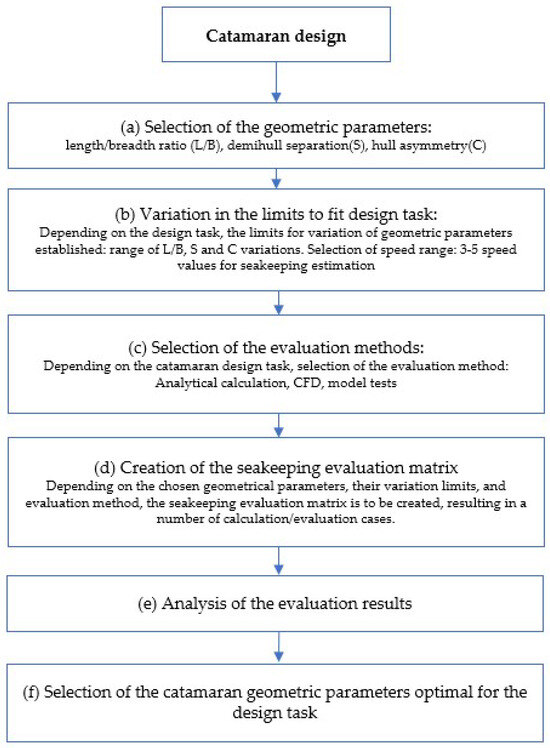
The part of the above-described complex methodology provided in this paper consists of selecting relevant geometric parameters, defining realistic variation limits, applying an appropriate numerical seakeeping method and analyzing the resulting motion responses to identify design trends. The general structure of the methodology is presented in Figure 1.
Figure 1.
Proposed methodology structure.
(a) The first step involves identifying geometric parameters known to influence catamaran seakeeping characteristics. Based on established seakeeping theory and previous studies [11,12,28,29], vessel length, demihull separation, and hull symmetry were selected for investigation. Among the many geometric variables that define a catamaran hull, these three are the ones most directly linked to the physics governing heave and pitch in head seas, and at the same time the ones most likely to be adjustable within a realistic design task. The vessel draft was held constant throughout the study to provide a consistent basis for comparing the investigated geometric parameters. This is a deliberate methodological choice intended to capture realistic early-stage design variations rather than idealized controlled comparisons, and is discussed in more detail in Section 6.
Vessel length (L) directly determines the natural periods of heave and pitch through its relationship with the vessel’s waterplane area, displacement, and pitch moment of inertia. Since resonance occurs when the encounter frequency matches the natural frequency of the vessel, length is important geometric factor governing which wavelengths will excite the vessel most strongly during operation [30,31]. Numerical studies have similarly confirmed the strong dependence of vertical motions on vessel length and relative wavelength across a range of catamaran configurations [32,33,34]. It is therefore one of the parameters any designer should examine when evaluating seakeeping at the concept stage.
In Section 3, the length values were varied within practical limits, considering the equipment placement possibilities of the original RV “Mintis” and potential hull cylindrical part modification.
Demihull separation (S) governs the hydrodynamic interaction between the two hulls. Each demihull generates its own wave system, and the separation distance determines the phase relationship between these systems—affecting both the wave excitation forces acting on the vessel and the radiation damping it experiences [7,11]. This effect becomes more noticeable at higher Froude numbers, making demihull separation a parameter worth examining systematically even if its absolute influence is smaller than that of vessel length [19,24]. Demihull separation is also one of the few geometric variables that can be meaningfully varied without requiring a fundamental redesign of the hull form itself. In Section 3, the separation values were varied within practical limits, which are related to general arrangement requirements and structural considerations of the connecting bridge.
Hull forepart symmetry can affect wave interaction patterns and hydrodynamic damping along the demihull, particularly in the bow region. Since pitch motion is most sensitive to forces acting forward of the center of gravity, changes in forepart geometry can alter the pitch damping and the spatial distribution of wave excitation moments without significantly affecting hydrostatic parameters such as displacement or waterplane area [3,8]. This makes forepart symmetry a parameter that can target pitch response specifically, independently of the other two variables, as confirmed by recent studies of catamaran hull form effects on seakeeping behavior [8,30]. In Section 3, the study case of methodology application is presented. It includes the forepart geometry of the demihull modification to generate asymmetric variants, while the aft part was kept unchanged to limit the scope of the investigation.
The methodology is not limited to these three parameters and can be extended to include additional variables in future applications.
(b) In the next stage of the methodology, the designer must define the allowable variation limits of the selected geometric parameters in accordance with the design task and intended operational profile of the catamaran. These limits are governed by general arrangement constraints, overall geometric proportions, and the functional requirements of the vessel. In the context of seakeeping analysis, the selected variation range should also ensure that the investigated configurations remain realistic and representative of practical design solutions.
The range over which vessel length can be varied is largely set by structural layout factors—frame spacing, the arrangement of the cylindrical midship section, and the configuration of internal compartments. From a seakeeping standpoint, changing vessel length shifts the relationship between hull length and incoming wavelength, which thereby affects the vessel’s motion response; therefore, dominant wavelength in the projected sailing area should be considered. Additional engineering work rising due to applicable rules (e.g., longitudinal strength calculation) should be accounted for. Also, selection of the length change step value should be performed in the framework of the ship design technical task; however, it should account for its influence on hydrodynamic characteristics.
The spacing between demihulls (S) may be adjusted within the constraints set by the overall breadth specified in the design requirements.
While increasing demihull separation may reduce hydrodynamic interaction effects in some conditions, it can also lead to structural challenges, such as reduced transverse strength of the connecting bridge and increased structural weight. On the other hand, smaller separation distances may intensify wave interference effects between demihulls, which can significantly influence vertical motion responses, particularly in head seas. From the studies [13,21,22,23,24,35], it is recommended to take demihull separations not less than half of the demihull, also taking into account the necessary deck area, dictated by the design task. Therefore, the selected range of S should balance structural, operational, and seakeeping considerations.
Hull symmetry is another parameter that can be adjusted depending on the design objectives. A symmetric hull configuration is typically used as a reference case, while asymmetric variations can be introduced by modifying the forebody geometry. In seakeeping terms, such modifications affect the distribution and hydrodynamic pressures along the hull, which influence heave and pitch responses. Care must be taken to ensure that the applied asymmetry remains within practical limits.
The selection of the operational speed range is also critical for seakeeping evaluation. The chosen speeds should reflect the vessel’s operational profile and correspond to representative Froude numbers. In this study, multiple speed conditions are considered to capture the variation of motion response across different encounter frequencies. While increasing the number of evaluated speeds can improve the resolution of the analysis, it also increases computational effort and should therefore be selected based on the objectives of the study.
(c) Selection of the evaluation methods: The chosen numerical evaluation tool is a critical part of the design stage. It should provide reasonable accuracy, be quick for evaluation and easy to use. Linear frequency-domain methods are widely used and recommended for the initial design evaluation and comparative experiments. Different evaluation methods (analytical calculations, CFD, model test) can be used to implement the methodological guidelines and to receive the results for evaluation within the wide domain frequency range. Maxsurf Motion software package (version 2024) is used in this case study for evaluation of seakeeping parameters using strip theory analysis.
(d) The next step in the methodology is to create the analysis matrix, which is constructed from different combination of hull geometric parameters. For example, applying the current methodology (presented in Section 3), the matrix consists of 36 different hulls, but can be expanded if necessary. Once the matrix is created, seakeeping analysis can be performed using the selected numerical tool. At the early design stage, RAO-based metrics are considered sufficient for comparative assessment, while more advanced operability criteria are recommended for later design phases. For this reason, heave and pitch response amplitude operator (RAO) curves were calculated for each hull configuration at different operating speeds corresponding to the Froude numbers investigated. The RAO selection can be explained as this value represents the fundamental transfer function between vessel motion and sea conditions and at the same time provides independence from the specific definition of input parameters. Considering the worst-case resonance condition, maximum values of heave and pitch RAOs are extracted from RAO curves. This makes RAO-based evaluation suitable for the early-stage design of a new build vessel. In addition to peak RAO values, the corresponding resonance frequencies were also examined to ensure that the motion response of the vessel occurs within the typical wavelength range of the vessel hull. In practical design application, the parameter of resonance frequency should be evaluated together with the expected wave spectrum of the operational environment conditions.
(e) Analysis of the evaluation results.
This stage of the methodology focuses on examining and presenting the seakeeping outcomes in a format appropriate for comparative evaluation.
The extracted maximum RAO values were grouped according to demihull separation and plotted separately for each operating speed. On the horizontal axis, within each spacing group, results were arranged by vessel length, allowing trends related to length, spacing, and hull symmetry to be clearly seen and compared. On the vertical axis, the results of pitching and heaving maximum RAO values for corresponding vessels are plotted. This analytical model can be easily extended to include additional geometric parameters and resulting values depending on the design requirements.
The following sections demonstrate the application of this methodology to a representative case study of the research vessel RV “Mintis”, with the numerical setup described in Section 4.
3. Case Study Conditions
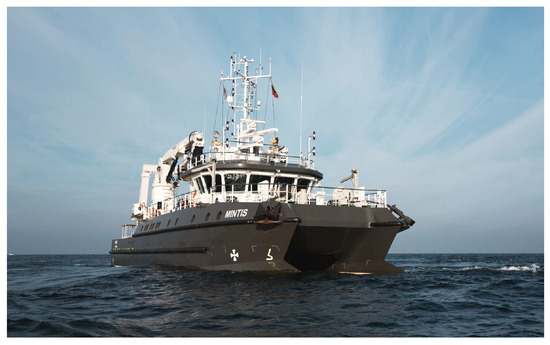
The proposed methodology application from Section 2 is demonstrated using the original hull configuration of the research vessel (RV) Mintis [35]. The vessel is a 39 m-long, 12 m-wide catamaran, built for multifunctional marine research tasks and put into service in 2014 (Figure 2).
Figure 2.
Research vessel “Mintis”.
RV Mintis was selected as the case study because challenges related to the selection of appropriate geometric parameters were identified by the engineers during the design stage. Moreover, comprehensive geometric and operational data for the vessel are available, allowing for a consistent and reliable application of the proposed methodology. The vessel is equipped with a dynamic positioning system that allows it to maintain accurate stations, keeping in wind speeds of up to 18 m/s and significant wave heights of up to 3.5 m. This feature ensures a high level of maneuverability and allows the vessel to operate safely in both open-sea conditions and restricted harbor areas.
The applied methodology is intended to establish design guidelines for optimizing the geometric parameters of catamaran hulls during the early stages of vessel design. The structured comparison process is based on a series of numerical analyses in which hull geometry variations were investigated using strip theory. The investigated variations include changes in demihull spacing, hull symmetry, and overall vessel length, allowing the influence of these parameters on vessel performance to be systematically evaluated. All geometric modifications were performed while maintaining a constant draft of 3 m. Consequently, the displacement of the investigated hull configurations varies between cases. This approach reflects practical early-stage design conditions, where modifications of vessel dimensions are commonly associated with changes in payload capacity, onboard equipment arrangement, or operational requirements. Therefore, the objective of the present study is not to compare hulls under identical displacement conditions, but rather to evaluate the influence of realistic geometric design variations that may occur during concept-stage development. The methodology thus represents a comparative design-space assessment rather than a displacement-constrained hydrodynamic optimization.
- (1)
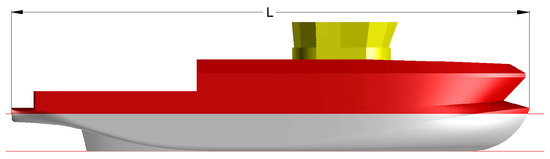
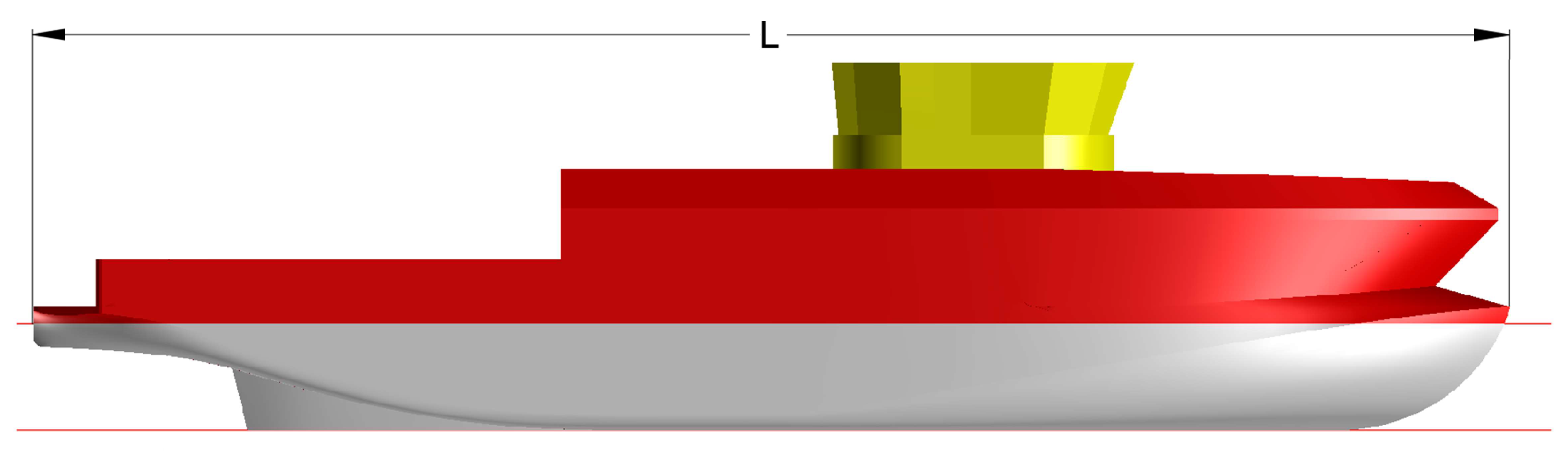
- Overall Length (L): Four vessel lengths—36 m, 38.6 m, 43.8 m, and 49 m—were considered. These configurations were regarded as practically achievable and obtained by altering the number of frames in the cylindrical midship region, leading to length changes of −2.6 m, the baseline length, +5.2 m, and +10.4 m, respectively (Figure 3).Figure 3. Scheme of vessel length measurement variation. Red lines represents draft and base line of catamaran.
- (2)
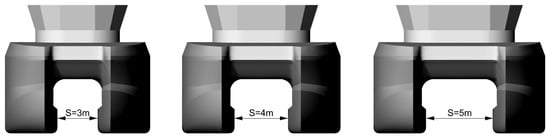
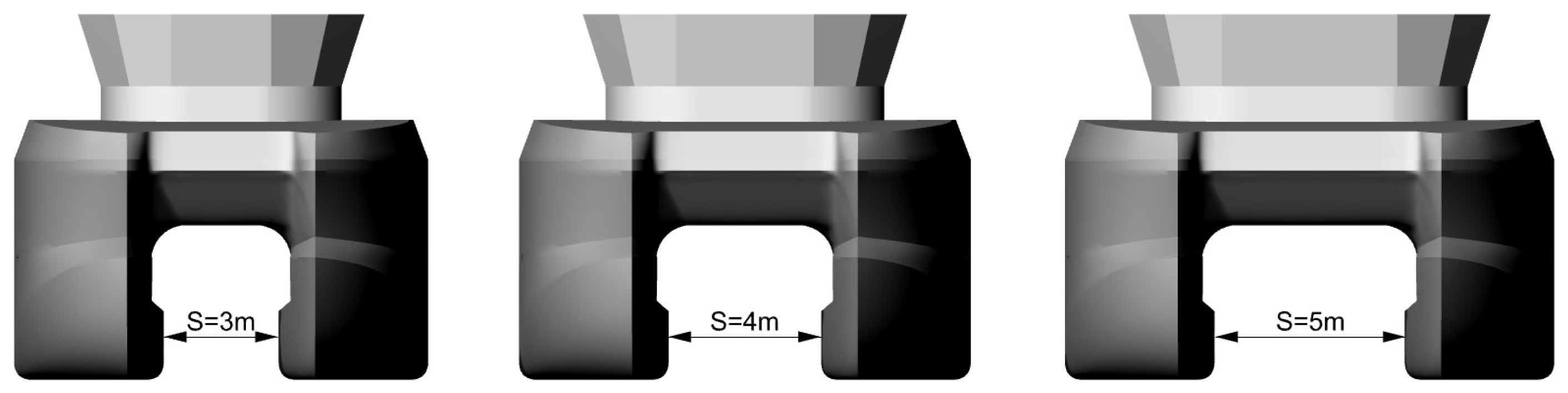
- Demihull Separation (S): Separation distances of 3 m, 4 m, and 5 m were evaluated in the simulations. These variations were implemented by increasing or decreasing the original spacing (4 m) by 1 m (Figure 4). The selected values were based on practical feasibility, ensuring that the overall beam of the catamaran remained within acceptable limits for structural strength considerations.Figure 4. Scheme of measurement variations in distances between the hulls.
- (3)
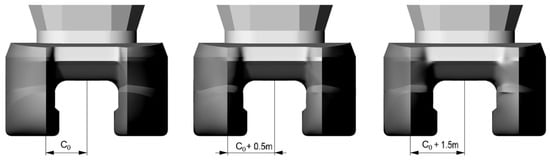
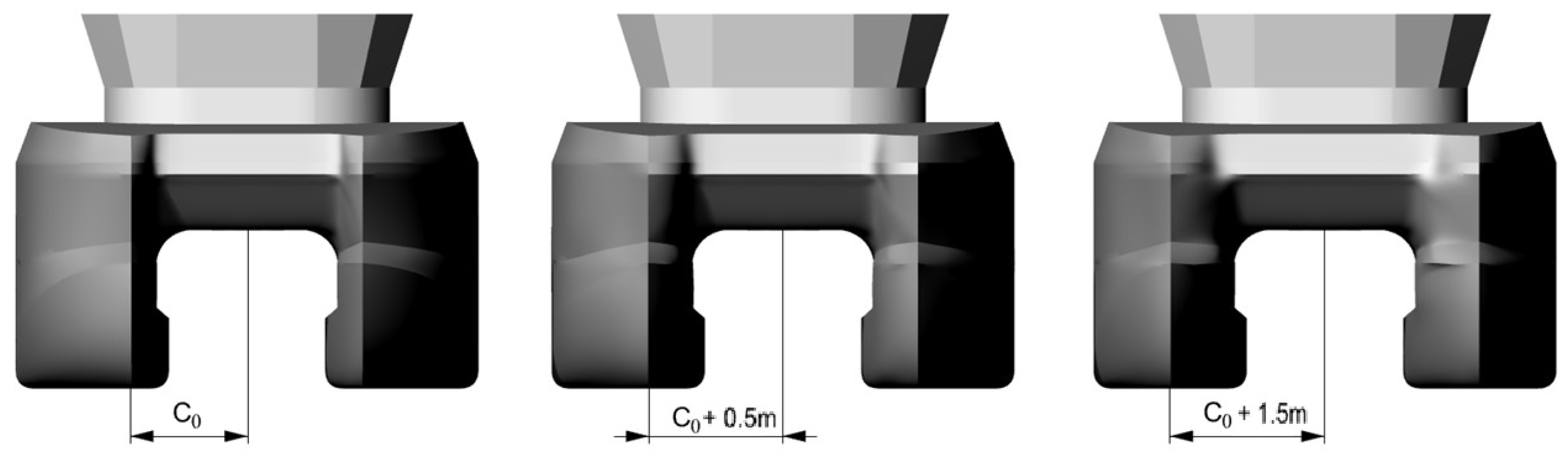
- Forepart Symmetry (C): The influence of bow section symmetry was also assessed by comparing the original asymmetric hull form with a fully symmetric configuration. The applied modifications in the numerical study are illustrated in Figure 5.Figure 5. Illustration of forepart symmetry variations. From left to right: original (v1), modified asymmetric form (v2), and symmetric form (v3).
The RV Mintis initially features an asymmetric hull form (C0), which was modified for the study by shifting the bow (stem) line by C0 + 0.5 m and C0 + 1.5 m, while keeping the original aft-body geometry. These adjustments produced only minor variations in hydrostatic characteristics, with changes in parameters such as LCB and waterplane area remaining within approximately 1%.
In the results discussion, the original RV Mintis configuration is designated as version 1 (v1). The modified asymmetric form corresponding to C0 + 0.5 m is referred to as version 2 (v2), whereas the modified symmetric form corresponding to C0 + 1.5 m is labeled version 3 (v3). Table 1 summarizes the hydrostatic parameters for all analyzed hull configurations.
Table 1.
Hydrostatics parameters of investigated model configurations.
It is important to note, that changes in demihull distance within the same length of the vessel had only minor change in hydrostatic parameters (less than 1%). Such results confirm that demihull spacing and symmetry of forepart are isolated from hydrostatic parameters and mainly effect hydrodynamic wave interaction between demihulls.
4. Numerical Method
The seakeeping analysis was performed using linear frequency-domain strip theory, which is consistent with ITTC-recommended practices for preliminary and comparative seakeeping assessments. This method is based on dividing the hull into a series of two-dimensional transverse sections. Hydrodynamic coefficients are calculated for each section and subsequently integrated along the vessel length to represent the overall hull response. Despite its advantages and wide application in early-stage design studies, strip theory method has its own limitations. The use of two-dimensional sections cannot fully capture complex three-dimensional hydrodynamic wave interference between demihulls and nonlinear viscous effects. These limitations may influence the accuracy of the predicted absolute motion amplitudes. The complete list of limitations and assumptions of this paper is presented in Section 6.
Nevertheless, strip theory remains well suited for comparative studies involving multiple hull configurations, where the objective is to identify trends in motion response across a range of wave frequencies and wavelengths rather than to predict exact motion magnitudes. Castiglionea T. et al. [36] used strip theory-based software to estimate seakeeping characteristics of a catamaran. A linear response of the catamaran was obtained for low steep waves, where good correlation between viscous computations, strip theory results and EFD data was achieved.
In this study, the Maxsurf Motions software package is employed to investigate the influence of geometric variations on catamaran wave-induced motions. The software is used to compute heave and pitch RAOs for different hull configurations, allowing systematic assessment of the effects of demihull spacing, hull symmetry, and vessel length.
The Maxsurf Motions software has been verified and demonstrated to be a reliable and suitable computational package for the application of strip theory in seakeeping analyses by numerous researchers, including recent studies, such as Kim, J et al. [37].
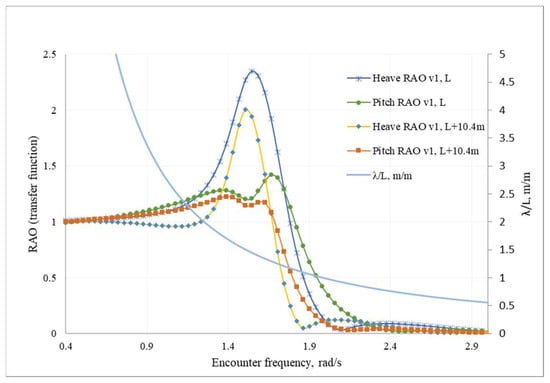
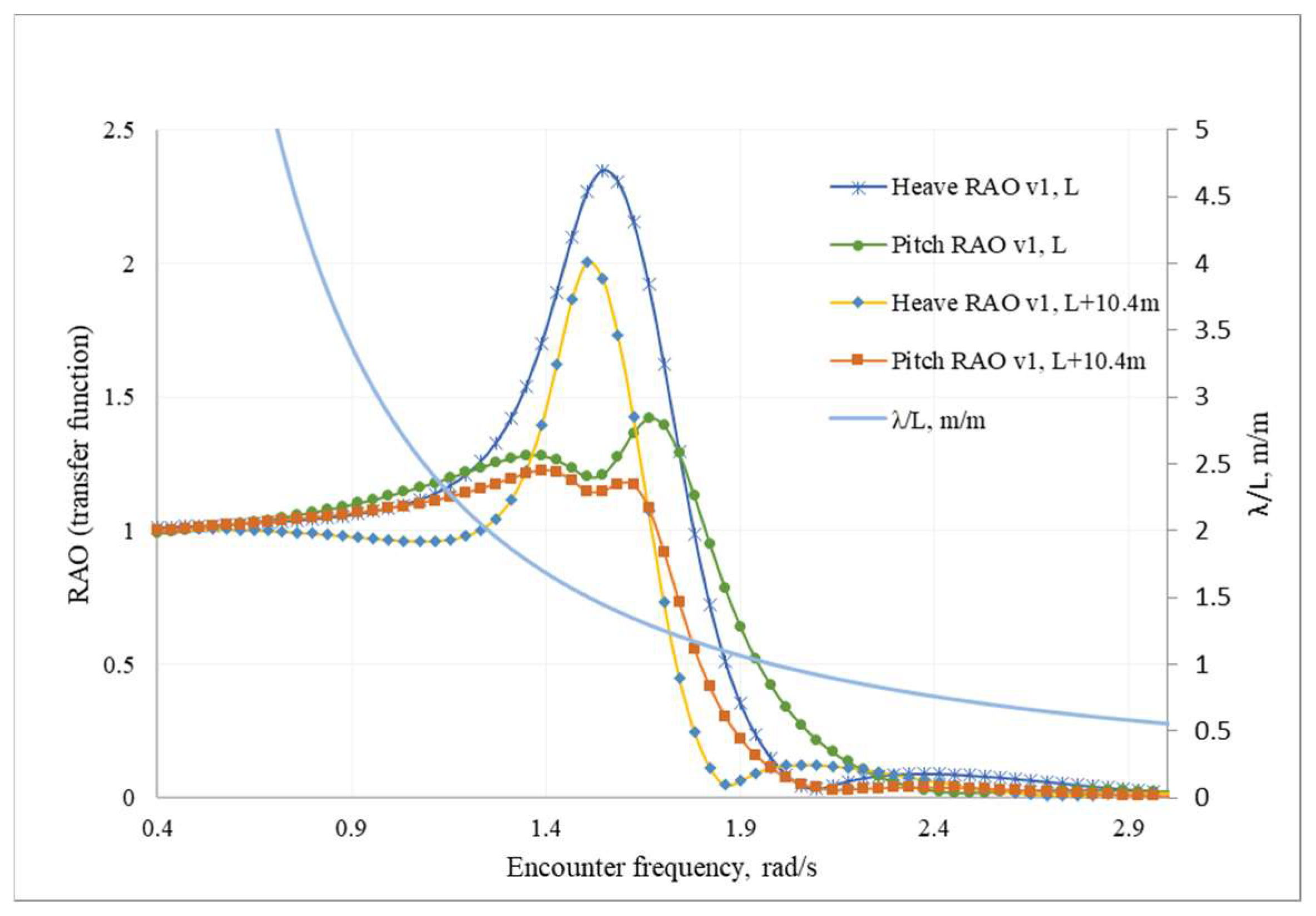
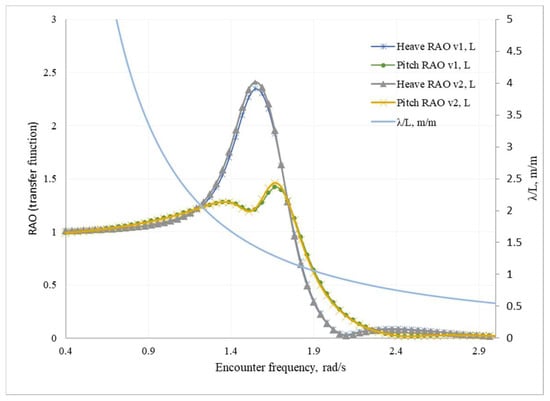
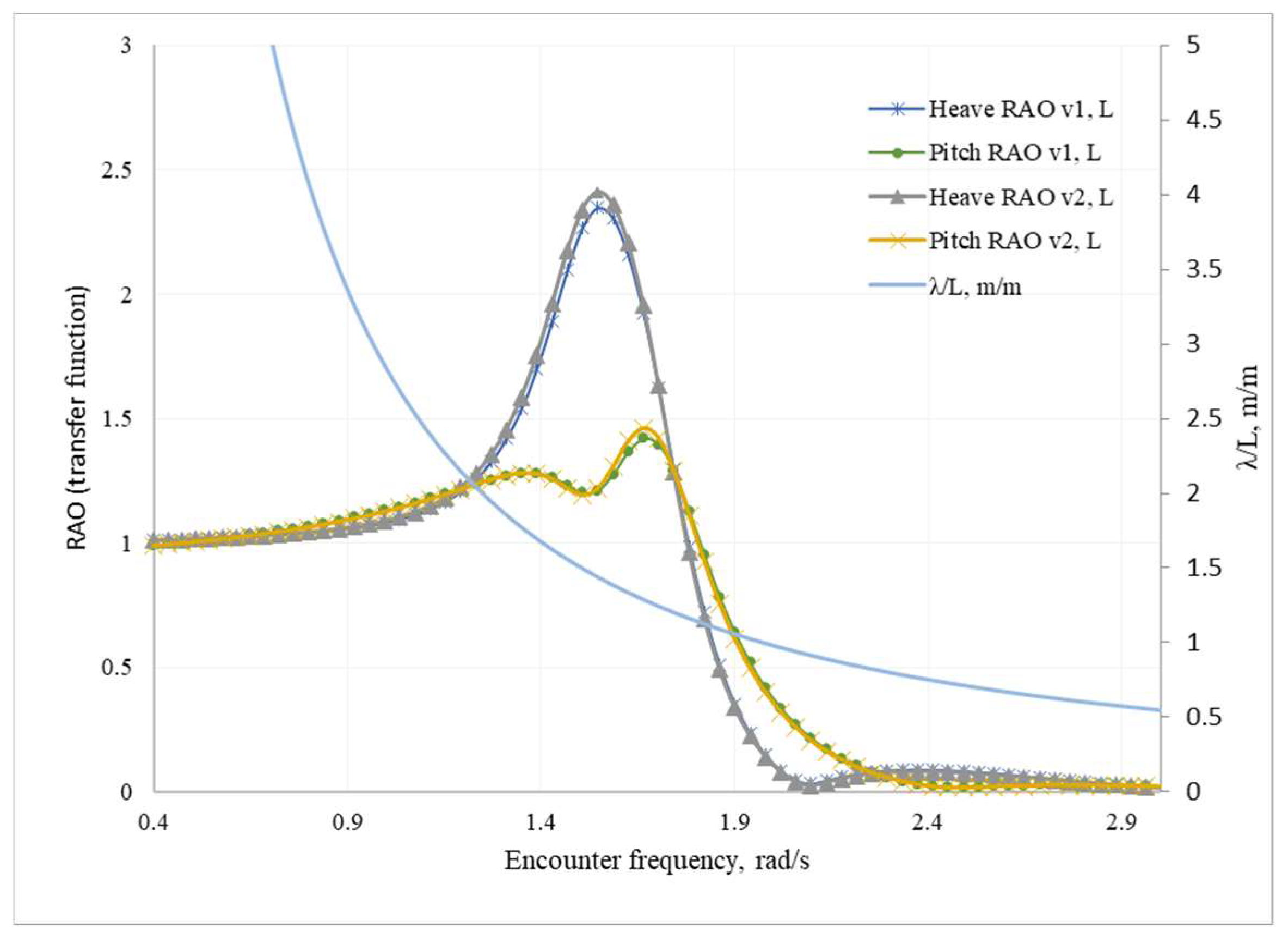
The numerical software high prediction level is additionally proved by the Maxsurf developers in their research works [38]. The numerical setup in the software consisted of the analysis of each catamaran configuration at a constant draft of 3 m and at three operating speeds: 6 kn (operational), 8.5 kn (cruise), and 12.5 kn (maximum). The use of multiple speeds allows the assessment of vessel behavior at different Froude numbers and facilitates comparison of geometric configurations. Each hull model was discretized into 41 two-dimensional transverse sections to ensure sufficient accuracy of the strip-theory predictions. All simulations were conducted in deep-water conditions with a wave heading of 180° (head seas) using regular waves. This numerical setup was selected to enable a clear and efficient comparison of the dynamic characteristics of multiple geometric variants. Regular-wave frequency-domain analysis allows direct evaluation of the response amplitude operators (RAOs), which describe the hull motion resonance response independently of a specific sea state definition and is well suited for the early stage of vessel design. The wave frequency range used for the evaluation of maximum heave and pitch RAO values was discretized into 91 frequency points. Such conditions provide reliable identification of resonance peaks, which are not boundary limited. Figure 6 and Figure 7 provide the comparison of classical heave RAO and pitch RAO curves for specific geometry combinations used in this study. Charts additionally include the λ/L ratio, where λ is the wavelength used for the evaluation of RAO, and L is vessel length. Using the charts, it is possible to see the motion response of the vessel at the desired motion encounter frequency range (0.4 rad/s to 3 rad/s plotted in the chart) and wavelengths.
Figure 6.
Comparison of RAO curves for symmetry version 1 and different lengths of hull (L refers to 38.6 m, L+10.4 m refers to 49 m).
Figure 7.
Comparison of RAO curves for symmetry version 1 (original RV) symmetry version 2 (asymmetric). L refers to 38.6 m.
Verification of Numerical Setup
In Maxsurf Motions, the frequency discretization for strip-theory analysis is internally defined and cannot be modified by the user. The frequency resolution, however, can be controlled through the number of evaluation points. To verify that the identified resonance peaks were not sensitive to this setting, the analysis was repeated with 69, 91, and 120 frequency evaluation points. Peak heave and pitch RAO values varied by less than 0.4% and 1.9%, respectively, across all three cases, confirming that 91 evaluation points provides sufficient resolution for accurate and stable identification of resonance peaks. In addition, the independence of the result from the two-dimension vessel section amount should be evaluated. The evaluation is performed according to methodology by L.F. Richardson [39] and P.J. Roache [40] for the original RV “Mintis” hull at 8 knot speed and 3 m draft. A constant refinement ratio was maintained across the three strip counts, allowing application of the standard three-grid GCI method. The results are presented in Table 2.
Table 2.
Numerical convergence assessment.
The GCI analysis confirms low sensitivity of peak heave and pitch RAO values to the number of transverse sections, with convergence uncertainties below 1.5% across the tested discretization. An additional test with 15 transverse sections produced heave and pitch RAO values of 2.591 and 1.658, respectively (about 30% difference), confirming that the solution diverges noticeably at very coarse discretization and that the selected 41-strip count lies well within the converged region. These results are consistent with ITTC recommendations for preliminary seakeeping evaluation and with findings reported in previous strip theory validation studies.
5. Results and Discussion
5.1. Overview of Results
The numerical investigation covered 36 catamaran hull configurations, each analyzed at three operating speeds corresponding to Froude numbers Fr = 0.15, 0.22, and 0.32, resulting in 108 peak heave RAO values and 108 peak pitch RAO values. All analyses were conducted in head seas using linear strip theory, as described in Section 4.
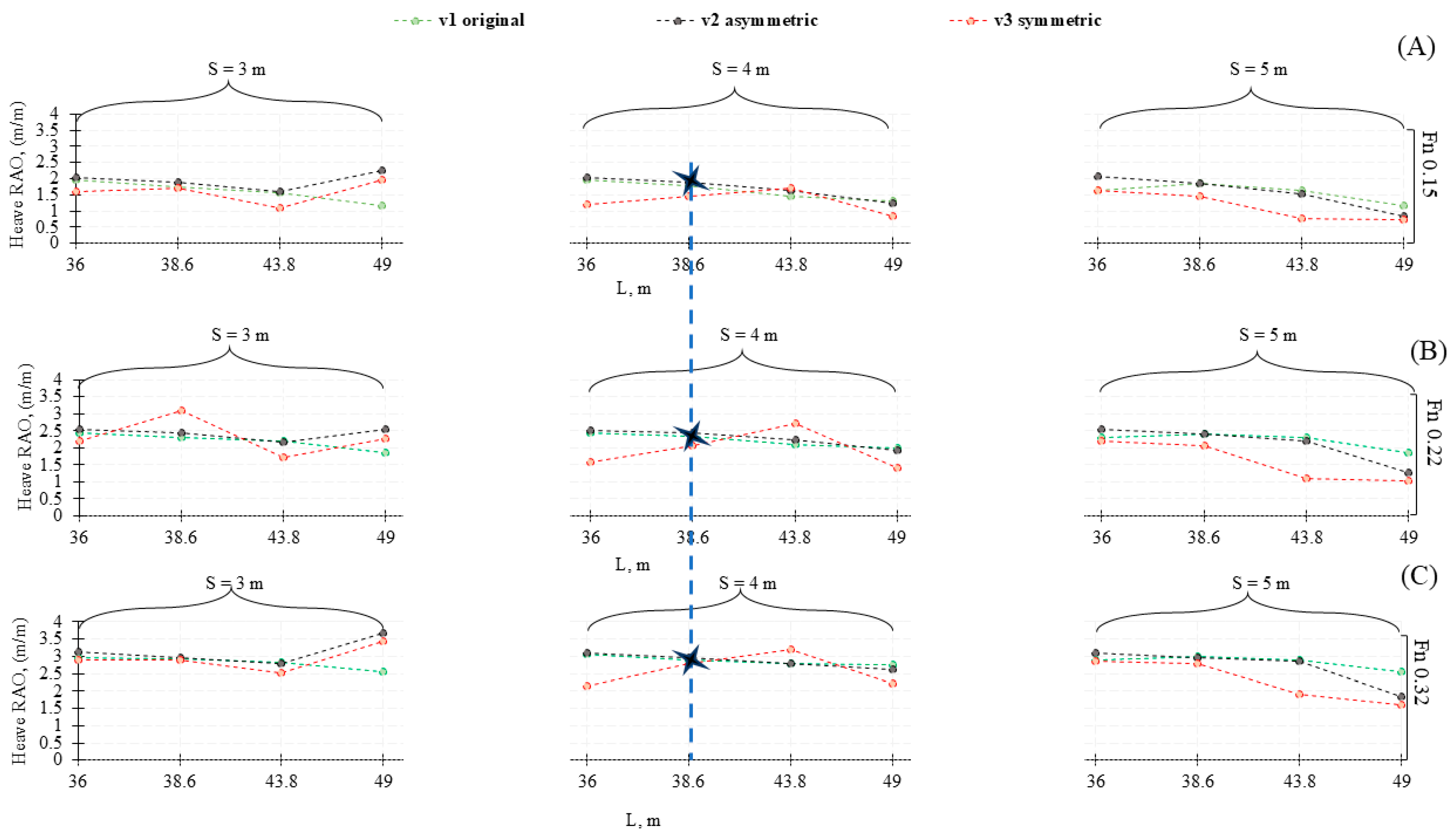
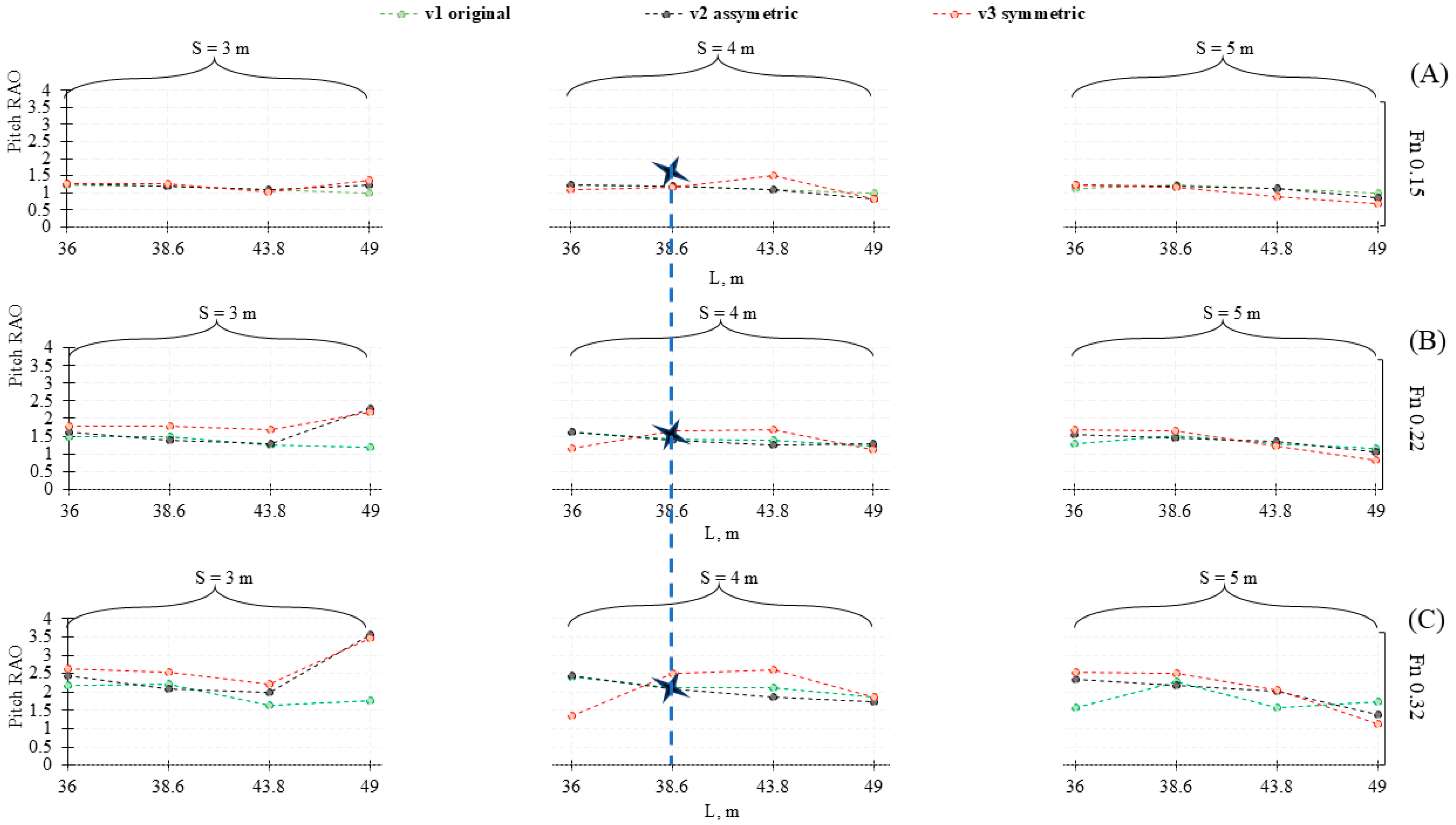
In standard seakeeping practice, results for each hull configuration are presented as individual RAO curves plotted against wave frequency, as shown for selected configurations in Figure 6 and Figure 7. While this format works well for a small number of configurations, comparing 36 curves on a single graph becomes impractical. For this reason, a condensed graphical representation was adopted, where only the peak RAO values are extracted from each curve and plotted together for all configurations, grouped by speed and demihull separation. This format, shown in Figure 8 and Figure 9, allows trends related to vessel length, demihull separation, and hull symmetry to be read directly and compared efficiently across all configurations simultaneously. It also allows direct comparison with the resistance evaluation chart presented in the companion study [27], which used the same graphical approach for resistance results.
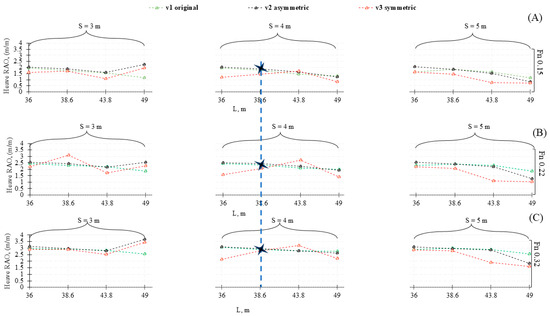
Figure 8.
Influence of separation distance and vessel length on heaving maximum RAO values. From top to bottom: (A) heaving, Fr 0.15, (B) heaving, Fr 0.22, (C) heaving Fr 0.32.
Figure 9.
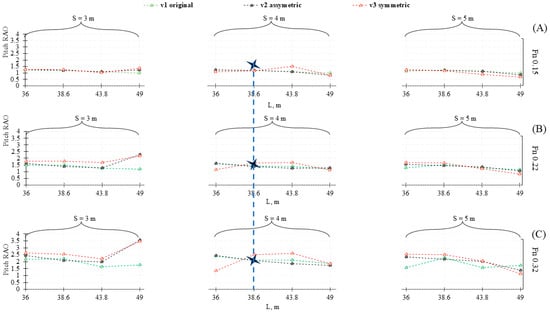
Influence of separation distance and vessel length on pitch maximum RAO values. From top to bottom: (A) pitching, Fr 0.15, (B) pitching, Fr 0.22, (C) pitching, Fr 0.32.
Figure 8 and Figure 9 are divided into six sections, each showing the maximum heave and pitch RAO values for a given Froude number (three in total) across all analyzed hull configurations. Each section includes horizontal axes representing L, which denotes the catamaran length variant, and S, which denotes the demihull separation distance. The differently colored curves indicate the forepart symmetry configurations of the vessel: v1 corresponds to the original RV Mintis, v2 represents the modified asymmetric form, and v3 represents the symmetric configuration (Figure 6).
Heave and pitch RAOs are presented using the same non-dimensional scale because both quantities are normalized in Maxsurf Motions. Heave RAO is normalized by wave height, while pitch RAO is normalized by wave slope, resulting in dimensionless response parameters suitable for comparative analysis.
To validate the proposed method and show its application, the vertical line with blue start between all graphs is plotted at the position of the original RV “Mintis” geometry data. This line clearly demonstrates the influence of several geometry parameters variations on the maximum heave and pitch RAO values and potentially natural resonance states of the hull during operation. Understanding the trend of heaving and pitching of the specific design task can clearly be simplified using such graphs, compared with the classical vessel frequency response chart.
A general observation across all configurations is that peak heave and pitch RAO values increase with Froude number. This is explained by the encounter frequency effect in head seas—as forward speed increases, the vessel meets waves at a higher effective frequency, shifting the resonance condition and increasing the motion response. This behavior is well established in classical seakeeping theory [41] and confirmed in recent numerical studies [32].
5.2. Effect of Vessel Length
Vessel length was varied between 36 m and 49 m, and produced a measurable but moderate influence on heave and pitch RAO values, with both motions varying by approximately 45–50% across the investigated range. In most configurations, shorter hull variants produced higher peak heave and pitch RAOs, while the longest variant (L = 49 m) tended to show the lowest peak values. This is consistent with classical seakeeping theory—a longer hull reaches resonance at longer absolute wavelengths, shifting the resonance condition away from the frequency range where most wave energy is concentrated in typical operational sea states [31], though some configurations show deviations from this trend, reflecting interaction with demihull separation and symmetry effects discussed in Section 5.3 and Section 5.4. Recent numerical studies have similarly confirmed the strong dependence of vertical motions on vessel length and relative wavelength [33,34].
The effect of vessel length on the shape of individual RAO curves is illustrated in Figure 6, which shows that longer configurations exhibit lower and broader resonance peaks, while shorter configurations produce sharper and higher peaks at lower absolute wavelengths. The relative wavelength parameter λ/L, also visible in Figure 6 and Figure 7, confirms that all configurations reach resonance within a comparable relative wave regime, demonstrating that the observed trends are physically consistent across the investigated design space rather than being specific to any particular configuration.
5.3. Effect of Demihull Separation
The influence of demihull separation on heave and pitch response is evident in Figure 8 and Figure 9, where results are grouped by separation value (S = 3, 4, and 5 m) for each speed. Across the investigated range, demihull separation produces a substantial effect on motion response—heave RAO varies by approximately 32–65% and pitch RAO by approximately 25–50% depending on vessel speed and length. This finding is consistent with the strip theory prediction for the head sea condition as implemented by Maxsurf software itself [39].
Changes in demihull separation within the same vessel length produced negligible changes in hydrostatic parameters—less than 1% change in waterplane area and longitudinal center of buoyancy—confirming that the observed RAO differences are driven by hydrodynamic rather than hydrostatic effects. This makes demihull separation a useful parameter at the early design stage: it can be adjusted to reduce motion response without requiring changes to the overall hull form or general arrangement.
5.4. Effect of Forepart Symmetry
The influence of forepart symmetry on individual RAO curves is illustrated in Figure 7, which compares the heave and pitch response of the asymmetric configurations v1 and v2 against the relative wavelength parameter λ/L. The broader comparison across all three symmetry variants, including the fully symmetric configuration (v3), is presented in Figure 8 and Figure 9. The effect of forepart symmetry differs between the two motions. For heave, the symmetric configuration (v3) produces lower peak RAO values than the asymmetric variants (v1, v2) in most investigated configurations. Heave RAO varies by approximately 30–60% depending on hull symmetry, speed, and length. For pitch, the relationship is less consistent: v3 generally produces higher peak RAO values than the asymmetric variants, with pitch RAO varying by approximately 27–50% across the investigated range. This trend weakens, and in some cases reverses, at wider demihull separations (S = 4 and 5 m) and longer vessel lengths, indicating that the influence of forepart symmetry on pitch response depends more strongly on its interaction with separation and length.
Changes in forepart symmetry produced negligible changes in hydrostatic parameters—less than 1% change in waterplane area and longitudinal center of buoyancy between the symmetry variants—indicating that the observed RAO differences are not driven by changes in the vessel’s overall hydrostatic properties. Detailed inspection of section-by-section hydrodynamic coefficients confirms that the influence of forepart symmetry is concentrated in the bow region, consistent with the location of the applied geometric modification. The symmetric configuration (v3) shows higher sectional added mass and damping coefficients near the bow than the asymmetric variants. This local increase in bow damping is consistent with the generally lower heave RAO observed for v3. However, the pitch RAO response of the symmetric configuration behaves differently. This may be explained by pitch response depending not only on the magnitude of the sectional coefficients but also on their distribution along the hull relative to the vessel’s center of gravity.
The general influence of hull form on multihull seakeeping behavior is consistent with findings reported in the literature [30,42], including recent studies of catamaran hull form optimization [8].
5.5. General Observations of the Methodology
The presented results are supported by numerical verification, including convergence assessment with respect to number of two-dimensional transverse sections. The convergence analysis shows uncertainties up to 1.5% for maximum heave and pitch RAO values, which show the accuracy of the presented results. It could be stated that linear strip theory may have some limitations, but it is still a reliable tool for any comparison analysis, like the one presented in this article.
The graphical comparison format introduced in this study allows a large number of geometric combinations to be compared simultaneously, supporting the identification of favorable configurations for a given operational task. This format complements the numerical methodology and is one of the key practical contributions of the proposed approach. Nevertheless, the provided evaluation method currently has its limitations, including the limitation of strip theory and seek of other commonly used seakeeping parameters (motion sickness index, non-linear wave spectrum analysis). These methodology limitations are presented in Section 6.
6. Limitations and Assumptions
The results presented in Section 5 demonstrate that the proposed methodology successfully identifies meaningful trends in catamaran seakeeping behavior across a wide range of geometric configurations. However, it is important to be explicit about what the methodology does and does not account for, so that future users can apply it appropriately.
In this study, all geometric modifications were performed at constant draft, which means that increasing vessel length simultaneously increases displacement—from 613.8 t at L = 36 m to 920 t at L = 49 m. As a consequence, the pitch radius of gyration k_yy, estimated in Maxsurf Motions as approximately 0.25 L following standard ITTC preliminary design practice, also scales with length. This means that the observed differences in heave and pitch RAO values across length variants reflect a combination of two effects: the hydrodynamic geometric effect of changing relative wavelength λ/L, and the inertial effect of increased displacement and pitch moment of inertia. These two contributions cannot be fully decoupled within the present study without running additional controlled simulations with artificially fixed mass properties. This is acknowledged as a limitation of the constant-draft comparison approach. It reflects a deliberate methodological choice—in real early-stage design, a longer vessel does carry more displacement, and the methodology is intended to capture realistic design variations rather than idealized controlled comparisons. Nevertheless, a displacement-controlled sensitivity study, where hull length is varied while mass properties are held fixed, would be a valuable extension of this work to isolate the purely geometric hydrodynamic contribution.
The analysis is based on linear 2D strip theory with hydrodynamic coefficients computed using conformal mapping. This approach is well established for conventional displacement hull forms at moderate Froude numbers and is considered reliable for Fr ≤ 0.35–0.40. The maximum Froude number in this study is Fr = 0.32, which falls within this range. At higher speeds, three-dimensional panel methods or CFD would be more appropriate. The near-field wave interaction between demihulls is accounted for through catamaran-specific correction factors [27] but is not fully resolved in three dimensions—for head seas this is a reasonable approximation supported by published validation studies [24,28,36,42]. For oblique or beam sea headings, where inter-hull interference is considerably more significant, the method would require more careful validation before being applied.
Finally, the presented methodology is based on regular wave RAO analysis, which captures resonance characteristics independently of a specific sea state and is well suited for early-stage comparative assessment. The extension to irregular wave analysis—for example through convolution of RAO curves with a representative JONSWAP spectrum for the target operational area—is a natural and straightforward next step, but is considered outside the scope of the present work. Similarly, the study is limited to head seas and RAO-based peak values. More advanced operability criteria, additional wave headings, and irregular wave response calculations are identified as extensions of the methodology for later design stages.
7. Conclusions
This paper presents a methodology for the early-stage seakeeping assessment of catamaran vessels, intended to support the identification of advantageous hull geometry parameters. Its applicability is demonstrated through a case study carried out at the vessel design stage.
The methodology includes the selection of relevant geometric parameters, the definition of analysis limits in accordance with design requirements, the selection of appropriate analysis methods, and the introduction of a multi-geometry evaluation chart for comparative assessment. The novelty of the present work does not lie in the development of a new hydrodynamic solver, but rather in the formulation of a structured early-stage design methodology that combines parameter selection, constrained geometric variation, comparative RAO-based assessment, and graphical interpretation into a unified decision-support framework for catamaran seakeeping evaluation.
A geometry-based parametric approach was applied to investigate the effects of vessel length, demihull separation, and hull symmetry on the maximum heave and pitch response amplitude operators (RAOs) in head seas at three operating speeds corresponding to Froude numbers Fn = 0.15, 0.22, and 0.32. The study employs a frequency-domain approach utilizing linear strip theory for seakeeping performance evaluation; however, the methodology can also be applied using alternative numerical or experimental evaluation methods.
Vessel length was found to have a measurable but moderate influence on motion response, with both heave and pitch RAO varying by approximately 45–50% across the investigated range of 36–49 m. In most configurations, shorter hull variants produced higher peak RAOs than longer ones, consistent with classical seakeeping theory, where longer hulls reach resonance at longer absolute wavelengths [32]. Recent numerical studies have similarly confirmed that heave and pitch responses strongly depend on relative wavelength effects and vessel geometry, supporting the trends observed in the present work [33,34]. In addition to the magnitude of the response, the corresponding resonance conditions were evaluated using the relative wavelength parameter (λ/L), which showed only minor variation across the investigated configurations. This indicates that the observed resonance peaks occur within a comparable relative wave regime, supporting the physical consistency of the comparative analysis.
Demihull separation was found to have a substantial influence on motion response, with heave RAO varying by approximately 32–65% and pitch RAO by approximately 25–50% across the investigated range of S = 3–5 m. Wider separation generally reduced peak RAO values, particularly at higher Froude numbers, consistent with strip theory expectations for head-sea conditions [38]. Changes in separation produced negligible changes in hydrostatic parameters, confirming that this effect originates from hydrodynamic rather than hydrostatic mechanisms.
Hull forepart symmetry was found to influence heave and pitch response differently. For heave, the symmetric configuration generally produced lower peak RAO values than the asymmetric variants. Heave RAO varied by approximately 30–60% across the investigated configurations. For pitch, the relationship was less consistent. The symmetric configuration generally produced higher peak RAO values, with pitch RAO varying by approximately 27–50%. This trend weakened or reversed at wider demihull separations and longer vessel lengths.
Overall, the proposed methodology provides a practical and computationally efficient framework that links geometric parameter variation with design decision-making, enabling a structured evaluation of catamaran seakeeping performance during the early stages of design. Unlike conventional parametric studies, the methodology guides the designer toward a narrower and more relevant range of geometric configurations, facilitating more focused and informed design decisions. Once this reduced design space has been identified, additional numerical tools and optimization techniques can be applied to further refine the vessel configuration. Furthermore, the methodology can be extended to include irregular-wave conditions, additional geometric variables, or more advanced nonlinear numerical approaches in later stages of the design process.
Author Contributions
Conceptualization, E.I. and V.D.; methodology, E.I. and V.D.; software, E.I.; validation, E.I. and L.N. formal analysis, J.J.; investigation, E.I. and V.D.; resources, E.I. and J.J.; data curation, J.J.; writing—original draft preparation, E.I., J.J. and V.D.; writing—review and editing, J.J., E.I. and V.D.; supervision, E.I. All authors have read and agreed to the published version of the manuscript.
Funding
The research was financed by Research Council of Lithuania and the Ministry of Education, Science and Sport Lithuania (Contract No. S-A-UEI-23-9).
Institutional Review Board Statement
Not applicable.
Informed Consent Statement
Not applicable.
Data Availability Statement
The original contributions presented in this study are included in the article. Further inquiries can be directed to the corresponding author.
Conflicts of Interest
The authors declare no conflicts of interest.
Abbreviations
The following abbreviations are used in this manuscript:
| RV | Research vessel |
| ITTC | International Towing Tank Conference |
| L | Ship length |
| B | Ship breadth |
| D | Ship draught |
| S | Catamaran demihull separation |
| C0 | Original RV “Mintis” symmetry value |
| Fr | Froude number |
| CFD | Computational fluid dynamics |
| k_yy | Pitch radius of gyration |
References
- Bouscasse, B.; Broglia, R.; Stern, F. Experimental investigation of a fast catamaran in head waves. Ocean Eng. 2013, 72, 318–330. [Google Scholar] [CrossRef] [Scilit]
- Begovic, E.; Bertorello, C.; Pennino, S. Experimental seakeeping assessments of a warped planning model series. Ocean Eng. 2014, 83, 1–15. [Google Scholar]
- Varyani, K.S.; Gatiganti, R.M.; Gerigk, M. Motions and slamming impact on catamaran. Ocean Eng. 2000, 27, 729–747. [Google Scholar] [CrossRef] [Scilit]
- Cai, J.; Yao, T.; Liu, H.; Wan, L.; Wan, J.; Fan, X.; Zhao, Y. Experimental and numerical study of the added resistance and seakeeping performance of a new unmanned survey catamaran. Ocean Eng. 2024, 308, 118255. [Google Scholar] [CrossRef] [Scilit]
- He, W.; Diez, M.; Zou, Z.; Campana, E.F.; Stern, F. URANS study of Delft catamaran total/added resistance, motions and slamming loads in head sea including irregular wave and uncertainty quantification for variable regular wave and geometry. Ocean Eng. 2013, 74, 189–217. [Google Scholar] [CrossRef] [Scilit]
- Jiang, B.; Wang, W.; Mao, B.; Wei, S.; Cang, J.; Zhang, Z.; Zhang, G. Wave interference characteristics of high-speed catamaran formations under various configurations. Ocean Eng. 2026, 351, 124355. [Google Scholar] [CrossRef] [Scilit]
- Wulandari, A.I.; Sulisetyono, A.; Utama, I.K.A.P. The influence of hull and tunnel geometry on resistance and seakeeping behavior of flat side-inside catamaran. Ships Offshore Struct. 2025, 1, 1–35. [Google Scholar] [CrossRef] [Scilit]
- Danışman, D.B. Reduction of demi-hull wave interference resistance in fast displacement catamarans utilizing an optimized centerbulb concept. Ocean Eng. 2014, 91, 227–234. [Google Scholar] [CrossRef] [Scilit]
- Zaraphonitis, G.; Spanos, D.; Papanikolaou, A. Numerical and experimental study on the wave resistance of fast displacement asymmetric catamarans. In Proceedings of the International Euro Conference on High Performance Marine Vehicles, Hamburg, Germany, 2–5 May 2001. [Google Scholar]
- Jiang, B.; Liang, X.; Wang, L.; Zhang, Z.; Wang, Y. Research on Energy-Saving Optimization of Different Formation Configurations Based on Four Catamarans. In Computational and Experimental Simulations in Engineering. ICCES 2024. Mechanisms and Machine Science; Zhou, K., Ed.; Springer: Cham, Switzerland, 2024; Volume 168. [Google Scholar] [CrossRef] [Scilit]
- Ahmed, T.M.; Abdelrahman, A.M.; Hassan, A.M.; Banawan, A.A. CFD optimization of a displacement catamaran’s configuration for minimized calm water resistance. Mar. Syst. Ocean Technol. 2023, 17, 188–202. [Google Scholar] [CrossRef] [Scilit]
- Broglia, R.; Zaghi, S.; Di Mascio, A. Numerical simulation of interference effects for a high-speed catamaran. J. Mar. Sci. Technol. 2011, 16, 254–269. [Google Scholar] [CrossRef] [Scilit]
- Aung, M.Z.; Nazemian, A.; Boulougouris, E.; Wang, H.; Duman, S.; Xu, X. Establishment of a design study for comprehensive hydrodynamic optimisation in the preliminary stage of the ship design. Ships Offshore Struct. 2024, 19, 793–806. [Google Scholar] [CrossRef] [Scilit]
- Osmanov, O.; Aksu, E. Impact of Tunnel Stern Design on Hydrodynamic Characteristics of Catamarans. Pol. Marit. Res. 2025, 32, 31–43. [Google Scholar] [CrossRef] [Scilit]
- Mai, T.L.; Vo, A.K.; Cho, A.; Mai, V.T.; Yoon, H.K. Experimental investigation on wave characteristics due to interference of catamaran demi-hulls in waves. Int. J. Nav. Archit. Ocean Eng. 2024, 16, 100594. [Google Scholar] [CrossRef] [Scilit]
- Zhang, Z.; Jiang, B.; Wang, L.; Wei, S.; Zhang, G.; Zong, Z. Optimization of three-catamaran formation for resistance performance under different Froude numbers and configurations. Ocean Eng. 2024, 312, 119330. [Google Scholar] [CrossRef] [Scilit]
- Sulistyawati, W.; Sudjasta, B.; Suranto, P.J.; Saputra, E. Geometric Effect of Bulbous Bows to the Hydrodynamic and the Probability on Slamming on Catamaran. CFD Lett. 2023, 15, 166–174. [Google Scholar] [CrossRef] [Scilit]
- Windyandari, A.; Sugeng, S.; Sulaiman, S.; Ridwan, M.; Kurniawan, Y. Seakeeping behavior of hexagonal catamaran hull form as an alternative geometry design of flat-sided hull vessel. J. Appl. Eng. Sci. 2023, 21, 1016–1030. [Google Scholar] [CrossRef] [Scilit]
- Guo, S.; Yang, X.; Li, H.; Ma, W.; Tian, Q.; Ma, Q.; Su, X.; Wang, Z. Numerical Study on the Influence of Catamaran Hull Arrangement and Demihull Angle on Calm Water Resistance. Mar. Sci. Eng. 2025, 13, 815. [Google Scholar] [CrossRef] [Scilit]
- Aung, M.Z.; Nazemian, A.; Boulougouris, E. Computational fluid dynamics study on demihull interference and shallow water effects on resistance and wash wave of high-speed catamaran ferry using OpenFOAM. Phys. Fluids 2025, 37, 087204. [Google Scholar] [CrossRef] [Scilit]
- Sedov, L.I. Plane Problems in Hydrodynamics and Aerodynamics; Nauka (Science): Moscow, Russia, 1966. (In Russian) [Google Scholar]
- Alferjev, M.Y.; Madorsky, G.S. Inland Transport Catamarans; USSR, UDK 629.541.001.2; Transport Press: Moscow, Russia, 1976. (In Russian) [Google Scholar]
- Yun, L.; Bliault, A.; Rong, H.Z. High Speed Catamarans and Multihulls. In Technology, Performance, and Applications; Springer Nature: Berlin, Germany, 2019. [Google Scholar] [CrossRef] [Scilit]
- Dyachkov, V.; Makov, J. Seakeeping of Fast Displacement Catamaran//Transport, 20, Nr. 1; Technika: Vilnius, Lithuania, 2005; pp. 14–22. [Google Scholar]
- Fitriadhy, A.; Razali, N.; AqilahMansor, N. Seakeeping performance of a rounded hull catamaran in waves using CFD approach. J. Mech. Eng. Sci. 2017, 11, 2601–2614. [Google Scholar] [CrossRef] [Scilit]
- Vernengo, G.; Villa, D.; Bruzzone, D.; Bonfiglio, L. A study on the added resistance of a catamaran advancing in waves considering variations of both operating and geometric parameters. Ships Offshore Struct. 2021, 16, 334–352. [Google Scholar] [CrossRef] [Scilit]
- Iamshchikov, E.; Janutenienė, J.; Mažeika, P.; Mickevičienė, R.; Villa, D.; Zapnickas, T.; Djackov, V. Optimizing Catamaran Hull Form for Resistance Reduction: Methodology and Case Study. J. Mar. Sci. Eng. 2025, 13, 1160. [Google Scholar] [CrossRef] [Scilit]
- Atlar, M.; Seo, K.; Sampson, R.; Danisman, D.B. Anti-slamming bulbous bow and tunnel stern applications on a novel Deep-V catamaran for improved performance. Int. J. Nav. Archit. Ocean Eng. 2013, 5, 302–312. [Google Scholar] [CrossRef] [Scilit]
- Kim, H.-C.; Rim, U.-R. A study on the reciprocal relation between hull separation and draft for minimization of catamaran’s resistance. Mar. Syst. Ocean Technol. 2025, 20, 31. [Google Scholar] [CrossRef] [Scilit]
- Faltinsen, O.M. Hydrodynamics of High-Speed Marine Vehicles; Cambridge University: Cambridge, UK, 2005. [Google Scholar]
- Bertram, V. Chapter 4—Ship Seakeeping, Practical Ship Hydrodynamics, 2nd ed.; Butterworth-Heinemann: Oxford, UK, 2012; pp. 143–204. ISBN 9780080971506. [Google Scholar] [CrossRef] [Scilit]
- Lin, Y.-H.; Lin, C.-W. Numerical Simulation of Seakeeping Performance on the Preliminary Design of a Semi-Planing Craft. J. Mar. Sci. Eng. 2019, 7, 199. [Google Scholar] [CrossRef] [Scilit]
- Ozturk, D.; Delen, C.; Mancini, S.; Serifoglu, M.O.; Hizarci, T. Full-Scale CFD Analysis of Double-M Craft Seakeeping Performance in Regular Head Waves. J. Mar. Sci. Eng. 2021, 9, 504. [Google Scholar] [CrossRef] [Scilit]
- Liu, X.; Wang, X.; Lu, J.; Cen, Y.; Dong, W.; Yang, J.; Wang, L.; Wei, Z.; Yuan, S.; Wang, S. Hydrodynamic characteristics of a WAM-V catamaran advancing in head waves. Ocean Eng. 2025, 333, 121522. [Google Scholar] [CrossRef] [Scilit]
- Djačkov, V.; Žapnickas, T.; Čerka, J.; Mickevičienė, R.; Ašmontas, Ž.; Norkevičius, L.; Ronkaitytė, I.; Zhou, P.; Blanco-Davis, E. Numerical simulation of a research vessel’s aftpart hull form. Ocean Eng. 2018, 169, 418–427. [Google Scholar] [CrossRef] [Scilit]
- Castiglione, T.; Stern, F.; Bova, S.; Kandasamy, M. Numerical investigation of the seakeeping behavior of a catamaran advancing in regular head waves. Ocean. Eng. 2011, 38–16, 1806–1822. [Google Scholar] [CrossRef] [Scilit]
- Kim, J.; Oh, W.; Kwon, W. A Numerical Study on the Seakeeping Performance and Ride Comfort of a Small MonoHull Vessel With and Without Hydrofoil in Regular Head Seas. J. Mar. Sci. Eng. 2025, 13, 1895. [Google Scholar] [CrossRef] [Scilit]
- Maxsurf Motions Program and User Manual. Available online: https://bentleysystems.service-now.com/community?id=community_document&sys_id=c6f9d8eb1bad1214dc6db99f034bcb00 (accessed on 8 February 2026).
- Richardson, L.F. The Approximate Arithmetical Solution by Finite Differences of Physical Problems Involving Differential Equations, with an Application to the Stresses in a Masonary Dam. Philos. Trans. R. Soc. Lond. 1910, 210, 307–357. [Google Scholar]
- Roache, P.J. Verification and Validation in Computational Science and Engineering; Hermosa Publishers: Albuquerque, NM, USA, 1998. [Google Scholar]
- Faltinsen, O.M. Sea Loads on Ships and Offshore Structures; Cambridge University: Cambridge, UK, 1990. [Google Scholar]
- Doğrul, A.; Kahramanoğlu, E.; Çakıcı, F. Numerical prediction of interference factor in motions and added resistance for Delft catamaran 372. Ocean Eng. 2021, 223, 108687. [Google Scholar] [CrossRef] [Scilit]

Disclaimer/Publisher’s Note: The statements, opinions and data contained in all publications are solely those of the individual author(s) and contributor(s) and not of MDPI and/or the editor(s). MDPI and/or the editor(s) disclaim responsibility for any injury to people or property resulting from any ideas, methods, instructions or products referred to in the content. |
© 2026 by the authors. Licensee MDPI, Basel, Switzerland. This article is an open access article distributed under the terms and conditions of the Creative Commons Attribution (CC BY) license.