


Abstract
Studying carbonate breccias enhances our understanding of various geological processes. Fieldwork in the vicinity of the Sakhray Massif in the Western Caucasus (western edge of the Caucasus Mountains) allowed us to discover a peculiar layer of carbonate breccia in the monotonous succession of Lower Triassic platy limestones. The lithological peculiarities of this breccia and the hosting rocks were examined in the field, as well as in polished slabs and thin sections. The results show that the breccia consists of a chaotic mass of chiefly angular clasts of entirely different limestones with abundant fossil debris and a micritic matrix similar to the hosting rocks but bearing siliciclastic debris. The age of the carbonate breccia is the same as that of the hosting rocks, i.e., it is late Induan–early Olenekian (Early Triassic), but the clasts are attributed to upper Changhsingian (Upper Permian) limestones (also reefal). It is proposed that these clasts were created by erosion in a subaerial environment, after which they were transported from a land mass to a deep sea. Apparently, extraordinary geological events (e.g., severe storms, earthquakes, or tsunamis) triggered submarine debris flows on a steep slope. From a practical point of view, the reported discovery extends the vision of the geological heritage of this part of the Western Caucasus.
1. Introduction
Environmental perturbations at the Permian–Triassic transition affected carbonate deposition and ecosystem development on a global and a regional scale [1,2,3]. This is why the studies of unusual carbonate features at this transition advance international research. The well-known examples of such features include the Lower Triassic intraclastic and vermicular limestones of South China [4,5].
Geologists have paid attention to carbonate breccias of different origins and ages [6,7,8,9,10,11,12]. These specific rocks are archives of geological events in ancient seas and oceans and their coasts. Particularly, carbonate breccias were informative in the previous studies of Early Triassic depositional environments in the An Chau basin of Vietnam [13] and the Yangtze Platform in China [14]. Interesting, but still fragmentary known, sections of Lower Triassic carbonate deposits are available in the Western Caucasus in southwestern Russia [15,16,17]. Chaitsky et al. [18] noted very briefly the regional existence of “brecciated limestones” near the bottom of the Lower Triassic carbonate succession but with no indication of their localities, composition, or origin. A re-examination of one section resulted in the discovery of a highly peculiar layer that differed from the hosting platy limestones by the presence of large carbonate clasts. This new record of carbonate breccias, which are conceptually interesting features [19], deserves close attention due to its importance for a better understanding of geological processes at the Permian–Triassic transition.
The present paper aims to provide the first description and genetic interpretation of the Lower Triassic carbonate breccia from the vicinity of the Sakhray Massif in the Western Caucasus. This study follows the work by Ruban et al. [16], but it is fully original and explores a novel aspect of the local sedimentary succession. Its outcomes allow us to trace a poorly known link between the Late Permian and Early Triassic episodes of carbonate deposition. The general purpose of this paper is to report a previously unknown sedimentary “curiosity” from the stratigraphical interval that is the focus of international geological research. Although it allows some wider interpretations, the latter can be only hypothetical, and this work does not pretend to offer ultimate solutions to the problems (e.g., geodynamic or structural) beyond the lithological field.
2. Geological Setting
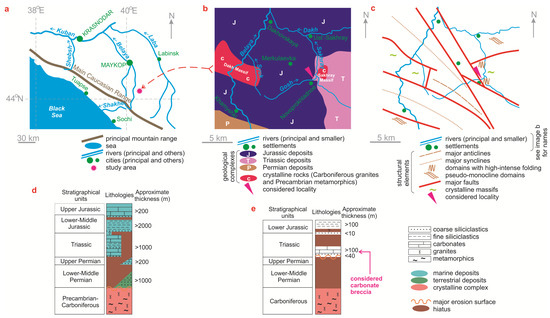
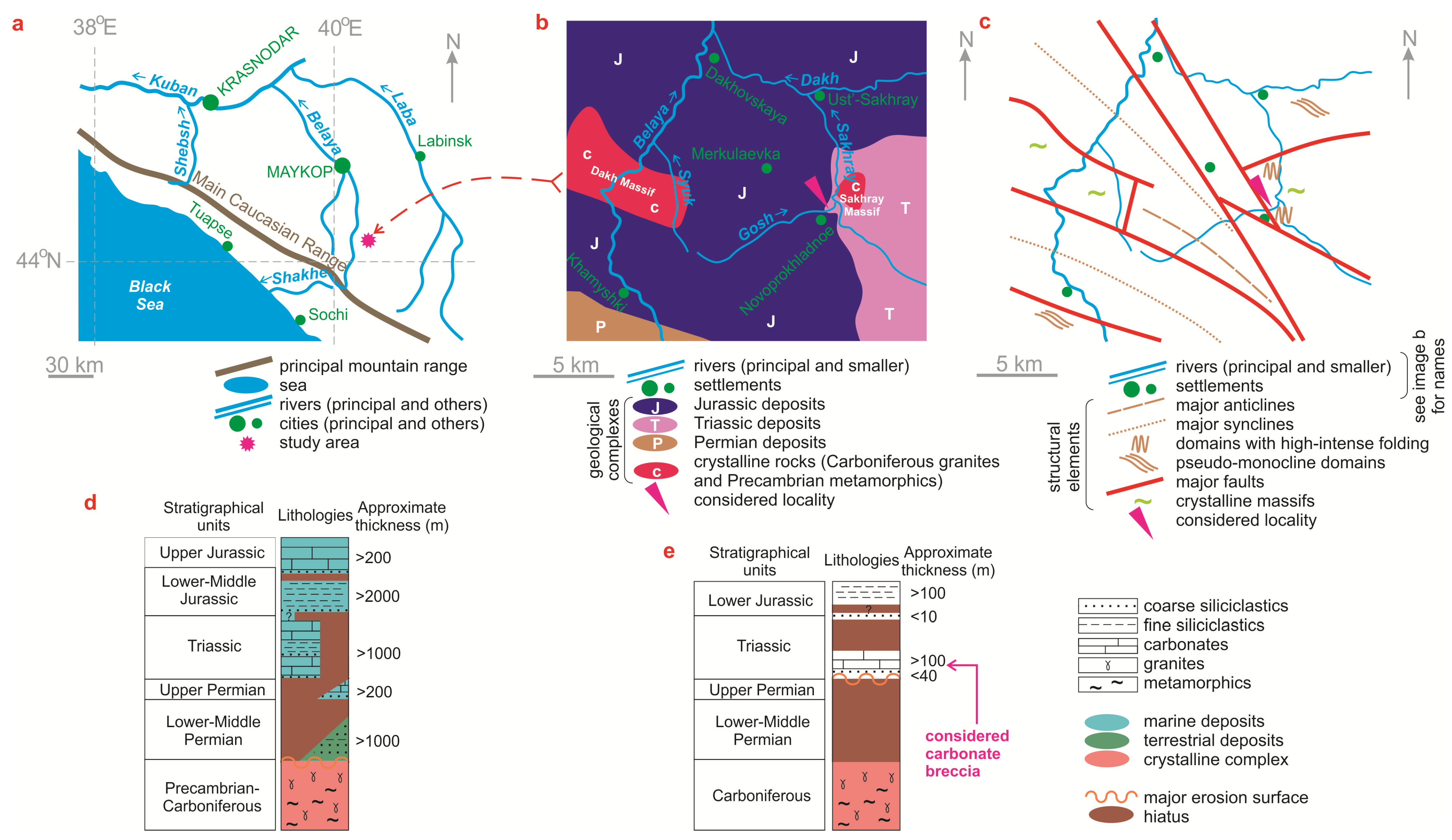
The study area is located in the Western Caucasus (southwestern Russia), northeast of the Main Caucasian Range and between the Belaya and Laba Rivers (Figure 1a). This is a rather remote mountainous domain with elevations of 500–1000 m, with slopes covered by dense forests. The study area belongs to the northwest–southeast trending orogen that grew in the late Cenozoic [20,21,22]. The geological setting of this area was characterized, particularly, by Guo et al. [23], Kolodyazhny et al. [24], and Ruban [25]. The area is dominated by Jurassic deposits. Permian strata crop out in its southern part (Figure 1b). Crystalline rocks form the Dakh Massif in the west and the Sakhray Massif in the east. The latter is associated with a wide distribution of Triassic deposits (Figure 1b). The understanding of the structural outline of the study area remains incomplete and debated. There are several major anticlines, synclines, and folds (Figure 1c). All sedimentary complexes are tectonically distorted (folded and faulted), and especially intensive deformations are typical of Triassic carbonates. It cannot be excluded that many structural patterns can be explained by highly complex tectonic–gravitational processes that took place in the Cenozoic [24].
Figure 1.
General outline of the study area: (a) geographical location in the Russian South, (b) geological scheme (partly based on the information from [25]), (c) structural scheme (partly based on the information from [26]), (d) stratigraphical scheme of the entire study area (partly based on the information from [25]), (e) stratigraphical scheme of the considered locality (partly based on the information from [16]. A dashed arrow indicates the relatino of the images a and b. A symbol “?” in the image e means a questionable nature of this hiatus.
The regional stratigraphical succession is heterogeneous (Figure 1d). The Lower–Middle Permian siliciclastic red beds overlie Carboniferous granites. They are separated by a hiatus from Upper Permian deposits with uppermost Permian carbonates (also reefal limestones). Permian deposits do not exist everywhere, and basal Triassic coarse siliciclastics occur locally right above Carboniferous granites. Lower–Middle Triassic limestones are rather common, and they constitute the lower part of the thick Mesozoic (chiefly Triassic–Jurassic) sedimentary succession (Figure 1d). The local relationship between Permian and Triassic rocks is unclear. On the basis of macro- and micropaleontological data (foraminifers were especially informative), a late Changhsingian age of Permian carbonates was established [27,28]. Evidently, these deposits formed in a shallow marine environment. Rare fossils found in younger limestones imply their late Induan–Olenekian age [15,17]. These carbonates accumulated in a relatively deep marine environment in a subsided basin [16]. Upper Permian deposits crop out where Lower Triassic limestones do not exist, and the latter occur commonly above basal siliciclastics covering Carboniferous granites (Figure 1b). Although the absence of Lower Triassic limestones above Upper Permian reefal carbonates can be explained by the total erosion of the former, an alternative hypothesis is that the southern and central parts of the study area may represent tectonic blocks with different geological history.
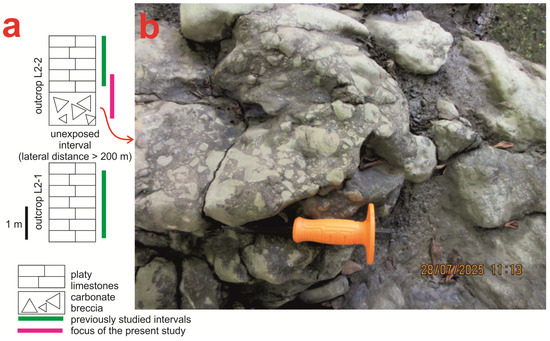
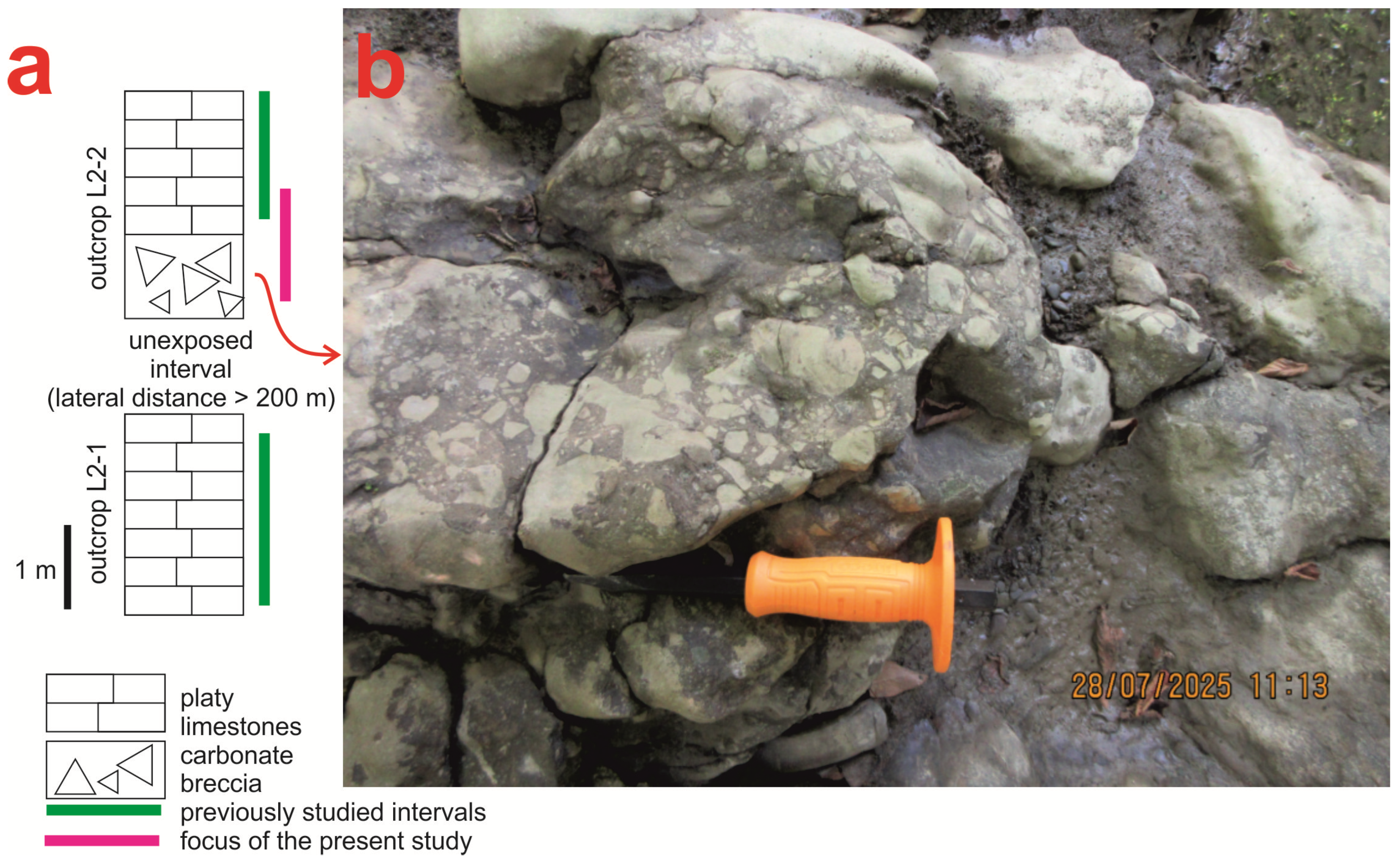
The considered locality corresponds to the lower part of the valley of the Gosh River (Figure 1b). Its geological peculiarities were characterized by Ruban et al. [16]. Small outcrops of Lower Triassic platy limestones with a northwest dip occur along the stream. Locally, these limestones are separated by coarse siliciclastics from Carboniferous granites, and Middle–Upper Triassic deposits were eroded (Figure 1e). One small outcrop of these limestones (Figure 2a) bears a layer of carbonate breccia (Figure 2b) with a visible thickness of ~1 m. Typical platy limestones are found below and above this layer. This locality represents the lowest part of the carbonate succession [16]. The occurrence of the carbonate breccia proves this interpretation because Chaitsky et al. [18] noted the presence of “brecciated limestones” near the bottom of the Lower Triassic succession. Generally, the considered carbonate breccia and the hosting platy limestones are late Induan–early Olenekian in age.
Figure 2.
Considered locality: (a) Triassic sedimentary succession represented in two main outcrops (L2-1 and L2-2). (b) A cropped-out layer of carbonate breccias (length of the tool is 20 cm); a red arrow shows correspondence of the layer on the image (b) to the considered section (a); the previously studied intervals refer to the work by Ruban et al. [16].
The tectonic history of the study area at the Permian–Triassic transition is yet to be perfectly understood. General paleotectonic position and configuration of this area from that time are matter for assumptions and hypotheses. Some fresh ideas were expressed by Gaetani et al. [15], who paid attention to the geodynamic activity in what is now the Western Caucasus: strike-slip movements and significant vertical block motions took place regionally in the Late Permian–Early Triassic. Nonetheless, one should note that sedimentation during this time span was rather continuous, and, thus, the geodynamic regime might not have experienced serious changes. Some important deformations occurred near the end of the Early Triassic and then in the Anisian [15]. The spatial extent and the mechanisms of the regional paleogeodynamics are yet to be known exactly.
3. Materials and Methods
In the considered locality (Figure 1b and Figure 2a), the section consists of two main outcrops. Ruban et al. [16] studied only platy limestones in them (Figure 2a), and these authors did not report a layer with carbonate breccia. In the present study, the carbonate breccia (Figure 2b) and the hosted platy limestones were examined (Figure 2a). These rocks were described in the field and sampled. A large sample was taken from the middle of the breccia level, and another sample was taken from the overlying platy limestones. Such sampling seems to be enough regarding the small thickness and the lithological homogeneity of the layers.
The subsequent analytical procedures were carried out in the laboratories of the Institute of Geology and Petroleum Technologies of Kazan Federal University (Kazan, Russia). First of all, large polished slabs of the rocks were examined macroscopically. Then, thin sections made with a Petrothin machine (Buehler, Lake Bluff, IL, USA) were examined in detail with a Carl Zeiss AxioLab optical polarizing microscope (Carl Zeiss Microscopy GmbH, Jena, Germany) with a digital camera Axiocam 506 color (Carl Zeiss Microscopy GmbH, Jena, Germany). Petrographical peculiarities of the studied rocks were recorded. The standard nomenclature of carbonate rocks [29,30,31] was employed to characterize the sampled rocks. Some recommendations for the studies of breccias (particularly, paying attention to clast brecciation) given recently by Flude et al. [19] were also taken into account. During the examination of thin sections, equal attention was paid to the matrix and clasts of the breccia.
The macro- and microscopical investigations were the most important in the present work, but geochemical peculiarities of clasts and the matrix of the carbonate breccia were also investigated tentatively with two approaches. The first approach was X-ray fluorescence analysis (XFA), which used an X S8 Tiger (Bruker) X-ray fluorescent spectrometer (Bruker AXS GmbH, Karlsruhe, Germany). The samples were processed in a vibratory mill to a particle size of <75 µm. Then, they were pressed into tablets (32–40 mm in diameter) and placed in the device with a maximum power of 4 kW and a current of up to 170 mA. The second approach was inductively coupled plasma mass spectrometry (ICP-MS), which employed an iCAP Qc (Thermo Fisher Scientific) mass spectrometer (Thermo Fisher Scientific, Bremen, Germany). The samples were crushed to a particle size of 1–2 mm, and then they were processed to a powder state (particle size < 75 μm) in the mill. They were liquefied by acid digestion in autoclaves using concentrated fluoride, ethanol, and nitric acid. Atomization and ionization of the matter was achieved in the special chamber.
4. Results
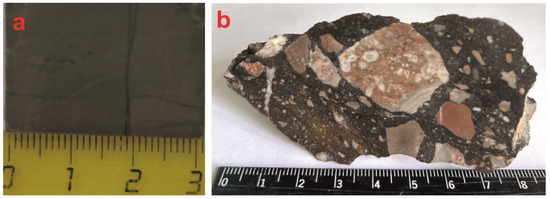
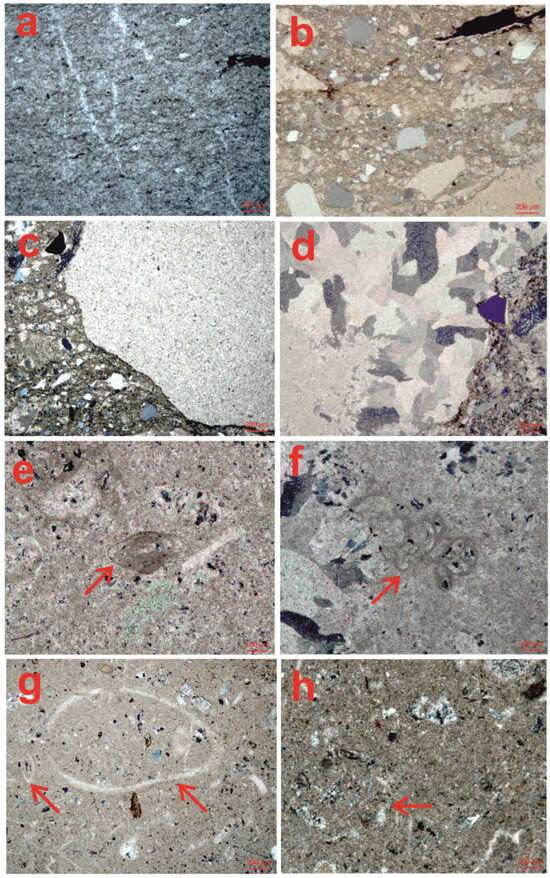
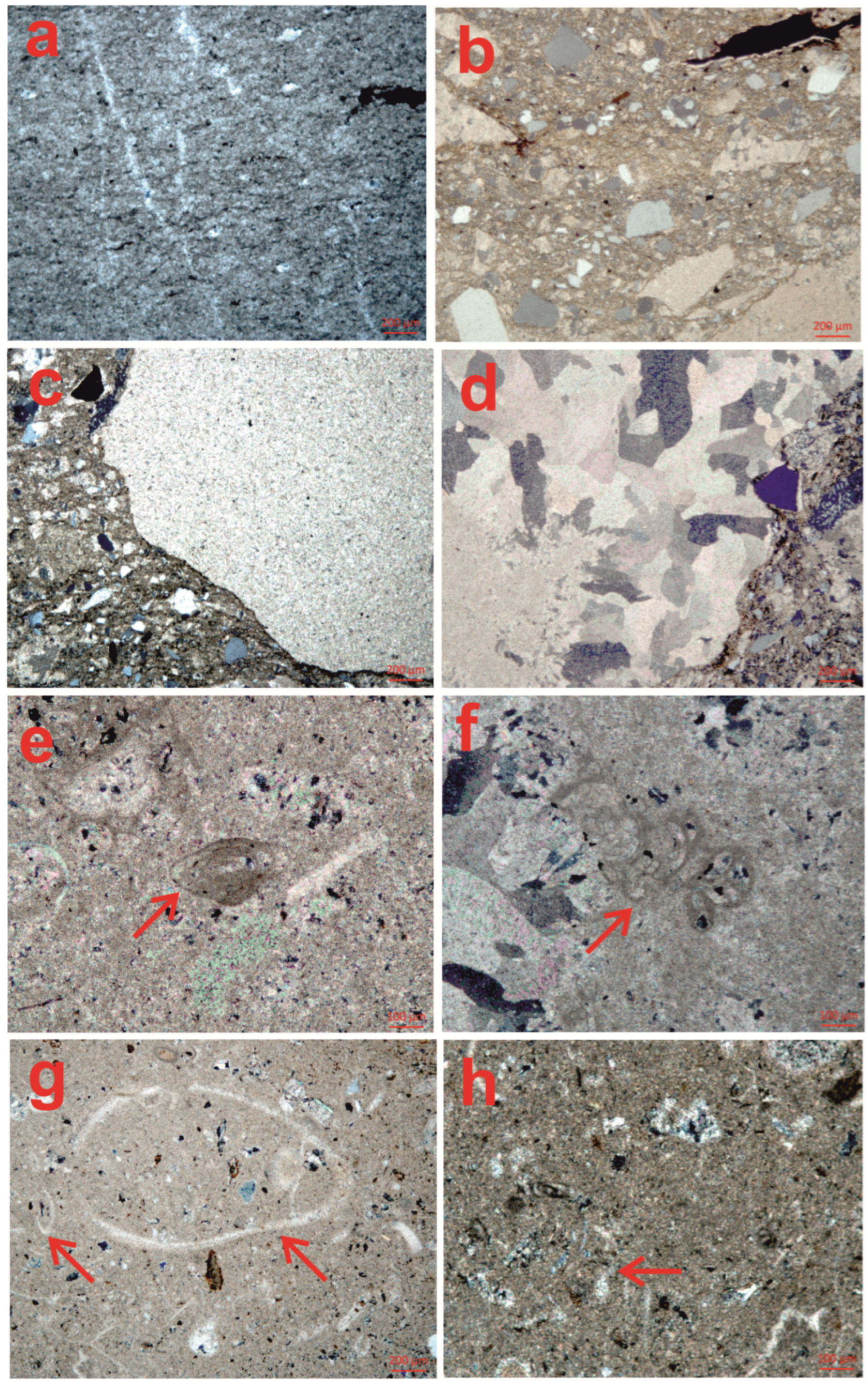
In the considered locality, the Lower Triassic carbonates are represented by greenish-grey platy limestones. They look massive in a polished slab (Figure 3a). Calcite veins and joints (also subparallel to layering) are common. Essentially, these are mudstones with a micrite mass constituting >90% of the rock (Figure 4a). Microlayers separated by wavy surfaces are observable. Veins filled with large calcite crystals have a width up to 5 mm. Detrital particles or fossils were not found. Generally, such limestones are very typical of the regional Lower Triassic carbonate succession, and they are common in the valley of the Gosh River [16], as well as in many other localities of the Western Caucasus [15,17].
Figure 3.
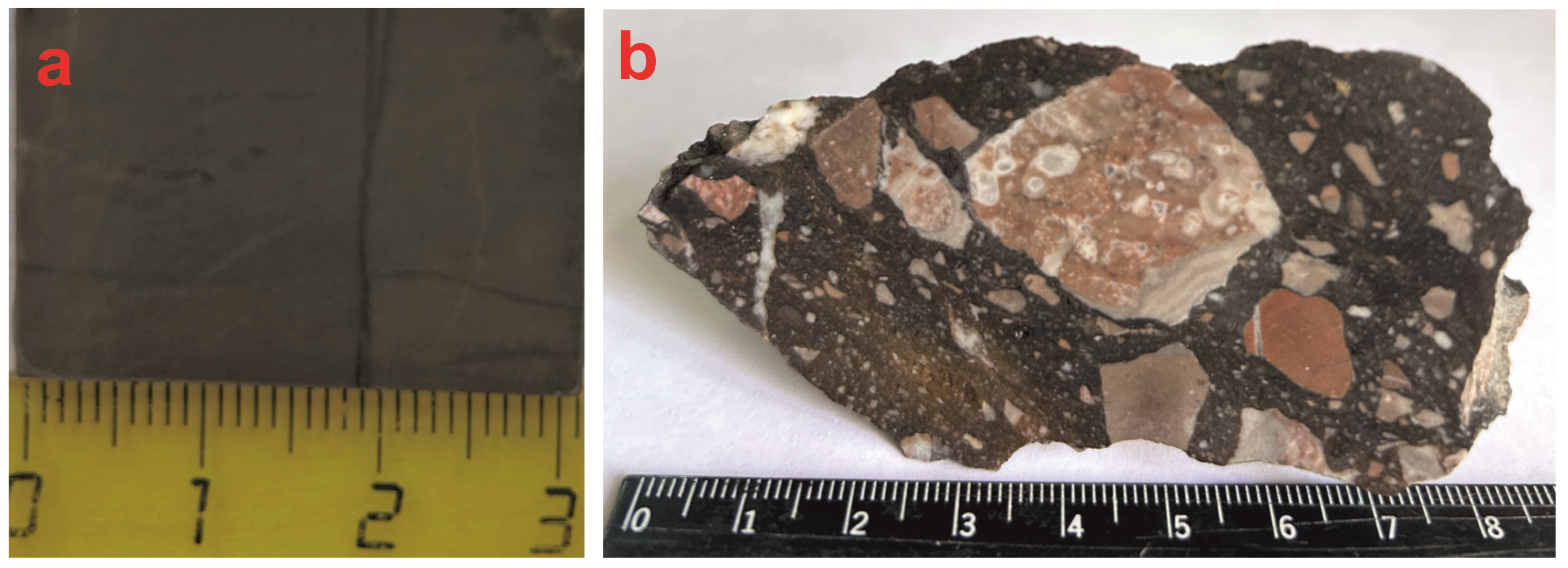
Polished slabs of the studied carbonate rocks from the considered locality: (a) platy limestones (mudstones) dominating the local sedimentary succession, (b) carbonate breccia investigated in the present work (numbers on lines are cm in both cases).
Figure 4.
Microscopic photographs of the studied carbonate rocks: (a) platy limestones (micrite-dominated mudstones with calcite veins), (b–h) carbonate breccia ((b,c) clasts of mudstones and wackestones in grainstone matrix, (d) secondary calcite, (e–h) fossils and their debris in clasts, indicated by red arrows) (thin sections: P.P.L., scale bar is 200 μm in (a–d,g) and 100 μm in (e,f,h)).
In the field, the layer of the carbonate breccia, which occurs within the above-mentioned platy limestones, is not easily distinguishable. The matrix has the same greenish-grey color, and the color of clasts is light grey, which makes them poorly visible due to natural shadows. Nonetheless, a close examination of the locality allowed us to find these rocks (Figure 2b). The carbonate breccia demonstrates the same or even greater hardness as the platy limestones, but it looks more monolithic, and its exposed surface is smoother. Similarly-looking clasts are distributed chaotically in the matrix (Figure 2b). They are angular to subangular and rarely subrounded. The size of clasts ranges from a few millimeters to 3–5 cm, and some of them are even bigger. Flude et al. [19] stressed that clast brecciation is an important pattern. The latter is registered in the studied carbonate breccia but in a relatively small amount.
In a polished slab, the carbonate breccia looks significantly more impressive (Figure 3b). The matrix is brown to dark grey in color. It contains numerous clasts with the sizes ranging from <1 mm to 2–3 cm. These clasts are chiefly angular and distributed chaotically. Nonetheless, elongated and flat clasts reflect a kind of wavy layering (Figure 3b). Although the clasts look different, their close examination shows that they are detrital fragments of grey and pink limestones, which differ strikingly from the Lower Triassic platy limestones hosting the breccias. One should also note that calcite veins are registered in some clasts but they do not cross their borders, and, thus, these veins are inherited from the eroded rocks. However, other calcite veins are also observed in the matrix, i.e., they mark a post-sedimentation alteration of the carbonate breccia.
A microscopic examination of the rock enhances our understanding of its composition. This is a typical breccia consisting of two components (Figure 4b,c). The first (matrix) component (up to 30%) is represented by micrite bearing chaotically distributed, angular, siliciclastic (often quartz) and carbonate grains (0.05–0.4 mm in size). This component can be defined as a grainstone. The second (clastic) component (up to 70%) includes limestone clasts strongly varying in size. These clasts are chiefly angular, sometimes with slightly rounded edges. Their borders are always sharp, although limonite developed around some clasts. Brecciation of clasts is an important pattern [19], but it was not observed in the thin sections of the studied rock. A comparison with the macroscopic description presented above implies that larger clasts were more prone to both rounding and brecciation than smaller clasts. Lithologically, these clasts can be characterized as mudstones and wackestones. Aggregates of secondary calcite with large (up to 0.5 mm) crystals were registered (Figure 4d). One should note that wackestones often include bioclasts, which are full and fragmented shells of foraminifers, ostracods, and other fossils (Figure 4e–h). This implies the existence of a rich marine ecosystem. Muscovite grains are present along some joints in the rocks. The distinction between the above-mentioned components of the carbonate breccia is not strict because the matrix is a mix of micrite and small-size debris particles, many of which are identical to the larger (limestone) clasts.
The outcomes of XFA and ICP-MS demonstrate significant differences between clasts and matrix (Tables S1 and S2). For instance, the content of SiO2 and Al2O3 is higher in the matrix by about three times (Table S1). Substantial differences in the content of some elements (particularly, Li, Ca, Ti, V, Cr, Co, and Ni) are also observed (Table S2). These findings can be explained, on the one hand, by the striking differences between the carbonate rocks represented in clasts and the matrix, and, on the other hand, by a significant amount of siliciclastic material “dispersed” in the matrix.
The age of the carbonate breccia is the same as that of the hosting platy limestones, i.e., late Induan–early Olenekian (see above). The age of the limestones represented in clasts can also be established. Indeed, these limestones differ from the Lower Triassic limestones by their lithological peculiarities. At the first glance, their pink color and abundance of fossils may indicate their relation to the colored reefal limestones, which are widespread in the study area [15,18]. However, this attribution is impossible because the colored reefal limestones are Norian–Rhaetian [15,18], i.e., much younger. If so, the only possibility, which is reasonable to consider, is that clasts from the considered breccia belong to the upper Changhsingian carbonates cropping out southwest, south, and southeast of the study area [27,28]. Their lithological peculiarities and rich fossil content match perfectly those observable in clasts of the studied breccia. Although particular fossil taxa cannot be identified in the available thin sections, the general view of foraminifers registered there (Figure 4e,f) resembles that of abundant foraminifers reported from the upper Changhsingian carbonates [28]. Generally, the Lower Triassic carbonate breccia consists of clasts derived from the uppermost Permian limestones.
5. Discussion
The studied carbonate breccia is found as a single layer in the Lower Triassic carbonate succession, which is rather monotonous. Platy limestones constituting this succession deposited in a relatively deep marine basin, which formed in the study area together with its rapid drowning triggered by tectonic subsidence [16]. This means that the carbonate breccia was also formed in a relatively deep marine environment and, thus, its origin was related to some specific geological processes in this basin. Although a single layer of the carbonate breccia is documented in the considered locality, it cannot be excluded that other similar layers can be found in the unexposed portion of the Lower Triassic carbonate succession. Nonetheless, the examination of the visible part of this succession implies that such layers cannot be common and, thus, they reflect rare geological events.
According to Flude et al. [19], carbonate breccias may have different origins and, particularly, they can be produced by storm events, debris flows, and subaqueous landslides. In the considered locality, one should note that the carbonate breccia is dominated by chaotically distributed clasts of older rocks and also bears a portion of siliciclastic material. Apparently, this layer reflects a short-term geological event. Notably, some limestone clasts demonstrate certain rounding. The most probable origin of this rock is a debris flow that transported clastic material from a nearby land down a rather steep slope. The role of debris flows in the transportation of carbonate clasts is well-known from the geological investigations in different regions and time slices [19,32,33,34,35]. This material either formed on an ancient shore due to wave abrasion of the exposed older rocks and cliff collapses or it was transported by streams from the land’s interiors. The angularity of many clasts favors the first assumption. A severe storm, earthquake, or even tsunami could trigger a debris flow and, thus, the delivery of the material to the deep marine environment.
A tectonic origin of the layer of carbonate breccia is not favored due to its compositional peculiarities. The material of clasts differs from that of the matrix, and there was evident input of siliciclastic material. It would be difficult to explain such peculiarities by syn- or post-sedimentation brecciation. Moreover, the latter might have made carbonate breccia very common in the Early Triassic succession, whereas, in fact, this rock has been found in a single locality.
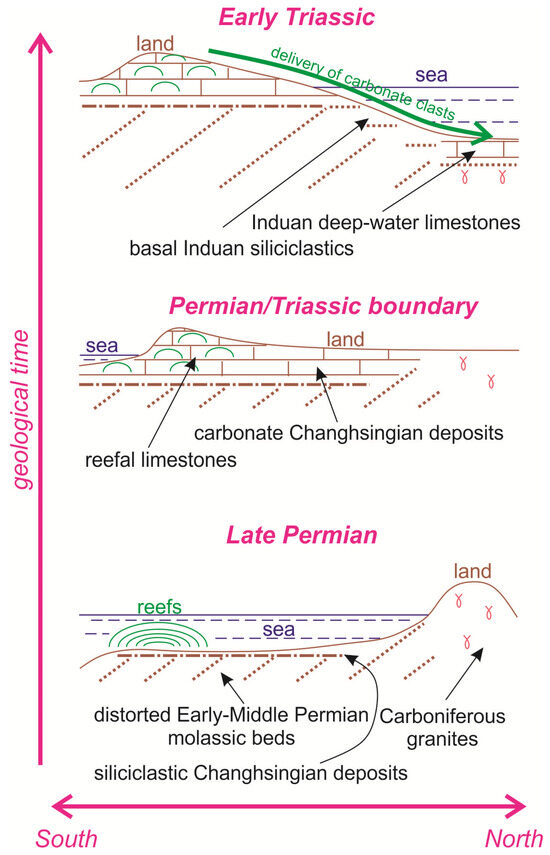
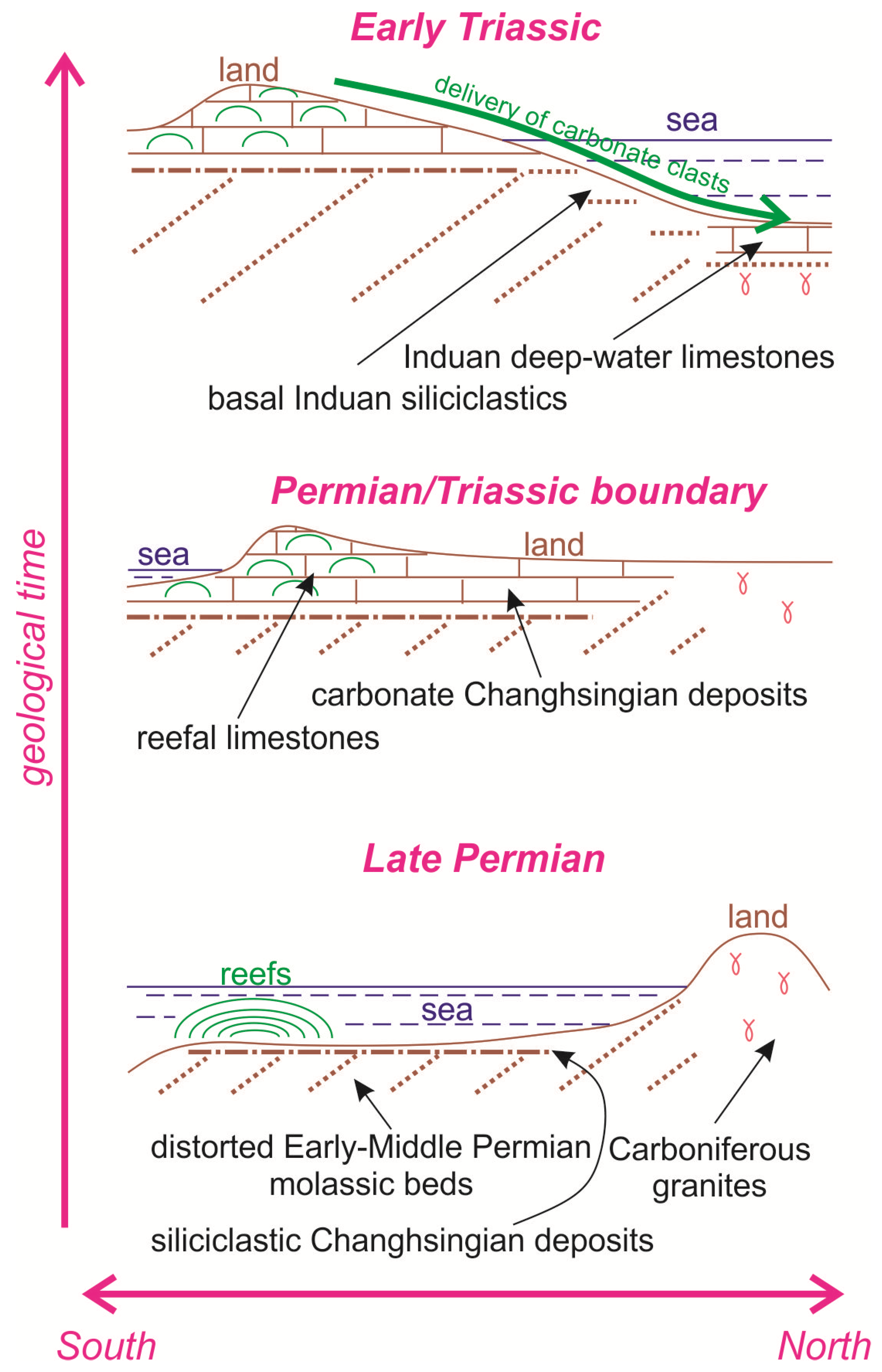
The knowledge of the geological setting of the study area [23,24,25] and the interpretation presented above allow us to propose tentatively a hypothetical scenario of the local geological evolution, as follows (Figure 5). Near the end of the Permian, the study area was embraced by a shallow water sea with rich ecosystems and reefs. A subsequent regression resulted in a wide exposure of the upper Changhsingian carbonates and the Carboniferous granites. A rapid subsidence in the northern part of the area led to a transgression and subsequent establishment of relatively deep marine environments in the Early Triassic (Figure 5). Reefal limestones are hard rocks resistant to erosion, and they form isolated landforms even presently (a typical example is the Raskol Cliff). The presence of clasts of the upper Changhsingian limestones in the studied breccia implies that these limestones remained exposed and formed actively denudated islands in the Early Triassic. If so, they were the sources of clasts produced at the seashore (or delivered there by streams) and then transported by debris flows to the deeper parts of the marine basin (Figure 5). Denudation of the other exposed rocks (either pre-Triassic siliciclastics or Carboniferous granites) supplied some amount of fine siliciclastic grains, which became mixed with micrite in the matrix; this also explains the registered geochemical peculiarities of the carbonate breccia (see above). It should be stressed that this scenario serves as nothing more than an interpretation of the information on the studied carbonate breccia. Although not so much is known about the regional paleogeodynamics, the scenario corresponds to the ideas of vertical tectonic motions in the study area at the Permian–Triassic transition [15].
Figure 5.
Local geological evolution through the Permian–Triassic transition (see text for more details). A tentative, rather hypothetical reconstruction based on the information from the present study of the Lower Triassic carbonate breccia.
The proposed scenario can be detailed with two important inferences. First, the presence of clasts of the upper Changhsingian limestones in the upper Induan–lower Olenekian carbonate breccia implies that the parts of the study area where these rocks crop out presently were connected spatially at the Permian–Triassic transition. In such a case, it is possible to hypothesize a continuity of carbonate deposition across the Permian–Triassic transition in the study area. This is somewhat analogous to the well-known carbonate platforms developed in the Nanpanjiang Basin of China [36,37,38]. Second, the absence of Upper Permian deposits near the Sakhray Massif (Figure 1b) does not necessarily mean that the supposed spatial connection required long-distance transportation of clasts.
The present study has a practical implication regarding geoconservation and geoeducation. Carbonate breccias are known for their high esthetic value [39], and the studied rock is not an exception (Figure 3b). It also bears important evidence of the regional geological evolution across the Permian–Triassic transition. Moreover, the presence of fossil-rich clasts of the upper Changhsingian carbonates in the micritic mass lacking fossils and related to the Lower Triassic limestones stresses the difference between the end-Permian rich marine ecosystems [27,40] and the Early Triassic microbial carbonate production with the ecosystems depleted after the Permian/Triassic mass extinction and the associated crises and recovered with a delay [2,41,42,43,44]. The noted peculiarities imply that the studied carbonate breccia is an element of geoheritage, which contributes to the high value of the Sakhray Canyon geosite characterized by Ruban et al. [16]. This rock can also be used in geoeducational and geotouristic programs focused on university students in geology and amateurs of geology. Polished slabs of this carbonate breccia (Figure 3b) can benefit private and university collections, including those used for educational purposes.
6. Conclusions
The reported discovery of the Lower Triassic carbonate breccia in the Western Caucasus has allowed us to make three general conclusions.
- (1)
- The carbonate breccia consists of two components, namely clasts of limestones entirely different from those hosting this breccia and a micrite-dominated matrix (with some amount of siliciclastics) related to Lower Triassic platy limestones.
- (2)
- The age of the examined breccia is late Induan–early Olenekian, whereas clasts belong to the upper Changhsingian limestones.
- (3)
- The carbonate breccia formed as a result of erosion of the subaerially exposed Upper Permian limestones (a hypothetical land mass) and debris flows in a submarine environment.
The present study demonstrates that the monotonous Lower Triassic carbonate succession of the study area contains really peculiar features. Further investigations should be aimed at the provision of very detailed bed-by-bed descriptions of the sections of Upper Permian and Lower Triassic rocks cropping out in the Western Caucasus. The present knowledge of them remains limited and, thus, extensive fieldwork is required. Moreover, the scenario of the regional geological evolution proposed in the present work is hypothetical to a certain degree and based on pure sedimentological interpretations. Indeed, further structural geological and paleogeodynamical investigations are required either to prove or modify this scenario and relate it to the wider tectonic processes in the Western Caucasus at the Permian–Triassic transition. In other words, the present paper is only a step towards a comprehensive understanding of the regional development at the noted key transition.
Supplementary Materials
The following supporting information can be downloaded at: https://www.mdpi.com/article/10.3390/jmse14111038/s1, Table S1: Content of the principal components in the studied carbonate breccia (results of the X-ray fluorescence analysis); Table S2: Content of elements in the studied carbonate breccia (results of the inductively coupled plasma mass spectrometry).
Author Contributions
Conceptualization, D.A.R. and S.O.Z.; methodology, D.A.R., S.O.Z., K.I.N., A.A.T. and I.I.S.; investigation, D.A.R., S.O.Z., K.I.N., A.A.T. and I.I.S.; writing—original draft preparation, D.A.R., S.O.Z., K.I.N., A.A.T. and I.I.S.; project administration, D.A.R. and S.O.Z. All authors have read and agreed to the published version of the manuscript.
Funding
This research received no external funding.
Data Availability Statement
Data are contained within the article.
Acknowledgments
The authors gratefully thank L.A. Glinskikh (Russia) and A.J. van Loon (China/Spain) for their helpful comments, as well as N.V. Ruban (Russia) for field assistance.
Conflicts of Interest
The authors declare no conflicts of interest.
References
- Grasby, S.E.; Bond, D.P.G.; Wignall, P.B.; Beauchamp, B. The late Permian through Middle Triassic environmental crises in the Boreal Realm—Records of the Griesbachian, Dienerian, Smithian, and Spathian type sections in Arctic Canada. Palaeogeogr. Palaeoclimatol. Palaeoecol. 2026, 682, 113453. [Google Scholar]
- Li, M.; Tian, L.; Wignall, P.B.; Dai, X.; Lin, W.; Cai, Q.; Song, H. Expansion of microbial-induced carbonate factory into deeper water after the Permian-Triassic mass extinction. Glob. Planet. Change 2023, 230, 104274. [Google Scholar] [CrossRef] [Scilit]
- Schubert, J.K.; Bottjer, D.J. Aftermath of the Permian-Triassic mass extinction event: Paleoecology of Lower Triassic carbonates in the western USA. Palaeogeogr. Palaeoclimatol. Palaeoecol. 1995, 116, 1–39. [Google Scholar] [CrossRef] [Scilit]
- Wignall, P.B.; Twitchett, R.J. Unusual intraclastic limestones in Lower Triassic carbonates and their bearing on the aftermath of the end-Permian mass extinction. Sedimentology 1999, 46, 303–316. [Google Scholar]
- Zhao, X.; Tong, J.; Yao, H.; Zhang, K.; Chen, Z. Anachronistic facies in the Lower Triassic of South China and their implications to the ecosystems during the recovery time. Sci. China Ser. D Earth Sci. 2008, 51, 1646–1657. [Google Scholar]
- Al-Mashaikie, S.Z.; Mohammed, Y.A. Anatomy of carbonate breccias, turbidite facies and depositional systems of Gercus formation in Dokan area, northern Iraq. Iraqi Geol. J. 2017, 50, 90–103. [Google Scholar]
- Chen, J. Surface and subsurface reworking by storms on a Cambrian carbonate platform: Evidence from limestone breccias and conglomerates. Geologos 2014, 20, 13–23. [Google Scholar] [CrossRef] [Scilit]
- Courjault, T.; Grosheny, D.; Ferry, S.; Sausse, J. Detailed anatomy of a deep-water carbonate breccia lobe (Upper Jurassic, French subalpine basin). Sediment. Geol. 2011, 238, 156–171. [Google Scholar] [CrossRef] [Scilit]
- Jones, B.; Ng, K.-C. Anatomy and diagenesis of a Pleistocene carbonate breccia formed by the collapse of a seacliff, Cayman Brac, British West Indies. Bull. Can. Pet. Geol. 1988, 36, 9–24. [Google Scholar]
- Kati, M.; Magganas, A.; Zambetakis-Lekkas, A.; Logotheti, V. Late triassic carbonate breccias and boulders from the Sub-Pelagonian Platform in Attica, Greece: Constraints on the platform evolution. Neues Jahrb. Geol. Palaontol. Abh. 2016, 282, 291–304. [Google Scholar] [CrossRef] [Scilit]
- León-Francisco, J.M.; Azmy, K.; Grajales-Nishimura, J.M.; Rosales-Rodríguez, J. Diagenetic evolution of the Cretaceous-Paleogene carbonate breccia, Cantarell, Mexico: Evidence from geochemical proxies. Mar. Pet. Geol. 2025, 174, 107301. [Google Scholar] [CrossRef] [Scilit]
- No, S.-G.; Park, M.-E.; Yoo, B.-C.; Lee, S.-H. Genesis of carbonate breccia containing invisible gold in Taebaeksan basin, South Korea. Minerals 2020, 10, 1087. [Google Scholar] [CrossRef] [Scilit]
- Komatsu, T.; Naruse, H.; Shigeta, Y.; Takashima, R.; Maekawa, T.; Dang, H.T.; Dinh, T.C.; Nguyen, P.D.; Nguyen, H.H.; Tanaka, G.; et al. Lower Triassic mixed carbonate and siliciclastic setting with Smithian-Spathian anoxic to dysoxic facies, An Chau basin, northeastern Vietnam. Sediment. Geol. 2014, 300, 28–48. [Google Scholar] [CrossRef] [Scilit]
- Enos, P.; Lehrmann, D.J.; Jiayong, W.; Youyi, Y.; Jiafei, X.; Chaikin, D.H.; Minzoni, M.; Berry, A.K.; Montgomery, P. Triassic evolution of the Yangtze Platform in Guizhou province, People’s Republic of China. Spec. Pap. Geol. Soc. Am. 2006, 417, 1–10. [Google Scholar]
- Gaetani, M.; Garzanti, E.; Polino, R.; Kiricko, Y.; Korsakhov, S.; Cirilli, S.; Nicora, A.; Rettori, R.; Larghi, C.; Bucefalo Palliani, R. Stratigraphic evidence for Cimmerian events in NW Caucasus (Russia). Bull. Soc. Geol. Fr. 2005, 176, 283–299. [Google Scholar] [CrossRef] [Scilit]
- Ruban, D.A.; Zorina, S.O.; Glinskikh, L.A.; Mikhailenko, A.V.; Nikashin, K.I.; Mohammad, N. The Sakhray Canyon as a key locality of late Paleozoic-middle Mesozoic carbonate and other rocks of the Western Caucasus. Carbonates Evaporites 2025, 40, 48. [Google Scholar] [CrossRef] [Scilit]
- Zakharov, Y.D.; Ukhaneva, N.G.; Ignatyev, A.V.; Afanasyeva, T.B.; Buryi, G.I.; Panasenko, E.S.; Popov, A.M.; Punina, T.A.; Cherbadzhi, A.K. Latest Permian and Triassic carbonates of Russia: New palaeontological findings, stable isotopes, Ca-Mg ratio, and correlation. Dev. Palaeontol. Stratigr. 2000, 18, 141–171. [Google Scholar]
- Chaitsky, V.P.; Popkov, V.I.; Popkov, I.V.; Pinchuk, T.N. Triassic of the Northern Caucasus. Geol. Geogr. Glob. Energiya 2020, 77, 11–21. (In Russian) [Google Scholar]
- Flude, S.; Bond, C.E.; Butler, R.W.H. Are geological description practices and classification schemes fit for future use? Breccias as an example. Earth-Sci. Rev. 2025, 266, 105140. [Google Scholar]
- Alekseeva, A.E.; Ershov, A.V.; Linev, D.N. Numerical modeling of uplift and erosion at the Western Caucasus orogen in the Neogene-Quaternary. Mosc. Univ. Geol. Bull. 2014, 69, 213–218. [Google Scholar] [CrossRef] [Scilit]
- Forte, A.M.; Cowgill, E.; Whipple, K.X. Transition from a singly vergent to doubly vergent wedge in a young orogen: The Greater Caucasus. Tectonics 2014, 33, 2077–2101. [Google Scholar] [CrossRef] [Scilit]
- Kuznetsov, N.B.; Romanyuk, T.V. On the onset time and mechanism of the Greater Caucasus uplift as well as genetic type and filling history of the Ciscaucasia troughs—Traditional and modern interpretations. Geodyn. Tectonophys. 2025, 16, 0825. [Google Scholar] [CrossRef] [Scilit]
- Guo, L.; Vincent, S.J.; Lavrishchev, V. Upper Jurassic reefs from the Russian Western Caucasus: Implications for the Eastern Black Sea. Turk. J. Earth Sci. 2011, 20, 629–653. [Google Scholar] [CrossRef] [Scilit]
- Kolodyazhny, S.Y.; Kuznetsov, N.B.; Makhinya, E.I.; Shalaeva, E.A.; Dantsova, K.I.; Romanyuk, T.V.; Antipov, M.P.; Parfenov, G.E. Tectono-Gravitational Detachments in the Alpine Cover of the Northern Slope of the Greater Caucasus and Western Pre-Caucasus Basin (Adygean Segment). Geotectonics 2024, 58, 611–638. [Google Scholar] [CrossRef] [Scilit]
- Ruban, D.A. Geological Investigations in Mountainous Adygeya; DGTU-Print: Rostov-on-Don, Russia, 2024; 149p. (In Russian) [Google Scholar]
- Popov, Y.V.; Sharova, T.V. Formations and Structural-Formation Zonality of the Geological Complexes of the Territory of the Mountainous Part of Adygeya (Greater Caucasus); Southern Federal University: Rostov-on-Don, Russia, 2022; 44p. (In Russian) [Google Scholar]
- Kotlyar, G.V.; Zakharov, Y.D.; Polubotko, I.V. Late Changhsingian fauna of the Northwestern Caucasus Mountains, Russia. J. Paleontol. 2004, 78, 513–527. [Google Scholar] [CrossRef] [Scilit]
- Pronina-Nestell, G.P.; Nestell, M.K. Late Changhsingian foraminifers of the Northwestern Caucasus. Micropaleontology 2001, 47, 205–234. [Google Scholar] [CrossRef] [Scilit]
- Embry, A.; Klovan, J.E. A late Devonian reef tract on northeastern Banks Island, Northwest Territories. Bull. Can. Pet. Geol. 1971, 19, 730–781. [Google Scholar]
- Flügel, E. Microfacies of Carbonate Rocks: Analysis, Interpretation and Application; Springer: Berlin/Heidelberg, Germany, 2010; 984p. [Google Scholar]
- Wright, V.P. A revised classification of limestones. Sediment. Geol. 1992, 76, 177–185. [Google Scholar] [CrossRef] [Scilit]
- Fabbi, S.; Citton, P.; Romano, M.; Cipriani, A. Detrital events within pelagic deposits of the Umbria-Marche Basin (Northern Apennines, Italy): Further evidence of Early Cretaceous tectonics. J. Mediterr. Earth Sci. 2016, 8, 39–52. [Google Scholar]
- Li, W.; Chen, J.; Hakim, A.J.; Myrow, P.M. Middle Ordovician mass-transport deposits from western Inner Mongolia, China: Mechanisms and implications for basin evolution. Sedimentology 2022, 69, 1301–1338. [Google Scholar] [CrossRef] [Scilit]
- Martínez Medrano, M.; Escalera Alcocer, A.; Aguilera Gomez, L.; Sanchez Arriaga, R.; de Jesus Correa López, M.; Granados Vazquez, D.I. Sedimentary Evolution of the Autochthonous Western Edge of the Cordoba Platform. In Fourth International Meeting for Applied Geoscience & Energy; SEG Technical Program Expanded Abstracts; GeoScienceWorld: Veracruz Basin, Mexico, 2024; pp. 1398–1400. Available online: https://archives.datapages.com/data/international-meeting-for-applied-geoscience-and-energy/data/2024/image2024-4090285.1.htm (accessed on 29 May 2026).
- Rubert, Y.; Jati, M.; Loisy, C.; Cerepi, A.; Foto, G.; Muska, K. Sedimentology of resedimented carbonates: Facies and geometrical characterisation of an upper Cretaceous calciturbidite system in Albania. Sediment. Geol. 2012, 257–260, 63–77. [Google Scholar] [CrossRef] [Scilit]
- Kelley, B.M.; Lehrmann, D.J.; Yu, M.; Minzoni, M.; Enos, P.; Li, X.; Lau, K.V.; Payne, J.L. The Late Permian to Late Triassic Great Bank of Guizhou: An isolated carbonate platform in the Nanpanjiang Basin of Guizhou Province, China. AAPG Bull. 2017, 101, 553–562. [Google Scholar] [CrossRef] [Scilit]
- Krull, E.S.; Lehrmann, D.J.; Druke, D.; Kessel, B.; Yu, Y.; Li, R. Stable carbon isotope stratigraphy across the Permian-Triassic boundary in shallow marine carbonate platforms, Nanpanjiang Basin, south China. Palaeogeogr. Palaeoclimatol. Palaeoecol. 2004, 204, 297–315. [Google Scholar] [CrossRef] [Scilit]
- Li, X.; Yu, M.; Lehrmann, D.J.; Payne, J.L.; Kelley, B.M.; Minzoni, M. Factors controlling carbonate platform asymmetry: Preliminary results from the Great Bank of Guizhou, an isolated Permian-Triassic Platform in the Nanpanjiang Basin, south China. Palaeogeogr. Palaeoclimatol. Palaeoecol. 2012, 315–316, 158–171. [Google Scholar]
- Muñoz-Cervera, M.C.; Rodriguez-Garcia, M.Á.; Cañaveras, J.C. Aesthetic Quality Properties of Carbonate Breccias Associated with Textural and Compositional Factors: Marrón Emperador Ornamental Stone (Upper Cretaceous, Southeast Spain). Appl. Sci. 2022, 12, 2566. [Google Scholar] [CrossRef] [Scilit]
- Weidlich, O.; Bernecker, M. Differential severity of Permian-Triassic environmental changes on Tethyan shallow-water carbonate platforms. Glob. Planet. Change 2007, 55, 209–235. [Google Scholar] [CrossRef] [Scilit]
- Bottjer, D.J.; Clapham, M.E.; Fraiser, M.L.; Powers, C.M. Understanding mechanisms for the end-Permian mass extinction and the protracted Early Triassic aftermath and recovery. GSA Today 2008, 18, 4–10. [Google Scholar] [CrossRef] [Scilit]
- Foster, W.J.; Danise, S.; Price, G.D.; Twitchett, R.J. Subsequent biotic crises delayed marine recovery following the late Permian mass extinction event in northern Italy. PLoS ONE 2017, 12, e0172321. [Google Scholar] [CrossRef] [Scilit] [PubMed]
- Hallam, A. Why was there a delayed radiation after the end-Palaeozoic extinctions? Hist. Biol. 1991, 5, 257–262. [Google Scholar]
- Ma, Y.; Ge, Z.; Shen, J. Prolonged nitrate depletion delayed marine ecosystem recovery after the end-Permian mass extinction. Sci. China Earth Sci. 2025, 68, 3035–3049. [Google Scholar] [CrossRef] [Scilit]
Disclaimer/Publisher’s Note: The statements, opinions and data contained in all publications are solely those of the individual author(s) and contributor(s) and not of MDPI and/or the editor(s). MDPI and/or the editor(s) disclaim responsibility for any injury to people or property resulting from any ideas, methods, instructions or products referred to in the content. |
© 2026 by the authors. Licensee MDPI, Basel, Switzerland. This article is an open access article distributed under the terms and conditions of the Creative Commons Attribution (CC BY) license.