


Abstract
A feasibility analysis was conducted on a crude oil tanker. Differences in power generation and fuel consumption of the diesel generators based on the noon report of the specified marine vessel were analyzed for similar periods before and after the scrubber application. Accordingly, the changes in releasing amounts of emissions were calculated. Then, a financial evaluation was realized with three economic indicators. As a result of the analysis performed, it is found that the power generation and fuel consumption realized by each diesel generator are increased after scrubber application. Nevertheless, its implementation on board may be considered acceptable in light of the economic findings. However, it has been determined that scrubber implementation causes an increase in all pollutants’ amounts except SOX. Therefore, it contradicts the zero-emission ship target and decarbonization strategy stated by IMO.
1. Introduction
The maritime industry has significant importance in worldwide cargo transportation since it ensures 80% of global transportation [1,2]. Additionally, it has been determined that the world fleet has been growing an average of 4.6% from 2008 to 2018 each year [3]. However, shipping contributes to the increase in pollutants caused by the combustion of huge amounts of fuel [4,5] that cause global warming, bad air quality, and visibility. From 2012 to 2018, greenhouse gas (GHG) emissions released by ships into the atmosphere increased by 9.6%, and the percentage of global emissions related to the maritime industry was 2.89% in 2018 [6]. In the case where no precautions are taken, it was predicted that the emission ratio from shipping could increase to 19% [7], and it will become the main environmental concern if effective policies are introduced [8,9].
Accordingly, priority cautions in reducing the environmental pollution caused by maritime transportation were introduced by the International Maritime Organization (IMO), which is the rule-maker and a significant authority for the shipping industry. Strict rules based on Annex-VI of the International Convention for the Prevention of Marine Pollution from Ships (MARPOL) have been enforced within the scope of air pollution. In this regard, to control and reduce ship-based SOx and NOx emissions, Emission Control Areas (ECAs) have been designated.
The measures considered include the development of new procedures for operating diesel engines to reduce fuel consumption [10,11] and emissions [12,13].
Other measures are associated with the way the ship is handled, as operation in rough weather leads to higher fuel consumption and emissions [9,14]; therefore, using weather routing contributes also to the decrease in emissions [15,16].
As a result of the limitation indicating the decrease in the sulfur content in the fuel used in global seas since 2020, shipowners and researchers have started to investigate various methods to meet this limit [17]. Scrubber retrofitting on ships is one of the preferred methods by the maritime industry to achieve compliance with the SOx limitation in existing ships.
1.1. Problems Statement
The scrubber system that is particularly considered offers an effective solution to prevent SOx emission on marine vessels [18]. However, it causes extra power generation in diesel generators (DG) and, accordingly, extra fuel consumption. Since heavy fuel oil (HFO) is used on ships equipped with the scrubber to reduce operational expenses, it is possible to increase other emission types, unlike SOx, as a result of the extra fuel consumption. Although there are studies on scrubbers in the literature, there is a gap since there is no study that reveals the effects of scrubber installation on diesel generators on issues such as power generation and fuel consumption, taking into account the noon report of a ship.
1.2. Contributions of the Study
In this study, the feasibility analysis of scrubber installation is realized. Initially, to perform the feasibility analysis, two months periods before and after the scrubber adaptation are collected from the noon reports of the ship. For this process, attention is paid to ensuring that the ship’s cruising conditions (shipload conditions, weather conditions) are almost equal. Then, a comparison has been made on power generation, fuel consumption, and the amount of emission released by diesel generators. Lastly, to examine the system economically, the net present values (NPVs), and the payback periods of the installation have been calculated with various interest rates. Some contributions of the paper are as follows:
- The scrubber installation is analyzed with real-time ship cruising data.
- The application is examined from points of view of both environmental and economic.
- It is revealed that scrubber application can decrease SOx emission, but it has a negative impact on the other emissions based on the increase in fuel oil consumption.
The rest of the paper is organized as follows. The literature review is realized under Section 2. General information about the scrubber systems is presented in Section 3. In Section 4, the case study is conducted. The findings are discussed in Section 5. Finally, the conclusions of the paper are given in Section 6.
2. Literature Review
In the maritime literature, three feasible options have drawn attention to meet SOx restrictions introduced by IMO: fuel switching, adoption of liquified natural gas (LNG) as fuel, and implementation of an exhaust gas cleaning system (scrubber) [19]. In the first option, it is possible to operate the ship in compliance with the sulfur limits by using marine gas oil with 0.1% of sulfur content in the SOx-ECAs and using very low sulfur fuel oil (VLSFO) in the other seas. The second option is an adaptation of the LNG system of ships. Although this approach provides a notable reduction in almost all pollutants, it has the disadvantages of a large initial investment cost, system installation requirements on the ship (tank space, line design), and immaturity of the bunkering supply chain. The third one is the application of a scrubber system on board.
Scrubber installation allows maritime companies to operate their ships more economically with HFO, which has a sulfur content of 3.5%. In this method, the exhaust gas emitted into the atmosphere is purified from almost all of the sulfur by washing it [20]. Among these three options, LNG is planned for new-built ships, while the others have been preferred primarily during compliance with the IMO 2020 sulfur cap [21].
In the literature, these three approaches have been frequently analyzed in a comparative way [22,23,24]. Despite the huge amount of investment cost for LNG installation, it was concluded that it could be a good option for new-built ships [25]. Lindstad et al. [26] examined various emission abatement methods and showed that the effects could change according to some parameters, such as engine size and fuel price. A useful decision-making tool that was developed based on the analytical network process method has been presented to operators to make financial comparisons during periods of compliance with IMO sulfur limitations [27]. According to Zis et al. [21], while the use of distilled fuel was preferred before 2020, the scrubber application for existing ships has come to the forefront after the beginning of the restriction. Lindstad et al. [28] stated that while high-speed cruising was preferred by ships equipped with scrubbers, marine vessels using more costly distilled fuels such as MGO were realized by lower-speed cruising due to the aim of reducing fuel expenses.
Kim and Seo [29] conducted a survey that was conducted with the Korean shipping industry, and they concluded that a scrubber could be a good option based on differences in fuel prices and the reduction rate of sulfur. Wilailak et al. [30] determined the parameters that affected the De-SOx process and proposed a new design of an open-loop scrubber to minimize the power requirement of the system pumps. Yang et al. [31] conducted an experimental analysis to determine scrubber effectiveness and showed that SOx and PM2.5 contents in the exhaust gases have decreased by more than 95% and approximately 10%, respectively. Caiazzo et al. [32] carried out an experiment on a ship in which a two-stroke diesel engine was equipped with an open-loop scrubber, and they calculated the SO2 reduction as 93%. Similar experimental studies have been carried out with different types of diesel engines on various loads, and the rate of SOx reduction has been observed up to 99% [33,34,35].
Wu and Lin [36] evaluated the scrubber installation for a container ship. They proposed that although scrubber implementation allows good opportunities for short-term plans, using VLSFO as a marine fuel to comply with SOx restrictions is more advantageous in a long-term application. Başhan et al. [37] examined three scrubber types in health, safety, and environmental failure framework based on the multi-criteria decision-making approaches. Tan et al. [38] conducted a case study for inland Yangtze River ships by comparing scrubber installation to the vessel and green fuel usage onboard and found that scrubber implementation is a more effective approach to decreasing SOx emission. Giroth and Ang [39] developed a design for the marine scrubbers and tested their model on ANSYS software to determine the superiority of their design compared to conventional ones. Lee et al. [40] performed simulations with open- and closed-loop scrubber systems to determine the differences in the performances and validated their results with sea-trial data to increase the reliability of the simulation results. The papers regarding the scrubber installation in the literature are summarized in Table 1.
Table 1.
The summary of the papers regarding scrubber installation to ships.
Apart from the papers in the literature, this paper comprehensively handles the scrubber implementation on ships. The differences in the fuel consumption and power demand of the ship are determined and analyzed based on real voyage data. In addition, this paper contributes to the literature by presenting operational differences as a result of the scrubber application.
3. Scrubber System
The scrubber is a system that ensures the removal of SOx and the decrease in PM particles in exhaust gases. Although its usage in land applications is very advanced, the maritime industry’s interest in the adaptation of scrubbers to ships has increased during the period of compliance with the IMO 2020 sulfur restriction. According to regulation, the introduced limitations by IMO corresponding with SOx are presented in Table 2.
Table 2.
Introduced limitations by IMO [41].
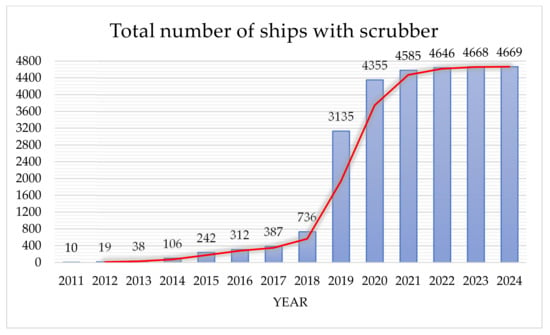
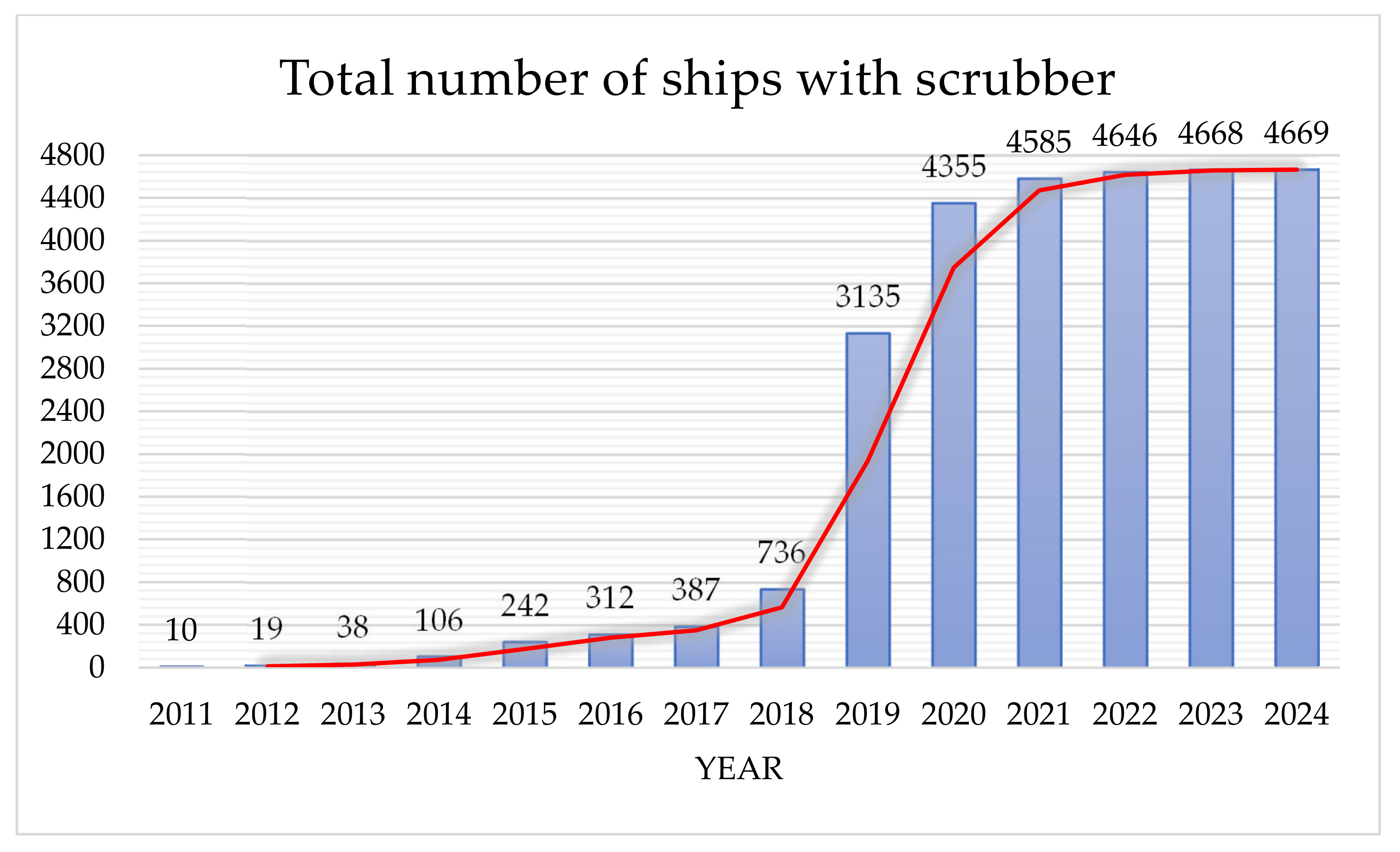
The rise in the total number of ships with a scrubber (in operation and on order) is shown in Figure 1.
Figure 1.
The rise in the total number of ships with scrubbers (in operation and on order) [42].
During the transition phase, the scrubber installation occurred as a retrofit and new built by approximately 70% and 30%, respectively. The adaptation of scrubbers has been realized mostly in dry bulks, containers, crude oil/chemical tankers, and Ro-Ro ships [42].
There are two different scrubber concepts, the dry and wet ones. The dry type of scrubber is not preferred because of the heavy equipment, instability, and requirement of the large areas [43]. The wet type of scrubber, which is more suitable for applications to marine vessels, is of three types: open-loop, closed-loop, and hybrid [44]. In the open-loop system, the elimination of the SOx is carried out based on the natural alkalinity of the seawater, while in the closed-loop system, it is made with alkaline chemicals such as sodium hydroxide (NaOH) or rarely by magnesium oxide (MgO). The open-loop system has some advantages, such as lower CAPEX and OPEX, less requirement of space for system and components, and no risk of storing any chemical. However, its efficiency can change according to the alkalinity level of seawater, and the discharge of effluent of open-loop scrubber is banned or restricted at some certain coastal or port areas such as the Kiel canal in Germany, territorial waters or ports of Latvia, the Panama Canal and the ports of China.
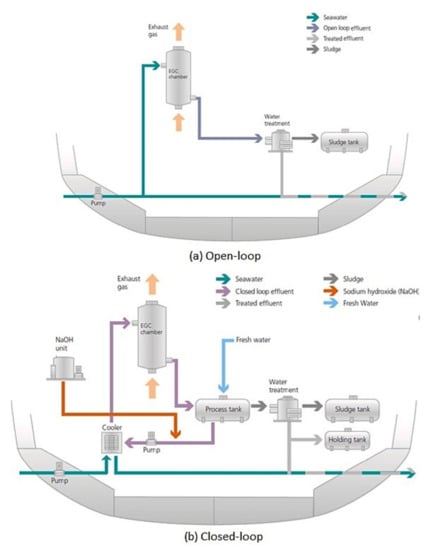
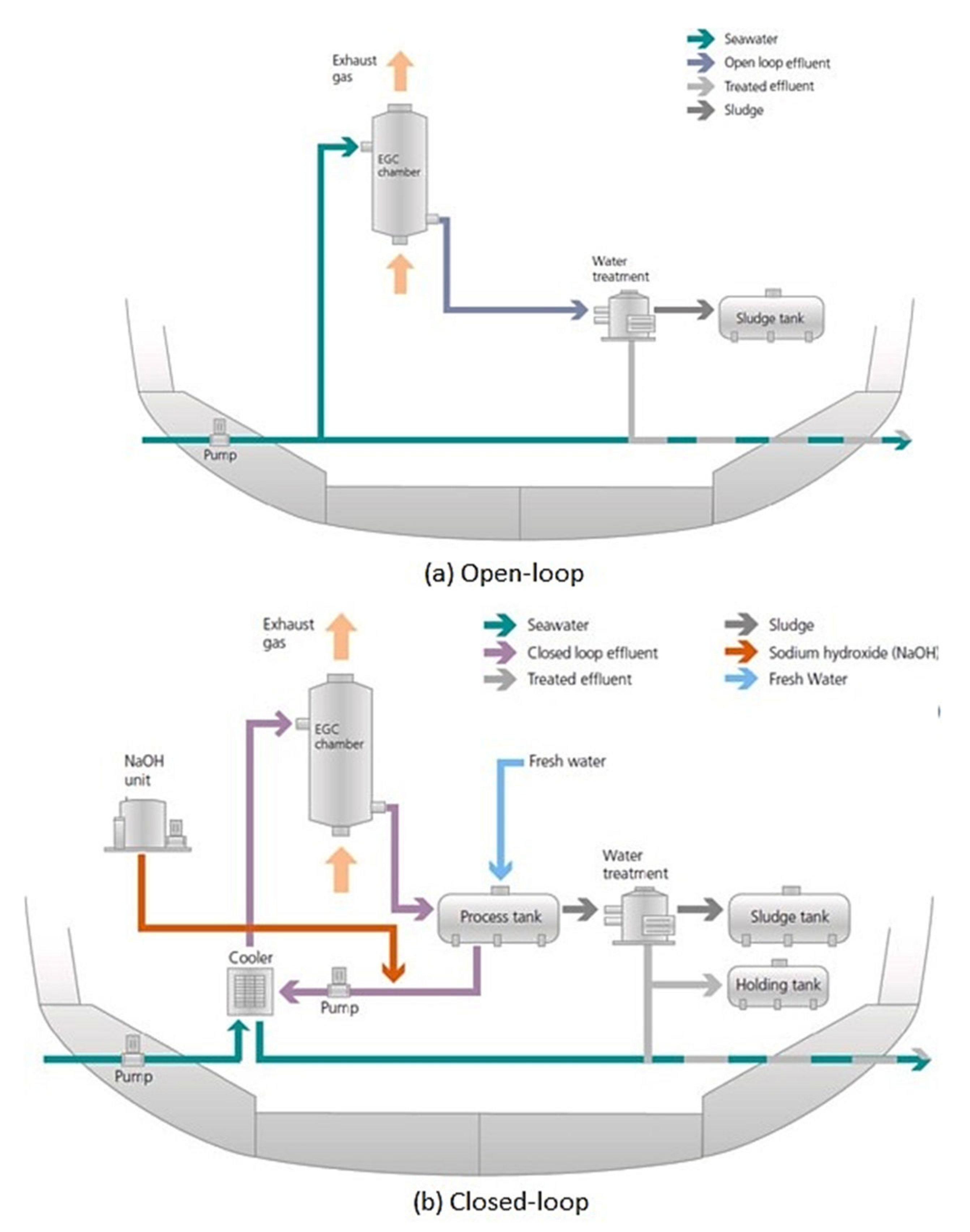
On the other hand, the operation of the closed-loop system is independent of the operation location of the ship and the alkalinity of seawater. Since its effluent is stored onboard, the operation of the system limits according to the waste tank capacity. The closed-loop type is also needed more space for adaptation, and its CAPEX and OPEX are relatively higher. It reveals additional risks for seafarers due to hazardous materials that are required in operation. The hybrid approach neutralizes the disadvantages of both open-loop and closed-loop design and provides significant flexibility in the operation of ships, but it has the highest OPEX and CAPEX [45]. The design and structure of open-loop and closed-loop scrubber systems are given in Figure 2.
Figure 2.
Structure of open-loop and closed-loop scrubbers [46].
4. Case Study
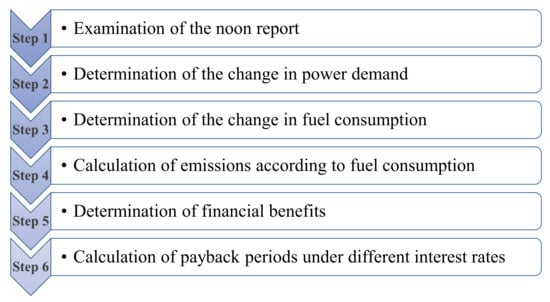
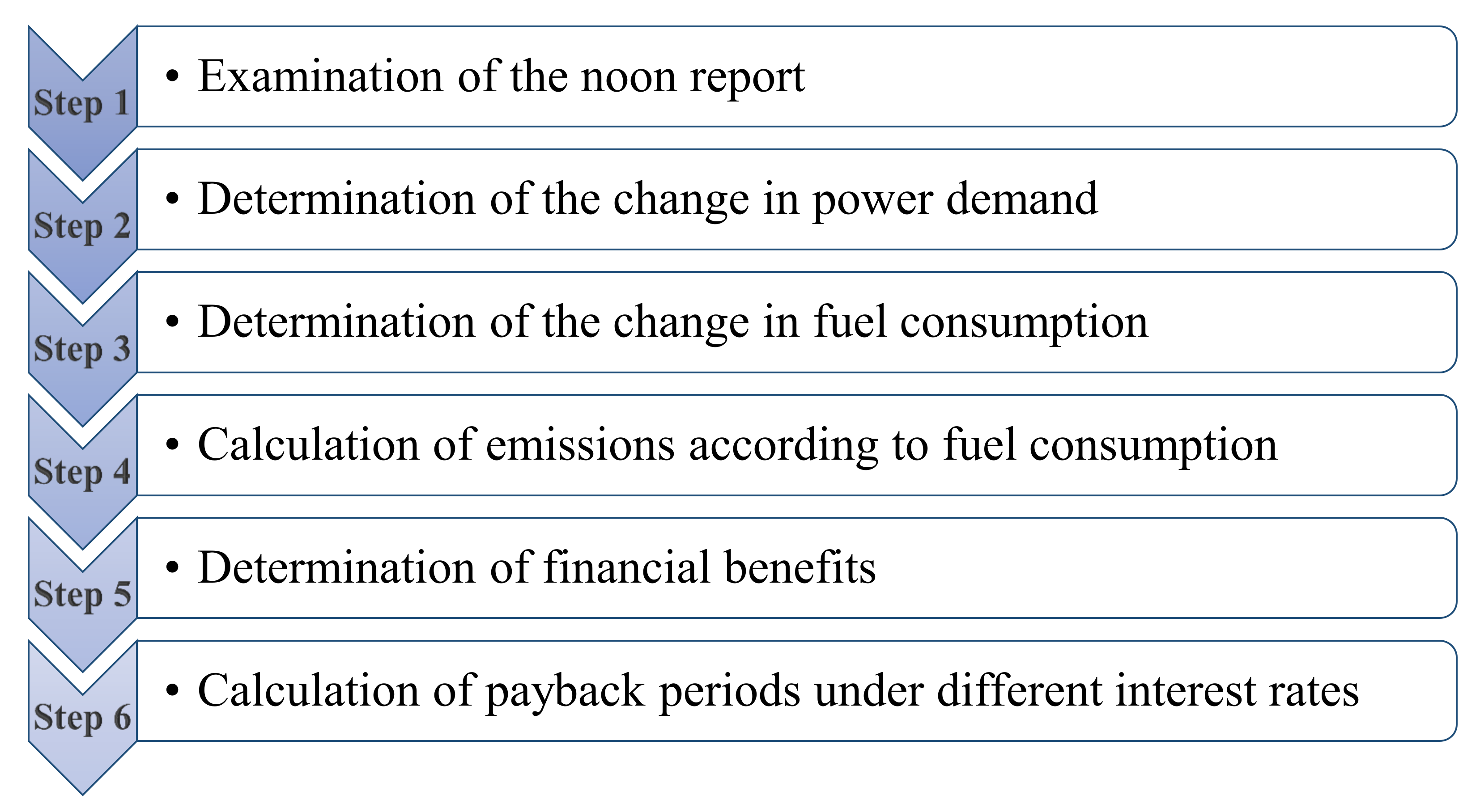
In the process of complying with the IMO 2020 sulfur limitation, the application of scrubbers on marine vessels has been frequently preferred by shipowners, and the number of ships with scrubbers is increasing every year. However, it is thought that the adaptation of this system causes some differences in the operation of the ship, as well as reducing SOx emissions; therefore, in this study, the scrubber system has been analyzed with a methodological approach that is shown in Figure 3.
Figure 3.
The methodology of the study.
The feasibility analysis of the case study is limited to the open-loop design since the ship where data have been obtained from this type of scrubber. However, the following calculations could be easily applied to the data set obtained from another marine vessel with a different type of scrubber. In addition, the analysis and findings of this study provide significant foresight for the scrubber systems.
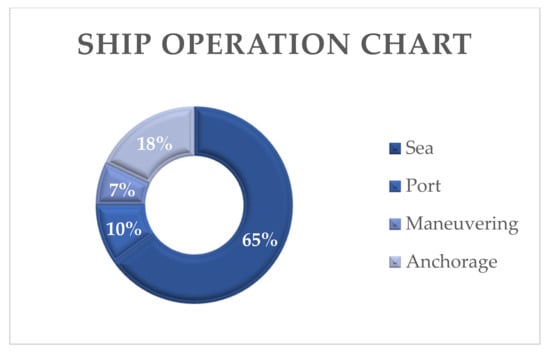
The analysis was carried out using noon reports of a large commercial marine vessel cruising on the open seas. The operation chart of the ship is illustrated in Figure 4. Further, the specifications of the ship are presented in Table 3.
Figure 4.
The operation chart of the ship.
Table 3.
Specifications of the ship.
To compare the differences that occur in power generation and fuel consumption in diesel generators, similar pieces of data that covered before and after the scrubber installation (sample day periods, ship’s load condition, ship’s cruise condition) have been determined from the noon report of the ship. Most sea voyages have been performed in the Baltic sea and the Red sea. While the ship was at the loaded situation in 59% of the analyzed dataset duration, it was at the ballasted condition on the rest times. During the voyage periods, its average speed was about 9 knots.
Emissions emitted to the atmosphere have been calculated, based on the amount of fuel consumption and emission factor [47] as:
where is the amount of emission over a complete trip (tons), is the fuel consumption (tons), EF is the emission factors (kg/tons), is a type of emission (NOx, SOx, CO2, PM2.5, PM10), j is the engine type (slow speed, medium speed, high speed), m is the fuel type (VLSFO, HFO, MGO/MDO), and is the different situation of the trip (cruise, berth, maneuvering). The used emission factors are presented in Table 4.
Table 4.
The used emission factors [6].
The VLSFO is a blended fuel that is a mixture of MGO by 80% and HFO by 20% [48]. The emission factor has been determined according to mixing ratios and used in the calculations. The emission reduction efficiency of the scrubber has been considered 97% for SOx [45] and 10% for PM2.5 [31].
The economic evaluation has been realized with net present value (NPV), simple payback period calculation (SPP), and discounted payback period calculation (DPP) [49].
where represents costs and represents benefits, and these parameters could be calculated as follows [49]:
where is the CAPEX of the scrubber, represents maintenance cost, d is the discount rate, and are prices of fuels and . and the present amount of consumption. indicates the indirect benefits, such as the prior entry to the port, and carbon credits [49]. The CAPEX of the scrubber was determined as 55 USD/kW [50] and is considered % 1 of CAPEX [51].
5. Results and Discussion
5.1. Findings
To carry out the feasibility analysis, average power demands and total amounts of fuel consumption from DGs are determined by covering the periods of 2 months before and after scrubber installation based on the noon reports. The findings are presented in Table 5.
Table 5.
Results of power and fuel analysis.
In similar navigation conditions of the ship, it is understood that the total power demand increases as a result of the scrubber application. It is observed that there is an increase in power generation of DGs at approximately 11%, 17%, and 16%, respectively. Accordingly, an extra 435 tons of fuel is consumed in the 2 months after the scrubber application.
Since two types of fuels that have different emission factors for pollutants have been used in the compared periods, the emissions emitted into the atmosphere have varied. The findings related to releasing emissions are presented in Table 6.
Table 6.
Comparison of releasing emissions before/after scrubber installation.
It is found that as a result of the scrubber installation, SOx emissions are effectively reduced, while other types of emissions increase due to the use of HFO and higher fuel consumption. In addition, although the reducing effect on PM2.5 is considered as 10%, the amount of this pollutant is higher compared to the specified ship without a scrubber. Besides, the increase in the amount of emitted CO2 is against the decarbonization strategy introduced by IMO.
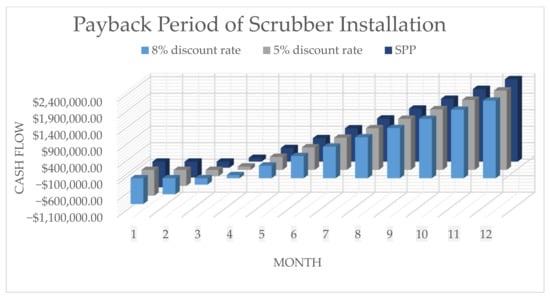
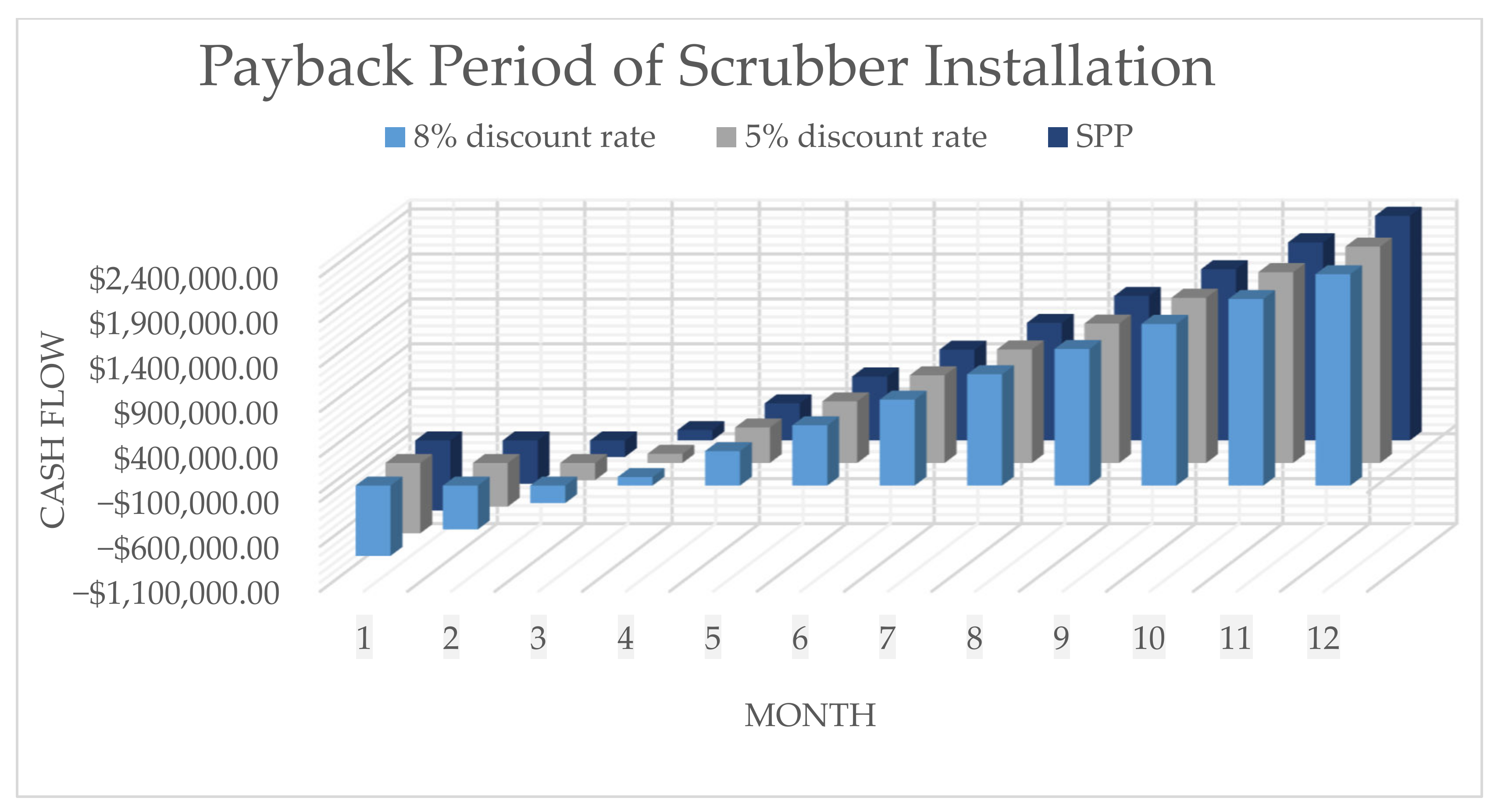
The CAPEX of the scrubber that is determined based on the variable investment cost factor is calculated at USD 1,079,100 and the is found to be USD 10,791. Prices of VLSFO and HFO have been taken at USD 773 and USD 497, respectively [52]. In line with this information, an economic evaluation of the application of the scrubber system is realized with NPV, SPP, and DPP using financial equations specified in Section 3. The NPV and DPP are calculated for 1 year using 2 different discount rates that are 5% and 8%. Accordingly, and are calculated as USD 2,407,946.27 and USD 2,352,598.17, respectively. The differences in the cash flow of the investment based on the discount rates, and corresponding payback periods are shown in Figure 5.
Figure 5.
Cash flow and payback period of scrubber installation based on different discount rates.
While the SPP is found at 0.30 years, the DPP is calculated at 0.34 and 0.37 years for 5% and 8% discount rates, respectively. Considering the ship life span, these economic results make it understandable that shipping companies conduct intensive scrubber adaptation in the process of complying with the sulfur restriction.
5.2. Discussion
In line with the conducted feasibility analysis via noon reports received from the ship, it has been determined that the generated power and the fuel consumption in the DGs increased as a result of the scrubber application. As a result of the higher fuel consumption, it is found that all emissions except SOx are released into the atmosphere more. This situation shows that a scrubber implementation is an effective option for complying with the sulfur restriction, but it contradicts the decarbonization strategy specified by IMO.
On the other hand, despite the increase in fuel consumption, operational expenses are saved as the HFO is cheaper than the VLSFO. The scrubber investment is financially evaluated within the three different economic indicators: NPV, SPP, and DPP. According to the values calculated, the installation is found to be acceptable in a financial way. The period of redemption has been determined between 0.3–0.4 years, which is changed according to the discounted rate.
6. Conclusions
In this study, the scrubber system, which is frequently preferred by maritime companies in the process of complying with the 2020 sulfur regulation enforced by IMO in shipping, has been examined in detail. Some of the adverse impacts of its application for ships are determined.
In this sense, a feasibility analysis is carried out on an oceangoing vessel. To conduct the analysis, the noon reports of a crude oil tanker have been obtained, and similar cruising conditions of the ship on the same periods before and after scrubber installation are compared. Since the ship has an open-loop system, the analysis is limited to this one, but at this point, it should be underlined that approximately 81% of the ships with scrubbers in the world fleet have an open-loop design [42]. As a result of the comparison, it is determined that there is an increase in the power generation and fuel consumption of the DGs. HFO was used as a fuel since the SOx in the exhaust gas can be removed in a huge percentage. It has been determined that this situation causes a decrease in operational fuel expenses despite higher fuel consumption but an increase in emission gases except for SOx. Finally, the investment is evaluated within the scope of three different economic parameters, and it is found acceptable.
The main contributions of the paper are as follows:
- i.
- As a result of the case study carried out on the specified crude oil vessel, some adverse effects of scrubber adaptation on issues such as emissions and fuel consumption have been identified.
- ii.
- Differing from the literature, the power and fuel consumption increase in DGs as a result of the scrubber installation is presented based on the ship’s real noon report data.
- iii.
- Emission analysis is carried out not only specifically for SOx but also for all pollutants, and the amounts of increases have been presented.
- iv.
- The financial results have been obtained parallel to the scrubber-related studies.
- v.
- The scrubber utilization is against the zero-emission ship target and decarbonization strategy stated by IMO.
The findings of the study provide significant results and foresight to maritime companies, authorities, and stakeholders about the scrubber application on marine vessels. In line with the calculated results, although scrubber application is acceptable to comply with the sulfur regulation in the short term, other options, such as alternative fuels and more beneficial De-SOx technologies, should be considered because of both environmental concerns and to meet environmental policies and strategies introduced by IMO.
Author Contributions
Ç.K.: Formal analysis, Visualization, and Writing—Original Draft; Y.A.: Writing—Review and Editing; C.G.S.: Writing—Conceptualization, Review and Editing, and Supervision. All authors have read and agreed to the published version of the manuscript.
Funding
This work was supported by The Scientific and Technological Research Council of Turkey BIDEB 2214-A International Doctoral Research Fellowship Programme (Grant no.: 1059B142100431) and the Research Fund of the Istanbul Technical University (Project No.: 43048).
Institutional Review Board Statement
Not applicable.
Informed Consent Statement
Not applicable.
Data Availability Statement
Not applicable.
Acknowledgments
This work contributes to the Strategic Research Plan of the Centre for Marine Technology and Ocean Engineering (CENTEC), which is financed by the Portuguese Foundation for Science and Technology (Fundação para a Ciência e Tecnologia—FCT) under contract UIDB/UIDP/00134/2020.
Conflicts of Interest
The authors declare no conflict of interest.
References
- UNCTAD. Review of Maritime Transport 2020; United Nations: Geneva, Switzerland, 2020. [Google Scholar]
- Karatug, C.; Arslanoglu, Y.; Guedes Soares, C. Evaluation of Decarbonization Strategies for Existing Ships. In Trends in Maritime Technology and Engineering; Guedes Soares, C., Santos, T.A., Eds.; Taylor & Francis Group: London, UK, 2022; Volume 2, pp. 45–54. [Google Scholar] [CrossRef] [Scilit]
- EMSA. The World Merchant Fleet: Statistics from Equasis; EMSA: Lisbon, Portugal, 2019. [Google Scholar]
- Uyanık, T.; Karatuğ, Ç.; Arslanoğlu, Y. Machine Learning Approach to Ship Fuel Consumption: A Case of Container Vessel. Transp. Res. Part D Transp. Environ. 2020, 84, 102389. [Google Scholar] [CrossRef] [Scilit]
- Tadros, M.; Vettor, R.; Ventura, M.; Guedes Soares, C. Coupled Engine-Propeller Selection Procedure to Minimize Fuel Consumption at a Specified Speed. J. Mar. Sci. Eng. 2021, 9, 59. [Google Scholar] [CrossRef] [Scilit]
- IMO. Fourth IMO GHG Study Executive Summary; IMO: London, UK, 2020. [Google Scholar]
- Zis, T.; Psaraftis, H.N. Operational Measures to Mitigate and Reverse the Potential Modal Shifts Due to Environmental Legislation. Marit. Policy Manag. 2018, 46, 117–132. [Google Scholar] [CrossRef] [Scilit]
- Rahim, M.M.; Islam, M.T.; Kuruppu, S. Regulating Global Shipping Corporations’ Accountability for Reducing Greenhouse Gas Emissions in the Seas. Mar. Policy 2016, 69, 159–170. [Google Scholar] [CrossRef] [Scilit]
- Moreira, L.; Vettor, R.; Guedes Soares, C. Neural Network Approach for Predicting Ship Speed and Fuel Consumption. J. Mar. Sci. Eng. 2021, 9, 119. [Google Scholar] [CrossRef] [Scilit]
- Tadros, M.; Ventura, M.; Guedes Soares, C. Optimization procedure to minimize fuel consumption of a four-stroke marine turbocharged diesel engine. Energy 2019, 168, 897–908. [Google Scholar] [CrossRef] [Scilit]
- Tadros, M.; Ventura, M.; Guedes Soares, C. Data driven in-cylinder pressure diagram based optimization procedure. J. Mar. Sci. Eng. 2020, 8, 294. [Google Scholar] [CrossRef] [Scilit]
- Tadros, M.; Ventura, M.; Guedes Soares, C. Optimization of the performance of marine diesel engines to minimize the formation of SOx emissions. J. Mar. Sci. Appl. 2020, 19, 473–484. [Google Scholar] [CrossRef] [Scilit]
- Mocerino, L.B.; Guedes Soares, C.; Rizzuto, E.; Balsamo, F.; Quaranta, F. Validation of a Model of Emissions for a Marine Diesel Engine with data from sea operation. J. Mar. Sci. Appl. 2021, 20, 534–545. [Google Scholar] [CrossRef] [Scilit]
- Prpic-Oršic, J.; Vettor, R.; Faltinsen, O.M.; Guedes Soares, C. The influence of route choice and operating conditions on fuel consumption and CO2 emission of ships. J. Mar. Sci. Technol. 2016, 21, 434–457. [Google Scholar] [CrossRef] [Scilit]
- Vettor, R.; Guedes Soares, C. Development of a ship weather routing system. Ocean. Eng. 2016, 123, 1–14. [Google Scholar] [CrossRef] [Scilit]
- Vettor, R.; Bergamini, G.; Guedes Soares, C. A comprehensive approach to account for weather uncertainties in ship route optimization. J. Marit. Sci. Eng. 2021, 9, 1434. [Google Scholar] [CrossRef] [Scilit]
- Wang, H.B.; Zhou, P.L.; Wang, Z.C. Review on Current Carbon Emission Reduction Technologies and Projects and their Feasibilities in Ships. J. Mar. Sci. Appl. 2017, 16, 159–165. [Google Scholar] [CrossRef] [Scilit]
- Bekdaş, A.; Kaya, C.; Kökkülünk, G. Comprehensive Economic Analyses in Terms of Maritime Sulphur 2020 Regulation. Ships Offshore Struct. 2022. [Google Scholar] [CrossRef] [Scilit]
- Nikopoulou, Z. Incremental Costs for Reduction of Air Pollution from Ships: A Case Study on North European Emission Control Area. Marit. Policy Manag. 2017, 44, 1056–1077. [Google Scholar] [CrossRef] [Scilit]
- Merien-Paul, R.H.; Enshaei, H.; Jayasinghe, S.G. Effects of Fuel-Specific Energy and Operational Demands on Cost/Emission Estimates: A Case Study on Heavy Fuel-Oil vs Liquefied Natural Gas. Transp. Res. Part D Transp. Environ. 2019, 69, 77–89. [Google Scholar] [CrossRef] [Scilit]
- Zis, T.; Angeloudis, P.; Bell, M.G.H.; Psaraftis, H.N. Payback Period for Emissions Abatement Alternatives: Role of Regulation and Fuel Prices. Transp. Res. Rec. J. Transp. Res. Board 2016, 2549, 37–44. [Google Scholar] [CrossRef] [Scilit]
- Jiang, L.; Kronbak, J.; Christensen, L.P. The Costs and Benefits of Sulphur Reduction Measures: Sulphur Scrubbers versus Marine Gas Oil. Transp. Res. Part D Transp. Environ. 2014, 28, 19–27. [Google Scholar] [CrossRef] [Scilit]
- Ammar, N.R.; Seddiek, I.S. Eco-Environmental Analysis of Ship Emission Control Methods: Case Study RO-RO Cargo Vessel. Ocean Eng. 2017, 137, 166–173. [Google Scholar] [CrossRef] [Scilit]
- Ritari, A.; Spoof-Tuomi, K.; Huotari, J.; Niemi, S.; Tammi, K. Emission Abatement Technology Selection, Routing and Speed Optimization of Hybrid Ships. J. Mar. Sci. Eng. 2021, 9, 944. [Google Scholar] [CrossRef] [Scilit]
- Abadie, L.M.; Goicoechea, N. Powering Newly Constructed Vessels to Comply with ECA Regulations under Fuel Market Prices Uncertainty: Diesel or Dual Fuel Engine? Transp. Res. Part D Transp. Environ. 2019, 67, 433–448. [Google Scholar] [CrossRef] [Scilit]
- Lindstad, H.; Sandaas, I.; Strømman, A.H. Assessment of Cost as a Function of Abatement Options in Maritime Emission Control Areas. Transp. Res. Part D Transp. Environ. 2015, 38, 41–48. [Google Scholar] [CrossRef] [Scilit]
- Schinas, O.; Stefanakos, C.N. Selecting Technologies towards Compliance with MARPOL Annex VI: The Perspective of Operators. Transp. Res. Part D Transp. Environ. 2014, 28, 28–40. [Google Scholar] [CrossRef] [Scilit]
- Lindstad, H.E.; Rehn, C.F.; Eskeland, G.S. Sulphur Abatement Globally in Maritime Shipping. Transp. Res. Part D Transp. Environ. 2017, 57, 303–313. [Google Scholar] [CrossRef] [Scilit]
- Kim, A.R.; Seo, Y.J. The Reduction of SOx Emissions in the Shipping Industry: The Case of Korean Companies. Mar. Policy 2019, 100, 98–106. [Google Scholar] [CrossRef] [Scilit]
- Wilailak, S.; Yoo, B.H.; Kim, Y.P.; Lee, C.J. Parametric Analysis and Design Optimization of Wet SOx Scrubber System in Marine Industry. Fuel 2021, 304, 121369. [Google Scholar] [CrossRef] [Scilit]
- Yang, J.; Tang, T.; Jiang, Y.; Karavalakis, G.; Durbin, T.D.; Wayne Miller, J.; Cocker, D.R.; Johnson, K.C. Controlling Emissions from an Ocean-Going Container Vessel with a Wet Scrubber System. Fuel 2021, 304, 121323. [Google Scholar] [CrossRef] [Scilit]
- Caiazzo, G.; Langella, G.; Miccio, F.; Scala, F. An Experimental Investigation on Seawater SO2 Scrubbing for Marine Application. Environ. Prog. Sustain. Energy 2012, 32, 1179–1186. [Google Scholar] [CrossRef] [Scilit]
- Zhou, J.; Zhou, S.; Zhu, Y. Characterization of Particle and Gaseous Emissions from Marine Diesel Engines with Different Fuels and Impact of After-Treatment Technology. Energies 2017, 10, 1110. [Google Scholar] [CrossRef] [Scilit]
- Winnes, H.; Fridell, E.; Moldanová, J. Effects of Marine Exhaust Gas Scrubbers on Gas and Particle Emissions. J. Mar. Sci. Eng. 2020, 8, 299. [Google Scholar] [CrossRef] [Scilit]
- Karjalainen, P.; Teinilä, K.; Kuittinen, N.; Aakko-Saksa, P.; Bloss, M.; Vesala, H.; Pettinen, R.; Saarikoski, S.; Jalkanen, J.-P.; Timonen, H. Real-world particle emissions and secondary aerosol formation from a diesel oxidation catalyst and scrubber equipped ship operating with two fuels in a SECA area. Environ. Pollut. 2022, 292, 118278. [Google Scholar] [CrossRef] [Scilit]
- Wu, P.C.; Lin, C.Y. Cost-Benefit Evaluation on Promising Strategies in Compliance with Low Sulfur Policy of Imo. J. Mar. Sci. Eng. 2021, 9, 3. [Google Scholar] [CrossRef] [Scilit]
- Başhan, V.; Yucesan, M.; Demirel, H.; Gul, M. Health, Safety, and Environmental Failure Evaluation by Hybridizing Fuzzy Multi-Attribute Decision-Making Methods for Maritime Scrubber Systems. Environ. Monit. Assess. 2022, 194, 641. [Google Scholar] [CrossRef] [Scilit]
- Tan, Z.; Zeng, X.; Shao, S.; Chen, J.; Wang, H. Scrubber installation and green fuel for inland river ships with non-identical streamflow. Transp. Res. Part E Logist. Transp. Rev. 2022, 161, 102677. [Google Scholar] [CrossRef] [Scilit]
- Giroth, E.J.; Ang, E.B. The Design and Evaluation of Exhaust Gas Cleaning System Equipped with SOx Scrubber. In Proceedings of the 2022 IEEE 13th International Conference on Mechanical and Intelligent Manufacturing Technologies (ICMIMT), Cape Town, South Africa, 25–27 May 2022; pp. 25–29. [Google Scholar] [CrossRef] [Scilit]
- Lee, I.; Chang, T.; Chang, C.; Truong, V.D.H.; Ward, J.D. Comparison of open- and closed-loop operating strategies for exhaust gas scrubbing in marine applications: Modeling and sea-trial data. J. Eng. Marit. Environ. 2022, 0, 14750902221123844. [Google Scholar] [CrossRef] [Scilit]
- IMO. Air Pollution and Greenhouse Gas (GHG) Emission from International Shipping, Marpol Annex VI; IMO: London, UK, 2014. [Google Scholar]
- DNV GL. Alternative Fuel Insight. Available online: https://afi.dnvgl.com/Statistics?repId=2 (accessed on 9 March 2022).
- Brynolf, S.; Magnusson, M.; Fridell, E.; Andersson, K. Compliance Possibilities for the Future ECA Regulations through the Use of Abatement Technologies or Change of Fuels. Transp. Res. Part D Transp. Environ. 2014, 28, 6–18. [Google Scholar] [CrossRef] [Scilit]
- Exhaust Gas Cleaning Systems Association. A Practical Guide to Exhaust Gas Cleaning Systems for the Maritime Industry, EGCSA Handbook; EGCSA: London, UK, 2012. [Google Scholar]
- ABS. Advisory on Exhaust Gas Scrubber Systems; American Bureau of Shipping: Spring, TX, USA, 2018. [Google Scholar]
- Ni, P.; Wang, X.; Li, H. A Review on Regulations, Current Status, Effects and Reduction Strategies of Emissions for Marine Diesel Engines. Fuel 2020, 279, 118477. [Google Scholar] [CrossRef] [Scilit]
- Trozzi, C. Emission Estimate Methodology for Maritime Navigation, US EPA. In Proceedings of the 19th International Emissions Inventory Conference, San Antonio, TX, USA, 27–30 September 2010. [Google Scholar]
- Pavlenko, N.; Comer, B.; Zhou, Y.; Clark, N.; Rutherford, D. The Climate Implications of Using LNG as a Marine Fuel; Technical Report by International Council on Clean Transportation; ICCT: The Hague, The Netherlands, 2020. [Google Scholar]
- Karatuğ, Ç.; Durmuşoğlu, Y. Design of a Solar Photovoltaic System for a Ro-Ro Ship and Estimation of Performance Analysis: A Case Study. Sol. Energy 2020, 207, 1259–1268. [Google Scholar] [CrossRef] [Scilit]
- Vanhamme, E. Assessment of Fuel Oil Availability Final Report; CE Delft: Delft, the Netherlands, 2016. [Google Scholar]
- Fan, L.; Gu, B.; Luo, M. A Cost-Benefit Analysis of Fuel-Switching vs. Hybrid Scrubber Installation: A Container Route through the Chinese SECA Case. Transp. Policy 2020, 99, 336–344. [Google Scholar] [CrossRef] [Scilit]
- Ship&Bunker. World Bunker Prices—Ship & Bunker. Available online: https://shipandbunker.com/prices (accessed on 12 October 2022).

Publisher’s Note: MDPI stays neutral with regard to jurisdictional claims in published maps and institutional affiliations. |
© 2022 by the authors. Licensee MDPI, Basel, Switzerland. This article is an open access article distributed under the terms and conditions of the Creative Commons Attribution (CC BY) license (https://creativecommons.org/licenses/by/4.0/).