


Abstract
Livestock manure management contributes substantially to agricultural greenhouse gas emissions, making the adoption of low-carbon approaches urgent in ecologically sensitive regions. This study focuses on the County-wide Livestock Manure Resource Utilization Project in Danjiangkou City, the core water source area of China’s South-to-North Water Diversion Project. Based on field survey data, IPCC Guidelines, and a life cycle assessment framework, this study established a carbon accounting boundary covering excretion, collection, storage, treatment, and utilization stages. A scenario analysis was conducted to compare 2023 baseline emissions with 2026 project emissions and to quantify the carbon reduction potential. The research findings indicate that the overall carbon reduction rate following the project’s implementation reached 40.8%. However, the effectiveness varied considerably across the four management models. The Sedimentation–Crop Model and the Housing–Bedding Integrated Model, which employed integrated systemic interventions, achieved reductions of 61.50% and 60.09%, respectively. In contrast, the “124” Healthy Breeding Model and the Raised-Bedding Composting System, which relied primarily on single-stage upgrades, achieved reductions of only 32.04% and 27.70%. This disparity suggests that in decentralized livestock operations, isolated technological improvements fall short; meaningful decarbonization requires systemic interventions across the entire manure management chain. The findings provide a reference for low-carbon livestock manure management and regional development in ecologically sensitive areas.
1. Introduction
Livestock production accounts for approximately 14.5% of all human-caused greenhouse gas (GHG) emissions, with manure management representing a major contributing source [1]. In addition to its climate change implications, improper manure management can also lead to substantial nitrogen and phosphorus losses through runoff and leaching, thereby exacerbating the risks of non-point source pollution [2].
In ecologically sensitive areas, the environmental risks associated with livestock manure management are significantly heightened. Although the definitions of ecologically sensitive areas vary across countries and regions, such as the EU’s Natura 2000 and China’s ecological conservation red lines, these areas are generally characterized by high ecological vulnerability and critical ecosystem service functions. Their carbon use efficiency and carbon sink capacity are highly sensitive to land-use change and anthropogenic disturbances [3,4]. In such regions, livestock production is often characterized by dispersed farms and small-scale operations, while strict environmental regulations further complicate standardized carbon accounting for manure management systems. Consequently, the inherent tension between ecological conservation and agricultural development necessitates the implementation of more stringent low-carbon manure management and monitoring strategies.
In response to this need, resource utilization has become the dominant approach for livestock and poultry manure management in ecologically sensitive areas, encompassing feed conversion, fertilizer application, energy recovery, and substrate manufacturing, with multiple integrated treatment models tailored to farm-specific conditions and manure characteristics [5,6,7,8,9,10]. Among these, two technological routes have received particular attention: aerobic composting (AC), which converts solid manure into organic fertilizer [11] and anaerobic digestion (AD), which produces biogas for energy recovery while generating digestate rich in nitrogen, phosphorus, and potassium for land application [7,12]. Early studies assessing greenhouse gas emissions during manure management mainly relied on the IPCC’s emission factor method, which estimates methane and nitrous oxide emissions at each management stage through standardized coefficients. However, its simplified structure often limits the ability to capture the complex interactions among manure treatment, energy recovery, and nutrient cycling processes. Therefore, more comprehensive analytical methods are needed to systematically evaluate the environmental impacts of manure resource utilization systems at multiple management stages.
In this context, life cycle assessment (LCA) has increasingly been adopted to evaluate environmental impacts associated with livestock manure management. Existing studies have applied LCA to compare alternative treatment pathways, such as composting, anaerobic digestion, and conventional storage, to identify key emission sources and assess mitigation potential [13,14]. Simultaneously, several studies have incorporated sensitivity and uncertainty analysis to examine the robustness of emission factors, model assumptions, and system parameters [7,9,12]. However, most research adopts cradle-to-gate system boundaries, often neglecting downstream processes such as manure land application and the indirect mitigation benefits arising from nutrient recycling and chemical fertilizer substitution. Moreover, under region-specific conditions—particularly in ecologically sensitive areas where climate, livestock structures, and environmental regulations vary substantially—the reliance on macro-level IPCC default emission factors introduces considerable uncertainty into carbon emission estimation and limits the applicability of existing assessments for regional manure management planning. Therefore, integrated assessments that simultaneously consider full chain manure management processes and region-specific emission characteristics remain limited, particularly at the county scale where diversified manure utilization models coexist.
Despite the growing application of LCA in manure management research, studies specifically addressing livestock production in ecologically sensitive areas remain relatively limited. Existing studies in such regions have primarily focused on protected areas, such as the EU Natura 2000 network and their surrounding landscapes. In these contexts, research has predominantly examined ammonia emissions and nitrogen deposition associated with livestock farming. These studies typically assess how livestock production increases the risk of excessive nitrogen loads and eutrophication in fragile ecosystems. They further evaluate the effectiveness of environmental control policies aimed at reducing nitrogen pollution in protected area [15]. Other studies have compared the costs and regulatory intensity of ammonia emission control measures around protected areas, as well as their relationship with the spatial distribution of aquaculture [16]. In ecologically sensitive areas, environmental management has traditionally focused on eutrophication control, nutrient management and drinking water protection, while greenhouse gas emissions from manure management have received relatively little attention. In addition, livestock production systems in these areas are typically characterized by scattered farms and diverse manure treatment methods, which makes systematic carbon emission accounting complex.
Therefore, this study takes the County-wide Promotion of Livestock and Poultry Manure Resource Utilization Project in Danjiangkou City, China as a case study. By constructing a baseline scenario (before the project implementation, in 2023) and a project scenario (after the project implementation, in 2026), the carbon emission reduction potential of the project is systematically evaluated. Based on the existing studies that mostly adopt the “cradle-to-grave” life cycle boundary and rely on default emission factors of the IPCC, this study incorporates upstream manure excretion and downstream application, establishing a carbon accounting framework covering the entire process of manure excretion, cleaning, storage, treatment and utilization. On the basis of the default parameters of the IPCC, regional-specific parameters reflecting local climate conditions, management practices, and characteristics of the agricultural land system are introduced, in order to more accurately characterize the emission reduction contributions and key influencing factors of different manure resource utilization models in ecologically sensitive areas. The research results are based on the real county-level policy intervention case, providing empirical evidence for achieving coordinated governance between agricultural development and ecological protection in ecologically sensitive areas.
2. Materials and Methods
2.1. Study Area
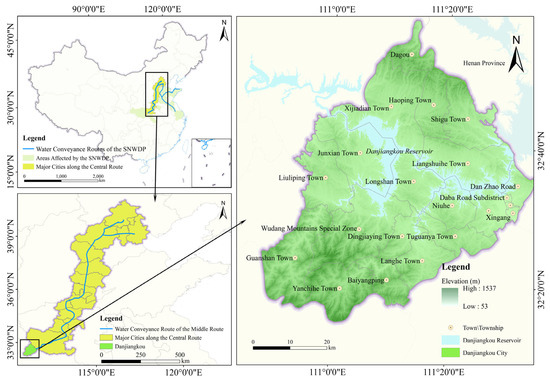
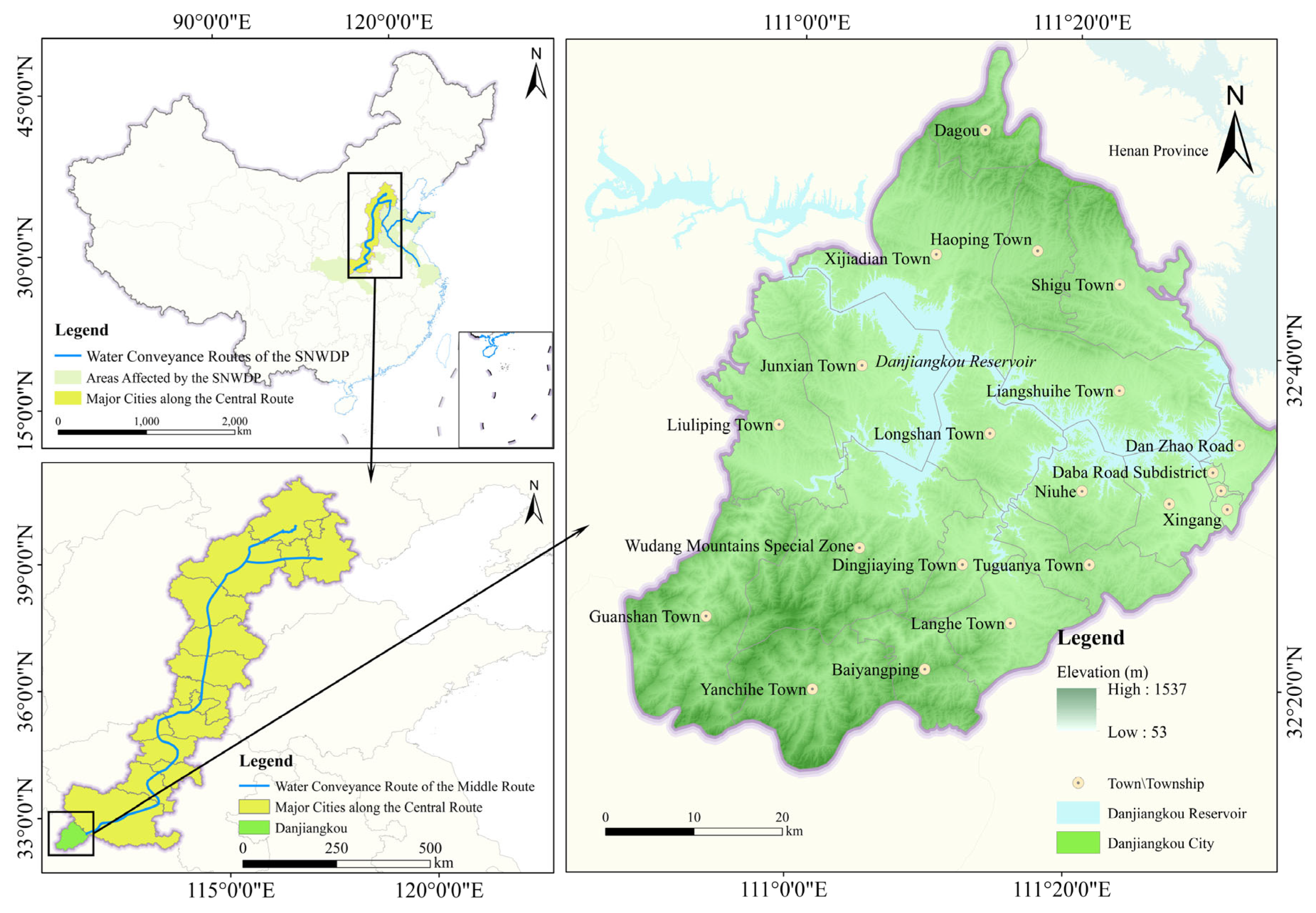
Danjiangkou City (32°32′ N, 111°30′ E) is located in northwestern Hubei Province, central China (Figure 1).
Figure 1.
The geographical location of Danjiangkou City in the South-to-North Water Diversion Project.
The city serves as the water source area of the South-to-North Water Diversion Central Route Project, and is therefore designated as a national ecological conservation zone with strict environmental protection requirements. The region is characterized by a subtropical monsoon climate, with an average annual temperature of approximately 16.0 °C and annual precipitation of about 800 mm. These climatic conditions, together with its complex mountainous–plain transitional topography, influence manure storage practices, decomposition processes, and associated greenhouse gas emission dynamics.
Dandangkou City is confronted with the pressure caused by agricultural non-point source pollution and greenhouse gas emissions related to livestock farming. The assessment results show that 52.65% of the area around the Danjiangkou Reservoir has been designated as highly sensitive or extremely sensitive zones, and the ecosystem is prone to being damaged [17]. At the same time, in 2023, the total output of livestock manure reached 1.68 million tons (data sourced from the unpublished statistics provided by the Danjiangkou Municipal Animal Husbandry and Veterinary Service Center, obtained in January 2025). In addition, the fragmented terrain and the spatial separation of livestock and farmland hindered centralized treatment, exacerbating methane emissions during storage and nitrogen loss caused by runoff and leaching. Therefore, Danjiangkou launched the “County-wide Livestock Manure Resource Utilization Project” in 2024. Through four different methods for the resource utilization of livestock manure in various situations, the management approach for manure was re-planned (Table 1).
Table 1.
The meaning of the resource utilization model in Danjiangkou City and the corresponding livestock and poultry.
2.2. Goal and Scope Definition
2.2.1. System Boundary and Model Configuration
This study adopts a cradle-to-field system boundary to quantify greenhouse gas (GHG) emissions associated with livestock and poultry manure management in Danjiangkou City. The system boundary encompasses the full manure management chain, including excretion, cleaning, storage, treatment, transportation, and final utilization in cropland. Emissions from upstream livestock production (e.g., feed production and enteric fermentation) are excluded, as the objective of this study is to isolate the mitigation effects induced by management restructuring rather than changes in livestock productivity. Within this boundary, both direct and indirect GHG emissions are considered (Table 2).
Table 2.
Greenhouse gas sources during each stage of the life cycle.
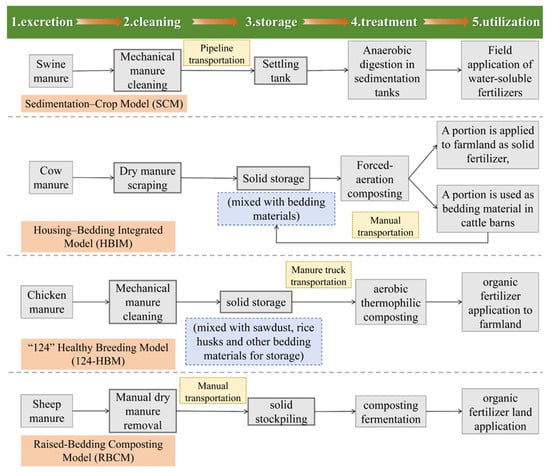
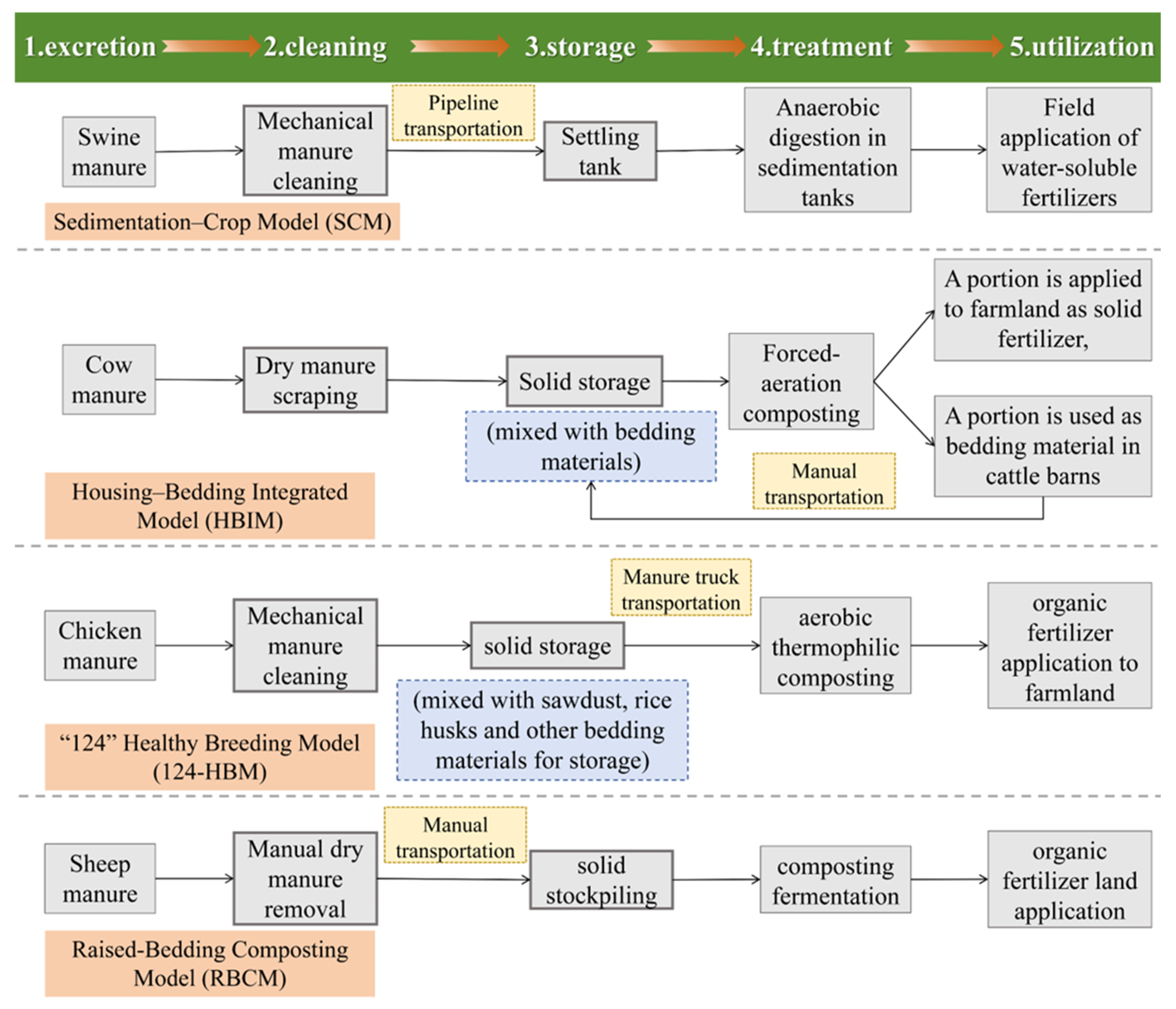
Although a unified system boundary is applied across all scenarios, the internal configuration of manure management processes differs among the four resource utilization models implemented in Danjiangkou City: the Sedimentation–Crop Model (SCM), the Housing–Bedding Integrated Model (HBIM), the “124” Healthy Breeding Model (124-HBM), and the Raised-Bedding Composting Model (RBCM). These models vary in manure cleaning methods (mechanical vs. manual), storage forms (liquid vs. solid), treatment technologies (sedimentation fermentation, forced-aeration composting, thermophilic composting, or natural stacked fermentation), transportation modes, and final utilization pathways. Such structural differences lead to distinct emission patterns along the manure management chain while operating within the same lifecycle boundary framework (Figure 2).
Figure 2.
The processes corresponding to each stage of the life cycle of the four types of livestock and poultry manure resource utilization models in Danjiangkou City. The orange box represents the processing mode. The grey boxes represent the processes corresponding to different stages of each mode. The yellow box represents the transportation stage. The blue boxes represent the mixtures added in the processing technology.
2.2.2. Functional Unit
In life cycle assessment (LCA), the functional unit (FU) represents the quantified performance of the studied system to which all material and energy flows are normalized. In this study, the FU is defined as the total annual livestock and poultry manure management system of Danjiangkou City (per year). Under this functional unit, all greenhouse gas emissions and mitigation effects are calculated on an annual basis for the entire county, ensuring consistency with regional policy implementation and management decision-making scales.
All greenhouse gas (GHG) emissions under the baseline (2023) and project (2026) scenarios are calculated on this basis and expressed in CO2-equivalent (CO2-eq) using the 100-year global warming potential (GWP100) factors recommended by the IPCC (2019) [18]: 28 kg CO2-eq/kg CH4 and 273 kg CO2-eq/kg N2O.
For model-level comparison, emissions are additionally reported as GHG emissions per ton of volatile solids (VS) managed (kg CO2-eq t−1 VS). This normalization eliminates the influence of livestock population size and allows structural differences among the Sedimentation–Crop Model (SCM), Housing–Bedding Integrated Model (HBIM), “124” Healthy Breeding Model (124-HBM), and Raised-Bedding Composting Model (RBCM) to be compared on an equivalent basis.
This dual functional unit design ensures both policy relevance at the county scale and methodological rigor in cross-model comparison.
2.2.3. Scenario Design
To evaluate the mitigation effects of the county-wide manure management restructuring project, as shown in Table 3, two scenarios were set: the baseline scenario (2023) and the project implementation scenario (2026). The baseline scenario reflects the prevailing manure collection, storage, treatment, and utilization practices prior to the project. The project scenario incorporates the technical and management improvements introduced by the county-wide manure resource utilization program. To ensure a consistent comparison, livestock population and total manure generation were assumed to remain constant between the two scenarios. Under this assumption, differences in greenhouse gas emissions can be attributed primarily to changes in manure management technologies and resource utilization pathways.
Table 3.
Comparison of manure management scenarios: Baseline situation (2023) and project situation (2026).
2.3. Data Source
The activity data, emission factors, and background data sources utilized in this carbon accounting study are presented in Table 4. The specific data used in this study can be freely accessed through the Medenhorst database (https://data.mendeley.com/datasets/kz5psxd3md/1, accessed on 29 March 2026).
Table 4.
The types and sources of data used in this research.
2.4. Carbon Emission Accounting Method
2.4.1. Carbon Mitigation Assessment
To isolate the mitigation effects induced by manure management restructuring, livestock population sizes and total manure generation are assumed to remain constant across scenarios. Under this assumption, differences in greenhouse gas emissions between scenarios arise primarily from changes in manure handling pathways, treatment technologies, energy inputs, and nutrient substitution effects associated with improved manure resource utilization.
Emission differences between the two scenarios are quantified as:
where represents the carbon emissions of the livestock manure resource utilization system under the baseline scenario (kg -eq), and represents those under the project scenario (kg -eq).
2.4.2. Emissions from Manure Management
2.4.3. Emissions Along the Manure Treatment Chain
- CH4 Emissions:
- 2.
- N2O Emissions:
For N2O emissions, where calculations are based on nitrogen content (N2O-N), the molecular weight conversion factor 44/28 is applied to obtain N2O mass, where 44 and 28 are the molecular weights of N2O and N2, respectively.
- (1)
- Direct N2O Emissions:
- (2)
- Indirect N2O Emissions:
Indirect N2O emissions from nitrogen volatilization in manure management:
where represents indirect N2O emissions from manure and urine excretion of livestock at stage k (kg -eq); is the fraction of nitrogen volatilized as NH3 and NOx under different manure management systems (%); and EF4 is the emission factor for N2O emissions resulting from atmospheric nitrogen deposition to soils and water surfaces (kg -N/(kg -N+-N volatilized)).
- (3)
- Indirect N2O emissions from manure management due to leaching and runoff:
2.4.4. Emissions from Manure Utilization
- Direct Emissions of N2O from Agricultural Residue Return to Field:
- 2.
- Indirect N2O Emissions from Agricultural Residue Return to Field:
- 3.
- Soil Carbon Sequestration Capacity from Agricultural Residue Return to Field:
- 4.
- CO2 Emission Reduction from Replacing Chemical Fertilizers with Organic Fertilize:
2.4.5. Other Emission Sources
- CO2 Emissions from Fuel Consumption in the Transportation Stage:
- 2.
- CO2 Emissions from Energy Consumption during Various Treatment Processes:
2.5. Sensitivity Analysis
A one-at-a-time (OAT) parameter perturbation approach was applied, in which selected parameters were varied by ±20% while all other parameters were held constant.
In this approach, each parameter was individually perturbed by ±20% around its baseline value to examine the resulting variation in the system’s total carbon emissions (E) and carbon emission reduction rate (ΔE). This perturbation range represents a moderate uncertainty interval commonly adopted in life cycle assessment studies and is broadly consistent with the uncertainty ranges reported for emission factors in the IPCC guidelines [18] and related literature [28,29,30]. Given that methane (CH4) and nitrous oxide (N2O) dominate greenhouse gas emissions from manure management systems, the sensitivity analysis focused on CH4 emission factors and N2O emission factors (direct and indirect) [30].
The normalized sensitivity coefficient was calculated as:
where is the original value of parameter i, and denotes the variation induced by parameter perturbation.
3. Results and Discussion
3.1. Carbon Emissions of the County-Wide Project
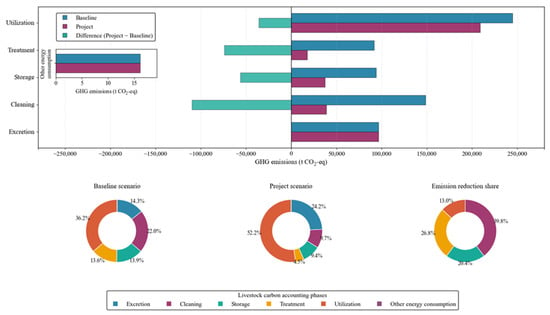
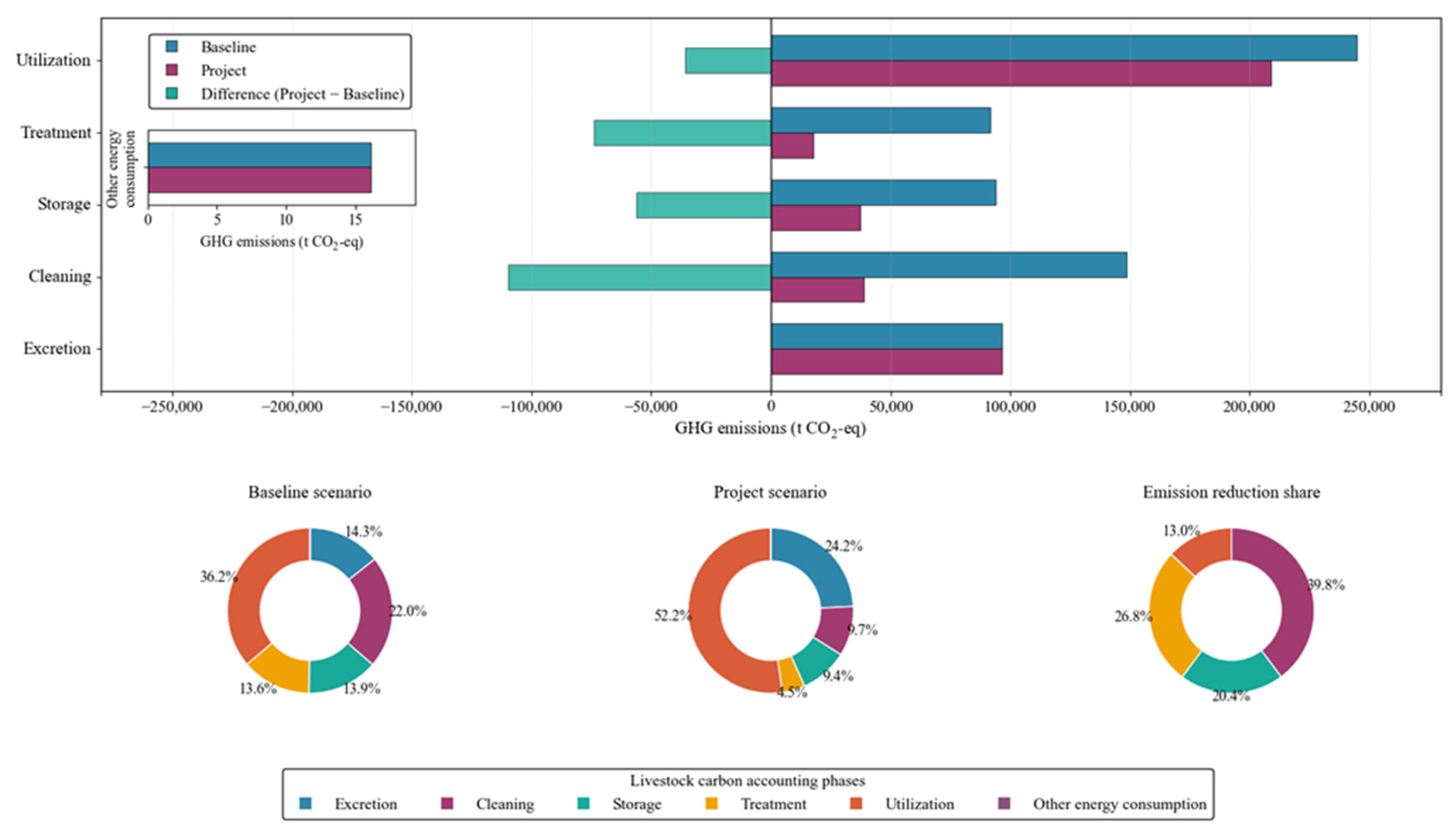
With the number of livestock and the amount of manure produced remaining unchanged, the reduction in emissions is attributed to changes in manure management measures. By comparing the project scenario (2026) with the baseline scenario (2023) (Figure 3), total system emissions decreased from 6.76 × 10⁵ t CO2-eq yr−1 in the baseline to 4.00 × 10⁵ t CO2-eq yr−1 under the project scenario, corresponding to an overall mitigation rate of 40.83%.
Figure 3.
Comparison of carbon emissions between the project based on life cycle assessment (2026) and the baseline scenario (2023) and the reduction rates at each stage.
The cleaning stage represents one of the primary contributors to system-level greenhouse gas emissions reductions. During this stage, emissions decreased from 1.49 × 10⁵ to 0.39 × 10⁵ t CO2-eq, achieving a mitigation rate of 73.81%. This substantial reduction stems from replacing conventional dry scraping and open drainage systems with a conveyor belt manure removal system, integrated with separate rainwater and wastewater pipelines. This approach minimizes the residence time of fresh manure within animal housing, reduces manure moisture content, and limits exposure to anaerobic microenvironments. Consequently, methane formation is suppressed (achieving a 73.67% methane reduction rate). Concurrently, the enclosed rainwater–sewage separation system limits nitrogen leaching and ammonia volatilization, thereby interrupting the nitrification–denitrification pathway responsible for subsequent indirect N2O emissions (N2O reduction rate: 74.62%).
During the storage stage, greenhouse gas emissions declined from 9.38 × 10⁴ to 3.75 × 10⁴ t CO2-eq, representing a reduction of 60.01%. In traditional open manure storage systems, rainwater infiltration significantly increases fecal moisture content, thereby promoting the formation of anaerobic microzones and intensifying methane production. However, covered facilities can effectively block the input of precipitation, inhibiting the development of anaerobic microenvironments. As a result, CH4 emissions decreased by 64.66%. Tank storage can control the hydraulic load and temperature field, and weaken the temperature-driven fluctuations in microbial activity. Due to the inherent complexity of the nitrogen transformation pathway, the reduction rate of N2O (45.00%) is lower than that of CH4. Although covering and hardening the storage surface can reduce nitrogen leaching and the resulting indirect N2O emissions, intermittent aeration in the surface layer under the cover still allows for local nitrification–denitrification reactions to occur. Therefore, compared to CH4, the emissions related to N2O have a weaker response to physical containment measures, and it is necessary to implement combined biochemical intervention strategies such as NH3 volatilization inhibition and organic nitrogen stabilization [31].
At the treatment stage, total emissions decreased from 9.17 × 10⁴ to 1.79 × 10⁴ t CO2-eq, an 80.52% reduction. Under the baseline scenario, the use of long-term static composting with limited oxygen supply led to the continuous formation of anaerobic microzones within the substrate. After the project implementation, the composting process was transformed from a static mode to a dynamic management mode combining mechanical turning and natural ventilation, significantly improving the porosity of the materials and the efficiency of oxygen mass transfer, effectively inhibiting the maintenance and expansion of the anaerobic microenvironment [32]. As a result, CH4 emissions decreased by 92.5%. However, owing to the multiple coupling characteristics of nitrogen transformation pathways under aerobic treatment conditions, N2O emissions were reduced by only 45.5%. Analysis revealed that while enhanced aeration suppressed denitrification, it concurrently promoted organic nitrogen mineralization and nitrite accumulation, thereby generating N2O. Furthermore, increased turning frequency exacerbated surface ammonia volatilization, leading to indirect N2O emissions.
Analysis reveals that achieving synergistic carbon and nitrogen reduction requires not only physical control measures, such as optimizing solid–liquid separation, covered storage, and ventilation management based on variations in manure moisture content, but also the integration of chemical and biological intervention strategies. Functional microbial inoculants, nitrification inhibitors, or organic stabilizing additives may be introduced during composting or anaerobic digestion to direct nitrogen transformation pathways, thereby suppressing the formation and release of N2O intermediates within the nitrification–denitrification process.
3.2. Carbon Mitigation Across Manure Utilization Models
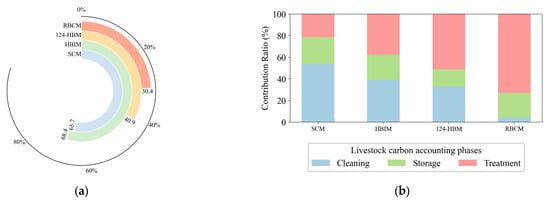
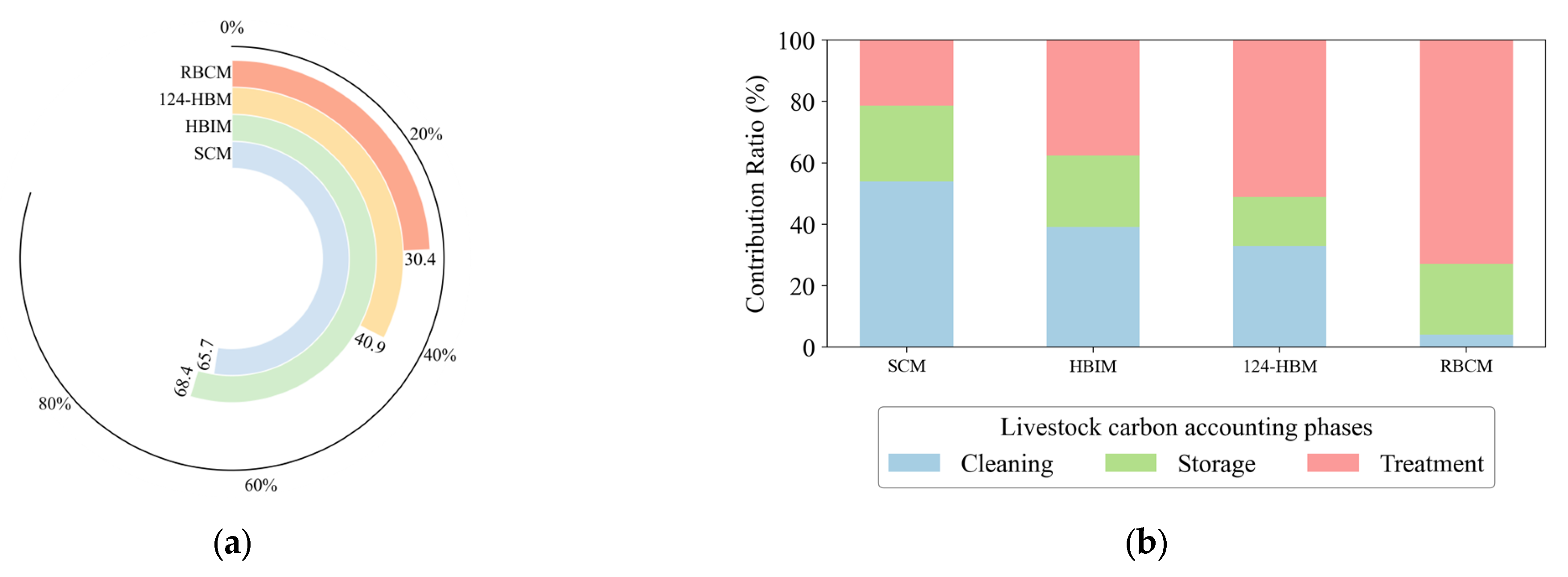
To assess the performance of the four fecal management models implemented in Danjiangkou City in terms of carbon emission reduction, this section analyzes the greenhouse gas emission reduction amounts throughout the life cycle by gas type and stage (washing, storage, and treatment), and presents the system-level emission reduction rates and the contributions of each stage in the following Figure 4, so as to compare the emission reduction paths among different models.
Figure 4.
The emission reduction situation of four livestock and poultry manure resource utilization models in Danjiangkou City. (a) shows the emission reduction potential of the four resource utilization models. (b) presents the contribution rates of the four resource utilization models at different stages of the life cycle.
3.2.1. Carbon Mitigation Potential of SCM
Under the county-wide promotion program, the Sedimentation-Crop Model (SCM) was implemented primarily in swine production systems located in mountainous and gentle-slope areas. Compared with the baseline management pathway—characterized by water-flushing manure removal, open storage, and conventional composting—the SCM integrates mechanical scraping, enclosed gravity-driven transport, covered sedimentation storage, and rapid conversion to water-soluble fertilizer prior to anaerobic digestion.
At the system level, total GHG emissions from swine manure management decreased from 20.65 × 10⁴ to 7.95 × 10⁴ t CO2-eq yr−1, corresponding to an overall mitigation rate of 61.50% (Figure 4). Decomposition by gas type indicates that mitigation was predominantly driven by CH4 reduction (78.46%), whereas N2O emissions declined more moderately (26.04%), suggesting that carbon-flow regulation exerted a stronger control effect than nitrogen-flow stabilization under this configuration.
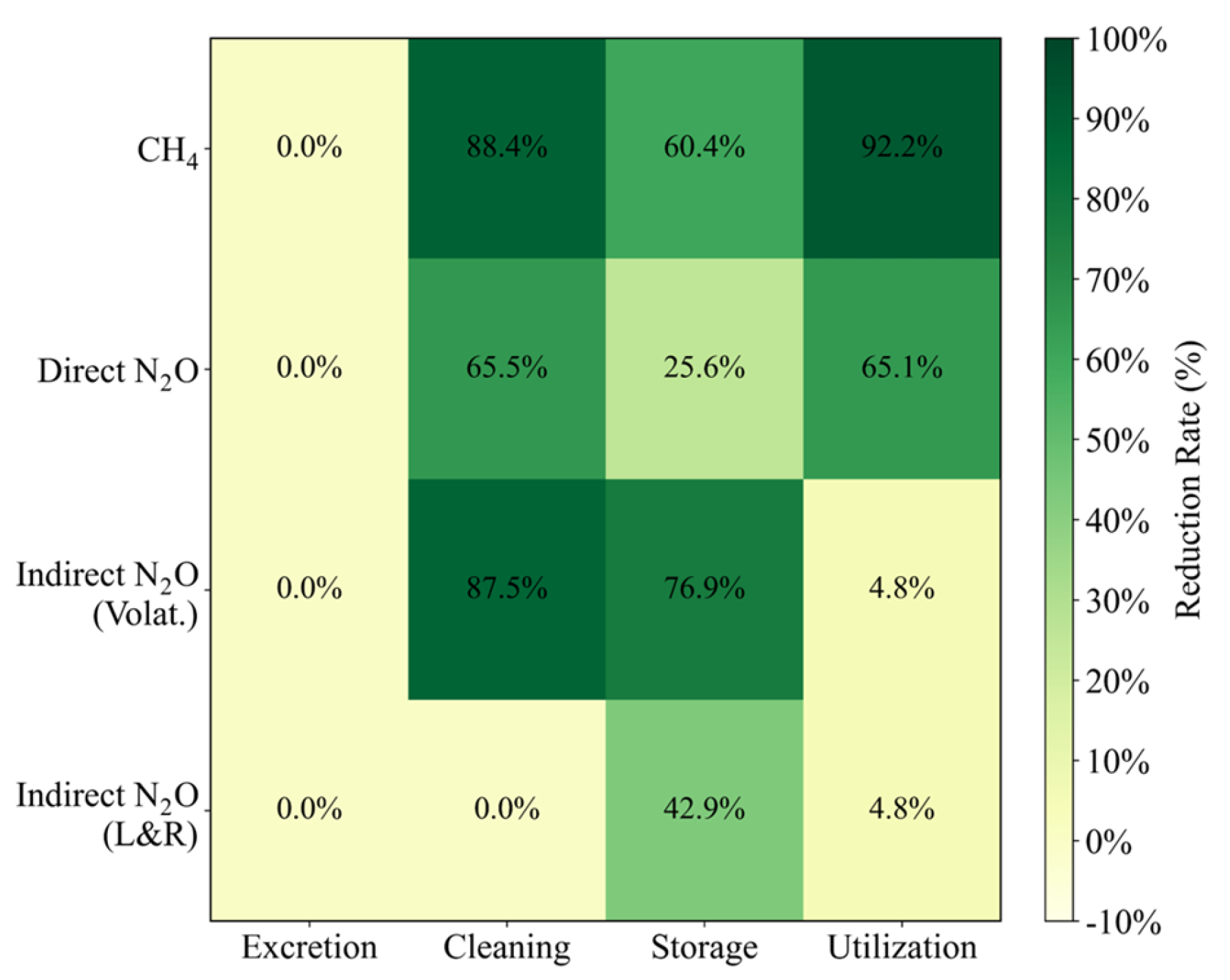
Stage-level decomposition (Figure 4 and Figure 5) shows that emission reduction was distributed across cleaning, storage, and treatment stages, with the cleaning stage contributing the largest proportional reduction (86.99%). Storage and treatment emissions decreased by 59.90% and 81.71%, respectively.
Figure 5.
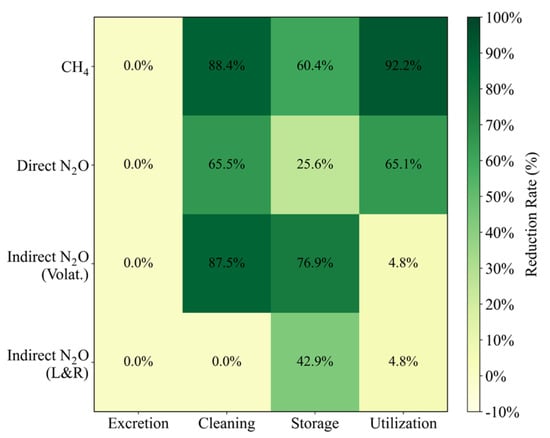
Heat map of greenhouse gas emission reduction rates in each life cycle mode under the Sedimentation-Crop Model (SCM).
At the cleaning stage, replacing water flushing with mechanized scraper systems and enclosed gravity-fed pipelines shorten manure retention time in housing and reduces moisture retention. This change is likely to suppress early methane generation, which corresponds to a CH4 emission reduction rate of 88.38% (Figure 5). Similar studies corroborate this finding. Dry or high-frequency manure removal regimes significantly reduce CH4 production by limiting the development of anaerobic microzones within the manure surface layer [13]. Concurrently, enclosed transport pipelines and separate storm-sewage systems mitigate nitrogen leaching and ammonia volatilization by hardening the substrate and isolating it from atmospheric contact, thereby blocking indirect N2O emissions (reduction rate: 87.46%). This aligns with the findings of Zhang et al. [33], indicating that controlling ammonia loss from manure effectively reduces subsequent indirect N2O emissions associated with atmospheric deposition and leaching pathways.
During the storage stage, the transition from open stacking to covered sedimentation ponds changes the moisture conditions of stored manure by limiting rainfall infiltration, which may influence the development of anaerobic microenvironments. Due to the high sensitivity of CH4 production to humidity regulation and dissolved oxygen levels, the CH4 emission was thus reduced by 60.45% (Figure 5) [34]. At the same time, covering the manure storage ponds with floating covers, plastic films, or expanded clay can limit gas exchange between manure and the atmosphere, which has been reported to reduce ammonia volatilization and associated nitrogen losses [35]. In the present model, the direct reduction in N2O emissions during storage is relatively limited (25.63%). However, reduced ammonia volatilization during storage may contribute to lower indirect N2O emissions associated with atmospheric deposition and nitrogen leaching pathways, with an estimated indirect reduction of 76.88%.
At the treatment stage, the SCM adopts the Biomass Biochemical Cracking and Biological Engineering Technology, which enables rapid biochemical conversion of mixed manure within 4 h, compared to days or weeks in the baseline scenario (Danjiangkou Municipal Animal Husbandry and Veterinary Service Center, unpublished data). Total emissions declined by 81.71%, with CH4 reduction dominating (92.17%, Figure 5). This reduction may be associated with the substantially shorter retention time prior to controlled treatment, which limits the duration of uncontrolled anaerobic decomposition. Similar relationships between storage duration and methane emissions from manure have been reported in previous studies [36].
A comparison can be made with the LCA study of García Álvaro et al. [12], conducted in Mediterranean coastal Spain, which evaluated five swine manure management scenarios representing progressively improved management strategies: conventional storage and land application (Scenario 1), covered slurry storage (Scenario 2), anaerobic digestion for biogas recovery (Scenario 3), and digestion systems further integrated with photovoltaic or hybrid solar energy supply (Scenarios 4–5). Their baseline configuration—manure storage followed by agricultural application—is broadly comparable to the baseline scenario adopted in this study. Among the alternatives, Scenario 4 achieved a system-level emission reduction of about 77%, whereas the Sedimentation-Crop Model (SCM) in Danjiangkou reached 61.5%. Although both systems employ covered storage, the lower mitigation level in Danjiangkou may be related to the subtropical monsoon climate, which can accelerate nitrogen transformation during storage. In addition, the photovoltaic integration in Scenario 4 provides further reductions through fossil-energy substitution. While such energy coupling was not considered in the present system, photovoltaic installation could represent a potential future mitigation pathway depending on regional infrastructure and policy support.
These results suggest that SCM may be particularly suitable for livestock farms located in mountainous areas or regions with complex terrain. In such settings, gravity-driven manure transport can shorten manure residence time and reduce additional energy inputs required for pumping and mechanical transfer. However, the broader applicability of this management pathway may depend on several structural and regional conditions. Gravity-based transport is limited in flat or dispersed production systems [37]. In addition, the adoption of integrated manure management technologies often depends on farm scale and infrastructure investment capacity, with medium- and large-scale farms generally showing higher feasibility for system upgrades [38]. Moreover, the utilization efficiency of manure-derived fertilizer is closely related to the availability of nearby cropland capable of absorbing nutrients, as nutrient recycling systems require sufficient land resources to avoid nutrient accumulation and environmental risks [39]. Therefore, although SCM demonstrates substantial mitigation potential at the county scale in this study, its replication in other regions should consider local production structures, land resource availability, and infrastructure conditions.
3.2.2. Carbon Mitigation Potential of HBIM
For livestock and poultry breeding near flat farmland, the Danjiangkou City county-wide promotion project has adopted the Housing–Bedding Integrated Model (HBIM) as an alternative to the traditional slatted floor and manure pit system. This model integrates in-pen fermentation bedding with composting and planting. It has achieved a 60.09% system carbon emission reduction rate (Figure 4), with CH4 and N2O emission reduction rates reaching 74.74% and 20.88%, respectively.
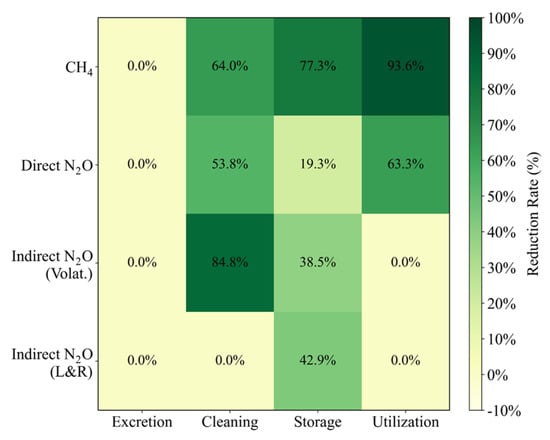
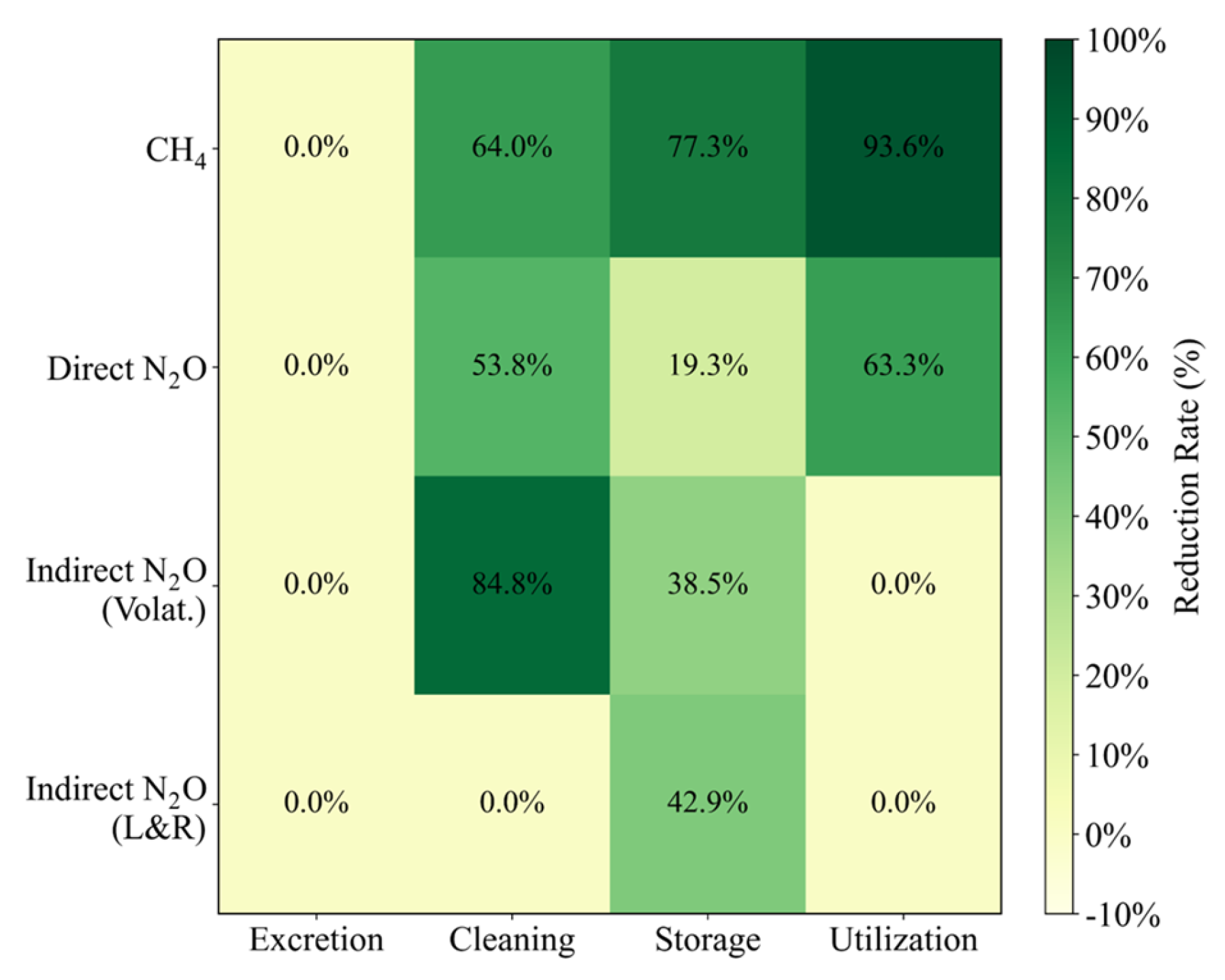
At the cleaning stage, switching from manual to mechanical scraping contributed to an emission reduction of 64.62%. Manual dry manure removal allows manure to accumulate for several days, creating localized anaerobic microenvironments that can promote hydrolysis, acidification, and subsequent CH4 production [40]. The mechanical system reduces manure retention time to under 4 h, which may interrupt the hydrolysis–methane generation cycle, corresponding to a methane emission reduction of 63.69% (Figure 6). Furthermore, the mechanical dry manure removal separates solid manure from urine and wash water, reducing the anaerobic conditions that typically arise when urine mixes with solid manure. This likely contributes to lower N2O production potential, with indirect N2O emissions reduced by 87.46% (Figure 6).
Figure 6.
Heat map of greenhouse gas emission reduction rates in each life cycle mode under the Housing–Bedding Integrated Model (HBIM).
At the storage stage, total GHG emissions decreased by 67.83%. Under the baseline scenario, manure undergoes prolonged anaerobic accumulation in sealed pits, driving continuous CH4 production and NH3 volatilization. In contrast, HBIM immediately mixes manure with a 40–60 cm layer of high C/N bedding (rice husks, sawdust, microbial inoculants), creating an aerobic-dominant microenvironment from day one. Its porous structure, combined with trampling and churning by cattle and other livestock, maintains ample oxygen supply, thereby efficiently suppressing methanogenic activity and achieving a 77.34% reduction in CH4 emissions (Figure 6). Concurrently, the high C/N ratio in the bedding promotes substantial immobilization of inorganic nitrogen within microbial biomass, significantly reducing substrate availability for nitrification and denitrification processes [41]. This ultimately resulted in a 26.45% reduction in N2O emissions (Figure 6). However, the transient aerobic–anaerobic cycling occurring at the litter surface during turning intervals may still support limited coupled nitrification–denitrification reactions at the air–litter interface, meaning the full potential for nitrous oxide reduction remains unrealized.
At the treatment stage, HBIM achieved a carbon reduction rate of 87.57%. Compared with the traditional open-air stacking method, this model employs controlled composting with optimized ventilation, carbon–nitrogen ratio, and moisture content. At the same time, it may also promote the complete nitrification, converting ammonium to nitrate, followed by denitrification to N2 rather than the intermediate product N2O. Under this mechanism, CH4 and N2O emissions during the treatment stage decreased by 93.58% and 52.69%, respectively (Figure 6). However, these ventilation conditions may also promote ammonia volatilization, supplying precursor substances for indirect N2O formation and thus limiting the potential for indirect N2O reduction [8].
Previous LCA studies have evaluated manure management systems with different system boundaries and treatment pathways. For example, Mahoney et al. [7] assessed several scenarios including conventional manure storage (baseline), anaerobic digestion of dairy manure, and integrated systems combining co-digestion of manure and food waste with composting of separated solids. Their system boundary includes not only manure treatment but also energy recovery from biogas, enabling renewable electricity to substitute fossil-based energy. Under this framework, the integrated system achieved an approximately 81% reduction in global warming impacts relative to baseline conditions. In comparison, the HBIM system in this study achieved a 60.09% reduction. The lower reduction rate mainly reflects differences in mitigation mechanisms: while the system evaluated by Mahoney et al. derives substantial reductions from energy substitution through biogas utilization, HBIM primarily reduces emissions through suppression of methane formation during bedding storage and improved nitrogen stabilization during controlled composting. In mountainous ecological regions such as Danjiangkou, biogas recovery facilities are typically located at centralized agricultural waste treatment centers, whereas farm-scale systems more commonly rely on compost-based management approaches such as HBIM.
Overall, in regions with relatively flat farmland, HBIM may achieve substantial emission reductions through bedding-based storage, controlled composting, and denitrification. Broader applicability depends on several factors. High C/N bedding materials (e.g., rice husks, sawdust) are critical for nitrogen immobilization and methane suppression [42]; regions lacking such biomass may face operational constraints. Operational parameters such as turning frequency and ventilation influence temperature distribution and oxygen availability [43]. While these conditions suppress CH4, they may also enhance NH3 volatilization, potentially increasing indirect N2O—a common trade-off [42]. Climatic conditions also matter, as higher temperatures accelerate organic matter degradation but may increase N losses [42].Therefore, although HBIM shows strong mitigation potential in Danjiangkou, its application elsewhere should consider local bedding material availability, climate, and management capacity.
3.2.3. Carbon Mitigation Potential of 124-HBM
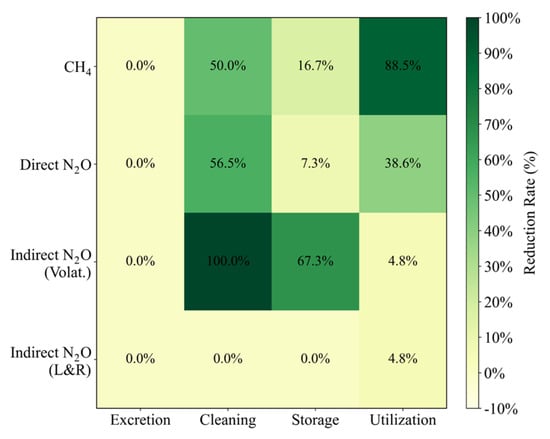
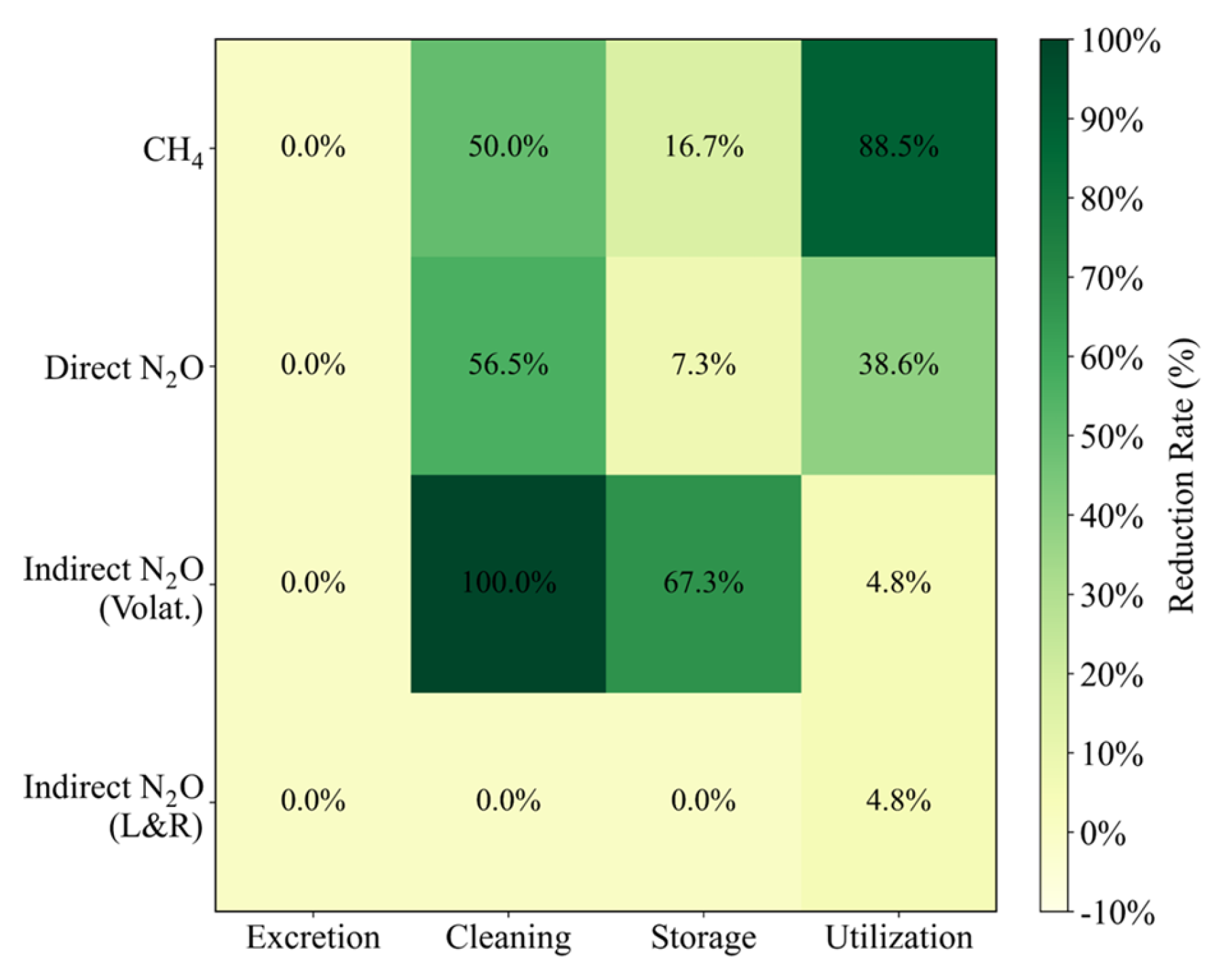
The “124” Healthy Breeding Model (124-HBM) is a resource utilization model for large-scale poultry farms in the Danjiangkou County-wide Promotion Project, with laying hens as the primary livestock. The model integrates a management system comprising a manure conveyor belt, manure collection tank and aerobic composting. This mode achieved an emission reduction rate of 32.04% (Figure 4), with CH4 and N2O reductions of 67.35% and 23.01%, respectively.
Stage decomposition indicates that the cleaning stage contributed substantially to overall mitigation, with a 73.82% reduction. The mechanism aligns with the SCM technology pathway: it shortens the retention time of feces within the rearing unit and enables immediate separation of feces and urine. As a result, contact between water and easily degradable carbon is reduced. This limits the formation of anaerobic conditions and cuts methane emissions by 50.00% (Figure 7). At the same time, quick removal of manure helps prevent urea breakdown and reduces ammonia production, which may weaken nitrification–denitrification and contribute to lower nitrous oxide emissions. Additionally, closed pipes prevent leakage and exposure to air. This pattern is consistent with poultry LCA studies demonstrating that emission intensity is strongly governed by manure retention time and nitrogen exposure conditions rather than by end-of-pipe treatment alone [44].
Figure 7.
Heat map of greenhouse gas emission reduction rates in each life cycle mode under the “124” Healthy Breeding Model (124-HBM).
At the storage stage, total emissions decreased by 35.81%. As this model primarily involved installing rain shelters during storage, the carbon decomposition pathways within the manure underwent moderate changes, and the in situ nitrification–denitrification processes were not strongly altered. Consequently, methane emissions declined by only 16.67%, whilst direct N2O decreased by 7.27% (Figure 7). In contrast, the rain shelter reduced the external nitrogen pool required for subsequent indirect N2O formation by limiting leaching and ammonia volatilization caused by rainfall. Indirect N2O emissions decreased by 65.88% (Figure 7). This disparity indicates that during short-term storage periods, structural control of moisture and runoff pathways may exert a greater influence on indirect N2O than on methane emissions [44].
At the treatment stage, emissions decreased by 59.87%. This model can achieve relatively uniform temperature and oxygen distribution throughout the pile by transporting dispersed manure to centralized composting facilities equipped with temperature control and forced ventilation systems. This helps avoid the localized issues common in traditional on-farm composting. Consequently, anaerobic microzones within the pile may be reduced, contributing to CH4 mitigation (emission reduction: 88.48%, Figure 7). However, consistent with HBIM findings, ventilation intensity may exhibit a non-linear relationship with N2O emissions [45].While enhanced oxygenation suppresses CH4, it may also accelerate ammonia oxidation to nitrite, supplying substrate for subsequent denitrification-derived N2O. Consequently, the reduction potential for N2O emissions may not be fully realized, with a reduction rate of 33.76% (Figure 7).
Previous research evaluating chicken manure anaerobic digestion systems typically adopts an energy-oriented boundary, including biogas production and fossil energy substitution, which generates additional mitigation credits beyond manure management itself. For instance, Wang et al. [46] developed a cradle-to-grave life cycle assessment model for chicken manure anaerobic digestion (CMAD), covering manure collection, anaerobic digestion, biogas utilization, and digestate treatment. Their emission reduction benefits mainly stemmed from the substitution of fossil fuels through biogas production and the recycling of digestate as organic fertilizer. In contrast, the 124-HBM focuses on optimizing the manure management chain, particularly rapid manure removal and centralized aerobic composting, to suppress methane formation at the source. Therefore, the mitigation benefits primarily arise from reduced in situ emissions rather than energy recovery. This distinction indicates that the two approaches represent different mitigation pathways: energy-substitution systems versus management-oriented emission control. In mountainous and ecologically sensitive regions such as Danjiangkou, where on-farm biogas infrastructure is economically and logistically constrained, management-based optimization may provide a more feasible mitigation strategy.
This model demonstrates that coordinated upgrading of manure treatment between farms and centralized facilities can effectively mitigate greenhouse gas emissions. However, its applicability depends on regional agricultural structure. Centralized composting requires stable manure transport networks and sufficient cropland nutrient demand to ensure efficient organic fertilizer recycling [11,37]. Thus, this model is more suitable for intensive livestock regions with developed crop–livestock integration. In grassland-dominated systems, such as those in parts of Europe, manure management typically relies on slurry storage and land spreading, often coupled with anaerobic digestion or energy recovery to maintain nutrient balance (e.g., Ireland [47]). Under such conditions, direct transferability of the 124-HBM may be limited, and additional technological integration may be required to adapt the system to local production structures.
3.2.4. Carbon Mitigation Potential of RBCM
The Raised-Bedding Composting Model (RBCM) in Danjiangkou City is equipped with small goat exercise yards outside goat houses. This model is applicable to small-scale household farms characterized by fragmented terrain and long transportation distances to waste treatment centers. It replaces the simple waste management practice of traditional grazing goat houses with a mixed feeding approach. The overall life-cycle carbon reduction rate of this model reached 27.70% (Figure 4).
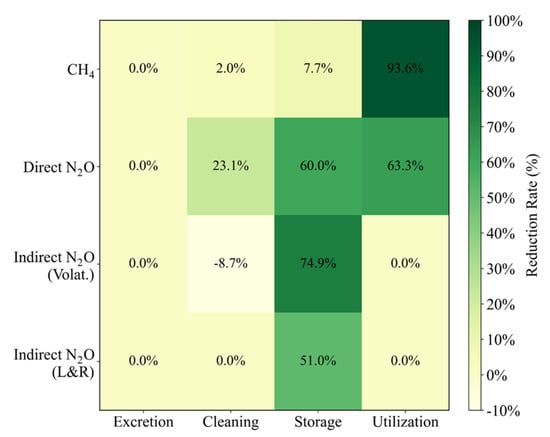
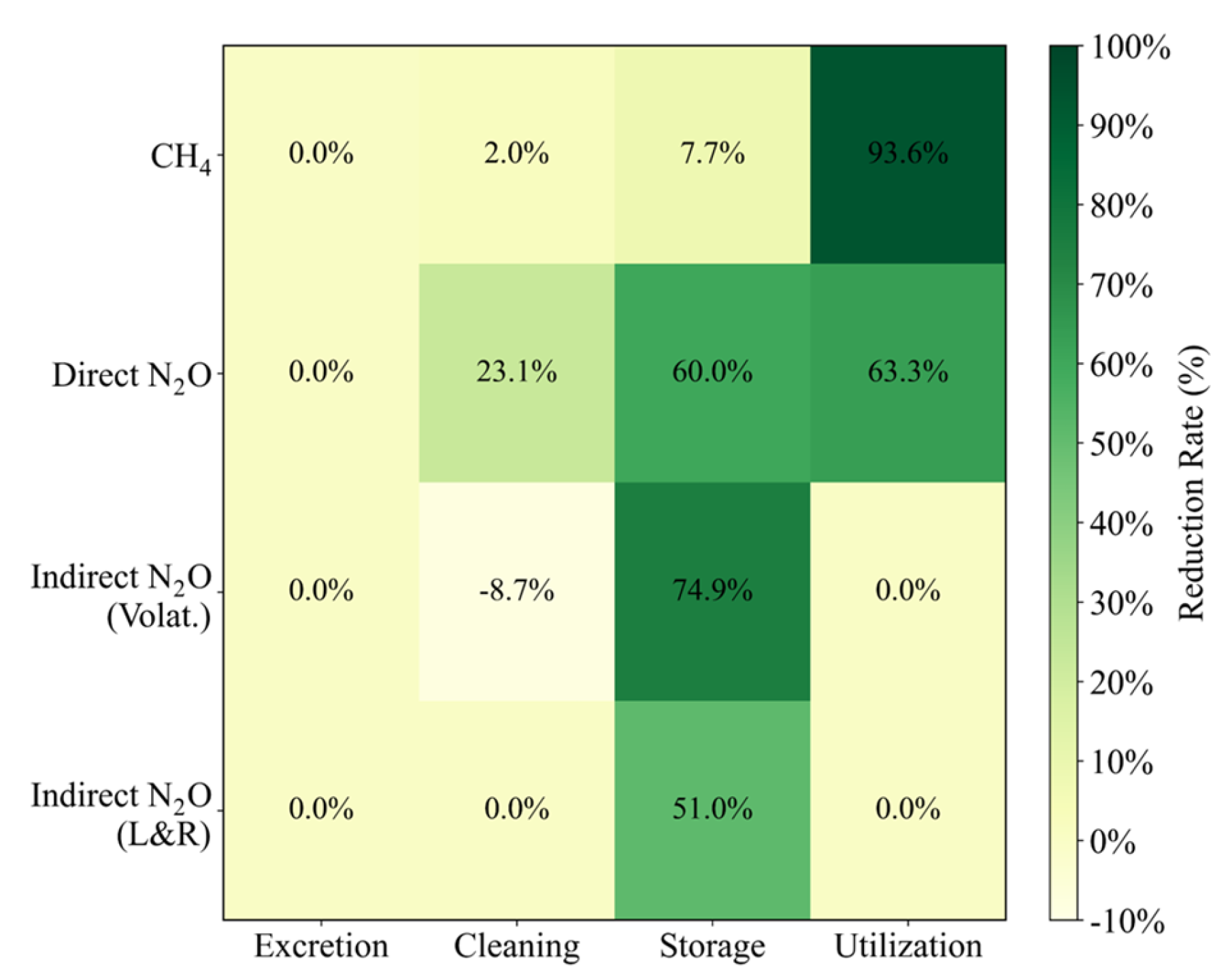
At the cleaning stage, the Raised-Bedding Composting Model (RBCM) achieved a modest reduction of 2.50% (Figure 8). Gas-specific decomposition shows limited CH4 mitigation (2.01%) and moderate suppression of direct N2O (23.08%), while indirect N2O associated with ammonia volatilization slightly increased (−8.07%), and leaching-related indirect N2O remained unchanged (0.00%). Mechanistically, manure removal in RBCM continues to rely predominantly on manual scraping, resulting in limited alteration of manure residence time and moisture conditions within the housing environment. Consequently, early anaerobic microenvironments remained largely unchanged, which may explain the negligible CH4 reduction. Although partial separation of feces from high-moisture areas may reduce localized nitrification–denitrification, the absence of structural enclosure may allow continued ammonia volatilization, which can enhance atmospheric nitrogen deposition and offset indirect N2O mitigation. These results indicate that without modification of front-end carbon and nitrogen flow pathways, cleaning-stage mitigation remains structurally constrained.
Figure 8.
Heat map of greenhouse gas emission reduction rates in each life cycle mode under the Raised-Bedding Composting Model (RBCM).
At the storage stage, emissions declined by 47.19% (Figure 8). Although the excrement was moved from open piles to indoor piles with roofs and regular fermentation treatment was carried out, local anaerobic areas remained within the upper pile and lower pits, particularly where urine accumulated below the compacted layer. Therefore, anaerobic decomposition may not have been fully eliminated, and the CH4 reduction was limited (7.75%, Figure 8). However, the roof covering reduced the infiltration and leaching of rainfall, and indoor management mitigated the water fluctuations, which may help inhibit the nitrification–denitrification reaction induced by the alternation of dry and wet conditions in the open piles [48]. Direct N2O emissions showed a reduction of 73.15% (Figure 8), while indirect N2O emissions decreased by 60.00%. (Figure 8).
During the treatment stage, the total emissions decreased by 86.42%. Among them, CH4 emissions decreased by 93.58% (Figure 8), direct N2O emissions decreased by 63.29% (Figure 8), while indirect N2O emissions did not show any reduction (0.00%, Figure 8). This stage involved a typical dynamic aerobic composting process. Regular turning of the pile and controlled aeration synergistically enhanced the oxygen diffusion within the pile, which may help reduce the anaerobic microzones. During the composting process, microbial oxidation played a dominant role, high temperatures were sustained, and the pile structure gradually became looser, which may contribute to inhibiting methanogenic activity and promoting the conversion of organic carbon to stable humus [49]. However, this model did not substantially alter the ammonia volatilization flux and its contribution to atmospheric nitrogen deposition, and its intervention effect on the cross-media nitrogen cascade migration limited.
Previous life cycle assessment studies on small ruminant systems, such as that by Jiao et al. [50], adopted a system boundary covering feed production, enteric fermentation, and manure management. The results showed that the carbon footprint of goats was reduced by 2.91%. In contrast, the RBCM in this study focused only on the manure treatment chain (from excretion to land application) and achieved a carbon reduction rate of 27.70% through source control (dynamic aerobic composting). The analysis revealed that both livestock manure management methods shared a common feature: despite the end-of-pipe process improvement from “open-air stacking” to “fermentation sheds”, the high reliance on manual collection at the front end led to ineffective suppression of CH4 emissions and N2O volatilization. This indicates that the emission reduction potential of upgrading a single process step is relatively limited compared to the coordinated upgrading of the entire system process.
Overall, the mitigation potential of the RBCM is primarily realized during the treatment stage, whereas the overall system performance remains constrained by limited intervention at the front-end manure management stages. Manual manure collection in smallholder goat farms often leads to incomplete removal of excreta, particularly in outdoor exercise yards, where manure deposition may result in diffuse nitrogen losses through runoff and leaching pathway [50]. As a result, part of the upstream emissions cannot be fully mitigated by subsequent composting processes. Nevertheless, this management strategy remains relevant for small-scale livestock systems distributed across mountainous regions, where fragmented terrain and long transportation distances limit the feasibility of centralized manure treatment infrastructure [51]. Under such conditions, low-cost on-farm composting systems such as RBCM provide a pragmatic manure management option, although their overall mitigation potential would benefit from improved coordination between upstream manure collection and downstream treatment processes.
3.3. Comparative Analysis of the Four Manure Utilization Models
The four manure utilization models implemented in Danjiangkou exhibit substantial differences in life-cycle greenhouse gas mitigation performance. At the system level, SCM and HBIM achieved relatively high mitigation rates (61.50% and 60.09%, respectively), whereas 124-HBM and RBCM showed more moderate reductions (32.04% and 27.70%). These differences largely reflect variations in how each model restructures manure flow pathways, storage environments, and treatment processes across the manure management chain.
A key distinction among the models lies in the degree of intervention at the early stages of manure management. SCM and HBIM both implement structural controls that shorten manure residence time and reduce the formation of anaerobic microenvironments immediately after excretion. SCM achieves this through gravity-driven transport and rapid biochemical conversion, while HBIM establishes an aerobic bedding environment that suppresses methanogenesis during storage. In contrast, 124-HBM and RBCM rely more heavily on improvements during later stages, particularly centralized composting or aerobic fermentation. This comparison suggests that mitigation strategies targeting upstream manure handling processes, such as rapid removal and moisture control, can exert stronger system-level effects than approaches focusing primarily on downstream treatment.
The stage-level contributions further illustrate these differences. In SCM and HBIM, emission reductions are distributed across multiple stages of the life cycle, including cleaning, storage, and treatment. By contrast, in 124-HBM the majority of mitigation originates from the cleaning stage through rapid manure removal, while in RBCM the treatment stage dominates the overall reduction due to dynamic aerobic composting. Systems that rely mainly on end-of-pipe treatment tend to show lower overall mitigation because upstream emissions generated during manure accumulation cannot be fully offset by later interventions.
The applicability of each model also reflects regional production conditions. SCM is particularly suitable for mountainous areas where gravity-driven manure transport can reduce energy demand and infrastructure requirements. HBIM performs well in regions with flat farmland and sufficient biomass resources for bedding materials. The 124-HBM model is more compatible with intensive poultry production systems where centralized composting facilities and manure transport networks are available. In contrast, RBCM represents a practical option for smallholder livestock systems in mountainous regions where farm-scale composting may be more feasible than centralized treatment infrastructure. These results indicate that effective manure management strategies should be adapted to local production structures, land availability, and infrastructure conditions, rather than relying on a single universal technological pathway.
3.4. Results of Sensitivity Analysis
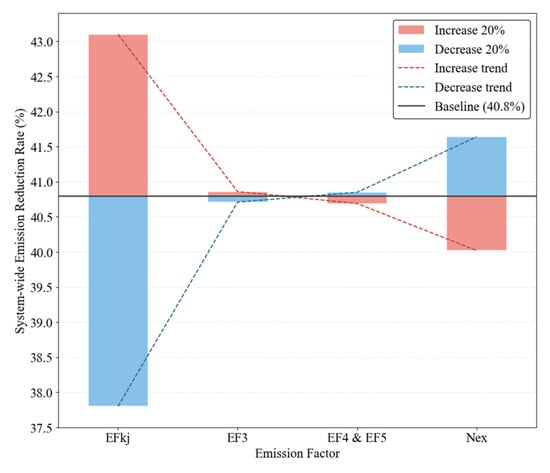
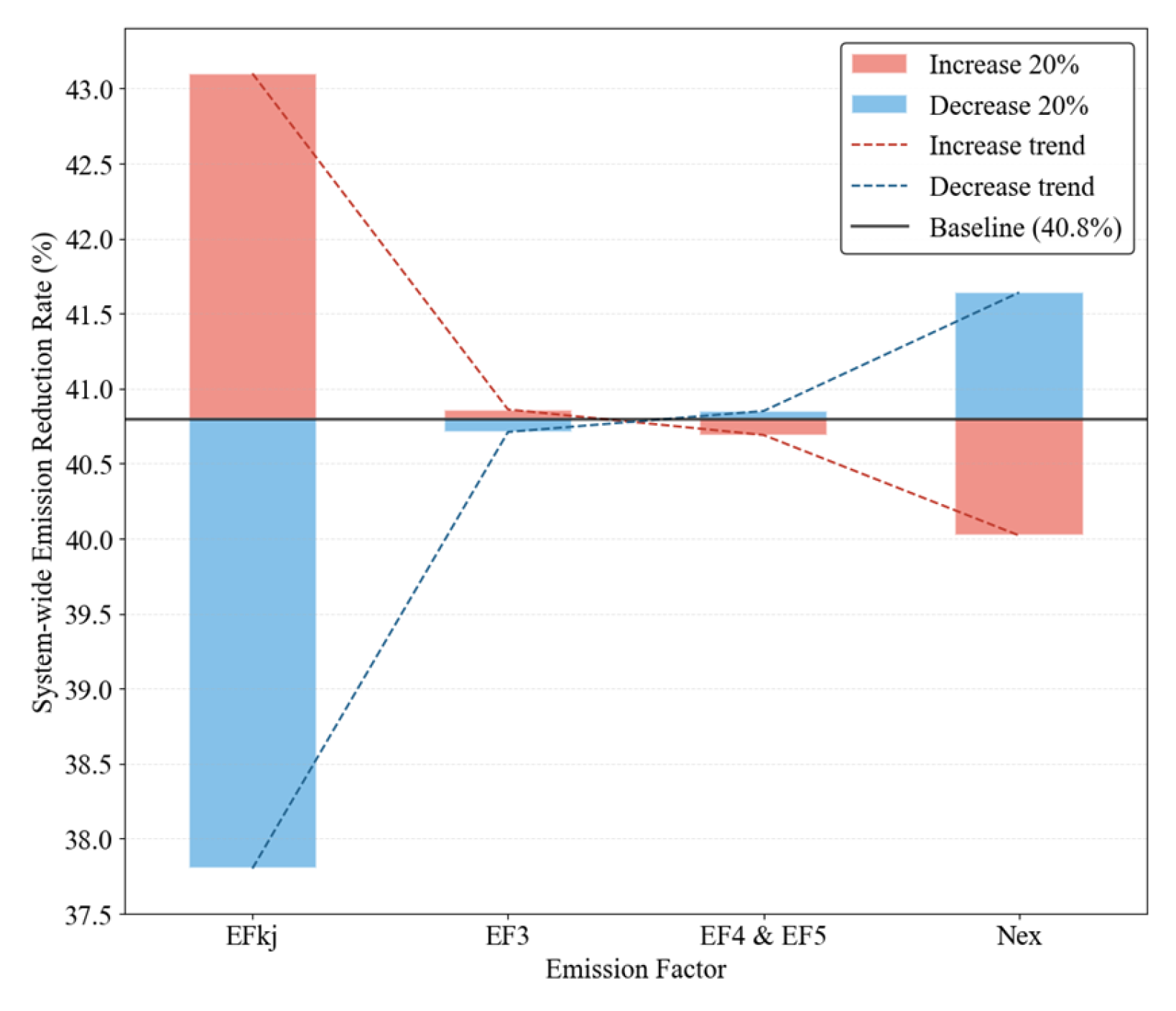
The results of the sensitivity analysis are presented in Figure 9. When the CH4 emission factor is increased by 20%, the overall greenhouse gas mitigation rate of the system increases from 40.8% to 43.1%; conversely, a 20% decrease in the emission factor reduces the mitigation rate to 37.9%. These results indicate that methane emissions exhibit relatively high sensitivity within livestock manure management systems. In particular, variations in methane emissions associated with manure storage and treatment stages exert a strong influence on the overall mitigation performance of the system. In contrast, parameters related to nitrous oxide emissions (EF3, EF4, and Nex) show comparatively lower sensitivity. A ±20% variation in these parameters results in a change in the overall emission reduction rate of less than ±0.85 percentage points. This suggests that uncertainties associated with nitrogen-related parameters exert a relatively smaller influence on the system-level mitigation outcomes compared with methane-related parameters.
Figure 9.
Sensitivity analysis results of different GHG emission factors.
It should be noted that the present analysis adopts a local one-at-a-time (OAT) sensitivity approach, in which parameters are varied individually while all other parameters remain constant [28]. Although this approach is widely used in life cycle assessment studies to identify influential parameters, it does not fully capture the combined uncertainty arising from the simultaneous variation and potential interactions among multiple parameters across the life cycle system [52].
More comprehensive uncertainty assessment methods, such as Monte Carlo simulation or global sensitivity analysis, have been suggested or applied in some LCA studies to evaluate uncertainty propagation and parameter interactions within complex systems [53,54]. Future studies incorporating probabilistic uncertainty analysis and larger datasets could further improve the robustness of emission estimates and mitigation assessments.
4. Conclusions
This study constructed a carbon accounting framework covering excretion, cleaning, storage, treatment and utilization to assess the potential of the County-wide Livestock Manure Resource Utilization Project in Danjiangkou City to reduce greenhouse gas emissions. Compared with the baseline scenario, the system’s emission reduction rate is 40.83%, which proves the feasibility of the project. The mitigation effects of the four organic fertilizer resource utilization models are significantly different. The Sedimentation-Crop Model (SCM) and the Housing-Bedding Integrated Model (HBIM) achieve the highest reduction by combining the removal of manure from the upstream with improved storage and treatment processes. The “124” Healthy Breeding Model (124-HBM) shows a moderate mitigation effect mainly through centralized compost management. In contrast, the Bedding-Composting Model (RBCM) exhibits relatively low system-level mitigation because the limited intervention at the manure collection stage restricts the overall reduction effect.
The four models differ in their suitability across regions. SCM is well-suited for mountainous areas where gravity-driven transport can be utilized. HBIM performs effectively in flat farmland regions with sufficient high C/N bedding materials. 124-HBM is more applicable in intensive livestock areas with well-developed transport networks and cropland demand for organic fertilizer. RBCM may be suitable for small-scale farms in fragmented terrain, though its overall mitigation is constrained by limited front-end intervention. Therefore, the selection and implementation of these models in ecologically sensitive areas should consider local terrain, resource availability, and agricultural structure.
This study contributes to the literature on life cycle assessment (LCA) of livestock manure management in ecologically sensitive areas in three aspects. Firstly, it expands the traditional system boundary and constructs a full-chain carbon accounting framework covering the entire manure management process. Secondly, it incorporates region-specific parameters reflecting local climatic conditions, management practices, and agricultural land characteristics, enhancing the characterization of emission dynamics in sensitive watersheds. Thirdly, by evaluating a county-level policy intervention, it provides empirical evidence for coordinating agricultural development and ecological protection in ecologically sensitive areas.
It should be noted that the results are influenced by scenario assumptions and key model parameters, and uncertainties remain in emission factors and management data across different livestock production systems. Future research should improve data availability for small-scale farming systems, refine region-specific emission factors, and conduct more comprehensive uncertainty and sensitivity analyses to support low-carbon livestock management in ecologically sensitive areas.
Author Contributions
Conceptualization, C.W. and J.Z.; methodology, C.W. and J.Z.; validation, J.L. and M.X.; formal analysis, C.W. and Z.H.; investigation, C.W., Z.H., Y.L., J.L. and M.X.; resources, J.Z., J.L. and M.X.; data curation, C.W., Z.H. and M.X.; writing—original draft preparation, C.W. and Y.L.; writing—review and editing, J.Z.; visualization, Z.H.; supervision, J.Z.; project administration, C.W. and J.Z. All authors have read and agreed to the published version of the manuscript.
Funding
This research received no external funding.
Data Availability Statement
The data presented in this study are openly available in Mendeley Data at https://data.mendeley.com/datasets/kz5psxd3md/1 (accessed on 29 March 2026), reference number kz5psxd3md.1.
Acknowledgments
The authors sincerely thank Huijuan Yan (Hubei University) for her support in field investigations and Lingping Lu (Hubei University) for her valuable guidance throughout this study. We also acknowledge Fenghao Peng, Wenjie Huang, and Aoying Liu (Hubei University) for their assistance with field surveys and data analysis. In addition, we are grateful to local practitioners and industry professionals for their cooperation and practical insights during data collection and project implementation.
Conflicts of Interest
The authors declare no conflicts of interest.
References
- FAO. Pathways Towards Lower Emissions—A Global Assessment of the Greenhouse Gas Emissions and Mitigation Options from Livestock Agrifood Systems; FAO: Rome, Italy, 2023. [Google Scholar]
- Tian, Y.; Xia, R.; Zhang, X. Evaluation of China’s Agricultural Non-point Source Pollution Intensity: Spatial and Temporal Differentiation, Dynamic Evolution and Spatial Agglomeration. Environ. Sci. 2025, 46, 5608–5618. [Google Scholar]
- Liu, Z.; Chen, Z.; Yu, G.; Yang, M.; Zhang, W.; Zhang, T.; Han, L. Ecosystem carbon use efficiency in ecologically vulnerable areas in China: Variation and influencing factors. Front. Plant Sci. 2022, 13, 1062055. [Google Scholar] [CrossRef] [Scilit] [PubMed]
- Wang, Y.; Liu, J.; Zhang, L.; Xue, Z.; Yang, Y. Projecting the response of carbon sink potential to land use/land cover change in ecologically fragile regions. Front. Environ. Sci. 2024, 12, 1380868. [Google Scholar] [CrossRef] [Scilit]
- Jebari, A.; Pereyra-Goday, F.; Kumar, A.; Collins, A.L.; Rivero, M.J.; McAuliffe, G.A. Feasibility of mitigation measures for agricultural greenhouse gas emissions in the UK. A systematic review. Agron. Sustain. Dev. 2024, 44, 2. [Google Scholar] [CrossRef] [Scilit] [PubMed]
- Kim, G.; Chung, W.; Hur, J.; Lee, H.S.; Shin, H.S. Changes in organic matter composition during poultry manure composting: A new perspective on compost maturity using DAX resin fractionation and spectroscopic analysis. Waste Manag. 2025, 205, 115015. [Google Scholar] [CrossRef] [Scilit]
- Mahoney, K.; Hassanein, A.; McCoy, E.L.; Lansing, S. Novel farm-scale bioenergy and waste management: A life cycle assessment of anaerobic co-digestion and manure composting. Energy 2025, 334, 137737. [Google Scholar] [CrossRef] [Scilit]
- Peña-Mosca, F.; Godden, S.; Royster, E.; Albrecht, D.; Wells, S.J.; Crooker, B.A.C.; Aulik, N. Relationships between method used for bedding processing and presence of mastitis and nonmastitis pathogens in ready-to-use recycled manure solids bedding on Midwest dairy farms. JDS Commun. 2025, 6, 567–572. [Google Scholar] [CrossRef] [Scilit]
- Tan, W.E.; Liew, P.Y.; Tan, L.S.; Woon, K.S.; Mohammad Rozali, N.E.; Ho, W.S.; NorRuwaida, J. Life Cycle Assessment and Techno-Economic Analysis for Anaerobic Digestion as Cow Manure Management System. Energies 2022, 15, 9586. [Google Scholar] [CrossRef] [Scilit]
- Zhang, X.; Jin, W.; Du, L. Analysis of the Fertilizer and Energy Utilization Potential of Livestock and Poultry Manure Resources—A Case Study Concerning Liaoning Province, China. Sustainability 2025, 17, 2612. [Google Scholar] [CrossRef] [Scilit]
- Sun, J.; Mao, X.; Shaghaleh, H.; Chang, T.; Wang, R.; Zhai, S.; Hamoud, Y.A. Analytic Method for Optimizing the Allocation of Manure Nutrients Based on the Assessment of Land Carrying Capacity: A Case Study from a Typical Agricultural Region in China. Agronomy 2023, 13, 1064. [Google Scholar] [CrossRef] [Scilit]
- García Álvaro, A.; Martínez-Hernando, M.-P.; García-Martínez, M.-J.; Ruiz Palomar, C.; Suárez Rodríguez, M.d.C.; Hermosilla, D.; Ortega, M.F.; de Godos Crespo, I. Life cycle assessment of swine manure management: A comparison of different management systems with Montecarlo simulation. J. Clean. Prod. 2025, 512, 145368. [Google Scholar] [CrossRef] [Scilit]
- Dong, B.; Song, C.; Li, H.; Lin, A.; Wang, J.; Li, W. Life cycle assessment on the environmental impacts of different pig manure management techniques. Int. J. Agric. Biol. Eng. 2022, 15, 78–84. [Google Scholar] [CrossRef] [Scilit]
- Wang, X.; Wang, J.; Duan, C.; Wang, X.; Liang, D. Systematic Review on the Life Cycle Assessment of Manure-Based Anaerobic Digestion System. Sustainability 2025, 17, 8926. [Google Scholar] [CrossRef] [Scilit]
- De Pue, D.; Buysse, J. Safeguarding Natura 2000 habitats from nitrogen deposition by tackling ammonia emissions from livestock facilities. Environ. Sci. Policy 2020, 111, 74–82. [Google Scholar] [CrossRef] [Scilit]
- Jacobsen, B.H.; Latacz-Lohmann, U.; Luesink, H.; Michels, R.; Stahl, L. Costs of regulating ammonia emissions from livestock farms near Natura 2000 areas—Analyses of case farms from Germany, Netherlands and Denmark. J. Environ. Manag. 2019, 246, 897–908. [Google Scholar] [CrossRef] [Scilit] [PubMed]
- Li, H.; Hou, L. Vulnerability evaluation of tourism eco-environment in reservoir area: Case study on Danjinagkou in Hubei Province. Environ. Sci. Technol. 2012, 35, 191–196. [Google Scholar] [CrossRef] [Scilit]
- IPCC. 2019 Refinement to the 2006 IPCC Guidelines for National Greenhouse Gas Inventories; Intergovernmental Panel on Climate Change: Geneva, Switzerland, 2019. [Google Scholar]
- Danjiangkou Municipal Bureau of Statistics. 2023 Statistical Communique on National Economic and Social Development; Danjiangkou Municipal Bureau of Statistics: Danjiangkou, China, 2024. Available online: http://www.djk.gov.cn/xxgk/fdzdgk/jczwgk/jczwgkbzml/tj/tjsj/202408/t20240818_4582826.shtml (accessed on 29 March 2026).
- Shiyan Municipal Development and Reform Commission. Reply on the Approval of the Preliminary Design Report of the Whole County Promotion Project for the Resource Utilization of Livestock and Poultry Breeding Manure in Danjiangkou City 2024. Available online: http://fgw.shiyan.gov.cn/xxgk/fdzdgknr/zdjsxm/xmsp/cbsjwjspjg/202502/t20250213_4697410.shtml (accessed on 29 March 2026).
- NY/T 3877-2021; Ministry of Agriculture and Rural Affairs of the People’s Republic of China, Method for Calculating Land Bearing Capacity of Animal Manure. Ministry of Agriculture and Rural Affairs: Beijing, China, 2021.
- NY/T 4243-2022; Ministry of Agriculture and Rural Affairs of the People’s Republic of China, Method for Calculating Land Carrying Capacity of Livestock and Poultry Manure. Ministry of Agriculture and Rural Affairs of China: Beijing, China, 2021.
- Bao, W.; Liu, J.; An, J.; Xie, G. Discussion on value-taking of relative parameters for assessment of livestock and poultry excrement resource in China. Trans. Chin. Soc. Agric. Eng 2018, 34, 314–322. [Google Scholar]
- Ma, Y.; Cao, D.; Luo, W.; Li, G.; Zhang, W.; Li, Y. The evaluation of the livestock and poultry production of carbon emissions in China based on life cycle assessment. China Environ. Sci 2024, 44, 2799–2810. [Google Scholar]
- Zhu, Z.; Zhong, M.; Hou, L.; Tian, Y.; Fu, J.; Yang, Y. Evaluation on greenhouse gas emission reduction of the whole county’s promotion project of livestock and poultry manure resource utilization. J. Environ. Eng. Technol. 2023, 14, 25–32. [Google Scholar]
- IEA. Emissions Factors 2025; International Energy Agency: Paris, France, 2025; Available online: https://www.iea.org/data-and-statistics/data-product/emissions-factors-2025 (accessed on 29 March 2026).
- IPCC. Climate Change 2021: The Physical Science Basis; Intergovernmental Panel on Climate Change: Cambridge, UK, 2021; Available online: https://www.ipcc.ch/report/ar6/wg1/chapter/chapter-7/ (accessed on 29 March 2026).
- Bhatt, A.; Abbassi, B. Relative sensitivity value (RSV): A metric for measuring input parameter influence in life cycle assessment modeling. Integr. Environ. Assess. Manag. 2022, 19, 547–555. [Google Scholar] [CrossRef] [Scilit]
- Kimei, E.H.; Nyambo, D.G.; Mduma, N.; Kaijage, S. Review of Sources of Uncertainty and Techniques Used in Uncertainty Quantification and Sensitivity Analysis to Estimate Greenhouse Gas Emissions from Ruminants. Sustainability 2024, 16, 2219. [Google Scholar] [CrossRef] [Scilit]
- Chen, X.; Corson, M.S. Influence of emission-factor uncertainty and farm-characteristic variability in LCA estimates of environmental impacts of French dairy farms. J. Clean. Prod. 2014, 81, 150–157. [Google Scholar] [CrossRef] [Scilit]
- Liu, H.-T.; Hou, J.-Y.; Deng, M.; Sun, Z.-G. Characteristics and influencing factors of livestock residue nitrogen, phosphorus, and organic matter discharge and spatial distribution of pollution potential: Case study in the Yellow River Delta, China. Resour. Environ. Sustain. 2025, 21, 100225. [Google Scholar] [CrossRef] [Scilit]
- Wu, X.; Zhang, Y.; Han, Y.; Zhang, Y.; Zhang, Y.; Cheng, X.; Zhong, P.; Yuan, X.; Zhang, Y.; Li, Z. Advances in methane emissions from agricultural sources: Part I. Accounting and mitigation. J. Environ. Sci. 2024, 140, 279–291. [Google Scholar] [CrossRef] [Scilit] [PubMed]
- Zhang, J.; Li, P.; Wan, J.; Guo, X.; Wang, Y.; Wang, J. Mitigation of nitrogen losses during pig manure management: Impact of manure cleaning technique. Water-Energy Nexus 2025, 8, 1–5. [Google Scholar] [CrossRef] [Scilit]
- Zhang, Q.; Liao, H.; Yang, H.; Liu, M.; Jia, S.; Li, H. Measuring Carbon Emissions from Green and Low-Carbon Full-Life-Cycle Feeding in Large-Scale Pig Production Systems: A Case Study from Shaanxi Province, China. Agriculture 2023, 13, 2281. [Google Scholar] [CrossRef] [Scilit]
- Wang, Y.; Xu, H.; Wang, Y.; Wang, W.; Wang, X.; Zhang, H.; Zhu, Z.; Dong, H. Achieving overall low greenhouse gas and ammonia emissions from digested pig slurry during storage and after field application by maintaining a micro-oxygen level at the storage stage. J. Environ. Chem. Eng. 2025, 13, 116712. [Google Scholar] [CrossRef] [Scilit]
- Pereira, J.L.S.; Perdigão, A.; Marques, F.; Wessel, D.F.; Trindade, H.; Fangueiro, D. Mitigating Ammonia and Greenhouse Gas Emissions from Stored Pig Slurry Using Chemical Additives and Biochars. Agronomy 2022, 12, 2744. [Google Scholar] [CrossRef] [Scilit]
- Deng, B.; Chen, T.; Pu, Z.; Peng, X.; Qin, X.; Zhan, X.; Wen, J. A Transportation Network Optimization Model for Livestock Manure under Different Terrains Considering Economic and Environmental Benefits. Sustainability 2022, 14, 7721. [Google Scholar] [CrossRef] [Scilit]
- Pan, D.; Tang, J.; Zhang, L.; He, M.; Kung, C.-C. The impact of farm scale and technology characteristics on the adoption of sustainable manure management technologies: Evidence from hog production in China. J. Clean. Prod. 2021, 280, 124340. [Google Scholar] [CrossRef] [Scilit]
- Sun, W.; Ros, G.H.; Zhu, Q.; Xu, D.; Hou, Y.; de Vries, W. Optimization of manure recycling and fertilizer use to meet crop nutrient demands and reduce nutrient losses, a case study in Quzhou, China. Agric. Syst. 2025, 226, 104321. [Google Scholar] [CrossRef] [Scilit]
- Petersen, S.O.; Ma, C.; Hilgert, J.E.; Mjöfors, K.; Sefeedpari, P.; Amon, B.; Aarnink, A.; Francó, B.; Dragoni, F.; Groenestein, K.; et al. In-vitro method and model to estimate methane emissions from liquid manure management on pig and dairy farms in four countries. J. Environ. Manag. 2024, 353, 120233. [Google Scholar] [CrossRef] [Scilit] [PubMed]
- Zhao, L.; Huang, Y.; Ran, X.; Xu, Y.; Chen, Y.; Wu, C.; Tang, J. Nitrogen Transformation Mechanisms and Compost Quality Assessment in Sustainable Mesophilic Aerobic Composting of Agricultural Waste. Sustainability 2025, 17, 575. [Google Scholar] [CrossRef] [Scilit]
- Wang, N.; He, Y.; Zhao, K.; Lin, X.; He, X.; Chen, A.; Wu, G.; Zhang, J.; Yan, B.; Luo, L.; et al. Greenhouse gas emission characteristics and influencing factors of agricultural waste composting process: A review. J. Environ. Manag. 2024, 354, 120337. [Google Scholar] [CrossRef] [Scilit]
- Yi, S.; Shao, H.; Shen, Y. Stratification law of the mixed aerobic composting process of cow manure and maize stovers. Trans. Chin. Soc. Agric. Eng. 2023, 39, 180–189. [Google Scholar]
- Chen, H.; Awasthi, S.K.; Liu, T.; Duan, Y.; Ren, X.; Zhang, Z.; Pandey, A.; Awasthi, M.K. Effects of microbial culture and chicken manure biochar on compost maturity and greenhouse gas emissions during chicken manure composting. J. Hazard. Mater. 2020, 389, 121908. [Google Scholar] [CrossRef] [Scilit]
- He, Y.; Inamori, Y.; Mizuochi, M.; Kong, H.; Iwami, N.; Sun, T. Nitrous Oxide Emissions from Aerated Composting of Organic Waste. Environ. Sci. Technol. 2001, 35, 2347–2351. [Google Scholar] [CrossRef] [Scilit]
- Wang, F.; Zhao, S.; Sun, Y.; Song, G.; Sun, Y.; Zhao, K.; Liu, R.; Li, Y.-Y. Strategies optimization to improve environmental benefit of chicken manure anaerobic digestion in China: Insight from life cycle assessment. J. Clean. Prod. 2025, 508, 145589. [Google Scholar] [CrossRef] [Scilit]
- Tisocco, S.; Beausang, C.; Zhan, X.; Crosson, P. Integration of anaerobic co-digestion of grass silage and cattle slurry within a livestock farming system in Ireland: Quantification of greenhouse gas emission reduction and nutrient flow. Resour. Conserv. Recycl. 2024, 206, 107650. [Google Scholar] [CrossRef] [Scilit]
- Yang, Y.; Chen, W.; Liu, G.; Kong, Y.; Wang, G.; Yin, Z.; Li, G.; Yuan, J. Effects of cornstalk and sawdust coverings on greenhouse gas emissions during sheep manure storage. Waste Manag. 2023, 166, 104–114. [Google Scholar] [CrossRef] [Scilit]
- Li, D.; Yuan, J.; Ding, J.; Wang, H.; Shen, Y.; Li, G. Effects of carbon/nitrogen ratio and aeration rate on the sheep manure composting process and associated gaseous emissions. J. Environ. Manag. 2022, 323, 116093. [Google Scholar] [CrossRef] [Scilit]
- Huang, K.; Qu, G.-F.; Ning, P.; Gao, H.-P.; Jia, L.-J.; Mao, W.-J.; Xiong, X.-F.; Liu, S.-J. Research on Nitrogen and Phosphorus Losses of Natural Composting Manure in the Northern Region of Erhai Lake. Adv. Mater. Res. 2011, 160–162, 585–589. [Google Scholar] [CrossRef] [Scilit]
- Zhou, K.; Zhang, J.; Liu, H.; Fan, J. An Integrated Framework for Assessing the Multiscale Environmental Risks of Domestic Waste Management Systems in Mountainous Regions. Environ. Impact Assess. Rev. 2024, 108, 107597. [Google Scholar] [CrossRef] [Scilit]
- Wei, W.; Larrey-Lassalle, P.; Faure, T.; Dumoulin, N.; Roux, P.; Mathias, J.-D. How to Conduct a Proper Sensitivity Analysis in Life Cycle Assessment: Taking into Account Correlations within LCI Data and Interactions within the LCA Calculation Model. Environ. Sci. Technol. 2015, 49, 377–385. [Google Scholar] [CrossRef] [Scilit]
- Kim, A.; Mutel, C.L.; Froemelt, A.; Hellweg, S. Global Sensitivity Analysis of Background Life Cycle Inventories. Environ. Sci. Technol. 2022, 56, 5874–5885. [Google Scholar] [CrossRef] [Scilit]
- Barahmand, Z.; Eikeland, M.S. Life Cycle Assessment under Uncertainty: A Scoping Review. World 2022, 3, 692–717. [Google Scholar] [CrossRef] [Scilit]

Disclaimer/Publisher’s Note: The statements, opinions and data contained in all publications are solely those of the individual author(s) and contributor(s) and not of MDPI and/or the editor(s). MDPI and/or the editor(s) disclaim responsibility for any injury to people or property resulting from any ideas, methods, instructions or products referred to in the content. |
© 2026 by the authors. Licensee MDPI, Basel, Switzerland. This article is an open access article distributed under the terms and conditions of the Creative Commons Attribution (CC BY) license.