


Abstract
In the conducted study, the structure of weed communities and their dynamics were assessed and compared in relation to plantation age and the species of energy crop. Weed diversity within the stands of the investigated energy crops was evaluated in three-year cycles, from 2006 to 2024. The assessment of weed diversity in the stands of the studied energy crops was conducted in three-year cycles, i.e., in the first year of cultivation (2006—the year of plantation establishment), the fourth year of cultivation (2009), the seventh year of cultivation (2012), the tenth year of cultivation (2015), the thirteenth year of cultivation (2018), the sixteenth year of cultivation (2021), and the nineteenth year of cultivation (2024). The species composition of weed communities and the abundance of individual weed species were determined. The diversity and dominance patterns of weed communities occurring in Salix viminalis, Miscanthus × giganteus, and Phalaris arundinacea were described using two indices: the Shannon–Wiener diversity index and the Simpson dominance index. As a result of the conducted observations, it was found that weed abundance, species diversity, and weed infestation dynamics depended on the energy crop species and the age of the plantation. Greater interannual variability was observed in weed abundance, whereas species richness remained relatively more stable between years. The highest species diversity was recorded in the Salix viminalis plantation, where a total of 53 weed species were identified. In contrast, considerably fewer taxa were found in Miscanthus × giganteus (42 species) and Phalaris arundinacea (41 species). Moreover, it was found that regardless of the energy crop species, segetal weeds dominated during the first years of cultivation, i.e., E. crus-galli, A. spica-venti, A. retroflexus, Ch. album, M. inodora, and V. arvensis. In subsequent years of cultivation, however, the dominant species were ruderal weeds, such as A. vulgaris, T. officinale, and U. dioica, as well as invasive species, e.g., S. canadensis and S. gigantea. In subsequent years, ruderal species became dominant. The Shannon–Wiener diversity and Simpson dominance indices indicated differences in species richness and the relative abundance of individual weed species. The highest values of the Shannon–Wiener diversity index and the lowest values of the Simpson dominance index were recorded in weed communities of Salix viminalis plantations aged 7–16 years after establishment. In contrast, the highest Simpson index values, indicating dominance by one or a few weed species, were observed in the first year of cultivation regardless of the energy crop species, as well as in the 19-year-old Miscanthus × giganteus plantation.
1. Introduction
Communities of arable fields constitute a specific group of agroecosystems formed under the influence of human activity. The agro-phytocoenosis created in this way contributes to the development of more favorable growth conditions for the cultivated crop as a result of the deliberate actions of the farmer. In addition to the crop plant, other plant species occur spontaneously within the agro-phytocoenosis; these are referred to as weeds. From an agricultural or herbological perspective, these plants are considered undesirable because they exert strong competitive effects on the cultivated crop [1,2].
Therefore, weeds are defined as plant species occurring in agro-phytocoenoses that have adapted to changing cultivation conditions in such a way that they can develop spontaneously and, through various reproductive strategies such as seeds, rhizomes, stolons, tubers, or bulbs, reappear in subsequent years within the crop stand. The harmfulness of weeds is primarily associated with their negative impact on the growth and development of cultivated plants, which consequently leads to yield reduction. This effect most often results from competition for nutrients, light, and living space [3]. According to the same author, the harmfulness of weeds becomes apparent only under certain conditions and depends on the weed species and its biology, population density, the crop species and its competitive ability, the purpose of cultivation, as well as soil type, weather conditions, and agronomic practices.
In this study, the term “weed” is used in the agronomic sense to describe plant species occurring spontaneously within crop stands that may potentially compete with cultivated plants [4]. However, in perennial energy crop plantations, these species may also constitute accompanying vegetation forming part of the local plant community.
However, in perennial energy crop plantations, the accompanying vegetation is most often described in agronomic literature as weed communities. However, from an agroecological perspective, these plant assemblages may also perform important ecological functions. They can contribute to the provision of ecosystem services such as supporting biodiversity, creating habitats for insects and other organisms, protecting soil, and increasing the functional stability of agroecosystems [5,6,7]. Therefore, segetal–ruderal vegetation in perennial crops may be perceived not only as a competitive factor affecting cultivated plants, but also as an element enhancing biological diversity and the functional complexity of agricultural systems.
Currently, instead of “fighting weeds,” the aim is to reduce weed infestation to a level that does not cause a significant decrease in yield. This is particularly relevant in energy crop plantations, where weeds are controlled (e.g., chemically or mechanically) mainly during the first year of cultivation, while in subsequent years no weed control treatments are usually applied [8,9]. The diversity of segetal flora is influenced by numerous environmental and agronomic factors [10,11,12,13,14]. Research conducted by Cimalová and Lososová [15] demonstrated that the formation of weed communities on arable land was more strongly determined by crop type and associated agronomic practices than by climatic and habitat conditions. However, the development and structure of weed communities may differ considerably in perennial cropping systems, where the long-term presence of the crop and reduced soil disturbance create different ecological conditions for the accompanying vegetation.
Over the past 20 years, the cultivation of perennial crops for energy purposes has become an increasingly common form of arable land use in Poland and other European countries. The species most frequently grown for bioenergy production include Salix spp., Miscanthus spp., Phalaris arundinacea, Sida hermaphrodita, Spartina pectinata, and Panicum virgatum. A common feature of these species is their ability to accumulate substantial amounts of lignocellulosic biomass and to adapt to diverse habitat conditions [16,17,18,19,20,21,22,23,24,25,26,27,28].
These plant species differ in their morphological and physiological traits, which may create distinct habitat conditions and consequently favor the occurrence of different spontaneously occurring plant species. In the present study, these species are referred to as weed species in the agronomic sense, i.e., plants occurring within the crop stand that are not intentionally cultivated and may potentially compete with the crop. In the initial years of cultivation, species composition may depend primarily on the previous land use and soil conditions. In subsequent years, however, substantial quantitative and qualitative changes in weed communities may occur [29,30,31,32,33,34].
According to Stolarski et al. [35,36], the cultivation of certain energy crops may be economically viable and provide environmental benefits. Moreover, compared with conventional crops, perennial energy crops require fewer plant protection products and fertilizers, which creates favorable conditions for the development of various weed species [30]. On the other hand, some studies indicate that long-term energy crop cultivation may lead to environmental changes and a decline in biodiversity, and that its impact on biodiversity may vary depending on the 31 species grown and the applied management practices [30,37,38,39].
Research conducted by Feledyn-Szewczyk et al. [30] on the impact of perennial energy crops on accompanying flora diversity showed that changes in plant communities were primarily associated with an increase in the proportion of perennial species at the expense of annual species typical of agricultural crops, as well as an increase in the abundance of species characteristic of ruderal habitats. Such long-term shifts in species composition indicate that the accompanying vegetation of perennial energy crops may differ substantially from typical segetal communities of annual cropping systems. Consequently, detailed identification and characterization of these communities are necessary to better understand their composition and dynamics under long-term cultivation.
In the literature, the issue most frequently discussed is weed control during the first years of cultivation [40,41], whereas a comprehensive assessment of floristic diversity in these agroecosystems and its significance has been presented in only a few studies [42,43]. Most researchers focus primarily on young plantations, i.e., 1–5-year-old stands, usually harvested annually or every 2–3 years [44,45]. However, studies on accompanying vegetation in older willow plantations, older than 5 years, which are harvested every three years or irregularly—or not harvested at all, mainly for economic reasons—are lacking. Such plantations are becoming increasingly common; therefore, it is important to investigate their biodiversity, including floristic diversity.
Most of the available information on weeds occurring in plantations of perennial plants cultivated for energy purposes concerns mainly so-called young plantations (generally only a few years old). In contrast, weed infestation in older plantations (over 10–15 years) remains largely unexplored. Moreover, there is a lack of studies systematically comparing weed infestation in younger and older plantations in order to track changes occurring with plantation age. Therefore, the identification and characterization of such communities—particularly those maintained for more than a decade—are of considerable importance, not only from a scientific perspective but also for practical applications. Moreover, an added value of this study is the opportunity to compare three energy crop species—Salix viminalis, Miscanthus × giganteus, and Phalaris arundinacea—in terms of biodiversity under long-term cultivation (approximately 20 years).
Therefore, the research hypothesis assumes that the species composition and abundance of weeds depend on the type of energy crop, harvest frequency (a 3-year cycle for S. viminalis and an annual cycle for M. giganteus and P. arundinacea), and the age of the plantation. Accordingly, the objectives of the study were: (1) to determine the species composition and abundance of individual weed species occurring in plantations of S. viminalis, M. giganteus and P. arundinacea, and (2) to analyze the composition and dynamics of weed infestation changes with plantation age and depending on the energy crop species.
2. Materials and Methods
2.1. Experiment Design
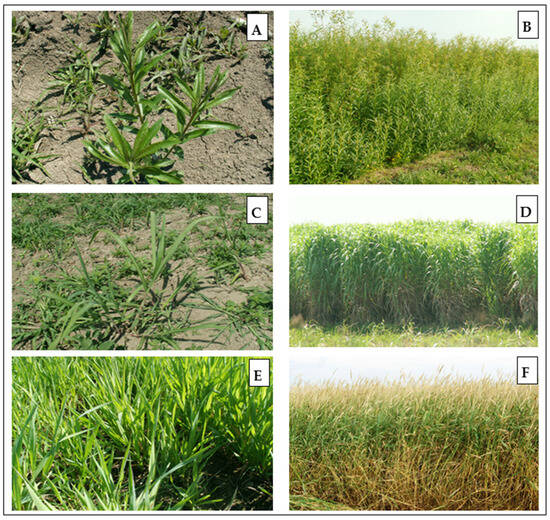
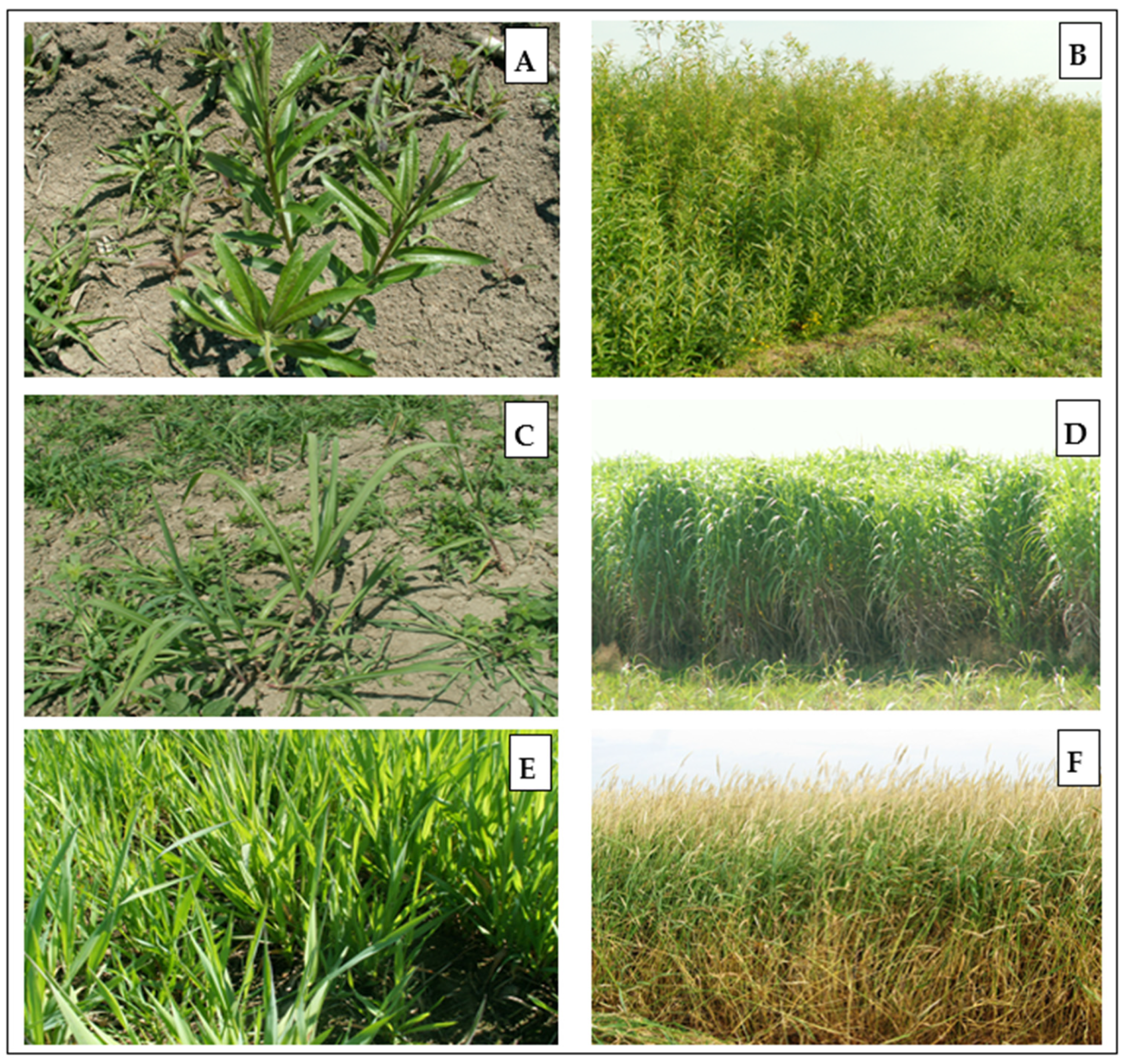
Field experiments were established in 2006 on a site characterized by brown alluvial soil developed from river deposits [46]. The study included three plant species cultivated for energy purposes: Salix viminalis, Miscanthus × giganteus and Phalaris arundinacea (Figure 1A–F). Selected agronomic practices applied to the energy crops are presented in Table 1.
Figure 1.
The photos show a 1-year-old plantation of S. viminalis (A); M. giganteus (C); P. arundinaceae (E) and a 16-year-old plantation of S. viminalis (B); M. giganteus (D); P. arundinaceae (F).
Table 1.
Selected elements of the agricultural practices of plants cultivated for energy purposes.
The plantations were established on very fertile brown river alluvial soil. Due to the natural abundance of nutrients in the soil and the high groundwater level (Table 2), no mineral fertilization was applied to any of the plantations throughout their entire period of use. Only before the establishment of the plantations, after harvesting the previous crop in 2005 (maize), post-harvest cultivation and winter ploughing were carried out. In early spring 2006, two weeks before the establishment of the experiment, the soil was prepared and leveled using a cultivation aggregate. During the years of the study, no chemical weed control treatments were applied in the energy crops.
Table 2.
Habitat characteristics of Salix viminalis, Miscanthus × giganteus and Phalaris arundinacea plantations.
The study covered the period 2006–2024, during which the condition and degree of weed infestation were assessed at three-year intervals. Weed infestation was evaluated using the Shannon–Wiener diversity index and the Simpson dominance index. In addition, the dynamics of weed communities were analyzed in relation to plantation age and the species of energy crop cultivated.
2.2. Study Site and Soil Properties
The experiments were conducted in the south-western part of Poland, in the Opolskie Voivodeship, on fields belonging to the Agricultural and Nursery Farm (50°87′33.42″ N, 17°46′45.28″ E). The experimental area was divided into three adjacent plots, each covering 1 ha. Each plot was planted with a different energy crop species: Salix viminalis, Miscanthus × giganteus, and Phalaris arundinacea. The plots represented large-scale production stands rather than replicated experimental units; therefore, the study focused on long-term observations of weed communities within each crop over time. Before the establishment of the experiment in 2006, seven soil samples were collected from each field. The samples were subsequently submitted to the Regional Chemical and Agricultural Station in Wrocław for physicochemical analyses. The characteristics of the fields are presented in Table 2.
2.3. Assessment of Weed Community Composition in Perennial Energy Crops
In this study, the term “weed species” refers to all plant species occurring spontaneously within the crop stands of the investigated energy crops. The term is used in an agronomic sense, describing plants that are not intentionally cultivated and may potentially compete with the crop for resources [4]. In perennial energy crop plantations, however, such species may also represent accompanying vegetation forming part of the local plant community.
The assessment of weed community diversity in stands of perennial energy crops—Salix viminalis, Miscanthus × giganteus, and Phalaris arundinacea—was conducted in the years 2006–2024 at three-year intervals (2006, 2009, 2012, 2015, 2018, 2021, and 2024).
The assessment of the diversity of individual weed species in the stands of perennial plants cultivated for energy purposes was conducted in three-year research cycles. The average values of the tested parameter for a given weed species were used for comparison. Weed infestation analyses were performed using the quadrat method during the peak of the growing season, in the first decade of June, due to the highest weed species richness occurring at that time. The areas where weed infestation was assessed (0.5 m2 quadrats) were designated along the diagonals of the fields in 10 replications (throws) for fields with energy crops [47]. In the quadrat method, a foldable frame with an area of 0.5 m2 is most commonly used. The method involves identifying and determining the number of all weed species occurring within the area defined by the quadrat on the assessed field surface. The species composition of weed communities and the abundance of individual weed species were determined using a quantitative approach, recording each species and its density expressed as the number of aboveground shoots (or rosettes) per m2 within the sampling quadrats.
In addition, the weed flora was compared among energy crop species in relation to plantation age. Weed species were grouped according to botanical class (monocotyledonous and dicotyledonous) and life span (annual and perennial). The share of each group was calculated as the percentage contribution of species belonging to a given group in the total number of recorded weed species within the sampling plots. Species nomenclature followed Mirek et al. [48], while characteristic species were identified according to Matuszkiewicz [49] and Rutkowski [50].
2.4. Diversity Indices: Shannon–Wiener Diversity Index and Simpson’s Dominance Index
The diversity and dominance patterns of weed communities were characterized using two commonly applied biodiversity indices: the Shannon–Wiener diversity index and the Simpson dominance index.
The Shannon–Wiener diversity index (H), which depends on both the number of species and their relative abundances, was calculated according to the formula [51,52]:
where
—probability of occurrence of a given weed species in the sample;
(where is the abundance of a particular weed species and N is the total weed abundance within the sampling area);
—natural logarithm.
Higher values of the H index indicate greater community diversity.
The Simpson dominance index (SI) was calculated using the formula:
The values of this index range from 0 to 1, with values approaching 1 indicating strong dominance by one or a few species [53,54].
2.5. Statistical Analysis
The data regarding the number of weed species and weed density, expressed as the number of shoots (or individuals) per m2, were analyzed using analysis of variance (ANOVA). Differences between mean values for subsequent years of the study were determined using Tukey’s honestly significant difference (HSD) test at a significance level of p ≤ 0.05.
The Shannon–Wiener diversity index and Simpson’s dominance index were calculated based on the abundance of individual weed species recorded in individual 0.5 m2 frames. For each year and plantation with the studied energy crop, measurements from ten replicates were used to determine species abundance, and the indices were calculated based on the relative abundance of each species in the entire weed community.
All statistical analyses were performed using ARM (Agriculture Research Management) software, version 2024.1.
3. Results
3.1. Species Composition and Number of Weeds
Weed abundance, species diversity, and the dynamics of weed infestation depended on both the species of energy crop cultivated and plantation age (Table 3, Table 4 and Table 5; Figure 2, Figure 3, Figure 4, Figure 5 and Figure 6).
Table 3.
Assessment of the species composition of weeds occurring on the Salix viminalis plantation (pcs·m−2).
Table 4.
Assessment of the species composition of weeds occurring on the Miscanthus × giganteus plantation (pcs·m−2).
Table 5.
Assessment of the species composition of weeds occurring on the Phalaris arundinacea plantation (pcs·m−2).
Figure 2.
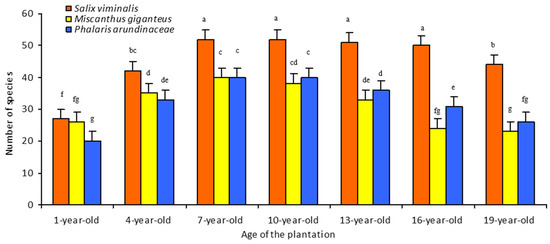
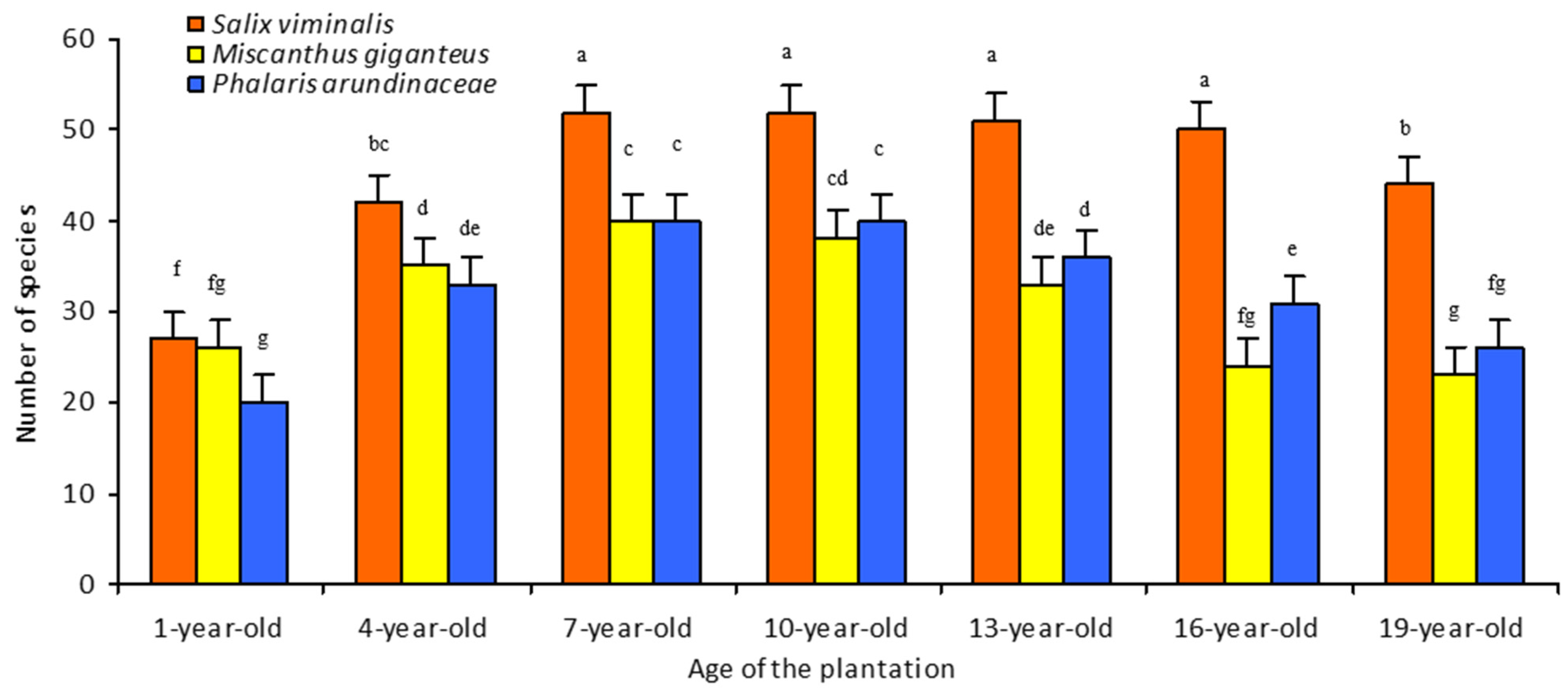
The number of species depending on the energy crop and the age of the plantation a–g—statistically significant differences at the confidence level p = 0.05 (Tukey’s HSD test).
Figure 3.
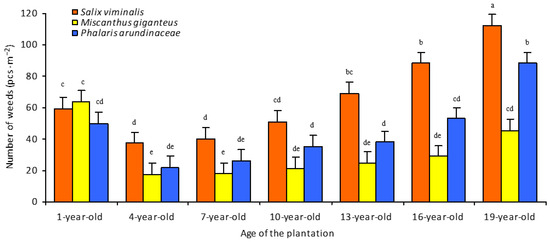
The number of weeds depending on the energy crop and the age of the plantation (pcs·m−2) a–e—statistically significant differences at the confidence level p = 0.05 (Tukey’s HSD test).
Figure 4.
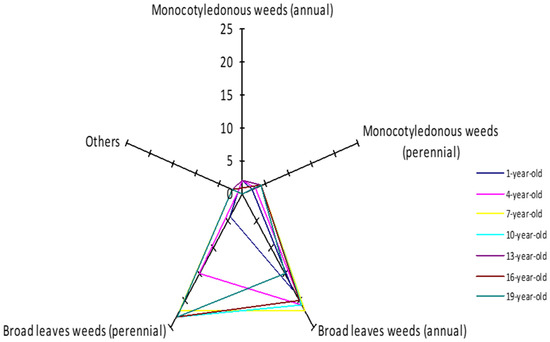
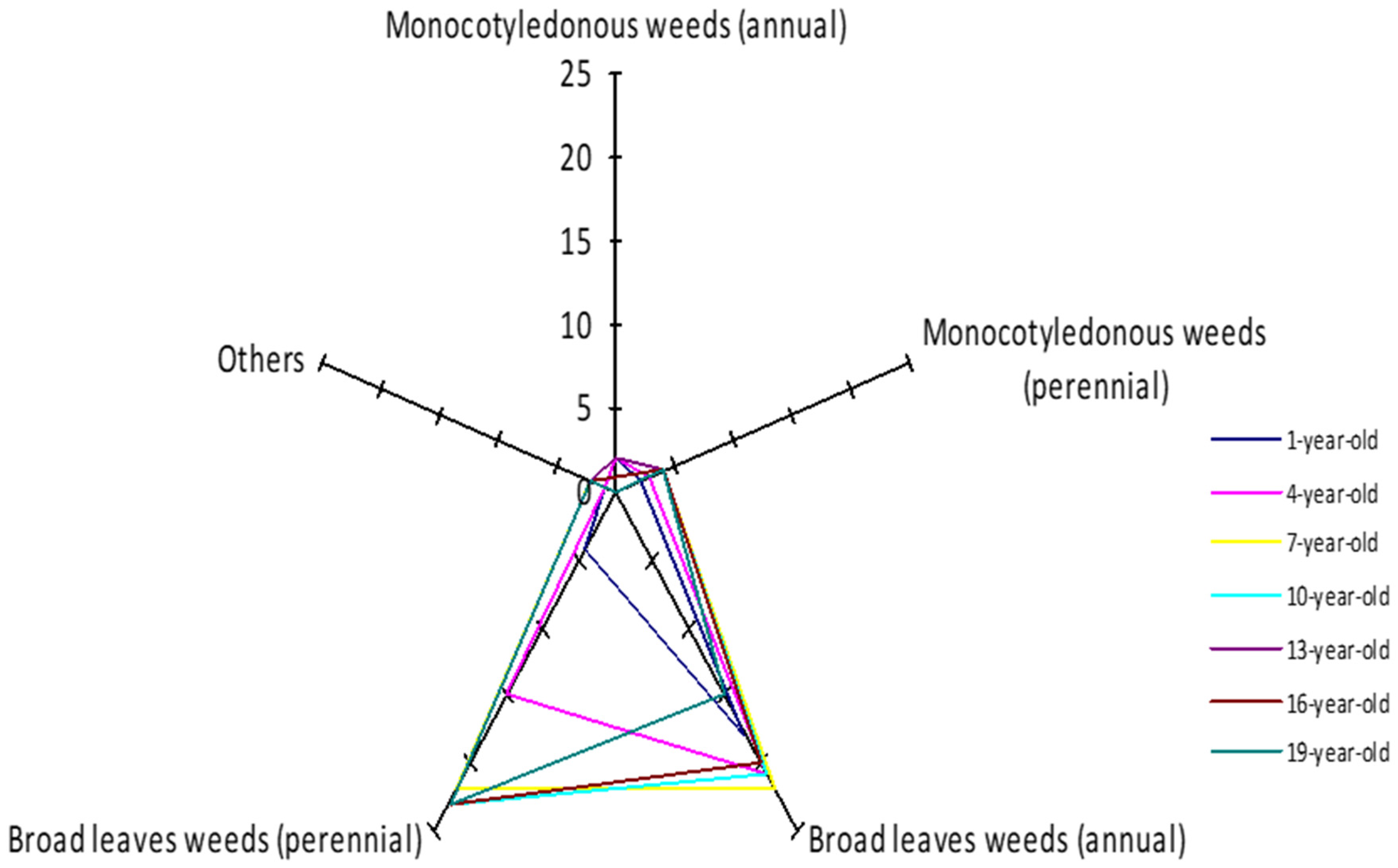
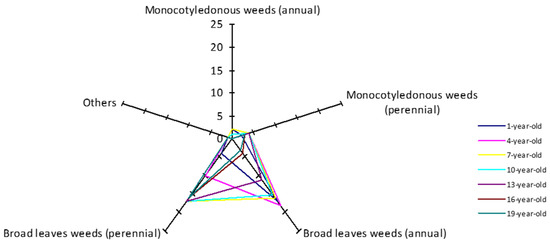
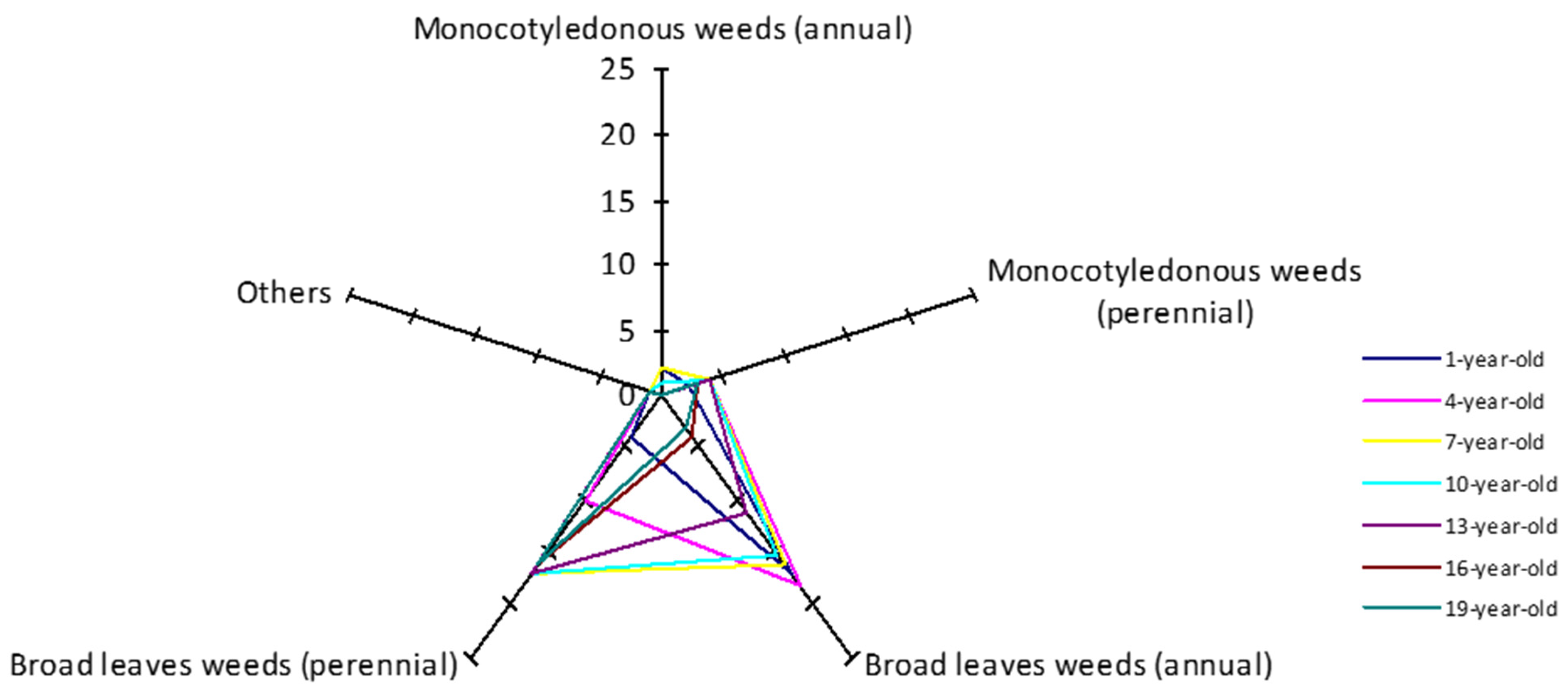
The structure of botanical classes of weeds depending on the age of the Salix viminalis plantation.
Figure 5.
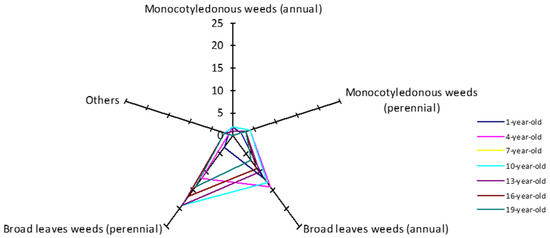
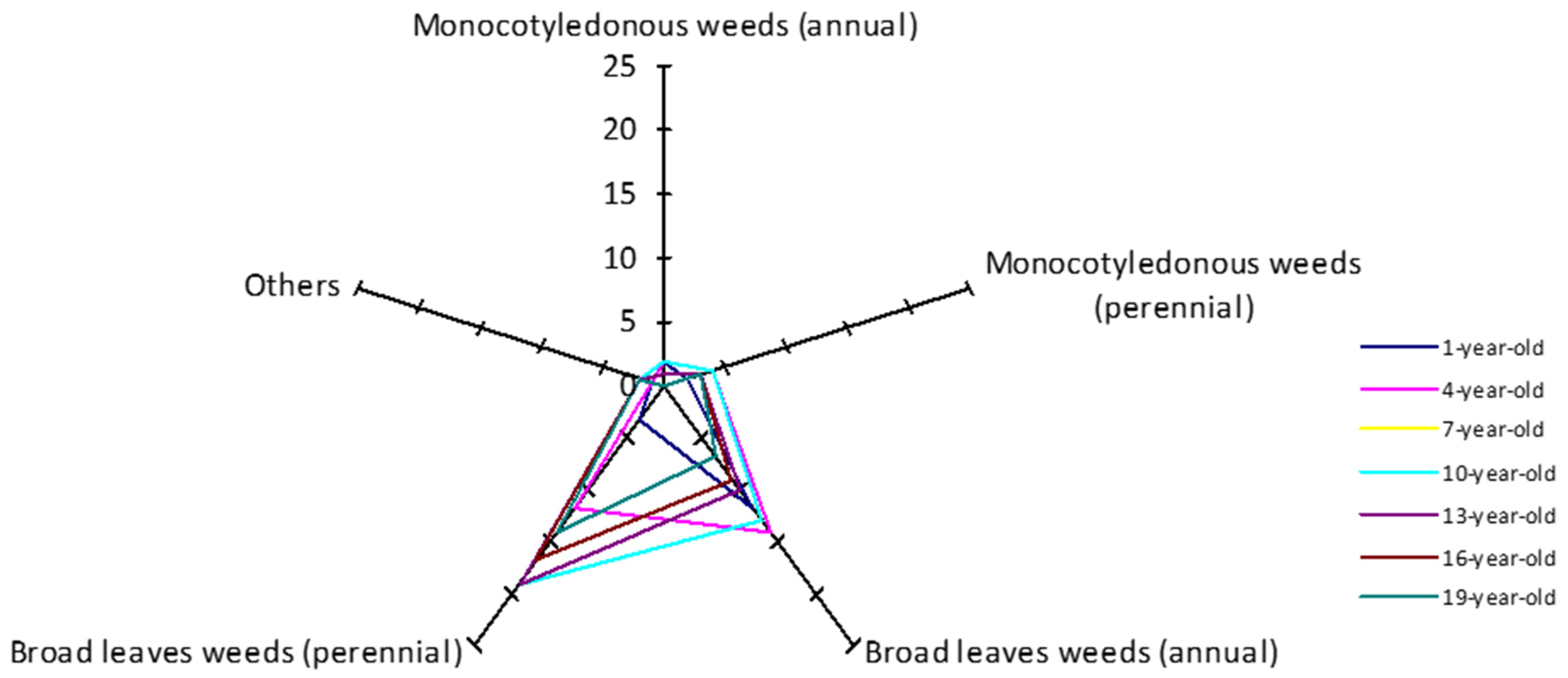
The structure of botanical classes of weeds depending on the age of the Miscanthus × giganteus plantation.
Figure 6.
The structure of botanical classes of weeds depending on the age of the Phalaris arundinacea plantation.
The highest weed density (individuals m−2) was recorded in the final year of the study, i.e., on the 19-year-old plantations of Salix viminalis (112 individuals m−2) and Phalaris arundinacea (88 individuals m−2). In contrast, in Miscanthus × giganteus cultivation, the highest weed density was observed in the first year of the study, i.e., on the 1-year-old plantation (64 individuals m−2). Differences in weed density among the studied energy crops were statistically significant.
The lowest weed densities during the entire study period were recorded on the 4-year-old plantations of Miscanthus × giganteus (17 pcs·m−2), Phalaris arundinacea (22 pcs·m−2), and Salix viminalis (37 pcs·m−2). In this case as well, statistically significant differences were confirmed among the investigated energy crops (Figure 3).
Greater interannual variation was observed in weed abundance than in species richness (Table 3 and Table 4; Figure 2 and Figure 3). The highest species diversity was recorded in the Salix viminalis plantation, where a total of 53 species were identified over the 19-year study period (2006–2024) (Table 3). Eleven and twelve fewer taxa were recorded in the perennial grass communities of Miscanthus × giganteus (42 species) and Phalaris arundinacea (41 species), respectively (Table 4 and Table 5; Figure 2). The greatest variability in the number of weed species over the years was observed in the annually harvested perennial grass plantations (Miscanthus × giganteus and Phalaris arundinacea) (Table 4 and Table 5; Figure 2). In contrast, smaller fluctuations in species number were recorded in the Salix viminalis plantation, harvested in a three-year cycle, which was statistically confirmed (Table 3; Figure 2).
Weed communities in the stands of energy crops differed in species composition depending on plantation age. In perennial grasses (Miscanthus × giganteus and Phalaris arundinacea) as well as in the shrub species Salix viminalis, a higher proportion of annual monocotyledonous segetal weeds, particularly Echinochloa crus-galli and Apera spica-venti, was observed in the first year of cultivation (1-year-old plantations) compared with subsequent years (4- to 19-year-old plantations), where perennial monocotyledonous species, mainly Elymus repens, became dominant (Table 3, Table 4 and Table 5; Figure 4, Figure 5 and Figure 6).
A similar pattern was observed for annual dicotyledonous species. Their proportion was markedly higher on 1-year-old plantations, regardless of the energy crop species. The dominant species were typical segetal weeds, including Amaranthus retroflexus, Chenopodium album, Matricaria inodora, Sinapis arvensis, and Viola arvensis. In subsequent years (4- to 19-year-old plantations), the proportion of perennial dicotyledonous species increased substantially, mainly ruderal species and those characteristic of permanent grasslands, such as Cirsium arvense, Rorippa sylvestris, Sonchus arvensis, Ranunculus repens, Senecio jacobaea, Potentilla reptans, Glechoma hederacea, Trifolium repens, Artemisia vulgaris, Taraxacum officinale, Urtica dioica, Symphytum officinale, Potentilla anserina, and Rumex crispus.
Moreover, on the Salix viminalis plantation (particularly the 16- and 19-year-old stands), numerous occurrences of Plantago media, Arctium tomentosum, and Daucus carota were recorded; these species were not observed in Miscanthus × giganteus or Phalaris arundinacea plantations. Species belonging to other taxonomic groups, such as Equisetum arvense and Juncus bufonius, were also identified (Table 3, Table 4 and Table 5; Figure 4, Figure 5 and Figure 6).
Additionally, invasive weed species, namely Solidago canadensis and Solidago gigantea, were recorded in the studied energy crop plantations. A significant contribution of these two invasive taxa was observed, particularly in older plantations of Salix viminalis and Phalaris arundinacea (Table 3 and Table 5).
3.2. Diversity Indices
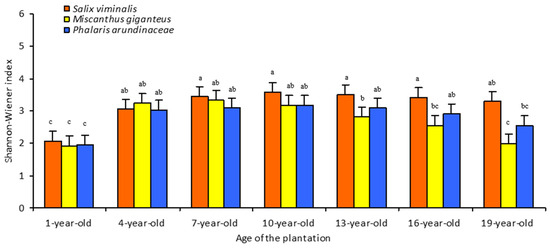
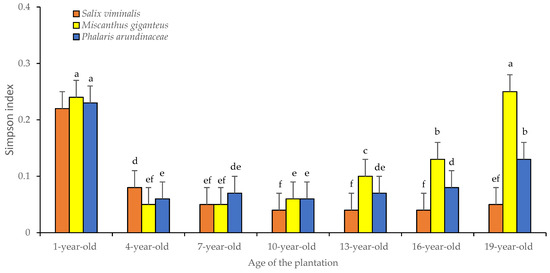
Differences in species richness and in the proportional contribution of individual weed species within the communities of Salix viminalis, Miscanthus × giganteus, and Phalaris arundinacea were reflected in the values of the Shannon–Wiener diversity index and the Simpson dominance index (Figure 7 and Figure 8).
Figure 7.
Diversity indices—Shannon–Wiener diversity index (H’) calculated for the number of weeds depending on the energy crop and the age of the plantation a–c—statistically significant differences at the confidence level p = 0.05 (Tukey’s HSD test).
Figure 8.
Diversity indices—Simpson dominance index (D) calculated for the number of weeds depending on the energy crop and the age of the plantation a–f—statistically significant differences at the confidence level p = 0.05 (Tukey’s HSD test).
The highest values of the Shannon index and simultaneously the lowest values of the Simpson dominance index were recorded in weed communities occurring in Salix viminalis plantations. Among the three investigated energy crops, the 7-, 10-, 13-, and 16-year-old Salix viminalis plantations were characterized by the most even distribution of weed species within the community, as indicated by the lowest Simpson dominance values; these differences were statistically significant (Figure 7 and Figure 8).
Intermediate values of both indices were observed in perennial grasses, i.e., Miscanthus × giganteus and Phalaris arundinacea. Within this group, the highest diversity and lowest dominance of weed species were recorded in the 13-, 16-, and 19-year-old Phalaris arundinacea plantations (Figure 7 and Figure 8). In contrast, Miscanthus × giganteus plantations evaluated in the 13th, 16th, and 19th years after establishment were characterized by the lowest Shannon index values and the highest Simpson dominance values, due to the high proportion of two weed species, namely Elymus repens and Taraxacum officinale, in the community (Table 4; Figure 7 and Figure 8).
During the assessment of accompanying flora in energy crop plantations in 2006–2024, Shannon diversity index values ranged from 1.93 to 3.56. The most similar values, regardless of the energy crop species, were recorded in the first year of cultivation (H = 1.93–2.08), which was statistically confirmed. The highest diversity values were observed in the 7-, 10-, 13-, 16-, and 19-year-old Salix viminalis plantations, ranging from 3.07 to 3.56.
The Simpson dominance index showed a wide range of variation, from 0.04 to 0.25. The highest values (D = 0.22–0.24), indicating dominance by one or a few weed species, were recorded in the first year of cultivation (1-year-old plantations), regardless of the energy crop species, and in the 19-year-old Miscanthus × giganteus plantation (D = 0.25); these differences were also statistically significant. The lowest Simpson dominance values, statistically confirmed, were obtained for the 7-, 10-, 13-, 16-, and 19-year-old Salix viminalis plantations (D = 0.04–0.05) (Figure 7 and Figure 8).
4. Discussion
One of the key components of biodiversity in agricultural land is the flora accompanying cultivated crops. The diversity of segetal flora is influenced by numerous environmental and agronomic factors [10,11,12,13]. An important issue in assessing the environmental impact of agriculture is the comprehensive evaluation of its influence on plant diversity within agrophytocenoses. A review of the literature indicates that species richness (number of species) is the most commonly used measure of biodiversity in a given area [55,56,57]. However, according to Sienkiewicz [58], this is not an entirely objective measure, as all species are treated equally regardless of their relative abundance within the community. Therefore, diversity indices that incorporate both species number and their proportional representation in the community are increasingly applied. Among numerous ecological indices, the Shannon diversity index and the Simpson dominance index are the most frequently used [53,54]. The analyses applied in this study focused on aggregated indicators of diversity and dominance; therefore, the obtained results should be interpreted as a general characterization of weed community dynamics rather than as a comprehensive multivariate analysis of species composition.
Although the accompanying vegetation of perennial energy crops may contribute to plant diversity within agricultural landscapes, species occurring spontaneously within crop stands are commonly classified as weeds in agronomic terminology. In this context, weeds are defined as plant species growing within a crop that are not intentionally cultivated and may potentially compete with the crop for resources such as light, water, and nutrients [4]. However, in perennial energy crops, which are characterized by dense canopy formation and relatively low management intensity, the accompanying flora may simultaneously represent an important component of agroecosystem biodiversity [5,6].
Although in this study the accompanying vegetation was analyzed primarily as weed communities from an agronomic perspective, the presence of diverse segetal–ruderal species in perennial plantations may simultaneously perform ecological functions, such as providing habitats for insects and increasing biodiversity within agricultural landscapes [5,6]. In the case of perennial energy crops, which often remain in the same location for many years, the accompanying vegetation may also influence the functional stability of the agroecosystem and act as an element increasing its biological heterogeneity.
Some authors emphasize that in the first year of energy crop cultivation, weeds constitute strong competition for crop growth and development; therefore, their control is justified. In subsequent years, however, weed control is often unnecessary for economic and ecological reasons [59,60,61].
For example, the results of studies by Jezierska-Domaradzka and Domaradzki [62] showed that despite almost complete soil surface coverage by weeds, no negative effect on the condition of willow was observed in 2–4-year-old plantations. Moreover, research conducted by Janicka et al. [63] demonstrated that with increasing plantation age, the share of perennial species and meadow, forest, and shrub apophytes increased, while therophytes and anthropophytes decreased. As plantations aged, the diversity of vascular flora declined, and stable conditions were observed after eight years of willow cultivation.
In the present study conducted in 2006–2024, 53 weed species were identified in Salix viminalis plantations. In contrast, the number of species recorded in Miscanthus × giganteus and Phalaris arundinacea plantations was lower but very similar, amounting to 42 and 41 species, respectively.
Fehér et al. [32], in studies carried out on miscanthus, willow, and poplar plantations, identified as many as 98 weed species. The highest number of species (58) was recorded in willow varieties, whereas the lowest (45) was observed in poplar. In miscanthus plantations, 53 species were found. Comparable results were reported by Baum et al. [64], who identified 79 and 98 species, respectively.
Feledyn-Szewczyk et al. [30], in willow, poplar, and false acacia plantations, recorded between 35 and 50 weed species. In perennial grasses such as miscanthus, switchgrass, big bluestem, and prairie cordgrass, they found 48–50 species, except for reed canary grass, where only 20 species were recorded. The lowest diversity and abundance of weed flora were observed in Virginia mallow and Jerusalem artichoke plantations (30–32 species).
Interesting findings were also presented by Janicka et al. [65], who compared the dynamics of flora changes in older willow plantations (>5 years) under two management regimes: harvested every two years and unharvested. A total of 62 weed species were recorded. Plantations harvested every two years exhibited greater species richness than unharvested ones. Moreover, the number of species decreased with plantation age in both systems, although this process progressed more rapidly in unharvested stands.
In the present study, weed communities consisted mainly of segetal and ruderal species. The proportion of particular species depended on both the energy crop species and the plantation age. Annual segetal species predominated, and weed abundance was highest in 1-, 4-, and 7-year-old plantations. In contrast, older plantations (16- and 19-year-old) were dominated primarily by perennial ruderal species. Similar results were obtained by Fehér et al. [32], who demonstrated the highest proportion of ruderal species in energy crop plantations. In contrast, Baum et al. [64] reported the greatest contribution of annual and perennial monocotyledonous species.
Semere and Slater [66] showed that the condition and degree of weed infestation depended on the cultivated energy crop species. In miscanthus plantations, perennial monocotyledonous weeds predominated, accompanied by annual dicotyledonous species and occasionally perennial dicots. In reed canary grass fields, perennial and annual dicotyledonous weeds were dominant, while perennial monocots occurred less frequently.
According to Feledyn-Szewczyk [42], on energy crop plantations established on arable land, the first years of cultivation are dominated by plant species typical of arable fields. These species result from previous land use and germinate from the soil seed bank. Only in subsequent years, as energy crop plantations age, does succession occur, leading to a decrease in the number of annual species and colonization by perennial species, such as ruderal and meadow species, as well as species characteristic of forest communities.
The transformation of the floristic structure from annual weeds to perennial species is likely largely caused by the abandonment of regular tillage and by the lower water and nutrient requirements of these species.
Sekutowski et al. [67], who assessed weed infestation in reed canary grass plantations depending on plantation age, recorded a total of 43 species across all plantations. The fewest species (18) were found in 1–2-year-old plantations, nearly twice as many (30) in 6–8-year-old plantations, and the highest number (33 taxa) in 3–5-year-old plantations. Annual segetal species dominated in 1–2-year-old plantations, whereas perennial ruderal species prevailed in 6–8-year-old stands.
In the analyzed energy crop plantations, factors that may differentiate weed infestation included plant density and harvest frequency (from 1 to 3 years), the varying ability of individual crop species to shade the soil, and allelopathic interactions, including the effects of fallen leaves, which additionally acted as soil mulch.
It is often observed that as willow plantations age, light-demanding species decline and are replaced by plants with lower light requirements. Harvesting every three years probably limits the development of annual segetal species while favoring the occurrence of perennial ruderal or meadow species and, in older plantations, also forest species [42,43,68,69].
Our own observations indicate that the physical structure of the crop stand, rapid growth rate, plant density, and regular annual harvesting mean that habitats formed by energy crops from the grass family (miscanthus and reed canary grass) are more effective at limiting weed infestation than, for example, willow.
It should also be noted that the initial growth rates of miscanthus and reed canary grass differ. Miscanthus, a plant with a C4 photosynthetic pathway and high thermal requirements, begins vegetation later in spring than reed canary grass and forms a dense canopy only in summer. However, during the autumn–winter harvest period, its falling leaves create a large biomass that effectively mulches the soil and suppresses the development of weeds, mainly annual species. In contrast, the strong competitive ability of reed canary grass against weeds may result from its very rapid canopy closure in spring, which limits weed growth, as well as from its allelopathic potential, as noted by Sekutowski and Bortniak [70].
Moreover, kenophytes may pose a threat to native flora, particularly invasive species such as Solidago canadensis, Solidago gigantea, and Conyza canadensis, which often form dense phytocoenoses. In these communities, native plants may be gradually displaced by invasive species through allelopathic interactions [71,72]. Similar expansive behavior has also been observed in species of the genus Artemisia, which are characterized by strong allelopathic potential that may affect both plants and soil microorganisms [71,73,74]. Floral richness can also be assessed using diversity indices that incorporate both species number and their proportional contribution to the community. In the present study, both the Shannon and Simpson indices were applied. The highest diversity was observed in 7-, 10-, 13-, 16-, and 19-year-old Salix viminalis plantations (H = 3.07–3.56). The highest dominance values were recorded in 1-year-old plantations (D = 0.22–0.24), regardless of the cultivated energy crop, and in the 19-year-old Miscanthus × giganteus plantation (D = 0.25).
Similar findings were reported by Radzikowski et al. [31], who demonstrated that Shannon diversity was highest in willow plantations and lowest in miscanthus plantations. Conversely, the Simpson dominance index indicated the greatest dominance in miscanthus plantations and the lowest in willow plantations.
Comparable results, although limited to willow, poplar, and false acacia, were obtained by Feledyn-Szewczyk et al. [30]. In addition, the highest Shannon index values were recorded in miscanthus, switchgrass, big bluestem, and prairie cordgrass, whereas the highest Simpson index values—indicating dominance of a few species—were observed in Virginia mallow and Jerusalem artichoke plantations.
The coexistence of perennial energy crops within agricultural landscapes may increase habitat diversity for flora and fauna. Cultivation of these crops may lead to changes in accompanying plant communities, particularly through an increase in the share of perennial species at the expense of annual ones. Energy crop plantations may also favor the occurrence of ruderal species that can form extensive patches, such as U. dioica, as well as alien invasive species such as C. canadensis, S. canadensis, and S. gigantea. Therefore, identifying and describing such plant communities—especially in plantations used for many years—and monitoring the changes occurring within them are very important not only for practical and scientific reasons but also from an ecological perspective.
5. Conclusions
The coexistence of perennial energy crops in agricultural landscapes may contribute to changes in the species diversity of flora. Cultivation of these plants may lead to changes in accompanying plant communities, particularly through an increase in the proportion of perennial species, such as A. repens, C. arvense, R. repens, A. vulgaris, T. officinale, U. dioica, S. officinale, and R. crispus, at the expense of annual species, such as E. crus-galli, A. spica-venti, A. retroflexus, Ch. album, M. inodora, and V. arvensis. Energy crop plantations also favor the occurrence of ruderal species that may form large patches, such as U. dioica, as well as alien invasive species, such as C. canadensis, S. canadensis, and S. gigantea. Therefore, identifying and describing such plant communities—especially in plantations used for many years—and monitoring the changes occurring within them are very important not only for practical and scientific reasons but also from an ecological perspective. The present study showed that weed species diversity and abundance changed with the age of plantations of energy crops. The highest number of species was recorded in the S. viminalis plantation, while the lowest was observed in the P. arundinacea plantation. The highest weed abundance was found in the 16- and 19-year-old S. viminalis plantations, whereas the lowest number of weeds per unit area was observed in the 4- and 7-year-old M. giganteus plantations. The greatest variation in the number of species over the years (depending on plantation age) was observed in P. arundinacea and M. giganteus. In contrast, relatively small differences in the number of weed species were found in the S. viminalis plantation.
Author Contributions
Conceptualization, T.R.S.; methodology, T.R.S. and J.G.; validation, T.R.S. and M.Z.; formal analysis, T.R.S. and J.B.; investigation, T.R.S.; resources, T.R.S.; writing—original draft preparation, T.R.S. and J.G.; writing—review and editing, T.R.S., M.Z. and J.B.; visualization, T.R.S.; supervision, J.G., M.Z. and T.R.S.; funding acquisition, J.G. and M.Z. All authors have read and agreed to the published version of the manuscript.
Funding
This research received no external funding.
Data Availability Statement
The data presented in this study are available in this article. Further inquiries can be directed to the corresponding author.
Acknowledgments
The authors wish to thank the Agricultural and Horticultural Farm of Kazimierz Kulas for allowing the experiments to be conducted on the farm’s fields.
Conflicts of Interest
The authors declare no conflicts of interest.
References
- Marshall, E.J.P.; Brown, V.K.; Boatman, N.D.; Lutman, P.J.W.; Squire, G.R.; Ward, L.K. The role of weeds in supporting biological diversity within crop fields. Weed Res. 2003, 43, 77–89. [Google Scholar] [CrossRef] [Scilit]
- Oerke, E.C. Crop losses to pests. J. Agric. Sci. 2006, 144, 31–43. [Google Scholar] [CrossRef] [Scilit]
- Aldrich, R.J. Ekologia Chwastów w Roślinach Uprawnych. Podstawy Zwalczania Chwastów. In Weed Ecology in Crop Plants, Weed Control Basics; Wyd. TChiIE: Opole, Poland, 1997; pp. 1–461. (In Polish) [Google Scholar]
- Radosevich, S.R.; Holt, J.S.; Ghersa, C.M. Ecology of Weeds and Invasive Plants: Relationship to Agriculture and Natural Resource Management, 3rd ed.; Wiley: Hoboken, NJ, USA, 2007. [Google Scholar]
- Grzelak, M.; Majchrzak, L.; Gaweł, E.; Idziak, R. Natural and habitat conditions of medow communities in the northern polder in the “Ujście Warty” national park. Folia Pomer. Univ. Technol. Stetin. Agric. Aliment. Pisc. Zootech. 2023, 367, 24–34. [Google Scholar] [CrossRef] [Scilit]
- Storkey, J.; Neve, P. What good are weeds? The role of weeds in supporting biodiversity in agroecosystems. Weed Res. 2018, 58, 259–261. [Google Scholar] [CrossRef] [Scilit]
- Adeux, G.; Vieren, E.; Carlesi, S.; Bàrberi, P.; Munier-Jolain, N.; Cordeau, S. Mitigating crop yield losses through weed diversity. Nat. Sustain. 2019, 2, 1018–1026. [Google Scholar] [CrossRef] [Scilit]
- Sekutowski, T.; Dziągwa, M. Weed problem on the newly established prairie cordgrass (Spartina pectinata) plantations intended for energetic purposes. J. Cent. Eur. Agric. 2012, 13, 253–261. [Google Scholar] [CrossRef] [Scilit]
- Brodowska, M.S.; Muszyński, P.; Haliniarz, M.; Brodowski, R.; Kowalczyk-Juśko, A.; Sekutowski, T.; Kurzyna-Szklarek, M. Agronomic aspects of switchgrass cultivation and use for energy purposes. Appl. Ecol. Environ. Res. 2018, 16, 5715–5743. [Google Scholar] [CrossRef] [Scilit]
- Pysek, P.; Jarosik, V.; Kropac, Z.; Chytry, M.; Wild, J.; Tichy, L. Effects of abiotic factors on species richness and cover in Central European weed communities. Agric. Ecosyst. Environ. 2005, 109, 1–8. [Google Scholar] [CrossRef] [Scilit]
- Murphy, C.E.; Lemerle, D. Continuous cropping systems and weed selection. Euphytica 2006, 148, 61–73. [Google Scholar] [CrossRef] [Scilit]
- Fried, D.; Norton, L.R.; Reboud, X. Environmental and management factors determining weed species composition and diversity in France. Agric. Ecosyst. Environ. 2008, 128, 68–76. [Google Scholar] [CrossRef] [Scilit]
- Cirujeda, A.; Aibar, J.; Zaragoza, C. Remarkable changes of weed flora in Spanish cereal fields from 1976 to 2007. Agron. Sustain. Dev. 2011, 31, 675–688. [Google Scholar] [CrossRef] [Scilit]
- Petit, S.; Boursault, A.; Le Guilloux, M.; Munier-Jolain, N.; Reboud, X. Weeds in agricultural landscape. A review. Agron. Sustain. Dev. 2011, 31, 309–317. [Google Scholar] [CrossRef] [Scilit]
- Cimalová, S.; Lososová, Z. Arable weed vegetation of the northeastern part of the Czech Republic: Effects of environmental factors on species composition. Plant Ecol. 2009, 203, 45–57. [Google Scholar] [CrossRef] [Scilit]
- Marks-Bielska, R.; Bielski, S.; Pik, K.; Kurowska, K. The Importance of Renewable Energy Sources in Poland’s Energy Mix. Energies 2020, 13, 4624. [Google Scholar] [CrossRef] [Scilit]
- Pietrzak, M.B.; Igliński, B.; Kujawski, W.; Iwański, P. Energy Transition in Poland—Assessment of the Renewable Energy Sector. Energies 2021, 14, 2046. [Google Scholar] [CrossRef] [Scilit]
- Borkowska, H.; Wardzińska, K. Some effects of Sida hermaphrodita R. cultivation on sewage sludge. Pol. J. Environ. Stud. 2003, 12, 119–122. [Google Scholar]
- Borkowska, H.; Molas, R. Yield comparison of four lignocellulosic perennial energy crop species. Biomass Bioenergy 2013, 51, 145–153. [Google Scholar] [CrossRef] [Scilit]
- Kieloch, R.; Gołębowska, H.; Sienkiewicz-Cholewa, U. Impact of habitat conditions on the biological traits of the reed canary grass (Phalaris arundinacea L.). Acta Agrobot. 2015, 68, 205–210. [Google Scholar] [CrossRef] [Scilit]
- Jeżowski, S. Yield traits of six clones of Miscanthus in the first 3 years following planting in Poland. Ind. Crops Prod. 2008, 27, 65–68. [Google Scholar] [CrossRef] [Scilit]
- Strašil, Z. Evaluation of Miscanthus grown for energy use. Res. Agric. Eng. 2016, 62, 92–97. [Google Scholar] [CrossRef] [Scilit]
- Muylle, H.; van Hulle, V.; de Vliegher, A.; Baert, J.; van Bockstaele, E.; Roldán-Ruiz, I. Yield and energy balance of annual and perennial lignocellulosic crops for bio-refinery use: A 4-year field experiment in Belgium. Eur. J. Agron. 2015, 63, 62–70. [Google Scholar] [CrossRef] [Scilit]
- Lewandowski, I. Biomass production from lignocellulosic energy crops. Encycl. Appl. Plant Sci. (Second Ed.) 2017, 3, 159–163. [Google Scholar] [CrossRef] [Scilit]
- Kowalczyk-Juśko, A.; Mazur, A.; Pochwatka, P.; Janczak, D.; Dach, J. Evaluation of the effects of using the giant miscanthus (Miscanthus × giganteus) biomass in various energy conversion processes. Energies 2022, 15, 3486. [Google Scholar] [CrossRef] [Scilit]
- Bilandzija, N.; Voca, N.; Jelcic, B.; Jurisic, V.; Matin, A.; Grubor, M.; Kricka, T. Evaluation of Croatian agricultural solid biomass energy potential. Renew. Sustain. Energy Rev. 2018, 93, 225–230. [Google Scholar] [CrossRef] [Scilit]
- Feledyn-Szewczyk, B.; Matyka, M.; Staniak, M. Diversity of weed flora, selected biometric characteristics and yielding of Miscanthus spp. cultivated on light and heavy soil. Acta Agrobot. 2014, 67, 67–76. [Google Scholar] [CrossRef] [Scilit]
- Dubis, B.; Jankowski, K.J.; Załuski, D.; Bórawski, P.; Szempliński, W. Biomass production and energy balance of Miscanthus over a period of 11 years: A case study in a large-scale farm in Poland. GCB Bioenergy 2019, 11, 1187–1201. [Google Scholar] [CrossRef] [Scilit]
- Lewandowski, I.; Clifton-Brown, J.C.; Scurlock, J.M.O.; Huisman, W. Miscanthus: European experience with a novel energy crop. Biomass Bioenergy 2000, 19, 209–227. [Google Scholar] [CrossRef] [Scilit]
- Feledyn-Szewczyk, B.; Matyka, M.; Staniak, M. Comparison of the effect of perennial energy crops and agricultural crops on weed flora diversity. Agronomy 2019, 9, 695. [Google Scholar] [CrossRef] [Scilit]
- Radzikowski, P.; Matyka, M.; Berbeć, A.K. Biodiversity of Weeds and Arthropods in Five Different Perennial Industrial Crops in Eastern Poland. Agriculture 2020, 10, 636. [Google Scholar] [CrossRef] [Scilit]
- Fehér, A.; Pintér, E.; Prus, P.; Konceková, L. Dependence of Weed Composition on Cultivated Plant Species and Varieties in Energy-Tree and-Grass Plantations. Agronomy 2020, 10, 1247. [Google Scholar] [CrossRef] [Scilit]
- Janicka, M.; Kutkowska, A.; Paderewski, J. Diversity of vascular flora accompanying Salix viminalis L. crops depending on soil conditions. Glob. Ecol. Conserv. 2020, 23, e01068. [Google Scholar] [CrossRef] [Scilit]
- Janicka, M.; Kutkowska, A.; Paderewski, J. Diversity of segetal flora in Salix viminalis L. crops established on former arable and fallow lands in Central Poland. Agriculture 2021, 11, 25. [Google Scholar] [CrossRef] [Scilit]
- Stolarski, M.J.; Krzyianiak, M.; Szczukowski, S.; Tworkowski, J.; Bieniek, A. Short rotation woody crops grown on marginal soil for biomass energy. Pol. J. Environ. Stud. 2014, 23, 1727–1739. [Google Scholar]
- Stolarski, M.J.; Krzyżaniak, M.; Załuski, D.; Tworkowski, J.; Szczukowski, S. Efects of Site, Genotype and Subsequent Harvest Rotation on Willow Productivity. Agriculture 2020, 10, 412. [Google Scholar] [CrossRef] [Scilit]
- Börjesson, P. Environmental effects of energy crop cultivation in Sweden-I: Identification and quantification. Biomass Bioenergy 1999, 16, 137–154. [Google Scholar] [CrossRef] [Scilit]
- Dauber, J.; Miyake, S. To integrate or to segregate food crop and energy crop cultivation at the landscape scale? Perspectives on biodiversity conservation in agriculture in Europe. Energy Sustain. Soc. 2016, 6, 25. [Google Scholar] [CrossRef] [Scilit]
- Fletcher, R.J., Jr.; Robertson, B.A.; Evans, J.; Doran, P.J.; Alavalapati, J.R.; Schemske, D.W. Biodiversity conservation in the era of biofuels: Risks and opportunities. Front. Ecol. Environ. 2011, 9, 161–168. [Google Scholar] [CrossRef] [Scilit]
- Miziniak, W. Influence of herbicydes on growth and development some varietes of wicker (Salix ssp.) crowing on energetic aim. Prog. Plant Prot. 2011, 51, 937–942. [Google Scholar]
- Larsen, S.U.; Jørgensen, U.; Kjeldsen, J.B.; Lærke, P.E. Long-term yield effects of establishment method and weed control in willow for short rotation coppice (SRC). Biomass Bioenergy 2014, 71, 266–274. [Google Scholar] [CrossRef] [Scilit]
- Feledyn-Szewczyk, B.; Sposobu, W. The Influence of Agricultural Land Use on Weed Flora Diversity. Habilitation Thesis, IUNG-PIB, Puławy, Poland, 2013; pp. 1–181. (In Polish) [Google Scholar]
- Birmele, J.; Kopp, G.; Brodbeck, F.; Konold, W.; Sauter, U.H. Successional changes of phytodiversity on a short rotation coppice plantation in Oberschwaben, Germany. Front. Plant Sci. 2015, 6, 124. [Google Scholar] [CrossRef] [Scilit]
- Wojciechowski, W.; Sowiński, J.; Zawieja, J. Wpływ wieku plantacji wierzby na zachwaszczenie w warunkach Sudetów. Pam. Puł. 2009, 150, 351–358. (In Polish) [Google Scholar]
- Wróbel, M.; Wróbel, J.; Gregorczyk, A. Floristic and community diversity of weed vegetation in willow short-rotation coppices in different soil-habitat conditions. Pol. J. Ecol. 2011, 59, 289–296. [Google Scholar]
- Polskie Towarzystwo Gleboznawcze. Particle size distribution and textural classes of soils and mineral materials-classification of Polish Society of Soil Sciences 2008. Rocz. Gleboz. 2009, 60, 5–16. (In Polish) [Google Scholar]
- Domaradzki, K.; Badowski, M.; Filipiak, K.; Franek, M.; Gołębiowska, H.; Kieloch, R.; Kucharski, M.; Rola, H.; Rola, J.; Sadowski, J.; et al. Metodyka Doświadczeń Biologicznej Oceny Herbicydów, Bioregulatorów i Adiuwantów. Cz. 1. Doświadczenia Polowe; Wyd. IUNG: Puławy, Poland, 2001; pp. 1–167. (In Polish) [Google Scholar]
- Mirek, Z.; Piękoś-Mirkowa, H.; Zając, A.; Zając, M. Flowering Plants and Pteridophytes of Poland a Checklist; Biodiversity of Poland 1, Krytyczna Lista Roślin Naczyniowych Polski W; Szafer Institute of Botany, Polish Academy of Sciences: Krakow, Poland, 2002. [Google Scholar]
- Matuszkiewicz, W. Przewodnik do Oznaczania Zbiorowisk Roślinnych Polski; Vademecum Geobotanicum 3; PWRiL: Warszawa, Poland, 2005; pp. 1–531. (In Polish) [Google Scholar]
- Rutkowski, L. Klucz do Oznaczania Roślin Naczyniowych Polski Niżowej (Key to the Identification of Vascular Plants of Lowland Poland); Wyd. Nauk. PWN: Warszawa, Poland, 2004; pp. 1–814. (In Polish) [Google Scholar]
- Shannon, C.E. A mathematical theory of communications. Bell Syst. Tech. J. 1948, 27, 379–423. [Google Scholar] [CrossRef] [Scilit]
- Waite, S. Statistical Ecology in Practice: A Guide to Analysing Environmental and Ecological Field Data; Pearson Education Ltd.: Harlow, UK, 2000. [Google Scholar]
- Simpson, E.H. Measurement of diversity. Nature 1949, 168, 668. [Google Scholar] [CrossRef] [Scilit]
- Magurran, A.E. Ecological Diversity and Its Measurement, 2nd ed.; Chapman & Hall: London, UK, 2004. [Google Scholar]
- Duelli, P.; Obrist, M.K. Biodiversity indicators: The choice of values and measures. Agric. Ecosyst. Environ. 2003, 98, 87–98. [Google Scholar] [CrossRef] [Scilit]
- Trzcińska-Tacik, H. Znaczenie różnorodności gatunkowej chwastów segetalnych (Importance of field weed species diversity). Pamiętnik Puławski 2003, 134, 253–262. (In Polish) [Google Scholar]
- Falińska, K. Ekologia Roślin (Plant Ecology); Wyd. Nauk. PWN: Warszawa, Poland, 2004; 512p. (In Polish) [Google Scholar]
- Sienkiewicz, J. Koncepcje bioróżnorodności—Ich wymiary i miary w świetle literatury (Concepts of biodiversity—Their dimensions and measures in the light of literaturę). Ochr. Sr. I Zasobów Nat. 2010, 45, 7–29. (In Polish) [Google Scholar]
- Gazoulis, I.; Kanatas, P.; Papastylianou, P.; Tataridas, A.; Alexopoulou, E.; Travlos, I. Weed management practices to improve establishment of selected lignocellulosic crops. Energies 2021, 14, 2478. [Google Scholar] [CrossRef] [Scilit]
- Song, J.S.; Lim, S.H.; Lim, Y.; Nah, G.; Lee, D.K.; Kim, D.S. Herbicide-based weed management in Miscanthus sacchariflorus. Bioenergy Res. 2016, 9, 326–334. [Google Scholar] [CrossRef] [Scilit]
- Ghimire, B.K.; Yu, C.Y.; Kim, S.H.; Chung, I.M. Evaluation of pre-emergence and post-emergence herbicides for weed management in Miscanthus sacchariflorus and Miscanthus sinensis. Phyton-Int. J. Exp. Bot. 2023, 92, 1339–1467. [Google Scholar] [CrossRef] [Scilit]
- Jezierska-Domaradzka, A.; Domaradzki, K. Roślinność towarzysząca uprawom Salix viminalis L. na siedlisku łąkowym w Muchowie na Pogórzu Kaczawskim (Vegetation accompanying Salix viminalis L. crops in a meadow habitat in Muchów in the Kaczawskie Foothills). Pamiętnik Puławski 2009, 150, 129–136. (In Polish) [Google Scholar]
- Janicka, M.; Kutkowska, A.; Paderewski, J. Temporal changes in diversity of vascular flora accompanying Salix viminalis L. plantations. J. Water Land Dev. 2025, 64, 100–111. [Google Scholar] [CrossRef] [Scilit]
- Baum, S.; Bolte, A.; Weih, M. High value of short rotation coppice plantations for phytodiversity in rural landscapes. Glob. Change Biol. Bioenergy 2012, 7, 728–738. [Google Scholar] [CrossRef] [Scilit]
- Janicka, M.; Kutkowska, A.; Paderewski, J. Diversity of vascular flora in Salix viminalis L. crops depending on the harvest cycle. Rocz. Ochr. Sr. 2019, 21, 1175–1201. [Google Scholar]
- Semere, T.; Slater, F.M. Ground flora, small mammal and bird species diversity in miscanthus (Miscanthus × giganteus) and reed canary-grass (Phalaris arundinacea) fields. Biomass Bioenergy 2007, 31, 20–29. [Google Scholar] [CrossRef] [Scilit]
- Sekutowski, T.; Karamon, B.; Rola, J. The weed species composition in a reed canary grass (Phalaris arundinacea L.) plantation for energy purposes depending on its age. Acta Agrobot. 2014, 67, 67–74. [Google Scholar] [CrossRef] [Scilit]
- Trąba, C.; Majda, J.; Wolański, P. Zbiorowiska roślinne towarzyszące plantacjom Salix viminalis L. na terenie województwa podkarpackiego (Plant communities accompanying plantations of Salix viminalis L. in podkarpackie voivodeship). Pamiętnik Puławski 2009, 150, 323–336. (In Polish) [Google Scholar]
- Skrajna, T.; Skrzyczyńska, J.; Rzymowska, Z.; Affek-Starczewska, A. Skład i struktura zbiorowisk zachwaszczających Salix sp. w północnej części niziny południowopodlaskiej (Composition and structure of communities infestin of Salix sp. in northern part of Południowopodlaska Lowland). Pamiętnik Puławski 2009, 150, 255–264. (In Polish) [Google Scholar]
- Sekutowski, T.; Bortniak, M. Wykorzystanie mikrobiotestu Phytotoxkit w wykrywaniu potencjału allelopatycznego mozgi trzcinowatej (Phalaris arundinacea) (Usage of microbiotest Phytotoxkit in detecting of allelopathic potential of Phalaris arundinacea). J. Res. Appl. Agric. Eng. 2009, 54, 88–93. (In Polish) [Google Scholar]
- Gniazdowska, A. Oddziaływanie allelopatyczne—„nowa broń” roślin inwazyjnych (Allelopathic interaction—A „novel weapon” of alien invasive plant species). Kosmos 2005, 54, 221–226. (In Polish) [Google Scholar]
- Tokarska-Guzik, B. The Establishment and Spread of Alienplant Species (Kenophytes) in the Flora of Poland; Wyd. Uniwersytetu Ślaskiego: Katowice, Poland, 2005; Volume 2372, pp. 1–192. [Google Scholar]
- Gołębiowska, H. Dynamika Występowania Flory Segetalnej w Uprawie Kukurydzy na Dolnym Śląsku w Latach 1972–2008 i Obecne Możliwości jej Regulacji (Dynamics of Weed Infestation in Maize in 1972–2008 Years in Lower Silesia and Present Possibilities of Weed Management). Habilitation Thesis, Monographs and Scientific Theses, Wyd. IUNG-PIB, Puławy, Poland, 2011; pp. 1–113. (In Polish) [Google Scholar]
- Gołębiowska, H. Effects of the penetration of Artemisia vulgaris L. into maize crops as a result of the use of reduced tillage. Acta Agrobot. 2014, 67, 109–116. [Google Scholar] [CrossRef] [Scilit]

Disclaimer/Publisher’s Note: The statements, opinions and data contained in all publications are solely those of the individual author(s) and contributor(s) and not of MDPI and/or the editor(s). MDPI and/or the editor(s) disclaim responsibility for any injury to people or property resulting from any ideas, methods, instructions or products referred to in the content. |
© 2026 by the authors. Licensee MDPI, Basel, Switzerland. This article is an open access article distributed under the terms and conditions of the Creative Commons Attribution (CC BY) license.