


Abstract
The precise, real-time delineation of rice lodging areas constitutes a fundamental prerequisite for the adaptive operation of unmanned combine harvesters. However, existing deep learning methods struggle to resolve a critical limitation: achieving an optimal equilibrium between robust regional morphological perception—which is crucial for irregular lodging patterns—and the ultra-low computational overhead demanded by resource-constrained edge terminals. To address this specific constraint, StarNet-RiceSeg is proposed as a lightweight semantic segmentation network explicitly tailored for unmanned harvesters. Initially, the architecture incorporates the minimalist StarNet as its backbone. By leveraging the unique “Star Operation,” it implicitly maps features into a high-dimensional nonlinear space, thereby significantly augmenting feature discriminability while drastically curtailing computational overhead. Furthermore, to mitigate the misdetection issues stemming from the textural similarity between lodged and upright rice, the Rice Spatial Attention (RSA) module was designed. By intensifying feature interaction within the spatial dimension, this module steers the network to focus on the cohesive morphology of lodged regions while effectively suppressing background noise. Experiments conducted on a self-constructed high-resolution rice lodging dataset demonstrate that StarNet-RiceSeg achieves a mIoU of 94.42%, significantly outperforming mainstream models such as U-Net, DeepLabV3+, SegNet and HRNet. Notably, the model maintains a compact footprint with only 8.01 million parameters and a computational load as low as 9.32 GFLOPs. Following optimization with TensorRT, the system achieved a real-time inference speed of 32.51 FPS on the NVIDIA Jetson Xavier NX embedded platform. These results indicate that StarNet-RiceSeg provides a high-precision, low-latency solution for perceiving rice lodging areas in complex field environments, facilitating unmanned precision harvesting.
1. Introduction
As a cornerstone of global food security, the stable and high yield of rice is of paramount importance. However, during the mid-to-late growth stages, rice lodging frequently occurs due to extreme weather events—such as strong winds and torrential rains—combined with field management factors [1]. Lodging not only disrupts the photosynthetic process, leading to yield losses ranging from 10% to 50%, but also severely impedes the advancement of agricultural mechanization. For intelligent agricultural equipment, lodging areas represent irregular operational obstacles [2]. If an unmanned combine harvester cannot perceive the distribution and morphology of lodging areas in real-time and with high precision, it will fail to obtain the necessary visual feedback for adaptive operation, resulting in increased harvest losses and potential mechanical failures. Consequently, the development of a high-precision, real-time lodging detection system capable of being embedded within harvester terminals is a critical prerequisite for achieving autonomous, precision harvesting operations [3].
Early research on lodging detection primarily focused on extracting geometric and textural features of crops utilizing traditional machine vision and stereo vision technologies. Li et al. proposed a detection method based on multi-feature fusion, leveraging color and texture disparities to assist in the adaptive control of harvesters [4]. To acquire spatial information, binocular stereo vision technology has been widely adopted: some studies calculate the height difference in the crop canopy via binocular cameras to determine lodging status [5,6,7,8]. Although these methods have achieved progress under specific conditions, they rely heavily on hand-crafted features or specific geometric assumptions. In unstructured farmland environments, drastic illumination changes and mixed crop textures compromise the robustness of such methods, making it difficult to acquire structurally continuous semantic representations of lodging areas. Additionally, in the broader context of agricultural perception and crop phenotyping, advanced algorithms and remote sensing technologies have yielded remarkable progress. For instance, recent studies have successfully applied novel methods such as PCAMP for identifying specific biosynthesis genes in rice [9]. Furthermore, macro-level field monitoring has greatly benefited from advanced architectures, such as CT-HiffNet for cropland parcel extraction [10] and S2DBFT for hyperspectral image classification [11], which demonstrate the immense potential of hierarchical feature fusion and spectral–spatial attention mechanisms. However, while these remote sensing and offline phenotyping methods provide valuable insights for large-scale monitoring, their data processing exhibits significant latency, failing to meet the real-time response requirements of harvester operations [12,13,14,15,16].
In recent years, Deep Convolutional Neural Networks (CNNs), renowned for their powerful feature extraction capabilities, have become the mainstream approach for image semantic segmentation tasks and are increasingly applied to crop phenotyping. Addressing harvester operation scenarios, researchers have explored numerous improvements to classic networks [17]. For instance, Lodge-UNet, targeting wheat lodging detection, introduced a network based on dual-frequency feature fusion and boundary-aware optimization, significantly enhancing the identification accuracy of lodging boundaries [2]. Regarding rice lodging, Yao et al. improved the DeepLabV3+ model, attempting to optimize real-time performance while maintaining accuracy [18]; similarly, Sun et al. proposed the lightweight RL-DeepLabv3 model, specifically designed for unmanned rice harvesters [19]. Moreover, some studies have further calculated lodging angles based on segmentation results, providing data support for refined operations [20].
Furthermore, the integration of edge computing and Internet of Things (Edge-IoT) technologies has emerged as a transformative paradigm in precision agriculture [21]. Within this context, deploying highly efficient semantic segmentation models directly onto harvester-mounted edge terminals facilitates real-time crop perception and adaptive decision-making, effectively bypassing the latency and connectivity constraints associated with cloud-based processing. Despite the superior performance of deep learning-based methods, deploying them on resource-constrained vehicular embedded terminals remains a bottleneck where accuracy and efficiency are difficult to balance. High-performance models represented by DeepLabV3+ possess massive parameter counts and high computational overheads, making real-time inference on edge devices (such as the NVIDIA Jetson series) unfeasible. Conversely, lightweight models designed for speed often suffer from the loss of spatial details due to excessive down-sampling. Consequently, when processing lodged rice with cluttered textures and irregular morphological patterns, these models frequently exhibit fragmented predictions and false detections. Achieving high-precision, interference-resistant segmentation of lodging areas while maintaining a low computational load remains an urgent problem to be solved [2,3,19,20]. Compared with existing harvester-oriented studies that primarily rely on modified spatial pyramid pooling architectures (e.g., lightweight DeepLab variants), a fundamentally different paradigm is required. The fundamental difference in this study lies in replacing complex convolutional structures with efficient element-wise multiplication for high-dimensional feature mapping, thereby achieving a more practical advancement in edge-side inference efficiency.
To transcend this limitation, this study proposes StarNet-RiceSeg, a lightweight real-time semantic segmentation network specifically tailored for unmanned harvesters. This method aims to achieve morphologically consistent perception of rice lodging areas within a constrained edge computing budget. First, we introduce the minimalist StarNet as the backbone network, utilizing its unique “Star Operation” to implicitly map features into a high-dimensional nonlinear space. This significantly enhances feature discriminability while drastically reducing computational costs. Second, to address the misclassification caused by the high textural similarity between lodged and upright rice, we designed the Rice Spatial Attention (RSA) module. By reinforcing feature interaction in the spatial dimension, this module guides the network to focus on the salient features of lodging areas, effectively suppressing background noise. Finally, we employed a TensorRT deep optimization strategy to deploy the trained model on the NVIDIA Jetson Xavier NX embedded computing platform, verifying its engineering feasibility. The main contributions of this study are summarized as follows:
(i) Proposal of a lightweight network architecture that addresses the efficiency-precision bottleneck. To overcome the specific limitation where existing lightweight models lose fine spatial details due to excessive down-sampling, StarNet-RiceSeg is proposed. By innovatively introducing the ‘Star Operation’ for high-dimensional feature mapping, the network maintains an extremely low computational overhead (9.32 GFLOPs) while effectively mitigating the feature degradation defect of traditional methods.
(ii) Design of a targeted attention mechanism to resolve the ‘class confusion’ issue. Addressing the unresolved challenge of misdetection caused by the high textural similarity between lodged and upright rice in complex field environments, the Rice Spatial Attention (RSA) module is designed. Unlike general channel attention, RSA focuses on reinforcing feature interaction in the spatial dimension, successfully guiding the network to suppress feature responses from upright rice and significantly improving the robustness of lodging regional discrimination.
(iii) Realization of a real-time edge deployment scheme for unmanned harvesters. This study not only verifies the theoretical performance of the algorithm but also completes a comprehensive engineering validation from model training to edge-side acceleration. Through TensorRT deep optimization and FP16 quantization strategies, the system achieved a real-time inference speed of 32.51 Frames Per Second (FPS) on the NVIDIA Jetson Xavier NX embedded platform, demonstrating its practical value for precise perception in offline and weak-network environments.
2. Materials and Methods
2.1. Dataset Acquisition and Preprocessing
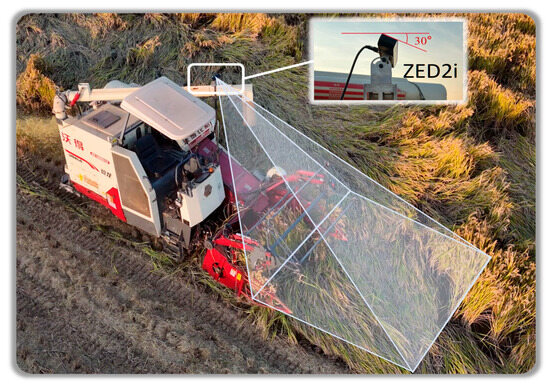
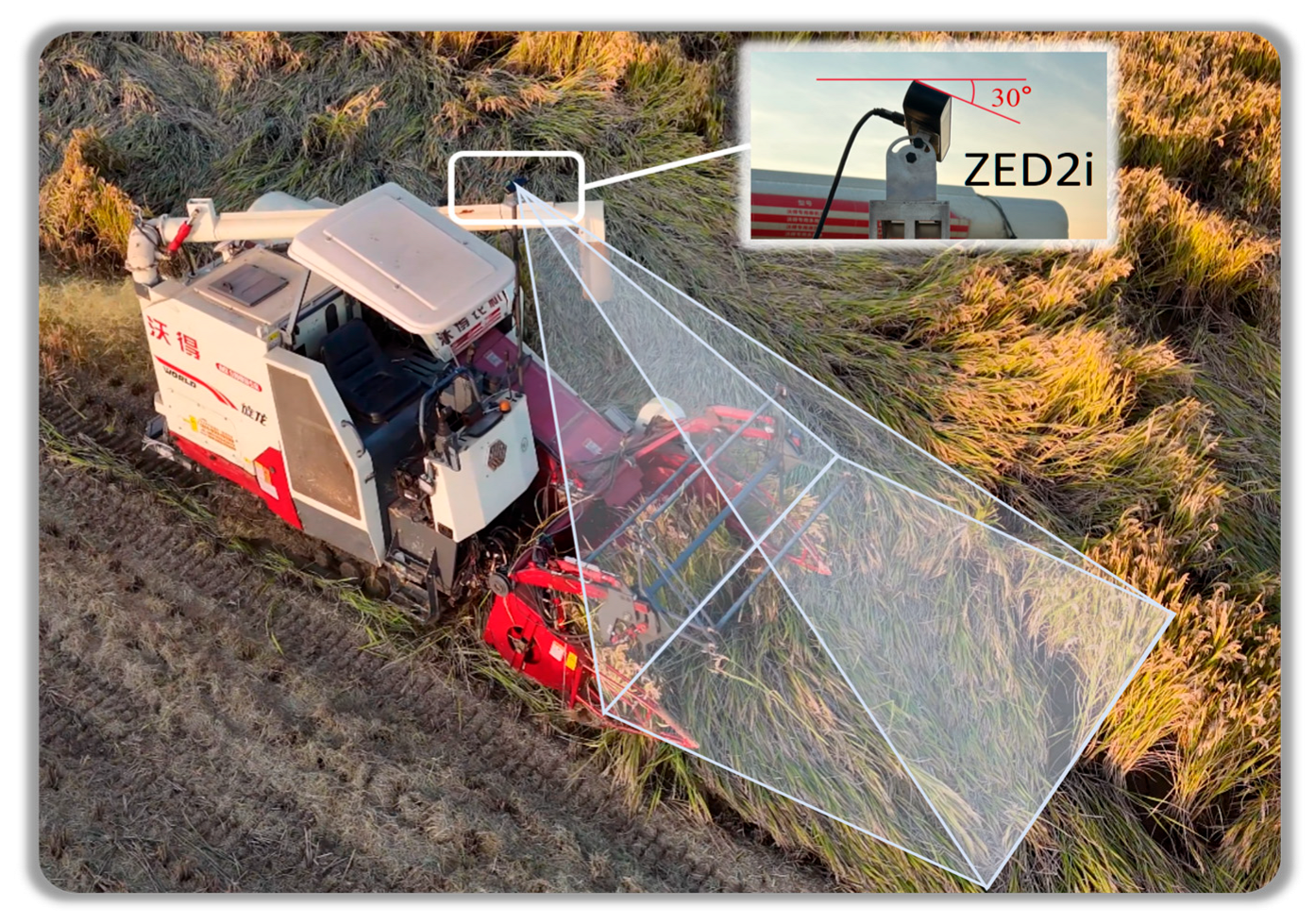
The empirical dataset utilized in this study was aggregated during the rice harvest seasons (September to November) spanning from 2022 to 2025. The data collection campaigns were conducted in the major rice-producing regions of Jiangsu and Chongqing, China. To acquire field images that closely approximate the actual operational perspective, a visual perception system was integrated atop a combine harvester. The core sensor employed was a ZED2i binocular stereo camera (Stereolabs, San Francisco, CA, USA)—selected for its industrial-grade robustness and adaptability to complex outdoor illumination—with its installation pitch angle set to 30° (as illustrated in Figure 1). This perspective design aims to maximize the field of view coverage of the area pending harvest ahead, while simultaneously minimizing interference from the distant non-operational background. In conjunction with this setup, the camera was mounted at an exact height of 2900 mm. The sensor captures raw images at a resolution of 1920 × 1080 with a hardware field-of-view (FOV) of 110° horizontally and 70° vertically, utilizing its factory-calibrated intrinsic parameters to correct lens distortion prior to processing. Finally, a static Region of Interest (ROI) extraction was performed, cropping the original images to 850 × 600 pixels based on the relative positions of the harvesting area and the header. This step standardizes the input by deliberately retaining a partial view of the header along with the immediate unharvested crop, mitigating the impact of peripheral structural variations among different harvesters and focusing the network strictly on the core operational zone. Data collection activities spanned a broad temporal window from 08:00 to 17:00 daily, encompassing diverse lighting environments such as direct intense sunlight, overcast diffuse reflection, and local shadows. Following rigorous quality screening and de-duplication, a rice lodging dataset comprising 2000 high-resolution raw images was ultimately established.
Figure 1.
Configuration of the data acquisition platform.
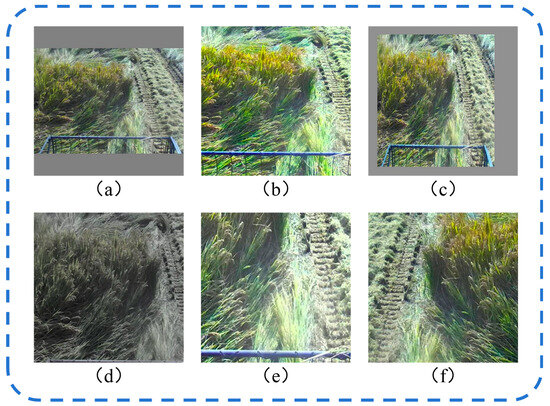
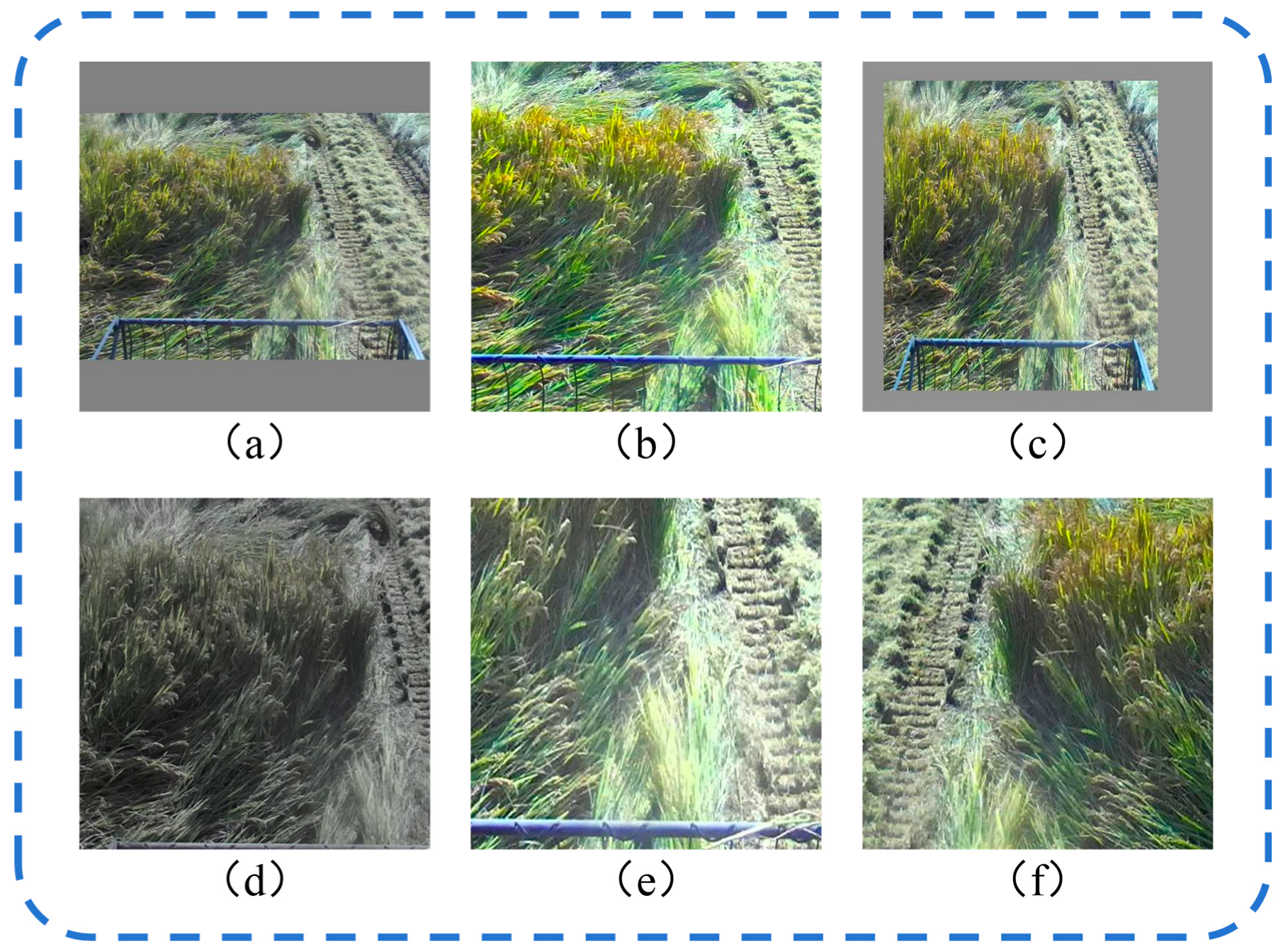
During the data annotation phase, the Labelme platform (MIT Computer Science and Artificial Intelligence Laboratory, Cambridge, MA, USA) was utilized to perform precise semantic region annotation. Based on harvesting logic, image content was categorized into three distinct classes: “Lodged Rice,” “Upright Rice,” and “Background”. In the preprocessing stage, to adapt to network input specifications and optimize computational resources, all images and their corresponding Ground Truth masks were downsampled to 512 × 512 pixels. To ensure the objectivity of model evaluation, the original 2000 images were randomly partitioned into three mutually exclusive subsets following a ratio of 8:1:1: a training set (1600 images), a validation set (200 images), and a test set (200 images). Notably, to enhance the model’s generalization capability under limited training samples and prevent overfitting, traditional offline augmentation methods were discarded in favor of an efficient Online Data Augmentation strategy. Unlike offline augmentation, which provides a limited, fixed set of variants and is prone to introducing static distribution biases and significant storage overhead, the online strategy maximizes combinatorial diversity while avoiding the risk of ‘over-distortion’ that could occur if both methods were redundantly combined. During the training data loading phase, stochastic perturbations are applied to each sample in real time. These include multi-scale spatial jittering (with scale factors randomly sampled from [0.25, 2.0]), random horizontal flipping (p = 0.5), random translation, and lightweight photometric distortions in the HSV color space. This mechanism continuously generates highly diverse samples across epochs to prevent network memorization. To rigorously guarantee experimental repeatability despite this stochasticity, the global random seed was fixed at 11, and deterministic seeding was enforced across all DataLoader workers. Additionally, all augmentation pipelines were strictly disabled during the validation and testing phases to ensure evaluation consistency. The examples of online data augmentation are shown in Figure 2. This dynamic augmentation mechanism ensures that the model is exposed to sample variants with differing fields of view and illumination characteristics in every training epoch. Consequently, this effectively simulates the visual disturbances arising from environmental changes as the harvester navigates the field, significantly bolstering the model’s robustness under complex operating conditions.
Figure 2.
Examples of online data augmentation: (a) Original (letterbox resized), (b–f) Augmented samples (random composite transforms). Each augmented image is generated by applying a randomized combination of scale/aspect-ratio jitter, random translation/crop, HSV jitter, and optional horizontal flip.
2.2. Overall Architecture of StarNet-RiceSeg
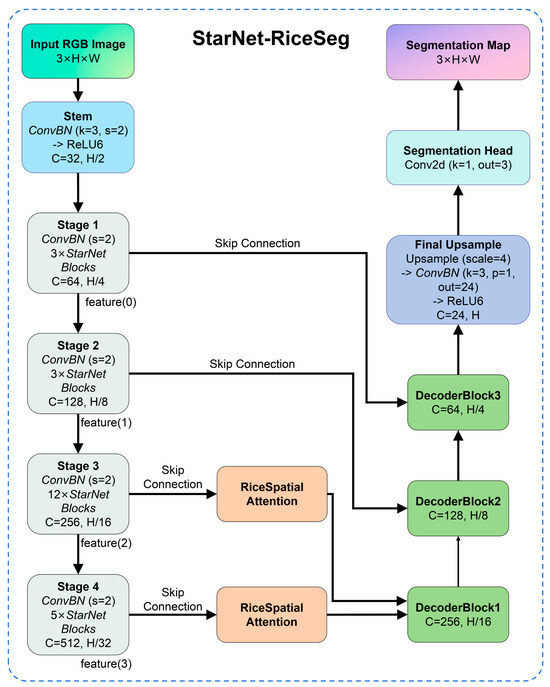
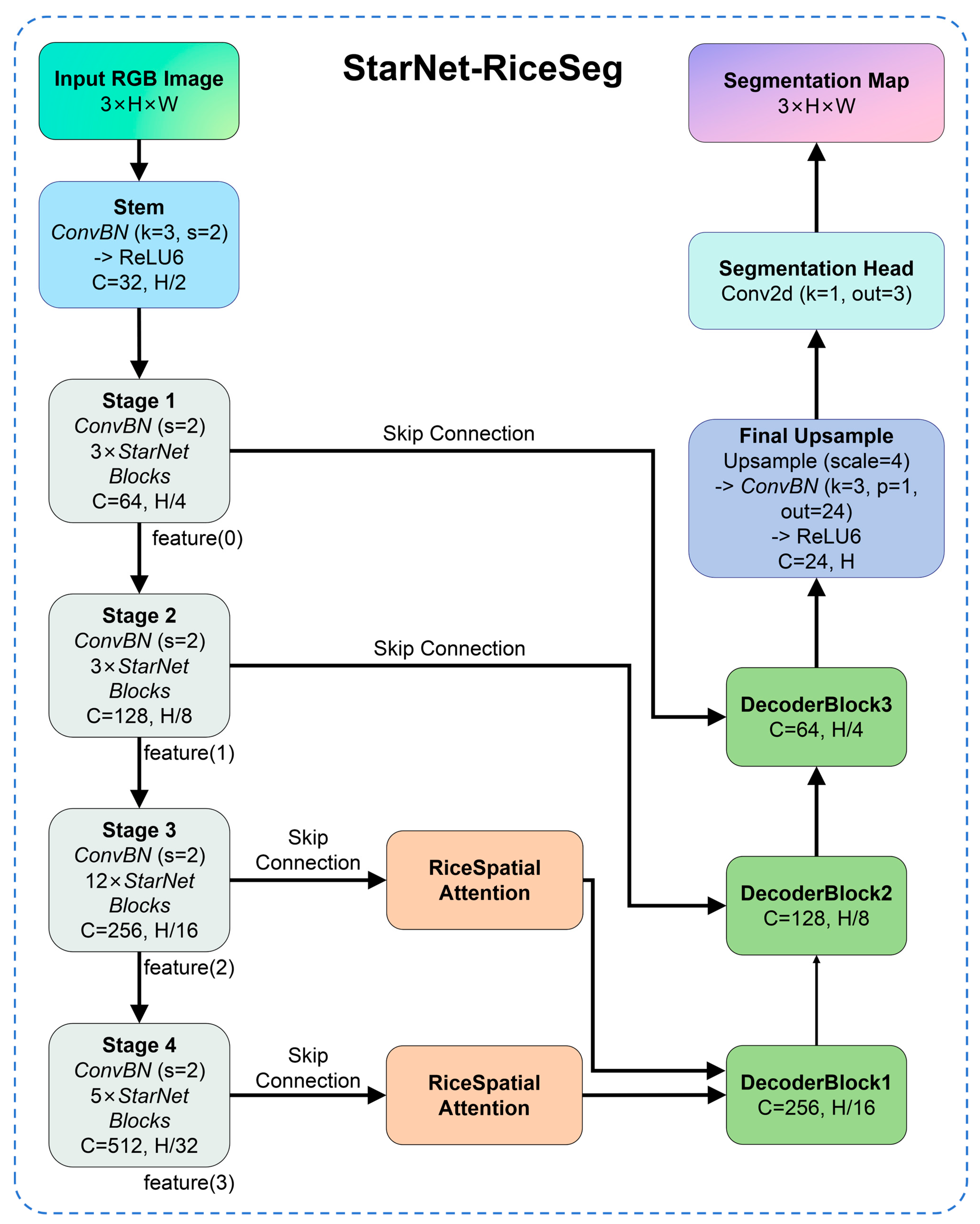
To achieve real-time, high-precision segmentation of rice lodging regions, this study proposes a lightweight semantic segmentation network designated as StarNet-RiceSeg. As illustrated in Figure 3, the network adopts a classic Encoder–Decoder architecture, comprising three principal components: the StarNet Encoder, the Rice Spatial Attention (RSA) Module, and a Lightweight Decoder.
Figure 3.
The overall architecture of the proposed StarNet-RiceSeg.
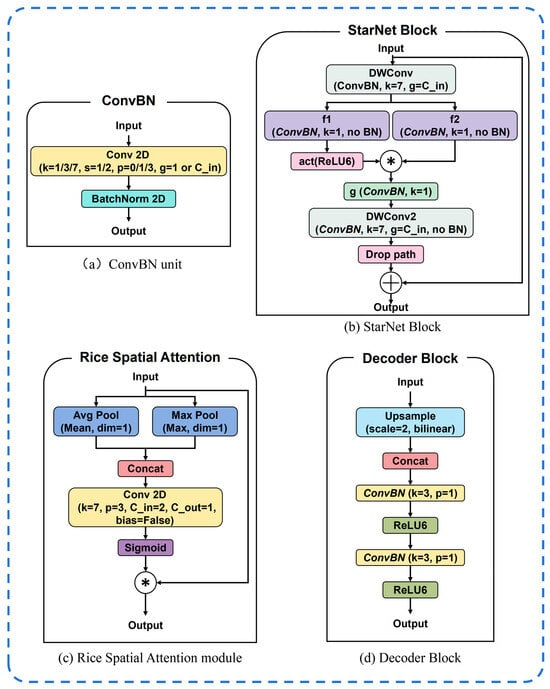
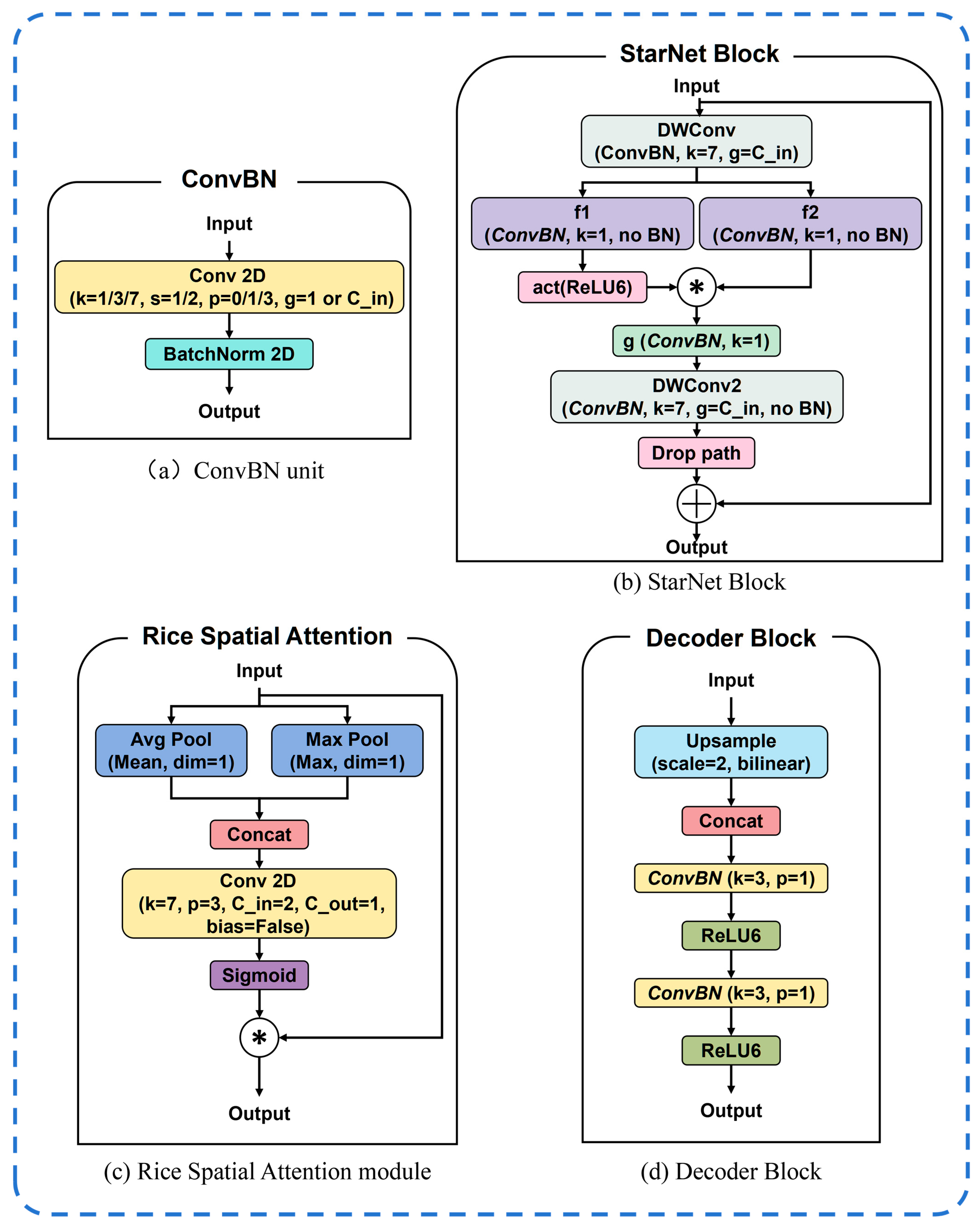
(i) High-Dimensional Feature Mapping Encoder (StarNet Encoder): The network backbone employs StarNet, a lightweight network engineered for efficient feature extraction. Given an input image , it first traverses a Stem layer (comprising a 3 × 3 convolution with a stride of 2) to downsample the spatial resolution to H/2, and expand the channel dimension to 32. Subsequently, the feature maps pass sequentially through four Stages, each consisting of a series of StarNet Blocks. The layer configurations for these four stages are [3, 3, 12, 5], with channel counts progressively increasing to [64, 128, 256, 512], while the feature map resolution is hierarchically downsampled to 1/4, 1/8, 1/16, and 1/32 of the input image, respectively. This hierarchical design enables the network to capture multi-scale features ranging from low-level textures to high-level semantics. The core advantage of StarNet lies in the “Star Operation” within its Block (structure shown in Figure 4b), which maps features into a high-dimensional space for element-wise multiplication. This mechanism significantly enhances nonlinear expressive capacity while maintaining low computational costs. Additionally, the fundamental convolution unit utilizes a ConvBN structure (as shown in Figure 4a) to ensure training stability.
Figure 4.
Detailed structures of the key sub-modules in StarNet-RiceSeg. (a) The ConvBN unit, serving as the basic building block. (b) The StarNet Block, which utilizes element-wise multiplication for high-dimensional feature mapping. (c) The Rice Spatial Attention module, designed to aggregate spatial context and highlight lodging regions. (d) The Decoder Block, which fuses multi-scale features via skip connections. Here, * denotes element-wise multiplication.
(ii) Spatial Attention Enhancement: Considering that rice lodging areas typically exhibit specific spatial distribution characteristics and are prone to confusion with the surrounding healthy, upright rice background, an attention mechanism was incorporated into the deep features of the encoder. Specifically, the Rice Spatial Attention (RSA) module (structure shown in Figure 4c) was embedded after the output feature maps of Stage 3 and Stage 4. This module aggregates features across the spatial dimension to generate a spatial weight map, thereby suppressing background noise and highlighting the salient features of lodging areas, which effectively alleviates misdetection issues in complex field environments.
(iii) Multi-scale Feature Fusion Decoder: To recover the spatial resolution of the image and generate structurally coherent segmentation results, an efficient decoder was designed. The decoder comprises three Decoder Blocks (DecoderBlock 1–3, structure shown in Figure 4d). Each Decoder Block receives deep features from the preceding level, first performing a 2× upsampling via Bilinear Interpolation, and then fusing them with the shallow features from the corresponding encoder level (outputs of Stages 4, 3, and 2) via Skip Connections and concatenation. The fused features are subsequently processed by a 3 × 3 convolution layer to smooth the representations and mitigate aliasing effects.
(iv) Final Prediction: Following processing by the three Decoder Blocks, the feature map resolution is restored to H/4, and the channel count is reduced to 64. To balance inference speed and segmentation accuracy, the concluding Final Upsample module employs a direct upsampling strategy with a scale factor of 4 to restore the feature map to the original image dimensions , and the channel count is reduced to 64. To balance inference speed and segmentation accuracy, the concluding Final Upsample module employs a direct upsampling strategy with a scale factor of 4 to restore the feature map to the original image dimensions N-category space (in this study, N = 3, representing Background, Upright Rice, and Lodged Rice) via a 1 × 1 convolution layer, outputting the final semantic segmentation map.
2.3. The StarNet Encoder
As delineated in Section 2.2, the StarNet encoder functions as the backbone network for feature extraction. In contrast to heavy-weight backbones, its design philosophy prioritizes the maximization of the receptive field and feature nonlinearity within a constrained computational budget. The encoder is composed of four hierarchical stages of varying depths, where the deeper stages are specifically configured with a greater number of modules to capture the high-level semantic abstractions of lodged rice. Specifically, the network adopts a [3, 3, 12, 5] block distribution. This configuration follows the optimal FLOPs allocation strategy of modern CNNs, deliberately concentrating the computational capacity (12 blocks) within Stage 3 (at 1/16 resolution) to maximize robust semantic extraction prior to excessive spatial downsampling.
The fundamental building unit of these stages is the StarNet Block (as illustrated in Figure 4b). Distinct from traditional residual blocks, the StarNet Block introduces the “Star Operation” to facilitate high-dimensional feature mapping [22]. Specifically, given input features , the module initially employs a 7 × 7 depth-wise convolution to capture long-range spatial dependencies. The utilization of such a large convolution kernel enables the network to simulate the extensive receptive field characteristic of Transformers without significantly increasing the parameter count. Compared to traditional 3 × 3 kernels that inherently fragment the perception of large continuous objects, this expanded receptive field is critical for identifying the macroscopic morphology of lodged rice. Following the depth-wise convolution, the features are bifurcated into two independent branches, and . Both branches are constituted by 1 × 1 convolutions without Batch Normalization, designed to expand the channel dimension by a factor of four (expansion ratio = 4). The branch is processed via a ReLU6 activation function, whereas the branch remains linear. Subsequently, the two branches undergo element-wise multiplication, constituting the Star Operation. Formally, the computational process of the StarNet Block is defined as:
where denotes the intermediate features following the initial depth-wise convolution; and represent the two 1 × 1 convolutional branches used for dimensional expansion; denotes the ReLU6 activation function; ⊙ represents element-wise multiplication; is a 1 × 1 convolution that projects the channel dimension back to its original size; is the depth-wise convolution at the output end; and is the final output feature. This design implicitly maps features into an extremely high-dimensional nonlinear space, enabling the network to learn more sparse and discriminative feature representations.
Finally, the entire block is connected to the input features via a residual connection with DropPath regularization to facilitate effective gradient propagation. By eschewing complex self-attention mechanisms and relying solely on convolutions and element-wise multiplications, the StarNet Block ensures the algorithm’s capability for real-time inference on embedded devices.
2.4. Rice Spatial Attention Module
Although the StarNet encoder is proficient in extracting rich high-dimensional features, the complex environment of rice fields presents significant challenges. Lodged regions frequently exhibit irregular geometric morphologies, and their textural characteristics are prone to being confounded with illumination shadows or the canopies of healthy, upright crops. To bolster the network’s spatial localization capabilities regarding lodged regions, this study integrated the Rice Spatial Attention (RSA) module at the output terminals of Stage 3 and Stage 4. This targeted placement strategy is predicated on a three-fold consideration: first, deep stages (Stages 3 and 4) abstract high-level semantics that directly dictate class discrimination and spatial focus on boundary transition zones during decoding, making spatial gating at these levels highly sensitive to final segmentation quality; second, applying pixel-wise spatial recalibration exclusively to lower-resolution deep features averts excessive computational and memory overhead, yielding an optimal accuracy–speed trade-off; third, it prevents premature attention gating in shallow stages (Stages 1 and 2), thereby avoiding the suppression of crucial low-level textural details and ensuring training stability. As illustrated in Figure 4c, this module is designed to exploit spatial interdependencies within features to generate attention maps, thereby emphasizing informative features of lodged areas while suppressing background noise.
Specifically, given an input feature map , the RSA module first applies Average Pooling and Max Pooling operations along the channel axis. The rationale behind this strategy is twofold: average pooling aggregates global feature responses across spatial locations, whereas max pooling captures the most salient textural details, such as lodging transition zones. By concurrently employing both pooling operations, we obtain a more comprehensive descriptor of the image’s spatial information. This process yields two 2D feature descriptors: and
Subsequently, these descriptors are concatenated along the channel dimension to form a dual-channel feature map. To capture broad spatial contextual information, a large-kernel convolution layer is employed to process the concatenated features. Finally, a Sigmoid activation function maps the convolutional output to the interval, generating the final 2D spatial attention map . The computational process of the RSA module can be formulated as follows:
where denotes the Sigmoid activation function; represents a convolution operation with a kernel size of (padding = 3, bias = False); signifies the concatenation operation along the channel dimension; and denotes element-wise multiplication. The final output is the weighted result of the original input features F and the spatial attention map . This mechanism enables the network to adaptively focus on informative regions containing lodged rice within the image, while disregarding irrelevant background areas during the subsequent decoding process.
2.5. Decoder and Feature Fusion
To compensate for the loss of spatial details resulting from consecutive down-sampling during the encoding phase and to generate structurally cohesive segmentation results, a cascaded lightweight decoder was constructed. This architecture comprises three identically structured Decoder Blocks (as illustrated in Figure 4d) alongside a Final Upsample Module. The decoding process adheres to a “stepwise recovery” principle, leveraging Skip Connections to fuse shallow, high-resolution features from the encoder with deep semantic features from the decoder.
Specifically, the decoder encompasses three stages, corresponding to Stages 4, 3, and 2 of the encoder. In each decoding phase, the input feature first undergoes a 2× upsampling via a Bilinear Interpolation layer to match the resolution of the preceding encoding features. Subsequently, the upsampled features are concatenated along the channel dimension with the skip features from the corresponding encoder level. These skip connections introduce rich shallow texture and structural information, effectively mitigating the issue of spatial information loss inherent in deep networks.
The fused features then propagate through two consecutive 3 × 3 convolution layers (incorporating ConvBN and ReLU6 activation functions). This step aims to smooth the aliasing effects introduced by concatenation and to integrate semantic information with detailed features. Formally, the computational process of the i-th Decoder Block is expressed as:
where denotes the channel concatenation operation, represents the ReLU6 activation function, and indicates the 3 × 3 convolution operation.
Following processing by the three Decoder Blocks, the feature map resolution is restored to . To balance computational efficiency, the architecture eschews the further stacking of decoder blocks in favor of a Final Upsample module. This module incorporates a bilinear upsampling layer with a scale factor of 4 and a 3 × 3 convolution layer, directly restoring the feature map to the original image dimensions H × W, while compressing the channel count to 24. Finally, the Segmentation Head maps the features to N class probability maps via a 1 × 1 convolution layer, thereby completing the end-to-end dense semantic prediction.
2.6. Implementation Details and Evaluation Metrics
2.6.1. Experimental Environment and Training Strategies
To eliminate the impact of systemic discrepancies on experimental results, all model training and inference evaluations were conducted within a unified high-performance computing environment (supported by SCNet). Regarding hardware configuration, the computing nodes are equipped with dual Intel® Xeon® Platinum 8458P processors (totaling 88 cores) (Intel Corporation, Santa Clara, CA, USA), with 10 physical cores explicitly allocated to this task to guarantee parallel efficiency during data preprocessing. The graphical acceleration unit employed is a single NVIDIA L20 data-center grade GPU (NVIDIA Corporation, Santa Clara, CA, USA); its substantial 48 GB ECC video memory provides significant computational redundancy and stability for training with full-resolution inputs. System memory is configured at 246 GB, sufficient to support the high-speed throughput of large-scale datasets. The software environment is based on the Ubuntu 22.04 LTS operating system (Canonical Ltd., London, UK), utilizing the PyTorch 2.4.1 deep learning framework (Meta Platforms, Inc., Menlo Park, CA, USA) configured with the CUDA 12.1 acceleration library to fully unleash the performance of the L20’s Ada Lovelace architecture. To ensure deterministic initialization, the global random seed was fixed at 11.
Regarding training strategies, leveraging the 48 GB ultra-large video memory advantage of the L20 GPU, a High-Throughput Two-stage Freeze Training Scheme was devised, spanning a total of 200 epochs to maximize training efficiency and ensure the statistical stability of Batch Normalization. Phase I (Freeze Stage): During the initial 50 epochs, the backbone network weights were frozen, and training was restricted to the newly introduced Rice Spatial Attention module, the decoder, and the segmentation head. The primary objective of this stage is to stabilize the early optimization process and protect the pre-trained backbone from the unstable error gradients originating from the randomly initialized modules. To accelerate convergence and stabilize gradients, the batch size for this phase was set to 32. Phase II (Unfreeze Stage): During the subsequent 150 epochs, the entire network was unfrozen to enable global end-to-end co-adaptation. To ensure the accuracy of Batch Normalization layer statistics under 512 × 512 high-resolution inputs while fully utilizing video memory, the batch size was adjusted to 16. The Adam optimizer was selected with momentum set to 0.9. In terms of explicit regularization, weight decay was deliberately set to 0. This setting maintains a concise, stable configuration consistent with our baseline experiments. Mathematically, it avoids the suboptimal coupling of L2 penalties with adaptive momentum in Adam, prevents the penalization of Batch Normalization layers, and preserves structural and morphological details. Overfitting is instead robustly mitigated through a compensatory ensemble including DropPath, online data augmentation, and the composite Weighted Cross-Entropy and Dice Loss. FP32 full-precision training was adopted throughout to ensure numerical stability. A Cosine Annealing Decay strategy was employed for the learning rate, initiating at , and gradually decaying to . To ensure a fair comparison, all models participating in the contrastive experiments were trained under identical hardware environments and hyperparameter configurations. Detailed configurations are summarized in Table 1.
Table 1.
Detailed experimental environment and hyperparameter settings.
2.6.2. Loss Function
To mitigate the issue of class imbalance inherent in rice lodging detection tasks, a composite loss function, denoted as , was employed for optimization. This objective function integrates Weighted Cross-Entropy Loss ( and Dice Loss (, and is formulated as follows:
where N represents the number of categories (in this study, N = 3), and denote the ground truth label (One-hot encoded) and the predicted probability for the i-th class, respectively; signifies the class weighting coefficient; and is a smoothing term introduced to prevent division-by-zero errors.
To guarantee an objective and rigorous evaluation, the comparative experiments were meticulously configured. Regarding backbone selection, representative networks were adopted based on their widely recognized standard configurations to accurately reflect their baseline performance (specifically, the standard ResNet-50 for U-Net and DeepLabV3+, the original VGG for SegNet, and the classic HRNetV2-W18 for HRNet). All models were trained using the Adam optimizer with a 512 × 512 input resolution, identical loss function settings, and the same online data augmentation strategies. Furthermore, since enforcing a rigid, identical learning rate across architecturally diverse networks often precludes them from achieving their respective optimal performance, the initial learning rates were empirically optimized: 1 × 10⁻⁴ was applied to the baseline networks to maintain gradient stability, while 1 × 10⁻³ was utilized for the proposed StarNet-RiceSeg. This configuration ensures that the evaluation reliably captures the true upper-bound capabilities of each model.
2.6.3. Evaluation Metrics
Given that the operational environments of unmanned combine harvesters typically lack support from high-performance computing servers, and that onboard computing platforms (e.g., the NVIDIA Jetson series) possess extremely constrained resources, model lightweightness and deployment efficiency constitute pivotal factors determining the feasibility of engineering implementation. Consequently, this study conducts a comprehensive evaluation of the model across two dimensions: segmentation accuracy and computational efficiency.
Regarding segmentation accuracy, the Mean Intersection over Union (mIoU) was selected as the cardinal metric to quantify the degree of set overlap between the predicted regions and the ground truth labels (including background). The calculation formula is as follows:
where k represents the number of semantic categories excluding the background (in this study, k = 2, corresponding to upright rice and lodged rice). denote the number of true positive, false positive, and false negative pixels for the i-th class, respectively.
To specifically evaluate the model’s reliability in identifying lodged regions, we further introduced Precision and Recall metrics. Precision measures the proportion of correctly identified lodged pixels among all pixels predicted as lodged, reflecting the model’s ability to minimize false alarms. Recall measures the proportion of correctly identified lodged pixels among all actual lodged pixels, indicating the model’s capability to avoid missed detections. The formulas are defined as:
In terms of computational efficiency, to verify whether the model satisfies real-time detection requisites, Parameters (Params) and Giga Floating-point Operations (GFLOPs) were adopted to measure the model’s spatial complexity and temporal complexity, respectively. Simultaneously, Frames Per Second (FPS) was utilized as an intuitive quantitative indicator of actual inference speed. By balancing the trade-off between mIoU and FPS, this study aims to validate whether StarNet-RiceSeg can adapt to the real-time processing demands of edge-side devices while guaranteeing high precision.
3. Results
3.1. Training Dynamics and Class-Wise Performance Analysis
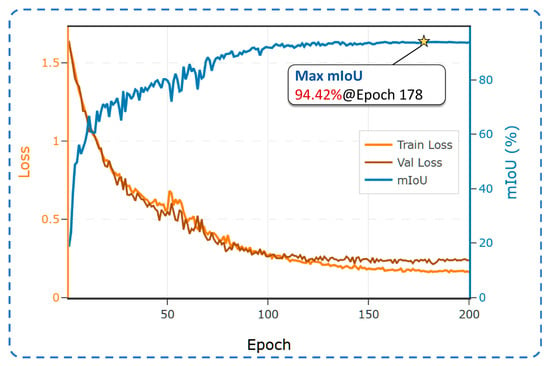
To comprehensively assess the convergence characteristics and generalization capabilities of the StarNet-RiceSeg model, dynamic metrics were recorded throughout the entire training cycle (Figure 5) and an in-depth analysis of class-wise performance on the test set (Figure 6) was conducted. As elucidated by the training curves in Figure 5, the model’s learning trajectory exhibits distinct two-stage characteristics, which strictly corroborates with the freeze-training strategy detailed in Section 2.6.1. During the initial 50-epoch Freeze Stage, facilitated by the Rice Spatial Attention module’s rapid adaptation to feature distributions, the loss value precipitated from an initial 1.62 to 0.56. Concurrently, the mIoU exhibited a steep ascent, surging from 18.6% to 79.7%. Upon entering the Unfreeze Stage, as the StarNet backbone parameters were incorporated into the global fine-tuning process, the model’s performance was further elevated. Despite minor fluctuations in mIoU during the latter stages of training, the model achieved peak performance at Epoch 178, with the validation mIoU reaching a zenith of 94.42%. Notably, the validation loss (Val Loss, depicted in brown) maintained a highly synchronized downward trend with the training loss (Train Loss, depicted in orange), with a negligible divergence between the two. This tight synchronization between training and validation trajectories serves as direct empirical proof that the diverse online data augmentation strategy effectively acted as a robust regularizer. It ensured the model remained free from overfitting, thereby demonstrating superior generalization stability and effectively substituting the need for a zero-augmentation baseline.
Figure 5.
Training dynamics of the StarNet-RiceSeg model.
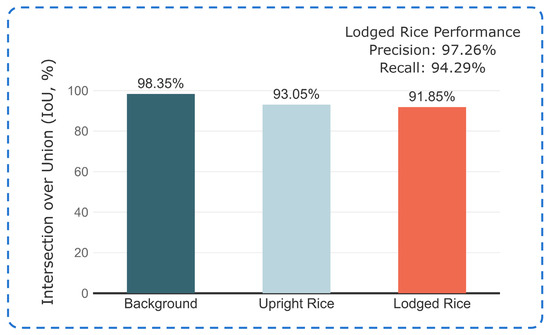
Figure 6.
Class-wise segmentation performance analysis.
Furthermore, Figure 6 illustrates the specific segmentation performance of the optimal model across distinct semantic categories. The results indicate that StarNet-RiceSeg achieved exceptionally high segmentation accuracy for both “Background” and “Upright Rice” categories, yielding IoU scores of 98.35% and 93.05%, respectively. The high recognition accuracy for upright rice is pivotal, acting as a “negative sample defense line” for lodging detection. Precise identification of upright regions is prerequisite to ensuring that healthy crops are not misclassified as lodged, thereby guaranteeing high confidence in lodging detection.
For the “Lodged Rice” category—the primary focus of this study—the model demonstrated equally superior performance, attaining an IoU of 91.85%. To verify the reliability of the model in practical engineering applications, the Precision and Recall metrics specifically for the lodging category were further analyzed. Data indicates that the Precision for the lodging category stands at 97.26%, implying that the model rarely misclassifies upright rice as lodged, thereby effectively reducing the false alarm rate that could trigger erroneous harvester adjustments. Simultaneously, the Recall reached 94.29%, signifying that the vast majority of lodged areas were successfully captured, which contributes to minimizing harvest losses caused by missed detections. These “dual-high” results validate the effective synergy between the high-dimensional nonlinear features extracted by StarNet and the spatial attention mechanism. This combination empowers the model to precisely capture subtle morphological discrepancies of lodged crops within complex field environments, achieving robust regional localization of lodging areas.
3.2. Comparison with Mainstream Segmentation Models
To validate the comprehensive performance of StarNet-RiceSeg, a quantitative benchmarking was conducted against four mainstream semantic segmentation networks—SegNet [23], U-Net [24], DeepLabV3+ [25], and HRNet [26]—on the same test set (as summarized in Table 2). It is crucial to emphasize that, to ensure the fairness and comparability of the experimental results, all inference tests were executed under a hardware environment identical to the training phase (Intel Xeon 8458P CPU + NVIDIA L20 GPU). (Deployment tests on the embedded development board are detailed in Section 3.4).
Table 2.
Quantitative performance comparison of mainstream semantic segmentation models.
The experimental results demonstrate that the proposed method achieves the optimal equilibrium between accuracy and efficiency. regarding segmentation accuracy (mIoU), StarNet-RiceSeg attained an mIoU of 94.42%. This performance not only significantly surpasses classic architectures such as SegNet (83.60%) and U-Net (85.41%) but also outperforms DeepLabV3+ (90.17%), a model renowned for its extensive receptive field. Even when compared to the high-performance HRNet (92.46%), the proposed method achieved an accuracy improvement of nearly 2 percentage points. Furthermore, to rigorously validate the statistical significance of this superiority beyond our deterministic main experiment, an additional robustness test comprising 5 repeated training runs with varied random seeds was conducted. The two-sample t-test results confirmed that StarNet-RiceSeg (94.35 ± 0.10%) significantly outperformed HRNet (94.32 ± 0.16%) with a p-value < 0.01. More importantly, this robust accuracy advantage is achieved alongside a significant computational improvement—halving the GFLOPs and tripling the FPS of HRNet—which firmly establishes its practical value for edge-deployed autonomous harvesters.
In terms of model complexity and computational efficiency, StarNet-RiceSeg exhibits a distinct lightweight advantage. Its parameter count stands at a mere 8.01 M, with a floating-point operation count (FLOPs) as low as 9.32 G. Compared to the most computationally intensive models, SegNet (160.83 G) and DeepLabV3+ (162.34 G), the proposed method reduces computational costs by over 94%. Consequently, the model achieves an inference speed of 232.67 FPS, which is approximately 3.4 times that of HRNet (67.89 FPS). These metrics rigorously prove that the model fully satisfies the stringent requirements for real-time processing on unmanned harvester terminals.
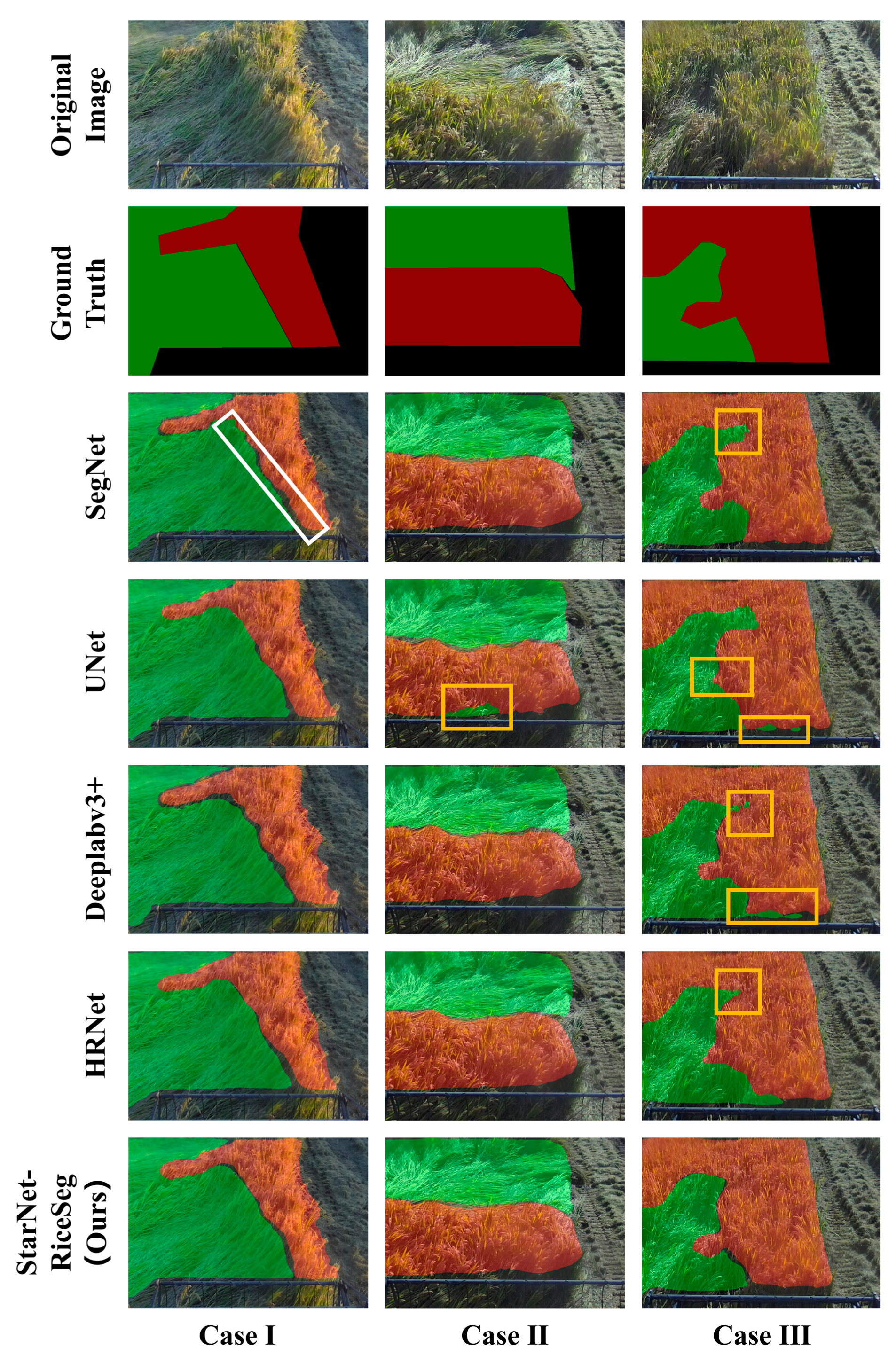
Figure 7 further presents the qualitative segmentation results of the five models across three representative scenarios, where red regions denote upright rice and green regions indicate lodged rice. A comparison with the Ground Truth (second row) reveals significant disparities in detail handling among the models. Case I: Observations indicate that the segmentation results of SegNet are exceedingly coarse. Fragmented predictions are visible at the transition zones between lodged and upright rice (as highlighted by the white rectangular box), suggesting that its simple up-sampling mechanism struggles to recover continuous morphological information. Cases II & III: SegNet (Case III), U-Net (Cases II & III), and DeepLabV3+ (Case III) all exhibit varying degrees of False Positive phenomena. As indicated by the yellow rectangular boxes, these models erroneously classify portions of upright rice or background areas as lodged rice (green regions). This “over-sensitivity” to texture can lead to operational misjudgments in practical harvesting scenarios. Comparison with HRNet: In contrast, HRNet maintains better regional coherence, effectively mitigating the fragmentation issue; however, its cumbersome multi-branch parallel structure results in significantly lower inference efficiency.
Figure 7.
Qualitative visualization of segmentation results on challenging rice lodging scenarios. Green regions represent lodged rice, and red regions represent upright rice. The white box highlights fragmented predictions, and the yellow boxes indicate false positive areas.
Synthesizing the above quantitative and qualitative analyses, it can be concluded that traditional segmentation models possess distinct limitations when addressing rice lodging tasks. SegNet and U-Net, while structurally classic, suffer from fragmented regional delineations and misclassification; DeepLabV3+, despite its large receptive field, still exhibits false positives; and HRNet, while maintaining morphological consistency, incurs an excessive computational penalty. StarNet-RiceSeg successfully breaks this bottleneck. It effectively resolves the issues of misdetection and regional fragmentation in complex scenarios while maintaining an extremely low computational cost (9.32 GFLOPs), achieving SOTA level segmentation accuracy and inference speeds far exceeding real-time requirements. This superior performance trade-off renders it the ideal choice for deployment on resource-constrained agricultural embedded devices.
3.3. Ablation Studies
3.3.1. Effectiveness of StarNet Backbone
To substantiate the rationale behind selecting StarNet as the feature extractor, a comprehensive quantitative and qualitative comparison was conducted against the classic heavy-weight backbone, ResNet-18 [27], and the ultra-lightweight backbone, MobileNetV3 [28], on the same dataset. MobileNetV3 was deliberately chosen as the comparative baseline because it acts as a classic and representative paradigm for the broader family of lightweight architectures (encompassing variants like EfficientNet) that are fundamentally built upon depthwise-separable convolutions and inverted residual blocks. This allows for a rigorous assessment of the inherent constraints associated with conventional lightweighting methodologies. As presented in Table 3, although MobileNetV3 achieved the highest inference speed (315.21 FPS) by virtue of its minimalist architecture, its mIoU was limited to 77.74%. This suggests that excessive lightweighting compromises the network’s ability to effectively capture the complex textural features of lodged rice. In contrast, StarNet achieved a remarkable mIoU of 94.42%, not only significantly outperforming MobileNetV3 but also surpassing the parameter-heavy ResNet-18 (85.25%) by a margin of 9.17%. Regarding efficiency, StarNet’s parameter count (8.01 M) and FLOPs (9.32 G) are substantially lower than those of ResNet-18 (14.29 M, 20.68 G), representing a reduction in computational cost of over 50%. This demonstrates that StarNet achieves an optimal balance between accuracy and efficiency while preserving critical semantic information.
Table 3.
Quantitative performance comparison of different backbone networks.
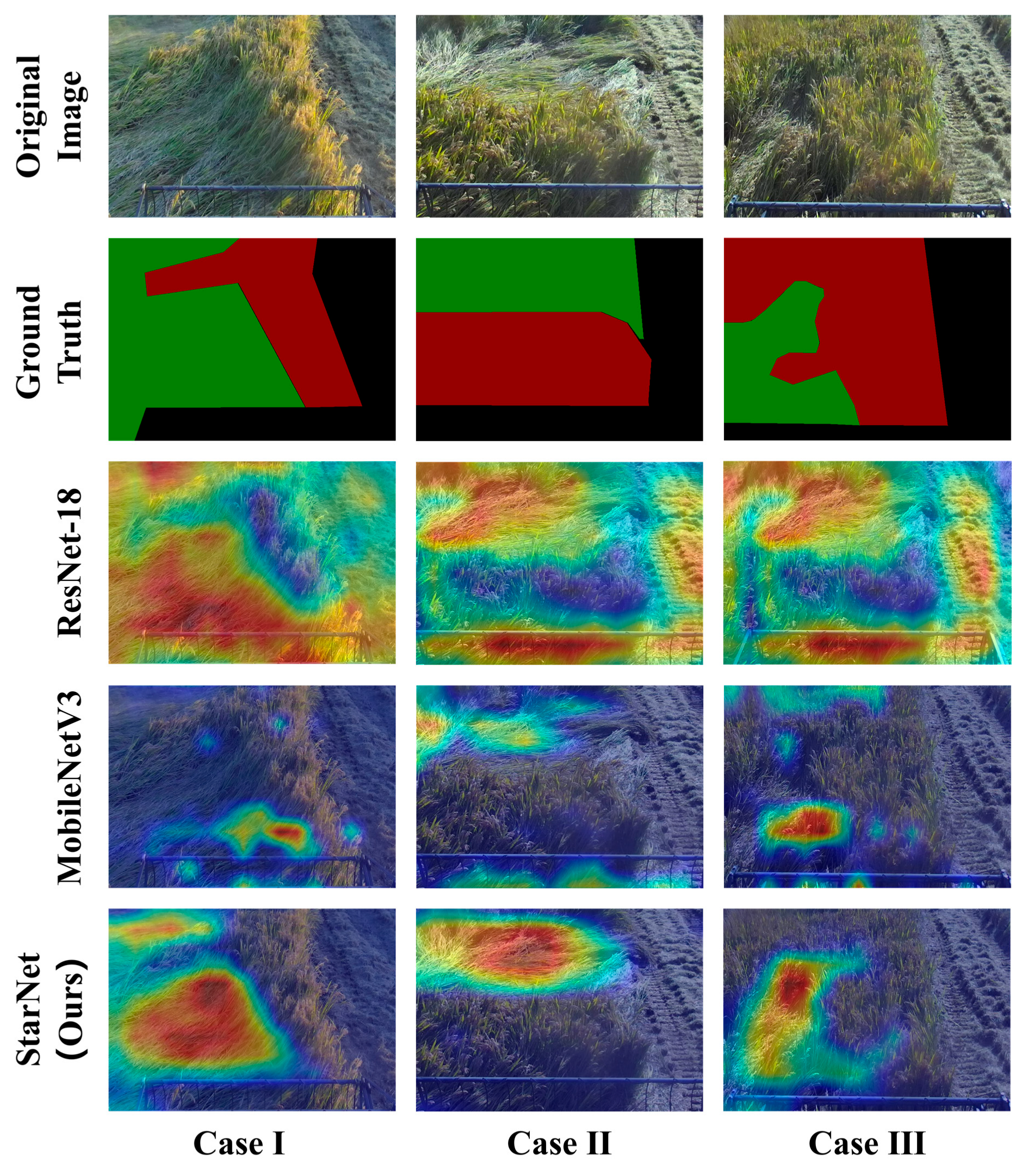
The Grad-CAM heatmaps in Figure 8 further corroborate these findings from a visual perspective. Given that the crux of lodging detection lies in separating the target from the environment, the analysis was focused on the model’s activation response to the “Lodged Rice” category. Observing the heatmaps for MobileNetV3 (middle row), it is evident that its activation regions are relatively divergent and weak. Feature loss even occurs in certain lodged areas (e.g., Case I), which elucidates the underlying cause of its lower segmentation accuracy. While ResNet-18 (first row) exhibits high activation intensity, its focus frequently extends to non-lodged background areas, manifesting a state of “over-activation” that is prone to inducing false positives. Conversely, the heatmaps for StarNet (bottom row) demonstrate a high degree of focus and precision. Particularly in Case II and Case III, the high-response regions accurately cover the core areas of lodged rice with cohesive structural morphology, remaining virtually unaffected by background noise. This attests that the StarNet backbone is capable of extracting more discriminative semantic features, laying a solid foundation for the subsequent high-precision segmentation task.
Figure 8.
Grad-CAM visualization results of different backbone networks. In the heatmaps, warmer colors (e.g., red) indicate higher network attention, while cooler colors (e.g., blue) represent lower attention.
3.3.2. Impact of Rice Spatial Attention
To validate the pivotal contribution of the Rice Spatial Attention (RSA) module, a baseline model without attention mechanisms (“No Attn”) was established, and a cost–performance comparative analysis was conducted by introducing the SE Block (Channel Attention) [29], CBAM (a representative Channel + Spatial Attention mechanism) [30], and the proposed RSA module. Experimental data from Table 4 reveals that the baseline model attained an mIoU of only 76.93%. While the incorporation of the SE Block and CBAM yielded moderate accuracy improvements (+1.28% and +6.62%, respectively), the magnitude of these gains remained limited.
Table 4.
Ablation study on the effectiveness of different attention mechanisms.
In stark contrast, the integration of the RSA module propelled the model’s mIoU to 94.42%, achieving a remarkable performance leap of 17.49% relative to the baseline. Crucially, as indicated in Table 4, the additional parameters and computational overhead introduced by the RSA module are virtually negligible (maintaining the total parameters at approximately 8.01 M and FLOPs at 9.32 G), yet it catalyzes a qualitative transformation in performance. This evidence substantiates that the spatial attention mechanism, specifically tailored for lodging features, is significantly more efficient than generic channel attention mechanisms for this task.
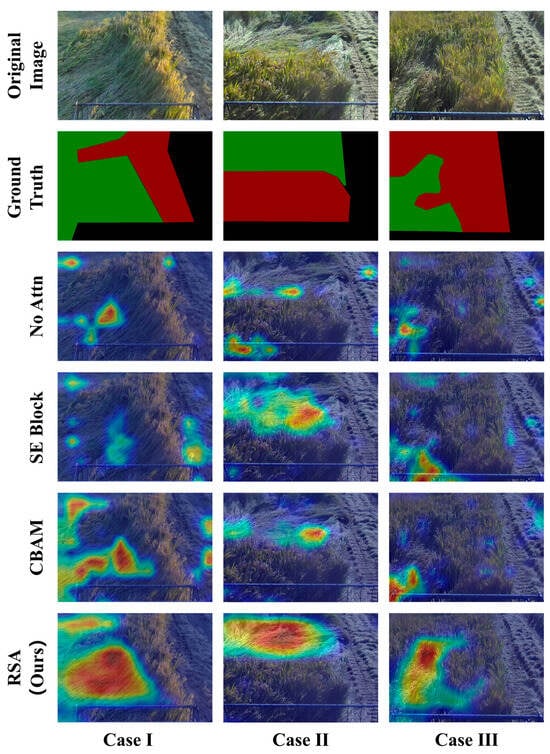
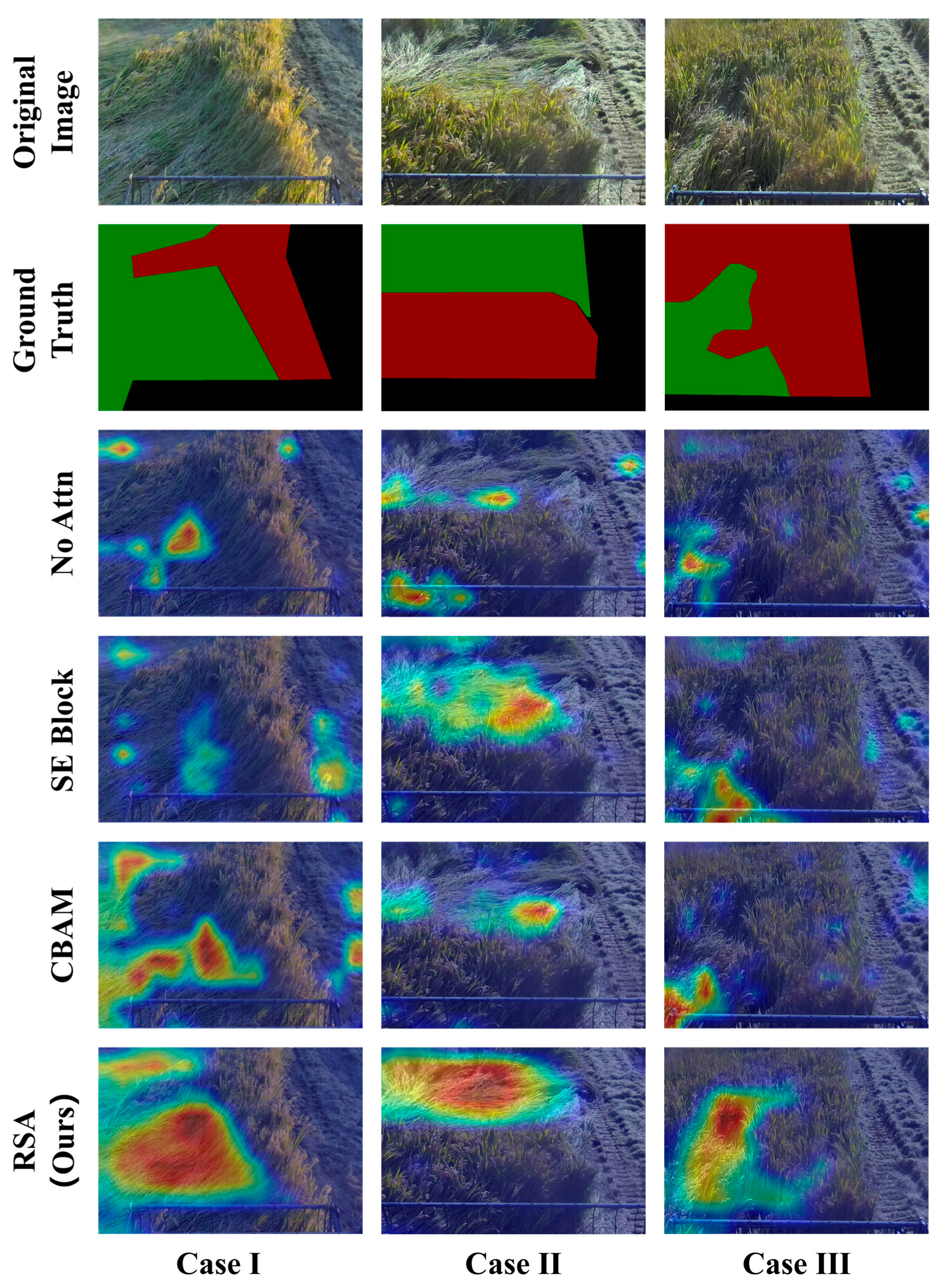
The visual heatmaps in Figure 9 elucidate the operational mechanisms of the different attention modules. In the absence of an attention mechanism (first row), the network’s focus on lodged regions is chaotic, exhibiting a multi-centric, scattered distribution that erroneously activates substantial areas of upright rice (e.g., the left side of Case I). Although the SE Block (second row) enhances certain features, the heatmaps remain relatively blurred and fail to effectively suppress background interference. The introduction of the spatial dimension via CBAM (third row) begins to concentrate focus on lodged areas; however, the activation scope remains imprecise (e.g., incomplete boundary coverage in Case III).
Figure 9.
Visual comparison of feature activation maps with different attention modules. In the heatmaps, warmer colors (e.g., red) indicate higher network attention, while cooler colors (e.g., blue) represent lower attention.
Conversely, the proposed RSA module (bottom row) demonstrates impeccable focusing capabilities. Across all three test cases, the heatmaps exhibit a high-intensity, single-core activation region with cohesive structural delineations, perfectly aligning with the actual morphology of the lodged rice. This mechanism not only thoroughly suppresses background noise but also reinforces the capture of irregular lodging morphologies. These results compellingly demonstrate that the RSA module successfully guides the network to attend to the most critical lodging features, serving as the core driver of the model’s performance enhancement.
To elucidate the underlying mechanism driving the substantial performance gains observed with the RSA module, it is essential to recognize its role in introducing ‘explicit spatial recalibration’ to the high-level features of StarNet, without significantly increasing parameter count or computational overhead. Specifically, while the StarNet backbone efficiently extracts multi-scale nonlinear representations, its high-level feature responses tend toward ‘broad-area activations’ in scenarios with highly similar textures. This results in insufficient spatial focus on narrow transition zones, local folds, and transition zones, subsequently leading to class confusion and adhesion between lodged and upright areas. Positioned between the encoder (Stages 3 and 4) and the decoder, the RSA module addresses this limitation by first generating compact spatial saliency cues through channel-wise statistics (average and max pooling). It then applies adaptive spatial gating to the feature maps using pixel-wise weights generated via convolution. Consequently, key regions associated with lodging—particularly the high-uncertainty transition zones near boundaries—are enhanced, whereas background and easily confused upright texture responses are suppressed. As a result, the decoding stage receives ‘cleaner and more focused’ high-level semantic priors. During skip-connection fusion, this reduces noise propagation and improves regional localization, benefiting both structural delineation and the distinction between lodged and upright rice. Compared to SE (which primarily focuses on channel recalibration) or CBAM (a more general channel-spatial attention), RSA is more closely aligned with the specific requirements of this task for spatial discrimination and transition zone sensitivity. This provides a clear mechanistic justification for why RSA delivers substantial performance improvements with almost no change to model complexity.
3.4. Deployment Verification on Edge Computing Platform
To validate the feasibility of deploying StarNet-RiceSeg in authentic agricultural operational scenarios, the trained model was migrated to a resource-constrained edge computing platform, the NVIDIA Jetson Xavier NX (8 GB) (NVIDIA Corporation, Santa Clara, CA, USA). Functioning as the onboard computing environment for the unmanned harvester, this device offers a modest AI computing performance of only 21 TOPS.
To maximize the hardware utilization of the embedded device, a standard model acceleration pipeline was implemented. Initially, the trained PyTorch model was exported to the Open Neural Network Exchange (ONNX) intermediate format. Subsequently, the NVIDIA TensorRT inference engine was leveraged to construct an optimized execution engine specifically tailored for the Jetson Xavier NX architecture. During this process, an FP16 (half-precision) quantization strategy was employed. This approach not only compressed the model weight file from 32 MB to approximately 16 MB, significantly reducing memory occupancy, but also capitalized on the hardware characteristics of Tensor Cores to substantially boost inference throughput without compromising segmentation accuracy.
Table 5 delineates the specific performance metrics of the model on the edge terminal. Experimental results indicate that, benefiting from the extremely streamlined architecture of StarNet and the deep optimization provided by TensorRT, the model achieved an inference speed of 32.51 FPS on the Jetson NX, with a single-frame processing latency of merely 30.76 ms. Recognizing that real-world latency is fundamentally governed by Memory Access Costs (MAC) and parallelization efficiency rather than theoretical FLOPs alone, a granular latency breakdown of this 30.76 ms pipeline was conducted. The execution time is distributed as follows: Data Preprocessing (~3.15 ms), StarNet Backbone feature extraction (~14.62 ms), RSA Module and Decoder feature fusion (~10.54 ms), and Output Post-processing (~2.45 ms). This breakdown demonstrates that despite the memory-bound nature of depth-wise convolutions in the backbone, the architecture maintains high execution efficiency under TensorRT optimization. It is imperative to clarify that this reported speed explicitly represents the full end-to-end processing pipeline, encompassing image reading, resizing, core network inference, and final mask generation. This performance metric successfully surpasses the 30 FPS threshold typically required for real-time video processing. Consequently, an unmanned combine harvester equipped with StarNet-RiceSeg is capable of generating high-precision lodging segmentation maps in real time during active operation.
Table 5.
Deployment performance of StarNet-RiceSeg on NVIDIA Jetson Xavier NX.
Furthermore, to ensure a fair and comprehensive evaluation of deployment feasibility, the four mainstream baseline models were benchmarked on the same Jetson Xavier NX platform using an identical TensorRT FP16 optimization pipeline. The comparative edge inference speeds are presented in Table 6. The results reveal that conventional architectures, hampered by massive computational loads, memory bandwidth constraints, and edge-inefficient operators (such as dilated convolutions in DeepLabV3+ and multi-branch parallelism in HRNet), struggle to achieve optimal real-time performance on the edge. Heavy models like SegNet and DeepLabV3+ yield sub-optimal frame rates (11.53 FPS and 8.42 FPS), and even the highly optimized U-Net and HRNet are restricted to 18.25 FPS and 8.81 FPS, respectively. This comparative data corroborates that StarNet-RiceSeg (32.51 FPS) demonstrates the optimal capability among the tested models to satisfy the >30 FPS real-time operational baseline for the harvester’s continuous electro-hydraulic control.
Table 6.
Inference speed comparison of different models deployed on the Jetson Xavier NX (TensorRT FP16).
4. Discussion
The primary objective of this study is to address the critical challenge of achieving real-time perception of lodged rice for unmanned combine harvesters operating in complex farmland environments. Traditional semantic segmentation models frequently encounter a trade-off dilemma between accuracy and speed: while lightweight models represented by SegNet and U-Net offer rapid inference, the information loss inherent in their down-sampling processes often results in highly fragmented predictions when delineating irregular lodged regions (as evidenced in Figure 7, Case I). Conversely, large-scale models such as DeepLabV3+, despite employing dilated convolutions to expand the receptive field, are hindered by excessive parameter counts (>40 M) and computational burdens that render deployment on embedded devices unfeasible. While recent agricultural studies have introduced lightweight DeepLab variants, they still inherently depend on convolutional feature aggregation. The unique architectural advantage of the proposed StarNet-RiceSeg is the deployment of the ‘Star Operation’, which shifts the paradigm toward efficient element-wise multiplication. This methodological shift constitutes the practical advancement of reducing the computational load to merely 9.32 GFLOPs while effectively preserving the cohesive morphological perception of irregular lodging areas. StarNet-RiceSeg successfully transcends this bottleneck by integrating a minimalist StarNet backbone with the Rice Spatial Attention (RSA) module. Experimental results indicate that the model not only achieves SOTA-level performance with an mIoU of 94.42% but also surpasses the inference speed of U-Net while possessing only one-fifth of its parameters (8.01 M). This superior accuracy–efficiency trade-off underscores the necessity and effectiveness of designing lightweight feature extractors tailored for specific agricultural scenarios.
Furthermore, lodged rice regions are characterized by cluttered textures and blurred transition zones near boundaries, making them highly susceptible to confusion with upright crops and background elements. Conventional Convolutional Neural Networks (CNNs) are prone to interference from background noise, leading to frequent False Positives. The proposed RSA module plays a pivotal role in mitigating this issue. Its advantage lies not merely in highlighting lodging features but, more critically, in effectively suppressing the feature responses associated with upright rice textures. This precise suppression of upright regions (visualized as red masks) is a prerequisite for achieving high signal-to-noise ratio lodging detection. Ablation studies (Table 4) and heatmap visualizations (Figure 9) reveal that while generic attention mechanisms (e.g., SE, CBAM) improve overall metrics, they remain ambiguous when delineating lodging transition zones. In contrast, by reinforcing feature interaction within the spatial dimension, the RSA module enables the network to function analogously to the human visual system—automatically “filtering out” upright rice and soil backgrounds while sharply focusing attention on the core textures of lodged areas. This mechanism significantly enhances the model’s sensitivity to lodging morphology, elucidating why StarNet-RiceSeg outperforms high-performance models like HRNet in maintaining structural cohesiveness and regional continuity.
From the perspective of practical agricultural engineering applications, model evaluation metrics must be closely aligned with operational requirements. For unmanned harvesters, bridging algorithmic performance with downstream operational value is paramount. Furthermore, it is critical to acknowledge the biological ambiguity inherent in crop lodging. Unlike rigid industrial objects, the transition zone between lodged and upright rice lacks a definitive hard edge, making micro-level geometric metrics (such as Boundary IoU against subjective manual polygons) less indicative of actual operational performance. From an agricultural engineering perspective, the harvester’s wide header requires structurally coherent regional guidance rather than reacting to pixel-level stalk protrusions. The large receptive field of StarNet-RiceSeg excels at filtering out high-frequency local perturbations, ensuring that the macroscopic delineations of lodged areas remain morphologically continuous. This regional consistency is the primary prerequisite for generating stable and safe electro-hydraulic trajectory commands. False positives trigger erroneous header lowering maneuvers, accelerating mechanical wear and increasing the risk of cutterbar collision with the soil; conversely, false negatives result in severe grain loss. StarNet-RiceSeg achieved a high Precision of 97.26% and a high Recall of 94.29% for the lodging category. These metric improvements directly translate into more stable path planning and fewer false header adjustments, implying that the system successfully ensures continuous mechanical safety while significantly reducing crop loss. StarNet-RiceSeg achieved a high Precision of 97.26% and a high Recall of 94.29% for the lodging category, implying that the system ensures continuous and stable harvester operation while minimizing harvest losses. Furthermore, deployment experiments in Section 3.4 confirm that the TensorRT-optimized model achieves a processing speed of 32.51 FPS on the Jetson Xavier NX. This visual update rate exceeding 30 Hz optimally aligns with the dynamic response cycles of the harvester’s electro-hydraulic actuators, enabling smooth, continuous downstream control without mechanical judder. This figure holds significant practical implications: it signifies that the harvester can achieve a real-time “perception-decision-control” closed loop locally on the edge, without relying on unstable 4G/5G farmland networks for cloud computing. This resolves the pain points of high data transmission latency and packet loss rates in weak-network environments, providing a viable technical solution for the large-scale implementation of unmanned smart agriculture.
Despite the excellent performance of StarNet-RiceSeg on the current dataset, its robustness against severe domain shifts requires further objective analysis to explicitly identify failure-prone conditions. First, the current dataset was primarily acquired under favorable daytime lighting conditions; robustness in scenarios such as heavy morning fog, dusk backlighting, or nighttime operations has not yet been fully verified. Furthermore, regarding system behavior under field variability beyond the current dataset conditions (e.g., different acquisition dates, field locations, entirely unseen rice varieties or extreme weed occlusion), the model’s perception confidence may degrade, manifesting as missed detections. However, from a practical operational standpoint, this triggers a fail-safe response where the machine maintains a conservative header height, ensuring mechanical safety despite the lack of visual guidance. Second, subtle textural differences exist among lodging patterns of different rice varieties (e.g., Indica vs. Japonica) and under varying soil types, and the model’s cross-variety and cross-region generalization capability requires further testing. Future work will focus on two directions: first, constructing a multi-modal dataset (integrating modalities such as LiDAR, thermal infrared, and RGB imaging) covering diverse weather and lighting conditions to enhance all-weather operational capability; and second, exploring ultra-lightweight strategies based on knowledge distillation to deploy the model on devices with even lower computing power. Additionally, while the current training pipeline relies heavily on DropPath and augmentation for regularization, conventional methods such as Dropout and Label Smoothing were not systematically evaluated via comparative ablation in this study. A comprehensive analysis of how diverse regularization strategies and varied training schedules impact model performance will be systematically conducted in subsequent research.
5. Conclusions
This study addresses the critical technical bottleneck of balancing lodging detection accuracy with real-time performance for unmanned combine harvesters operating in complex, dynamic farmland environments. To this end, a lightweight semantic segmentation network designated as StarNet-RiceSeg is proposed. By innovatively fusing the minimalist StarNet encoder with the Rice Spatial Attention (RSA) module—specifically tailored for lodging features—this approach successfully achieves high-precision and robust perception of lodging regions under constrained computing resources. The principal conclusions of this research are as follows:
(i) Validity of the Algorithm Architecture: StarNet-RiceSeg, through the introduction of “Star Operation” for high-dimensional feature mapping and spatial attention mechanisms, effectively resolves the inadequacy in feature extraction characteristic of traditional lightweight models (e.g., MobileNetV3) and the computational redundancy inherent in heavy-weight models (e.g., DeepLabV3+). Ablation studies and heatmap visualizations confirm that the RSA module significantly suppresses interference from upright rice and background noise while precisely focusing on irregular lodging textures, serving as the core driving force for enhancing the model’s discriminability.
(ii) SOTA Performance: On a self-constructed high-resolution rice lodging dataset, StarNet-RiceSeg achieved an mIoU of 94.42%, significantly outperforming mainstream models such as SegNet, U-Net, and HRNet. Particularly for the lodging category, the model attained a Precision of 97.26% and a Recall of 94.29%. This superior performance across both metrics effectively balances the operational efficiency of the harvester with the requirement for minimizing grain loss.
(iii) Superior Engineering Deployment Potential: Benefiting from an ultra-low parameter count of 8.01 M and a minimalist computational overhead of 9.32 GFLOPs, the model achieved a real-time inference speed of 32.51 FPS on the NVIDIA Jetson Xavier NX edge computing platform following TensorRT optimization. This demonstrates that StarNet-RiceSeg possesses the capability for real-time edge-side processing in offline or weak-network environments, providing a low-cost, replicable visual perception solution for large-scale, unmanned precision rice harvesting.
In summary, StarNet-RiceSeg establishes a novel and efficient paradigm for crop lodging area perception tasks within the domain of smart agriculture. Despite its strong potential for practical deployment, the current model’s generalization capabilities across diverse rice varieties and adverse meteorological conditions remain a limitation that requires further validation. Consequently, future work will focus on further expanding the diversity of the dataset and exploring multi-modal fusion technologies (e.g., integrating LiDAR with the current vision system) to achieve robust operational capabilities across all weather conditions and crop varieties.
Author Contributions
Conceptualization, P.L.; methodology, P.L. and Z.C.; validation, P.L., Z.C. and Z.Z.; investigation, J.H.; resources, J.H. and W.Y.; data curation, X.C. and L.X.; writing—original draft preparation, P.L.; writing—review and editing, X.C. and L.X.; Funding acquisition, P.L., X.C. and L.X. All authors have read and agreed to the published version of the manuscript.
Funding
This research was funded by the National Natural Science Foundation of China, grant number 52405271 & 52475265, Natural Science Foundation of Jiangsu Province, grant number BK20230544, Jiangsu Agricultural Science and Technology Innovation Fund (CX(22)1005), and Postgraduate Research & Practice Innovation Program of Jiangsu Province, grant number KYCX24_3989.
Institutional Review Board Statement
Not applicable.
Data Availability Statement
The original contributions presented in this study are included in the article. Further inquiries can be directed to the corresponding author.
Conflicts of Interest
The authors declare no conflicts of interest.
References
- Yadav, K.; Kumar, M.; Gulaiya, S.; Singh, N.; Singh, S.; Salar, A.; Joshi, M.; Pal, S.S.; Singh, P.P. Adverse impacts of lodging and strategies for management in cereal crops: A comprehensive review. Plant Arch. 2024, 24, 495–503. [Google Scholar] [CrossRef] [Scilit]
- Liu, P.; Cui, Z.; Hu, J.; Zhang, Q.; Sun, J.; Chai, X.; Xu, L. Lodge-Unet: A Dual-Frequency Feature Fusion Network with Boundary-Aware Optimization for Wheat Lodging Detection via Autonomous Harvesters. Comput. Electron. Agric. 2025, 238, 110769. [Google Scholar] [CrossRef] [Scilit]
- Xie, B.; Wang, J.; Jiang, H.; Zhao, S.; Liu, J.; Jin, Y.; Li, Y. Multi-Feature Detection of in-Field Grain Lodging for Adaptive Low-Loss Control of Combine Harvesters. Comput. Electron. Agric. 2023, 208, 107772. [Google Scholar] [CrossRef] [Scilit]
- Li, Y.; Guo, Y.; Gong, L.; Liu, C. Harvesting Route Detection and Crop Height Estimation Methods for Lodged Farmland Based on AdaBoost. Agriculture 2023, 13, 1700. [Google Scholar] [CrossRef] [Scilit]
- Wen, J.; Yin, Y.; Zhang, Y.; Pan, Z.; Fan, Y. Detection of Wheat Lodging by Binocular Cameras during Harvesting Operation. Agriculture 2022, 13, 120. [Google Scholar] [CrossRef] [Scilit]
- Luo, Y.; Wei, L.; Xu, L.; Zhang, Q.; Liu, J.; Cai, Q.; Zhang, W. Stereo-Vision-Based Multi-Crop Harvesting Edge Detection for Precise Automatic Steering of Combine Harvester. Biosyst. Eng. 2022, 215, 115–128. [Google Scholar] [CrossRef] [Scilit]
- Yang, Y.; Liang, C.; Hu, L.; Luo, X.; He, J.; Wang, P.; Huang, P.; Gao, R.; Li, J. A Proposal for Lodging Judgment of Rice Based on Binocular Camera. Agronomy 2023, 13, 2852. [Google Scholar] [CrossRef] [Scilit]
- Guo, Y.; Li, Y.; Liu, Z.; Liu, C. Advanced Stereo Vision-Based Solutions for Header and Crop Height Detection in Combine Harvesters. In Proceedings of the 2023 IEEE 9th International Conference on Cloud Computing and Intelligent Systems (CCIS), Dali, China, 12–13 August 2023; IEEE: Piscataway, NJ, USA, 2023; pp. 366–373. [Google Scholar]
- Yang, X.; Xia, X.; Zhang, Z.; Nong, B.; Zeng, Y.; Wu, Y.; Xiong, F.; Zhang, Y.; Liang, H.; Pan, Y.; et al. Identification of Anthocyanin Biosynthesis Genes in Rice Pericarp Using PCAMP. Plant Biotechnol. J. 2019, 17, 1700–1702. [Google Scholar] [CrossRef] [Scilit]
- Wu, H.; Xie, J.; Deng, W.; Lin, A.; Mohamed Shariff, A.R.; Akmalov, S.; Wu, W.; Li, Z.; Yu, Q.; Wang, Q.; et al. CT-HiffNet: A Contour-Texture Hierarchical Feature Fusion Network for Cropland Field Parcel Extraction from High-Resolution Remote Sensing Images. Comput. Electron. Agric. 2025, 239, 111010. [Google Scholar] [CrossRef] [Scilit]
- Zhang, Y.; Wang, Z.; Huang, M.; Li, M.; Zhang, J.; Wang, S.; Zhang, J.; Zhang, H. S2DBFT: Spectral–Spatial Dual-Branch Fusion Transformer for Hyperspectral Image Classification. IEEE Trans. Geosci. Remote Sens. 2025, 63, 5525517. [Google Scholar] [CrossRef] [Scilit]
- Pan, C.; Xie, J.; Zhang, G.; Cheng, T.; Han, D.; Fang, Q.; Ju, S.; Zhang, D. Real-Time UAV-Based Wheat Lodging Detection via Edge-Accelerated Improved Mask-RT-DETR. Smart Agric. Technol. 2025, 12, 101509. [Google Scholar] [CrossRef] [Scilit]
- Zhang, Z.; Flores, P.; Igathinathane, C.; L. Naik, D.; Kiran, R.; Ransom, J.K. Wheat Lodging Detection from UAS Imagery Using Machine Learning Algorithms. Remote Sens. 2020, 12, 1838. [Google Scholar] [CrossRef] [Scilit]
- Kumar, M.; Bhattacharya, B.K.; Pandya, M.R.; Handique, B.K. Machine Learning Based Plot Level Rice Lodging Assessment Using Multi-Spectral UAV Remote Sensing. Comput. Electron. Agric. 2024, 219, 108754. [Google Scholar] [CrossRef] [Scilit]
- Guo, C.; Tan, F. SWRD–YOLO: A Lightweight Instance Segmentation Model for Estimating Rice Lodging Degree in UAV Remote Sensing Images with Real-Time Edge Deployment. Agriculture 2025, 15, 1570. [Google Scholar] [CrossRef] [Scilit]
- Zhang, X.; Han, X.; Qin, C.; An, Z.; Qi, B.; Liu, J.; Du, B.; Liu, H.; Wang, Y.; Meng, L.; et al. A Multi-Scale Rice Lodging Monitoring Method Based on MSR-Lodfnet. Agriculture 2025, 15, 2487. [Google Scholar] [CrossRef] [Scilit]
- Zhuang, X.; Li, Y. Segmentation and Angle Calculation of Rice Lodging during Harvesting by a Combine Harvester. Agriculture 2023, 13, 1425. [Google Scholar] [CrossRef] [Scilit]
- Yao, C.; Lv, D.; Li, H.; Fu, J.; Li, C.; Gao, X.; Hong, D. A Real-Time Crop Lodging Recognition Method for Combine Harvesters Based on Machine Vision and Modified DeepLab V3+. Smart Agric. Technol. 2025, 11, 100926. [Google Scholar] [CrossRef] [Scilit]
- Sun, J.; Zhou, J.; He, Y.; Jia, H.; Liang, Z. RL-DeepLabv3+: A Lightweight Rice Lodging Semantic Segmentation Model for Unmanned Rice Harvester. Comput. Electron. Agric. 2023, 209, 107823. [Google Scholar] [CrossRef] [Scilit]
- Zhang, Q.; Chen, Q.; Xu, L.; Xu, X.; Liang, Z. Wheat Lodging Direction Detection for Combine Harvesters Based on Improved K-Means and Bag of Visual Words. Agronomy 2023, 13, 2227. [Google Scholar] [CrossRef] [Scilit]
- Sangaiah, A.K.; Anandakrishnan, J.; Meenakshisundaram, V.; Rahman, M.A.A.; Arumugam, P.; Das, M. Edge-IoT-UAV Adaptation Toward Precision Agriculture Using 3D-LiDAR Point Clouds. IEEE Internet Things Mag. 2025, 8, 19–25. [Google Scholar] [CrossRef] [Scilit]
- Ma, X.; Dai, X.; Bai, Y.; Wang, Y.; Fu, Y. Rewrite the Stars. arXiv 2024, arXiv:2403.19967. [Google Scholar] [CrossRef] [Scilit]
- Badrinarayanan, V.; Kendall, A.; Cipolla, R. SegNet: A Deep Convolutional Encoder-Decoder Architecture for Image Segmentation. IEEE Trans. Pattern Anal. Mach. Intell. 2017, 39, 2481–2495. [Google Scholar] [CrossRef] [Scilit]
- Ronneberger, O.; Fischer, P.; Brox, T. U-Net: Convolutional Networks for Biomedical Image Segmentation. In International Conference on Medical Image Computing and Computer-Assisted Intervention; Springer: Cham, Switzerland, 2015. [Google Scholar]
- Liu, Y.; Bai, X.; Wang, J.; Li, G.; Li, J.; Lv, Z. Image Semantic Segmentation Approach Based on DeepLabV3 plus Network with an Attention Mechanism. Eng. Appl. Artif. Intell. 2024, 127, 107260. [Google Scholar] [CrossRef] [Scilit]
- Wu, H.; Liang, C.; Liu, M.; Wen, Z. Optimized HRNet for Image Semantic Segmentation. Expert Syst. Appl. 2021, 174, 114532. [Google Scholar] [CrossRef] [Scilit]
- Nisa, M.; Leszczuk, M.; Juszka, D.; Zhang, Y. Improved Binary Classification of Underwater Images Using a Modified Resnet-18 Model. Electronics 2025, 14, 2954. [Google Scholar] [CrossRef] [Scilit]
- Zhao, L.; Wang, L. A New Lightweight Network Based on MobileNetV3. KSII Trans. Internet Inf. Syst. 2022, 16, 1–15. [Google Scholar] [CrossRef] [Scilit]
- Hu, J.; Shen, L.; Sun, G. Squeeze-and-Excitation Networks. arXiv 2019, arXiv:1709.01507. [Google Scholar]
- Chen, L.; Yao, H.; Fu, J.; Tai Ng, C. The Classification and Localization of Crack Using Lightweight Convolutional Neural Network with CBAM. Eng. Struct. 2023, 275, 115291. [Google Scholar] [CrossRef] [Scilit]

Disclaimer/Publisher’s Note: The statements, opinions and data contained in all publications are solely those of the individual author(s) and contributor(s) and not of MDPI and/or the editor(s). MDPI and/or the editor(s) disclaim responsibility for any injury to people or property resulting from any ideas, methods, instructions or products referred to in the content. |
© 2026 by the authors. Licensee MDPI, Basel, Switzerland. This article is an open access article distributed under the terms and conditions of the Creative Commons Attribution (CC BY) license.