


Abstract
Amid global population growth and the pressures of climate change, traditional factors in driving grain production are increasingly inadequate. In this context, this study utilizes panel data from 31 provinces in China (2001–2022) to examine the impact of digitalization (DG), technological innovation (TI), and financial innovation (FI) on grain production (GP). Specifically, the study constructs a comprehensive evaluation framework where DG is measured by mobile communication penetration, TI by agricultural R&D expenditure, and FI by the loan-to-GDP ratio of financial institutions. Employing a fixed effects model, the empirical results demonstrate that DG, TI, and FI yield significant positive returns on GP, with elasticity coefficients of 0.262, 10.675 and 6.589, respectively. Furthermore, synergistic effects are observed, where the interaction between DG and TI (coefficient 0.0402 × 10⁻³) and between DG and FI (coefficient 0.221 × 10⁻²) significantly amplify production capacity. Channel analysis reveals that DG and TI promote GP by fostering agricultural industrial agglomeration, TI and FI by advancing agricultural mechanization, and DG and FI by expanding the agricultural insurance scale. Heterogeneity analysis indicates that these factors significantly boost GP in major grain-producing regions but are insignificant in grain production–marketing balanced regions. In major grain-consuming regions, DG has an adverse effect, TI has no significant impact, and FI has a positive effect. Additionally, in non-humid regions, the positive impacts of DG, TI, and FI on GP are greater.
1. Introduction
Globally, food security persists as a paramount strategic imperative underpinning national stability and livelihood assurance. With the ongoing growth of the global population, the demand for food worldwide is showing a steady upward trend [1]. In 2023, approximately 864 million people worldwide faced severe food insecurity, and at the end of this decade, an additional 582 million are expected to experience long-term food shortages [2]. In particular, against the backdrop of increasingly prominent constraints on natural resources such as global climate change [3] and water scarcity [4], how to enhance food production capacity under limited resources and ensure the stability and sustainability of food supply has become a significant challenge faced globally, especially in densely populated regions [5].
China is a country with a large grain production and population. The country’s food production and supply are crucial to the stability and sustainability of global food security [6]. Although China has made significant progress in food production in recent years, it still faces considerable challenges in addressing national livelihood issues due to its large population and relatively limited arable land resources [7]. Consequently, the 2025 Central No. 1 Document prioritizes three critical dimensions: stabilizing grain cultivation acreage, achieving breakthrough progress in per-unit yield and quality enhancement, and large-scale deployment of high-efficiency production paradigms. These concerted initiatives collectively signify a paradigm shift in China’s grain production system, transitioning from traditional input-driven growth to innovation-led sustainable intensification [8]. Although China’s grain production is facing severe challenges, the new round of scientific and technological revolution has brought opportunities for transformation and upgrading—digital transformation (epitomized by rural e-commerce and IoT), emerging technological breakthroughs (such as bio-breeding and intelligent agricultural machinery), and financial innovations (including agricultural supply chain finance and industrial investment funds) will collectively generate new momentum for upgrading and transforming grain production. This transition will not only reshape the production efficiency of traditional factors—land, labor, and capital—but also, through the permeation effects of digitalization, the diffusion effects of technological innovation, and the inclusive effects of financial innovation, forge a modernized grain production paradigm with distinct Chinese characteristics.
The study of factors influencing grain production (GP) has consistently attracted significant academic attention. In terms of natural and material determinants, farmland expansion directly promotes increases in grain yield [9], and the application of chemical fertilizers also enhances grain production [10]. However, this also raises environmental concerns, including soil degradation, water eutrophication, and greenhouse gas emissions [11]. Furthermore, extreme weather events and environmental degradation can lead to a decline in grain production [12]. Additionally, urbanization is widely regarded as a significant cause of large-scale farmland loss [13]. In recent years, China has witnessed a paradoxical trend: rapid urbanization [14], reduced chemical fertilizer application [15], and a steady growth in grain production [16]. This phenomenon is closely linked to the impact of digitalization (DG), technological innovation (TI), and financial innovation (FI) on GP.
A substantial body of research supports these observations. DG plays a vital role in ensuring food security [17]. Specifically, digital transformation contributes to food security by advancing agricultural development [18]. Digital artifacts enhance farm efficiency by equipping farmers with real-time intelligent decision support [19]. Furthermore, the combination of digital technologies with traditional agriculture fosters technological innovation in food production [20], thereby enhancing the efficiency of resource utilization in agricultural production [21]. At the application level, the integration of IoT and big data enhances factor utilization and agricultural productivity [22]. Data collected from drones and satellites helps mitigate the impact of weather fluctuations on food production [23], while the widespread use of mobile phones and the internet drives advancements in food production [24].
TI serves as a strategic foundation for stable and sustainable agricultural development [25]. As an alternative of resource [26], TI can partially mitigate the impact of natural resource constraints on food production [27], thereby expanding the suitability for crop cultivation and facilitating the potential for scaling up food production [28]. Regarding environmental benefits, when integrated with management innovations, TI can reduce soil erosion and ecological degradation [29], while also lowering fertilizer and water resource inputs and increasing wheat yields [30]. In practical applications, innovations in precision agriculture technologies [31] and agricultural pollution control technologies [32] directly contribute to enhanced food production.
FI can enhance food productivity [33], with digital inclusive finance improving agricultural social services and, in turn, boosting agroecological efficiency [34]. Additionally, it can reduce carbon emissions while promoting grain production [35]. Furthermore, green finance plays a crucial role in ensuring food security [36] by fostering technological innovation and optimizing industrial structures, thereby mitigating the impact of climate change on grain production [37]. In practical terms, innovations in mortgage guarantee models [38], microcredit access models [39], and inventory credit models [40] are crucial in safeguarding food security.
A substantial body of the literature has currently examined the impact of DG, TI, and FI on GP. However, no research has integrated DG, TI, FI and GP into a single theoretical framework for analysis. Moreover, the potential synergistic interactions among these factors have not been explored. To address this gap and ensure food security as well as the sustainable development of agriculture, this study utilizes provincial panel data from China spanning 2001 to 2022 to analyze the effects of DG, TI, and FI on GP.
This paper makes several key contributions. First, regarding the theoretical framework, this paper analyzes the impacts of DG, TI, and FI on GP using a Cobb–Douglas (C-D) agricultural production function. We prioritize the C-D specification over alternatives such as the Leontief function for two strategic reasons rooted in the characteristics of modern agriculture. First, unlike the Leontief model which assumes fixed input proportions (zero elasticity of substitution), the C-D function allows for factor substitution. This flexibility is essential for capturing the structural transformation in China’s grain production, where mechanical capital is actively substituting for scarce rural labor. Second, regarding the modeling of digital innovation, the multiplicative nature of the C-D function provides the necessary capability to operationalize digitalization as a Hicks-neutral efficiency modifier. This allows us to theoretically characterize digital innovation not merely as a static additive input, but as a dynamic multiplier that permeates the production process and enhances the marginal productivity of traditional factor endowments. Second, it examines both pairwise and three-way synergistic effects of DG, TI, and FI on GP. Third, the study investigates the channels through which DG, TI and FI influence GP, focusing on agricultural industrial agglomeration, agricultural mechanization, and the scale of agricultural insurance. Finally, it examines the heterogeneous effects of DG, TI and FI on GP across different grain production and consumption regions and under varying natural resource endowments.
2. Theoretical Analysis and Research Hypotheses
2.1. The Effects of Dg, Ti, and Fi on Gp
To examine the impact of DG, TI and FI on GP, this study develops an agricultural production function in the Cobb–Douglas form as follows:
In this Equation, Y denotes agricultural output (i.e., grain production), A represents total factor productivity in agriculture, L stands for labor, K indicates capital, and N refers to land. The Cobb–Douglas specification implies a unitary elasticity of substitution between factors. In the context of Chinese grain production, this assumption is reasonable as it reflects the complementary nature of land, labor, and capital. We assume constant returns to scale for the traditional inputs (L, K, N) while allowing DG, TI, and FI to exhibit increasing returns through their spillover effects on TFP.
DG is frequently conceptualized as the accumulation of digital capital. Initially, it was primarily viewed as a form of technological advancement capable of enhancing production efficiency without altering raw material inputs [41]. According to endogenous growth theory, the data generated by DG constitutes a new production factor that, through digital technologies, can be recombined with traditional aspects of production to produce multiplier effects [42]. This recombination optimizes the technical division of labor in grain production, facilitates agglomeration, and promotes the formation of systematic production organizations [43], which manifests in the agricultural production function as an improvement in total factor productivity. In addition, DG ensures the timeliness of information transmission, increases information transparency, and provides multiple channels for verifying information authenticity. For agricultural producers, DG expands access to financing, shortens loan approval processes, and reduces both search and bargaining costs [44]. For financial institutions, DG enables rapid assessment of producers’ creditworthiness and productive capacities, guiding capital toward highly productive entities based on market signals and thereby improving the efficiency of capital allocation [45].
Following the standard framework of endogenous growth theory, we treat digitalization, technological innovation, and financial innovation as drivers of Hicks-neutral technical progress. Unlike traditional factor inputs (like labor and land) which typically exhibit diminishing marginal returns, these innovation-related factors are modeled as efficiency shifters that enhance total factor productivity. We adopt the exponential specification for two reasons: First, it captures the multiplicative nature of technological diffusion—improvements in digitalization amplify the productivity of existing physical capital and labor rather than merely adding to them additively. Second, this functional form naturally leads to a semi-logarithmic econometric specification, allowing us to interpret the coefficients as the percentage change in grain production resulting from a unit change in innovation capabilities. Accordingly, the function is specified as follows:
TI affects grain production primarily through two channels. First, it drives the upgrading and renewal of complex technologies within the existing agricultural economic system. According to the induced technological innovation theory, the relative scarcity of agricultural production factors determines the direction of technological change [46]. Under the rigid constraint of land resources, TI is mainly manifested in improvements to the efficiency of agricultural inputs such as seeds, fertilizers, pesticides, and machinery, ensuring they perform more efficiently in the farm production process [47], ultimately leading to an increase in the output efficiency of land factors [48]. Second, TI facilitates soft technological innovation by reorganizing and optimizing the allocation of factor resources within the current agricultural economic system. Specifically, TI promotes the transformation of agricultural production methods and the modernization of production tools, which reduce production costs and enhance the overall efficiency and capacity of farming operations. Additionally, as technological innovations are increasingly promoted and applied in practice, agricultural producers engaged in research, development, and adoption of new technologies are able to attract more production factors and shift toward a more technology-intensive production model [49]. In the context of the agricultural production function, these effects are reflected in improvements in total factor productivity. Accordingly, the function is specified as follows:
FI involves the creation of new financial instruments and institutions, which optimize the allocation of economic resources and provide diversified channels for financing. This process enhances both the supply and accessibility of financial services [50], thereby increasing the efficiency of capital circulation in agriculture and directly supporting capital investment in agricultural production. In addition, the capital-intensive investments brought about by FI spur demand for high-skilled labor and attract talent agglomeration, thereby enriching the stock of human capital within a region [51]. Highly skilled labor possesses unique capabilities in resource allocation, technological innovation, and technology absorption, and can gradually replace low-skilled labor through downward compatibility [52], ultimately enhancing the overall productivity of the labor force. Accordingly, the function is specified as follows:
Accordingly, incorporating Equations (2) and (5), the function is redefined as follows:
Based on Equations (3) and (6), the function is redefined as follows:
By substituting Equations (4), (7)–(9) into Equation (1), we obtain the following:
Taking the natural logarithm of both sides of Equation (10) yields the following:
Drawing on the preceding theoretical analysis, Equation (11) demonstrates that GP is affected by digitalization DG, TI and FI. Moreover, the interaction terms between DG and TI, as well as between DG and FI, also exert an impact on GP. While positive synergies among DG, TI, and FI are theoretically expected due to their complementary nature, it is crucial to define the boundary conditions of these interactions. Drawing on Resource Dependence Theory, we posit that in the short run, technological innovation (hardware upgrades) and financial innovation (leverage expansion) may compete for the same pool of scarce liquidity within the agricultural sector. If financial resources are diverted to cover the high sunk costs of technological adoption without a sufficient expansion of total credit supply, a substitution effect may dominate, rendering the synergy insignificant. Furthermore, System Innovation Theory suggests that integrating three distinct subsystems (DG, TI, and FI) exponentially increases coordination and transaction costs. A significant three-way synergy can only be realized when the efficiency gains from integration outweigh these rising coordination costs. Therefore, the magnitude and significance of these synergistic effects depend on the region’s ability to overcome these resource and coordination constraints. Accordingly, this study proposes the following research hypotheses:
H1:
DG, TI, and FI each contribute to the promotion of GP.
H2:
There is a synergistic effect of DG and TI on GP.
H3:
There is a synergistic effect of DG and FI on GP.
2.2. The Channel of Dg, Ti and Fi on Gp
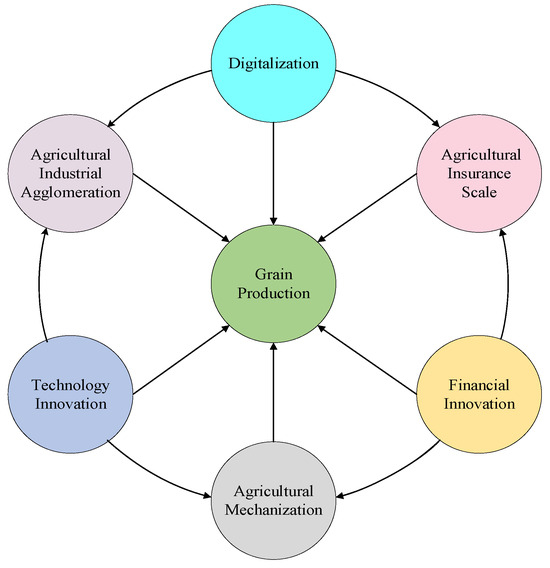
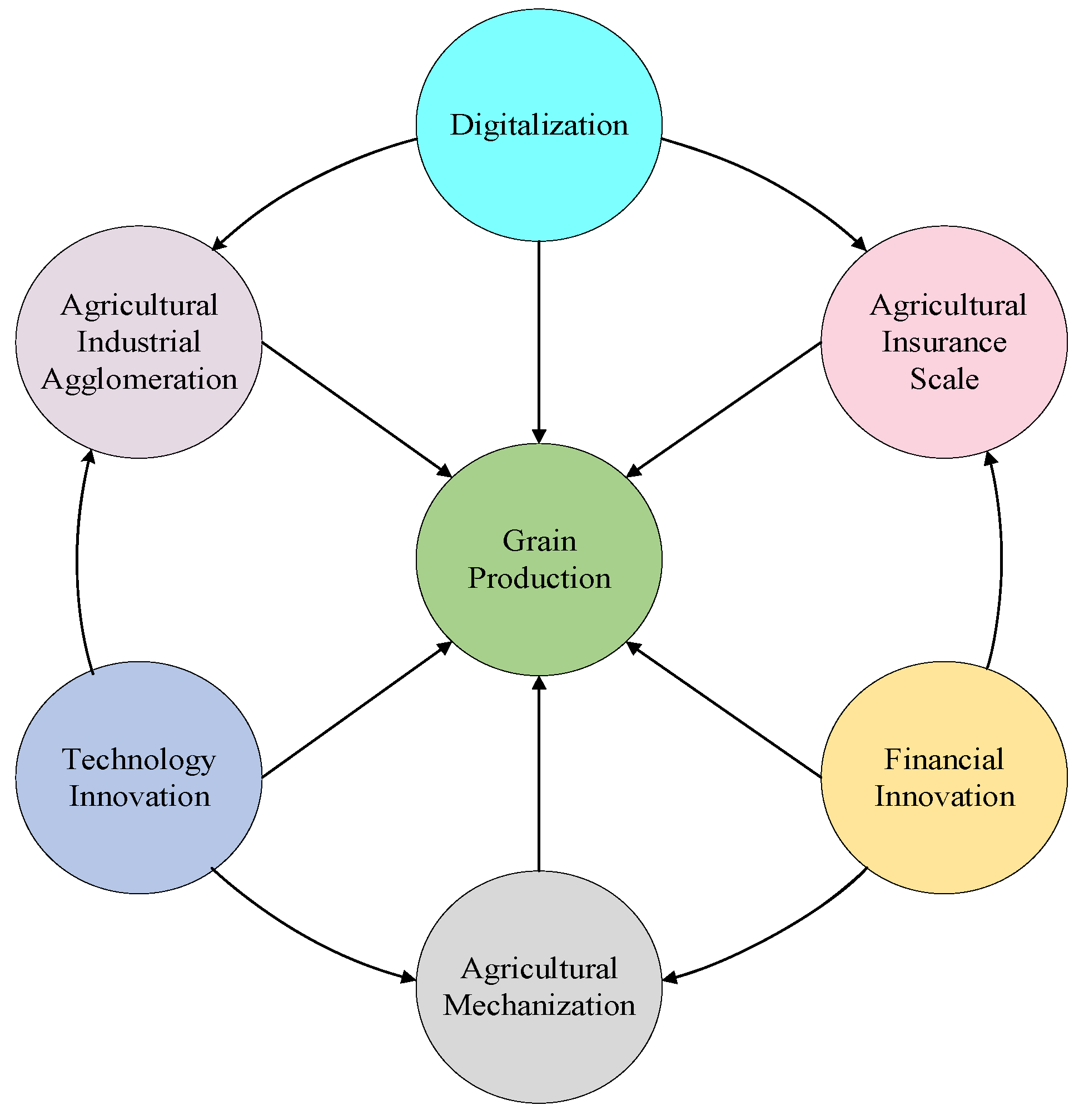
To systematically examine how digitalization (DG), technological innovation (TI), and financial innovation (FI) drive grain production (GP), this study identifies agricultural industrial agglomeration (AIA), agricultural mechanization (AM), and agricultural insurance scale (AIS) as the core transmission channels. This selection is not arbitrary but is theoretically grounded in the modernization of the three classical factors of production: land, labor, and capital.
While the existing literature suggests alternative mechanisms such as human capital accumulation or environmental sustainability, we argue that AIA, AM, and AIS represent the most direct and dominant pathways for enhancing grain productivity in the context of China’s resource constraints. First, regarding the land factor, China’s grain production is constrained by land fragmentation. AIA serves as the spatial reconfiguration mechanism, where DG and TI overcome physical boundaries to foster scale economies akin to land consolidation. Second, regarding the labor factor, the massive rural labor exodus necessitates a substitution strategy. AM represents the physical embodiment of TI and FI, serving as the primary substitute for labor input to maintain yield stability. Third, regarding the capital factor, the inherent vulnerability of agriculture deters capital deepening. AIS acts as the crucial risk-hedging mechanism that enables FI and DG to channel capital into production by stabilizing expected returns.
Therefore, unlike broader developmental indicators, these three channels—AIA, AM, and AIS—capture the specific structural transformation of the agricultural production function. The following sections detail these pathways.
2.2.1. Agricultural Industrial Agglomeration
The mechanism by which DG fosters agricultural industrial agglomeration can be elucidated through the lens of Transaction Cost Theory. Traditional agricultural markets are often fragmented due to high information asymmetry and search costs. Digitalization significantly mitigates these frictions by establishing information exchange platforms that lower the costs of search, bargaining, and contract enforcement [53]. This reduction in transaction costs facilitates the vertical disintegration of agricultural production and promotes a specialized division of labor. By enabling efficient matching between upstream input suppliers and downstream processors, DG creates a ‘virtual cluster’ effect. This virtual connectivity reduces the coordination costs of inter-firm collaboration, thereby incentivizing physical service providers—such as logistics firms and machinery leasing agencies—to co-locate, which ultimately drives substantive industrial agglomeration. Second, regions with higher levels of digitalization possess more diverse and extensive channels for information transmission, with greater authenticity and effectiveness of information [54]. This helps foster an open and transparent business environment, which, in turn, attracts numerous agricultural enterprises and further advances the process of industrial agglomeration.
Similarly, TI can promote agricultural industrial agglomeration by attracting enterprise clustering. TI effectively fosters knowledge spillovers across sectors [55], producing strong positive externalities. According to the theory of industrial agglomeration externalities, such externalities are a key driver in the formation of industrial clusters [56]. Consequently, TI serves as an important catalyst for agricultural industrial agglomeration.
Agricultural industrial agglomeration entails both the concentration of production factors and the clustering of agricultural enterprises [57]. From the perspective of factor agglomeration, it involves increased input density of land, labor, and capital within a region, the expansion of production scale, and the emergence of specialized division of labor [58]. These conditions improve production efficiency, reduce costs, and enable economies of scale, thereby enhancing grain production capacity. From the perspective of enterprise agglomeration, such clustering facilitates interconnections among enterprises engaged in seed supply, fertilizer production, agricultural machinery, product processing, and sales. This reduces transaction costs and optimizes resource allocation, promoting coordinated development along the agricultural value chain and ultimately contributing to increased grain output. Accordingly, this study proposes the following hypothesis:
H4:
DG and TI promote GP by fostering agricultural industrial agglomeration.
2.2.2. Agricultural Mechanization
Agricultural machinery and equipment are themselves tangible embodiments of TI. Advancements such as more efficient engines, intelligent automation systems, and precise sensing technologies directly enhance the technical performance of agricultural machinery. Moreover, TI improves the economic efficiency of machinery by reducing per-unit operating costs, lowering energy consumption, and increasing durability. Drawing on Schumpeter’s theory of creative destruction, agricultural machinery with superior technical and economic attributes will inevitably replace outdated and inefficient models. This process compels farmers to upgrade their equipment and adopt new technologies to remain competitive, thereby driving improvements in agricultural mechanization at the macro level.
At its core, agricultural mechanization represents a process of capital deepening [59], necessitating substantial initial investment in fixed capital. However, the inherent instability of agricultural production and the generally low level of financial participation among farmers mean that traditional financial services often fall short in supporting this process effectively [60]. FI, through the development of new financial instruments and services, can partially address issues such as insufficient collateral and underdeveloped credit systems in rural credit markets. This alleviates financing constraints for farmers during mechanization and enhances the overall level of agricultural mechanization.
The primary advantage of agricultural mechanization lies in its capacity to precisely manage the entire grain production process, including plowing, sowing, fertilizing, irrigation, and harvesting. Such specialized operations increase land productivity [61]. Furthermore, the progression of mechanization promotes land consolidation and the expansion of production scale [62], broadening the application of mechanized technologies and further improving grain production efficiency. Additionally, mechanization reduces labor requirements in agriculture [63], allowing farmers to optimize their expenditure by investing more in advanced machinery or higher-yield farmland within the same budget. This fosters a virtuous cycle in agricultural production, resulting in sustained increases in grain output. Accordingly, this study proposes the following hypothesis:
H5:
TI and FI promote GP by advancing agricultural mechanization.
2.2.3. Agricultural Insurance Scale
TI primarily influences the agricultural insurance scale on the supply side. The core mechanism lies in the integration of agricultural insurance with other financial instruments—such as “agricultural insurance + securities,” “agricultural insurance + funds,” and “agricultural insurance + futures” [64]. This integration enables insurance companies to disperse agricultural risks into capital markets, while reinsurance further enhances their capital adequacy and risk tolerance. Such optimization not only lowers operational risks for insurers but also enables agricultural insurance to reach a broader spectrum of agricultural producers at a reduced cost.
DG affects agricultural insurance scale in two main ways. First, on the purchasing side, DG leverages digital platforms to provide grain producers with comparable electronic policies, streamlines the insurance application process, and reduces intermediary costs associated with traditional sales channels. This helps address the suppressed demand caused by information asymmetry among farmers. Second, on the claims side, DG optimizes claims management by shortening settlement cycles [65], which increases farmers’ trust in agricultural insurance products and boosts renewal rates.
GP is inherently subject to both systemic and idiosyncratic risks, including climate disasters, pest outbreaks, and market price fluctuations, resulting in high output uncertainty. Such uncertainty leads risk-averse farmers to adopt conservative input strategies. According to risk compensation theory, agricultural insurance can stabilize farmers’ expected incomes and reduce their perceived risk [66], thereby encouraging greater investment in production factors and ultimately increasing grain yields. Moreover, agricultural insurance plays a crucial role in mitigating losses from natural disasters or other force majeure events [67], ensuring that farmers can quickly replenish their capital for reinvestment and maintain stable, continuous grain production. Based on these considerations, this study proposes the following hypothesis:
H6:
FI and DG promote GP by expanding agricultural insurance scale.
Drawing on the preceding analysis, the theoretical framework is presented in Figure 1.
Figure 1.
Mechanism of DG, TI and FI affecting GP.
3. Data and Methodology
3.1. Data Sources
We use data from 2001 to 2022 and the 31 provinces of China as the subjects of this empirical test. The original data is obtained from the China Statistical Yearbook, the China Rural Statistical Yearbook, the China Insurance Yearbook, the China Agricultural Machinery Industry Yearbook, local statistical bureaus in China, and the China Research Data Service Platform. Based on the linear interpolation approach, the missing data for particular years and provinces were completed.
3.2. Variable Selection
Dependent variable: The explained variable in this study is grain production (GP), measured by the aggregated total output of the three major staple crops: rice, wheat, and corn. The selection of these specific crops is grounded in three critical considerations. First, Statistical Representativeness: Rice, wheat, and corn collectively account for approximately 90% of China’s total grain output, thereby serving as the definitive proxy for the nation’s overall food supply capacity. The exclusion of tubers and legumes does not statistically alter the macro-trends of grain production productivity. Second, Strategic Relevance: In the context of China’s national food security strategy, a fundamental distinction is made between the “absolute security of staples” and the basic self-sufficiency of other crops. Since the core policy objective of digitalization and financial support is to secure the “Rice Bowl” (staple sufficiency), focusing on these three crops aligns strictly with the policy targets of the study. Third, Research Validity: Unlike soybeans or coarse grains, which are highly susceptible to import shocks or lack consistent historical data across all 31 provinces, the production data for the three major staples is robust and continuous, minimizing measurement errors in the panel analysis.
Independent variables: The independent variables include digitalization (DG), technological innovation (TI), and financial innovation (FI). DG is measured by the number of mobile phone users, while TI is measured by agricultural R&D expenditure. Given that China does not disclose specific agricultural R&D expenditures, these are approximated by multiplying internal R&D funding by the proportion of the total value of agriculture, forestry, animal husbandry, and fisheries within regional GDP. FI is quantified using the growth rate of the ratio of financial institution loan balances to GDP.
Control variables: We also chose other factors that might affect the GP as the control variables. Specifically, we included the fertilizer (FT), agricultural film (AF), rural electricity (RE), social security (SS), permanent residents (PR), labor force (LF), tax revenue (TR), and the urbanization rate (UR).
Mediating variables: We established three mediating variables to include the agricultural industrial agglomeration, agricultural mechanization and agricultural insurance scale to examine the indirect impact of DG, TI and FI on GP (Table 1).
Table 1.
An explanation of variables.
3.3. Model Construction
We address intra-provincial heterogeneity using a two-way fixed effects (TWFE) framework that absorbs time-invariant provincial characteristics and common shocks. The benchmark model is
where represents grain production, denotes the digitalization, is technological innovation, depicts the financial innovation, denotes the constant term, Con denotes the control variable, and and denote the regression coefficients of the variable, respectively. denotes the ith province and denotes the tth year. Regional fixed effects are represented by , temporal fixed effects by , and the random disturbance term by .
4. Empirical Analysis
4.1. Data Smoothness Analysis
To avoid the “pseudo-regression” caused by the unstable data, this paper initially conducts stationarity tests on the data using the LLC test and the IPS test. The outcomes of these tests are presented in Table 2. The variables used are smooth after the first-order difference.
Table 2.
Unit root test result.
4.2. Data Covariance Analysis
The variables in the model are non-stationary at the level; however, after the unit root test, all variables have the same order of flatness, suggesting a long-run equilibrium relationship between them. This paper uses Kao’s method for the cointegration test and the results are shown in Table 3. It can be seen that there is a long-run equilibrium relationship between other variables and the explained quantity GP.
Table 3.
Panel cointegration test.
4.3. Benchmark Regression
Table 4 reports the baseline regression results. The coefficients of digitalization (DG), technological innovation (TI), and financial innovation (FI) are consistently positive and statistically significant across all specifications, regardless of the inclusion of control variables. Beyond statistical significance, the estimated effect sizes demonstrate substantial economic significance with tangible practical implications. Specifically, the coefficient for DG (0.262) implies that, ceteris paribus, an increase of 10,000 mobile phone users is associated with a 2620-ton increase in regional grain production. Similarly, the estimates for TI (10.657) and FI (6.589) suggest that a 100 million yuan increase in agricultural R&D expenditure and a 1 percentage point rise in the agricultural loan-to-GDP ratio corresponding to grain output increments of approximately 106,750 tons and 65,890 tons, respectively. These magnitudes underscore that innovation factors are not merely auxiliary but are potent drivers of food security. To further ensure the robustness of these estimates and mitigate potential multicollinearity, we computed Variance Inflation Factors (VIFs) for the benchmark specification. The results show that the VIF values for all core explanatory variables are well below the threshold of 10. This empirical evidence collectively confirms that DG, TI, and FI play a robust and economically meaningful positive role in grain production (GP), thereby validating H1.
Table 4.
Benchmark regression results.
4.4. Endogeneity Test
This study employs the instrumental variable approach to examine potential endogeneity issues in the model, using the lagged terms of DG, TI, and FI as their respective instrumental variables.
Table 5 presents the regression results for both stages. In the first stage, L.DG is found to be significantly and positively associated with DG, L.TI with TI, and L.FI with FI, thereby satisfying the conditions for valid instrumental variables. In the second stage, the coefficients for DG, TI, and FI remain significantly positive at the 1% significance level. These findings indicate that, after accounting for endogeneity, DG, TI, and FI continue to exert significant positive effects on GP, further substantiating the robustness of the baseline regression results.
Table 5.
The endogenous processing results.
4.5. Robustness Test
4.5.1. Double Machine Learning
Compared to traditional causal inference models, double machine learning (DML) offers advantages in both variable selection and model inference. First, DML leverages algorithmic strengths to mitigate the “curse of dimensionality” arising from high-dimensional control variables. Second, given the potential for nonlinear growth relationships in economic growth, DML helps address model specification biases caused by such nonlinearities in the financial system. Based on these considerations, this study employs DML for robustness checks. Specifically, the sample splitting ratio for DML is set to 1:4. To mitigate algorithmic subjectivity, we use two prediction algorithms: Lasso and Ridge. The estimation results, presented in Table 6, show that DG, TI, and FI are all significantly positively correlated with DG, and the baseline regression conclusions remain robust.
Table 6.
The DML processing results.
4.5.2. Replace the Variables
To further ensure the robustness of the regression results, this study first substitutes the explanatory variables: Replace DG with the Digitalization Index (DG2), which is calculated using the entropy method based on five indicators—number of mobile phone users, internet penetration rate, total telecommunications business volume, length of long-distance optical cable lines, and number of digital agriculture enterprises. Replace TI with the number of agricultural utility patents (TI2), and FI with the growth rate of the ratio of financial institution loans to the value-added of the tertiary industry (FI2). Next, the dependent variable is substituted, replacing DG with the total output value of rice, wheat, and corn (GP2). To align with the preceding theoretical analysis, the natural logarithm of GP is taken, with lnGP used as the dependent variable. Regressions are performed using DG2, TI2, and FI2 against GP; DG, TI, and FI against GP2; and DG, TI, and FI against lnGP, respectively. The results, shown in Table 7, indicate that the regression outcomes remain significant after the variable substitutions.
Table 7.
Replace the variables.
4.5.3. Replace the Model
In light of potential heteroscedasticity and autocorrelation issues in the benchmark model, this study re-estimates the model using the feasible generalized least squares (FGLS) method. This approach aims to mitigate the estimation bias that may arise from relying on a single regression method in the benchmark analysis. The regression results are shown in Table 8 (1), (2), and (3), with the estimated coefficients for DG, TI, and FI all significantly positive at the 1% level, thereby reinforcing the robustness of the benchmark regression.
Table 8.
Replace the model and adjust the research sample.
4.5.4. Adjust the Research Sample
Given that municipalities directly under the central government, though administratively on the same level as provinces (autonomous regions), possess greater political status and resource allocation capabilities, which are more likely to support DG, TI, and FI, this study accounts for the potential bias these differences may introduce in the estimation results. Therefore, the four municipality samples are excluded, and the regression analysis is re-conducted. The results, presented in Table 8 (4), (5), and (6), show that the estimates for DG, TI, and FI are consistent with those of the benchmark analysis, further reinforcing the robustness of the benchmark regression results.
4.6. Synergy Analysis
To examine the potential synergistic effects of digitalization (DG), technological innovation (TI), and financial innovation (FI) on grain production (GP), this study introduces interaction terms among these variables into the baseline regression model. To address possible multicollinearity introduced by the interaction terms, DG, TI, and FI are mean-centered, both pairwise and jointly. The centered variables are then multiplied to construct four specific interaction terms: Interact1 (DG × TI), Interact2 (DG × FI), Interact3 (TI × FI), and Interact4 (DG × TI × FI).
4.6.1. Mechanisms of Positive Synergies
As indicated in columns (1) and (2) of Table 9, the estimated coefficients for Interact1 (0.402 −3) and Interact2 (0.221 −2) are significantly positive. These results confirm that the interaction between these factors is super-additive rather than merely additive—meaning the combined effect exceeds the sum of individual effects.
Table 9.
Results of synergy analysis.
The synergy between DG and TI operates through a mechanism of “Technological Complementarity” and “Feedback Loops.” Theoretically, while TI provides the hardware (e.g., automated machinery, bio-breeding), DG provides the “cognitive system” (e.g., IoT data, AI algorithms). This interaction creates a non-linear effect: DG reduces the uncertainty and learning costs associated with adopting new technologies, thereby enhancing the marginal productivity of TI. For instance, intelligent decision-making tools (DG) allow precision machinery (TI) to execute variable-rate fertilization based on real-time soil data, achieving efficiency gains that neither simple mechanization nor pure data collection could achieve in isolation.
The synergy between DG and FI is driven by the mechanism of “Information-Collateral Substitution.” Traditional FI is often constrained by the “collateral threshold” (additive constraint), where credit supply is linearly limited by a farmer’s physical assets. DG breaks this linearity by converting production data into verifiable “digital credit,” effectively substituting information for physical collateral. This synergy not only alleviates information asymmetry but also creates a “Financial Accelerator” effect: digital footprints allow capital to be precisely targeted to high-yield production links, thereby increasing the marginal return on capital investment and fostering a virtuous cycle of “Data-Credit-Production.”
4.6.2. Boundary Conditions and Non-Significant Interactions
In contrast, columns (3) and (4) of Table 9 show that the coefficients for Interact3 (TI × FI) and Interact4 (DG × TI × FI) are not statistically significant. These findings align with the theoretical expectations regarding resource constraints discussed in Section 1. The lack of synergy between TI and FI supports the Resource Dependence argument, suggesting that within a fixed liquidity constraint, the capital demands of technological upgrades (hardware investment) and financial leveraging (liquidity needs) may substitute rather than complement each other. Similarly, the insignificance of the three-way interaction corroborates the high coordination cost hypothesis. It indicates that the current agricultural system has not yet reached the developmental threshold where the efficiency gains of triple integration outweigh the complexity costs. This suggests that achieving a “System-level Synergy” requires a higher stage of digital maturity to lower the frictional costs of coordinating DG, TI, and FI simultaneously.
4.7. Channel Analysis
The theoretical analysis presented earlier indicates that DG and TI promote GP by fostering AIA, TI and FI promote GP by advancing AM, FI and DG promote GP by expanding AIS. Accordingly, this study uses AIA, AM and AIS as mediating variables to test this channel empirically.
This paper primarily employs Jiang’s two-step method for channel analysis [68]. Table 10 column (4) and Table 11 column (4) show that both DG and TI have significant positive effects on AIA. Prior studies suggest that AIA significantly promotes GP [69,70], indicating that AIA serves as the intermediary channel for TI on GP and thus supports H4. Similarly, Table 11 column (2) and Table 12 (4) reveal that TI and FI significantly enhance AM. Since the literature affirms that AM positively influences GP [71,72], AM serves as the intermediary channel for TI and FI on GP, supporting H5. Finally, Table 10 column (2) and Table 12 (2) indicate that DG and FI have significant positive impacts on AIS. Given that previous research finds that AIS has a positive effect on GP [73,74], AIS serves as the intermediary channel for DG and FI to affect GP, confirming H6.
Table 10.
The channels of DG affecting GP.
Table 11.
The channels of TI affecting GP.
Table 12.
The channels of FI affecting GP.
To strengthen the causal chain inference, this study further conducted a three-step mediation analysis. As shown in column (3) and column (5) of Table 10, the coefficients of DG, AIS, and AIA are all significantly positive, and the results have passed the Sobel test, reaffirming the channels through which DG influences GP. According to column (3) and column (5) of Table 11, the coefficients of AM and AIA are both significantly positive and have passed the Sobel test, reconfirming the channels through which TI affects GP. From column (3) and column (5) of Table 12, the coefficients of AM and AIS are significantly positive and have passed the Sobel test, once again validating the channels through which FI influences GP.
4.8. Heterogeneity Analysis
4.8.1. Functional Region Heterogeneity Analysis
Based on functional divisions, China is categorized into major grain-producing regions, grain production–marketing balance regions, and major grain-marketing regions. Heterogeneity tests were conducted to assess how GP responds to DG, TI, and FI across these different zones. As shown in Table 13, for major grain-producing regions, the coefficients for DG, TI, and FI are all significantly positive, further corroborating the positive effects of DG, TI, and FI on GP in these areas. In contrast, the estimated coefficient of DG is significantly negative in major grain-marketing regions. We interpret this counterintuitive finding through the theoretical lens of structural transformation and induced technical change. Major grain-marketing regions, typically located in economically advanced coastal areas, possess a comparative advantage in non-agricultural sectors. In this context, digitalization likely accelerates the flow of information regarding factor returns, making the wage gap between agricultural and industrial sectors more transparent.
Table 13.
Functional region heterogeneity.
Consequently, we postulate that digitalization in these regions may trigger a ‘Resource Siphon Effect,’ where high-mobility factors (capital and high-quality labor) are rapidly reallocated from the lower-margin grain sector to high-return secondary and tertiary industries. Unlike in grain-producing regions where digital tools are used to intensify agriculture, in marketing regions, digital infrastructure may inadvertently facilitate the de-agrarianization process by lowering the transaction costs of labor migration and non-farm enterprise formation. However, it is important to note that this mechanism is a theoretical derivation based on the regression results; direct micro-evidence regarding factor flow requires further verification.
4.8.2. Resource Endowment Heterogeneity Analysis
Based on natural resource endowment, defined by the “800 mm precipitation line” and the “≥10 °C accumulated temperature of 4500 °C isotherm,” China is divided into non-humid and humid regions. Heterogeneity tests were conducted to examine the effects of DG, TI, and FI on GP across these regions. As shown in Table 14, DG, TI, and FI all have significant positive effects on GP in both non-humid and humid areas. However, the coefficients for DG, TI, and FI are markedly higher in non-humid regions. This disparity may stem from water scarcity in non-humid areas, which serves as a primary constraint on agricultural production and amplifies the marginal contributions of DG, TI, and FI. Specifically, DG improves the efficiency of resource allocation in agriculture, reduces water waste, and optimizes irrigation practices. TI facilitates the adoption of crop varieties and cultivation techniques that are better suited to arid environments, thereby mitigating the impact of water shortages. FI addresses capital constraints, enabling agricultural producers to invest in advanced water-saving technologies and drought-resistant infrastructure. Consequently, DG, TI, and FI yield significantly greater effects on GP in non-humid regions. Conversely, in humid regions, where water resources are less of a limiting factor and natural conditions are more favorable, the marginal contributions of DG, TI, and FI are relatively diminished, resulting in smaller coefficients.
Table 14.
Resource endowment heterogeneity.
5. Discussion, Conclusions, Implications, Limitations and Future Research
5.1. Discussion
This section interprets the empirical findings within the broader theoretical context, specifically addressing the rationale for model selection and situating the results regarding synergies and heterogeneity against the existing literature.
5.1.1. Comparative Justification of the Production Function Specification
A critical methodological distinction of this study is the adoption of the Cobb–Douglas (C-D) production function over alternatives like the Leontief or Translog functions. The Leontief function assumes zero elasticity of substitution, implying fixed factor proportions. This rigidity contradicts the reality of China’s agricultural modernization, where mechanical capital is actively substituting for scarce rural labor. Conversely, while the Translog function allows for variable substitution elasticities, its complexity often introduces severe multicollinearity when simultaneously estimating multiple innovation inputs (DG, TI, FI). Therefore, the C-D specification proves most appropriate for this study. Its multiplicative structure allows us to uniquely conceptualize DG, TI, and FI as Hicks-neutral efficiency modifiers embedded within total factor productivity (TFP). This specification captures the “permeation effect”—where digitalization acts as a multiplier enhancing the marginal productivity of traditional endowments—offering a parsimonious yet powerful framework for assessing the simultaneous impacts of multiple innovation drivers.
5.1.2. Synergies and Thresholds: Extending the “Complementarity Hypothesis”
Our findings confirm significant pairwise synergies (DG-TI and DG-FI), aligning with the “complementarity hypothesis” in recent studies. This validates that digitalization serves as the infrastructural connector that amplifies returns on physical technology and financial capital. However, this study extends the literature by revealing an insignificant three-way synergy. This result challenges the assumption of unlimited integration, supporting System Innovation Theory. It suggests that the high coordination costs of managing three complex subsystems currently simultaneously offset potential efficiency gains, indicating that agricultural modernization faces a “complexity threshold” where simply stacking innovation factors without reducing frictional costs yields diminishing returns.
5.1.3. The “Resource Siphon” Paradox in Regional Heterogeneity
Contrary to the consensus that digital transformation universally benefits agriculture, our heterogeneity analysis identifies a negative impact of DG in major grain-marketing regions. We interpret this as a “Resource Siphon Effect,” which aligns with Structural Transformation Theory but contradicts studies focused solely on production regions. In economically advanced marketing regions, digital transparency likely accelerates the reallocation of high-quality labor and capital toward higher-return non-agricultural sectors, thereby “hollowing out” local grain production. This insight provides a crucial theoretical correction: the impact of digitalization is regime-dependent, functioning as a productivity booster in comparative advantage zones but as an accelerator of de-agrarianization in non-comparative advantage zones.
5.2. Conclusions
This study constructs a unified framework to assess how digitalization (DG), technological innovation (TI), and financial innovation (FI) reshape China’s grain production system. Distinct from the statistical summary in the Abstract, we distill four core theoretical insights aligned with our research objectives:
Innovation as an Efficiency Modifier: We confirm that DG, TI, and FI have evolved from auxiliary tools to core drivers of TFP. They function not merely as additive inputs but as multipliers that significantly elevate the output elasticity of traditional factors.
Factor Endowment Transformation: The channel analysis reveals that modern productive forces reconstruct the classical production function: DG and TI overcome land fragmentation through agglomeration; TI and FI substitute for labor shortages through mechanization; and DG and FI hedge capital risks through insurance expansion.
Synergy Boundaries: We conclude that while pairwise integration is effective, a “systemic complexity trap” currently hinders the realization of three-way synergies, highlighting the necessity of reducing coordination costs.
Context-Dependent Impact: The study uncovers a structural divergence where innovation factors act as substitutes for natural constraints in water-scarce regions (positive effect) but trigger resource crowding-out effects in economically advanced marketing regions (negative effect).
5.3. Implications
First, in light of the empirical evidence showing significant pairwise synergies between digitalization (DG) and technological/financial innovation, yet an insignificant three-way synergy due to high coordination costs, policy priority should be assigned to establishing a standardized digital infrastructure that reduces transaction frictions. The current lack of system-level integration suggests that the marginal cost of coordinating DG, TI, and FI simultaneously outweighs the benefits. To address this, the government should prioritize the construction of a unified “National Agricultural Data Standard” before incentivizing complex multi-factor applications. This mechanism involves establishing interoperable interfaces between agricultural machinery sensors (TI) and credit evaluation systems (FI), thereby allowing financial institutions to directly utilize production data for risk assessment. Although the initial fixed cost of deploying 5G networks and IoT sensors in rural areas is substantial, the long-term cost–benefit analysis favors this investment due to the near-zero marginal cost of data replication and the reduction in information asymmetry. Consequently, a phased implementation roadmap is recommended: strictly prioritizing the coverage of hard digital infrastructure in the short term (1–3 years) to lower the threshold for multi-system integration, followed by the development of soft data-sharing ecosystems in the medium term.
Second, considering the heterogeneity analysis which reveals that digitalization exerts a negative “resource siphon effect” on grain production in major grain-marketing regions, regional development strategies must be differentiated to align with comparative advantages. Instead of enforcing a uniform production expansion policy which may lead to inefficient resource allocation in economically advanced but land-scarce marketing regions, a “Digital Enclave” model should be adopted. Specifically, major grain-marketing regions should be encouraged to export their abundant digital capital and financial services to major grain-producing regions, establishing cooperative grain production bases. This approach leverages the technological and financial strengths of marketing regions while utilizing the land resources of producing regions, thereby mitigating the crowding-out effect observed in the empirical results. To implement this effectively, institutional barriers regarding cross-regional GDP accounting and tax sharing must be dismantled, ensuring that the economic benefits generated by these enclave bases are equitably distributed between the investing and host provinces.
Third, based on the finding that the marginal productivity of DG, TI, and FI is significantly higher in non-humid regions compared to humid regions, fiscal resource allocation should follow the principle of marginal efficiency. The empirical results suggest that water scarcity acts as a binding constraint that amplifies the benefits of innovation; therefore, limited public funds should be tilted towards arid and semi-arid areas (such as Northwest and North China). In these regions, the promotion of “Water-Saving Precision Agriculture”—which integrates digital monitoring with drought-resistant agronomy—should be the top priority. This targeted allocation ensures a higher return on investment for fiscal funds concerning grain output per unit of water resource. Conversely, in humid regions where natural endowments are more favorable, policies should focus more on ecological sustainability and quality improvement rather than mere yield expansion, optimizing the input structure to prevent diminishing marginal returns.
Finally, the insignificant synergy between technological innovation (TI) and financial innovation (FI) indicates a potential substitution effect driven by capital constraints, necessitating the innovation of financial products specifically designed to cover the sunk costs of technological adoption. Since the empirical results imply that farmers may face a trade-off between investing in hardware upgrades and maintaining liquidity, financial institutions, supported by government policy, should develop long-term credit products with extended maturity periods (5–10 years) that match the depreciation cycle of modern agricultural machinery. Furthermore, to overcome the barrier of high risk associated with agricultural technology adoption, a government-backed risk compensation mechanism should be established. This mechanism would share the default risk with commercial banks, thereby lowering the financing threshold for smallholders and facilitating the organic integration of capital and technology.
5.4. Limitations and Future Research
While this study provides novel insights, several limitations warrant attention and suggest avenues for future research.
First, linear interpolation was employed to address partially missing data, yet sensitivity analysis was not conducted. Second, endogeneity concerns have not been fully resolved. Third, constrained by data availability, the indicators selected in this study may not fully capture the explanatory variables. Future research could adopt more representative indicators for grain production, digitalization, technological innovation, and financial innovation to facilitate more practical and in-depth analysis. Fourth, heterogeneity analysis suggests that digitalization may inhibit grain production in major consumption regions through resource reallocation. However, due to the lack of granular data at the provincial level, such as cross-sectoral labor migration and the registration of non-agricultural enterprises in rural areas, we were unable to empirically test this specific channel. Future studies could leverage matched micro-level survey data to explicitly examine how digitalization influences occupational choices of the agricultural labor force in economically developed regions.
Author Contributions
Experiment conception and design, M.Y.; methodology, F.Y.; software, M.Y.; validation, M.Y. and F.Y.; investigation, F.Y.; data curation, M.Y.; writing—original draft preparation, H.Z.; writing—review and editing, M.Y. and F.Y.; visualization, H.Z.; supervision, M.Y.; project administration, H.Z.; funding acquisition, H.Z. All authors have read and agreed to the published version of the manuscript.
Funding
The work was supported by National Social Science Fund of China (24XJY029).
Data Availability Statement
The data presented in this study are available on request from the corresponding author due to data security issues.
Conflicts of Interest
The authors declare no conflicts of interest.
References
- Routis, G.; Lopez-Morales, J.A.; Claffey, E.; Mora, M.; Martinez, J.A. Building an interoperable space for smart agriculture. Digit. Commun. Netw. 2023, 9, 183–193. [Google Scholar]
- FAO; IFAD; UNICEF; WFP; WHO. The State of Food Security and Nutrition in the World 2024—Financing to End Hunger, Food Insecurity and Malnutrition in All Its Forms; FAO; IFAD; UNICEF; WFP; WHO: Rome, Italy, 2024. [Google Scholar]
- Chen, D.; Sun, Q. Impact of rapid Arctic sea ice decline on China’s crop yield under global warming. Environment. Dev. Sustain. 2024, 26, 1263–1280. [Google Scholar] [CrossRef] [Scilit]
- Cao, X.; Wu, N.; Adamowski, J.; Zhou, Y.; Muneer, M.A.; Hu, W.; Li, L. Assessing the contribution of China’s grain production during 2005–2020 from the perspective of the crop-water-land nexus. J. Hydrol. 2023, 626, 130376. [Google Scholar] [CrossRef] [Scilit]
- Dizon, F.; Josephson, A.; Raju, D. Pathways to better nutrition in South Asia: Evidence on the effects of food and agricultural interventions. Glob. Food Secur. 2021, 28, 100467. [Google Scholar] [CrossRef] [Scilit]
- Wang, R.; Chen, J.; Li, Z.; Zhang, X.; Jiao, L.; Zhou, Y.; Li, Y. Factors analysis for the decoupling of grain production and carbon emissions from crop planting in China: A discussion on the regulating effects of planting scale and technological progress. Environ. Impact Assess. Rev. 2023, 103, 107249. [Google Scholar] [CrossRef] [Scilit]
- Chandio, A.A.; Ozdemir, D.; Gokmenoglu, K.K.; Usman, M.; Jiang, Y. Digital agriculture for sustainable development in China: The promise of computerization. Technol. Soc. 2024, 76, 102479. [Google Scholar] [CrossRef] [Scilit]
- Li, Z.; Cheng, C.; He, Y. Research on Construction of Inter-provincial Horizontal Benefit Compensation Mechanism in Grain Production and Marketing Areas with Construction of High-standard Farmland. Agric. Econ. Manag. 2024, 5, 44–52. [Google Scholar]
- Potapov, P.; Turubanova, S.; Hansen, M.C.; Tyukavina, A.; Zalles, V.; Khan, A.; Song, X.-P.; Pickens, A.; Shen, Q.; Kommareddy, A. Global maps of cropland extent and change show accelerated cropland expansion in the twenty-first century. Nat. Food 2022, 3, 19–28. [Google Scholar] [CrossRef] [Scilit]
- Li, Y.; Huan, M.; Jiao, X.; Chi, L.; Ma, J. The impact of labor migration on chemical fertilizer use of wheat smallholders in China-mediation analysis of socialized service. J. Clean. Prod. 2023, 394, 136366. [Google Scholar] [CrossRef] [Scilit]
- Ji, X.; Xu, J.; Zhang, H. Environmental effects of rural e-commerce: A case study of chemical fertilizer reduction in China. J. Environ. Manag. 2023, 326, 116713. [Google Scholar] [CrossRef] [Scilit]
- Lesk, C.; Rowhani, P.; Ramankutty, N. Influence of extreme weather disasters on global crop production. Nature 2016, 529, 84–87. [Google Scholar] [CrossRef] [Scilit] [PubMed]
- Qiu, B.; Li, H.; Tang, Z.; Chen, C.; Berry, J. How cropland losses shaped by unbalanced urbanization process? Land Use Policy 2020, 96, 104715. [Google Scholar] [CrossRef] [Scilit]
- Feng, H.; Fu, J.; Li, H.; Liang, Y. Urbanization or “Townization”? Measuring the evolution of Urban Systems in modern China. China Econ. Rev. 2025, 90, 102368. [Google Scholar] [CrossRef] [Scilit]
- Wang, X.; Zhao, X. The moderating effect of training, subsidies and propaganda on the relationship between psychological factors and farmers’ willingness to reduce chemical fertilizer application: Evidence from dryland farming areas of China. Agric. Syst. 2025, 224, 104257. [Google Scholar] [CrossRef] [Scilit]
- Wang, K.; Sun, M.; Liu, J.; Dai, M.H.; Che, L.J. Main Indicators and Correlation Degree Measurement Analysis for Comprehensively Consolidating the Foundation of Food Security. Nankai Econ. Stud. 2024, 5, 21–36. [Google Scholar]
- Huang, Q.; Guo, W.; Chen, Y. Measuring the Digitization Level of China’s Grain Industry Chain and Its Spatial–Temporal Evolution. Agriculture 2024, 14, 1371. [Google Scholar] [CrossRef] [Scilit]
- Johnson, D. Food security, the agriculture value chain, and digital transformation: The case of Jamaica’s agricultural business information system (ABIS). Technol. Soc. 2024, 77, 102523. [Google Scholar] [CrossRef] [Scilit]
- Lioutas, E.D.; Charatsari, C.; La Rocca, G.; De Rosa, M. Key questions on the use of big data in farming: An activity theory approach. NJAS Wagening. J. Life Sci. 2019, 90, 100297. [Google Scholar] [CrossRef] [Scilit]
- Wang, W.; Huang, Z.; Fu, Z.; Jia, L.; Li, Q.; Song, J. Impact of digital technology adoption on technological innovation in grain production. J. Innov. Knowl. 2024, 9, 100520. [Google Scholar] [CrossRef] [Scilit]
- Wepner, B.; Neuberger, S.; Hörlesberger, M.; Molin, E.M.; Lampert, J.; Koch, H. How can digitalisation support transformation towards sustainable agri-food systems? Scenario development in Lower Austria. Agric. Syst. 2025, 224, 104251. [Google Scholar] [CrossRef] [Scilit]
- Tchamyou, V.S.; Erreygers, G.; Cassimon, D. Inequality, ICT and financial access in Africa. Technol. Forecast. Soc. Change 2019, 139, 169–184. [Google Scholar] [CrossRef] [Scilit]
- Goel, R.K.; Yadav, C.S.; Vishnoi, S.; Rastogi, R. Smart agriculture–Urgent need of the day in developing countries. Sustain. Comput. Inform. Syst. 2021, 30, 100512. [Google Scholar] [CrossRef] [Scilit]
- Chandio, A.A.; Amin, A.; Khan, I.; Rehman, A.; Memon, A. Can digitalization improve agriculture? Exploring the impact of ICT on grain food production in SAARC countries. Inf. Dev. 2024, 42, 529–548. [Google Scholar] [CrossRef] [Scilit]
- Deng, F.; Jia, S.; Ye, M.; Li, Z. Coordinated development of high-quality agricultural transformation and technological innovation: A case study of main grain-producing areas, China. Environ. Sci. Pollut. Res. 2022, 29, 35150–35164. [Google Scholar] [CrossRef] [Scilit] [PubMed]
- Lu, W.; Li, W.; Lin, J. Damping effects of water and land constraints on economic growth in basin economic zones. Resour. Policy 2022, 79, 103057. [Google Scholar] [CrossRef] [Scilit]
- Lu, S.; Bai, X.; Li, W.; Wang, N. Impacts of climate change on water resources and grain production. Technol. Forecast. Soc. Change 2019, 143, 76–84. [Google Scholar] [CrossRef] [Scilit]
- Yang, Z.; Zhang, Y.; Yin, C. Historical Changes of Grain Supply and Demand Pattern in China: From “South-to-North Grain Flow” to “North-to-South Grain Flow”. Issues Agric. Econ. 2025, 4, 109–123. [Google Scholar]
- Guo, Y.; Liu, Y.; Li, R.; Li, Y.; Wang, J. TIC-driven sustainable land use mode in the Loess Plateau: A case study of gully land consolidation project in Yan’an City, China. Land Use Policy 2024, 140, 107107. [Google Scholar] [CrossRef] [Scilit]
- Wang, X.; Cui, C.; Xu, M.; Cheng, B.; Zhuang, M. Key technologies improvements promote the economic-environmental sustainability in wheat production of China. J. Clean. Prod. 2024, 443, 141230. [Google Scholar] [CrossRef] [Scilit]
- Eastwood, C.; Klerkx, L.; Nettle, R. Dynamics and distribution of public and private research and extension roles for technological innovation and diffusion: Case studies of the implementation and adaptation of precision farming technologies. J. Rural. Stud. 2017, 49, 1–12. [Google Scholar] [CrossRef] [Scilit]
- Dar, A.A.; Pan, B.; Qin, J.; Zhu, Q.; Lichtfouse, E.; Usman, M.; Wang, C. Sustainable ferrate oxidation: Reaction chemistry, mechanisms and removal of pollutants in wastewater. Environ. Pollut. 2021, 290, 117957. [Google Scholar] [CrossRef] [Scilit] [PubMed]
- Din, Y.; Liu, Y.; Zhang, L. Impacts of Financial Innovations on Grain Productivity—A Household Analysis based on Propensity Score Matching Model. Price Theory Pract. 2021, 4, 90–93. [Google Scholar]
- Zhang, Y.; Cui, R.; Wei, X.; Chen, T. How digital financial inclusion enhances agroecological efficiency: Impact effects and mechanism tests. Int. Rev. Econ. Financ. 2025, 97, 103755. [Google Scholar] [CrossRef] [Scilit]
- Liu, J.; Ren, Y. Can digital inclusive finance ensure food security while achieving low-carbon transformation in agricultural development? Evidence from China. J. Clean. Prod. 2023, 418, 138016. [Google Scholar] [CrossRef] [Scilit]
- Yuan, Z.; Lee, C.C.; He, Z.W. How does green finance improve food security? From the perspective of rural human capital. Int. Rev. Econ. Financ. 2025, 99, 103981. [Google Scholar] [CrossRef] [Scilit]
- Zhang, J.; Yu, J.; Ma, S.; Li, J.; Zhu, Z. Green finance and agricultural climate resilience: Evidence from China. Res. Int. Bus. Financ. 2025, 78, 102995. [Google Scholar] [CrossRef] [Scilit]
- Guo, T.; Yin, Y. Financial Support for Agriculture ‘Going Abroad’: Significance of the Times, Mode Innovation and Policy Support. Macroeconomics 2023, 9, 54–67. [Google Scholar]
- Kipkogei, S.; Han, J.; Mwalupaso, G.; Tanui, J.; Brenya, R. The synergistic effects of microcredit access and agricultural technology adoption on maize farmer’ s income in Kenya. PLoS ONE 2025, 20, e0316014. [Google Scholar] [CrossRef] [Scilit]
- Le Cotty, T.; d’Hôtel, E.M.; Subervie, J. Inventory credit to enhance food security in Burkina Faso. World Dev. 2023, 161, 106092. [Google Scholar] [CrossRef] [Scilit]
- Li, B.; Du, Y.; Chen, G. Dynamic nexus between urban digitization and pollutant discharge: RBC theory and empirical evidence from China. Technol. Forecast. Soc. Change 2025, 211, 123915. [Google Scholar] [CrossRef] [Scilit]
- Huang, J.; Wang, Y.; Luan, B.; Zou, H.; Wang, J. The energy intensity reduction effect of developing digital economy: Theory and empirical evidence from China. Energy Econ. 2023, 128, 107193. [Google Scholar] [CrossRef] [Scilit]
- Lei, L.; Zhou, X.; Sun, L.; Liu, B. Rural digitalization, green technology innovation and food total factor productivity. J. Agro-For. Econ. Manag. 2025, 24, 204–214. [Google Scholar]
- Zhang, X.; Li, J.; Xiang, D.; Worthington, A.C. Digitalization, financial inclusion, and small and medium-sized enterprise financing: Evidence from China. Econ. Model. 2023, 126, 106410. [Google Scholar] [CrossRef] [Scilit]
- Bollaert, H.; Lopez-de-Silanes, F.; Schwienbacher, A. Fintech and access to finance. J. Corp. Financ. 2021, 68, 101941. [Google Scholar] [CrossRef] [Scilit]
- Liao, L.; Long, H.; Ma, E. Factors influencing the recessive morphology of farmland use under labor changes based on production input willingness and behavior of farmers. J. Geogr. Sci. 2023, 33, 2467–2488. [Google Scholar] [CrossRef] [Scilit]
- Cai, X.; Li, H. The Path Choice of Biased Technical Progress of China’s Wheat Industry under the Background of “Storing Grain in Technology”. J. Agrotech. Econ. 2023, 8, 130–144. [Google Scholar]
- Lu, J.; Li, H. Can high-speed rail improve agricultural land use in China’s counties? From the perspective of dynamic network two-stage model. Land Use Policy 2025, 148, 107403. [Google Scholar] [CrossRef] [Scilit]
- Li, J.; Wan, Q. Influence of Agricultural Technological Innovation on Agricultural Economic Resilience: Based on the Threshold Effect Analysis of Financial Policy Supporting Agriculture. J. Agrotech. Econ. 2025, 4–17. [Google Scholar]
- Lee, C.C.; Wang, C.W.; Ho, S.J. Financial inclusion, financial innovation, and firms’ sales growth. Int. Rev. Econ. Financ. 2020, 66, 189–205. [Google Scholar] [CrossRef] [Scilit]
- Liu, Y.; Deng, Y.; Peng, B. The impact of digital financial inclusion on green and low-carbon agricultural development. Agriculture 2023, 13, 1748. [Google Scholar] [CrossRef] [Scilit]
- Wang, Y.; Hao, Y. Rural Household Human Capital Structure and Agricultural Environmental Efficiency in the Context of Smallholder Farmers: Mechanism of Action and Effect. Agric. Econ. Manag. 2025, 6, 95–106. [Google Scholar]
- Gu, R.; Li, C.; Yang, Y.; Zhang, J. The impact of industrial digital transformation on green development efficiency considering the threshold effect of regional collaborative innovation: Evidence from the Beijing-Tianjin-Hebei urban agglomeration in China. J. Clean. Prod. 2023, 420, 138345. [Google Scholar] [CrossRef] [Scilit]
- Xu, Q.; Zhong, M.; Li, X. How does digitalization affect energy? International evidence. Energy Econ. 2022, 107, 105879. [Google Scholar] [CrossRef] [Scilit]
- Xu, Y.; Li, X.; Tao, C.; Zhou, X. Connected knowledge spillovers, technological cluster innovation and efficient industrial structure. J. Innov. Knowl. 2022, 7, 100195. [Google Scholar] [CrossRef] [Scilit]
- Zeng, G.; Wu, M.; Yuan, X. Digital economy and industrial agglomeration. Econ. Anal. Policy 2024, 84, 475–498. [Google Scholar] [CrossRef] [Scilit]
- Zheng, W. Land supply and industrial agglomeration: Extension of the new economic geography model with land elements incorporated. Land Use Policy 2023, 132, 106757. [Google Scholar] [CrossRef] [Scilit]
- Wang, S.; Xu, Y.; Wang, L.; Lv, J. A Study on the Impact of Agricultural Industry Agglomeration on Agricultural Industry Resilience: From the Dual Perspectives of Horizontal Agglomeration and Vertical Agglomeration. Econ. Surv. 2024, 41, 71–82. [Google Scholar]
- Benin, S. Impact of Ghana’s agricultural mechanization services center program. Agric. Econ. 2015, 46, 103–117. [Google Scholar] [CrossRef] [Scilit]
- Yan, Y.; Chen, L.; Zhou, Z.; Wei, Y. Digital financial inclusion and agricultural modernization development in China—A study based on the perspective of agricultural mechanization services. Humanit. Soc. Sci. Commun. 2025, 12, 577. [Google Scholar] [CrossRef] [Scilit]
- Fang, D.; Chen, J.; Wang, S.; Chen, B. Can agricultural mechanization enhance the climate resilience of food production? Evidence from China. Appl. Energy 2024, 373, 123928. [Google Scholar] [CrossRef] [Scilit]
- Qian, L.; Lu, H.; Gao, Q.; Lu, H. Household-owned farm machinery vs. outsourced machinery services: The impact of agricultural mechanization on the land leasing behavior of relatively large-scale farmers in China. Land Use Policy 2022, 115, 106008. [Google Scholar] [CrossRef] [Scilit]
- Hamilton, S.F.; Richards, T.J.; Shafran, A.P.; Vasilaky, K.N. Farm labor productivity and the impact of mechanization. Am. J. Agric. Econ. 2022, 104, 1435–1459. [Google Scholar] [CrossRef] [Scilit]
- Yang, L.; Wang, Z.; Lee, J.I.; Wang, T.Y. How Does Investment in Agricultural Insurance Promote High-Quality Agricultural Development? Mediating Effect of Green Total Factor Productivity. Financ. Res. Lett. 2025, 81, 107485. [Google Scholar] [CrossRef] [Scilit]
- Li, C.; Ma, S.; Zhong, C. Historical Evolution, Theoretical Logic and Future Prospects of Digitization of Agricultural Insurance. Lanzhou Acad. J. 2024, 12, 148–160. [Google Scholar]
- Huang, Z.; Su, K.; Wang, S. The role of agricultural insurance in promoting farmers’ green production behavior: The moderating effect of legal trust. Financ. Res. Lett. 2025, 80, 107269. [Google Scholar] [CrossRef] [Scilit]
- Gu, L.; Liu, Y.; Liu, F.; Dong, X.; Dong, Y. Impacts of policy-related agricultural insurance on farmers’ earnings in China’s major grain-producing regions. Financ. Res. Lett. 2024, 69, 106189. [Google Scholar] [CrossRef] [Scilit]
- Jiang, T. Mediating Effects and Moderating Effects in Causal Inference. China Ind. Econ. 2022, 100–120. [Google Scholar]
- Li, J.; Wang, C.; Yuan, Z. Enhancing Food Security through Green Finance: A Study from the Perspectives of Rural Human Capital and Agglomeration of Agricultural Industry. J. Univ. Jinan (Soc. Sci. Ed.) 2024, 34, 52–68. [Google Scholar]
- Yao, R.; Ma, Z.; Wu, H.; Xie, Y. Mechanism and measurement of the effects of industrial agglomeration on agricultural economic resilience. Agriculture 2024, 14, 337. [Google Scholar] [CrossRef] [Scilit]
- Sun, X.; Zhao, Y.; Zhang, G. The impact of improving element quality on the comprehensive production capacity of grain: Evidence from high-standard farmland construction. China Agric. Econ. Rev. 2025, 17, 131–149. [Google Scholar] [CrossRef] [Scilit]
- Yu, A.; Li, J.; Jia, Z. The Intelligent Agricultural Mechanization Ensures Food Security: Its Mechanism and the Path. Rural Econ. 2024, 6, 33–44. [Google Scholar]
- Li, F.; He, D.; Liu, J.; Hong, N. Does crop insurance increase farmers’ income? Evidence from the pilot program of agricultural catastrophe insurance in China. Econ. Anal. Policy 2025, 86, 1002–1019. [Google Scholar] [CrossRef] [Scilit]
- Chen, L.; Gu, H. The Impact and Mechanism of Agricultural Insurance on the Yield of Grain Crop: A Case Study of Three Major Grain Crops. J. Agrotech. Econ. 2025, 1, 4–19. [Google Scholar]

Disclaimer/Publisher’s Note: The statements, opinions and data contained in all publications are solely those of the individual author(s) and contributor(s) and not of MDPI and/or the editor(s). MDPI and/or the editor(s) disclaim responsibility for any injury to people or property resulting from any ideas, methods, instructions or products referred to in the content. |
© 2026 by the authors. Licensee MDPI, Basel, Switzerland. This article is an open access article distributed under the terms and conditions of the Creative Commons Attribution (CC BY) license.