


Abstract
This study assessed the technical capacity and specific support needs of 28 small, medium, and community cassava processing centers across the Ruzizi Plain, Kinshasa, and Kongo Central Provinces of the Democratic Republic of Congo. A rapid appraisal methodology involving physical visits and direct interviews with proprietors and operators was conducted between March and May 2023. Data collection focused on product types, machinery, production capacity, operational status, challenges, and quality management. The study revealed significant technical and infrastructural deficiencies. Key challenges include reliance on inefficient sun-drying, inadequate infrastructure, lack of basic utilities, obsolete machinery, poor local capacity for machine repair, minimal adherence to Good Manufacturing Practices, and inadequate product quality testing, all leading to inconsistent product quality. The study highlights urgent need for investments in efficient drying facilities, equipment upgrades, and capacity building in quality control and business management. By differentiating technical assistance needs based on enterprise scale and product type, this study provides evidence-based recommendations essential for tailoring effective and sustainable intervention strategies to transform the DRC’s cassava processing sector and enhance food security.
1. Introduction
Tropical root and tuber crops (RTCs) are fundamental to global food security, particularly in developing countries, serving as staple foods and crucial carbohydrate sources [1,2]. Among these, cassava (Manihot esculenta Crantz) stands out due to its remarkable resilience to harsh agronomic conditions, its flexibility in the face of climate change, and its high productivity in marginal soils [3,4]. The evolution of its processing methods has further cemented its importance as a staple and cash crop worldwide, supporting the livelihoods of over 800 million people globally [5].
The Democratic Republic of Congo (DRC) is a central player in the global cassava landscape, ranking as Africa’s second-largest producer [6]. Cassava is not merely a crop in the DRC; it is a critical pillar of national food security, providing the primary source of calories for over 70% of the population [7,8]. The national cassava value chain is complex, encompassing primary production, processing into a diverse range of food and industrial products (such as fufu, Chikwangue, and High-Quality Cassava Flour (HQCF)), and marketing for both domestic and export markets [9,10]. Despite its centrality, the sector is plagued by significant challenges, primarily related to inadequate infrastructure, post-harvest processing inefficiencies, and market barriers [11,12]. However, the sector also presents large opportunities for agro-industrial investments, the adoption of modern technology, and capitalizing on the strong and growing market demand for cassava products [13].
Value addition through processing is essential for reducing post-harvest losses, which can range from 30 to 50% in tropical regions, and for ensuring the consistent market off-take of agricultural commodities [9,10,14]. Despite its centrality, the sector is plagued with several technical and quality challenges [15]. This processing readiness is paramount for sustainable agricultural development and for transitioning from subsistence farming to a market-oriented economy [16]. In the DRC, cassava transformation is largely driven by Small and Medium Enterprises (SMEs) and community processing centers, which form the backbone of the processing sector [17]. These enterprises are crucial for converting perishable cassava roots into stable, marketable products, thereby extending shelf life and increasing economic returns for farmers and processors [16].
The growth trajectory of the DRC’s cassava sector is currently supported by integrated government and donor-funded interventions across the value chain [18]. Recognizing the importance of cassava and its untapped industrial potential, the DRC government, with support from international donors and partners like the African Development Bank, International Institute of Tropical Agriculture (IITA) and the American government, has launched initiatives focused on modern production and processing technologies and market reform. These projects, such as the Agricultural Transformation Agenda (ATA-DRC) and the Cassava Value Chain Development to Support Food Security and the Bread Industry in DRC, underscore the national commitment to modernizing the sector.
The efficiency and safety of cassava processing are directly linked to the technology and infrastructure employed [19]. In many parts of Central and West Africa, including the DRC, processing remains largely traditional, relying on manual labor and rudimentary equipment [5]. This reliance introduces several critical constraints that limit the sector’s potential. The adoption of improved cassava processing technologies, such as mechanical peelers, efficient graters, and modern hydraulic presses, is often low among SMEs in Africa [20,21]. Many processors rely on locally fabricated machines that are often old, obsolete, and inefficient, leading to low throughput and high operational costs [22]. Furthermore, the lack of local capacity for machine maintenance and repair leads to prolonged downtimes, further hindering productivity. This has also been reported by Tran and Taborda [23]. Also, adoption of sun-drying, particularly using flash dryers for HQCF, is a major technological hurdle, as sun-drying compromises product quality, hygiene, and consistency [24,25]. Poor road infrastructure also complicates the transportation of raw materials and finished products, increasing costs and post-harvest losses [12]. These infrastructural deficiencies are particularly pronounced in rural areas like the Ruzizi Plain, contrasting with the higher enterprise density and market access in urban centers like Kinshasa.
Study Context and Objectives
The three selected provinces—Kinshasa, Kongo Central, and the Ruzizi Plain—collectively represent a critical cross-section of the DRC’s diverse cassava production and consumption contexts. Kinshasa serves as the major urban consumption and market hub, driving demand for processed products. Kongo Central acts as a key production and supply corridor, linking agricultural areas to the capital. The Ruzizi Plain, a distinct agro-ecological zone, represents a rural, agriculture-driven community with unique logistical and security challenges. This study was designed to assess the capacity of private Small and Medium Enterprises and community cassava processing centers. The primary objective was to conduct a technical audit to identify the specific technical support needs for privately owned SMEs and community processing centers. The findings are intended to inform future interventions by government and development partners to strengthen the DRC’s cassava processing sector, ultimately contributing to improved food security, enhanced livelihoods, and sustainable agricultural development.
2. Materials and Methods
2.1. Study Location
The three selected locations represent a critical cross-section of the DRC’s cassava sector, encompassing the major urban consumption center, a key supply and production corridor, and a unique, high-risk production zone (Table 1).
Table 1.
Contextual information on the study locations, including their primary role in the cassava value chain and justification for inclusion in the assessment (source: field assessment data, March–May 2023).
2.2. Methodology
The assessment employed a rapid appraisal methodology, involving physical visits to 28 processing entities (12 in the Ruzizi plains, 5 in Kinshasa, and 11 in Kongo Central) between March and May 2023. The processing centers were selected purposively based on three criteria: (1) active involvement in ongoing cassava value chain development projects supported by the International Institute of Tropical Agriculture (IITA) and development partners; (2) accessibility and willingness of proprietors to participate in the assessment; and (3) active involvement in cassava processing during the assessment visit. While this purposive sampling approach enabled in-depth technical assessment of operational facilities, it may introduce selection bias toward more organized and project-engaged processors. The sample represents approximately 65 to 75% of the cassava processing centers in the three provinces, with higher coverage in Kinshasa (urban hub) and lower coverage in the more dispersed rural areas of Ruzizi Plain. The findings are therefore representative of community/cooperative as well as small- and medium-scale cassava processors with some level of formalization and developmental project support and may not fully capture the challenges faced by household, informal, subsistence-level processors in the hinterland villages. Data collection involved direct interviews with proprietors and operators, and physical evaluations of processing hangers and equipment. A standardized set of guiding questions ensured comprehensive data capture on product types, machinery, production capacity, operational status, challenges, and quality management (Table 2).
Table 2.
Guiding questions and focus points for rapid appraisal of cassava processing centers, showing the systematic criteria used for technical assessment (source: IITA rapid appraisal protocol, adapted for DRC context).
The assessment employed a multi-faceted approach combining direct observations, equipment inspections, and structured interviews. Each site visit included systematic documentation of processing workflows, equipment conditions, infrastructure adequacy, and hygiene practices. A standardized set of guiding questions ensured comprehensive data capture on product types, machinery specifications and conditions, production capacity, operational status, technical challenges, quality management practices, and support needs (Table 2). The evaluation criteria were designed to assess both technical capabilities and operational constraints, with particular attention paid to equipment functionality, maintenance practices, drying methods, quality control procedures, and infrastructure adequacy. Assessors examined food contact surfaces for material suitability, evaluated machine installation and capacity matching, observed processing operations for GMP compliance, and documented evidence of quality testing practices. This comprehensive approach enabled identification of specific technical assistance needs tailored to each processor’s scale and product type.
3. Results
3.1. Distribution of Enterprises by Province and Scale of Production
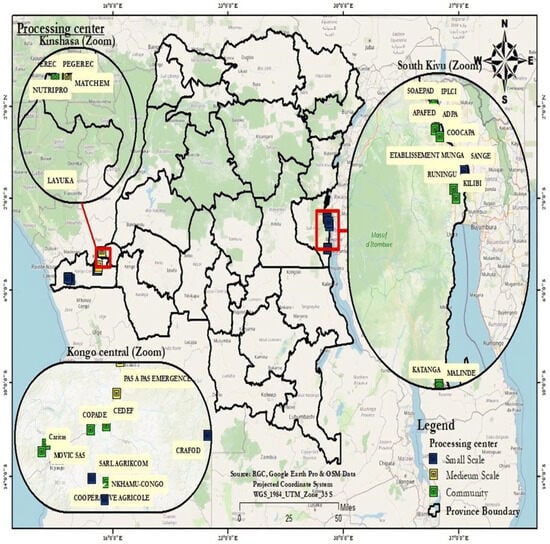
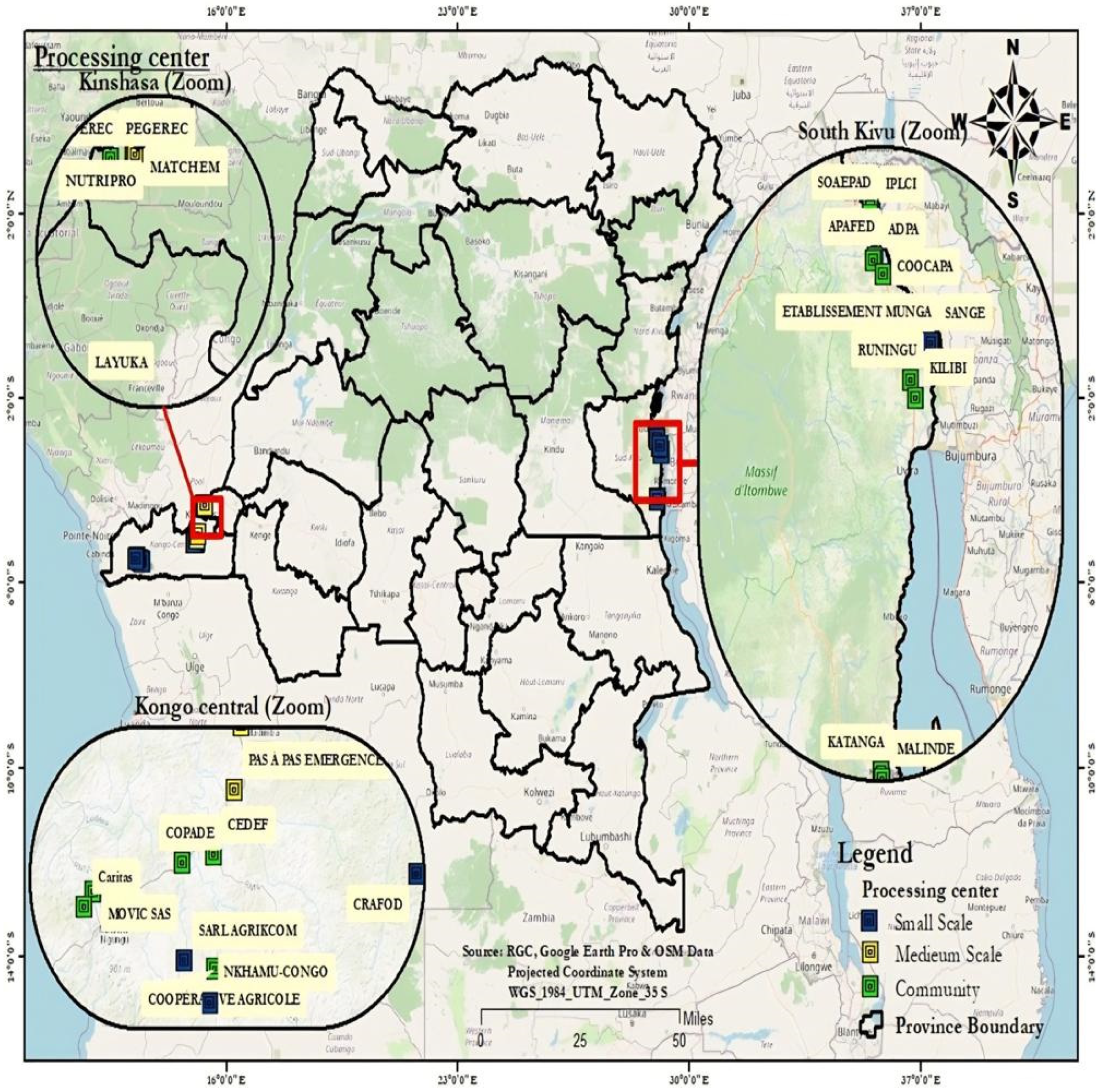
The distribution of the processing centers by province and scale of production (Figure 1) showed that processing centers in the Ruzizi Plain are predominantly community-scale (processing 200–500 kg of dried products daily) and small-scale (processing 500–1000 kg dried products per day), while Kinshasa is dominated by medium-scale processing factories (1–3 tons of dried products per day) [26,27]. All processing units across the provinces primarily process cassava into fermented flour (fufu). Community- and small-scale units recorded quality issues due to inefficient sun-drying. Only five SMEs produced High-Quality Cassava Flour (HQCF) using flash dryers, concentrated in Kinshasa and Kongo Central. Common machines used included chippers, graters, presses, and hammer mills, but mechanical peelers were rare. Many machines, particularly screw and hydraulic jack presses, were locally sourced, old, or obsolete, and less efficient than modern hydraulic presses. Production capacities were generally low due to manual methods, scarcity of raw materials, and transportation issues. Evidence of recent processing was observed in 69% of audited centers.
Figure 1.
Geographical distribution of the assessed cassava processing enterprises by province and scale of production (n = 28; community-scale: 200–500 kg/day, small-scale: 500–1000 kg/day, medium-scale: 1–3 tons/day; source: field assessment, March–May 2023).
3.2. Challenges of the Processing Centers
Major challenges include a lack of local capacity for machine fabrication and repair and costly spare parts. Inefficient drying techniques for cassava are a significant hurdle. Many processors lack quality improvement tools and knowledge. Post-processing challenges revolve around marketing and commercialization due to inconsistent product quality, poor transportation services, and high prices. Modern pressing machines, improved dryers, efficient graters, and hammer mills are most needed. Many establishments, especially SMEs, operate in inadequate, unhygienic rented structures with poor waste management, leading to pest infestation and compromised product quality. Product quality testing is rarely performed, highlighting a critical need for capacity building in quality control and Good Manufacturing Practices. Feedback from product outlets indicates inconsistent quality and high prices for local products, making them uncompetitive compared to maize flour and imported wheat flour.
Testing of product quality is rarely performed. There is poor knowledge of product quality, and limited testing for critical parameters is undertaken. Key quality and safety parameters relevant to cassava products include the following [28,29]: (1) moisture content (target: ≤12% for flour to prevent microbial growth and ensure shelf stability); (2) residual cyanide content (target: <10 ppm for safe consumption, as per Codex Alimentarius standards); (3) pH level (target: 3.5–4.5 for fermented products like fufu to ensure proper fermentation); (4) microbial load (total plate count <104 CFU/g, absence of pathogens such as E. coli and Salmonella); (5) particle size distribution (80% passing through 250 μm sieve for HQCF to meet industrial specifications); (6) color and whiteness index (L* value >85 for HQCF to ensure market acceptability); and (7) aflatoxin levels (<5 ppb as per WHO standards). These parameters are critical for ensuring product safety, marketability, and compliance with national and international food safety standards.
In the Ruzizi Plain, no facilities for quality control were observed, although some community associations had moisture meters. Only one SME of those sampled in Kinshasa/Congo central had established a mini laboratory. A strong engagement model for food quality, processing hygiene, and quality control needs to be designed and implemented. There is a cross-cutting need to build the capacity of processors to perform quality testing and monitoring.
3.3. Technical Assistance Needs of the Processing Centers
The technical assistance needs vary depending on the type of processing unit and the product processed. Table 3 reveals that small-scale units generally have a high need across most technical assistance categories, reflecting their limited resources and expertise. Cooperatives also show high needs in business management and marketing, suggesting challenges in collective organization and market access. Medium-scale units, while more established, still require significant support, particularly in equipment maintenance and quality control, which are critical for scaling operations.
Table 3.
Technical assistance needs by type of processing unit, showing relative priority levels (high/medium) based on assessment findings (n = 28 processing centers; source: field assessment, March–May 2023).
Table 4 shows that technical assistance needs varied by product type. For instance, High-Quality Cassava Flour and starch processors have high needs in terms of processing techniques and equipment maintenance, while fufu and starch processors have high needs in terms of quality control. This differentiation underscores the importance of tailoring support programs to the specific requirements of each actor.
Table 4.
Technical assistance needs by type of product processed, showing relative priority levels (high/medium) for different cassava product categories (source: field assessment, March–May 2023).
4. Discussion
This technical audit of small and medium cassava processing enterprises (SMEs) in the Democratic Republic of Congo (DRC) reveals a complex interplay of technical, infrastructural, and managerial deficiencies that collectively impede the sector’s growth and its ability to contribute effectively to national food security. The findings from the Ruzizi Plain, Kinshasa, and Kongo Central provinces underscore a pervasive challenge common across many developing economies: the struggle to transition from rudimentary, traditional processing methods to modern, efficient, and safe agro-industrial practices [5].
Most of the processors rely on old, obsolete, or inefficient machinery (e.g., screw presses, basic graters). This finding aligns with previous study on agricultural mechanization in Central Africa [19]. While local machinery fabrication offers cost advantages, the resulting equipment often lacks the efficiency, durability, and hygienic design features of modern, industrial-grade machinery [22]. For instance, the continued use of manual or screw-type presses, as opposed to modern hydraulic presses, severely limits dewatering efficiency, leading to higher residual moisture content and prolonged drying times [30]. This inefficiency directly translates to lower production capacity and higher operational costs, making the final product less competitive [31].
A particularly salient finding is the pervasive reliance on sun-drying across the majority of the audited centers, especially the community and small-scale units. This practice, while low-cost, is a major bottleneck and a significant food safety risk [24]. Sun-drying is highly weather-dependent, leading to inconsistent product quality and extended processing times [25]. More importantly, it exposes the product to environmental contaminants, dust, pests, and microbial growth, directly compromising the safety and shelf-stability of the final cassava flour [32]. Research has consistently shown that sun-drying negatively impacts the color, functional, and pasting properties of cassava flour compared to mechanical drying methods, such as flash or cabinet dryers [33,34]. The fact that only five SMEs were found to be producing High-Quality Cassava Flour (HQCF) using flash dryers, and that these were concentrated in the more urbanized Kinshasa and Kongo Central, highlights the financial and technical barriers to adopting modern drying technology in rural areas like the Ruzizi Plain [18]. The need for investments in efficient drying facilities is therefore not just an efficiency issue, but a fundamental food safety and quality imperative [35].
The technical assessment identified a lack of local capacity for machine fabrication and repair and the high cost of spare parts as major challenges. This finding is a key indicator of a weak supporting industrial ecosystem [17]. When machinery breaks down, the absence of skilled local technicians and readily available spare parts leads to prolonged downtimes, which can be catastrophic for small enterprises with limited working capital [11]. This situation forces processors to rely on expensive, often imported expertise or to simply operate with sub-optimal, poorly maintained equipment, further accelerating obsolescence [36]. The successful diffusion of technologies, such as the flash dryer in the DRC, requires not only the introduction of the technology but also the simultaneous development of a local manufacturing and maintenance base. The observed high need for equipment maintenance training across all processing unit types (Table 3), particularly high for medium-scale units which are more reliant on complex machinery, underscores the importance and urgency of this capacity building. Policy interventions must therefore move beyond mere technology transfer to include targeted vocational training programs for local artisans and engineers to ensure efficient operational skills and create a sustainable maintenance and repair network.
Many of the enterprises operate in inadequate, unhygienic rented structures with poor waste management systems, which contribute to a severe infrastructural deficit that transcends the processing equipment itself. The lack of basic utilities, such as potable water and reliable electricity, is a major impediment to implementing even basic Good Manufacturing Practices (GMPs). For instance, Lateef and Ojo [37] reported that the absence of clean water makes effective sanitation of equipment and processing environments impossible, directly contributing to the risk of microbial contamination. Similarly, unreliable electricity prevents the use of modern, electrically powered equipment and lighting, forcing reliance on manual and unhygienic alternatives.
The poor factory layouts and waste disposal practices observed in the study create environments conducive to pest infestation and cross-contamination, which are primary causes of quality compromise in food processing [30]. This is of significant public health concern given the importance of cassava as a staple food and the potential for public health risks associated with poor hygiene [10]. A previous study supports the notion that infrastructural investment, particularly in rural electrification and water access, is a prerequisite for the successful modernization of the agro-processing sector in Africa [12,13]. Furthermore, the poor transportation infrastructure in the DRC, particularly the road networks connecting the Ruzizi Plain and Kongo Central to Kinshasa, exacerbates post-harvest losses and increases the cost of raw-material procurement and product distribution, ultimately affecting market competitiveness.
The most alarming finding related to food quality is the minimal practice of product quality testing and the poor knowledge of product quality among processors. The observation that no quality control mechanisms were implemented in the Ruzizi Plain, and only one SME in Kinshasa/Kongo Central had a mini laboratory, highlights a systemic failure in quality assurance. In the context of cassava, quality control is paramount, not only for commercial consistency but also for public health, particularly in monitoring residual cyanide levels [35]. The lack of adherence to GMPs and the absence of quality assurance systems result in the inconsistent product quality reported by product outlets [38]. This inconsistency, coupled with high prices, makes local cassava products uncompetitive compared to imported wheat flour and locally processed maize flour. This market rejection cycle perpetuates the low-investment environment, as processors lack the incentive to upgrade when their products are already struggling to find a stable market [16].
The high need for quality control training across all processing unit types (Table 3) and for all product types (Table 4) confirms that this is a cross-cutting issue requiring immediate attention. Effective intervention must involve designing and implementing a strong engagement model for food quality, processing hygiene, and quality control, including the provision of basic, affordable testing equipment (like moisture meters) and training in simple, yet effective, quality assurance procedures [37,39,40]. The successful implementation of quality management systems, such as HACCP or QACCP, has been shown to be effective in assuring the safety of traditional African foods, but requires significant capacity building and regulatory support [41].
Beyond the technical and infrastructural challenges, the technical assessment revealed a need for business management and marketing training, particularly for small-scale and community/cooperative units (Table 3). The challenges revolving around commercialization, including poor market linkages and high prices, suggest that technical efficiency alone is insufficient for sustainability [17]. Processors require capacity building in business planning, financial management, and market analysis to transition from subsistence-oriented processing to profitable, market-driven enterprises [9]. Cooperatives, in particular, need support in collective organization and market access strategies to leverage economies of scale and negotiate better prices for both raw materials and finished products.
5. Conclusions and Recommendations
This technical audit revealed critical deficiencies in processing technologies, infrastructure, hygiene, and quality management practices across small, medium, and community cassava processing centers in the DRC, necessitating comprehensive interventions to enhance operational efficiency and market competitiveness.
Key challenges include sun-drying reliance, outdated machinery, inadequate quality control, and poor local repair capacity, all impeding consistent delivery of high-quality products.
Based on prevalence of technical challenges, potential impact, and feasibility, our recommendations are prioritized as follows. High Priority (immediate action required): (1) investing in efficient drying technology (flash dryers or cabinet dryers) to replace sun-drying, addressing the most critical quality and safety bottleneck; (2) implementing basic quality control training and providing affordable testing equipment (moisture meters, pH meters) to ensure product safety and consistency. Medium Priority: (3) upgrading key processing equipment (hydraulic presses, improved graters and mills) to enhance capacity and efficiency; (4) strengthening local technical capacity for machine fabrication, maintenance, and repair to ensure sustainability of equipment investments. Lower Priority (long-term development): (5) upgrading infrastructure to meet hygiene standards with proper plant layouts and waste management systems; (6) providing comprehensive business planning, financial management, and marketing training to improve commercial viability; and (7) promoting waste valorization initiatives to support circular economy principles.
Implementing these interventions will enhance productivity, product quality, market access, and sustainable livelihoods, strengthening the cassava subsector’s contribution to national GDP growth.
Author Contributions
Conception, A.A. and A.-R.A.; investigation, S.L., A.O., C.M., G.N., P.M. and R.I.; writing—original draft preparation, A.A., A.-R.A., S.L., C.M. and A.O.; supervision, A.A., A.-R.A., S.M. and N.A.; project administration, A.A. and A.-R.A.; funding acquisition, A.A., A.-R.A., S.M. and N.A.; writing—review and editing, A.A., A.-R.A., C.M., B.M. and D.M.; visualization, A.A., A.-R.A. and B.M. All authors have read and agreed to the published version of the manuscript.
Funding
This research was funded by the Agenda for the Transformation of Agriculture in the Democratic Republic of Congo (ATA-DRC) Program, Technology for African Agricultural Transformation (TAAT) of the African Development Bank and the American People.
Institutional Review Board Statement
Not applicable.
Data Availability Statement
The original findings from this study are included in the article. Further inquiries can be directed to the corresponding author.
Acknowledgments
The authors acknowledged funding received from the African Development Bank, as well as the DRC government and the American people.
Conflicts of Interest
The authors declare no conflicts of interest. The funders had no role in the design of the study; in data collection, analyses, or interpretation; in writing/editing of the manuscript; or in the decision to publish the findings.
References
- Chandrasekara, A.; Kumar, T.J. Roots and tuber crops as functional foods: A review on phytochemical composition and potential health benefits. Int. J. Food Sci. 2016, 2016, 3631647. [Google Scholar] [CrossRef] [Scilit]
- Kumar, J.S.; Sunitha, S.; Giri, N.A. A Review of Tropical Root and Tuber Crops for Livelihood Security and Nutrition. Environ. Ecol. 2024, 42, 1793–1800. [Google Scholar] [CrossRef] [Scilit]
- Sheela, I.; Jaganathan, D.; Prakash, P.; Sivakumar, P.S. Cassava for Food Security, Poverty Reduction and Climate Resilience: A Review. Indian J. Ecol. 2024, 51, 21–31. [Google Scholar]
- Sakadzo, N.; Kugedera, A.T.; Ranganai, N.; Kokerai, L.K. Cassava: Practices and technologies to improve food security in sub-Saharan Africa. Cogent Food Agric. 2025, 11, 2518758. [Google Scholar] [CrossRef] [Scilit]
- Adebayo, W.G. Cassava production in Africa: A panel analysis of the drivers and trends. Heliyon 2023, 9, e19939. [Google Scholar] [CrossRef] [Scilit] [PubMed]
- Nweke, F.I. The Cassava Transformation: Africa’s Best-Kept Secret; Michigan State University Press: East Lansing, MI, USA, 2004. [Google Scholar]
- World Bank. DRC Economic Update: Resilience and Reform; World Bank Group: Washington, DC, USA, 2022; Available online: https://www.worldbank.org/en/news/press-release/2022/10/07/democratic-republic-of-congo-economic-update (accessed on 21 April 2025).
- Manyong, V.M.; Dontsop, P.M.; Nyamuhirwa, D.A.; Osabohien, R.; Bokangae, M.; Mignouna, J.; Bamba, Z.; Adeoti, R. Drivers and magnitude of food insecurity among rural households in the Democratic Republic of Congo. Food Policy 2024, 10, e40207. [Google Scholar] [CrossRef] [Scilit]
- Tabaglio, V.; Fiorini, A.; Ndayisenga, V.; Ndereyimana, A.; Minuti, A.; Nyembo Nyembo, R.; Nyembo Ngoy, D.; Bertoni, G. Sustainable Intensification of Cassava Production towards Food Security in the Lomami Province (DR Congo): Role of Planting Method and Landrace. Agronomy 2023, 13, 228. [Google Scholar] [CrossRef] [Scilit]
- WFP. Food Security Crisis in the Democratic Republic of Congo. WFP News. 2021. Available online: https://www.wfp.org/news/food-security-crisis-democratic-republic-congo-could-worsen-coming-months (accessed on 3 June 2025).
- Bokundabi, G.; Bwanga, N.; Mapatano, M. When knowledge is not enough: Barriers to recommended cassava processing in resource-constrained Kwango, DRC. Public Health Afr. 2023, 11, 191. [Google Scholar]
- World Bank. Case Study: Agribusiness—The Cassava Value Chain in DRC; World Bank Group: Washington, DC, USA, 2023; p. 63. Available online: http://documents1.worldbank.org/curated/en/099101723140713472/pdf/P1751610b5584004c0a1c60ac4c1eb2a141.pdf (accessed on 21 April 2025).
- AUC/OECD. Africa’s Development Dynamics 2025: Infrastructure, Growth and Transformation; AUC: Addis Ababa, Ethiopia; OECD Publishing: Paris, France, 2025. [Google Scholar] [CrossRef] [Scilit]
- Kasso, M.; Bekele, A. Post-harvest losses of fruits and vegetables: Assessment of causes and severity levels. J. Food Sci. Technol. 2016, 53, 3715–3725. [Google Scholar]
- FAO. Almost a Quarter of the Population in the Democratic Republic of the Congo Continue to Face Acute Food Insecurity. Joint FAO/WFP News Release. 2023. Available online: https://www.fao.org/newsroom/detail/almost-a-quarter-of-the-population-in-the-democratic-republic-of-the-congo-continue-to-face-acute-food-insecurity-as-humanitarian-needs-grow-to-record-levels/en (accessed on 3 June 2024).
- Kpadonou, G.E.; Sobgui, C.M.; Edoh, R.; Ganyo, K.K.; Anihouvi, S.E.L.; Lamien, N. Unlocking the Role of Food Processing in Nutrition-Smart and Nutrition-Sensitive Agriculture in West Africa: Challenges, Opportunities, and a Framework for Deployment. Proceedings 2025, 118, 17. [Google Scholar] [CrossRef] [Scilit]
- Sahel Capital. The Cassava Value Chain. Sahel Quarterly. 2021, p. 28. Available online: https://sahelcapital.com/wp-content/uploads/2022/05/Sahel-Quarterly-_The-Cassava-Value-Chain-Volume-28-v1.pdf (accessed on 21 April 2025).
- CGIAR. New Project to Strengthen and Modernize DRC’s Cassava Sector. CGIAR News. 2023. Available online: https://www.cgiar.org/news-events/news/new-project-to-strengthen-and-modernize-drcs-cassava-sector/ (accessed on 10 October 2025).
- Ndjouenkeu, R. Cassava in Central and Western Africa: Postharvest operations and processing. In Cassava: Cultivation, Uses and Health Effects; InTech: London, UK, 2018. [Google Scholar] [CrossRef] [Scilit]
- Adjéi, E.A.; Kouadio, K.K.; Kouamé, K.G. Adoption of improved cassava production technologies in Côte d’Ivoire. Front. Agron. 2024, 5, 1433204. [Google Scholar]
- Nabahungu, N.L.; Mirali, J.C.; Simbeko, G.; Amato, S.; Mirali, G.M.; Muhindo, P.M.; Kitangala, C.; Balangaliza, F.B.; Nguezet, P.D.; Kintche, K.; et al. Farmer typology and adoption of improved cassava production technologies in the Eastern Democratic Republic of the Congo. Agric. Biol. 2025, 6, 0018. [Google Scholar] [CrossRef] [Scilit]
- Ampah, J.; Ofori, D.; Owusu, A. Status, challenges and prospects of food processing equipment fabricators in Ghana. J. Manuf. Technol. Manag. 2021, 32, 1387–1406. [Google Scholar] [CrossRef] [Scilit]
- Tran, T.; Taborda, L. From Capacity Building to Local Adoption: Manufacturing and Diffusion of Cassava Flash Dryers in DR Congo; Study #AFR—2434; Bioversity International: Rome, Italy; CIAT: Cali, Colombia, 2025; p. 2. [Google Scholar]
- Nainggolan, E.A.; Banout, J.; Urbanova, K. Recent Trends in the Pre-Drying, Drying, and Post-Drying Processes of Cassava. Foods 2024, 13, 1778. [Google Scholar] [CrossRef] [Scilit] [PubMed]
- Isirima, C.B.; Okole, P.; Ogunu-Ebiyi, U. Effects of oven and sun drying processing techniques on the organoleptic characteristics quality of cassava (Manihot esculenta) flour and fufu. Int. J. Dev. Sust. Int. J. Dairy Sci. 2023, 12, 425–438. [Google Scholar]
- FAO. A Cassava Industrial Revolution in Nigeria; Publishing Management Service, Information Division, FAO: Rome, Italy, 2005; Available online: https://www.fao.org/4/y5548e/y5548e08.htm (accessed on 3 June 2025).
- TAAT Clearinghouse. Cassava Processing Technology Toolkit Catalogue. In Clearinghouse Technical Report Series 013; Technologies for African Agricultural Transformation, Clearinghouse Office, IITA: Cotonou, Benin, 2022; p. 28. [Google Scholar]
- ARSO. African Standard CD-ARS [838]. In Cassava Flour—Specification, 1st ed.; ARSO: Nairobi, Kenya, 2014. [Google Scholar]
- ARSO. African Standard CD-ARS 840. In High Quality Cassava Flour—Specification, 1st ed.; ARSO: Nairobi, Kenya, 2014. [Google Scholar]
- Bakari AAbdallah, B.A.; Uzokwe, V.N.E.; Silayo VMamiro, P.; Chisawillo, P.; Kolawole, P. Handbook for Good Manufacturing and Hygienic Practices (GMP & GHP); IITA: Ibadan, Nigeria, 2016; p. 38. [Google Scholar]
- Ellah, G.O.; Eze, C.C.; Orebiyi, J.S.; Korie, O.C.; Onyeagocha, S.U.O. Critical Challenges of Cassava Value Chain Actors in Imo State, Nigeria. UKR J. Agric. Vet. Sci. (UKRJAVS) 2025, 1, 8–19. [Google Scholar]
- Massamby, A.; Leong, S.-L.L.; Müller, B.; Tivana, L.; Passoth, V.; Macuamule, C.; Sandgren, M. Microbial Contamination and Food Safety Aspects of Cassava Roasted Flour (“Rale”) in Mozambique. Microorganisms 2025, 13, 168. [Google Scholar] [CrossRef] [Scilit]
- Pornpraipech, P.; Khusakul, M.; Singklin, R.; Sarabhorn, P.; Areeprasert, C. Effect of temperature and shape on drying performance of cassava chips. Agric. Nat. Resour. 2017, 51, 402–409. [Google Scholar] [CrossRef] [Scilit]
- Atlaw, T.K. Influence of Drying Methods on Flour Quality and Cyanide Content of Cassava Root Tuber. Int. J. Nutr. Food Sci. 2018, 7, 142–147. [Google Scholar] [CrossRef] [Scilit]
- Forkum, A.T.; Nguimkeu, I.M.; Nguimkeu, P. Safety of cassava and cassava-based products: A review. Front. Sustain. Food Syst. 2025, 9, 1497609. [Google Scholar] [CrossRef] [Scilit]
- Ajayi, O.A.; Olorunfemi, O.D.; Oladipo, F.O. The role of small and medium enterprises in agricultural value chain development in Nigeria. J. Agribus. Rural. Dev. 2019, 52, 101–112. [Google Scholar]
- Lateef, A.; Ojo, M.O. Public health issues in the processing of cassava (Manihot esculenta Crantz). Qual. Assur. Saf. Crops Foods 2016, 8, 165–177. [Google Scholar] [CrossRef] [Scilit]
- Ameye, H.; Talsma, E.F.; Gellynck, X. Urbanizing food environments in Africa: Challenges and policy options. Food Policy 2025, 123, 102600. [Google Scholar]
- Komlaga, G.A.; Dziedzoave, N.T. Quality management of cassava processing: The C:AVA Ghana experience. In CSIR-FRI Research Report; CSIR-Food Research Institute: Accra, Ghana, 2019; p. 12. Available online: https://csirspace.foodresearchgh.org/bitstream/1/1459/1/Quality_Management_Cassava_Processng.pdf (accessed on 21 April 2025).
- Dziedzoave, N.T.; Abass, A.B.; Amoa-Awua, W.K.A.; Sablah, M. Quality Management Manual for the Production of High Quality Cassava Flour; Adegoke, G.O., Brimer, L., Eds.; International Institute of Tropical Agriculture: Ibadan, Nigeria, 2006; p. 68. [Google Scholar]
- Amoa-Awua, W.K.; Appoh, F.E.; Kpodo, K. The effect of applying GMP and HACCP to traditional food processing. Food Control 2007, 18, 1205–1212. [Google Scholar] [CrossRef] [Scilit]

Disclaimer/Publisher’s Note: The statements, opinions and data contained in all publications are solely those of the individual author(s) and contributor(s) and not of MDPI and/or the editor(s). MDPI and/or the editor(s) disclaim responsibility for any injury to people or property resulting from any ideas, methods, instructions or products referred to in the content. |
© 2026 by the authors. Licensee MDPI, Basel, Switzerland. This article is an open access article distributed under the terms and conditions of the Creative Commons Attribution (CC BY) license.