1. Introduction
The sustainability of modern agriculture hinges on its capacity to reconcile high productivity with robust environmental and landscape protection, particularly the enhancement of crop diversity [
1,
2]. The structure of farm crops is a key determinant of landscape crop diversity, as acknowledged by various studies that link agricultural practices to ecological outcomes [
1,
3,
4]. A diverse crop composition, where a wide variety of crops are well-represented in the overall composition, has a positive impact on the diversity and abundance of fauna and flora species, whereas a simplified crop structure, often involving monoculture, leads to negative environmental consequences [
1,
4]. Cropland structure, adjusted to farm specialization, is therefore recognized as a crucial element influencing the maintenance of crop diversity in rural areas [
3].
In the EU policy context, enhancing on-farm crop diversity has become a central objective of the CAP’s environmental architecture, particularly under the 2023–2027 framework where eco-schemes are intended to incentivize management practices with measurable environmental benefits [
5,
6,
7]. However, the capacity of these instruments to counteract long-standing structural trends—such as production specialization and cereal dominance—remains uncertain in several member states, including Poland [
3,
4,
8]. This uncertainty motivates the need for an empirical assessment linking CAP environmental instruments to observed crop-structure outcomes across space and time.
Throughout this paper, we distinguish crop diversity (diversity of cultivated crops and their relative shares) from crop diversity as a broader ecosystem concept [
3,
4,
8]. In our empirical framework, the Shannon–Wiener index is used as an indicator of crop-structure diversity, which is treated as a proxy relevant to landscape ecological functioning rather than as a direct measure of ecosystem crop diversity [
3,
4,
8,
9,
10].
In Poland, the predominant structure of agricultural production is characterized by an excessive dominance of cereals, which has led to significant crop simplification [
3,
4]. This concentration of crops, which frequently exceeds 50% of the arable land, was reported at 56.9% of the cropping area in 2019 [
8]. This simplification poses considerable environmental risks, including reduced soil health, increased pest and disease pressure, and a decline in agro-ecosystem crop diversity [
1,
4]. These patterns are consistent with agronomic field studies showing that long-term land-use practices significantly shape segetal flora composition and overall agroecosystem crop diversity [
11]. Spatial assessments of crop compositional balance in the country reveal a clear north–south divide, with northern and central Poland generally exhibiting more balanced crop compositions, while the south shows greater disproportions between individual crops [
4]. This structural diversity is often attributed to non-natural factors such as farm organizational characteristics, distance from major cities (market access), and historical political divisions [
4]. To quantify this ecological phenomenon, a set of agroecological indicators are employed: the Shannon–Wiener index (H′), which is the key metric for assessing diversity, and the Pielou equality index, used to determine the uniformity of crop contribution across regions [
3,
4,
8].
Notably the “European Green Deal” and the “EU Biodiversity Strategy 2030” [
8,
12]. For instance, the Common Agricultural Policy (CAP) previously introduced “greening” requirements, implemented since 2015, which linked direct payments to farmers with the compliance of environmental standards, including crop diversification on farms with more than 10 ha of arable land [
3,
5]. These strategic commitments align with broader environmental and climate priorities identified for Polish agriculture, which underline the need for crop diversity protection within the European Green Deal framework [
5]. These requirements established quantifiable diversity thresholds, such as a minimum Shannon–Wiener index of 0.56 for farms with 10–30 ha of arable land, and 0.69 for farms exceeding 30 ha [
3]. Building on this framework, the new CAP Strategic Plan for Poland (2023–2027), officially approved by the European Commission on 31 August 2022 [
6], emphasizes a continued commitment to sustainable, climate- and environment-friendly farming methods, as well as the protection of water, soil, air, and biodiversity [
6]. The policy response to this ongoing challenge of crop simplification is the implementation of the new CAP with its enhanced environmental component, notably the Eco-Schemes [
7,
13,
14].
Despite growing literature on crop diversification and CAP conditionality, two empirical gaps remain salient for Poland. First, evidence linking the new 2023–2027 eco-scheme uptake to crop-structure diversity is still limited, particularly when considering both farm-level behaviour and municipality-level policy saturation. Second, the literature offers mixed expectations regarding whether smaller farms maintain more diverse crop structures or whether organizational and market constraints instead lead to simplification. This study contributes by combining longitudinal farm-level data (2016/2021/2024) with a municipality-level spatial assessment of environmental-measure saturation to evaluate crop-structure diversity under the evolving CAP framework.
Accordingly, the objective of this study is to assess the determinants of crop-structure diversity in Poland and to evaluate whether municipalities and farms more engaged with CAP environmental instruments display more diversified crop structures. We address this objective through four hypotheses concerning (i) livestock specialization and simplification, (ii) farm size and crop diversity, (iii) farm size and eco-scheme participation intensity, and (iv) temporal trends in maize expansion as a marker of ongoing simplification. The remainder of the paper is structured as follows:
Section 1 synthesizes the relevant evidence and frames the hypotheses;
Section 2 outlines the data and analytical framework;
Section 3 and
Section 4 present the results;
Section 5 discusses implications, limitations, and policy relevance; and
Section 6 concludes.
2. Crop Diversity, Farm Structure, and CAP Environmental Instruments
The sustainability of agricultural production is increasingly evaluated by its capacity to enhance or maintain crop diversity, with the structure of cultivated crops recognized as a fundamental determinant of ecological outcomes [
3,
4,
15,
16]. This paradigm shift is supported by meta-analysis evidence demonstrating that agricultural diversification enhances biodiversity and the delivery of multiple supporting and regulating ecosystem services—including pest control, pollination, nutrient cycling, soil fertility, and water regulation—often without compromising crop yield when compared to simplified cropping systems [
1].
Recent experimental research further reinforces this evidence, showing that diversified crop rotations can simultaneously increase total equivalent yield by up to 38%, improve soil microbial diversity, and enhance multiple soil health indicators, demonstrating the multifaceted ecological advantages of diversification [
17]. However, in Poland, the predominant crop structure has been deemed “inappropriate” due to an excessive dominance of cereals, which frequently exceeds 50% of the arable land, leading to significant crop simplification and associated environmental risks [
3,
4,
8]. Similarly, evidence from monoculture systems shows that prolonged simplification reduces microbial functional diversity—such as declines in Shannon H’ and substrate richness—highlighting the broader ecological degradation associated with simplified cropping patterns [
18].
This review synthesizes the existing literature relevant to the methodology and objectives of the current study, focusing on the role of crop diversity in Polish agriculture, its key drivers, and the policy context of the Common Agricultural Policy (CAP). Methodologically, the literature establishes the Shannon–Wiener index (H′) as the key metric for assessing the diversity of a cropping pattern, with the Pielou equality index (J′) used to determine the uniformity of crop contribution [
3,
4,
12,
17,
18,
19,
20,
21,
22,
23]. Ecological research consistently emphasizes the importance of selecting diversity metrics that capture both richness and abundance, with Shannon’s index considered appropriate when rare and dominant species have similar relevance, thereby supporting its application in crop-structure studies [
20].
Previous empirical studies based on farms from the Polish Farm Accountancy Data Network (FADN) have widely applied diversity metrics such as the Shannon–Wiener and Pielou indices to characterize crop-structure diversity across different production systems [
8]. These studies consistently document a strong association between production specialization and crop simplification. In particular, farms engaged in commercial granivorous animal production exhibit the lowest levels of crop diversity (H′ = 0.93) and uniformity (J′ = 0.42), alongside the highest share of cereals (75.5%) [
3,
8]. In contrast, farms oriented towards permanent crops display substantially higher levels of crop-structure diversity (H′ = 1.59), reflecting more balanced cropping patterns [
8].
Furthermore, crop diversity was shown to increase with the economic size of the farm, with the highest value on big farms (100 ≤ thous. € < 500, H′ = 1.51) and the lowest on very small farms (2 ≤ thous. € < 8, H′ = 0.97) [
8]. These empirical patterns align with general ecological theory, which predicts that systems with even species distributions—analogous to balanced crop shares—exhibit greater stability and resilience [
24]. Therefore, the current study is designed to test these established relationships between farm size and specialization against the performance of the new policy tools: the CAP Eco-Schemes [
1,
7,
13,
22].
2.1. The Role of Crop Diversity and Simplification
The literature establishes a clear link between diversified crop composition and positive environmental effects, including the diversity and abundance of fauna and flora. Conversely, a simplified crop structure, often resulting in monocultures or the excessive dominance of a few crops, leads to negative consequences such as reduced soil health and increased pest and disease pressure [
4]. This relationship is further supported by experimental findings showing that continuous monoculture significantly decreases microbial functional diversity, with reductions in carbon-source utilization and Shannon H′, illustrating how biological degradation emerges under simplified production systems [
18]. In Poland, a central challenge has been the structure of agricultural production, which is characterized by a high share of cereals, frequently exceeding 50% of the arable land [
6]. Recent spatial assessments also demonstrate that regions dominated by simplified crop structures exhibit lower landscape-level crop diversity, confirming the broader ecological implications of cereal-dominated production [
4]. This high concentration is a long-standing issue; for instance, the share of basic grains alone was reported at 56.9% of the cropping area in 2019 [
8].
2.2. Quantification of Crop Diversity
The assessment of the environmental impact of a farm’s sowing structure often employs standard agroecological indicators [
8]. The Shannon–Wiener index (H′) is the key metric used to assess the diversity of a cropping pattern, while the Pielou equality index (J′) is used to determine the uniformity of the contribution of each crop species [
3,
4,
8]. Ecological literature highlights that selecting more than one diversity metric—especially those positioned along Hill’s series—can improve the robustness of crop diversity assessments by simultaneously capturing changes in both dominant and rare components of a community [
20].
These indices demonstrate measurable differences across farm types. For example, farms specializing in granivorous animals exhibited the lowest diversity (H′ = 0.93) and uniformity (J′ = 0.42), primarily due to the highest share of cereals (75.5%) in their crop structure (Madej, 2022) [
8]. Similar thresholds for ecological functioning have been observed in experimental systems, where reductions in Shannon diversity correspond with declines in soil health, microbial biomass, and ecosystem multifunctionality [
17].
2.3. Farm Characteristics and Drivers of Simplification
Research confirms that farm specialization and economic size are critical factors influencing crop structure, forming the basis for the hypotheses in the current study [
3]. Farm Specialization: Farms engaged in commercial animal production, particularly granivorous animal husbandry (pigs and poultry), are strongly associated with crop simplification. These farms concentrate on producing their own feed, resulting in high cereal dominance, which aligns with the research hypothesis (H1) that commercial animal production simplifies crop structure [
8]. Conversely, mixed-production farms have been found to be the most beneficial in terms of crop diversity, characterized by the highest diversity index (H′ = 1.80) and a higher number of cultivated species [
3].
The impact of farm size is complex. Smaller farms (e.g., 2 ≤ thous. € < 8 economic size, representing very small farms) have been linked to the highest cereal share (75.3%) and the lowest diversity index [
8], suggesting they may also simplify their crop rotation. However, another study found that very small farms had a more diversified structure compared to larger ones [
6]. The current study’s hypotheses (H2 and H3) are designed to specifically test the relationship between farm size and both crop diversification and the capacity to adopt Eco-Schemes under the new policy [
3]. Empirical evidence from Polish small farms reveals that crop diversification decisions involve a trade-off between economic efficiency and risk management, where specialized farms accumulate higher-value fixed assets but face greater income volatility [
25]. Similar dynamics have been observed outside Europe, where panel regression evidence shows that crop diversification decisions respond to economic efficiency signals and structural constraints [
19]. This heterogeneity in farm-level responses suggests that the capacity to adopt diversification practices under CAP incentives may be constrained by asset endowments and prior specialization pathways.
2.4. Policy Context: From Greening to Eco-Schemes
The issue of agricultural crop diversity is integrated into strategic documents like the EU’s “European Green Deal” and “EU Biodiversity Strategy 2030” [
8,
12]. The shift from the previous “greening” component of the CAP to the new Eco-Schemes marks a crucial policy transition. The new CAP Strategic Plan for Poland (2023–2027), officially approved on 31 August 2022 [
6], continues this commitment to sustainable, climate- and environment-friendly farming methods [
6,
8,
26]. The Eco-Schemes represent the next evolution in policy tools aimed at incentivizing farmers to adopt beneficial practices like ‘Diversified Sowing Structure’ [
7,
14,
26]. The efficacy of these new instruments in interrupting the established trends of crop simplification, particularly those linked to farm specialization and size, is the primary gap the present research aims to address. Recent analyses of CAP implementation in neighbouring Slovakia demonstrate that second-pillar payments (ANC and animal welfare) positively influence crop diversity, while first-pillar direct payments (SAPS) correlate with homogenization [
22].
This highlights the critical importance of payment design and conditionality in shaping farm-level diversification outcomes. In Poland, the carbon farming eco-scheme has already shown distinct spatial clustering patterns, with larger farms exhibiting higher participation rates but smaller farms demonstrating stronger local adoption intensity [
26]. The measure’s point-based system, where 1 point equals approximately €22.47, creates differentiated incentives across farm size categories, potentially reinforcing existing structural inequalities in access to environmental subsidies. Furthermore, research on Carpathian agriculture reveals that institutional environmental measures have not yet achieved satisfactory participation rates in mountain and foothill areas, where abandonment risks are highest [
7], underscoring the need for targeted outreach and simplified application procedures.
The reviewed literature consistently demonstrates that crop-structure diversity is shaped by a combination of structural farm characteristics, production specialization, and policy incentives. Empirical studies in Poland and other EU member states confirm that livestock-oriented specialization and cereal dominance are strongly associated with simplified cropping patterns, while diversified rotations are linked to improved ecological functioning.
However, two important gaps remain. First, there is limited empirical evidence assessing whether the newly introduced eco-schemes under the 2023–2027 Common Agricultural Policy have translated into observable improvements in crop-structure diversity, particularly when evaluated simultaneously at the farm and municipality levels. Second, the literature provides mixed expectations regarding the relationship between farm size and diversification, especially in contexts where regulatory exemptions and organizational constraints coexist.
Addressing these gaps requires an analytical framework that integrates longitudinal farm-level data with spatially explicit information on policy uptake. The present study responds to this need by evaluating crop-structure diversity using established ecological indicators while explicitly linking observed patterns to the evolving design of CAP environmental instruments.
3. Materials and Methods
This study utilizes a multi-stage, multiscale methodological approach that integrates farm-level longitudinal analysis with municipality-level spatial assessment and policy evaluation [
3,
4,
6,
8]. This approach is grounded in agroecological principles, supported by foundational agronomic studies on crop cultivation and soil systems [
27,
28], and incorporates ecological theory on population structure, abundance, and methodological rigour [
24,
29]. Diversity metrics are used to quantify ecological outcomes, following both classical information theory [
10] and contemporary ecological applications [
20]. The methodological framework is further validated by empirical evidence demonstrating that agricultural diversification promotes multiple ecosystem services without compromising yield, supporting its viability as a sustainable intensification strategy [
1].
3.1. Research Problem
The necessity of reconciling high agricultural production with environmental and landscape protection to enhance crop diversity has been clearly established [
3,
4,
8]. The crop structure in Poland has been characterized as “inappropriate” [
8], primarily due to the overwhelming dominance of cereals, which, as a long-standing issue, exceeded 50% of arable land [
3] and constituted 56.9% of the cropping area in 2019 [
8]. This concentration leads to crop simplification and associated environmental risks, thereby undermining the ecological functions of the agricultural landscape [
4,
8]. The central research problem is, therefore, to assess the efficacy of the new CAP Eco-Schemes in counteracting this crop structure simplification across diverse regional contexts and production systems, particularly in light of the mixed performance of earlier policy instruments [
3,
8]. The challenge is compounded by spatial heterogeneity, as demonstrated by recent spatial statistical analyses revealing distinct clustering patterns in eco-scheme participation across Polish counties, with larger farms showing greater regional concentration [
26].
3.2. General Objective
To identify the economic, organizational, biological, and policy-related factors driving changes in agricultural land structure in Poland [
4,
6,
8].
3.3. Specific Objective/Thesis
To assess that farm area and commercial animal production are key determinants shaping changes in crop structure in Poland [
4,
8]. This objective is based on previous findings linking specialization—especially granivorous animal husbandry—with the strongest crop simplification tendencies [
8]. The thesis is further substantiated by evidence from small farm efficiency studies demonstrating that Polish farms diversifying crops face significant trade-offs between economic efficiency and risk reduction, where specialized farms accumulate higher-value fixed assets but experience greater income volatility [
25].
3.4. Research Questions
Which specific elements of the CAP, including the new Eco-Schemes, provide the most effective encouragement for farmers to maintain or increase field crop diversification, particularly in comparison to the former ‘greening’ requirements [
3]?
How effective has the uptake of Eco-Schemes been by Polish farmers (Date–Date), and does this vary based on farm economic size [
8] or location in Areas with Natural or Other Specific Constraints (ANC)?
How does the implementation of Eco-Schemes, such as ‘Diversified Sowing Structure’, impact actual crop diversity, as quantitatively measured by the Shannon–Wiener index (H′) [
3,
4,
8]?
What regulatory adjustments, including modifications to the design of the Eco-Schemes, are necessary to most effectively increase crop diversification and soil protection in Poland [
4]?
3.5. Research Hypotheses
H1. Farms engaged in commercial animal production simplify the crop structure, due to the high demand for self-produced cereal fodder [8].
H2. Smaller farms (<10 ha) have a more diversified crop structure than larger farms [6], although their capacity to adopt multiple Eco-Schemes is limited. H3. Larger farms (>50 ha) demonstrate higher levels of participation in the CAP Eco-Schemes by adopting a greater number of individual practices, potentially due to better organizational and economic capacity [8].
H4. In the Date–Date period, there was a tendency to simplify the sowing structure (increasing maize share), especially in regions with concentrated animal production, continuing the trend of increasing concentration in certain crops [4].
To empirically test the proposed relationships (H1–H4) and formally address the research questions, the analytical framework is constructed upon established metrics for quantifying agricultural crop diversity [
3,
4,
8]. This research employs a modified methodology. The original study, which examined 192 farms across all Polish voivodeships for the years 2016, 2021, and 2024, serves as the foundational source and benchmark for the results [
9]. The analytical framework will be specifically adapted to test the influence of the new CAP Eco-Schemes, utilizing the Shannon–Wiener index (H′) to measure crop diversity, as established in the source methodology [
3,
4,
8]. The H′ index is selected because higher values denote a more even and balanced share of species, indicative of greater crop diversity [
3,
4,
8].
3.6. Scope of Research
The farm-level sample consists of 192 farms purposively selected to ensure structural and regional coverage rather than statistical representativeness of the national farm population. The number reflects a balanced design including farms from all 16 voivodeships and key production types, consistent with the benchmark study on regional changes in sowing structure in Poland on which the analytical framework is based. Given that Poland has over one million registered farms, the sample is not intended to represent population shares, but to capture dominant structural contrasts related to farm size, production orientation, and regional context; accordingly, the analysis focuses on comparative patterns in crop-structure diversity rather than on population-level descriptive statistics.
The research encompasses the entire territory of Poland, including all 16 voivodeships, and is based on a structured sample of 192 farms that represent meaningful variation in farm size, production orientation, and regional characteristics. This multilevel approach—spanning national, regional, and individual farm scales—reflects ecological sampling principles that emphasize spatial heterogeneity and population structure [
24,
29]. The stratification mirrors the methodological approach used in assessing regional crop diversity changes during EU membership, which documented significant spatiotemporal variation in crop diversity across Polish gminas [
4].
In accordance with the methodological guidelines of the foundational study Regional Changes in the Sowing Structure in Poland, the sampled farms were stratified within each voivodeship into smaller units (<10 ha) and larger units (≥10 ha). This stratification mirrors long-established agronomic insights into soil–plant interactions and regional variability in cultivation conditions [
27], as well as recognized differences in crop profitability across farm types [
28]. The temporal scope of the study includes the years 2016, 2021, and 2024, thereby allowing for comparative assessment before and after the introduction of the new CAP instruments.
3.7. Data Sources
The primary data for this study are drawn from publicly available agricultural statistics and administrative datasets related to the implementation of CAP payments in Poland. Central to the analysis are datasets provided by the Agency for Restructuring and Modernisation of Agriculture (ARiMR), which administers CAP instruments and supplies detailed information on agricultural land structure, crop composition, livestock numbers, and territorial classification across the years 2016, 2021, and 2024 [
4,
8]. The processing of these administrative data follows standardized protocols established for evaluating agricultural policy effectiveness, incorporating quality control mechanisms for handling missing data and outliers [
22].
Information on farm size structure is incorporated through the Agricultural Census and the Farm Accountancy Data Network (FADN), the latter being essential for assessing economic size and production orientation [
3,
8]. Given the centrality of environmental commitments in the current CAP, municipality-level data for 2023 are also employed to capture the spatial distribution of beneficiaries of eco-schemes, organic farming interventions, and agri-environment–climate measures administered under Pillar I and Pillar II. These datasets enable the identification of municipalities with varying degrees of saturation of environmental measures and provide a basis for assessing associated crop diversity outcomes.
In addition, the study makes use of supporting indicators such as the Agricultural Production Space Valorisation Index (WRPP), which reflects regional production conditions and natural constraints. Data from the 2023–2024 CAP period are prioritized to evaluate the initial effects of the newly introduced environmental instruments and to contextualize observed changes within the broader evolution of agricultural policy [
6].
3.8. Data Collection Methods
The Agency for Restructuring and Modernisation of Agriculture (ARiMR), responsible for administering CAP instruments in Poland, provided harmonized datasets for each voivodeship, ensuring methodological consistency across the study period [
29]. These datasets contained standardized variables for 2016, 2021, and 2024, including detailed information on agricultural land structure—arable land, permanent grasslands, and orchards or permanent crops—along with crop composition expressed as percentage shares of individual species, livestock numbers calculated in livestock units (DJP), and precise territorial identifiers enabling spatially consistent classification.
Farm-level data were collected according to a stratified sampling design aligned with the methodological foundations of the benchmark study. Within each voivodeship, farms were selected at two size thresholds—half the average farm area and twice the average farm area—and further categorized into animal-specialized, plant-specialized, and mixed-production systems. This approach captures ecological and economic gradients that are central to understanding variation in crop diversity and production structure [
20,
24]. A codified numbering system, ranging from 1/1 to 16/6, was applied to maintain transparent traceability throughout all analytical procedures.
In addition, municipality-level data for 2023 were classified into analytical categories reflecting the degree of saturation with environmental measures. Municipalities were grouped according to whether agricultural land accounted for ≥50% or <50% of farms participating in eco-schemes, ≥25% or <25% participation in organic farming, and ≥25% or <25% involvement in agri-environment–climate interventions. This classification enables structured comparisons of crop diversity metrics across distinct policy contexts, allowing the analysis to link variation in the Shannon–Wiener index directly to the spatial distribution of environmental commitments.
3.9. Data Processing Methods
The analytical procedures applied in this study incorporate inductive, deductive, and re-deductive reasoning, consistent with established standards in ecological methodology [
29]. Data processing is structured to capture both temporal dynamics and spatial variation in crop structure and crop diversity. The two complementary levels of analysis are conducted, each serving a distinct purpose in evaluating the effects of agricultural policy instruments on cropping systems. For quantifying economic diversification patterns, the Herfindahl-Hirschman Index (HHI) provides a robust concentration measure where values approaching zero indicate greater diversification [
25].
Crop diversity is quantified using the Shannon–Wiener index, originally developed within information theory [
10] and subsequently adapted for ecological applications. The index is computed following its standard ecological formulation using natural logarithms, as widely applied in crop-structure and biodiversity-related studies. Its enduring relevance stems from its ability to jointly represent species richness and evenness, thereby providing a probabilistic interpretation of diversity [
10,
20,
29]. Values approaching 0 indicate complete dominance by a single crop, while values ≥ 1.5 generally reflect minimally acceptable biodiversity levels in ecological systems (Morris et al., 2014) [
20]. Because the index has no fixed upper limit and increases when species are more evenly distributed, it is well suited to assessing agricultural systems in which simplification poses a documented ecological risk [
3,
4,
8].
The use of natural logarithms follows standard ecological practice [
20,
29]. The index’s application in agricultural systems is validated by functional diversity studies demonstrating that diversified cropping systems enhance ecosystem service provision, making it an appropriate metric for evaluating policy impacts [
1]. Given the descriptive-comparative nature of the analysis, diversity indices are interpreted as structural indicators rather than as inferential statistical measures.
3.10. Analytical Framework
The analytical procedure is structured into three interconnected stages and follows the structure of the original 192-farm benchmark study and integrates ecological reasoning, agronomic foundations, and economic determinants. The framework is complemented by sustainable development assessment methodology, which identifies that farm productivity improvements are associated with production-related characteristics, farm asset endowments, and household-level variables [
29]. This multi-dimensional approach ensures that policy recommendations are grounded in the complex reality of agricultural decision-making, where environmental, economic, and social factors interact dynamically.
Farm-level data are used to examine trends and structural differences in crop composition. Although regression modelling informs the conceptual framework, the analysis primarily relies on comparative techniques to evaluate how farm area, livestock intensity, and regional characteristics relate to crop simplification [
27,
28].
Uptake of environmental measures is assessed by examining participation across farm size categories and spatial contexts, including ANC versus non-ANC regions. Biodiversity effects are evaluated through comparative analysis of H′ across municipalities with differing saturation levels of eco-schemes and related interventions, in alignment with ecological experimental design principles [
20,
24].
Evidence-based recommendations are formulated by synthesizing findings from both analytical levels. Consideration is given to:
This process reflects the long-standing recognition that agricultural profitability and ecological sustainability interact—and sometimes conflict—in shaping crop choices [
28].
4. Results
This section presents the results of the municipality-level and farm-level analyses of crop-structure diversity and eco-scheme uptake under the CAP framework. In summary regarding the hypotheses: H1 is supported, as commercial animal production is strongly associated with simplified crop structures and low H′ values. H2 is not supported, as smaller farms did not demonstrate higher crop diversity. H3 is supported, as organisationally stronger (larger) farms were observed to adopt more complex eco-scheme practices. Finally, H4 is supported by the data, which show a clear temporal trend of increasing maize share (from 12.4% to 16.7%) consistent with ongoing simplification in livestock regions.
At the municipality level, the findings demonstrate that areas with high saturation of eco-schemes and organic farming interventions exhibit notably higher H′ values than their comparison groups. Municipalities with ≥50% participation in eco-schemes show higher crop diversity and more favourable agronomic conditions, while those with ≥25% participation in organic farming interventions achieve the highest H′ values overall, despite poorer soils and less favourable production conditions. In contrast, municipalities with high involvement in agri-environment–climate interventions record lower H′ values, largely reflecting their concentration in foothill and mountainous regions where natural constraints limit crop diversification.
The results also highlight clear structural and behavioural patterns in eco-scheme uptake at the farm level. Practices directly linked to diversification, such as winter catch crops and diversified cropping structures, increase in prevalence among farms implementing multiple eco-scheme commitments, although they remain less common than lower-cost, lower-complexity practices such as straw mixing or simplified tillage systems. The substantial expansion of several eco-scheme practices between 2023 and 2024—particularly Integrated Plant Production, Biological Crop Protection, and diversified crop structure—further underscores the influence of payment rates, administrative familiarity, and perceived economic benefits on farmer decision-making.
The empirical evidence suggests that biodiversity outcomes, as measured through H′, are strongly associated with both environmental policy uptake and regional production characteristics. Eco-schemes and organic farming interventions contribute positively to crop diversification, while structural constraints in specific regions limit the diversification potential of agri-environment–climate measures. At the farm level, adoption behaviour reflects varying capacities to implement more complex practices, with organizationally stronger farms disproportionately responsible for higher-level commitments.
4.1. Environmental Commitments Under the CAP and Patterns of Crop Structure
The results document the structure and extent of environmental commitments implemented under the Common Agricultural Policy (CAP) during the 2023–2027 programming period, with specific emphasis on the scale and distribution of eco-schemes and related environmental measures across Poland. The data show that a minimum of 25% of the direct payments budget was allocated to eco-schemes, reflecting the designated financial structure of the policy for this period. These eco-schemes consist of voluntary, annually contracted practices fully financed by the European Union, designed to support agricultural activities classified under environmental and climate-related commitments.
Table 1 summarizes the Shannon–Wiener index (H′) and WRPP values reported for municipalities classified by saturation with selected CAP environmental measures.
The dataset identifies the set of environmental interventions that were available to farmers in 2023, including eco-schemes under Pillar I and organic farming and agri-environment–climate measures under Pillar II. The eco-schemes recorded include practices such as winter catch crops and undersown crops, diversified cropping structures, integrated plant production, biological crop protection, mixing manure within a specified timeframe, simplified tillage systems, liquid organic fertilizer application (non-spraying methods), areas with melliferous plants, water retention on permanent grasslands, and extensive grassland use with livestock stocking. Each of these practices is listed within the data as a discrete commitment option with defined eligibility criteria and recorded areas of implementation.
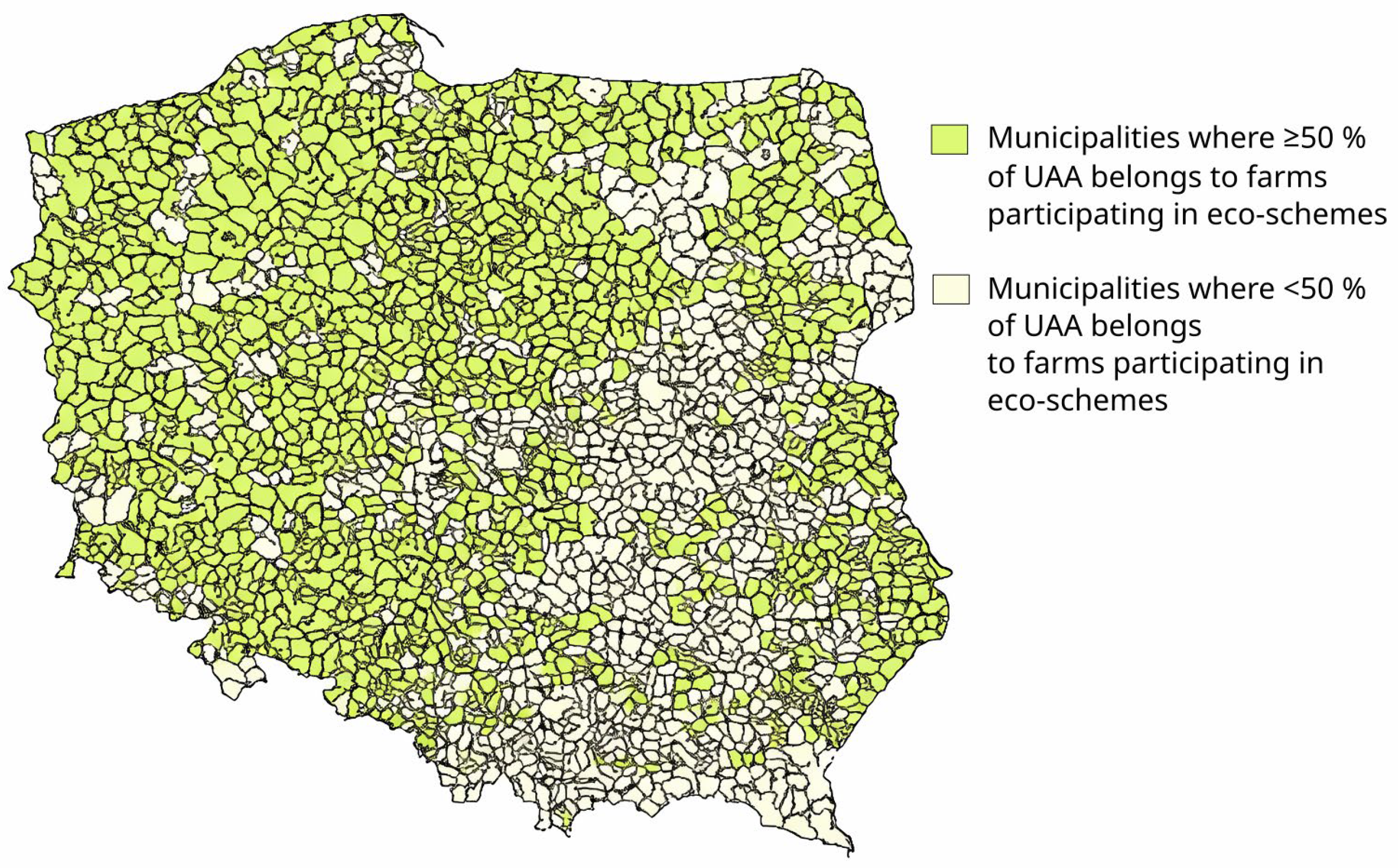
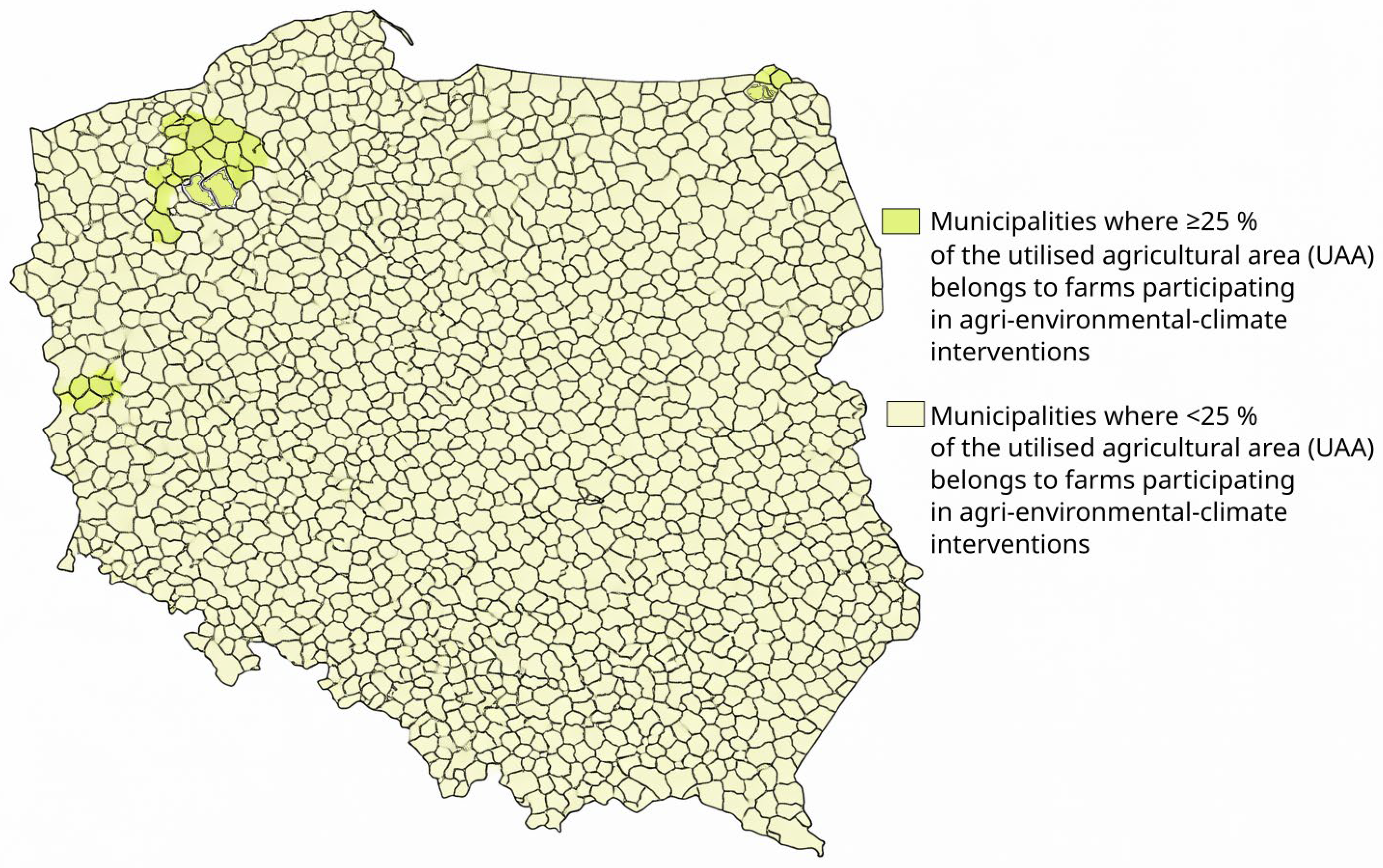
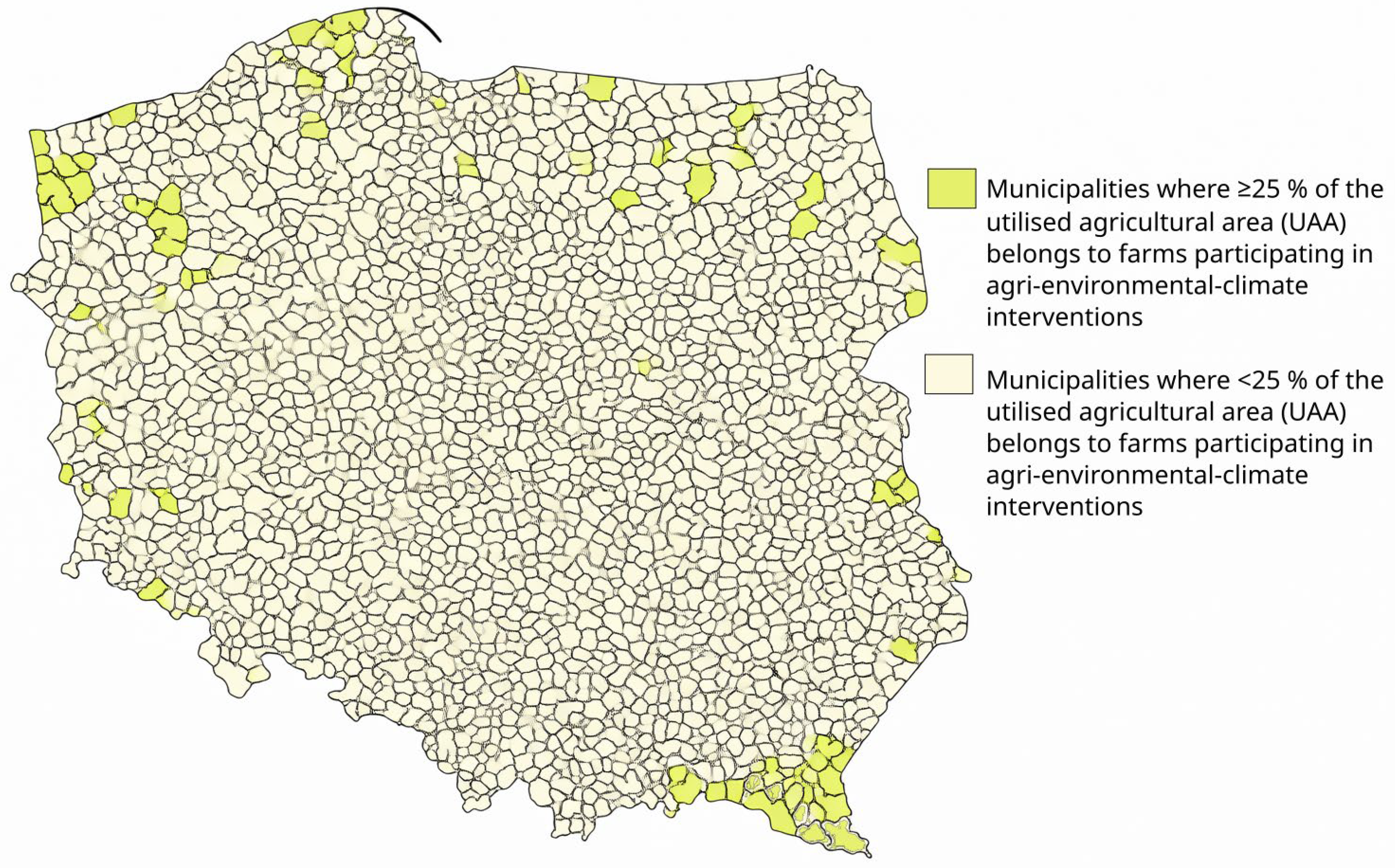
The results also document the spatial distribution of municipalities according to the share of agricultural land associated with these environmental interventions. The classification shows the number of municipalities in which at least 50% of agricultural land was associated with eco-scheme beneficiaries, as well as those below this threshold. A similar classification is provided for organic farming interventions at a 25% threshold, and for agri-environment–climate interventions at the same percentage threshold. Figures corresponding to these classifications (
Figure 1,
Figure 2 and
Figure 3) display the distribution of municipalities in each category, showing how land area associated with these interventions was distributed across the national territory in 2023 [
9,
30,
31].
The dataset further records the Shannon–Wiener crop diversity index (H′) for each municipality category. In municipalities with ≥50% eco-scheme participation, the H′ value recorded was 2.42, whereas municipalities below that threshold recorded 2.29. In municipalities with ≥25% organic farming participation, the reported H′ was 2.51, compared to 2.36 in municipalities below 25%. For agri-environment–climate interventions, municipalities with ≥25% participation displayed an H′ of 2.28, whereas those with <25% participation displayed a value of 2.37. These values represent the recorded diversity index outcomes for each group.
The results also include the Agricultural Production Space Valorisation Index (WRPP) for each municipality category. Municipalities with ≥50% eco-scheme participation recorded a WRPP value of 68.3, compared to 61.4 for those below 50%. For organic farming, municipalities with ≥25% participation displayed WRPP 56.8, while those below the threshold displayed 65.2. For agri-environment–climate interventions, WRPP values were 55.2 and 65.7 for ≥25% and <25% participation categories, respectively.
In addition to the municipality-level indicators, the results include a breakdown of the area covered by individual eco-scheme practices for 2023 and 2024. Each practice is listed with its corresponding area in hectares for both years, along with the percentage change. The recorded changes range from increases of 7% to 479% and include one practice showing a decrease of 12%. These numerical values describe the documented extent of adoption and the annual variation between the two years.
The results also list the distribution of eco-scheme practices across farms grouped by the number of adopted commitments. For farms implementing one practice, the most frequently recorded commitments were mixing straw with soil (57.2%), simplified cultivation systems (11.6%), and winter catch crops (10.6%). For farms implementing two practices, winter catch crops accounted for 24.6% and mixing straw with soil for 27.4%. For farms implementing three practices, the contributions of winter catch crops and simplified cultivation systems were 22.8% and 11.4%, respectively. For farms implementing four or more practices, winter catch crops accounted for 18.5%, while diversified crop structure accounted for 10.9%. These figures represent the recorded distribution of practices among farms according to the number of environmental commitments adopted.
4.2. Municipality-Level Saturation with Environmental Measures
Three parallel classification schemes were used to identify the degree of saturation for each intervention type. The classifications consist of categorical thresholds representing the share of agricultural land associated with each intervention.
Eco-Schemes
For eco-schemes, municipalities were divided into two groups: those in which at least 50% of the total agricultural land area was located on farms participating in eco-schemes, and those in which less than 50% of agricultural land belonged to participating farms. This classification captures the observed variation in eco-scheme participation across municipalities. The recorded data indicate the number of municipalities falling into each of these two categories and their geographic distribution, which is visually presented in
Figure 1.
Figure 1 illustrates the spatial distribution of municipalities according to the share of agricultural land located on eco-scheme beneficiary farms. Municipalities classified in the ≥50% category are widely distributed across the country and are particularly visible in regions characterized by favourable agronomic conditions, as reflected by higher average WRPP values (68.3). These municipalities also display higher crop diversity outcomes (H′ = 2.42) compared to municipalities below the 50% threshold (H′ = 2.29). In contrast, municipalities with lower eco-scheme saturation tend to cluster in areas with less intensive participation, corresponding to lower average shares of agricultural land under eco-schemes (36.7%).
For organic farming interventions, the threshold used was 25%. Municipalities in which at least 25% of agricultural land belonged to farms participating in organic farming interventions were classified separately from those in which participation levels were below 25%. This classification is reflected in
Figure 2, which presents the spatial distribution of municipalities for both categories and the corresponding shares of agricultural land associated with organic farming beneficiaries.
Figure 2 presents the distribution of municipalities according to the share of agricultural land under organic farming interventions. Municipalities exceeding the 25% threshold are less numerous but clearly distinguishable spatially, and they record the highest crop diversity levels among all intervention types (H′ = 2.51). Despite operating under less favourable production conditions on average (WRPP = 56.8), these municipalities achieve higher diversification outcomes than those with lower organic farming participation (H′ = 2.36). This pattern suggests that organic farming interventions are associated with structurally higher crop diversity even in regions with natural or agronomic constraints.
For agri-environment–climate interventions, the same 25% threshold was applied. Municipalities were categorized into those with at least 25% of agricultural land associated with farms participating in agri-environment–climate interventions and those with less than 25%.
Figure 3 shows the spatial distribution of municipalities according to participation in agri-environment–climate interventions. Municipalities with at least 25% of agricultural land under these measures are predominantly located in foothill and mountainous regions, where natural constraints limit crop diversification options. This is reflected in lower average crop diversity values (H′ = 2.28) and lower WRPP scores (55.2) compared to municipalities below the threshold (H′ = 2.37; WRPP = 65.7). The observed spatial pattern highlights the role of regional production conditions in shaping diversification outcomes under agri-environment–climate schemes.
4.3. Crop Diversity Outcomes in Municipalities Saturated with Environmental Interventions
Municipalities with at least 50% of agricultural land on eco-scheme beneficiary farms recorded an H′ value of 2.42. Municipalities with less than 50% eco-scheme participation recorded an H′ of 2.29. The average share of agricultural land associated with eco-scheme beneficiaries in the ≥50% group was 65.0%, while in the <50% group the average share was 36.7%.
The WRPP values for these categories were 68.3 in the ≥50% participation group and 61.4 in the <50% participation group. These values represent the recorded agronomic characteristics for the municipalities under each saturation category.
4.3.1. Organic Farming Interventions
Municipalities with at least 25% of agricultural land associated with organic farming participants recorded an H′ of 2.51, and municipalities with less than 25% participation recorded an H′ of 2.36. The average share of agricultural land under organic farming in the ≥25% group was 33.2%, while in the <25% group it was 2.5%.
The WRPP values documented for these categories were 56.8 in municipalities with ≥25% participation and 65.2 in municipalities with <25% participation. These values correspond to the production space characteristics recorded for each group.
4.3.2. Agri-Environment–Climate Interventions
Municipalities with at least 25% of agricultural land associated with agri-environment–climate intervention beneficiaries recorded an H′ value of 2.28. Municipalities with less than 25% participation recorded an H′ value of 2.37. The average share of agricultural land associated with these interventions in the ≥25% category was 36.2%, while in the <25% category it was 6.4%.
The WRPP values for these two categories were 55.2 for the ≥25% participation group and 65.7 for the <25% group. These results reflect the recorded agricultural production space characteristics for municipalities categorized according to the agri-environment–climate participation threshold.
4.4. Uptake of Eco-Schemes and Quantitative Characteristics of Diversification-Related Practices
4.4.1. Distribution of Practices Across Farm Groups
The results include detailed information on the distribution of eco-scheme practices across farms classified according to the number of commitments undertaken during the 2023 campaign.
Table 2 provides the percentage share of each practice within four groups: farms implementing one practice, two practices, three practices, and four or more practices.
Across all groups, the observed data indicate variation in the relative participation rates for specific eco-scheme practices. Farms implementing only one practice recorded a 57.2% share for “mixing straw with soil”, followed by 11.6% for “simplified tillage systems”, 10.6% for “winter catch crops and undersown crops”, and 5.0% for “diversified crop structure”. Other practices such as “areas with melliferous plants”, “application of liquid natural fertilizers”, and “extensive use of permanent grasslands with livestock stocking” recorded lower shares, ranging from 0.2% to 4.2%.
In farms implementing two practices, the dataset shows that “winter catch crops and undersown crops” accounted for 24.6% of all adopted practices, “mixing straw with soil” for 27.4%, “simplified tillage systems” for 11.6%, and “mixing manure within 12 h” for 15.9%. The recorded share for “diversified crop structure” in this group was 9.0%. Other practices remained below 4% of total commitments.
Among farms implementing three practices, the results show that “winter catch crops and undersown crops” and “mixing manure within 12 h” accounted for 22.8% and 18.9%, respectively. “Simplified tillage systems” represented 11.4%, while “mixing straw with soil” accounted for 18.6%. “Diversified crop structure” constituted 9.7% of practices in this group. Other practices—including “areas with melliferous plants”, “biological crop protection”, and “integrated crop production”—recorded values between 0.2% and 0.5%.
In farms implementing four or more practices, the dataset reports that “simplified tillage systems” had a 11.7% share, “mixing manure within 12 h” 16.4%, “application of liquid natural fertilizers” 9.2%, “mixing straw with soil” 13.5%, and “winter catch crops and undersown crops” 18.5%. “Diversified crop structure” recorded a share of 10.9%. All remaining practices accounted for less than 5% individually.
Table 2 additionally specifies the proportion of farms within each commitment group relative to the total number of eco-scheme participants: 49% implemented one practice, 29% implemented two, 14% implemented three, and 8% implemented four or more practices.
4.4.2. Expansion of Eco-Scheme Practices Between 2023 and 2024
Table 3 reports the area (in hectares) covered by each eco-scheme practice in 2023 and the area declared by farmers in the 2024 campaign, together with the percentage change between both periods.
The dataset records the following changes:
“Biological crop protection” increased from 28,045 ha in 2023 to 134,319 ha in 2024, representing a 479% increase.
“Integrated Plant Production” expanded from 123,167 ha to 419,186 ha, a 340% increase.
“Areas with melliferous plants” increased from 13,044 ha to 24,809 ha, a 190% change.
“Application of liquid natural fertilizers by non-spraying methods” increased from 676,210 ha to 1,222,428 ha, representing a 181% increase.
“Diversified crop structure” expanded from 1,406,353 ha to 2,086,591 ha, a 48% increase.
“Simplified cultivation systems” increased from 2,349,239 ha to 3,415,275 ha, representing a 45% change.
“Winter catch crops and undersown crops” increased from 1,011,059 ha to 1,079,588 ha, a 7% increase.
“Mixing manure within 12 h” increased from 778,362 ha to 817,265 ha, a 5% increase.
“Mixing straw with soil” decreased from 2,097,749 ha in 2023 to 1,855,195 ha in 2024.
For several practices—such as “water retention on permanent grasslands”—2024 data were not available in the dataset used. The table includes clarification from ARiMR that the 2024 figures correspond to areas declared by farmers, while implementation data received later by the Ministry may differ following administrative checks and sanctions.
4.4.3. Regulatory and Economic Parameters Affecting the Recorded Uptake
The dataset also contains information on payment structures and regulatory frameworks associated with the eco-scheme system. Each eco-scheme practice is assigned a specific number of points, with one point corresponding to €22.47 (≈100 PLN). A minimum number of points is required per farm, calculated as 25% of the farm’s agricultural area multiplied by 5 points per hectare.
The recorded point values per practice are as follows:
“Extensive use of permanent grassland with livestock stocking”: 5 points.
“Winter catch crops or undersown crops”: 5 points.
“Fertilization plan (basic variant)”: 1 point;
“Fertilization plan with liming”: 3 points.
“Diversified crop structure”: 3 points.
“Mixing manure within 12 h”: 2 points.
“Application of liquid natural fertilizers by non-spraying methods”: 3 points.
“Simplified cultivation systems”: 4 points.
“Mixing straw with soil”: 2 points.
Additionally, the dataset includes regulatory conditions under GAEC 7, specifying crop rotation and diversification requirements. The standards indicate that:
A different main crop must be grown on at least 40% of arable land compared to the previous year.
The same crop may not be grown on all arable land for more than three consecutive years.
Farms with 10–30 ha must cultivate at least two crops, with the main crop ≤ 75% of the area.
Farms with >30 ha must have at least three crops, with the main crop ≤ 75% and the two dominant crops ≤95%.
Farms with <10 ha of arable land are exempt.
Organic farms are exempt from GAEC 7 requirements.
These recorded parameters document the relevant institutional context associated with the observed uptake values.
5. Discussion
The findings of this study provide a multidimensional perspective on how structural characteristics of farms, regional production factors, and varying degrees of engagement with CAP environmental instruments interact to shape crop diversity outcomes in Poland. By integrating municipality-level environmental measure saturation with longitudinal farm-level data, the results confirm established patterns from earlier national research while also revealing how these patterns manifest within the new eco-scheme framework of the 2023–2027 CAP Strategic Plan. Overall, the observed relationships align with ecological theory, previous empirical work in Poland, and international evidence demonstrating that diversified cropping systems are strongly associated with improved ecological performance and soil health [
1,
17,
18].
A central finding of this research is the consistent confirmation of H1, which posited that farms engaged in commercial animal production simplify their cropping structures. This relationship has been emphasized previously by [
3,
8], who documented similar patterns in the Polish FADN, particularly among granivorous livestock farms. The present study reinforces these findings by using the Shannon–Wiener index (H′) to quantify diversity and demonstrates that livestock-oriented farms maintain a strong reliance on cereals, especially maize. This is consistent not only with national analyses but also with broader agroecological literature showing that feed-based production systems tend to reduce functional and biological diversity due to their dependence on uniform caloric inputs [
24]. The convergence of results across methodologies and data sources suggests that specialization remains a structural constraint that the current CAP instruments have not yet mitigated.
The results related to farm size provide a more nuanced picture. Unlike expectations drawn from part of the literature [
6], H2 was not confirmed, as smaller farms did not consistently exhibit higher crop diversity than larger farms. While some international studies suggest that smallholder systems can maintain high landscape-level diversity [
21], the present findings indicate that very small Polish farms may lack the organizational, technical, or economic capacity to manage more complex rotations. This aligns with observations that diversification practices, whether ecological or agronomic, often require higher planning capacity and access to capital or advisory services [
17]. The divergence between previous assumptions and current findings underscores the importance of re-evaluating the relationship between farm size, regulatory exemptions (e.g., GAEC 7 thresholds), and actual ecological outcomes.
The confirmation of H3 and H4, which relate to the tendency toward simplification and the particularly strong rise of maize, provides further insight into ongoing structural transformations. The monotonic increase in maize share from 2016 to 2024 aligns with known trends in the intensification of feed production and mirrors patterns observed in other EU countries with concentrated livestock sectors. The accelerated simplification observed between 2021 and 2024 also coincides with Poland’s entry into the new CAP period, suggesting that the eco-scheme system—at least in its initial implementation—has not yet reversed historical tendencies of structural homogenization. This corresponds with findings from [
4], who identified a spatial clustering of simplified cropping systems in regions where animal production is heavily concentrated.
At the municipality level, the differentiated crop diversity outcomes under varying degrees of eco-scheme, organic farming, and agri-environment–climate intervention saturation provide important context for evaluating the ecological effects of Pillar I and Pillar II interventions. Municipalities with high saturation of eco-schemes and organic farming exhibited higher H′ values than comparison regions, indicating that these measures are associated with more diverse cropping systems. Crucially, the recorded H′ values for high eco-scheme saturation municipalities (e.g., 2.42) far exceed the mandatory diversity thresholds set under the former CAP ‘greening’ requirements (H′ ≥ 0.56 for 10–30 ha farms and H′ ≥ 0.69 for >30 ha farms), suggesting that the new policy instruments are associated with a substantially greater degree of crop diversification at the landscape level.
This finding is consistent with international assessments showing that policy incentives play a decisive role in facilitating landscape diversification, particularly when they are linked to tangible agronomic or economic co-benefits [
17]. However, municipalities with high saturation of agri-environment–climate interventions recorded lower H′ values, largely due to their concentration in physically constrained areas such as foothill and mountain regions. This aligns with the spatial logic of AECC targeting but also suggests that, in practice, geographic constraints may limit the functional impact of these measures on crop diversification.
The structure of practice adoption across farms further illustrates the interplay between policy incentives and production realities. While several diversification-enhancing practices such as winter catch crops, undersown crops, and diversified crop structure were adopted across multiple farm groups, the persistently low adoption of melliferous plant areas indicates that some environmentally beneficial practices may face socio-economic or agronomic barriers. The rapid expansion of other practices—such as Integrated Plant Production or Biological Plant Protection—between 2023 and 2024 suggests that farmers respond strongly to payment rate differentials and to the perceived compatibility of practices with existing production systems. These patterns emphasize the importance of designing eco-schemes that align ecological goals with operational feasibility, a point raised in both Polish and international literature on agri-environmental policy effectiveness [
5,
7].
Taken together, the findings reinforce the importance of combining ecological reasoning with farm-level structural analysis when evaluating the outcomes of environmental policies. The multilevel framework employed here demonstrates that while eco-schemes and organic farming interventions are associated with measurable increases in crop diversity at the municipality scale, structural determinants such as specialization and regional constraints continue to shape diversification outcomes at the farm scale. This supports the broader assertion in ecological literature that crop diversity outcomes emerge from the interaction of policies, production incentives, and biophysical conditions [
20,
24].
Finally, this study highlights several gaps that merit further investigation. The documented mismatch between regulatory exemptions, farm size, and ecological outcomes suggests that future policy design may benefit from recalibrating diversification thresholds or offering more targeted support for small farms with limited organizational capacity. Additionally, the persistent rise of maize underscores the need to understand how market signals and livestock sector demand interact with CAP incentives. Future research could also integrate remote sensing or soil health indicators to more precisely measure ecological outcomes and could conduct longitudinal tracking of farm-level eco-scheme participation to assess behavioural adaptation over time.
5.1. Limitations
The limitations of this study should be considered when interpreting the results. First, although the analysis relies on comprehensive administrative datasets and longitudinal farm-level observations, the farm sample is purposively selected and does not aim at statistical representativeness of the national farm population. Second, municipality-level indicators capture associations between environmental-measure saturation and crop-structure diversity but do not allow for causal inference. Third, differences between declared and implemented eco-scheme areas may arise due to post hoc administrative controls. Finally, the analysis focuses on crop-structure diversity as measured by the Shannon–Wiener index and does not directly observe ecological outcomes such as species abundance or soil biological indicators.
5.2. Policy Implications
The results suggest several implications for the design of CAP eco-schemes. First, practices directly linked to crop diversification—such as diversified crop structures, catch crops, and undersown crops—appear less prevalent than lower-complexity practices, indicating that payment levels and administrative requirements play a key role in shaping uptake. Second, the persistent increase in maize share highlights the need to strengthen incentives targeting crop rotation and diversification in livestock-oriented regions. Third, differentiated outcomes across municipality types suggest that eco-schemes and organic farming measures may be more effective in regions with fewer biophysical constraints, whereas agri-environment–climate interventions primarily reflect structural limitations rather than diversification potential. These insights point to the importance of aligning incentive design with regional production conditions and farm organizational capacity.
6. Conclusions
This study confirms that farms engaged in commercial animal production consistently exhibit simplified cropping structures, as reflected in lower Shannon–Wiener index (H′) values and higher shares of maize and other cereals. This pattern is observed in both the full-population ARiMR data for 2023 and in the longitudinal farm-level evidence for 2016–2024, indicating that production specialization remains a dominant driver of crop-structure simplification in Polish agriculture.
The results also reveal clear spatial differentiation in crop structure across Poland. Reduced crop diversity and higher dominance of specific crops are more frequently observed in southeastern voivodeships, in line with regional production conditions and WRPP values. These findings underline the importance of territorial heterogeneity in shaping crop-structure outcomes and confirm that diversification potential varies substantially across regions.
With respect to farm size, the analysis does not support the expectation that smaller farms exhibit more diversified cropping structures. Despite regulatory exemptions from GAEC 7 requirements, farms under 10 ha do not display higher H′ values than larger units. This suggests that organizational, technical, or economic constraints may outweigh regulatory flexibility in shaping diversification decisions at the farm level.
The temporal analysis documents a continued simplification of the sowing structure between 2016 and 2024, particularly after 2021. The progressive increase in maize share—from 12.4% to 16.7%—indicates that structural trends toward homogenisation persist, especially in regions with concentrated livestock production, despite the introduction of the new eco-scheme framework.
Finally, the municipality-level assessment shows that higher saturation with eco-schemes and organic farming interventions is associated with higher crop-structure diversity, whereas municipalities with strong participation in agri-environment–climate measures tend to display lower H′ values due to underlying biophysical constraints. Taken together, these findings suggest that while CAP eco-schemes and organic farming are linked to more diversified crop structures at the landscape level, long-standing structural determinants continue to limit diversification outcomes at the farm level.
Recommendations, Limitations and Future Research Paths
Based on the recorded results, several recommendations were formulated concerning the future design and calibration of CAP eco-schemes and their integration with broader cropping-system management requirements.
First, the observed increase in maize share and the simultaneous decline or stagnation in biologically valuable species (e.g., small-seeded legumes, root crops, oilseeds, honey-producing plants) highlight the need to reinforce diversification incentives within the eco-scheme framework. Increasing point valuations for practices directly contributing to crop diversity—particularly catch crops, undersown crops, and diversified crop structures—could better align farmer participation with policy objectives aimed at enhancing crop diversity.
Second, the results documenting widespread simplification and weakened crop rotation practices underscore the importance of promoting phytosanitary species, especially oats, as either main crops or plough-down catch crops. Their inclusion modifies soil structure, contributes to weed suppression, and supports the agronomic conditions necessary for stable rotations.
Third, the data suggest structural deficits in soil organic matter replenishment due to limited manure availability and insufficient use of catch crops. In this context, CAP instruments could further prioritize livestock systems that rely on manure, given their relevance for soil fertility maintenance. Conversely, extensive support for liquid-manure-based systems may not contribute to the agronomic conditions associated with diversified crop rotations.
Fourth, to counteract the declining presence of specific crop groups, targeted subsidies or increased payment rates could be considered for:
Root crops;
Small- and large-seeded legumes (as main and catch crops);
Oilseeds (including rapeseed, mustard, sunflower, and flax);
Oats and buckwheat;
Phacelia and other melliferous plants;
Herbs and specialty crops.
Finally, the recorded eco-scheme uptake suggests a need for further procedural simplification, particularly in application processes, and for stable, predictable payment rates across programming years to ensure continuity in farmers’ production decisions.
This study relies primarily on administrative datasets covering the full population of farms registered with ARiMR, complemented by purposefully selected farm-level data for in-depth structural assessment. While the comprehensiveness of administrative data allows for exhaustive national-scale analysis, limitations include: (1) restricted availability of certain variables for all years, especially for 2016 in specific regions; (2) potential inconsistencies between declared and implemented eco-scheme areas due to post hoc administrative corrections; and (3) limited granularity on within-farm management decisions that may influence crop diversity metrics but are not recorded in administrative sources. These constraints do not undermine the robustness of the aggregated findings but should be acknowledged when interpreting temporal and spatial variation.
Future research could expand the analytical framework by integrating remote sensing data to assess crop diversification outcomes with higher spatial precision, particularly in heterogeneous landscapes. Additionally, linking farm-level crop diversity indicators with soil health metrics, such as organic matter content or erosion risk, would allow for a more comprehensive evaluation of ecological performance. Another promising direction involves analyzing the behavioural determinants of eco-scheme adoption, incorporating survey-based or qualitative data to complement administrative records. Finally, comparative analyses across EU member states implementing similar eco-schemes could offer insights into policy effectiveness under different agronomic, structural, and institutional contexts.





 ,
,