


Abstract
Artificial intelligence (AI) tools are increasingly used to support scientific modeling; however, the reliability of AI-generated mathematical models for predicting agricultural machinery performance remains insufficiently understood. This study evaluated the ability of ChatGPT and Microsoft Copilot to independently formulate numerical models of the transverse distribution of organic granular fertilizers applied using a centrifugal spreader. AI-generated models are essentially statistical–probabilistic models that do not explicitly represent or reconstruct the physical mechanisms underlying particle dynamics. The tools received identical descriptions of the experimental conditions and input parameters. The tools received identical descriptions of the experimental conditions and input parameters. The generated models were subsequently applied under field-based operating conditions and benchmarked against measured fertilizer masses collected across the spreading width. Two types of fertilizer with contrasting physical characteristics—grain husk granules and poultry manure granules—were investigated. Model performance was assessed using average collected mass, transverse distribution characteristics, and coefficient of variation (CV). For grain husk granules, the experimental average mass and CV were 4.93 g and 7.78%, respectively. ChatGPT predicted an average of 5.33 g, whereas Copilot predicted 6.66 g; both models overestimated distribution variability, with CV values of 16.57% and 17.90%, respectively. For poultry manure granules, the experimental average mass and CV were 7.25 g and 16.26%. ChatGPT underestimated the deposited mass (5.83 g) but closely reproduced its variability (CV = 15.10%), while Copilot substantially overestimated both deposition magnitude (14.93 g) and variability (CV = 21.26%). Overall, ChatGPT produced predictions that were more consistent with the experimental distributions, whereas Copilot showed a systematic tendency to overestimate fertilizer deposition. The findings demonstrate that general-purpose AI tools can generate mathematically plausible representations of fertilizer spreading but cannot yet provide reliable quantitative predictions without material-specific calibration and experimental validation.
1. Introduction
Accurate fertilizer application depends not only on determining the appropriate agronomic rate but also on the ability of the spreading machine to deliver the prescribed amount uniformly and at the correct spatial location. In centrifugal spreaders, fertilizer particles interact with the metering mechanism, rotating discs, vanes, surrounding air, and other particles before reaching the soil surface. Consequently, the resulting spread pattern is affected by numerous interacting variables, including particle size, shape, density, moisture content, friction and restitution properties, fertilizer flow rate, disc rotational speed, vane geometry, feed position, machine forward speed, wind conditions, and field topography [1,2]. Variations in these factors can produce substantial changes in effective spreading width and transverse distribution uniformity.
Traditionally, the performance of fertilizer spreaders has been evaluated experimentally using collection trays positioned across the spreading width [3]. Although tray testing provides a direct measurement of the deposited fertilizer distribution, it is labor-intensive, time-consuming, and dependent on the test environment. Moreover, conventional testing provides limited information about particle trajectories and the mechanisms responsible for non-uniform distribution.
Physics-based modeling has become another important tool for investigating fertilizer-spreading processes. Analytical and ballistic models can describe the main stages of particle motion, but their predictive capability is often limited when particle–particle and particle–machine interactions become dominant. The discrete element method (DEM) makes it possible to simulate individual particles and their contacts with other particles and machine surfaces. Van Liedekerke et al. demonstrated that DEM could provide valuable information about fertilizer flow on centrifugal spreading discs and support computer-aided spreader development [1,4,5]. Coetzee and Lombard subsequently developed and experimentally validated a DEM model of a centrifugal fertilizer spreader and investigated the effects of disc speed, fertilizer feed position, feed rate, and vane angle on the resulting distribution pattern. DEM studies have provided useful insights into particle flow on spinning discs and the effects of disc speed, feed position, flow rate, and vane configuration on spread-pattern formation [1,2,6]. Despite these advances, high-fidelity numerical models involve several practical limitations. DEM simulations require calibration of contact parameters that are often difficult to measure directly, while realistic particle shapes and large particle populations can result in considerable computational cost. Coupled CFD–DEM models increase these requirements further because the interactions between the particles and airflow must be resolved simultaneously. In addition, deterministic simulations may not adequately represent the variability encountered under field conditions [7]. These limitations restrict the direct use of high-fidelity numerical models for real-time prediction, optimization, and closed-loop control.
Rapid advances in generative artificial intelligence have introduced a new category of tools capable of interpreting natural-language instructions and producing mathematical explanations, algorithms, computer code, and structured technical recommendations. Large language models (LLMs) such as those underlying ChatGPT (GPT-4) and Microsoft Copilot (M365) can potentially assist researchers in translating a physical problem into mathematical relationships, selecting modeling approaches, preparing simulation algorithms, generating and debugging code, and interpreting model outputs. In agriculture, LLM-based systems have already been proposed for knowledge retrieval, decision support, crop management, and communication of technical information. Kuska emphasized that LLMs could provide substantial value in crop production by connecting heterogeneous information sources and supporting context-specific decisions [8]. Similarly, De Clercq and Awad suggested that LLMs could improve access to agricultural knowledge and contribute to more efficient food-production systems [9]. However, most existing agricultural applications have focused on advisory services, information retrieval, and decision support rather than the modeling of agricultural machinery and its physical processes.
The ability of generative AI systems to produce computer code further increases their potential relevance to fertilizer spreading research. Empirical evaluations have shown that AI-assisted coding tools can generate syntactically valid programs and accelerate certain programming tasks. Nevertheless, syntactic validity does not necessarily guarantee physical correctness, numerical stability, or agreement with experimental tests [10]. Yetistiren et al. found that although most programs generated by GitHub Copilot were executable, only a considerably smaller proportion were fully correct. Such findings indicate that AI-generated models must be assessed using domain-specific criteria rather than solely on whether the output can be executed. This issue is particularly important for spreading fertilizer, where an apparently reasonable equation or simulation may violate conservation principles, omit important forces, use inappropriate assumptions, or produce unrealistic distribution patterns [11]. Comparative investigations of ChatGPT and Microsoft Copilot in specialized scientific fields have likewise shown that their performance varies with question complexity and that neither system can be regarded as consistently reliable without expert verification [12].
In summary, when modeling granular fertilizer distribution, current approaches are typically divided into two main categories: mechanistic/dynamics-driven models (e.g., analytical ballistic models and the Discrete Element Method—DEM) and AI-generated statistical distribution models. While high-fidelity mechanistic models require extensive calibration of physical parameters, complex equations, and high computational cost, the potential of modern generative AI tools in this domain is rapidly evolving. However, little systematic information is available on whether general-purpose LLMs (such as ChatGPT and Microsoft Copilot) can independently formulate scientifically valid fertilizer spreading models without explicit guidance. In particular, a significant research gap remains regarding whether these models, when provided solely with textual descriptions and no reference equations or training examples, can identify governing variables, formulate motion equations, and generate computational procedures capable of predicting fertilizer distribution with engineering accuracy.
Therefore, the novelty and originality of this study stem from the experimental evaluation and direct comparison of general-purpose LLMs (ChatGPT and Microsoft Copilot) in formulating fertilizer-spreading prediction models under zero-example, text-only prompts. The AI-generated models were validated under field conditions across full spreading widths using two organic granular fertilizers with contrasting physical properties. By comparing the AI predictions against empirical tray measurements, this study identifies tool-specific capabilities, evaluates whether LLM outputs achieve engineering accuracy, and demonstrates the extent to which model reliability depends on physical fertilizer characteristics.
2. Materials and Methods
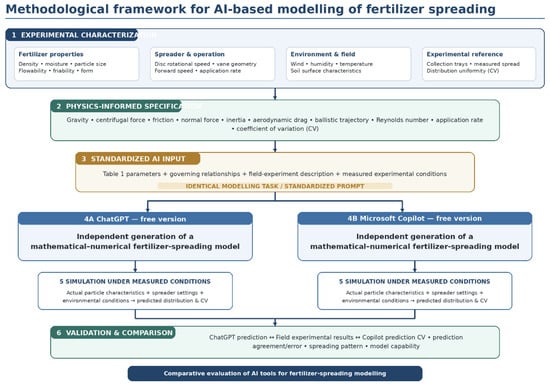
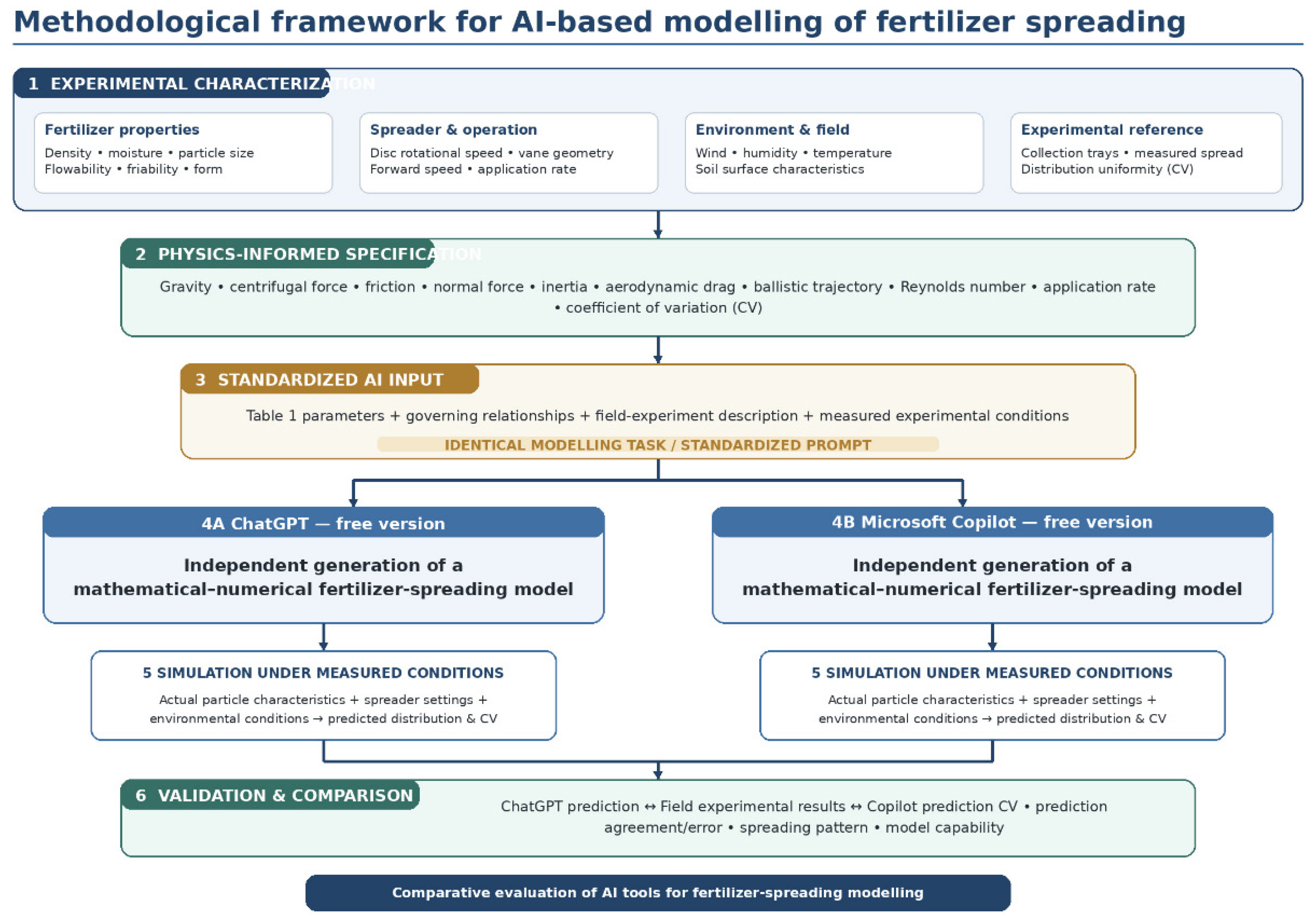
The methodological framework of this study consists of three sequential stages (Figure 1). Two widely used artificial intelligence tools, ChatGPT and Microsoft Copilot, were selected based on the assumption that large language models can be applied to the development of mathematical models and simulation procedures in a manner comparable to advanced engineering modeling platforms such as Altair DEM, EDEM, Ansys Rocky, and LIGGGHTS. Recent research indicates that AI-assisted modeling can support or augment complex computational simulations, particularly in tasks involving rapid scenario generation or parameter optimization [13].
Figure 1.
Methodological framework for the development, simulation, validation, and comparative evaluation of AI-generated mathematical–numerical models of fertilizer spreading using ChatGPT, GPT-5.6 Luna, OpenAI and Microsoft Copilot, M365 Copilot based on GPT-5.
In the first stage, a comprehensive list of factors influencing fertilizer spreading quality was compiled, including granule physical properties, spreader technical settings, environmental conditions, and soil surface characteristics. Using this factor set, both AI tools were tasked with generating a mathematical model for fertilizer distribution on the soil surface.
In the second stage, the AI-generated models were supplied with the same parameter set used in a previously conducted experimental fertilizer spreading study. This experiment was carried out at Marijampole Vocational Education and Training Centre, Lithuania, and its methodology and results are described in detail in a publication by Juodišius et al. [3].
Finally, in the third stage, the outputs of the AI-based simulations were evaluated and compared against the empirical data obtained from the experimental study to assess the accuracy and applicability of the AI-generated mathematical models.
The key factors influencing the uniformity of mineral fertilizer distribution on the soil surface and incorporated into the development of the mathematical–numerical AI model are presented in Table 1. These factors include the physical properties of fertilizer granules, the technical parameters of the spreader, driving speed, environmental conditions, and soil surface characteristics. Together, they determine granule flight trajectory, spreading width, application rate accuracy, and potential deviations; therefore, their evaluation is essential for ensuring agronomic efficiency and reducing nutrient losses.
For this reason, the forces acting on the spreading process were also incorporated into the model. The methodological section provides the measurement principles for these factors and the computational models applied, drawing on scientific literature that examines fertilizer spreading processes.
Table 1.
Input parameters and process factors used for developing the AI-generated mathematical–numerical model of fertilizer distribution.
2.1. Experimental Field Setup and Data Collection
To establish realistic boundary conditions and provide empirical data for AI model validation, field experiments were conducted at the Marijampolė Vocational Education and Training Centre, Lithuania [3]. The experimental setup involved spreading organic granular fertilizers using a John Deere 3015 tractor equipped with a Kuhn MDS 9.19 spreader operating at a forward speed of 11 km/h, a working width of 14 m, a target application rate of 300 kg/ha, and a rear Power Take-Off (PTO) speed of 540 rpm, while maintaining a constant tractor engine speed to ensure disc speed stability and distribution uniformity [3]. The vane form had vertical side walls with a curved upper edge of the blade, as investigated in [3]. The height of the spreading disc above the field surface was 0.85 m.
To characterize the tested fertilizers, standardized laboratory measurements were performed for both grain husk granules and poultry manure granules. In addition to basic dimensions, key physical and mechanical property indicators—including explicit moisture content, angle of repose, particle size distribution, and friability (crush resistance)—were determined to match the input parameter system. These comprehensive physical, geometric, and mechanical properties, which are critical for simulation accuracy and spreading performance, are summarized in Table 2.
Table 2.
Comprehensive physical, geometric, and mechanical properties of the tested organic granular fertilizers (mean ± standard deviation).
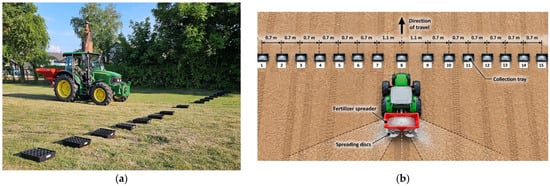
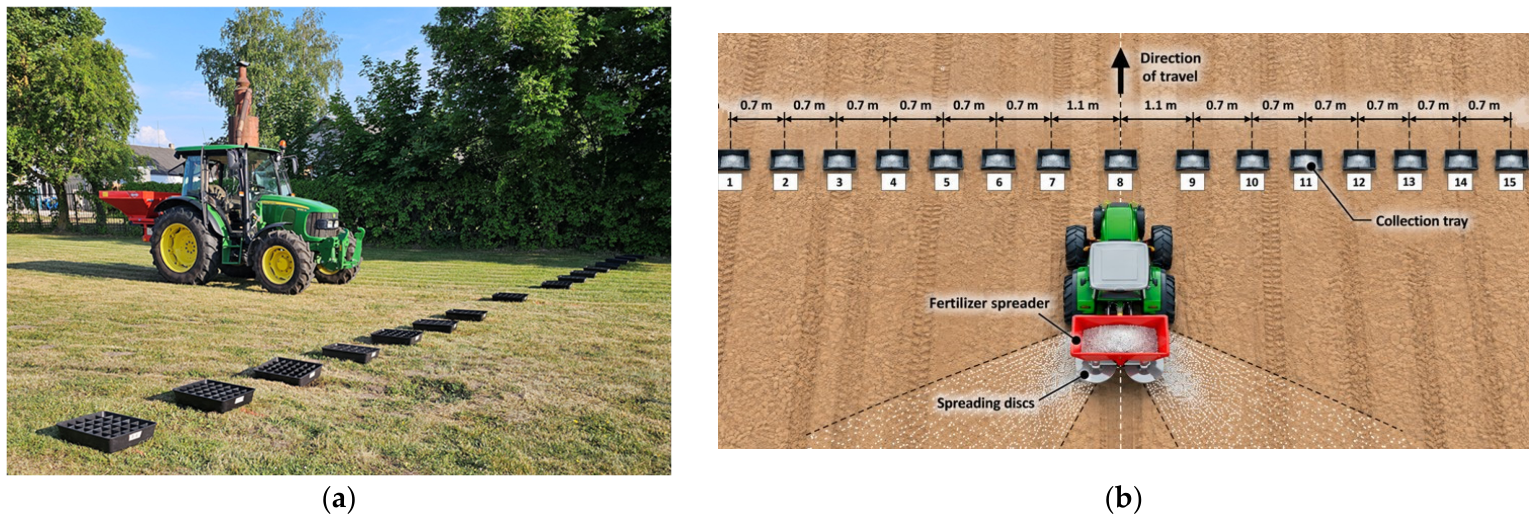
Experimental research methods and indicators for the soil application of granular organic fertilizers were selected and determined in accordance with the relevant standards, ISO 5690 and ASAE S314.2 [19]. A total of fifteen fertilizer collection trays (0.36 × 0.48 × 0.11 m) were positioned transversally across the full spreading width to capture the lateral fertilizer distribution pattern (Figure 2). During the tests, the tractor moved continuously in a single forward direction over the trays without returning (Figure 2b), ensuring no spatial or measurement overlap. The collection trays must be arranged in a single row, with a spacing of at least one meter between them. The trays were arranged in a single line, with the central trays positioned at the center of the tractor and spreader. Cardboard partitions were placed inside the collection trays to prevent the granular fertilizers from bouncing off the bottom and to ensure they are collected evenly within the boxes. The row of trays was positioned such that the direction of the machine’s movement aligned with the prevailing wind direction. Environmental conditions during the trials were recorded using field sensors: relative air humidity was 49%, ambient temperature ranged between 18 and 23 °C, and wind speed was low (5 km/h) [3].
Figure 2.
Field experiment setup: (a) tractor with Kuhn MDS 9.1Q spreader during organic fertilizer application; (b) the scheme of the layout of collection trays across the working width.
2.2. AI Model Development and Simulation Procedure
A structured approach to documenting AI-assisted modeling procedures was adopted, consistent with previous research employing conversational AI for agricultural machinery performance optimization [20]. The mathematical–numerical modeling process was conducted using the freely accessible versions of two general-purpose artificial intelligence (AI) tools, ChatGPT and Microsoft Copilot. The objective was to evaluate the ability of these tools to independently develop mathematical models for predicting the transverse distribution of organic granular fertilizers applied using a centrifugal spreader. Both AI systems were provided with equivalent experimental information, input parameters, and modeling objectives to enable a comparative evaluation of their modeling capabilities.
The model development process was based on a previously conducted field experiment involving the spreading of grain husk and poultry manure granules. The experimental configuration, operating conditions, fertilizer characteristics, and relevant mathematical relationships were used as the basis for AI-assisted model formulation. The input information included the physical and mechanical properties of the fertilizer granules, spreader disc rotational speed, vane geometry, tractor forward speed, environmental conditions, and spreading uniformity indicators, as summarized in Table 1. The experimental setup consisted of 16 fertilizer collection trays, each measuring 0.36 × 0.48 × 0.11 m, positioned across the spreading width. The AI tools were tasked with developing mathematical formulations capable of estimating the fertilizer mass deposited in each collection tray under specified operating conditions.
The AI-assisted modeling procedure was organized into five principal stages:
- Experimental Information and Input Parameter Presentation: The experimental setup and the parameters relevant to fertilizer spreading were described to both AI systems. These included fertilizer granule properties (density, moisture content, particle size distribution, flowability, and particle shape), spreader operating characteristics (disc rotational speed, vane geometry, and tractor forward speed), and environmental conditions (wind speed, air humidity, and temperature). The mathematical relationships and mechanical forces associated with fertilizer spreading, including gravitational, centrifugal, frictional, and aerodynamic forces, were also considered as reference information. The input parameters and corresponding mathematical expressions are summarized in Table 1.
- Mathematical Model Formulation: ChatGPT and Microsoft Copilot were independently tasked with developing mathematical–numerical models describing the transverse distribution of granular fertilizer deposited on the soil surface. The modeling objective was to establish mathematical relationships between the supplied input parameters and the expected fertilizer deposition at different lateral positions. Particular emphasis was placed on predicting the fertilizer mass collected in individual trays and representing the transverse distribution pattern. The two AI systems generated different mathematical formulations, which are presented in Table 3.Table 3. Numerical mathematical models developed by ChatGPT and MS Copilot for fertilizer spreading simulation.
- Model Structure and Parameter Identification: The mathematical formulations generated by each AI system were examined to identify their underlying assumptions, required input variables, and mathematical structure. ChatGPT generated a continuous statistical model based on a Gaussian distribution, relating fertilizer mass flow rate, tractor forward speed, and transverse spreading characteristics to the expected deposited mass. In contrast, Microsoft Copilot formulated a probabilistic model incorporating nominal fertilizer application rate, collection-tray geometry, and particle landing probability. The variables introduced by the AI systems were distinguished from the experimentally supplied input parameters to clarify the assumptions underlying each model.
- Numerical Simulation and Fertilizer Distribution Prediction: Following model formulation, the mathematical expressions generated by both AI systems were applied using the operating conditions and fertilizer characteristics recorded during the field experiments. Separate simulations were performed for grain husk and poultry manure granules. The predicted fertilizer masses at the individual transverse collection positions were used to characterize the lateral distribution patterns and calculate the average deposited mass and coefficient of variation (CV). The same experimental conditions were used for both AI-generated models to ensure consistency in the comparative evaluation.
- Experimental Validation and Comparative Evaluation: The predicted fertilizer distribution patterns were compared with the corresponding field measurements obtained from the collection trays. Model performance was evaluated by examining the average fertilizer mass, transverse distribution characteristics, and CV. Differences between the predictions and experimental measurements were analyzed to assess the ability of each AI-generated formulation to reproduce the magnitude and spatial variability of fertilizer deposition. The comparison also enabled the identification of model-specific deviations and limitations associated with the two mathematical approaches.
The modeling procedure was designed to evaluate the independent mathematical formulations generated by the two AI systems under equivalent experimental conditions. Unlike conventional physics-based numerical simulations, such as the Discrete Element Method (DEM), the AI-generated models did not explicitly solve the equations governing individual particle trajectories or particle–particle interactions. Instead, they represented fertilizer deposition through statistical and probabilistic mathematical relationships. Consequently, the present study evaluates the ability of general-purpose AI tools to formulate and apply approximate mathematical representations of fertilizer spreading rather than to perform detailed particle-level simulations.
3. Results
3.1. Parallel Modeling Approaches Developed by ChatGPT and MS Copilot
The development of the numerical mathematical model was grounded in the previously conducted field experiment [3], in which organic granulated fertilizers were spread on the soil surface. During the experiment, sixteen fertilizer collection trays were positioned across the spreading width, each with dimensions of 0.36 × 0.48 × 0.11 m, enabling precise measurement of the fertilizer mass deposited at different lateral distances. Accordingly, the AI-based model had to be constructed in a way that would allow the estimation of the fertilizer amount (in grams, g) expected to accumulate in each individual tray. Using the free versions of MS Copilot and ChatGPT, two independent digital mathematical models were generated based on the full set of parameters listed in Table 1 and the description of the experimental setup. The resulting AI-generated models are presented in Table 3.
The coefficient was introduced by ChatGPT during the mathematical formulation of the model. Its derivation is based on the assumption of spherical fertilizer granules, for which the individual granule mass is expressed as Accordingly, represents the inverse mass of an individual granule, while Δx denotes the width of the collection interval. The coefficient therefore combines experimentally supplied particle properties (density and diameter) with the collection tray geometry. It was mathematically formulated by the AI tool rather than empirically calibrated from experimental data or directly adopted from a published equation.
To ensure complete transparency, the variables appearing in the AI-generated equations presented in Table 3 can be classified into two distinct categories: (1) input parameters provided directly to the tools (such as tractor forward speed νt, granule density ρ, mean diameter d, and collection tray dimensions), and (2) AI-introduced variables originating from mathematical assumptions formulated by the models (such as the standard deviation σ and the mean location μ in the Gaussian distribution, or the landing probability Pi(p)).
Furthermore, it is important to clarify that neither ChatGPT nor Copilot generated differential equations governing individual particle motion or particle–machine/particle–particle collision dynamics (as used in DEM). Instead, both AI tools formulated statistical fitting and probabilistic distribution models, which approximate the lateral deposition profile macroscopically rather than tracking the physical trajectory of individual particles through mechanics-driven equations.
Table 3 presents the numerical mathematical models generated independently by ChatGPT and MS Copilot for simulating fertilizer spreading and estimating the fertilizer quantity collected in each tray. Although both AI tools were provided with the same experimental parameters and identical prompts, the resulting models differ substantially in their mathematical structure, underlying assumptions, and the way they represent the spreading process.
ChatGPT produced a model based on a probabilistic Gaussian distribution, where the fertilizer deposition pattern is expressed as a continuous transverse profile. The number of granules in the i-th tray is calculated using a normal distribution function with parameters for the spreading center (μ) and standard deviation (σ). This formulation explicitly incorporates physical granule properties, namely density (ρ) and diameter (d), and links the mass flow rate (Q) with tractor speed vt. As a result, ChatGPT’s model is more physically explicit, directly connecting particle-scale characteristics with the macroscopic spreading pattern. Its advantage lies in its continuous mathematical representation, which allows smooth simulation of the transverse distribution and is well suited for sensitivity analysis of spreading parameters.
In contrast, MS Copilot generated a model that is more discrete and experimentally oriented. It calculates the number of granules in each tray by dividing the measured or estimated tray mass by the mass of a single granule. The model relies on the nominal application rate qnom, the projected tray area Sbox, and the probability (p) that a granule lands within the tray’s interval. The mass in each tray is obtained by integrating the transverse distribution profile (;) over the tray width. This approach is more directly aligned with field measurement methodology, emphasizing the relationship between application rate, tray geometry, and landing probability. Its strength is its straightforward interpretability and compatibility with empirical data collection procedures.
Despite their structural differences, both models share the same objective: estimating the fertilizer quantity (either mass or particle count) in each collection tray based on the experimental setup. Both incorporate key geometric parameters (tray width, tray position) and spreading characteristics, but they operationalize these elements through different mathematical pathways. ChatGPT emphasizes a theoretical distribution-based formulation, while MS Copilot emphasizes a probability–area–mass relationship grounded in the nominal application rate.
Together, these models illustrate two complementary approaches to simulating fertilizer spreading: one rooted in continuous statistical modeling, the other in discrete probabilistic estimation. Their comparison highlights the versatility of AI tools in constructing numerical models and demonstrates how different algorithmic reasoning paths can lead to functionally similar, yet mathematically distinct, representations of the same physical process.
3.2. Assessment of Fertilizer Deposition Patterns Predicted by AI-Based Models
Both AI-generated numerical models were executed under identical boundary conditions corresponding to the field experiment, allowing a direct evaluation of their intrinsic ability to predict transverse fertilizer distribution profiles, tray mass accumulation, and spreading uniformity.
The predictive performance of the AI-based numerical approaches was further evaluated by benchmarking the simulated lateral deposition patterns against the corresponding field measurements. While the preceding analysis considered the overall characteristics of the predicted spreading patterns, the present assessment focuses on the degree of agreement between predicted and experimentally determined deposition. The comparison considered the mean fertilizer mass collected in individual trays, the associated 95% confidence intervals (CIs), and the coefficient of variation (CV). The mean values provide information on the magnitude of fertilizer deposition, whereas the 95% CIs characterize the uncertainty associated with the estimated mean at each measurement position. The CV was used as the principal indicator of lateral spreading uniformity. The experimental measurements were treated as the reference benchmark for evaluating the predictive performance of the two AI-based approaches.
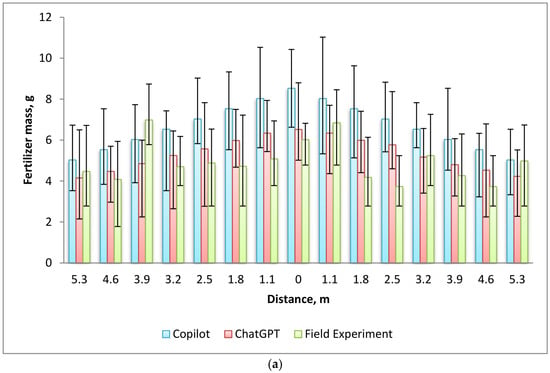
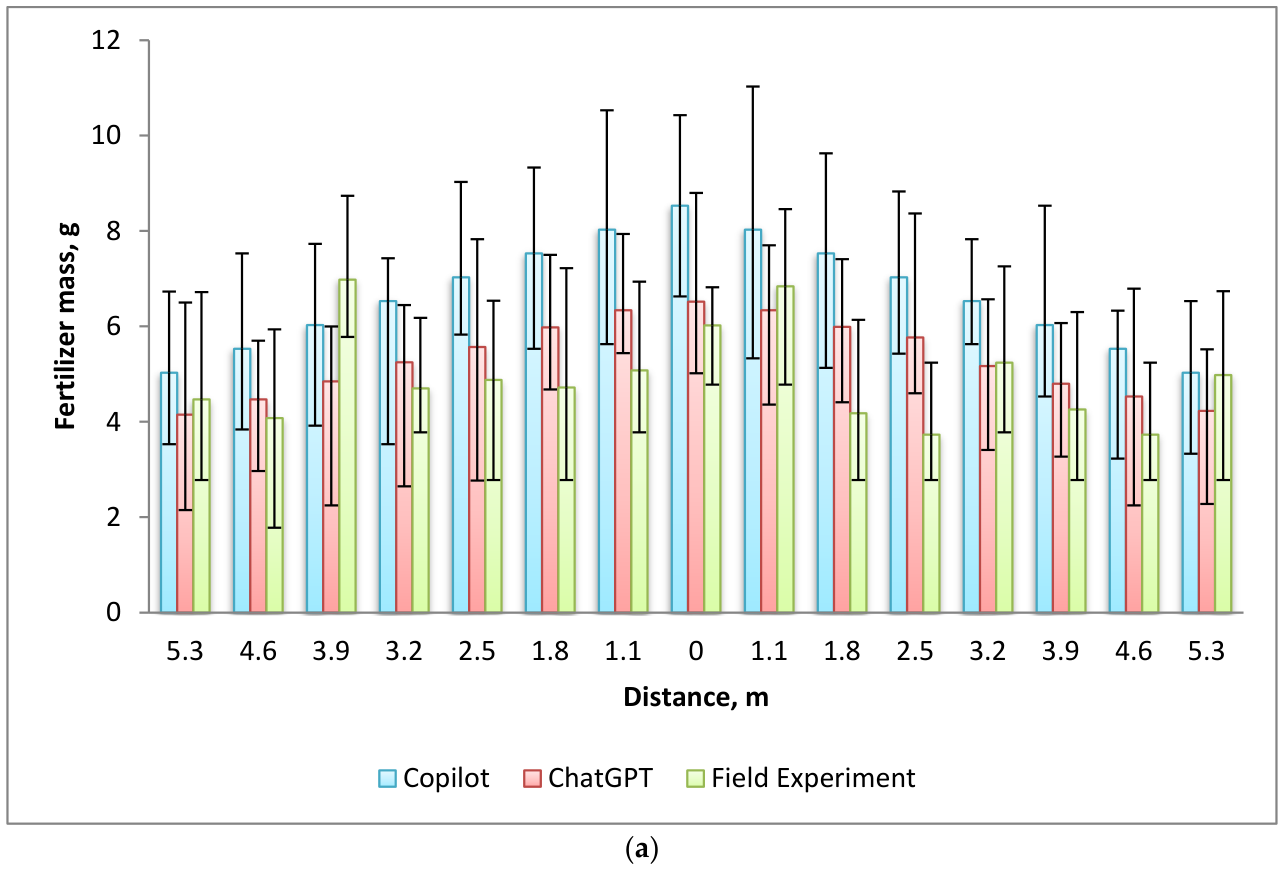
For the grain husk granules, the experimental measurements showed a comparatively uniform lateral deposition pattern across the investigated 10.6 m working range (Figure 3a). The mean mass collected per tray was 4.93 g, while the highest measured deposition was 6.98 g at a lateral distance of 3.9 m from the spreader axis. In the central position (0 m), the deposited mass was 6.02 g. Thus, although the central region exhibited a relatively elevated deposition level, the maximum experimental value did not occur directly at the spreader axis. The gradual variation in deposited mass across the measurement positions indicates that the experimentally observed distribution was not characterized by a pronounced concentration exclusively in the central zone. The corresponding experimental CV of 7.78% indicates a high degree of lateral uniformity and is below the commonly applied 15% [17] threshold.
Figure 3.
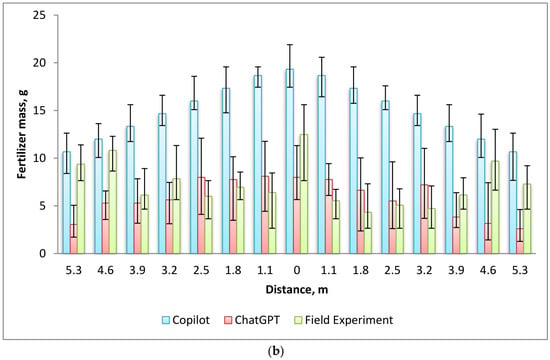
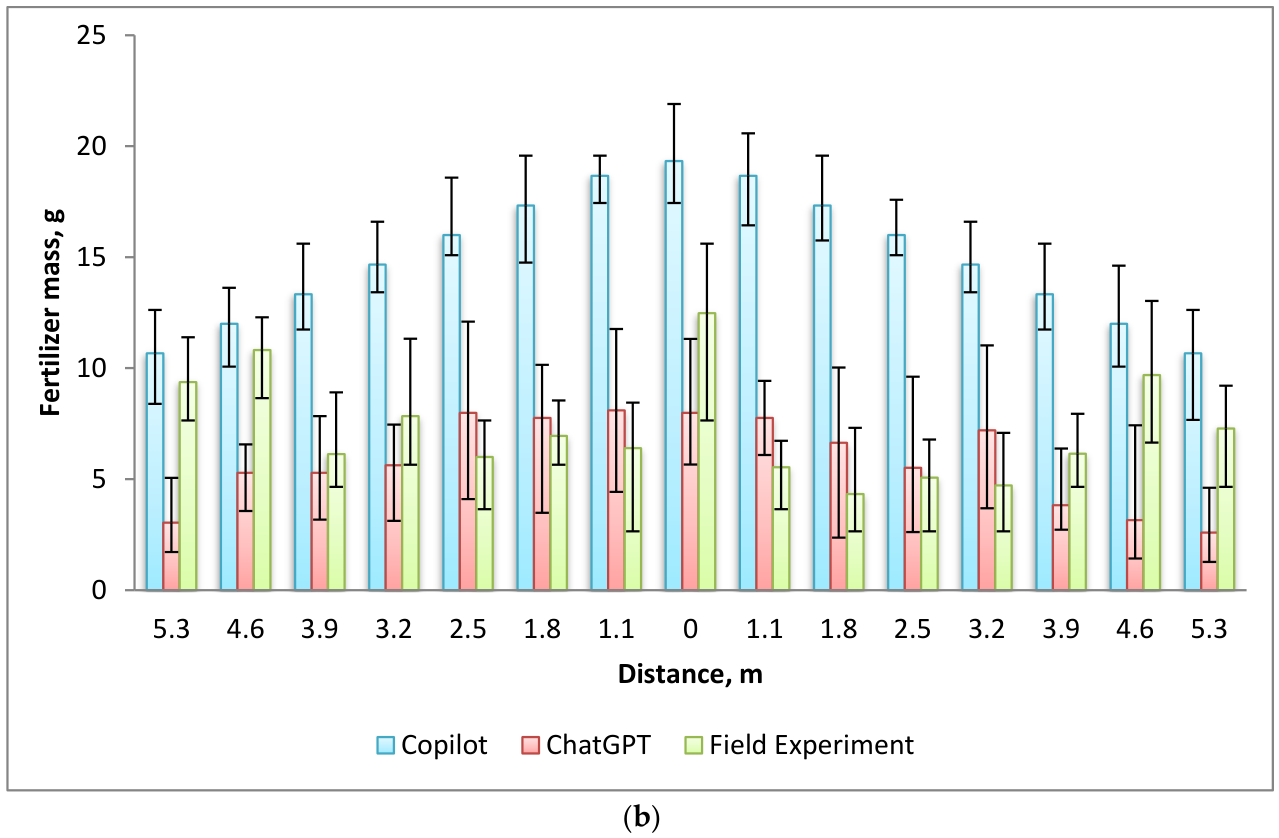
Distribution of fertilizer deposition obtained from numerical model predictions and field experiments: (a) grain husk granules; (b) poultry manure granules.
The AI-based predictions reproduced the principal lateral characteristics of the experimental distribution, but substantial differences were observed in the magnitude of deposition. The Copilot prediction resulted in a considerably higher mean deposition of 6.66 g per tray, with the highest predicted deposition occurring in the central region and reaching 8.53 g. This represents a systematic overestimation of the deposited fertilizer mass relative to the experimental benchmark. The ChatGPT prediction produced a lower mean deposition of 5.33 g per tray and a maximum value of 6.52 g. These values were substantially closer to the experimental measurements, particularly with respect to the overall deposition magnitude. The predicted lateral profile also followed the experimentally observed pattern more closely than the Copilot prediction.
Despite the closer agreement in deposition magnitude, neither AI-based prediction reproduced the experimentally observed level of spreading uniformity for the grain husk granules. The CV values calculated from the ChatGPT and Copilot distributions were 16.57% and 17.90%, respectively, compared with 7.78% for the field measurements. The differences from the experimental CV were therefore 8.79 and 10.12 percentage points, respectively. These results indicate that both approaches generated greater tray-to-tray variability than was observed experimentally. Thus, a relatively close agreement in mean deposition does not necessarily correspond to an accurate reproduction of the experimentally observed spatial uniformity. In this respect, ChatGPT provided a closer approximation of the deposition magnitude and lateral distribution profile, although it still overestimated the experimentally determined variability.
A substantially different experimental pattern was observed for the poultry manure granules (Figure 3b). The experimental measurements were characterized by greater spatial variability, with a mean collected mass of 7.25 g per tray. The maximum deposition of 12.48 g occurred at the central position, while comparatively high deposition values, reaching approximately 10.82 g, were also observed towards the outer sections of the investigated working range. The experimental CV was 16.26%, exceeding the 15% [19] threshold and indicating lower spreading uniformity than that obtained for the grain husk granules.
The greater spatial variability observed for poultry manure granules can be associated with their heterogeneous physical and mechanical characteristics. Compared with the grain husk granules, poultry manure granules may exhibit greater variation in particle shape, density, surface characteristics, and mechanical properties. These characteristics can influence particle acceleration, contact with the spreading disc and vanes, particle–particle collisions, and subsequent flight trajectories. Variations in these parameters may accumulate throughout the spreading process and consequently become expressed as greater spatial variability in the final deposition pattern.
The differences between the AI-based predictions were particularly pronounced for poultry manure granules. The Copilot prediction resulted in a mean deposition of 14.93 g per tray, with the maximum deposition of 19.33 g occurring in the central region. Both values substantially exceeded the corresponding experimental measurements, demonstrating a pronounced overestimation of fertilizer deposition. The predicted CV of 21.26% was also the highest among all datasets considered. Therefore, the Copilot not only overestimated the absolute amount of deposited fertilizer but also generated a more heterogeneous lateral distribution than that observed experimentally.
The ChatGPT prediction exhibited a different response. The predicted mean deposition was 5.83 g per tray, while the maximum value of 7.99 g occurred in the central region. Although both values were lower than those measured experimentally, the predicted CV of 15.10% was close to the experimental value of 16.26%. The difference between the predicted and experimental CV was only 1.16 percentage points, representing the smallest deviation obtained among all model–experiment comparisons. This result indicates that, despite underestimating the absolute deposition magnitude, ChatGPT reproduced the degree of lateral nonuniformity of poultry manure spreading considerably more closely than Copilot.
The combined comparison of deposition magnitude and variability demonstrates a material-dependent difference in model performance. For grain husk granules, ChatGPT provided the closest approximation of the experimental deposition magnitude, whereas neither AI-based approach reproduced the low experimental CV of 7.78%. For poultry manure granules, ChatGPT again provided the closer representation of the experimental spreading behavior, particularly in terms of CV, despite underestimating the absolute deposited mass. Copilot showed a greater tendency to overestimate deposition, most notably for poultry manure, where both the mean and central deposition were substantially higher than the experimental values.
The observed differences between the two fertilizer types further emphasize the importance of particle characteristics in numerical prediction of centrifugal spreading. The relatively low experimental CV of the grain husk granules indicates a comparatively stable lateral deposition pattern, whereas the higher CV obtained for poultry manure granules reflects greater variability in particle transport and deposition. The AI-based approaches reproduced this general distinction only partially. Their ability to reproduce the absolute deposition magnitude and the spatial variability differed according to the fertilizer material, indicating that material-specific physical and mechanical characteristics are important determinants of predictive performance.
From an experimental benchmarking perspective, the results demonstrate that field measurements provide an essential reference for evaluating AI-generated numerical predictions. The experimental dataset makes it possible to identify systematic deviations in both the magnitude and spatial variability of predicted deposition. In the present investigation, ChatGPT generally produced predictions closer to the experimentally observed spreading behavior, particularly for poultry manure granules, for which the predicted CV differed from the experimental value by only 1.16 percentage points. In contrast, Copilot exhibited larger deviations, most notably in the predicted deposition magnitude for poultry manure granules.
Nevertheless, the observed differences should not be interpreted as evidence that one AI-based approach is universally superior. The comparison was performed for a specific centrifugal spreading system, fertilizer materials, operating conditions, and set of input assumptions. The predictive performance of AI-generated numerical models may therefore depend strongly on the completeness and accuracy of the physical parameters used to describe the fertilizer and spreading mechanism. In particular, particle size and shape, density, frictional behavior, restitution, particle–particle interactions, and particle–equipment contacts may substantially influence the resulting trajectories and lateral deposition pattern.
Overall, the experimental benchmarking demonstrated that AI-based numerical approaches were capable of reproducing the principal characteristics of lateral fertilizer distribution, but their quantitative agreement with field measurements varied according to both fertilizer type and evaluation criterion. The results indicate that the similarity of mean deposition values alone is insufficient to establish predictive reliability. Agreement in spatial variability, represented by CV, together with the uncertainty associated with the estimated means, represented by 95% CIs, provides a more rigorous basis for evaluating model performance. Under the investigated conditions, ChatGPT showed closer overall agreement with the experimental spreading behavior than Copilot, particularly for the more heterogeneous poultry manure granules. However, the remaining discrepancies confirm that AI-generated predictions should be considered an initial modeling approximation rather than a substitute for experimentally validated numerical modeling. Experimental benchmarking therefore remains essential for assessing predictive reliability and for identifying material-specific deviations that may require further calibration or refinement of the modeling approach.
4. Discussion
The findings clearly demonstrate the current limitations of AI models in predicting the mechanical behavior and distribution kinetics of granular materials. Previous research has demonstrated that, despite their advanced language-processing capabilities, LLMs still face challenges in physical reasoning and interpreting the underlying properties of physical systems [21]. In the present study, the numerical profiles generated by ChatGPT and Copilot indicate that these generative architectures currently function as generalized numerical approximators rather than precise physical simulators.
Distinct systematic tendencies were observed between the models: Specifically, Microsoft Copilot exhibited a systematic overestimation of both fertilizer deposition magnitude and distribution variability (CV). These discrepancies can be attributed to several fundamental factors: the free-version LLM’s lack of prior grounding in particulate physics, a tendency to generate overly broad statistical distribution curves, and systematic errors in converting application rates into collection-tray mass. In contrast, ChatGPT successfully captured the normalized geometrical probability ‘shape’ of the process—demonstrating a close alignment with experimental CV values—while exhibiting a scaling bias in absolute mass prediction. A critical insight from this study is that model reliability strongly depends on the specific evaluation criterion applied. While average deposited mass may be predicted with acceptable accuracy, spatial distribution and the coefficient of variation (CV) remain highly sensitive to minor parametric errors. Previous studies have demonstrated that fertilizer distribution uniformity is influenced by particle properties, spreader configuration, operating parameters, and application conditions [22,23]. The complex particle dynamics governing fertilizer spreading, particularly particle interactions with rotating disc vanes, particle shape, surface properties, density, and aerodynamic resistance, present substantial challenges for accurate numerical prediction. Previous investigations have demonstrated the importance of particle motion along spreader vanes [6,14,24], aerodynamic particle properties [25], and discrete element modeling for simulating granular fertilizer distribution [4,26]. These findings suggest that the complex mechanics governing the disc vane interface, including particle sphericity, surface roughness, density heterogeneity, and aerodynamic drag, generate complex multiphase dynamics that current general-purpose generative models cannot fully resolve.
Future Possibilities and Research Directions:
- •
- Hybrid AI–DEM Frameworks: Integrating AI algorithms with physics-based Discrete Element Method (DEM) simulations represents a promising avenue. Training generative models on realistic particle interaction physics would mitigate structural simplification errors, significantly enhancing predictions of spatial distribution and CV.
- •
- Future efforts should focus on enhancing current AI models by adjusting network structures and integrating additional physical variables. Embedding fundamental mechanical laws directly into the model architecture could significantly improve prediction accuracy for complex granular dynamics.
Practical Implications: Currently, AI-generated predictions serve as a valuable preliminary screening tool for rapid scenario evaluation and qualitative design iterations. However, physical experimental validation remains indispensable for final engineering decisions and machinery optimization. Future efforts should aim not to replace experimental benchmarking but to augment its interpretive power within agricultural machinery design.
5. Conclusions
- AI Model Independence and Structural Divergence: When supplied with identical experimental inputs, ChatGPT and Microsoft Copilot independently generated fundamentally different numerical formulations—ChatGPT utilized a continuous Gaussian distribution linked to particle parameters, whereas Copilot adopted a discrete probabilistic approach. Predictive Accuracy and Performance Divergence: ChatGPT generally outperformed Copilot, closely approximating experimental deposition mass for grain husk granules (5.33 g vs. 4.93 g) and successfully capturing the spreading variability (CV of 15.10% vs. 16.26%) for poultry manure granules, albeit with a mass-scaling bias. In contrast, Copilot systematically overestimated both absolute deposition and distribution variability. Material-Dependent Limitations: Neither model accurately captured the high uniformity of the homogeneous grain husk granules, and prediction errors intensified for the heterogeneous poultry manure granules, highlighting the necessity of integrating particle-level physical properties (shape, density, surface behavior) into future numerical formulations. Critical Methodological Insight: A well-fitted coefficient of variation (CV) alone does not imply overall model reliability. Both absolute deposited mass magnitude and transverse distribution shape must be simultaneously validated against experimental data before any model can be considered quantitatively reliable. Consequently, general-purpose LLMs currently serve only as preliminary estimation tools rather than substitutes for experimental calibration.
- Study Scope and Limitations: These findings apply strictly to the evaluated free-version LLMs operating under zero-shot, text-only conditions without advanced prompt optimization or few-shot examples and thus cannot be broadly generalized across all LLMs or operational spreading scenarios without further validation.
Author Contributions
Conceptualization, R.Z., E.J. and D.K.; methodology, R.Z., E.J., D.K., G.J. and S.T.S.Y.; software, R.Z., E.J. and D.K.; validation, R.Z., E.J., D.K., G.J. and S.T.S.Y.; formal analysis, R.Z., E.J., D.K., G.J. and S.T.S.Y.; investigation, R.Z., E.J., D.K., G.J. and S.T.S.Y.; resources, R.Z., E.J., D.K., G.J. and S.T.S.Y.; data curation, R.Z., E.J., D.K., G.J. and S.T.S.Y.; writing—original draft preparation, R.Z., E.J., D.K., G.J. and S.T.S.Y.; writing—review and editing, R.Z., E.J., D.K., G.J. and S.T.S.Y.; visualization, R.Z., E.J., D.K., G.J. and S.T.S.Y.; supervision, R.Z. and E.J.; project administration, R.Z., E.J., D.K. and G.J.; funding acquisition, R.Z., E.J., D.K., G.J. and S.T.S.Y. All authors have read and agreed to the published version of the manuscript.
Funding
This research received no external funding.
Institutional Review Board Statement
Not applicable.
Informed Consent Statement
Not applicable.
Data Availability Statement
The experimental data supporting the findings of this study are available from the corresponding author upon reasonable request. The input parameters, mathematical formulations, and methodological procedures used for AI-assisted model development are described in the manuscript.
Acknowledgments
During the preparation of this manuscript, the authors used Microsoft Copilot (M365 Copilot) based on the GPT-5 chat model and ChatGPT (GPT-5.6 Luna, OpenAI) as supporting tools for developing computational models and conducting simulations based on experimental data, parameters, research assumptions, and methodological frameworks established by the authors from their experimental work and synthesis of relevant scientific literature. The AI-generated models and simulation outputs were subsequently reviewed, evaluated, and interpreted by the authors. AI tools were also used for language editing and improving the clarity of the text. The authors have reviewed and edited the output and take full responsibility for the content of this publication.
Conflicts of Interest
The authors declare no conflicts of interest.
References
- Van Liedekerke, P.; Tijskens, E.; Dintwa, E.; Rioual, F.; Vangeyte, J.; Ramon, H. DEM simulations of the particle flow on a centrifugal fertilizer spreader. Powder Technol. 2009, 190, 348–360. [Google Scholar] [CrossRef] [Scilit]
- Coetzee, C.J.; Lombard, S.G. Discrete element method modelling of a centrifugal fertiliser spreader. Biosyst. Eng. 2011, 109, 308–325. [Google Scholar] [CrossRef] [Scilit]
- Juodišius, G.; Zinkevičienė, R.; Jotautienė, E.; Karayel, D.; Mieldažys, R. Investigation of Granular Organic Fertilizer Distribution Uniformity in Disk-Type Spreaders with Standard and Modified Vane Configurations. Appl. Sci. 2025, 15, 13076. [Google Scholar] [CrossRef] [Scilit]
- Zinkevičienė, R.; Jotautienė, E.; Juostas, A.; Comparetti, A.; Vaiciukevičius, E. Simulation of granular organic fertilizer application by centrifugal spreader. Agronomy 2021, 11, 247. [Google Scholar] [CrossRef] [Scilit]
- Van Liedekerke, P.; Piron, E.; Vangeyte, J.; Villette, S.; Ramon, H.; Tijskens, E. Recent results of experimentation and DEM modeling of centrifugal fertilizer spreading. Granul. Matter 2008, 10, 247–255. [Google Scholar] [CrossRef] [Scilit]
- Dintwa, E.; Van Liedekerke, P.; Olieslagers, R.; Tijskens, E.; Ramon, H. Model for simulation of particle flow on a centrifugal fertiliser spreader. Biosyst. Eng. 2004, 87, 407–415. [Google Scholar] [CrossRef] [Scilit]
- Ou, M.; Wang, G.; Lu, Y.; Zhang, Z.; Pan, H.; Jia, W.; Dong, X. Structure optimization and performance simulation of a double-disc fertilizer spreader based on EDEM–CFD. Agronomy 2025, 15, 1025. [Google Scholar] [CrossRef] [Scilit]
- Kuska, M.T.; Wahabzada, M.; Paulus, S. AI for crop production—Where can large language models (LLMs) provide substantial value? Comput. Electron. Agric. 2024, 221, 108924. [Google Scholar] [CrossRef] [Scilit]
- De Clercq, D.; Awad, A. Large language models can help boost food production. Front. Artif. Intell. 2024, 7, 1326153. [Google Scholar] [CrossRef] [Scilit] [PubMed]
- Walters, W.H.; Wilder, E.I. Fabrication and errors in the bibliographic citations generated by ChatGPT. Sci. Rep. 2023, 13, 14045. [Google Scholar] [CrossRef] [Scilit] [PubMed]
- Yetistiren, B.; Ozsoy, I.; Tuzun, E. Assessing the quality of GitHub Copilot’s code generation. In Proceedings of the 18th International Conference on Predictive Models and Data Analytics in Software Engineering; Association for Computing Machinery: New York, NY, USA, 2022; pp. 62–71. [Google Scholar] [CrossRef] [Scilit]
- Ahmad, A.; Rahman, T.; Kasera, N.; Ahmed, S. Large language models in cellulose biopolymer studies: Evaluating ChatGPT and Microsoft Copilot for information and reference accuracy. Int. J. Intell. Syst. 2026, 2026, 2260439. [Google Scholar] [CrossRef] [Scilit]
- Fachada, N.; David, N. Artificial Intelligence in Modeling and Simulation. Algorithms 2024, 17, 265. [Google Scholar] [CrossRef] [Scilit]
- Tomantschger, K.; Petrović, V.D.; Cerović, B.V.; Dimitrijević, Ž.A.; Radojević, L.R. Prediction of a Fertilizer Particle Motion Along a Vane of a Centrifugal Spreader Disc Assuming its Pure Rolling. FME Trans. 2018, 46, 544–551. [Google Scholar] [CrossRef] [Scilit]
- Ferreira, I.S.B.; Peruchi, R.S.; Fernandes, N.J.; Rotella Junior, P. Measurement system analysis in angle of repose of fertilizers with distinct granulometries. Measurement 2021, 170, 108681. [Google Scholar] [CrossRef] [Scilit]
- Ahdi, H.A.; Jebur, H.A. Evaluation of the Efficiency and the Performance of a Variable-Rate Chemical Fertilizer Spreader Using a GPS-Based Control System. Diyala Agric. Sci. J. 2025, 17, 212. [Google Scholar] [CrossRef] [Scilit]
- EN 13739-1:2011; Agricultural Machinery—Solid Fertilizer Broadcasters and Full Width Distributors—Environmental Protection—Part 1: Requirements. CEN: Brussels, Belgium, 2011.
- Villette, S.; Piron, E.; Miclet, D. Hybrid centrifugal spreading model to study the fertiliser spatial distribution and its assessment using the transverse coefficient of variation. Comput. Electron. Agric. 2017, 137, 115–129. [Google Scholar] [CrossRef] [Scilit]
- ASAE S341.5; Procedure for Measuring Distribution Uniformity and Calibrating Granular Broadcast Spreaders. American Society of Agricultural and Biological Engineers (ASABE): St. Joseph, MI, USA, 2018.
- Karayel, D.; Šarauskis, E.; Jotautienė, E. Performance Optimization of Pneumatic Precision Planters for Uniform Distribution of Small Seeds Using AI-Guided Multi-Criteria and Evolutionary Approaches. Smart Agric. Technol. 2025, 12, 101262. [Google Scholar] [CrossRef] [Scilit]
- Wang, Y.; Duan, J.; Fox, D.; Srinivasa, S. NEWTON: Are large language models capable of physical reasoning? Find. Assoc. Comput. Linguist. EMNLP 2023, 2023, 9743–9758. [Google Scholar] [CrossRef] [Scilit]
- Shi, Y.; Hu, Z.; Wang, X. Fertilization strategy and application model using a centrifugal variable-rate fertilizer spreader. Int. J. Agric. Biol. Eng. 2018, 11, 41–48. [Google Scholar] [CrossRef] [Scilit]
- Guan, Z.; Mu, S.; Jiang, T.; Li, H.; Zhang, M.; Wu, C.; Jin, M. Development of centrifugal disc spreader on tracked combine harvester for rape undersowing rice based on DEM. Agriculture 2022, 12, 562. [Google Scholar] [CrossRef] [Scilit]
- Xie, Y.; Liu, H.; Shang, J.; Guo, L.; Zheng, G. Effect of angle between center-mounted blades and disc on particle trajectory correction in side-throwing centrifugal spreaders. Agriculture 2025, 15, 1392. [Google Scholar] [CrossRef] [Scilit]
- Biocca, M.; Menesatti, P. Aerodynamic properties of six organo-mineral fertiliser particles. J. Agric. Eng. 2013, 44, e83. [Google Scholar] [CrossRef] [Scilit]
- Abbou-Ou-Cherif, E.M.; Piron, E.; Chateauneuf, A. On-the-field simulation of fertilizer spreading: Part 3—Control of disk inclination for uniform application on undulating fields. Comput. Electron. Agric. 2019, 158, 150–158. [Google Scholar] [CrossRef] [Scilit]

Disclaimer/Publisher’s Note: The statements, opinions and data contained in all publications are solely those of the individual author(s) and contributor(s) and not of MDPI and/or the editor(s). MDPI and/or the editor(s) disclaim responsibility for any injury to people or property resulting from any ideas, methods, instructions or products referred to in the content. |
© 2026 by the authors. Licensee MDPI, Basel, Switzerland. This article is an open access article distributed under the terms and conditions of the Creative Commons Attribution (CC BY) license.