


Abstract
The need for mechanization of sweet potato production remains a critical challenge. Furthermore, automated transplanting using large-scale machinery remains semi-automated and presents an operational challenge. Here, we evaluated the agronomic suitability of a short, 5-node seedling standard for improving mechanical adaptability without compromising plant productivity and root quality. The growth characteristics, biomass accumulation, carbon (C) and nitrogen (N) contents, post-transplant survival, and storage root yields of 5-node seedlings and conventional 7-node seedlings of the premium fresh-market cultivar ‘Beniharuka’ were compared. The 5-node seedlings exhibited lower initial dry masses and smaller leaf areas. However, the 5-node standard significantly reduced the stem bending index and reduced the percentage of seedlings that were mechanically unsuitable for transplanting (bending angle ≥ 40°). The post-transplant survival rate of the 5-node seedlings decreased by approximately 20% compared with that of the conventional control (p = 0.053). Although this difference was marginally non-significant, it represents a substantial biological reduction in early field establishment. However, the comparable final yield components indicated that the cultivar ‘Beniharuka’ exhibited comparable yield performance under the tested conditions. While addressing this survival challenge through targeted agronomic management is essential for practical implementation, the 5-node standard represents a promising morphological strategy to improve compatibility with automated transplanters in fresh-market sweet potato production.
1. Introduction
Sweet potato (Ipomoea batatas (L.) Lam.), a major global storage root crop, has a global cultivation area of approximately 7.21 million hectares and reached an annual production of 90.9 million tons in 2024 [1]. With the decline in the global agricultural labor force, the mechanization of sweet potato production has become essential [2]. Among the various cultivation stages, seedling preparation and transplanting are highly labor-demanding, accounting for a substantial proportion of the total working hours for sweet potato production [3].
In the United States, advances have been made in automated transplanting using large-scale machinery. However, these systems remain semi-automated, requiring manual operation of the machine and manual feeding of individual seedlings into the planting mechanism, which presents an operational challenge. In Asian countries, manual seedling transplantation, which remains prevalent, contributes to domestic labor shortages [2]. In Japan, although mechanization was introduced early for processing (starch) sweet potatoes [4] and has expanded into fresh-market sectors, transplanting has traditionally relied on manual labor. Consequently, adapting seedling morphology to mechanical clamping, feeding, and transportation devices has emerged as a key technological constraint in the Japanese sweet potato industry [3].
Contemporary automated transplanters are highly sensitive to seedling morphology, particularly basal stem curvature. Seedlings exhibiting basal bending, frequently exceeding 40°, are unsuitable for mechanical handling, resulting in clamping failures, seedling feed blockages, and missing seedlings in the field [3]. To resolve this challenge, labor-saving nursery practices and the adoption of short 5-node seedlings through simultaneous mechanical harvesting have been recommended for processing-use production to minimize stem bending [5].
Although reducing the seedling length to a 5-node standard mitigates stem bending, it introduces a biological tradeoff. Under conventional cultivation models, shorter seedlings (5-node/5-leaf or 3-node/3-leaf) exhibit a lower total root number, length, and mass than those of the standard 7-node/7-leaf benchmark because of the reduction in both node number (sink) and photosynthetic leaf area (source) [6]. This structural and energy deficit may reduce the number of storage roots per plant. This biological response introduces a dilemma in fresh sweet potato production. Historically, traditional Japanese agronomy has established a benchmark for high-quality seedlings: a thick stem possessing large leaf blades with 6 or 7 nodes and a length of 25–30 cm to ensure root establishment and survival [6]. Consequently, although a 5-node standard can result in a reduced total root count and a subsequent tendency toward individual root oversizing, this outcome is acceptable for industrial starch processing. However, this constitutes a commercial disadvantage in fresh markets, where size uniformity, market appearance, and adherence to standard marketable size categories dictate market prices and grower profitability [6].
In sweet potato, node number [7] and storage root establishment [8] are related to its physiology [9,10]. First, adventitious root primordia develop near the vascular bundles of the stem. The number of nodes or the developmental status of sweet potato seedlings can influence subsequent root development and formation [11]. In conventional long seedlings, the number, diameter, and elongation speed of these primordia reach a maximum at the 5th–7th nodes from the apex, making them more likely to differentiate into storage roots [12]. Second, the initiation and early enlargement of these storage roots depend on the supply of carbohydrates and nitrogen translocated from the active leaf blades, as well as the internal carbon-to-nitrogen ratio within the seedling tissue [13]. Therefore, fewer nodes on the seedling result in a smaller number of storage roots compared with the conventional 7-node seedling; however, the storage roots enlarge more notably when sufficient leaf area is established. Therefore, theoretically, the yield should not differ from that of conventional seedlings.
Both environmental and biological factors influence this system. The ‘Beniharuka’ cultivar has achieved widespread commercial adoption in Japan owing to its eating quality and storability [6]. Therefore, ‘Beniharuka’ is a suitable model for evaluating whether a 5-node seedling standard can be applied to fresh-market cultivation without reducing final harvest quality. Based on the current experience with mechanized sweet potato cultivation in Japan, we believe that reducing the number of nodes on seedlings can effectively alleviate mechanical gripping issues. Amoah [14] investigated the effect of node count on local sweet potato yields and indicated that seedlings with five nodes exhibit sufficient production potential. We hypothesize that 5-node seedlings can address the challenge of excessive bending associated with 7-node seedlings while retaining inherent yield potential in the local Japanese cultivar ‘Beniharuka’; however, owing to their lower biomass, seedling survival may present a potential challenge.
Here, by comparing the morphological traits and field yield profiles of 5-node seedlings with those of the conventional 7-node benchmark, we evaluated the baseline agronomic suitability of the 5-node seedling standard for fresh-market sweet potato production. This study aimed to establish 5-node seedlings as a new standard for seedling selection, replacing 7-node seedlings. Overall, an evaluation system was developed based on the criteria of mechanical suitability, seedling physiology, and field performance.
2. Materials and Methods
2.1. Comparison of Seedling Productivity (2022)
2.1.1. Plant Materials and Cultivation
The seedling experiment was conducted in March 2022 using the fresh-market cultivar ‘Beniharuka’ in a greenhouse at the Faculty of Agriculture, Ibaraki University, Japan. Seed roots were planted on 28 March with a base fertilizer of 20.3 kg each of nitrogen (N), phosphorus pentoxide (P2O5), and potassium oxide (K2O) per ha. Plants were grown in double rows with a 1.1 m ridge spacing and 0.3 m plant spacing (6.1 plants·m−2), using three 0.55 m2 replicate plots per treatment (n = 3). Three ridges were prepared in the greenhouse, and the experimental plots were randomly distributed along the ridges. To prevent edge effects, the four sweet potato plants at each end of the ridge were excluded from the experiment.
2.1.2. Measurement Indicators and Methods
Two treatments were established: (1) conventional seedling treatment, wherein the apical 7-node section was collected when seedlings developed more than 10 nodes, and (2) the 5-node seedling treatment, wherein the apical 5-node section was collected when seedlings developed more than 8 nodes. Seedlings were sampled six times between 4 May and 13 June. On each sampling date, all qualified seedlings within each plot were measured, and the plot was designated as the experimental unit (n = 3).
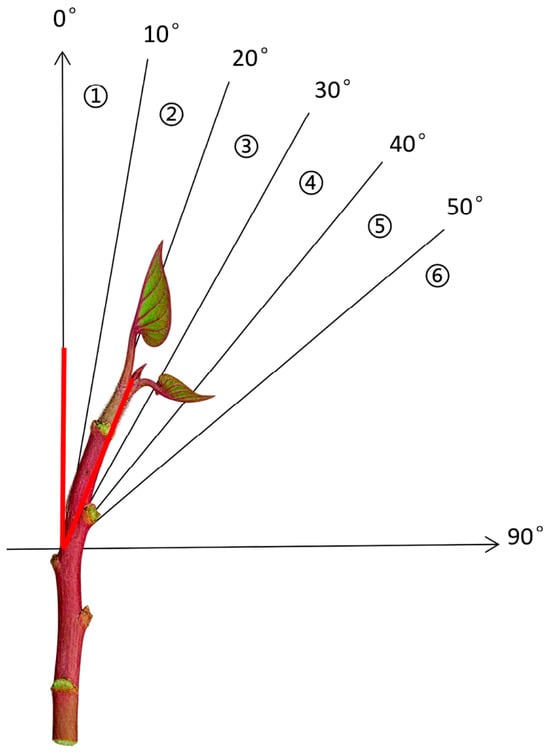
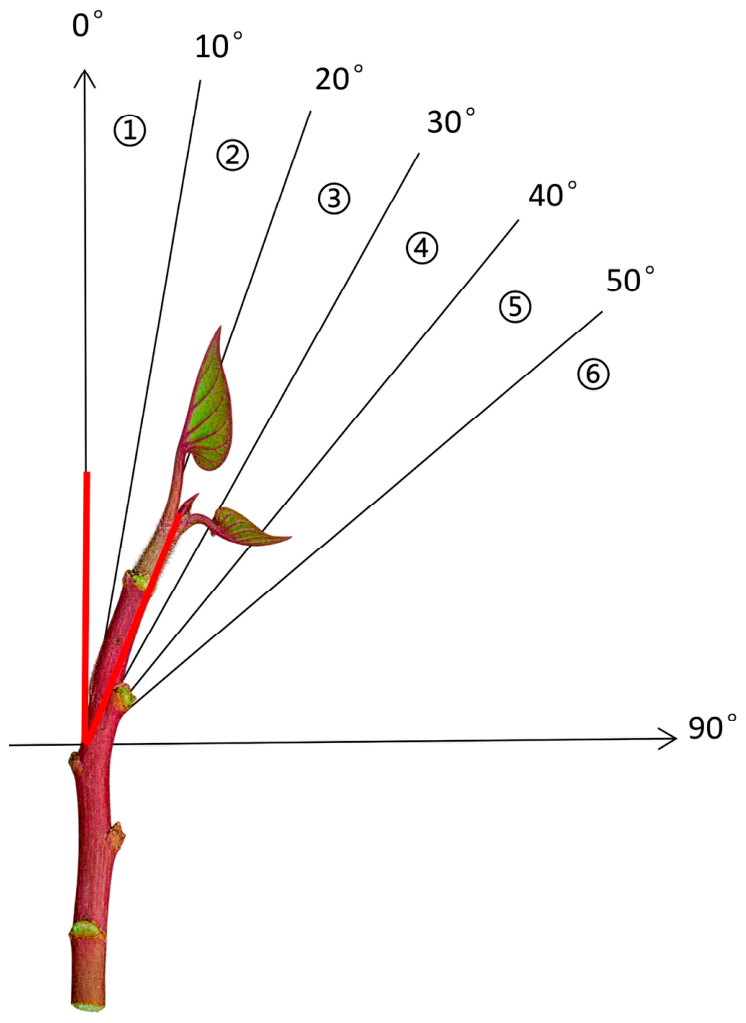
The number of seedlings collected from each group and the degree of bending of each seedling were recorded. In mechanical transplanting, increased stem curvature is widely recognized to increase the risk of gripping failures, feeding errors, and missing plants. Based on practical technical guidelines and field observations for Japanese fresh-market transplanters [3], a bending angle of 40 degrees or greater was adopted as an operational threshold representing severe curvature that impairs mechanical handling. To evaluate population-level stem straightness, a bending index (BI) was adapted from plant pathology grading systems [15,16]. The degree of bending was classified into six grades at 10° intervals as follows: bending score 1 (0–10°), score 2 (10–20°), score 3 (20–30°), score 4 (30–40°), score 5 (40–50°), and score 6 (>50°). Lower scores indicated better erectness. A reference sheet with standard angles was prepared before the measurement (Figure 1). For each measurement, sweet potato seedlings were placed flat on a reference sheet (leaves were removed from the schematic for clarity). To minimize interobserver variability, all samples were classified by the same observer. The formula for calculating the BI for each plot is as follows:
where “i” can be assumed to be each score, “vi” is the number of samples of score i, “N” is the highest score, and “Z” is the total number of samples.
Figure 1.
Schematic diagram of seedling bending angle measurement and classification. The growth direction of the base of the seedling was aligned with the 0° reference line and defined as the reference direction. The bending point of the seedling was designated as the origin of measurement and positioned at the intersection of the horizontal and vertical axes on the reference sheet. A straight line was then drawn from the bending point to the shoot’s apical growing point. The acute angle between this line and the 0° reference line was defined as the branch-deflection angle. The numbers (1–6) represent the bending scores based on the inclination degree: score 1 (0–10°), score 2 (10–20°), score 3 (20–30°), score 4 (30–40°), score 5 (40–50°), and score 6 (>50°).
Morphological traits, including total length, stem diameter, leaf area, dry mass, and length of the lower three internodes (the buried portion), were measured on three plants randomly selected from each plot. These three plants were treated as subsamples, and their values were averaged to obtain a single plot mean for statistical analysis to avoid pseudoreplication. Leaf area was measured from digital images using LIA for Win32 (Ver. 0.378; Yamamoto, 2008) [17], and dry mass was measured after drying at 80 °C for at least 48 h.
2.2. Field Cultivation and Yield Assessment (2022)
2.2.1. Transplanting and Field Plot Design
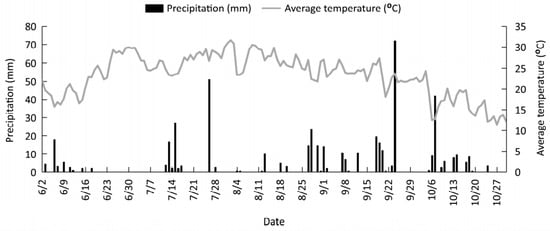
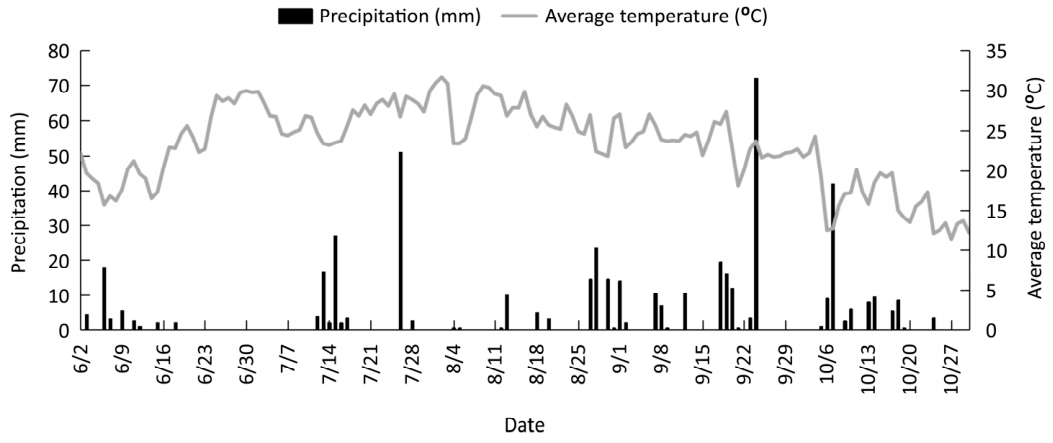
Field experiments were conducted at the Faculty of Agriculture, Ibaraki University. The field soil was treated with dazomet (Basamid Microgranules, Agro-Kanesho Co., Ltd., Tokyo, Japan) (300 kg·ha−1) for soil disinfestation and fosthiazate (Nemathorin Ace Granules, Ishihara Bioscience Co., Ltd., Tokyo, Japan) (300 kg·ha−1) for nematode control. Base fertilizer (30 kg·ha−1 each of N, P2O5, and K2O) was applied, and the soil was covered with a black plastic mulch film. The site experienced a temperate monsoon climate with 484 mm of cumulative precipitation (3.2 mm·day−1 on average) and a mean daily temperature of 23.3 °C during the cultivation period. Meteorological data were obtained from the Japan Meteorological Agency (JMA) (Figure 2) [18].
Figure 2.
Daily mean temperature and precipitation during the 2022 sweet potato cultivation period (transplanting on 2 June 2022; harvesting on 30 October 2022). Data were obtained from the Tsuchiura Weather Station of the Japan Meteorological Agency.
Seedlings obtained from the greenhouse seedling cultivation experiment (Section 2.1) were manually transplanted using the slant-planting method on 2 June 2022, with a planting density of 3.3 plants·m−2 (1.0 m ridge spacing, 0.3 m plant spacing). Each treatment consisted of three replicate plots with 10 plants per plot. The plots were randomly arranged across three 1-m-wide ridges. Two additional plants were planted at each end of each ridge; however, they were excluded from the sampling to minimize edge effects. The transplantation depth was standardized to ensure that the three basal nodes were buried in both treatments.
2.2.2. Survival Rate and Yield Components Analysis
The survival rate was evaluated at 14 days post-transplantation, whereas aboveground growth metrics were recorded monthly until harvest at 150 days. Harvested storage roots were graded according to the Ibaraki Prefecture standards (2021) [6], with roots ≥ 50 g classified as marketable roots. Storage roots were classified into six size categories according to fresh mass: 2S (50–100 g), S (100–200 g), M (200–350 g), L (350–500 g), 2L (500–700 g), and 3L (≥700 g). Among marketable roots, those with a straight shape and no external injuries or evident curvatures were classified as “Grade A.” All samples were graded by the same evaluator, who was blinded to the treatment identity during grading. Based on these classifications, the yield of marketable storage roots, the yield of Grade A storage roots, and the Grade A storage root rates were calculated on a per-hectare basis.
2.3. Carbon and Nitrogen Analysis of Seedling Tissue (2024)
2.3.1. Plant Materials and Sample Collection
For the sweet potatoes used in this experiment, seed roots were planted on 18 March 2024, using the same cultivation method described in Section 2.1.1, and samples were collected on 10 July 2024. For tissue C and N quantification, individual seedlings randomly collected from each treatment served as the experimental unit, with four biological replicates (n = 4 individual seedlings) per treatment.
2.3.2. Quantification of Total Carbon (C) and Nitrogen (N)
Samples of the harvested seedlings were dried at 60 °C for 1 week, and their dry mass was determined. The dried samples were then ground, and the concentrations of total C and N (expressed as a percentage of dry mass) and C:N ratios were measured using a C-N analyzer (JM3000, J-Science Lab Co., Ltd., Kyoto, Japan).
A portion of each sample was re-dried to determine the ratio of oven-dry mass to mass at the time of the C-N analysis. This correction factor was used to correct the measured total C and N concentrations for moisture absorption. The amounts of total C and N absorbed per plant were calculated by multiplying the corrected concentrations by the dry mass of each plant.
2.4. Statistical Analysis
Data were analyzed using Microsoft Excel. In the 2022 experiments, the plot served as the experimental unit (n = 3). For variables measured on multiple plants within a plot, values from the subsampled plants were averaged into a single plot mean prior to analysis. Differences in mean values between the conventional seedling treatment and the 5-node seedling treatment were analyzed using Welch’s t-test in R software (version 4.5.1).
For repeated measures indicators, instead of Welch’s t-test, linear mixed-effects models (LMMs) were fitted in R (version 4.5.1) to evaluate the effects of treatment, sampling date, and their interaction. The sampling date was treated as a categorical variable, and plot identity was included as a random intercept to account for repeated measurements. Fixed effects were assessed using Type III F-tests with Satterthwaite’s approximation for denominator degrees of freedom. Pairwise treatment comparisons at each sampling date were performed using model-estimated marginal means with the Holm adjustment across sampling dates. Statistical significance was set at p < 0.05.
3. Results
3.1. Seedling Productivity
3.1.1. Seedling Production Capacity
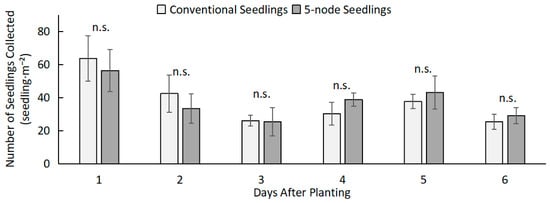
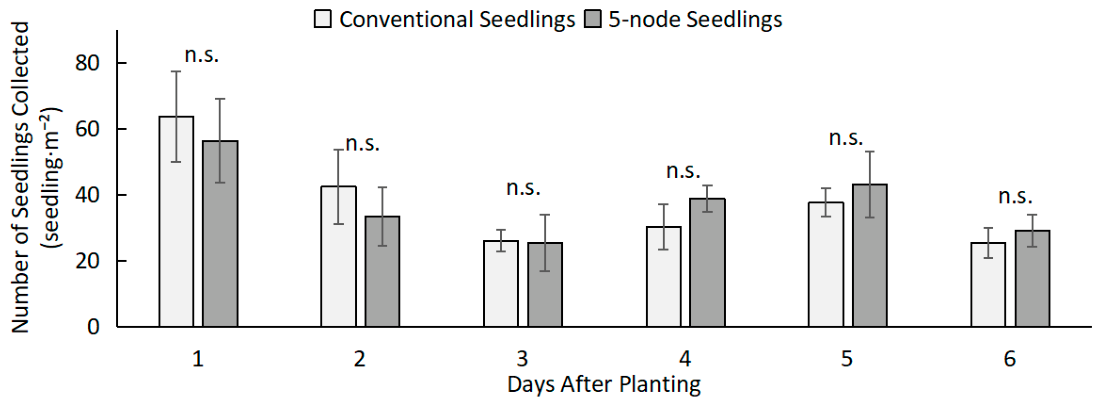
Over the six sampling cycles, the conventional and 5-node plots produced means of 225.5 and 226.1 seedlings, respectively. The LMM analysis revealed a significant main effect of time (p = 0.0078), whereas neither the treatment effect (p = 0.99) nor the treatment × time interaction (p = 0.87) was statistically significant. No statistically significant difference in the net seedling production capacity per mother plant was observed when the harvested seedlings were reduced to a 5-node length (all p > 0.05; Figure 3). These results indicate significant temporal variation in the number of seedlings recovered; however, no significant overall treatment effect or significant interaction between treatment and sampling time was observed.
Figure 3.
Number of conventional and 5-node seedlings harvested per plot across six sampling cycles in 2022. Data are presented as mean ± SE (n = 3). Statistical analyses were performed using a linear mixed-effects model (LMM). The Type III F-test results were as follows: treatment effect, F (1, 4) = 0.0004, p = 0.99; time effect, F (5, 20) = 4.33, p = 0.0078; and treatment × time interaction, F (5, 20) = 0.36, p = 0.87. Between-group comparisons at individual time points were performed with the Holm correction for multiple comparisons (n.s. means no statistically significant difference, p > 0.05).
3.1.2. Biomass Accumulation and Stem Elongation
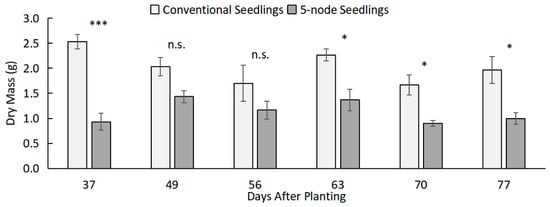
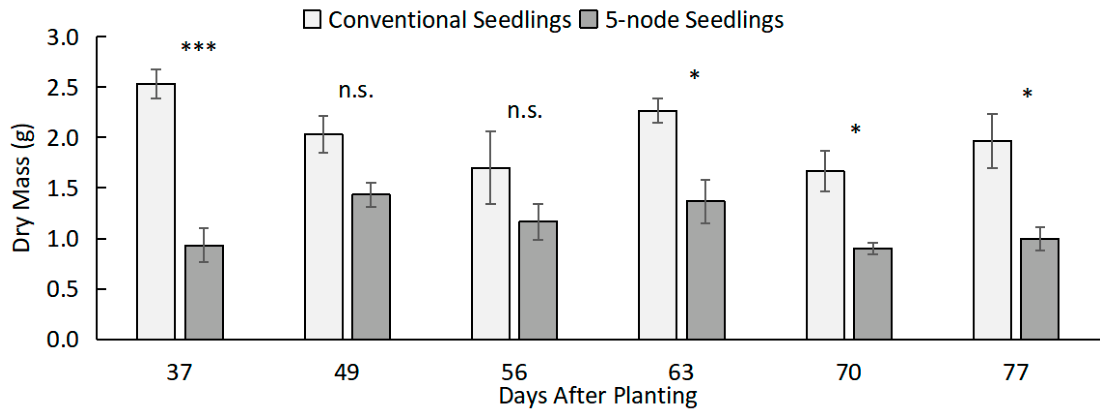
The mean dry mass of the 5-node seedlings was significantly lower than that of the conventional seedlings on days 37, 63, 70, and 77 (p = 0.0001, 0.02, 0.03, and 0.01, respectively; Figure 4). Significant main effects of treatment (p = 0.006) and time (p = 0.032) were observed, whereas the treatment × time interaction did not reach statistical significance (p = 0.06), indicating a significant overall treatment effect on dry mass, although there was insufficient evidence to establish different temporal response patterns between groups.
Figure 4.
Dry mass of conventional and 5-node seedlings across six sampling cycles in 2022. Data are presented as mean ± SE (n = 3). Statistical analyses were performed using a linear mixed-effects model (LMM). The Type III F-test results were as follows: treatment effect, F (1, 4) = 29.5, p = 0.006; time effect, F (5, 20) = 3.1, p = 0.03; and treatment × time interaction, F (5, 20) = 2.6, p = 0.06. Between-group comparisons at individual time points were performed using the Holm correction for multiple comparisons (* p < 0.05; *** p < 0.001; n.s., no significant difference).
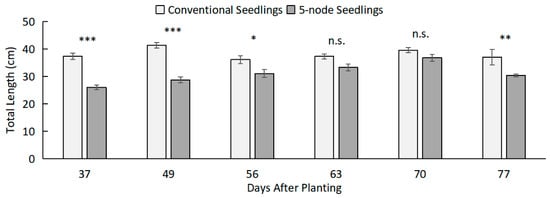
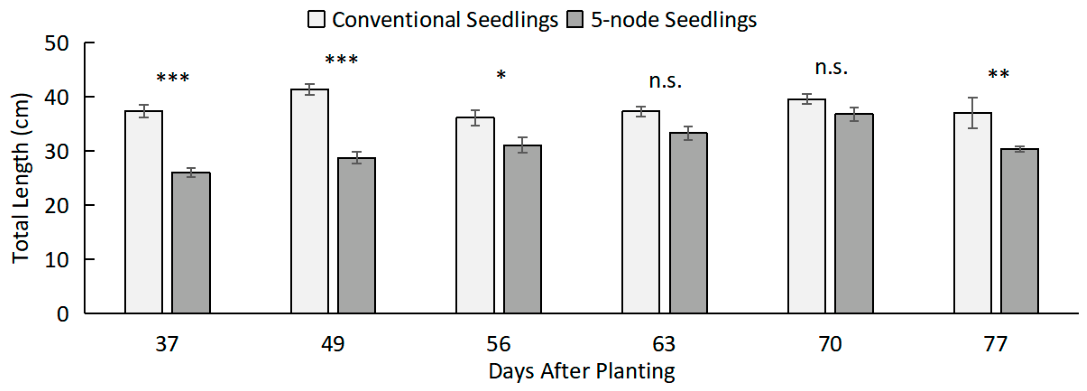
The 5-node seedlings exhibited significantly shorter total lengths during the seedling cultivation phase on days 37, 49, 56, and 77 (p = 0.00002, 0.000004, 0.04, and 0.007, respectively; Figure 5). The LMM analysis demonstrated significant main effects of treatment (p = 0.002) and time (p = 0.002), together with a significant treatment × time interaction (p = 0.004). These findings indicate that the treatment effect on total length varied significantly over time.
Figure 5.
Total length of conventional and 5-node seedlings across six sampling cycles in 2022. Data are presented as mean ± SE (n = 3). Statistical analyses were performed using a linear mixed-effects model (LMM). The Type III F-test results were as follows: treatment effect, F (1, 4) = 58.6, p = 0.002; time effect, F (5, 20) = 5.9, p = 0.002; and treatment × time interaction, F (5, 20) = 5.1, p = 0.004. Between-group comparisons at individual time points were performed with the Holm correction for multiple comparisons (* p < 0.05; ** p < 0.01; *** p < 0.001; n.s., no significant difference).
3.1.3. Basal Internode Characteristics and Photosynthetic Area
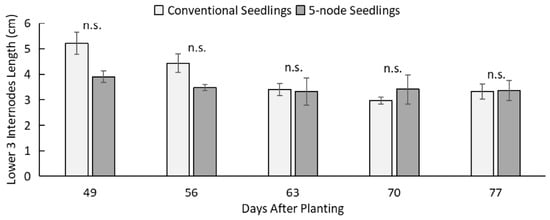
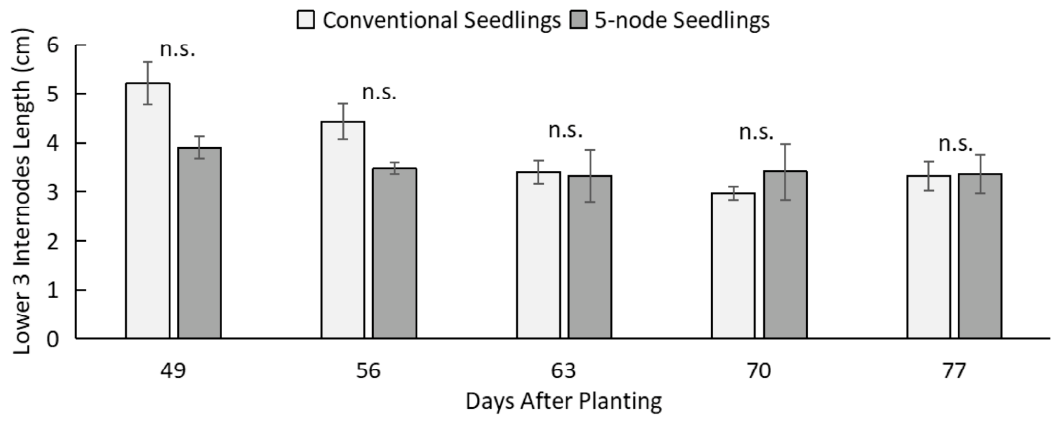
The lengths of the lower three internodes, which constituted the buried portion during transplantation, stabilized at approximately 3–4 cm for both groups from day 49 onward, exhibiting no statistically significant difference throughout the evaluated sampling cycles (Figure 6). However, the LMM analysis revealed a significant main effect of time (p = 0.0006) and treatment × time interaction (p = 0.03), whereas the treatment effect (p = 0.4) did not reach statistical significance.
Figure 6.
Length of the lower three internodes of conventional and 5-node seedlings across five sampling cycles in 2022. Data are presented as mean ± SE (n = 3). Statistical analyses were performed using a linear mixed-effects model (LMM). The Type III F-test results were as follows: treatment effect, F (1, 4) = 0.95, p = 0.4; time effect, F (4, 16) = 8.7, p = 0.0006; and treatment × time interaction, F (4, 16) = 3.7, p = 0.03. Between-group comparisons at individual time points were performed with the Holm correction for multiple comparisons (p > 0.05).
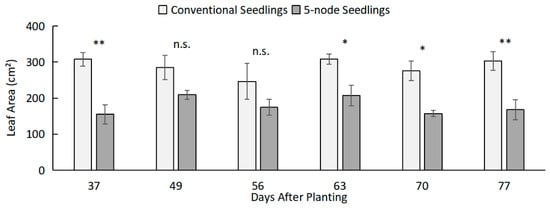
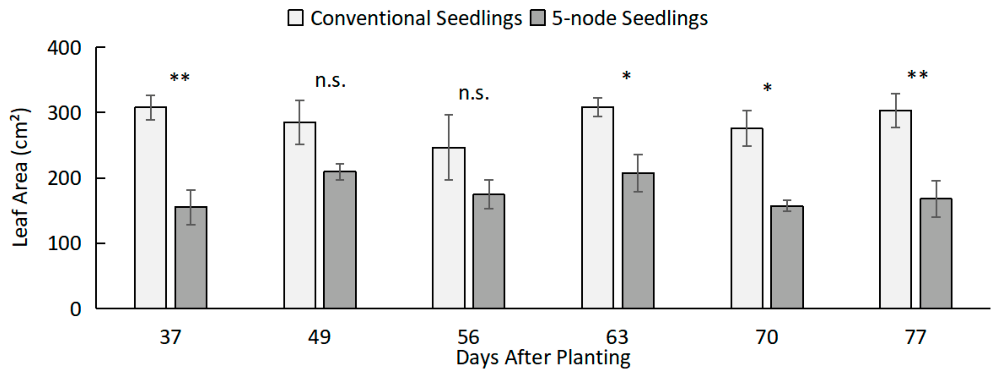
The leaf area of the 5-node seedlings was significantly lower than that of the conventional control group on days 37, 63, 70, and 77 (p = 0.003, 0.04, 0.02, and 0.008, respectively; Figure 7). The main effect of treatment (p = 0.005) on leaf area was significant, whereas the effect of time (p = 0.4) and the interaction (p = 0.6) between the two factors were not significant.
Figure 7.
Leaf area of conventional and 5-node seedlings across six sampling cycles in 2022. Data are presented as mean ± SE (n = 3). Statistical analyses were performed using a linear mixed-effects model (LMM). The Type III F-test results were as follows: treatment effect, F (1, 4) = 32.3, p = 0.005; time effect, F (5, 20) = 1.01, p = 0.4; and treatment × time interaction, F (5, 20) = 0.8, p = 0.6. Between-group comparisons at individual time points were performed with the Holm correction for multiple comparisons (* p < 0.05; ** p < 0.01; n.s., no significant difference).
3.1.4. Seedling Stem Straightness
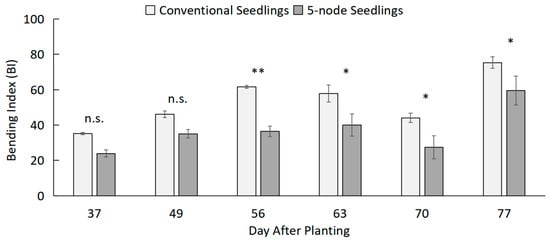
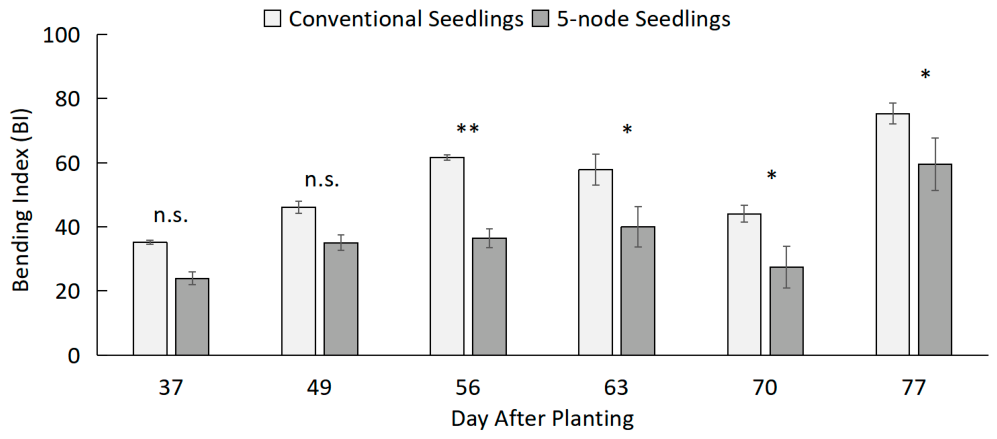
The BI of the 5-node seedlings was significantly lower than that of the conventional seedlings during the later stages of seedling cultivation from days 56 to 77 (day 56, p = 0.002; day 63, p = 0.03; day 70, p = 0.04; day 77, p = 0.04, respectively; Figure 8).
Figure 8.
Bending index of conventional and 5-node seedlings across six sampling cycles in 2022. Data are presented as mean ± SE (n = 3). Statistical analyses were performed using a linear mixed-effects model (LMM). The Type III F-test results were as follows: treatment effect, F (1, 24) = 44.6, p < 0.0001; time effect, F (5, 24) = 17.8, p < 0.0001; and treatment × time interaction, F (5, 24) = 0.8, p = 0.6. Between-group comparisons at individual time points were performed with the Holm correction for multiple comparisons (* p < 0.05, ** p < 0.01; n.s., no significant difference).
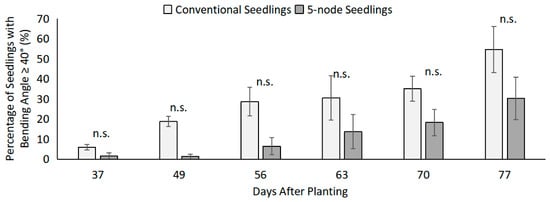
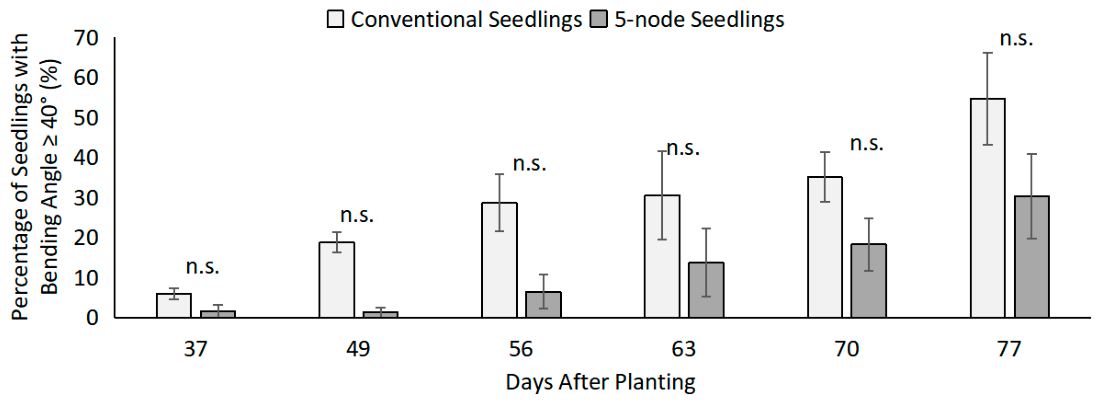
LMM analysis indicated that the overall main effect of treatment was highly significant (F(1, 24) = 17.42, p < 0.001), with 5-node seedlings consistently maintaining a markedly lower incidence of unsuitable bent seedlings (bending angle ≥ 40°) than conventional seedlings throughout the experiment (Figure 9). The main effect of sampling date was also significant (F(5, 24) = 7.42, p < 0.001), while the interaction between treatment and sampling date was not significant (F(5, 24) = 0.49, p = 0.78). Although pairwise comparisons at individual sampling dates did not show significant differences following the conservative Holm adjustment—largely due to the inherent variability of percentage data and the limited plot-level replication (n = 3)—the continuous reduction in severely bent seedlings demonstrates the robust advantage of 5-node cuttings for automated transplanting.
Figure 9.
Percentage of seedlings unsuitable for mechanical planting (bending angle ≥ 40°) for conventional and 5-node seedlings across six sampling cycles in 2022. Data are presented as mean ± SE (n = 3). Statistical analyses were performed using a linear mixed-effects model (LMM). The Type III F-test results were as follows: treatment effect, F (1, 24) = 17.4, p = 0.0003; time effect, F (5, 24) = 7.4, p = 0.0002; and treatment × time interaction, F (5, 24) = 0.48, p = 0.78. Between-group comparisons at individual time points were performed with the Holm correction for multiple comparisons (n.s., no significant difference, p > 0.05).
3.2. Field Performance and Yield
3.2.1. Post-Transplant Survival Rate
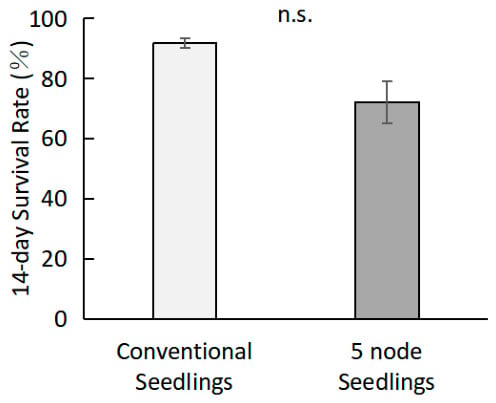
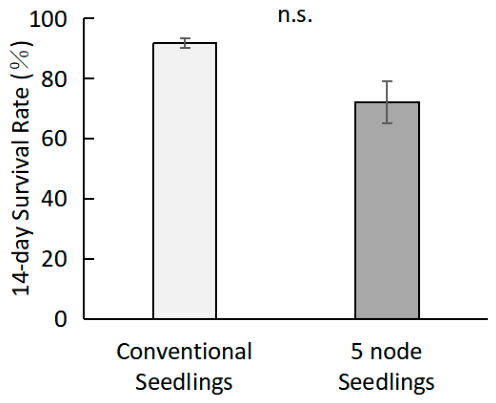
Fourteen days post-transplantation, the mean survival rate was 72.2% for the 5-node seedlings and 91.7% for the conventional seedlings (Figure 10). Although this difference was marginally above the conventional significance threshold (p = 0.053), the approximately 20% reduction represents a substantial biological difference in field survival between the two seedling types.
Figure 10.
Survival rate after field transplanting of conventional and 5-node seedlings in 2022. Data are presented as mean ± SE (n = 3). Welch’s t-test showed no significant differences (p > 0.05).
3.2.2. Storage Root Yield and Size Distribution
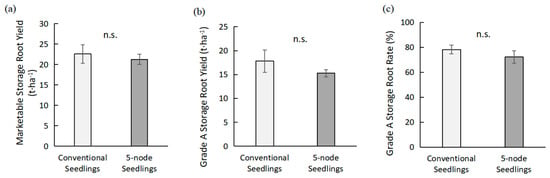
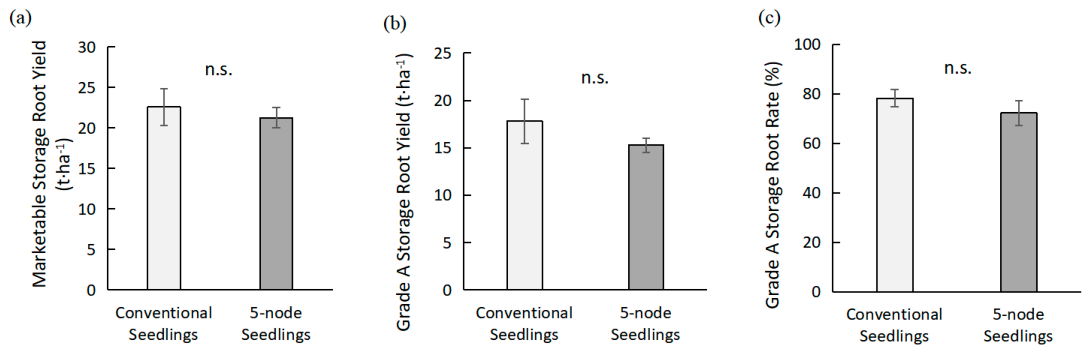
The total marketable storage root yield was 22.6 t·ha−1 (78.3% Grade A rate) for the conventional group and 21.3 t·ha−1 (72.3% Grade A rate) for the 5-node group (Figure 11). The two treatments exhibited comparable performance, with no statistically significant differences observed in the total marketable yield (p = 0.7), Grade A yield (p = 0.4), or Grade A rate (p = 0.4).
Figure 11.
(a) Marketable storage root yields, (b) Grade A storage root yields, and (c) Grade A storage root rates of conventional and 5-node seedlings. Data are presented as mean ± SE (n = 3). Welch’s t-test showed no significant differences (p > 0.05).
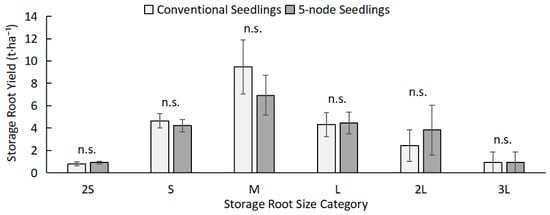
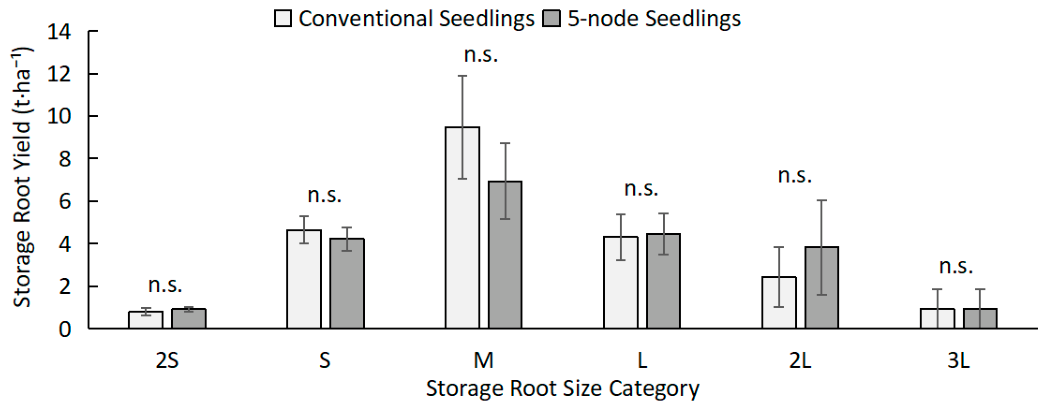
Additionally, root size distribution analyses revealed no statistically significant differences in any of the mass categories, including the M (p = 0.4) and 2L (p = 0.9) classes (Figure 12). Across the size categories, the yield of prime commercial M-size roots was 9.5 t·ha−1 in the conventional group and 6.9 t·ha−1 in the 5-node group, whereas the yield of oversized 2L roots was 3.4 t·ha−1 and 4.8 t·ha−1, respectively.
Figure 12.
Yield of storage roots in different size categories for conventional and 5-node seedlings in 2022. 2S, S, M, L, 2L, and 3L indicate size categories based on fresh mass: 2S (50–100 g), S (100–200 g), M (200–350 g), L (350–500 g), 2L (500–700 g), and 3L (≥700 g). Data are presented as mean ± SE (n = 3). Welch’s t-test showed no significant differences (p > 0.05).
3.3. Seedling C and N Status
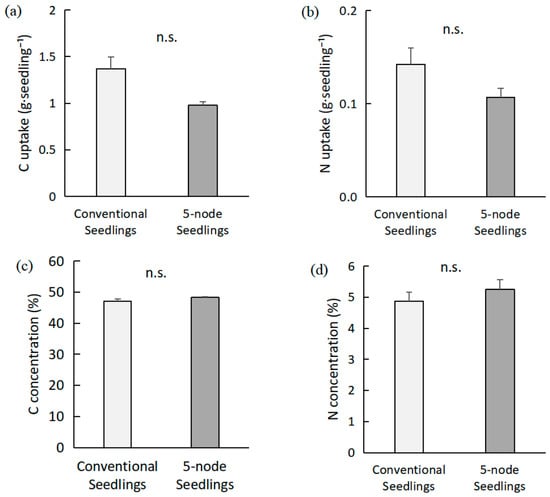
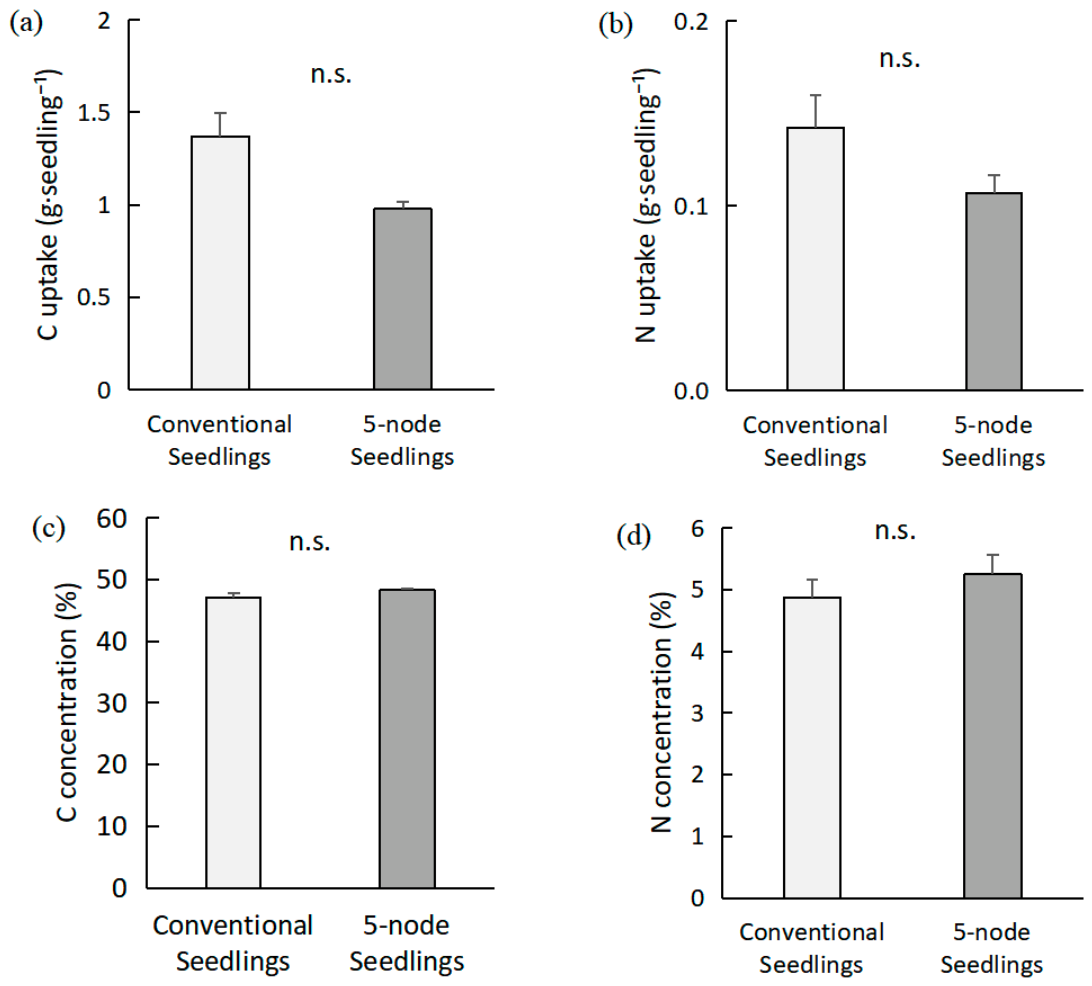
To further investigate the C and N contents of the seedlings, the treatments were repeated in 2024. Biochemical analysis showed that both total C and N concentrations (percentage values per unit dry mass) were not significantly different between the 5-node and conventional 7-node seedlings (Figure 13). Similar to the seedling biomass patterns in 2022, the individual dry mass of the 5-node seedlings (2.02 g) was lower than that of the 7-node seedlings (2.9 g), resulting in a lower absolute total C and N accumulation per plant in the 5-node group, although these variations were not statistically significant.
Figure 13.
Effects of seedling standards on nutrient analysis of conventional and 5-node seedlings in 2024. (a) C uptake. (b) N uptake. (c) C concentration. (d) N concentration. Data are presented as mean ± SE (n = 4). Welch’s t-test revealed no significant differences (p > 0.05).
4. Discussion
We evaluated the baseline agronomic suitability of the 5-node seedling standard for fresh-market sweet potato production by comparing the morphological traits and field yield profiles of 5-node seedlings with those of the conventional 7-node benchmark. We found that the advantages of the 5-node standard outweigh its physiological limitations when supported by targeted agronomic management.
4.1. Effect of Node Reduction on Seedling Quality and Morphological Compatibility for Mechanization
Notably, adopting the 5-node seedling standard substantially improved the proportion of seedlings morphologically suitable for mechanized transplanting by reducing morphological losses associated with excessive stem bending, rather than by increasing the gross number of seedlings produced per mother plant.
To establish a baseline for this seedling standard, field validation was conducted under precise manual planting conditions. This approach isolates the biological and agronomic performance of the 5-node standard by excluding operational variables from the transplanters, such as inconsistent machine clamping or localized physical damage.
During the seedling cultivation stage, harvesting shorter (5-node) seedlings would theoretically increase the total number of seedlings obtained per mother plant. However, our results showed that reducing the seedling length to a 5-node standard resulted in comparable numbers of available seedlings to those obtained using conventional methods. This suggests that shoot regrowth relies on nutrients from the seed roots, as well as on assimilates supplied by existing leaves. Specifically, because the leaf area per plant was consistently smaller in the 5-node treatment than in the 7-node treatment, a reduced supply of assimilates to new shoots is hypothesized as a potential factor limiting shoot multiplication, although metabolic assimilate fluxes were not directly monitored. Although harvesting shorter seedlings maintains axillary bud development without resulting in excessive vegetative stress, it does not increase the gross number of shoots exponentially.
Importantly, a comparable gross seedling yield is advantageous when seedling quality and morphological suitability for mechanized transplanting are considered. Conventional seedlings present physical limitations characterized by high BI and extended stem length. These morphological characteristics are critical factors associated with transplanter jamming, feed mechanism slippage, and subsequent supply errors in automated systems [5]. In automated transplanting systems, operational errors and seedling feed blockages tend to increase progressively with the degree of stem curvature. Although the 40° threshold was adopted as an empirical benchmark based on extension guidelines [3] rather than a strictly validated mechanical limit, an average of 29% of conventional seedlings exceeded this threshold. Adopting the standardized 5-node system significantly reduced the occurrence of such severely curved stems, thereby providing more uniform seedling morphology favorable for mechanical handling. Consequently, although the gross number of seedlings produced per mother plant did not increase, the 5-node standard can reduce morphological loss observed in conventional seedlings by approximately 29%, thereby substantially increasing the net number of effective seedlings morphologically suitable for mechanized planting per unit area.
4.2. Challenges in Post-Transplant Survival and Environmental Mitigation
The post-transplantation survival rate of the 5-node seedlings was approximately 20% lower than that of the conventional control group (72.2% vs. 91.7%). Although this difference was marginally non-significant (p = 0.053), such a substantial biological reduction deserves serious consideration rather than being regarded simply as a non-significant statistical outcome. Previous studies have similarly reported that shorter seedlings with fewer nodes frequently exhibit reduced field establishment and survival rates [6]. This substantial reduction highlights early field establishment as a critical agronomic challenge that requires thorough investigation of the underlying factors and practical mitigation measures [11].
As the subterranean traits and buried internode depth were consistent between the two treatments, this variation was unlikely to be associated with root zone morphology. However, the potential risk of lower survival can be hypothesized to originate from aboveground morphological limitations, such as lower initial dry mass, reduced leaf area, and microclimatic factors. Because environmental stresses and the specific physiological causes of mortality were not directly measured in the field, these proposed mechanisms remain plausible hypotheses that require further empirical testing.
The percentage concentrations of C and N were not significantly different between the 5-node and conventional seedlings. This indicates that the shorter 5-node seedlings were not physiologically immature; rather, they possessed similar tissue maturity and nutrient density relative to those of the conventional standard. However, owing to their lower overall dry mass, the absolute internal pool of total C and N per individual seedling was smaller. Insufficient dry matter accumulation and smaller endogenous C and N pools in 5-node seedlings may indicate a reduced availability of internal resources to support maintenance metabolism and new root formation during the early stage after transplanting. These internal reserves may be particularly important during early establishment when seedlings must rapidly regenerate roots and restore resource acquisition following transplanting [11,19]. Importantly, because the tissue C and N quantification was conducted in a separate year (2024) with a limited sample size (n = 4), these data should be interpreted cautiously as supportive physiological context regarding seedling reserve capacity, rather than a direct, causal explanation for the survival patterns observed in the 2022 field trial.
Agronomic literature indicates that carbohydrates and N for initial adventitious root development are translocated from active leaf blades [20]. Therefore, we hypothesize that reduced leaf area in 5-node seedlings could potentially constrain transient carbohydrate availability for early root initiation and elongation [21,22], although individual translocation rates were not directly quantified in this study.
Therefore, a distinct tradeoff emerged between mechanical suitability and early field establishment. Specifically, we hypothesize that the growing points of the shorter 5-node seedlings are naturally positioned closer to the ridge surface, which could make them more vulnerable to direct contact with the plastic mulch. This physical proximity may increase the risk of transient heat stress or leaf scorching under intense sunlight, particularly when transplantation is conducted at high temperatures in June [23,24,25]. Environmental mitigation measures are highly effective for the successful adoption of 5-node seedlings in commercial practice. They include implementing vertical planting methods to elevate the growth point away from the mulch surface, using post-transplant irrigation systems, and incorporating white mulch to suppress soil surface temperatures. Additionally, growers can shift the transplanting period earlier into May, when ambient temperatures and solar radiation are less severe, thereby neutralizing the survival disadvantage.
4.3. Yield Sustainability and Biomass Compensation Capacity
Our yield and spatial size distribution data provide a critical update on conventional agronomic perspectives. Historically, the 7-node/7-leaf standard has been established as the optimum because it promotes root establishment and results in an increased proportion of medium-sized storage roots (M-size), which traditionally maintains a stable market price in Japan [26,27]. According to conventional studies, seedlings with fewer nodes frequently have a reduced storage root count per plant, leading to the expansion of the remaining roots and an increased proportion of oversized, unmarketable roots [6]. In our study, the 5-node seedlings exhibited comparable yield performance to the traditional 7-node seedlings without significant yield penalties under the tested conditions. This biological resilience is also consistent with the observations of Amoah [14], who compared 3-, 5-, and 7-node sweet potato cuttings of the cultivar ITS2 in Ghana, West Africa, using a transplanting method different from that used in the present study; excess leaves were removed, retaining only one or two leaves per seedling, and the seedlings were transplanted at an angle of one-half to two-thirds of their length buried in the soil. Despite these methodological differences, the results also showed no significant difference in final yield between 7- and 5-node seedlings. In contrast, the performance of the 3-node seedlings was reduced relative to that of the 7-node seedlings in terms of growth and yield-related traits, indicating that the number of initial leaves may not constitute the primary determinant of final yield, and that the accumulation of biomass in the planting material requires thorough evaluation [14]. Our study further indicated that reducing the seedling size to five nodes did not result in a statistical disadvantage in total yield, and the 5-node group successfully maintained a comparable level of A-grade product yield. However, presenting the detailed size distribution (Figure 12) provides critical agronomic context for ‘Beniharuka’, where commercial value heavily depends on preferred retail size classes. Although no statistically significant differences were detected across individual size classes, we acknowledge that the absence of significant differences in a field trial with limited replicates (n = 3) does not definitively establish identical market quality. Numerical variations—specifically the observed lower yield in the M category and the concurrent increase in the 2L category for the 5-node treatment—warrant careful interpretation. This shift is plausibly linked to compensatory root enlargement; the approximately 20% lower initial survival in the 5-node plots increased spatial and nutrient availability for the surviving plants, allowing remaining storage roots to oversize into the 2L class.
This proposed biomass compensation mechanism—hypothesized to reflect enhanced individual root enlargement under reduced stand competition—can nonetheless preserve commercial value owing to the specific cultivar characteristics of the ‘Beniharuka’ variety. ‘Beniharuka’ naturally produces an increased number of storage roots per plant and is less prone to producing poorly shaped roots, even in larger mass classes, compared to older cultivars such as ‘Beniazuma’ [6]. Additionally, within the contemporary fresh market, which currently comprises expanding international exports and increasing commercial demands for processing into roasted sweet potatoes [6,28,29], uniform 2L-size storage roots of ‘Beniharuka’ are highly valued as a premium marketable category, provided they meet Grade A visual standards. Nevertheless, multi-year and larger-scale commercial assessments are necessary to rigorously confirm root size uniformity under mechanical planting systems.
From a physiological perspective, burying the three basal nodes is hypothesized to preserve sufficient differentiation potential of adventitious root primordia [7] to sustain baseline storage root initiation, although anatomical primordia development was not directly examined. Considering that the conventional standard introduces substantial engineering constraints, rendering an average of 29% of seedlings unusable because of stem bending, the fact that the 5-node standard achieves comparable yield performance while mitigating mechanical morphological limitations makes it a feasible alternative. The adoption of a 5-node standard may improve compatibility between agricultural machinery applications and cultivation techniques.
4.4. Study Limitations and Future Perspectives
Finally, certain limitations of this study must be acknowledged. The field evaluation was conducted using a single cultivar, ‘Beniharuka.’ Although ‘Beniharuka’ serves as a dominant model for fresh-market sweet potatoes, further research is required to verify whether these findings, particularly the biomass compensation capacity, can be generalized to other fresh-market cultivars with different growth habits [27].
Next, to establish a biological baseline and reduce operational variables, transplantation in this study was performed manually rather than using an automated transplanter. Consequently, the Bending Index (BI) used in this study represents a morphological proxy to quantify population-level stem straightness, but it has not yet been directly validated against actual transplanter handling failure rates. Although 5-node seedlings showed a lower BI that provided favorable morphological conditions, the present study did not directly measure operational parameters such as mechanical gripping stability, continuous feeding regularity, physical stem damage, or machine-induced missing-plant rates. Therefore, actual large-scale field trials using automated transplanters are still required to evaluate these engineering efficiencies and mathematically validate the relationship between the BI and actual mechanical blockages under commercial field scales. Further, the field experiments were conducted at a single location within a limited number of growing seasons and replicates, which may restrict the generalizability and statistical power of the findings. The C-N experiment was also conducted in a separate year with a limited sample size (n = 4); therefore, these physiological data provide supportive baseline information on reserve capacity, but potential interannual environmental variations prevent direct causal linking to the 2022 field establishment response. Additionally, the present study did not include a comprehensive economic assessment that incorporates labor requirements, replacement planting, machine efficiency, and production costs. Nevertheless, the physiological and morphological insights gained in this study provide a solid foundation for optimizing seedling standards for mechanized production.
5. Conclusions
Under the tested experimental conditions, the morphology of the 5-node seedlings aligned more closely with mechanical gripping standards than that of the conventional 7-node seedlings. Additionally, the 5-node seedlings did not negatively affect the final marketable yield. Overall, the present study demonstrates the strong agronomic potential of the 5-node seedling system as an alternative approach for improving the synergy between sweet potato agronomic productivity and agricultural mechanization. However, describing this system as a general commercial standard remains premature. Future studies incorporating multi-location trials, increased replications, direct automated-transplanter experiments, and economic analyses are necessary to further assess the robustness and widespread practical applicability of the 5-node seedling standard.
Author Contributions
Conceptualization, T.S. and S.T.; Data curation, C.C.; Formal analysis, C.C.; Funding acquisition, T.S.; Investigation, A.N., R.L. and X.L.; Methodology, A.N., N.A. and T.S.; Project administration, S.T.; Supervision, S.T.; Validation, C.C.; Writing—original draft, C.C.; Writing—review & editing, A.N., R.L., X.L., N.A., T.S. and S.T. All authors have read and agreed to the published version of the manuscript.
Funding
This research received no external funding.
Institutional Review Board Statement
Not applicable.
Data Availability Statement
Data are contained within the article.
Acknowledgments
During the preparation of this manuscript, the authors used Google Gemini (Gemini 1.5 Pro), Paperpal (web version), and ChatGPT (GPT-4) for English language editing, grammar refinement, and improving the clarity of the text. The authors reviewed and edited all the generated content and took full responsibility for the final manuscript.
Conflicts of Interest
The authors declare no conflicts of interest.
Abbreviations
The following abbreviations are used in this manuscript:
| BI | Bending index |
| JMA | Japan Meteorological Agency |
References
- FAOSTAT. Crops and Livestock Products Database: Sweet Potatoes, Production Quantity, 2024; Food and Agriculture Organization of the United Nations (FAO): Rome, Italy, 2026; Available online: https://www.fao.org/faostat/zh/#data/QCL (accessed on 29 April 2026).
- Kim, J.-H.; Cho, Y.-H.; Kim, K.-M.; Lee, C.-Y.; Lee, W.S.; Nam, J.-S. Sweet potato farming in the USA and South Korea: A comparative study of cultivation pattern and mechanization status. J. Biosyst. Eng. 2025, 50, 210–224. [Google Scholar] [CrossRef] [Scilit]
- Fresh-Market Sweet Potato Labor-Saving Consortium. Manual for Labor-Saving Mechanical Transplanting Cultivation Systems of Sweet Potato for Fresh Market Use. In Green Food System Strategy Technology Development and Demonstration Project (JP18065031); Fresh-Market Sweet Potato Labor-Saving Consortium: Kumamoto, Japan, 2023; Available online: https://www.naro.go.jp/publicity_report/publication/files/kannsyonosyouryokukikaiisyoku_202303.pdf (accessed on 25 October 2026). (In Japanese)
- Takei, H. On the manufacture of sweet potato starch. J. Jpn. Soc. Starch Sci. 1960, 8, 109–154. (In Japanese) [Google Scholar] [CrossRef]
- Murai, T. Establishment of a labor-saving mechanical transplanting system for fresh-market sweet potato: A case study from Tokushima Prefecture. Imorui Shinko Joho Sweet Potato Taro Promot. Inf. 2023, 156, 12–17. (In Japanese) [Google Scholar]
- Rural Culture Association of Japan (Ed.) Satsumaimo Satoimo Daijiten (Sweet Potato and Taro Encyclopedia); Rural Culture Association of Japan: Tokyo, Japan, 2026. (In Japanese) [Google Scholar]
- Shi, K.; Sun, X.; He, D. Effects of single-node cutting method on the propagation and storage root growth of sweetpotato seedlings. Int. J. Agric. Biol. Eng. 2025, 18, 59–68. [Google Scholar] [CrossRef] [Scilit]
- Sakamoto, M.; Suzuki, T. Impacts of light exposure and soil covering on sweet potato storage roots in a novel soilless culture system. AgriEngineering 2024, 6, 3912–3930. [Google Scholar] [CrossRef] [Scilit]
- Xiao, X.; Tu, X.; Zhong, K.; Zhang, A.; Yi, Z. Screening of indicators to evaluate the overwintering growth of leaf-vegetable sweet potato seedlings and their main influential factors. Agriculture 2024, 14, 762. [Google Scholar] [CrossRef] [Scilit]
- Xue, L.; Wang, Y.; Fan, Y.; Jiang, Z.; Wei, Z.; Zhai, H.; He, S.; Zhang, H.; Yang, Y.; Zhao, N.; et al. IbNF-YA1 is a key factor in the storage root development of sweet potato. Plant J. 2024, 118, 1991–2002. [Google Scholar] [CrossRef] [Scilit]
- Song, Y.; He, Z.; Sun, G.; Deng, S.; Deng, Z.; Lyv, C.; Tang, D.; Wang, J. Effects of node number of vine cuttings and planting methods on endogenous hormone contents at nodes and storage root formation in sweet potato. PLoS ONE 2026, 21, e0351031. [Google Scholar] [CrossRef] [Scilit]
- Togari, Y. Studies on sweet potato tuberous root formation. Bull. Natl. Agric. Exp. Stn. 1950, 68, 1–96. (In Japanese) [Google Scholar]
- Kobayashi, A.; Fukushima, K. Effects of soil reaction on nutrient status and storage-root differentiation in sweet potato. Agric. Hort. 1944, 19, 499-500. (In Japanese) [Google Scholar]
- Amoah, F.M. The effect of number of nodes per cutting and potassium fertilizer on the growth, yield and yield components of sweet potatoes (Ipomoea batatas Poir). Ghana J. Agric. Sci. 1997, 30, 53–62. [Google Scholar] [CrossRef] [Scilit]
- Chiang, K.-S.; Bock, C.H. Understanding the ramifications of quantitative ordinal scales on accuracy of estimates of disease severity and data analysis in plant pathology. Trop. Plant Pathol. 2022, 47, 58–73. [Google Scholar] [CrossRef] [Scilit]
- Pandey, K.; Pandey, P.; Kalloo, G.; Banerjee, M.K. Resistance to early blight of tomato with respect to various parameters of disease epidemics. J. Gen. Plant Pathol. 2003, 69, 364–371. [Google Scholar] [CrossRef] [Scilit]
- Yamamoto, K. LIA for Win32 (LIA32) ver. 0.376 Users Manual (Revised Version). 2008. Available online: https://www.agr.nagoya-u.ac.jp/~shinkan/LIA32/ (accessed on 24 May 2026). (In Japanese)
- Japan Meteorological Agency. Past Weather Data Download. Available online: https://www.data.jma.go.jp/risk/obsdl/index.php#!table (accessed on 12 August 2026).
- Dong, H.T.; Li, Y.; Brown, P.; Akbar, D.; Xu, C.-Y. Effects of nitrogen application on soluble sugar and starch accumulation during sweet potato storage root formation. Horticulturae 2025, 11, 837. [Google Scholar] [CrossRef] [Scilit]
- Shankle, M.W.; Harvey, L.M.; Reddy, K.R. Sweetpotato Storage Root Initiation; Mississippi State University Extension: Mississippi State, MS, USA, 2023. Available online: https://extension.msstate.edu/publications/sweetpotato-storage-root-initiation (accessed on 25 October 2026).
- Klopotek, Y.; Haensch, K.-T.; Hause, B.; Hajirezaei, M.-R.; Druege, U. Carbon assimilation of petunia cuttings in a non-disturbed rooting environment: Response to environmental key factors and adventitious root formation. Sci. Hortic. 2012, 145, 118–126. [Google Scholar] [CrossRef] [Scilit]
- Druege, U.; Hilo, A.; Pérez-Pérez, J.M.; Klopotek, Y.; Acosta, M.; Shahinnia, F.; Zerche, S.; Franken, P.; Hajirezaei, M.R. Molecular and physiological control of adventitious rooting in cuttings: Phytohormone action meets resource allocation. Ann. Bot. 2019, 123, 929–949. [Google Scholar] [CrossRef] [Scilit]
- Nakatani, M.; Koyanagi, A.; Watanabe, Y. Effects of soil temperature on the rooting of sweet potato cut-sprouts. I. Optimum soil temperature for rooting and effects of high soil temperature on the physiological and morphological characteristics of roots. Jpn. J. Crop Sci. 1986, 55, 208–216. (In Japanese) [Google Scholar] [CrossRef] [Scilit]
- Gajanayake, B.; Reddy, K.R.; Shankle, M.W.; Arancibia, R.A.; Villordon, A.O. Quantifying storage root initiation, growth, and developmental responses of sweet potato to early season temperature. Agron. J. 2014, 106, 1795–1804. [Google Scholar] [CrossRef] [Scilit]
- Wijewardana, C.; Reddy, K.R.; Shankle, M.W.; Meyers, S.; Gao, W. Low and high-temperature effects on sweet potato storage root initiation and early transplant establishment. Sci. Hortic. 2018, 240, 38–48. [Google Scholar] [CrossRef] [Scilit]
- Wu, G.; Wang, S.; Zhang, A.; Xiao, Y.; Li, L.; Yin, Y.; Li, H.; Wen, C.; Yan, B. Optimized design and experiment of a self-covering furrow opener for an automatic sweet potato seedling transplanting machine. Sustainability 2023, 15, 13091. [Google Scholar] [CrossRef] [Scilit]
- Hall, M.R. Length, nodes underground, and orientation of transplants in relation to yields of sweet potato. HortScience 1986, 21, 88–89. [Google Scholar] [CrossRef] [Scilit]
- United Nations Economic Commission for Europe. UNECE Standard FFV-66 Concerning the Marketing and Commercial Quality Control of Sweet Potatoes: 2024 Edition; United Nations: Geneva, Switzerland, 2024; Available online: https://unece.org/sites/default/files/2025-02/FFV-66_Sweet_potatoes_2024_e.pdf (accessed on 25 October 2026).
- U.S. Department of Agriculture; Agricultural Marketing Service. Sweetpotatoes Grades and Standards. Available online: https://www.ams.usda.gov/grades-standards/sweetpotatoes-grades-and-standards (accessed on 6 July 2026).
Disclaimer/Publisher’s Note: The statements, opinions and data contained in all publications are solely those of the individual author(s) and contributor(s) and not of MDPI and/or the editor(s). MDPI and/or the editor(s) disclaim responsibility for any injury to people or property resulting from any ideas, methods, instructions or products referred to in the content. |
© 2026 by the authors. Licensee MDPI, Basel, Switzerland. This article is an open access article distributed under the terms and conditions of the Creative Commons Attribution (CC BY) license.