


Abstract
Against the backdrop of growing global water scarcity and mounting food security pressures, the intelligent transformation of agricultural irrigation and drainage machinery is crucial for enhancing operational efficiency, reducing energy consumption, and ensuring reliable field operations. This paper systematically reviews the evolution of agricultural irrigation and drainage machinery from traditional manual operation and mechanized practices to automated control and intelligent decision-making. Within a closed-loop “sensing–decision-making–execution” framework, particular emphasis is placed on key technologies, including multisource sensing, intelligent decision-making, adaptive actuation, and precision control. The findings indicate that multiscale, multimodal information fusion enhances the observability of farmland environments and equipment conditions. Irrigation and drainage decision-making is shifting from timer-based, threshold-based, and empirical-rule-based approaches toward state prediction, mechanism-constrained control, and multi-objective optimization. Precision irrigation is advancing from state monitoring to predictive decision-making and closed-loop intelligent control. However, there are still key challenges such as data heterogeneity, insufficient cross-scenario model generalizability, and limitations in model interpretability and real-time performance. Future research should focus on integrated irrigation and drainage, multimodal spatiotemporal fusion, mechanism and data collaborative driving, cloud–edge–end collaborative intelligence, and standardized field verification to enhance the autonomous decision-making, precision operation, and long-term reliability of agricultural irrigation and drainage machinery in complex environments.
1. Introduction
Global agriculture is facing the dual challenges of increasing water scarcity and mounting pressure on food security [1,2]. According to FAO AQUASTAT, agriculture is the largest water-withdrawing sector worldwide, accounting for approximately 70% of global freshwater withdrawals [3,4]. As a core component of modern agricultural production, agricultural irrigation and drainage machinery (AIDM) plays an irreplaceable key role in safeguarding food security, improving the utilization rate of water resources, and promoting sustainable agricultural development [5]. With the widespread adoption of smart agriculture, irrigation and drainage machinery has gradually evolved from the early human–animal power phase through mechanical power phase and automation phase to the current intelligent phase, becoming an important driving force to promote agricultural modernization [6,7].
AIDM refers to the mechanical equipment and supporting system used for farmland water lifting, conveyance and distribution, irrigation, drainage, and waterlogging drainage. It serves as a vital technological means of regulating soil moisture conditions and ensuring crop growth. It mainly includes water lifting equipment, such as centrifugal pump, axial flow pump, submersible pump and various pump stations; water transmission and distribution equipment, such as pipeline network, canal gate, and flow-measurement facilities; field irrigation equipment, such as sprinkler irrigation machines and drip irrigation and micro irrigation systems; and drainage and flood-control equipment, such as drainage pumping stations, mobile dewatering units, and subsurface drainage facilities. The AIDM discussed in this review also encompasses sensing and monitoring, communication and data transmission, intelligent decision-making, automatic control, and operation management systems that are directly integrated with the aforementioned equipment. For general-purpose technologies such as remote sensing, machine vision, and artificial intelligence, only applications that directly support irrigation and drainage state perception, decision-making, equipment control, and operational management are considered. General agricultural machinery and stand-alone intelligent technologies for harvesting, plant protection, tillage, and other activities that are not directly related to field water regulation or irrigation and drainage operations fall outside the core scope of AIDM addressed in this review.
From the perspective of technological evolution, the development of irrigation and drainage machinery clearly presents a trajectory of progressive advancement. In the traditional phase, human–animal power served as the primary sources of energy, resulting in low operational efficiency and a highly limited irrigation and drainage capacity. In the mechanization phase, the diesel-powered and electric-powered pumps became the core equipment, fundamentally replacing traditional human–animal power. However, the irrigation and drainage decision-making excessively relied on the static schedule and manual experience, resulting in high energy consumption and severe water wastage [8]. The automation phase was characterized by electrical control and remote operation, enabling automatic measurement of agricultural water use and the programmed execution of irrigation and drainage tasks. However, these systems lacked effective real-time sensing of changes in soil moisture, making it difficult to adapt dynamically to the spatial and temporal heterogeneity of field conditions [9]. At present, AIDM is entering the intelligent stage, characterized by the development of a closed-loop “sensing–decision-making–execution” architecture. At the sensing layer, the integration of multisource sensor networks and internet of things (IoT) technologies enables real-time monitoring and wireless transmission of key parameters, including soil moisture, meteorological conditions, and crop growth status [10,11,12]. At the decision-making layer, the introduction of artificial intelligence and machine learning algorithm makes the irrigation and drainage decision-making from experience-based to data-driven precise prediction [13]. At the execution layer, the adaptive control and precision regulation systems enable on-demand, quantitative, and timely irrigation and drainage based on decision-making commands [14,15]. With the continued advancement of the IoT, big data, artificial intelligence, and intelligent control technology, AIDM is rapidly progressing toward comprehensive intelligence, providing increasingly robust technological support for the efficient use of global agricultural water resources and the food security.
However, the current research and application of intelligent AIDM still face numerous deep-seated structural contradictions and practical bottlenecks that urgently require systematic analysis and targeted breakthroughs. First, the existing research focuses on local links such as sensor accuracy improvement, algorithm model optimization, or single equipment automatic control, while lacking coordinated optimization across the entire chain from perception and decision-making to execution [16]. Second, the current research is primarily oriented toward large-scale single cropping patterns, such as open-field wheat and maize production, with comparatively limited attention devoted to intelligent irrigation and drainage solutions for complex terrain in hilly and mountainous regions, microenvironments in protected agriculture, precision management of urban horticulture, and multispecies mixed-cropping systems [17,18]. Finally, the “black-box” nature of algorithmic models and their insufficient integration with underlying agricultural processes, such as crop physiology, soil moisture dynamics, and water and nutrient transport, limit their generalizability across regions and years. Therefore, how to improve the environmental adaptability, operation reliability, operation convenience and maintenance accessibility of the equipment while ensuring the sensing accuracy, decision-making capability and control effectiveness, and build a low-cost, lightweight and easily maintainable intelligent irrigation and drainage system, are still a critical challenge for both academia and industry.
In summary, this paper aims to systematically summarize the key technology pathways underlying the evolution of AIDM from traditional mechanization to comprehensive intelligence, focusing on the current research advances and practical applications at the sensing, decision-making, and executive layers of intelligent irrigation and drainage machinery. Furthermore, combined with emerging technologies such as IoT [19], edge computing [20], digital twin [21], this paper discusses the development trend of future AIDM in multisource sensing, cross-domain collaborative drive, and lightweight operation and maintenance. Through a comprehensive review of the existing research, this paper seeks to provide theoretical reference and practical enlightenment for breaking through the bottleneck of intelligent agricultural drainage and irrigation equipment and promoting the high-quality development of smart agriculture.
The remainder of this paper is structured as follows. Section 2 systematically examines the technological development trajectory and underlying evolution mechanisms of AIDM. Section 3 reviews recent progress in intelligent AIDM, with particular attention to intelligent sensing, intelligent decision-making, precision control, and system-level integration. Section 4 examines the chief limitations that constrain the further development of intelligent AIDM and highlights promising avenues for future research. Particular attention is given to four critical aspects: the fusion capability and operational reliability of multisource sensing, the interpretability and generalizability of intelligent decision-making, the coordinated optimization of the sensing–decision–execution–feedback closed loop, and the social adaptability and practical deployment of intelligent irrigation and drainage technologies, which together constitute the major challenges and research priorities for advancing intelligent AIDM. Finally, Section 5 summarizes the main findings of this review and highlights the key directions for the future development of intelligent AIDM.
To improve the transparency and reproducibility of this narrative review, a structured literature search was conducted using the Web of Science Core Collection, Scopus, ScienceDirect, and Google Scholar databases. The literature search focused primarily on studies published between 2018 and 2026, while earlier representative and foundational studies were additionally included where necessary to trace the historical evolution of agricultural irrigation and drainage machinery. The search strategy used combinations of terms including “agricultural irrigation and drainage machinery”, “smart irrigation”, “intelligent irrigation”, “intelligent drainage”, “precision irrigation”, “soil moisture sensing”, “soil hydraulic properties”, “crop monitoring”, “evapotranspiration estimation”, “equipment condition monitoring”, “machine learning”, “deep learning”, “intelligent decision-making”, “precision control”, “digital twin”, “agricultural IoT”, and “cloud-edge-device computing”. Reference lists of relevant articles were also examined to identify additional representative studies.
Studies were included when they were directly relevant to the technological evolution or intelligent development of agricultural irrigation and drainage machinery and provided sufficient methodological, experimental, or application information. Particular attention was given to studies addressing intelligent sensing, decision-making, precision control, system integration, and their resource, environmental, economic, and social implications. Peer-reviewed journal articles and recent studies representing technological advances were prioritized. Duplicate records, studies outside the scope of agricultural irrigation and drainage, publications lacking sufficient technical information, and studies with limited relevance to the major themes of this review were excluded. Because this study is a narrative review rather than a systematic review, the literature was synthesized according to technological relevance and thematic representativeness rather than through a formal PRISMA-based selection procedure.
2. Development Phases and Evolutionary Trajectory of AIDM
The development of AIDM is not a linear accumulation of technologies, but rather a process characterized by successive shifts in technological paradigms. From the primitive water lifting relying on human labor, through the large-scale application of mechanical power, to the deep integration of automatic control and intelligent decision-making, AIDM has evolved through four developmental phases connected by three successive transitions, as illustrated in Figure 1. These transitions comprise the shift from human–animal power to mechanization, from mechanization to automation, and from automation to intelligence. The first two transitions constitute the complete evolutionary trajectory toward automation, whereas intelligent development represents an emerging paradigm that is currently unfolding.
Figure 1.
Development stages of AIDM.
2.1. From Human–Animal Power to Mechanical Power: Operational Mechanization
The defining feature of the mechanization phase is the fundamental transformation in the source of power, replacing human–animal power with mechanical power. The human–animal power phase was primarily represented by noria, shaduf, and well windlass, with low irrigation and drainage efficiency and limited lift [22,23]. In the mechanical power phase, mechanical power devices such as steam engine [24], internal combustion engine [25], and electric motor [26] were the core driving force, spawning the wide application of water pump technologies, such as centrifugal pump, axial-flow pump, and submersible pump; irrigation equipment, such as sprinkler, drip, and micro irrigation; drainage equipment, such as mobile drainage pump, emergency drainage equipment, mechanized water transmission and distribution, and canal system control facilities [27,28,29,30]. This marked a leap from human–animal power to mechanical power in irrigation and drainage operations.
The transformation of irrigation and drainage machinery from human–animal power to mechanical power marked a critical leap in improving the quality and efficiency of agricultural production. Its impacts are reflected not only in enhanced irrigation and drainage capacity and increased crop yields, but also in profound changes in resource consumption patterns and the environmental effects associated with agricultural production. In terms of water resource utilization efficiency, mechanical power has broken through the physical limitations of low lift and small flow of traditional tools. Through the water pump, sprinkler irrigation and drip irrigation system, cross regional, cross terrain and high lift water transmission and distribution are realized, improving the efficiency of water intake, water delivery and field irrigation [31,32,33]. However, in the absence of appropriate regulation and management, mechanized irrigation and drainage may exacerbate environmental problems such as groundwater overexploitation, excessive water consumption, and localized soil salinization. By contrast, although the human- and animal-powered stage was characterized by relatively low production efficiency, its direct disturbance to the ecological environment was comparatively limited. In terms of energy use, mechanical power offers substantially higher energy-conversion efficiency than human and animal power; however, it is also associated with markedly greater absolute energy consumption and carbon emissions. Life-cycle studies have shown that fossil CO2 emissions in some modern agricultural production systems can reach 673.4–1879.0 kg·ha−1, with diesel consumption of approximately 572 kg·ha−1 reported for high-input tomato production systems [34]. These findings indicate that, although mechanization substantially enhances operational capacity, it may also impose considerable energy and environmental costs. In crop production, mechanized irrigation and drainage can not only enhance the timeliness of irrigation water supply and the efficiency of flood control and drainage, but also provide essential equipment support for fertigation and large-scale production. However, its operation still relies heavily on manual intervention and empirical judgment, making it difficult to precisely adjust irrigation and drainage parameters according to crop water and nutrient requirements at different growth stages, soil moisture dynamics, and real-time meteorological variations. Thus, while the deployment of mechanical power has markedly enhanced both irrigation and drainage performance and field productivity, further efforts are still required to reconcile the interrelations between water use, energy expenditure, environmental protection, and crop yield through highly efficient water-saving equipment, energy-efficient drive technologies, and scientifically grounded scheduling mechanisms.
2.2. From Manual Operation to Automatic Control: Operational Automation
The automation phase is essentially defined by a paradigm shift in control logic, shifting from manual intervention based on human experience to automatic execution governed by predefined programs, thresholds, and control rules. The manual operation stage mainly relies on the methods of field inspections, manual switching of pumps and valves, and timer-based control strategies, with insufficient control precision and delayed responses. The automation stage is primarily supported by technologies such as sensors, programmable logic controllers, remote terminal units, and wireless communication networks. These advancements have promoted the widespread adoption of automated irrigation and drainage technologies, including variable-frequency constant-pressure water supply, precision irrigation, remote monitoring and scheduling, and integrated water-fertilizer systems. Consequently, irrigation and drainage operations have undergone a transformative shift from manual intervention toward automated closed-loop control [35]. At this stage, systems typically adjust the operating states of pumps and valves, as well as flow rate and pressure, according to real-time monitoring results and predefined thresholds, time-based programs, control rules, or feedback parameters. The core feature of this stage is automatic execution based on predetermined control logic. Although feedback control can improve control accuracy and response speed, such systems generally lack the capability to autonomously predict future environmental conditions and changes in crop water demand, dynamically optimize control strategies, or continuously update decision-making policies based on long-term feedback.
The transformation of AIDM from manual operation to automated control constitutes a critical milestone in the evolution of agricultural irrigation toward precision, automation, and intelligent management. This transition exhibits both notable advantages and inherent limitations, particularly in terms of operational precision, labor cost efficiency, agricultural production stability, and environmental benefits. In terms of operational precision, automated control overcomes the limitations of conventional manual operation, which largely relies on empirical judgment. Sensors continuously monitor soil moisture conditions and crop water requirements, while intelligent algorithms precisely regulate irrigation volume and frequency. This enables automated systems to achieve demand-driven water supply and precision irrigation, thereby substantially improving water-resource allocation efficiency. However, such systems are highly dependent on the reliability of sensing, control, and communication components, and equipment failures may result in interruptions to irrigation operations [36]. Empirical studies have demonstrated that automated and intelligent irrigation systems can deliver substantial water-saving and yield-enhancing benefits. For example, Kumar et al. developed an IoT-based drip irrigation system for eggplant, which reduced irrigation water use by 35.2% and increased crop yield by 12.05% compared with conventional drip irrigation [37]. Similarly, greenhouse cucumber experiments conducted by Behzadipour et al. showed that an automated irrigation system improved water-use efficiency by 15.6% relative to conventional flood irrigation, while maintaining crop yield and quality at comparable levels [38]. In terms of labor cost control, automatic control enables unmanned and remote operation of irrigation and drainage processes, substantially reducing the need for manual inspections and on-site interventions. However, these benefits are accompanied by considerably higher upfront investments in hardware infrastructure and increased costs associated with software maintenance and system management. The payback period of a low-cost smart irrigation system can vary substantially with crop type and irrigated area, ranging from approximately 3.8 to 82 months [39]. In terms of agricultural production stability, automated irrigation and drainage systems are characterized by real-time monitoring, rapid response, and dynamic regulation capabilities. These functions enable the systems to respond efficiently to drought and waterlogging events. They also allow water and fertilizer supplies to be matched more accurately with crop requirements, thereby supporting stable and high-yield crop production. Nevertheless, rigid or preconfigured control programs may lack sufficient flexibility to cope with sudden changes such as extreme weather events, and therefore cannot fully replicate the adaptive decision-making and situational responsiveness of human operators. In terms of environmental performance, automated irrigation and drainage systems enable real-time monitoring and precise regulation of irrigation timing and water application in response to dynamic changes in soil moisture and crop water demand. Such systems can reduce over-irrigation, non-beneficial evaporation, and deep percolation losses, thereby enhancing water-use efficiency while mitigating, to some extent, the risks of nutrient leaching and agricultural non-point source pollution. For example, Jamroen et al. developed an intelligent irrigation scheduling system based on fuzzy logic and wireless sensor networks. Under experimental conditions, the system reduced water consumption by 59.61% and electricity consumption by 67.35% compared with conventional irrigation, while increasing crop yield by 22.58%, highlighting its potential for the coordinated optimization of water use, energy consumption, and agricultural productivity [40]. Nevertheless, automated systems themselves also involve energy and material inputs associated with sensors, communication modules, control devices, and power infrastructure. Therefore, their overall environmental performance should be evaluated from a life-cycle perspective.
2.3. From Automatic Control to System Intelligence: Intelligent Decision-Making
The defining feature of the intelligent stage lies in a fundamental transformation of the decision-making mechanism, shifting from automatic execution based on predefined rules and fixed control logic to intelligent decision-making that integrates state prediction, dynamic optimization, and adaptive updating. During the automated control stage, methods such as proportional-integral-derivative control, fuzzy control, linear quadratic regulators, and neural network-based control were widely adopted. However, these approaches are often constrained by relatively rigid control logic and limited adaptability to dynamic environments, making it difficult to accommodate the complex and highly variable water demands and environmental fluctuations encountered in agricultural production. In the intelligent phase, intelligent technologies such as multisource sensor fusion, machine learning and deep learning algorithms, edge computing and digital twin platform are the core support to promote the formation of innovative applications such as intelligent water and fertilizer decision-making system, irrigation area digital twin platform and adaptive irrigation regulation system. By integrating multidimensional data such as soil conditions, crop status, meteorological factors, water resources, and equipment operating states, the system can not only identify current environmental conditions but also predict trends in crop water demand and field water dynamics. Under dynamic constraints, it can autonomously optimize irrigation and drainage timing, water application and removal amounts, and equipment operating strategies, while continuously updating decision parameters and control strategies based on real-time feedback, and promote the feedback closed loop from automatic control according to preset procedures to “sensing–decision-making–execution” of irrigation and drainage operation [41].
The transition of AIDM from automated control to intelligent decision-making represents a major step toward comprehensive sensing, dynamic regulation, and autonomous decision-making in agricultural production. Its functional benefits have accordingly expanded from localized water and energy savings to the coordinated optimization of water, fertilizer, energy, and the ecological environment. In terms of decision-making robustness and scientific rigor, intelligent decision-making overcomes the limitations of automated control systems that rely on fixed rules and have limited capacity to account for multiple interacting variables. By integrating multisource data such as soil moisture conditions, meteorological variations, crop growth status and equipment operation status, combined with machine learning and deep learning algorithm, the law of crop water demand and farmland water change can be identified in real time, and irrigation and drainage decisions can be generated and dynamically optimized. For example, Martelli et al. applied a machine-learning-based decision support system to deficit irrigation management in processing tomato, achieving a 32.66% reduction in irrigation water use while maintaining high water productivity and improving fruit quality [42]. However, the training and optimization of algorithmic models rely heavily on large volumes of high-quality data, while missing data, sampling bias, and limited model generalizability may all compromise the accuracy and reliability of decision-making. In terms of resource-matching efficiency, intelligent decision-making enables the dynamic alignment of water, fertilizer, and energy inputs with crop production demands, thereby reducing resource mismatches and ineffective inputs caused by rigid control rules. This capability further improves water and fertilizer use efficiency as well as the operational performance of irrigation and drainage equipment. Across different agricultural scenarios, such systems can achieve water savings of approximately 30–50% while increasing crop yields by about 20–30% [43]. However, intelligent decision-making systems generally involve high implementation costs and rapid technological iteration, resulting in substantially greater initial investment and subsequent technology-upgrade costs than conventional automated control systems. Existing reviews have shown that digital agricultural technologies can reduce input costs by approximately 20% in certain application scenarios, while intelligent irrigation decision-support systems may lower irrigation costs by up to 30% [44]. However, their economic feasibility is influenced by multiple factors, including farm size, crop type, equipment costs, and operating conditions. Consequently, the economic benefits generated by intelligent systems may not always be sufficient to offset their relatively high initial capital investment [45]. In terms of agricultural risk resilience, intelligent irrigation and drainage systems are characterized by dynamic monitoring, autonomous assessment, and rapid response capabilities. These systems can identify drought and waterlogging risks in advance and dynamically adjust irrigation and drainage strategies according to meteorological changes, crop water requirements, and field environmental conditions, thereby providing intelligent support for stable and increased crop production as well as sustainable agricultural development. For example, a study on processing tomato irrigation using the IrriDesK digital twin platform showed that the system dynamically adjusted irrigation in response to soil and plant conditions over two consecutive growing seasons, reducing irrigation water use by approximately 40% compared with full irrigation [46]. However, under extreme weather conditions or compound disasters, inaccuracies in risk identification and failures in decision-making may still occur. In terms of environmental synergies, intelligent irrigation and drainage systems integrate precise sensing, intelligent decision-making, and dynamic regulation to reduce over-irrigation, unnecessary drainage, and avoidable energy consumption. By improving the alignment between water and fertilizer inputs and crop demand, these systems can also reduce nutrient leaching, surface runoff, and the transport of pollutants such as nitrogen and phosphorus in agricultural drainage. Consequently, they contribute not only to higher resource-use efficiency but also to the mitigation of agricultural non-point source pollution and groundwater contamination, thereby improving the agroecological environment. In addition, optimizing the operating conditions of pumping stations and irrigation and drainage equipment can further reduce the excess energy consumption and indirect carbon emissions associated with inefficient operation. However, the transition toward greater intelligence may itself introduce new environmental burdens. The large-scale deployment of sensors, communication terminals, edge-computing devices, and cloud-computing platforms can increase electricity demand and the need for electronic equipment manufacturing. Moreover, rapid hardware replacement and technological upgrading may result in additional resource consumption and the generation of electronic waste.
3. Key Technologies for Intelligent AIDM
The intelligent transformation of AIDM represents an inevitable pathway toward mitigating water supply-demand conflicts, coping with structural labor shortages in agriculture, and advancing the development of high-standard farmland. The intelligent transformation of AIDM is not merely the application of individual technologies, but rather the result of deep integration among multiple technological components, including intelligent sensing, data fusion, intelligent decision-making, precision execution, and system coordination. Its core objective is to establish a closed-loop feedback control framework characterized by “intelligent perception–intelligent decision-making–precision execution.”
3.1. Intelligent Sensing
Intelligent sensing constitutes the fundamental basis for achieving intelligent decision-making and precision actuation in agricultural irrigation and drainage machinery. Conventional AIDM relies primarily on individual sensors to acquire a limited number of environmental parameters, such as soil moisture content, canal water level, and pipeline pressure. Such limited sensing capability is insufficient to accurately characterize field water transport dynamics, temporal variations in crop water requirements, and the operational status of irrigation and drainage equipment.
With the development of sensor, machine vision, agricultural remote sensing, IoT and embedded computing technology, the sensing object of agricultural drainage and irrigation system has expanded from a single parameter to multiple elements, including soil, crops, meteorological conditions, water sources, and equipment. Meanwhile, monitoring approaches have gradually evolved from discrete measurements to multiscale sensing [47]. The corresponding technological pathway is illustrated in Figure 2. Through the fusion and analysis of multisource heterogeneous data, intelligent perception of the coupled “soil–crop–meteorology–irrigation and drainage equipment” system can be achieved, providing essential data support for crop water-demand prediction, irrigation and drainage timing determination, irrigation amount estimation, field waterlogging early warning, and machinery fault diagnosis.
Figure 2.
Development Trends in Intelligent Sensing Technologies for AIDM.
- Soil moisture sensing
The primary objective of agricultural irrigation and drainage is to regulate field water conditions by maintaining soil moisture within an appropriate range in the crop root zone and promptly removing excess water under conditions of excessive rainfall or elevated groundwater levels. Therefore, intelligent sensing should first acquire information on soil moisture conditions and their spatial distribution. Current intelligent soil moisture sensing encompasses a range of techniques, including point-based in situ monitoring, profile and near-surface geophysical sensing, fast neutron analysis, UAV satellite remote sensing monitoring, as well as multisource data fusion and intelligent inversion. These approaches enable the monitoring and estimation of volumetric water content across different soil layers. Yakubova et al. proposed a pulsed fast-thermal neutron analysis method to estimate soil moisture content and its spatial distribution by analyzing the area of the characteristic hydrogen peak generated during the interaction between fast neutrons and the soil matrix [48]. This approach provides a new technical pathway for rapid soil moisture measurement and spatial mapping in agricultural fields. Wang et al. acquired multispectral imagery of agricultural fields using an unmanned aerial vehicle (UAV) and used in situ soil moisture measurements at different depths as training and validation samples to develop a backpropagation neural network [49]. The resulting model enabled intelligent inversion of soil moisture content across the field. Yu et al. developed a multi-sensor UAV-based monitoring platform that integrates data across multiple spatial scales, including ground measurements, UAV imagery, and satellite remote sensing [50]. The platform was used to estimate soil moisture content and generate spatial distribution maps, improving both the monitoring coverage and retrieval accuracy of field-scale soil moisture assessment. Wu et al. developed a hybrid model integrating particle swarm optimization (PSO) with a long short-term memory (LSTM) network [51]. In this framework, PSO was employed to optimize model parameters, while the LSTM network was used to capture long-term dependencies in soil moisture time series, enabling accurate prediction of soil moisture content across different soil layers at large spatial scales. Ma et al. developed a multi-feature fusion network for soil moisture inversion, in which channel-variable residual blocks were used to establish a multi-branch architecture for feature extraction and fusion [52]. By exploiting visual features derived from summer maize leaf images, the model enabled the estimation of root-zone soil moisture content. Hou et al. developed a synthetic aperture radar (SAR)-based soil moisture retrieval framework that integrates metaheuristic optimization with XGBoost, providing a novel approach for intelligent soil moisture estimation [53]. Table 1 compares the characteristics of different soil moisture sensing technologies. Existing studies indicate that soil moisture sensing is progressively evolving from single-point, single-layer, and offline measurements toward multiscale, continuous, noncontact, and spatially distributed monitoring.
Table 1.
Comparison of the advantages and limitations of soil moisture sensing technologies.
In addition to soil moisture content, which represents a dynamic state variable, soil hydraulic properties constitute another important source of fundamental information for characterizing water movement and drainage processes in agricultural soils. These properties mainly include saturated hydraulic conductivity, unsaturated hydraulic conductivity, soil water retention characteristics, and effective porosity, which collectively govern water infiltration, storage, redistribution, and drainage within the soil profile. Mehdinejadiani et al. developed an inverse modeling framework based on the Bees Algorithm to estimate the ratio of hydraulic conductivity to drainable porosity for subsurface drainage applications [54]. Validation using both laboratory and field-scale datasets demonstrated the high estimation accuracy and promising applicability of the proposed model. Farasati et al. developed soil hydraulic conductivity prediction models based on support vector machines and least-squares support vector machines, providing an effective approach for the rapid estimation of soil hydraulic properties and the design of irrigation and drainage systems [55].
- 2.
- Crop growth status sensing
Crop growth status provides a critical basis for assessing irrigation and drainage requirements [56]. Compared with soil moisture monitoring, crop status sensing can more directly reflect the actual effects of water deficit or waterlogging stress on crop physiological processes and morphological characteristics. Intelligent sensing of crop growth status primarily involves techniques such as machine vision, spectral imaging, thermal infrared thermography, LiDAR-based three-dimensional reconstruction, UAV, and satellite-based remote sensing [57,58,59]. RGB imagery, combined with object detection and semantic segmentation algorithms, can be used to extract phenotypic traits such as plant height, canopy coverage, leaf morphology, and wilting characteristics. Multispectral and hyperspectral data, together with vegetation indices, characteristic-band selection, and intelligent inversion models, enable the estimation of leaf area index, chlorophyll content, biomass, and canopy water content. Thermal infrared imaging can characterize variations in crop transpiration through canopy temperature and the crop water stress index, whereas LiDAR and multi-view vision can be used to acquire canopy height, canopy volume, and three-dimensional structural parameters. In terms of data processing, support vector machines, random forests (RF), and gradient boosting trees are well suited for analyzing multidimensional structured phenotypic data. Convolutional neural networks can effectively extract spatial features from crop imagery and spectral data, whereas LSTM networks and Transformers are capable of characterizing the temporal evolution of crop growth status and water stress [60,61]. Cong et al. integrated UAV-based multispectral remote sensing data with backpropagation neural networks, support vector machines, and decision trees to retrieve rice water content and canopy parameters, thereby enabling accurate determination of the optimal harvest period for rice [62]. Peng et al. proposed a fruit maturity quantification method integrating FreqViT-based fruit segmentation, HSV hue analysis, and LaMa-based image inpainting, enabling high-precision assessment of fruit maturity under complex orchard conditions [63]. Zhao et al. integrated UAV-borne hyperspectral imagery with a SAM-1D-CNN model to achieve accurate prediction of wheat leaf nitrogen concentration, enhancing the feature extraction capability and robustness against interference [64]. Zhang et al. proposed a self-attention-based crop growth status detection model [65]. By incorporating a dual self-attention mechanism, the IS-IoU loss function, and a high-resolution feature fusion architecture, the model reduced the number of parameters while improving the detection accuracy of crop growth status and small targets. Li et al. developed a three-dimensional convolutional neural network based on hyperspectral satellite remote sensing data, which jointly integrates spatial, temporal, and spectral information to improve the accuracy of large-scale rice growth status monitoring [66]. Table 2 compares the characteristics of various crop growth status sensing technologies. Overall, the deep integration of multisource sensing technologies with artificial intelligence models provides essential technical support for accurate identification of crop growth status, diagnosis of water stress, and irrigation and drainage decision-making.
Table 2.
Comparison of the advantages and limitations of crop growth status sensing technologies.
- 3.
- Meteorological sensing
Meteorological conditions play a critical role in regulating crop evapotranspiration (ET), irrigation requirements, and field drainage processes [67]. ET reflects the combined effects of soil water evaporation and crop transpiration and serves as a key parameter for predicting crop water requirements and optimizing water resource allocation [68,69]. For the estimation of crop ET and water requirements, the FAO-56 Penman–Monteith method is widely recognized as the standard approach for calculating reference ET. Crop ET for different crops and growth stages is then derived from reference ET using crop coefficients, providing a fundamental theoretical basis for estimating crop water requirements and irrigation demand. Focusing on meteorological information sensing and ET estimation, Elbeltagi et al. integrated the minimum redundancy–maximum relevance feature selection method with neural networks of multiple architectures to develop a long-term actual ET forecasting model [70,71]. Through comparative evaluation of multiple models and optimization of network structures, the proposed framework improved prediction accuracy. Xiong et al. proposed a meteorology-driven Transformer framework that integrates weather forecast information with soil physical properties, enabling lead-time prediction of global surface and root-zone soil moisture [72]. Wu et al. combined UAV-based thermal infrared remote sensing with a two-source energy balance model and incorporated the diurnal variation of energy fluxes to characterize canopy and soil temperature components, thereby improving the physical estimation accuracy of field-scale ET [73]. These studies demonstrate that the coordinated application of field meteorological monitoring, weather forecasting services, intelligent prediction models, and UAV-based remote sensing can enhance the sensing and estimation of key meteorological variables, including precipitation, air temperature and humidity, solar radiation, wind speed, and ET. This integrated approach provides essential data support for crop water-demand forecasting, rainfall early warning, and the dynamic adjustment of irrigation and drainage schedules.
- 4.
- Operational Status Sensing of AIDM
Beyond field environmental monitoring, the operational condition of irrigation and drainage machinery constitutes another critical dimension of intelligent sensing [74]. By acquiring signals such as pump rotational speed, outlet pressure, instantaneous flow rate, motor current, and bearing vibration, the operating efficiency of pump units can be evaluated to determine whether they are functioning within an optimal efficiency range, while abnormal conditions such as dry running, blockage, cavitation, leakage, and bearing wear can also be identified [75,76,77]. For pump fault diagnosis, Kumar et al. proposed an improved InceptionV3-based deep convolutional neural network that analyzes centrifugal pump inlet pressure signals to accurately identify and classify blockage faults and their severity levels [78]. Xu et al. integrated digital twin technology with graph-based transfer learning, using high-fidelity models to generate simulated data under multiple operating conditions and combining graph convolutional networks with adversarial domain adaptation to enable cross-domain fault diagnosis [79]. Song proposed a multi-scale residual attention convolutional neural network that integrates multi-scale feature extraction, attention mechanisms, and hierarchical feature fusion, achieving a diagnostic accuracy of 95.43% across eight operating conditions of drainage pumps [80]. For sprinkler irrigation machines, mobile irrigation equipment, and autonomous drainage machinery, integrated sensing based on the BeiDou navigation satellite system, inertial measurement units, encoders, vision cameras, and obstacle-detection sensors is also required to acquire information on equipment position, attitude, travel speed, and operational trajectory [81,82,83]. Zheng et al. developed a machine vision-based row-oriented spraying system, in which the Hough transform was integrated with an extended Kalman filter for navigation-line detection [84]. By further incorporating delay compensation and a closed-loop control strategy, the system achieved accurate inter-row tracking of the spraying apparatus. Dou et al. proposed a dynamic boom-height detection and control method based on ultrasonic sensing and data-driven processing [85]. By continuously monitoring operational parameters and boom attitude while optimizing sensor signals, the method enabled stable boom-height regulation and improved spraying quality. Through the coordinated sensing of field environmental conditions and machinery operating states, the system can not only determine irrigation and drainage requirements, but also assess equipment operational capability and optimize operating parameters, thereby improving the efficiency, reliability, and safety of irrigation and drainage operations.
Overall, intelligent sensing for agricultural irrigation and drainage is evolving into an integrated technological framework built on multisource sensing, enabled by communication and embedded computing, and driven by artificial intelligence and digital twin technologies. The sensing paradigm is progressively shifting from single-parameter monitoring toward coordinated perception and closed-loop regulation of the environment–crop–equipment system.
3.2. Data-Driven Approaches and Intelligent Decision-Making
3.2.1. Multisource Heterogeneous Data Fusion
Building on multisource information acquired from soil conditions, crop growth, meteorological conditions, and the operational status of irrigation and drainage equipment, effective extraction of key features and the generation of accurate, dynamic irrigation and drainage decisions constitute a critical step in advancing the intelligent development of agricultural irrigation and drainage machinery [86,87,88]. However, data acquired from different sources often exhibit substantial heterogeneity in sampling frequency, spatial scale, data format, and measurement accuracy [89]. For example, soil moisture and equipment operational data typically provide high temporal resolution but limited spatial coverage. Remote sensing data can characterize crop growth conditions and surface moisture distribution over large areas, yet their applicability may be constrained by revisit intervals, cloud contamination, and retrieval errors [90]. Meteorological forecasts can support the assessment of future irrigation and drainage requirements, although the resulting predictions are inherently subject to uncertainty. Therefore, data-driven intelligent irrigation and drainage decision-making must first address several key technical challenges, including multisource heterogeneous data cleaning, spatiotemporal alignment, collaborative data fusion, and effective feature representation [91,92].
Existing studies primarily employ methods such as outlier detection, missing-data imputation, spatiotemporal registration, feature selection, and dimensionality reduction to improve data quality. These preprocessing techniques are further integrated with statistical fusion, Bayesian inference, Kalman filtering, machine learning, and deep feature fusion to enable multidimensional sensing and comprehensive representation of field water conditions. Compared with single-parameter threshold-based control, integrating soil moisture, crop growth, meteorological conditions, ET, and agricultural management information provides a more comprehensive and accurate assessment of field water supply and demand. This integrated information framework offers a reliable basis for scientifically determining irrigation and drainage timing, water application or removal amounts, and equipment operating parameters. In the context of agroecological risk assessment and sensor data processing, Zhou et al. proposed a multisource data fusion-based risk assessment method for agricultural ecological environments [93]. The method constructed an agricultural risk fusion network and an adaptive fusion strategy to characterize the spatiotemporal relationships among climate, soil, vegetation, and human activities. It also dynamically adjusted the fusion weights assigned to different data sources. Wang et al. proposed an entropy-weighted multi-view collaborative fusion algorithm that integrates primary attribute selection with fuzzy clustering to achieve dynamic compression and fusion of heterogeneous data in agricultural wireless sensor networks [94]. For field water and ET monitoring, Zhu et al. integrated MODIS, Landsat, CLDAS, a footprint model, and 1D-CNN to develop a seamless daily ET estimation framework at a 30 m spatial resolution [95]. Lamichhane et al. integrated Sentinel-1 SAR data, optical imagery, and in situ soil moisture observations at a depth of 0–30 cm to predict surface soil moisture at a 10 m spatial resolution in semiarid agricultural fields in Colorado, USA [96]. Liu et al. further proposed a multimodal framework for surface soil moisture estimation by integrating SAR data, optical imagery, vegetation indices, topographic information, meteorological variables, and spatiotemporal metadata [97]. With an intermediate fine-tuning strategy, the model demonstrated strong generalizability and cross-regional transferability across croplands, alpine grasslands, and ecologically fragile regions. Mi et al. coupled a random forest model with a winter wheat water balance model to estimate pre-sowing soil moisture across eight soil layers using multisource environmental data [98]. The estimated soil moisture was further combined with the soil moisture anomaly percentage index for regional drought monitoring. For crop identification, cropland monitoring, and nutrient retrieval, Zhang et al. developed an automated framework for monitoring the non-agricultural and non-grain conversion of cropland in the cloudy and rainy regions of southern China [99]. The framework integrated optical and SAR imagery with parcel-level vector constraints, automated sample generation, and reconstructed time-series features, enabling accurate extraction of field boundaries and identification of multiple types of land-use change. Wu et al. integrated Sentinel-2 imagery, ground-based hyperspectral data, and standardized leaf images to develop a retrieval model for jujube canopy nitrogen content [100]. Shen et al. proposed a Gaussian kernel-based spatiotemporal fusion model, which employs Gaussian kernels to characterize the nonlinear relationship between Landsat and MODIS normalized difference vegetation index data, improving spatiotemporal fusion and mapping accuracy during the middle stage of the crop growing season [101]. For crop yield prediction and agricultural management assessment, Zhang et al. proposed a mixed-effects spatiotemporal learning framework [102]. By integrating a multi-year sliding window, deep temporal encoding, and a mixed-effects module, the framework fuses climate, soil, remote sensing, and management data to enable maize yield prediction and tillage-residue management assessment across different locations and years. Lin et al. proposed a phenology-aligned multi-task temporal fusion framework [103]. The framework employed parallel Transformer encoders to integrate climate variables, vegetation indices, productivity metrics, and soil properties, while automatic phenology detection was used to align the time series with key crop developmental stages. Sun et al. developed a machine learning framework integrating multisource remote sensing, meteorological, and topographic data for maize mapping and yield estimation in fragmented smallholder fields within the Loess Plateau gully region [104].
For field drainage decision-making, additional information on terrain elevation, soil infiltration capacity, ditch water levels, field ponding depth, and drainage infrastructure capacity should be integrated to comprehensively assess the formation, propagation, and recession of surface waterlogging. Recent studies have increasingly combined field monitoring, process-based models, and intelligent algorithms to improve drainage regulation and risk assessment. de Wit et al. integrated field observations, weather forecasts, and the SWAP model to dynamically regulate drainage levels in a controlled drainage with subirrigation system, demonstrating the potential of active water-table management for reducing external water supply while maintaining crop production [105]. For drainage pumping-station operation, Kimura et al. developed an LSTM-based model using approximately eight years of monitoring data to predict pumping-station water levels at 3-h and 6-h lead times, providing decision support for flexible pump operation during drainage events [106]. In waterlogging monitoring, Zhang et al. coupled HYDRUS-1D with the WOFOST crop model and assimilated Sentinel-1-derived soil moisture data to improve the identification and assessment of winter-wheat waterlogging [107]. These approaches enable more accurate identification of waterlogging risks across different areas and provide a basis for determining drainage priorities, drainage intensity, and equipment dispatching strategies.
Currently, multisource data fusion still faces several challenges, including inconsistent data standards, sensor drift, missing samples, and insufficient data reliability [108]. Although some studies incorporate a large number of input variables, the physical relationships among these variables and their actual contributions to decision outcomes are often insufficiently examined. This may lead to increased model complexity without commensurate improvements in decision-making performance. Therefore, future research should not only broaden data sources but also strengthen data quality assessment and key feature selection, with the aim of establishing a data representation framework that is consistent with crop water-demand patterns, field water transport processes, and the operational mechanisms of irrigation and drainage machinery.
3.2.2. Intelligent Decision-Making for Irrigation and Drainage
Intelligent decision-making serves as the critical link between multisource sensing and equipment control. Its fundamental role is to transform information on soil conditions, crop growth, meteorological conditions, and the operational status of irrigation and drainage equipment into executable irrigation and drainage strategies and control objectives [109,110]. Compared with traditional static decision-making approaches that rely on empirical judgment or fixed thresholds, modern agricultural irrigation and drainage decision-making is progressively evolving toward a dynamic optimization paradigm that integrates data-driven methods with mechanism-based constraints. Intelligent decision-making systems comprehensively analyze multisource information on soil conditions, crop growth, meteorological conditions, and equipment operating status. Based on these data, they coordinate irrigation and drainage timing, target areas, water application and removal amounts, equipment dispatching strategies, and key operating parameters, thereby supporting precision irrigation and drainage and autonomous equipment control. From a methodological perspective, existing intelligent decision-making approaches for irrigation and drainage can be broadly classified into three categories: statistical and optimization methods, mechanism-based modeling approaches, and data-driven methods [111,112,113]. The representative techniques within these categories are summarized in Table 3.
Table 3.
Typical technologies for intelligent decision-making in irrigation and drainage.
Statistical and optimization methods can be broadly divided into two categories: statistical analysis methods and operations research-based optimization approaches. Statistical analysis methods, represented by PCA, PLSR, and multiple regression, are mainly used for dimensionality reduction of multisource irrigation and drainage data, extraction of key variables, and analysis of the relationships between environmental factors and crop growth. However, their capability to capture complex nonlinear relationships remains limited. Operations research-based optimization methods formulate objective functions and constraints using approaches such as linear programming, dynamic programming, genetic algorithms, particle swarm optimization, and multi-objective optimization. These methods have been widely applied to water and fertilizer resource allocation, irrigation scheduling, pumping-station operation, canal design, and drainage equipment dispatching. However, as the number of decision variables and constraints increases, computational efficiency and real-time applicability remain major challenges. Related studies have addressed field scheduling, canal design, and model optimization. Zhao et al. proposed an optimization approach for terminal water management, in which irrigation quotas were optimized based on water balance analysis, while a genetic algorithm was employed to schedule water delivery through terminal canals [114]. Mahmoud et al. developed an optimization framework integrating autoencoders, ensemble learning, metaheuristic feature selection, and model compression, achieving high-accuracy and low-latency water leakage detection and irrigation scheduling [115]. This framework provided technical support for the real-time deployment of intelligent irrigation systems. For center-pivot irrigated fields, Sahoo et al. developed a knowledge-based model predictive control approach for irrigation scheduling [116]. By combining structure-preserving dimensionality reduction with experiential knowledge, the method optimized irrigation timing and water application amounts while accounting for weather uncertainty and soil heterogeneity. For water conveyance engineering optimization, Wang employed a genetic algorithm to perform nonlinear optimization of trapezoidal and U-shaped canal cross-sections under different layout configurations [117]. Akbari et al. developed the EDOSIM surface irrigation simulation-optimization model, which employed a volume balance model to simulate basin, border, and furrow irrigation and incorporates 20 metaheuristic algorithms for optimization [118]. Yu et al. developed a grid-based irrigation optimization model integrating salinity effects, fallow strategies, and multi-source water allocation [119]. Field experiments in cotton-growing areas of the Tarim Basin showed that optimized water allocation increased lint yield by 3.3% compared with uniform water allocation. Li et al. developed a bidirectionally coupled SWAT-MODFLOW model for surface water-groundwater interactions and integrated it with a multi-objective particle swarm optimization algorithm to establish a dynamic water allocation framework that simultaneously considers economic benefits, water supply security, and groundwater protection [120]. These studies have effectively improved the scientific rigor of decision-making and resource-use efficiency in irrigation and drainage systems. Nevertheless, further advances are still needed in modeling complex nonlinear relationships, adapting to dynamic environments, handling multisource uncertainties, and achieving real-time optimization and solution. To further compare the application characteristics of different optimization methods in agricultural irrigation and drainage decision-making, Table 4 summarizes representative studies in terms of application target, core methodology, application scale, optimization objectives, and major outcomes. Existing research has gradually evolved from the optimization of individual irrigation schedules and canal parameters toward the coordinated allocation of water and land resources, multi-objective optimization under complex constraints, and integrated optimization combining data-driven approaches with mechanistic models.
Table 4.
Representative optimization methods for irrigation and drainage decision-making.
Mechanism-based modeling approaches are grounded in processes such as soil water movement, field water balance, crop ET, and crop growth responses. By simulating water transport and consumption within the soil–plant–atmosphere continuum, these models can predict field moisture conditions and crop responses under different irrigation and drainage strategies. Common approaches include the crop coefficient method, soil water balance models, the Richards equation, crop growth models, and hydrological and hydrodynamic models. Compared with statistical and optimization methods, mechanism-based models can provide process-level interpretations of how irrigation and drainage practices affect soil moisture dynamics, crop growth, yield formation, and the farmland water environment. They are therefore well suited for scenario simulation and benefit assessment under varying climatic, soil, and management conditions. However, mechanism-based models generally involve numerous parameters and complex calibration procedures, while some parameters are difficult to obtain through real-time monitoring. In addition, model outputs are often sensitive to environmental variability, scale effects, boundary conditions, and parameter uncertainty, which limits their ability to fully meet the real-time decision-making requirements of dynamic agricultural operations. Accordingly, recent studies have increasingly integrated mechanism-based models with optimization algorithms, RL, fuzzy inference, knowledge graphs, and other data-driven approaches to enhance dynamic adaptability and decision-making efficiency, with promising progress already demonstrated across related application domains. For water resource allocation and irrigation district management, Wang et al. developed an optimal water allocation model based on the fuzzy geometric weighting method [121]. The approach transformed a multi-objective programming problem into a single-objective nonlinear optimization problem, thereby providing decision support for efficient water resource allocation in irrigation districts. Sun et al. constructed a problem-management knowledge graph and employed a BERT + BiLSTM + CRF model to identify engineering facilities and problem-related entities from inspection logs [122]. Through entity alignment and graph-based retrieval, the framework automatically generated management solutions, providing a novel approach to multisource information integration, knowledge sharing, and visualized management in irrigation districts. For irrigation regime optimization, Zhang et al. developed an intelligent decision-making model for conventional surface flood-irrigated areas by integrating SPAC water-cycle theory, regional irrigation experience, and RL [123]. The model can coordinate crop water requirements with the temporal distribution of precipitation and generate adaptive regulation strategies, including peak shifting, irrigation restriction, and delayed irrigation. Chen et al. integrated the CSM-CROPGRO cotton model within DSSAT with a RL algorithm to develop a precision irrigation decision-making system capable of dynamically adjusting irrigation strategies according to different cotton growth stages [124]. For real-time irrigation decision-making, Chen et al. developed a real-time DSSIS, which employed the RZWQM2 model to predict crop water stress, soil moisture conditions, and rainfall dynamics, thereby determining appropriate irrigation timing and water application amounts [125]. Liu et al. integrated the IoT, fuzzy rule-based inference, and energy-aware routing to develop a low-cost intelligent irrigation system [126]. By leveraging real-time sensing data, the system optimized irrigation decision-making and supported remote monitoring via mobile devices. Perea et al. developed an irrigation water-demand forecasting model integrating a Transformer neural network, fuzzy logic, and an improved genetic algorithm [127]. The model enabled one-week-ahead prediction of irrigation water demand, thereby supporting water supply scheduling and energy cost optimization. Du et al. developed a precision irrigation decision-making system for greenhouse tomato production based on cumulative photosynthetically active radiation [128]. Cumulative PAR was used as the irrigation trigger, while cultivation mode, irrigation frequency, irrigation amount, and reference crop ET were incorporated to establish an intelligent irrigation model. To further compare different mechanism-based approaches for agricultural irrigation and drainage decision-making and their application characteristics, Table 5 summarizes representative studies in terms of application target, core methodology, application scale, decision-making objectives, and major outcomes. Overall, research based on mechanism-based models is evolving from single-process simulation toward an integrated framework encompassing mechanism-based simulation, state sensing, trend prediction, and optimization-oriented decision-making. Future research should further strengthen the integration of mechanism-based modeling and data-driven approaches while reducing the costs of model parameterization and calibration. Efforts should also focus on improving model generalizability and real-time decision-making capabilities across multiple scales and under uncertain environmental conditions.
Table 5.
Representative mechanism-based approaches for irrigation and drainage decision-making.
Data-driven approaches employ machine learning and deep learning algorithms to uncover nonlinear relationships among environmental factors, crop conditions, and irrigation and drainage requirements from historical datasets and real-time observations. Models such as RF, SVM, ANN, LSTM, and Transformers have been widely applied to soil moisture prediction, evapotranspiration estimation, crop water-demand diagnosis, waterlogging risk identification, and irrigation and drainage water recommendation. In recent years, RL has also been increasingly applied to sequential decision-making in irrigation and drainage. Through continuous interactions between an intelligent agent and the field environment, RL frameworks can use crop yield, water-use efficiency, energy consumption, and the degree of water stress as reward signals to autonomously learn irrigation and drainage strategies under different crop growth stages and weather conditions. Recent studies have primarily focused on mechanism-data fusion, multisource information-driven decision support, and the integration of the IoT with intelligent algorithms. Wang et al. integrated the DSSAT with machine learning to develop an intelligent irrigation decision-making framework for cotton that jointly considers weather conditions, soil properties, crop growth, irrigation strategies, and canal water-delivery time constraints [129]. The model was calibrated using long-term meteorological, soil, and field experimental data. Conde et al. developed an adaptive and predictive irrigation decision support system that integrates soil moisture, rainfall, temperature, and irrigation records [130]. By combining dynamic modeling, parameter estimation, and feedback-feedforward control, the system can generate real-time irrigation recommendations. Simionesei et al. developed an open-source web-based irrigation decision support system that integrates weather-station observations, seven-day weather forecasts, soil moisture modeling, database resources, and satellite remote sensing imagery [131]. The system dynamically calculated field water balance and generates irrigation schedules accordingly. Wang et al. developed a web-based irrigation decision support system that integrates data acquisition and monitoring, real-time irrigation forecasting, dynamic water allocation decision-making, and irrigation information management [132]. The system reduced the dependence on specialized expertise while incorporating the practical experience of irrigation managers into the decision-making process. Vianny et al. developed an IoT-based hybrid intelligent irrigation model for banana cultivation [133]. The system continuously acquired soil moisture, temperature, weather, and field environmental data through sensors and integrates KNN, gradient boosting trees, LSTM, and Spearman rank correlation analysis to perform sensor information selection, estimate actual crop water requirements, and conduct time-series forecasting. Preite et al. developed a three-layer intelligent irrigation system that integrates soil data, environmental monitoring information, and meteorological data [134]. By determining confidence intervals for soil water-holding capacity, the system enabled prediction of the operational status of the irrigation network. Chen et al. proposed a novel intelligent irrigation approach for cotton based on distributional RL [135]. By jointly accounting for weather conditions, soil properties, and crop status, the method enabled dynamic optimization of irrigation decisions. To further compare the application characteristics of different data-driven approaches in agricultural irrigation and drainage decision-making, Table 6 summarizes representative studies in terms of application target, core methodology, application scale, decision-making objectives, and major outcomes. Overall, data-driven irrigation and drainage decision-making is evolving from single-variable prediction toward an integrated intelligent decision-making paradigm that encompasses multisource sensing, state prediction, crop water-demand diagnosis, strategy generation, and feedback control. Future research should further strengthen multisource data quality control, the incorporation of mechanism-based knowledge constraints, model uncertainty quantification, and online incremental learning to enhance the reliability, transferability, and real-time decision-making capability of data-driven models in complex agricultural environments.
Table 6.
Representative data-driven approaches for irrigation and drainage decision-making.
Drainage decision-making research primarily focuses on challenges associated with storm-induced waterlogging, excessively high groundwater levels, and soil waterlogging stress. These approaches typically integrate information on rainfall forecasts, terrain elevation, soil infiltration capacity, groundwater levels, field ponding depth, ditch water levels, and drainage infrastructure capacity to simulate the formation, propagation, and recession of waterlogging. Based on these simulations, they can assess waterlogging risk levels and determine appropriate drainage timing, drainage intensity, and equipment dispatching strategies. Recent studies have increasingly combined process-based models, remote sensing, and intelligent algorithms to improve drainage regulation and waterlogging risk assessment. Han et al. developed a coupled agro-hydrological model to evaluate the effects of controlled drainage on groundwater–surface water interactions, crop water stress, and yield at the regional scale, and further proposed precipitation-specific drainage regulation strategies for mitigating both waterlogging and drought [136]. For drainage pumping-station operation, Kimura et al. integrated a deep neural network with a physical model and transfer learning to predict regulation-pond water levels under extreme rainfall conditions, improving the prediction of flood peaks and providing support for responsive pump operation [137]. In waterlogging risk assessment, Bezdan et al. combined the entropy weighting method, Sentinel-2 imagery, and random forest classification to evaluate waterlogging vulnerability and hazard using soil, geomorphological, groundwater, climatic, and land-cover factors [138]. In addition, Ku et al. used Sentinel-1 imagery and high-resolution reference data to map inundated cropland in complex terrain, achieving an F1-score of 82.35% for cropland inundation extraction and demonstrating the potential of remote sensing for rapid agricultural flood monitoring [139]. These studies indicate that intelligent drainage is gradually evolving from passive water removal toward integrated monitoring–prediction–regulation–equipment operation. However, compared with irrigation decision-making, intelligent decision-making for agricultural drainage remains relatively underdeveloped. In particular, mature frameworks have yet to be established for real-time waterlogging monitoring, coordinated scheduling of drainage machinery, and integrated irrigation–drainage control.
3.3. Precision Control and Intelligent Equipment
Precision control constitutes the core execution layer of intelligent agricultural machinery systems, with the primary objective of achieving stable tracking and dynamic optimization of operational parameters under complex environmental conditions and multiple disturbances [140,141]. Compared with conventional control systems, intelligent agricultural irrigation and drainage machinery imposes higher requirements on control accuracy, robustness, and real-time responsiveness [142,143]. Therefore, the precision regulation and intelligence level of agricultural irrigation and drainage machinery constitute a critical link between irrigation and drainage decision-making and field implementation, ensuring the effective execution of decision strategies in practical operations. With advances in sensor technology, the IoT, automatic control, variable-frequency drives, and intelligent agricultural machinery, agricultural irrigation and drainage machinery has gradually evolved into an integrated intelligent equipment system encompassing water conveyance and distribution, field irrigation, farmland drainage, and operational management [144].
In the field of precision irrigation technologies and equipment, current research primarily focuses on intelligent pumping stations, intelligent irrigation control systems, and irrigation equipment for sprinkler, micro-sprinkler, and drip irrigation. Intelligent pumping stations integrate sensor-based monitoring, variable-frequency speed regulation, and remote control to achieve on-demand adjustment of flow rate and pressure, while simultaneously monitoring equipment operating conditions [145]. IoT-based sensing and communication technologies provide the fundamental infrastructure for intelligent irrigation control systems. Ji et al. developed an automatic irrigation system based on PSO and extreme learning machine model [146]. The system acquired field data through a LoRa network and employs a microcontroller for precision regulation, achieving a crop water-demand prediction accuracy of over 98%. Benzaouia et al. developed a fuzzy logic-based intelligent precision irrigation system that dynamically regulates irrigation by integrating soil moisture, temperature, solar irradiance, and rainfall data [147]. Remote monitoring was further enabled through LoRa communication and an IoT platform. Liu et al. developed an automatic irrigation control strategy based on a ZigBee wireless sensor network by integrating real-time substrate moisture monitoring with a dynamic crop ET model [148]. The strategy combined threshold-triggered control with multi-parameter coupled decision-making, enabling precise water regulation under soilless cultivation conditions. Mishra et al. proposed an IoT-based intelligent irrigation framework in which crop water requirements were estimated using CROPWAT 8.0 together with climatic data, while soil moisture was monitored in real time through LoRaWAN communication [149]. The framework enabled automatic and precise irrigation control. Amune et al. proposed an IoT-based intelligent irrigation control method that integrates a distributed bidirectional LSTM network with the Jubatus classifier algorithm [150]. The method extracted temporal features from soil moisture data and optimizes model parameters, enabling accurate prediction and automated irrigation control. Madhukumar et al. proposed a hybrid Transformer network that integrates ground-based sensor measurements, downscaled satellite soil moisture data, and soil-water-plant characteristics [151]. By incorporating dynamic perceptrons, dual-attention mechanisms, and Bayesian layers, the model estimated root-zone soil moisture in non-sensor-covered areas, thereby supporting precision irrigation scheduling.
In the operational optimization of irrigation machinery and equipment, precision regulation has expanded beyond the control of irrigation timing and water application amounts to the coordinated optimization of hydraulic performance and energy consumption in pumping stations, pipe networks, and sprinkler irrigation equipment. Hernandez-Hidalgo et al. proposed a low-power precision irrigation approach for resource-constrained environments by integrating normalized difference vegetation index anomalies with temperature and humidity data [152]. The method employed tiny machine learning for offline, real-time inference on microcontrollers, demonstrating potential for low-cost and scalable deployment. Pang et al. treated individual sprinklers as the minimum optimization units and combined a genetic algorithm with variable-frequency pump control to optimize rotational irrigation zoning [153]. This approach effectively reduced pressure differences among sprinklers and achieved an 18% reduction in irrigation energy consumption. Yin et al. proposed an adaptive multi-strategy multi-objective optimization algorithm based on RL [154]. The algorithm integrated grey wolf optimization, Lévy flight, differential evolution, and stochastic elite learning strategies, while employing a Q-learning mechanism to dynamically select the optimal strategy. By jointly considering soil moisture dynamics, crop growth status, and environmental impacts, the framework enabled coordinated optimization of crop yield, irrigation cost, and environmental sustainability. Karnoutsos et al. developed an Arduino-based intelligent irrigation system for aeroponic lettuce using real-time leaf turgor feedback [155]. The system reduced water consumption by 15.9% and the number of pump activations by 17.2%, while improving water and nutrient use efficiency by 17.8%.
To further compare the application characteristics and technological maturity of different precision irrigation control methods and intelligent equipment, Table 7 summarizes representative studies in terms of crop or application target, control method, validation scale and type, key performance indicators, water- and energy-saving effects, and validation duration. Existing studies have achieved favorable control performance in areas such as crop water demand prediction, soil moisture estimation, irrigation scheduling, and operational optimization of pumping stations and sprinkler irrigation systems. Some approaches have also demonstrated considerable potential for water conservation, reduced irrigation costs, and improved resource-use efficiency. However, substantial differences remain among studies in terms of validation environment, experimental scale, and test duration. Therefore, their reported performance and level of technological maturity should be evaluated comprehensively in relation to the specific experimental conditions.
Table 7.
Comparison of representative precision irrigation control and intelligent equipment studies.
In terms of equipment, drip irrigation, micro-sprinkler irrigation, sprinkler irrigation, and integrated water-fertilizer systems have undergone continuous upgrading and increasingly incorporate solenoid valves, flow meters, pressure sensors, variable-frequency pumps, and remote terminal units. In large-scale sprinkler irrigation, variable-rate irrigation has been increasingly integrated into center-pivot systems, where crop and soil information can be converted into spatial prescription maps to dynamically regulate irrigation depth [156]. Meanwhile, variable-frequency drives have been applied to irrigation pumping stations to match pump operation with changing water demand and improve energy efficiency [157]. Pressure regulation in irrigation pipe networks has also been optimized through valve control, while the hydraulic performance and application uniformity of sprinklers and emitters remain important determinants of irrigation quality [158,159]. Canal automation is progressing toward real-time water-level regulation and automatic gate control through model predictive control and related control strategies [160]. In addition, photovoltaic-powered pumping integrated with intelligent irrigation management provides an increasingly important option for reducing dependence on conventional energy sources, particularly in remote and off-grid agricultural areas [161].
3.4. System Integration and Cloud–Edge–End Collaboration
With advances in the IoT, wireless communication, embedded control, and artificial intelligence, the intelligentization of AIDM has gradually evolved from standalone equipment automation toward integrated system architectures encompassing sensing terminals, edge control, cloud platforms, and execution equipment [162]. Such systems typically consist of field sensing units, wireless communication networks, edge control nodes, cloud-based data management platforms, and irrigation and drainage actuators [163], as illustrated in Figure 3. Through the coordinated integration of sensors, communication modules, controllers, actuators, and software platforms, such systems can enable continuous sensing of field water conditions, remote operation of irrigation and drainage equipment, operational status diagnosis, and precision irrigation decision-making. This integrated architecture provides a fundamental technological basis for the transition of agricultural irrigation and drainage equipment from automation toward intelligence. From the perspective of task allocation, the cloud layer is more suitable for long-term storage of multisource data, model training and updating, cross-regional information analysis, and global optimization of irrigation and drainage schemes. The edge layer mainly undertakes real-time data fusion, state recognition, anomaly detection, and local irrigation and drainage decision-making, thereby reducing dependence on cloud computing resources and communication links. The terminal layer is responsible for sensing soil, crop, meteorological, and equipment operating conditions and for implementing control commands in the field through actuators such as pumps, valves, and gates. This hierarchical architecture can, to some extent, balance the computational demands of complex models with the real-time response requirements of field control.
Figure 3.
Technical Framework for Cloud–Edge–End Collaboration in AIDM.
For terminal equipment integration and field-level automatic control, current studies commonly adopt a modular architecture that combines sensors, microcontrollers, communication modules, and actuators. Zhang et al. employed an STC12C5A60S2 microcontroller as the core control unit and integrated soil temperature and moisture sensors, an ESP8266 wireless communication module, and a 12 V water pump [164]. The system was connected to the OneNET platform via the MQTT protocol, enabling real-time temperature and moisture monitoring, data logging, and switching between automatic and manual irrigation modes. Oyo et al. developed a low-cost modular precision irrigation system that integrates soil moisture and temperature-humidity sensors, ESP32-based master-slave microcontrollers, 5 V pressure-reducing motorized valves, a soil-crop database, and the GEPA Mobi mobile application [165]. The system enabled remote field monitoring and adaptive irrigation scheduling. Gupta et al. developed an Arduino-based smart irrigation system integrating soil moisture, temperature, and air humidity sensors [166]. By combining real-time and historical data, the system predicted irrigation requirements and supports remote management through a mobile application. For cloud-platform integration and remote irrigation management, Anguraj et al. developed an intelligent irrigation scheme based on a wireless sensor network and decision-support system [167]. The system continuously collected data on soil moisture, meteorological conditions, water sources, and crop status, and employs a convolutional neural support vector machine hybrid classifier to support precision irrigation. Dong et al. developed an irrigation management system comprising IoT sensor stations, a web-based platform, and a mobile application [168]. The system enabled online soil moisture monitoring, irrigation strategy recommendation, and mobile-based irrigation management. Wu et al. proposed a precision irrigation system integrating phenology-aware decision-making with the AG-PSTC algorithm [169]. The system dynamically determined target soil moisture based on phenological model and the crop water stress index, while combining an improved Smith predictor with adaptive super-twisting sliding mode control to achieve precise irrigation regulation. Elsherbiny et al. proposed an IoT-DL-based intelligent irrigation monitoring approach for wheat by integrating multisource data, including crop imagery, wind speed, soil moisture, air temperature, and relative humidity [170]. The framework employed CNNs, DNNs, and pretrained architectures such as VGG16, VGG19, ResNet, and MobileNet to predict irrigation frequency and crop water-demand status. In addition, interoperability among heterogeneous devices and platforms, transparency of intelligent decision-making processes, and interpretability of irrigation recommendations remain important challenges that need to be addressed in current system integration research. Lachgar et al. developed an ontology-driven expert system for precision irrigation to address the limitations of conventional IoT systems and black-box artificial intelligence models, particularly in terms of inconsistent data semantics, limited interoperability among devices, and insufficient transparency in decision-making [171]. Future intelligent systems for AIDM should not only improve sensing accuracy, predictive capability, and control performance, but also establish unified data interfaces, communication protocols, and knowledge representation frameworks to enhance interoperability among heterogeneous sensors, pumps and valves, control terminals, and cloud platforms. Meanwhile, the practical deployment of cloud–edge–end collaboration in agricultural environments remains constrained by several factors, including insufficient communication network coverage, transmission latency and interruptions, limited computing and storage capacity at the edge, energy constraints at terminal devices, and the lack of unified communication protocols among heterogeneous devices. When high-dimensional data, such as remote sensing imagery and crop images, require real-time transmission and processing, these limitations may further increase the communication and computational burdens of the system.
Overall, the system integration of agricultural irrigation and drainage machinery is evolving toward modularity, low-cost deployment, networked connectivity, and greater autonomy. Meanwhile, cloud–edge–end collaboration provides an important technological pathway for achieving global optimization while maintaining rapid on-site responsiveness. Future systems should adopt a hierarchical collaborative architecture characterized by the characteristics of cloud-based global optimization, edge-level real-time decision-making, and terminal-level precision execution. Meanwhile, greater emphasis should be placed on the coordinated integration of irrigation equipment with drainage pumping stations, canal gates, field water-level monitoring devices, and farmland drainage facilities, thereby promoting the development of a closed-loop intelligent management framework integrating “sensing–transmission–decision-making–execution–feedback” for agricultural irrigation and drainage machinery.
4. Challenges and Prospects for Intelligent AIDM
4.1. Further Advances Are Required to Enhance Multisource Sensing Fusion and Operational Reliability Under Heterogeneous Field Conditions
Multisource environmental sensing serves as the foundation for intelligent decision-making and precision operation of agricultural irrigation and drainage machinery. The sensing paradigm of current agricultural irrigation and drainage systems has gradually shifted from single-parameter, single-scale monitoring of variables such as soil moisture, water level, pressure, and flow rate toward multisource heterogeneous and multiscale collaborative sensing of soil conditions, crop status, meteorological factors, water sources, and equipment operating states. However, substantial heterogeneity exists among different data sources in terms of sampling frequency, spatial resolution, information dimensionality, and data quality, as well as data formats, measurement units, timestamps, and communication protocols. Consequently, current sensing systems still exhibit insufficient continuity, accuracy, interoperability, and reliability across diverse field environments.
Future research should shift from multi-sensor data acquisition toward multimodal spatiotemporal information fusion and trustworthy sensing. On the one hand, greater emphasis should be placed on the spatiotemporal registration, feature extraction, and fusion-based representation of multisource information on soil, crops, meteorological conditions, and equipment operating states, so as to fully exploit the complementary advantages of ground-based sensors, proximal remote sensing, and satellite remote sensing in terms of temporal resolution, spatial coverage, and information dimensionality. Unified data formats, metadata, measurement units, sampling-frequency specifications, and data-exchange interfaces should also be established to improve cross-source synchronization and platform interoperability. On the other hand, data quality assessment, anomaly detection, missing-data imputation, and uncertainty modeling should be incorporated to enhance the fault tolerance of sensing systems against noise, sensor drift, and communication interruptions. Meanwhile, standardized datasets covering diverse regions, crop types, climatic conditions, and irrigation and drainage scenarios should be established, together with appropriate mechanisms for data access, privacy protection, secure transmission, and traceability, to provide a robust data foundation for cross-regional transfer, long-term deployment, and large-scale application of sensing models.
4.2. The Interpretability and Generalizability of Intelligent Decision-Making Systems Remain Major Challenges
Intelligent decision-making is the core enabler driving agricultural irrigation and drainage machinery from automated execution toward intelligent and autonomous operation. Currently, machine learning, deep learning, and other data-driven models have been widely applied to tasks such as soil moisture prediction, crop water-demand estimation, optimization of irrigation timing and water application amounts, early warning of field waterlogging risk, and fault diagnosis of irrigation and drainage equipment. However, limited model interpretability and weak generalizability remain major challenges. Most existing approaches rely on black-box models with limited interpretability. Although these models can achieve high predictive accuracy for specific tasks, they often fail to reveal the underlying relationships between decision outcomes and key factors such as soil water transport, crop physiological water requirements, meteorological variability, water supply conditions, and equipment operating states. This limitation constrains their engineering application and trustworthy deployment in practical agricultural production.
Future intelligent decision-making for agricultural irrigation and drainage machinery should evolve toward the synergistic integration of mechanism-based constraints, data-driven modeling, interpretability, and transferability. On the one hand, soil water transport, crop evapotranspiration, crop water-demand patterns, and the operating mechanisms of irrigation and drainage equipment should be deeply integrated with machine learning models to develop hybrid decision-making models that combine high predictive accuracy with mechanistic consistency. On the other hand, standardized datasets covering multiple regions, crop types, growth stages, and climatic conditions should be established, while approaches such as transfer learning, domain adaptation, meta-learning, and continual learning should be incorporated to enhance model generalizability under distribution shifts and previously unseen environmental conditions.
4.3. The Collaborative Optimization Capability of the “Sensing–Decision-Making–Execution–Feedback” Closed Loop Requires Further Enhancement
Intelligent closed-loop regulation constitutes a key technological foundation for enabling precision operation, adaptive control, and autonomous operation of agricultural irrigation and drainage machinery. The rapid development of soil and meteorological sensors, machine vision, UAV-based remote sensing, satellite remote sensing, and the agricultural IoT has provided strong technological support for multidimensional sensing of soil moisture conditions, crop status, meteorological conditions, and equipment operating states. However, the sensing, decision-making, execution, and feedback components of current agricultural irrigation and drainage systems have not yet been effectively integrated into a highly coordinated framework. Multisource heterogeneous sensing data are still difficult to translate in real time into precise and executable irrigation and drainage control commands, while the actual responses and operational outcomes of actuators such as pumps, valves, and gates are not promptly fed back into the decision-making models.
Future research should strengthen key technologies including multimodal spatiotemporal information fusion, synergistic integration of mechanism-based and data-driven models, lightweight edge intelligence, and cloud–edge–end collaborative computing. On the one hand, a unified representation and fusion framework for multisource heterogeneous data should be established to enable relational modeling of soil, crop, meteorological, hydrological, and equipment-status information across different temporal and spatial scales, thereby promoting the deep coupling of agricultural mechanism-based models with machine learning. On the other hand, a hierarchical computing architecture should be established to coordinate cloud-based global optimization, edge-level real-time decision-making, and terminal-level precision execution. Decision models and control parameters should be dynamically updated according to operational outcomes and environmental feedback, ultimately forming a complete closed-loop framework encompassing “multisource precision sensing–intelligent state cognition–autonomous strategy generation–coordinated equipment execution–feedback-based correction.” This framework will facilitate the evolution of agricultural irrigation and drainage machinery from isolated automated control toward full-process collaborative optimization and autonomous regulation.
4.4. Social Adaptability and Deployment Capacity of Intelligent Irrigation and Drainage Technologies Need Further Improvement
The continued advancement of intelligent agricultural irrigation and drainage machinery depends not only on progress in key technologies such as sensing, decision-making, and control, but also on social and practical factors, including farmer awareness, digital literacy, infrastructure availability, and access to technical support. Intelligent irrigation and drainage systems increasingly integrate sensors, IoT platforms, decision-support models, and automated control equipment, which places higher demands on users in terms of system operation, maintenance, and interpretation of decision outputs. These challenges are particularly pronounced for farmers with limited exposure to digital technologies, especially small and medium-scale operators and users in developing regions. Inadequate technical knowledge, insufficient training, limited digital infrastructure, and difficulties in interpreting algorithm-generated recommendations may substantially hinder the adoption and practical application of intelligent irrigation and drainage technologies. Moreover, disparities in access to equipment, technical services, and information resources across regions and farm types may further widen the digital divide in the application of smart agricultural technologies.
Future efforts should advance technological innovation in parallel with strengthening the social adaptability and practical deployment of intelligent irrigation and drainage systems. On the one hand, digital skills training, technology demonstration, and sustained support mechanisms tailored to different types of farmers should be established to enhance their ability to understand and effectively use system operation procedures, model outputs, and decision recommendations. On the other hand, greater emphasis should be placed on improving the usability of human–machine interfaces, the interpretability of decision-making models, and the convenience of system operation, thereby lowering the barriers associated with complex algorithms and digital platforms. Meanwhile, closer collaboration among agricultural extension agencies, research institutions, equipment manufacturers, and farmers should be promoted to establish an integrated service system covering equipment deployment, operation and maintenance, technical consultation, and personnel training. Technology solutions should also be adapted to variations in regional economic conditions, farm scale, and infrastructure availability. By jointly advancing technological innovation and social capacity building, intelligent irrigation and drainage technologies can progress from pilot-scale demonstration toward large-scale, inclusive, and sustainable deployment.
5. Conclusions
Agricultural irrigation and drainage machinery has evolved from human- and animal-powered operation to mechanization, automation, and increasingly intelligent decision-making. This technological progression has substantially improved irrigation and drainage capacity, operational precision, resource-use efficiency, and production stability. In the current intelligent stage, advances in multisource sensing, machine learning, deep learning, digital twin, edge computing, and intelligent control have promoted the development of integrated systems capable of sensing environmental and equipment states, predicting crop water demand, optimizing irrigation and drainage strategies, and coordinating equipment operation.
Despite these advances, the large-scale application of intelligent AIDM still faces several challenges. Multisource sensing remains constrained by data heterogeneity, environmental interference, and long-term reliability; intelligent decision-making is limited by model interpretability, generalizability, and dependence on high-quality data; and the coordination among sensing, decision-making, execution, and feedback still requires further improvement. In addition, economic feasibility, farmer training, system usability, infrastructure availability, cybersecurity, data ownership, energy supply, and institutional water-management mechanisms can strongly influence practical adoption.
Future research should therefore strengthen multimodal spatiotemporal data fusion, mechanism-data collaborative modeling, cloud–edge–device intelligence, adaptive closed-loop control, and standardized field validation. Greater attention should also be given to affordability, maintainability, user accessibility, and institutional adaptability. Coordinated advances in technological innovation and practical implementation will be essential for promoting AIDM toward more autonomous, efficient, resilient, and sustainable operation.
Author Contributions
Methodology, writing—original draft preparation, T.Z.; conceptualization, investigation, funding acquisition, Y.Z.; investigation, writing—review and editing, S.T.; formal analysis, validation, S.Z.; writing—original draft preparation, T.Z.; project administration, supervision, Y.Z. All authors have read and agreed to the published version of the manuscript.
Funding
This research was funded by the Qing Lan Project of Jiangsu Higher Education Institutions (RC20251111).
Data Availability Statement
No new data were created or analyzed in this study. Data sharing is not applicable to this article.
Acknowledgments
During the preparation of this manuscript, the authors used ChatGPT 6.0 by OpenAI to assist with language editing, phrasing, and improving the overall readability of the manuscript, as well as with the visual design and layout optimization of the figures. After using this tool, the authors reviewed and edited the output as needed and take full responsibility for the content of this publication.
Conflicts of Interest
The authors declare no conflicts of interest.
References
- Kuang, X.; Liu, J.; Scanlon, B.R.; Jiao, J.J.; Jasechko, S.; Lancia, M.; Biskaborn, B.K.; Wada, Y.; Li, H.; Zeng, Z.; et al. The changing nature of groundwater in the global water cycle. Science 2024, 383, eadf0630. [Google Scholar] [CrossRef] [Scilit]
- Kabato, W.; Getnet, G.T.; Sinore, T.; Nemeth, A.; Molnár, Z. Towards climate-smart agriculture: Strategies for sustainable agricultural production, food security, and greenhouse gas reduction. Agronomy 2025, 15, 565. [Google Scholar] [CrossRef] [Scilit]
- Zhu, Y.; Zhang, S.; Tang, S.; Gao, Q. Research progress and applications of artificial intelligence in agricultural equipment. Agriculture 2025, 15, 1703. [Google Scholar] [CrossRef] [Scilit]
- Lakhiar, I.A.; Yan, H.; Zhang, C.; Wang, G.; He, B.; Hao, B.; Han, Y.; Wang, B.; Bao, R.; Syed, T.N.; et al. A review of precision irrigation water-saving technology under changing climate for enhancing water use efficiency, crop yield, and environmental footprints. Agriculture 2024, 14, 1141. [Google Scholar] [CrossRef] [Scilit]
- Ge, C.; Zhang, G.; Wang, Y.; Shao, D.; Song, X.; Wang, Z. Research status and development trends of artificial intelligence in smart agriculture. Agriculture 2025, 15, 2247. [Google Scholar] [CrossRef] [Scilit]
- Ammar, E.E.; Aziz, S.A.; Zou, X.; Elmasry, S.A.; Ghosh, S.; Khalaf, B.M.; EL-Shershaby, N.A.; Tourky, G.F.; AL-Farga, A.; Khan, A.N.; et al. An in-depth review on the concept of digital farming. Environ. Dev. Sustain. 2026, 28, 4827–4853. [Google Scholar]
- Zhao, J.; Fan, S.; Zhang, B.; Wang, A.; Zhang, L.; Zhu, Q. Research status and development trends of deep reinforcement learning in the intelligent transformation of agricultural machinery. Agriculture 2025, 15, 1223. [Google Scholar] [CrossRef] [Scilit]
- Dwomoh, F.A.; Zhu, X.; Fordjour, A.; Liu, J.; Yuan, S.; Li, H. Structural design and performance characteristics of the fluidic sprinkler application technology for saving irrigation water: A review. J. Agric. Eng. 2023, 54, 1452. [Google Scholar] [CrossRef] [Scilit]
- Shen, Y.; Yang, F.; Wu, J.; Luo, S.; Khan, Z.; Zhang, L.; Liu, H. Advances and future trends in electrified agricultural machinery for sustainable agriculture. Agriculture 2025, 15, 2367. [Google Scholar] [CrossRef] [Scilit]
- Elhoseny, M.; Jahid, K.; Latif, R.; Saddik, A.; Atassi, R. Recent advances in IoT-driven crop monitoring and precision irrigation: Technologies, models, and future challenges. Sci. Afr. 2026, 31, e03222. [Google Scholar] [CrossRef] [Scilit]
- Li, Z.; Wang, R.; Ding, R. A review of crop attribute monitoring technologies for general agricultural scenarios. AgriEngineering 2025, 7, 365. [Google Scholar] [CrossRef] [Scilit]
- Zhang, L.; Wang, A.; Zhang, H.; Zhu, Q.; Zhang, H.; Sun, W.; Niu, Y. Estimating leaf chlorophyll content of winter wheat from uav multispectral images using machine learning algorithms under different species, growth stages, and nitrogen stress conditions. Agriculture 2024, 14, 1064. [Google Scholar] [CrossRef] [Scilit]
- Yu, J.; Qu, Q.; Peng, S.; Wei, X.; Li, Y.; Sun, C. Deep learning for intelligent irrigation decision-making: A review. Agric. Water Manag. 2025, 320, 109836. [Google Scholar] [CrossRef] [Scilit]
- Bounajra, A.; El Guemmat, K.; Mansouri, K.; Akef, F. Towards efficient irrigation management at field scale using new technologies: A systematic literature review. Agric. Water Manag. 2024, 295, 108758. [Google Scholar] [CrossRef] [Scilit]
- Chauhdary, J.N.; Li, H.; Jiang, Y.; Pan, X.; Hussain, Z.; Javaid, M.; Rizwan, M. Advances in sprinkler irrigation: A review in the context of precision irrigation for crop production. Agronomy 2024, 14, 47. [Google Scholar] [CrossRef] [Scilit]
- Wang, B.; Du, X.; Wang, Y.; Mao, H. Multi-machine collaboration realization conditions and precise and efficient production mode of intelligent agricultural machinery. Int. J. Agric. Biol. Eng. 2024, 17, 27–36. [Google Scholar] [CrossRef] [Scilit]
- Younes, A.; Elamrani Abou Elassad, Z.; El Meslouhi, O.; Elamrani Abou Elassad, D.; Ed-dahbi, A.M. The application of machine learning techniques for smart irrigation systems: A systematic literature review. Smart Agric. Technol. 2024, 7, 100425. [Google Scholar] [CrossRef] [Scilit]
- Wei, H.; Xu, W.; Kang, B.; Eisner, R.; Muleke, A.; Rodriguez, D.; deVoil, P.; Sadras, V.; Monjardino, M.; Harrison, M.T. Irrigation with artificial intelligence: Problems, premises, promises. Hum.-Centric Intell. Syst. 2024, 4, 187–205. [Google Scholar] [CrossRef] [Scilit]
- Mohamed, T.M.K.; Gao, J.; Tunio, M. Development and experiment of the intelligent control system for rhizosphere temperature of aeroponic lettuce via the Internet of Things. Int. J. Agric. Biol. Eng. 2022, 15, 225–233. [Google Scholar] [CrossRef] [Scilit]
- Yu, P.; Teng, F.; Zhu, W.; Shen, C.; Chen, Z.; Song, J. Cloud-edge-device collaborative computing in smart agriculture: Architectures, applications, and future perspectives. Front. Plant Sci. 2025, 16, 1668545. [Google Scholar] [CrossRef] [Scilit]
- Zhang, R.; Zhu, H.; Chang, Q.; Mao, Q. A comprehensive review of digital twin technology in agriculture. Agriculture 2025, 15, 903. [Google Scholar] [CrossRef] [Scilit]
- Singhal, K.; Singhal, J. Technology, knowledge, and manufacturing before the industrial revolution. Prod. Oper. Manag. 2022, 31, 4262–4275. [Google Scholar] [CrossRef] [Scilit]
- Sun, L.; Li, A. Rolling-element bearings in China: From ancient times to the 20th century. Front. Mech. Eng. 2016, 11, 33–43. [Google Scholar] [CrossRef] [Scilit]
- Olmstead, A.L.; Rhode, P.W. Reshaping the landscape: The impact and diffusion of the tractor in American agriculture, 1910–1960. J. Econ. Hist. 2001, 61, 663–698. [Google Scholar] [CrossRef] [Scilit]
- Reitz, R.D.; Ogawa, H.; Payri, R.; Fansler, T.; Kokjohn, S.; Moriyoshi, Y.; Agarwal, A.K.; Arcoumanis, D.; Assanis, D.; Bae, C.; et al. IJER editorial: The future of the internal combustion engine. Int. J. Engine Res. 2020, 21, 3–10. [Google Scholar] [CrossRef] [Scilit]
- Liao, W.; Zeng, F.; Chanieabate, M. Mechanization of small-scale agriculture in China: Lessons for enhancing smallholder access to agricultural machinery. Sustainability 2022, 14, 7964. [Google Scholar] [CrossRef] [Scilit]
- Lamaddalena, N.; Khila, S. Energy saving with variable speed pumps in on-demand irrigation systems. Irrig. Sci. 2012, 30, 157–166. [Google Scholar] [CrossRef] [Scilit]
- Tang, L.; Yuan, S.; Liu, J.; Qiu, Z.; Ma, J.; Sun, X.; Zhou, C.; Gao, Z. Challenges and opportunities for development of sprinkler irrigation machine in China. J. Drain. Irrig. Mach. Eng. 2022, 40, 1072–1080. [Google Scholar]
- Yuan, B.; Nishiyama, S.; Kang, Y. Effects of different irrigation regimes on the growth and yield of drip-irrigated potato. Agric. Water Manag. 2003, 63, 153–167. [Google Scholar] [CrossRef] [Scilit]
- Shankar, V.K.A.; Umashankar, S.; Paramasivam, S.; Hanigovszki, N. A comprehensive review on energy efficiency enhancement initiatives in centrifugal pumping system. Appl. Energy 2016, 181, 495–513. [Google Scholar] [CrossRef] [Scilit]
- Chen, C.; Hussain, Z.; Liu, J.; Zaman, M.; Akhlaq, M. Innovative technologies in sprinkler irrigation: An overview. Agrociencia 2024, 58, 799–816. [Google Scholar] [CrossRef] [Scilit]
- Liu, J.; Zhu, X.; Yuan, S.; Li, H.; Tang, Y. Research and development trend of agricultural water-saving sprinkler and micro-irrigation equipment in China. J. Drain. Irrig. Mach. Eng. 2022, 40, 87–96. [Google Scholar]
- Zhou, Y.; Bao, R.; Yan, H.; Zhang, C.; Zheng, H.; Wu, J.; Zhang, J.; Wang, G.; Tian, D.; Xue, R.; et al. Optimization of shallow buried drip irrigation and nitrogen management for spring maize in the sandy land of Northwest China. Field Crops Res. 2025, 333, 110056. [Google Scholar] [CrossRef] [Scilit]
- Canaj, K.; Mehmeti, A.; Berbel, J. The economics of fruit and vegetable production irrigated with reclaimed water incorporating the hidden costs of life cycle environmental impacts. Resources 2021, 10, 90. [Google Scholar] [CrossRef] [Scilit]
- Jiang, L.; Xu, B.; Husnain, N.; Wang, Q. Overview of agricultural machinery automation technology for sustainable agriculture. Agronomy 2025, 15, 1471. [Google Scholar] [CrossRef] [Scilit]
- Wang, Y.; Zhang, Z.; Jia, W.; Ou, M.; Dong, X.; Dai, S. A review of environmental sensing technologies for targeted spraying in orchards. Horticulturae 2025, 11, 551. [Google Scholar] [CrossRef] [Scilit]
- Vinod, K.S.; Singh, C.D.; Rao, K.V.R.; Rajwade, Y.A.; Kumar, M.; Asha, K.R. Development and evaluation of smart drip irrigation system for egg plant using Internet of Things. J. Sci. Ind. Res. 2024, 83, 300–308. [Google Scholar] [CrossRef] [Scilit]
- Behzadipour, F.; Ghasemi-Nejad-Raeini, M.; Mehdizadeh, S.A.; Taki, M.; Moghadam, B.K.; Bavani, M.R.Z. Optimizing water use efficiency in greenhouse cucumber cultivation: A comparative study of intelligent irrigation systems. PLoS ONE 2024, 19, e0311699. [Google Scholar] [CrossRef] [Scilit]
- Bazaluk, O.; Havrysh, V.; Nitsenko, V.; Mazur, Y.; Lavrenko, S. Low-cost smart farm irrigation systems in kherson province: Feasibility study. Agronomy 2022, 12, 1013. [Google Scholar] [CrossRef] [Scilit]
- Jamroen, C.; Komkum, P.; Fongkerd, C.; Krongpha, W. An intelligent irrigation scheduling system using low-cost wireless sensor network toward sustainable and precision agriculture. IEEE Access 2020, 8, 172756–172769. [Google Scholar] [CrossRef] [Scilit]
- Taha, M.F.; Mao, H.; Zhang, Z.; Elmasry, G.; Awad, M.A.; Abdalla, A.; Mousa, S.; Elwakeel, A.E.; Elsherbiny, O. Emerging technologies for precision crop management towards agriculture 5.0: A comprehensive overview. Agriculture 2025, 15, 582. [Google Scholar] [CrossRef] [Scilit]
- Martelli, A.; Rapinesi, D.; Verdi, L.; Donati, I.I.M.; Dalla Marta, A.; Altobelli, F. Smart irrigation for management of processing tomato: A machine learning approach. Irrig. Sci. 2025, 43, 1407–1424. [Google Scholar] [CrossRef] [Scilit]
- Oğuztürk, G.E. AI-driven irrigation systems for sustainable water management: A systematic review and meta-analytical insights. Smart Agric. Technol. 2025, 11, 100982. [Google Scholar] [CrossRef] [Scilit]
- Papadopoulos, G.; Arduini, S.; Uyar, H.; Psiroukis, V.; Kasimati, A.; Fountas, S. Economic and environmental benefits of digital agricultural technologies in crop production: A review. Smart Agric. Technol. 2024, 8, 100441. [Google Scholar] [CrossRef] [Scilit]
- Sharma, S.; Irmak, S.; Kranz, W. Variable Rate Irrigation: A long-term simulated and field data analyses of irrigation practices, field variability, economic feasibility and profitability. Irrig. Drain. 2026, 1–18. [Google Scholar] [CrossRef] [Scilit]
- Millán, S.; Casadesús, J.; Vadillo, J.M.; Campillo, C. Digital twin irrigation strategies to mitigate drought effects in processing tomatoes. Horticulturae 2026, 12, 28. [Google Scholar] [CrossRef] [Scilit]
- Li, X.; Gong, Z.; Zheng, J.; Liu, Y.; Cao, H. A survey of data collaborative sensing methods for smart agriculture. Internet Things 2024, 28, 101354. [Google Scholar] [CrossRef] [Scilit]
- Yakubova, G.; Kavetskiy, A.; Prior, S.A.; Torbert, H.A. Measuring and mapping moisture content in agricultural fields by neutron-gamma analysis. Soil Tillage Res. 2025, 248, 106444. [Google Scholar] [CrossRef] [Scilit]
- Wang, Y.; Ma, Y.; Zhou, F.; Huang, Z.; Yao, Y. More precise monitoring of soil moisture content in agricultural fields by upscaling conversion of multispectral image data from unmanned aerial vehicles. IEEE Access 2024, 12, 79892–79904. [Google Scholar] [CrossRef] [Scilit]
- Yu, X.; Yin, Q.; Qian, L.; Zhang, C.; Shao, L.; Ran, D.; Wang, W.; Zhang, B.; Hu, X. Cross-scale soil moisture content monitoring of winter wheat by integrating UAV and Sentinel-1/2 data. Agric. Water Manag. 2025, 320, 109831. [Google Scholar] [CrossRef] [Scilit]
- Wu, Z.; Cui, N.; Zhang, W.; Liu, C.; Jin, X.; Gong, D.; Xing, L.; Zhao, L.; Wen, S.; Yang, Y. Estimating soil moisture content in citrus orchards using multi-temporal Sentinel-1A data-based LSTM and PSO-LSTM models. J. Hydrol. 2024, 637, 131336. [Google Scholar] [CrossRef] [Scilit]
- Ma, J.; Han, J.; Cui, B.; Hao, X.; Bai, Z.; Chen, Y.; Zhao, Y.; Ding, Y. MFF-Net: A study on soil moisture content inversion in a summer maize field based on multi-feature fusion of leaf images. Agriculture 2026, 16, 298. [Google Scholar] [CrossRef] [Scilit]
- Hou, C.; Tan, M.L.; Yaseen, Z.M.; Zhang, F. Advancing soil moisture retrieval from SAR data using meta-heuristic optimization XGBoost and SHAP analysis. Int. J. Remote Sens. 2025, 46, 5354–5383. [Google Scholar] [CrossRef] [Scilit]
- Mehdinejadiani, B.; Fathi, P.; Khodaverdiloo, H. An inverse model-based Bees algorithm for estimating ratio of hydraulic conductivity to drainable porosity. J. Hydrol. 2022, 608, 127673. [Google Scholar] [CrossRef] [Scilit]
- Farasati, M.; Seyedian, M.; Fathaabadi, A. Predicting soil hydraulic conductivity using random forest, SVM, and LSSVM models. Nat. Resour. Model. 2024, 37, e12407. [Google Scholar] [CrossRef] [Scilit]
- Li, A.; Wang, C.; Ji, T.; Wang, Q.; Zhang, T. D3-YOLOv10: Improved YOLOv10-based lightweight tomato detection algorithm under facility scenario. Agriculture 2024, 14, 2268. [Google Scholar] [CrossRef] [Scilit]
- Yang, X.; Chen, J.; Lu, X.; Liu, H.; Liu, Y.; Bai, X.; Qian, L.; Zhang, Z. Advances in UAV remote sensing for monitoring crop water and nutrient status: Modeling methods, influencing factors, and challenges. Plants 2025, 14, 2544. [Google Scholar] [CrossRef] [Scilit]
- Gao, X.; Gao, J.; Qureshi, W.A. Applications, trends, and challenges of precision weed control technologies based on deep learning and machine vision. Agronomy 2025, 15, 1954. [Google Scholar] [CrossRef] [Scilit]
- Memon, M.S.; Chen, S.; Shen, B.; Liang, R.; Tang, Z.; Wang, S.; Zhou, W.; Memon, N. Automatic visual recognition, detection and classification of weeds in cotton fields based on machine vision. Crop Prot. 2025, 187, 106966. [Google Scholar] [CrossRef] [Scilit]
- Li, Z.; Mao, H.; Li, L.; Wei, Y.; Yu, Y.; Zhao, M.; Liu, Z. A flexible wearable sensor for in situ non-destructive detection of plant leaf transpiration information. Agriculture 2024, 14, 2174. [Google Scholar] [CrossRef] [Scilit]
- Chang, H.; Cai, J.; Ouyang, Q. Intelligent chlorophyll estimation by attention-integrated deep learning and dual-modal fusion in tencha drying using snapshot multispectral camera. J. Sci. Food Agric. 2025, 105, 6737–6745. [Google Scholar] [CrossRef] [Scilit]
- Cong, C.; Cao, G.; Li, Y.; Liu, D.; Ma, B.; Zhang, J.; Li, L.; Hu, J.; Guirao, J.L.G. Research on monitoring methods for the appropriate rice harvest period based on multispectral remote sensing. Discret. Dyn. Nat. Soc. 2022, 2022, 1519667. [Google Scholar] [CrossRef] [Scilit]
- Peng, Y.; Sun, J.; Wu, Z.; Shi, L.; Ji, X.; Jia, Y.; Xie, Y. Apple maturity quantification based on fine-grained coloration analysis using deep learning and computer vision. J. Food Meas. Charact. 2025, 19, 9637–9653. [Google Scholar] [CrossRef] [Scilit]
- Zhao, J.; Li, H.; Liu, J.; Zhao, M.; Yan, Z. Integration of spatial attention mechanism into 1D-CNN for prediction of wheat leaf nitrogen concentration from UAV-borne hyperspectral imagery. Comput. Electron. Agric. 2025, 239, 110906. [Google Scholar] [CrossRef] [Scilit]
- Zhang, J.; Yang, W.; Lu, Z.; Chen, D. HR-YOLOv8: A crop growth status object detection method based on YOLOv8. Electronics 2024, 13, 1620. [Google Scholar] [CrossRef] [Scilit]
- Li, Y.; Chen, Y.; Wang, W. Monitoring the growth status of rice based on hyperspectral satellite remote sensing data. Int. J. Comput. Commun. Control 2025, 20, 6910. [Google Scholar] [CrossRef] [Scilit]
- Bouteska, A.; Sharif, T.; Bhuiyan, F.; Abedin, M.Z. Impacts of the changing climate on agricultural productivity and food security: Evidence from Ethiopia. J. Clean. Prod. 2024, 449, 141793. [Google Scholar] [CrossRef] [Scilit]
- Capurro, M.C.; Andales, A.A. History and progress of developing basal crop coefficients for estimating crop evapotranspiration. Int. J. Agron. 2025, 2025, 9156265. [Google Scholar] [CrossRef] [Scilit]
- Huang, X.; Zhang, Z.; Wu, S.; Luo, D.; Li, J.; Jiao, X.; Gu, Z. Simulation and evaluation of water-saving irrigation modes for rice based on WHCNS rice model. J. Drain. Irrig. Mach. Eng. 2026, 44, 75–84. [Google Scholar]
- Elbeltagi, A.; Srivastava, A.; Deng, J.; Li, Z.; Raza, A.; Khadke, L.; Yu, Z.; El-Rawy, M. Forecasting vapor pressure deficit for agricultural water management using machine learning in semi-arid environments. Agric. Water Manag. 2023, 283, 108302. [Google Scholar] [CrossRef] [Scilit]
- Elbeltagi, A.; Alsumaiei, A.A.; Raza, A.; Al-Mukhtar, M.; Heddam, S. Integration of MRMR algorithm with advanced neural networks for modeling long-term crop water demand in agricultural basins. Appl. Water Sci. 2025, 15, 217. [Google Scholar] [CrossRef] [Scilit]
- Xiong, Z.; Zhang, Z.; Gui, H.; Hu, S.; Chen, X.; Gao, L.; He, Y.; Qiu, J.; Xin, Q. A meteorology-driven transformer network to predict soil moisture for agriculture drought forecasting. IEEE Trans. Geosci. Remote Sens. 2025, 63, 4405818. [Google Scholar] [CrossRef] [Scilit]
- Wu, T.; Liu, K.; Cheng, M.; Gu, Z.; Guo, W.; Jiao, X. Paddy field scale evapotranspiration estimation based on two-source energy balance model with energy flux constraints and UAV multimodal data. Remote Sens. 2025, 17, 1662. [Google Scholar] [CrossRef] [Scilit]
- Chen, C.; Cao, G.; Zhang, J.; Hu, J. Dynamic monitoring of harvester working progress based on traveling trajectory and header status. Eng. Agríc. 2023, 43, e20220196. [Google Scholar] [CrossRef] [Scilit]
- Hu, S.; Dong, L.; Zhu, J.; Chen, Y.; Cheng, M. Experimental study on typical faults recurrence in vertical centrifugal pump. J. Drain. Irrig. Mach. Eng. 2024, 42, 563–569. [Google Scholar]
- Xiao, X.; Li, C.; He, H.; Huang, J.; Yu, T. Rotating machinery fault diagnosis method based on multi-level fusion framework of multi-sensor information. Inf. Fusion 2025, 113, 102621. [Google Scholar] [CrossRef] [Scilit]
- Zaman, W.; Ahmad, Z.; Siddique, M.F.; Ullah, N.; Kim, J.-M. Centrifugal pump fault diagnosis based on a novel SobelEdge scalogram and CNN. Sensors 2023, 23, 5255. [Google Scholar] [CrossRef] [Scilit]
- Kumar, D.; Ranawat, N.S.; Kankar, P.K.; Miglani, A. InceptionV3 based blockage fault diagnosis of centrifugal pump. Adv. Eng. Inform. 2025, 65, 103181. [Google Scholar] [CrossRef] [Scilit]
- Xu, Z.; Wang, Z.; Gao, C.; Zhang, K.; Lv, J.; Wang, J.; Liu, L. A digital twin system for centrifugal pump fault diagnosis driven by transfer learning based on graph convolutional neural networks. Comput. Ind. 2024, 163, 104155. [Google Scholar] [CrossRef] [Scilit]
- Song, Y. A multi-scale residual attention network for drainage pump fault diagnosis. IEEE Access 2026, 14, 34585–34599. [Google Scholar] [CrossRef] [Scilit]
- Wang, Y.; Liu, J.; Zhang, H.; Yuan, S. Performance analysis and experiment of self-propelled spraying device for hilly slopes. J. Drain. Irrig. Mach. Eng. 2025, 43, 202–208. [Google Scholar]
- Chen, Z.; Yin, J.; Farhan, S.M.; Liu, L.; Zhang, D.; Zhou, M.; Cheng, J. A comprehensive review of obstacle avoidance for autonomous agricultural machinery in multi-operational environment. Artif. Intell. Agric. 2026, 16, 139–163. [Google Scholar] [CrossRef] [Scilit]
- Jiang, Y.; Sun, Z.; Wang, R.; Ding, R.; Ye, Q. Design and control of a new omnidirectional levelling system for hilly crawler work machines. Comput. Electron. Agric. 2024, 218, 108661. [Google Scholar] [CrossRef] [Scilit]
- Zheng, K.; Zhao, X.; Han, C.; He, Y.; Zhai, C.; Zhao, C. Design and experiment of an automatic row-oriented spraying system based on machine vision for early-stage maize crops. Agriculture 2023, 13, 691. [Google Scholar] [CrossRef] [Scilit]
- Dou, H.; Zhai, C.; Chen, L.; Wang, S.; Wang, X. Field variation characteristics of sprayer boom height using a newly designed boom height detection system. IEEE Access 2021, 9, 17148–17160. [Google Scholar] [CrossRef] [Scilit]
- Thilakarathne, N.N.; Abu Bakar, M.S.; Abas, P.E.; Yassin, H. Internet of things enabled smart agriculture: Current status, latest advancements, challenges and countermeasures. Heliyon 2025, 11, e42136. [Google Scholar] [CrossRef] [Scilit]
- Assimakopoulos, F.; Vassilakis, C.; Margaris, D.; Kotis, K.; Spiliotopoulos, D. AI and related technologies in the fields of smart agriculture: A review. Information 2025, 16, 100. [Google Scholar] [CrossRef] [Scilit]
- Zhong, W.; Yang, W.; Wang, Y.; Dong, X.; Wang, X.; Jia, W.; Ou, M. Intelligent pesticide application system for intercropping: Development, challenges, and solutions based on monoculture machinery. Cogent Food Agric. 2025, 11, 2597615. [Google Scholar] [CrossRef] [Scilit]
- Li, X.; Wang, L.; Dai, M.; Zhang, Y.; Su, W.; Wang, M.; Miao, H. Two-level distributed multi-source information fusion model for aphid monitoring and forecasting in the greenhouse. Agronomy 2025, 15, 1044. [Google Scholar] [CrossRef] [Scilit]
- Ye, F.; Yu, C.; Rafael, R.B.A.; Shuai, Y. A review of remote sensing-crop model data assimilation: Addressing challenges in data-scarce and spatially heterogeneous regions. Eur. J. Agron. 2026, 180, 128236. [Google Scholar] [CrossRef] [Scilit]
- Chen, H.; Hou, G.; Hua, C.; Wang, S.; Chen, Z.; Zhang, Y. Agricultural autonomous decision-making system “Fuxi Brain” based on generative large model fusion internet of things. Comput. Electron. Agric. 2026, 244, 111454. [Google Scholar] [CrossRef] [Scilit]
- Barbedo, J.G.A. Data fusion in agriculture: Resolving ambiguities and closing data gaps. Sensors 2022, 22, 2285. [Google Scholar] [CrossRef] [Scilit]
- Zhou, F.; Sun, Z. Multi-source data fusion-based risk assessment method for agricultural ecological environments. Front. Sustain. Food Syst. 2026, 10, 1749085. [Google Scholar] [CrossRef] [Scilit]
- Wang, X.; You, X. A research study on an entropy-weighted multi-view fusion approach for agricultural WSN data based on fuzzy clustering. Electronics 2025, 14, 2424. [Google Scholar] [CrossRef] [Scilit]
- Zhu, P.; Han, Q.; Li, S.; Liu, H.; Li, C.; Ma, Y.; Wang, J. A novel framework based on data fusion and machine learning for upscaling evapotranspiration from flux towers to the regional scale. Remote Sens. 2025, 17, 3813. [Google Scholar] [CrossRef] [Scilit]
- Lamichhane, M.; Mehan, S.; Mankin, K.R. Surface soil moisture prediction using multimodal remote sensing data fusion and machine learning algorithms in semi-arid agricultural region. Sci. Remote Sens. 2025, 12, 100255. [Google Scholar] [CrossRef] [Scilit]
- Liu, J.; Liu, L.; Yu, W.; Wang, X. Estimating soil moisture using multimodal remote sensing and transfer optimization techniques. Remote Sens. 2026, 18, 84. [Google Scholar] [CrossRef] [Scilit]
- Mi, Q.; Huo, Z.; Li, M.; Zhang, L.; Kong, R.; Zhang, F.; Wang, Y.; Huo, Y. Development of a drought monitoring system for winter wheat in the Huang-Huai-Hai region, China, utilizing a machine learning-physical process hybrid model. Agronomy 2025, 15, 696. [Google Scholar] [CrossRef] [Scilit]
- Zhang, J.; Yang, X.; Dai, J.; Wang, X.; Fang, Z.; Liu, X.; Zeng, X.; Wang, Z. Automated remote sensing monitoring of cropland non-agricultural and non-grain conversion at parcel scale in complex environments through multi-source data fusion. Geo-Spat. Inf. Sci. 2026, 29, 168–192. [Google Scholar] [CrossRef] [Scilit]
- Wu, J.; Tan, L.; Chen, J.; Li, X.; Wu, C. Inversion study on the nitrogen content of jujube canopy based on multi-source data fusion combined with integrated learning algorithm. Smart Agric. Technol. 2025, 12, 101407. [Google Scholar] [CrossRef] [Scilit]
- Shen, Y.; Shen, G.; Zhai, H.; Yang, C.; Qi, K. A gaussian kernel-based spatiotemporal fusion model for agricultural remote sensing monitoring. IEEE J. Sel. Top. Appl. Earth Obs. Remote Sens. 2021, 14, 3533–3545. [Google Scholar] [CrossRef] [Scilit]
- Zhang, Z.; Gan, M.; Li, N.; Dong, J.; Liu, Y.; Hou, Z.; Yue, X.; Dong, Z. Dynamic evaluation of tillage-residue management systems and maize yield prediction via multi-source data fusion and mixed-effects modeling. Agronomy 2026, 16, 584. [Google Scholar] [CrossRef] [Scilit]
- Lin, Z.; Guan, K.; Wang, S.; Zhou, Q.; You, L.; Chen, X.; Luo, X.; Zhao, K. Phenology-aligned multi-task temporal fusion framework for satellite-based triple-seasonal rice yield estimation in southeast Asia. Int. J. Appl. Earth Obs. Geoinf. 2026, 149, 105231. [Google Scholar] [CrossRef] [Scilit]
- Sun, L.; Li, H.; Li, S.; Zhao, S.; Zhang, Y.; Mo, Y.; Zhang, B.; Wu, Y. A multi-source remote sensing and machine learning framework for maize mapping and yield estimation in fragmented Loess gully regions. Front. Plant Sci. 2026, 17, 1892566. [Google Scholar] [CrossRef] [Scilit]
- de Wit, J.A.; van Dam, J.C.; van den Eertwegh, G.A.P.H.; van Huijgevoort, M.H.J.; Ritsema, C.J.; Bartholomeus, R.P. Controlled drainage with subirrigation systems: Reduce water supply by automatic control. Agric. Water Manag. 2024, 303, 109022. [Google Scholar] [CrossRef] [Scilit]
- Kimura, N.; Yoshinaga, I.; Sekijima, K.; Azechi, I.; Kiri, H.; Baba, D. Recurrent neural network predictions for water levels at drainage pumping stations in an agricultural lowland. Jpn. Agric. Res. Q. 2021, 55, 45–58. [Google Scholar] [CrossRef] [Scilit]
- Zhang, J.; Pan, B.; Shi, W.; Zhang, Y. Monitoring waterlogging damage of winter wheat based on HYDRUS-1D and WOFOST coupled model and assimilated soil moisture data of remote sensing. Remote Sens. 2023, 15, 4133. [Google Scholar] [CrossRef] [Scilit]
- Jiang, H.; Liu, J.; Lei, X.; Xu, B.; Jin, Y. Multi-stage fusion of dual attention mask R-CNN and geometric filtering for fast and accurate localization of occluded apples. Artif. Intell. Agric. 2026, 16, 187–205. [Google Scholar] [CrossRef] [Scilit]
- Wang, L.; Lin, M.; Han, Z.; Han, L.; He, L.; Sun, W. Simulating the effects of drought stress timing and the amount irrigation on cotton yield using the CSM-CROPGRO-cotton model. Agronomy 2024, 14, 14. [Google Scholar] [CrossRef] [Scilit]
- Zhang, Z.; Li, P.; Wang, J. A meteorological data quality control framework for tea plantations using association rules mined from ERA5 reanalysis data. Agriculture 2026, 16, 226. [Google Scholar] [CrossRef] [Scilit]
- Shi, R.; Han, X.; Guo, W. Uncertain multi-objective programming approach for planning supplementary irrigation areas in rainfed agricultural regions. Irrig. Drain. 2025, 74, 1193–1214. [Google Scholar] [CrossRef] [Scilit]
- Liu, Y.; Yan, H.; Zhang, C.; Zhang, J.; Wang, G.; Zhang, D.; Bao, R.; Han, Y. Application of irrigation decision-making methods for smart irrigation systems: A review. Irrig. Drain. 2026, 75, 1250–1264. [Google Scholar] [CrossRef] [Scilit]
- Umutoni, L.; Samadi, V. Application of machine learning approaches in supporting irrigation decision making: A review. Agric. Water Manag. 2024, 294, 108710. [Google Scholar] [CrossRef] [Scilit]
- Zhao, S.; Chen, J.; Chen, D.; Luo, Z.; Bi, B.; Lin, L.; Du, X.; Liu, Y.; Xia, Q. Optimizing terminal water management in irrigation district using water balance and genetic algorithm. Agronomy 2024, 14, 2987. [Google Scholar] [CrossRef] [Scilit]
- Mahmoud, M.B.R.; Hemdan, D.I.I.; Alajmani, S.H.; Alyami, R.Y.; Elmarhomy, G.; Hashim, H.; Atlam, E.-S. Optimized AI and IoT-driven framework for intelligent water resource management. IEEE Access 2025, 13, 97628–97646. [Google Scholar] [CrossRef] [Scilit]
- Sahoo, S.R.; Agyeman, B.T.; Debnath, S.; Liu, J. Knowledge-based optimal irrigation scheduling of agro-hydrological systems. Sustainability 2022, 14, 1304. [Google Scholar] [CrossRef] [Scilit]
- Wang, Y. Technical research on optimization of irrigation canal system considering genetic algorithm. Mob. Inf. Syst. 2022, 2022, 8687532. [Google Scholar] [CrossRef] [Scilit]
- Akbari, M.; Gheysari, M.; Mostafazadeh-Fard, B.; Shayannejad, M. Surface irrigation simulation-optimization model based on meta-heuristic algorithms. Agric. Water Manag. 2018, 201, 46–57. [Google Scholar] [CrossRef] [Scilit]
- Yu, Q.; Kang, S.; Wu, H.; Song, J.; Wang, H.; Parsons, D. Optimizing regional irrigation management in arid saline areas using a process-based hydro-salt-crop model and fallow strategy. Agric. Water Manag. 2025, 320, 109832. [Google Scholar] [CrossRef] [Scilit]
- Li, J.; Jin, T.; Hu, G.; Chen, N.; Wang, T.; Chen, K.; Tian, K. Optimal allocation of water resources for an irrigation district in the middle reaches of the Heihe River based on multi-objective optimization and coupled SWAT-MODFLOW model. J. Drain. Irrig. Mach. Eng. 2026, 44, 628–638. [Google Scholar]
- Wang, E.; Hu, S.; Tian, Y.; Liu, X. Study on optimal allocation of water resources in irrigation area based on fuzzy geometric weighted model. J. Drain. Irrig. Mach. Eng. 2022, 40, 737–744. [Google Scholar]
- Sun, S.; Ding, Y.; Dong, G.; Wang, A. Application of knowledge graph in smart irrigation district management decision making. Heliyon 2024, 10, e38398. [Google Scholar] [CrossRef] [Scilit]
- Zhang, X.; Zheng, X.; Gao, Z.; Fan, Y.; Zhou, K.; Zhang, W.; Chang, X. Development of a reinforcement learning-based intelligent irrigation decision-making model. Agronomy 2025, 15, 2416. [Google Scholar] [CrossRef] [Scilit]
- Chen, Y.; Yu, Z.; Han, Z.; Sun, W.; He, L. A decision-making system for cotton irrigation based on reinforcement learning strategy. Agronomy 2024, 14, 11. [Google Scholar] [CrossRef] [Scilit]
- Chen, X.; Qi, Z.; Gui, D.; Gu, Z.; Ma, L.; Zeng, F.; Li, L.; Sima, M.W. A model-based real-time decision support system for irrigation scheduling to improve water productivity. Agronomy 2019, 9, 686. [Google Scholar] [CrossRef] [Scilit]
- Liu, X.; Zhao, Z.; Rezaeipanah, A. Intelligent and automatic irrigation system based on internet of things using fuzzy control technology. Sci. Rep. 2025, 15, 14577. [Google Scholar] [CrossRef] [Scilit]
- González Perea, R.; Camacho Poyato, E.; Rodríguez Díaz, J.A. Attention is all water need: Multistep time series irrigation water demand forecasting in irrigation districts. Comput. Electron. Agric. 2024, 218, 108723. [Google Scholar] [CrossRef] [Scilit]
- Du, Y.; Huang, Y.; Kang, Y.; Li, J.; Gao, X.; Li, H.; Du, P.; Wu, M.; Wu, Y.; Huang, J.; et al. Precision irrigation decision system for protected vegetables based on cumulative PAR and its application in tomato cultivation. Smart Agric. Technol. 2026, 14, 102327. [Google Scholar] [CrossRef] [Scilit]
- Wang, L.; He, L.; Sun, W.; Gao, C.; Han, Z.; Lin, M. Precise irrigation of dryland cotton under canal irrigation system constraints based on the CERES-CROPGRO-cotton model. Agric. Water Manag. 2025, 317, 109624. [Google Scholar] [CrossRef] [Scilit]
- Conde, G.; Guzmán, S.M.; Athelly, A. Adaptive and predictive decision support system for irrigation scheduling: An approach integrating humans in the control loop. Comput. Electron. Agric. 2024, 217, 108640. [Google Scholar] [CrossRef] [Scilit]
- Simionesei, L.; Ramos, T.B.; Palma, J.; Oliveira, A.R.; Neves, R. IrrigaSys: A web-based irrigation decision support system based on open source data and technology. Comput. Electron. Agric. 2020, 178, 105822. [Google Scholar] [CrossRef] [Scilit]
- Wang, W.; Cui, Y.; Luo, Y.; Li, Z.; Tan, J. Web-based decision support system for canal irrigation management. Comput. Electron. Agric. 2019, 161, 312–321. [Google Scholar] [CrossRef] [Scilit]
- Vianny, D.M.M.; John, A.; Mohan, S.K.; Sarlan, A.; Adimoolam; Ahmadian, A. Water optimization technique for precision irrigation system using IoT and machine learning. Sustain. Energy Technol. Assess. 2022, 52, 102307. [Google Scholar] [CrossRef] [Scilit]
- Preite, L.; Vignali, G. Artificial intelligence to optimize water consumption in agriculture: A predictive algorithm-based irrigation management system. Comput. Electron. Agric. 2024, 223, 109126. [Google Scholar] [CrossRef] [Scilit]
- Chen, Y.; Lin, M.; Yu, Z.; Sun, W.; Fu, W.; He, L. Enhancing cotton irrigation with distributional actor-critic reinforcement learning. Agric. Water Manag. 2025, 307, 109194. [Google Scholar] [CrossRef] [Scilit]
- Han, X.; Zhu, Y.; Wang, X.; Gu, W.; Qian, Y.; Wang, Y.; Shen, T.; Tang, R. Assessing the effects of controlled drainage on regional hydrological cycle and crop waterlogging and drought based on a coupled agro-hydrological model. Agric. Water Manag. 2025, 320, 109881. [Google Scholar] [CrossRef] [Scilit]
- Kimura, N.; Minakawa, H.; Fukushige, Y.; Kimura, M.; Baba, D. Water-level predictions in a drainage pumping station using a deep learning model, coupled with a physical model and a transfer learning approach. J. JSCE 2024, 12, 23–00207. [Google Scholar] [CrossRef] [Scilit]
- Bezdan, A.; Bezdan, J.; Marković, M.; Mirčetić, D.; Baumgertel, A.; Salvai, A.; Blagojević, B. An objective methodology for waterlogging risk assessment based on the entropy weighting method and machine learning. Catena 2025, 249, 108618. [Google Scholar] [CrossRef] [Scilit]
- Ku, M.; Jiang, H.; Jia, K.; Dai, X.; Xu, J.; Li, D.; Wang, C.; Qin, B. Cropland inundation mapping in rugged terrain using sentinel-1 and google earth imagery: A case study of 2022 flood event in fujian provinces. Agronomy 2024, 14, 138. [Google Scholar] [CrossRef] [Scilit]
- Zhang, Y.; Liu, H.; Shen, Y.; He, S.; Wang, H.; Shen, Y. A systematic review of modeling and control approaches for path tracking in unmanned agricultural ground vehicles. Agronomy 2025, 15, 2274. [Google Scholar] [CrossRef] [Scilit]
- Wang, A.; Ji, X.; Song, Q.; Wei, X.; Chen, W.; Wang, K. Path tracking controller and system design for agricultural tractors based on improved Stanley and sliding mode algorithms considering sideslip compensation. Agronomy 2025, 15, 2329. [Google Scholar] [CrossRef] [Scilit]
- Zhao, S.; Liu, J.; Hua, T.; Jiang, Y. Improved UNet recognition model for multiple strawberry pests based on small samples. Agronomy 2025, 15, 2252. [Google Scholar] [CrossRef] [Scilit]
- Li, K.; Shi, J.; Hu, C.; Xue, W. The intelligentization process of agricultural greenhouse: A review of control strategies and modeling techniques. Agriculture 2025, 15, 2135. [Google Scholar] [CrossRef] [Scilit]
- Ma, Z.; Wang, X.; Chen, X.; Hu, B.; Li, J. Advances in crop row detection for agricultural robots: Methods, performance indicators, and scene adaptability. Agriculture 2025, 15, 2151. [Google Scholar] [CrossRef] [Scilit]
- Peng, W.; Wang, W.; Pei, J.; Yuan, S.; Li, Y.; Meng, X. Design and application research of intelligent pump station unit monitoring platform and digital twin technology. J. Drain. Irrig. Mach. Eng. 2026, 44, 838–847. [Google Scholar]
- Ji, H.; Song, D.; Zhang, C. Automatic water-saving irrigation technology for farmland based on PSO-ELM algorithm and micro control unit. Front. Mech. Eng. 2025, 11, 1619319. [Google Scholar] [CrossRef] [Scilit]
- Benzaouia, M.; Hajji, B.; Mellit, A.; Rabhi, A. Fuzzy-IoT smart irrigation system for precision scheduling and monitoring. Comput. Electron. Agric. 2023, 215, 108407. [Google Scholar] [CrossRef] [Scilit]
- Liu, Z.; Xu, Q. An automatic irrigation control system for soilless culture of lettuce. Water 2018, 10, 1692. [Google Scholar] [CrossRef] [Scilit]
- Mishra, A.; Singh, S.; Verma, K.; Singh, M.; Verma, A.; Singh, T.; Shacham-Diamand, Y. An autonomous irrigation system framework for precision agriculture in Punjab, India. Irrig. Sci. 2025, 43, 1071–1092. [Google Scholar] [CrossRef] [Scilit]
- Amune, A.; Pande, H.; Musale, V. Smart irrigation control system in precision agriculture with Jubatus climber algorithm optimized distributed BiLSTM. Irrig. Drain. 2025, 74, 1478–1492. [Google Scholar] [CrossRef] [Scilit]
- Madhukumar, N.; Wang, E.; Everingham, Y.; Xiang, W. Hybrid transformer network for soil moisture estimation in precision irrigation. IEEE Access 2024, 12, 48898–48909. [Google Scholar] [CrossRef] [Scilit]
- Hernandez-Hidalgo, C.; González-Vidal, A.; Skarmeta, A.F. Enhancing precision irrigation with TinyML: Advanced NDVI anomaly detection and model optimization. Internet Things 2026, 35, 101839. [Google Scholar] [CrossRef] [Scilit]
- Pang, Y.; Tang, P.; Li, H.; Marinello, F.; Chen, C. Optimization of sprinkler irrigation scheduling scenarios for reducing irrigation energy consumption. Irrig. Drain. 2024, 73, 1329–1343. [Google Scholar] [CrossRef] [Scilit]
- Yin, G.; Li, W.; Xiong, Q. Adaptive multi-strategy grey wolf optimizer with reinforcement learning for multi-objective precision irrigation optimization. Algorithms 2026, 19, 168. [Google Scholar] [CrossRef] [Scilit]
- Karnoutsos, P.; Katsantonis, D.; Gkotzamani, A.; Koukounaras, A.; Kotsopoulos, T.; Pantazi, X.E.; Fragos, V.P. Plant-driven precision irrigation in aeroponics: Real-time turgor sensing for sustainable lettuce cultivation. Agriculture 2025, 15, 1948. [Google Scholar] [CrossRef] [Scilit]
- Zhang, M.; Zhao, W.; Zhu, C.; Li, J. Influence of the sampling time interval of canopy temperature on the dynamic zoning of variable rate irrigation. Agric. Water Manag. 2024, 295, 108754. [Google Scholar] [CrossRef] [Scilit]
- Ostad-Ali-Askari, K.; Sadeghi, F.; Raeisi Vanani, H.; Monem, M.J.; Kianmehr, P. Evaluation of variable frequency drive system in pumping stations of irrigation networks using INACSEM model. Irrig. Drain. 2025, 74, 933–943. [Google Scholar] [CrossRef] [Scilit]
- Liu, Q.; Wang, Z.; Zhang, J.; Liu, N.; Chen, R.; Luo, P. Multi-objective optimization of pressure in self-pressurized irrigation networks based on meta-heuristic algorithm with valve openings. Comput. Electron. Agric. 2025, 237, 110542. [Google Scholar] [CrossRef] [Scilit]
- Xing, S.; Du, K.; Liu, N.; Li, M.; Li, W.; Zhang, J.; Yin, F.; Zhang, J.; Wang, Z. Effect of dynamic pressure and emitter type on irrigation and fertigation uniformity of drip irrigation systems. Agric. Water Manag. 2025, 312, 109418. [Google Scholar] [CrossRef] [Scilit]
- Kong, L.; Liu, Y.; Li, J.; Tian, Y.; Yang, Q.; Chen, Z. Nonlinear model predictive controller for gate control in open canal irrigation systems with flexible water demands. Comput. Electron. Agric. 2024, 222, 109023. [Google Scholar] [CrossRef] [Scilit]
- Cervera-Gascó, J.; Montero, J.; Moreno, M.A. An intelligent irrigation management model for direct injection of solar pumping systems. Agric. Water Manag. 2023, 279, 108182. [Google Scholar] [CrossRef] [Scilit]
- Bayar, J.; Ali, N.; Cao, Z.; Ren, Y.; Dong, Y. Artificial intelligence of things (AIoT) for precision agriculture: Applications in smart irrigation, nutrient and disease management. Smart Agric. Technol. 2025, 12, 101629. [Google Scholar] [CrossRef] [Scilit]
- Aarif, K.O.M.; Alam, A.; Hotak, Y. Smart sensor technologies shaping the future of precision agriculture: Recent advances and future outlooks. J. Sens. 2025, 2025, 2460098. [Google Scholar] [CrossRef] [Scilit]
- Zhang, Y.; Feng, Z.; Huang, Y.; Li, T.; Yang, X.; Zhang, H.; Wang, L. Research on soil moisture detection and remote precision irrigation of seedlings based on Internet of Things. INMATEH-Agric. Eng. 2023, 69, 449–460. [Google Scholar] [CrossRef] [Scilit]
- Oyo, B.; Asiku, A.J.; Ogenrwot, D.; Kawagga, V.P.; Byabazaire, J.; Akello, C.K. A low-cost modular precision irrigation system for resource-constrained environments. Smart Agric. Technol. 2026, 14, 102309. [Google Scholar] [CrossRef] [Scilit]
- Gupta, S.; Chowdhury, S.; Govindaraj, R.; Amesho, K.T.T.; Shangdiar, S.; Kadhila, T.; Iikela, S. Smart agriculture using IoT for automated irrigation, water and energy efficiency. Smart Agric. Technol. 2025, 12, 101081. [Google Scholar] [CrossRef] [Scilit]
- Anguraj, D.K.; Mandhala, V.N.; Bhattacharyya, D.; Kim, T.H. Hybrid neural network classification for irrigation control in WSN based precision agriculture. J. Ambient Intell. Humaniz. Comput. 2021, 14, 1–12. [Google Scholar] [CrossRef] [Scilit]
- Dong, Y.; Werling, B.; Cao, Z.; Li, G. Implementation of an in-field IoT system for precision irrigation management. Front. Water 2024, 6, 1353597. [Google Scholar] [CrossRef] [Scilit]
- Wu, L.; Liu, H.; Shu, S.; Ye, C. Phenology-aware collaborative decision-making and AG-PSTC algorithm for precision irrigation in smart tea gardens. Electronics 2026, 15, 1429. [Google Scholar] [CrossRef] [Scilit]
- Elsherbiny, O.; Zhou, L.; He, Y.; Qiu, Z. Precision farming: Using an IoT multimodal data-driven deep network to optimize irrigation in wheat crops. Expert Syst. Appl. 2025, 291, 128583. [Google Scholar] [CrossRef] [Scilit]
- Lachgar, N.; Essabbar, M.; Saikouk, H.; El Hilali Alaoui, A. Development of an expert system for precision irrigation: Knowledge modeling approach. IEEE Access 2025, 13, 165623–165644. [Google Scholar] [CrossRef] [Scilit]
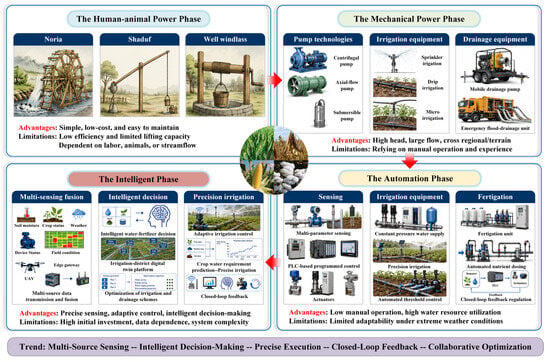
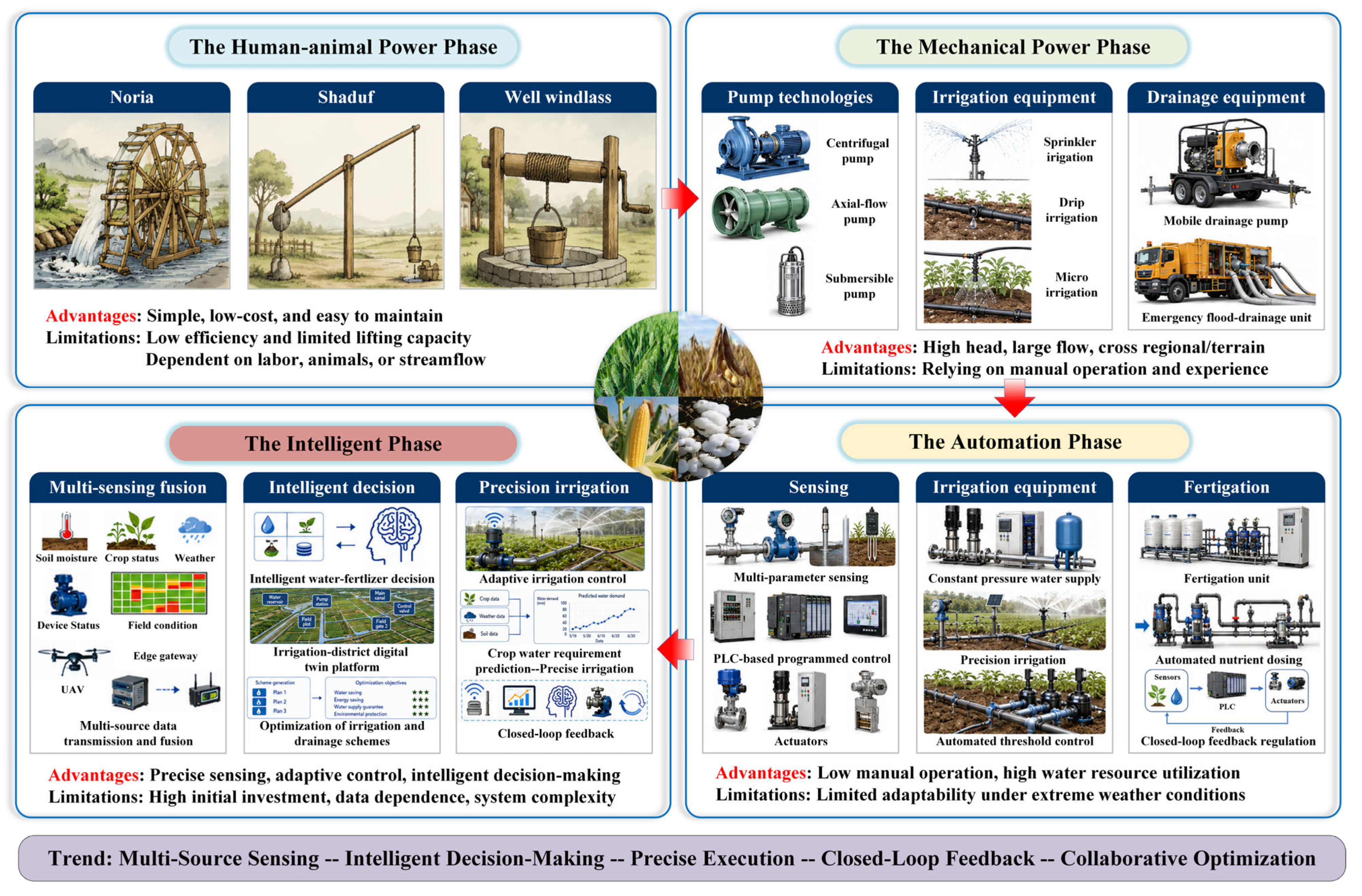
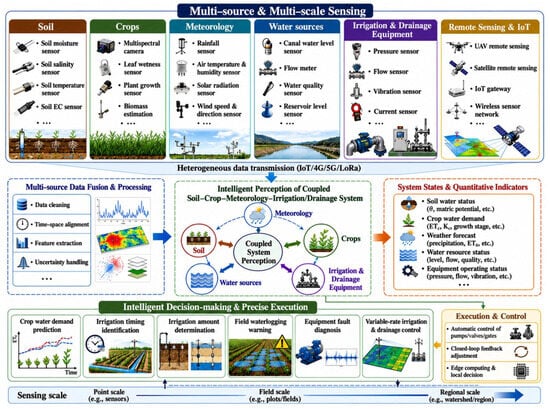
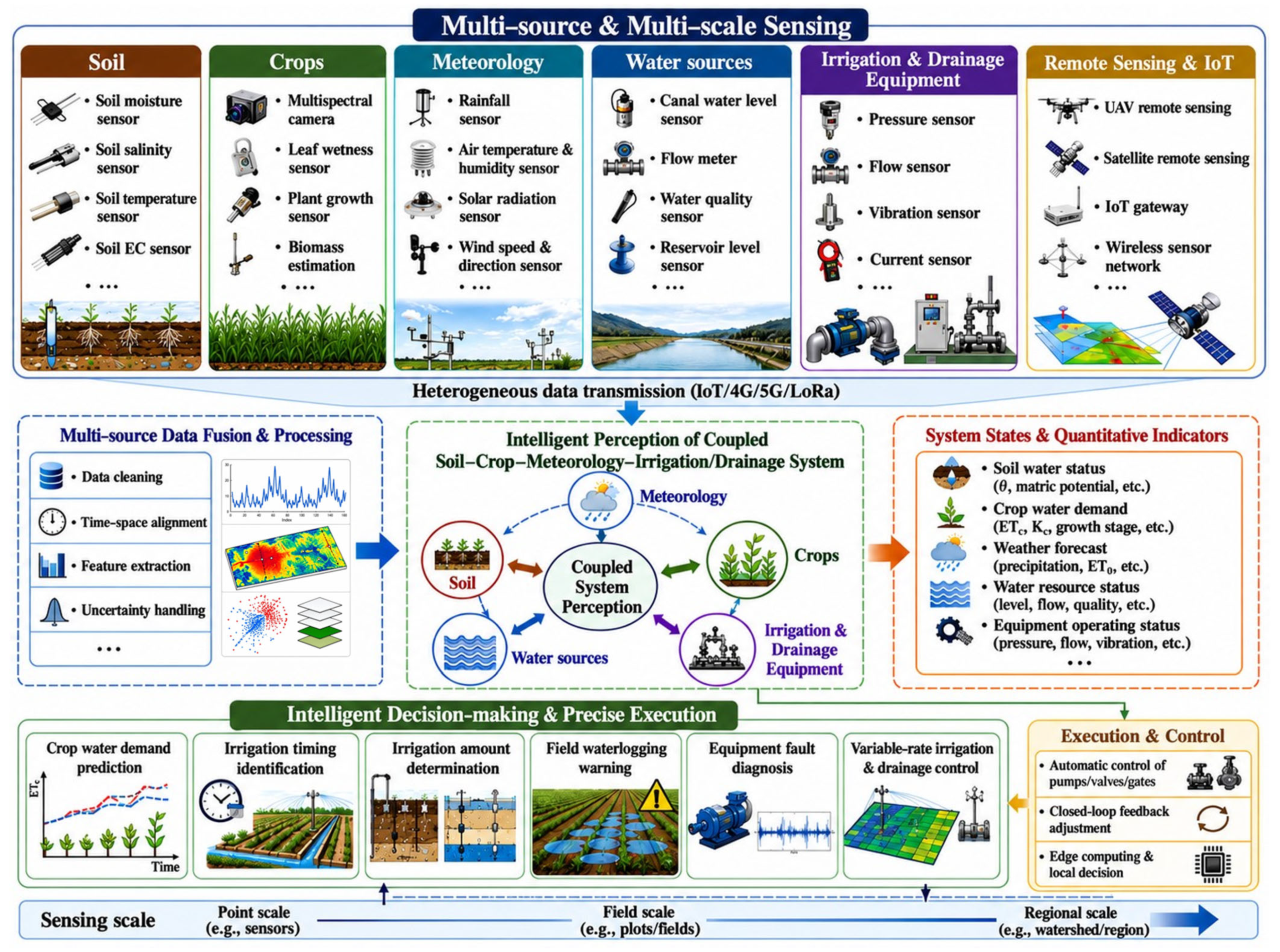
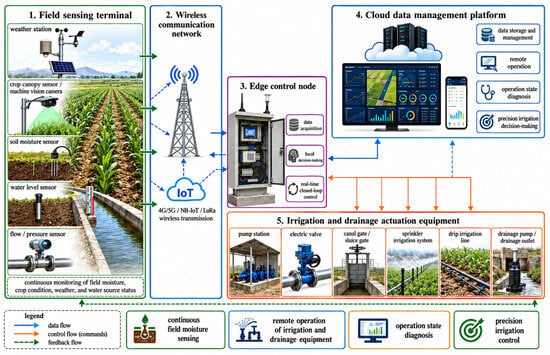
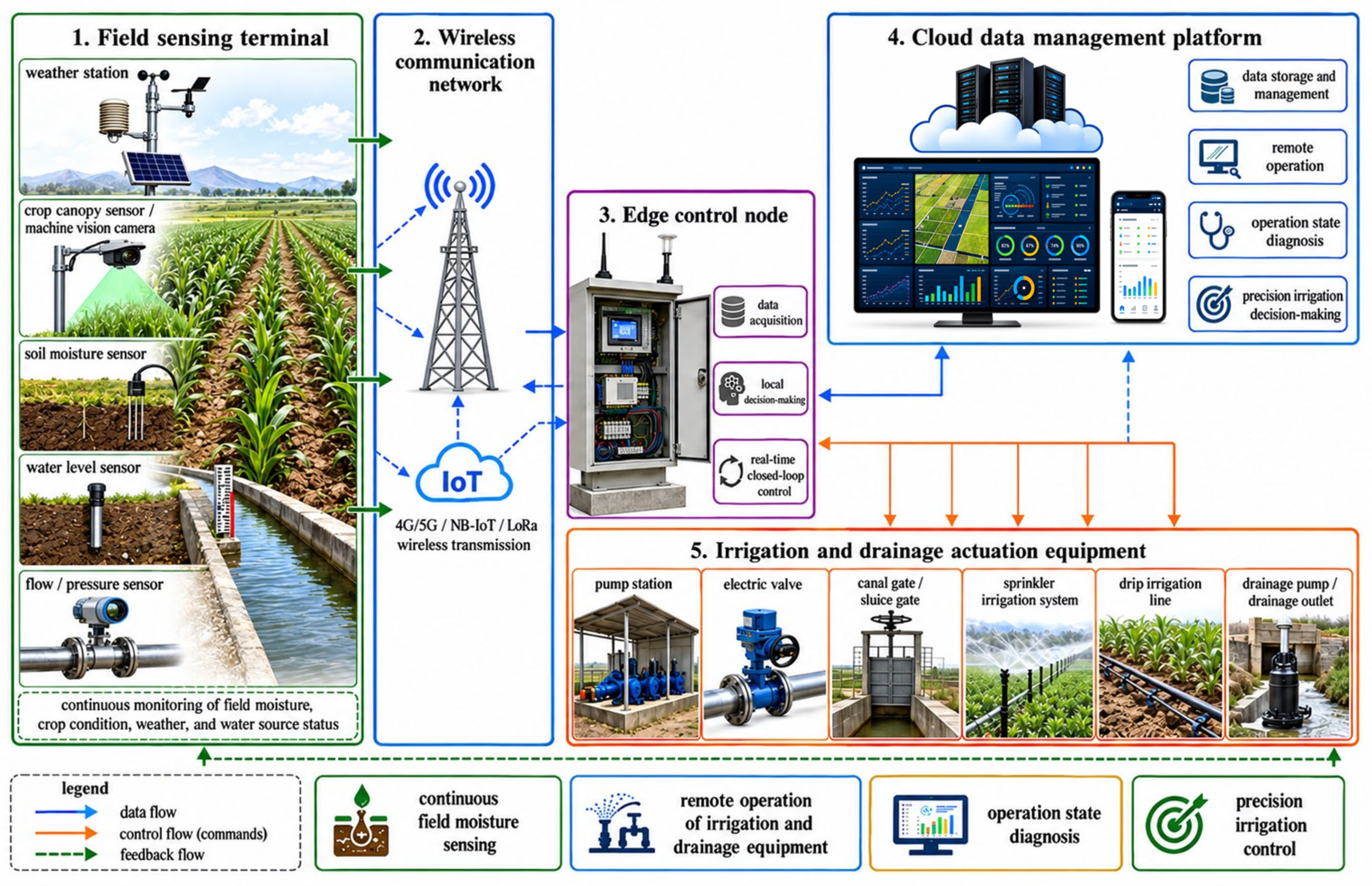

Disclaimer/Publisher’s Note: The statements, opinions and data contained in all publications are solely those of the individual author(s) and contributor(s) and not of MDPI and/or the editor(s). MDPI and/or the editor(s) disclaim responsibility for any injury to people or property resulting from any ideas, methods, instructions or products referred to in the content. |
© 2026 by the authors. Licensee MDPI, Basel, Switzerland. This article is an open access article distributed under the terms and conditions of the Creative Commons Attribution (CC BY) license.