


Abstract
The pollen beetle, Brassicogethes aeneus, is a major pest of winter oilseed rape in Europe, and the development of insecticide resistance remains a key challenge for its management. This study evaluated recent changes in susceptibility of B. aeneus populations to lambda-cyhalothrin, etofenprox, acetamiprid and thiacloprid in the Czech Republic during 2020–2025. Adult beetles were collected annually from 14 agricultural localities and tested using standardized IRAC vial bioassays. Dose–response parameters (LC50 and LC90), relative susceptibility ratios, and mortality at recommended field doses were analyzed using weighted linear mixed-effects models. Susceptibility-related responses differed markedly among insecticides and years. Absolute LC values occupied different numerical ranges among compounds, while mortality at the recommended field dose indicated the highest efficacy for acetamiprid and thiacloprid and the lowest for lambda-cyhalothrin. Several LC- and RSR-based endpoints showed elevated values around 2021–2022, followed by lower values in later years, although the magnitude and direction of temporal changes differed among insecticides. Significant insecticide × year interactions further demonstrated compound-specific temporal trajectories. Locality contributed to variability in LC-based endpoints but explained only a limited proportion of total variance. Long-term monitoring provides valuable information for resistance management and supports the need for diversified insecticide use in oilseed rape pest control.
1. Introduction
The pollen beetle, Brassicogethes aeneus (Fabricius, 1775) (Coleoptera: Nitidulidae), is one of the most important insect pests of winter oilseed rape (Brassica napus L. var. oleifera) in Europe, including the Czech Republic [1,2,3,4,5]. Adults damage developing flower buds, and severe infestations can reduce flowering intensity and yield. Although the pest can be managed by insecticide applications when economic thresholds are exceeded, the long-term effectiveness of chemical control is increasingly challenged by the development of insecticide resistance [6,7,8,9].
Resistance of B. aeneus to insecticides has been widely documented across Europe, particularly to pyrethroids, which have historically been among the most commonly used compounds for pollen beetle control [1,10,11,12]. Pyrethroids act on voltage-gated sodium channels in the insect nervous system, and resistance may arise through target-site insensitivity, such as knockdown resistance (kdr) mutations, or through enhanced metabolic detoxification [13,14,15,16]. In Central European populations, including those from the Czech Republic, pyrethroid resistance has frequently been reported even in the absence of clear evidence for widespread kdr mutations, suggesting an important role of metabolic mechanisms, especially cytochrome P450-mediated detoxification [1,8,13,16]. Recent genomic and functional evidence further supports the importance of CYP6BQ23 in pyrethroid metabolism in B. aeneus.
Previous monitoring in the Czech Republic during 2013–2017 showed decreasing susceptibility of B. aeneus to several insecticides, including lambda-cyhalothrin, etofenprox and thiacloprid [17]. Long-term monitoring from the Czech Republic and other European regions has further shown that susceptibility may vary substantially among years, regions and active ingredients, emphasizing the dynamic nature of resistance development in this species [18,19,20]. These findings indicated that resistance development in Czech pollen beetle populations was not limited to a single active ingredient or insecticide group. Since then, insecticide availability, regulatory conditions and pest management practices in oilseed rape have continued to change, while selection pressure on pollen beetle populations has persisted. However, standardized information on recent susceptibility dynamics remains limited.
Long-term monitoring is essential because resistance development is rarely linear. Susceptibility of beetle populations may vary among years, insecticides, and localities depending on selection intensity, local management history, population movement and possible fitness costs associated with resistance [21,22,23,24]. Therefore, evaluating only mortality at a single field rate may not be sufficient to describe changes in population susceptibility. Dose-response parameters such as LC50 and LC90, resistance ratios or relative susceptibility ratios, and mortality at recommended field rates provide complementary information on both susceptibility dynamics and practical insecticide efficacy.
The present study aimed to assess recent changes in susceptibility of B. aeneus populations to selected insecticides in the Czech Republic during 2020–2025. Specifically, we evaluated temporal trends in LC50, LC90, relative susceptibility ratios and mortality at recommended field doses for lambda-cyhalothrin, etofenprox, acetamiprid and thiacloprid. In addition, we examined whether susceptibility patterns differed among insecticides and sampling localities. The results provide an updated assessment of susceptibility dynamics in pollen beetle populations in the Czech Republic and contribute to resistance management strategies in oilseed rape systems.
2. Materials and Methods
2.1. Sampling of Pollen Beetle Populations
The study was designed as a continuation of the previous monitoring program [17], with methodological continuity maintained to ensure comparability over time. Populations of pollen beetle, B. aeneus, were sampled annually between the years 2020 and 2025 at 14 agricultural localities across the Czech Republic (Table S1). The same localities were monitored throughout the study period; however, due to crop rotation, winter oilseed rape was grown in different fields in individual years. Sampling was therefore conducted in fields located as close as possible to those sampled in previous seasons, typically within an approximately 300 m radius, to maintain spatial consistency and to represent the same local population pool.
At each locality, 500–1000 adult beetles were collected using sweep nets. Detailed field-specific insecticide application histories were not available for all sampling sites. Sampling was therefore performed at the beginning of flowering of winter oilseed rape, before the usual pollen beetle insecticide treatments, to minimize the potential influence of recent field applications. Collected beetles were transported to the laboratory in insulated polystyrene containers. Prior to bioassays, beetles were maintained at 20 °C and provided with fresh oilseed rape inflorescences. Only active and mobile individuals were used for subsequent testing performed on the same day as collection.
2.2. Bioassays
Bioassays were conducted according to standardized protocols of the Insecticide Resistance Action Committee (IRAC) for susceptibility testing of pollen beetle. IRAC method No. 011 (version 3) was used for lambda-cyhalothrin and etofenprox, while methods No. 021 and No. 025 were followed for thiacloprid and acetamiprid, respectively.
Test solutions were prepared from analytical standards (Sigma-Aldrich, Darmstadt, Germany). Concentrations were expressed as grams of active ingredient per hectare (g a.i. ha−1) to ensure comparability with IRAC protocols and previous monitoring studies.
The following concentration series were used: lambda-cyhalothrin: 0, 1.5, 7.5, and 37.5 g a.i. ha−1; etofenprox: 0, 11.5, 57.5, and 287.5 g a.i. ha−1; acetamiprid: 0, 10, 50, and 250 g a.i. ha−1; thiacloprid: 0, 14.4, 72, and 360 g a.i. ha−1. The rates of 7.5, 57.5, 50, and 72 g a.i. ha−1 corresponded to the recommended field doses for lambda-cyhalothrin, etofenprox, acetamiprid, and thiacloprid, respectively. Each insecticide was tested separately; no insecticide mixtures or tank-mix combinations were evaluated. The bioassay was designed as a standardized field-monitoring assay of each population.
Glass vials with an internal surface area of 50 cm2 were coated with corresponding insecticide solutions using a rolling technique and allowed to dry before beetles were introduced. For each concentration, three replicate vials were used, each containing 10–20 adult beetles, resulting in a total of 30–60 individuals per concentration. The number of beetles per vial varied among years depending on field availability, while the same replication structure was maintained. Bioassays were conducted under controlled conditions at 20 ± 2 °C for 24 h under indirect laboratory illumination, corresponding approximately to a 12/12 h light/dark photoperiod. Prior to testing, beetles were briefly maintained in darkness during the pre-assay adaptation period.
After exposure, beetles were transferred onto filter paper discs and assessed for mortality. Individuals unable to perform coordinated movement, including paralyzed beetles, were classified as dead according to IRAC criteria. For each locality and year, all insecticides were tested concurrently to ensure comparability among treatments.
2.3. Dose-Response Analysis and Derived Parameters
Dose–response relationships were analyzed using probit regression implemented in BioStat 7 software (AnalystSoft, Walnut, CA, USA; [25]). Median and high-effect concentrations (LC50 and LC90), along with their corresponding standard errors, were estimated from mortality responses for each population, year, and insecticide and expressed as field-rate equivalents (g a.i. ha−1).
Relative susceptibility ratios (hereafter referred to as RSR50 and RSR90) were calculated separately for LC50 and LC90 as the ratio of the estimated LC value for a given population and the corresponding LC value of the most susceptible field population observed for each insecticide within the dataset. These ratios should not be interpreted as formal resistance ratios based on a laboratory susceptible strain, but as comparative indices of relative susceptibility among field populations.
All mortality data were corrected for control mortality using Abbott’s formula [26]. Control mortality remained low throughout the experiments ranging from 0 to 6%.
2.4. Statistical Analysis
Statistical analyses were designed to evaluate temporal changes in insecticide susceptibility, differences among insecticides, and variability among sampling localities. Analyses focused on five response variables: LC50, LC90, RSR50, RSR90, and mortality at the recommended field dose (MRD).
LC50, LC90, RSR50, and RSR90 were natural-log transformed before analysis to improve model fit and reduce heteroscedasticity. MRD was analyzed on the original percentage scale. The primary dataset included the period 2020–2025, for which all four insecticides were available.
For LC50 and LC90, weighted linear mixed-effects models were used to account for unequal precision of dose-response estimates. Weights were calculated as the inverse of the approximate variance of the ln-transformed LC estimates:
where SE is the standard error of the corresponding LC estimate. Thus, estimates with higher uncertainty contributed less to model fitting.
w = 1/(SE/LC)2
The main model included insecticide, year, and their interaction as fixed effects. Locality was included as a random effect to account for repeated sampling of the same local population pools and to avoid treating localities as fixed treatment categories. This structure allowed inference on general spatial variability while focusing interpretation on insecticide and temporal effects.
For RSR50, RSR90, and MRD, the same fixed- and random-effect structure was applied. Post-hoc comparisons were performed only for fixed effects and fixed-effect interactions. Scheffé tests were used for insecticide × year comparisons due to unequal sample sizes and the large number of pairwise contrasts. For the presentation and interpretation of temporal changes, comparisons among years were performed separately within each insecticide. No post-hoc tests were performed for locality, as this factor was treated as random.
Estimated marginal means (LS means), standard errors, and 95% confidence intervals were extracted from the models. For ln-transformed endpoints, LS means and confidence limits were back-transformed to the original scale for presentation. Homogeneous groups from post-hoc tests were reported in the Supplementary Material.
To distinguish non-linear year-to-year variation from directional temporal trends, a second set of models was fitted with year treated as a continuous predictor. In these models, the year coefficient represented the average annual trend, whereas the insecticide × year interaction tested whether slopes differed among insecticides. Parameter estimates from these models were used to describe the direction and magnitude of temporal trends.
Variance components were extracted for the random effect of locality and residual error. The proportion of variance attributable to locality was calculated as the intraclass correlation coefficient:
and expressed as a percentage. This was used to quantify the relative contribution of spatial variability across response variables.
ICC = σ2locality/(σ2locality + σ2residual)
Graphical outputs included boxplots of the original (non-transformed) data, displayed on logarithmic axes for LC and RSR parameters, and percentage-scale plots for MRD. Boxplots were used to visualize medians, interquartile ranges, whiskers, and outliers. Model-based trend plots were used to illustrate temporal patterns and insecticide-specific trajectories where appropriate. Mixed-effects analyses and graphical outputs were performed in Statistica 14 software (TIBCO Software Inc., Palo Alto, CA, USA). All tests were evaluated at α = 0.05.
3. Results
3.1. Overall Patterns in Insecticide Susceptibility
Susceptibility of B. aeneus populations differed markedly among insecticides and years. In the weighted LMM with year treated as a categorical factor, all LC-based endpoints showed significant effects of insecticide and year, with significant insecticide × year interactions for both LC50 and LC90. These interactions indicate that changes in susceptibility were not uniform across compounds during the monitoring period.
For LC50, the strongest fixed effect was insecticide, followed by the insecticide × year interaction and year effect. A broadly similar pattern was observed for LC90, where insecticide again explained the largest proportion of variability. Locality contributed significantly to variation in LC50 and LC90, indicating spatial heterogeneity in susceptibility; however, the corresponding variance partition coefficients were low, showing that most residual variability remained at the observation level rather than being explained by locality alone (Table 1A).
Table 1.
Results of the weighted linear mixed-effects model evaluating the effect of insecticide, year (2020–2025), interaction between insecticide and year, and locality on ln-transformed LC50 estimations (A), LC90 estimations (B), relative susceptibility ratio of LC50 (C), relative susceptibility ratio of LC90 (D), and mortality at the recommended field dose (E) of pollen beetle (Brassicogethes aeneus). Statistically significant p-values (p < 0.05) are shown in bold.
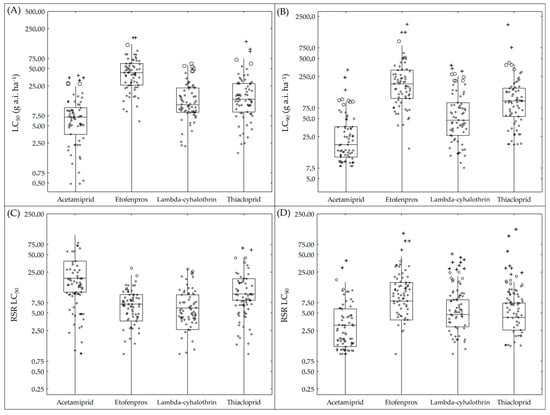
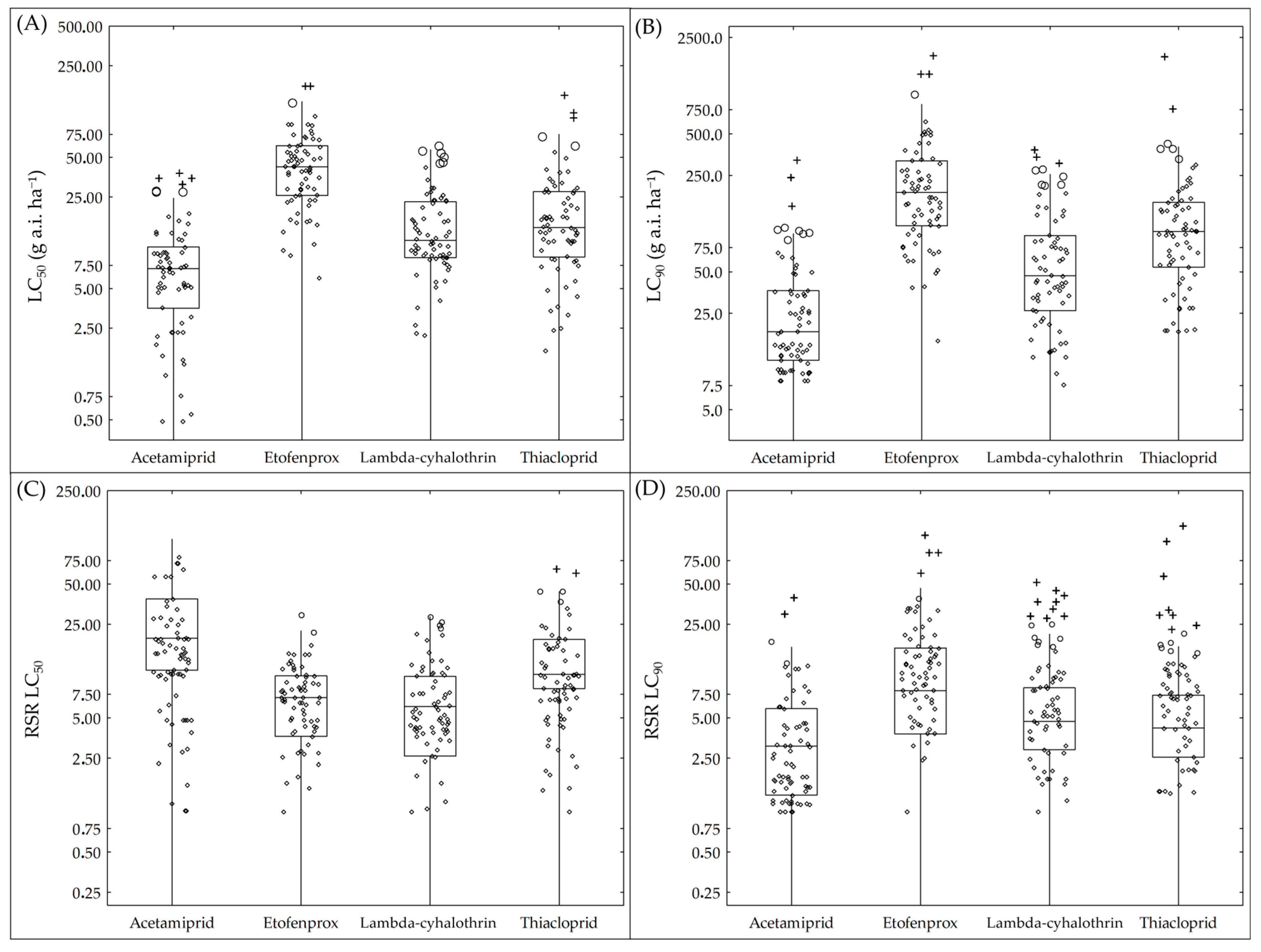
Absolute LC values occupied markedly different numerical ranges among the four insecticides (Figure 1A,B). Etofenprox showed the highest numerical LC values and acetamiprid the lowest; however, because the compounds differ in intrinsic toxicity and recommended field rates, these differences were considered descriptive and were not interpreted as a direct ranking of susceptibility among insecticides. Temporal changes in LC values were therefore interpreted primarily within individual compounds (Figure 2).
Figure 1.
Distribution of LCs (expressed as g a.i. ha−1) and relative susceptibility ratios (RSRs) values of field-collected Brassicogethes aeneus populations across insecticides. Boxplots illustrate the variability of (A) LC50; (B) LC90; (C) RSR LC50; and (D) RSR LC90 among insecticides over the study period. The horizontal line within each box represents the median, the boxes indicate the interquartile range (25–75%), and the whiskers extend to 1.5 × IQR. Individual symbols represent raw observations (◊), outliers (◦), and extreme values (+). Because the tested insecticides differ in intrinsic toxicity and recommended field rates, absolute LC values should not be interpreted as a direct ranking of susceptibility among compounds.
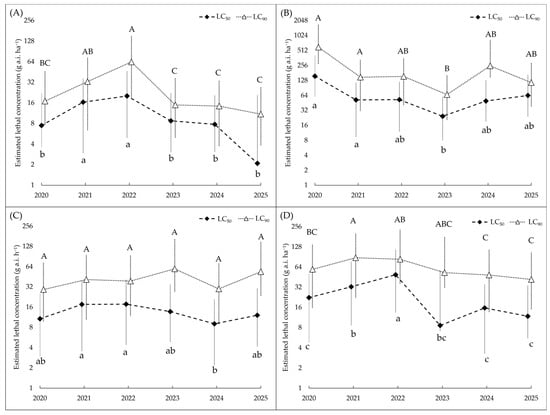
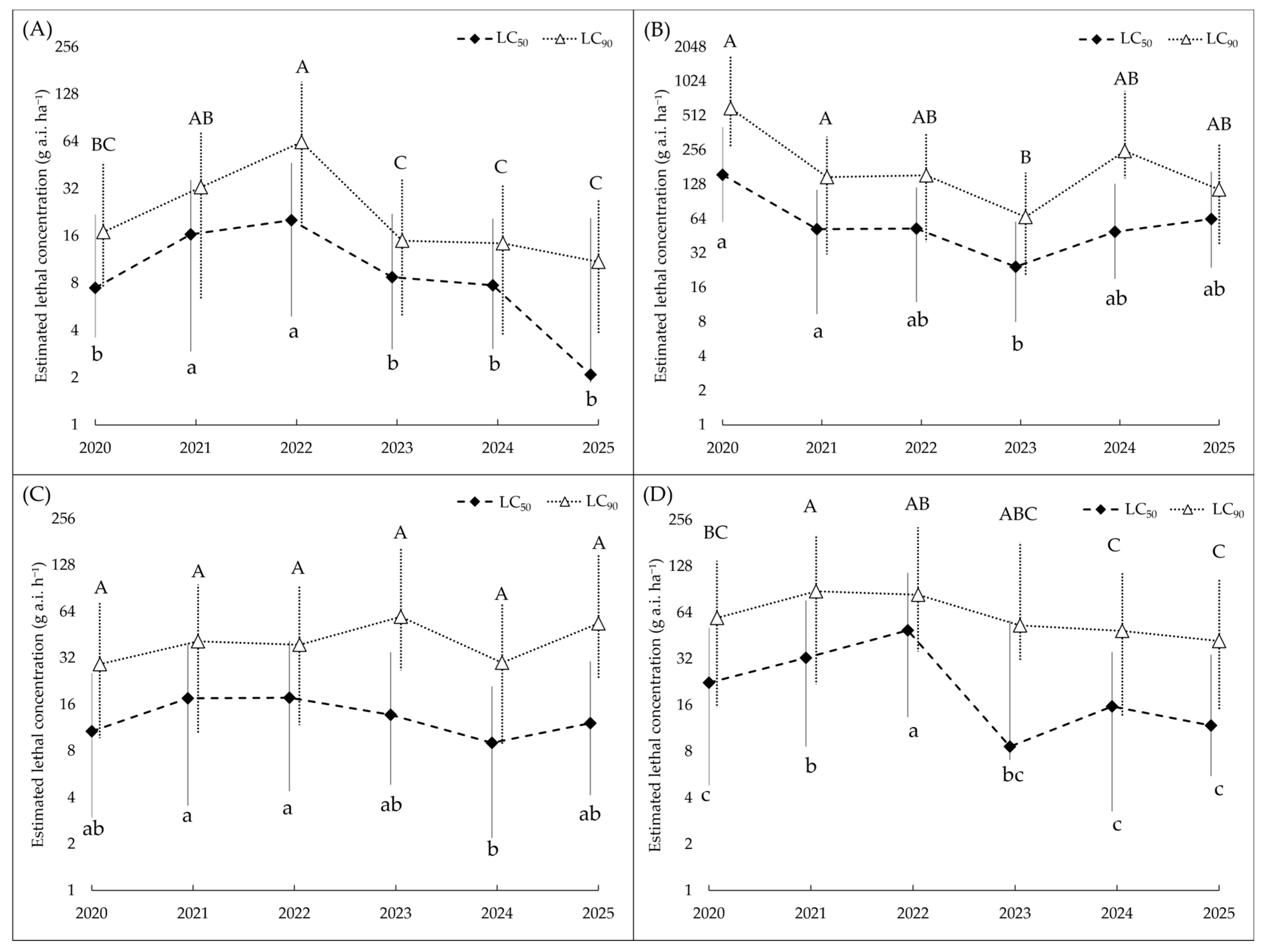
Figure 2.
Temporal changes in estimated lethal concentrations (LC50 and LC90) of field-collected Brassicogethes aeneus populations during 2020–2025 for (A) acetamiprid, (B) etofenprox, (C) lambda-cyhalothrin, and (D) thiacloprid. Points represent back-transformed estimated marginal means (LS means) derived from weighted linear mixed-effects models, expressed as field-rate equivalents (g a.i. ha−1); error bars indicate 95% confidence intervals. The y-axis is presented on a logarithmic scale. Dashed lines with filled diamonds represent LC50, whereas dotted lines with open triangles represent LC90; connecting lines are included only to facilitate visualization of temporal changes. Within each insecticide, different lowercase letters indicate significant differences among years for LC50, and different uppercase letters indicate significant differences among years for LC90, based on Scheffé’s post hoc test (p < 0.05). Values sharing at least one letter are not significantly different.
3.2. LC50 Dynamics
LC50 values differed significantly among insecticides, years, and insecticide × year combinations (Table 1A). Absolute LC50 values differed among insecticides; however, because the compounds differ in intrinsic toxicity and recommended field rates, these values were not interpreted as direct measures of relative susceptibility across insecticides. Temporal changes were therefore evaluated primarily within each insecticide. The temporal pattern was non-linear: LC50 values increased from 2020 to 2022, followed by a marked decrease during 2023–2025.
When year was fitted as a continuous predictor, LC50 showed a significant negative temporal trend, confirming an overall decline in LC50 across the study period (Tables S2A and S3A). The insecticide × year interaction was not significant in this trend model, indicating that the declining LC50 trend was broadly similar across insecticides. Thus, although categorical models revealed year-to-year differences among insecticides (Figure S1A; Table S4), the overall directional trend was a general decrease in LC50 (Table S3A).
Back-transformed LS means revealed distinct temporal patterns among individual insecticides (Figure 2). Etofenprox showed relatively high LC50 values in 2020–2021, followed by lower values in subsequent years, whereas lambda-cyhalothrin exhibited comparatively limited temporal variation. These compound-specific patterns are consistent with the significant insecticide × year interaction. Post hoc comparisons performed within each insecticide further identified which years differed significantly in LC50 (Figure 2; Table S4).
3.3. LC90 Dynamics
LC90 values showed more pronounced insecticide-specific temporal variation than LC50. Significant effects of insecticide, year, insecticide × year interaction, and locality were detected (Table 1B).
The categorical model indicated substantial temporal variability, with generally higher LC90 values around 2021–2022 and lower values in later years; however, the significant insecticide × year interaction showed that these temporal patterns differed among individual insecticides (Figure 2; Table S5). Consistent with this result, the continuous-year model showed both a significant overall negative trend and a significant insecticide × year interaction. This indicates that LC90 decreased over the study period overall, but the rate and direction of change differed among insecticides (Tables S2B and S3B).
These compound-specific trajectories were particularly evident for acetamiprid and lambda-cyhalothrin. Acetamiprid showed a pronounced decline in LC90 toward the later years, whereas lambda-cyhalothrin exhibited a less uniform temporal pattern. Etofenprox also showed substantial year-to-year variation, with relatively high values at the beginning of the monitoring period followed by lower values in several subsequent years. These findings indicate that LC90 revealed more pronounced insecticide-specific temporal differences than LC50 (Table S5).
3.4. Relative Susceptibility Ratios
Relative susceptibility ratios reflected the patterns observed for LC values but provided a complementary measure of relative differences in susceptibility.
For RSR50, significant effects of insecticide and year were detected, whereas the insecticide × year interaction was not significant (Table 1C). This indicates that RSR50 varied among insecticides and years, but temporal patterns were broadly parallel across compounds. RSR50 peaked during 2021–2022 and declined thereafter (Figure S1C). The continuous-year model confirmed a significant negative trend, supporting an overall reduction in RSR50 in the later years of the study (Tables S2C and S3C).
Numerically, acetamiprid showed the highest RSR50 values, followed by thiacloprid, whereas etofenprox and lambda-cyhalothrin showed lower values. This ranking partly differed from the LC values because RSR values were normalized to the most susceptible field population identified for each compound (Figure 1C; Table S6).
For RSR90, insecticide, year, and insecticide × year effects were significant (Table 1D). Numerically, etofenprox showed the highest RSR90 values, while acetamiprid showed the lowest (Figure 1D). Temporal variation was characterized by elevated RSR90 values around 2021–2022 for several insecticides, although the significant insecticide × year interaction indicated that the magnitude and pattern of these changes differed among compounds. Unlike RSR50, the continuous-year model did not confirm a significant overall linear trend for RSR90 (Tables S2D and S3D), while the insecticide × year interaction remained significant (Table S7). This indicates that RSR90 dynamics were compound-specific rather than adequately described by one common temporal trend.
3.5. Mortality at the Recommended Field Dose
Mortality at the recommended field dose differed strongly among insecticides (Table 1E). Acetamiprid provided the highest mortality, followed by thiacloprid, etofenprox, and lambda-cyhalothrin. Post-hoc comparisons separated the insecticides into distinct groups, confirming clear differences in practical efficacy.
Mean mortality values showed that acetamiprid retained high efficacy throughout most of the study period, with values generally above 90% except in 2022. Thiacloprid also maintained relatively high mortality, although it decreased in 2021–2022 followed by recovery in 2024–2025. Etofenprox showed intermediate efficacy, whereas lambda-cyhalothrin consistently produced the lowest mortality values (Table 2).
Table 2.
Descriptive statistics of mortality of field-collected Brassicogethes aeneus populations at the recommended field dose (%) for (A) insecticide and (B) year, with standard deviation (SD), standard error (SE), 95% confidence intervals (CI), and Scheffé post hoc grouping α = 0.05 (HG—homogeneous group). Different letters indicate significant differences.
The year factor had a significant effect on MRD in both the categorical and continuous models, but the insecticide × year interaction was not significant (Table 1E, Tables S2E, S3E and S8). This indicates that mortality varied among years, but the relative ranking of insecticides remained broadly consistent. Unlike LC-based endpoints, locality was not significant for MRD, suggesting that field-rate mortality was less influenced by site-specific variation than LC estimates.
3.6. Spatial Variability
The locality factor was significant for LC50 and LC90, and marginal or non-significant for RSRs and MRD endpoints. Although significant locality effects indicate spatial heterogeneity in susceptibility, variance partitioning showed that the proportion of total variance attributable to locality was relatively small for LC endpoints. The locality component was more pronounced for relative susceptibility ratios than for LC estimates but remained secondary to residual variation (Table S9).
This suggests that local population differences were present but did not dominate the overall susceptibility patterns. Therefore, locality was retained as a random effect to account for spatial structure, but individual localities were not interpreted as separate fixed categories.
4. Discussion
The present study provides a multi-year assessment of susceptibility dynamics in field-collected pollen beetle (B. aeneus) populations from oilseed rape in Central Europe, specifically in the Czech Republic, revealing temporally structured and insecticide-specific patterns. Several LC- and RSR-based endpoints showed elevated values around 2021–2022, followed by lower values in later years, although the magnitude and direction of these temporal changes differed among insecticides. Similar non-linear trajectories have been reported in Central European populations of B. aeneus, where resistance levels vary in response to local selection pressure, insecticide availability and management practices [1,8,18,23]. In particular, Stará and Kocourek [18] reported a decline in pyrethroid resistance during the later years of a seven-year monitoring program conducted alongside resistance-management measures, while monitoring in Estonia [20] revealed marked temporal and regional differences among individual active ingredients. Together with the earlier Czech monitoring from 2013 to 2017 [17], these findings indicate that susceptibility in pollen beetle populations may change substantially over relatively short time scales and should not be interpreted as a simple cumulative increase in resistance. Such temporal variability is particularly relevant for resistance monitoring because single-year assessments may capture only a transient phase of a longer-term trajectory.
The lower LC and RSR values observed for several endpoints in later years may reflect changes in selection pressure and/or fitness costs associated with resistance mechanisms. Fitness costs linked to metabolic resistance or target-site mutations have been documented in several insect species and can lead to partial restoration of susceptibility when selection pressure is reduced [21,22]. In B. aeneus, cytochrome P450-mediated detoxification represents an important resistance mechanism [8], and more recent genomic and functional analyses have further highlighted CYP6BQ23 as a contributor to pyrethroid metabolism [16]. Cross-resistance has also been demonstrated in B. aeneus, although its magnitude can differ substantially among compounds; earlier Czech monitoring, for example, reported strong cross-resistance between lambda-cyhalothrin and deltamethrin but considerably weaker cross-resistance between lambda-cyhalothrin and etofenprox [18]. These findings provide a plausible mechanistic context for the compound-specific susceptibility patterns observed in field populations. However, neither resistance mechanisms nor cross-resistance were directly evaluated in the present study. Absolute LC values differed substantially among insecticides, with etofenprox occupying the highest numerical range. However, these between-compound differences should be interpreted cautiously because the tested insecticides differ in intrinsic toxicity and recommended field rates. Consequently, absolute LC values are most informative for monitoring temporal changes within a given insecticide rather than for ranking susceptibility across compounds. Previous studies have documented reduced pyrethroid sensitivity and metabolic resistance mechanisms in European pollen beetle populations [10,11,12], which may provide relevant context for the patterns observed here.
Acetamiprid, in contrast, maintained relatively high practical efficacy, particularly when assessed using mortality at the recommended field dose. Nevertheless, recent regional studies indicate that susceptibility to neonicotinoids should not be assumed to be stable for a long time [23,24]. The variability observed among responses to acetamiprid and thiacloprid may reflect differences in historical exposure, metabolic pathways, and compound-specific sensitivity. This is especially relevant because shifts in available active ingredients can redirect selection pressure toward remaining compounds.
The significant insecticide × year interactions for LC-based parameters further confirmed that susceptibility trajectories differed among compounds. These differences were more pronounced for LC90 and RSR90 than for LC50 and RSR50, while mortality at the recommended field dose showed weaker interaction patterns. This suggests that dose-response-derived endpoints can reveal temporal shifts that may not be evident from a single field-rate mortality assessment. The combined use of LC50, LC90, RSRs, and MRD therefore provides complementary information on susceptibility dynamics and practical efficacy.
Locality was identified as a significant source of variability, particularly for LC-based parameters. This finding is consistent with previous studies reporting spatial heterogeneity in pollen beetle resistance across Central Europe [12,23]. Recent field studies further demonstrate that the spatial arrangement of oilseed rape and surrounding landscape structure can influence B. aeneus abundance, colonization and biological control [27,28]. Although these studies did not address insecticide susceptibility directly, they illustrate that locality can integrate multiple ecological processes in addition to insecticide-use history. The weaker effect of locality on mortality at recommended field rates suggests that spatial differences were more readily detected using dose–response-derived LC endpoints than using mortality at a single field-rate concentration.
A limitation of the present study is that detailed insecticide application histories were not available for individual sampling fields or surrounding landscapes. Therefore, locality effects should be interpreted as spatial variation in field-population susceptibility rather than as direct evidence of site-specific selection pressure. In addition, no long-term laboratory susceptible reference strain was used in the study. Consequently, the relative susceptibility ratios used in this study quantify differences among field-collected populations within the monitoring dataset and should not be interpreted as formal resistance ratios. Nevertheless, because all populations were tested using the same standardized IRAC-based bioassay design and all insecticides were tested concurrently within each locality and year, the dataset provides a consistent basis for evaluating temporal and compound-specific shifts in susceptibility under field-monitoring conditions.
The observed patterns underscore the importance of adaptive resistance management. IRAC recommendations emphasize rotation of insecticides with different modes of action, avoidance of repeated applications of the same active ingredient, and integration of chemical and non-chemical approaches to reduce selection pressure. The partial recovery of susceptibility observed for several endpoints in later years is consistent with the possibility that changes in selection pressure can influence susceptibility trajectories, but the persistence of elevated resistance indicators for some compounds shows that recovery is not uniform across insecticides.
From a practical perspective, chemical control of the pollen beetle should therefore be embedded within integrated pest management rather than treated as a stand-alone strategy. Alternative and complementary approaches include the use of oilseed rape genotypes with improved tolerance or resistance to pollen beetle attack [7,29], plant-derived products such as essential oils with insecticidal or behavioral effects [30], and biological or ecological strategies aimed at reducing dependence on single insecticide classes [31]. RNA interference has also been explored as a targeted control approach in B. aeneus, with studies demonstrating that gene silencing can cause mortality and that efficacy may be improved by chronic dsRNA exposure [2,32,33]. Although these methods are not yet direct replacements for conventional insecticides under field conditions, they illustrate the range of tools that may contribute to future resistance management. Recent reviews focused specifically on pollen beetle management likewise emphasize that sustainable control will require integration of resistance-aware insecticide use with agronomic, ecological and host-plant-based approaches [34,35].
The present results highlight the need to maintain standardized long-term monitoring. Susceptibility in pollen beetle populations can change over relatively short time intervals and may differ among compounds, endpoints and localities. Therefore, resistance management decisions should not rely solely on single-year bioassays or field-rate mortality but should integrate dose–response data, relative susceptibility ratios and practical efficacy endpoints.
5. Conclusions
Across endpoints, the results showed four consistent patterns. First, insecticide identity was the dominant factor affecting the numerical range of LC values and mortality at the recommended field dose. Second, several susceptibility-related parameters showed elevated values around 2021–2022 followed by lower values in later years, although the magnitude and direction of these changes differed among insecticides. Third, LC90 and RSR90 revealed more pronounced insecticide-specific temporal differences than LC50 and RSR50. Fourth, MRD provided the clearest indication of practical efficacy at the recommended field dose, with acetamiprid and thiacloprid showing the highest mortality and lambda-cyhalothrin the lowest.
The LCs, RSRs, and MRD endpoints indicate a partial recovery of susceptibility in the later years of the monitoring period for several insecticides and endpoints, although this pattern was not uniform across compounds and was less evident for some LC90- and RSR90-based responses.
Supplementary Materials
The following supporting information can be downloaded at: https://www.mdpi.com/article/10.3390/agriculture16202214/s1, Figure S1: Distribution of LCs (expressed as g a.i. ha−1) and relative susceptibility ratio (RSRs) values of field-collected Brassicogethes aeneus populations across years; Table S1: Administrative location of the 14 sampling localities used for monitoring Brassicogethes aeneus populations in the Czech Republic during 2020–2025; Table S2: Results of the weighted linear mixed-effects model evaluating the effect of insecticide, year (treated as continuous predictor), interaction between insecticide and year, and locality on ln-transformed LC50 estimations (A), LC90 estimations (B), relative susceptibility ratio of LC50 (C), relative susceptibility ratio of LC90 (D), and mortality at the recommended field dose (E) of pollen beetle (Brassicogethes aeneus); Table S3: Parameter estimates from weighted linear mixed-effects models (LMMs) with year fitted as a continuous predictor for insecticide sensitivity parameters of Brassicogethes aeneus; Table S4: Estimated marginal means (LS means) of ln-transformed LC50 values by weighted linear mixed-effects models (LMMs) and corresponding back-transformed LC50 (g a.i. ha−1) 95% confidence intervals (CI), standard error (SE), and Scheffé post-hoc grouping (α = 0.05); Table S5: Estimated marginal means (LS means) of ln-transformed LC90 values by weighted linear mixed-effects models (LMMs) and corresponding back-transformed LC90 (g a.i. ha−1), 95% confidence intervals (CI), standard error (SE), and Scheffé post-hoc grouping (α = 0.05); Table S6: Estimated marginal means (LS means) of ln-transformed relative susceptibility ratio (RSR) values from LC50 estimations by linear mixed-effects models (LMMs) and corresponding back-transformed values, 95% confidence intervals (CI), and standard error (SE); Table S7: Estimated marginal means (LS means) of ln-transformed relative susceptibility ratio (RSR) values from LC90 estimations by linear mixed-effects models (LMMs) and corresponding back-transformed values, 95% confidence intervals (CI), standard error (SE), and Scheffé post-hoc grouping (α = 0.05); Table S8: Descriptive statistics of mortality at the recommended field dose (%) parameter in interaction between factors insecticide × year with 95% confidence intervals (CI), standard deviation (SD), and standard error (SE); Table S9: Variance components and proportion of variance explained by the random effect of locality in linear mixed-effects models (LMMs) for insecticide sensitivity parameters of Brassicogethes aeneus.
Author Contributions
Conceptualization, T.S.; methodology, T.S.; software, D.B.; validation, T.S. and D.B.; formal analysis, T.S. and D.B.; investigation, T.S. and D.B.; resources, T.S.; data curation, D.B.; writing—original draft preparation, D.B.; writing—review and editing, T.S.; visualization, D.B.; supervision, T.S. and D.B.; project administration, D.B.; funding acquisition, T.S. All authors have read and agreed to the published version of the manuscript.
Funding
The research was supported by the Ministry of Agriculture of the Czech Republic (grant number: MZE-RO1123).
Data Availability Statement
All relevant data can be found within the article and its Supplementary Information. Further inquiries can be directed to the corresponding author.
Acknowledgments
During the preparation of this manuscript, the authors used ChatGPT 5.5 (OpenAI) for grammar checking, language polishing, and improving readability. The authors reviewed and edited the output and take full responsibility for the content of this publication. We thank Jan Bílovský for his assistance with the collection of beetles and Pavel Matušinský for careful proofreading of the manuscript.
Conflicts of Interest
Authors Tomáš Spitzer and Dominik Bleša were employed by Agrotest Fyto, Ltd., a private research organization (research and knowledge-dissemination organisation under Commission Regulation (EU) No. 651/2014, Article 2(83)). The authors declare no other commercial or financial relationships that could be construed as a potential conflict of interest.
Abbreviations
The following abbreviations are used in this manuscript:
| LC | Lethal concentration |
| RSR | Relative susceptibility ratio |
| MRD | Mortality at the recommended field dose |
References
- Hovorka, T.; Kocourek, F.; Horská, T.; Stará, J. Widespread resistance of pollen beetles to pyrethroids in Czechia with no evidence for kdr mutation. Crop Prot. 2021, 145, 105648. [Google Scholar] [CrossRef] [Scilit]
- Willow, J.; Sulg, S.; Taning, C.N.T.; Silva, A.I.; Christiaens, O.; Kaasik, R.; Prentice, K.; Lövei, G.L.; Smagghe, G.; Veromann, E. Targeting a coatomer protein complex-I gene via RNA interference results in effective lethality in the pollen beetle Brassicogethes aeneus. J. Pest Sci. 2021, 94, 703–712. [Google Scholar] [CrossRef] [Scilit]
- Tratwal, A.; Witaszak, W.; Trzciński, P.; Baran, M.; Bocianowski, J. Analysis of winter oilseed rape damages caused by Brassicogethes aeneus (Fabricius, 1775) in various regions of Poland, in 2009–2019. Prog. Plant Prot. 2022, 62, 128–133. [Google Scholar] [CrossRef] [Scilit]
- Bick, E.; Sigsgaard, L.; Torrance, M.T.; Helmreich, S.; Still, L.; Beck, B.; El Rashid, R.; Lemmich, J.; Nikolajsen, T.; Cook, S.M. Dynamics of pollen beetle (Brassicogethes aeneus) immigration and colonization of oilseed rape (Brassica napus) in Europe. Pest Manag. Sci. 2024, 80, 2306–2313. [Google Scholar] [CrossRef] [Scilit]
- Shortall, C.R.; Cook, S.M.; Mauchline, A.L.; Bell, J.R. Long-term trends in migrating Brassicogethes aeneus in the UK. Pest Manag. Sci. 2024, 80, 2294–2305. [Google Scholar] [CrossRef] [Scilit]
- Rabelo, M.M.; Paula-Moraes, S.V.; Pereira, E.J.G.; Siegfried, B.D. Contrasting susceptibility of lepidopteran pests to diamide and pyrethroid insecticides in a region of overwintering and migratory intersection. Pest Manag. Sci. 2020, 76, 4240–4247. [Google Scholar] [CrossRef] [Scilit]
- Seimandi-Corda, G.; Renaud, D.; Escande, L.; Larièpe, A.; Ollivier, J.; Faure, S.; Cortesero, A.M. Screening the variability in oilseed rape resistance to pollen beetle attacks in the field and assessment of biochemical biomarkers. J. Pest Sci. 2019, 92, 895–908. [Google Scholar] [CrossRef] [Scilit]
- Kocourek, F.; Stará, J.; Sopko, B.; Talacko, P.; Harant, K.; Hovorka, T.; Erban, T. Proteogenomic insight into the basis of the insecticide tolerance/resistance of the pollen beetle Brassicogethes (Meligethes) aeneus. J. Proteom. 2021, 233, 104086. [Google Scholar] [CrossRef] [Scilit]
- Zheng, X.; Koopmann, B.; Ulber, B.; von Tiedemann, A. A global survey on diseases and pests in oilseed rape—current challenges and innovative strategies of control. Front. Agron. 2020, 2, 590908. [Google Scholar] [CrossRef] [Scilit]
- Slater, R.; Ellis, S.; Genay, J.-P.; Heimbach, U.; Huart, G.; Sarazin, M.; Longhurst, C.; Müller, A.; Nauen, R.; Rison, J.L.; et al. Pyrethroid resistance monitoring in European populations of pollen beetle (Meligethes spp.): A coordinated approach through the Insecticide Resistance Action Committee (IRAC). Pest Manag. Sci. 2011, 67, 633–638. [Google Scholar] [CrossRef] [Scilit]
- Heimbach, U.; Müller, A. Incidence of pyrethroid-resistant oilseed rape pests in Germany. Pest Manag. Sci. 2013, 69, 209–216. [Google Scholar] [CrossRef] [Scilit]
- Zimmer, C.T.; Bass, C.; Williamson, M.S.; Kaussmann, M.; Wölfel, K.; Gutbrod, O.; Nauen, R. Molecular and functional characterization of CYP6BQ23, a cytochrome P450 conferring resistance to pyrethroids in European populations of pollen beetle, Meligethes aeneus. Insect Biochem. Mol. Biol. 2014, 45, 18–29. [Google Scholar] [CrossRef] [Scilit]
- Nauen, R.; Bass, C.; Feyereisen, R.; Vontas, J. The role of cytochrome P450s in insect toxicology and resistance. Annu. Rev. Entomol. 2022, 67, 105–124. [Google Scholar] [CrossRef] [Scilit]
- Zhou, H.; Ning, Y.; Jian, Y.; Zhang, M.; Klakong, M.; Guo, F.; Shao, Q.; Li, Y.; Yang, P.; Li, Z.; et al. Functional analysis of a down-regulated transcription SoxNeuroA gene involved in the acaricidal mechanism of scopoletin against spider mites. Pest Manag. Sci. 2023, 80, 1593–1606. [Google Scholar] [CrossRef] [Scilit]
- Zhu, J.; Qu, R.; Wang, Y.; Ni, R.; Tian, K.; Yang, C.; Li, M.; Kristensen, M.; Qiu, X. Up-regulation of CYP6G4 mediated by a CncC/maf binding-site-containing insertion confers resistance to multiple classes of insecticides in the house fly Musca domestica. Int. J. Biol. Macromol. 2023, 253, 127024. [Google Scholar] [CrossRef] [Scilit]
- King, R.; Boaventura, D.; Hunt, B.J.; Hayward, A.; Singh, K.S.; Gutbrod, O.; Zimmer, C.T.; Williamson, M.S.; Field, L.M.; Bass, C.; et al. A chromosome-scale genome assembly of the pollen beetle, Brassicogethes aeneus, provides insight into cytochrome P450-mediated pyrethroid resistance. Entomol. Gen. 2023, 43, 639–648. [Google Scholar] [CrossRef] [Scilit]
- Spitzer, T.; Bílovský, J.; Matušinsky, P. Changes in resistance development in pollen beetle (Brassicogethes aeneus F.) to lambda-cyhalothrin, etofenprox, chlorpyrifos-ethyl, and thiacloprid in the Czech Republic during 2013–2017. Crop Prot. 2020, 135, 105224. [Google Scholar] [CrossRef] [Scilit]
- Stará, J.; Kocourek, F. Seven-year monitoring of pyrethroid resistance in the pollen beetle (Brassicogethes aeneus F.) during implementation of insect resistance management. Pest Manag. Sci. 2018, 74, 200–209. [Google Scholar] [CrossRef] [Scilit]
- Kaiser, C.; Jensen, K.-M.V.; Nauen, R.; Kristensen, M. Susceptibility of Danish pollen beetle populations against λ-cyhalothrin and thiacloprid. J. Pest Sci. 2018, 91, 447–458. [Google Scholar] [CrossRef] [Scilit]
- Kann, L.; Koppel, M.; Kaart, T.; Islamov, B.; Sooväli, P.; Mäe, A. Resistance developments in Estonia’s population of pollen beetles (Brassicogethes aeneus). Agric. Food Sci. 2021, 30, 166–176. [Google Scholar] [CrossRef] [Scilit]
- Ffrench-Constant, R.H.; Bass, C. Does resistance really carry a fitness cost? Curr. Opin. Insect Sci. 2017, 21, 39–46. [Google Scholar] [CrossRef] [Scilit]
- Kliot, A.; Ghanim, M. Fitness costs associated with insecticide resistance. Pest Manag. Sci. 2012, 68, 1431–1437. [Google Scholar] [CrossRef] [Scilit]
- Seidenglanz, M.; Šafář, J.; Rubil, N.; Ruseňáková, M.; Roskóová, V. Control of cabbage stem weevil and pollen beetle with one insecticide application. Plant Prot. Sci. 2020, 56, 92–100. [Google Scholar] [CrossRef] [Scilit]
- Marczali, F.; Menyhárt, L.; Kwemoi, K.; Gombai, B. Susceptibility levels of Hungarian pollen beetle (Coleoptera: Nitidulidae) populations to lambda-cyhalothrin. J. Cent. Eur. Agric. 2024, 25, 171–178. [Google Scholar] [CrossRef] [Scilit]
- Finney, D.J. Probit Analysis, 3rd ed.; Cambridge University Press: Cambridge, UK, 1971. [Google Scholar]
- Abbott, W.S. A method of computing the effectiveness of an insecticide. J. Econ. Entomol. 1925, 18, 265–267. [Google Scholar] [CrossRef] [Scilit]
- Sulg, S.; Kovács, G.; Willow, J.; Kaasik, R.; Smagghe, G.; Lövei, G.L.; Veromann, E. Spatiotemporal distancing of crops reduces pest pressure while maintaining conservation biocontrol in oilseed rape. Pest Manag. Sci. 2024, 80, 2250–2259. [Google Scholar] [CrossRef] [Scilit]
- Vilumets, S.; Kaasik, R.; Lof, M.; Kovács, G.; Holland, J.; Veromann, E. Landscape complexity effects on Brassicogethes aeneus abundance and larval parasitism rate: A two-year field study. Sci. Rep. 2023, 13, 22373. [Google Scholar] [CrossRef] [Scilit]
- Austel, N.; Böttcher, C.; Meiners, T. Chemical defence in Brassicaceae against pollen beetles revealed by metabolomics and flower bud manipulation approaches. Plant Cell Environ. 2021, 44, 519–534. [Google Scholar] [CrossRef] [Scilit]
- Willow, J.; Sulg, S.; Kaurilind, E.; Silva, A.I.; Kaasik, R.; Smagghe, G.; Veromann, E. Evaluating the effect of seven plant essential oils on pollen beetle (Brassicogethes aeneus) survival and mobility. Crop Prot. 2020, 134, 105181. [Google Scholar] [CrossRef] [Scilit]
- Muola, A.; Birge, T.; Helander, M.; Mathew, S.; Harazinova, V.; Saikkonen, K.; Fuchs, B. Endophytic Beauveria bassiana induces biosynthesis of flavonoids in oilseed rape following both seed inoculation and natural colonization. Pest Manag. Sci. 2024, 80, 2461–2470. [Google Scholar] [CrossRef] [Scilit]
- Willow, J.; Soonvald, L.; Sulg, S.; Kaasik, R.; Silva, A.I.; Taning, C.N.T.; Christiaens, O.; Smagghe, G.; Veromann, E. RNAi efficacy is enhanced by chronic dsRNA feeding in pollen beetle. Commun. Biol. 2021, 4, 444. [Google Scholar] [CrossRef] [Scilit]
- Willow, J.; Kallavus, T.; Soonvald, L.; Caby, F.; Silva, A.I.; Sulg, S.; Kaasik, R.; Veromann, E. Examining spray-induced gene silencing for pollen beetle control. J. Nat. Pestic. Res. 2023, 5, 100036. [Google Scholar] [CrossRef] [Scilit]
- Fricke, U.; Redlich, S.; Lucas-Barbosa, D.; Steffan-Dewenter, I. Towards sustainable insect pest management: A conceptual review using the example of pollen beetles in rapeseed. Crop Prot. 2025, 197, 107364. [Google Scholar] [CrossRef] [Scilit]
- Shahzad, A.; Diederichsen, E.; Austel, N.; Meiners, T.; Mason, A.S. Managing pollen beetle (Brassicogethes aeneus) in rapeseed (Brassica napus L.): From biological interactions to integrated control and resistance breeding. Plant Stress 2026, 22, 101481. [Google Scholar] [CrossRef] [Scilit]

Disclaimer/Publisher’s Note: The statements, opinions and data contained in all publications are solely those of the individual author(s) and contributor(s) and not of MDPI and/or the editor(s). MDPI and/or the editor(s) disclaim responsibility for any injury to people or property resulting from any ideas, methods, instructions or products referred to in the content. |
© 2026 by the authors. Licensee MDPI, Basel, Switzerland. This article is an open access article distributed under the terms and conditions of the Creative Commons Attribution (CC BY) license.