


Abstract
Inadequate intake of Fe and Zn is prevalent in a large part of the world’s population, and agronomic biofortification has been a strategy to improve the nutritional quality of food and, consequently, the nutrient intake by people. The objective of this study was to evaluate the effects of Fe and Zn concentrations in the nutrient solution on the morphophysiological traits, nutritional quality, and biofortification of two cultivars of baby leaf lettuce in a deep water technique hydroponic system. Two experiments were conducted, one with ‘Vanda’ lettuce (green) and the other with ‘Luminosa’ lettuce (reddish). Six treatments were evaluated, in a 3 × 2 factorial scheme, corresponding to the concentrations of Fe (2.0, 4.0, and 8.0 mg L−1) and Zn (0.06 and 0.24 mg L−1), with four replicates. ‘Vanda’ proved to be more productive, while ‘Luminosa’ has a higher nutraceutical value. The growth traits, yield, and leaf contents of carotenoids and anthocyanins of both cultivars were not influenced by the increase in Fe and Zn concentrations in the nutrient solution. There was a 25% and a 33% increase in the content of phenolic compounds in ‘Vanda’ and ‘Luminosa’, respectively, when the Fe concentration increased from 2 to 8 mg L−1. The Fe content in ‘Vanda’ was influenced only by the Fe concentration in the nutrient solution and increased by 13% between 2 and 8 mg L−1 of Fe. For ‘Luminosa’, there was an interaction, but the highest Fe contents in the shoot were observed with 8 mg L−1 of Fe, which were 24 and 38% higher than those obtained with 2 mg L−1 of Fe at Zn concentrations of 0.06 and 0.24 mg L−1, respectively. The study showed the importance of evaluating the biofortification for cultivars. While ‘Vanda’ baby leaf was biofortified only with Fe, ‘Luminosa’ was biofortified with both micronutrients.
1. Introduction
Food insecurity, unbalanced diet, predominant consumption of grains with low nutritional quality, low dietary diversity [1], and lower-cost products with the main characteristic of being an energy source [2] are negatively affecting human health on a global scale. According to a study by Afshin et al. [3], poor eating habits are associated with a number of chronic diseases and, unlike many other risk factors, dietary risks affect people regardless of age, gender, and the sociodemographic development of their place of residence, being responsible for more deaths than any other risk globally.
Malnutrition is most commonly caused by deficiencies of iodine, iron, zinc, selenium, and vitamin A [4,5], particularly iron (Fe) and zinc (Zn). More than half of children under 5 years of age are deficient in Fe, Zn, or vitamin A, and two out of three women aged 15 to 49 years are deficient in Fe, Zn, or folate [6]. Inadequate micronutrient intake is particularly serious in vulnerable populations, but it can also affect individuals who follow restricted diets for religious, ethical, or medical reasons [7], which leads to the condition known as hidden hunger, which, according to the PAHO [8], is understood as the non-explicit need for 1 or more of the 26 micronutrients essential for the proper functioning of the body.
In addition to the direct impacts on health, nutrient deficiencies represent a high societal cost, from reduced working hours to increments in medical expenses and disability-adjusted life years [9]. According to Khan et al. [10], it is estimated that Fe and Zn deficiency can reduce the Gross Domestic Product of developing countries by up to 11%.
Fe participates in muscle proteins and several enzymes, and its deficiency leads to anemia, which impairs physical growth, limits physical activities and mental and motor functions [11], and compromises DNA and RNA metabolism [12]. In the diet, Fe is present in two main forms: heme Fe, which comes from animal foods, and non-heme Fe, which is predominant in vegetables and used in supplements [13]. Although heme Fe is more easily absorbed, increasing meat consumption is not a viable solution from an environmental, economic, and public health perspective, as its high intake has been associated with a 31% higher risk of coronary artery disease [13,14], in addition to not being part of the diet of vegetarians and vegans. In addition, a change in diet from unhealthy animal foods (e.g., red meat and processed meat) to healthy plant-based foods (e.g., fruits, vegetables, and whole grains) may be associated with lower greenhouse gas emissions, so this may be more environmentally sustainable [15,16,17,18], with a smaller water footprint and area for food production [16].
Zn is considered the micronutrient that determines the largest number of critical vital functions in the body [19], acting as a cofactor and functional constituent of enzymes and directly influencing processes related to growth, cognition, immune system, and reproduction [20]. Zn deficiency is most alarming in countries whose staple diet is predominantly composed of grains and tubers grown in nutrient-poor soils. In these regions, Zn deficiency is widespread, resulting in high rates of stunting, infant mortality, and poor school performance [21].
To mitigate this public health problem, several strategies have been implemented, such as direct micronutrient supplementation, industrial food fortification, and, more recently, biofortification of staple food crops [19]. Agronomic biofortification has gained prominence as an action proven to improve the nutraceutical quality of foods from various plant species, consequently increasing micronutrient intake by the population. Among these foods, the agronomic biofortification of vegetables has received attention, since it is a food group with characteristics peculiar to human nutrition. In this context, with a growing consumer demand for healthy, fresh, and ready-to-eat vegetables, baby leaf lettuce was chosen for biofortification. Baby leaves are characterized by leaves harvested early, at the initial stage of plant development, which combines attractive sensory attributes with high contents of nutrients and bioactive compounds [22], and lettuce in its green and red colors is one of the most appreciated baby leaves.
Soil, foliar, and hydroponic micronutrient applications have been studied to perform agronomic biofortification of vegetables. Among them, when possible to use, the hydroponic system has been more interesting, since it does not have the physicochemical interactions of the micronutrient with the soil [23] and does not suffer a climatic influence that affects leaf absorption [24]; also, it is the most economical among them due to the lower dose required for biofortification [25]. Among the hydroponic modalities, a good option is the floating system, in which the trays with the plants float on a nutrient solution in a closed system, allowing for cultivation in high density, with short cycles, high yields, and quality commercial products free of soil contaminants [26,27]. In hydroponics, there has been success in increasing zinc in white cabbage [28], zinc and selenium levels in lettuce [29], iodine in lettuce [30], and iron and zinc in lettuce [31].
Given this context, the hypotheses of the present study are that (i) Fe- and Zn-enriched nutrient solution will promote biofortification of baby leaf lettuces, without compromising growth and yield; (ii) cultivars may differ in their efficiency of nutrient absorption and accumulation and, therefore, respond differently to agronomic biofortification; and (iii) agronomic biofortification with Fe and Zn improves functional quality, also increasing the content of antioxidant compounds in baby leaf. In this scenario, biofortified vegetables emerge as important vehicles for being consumed fresh, quick to prepare, with low energy density and rich in vitamins, nutrients, and bioactive compounds, serving those who follow an omnivorous, vegetarian, or vegan diet.
Thus, the objective of this study was to evaluate the effects of Fe and Zn concentrations in the nutrient solution on the morphophysiological traits, yield, and nutraceutical quality of red and green baby leaf lettuces grown in a deep water technique hydroponic system.
2. Materials and Methods
2.1. Experimental Area Location and Characterization
The experiments were carried out in a greenhouse, from 16 April to 8 May 2025, at Unesp, Campus of Jaboticabal, a city located at 21°14′33″ S 48°17′10″ W and an altitude of 565 m. The climate of the region is classified as tropical, with rainy summers and dry winters, an average annual rainfall of 1425 mm, and an average temperature of 22 °C [32]. During the experimental period, the mean, average maximum, and average minimum temperatures were 21.3, 27.9, and 16.0 °C, respectively, while the average maximum and average minimum relative humidity were 89.8 and 44.2%, respectively, with global solar radiation of 17.1 MJ m−2. The data were extracted from the collection of the Agrometeorology area of the Department of Exact Sciences of the Agroclimatological Station of the Jaboticabal Campus, SP.
2.2. Treatments, Design, and Experimental Unit
The two experiments were conducted concomitantly in the greenhouse, one with ‘Vanda’ lettuce (Sakata Seed Sudamerica®, Bragança Paulista, Brazil), with green leaves and undulated margins, and the other with ‘Luminosa’ lettuce (Agristar do Brasil®, Santo Antonio de Posse, Brazil), with reddish leaves and undulated margins. These cultivars are two of the main lettuce cultivars from the green leaf and reddish leaf groups, respectively. In each experiment, six treatments were evaluated in a randomized block design, in a 3 × 2 factorial scheme corresponding to the concentrations of Fe (2.0, 4.0 and 8.0 mg L−1) and Zn (0.06 and 0.24 mg L−1), with four replicates. The proposed Fe and Zn concentrations were based on the study by Silva et al. [31]. The levels of Fe (2.0 mg L−1) and Zn (0.06 mg L−1) were recommended by Furlani et al. [33] for hydroponic cultivation of leafy vegetables and represent the control concentrations. Rexene Ferro Q48 (6% Fe with EDDHA) and zinc sulfate (22% Zn) were used as nutritional sources. Each experimental unit was composed of one tray with 63 plants in a polyethylene reservoir with a total capacity of 20 L, filled with 17 L of nutrient solution, in a deep water technique (DWT) hydroponic system. The tray had 63 cells, each measuring 3.8 × 3.8 × 6.0 cm (length, width, and depth, respectively). Each cell received a piece of phenolic foam containing three seedlings.
2.3. Experimental Conduction
The seeds were sown on phenolic foam plates (Green up®, Diadema, Brazil), whose cubic cells measured 19 × 19 × 19 mm. After germination, the trays remained in the nursery for five days, at which time the cotyledons were expanded. The cells of the phenolic foam plates were individualized and placed in hydroponics, a nutrient film technique system, consisting of 5 cm wide polypropylene channels with a 5% inclination. The seedlings received the nutrient solution for leafy vegetables proposed by Furlani et al. [33], whose nutrient concentrations were 24, 174, 39, 183, 142, 38, 52, 0.3, 0.02, 2.0, 0.40, 0.06, and 0.06 mg L−1 of N-NH4+, N-NO3−, P, K, Ca, Mg, S, B, Cu, Fe, Mn, Mo, and Zn, respectively. The spacing between plants was 0.05 × 0.05 m. After five days, the phenolic foam cells were transferred to polyethylene trays, in a DWT hydroponic system, and a piece of phenolic foam containing three seedlings was placed in each cell of the polyethylene tray.
Prior to dissolving the fertilizers, the pH of the water (7.8) was lowered to 6.2. Nutrient solutions were prepared with the concentrations of Fe and Zn according to the treatments. Regardless of the Fe and Zn concentrations, the electrical conductivity of the nutrient solutions was 2.1 dS m−1. The reservoirs of each experimental unit were filled with 17 L of the specific nutrient solution for the Fe × Zn treatment. The nutrient solution was aerated daily using an air compressor, and the initial volume of the nutrient solution (17 L) was maintained daily with water replenishment at a pH of 6.2. Due to the short experimental period, nutrient replenishment was not necessary, and the electrical conductivity at the end of the experiment was 1.82. The nutrient solution of Furlani et al. [33], aerated daily by means of a compressor, was also used in the DWT hydroponic system. The initial volume (17 L) of the reservoirs was replenished daily with water of pH 6.2. After 10 days of cultivation in the DWT system, the plants were harvested by cutting the petioles at the base, near the surface of the phenolic foam.
2.4. Evaluated Traits
The biometric characteristics and yield were evaluated in 21 plants as follows: (a) shoot fresh mass (g plant−1), determined after harvesting the plants of each plot with the leaves cut close to the phenolic foam and measuring the fresh mass immediately after cutting; (b) length of the largest leaf (cm)—using a ruler, the largest leaf of each of the 21 plants was measured, in mm; (c) leaf area (cm2 plant−1), determined using the LI-COR 3100 electronic area integrator, by quantifying the area of all leaves of the plants; (d) shoot dry mass (mg plant−1), determined after drying the leaves of the plants in an oven with forced air circulation at 65 °C for 72 h and weighing them on a precision scale; and (e) yield (kg m−2), estimated from shoot fresh mass and the area occupied by the baby leaves. For pigments, ascorbic acid, and phenols, 27 plants were collected (9 for each group), and the analyses were performed as follows: (a) contents of chlorophyll a, chlorophyll b, total chlorophyll, and carotenoids (mg g−1 FM), determined according to the methodology proposed by Lichtenthaler [34], after preparing triplicates from the samples and taking readings using a spectrophotometer at 663 nm (chlorophyll a), 647 nm (chlorophyll b), 652 nm (total chlorophyll), and 470 nm (carotenoids), with contents calculated according to the formulas proposed by the author; (b) anthocyanins, determined as proposed by Francis [35], with a spectrophotometer reading at 535 nm, using triplicates of the samples; (c) ascorbic acid (mg 100 g−1 FM), obtained after preparing triplicates from the samples and determining the contents, as described by Strohecker; Henning [36]; and (d) phenolic compounds (mg gallic acid equivalent (GAE) 100 g−1 fresh mass) were obtained by performing spectrophotometry of an extract obtained according to Larrauri et al. [37] using 70% acetone and 50% methanol solutions and the subsequent addition of the Folin–Ciocalteu reagent. With the reaction, the phenolate ion is oxidized and the Folin reagent is reduced, generating a blue color. The reading is performed at an absorbance of 700 nm. The analyses were performed in triplicate. For the analysis of leaf contents of Ca and Mg (g kg−1) and Fe and Zn (mg kg−1), leaves from 15 plants were washed in deionized water, dried in a forced-air oven at 65 °C, ground, and subjected to nitric-perchloric digestion to determine the nutrient content, according to Miyazawa et al. [38].
2.5. Statistical Analysis
The normality and homoscedasticity of the variance tests were assessed using the data. For each experiment (lettuce cultivars), the data of each evaluated trait were subjected to analysis of variance, using the F-test at 5% probability of error, in the AgroEstat program [39] (version 1.1.0.712, Unesp, Jaboticabal, Brazil). As the ratio of the mean squares of the residuals of the experiments was less than 7, joint analysis of the experiments was performed [40]. The means of the factors were compared using Tukey’s test, also at the 5% probability level.
3. Results
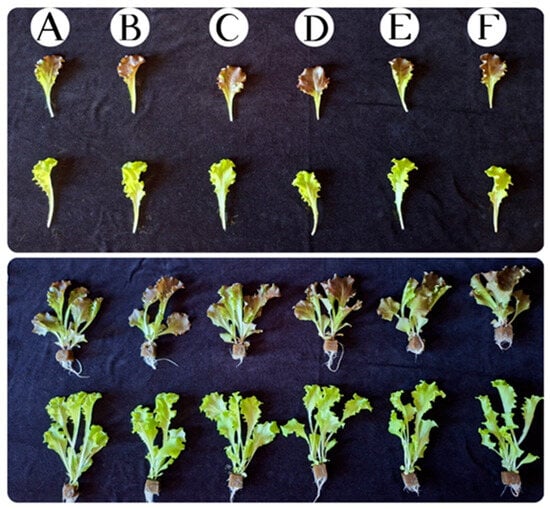
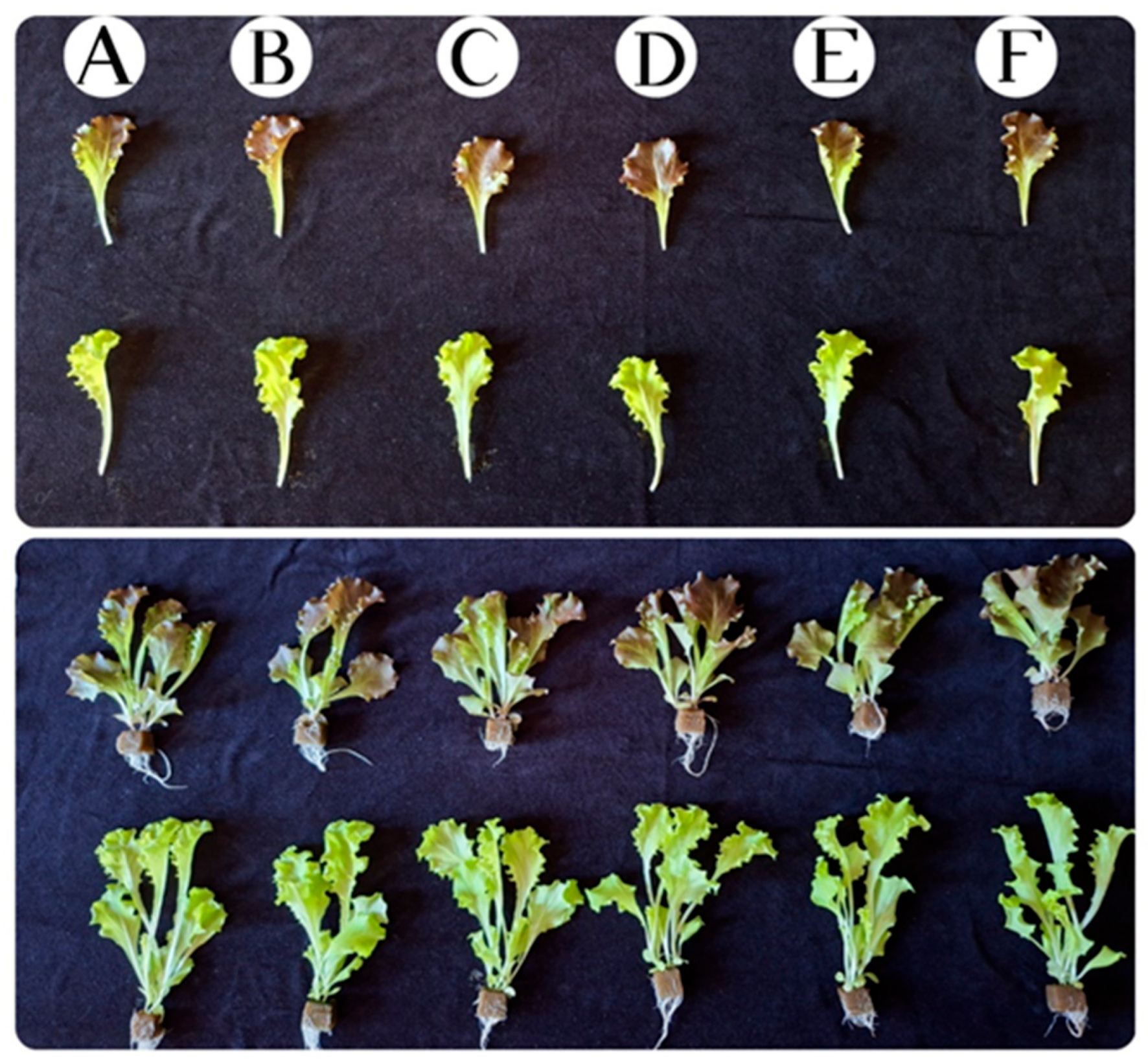
Figure 1 shows the leaves and plants of ‘Vanda’ and ‘Luminosa’ baby leaf lettuce on the day of harvest, 10 days after starting the cultivation in DWT hydroponics and 22 days after sowing.
Figure 1.
Baby leaves at harvest according to treatments: 2 mg L−1 Fe + 0.06 mg L−1 Zn (A), 2 mg L−1 Fe + 0.24 mg L−1 Zn (B), 4 mg L−1 Fe + 0.06 mg L−1 Zn (C), 4 mg L−1 Fe + 0.24 mg L−1 Zn (D), 8 mg L−1 Fe + 0.06 mg L−1 Zn (E), and 8 mg L−1 Fe + 0.24 mg L−1 Zn (F).
As evidenced in the joint analysis of the experiments, no significant interaction was observed between the treatments (Fe and Zn concentrations) and lettuce cultivars for yield, shoot fresh and dry mass, number of leaves, length of the largest leaf, leaf area, vitamin C, anthocyanins, carotenoids, calcium, magnesium, or zinc. These traits, except for leaf area, were influenced by the cultivar factor (Table 1).
Table 1.
Summary of the joint analyses of the traits yield, shoot fresh mass (SFM), shoot dry mass (SDM), number of leaves (NL), length of the largest leaf (LLL), leaf area (LA), and contents of vitamin C (Vit C), phenolic compounds (Phenols), anthocyanins (Ant), chlorophyll a (Chl a), chlorophyll b (Chl b), total chlorophyll (Chl t), carotenoids (Carot), calcium (Ca), magnesium (Mg), iron (Fe), and zinc (Zn) of the baby leaf lettuce cultivars ‘Vanda’ and ‘Luminosa’ (experiments) as a function of iron and zinc concentrations (treatments) in the nutrient solution.
‘Vanda’ showed higher values of biometric traits (except for leaf area), yield, and calcium content than ‘Luminosa’ (Table 2). ‘Vanda’ showed 12.9% higher yield than ‘Luminosa’, in addition to fresh mass (13%) and dry mass (17.3%), confirming its high production potential in a hydroponic system. It also exhibited higher performance in terms of morphological attributes, with an increase of 4.3% in the number of leaves and 13.4% in the length of the largest leaf.
Table 2.
Means of the joint analyses of experiments (baby leaf lettuce cultivars ‘Vanda’ and ‘Luminosa’) for yield, shoot fresh mass (SFM), shoot dry mass (SDM), number of leaves (NL), length of the largest leaf (LLL) and leaf area (LA), vitamin C (Vit C), anthocyanins (Ant), phenolic compounds (Phenols), chlorophyll a (Chl a), chlorophyll b (Chl b), total chlorophyll (Chl t), carotenoids (Carot), calcium (Ca), magnesium (Mg), iron (Fe), and zinc (Zn).
On the other hand, regarding the nutritional quality traits of baby leaf lettuce (Table 2), ‘Luminosa’ had higher values than ‘Vanda’. The vitamin C content was 23.2% higher, while the content of phenolic compounds was three times higher. Similarly, the photosynthetic pigments differed between the cultivars, with 87%, 84%, and 96% higher concentrations of chlorophyll a, chlorophyll b, and total chlorophyll, respectively, in ‘Luminosa’. The carotenoid content was 66.7% higher, while the magnesium, iron, and zinc contents were 4.7%, 23.9, and 6.4% higher, respectively, than those observed in the aerial part of ‘Vanda’.
Table 3, Table 4 and Table 5 present the results of the analysis of variance for the traits that were not influenced by the interaction between treatments and experiments. In Table 3, according to the analysis of variance, there were no significant differences for yield, shoot fresh mass, shoot dry mass, and number of leaves as a function Fe and Zn concentrations, and no interaction between these nutrients, while the length of the largest leaf, leaf area, and vitamin C content were influenced by the Fe concentration in the nutrient solution. In the same table, it is observed that the Fe concentration of 2 mg L−1 in the nutrient solution did not differ from that of 4 mg L−1 for the length of the largest leaf, but the value was lower than that obtained with 8 mg L−1. For leaf area, 4 and 8 mg L−1 of Fe promoted a higher value compared to when the baby leaf lettuce was grown with 2 mg L−1. On the other hand, there was a reduction in the vitamin C content, from 45.80 mg 100 g−1 at the Fe dose of 2 mg L−1 to 33.23 mg 100 g−1 at the Fe dose of 8 mg L−1. The Zn concentration in the nutrient solution did not influence these traits.
Table 3.
Summary of variance analyses and means of yield, shoot fresh mass (SFM), shoot dry mass (SDM), number of leaves (NL), length of the longest leaf (LLL), leaf area (LA), and content of vitamin C (Vit C) of baby leaf lettuce (average data of the cultivars, experiments) as a function of iron and zinc concentrations in the nutrient solution.
Table 4.
Summary of variance analyses and means of anthocyanins (Ant), carotenoids (Carot), calcium (Ca), magnesium (Mg), and zinc (Zn) in baby leaf lettuce (average data from cultivars, experiments) as a function of iron and zinc concentrations in the nutrient solution.
Table 5.
Zinc content in the shoot dry mass of baby leaf lettuce as a function of the interaction between iron and zinc concentrations in the nutrient solution.
The contents of anthocyanins, carotenoids, and calcium were not influenced by the Fe and Zn concentrations, individually or by the interaction. Fe concentration had an effect on magnesium (Mg) content, and Zn concentration and the interaction between micronutrient concentrations had an effect on Zn content. Higher Mg contents were observed with 4 and 8 mg L−1 of Fe in the nutrient solution (Table 4).
Regarding the Zn content, according to the interaction between the micronutrient concentrations in the nutrient solution (Table 5), regardless of the Fe concentration, the highest Zn concentration in the nutrient solution always promoted the highest Zn content in the aerial part of baby leaf lettuce. However, at the lowest Zn concentration, the increase in the Fe concentration caused an increase in the shoot Zn content, while at the highest Zn concentration in the solution, the increase in Fe caused the opposite effect (Table 5).
Table 6 and Table 7 show the results of the analysis of variance for phenolic compounds, chlorophylls a and b and the total, and iron in the aerial part of ‘Vanda’ and ‘Luminosa’ lettuce, respectively. There was a significant effect of the interaction between treatments (Fe and Zn concentrations) and cultivars (Table 1). In both cultivars, the contents of phenolic compounds were influenced only by Fe concentration, with the highest content obtained at the highest concentration of the micronutrient (Table 6 and Table 7). For each cultivar, chlorophyll a and the total chlorophyll content responded differently to the factors. While the effects of the interaction between the micronutrients were observed for chlorophyll a and total chlorophyll in ‘Vanda’ (Table 6), there was only an effect of the interaction between factors on chlorophyll a and iron content in ‘Luminosa’ (Table 7). For both cultivars, there was no effect of the factors, individually or in interaction, on chlorophyll b (Table 6 and Table 7).
Table 6.
Summary of variance analyses and means of content of phenolic compound (Phenols), chlorophylls a (Chl a), b (Chl b), and total (Chl t), and iron (Fe) in ‘Vanda’ lettuce as a function of iron and zinc concentrations in the nutrient solution.
Table 7.
Summary of variance analyses and means of content of phenolic compound (Phenols), chlorophylls a (Chl a), b (Chl b), and total (Chl t), and iron (Fe) in ‘Luminosa’ lettuce as a function of iron and zinc concentrations in the nutrient solution.
In ‘Vanda’ lettuce, with 0.06 mg L−1 of Zn in the nutrient solution, the chlorophyll a contents decreased with the increase in the Fe concentration, while in ‘Luminosa’, the opposite occurred (Table 8). In both cultivars, the chlorophyll a contents did not differ with the increase in the Fe concentration when using 0.24 mg L−1 of Zn in the solution (Table 8). With Fe concentrations of 2 and 4 mg L−1, the chlorophyll a contents did not differ with the enrichment of the solution with Zn, while at the highest concentration of Fe, the response differed according to the cultivar (Table 8). The total chlorophyll content, which was also influenced by the interaction, but only in ‘Vanda’ (Table 6 and Table 7), followed the same pattern as that described for chlorophyll a (Table 8). In ‘Luminosa’, total chlorophyll was lower at the lowest concentration of Fe and at the highest concentration of Zn (Table 7).
Table 8.
Means of chlorophyll a (Chl a) and total chlorophyll (Chl t) content of the baby leaf lettuce cultivar ‘Vanda’ and chlorophyll a and iron content of the cultivar ‘Luminosa’ as a function of the interaction between iron and zinc concentrations in the nutrient solution.
The Fe content in ‘Vanda’ was influenced only by the concentration of Fe; the higher its concentration in the nutrient solution, the higher its content in the shoot (Table 7), representing an increase of 13.3% between the concentrations of 2 and 8 mg L−1. In ‘Luminosa’, there was an interaction between the Fe and Zn concentrations in the nutrient solution. According to the results presented in Table 8, regardless of the Zn concentration in the nutrient solution, higher Fe contents in the shoot were observed with 8 mg L−1 of Fe, whose values were 24 and 38% higher than those obtained with 2 mg L−1 of Fe at Zn concentrations of 0.06 and 0.24 mg L−1, respectively. Among the Zn concentrations, the Fe content differed only at the highest Fe concentration in the nutrient solution, and the highest Fe content in the aerial part was obtained with 0.24 mg L−1 (Table 8).
4. Discussion
For growth and yield traits, there was no interaction between cultivars and micronutrient concentrations. However, with the exception of leaf area, the other traits were influenced by the cultivars (Table 1). ‘Vanda’ (green leaf lettuce) had higher shoot fresh and dry mass, number of leaves, and length of the largest leaf when compared to ‘Luminosa’ (red leaf lettuce) (Table 2), showing greater capacity for biomass accumulation, reflected in the higher yield. These differences are probably related to the genetic and physiological particularities of each cultivar, which determine the balance of photoassimilates and their use in plant growth and development. Chouraqui [7] also found that the ‘Green Salad Bowl’ lettuce (green leaf lettuce) showed higher growth (dry mass) and yield than the ‘Red Salad Bowl’ lettuce (red leaf lettuce). The better performance of green lettuce, according to Rouphael et al. [41], is due to its lower stomatal resistance, which allows for greater CO2 diffusion and increased photosynthesis, even with the lower chlorophyll concentration observed in our experiment, promoting greater efficiency, growth, and production. Rosa et al. [42] observed that, despite having higher concentrations of chlorophylls, the ‘Mimosa Rosa Grenadine’ cultivar exhibited a lower maximum CO2 assimilation rate than the ‘Mimosa Verde Salad Bowl’ cultivar, associating it with its lower growth and yield. Becker et al. [43] observed a lower number of leaves in red lettuce compared to green lettuce. The authors attributed the result to the fact that part of the assimilated carbon is directed to the biosynthesis of phenolics, higher in the red than in the green, to the detriment of growth.
On the other hand, except for the length of the largest leaf and leaf area, which had higher values with 8 mg of Fe L−1, without differing from the values obtained with 4 mg L−1, the Fe and Zn concentrations did not influence the growth traits and, consequently, the yield of baby leaf lettuce (Table 3). Puccinelli et al. [44] also observed no significant differences in the growth of green lettuce plants cv. ‘Nelson’ grown under increasing concentrations of Zn in the nutrient solution. The absence of the influence of Zn concentrations on the growth traits of lettuce may be associated with it being a member of the Asteraceae family, which is recognized as a Zn hyperaccumulator [45]. In a biofortification study with Zn in different lettuce genotypes, Moraes et al. [46] also demonstrated the viability in the strategy and highlighted that a daily serving of 50 g of biofortified lettuce can provide a higher nutritional contribution than larger portions of grains and cereals, due to the lower phytic acid content in leafy vegetables, a compound known to reduce the bioavailability of micronutrients in food. In addition, plants have mechanisms for compartmentalizing the element in tissues or even for its precipitation in the apoplast [47]. Thus, the increase in the availability of the micronutrient did not result in negative effects or significant increments in plant growth. As for Fe, according to Rai et al. [48], plants have developed multifaceted strategies for absorption, storage, and metabolism of this nutrient, and they regulate these processes to maintain homeostasis for optimal development. Also in accordance with these authors, Briat et al. [49] emphasized that, in order to avoid the toxicity associated with free Fe, plants have efficient mechanisms for storing and remobilizing this micronutrient, and the vacuole and plastids are recognized as key compartments in its regulation and internal reserve.
Regarding the quality of baby leaf lettuce, it was possible to observe the effects of cultivars and Fe and Zn concentrations, and sometimes of the interaction between these factors (Table 2, Table 3, Table 4, Table 5, Table 6, Table 7 and Table 8). The content of vitamins, especially vitamin C, is one of the most relevant parameters for assessing the nutritional quality of fruits and vegetables [50]. El-Nakhel et al. [51] reported higher concentrations of vitamin C in red lettuces, about six times higher than in green lettuces. The results obtained in the present study attest that the red cultivar had a higher vitamin C content than the green cultivar, by approximately 23% higher (Table 2). Thus, considering only the color of the lettuce, when consuming 100 g of baby leaf, the individual will have an intake of 23% more vitamin C with red lettuce. According to the National Health Surveillance Agency (ANVISA), Resolution RDC No. 269, the Recommended Daily Intake (RDI) of vitamin C for adults is 45 mg day−1 [52]. Considering that the vitamin C concentration in baby leaf lettuce leaves ranged from 33.23 to 45.80 mg 100 g−1 FM (Table 3), depending on the Fe concentration in the nutrient solution, 98 and 135 g of fresh lettuce would be needed to meet the RDI established by ANVISA [52] if the plants were grown at the lowest (2 mg L−1) and highest (8 mg L−1) concentrations of Fe, respectively. It can be observed, therefore, that the increase in the Fe concentration progressively reduced the vitamin C contents in baby leaf lettuce.
The content of phenolic compounds was influenced by the interaction between the cultivars and the micronutrients (Table 1). The higher content observed in ‘Luminosa’ lettuce (red) than in ‘Vanda’ lettuce (green) (Table 2) may be associated with a differentiated strategy of resource allocation. As described by Becker et al. [43], reddish cultivars tend to direct metabolism towards the synthesis of secondary metabolites, instead of prioritizing growth and yield, which explains the higher levels observed. In the present study, for example, the phenol content of red lettuce was 235% higher than that of green lettuce (Table 2), which corroborates the findings of Stojanović et al. [53], who also identified red cultivars as richer in phenolic compounds. This response can be understood from the perspective of the “plant defense theory”, according to which the greater investment in secondary metabolites entails an additional metabolic cost. Thus, part of the assimilated carbon is diverted to the biosynthesis of these compounds, proportionally reducing the investment in vegetative growth [54].
In both cultivars, the phenol content was not statistically influenced by the Zn concentrations in the nutrient solution. On the other hand, both responded significantly to the increase in Fe, since the increase in this micronutrient can be perceived by plants as a condition of metallic stress, resulting in the production of reactive oxygen species and, consequently, in the stimulation of the synthesis of non-enzymatic antioxidants, such as phenols [55,56]. Similarly, when evaluating three concentrations of Fe (0.02, 1.02, and 2.02 mmol L−1), the authors observed that the increase in the concentrations culminated in a peak in the phenol content at the highest concentration of Fe.
Similarly, our results showed that ‘Luminosa’ lettuce (red) had 87% more chlorophyll a, 84% more chlorophyll b, and, in total, 97% more chlorophylls than the cultivar ‘Vanda’ (green) (Table 2). These results agree with those reported by Rosa et al. [42], who compared green and red Mimosa lettuce cultivars and found that the red variety had a significantly higher average total chlorophyll content than the green variety, with an increase of approximately 53%, especially in hydroponic systems. Also, Becker et al. [43] observed higher levels of chlorophyll b in red lettuce compared to green lettuce. This fact may be associated with a higher nitrogen content in this cultivar, since El-Nakhel et al. [51] found significantly higher nitrogen and sulfur contents from the eighth day of cultivation in nutrient solution. It is important to highlight that, although the red lettuce had a higher chlorophyll content, its reddish color, conferred by the presence of mainly anthocyanins, can mask the green hue of the leaves, generating the mistaken impression that it has a lower chlorophyll content.
In the lettuce cultivar ‘Vanda’ (green), a significant interaction was observed between the Fe and Zn concentrations for chlorophyll a and total chlorophyll content (Table 6). At the lowest concentration of Zn, the increase in Fe resulted in a reduction in the chlorophyll concentration (Table 8), indicating that the nutritional imbalance between these micronutrients can compromise the synthesis or stability of photosynthetic pigments. Despite having very distinct functions in cells, Fe and Zn have interactions in their homeostasis networks due to the similarity between their ionic radii and coordination geometries, which can lead to the common use of transporters and chelating molecules, favoring competition between them [57]. This result was not repeated when the plants were grown at the highest concentration of Zn, a condition in which the increase in Fe did not reduce the chlorophyll content. On the other hand, the effects of Zn doses became evident only in the presence of the highest concentration of Fe (Table 8), suggesting that chlorophyll synthesis depends on the balance between these nutrients, so that high concentrations of Fe must be accompanied by a high supply of Zn. This is because, although Fe is indispensable for chlorophyll synthesis, Zn availability also plays a crucial role in the maintenance of leaf chlorophyll [58]. Kaya et al. [59] highlighted that Zn can compete with Fe in a stage of its acquisition during chlorophyll biosynthesis. This effect, however, was observed only in red lettuce, which showed a reduction in chlorophyll a content under high Zn concentrations, even in the presence of high Fe concentrations.
The increase in the Zn concentration reduced the chlorophyll a contents in ‘Luminosa’ lettuce (red) (Table 8), possibly because Zn can inactivate the chlorophyll molecule by replacing the Mg present in the porphyrin structure during the photosynthetic process [60]. Ciriello et al. [61], when working with basil, also observed that higher Zn concentrations resulted in a decrease in chlorophyll content. In turn, Fe promoted an increase in chlorophyll content in this cultivar, which is in line with what is expected for several species, since this micronutrient actively participates in chlorophyll synthesis and contributes to the efficiency of respiration and photosynthesis processes [62]. In addition, the main site of Fe accumulation in plants is the photosynthetic apparatus, and most of the element is found in chloroplasts [63].
The cultivation of ‘Luminosa’ lettuce, as compared to ‘Vanda’ lettuce, has a nutritional appeal to the consumer due to the high accumulation of anthocyanins, which are antioxidant pigments predominantly located in the leaf epidermis, responsible for the characteristic color that gives the red hue to the leaves [64,65]. In the present study, both anthocyanins and carotenoids were influenced by the cultivars, with red lettuce having 22 and 66% higher levels of anthocyanins and carotenoids than green lettuce. In addition to the visual effect, anthocyanins perform relevant physiological functions, such as photoprotection, and red cultivars in general accumulate higher concentrations not only of carotenoids but also of anthocyanins, total phenols, and flavonoids compared to green cultivars [66,67]. The higher production of anthocyanins in red cultivars is associated with genetic differences that modulate the biosynthesis of these pigments. According to Wada et al. [68], although green lettuce cultivars have functional genes for anthocyanin synthesis, the expression of this phenotype is often not consistent, as the biosynthetic pathway can be interrupted in the penultimate step of the process.
The Mg, Fe, and Zn contents were higher in red lettuce than in green lettuce. On the other hand, the cultivar ‘Vanda’ had higher Ca contents (Table 2), showing that the differentiation between genotypes influences not only the synthesis of pigments and secondary metabolites but also the dynamics of nutrient accumulation. Similarly, El-Nakhel et al. [51] found that, throughout the growth period evaluated, the green Salanova butterhead cultivar showed significantly higher levels of Ca. Several factors are involved in the plant’s genetics. El-Nakhel et al. [51] observed that the cumulative water uptake in red lettuce was substantially higher than in green lettuce, demonstrating an exponential increase throughout the growing period, which may be associated with higher nutrient contents in this cultivar, since greater water absorption also favors nutrient absorption.
Although Fe and Mg are often considered competitive in plant absorption, the increase in the micronutrient content in the aerial part of baby leaves, in response to the increase in its concentration in the nutrient solution (Table 6 and Table 7), was accompanied by an increase in Mg in the baby leaf, by about 12% (Table 4), not revealing the antagonism reported in the literature. This result is similar to that reported by Buturi et al. [56], who found an average increase of 35% in Mg content in ‘Longifolia’ lettuce of the Romaine group when the Fe concentration in the nutrient solution increased from 0.02 to 1.02 mmol L−1. The increase in the Fe concentration in the nutrient solution resulted in a higher content of this micronutrient in the aerial part of both cultivars, highlighting the potential of agronomic biofortification as an effective strategy for lettuce. An average increase of 13.3% in Fe content was observed in the green cultivar, while in the red cultivar, this increase reached 31.5%, demonstrating greater responsiveness to nutrient solution enrichment. This result was expected and is supported by Buturi et al. [56] and Giordano et al. [69], who also reported success in the biofortification of lettuce with Fe, highlighting the red cultivar as the most responsive and promising for nutritional enrichment. Thus, to meet the recommended daily requirement of Fe, 14 mg day−1 for adults [52], an individual needs to consume approximately 76.5 g of red lettuce per day. In the case of green lettuce, this value corresponds to 103.4 g. These results were obtained considering the maximum level of biofortification achieved in this study, associated with the highest concentration of Fe applied in the nutrient solution.
Increasing the Zn concentration in the nutrient solution from 0.06 to 0.24 mg L−1 promoted average increments of 39%, 22%, and 8% in the Zn contents in lettuce plants, considering Fe concentrations of 2, 4, and 8 mg L−1 in the nutrient solution, highlighting the feasibility of the biofortification of these cultivars with Zn. The feasibility of biofortifying lettuce with a high Zn concentration is maximized when associated with low Fe concentrations, showing that the success of biofortification depends on precise and well-targeted strategies. Considering the recommended daily intake of Zn for adults, established at 7 mg day−1 [52], it was found that portions of approximately 38.3 g of red lettuce and 51.7 g of green lettuce would be sufficient to meet the nutritional needs of adult individuals.
These results indicate that the red baby leaf has greater potential for biofortification with antioxidant compounds and essential elements, especially in relation to Fe, Mg, and Zn.
5. Conclusions
From a varietal point of view, ‘Vanda’ is more productive, while ‘Luminosa’ has a higher nutraceutical value.
Regarding the response of the cultivars to the concentrations of micronutrients, it was found that the growth traits, yield, and leaf contents of carotenoids and anthocyanins of both cultivars were not influenced by the increase in Fe and Zn concentrations in the nutrient solution, but there was an increase in the content of phenolic compounds.
Agronomic biofortification of baby leaf lettuces, in deep water technique hydroponics, is feasible and proves the importance of evaluating the effects of fertilization on cultivars, as the studied cultivars showed a differentiated response to increasing Fe and Zn concentrations in the nutrient solution and biofortification of baby leaves with micronutrients. While ‘Vanda’ baby leaf (green leaf lettuce) was biofortified only with Fe, with the best result obtained with 8 mg L−1 of Fe in the nutrient solution, ‘Luminosa’ (red leaf lettuce) was biofortified with both micronutrients, for which the highest concentrations of micronutrients (8 mg L−1 Fe and 0.24 mg L−1 Zn) are recommended.
However, we see as a limitation of the technique, in guaranteeing commercial standards for biofortification (ensuring standard concentrations of Fe and Zn), the fact that biofortification is carried out in a greenhouse without temperature and relative humidity control. In this production environment, changes in climatic conditions depending on the region or season alter plant metabolism and, consequently, affect the absorption and accumulation of Fe and Zn. Thus, the proven technique for biofortifying baby leaf lettuce may be better applied in environments that allow for the control of climatic factors, such as plant factories or vertical farms.
Author Contributions
Conceptualization, A.B.C.F.; methodology, A.B.C.F.; validation, A.B.C.F., G.S.B., F.A.G.P. and F.L.d.N.A.; formal analysis, A.B.C.F. and G.S.B.; investigation, G.S.B., F.A.G.P., G.R.R., F.L.d.N.A., D.P.A. and A.R.H.J.; resources, A.B.C.F.; data curation, G.S.B., F.A.G.P., G.R.R., F.L.d.N.A., D.P.A. and A.R.H.J.; writing—original draft preparation, G.S.B., F.A.G.P., G.R.R., F.L.d.N.A., D.P.A. and A.R.H.J.; writing—review and editing, A.B.C.F.; supervision, A.B.C.F.; project administration, A.B.C.F. All authors have read and agreed to the published version of the manuscript.
Funding
This research received no external funding.
Institutional Review Board Statement
Not applicable.
Data Availability Statement
The data presented in this study are available upon reasonable request from the first author.
Acknowledgments
We would like to thank CAPES and CNPq.
Conflicts of Interest
The authors declare no conflicts of interest.
References
- Prajharaj, S.; Skalicky, M.; Maitra, S.; Bhadra, P.; Shankar, T.; Brestic, M.; Hejnak, V.; Vachova, P.; Hossain, A. Zinc biofortification in food crops could alleviate the zinc malnutrition in human health. Molecules 2021, 26, 3509. [Google Scholar] [CrossRef] [Scilit] [PubMed]
- Bhardwaj, A.K.; Chejara, S.; Malik, K.; Kumar, R.; Kumar, A.; Yadav, R.K. Agronomic biofortification of food crops: An emerging opportunity for global food and nutritional security. Front. Plant Sci. 2022, 13, 1055278. [Google Scholar] [CrossRef] [Scilit]
- Afshin, A.; Sur, P.J.; Fay, K.A.; Cornaby, L.; Ferrara, G.; Salama, J.S.; Mullany, E.C.; Abate, K.H.; Abbafati, C.; Abebe, Z. Health effects of dietary risks in 195 countries, 1990–2017: A systematic analysis for the Global Burden of Disease Study 2017. Lancet 2019, 393, 1958–1972. [Google Scholar] [CrossRef] [Scilit]
- Bai, S.; Zhang, M.; Tang, S.; Li, M.; Wu, R.; Wan, S.; Chen, L.; Wei, X.; Feng, S. Effects and impact of selenium on human health: A review. Molecules 2024, 30, 50. [Google Scholar] [CrossRef] [Scilit]
- Rani, J.; Beniwal, D.; Dhull, S.S.; Gulia, V.; Sangwan, P.; Abdi, G. Biofortification of Cicer arietinum to enhance nutrient-rich diets in semi-arid regions. Discov. Sustain. 2025, 6, 1554. [Google Scholar] [CrossRef] [Scilit]
- Passarelli, S.; Free, C.M.; Shepon, A.; Beal, T.; Batis, C. Global estimation of dietary micronutrient inadequacies: A modelling analysis. Lancet Glob. Health 2024, 12, e1590–e1599. [Google Scholar] [CrossRef] [Scilit]
- Chouraqui, J.-P. Risk assessment of micronutrients deficiency in vegetarian or vegan children: Not so obvious. Nutrients 2023, 15, 2129. [Google Scholar] [CrossRef] [Scilit]
- PAHO—Pan American Health Organization. Informe ONU: 131-Millones-Personas-America-Latina-Caribe-Nopueden-Acceder-Dieta Saludable. 2023. Available online: https://www.paho.org/es/noticias/19-1-2023-informe-onu-131-millones-personas-america-latina-caribe-no-pueden-acceder-dieta (accessed on 17 December 2024).
- Wieser, S.; Brunner, B.; Tzogiou, C.; Plessow, R.; Zimmermann, M.B.; Farebrother, J.; Soofi, S.; Bhatti, Z.; Ahmed, I.; Bhutta, Z.A. Societal costs of micronutrient deficiencies in 6- to 59-month-old children in Pakistan. Food Nutr. Bull. 2017, 38, 485–500. [Google Scholar] [CrossRef] [Scilit] [PubMed]
- Khan, S.T.; Malik, A.; Alwarthan, A.; Shaik, M.R. The enormity of the zinc deficiency problem and available solutions: An overview. Arab. J. Chem. 2022, 15, 103668. [Google Scholar] [CrossRef] [Scilit]
- Bayati, M.; Arkia, E.; Emadi, M. Socio-economic inequality in the nutritional deficiencies among the world countries: Evidence from Global Burden of Disease Study 2019. J. Health Popul. Nutr. 2025, 44, 8. [Google Scholar] [CrossRef] [Scilit]
- Kim, M.J.; Moon, Y.; Tou, J.C.; Mou, B.; Waterland, N.L. Nutritional value, bioactive compounds and health benefits of lettuce (Lactuca sativa L.). J. Food Compos. Anal. 2016, 49, 19–34. [Google Scholar] [CrossRef] [Scilit]
- Buzała, M.; Janicki, B.; Buzała, M.; Słomka, A. Heme iron in meat as the main source of iron in the human diet. J. Elementol. 2015, 21, 303–314. [Google Scholar] [CrossRef] [Scilit]
- Li, M.; Watanabe, S.; Gao, F.; Dubos, C. Iron nutrition in plants: Towards a new paradigm? Plants 2023, 12, 384. [Google Scholar] [CrossRef] [Scilit]
- Tilman, D.; Clark, M. Global diets link environmental sustainability and human health. Nature 2014, 515, 518–522. [Google Scholar] [CrossRef] [Scilit]
- Auestad, N.; Fulgoni, V.L. What current literature tells us about sustainable diets: Emerging research linking dietary patterns, environmental sustainability, and economics. Adv. Nutr. 2015, 6, 19–36. [Google Scholar] [CrossRef] [Scilit]
- Heller, M.C.; Keoleian, G.A.; Willett, W.C. Toward a life cycle-based, diet-level framework for food environmental impact and nutritional quality assessment: A critical review. Environ. Sci. Technol. 2013, 47, 12632–12647. [Google Scholar] [CrossRef] [Scilit]
- Sabaté, J.; Soret, S. Sustainability of plant-based diets: Back to the future. Am. J. Clin. Nutr. 2014, 100, 476S–482S. [Google Scholar] [CrossRef] [Scilit] [PubMed]
- Lowe, N.M.; Hall, A.G.; Broadley, M.R.; Foley, J.; Boy, E.; Bhutta, Z.A. Preventing and controlling zinc deficiency across the life course: A call to action. Adv. Nutr. 2024, 15, 100181. [Google Scholar] [CrossRef] [Scilit] [PubMed]
- Schulz, M.T.; Rink, L. Zinc deficiency as a possible link between immunosenescence and age-related diseases. Immun. Ageing 2025, 22, 19. [Google Scholar] [CrossRef] [Scilit]
- Joy, E.J.M.; Stein, A.J.; Young, S.D.; Ander, E.L.; Watts, M.J.; Broadley, M.R. Zinc-enriched fertilisers as a potential public health intervention in Africa. Plant Soil. 2015, 389, 1–24. [Google Scholar] [CrossRef] [Scilit]
- Martínez-Ispizua, E.; Calatayud, Á.; Marsal, J.I.; Cannata, C.; Basile, F.; Abdelkhalik, A.; Soler, S.; Valcárcel, J.V.; Martínez-Cuenca, M.R. The nutritional quality potential of microgreens, baby leaves, and adult lettuce: An underexploited nutraceutical source. Foods 2022, 11, 423. [Google Scholar] [CrossRef] [Scilit] [PubMed]
- Matos, C.H.L.; Montenegro, R.A.; Uchôa, S.C.P.; Vale Junior, J.F.; Sabóia, V.H.C.; Tavares, I.N. Soil micronutrients: Dynamics, availability, and fertilization management. Biol. Agric. Sci. 2024, 1, 60–79. [Google Scholar] [CrossRef] [Scilit]
- Tzortzakis, N.; Nicola, S.; Savvas, D.; Voogt, W. Editorial: Soilless cultivation through an intensive crop production scheme. Management Strategies, Challenges and Future Directions. Front. Plant Sci. 2020, 11, 363. [Google Scholar] [CrossRef] [Scilit] [PubMed]
- Nascimento, C.S.; Nascimento, C.S.; Lopes, G.; Carrasco, G.; Gratão, P.L.; Cecílio Filho, A.B. Biofortified rocket (Eruca sativa) with selenium by using the nutrient Film Technique. Horticulturae 2022, 8, 1088. [Google Scholar] [CrossRef] [Scilit]
- Nicola, S.; Egea-Gilabert, C.; Niñirola, D.; Conesa, E.; Pignata, G.; Fontana, E.; Fernández, J.A. Nitrogen and aeration levels of the nutrient solution in soilless cultivation systems as important growing conditions affecting inherent quality of baby leaf vegetables: A review. Acta Hortic. 2015, 1099, 167–177. [Google Scholar] [CrossRef] [Scilit]
- Brito, G.S.; Pimentel, F.A.G.; Cecílio Filho, A.B.; Rossi, G.R.; Humel Júnior, A.R.; Mourão, G.M.B. Agronomic and qualitative characteristics of baby leaf lettuce as a function of planting density in a floating hydroponic system. Pesqui. Agropecu. Trop. 2025, 55, e83809. [Google Scholar]
- Barrameda-Medina, Y.; Blasco, B.; Lentini, M.; Esposito, S.; Baenas, N.; Moreno, D.A.; Ruiz, J.M. Zinc biofortification improves phytochemicals and amino-acidic profile in Brassica oleracea cv. Bronco. Plant Sci. 2017, 258, 45–51. [Google Scholar] [CrossRef] [Scilit]
- Sahin, O. Combined biofortification of soilless grown lettuce with iodine, selenium and zinc and its effect on essential and non-essential elemental composition. J. Plant Nutr. 2020, 44, 673–678. [Google Scholar] [CrossRef] [Scilit]
- Figueiredo, M.N.; Martinez, H.E.P.; Fontes, E.A.F.; Milagres, C.C.; Silva, J.M. Agronomic biofortification with iodine in lettuce plants cultivated in floating hydroponic system. Rev. Ceres 2022, 69, 210–217. [Google Scholar] [CrossRef] [Scilit]
- Silva, V.B.; Ribera, L.M.; Medelo, M.J.Y.; Almeida, H.J.; Cecílio Filho, A.B. Effects of Fe and Zn on growth, biofortification and quality of lettuce grown in hydroponics. Rev. Caatinga 2024, 37, 1–7. [Google Scholar] [CrossRef] [Scilit]
- Alvares, C.A.; Stape, J.L.; Sentelhas, P.C.; Gonçalves, J.L.M.; Sparovek, G. Köppen’s climate classification map for Brazil. Meteorol. Z. 2013, 22, 711–728. [Google Scholar] [CrossRef] [Scilit]
- Furlani, P.R.; Silveira, L.C.P.; Bolonhezi, D.; Faquin, V. Cultivo Hidropônico de Plantas; Instituto Agronômico de Campinas: Campinas, Brazil, 1999. [Google Scholar]
- Lichtenthaler, H.K.; Wellburn, A.R. Determinations of total carotenoids and chlorophylls a and b of leaf extracts in different solvents. Biochem. Soc. Trans. 1983, 11, 591–592. [Google Scholar] [CrossRef] [Scilit]
- Francis, F.J. Analysis of anthocyanins. In Anthocyanins as Food Colors; Markakis, P., Ed.; Academic Press: New York, NY, USA, 1982; pp. 181–207. [Google Scholar]
- Strohecker, R.L.; Henning, H.M. Análisis de Vitaminas: Métodos Comprobados; Paz Montalvo: Madrid, Spain, 1967. [Google Scholar]
- Larrauri, J.A.; Rupérez, P.; Saura-Calixto, F. Effect of drying temperature on the stability of polyphenols and antioxidant activity of red grape pomace peels. J. Agric. Food Chem. 1997, 45, 1390–1393. [Google Scholar] [CrossRef] [Scilit]
- Miyazawa, M.; Pavan, M.A.; Muraoka, T.; Santana do Carmo, C.A.F.; de Melo, W.J. Análise química de tecido vegetal. Parte 2, Cap. 2. In Manual de Análises Químicas de Solos, Plantas e Fertilizantes, 2nd ed.; Silva, F.C., Ed.; Embrapa Informática Tecnológica: Brasília, Brazil, 2009; pp. 191–233. [Google Scholar]
- Barbosa, J.C.; Maldonado, J.W. Experimentação Agronômica e AgroEstat: Sistema para Análises Estatísticas de Ensaios Agronômicos; Gráfica Multipress Ltda: Jaboticabal, Brazil, 2015; 396p. [Google Scholar]
- Pimentel-Gomes, F. Curso de Estatística Experimental, 15th ed.; FEALQ: Piracicaba, Brazil, 2023; 570p. [Google Scholar]
- Rouphael, Y.; Kyriacou, M.C.; Carillo, P.; Pizzolongo, F.; Romano, R.; Sifola, M.I. Chemical eustress elicits tailored responses and enhances the functional quality of novel food Perilla frutescens. Molecules 2019, 24, 185. [Google Scholar] [CrossRef] [Scilit]
- Rosa, A.M.; Seó, H.L.S.; Volpato, M.B.; Foz, N.V.; Silva, T.C.; Oliveira, J.L.B.; Pescador, R.; Ogliari, J.B. Production and photosynthetic activity of Mimosa verde and Mimosa roxa lettuce in two farming systems. Rev. Ceres 2014, 61, 494–501. [Google Scholar] [CrossRef] [Scilit]
- Becker, C.; Urlić, B.; Jukić, M.; Kläring, H.P.; Krumbein, A.; Baldermann, S.; Ban, S.G.; Perica, S.; Schwarz, D. Nitrogen limited red and green leaf lettuce accumulate flavonoid glycosides, caffeic acid derivatives, and sucrose while losing chlorophylls, β-carotene and xanthophylls. PLoS ONE 2015, 10, e0142867. [Google Scholar] [CrossRef] [Scilit]
- Puccinelli, M.; de Padova, A.; Vernieri, P.; Carmassi, G.; Incrocci, L. Response of aeroponically cultivated baby-leaf lettuce (Lactuca sativa L.) plants with different zinc, copper, iodine, and selenium concentrations. Horticulturae 2024, 10, 726. [Google Scholar] [CrossRef] [Scilit]
- Clemens, S. How metal hyperaccumulating plants can advance Zn biofortification. Plant Soil. 2016, 411, 111–120. [Google Scholar] [CrossRef] [Scilit]
- Moraes, C.C.; Silveira, N.M.; Mattar, G.S.; Sala, F.C.; Mellis, F.V.; Purquerio, L.F.V. Agronomic biofortification of lettuce with zinc under tropical conditions: Zinc content, biomass production and oxidative stress. Sci. Hortic. 2022, 303, e111218. [Google Scholar] [CrossRef] [Scilit]
- Barrameda-Medina, Y.; Montesinos-Pereira, D.; Romero, L.; Blasco, B.; Ruiz, J.M. Role of GSH homeostasis under Zn toxicity in plants with different Zn tolerance. Plant Sci. 2014, 227, 110–121. [Google Scholar] [CrossRef] [Scilit] [PubMed]
- Rai, S.; Singh, P.K.; Mankotia, S.; Swain, J.; Satbhai, S.B. Iron homeostasis in plants and its crosstalk with copper, zinc, and manganese. Plant Stress. 2021, 1, 100008. [Google Scholar] [CrossRef] [Scilit]
- Briat, J.F.; Curie, C.; Gaymard, F. Iron utilization and metabolism in plants. Curr. Opin. Plant Biol. 2007, 10, 276–282. [Google Scholar] [CrossRef] [Scilit]
- Medina-Lozano, I.; Bertolín, J.R.; Díaz, A. Nutritional value of commercial and traditional lettuce (Lactuca sativa L.) and wild relatives: Vitamin C and anthocyanin content. Food Chem. 2021, 359, 129864. [Google Scholar] [CrossRef] [Scilit]
- El-Nakhel, C.; Giordano, M.; Pannico, A.; Carillo, P.; Fusco, G.M.; De Pascale, S.; Rouphael, Y. Cultivar-specific performance and qualitative descriptors for butterhead Salanova lettuce produced in closed soilless cultivation as a candidate salad crop for human life support in space. Life 2019, 9, 61. [Google Scholar] [CrossRef] [Scilit] [PubMed]
- ANVISA—Agência Nacional de Vigilância Sanitária. Resolução RDC nº 269, de 22 de Setembro de 2005. Regulamento Técnico sobre a Ingestão Diária Recomendada (IDR) de Proteína, Vitaminas e Minerais; Diário Oficial da União: Brasília, Brazil, 2005. [Google Scholar]
- Stojanović, M.; Savić, S.; Delcourt, A.; Hilbert, J.L.; Hance, P.; Maksimović, J.D.; Maksimović, V. Phenolics and sesquiterpene lactones profile of red and green lettuce: Combined effect of cultivar, microbiological fertiliser, and season. Plants 2023, 12, 2616. [Google Scholar] [CrossRef] [Scilit]
- Neilson, E.H.; Goodger, J.Q.D.; Woodrow, I.E.; Møller, B.L. Plant chemical defense: At what cost? Trends Plant Sci. 2013, 18, 250–258. [Google Scholar] [CrossRef] [Scilit] [PubMed]
- Hasanuzzaman, M.; Bhuyan, M.H.M.; Zulfiqar, F.; Raza, A.; Mohsin, S.; Mahmud, J.; Fujita, M.; Fotopoulos, V. Reactive oxygen species and antioxidant defense in plants under abiotic stress: Revisiting the crucial role of a universal defense regulator. Antioxidants 2020, 9, 681. [Google Scholar] [CrossRef] [Scilit]
- Buturi, C.V.; Sabatino, L.; Mauro, R.P.; Navarro-León, E.; Blasco, B.; Leonardi, C.; Giuffrida, F. Iron biofortification of greenhouse soilless lettuce: An effective agronomic tool to improve the dietary mineral intake. Agronomy 2022, 12, 1793. [Google Scholar] [CrossRef] [Scilit]
- Hanikenne, M.; Bouché, F. Iron and zinc homeostasis in plants: A matter of trade-offs. J. Exp. Bot. 2023, 74, 5426–5430. [Google Scholar] [CrossRef] [Scilit]
- Hanjagi, P.S.; Singh, B. Interactive regulation of iron and zinc nutrition in wheat (Triticum aestivum L.). Indian. J. Plant Physiol. 2016, 22, 70–78. [Google Scholar] [CrossRef] [Scilit]
- Kaya, C.; Higgs, D.; Burton, A. Foliar application of iron as a remedy for zinc-toxic tomato plants. J. Plant Nutr. 1999, 22, 1829–1837. [Google Scholar] [CrossRef] [Scilit]
- Sharma, A.; Kumar, V.; Shahzad, B.; Ramakrishnan, M.; Sidhu, G.P.S.; Bali, A.S.; Handa, N.; Kapoor, D.; Yadav, P.; Khanna, K. Photosynthetic response of plants under different abiotic stresses: A review. J. Plant Growth Regul. 2020, 39, 509–531. [Google Scholar] [CrossRef] [Scilit]
- Ciriello, M.; Formisano, L.; Kyriacou, M.; Soteriou, G.A.; Graziani, G.; De Pascale, S.; Rouphael, Y. Zinc biofortification of hydroponically grown basil: Stress physiological responses and impact on antioxidant secondary metabolites of genotypic variants. Front. Plant Sci. 2022, 13, 1049004. [Google Scholar] [CrossRef] [Scilit] [PubMed]
- Pal, V.; Singh, G.; Dhaliwal, S.S. Yield enhancement and biofortification of chickpea (Cicer arietinum L.) grain with iron and zinc through foliar application of ferrous sulfate and urea. J. Plant Nutr. 2019, 42, 1789–1802. [Google Scholar] [CrossRef] [Scilit]
- Fodor, F. Iron nutrition and its biochemical interactions in plants: Iron uptake, biofortification, bacteria, and fungi in focus. Plants 2024, 13, 561. [Google Scholar] [CrossRef] [Scilit]
- Qin, H.; Xu, Y.; Liu, B.; Gao, Y.; Zheng, Y.; Li, Q. UV-A supplement improved growth, antioxidant capacity, and anthocyanin accumulation in purple lettuce (Lactuca sativa L.). Horticulturae 2023, 9, 634. [Google Scholar] [CrossRef] [Scilit]
- Das, P.R.; Del Moro, D.S.; Givens, S.R.; Armstrong, S.P.; Walters, K.J. Propagation light intensity influences yield, morphology, and phytochemistry of purple-leaf butterhead lettuce (Lactuca sativa). J. Agric. Food Res. 2024, 16, 101210. [Google Scholar] [CrossRef] [Scilit]
- Liu, C.; Yu, H.; Liu, Y.; Zhang, L.; Li, D.; Zhao, X.; Zhang, J.; Sui, Y. Promoting anthocyanin biosynthesis in purple lettuce through sucrose supplementation under nitrogen limitation. Horticulturae 2024, 10, 838. [Google Scholar] [CrossRef] [Scilit]
- Kim, D.E.; Shang, X.; Assefa, A.D.; Keum, Y.S.; Saini, R.K. Metabolite profiling of green, green/red, and red lettuce cultivars: Variation in health beneficial compounds and antioxidant potential. Food Res. Int. 2018, 105, 361–370. [Google Scholar] [CrossRef] [Scilit]
- Wada, K.C.; Inagaki, N.; Sakai, H.; Yamashita, H.; Nakai, Y.; Fujimoto, Z.; Yonemaru, J.; Itoh, H. Genetic effects of Red Lettuce Leaf genes on red coloration in leaf lettuce under artificial lighting conditions. Plant-Environ. Interact. 2022, 3, 179–192. [Google Scholar] [CrossRef] [Scilit]
- Giordano, M.; El-Nakhel, C.; Pannico, A.; Kyriacou, M.C.; Stazi, S.R.; De Pascale, S.; Rouphael, Y. Iron biofortification of red and green pigmented lettuce in closed soilless cultivation impacts crop performance and modulates mineral and bioactive composition. Agronomy 2019, 9, 290. [Google Scholar] [CrossRef] [Scilit]

Disclaimer/Publisher’s Note: The statements, opinions and data contained in all publications are solely those of the individual author(s) and contributor(s) and not of MDPI and/or the editor(s). MDPI and/or the editor(s) disclaim responsibility for any injury to people or property resulting from any ideas, methods, instructions or products referred to in the content. |
© 2026 by the authors. Licensee MDPI, Basel, Switzerland. This article is an open access article distributed under the terms and conditions of the Creative Commons Attribution (CC BY) license.