


Abstract
The widespread co-occurrence of elevated selenium (Se) and cadmium (Cd) in paddy soils presents a dual challenge of maximizing agronomic Se biofortification while simultaneously mitigating Cd toxic risks. Although straw return is a prevalent agricultural management practice, its specific impacts on the bioavailability and subsequent grain accumulation of Se and Cd remain complex. The aim of this paper was to evaluate the effects of various straw return strategies—including straw applied to the soil surface (SS), deep soil incorporation (SI), and the application of a straw-decomposing microbial agent (SD)—on soil physicochemical properties, elemental dynamics, and rice growth performance, with particular emphasis on Se and Cd accumulation, in a typical subtropical paddy field ecosystem in Guangxi, China. The findings indicate that straw return effectively ameliorated soil conditions by enhancing macronutrient availability (nitrogen, phosphorus, and potassium concentrations), though improvements in soil pH and organic matter were treatment-specific: significant increases occurred under SI and SD for pH and only under SD for organic matter, with SS showing no significant change. These soil improvements culminated in a theoretical grain yield increase of 6.51–9.07% across all straw-return treatments. These practices primarily modulated Se and Cd bioavailable fractions through complex biogeochemical interactions. Consequently, Se biofortification in rice grains was substantially achieved, with increments ranging from 28.64% to 41.62%. However, this process was accompanied by a 4.99% to 19.69% increase in grain Cd accumulation. In contrast, incorporating straw deeply into the soil (below the 20 cm layer) emerged as a promising strategy under the conditions of this experiment. The synergistic combination of deep tillage and straw application significantly increased theoretical yield and achieved reliable grain Se biofortification (exceeding 0.1 mg kg−1) without inducing a significant increase in Cd accumulation. Ultimately, deep straw incorporation provides a practical management framework for achieving Se enrichment with stable grain Cd levels in paddy fields characterized by high Se and elevated Cd geological backgrounds, offering valuable implications for agricultural sustainability.
1. Introduction
Straw, comprising the dry stems of crops such as rice and wheat, consists primarily of cellulose (30–45%), hemicellulose (20–35%), and lignin (15–25%) [1], and represents a valuable agricultural by-product [2]. Approximately 2.5 billion tons of crop straw are produced globally per year [3], with China being the largest producer, contributing roughly 700 million tons annually [4], followed by India (~620 million tons), the United States (~410 million tons), Brazil (~320 million tons), and the European Union (~290 million tons) according to FAOSTAT (2022). Consequently, straw return is a widespread agricultural practice [5]. This practice sustainably improves soil structure, fertility, and crop yields, thereby promoting sustainable agriculture [6]. However, industrialization has led to the release of heavy metal-laden exhaust gases and wastewater into the environment, resulting in soil contamination with toxic metals such as cadmium (Cd), lead (Pb), mercury (Hg), arsenic (As), and chromium (Cr). These metals are of particular concern due to their persistence, bioaccumulation potential, and severe toxicity [7]. Straw originating from heavy metal-contaminated regions may reintroduce high levels of heavy metals into soil systems, potentially causing secondary pollution [8] and posing threats to ecosystem function and food safety [9]. Conversely, research indicates that straw decomposition generates substantial organic matter that chelates heavy metals by forming stable ring-like complexes via functional groups (e.g., carboxyl and hydroxyl), thereby reducing their bioavailability [10,11]. Consequently, different straw return modes may influence decomposition processes, significantly affecting the migration and transformation of heavy metals in soil through key chemical processes such as adsorption–desorption, precipitation–dissolution, complexation, and redox reactions [10], thereby ultimately altering their bioavailability [11].
Cd is a highly carcinogenic metal ubiquitous in the environment [12], characterized by high mobility and long-term persistence [13]. Selenium (Se) is an essential micronutrient for human health [14]. Se can significantly alleviate Cd toxicity in rice [15]; Se fertilizer application notably increases rice Se content while reducing Cd levels [16]. Furthermore, Cd bioavailability may depend on the soil Se/Cd molar ratio [17]. Zhang et al. found that simultaneous consumption of Cd- and Se-containing foods mitigates Cd toxicity, as Se restores and optimizes the gut microbiota disrupted by Cd [18]. Further research indicates that dissolved organic matter (DOM) can activate Se and immobilize Cd in naturally Se- and Cd-rich soils. Specifically, DOM promotes Se activation by forming soluble organo-Se complexes that enhance Se mobility and bioavailability [19], while it facilitates Cd immobilization through mechanisms such as surface complexation with soil minerals, precipitation as insoluble compounds, and electrostatic attraction, thereby reducing Cd bioavailability [20]. Since straw decomposition generates substantial organic matter [21], straw return represents a promising strategy for the remediation of Cd-contaminated arable land. However, considerable variation exists among different straw return strategies. Liu et al. (2024) [22] reported that straw incorporation with deep tillage and straw incorporation with subsoiling increased soil organic carbon and total nitrogen contents and improved crop yield compared with conventional straw return methods. Similarly, Gonfa et al. (2026) [23] found that, under long-term straw return, autumn rotary tillage with straw return improved the weighted soil health index by at least 4.24% relative to conventional straw return practices. To date, however, a knowledge gap remains regarding the effects of different straw return strategies on Se and Cd accumulation in rice. Furthermore, previous Se and Cd studies have predominantly relied on pot experiments; however, field conditions—including inherent soil heterogeneity and natural hydrological flow—may differentially influence Se and Cd behavior compared to controlled pot environments. Therefore, field experiments are essential to evaluate straw return strategies under realistic agronomic conditions and to better understand their regulatory effects on grain Se and Cd accumulation within a single growing season.
This study conducted a field experiment to: (1) investigate the effects of different straw return strategies on the physicochemical properties and nutrient dynamics of paddy soil under field conditions; (2) determine the effects of these strategies on the accumulation of key elements, including Cd and Se, in rice plants; (3) discuss potential mechanisms underlying observed changes in Se and Cd accumulation based on the existing literature; and (4) compare the relative performance of the tested strategies in balancing grain Se enrichment and Cd stability under the experimental conditions. These findings contribute to a better understanding of Se and Cd behavior in paddy soils under straw return within a single growing season, offering a practical reference for straw management in regions with similar high-Se and elevated-Cd soil backgrounds.
2. Materials and Methods
2.1. Experimental Design
Based on a comprehensive literature review and field surveys of local farming practices, three straw return strategies were established in this study: (1) CK: control group with no straw amendment; (2) SS: straw applied to the soil surface; (3) SI: straw incorporated deeply into the soil (below the 20 cm layer); and (4) SD: straw applied to the soil surface with the addition of a straw-decomposing microbial agent (free of Se and Cd) from Shandong Yihao Biotechnology Co., Ltd. (Weifang, China). Each treatment was replicated in three plots of approximately 600 m2, totaling 12 plots arranged in a completely randomized design without blocking. Adjacent plots were separated by soil bunds to prevent cross-contamination among treatments.
2.2. Experimental Materials and Plant Cultivation
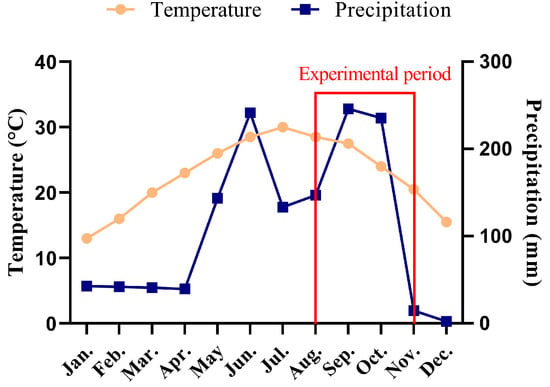
The field experiment was conducted in Hengtang Village, Xiaoyi Town, Nanning City, Guangxi, China (109°14′25″ E, 22°48′20″ N). The region is characterized by a mean annual temperature of 22.4 °C, annual precipitation of 1496.5 mm, and mean sunshine duration of 1631.8 h. The active accumulated temperature is approximately 7900 °C·day (estimated), and the effective accumulated temperature during the rice growing season is approximately 2600–3100 °C·day. Detailed climatic conditions, including the average monthly temperatures and precipitation amounts during the rice growing season, are illustrated in Figure 1.
Figure 1.
Monthly average temperature and precipitation in the study area (Xiaoyi Town, Guangxi, China) in 2023. The red box indicates the duration of the rice growing season during the experimental period. Data were obtained from local government publications.
The cropping system used was a double-cropping rice rotation on paddy soil. The early rice variety was Oryza sativa L. cv. Zhenguiai No.1 (harvested to provide the straw), and the late rice variety was Oryza sativa L. cv. Baixiangyounasi. All rice seedlings were purchased from Guangxi Baixiang High Tech Seed Industry Co., Ltd (Nanning, China). The preliminary chemical composition and basic properties of the soil before the experiment are summarized in Table 1.
Table 1.
Initial chemical composition and basic properties of the experimental soil.
Early rice was harvested on 22 July 2023, and the resulting straw was collected as the raw material for field return. To minimize the confounding effects of mechanical disturbance from deep tillage, all experimental plots were uniformly subjected to mechanical tillage at a depth of 20–25 cm prior to treatment application. The CK treatment received no straw amendment; in the SS treatment, straw was applied to the soil surface; in the SI treatment, straw was incorporated into the soil via deep tillage; and in the SD treatment, straw was applied to the soil surface concurrently with a microbial inoculant designed to accelerate straw decomposition. The straw application rate was standardized at 6.5 t ha−1 across all three straw-amended treatments (SS, SI, and SD). Basal fertilizers were applied simultaneously at rates of 150 kg ha−1 of urea, 90 kg ha−1 of calcium superphosphate, and 120 kg ha−1 of potassium chloride. Late rice seedlings were transplanted on 9 August 2023. Local agronomic management practices were maintained throughout the cultivation period, with irrigation water drawn from local canals to simulate authentic field conditions. Pest, disease, and weed control were conducted in accordance with local standards. The crop was harvested on 19 November 2023, corresponding to a total field growth period of 108 days.
2.3. Soil Collection and Analysis
After the rice harvest, soil samples were collected from the plow layer (0–20 cm) of each experimental plot using a five-point sampling method, targeting the primary root zone. The five subsamples collected from each plot were thoroughly mixed to form a single composite soil sample. A stainless-steel soil auger (Nanjing Ningxi Soil Instrument Co., Ltd., Naning, China)was used to prevent metal contamination. Stones, roots, and debris were removed from the samples, which were then air-dried naturally in a shaded area for over 5 days until a constant weight was achieved to prevent elemental volatilization. The air-dried soil was homogenized, ground, and passed through 1 mm and 0.25 mm sieves, then stored in sealed bags away from light for subsequent analysis.
Soil pH was measured using a pH meter (Testo, 206-pH1, Titisee-Neustadt, Germany) (water:soil = 2.5:1). Soil bulk density and water content were determined using the cutting ring method (100 cm volume) [24]. Water-stable aggregates were analyzed via the wet sieving method [25]. Soil organic matter (SOM) was determined using the Walkley–Black method [26]. Soil available nitrogen (N) was measured using the alkaline hydrolysis diffusion method [27]. Soil available potassium (K) was determined using the rapid determination method, according to standard NY/T 1121.7-2014 [28] issued by the Ministry of Agriculture of China. Available phosphorus (P) was determined by sodium bicarbonate extraction, according to standard HJ 704-2014 [29] issued by the Ministry of Ecology and Environment of China. Soil samples were digested and analyzed for total Se and Cd concentrations using an inductively coupled plasma mass spectrometer (ICP-MS; NexION 350X, PerkinElmer, Shelton, CT, USA). Specifically, approximately 0.2 g of dried, powdered sample was weighed into individual PTFE digestion vessels, followed by the addition of 8 mL of 70% HNO3 and 2 mL of 30% H2O2. After pre-digestion at 80 °C for 30 min, microwave-assisted digestion was performed using a microwave digestion system (Multiwave 5001, Anton Paar, Graz, Austria) at 190 °C for 30 min. The resulting digestates were cooled to room temperature, diluted to 50 mL with ultrapure water, filtered through a 0.45 μm membrane filter, and subsequently analyzed following standard operating procedures. For available Se, extraction was conducted using a KH2PO4–K2HPO4 buffer solution [30]; for available Cd, extraction was performed with a DTPA–CaCl2–TEA buffer solution in accordance with the Chinese Ministry of Ecology and Environment standard HJ 804-2016 [31]. Both available fractions were also determined by ICP-MS. For quality assurance and quality control (QA/QC), a chestnut soil standard reference material (GBW07402-GSS2, nicebiochem, Beijing, China: Se 160 ± 40 μg kg−1, Cd 71 ± 22 μg kg−1) was used. Method validation indicated a relative standard deviation (RSD) of <3%, with recovery rates of 85–112% for Se and 85–107% for Cd. The limits of detection (LOD) and limits of quantification (LOQ) were determined to be 0.013 mg kg−1 and 0.043 mg kg−1 for Se, and 0.008 mg kg−1 and 0.027 mg kg−1 for Cd, respectively.
2.4. Plant Harvest and Analysis
Rice harvesting and sampling were also conducted using the five-point sampling method. In each plot, five 1 m2 quadrats were established, and all aboveground biomass within each quadrat was harvested to obtain five subsamples. These subsamples were then combined to form a single composite sample per plot, with each plot serving as an independent experimental unit. Upon collection, samples were initially oven-dried at 105 °C for 30 min to deactivate enzymes, followed by drying at 75 °C for over 48 h until a constant weight was achieved. Rice grains were dehusked to isolate brown rice. The dried brown rice samples were ground into powder using a ball mill, sequentially passed through 1 mm and 0.25 mm sieves, and stored in sealed, light-proof bags for subsequent analysis.
The determination of N, P, and K in brown rice was conducted in accordance with standard NY/T 2017-2011 [32] issued by the Ministry of Agriculture of China, utilizing the Kjeldahl method, vanadium molybdate yellow colorimetry, and flame photometry, respectively. Total Se and Cd contents in brown rice were analyzed following the National Standards of China GB 5009.93-2017 [33] and GB 5009.15-2014 [34], respectively. Prior to instrumental analysis, brown rice samples were digested as follows: approximately 0.2 g of dried, powdered grain sample was placed into a digestion tube, to which 3 mL of 70% HNO3 and 1 mL of 37% HCl were added. The mixture was pre-digested at 80 °C for 30 min, followed by Multiwave 5001 microwave-assisted digestion at 190 °C for 30 min. After cooling, the digestate was transferred to a centrifuge tube and diluted to a final volume of 50 mL with ultrapure water. Se concentrations were determined using a fluorescence spectrophotometer (Model Lumina, Thermo Fisher Scientific, Waltham, MA, USA), and Cd concentrations were measured using an atomic absorption spectrometer (Model WFX-810, Beijing Beifen Ruili Analytical Instruments (Group) Co., Ltd., Beijing, China). The calibration standards were prepared using a Se standard solution (Codow CD442779, Guangzhou, China) and a Cd standard solution (Zhongchang GuoyanGSB04-1721-2004, Wuhan, China), respectively.
At maturity, yield components were determined by randomly sampling 10 hills from the center of each plot to assess effective panicle number per hill; from these sampled hills, 3 panicles per hill were further selected to determine spikelets per panicle, seed-setting rate, and 1000-grain weight through manual counting and weighing. The theoretical yield was calculated using the following empirical formula:
TheoreticalYield (t ha−1) = Effective Panicles × Spikelets per Panicle × Seed Setting Rate × 1000 − grain Weight (g) × 10−5
It should be explicitly noted that actual harvested grain yield was not independently measured at the plot level in this study. Consequently, all yield-related data and interpretations presented herein refer exclusively to theoretical yield derived from the above components.
2.5. Statistical Analysis
One-way ANOVA was performed using IBM SPSS 23.0 to evaluate the effects of different treatments. Prior to ANOVA, the assumptions of normality and homogeneity of variance were verified using the Kolmogorov–Smirnov test and Bartlett’s test, respectively. Where ANOVA revealed significant treatment effects, post hoc multiple comparisons were conducted using Tukey’s honestly significant difference (HSD) test at p < 0.05. All graphs were generated using Origin 2021 and GraphPad Prism 8.0.2. Correlations between soil chemical properties and soil Se/Cd fractions were assessed using Spearman’s rank correlation coefficient. For these correlation analyses, plot-level mean values were used as the independent observations (n = 12; 4 treatments × 3 replicate plots), with each plot serving as the independent experimental unit.
3. Results
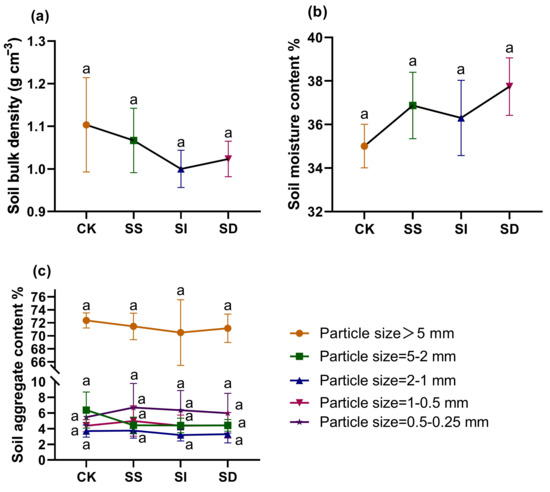
3.1. Changes in Soil Physical Properties
The variations in soil physical properties under different straw return practices are depicted in Figure 2. As observed, all three straw return strategies decreased soil bulk density and concurrently increased soil moisture content; however, no statistically significant differences were detected for these variations. Regarding the soil aggregate fractions, particles > 5 mm constituted the highest proportion, accounting for approximately 70% of the total aggregates. Moreover, straw return did not significantly alter the size distribution of the soil aggregates. Overall, straw return appears to exert no substantial impact on the physical properties of the soil.
Figure 2.
Soil physical properties under different straw return strategies (CK: control; SS: straw applied to the soil surface; SI: straw incorporated deeply into the soil; and SD: straw applied to the soil surface with a straw-decomposing microbial agent). The properties include: (a) soil bulk density, (b) soil moisture content, and (c) soil aggregate content. Different lowercase letters near the points indicate significant differences among treatments at p < 0.05. Values are presented as mean ± SD.
3.2. Changes in Soil Chemical Properties
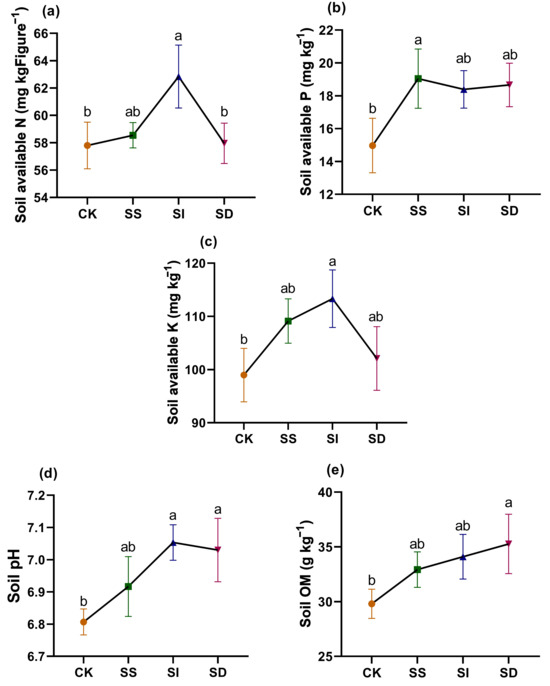
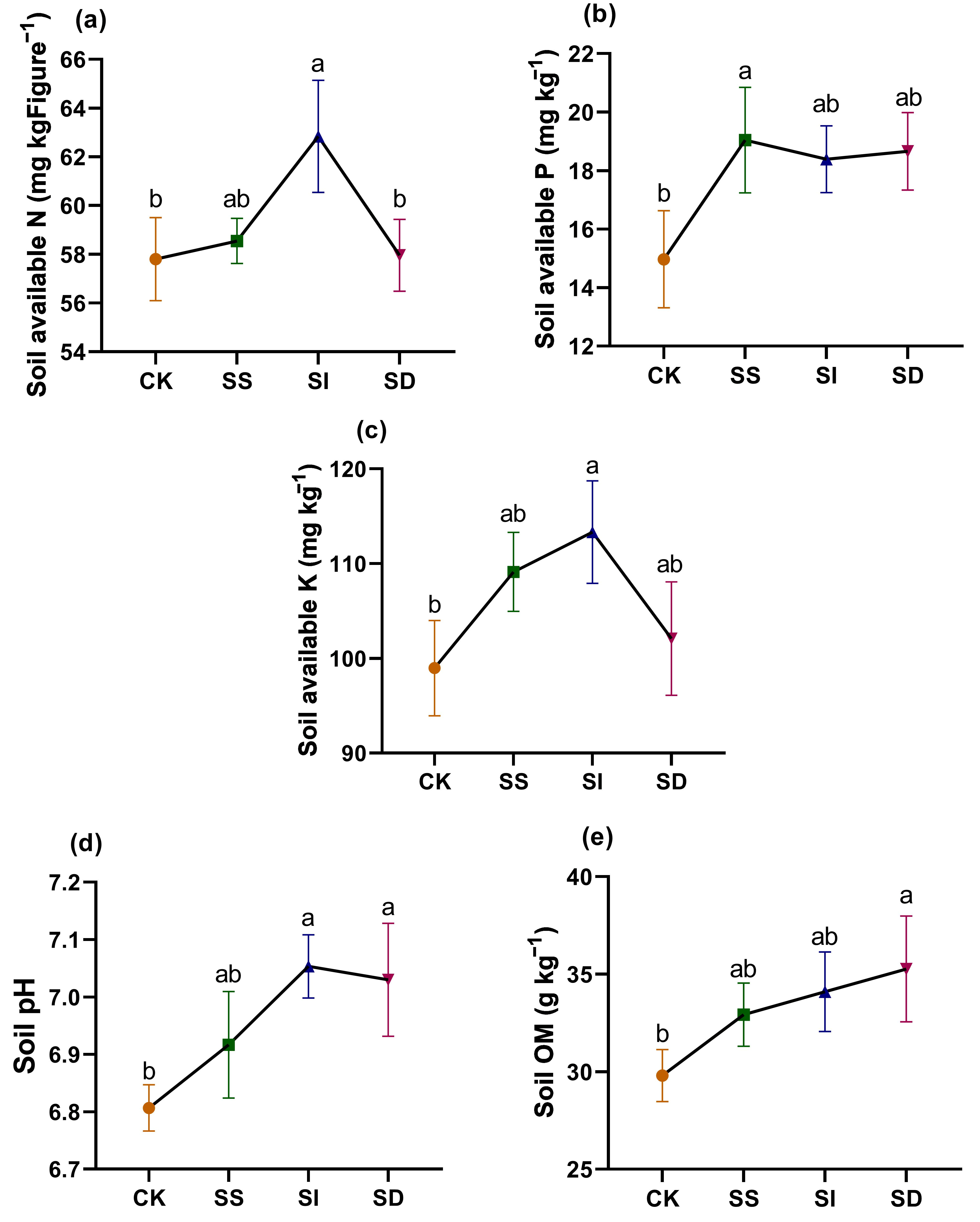
The changes in soil chemical properties under various straw return strategies were illustrated in Figure 3. Generally, straw return increased the soil available N, P, and K contents to varying degrees. Compared to the control (CK), the available N, P, and K contents exhibited maximum significant increases of 8.72% (under the SI treatment), 27.19% (SS), and 14.49% (SI), respectively. Furthermore, straw return enhanced both soil pH and soil OM content, yielding maximum increases of 3.51% and 14.43%, respectively. Overall, straw return exerted a positive effect on the availability of soil N, P, and K, with straw incorporated deeply into the soil demonstrating the most pronounced impact on these nutrients.
Figure 3.
Soil chemical properties under different straw return strategies (CK: control; SS: straw applied to the soil surface; SI: straw incorporated deeply into the soil; and SD: straw applied to the soil surface with a straw-decomposing microbial agent). The properties include: (a) available nitrogen; (b) available phosphorus; (c) available potassium; (d) soil pH; and (e) soil organic matter. Different lowercase letters near the points indicate significant differences among treatments at p < 0.05. Values are presented as mean ± SD.
3.3. Variations in Soil Se and Cd Concentrations
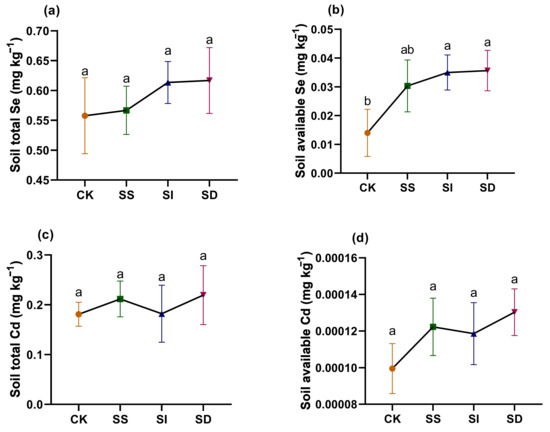
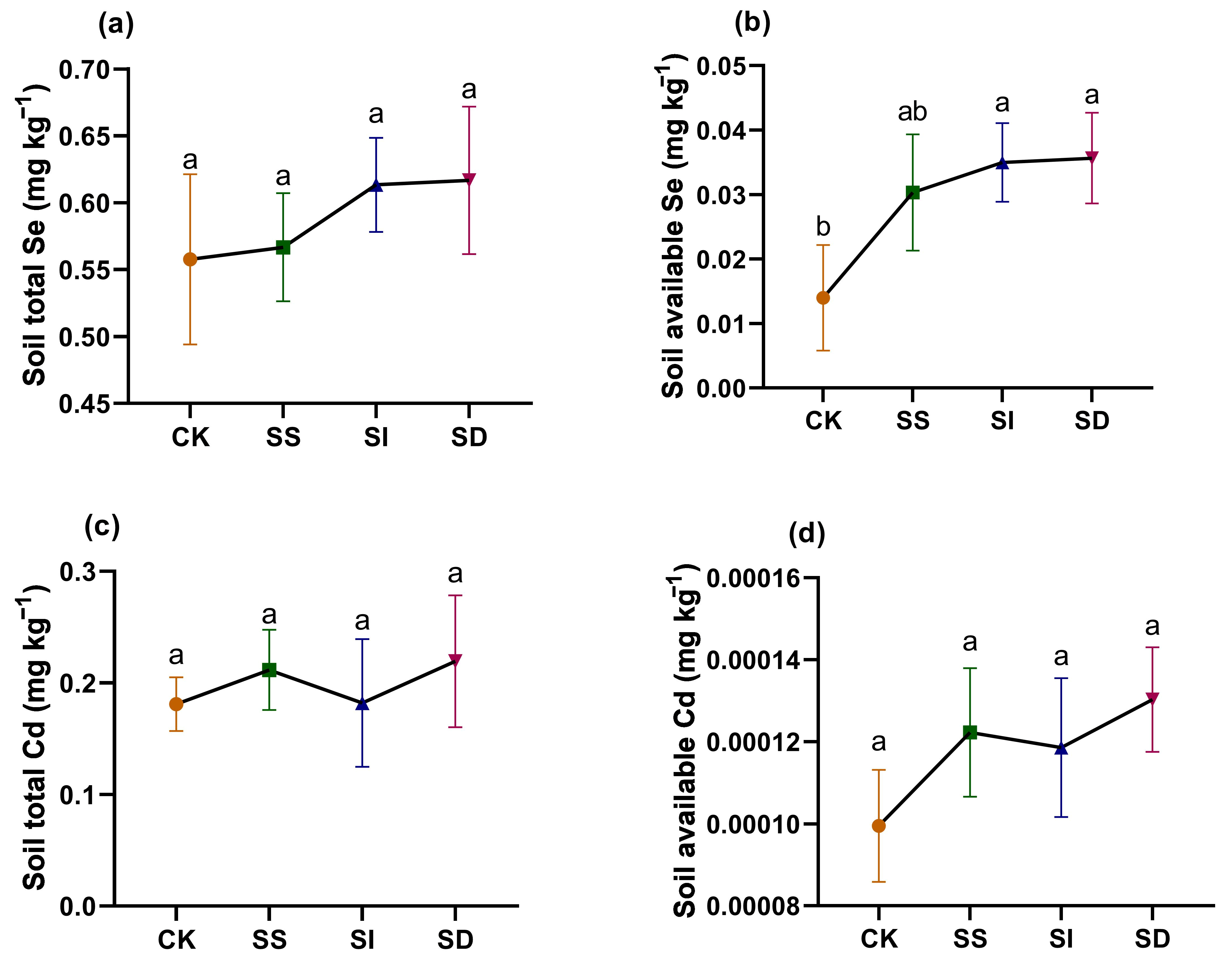
The effects of different straw return strategies on the total and available concentrations of soil Se and Cd are illustrated in Figure 4. In contrast to the three macronutrients, total Se concentrations in all straw-return treatments showed a slight but non-significant increase, ranging from 1.61% to 10.58%; notably, the SD treatment exhibited the highest soil total Se concentration. In contrast to total Se, available Se increased substantially by 116.67–154.76%, with both SI and SD treatments showing significantly higher values than CK. Soil Cd followed a similar pattern: relative to CK, total Cd concentrations in straw-return treatments showed numerical increases ranging from 18.20% to 21.93%, with the SD treatment recording the highest value; however, these differences were not statistically significant (p > 0.05). Similarly, available Cd exhibited non-significant numerical increases of 19.20–30.96% across all straw-return treatments compared to CK.
Figure 4.
Soil selenium (Se) and cadmium (Cd) concentrations under different straw return strategies (CK: control; SS: straw applied to the soil surface; SI: straw incorporated deeply into the soil; and SD: straw applied to the soil surface with a straw-decomposing microbial agent). The properties include: (a) soil total Se; (b) soil available Se; (c) soil total Cd; (d) soil available Cd. Different lowercase letters near the points indicate significant differences among treatments at p < 0.05. Values are presented as mean ± SD.
3.4. Plant Physiological Properties
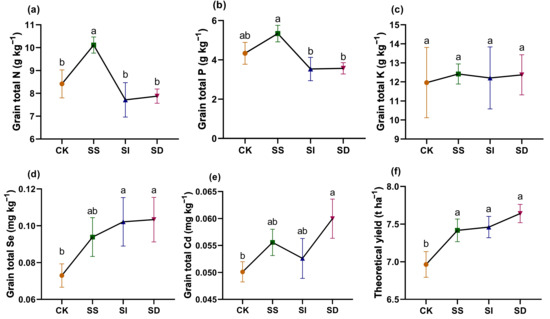
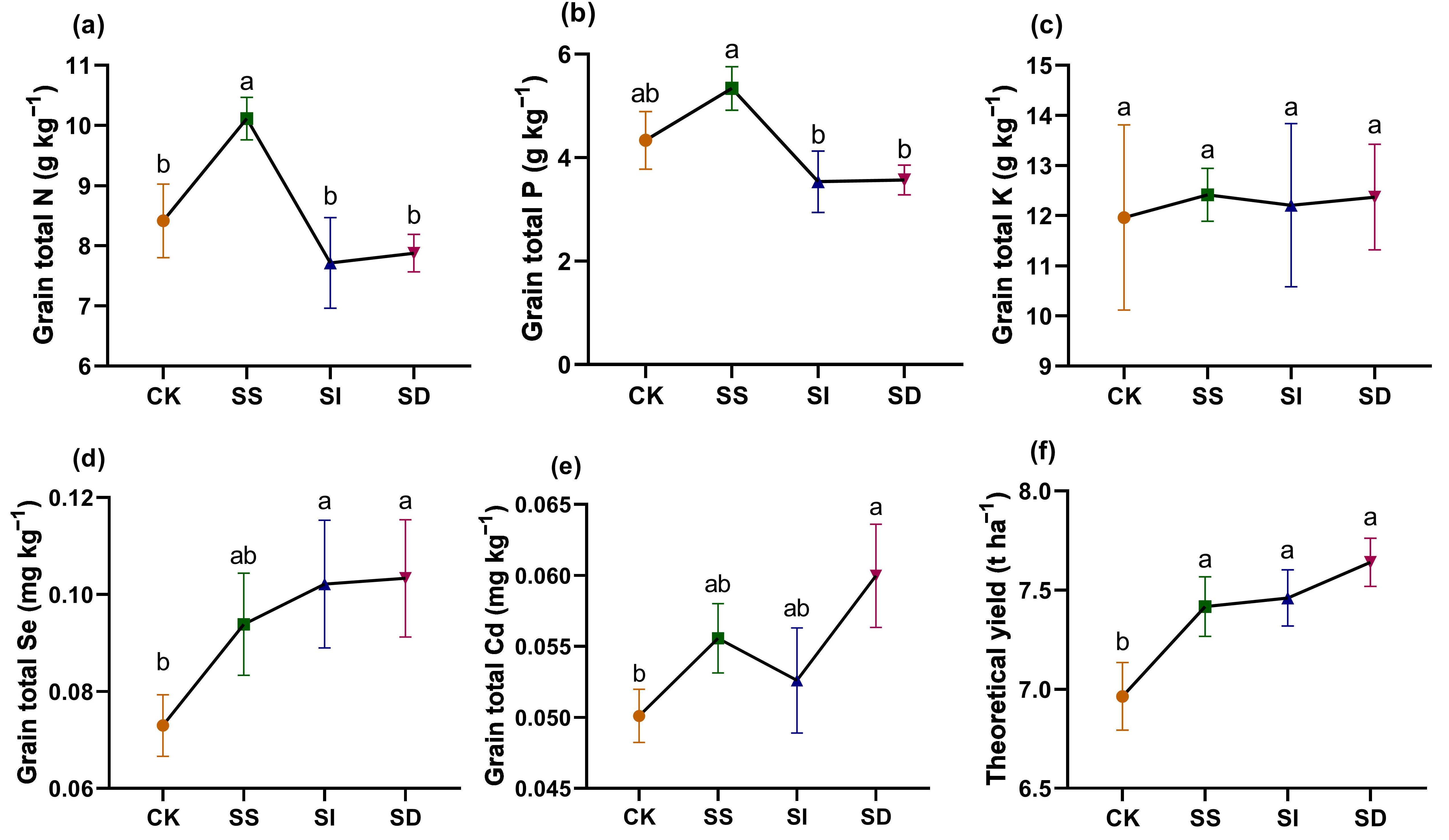
The effects of various straw return practices on elemental concentrations and the theoretical yield of rice grains were illustrated in Figure 5. Regarding the three macronutrients, straw return did not significantly alter the N, P, and K concentrations in the grains and even resulted in slight decreases; a significant increase in grain N concentration was observed only in the SS treatment. However, the theoretical grain yield significantly increased under all three straw return treatments, achieving a maximum theoretical yield increment of 6.51% to 9.07%. Concurrently, straw return increased grain Se concentrations by 28.64–41.62%, although statistical significance was achieved only in the SI and SD treatments. Similarly, grain Cd concentrations were elevated by 4.99–19.69%, yet a significant increase was observed only in the SD treatment. Notably, the SI treatment exhibited a favorable effect of Se enrichment coupled with no significant increase in grain Cd; specifically, grain Se was significantly elevated, whereas the increment in grain Cd remained marginal. In summary, although straw return exerts no significant overall impact on macronutrient concentrations in rice grains, it effectively enhances theoretical grain yield. Furthermore, the concurrent accumulation of Se and Cd induced by straw return is highly treatment-specific: significant improvements in Se-enrichment capacity are confined to the SI and SD treatments, whereas the risk of grain Cd contamination is significantly exacerbated only under the SD treatment.
Figure 5.
Plant physiological properties under different straw return strategies (CK: control; SS: straw applied to the soil surface; SI: straw incorporated deeply into the soil; and SD: straw applied to the soil surface with a straw-decomposing microbial agent). The properties include: (a) grain total nitrogen; (b) grain total phosphorus; (c) grain total potassium; (d) grain total selenium; (e) grain total cadmium; (f) rice theoretical yield. Different lowercase letters near the points indicate significant differences among treatments at p < 0.05. Values are presented as mean ± SD.
3.5. Correlations Between Soil Physicochemical Properties and Element Contents in Grains
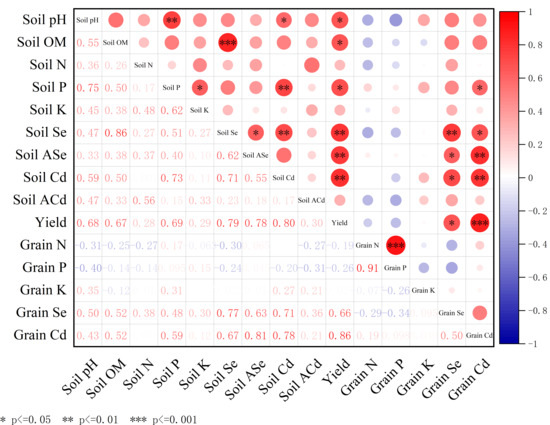
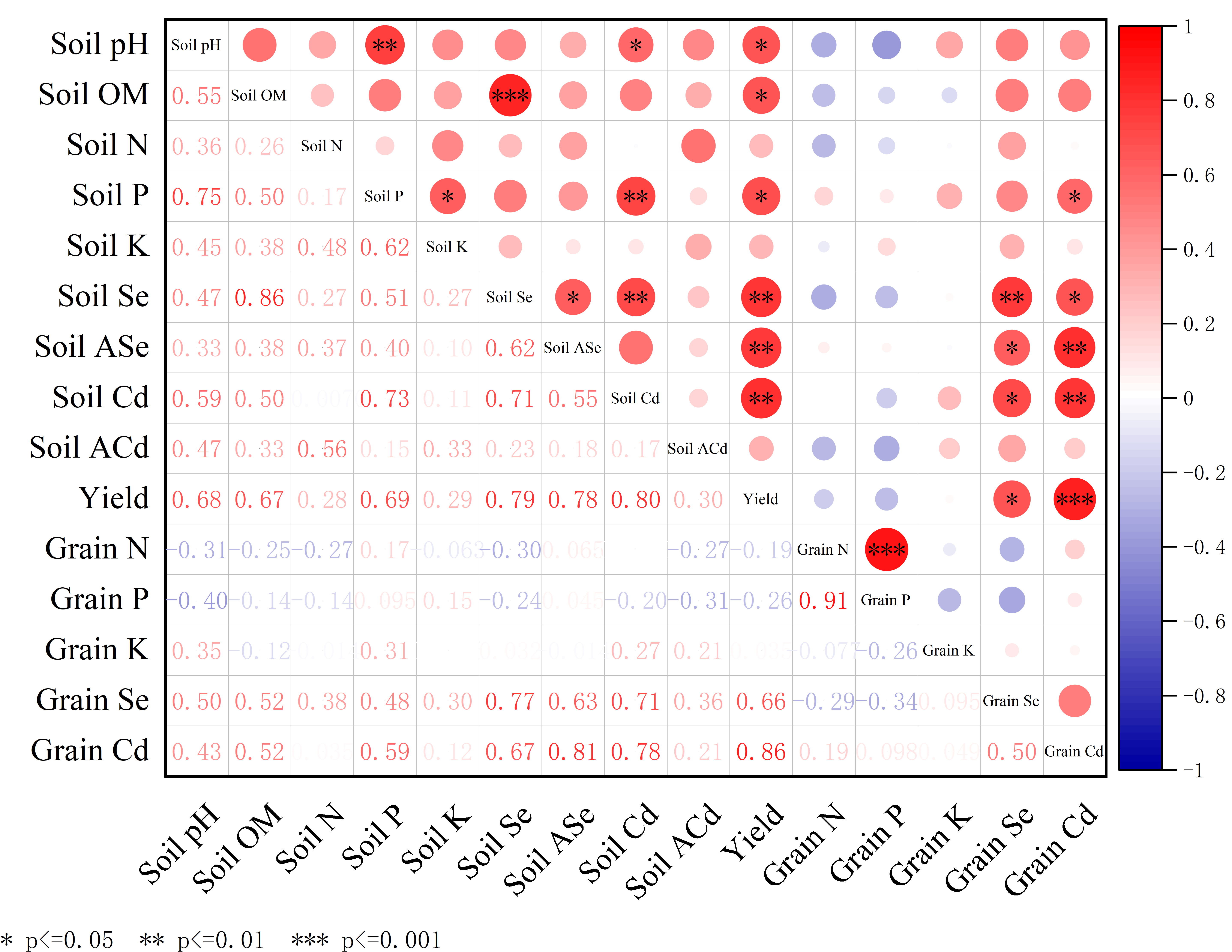
The relationships between soil physicochemical properties and grain elemental concentrations were evaluated using Spearman correlation analysis, and the resulting correlations are illustrated in Figure 6. Specifically, rice theoretical yield was positively correlated with soil pH, soil organic matter content, and the concentrations of P, total Se, and total Cd. Regarding trace elements, the Se concentration in rice grains exhibited a positive correlation with both total and available soil Se. Similarly, a positive correlation was observed between grain Cd concentration and total soil Cd content.
Figure 6.
Spearman’s correlation analysis of comparisons among soil physicochemical properties and element contents in grains. Soil ASe = soil available Se; soil ACd = soil available Cd. ***, p < 0.001; **, p < 0.01; *, p < 0.05.
4. Discussion
4.1. Effects of Straw Return on Soil Physicochemical Properties
The effects of various straw return strategies on soil physical and chemical properties are shown in Figure 2 and Figure 3, respectively. The various straw return strategies increased soil available N, P, and K contents to varying degrees, primarily attributable to the biochemical decomposition mediated by soil microorganisms, such as bacteria and fungi [35]. Previous studies have demonstrated that soil microorganisms in the vicinity of the straw colonize the residues upon acquiring abundant carbon sources [36], thereby significantly enhancing soil microbial abundance and diversity [37]. The decomposition of rice straw typically exhibits an initial rapid phase followed by a slower phase [38]. This deceleration occurs because, as readily degradable compounds are depleted, the relative proportion of complex, recalcitrant organic matter increases, consequently reducing the overall decomposition rate [39]. Among these components, hemicellulose exhibits the highest degradation rate, followed by cellulose, while lignin decomposes at the slowest rate [40]. Regarding mineralization and nutrient release dynamics, K is released most rapidly, followed by P, whereas N exhibits the slowest release rate [41].
Notably, the growth period of the late rice crop in this study (approximately three months) was insufficient for the complete decomposition of the incorporated straw. A previous study conducted in Northeast China indicated that the decomposition rate of rice straw over a three-month period was approximately 47.3% [42]. However, as straw decomposition was not directly measured in this experiment, no quantitative estimate can be provided for the present site. Furthermore, straw return significantly increased soil pH under the SI and SD treatments compared to CK, whereas no significant difference was observed between SS and CK. Similarly, soil organic matter content was significantly elevated only under the SD treatment; neither SS nor SI differed significantly from CK. These results are partially consistent with the findings of Li et al. [5], who reported general improvements in soil properties following straw incorporation. This demonstrates that straw return effectively counteracts soil acidification and enhances soil fertility, primarily due to the generation of alkaline cations and the augmentation of soil organic carbon during the decomposition process [43]. However, Cheng et al. noted that the impact of straw return on soil pH is highly dependent on specific soil properties [44]; while straw decomposition increases the pH of acidic soils, it can decrease the pH of alkaline soils owing to the production of organic acids during microbial degradation [45]. In contrast, the impact of straw return on soil physical properties was relatively limited.
Among the evaluated straw return strategies, deep incorporation of straw into the soil (SI treatment) exhibited the most pronounced effect on enhancing soil nutrient availability, particularly regarding soil N content. This observation aligns with the findings of Ling et al. [46]. Mechanistically, this phenomenon can be attributed to two primary factors. Firstly, deep incorporation places straw in soil layers that maintain more stable and optimal moisture conditions compared to the surface layer, which is prone to evaporation and drastic drying-wetting cycles. This stable moisture environment promotes the proliferation and activity of soil microorganisms and their extracellular enzymes, thereby accelerating the decomposition of straw and the release of dissolved organic carbon [47]. Secondly, as the deeply incorporated straw decomposes, it releases organic compounds rich in oxygen-containing functional groups that carry negative charges. These decomposed residues significantly increase the soil’s cation exchange capacity, conferring a strong electrostatic adsorption capacity for ammonium produced by urea hydrolysis. This adsorption, coupled with microbial nitrogen immobilization during the decomposition of high C/N ratio straw, effectively reduces nitrogen leaching and gaseous losses, thereby further bolstering the overall nitrogen retention capacity of the soil [48]. Huang et al. further proposed that in regions with an average annual precipitation exceeding 800 mm, deep burial of straw outperforms surface application [49]. Conversely, the surface application of straw combined with a decomposing microbial agent (SD treatment) demonstrated only a moderate capacity for elevating soil nutrients. It is postulated that while the addition of the microbial agent accelerates straw degradation, the ensuing rapid release of nutrients simultaneously exacerbates their susceptibility to severe leaching and loss. The above literature may explain the potential mechanisms underlying the significant increase in soil available N induced by deep straw incorporation.
Overall, straw return enhanced soil nutrient contents, soil pH, and soil OM. This improvement is primarily attributable to the microbial decomposition and mineralization of the straw residues, coupled with their inherent adsorption capacity. Notably, deep straw incorporation emerged as the most effective strategy for enhancing soil fertility.
4.2. Effects of Straw Return on Rice Theoretical Yield
The results of this study indicate that straw return significantly increased rice theoretical yield without elevating the N, P, and K concentrations in the grains (Figure 5), which is consistent with the findings of numerous other studies [5,43,50]. However, a recent meta-analysis indicated that straw return treatments tend to decrease crop yields when the mean annual precipitation is excessively low (<500 mm) or high (>1200 mm). In arid regions with low precipitation (<500 mm), the decomposition of returned straw competes with crops for limited soil moisture. Furthermore, the increased soil porosity caused by undecomposed straw can exacerbate soil water evaporation, thereby aggravating water stress and reducing yield. Conversely, in regions with excessive precipitation (>1200 mm), high soil moisture combined with straw incorporation often creates waterlogged and anaerobic conditions. This environment inhibits aerobic microbial decomposition and promotes the accumulation of phytotoxic substances. Additionally, the resulting root hypoxia and the increased risk of soil-borne diseases under high humidity can severely compromise crop root development and overall yield [50]. Furthermore, it is highly recommended to combine straw return with N fertilizer application or to appropriately increase the proportion of N in the basal fertilizer [51]. This is because decomposing straw residues can compete with seedlings for N, an element crucial for crop growth [52]. Excessive straw application or improper fertilization can lead to an imbalance in the soil carbon-to-nitrogen (C/N) ratio, potentially exerting negative effects on crop growth [53]. Therefore, it is essential to implement appropriate straw return practices, carefully considering the ratio of the straw return rate to the N application rate [44].
Additionally, returned straw can serve as a primary inoculum source for pathogens, potentially increasing the risk of crop disease transmission and ultimately compromising crop theoretical yield [54]. For instance, Shan et al. reported that straw return elevated the incidence of rice sheath blight and rice false smut diseases [6]. Conversely, it has also been reported that straw return can reduce pathogen populations [55], presumably because it promotes lignin accumulation, thereby enhancing the crop’s resistance to pathogens [56]. Regarding pest infestations, several studies have documented that straw return may bolster pest control efficacy by promoting the reproduction of natural enemies, such as predators and parasitoids [57]. For example, Seimandi-Corda et al. demonstrated that the application of straw mulch significantly reduced crop damage caused by cabbage stem flea beetle adults [58]. Similarly, Kirchner et al. (2014) reported that straw mulching alleviated aphid infestations [59], a mechanism primarily attributed to the visual disruption of the aphids’ host-finding behavior caused by the mulch [60]. Nevertheless, the implementation of straw return must be coupled with rigorous pest and disease management strategies, such as crop rotation and the use of biocontrol agents, to effectively regulate pest populations and maximize the benefits of straw return.
Overall, both in this study and in the majority of regions, straw return contributes to enhanced crop theoretical yield, with negligible differences in theoretical yield improvement observed among various return strategies. However, careful attention must be paid to supplemental N topdressing and comprehensive pest and disease management to avert any potential negative impacts on crop theoretical yield.
4.3. Impact of Straw Return on Se Accumulation in Soil and Rice Grains
The total and available Se concentrations in the soil under various straw return strategies are depicted in Figure 4a and Figure 4b, respectively, whereas the variations in grain Se concentrations are illustrated in Figure 5d. Following straw return, total soil Se concentrations exhibited a slight, albeit statistically non-significant, increase. In contrast, both soil available Se and grain Se concentrations were significantly elevated. Analogous to macronutrients such as N, P, and K, the Se contained within the rice straw undergoes decomposition and mineralization, ultimately returning to the soil system [61]. However, as the Se concentration in the returned straw was not measured in this study, the net input of Se into the soil via mineralization remains uncertain but is presumed to be relatively low based on typical values reported in the literature [20]. This may help explain the non-significant variation observed in total soil Se content. Consequently, based on previous studies, straw return strategies are hypothesized to enhance crop Se biofortification primarily by increasing Se bioavailability through complex interactions between Se and organic matter derived from straw decomposition [19]. For instance, Dalai et al. demonstrated via X-ray absorption spectroscopy that organic matter can potentially mediate the reduction in selenate to selenite [62]. Furthermore, Dinh et al. reviewed how organic acids may interact with soil Se via adsorption, complexation, and reduction processes; such interactions are thought to govern the immobilization and mobilization of Se, thereby modulating its bioavailability [63]. Additionally, straw residues could supply supplementary electron donors and carbon sources for microbial activity, which might in turn promote the biological reduction of Se in the soil [64]. Huang et al. also reported that increased soil P content resulting from straw decomposition can facilitate Se desorption, further enhancing its bioavailability [65]. These literature-based mechanisms offer plausible explanations for the significant increase in soil available Se observed in the present study. This bioavailable fraction is readily absorbed and utilized by plants [66], a notion supported by the correlation analysis in Figure 5, which reveals a positive association between grain Se concentration and both total and available soil Se.
Regarding the comparison among different straw return strategies, both SI and SD treatments exhibited significant elevations in grain Se concentrations, with values exceeding 0.1 mg kg−1 and surpassing the Chinese national standard for Se-enriched rice (>0.04 mg kg−1; GB/T 22499-2008 [67]). According to previous research, deep straw incorporation (SI) tends to augment soil organic matter content and microbial abundance [68], which may synergistically enhance Se availability. Conversely, the application of a straw-decomposing microbial agent (SD) introduces exogenous microorganisms that could potentially amplify microbial abundance, accelerate straw decomposition, and hasten Se release. Such literature-supported processes may account for the superior Se biofortification performance observed in the SD treatment. Overall, it is proposed that straw return achieves crop Se biofortification primarily by promoting the transformation of soil Se into bioavailable fractions through organic matter–microorganism interactions, rather than by merely increasing total Se concentration.
4.4. Impact of Straw Return on Cd Accumulation in Soil and Rice Grains
Similarly, the total and available Cd concentrations in soil under various straw return strategies are depicted in Figure 4c and Figure 4d, respectively, whereas variations in grain Cd concentrations are illustrated in Figure 5e. Following straw return, total soil Cd concentrations exhibited little variation, whereas soil available Cd showed a slight but non-significant increase. Notably, grain Cd concentration increased significantly only under the SD treatment. Crop straw from contaminated paddy fields typically accumulates substantial Cd, and its return poses a risk of exacerbating Cd pollution [69]. In the present study, the baseline soil Cd concentration was 0.22 mg kg−1, below the threshold stipulated by the Chinese National Standard GB 15618-2018 [70] (<0.6 mg kg−1 for 6.5 < soil pH ≤ 7.5). While this suggests that straw return may be feasible under these specific soil conditions, its overall suitability must also be evaluated in light of Cd bioavailability and grain Cd accumulation—particularly given the significant elevation observed under SD—to ensure food safety and long-term sustainability.
However, numerous studies have indicated that the total Cd content in the soil does not merely increase in direct proportion to the amount of straw returned. Conversely, the accumulation, migration, and transformation of Cd in the soil constitute a complex and dynamic process involving adsorption and desorption associated with soil particles, diffusion and seepage within the soil solution, as well as microbial uptake and mineralization [6]. For instance, Huang et al. reported that rice straw return increased Cd availability by inducing the production of hydroxyl radicals (·OH) [65]. Likewise, Darma et al. observed that the application of maize straw enhanced Cd mobility in alkaline-contaminated soils [71]. While straw return may amplify Cd-related risks in contaminated acidic paddy soils [72], other studies argue that long-term straw return does not directly result in significant Cd accumulation [73] and may even mitigate the risk of Cd pollution. For example, the organic matter derived from straw return significantly enhances the adsorption of NH4+ [74], thereby elevating soil pH and promoting Cd adsorption onto soil colloids, which consequently substantially reduces the exchangeable Cd content in the soil [75]. Furthermore, Liu et al. discovered that C=O and C=C functional groups within straw decomposition products participate in interactions with Cd; these functional groups can form stable complexes with Cd ions, effectively immobilizing Cd in the soil [76]. Additional research indicates that straw return can influence iron and sulfur redox reactions in the soil, thereby affecting Cd migration [77,78,79]. Overall, straw return collectively influences Cd accumulation in crops through multiple pathways [21]. Therefore, carefully formulating straw return strategies tailored to local soil conditions is crucial for mitigating the risk of Cd pollution [80].
Among the various straw return strategies evaluated in this study, the application of straw with the addition of a decomposing microbial agent (the SD treatment) was the sole strategy that significantly increased Cd content in the rice. This can likely be attributed to microbial action accelerating straw decomposition [81,82], thereby hastening Cd release. However, these conclusions are derived from a synthesis of previous studies; further investigation into soil microbial composition is still required to elucidate the specific underlying mechanisms.
4.5. Significance and Future Perspectives
This study evaluated the impacts of various straw return strategies on soil properties and rice performance within a typical paddy field ecosystem in the subtropical region of Guangxi, China. The results indicate that, under the conditions of this study, incorporating straw deeply into the soil effectively enhanced crop theoretical yield and significantly elevated grain Se content. Notably, this strategy did not lead to a significant increase in grain Cd accumulation. Given the widespread co-occurrence of high Se and Cd in Guangxi paddy soils [83], and that over two-thirds of Se-enriched soils in southern China exceed the safety threshold for Cd [84], this approach is regarded as an optimal straw return strategy, capable of simultaneously achieving effective Se biofortification without significantly increasing Cd accumulation in rice. These findings provide a solid empirical basis for regional agricultural development and the expansion of the Se-enriched industry in Guangxi, bearing profound implications for agricultural safety and the protection of human health.
Nevertheless, certain limitations of the present study must be acknowledged. First and foremost, this experiment was conducted at a single site during only one rice-growing season, which inherently limits the generalizability of the results; therefore, the long-term effectiveness and broader applicability of the tested straw-return strategies should be interpreted with caution and validated through multi-site, multi-year trials. Additionally, although the tested soil (Se content: 0.54 mg kg−1) met the minimum threshold for Se-enriched soils (≥0.40 mg kg−1), its total Se and Cd concentrations were relatively low and slightly below the mean value (0.67 mg kg−1) reported for a specific Se-enriched area in Guangxi [85]. More pronounced outcomes are anticipated if future trials are conducted in soils characterized by higher baseline Se and Cd concentrations. Furthermore, future research should employ advanced analytical techniques, such as Fourier-transform ion cyclotron resonance mass spectrometry (FT-ICR MS) [86], to comprehensively elucidate the molecular characteristics of the organic matter released during straw decomposition and its regulatory roles in Se and Cd dynamics. Moreover, the current study did not model the dynamic fluctuations of Se and Cd concentrations during the critical heading, flowering, and grain-filling stages of rice, which is essential for thoroughly understanding the uptake mechanisms of these elements by the plant. Simultaneously, the profound influence of microorganisms within the soil system cannot be overlooked. Targeted assessments of microbial community structures, specific functional genes, and enzyme activities are imperative for a holistic understanding of how dissolved organic matter modulates the behavior of the Se/Cd system in the soil. In conclusion, the precise mechanisms underpinning crop Se biofortification driven by straw return warrant further systematic investigation.
5. Conclusions
This study evaluated the impacts of various straw return strategies on soil physicochemical properties and rice growth performance in a typical paddy field ecosystem in the subtropical region of Guangxi, China. The findings demonstrate that straw return enhanced soil macronutrient availability (N, P, K contents), but its effects on soil pH and organic matter were treatment-specific: significant increases occurred under SI and SD for pH and only under SD for organic matter, whereas SS showed no significant improvement in either parameter. Meanwhile, the ameliorative effects of all straw-return practices on soil physical properties remained limited. Importantly, these practices contributed to a notable increase in theoretical yield by 6.51–9.07%. Furthermore, straw return did not significantly alter total soil Se or Cd concentrations, but primarily modulated their bioavailable fractions through interactions between Se, Cd, and organic matter. Consequently, this dynamic facilitated substantial Se biofortification in rice grains, with increments ranging from 28.64–41.62%, albeit accompanied by a 4.99% to 19.69% increase in grain Cd accumulation.
Among the evaluated practices, incorporating straw deeply into the soil (below the 20 cm layer; SI) emerged as a promising strategy in this experiment. This approach synergistically achieved significant theoretical yield enhancement and grain Se biofortification without provoking a statistically significant increase in Cd uptake, suggesting its potential applicability for regional Se-enriched rice production. Ultimately, this single-site, single-season study provides preliminary empirical evidence supporting “Se-enrichment coupled with Cd-unchanged” straw management strategies in paddy fields characterized by naturally high Se and elevated Cd backgrounds. Wider regional applicability across the subtropical regions of southern China should be confirmed through multi-site and multi-year field studies.
Author Contributions
X.H.: data analysis, visualization, writing—original draft, revision and finalization. B.L.: experiment conducting, data collection. M.N.: conceptualization, project administration, supervision. L.P.: writing—review and editing. Y.X.: writing—review and editing. Q.L.: writing—review and editing. J.C.: writing—review and editing. Y.L.: conceptualization, project administration, supervision, funding acquisition. All authors have read and agreed to the published version of the manuscript.
Funding
We gratefully acknowledge the financial support from the Joint Fund of the National Natural Science Foundation of China (U23A2040), the Guangxi Science and Technology Program (GuikeZG2600640023, GuikeZY24212009, GuikeAB24010136 and GuikeAB23075170), the Independent Research Project of the Guangxi Key Laboratory of Arable Land Conservation (23-026-12-25ZZYJ02) and the Selenium Enhancement Industry Science and Technology Pioneer Special Project (Guinongkemeng202614).
Institutional Review Board Statement
Not applicable.
Informed Consent Statement
Not applicable.
Data Availability Statement
The data presented in this study are available on request from the corresponding author due to the sensitivity and confidentiality of the data.
Conflicts of Interest
The authors declare no conflicts of interest.
References
- Wang, X.; Yang, Z.; Liu, X.; Huang, G.; Xiao, W.; Han, L. The composition characteristics of different crop straw types and their multivariate analysis and comparison. Waste Manag. 2020, 110, 87–97. [Google Scholar] [CrossRef] [Scilit] [PubMed]
- Ninkuu, V.; Liu, Z.; Qin, A.; Xie, Y.; Song, X.; Sun, X. Impact of straw returning on soil ecology and crop yield: A review. Heliyon 2025, 11, e41651. [Google Scholar] [CrossRef] [Scilit] [PubMed]
- Bao, Y.; Feng, Y.; Stegen, J.C.; Wu, M.; Chen, R.; Liu, W.; Zhang, J.; Li, Z.; Lin, X. Straw chemistry links the assembly of bacterial communities to decomposition in paddy soils. Soil Biol. Biochem. 2020, 148, 107866. [Google Scholar] [CrossRef] [Scilit]
- Cheng, J.; Lin, B.-J.; Chen, J.-S.; Duan, H.-X.; Sun, Y.-F.; Zhao, X.; Dang, Y.P.; Xu, Z.-Y.; Zhang, H.-L. Strategies for crop straw management in China’s major grain regions: Yield-driven conditions and factors influencing the effectiveness of straw return. Resour. Conserv. Recycl. 2025, 212, 107941. [Google Scholar] [CrossRef] [Scilit]
- Li, S.; Liu, M.; Huang, H.; Zhao, L.; Zhuang, M.; Wang, C. Effects of long-term straw return on grain yield stability in China: A meta-analysis. Field Crops Res. 2026, 335, 110175. [Google Scholar] [CrossRef] [Scilit]
- Shan, A.; Pan, J.; Kang, K.J.; Pan, M.; Wang, G.; Wang, M.; He, Z.; Yang, X. Effects of straw return with N fertilizer reduction on crop yield, plant diseases and pests and potential heavy metal risk in a Chinese rice paddy: A field study of 2 consecutive wheat-rice cycles. Environ. Pollut. 2021, 288, 117741. [Google Scholar] [CrossRef] [Scilit] [PubMed]
- Alengebawy, A.; Abdelkhalek, S.T.; Qureshi, S.R.; Wang, M.-Q. Heavy metals and pesticides toxicity in agricultural soil and plants: Ecological risks and human health implications. Toxics 2021, 9, 42. [Google Scholar] [CrossRef] [Scilit] [PubMed]
- Zong, Y.; Chen, H.; Malik, Z.; Xiao, Q.; Lu, S. Comparative study on the potential risk of contaminated-rice straw, its derived biochar and phosphorus modified biochar as an amendment and their implication for environment. Environ. Pollut. 2022, 293, 118515. [Google Scholar] [CrossRef] [Scilit] [PubMed]
- Xu, H.; Huang, Y.; Xiong, X.; Zhu, H.; Lin, J.; Shi, J.; Tang, C.; Xu, J. Changes in soil Cd contents and microbial communities following Cd-containing straw return. Environ. Pollut. 2023, 330, 121753. [Google Scholar] [CrossRef] [Scilit] [PubMed]
- Su, Y.; Kwong, R.W.M.; Tang, W.; Yang, Y.; Zhong, H. Straw return enhances the risks of metals in soil? Ecotoxicol. Environ. Saf. 2021, 207, 111201. [Google Scholar] [CrossRef] [Scilit] [PubMed]
- Liu, Y.; Zeng, H.; Zhou, H.; Zhang, S.; Tie, B.; Peng, L.; Zeng, Q.; Peng, H.; Luo, S. Variation of Cd and As accumulation in crops under oilseed rape–rice rotation system in response to different contaminated rice straw-return methods. Plant Soil 2023, 489, 309–321. [Google Scholar] [CrossRef] [Scilit]
- Ferdigg, A.; Hopp, A.-K.; Wolf, G.; Superti-Furga, G. Membrane transporters modulating the toxicity of arsenic, cadmium, and mercury in human cells. Life Sci. Alliance 2025, 8, e202402866. [Google Scholar] [CrossRef] [Scilit] [PubMed]
- Lin, J.; He, F.; Su, B.; Sun, M.; Owens, G.; Chen, Z. The stabilizing mechanism of cadmium in contaminated soil using green synthesized iron oxide nanoparticles under long-term incubation. J. Hazard. Mater. 2019, 379, 120832. [Google Scholar] [CrossRef] [Scilit] [PubMed]
- Du, G.; Duan, Y.; Fu, Y.; Yuan, L.; Zhang, Z.; Shi, W.; Wang, Y.; Ma, Y.; Lin, Z.-Q.; Zhang, H.; et al. The mechanism and application of the selenium hyperaccumulator Cardamine hupingshanensis: Status and challenges. Ann. Bot. 2025, 137, 591–607. [Google Scholar] [CrossRef] [Scilit] [PubMed]
- Zhao, P.; Wan, Y.; Wan, Y.; Li, Q.; Xiong, Y.; Yang, Z.; Si, M.; Yang, W. The dual role of selenium in mitigating cadmium toxicity and inhibiting trace element uptake in rice highlights the critical trade-off for safe agricultural production. J. Environ. Manag. 2025, 391, 126527. [Google Scholar] [CrossRef] [Scilit] [PubMed]
- Huang, P.; Yang, W.; Li, Q.; Liao, Q.; Si, M.; Shi, M.; Yang, Z. A novel slow-release selenium approach for cadmium reduction and selenium enrichment in rice (Oryza sativa L.). Chemosphere 2023, 342, 140183. [Google Scholar] [CrossRef] [Scilit] [PubMed]
- Zhang, Z.; Wang, Y.; Shi, W.; Qi, S.; Yuan, L. Bioavailability, accumulation, translocation and transformation of Cd depend on the molar ratio of soil Se-to-Cd: Evidence from a natural Se Cd rich soil-corn system. Sci. Total Environ. 2025, 1004, 180758. [Google Scholar] [CrossRef] [Scilit] [PubMed]
- Zhang, L.; Shi, W.-Y.; Zhang, L.-L.; Sha, Y.; Xu, J.-Y.; Shen, L.-C.; Li, Y.-H.; Yuan, L.-X.; Qin, L.-Q. Effects of selenium-cadmium co-enriched Cardamine hupingshanensis on bone damage in mice. Ecotoxicol. Environ. Saf. 2024, 272, 116101. [Google Scholar] [CrossRef] [Scilit] [PubMed]
- Qi, M.; Wang, D.; Zhai, H.; Zhou, F.; Wu, H.; Zhao, W.; Ren, R.; Shi, J.; Liang, D. Effects of straw amendment on the bioavailability of selenite in soil and its mechanisms. Ecotoxicol. Environ. Saf. 2025, 290, 117578. [Google Scholar] [CrossRef] [Scilit] [PubMed]
- He, X.; Nong, M.; Lv, J.; Zhang, Z.; Duan, Y.; Liu, Y.; Yuan, L. Dissolved organic matter induces selenium and cadmium immobilization in natural selenium–cadmium-rich paddy soils. Ecotoxicol. Environ. Saf. 2026, 309, 119563. [Google Scholar] [CrossRef] [Scilit] [PubMed]
- Feng, M.; Dong, W.; Wei, Z.; Wu, Q.; Qiu, R.; Gao, T.; Guo, Y.; Li, Z.; Li, M.; Chen, Y. Effects of straw return on mitigating cadmium-contaminated soils. Soil Use Manag. 2025, 41, e70085. [Google Scholar] [CrossRef] [Scilit]
- Liu, R.Z.; Borjigin, Q.; Gao, J.; Yu, X.; Hu, S.; Li, R.P. Effects of different straw return methods on soil properties and yield potential of maize. Sci. Rep. 2024, 14, 28682. [Google Scholar] [CrossRef] [Scilit] [PubMed]
- Gonfa, J.D.; Dong, W.; Huang, J.; Liu, Y.; Tang, A.; Yin, Z.; Shen, Z.; Ai, D.; Ahmed, I.; Zhang, C.; et al. Long-term optimized tillage with straw return enhances soil health, ecosystem multifunctionality, and rice yield in paddy soils. Farm. Syst. 2026; in press. [CrossRef] [Scilit]
- Bao, S.D. Soil and Agricultural Chemistry Analysis, 3rd ed.; China Agriculture Press: Beijing, China, 2000. (In Chinese) [Google Scholar]
- Almajmaie, A.; Hardie, M.; Acuna, T.; Birch, C. Evaluation of methods for determining soil aggregate stability. Soil Tillage Res. 2017, 167, 39–45. [Google Scholar] [CrossRef] [Scilit]
- El Mouridi, Z.; Ziri, R.; Douaik, A.; Bennani, S.; Lembaid, I.; Bouharou, L.; Brhadda, N.; Moussadek, R. Comparison between walkley-black and loss on ignition methods for organic matter estimation in different Moroccan soils. Ecol. Eng. Environ. Technol. 2023, 24, 253–259. [Google Scholar] [CrossRef] [Scilit] [PubMed]
- Roberts, T.L.; Ross, W.J.; Norman, R.J.; Slaton, N.A.; Wilson, C.E. Predicting nitrogen fertilizer needs for rice in Arkansas using alkaline hydrolyzable-nitrogen. Soil Sci. Soc. Am. J. 2011, 75, 1161–1171. [Google Scholar] [CrossRef] [Scilit]
- Standard’s NY/T 1121.7-2014; Soil Testing Part 7: Determination of Available Phosphorus in Soil. China Agriculture Press: Beijing, China, 2014.
- Standard’s HJ 704-2014; Soil Quality—Determination of Available Phosphorus in Calcareous Soils by Sodium Bicarbonate Extraction. China Environmental Science Press: Beijing, China, 2014.
- Liu, X.; Zhao, Z.; Duan, B.; Hu, C.; Zhao, X.; Guo, Z. Effect of applied sulphur on the uptake by wheat of selenium applied as selenite. Plant Soil 2015, 386, 35–45. [Google Scholar] [CrossRef] [Scilit]
- Standard’s HJ 804-2016; Soil—Determination of Bioavailable Form of Eight Elements—Extraction with Buffered DTPA Solution/Inductively Coupled Plasma Optical Emission Spectrometry. China Environmental Science Press: Beijing, China, 2016.
- Standard’s NY/T 2017-2011; Determination of Organic Matter in Soil. China Agriculture Press: Beijing, China, 2011.
- Standard’s GB 5009.93-2017; National Food Safety Standard—Determination of Selenium in Foods. China Standards Press: Beijing, China, 2017.
- Standard’s GB 5009.15-2014; National Food Safety Standard—Determination of Cadmium in Foods. China Standards Press: Beijing, China, 2014.
- Zhao, S.; Li, K.; Zhou, W.; Qiu, S.; Huang, S.; He, P. Changes in soil microbial community, enzyme activities and organic matter fractions under long-term straw return in north-central China. Agric. Ecosyst. Environ. 2016, 216, 82–88. [Google Scholar] [CrossRef] [Scilit]
- Wang, X.; He, P.; Xu, X.; Qiu, S.; Zhao, S. Characteristics of rice straw decomposition and bacterial community succession for 2 consecutive years in a paddy field in southeastern China. Sci. Rep. 2022, 12, 20893. [Google Scholar] [CrossRef] [Scilit] [PubMed]
- Li, T.; Sun, Z.; He, C.; Ge, X.; Ouyang, Z.; Wu, L. Changes in soil bacterial community structure and microbial function caused by straw retention in the North China Plain. Arch. Agron. Soil Sci. 2020, 66, 46–57. [Google Scholar] [CrossRef] [Scilit]
- Ferreira, D.A.; Franco, H.C.J.; Otto, R.; Vitti, A.C.; Fortes, C.; Faroni, C.E.; Garside, A.L.; Trivelin, P.C.O. Contribution of N from green harvest residues for sugarcane nutrition in Brazil. GCB Bioenergy 2016, 8, 859–866. [Google Scholar] [CrossRef] [Scilit]
- Zhang, N.; Wen, J.; Bai, L.; Wei, X.; Li, T.; Tang, Y.; Su, S.; Peng, Z.; Zeng, X. Effects of fertilization and different straw return methods on soil fertility and rice yield in double-season paddy fields. J. Environ. Chem. Eng. 2025, 13, 118200. [Google Scholar] [CrossRef] [Scilit]
- Weiler, D.A.; Bastos, L.M.; Schirmann, J.; Aita, C.; Giacomini, S.J. Changes in chemical composition of cover crops residue during decomposition. Cienc. Rural 2022, 52, e20210357. [Google Scholar] [CrossRef] [Scilit]
- Fores, E.; Menendez, M.; Comin, F.A. Rice straw decomposition in rice-field soil. Plant Soil 1988, 109, 145–146. [Google Scholar] [CrossRef] [Scilit]
- Yan, C.; Yan, S.-S.; Jia, T.-Y.; Dong, S.-K.; Ma, C.-M.; Gong, Z.-P. Decomposition characteristics of rice straw returned to the soil in northeast China. Nutr. Cycl. Agroecosyst. 2019, 114, 211–224. [Google Scholar] [CrossRef] [Scilit]
- Cai, Z.; Xu, M.; Wang, B.; Zhang, L.; Wen, S.; Gao, S. Effectiveness of crop straws and swine manure in ameliorating acidic red soils: A laboratory study. J. Soils Sediments 2018, 18, 2893–2903. [Google Scholar] [CrossRef] [Scilit]
- Cheng, J.; Yang, C.-Z.; Zhang, L.; Lin, Z.-J.; Dang, Y.P.; Zhao, X.; Zhang, H.-L. The competitive effects of crop straw return and nitrogen fertilization on soil acidification. Agric. Ecosyst. Environ. 2025, 388, 109638. [Google Scholar] [CrossRef] [Scilit]
- van Asten, P.J.A.; van Bodegom, P.M.; Mulder, L.M.; Kropff, M.J. Effect of straw application on rice yields and nutrient availability on an alkaline and a pH-neutral soil in a Sahelian irrigation scheme. Nutr. Cycl. Agroecosyst. 2005, 72, 255–266. [Google Scholar] [CrossRef] [Scilit]
- Ling, J.; Zhou, J.; Wu, G.; Zhao, D.-Q.; Wang, Z.-T.; Wen, Y.; Zhou, S.-L. Deep-injected straw incorporation enhances subsoil quality and wheat productivity. Plant Soil 2024, 499, 207–220. [Google Scholar] [CrossRef] [Scilit]
- Zhang, B.-Y.; Dou, S.; Guan, S.; Yang, C.; Wang, Z. Deep straw burial accelerates straw decomposition and improves soil water repellency. Agronomy 2023, 13, 1927. [Google Scholar] [CrossRef] [Scilit]
- Li, J.; Ye, X.; Zhang, Y.; Chen, J.; Yu, N.; Zou, H. Maize straw deep-burying promotes soil bacteria community abundance and improves soil fertility. J. Soil Sci. Plant Nutr. 2021, 21, 1397–1407. [Google Scholar] [CrossRef] [Scilit]
- Huang, T.; Yang, N.; Lu, C.; Qin, X.; Siddique, K.H.M. Soil organic carbon, total nitrogen, available nutrients, and yield under different straw returning methods. Soil Tillage Res. 2021, 214, 105171. [Google Scholar] [CrossRef] [Scilit]
- He, K.; Ma, B.-L.; Wei, X.; Guo, S.; Feng, C.; Liu, C.; Ma, Y.; Li, P. Straw return impacts on crop yield and yield variability: A meta-analysis. Soil Tillage Res. 2025, 254, 106712. [Google Scholar] [CrossRef] [Scilit]
- Gao, H.J.; Chen, X.W.; Liang, A.Z.; Peng, C.; Zhu, P.; Zhang, X.Z. Combined effects of straw returning and nitrogen fertilizer application on crop yield and nitrogen utilization in the chernozem of northeast China. Appl. Ecol. Environ. Res. 2022, 20, 893–903. [Google Scholar] [CrossRef] [Scilit]
- Wang, X.; Jia, Z.; Liang, L.; Zhao, Y.; Yang, B.; Ding, R.; Wang, J.; Nie, J. Changes in soil characteristics and maize yield under straw returning system in dryland farming. Field Crops Res. 2018, 218, 11–17. [Google Scholar] [CrossRef] [Scilit]
- Hu, J.; Guan, X.; Liang, X.; Wang, B.; Chen, X.; He, X.; Xie, J.; Deng, G.; Chen, J.; Li, X.; et al. Optimizing the nitrogen fertilizer management to maximize the benefit of straw returning on early rice yield by modulating soil N availability. Agriculture 2024, 14, 1168. [Google Scholar] [CrossRef] [Scilit]
- van Bruggen, A.H.C.; Gamliel, A.; Finckh, M.R. Plant disease management in organic farming systems. Pest Manag. Sci. 2016, 72, 30–44. [Google Scholar] [CrossRef] [Scilit] [PubMed]
- Zhang, C.; Lin, Z.; Que, Y.; Fallah, N.; Tayyab, M.; Li, S.; Luo, J.; Zhang, Z.; Abubakar, A.Y.; Zhang, H. Straw retention efficiently improves fungal communities and functions in the fallow ecosystem. BMC Microbiol. 2021, 21, 52. [Google Scholar] [CrossRef] [Scilit] [PubMed]
- Tang, L.; Nie, S.; Li, W.; Fan, C.; Wang, S.; Wu, F.; Pan, K. Wheat straw increases the defense response and resistance of watermelon monoculture to Fusarium wilt. BMC Plant Biol. 2019, 19, 551. [Google Scholar] [CrossRef] [Scilit] [PubMed]
- Kennedy, T.F.; McDonald, J.G.; Connery, J.; Purvis, G. A comparison of the occurrence of aphids and barley yellow dwarf virus in minimum-till and conventional-till autumn-sown cereals. J. Agric. Sci. 2010, 148, 407–419. [Google Scholar] [CrossRef] [Scilit]
- Seimandi-Corda, G.; Winkler, J.; Jenkins, T.; Kirchner, S.M.; Cook, S.M. Companion plants and straw mulch reduce cabbage stem flea beetle (Psylliodes chrysocephala) damage on oilseed rape. Pest Manag. Sci. 2024, 80, 2333–2341. [Google Scholar] [CrossRef] [Scilit] [PubMed]
- Kirchner, S.M.; Hiltunen, L.H.; Santala, J.; Döring, T.F.; Ketola, J.; Kankaala, A.; Virtanen, E.; Valkonen, J.P.T. Comparison of straw mulch, insecticides, mineral oil, and birch extract for control of transmission of Potato virus Y in seed potato crops. Potato Res. 2014, 57, 59–75. [Google Scholar] [CrossRef] [Scilit]
- Döring, T.F.; Kirchner, S.M.; Kühne, S.; Saucke, H. Response of alate aphids to green targets on coloured backgrounds. Entomol. Exp. Appl. 2004, 113, 53–61. [Google Scholar] [CrossRef] [Scilit]
- Li, Z.; Liang, D.; Peng, Q.; Cui, Z.; Huang, J.; Lin, Z. Interaction between selenium and soil organic matter and its impact on soil selenium bioavailability: A review. Geoderma 2017, 295, 69–79. [Google Scholar] [CrossRef] [Scilit]
- Dalai, S.; Sivan, M.; Husain, M.A.; Alam, N.; Landrot, G.; Biswas, A. Mechanistic insight into the abiotic interactions of selenate and selenite with natural organic matter. Environ. Sci. Technol. 2023, 57, 16595–16605. [Google Scholar] [CrossRef] [Scilit] [PubMed]
- Dinh, Q.T.; Li, Z.; Tran, T.A.T.; Wang, D.; Liang, D. Role of organic acids on the bioavailability of selenium in soil: A review. Chemosphere 2017, 184, 618–635. [Google Scholar] [CrossRef] [Scilit] [PubMed]
- Wiszniewska, A.; Hanus-Fajerska, E.; Muszyńska, E.; Ciarkowska, K. Natural organic amendments for improved phytoremediation of polluted soils: A review of recent progress. Pedosphere 2016, 26, 1–12. [Google Scholar] [CrossRef] [Scilit]
- Huang, H.; Tian, Z.; Guo, D.; Tang, Z.; Li, R.; Ali, A.; Cao, Z.; Lu, H.; Shen, Y.; Zhu, Y.; et al. Rice straw returning enhances cadmium activation by accelerating iron cycling thus hydroxyl radical production in paddy soils during drainage. Sci. Total Environ. 2024, 923, 171543. [Google Scholar] [CrossRef] [Scilit] [PubMed]
- Rong, Q.; Chen, J.; Zhang, Y.; Tan, Z.; Wang, W.; Sun, C.; Guo, X.; Zhou, C.; Cai, H.; Zhao, X. The interaction between selenium and other elements in soil and rice roots shaped by straw and straw biochar regulated the enrichment of selenium in rice grain. Front. Plant Sci. 2024, 15, 1387460. [Google Scholar] [CrossRef] [Scilit] [PubMed]
- Standard’s GB/T 22499-2008; Rich Selenium Paddy. China Standards Press: Beijing, China, 2008.
- Li, S.; Hu, M.; Shi, J.; Tian, X.; Wu, J. Integrated wheat-maize straw and tillage management strategies influence economic profit and carbon footprint in the Guanzhong Plain of China. Sci. Total Environ. 2021, 767, 145347. [Google Scholar] [CrossRef] [Scilit] [PubMed]
- Yi, K.; Fan, W.; Chen, J.; Jiang, S.; Huang, S.; Peng, L.; Zeng, Q.; Luo, S. Annual input and output fluxes of heavy metals to paddy fields in four types of contaminated areas in Hunan Province, China. Sci. Total Environ. 2018, 634, 67–76. [Google Scholar] [CrossRef] [Scilit] [PubMed]
- Standard’s GB 15618-2018; National Food Safety Standard—Limits of Contaminants in Agricultural Products. China Standards Press: Beijing, China, 2018.
- Darma, A.; Feng, Y.; He, C.; Han, H.; Zandi, P.; Bloem, E.; Yang, J. Maize straw application reduced cadmium and increased arsenic uptake in wheat and enhanced the rhizospheric bacterial communities in alkaline-contaminated soil. J. Environ. Manag. 2023, 347, 119138. [Google Scholar] [CrossRef] [Scilit]
- Guo, A.; Ren, H.; Hao, X. Effects of straw return on cadmium mobilization in paddy soils and its subsequent accumulation in rice grains: A meta-analysis. Front. Environ. Sci. 2026, 14, 1779574. [Google Scholar] [CrossRef] [Scilit]
- Nie, X.; Duan, X.; Zhang, M.; Zhang, Z.; Liu, D.; Zhang, F.; Wu, M.; Fan, X.; Yang, L.; Xia, X. Cadmium accumulation, availability, and rice uptake in soils receiving long-term applications of chemical fertilizers and crop straw return. Environ. Sci. Pollut. Res. 2019, 26, 31243–31253. [Google Scholar] [CrossRef] [Scilit] [PubMed]
- Zhang, W.-Z.; Chen, X.-Q.; Wang, H.-Y.; Wei, W.-X.; Zhou, J.-M. Long-term straw return influenced ammonium ion retention at the soil aggregate scale in an Anthrosol with rice-wheat rotations in China. J. Integr. Agric. 2022, 21, 521–531. [Google Scholar] [CrossRef] [Scilit]
- Jha, A.K.; Kumar, N. (Eds.) Cadmium Toxicity in Water: Challenges and Solutions; Springer: Cham, Switzerland, 2024. [Google Scholar] [CrossRef] [Scilit]
- Liu, Y.; Zeng, H.; Ding, S.; Hu, Z.; Tie, B.; Luo, S. A new insight into the straw decomposition associated with minerals: Promoting straw humification and Cd immobilization. J. Environ. Sci. 2025, 148, 553–566. [Google Scholar] [CrossRef] [Scilit] [PubMed]
- Tao, M.; Peng, X.; Ke, X.; Qiu, Y.; Wang, X.; Hu, Z.; Liu, F. Co-application of straw pellets and sulfate reduces cadmium accumulation in brown rice and enhances grain yield via iron-sulfur coupling in flooded paddy fields. Field Crops Res. 2026, 340, 110390. [Google Scholar] [CrossRef] [Scilit]
- Ahmed, M.M.M.; Liao, C.-H.; Venkatesan, S.; Liu, Y.-T.; Tzou, Y.-M.; Jien, S.-H.; Lin, M.-C.; Hsieh, Y.-C.; Osman, A.I. Sulfur-functionalized sawdust biochar for enhanced cadmium adsorption and environmental remediation: A multidisciplinary approach and density functional theory insights. J. Environ. Manag. 2025, 373, 123586. [Google Scholar] [CrossRef] [Scilit]
- Vidal, A.; Nguyen, C.; Janot, N.; Eon, P.; Coriou, C.; Cornu, J.-Y. Effects of sulfur fertilizers applied at agronomic rates on cadmium availability in agricultural soils: Insights from a batch experiment. Pedosphere 2025, 35, 995–1004. [Google Scholar] [CrossRef] [Scilit]
- Shen, X.; Jin, S.; Liang, Z.; Ao, R. Unravelling the effects of straw return on rice production in central China: Evidence for future policy-making. Soil Use Manag. 2024, 40, e13118. [Google Scholar] [CrossRef] [Scilit]
- Zhao, B.; Dong, W.; Chen, Z.; Zhao, X.; Cai, Z.; Feng, J.; Li, S.; Sun, X. Microbial inoculation accelerates rice straw decomposition by reshaping structure and function of lignocellulose-degrading microbial consortia in paddy fields. Bioresour. Technol. 2024, 413, 131545. [Google Scholar] [CrossRef] [Scilit] [PubMed]
- Wang, L.; Zhao, W.; Liu, R.; Jiang, H.; Yu, X.; Gao, J.; Hu, S.; Borjigin, Q. Study on the effect of microbial agent M44 on straw decay promoting in cold soils. Sci. Rep. 2025, 15, 22539. [Google Scholar] [CrossRef] [Scilit] [PubMed]
- Wei, W.-Y.; Lu, D.; Long, H.-Y.; Li, J.-Y.; Suoerqinge; Yang, S. Study on the effect of biochar on selenium-enriched rice production in paddy fields with high selenium and cadmium background. Tianjin Agric. Sci. 2025, 31, 78–83. (In Chinese) [Google Scholar]
- Han, Z.; Li, Y.; Zhao, R.; Yang, Y.; Cai, Y.; Lu, H. Co-enrichment of selenium and cadmium in soils of southern China and its implication for the safe utilisation of selenium-rich lands. J. Geochem. Explor. 2024, 262, 107487. [Google Scholar] [CrossRef] [Scilit]
- Xiao, K.; Tang, J.; Chen, H.; Li, D.; Liu, Y. Impact of land use/land cover change on the topsoil selenium concentration and its potential bioavailability in a karst area of southwest China. Sci. Total Environ. 2020, 708, 135201. [Google Scholar] [CrossRef] [Scilit] [PubMed]
- Ning, C.; Sun, S.; Gao, Y.; Xie, H.; Wu, L.; Zhang, H.; Chen, J.; Geng, N. Characterization of natural and anthropogenic dissolved organic matter in the Yangtze River Basin using FT-ICR MS. Water Res. 2025, 268, 122636. [Google Scholar] [CrossRef] [Scilit] [PubMed]

Disclaimer/Publisher’s Note: The statements, opinions and data contained in all publications are solely those of the individual author(s) and contributor(s) and not of MDPI and/or the editor(s). MDPI and/or the editor(s) disclaim responsibility for any injury to people or property resulting from any ideas, methods, instructions or products referred to in the content. |
© 2026 by the authors. Licensee MDPI, Basel, Switzerland. This article is an open access article distributed under the terms and conditions of the Creative Commons Attribution (CC BY) license.