


Abstract
The increasing demand for food driven by population growth, together with climate change, environmental degradation, and the excessive dependence of modern agriculture on synthetic fertilizers and pesticides, has intensified the search for sustainable strategies capable of maintaining crop productivity while reducing environmental impacts. Beneficial interactions between plants, arbuscular mycorrhizal fungi (AMF), and rhizobacteria (RHZb) represent one of the most successful evolutionary adaptations of terrestrial plants and have emerged as fundamental components of climate-smart and sustainable agriculture. Here, we comprehensively review the evolutionary origin of these interactions, the molecular and physiological mechanisms underlying plant recruitment, recognition, and establishment of symbiotic and associative relationships, as well as the structural adaptations that support nutrient exchange between partners. Particular emphasis is given to the complementary roles of AMF and RHZb in improving nutrient acquisition, reprogramming plant phytohormone networks, and enhancing tolerance to biotic and abiotic stresses through coordinated physiological, biochemical, and molecular responses. Finally, recent case studies are discussed to demonstrate how these microorganisms contribute to reducing fertilizer inputs, increasing crop productivity, improving stress resilience, and supporting ecological restoration under diverse agricultural systems. Collectively, the evidence highlights that integrating AMF and RHZb into crop management offers a robust biological strategy to enhance resource-use efficiency and agricultural resilience, providing a solid scientific foundation for the development of next-generation bioinoculants and more sustainable food production systems.
1. Introduction
Microorganisms are indispensable components of terrestrial ecosystems and play a central role in maintaining environmental balance. Soil harbors an extraordinary level of biological diversity, containing up to 109 microbial cells and thousands of species within a single gram, making it one of the most complex and biodiverse habitats on Earth [1,2,3]. These microorganisms actively contribute to a wide range of ecosystem services, including nutrient cycling [4,5], organic matter decomposition [6,7], soil structure formation and stabilization [8,9], and the promotion of plant growth [10,11].
Particularly in agricultural systems, the integration of microbial processes with soil health is essential for sustaining plant growth and productivity. According to projections by the OECD/FAO [12], the global population is expected to reach approximately 8.5 billion by 2030. Furthermore, van Dijk [13] estimated that global food demand may increase by 35% to 56% between 2010 and 2050. Consequently, economically viable and environmentally sustainable agricultural production systems must be increasingly adopted, especially considering that many agricultural inputs, such as mineral fertilizers, are derived from finite and non-renewable natural resources. The continued dependence on these resources poses a significant challenge to the long-term sustainability of agricultural production [14,15].
Plant growth-promoting microorganisms represent a promising strategy for reducing reliance on synthetic fertilizers, as they enhance the acquisition, mobilization, and/or biosynthesis of nutrients available in the environment that are essential for plant development [16,17]. Among these beneficial microorganisms, two groups have received particular attention: arbuscular mycorrhizal fungi (AMF) and plant growth-promoting rhizobacteria (RHZb). AMF establish symbiotic associations with the roots of most terrestrial plants, substantially enhancing nutrient uptake, particularly phosphorus, while also improving water acquisition and increasing tolerance to abiotic stresses [18]. In contrast, RHZb promote plant development through multiple mechanisms, including biological nitrogen fixation, nutrient solubilization, and phytohormone production, thereby enhancing plant growth and productivity. Moreover, the synergistic interaction between AMF and RHZb can further improve soil fertility and nutrient use efficiency, resulting in significant gains in crop performance [19,20].
Although the individual mechanisms underlying the beneficial effects of arbuscular mycorrhizal fungi and plant growth-promoting rhizobacteria have been extensively investigated, these interactions are still predominantly examined independently in the literature. Relatively few studies integrate the evolutionary, ecological, molecular, and physiological dimensions of these associations, linking microbial recruitment, symbiosis establishment, plant growth-promotion mechanisms, and their application in sustainable agriculture. This fragmented perspective limits a comprehensive understanding of how these microorganisms function cooperatively to optimize plant performance under diverse environmental conditions.
Accordingly, this review synthesizes the current knowledge on the interactions between agriculturally important plants, AMF and RHZb. Specifically, it discusses the evolutionary and ecological foundations of these associations, highlights representative case studies illustrating the benefits conferred by these microorganisms to plants, and examines their contribution to the development of more sustainable agricultural systems.
2. Origin and Evolution of Symbiotic Associations
2.1. Evolutionary History of Plant–AMF Symbioses
Plant–microorganism interactions are among the oldest and most influential ecological associations in the history of life on Earth and played a pivotal role in the colonization of terrestrial environments. However, even before plants established themselves on land, aquatic ecosystems already harbored mycorrhiza-like symbiotic associations between plants and fungi dating back to the Cryogenian period (720–635 Ma), coinciding with the earliest evidence of terrestrial fungal colonization [21]. Thus, the origins of these ecological interactions reflect a continuous evolutionary specialization that has been fundamental to the coevolution of plants and fungi.
By the Devonian period, approximately 407 Ma, fungi belonging to the subphyla Glomeromycotina and Mucoromycotina had established associations with ancestral land plants of the genera Horneophyton and Aglaophyton preserved in the Rhynie Chert sedimentary deposit (Scotland), forming rooting structures morphologically comparable to those of extant arbuscular mycorrhizas [22,23,24,25].
Evidence also indicates that fungi established mutualistic relationships with other photosynthetic organisms, with the only confirmed example being Geosiphon pyriformis, which forms an endosymbiotic association with cyanobacteria of the genus Nostoc [26,27]. However, the ancestral nature of this endosymbiosis remains controversial. According to Malar et al. [28], the association between Geosiphon and cyanobacteria may represent an ancestral state within Glomeromycotina, based on its apparently basal phylogenetic position, its resemblance to primitive symbiotic systems, and interpretations derived from early fossil and genomic evidence. In contrast, more recent studies by Nelsen et al. [29], integrating phylogenetic evidence, ancestral-state reconstruction, temporal analyses, and comparative genomics, indicate that this fungus is nested within Glomeromycotina. These findings make it unlikely that Geosiphon represents a direct remnant of a primordial symbiosis predating arbuscular mycorrhizas. Instead, the authors propose that this endosymbiosis originated much later, possibly between the Mesozoic and Cenozoic eras rather than during the Paleozoic, representing a relatively recent evolutionary innovation rather than an ancestral symbiotic stage involved in the early colonization of terrestrial environments.
Although these findings argue against the interpretation of the extant Geosiphon–Nostoc endosymbiosis as a direct remnant of a primordial association, they do not exclude the possibility of much older evolutionary interactions between Glomeromycotina and cyanobacteria. In this context, genomic and transcriptomic analyses of Rhizophagus irregularis (reported by Lee et al. [30]) and other representatives of Glomeromycotina revealed evidence of horizontal gene transfer (HGT) from autotrophic cyanobacteria. Among the acquired genes are those encoding a class I ribonuclease III, an enzyme of prokaryotic origin that, until then, had not been identified in eukaryotic organisms. Proteins belonging to the ribonuclease III family are involved in small RNA regulation and act together with other core components of the RNA interference machinery, such as Argonaute/Piwi and RNA-dependent RNA polymerase. The conservation of at least one of these HGT events across different species of arbuscular mycorrhizal fungi indicates that the acquisition occurred, at the latest, before the divergence of Diversisporales and Glomerales. Therefore, the apparently more recent origin of the extant Geosiphon–Nostoc endosymbiosis and the much older HGT signal are not necessarily contradictory, but rather may reflect distinct stages in the evolutionary history of interactions between cyanobacteria and Glomeromycotina.
Nevertheless, there is broad consensus that the mutualistic association between plants and fungi based on the exchange of photosynthetically derived carbon for soil-derived nutrients was one of the key drivers of plant expansion across terrestrial environments. During the Carboniferous period (359–299 Ma), arbuscular mycorrhiza-like associations became established in diverse plant lineages, including cordaites, seed ferns, and lycophytes [22,31,32,33]. Subsequently, AMF likely contributed to the expansion of gymnosperm-dominated forests during the early Triassic through associations with conifers and cycads [22,34,35]. Later, during the Cretaceous, AMF also played an important role in the ecological succession of terrestrial vegetation by colonizing basal angiosperms as well as early monocots and eudicots [22,36,37,38,39].
Currently, AMF symbioses are estimated to occur in approximately 80–90% of all terrestrial plant species, making them the most widespread plant–microorganism interaction in terrestrial ecosystems [40,41]. The remarkable evolutionary conservation of these associations suggests that AMF played a fundamental role in the adaptive success of plants during their colonization and diversification across heterogeneous terrestrial environments. The functional plasticity of these symbioses enabled plants to establish and thrive under a wide range of edaphic and climatic conditions, including oligotrophic environments, arid regions, highly weathered soils, and ecosystems exposed to multiple abiotic stresses [42,43].
2.2. Evolutionary History of Plant–RHZb Symbioses
The evolutionary history of plant–RHZb interactions has not been investigated as extensively as the evolutionary relationships between plants and mycorrhizal fungi. Nevertheless, it is reasonable to assume that, following the emergence of the first microorganisms approximately 3.5 billion years ago [44,45], several fundamental metabolic processes, including biological nitrogen fixation, phosphate solubilization, siderophore production, phytohormone biosynthesis, and biofilm formation, initially evolved as microbial adaptations for nutrient acquisition, competition, and survival in primitive environments.
According to Boyd and Peters [46] biological nitrogen fixation, one of the most essential processes supporting plant growth and development, is considered one of the oldest metabolic innovations on Earth, having likely originated approximately 3.5 billion years ago in response to the progressive depletion of bioavailable nitrogen in early ecosystems [47,48]. As abiotic sources of fixed nitrogen became insufficient to sustain the expansion of microbial biomass, the evolution of nitrogenase enabled microorganisms to utilize atmospheric N2 as a nitrogen source [49]. Only hundreds of millions of years later, following the emergence and colonization of terrestrial environments by plants, these microbial growth-promoting mechanisms were progressively recruited and refined through evolution, ultimately giving rise to the complex mutualistic associations currently observed between plants and plant growth-promoting rhizobacteria.
Within this evolutionary framework, the emergence of cyanobacteria approximately 2.7 Ga ago and the evolution of oxygenic photosynthesis led to the gradual accumulation of atmospheric oxygen, culminating in the Great Oxidation Event (approximately 2.4–2.1 Ga) [50,51]. Rising atmospheric O2 concentrations enabled the formation of the ozone layer, which absorbed a substantial proportion of incoming ultraviolet radiation and contributed to the set of environmental conditions that made terrestrial colonization possible [52]. According to Kasting and Catling [53], before the Great Oxidation Event, when the ozone layer had not yet formed, additional ultraviolet radiation within the 200–300 nm (UV-C) wavelength range would have exerted lethal effects on living organisms.
Following the colonization of terrestrial environments, plant–bacterial associations became increasingly intimate and diversified. The earliest direct evidence of bacterial endophytism dates to approximately 407–400 Ma, when filamentous cyanobacteria colonized the internal tissues of the early land plant Aglaophyton major, entering through stomata and occupying substomatal chambers and intercellular spaces of the outer cortex [54]. Much later, with the diversification of angiosperms and the emergence of lineages predisposed to nodulation, plant–bacterial coevolution gave rise to specialized root nodule symbioses. In these associations, plants provide a highly regulated microenvironment within root nodules, enabling rhizobia and the actinobacterium Frankia to efficiently perform biological nitrogen fixation and directly supply fixed nitrogen to their hosts [55].
Root nodule symbiosis represents an evolutionary innovation restricted to a lineage of angiosperms belonging to the Nitrogen-Fixing Nodulation (NFN) clade, which originated during the early Cretaceous approximately 100 million years ago [56,57]. Phylogenetic evidence indicates that all extant nodulating plants descend from a common ancestor possessing a genetic predisposition for nodulation. However, the subsequent evolution of this trait remains debated. One hypothesis proposes that functional nodulation evolved only once in this ancestral lineage and was subsequently lost independently multiple times [36,56,57,58,59]. Alternatively, recent phylogenetic reconstructions support a multiple-origin scenario, in which the ancestral predisposition arose once, but the complete nodulation phenotype evolved independently in several descendant lineages, followed by subsequent secondary losses, with estimates of 16 independent origins and 10 losses of root-nodule symbiosis within the NFN clade [60,61]. Thus, the current debate concerns whether nodulation itself had a single evolutionary origin or arose repeatedly from a shared ancestral predisposition.
This symbiotic capability evolved primarily in species belonging to the families Fabaceae and Cannabaceae (e.g., the tropical genus Parasponia), which establish symbioses with rhizobia belonging to the Alphaproteobacteria and Betaproteobacteria [57,62,63]. In contrast, members of the orders Rosales, Fagales, and Cucurbitales predominantly establish actinorhizal symbioses with the genus Frankia (Actinomycetota) [57,62,63]. It is widely believed that the molecular mechanisms underlying microsymbiont recognition and nodule organogenesis evolved through the recruitment of ancestral signaling pathways already present in the arbuscular mycorrhizal symbiosis. This evolutionary scenario highlights the central role of plant, fungal, and prokaryotic coevolution in the origin and diversification of mutualistic symbioses [56,64,65].
Today, virtually all land plants maintain some form of beneficial interaction with prokaryotic microorganisms, collectively forming a holobiont in which the host and its associated microbiota function as an integrated ecological and evolutionary unit [66]. This perspective reinforces the concept that the adaptive success of plants is intimately linked to their long-term coevolution with associated microorganisms. Figure 1 summarizes the evolutionary history of plant interactions with AMF and RHZb.
Figure 1.
Evolutionary history of associations between plants, arbuscular mycorrhizal fungi (AMF), and rhizobacteria (RHZb). Conceptual framework adapted from Martin et al. [22]. * The Neoproterozoic is only partially represented in the timeline; the Cryogenian interval (720–635 Ma) is shown, while intervening geological intervals were omitted for graphical clarity. Letters (A–E) identify externally sourced images for attribution only and do not represent independent subpanels. (A) Unicellular algae (Chlorella) by Andrei Savitsky, CC BY 4.0 (https://creativecommons.org/licenses/by/4.0), via Wikimedia Commons; (B) Mature sporangium of a Mucor sp. fungus by Dr. Lucille K. Georg, Public domain, via Wikimedia Commons; (C) Vesicular Arbuscular Mycorrhizae by Rajarshi Rit, CC BY 4.0 (https://creativecommons.org/licenses/by/4.0), via Wikimedia Commons; (D) Transmission electron microscopy of a soybean (Glycine max) root nodule (Bradyrhyzobium japonicum) by Louisa Howard, Public domain, via Wikimedia Commons; (E) Franki nodules by Lebrac, CC BY-SA 3.0 (https://creativecommons.org/licenses/by-sa/3.0), via Wikimedia Commons.
3. Recruitment and Establishment of Beneficial Plant–Microbe Interactions
Communication between plants and soil microorganisms is a fundamental step in the establishment of mutualistic interactions, as it enables molecular recognition between symbiotic partners through the exchange of specific chemical signals. These signaling events trigger coordinated responses that culminate in root colonization, modulation of plant immunity, and the formation of specialized symbiotic structures [67].
Approximately 5–25% of the carbon fixed during photosynthesis is released into the rhizosphere as root exudates, highlighting the importance of plant–environment communication throughout the plant life cycle [68,69,70]. In addition to sugar-derived compounds (e.g., glucose, sucrose, and fructose) [71], several other classes of low-molecular-weight primary metabolites contribute to rhizosphere dynamics, including organic acids (e.g., citrate, isocitrate, and oxalate) [72], amino acids (e.g., serine, asparagine, and glutamine) [73], vitamins (e.g., riboflavin, biotin, and thiamine) [74,75], and lipids (e.g., triacylglycerols, sphingolipids, and sterols) [76].
Plants also secrete a wide range of specialized metabolites, including flavonoids (e.g., quercetin, biochanin A, and daidzin) [77], strigolactones (e.g., 5-deoxystrigol, orobanchol, and sorgomol) [78], phenolic compounds (e.g., gallic acid, p-coumaric acid, and ferulic acid) [79], coumarins (e.g., scopoletin, scopolin, and fraxin) [80], terpenoids (e.g., abscisic aldehyde, loliolide, and dehydrovomifoliol) [81], and alkaloids (e.g., nicotine, nornicotine, and anabasine) [82]. In addition, the root secretome contains macromolecules such as chitinases, β-1,3-glucanases, peroxidases, acid phosphatases, and pathogenesis-related proteins [83,84,85]. Beyond their roles in mediating interactions with soil microorganisms, root-exuded compounds perform essential functions in nutrient acquisition, modulation of the physicochemical properties of the rhizosphere, defense against pathogens, allelopathy, tolerance to abiotic stresses, soil aggregation, phytoremediation, and regulation of plant–plant interactions, thereby contributing directly to plant growth, adaptation, and survival [86,87].
Collectively, primary metabolites, specialized metabolites, and root secretome macromolecules constitute major components of rhizodeposition and act synergistically and/or complementarily to increase the diversity and abundance of soil microorganisms while regulating microbial signaling, plant defense, and the selective recruitment of beneficial microorganisms [88]. Consequently, the narrow soil zone directly influenced by roots and rhizodeposits exhibits intense biological activity and dynamic interactions among plants, microorganisms, and soil, forming the rhizosphere [89].
Recent studies have demonstrated that plants not only recruit beneficial microorganisms through the secretion of root exudates but also dynamically modulate their chemical composition in response to nutritional status, developmental stage, and biotic and abiotic stresses [90,91]. According to Van Dijck et al. [92], the composition of root exudates is continuously remodeled in response to plant nutritional conditions. In Arabidopsis thaliana, iron deficiency induced a significant increase in the exudation of the coumarin scopoletin, promoting the recruitment of the endophytic fungus Macrophomina phaseolina MPI-SDFR-AT-0080 (F80), previously isolated from wild Arabidopsis roots. Following root colonization, the fungus converted scopoletin into esculetin, a catecholic coumarin with a high Fe3+-chelating capacity, thereby increasing iron availability to the host plant. These findings demonstrate how specific changes in the chemical composition of root exudates can selectively regulate the assembly and functional activity of the rhizosphere microbiome.
Similarly, Stringlis et al. [93] demonstrated that colonization of A. thaliana by Pseudomonas simiae WCS417 activates the MYB72/BGLU42-regulated pathway, promoting the biosynthesis and exudation of the coumarin scopoletin into the rhizosphere. This specialized metabolite selectively reshaped the microbial community by inhibiting the growth of the phytopathogens Fusarium oxysporum and Verticillium dahliae, whereas beneficial rhizobacteria, including P. simiae WCS417 and Pseudomonas capeferrum WCS358, exhibited high tolerance to scopoletin. Together, these findings highlight that specialized root metabolites are key determinants of rhizosphere microbiome assembly, promoting the selective recruitment and establishment of mutualistic microorganisms.
3.1. AMF Recruitment Mechanisms
Following the establishment of the rhizosphere as a highly dynamic environment for chemical communication, a complex exchange of molecular signals is initiated between plant roots and AMF. The recruitment of these fungi results from a highly coordinated process of bidirectional signaling, in which both plants and fungi secrete specific molecules that mediate partner recognition, directional growth, and root colonization [94,95].
The primary environmental cue governing AMF recruitment is the limited availability of inorganic phosphate (Pi) in the soil [96]. Although deficiencies of other nutrients, including nitrogen, zinc, iron, and sulfur, can influence the extent of mycorrhizal colonization, phosphorus limitation remains the principal environmental regulator of this process [97,98,99,100]. This is largely because phosphorus exhibits extremely low mobility in soils and is predominantly immobilized through adsorption to metal oxides and clay minerals, greatly limiting its bioavailability to plants [101,102]. Consequently, as plants deplete the pool of available phosphate surrounding their roots, localized phosphorus depletion zones are formed, increasing the selective pressure to explore additional soil volumes for nutrient acquisition [103,104,105].
In response to phosphate deficiency, plants activate the Phosphate Starvation Response signaling pathway. Importantly, the intracellular phosphate status is not sensed directly through Pi itself, but rather through the concentration of inositol pyrophosphates, particularly InsP8 [106,107]. Under phosphate-sufficient conditions, intracellular InsP8 levels remain high, allowing these molecules to bind SPX (SYG1/Pho81/XPR1 domain-containing) proteins, which repress the activity of the transcription factor PHR1 (Phosphate Starvation Response 1). As a result, the transcription of phosphate starvation-responsive genes is suppressed [108]. Conversely, under phosphate-deficient conditions, InsP8 concentrations decline, causing SPX proteins to dissociate from PHR1. Activated PHR1 subsequently recognizes P1BS (PHR1 Binding Sequence) cis-regulatory elements located within the promoters of phosphate-responsive genes, inducing the expression of phosphate transporters, phosphatases, root architectural remodeling pathways, and strigolactone biosynthetic genes, thereby promoting the establishment of arbuscular mycorrhizal symbiosis [106,109].
Strigolactones are a class of carotenoid-derived phytohormones involved in numerous aspects of plant growth and development, including seed germination, root architecture, leaf senescence, and responses to environmental stresses [110,111]. Notably, these compounds play a central role in AMF recruitment. Once released into the rhizosphere, strigolactones diffuse through the surrounding soil, where they are perceived by AMF spores, stimulating spore germination and directional chemotropic hyphal growth toward the host root [112]. Table 1 summarizes representative strigolactones and their reported biological activities.
Table 1.
Experimental evidence of the activity of natural strigolactones and their analogs in the pre-symbiotic activation of AMF.
As summarized in Table 1, diverse strigolactones act as signaling molecules that initiate the pre-symbiotic phase of the plant–AMF interaction by triggering rapid metabolic reprogramming within the fungus. This response is characterized by the activation of mitochondrial metabolism, accompanied by the mobilization of lipid reserves stored in spores and increased ATP production [118,122,123]. In parallel, extensive transcriptional reprogramming occurs, including the induction of genes associated with energy metabolism, cellular respiration, and the transition to the pre-symbiotic state, such as AM1, AM2, AM3, and AM11, whose specific biological functions remain incompletely understood [124,125,126].
Collectively, these pre-symbiotic responses culminate in spore germination, hyphal elongation, and extensive hyphal branching, thereby increasing the likelihood of physical contact with the host root. However, root exudates are perceived by a broad diversity of rhizosphere microorganisms, including mutualists, commensals, and potential pathogens, making molecular discrimination between symbiotic partners and opportunistic microorganisms essential [127,128]. To accomplish this, plants possess a sophisticated receptor system composed primarily of LysM (Lysin Motif)-containing receptors, including LysM Receptor-Like Kinases (LysM-RLKs), such as CERK1, LYK, and LYR, as well as NFR5-like receptors belonging to the LysM Receptor-Like Protein (LysM-RLP) family. These receptors recognize distinct microbe-associated molecular patterns (MAMPs) and symbiotic signaling molecules (Myc factors), including chitin-derived oligomers such as lipo-chitooligosaccharides (LCOs) and chitooligosaccharides (COs) [95,129,130,131,132,133].
Recognition of these molecules triggers distinct signaling outcomes that may either activate basal immune responses or, alternatively, initiate the Common Symbiosis Signalling Pathway (CSSP) [132,134]. The activation of either pathway depends on the specific combination of receptors, ligands, and downstream regulatory networks involved [135]. Upon activation, the CSSP promotes the coordinated opening of ion channels located on the nuclear envelope, resulting in periodic oscillations of nuclear Ca2+ concentrations, a phenomenon known as nuclear calcium spiking [136,137]. These calcium oscillations are decoded by the calcium- and calmodulin-dependent protein kinase (CCaMK), which subsequently activates transcriptional regulators such as CYCLOPS. This signaling cascade initiates a transcriptional program responsible for cytoskeletal reorganization, assembly of the prepenetration apparatus, hyphopodium differentiation, arbuscule development, and ultimately the establishment of arbuscular mycorrhizal symbiosis [138,139,140].
Although activation of the CSSP constitutes the central molecular pathway governing the establishment of arbuscular mycorrhizal symbiosis, its progression depends on a complex regulatory network integrating developmental signals, immune responses, and the nutritional status of the host plant. In this context, signaling cascades mediated by mitogen-activated protein kinases (MAPKs) function as important regulators of the symbiotic response by balancing the controlled suppression of plant defense mechanisms with the activation of genes required for fungal accommodation, arbuscule development, and maintenance of the mutualistic association [141,142]. In parallel, microRNAs (miRNAs), including miR399, miR171, and miR827, post-transcriptionally regulate genes involved in phosphate homeostasis, phosphate starvation responses, and the extent of mycorrhizal colonization, thereby fine-tuning the plant response according to nutrient availability and the progression of symbiosis [143,144].
In addition to host-mediated reprogramming, AMF actively reinforce symbiosis through the secretion of mycorrhizal effectors small secreted proteins (MiSSPs). These effector molecules are translocated into host cells, where they modulate phytohormone signaling pathways and components of the plant immune system, particularly jasmonate-dependent responses. As a consequence, plant defense responses are attenuated, facilitating hyphopodium differentiation, arbuscule development, and the establishment of a stable mutualistic association between the plant and the fungus [145,146,147,148].
3.2. RHZb Recruitment Mechanisms
Unlike the recruitment of arbuscular mycorrhizal fungi, in which strigolactones play a central role as signaling molecules during the pre-symbiotic stage, the recruitment of RHZb is mediated by a diverse array of root exudates. The composition of these exudates is continuously modulated in response to nutrient deficiencies, biotic and abiotic stresses, as well as the plant’s developmental stage, thereby enabling the selective recruitment of distinct bacterial groups [149].
Nutrient availability strongly influences the qualitative and quantitative composition of root exudates. According to Carvalhais et al. [150], in maize, Fe deficiency increased the release of glutamate, glucose, ribitol, and citrate, whereas P deficiency stimulated the exudation of γ-aminobutyric acid (GABA), glucose, fructose, arabinose, inositol, ribitol and erythritol. In contrast, K deficiency reduced the release of several sugars, particularly glycerol, ribitol, fructose, and maltose, while N deficiency decreased the amount of amino acids released by roots. These distinct exudation profiles indicate that plants differentially adjust rhizodeposition according to the specific nutrient limitation experienced.
Thus, selective recruitment is driven by stress-dependent changes in the chemical composition of root exudates, which generate distinct rhizosphere niches and favor bacterial groups with complementary functional traits [149]. Changes in the relative abundance of signaling molecules, primary metabolites, and specialized compounds can influence microbial chemotaxis, substrate utilization, and competitive filtering, thereby reshaping community composition according to plant physiological demands. Representative examples of these stress-specific exudation patterns, the bacterial groups preferentially enriched, and their associated functional roles are summarized in Table 2.
Table 2.
Stress-Specific Modulation of Root Exudates and Selective Recruitment of Rhizosphere Bacteria under Nutrient Deficiencies and Abiotic Stresses.
According to Wang et al. [157], the abundance of root-associated bacteria increases progressively throughout plant development. In soybean, the bacterial population in the rhizosphere increased from approximately 5.8 × 10⁹ copies of the 16S rRNA gene g−1 during the early stages of growth to 2.3 × 10¹⁰ copies g−1 at 72 days after emergence. Likewise, bacterial abundance within the root endosphere increased from 1.5 × 10⁸ to 4.7 × 10⁹ copies g−1 over the same period, demonstrating a gradual enrichment of the bacterial community during root development.
Following the release of stimulatory compounds into the soil, RHZb recruitment within the rhizosphere is regulated through a coordinated sequence of chemotaxis, motility, biofilm formation, and root colonization. Chemotaxis is defined as the directed movement of microorganisms along a chemical gradient and may be either positive, when bacteria move toward an attractant, or negative, when they migrate away from a repellent compound [158].
Bacteria perceive chemical signals through membrane-bound chemoreceptors known as Methyl-accepting Chemotaxis Proteins (MCPs). Binding of a ligand to the ligand-binding domain (LBD) induces conformational changes that are transmitted through the HAMP domain to the protein interaction region (PIR), where the activity of the histidine kinase CheA is modulated in association with the adaptor protein CheW [159,160,161,162,163]. In the absence of an attractant gradient, CheA remains predominantly active, using ATP to autophosphorylate its P1 domain and subsequently transferring the phosphate group to the response regulator CheY. Phosphorylated CheY (CheY-P) binds to the FliM component of the flagellar motor, promoting clockwise flagellar rotation and frequent changes in swimming direction [159,160,161,162,163]. Conversely, when bacteria detect an increasing concentration of chemoattractants, CheA activity is reduced, leading to lower intracellular levels of CheY-P. As a result, counterclockwise flagellar rotation predominates, allowing prolonged directional swimming toward the root surface [159,160,161,162,163].
Simultaneously, the sensitivity of MCPs is continuously adjusted through the chemotactic adaptation system, in which CheR catalyzes receptor methylation and CheB promotes receptor demethylation. This dynamic regulation continuously resets receptor sensitivity, enabling bacteria to remain responsive to changes in attractant concentration [159,160,161,162,163]. In bacteria possessing the canonical chemotaxis system, the phosphatase CheZ accelerates the dephosphorylation of CheY-P, rapidly terminating the signaling response and allowing subsequent rounds of chemotactic sensing. Collectively, these mechanisms enable bacterial cells to continuously compare changes in chemical gradients and translate this information into directed movement, thereby constituting the basis of bacterial motility [159,160,161,162,163].
Recent studies have demonstrated that myo-inositol secreted by plant roots functions not only as a carbon source but also as a signaling molecule capable of modifying bacterial phenotypes associated with root colonization. In Pseudomonas, perception and metabolism of myo-inositol through the iol locus enhance swimming motility and increase bacterial competitiveness within the rhizosphere. Transcriptomic evidence further suggests that this response may involve repression of the transcriptional regulator DksA, whose activity has been associated with reduced motility. However, the direct causal role of DksA in this regulatory mechanism remains to be experimentally validated [164,165,166,167].
Once bacteria reach the vicinity of the root surface, the process known as rhizosphere competence is established. In the context of bacterial root colonization, this phenomenon refers to the ability of microorganisms to proliferate, perform their physiological functions, and compete successfully with other microorganisms for resources released through rhizodeposition [168,169,170]. Bacteria preferentially colonize the youngest regions of the root system, as these tissues exhibit higher metabolic activity, greater exudation rates, and lower levels of lignification than older root tissues [90,171].
Upon contact with the root surface, bacterial adhesion is mediated by cellular structures including flagella, adhesive pili, fimbriae, outer membrane proteins, porins, and extracellular polysaccharides. These components enable bacteria to overcome the electrostatic repulsion between the bacterial cell and the root surface by promoting physicochemical interactions such as van der Waals forces, electrostatic attractions, and hydrophobic interactions [167]. Because these interactions are relatively weak, the initial attachment of bacterial cells to the root surface is considered reversible, allowing microorganisms to detach and colonize other favorable microhabitats when environmental conditions change [167,172].
According to Parsons et al. [173], the primary adhesion of Rhizobium leguminosarum to plant roots is a highly complex process that is strongly influenced by environmental conditions, particularly soil pH. The authors identified 115 genes involved in this stage, of which 22 constitute a core set essential for bacterial adhesion across different pH conditions. These genes are primarily associated with cell surface synthesis and remodeling, exopolysaccharide production, adhesins, outer membrane proteins, and stress response mechanisms, highlighting that the integrity of the bacterial cell surface is a key determinant of successful initial root colonization. Furthermore, the study demonstrated that reversible attachment results from the coordinated action of multiple structural and regulatory factors rather than from a single adhesion mechanism.
Following this initial attachment, the interaction may progress toward a highly stable state, traditionally referred to as irreversible adhesion. This transition involves the production of fibrils, adhesins, surface proteins, lipopolysaccharides, and extracellular matrix components that promote cell aggregation and initiate biofilm formation [167,172]. As rhizobacteria organize into biofilms, they establish highly structured microbial communities composed of one or multiple bacterial species. Biofilm formation enhances attachment stability on the root surface while providing increased protection against desiccation, antimicrobial compounds, environmental stresses, and competition with other microorganisms [174,175]. In addition to promoting persistence on the rhizoplane, biofilms facilitate cell-to-cell communication, metabolic cooperation, and horizontal gene transfer, thereby improving the efficiency and long-term stability of root colonization while strengthening beneficial plant–bacterium interactions [176,177].
Biofilm formation is not constitutive but is tightly regulated by bacterial signaling networks that integrate signals derived from root exudates and the rhizosphere environment, thereby coordinating the transition between motile and sessile lifestyles. Following the perception of these environmental cues, membrane-associated receptors (primarily histidine kinases such as KinD in Bacillus) activate signaling cascades that regulate global transcriptional factors [169,178]. In Bacillus, the response regulators Spo0A and DegU function as molecular switches, whereby distinct phosphorylation levels repress genes involved in motility and chemotaxis while simultaneously inducing the expression of genes responsible for exopolysaccharide synthesis, extracellular matrix production, and adhesin biosynthesis [178,179]. In Pseudomonas, this developmental transition is primarily controlled by the transcriptional regulator FleQ, whose activity is modulated by the second messenger cyclic di-GMP (c-di-GMP). Elevated intracellular concentrations of c-di-GMP repress the expression of flagellar genes while stimulating biofilm matrix production, thereby promoting irreversible attachment and microcolony formation [180]. Collectively, rhizosphere-derived signals are integrated through interconnected signal transduction networks that coordinate the transition from a motile lifestyle to stable colonization of the root surface.
Despite their strong attachment, biofilms remain highly dynamic structures capable of active remodeling and dispersal in response to environmental and regulatory signals, thereby enabling recolonization of new ecological niches. Chou et al. [181] demonstrated that biofilm dispersal in Bacillus subtilis is mediated not only by enzymatic degradation of the extracellular matrix but also by a previously unrecognized mechanical mechanism. Specifically, the production of the extracellular polymer poly-γ-glutamate (γ-PGA) generates a hydrogel capable of producing sufficient osmotic pressure to propel cells from the interior of the biofilm through its outer layers, ultimately driving their ejection and dispersal. Furthermore, modulation of γ-PGA biosynthesis was shown to regulate this process by either promoting or suppressing cellular dispersal. These findings reveal a novel mechanism underlying biofilm remodeling and dissemination and identify γ-PGA as an important regulator of bacterial community dynamics and environmental adaptation.
Finally, as observed during interactions with AMF, plant immune mechanisms also regulate associations with rhizobacteria. Initially, MAMPs, including flagellin (Flg22), elongation factor Tu (EF-Tu), lipopolysaccharides, peptidoglycans, and exopolysaccharides, are recognized by pattern recognition receptors (PRRs), predominantly leucine-rich repeat receptor-like kinases (LRR-RLKs) and LysM receptor-like kinases (LysM-RLKs), thereby activating Pattern-Triggered Immunity (PTI) [182,183]. This response involves a rapid increase in cytosolic Ca2+ concentrations, production of reactive oxygen species, activation of mitogen-activated protein kinase (MAPK) cascades, particularly MPK3, MPK4, and MPK6, callose deposition, and extensive transcriptional reprogramming of defense-related genes [184,185].
Beneficial rhizobacteria, however, are able to modulate these immune responses through the secretion of lipopeptides, exopolysaccharides, effector proteins, volatile organic compounds, and signaling molecules such as N-acyl homoserine lactones, which attenuate the intensity of PTI without completely suppressing it [186,187]. Simultaneously, plant hormones, particularly jasmonate and ethylene, together with salicylic acid to a lesser extent, integrate this regulatory network, ultimately leading to the establishment of induced systemic resistance [188,189]. Consequently, plants maintain a finely balanced equilibrium between defense and tolerance, permitting colonization by mutualistic rhizobacteria while preserving their ability to mount rapid immune responses against pathogenic microorganisms. Figure 2 illustrates the molecular mechanisms involved in the recruitment and recognition of AMF and RHZb.
Figure 2.
Comparative overview of the molecular mechanisms underlying the recruitment, recognition, and establishment of beneficial interactions between plants and arbuscular mycorrhizal fungi (AMF) or beneficial rhizobacteria (RHZb). Red arrows indicate plant-derived recruitment cues and root exudate-mediated signaling, whereas blue arrows indicate microbial responses and subsequent steps involved in the establishment and molecular recognition of plant–microbe interactions. LCOs, lipochitooligosaccharides; COs, chitin oligomers; Myc-LCOs, mycorrhizal lipochitooligosaccharides; Myc-COs, mycorrhizal chitin oligomers; MCPs, methyl-accepting chemotaxis proteins; MAMPs, microbe-associated molecular patterns; Flg22, 22-amino-acid epitope of bacterial flagellin; EF-Tu, elongation factor Tu; LPS, lipopolysaccharides; EPS, exopolysaccharides; LysM-RLKs, LysM-containing receptor-like kinases; LRR-RLKs, leucine-rich repeat receptor-like kinases; PRRs, pattern recognition receptors (* Representative receptor classes forming a shared plant recognition interface for microbial signals from both fungi and bacteria); CSSP, Common Symbiosis Signalling Pathway; PTI, Pattern-Triggered Immunity.
3.3. Root Colonization and the Development of Associative and Symbiotic Structures
Following the recruitment and molecular recognition of beneficial microorganisms, the process of root colonization is initiated. As colonization progresses, mutualistic and symbiotic associations become established, providing favorable conditions for both the plant and its microbial partners to benefit from this ecological interaction.
3.3.1. Structural Features of the AMF Symbiosis
Following spore germination, AMF hyphae undergo coordinated growth toward the root surface. Upon contact with the root epidermis, the hyphae branch extensively to form a hyphopodium, a specialized structure that functions both as an appressorium, ensuring firm attachment of the fungus to the root surface, and as the penetration structure that initiates invasion of root tissues. Root penetration is guided by the prepenetration apparatus, a dynamic plant-derived structure composed of cytoskeletal elements and endoplasmic reticulum components that modulate Ca2+ homeostasis and direct fungal growth through the host tissues toward the root cortex [190,191].
After crossing the epidermis, fungal hyphae initially proliferate through the intercellular spaces of the root cortex before invading cortical cells, where successive rounds of branching ultimately give rise to arbuscules. Based on the pattern of fungal colonization, arbuscular mycorrhizal symbioses are classified into distinct morphological types. In the Arum-type, hyphae predominantly spread through intercellular cortical spaces before producing terminal arbuscules within cortical cells. In contrast, the Paris-type is characterized by direct cell-to-cell growth, resulting in intracellular hyphal coils associated with arbuscules intercalated along these structures. Finally, the intermediate type exhibits structural characteristics of both the Arum and Paris morphologies within the same root system [192,193,194].
Arbuscules are highly branched structures that constitute the principal site of nutrient and carbon exchange between the two symbiotic partners. Completely surrounding each arbuscule, the periarbuscular space forms a dynamic apoplastic interface where bidirectional nutrient exchange is coupled with intense molecular communication between the plant and the fungus [187,188]. This interface is enriched with receptors, signaling peptides, cell wall components, and extracellular vesicles that regulate symbiont perception and accommodation, modulate plant immune responses, and ensure the development and maintenance of the symbiotic association [195,196].
Importantly, despite their intracellular development, arbuscules remain physically separated from the host cell cytoplasm by a highly specialized symbiotic interface. Each arbuscular branch retains its fungal plasma membrane and cell wall and is surrounded by a plant-derived periarbuscular membrane (PAM), with the periarbuscular space (PAS) forming an apoplastic compartment between the fungal wall and the PAM [197]. The fungal cell wall undergoes pronounced remodeling during intracellular development, becoming progressively thinner and more amorphous toward the fine arbuscular branches. The PAS also contains loosely organized plant cell wall-related components, including cellulose, hemicelluloses, pectins, and arabinogalactan/hydroxyproline-rich proteins; this interfacial matrix is comparatively thicker around the arbuscule trunk and becomes extremely thin around the fine branches [197]. Moreover, the PAM is structurally and functionally differentiated into distinct domains, including a trunk-associated domain and a branch-associated domain enriched in symbiosis-specific transport proteins, further emphasizing the specialized organization of the arbuscular interface [198].
Despite their high physiological activity, arbuscules are transient structures with a lifespan of only a few days. Their formation, maintenance, and degeneration are tightly regulated by a complex network of molecular signals originating from both the host plant and the fungus [199]. Furthermore, because of their strong dependence on the host, AMF are classified as obligate biotrophs [200]. Although their spores are capable of germinating and producing hyphae in the absence of a host plant, asymbiotic growth is limited and insufficient to sustain fungal development and reproduction.
This obligate dependence is primarily attributed to their inability to synthesize sufficient quantities of fatty acids (fatty acid auxotrophy), rendering AMF dependent on lipids and other carbon compounds supplied by the host throughout the symbiotic interaction [201]. At the molecular level, the proposed pathway is transcriptionally coupled to arbuscule development. Symbiotic signaling through the CCaMK–CYCLOPS–DELLA module activates RAM1 (Reduced Arbuscular Mycorrhiza 1), which acts in concert with AM-associated WRINKLED transcription factors (e.g., WRI5/WRI6). These factors recognize MYCS and AW-box cis-elements to induce key genes required for lipid biosynthesis and export, including RAM2 and STR. In parallel, enhanced plastidial fatty-acid synthesis (driven by the type-II fatty-acid synthase machinery and the AM-specific KASI paralog DIS) generates 16:0-ACP. FatM then hydrolyzes 16:0-ACP, releasing C16:0 fatty acids that are channeled into RAM2-dependent production of 16:0 β-monoacylglycerol (β-MAG). Finally, β-MAG (or a related lipid derivative) is exported across the PAM-localized STR/STR2 ABCG transporter complex into the periarbuscular interface, providing an essential carbon source to the fungal partner. Once acquired, these host-derived C16 fatty acids are desaturated, elongated, and incorporated into fungal membrane and storage lipids [202,203,204].
Another intracellular structure formed during arbuscular mycorrhizal symbiosis is the vesicle, a specialized storage organ that primarily accumulates lipids serving multiple functions in fungal metabolism. In addition to acting as storage structures, vesicles may contribute to the vegetative propagation of certain AMF species, thereby supporting the maintenance of root colonization and enhancing the persistence of the symbiosis under adverse environmental conditions, including water limitation [205,206].
Finally, an extensive extraradical mycelial network develops outside the root system. Through this highly branched hyphal network, AMF greatly expand the volume of soil explored beyond the rhizosphere, thereby enhancing the acquisition of water and mineral nutrients, particularly those with low soil mobility such as phosphorus, while simultaneously contributing to improvements in soil physical structure [207,208].
3.3.2. Colonization Strategies and Plant–RHZb Associations
Following their recruitment into the rhizosphere, RHZb may establish beneficial associations with plants through distinct colonization strategies, the nature of which is determined by the biological characteristics of both the bacterial species and the host plant. Importantly, these interaction modes should not be interpreted as successive stages of increasing symbiotic complexity, but rather as distinct colonization and interaction strategies. Here, associative interactions refer primarily to bacteria remaining externally associated with the rhizosphere or root surface, whereas endophytic interactions involve colonization of internal plant tissues without necessarily inducing specialized host organs. In contrast, the term symbiotic nitrogen-fixing association is reserved for highly coordinated interactions involving specialized host structures, particularly nitrogen-fixing nodules.
Rhizospheric and Associative Rhizobacteria
The simplest form of beneficial plant–rhizobacteria association is established by microorganisms inhabiting the rhizosphere without directly adhering to the rhizoplane, the outer surface of plant roots comprising the epidermis and the mucilage layer [209]. These rhizospheric microorganisms, generally classified as free-living bacteria, retain active motility while promoting plant nutrition, enhancing tolerance to abiotic stresses, and suppressing the proliferation of soilborne pathogens [210].
Because root exudates provide a continuous supply of carbon and energy, the rhizosphere functions as a hotspot of microbial abundance and activity, harboring a highly diverse microbial community [211]. Since free-living microorganisms remain highly responsive to environmental cues, adverse conditions or the presence of more attractive root exudates may stimulate their migration along chemical gradients within the soil, allowing them to colonize new ecological niches [90,212,213].
In contrast, rhizobacteria may establish themselves on the rhizoplane through an initial attachment mediated by physicochemical interactions between the bacterial cell and the root surface, followed by the production of an extracellular matrix and biofilm formation, which promote more stable colonization [167]. By remaining in direct contact with the root, these microorganisms optimize mutualistic interactions while becoming less susceptible to environmental stresses due to the protective properties of the biofilm matrix [214,215]. Conversely, this stable attachment substantially reduces the motility of a proportion of the bacterial population, which adopts a predominantly sessile lifestyle [216].
Free-living and associative rhizobacteria comprise a taxonomically diverse group, predominantly including species belonging to the genera Bacillus, Pseudomonas, Azospirillum, Azotobacter, Arthrobacter, Burkholderia, Enterobacter, Serratia, Paenibacillus, and Klebsiella [217,218,219].
Endophytic Plant–RHZb Associations
Another important mode of plant–rhizobacteria association is endophytism. In this form of colonization, bacteria establish themselves within internal plant tissues following compatible molecular recognition between the host and the microorganism, thereby facilitating colonization while minimizing the activation of plant defense responses. In roots, bacterial entry occurs preferentially through sites of lateral root emergence, root hairs, root apices, and natural wounds, and may be facilitated by the production of hydrolytic enzymes, including cellulases, endoglucanases, pectinases, and xylanases, which promote the degradation of plant cell wall components and facilitate tissue penetration [220,221,222,223,224].
Endophytic colonization provides mutual benefits to both the plant and the bacterium. For microorganisms, the internal plant environment offers a relatively protected niche, reducing exposure to microbial competition and environmental fluctuations while providing a continuous source of nutrients and enabling systemic colonization throughout the host [225]. For the plant, the close association between bacteria and host tissues enhances the efficiency of plant growth promotion by improving nutrient acquisition, stimulating phytohormone production, inducing systemic resistance, and increasing tolerance to both biotic and abiotic stresses [226].
Despite these advantages, endophytic colonization also presents important constraints. Successful establishment depends on a high degree of molecular compatibility between the plant and the bacterium and requires metabolic investment from the host. Moreover, under certain environmental conditions, some endophytic bacteria may shift toward opportunistic or pathogenic lifestyles [222,227]. Likewise, endophytic microbial communities are strongly influenced by the ecological performance of their host, meaning that susceptibility to biotic and abiotic stresses, together with plant survival and reproductive success, can substantially affect the composition and stability of the endophytic microbiota [228].
Once inside the root, endophytic bacteria may colonize host tissues through two distinct strategies. The first is intercellular colonization, in which bacteria remain within the apoplastic spaces between plant cells, frequently associating with cell walls and the extracellular matrix without directly entering the host cytoplasm [222,229]. The second is intracellular colonization, in which bacteria penetrate and establish themselves within living host cells, occupying the cytoplasm [230]. Although intracellular colonization is considerably less common, several studies have demonstrated its occurrence in diverse plant–bacterium associations [230,231,232,233,234,235,236].
Following colonization of the internal root tissues, some endophytic bacteria reach the vascular bundles, particularly the xylem, by progressing through cortical tissues and crossing the endodermis [222,237]. Once inside the vascular system, these microorganisms are transported passively by the transpiration-driven flow of xylem sap, enabling systemic dissemination to stems, leaves, flowers, fruits, and seeds [238,239]. This strategy expands the ecological niche available to endophytic bacteria, promotes their persistence throughout the plant life cycle, and enhances their beneficial effects on multiple host organs.
According to Velichko et al. [240], Herbaspirillum lusitanum P6-12 rapidly colonized common bean (Phaseolus vulgaris) and wheat (Triticum aestivum), being detected in the root cap region only 30 min after inoculation, suggesting that bacterial penetration occurs through the loosely organized parenchyma of this tissue. During the following hours, the bacterium migrated through the zones of cell division, elongation, and maturation, and after two days formed intracellular aggregates distributed throughout the root tissues. Approximately four days after inoculation, colonization had extended to the aerial portions of the plant, whereas the bacterial population reached its maximum abundance around the seventh day.
According to Liu et al. [241], endophytic bacterial communities exhibit substantially lower cell densities and diversity than those found in bulk soil and the rhizosphere, with populations ranging from approximately 104 to 108 cells per gram of root tissue, whereas bulk soil and rhizosphere communities typically contain between 106 and 109 cells g−1 [242]. This reduced complexity reflects an intense ecological filtering process imposed by the host plant during the establishment of the endophytic microbiota, whereby only a small fraction of the microorganisms initially recruited from the rhizosphere successfully colonize internal plant tissues [241,243]. This sequential filtering process involves microbial selection within the rhizosphere, successful attachment to the rhizoplane, and the action of the plant immune system, ultimately resulting in less diverse microbial communities enriched primarily with members of the phyla Proteobacteria, Actinobacteria, Firmicutes, and Bacteroidetes, whereas groups commonly abundant in bulk soil, such as Acidobacteria, Gemmatimonadetes, and Archaea, become comparatively underrepresented [241,244].
Nodule-Forming Symbiotic Associations
Distinct from associative and endophytic colonization, some nitrogen-fixing bacteria establish highly specialized symbiotic interactions with their hosts that involve coordinated molecular recognition, bacterial accommodation, and the development of dedicated nitrogen-fixing organs. In this review, the term symbiotic nitrogen-fixing association is specifically used for interactions involving host-controlled nodule organogenesis and specialized structures for bacterial accommodation and N2 fixation. These associations are therefore distinguished from associative diazotrophs, which remain predominantly associated with the root surface or rhizosphere, and from endophytic diazotrophs, which colonize internal plant tissues without inducing specialized nitrogen-fixing organs. Two major forms of nodule-forming symbiosis are considered here: rhizobial symbioses in legumes and Frankia-mediated symbioses in actinorhizal plants.
Nodulation in legumes is a highly specific interaction between the host plant and rhizobial bacteria, generally initiated under conditions of limited nitrogen availability in the soil [245]. Under nitrogen-deficient conditions, plant roots secrete flavonoids such as luteolin, genistein, and daidzein, which attract rhizobia through chemotaxis while simultaneously activating the regulatory protein NodD, thereby inducing the expression of nod genes responsible for the biosynthesis of Nod factors (LCOs) [246,247]. These bacterial signaling molecules are recognized by LysM receptor-like kinases (LysM-RLKs), including NFR1 and NFR5, located in the root epidermis, thereby activating the CSSP. This signaling cascade generates characteristic nuclear and perinuclear Ca2+ oscillations, which are decoded by CCaMK. Upon activation, CCaMK phosphorylates the transcriptional regulator CYCLOPS, enabling it to bind cis-regulatory elements in the Nodule Inception (NIN) promoter and activate its transcription. NIN subsequently coordinates rhizobial infection and nodule organogenesis [248,249,250]. Importantly, the CCaMK–CYCLOPS module represents a conserved regulatory core reused in both rhizobial and arbuscular mycorrhizal symbioses. Whereas phosphorylated CYCLOPS promotes NIN transcription during nodulation, in arbuscular mycorrhiza symbiosis it cooperates with DELLA proteins to induce RAM1, thereby directing the shared CSSP toward arbuscule development and nutrient exchange [139,251].
Simultaneously, the host plant recognizes bacterial exopolysaccharides through receptors such as EPR3, ensuring symbiotic compatibility. Subsequently, root hairs undergo characteristic curling, entrapping rhizobial cells and allowing the formation of the infection thread, an invagination of the plasma membrane and cell wall that guides bacteria through the root cortex [246,252]. As the infection thread progresses, cortical cell divisions induced by NIN together with phytohormones, particularly cytokinins and auxins, give rise to the nodule primordium [253,254].
Upon reaching this developing tissue, rhizobia are released into host cells through an endocytosis-like process and remain enclosed within a plant-derived membrane, forming symbiosomes, where they differentiate into nitrogen-fixing bacteroids [255,256]. Within mature nodules, the nitrogenase enzyme catalyzes the reduction of atmospheric N2 to ammonia under microaerobic conditions maintained by leghemoglobin, which buffers free oxygen concentrations at sufficiently low levels to prevent oxygen-mediated nitrogenase inactivation while ensuring an adequate oxygen supply for bacteroid respiration [257,258]. The host plant, in turn, regulates nodule number through the Autoregulation of Nodulation (AON) pathway, a systemic regulatory mechanism mediated by CLE peptides, the HAR1/SUNN receptor kinase, microRNA miR2111, and the TOO MUCH LOVE (TML) protein, thereby preventing excessive nodule formation and minimizing the metabolic costs associated with symbiosis [259,260].
In actinorhizal plants, species of the genus Frankia establish symbiosis through two distinct infection pathways, intracellular or intercellular, depending on the host species. In the intracellular infection pathway, observed in genera such as Alnus, Myrica, and Comptonia, symbiosis is initiated through the perception of reciprocal chemical signals exchanged between the plant and Frankia, leading to root hair curling and bacterial attachment to the root surface [261]. Subsequently, bacterial hyphae penetrate the root hair and advance toward the cortex through a structure analogous to the infection thread observed in legumes, remaining enclosed within a matrix derived from the plant cell wall [262].
Colonization stimulates cortical cell divisions, initially producing a prenodule, while cells of the pericycle initiate the formation of the nodule primordium, which is subsequently colonized by Frankia hyphae. In contrast, the intercellular infection pathway, described in species of Elaeagnus, Discaria, and other representatives of the families Elaeagnaceae, Rhamnaceae, and Rosaceae, does not involve root hair deformation or prenodule formation [39,263,264]. Instead, Frankia penetrates through the apoplastic spaces between epidermal and cortical cells, probably assisted by enzymes that promote cell wall loosening, migrating intercellularly until reaching the pericycle-derived nodule primordium, where the hyphae subsequently colonize the developing cortical cells [261,265,266,267].
Regardless of the infection pathway, once inside nodule cells the hyphae differentiate into specialized vesicles, which constitute the site of biological nitrogen fixation. These vesicles are surrounded by a thick envelope enriched in hopanoid lipids, pentacyclic molecules that restrict oxygen diffusion and establish the microaerobic conditions required for nitrogenase activity while protecting the enzyme from oxygen inactivation [268,269]. As a result, an indeterminate actinorhizal nodule is formed, consisting of multiple lobes that retain the typical architecture of modified lateral roots, including a functional apical meristem and a centrally positioned vascular system. This structural organization supports a highly efficient symbiotic association between the host plant and Frankia [270,271]. Figure 3 summarizes the principal microbial colonization strategies and the specialized structures formed during interactions between plants, AMF, and RHZb.
Figure 3.
Major colonization strategies and specialized structures formed during beneficial interactions between plants, arbuscular mycorrhizal fungi (AMF), and rhizobacteria (RHZb).
3.4. Bidirectional Recruitment Between AMF and RHZb
Once root colonization has been established, the interactions occurring within the rhizosphere enable reciprocal communication between AMF and rhizobacteria, resulting in bidirectional recruitment. Through these mutual interactions, both microbial partners enhance each other’s establishment and activity, ultimately providing additional benefits to the host plant throughout its life cycle. The mechanisms underlying these reciprocal interactions are discussed below.
3.4.1. RHZb Recruitment and Interactions with AMF
According to Linderman [272], the mycorrhizosphere is the region of the rhizosphere influenced by the mycorrhizal association, where physiological changes induced in the host plant, together with the physical presence and metabolic activity of extraradical mycorrhizal hyphae, promote significant alterations in the chemical, physical, and microbiological properties of the surrounding soil. Consequently, the extensive extraradical mycelial network not only expands the soil volume explored by the host plant but also extends its capacity for chemical communication with soil microorganisms.
Within this mycelial network lies the hyphosphere, defined as the zone of soil directly influenced by the activity of extraradical hyphae. This region constitutes a distinct microenvironment in which hyphal exudation, the flow of plant-derived carbon, and nutrient uptake collectively modify the composition and activity of microbial communities associated with fungal hyphae [273]. According to Jin et al. [274], Li et al. [275], and Zhang et al. [276], extraradical AMF hyphae release a wide variety of compounds into the soil, including sugars (glucose, fructose, and trehalose), amino acids, organic acids, carboxylates, flavonoids, proteins, polysaccharides, and other secondary metabolites. These compounds simultaneously serve as carbon sources and signaling molecules, stimulating bacterial chemotaxis, growth, and colonization within the hyphosphere. Consequently, AMF selectively recruit functionally specialized bacterial communities capable of performing plant growth-promoting functions that ultimately benefit the host plant.
According to Jin et al. [277], AMF selectively recruit functionally specialized bacteria within the hyphosphere, establishing mutualistic interactions that enhance fungal nutrient acquisition while shaping the structure of the associated bacterial community. Using in vitro culture systems and pot experiments involving different AMF species, soil leachates, and synthetic microbial communities, the authors demonstrated that, under conditions in which organic phosphorus was the predominant phosphorus source, fungi belonging to the genus Rhizophagus preferentially enriched Streptomyces sp. D1, identified as a keystone bacterium of the hyphosphere. This actinobacterium utilized carbon compounds exuded by fungal hyphae as an energy source while, in return, mineralizing organic phosphorus and increasing its availability to the fungus. Moreover, Streptomyces sp. D1 modified the bacterial community associated with the hyphae by suppressing bacterial populations with low phosphorus-mobilizing capacity, thereby reducing competition for this nutrient and enhancing phosphorus acquisition by AMF. The authors concluded that keystone bacteria simultaneously mediate fungus–bacterium and bacterium–bacterium interactions, demonstrating that mycorrhizal hyphae constitute a selective ecological niche capable of recruiting and organizing bacterial communities that enhance the performance of the mycorrhizal symbiosis.
Furthermore, He et al. [278] demonstrated that AMF hyphae can function as physical dispersal routes and chemical communication pathways for rhizobia in the soil, thereby promoting nodulation in legumes. To investigate this mechanism, the authors employed in vitro systems and greenhouse microcosms containing R. irregularis (AMF), Sinorhizobium meliloti (rhizobium), Solanum tuberosum (potato), and Medicago truncatula (legume). Their results showed that, in the presence of AMF, rhizobia migrated over long distances along the fungal mycelium toward the roots of the legume, resulting in nodule formation, a phenomenon that was absent in treatments lacking AMF. In experimental systems where potato and the legume were connected by a common mycelial network, S. meliloti preferentially migrated toward the legume. This directional movement was attributed to the transport of flavonoids through the hyphal network, which stimulated bacterial growth and induced the expression of nod genes. Additionally, the presence of rhizobia increased cytoplasmic streaming within fungal hyphae, suggesting enhanced transport of nutrients and signaling molecules that further promoted bacterial recruitment and the establishment of nodulation.
In addition to actively recruiting bacteria through the release of stimulatory exudates, AMF also facilitate bacterial translocation through the soil. Williams et al. [279] described that the establishment of the extraradical mycelium gives rise to fungal highways, in which fungal hyphal networks function as physical conduits that promote bacterial dispersal through the complex soil matrix. Because bacterial movement is often constrained by the discontinuity of water films and the heterogeneous architecture of soil pores, fungal hyphae provide an effective dispersal route by being coated with a thin, continuous water film that enables bacteria to swim or glide over distances substantially greater than those achievable through the bulk soil [280,281,282]. This hypha-mediated dispersal mechanism not only expands the spatial distribution of bacteria but also enables fungi to strategically recruit beneficial microbial partners.
According to Bouchard et al. [283], the formation of fungal highways is strongly influenced by the interaction between biological and environmental factors. To investigate this process, the authors developed three-dimensional (3D)-printed experimental devices that enabled the evaluation of bacterial translocation along fungal networks under different nutrient availabilities, inoculation strategies, and fungus–bacterium combinations. Their results demonstrated that bacterial dispersal was significantly enhanced under nutrient-limited conditions, in which fungal hyphae exhibited a more exploratory growth pattern. Moreover, both motile and non-motile bacteria were transported along the hyphae, indicating that translocation may occur through both active and passive mechanisms. The authors further demonstrated that fungal hyphae facilitated bacterial colonization of natural substrates and, for the first time in plants, showed that Fusarium graminearum (although not an AMF and capable of behaving either as a pathogen or an endophyte depending on the host [284]) can transport bacteria during the colonization of wheat spikes. Collectively, these findings demonstrate that fungal hyphae serve as highly efficient dispersal pathways for bacteria, although the magnitude of this process depends on fungal identity, bacterial characteristics, and environmental conditions.
Beyond accommodating bacteria on the hyphal surface, AMF are also capable of hosting RHZb intracellularly. Several studies have demonstrated that AMF spores naturally harbor bacteria, highlighting the importance of these associations from the earliest stages of the fungal life cycle [285,286,287,288,289]. These bacterial partners may occupy distinct niches within the spores, including the cytoplasm, where they are referred to as endohyphal bacteria, or they may remain protected within the layers of the spore wall [290].
Among the best-characterized endohyphal bacteria are Candidatus Glomeribacter gigasporarum (CaGg) and Candidatus Moeniiplasma glomeromycotorum (CaMg), which are regarded as persistent symbionts of numerous AMF species [291,292]. Their intracellular localization promotes long-term maintenance throughout the fungal life cycle while enabling intimate metabolic interactions with the host fungus. According to Bianciotto et al. [293], endobacteria of Gigaspora margarita proliferate throughout the coenocytic mycelium, accumulate within vegetative spores, and are subsequently transmitted vertically across fungal generations. Furthermore, Salvioli et al. [294] demonstrated that the association between CaGg and G. margarita enhances fungal fitness by promoting sporulation, energy metabolism, ATP production, and tolerance to oxidative stress. These beneficial effects are particularly pronounced during the pre-symbiotic stage of the mycorrhizal interaction, thereby supporting fungal growth and development before host colonization.
According to Hoffman et al. [295], endohyphal bacteria exhibit broad phylogenetic diversity and are capable of establishing facultative associations with endophytic fungi. To investigate this diversity, the authors analyzed 414 endophytic fungal isolates obtained from leaf tissues of six Cupressaceae species using microscopy and molecular techniques to detect intracellular bacteria. Viable bacterial cells were identified within the hyphae of fungi belonging to the classes Pezizomycetes, Dothideomycetes, Eurotiomycetes, and Sordariomycetes, representing all plant species and geographical regions examined. Characterization of 29 fungus–bacterium associations identified eight bacterial families and 15 distinct endohyphal bacterial genotypes, with Proteobacteria predominating together with several representatives of the family Bacillaceae. Phylogenetic analyses further revealed that bacterial diversity was not congruent with either fungal or host plant phylogeny, suggesting multiple independent evolutionary origins for these associations. Moreover, the frequent loss of bacteria during successive subcultures indicated that these interactions are predominantly facultative rather than obligate.
3.4.2. Mycorrhiza Helper Bacteria in AMF Establishment
Mycorrhiza Helper Bacteria (MHB) comprise a functional group of bacteria capable of enhancing the establishment, development, and efficiency of arbuscular mycorrhizal symbiosis through multiple mechanisms, including stimulation of spore germination, promotion of hyphal growth and branching, enhancement of root colonization, mobilization of nutrients, and protection of the symbiotic interface against biotic and abiotic stresses [296,297]. Consequently, MHB reinforce the association between AMF and their host plants, thereby amplifying the benefits provided by mycorrhizal symbiosis. The principal bacterial genera reported as MHB include Pseudomonas, Bacillus, Paenibacillus, Rhizobium, Azotobacter, Azospirillum, Klebsiella, Enterobacter, Agrobacterium, Bradyrhizobium, Streptomyces, Brevibacillus, Alcaligenes, Burkholderia, and Arthrobacter [298]. Nevertheless, despite the growing body of evidence supporting these beneficial effects, the molecular mechanisms governing communication between AMF and hyphosphere-associated bacteria remain only partially understood [144,296].
One of the primary functions attributed to MHB is the stimulation of AMF spore germination. Interestingly, this activity shows functional similarities to that described for AMF endobacteria discussed in the previous section. Although the literature does not clearly define the relationship between fungal endosymbionts and MHB, endobacteria already residing within AMF spores enhance fungal fitness from the earliest stages of development and therefore perform a functional role analogous to that of MHB in promoting spore germination and fungal establishment.
In this context, Wu et al. [299] developed a synthetic microbial consortium composed of Escherichia coli and the yeast Saccharomyces cerevisiae capable of producing several biologically active strigolactones, including carlactone, carlactonoic acid, 5-deoxystrigol (5DS), 4-deoxyorobanchol, and orobanchol. Through metabolic engineering, 5DS production was increased to 47.3 μg L−1, demonstrating the potential of this approach for investigating strigolactone biosynthesis, evolution, and biotechnological production. Because strigolactones are phytohormones that directly stimulate AMF spore germination, their microbial production represents a potential mechanism contributing to fungal recruitment and activation of the pre-symbiotic stage.
Similarly, Hildebrandt et al. [300] demonstrated that two strains of Paenibacillus validus promoted the asymbiotic development of Glomus intraradices to the stage of fertile spore formation, enabling the fungus to subsequently recolonize carrot roots. These findings showed that, in the presence of these bacteria, the fungus was capable of completing its life cycle even in the absence of a host plant. The authors further demonstrated that the bacterial culture supernatant contained raffinose together with an unidentified trisaccharide, with raffinose being the most effective compound in stimulating mycelial growth. However, raffinose alone was insufficient to induce the formation of fertile spores, indicating that additional bacterial metabolites or signaling molecules also participate in this developmental process. Furthermore, gene expression analyses revealed differential regulation of signaling-related genes in G. intraradices during co-cultivation with P. validus, suggesting that fungal development and symbiosis establishment depend on complex molecular communication between the fungus and its bacterial partner.
Shi et al. [301] demonstrated that co-inoculation of Rhizophagus intraradices with the helper bacteria Agrobacterium rhizogenes and B. subtilis significantly enhanced mycorrhizal colonization in rice plants exposed to low-temperature stress. The microbial consortium increased root colonization by approximately 17% compared with inoculation with the fungus alone, resulting in 87.5% of roots being colonized. This enhanced establishment of the mycorrhizal symbiosis was accompanied by improved plant growth and greater cold tolerance, indicating that MHB increased the efficiency of fungal colonization and consequently amplified the physiological benefits conferred by AMF. Beyond promoting AMF establishment and proliferation, MHB also contribute substantially to nutrient acquisition processes [302,303,304,305,306], which are discussed in the following sections of this review.
Collectively, these findings demonstrate that plants, AMF, and RHZb establish a highly complex and interdependent relationship in which the host plant provides the ecological and nutritional conditions required for the proliferation of its associated microorganisms, which subsequently enhance nutrient acquisition and overall plant performance. As discussed throughout this section, microbial recruitment together with the establishment of associative and symbiotic structures culminates in the formation of a functional holobiont characterized by extensive metabolic and molecular cooperation among its members. Accordingly, numerous studies describe this system as a tripartite interaction, recognizing that the observed benefits emerge from the integrated activities of the host plant, arbuscular mycorrhizal fungi, and their associated rhizobacteria [307,308,309].
4. Benefits of Plant–Microorganism Interactions
Following the establishment of plant–microorganism interactions, a wide range of physiological and biochemical processes contribute to enhanced plant growth and development. Among the principal mechanisms are improved nutrient acquisition, phytohormonal regulation, increased tolerance to biotic and abiotic stresses, and protection against phytopathogens, all of which are discussed throughout this section.
Before addressing these mechanisms in detail, it is important to emphasize that the widespread occurrence of beneficial microorganisms in cultivated plant species demonstrates that these interactions are not restricted to specific plant groups but are found across a broad range of crops of agricultural importance. To illustrate the extent of these associations, Table 3 summarizes representative examples of AMF and RHZb reported in association with different crop species.
Table 3.
Representative AMF and RHZb genera reported in association with different agricultural crops.
4.1. Nutrient Acquisition
Nutrient acquisition is one of the primary functions performed by AMF and RHZb during their interactions with plants. Although many of the nutrients essential for plant growth are naturally present in soils, a substantial proportion remains either in chemically insoluble forms or beyond the depletion zone explored by the root system [344,345]. The enhancement of nutrient availability by beneficial microorganisms occurs predominantly through four major processes: (1) solubilization [346], (2) mineralization [347,348], (3) biological nitrogen fixation [349], and (4) chemical mobilization [350,351].
- (1)
- Solubilization involves the conversion of nutrients present in poorly soluble minerals into dissolved forms available in the soil solution, thereby making them accessible for plant uptake. This process is primarily mediated through the secretion of low-molecular-weight organic acids, proton (H+) extrusion, production of chelating compounds, and oxidation–reduction reactions, which reduce nutrient adsorption to soil colloids or promote mineral dissolution. Consequently, the availability of nutrients such as phosphorus (P), potassium (K), zinc (Zn), copper (Cu), and iron (Fe) is significantly increased [346,352,353].
- (2)
- Mineralization refers to the microbial degradation of nutrient-containing organic compounds into mineral forms that can be assimilated by plants. This process is mediated by extracellular enzymes, including phosphatases, phytases, proteases, ureases, and sulfatases, which release orthophosphate (Pi), ammonium (NH4+), sulfate (SO42−), and other inorganic ions from soil organic matter [347,348,354,355].
- (3)
- Biological nitrogen fixation, unlike the previous mechanisms, does not mobilize nutrients already present in the soil but instead introduces new nitrogen into the ecosystem through the reduction of atmospheric N2 to ammonia (NH3), catalyzed by the nitrogenase enzyme complex present in diazotrophic bacteria. The ammonia produced is rapidly converted into NH4+, making nitrogen available for assimilation by plants or other microorganisms [349,356]. A more specialized form of biological nitrogen fixation also occurs directly within the nodules of symbiotic plants, as discussed in the previous section. Collectively, these processes substantially increase nitrogen availability in the rhizosphere and represent the principal contribution of rhizobacteria to plant nutrition [357].
- (4)
- In addition, numerous microorganisms enhance nutrient acquisition through chemical mobilization, including the production of siderophores (exclusively RHZb), rhizosphere acidification, modification of redox potential, and the formation of metal-chelating complexes. These mechanisms increase the bioavailability of micronutrients, particularly iron (Fe), zinc (Zn), copper (Cu), and manganese (Mn), complementing nutrient solubilization and further improving plant nutrient acquisition [350,351,358].
With the exception of biological nitrogen fixation, which is exclusively performed by prokaryotes, all of the mechanisms described above can be found in both AMF and RHZb. However, their relative efficiencies differ considerably. Prokaryotes possess a remarkably diverse repertoire of extracellular enzymes [359], whereas AMF exhibit comparatively limited extracellular enzymatic capabilities, a characteristic that is likely associated with their obligate biotrophic lifestyle [360,361].
Whereas RHZb predominantly mediate nutrient mobilization and chemical transformation within the rhizosphere, arbuscular mycorrhizal fungi are highly specialized in nutrient acquisition, long-distance transport through the extraradical mycelium, and subsequent transfer to the host plant [144]. These distinct functional roles demonstrate that AMF and RHZb contribute to plant nutrition through complementary mechanisms. From this perspective, RHZb can be regarded primarily as nutrient providers, transforming or releasing nutrients into plant-available forms, whereas AMF function principally as nutrient transporters, efficiently capturing and delivering these resources to the host plant. Together, these complementary activities maximize nutrient acquisition by the ultimate beneficiary of the symbiosis, the host plant. Table 4 summarizes the principal mechanisms by which AMF and RHZb enhance nutrient availability and acquisition in the soil–plant system.
Table 4.
Comparative mechanisms and quantitative evidence of nutrient mobilization, uptake, and translocation mediated by AMF and RHZb.
How, then, are nutrients acquired, transported, and ultimately transferred from AMF to their host plants? Duan et al. [144] provided a comprehensive description of the mechanisms involved in nitrogen (N) and phosphorus (P) transport. Following nutrient mobilization within the rhizosphere, uptake by the fungus occurs through the extraradical hyphae, which explore a soil volume far exceeding that reached by the root system. Inorganic phosphate (Pi) is absorbed by high-affinity phosphate transporters located in the plasma membrane of the hyphae, including GvPT, GintPT, and GigmPT, whereas inorganic nitrogen is taken up as ammonium (NH4+) and nitrate (NO3−) through specific transporters such as AMT1, AMT3, and GiNT. In addition to inorganic forms, AMF can also assimilate organic nitrogen sources, including amino acids and small peptides [382,383].
Although AMF release carbon-containing compounds through their extraradical hyphae, including sugars, amino acids, and carboxylates, their direct capacity to solubilize or mineralize poorly available nutrient forms appears to be comparatively limited [273]. In particular, the direct phosphate-solubilizing capacity of AMF remains controversial. Although these fungi exhibit phosphatase activity and can hydrolyze some organic phosphorus substrates under controlled conditions, their saprotrophic and extracellular enzymatic capacities appear limited, and the quantitative contribution of hyphae-derived phosphatases to organic phosphorus mineralization in soil remains uncertain [384]. Instead, AMF can indirectly stimulate nutrient mobilization by releasing labile carbon compounds that recruit and sustain metabolically active bacteria in the hyphosphere. These bacteria complement functions that are limited or absent in AMF, such as organic phosphorus mineralization and inorganic phosphate solubilization through phosphatase activity, organic acid production, and other biochemical processes [274].
According to Kuyper and Jansa [385], the direct contribution of AMF to the solubilization and mineralization of poorly available phosphorus forms should be interpreted with caution. AMF are obligate biotrophs and cannot live saprotrophically, which limits their capacity to directly exploit complex organic phosphorus pools. Moreover, there is no direct evidence that AMF can take up organic phosphorus compounds without their prior mineralization to inorganic orthophosphate. Although phosphatase activity and carboxylate release have been reported in mycorrhizal systems, these processes cannot always be unequivocally attributed to the fungal partner, since hyphosphere-associated bacteria may contribute substantially to extracellular enzyme activity and carboxylate production. Thus, the mobilization of organic phosphorus in the mycorrhizal pathway may depend largely on associated microorganisms that mineralize organic phosphorus into orthophosphate, which can subsequently be absorbed by AMF hyphae and transported to the host plant.
According to Duan et al. [144], bacteria inhabiting the hyphosphere cooperate with AMF during nutrient acquisition by mineralizing complex organic compounds through the secretion of phosphatases and other extracellular hydrolases, thereby increasing nutrient availability for fungal uptake. Once internalized, nutrients are converted into forms suitable for long-distance transport throughout the mycelial network. Phosphorus is rapidly polymerized into polyphosphate, stored within vacuoles, and subsequently translocated toward the intraradical hyphae, a process that may be facilitated by the water flow generated by plant transpiration [386,387].
Simultaneously, assimilated ammonium is incorporated into arginine, which serves as the principal nitrogen transport molecule within the fungal mycelium and is frequently translocated in association with polyphosphate [144,388,389]. Final nutrient transfer occurs within the arbuscules, the specialized structures formed inside cortical root cells. At this symbiotic interface, polyphosphate is hydrolyzed by fungal exopolyphosphatases, including PPX1 and PPN1, releasing orthophosphate that is exported into the periarbuscular space through transporters such as RiPT7 and members of the PHO1 transporter family [144,390]. Likewise, arginine is catabolized, releasing ammonium (NH4+), which is exported into the periarbuscular space, while part of the nitrate pool may also be discharged directly into this compartment [144,389,391].
The released nutrients are subsequently absorbed by the host plant through specialized transporters localized in the periarbuscular membrane, including MtPT4 and OsPT11 for phosphate uptake and members of the AMT2 transporter family for ammonium acquisition [144,392,393]. The activity of these transport systems is driven by the proton electrochemical gradient established by H+-ATPases located in the periarbuscular membrane, particularly MtHA1 [394]. In exchange for mineral nutrients, the host plant supplies arbuscular mycorrhizal fungi with photosynthetically derived carbon, primarily in the form of soluble sugars and lipids. Sucrose transported through the phloem is metabolized within colonized root tissues to generate glucose and fructose, which are exported into the periarbuscular space by plant transporters, including members of the SWEET family, and subsequently imported by fungal monosaccharide transporters. These hexoses sustain fungal respiration, ATP production, and the biosynthesis of structural and storage compounds [395,396].
Concurrently, arbuscule-containing cortical cells activate a specialized lipid biosynthetic pathway regulated by RAM1 and involving the enzymes FatM, KASI, and RAM2, which are responsible for the synthesis of C16 fatty acids, particularly palmitate, together with their monoacylglycerol derivatives [201,395,397]. These lipid compounds are thought to be exported through the STR/STR2 transporter complex located in the periarbuscular membrane and subsequently utilized by AMF for the synthesis of cellular membranes, triacylglycerols, vesicles, spores, and the extraradical mycelium [204,395]. Thus, whereas soluble sugars provide a readily metabolizable carbon source, lipids constitute an essential source of structural, energetic, and storage carbon, highlighting the profound metabolic dependence of AMF on their host plant [395,398].
Expansion of Soil Exploration by AMF
The expansion of the soil volume explored is one of the principal mechanisms by which AMF enhance nutrient acquisition by plants. In non-mycorrhizal root systems, one of the major constraints to nutrient uptake is the formation of depletion zones surrounding the roots. These zones develop when the rate of nutrient uptake by the root system exceeds nutrient replenishment through diffusion and mass flow, progressively reducing nutrient availability in the soil solution, particularly for elements with low mobility, such as phosphorus (P), zinc (Zn), and copper (Cu) [399,400,401].
As a consequence, nutrient uptake efficiency declines as the nutrient pool adjacent to the root surface becomes depleted, requiring continuous root growth to exploit previously unoccupied soil volumes [402]. Using chemical imaging techniques, Kreuzeder et al. [403] demonstrated that the phosphorus depletion zone may extend up to approximately 2.5 mm on each side of the root, expanding at a rate close to 1 mm per day.
Following the establishment of mycorrhizal symbiosis, the development of an extensive extraradical hyphal network enables AMF to extend beyond the depletion zone surrounding the roots and explore soil micropores and microsites that are inaccessible to the root system. This enhanced exploratory capacity is primarily attributable to the considerably smaller diameter of fungal hyphae compared with plant roots. According to Wang et al. [404], AMF hyphae range from 2 to 10 μm in diameter, making them up to two orders of magnitude thinner than fine roots (approximately 0.2 mm). Furthermore, the density of the extraradical mycelium may exceed 108 m of hyphae per cubic meter of soil, surpassing root length density (approximately 104 m m−3) by several orders of magnitude [405,406]. Figure 4 provides a schematic representation of how the extraradical mycelium expands the soil volume explored for nutrient acquisition.
Figure 4.
Architecture of the Extraradical Mycelium and Expansion of Soil Exploration. AZ: Absorption Zone.
As illustrated in Figure 4, the exploration of new soil volumes exclusively through root growth would require substantial investments of carbon, energy, and nutrients for the development and maintenance of lateral roots. According to Jansson et al. [407], approximately 20–30% of recently assimilated photoassimilates are allocated belowground, of which nearly 50% are invested in root growth and development.
Mycorrhizal symbiosis substantially reduces this demand by transferring much of the soil exploration function to the extraradical mycelium. Owing to its exceptionally high length-to-biomass ratio, the fungal hyphal network greatly expands the absorptive interface while requiring considerably less biomass investment from the host plant than would be necessary for the production of additional roots [408]. Although this symbiosis requires the allocation of photosynthetically derived carbon to the fungus, the resulting increase in water and nutrient acquisition, particularly under nutrient-limited conditions, generally outweighs this metabolic cost, making mycorrhizal symbiosis a highly efficient strategy for optimizing carbon use efficiency. Consequently, plants can maintain efficient resource acquisition while reducing their root-to-shoot ratio [204,409].
4.2. Phytohormonal Regulation
Phytohormones are a class of signaling molecules produced at low concentrations that regulate virtually every aspect of plant growth and development, including cell division and expansion, root architecture, nutrient acquisition, responses to biotic and abiotic stresses, and defense mechanisms [410,411]. In addition to coordinating endogenous physiological processes, these compounds play a central role in plant–microorganism communication by integrating environmental cues with the metabolic responses of the host plant [412].
The following sections discuss the major phytohormones involved in these interactions, as well as the mechanisms by which AMF and RHZb modulate their biosynthesis and signaling pathways to enhance plant physiological performance and maintain the stability of the mutualistic association.
4.2.1. AMF-Mediated Phytohormonal Regulation
During arbuscular mycorrhizal symbiosis, AMF modulate the host plant’s hormonal balance by activating or repressing phytohormone biosynthetic pathways, thereby altering the levels of auxins, cytokinins, abscisic acid, ethylene, jasmonic acid, salicylic acid, and gibberellins [413]. This hormonal reprogramming promotes root system development, arbuscule formation and maintenance, nutrient and water acquisition, and the coordination of growth and defense responses, enabling the host plant to maximize the benefits of the symbiosis without eliciting immune responses that would interfere with its establishment [414,415].
Although there is growing evidence that arbuscular mycorrhizal fungi produce or release compounds exhibiting auxin-, cytokinin-, and possibly abscisic acid-like activities [416,417,418,419], their primary contribution to host hormonal balance is currently considered to arise from the modulation of plant hormone biosynthesis, transport, perception, and signaling pathways [420,421,422]. Thus, AMF function predominantly as regulators of plant hormonal homeostasis, promoting a physiological reprogramming that favors both the establishment and maintenance of the symbiotic association.
The influence of AMF on plant hormone metabolism has been demonstrated in several studies. Du et al. [423] reported that colonization by R. intraradices triggered a localized activation of hormone-related pathways in M. truncatula, particularly under phosphorus-deficient conditions, and that this response was closely associated with changes in root architecture. Transcriptomic analysis revealed the upregulation of genes involved in gibberellin biosynthesis (GA20ox), auxin-responsive pathways (GH3 and SAUR), and brassinosteroid biosynthesis (CYP92A6), all of which showed positive correlations with root morphological traits. Compared with non-inoculated controls, AMF inoculation increased root biomass by 71.2% under partial colonization and by 87.7% under complete colonization.
Furthermore, the authors [423] reported that colonized roots exhibited greater total root length, increased root surface area, and enhanced formation of second-order lateral roots, traits associated with the induction of phytohormone-responsive genes. In contrast, ACC oxidase, the key enzyme involved in ethylene biosynthesis, showed a negative correlation with most root morphological characteristics, although it was positively associated with the number of secondary roots. Concurrently, AMF induced the expression of genes involved in sucrose and glucose metabolism, pyruvate production, fatty acid biosynthesis, and lipid transport to the fungus, highlighting a coordinated metabolic reprogramming that supports the establishment and functioning of the symbiosis.
Similarly, Guo et al. [424] demonstrated that Funneliformis mosseae regulated root development in Poncirus trifoliata through the temporal modulation of auxin biosynthesis, transport, and distribution. AMF inoculation promoted a progressive increase in indole-3-acetic acid (IAA) content throughout the colonization process, accompanied by dynamic changes in auxin flux and in the expression of PtPIN genes, which encode auxin efflux transporters. The expression of these transporters was strongly correlated with both total IAA flux and root hair development, with PtPIN6 emerging as a potential positive regulator of this process.
The authors further demonstrated that the hormonal response depended on the stage of symbiosis establishment. Root hair growth was initially inhibited between the fourth and eighth weeks after inoculation but became significantly stimulated during the tenth and twelfth weeks. Compared with non-mycorrhizal controls, this auxin-mediated reprogramming was accompanied by marked improvements in root architecture, including increases in total root length, root surface area, root volume, and the number of second-order lateral roots, ultimately resulting in greater plant growth and biomass accumulation.
4.2.2. RHZb-Mediated Phytohormonal Regulation
In addition to arbuscular mycorrhizal fungi, RHZb also play a central role in the hormonal regulation of plants. These microorganisms influence plant development through two complementary mechanisms: (1) The direct production of phytohormones or their precursors [425,426], and (2) The modulation of the host plant’s hormone biosynthesis, transport, perception, and signaling pathways [427,428,429].
Among the phytohormones influenced by RHZb, auxin, particularly indole-3-acetic acid (IAA), is one of the most extensively studied regulators. It is estimated that approximately 80% of plant growth-promoting rhizobacteria are capable of synthesizing IAA, predominantly using L-tryptophan exuded by plant roots as the primary precursor [430,431,432].
According to Wang et al. [433], bacterial IAA production represents one of the major mechanisms underlying RHZb-mediated stimulation of root development. Among 21 bacterial isolates obtained from the nodules and rhizosphere of Sesbania bispinosa, eight strains belonging to the genera Bacillus, Chryseobacterium, Enterobacter, Klebsiella, and Herbaspirillum were capable of synthesizing IAA. Hormone production varied substantially among the isolates, with Klebsiella aerogenes N10 producing the highest concentration (111.01 μg mL−1), followed by K. aerogenes W15 (52.87 μg mL−1), Enterobacter ludwigii N9 (48.55 μg mL−1), Chryseobacterium indologenes N7 (33.52 μg mL−1), and Enterobacter cloacae W16 (26.97 μg mL−1). Under greenhouse conditions, inoculation with these bacteria, either individually or as microbial consortia, significantly increased primary root length, lateral root formation, and root fresh biomass compared with non-inoculated plants, with E. cloacae and K. aerogenes producing the most pronounced growth-promoting effects.
Similarly, Palberg et al. [434] demonstrated the capacity of Methylobacterium species to synthesize cytokinins. The characterization of 46 bacterial strains using high-performance liquid chromatography coupled with tandem mass spectrometry revealed substantial variation in cytokinin production, with total cytokinin concentrations ranging from 5.09 to 191.47 pmol mL−1 and concentrations of the biologically most active form, trans-zeatin, ranging from 0.46 to 82.16 pmol mL−1. Furthermore, sixteen distinct cytokinin forms were identified, highlighting the remarkable metabolic diversity among the evaluated strains.
In addition to directly producing phytohormones, numerous studies have demonstrated that RHZb modulate endogenous plant hormone metabolism. Chen et al. [435] reported that the rhizobacterium Variovorax paradoxus 5C-2 promotes plant growth by regulating ethylene biosynthesis through the activity of the enzyme ACC deaminase. Inoculation of A. thaliana reduced foliar concentrations of 1-aminocyclopropane-1-carboxylic acid (ACC), the immediate precursor of ethylene, by 59% and decreased ethylene emission by 42% in wild-type plants and by 37% in the ethylene-overproducing mutant eto1-1. Consequently, inoculated plants exhibited significant increases in leaf area, shoot biomass, and flowering occurred approximately 2.5 days earlier than in non-inoculated controls. In contrast, these responses were absent in the ethylene-insensitive mutants etr1-1 and ein2-1, despite levels of root colonization comparable to those of wild-type plants. These findings demonstrate that the reduction of ethylene biosynthesis mediated by bacterial ACC deaminase requires an intact ethylene signaling pathway to stimulate plant growth and development, providing direct evidence that modulation of ethylene metabolism constitutes one of the principal mechanisms through which RHZb promote plant growth.
Finally, Liu et al. [436] demonstrated that inoculation of Platycladus orientalis with the cytokinin-producing rhizobacterium B. subtilis induced extensive hormonal reprogramming under drought conditions. Whereas drought stress reduced cytokinin concentrations in the shoots of non-inoculated plants by 39.14%, this decline was limited to only 10.22% in inoculated plants, indicating that the bacterium substantially alleviated cytokinin depletion during water deficit. The maintenance of cytokinin levels was accompanied by increased concentrations of abscisic acid (ABA), suggesting coordinated regulation between these two phytohormones in maintaining plant water homeostasis. Consequently, inoculated plants exhibited higher relative water content, improved leaf water potential, and optimized stomatal conductance, demonstrating that the interaction between cytokinins and ABA enhanced physiological adaptation to drought stress. Moreover, bacterial inoculation increased shoot dry biomass by 34.85% under well-watered conditions and by 19.23% under drought, while root biomass increased by 15.45% and 13.99%, respectively. Collectively, these findings demonstrate that cytokinin-producing RHZb can regulate host hormonal dynamics by maintaining cytokinin levels during drought while coordinating their interaction with ABA, thereby enhancing drought tolerance and sustaining plant growth.
4.3. Stress Amelioration
In addition to promoting plant growth through enhanced nutrient acquisition and modulation of phytohormonal balance, AMF and RHZb play a fundamental role in the amelioration of both biotic and abiotic stresses. These beneficial microorganisms enhance plant adaptive capacity through a combination of physiological, biochemical, and molecular mechanisms that reduce the detrimental effects of environmental constraints and phytopathogen infection [437].
Among the principal mechanisms involved are improved water and nutrient use efficiency, reinforcement of the antioxidant defense system, maintenance of ionic and osmotic homeostasis, modulation of plant hormone metabolism, accumulation of compatible osmolytes, and activation of local and systemic defense responses, including induced systemic resistance (ISR) and systemic acquired resistance (SAR) [438,439,440]. Consequently, plants associated with these microorganisms exhibit greater photosynthetic stability, reduced accumulation of reactive oxygen species, improved membrane integrity, and enhanced performance under drought, salinity, extreme temperatures, nutrient deficiency, contamination by potentially toxic metals, and phytopathogen attack [441].
Taken together, plant interactions with beneficial microorganisms represent an important adaptive strategy for increasing crop resilience under the environmental challenges imposed by climate change and the intensification of agricultural systems. The following subsections focus on the mechanisms through which AMF and RHZb alleviate the impacts of drought and salinity stress.
4.3.1. Abiotic Stresses
Drought
Drought is one of the major constraints on global agricultural productivity, and its frequency and severity are expected to increase as a consequence of climate change and the growing irregularity of precipitation patterns [442]. Reduced soil water availability limits water uptake by plant roots, leading to loss of cellular turgor, stomatal closure, decreased carbon assimilation and photosynthetic activity, and impaired transport and acquisition of mineral nutrients [443]. Under prolonged drought, these physiological disturbances promote excessive accumulation of reactive oxygen species (ROS), resulting in oxidative damage to lipids, proteins, and nucleic acids, thereby compromising membrane integrity, plant growth, and ultimately crop productivity [443,444].
Although plants possess intrinsic mechanisms to mitigate these adverse effects, such responses are often insufficient under severe or prolonged drought conditions [445]. In this context, AMF and RHZb play a pivotal role in drought stress amelioration through complementary mechanisms, including enhanced water uptake and water use efficiency, maintenance of osmotic and ionic homeostasis, activation of antioxidant defense systems, modulation of phytohormone metabolism, and induction of stress-responsive genes [446,447].
In AMF-associated plants, drought tolerance is primarily enhanced by the extensive extraradical mycelial network, which expands the volume of soil explored and thereby improves water acquisition. Specifically, Quiroga et al. [448] demonstrated that symbiosis with R. irregularis preserves root water uptake and transport under drought conditions through the regulation of aquaporin activity. In inoculated maize (Zea mays) plants, root cell water permeability and cellular hydraulic conductivity remained comparable to those observed under well-watered conditions, whereas both parameters declined markedly in non-mycorrhizal plants subjected to water deficit. This response was associated with increased phosphorylation of PIP2 aquaporins, indicating enhanced activation of these water transport channels and, consequently, greater permeability of root cells. Maintenance of root water flux was directly reflected in shoot physiology, resulting in higher stomatal conductance, increased net photosynthetic rates, and improved photosynthetic performance under drought stress.
Similarly, Yang et al. [449] reported that inoculation of Leymus chinensis with the arbuscular mycorrhizal fungi Funneliformis mosseae and Claroideoglomus etunicatum significantly enhanced drought tolerance by promoting greater plant growth and biomass accumulation compared with non-inoculated controls, regardless of drought severity. Mycorrhizal colonization increased soluble sugar concentrations and antioxidant enzyme activities, thereby reducing oxidative stress and contributing to the maintenance of plant productivity. However, the physiological mechanisms underlying these responses varied according to drought intensity. Under moderate drought, biomass enhancement was primarily associated with increased cytokinin concentrations and soluble sugar accumulation, accompanied by reduced catalase activity. In contrast, under severe drought, improved plant growth resulted from enhanced peroxidase activity, which promoted greater accumulation of soluble sugars, whereas cytokinin levels declined. Furthermore, C. etunicatum exhibited superior performance under severe drought by maintaining a more extensive extraradical mycelial network with lower carbon demand, thereby enabling more efficient exploration of the soil and improved acquisition of residual water.
Drought tolerance mediated by RHZb has also been extensively documented. According to Preeti et al. [450], co-inoculation with Azotobacter chroococcum, Pseudomonas putida, and B. subtilis significantly increased drought tolerance in tomato (Solanum lycopersicum) plants by increasing relative water content from 55.41% to 72.06% and chlorophyll content from 0.85 to 1.70 mg g−1 fresh weight. The microbial consortium also enhanced the activities of the antioxidant enzymes superoxide dismutase (35.4 μmol min−1 mg−1), catalase (74.6 μmol min−1 mg−1), and peroxidase (0.89 μmol g−1), thereby alleviating drought-induced oxidative stress. Consequently, inoculated plants achieved greater productivity, reaching 0.94 kg plant−1, outperforming both individually inoculated plants and non-inoculated controls. These findings demonstrate that the synergistic action of rhizobacteria improves plant water status, preserves photosynthetic capacity, and enhances plant resilience under drought conditions.
In addition, Sandhya et al. [451] evaluated sunflower (Helianthus annuus) plants inoculated with the exopolysaccharide (EPS)-producing strain Pseudomonas putida GAP-P45. Drought tolerance was significantly improved through modifications of the physical properties of the rhizosphere. High EPS production promoted root surface colonization and biofilm formation while simultaneously increasing soil aggregate stability and the proportion of soil adhering to the roots. These changes enhanced water retention within the rhizosphere, ultimately resulting in greater plant survival and increased biomass accumulation under drought stress.
Quantitative evidence indicates that the benefits of the three-way plant–AMF–RHZb interaction under drought extend beyond general improvements in plant growth and involve measurable changes in water relations, nutrient acquisition, and photosynthetic performance. In maize exposed to moderate and severe drought, co-inoculation with Acaulospora laevis and B. subtilis increased root mycorrhizal colonization by 104.6–113.2% and soil microbial biomass carbon by 36.4–40.2% compared with non-inoculated plants. This interaction also increased water-use efficiency by 21.6% and 12.8% under moderate and severe drought, respectively, while leaf photosynthetic rates increased by 27.3–29.8% [452]. However, the magnitude of the co-inoculation effect is not uniformly superior across environmental conditions or functional traits. Using 33P tracing, Silva et al. [20] showed that under severe drought, shoot acquisition of labeled phosphorus was 2.4-fold higher in both the RHZb alone (Bacillus sp.) and AMF (Rhizophagus clarus) + RHZb treatments than in the uninoculated control, whereas under moderate drought, AMF alone resulted in a 2.1-fold increase and outperformed the combined treatment. These results demonstrate that functional complementarity between AMF and rhizobacteria is strongly dependent on drought intensity and the response variable considered, rather than representing an invariably synergistic interaction.
Soil Salinity
Soil salinity is one of the major abiotic stresses limiting agricultural productivity in arid and semi-arid regions, and its severity has been intensified by inadequate irrigation practices, seawater intrusion, and climate change [453]. Excessive concentrations of soluble salts, particularly Na+ and Cl−, initially induce osmotic stress by reducing soil water availability and impairing water uptake by plant roots [454]. As salinity persists, the accumulation of these ions within plant tissues leads to ionic toxicity, nutrient imbalance, and increased production of reactive oxygen species (ROS), ultimately compromising membrane integrity, photosynthetic activity, and plant growth [454,455].
Although plants activate several adaptive responses, including ion compartmentalization, osmotic adjustment, antioxidant defense, and hormonal regulation, these mechanisms are often insufficient to maintain cellular homeostasis under severe or prolonged saline conditions [456,457].
In this context, AMF and RHZb play a pivotal role in salinity stress amelioration through complementary mechanisms, including enhanced selective uptake of nutrients, particularly K+, Ca2+, and P, maintenance of ionic homeostasis by reducing the Na+/K+ ratio, accumulation of compatible osmolytes, reinforcement of antioxidant defense systems, modulation of phytohormone metabolism, and induction of stress-responsive genes [458,459]. As a result, plants associated with these beneficial microorganisms exhibit greater photosynthetic efficiency, reduced ROS accumulation, improved membrane stability, and enhanced growth and productivity under saline conditions.
Recently, Han et al. [460] demonstrated the effectiveness of AMF in alleviating the detrimental effects of salinity stress. Inoculation of hybrid poplar (Populus alba × P. tremula var. glandulosa) seedlings significantly enhanced salt tolerance by modulating plant water relations, antioxidant defenses, and ionic balance. AMF efficiently colonized the root system even under saline conditions, reduced water loss by improving transpiration, and promoted greater biomass accumulation. Furthermore, mycorrhizal plants exhibited lower concentrations of proline and malondialdehyde, together with increased activities of antioxidant enzymes, indicating improved membrane stability. AMF inoculation also reduced Na+ accumulation in plant tissues, thereby contributing to the maintenance of ionic homeostasis.
The effectiveness of RHZb in mitigating salinity stress has likewise been extensively documented. Neshat et al. [461] demonstrated that inoculation of Brassica napus with Pseudomonas sp. C16-2O and Enterobacter sp. S16-3 alleviated the adverse effects of salinity by maintaining ionic homeostasis and strengthening the antioxidant defense system. These rhizobacteria enhanced potassium and phosphorus solubilization, thereby reducing Na+ uptake by plants, one of the principal mechanisms underlying salt tolerance. In addition, bacterial inoculation increased the activities of the antioxidant enzymes superoxide dismutase, catalase, ascorbate peroxidase, and polyphenol oxidase, thereby reducing oxidative damage caused by H2O2 generated during photosynthetic electron transport.
Similarly, Hui et al. [462] demonstrated that the combined application of AMF and RHZb produced synergistic effects on plant salt tolerance. The authors showed that inoculation of Robinia with salt-tolerant rhizobia enhanced tolerance to salinity through improved ionic homeostasis. Inoculated plants exhibited reduced Na+ accumulation and increased K+ concentrations, resulting in higher K+/Na+ ratios in both roots and leaves. This response was further enhanced by co-inoculation with AMF, which intensified Na+ exclusion and K+ accumulation, particularly in the salt-tolerant cultivar Lu155. Moreover, the combined inoculation induced the expression of the ion transporter genes RpSOS1, RpHKT1, RpNHX1, and RpSKOR, which regulate Na+ transport, K+ transport, and intracellular ion compartmentalization. These findings demonstrate that the regulation of ion transport systems constitutes one of the principal mechanisms through which AMF and RHZb preserve ionic homeostasis and enhance plant tolerance to salinity.
The benefits of AMF–RHZb interactions under salinity are also quantitatively evident, although their magnitude depends on microbial identity and stress intensity. In Sulla carnosa exposed successively to 100 and 200 mM NaCl, dual inoculation with R. intraradices and B. subtilis consistently improved plant biomass and, under severe salinity, reduced leaf electrolyte leakage by 32% compared with non-inoculated salt-stressed plants. Co-inoculated plants also showed the lowest hydrogen peroxide accumulation and a strong association between the combined treatment and antioxidant and hormonal responses, including superoxide dismutase activity and abscisic acid-related signaling [463]. Similarly, in maize subjected to 40–80 mM NaCl, the association of R. clarus with selected RHZb increased mycorrhizal colonization by approximately 50% and improved biomass accumulation and osmotic adjustment [464]. Importantly, these effects were dependent on the bacterial strain used, indicating that salinity tolerance cannot be generalized to any AMF–RHZb combination. Thus, the three-way interaction appears to alleviate salinity through complementary regulation of fungal establishment, membrane stability, redox homeostasis, and ionic/osmotic adjustment, but its efficiency remains highly dependent on microbial compatibility.
4.3.2. Biotic Stresses: Biological Control
Biotic stresses caused by biological agents such as fungi, bacteria, viruses, and nematodes represent one of the major constraints to agricultural productivity and the stability of cropping systems, resulting in substantial reductions in both crop yield and quality worldwide. Savary et al. [465] quantified the impact of pests and diseases on the productivity of major food crops, reporting average yield losses of approximately 21.5% in wheat, 30.0% in rice, 22.5% in maize, 21.4% in soybean, and 17.2% in potato.
Infection by these organisms compromises the structural and functional integrity of plant tissues, reduces photosynthetic activity, alters primary and secondary metabolism, and redirects metabolic resources toward defense responses, thereby restricting plant growth and productivity [466].
Although plants possess an innate immune system capable of recognizing microbe- or pathogen-associated molecular patterns (MAMPs/PAMPs) and pathogen-derived effectors, thereby activating local and systemic defense responses, these mechanisms are often insufficient to prevent pathogen establishment and disease progression, particularly under conditions of high inoculum pressure or environments favorable to pathogen development [467,468]. In this context, AMF and RHZb serve as important biological control agents by acting through both direct and indirect mechanisms that reduce disease incidence and severity. These mechanisms include competition for space and nutrients within the rhizosphere, production of siderophores (exclusively RHZb), antibiotics, lipopeptides, volatile organic compounds, and antimicrobial hydrolytic enzymes, as well as activation of plant defense responses, particularly induced systemic resistance (ISR) [469,470,471].
Among AMF, Zoubi et al. [472] demonstrated that inoculation of the citrus rootstocks Citrus aurantium and Carrizo citrange with the arbuscular mycorrhizal fungi Funneliformis mosseae and R. irregularis significantly reduced infestation by the citrus nematode Tylenchulus semipenetrans while simultaneously promoting plant growth. In the soil, F. mosseae reduced nematode populations by 95.44% and 95.57%, whereas R. irregularis achieved reductions of 86.50% and 80.47% in C. aurantium and Carrizo citrange, respectively. Within the root system, nematode suppression ranged from 63.10% to 88.89%, depending on the fungal species and rootstock combination. In addition to suppressing nematode populations, both AMF significantly enhanced plant growth and biomass accumulation compared with plants inoculated solely with T. semipenetrans, highlighting their potential as biological control agents in citrus production.
In RHZb, a wide range of antimicrobial metabolites, including phenazine-1-carboxylic acid (PCA), 2,4-diacetylphloroglucinol (2,4-DAPG), oomycin, pyoluteorin, pyrrolnitrin, kanosamine, zwittermicin A, and pantocin, contribute to pathogen suppression while simultaneously promoting induced systemic resistance in the host plant [473]. According to Balthazar et al. [474], Pseudomonas protegens Pf-5 suppresses Botrytis cinerea primarily through the production of the antibiotics pyoluteorin (PLT) and 2,4-diacetylphloroglucinol (2,4-DAPG). Mutant strains deficient in the synthesis of these compounds exhibited a marked reduction in antagonistic activity, decreasing gray mold severity by only 10% (ΔpltD) and 19% (ΔphlA), whereas the wild-type strain reduced disease severity by approximately 40%.
Quantitative studies also demonstrate that the tripartite plant–AMF– RHZb interaction can provide stronger protection against phytopathogens than either microbial partner alone. Reference [475] showed that co-inoculation of tomato with R. irregularis and Bacillus velezensis reduced Botrytis disease severity by approximately 60% and disease incidence by approximately 75% relative to the non-inoculated control. Notably, AMF or bacterial inoculation alone also provided protection, but at significantly lower levels than the combined treatment, providing direct evidence of functional complementarity between the two microorganisms. The mechanism involved more than direct bacterial antagonism: B. velezensis migrated along the extraradical hyphae of R. irregularis, while the AMF modulated bacterial secondary metabolism, and the resulting microbial partnership enhanced systemic resistance in the host plant. Similar complementarity has been observed against soil-borne pathogens. In date palm challenged with F. oxysporum f. sp. albedinis, combined AMF and RHZb consortia provided greater disease suppression than either consortium individually and simultaneously increased mycorrhizal colonization intensity approximately threefold and colonization frequency 1.5-fold [340]. Together, these findings indicate that biological control through the three-way interaction can result from the integration of direct pathogen antagonism, improved microbial establishment, and activation of host defense rather than from a single protective mechanism.
5. AMF and RHZb Applied to Sustainable Agricultural Production
In light of the mechanisms discussed throughout this review, the benefits of plant–microorganism interactions for plant growth and development are unequivocal. Considering that the vast majority of terrestrial plants establish associations with AMF and that virtually all plants benefit, to some extent, from RHZb, these interactions can be successfully harnessed in agricultural systems to improve resource-use efficiency and promote more sustainable crop production [40,41].
In this context, increasing nutrient use efficiency has become a major priority, particularly given agriculture’s dependence on finite natural resources and the high energy demands associated with mineral fertilizer production. According to Scholz et al. [476], the projected global increase in food demand of approximately 40% by 2060 is expected to intensify the demand for phosphate fertilizers, placing additional pressure on mineral phosphorus resources. Currently, approximately 93% of the phosphate rock extracted worldwide is used for food production. However, overall phosphorus use efficiency remains remarkably low, ranging from only 5% to 10%, owing to substantial losses throughout the agricultural production chain. Although current phosphate rock reserves are considered sufficient for more than one thousand years, the authors emphasize that the long-term sustainability of this resource will depend primarily on improving phosphorus use efficiency and expanding the recycling of phosphorus-rich residues, thereby reducing the need for new mining activities and enhancing the resilience of agricultural systems.
Unlike phosphorus, whose principal limitation lies in the finite nature of mineral reserves, the major challenge associated with nitrogen fertilization is its low utilization efficiency and the high energy cost required for fertilizer production. Although atmospheric nitrogen is abundant, the industrial synthesis of nitrogen fertilizers relies on the Haber–Bosch process, which is highly energy-intensive and depends predominantly on fossil fuels [477]. Furthermore, crop nitrogen recovery efficiency is typically below 50%, as a substantial proportion of the applied fertilizer is lost through volatilization, leaching, and denitrification, resulting in significant environmental, economic, and public health consequences [478].
In addition, the high geographical concentration of global mineral fertilizer reserves and production exposes the supply of strategic nutrients to geopolitical instability, trade disputes, and disruptions in global supply chains, threatening food security and reinforcing the need for strategies that improve nutrient-use efficiency and promote nutrient recycling [479,480]. Using Hubbert and Gompertz logistic models, Al Rawashdeh [481] estimated that global potash production is likely to reach its peak between 2057 and 2060, although different reserve scenarios suggest a broader range between 2029 and 2095. The study also highlights that global potassium reserves are concentrated in a relatively small number of countries, further increasing the vulnerability of worldwide fertilizer supplies.
Another major challenge for sustainable agriculture is the heavy reliance on synthetic pesticides for the control of pests, diseases, and weeds. Although these inputs have played a fundamental role in increasing agricultural productivity over recent decades, their intensive and often indiscriminate use has accelerated the selection of resistant populations of phytopathogens, insect pests, and weeds, progressively reducing their effectiveness [482,483]. Moreover, the persistence and environmental transport of these compounds can contaminate soils, water bodies, and non-target organisms, negatively affecting biodiversity, soil microbial communities, and essential ecosystem services [484,485].
Beyond the challenges associated with synthetic fertilizers and pesticides, climate change represents another critical threat to agricultural sustainability [486]. The increasing frequency and intensity of extreme climatic events, including prolonged droughts, heat waves, floods, and expanding soil salinization, have compromised agricultural productivity, reduced the availability of natural resources, and increased the vulnerability of production systems [467,468,469,470,471,472,473,474,475,476,477,478,479,480,481,482,483,484,485,486,487,488,489]. These environmental changes directly affect water availability, soil fertility, nutrient dynamics, and the incidence of pests and diseases, making agricultural systems increasingly dependent on strategies capable of enhancing their resilience.
As the global population continues to grow, the need for agricultural systems capable of maximizing productivity while simultaneously minimizing environmental impacts and conserving natural resources and soil ecosystem services has become increasingly urgent. Consequently, strategies that improve water and nutrient use efficiency, reduce dependence on synthetic inputs, and preserve biodiversity and agroecosystem functionality are essential to ensuring global food security and the long-term sustainability of agricultural production.
Within this framework, AMF and RHZb have emerged as strategic components for the transition toward more sustainable and resilient agricultural systems. By acting synergistically to enhance nutrient acquisition and use efficiency, improve water-use efficiency, mitigate biotic and abiotic stresses, suppress phytopathogens through biological control, and promote soil health, these beneficial microorganisms reduce dependence on synthetic fertilizers and pesticides, contribute to the conservation of soil biodiversity and ecosystem services, support the restoration of degraded lands, and increase the resilience of agroecosystems to climate change. Table 5 summarizes representative experimental studies illustrating these contributions across different crops and agricultural production systems.
Table 5.
Recent experimental applications of arbuscular mycorrhizal fungi (AMF) and rhizobacteria (RHZb) for enhancing agricultural sustainability.
6. Final Considerations, Current Bottlenecks, and Future Perspectives
The evidence discussed throughout this review demonstrates the considerable potential of plant–AMF–RHZb interactions to improve nutrient acquisition, plant development, and tolerance to biotic and abiotic stresses. However, the transition from controlled experiments to agricultural fields remains one of the major challenges for the practical use of microbial consortia. Responses obtained under greenhouse or pot conditions are often more consistent than those observed under field conditions, where soil physicochemical heterogeneity, climatic fluctuations, crop management, host genotype, and competition with the native microbiome can strongly influence microbial establishment and functionality. Different agricultural ecosystems therefore impose distinct ecological filters that may favor some microbial species or strains while restricting others. Consequently, the same inoculant cannot be expected to perform equally well across all soils, crops, and environments. Soil type is particularly important because texture, pH, organic matter content, nutrient availability, water retention, and indigenous microbial communities directly affect propagule survival, bacterial proliferation, AMF colonization, nutrient exchange, and the competitive ability of introduced microorganisms. This context reinforces the importance of continuous exploration and bioprospecting of native and locally adapted microorganisms, which may exhibit greater ecological compatibility, persistence, and functional stability under the environmental conditions in which they will ultimately be applied.
Another important limitation concerns the ecological stability of introduced microbial communities. Successful inoculation cannot be evaluated solely by short-term plant responses, because the persistence of AMF and RHZb, their ability to maintain root colonization, and the stability of their interactions throughout the crop cycle remain insufficiently understood. Particularly in three-way plant–AMF–RHZb associations, the molecular and ecological dynamics occurring in situ are considerably more complex than those inferred from simplified experimental systems. Future studies should therefore move beyond endpoint measurements and investigate how microbial populations, colonization patterns, signaling networks, metabolite exchange, and functional traits change over time and in response to environmental fluctuations. Long-term monitoring across successive crop stages and growing seasons will be essential to determine whether introduced microorganisms remain functionally active, become integrated into the resident microbiome, or progressively decline after inoculation.
The industrial development of microbial inoculants introduces an additional set of bottlenecks that must be addressed before these biological interactions can be translated into predictable agricultural technologies. The performance of an effective strain under experimental conditions does not necessarily guarantee its suitability for large-scale production, formulation, storage, transport, or field application. Microbial viability must be maintained throughout the production chain, while formulations must preserve physiological activity and compatibility among microbial partners. This challenge is particularly relevant for multi-organism inoculants, because conditions that favor the survival of one microorganism may reduce the viability or functionality of another. Carrier composition, storage conditions, shelf life, inoculum concentration, quality control, and recovery after application therefore represent critical components of product development. In addition, AMF presents specific constraints because their obligate biotrophic lifestyle makes large-scale propagation and standardization considerably more complex than conventional bacterial fermentation. Equally important is the field persistence period of formulated microorganisms, since high viability at the moment of application does not necessarily translate into successful establishment or prolonged activity in the rhizosphere. From a commercial perspective, these biological and formulation constraints also influence production costs, scalability, batch-to-batch consistency, application frequency, and ultimately the economic return expected by growers. Mixed inoculants must therefore provide sufficiently consistent agronomic benefits to justify the additional complexity and cost associated with producing and maintaining multiple viable microbial partners within the same product.
Importantly, these constraints become even more pronounced in dual AMF–RHZb inoculation, because successful performance depends not only on the establishment of each microorganism individually, but also on the maintenance of a compatible and functionally coordinated interaction between them. Under field conditions, one partner may establish successfully while the other declines because of soil pH, nutrient availability, moisture, temperature, native microbial competition, or management practices. High soil P availability, for example, may reduce plant dependence on AMF and suppress mycorrhizal colonization, whereas bacterial establishment may be strongly affected by rhizosphere competition, substrate availability, or chemical inputs. Differences in colonization timing, inoculum density, spatial distribution, and persistence may further prevent the two partners from interacting during the period in which their complementary functions would be beneficial to the plant. In addition, strains that perform synergistically under controlled conditions may compete for resources, alter one another’s signaling, or become functionally redundant under field conditions. Consequently, the failure of dual inoculation is often not attributable to the inefficacy of either microorganism alone, but rather to the instability of the tripartite plant–AMF–RHZb interaction across heterogeneous agricultural environments. This explains why positive results obtained under controlled conditions cannot be assumed to translate directly into additive or synergistic responses in the field.
Beyond these biological and technological constraints, the adoption of microbial products also depends on farmer perception, confidence, and accumulated production experience. Compared with conventional management based on synthetic inputs, biological products may face greater resistance because many producers prefer production systems that are already consolidated, predictable, and often culturally transmitted across generations. This preference is understandable in contexts where crop failure represents substantial economic risk. Moreover, the effects of biological inoculants may be less immediate or visually evident than those associated with conventional fertilizers or pesticides, and their benefits may become more apparent only over longer periods or through cumulative improvements in nutrient-use efficiency, soil biological functioning, plant resilience, and input reduction. Therefore, successful adoption of microbial technologies will depend not only on demonstrating biological efficacy, but also on generating consistent field evidence, improving predictability, facilitating product use, and communicating benefits in a way that is compatible with the practical decision-making processes of farmers.
Future advances will therefore depend on integrating ecological, molecular, agronomic, technological, and socioeconomic approaches rather than focusing exclusively on the identification of microorganisms with strong individual plant growth-promoting traits. Priority should be given to understanding the in situ molecular dynamics of plant–AMF–RHZb interactions, identifying the mechanisms that determine compatibility or antagonism among microbial partners, and monitoring colonization stability under realistic field conditions. Multi-location and multi-season experiments will be particularly important for distinguishing reproducible microbial effects from responses that are highly dependent on local conditions. At the same time, strain selection should increasingly incorporate ecological adaptation, formulation compatibility, storage stability, and persistence after application as selection criteria. The development of crop- and soil-specific microbial consortia, supported by continuous bioprospecting of native microbial diversity, robust quality-control procedures, and strategies that facilitate farmer adoption, may ultimately provide a more realistic pathway toward reliable bioinoculants. Bridging the gap between mechanistic knowledge and agricultural implementation will therefore require not only understanding how AMF and RHZb promote plant performance, but also determining where, when, for how long, and under which ecological, technological, and socioeconomic conditions these interactions can be consistently reproduced.
7. Conclusions
This review synthesized current knowledge on the evolutionary origin, molecular mechanisms, physiological processes, and agricultural applications of beneficial plant interactions with AMF and RHZb. Together, these microorganisms establish complementary associations that enhance nutrient acquisition, optimize water use, modulate plant hormonal networks, increase tolerance to biotic and abiotic stresses, and improve soil health, ultimately promoting plant growth and productivity.
Recent experimental evidence demonstrates that AMF and RHZb can significantly reduce the dependence on synthetic fertilizers and pesticides while improving crop resilience under diverse environmental conditions. These findings reinforce their potential as key components of sustainable agricultural systems and as promising bioinoculants for increasing resource-use efficiency and reducing environmental impacts.
Despite these advances, further research is needed to better understand the molecular basis of plant–microbe interactions, optimize microbial consortia, and improve the performance and persistence of bioinoculants under field conditions. Advances in multi-omics approaches, microbial formulation technologies, and precision agriculture will be essential for developing next-generation bioinputs capable of meeting future agricultural demands.
Overall, integrating AMF and RHZb into crop management represents a robust biological strategy to improve productivity, strengthen agroecosystem resilience, and support the transition toward more sustainable and climate-resilient agriculture.
Author Contributions
Conceptualization, methodology, investigation, data curation, project administration, writing—review and editing, L.I.d.S.; writing—review and editing, M.C.P.; data curation, writing—review and editing, A.M.X.d.C.; writing—review and editing, V.H.B.; supervision, J.D.; supervision, J.d.F.S. All authors have read and agreed to the published version of the manuscript.
Funding
This work was supported by the Conselho Nacional de Desenvolvimento Científico e Tecnológico—CNPq (Proc. [157163/2025-3]).
Institutional Review Board Statement
Not applicable.
Informed Consent Statement
Not applicable.
Data Availability Statement
No new data were created or analyzed in this study. Data sharing is not applicable to this article.
Acknowledgments
The authors would like to thank CAPES, CNPq, and FAPEMIG for the financial resources and scholarship payments to the team members. During the preparation of this manuscript, ChatGPT (OpenAI, GPT-5.5) was used in moderation to assist with drafting selected text passages and to improve grammar, language clarity, semantic consistency, and readability. Artificial intelligence was also used to generate some illustrative images. The scientific conception, literature selection, critical analysis, interpretation of results, figure design and panel assembly, and final revision of the manuscript were performed by the authors, who take full responsibility for the content.
Conflicts of Interest
The authors declare no conflict of interest.
References
- Van Der Heijden, M.G.A.; Bardgett, R.D.; Van Straalen, N.M. The unseen majority: Soil microbes as drivers of plant diversity and productivity in terrestrial ecosystems. Ecol. Lett. 2008, 11, 296–310. [Google Scholar] [CrossRef] [Scilit]
- Fierer, N. Embracing the unknown: Disentangling the complexities of the soil microbiome. Nat. Rev. Microbiol. 2017, 15, 579–590. [Google Scholar] [CrossRef] [Scilit]
- Delgado-Baquerizo, M.; Eldridge, D.J.; Liu, Y.-R.; Liu, Z.-W.; Coleine, C.; Trivedi, P. Soil biodiversity and function under global change. PLoS Biol. 2025, 23, e3003093. [Google Scholar] [CrossRef] [Scilit]
- Bhattacharyya, S.S.; Furtak, K. Soil–Plant–Microbe Interactions Determine Soil Biological Fertility by Altering Rhizospheric Nutrient Cycling and Biocrust Formation. Sustainability 2023, 15, 625. [Google Scholar] [CrossRef] [Scilit]
- Aralappanavar, V.K.; Mukhopadhyay, R.; Yu, Y.; Liu, J.; Bhatnagar, A.; Praveena, S.M.; Li, Y.; Paller, M.; Adyel, T.M.; Rinklebe, J.; et al. Effects of microplastics on soil microorganisms and microbial functions in nutrients and carbon cycling—A review. Sci. Total Environ. 2024, 924, 171435. [Google Scholar] [CrossRef] [Scilit]
- Fang, C.; Smith, P.; Smith, J.; Moncrieff, J. Incorporating microorganisms as decomposers into models to simulate soil organic matter decomposition. Geoderma 2005, 129, 139–146. [Google Scholar] [CrossRef] [Scilit]
- Khan, M.T.; Supronienė, S.; Žvirdauskienė, R.; Aleinikovienė, J. Climate, Soil, and Microbes: Interactions Shaping Organic Matter Decomposition in Croplands. Agronomy 2025, 15, 1928. [Google Scholar] [CrossRef] [Scilit]
- Xie, X.; Larson, S.L.; Ballard, J.H.; Zhang, Q.; Zhang, H.; Han, F.X. Exopolysaccharides from Rhizobium tropici Promote the Formation and Stability of Soil Aggregates: Insights from Soil Incubation. Agronomy 2026, 16, 314. [Google Scholar] [CrossRef] [Scilit]
- Schulz, S.; Brankatschk, R.; Dümig, A.; Kögel-Knabner, I.; Schloter, M.; Zeyer, J. The role of microorganisms at different stages of ecosystem development for soil formation. Biogeosciences 2013, 10, 3983–3996. [Google Scholar] [CrossRef] [Scilit]
- El-Saadony, M.T.; Saad, A.M.; Soliman, S.M.; Salem, H.M.; Ahmed, A.I.; Mahmood, M.; El-Tahan, A.M.; Ebrahim, A.A.M.; El-Mageed, T.A.A.; Negm, S.H.; et al. Plant growth-promoting microorganisms as biocontrol agents of plant diseases: Mechanisms, challenges and future perspectives. Front. Plant Sci. 2022, 13, 923880. [Google Scholar] [CrossRef] [Scilit]
- Taheri, P.; Puopolo, G.; Santoyo, G. Plant growth-promoting microorganisms: New insights and the way forward. Microbiol. Res. 2025, 297, 128168. [Google Scholar] [CrossRef] [Scilit]
- OECD; FAO. OECD-FAO Agricultural Outlook 2021–2030; OECD Publishing: Paris, France, 2021. [Google Scholar] [CrossRef] [Scilit]
- van Dijk, M.; Morley, T.; Rau, M.L.; Saghai, Y. A meta-analysis of projected global food demand and population at risk of hunger for the period 2010–2050. Nat. Food 2021, 2, 494–501. [Google Scholar] [CrossRef] [Scilit]
- Barbieri, P.; MacDonald, G.K.; Bernard de Raymond, A.; Nesme, T. Food system resilience to phosphorus shortages on a telecoupled planet. Nat. Sustain. 2022, 5, 114–122. [Google Scholar] [CrossRef] [Scilit]
- McDowell, R.W.; Pletnyakov, P.; Haygarth, P.M. Phosphorus applications adjusted to optimal crop yields can help sustain global phosphorus reserves. Nat. Food 2024, 5, 332–339. [Google Scholar] [CrossRef] [Scilit]
- Ikiz, B.; Dasgan, H.Y.; Gruda, N.S. Utilizing the power of plant growth-promoting rhizobacteria on reducing mineral fertilizer, improved yield, and nutritional quality of Batavia lettuce in a floating culture. Sci. Rep. 2024, 14, 1616. [Google Scholar] [CrossRef] [Scilit]
- Moharrami, F.; Bolandnazar, S.; Alizadeh Salteh, S.; Sarikhani, M. Plant growth-promoting microorganisms and phosphorus levels influence growth, nutrient uptake, and secondary metabolites in hydroponic basil. Sci. Rep. 2026, 16, 18397. [Google Scholar] [CrossRef] [Scilit]
- Chen, M.; Arato, M.; Borghi, L.; Nouri, E.; Reinhardt, D. Beneficial services of arbuscular mycorrhizal fungi—From ecology to application. Front. Plant Sci. 2018, 9, 1270. [Google Scholar] [CrossRef] [Scilit]
- Lugtenberg, B.; Kamilova, F. Plant-growth-promoting rhizobacteria. Annu. Rev. Microbiol. 2009, 63, 541–556. [Google Scholar] [CrossRef] [Scilit]
- Silva, A.M.M.; Jones, D.L.; Chadwick, D.R.; Qi, X.; Cotta, S.R.; Araújo, V.L.; Matteoli, F.P.; Lacerda-Júnior, G.V.; Pereira, A.P.; Fernandes-Júnior, P.I.; et al. Can arbuscular mycorrhizal fungi and rhizobacteria facilitate 33P uptake in maize plants under water stress? Microbiol. Res. 2023, 271, 127350. [Google Scholar] [CrossRef] [Scilit]
- Lutzoni, F.; Nowak, M.D.; Alfaro, M.E.; Reeb, V.; Miadlikowska, J.; Krug, M.; Arnold, A.E.; Lewis, L.A.; Swofford, D.L.; Hibbett, D.; et al. Contemporaneous radiations of fungi and plants linked to symbiosis. Nat. Commun. 2018, 9, 5451. [Google Scholar] [CrossRef] [Scilit]
- Martin, F.M.; Uroz, S.; Barker, D.G. Ancestral alliances: Plant mutualistic symbioses with fungi and bacteria. Science 2017, 356, eaad4501. [Google Scholar] [CrossRef] [Scilit]
- Delaux, P.M.; Schornack, S. Plant evolution driven by interactions with symbiotic and pathogenic microbes. Science 2021, 371, eaba6605. [Google Scholar] [CrossRef] [Scilit]
- Strullu-Derrien, C.; Kenrick, P.; Pressel, S.; Duckett, J.G.; Rioult, J.; Strullu, D. Fungal associations in Horneophyton ligneri from the Rhynie Chert (c. 407 million year old) closely resemble those in extant lower land plants: Novel insights into ancestral plant-fungus symbioses. New Phytol. 2014, 203, 964–979. [Google Scholar] [CrossRef] [Scilit]
- Strullu-Derrien, C.; Wightman, R.; McDonnell, L.P.; Evans, G.; Fercoq, F.A.; Kenrick, P.; Ferrari, A.C.; Schornack, S. An arbuscular mycorrhiza from the 407-million-year-old Windyfield Chert identified through advanced fluorescence and Raman imaging. New Phytol. 2026, 249, 448–459. [Google Scholar] [CrossRef] [Scilit]
- Gehrig, H.; Schüßler, A.; Kluge, M. Geosiphon pyriforme, a fungus forming endocytobiosis with Nostoc (cyanobacteria), is an ancestral member of the Glomales: Evidence by SSU rRNA analysis. J. Mol. Evol. 1996, 43, 71–81. [Google Scholar] [CrossRef] [Scilit]
- Schüßler, A. Molecular phylogeny, taxonomy, and evolution of Geosiphon pyriformis and arbuscular mycorrhizal fungi. Plant Soil 2002, 244, 75–83. [Google Scholar] [CrossRef] [Scilit]
- Malar, C.M.; Krüger, M.; Krüger, C.; Roux, C.; Delaux, P.-M.; Corradi, N. The genome of Geosiphon pyriformis reveals ancestral traits linked to the emergence of the arbuscular mycorrhizal symbiosis. Curr. Biol. 2021, 31, 1570–1577.e4. [Google Scholar] [CrossRef] [Scilit]
- Nelsen, M.P.; Lumbsch, H.T.; Boyce, C.K. The Geosiphon–Nostoc symbiosis: Recent elaboration or remnant of an enduring association? Ann. Bot. 2025, 136, 473–484. [Google Scholar] [CrossRef] [Scilit]
- Lee, S.J.; Kong, M.; Harrison, P.; Hijri, M. Conserved proteins of the RNA interference system in the arbuscular mycorrhizal fungus Rhizoglomus irregulare provide new insight into the evolutionary history of Glomeromycota. Genome Biol. Evol. 2018, 10, 328–343. [Google Scholar] [CrossRef] [Scilit]
- Krings, M.; Taylor, T.N.; Taylor, E.L.; Dotzler, N.; Walker, C. Arbuscular mycorrhizal-like fungi in Carboniferous arborescent lycopsids. New Phytol. 2011, 191, 311–314. [Google Scholar] [CrossRef] [Scilit]
- Morris, J.L.; Leake, J.R.; E Stein, W.; Berry, C.M.; Marshall, J.; Wellman, C.H.; Milton, J.A.; Hillier, S.J.; Mannolini, F.; Quirk, J.P.; et al. Investigating Devonian trees as geo-engineers of past climates: Linking palaeosols to palaeobotany and experimental geobiology. Palaeontology 2015, 58, 787–801. [Google Scholar] [CrossRef] [Scilit]
- Mitchell, R.L.; Kenrick, P.; Pressel, S.; Duckett, J.; Strullu-Derrien, C.; Davies, N.; McMahon, W.J.; Summerfield, R. Terrestrial surface stabilisation by modern analogues of the earliest land plants: A multi-dimensional imaging study. Geobiology 2023, 21, 454–473. [Google Scholar] [CrossRef] [Scilit]
- Brundrett, M.C. Coevolution of roots and mycorrhizas of land plants. New Phytol. 2002, 154, 275–304. [Google Scholar] [CrossRef] [Scilit]
- Zonneveld, K.L.; Bustos-Diaz, E.D.; Barona-Gómez, F.; Cibrian-Jaramillo, A. The cycad coralloid root: Is there evidence for plant-microbe coevolution? Curr. Opin. Microbiol. 2025, 88, 102660. [Google Scholar] [CrossRef] [Scilit]
- Soltis, D.E.; Soltis, P.S.; Morgan, D.R.; Swensen, S.M.; Mullin, B.C.; Dowd, J.M.; Martin, P.G. Chloroplast gene sequence data suggest a single origin of the predisposition for symbiotic nitrogen fixation in angiosperms. Proc. Natl. Acad. Sci. USA 1995, 92, 2647–2651. [Google Scholar] [CrossRef] [Scilit]
- Werner, G.D.A.; Cornwell, W.K.; Sprent, J.I.; Kattge, J.; Kiers, E.T. A single evolutionary innovation drives the deep evolution of symbiotic N2-fixation in angiosperms. Nat. Commun. 2014, 5, 4087. [Google Scholar] [CrossRef] [Scilit]
- Raymond, J.; Siefert, J.L.; Staples, C.R.; Blankenship, R.E. The natural history of nitrogen fixation. Mol. Biol. Evol. 2004, 21, 541–554. [Google Scholar] [CrossRef] [Scilit]
- Kundu, A.; Moraes, T.A.; Price, R.J.; Harrison, R.J.; Oldroyd, G.E.D. Getting to the route: The evolution of nitrogen-fixing nodules. Annu. Rev. Cell Dev. Biol. 2025, 41, 457–478. [Google Scholar] [CrossRef] [Scilit]
- Wang, M.; Wang, Z.; Guo, M.; Qu, L.; Biere, A. Effects of arbuscular mycorrhizal fungi on plant growth and herbivore infestation depend on availability of soil water and nutrients. Front. Plant Sci. 2023, 14, 1101932. [Google Scholar] [CrossRef] [Scilit]
- Wu, Y.; Chen, C.; Wang, G. Inoculation with arbuscular mycorrhizal fungi improves plant biomass and nitrogen and phosphorus nutrients: A meta-analysis. BMC Plant Biol. 2024, 24, 960. [Google Scholar] [CrossRef] [Scilit]
- Madouh, T.A.; Quoreshi, A.M. The function of arbuscular mycorrhizal fungi associated with drought stress resistance in native plants of arid desert ecosystems: A review. Diversity 2023, 15, 391. [Google Scholar] [CrossRef] [Scilit]
- Formenti, C.; Mauromicale, G.; Pandino, G.; Lombardo, S. Arbuscular mycorrhizal fungi mitigate crop multi-stresses under Mediterranean climate: A systematic review. Agronomy 2026, 16, 113. [Google Scholar] [CrossRef] [Scilit]
- Westall, F. What the earliest evidence for life tells us about the early evolution of the biosphere. Philos. Trans. R. Soc. B Biol. Sci. 2025, 380, 20240106. [Google Scholar] [CrossRef] [Scilit]
- Knoll, A.H. Paleobiological perspectives on early microbial evolution. Cold Spring Harb. Perspect. Biol. 2015, 7, a018093. [Google Scholar] [CrossRef] [Scilit]
- Boyd, E.S.; Peters, J.W. New insights into the evolutionary history of biological nitrogen fixation. Front. Microbiol. 2013, 4, 201. [Google Scholar] [CrossRef] [Scilit]
- Kasting, J.F.; Siefert, J.L. Biogeochemistry: The nitrogen fix. Nature 2001, 412, 26–27. [Google Scholar] [CrossRef] [Scilit]
- Navarro-González, R.; McKay, C.P.; Mvondo, D.N. A possible nitrogen crisis for Archaean life due to reduced nitrogen fixation by lightning. Nature 2001, 412, 61–64. [Google Scholar] [CrossRef] [Scilit]
- Boyd, E.S.; Anbar, A.D.; Miller, S.; Hamilton, T.L.; Lavin, M.; Peters, J.W. A late methanogen origin for molybdenum-dependent nitrogenase. Geobiology 2011, 9, 221–232. [Google Scholar] [CrossRef] [Scilit]
- Fournier, G.P.; Moore, K.R.; Rangel, L.T.; Payette, J.G.; Momper, L.; Bosak, T. The Archean origin of oxygenic photosynthesis and extant cyanobacterial lineages. Proc. R. Soc. B Biol. Sci. 2021, 288, 20210675. [Google Scholar] [CrossRef] [Scilit]
- Blank, C.E.; Sanchez-Baracaldo, P. Timing of morphological and ecological innovations in the cyanobacteria—A key to understanding the rise in atmospheric oxygen. Geobiology 2010, 8, 1–23. [Google Scholar] [CrossRef] [Scilit]
- Schirrmeister, B.E.; Gugger, M.; Donoghue, P.C.J. Cyanobacteria and the Great Oxidation Event: Evidence from genes and fossils. Palaeontology 2015, 58, 769–785. [Google Scholar] [CrossRef] [Scilit]
- Kasting, J.F.; Catling, D. Evolution of a habitable planet. Annu. Rev. Astron. Astrophys. 2003, 41, 429–463. [Google Scholar] [CrossRef] [Scilit]
- Krings, M.; Hass, H.; Kerp, H.; Taylor, T.N.; Agerer, R.; Dotzler, N. Endophytic Cyanobacteria in a 400-Million-Yr-Old Land Plant: A Scenario for the Origin of a Symbiosis? Rev. Palaeobot. Palynol. 2009, 153, 62–69. [Google Scholar] [CrossRef] [Scilit]
- Yeremko, L.; Czopek, K.; Staniak, M.; Marenych, M.; Hanhur, V. Role of environmental factors in legume–Rhizobium symbiosis: A review. Biomolecules 2025, 15, 118. [Google Scholar] [CrossRef] [Scilit]
- Gualtieri, G.; Bisseling, T. The evolution of nodulation. Plant Mol. Biol. 2000, 42, 181–194. [Google Scholar] [CrossRef] [Scilit]
- Ardley, J.; Sprent, J. Evolution and biogeography of actinorhizal plants and legumes: A comparison. J. Ecol. 2021, 109, 1098–1121. [Google Scholar] [CrossRef] [Scilit]
- Griesmann, M.; Chang, Y.; Liu, X.; Song, Y.; Haberer, G.; Crook, M.B.; Billault-Penneteau, B.; Lauressergues, D.; Keller, J.; Imanishi, L.; et al. Phylogenomics reveals multiple losses of nitrogen-fixing root nodule symbiosis. Science 2018, 361, eaat1743. [Google Scholar] [CrossRef] [Scilit]
- van Velzen, R.; Doyle, J.J.; Geurts, R. A resurrected scenario: Single gain and massive loss of nitrogen-fixing nodulation. Trends Plant Sci. 2019, 24, 49–57. [Google Scholar] [CrossRef] [Scilit]
- Doyle, J.J.; Ren, J.; Pawlowski, K.; James, E.K.; Gao, Y. One versus many independent assemblies of symbiotic nitrogen fixation in flowering plants. Nat. Commun. 2025, 16, 5345. [Google Scholar] [CrossRef] [Scilit]
- Kates, H.R.; O’Meara, B.C.; LaFrance, R.; Stull, G.W.; James, E.K.; Liu, S.-Y.; Tian, Q.; Yi, T.-S.; Conde, D.; Kirst, M.; et al. Shifts in evolutionary lability underlie independent gains and losses of root-nodule symbiosis in a single clade of plants. Nat. Commun. 2024, 15, 4262. [Google Scholar] [CrossRef] [Scilit]
- Van Berkum, P.; Eardly, B.D. Molecular evolutionary systematics of the Rhizobiaceae. In The Rhizobiaceae; Spaink, H.P., Kondorosi, A., Hooykaas, P.J.J., Eds.; Kluwer Academic Publishers: Dordrecht, The Netherlands, 1998; pp. 9–20. [Google Scholar]
- Coleman, D.C.; Callaham, M.A.; Crossley, D.A. Primary production processes in soils: Roots and rhizosphere associates. In Fundamentals of Soil Ecology, 3rd ed.; Coleman, D.C., Callaham, M.A., Crossley, D.A., Eds.; Academic Press: Cambridge, MA, USA, 2018; pp. 21–45. [Google Scholar]
- Geurts, R.; Huisman, R. Innovations in two genes kickstarted the evolution of nitrogen-fixing nodules. Curr. Opin. Plant Biol. 2024, 77, 102446. [Google Scholar] [CrossRef] [Scilit]
- LaRue, T.A.; Weeden, N.F. The symbiosis genes of the host. In Proceedings of the 1st European Nitrogen Fixation Conference; Kiss, G.B., Endre, G., Eds.; Officina Press: Szeged, Hungary, 1994; pp. 147–151. [Google Scholar]
- Berg, G.; Dorador, C.; Egamberdieva, D.; Kostka, J.E.; Ryu, C.-M.; Wassermann, B. Shared governance in the plant holobiont and implications for One Health. FEMS Microbiol. Ecol. 2024, 100, fiae004. [Google Scholar] [CrossRef] [Scilit]
- Srivastava, A.K.; Singh, R.D.; Pandey, G.K.; Mukherjee, P.K.; Foyer, C.H. Unravelling the molecular dialogue of beneficial microbe–plant interactions. Plant Cell Environ. 2025, 48, 2534–2548. [Google Scholar] [CrossRef] [Scilit]
- Jones, D.L.; Nguyen, C.; Finlay, R.D. Carbon flow in the rhizosphere: Carbon trading at the soil–root interface. Plant Soil 2009, 321, 5–33. [Google Scholar] [CrossRef] [Scilit]
- Lamichhane, J.R.; Barbetti, M.J.; Chilvers, M.I.; Pandey, A.K.; Steinberg, C. Exploiting root exudates to manage soil-borne disease complexes in a changing climate. Trends Microbiol. 2024, 32, 27–37. [Google Scholar] [CrossRef] [Scilit]
- Chai, Y.N.; Schachtman, D.P. Root exudates impact plant performance under abiotic stress. Trends Plant Sci. 2022, 27, 80–91. [Google Scholar] [CrossRef] [Scilit]
- Hemelda, N.M.; Noutoshi, Y. Root-exuded sugars as drivers of rhizosphere microbiome assembly. Plant Biotechnol. 2025, 42, 215–227. [Google Scholar] [CrossRef] [Scilit]
- Almeida, D.S.; Delai, L.B.; Sawaya, A.C.H.F.; Rosolem, C.A. Exudation of organic acid anions by tropical grasses in response to low phosphorus availability. Sci. Rep. 2020, 10, 16955. [Google Scholar] [CrossRef] [Scilit]
- Coker, H.R.; Lin, H.-A.; Shackelford, C.E.B.; Tfaily, M.M.; Smith, A.P.; Howe, J.A. Drought stimulates root exudation of organic nitrogen in cotton (Gossypium hirsutem). Front. Plant Sci. 2024, 15, 1431004. [Google Scholar] [CrossRef] [Scilit]
- Bosch, G.; Fuentes, M.; Erro, J.; Zamarreño, Á.M.; García-Mina, J.M. Hydrolysis of riboflavins in root exudates under iron deficiency and alkaline stress. Plant Physiol. Biochem. 2024, 210, 108573. [Google Scholar] [CrossRef] [Scilit]
- Yang, C.X.; Chen, S.J.; Hong, X.Y.; Wang, L.Z.; Wu, H.M.; Tang, Y.Y.; Gao, Y.Y.; Hao, G.F. Plant exudates-driven microbiome recruitment and assembly facilitates plant health management. FEMS Microbiol. Rev. 2025, 49, fuaf008. [Google Scholar] [CrossRef] [Scilit]
- Couvillion, S.P.; Yang, I.H.; Hermosillo, D.; Leach, D.; Eder, J.; Bell, S.; Hofmockel, K.S. Root exudate lipids: Uncovering chemodiversity and carbon stability potential. Soil Biol. Biochem. 2025, 206, 109799. [Google Scholar] [CrossRef] [Scilit]
- Qiu, X.; Wang, W.; Yang, J.; Li, D.; Jiao, J.; Wang, E.; Yuan, H. Fulvic acid promotes legume–Rhizobium symbiosis by stimulating endogenous flavonoids synthesis and secretion. J. Agric. Food Chem. 2024, 72, 6133–6142. [Google Scholar] [CrossRef] [Scilit]
- Ahmed, N.M.; Babiker, A.G.T.; Bouwmeester, H.J. A role for strigolactones in the genetic variation in tolerance to Striga infection in sorghum. Weed Res. 2025, 65, e70011. [Google Scholar] [CrossRef] [Scilit]
- Jakl, M.; Kuneš, I.; Zeljković, S.Ć.; Tarkowski, P.; Dytrtová, J.J. Differences in phenolic acids in soil substrates of forest deciduous tree species. Folia For. Pol. 2024, 66, 270–284. [Google Scholar] [CrossRef] [Scilit]
- Sisó-Terraza, P.; Luis-Villarroya, A.; Fourcroy, P.; Briat, J.F.; Abadía, A.; Gaymard, F.; Abadía, J.; Álvarez-Fernández, A. Accumulation and secretion of coumarinolignans and other coumarins in Arabidopsis thaliana roots in response to iron deficiency at high pH. Front. Plant Sci. 2016, 7, 1711. [Google Scholar] [CrossRef] [Scilit]
- Wu, D.; He, X.; Jiang, L.; Li, W.; Wang, H.; Lv, G. Root exudates facilitate the regulation of soil microbial community function in the genus Haloxylon. Front. Plant Sci. 2024, 15, 1461893. [Google Scholar] [CrossRef] [Scilit]
- Li, A.; Jin, K.; Zhang, Y.; Deng, X.; Chen, Y.; Wei, X.; Hu, B.; Jiang, Y. Root exudates and rhizosphere microbiota in responding to long-term continuous cropping of tobacco. Sci. Rep. 2024, 14, 11274. [Google Scholar] [CrossRef] [Scilit]
- Driouich, A.; Gueye, M.-L.F.; Vicré, M.; Moore, J.P. The root extracellular trap: A complex and dynamic biomatrix network essential for plant protection. Curr. Opin. Plant Biol. 2024, 82, 102656. [Google Scholar] [CrossRef] [Scilit]
- Tan, W.; Nian, H.; Tran, L.S.P.; Jin, J.; Lian, T. Small peptides: Novel targets for modulating plant–rhizosphere microbe interactions. Trends Microbiol. 2024, 32, 1072–1083. [Google Scholar] [CrossRef] [Scilit]
- van Boerdonk, S.; Saake, P.; Wanke, A.; Neumann, U.; Zuccaro, A. β-Glucan-binding proteins are key modulators of immunity and symbiosis in mutualistic plant–microbe interactions. Curr. Opin. Plant Biol. 2024, 81, 102610. [Google Scholar] [CrossRef] [Scilit]
- Zambelli, A.; Nocito, F.F.; Araniti, F. Unveiling the multifaceted roles of root exudates: Chemical interactions, allelopathy, and agricultural applications. Agronomy 2025, 15, 845. [Google Scholar] [CrossRef] [Scilit]
- Camli-Saunders, D.; Villouta, C. Root exudates in controlled environment agriculture: Composition, function, and future directions. Front. Plant Sci. 2025, 16, 1567707. [Google Scholar] [CrossRef] [Scilit]
- Li, H.; Chang, L.; Liu, H.; Li, Y. Diverse factors influence the amounts of carbon input to soils via rhizodeposition in plants: A review. Sci. Total Environ. 2024, 948, 174858. [Google Scholar] [CrossRef] [Scilit]
- Solomon, W.; Janda, T.; Molnár, Z. Unveiling the significance of rhizosphere: Implications for plant growth, stress response, and sustainable agriculture. Plant Physiol. Biochem. 2024, 206, 108290. [Google Scholar] [CrossRef] [Scilit]
- Yang, L.; Qian, X.; Zhao, Z.; Wang, Y.; Ding, G.; Xing, X. Mechanisms of rhizosphere plant–microbe interactions: Molecular insights into microbial colonization. Front. Plant Sci. 2024, 15, 1491495. [Google Scholar] [CrossRef] [Scilit]
- Griffin, C.; Oz, M.T.; Demirer, G.S. Engineering plant–microbe communication for plant nutrient use efficiency. Curr. Opin. Biotechnol. 2024, 88, 103150. [Google Scholar] [CrossRef] [Scilit]
- Van Dijck, L.; Esposto, D.; Huelsmann, C.; Malisic, M.; Piro, A.; Giehl, R.F.H.; Balcke, G.U.; Tissier, A.; Parker, J.E. Cooperation between a root fungal endophyte and host-derived coumarin scopoletin mediates Arabidopsis iron nutrition. New Phytol. 2025, 248, 857–871. [Google Scholar] [CrossRef] [Scilit]
- Stringlis, I.A.; Yu, K.; Feussner, K.; de Jonge, R.; Van Bentum, S.; Van Verk, M.C.; Berendsen, R.L.; Bakker, P.A.H.M.; Feussner, I.; Pieterse, C.M.J. MYB72-dependent coumarin exudation shapes root microbiome assembly to promote plant health. Proc. Natl. Acad. Sci. USA 2018, 115, E5213–E5222. [Google Scholar] [CrossRef] [Scilit]
- Gorzelak, M.A.; Asay, A.K.; Pickles, B.J.; Simard, S.W. Inter-plant communication through mycorrhizal networks mediates complex adaptive behaviour in plant communities. AoB Plants 2015, 7, plv050. [Google Scholar] [CrossRef] [Scilit]
- Boyno, G.; Demir, S. Plant–mycorrhiza communication and mycorrhizae in inter-plant communication. Symbiosis 2022, 86, 155–168. [Google Scholar] [CrossRef] [Scilit]
- Paz-Ares, J.; Puga, M.I.; Rojas-Triana, M.; Martinez-Hevia, I.; Diaz, S.; Poza-Carrión, C.; Miñambres, M.; Leyva, A. Plant adaptation to low phosphorus availability: Core signaling, crosstalks, and applied implications. Mol. Plant 2022, 15, 104–124. [Google Scholar] [CrossRef] [Scilit]
- Zhao, B.; Jia, X.; Yu, N.; Murray, J.D.; Yi, K.; Wang, E. Microbe-dependent and independent nitrogen and phosphate acquisition and regulation in plants. New Phytol. 2024, 242, 1507–1522. [Google Scholar] [CrossRef] [Scilit]
- Nguyen, T.D.; Cavagnaro, T.R.; Watts-Williams, S.J. The effects of soil phosphorus and zinc availability on plant responses to mycorrhizal fungi: A physiological and molecular assessment. Sci. Rep. 2019, 9, 14880. [Google Scholar] [CrossRef] [Scilit]
- Liu, Y.; Xiong, Z.; Wu, W.; Ling, H.Q.; Kong, D. Iron in the symbiosis of plants and microorganisms. Plants 2023, 12, 1958. [Google Scholar] [CrossRef] [Scilit]
- Gerke, J. Improving phosphate acquisition from soil via higher plants while approaching peak phosphorus worldwide: A critical review of current concepts and misconceptions. Plants 2024, 13, 3478. [Google Scholar] [CrossRef] [Scilit]
- Islam, M.; Siddique, K.H.; Padhye, L.P.; Pang, J.; Solaiman, Z.M.; Hou, D.; Srinivasarao, C.; Zhang, T.; Chandana, P.; Venu, N.; et al. A critical review of soil phosphorus dynamics and biogeochemical processes for unlocking soil phosphorus reserves. Adv. Agron. 2024, 185, 153–249. [Google Scholar] [CrossRef] [Scilit]
- Gahoonia, T.S.; Nielsen, N.E. The effects of root-induced pH changes on the depletion of inorganic and organic phosphorus in the rhizosphere. Plant Soil 1992, 143, 185–191. [Google Scholar] [CrossRef] [Scilit]
- Hedley, M.J.; Kirk, G.J.R.; Santos, M.B. Phosphorus efficiency and the forms of soil phosphorus utilized by upland rice cultivars. Plant Soil 1994, 158, 53–62. [Google Scholar] [CrossRef] [Scilit]
- Lambers, H. Phosphorus acquisition and utilization in plants. Annu. Rev. Plant Biol. 2022, 73, 17–42. [Google Scholar] [CrossRef] [Scilit]
- Mai, W.; Xue, X.; Feng, G.; Yang, R.; Tian, C. Arbuscular mycorrhizal fungi—15-fold enlargement of the soil volume of cotton roots for phosphorus uptake in intensive planting conditions. Eur. J. Soil Biol. 2019, 90, 31–35. [Google Scholar] [CrossRef] [Scilit]
- Puga, M.I.; Poza-Carrión, C.; Martinez-Hevia, I.; Perez-Liens, L.; Paz-Ares, J. Recent advances in research on phosphate starvation signaling in plants. J. Plant Res. 2024, 137, 315–330. [Google Scholar] [CrossRef] [Scilit]
- Nagpal, L.; He, S.; Rao, F.; Snyder, S.H. Inositol pyrophosphates as versatile metabolic messengers. Annu. Rev. Biochem. 2024, 93, 317–338. [Google Scholar] [CrossRef] [Scilit]
- Ried, M.K.; Wild, R.; Zhu, J.; Pipercevic, J.; Sturm, K.; Broger, L.; Harmel, R.K.; Abriata, L.A.; Hothorn, L.A.; Fiedler, D.; et al. Inositol pyrophosphates promote the interaction of SPX domains with the coiled-coil motif of PHR transcription factors to regulate plant phosphate homeostasis. Nat. Commun. 2021, 12, 384. [Google Scholar] [CrossRef] [Scilit]
- Wang, Z.; Zheng, Z.; Liu, D. Comparative functional analyses of PHR1, PHL1, and PHL4 transcription factors in regulating Arabidopsis responses to phosphate starvation. Front. Plant Sci. 2024, 15, 1379562. [Google Scholar] [CrossRef] [Scilit]
- Naz, M.; Afzal, M.R.; Raza, M.A.; Tariq, M.; Yan, M.; Dai, Z.; Qi, S.; Du, D. The significant effects of strigolactones on plant growth and microbe interactions: A review. Plant Growth Regul. 2025, 105, 937–957. [Google Scholar] [CrossRef] [Scilit]
- Lanfranco, L.; Fiorilli, V.; Gutjahr, C. Partner communication and role of nutrients in the arbuscular mycorrhizal symbiosis. New Phytol. 2018, 220, 1031–1046. [Google Scholar] [CrossRef] [Scilit]
- Wang, J.Y.; Chen, G.E.; Braguy, J.; Al-Babili, S. Distinguishing the functions of canonical strigolactones as rhizospheric signals. Trends Plant Sci. 2024, 29, 925–936. [Google Scholar] [CrossRef] [Scilit]
- Akiyama, K.; Matsuzaki, K.; Hayashi, H. Plant sesquiterpenes induce hyphal branching in arbuscular mycorrhizal fungi. Nature 2005, 435, 824–827. [Google Scholar] [CrossRef] [Scilit]
- Klein, M.; Bisot, C.; Oyarte Gálvez, L.; Kokkoris, V.; Shimizu, T.S.; Dong, L.; Weedon, J.T.; Bouwmeester, H.; Kiers, E.T. The potential of strigolactones to shift competitive dynamics among two Rhizophagus irregularis strains. Front. Microbiol. 2024, 15, 1470469. [Google Scholar] [CrossRef] [Scilit]
- Akiyama, K.; Ogasawara, S.; Ito, S.; Hayashi, H. Structural requirements of strigolactones for hyphal branching in AM fungi. Plant Cell Physiol. 2010, 51, 1104–1117. [Google Scholar] [CrossRef] [Scilit]
- Kountche, B.A.; Novero, M.; Jamil, M.; Asami, T.; Bonfante, P.; Al-Babili, S. Effect of the strigolactone analogs methyl phenlactonoates on spore germination and root colonization of arbuscular mycorrhizal fungi. Heliyon 2018, 4, e00936. [Google Scholar] [CrossRef] [Scilit]
- Mori, N.; Nishiuma, K.; Sugiyama, T.; Hayashi, H.; Akiyama, K. Carlactone-type strigolactones and their synthetic analogues as inducers of hyphal branching in arbuscular mycorrhizal fungi. Phytochemistry 2016, 130, 90–98. [Google Scholar] [CrossRef] [Scilit]
- Besserer, A.; Bécard, G.; Jauneau, A.; Roux, C.; Séjalon-Delmas, N. GR24, a synthetic analog of strigolactones, stimulates the mitosis and growth of the arbuscular mycorrhizal fungus Gigaspora rosea by boosting its energy metabolism. Plant Physiol. 2008, 148, 402–413. [Google Scholar] [CrossRef] [Scilit]
- Tanaka, S.; Hashimoto, K.; Kobayashi, Y.; Yano, K.; Maeda, T.; Kameoka, H.; Ezawa, T.; Saito, K.; Akiyama, K.; Kawaguchi, M. Asymbiotic mass production of the arbuscular mycorrhizal fungus Rhizophagus clarus. Commun. Biol. 2022, 5, 43. [Google Scholar] [CrossRef] [Scilit]
- Sun, X.; Feng, J.; Shi, J. Stimulation of hyphal ramification and sporulation in Funneliformis mosseae by root extracts is host phosphorous status-dependent. J. Fungi 2022, 8, 181. [Google Scholar] [CrossRef] [Scilit]
- Cardoso, C.; Charnikhova, T.; Jamil, M.; Delaux, P.-M.; Verstappen, F.; Amini, M.; Lauressergues, D.; Ruyter-Spira, C.; Bouwmeester, H. Differential activity of Striga hermonthica seed germination stimulants and Gigaspora rosea hyphal branching factors in rice and their contribution to underground communication. PLoS ONE 2014, 9, e104201. [Google Scholar] [CrossRef] [Scilit]
- Besserer, A.; Puech-Pagès, V.; Kiefer, P.; Gomez-Roldan, V.; Jauneau, A.; Roy, S.; Portais, J.-C.; Roux, C.; Bécard, G.; Séjalon-Delmas, N. Strigolactones stimulate arbuscular mycorrhizal fungi by activating mitochondria. PLoS Biol. 2006, 4, e226. [Google Scholar] [CrossRef] [Scilit]
- Besserer, A.; Bécard, G.; Roux, C.; Séjalon-Delmas, N. Role of mitochondria in the response of arbuscular mycorrhizal fungi to strigolactones. Plant Signal. Behav. 2009, 4, 75–77. [Google Scholar] [CrossRef] [Scilit]
- Colard, A.; Angelard, C.; Sanders, I.R. Genetic exchange in an arbuscular mycorrhizal fungus results in increased rice growth and altered mycorrhiza-specific gene transcription. Appl. Environ. Microbiol. 2011, 77, 6510–6515. [Google Scholar] [CrossRef] [Scilit]
- Boyno, G.; Rezaee Danesh, Y.; Demir, S.; Teniz, N.; Mulet, J.M.; Porcel, R. The complex interplay between arbuscular mycorrhizal fungi and strigolactone: Mechanisms, synergies, applications, and future directions. Int. J. Mol. Sci. 2023, 24, 16774. [Google Scholar] [CrossRef] [Scilit]
- Oliveira, J.; Yildirir, G.; Corradi, N. From chaos comes order: Genetics and genome biology of arbuscular mycorrhizal fungi. Annu. Rev. Microbiol. 2024, 78, 147–168. [Google Scholar] [CrossRef] [Scilit]
- Feng, Z.; Liang, Q.; Yao, Q.; Bai, Y.; Zhu, H. The role of the rhizobiome recruited by root exudates in plant disease resistance: Current status and future directions. Environ. Microbiome 2024, 19, 91. [Google Scholar] [CrossRef] [Scilit]
- Wu, C.; Liu, H.; Carvalhais, L.C.; Guo, J.; Cai, P.; Zhong, J.; Zhang, H.; Jin, B.; Li, G.; Yang, J.; et al. Root exudate-associated microbiome assembly contributes to viral disease resistance in wheat. New Phytol. 2026, 251, 1397–1414. [Google Scholar] [CrossRef] [Scilit]
- He, J.; Huang, R.; Xie, X. A gap in the recognition of two mycorrhizal factors: New insights into two LysM-type mycorrhizal receptors. Front. Plant Sci. 2024, 15, 1418699. [Google Scholar] [CrossRef] [Scilit]
- Zhang, J.; Sun, J.; Chiu, C.H.; Landry, D.; Li, K.; Wen, J.; Mysore, K.S.; Fort, S.; Lefebvre, B.; Oldroyd, G.E.D.; et al. A receptor required for chitin perception facilitates arbuscular mycorrhizal associations and distinguishes root symbiosis from immunity. Curr. Biol. 2024, 34, 1705–1717.e6. [Google Scholar] [CrossRef] [Scilit]
- Fiorilli, V.; Martínez-Medina, A.; Pozo, M.J.; Lanfranco, L. Plant immunity modulation in arbuscular mycorrhizal symbiosis and its impact on pathogens and pests. Annu. Rev. Phytopathol. 2024, 62, 127–156. [Google Scholar] [CrossRef] [Scilit]
- Camps, C.; Jardinaud, M.-F.; Rengel, D.; Carrère, S.; Hervé, C.; Debellé, F.; Gamas, P.; Bensmihen, S.; Gough, C. Combined genetic and transcriptomic analysis reveals three major signalling pathways activated by Myc-LCOs in Medicago truncatula. New Phytol. 2015, 208, 224–240. [Google Scholar] [CrossRef] [Scilit]
- Genre, A.; Chabaud, M.; Balzergue, C.; Puech-Pagès, V.; Novero, M.; Rey, T.; Fournier, J.; Rochange, S.; Bécard, G.; Bonfante, P.; et al. Short-chain chitin oligomers from arbuscular mycorrhizal fungi trigger nuclear Ca2+ spiking in Medicago truncatula roots and their production is enhanced by strigolactone. New Phytol. 2013, 198, 190–202. [Google Scholar] [CrossRef] [Scilit]
- Wasudeo, N.G.; Kumar, G.H.; Kumar, M.A.; Suprasanna, P. Plant–microbial symbiosis: Molecular insights and applications in sustainable agriculture. Curr. Plant Biol. 2026, 45, 100587. [Google Scholar] [CrossRef] [Scilit]
- Tan, X.; Wang, D.; Zhang, X.; Zheng, S.; Jia, X.; Liu, H.; Liu, Z.; Yang, H.; Dai, H.; Chen, X.; et al. A pair of LysM receptors mediates symbiosis and immunity discrimination in Marchantia. Cell 2025, 188, 1330–1348. [Google Scholar] [CrossRef] [Scilit]
- Aldon, D.; Mbengue, M.; Mazars, C.; Galaud, J.P. Calcium signalling in plant biotic interactions. Int. J. Mol. Sci. 2018, 19, 665. [Google Scholar] [CrossRef] [Scilit]
- Wang, S.; Yi, J.; Li, Z.; Wu, J.; Xu, Y.; Xue, R.; Wang, Y.; Duan, L.; Zhao, L.; Pi, E. Functional overview of plant genes essential for arbuscular mycorrhizal symbiosis. Genes 2026, 17, 686. [Google Scholar] [CrossRef] [Scilit]
- Delaux, P.-M.; Gutjahr, C. Evolution of small molecule-mediated regulation of arbuscular mycorrhiza symbiosis. Philos. Trans. R. Soc. B Biol. Sci. 2024, 379, 20230369. [Google Scholar] [CrossRef] [Scilit]
- Singh, S.; Katzer, K.; Lambert, J.; Cerri, M.; Parniske, M. CYCLOPS, a DNA-binding transcriptional activator, orchestrates symbiotic root nodule development. Cell Host Microbe 2014, 15, 139–152. [Google Scholar] [CrossRef] [Scilit]
- Siciliano, V.; Genre, A.; Balestrini, R.; De Wit, P.J.; Bonfante, P. Pre-penetration apparatus formation during AM infection is associated with a specific transcriptome response in epidermal cells. Plant Signal. Behav. 2007, 2, 533–535. [Google Scholar] [CrossRef] [Scilit]
- Liu, Z.; Li, Y.; Ma, L.; Wei, H.; Zhang, J.; He, X.; Tian, C. Coordinated regulation of arbuscular mycorrhizal fungi and soybean MAPK pathway genes improved mycorrhizal soybean drought tolerance. Mol. Plant-Microbe Interact. 2015, 28, 408–419. [Google Scholar] [CrossRef] [Scilit]
- Liu, Y.; Sheng, S.; Lu, B.; Hu, J.; Xu, K.; Shen, J.; Tang, S.; Qian, J. MAPK signaling pathway and rhizosphere modulation: Mechanisms of arbuscular mycorrhizal symbiosis in enhancing Phragmites communis tolerance to triclocarban stress. Mycorrhiza 2026, 36, 38. [Google Scholar] [CrossRef] [Scilit]
- Wu, P.; Wu, Y.; Liu, C.-C.; Liu, L.-W.; Ma, F.-F.; Wu, X.-Y.; Wu, M.; Hang, Y.-Y.; Chen, J.-Q.; Shao, Z.-Q.; et al. Identification of arbuscular mycorrhiza-responsive microRNAs in tomato. Front. Plant Sci. 2016, 7, 429. [Google Scholar] [CrossRef] [Scilit]
- Duan, S.; Feng, G.; Limpens, E.; Bonfante, P.; Xie, X.; Zhang, L. Cross-kingdom nutrient exchange in the plant–arbuscular mycorrhizal fungus–bacterium continuum. Nat. Rev. Microbiol. 2024, 22, 773–790. [Google Scholar] [CrossRef] [Scilit]
- Zhu, C.; Liu, J.H.; Zhao, J.H.; Liu, T.; Chen, Y.Y.; Wang, C.H.; Zhang, Z.H.; Guo, H.S.; Duan, C.G. A fungal effector suppresses the nuclear export of the AGO1–miRNA complex to promote infection in plants. Proc. Natl. Acad. Sci. USA 2022, 119, e2114583119. [Google Scholar] [CrossRef] [Scilit]
- Aparicio Chacón, M.V.; Van Dingenen, J.; Goormachtig, S. Characterization of arbuscular mycorrhizal effector proteins. Int. J. Mol. Sci. 2023, 24, 9125. [Google Scholar] [CrossRef] [Scilit]
- Daguerre, Y.; Basso, V.; Hartmann-Wittulski, S.; Schellenberger, R.; Meyer, L.; Bailly, J.; Kohler, A.; Plett, J.M.; Martin, F.; Veneault-Fourrey, C. The mutualism effector MiSSP7 of Laccaria bicolor alters the interactions between the poplar JAZ6 protein and its associated proteins. Sci. Rep. 2020, 10, 20362. [Google Scholar] [CrossRef] [Scilit]
- Li, G.; Newman, M.; Yu, H.; Rashidzade, M.; Martínez-Soto, D.; Caicedo, A.; Allen, K.S.; Ma, L.J. Fungal effectors: Past, present, and future. Curr. Opin. Microbiol. 2024, 81, 102526. [Google Scholar] [CrossRef] [Scilit]
- Chen, L.; Liu, Y. The function of root exudates in root colonization by beneficial soil rhizobacteria. Biology 2024, 13, 95. [Google Scholar] [CrossRef] [Scilit]
- Carvalhais, L.C.; Dennis, P.G.; Fedoseyenko, D.; Hajirezaei, M.-R.; Borriss, R.; von Wirén, N. Root exudation of sugars, amino acids, and organic acids by maize as affected by nitrogen, phosphorus, potassium, and iron deficiency. J. Plant Nutr. Soil Sci. 2011, 174, 3–11. [Google Scholar] [CrossRef] [Scilit]
- Chen, Q.; Lu, X.; Liu, G.; Wang, T.; Zhou, H.; Tian, J.; Yao, Q.; He, J.; Tian, J.; Liang, C. Low-phosphorus stress induces GmSTOP1-3-mediated organic acid exudation to recruit phosphate-solubilizing bacteria for organic phosphorus mineralization in soybean rhizosphere. J. Integr. Agric. 2025, 25, 2077–2092. [Google Scholar] [CrossRef] [Scilit]
- Yu, P.; He, X.; Baer, M.; Beirinckx, S.; Tian, T.; Moya, Y.A.T.; Zhang, X.; Deichmann, M.; Frey, F.P.; Bresgen, V.; et al. Plant flavones enrich rhizosphere Oxalobacteraceae to improve maize performance under nitrogen deprivation. Nat. Plants 2021, 7, 481–499. [Google Scholar] [CrossRef] [Scilit]
- Liu, C.; Yu, Z.; Yu, Q.; Wang, Y.; Gu, H.; Li, Y.; Jin, J.; Hu, X.; Liu, J.; Wang, G.; et al. Revealing the mechanisms behind high potassium efficiency in vegetable soybean through rhizospheric microbial community recruitment and potassium activation. Soil Ecol. Lett. 2026, 8, 260488. [Google Scholar] [CrossRef] [Scilit]
- Voges, M.J.E.E.E.; Bai, Y.; Schulze-Lefert, P.; Sattely, E.S. Plant-derived coumarins shape the composition of an Arabidopsis synthetic root microbiome. Proc. Natl. Acad. Sci. USA 2019, 116, 12558–12565. [Google Scholar] [CrossRef] [Scilit]
- Li, G.; Wang, K.; Qin, Q.; Li, Q.; Mo, F.; Nangia, V.; Liu, Y. Integrated microbiome and metabolomic analysis reveal responses of rhizosphere bacterial communities and root exudate composition to drought and genotype in rice (Oryza sativa L.). Rice 2023, 16, 19. [Google Scholar] [CrossRef] [Scilit]
- Zheng, Y.; Cao, X.; Zhou, Y.; Ma, S.; Wang, Y.; Li, Z.; Zhao, D.; Yang, Y.; Zhang, H.; Meng, C.; et al. Purines enrich root-associated Pseudomonas and improve wild soybean growth under salt stress. Nat. Commun. 2024, 15, 3520. [Google Scholar] [CrossRef] [Scilit]
- Wang, M.; Ge, A.H.; Ma, X.; Wang, X.; Xie, Q.; Wang, L.; Song, X.; Jiang, M.; Yang, W.; Murray, J.D.; et al. Dynamic root microbiome sustains soybean productivity under unbalanced fertilization. Nat. Commun. 2024, 15, 1668. [Google Scholar] [CrossRef] [Scilit]
- Seymour, J.R.; Brumley, D.R.; Stocker, R.; Raina, J.B. Swimming towards each other: The role of chemotaxis in bacterial interactions. Trends Microbiol. 2024, 32, 640–649. [Google Scholar] [CrossRef] [Scilit]
- Muok, A.R.; Olsthoorn, F.A.; Briegel, A. Unpacking alternative features of the bacterial chemotaxis system. Annu. Rev. Microbiol. 2024, 78, 169–189. [Google Scholar] [CrossRef] [Scilit]
- Muok, A.R.; Briegel, A.; Crane, B.R. Regulation of the chemotaxis histidine kinase CheA: A structural perspective. Biochim. Biophys. Acta Biomembr. 2020, 1862, 183030. [Google Scholar] [CrossRef] [Scilit]
- Kehry, M.R.; Dahlquist, F.W. Adaptation in bacterial chemotaxis: CheB-dependent modification permits additional methylations of sensory transducer proteins. Cell 1982, 29, 761–772. [Google Scholar] [CrossRef] [Scilit]
- Sarkar, M.K.; Paul, K.; Blair, D.F. Chemotaxis signaling protein CheY binds to the rotor protein FliN to control the direction of flagellar rotation in Escherichia coli. Proc. Natl. Acad. Sci. USA 2010, 107, 9370–9375. [Google Scholar] [CrossRef] [Scilit]
- Berry, M.A.; Andrianova, E.P.; Zhulin, I.B. Diverse domain architectures of CheA histidine kinase, a central component of bacterial and archaeal chemosensory systems. Microbiol. Spectr. 2024, 12, e0346423. [Google Scholar] [CrossRef] [Scilit]
- Sánchez-Gil, J.J.; Poppeliers, S.W.M.; Vacheron, J.; Zhang, H.; Odijk, B.; Keel, C.; de Jonge, R. The conserved iol gene cluster in Pseudomonas is involved in rhizosphere competence. Curr. Biol. 2023, 33, 3097–3110.e6. [Google Scholar] [CrossRef] [Scilit]
- O’Banion, B.S.; Jones, P.; Demetros, A.A.; Kelley, B.R.; Knoor, L.H.; Wagner, A.S.; Chen, J.G.; Muchero, W.; Reynolds, T.B.; Jacobson, D.; et al. Plant myo-inositol transport influences bacterial colonization phenotypes. Curr. Biol. 2023, 33, 3111–3124.e5. [Google Scholar] [CrossRef] [Scilit]
- Kovács, Á.T. Plant–microbe interactions: Plant-exuded myo-inositol attracts specific bacterial taxa. Curr. Biol. 2023, 33, R825–R827. [Google Scholar] [CrossRef] [Scilit]
- Liu, Y.; Xu, Z.; Chen, L.; Xun, W.; Shu, X.; Chen, Y.; Sun, X.; Wang, Z.; Ren, Y.; Shen, Q.; et al. Root colonization by beneficial rhizobacteria. FEMS Microbiol. Rev. 2024, 48, fuad066. [Google Scholar] [CrossRef] [Scilit]
- Basu, A.; Prasad, P.; Das, S.N.; Kalam, S.; Sayyed, R.Z.; Reddy, M.S.; El Enshasy, H. Plant growth-promoting rhizobacteria as green bioinoculants: Recent developments, constraints, and prospects. Sustainability 2021, 13, 1140. [Google Scholar] [CrossRef] [Scilit]
- Babalola, O.O. Beneficial bacteria of agricultural importance. Biotechnol. Lett. 2010, 32, 1559–1570. [Google Scholar] [CrossRef] [Scilit]
- Igiehon, B.C.; Babalola, O.O.; Hassen, A.I. Rhizosphere competence and applications of plant growth-promoting rhizobacteria in food production—A review. Sci. Afr. 2024, 23, e02081. [Google Scholar] [CrossRef] [Scilit]
- Lugtenberg, B.J.; Dekkers, L.; Bloemberg, G.V. Molecular determinants of rhizosphere colonization by Pseudomonas. Annu. Rev. Phytopathol. 2001, 39, 461–490. [Google Scholar] [CrossRef] [Scilit]
- Wheatley, R.M.; Poole, P.S. Mechanisms of bacterial attachment to roots. FEMS Microbiol. Rev. 2018, 42, 448–461. [Google Scholar] [CrossRef] [Scilit]
- Parsons, J.D.; Cocker, C.R.; East, A.K.; Wheatley, R.M.; Ramachandran, V.K.; Kaschani, F.; Kaiser, M.; Poole, P.S. Factors governing attachment of Rhizobium leguminosarum to legume roots at acid, neutral, and alkaline pHs. mSystems 2024, 9, e00422-24. [Google Scholar] [CrossRef] [Scilit]
- Flemming, H.-C.; Wingender, J. The biofilm matrix. Nat. Rev. Microbiol. 2010, 8, 623–633. [Google Scholar] [CrossRef] [Scilit]
- Sauer, K.; Stoodley, P.; Goeres, D.M.; Hall-Stoodley, L.; Burmølle, M.; Stewart, P.S.; Bjarnsholt, T. The biofilm life cycle: Expanding the conceptual model of biofilm formation. Nat. Rev. Microbiol. 2022, 20, 608–620. [Google Scholar] [CrossRef] [Scilit]
- Danhorn, T.; Fuqua, C. Biofilm formation by plant-associated bacteria. Annu. Rev. Microbiol. 2007, 61, 401–422. [Google Scholar] [CrossRef] [Scilit]
- Li, Y.; Narayanan, M.; Shi, X.; Chen, X.; Li, Z.; Ma, Y. Biofilm formation in plant growth-promoting bacteria for alleviating agro-environmental stress. Sci. Total Environ. 2024, 907, 167774. [Google Scholar] [CrossRef] [Scilit]
- Feng, J.; Luo, H.; Zhang, Z.; Wang, Z.; Wang, M. Molecular mechanisms and applications of antimicrobial secondary metabolites of Bacillus subtilis based on biofilm and quorum sensing. Appl. Environ. Microbiol. 2026, 92, e00241-26. [Google Scholar] [CrossRef] [Scilit]
- Milton, M.E.; Cavanagh, J. The biofilm regulatory network from Bacillus subtilis: A structure–function analysis. J. Mol. Biol. 2023, 435, 167923. [Google Scholar] [CrossRef] [Scilit]
- Torres-Sánchez, L.; Sana, T.G.; Decossas, M.; Hashem, Y.; Krasteva, P.V. Structures of the Pseudomonas aeruginosa FleQ–FleN master regulators reveal large-scale conformational switching in motility and biofilm control. Proc. Natl. Acad. Sci. USA 2023, 120, e2312276120. [Google Scholar] [CrossRef] [Scilit]
- Chou, T.K.T.; Dau-Martinez, A.; Vicens-Figueres, J.; Gouttumukkala, A.; Galera-Laporta, L.; Garcia-Ojalvo, J.; Süel, G.M. Self-generated hydrogel ejects bacterial cells for localized biofilm dispersion. Nat. Microbiol. 2026, 11, 2423–2435. [Google Scholar] [CrossRef] [Scilit]
- Jones, J.D.; Staskawicz, B.J.; Dangl, J.L. The plant immune system: From discovery to deployment. Cell 2024, 187, 2095–2116. [Google Scholar] [CrossRef] [Scilit]
- Snoeck, S.; Johanndrees, O.; Nürnberger, T.; Zipfel, C. Plant pattern recognition receptors: From evolutionary insight to engineering. Nat. Rev. Genet. 2025, 26, 268–278. [Google Scholar] [CrossRef] [Scilit]
- Weralupitiya, C.; Eccersall, S.; Meisrimler, C.N. Shared signals, different fates: Calcium and ROS in plant PRR and NLR immunity. Cell Rep. 2024, 43, 114910. [Google Scholar] [CrossRef] [Scilit]
- Hailemariam, S.; Liao, C.J.; Mengiste, T. Receptor-like cytoplasmic kinases: Orchestrating plant cellular communication. Trends Plant Sci. 2024, 29, 1113–1130. [Google Scholar] [CrossRef] [Scilit]
- Duan, Y.; Han, M.; Schikora, A. The coordinated responses of host plants to diverse N-acyl homoserine lactones. Plant Signal. Behav. 2024, 19, 2356406. [Google Scholar] [CrossRef] [Scilit]
- Hartmann, A. Quorum sensing N-acyl-homoserine lactone signal molecules of plant-beneficial Gram-negative rhizobacteria support plant growth and resistance to pathogens. Rhizosphere 2020, 16, 100258. [Google Scholar] [CrossRef] [Scilit]
- Kumari, R.; Pandey, E.; Bushra, S.; Faizan, S.; Pandey, S. Plant growth-promoting rhizobacteria-induced protection: A plant immunity perspective. Physiol. Plant. 2024, 176, e14495. [Google Scholar] [CrossRef] [Scilit]
- Zhu, L.; Huang, J.; Lu, X.; Zhou, C. Development of plant systemic resistance by beneficial rhizobacteria: Recognition, initiation, elicitation, and regulation. Front. Plant Sci. 2022, 13, 952397. [Google Scholar] [CrossRef] [Scilit]
- He, X.; Tang, C.; Wang, J.; Subbarao, K.V.; Wang, Y. Veh1 modulates Ca2+ dynamics through VdMid1 and VdMcu1 to control hyphopodium-mediated infection in Verticillium dahliae. aBIOTECH 2026, 7, 100076. [Google Scholar] [CrossRef] [Scilit]
- Kokkoris, V. Mycelial dynamics in arbuscular mycorrhizal fungi. New Phytol. 2026, 249, 691–713. [Google Scholar] [CrossRef] [Scilit]
- Dickson, S. The Arum–Paris continuum of mycorrhizal symbioses. New Phytol. 2004, 163, 187–200. [Google Scholar] [CrossRef] [Scilit]
- Chanu, S.N.; Pandey, R.R.; Kannaiah, S. Arbuscular mycorrhizal and dark septate endophytic fungal symbioses in three different citrus species from hillside orchards of north-eastern India. Agric. Res. 2026, 15, 846–859. [Google Scholar] [CrossRef] [Scilit]
- Ahammed, G.J.; Hajiboland, R. Introduction to arbuscular mycorrhizal fungi and higher plant symbiosis: Characteristic features, functions, and applications. In Arbuscular Mycorrhizal Fungi and Higher Plants; Ahammed, G.J., Hajiboland, R., Eds.; Springer: Singapore, 2024. [Google Scholar] [CrossRef] [Scilit]
- Rodriguez-Garcia, D.R.; Müller, L.M. Signaling at the interface: The cell wall, peptides, and extracellular vesicles mediate partner communication during arbuscular mycorrhizal symbiosis. Curr. Opin. Plant Biol. 2026, 89, 102849. [Google Scholar] [CrossRef] [Scilit]
- Sarkar, S.; Roy, S.; Choudhury, L. Arbuscular mycorrhiza symbiosis—From molecular dialogues to biotechnological applications. Mycol. Prog. 2025, 24, 67. [Google Scholar] [CrossRef] [Scilit]
- Balestrini, R.; Bonfante, P. Cell wall remodeling in mycorrhizal symbiosis: A way towards biotrophism. Front. Plant Sci. 2014, 5, 237. [Google Scholar] [CrossRef] [Scilit]
- Pumplin, N.; Harrison, M.J. Live-cell imaging reveals periarbuscular membrane domains and organelle location in Medicago truncatula roots during arbuscular mycorrhizal symbiosis. Plant Physiol. 2009, 151, 809–819. [Google Scholar] [CrossRef] [Scilit]
- Roth, R.; Chiapello, M.; Montero, H.; Gehrig, P.; Grossmann, J.; O’hOlleran, K.; Hartken, D.; Walters, F.; Yang, S.-Y.; Hillmer, S.; et al. A rice serine/threonine receptor-like kinase regulates arbuscular mycorrhizal symbiosis at the peri-arbuscular membrane. Nat. Commun. 2018, 9, 4677. [Google Scholar] [CrossRef] [Scilit]
- Sethu Madhavan, A.; Müller, L.M. Balancing mutualism: Choice and sanctions in root–microbe symbioses. New Phytol. 2026, 250, 2814–2836. [Google Scholar] [CrossRef] [Scilit]
- Luginbuehl, L.H.; Menard, G.N.; Kurup, S.; Van Erp, H.; Radhakrishnan, G.V.; Breakspear, A.; Oldroyd, G.E.D.; Eastmond, P.J. Fatty acids in arbuscular mycorrhizal fungi are synthesized by the host plant. Science 2017, 356, 1175–1178. [Google Scholar] [CrossRef] [Scilit]
- Keymer, A.; Pimprikar, P.; Wewer, V.; Huber, C.; Brands, M.; Bucerius, S.L.; Delaux, P.-M.; Klingl, V.; von Röpenack-Lahaye, E.; Wang, T.L.; et al. Lipid transfer from plants to arbuscular mycorrhiza fungi. eLife 2017, 6, e29107. [Google Scholar] [CrossRef] [Scilit]
- Paries, M.; Hobecker, K.; Hernandez Luelmo, S.; Binci, F.; Guercio, A.; Usländer, A.; Cardoso, C.; Si, Y.; Wankner, L.; Bashyal, S.; et al. The GRAS protein RAM1 interacts with WRI transcription factors to regulate plant genes required for arbuscule development and function. Proc. Natl. Acad. Sci. USA 2025, 122, e2427021122. [Google Scholar] [CrossRef] [Scilit]
- Bravo, A.; Brands, M.; Wewer, V.; Dörmann, P.; Harrison, M.J. Arbuscular mycorrhiza-specific enzymes FatM and RAM2 fine-tune lipid biosynthesis to promote development of arbuscular mycorrhiza. New Phytol. 2017, 214, 1631–1645. [Google Scholar] [CrossRef] [Scilit]
- Kameoka, H.; Gutjahr, C. Functions of lipids in development and reproduction of arbuscular mycorrhizal fungi. Plant Cell Physiol. 2022, 63, 1356–1365. [Google Scholar] [CrossRef] [Scilit]
- Farhaoui, A.; Taoussi, M.; Laasli, S.E.; Legrifi, I.; El Mazouni, N.; Meddich, A.; Hijri, M.; Lahlali, R. Arbuscular mycorrhizal fungi and their role in plant disease control: A state-of-the-art. Microbe 2025, 8, 100438. [Google Scholar] [CrossRef] [Scilit]
- Choudhary, Y.; Mathur, S.; Jajoo, A. Beneficial networking between AMF and plants leads to improved stress tolerance. Discov. Plants 2026, 3, 30. [Google Scholar] [CrossRef] [Scilit]
- Kakabouki, I.; Stavropoulos, P.; Roussis, I.; Mavroeidis, A.; Bilalis, D. Contribution of arbuscular mycorrhizal fungi in improving the growth and yield performance of flax (Linum usitatissimum L.) under salinity stress. Agronomy 2023, 13, 2416. [Google Scholar] [CrossRef] [Scilit]
- Tao, J.; Yu, S.; Lu, P.; Gu, M.; Kong, M.; Guo, J.; Zhao, Z.; Su, H.; Li, H.; Zhang, J.; et al. Rhizoplane microbiome: Niche-specific recruitment and plant defense priming against bacterial wilt disease. Plant Physiol. 2026, 201, kiag483. [Google Scholar] [CrossRef] [Scilit]
- Pramparo, R.; Vezza, M.E.; Wevar Oller, A.L.; Talano, M.A.; Agostini, E. Assessing the impact of arsenic on symbiotic and free-living PGPB: Plant growth-promoting traits, bacterial compatibility, and adhesion on soybean seed. World J. Microbiol. Biotechnol. 2025, 41, 20. [Google Scholar] [CrossRef] [Scilit]
- Tian, P.; Razavi, B.S.; Zhang, X.; Wang, Q.; Blagodatskaya, E. Microbial growth and enzyme kinetics in rhizosphere hotspots are modulated by soil organics and nutrient availability. Soil Biol. Biochem. 2020, 141, 107662. [Google Scholar] [CrossRef] [Scilit]
- Feng, H.; Fu, R.; Hou, X.; Lv, Y.; Zhang, N.; Liu, Y.; Xu, Z.; Miao, Y.; Krell, T.; Shen, Q.; et al. Chemotaxis of beneficial rhizobacteria to root exudates: The first step towards root–microbe rhizosphere interactions. Int. J. Mol. Sci. 2021, 22, 6655. [Google Scholar] [CrossRef] [Scilit]
- Weigh, K.V.; Batista, B.D.; Hoang, H.; Dennis, P.G. Characterisation of soil bacterial communities that exhibit chemotaxis to root exudates from phosphorus-limited plants. Microorganisms 2023, 11, 2984. [Google Scholar] [CrossRef] [Scilit]
- Arnaouteli, S.; Bamford, N.C.; Stanley-Wall, N.R.; Kovács, Á.T. Bacillus subtilis biofilm formation and social interactions. Nat. Rev. Microbiol. 2021, 19, 600–614. [Google Scholar] [CrossRef] [Scilit]
- Wang, M.; Xu, Z. PGPR-mediated enhancement of soil nutrients, rhizosphere microbial ecology, and plant growth: A review. npj Biofilms Microbiomes 2026, 12, 95. [Google Scholar] [CrossRef] [Scilit]
- Flemming, H.-C.; van Hullebusch, E.D.; Neu, T.R.; Nielsen, P.H.; Seviour, T.; Stoodley, P.; Wingender, J.; Wuertz, S. The biofilm matrix: Multitasking in a shared space. Nat. Rev. Microbiol. 2023, 21, 70–86. [Google Scholar] [CrossRef] [Scilit]
- Bhat, B.A.; Tariq, L.; Nissar, S.; Islam, S.T.; Islam, S.U.; Mangral, Z.; Ilyas, N.; Sayyed, R.Z.; Muthusamy, G.; Kim, W.; et al. The role of plant-associated rhizobacteria in plant growth, biocontrol, and abiotic stress management. J. Appl. Microbiol. 2022, 133, 2717–2741. [Google Scholar] [CrossRef] [Scilit]
- Gómez-Godínez, L.J.; Aguirre-Noyola, J.L.; Martínez-Romero, E.; Arteaga-Garibay, R.I.; Ireta-Moreno, J.; Ruvalcaba-Gómez, J.M. A look at plant growth-promoting bacteria. Plants 2023, 12, 1668. [Google Scholar] [CrossRef] [Scilit]
- Chandran, H.; Meena, M.; Swapnil, P. Plant growth-promoting rhizobacteria as a green alternative for sustainable agriculture. Sustainability 2021, 13, 10986. [Google Scholar] [CrossRef] [Scilit]
- Kandel, S.L.; Joubert, P.M.; Doty, S.L. Bacterial endophyte colonization and distribution within plants. Microorganisms 2017, 5, 77. [Google Scholar] [CrossRef] [Scilit]
- Rangel de Souza, A.L.S.; De Souza, S.A.; De Oliveira, M.V.V.; Ferraz, T.M.; Figueiredo, F.A.M.M.A.; Da Silva, N.D.; Rangel, P.L.; Panisset, C.R.S.; Olivares, F.L.; Campostrini, E.; et al. Endophytic colonization of Arabidopsis thaliana by Gluconacetobacter diazotrophicus and its effect on plant growth promotion, plant physiology, and activation of plant defense. Plant Soil 2016, 399, 257–270. [Google Scholar] [CrossRef] [Scilit]
- Hardoim, P.R.; van Overbeek, L.S.; Berg, G.; Pirttilä, A.M.; Compant, S.; Campisano, A.; Döring, M.; Sessitsch, A. The hidden world within plants: Ecological and evolutionary considerations for defining functioning of microbial endophytes. Microbiol. Mol. Biol. Rev. 2015, 79, 293–320. [Google Scholar] [CrossRef] [Scilit]
- Zhang, T.; Xiong, J.; Tian, R.; Li, Y.; Zhang, Q.; Li, K.; Xu, X.; Liang, L.; Zheng, Y.; Tian, B. Effects of single- and mixed-bacterial inoculation on the colonization and assembly of endophytic communities in plant roots. Front. Plant Sci. 2022, 13, 928367. [Google Scholar] [CrossRef] [Scilit]
- Compant, S.; Clément, C.; Sessitsch, A. Plant growth-promoting bacteria in the rhizo- and endosphere of plants: Their role, colonization, mechanisms involved, and prospects for utilization. Soil Biol. Biochem. 2010, 42, 669–678. [Google Scholar] [CrossRef] [Scilit]
- dos Santos, M.L.; Berlitz, D.L.; Wiest, S.L.F.; Schünemann, R.; Knaak, N.; Fiuza, L.M. Benefits associated with the interaction of endophytic bacteria and plants. Braz. Arch. Biol. Technol. 2018, 61, e18160431. [Google Scholar] [CrossRef] [Scilit]
- Sen, A.; Saji, J.; Faseela, P.; Zhang, C.; Mohanan, S.; Xia, Y. Exploring the functional roles of endophytic bacteria in plant stress tolerance for sustainable agriculture: Diversity, mechanisms, applications, and challenges. Plants 2026, 15, 206. [Google Scholar] [CrossRef] [Scilit]
- Li, E.; de Jonge, R.; Liu, C.; Jiang, H.; Friman, V.P.; Pieterse, C.M.; Bakker, P.A.; Jousset, A. Rapid evolution of bacterial mutualism in the plant rhizosphere. Nat. Commun. 2021, 12, 3829. [Google Scholar] [CrossRef] [Scilit]
- Cordovez, V.; Dini-Andreote, F.; Carrión, V.J.; Raaijmakers, J.M. Ecology and evolution of plant microbiomes. Annu. Rev. Microbiol. 2019, 73, 69–88. [Google Scholar] [CrossRef] [Scilit]
- Kumar, D.; Sattiraju, K.S.; Reddy, M.S. A systems approach to endophyte-mediated plant holobiont and microbiome dynamics. Plants 2026, 15, 802. [Google Scholar] [CrossRef] [Scilit]
- Thomas, P.; Franco, C.M.M. Intracellular bacteria in plants: Elucidation of abundant and diverse cytoplasmic bacteria in healthy plant cells using in vitro cell and callus cultures. Microorganisms 2021, 9, 269. [Google Scholar] [CrossRef] [Scilit]
- Pirttilä, A.M.; Laukkanen, H.; Pospiech, H.; Myllylä, R.; Hohtola, A. Detection of intracellular bacteria in the buds of Scots pine (Pinus sylvestris L.) by in situ hybridization. Appl. Environ. Microbiol. 2000, 66, 3073–3077. [Google Scholar] [CrossRef] [Scilit]
- Esposito-Polesi, N.P.; de Abreu-Tarazi, M.F.; de Almeida, C.V.; Tsai, S.M.; de Almeida, M. Investigation of endophytic bacterial community in supposedly axenic cultures of pineapple and orchids with evidence of abundant intracellular bacteria. Curr. Microbiol. 2017, 74, 103–113. [Google Scholar] [CrossRef] [Scilit]
- Thomas, P.; Reddy, K.M. Microscopic elucidation of abundant endophytic bacteria colonizing the cell wall–plasma membrane peri-space in the shoot-tip tissue of banana. AoB Plants 2013, 5, plt011. [Google Scholar] [CrossRef] [Scilit]
- White, J.F.; Torres, M.S.; Somu, M.P.; Johnson, H.; Irizarry, I.; Chen, Q.; Zhang, N.; Walsh, E.; Tadych, M.; Bergen, M. Hydrogen peroxide staining to visualize intracellular bacterial infections of seedling root cells. Microsc. Res. Tech. 2014, 77, 566–573. [Google Scholar] [CrossRef] [Scilit]
- De Almeida, C.V.; Andreote, F.D.; Yara, R.; Tanaka, F.A.O.; Azevedo, J.L.; de Almeida, M. Bacteriosomes in axenic plants: Endophytes as stable endosymbionts. World J. Microbiol. Biotechnol. 2009, 25, 1757–1764. [Google Scholar] [CrossRef] [Scilit]
- Shadab, M.; Samanta, S.K.; Baruah, J.; Deka, S.; Raj, G.; Talukdar, N.C. Comparative analysis of endophytic bacterial localization and microbiome diversity in plant varieties under varied growth conditions through microscopic imaging and sequencing techniques. Front. Microbiol. 2025, 16, 1568209. [Google Scholar] [CrossRef] [Scilit]
- Pesenti, L.; Lengrand, S.; Kahn, A.; Michot, L.; Marchandise, F.; Focant, C.; Richet, S.; Debode, F.; Bragard, C. Xylem endophytes of Salicaceae: Potential role in mitigating disease symptoms from Xylella fastidiosa or Brenneria salicis. New Phytol. 2026, 251, 455–476. [Google Scholar] [CrossRef] [Scilit]
- Lengrand, S.; Pesenti, L.; Bragard, C.; Legrève, A. Bacterial endophytome sources, profile, and dynamics—A conceptual framework. Front. Sustain. Food Syst. 2024, 8, 1378436. [Google Scholar] [CrossRef] [Scilit]
- Frank, A.C.; Saldierna Guzmán, J.P.; Shay, J.E. Transmission of bacterial endophytes. Microorganisms 2017, 5, 70. [Google Scholar] [CrossRef] [Scilit]
- Velichko, N.S.; Bagavova, A.R.; Burygin, G.L.; Baymiev, A.K.; Pylaev, T.E.; Fedonenko, Y.P. In situ localization and penetration route of an endophytic bacterium into roots of wheat and common bean. Rhizosphere 2022, 23, 100567. [Google Scholar] [CrossRef] [Scilit]
- Liu, H.; Carvalhais, L.C.; Crawford, M.; Singh, E.; Dennis, P.G.; Pieterse, C.M.J.; Schenk, P.M. Inner plant values: Diversity, colonization, and benefits from endophytic bacteria. Front. Microbiol. 2017, 8, 2552. [Google Scholar] [CrossRef] [Scilit]
- Bulgarelli, D.; Schlaeppi, K.; Spaepen, S.; Ver Loren van Themaat, E.; Schulze-Lefert, P. Structure and functions of the bacterial microbiota of plants. Annu. Rev. Plant Biol. 2013, 64, 807–838. [Google Scholar] [CrossRef] [Scilit]
- Halo, B.A.; Aljabri, Y.A.S.; Glick, B.R.; Yaish, M.W. Metagenomic and functional insights into root endophytic bacteria associated with drought stress in cowpea. Sci. Rep. 2026, 16, 14519. [Google Scholar] [CrossRef] [Scilit]
- Sessitsch, A.; Hardoim, P.; Döring, J.; Weilharter, A.; Krause, A.; Woyke, T.; Mitter, B.; Hauberg-Lotte, L.; Friedrich, F.; Rahalkar, M.; et al. Functional characteristics of an endophyte community colonizing rice roots as revealed by metagenomic analysis. Mol. Plant-Microbe Interact. 2012, 25, 28–36. [Google Scholar] [CrossRef] [Scilit]
- Lepetit, M.; Brouquisse, R. Control of the rhizobium–legume symbiosis by plant nitrogen demand is tightly integrated at the whole-plant level and requires inter-organ systemic signaling. Front. Plant Sci. 2023, 14, 1114840. [Google Scholar] [CrossRef] [Scilit]
- Nuc, K.; Olejnik, P. Molecular mechanisms underlying root nodule formation and activity. Agronomy 2025, 15, 1552. [Google Scholar] [CrossRef] [Scilit]
- Shumilina, J.; Soboleva, A.; Abakumov, E.; Shtark, O.Y.; Zhukov, V.A.; Frolov, A. Signaling in legume–rhizobia symbiosis. Int. J. Mol. Sci. 2023, 24, 17397. [Google Scholar] [CrossRef] [Scilit]
- Li, X.; Xiao, R. Molecular dialogue in legume–rhizobium symbiosis: Signaling mechanisms and genetic insights. Rhizosphere 2025, 33, 101034. [Google Scholar] [CrossRef] [Scilit]
- Zhang, X.; Wu, J.; Kong, Z. Cellular basis of legume–rhizobium symbiosis. Plant Commun. 2024, 5, 101045. [Google Scholar] [CrossRef] [Scilit]
- Shen, L.; Feng, J. NIN—At the heart of nitrogen-fixing nodule symbiosis. Front. Plant Sci. 2024, 14, 1284720. [Google Scholar] [CrossRef] [Scilit]
- Pimprikar, P.; Carbonnel, S.; Paries, M.; Katzer, K.; Klingl, V.; Böhmer, M.J.; Karl, L.; Floss, D.S.; Harrison, M.J.; Parniske, M.; et al. A CCaMK–CYCLOPS–DELLA complex activates transcription of RAM1 to regulate arbuscule branching. Curr. Biol. 2016, 26, 987–998. [Google Scholar] [CrossRef] [Scilit]
- Kawaharada, Y.; Nielsen, M.; Kelly, S.; James, E.K.; Andersen, K.R.; Rasmussen, S.R.; Füchtbauer, W.; Madsen, L.H.; Heckmann, A.B.; Radutoiu, S.; et al. Differential regulation of the Epr3 receptor coordinates membrane-restricted rhizobial colonization of root nodule primordia. Nat. Commun. 2017, 8, 14534. [Google Scholar] [CrossRef] [Scilit]
- Gao, J.-P.; Liang, W.; Liu, C.-W.; Xie, F.; Murray, J.D. Unraveling the rhizobial infection thread. J. Exp. Bot. 2024, 75, 2235–2245. [Google Scholar] [CrossRef] [Scilit]
- Lin, J.; Frank, M.; Reid, D. No home without hormones: How plant hormones control legume nodule organogenesis. Plant Commun. 2020, 1, 100104. [Google Scholar] [CrossRef] [Scilit]
- Ma, C.; Zhang, X.; Bao, X.; Zhu, X. In the symbiosome: Cross-kingdom dating under the moonlight. New Crops 2024, 1, 100015. [Google Scholar] [CrossRef] [Scilit]
- Yu, X.; Zhu, H. Enacting partner specificity in legume–rhizobia symbioses. aBIOTECH 2025, 6, 311–327. [Google Scholar] [CrossRef] [Scilit]
- Brill, W.J. Biochemical genetics of nitrogen fixation. Microbiol. Rev. 1980, 44, 449–467. [Google Scholar] [CrossRef]
- Liu, F.; Zhao, Z.; Fernie, A.R.; Zhang, Y. Towards establishing functional nitrogenase activities within plants. Trends Biotechnol. 2025, 43, 2698–2708. [Google Scholar] [CrossRef] [Scilit]
- Ma, Y.; Xiao, C.; Liu, J.; Ren, G. Nutrient-dependent regulation of symbiotic nitrogen fixation in legumes. Hortic. Res. 2025, 12, uhae321. [Google Scholar] [CrossRef] [Scilit]
- Nakagami, S.; Kajiwara, T.; Tsuda, K.; Sawa, S. CLE peptide signaling in plant–microbe interactions. Front. Plant Sci. 2024, 15, 1481650. [Google Scholar] [CrossRef] [Scilit]
- Miller, I.M.; Baker, D.D. Nodulation of actinorhizal plants by Frankia strains capable of both root hair infection and intercellular penetration. Protoplasma 1986, 131, 82–91. [Google Scholar] [CrossRef] [Scilit]
- Obertello, M.; Sy, M.O.; Laplaze, L.; Santi, C.; Svistoonoff, S.; Auguy, F.; Bogusz, D.; Franche, C. Actinorhizal nitrogen-fixing nodules: Infection process, molecular biology, and genomics. Afr. J. Biotechnol. 2003, 2, 528–538. [Google Scholar] [CrossRef] [Scilit]
- Imanishi, L.; Perrine-Walker, F.M.; Ndour, A.; Vayssières, A.; Conejero, G.; Lucas, M.; Champion, A.; Laplaze, L.; Wall, L.; Svistoonoff, S. Role of auxin during intercellular infection of Discaria trinervis by Frankia. Front. Plant Sci. 2014, 5, 399. [Google Scholar] [CrossRef] [Scilit]
- Callaham, D.; Torrey, J.G. Prenodule formation and primary nodule development in roots of Comptonia (Myricaceae). Can. J. Bot. 1977, 55, 2306–2318. [Google Scholar] [CrossRef] [Scilit]
- Benson, D.R.; Silvester, W.B. Biology of Frankia strains, actinomycete symbionts of actinorhizal plants. Microbiol. Rev. 1993, 57, 293–319. [Google Scholar] [CrossRef] [Scilit]
- Santi, C.; Bogusz, D.; Franche, C. Biological nitrogen fixation in non-legume plants. Ann. Bot. 2013, 111, 743–767. [Google Scholar] [CrossRef] [Scilit]
- Svistoonoff, S.; Hocher, V.; Gherbi, H. Actinorhizal root nodule symbioses: What is signalling telling on the origins of nodulation? Curr. Opin. Plant Biol. 2014, 20, 11–18. [Google Scholar] [CrossRef] [Scilit]
- Berry, A.M.; Harriott, O.T.; Moreau, R.A.; Osman, S.F.; Benson, D.R.; Jones, A.D. Hopanoid lipids compose the Frankia vesicle envelope, presumptive barrier of oxygen diffusion to nitrogenase. Proc. Natl. Acad. Sci. USA 1993, 90, 6091–6094. [Google Scholar] [CrossRef] [Scilit]
- Kannenberg, E.; Poralla, K. Hopanoid biosynthesis and function in bacteria. Naturwissenschaften 1999, 86, 168–176. [Google Scholar] [CrossRef] [Scilit]
- Pawlowski, K.; Bisseling, T. Rhizobial and actinorhizal symbioses: What are the shared features? Plant Cell 1996, 8, 1899–1913. [Google Scholar] [CrossRef] [Scilit]
- Bogusz, D.; Franche, C.; Gherbi, H.; Diouf, D.; Nassar, A.; Gobé, C.; Duhoux, E. La symbiose Casuarinaceae–Frankia: Approche moléculaire du rôle de la plante-hôte. Acta Bot. Gall. 1996, 143, 621–633. [Google Scholar] [CrossRef] [Scilit][Green Version]
- Linderman, R.G. Mycorrhizal interactions in the rhizosphere. In The Rhizosphere and Plant Growth; Keister, D.L., Cregan, P.B., Eds.; Beltsville Symposia in Agricultural Research; Springer: Dordrecht, The Netherlands, 1991; Volume 14. [Google Scholar] [CrossRef] [Scilit]
- Wang, L.; Zhang, L.; George, T.S.; Feng, G. A core microbiome in the hyphosphere of arbuscular mycorrhizal fungi has functional significance in organic phosphorus mineralization. New Phytol. 2023, 238, 859–873. [Google Scholar] [CrossRef] [Scilit]
- Jin, Z.; Wang, G.; George, T.S.; Zhang, L. Potential role of sugars in the hyphosphere of arbuscular mycorrhizal fungi to enhance organic phosphorus mobilization. J. Fungi 2024, 10, 226. [Google Scholar] [CrossRef] [Scilit]
- Li, X.; Zhao, R.; Li, D.; Wang, G.; Bei, S.; Ju, X.; An, R.; Li, L.; Kuyper, T.W.; Christie, P.; et al. Mycorrhiza-mediated recruitment of complete denitrifying Pseudomonas reduces N2O emissions from soil. Microbiome 2023, 11, 45. [Google Scholar] [CrossRef] [Scilit]
- Zhang, L.; Zhou, J.; George, T.S.; Limpens, E.; Feng, G. Arbuscular mycorrhizal fungi conducting the hyphosphere bacterial orchestra. Trends Plant Sci. 2022, 27, 402–411. [Google Scholar] [CrossRef] [Scilit]
- Jin, Z.; Jiang, F.; Wang, L.; Declerck, S.; Feng, G.; Zhang, L. Arbuscular mycorrhizal fungi and Streptomyces: Brothers in arms to shape the structure and function of the hyphosphere microbiome in the early stage of interaction. Microbiome 2024, 12, 83. [Google Scholar] [CrossRef] [Scilit]
- He, J.; Zhang, L.; Van Dingenen, J.; Desmet, S.; Goormachtig, S.; Calonne-Salmon, M.; Declerck, S. Arbuscular mycorrhizal hyphae facilitate rhizobia dispersal and nodulation in legumes. ISME J. 2024, 18, wrae185. [Google Scholar] [CrossRef] [Scilit]
- Williams, A.; Sinanaj, B.; Hoysted, G.A. Plant–microbe interactions through a lens: Tales from the mycorrhizosphere. Ann. Bot. 2024, 133, 399–412. [Google Scholar] [CrossRef] [Scilit]
- Jansa, J.; Hodge, A. Swimming, gliding, or hyphal riding? On microbial migration along the arbuscular mycorrhizal hyphal highway and functional consequences thereof. New Phytol. 2021, 230, 14–16. [Google Scholar] [CrossRef] [Scilit]
- Jansa, J.; Bukovská, P.; Gryndler, M. Mycorrhizal hyphae as an ecological niche for highly specialized hypersymbionts—Or just soil free-riders? Front. Plant Sci. 2013, 4, 134. [Google Scholar] [CrossRef] [Scilit]
- Simon, A.; Bindschedler, S.; Job, D.; Wick, L.Y.; Filippidou, S.; Kooli, W.M.; Verrecchia, E.P.; Junier, P. Exploiting the fungal highway: Development of a novel tool for the in situ isolation of bacteria migrating along fungal mycelium. FEMS Microbiol. Ecol. 2015, 91, fiv116. [Google Scholar] [CrossRef] [Scilit]
- Bouchard, A.; Darino, M.; Cailleau, G.; Narayanan, A.; Cravero, M.; Kennedy, P.G.; Hanson, B.T.; Robinson, A.J.; Kelliher, J.M.; Hammond-Kosack, K.E.; et al. Methods for evaluating bacterial dispersal on hyphal networks. Microlife 2026, 7, uqag017. [Google Scholar] [CrossRef] [Scilit]
- Lofgren, L.A.; LeBlanc, N.R.; Certano, A.K.; Nachtigall, J.; LaBine, K.M.; Riddle, J.; Broz, K.; Dong, Y.; Bethan, B.; Kafer, C.W.; et al. Fusarium graminearum: Pathogen or endophyte of North American grasses? New Phytol. 2018, 217, 1203–1212. [Google Scholar] [CrossRef] [Scilit]
- Xavier, L.J.; Germida, J.J. Bacteria associated with Glomus clarum spores influence mycorrhizal activity. Soil Biol. Biochem. 2003, 35, 471–478. [Google Scholar] [CrossRef] [Scilit]
- Grassi, A.; Pagliarani, I.; Cantini, G.; Avio, L.; Giovannetti, M.; Agnolucci, M.; Turrini, A. Spore-associated bacterial communities display patterns related to the arbuscular mycorrhizal host genotype in Mediterranean sand dunes. Environ. Microbiome 2026, 21, 36. [Google Scholar] [CrossRef] [Scilit]
- Djotan, A.K.G.; Matsuda, Y. Resolving an exception: The arbuscular mycorrhizal fungi Gigaspora rosea and Gigaspora margarita host culturable and functionally diverse endobacteria. Sci. Rep. 2026. online ahead of print. [Google Scholar] [CrossRef] [Scilit]
- Jie, W.; Zhang, M. Responses of soybean biomass and bacterial community diversity of AMF spore-associated and soybean rhizosphere soil to microbial inoculation and chlorothalonil. Agronomy 2025, 15, 738. [Google Scholar] [CrossRef] [Scilit]
- Roesti, D.; Ineichen, K.; Braissant, O.; Redecker, D.; Wiemken, A.; Aragno, M. Bacteria associated with spores of the arbuscular mycorrhizal fungi Glomus geosporum and Glomus constrictum. Appl. Environ. Microbiol. 2005, 71, 6673–6679. [Google Scholar] [CrossRef] [Scilit]
- Agnolucci, M.; Grassi, A.; Giovannetti, M.; Lastovetsky, O.A. Bacteria associated with spores of arbuscular mycorrhizal fungi: A review. Biol. Fertil. Soils 2026, 62, 411–425. [Google Scholar] [CrossRef] [Scilit]
- Bonfante, P.; Desirò, A. Who lives in a fungus? The diversity, origins, and functions of fungal endobacteria living in Mucoromycota. ISME J. 2017, 11, 1727–1735. [Google Scholar] [CrossRef] [Scilit]
- Pawlowska, T.E.; Gaspar, M.L.; Lastovetsky, O.A.; Mondo, S.J.; Real-Ramirez, I.; Shakya, E.; Bonfante, P. Biology of fungi and their bacterial endosymbionts. Annu. Rev. Phytopathol. 2018, 56, 289–309. [Google Scholar] [CrossRef] [Scilit]
- Bianciotto, V.; Genre, A.; Jargeat, P.; Lumini, E.; Bécard, G.; Bonfante, P. Vertical transmission of endobacteria in the arbuscular mycorrhizal fungus Gigaspora margarita through generation of vegetative spores. Appl. Environ. Microbiol. 2004, 70, 3600–3608. [Google Scholar] [CrossRef] [Scilit]
- Salvioli, A.; Ghignone, S.; Novero, M.; Navazio, L.; Venice, F.; Bagnaresi, P.; Bonfante, P. Symbiosis with an endobacterium increases the fitness of a mycorrhizal fungus, raising its bioenergetic potential. ISME J. 2016, 10, 130–144. [Google Scholar] [CrossRef] [Scilit]
- Hoffman, M.T.; Arnold, A.E. Diverse bacteria inhabit living hyphae of phylogenetically diverse fungal endophytes. Appl. Environ. Microbiol. 2010, 76, 4063–4075. [Google Scholar] [CrossRef] [Scilit]
- Nasslahsen, B.; Prin, Y.; Ferhout, H.; Smouni, A.; Duponnois, R. Mycorrhizae helper bacteria for managing mycorrhizal soil infectivity. Front. Soil Sci. 2022, 2, 979246. [Google Scholar] [CrossRef] [Scilit]
- Deveau, A.; Labbé, J. Mycorrhiza helper bacteria. In Molecular Mycorrhizal Symbiosis; Martin, F., Ed.; Wiley-Blackwell: Hoboken, NJ, USA, 2016. [Google Scholar] [CrossRef] [Scilit]
- Frey-Klett, P.; Garbaye, J.; Tarkka, M. The mycorrhiza helper bacteria revisited. New Phytol. 2007, 176, 22–36. [Google Scholar] [CrossRef] [Scilit]
- Wu, S.; Ma, X.; Zhou, A.; Valenzuela, A.; Zhou, K.; Li, Y. Establishment of a strigolactone-producing bacterium–yeast consortium. Sci. Adv. 2021, 7, eabh4048. [Google Scholar] [CrossRef] [Scilit]
- Hildebrandt, U.; Ouziad, F.; Marner, F.J.; Bothe, H. The bacterium Paenibacillus validus stimulates growth of the arbuscular mycorrhizal fungus Glomus intraradices up to the formation of fertile spores. FEMS Microbiol. Lett. 2006, 254, 258–267. [Google Scholar] [CrossRef] [Scilit]
- Shi, F.; Liu, F.; He, X.; Zhu, S.; Li, H.; Ding, Y.; Zhang, B.; Xu, T.; Song, F. Mycorrhizal helper bacteria further promote mycorrhizal fungi to improve cold tolerance in rice seedlings: Evidence from oxidative stress, osmoregulation, photosynthesis, and related genes in rice. Front. Plant Sci. 2025, 16, 1692304. [Google Scholar] [CrossRef] [Scilit]
- Lies, A.; Delteil, A.; Prin, Y.; Duponnois, R. Using mycorrhiza helper microorganisms to improve mycorrhizal efficiency on plant growth. In Role of Rhizospheric Microbes in Soil; Springer: Singapore, 2018; pp. 277–298. [Google Scholar] [CrossRef] [Scilit]
- Xu, Y.; Yan, Y.; Zhou, T.; Lu, Y.; Yang, X.; Tang, K.; Liu, F. Synergy between arbuscular mycorrhizal fungi and rhizosphere bacterial communities increases the utilization of insoluble phosphorus and potassium in soil by maize. J. Agric. Food Chem. 2024, 72, 23631–23642. [Google Scholar] [CrossRef] [Scilit]
- Severo, H.C.A.R.; de Santana Arauco, A.M.; Nunes, R.W.F.; Monteiro, G.N.; Duarte, M.H.F.; da Silva, A.P.M.; de Castro Ferreira, A.; Luz, M.R.; de Souza Miranda, R.; de Araújo, A.S.F.; et al. Co-inoculation of arbuscular mycorrhizal fungi and Bacillus subtilis enhances morphological traits, growth, and nutrient uptake in maize under limited phosphorus availability. Sci. Rep. 2025, 15, 25448. [Google Scholar] [CrossRef] [Scilit]
- Guan, S.; Shao, X.; Liu, R.; Ge, J.; Song, G.; Yang, Z. Interactions between mycorrhizal fungi and mycorrhiza helper bacteria: Mechanisms, ecological functions, and potential applications in sustainable agriculture and ecological restoration. Sustainability 2026, 18, 5643. [Google Scholar] [CrossRef] [Scilit]
- Sangwan, S.; Prasanna, R. Mycorrhizae helper bacteria: Unlocking their potential as bioenhancers of plant–arbuscular mycorrhizal fungal associations. Microb. Ecol. 2022, 84, 1–10. [Google Scholar] [CrossRef] [Scilit]
- Sharma, M.P.; Grover, M.; Chourasiya, D.; Bharti, A.; Agnihotri, R.; Maheshwari, H.S.; Pareek, A.; Buyer, J.S.; Sharma, S.K.; Schütz, L.; et al. Deciphering the role of trehalose in tripartite symbiosis among rhizobia, arbuscular mycorrhizal fungi, and legumes for enhancing abiotic stress tolerance in crop plants. Front. Microbiol. 2020, 11, 509919. [Google Scholar] [CrossRef] [Scilit]
- Gorgia, P.; Tsikou, D. Tripartite symbiosis between legumes, arbuscular mycorrhizal fungi, and nitrogen-fixing rhizobia: Interactions and regulation. Plant Cell Environ. 2026, 49, 3789–3807. [Google Scholar] [CrossRef] [Scilit]
- Zhang, C.; van der Heijden, M.G.A.; Dodds, B.K.; Nguyen, T.B.; Spooren, J.; Valzano-Held, A.; Cosme, M.; Berendsen, R.L. A tripartite bacterial–fungal–plant symbiosis in the mycorrhiza-shaped microbiome drives plant growth and mycorrhization. Microbiome 2024, 12, 13. [Google Scholar] [CrossRef] [Scilit]
- Nopphakat, K.; Runsaeng, P.; Klinnawee, L. Acaulospora as the dominant arbuscular mycorrhizal fungi in organic lowland rice paddies improves phosphorus availability in soils. Sustainability 2022, 14, 31. [Google Scholar] [CrossRef] [Scilit]
- Mohamadpoor, M.; Amini, J.; Ashengroph, M.; Azizi, A. Evaluation of the biocontrol potential of Achromobacter xylosoxidans strain CTA8689 against common bean root rot. Physiol. Mol. Plant Pathol. 2022, 117, 101769. [Google Scholar] [CrossRef] [Scilit]
- Prates Júnior, P.; Moreira, B.C.; da Silva, M.d.C.S.; Veloso, T.G.R.; Stürmer, S.L.; Fernandes, R.B.A.; Mendonça, E.d.S.; Kasuya, M.C.M. Agroecological coffee management increases arbuscular mycorrhizal fungi diversity. PLoS ONE 2019, 14, e0209093. [Google Scholar] [CrossRef] [Scilit]
- Platamone, G.; Procacci, S.; Maccioni, O.; Borromeo, I.; Rossi, M.; Bacchetta, L.; Forni, C. Arthrobacter sp. inoculation improves cactus pear growth, fruit quality, and the nutraceutical properties of cladodes. Curr. Microbiol. 2023, 80, 266. [Google Scholar] [CrossRef] [Scilit]
- Solórzano-Acosta, R.; Toro, M.; Zúñiga-Dávila, D. Plant growth-promoting bacteria and arbuscular mycorrhizae improve the growth of Persea americana var. Zutano under salt stress conditions. J. Fungi 2023, 9, 233. [Google Scholar] [CrossRef] [Scilit]
- Naqqash, T.; Malik, K.A.; Imran, A.; Hameed, S.; Shahid, M.; Hanif, M.K.; Majeed, A.; Iqbal, M.J.; Qaisrani, M.M.; van Elsas, J.D. Inoculation with Azospirillum spp. acts as a liming source for improving the growth and nitrogen use efficiency of potato. Front. Plant Sci. 2022, 13, 929114. [Google Scholar] [CrossRef] [Scilit]
- Al-Hinai, A.; Janke, R.; Sieverding, E.; Farooq, M.; Menezes-Blackburn, D. Identification and characterization of native arbuscular mycorrhizal fungi in plants growing under organic and conventional farming conditions in Oman. Soil Environ. Health 2025, 3, 100140. [Google Scholar] [CrossRef] [Scilit]
- Ibrahim, H.M.; El-Sawah, A.M. The mode of integration between Azotobacter and Rhizobium affects plant growth, yield, and physiological responses of pea (Pisum sativum L.). J. Soil Sci. Plant Nutr. 2022, 22, 1238–1251. [Google Scholar] [CrossRef] [Scilit]
- Bilgili, A. The effectiveness of arbuscular mycorrhizal fungal species (Funneliformis mosseae, Rhizophagus intraradices, and Claroideoglomus etunicatum) in the biocontrol of root and crown rot pathogens, Fusarium solani and Fusarium mixture, in pepper. PeerJ 2025, 13, e18438. [Google Scholar] [CrossRef] [Scilit]
- Shao, D.; He, Y.; Zhai, Y.; Yang, X.; Guo, Z.; Tan, J.; Wei, M. Mechanisms of tomato growth promotion in three soils after the application of Bacillus combinations. Soil Tillage Res. 2025, 249, 106477. [Google Scholar] [CrossRef] [Scilit]
- Das, B.B.; Sivashri, N. Association of arbuscular mycorrhizal fungi in Casuarina equisetifolia L. growing in a shoreline ecosystem. Indian J. Nat. Sci. 2022, 13. [Google Scholar]
- Frezarin, E.T.; Santos, C.H.B.; Sales, L.R.; dos Santos, R.M.; de Carvalho, L.A.L.; Rigobelo, E.C. Promotion of peanut (Arachis hypogaea L.) growth by plant growth-promoting microorganisms. Microbiol. Res. 2023, 14, 316–332. [Google Scholar] [CrossRef] [Scilit]
- Zou, Y.-N.; Xu, Y.-J.; Liu, R.-C.; Huang, G.-M.; Kuča, K.; Srivastava, A.K.; Hashem, A.; Abd_Allah, E.F.; Wu, Q.-S. Two different strategies of Diversispora spurca-inoculated walnut seedlings to improve leaf P acquisition at low and moderate P levels. Front. Plant Sci. 2023, 14, 1140467. [Google Scholar] [CrossRef] [Scilit]
- Gulzar, S.; Xu, Y.; Fei, F.; Yi, Z.; Huang, C.; Sharif, R.; Long, Z.; Lu, Y.; Zhan, H.; Xu, C. Burkholderia seminalis suppresses Fusarium wilt infection in banana by modulating cell wall integrity. Pestic. Biochem. Physiol. 2026, 218, 106950. [Google Scholar] [CrossRef] [Scilit]
- Jabborova, D.; Davranov, K.; Jabbarov, Z.; Bhowmik, S.N.; Ercisli, S.; Danish, S.; Singh, S.; Desouky, S.E.; Elazzazy, A.M.; Nasif, O.; et al. Dual inoculation of plant growth-promoting Bacillus endophyticus and Funneliformis mosseae improves plant growth and soil properties in ginger. ACS Omega 2022, 7, 34779–34788. [Google Scholar] [CrossRef] [Scilit]
- Yue, H.; Sun, S.; Wang, R.; Ma, X.; Shen, S.; Luo, Y.; Ma, X.; Wu, T.; Li, S.; Yang, Z.; et al. Study on the mechanism of salt stress alleviation and growth promotion of Enterobacter cloacae in cotton. BMC Plant Biol. 2023, 23, 656. [Google Scholar] [CrossRef] [Scilit]
- Klinsukon, C.; Ekprasert, J.; Boonlue, S. Using arbuscular mycorrhizal fungi (Gigaspora margarita) as a growth promoter and biocontrol agent against leaf blight disease in eucalyptus seedlings caused by Cylindrocladium quinqueseptatum. Rhizosphere 2021, 20, 100450. [Google Scholar] [CrossRef] [Scilit]
- Ceballos-Aguirre, N.; Cuellar, J.A.; Restrepo, G.M.; Sánchez, Ó.J. Effect of the application of Gluconacetobacter diazotrophicus and its interaction with nitrogen and phosphorus fertilization on carrot yield in the field. Int. J. Agron. 2023, 2023, 6899532. [Google Scholar] [CrossRef] [Scilit]
- Gutierrez, M.; Quispe-Medina, E.; García-Blásquez Morote, C.; Quispe-Tenorio, J.A.; Cántaro-Segura, H.; Díaz-Morales, L.; Matsusaka, D. Microbial synergy between Azospirillum brasilense and Glomus iranicum promotes root biomass and grain yield in Andean quinoa cultivars. Appl. Microbiol. 2026, 6, 12. [Google Scholar] [CrossRef] [Scilit]
- Canellas, L.P.; Canellas, N.A.; Silva, R.M.; Novotny, E.H.; Olivares, F.L. Growth stimulation of tropical grass (Megathyrsus maximus Jacq.) by humic substances and Herbaspirillum seropedicae. Agronomy 2024, 14, 2006. [Google Scholar] [CrossRef] [Scilit]
- Abd-Alla, M.H.; Nafady, N.A.; Hassan, A.A.; Bashandy, S.R. Isolation and characterization of non-rhizobial bacteria and arbuscular mycorrhizal fungi from legumes. BMC Microbiol. 2024, 24, 454. [Google Scholar] [CrossRef] [Scilit]
- Sapre, S.; Gontia-Mishra, I.; Tiwari, S. Klebsiella sp. confers enhanced salinity tolerance and promotes plant growth in oat seedlings (Avena sativa). Microbiol. Res. 2018, 206, 25–32. [Google Scholar] [CrossRef] [Scilit]
- Yuan, P.; Wang, Y.; Peng, J.; Chen, Y.; Li, J.; Eissa, M.A.; Luo, G.; Tian, C. Paraglomus and Glomus arbuscular mycorrhizal fungi induce the green tea catechin quality index and phosphorus bioavailability in tropical soils. Mycorrhiza 2025, 35, 11. [Google Scholar] [CrossRef] [Scilit]
- Zhang, L.Y.; Tian, D.D.; Liu, Z.; Zhang, M.-M.; Wu, J.; Wang, S.-J.; Yang, S.; Zhang, C.; Yao, L.; Tan, L.-L. Engineering phosphoribosylpyrophosphate synthetase in Methylobacterium radiotolerans for lettuce growth and quality enhancement. Arch. Microbiol. 2026, 208, 318. [Google Scholar] [CrossRef] [Scilit]
- Juntahum, S.; Ekprasert, J.; Boonlue, S. Efficiency of arbuscular mycorrhizal fungi for the growth promotion of sugarcane under pot conditions. Sugar Tech 2022, 24, 1738–1747. [Google Scholar] [CrossRef] [Scilit]
- Rosid, S.M.; Kamaruzaman, N.; Badaluddin, N.A.; Khandaker, M.M.; Awang, M.I. Soil fertility improvement using Paenibacillus spp. as biofertiliser in the Paloh Jenang oil palm plantation. J. Saudi Soc. Agric. Sci. 2026, 25, 40. [Google Scholar] [CrossRef] [Scilit]
- de Souza Buzo, F.; Garé, L.M.; Garcia, N.F.S.; Martins, J.T.; Sales, L.Z.d.S.; Catalani, V.P.; Fascina, J.B.; de Carvalho, L.A.L.; Pinheiro, D.G.; Nogales, A.; et al. Effects of co-inoculation of plant growth-promoting bacteria and Rhizoglomus clarum on growth, nutrition, and the root microbiome of first-season maize. Plant Soil 2026, 522, 797–817. [Google Scholar] [CrossRef] [Scilit]
- Mareque, C.; Battistoni, F. Endophytic interaction of the plant growth-promoting strain Pantoea dispersa UYSB45 and sweet sorghum (Sorghum bicolor) plants. Plant Soil 2025, 515, 407–422. [Google Scholar] [CrossRef] [Scilit]
- Jie, W.; Tan, Y.; Lin, H.; Zhang, M.; Kan, L. Effectiveness of Rhizophagus intraradices and Acinetobacter calcoaceticus on soybean growth and thiram residues in soybean grains and rhizosphere soil. PeerJ 2025, 13, e19701. [Google Scholar] [CrossRef] [Scilit]
- Miguelez-Sierra, Y.; Bertin, P.; Hernández-Rodríguez, A. Induction of defence responses in cacao against Phytophthora palmivora by Pseudomonas chlororaphis CP07. Eur. J. Plant Pathol. 2025, 172, 23–34. [Google Scholar] [CrossRef] [Scilit]
- Ziane, S.O.; Talibi, Z.E.A.; Koraichi, S.I.; Douira, A.; Amir, S.; Meddich, A.; El Modafar, C. Synergistic effects of arbuscular mycorrhizal fungi associated with plant growth-promoting rhizobacteria in the suppression of soil-borne Fusarium wilt of date palm. Biocatal. Agric. Biotechnol. 2023, 51, 102753. [Google Scholar] [CrossRef] [Scilit]
- Pathak, D.; Singh, D.; Jha, M.N.; Choudhary, K.B. Harnessing the efficacy of a Rhizobium strain in individual and consortium modes to promote sustainable lentil production and biofortification under diverse soil conditions. J. Soil Sci. Plant Nutr. 2024, 24, 5175–5194. [Google Scholar] [CrossRef] [Scilit]
- Yang, S.L.; Bi, X.X.; Huang, B.; Xia, T.Y.; Deng, L.J.; Luo, X.Q.; Zhong, Y.; Zhang, Y.-P.; Qian, Y.-Y.; Yin, M.; et al. Screening and transcriptomic profiling of tobacco growth-promoting arbuscular mycorrhizal fungi. Plant Signal. Behav. 2025, 20, 2467935. [Google Scholar] [CrossRef] [Scilit]
- Gopalakrishnan, S.; Srinivas, V.; Chand, U.; Pratyusha, S.; Samineni, S. Streptomyces consortia-mediated plant growth promotion and yield performance in chickpea. 3 Biotech 2022, 12, 318. [Google Scholar] [CrossRef] [Scilit]
- Hinsinger, P.; Bengough, A.G.; Vetterlein, D.; Young, I.M. Rhizosphere: Biophysics, biogeochemistry, and ecological relevance. Plant Soil 2009, 321, 117–152. [Google Scholar] [CrossRef] [Scilit]
- Singh, K.; Gupta, S.; Singh, A.P. Nutrient–nutrient interactions governing underground plant adaptation strategies in a heterogeneous environment: A review. Plant Sci. 2024, 342, 112024. [Google Scholar] [CrossRef] [Scilit]
- Kumawat, N.; Kumar, R.; Kumar, S.; Meena, V.S. Nutrient-solubilizing microbes: Their role in sustainable crop production. In Agriculturally Important Microbes for Sustainable Agriculture; Meena, V., Mishra, P., Bisht, J., Pattanayak, A., Eds.; Springer: Singapore, 2017. [Google Scholar] [CrossRef] [Scilit]
- Prescott, C. Decomposition and mineralization of nutrients from litter and humus. In Nutrient Acquisition by Plants; BassiriRad, H., Ed.; Ecological Studies; Springer: Berlin/Heidelberg, Germany, 2005; Volume 181. [Google Scholar] [CrossRef] [Scilit]
- Gan, H.Y.; Schöning, I.; Schall, P.; Ammer, C.; Schrumpf, M. Soil organic matter mineralization as driven by nutrient stoichiometry in soils under differently managed forest stands. Front. For. Glob. Change 2020, 3, 99. [Google Scholar] [CrossRef] [Scilit]
- Bohlool, B.B.; Ladha, J.K.; Garrity, D.P.; George, T. Biological nitrogen fixation for sustainable agriculture: A perspective. Plant Soil 1992, 141, 1–11. [Google Scholar] [CrossRef] [Scilit]
- Glick, B.R. Plant growth-promoting bacteria: Mechanisms and applications. Scientifica 2012, 2012, 963401. [Google Scholar] [CrossRef] [Scilit]
- Pii, Y.; Mimmo, T.; Tomasi, N.; Terzano, R.; Cesco, S.; Crecchio, C. Microbial interactions in the rhizosphere: Beneficial influences of plant growth-promoting rhizobacteria on nutrient acquisition processes—A review. Biol. Fertil. Soils 2015, 51, 403–415. [Google Scholar] [CrossRef] [Scilit]
- Rawat, P.; Das, S.; Shankhdhar, D.; Shankhdhar, S.C. Phosphate-solubilizing microorganisms: Mechanisms and their role in phosphate solubilization and uptake. J. Soil Sci. Plant Nutr. 2021, 21, 49–68. [Google Scholar] [CrossRef] [Scilit]
- Sethi, G.; Behera, K.K.; Sayyed, R.; Adarsh, V.; Sipra, B.S.; Singh, L.; Alamro, A.A.; Behera, M. Enhancing soil health and crop productivity: The role of zinc-solubilizing bacteria in sustainable agriculture. Plant Growth Regul. 2025, 105, 601–617. [Google Scholar] [CrossRef] [Scilit]
- Li, J.; Xie, T.; Zhu, H.; Zhou, J.; Li, C.; Xiong, W.; Xu, L.; Wu, Y.; He, Z.; Li, X. Alkaline phosphatase activity mediates soil organic phosphorus mineralization in a subalpine forest ecosystem. Geoderma 2021, 404, 115376. [Google Scholar] [CrossRef] [Scilit]
- Li, Y.T.; Rouland, C.; Benedetti, M.; Li, F.B.; Pando, A.; Lavelle, P.; Dai, J. Microbial biomass, enzyme, and mineralization activity in relation to soil organic C, N, and P turnover influenced by acid metal stress. Soil Biol. Biochem. 2009, 41, 969–977. [Google Scholar] [CrossRef] [Scilit]
- Howard, J.B.; Rees, D.C. Structural basis of biological nitrogen fixation. Chem. Rev. 1996, 96, 2965–2982. [Google Scholar] [CrossRef] [Scilit]
- do Vale Barreto Figueiredo, M.; do Espírito Santo Mergulhão, A.C.; Sobral, J.K.; de Andrade Lira Junior, M.; de Araújo, A.S.F. Biological nitrogen fixation: Importance, associated diversity, and estimates. In Plant Microbe Symbiosis: Fundamentals and Advances; Arora, N., Ed.; Springer: New Delhi, India, 2013. [Google Scholar] [CrossRef] [Scilit]
- Kramer, J.; Özkaya, Ö.; Kümmerli, R. Bacterial siderophores in community and host interactions. Nat. Rev. Microbiol. 2020, 18, 152–163. [Google Scholar] [CrossRef] [Scilit]
- Hassan-Dalléac, S.; Guiga, W.; Suau-Pernet, A. Soil microbes are the tiny bioengineers running Earth’s underground factory. Commun. Earth Environ. 2026, 7, 403. [Google Scholar] [CrossRef] [Scilit]
- Tisserant, E.; Malbreil, M.; Kuo, A.; Kohler, A.; Symeonidi, A.; Balestrini, R.; Charron, P.; Duensing, N.; Frei dit Frey, N.; Gianinazzi-Pearson, V.; et al. Genome of an arbuscular mycorrhizal fungus provides insight into the oldest plant symbiosis. Proc. Natl. Acad. Sci. USA 2013, 110, 20117–20122. [Google Scholar] [CrossRef] [Scilit]
- Jansa, J.; Forczek, S.T.; Rozmoš, M.; Püschel, D.; Bukovská, P.; Hršelová, H. Arbuscular mycorrhiza and soil organic nitrogen: A network of players and interactions. Chem. Biol. Technol. Agric. 2019, 6, 10. [Google Scholar] [CrossRef] [Scilit]
- Andrino, A.; Guggenberger, G.; Kernchen, S.; Mikutta, R.; Sauheitl, L.; Boy, J. Production of organic acids by arbuscular mycorrhizal fungi and their contribution to the mobilization of phosphorus bound to iron oxides. Front. Plant Sci. 2021, 12, 661842. [Google Scholar] [CrossRef] [Scilit]
- Archana, G.; Buch, A.; Kumar, G.N. Pivotal role of organic acid secretion by rhizobacteria in plant growth promotion. In Microorganisms in Sustainable Agriculture and Biotechnology; Satyanarayana, T., Johri, B., Eds.; Springer: Dordrecht, The Netherlands, 2012. [Google Scholar] [CrossRef] [Scilit]
- Bai, K.; Wang, W.; Zhang, J.; Yao, P.; Cai, C.; Xie, Z.; Luo, L.; Li, T.; Wang, Z. Effects of phosphorus-solubilizing bacteria and biochar application on phosphorus availability and tomato growth under phosphorus stress. BMC Biol. 2024, 22, 211. [Google Scholar] [CrossRef] [Scilit]
- Xu, L.-J.; Hao, Z.-P.; Xie, W.; Li, F.; Chen, B.-D. Transmembrane H+ and Ca2+ fluxes through extraradical hyphae of arbuscular mycorrhizal fungi in response to drought stress. Chin. J. Plant Ecol. 2018, 42, 764–773. [Google Scholar] [CrossRef] [Scilit][Green Version]
- Tao, M.; Huang, Y.; Luo, J.; Wang, Y.; Luo, X. The role of protons excreted by Advenella kashmirensis DF12 during ammonium assimilation in phosphate solubilization. World J. Microbiol. Biotechnol. 2024, 40, 346. [Google Scholar] [CrossRef] [Scilit]
- Della Mónica, I.F.; Godeas, A.M.; Scervino, J.M. Hyphosphere interactions: P-solubilizing fungi modulate AMF phosphatase activity and mycorrhizal symbiosis via exudate-mediated communication. Mycorrhiza 2025, 35, 66. [Google Scholar] [CrossRef] [Scilit]
- Khalid, R.; Khalid, A.; Shabaan, M.; Asghar, H.N.; Zahir, Z.A. Phosphorus-solubilizing rhizobacteria improve P availability to mung bean via enhanced soil phosphatase activity and promote its growth. J. Soil Sci. Plant Nutr. 2023, 23, 6155–6166. [Google Scholar] [CrossRef] [Scilit]
- El Ifa, W.; Belgaroui, N.; Sayahi, N.; Ghazala, I.; Hanin, M. Phytase-producing rhizobacteria enhance barley growth and phosphate nutrition. Front. Sustain. Food Syst. 2024, 8, 1432599. [Google Scholar] [CrossRef] [Scilit]
- Sritongon, N.; Boonlue, S.; Mongkolthanaruk, W.; Jogloy, S.; Riddech, N. The combination of multiple plant growth-promoting and hydrolytic enzyme-producing rhizobacteria and their effect on Jerusalem artichoke growth improvement. Sci. Rep. 2023, 13, 5917. [Google Scholar] [CrossRef] [Scilit]
- Goswami, D.; Patel, K.; Parmar, S.; Vaghela, H.; Muley, N.; Dhandhukia, P.; Thakker, J.N. Elucidating multifaceted urease-producing marine Pseudomonas aeruginosa BG as a cogent PGPR and biocontrol agent. Plant Growth Regul. 2015, 75, 253–263. [Google Scholar] [CrossRef] [Scilit]
- Guimarães, G.S.; Rondina, A.B.L.; Canelossi, B.F.; Nogueira, M.A.; Hungria, M. Plant growth-promoting rhizobacteria impacting forage mass of Urochloa ruziziensis and Megathyrsus maximus: A reliable new strategy for tropical pastures. Grass Forage Sci. 2026, 81, e70042. [Google Scholar] [CrossRef] [Scilit]
- Buisset, E.; Soust, M.; Scott, P.T. The isolation of free-living nitrogen-fixing bacteria and the assessment of their potential to enhance plant growth in combination with a commercial biostimulant. Microbiol. Res. 2025, 16, 69. [Google Scholar] [CrossRef] [Scilit]
- Kumar, P.S.; Rangasamy, G.; Gayathri, K.V.; Parthasarathy, V. Rhizobium mayense sp. nov., an efficient plant growth-promoting nitrogen-fixing bacterium isolated from rhizosphere soil. Environ. Res. 2023, 220, 115200. [Google Scholar] [CrossRef] [Scilit]
- Martinez-Feria, R.; Simmonds, M.B.; Ozaydin, B.; Lewis, S.; Schwartz, A.; Pluchino, A.; McKellar, M.; Gottlieb, S.S.; Kayatsky, T.; Vital, R.; et al. Genetic remodeling of soil diazotrophs enables partial replacement of synthetic nitrogen fertilizer with biological nitrogen fixation in maize. Sci. Rep. 2024, 14, 27754. [Google Scholar] [CrossRef] [Scilit]
- Haselwandter, K. Mycorrhizal fungi: Siderophore production. Crit. Rev. Biotechnol. 1995, 15, 287–291. [Google Scholar] [CrossRef] [Scilit]
- Winkelmann, G. A search for glomuferrin: A potential siderophore of arbuscular mycorrhizal fungi of the genus Glomus. Biometals 2017, 30, 559–564. [Google Scholar] [CrossRef] [Scilit]
- Mushtaq, Z.; Liaquat, M.; Jehan, S.; Akram, M.T.; Jaffar, M.T.; Alasmari, A. Microbial biofortification of iron in Solanum tuberosum L. through siderophore-producing rhizobacteria along with L-tryptophan and iron sulfate supply. Potato Res. 2025, 68, 1355–1373. [Google Scholar] [CrossRef] [Scilit]
- Wang, N.; Wang, T.; Chen, Y.; Wang, M.; Lu, Q.; Wang, K.; Dou, Z.; Chi, Z.; Qiu, W.; Dai, J.; et al. Microbiome convergence enables siderophore-secreting rhizobacteria to improve iron nutrition and yield of peanut intercropped with maize. Nat. Commun. 2024, 15, 839. [Google Scholar] [CrossRef]
- Qin, Z.; Peng, Y.; Yang, G.; Feng, G.; Christie, P.; Zhou, J.; Zhang, J.; Li, X.; Gai, J. Relationship between phosphorus uptake via indigenous arbuscular mycorrhizal fungi and crop response: A 32P-labeling study. Appl. Soil Ecol. 2022, 180, 104624. [Google Scholar] [CrossRef] [Scilit]
- Jakobsen, I.; Abbott, L.K.; Robson, A.D. External hyphae of vesicular–arbuscular mycorrhizal fungi associated with Trifolium subterraneum L. New Phytol. 1992, 120, 509–516. [Google Scholar] [CrossRef] [Scilit]
- Tanwir, K.; Abbas, S.; Shahid, M.; Chaudhary, H.J.; Javed, M.T. Mycorrhizal symbiosis and nutrient uptake in plants. In Plant Ionomics; Singh, V.P., Siddiqui, M.H., Eds.; Wiley: Hoboken, NJ, USA, 2023. [Google Scholar] [CrossRef] [Scilit]
- Wipf, D.; Krajinski, F.; van Tuinen, D.; Recorbet, G.; Courty, P.-E. Trading on the arbuscular mycorrhiza market: From arbuscules to common mycorrhizal networks. New Phytol. 2019, 223, 1127–1142. [Google Scholar] [CrossRef] [Scilit]
- Etesami, H.; Jeong, B.R.; Glick, B.R. Contribution of arbuscular mycorrhizal fungi, phosphate-solubilizing bacteria, and silicon to P uptake by plant. Front. Plant Sci. 2021, 12, 699618. [Google Scholar] [CrossRef] [Scilit]
- Kuyper, T.W.; Jansa, J. Arbuscular mycorrhiza: Advances and retreats in our understanding of the ecological functioning of the mother of all root symbioses. Plant Soil 2023, 489, 41–88. [Google Scholar] [CrossRef] [Scilit]
- Ohtomo, R.; Saito, M. Polyphosphate dynamics in mycorrhizal roots during colonization by an arbuscular mycorrhizal fungus. New Phytol. 2005, 167, 571–578. [Google Scholar] [CrossRef] [Scilit]
- Zhang, S.; Nie, Y.; Fan, X.; Wei, W.; Chen, H.; Xie, X.; Tang, M. A transcriptional activator from Rhizophagus irregularis regulates phosphate uptake and homeostasis in AM symbiosis during phosphorus starvation. Front. Microbiol. 2023, 13, 1114089. [Google Scholar] [CrossRef] [Scilit]
- Vergara, C.; Araujo, K.E.C.; de Souza, S.R.; Schultz, N.; Saggin Júnior, O.J.; Sperandio, M.V.L.; Zilli, J.É. Plant–mycorrhizal fungi interaction and response to inoculation with different growth-promoting fungi. Pesqui. Agropecu. Bras. 2019, 54, e25140. [Google Scholar] [CrossRef] [Scilit]
- Govindarajulu, M.; Pfeffer, P.; Jin, H.; Abubaker, J.; Douds, D.D.; Allen, J.W.; Bücking, H.; Lammers, P.J.; Shachar-Hill, Y. Nitrogen transfer in the arbuscular mycorrhizal symbiosis. Nature 2005, 435, 819–823. [Google Scholar] [CrossRef] [Scilit]
- Luo, Y.; Ma, L.; Feng, Q.; Luo, H.; Chen, C.; Wang, S.; Yuan, Y.; Liu, C.; Cao, X.; Li, N. Influence and role of fungi, bacteria, and mixed microbial populations on phosphorus acquisition in plants. Agriculture 2024, 14, 358. [Google Scholar] [CrossRef] [Scilit]
- Jin, H.; Liu, J.; Liu, J.; Huang, X. Forms of nitrogen uptake, translocation, and transfer via arbuscular mycorrhizal fungi: A review. Sci. China Life Sci. 2012, 55, 474–482. [Google Scholar] [CrossRef] [Scilit]
- Banasiak, J.; Jamruszka, T.; Murray, J.D.; Jasiński, M. A roadmap of plant membrane transporters in arbuscular mycorrhizal and legume–rhizobium symbioses. Plant Physiol. 2021, 187, 2071–2091. [Google Scholar] [CrossRef] [Scilit]
- Rui, W.; Mao, Z.; Li, Z. The roles of phosphorus and nitrogen nutrient transporters in arbuscular mycorrhizal symbiosis. Int. J. Mol. Sci. 2022, 23, 11027. [Google Scholar] [CrossRef] [Scilit]
- Wang, E.; Yu, N.; Bano, S.A.; Liu, C.; Miller, A.J.; Cousins, D.; Zhang, X.; Ratet, P.; Tadege, M.; Mysore, K.S.; et al. A H+-ATPase that energizes nutrient uptake during mycorrhizal symbioses in rice and Medicago truncatula. Plant Cell 2014, 26, 1818–1830. [Google Scholar] [CrossRef] [Scilit]
- Bell, C.A.; Magkourilou, E.; Ault, J.R.; Urwin, P.E.; Field, K.J. Phytophagy impacts the quality and quantity of plant carbon resources acquired by mutualistic arbuscular mycorrhizal fungi. Nat. Commun. 2024, 15, 801. [Google Scholar] [CrossRef] [Scilit]
- Salmeron-Santiago, I.A.; Martínez-Trujillo, M.; Valdez-Alarcón, J.J.; Pedraza-Santos, M.E.; Santoyo, G.; Pozo, M.J.; Chávez-Bárcenas, A.T. An updated review on the modulation of carbon partitioning and allocation in arbuscular mycorrhizal plants. Microorganisms 2022, 10, 75. [Google Scholar] [CrossRef] [Scilit]
- Jing, S.; Li, M.; Li, C.; Zhang, C.; Zhu, L.; Du, L.; Li, Y.; Wei, X.; Zhang, M.; Ma, B.; et al. ABA promotes fatty acid biosynthesis and transport to boost arbuscular mycorrhizal symbiosis in apple roots. Plant Commun. 2025, 6, 101426. [Google Scholar] [CrossRef] [Scilit]
- Wang, Y.-J.; Wu, Q.-S. Influence of sugar metabolism on the dialogue between arbuscular mycorrhizal fungi and plants. Hortic. Adv. 2023, 1, 2. [Google Scholar] [CrossRef] [Scilit]
- Tinker, P.B.; Nye, P. Solute transport in the soil near root surfaces. In Solute Movement in the Rhizosphere; Oxford University Press: New York, NY, USA, 2000. [Google Scholar] [CrossRef] [Scilit]
- Hinsinger, P.; Gobran, G.R.; Gregory, P.J.; Wenzel, W.W. Rhizosphere geometry and heterogeneity arising from root-mediated physical and chemical processes. New Phytol. 2005, 168, 293–303. [Google Scholar] [CrossRef] [Scilit]
- Marschner, P.; Rengel, Z. Nutrient availability in soils. In Marschner’s Mineral Nutrition of Plants; Academic Press: Cambridge, MA, USA, 2023; pp. 499–522. [Google Scholar] [CrossRef] [Scilit]
- Giehl, R.F.H.; von Wirén, N. Root nutrient foraging. Plant Physiol. 2014, 166, 509–517. [Google Scholar] [CrossRef] [Scilit]
- Kreuzeder, A.; Santner, J.; Scharsching, V.; Oburger, E.; Hoefer, C.; Hann, S.; Wenzel, W.W. In situ observation of localized, sub-millimeter-scale changes in phosphorus biogeochemistry in the rhizosphere. Plant Soil 2018, 424, 573–589. [Google Scholar] [CrossRef] [Scilit]
- Wang, F.; Zhang, L.; Zhou, J.; Rengel, Z.; George, T.S.; Feng, G. Exploring the secrets of the hyphosphere of arbuscular mycorrhizal fungi: Processes and ecological functions. Plant Soil 2022, 481, 1–22. [Google Scholar] [CrossRef] [Scilit]
- Allen, M.F. Mycorrhizal fungi: Highways for water and nutrients in arid soils. Vadose Zone J. 2007, 6, 291–297. [Google Scholar] [CrossRef] [Scilit]
- Miller, R.M.; Jastrow, J.D.; Reinhardt, D.R. External hyphal production of vesicular–arbuscular mycorrhizal fungi in pasture and tallgrass prairie communities. Oecologia 1995, 103, 17–23. [Google Scholar] [CrossRef] [Scilit]
- Jansson, C.; Faiola, C.; Wingler, A.; Zhu, X.-G.; Kravchenko, A.; de Graaff, M.-A.; Ogden, A.J.; Handakumbura, P.P.; Werner, C.; Beckles, D.M. Crops for carbon farming. Front. Plant Sci. 2021, 12, 636709. [Google Scholar] [CrossRef] [Scilit]
- Finlay, R.D. Ecological aspects of mycorrhizal symbiosis: With special emphasis on the functional diversity of interactions involving the extraradical mycelium. J. Exp. Bot. 2008, 59, 1115–1126. [Google Scholar] [CrossRef] [Scilit]
- Lehmann, A.; Tang, B.; Rillig, M.C. Meta-analysis of effects of common mycorrhizal networks formed by arbuscular mycorrhizal fungi on plant and fungal parameters. Funct. Ecol. 2025, 39, 2758–2771. [Google Scholar] [CrossRef] [Scilit]
- Smith, F.A.; Grace, E.J.; Smith, S.E. More than a carbon economy: Nutrient trade and ecological sustainability in facultative arbuscular mycorrhizal symbioses. New Phytol. 2009, 182, 347–358. [Google Scholar] [CrossRef] [Scilit]
- Egamberdieva, D.; Wirth, S.J.; Alqarawi, A.A.; Abd_Allah, E.F.; Hashem, A. Phytohormones and beneficial microbes: Essential components for plants to balance stress and fitness. Front. Microbiol. 2017, 8, 2104. [Google Scholar] [CrossRef] [Scilit]
- Munné-Bosch, S. Phytohormones revisited: What makes a compound a hormone in plants. Trends Plant Sci. 2025, 31, 705–718. [Google Scholar] [CrossRef] [Scilit]
- Berger, S.; Van Wees, S.C.M.; Nybroe, O.; Großkinsky, D.K. Editorial: Cross-frontier communication: Phytohormone functions at the plant–microbe interface and beyond. Front. Plant Sci. 2020, 11, 386. [Google Scholar] [CrossRef] [Scilit]
- Kandalgaonkar, K.N.; Barvkar, V.T. Intricate phytohormonal orchestration mediates mycorrhizal symbiosis and stress tolerance. Mycorrhiza 2025, 35, 13. [Google Scholar] [CrossRef] [Scilit]
- Chandrasekaran, M.; Ponmani, T.; Ahmad, S. Arbuscular mycorrhizal fungi-mediated hormonal interplay under drought stress conditions: Current insights and future directions. Plant Soil 2025, 517, 2041–2058. [Google Scholar] [CrossRef] [Scilit]
- Ho-Plágaro, T.; García-Garrido, J.M. Molecular regulation of arbuscular mycorrhizal symbiosis. Int. J. Mol. Sci. 2022, 23, 5960. [Google Scholar] [CrossRef] [Scilit]
- Ludwig-Müller, J.; Güther, M. Auxins as signals in arbuscular mycorrhiza formation. Plant Signal. Behav. 2007, 2, 194–196. [Google Scholar] [CrossRef] [Scilit]
- Esch, H.; Hundeshagen, B.; Bothe, H. Demonstration of abscisic acid in spores and hyphae of the arbuscular-mycorrhizal fungus Glomus and in the N2-fixing cyanobacterium Anabaena variabilis. Plant Sci. 1994, 99, 9–16. [Google Scholar] [CrossRef] [Scilit]
- Pons, S.; Fournier, S.; Chervin, C.; Bécard, G.; Rochange, S.; Frei Dit Frey, N.; Puech Pagès, V. Phytohormone production by the arbuscular mycorrhizal fungus Rhizophagus irregularis. PLoS ONE 2020, 15, e0240886. [Google Scholar] [CrossRef] [Scilit]
- Barea, J.M.; Azcón-Aguilar, C. Production of plant growth-regulating substances by the vesicular–arbuscular mycorrhizal fungus Glomus mosseae. Appl. Environ. Microbiol. 1982, 43, 810–813. [Google Scholar] [CrossRef] [Scilit]
- Pozo, M.J.; López-Ráez, J.A.; Azcón-Aguilar, C.; García-Garrido, J.M. Phytohormones as integrators of environmental signals in the regulation of mycorrhizal symbioses. New Phytol. 2015, 205, 1431–1436. [Google Scholar] [CrossRef] [Scilit]
- Khan, R.; Shang, Y.; Wang, C.; Sun, F.; Li, M.; Li, Y.; Wu, F.; Gao, D. Common mycorrhizal networks regulate nutrient-and hormone-related gene expression in tomato under a tomato–potato–onion intercropping system. Plant Soil 2026, 523, 1169–1185. [Google Scholar] [CrossRef] [Scilit]
- Du, Y.; Yang, H.; Tang, J.; Hu, L.; Chen, X. Arbuscular mycorrhizal fungi affect root morphology locally but not systemically through altering nutrient- and phytohormone-related gene expression at low soil P levels. Plant Soil 2025, 512, 1279–1296. [Google Scholar] [CrossRef] [Scilit]
- Guo, X.N.; Lu, W.; Liu, C.Y.; Wu, Q.S. Regulation of citrus root hairs by arbuscular mycorrhizal fungi mediated by the auxin efflux carrier proteins PtPINs. Sci. Hortic. 2024, 337, 113574. [Google Scholar] [CrossRef] [Scilit]
- Kejela, T. Phytohormone-producing rhizobacteria and their role in plant growth. In New Insights into Phytohormones; IntechOpen: London, UK, 2024. [Google Scholar] [CrossRef] [Scilit]
- Orozco-Mosqueda, M.D.C.; Santoyo, G.; Glick, B.R. Recent advances in the bacterial phytohormone modulation of plant growth. Plants 2023, 12, 606. [Google Scholar] [CrossRef] [Scilit]
- Yue, L.; Uwaremwe, C.; Tian, Y.; Liu, Y.; Zhao, X.; Zhou, Q.; Wang, Y.; Zhang, Y.; Liu, B.; Cui, Z.; et al. Bacillus amyloliquefaciens rescues glycyrrhizic acid loss under drought stress in Glycyrrhiza uralensis by activating the jasmonic acid pathway. Front. Microbiol. 2022, 12, 798525. [Google Scholar] [CrossRef] [Scilit]
- Park, Y.G.; Mun, B.G.; Kang, S.M.; Hussain, A.; Shahzad, R.; Seo, C.W.; Kim, A.-Y.; Lee, S.-U.; Oh, K.Y.; Lee, D.Y.; et al. Bacillus aryabhattai SRB02 tolerates oxidative and nitrosative stress and promotes soybean growth by modulating phytohormone production. PLoS ONE 2017, 12, e0173203. [Google Scholar] [CrossRef] [Scilit]
- Kaya, C. Microbial modulation of hormone signaling, proteomic dynamics, and metabolomics in plant drought adaptation. Food Energy Secur. 2024, 13, e513. [Google Scholar] [CrossRef] [Scilit]
- Spaepen, S.; Vanderleyden, J.; Remans, R. Indole-3-acetic acid in microbial and microorganism–plant signaling. FEMS Microbiol. Rev. 2007, 31, 425–448. [Google Scholar] [CrossRef] [Scilit]
- Jabborova, D.; Mamarasulov, B.; Davranov, K.; Enakiev, Y.; Bisht, N.; Singh, S.; Stoyanov, S.; Garg, A.P. Diversity and plant growth properties of rhizospheric bacteria associated with medicinal plants. Indian J. Microbiol. 2024, 64, 409–417. [Google Scholar] [CrossRef] [Scilit]
- Kravchenko, L.V.; Azarova, T.S.; Makarova, N.M.; Tikhonovich, I.A. The effect of tryptophan present in plant root exudates on the phytostimulating activity of rhizobacteria. Microbiology 2004, 73, 156–158. [Google Scholar] [CrossRef] [Scilit]
- Wang, X.; Luo, L.; Li, J.; Zhang, Z.; Ren, R.; Wu, H.; Li, X.; Zhou, J.; Zhang, X.; Lei, Q.; et al. Isolation and identification of IAA-producing rhizobacteria from alfalfa and their strain-specific growth-promoting effects in arid regions. Agriculture 2026, 16, 884. [Google Scholar] [CrossRef] [Scilit]
- Palberg, D.; Kisiała, A.; Jorge, G.L.; Emery, R.J.N. A survey of Methylobacterium species and strains reveals widespread production and varying profiles of cytokinin phytohormones. BMC Microbiol. 2022, 22, 49. [Google Scholar] [CrossRef] [Scilit]
- Chen, L.; Dodd, I.C.; Theobald, J.C.; Belimov, A.A.; Davies, W.J. The rhizobacterium Variovorax paradoxus 5C-2, containing ACC deaminase, promotes growth and development of Arabidopsis thaliana via an ethylene-dependent pathway. J. Exp. Bot. 2013, 64, 1565–1573. [Google Scholar] [CrossRef] [Scilit]
- Liu, F.; Xing, S.; Ma, H.; Du, Z.; Ma, B. Cytokinin-producing, plant growth-promoting rhizobacteria that confer resistance to drought stress in Platycladus orientalis container seedlings. Appl. Microbiol. Biotechnol. 2013, 97, 9155–9164. [Google Scholar] [CrossRef] [Scilit]
- Mohamed, H.I.; El-Beltagi, H.E.-D.S.; Abd-Elsalam, K.A. (Eds.) Plant Growth-Promoting Microbes for Sustainable Biotic and Abiotic Stress Management; Springer International Publishing: Cham, Switzerland, 2021. [Google Scholar] [CrossRef] [Scilit]
- Muhammad, A.; Kong, X.; Zheng, S.; Bai, N.; Li, L.; Khan, M.H.U.; Fiaz, S.; Zhang, Z. Exploring plant–microbe interactions in adaptation to abiotic stress under climate change: A review. Front. Plant Sci. 2024, 15, 1482739. [Google Scholar] [CrossRef] [Scilit]
- Verma, K.K.; Joshi, A.; Song, X.-P.; Liang, Q.; Xu, L.; Huang, H.; Wu, K.-C.; Seth, C.S.; Arora, J.; Li, Y.-R. Regulatory mechanisms of plant rhizobacteria in plant adaptation to adverse agroclimatic variables. Front. Plant Sci. 2024, 15, 1377793. [Google Scholar] [CrossRef] [Scilit]
- Vieira, M.E.O.; Nunes, V.V.; Calazans, C.C.; Silva-Mann, R. Unlocking plant defenses: Harnessing the power of beneficial microorganisms for induced systemic resistance in vegetables—A systematic review. Biol. Control 2024, 188, 105428. [Google Scholar] [CrossRef] [Scilit]
- Singh, M.; Singh, S.K.; Sharma, J.G.; Giri, B. Insights into the multifaceted roles of soil microbes in mitigating abiotic stress in crop plants: A review. Environ. Exp. Bot. 2024, 228, 106010. [Google Scholar] [CrossRef] [Scilit]
- Zhang, X.; Cai, X. Climate change impacts on global agricultural water deficit. Geophys. Res. Lett. 2013, 40, 1111–1117. [Google Scholar] [CrossRef] [Scilit]
- Rahmani, A.; Seighali Komleh, N.; Hui, D. Drought and its impacts on plants: A short review. Proc. Natl. Acad. Sci. India Sect. B Biol. Sci. 2026, 96, 293–297. [Google Scholar] [CrossRef] [Scilit]
- Farooq, M.; Wahid, A.; Kobayashi, N.; Fujita, D.; Basra, S.M.A. Plant drought stress: Effects, mechanisms, and management. In Sustainable Agriculture; Lichtfouse, E., Navarrete, M., Debaeke, P., Véronique, S., Alberola, C., Eds.; Springer: Dordrecht, The Netherlands, 2009. [Google Scholar] [CrossRef] [Scilit]
- Gupta, A.; Rico-Medina, A.; Caño-Delgado, A.I. The physiology of plant responses to drought. Science 2020, 368, 266–269. [Google Scholar] [CrossRef] [Scilit]
- Bahadur, A.; Batool, A.; Nasir, F.; Jiang, S.; Mingsen, Q.; Zhang, Q.; Pan, J.; Liu, Y.; Feng, H. Mechanistic insights into arbuscular mycorrhizal fungi-mediated drought stress tolerance in plants. Int. J. Mol. Sci. 2019, 20, 4199. [Google Scholar] [CrossRef] [Scilit]
- Chieb, M.; Gachomo, E.W. The role of plant growth-promoting rhizobacteria in plant drought stress responses. BMC Plant Biol. 2023, 23, 407. [Google Scholar] [CrossRef] [Scilit]
- Quiroga, G.; Erice, G.; Ding, L.; Chaumont, F.; Aroca, R.; Ruiz-Lozano, J.M. The arbuscular mycorrhizal symbiosis regulates aquaporin activity and improves root cell water permeability in maize plants subjected to water stress. Plant Cell Environ. 2019, 42, 2274–2290. [Google Scholar] [CrossRef] [Scilit]
- Yang, X.; Wang, Z.; Li, J.; Struik, P.C.; Jiang, S.; Jin, K.; Mu, H. How do arbuscular mycorrhizal fungi enhance drought resistance of Leymus chinensis? BMC Plant Biol. 2025, 25, 453. [Google Scholar] [CrossRef] [Scilit]
- Preeti; Rai, P.K.; Khanday, D.M.; Choudhary, S.M.; Singh, M.; Wani, S.; Kumar, P.; Gruda, N.S.; Rai, G.K. Synergistic rhizobacteria enhance physio-biochemical resilience and sustain tomato yield under drought stress. Sci. Rep. 2026, 16, 14971. [Google Scholar] [CrossRef] [Scilit]
- Sandhya, V.; Ali, S.Z.; Grover, M.; Reddy, G.; Venkateswarlu, B. Alleviation of drought stress effects in sunflower seedlings by the exopolysaccharide-producing Pseudomonas putida strain GAP-P45. Biol. Fertil. Soils 2009, 46, 17–26. [Google Scholar] [CrossRef] [Scilit]
- Khan, W.; Zhu, Y.; Khan, A.; Zhao, L.; Yang, Y.M.; Wang, N.; Hao, M.; Ma, Y.; Nepal, J.; Ullah, F.; et al. Above- and below-ground feedback loop of maize is jointly enhanced by plant growth-promoting rhizobacteria and arbuscular mycorrhizal fungi in drier soil. Sci. Total Environ. 2024, 917, 170417. [Google Scholar] [CrossRef] [Scilit]
- Mukhopadhyay, R.; Sarkar, B.; Jat, H.S.; Sharma, P.C.; Bolan, N.S. Soil salinity under climate change: Challenges for sustainable agriculture and food security. J. Environ. Manag. 2021, 280, 111736. [Google Scholar] [CrossRef] [Scilit]
- Parihar, P.; Singh, S.; Singh, R.; Singh, V.P.; Prasad, S.M. Effect of salinity stress on plants and its tolerance strategies: A review. Environ. Sci. Pollut. Res. 2015, 22, 4056–4075. [Google Scholar] [CrossRef] [Scilit]
- Isayenkov, S.V.; Maathuis, F.J.M. Plant salinity stress: Many unanswered questions remain. Front. Plant Sci. 2019, 10, 80. [Google Scholar] [CrossRef] [Scilit]
- Munns, R.; Tester, M. Mechanisms of salinity tolerance. Annu. Rev. Plant Biol. 2008, 59, 651–681. [Google Scholar] [CrossRef] [Scilit]
- van Zelm, E.; Zhang, Y.; Testerink, C. Salt tolerance mechanisms of plants. Annu. Rev. Plant Biol. 2020, 71, 403–433. [Google Scholar] [CrossRef] [Scilit]
- Gupta, A.; Mishra, R.; Rai, S.; Bano, A.; Pathak, N.; Fujita, M.; Kumar, M.; Hasanuzzaman, M. Mechanistic insights into plant growth-promoting bacteria-mediated drought and salt stress tolerance in plants for sustainable agriculture. Int. J. Mol. Sci. 2022, 23, 3741. [Google Scholar] [CrossRef] [Scilit]
- Xie, X.; Gan, L.; Wang, C.; He, T. Salt-tolerant plant growth-promoting bacteria as a versatile tool for combating salt stress in crop plants. Arch. Microbiol. 2024, 206, 341. [Google Scholar] [CrossRef] [Scilit]
- Han, S.; Cheng, Y.; Wu, G.; He, X.; Zhao, G. Enhancing salt tolerance in poplar seedlings through arbuscular mycorrhizal fungi symbiosis. Plants 2024, 13, 233. [Google Scholar] [CrossRef] [Scilit]
- Neshat, M.; Abbasi, A.; Hosseinzadeh, A.; Sarikhani, M.R.; Chavan, D.D.; Rasoulnia, A. Plant growth-promoting bacteria induce antioxidant tolerance against salinity stress through biochemical and physiological mechanisms. Physiol. Mol. Biol. Plants 2022, 28, 347–361. [Google Scholar] [CrossRef] [Scilit]
- Hui, Q.; Li, S.; Chen, Z.; Zhang, R.; Hou, R.; Efrose, R.; Flemetakis, E.; Hu, B.; Rennenberg, H. Inoculation with salt-tolerant rhizobia and AMF regulates K+/Na+ homeostasis in Robinia pseudoacacia L., alleviating salinity. Plant Cell Environ. 2026, 49, 4116–4133. [Google Scholar] [CrossRef] [Scilit]
- Hidri, R.; Mahmoud, O.M.-B.; Debez, A.; Zorrig, W.; Abdelly, C.; Zamarreño, A.M.; García-Mina, J.M.; Azcon, R.; Aroca, R. Dual PGPR-AMF inoculation offsets salinity stress impact on the fodder halophyte Sulla carnosa by concomitantly modulating plant ABA content and leaf antioxidant response. J. Plant Growth Regul. 2025, 44, 6967–6985. [Google Scholar] [CrossRef] [Scilit]
- de Carvalho Neta, S.J.; Araújo, V.L.V.P.; Fracetto, F.J.C.; da Silva, C.C.G.; de Souza, E.R.; Silva, W.R.; Lumini, E.; Fracetto, G.G.M. Growth-promoting bacteria and arbuscular mycorrhizal fungus enhance maize tolerance to saline stress. Microbiol. Res. 2024, 284, 127708. [Google Scholar] [CrossRef] [Scilit]
- Savary, S.; Willocquet, L.; Pethybridge, S.J.; Esker, P.; McRoberts, N.; Nelson, A. The global burden of pathogens and pests on major food crops. Nat. Ecol. Evol. 2019, 3, 430–439. [Google Scholar] [CrossRef] [Scilit]
- Jarosz, A.M.; Davelos, A.L. Effects of disease in wild plant populations and the evolution of pathogen aggressiveness. New Phytol. 1995, 129, 371–387. [Google Scholar] [CrossRef] [Scilit]
- Lozano-Durán, R. Viral recognition and evasion in plants. Annu. Rev. Plant Biol. 2024, 75, 655–677. [Google Scholar] [CrossRef] [Scilit]
- Ingle, R.A.; Carstens, M.; Denby, K.J. PAMP recognition and the plant–pathogen arms race. BioEssays 2006, 28, 880–889. [Google Scholar] [CrossRef] [Scilit]
- Pal, K.K.; Gardener, B.M. Biological control of plant pathogens. Plant Health Instr. 2006, 2, 1117–1142. [Google Scholar]
- Villavicencio-Vásquez, M.; Espinoza-Lozano, F.; Espinoza-Lozano, L.; Coronel-León, J. Biological control agents: Mechanisms of action, selection, formulation, and challenges in agriculture. Front. Agron. 2025, 7, 1578915. [Google Scholar] [CrossRef] [Scilit]
- Sarun, H. Biological control of plant pathogens using beneficial microorganisms. J. Agric. 2026, 3, 81–86. [Google Scholar] [CrossRef]
- Zoubi, B.; Mokrini, F.; Houssayni, S.; Benkebboura, A.; Akachoud, O.; Ghoulam, C.; Housseini, A.I.; Qaddoury, A. Effectiveness of the arbuscular mycorrhizal fungi Funneliformis mosseae and Rhizophagus irregularis as biological control agents of the citrus nematode Tylenchulus semipenetrans. J. Nat. Pestic. Res. 2025, 11, 100104. [Google Scholar] [CrossRef] [Scilit]
- Fernando, W.G.D.; Nakkeeran, S.; Zhang, Y. Biosynthesis of antibiotics by PGPR and its relation to the biocontrol of plant diseases. In PGPR: Biocontrol and Biofertilization; Siddiqui, Z.A., Ed.; Springer: Dordrecht, The Netherlands, 2005. [Google Scholar] [CrossRef] [Scilit]
- Balthazar, C.; St-Onge, R.; Léger, G.; Lamarre, S.G.; Joly, D.L.; Filion, M. Pyoluteorin and 2,4-diacetylphloroglucinol are major contributors to Pseudomonas protegens Pf-5 biocontrol against Botrytis cinerea in cannabis. Front. Microbiol. 2022, 13, 945498. [Google Scholar] [CrossRef] [Scilit]
- Anckaert, A.; Declerck, S.; Poussart, L.A.; Lambert, S.; Helmus, C.; Boubsi, F.; Steels, S.; Argüelles-Arias, A.; Calonne-Salmon, M.; Ongena, M. The biology and chemistry of a mutualism between a soil bacterium and a mycorrhizal fungus. Curr. Biol. 2024, 34, 4934–4950. [Google Scholar] [CrossRef] [Scilit]
- Scholz, R.W.; Wellmer, F.W.; Mew, M.; Steiner, G. The dynamics of increasing mineral resources and improving resource efficiency: Prospects for mid- and long-term security of phosphorus supply. Resour. Conserv. Recycl. 2025, 213, 107993. [Google Scholar] [CrossRef] [Scilit]
- Humphreys, J.; Lan, R.; Tao, S. Development and recent progress on ammonia synthesis catalysts for the Haber–Bosch process. Adv. Energy Sustain. Res. 2021, 2, 2000043. [Google Scholar] [CrossRef] [Scilit]
- Cassim, B.M.A.R.; Lisboa, I.P.; Besen, M.R.; Otto, R.; Cantarella, H.; Inoue, T.T.; Batista, M.A. Nitrogen: From discovery and plant assimilation to sustainable use and current enhanced-efficiency fertilizer technologies—A review. Rev. Bras. Cienc. Solo 2024, 48, e0230037. [Google Scholar] [CrossRef] [Scilit]
- Niu, K.; Li, M.; Lenzen, M.; Wiedmann, T.; Han, X.; Jin, S.; Malik, A.; Gu, B. Impacts of global trade on cropland soil-phosphorus depletion and food security. Nat. Sustain. 2024, 7, 1128–1140. [Google Scholar] [CrossRef] [Scilit]
- Baker, J.; Schunk, N.; Scholz, M.; Merck, A.; Logsdon Muenich, R.; Westerhoff, P.; Elser, J.J.; Duckworth, O.W.; Gatiboni, L.; Islam, M.; et al. Global-to-local dependencies in phosphorus mass flows and markets: Pathways to improving system resiliency in response to exogenous shocks. Environ. Sci. Technol. Lett. 2024, 11, 493–502. [Google Scholar] [CrossRef] [Scilit]
- Al Rawashdeh, R. World peak potash: An analytical study. Resour. Policy 2020, 69, 101834. [Google Scholar] [CrossRef] [Scilit]
- Ceresini, P.C.; Silva, T.C.; Vicentini, S.N.C.; Júnior, R.P.L.; Moreira, S.I.; Castro-Ríos, K.; Garcés-Fiallos, F.R.; Krug, L.D.; de Moura, S.S.; da Silva, A.G.; et al. Strategies for managing fungicide resistance in the Brazilian tropical agroecosystem: Safeguarding food safety, health, and environmental quality. Trop. Plant Pathol. 2024, 49, 36–70. [Google Scholar] [CrossRef] [Scilit]
- Yin, Y.; Miao, J.; Shao, W.; Liu, X.; Zhao, Y.; Ma, Z. Fungicide resistance: Progress in understanding mechanisms, monitoring, and management. Phytopathology 2023, 113, 707–718. [Google Scholar] [CrossRef] [Scilit]
- Rani, L.; Thapa, K.; Kanojia, N.; Sharma, N.; Singh, S.; Grewal, A.S.; Srivastav, A.L.; Kaushal, J. An extensive review on the consequences of chemical pesticides on human health and the environment. J. Clean. Prod. 2021, 283, 124657. [Google Scholar] [CrossRef] [Scilit]
- Tudi, M.; Daniel Ruan, H.; Wang, L.; Lyu, J.; Sadler, R.; Connell, D.; Chu, C.; Phung, D.T. Agriculture development, pesticide application, and its impact on the environment. Int. J. Environ. Res. Public Health 2021, 18, 1112. [Google Scholar] [CrossRef] [Scilit]
- Fischer, G.; Shah, M.M.; Van Velthuizen, H.T. Climate Change and Agricultural Vulnerability; International Institute for Applied Systems Analysis: Laxenburg, Austria, 2002. [Google Scholar]
- Malhi, G.S.; Kaur, M.; Kaushik, P. Impact of climate change on agriculture and its mitigation strategies: A review. Sustainability 2021, 13, 1318. [Google Scholar] [CrossRef] [Scilit]
- Wang, L.; Ren, W. Drought in agriculture and climate-smart mitigation strategies. Cell Rep. Sustain. 2025, 2, 100386. [Google Scholar] [CrossRef] [Scilit]
- Muthiah, K.; Arunya, K.G.; Sridhar, V.; Patakamuri, S.K. Heavy rainfall impact on agriculture: Crop risk assessment with farmer participation in the Paravanar Coastal River Basin. Water 2025, 17, 658. [Google Scholar] [CrossRef] [Scilit]
- Ghobadi, M.; Dehnavi, M.M.; Yadavi, A.R.; Parvizi, K.; Zafari, D. Reduced P fertilization improves Fe and Zn uptake in potato when inoculated with AMF in P, Fe, and Zn-deficient soil. Rhizosphere 2020, 15, 100239. [Google Scholar] [CrossRef] [Scilit]
- de Souza, A.E.S.; Filla, V.A.; da Silva, J.P.M.; Júnior, M.R.B.; de Oliveira-Paiva, C.A.; Coelho, A.P.; Lemos, L.B. Application of Bacillus spp. phosphate-solubilizing bacteria improves common bean production compared with conventional fertilization. Plants 2023, 12, 3827. [Google Scholar] [CrossRef] [Scilit]
- Wang, Z.; Lian, J.; Liang, J.; Wei, H.; Chen, H.; Hu, W.; Tang, M. Arbuscular mycorrhizal symbiosis modulates nitrogen uptake and assimilation to enhance drought tolerance of Populus cathayana. Plant Physiol. Biochem. 2024, 210, 108648. [Google Scholar] [CrossRef] [Scilit]
- dos Santos Sousa, W.; Soratto, R.P.; Peixoto, D.S.; Campos, T.S.; da Silva, M.B.; Souza, A.G.V.; Teixeira, I.R.; Gitari, H.I. Effects of Rhizobium inoculum compared with mineral nitrogen fertilizer on nodulation and seed yield of common bean: A meta-analysis. Agron. Sustain. Dev. 2022, 42, 52. [Google Scholar] [CrossRef] [Scilit]
- Bakhshandeh, E.; Pirdashti, H.; Gholitabar Faramarzi, F.; Zholideh Rodposhti, T.; Zaefarian, F. Improving the growth, yield, and uptake of potassium and zinc in rice (Oryza sativa L.) affected by plant growth-promoting rhizobacteria under optimal and reduced levels of chemical fertilizers. J. Crop Improv. 2024, 26, 275–291. [Google Scholar] [CrossRef]
- Peng, Z.; Xi, H.; Mao, L.; Feng, H.; Liu, Y. Responses of arbuscular mycorrhizal fungi to straw return and nitrogen fertilizer reduction in a rainfed maize field. Pedosphere 2024, 34, 351–360. [Google Scholar] [CrossRef] [Scilit]
- Khan, S.; Shahid, M.; Khan, M.S.; Syed, A.; Bahkali, A.H.; Elgorban, A.M.; Pichtel, J. Fungicide-tolerant plant growth-promoting rhizobacteria mitigate physiological disruption of white radish caused by fungicides used in field cultivation. Int. J. Environ. Res. Public Health 2020, 17, 7251. [Google Scholar] [CrossRef] [Scilit]
- Demir, S.; Boyno, G.; Rezaee Danesh, Y.; Teniz, N.; Calayır, O.; Çevik, R.; Farda, B.; Sabbi, E.; Djebaili, R.; Ercole, C.; et al. Preliminary insights into sustainable control of Solanum lycopersicum early blight: Harnessing arbuscular mycorrhizal fungi and reducing fungicide dose. Agronomy 2024, 14, 2521. [Google Scholar] [CrossRef] [Scilit]
- Orouji, E.; Fathi Ghare Baba, M.; Sadeghi, A.; Gharanjik, S.; Koobaz, P. A specific Streptomyces strain enhances cucumber growth, defense mechanisms, and fruit quality while minimizing fertilizer consumption. BMC Plant Biol. 2023, 23, 246. [Google Scholar] [CrossRef] [Scilit]
- Karavidas, I.; Ntatsi, G.; Ntanasi, T.; Tampakaki, A.; Giannopoulou, A.; Pantazopoulou, D.; Sabatino, L.; Iannetta, P.P.M.; Savvas, D. Hydroponic common bean performance under reduced N supply and rhizobia application. Plants 2023, 12, 646. [Google Scholar] [CrossRef] [Scilit]
- Hassani, S.B.; Latifi, M.; Akbar-Tajari, Z.; Ahangir, A.; Jafari, F.; Gruda, N.S.; Seifikalhor, M. Combined Spirulina and sulfate-reducing bacteria enhance drought tolerance in lettuce, with sulfate-reducing bacteria excelling under severe stress. Horticulturae 2025, 11, 278. [Google Scholar] [CrossRef] [Scilit]
- Zarei, M.; Malekzadeh, E.; Movahedi Naeini, A. Bio-amelioration of saline soil using Aeluropus littoralis, arbuscular mycorrhizal fungi, and salt-resistant PGPB. J. Agric. Sci. Technol. 2026, 28, 731–745. [Google Scholar] [CrossRef]
- Almanza, R.H.P.; Roncancio, S.S.S.; Bernal, C.J.R. Arbuscular mycorrhizae induce resistance against Fusarium wilt in onion in Boyacá, Colombia. Agron. Colomb. 2025, 43, 1–12. [Google Scholar] [CrossRef] [Scilit]
- Mata, A.S.; Cruz, C.; Gaspar, J.R.; Abrantes, I.; Conceição, I.L.; Morais, P.V.; Proença, D.N. Plant growth-promoting bacteria as biological control agents for sustainable agriculture: Targeting root-knot nematodes. Front. Plant Sci. 2025, 16, 1567265. [Google Scholar] [CrossRef] [Scilit]
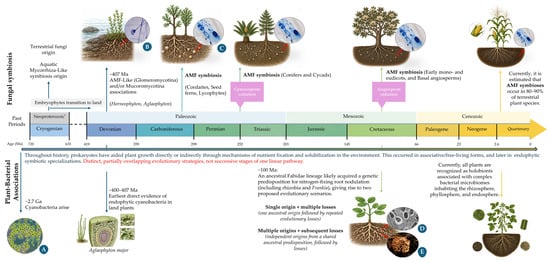
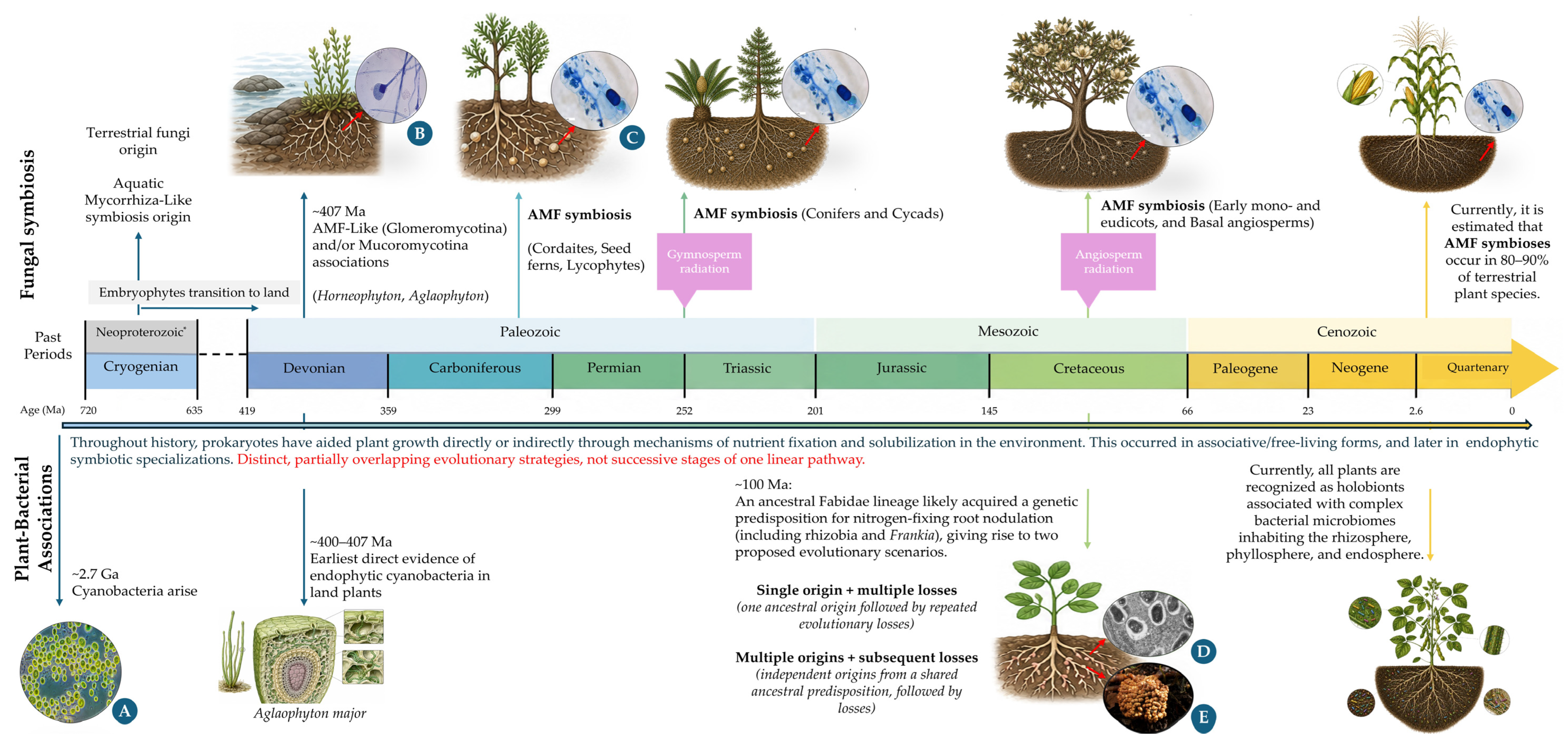
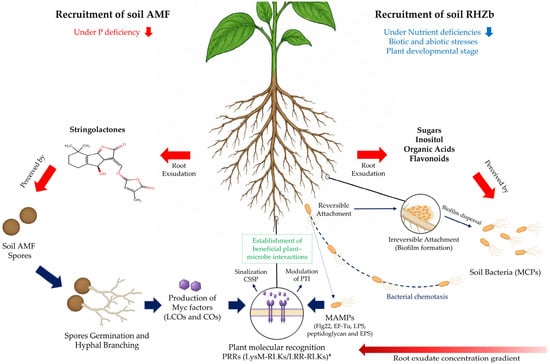
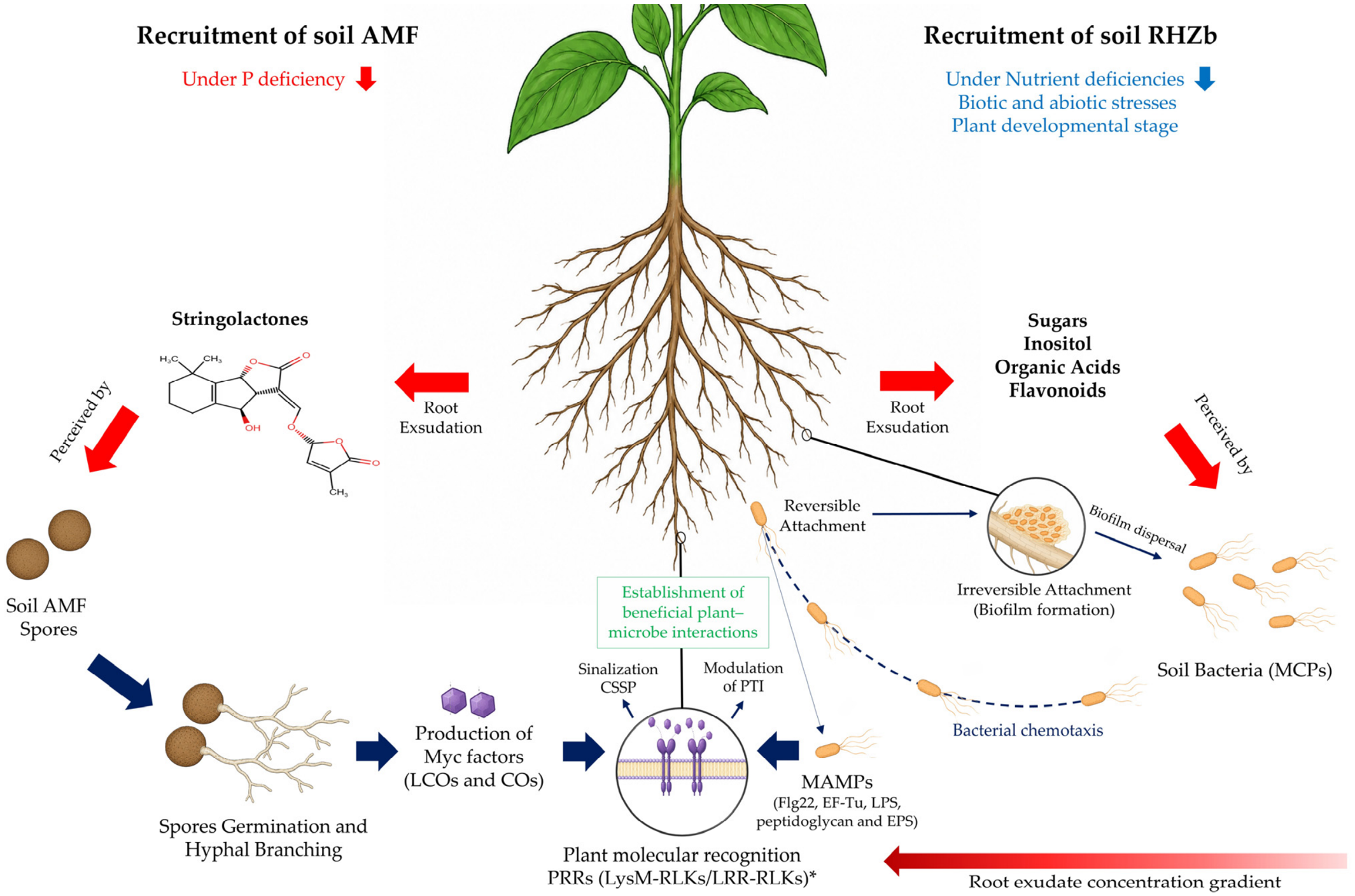
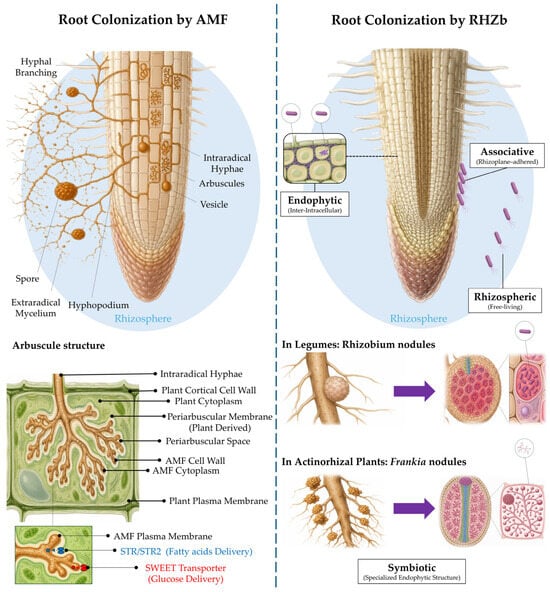
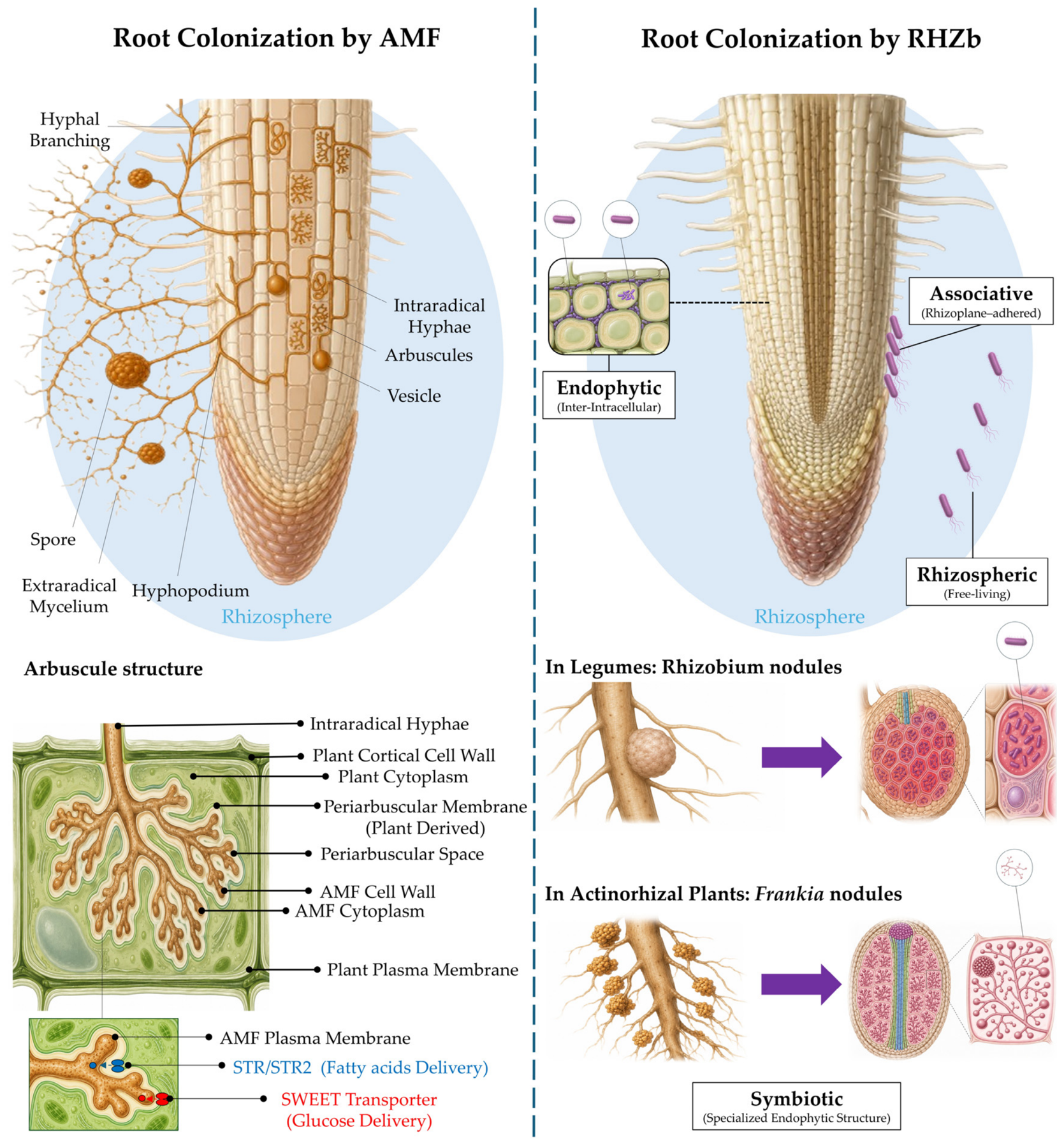
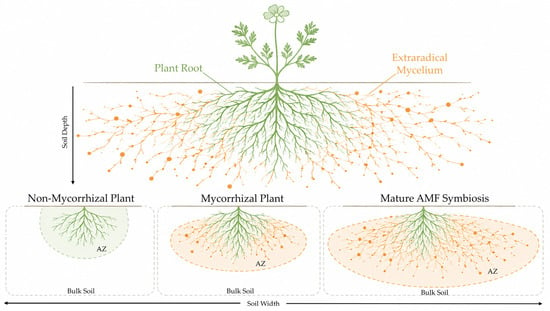
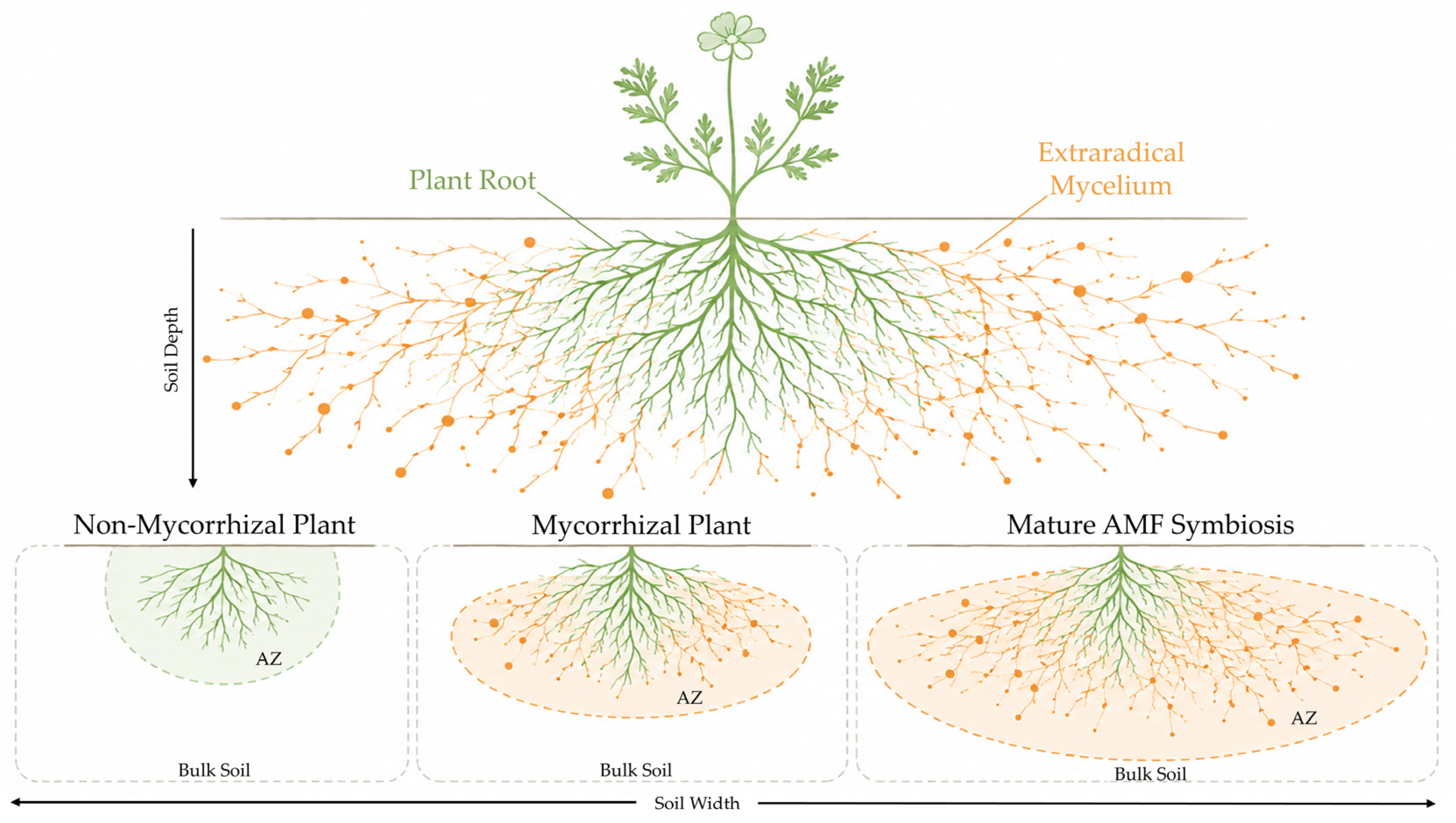

Disclaimer/Publisher’s Note: The statements, opinions and data contained in all publications are solely those of the individual author(s) and contributor(s) and not of MDPI and/or the editor(s). MDPI and/or the editor(s) disclaim responsibility for any injury to people or property resulting from any ideas, methods, instructions or products referred to in the content. |
© 2026 by the authors. Licensee MDPI, Basel, Switzerland. This article is an open access article distributed under the terms and conditions of the Creative Commons Attribution (CC BY) license.