


Abstract
Coordinating ecological restoration with livelihood protection is a central challenge in grassland governance, particularly in regions where ecological fragility coincides with strong dependence on pastoral production. Using panel data for 1008 county-level units in 11 provinces from 2005 to 2020, this paper applies a difference-in-differences approach combined with an event-study design to examine the ecological and income effects of two rounds of China’s Grassland Ecological Compensation Policy (GECP), as well as their underlying mechanisms. The results show that the ecological effects of the GECP are dynamic, peaking two to three years after implementation before gradually stabilizing. The first-round policy significantly improved grassland ecological conditions, increasing the Normalized Difference Vegetation Index (NDVI) by about 3%, but reduced herders’ per capita disposable income by about 6.9%. By contrast, the second-round policy also significantly improved grassland ecological conditions, with an average NDVI increase of about 1.7%, while its income effect was small and statistically insignificant. Mechanism analysis shows that the ecological effects are stronger in areas with lower dependence on animal husbandry and poorer initial grassland conditions, while heterogeneity analysis indicates stronger ecological gains in low-population-density and low-income regions. Overall, the GECP contributes to ecological restoration, but its income gains remain limited.
1. Introduction
In pastoral regions, grassland governance involves a dual policy objective: restoring grassland ecosystems while maintaining the livelihood security of households whose income depends on grazing. Grasslands provide multiple ecosystem services, including biodiversity conservation, climate regulation, and carbon sequestration [1,2,3], while also serving as the main production base for herding households [4]. In China, grasslands constitute the largest terrestrial ecosystem, and their condition is closely linked to both the functioning of ecosystems and the sustainability of pastoral livelihoods [5,6]. Against the broader backdrop of ecological conservation, green development, and the national goals of carbon peaking and carbon neutrality, improving grassland governance has become increasingly important. The key question is therefore not only whether degraded grasslands can be restored but also whether ecological regulation can avoid imposing excessive livelihood costs on households that depend on grazing.
The Grassland Ecological Compensation and Reward Policy (GECP) provides a useful policy setting for examining this issue because it combines regulatory restrictions with fiscal compensation and has been implemented in successive policy rounds. The policy was introduced in response to long-standing grassland degradation, excessive grazing pressure, and the need to reconcile ecological restoration with herders’ livelihood security. Its main goals are to restore grassland ecosystems, regulate grazing activities, and compensate herding households for the economic costs associated with conservation requirements. Rather than relying solely on administrative restrictions, the policy links grazing regulation with fiscal transfers designed to compensate herding households for the economic costs of conservation [7,8]. The GECP has been implemented in successive five-year rounds. The first round, from 2011 to 2015, covered eight major pastoral provinces, while the second round, from 2016 to 2020, expanded coverage to thirteen provinces. A third round has continued during the Fourteenth Five-Year Plan period. This staged implementation makes it possible to examine whether ecological and income effects differ as policy coverage, compensation arrangements, and local implementation conditions change over time. After more than a decade of implementation and cumulative fiscal expenditure exceeding RMB 150 billion, the GECP provides an important setting for examining whether an incentive-based conservation program can simultaneously improve ecological conditions and protect household livelihoods.
Although a growing body of research has examined the GECP, three issues remain insufficiently resolved. First, existing studies often evaluate ecological outcomes and household income outcomes separately, making it difficult to assess whether the policy has achieved a balance between ecological restoration and livelihood protection. Second, limited attention has been paid to differences across policy rounds, even though the GECP has evolved over time in terms of coverage, compensation standards, and implementation conditions. Third, the role of local conditions in shaping the ecological effects of the policy remains insufficiently clarified. These issues suggest the need for an integrated evaluation of the GECP that considers both ecological and livelihood outcomes across different implementation stages.
To address these issues, this paper evaluates the ecological and income effects of the GECP across two policy rounds within a unified framework. The general aim of this study is to assess whether the GECP has achieved a balance between grassland ecological restoration and herders’ livelihood protection during different stages of implementation. Specifically, this study has three objectives: (1) to estimate the effects of the GECP on grassland ecological conditions and herders’ income; (2) to compare the ecological and income effects of the first and second policy rounds; and (3) to examine how local conditions, particularly dependence on animal husbandry and initial grassland conditions, shape the ecological effects of the policy. Using panel data for 1008 county-level units in 11 provinces over the period 2005–2020, this paper applies a difference-in-difference (DID) model combined with an event-study design. The phased implementation of the GECP across provinces and policy rounds allows us to compare changes in ecological and income outcomes between treated and untreated counties before and after policy implementation. This strategy helps identify the average policy effects while controlling for time-invariant county characteristics and common year shocks.
The paper makes three contributions. First, it provides a unified evaluation of ecological and income effects, allowing for a more comprehensive assessment of policy effectiveness. Second, it explicitly compares the first and second rounds of the GECP and highlights the dynamic and round-specific nature of policy impacts. Third, it examines how local production dependence and baseline grassland conditions shape the ecological effects of the GECP, focusing on local dependence on animal husbandry and initial grassland conditions.
The remainder of the paper is organized as follows. Section 2.1 reviews the related literature. Section 2.2 presents the theoretical analysis and develops the research hypotheses. Section 2.3, Section 2.4, Section 2.5, Section 2.6, Section 2.7 and Section 2.8 describe the empirical strategy, variable construction, and data sources. Section 3 reports the empirical results, including the baseline estimates, parallel-trends evidence, dynamic effects, and mechanism-related heterogeneity analysis. Section 4 discusses the findings. Section 5 concludes.
2. Materials and Methods
2.1. Literature Review
Existing studies on the GECP can be grouped into three main strands. The first evaluates ecological responses to the policy, including changes in vegetation growth, grassland productivity, and ecological quality. The second examines income and livelihood consequences for herding households under ecological regulation and compensation payments. The third explores how policy effects vary across regions, households, policy instruments, and implementation periods.
2.1.1. Ecological Effects of the GECP
The first strand of the literature evaluates the ecological outcomes of the GECP, focusing on changes in vegetation cover, grassland productivity, and overall ecological quality after policy implementation. Some studies report improvements in vegetation cover, net primary productivity, and grassland quality following policy implementation, suggesting that the policy has contributed to ecological recovery [9,10]. Other studies find that the effects are weaker than expected and that grassland degradation has not been fundamentally reversed in some regions [11,12,13]. There is also evidence that policy effects vary across instruments and local contexts. For example, grazing bans appear to generate stronger ecological effects, whereas the effects of grass–livestock balance are relatively limited [14]. Some studies even report negative ecological effects associated with the policy [15,16].
2.1.2. Income and Livelihood Effects of the GECP
The second strand of the literature focuses on the income and livelihood consequences of the GECP. Some studies find that compensation payments can partly offset the income losses associated with grazing restrictions and may improve household income through changes in employment and livelihood structure [17]. Other studies show that the policy may reduce pastoral production income in the short run and that compensation payments are not always sufficient to fully offset these losses [18,19]. In addition, several studies emphasize that the income effects of the policy are heterogeneous and may differ across households and regions depending on compensation intensity, dependence on animal husbandry, and access to alternative livelihoods [20,21]. This literature highlights a central trade-off in ecological compensation programs. Restrictions on grazing may generate ecological benefits, but they may also reduce the private returns from livestock production. Whether compensation can offset this opportunity cost is therefore crucial for evaluating the welfare consequences of the GECP.
2.1.3. Heterogeneity and Dynamics of Policy Effects
The third strand of the literature examines the heterogeneity and dynamic evolution of the GECP’s effects. Existing studies suggest that the policy effects vary across regions, households, policy instruments, and implementation periods, reflecting differences in ecological conditions, production structures, compensation standards, livelihood strategies, and enforcement intensity [20,21]. At the regional level, the ecological and economic effects of the GECP may differ with grassland degradation, grazing pressure, market access, and local implementation capacity [11,21]. At the policy-instrument level, grazing bans, grazing suspension, and grass–livestock balance requirements may produce different effects because they impose different degrees of restriction on herders’ production behavior [14]. In addition, the effects of the GECP may evolve gradually, as grassland restoration and household livelihood adjustment often take time after policy implementation [9,10]. Overall, the literature shows that the GECP’s effects are context-dependent and may change over the course of implementation.
2.1.4. Summary of the Literature
Overall, existing studies have provided valuable evidence on the ecological, income, and heterogeneous effects of the GECP. However, several issues remain insufficiently addressed. First, ecological and income outcomes are often examined separately, making it difficult to assess whether the policy has balanced ecological restoration with livelihood protection. Second, limited attention has been paid to differences across policy rounds, despite changes in coverage, compensation standards, and implementation conditions over time. Third, the role of local conditions in shaping ecological responses has not been fully examined within an integrated empirical framework. By addressing these gaps, this paper differs from studies that focus primarily on herders’ grazing behavior or single-dimensional policy outcomes and instead provides a county-level evaluation of the ecological and income effects of the first two rounds of the GECP.
2.2. Theoretical Framework and Hypotheses
The GECP is closely related to broader debates on ecological compensation, payment for ecosystem services (PES), environmental governance, and livelihood adaptation in socio-ecological systems. PES programs are generally designed to internalize environmental externalities by providing incentives for land users or resource managers to generate ecological benefits, but their effectiveness depends on institutional design, implementation conditions, and local socio-economic contexts [22,23,24]. In China’s pastoral regions, these issues are particularly relevant because grasslands are both ecological assets and the production base for herding households. The GECP can therefore be understood as a large-scale ecological compensation program that seeks to improve grassland conditions while protecting herders’ livelihoods [21]. However, unlike many voluntary and contract-based PES programs, the GECP combines fiscal compensation with regulatory instruments, such as grazing bans and grass–livestock balance requirements. This feature makes the GECP not only a compensation mechanism, but also a state-led environmental governance arrangement embedded in China’s pastoral socio-ecological system. From this perspective, the effects of the GECP depend not only on compensation incentives but also on local production dependence, baseline ecological conditions, and households’ capacity for livelihood adjustment [19,25].
Building on this theoretical perspective, the core economic logic of the GECP is to reduce the ecological externality of grazing by changing the relative returns to livestock production and grassland conservation. In pastoral areas, herding households derive income from livestock production, while grazing activities also exert pressure on grassland ecosystems. When household decisions are based mainly on private production returns, grazing intensity may exceed the level consistent with ecological sustainability. By introducing grazing restrictions and compensation payments, the GECP may affect both grassland ecological conditions and herders’ income.
2.2.1. Policy Incentives and Grazing Behavior
The GECP affects herding households primarily by changing the incentives associated with grazing. Grazing bans, grazing suspension, and grass–livestock balance requirements restrict the use of grassland resources and reduce the feasible intensity of livestock production. Compensation payments, in turn, are intended to offset part of the income loss caused by reduced grazing. From the perspective of household decision-making, the policy changes the trade-off between livestock production and ecological compliance. When compensation is sufficient to offset the opportunity cost of reducing grazing, herding households have stronger incentives to reduce grazing intensity. When compensation is insufficient or when livestock production remains the dominant source of income, the behavioral response may be limited. Therefore, the effect of the GECP depends on both the strength of policy incentives and the production dependence of herding households.
2.2.2. Grazing Reduction and Ecological Outcomes
The ecological effect of the GECP depends on whether the policy effectively reduces grazing pressure. Lower grazing intensity can reduce vegetation loss, improve aboveground biomass recovery, and create conditions for grassland restoration. Since NDVI captures vegetation growth and grassland ecological conditions, effective reductions in grazing pressure are expected to increase NDVI. Ecological restoration is unlikely to occur immediately after policy implementation. Vegetation recovery depends on cumulative changes in grazing pressure and the adjustment process of grassland ecosystems. Therefore, the ecological effect of the GECP may display a dynamic pattern, with delayed improvement followed by stabilization.
2.2.3. Compensation, Opportunity Costs, and Income Effects
The income effect of the GECP is theoretically ambiguous. On the one hand, compensation payments directly increase household disposable income. On the other hand, grazing restrictions may reduce livestock production income by limiting grazing intensity, livestock scale, or access to grassland resources. Thus, the net income effect depends on the balance between compensation gains and the opportunity cost of reduced grazing. If compensation payments are insufficient to offset the income loss associated with reduced livestock production, the policy may reduce herders’ income, especially in the short run. If compensation standards increase or households gradually adjust their production and livelihood strategies, the negative income effect may weaken over time.
2.2.4. Policy-Round Differences
The effects of the GECP may differ across policy rounds because policy coverage, compensation standards, implementation conditions, and household adaptation change over time. The first round, implemented from 2011 to 2015, represented the initial stage of large-scale grassland ecological compensation. During this period, grazing restrictions may have generated relatively strong ecological effects by reducing grazing pressure. However, if compensation payments were insufficient to offset the opportunity cost of reduced grazing, the first round may also have imposed income losses on herders.
The second round, implemented from 2016 to 2020, was carried out after the policy had expanded and accumulated implementation experience. Compensation arrangements and implementation capacity may have improved, and households may have had more time to adjust production decisions. As a result, the negative income effect may have weakened in the second round. At the same time, the marginal ecological gains may have declined if part of the ecological recovery had already occurred during the first round or if the second round was implemented under different initial ecological conditions.
2.2.5. Research Hypotheses
Based on the above theoretical discussion of ecological compensation, policy incentives, livelihood adjustment, and ecological responses, this paper proposes the following hypotheses:
Hypothesis 1.
The GECP improves grassland condition, as measured by NDVI.
Hypothesis 2.
The ecological effects of the GECP exhibit dynamic adjustment, with delayed improvement followed by stabilization.
Hypothesis 3.
The first round of the GECP has a negative average effect on herders’ income when compensation is insufficient to offset the opportunity cost of reduced grazing.
Hypothesis 4.
The second round of the GECP has an insignificant average effect on herders’ income when higher compensation and improved implementation offset the income loss caused by reduced grazing.
2.3. Sample Selection
This paper exploits the implementation of the Grassland Ecological Compensation Policy as a quasi-natural experiment and estimates the effects of the first and second policy rounds separately, given the differences in policy coverage across rounds. This round-specific sample construction is used to avoid overlapping policy exposure and to define treatment and control groups more clearly for each implementation stage. The treatment and control groups are constructed according to the phased rollout of the GECP rather than an arbitrary regional classification.
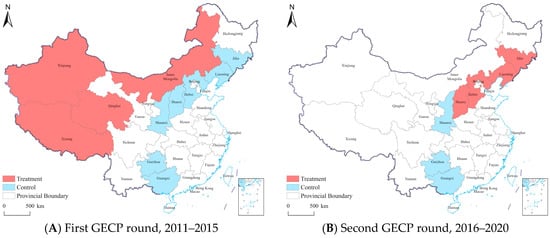
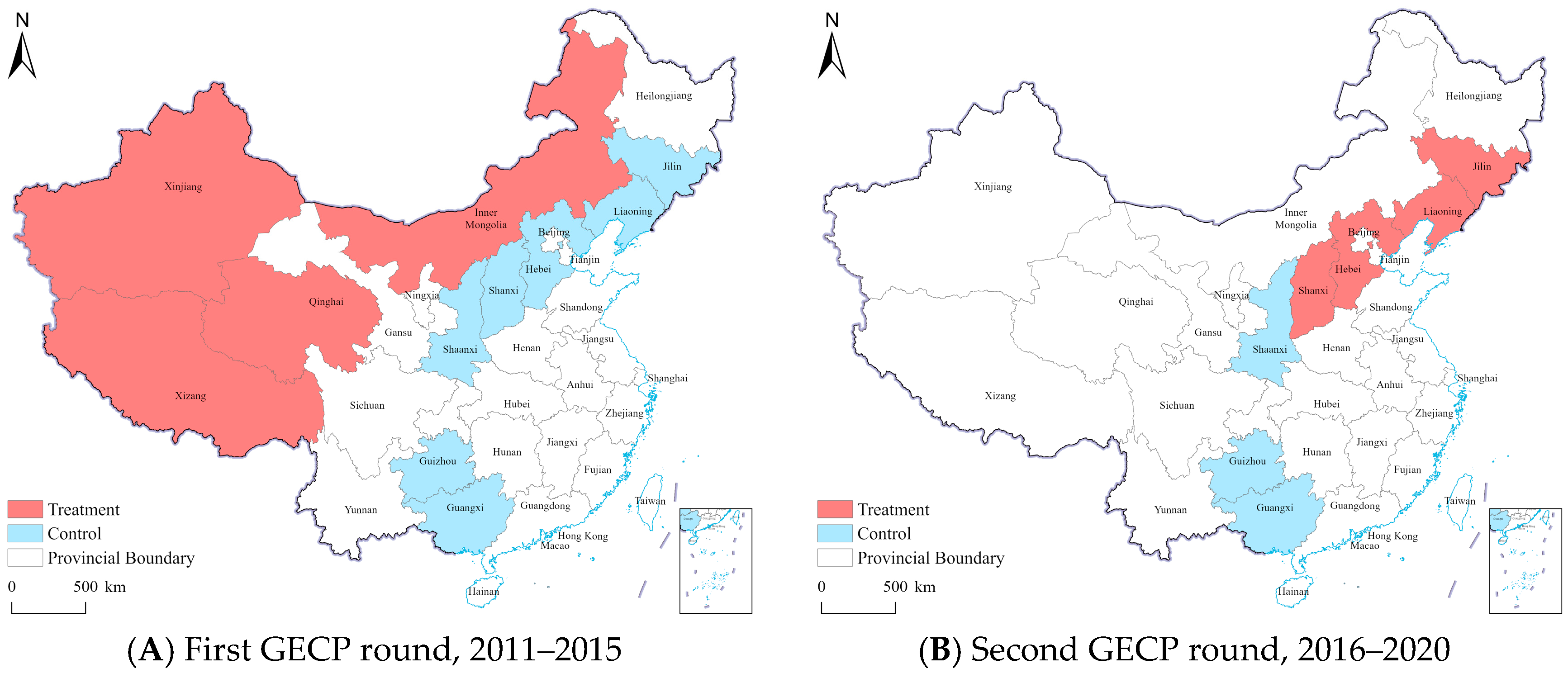
For the first round, implemented during 2011–2015, the empirical analysis restricts the treatment group to counties in Tibet, Inner Mongolia, Xinjiang, and Qinghai. These four provinces are selected because they constitute the core pastoral areas among the first-round policy regions and account for the largest shares of China’s total grassland area, at 20.9%, 20.1%, 14.6%, and 9.3%, respectively. Their early inclusion reflects their ecological importance, extensive grassland resources, and strong relevance to pastoral production. Focusing on these provinces allows the analysis to capture the main scope of policy intervention and the areas most directly exposed to the policy during the first round. The first-round control group consists of counties in provinces that were not covered by the first round of the GECP but are included in the sample, namely Liaoning, Jilin, Shanxi, Hebei, Guangxi, Guizhou, and Shaanxi. These counties provide a comparison group that was not exposed to the first-round policy shock during 2011–2015. Although the treatment and control regions differ in some economic, geographic, and institutional characteristics, the difference-in-differences (DID) design controls for time-invariant county-level differences through county fixed effects and for common shocks through year fixed effects. In addition, time-varying climate, geographic, and socioeconomic controls are included to reduce the influence of observable differences across regions. Figure 1 presents the geographic distribution of treatment and control groups across the two GECP rounds, with Panel A showing the first-round sample classification and Panel B showing the second-round classification, including regions excluded because of prior policy exposure.
Figure 1.
Geographic distribution of treatment and control groups across GECP rounds. (A) Panel A shows the treatment and control groups for the first GECP round from 2011 to 2015. (B) Panel B shows the newly treated counties, control counties, and counties excluded from the second-round estimation because of prior policy exposure.
For the second round, implemented during 2016–2020, the treatment group consists of counties in provinces that were newly included in the policy in 2016, namely Liaoning, Jilin, Shanxi, and Hebei, while the control group is restricted to counties in provinces that did not implement the policy during 2016–2020, namely Guangxi, Guizhou, and Shaanxi. Counties in Tibet, Inner Mongolia, Xinjiang, and Qinghai are excluded from the second-round estimation because they had already been exposed to the first round of the policy. This design helps reduce contamination from prior policy exposure and allows the second-round effect to be identified by comparing newly treated counties with counties that remained untreated during the same period. The validity of this identification strategy relies on the following parallel trends assumption: in the absence of the GECP, the outcome variables in the treatment and control groups would have followed similar trends. To assess the plausibility of this assumption, this paper conducts event-study analyses for both ecological and income outcomes. The pre-policy coefficients provide direct evidence on whether the treatment and control groups exhibited similar trends before policy implementation.
2.4. Baseline Empirical Strategy
We use a difference-in-differences (DID) model [26] to estimate the ecological and income effects of the GECP. This specification is used to test the average ecological and income effects implied by the theoretical framework. The baseline specification is as follows:
where i indexes counties and t indexes years. The dependent variable measures either grassland ecological condition or herders’ income at the county level. Specifically, the ecological outcome is measured by the Normalized Difference Vegetation Index (NDVI), which is a unitless vegetation index, and the income outcome is measured by real per capita disposable income. The key explanatory variable is , which indicates whether county i is exposed to the policy in the post-treatment period. is a vector of time-varying county-level controls. is the corresponding coefficient vector. The model includes county fixed effects and year fixed effects . is an idiosyncratic error term. The definitions and units of all variables are reported in Table 1. Standard errors are clustered at the county level to account for serial correlation and heteroskedasticity. The coefficient captures the average effect of policy implementation under the identifying assumptions of the difference-in-differences design. The model is estimated separately for the first and second policy rounds.
Table 1.
Descriptive statistics of variables.
The key identifying assumption is that, in the absence of the GECP, the treatment and control groups would have experienced parallel changes in the outcome variables. We acknowledge that provincial inclusion in each GECP round was not randomly assigned. In particular, the first-round provinces were selected partly because of their ecological importance, extensive grassland resources, and pastoral characteristics. Therefore, treatment and control counties may differ in baseline ecological, economic, geographic, and institutional conditions. However, the DID design does not require identical baseline levels between treatment and control counties; rather, it requires that the outcome trends would have been parallel in the absence of the policy. Since the treatment and control regions may differ in baseline economic, geographic, and institutional conditions, the specification includes county fixed effects to absorb time-invariant county characteristics and year fixed effects to control for common time shocks. The control variables further account for time-varying differences in climate, geography, industrial structure, population density, and economic development that may affect both NDVI and income. These settings help improve comparability between treatment and control counties and reduce potential omitted variable bias arising from concurrent environmental or rural development policies and other observable shocks. The plausibility of the parallel trends assumption is further examined using the event-study specification.
2.5. Event-Study Specification
To examine the dynamic effects of the GECP and assess the parallel trends assumption, this paper further estimates an event-study model [27]. The specification is written as follows:
where is an indicator for event year relative to the implementation year of the corresponding policy round. The year immediately before policy implementation is omitted as the reference period. The coefficients capture the dynamic effects of the GECP before and after policy implementation. The definitions and units of the variables are reported in Table 1.
The event-study specification is used not only to describe the dynamic policy effects, but also to assess the plausibility of the parallel trends assumption. If the coefficients for the pre-policy years are statistically insignificant and show no systematic trend, this suggests that the treatment and control groups followed similar trajectories before policy implementation. In this case, the DID estimates are less likely to be driven by pre-existing differential trends. The post-policy coefficients are then used to examine whether the effects of the GECP emerge gradually, persist, or stabilize over time.
2.6. Mechanism Specification
To examine the mechanisms through which the GECP affects grassland ecological conditions, this paper extends the baseline DID specification by interacting the policy term with pre-policy county characteristics [28,29]. The mechanism model is specified as follows:
where denotes a pre-policy county characteristic capturing the proposed mechanism. The coefficient on the triple interaction term indicates whether the ecological effect of the policy varies systematically with the corresponding pre-policy condition. , , , , , and are defined as in Equation (1). The definitions and units of all variables are reported in Table 1.
This paper considers two mechanism variables. The first is dependence on animal husbandry, which captures the extent to which local production and livelihoods rely on livestock activities. Higher dependence on animal husbandry may imply higher adjustment costs and therefore weaker ecological responses to grazing restrictions. The second is the initial grassland condition, which captures the baseline ecological status of a county before policy implementation. Counties with poorer initial grassland conditions may have greater potential for ecological recovery after grazing pressure is reduced.
In the empirical analysis, dependence on animal husbandry is measured by the pre-policy share of value added in animal husbandry in regional GDP. Initial grassland conditions are proxied by alternative pre-policy NDVI measures, including NDVI in 2000, NDVI in 2004, and the average NDVI over the period 2000–2003. Using pre-policy values helps mitigate reverse causality and ensures that these variables capture baseline county characteristics rather than post-policy responses.
2.7. Variable Specification
2.7.1. Dependent Variables
To examine the ecological effects of the policy, the dependent variable is the logarithm of county-level average grassland NDVI. NDVI is widely used as an indicator of grassland quality [30] and can also serve as a proxy for ecological restoration. To examine the income effects of the policy, the dependent variable is the logarithm of real per capita disposable income of farmers and herders. Given the relatively long study period from 2005 to 2020, nominal income is deflated using the annual GDP deflator to ensure comparability over time.
2.7.2. Key Independent Variable
The key independent variable is the implementation of the Grassland Ecological Compensation Policy, captured by the interaction term . Here, is a treatment-group indicator equal to 1 for counties covered by the policy and 0 otherwise, while is a post-policy time indicator. When estimating the effects of the first policy round, for 2011–2015 and 0 otherwise. When estimating the effects of the second policy round, for and 0 otherwise.
2.7.3. Control Variables
Following the related literature [28,31], we include climate, geographic, and socioeconomic controls that may affect grassland ecological conditions and local economic outcomes. Climate controls include temperature and precipitation. Geographic controls include elevation and slope, which are important determinants of the spatial distribution and ecological quality of grassland ecosystems. Socioeconomic controls include real GDP per capita, the ratio of value added in the primary sector to that in the secondary sector, the share of value added in the tertiary sector of GDP, population density, and county area. Given the long sample period, nominal GDP per capita is deflated using the GDP deflator to obtain its real value.
2.7.4. Mechanism Variables
Two pre-policy mechanism variables are used in the mechanism analysis. The first is dependence on animal husbandry, measured by the share of value added in animal husbandry in regional GDP. A higher value indicates that the local economy relies more heavily on livestock production. To mitigate reverse causality, this variable is constructed using its pre-policy average. The second is initial grassland conditions, measured by pre-policy NDVI. To reduce the influence of year-specific fluctuations, three alternative indicators are used: NDVI in 2000, NDVI in 2004, and average NDVI over the period 2000–2003.
2.7.5. Data Processing and Spatial Harmonization
The empirical analysis combines raster-based ecological, climatic, and geographic data with county-level socioeconomic statistics. Since these datasets differ in spatial resolution and original format, all variables are harmonized to the county-year level before estimation. County administrative boundaries are used as the common spatial unit for aggregation and matching.
For NDVI, monthly MOD13A3 raster data with a spatial resolution of 250 m 250 m are first projected to a common coordinate system and clipped using county boundaries. To better capture grassland ecological conditions, the calculation is based on valid grassland pixels within each county. County-level monthly NDVI is obtained by averaging all valid grassland pixels within the county boundary, and the annual NDVI is then calculated as the average of monthly NDVI values within each year. The logarithm of county-level annual average grassland NDVI is used in the empirical analysis.
Climate variables, including temperature and precipitation, are also spatially matched to county boundaries. Raster or gridded climate observations are aggregated to the county level by calculating the average value of all valid grid cells falling within each county. Annual temperature and precipitation are constructed from the corresponding yearly averages or accumulations, depending on the original data format. Geographic variables are derived from the DEM data. Elevation is calculated as the county-level average elevation, while slope is generated from the DEM and then averaged within each county boundary.
Socioeconomic variables, including GDP, industrial structure, population, county area, and rural per capita household income, are obtained directly at the county level from statistical yearbooks. These variables are matched to the spatially aggregated ecological, climatic, and geographic variables by county administrative code and year. When county boundary adjustments or missing observations occur, county names and administrative codes are checked to ensure temporal consistency. Observations with insufficient spatial coverage or missing key variables are excluded from the corresponding regressions.
Although this procedure improves consistency across datasets, aggregating raster-based indicators to county-level averages may introduce measurement error, especially in counties with large internal ecological variation. Therefore, the estimates should be interpreted as county-level average effects rather than fine-scale ecological responses.
2.8. Data Sources and Descriptive Statistics
The empirical analysis is based on a panel of 1008 county-level units in 11 provinces over the period 2005–2020. NDVI data are obtained from the MOD13A3 product provided by NASA EarthData, National Aeronautics and Space Administration, Washington, DC, USA, which offers monthly observations for 2004–2021 at a spatial resolution of 250 m × 250 m. Climate data come from the National Meteorological Science Data Center, Beijing, China, while geographic variables are derived from the 2023 DEM dataset provided by the General Bathymetric Chart of the Oceans (GEBCO), Liverpool, UK, with a spatial resolution of 15 arc-seconds, or approximately 500 m. Socioeconomic data and rural per capita household income data are drawn from the China County Statistical Yearbook for 2006–2021. Table 1 reports the descriptive statistics of the main variables. Because data availability varies across indicators, especially for income- and pastoral-related variables, the number of observations differs across regression specifications.
3. Results
3.1. Baseline Regression Results
3.1.1. Ecological Effects of the First-Round Policy
Table 2 reports the baseline regression results for the ecological effects of the first-round GECP. In column (1), which includes only county fixed effects and year fixed effects, the coefficient on the interaction term GECP × Post is 0.028 and statistically significant at the 1% level. This estimate suggests that the first-round policy is associated with an increase in grassland NDVI of approximately 2.8%. In column (2), after including the full set of controls, the coefficient rises to 0.160 and remains statistically significant at the 1% level. This coefficient corresponds to an approximate increase of 3%, (). in grassland NDVI in treated areas. These results suggest that the first-round GECP may have contributed to improved grassland ecological conditions, conditional on the validity of the parallel trends assumption and the comparability of treatment and control counties. Therefore, the estimates provide support for Hypothesis 1.
Table 2.
Baseline estimates of the ecological effects of the first-round GECP.
3.1.2. Income Effects of the First-Round Policy
Table 3 reports the estimated income effects of the first-round GECP. In column (1), which includes only county fixed effects and year fixed effects, the coefficient on is −0.048 and statistically significant at the 1% level. This estimate implies an income decline of approximately 4.7% in treated areas. In column (2), after adding the full set of controls, the coefficient decreases to −0.067 and remains statistically significant, corresponding to an income reduction of about 6.9% (). These findings suggest that the first-round GECP was associated with a reduction in herders’ income. This result is consistent with Hypothesis 3.
Table 3.
Baseline estimates of the income effects of the first-round GECP.
3.2. Parallel Trends and Dynamic Effects
A key identifying assumption of the difference-in-differences (DID) model is that the treatment and control groups follow parallel trends prior to policy implementation [32]. To assess this assumption and to trace the dynamic effects of the policy, this paper employs an event-study specification [33], using the year immediately preceding policy implementation as the reference period.
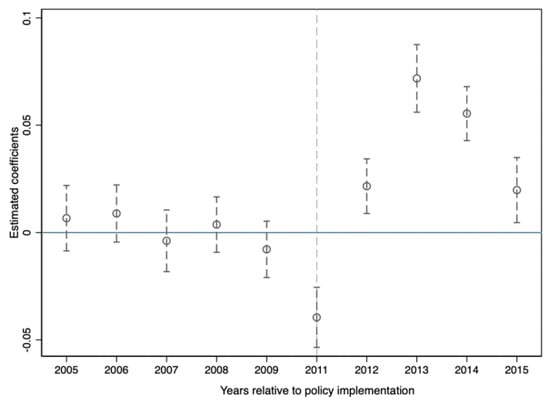
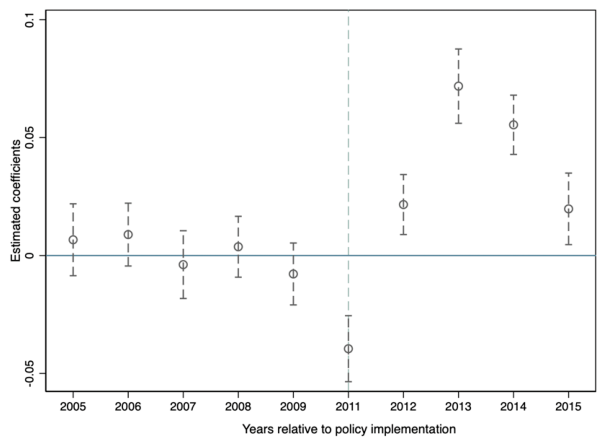
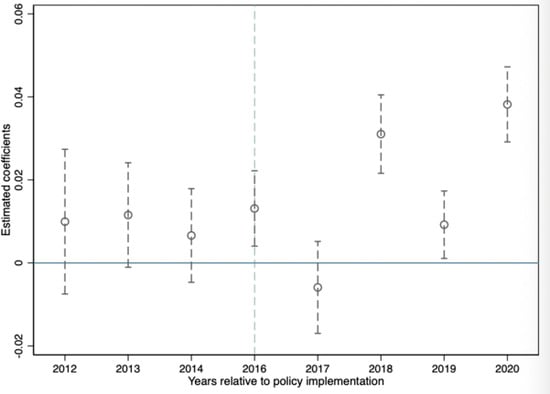
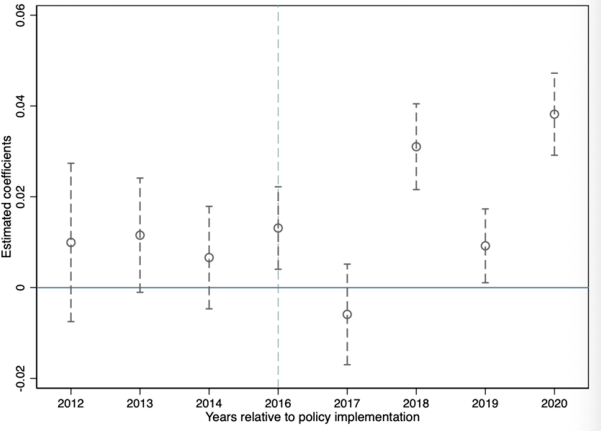
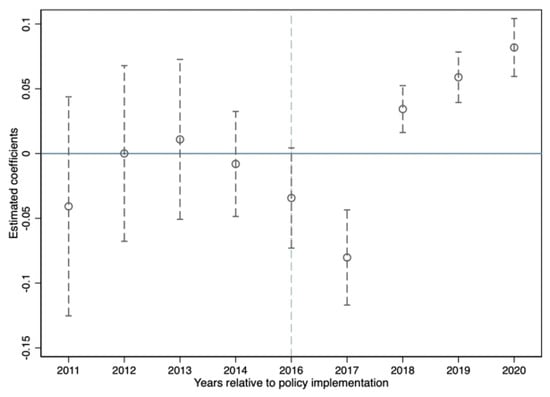
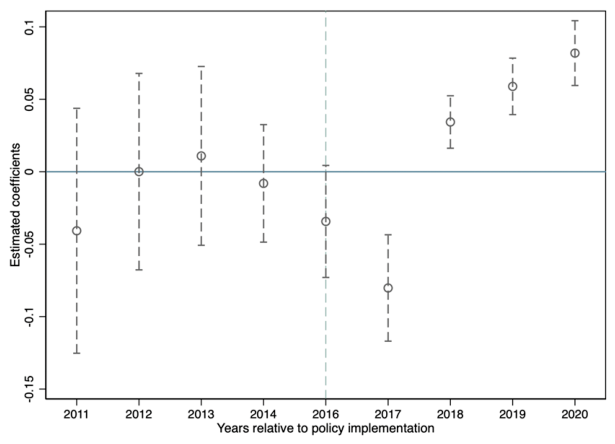
Figure 2 and Figure 3 report the dynamic ecological effects of the first and second policy rounds, respectively. For both rounds, the estimated coefficients in the pre-treatment period are generally close to zero and statistically insignificant, with confidence intervals covering zero and no systematic upward or downward pattern. This provides support for the parallel trends assumption. For the first round, with 2011 as the implementation year, the ecological effect exhibits a brief negative fluctuation at the time of implementation, then becomes significantly positive, reaches a peak in the second to third years after implementation, and declines slightly thereafter while remaining positive overall. This pattern suggests that the ecological effects of the policy are characterized by a lagged response and diminishing marginal gains over time. For the second round, implemented in 2016, the estimated effect is insignificant in the implementation year and the following year, becomes significantly positive from 2018 onward, peaks in 2019, and moderates slightly in 2020 while remaining positive. These results indicate that the ecological effects of the GECP emerge gradually rather than immediately.
Figure 2.
Dynamic ecological effects of the first-round GECP. Dots represent estimated coefficients, vertical bars indicate 95% confidence intervals, the horizontal line denotes zero, and the vertical dashed line indicates the policy implementation year.
Figure 3.
Dynamic ecological effects of the second-round GECP.
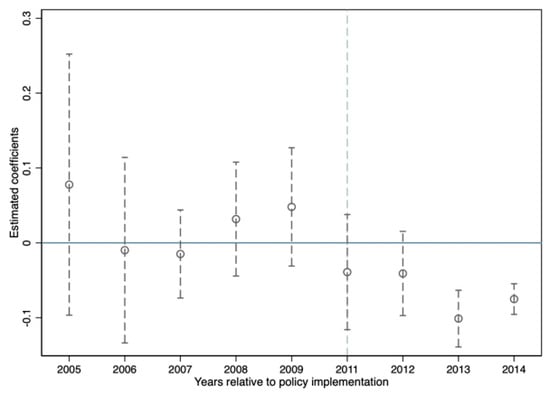
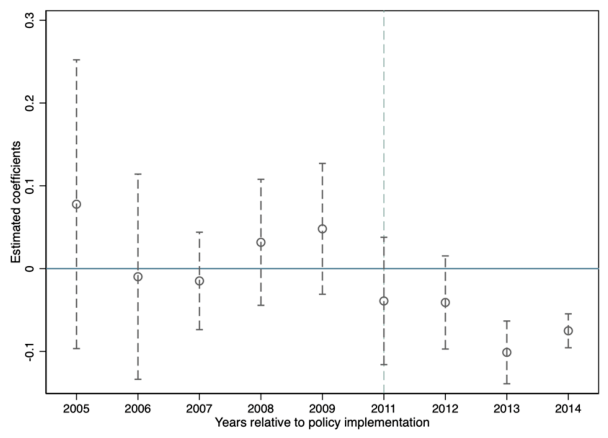
Figure 4 and Figure 5 report the dynamic income effects of the first and second policy rounds, respectively. The pre-treatment coefficients are again generally close to zero and statistically insignificant, which is consistent with the parallel trends assumption. For the first round, the estimated effect on herders’ income turns negative in the implementation year and becomes more pronounced in the second to third years after implementation, reaching statistical significance in some periods and remaining in the negative range thereafter. For the second round, the estimated effect is insignificant in the implementation year and the following year, and the coefficients then gradually move from around zero to positive values in later periods. The results indicate that the income effects of the GECP also follow a lagged adjustment process and differ across policy rounds. While the first round is associated with a significant compression of herders’ income, the second round does not reproduce the same negative pattern, although its average income effect remains statistically insignificant over the sample period.
Figure 4.
Dynamic income effects of the first-round GECP.
Figure 5.
Dynamic income effects of the second-round GECP.
3.3. Robustness Checks
To assess the robustness of the baseline ecological results, four additional tests are conducted. First, a placebo test is implemented by artificially moving the policy timing forward to 2009, following the placebo-law logic commonly used in the DID literature to assess whether the estimated policy effect merely reflects spurious pre-treatment differences [34]. As reported in column (1) of Table 4, the coefficient on the placebo interaction term is statistically insignificant. Second, when the sample window is restricted to 2007–2014, the coefficient on remains significantly positive, as shown in column (2), indicating that the main result is not driven by the particular time span of the full sample [35]. Third, clustering standard errors at the provincial level instead of the county level does not alter the sign or statistical significance of the main coefficient, as reported in column (3), indicating that the baseline inference is not sensitive to the choice of clustering level [36]. Fourth, after winsorizing all continuous variables at the 1% level, the coefficient remains significantly positive in column (4). Overall, these results indicate that the positive ecological effect of the first-round GECP is robust across alternative specifications.
Table 4.
Robustness checks for the ecological effects of the first-round GECP.
3.4. Mechanism Analysis
This section examines whether the ecological effects of the GECP vary with pre-policy county characteristics related to the proposed mechanisms. Since the empirical analysis relies on interaction terms constructed from county-level variables, the results should be interpreted as mechanism-related evidence and conditional variation in policy effects, rather than direct identification of complete causal pathways [37,38].
3.4.1. The Production Adjustment Channel
Table 5 reports the results for the interaction between the policy variable and pre-policy dependence on pastoral production. Here, Pastoral_Dependence is measured by pre-policy log real per capita pastoral value added and is used to capture baseline dependence on pastoral production at the county level. The coefficient on the triple interaction term, GECP × Post × Pastoral_Dependence, is negative and statistically significant. This result suggests that the estimated ecological effect of the policy is weaker in counties with stronger baseline dependence on pastoral production, and stronger in counties with lower dependence on animal husbandry. A plausible interpretation is that greater reliance on pastoral production raises the cost of behavioral adjustment under the GECP, thereby constraining the ecological gains from policy intervention. However, this result should be interpreted with caution. The variable Pastoral_Dependence is measured at the county level and captures local production structure rather than household-level grazing behavior or livestock adjustment. Therefore, the finding provides indirect evidence for the production adjustment mechanism, rather than direct proof of household-level behavioral responses.
Table 5.
Mechanism analysis: the production adjustment channel.
3.4.2. The Initial Grassland Condition Channel
Table 6 presents the results for the initial grassland condition channel using three alternative measures of pre-policy grassland conditions. The coefficients on the triple interaction terms are negative and statistically significant across all specifications. This suggests that the ecological effect of the GECP decreases with the level of initial NDVI and is stronger in counties with poorer pre-policy grassland conditions. This pattern is consistent with the ecological recovery potential mechanism: areas with poorer initial grassland conditions may have greater room for vegetation recovery after grazing pressure is reduced. The consistency across alternative NDVI measures suggests that the result is not driven by a single baseline year. However, because initial NDVI is a county-level proxy for baseline vegetation conditions and may also reflect other ecological or land-use characteristics, the result should be interpreted as indirect evidence consistent with the ecological recovery potential channel, rather than direct identification of the underlying ecological recovery pathway.
Table 6.
Mechanism analysis: the initial grassland condition channel.
Overall, these results suggest that the ecological effects of the GECP are conditioned by local production structure and baseline ecological endowments. The findings provide mechanism-related evidence, but the county-level nature of the data requires caution in drawing household-level behavioral conclusions.
3.5. Heterogeneity Analysis
Table 7 reports heterogeneity analysis along two dimensions: population density and real per capita disposable income. In column (1), the interaction term between the policy variable and population density is negative and statistically significant at the 1% level, indicating that the ecological effect of the policy is stronger in less densely populated areas. In column (2), the interaction term between the policy variable and real per capita disposable income is also negative and statistically significant at the 1% level, indicating that the ecological effect of the policy is stronger in lower-income regions. The results, therefore, suggest that the ecological gains from the GECP are more pronounced in areas with lower demographic pressure and lower income levels.
Table 7.
Heterogeneity analysis by population density and income level.
3.6. Additional Analysis of the Second-Round Policy Effects
3.6.1. Ecological Effects
Column (1) of Table 8 reports the ecological effect of the second-round GECP. The coefficient on GECP × Post is 0.017 and statistically significant at the 1% level, indicating that the second-round policy increased NDVI in the treated group by approximately 1.7%. This finding supports Hypothesis 2. Although the estimated effect remains positive and statistically significant, its magnitude is smaller than that of the first-round policy, suggesting a weaker average ecological effect in the second round.
Table 8.
Effects of the second-round GECP.
3.6.2. Income Effects
Column (2) of Table 8 reports the income effect of the second-round GECP. The coefficient on GECP × Post is negative but statistically insignificant. This finding supports Hypothesis 4 and indicates that the second-round policy did not generate a statistically significant average income effect over the sample period. At the same time, unlike the first-round policy, it did not produce a significant negative effect on herders’ income. These results suggest that the welfare consequences of the policy became weaker and less clearly negative in the second round.
4. Discussion
4.1. Ecological Effects Across Policy Phases
The empirical results show that the GECP significantly improved grassland ecological conditions in both policy rounds. This confirms that the policy generated positive ecological responses across different implementation stages. This finding is broadly consistent with studies reporting positive ecological effects of the policy, including improvements in vegetation cover, net primary productivity, and grassland quality [9,10,21]. A plausible explanation for the stronger first-round ecological effect is that the first-round policy was implemented primarily in core pastoral areas with more severe degradation and stronger grazing pressure. In these areas, the scope for ecological recovery was larger, so policy-induced reductions in grazing pressure were more likely to generate observable ecological improvement. By contrast, the second round appears to have covered areas with relatively better baseline ecological conditions, where the room for additional ecological gains was more limited. This suggests that the smaller second-round effect may reflect declining marginal ecological returns rather than a failure of the policy itself. Such a pattern is in line with previous studies suggesting that the ecological effects of the GECP are shaped by grassland ecosystem vulnerability and may differ across policy stages and regions [11,14]. It is also consistent with evidence that the ecological impacts of China’s grassland conservation policies are positive on average but highly heterogeneous across counties and ecological zones [39,40].
The mechanism results further support this explanation. The significantly negative interaction between the policy variable and initial grassland conditions indicates that the ecological effect was stronger in counties with poorer initial ecological endowments. In other words, the policy generated larger marginal improvements where the potential for recovery was greater [41]. This finding suggests a partial convergence effect in ecological quality and is broadly consistent with the findings of Deng and Ma [42]. At the same time, the weaker ecological response in more livestock-dependent areas indicates that policy effectiveness was constrained where households faced higher adjustment costs from reducing grazing intensity [43]. This interpretation is in accordance with studies emphasizing that ecological compensation does not automatically translate into ecological improvement unless it induces effective behavioral change [15,44]. In particular, Yu et al. [15] show that subsidies may even increase livestock numbers in some contexts, while Hu et al. [25] highlight that the ecological consequences of the GECP are closely tied to changes in household livestock production. Overall, these results suggest that the ecological gains of the GECP depend not only on the policy itself, but also on the local capacity for behavioral adjustment.
4.2. Income and Welfare Implications Across Policy Phases
The income effects differ sharply across the two policy rounds. The first round had a significantly negative effect on herders’ income, whereas the second round did not generate a statistically significant average income effect. This contrast is important because the existing literature has reached divergent conclusions regarding the welfare consequences of the GECP. Some studies suggest that compensation payments can partly offset income losses associated with grazing restrictions and may improve household welfare through transfer income or non-farm employment [9,17], whereas others find that compensation is insufficient and that policy constraints reduce pastoral income, at least in the short run [18,19]. The present results suggest that these divergent findings may partly reflect differences in policy stage, sample coverage, and the level at which outcomes are measured.
The negative income effect in the first round indicates that the opportunity cost of ecological regulation was not fully offset by compensation. A likely reason is that grazing restrictions were introduced relatively strongly in the early stage of the policy, while compensation standards, supporting institutions, and non-pastoral livelihood opportunities were still limited. Under these conditions, reductions in livestock production would directly compress household income. This interpretation is consistent with studies showing that the policy could impose short-run income pressure on herders when compensation remained insufficient [18,19]. It is also compatible with evidence that the GECP altered household livestock production behavior, implying that ecological improvement may come at the cost of reduced pastoral earnings in the short run [25].
By contrast, the absence of a significant negative income effect in the second round suggests that later policy adjustments may have partly mitigated the welfare losses observed in the first round. This is consistent with Zhang and Tan [13], who show that the second-round policy generated a livestock reduction effect and provided important implications for improving policy design. However, the second round still failed to produce a statistically significant positive income effect, which indicates that compensation alone was not sufficient to generate broad-based welfare gains. This point is important because some studies report positive income effects through compensation transfers or off-farm employment [9,17], whereas others emphasize insufficient compensation and continued income pressure [18,19]. Our results suggest that these differences are likely related to variation in policy stage, level of analysis, and outcome measurement. Household-level studies may capture specific channels such as transfer income or livelihood diversification, while county-level estimates are more likely to reflect the net effect of reduced pastoral production and incomplete compensation.
More broadly, these findings highlight a policy trade-off in ecological compensation programs. Ecological restoration may generate broad public benefits, but the short-term costs of grazing restrictions may be borne mainly by herding households whose livelihoods depend on livestock production. The negative income effect in the first round suggests that compensation did not fully offset these costs, raising concerns about the distributional consequences of conservation policy. Therefore, the long-term sustainability of the GECP depends not only on ecological effectiveness but also on whether compensation standards and livelihood support can make ecological regulation economically viable for affected households.
5. Conclusions
Using panel data for 1008 county-level units across 11 provinces from 2005 to 2020, this paper evaluates the ecological and income effects of two rounds of China’s GECP within a unified difference-in-differences framework. Unlike studies that examine ecological restoration or household income separately, this study jointly considers both outcomes and compares the first and second policy rounds. This design not only allows us to assess whether the GECP improved grassland ecological conditions but also whether these ecological gains were achieved alongside livelihood protection.
The results indicate that the GECP generated clear ecological gains, but its income effects were more limited and varied across policy rounds. The first round produced greater ecological improvement but was accompanied by income losses, whereas the second round showed a weaker ecological effect and no significant average income effect. These findings suggest that the GECP has been more effective in ecological restoration than in livelihood improvement, and that policy performance changes as coverage, compensation arrangements, implementation conditions, and household adaptation evolve.
The study contributes to the literature in three main ways. First, it provides an integrated assessment of the ecological and income effects of the GECP, thereby linking the environmental and livelihood dimensions of ecological compensation policy. Second, by comparing two policy rounds, it shows that the effectiveness of the GECP is not static but varies across implementation stages. This contributes to a better understanding of how long-term ecological compensation programs evolve over time. Third, the analysis shows that policy effects are conditioned by local production structure and baseline ecological endowments. The ecological effect is stronger in counties with lower dependence on animal husbandry and poorer initial grassland conditions, suggesting that local conditions shape the extent to which ecological compensation can translate into vegetation recovery.
Several implications follow from these findings. First, the contrast between the two policy rounds indicates that compensation intensity and implementation quality are central to the income consequences of ecological regulation. When compensation does not adequately offset the opportunity cost of reduced grazing, ecological improvement may be achieved at the expense of household income. Second, policy design should account for local heterogeneity. Counties with different degrees of dependence on animal husbandry and different baseline grassland conditions may require differentiated compensation standards and management measures. Third, ecological compensation alone may be insufficient to secure broad-based livelihood improvement. Complementary measures, such as non-pastoral employment support, livelihood diversification, and improved local implementation capacity, are needed to make ecological regulation socially sustainable.
Several limitations should be acknowledged. First, although the DID framework, fixed effects, control variables, and event-study tests help strengthen the identification strategy, the comparability between treatment and control groups remains relevant when interpreting the estimated effects. Second, other environmental or rural development policies implemented during the same period may also have influenced NDVI and income, although the empirical specification controls for common shocks and observable county-level characteristics. Third, because this study integrates raster-based ecological, climatic, and geographic data with county-level socioeconomic statistics, the results should be interpreted as county-level average effects rather than fine-scale ecological or household-level responses. Finally, while NDVI is a widely used indicator of vegetation growth and grassland ecological conditions, it cannot capture all dimensions of grassland ecosystem quality. Future research could further improve the analysis by incorporating more detailed county-level policy information, household-level survey data, and multidimensional ecological indicators.
Author Contributions
Conceptualization, S.G. and Z.T.; methodology, formal analysis, investigation, data curation, and writing—original draft preparation, S.G.; writing—review and editing, S.G., Y.L., Z.Q. and Z.T.; funding acquisition, Z.T. All authors have read and agreed to the published version of the manuscript.
Funding
This research was supported by the Consulting Project of the Chinese Academy of Engineering (Grant No. GS2023ZDI01).
Data Availability Statement
The data presented in this study are available on request from the corresponding author due to ongoing related research.
Acknowledgments
The authors have reviewed and edited the output and take full responsibility for the content of this publication.
Conflicts of Interest
The authors declare no conflicts of interest.
References
- Stevens, N.; Bond, W.; Feurdean, A.; Lehmann, C.E.R. Grassy ecosystems in the Anthropocene. Annu. Rev. Environ. Resour. 2022, 47, 261–289. [Google Scholar] [CrossRef] [Scilit]
- Zhang, M.; Delgado-Baquerizo, M.; Li, G.; Isbell, F.; Wang, Y.; Hautier, Y.; Wang, Y.; Xiao, Y.; Cai, J.; Pan, X.; et al. Experimental impacts of grazing on grassland biodiversity and function are explained by aridity. Nat. Commun. 2023, 14, 5040. [Google Scholar] [CrossRef] [Scilit] [PubMed]
- Yang, Y.; Tilman, D.; Furey, G.; Lehman, C. Soil carbon sequestration accelerated by restoration of grassland biodiversity. Nat. Commun. 2019, 10, 718. [Google Scholar] [CrossRef] [Scilit] [PubMed]
- Reid, R.S.; Fernández-Giménez, M.E.; Galvin, K.A. Dynamics and resilience of rangelands and pastoral peoples around the globe. Annu. Rev. Environ. Resour. 2014, 39, 217–242. [Google Scholar] [CrossRef] [Scilit]
- Kang, L.; Han, X.; Zhang, Z.; Sun, O.J. Grassland ecosystems in China: Review of current knowledge and research advancement. Philos. Trans. R. Soc. B Biol. Sci. 2007, 362, 997–1008. [Google Scholar] [CrossRef] [Scilit]
- Fang, J.; Yang, Y.; Ma, W.; Mohammat, A.; Shen, H. Ecosystem carbon stocks and their changes in China’s grasslands. Sci. China Life Sci. 2010, 53, 757–765. [Google Scholar] [CrossRef] [Scilit] [PubMed]
- Zhou, T.; Yang, H.; Qiu, X.; Sun, H.; Song, P.; Yang, W. China’s grassland ecological compensation policy achieves win-win goals in Inner Mongolia. Environ. Res. Commun. 2023, 5, 031007. [Google Scholar]
- Brown, C.; Behrendt, K.; Li, P.; Qiao, G.; Bennett, J.; Zhang, B.; Addison, J.; Kemp, D.; Han, G.; Zhang, J. Refining China’s grassland policies: An interdisciplinary and ex-ante analysis. Rangel. J. 2021, 42, 435–445. [Google Scholar]
- Liu, M.; Wu, W.; Li, H. The influence of grassland ecological compensation policy on grassland quality: Evidence from the perspective of grassland ecosystem vulnerability. Agriculture 2023, 13, 1841. [Google Scholar] [CrossRef] [Scilit]
- Liu, M.; Dries, L.; Heijman, W.; Huang, J.; Zhu, X.; Hu, Y.; Chen, H. The impact of ecological construction programs on grassland conservation in Inner Mongolia, China. Land Degrad. Dev. 2018, 29, 326–336. [Google Scholar]
- Yang, F.; Xu, J.; Zhao, X.; Wang, X.; Xiong, Y. Assessment of the Grassland Ecological Compensation Policy (GECP) in Qinghai, China. Agriculture 2022, 12, 1479. [Google Scholar] [CrossRef] [Scilit]
- Zhang, Q.; Fan, M.M. Whether payment for ecosystem services can protect grassland ecology? Case study of rangeland ecological policy in Alxa Left Banner. J. China Agric. Univ. Soc. Sci. 2020, 37, 36–46. [Google Scholar]
- Zhang, R.X.; Tan, S.H. The livestock reduction effect of the second-round grassland ecological compensation policy and its implication for the new-round policy implementation: An analysis based on microscopic time-series tracking data in Inner Mongolia pastoral areas. Chin. Rural Econ. 2022, 5, 55–71. [Google Scholar]
- Zhang, X.H.; Lu, J.P.; Gu, S.Z.; Wang, L.M. Assessing the implementation effects of grassland eco-compensation policy in Xinjiang. J. Arid Land Resour. Environ. 2017, 31, 39–44. [Google Scholar]
- Yu, Y.; Wu, Y.; Wang, P.; Zhang, Y.; Yang, L.E.; Cheng, X.; Yan, J. Grassland subsidies increase the number of livestock on the Tibetan Plateau: Why does the “payment for ecosystem services” policy have the opposite outcome? Sustainability 2021, 13, 6208. [Google Scholar] [CrossRef] [Scilit]
- Feng, X.L.; Liu, M.Y.; Qiu, H.G. Impact of grassland eco-compensation policy on herders’ overgrazing behavior: The moderating role of social capital. China Popul. Resour. Environ. 2019, 29, 157–165. [Google Scholar]
- Wang, D.; Huang, J.K. Impact of grassland ecological compensation policy on household’s off-farm livelihoods. Resour. Sci. 2018, 40, 1344–1353. [Google Scholar]
- Hu, Z.T.; Liu, D.; Jin, L.S. Grassland eco-compensation: Ecological performance, income effect and policy satisfaction. China Popul. Resour. Environ. 2016, 26, 165–176. [Google Scholar]
- Yin, Y.; Hou, Y.; Langford, C.; Bai, H.; Hou, X. Herder stocking rate and household income under the Grassland Ecological Protection Award Policy in northern China. Land Use Policy 2019, 82, 120–129. [Google Scholar] [CrossRef] [Scilit]
- Li, Z.D.; Rao, D.D.; Liu, M.C. The impact of China’s grassland ecological compensation policy on the income gap between herder households? A case study from a typical pilot area. Land 2021, 10, 1405. [Google Scholar] [CrossRef] [Scilit]
- Hou, L.; Xia, F.; Chen, Q.; Huang, J.; He, Y.; Rose, N.; Rozelle, S. Grassland ecological compensation policy in China improves grassland quality and increases herders’ income. Nat. Commun. 2021, 12, 4683. [Google Scholar] [CrossRef] [Scilit] [PubMed]
- Engel, S.; Pagiola, S.; Wunder, S. Designing payments for environmental services in theory and practice: An overview of the issues. Ecol. Econ. 2008, 65, 663–674. [Google Scholar] [CrossRef] [Scilit]
- Muradian, R.; Corbera, E.; Pascual, U.; Kosoy, N.; May, P.H. Reconciling theory and practice: An alternative conceptual framework for understanding payments for environmental services. Ecol. Econ. 2010, 69, 1202–1208. [Google Scholar] [CrossRef] [Scilit]
- Börner, J.; Baylis, K.; Corbera, E.; Ezzine-de-Blas, D.; Honey-Rosés, J.; Persson, U.M.; Wunder, S. The effectiveness of payments for environmental services. World Dev. 2017, 96, 359–374. [Google Scholar] [CrossRef] [Scilit]
- Hu, Y.; Huang, J.; Hou, L. Impacts of the grassland ecological compensation policy on household livestock production in China: An empirical study in Inner Mongolia. Ecol. Econ. 2019, 161, 248–256. [Google Scholar] [CrossRef] [Scilit]
- Athey, S.; Imbens, G.W. Identification and inference in nonlinear difference-in-differences models. Econometrica 2006, 74, 431–497. [Google Scholar]
- Corrado, C.J. Event studies: A methodology review. Account. Financ. 2011, 51, 207–234. [Google Scholar]
- Nunn, N.; Qian, N. The potato’s contribution to population and urbanization: Evidence from a historical experiment. Q. J. Econ. 2011, 126, 593–650. [Google Scholar] [PubMed]
- Finkelstein, A. The aggregate effects of health insurance: Evidence from the introduction of Medicare. Q. J. Econ. 2007, 122, 1–37. [Google Scholar] [CrossRef] [Scilit]
- Piao, S.; Mohammat, A.; Fang, J.; Cai, Q.; Feng, J. NDVI-based increase in growth of temperate grasslands and its responses to climate changes in China. Glob. Environ. Change 2006, 16, 340–348. [Google Scholar] [CrossRef] [Scilit]
- Cao, Y.; Chen, S. Rebel on the canal: Disrupted trade access and social conflict in China, 1650–1911. Am. Econ. Rev. 2022, 112, 1555–1590. [Google Scholar] [CrossRef] [Scilit]
- Roth, J.; Sant’Anna, P.H.C.; Bilinski, A.; Poe, J. What’s trending in difference-in-differences? A synthesis of the recent econometrics literature. J. Econom. 2023, 235, 2218–2244. [Google Scholar]
- Miller, D.L. An introductory guide to event study models. J. Econ. Perspect. 2023, 37, 203–230. [Google Scholar] [CrossRef] [Scilit]
- Bertrand, M.; Duflo, E.; Mullainathan, S. How much should we trust differences-in-differences estimates? Q. J. Econ. 2004, 119, 249–275. [Google Scholar]
- Goodman-Bacon, A. Difference-in-differences with variation in treatment timing. J. Econom. 2021, 225, 254–277. [Google Scholar] [CrossRef] [Scilit]
- Cameron, A.C.; Miller, D.L. A practitioner’s guide to cluster-robust inference. J. Hum. Resour. 2015, 50, 317–372. [Google Scholar]
- Biroli, P.; Galama, T.; von Hinke, S.; van Kippersluis, H.; Rietveld, C.A.; Thom, K. The economics and econometrics of gene–environment interplay. Rev. Econ. Stud. 2026, 93, 144–180. [Google Scholar] [PubMed]
- Ferraro, P.J.; Miranda, J.J. Heterogeneous treatment effects and mechanisms in information-based environmental policies: Evidence from a large-scale field experiment. Resour. Energy Econ. 2013, 35, 356–379. [Google Scholar]
- Lin, H.; Zhao, Y.; Kalhoro, G.M. Ecological response of the subsidy and incentive system for grassland conservation in China. Land 2022, 11, 358. [Google Scholar] [CrossRef] [Scilit]
- Chen, H.; Shao, L.; Zhao, M.; Zhang, X.; Zhang, D. Grassland conservation programs, vegetation rehabilitation and spatial dependency in Inner Mongolia, China. Land Use Policy 2017, 64, 429–439. [Google Scholar] [CrossRef] [Scilit]
- Mi, W.; Zheng, H.; Chi, Y.; Ren, W.; Zhang, W.; Zhang, H.; Liu, Y.; Yuan, F. Reseeding inhibits grassland vegetation degradation—Global evidence. Agric. Ecosyst. Environ. 2024, 374, 109144. [Google Scholar]
- Deng, X.H.; Ma, Z.B. Study on the relative effectiveness of the measure named grazing prohibition in grassland ecological compensation policy: Taking the Qilian Mountains as an example. Qinghai Soc. Sci. 2024, 3, 62–72. [Google Scholar]
- Qiu, H.; Su, L.; Feng, X.; Tang, J. Role of monitoring in environmental regulation: An empirical analysis of grazing restrictions in pastoral China. Environ. Sci. Policy 2020, 114, 295–304. [Google Scholar] [CrossRef] [Scilit]
- Gao, L.; Kinnucan, H.W.; Zhang, Y.; Qiao, G. The effects of a subsidy for grassland protection on livestock numbers, grazing intensity, and herders’ income in Inner Mongolia. Land Use Policy 2016, 54, 302–312. [Google Scholar] [CrossRef] [Scilit]

Disclaimer/Publisher’s Note: The statements, opinions and data contained in all publications are solely those of the individual author(s) and contributor(s) and not of MDPI and/or the editor(s). MDPI and/or the editor(s) disclaim responsibility for any injury to people or property resulting from any ideas, methods, instructions or products referred to in the content. |
© 2026 by the authors. Licensee MDPI, Basel, Switzerland. This article is an open access article distributed under the terms and conditions of the Creative Commons Attribution (CC BY) license.